A Treasury official blogging on Chinese investment flows

I had heard that The Treasury was thinking of starting a blog, and the other day I noticed on their website  two new pieces under the heading “Treasury Staff Insights: Rangitaki”.   On checking, ‘rangitaki’ appears to be the Maori word for blog.

Blogs are becoming a bit more common in official agencies these days: several of the regional Federal Reserves have them, as does the IMF.  And the Bank of England launched one last year.  I wrote about the Bank of England one here, welcoming it, but being rather skeptical as to whether its avowed aim could, or even should, be met.

Bank Underground is a blog for Bank of England staff to share views that challenge – or support – prevailing policy orthodoxies.

I don’t read Bank Underground all the time, but I’m not aware that anything they have published in the last year has  in fact challenged “prevailing policy orthodoxies”, unless it was in areas where the Governor himself wanted something challenged.

The Treasury description of their aim is less ambitious –  and, hence, probably more realistic.

In their Staff Insights: Rangitaki articles staff are writing in their individual capacity or in a Treasury team’s capacity and the views are not necessarily a “Treasury” view. The goal is to focus on the analytical content and insights.

In that respect, it isn’t so different from the approach taken to formal working papers, policy perspectives papers etc that Treasury has published over the years –  or to stimulating work in progress pieces such as the one by Struan Little that I wrote about a few weeks ago.  The Reserve Bank does something similar with their Analytical Notes series.  The main difference, at present at least, is that the blog pieces are rather shorter.

In general, I welcome having the analytical work of public servants in the public domain, and favour more rather than less pro-active release of material Treasury (and other departments) have been doing.  But there is a balance to be struck.  Treasury exists primarily as the adviser to the Minister of Finance –  it isn’t an independent agency, and over time its effectiveness can be compromised if, say, a Minister were to feel that Treasury was attempting to use its publications (and perhaps especially ones like this) to make end runs around government policy, pursuing its own agendas.  And equally, we would want to be cautious that pieces on the blog weren’t being used, in a rather informal way, to champion government PR messages.  Time will tell how the model works  –  and how robust it proves to be to a different Minister of Finance.

One of the blog posts, on the insurance market’s move to sum insured house insurance policies, has already had quite a bit of media coverage.     But it  also highlights some of the limitations of the blog format for a policy agency.  It discusses some potentially interesting investigative work Treasury has done, but provides no details, so we have as readers and citizens have no way –  without OIAing the underlying papers –  to gauge whether the Treasury approach is reasonable.  Blog posts to promote new, more detailed, background papers might be more helpful.

The second blog post, by Mario di Maio, is headed “Chinese-New Zealand investment flows”, (although actually the focus of the piece is not on flows at all, but on changes in stocks).  The author starts

Foreign investment flows into New Zealand assets raise a host of legal, political and economic issues. Often the political issues of the day and the source of the investment can obscure the longer-term trends.  At the moment, risks around a smooth transition of the sources of growth for the Chinese economy have seen an acceleration of capital outflows. We decided to abstract from these near-term issues and take a longer perspective on what might happen to two way flows and stocks of investment between New Zealand and China over the next several decades.

In fact, they only look out to 2030, which is now not much more than a decade away.  (And note that delicate public service phraseology “at the moment, risks around a smooth transition of the sources of growth” –  not a hint of political crackdowns, inadequate protection of property rights, or fear of devaluation).

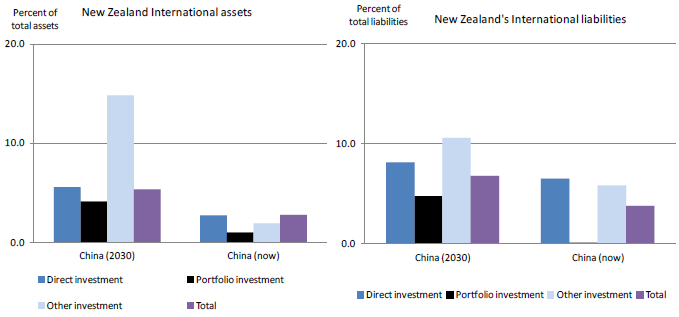
The author reports a scenario in which if China liberalizes its capital account the stock of Chinese investment in New Zealand and New Zealand investment in China would increase reasonably materially between now and 2030.

Here is the chart
staff-insight-dimaio-china-investment-02


Again, it cries out for more detail.  The broad direction of change looks plausible enough (as one scenario), but why (for example) would we expect to see such a huge increase in the “other investment” component of New Zealanders’ investments in China?  I presume there is a good reason, but it isn’t outlined here.  Overall, what is perhaps noteworthy is how small the net position vis-à-vis China remains: in 2030 New Zealanders’ liabilities to Chinese entities would be around 7 per cent of New Zealanders’ total external liabilities, and New Zealand entities’ claims on Chinese entities would be around 5.5 per cent of New Zealanders total offshore assets.

But it also isn’t clear what assumption the author is making about China’s own overall NIIP position.  He assumes New Zealand’s remains at around the current level which –  unsatisfactory as it for such a low productivity growth economy –  at least has the appeal of being the level around which it has fluctuated for the last 25 years or so.  But the authors –  and those he draws from –  appear to be optimistic on China’s ability to continue towards upper-middle income status (closing those gaps highlighted in this morning’s post) in a generally much freer economic environment.   But in such an environment it might not be unreasonable to expect to see China running material current account deficits for many years –  many successful emerging economies (including Singapore and Korea) did.   If so, we might still expect to see some gross outflows from individual Chinese people and firms, but it would be a quite different environment than the climate of the last decade or so, in which large current account surpluses and then large accumulated reserves made first for large official capital outflows, and more recently large private capital outflows.  I don’t know what the right answer is  –  and am probably more skeptical than the author on China’s future progress –  but his scenario probably doesn’t have much information in it without a lot more supporting detail.

Which does raise the worrying concern that the point of the blog piece might have been more about promoting a political message.  Following the scenario, the piece continues:

Foreign investment from (and into) China is likely to increase significantly over time. This could potentially take some time or might occur more rapidly and would contribute positively to New Zealand economic performance at the margin.  The maintenance of a stable and predictable business environment will be an important factor in ensuring that foreign investment flows from China benefit New Zealand.

Even the first claim is arguable –  as his chart shows, even countries like South Africa and Argentina (neither the most repressive nor the freest) have gross international assets and liabilities not much different than China’s level today.  But the second claim –  that this “would contribute positively to New Zealand economic performance at the margin” seems to built on not very much at all.  As I’ve said repeatedly, I’m generally supportive of a pretty open approach to foreign investment, but…..(a) di Maio’s scenario is built on the assumption that the net IIP position for New Zealand doesn’t change (as a share of GDP) so increased Chinese foreign investment largely (net) just replaces some other foreign investment, and (b) China is not an economy where market disciplines are consistently allowed to work, and as is well-recognized all major Chinese firms effectively operate within the limits set by the Party, and (c) China (and Chinese firms) have not shown the capacity to generate world-leading economic performance.  Against that backdrop (and without suggesting that Chinese investment should be restricted), there is likely to be much more open question about the benefits to New Zealand of increased Chinese investment than the author allows.  Curiously, he writes that “the maintenance of a stable and predictable business environment will be an important factor in ensuring that foreign investment flows from China benefit New Zealand”.  Actually, I’d have thought it was much more important that the business environment in China become more stable and predictable, governed by the rule of law amid secure property rights.  Then we really could be more confident that increased foreign investment would benefit both sides.  But I guess Treasury officials –  even speaking in a personal capacity –  probably couldn’t say that openly.

The final paragraph of the post also tilts towards advertorial,

Some specific investments have been taken that can smooth two-way investment flows between China and New Zealand.This includes negotiation of a swap agreement (RMB 25 billion / NZ$5 billion) between central banks to provide liquidity to support trading in RMB; (ii) the issuance of RMB denominated corporate debt by Fonterra; and (iii) the registration of three Chinese-owned banks in 2013 and 2014. That most of the increase will occur in portfolio and other investment flows suggests where attention might focus in the coming decade.

“Investments” is an odd choice of word, but even setting that to one side the argument seems a little flimsy.  The New Zealand dollar trades freely, and our central bank does not have (or need) swap agreements with the central banks of other countries with liberalised current accounts.  The RMB swap agreement, like those other countries have done with China, is best seen as a piece of political theatre –  not harmful, but of no real value to New Zealand in anything other than political terms either.  Similarly, the choice of a major corporate which has a very large investment in China to issue some RMB-denominated bonds also doesn’t look like an “investment”, or something that will “smooth two-way investment flows”, although the ability for Fonterra to issue those bonds might be a welcome reflection of China’s liberalization to date.  And finally, the choice of three government-controlled Chinese banks to set up here, doesn’t look like an “investment” either (at least not by New Zealand).  If anything, we should probably think of it as a new area of risk for New Zealand.  Government-owned or controlled banks have a bad record globally, often allocating credit in directions, or on a scale, not that conducive to economic stability or efficiency. It should also be a concern that all three banks are chaired by former National Party MPs, only one of whom has any past banking experience.  That choice by the Chinese shareholders suggests that they have imported their “connections” model of doing business to New Zealand.  One would hope that our political and official institutions are strong enough, that those connections really don’t matter, but it should be worrying trend, not a reassuring one.

And I’m left puzzling what the final sentence means.  Even if this (single) scenario were correct and there was the be a material increase in Chinese portfolio investment into New Zealand in the next decade, it isn’t obvious that that has any particular policy implications.  But perhaps I’m missing something obvious.

The Staff Insights blog series is an interesting new initiative. It is in the spirit of the generally quite open approach that Treasury takes to things (including the Official Information Act).  I will certainly keep an eye out for future releases in this series, but I suspect they still have some way to go in finding quite the right model for the sorts of material to present in it.
 

Outperforming cities…but not Auckland

My post the other day put the decline in Auckland’s GDP per capita (relative to that of the rest of the country) in some international context using BEA data on the average per capita GDP of various large US cities.  As one would have expected, the average per capita in the typical US large city had been rising a little faster than GDP in the US as a whole.

The US data are interesting, but the US is an extremely large country.  By contrast, in Europe that are lots of small countries, and (in particular) small countries with a single dominant city.  In that respect at least, European experiences might be more interesting to compare Auckland’s experience against.

Eurostat publishes a huge quantity of regional per capita nominal GDP data for the 28 EU member countries.  For a few (Malta, Luxembourg, and Cyprus) there wasn’t meaningful data distinguishing the performance of the biggest city from the rest of the country –  and in Luxembourg, the data are problematic anyway, since GDP captures economic activity occurring in a country, while many people who work in Luxembourg live in surrounding countries.  But that left 25 EU countries, and I went through the data to identify, as accurately as I could, the data for the metropolitan region capturing the largest city in each country.  Again, the data are likely to be only indicative –  in every metropolitan area, there will be some cases where people work in the area (so their output is in GDP) but live somewhere else (so the person isn’t in the population numbers for that region).

For a few large countries there is no single dominant city.  It isn’t an issue in the United Kingdom, France or Poland, where London, Paris and Warsaw respectively dominate,  But for Spain, Germany and Italy it is.  For illustrative purposes, I used data for Madrid, Hamburg, and Milan respectively.

Eurostat publishes data for 2000 to 2014, but for some cities the data are only available to 2013.   For each country, I took the average per capita income of the largest city and calculated that as a ratio of the whole country’s GDP.

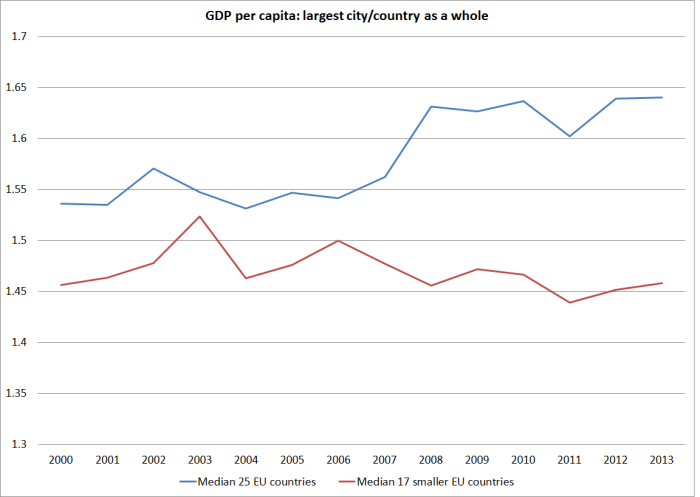
This chart shows the behavior over time in the ratio for the median country.  I’ve shown two lines: one for the 17 countries with populations less than around 10 million, and one for all 25 countries.

eu time series

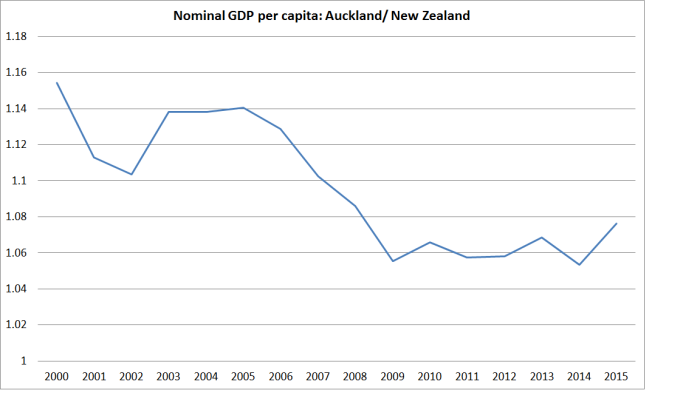
For all 25 countries, the median had increased over this period.  For the smaller countries, there been basically no change over the full period.  It is quite different from the picture for Auckland.

akld rel to nz gdp pc

I’m not sure why the smaller EU countries did less well on this measure than the full EU sample, but the smaller countries included the countries worst hit by the 2008/09 recession and the subsequent euro crisis.  There might be some cyclicality in the relative performance of the largest city does (doing really well in boom times, but suffering more than most in downturns –  we see a bit of this in Auckland, which feels the demand effects of fluctuations in migration more than most places).

Auckland’s average GDP per capita is higher than that in New Zealand as a whole (and around 12 per cent than that in the rest of New Zealand excluding Auckland), even if that gap has been closing.  But how does that levels gap compare?

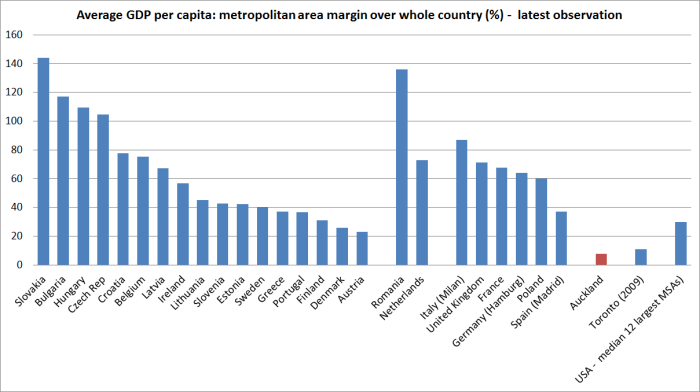
In this chart, I’ve shown the latest observations for how much higher (%) average per capita GDP is in the big city  than for the country as a whole for each of the EU country –  grouped by small, medium and large.  I’ve also shown the median for the twelve largest US MSAs (as per my post the other day), the Auckland numbers, and the experimental numbers for Toronto (from a Statistics Canada research paper) for 2009.

gdp pc cross EU city margins

A few things catch the eye.  The first is that, at least among the smaller EU countries, it is the ones which have been catching up where the cities are doing best relative to the rest of their respective countries (eg Slovakia, Bulgaria, Hungary, and the Czech Republic).  New Zealand was supposed to have been catching up, but hasn’t.

The second thing that catches the eye is just how low the margin between average Auckland incomes and those in the country as a whole is, by comparison with these other countries.

But the third thing that caught my eye, was that the Toronto wasn’t much different.  Toronto doesn’t dominate Canada in the way Auckland does New Zealand: Toronto’s population is only about 50 per cent larger than that of Montreal.    The Statistics Canada data are only experimental, and they provide estimates for only 2001, 2005 and 2009, but on those estimates both Toronto (in particular) and Montreal had seen a fall in their average per capita GDP relative to that in Canada as a whole.

These days, Canada has higher GDP per capita than New Zealand does (it was the other way round prior to World War Two), but Canada’s productivity growth in recent decades has been about as mediocre as that of New Zealand.  Canada has much larger industrial manufacturing sectors than New Zealand does –  much of it tied into the US automotive industry –  but at heart much of Canada’s prosperity continues to derive from the ability to utilize its vast natural resources.  It isn’t an economy whose prosperity seems to be led from its big cities –  any more than New Zealand is.    That said, Toronto –  in such close proximity to the US –  seems a much more likely place for successful global companies to base themselves long-term than Auckland.

Canada also operates large scale non-citizen immigration programmes –  indeed, the new Canadian government has just announced a material increase in the target rate of immigration (and an reorientation away from economic migration –  towards refugee and family). Without knowing more about the Canadian data, I’d be hesitant in drawing too many parallels –  and Canada has not faced the same real interest and real exchange rate challenges New Zealand has.

But at least for New Zealand the striking underperformance of our largest city should raise real questions about strategies designed to (or having the effect of) drawing more and more people into Auckland (from abroad –  New Zealanders aren’t being attracted), in a country where per capita prosperity seems to rest –  and seems likely to continue to rest –  on the ability of our people to utilize, ever more smartly, a largely fixed stock of natural resources.

NB: Note that the US figures are measures of real GDP, while for the other countries the data are nominal GDP.    For cities other than the US, this will probably have the effect of overstating the margins by which big city per capita GDP exceeds that in the rest of the country, since many prices (including for example housing services prices, but also labour-intensive services) will typically be higher in big cites than in the rest of the country.

Twenty companies manufacturing TVs

No, that isn’t a statistic from South Korea or China.  It is New Zealand in 1963.

My in-laws live in Waihi and whenever we are up there I point out to the children the old television factory, just off the main road, and give them a little reminder about the bad old days when New Zealand destroyed value by manufacturing and assembling television sets.  Somehow I must have been under the impression that there was just one television manufacturing factory in New Zealand.

But browsing in a second-hand bookshop the other day, I stumbled on Electric Household Durable Goods: Economic Aspects of their Manufacture in New Zealand, an NZIER Research Paper published in 1965.  There is 15o pages of analysis, statistics and discussion –  not everyone’s cup of tea, but I found it fascinating.

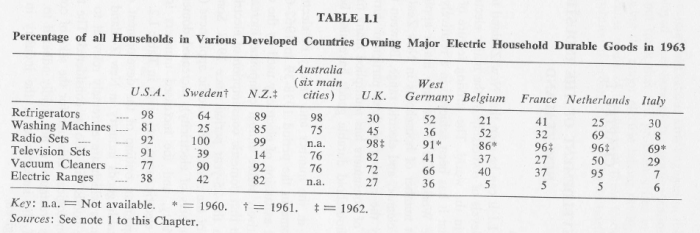
It doesn’t just have information on manufacturing.  There is an interesting reminder of just how many more electrical appliances New Zealand households back then had than their counterparts in other advanced countries.

durables

These sorts of international comparisons probably always have to be treated with some caution, but there is nothing very inconsistent with the data suggesting that at the time New Zealand still had among the highest real incomes per capita anywhere.   Actually, I was a little surprised there were quite so many consumer electrical goods here, since New Zealand had high protective barriers which meant many such things cost more here than in other advanced countries.  But, as the report notes, household electricity prices in New Zealand at the time were around half those in the United States and Australia, and around two-thirds of those in the United Kingdom.   A government commission of inquiry had recently noted that in most areas the price of domestic electricity was below the cost of production and transmission.

The domestic manufacturing of electric household durable goods was largely a result of the very heavy regime of import protection and controls put on from 1938 and kept in place, with varying degrees of intensity, for decades afterwards (that Waihi factory didn’t close until the mid 1980s).  As the NZIER piece notes

Before 1939, production of electric household durable goods in New Zealand, other than electric ranges and domestic radios, was practically non-existent.

Even for electric ranges, the report manages to cite statistics that over 80 per cent of those in use in 1939/40 had been imported.

The import controls which began in 1938 were precipitated by a foreign exchange crisis – which might well have led to a serious sovereign debt default if it had not been for the looming war –  but also reflected an active desire by the government of the day to promote domestic manufacturing (for a variety of reasons, including pessimism about the prospects for (and volatility of) agriculture, a desire for greater self-sufficiency, and so on).

In some sense it worked.  Many firms which had previously been importers and distributors turned to manufacturing.  The NZIER paper quotes from the company history of Fisher & Paykel –  a company established as importers and distributors.

The adoption by the Government in 1938 of a policy of controlling imports by licensing created an immediate problem for Fisher & Paykel Ltd,, as the company was trading principally in appliances imported from the USA. As dollar imports were even more restricted by the new system of import control than those from sterling sources, it became necessary to find alternative means of meeting a demand already barely filled and steadily increasing. The alternative was to produce the necessary appliances within the country, and so, in 1939, Fisher & Paykel entered the manufacturing field.

All sorts of New Zealand and foreign firms set up manufacturing operations here, producing all sort of products on a very small scale.  It individually rational, and often highly profitable, but wildly inefficient.  It took many decades to unwind.

But import licensing was considerably relaxed for a few years in the 1950s (although there were still typically tariff barriers), and there was a brief but substantial resurgence in imports of electrical household durables.  During the brief period of liberalization, annual imports of washing machines (for example) were ten times what they had been in the periods of heavy controls before and after.  Unsurprisingly, during that liberalization period there was some reduction in the number of domestic producers.

But when tight import controls were re-imposed in 1958, the whole focus on developing New Zealand industry was taken still further, with an emphasis on encouraging “manufacturing in depth”, and “since 1958 manufacturers in all industries have been encouraged to increase the ‘local content’ of their production”.

Television has been introduced into New Zealand since 1958 [experimental broadcasts only until 1960] and provides an excellent illustration of the policy in practice.  Not only is the supply of receivers to the New Zealand market the sole prerogative of New Zealand manufacturers, but the manufacture of television tubes and other components in New Zealand has been deliberately encouraged……..where manufacturers are allocated a licence to use overseas exchange which is not tied to any particular product (the so-called “pool” licensing system), it pays to take advantage of the facilities of as local supplier even if some cost disadvantage is incurred.

And thus it was that in 1963 “the number of firms engaged in the manufacture of [TV] receivers (20) constituted a record for the production of any electronic consumer good in New Zealand”.    The number of firms producing componentry is not listed.  The New Zealand Official Yearbook records that in 1963/64 there were 35 firms engaged in “radio and television assembly and manufacture”, producing 113904 TVs and 93676 radios.  The scale (or rather lack of it) is almost beyond belief  –  the average firms was producing just under 6000 units per annum.

Much of the focus of the NZIER is on the (in)efficiency of the New Zealand manufacturing operations.   The author went to some length to get good data, including from foreign firms with manufacturing operations here and abroad. They cite one example of a European manufacturer of radios (a sector where, they noted, the economies of scale were less than those for the production of televisions) who supplied data on the estimated costs of production for different size production runs.  That European manufacturer noted that they typically manufactured in Europe in production runs of 100000, but in New Zealand reasonably large firms typically did runs of around 5000 units.  The cost of production per unit on that scale was around twice that for the European-sized production runs (scaling up to runs of one million units was estimated to produce further per unit cost savings of less than 10 per cent).   Other estimates led the authors to conclude that New Zealand production was typically costing at least twice the “world” price.

The NZIER piece was primarily analytical and descriptive, rather than being policy-focused.  But the author, rather drily, concludes:

If the cost of producing radio and television sets in New Zealand are likely to remain 100 per cent above costs of production in large industrial countries (and on the basis of the evidence presented in chapter VI this is a generous assessment of the higher costs of production in New Zealand) then it is a valid question as to whether the capital and labour now engaged in this industry could not be employed elsewhere to the greater national benefit.

Indeed.

Such staggeringly wasteful economic policies for so long.

(And since we have only continued to lose a little more ground relative to other countries since these particular policies were scrapped, one might hypothesise some ongoing policy problems.  But that isn’t for today’s post.)

(And for anyone wanting a slightly caricatured sense of how things were, I recall this Alan Gibbs speech on New Zealand assembling television sets)


Looking to the FSR

This Wednesday brings the release of the latest Reserve Bank Financial Stability Report.  With pre-release lock-ups having (appropriately) been discontinued, the Governor’s press conference will, for the first time, occur an hour or two after the release.  That will mean that journalists will have had a chance to talk to analysts and industry representatives before questioning the Governor.  In principle, that should make for some more searching questioning and scrutiny.

Presumably the document will focus on the two main areas of credit exposure in the New Zealand financial system: dairy, and housing.

It isn’t that long since the Bank released the write-up of the dairy stress test it did with the major rural lending banks last year.  I thought that write-up was a bit too optimistic  – in particular, it was based on a stress test assuming a fall in dairy farm prices much less than the fall in Auckland house prices that they had assumed in their earlier housing shock stress test – but I don’t see any reason to change my view that the dairy book does not represent a systemic threat to the soundness of the New Zealand banking system.  It would be good to see a discussion this time based on some less positive scenarios, (and hopefully without the Governor taking on the mantle of a politician in trying to offer guidance to –  or exert moral suasion on –  banks as to how they should deal with farmer clients).

But most interest is likely to centre on the Bank’s discussion of the housing market, any resulting risks it sees to the health of the financial system, and whether the Bank is planning to devise yet more direct regulatory controls on banks’ housing lending activities.

On the policy front, the best thing they could do would be to simply abolish the various LVR restrictions puts in place over the last three years.  Those restrictions were ad hoc, ill-grounded, intrusive, and unnecessary.  If the Reserve Bank has concerns about the ability of the banks to withstand severe adverse shocks –  and if they do, those concerns have not been laid out in public backed by robust analysis – it is free to propose, and consult on, requirements for banks to fund a larger share of their assets from capital rather than deposits.  Capital requirements are less costly, less intrusive, and require considerably less knowledge by offficials.

Of course, the Reserve Bank won’t be lifting the restrictions, and the real interest seems to be whether the tentacles of this one-man branch of the administrative state will extend even further into the business operations of private companies (and their customers). Will LVR limits be further refined, and extended?  And will the Bank decide to try (consulting on) limits on the debt to income ratios of borrowers?

Consistent clear communication has not been the Governor’s strong point, so in a sense it is anyone’s guess.    The Reserve Bank does have a non-binding Memorandum of Understanding with the Minister of Finance on (so-called) macro-prudential policy.  In that document, the Bank undertakes that

The Bank will consult with the Minister and the Treasury from the point where macro-prudential intervention is under active consideration, and will inform the Minister and the Treasury prior to making any decision on deployment of a macro-prudential policy instrument.

We have heard noises from the Prime Minister about possible land taxes, but nothing about new banking regulatory controls.  And, although the document is non-binding, limits on debt to income ratios are not, at present, included in the MOU’s list of possible instruments “considered useful in the New Zealand context”.   That said, debt to income limits were preferred by The Treasury to the Auckland investor LVR restrictions imposed last year.

If the Reserve Bank is going to propose yet more new controls, one can only hope that the rationale, and supporting analysis, will be done to much higher and more demanding standard than what was offered in 2013 when LVR limits were first imposed, or last year when the investor restrictions were introduced, and the regional differentiation of LVR limits was imposed.  One of the things I pointed out then was how little research the Reserve Bank seemed to be doing, or publishing, in support of its new enthusiasm for direct controls on the banking system.  That doesn’t seem to have changed.

There has not, for example, been a single Discussion Paper, Analytical Note, or Bulletin in the last 18 months on the efficiency of the financial system and the way regulatory imposts affect efficiency, or any cross-country research evidence on what marks out financial systems that have had domestic financial crises from those which have not.    No more has been heard recently of the loose comparisons they attempted to draw last year between New Zealand and the experience in Ireland and the United States, but instead of replacing those comparisons with more in-depth research and analysis there has just been silence.    Given (a) the scale and nature of the Bank’s regulatory interventions and inclinations, (b) the potential size of the risks, and (c) the significant research resources they have been funded for, that silence doesn’t seem very satisfactory.

It would, for example, still be good to know whether the Bank has been able to identify any examples of countries with banking systems which have come under severe stress from housing lending when

(a) there is little of no direct government intervention in housing finance,

(b) when debt to income ratios have been little changed from those over the previous decade, and

(c) in a floating exchange rate country.

As the Bank has noted previously, vanilla housing loans have rarely, if ever, been at the heart of a systemic financial crisis.  For all the worries about Ireland, for example, the problems there were mostly those of speculative building (commercial property in particular, but also residential), and a monetary system that meant interest rates were set for German and French conditions, not those in Ireland itself.

The Reserve Bank Act sets out the bare minimum of what Financial Stability Reports must contain

A financial stability report must—

a)  report on the soundness and efficiency of the financial system and other matters associated with the Bank’s statutory prudential purposes; and
(b) contain the information necessary to allow an assessment to be made of the activities undertaken by the Bank to achieve its statutory prudential purposes under this Act and any other enactment

Typically FSRs have not done the basics well.  The Reserve Bank might prefer that “efficiency” did not feature so much in the various bits of legislation it is responsible for, but Parliament has chosen otherwise.  And yet the reporting on the efficiency implications of regulatory policy has typically been quite weak –  and there has been no research the Bank has done to draw on or refer to.  In one sense, it may not have mattered much when the Bank’s policy approach was fairly non-intrusive.  But the current Governor clearly believes he is better able to determine the structure of banks’ loan portfolios than they are.  However, he has offered no analysis of the efficiency implications of his choices, or even a discussion of how best to think about the issue.

It is now almost three years since the first LVR limits were announced.    Surely we should also be expecting to see some good empirical analysis of what impact those restrictions have had?  And not just on the things the Governor cares about –  house prices and financial stability –  but the side-effects and distributional implications that got so little attention in the regulatory impact assessment the Bank prepared when it imposed the policy.    The investor finance restrictions are newer, so it will be hard to provide much concrete analysis of the impact just yet, but the Act requires them to make the effort.   Of course, it isn’t enough simply to say ‘house prices are materially higher than they were when the regulatory restrictions were imposed’  but citizens might reasonably ask what useful impact these intrusive new controls –  imposed on the whim of one unelected individual –  have had?  And how, for example, does the Bank think banks themselves have responded?  Since the banks are profit-maximizing entities, and the Reserve Bank has constrained one line of business, where have banks sought profits instead?  And can we be confident that even if the level of risk in the directly-constrained books has been reduced slightly, that the restrictions have made any difference to the overall riskiness of the banks, and the system?

There may well be good answers to these questions, but so far there has been little sign of the Reserve Bank providing the analysis that would enable us to be comfortable.  And recall that providing the material necessary to allow readers to assess the Bank’s regulatory activities is not an optional extra, but a statutory requirement.

Of course, to make the point is also to recognize how weak the system actually is for promoting effective accountability:

  • The Governor personally decides on all the regulatory measures, and is also personally responsible for the contents of the FSR.  It isn’t plausible to expect that FSRs will ever contain anything suggesting doubts about choices a Governor has made, and it is unlikely that they will ever contain a balanced and comprehensive set of material allowing readers to draw their own conclusions. The Act describes the FSR as an accountability document.  In fact, it is better seen as a marketing document.
  • The Bank’s Board has some responsibility for scrutinizing the Governor, including around FSRs.  But the Board has limited resources, is too close to management, and has a track record of seeing its role as being to provide cover for the Governor, and to assist the Bank in its outreach activities (see last year’s Annual Report).  The Minister’s recent letter of expectations, which explicitly asked  the Board about the balance between soundness and efficiency may help a little, but it is going to be difficult for the Board to ever adopt anything other than a pro-management perspective.
  • Parliament’s Finance and Expenditure Committee has limited resources for scrutiny.

There is never going to be perfect scrutiny or accountability, and being a small country brings inevitable resource constraints.  But there are some possible institutional improvements.  For example, a separation of the role of chief executive of the institution from that of policy decision-making would be a step in the right direction.  And I’ve argued previously that there is a case for something like a Macroeconomic Policy Council, a small body that would have responsibility for undertaking or commissioning independent reports on aspects of the conduct of fiscal analysis and policy, monetary analysis and policy, and financial regulatory policy.  Operating at arms-length from the Reserve Bank and Treasury, such a body would contribute to a better quality debate on policy issues in these areas, and help provide the assurance to citizens, and MPs, that the quality of policy, and of supporting policy analysis and advice, was running consistent up to the sort of standard we should expect.  Our current system puts too much legislative weight on self-assessments (in the case of the Bank, both for MPSs and FSRs).  They typically don’t happen to any great extent at present, and it is probably unrealistic to think that institutional incentives will ever allow them to happen in a way that offers much genuine insight on policy choices and analysis, and certainly not when the results might be awkward for the institution and individuals publishing the self-assessment.  If we are serious about scrutinizing powerful unelected individuals wielding huge discretionary powers, which we should be, that really needs to change.

By the way, it is worth remembering when the FSR comes out that the Reserve Bank has no statutory responsibility for the housing market.  It has just two main roles:

  • maintaining a stable general level of prices, and
  • using its various regulatory powers to promote the soundness and efficiency of the financial system.

Dysfunctional housing markets are a matter for elected national and local government politicians.


A belated price for the OCR leak

More than three weeks after the Reserve Bank released the results of its OCR leak inquiry comes news that the Bank has finally taken some specific action against MediaWorks, the media group responsible for the leak.  We learn today –  although not via a open release from the Bank –  that representatives

“from Mediaworks news outlets are excluded from Reserve Bank media conferences until further notice”

In the Reserve Bank’s release on 14 April there was no hint of any specific sanctions for MediaWorks.  Instead, taking the opportunity to tar junior staff (and me), the Governor lauded MediaWorks management, noting that:

Deloitte was assisted in its investigation by Mediaworks’ legal team, who undertook an internal investigation, uncovered emails that confirmed the leak, and reported these to Deloitte.

The leak prompted the Reserve Bank (quite appropriately) to discontinue lock-ups for media and market analysts, but to the extent that was a penalty it was one imposed on all those who had previously participated (and was, perhaps, a greater burden on some of the more specialist entities).

Unfortunately for the Reserve Bank, it quickly became clear, upon reading the Deloitte report, that MediaWorks management must in fact not have been terribly helpful, at least until very late in the piece.

It is possible that MediaWorks senior management, including the former chief executive Mark Weldon, was not aware there was even an issue until 21 March.  The leak had occurred on 10 March, and although I drew attention to it that day (both directly to the Bank and, later, on a post here), it only got attention and coverage in the mainstream media on 21 March.    But at that point it got considerable coverage, and there is no way the senior management of a major media organization, with their own corporate Group Head of Communications, could not have been aware there had been a leak.  At that point, it would presumably have taken no more than an hour to have had the internal IT people check the emails of the MediaWorks staff in the lockup (even if they had no knowledge or suspicion of their own organization’s involvement, just to be on the safe side). That would have confirmed that MediaWorks was the organization responsible.

At that point, as the Deloitte team was (by their own account) only just turning their attention to media outlets as the possible source of the (then) possible leak, MediaWorks could have come forward and alerted the Reserve Bank to their responsibility.   That would have looked like full and early cooperation.  Even better, they could have pro-actively told the Bank, and Deloitte, how long this practice, of journalists emailing draft stories back to the office from the lock-up, had been going on.  There is no suggestion in the Deloitte report that what happened was just an accident (someone hit the wrong key on their laptop).

In fact, the Deloitte report makes it clear that MediaWorks did not approach either them or the Reserve Bank until 5 April, more than two weeks later, and then only when the Deloitte team sought meetings with each media person who had been in the lock-up.  At that point, presumably, the staff concerned and their managers left senior management with little option.

It isn’t really that clear why the Reserve Bank gave so much cover to MediaWorks in their 14 April statement.  A simple statement that MediaWorks had not approached the Reserve Bank until more than three weeks after the leak had occurred would have been considerably more appropriate than the positive statement on the role of the MediaWorks legal team. They were, no doubt, working largely to protect the interests of their own organization –  an organization which has been notably unforthcoming in answering questions about just really went on, who had sanctioned these breaches of the lock-up rules etc.

I suspect the answer to my question has something to do with the Reserve Bank’s desire to play down the whole episode.  Their systems were shown to have been very weak, and totally reliant on trust. It took no sophisticated signaling techniques for this leak to occur –  just clicking Send on an email.    Systems that might have reasonably robust 20 years ago –  when lock-ups were more useful, because ordinary readers couldn’t simply download the MPS at 9am and read for themselves what the Bank had to say –  simply hadn’t kept up.  The Bank has accepted no responsibility for that, or released any internal reviews it has undertaken as to how such vulnerabilities were allowed to arise.

But the inquiry also raised some questions about just how seriously the Reserve Bank itself had taken the issue in the first place.  Had they really taken seriously the possibility of a leak they could have taken action on 10 March.  I had suggested to them that morning that they focus on media outlets.  It wouldn’t have taken much effort for the Bank – Governor and Deputy Governors – to have rung the heads of each media organization in the lock-up  (I’m not sure how many that would be, but I’m assuming no more than 20) and asked them to (a) check emails of all of their staff who had been in the lock-up, and (b) arrange for signed statements to be prepared by all those in the lock-up swearing that they had not been responsible.  Had there in fact not been a leak (and the Reserve Bank couldn’t be sure then) it wouldn’t have cost much.  As it was, it surely would have identified the culprits within hours.    Instead, we learn that the Deloitte inquiry did not focus on media until after they met me on 18 March –  more than a week later –  and as late as 21 March the Bank was on record as talking only of “allegations” of a leak.

To be frank, given the Bank’s general attitude to me, and their unease about the issues I have been raising, and the questions I’ve been posing, I can understand why they might have been a little wary.  But the fact remains that, for all the Governor’s huffing and puffing about whether I told them what I knew at 8:30 or 9:08, they don’t seem to have done much with the information for several days at least.  And when they finally did discover the truth they appear to have been at pains to help protect MediaWorks’ corporate image.   There are still unanswered questions about whether MediaWorks was shown the draft Deloittle report, and whether it was given the chance to comment on the Reserve Bank’s press release in draft.

But this all brings us back to the question as to what has changed now (other than the CEO of MediaWorks).  Banning MediaWorks from Reserve Bank media conferences for a time seems like a reasonable sanction, but why wasn’t it done three weeks ago?  Since the Governor never acknowledges mistakes, and rarely makes himself available for interviews, perhaps we’ll never know. Then again, perhaps someone will ask at the FSR press conference next week.  They might also ask what “until further notice” means.  What are the conditions that MediaWorks has to meet?  Such an indefinite suspension seems unwise, and could give rise to speculation that the suspension might be lifted if MediaWorks outlets were seen to be covering the Bank in a not-unfavourable light.  Better, probably, to have banned them for three or six months, and then put the matter behind them.  And if the conditions for lifting the suspension don’t relate to the tone of the coverage of the Reserve Bank, do they relate to getting fuller and more complete answers from the new management about just what had been going on?  That might not be an unreasonable stance to have taken, but the Bank should be upfront about it.  As it is, we were left with the impression on 14 April that the matter was over as far as the Bank was concerned.

There is still a series of questions outstanding for both the Reserve Bank and MediaWorks.  Those for the Reserve Bank concern me most, because the Bank is a powerful public sector organization, which really should be much more upfront with the public when things go wrong (as inevitably occasionally they will).  I hope that some light will be shed on some of those questions when a series of Official Information Act and Privacy Act requests I have lodged with the Bank (and its Board) are answered.  Those answers are due in a couple of weeks, and I suspect that the Reserve Bank will delay responding just as long as it possibly can.

UPDATE: The question of why the Reserve Bank provided such cover to MediaWorks is deepened if this piece by John Drinnan is accurate.

The report talks about workers, but I understand senior news staff received the leak. I spoke to a Bank spokesman at the time the Bank stopped lockups, and it was unhappy about the way it was dealt with.

If the Bank was really unhappy, why imply otherwise, commending the assistance of MediaWorks?


Appointing a central bank Governor

I commented yesterday on the unusually powerful role the Reserve Bank of New Zealand’s Board plays in determining who will be appointed as the Governor.  The Minister finally makes the appointment, but he can only appoint someone the Board recommends.   And the influence  of Board members is multiplied because the Governor of the Reserve Bank of New Zealand exercises an unusually large degree of power.

In New Zealand, the Governor is single (legal) decision-maker (and recently provided a written reaffirmation of that position as practice as well as law). And the Bank exercises power not just over monetary policy, but over a raft of regulatory policy matters (as well as the administration of supervision) in respect of banks, non-banks, and insurance companies, and a variety of other generally less contentious discretionary functions (notes and coins, foreign exchange intervention, payments system, and the operations of the key securities settlement system).  And in many areas the Reserve Bank’s legislation is quite permissive, leaving considerable policy discretion to the person who happens to be Governor (LVR limits –  whether or not to have them, and how they should be used –  is one recent example).  Even in respect of monetary policy, as have seen in the last few years, the Policy Targets Agreement (inevitably and probably sensibly) leaves plenty of room for interpretation.

So who gets appointed to the position matters a lot.  That person, while no doubt in receipt of lots of advice, will have considerable discretionary influence in many areas.   They aren’t just technocratic judgements either.  Reasonable people will have quite different views on appropriate policy in a lot of these areas, partly reflecting differences in what weights they put on different considerations and values (fluctuation in unemployment vs swings in house prices, say).     And they are typically areas in which there are either no rights of appeal, or where the courts have been very reluctant to second-guess decisions of executive officials.  Unlike, say, the Minister of Finance, the Governor does not typically require new legislation or parliamentary approvals (Budgets mean nothing without securing supply in Parliament, and public money can’t be spent without parliamentary appropriations), and doesn’t even have to front up to question time in Parliament each day.   In formal legal terms, the Governor is not even subject to parliamentary control on the level, let alone the composition, of the Bank’s expenditure.

So the ability to determine who gets this role is extraordinarily influential.    But this power rests not with the Prime Minister, not with the Minister of Finance, not with the Governor-General, but with half a dozen low profile individuals, themselves appointed by the Minister of Finance but for five year terms (in a system with three year parliamentary terms).  These people operate in secret –   past Annual Reports have been bland exercises in supporting whoever the incumbent Governor is –  and face no parliamentary scrutiny either when they are appointed or, generally, at any time during their term.

Who are these people?

The current non-executive directors (plus the Governor who is also a director) are:

Rod Carr

Bridget Coates

Neil Quigley

Jonathan Ross

Tania Simpson

Keith Taylor

Kerrin Vautier

Mostly company directors, a couple of former senior finance sector executives, a couple of (mostly micro) economists, a couple of university administrators, and a lawyer.  I’m sure they are all fairly able people in their own fields, but why would we delegate to those people in particular the ability to determine who will exercise that huge discretionary power the Governor has.  I’m not aware that any of them has ever stood for, or been elected to, public office, and we know little of their preferences or views on the sorts of issue whoever is Governor will get to decide.  But those preferences (explicit or not) will almost certainly influence the sort of person they put forward.  When I worked at Treasury I helped provide advice to the Minister on possible Board candidates –  including some of those now on the Board –  but we never looked into the questions of Board members’ policy preferences.  The focus was typically on a range of experiences and skills to help do the ongoing monitoring role.  But in fact the power to determine who (and what sort of person) is appointed Governor is probably where the Board members have most influence, and the least scrutiny.

I’m not suggesting that they exercise that power carelessly.  Or that they are necessarily blind to the political environment.  Since the current Act was put in place, the Board has chosen two Governors (Don Brash was already in place when the Act was passed, and reappointments are a somewhat different matter).

There was quite a strong sense of political involvement in the process after Don Brash left in 2002. The then Prime Minister was furious with the Board for having allowed the Governor to be employed on conditions that allowed him to go straight from running the central bank one day to active party politics the next.  And word was also understood to have come down that the government would not be receptive to the nomination of a “Brash clone”, widely regarded as anyone who had been in senior management under Don Brash.   But my sense (I was second tier manager at the time) was that the Board played the process fairly straight.  They employed an executive search firm –  but I’m not sure how much effort the recruiters would have put into understanding the policy preferences and inclinations of candidates.  I understand that at the final interview stage it was a choice between Rod Carr (Deputy  –  and then acting –  Governor), Murray Sherwin, Deputy Governor until quite recently, and Alan Bollard.  People can debate whether Alan was really the best pick but all three were serious credible candidates.

In 2012, again an executive search firm was used.  I understand that the choice quickly resolved to one between the longstanding incumbent Deputy Governor, Grant Spencer, and Graeme Wheeler, with the suggestion that Board members were quickly wowed by Wheeler’s experience in international bureaucracies, and the big name referees he cited.  Again, on paper both candidates looked quite impressive, but I wonder how much effort the Board put into understanding and assessing the candidates’ policy preferences and inclinations.  And, of course, even if they had made time to, what qualified the Board members to assess those –  innately “political” – preferences and determine which set was, in some sense, “best”?  That, surely, is what we have politicians to do.

If the Board doesn’t do it, and the Minister can at no point impose his own candidate, then what we end up with is either a candidate who accords with the implicit (often unstated and perhaps unrecognized) biases, preferences, and interests of Board members, or something more random.  A person might be chosen because they are thought to be, say, a good manager, and/or, have some familiarity with macroeconomics and finances.  But what they might do with the considerable powers they are to be given is simply unknown –  even to the Board.  That simply isn’t good public policy governance.

I’m also not suggesting that if in 2002 and 2012 the appointment of the Governor had been solely in the hands of the Minister of Finance we would necessarily have had different people appointed.  Bollard and Wheeler both looked like establishment candidates when they were appointed,  As I noted, the Labour government in 2002 was pretty clear it didn’t want Brash people, and Alan Bollard’s give-growth-a-chance mentality (in contrast to perceptions of “crush growth Brash”), if it had ever been enunciated, would probably have resonated with Michael Cullen and Helen Clark.  And Bill English was known to have been keen to find a place back in New Zealand for Graeme Wheeler.  But those decisions really should have been in the hands of somone the voters could toss out, not a bunch of fairly anonymous Board appointees, who often enough will have been appointed by the previous government.

I can think of no other powerful independent office holders which are appointed, in effect, by unelected unscrutinised people.  The State Services Commissioner appoints head of core government departments, but those department heads typically have little or no policy flexibility –  policy is set by ministers, and departments advise and administer.  The State Services Commissioner himself is, in effect, appointed by the Prime Minister, as is the Police Commissioner. Judges are appointed by the Governor General, on  the recommendation of the Attorney General. The Chief Electoral Officer is appointed by the Governor General on the recommendation of Parliament, as is the Ombudsman. The Governor General is appointed on the advice of the Prime Minister.   And all boards of decision-making Crown entities (eg FMA, NZQA, TEC, EQC) are appointed by ministers (those Boards in turn employ chief executives, but the power rests with the Board, not with the CE.)

There is simply nothing comparable in New Zealand to the situation of the Reserve Bank in  (a) the extent of policy discretion held by an unelected official, and (b) the extent to which other unelected officials control the appointment of the person (the Governor) exercising that discretion.   It is a reach too far –  too much distance between those we elect, and the person exercising the (considerable) discretionary powers.  Perhaps it might matter a little less if these were decision-making committees being appointed (as is typical with central bank), but in this case it is one man –  and any one person while have his or her own biases, preferences, idiosyncrasies and flaw.

What happens abroad?  Well, typically the head of the central bank is appointed directly by politicians, most commonly the Minister of Finance or President. With a bit of help, I found a handful of countries where the appointment is subject to parliamentary ratification (the US is the most obvious example, but it is also the case in Japan, and in several emerging economies).  The Reserve Bank had an article not long ago on some of these issues, including a useful table on appointment arrangements etc ( I had editorial responsibility for the article, but have just noticed an error, in that the Japanese requirement for parliamentary ratification was somehow overlooked).

But what about cases at the other end of the spectrum?

In Sweden, the Governor (and other monetary policy decision-makers) are appointed by the General Council.  That might sound a bit like our Board, but it isn’t.  It is a parliamentary committee, appointed by MPs from their number, after each election, in proportion to the various parties’ representation in Parliament.  The Minister of Finance doesn’t get to appoint the decision-makers, but elected politicians certainly do.   (Note in Sweden the central bank has much less discretionary power than our Reserve Bank has, as it is ot responsible for banking regulation and supervision).

The closest parallel to the New Zealand arrangement is Canada.  The Bank of Canada also has, in law, a single decision-maker, the only other advanced country central bank to have such a model.  The Governor is appointed by the Board, with the consent of the Minister (in substance the same approach as in New Zealand). One difference from the New Zealand system is that members of the Board in Canada are appointed for three year terms (rather than five years in New Zealand) in a parliamentary system in which elections typically occur every four years (rather than three years in New Zealand).  It is also worth noting that in Canada the Secretary to the Treasury sits as a non-voting member of the Board, and that the Bank of Canada also has little or no responsibility for supervisory/regulatory matters.

My point is not that there are no parallels with the New Zealand model –  Canada, with quite old legislation and a much narrower range of responsibilities, is strikingly similar,  But our model remains quite unusual, and seems to leave a rather large democratic legitimacy gap: there is much more effective discretion for central bankers than was realized when the law was passed in 1989, few other central bank decisionmakers are appointed this way, and there is nothing remotely comparable in how we appoint key decisionmakers is other areas of the New Zealand government and public sector.

I suggested yesterday that at very least the Reserve Bank Act should be amended to provide simply for the Governor to be appointed by the Minister, taking advice and nominations from anyone the Minister chooses.  I also suggested the idea of parliamentary select committees hearing before any new Governor takes office, along the lines of the model now quite successfully used in the United Kingdom.  We don’t have a constitutional system of parliamentary ratification of appointments, or indeed for Parliament to be directly involved in making appointments (with the except of the important deliberately non-partisan positions such as the Ombudsman or the Chief Electoral Officer).  Perhaps one could argue that the Governor has so much power an exception should be made for his position, but I wouldn’t go that far.

As I noted yesterday, our FEC is less likely to do the scrutiny job well than, say, the House of Commons Treasury select committee does.  Able government members very quickly become ministers, and the ones who aren’t yet want to be soon.  Rocking the boat by openly asking hard questions of a ministerial appointee-designate probably isn’t particularly rewarded.  And, unlike the UK, we don’t have much a hinterland of able former ministers from the governing party who stay on in Parliament, and are often willing  –  and better positioned – to pose those sorts of questions.   Our select committees also simply aren’t well-resourced.  But FEC hearings would be better than the situation we have at present, and not being tied to actual MPS or FSR announcements (which are what Governors mostly front up to FEC for), the process might encourage more serious questioning.

(A reader got in touch to suggest something beyond FEC hearings: perhaps a debate in Parliament itself on the appointment, with the whips off.  That just seems too out of step with our system of government for me.  Apart from anything else, the policy inclinations and character of a person appointed to have big discretionary influence over monetary and financial policy doesn’t seem like the sort of area one would want to remove party discipline for. A Minister of Finance might reasonably tolerate his MPs grilling a Governor-designate in a select committee, but should be able to expect his party to ultimately support his appointee to such an important position. )

The Governor of the central bank is a position unlike the Ombudsman, the Chief Electoral Officer, or the Auditor General.  Those positions really need to be non-partisan in nature, since they are focused on the process of our democracy.   The Governor, by contrast, exercises considerably discretionary power, and it is the nature of things that there will be differences, often along partisan lines, in how the Governor should exercise that power.  There is a case for some specific policy decisions of the Governor to be at arms-length from the government of the day, but there is strong public interest in understanding the inclinations and preferences of the person appointed to the role.  Hard questioning of anyone appointed to a position wielding considerable discretionary power is likely to make for a better functioning system of government.  And sheeting home responsibility for those appointments to politicians whom we can turf out, rather than to little known appointees who owe citizens little and over whom we have little leverage, is perhaps even more fundamental.

The system of appointing the Governor really needs to change.


Lessons from the losers: Reflections on (Struan) Little

As I noted a few weeks ago, about fifteen years ago Struan Little, then at The Treasury, sparked my interest in Uruguay, and comparisons between its long-run economic performance and that of New Zealand.  When I wrote that earlier post, I searched around to see if anything Struan had written on New Zealand’s economic performance was on the web.    Nothing was now, but it became clear that something had been.  Various old articles (eg here) referred to a paper released at the end of 2001 by Treasury, drawing “lessons from the losers” –  other reasonably advanced. reasonably democratic, countries, or regions, with some similarities to New Zealand, which had also done poorly.   The paper had even been cited by the IMF in one of their Article IV reviews of New Zealand.

The author no longer had a copy of the paper, but fortunately Treasury was able to track it down for me.  The OIA response should be on their website before too long, but in the meantime here is the document itself, “Growth and Policy in other countries: lessons from the losers”, dated 31 October 2001.

Lessons from the Losers by Struan Little

As Treasury is at pains to note, this was a personal thinkpiece, and although it was publicly released back in 2001 to influence debate and discussion, it was never finalized.  It isn’t a long paper (12 pages of text), so couldn’t cover everything, or document every caveat or qualification, but papers like this help us see the issues in slightly different ways.  It is to Treasury’s credit that they made space for the work to be done, and then put it out proactively for discussion.

In his stimulating paper, Little thinks about New Zealand’s experience in light of  eight comparators, four of which he saw as having had a “disappointing economic performance over a long period of time”

  • Uruguay
  • Switzerland
  • Tasmania
  • Atlantic provinces of Canada

And four of which “have gone through very difficult periods but moved on to become some of the richest economies in the OECD”

  • Denmark
  • Finland
  • Iceland
  • Ireland

The inclusion of Switzerland might surprise some, since it is –  and consistently has been –  one of richest countries in the world.  But its productivity growth had been strikingly weak over several decades.  Overall, it is a fascinating alternative lens to look at New Zealand’s experience through  – a contrast to, say, simply looking at the US or the UK, or even the OECD as a whole.

To structure his discussion, Little drew seven “broad lessons”

  1. Losers can’t be saved.    He isn’t quite as pessimistic as this sounds but observes “once you are gifted with the “loser economy” tag, there is no single policy (or even groups of policies) that can easily reverse this decline”.
  2. Don’t just blame size and distance.
  3. We spend a lot on education and training but do we get results?
  4. Technology-Driven Productivity Growth Went Out with the Tech Bubble. NZ firms don’t do much (that is classified as) R&D spending, but “the links between R&D and economic success are not clear”.
  5. You are either on the internationalization bus or plugging through the mud. NZers attitudes to internationalization weren’t very positive, and the volatility of the real exchange rate had been a problem, holding back our tradables sector/
  6. Social consensus matters
  7. Are individual interventions effective?
    • Size of government doesn’t matter
    • Centralisation isn’t all bad
    • FDI can help
    • Public infrastructure investment can be a waste of money

His own view, in conclusion, was that three policy areas were paramount for New Zealand, if it was to sustain a higher growth rate in future

  • Sound and stable macro policies, with a particular emphasis on a less volatile real exchange rate.
  • A shared social vision as to New Zealand’s future
  • Greater internationalization (changing attitudes, more emphasis on trade agreements, and “perhaps greater assistance to exporters”.

Any 15 year old paper on a topic of this sort is going to read a bit oddly in places –  at the time, for example, Italy was cited as an example of a notably successful economy (unfortunately it has had no per capita growth at all since then).  And although all of his four success stories remain much richer than New Zealand, each has had a new very rocky time in the last decade or so.

And whatever any author writes on a topic like this is going to be partly a product of his/her experiences and context.  2001 was two years into the first term of the Labour government, and I suspect Michael Cullen would not have been unreceptive to many of the sorts of messages in this note (which is perhaps why Treasury was able to publish it).

But I wanted to comment on one of the strands of policy Struan emphasizes, and then highlight a few that I was interested to find no mention of (perhaps partly reflecting the fact that today’s context is different to his).  And then offer a few thoughts on whether “losers’ can be saved.

The first is the volatility of the real exchange rate.  Little notes the materially greater volatility of New Zealand’s real exchange rate than those of Denmark, Iceland, Finland, and Ireland and observes:

“I see this as one of the key reasons why our export performance has been relatively weak compared to more successful economies.  While more extreme than New Zealand, the experience of Uruguay and the Southern Cone countries shows than an upward appreciation of the real exchange rate can undermine a reform programme and prevent a country from getting out of a low growth trap……..I would hope that improvements in our monetary framework may resolve the real exchange rate issue.”

What was the context?  We had had a relatively volatile real exchange rate in fifteen years since the exchange rate had been floated.  In 2001 the real exchange rate was actually very low –  only just off its all-time lows –  but there had been a lot of recent focus on the conduct of monetary policy.  In fact, Struan and I had been the bulk of the secretariat to Lars Svensson’s review of New Zealand’s monetary policy arrangements, which had been commissioned by the incoming Labour government –  concerned about the exchange rate, and disconcerted by things like the Bank’s unfortunate Monetary Conditions Index experiment.  That inquiry had reported earlier in 2001.

The Reserve Bank has always cautioned against emphasizing the volatility of the real exchange rate as a factor in New Zealand’s economic underperformance. As various people have noted, our real exchange rate is not extraordinarily volatile by advanced country standards –  which sample you compare it with matters a lot –  and much of the volatility reflects the real and financial external shocks the country faces. I largely agree with the Bank’s perspective on this issue –  and it isn’t obvious that much could be done to attenuate the big cycles in the real exchange rate anyway –  but we need to be open to the possibility that the impact is greater than we realise (if, eg, fluctuations in commodity prices contribute directly to exchange rate fluctuations, making it very difficult for other industries to successfully emerge and compete internationally).  But changing the details of the monetary policy framework isn’t likely to make much difference –  we’ve been through a wide variety of regimes over the decades, and had quite big real exchange rate fluctuations in each of them.

I’ve been more concerned about the average level of the real exchange rate.  Right from the early days of the reforms, experts (themselves supportive of the reform programme) have emphasized the importance of a lower real exchange rate as part of a path towards rebalancing the economy and establishing a stronger growth trajectory.  It was the Reserve Bank and Treasury view as far back as 1985.  Leading international scholars like Anne Krueger and Sebastian Edwards re-emphasized it –  partly in reference to the Latin American experience Little alludes to in the quote above.   It isn’t a line that is so widely heard in the mainstream these days, but the failure to achieve any per capita growth in New Zealand’s tradables sector in the 15 years since Little was writing suggests that the issue has not gone away.  Our persistently high (relative to other advanced countries) real interest rates look to be related to the failure of the exchange rate to adjust –  but that gap wouldn’t have been so evident in 2001.

T and NT components of real GDP

Reading through Little’s paper yesterday, three omissions struck me:

  • first, there was no specific mention of Auckland whatever.  I’m not critical of that  –  as I’ve made clear, I think the policy focus on growing Auckland is seriously misguided –  but one could not imagine a similar paper today not touching on the Auckland (and agglomeration) issues.
  • second, there was no mention of taxation and particular not the taxation of capital.  Perhaps it isn’t a material explanatory factor, or a tool that might make much difference, but the Irish experience with a very low company tax rate, and the Nordic experience with setting tax rates on capital income much lower than those of labour income look as though they should be candidates for inclusion in a list of explanatory factors.
  • third, there was no mention of immigration (policy) at all.  Emigration –  from all the “losers”  – got a mention, but not the role of policy-facilitated immigration of non-citizens.  Perhaps it just reflected the times – overall net immigration was quite modest around the turn of the century –  but the scale of our non-citizen immigration programme, unparalleled in the other countries and explicitly seen as an economic growth lever, looks as though it probably should have rated a mention of some sort.  (Of course, the paper was written just before the New Zealand house price boom started, so not even immediate house price effects of immigration were salient then).

Perhaps relatedly, in his final section Little talks of the contrast between fixed and mobile factors of production, emphasizing labour (“at least to an extent”) and social institutions as fixed factors.  It was a surprise that, in an economy whose exports are overwhelmingly natural resource based, our land wasn’t considered as an important fixed factor –  an opportunity and, perhaps, a constraint.

I’m explicitly not writing to criticize Little’s paper.  There is so little good material on these issues, and his note offers a lens that helps stimulate one’s thoughst even when not fully agreeing with it.  But there is perhaps one area where experience might suggest he was a little too pessimistic.  Even his “losers” can, it seems, turn themselves around, at least to some extent.

Of course, even in 2000 we knew that in some cases –  the better countries of Eastern Europe were already rebounding from the dark decades of Communist rule.  But it seems to have been true of some of Little’s losers too.

Switzerland’s productivity growth still isn’t stellar, but the Swiss have very large net foreign assets. I checked the net national income per capita data from the OECD this morning, and over the last 15 years, Switzerland –  already richer than most –  has outstripped growth in the OECD as a whole, and in the United States in particular.

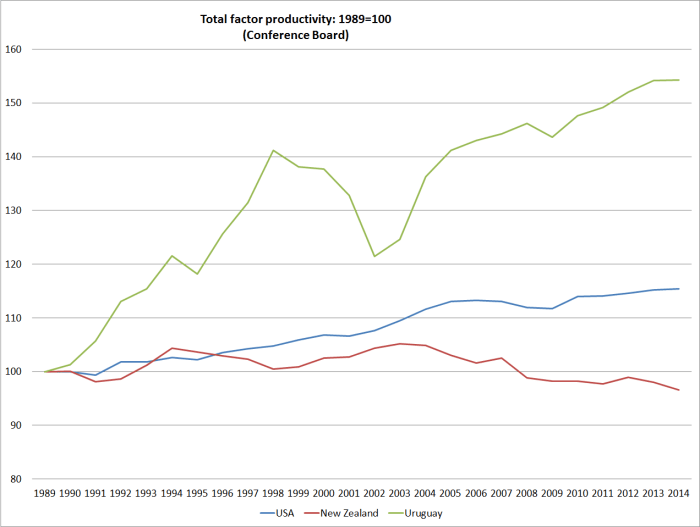
For Uruguay, I showed this chart a few weeks ago, of TFP growth over the last couple of decades.

uruguay nz 4

Uruguay has a long way to go, but they’ve made an impressive start.

And what about Tasmania?  The Australian state GDP data start from 1990, and Little writing in late 2001 discusses the record in the 1990s.  Here is how NSW and Victoria, on the one hand, and Tasmania on the other have done over the subperiods 1990 to 2001 and 2001 to 2015.

real gspQuite a rebound in relative performance.

New Zealand, meanwhile, has shown no signs of even beginning to close any of the big gaps in productivity  –  if anything, on many measures they are still widening.

In terms of my narrative of New Zealand’s policy problems, one thing that marks out territories, states or regions from countries is that the former do not have an immigration policy.  Population growth in Tasmania may be very slightly influenced by Australia’s overall immigration programme, but largely people move to Tasmania only if the relative opportunities within Australia are better in Tasmania than they are elsewhere in Australia.    Tasmania looks like the sort of place –  like my story of New Zealand –  that can generate good incomes for a small number of people.  And in the last 25 years, Tasmania’s population has increased by around 12 per cent, while the populations of New South Wales and Victoria have increased by more than 30 per cent.   By contrast, in New Zealand’s case, the central government’s immigration policy directly boosts the population of the entire country.  Unlike Tasmania, we’ve had more than 35 per cent population growth since 1990, mostly concentrated in Auckland.  In such an unpropitious location for economic activity, it has just made it that much harder to even begin to close the income gaps.

Old papers aren’t to everyone’s taste, but the issues Little’s paper treats (or those treated in my own speculative entry to the field from a few years ago) haven’t gone away.  Unfortunately there is little sign of our political leaders –  government or opposition –  really doing much to reverse the decline of this “loser”.


Should household debt be a worry?

Westpac had a note out the other day under the heading “Household debt levels now higher than before the financial crisis”.  Using December data for household and consumer debt (including debt used to finance residential rental businesses) and comparing it with household disposable income, they calculated that household debt was 162 per cent of income, compared to 159 per cent at the previous peak in September 2009.

Using slightly different numerators or denominators alters the picture only a little. Debt to income ratios fell back during and after the 08/09 recession, and have been increasing quite a bit in the last couple of years.  Credit growth has picked up and income growth has slowed.  I prefer to focus on debt to GDP measures, and here is my version of the chart.

household debt to gdp

The ratios haven’t yet reached the previous peaks, but aren’t that far away, and may well go past the previous peak this year.  One gets much the same picture looking at broader credit aggregates relative to GDP.

One could look at these trends in a variety of ways. I’d tend to emphasise the fact that over the last 7.5 years there has been no growth at all in the ratio of household debt to GDP, whereas over the previous 15 years that ratio had increased by around 60 percentage points.   Westpac seems much more worried than that.

But there are a couple of important things we know (or know we don’t know):

  • that we have no idea what any sort of “equilibrium” ratio of household debt to income is.
  • that when household debt levels were first at these sorts of levels, around the time of the 08/09 recession, it didn’t lead to any serious stresses on the financial system –  we had a pretty serious recession, mostly reflecting global developments, and yet there was never any question about the soundness of the New Zealand financial system.
  • that vanilla household debt has very rarely been at the heart of serious financial system problems in this or other countries  –  the Reserve Bank drew our attention to that in an article only a couple of years ago. Lending on speculative commercial (and residential) developments, and other (typically unsecured) business lending, has usually been the presenting source of financial system problems.

But I’m also puzzled by two points about the Westpac piece –  one presence, and one absence.

Westpac talks of high house prices boosting consumption.

household C to GDP

But household consumption as a share of GDP is currently just slightly below the average ratio for the last 30 years or so.  This shouldn’t be very surprising –  higher house prices don’t make New Zealanders as a whole any better off.  A longer discussion of this issue is contained in this Reserve Bank Bulletin article from a few years ago.

The “absence” is any sense that changes in household debt to GDP (or income) ratios are not mostly some exogenous phenomenon of reckless banks and households taking on new debt with gay abandon.  I discussed this issue a couple of weeks ago.  If there are shocks to the population, and land supply restrictions exist, then house prices will rise.  New purchasers will typically (and probably rather reluctantly) need to take on more debt than their predecessors did.  As a result, debt to income ratios will rise. Since the housing stock turns over only quite slowly, an initial shock boosting house prices will go on boosting debt to income ratios for many years.

In the chart below I’ve done a very simple exercise.  I’ve assumed that at the start of the exercise, housing debt is 50 per cent of income, house prices and incomes are flat, and people repay mortgages evenly over 25 years.  Only a minority of houses is traded each year, but each year the new purchasers take on new debt just enough to balance the repayments across the entire mortgage book.

And then a shock happens –  call it tighter land use regulation –  the impact of which is instantly recognized, and house prices double as a result.  Following that shock, house purchasers also double the amount of debt they take on with each purchase, while the (now rising) stock of debt continues to be repaid in equal installments over 25 years.

In this scenario remember, house prices rose only in year 1.  There is no subsequent increase in house prices or incomes.  But this is what happens to the debt to income ratio:

debt to income scenario

In this particular scenario, 100 years after the initial doubling in house prices, the debt to income ratio is still rising, solely as a result of the initial shock, converging (ever so slowly by then) to the new steady-state level of 1.  One could play around with the parameters, but a permanently higher level of real house prices will, in almost any of them, produce a permanently higher level of gross housing debt, and it will take many years to get to that new level.  The flipside, which I could also show, is the deposit balances of the other parts of the household sectors – the young who have to save for a higher deposit (even for a constant LVR) and the older cohorts who extract more money from the housing market when they downsize or exit the market.  Higher house prices do not, of themselves, require banks to raise more funding offshore.

This is deliberately highly-stylized, but it is designed to illustrate just two main points: higher debt ratios can be primarily a symptom of higher house prices (rather than any sort of cause) and the adjustment upwards in debt levels following an upward house price movement can take many years to work through.

Given the huge population pressures, especially in Auckland, and the lack of much material progress in easing land use constraints, it is hardly surprising that real house prices have increased quite a lot further in some places. If anything, it might be a little surprising that debt to income ratios have not increased more. But these things take time – the point of the chart above.

Westpac has long been of the view that low interest rates have been a major factor explaining rising house prices.  I’ve never found that story particularly persuasive.  We’ve had a 600 point cut in the nominal OCR since 2008 (and a bit more in real terms).  If all else was equal and the Reserve Bank had not cut the OCR as much no doubt house prices would be lower (and quite a lot of other aspects of the economy would be doing even less well).  But the OCR cuts have been done for a reason: the economy hasn’t been performing that well, and inflation has persistently surprised on the downside. In Wicksellian terms, it looks a lot as though the natural interest rate has fallen quite a bit.  Westpac worries about what happens when (if) interest rates rise, but they are only likely to rise much if the economy is performing much better, and is generating much stronger income growth (which would support the existing debt).

There is a still a strong sense around that, when it comes to housing, what goes up must come down.  But when a market is so heavily influenced by regulatory factors, there is no such natural adjustment.  As a loose parallel, we have plenty of people who find it hard to get a job, but the minimum wage keeps on being increased.  Urban residential property prices, especially in Auckland, are a disgrace –  the responsibility of the choices (active and passive) of a succession of central (and local) government politicians. They are hard to defend under any conception of justice or fairness. But there is little sign that they are any sort of macroeconomic risk.  Debt to income is little higher than it was a decade ago, consumption to GDP has not gone crazy, there is nothing of the sort of debt fuelled speculative construction boom seen in, say, Ireland, and there is no sign of reckless behaviour by lenders.  And the banks are very well-capitalized.  It is awful for the many adversely affected, but there is no reason why things should necessarily change much for the better any time soon,

Finally, one of the points of the Westpac note seemed to be to foreshadow the risk of new layers of regulatory controls (so-called “macro-prudential” measures) being imposed on the banking system by the Reserve Bank.  Perhaps they are right about what might be coming. But there would be no good (financial system soundness) basis for further intrusions on the ability of borrowers and lenders to freely arrange finance.    There is simply no evidence that the soundness of the financial system is at risk –  or would be even if, say, the population pressures reversed and land use restrictions were freed up.  Then again, the last two sets of LVR restrictions, undermining the efficiency of the financial system and the wider economy in the process were unwarranted, but that didn’t stop the Reserve Bank charging ahead then.


An underperforming taxpayer subsidised industry

Getting diverted again on Saturday, because of yet another road closure to assist the film industry, reminded me that I had been intending to write briefly about the screen industry data Statistics New Zealand released last week.

Perhaps I missed the coverage in the local papers, but the only media story I’ve seen on these data was in the Wall Street Journal, in a story headed “With no hobbits, New Zealand movie industry is hobbled”. The author quotes a US industry figure observing that “New Zealand is a global hub for filmmaking with an exceptional reputation”. Perhaps, but the numbers don’t seem to be moving in the right direction.

Gross revenue of screen industry businesses was $3221 million last year, slightly up for the year, but still 2 per cent lower (in nominal terms) than in 2012.

Gross revenue from production and post-production of feature films was (down a lot last year and) less than half of that in 2012.

There are almost 10 per cent fewer jobs in the screen industry than there were in 2005 (and while I promise not to keep mentioning it, New Zealand’s population is a lot larger than it was in 2005).

And this in an industry where 40 per cent of the revenue for “production” comes from the New Zealand government: it makes the export incentives in places a few decades ago to encourage non-conventional exports look niggardly.

Statistics New Zealand also recently released a detailed breakdown of exports of servces for 2015.  Here is how exports of “motion picture production services” have gone over the last few years.

movie exports

There has been some growth in “Radio, TV, and other artistic services” but nowhere near enough to offset the fall in the movie side of things.

SNZ also reports some industry value-added estimates, but the most recent data relate to 2014 financial years.

screen industry VA

Presumably the 2015 numbers will be lower.

And although much the hype is around Wellington –  still important on the movie side of things – what is striking is the decline in the industry in Wellington.

screen gross revenue wgtn

Another way of seeing this over a longer period is to turn to the regional GDP numbers.

The published numbers don’t identify film or screen industry activities separately.  But they do have a category called “Information media, telecommunications and other services”.  Much of the screen business activity must be included in that industry segment.   But here is how the share of this industry segment in GDP has behaved for Wellington on the one hand, and for the median New Zealand region on the other.

film share of gdp

As I’ve noted in earlier posts, the industry breakdowns of the GDP data are only available to 2013.   When it is available, the relative picture for Wellington is likely to be even worse by 2015.

The Wall Street Journal article summed up the subsidies.

New Zealand, along with the UK, Canada, and several US states, offers incentives for businesses producing films here.  A cash grant was increased to 20%, from 15%, from 2014 –  partly to clinch the “Avatar” deal.  This allows international productions to claim back 20% of the money they spend in the country.  Some productions receive an additional 5% rebate.  And local ones receive a 40% grant.

Even MBIE was opposed to the increased subsidies.   The industry has the feel of a sinkhole, into which public money is poured with little very evident payoff.  At least when we subsidized manufacturing exports in the bad old days, we got more of them.  But screen industry exports have been falling.

The head of the government’s Film Commission is quoted as saying “we need to keep growing.  We want those jobs here”.   But do we?  If so, why?  And at what cost to the rest of us.  (And as the SNZ data show, most of these jobs aren’t even particularly well remunerated.)

Ah, but “industry experts say that the movie business’s economic contribution cannot be measured by revenue alone”.  Tourism spinoffs are apparently the thing.  WSJ readers are told of tourists spotted along “Miramar’s main retail strip”, but perhaps won’t appreciate that Park Road isn’t exactly Hollywood Boulevard.  More importantly, perhaps, as I highlighted last week, although tourism had a good year last year (and export education as well), New Zealand’s overall services exports remain weak by international standards (especially for small countries) and have been some of worst-performing among advanced economies over recent decades.

services X change since 2005

We massively subsidise the film industry with direct subsidies.  We also subsidise the tourism industry with the rapid expansion in working holiday programmes –  this time, the subsidy isn’t direct from taxpayers, but from lower-end New Zealand workers facing greater competition from temporary foreign workers.     Much the same could now be said for export education.

And yet we have so little to show for it all.  A better class of cafes in Miramar perhaps, but not much beyond that.  Sadly, it is all too typical of the disappointing New Zealand story –  although perhaps made worse by the direct government hand in these industries.


Charles I?

Charles I was a good man, but (was generally reckoned) a bad king.  His reign ended. following the Civil War, with his beheading on 30 January 1649.

In their amusing take on English history 1066 And All That, Sellar and Yeatman offer this caricature of Charles’s views:

Charles explained that there was a doctrine called the Divine Right of Kings, which said that:

(a) He was King, and that was right.

(b) Kings were divine, and that was right.

(c) Kings were right, and that was right.

(d) Everything was all right.

Sometimes I wonder if Graeme Wheeler sees himself, and the Reserve Bank, in much the same light.

I wrote the other day about my request to the Reserve Bank to provide summary information on the OCR recommendations made by the Governor’s designated advisers for each of the OCR reviews since mid 2013.  The Governor himself had disclosed that information for the March Monetary Policy Statement review in an interview conducted only a day or two after the release of that particular OCR decision.

As I noted the other day, I didn’t expect them to respond positively to my request.

I finally got the response late yesterday afternoon, just before the end of the maximum allowed time of 20 working days.  I wasn’t surprised by the decision to withhold all the information, but was more than a little surprised at the argument they sought to rely on.  Here is what they had to say:

Decision

The Reserve Bank is withholding the information under the grounds provided by section 9(2)(d) of the OIA, to protect the substantial economic interests of New Zealand.

Reasons

Official Cash Rate (OCR) decisions clearly relate to the substantial economic interests of New Zealand and it is clearly in the public interest that the Governor is able to decide the OCR as the Reserve Bank of New Zealand Act intends and requires.

The Governor has a statutory position as the sole decision-maker on the OCR. While the Governor chooses to take advice from the Monetary Policy Committee (MPC) and others prior to making decisions, the advice does not bind or compel the Governor to any particular decision. MPC policy recommendations are simply advice that the Governor is free to accept or not. What matters under the law is the Governor’s decision.

Given the Governor’s sole responsibility for determining monetary policy settings and the limited objective value of the information, the Bank considers the public interest in knowing this selective aspect of the advice of the MPC is not strong.

Moreover, there are serious risks that mis-informed commentary on this partial aspect of advice could detract from the Governor’s ability to implement monetary policy.  This could adversely impact on the effectiveness of monetary policy, likely damaging the substantial economic interests of New Zealand.

As noted in responses to two previous OIAs requests from you (24 and 25 September 2015), the underlying analysis and advice for OCR decisions are published in summary form in a programme of carefully drafted media statements, Monetary Policy Statements, news media press conferences and media interviews.  The Bank considers that the public interest in understanding OCR decisions made by the Governor is sufficiently met by these existing information disclosures.

The Governor may choose, on occasion, to publicly state that his decision on monetary policy settings accords with the views of the MPC or anyone else that he receives advice from or wants to refer to.

For those not familiar with the details of the Official Information Act, the relevant provision allows for information to be withheld if to do so is

necessary [emphasis added] to avoid prejudice to the substantial economic interests of New Zealand”

“unless in the circumstances of the particular case, the withholding of that information is outweighed by other considerations which render it desirable, in the public interest, to make that information available”

The operative word there is “necessary”.  There being some remote possibility that some harm could be done is not sufficient.   Nor is a higher likelihood that some minimal inconvenience or discomfort to officials might ensue.  No, it must be ‘necessary” to withhold that specific information to avoid prejudicing the substantial economic interests of New Zealand.  And even then the wider public interest needs to be considered, in the context of an Act designed to make information available to public, to assist public understanding and to strengthen the accountability of ministers, officials, and official agencies.

The Governor’s case is already severely undermined by the fact that he chose to disclose this information, about the most recent OCR decision.  Could he be sure that that information would not be misinterpreted, and lead to commentary that might make his life difficult?    But he took the (surely very modest) risk anyway, and made the information available, presumably concluding that there was no material risk of prejudice to the substantial economic interests of New Zealand.

But then how can he seriously argue that the release of the same information for, say, the July 2013 OCR review has such serious risks that it is “necessary” to withhold it to avoid prejudicing those “substantial economic interests of New Zealand”?  Or the July 2014 review? Or the July 2015 review –  now eight months in the past.  There is no sign in the Bank’s response that they have considered each piece of information separately, and evaluated the risks (which might well be different for information six weeks old than for information almost three years old).  That sort of blanket refusal is inconsistent with the Act.

The substance of the Governor’s claim is that there are

serious risks that mis-informed commentary on this partial aspect of advice could detract from the Governor’s ability to implement monetary policy.  This could adversely impact on the effectiveness of monetary policy, likely damaging the substantial economic interests of New Zealand.

Quite how  a summary of the non-binding opinions of his own chosen advisers, relating to events already some time in the past, could detract from the Governor’s ability to implement monetary policy is really beyond me.  Ultimately, the Governor makes the OCR decisions, and communicates his final stance by both the announced OCR itself and his press statement around it.  It is entirely lawful, and reasonable, for the Governor to adopt an OCR that a minority or even, on rare occasion, a majority of his advisers disagree with.  He is appointed Governor, and he signed the PTA, not them.

Of course, markets and commentators might be interested in which way the balance of advice went but this is lagged information (the most recent event I requested information for was the January OCR review, and my request was lodged after the next OCR decision was already known).    If I had asked for named views of each individual adviser it might perhaps have been a little different –  people could have fun with evidence that, say, the Deputy Governors disagreed with the Governor. But (a) that isn’t the information I asked for, and (b) in other countries, evidence of such a range of views within a central bank doesn’t seem to impair the ability of the central bank concerned to conduct monetary policy effectively.  On several occasions, the former Governor of the Bank of England chose to be in a minority in the vote of the binding MPC, again without impairing either confidence in the individual or the effectiveness of UK monetary policy.

Frankly, the suggestion that the effectiveness of monetary policy could be thus impaired, particularly to extent that could “prejudice the substantial economic interests of New Zealand”, is preposterous.

I’ve highlighted previously the contrast between the pro-active approach adopted by the Minister of Finance and Treasury to the release of advice and papers relating to each year’s government Budget. The Minister of Finance is, in this context, the sole decision-maker, and the Treasury are the advisers to the Minister.  The Treasury provides analysis, and advice, and recommendations.  Sometimes those views are accepted by Ministers, sometimes regretfully not accepted, and sometimes just dismissed out of hand.  That is the nature of good advice, in a world characterized by uncertainty and a range of perspectives on any one issue.

And yet most of that advice is routinely published.  Occasionally perhaps it embarrasses either Treasury or the Minister (but embarrassment isn’t grounds for withholding) but no one questions the ability of the Minister to make fiscal policy decisions effectively. It isn’t impaired by knowing that at times the advisers – and that is all they are –  disagree with the decisionmaker.  What makes monetary policy different?

At times, commentary on official agencies and officials will be annoying, uncomfortable, perhaps lightweight, and perhaps even (the Bank’s concern) “misinformed”.  Democracy is messy. We leave the alternative approach to places like Singapore.  (And, of course, the usual remedy when there is “misinformation” or misinterpretation abroad, is to make more information available.)

In the end much of this comes down to what I wrote about the other day.  The Bank has long considered that the final products that it chooses to publish should be enough –  whether for financial markets, the public, or members of Parliament.  The only people they are comfortable with providing more information to, apparently, are the members of the Reserve Bank Board.  It was the mindset that used to prevail across the whole public sector, here and abroad.

But that isn’t law in New Zealand.  Of course it would be tidier for official agencies and Ministers if only the approved “carefully drafted” final documents were ever made public –  press releases, Budget speeches, Monetary Policy Statements and so on.  But the Official Information Act was not passed in the interests of tidiness, or the convenience of powerful institutions and individuals. It was –  and is –  about allowing greater light to be shed on government processes, and the background analysis and advice that underpins decisions. That is what an open society is about.  It is a big part of how we hold the powerful to account.  As the Reserve Bank well knows, much though it may not like, it, the Official Information Act covers drafts as well as final documents –  it might be interesting for someone, say, to ask for the various drafts of a particular OCR press release (perhaps one from a few quarters ago, the disclosure of which could not possibly impair current monetary policy).

I experienced this line of argument repeatedly in my time in the Bank.  The Bank tends to operate as if it is a world apart.  Many of its people think of the Bank –  subconsciously I’m sure –  more as one of international circle of likeminded central banks, interacting mostly with banks and financial markets, rather than as agency of executive government in New Zealand, accountable to the public (including through the Official Information Act) just as other agencies are.

And I’ve experienced this line repeatedly in responses to OIA requests over the last year or so.  Of those relevant to monetary policy:

  • after some months’ delay, the Bank grudgingly agreed to release the background papers to a Monetary Policy Statement from 10 years previously.  On that occasion I did not ask for either copies of the individual OCR advice, or the summary of the recommendations.
  • they subsequently refused to release  any of the papers provided to the Bank’s Board regarding the September 2015 MPS
  • the Bank refused to release any material background information relevant to the most recent Policy Targets Agreement.
  • the Bank refused to release any minutes of meetings of its Governing Committtee (the forum in which the Governor takes the final OCR decision)
  • the Bank refused for months to release any material information about the work they had been doing on governance reform, belatedly releasing a small amount only recently, claiming as warrant for doing so an Associate Minister’s answer to an Opposition MP’s supplementary question six months earlier.
  • the Bank has refused to release any of the background information on its analysis of the economic impact of immigration that led into its material change of view at the December MPS.  (this is a good illustration of all that is wrong with the Bank’s argument that the MPS is really quite enough for us mere mortals –  since they included no supporting analysis in that MPS to justify their change of view).

Sadly, this latest response is all too typical, even if the particular excuse they must have spent a month crafting has a degree of novelty. It speaks of an organization –  and the key individuals –  who believe that they are, or should be, above the messiness of the sort of real world scrutiny that we expect in a democracy, and for which the Official Information Act provides.  Hence, the Charles I references.

It is a shame, because I really can’t imagine what they have to hide.  It shouldn’t be surprise if from time to time advisers disagree with the Governor –  it should worry us much more if they never do.  From time to time a Governor has gone against the majority view of his advisers –  hindsight suggests that sometimes he was right to do so, and on other occasions probably not.   But we should be able to see the balance of that advice, perhaps with a modest lag.  Sometimes it will suit the Governor (as presumably in March, when he unilaterally released the information) and sometimes not.  But what suits the Governor on particular occasions is not a relevant consideration under the Act.

The Reserve Bank of New Zealand was once at the forefront of greater openness and transparency among central banks.  Sadly, that is no longer true.

I have appealed this decision to the Ombudsman, on two grounds:

  • first, taking 20 working days to issue a blanket refusal (on material that involvement no substantial compilation or review effort) is simply inconsistent with the statutory responsibility to respond “as soon as reasonably practicable”, and
  • second, that it is simply not credible that withholding all this information (including that about decisions in 2013) is “necessary” to avoid prejudice to the substantial economic interests of New Zealand.

Hamish Rutherford has covered the story here.