Even Treasury has lost hope?

Pottering around the web, and working my way through my emails, on my return from holiday, I found a couple of things from The Treasury that caught my eye.

The first was the release of new risk-free rates and CPI inflation assumptions –  inputs that are required to be used in preparing the government financial statements.  Treasury releases these every few months.  They don’t get much attention –  presumably outside government agency accounting departments –  but out of curiosity I opened the latest one.  And as I dug into the history of these assumptions what I found was really quite startling.

When I was at the Reserve Bank we often used to bemoan the fact that Treasury’s published inflation forecasts never seemed to settle anywhere near the midpoint of the target range.  In fact, for a long time the Treasury approach seemed quite reasonable –  after all, in the first 15 years or so of inflation targeting, the average annual inflation outcomes had been around 0.5 percentage points higher than the (successively revised) target midpoints.  Reasonable people can debate why that happened, but it did.  It was unusual –  in most inflation-targeting countries, out-turns had averaged nearer the midpoint of the respective targets  – but as the midpoint wasn’t mentioned in the PTA it wasn’t a major accountability issue.  Don Brash took the midpoint quite seriously, while Alan Bollard wasn’t too bothered by it, but under both Governors inflation had averaged higher than the midpoint.

The Treasury’s continued assumption/forecast that inflation would settle back to around 2.5 per cent had become more frustrating, and questionable, in the years since the 2008/09 recession.  Actual inflation outcomes had begun to persistently undershoot the midpoint of the target, and the midpoint of the target range had been explicitly added to the Policy Targets Agreement in 2012.  The Bank, the Treasury, and the Minister of Finance all agreed that the focus of monetary policy should be the midpoint.

These are the assumptions Treasury published two year ago.

tsy inflation 1

At the time, it seemed like the ultimate in very slowly adapting, backward-looking, expectations.  By this time last year, they had markedly revised down their assumptions for the next few years (it wasn’t until 2030 that they assumed that inflation got back above even 1.75 per cent), but still assumed that in the very long-term inflation would eventually revert to 2.5 per cent.    If the Reserve Bank was, as it said, concerned to see long-term expectations centre on 2 per cent, there was still some (rather limited) cover in the Treasury assumptions for a moderately “hawkish” stance.  “Not even Treasury yet takes the 2 per cent midpoint that seriously” they might have argued.

But not any more.  Here are latest CPI inflation assumptions from The Treasury.

tsy inflation 2

They have had to dramatically extend the horizon they provide numbers for to encompass the eventual return to their long-run assumptions.  But it is 30 years from now before they assume inflation gets back even to 1.75 per cent, and almost 40 years to get back to 2 per cent.

I’m not sure quite what is going on here.  On the one hand, Treasury is the chief adviser to the Minister of Finance, who has signed a Policy Targets Agreement with the Governor of the Reserve Bank requiring him to focus on a 2 per cent midpoint.  And on the other hand, it is pretty much common ground that monetary policy works with a lag of perhaps a couple of years.  Anything beyond, say, 2018 is definitely an outcome monetary policy can control.  The PTA needs to be renegotiated next year, but not long ago the Secretary to the Treasury was quoted saying that he didn’t think Treasury would be suggesting major PTA changes. And yet Treasury thinks the best guess for inflation for the next 25 to 30 years is something well below the target they and the Minister are asking the Reserve Bank to achieve.

Of course, with yet another surprisingly weak CPI outcome just released, building on years of undershooting the target, Treasury might yet be right (between Reserve Bank policy (mis)judgements and the global deflationary environment).  But whether they are or not, what should disconcert the Governor –  and the Board, and those monitoring the Bank, such as Parliament’s Finance and Expenditure Committee –  is that not even Treasury believes him any longer.  They might say otherwise in their official advice – which we haven’t seen –  but these are the numbers they consciously chose to publish.

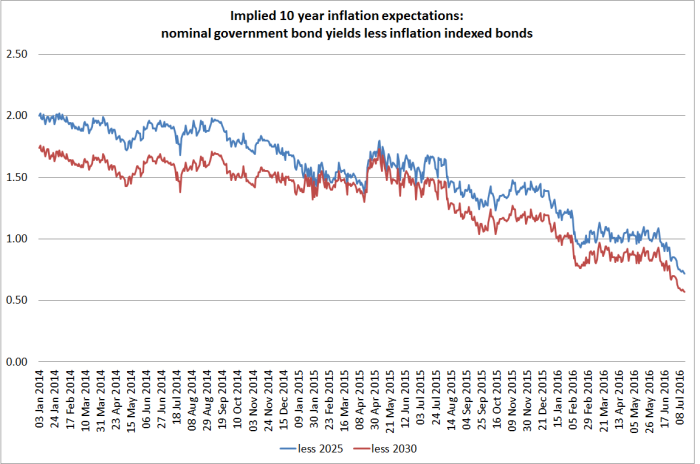
And, of course, it is not as if Treasury is alone in its doubts.  For all that the Reserve Bank likes to quote surveys of a handful of local bank economists, the market has its own approximate “price” for implied future inflation.  This chart takes the 10 year nominal government bond yield, and subtracts the yields on inflation-indexed bonds.  It isn’t a precise measure for various reasons, including the changing maturity dates on the various bonds, but the picture is pretty clear and persistent.

iibs july 16

As late as two years ago, the implied inflation expectations for the next 10 years were very close to 2 per cent.  Now they are around 0.65 per cent.

A persistently easier stance of monetary policy is much overdue.  Not even Treasury seems to take the 2 per cent midpoint very seriously now.

(UPDATE: Someone at Treasury pointed me to their relatively recent –  and useful – methodology note, which explains the relatively mechanical approach they currently take to updating the CPI inflation asumptions.  I don’t think it really changes my story, since the considered judgement has gone into the decision as to how best to represent a reasonable future path for inflation.  The Treasury has consciously chosen to put a considerable weight on indexed bond pricing, while the Reserve Bank excludes that information completely from the inflation expectations curve it regularly cites in its updates.)

On another matter, I have lauded the Treasury’s approach to the Official Information Act issues. They seem to take seriously their obligation under the Act, and although they receive a lot of requests (about 350 in the last year) have not sought to charge anyone.  They withhold material from time to time, but I’ve had enough confidence that they were playing by the rules that I have never sought to challenge those decisions, asking the Ombudsman for a review.  That changed this morning.

A while ago I asked for

Copies of any material prepared by The Treasury this year on regional economic performance, particularly in New Zealand. I am particularly interested in any analysis or advice –  whether supplied to the Minister or his office, or for use internally – on the economic performance of Auckland relative to the rest of the country (whether cyclically or structurally).

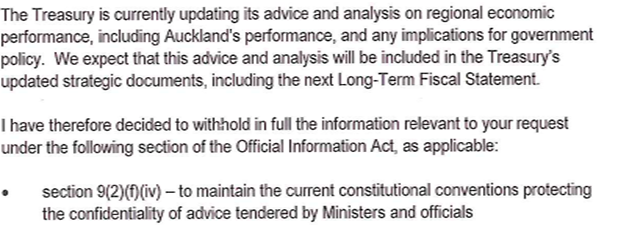
I wasn’t expecting much; perhaps some anodyne comments on some or other aspect of recent data, including perhaps the regional GDP data released in March.  But while I was away, I got this reply

oia akld 2

It is all very well and good for Treasury to be updating its analysis and advice.  But I asked for what they have already provided, not what they might (or might not) include in future “strategic documents”, such as the next Long-Term Fiscal Statement, which does not have to be published until July next year.

Given that they are not even willing to publish the titles or dates of any documents (whether internal or provided to the Minister) it does raise the question as to what Treasury has to hide.  Given the woeful underperformance of Auckland –  considered in per capita GDP terms – perhaps Treasury is finally awakening to the fact that something is wrong with the Think Big Auckland strategy?  That might be awkward for the government, but isn’t a good basis –  under the OIA –  for withholding material, especially in such a blanket way.

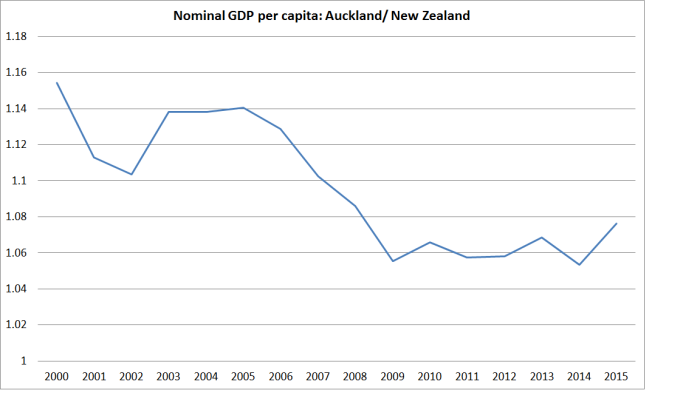
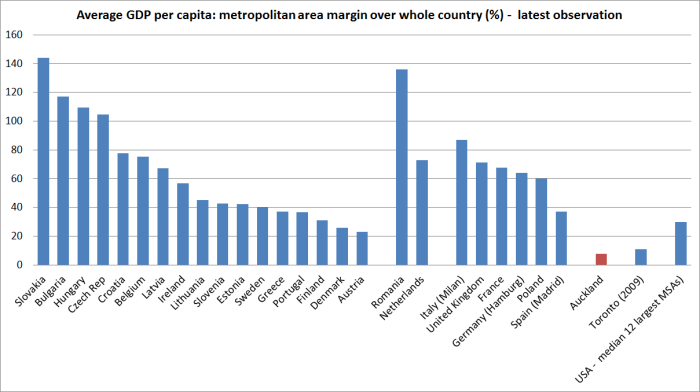
As a reminder, here is how badly Auckland has done

Over time

akld rel to nz gdp pc

And in comparison to the largest cities in other advanced countries

gdp pc cross EU city margins

I’m not sure what Treasury is hiding, or why. Perhaps the Secretary is reacting defensively to my criticisms of his recent speech?  But it was that speech that prompted my original request, to see what analysis lay behind his upbeat claims about Auckland.

As an organization Treasury is better than the standard being displayed here: we see the good side of Treasury again in the recent pro-active release of Budget background papers. It is time for them to reconsider, and to release any analysis or advice they have prepared on the Auckland’s economic performance.  I’ve asked the Ombudsman to review the decision.

Makhlouf again

In almost any well-functioning country, The Treasury should be one of the very best government agencies: a repository of wisdom, experience, rigour, and the skepticism that comes from seeing all too many “bright ideas” put forward over the years.  If the Secretary to the Treasury is going to give public speeches –  and there are reasonable arguments that someone in that role shouldn’t (one doesn’t come across public speeches from the chief executives of MBIE or MFAT, two other major departments) –  we might reasonably expect something judicious and rigorous, and which provides at least some fresh and interesting insights on the issues he is addressing.    It should be a public reflection of the very best of the sort of insight and advice The Treasury is offering their primary “customer”, the Minister of Finance.

As an example, speeches by Ken Henry, the former head of the Australian Federal Treasury, almost always met that standard –  I looked forward to reading them, and expected to see some or other issue or argument a little differently as a result.  It isn’t about whether or not one agrees with the points the speaker is making – often one learns most from thinking hard about cases made by able advocates of an alternative view –  but about the quality of what is on offer.

The speeches of our current Secretary to the Treasury simply don’t reach that standard.  On Thursday I wrote about Gabs Makhlouf’s recent speech about disruptive technological change.  Only a true believer can have felt better for reading it –  deriving, perhaps, a sense of validation in having such a senior official, a pillar of the establishment, say it.

Perhaps more disconcerting was Makhlouf’s speech earlier this week titled (apparently with reference to the title of Oscar Wilde’s famous play, The Importance of Being Earnest: A Trivial Comedy for Serious People) The Importance of Being Auckland: Strengths, Challenges, and the Impact on New Zealand, delivered to something called the “Committee for Auckland Advisory Group Summit”.

It is a disappointingly poor speech –  I wish I could say I was surprised, but I wasn’t really.  It was a piece that combined lightweight analysis, (very) selective choices of evidence, and a use of rhetoric that might have been becoming from a Cabinet minister pursuing voters, but should have been beneath a senior public servant.  It was all too similar to previous speeches: not just one bad example amid an otherwise solid record.

There were three main parts of the speech.  I don’t have anything to say on the material on infrastructure, much of which is simply a list of points from another report.

Makhlouf begins with a celebration, in a section headed “Auckland’s Strengths”.  The text reaffirms Makhlouf’s position as a true believer: a rapidly growing population is apparently something to celebrate, and the cultural/ethnic diversity of the city is “exciting”.  Here is what he has to say

Why do I find this exciting? It’s because high levels of diversity provide dividends including through increases in innovation and productivity.

Auckland’s diversity is particularly critical for our international connections. There’s much more to international connections than trade. It’s the other international flows – flows of capital and people, and the accompanying flow of ideas – which are the key to reinventing trade, and which will lay the foundation for a more prosperous New Zealand in the long-run.

The high number of overseas-born Aucklanders can bring new skills, new ideas and a diversity of perspectives and experiences that help to make our businesses more innovative and productive. And perhaps most importantly, they often retain strong personal and cultural connections to other parts of the world, which opens up, and helps us to pursue, new business opportunities.

Auckland is truly New Zealand’s gateway to the world. It’s not just that there is a big number of companies here doing business internationally. It’s the port and airport linking the country to global markets; and tertiary institutions, researchers and innovators linking us to global knowledge.

Which might all sound fine,  until one starts to look for the evidence.  And there simply isn’t any.  Perhaps 25 years ago it was a plausible hypothesis for how things might work out if only we adopted the sort of policies that have been pursued. But after 25 years surely the Secretary to the Treasury can’t get away with simply repeating the rhetoric, offering no evidence, confronting no contrary indicators, all simply with the caveat that in “the long run” things will be fine and prosperous.  How many more generations does Makhouf think we should wait to see his preferred policies producing this “more prosperous New Zealand in the long run”?

If the Secretary to the Treasury was going to address the economic issues around Auckland, one might have hoped there would be at least passing reference to:

He might also have linked to the recent presentation by Jacques Poot (in a Treasury guest lecture), in which Poot was keen not to sound very optimistic about just how large those economic benefits of diversity really are, or to the work of Bart Frijns – an (immigrant) professor in Auckland (see last sentence of the extract above) –  whose recent work suggests that on some measures, in some contexts, there may be net costs, not benefits at all.

Of course, one can’t say everything in a single speech, but when a credible case could be made that the Auckland-centred model is in serious trouble, it is bordering on the seriously unprofessional to not even allude to any of these sorts of points, even if only to explain why the Secretary interprets then differently than, say, I might.

So keen was Makhlouf not to undermine his good news creative fiction about the Auckland economy that the one difficulty he does allude to is buried under a different heading “Social Outcomes”.

Let me start with social outcomes. Auckland scores well on quality of life indicators but other measures suggest not everyone is able to enjoy what Auckland has to offer. Social outcomes vary significantly across Auckland, highlighting the potential importance of sub-regional thinking and analysis to lift social outcomes across the board in Auckland.

Issues with the labour market contribute to patchy social outcomes across the city. While Auckland has higher productivity than other urban centres in New Zealand, it also has an underutilised labour force. For example, the five year average unemployment rate in South Auckland is 11.7 percent compared with 6.3 percent for the rest of Auckland and 6 percent for New Zealand overall. That’s the sort of discrepancy that has a real impact on the quality of life of families and communities.

To the first paragraph one can only say “And?”   In what city –  or decent-sized town –  ever did “social outcomes” not “vary significantly”?

Similarly, differences in the unemployment rate across groups within cities will occur everywhere –  if we had the data, I’m sure the unemployment rate would be higher (and probably the participation rate lower) in Porirua than in Karori/Kelburn.  It might be good if were not so, but it isn’t obviously an Auckland-specific issue.   After all, across the country as a whole, the average unemployment rate over the last five years for Europeans has been 4.3 per cent, while that for Maori has been 14.7 per cent, and that for Pacific populations has been 13.4 per cent.  Given that the population of South Auckland is disproportionately Maori/Pacific, the issues in South Auckland seem most likely to be mainly national than (intra-Auckland) suburban.

But there is an Auckland underperformance that might almost escape you if you didn’t read that second paragraph quite slowly and carefully.  The unemployment rate in Auckland is higher than that in the rest of New Zealand.   For a long time, that wasn’t so.

auckland U makhlouf

The chart shows the gap between the unemployment rate for New Zealand as a whole.  Over the history of the HLFS until around 2007, Auckland’s unemployment rate averaged a bit below that of the rest of the country.  There was some clear cyclicality to the gap –  Auckland’s economy/labour market seems to have been more badly hit in recessions (I’ve highlighted the 1991 and 1997/98 recessions) and does relatively better in good times.  In a well-functioning economy, that better performance is what I’d expect.  After all, the Auckland labour market is so much deeper, and more diversified, than that in other centres, that it should be easier for workers and firms to find each other, matching the  skills offered and required, than in a smaller area, typically prone to more idiosyncratic shocks.

But even by the end of the last boom, Auckland’s advantage seemed to be fading.  And in every single quarter since the start of 2007 –  nine years now –  Auckland’s unemployment rate has been above that in the country as a whole.  The gap is slowly closing again –  but the operative word is “slowly”.  It is a quite stunning example of the (frankly rather surprising) extent of Auckland’s economic underperformance.  It certainly has “social” implications for the people adversely affected, but make no mistake, it is a striking economic issue.    And with barely a mention by the government’s chief economic adviser in a speech on the importance of Auckland’s economy.

I was going to write quite a bit about the second half of Makhlouf’s speech, on house prices and housing supply.  I have lots of scrawls in the margins of those sections, about both substance and style.    Like Graeme Wheeler, Makhlouf appears to have it in for “speculators”.  And I’m sure, for example, that Makhlouf’s comments that central and local government have “been working well together” in “addressing the housing challenge” must be a great comfort to those priced out of the market by the combination of central and local governments rules and policies.  They are probably more interested in outcomes –  which are shockingly bad – than in knowing that the bureaucrats are working well together.

But perhaps the line that caught my eye most was one that Treasury consciously chose to highlight on its Twitter feed: “Auckland NIMBYism hurting New Zealand”.    Perhaps “NIMBY” is a convenient shorthand in the popular press, and among sloganeers.  One might have hoped that the Secretary to the Treasury might have avoided clearly pejorative labelling of people, whose interests stands in the way of his preferences.  There is no analysis –  even by way of allusion – to the fact that in most new residential developments, private covenants (voluntary contracts) provide exactly the sorts of binding protections (and more) that residents of Orakei or Epsom might be looking to councils for in the current Auckland debate.  Reasonable people might differ on where the lines should be drawn, and quite which existing features of communities should be able to be protected.  But to simply decry the interests of property owners seems closer to demagoguery than to detached analysis and insightful policy advice.  It also occurred to me to wonder quite what the longstanding residents and property owners in existing suburbs might make of someone fairly fresh off the plane from the UK telling them how their suburbs should be changed.  I’m quite sure that Makhlouf has the best interests of New Zealanders at heart, but when you are a newly-arrived outsider, sometimes you need to be conscious of quite how you sound, and quite what your stake is in the country you are advising on, relative (say) to those who have lived their whole lives in Auckland.

In closing his speech, Makhlouf offered this odd paragraph:

The famous photographer Sir Cecil Beaton once appealed to people to “be anything that will assert integrity of purpose and imaginative vision against the play-it-safers, the creatures of the commonplace, the slaves of the ordinary.”   From what I can see, many Aucklanders are heeding that call in their own way.  And having the right infrastructure, supported by economic incentives that send clear, efficient and effective signals, will enable Aucklanders to continue to exercise their dynamism and diversity and to do the best that they can do.

When I looked up Beaton, his seemed a somewhat reckless life, ending in financial stress.  Perhaps it is the style the dreaded “speculators” emulate –  but then we already know Makhlouf disapproves of them.  Surely most people, in most places, in most times, crave the security of a home, an income, a family, the commonplace things that mostly conduce to sustained happiness (and prosperity for that matter). Risk is, of course, part of life, and many of the great financial successes involved some mix of great risk and great luck.  But we seem to be in an upside-down world in which a Secretary to the Treasury (self-described cautious guardian of the government’s finances) scorns the natural concerns of the vast mass of people.  One might add, that  –  with the full support of the Treasury –  we’ve been eschewing the commonplace, and the “play-it-safers” in our Think Big policy for Auckland over the last 25 years.     And there is little good –  for the vast mass of Aucklanders (and New Zealanders) – to show for it.

Makhlouf quotes various English figures in his speech.  I’ve always been quite keen on Kipling.  In his famous poem “If” comes the lines

If you can make one heap of all your winnings
    And risk it on one turn of pitch-and-toss,
And lose, and start again at your beginnings
    And never breathe a word about your loss;
you’ll be a Man, my son!
I’m not sure that giant policy experiments, showing no sign of paying off 25 years on, are really quite what Kipling had in mind.  But I’m sure that simply ignoring the signs that things aren’t going well wasn’t.
New Zealanders deserve a great deal better from the Secretary to the Treasury.


Some snippets on New Zealand’s continuing economic underperformance

I’m tied up with some other stuff for much of this week, so if there is a post each day it is likely to be a fairly short one.

Today, I wanted to show just a few charts –  mostly updates of ones I’ve shown before.

In yesterday’s Sunday Star Times, I read Rod Oram’s column.  It was headed Australia’s Delusions Run Deep, on some of the economic challenges Australia undoubtedly faces.  It was fine, as far as it went, but it did bring to mind the words

“Why do you look at the speck of sawdust in your brother’s eye and pay no attention to the plank in your own eye?

Whatever Australia’s challenges, it remains far richer than New Zealand.  We rather take that as given these days, but through most of our modern history there was no such gap.  And there is nothing suggesting that yawning gap is about to begin to sustainably close.

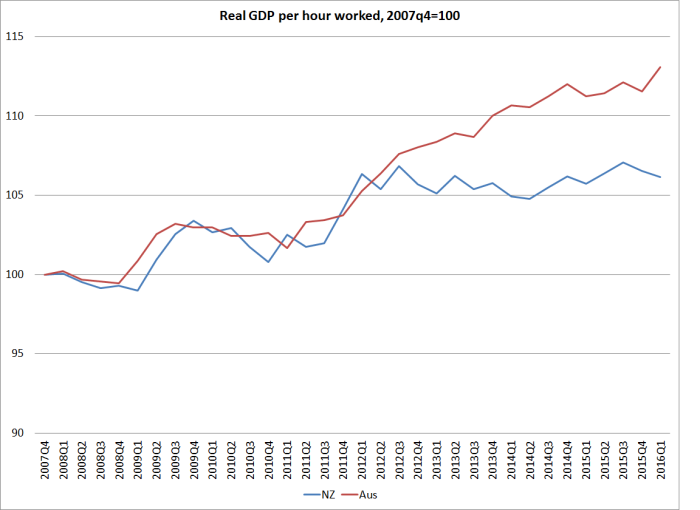
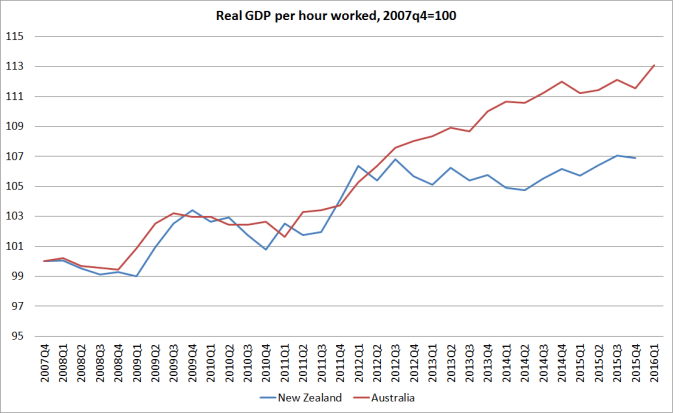
Even over the shorter-term the comparisons don’t flatter us.  Here is real GDP per hour worked (ie labour productivity) for the two countries since the end of 2007 (ie just prior to the recession).

real gdp phw nz and aus

The big differences aren’t about the recession period (our recession was worse than the Australian (income) recession) but are actually apparent in the last few years.  In short, on the official numbers –  and always subject to revisions –  there has been no productivity growth at all in New Zealand for the last four years.  And yet those were the years when, for some reason, people –  even Australians –  started talking about “rockstar” economies on this side of the Tasman, and our Prime Minister (and his acolytes) having been telling us how well New Zealand has been doing, with any stresses “quality problems” and “signs of success”.

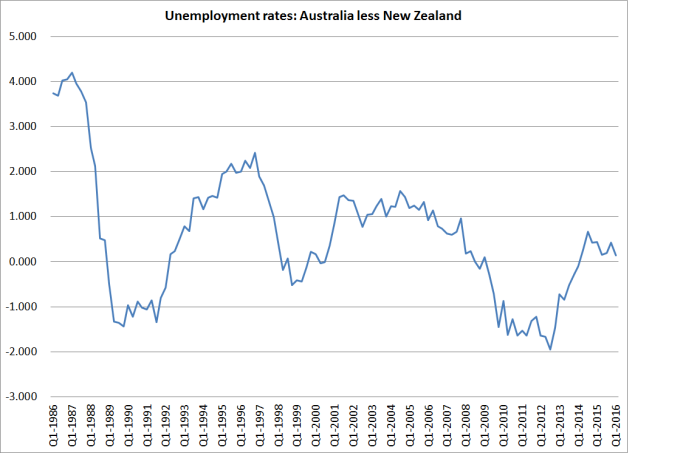
At present New Zealand’s unemployment rate is exactly the same as Australia’s –  both at 5.7 per cent.  But in the decade leading up to the 08/09 recession, Australia’s unemployment rate had averaged 5.9 per cent, while ours averaged 5.2 per cent.    Australia’s unemployment rate is actually a little less bad than average, while ours is worse.

The HLFS has been running for 30 years now.  Over that time, Australia’s unemployment rate has usually been above New Zealand’s –  and they have a more heavily regulated labour market so that is what one should expect –  but not now.

U rates Aus less NZ

But turning back to the New Zealand national accounts, the media coverage did note that per capita real GDP growth has been very slow.    But no one seemed unduly bothered.  Of course there is some quarter to quarter variability in the series, and the data are revised over time, but the simple fact is that, on the official data we currently have, and averaging the production and expenditure measures of GDP, there was no real per capita growth at all last quarter.  And yet this is supposed to be some sort of success story?  Even in the last full year, real per capita GDP growth has been only around 0.6 per cent in total. It remains something of a mystery to me why the Reserve Bank and Treasury expect growth to pick-up from here.

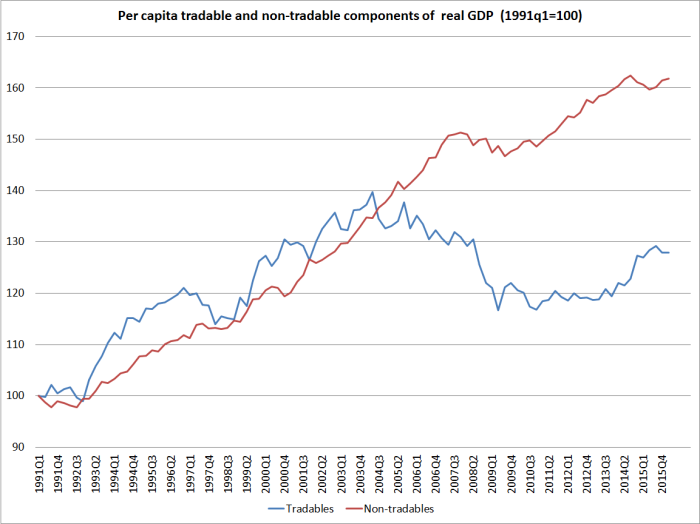
And here is the (rough and ready) breakdown of per capita GDP into its tradable and non-tradable sector components.

pc gdp components

Tradables here includes primary production, manufacturing and exports of services.  Non-tradables is the rest.  So the tradables sector, as captured here, includes the booming (subsidized) export education sector and the booming tourism sector.    And yet there has been no overall growth in tradables sector real GDP per capita for more than 15 years.

Successful economies, building on a sustainable footing, do so by selling more and different stuff in competition with the best the rest of the world has to offer.   That doesn’t describe New Zealand at all –  under this government or its predecessor.

We have

  • no productivity growth
  • a continuing high unemployment rate
  • ruinous house prices, and
  • a tradables sector that has achieved no per capita growth for 15 years.

And yet, so our ministers and officials tell us, our immigration policy is a “critical economic enabler”.    Frankly, it seems bizarre that, as a matter of policy, we bring more and more people –  many of them just not that skilled anyway –  to such an underperforming place.  It is as if theory trumps experience.  New Zealanders pay the price for these political and bureaucratic preconceptions, and for an unwillingness to look out the window and recognize that all is far from well with New Zealand’s economy. Even Australia, for all its challenges, just keeps doing better.

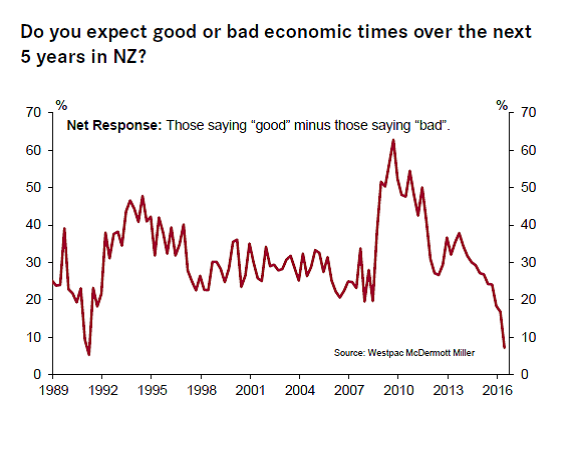
UPDATE:  After finishing that post, I noticed this chart in the Westpac consumer confidence report.  Respondents aren’t always correct in their expectations, but at present they (potential voters all) don’t seem remotely optimistic about the medium-term outlook for New Zealand.

consumer confidence

Three months on…

It is three months since, on the morning of the release of the last Monetary Policy Statement, a fortuitous set of circumstances brought to light a leak of the Reserve Bank’s OCR decision.  It hadn’t required any particular devious methods or technologies, and the suggestion –  including from the Reserve Bank’s own lawyer –  has been that it wasn’t the first time it had happened.  Whether that was so or not, the Reserve Bank’s systems were loose enough that it was only a matter of time before, accidentally or deliberately, a leak happened.  And ethics were loose enough at MediaWorks that the leak was apparently seen as acceptable conduct, despite the rules of the lock-up.  It took weeks for MediaWorks to own up, and even now there has been no proper accounting from them as to just what went on.

In an email yesterday about today’s Monetary Policy Statement, someone in the markets noted to me

Still waiting to read your full apology from RBNZ, I live in hope!!

It might be nice, but the words and (in)actions of Graeme Wheeler, and his associates Geoff Bascand, Mike Hannah, and Rod Carr, really speak for themselves.  How did we end up in a situation where these sorts of people govern our central bank?

But I’m still more disturbed about the secrecy with which the Reserve Bank has sought to cloak the whole affair –  telling us just as much as they want us to know.  Answers to a series of fairly straightforward OIA requests, about events that happened two to three months ago, have been kicked out to 1 July –  and such is the Reserve Bank’s track record on the OIA that I’m not optimistic we will get much even then.  Whatever the case for secrecy on some policy matters, a leak inquiry  –  especially one that confirmed an actual leak and prompted major system changes – seems like one of those things where the public should be able to expect a full and open accounting from a taxpayer funded public agency.

Instead, we have them stalling, seemingly averse to transparency and scrutiny.  Among the outstanding matters:

  • We haven’t seen the terms of reference for the leak inquiry
  • We haven’t seen the full Deloitte leak inquiry report, only a short-form public version.
  • We haven’t heard why no penalty was initially imposed on MediaWorks, only for the Governor to later change his mind and indefinitely ban them from Reserve Bank press conferences.
  • We haven’t heard why the Governor chose in his press statement to emphasise the cooperation of MediaWorks when even the short-form report makes clear that it took weeks for that company to own up, and then only when it had been approached by the inquiry team.
  • We have seen no acceptance from the Reserve Bank that its own systems had failed to keep pace with technological change, which left them open to a leak (the consequences of which could have been much more serious than they were).
  • We don’t know whether the Bank has made any serious efforts to find out whether MediaWorks staff had leaked previously, and if they did make the effort to seriously pursue the matter, what the answers were.
  • We don’t know how much involvement the Bank’s Board –  supposed to operate at arms-length from management to hold the Governor to account – had in the handling of the leak, and 14 April press statement.  The documents that have been released suggest, which shed a partial light on the matter, suggest that the answer was “too much”.
  • We haven’t seen the papers the Reserve Bank considered in reviewing the options regarding the future of lock-ups, press conferences etc.

I’m not sure what the Bank has to hide.  The answer may well be “not that much at all”.  If so, the obstructiveness and resistance to an open accounting for their handling of a serious breach is perhaps more just a reflection of an ingrained resistance to see themselves as a public body with all that means.  In particular, that they are subject to the Official Information Act as much as to any other law, and are a body from whom the public should reasonably expect a full and open accounting.  Mistakes happen, errors are made, system flaws come to light.  That is what happens with human beings and human institutions.  Embarrassing as they sometimes are, accidents  and errors will happen.  But how an institution – and a powerful individual – recognizes, accepts responsibility for, and responds to such mis-steps can tell us a lot.

As journalists and MPs gather today to scrutinize the Governor, perhaps they might like to reflect on some of this.


Some matters the Monetary Policy Statement could address

Tomorrow sees the release of the latest Reserve Bank Monetary Policy Statement.  My “rule” for making sense of the Governor’s monetary policy choices at present is that he really doesn’t want to cut the OCR –  and hasn’t for the last year –  as much because of the housing market as anything, and cuts only if reality mugs him, in the form of some key data that he just can’t escape the implications of.   I haven’t seen that sort of data in the last month or two.  Given the terms of the Policy Targets Agreement, it should have been an easy call to cut the OCR again, but it probably hasn’t been.

There is a nice, fairly trenchant, column from Hamish Rutherford in the Dominion-Post this morning on the Governor’s communications “challenges”.  I’m very sympathetic to the line of argument Rutherford is running (including his use of some BNZ analysis of monetary policy surprises).  My only caveat is that, in my view, getting policy roughly right is better than being predictable and wrong.  There were no major monetary policy surprises or communications problems in 2014.  But the repeated increases in the OCR were simply bad policy.  Grudging as it may have been, and badly communicated as it undoubtedly was, the OCR has at least been moved in the right direction for the last year.

In this post, I wanted to highlight some issues that it would be good to see the Reserve Bank change its stance on in its statement tomorrow.   If I really expected they would do so, I probably wouldn’t bother with the post, but perhaps there will be a surprise in store.  Many of them have to do with countering that persistent sense, pervading Bank documents, that the economy is doing just fine.  The Reserve Bank has an inflation target, not an economic performance one, but the argument that all is fine in the economic garden has been used repeatedly to justify keeping the OCR as high as it has been.  As a reminder, even today, in real terms the OCR now is still higher than it was when the ill-judged 2014 tightenings began.

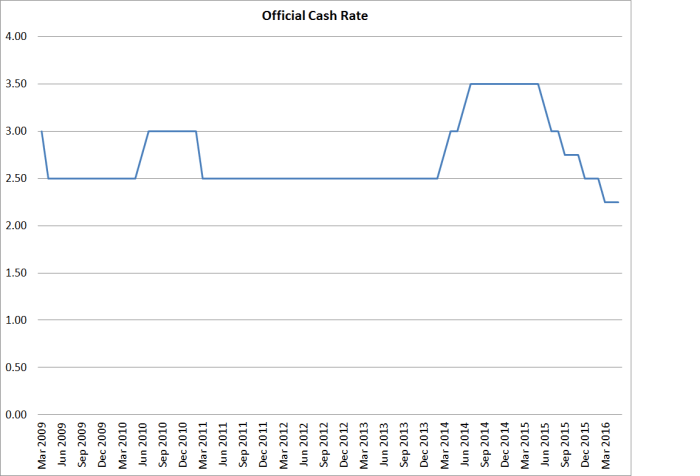
The first is the constantly repeated claim that monetary policy in New Zealand and in other countries is highly “stimulatory”.  It appears in almost every Reserve Bank policy statement or speech, and appears to be based on nothing more than the undoubted fact that interest rates (real and nominal) are currently low by longer-term historical standards.  That doesn’t make them stimulatory.  It has now been more than seven years since the rate cuts during the 2008/09 recession came to an end.  For most of the time since then the OCR has been at 2.5 per cent.  Today it is at 2.25 per cent.

ocr

Adjust for the fall in inflation expectations (around 60 basis points over 7 years on the Bank’s two-year ahead measure), and if anything real interest rates are a bit higher than they’ve typically been since 2009.

The Reserve Bank appears to still believe that a normal (or ‘neutral’) short-term interest rate might be around 4.5 per cent.  But there is nothing substantial to back that view.  The fact that inflation has been persistently below target for several years, in a weak recovery with persistently high unemployment, argues against there being anything meaningful to a claim that 4.5 per cent is a “neutral” interest rate –  a benchmark against which to measure whether monetary policy is “highly stimulatory” or not.  Better, perhaps, to look out the window, and check the current data.  That isn’t always a safe strategy, but it is better than clinging to old estimates of unobservable structural features of the economy.  Having moved to a flat track in its interest rate projections, the Bank appears to be backing away from putting much practical weight on the high estimates of a neutral –  or normal –  interest rate.  But the rhetoric still seems to matter to the Governor, and his reluctance to cut the OCR seems, in part, influenced by his sense that interest rates are already “too low”.  He has –  or at least has produced –  nothing to support that sense –  whether for New Zealand, or for most other advanced other countries.  Better to put to one side for now any estimates of neutral interest rates, lose the rhetoric, and respond to the observable data as they are.

The second point I would like to see signs of the Reserve Bank taking seriously is the persistently high unemployment rate.  At 5.7 per cent it has barely changed in the last year.  I noticed that the OECD in its new forecasts seems to treat 5.8 per cent as the natural rate of unemployment (or NAIRU) for New Zealand.  Few others do, and both the Treasury and the Reserve Bank have tended to work on the basis that our regulatory provisions (welfare system, labor market restrictions etc) are such that the unemployment rate should typically be able to settle nearer 4.5 per cent without creating any inflation problems.    Someone forwarded me the other day a market economist’s preview of this MPS, noting  with some surprise that the unemployment rate wasn’t mentioned at all.  I sympathized with the person who sent it, but pointed out that it was the Reserve Bank the market economists were trying to make sense of, and the Reserve Bank gives hardly any attention to this key indicator of excess capacity in the labour market.   Reluctance to cut the OCR might make more sense if the unemployment rate were already at or below the NAIRU.  As things stand for the last few years, there is an inefficiently large number of people already unemployed, and the Governor’s reluctance to cut just condemns many of them to stay unemployed longer than necessary.  The Governor should at least recognize that trade-off, and explain the basis for his judgements.

The third point it would be good to see the Reserve Bank explicitly addressing is the mistakes it has made in monetary policy over the last few years.  Depending on the precise measure one uses, inflation has been below the target midpoint –  a reference point explicitly added to the PTA in 2012 – for many years now.  Some of that might not have been easily foreseeable.  Some of it might even have been desirable in terms of the PTA (if the one-off price shocks were all one-sided, which they weren’t).  Humans  –  and human institutions –  make mistakes, and one test of a person or institution is their willingness to recognize, respond to, and learn from their mistakes.  Since the Governor is unwilling even to acknowledge that there were any mistakes, it is difficult to be confident that he or the institution has learned the appropriate lessons and adapted their behavior.

The fourth point it would be good to see the Reserve Bank acknowledge is how poor New Zealand’s productivity and per capita real GDP performance has been.  For example, here is real GDP per hour worked for New Zealand and Australia since the end of last boom.

real gdp phw june 16

Maybe data revisions will eventually close the gap, but that is the data as it stands now.

And here is per capita real GDP growth rates.

real gdp pc aapc

A pretty dismal recovery phase, by comparison with past cycles.

My point is not that monetary policy can or should target medium-term productivity growth or real GDP growth, but simply to illustrate the climate in which the Governor has been making his monetary policy calls, holding the OCR consistently higher than the inflation target required.  He likes to convey a sense –  akin to the tone of the government’s own “glee club” –  that everything is fine here but actually it is pretty disappointing.  Perhaps holding interest rates higher than was really necessary might make a little sense if the per capita GDP growth or productivity growth had been really strong –  leaning a little against the wind –  but they’ve been persistently weak.  Again, the Governor should explain the basis for his trade-offs, not pretend they don’t exist.  We’d have had a better cyclical performance if the OCR had not been kept so high.

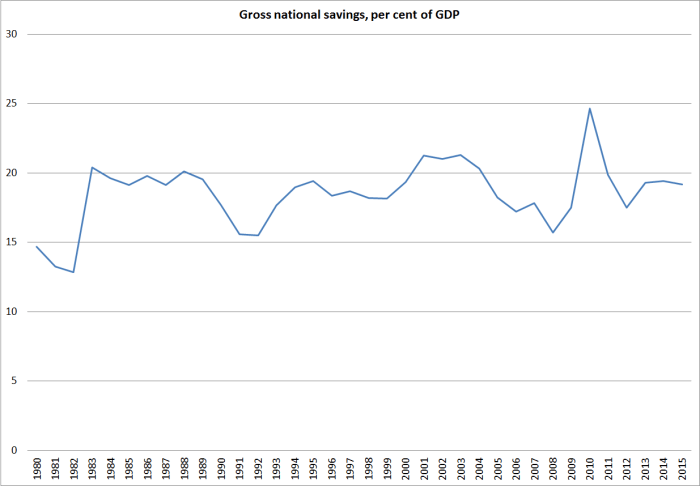
I could go on.  The Governor could usefully highlight that, although he is uncomfortable –  as everyone should be –  with current house prices, there is nothing in the turnover or mortgage approvals data (per capita) to suggest an excessively active market (high turnover is often associated with excessive optimism, and unjustifiably loose credit conditions).    And there is nothing in the consumption or savings data to suggest that high or rising house prices have spilled over into unwarranted additional consumption, putting upward pressure on inflation more generally.  I showed the chart of private consumption to GDP in a post yesterday –  stable over almoat 30 years, despite really large increases in house prices and credit.  This chart shows the national savings rate, since 1980.  There is a little year to year variability, but again no trend over 35 years now.

national savings

House prices are a national scandal, but there is no reason to think they should be treated as a monetary policy problem.

I do think the OCR should be lower –  perhaps 50 or 75 basis points lower than it is now.  In time, the Reserve Bank is likely to recognize that.  But my point here is really that when he makes his choices –  and they are personal choices, not those of a Committee –  the Governor should, and should be seen to, engage with world as it is, not as he might wish that it would be.  In that world, the unemployment rate lingers high, productivity and income growth have been persistently weak, inflation has been persistently below target, wage inflation is weak, house price inflation isn’t splling into generalized inflation pressures, and historical reference points around normal or neutral interest rates seem increasingly unhelpful.  Perhaps there is a good case for keeping the OCR at current levels, but a good case can’t simply pretend everything is rosy in the garden or that –  finally –  everything is just about to come right.

(And all that without even mentioning the exchange rate which is not only high by historical standards –  again raising doubts about those “stimulatory” claims for monetary policy –  but this morning is at almost exactly the same level it was at a year ago.  The fall in the exchange rate from the 2014 highs was supposed to help get inflation back to target.  It was a half-plausible story when the fall first happened.  It is less even than that now.)


Immigration: some follow-up points

Yesterday’s Q&A discussions on immigration seem to have attracted quite a bit of coverage.

Of course, most of that focused on the comments made by Winston Peters, and I don’t have anything much to say about those except to note two things.

First, I was interested to hear him talk of targeting 7000 to 15000 annual migrants, which was quite similar to my suggested target for residence approvals of perhaps 10000 to 15000 per annum.  The United States issues around 1 million green cards a year, and as the US had about 70 times our population that is about the same rate of per capita immigration as would be implied by my 10000 to 15000 annual range.  It isn’t a level that amounts to shutting the door.

Second, Peters has twice before been a senior minister and has never made the rate of permanent immigration a central issue in negotiations to form a government. Perhaps this time will be different.

Of my comments, most of the coverage has been around the suggestion that if the residence approvals target was cut as I suggested, house prices might be 25 per cent lower in a couple of years.  It wasn’t intended as a precise estimate, more an indication that population growth (and especially unexpected changes) make a material difference to house prices in markets where the supply response to impaired by the thicket of land use and building regulations.  However, it is quite a plausible estimate, consistent with some past empirical research on the link between population change and New Zealand house prices.

A decade ago, Coleman and Landon-Lane, in work done at the Reserve Bank, estimated that a 1 per cent shock to the population would shift house prices by 10 per cent, and more recently Chris McDonald’s Reserve Bank work produced not-dissimilar   estimates (especially for non New Zealand migrants).   Adopting my proposal to cut the residence target by 35000 per annum would, all else equal, lower the population by 1.5 per cent in the first two years.  But, more importantly, it would materially lower the expected future population, and asset markets (such as the urban land market) work on the basis of expectations.  Over a decade, again all else equal, the population would be around 7.5 per cent lower on my proposed policy than on current policy.  All else equal, urban land prices would be much lower.  Of course, all else is never equal, and with less population pressure some of the pressure to liberalise housing supply would dissipate.  But the direction of the effect on house prices is pretty clear, and the magnitude would almost certainly be quite large.

Perhaps one thing that disappointed me a little about yesterday’s programme was that discussion tended to focus on the immediate cyclical pressures, and especially those on Auckland house prices.  I guess those issues are most immediately salient, especially in Auckland, and perhaps most easily accessible to a lay audience.  My own arguments have tried to focus (a) not on the cycles in net migration, much of which are about New Zealanders coming and going, but on the trend target level of residence approvals, and (b) on the impact of New Zealand’s disappointing overall economic performance (ie the continued trend decline, over many decades, in our relative productivity).  We could fix up the land supply market –  and should –  and many of those questions and issues would, almost certainly, remain outstanding.  That said, when the advocates of the current policy can show so little evidence suggesting real economic gains to New Zealanders (as a whole) from our really large scale immigration policy (repeat, policy – the target level of residence approvals) then the appalling house price situation cries out for winding back the level of migration approvals, as one way of mitigating the adverse effects of the land use restrictions.    One could envisage an alternative world in which the real economic benefits of large scale immigration were large, clear, and demonstrable, and yet the housing market was still severely dysfunctional.  In that world, there would be some nasty potential tradeoffs if reform of land supply couldn’t be achieved.  But we aren’t in that world.  Here, it looks as though winding back migration approvals might well improve productivity prospects and improve housing affordability.   There would, and will, always be cycles in net measured migration, but the policy component is relatively easy to adjust, and to maintain at a different target level (lower or higher) than we’ve had for the past 15 years.

I was pleasantly surprised at the moderate and reasoned approach the Q&A panel took to the immigration segment.  They recognized that there are some real issues that need rational and thoughtful debate.  Nonetheless, they all still seemed in the thrall of the idea that “skill shortages mean we need migration, just perhaps a “better quality” of migrant”.   There are really just two points that need to be made in response.  The first is that empirical research suggests –  and historical casual empiricism does too –  that an influx of migrants adds more to demand rather than to supply in the short-term.  People who live in a modern economy need lots of real physical capital, and it doesn’t build itself.  So although an individual migrant might ease an individual employer’s problem, in aggregate high immigration simply further exacerbates any existing excess demand for labour (skilled or not).  Economists have recognized that for decades.  It doesn’t, of itself, make immigration a bad thing –  long term gains might still make it worthwhile –  but immigration isn’t a way of dealing with systematic skill shortages.    By contrast, a flexible domestic labour market is quite a good way: changing wage rates should signal difficulties in attracting people to particular roles/regions.  It doesn’t work overnight, and it doesn’t work in aggregate if the economy is overheating, but it works when given the chance.

The panellists also seemed taken with the idea that more should be done to get more of the migrants who do come to go to regions other than Auckland.  That seems, at least in part, to reflect a sense that something is wrong about things in Auckland (whether short term or long term) and perhaps a sense that a more successful New Zealand is likely to be one less strongly skewed away from the regions. But it risks leading to even more wrongheaded policies.  We’ve already seen that last year, when the government amended the rules to give additional bonus points to people with job offers in the regions.  Unfortunately that has the effect of lowering the average quality of the migrants who get in.  The residence approvals target is largely fixed, and the changes in the scheme rewards those who can get to particular locations, not either (a) the most highly-skilled migrants, or (b) the most rewarding and productive New Zealand jobs.  Auckland’s economic performance has been quite disappointing, suggesting it isn’t a natural place to funnel ever more people into.  But that doesn’t suggest that the solution is to funnel more people to other places instead.  It suggests focusing on the whole economy –  in particular, getting the real exchange rate sustainably down –  and letting a rather smaller number of total permanent migrants locate where the jobs and rewards are best.  In that sort of world, Auckland’s population might be materially smaller than it would be on current policy, but the population of the regions might not be much larger.  But the share of the regions in overall economic activity would be larger than it is now.  Better to cut the overall residence approvals target, and focus in on a modest number of really highly-skilled people.  The regions aren’t short of people, but Auckland seems to be awash in them (relative to the high-returning opportunities that seem to exist in Auckland).

As a final observation on the Q&A discussion, I was interested in Andrew Little’s response to questions about immigration.  He continues to toy with the idea of some sort of short-term cap on migration. I don’t think that is particularly sensible or meaningful.  No one can accurately forecast short-term fluctuations in net migration (ie the combination of New Zealanders and foreigners) and if those fluctuations can’t be forecast, one can’t run meaningful short-term caps. In the nature of things, and well-intentioned as they might be, they would simply risk exacerbating the short-term cycles in net migration: pull back approvals when net migration was at a cyclical peak, and by the time those changes took effect, often enough the natural cycle would have turned down anyway.  And vice versa when net migration is at a trough.  We are much better to run a stable and predictable programme of residence approvals, and live with the natural variation that results mostly from New Zealanders coming and going.    In my view, the target level of approvals should be lowered quite substantially, but wherever it is set it shouldn’t be messed around with –  up or down –  in response to short-term cyclical pressures.

But my concern about Little’s comments was more about the underlying message.  Twice in the space of thirty seconds, he repeated the line that “New Zealand has always been a country dependent on bringing in skills from abroad”, stressing that he would never want to change that.  It is simply a mistaken model of growth.  The prosperity of any country depends primarily on some combination of the natural resources it has and, most importantly, on the skills and talents of its own people, and the institutions (political and economic) that those people nurture.    That was true of the United Kingdom or Holland centuries ago, it was true of the United States century or more ago, it was true of twentieth century New Zealand, and it is true of every advanced successful country today.  Of course, every country draws on ideas and technologies developed in other countries. In some cases,. immigration may even have helped the recipient country a bit –  but any such gains look to be quite small – but prosperity depends mostly on a country’s own people and own institutions.  The line Little is running is certainly consistent with the implicit stance of the New Zealand elite, across the main parties, but there is little or no empirical foundation for it.  Indeed, it risks sounding like a cargo-cult mentality –  waiting for just the right people from over the water to come and bring us prosperity.  Things simply don’t work like that.  It is a shame that our political leaders aren’t willing to put more faith in the skills, talents, and energies of our own people and firms, rather than (so it seems) wanting to “trade us in” for some better group of people.  Countries don’t get successful by bringing in better people: rather, successful countries can afford to bring in more people, if they choose.

In this morning’s Herald, the other key prominent academic in the liberally-funded (by MBIE) CaDDANZ project, Professor Paul Spoonley of Massey, has an op-ed championing the current immigration policy.  It probably warrants a post of its own, but his bottom line seemed to be “keep the faith”.

Spoonley starts with this:

The International Labour Organisation estimates a 1 per cent increase in population expands GDP by between 1.25 and 1.50 per cent.

I’m not sure the source of this estimate, but it is a huge effect.  Stop and think about what it means for New Zealand, if it were true over the medium-term.  We’ve had one of the fastest population growth rates in the OECD in recent decades, and yet one of the worst productivity growth performances.  So perhaps the really rapid migration-fuelled population growth has been really really good for us, and everyone else has gone really really badly, to explain our overall disappointing performance. But where is evidence –  the telling statistics that suggest that that is really what has gone on? Professor Spoonley knows about the disappointing New Zealand economic performance, so it is a shame that he didn’t try to relate his general claim to the specific experience of New Zealand.

Spoonley then argues

Auckland gains from the effects of agglomeration. Population growth and immigration is associated with economic growth and diversity. For example, Auckland and Canterbury between them accounted for almost all the new jobs growth in New Zealand last year.

Immigration is key to this as skilled immigrants add to the human talent pool that is available to employers. They also establish new businesses and contribute to demand, including for education. Regions and cities that are not attracting immigrants are losing out on this current windfall.

It is fine theory. It just bears no relationship to  the experience of New Zealand, and Auckland in particular, in recent decades.

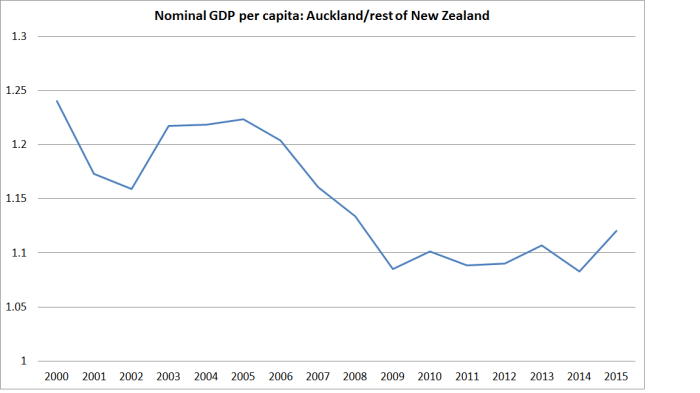
I’ve shown this chart before

ngdp akld ronz

No one disputes – Spoonley doesn’t –  that Auckland’s population growth is largely migrant-driven.  And yet Auckland’s per capita GDP has been trending down relative to the rest of the country’s over 15 years.  And the margin of Auckland’s GDP over that of the rest of New Zealand was already low relative to what we see in most other advanced economies.

Perhaps Professor Spoonley and the other New Zealand pro-immigration advocates (many of them taxpayer funded) are right about the benefits to New Zealanders of this really large scale intervention.  But even if so, surely we deserve much more evidence of those benefits than we get when leading academics simply assert over again that, whatever the short-term stresses, the Think Big programme is really working out just fine?

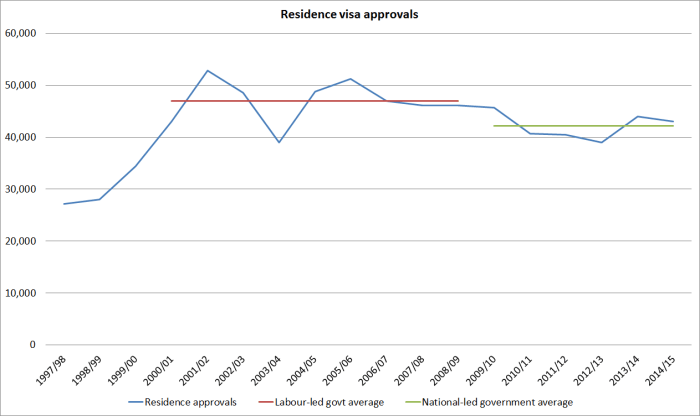
And to end a long post, just a simple chart.  It shows residence approvals for each year since 1997/98.

residence approvals

The data are only available annually, but they are hard data on the number of people MBIE has given residence visas to.  This isn’t SNZ arrivals and departures data, it is the policy core of the immigration programme –  aiming at 45000 to 50000 approvals per annum.  One of my commenters keeps trying to distract from this issue by citing PLT data. Those data are often interesting and useful (and in other ways quite limited) for various other analytical purposes, but if we want to think about the implications of the annual flow of residence approvals this is where the focus should be.  Annual approvals under this programme are not very cyclical, and haven’t varied much across the last two governments.  They are simply very high by international standard (per capita) –  three times the US level.  And on the (lack of) evidence to date of economic benefit to New Zealanders, the annual target should be wound back quite considerably.


House prices and the Reserve Bank

House prices are not the responsibility of the Reserve Bank, any more than tomato prices are.

In its monetary policy, the Bank was charged by Parliament with maintaining a stable general level of prices.  In the Policy Targets Agreement, the Governor and the Minister of Finance agreed that, while the Bank should keep an eye on all sorts of price measures, for practical purposes the focus should be on keeping annual CPI inflation near 2 per cent.  The CPI includes rental costs and the cost of construction of new dwellings, but it does not include section prices or the prices of existing dwellings.  Parliament or the Minister could require the Bank to focus on some different index altogether –  there is nothing sacrosanct about the CPI, even as a measure of prices –  but they haven’t.  And the way the CPI treats housing is consistent with the Reserve Bank’s view as to how housing should be treated.

What about the financial regulatory side of the Bank’s responsibilities?  The Reserve Bank Act requires that the Bank exercise its regulatory powers over banks in ways that promote the soundness and efficiency of the financial system.  What matters is the overall health of the balance sheets of the financial system as a whole.  Loans secured on residential properties make up a fairly large proportion of bank balance sheets, which suggests that the Reserve Bank might reasonably want to understand the risks banks are carrying, and the buffers they have in place if things turn out less well than expected.  But it does not make house prices a policy responsibility of the Reserve Bank.

Perhaps one might make an exception to the statement if there were evidence that house prices increases were occurring primarily because of reckless lending by banks.  But even that is a higher standard than it might sound.  It doesn’t just mean that credit growth for housing might be running ahead of incomes –  one would expect that if other shocks and distortions (eg land supply or immigration) were putting upward pressure on house prices. If so, the younger generation will typically need to borrow more from older generations to get into a house, and the banks may be just the intermediaries in that process.  And even if the Reserve Bank suspected “recklessness” it would have to ask itself why, and what basis, its judgements were likely to be better than those of the banks.  After all, the Reserve Bank has nothing at stake, while the shareholders of banks have a great deal at stake (even if you think that governments would mostly bail-out creditors, shareholders usually lose a lot when things go wrong).

One might draw on past experience and international research.  But even then one has to do so carefully.  After all, as the Reserve Bank itself has highlighted, losses on residential mortgage portfolios have rarely played a central role in systemic financial crises –  and particularly not in countries with floating exchange rates (check) and with little or no direct government involvement in housing finance (check).  Very rapid housing turnover can be a sign of things going haywire –  although even then not necessarily of high risk to banks.  But in New Zealand, house sales per capita have remained well below what we saw in the previous boom, and mortgage approvals per capita also remain pretty subdued by pre 2008 levels.  And recall that in New Zealand, with the same banks we have now and the same incentives, the banking system did not get into trouble even after that boom.  During the 2008/09 recession, senior Reserve Bank and Treasury officials toured the world spreading reassuring words, and they were right to do so.

Perhaps too, the Bank might worry about the spillover from higher house prices into the rest of domestic demand.  But, in fact, over the last 25 years, despite huge increases in real house prices, the private consumption share of GDP has been essentially constant.

household C to GDP

That is largely what we should expect: after all, higher house prices don’t make New Zealand any better off, and the individuals who are better off must be offset by other individuals who are made worse off.  The Bank might also pay attention to high-level research suggesting that financial crises have typically been foreshadowed by big increases in debt to GDP ratios over relatively short periods (the few years just prior to the crisis).    But on that score, it is worth remembering that most countries that have had big increases in debt to GDP ratios have not had domestic financial crises (think of the UK, Canada, Australia and New Zealand for example).  And in New Zealand, household debt to GDP ratios have gone largely nowhere for eight years, after a huge increase in the previous 15 years.  Yes, there has been quite an increase in the last couple of years, but that is surely what one would expect when population pressures and land supply restrictions combine to push house prices up.  A higher level of credit is a typical endogenous response.    It is not, of itself, a danger signal regarding the soundness of the financial system.

This was all prompted by a piece I noticed on interest.co.nz which appeared under the heading “RBNZ has nowhere to hide from the housing market”, with the fuller heading  “Each new piece of housing-related data coming out at the moment is increasing the pressure on our central bank”.   If so, it is only because the Reserve Bank has chosen, with no good statutory justification, to put that pressure on itself.  Good central banks don’t need to “hide”.  The housing market is just another, albeit important, market.

The Reserve Bank has a relatively straightforward job. It is supposed to keep inflation near 2 per cent, which it has been failing to do.  And it is supposed to use its regulatory powers to promote the soundness and efficiency of the financial system.  There is no sign that the soundness of the system is threatened, and each new regulatory intervention impairs the efficiency of the financial system –  and provides, briefly, cheaper entry levels for those upon whom the Reserve Bank’s favour rests.

Here’s what I would expect the Reserve Bank to be doing.  They should be continually reviewing the reasonableness of the risk weights that they allow the banks to use in their capital modelling, and ensuring that they understand how different banks are assessing the same risk.  They should carry on with their programme of stress tests, which so far have shown very encouraging results in the face of very severe shock scenarios.  And then they should be leaving the responsibility for house prices and a dysfunctional housing supply market where it rightly belongs: with central and local government.  When the Reserve Bank intervenes not only does it compromise financial system efficiency, for little obvious gain on soundness, but it leaves observers with a sense that perhaps the real issues are different from what they are.  And it encourages banks to focus on managing regulatory limits rather than thinking hard about the risks they, and their shareholders, are taking on.

The Reserve Bank is not responsible for the current housing mess, and it cannot provide the solution –  not even partial or temporary solutions.  Responsibility rests with successive governments that bring in tens of thousands of non-New Zealanders each year into a system that is simply unable to generate effectively and cheaply a sufficient supply of houses.  And that isn’t a market failure, but yet another example of government failure.

And for those who worry that a lower OCR would simply push up house prices further, a reminder that one of the key ways in which monetary policy works is by raising the prices of long-lived assets – which encourages people to invest in producing more of them.  But perhaps too it is worth remembering that the real OCR has fallen by more than 600 basis points since 2008, and yet material real house price increases have only been seen in places with that fatal combination of substantial population pressures and a highly distorted land supply market.  Interest rates are low for a reason –  the economy would be even weaker and inflation lower if they were not.


The Herald’s wrongheaded call for an ever-bigger population

The Herald’s editorial today is headed “Population growth is powering NZ economy”.   It isn’t just a statement of the rather obvious, that a rapid growth in the population –  particularly unexpectedly rapid growth – boosts total GDP.    When there are more people, they all need to consume stuff, and they need houses, schools, shops, roads, offices etc.  And unexpected surges in the population boost demand more, in the short-term, than they do supply.    But they don’t do anything much to boost sustainable per capita real GDP.

That isn’t, of course, the Herald line.  Rather, channelling the Prime Minister, they assert that

The population increase is helping to generate the growth in the economy that puts New Zealand ahead of most other and larger economies at present, which in turn makes it a magnet for yet more migrants, as well as persuading more young New Zealanders to stay here.

There is so much wrong with this sentence, it is difficult to know where to start.  First, and repeating it slowly yet again, it is per capita economic growth that matters.  New Zealand has been doing quite badly on that score over the last year or so, even by comparison with other countries.  And as I illustrated yesterday, even on the Treasury’s own, optimistic-looking, numbers, we are expected to be only an average performer over the next four year.  Average isn’t necessarily bad, except that we are starting out so much poorer than most advanced countries, and not closing the gap.

And it isn’t as if jobs are abundant here either,  Our unemployment rate, at 5.7 per cent, is well above most estimates of the “natural” rate of unemployment, and not much below the median unemployment rate for OECD countries.    The number of residence approvals here is subject to a target, so even if there is increased demand from foreign citizens to move here, it only increases slightly the quality of the people we can take, not the total number.  Much of the variation results from two things.  The first is the inflow of students, probably influenced more by the policy change allowing most to work here while they study, rather than by the intrinsic strength of the New Zealand economy.  And the second is the flow –  mostly of New Zealand citizens –  to and from Australia.  Australia’s unemployment rate is also now quite high, at 5.7 per cent, and New Zealanders moving there don’t have access to the welfare safety net and associated entitlements they do at home.

The editorial goes on

The Government would not want to say this out loud, but clearly it is not controlling immigration as tightly as previous governments have done. This attitude undoubtedly comes from the Prime Minister and it is consistent with his disinclination to restrict foreign investment or even monitor its impact on the house market. He deeply believes the country is better off being open and connected to the world’s flows of capital, trade and people. The performance of the economy on his watch suggests he is right. Even the housing affordability is a cost of prosperity. If we want drastic steps taken to stop rising prices we need to be careful what we wish for.

With the exception of allowing students to work, the initial claim here is simply incorrect.  The residence approvals target is the same as it was under the previous government, and even student arrivals have not reached the peaks seen under the previous government.  As for the rest, no doubt it accurately reports the Prime Minister’s views –  he has repeated them often enough –  but there is no evidence to support it.  Productivity growth –  the foundation of sustained long-term prosperity –  has remained disappointingly weak.  And the immigration inflows have been overwhelmingly concentrated in Auckland, and yet the official data show that Auckland incomes are (a) lower relative to those in the rest of the country than we see in most advanced countries (comparing dominant cities and the rest of the country) and (b) that that gap has been narrowing.  Whatever the reason, the strategy is failing.

From there the editorial launches off into its own alternative universe

New Zealand’s desirable population size has always been a contentious subject, though not previously an urgent question. The increase since the turn of the century followed 25 years of static population figures as more people left than arrived.

Immigration policy was a notoriously capricious. Each time the economy dipped, governments would close the door. Now that we appear to have a rapidly growing population again, we need to be discussing how high we want it to go, and how it might be channelled to regions that most need it, and the houses and services it is going to need.

This country would benefit from many more people, and better preparation for their arrival.

There was a period from the mid 1970s to the late 1980s when New Zealand’s population growth was quite subdued.  But for the last 25 years –  not just since the turn of the century –  we have had one of the faster population growth rates of the OECD.  One doesn’t have to take a view on causation to note that people haven’t exactly been flocking to an economic success story.  Incomes here are presumably better than they were in the migrants’ home countries, but our productivity growth rate over that 25 years has been among the very slowest in the OECD.  Starting low, we’ve just drifted somewhat further behind.

I’m also not sure where the author gets the idea that New Zealand “immigration policy was notoriously capricious”.  Yes, there are constant changes at the margin, but to a large extent we’ve been running much the same immigration policy for 25 years now, through several recessions, and some pretty sharp ups and downs in the labour market.  Much the same could be said of the post-war decades, until the Labour government in 1974 closed down automatic access for British and Irish citizens –  and that wasn’t because the economy was doing badly, but just because they thought immigration should be less focused on traditional sources countries.

Of course, I thoroughly agree that we should be having a national debate about immigration policy.  Policy has long been premised, explicitly or otherwise, on the belief that New Zealand would be better, and more productive, if only there were more people.     But there is just no evidence for that proposition, and certainly not enough on which to rest such a large scale economic and social intervention as our immigration policy.  Big countries don’t grow faster than small ones.  When we had 1 million people, there were calls for many more people.  And when we had 2 million people.  And when we had 3 million people. And so on.  And for decades our relative incomes and productivity performance have been deteriorating.  New Zealanders have been getting poorer relative to their advanced country peers.  I’m not sure where the advocates think the critical threshold is where things might turn around –  but clearly 4.5 million people hasn’t been enough either.

The editorial writer talks of channeling people to “the regions”, which is almost certainly even more wrongheaded than bringing in large numbers in the first place.  We’ve seen that in the policy changes the government made last year: giving more points to people with job offers from the regions simply has the effect of lowering the average quality of the migrants we do get, who (on average) have not been terribly highly-skilled in the first place.

Instead of constantly championing the case for ever more people –  even at the cost of encouraging New Zealanders to leave Auckland (a weird way to help people at the bottom) – it is about time there was a serious conversation that stopped pretending everything was fine, and confronted the facts of New Zealand’s economic underperformance, and Auckland’s economic underperformance.  Doing so would force people to think harder about whether there was much realistic prospect of New Zealanders benefiting from an ever-increasing migration-fuelled population.  I’m not suggesting a population policy –  fertility and emigration choices of New Zealanders are their own affair –  rather, the abandonment of the implicit “big New Zealand” population policy we have had through successive governments.   Pretty much everyone accepts (and it is an uncontested OECD empirical result) that our distance from markets (and competitors) is a material penalty, making it harder to generate really high per capita incomes in New Zealand.  There is still no sign that New Zealand is getting much traction in products and markets that don’t rely largely on our natural resources –  and utilizing those natural resources in ever smarter ways simply does not need lots more people. Why penalize everyone more by rapidly increasing the population of a country with such a disadvantageous location?

The Herald is right that without the unexpected surge in immigration total GDP today would be lower than it is.  But without the surge in immigration over the last few years then, all else equal, our interest rates would also be lower, and our exchange rate would be lower.  And New Zealanders as a whole would be better off, because more firms would be better positioned to sell products and services into world markets at competitive prices.  But, probably more importantly in the long-run, our largely fixed stock of natural resources, found on not-very-propitiously-located remote islands, would be spread over rather fewer people.  As a country we’d be better off, and lower Auckland house prices –  no doubt still distorted by unnecessary land use restrictions –  would be a beneficial mark of that success.  As it happens, the regions  –  where the natural resources mostly are (pasture, forests, mines, seas, landscapes) –  would loom larger relative to Auckland, curiously the goal that the Herald’s editorialist seems to espouse.


The OCR leak: some disclosures

Will I come to regret this post?  Probably not, but only time will tell.  It also may not be of wide general interest, but that is fine.

Regular readers will recall that I got caught up in the Reserve Bank’s OCR leak.  More specifically, gaping breaches in the Bank’s systems (a near-total reliance on trust) and an actual leak of the March OCR decision would not have come to their attention, and been addressed, if I had not passed on to them information that arrived unwanted in my email in-box on the morning of the release, which suggested the possibility of a leak.  Frankly, if anyone was the innocent party in the whole episode it was me.  I wasn’t the leaker, I wasn’t the major media organisation that failed to disclose the leak by its employees for several weeks, I didn’t even receive what information I had from the person who was the leaker, and I wasn’t the central bank that ran security systems that made such a leak astonishingly easy.

And so I was more than a little miffed to have the Governor of the Reserve Bank describe me and my conduct as irresponsible in his press release announcing the results of the inquiry –  an inquiry that would never have taken place if it had not been for my initiative in alerting the Bank to the issue.  What particularly irked me was that in the same statement the Governor (a) took no responsibility for the laxness of the Bank’s own systems, and (b) seemed to go out of his way to stress how helpful the media organisation, MediaWorks, had been.   It also puzzled me a little that there seemed to be no sanctions imposed by the Bank on the leakers – MediaWorks and its staff.

That prompted me to lodge a series of requests for information –  from the Bank itself, and from its Board (which is paid to operate at arms-length from the Bank to scrutinise the performance of the Governor and hold him to account).    The Bank has actually responded to one other OIA request in this area: the Taxpayers’ Union asked about the cost of the Deloitte inquiry, and was told a few weeks ago that the cost was $58952.28 (plus GST).  My OIA requests have been treated in a more typical Bank way –  not just extended for one month, but all the way out to 1 July, with talk of the possibility of charging.

However, I also sought from the Bank under the Privacy Act material relating to me that was held by the Bank and generated or obtained between the morning of the MPS release on 10 March and the day I lodged the request.  They didn’t respond in 20 working days, but it wasn’t that much after the initial deadline when I was sent a fairly large collection of material yesterday.  I had kept the request quite focused –  I wasn’t after copies of media reports, or out to embarrass junior people who were not involved in the leak investigation and might have been exchanging speculative emails.  All the material I obtained was comments from people directly involved, mostly people from the senior management group including the Governor.

I have tossed up about whether to release this material, and am doing so for two reasons.

The first is that I think it does shed useful light on how the Bank went about dealing with the information I provided to them, and the priors and presuppositions of key people involved.  It is only a partial view of course, and I hope in time the Official Information Act requests will provide some more clarity.  Unfortunately, the Bank has deliberately stalled the release of that information (which it can be onerous neither to collect/collate nor to review).

The second is more personal.  Various people wisely suggested that I separate my irritation at having been personally attacked by the Governor from the wider issues of how the Bank has dealt with the issues of the leak, MediaWorks involvement, lock-ups etc.   Some experienced former colleagues had even got in touch to suggest I must be misinterpreting things, and the Governor’s statement about irresponsibility couldn’t have been meant to include me.  And so I decided to write a private letter to the Governor, outlining my perspective on my involvement in the whole issue and, in light of those points, inviting him to explain, or reconsider, his public assertion that my conduct had been irresponsible.  If possible, dealing with such issues privately is generally likely to be more constructive.

It wasn’t long before I got a very terse response from the Governor confirming that he did indeed regard me as having behaved irresponsibly.  I didn’t do anything with that, other than to pass the message on to those optimistic former colleagues.

But then I received yesterday’s collection of documents.  Publishing them, together with my letter to the Governor and his reply, will enable people to form their own views.  I’m sure many will see what they want to see, and some of those inclined to support Graeme Wheeler more generally may agree with the views he, and his senior colleagues, expressed.   Anyone is entitled to his or her own view.

As for me, I have to live with my own conscience.  There would be nothing shameful in concluding that, with the benefit of hindsight, one might have done some things differently.  After all, the Governor himself –  who had much more time – has changed tack twice since the inquiry was released (from no penalties for MediaWorks to indefinite exclusion from press conferences, and from immediately discontinuing lock-ups to investigating the possibility of reinstating them).   I have asked myself some of the questions others have posed, but reading the material I received yesterday led me to conclude more strongly than previously that I had done the right thing –  not necessarily the things the Bank would have preferred, but those which best balanced the public interest and the protection of my own interests.

Here is the link to the material the Reserve Bank released.

OCR leak inquiry Privacy Act response from RB

My earlier posts on the leak and related issues are all here

And here is what I took from the newly-released material.

The first point I noted is that, with the exception of a brief email from John McDermott on the morning of the MPS release, in which he wrote to me “Thank you for letting me know”, no one (management or Board) seems to have considered, at any point in the subsequent six weeks, expressing appreciation to me for coming forward and passing on the information that I had.  One doesn’t try to do the right thing in the hope of being thanked for it, but it is a telling omission nonetheless.

The second point is that I was pleasantly surprised to learn that the Bank seemed to take the information seriously from the start.  By 11:30am on 10 March, Deputy Governor Geoff Bascand had asked the senior manager responsible for risk and audit to undertake an inquiry, noting (page 2) “we cannot be sure it is a leak as opposed to speculation but need to enquire into it with diligence and urgency on the assumption it is”.

That was fine, and he even noted that “in the first instance, he [Michael] is the messenger”.   But in the same email Bascand had already moved on to treating the information I had passed on as an “allegation”, and two of the three questions he expects answers to are about my conduct.

Somewhat surprisingly, in a world in which a “no surprises” policy is generally supposed to prevail between government agencies and the Minister’s office, it appears (page 4) that the Bank only decided to tell the Minister of Finance’s office about the possibility of a leak after I had made a brief mention of the information I received on my blog on the afternoon of the release (having advised the Bank some hours earlier that I was likely to mention it).  That looks like poor political management, but also tends to confirm the unease I felt at the time, that the issue might be hushed up if at all possible.

Geoff Bascand’s biases become increasingly apparent in one of the unguarded emails that requests like this throw up.  After they advised Bank staff of the situation late on 10 March, the head of HR emails Bascand with a brief expression of sympathy.  Bascand’s response is nothing at all about the possible vulnerability in the Bank’s own systems (he being the senior manager responsible for the Communications functions), the possibility of an actual leak, or anything of the sort, but is all about the messenger.

By this time, and perhaps reflecting his biases, it is becoming clear that Bascand has trouble with the meaning of the word “allegation”.  I have commented on this previously, but it is more stark in the light of the information in this release.  In his message to all Bank staff (page 5) late on the afternoon of 10 March the heading is “Allegation of leak information”, and in a five line email the word “allegation” is used twice.  Nowhere, by contrast, does he note something like “we have received information suggesting that information may have been leaked”.      To repeat, allegations are claims are that are made, something that (at least according to my Oxford dictionary) involves “to assert without proof”.

To repeat, at no time between 10 March and 14 April (the release of the short-form inquiry report) did I make any “allegations”.  All I did –  and the emails are in this batch, on page 1 –  was to pass on hard information that I had (an email) while stressing repeatedly that I had no idea whether it was the fruit of a leak, or something else.  At the time, as I’ve said before, I struggled to believe a leak was possible.

It took a while for the leak inquiry to get going.  I’ve covered previously the Bank’s approach to me to assist the inquiry –  an approach which was extremely professional and which carefully referred only to the “possibility of a leak”.  I talked to the Deloitte investigators a few days later.  I gave them a copy of the text of the email I had received, and we had an amicable conversation in which, inter alia, they indicated that the Bank was very grateful to me for having come forward.  At the time I took that at face value, and commented openly on my support for the process the Bank had put in place.  It is worth noting –  because it comes up later –  that the Deloitte investigators did not ask me who sent the email to me, and indicated that they would not expect that I would tell them.  I wrote a post following that meeting with the investigators, mentioning briefly the discussion we had had, but focusing mostly on structural changes that I thought were warranted (abandonment of lock-ups etc) regardless of whether or not there had been a leak on this occasion.

That post seemed to spark some media interest.  The documents contain an email to Mike Hannah (RB Head of Communications) from Hamish Rutherford of Fairfax (someone else who appears to have had trouble with the meaning of the word “allegations”) and over the next couple of days there was a flurry of media coverage, here and abroad, and some clarificatory posts from me (partly annoyed at the continued public use of the term “allegations” by media and Bank representatives).  That in turn sparked various emails among senior managers at the Bank.

Mike Hannah is the first (page 13).  Interestingly, he claims that he would have picked up and responded quickly to any email I had sent before 9am on 10 March.  If so, that is good to know now, although it wasn’t the impression I was under at the time.  But he also notes that the Bank would not necessarily have done anything differently: “we’d have watched the markets very carefully , and might have had to consider going early if we saw action”.  But as everyone recognises, there was nothing visible happening in markets.

Hannah also responds to my point that one reason I hadn’t contacted the Bank in the brief window before 9am was my unease about the Bank’s reaction if in fact it had not been cutting that morning.  He considers it a “flimsy” story, but in fact the tone of the senior management comments –  from him, Bascand and Wheeler – throughout these documents only confirms that was an entirely reasonable fear on my part.  One thing that is striking in these documents is the apparent total inability of such senior people to imagine themselves in someone else’s position with someone else’s (lack of) information. They knew there was a cut coming. I didn’t.

The Governor responded to Hannah (at 1:48 am –  perhaps he was travelling).  From the tone of his email he seems to regard the whole exercise as a “quest for publicity” by me, adding that “my sense is that he is digging himself into a hole” – I’m still not sure, from context, how.    He seems aggrieved (on which more later) that a former employee of the Bank would blog about the enquiry.  It is really quite a weird reaction: one might hope that the Governor would have been most concerned about getting to the bottom of the substantive issue, and would expect considerable public scrutiny at even the possibility that an OCR decision had been leaked.  Recall that by this point –  objections to the misuse of “allegations” apart –  I had been supportive –  in public and in private –  of the whole inquiry process the Bank had put in place.

The Governor forwarded that email to the chair of the Bank’s Board, Rod Carr.  Instead of keeping an appropriate distance from management, Carr weighs in suggesting that perhaps I was now feeling guilty, that my actions were not a “sign of good citizenship”, and that somehow advising them a few minutes earlier  –  see Hannah’s comments above –  might have protected “NZ’s reputation”.    To his credit, Carr does flag the possible need to abolish lock-ups.

A few days later, Mike Hannah reports to the Governor on his approaches to the attendees at the media lock-up.  Hannah remains reluctant to believe that any media person/body can be responsible –  even though I had told him by inference (on the first day) and told the Deloitte team directly a week earlier that the email I received had come from a person in a media organisation.    More generally, at this point, Hannah still seems reluctant to believe that there had been a leak at all –  perhaps understandably given that he ran the lock-ups –  noting of his conversations with journalists “it may all be humour, bluff, etc, but it may also reflect scepticism about Reddell’s credibility”.    Given Hannah’s reluctance to accept the possibilities, the Bank’s in-house counsel (one of the few to emerge creditably from these documents) had to go back to Deloitte (page 16/17) to confirm that I had in fact said the email came from a person in a media organisation.

The Deloitte report indicated that, finally, on 5 April, MediaWorks owned up to the fact that there had been a leak, and that their staff had been responsible.  Perhaps unsurprisingly, there is no email in the system from senior RB managers saying “gee, Michael’s information turned out to be about something real; just as well as he came forward”.

Instead, the documents skip forward to Sunday 10 April.  By then, the Bank had the draft Deloitte report and was providing comments on it, and drafting press releases.

Geoff Bascand had sent out an email expressing surprise that no (MediaWorks) names were named in the Deloitte report –  in particularly that the report did not name the person who had sent the email to me.  Hannah responds identifying his suppositions about who it was, and he indicated that his draft press releases included the name of the person he suspected.  He also noted that he  had “not yet included Reddell’s name” –  the operative word apparently being “yet”.  Reflecting the Bank’s cast of mind, he noted that this was “not to save him” but simply because he still wanted more information.  The next morning, Hannah emails senior colleagues indicating that the draft press release had been done by him and the Governor jointly.  He urges that the Bank needs to get Deloitte to ask MediaWorks for the name of the person who emailed me (even if just to confirm that they would not provide the information).

In response, Nick McBride points out that he would not expect MediaWorks would provide anything more, and urged that the Bank should avoid focusing on individuals, stressing “it is MediaWorks that is responsible”. He goes on to note that “there is also a strong basis for speculating that a journalist emailing from the lock-up was normal behaviour, for Mediaworks at least”.   Interesting, he notes that MediaWorks will be particularly reluctant “if it senses the Bank’s ‘no mercy’ approach and the lack of credit it is likely to get for its admission”.    Given that there were no sanctions imposed on MediaWorks in the 14 April announcement, and the statement went out of its way to praise the cooperation of MediaWorks, something must have changed between then and 14 April.

That same day  – Monday 11 April –  also saw an odd email exchange between the Bank and Deloitte.  The Bank asks for copies of all emails from MediaWorks, and in response is told that “the only other email correspondence that we had with MediaWorks was the email exchange about Mr Reddell’s phone number –  now attached for your reference” [although for some reason not included in the material the Bank released].  My phone number isn’t exactly a secret –  it is in the White Pages.  But that same exchange also confirms that what the Bank released on 14 April is not, despite the impression given in the Bank’s statement, the full Deloitte report at all.  Instead, it appears to be a “short form” “public version”.  Someone should probably request the full report.

The Governor himself was engaged in providing comments on the draft report.  His attitude is evident in the following exchange.  A manager in the audit area of the Bank advises senior management that he has asked that Deloitte delete the word “all” from a description of how I had “cooperated with all our inquiries”, since I had declined to name my source (despite never being asked to, either by the Bank or Deloitte).  Not content with that excision (which wouldn’t have bothered me) the Governor insists that they must delete “Mr Reddell cooperated with our enquiries”, noting “as he didn’t disclose everything that was necessary this therefore gives a misleading impression”.  The fact that the inquiry would never have occurred at all without my original initiative clearly escaped him.

The remaining emails relate to the period after the release of the (public version) of the inquiry report on 14 April.  There is the gratuitously nasty one from someone outside the Bank (page 25) but my interest is mostly in the stance of the Bank’s senior management and Board.

According to Mike Hannah, in an email to the Governor and Board chair, by now I am “obviously smarting from a well-aimed and deserved reprimand”, and am “irresponsible again” for suggesting that the lock-ups had had lax security.  Reading that did prompt me to wonder which senior manager oversaw the procedures for and administration of the lock-ups which had just been revealed to have been breached.

And then the ante starts getting raised further.  According to Geoff Bascand,

“nothing will satisfy Michael. He is a deeply aggrieved person.  Everything will be interpreted through his victim filter”.

I’m not sure where Bascand gets any of this from.  And a simple apology from the Governor for publically tarring me as “irresponsible” would satisfy me.  Bascand continues to seem to think I somehow regret leaving the Reserve Bank, when I had been quite clear for several years prior to doing so that I was keen to get out, and do as my mother had done for me, and be around for my growing children.    That had only become financially feasible by late 2014, and by then the (personally) optimal thing was to stick around long enough to collect a looming redundancy cheque, which is currently helping pay for house alterations.  As I said to John McDermott at the time, my only concern had been that the Bank might change its mind.

The Governor also weighs in (page 27) and we get here the fullest explanation of his view of my irresponsibility

I firmly believe Michaels behaviour was irresponsible in failing to inform the Bank immediately, in not informing Deloitte as to who contacted him and blogging continuously on the matter even when the investigation was underway. I believe the reasons he trotted out for his actions to Deloittes were extremely weak to say the least.


I also find all this rich from someone who worked in the Bank for a long time and I believe should have used much better judgement- also Michael has repeated denigrated the work of colleagues that he worked alongside for many years and I believe also he has been reckless in his criticism . I believe many of the points he makes are misplaced and can readily be countered by a competent economist.

Some of this was familiar ground (see his brief letter below), but much was not.  The suggestion that I  –  or presumably others  –  should not have written about the matter while his investigation was underway almost beggars belief.  His internal inquiry about a possible failure of internal process is not exactly on a par with a matter that might be sub judice because it is being dealt with in a court of law. This is a (potential and actual) systems breach in high profile powerful public agency.

Unfortunately, the Governor seems to have allowed his judgement on the specifics of the (possible) leak issue to have become clouded by his irritation at the scrutiny and challenges that I have posed to the Bank, and him in particular, over the previous year or so.   And the substance of his point seems wrong  – I have tried to be very careful, when being critical, to focus responsibility on the Governor (as the law does) and his senior managers, and not on the many able staff who work in the organisation.  I’m quite relaxed about the idea that the Governor will often disagree with my points of view   –  that is hardly surprising, and not really that different than it was when I was inside the organisation –  and, yes, reasonable people (including some other “competent economists”) will differ on many of these issues.  But none of that is, or should be, germane to the specific issue of the leak that (a) occurred on his watch, and (b) would not have come to light without my help.

Since I was interested in lowering the temperature on the personal aspects of this, I approached a friend of mine who is on the Board seeking some sense from him as to why the Governor’s stance towards me on this issue was reasonable.  Perhaps he was in an awkward position, but I was largely fobbed off with a “circle the wagons in defence of the Governor” attitude.  And so I wrote to the Governor, copied to the Board.

That letter is here.

Letter to Graeme Wheeler OCR leak press release

The Governor’s very brief response is here.

Graeme Wheeler Ltr to M Reddell April 2016

The final email in the set of documents that the Bank released is an email from the Governor to his senior colleagues and the Board chair, forwarding them a copy of the letter, with the terse observation “I find this letter quite extraordinary”.

Some readers will get to the end of all this and perhaps still think the issue at stake is that I should have got in touch with the Bank a little earlier than I did on 10 March.  A few commenters on earlier posts have argued that.

Contrary to the sense that pervades many of these emails among Reserve Bank senior managers and Board members, I owed the Reserve Bank nothing.   But I do feel some sense of residual loyalty to the organisation and so I did what I reasonably could, in a way that directly helped them uncover a serious leak (and subsequently amend their own procedures).    If anyone reading these emails thinks that, in my shoes, they’d have rushed to tell the Bank earlier, at risk of being scoffed at and ridiculed had the Bank not in fact been cutting that morning, well all I can say is that they have a thicker skin than I do.  Bascand and Wheeler would no doubt have been poised with some barbed turn of phrase about “there goes Michael again”, ready to tell others the story the next time I ran a post they disliked.

At one level, the attitudes in these emails don’t surprise me greatly –  although perhaps I’m a little  surprised that despite the OIA and the Privacy Act they wrote these things down.  And I’m a little relieved that none of them are from my own two previous bosses.  I don’t think they reflect well on the Bank, or its Board, but that is also something for others to judge.
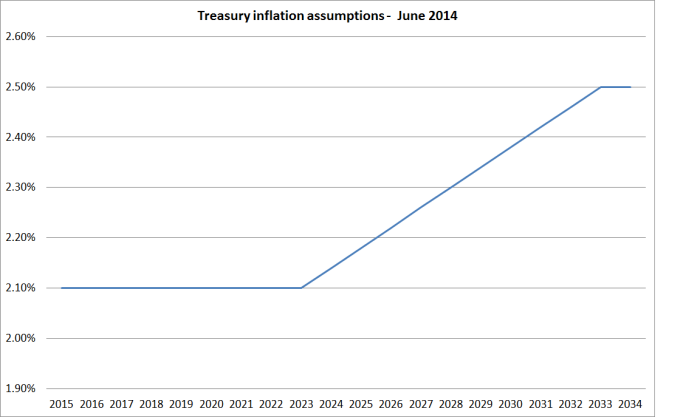
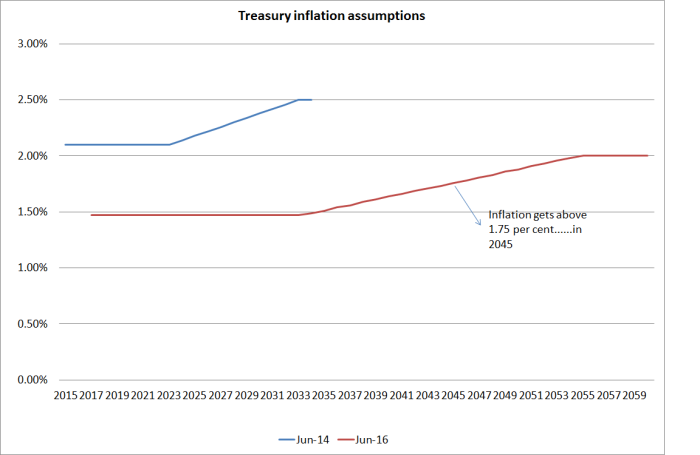
Sometimes I wonder….

There is always plenty in the newspapers to disagree with, but over the last couple of days a couple of pieces from the Herald particularly caught my eye.

On Wednesday there was an editorial supporting a focus on reducing government debt rather than tax cuts.   It culminated in this paragraph

The economy continues to enjoy stronger growth than most in the wake of the crisis more than seven years ago. With continuing high net migration gains, good numbers of tourists and rising returns from non-dairy exports, notably beef and wine, next week’s Budget will present a bright picture. It needs to do something more to contain house prices but that problem, too, is a symptom of economic success. New Zealand is attractive to migrants and investment because much of the world is so slow to finally recover from the crisis. When they do, our fortunes could change.

Where to start?    As I’ve pointed out before there is nothing impressive about New Zealand’s growth or productivity record even since the 2008/09 recession –  we had a serious recession, actually a double-dip in 2010 too, and have since had a sluggish recovery.  Headline GDP growth rates haven’t been bad by international terms, but per capita growth – surely what counts –  remains unimpressively weak.   And for all the talk about some individual sub-sectors doing well in exporting, per capita tradables sector production is no higher now than it was 15 years ago.

T and NT components of real GDP

And then there is the Prime Minister’s talking point –  house prices are a symptom of economic success.  Well, no.  They are a symptom of regulatory failure, compounded by an immigration policy that draws in lots of people –  not even to a successful city, but one where GDP per capita has been falling, relative to the rest of the country for 15 years.  Moderately wealthy countries will never have trouble attracting migrants if they want them –  there are always poorer places than us (eg, in the current New Zealand context, China, India and the Philippines).  A better sign of economic success might be if the New Zealand diaspora started returning –  but even last year, there was a (modest) net outflow of New Zealanders to Australia, an economy with its own problems.

I’m not sure what the editorial writer had in mind when he spoke of New Zealand being “attractive to investment”.  It is well known that rates of business investment in New Zealand have been very low for a long time.  Perhaps the writer had in mind non-resident purchases of New Zealand houses?  If so, again it is hardly a mark of  economic success to have a more secure environment, subject to the rule of law, than China.   Most countries –  rich, poor, and middling –  probably do.    And other countries have been “so slow to finally recover from the crisis”?   Really?   What has always been striking is quite how weak New Zealand’s performance has been, especially as it was not directly involved in the financial crisis (and associated losses) itself.  The weird narrative that we’ve done well is just contradicted by the facts –  unless perhaps Greece is the benchmark people have in mind,

Now, I agree with the leader writer that no doubt there will be another recession along before too many years pass, and it is wise to be fiscally cautious.  But if these are the “good times”  – unemployment still at 5.7 per cent, per capita incomes up only about 5 per cent over the eight years since just prior to the recession –  it is scarcely an encouraging story.

The other piece that caught my eye was on the front page of the Herald’s Capital Markets supplement.  In an article written by Fran O’Sullivan, Scott St John the head of investment banking firm First NZ Capital proclaims the death of distance.

The tyranny of distance has now turned into an advantage and in an infrastructural sense I hope we are bold enough and aspirational enough to capture that opportunity.

But I looked through the rest of the article, and found not a shred of argument or evidence in support of this proposition.

Yes, there was an argument for a while that falling communications costs etc would be the “death of distance”,  and for some individuals that is probably so.  But for economies as a whole, it just looks as though the argument, however reasonable it seemed when it was first made, was just wrong.  Location and personal connections seem to be mattering more than ever.  If it were not so, why would we see the average GDP per capita of big cities around the world still rising relative to those of the countries they are part of?    I illustrated the point in a series of posts last week (here and here).

As a reminder, New Zealand has spent decades slipping behind the advanced country pack we once led.  And there is still no sign of that turning around, despite all the “aspirational” policy initiatives successive governments have adopted.  And Auckland –  home of Mr St John’s business –  has underperformed even New Zealand.  Despite all the policy focus on Auckland, over the 15 years for which we have data per capita GDP in Auckland has been shrinking relative to that in the rest of the country, not growing.

St John cites “a few champions who are growing their businesses from New Zealand”.  He offers two names.  The first is Fisher and Paykel Healthcare (on whose board he sits).  It seems to be quite an impressive company, but total revenues last year were $672 million.  At least, that firm is highly profitable.  His other example is Xero.  I wish Xero well but  total revenue last year was $124 million, for losses of $70 million: it is small, success (turning a profit) yet unproven, and with a fairly high likelihood that if it succeeds it will eventually be taken over and relocated abroad.   In a sense, the (short) list illustrates the challenge.  This remains a natural-resource oriented economy.  That isn’t necessarily a bad thing, and is probably largely a reflection of location and distance.

And for all the talk of tourism –  the upbeat story of the year – services exports as a share of GDP are still less than they were 15 years ago.

services X to GDp since 1991

In fact, the latest observation was bang on the average for the last 25 years.  Successful countries almost always become such, and stay such, by finding more and better stuff to sell on world markets. Even for services, we aren’t.

Sometimes, there are encouraging moments.  One of those the other day was the Labour Party moving to outflank the government and propose the complete abolition of the Metropolitan Urban Limit (or restrictions in a similar guise) around Auckland.  I’m not optimistic that it will all come to much –  as I’ve noted repeatedly, hoping that someone can offer a counter-example, there are no cases I’m aware of of cities/countries successfully throwing off planning restrictions once they become established –  but at least it seems to represent a recognition of (a) the seriousness of the problems, and (b) something closer to the root causes of the problem.

I wonder how long it will be until some political party –  even some leading media outlet –  might decide there is mileage in highlighting just how badly New Zealand has been doing economically over a very long time, and offer some serious grounded ideas for how we might turn that failure around.    Since 1970, Statistics New Zealand data tell us that a net 940000 New Zealand citizens have left New Zealand, and even in the last 25 years we’ve seen over 500000 (net) New Zealanders leave.  Sadly, it has been –  and remains –  a rational response to our own continuing underperformance