Not much encouragement in the productivity data

New Zealand’s weak productivity performance has been an on-and-off theme of discussion for decades.   We’ve been falling behind for 70 years now, something that was recognised by expert observers almost 60 years ago. In all that time, there has never been any sustained period when we’ve made any progress in closing the gap.   A typical cycle seems to involve Opposition politicians –  of whichever party –  suggesting that they will do better, and that under their stewardship we’ll catch Australia, get back into the upper half of the OECD, or whatever.   Once in office, the rhetorical concern often lasts for a year or two, and then typically nothing much else is heard or –  worse –  there are attempts to twist the data to try to render our underperformance less stark.

There was a bit of focus last year on New Zealand’s latest run of poor productivity outcomes.  I and others had noted that we seemed to have had no productivity growth for almost five years.  And, sure enough, Opposition parties picked up the issue to some extent, and the then-government attempted to play distraction and pretend everything was fine.

And then there was a change of government, and a couple of months later a new annual update on the GDP numbers.  The new numbers saw estimates of GDP for the last few years revised up a bit and –  since estimates of hours worked didn’t change – that translated through into a lift in estimates of real GDP per hour worked.  In some quarters, a sigh of relief was breathed.  And, to be sure, in this context more was undoubtedly better than less.

But when I dug into the numbers it still resulted in this chart

GDP phw worked NZ Jan18

We’d gone from having no labour productivity growth at all (actually marginally negative) over the last five years to total productivity growth over that period of 1 per cent (ie about 0.2 per cent per annum).   It is a little better than the previous iteration of data has suggested, but……it wasn’t anything to boast about.  It shouldn’t have made anyone much less uncomfortable.  And on the updated data this was the New Zealand vs Australia comparison.

AUs and NZ reaL gdp PHW

Once a year, Statistics New Zealand release official estimates of annual labour productivity growth for what they label the “measured sector” of the economy, which covers around 80 per cent of the economy (total GDP).  The latest release, including data for the year to March 2017, was out last week.  The “measured sector” includes about 80 per cent of the economy, where Statistics New Zealand is reasonably comfortable about its real output measures (the main exclusions are education and health).

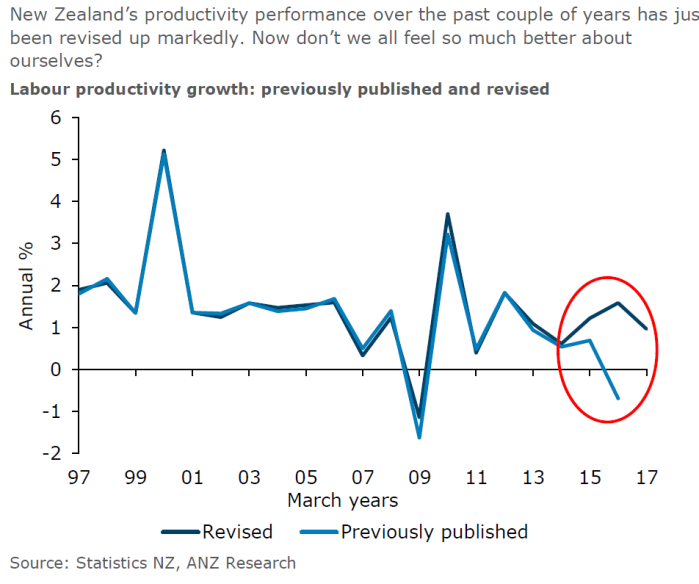
Unsurprisingly, there were some upward revisions in these numbers as well.   The numbers don’t get a great deal of commentary, but the reaction seemed encapsulated in this chart from one of the banks.

sharon

Not only were the numbers for the last couple of years revised up, but if you eyeball the chart productivity growth in the last decade doesn’t look much different than that for the previous decade.

That certainly looks more encouraging.

This is how productivity growth in (a) the measured sector and (b) the whole economy compare, based on the latest SNZ releases.   Here I’ve used just production GDP –  since it is production sectors SNZ uses to do the measured sector numbers –  and have shown the data in log form, in which a constant slope of the line means a constant growth rate.

measured sector and real GDP phw

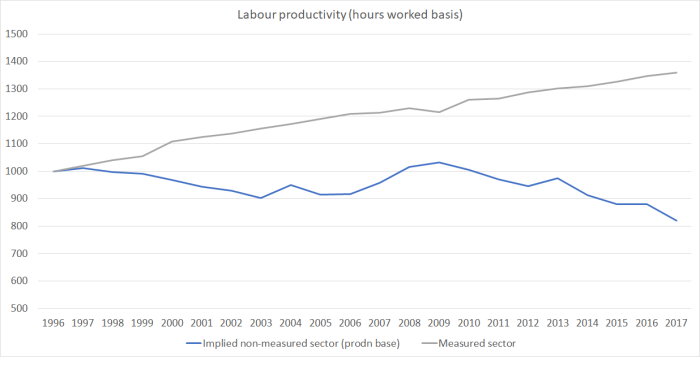
Recall that the measured sector is about 80 per cent of the economy.  And for a gap of that size –  the measured sector productivity growth was 17 percentage points faster than that for the whole economy over the 21 years – to have opened up it suggests that productivity in the non-measured sector (the rest of GDP) must have done very badly indeed.

This little exercise is purely illustrative.  I’ve deducted measured sector productivity from the total, assuming the measured sector is indeed 80 per cent of the economy, and then multiplied what was left by 5 [(100/(100-80)] to produce a proxy residual index of implied labour productivity in the non-measured sector.  This is the result.

nonmeasured sector

It is only a proxy, calculated residually, and the precise numbers are sensitive to the (changing) exact share of the non-measured sector industries.  But the proxy suggests a pretty calamitous picture for productivity (especially, if summary numbers SNZ includes are to be taken seriously, in education) in the non-measured sector.  Disgruntled parental consumer of the education system that I am, something doesn’t seem to entirely ring true –  these aren’t, after all, quality-adjusted numbers.   When, as a matter of policy, money is being thrown at education and (eg) teacher/pupil ratios are being raised, one might expect crude measure of education sector productivity to fall.  But that doesn’t seem to have been the story of the last nine years –  whether the educational lobbies, or the former government, are to be believed.

One problem with the measured sector data is that there is no ready way to compare New Zealand productivity growth numbers with those for most other countries.    There are no standard compilations of such data and it would take a huge amount of painstaking effort for an individual to attempt to replicate the numbers for a reasonable range of other advanced countries.  Given the importance of common global (or at least advanced country) trends in productivity, that severely undermines how much use can be made of the aggregate data.

However, the Australian Bureau of Statistics publishes some very similar data, for what it calls the “market sector”, also around 80 per cent of the economy.  And SNZ themselves highlight the comparisons between the New Zealand and Australian productivity growth numbers in each of their annual releases.  As they note in the latest release, over the period since 1996 (the period for which the two countries have comparable data), labour productivity in the measured/market sector averaged 1.5 per cent per annum in New Zealand and 2.2 per cent in Australia (Australian data is for June years).   Over 21 years, those differences multiply up to big numbers –  and, in levels terms, we had already fallen well behind Australia by the mid 1990s.

You might have hoped that all those differences were early in the period. Unfortunately, the SNZ/ABS data suggest not.

measured sector nz vs aus

Starting from just prior to the 2008/09 recession (downturn in Australia) the relative performances of the two measuered sectors look depressingly similar to the pattern in the aggregate (real GDP per hour worked) chart I showed earlier.  Over nine years, Australia’s market sector managed total productivity growth a full eight percentage points fast than New Zealand’s measured sector managed.

All these charts just use hours worked as the relevant input measure.  Usually SNZ also publish (as do the ABS) the data using composition-adjusted labour input measures (eg if the amount of human capital per worker is increasing, as people get more skilled, that represents more inputs not higher productivity).   I’ve become a bit more sceptical of such measures in recent years, since proxies for human capital are often educational achievement numbers, and much of what Bryan Caplan writes about –  that much of formal education is about signalling rather than skill acquisition –  I find increasingly persuasive.  But this year I can’t even show you the numbers as SNZ ends their release noting plaintively

The composition-adjusted productivity in the measured sector data did not meet our quality standards for publication..The absence of this data does not affect any other data published in this release. We don’t have an expected release date for this data

Oh dear.

In sum, there isn’t much in the recent waves of productivity data/estimates that should give anyone serious about economic performance much comfort at all.   There are, no doubt, countries that have done worse than us on this score in the last decade, but  –  starting well behind –  we’ve made no overall progress in closing the gaps to other more advanced countries, and have continued to slip (quite materially) further behind our closest comparator, Australia.


Revisiting the case for splitting the Reserve Bank

The Minister of Finance has commissioned a two-stage review of the Reserve Bank Act.  The scope of the first part is pretty clear: it is about monetary policy (goals, transparency, and decisionmaking structures).  What, if anything, is included in the second stage is still up for grabs, with the Minister awaiting advice from the officials (a joint Treasury/Reserve Bank process) and from the Independent Expert Advisory Panel.   It seems likely that the Reserve Bank itself will try to keep any second stage to an absolute minimum –  as someone put it to me last week, the Bank seems happy with any reform that keeps things pretty much just as they are now –  and the arrival of Adrian Orr as Governor next month is likely, based on past performance, to reinforce that resistance.

A few weeks ago, I outlined the case that, as a key component of the second stage, the Reserve Bank should be split in two.  The Reserve Bank itself would remain responsible for monetary policy and associated activities (notes and coins, foreign exchange reserves, interbank settlement etc) while a new Prudential Regulatory Authority would take on responsibility for regulation and/or supervision of banks, non-banks, insurance companies, payments systems (and for the associated AML controls).

In favour of that position is that:

  • it is the more common model in advanced countries today (including Australia),
  • the synergies and overlaps between the various functions of the Reserve Bank are pretty slight (and probably no greater than, say, those between fiscal and monetary policy),
  • structural separation would allow for clearer lines of accountability, and
  • structural separation would allow for the creation of stronger, more effective, cultures  –  with appropriately skilled chief executives –  in each of the two successor institutions.

There hasn’t been a great deal of public commentary about this issue/option, but I noticed that the Shoeshine column in last week’s NBR picked it up.   NBR’s columnist  –  Jenny Ruth –  noted her support for structural separation (“a jolly good thing”).    She has been pretty critical of the Bank’s handling of a number of its prudential responsibilities, and is uneasy about the extent to which she believes the use of LVR limits –  by statutue, in pursuit of financial stability – “has become hopelessly confused with the Reserve Bank’s monetary policy functions”.

But in putting together her column she also talked to Massey banking academic David Tripe who “agrees there is a problem but isn’t so sure separation is the solution”.  He is quoted as saying

“My suspicion is that it wouldn’t improve matters because it would still be the same people doing the supervision”

and arguing

“We’ve got bank capture of the regulator –  the Reserve Bank asks for the data that the banks agree to provide, not the other way round”

On his first point, I guess my response would be that structural separation is not panacea, but that (a) change starts from the top, and (b) it should be materially easier to hold the financial regulator to account when it is responsible for only one main job (unlike today’s Reserve Bank).   And, as I’ve noted above, many of the other considerations also point in the direction of structural separation.  Finding a chief executive and senior management team who care primarily about the prudential regulation of the financial system –  whereas most of the senior management of the Reserve Bank over decades has always been more interested in (and had more background in) monetary policy –  is likely to be significant part of lifting the performance of the regulator.

Perhaps my one real unease is that a standalone regulatory agency could – if it were allowed to – become even more resistant to transparency and public accountability for its actions.  Whether there is a structural split or not, the officials and politicians doing the current review need to take steps to make the regulatory side of the Bank (as it is now) much more open.

(On Tripe’s second point, while I think there is something in what he says –  especially around data –  I rather doubt many of the banks would recognise the “regulatory capture” story.  On that note, I’m looking forward to the forthcoming publication of the New Zealand Initiative’s work on economic regulatory agencies, including the Reserve Bank.)

In her column, Jenny Ruth highlights a number of recent cases where the Reserve Bank’s handling of regulatory issues leaves a lot to be desired (and where, even if the Bank was correct, it has been so untransparent that we couldn’t possibly be confident of that).  I’ve written a bit about one of the cases she mentions –  the Westpac capital models issue.  The Bank has made no attempt to pro-actively disclose the relevant material (and would no doubt staunchly resist OIA requests), and although it claims it discovered the problem, as Ruth notes

“Westpac insiders say that Westpac outed itself. Shoeshine’s money in on Westpac”

Whatever the truth on that point, the whole episode did little to instill confidence in the Reserve Bank’s systems, processes, or accountability.

I haven’t written about the two other episodes Jenny Ruth highlights, both involving Kiwibank (you can read them for yourself).  Neither suggest that the Reserve Bank’s prudential wing has been on top of its game, or that they really have an instinctive handle on the nature of markets and financial institutions.

There are capable people in the regulatory/supervisory side of the institution (and I sat on the relevant internal policy committee for the best part of 20 years) but it is time for some refreshment, and the sort of restructuring that a fresh chief executive, focused on building and maintaining a strong and effective regulatory agency, can bring.  I’m not convinced, by any means, that all the regulatory framework is well-warranted, but if Parliament chooses to regulate, we need the job done excellently, and with considerable transparency and accountability.

NBR appeared on Friday morning.  As it happens, on Friday the Reserve Bank was taking regulatory action.   At 6.37pm an email dropped into my inbox stating that CBL Insurance had been placed in interim liquidation by the High Court, on application from the Reserve Bank.  The Reserve Bank is, of course, now responsible for the prudential regulation of insurance companies.

In time, I hope we see a substantial accounting by the Reserve Bank of its activities in this case, including its exercise of its powers to apply for the appointment of a liquidator.  In the meantime, I was interested in a piece on interest.co.nz by David Hargreaves who suggest that, based on what we’ve seen so far, this episode too raises questions about the handling of the Reserve Bank’s supervisory/regulatory role.

From the Hargreaves article

That the RBNZ was interacting, strongly it seems, with CBL Insurance going back as far as July last year was revealed by CBL Corporation to the NZX only as recently as February 5, almost in passing and then more explicitly on February 7.

Key parts of the February 7 revelation for me were that the RBNZ had done an independent review on CBL insurance, that it had, as long ago as July 27, 2017 issued a minimum solvency recommendation, and then – most crucially from my perspective – that on November 22, according to the statement from CBL Corp, RBNZ had issued directions to CBL Insurance, CBL Corporation and its subsidiaries, requiring them to consult on any non-business-as-usual transactions greater than $5m.

That last one, as far as I’m concerned is a biggie. Essentially a publicly listed company with a sharemarket value of three quarters of a billion dollars was put on the leash by the regulator three months ago. And yet nobody was told publicly.

The CBL February 7 statement went on to say that “these directions and discussions that CBL Insurance has had with RBNZ have been occurring under strict confidentiality orders prohibiting CBL from making any announcement to the market while those orders remained in place. These orders have now been lifted.”

Neither confirm nor deny

The RBNZ refuses to either confirm or deny that it had placed confidentiality orders on its interactions with CBL Insurance last year.

He goes on

I actually think the RBNZ had some obligation to let the public know it was engaging with this company.

I do not like the idea of regulation behind closed doors because it is suggestive, at least, whether that is the reality or not, of a holier than thou attitude. It is to me, the regulator putting themselves above the public.

I’m not sure how well prepared the RBNZ was for getting itself into a situation like this with a publicly listed entity like an insurance company.

I’m not so sure about “holier than thou”, but it is an example of just the sort of thing the Reserve Bank always used to worry about: if it had private information (especially about significant regulatory interventions) and customers were nonetheless allowed to carry on trading with regulated entity, doesn’t that then create at least some moral risk, some moral exposure, if the regulated entity subsequently failed?  It seems extraordinary, if true, that the Reserve Bank could ban a regulated entity talking about a regulatory intervention.

Hargreaves’ solution isn’t one I’d agree with

Personally, I would suggest creation of a separate authority to regulate and supervise the insurance sector. Yes, it would be more money, it would arguably be more bureaucracy, but sometimes that’s what you’ve got to do for the best results.

Frankly, I’ve never been quite sure that the case for prudential regulation of general insurance is particularly strong anyway, and would be very reluctant to see a standalone insurance regulator. But I take the Hargreaves story as reinforcing the case for a strong standalone prudential regulatory agency, led by people whose sole job is prudential regulation and supervision, and within governance and accountability structures that help ensure serious and effective scrutiny of how the regulatory agency does its job.

I gather that Treasury and the Reserve Bank have been consulting this week with private sector representatives on the possible prudential regulatory aspects of the Stage 2 review.  I hope that the idea of structural separation –  with all it could entail –  isn’t lost in the desire of Reserve Bank management to keep things just as they have (not overly effectively) been.

The boondoggle

Earlier this week, Kiwirail released its most recent half-yearly financial result.  Once again, the taxpayer was poorer for their operations.   They make great play of a modest “operating surplus” but I rather liked this summary table from their latest Annual Report

kiwirail

In other words, no returns to shareholders at all; in fact losses in one year of a third of the (periodically replenished) shareholders’ funds

Last year, they had operating revenues of $595 million, and an overall loss of $197 million (much the same as the year before).  So roughly a quarter of their overall costs are not covered by income.   As an organisation –  and with all due respect to the energies of individual employees (including the five earning in excess of $500000 per annum) – it has all the appearance of being a sinkhole, absorbing more of the scarce resources of taxpayers each year.

And before people start objecting that roads don’t make a profit, it is worth remembering that airlines do and coastal shipping operations do –  and, if they don’t, they usually go out of business.

An organisation that operates such large losses (acquiesced in by successive shareholder governments) clearly isn’t one that applies the most demanding tests possible to the question of whether individual lines should be opened or closed.  Occasionally people attempt to justify government intervention in this or that activity on (questionable) grounds that the private sector is applying too high a cost of capital.  But in this case, the state operator’s average return on capital (ie over all its operations) is substantially negative, and it has no expectation of changing that.

A few years ago, Kiwirail closed the Gisborne to Napier line.  Rail volumes had been low and falling –  some trivial portion of the volume that Kiwirail estimated would have been required to make the line viable.  But ever since, there have been people hankering for the line to be reopened.

And yesterday, as part of the first wave of projects approved under the new Provincial Growth Fund, the Minister of Regional Development announced that

“We’re also providing $5 million to Kiwirail to reopen the Wairoa-Napier line for logging trains, taking more than 5700 trucks off the road each year.”

 In the more detailed material released with the announcement there is a suggestion that the Hawkes Bay Regional Council may also be putting in money.

There is no sign of any cost-benefit analysis of this proposal having been released at all. But we can assume that the proposal wouldn’t pass any standard (weak) Kiwirail commercial test since otherwise Kiwirail would have reopened the line without taxpayers’ having to chip in more money directly.

There used to be some logs/timber carried on the Gisborne-Napier line, but a reader pointed me to the numbers: in the final full three years of operation, a total of 327 tonnes of it.

There are, apparently, going to be a lot more logs to move in the coming years.  In the Minister’s words

“The wall of wood is expected to reach peak harvest by 2032 so reopening this line will get logging trucks off the road and give those exporting timber options that they currently do not have,” Mr Jones says.

“It makes sense to consolidate that timber in Wairoa and use rail to take it to the Port of Napier.

Except that apparently officials and Kiwrail had already looked at this option a few years ago.  In a report released only a few year ago it was noted that

“We note that Kiwirail was not convinced this would be finanically viable for users given the relatively short distance involved and the need to double-handle the logs.  Industry feedback has also indicated that transport of logs on rail across the study area was unlikely to be economic.”

Perhaps the economics has suddenly changed?  But, if so, where is evidence?  None was published yesterday.   We aren’t even told what assumptions are being made about how much of the logging business will be captured.

The Minister’s release also argued that there were climate change benefits from this move

“It will also mean 1,292 fewer tonnes of carbon dioxide released into the atmosphere each year.”

Even if this were relevant –  don’t we have an ETS supposed to deal directly with pricing emissions? –  and accurate (what assumptions are being made, including about the carbon costs of the double-handling?), it sound doesn’t terribly impressive.  A single 747 flying to London and back once apparently emits 1100 tonnes of carbon dioxide.

This is just one of the numerous projects the government is going to spend money on in the next few years.  I’ve only looked through the Gisborne/Hawke’s Bay list, and none of it fills me any confidence.   What, for example, is central government doing on this?

The Provincial Growth Fund will provide $2.3 million to redevelop the Gisborne Inner Harbour as part of a wider tourism investment programme.

If, as the Minister claims,

“Tairāwhiti is brimming with potential and untapped opportunities

you would have to wonder why the private sector, and the local authorities, don’t seem to think them worth spending money on.  (On my story, a materially lower real exchange rate would help quite a bit, but the government shows no sign of addressing that.)

A couple of weeks ago, I commented on the Minister of Finance’s underwhelming exposition of what the government was going to do to transform the productivity outlook in New Zealand.   The Minister noted

A major example of this is the Provincial Growth Fund developed as part of our coalition agreement with New Zealand First.  This will see significant investments in the regions of New Zealand to grow sustainable and productive job opportunities.

To which my response was

If it ends up less bad than a boondoggle we should probably be grateful.  It isn’t the sort of policy that has a great track record, and it is hard to be optimistic that one new minister –  with a vote base to maintain –  is going to transform the sort of flabby thinking around regional development presented at Treasury late last year.  

hen again, the Secretary to the Treasury might quite like the idea of paying to reopen the Napier-Wairoa line.  I’ve told previously the story of Gabs Makhlouf, fresh off the plane from the UK, lamenting that the one thing New Zealand hadn’t sufficiently taken from the British Empire experience was to invest more heavily in rail (in response, assembled Treasury officials were not quite being sure where to look).

Sometimes economic policy in this country seems almost designed to defy reason and evidence in an effort to make us poorer, to hold back national productivity prospects.  Spraying around $5m here and $5m there –  $3 billion over three years, in some scheme reminscent of congressional earmarks in the United States – not backed, it seems, by any robust supporting analysis, seems just another  step along that path.

Other people OIA the Reserve Bank too

Occasionally I have a look at the Reserve Bank’s website page on which they post selected OIA responses.  This time I was just checking to see whether a response I got yesterday –  after 2.5 months, and still only partial –  was there (it wasn’t).  But I spotted this response to someone else, released last Friday

Dear …..

On 12 December 2017 the Reserve Bank received a request from you, via http://www.fyi.org.nz and pursuant to section 12 of the Official Information Act 1982 (the OIA), asking:

In the recent recruitment process to appoint a new Governor of RBNZ (which resulted in the Board recommending to the Minister of Finance that Adrian Orr be appointed as Governor), please advise: 1. How many of the total applicants/individuals considered for the role were: a) women; or b) non-Pakeha; or c) both.

2. What was the total number of applicants/individuals considered?

3. If there is a shortlisting process, how many of the individuals who were included on that shortlist were: a) women; or b) non-Pakeha; or c) both.

4. If there was a shortlisting process, how many individuals were included on the shortlist in total?

Decision

The Reserve Bank is declining your request, as allowed by section 9(2)(a) of the OIA, in order to protect the privacy of the candidates considered for the role of Governor.

Given the nature of the process and the final pool of candidates, releasing the information that you have requested is likely to identify people who were considered but not appointed – which is private information.

In other words, they refused to release any of this information at all.

Which should be pretty extraordinary really.   The Board’s defence is that they are withholding the information to protect the privacy of candidates.    But they ran a search process that included a public advertisement inviting applications.  I suspect they had several dozen applications, some less serious than others.   How could anyone’s privacy be breached by releasing the total number of applicants (plus the number of any people the Board themselves put directly into the mix)?     How could anyone’s privacy possibly be breached if it were known that three women and three “non-Pakeha” had applied (we know there was at least one in the latter category, since Adrian Orr has some Cook Islands ancestry)?  And how could anyone’s privacy be breached by revealing how many people were on the shortlist?

I’m a little more sympathetic in respect of question 3.  If there was, say, one woman on the shortlist, that might reasonably invite some speculation as to who, but even then it is hard to see how –  in a universe of say 1.5 million adult women in New Zealand –  a person’s privacy could have been breached.  And, given that the Bank has been notoriously weak (for whatever reason) in appointing women to senior positions, it might have been somewhat reassuring to the public that one (or more) women had made the shortlist.   As it is, we know there was at least one “non-Pakeha” in the list since –  as the Board tells the requester later in the letter –  Orr is quite open about the Cook Islands aspect of his heritage, and if perchance there was more than one “non-Pakeha” on the shortlist it is still hard to see how any one specific person’s privacy would have been jeopardised.

But in a sense, the really interesting bit of the letter is the final paragraph of the extract above.  It is factually false for one thing (names of people the Board considered are official information –  not private information –  even if protected from disclosure by the “privacy of natural persons” section of the Official Information Act).  But, if the Board is to be taken at its word.

releasing the information that you have requested is likely to identify people who were considered but not appointed

They don’t say “invite speculation on possible names” but “likely to identify people”. It is hard to imagine how it could do so –  reasoning outlined earlier – unless the shortlist included the name of a “non-Pakeha” woman (the subset of potentially credible candidates fitting this description seems likely to be very small indeed).   But even if it did, it would require a wider knowledge and a richer imagination than mine to guess –  let alone “identify” – who such a person might have been.

I rather doubt the Board should be taken at its word on this point –  rather they probably just didn’t want to release anything and waved their hands to construct a defence –  but if any readers do want to take them at their word, I’d welcome suggestions as to who the person might have been.

Retired politicians in demand

A few days ago, shortly after Bill English announced that he would shortly be leaving Parliament, Stuff had an article on his post-politics prospects.

English, credited with steering New Zealand through the global financial crisis, is likely to be in strong demand on company boards. He has both the experience and contacts needed.

The demand may be especially strong in Australia, where the business media often fawned at the performance of the former National-led government, in comparison to its own governments.

There is quite a bit of hype there  – recall that, despite the fact of the “fawning”, Australia’s productivity growth substantially outstripped that of New Zealand over recent years.  But while business is very different from politics, and the Australian business/political environment is quite different than that in New Zealand, quite possibly English’s services will be in considerable demand.

The article goes on to suggest that a bank board might be a possibility

One of the early rumours circulating on Tuesday was that English was set for a seat on the board of a major Australian bank, with an investment banker speculating that he could soon be a director of Westpac on both sides of the Tasman.

John Key, after all, turned up not long ago as chair of ANZ’s New Zealand subsidiary.

Whether or not there is anything to the possibility of English turning up on a bank board I (obviously) have no idea (although the Westpac main board looks chock-full of bankers, lawyers, and accountants) but what concerns me is the lack of concern about the idea (or about the fact of John Key being recruited directly to chair ANZ’s New Zealand board).

Until just over a year ago, Bill English had been Minister of Finance for eight years.  In that role he had responsibility for the framework of legislation (primary and secondary) governing the prudential regulation of banks,  non-banks, and insurers.  He was minister responsible for the Reserve Bank of New Zealand, the prudential supervisory agency (including for banks).  He appointed the people who appointed the new Governor (and – single decisionmaking – supervisor). His department –  The Treasury –  was a key participant in the trans-Tasman banking council.  Even in his year as Prime Minister, there was no sign that he had lost interest in matters economic and financial.

It would be a dreadful look if a retiring former Minister of Finance went (more or less) straight from politics onto the board of a Bank.   It would be almost as bad as if a retiring Governor of the Reserve Bank made a similar move.   The issue –  especially for the Minister of Finance case –  isn’t about inside information; ministers aren’t usually privy to much individual institution data, and the broad intended sweep of policy (a) usually isn’t that secret, and (b) is somewhat specific to particular governments.    It is about incentives, appearances, and our ability to be reasonably confident that our governors are governing in the public interest and not in their own interests.

Probably few people go into politics initially for the post-politics opportunities.  Nonetheless, people need to feed their families, and fill their days, and even if you eventually get to the very top, even being Prime Minister doesn’t last forever.   Bill English is only 56, and the current Prime Minister –  even if consistently successful –  is likely to be out of Parliament by the time she is 50.   And –  even in New Zealand –  private sector directorships can pay pretty well (it was suggested that John Key might be getting $200,000 per annum for chairing the ANZ –  a big bank to be sure, but an unlisted 100 per cent subsidiary of an Australian parent, pretty substantially controlled by that parent).

Whatever the sector, a Cabinet minister who legislates/regulates in ways which are welcomed by the regulated industry are much more likely to find the post-politics doors open than one who regulates in a way the industry finds costly or inconvenient.  It isn’t just an issue in banking – it could be telecoms, or electricity, or transport, export education or whatever.   I’m no great fan of most business regulation, but it exists –  and the community as a whole has made a decision that such regulation is necessary or desirable.  If so, it is easy to envisage cases of a conflict between the public interest and the private interests of the regulated entities.

I’m not suggesting that Bill English (or John Key) made any decisions during their terms in office for reasons other than some mix of their view of the best thing for the country, and their view of how best to get re-elected.     But the incentives, and risks around them. are things that need managing.  It would set a dreadful example if Bill English shortly turns up on the board of a bank (in John Key’s case, the concern might be more about his membership of the Air New Zealand board –  a majority state-owned company, with ownership sold down by Key’s government, and where Key himself had until quite recently been Minister of Tourism).

(It is interesting to note that the main boards of the four big Australian banks do not appear to have a single former politician on them, although one is now chaired by a former Secretary to the Treasury.)

I’m not sure if there are any rules on what ministers can do once out of office –  there is no sign of anything in the (non-binding) Cabinet Manual.  Quite probably it wouldn’t be easy to draw up a good, workable and reasonable set of rules.   But I’m also struck by the fact that it appears to be a relatively new problem, at least as regards former Prime Ministers.

Going back 100 years:

  • Massey died in office
  • Bell (PM for a mere 16 days) ceased holding active political office at 77,
  • Coates died while still an MP,
  • Ward died while still an MP,
  • Forbes left Parliament at 74,
  • Savage died in office,
  • Fraser died while Leader of the Opposition,
  • Holland left Parliament at age 64, already ill and never really recovered,
  • Holyoake went from Parliament to being Governor-General and finally left office at 76,
  • Nash died while still an MP,
  • Marshall left Parliament to practice law and held various prominent private sector directorships,
  • Kirk died in office,
  • Rowling held only government-appointed roles and governance roles in community bodies after retirement,
  • Muldoon died while still an MP, [Correction: he resigned in ill-health a few months before his death]
  • Lange left Parliament at 54, and appeared to have had only community involvements subsequently,
  • Palmer returned to the practice of law, at the interfaces with public policy,
  • Moore mostly held government-sponsored positions after leaving Parliament, although did for a time –  15 years after being Minister of Trade –  work for Fonterra,
  • Bolger held some lower-level commercial directorships, but not until several years after leaving Parliament (and the Prime Ministership),
  • Shipley has held numerous directorships,
  • Clark moved on from Parliament to head the UNDP (government-sponsored),
  • John Key left Parliament at 55, and appears to be picking up various directorships and the like, and
  • Bill English is leaving Parliament at 56.

I’m old-fashioned enough to think that being Prime Minister (or Governor of the Reserve Bank) should be a stepping stone to retirement, or at least a retreat to advocating the ideas one governed on, or doing good through community and voluntary organisations or government roles.  That isn’t an anti-business stance at all, just that the extent of the regulatory state has become so pervasive, and so much money is at stake, that it should trouble us, and cause questions to be asked, when senior politicians step so readily from politics into the board room (or consultancy rooms) of private businesses.  I’ve always  found oddly attractive the stories of Harry Truman –  who left office with almost nothing but his old army pension, but still wouldn’t do product endorsements –  or Clement Attlee who (reportedly) took the bus to the House of Lords in his retirement.   Or even George W Bush, who seems to have retired to paint, or John Howard.  I don’t wish poverty on our past leaders –   a decent parliamentary pension seems appropriate  – nor to make politics the preserve of the wealthy, but equally that public service shouldn’t be stepping stone to wealth, via regulated industries, either.  If the stepping stone is there, the risks to good government are real.

It would concern me if Bill English quickly shows up on a bank board, or even the board of a commercial entity much affected by specific government regulation/legislation.  But perhaps even more concerning should be if he follows in the path set by so many of our recent senior politicians (sadly, particularly National Party ones) and ends up being remunerated to serve the interests of –  or trade off the back of good relations with – the government of the People’s Republic of China and of the Chinese Communist Party (which, of course, controls the government).

There are the directorships of Chinese banks (former ministers Chris Tremain and Ruth Richardson, former Prime Minister, Jenny Shipley, and former National Party leader –  and Reserve Bank Governor –  Don Brash).   There are consultancy contracts (John Key, and Comcast’s interests in China).   Or Board memberships of Chinese government affiliated entities (Jenny Shipley).

Quite possibly all these people believe that are doing good.  But their positions put them in a situation where they have to think very hard if ever once they considered taking a stand against an aggressive expansionist repressive dictatorial state (from which, directly or indirectly, they are remunerated).  New Zealand isn’t unique in having former political leaders taking this path, but that we aren’t alone shouldn’t make it any more acceptable.  There were apologists for evil in the late 1930s too.

Might one hope for better from Bill English?  One might have  –  I would have – hoped so.  But when you’ve served as Deputy Prime Minister and Prime Minister for nine years and never once spoken out against the evils of the regime (domestic or foreign policy –  see continued illegal expansionism in the South China Sea), when as party leader you’ve kept on your list (and then promoted) an MP who has been, and probably still is, a member of the Chinese Communist Party, a former member of the Chinese intelligence services, someone who is repeatedly photographed with Chinese Embassy figures, and who  has never once been heard to criticise any aspect of the evil regime he once served, I’m not sure there is any reason for optimism.  This was the same party leader who, only a few months ago, refused to answer any serious questions about his MP Jian Yang, despite clear evidence that he had withheld information about his past in the intelligence services from New Zealand authorites when applying for citizenship or residence.    And who has never once engaged with the observations of a leading former diplomat who publicly stated last year that he was always very careful what he said around Jian Yang because the latter was known to be close to the Chinese Embassy.     In what sense did Bill English represent the attitudes and values of New Zealand and its people?

Last year, I repeatedly encouraged people to read, and engage with, Anne-Marie Brady’s paper on PRC party/government influence activities in New Zealand.    There is an increasing stream of reports and papers on these activities in other countries –  a recent testimony (full version number 20 here) to the Australian parliamentary committee on proposed new foreign political interference laws, or a substantial report from a German think-tank.    But where are our political leaders?      It is sad state we’ve come to when a former PRC intelligence official –  an open associate of an embassy of a hostile foreign powers, who withheld material information from the authorities –  gets to vote for the new Leader of the Opposition (will any media ask the candidates their attitudes to Chinese interference in New Zealand and other democratic countries?).

(And, to be fair and balanced, not that there is any sign that the parties that make-up the new government are any more willing to make a stand for the values that underpin our society. It isn’t many months since the President of the Labour Party was openly gushing about Xi Jinping and PRC regime.)

Should the Reserve Bank be broken in two?

I’ve come to think so.

The Reserve Bank has two main functions:

  • conduct of monetary policy (and supporting activities –  currency issues, foreign reserves management, interbank settlement accounts), and
  • prudential regulation of banks, non-bank deposit-takers, insurance companies (and roles around payments system and AML thrown in for good measure.

These quite different functions are conducted in one institution, but they needn’t be.  In fact, in most advanced countries they aren’t.

Historically, there wasn’t much prudential regulation in New Zealand at all.  There was lots of direct regulation of various types of financial intermediaries (banks, building societies, savings banks and so on) but most of the regulation (reserve ratios, interest rate controls etc) was macro policy focused, not about financial system stability or depositor protection per se.   That regulation –  often administered by the Reserve Bank, but individually approved by the Minister of Finance –  was a substitute for the sort of market-based monetary policy all advanced countries now rely on.   As interest and exchange rates were freed up, the panoply of direct controls was stripped away.   Our great bonfire of such controls took place in 1984 and 85.

By the time what became the Reserve Bank of New Zealand Act 1989 was going through Parliament, the primary conception of the Reserve Bank was as a monetary policy agency.   Sure, there were some regulatory provisions –  and in particular provisions around the handling of bank failures –  but it was seen as pretty peripheral activity.  If anything, it became more peripheral as the 1990s unfolded: the framework covered only banks (increasingly a foreign-owned group), there was a shift to a largely disclosure-based regime, and the function took very few staff  (from memory, only around 10 or 12 staff).  For practical purposes it probably wasn’t too much of an issue that the two functions were in one institution.

But as the 21st century unfolded so too did a dramatic change in the supervisory and regulatory activities the Reserve Bank was involved in.    There were new classes of entities to regulate or supervise, new functions (payments system and AML) to regulate or supervise, new statutory reporting obligations, a reduced reliance on disclosure (even for banks), and new powers and new appetite for more direct and discretionary regulatory interventions (culminating, for example, in the numerous iterations of LVR controls in recent years).  The Reserve Bank now is at least as much of a financial regulatory and supervisory agency as it is a monetary policy one.  A large share of the staff, a large share of the budget, and a large share of the Govenor’s time is now devoted to these functions.

I’m not here offering a view on the merits, or otherwise, of these new activities.  The point is simply that Parliament has either specifically mandated the Bank to do these new things, or written legislation that has allowed the Bank to do them.    And those functions don’t look like going away any time soon.  After all, if many details are a bit different from models used in other countries, the broad direction –  more comprehensive, more intensive, controls –  isn’t exactly some idiosyncratic New Zealand thing.  It is the way of the world, for good or ill.

At times, the Reserve Bank has tried to make a virtue of this “all in one” model.  In the wake of the 2008/09 recession, the former Governor Alan Bollard made much of the idea of a “full-service central bank”, very well-positioned to carry out the variety of different functions because they were all located in a single institution.    More often, the Bank has pointed out that there is a range of ways of organising these activities, suggesting that no one model is clearly superior.

There is certainly a range of models used in other countries, but once one looks a bit more closely there are also some pretty clear patterns which emerge.  Specifically, New Zealand’s current model is out of step with the main stream of advanced countries.

People here often, and naturally, look to Australia.  Once upon a time their Reserve Bank and ours had a lot in common in what the institutions were responsible for, and both had evolved through a phase where direct controls had been mostly about monetary policy.  But about 20 years ago, the emerging regulatory functions were spun out of the Reserve Bank and a separate Australian Prudential Regulatory Authority (APRA) was established.     There has been no sign that the Australian authorities are unhappy with that model, which seems to work well, allowing both the RBA and APRA to concentrate on their own primary areas of responsibility.

There are plenty of advanced country central banks which are responsible for bank supervision.  But in most cases now those national central banks are part of the euro-area: they don’t themselves set monetary policy (although each Governor has a vote at the ECB), and would struggle to justify existing as independent entities were it not for the supervisory roles.

But if we look at advanced countries that do have their own monetary policies, I could find only three others –  Czech Republic, Israel, and the United Kingdom –  in which the same agency is responsible for monetary policy as for prudential supervision.   The US is –  in this area as so many –  a curious hybrid system, in which the Federal Reserve has some –  but not remotely all – responsibility for prudential supervision.  But as far as I could tell, the following OECD countries have monetary policy and prudential supervision conducted by separate agencies:

Canada, Australia, Norway, Sweden, Korea, Japan, Poland, Chile, Turkey, Mexico, Switzerland, and Iceland

I’m not sure that Turkey or Mexico offer models of governance for New Zealand, but the presence on that list of small well-governed countries like Norway, Sweden and Switzerland –  as well as tiny Iceland –   gave me pause for thought.

And the more I reflected on the issue, the harder it was to identify good reasons why New Zealand should now stay with the all-in-one model:

  • probably the most common argument made is about the possible “synergies” between financial regulatory and monetary policy functions.  But there are snyergies, connections, and potentially valuable information overlaps all over the place.  Between fiscal and monetary policy for example, and yet we –  and every other advanced country –  keeps fiscal policy advice and governance quite separate from monetary policy.   And I could mount arguments of possible synergies between the Reserve Bank’s financial market activities and the role of the Financial Markets Authority, and yet no one seriously argues for putting the FMA into a mega Reserve Bank.     Specialisation, and specialist agencies, has tended to be the way in which advanced country governments have organised themselves (often backed by information-sharing protocols, and effective working relationships across agencies –  eg a typical Cabinet paper will reflect perspectives or comments from a range of agencies with relevant perspectives on the topic),
  • as it is, the synergies between the monetary policy related functions and the prudential regulatory ones are generally pretty slight –  almost vanishingly so in normal times (and there are some conflicts).   The timeframes are different, the instruments are different (indirect influence vs direct controls), the required mindsets are different, the Bank’s own financial market operations are typically quite mundane, and its research capability (developed mostly for monetary policy purposes) has rarely been used to produce research around the regulatory or supervisory functions.     One of my former colleagues likes to argue that one should conceptualise the Bank’s regulatory role as akin to that of a banker knowing his or her customers, and (eg) maintaining covenants on the credit facilities of those customers.  But mostly monetary policy isn’t about lending to banks –  and certainly not to insurers or credit unions –  and when there is lending involved in monetary policy, the Bank typically seeks to expose itself to minimum credit risk.   Crises can be, and are, different –  lender of last resort, and provision of emergency liquidity is a core part of a central bank role –  but it doesn’t seem to have been an obstacle to other small well-governed countries separating out the monetary policy and regulatory functions into different institutions.
  • organisational cohesion and culture are likely to be better-fostered in institutions that have a single main purpose,
  • the same goes for the senior leadership of the organisation.  20 years ago it would have been inconceivable that the Governor would be focused primarily on anything other than monetary policy –  that was overwhelmingly the Bank’s role –  but now it is not so at all, and yet the sort of skills, expertise, and even relationships that might be needed to be responsible for monetary policy –  with considerable macroeconomic discretion, and associated accountability, may be quite different from what best suits a regulatory agency.   We might well benefit from having both a highly capable macro and markets focused Governor of the (monetary policy) central bank, and the head of a specialised financial regulatory agency.
  • governance structures and accountability models would be likely to develop more naturally if the two main functions were structurally separated into different institutions.   (And it is more difficult than it should be to hold the Governor effectively to account when he is responsible for two, quite different. big areas of policy).
  • Specifically, the Bank’s regulatory activities would quite naturally fit with something much closer to a standard Crown entity sort of model (as with the FMA) –  in which key big picture policy matters were decided by the Minister of Finance (with advice from Treasury and the agency), while the Board of the agency was responsible (with operational autonomy) for the implementation of the framework.  The monetary policy (and related) functions don’t fit that sort of model, partly because of the inevitable quite substantial degree of policy discretion –  and hence need for ongoing transparency and accountability –  that are (largely rightly) seen to need to go with monetary policy.

I’ve argued previously that it seems mistake to push ahead with the proposed Stage 1 reforms flowing from the review of the Reserve Bank Act, without first completing an overall review of how the functions the Bank currently undertakes should best be organised, governed and held to account.

And so here is my model:

  • the Reserve Bank becomes responsible for the conduct of monetary policy (and directly associated functions –  interbank settlement, notes and coins, foreign reserves management.   In my post on Monday I outlined how I would establish a statutory Monetary Policy Committee.   The same people, appointed the same way, would comprise the Board of the Reserve Bank, and would be responsible for all the functions of the Reserve Bank.  Specific statutory provisions –  of the sort outlined in Monday’s post –  would cover them when meeting as the Monetary Policy Committee.  Note that this model would also increase the chances that the executive members of the Monetary Policy Committee would be genuine experts in the area, devoting of their time and energy to monetary policy,
  • a New Zealand Prudential Regulatory Agency –  parallel to APRA –  would be established to take responsibility for the regulatory and supervisory functions the Bank currently has  (but with a revision and streamlining of powers, so that  major policy framework decisions are once again matters for the Minister of Finance).    There is a variety of possible structures.  A typical Crown entity would have a non-executive Board responsbile for the institution, employing a chief executive to run the day to say organisation, generate advice, and implement the policies of the Board.   But a small executive Board (akin to APRA) is an alternative approach.
  • perhaps the (formal) establishment of a Financial System Council, with representation from the Reserve Bank, the NZPRA, and the FMA, to offer advice –   perhaps especially systemic advice –  to relevant ministers.

There is no role in this model for anything like the current Reserve Bank Board.    That Board is almost totally useless, and I’m not aware of anyone who thinks it adds value.  In many ways that isn’t surprising.   The Board was designed as agent for the Minister and the public holding the Governor to account, in particular for his conduct of monetary policy (but also for his more general stewardship).   It isn’t a model found anywhere else in the New Zealand public sector, and for good reason.  The Reserve Bank Board has no independent resources, it meets at the Reserve Bank, its Secretary is a senior Reserve Bank manager, and the Governor himself sits on a Board whose prime purpose is to hold the Governor to account.   It is a highly successful recipe for “duchessing”:  the Board comes to see itself more as part of the Reserve Bank, acting to defend the Bank and the Governor, lulled by all the smart people who present to it (and with few/no formal powers), rather than as some sort of independent source of scrutiny or critical analysis.

Part of the failure is structural –  the system was set up in a way that meant it would almost inevitably fail (at least once monetary policy was conceived of as anything other than mechanical, and once the functions broadened out) –  but that doesn’t remove responsibility from the people (often otherwise quite able) who have served on the Board over the years.   In the 15 years the Board has been required to publish Annual Reports –  which, bad sign, they choose to publish buried in the midst of the Governor’s Annual Report –  they have never once made even a slightly critical or sceptical comment about the performance of the Governor or Bank, on policy or other areas of performance.  Disgracefully, they stood by silently while Graeme Wheeler and his senior management tried to silence Stephen Toplis’s criticism –  and, of course, they cheered on Wheeler’s public attack on me when I drew the Bank’s attention to an apparent leak of an OCR decision.    They serve no useful function, and should be disbanded as part of the current review, and amended legislation.

Of course, that doesn’t mean there is a reduced need for scrutiny and accountability.  My point about the Board is that, in effect, over almost 30 years they simply haven’t served that role –  they just function as a department of the Bank, protectors of the insiders.  Effective accountability doesn’t really involve the power to fire –  or to recommend dismissal –  the main formal accountability power the Board has: no Governor (or MPC member) will ever be fired for policy-incompetence related cause during their term (and nor should they be), and the same goes (and should) for independent financial regulators.  But reappointment is another matter altogether.  And much about accountability is the quality of the questions, the bringing to bear of alternative perspectives etc.    The new government has proposed –  in fact promised before the election, although nothing has been heard of it since –  to establish a Fiscal Council, to help provide genuinely independent scrutiny of fiscal policy and associated analysis.  I’ve argued previously –  and repeat the call today –  that this new entity should actually be set up as a Macroeconomic Review Council, responsible for independent scrutiny (published reports etc) on fiscal policy, monetary policy, and systemic financial regulatory policy.  Operating at arms-length from all the agencies –  Treasury, Reserve Bank, NZPRA, and FMA –  and not resourced by them, it would have a better chance of making a material contribution than the Reserve Bank Board has done, and could help promote scrutiny and associated debate.

A little anecdote of how the Reserve Bank’s Board seems to allow itself to be subsumed into the Bank

A month or so ago I lodged an Official Information Act request with the Reserve Bank’s Board –  explicitly asking for it to be delivered to the Board chair – asking them

  • how many OIA requests the Board had received in 2016 and 2017, and
  • for copies of the Board’s policies and procedures for handling OIA requests.

It seemed to be a pretty straightforward request.   The Board is, after all, statutorily distinct from the Bank, is required to publish its own Annual Report, and (in my experience) had good, well-filed, sets of Board papers.   With a new emphasis from SSC on agencies reporting on performance with OIA requests, I felt sure it would be an easy request to answer.  At most, surely, counting the number of OIA requests might require a quick flick through, say, 10 sets of minutes for each year.  I guess I also –  naively –  assumed that, with the current review underway, the Board would be keen to demonstrate the independent way in which it operated.

More fool me.

A couple of weeks ago, I had a response from one Roger Marwick in the Reserve Bank’s Communications Department telling me that under the Reserve Bank’s charging policy –  note nothing about the Board –  they would want to charge for this information, but noting that I might be able to reduce the charges by narrowing the scope of my request.

So I asked them what the cost would be if I simply restricted the request to the number of OIA requests.     And Mr Marwick responded that it would make no difference because all the costs were associated with that limb of the request.

So I then went back to him –  this was 12 days ago now –  suggesting that if that was the case, I presumed he could now provide me with the Board’s policies and procedures (since he’d just told me that all the costs were associated with the other limb of the original request.

I’ve heard nothing more since.  Last Friday, I went back to Mr Marwick and specifically asked for clarification as to whether the Board was refusing to release the policies and procedures, or were still considering the matter (as fast as reasonably practicable –  the statutory standard).  And again, I’ve heard nothing more.  My suspicion is that there are no Board policies and procedures for handling OIA requests, and that even though the Board’s whole role is to operate at arms-length from the Bank, holding it to account, they’ve just made themselves part of the institution, and left the same management they are paid to hold to account to handle such things.  And, clearly, have no interest themselves in the number or nature of requests being made of them.

In short, they are useless and ineffectual, at least for anything other than giving cover to the Governor.   But perhaps it shouldn’t really be surprising: this was the same Board that, on the basis of their own disclosed papers, doesn’t even comply with such basic requirements of good public sector governance as the Public Records Act.

UPDATE: A day after posting this, I had an email from the Reserve Bank backing down.  I have now been provided with the number of OIA requests made to the Board, and a copy of the Bank’s policies for handling OIA requests, with this observation

requests addressed to the Board are processed in the same way as those addressed to any other part of the Bank. The policy for handling OIA requests addressed to the Board is the same as the Reserve Bank’s policy. In the case of OIA requests made of the Board, the Bank informs and consults the Chair on the requests, and the Chair informs the Bank of the preferred response.

But since the decision to waive charges –  and thus avoid an appeal to the Ombudsman –  is described as having been made by the Bank, not the Board, I think it largely serves to illustrate my point, that the Board works hand in glove with management rather than serving as an sort of independent check on them.


Towards a statutory monetary policy committee

As part of the review of (parts of) the Reserve Bank Act, The Treasury is inviting comments and suggestions, on how the changes in stage 1 of the review (statutory goal of monetary policy, establishment of a statutory monetary policy committee) should be implemented, and on what else should be reviewed in the forthcoming stage 2 of the review.

Last Thursday I went along to a Stakeholder Engagement Roundtable, in which Treasury had invited various private economists in to offer our perspectives on those issues.  My post on Thursday –  on the statutory goal of monetary policy –  was, in effect, part of my notes in preparation for that meeting.   In the discussion, opinion was fairly mixed on the merits of making a change, but it was generally recognised that the government had committed to change and so the main issue was how best to give it legislative form.

The second chunk of the discussion was about the establishment of a statutory monetary policy committee.  Here there seemed to be greater unanimity that reform was desirable, and that part of any reform should be a greater emphasis on transparency, including individual accountability.

I’ve covered my own views on various of these points in earlier posts, but for ease of future reference, I thought I’d bring them together in a single post.  My model would not replicate that in any single other country, but is probably closest to the monetary policy committees in the United Kingdom and Sweden.

Who should appoint the members of the committee?

All of the members should be appointed by the Minister of Finance.   People who exercise significant statutory power –  and the conduct of monetary policy is certainly that –  sholu.d either be elected themselves or appointed by those who are themselves elected.  That is the general approach we take to governing New Zealand:  whether it is Cabinet, the courts, the boards of Crown entities, the Commissioner of Police, or the Auditor-General.  There is no particularly good reason why members of a Monetary Policy Committee should be different.    There are probably unique aspects to all governance appointments, but nothing around monetary policy marks it out as warranting putting another layer between the elected and the decisionmakers.

This is, of course, in contrast both to the current model (single decisionmaker –  the Governor –  in effect appointed by the Bank’s Board), and to the model Labour campaigned on (where external members would be appointed by the Governor –  putting them at a further removes from someone who has to actually face the voters).  Allowing the Governor to appoint the external members would risk substantially undermining the reasons for the reforms.

In the United States nominees for the Federal Reserve Board of Governors are required to win Senate confirmation.  That isn’t our constitutional model.  In the United Kingdom, appointees are required to face a parliamentary select committee hearing before taking up the role.  The committee can’t block the appointment, but can report on the suitability of otherwise of the nominee.   This might be a useful feature to add here.  It isn’t an approach we take generally, but monetary policy makers exercise wide powers of discretion (much more, say, than a typical Crown entity Board member) and, with ex post accountability difficult to maintain, it seems reasonable that those taking up such roles should face some open scrutiny at the start.

There is a counter-argument that the Governor should be free to appoint his or her own Deputy (as might be normal in a commercial context).  To which my response would be that if the deputy was not serving on a statutory committee, exercising statutory powers, that model would be fine.  But if the Deputy Governor is to exercise statutory powers, they should be appointed by someone who was elected, and who is accountable to voters: as far as I can tell, that is the typical model (including, for example, in Australia and the United Kingdom).

How many members should there be?

I’d favour either five or seven.  Any larger number would make it unduly difficult to fill the roles with good people consistently through time.

Either way, I’d favour having two internals (executives) – the Governor and a Deputy Governor –  with the remaining members being part-time non-executives.  It is highly desirable to have a majority of members who are outside the managerial hierarchy of the Bank.  Put the structure the other way round and there is a high risk that, over time, the non-executive members will be neutered (with management coming to block vote), and that  then good people will be unwilling to put themselves forward to serve on the committee.  Non-executives will always be at some disadvantage –  re access to analysis, and ability to influence the research agenda etc – and only be holding the majority of votes on the committee will they be able, if they choose, to consistently push back against that pressure.

The counter-argument often made is often about technical expertise: the choice between internals and externals is often presented as a choice between experts and non-experts.  To which there are several responses to be made.  First, as the Reserve Bank is currently structured, the internals will often not be “experts” on monetary policy at all –  none of the Governors since 1989 could really be classed as “experts” on monetary policy, although of course over time they acquired considerable experience, and even among Deputy Governors there have been considerable differences of expertise and background.  And the skills of being a good chief executive –  running the organisation, generating the analysis, managing the operations –  also aren’t necessarily those of a leading monetary policy expert.

But perhaps as importantly, while I think it is vital to have expert advice and analysis, as inputs to decisionmaking, it isn’t clear that we want technical experts making policy decisions, and exercising the (inevitable) degree of discretion that monetary policy makers do.  Some people with technical expertise may be able to serve effectively as decisionmakers (and communicators) but the skills aren’t the same at all.  And if the internal members of a Monetary Policy Committee, with all the technical resources of the Bank staff at their command, cannot convince one or two non-executive members of the merits of their case, it seems unlikely that they will be able to convince the wider public.

What sort of non-executive members should be appointed?

I’m wary of making much of an internal vs external distinction, and instead focus on that between executives and non-executives.  After all, there has been no internal candidate appointed as Governor since 1982.

But in considering non-executive appointments (three or five in my model) there are a few relevant considerations:

  • no one should be appointed to represent a particular interest group.  Of course, everyone has a background, but once one takes up a position on an MPC your commitment has to be to implementing the Act and serving the interests of the country as a whole,
  • there should be no prohibition on non-resident or non-citizen members (although I would favour no more than one at a time).   We are a small country, and there can at times be valuable perspectives that people employed abroad can offer (and it is a model the UK has used), as one vote among five or seven,
  • it would be desirable to have one member with some reasonable academic exposure to monetary policy, but undesirable to think of a Monetary Policy Committee as, say, a research conference or an academic seminar,
  • people with sound general Board-level skills can make a valuable contribution to an MPC, regardless of their formal academic background.  One doesn’t typical want an telecoms company Board stuffed full of tech people, and there isn’t any obvious reason why a Reserve Bank MPC should be different.  The ability, and willingness, to ask hard questions, and even just to say “tell me that again, in ways I can understand” is a valuable part of the mix.

How long should MPC members’ terms be?

I would favour five year terms, perhaps with a limit of one reappointment each.  With five or seven members, one appointment would come up every year or so, enabling a government is the course of a three year term to replace gradually around half the members of the committee, but not to launch a purge on newly taking office.   Terms of this length seem reasonably conventional (and are the same as those of the Governor, and Board members, at present).

Individualistic or collegial?

I’ve outlined here previously why I strongly favour the sort of individualistic model adopted in the UK, the USA and in Sweden, in which individual members of the MPC are individually accountable for their votes.  The current management of the Reserve Bank really dislikes the model, but they have never been willing, or able, to articulate –  from the experience of other countries –  what the nature of their concerns is, and how they balance any such concerns against the interests of democratic accountability, in a model in which decisionmakers exercise considerable discretion.

As I’ve documented here over the years, formal effective accountability for monetary policy decisions is hard –  much harder than those who devised the current law thought at the time it was drafted.  In practice, accountability can be exercised only through public scrutiny and challenge, and at the point where a member of the MPC is up for reappointment.  Against that backdrop –  and in a game where there is so much uncertainty – it is highly desirable that individual MPC members’ votes should be recorded and published, and that members should have the opportunity to have their views recorded in minutes that are published in a fairly timely fashion.  The Reserve Bank’s management has at times expressed concerns about this approach –  used elsewhere –  “muddying the message”, but in fact there is so much uncertainty about the way ahead (what is going on with the economy and inflation) that over time it will usually be preferable to have in public the sorts of issues and concerns that were bothering decisionmakers, rather than just some sort of somewhat-artificial consensus about an immediate OCR decision.

In a similar vein, MPC members should all be free to make speeches, give interviews etc articulating their own views on the issues the MPC is facing.  I’m not suggesting some sort of chaotic free for all: it would no doubt be desirable for members to develop protocols in which members ensured that other members were aware of forthcoming speeches and interviews, agreed to circulate draft texts to each other in advance, and perhaps agreed to avoid comment altogether in the week or so (say) prior to an OCR announcement.  Commonsense and common courtesy can resolve many potential issues.

Who should chair the MPC?

The Governor.  I hadn’t particularly thought of this issue, but it came up at the Treasury meeting the other day. There is an argument for a non-executive chair –  the approach in most Crown entities – but provided there is a majority of non-executive members I’m not sure I see the case for departing from the universal international practice, in which the Governor chairs the MPC.    (It is also perhaps worth noting here that in other countries –  including the UK – it has not been a problem if the Governor has at times voted with the minority.  Smart people will often view the same data quite differently.)

Transparency

The amended Act should require the publication of minutes, and the record of individual votes, within a reasonable time –  perhaps to be determined by the Minister –  of the particular OCR decision.  As I’ve noted previously, I do not favour either keeping, or eventually publishing (even with very long lags), transcripts of MPC meetings.

I would also favour moving to a system where the background papers for MPC meetings are routinely and pro-actively published (perhaps six weeks after the OCR decisions to which they relate).  Ideally, I would not consider this something that should be legislated, but given the obstructiveness of the Bank, and the willingness of successive Ombudsmen to aid and abet the Bank in keeping such papers secret even well after the relevant decision, the legislative option may need to be considered.

As I’ve noted repeatedly before, the Reserve Bank is quite transparent about stuff it knows little abour –  eg where the OCR might be a couple of years hence –  but isn’t very transparent at all about what it does know about.  Transparency is valuable in itself –  an essential part of democracy –  but in a small country with limited pools of expertise, the ability of greater transparency to facilitate more informed and debate and scrutiny of the issues is almost instrumentally useful.

Should there be a Treasury representative on the MPC (in a non-voting capacity)?

I don’t have a strong view on this issue, but it is a model that is used in a number of countries, and could help to formalise a recognition of the relationship between various bits of economic policy.    The model appears to have worked, without undue problems, in the UK.     But if it is to be done, it needs to be recognised that it would involvement a non-trivial time commitment by someone reasonably senior in Treasury –  and time/resources are scarce.

The Policy Targets Agreement

At present, Policy Targets Agreements are (a) signed with the Governor personally, consistent with the single decisionmaker model, and (b) have to be agreed with an incoming Governor before that person is formally appointed or takes office.  It is a poor model, and not one that is much imitated abroad.

Under my reform model, the MPC as a whole would be responsible for monetary policy and the onus of a PTA should also rest on them.  To do that probably requires rethinking the PTA model, and might suggest moving to the system adopted in some countries –  eg the UK –  where the goal (PTA) is specified by the Minister of Finance, and the MPC is simply responsible for conducting policy consistent with that goal.  The UK model isn’t ideal – the target can be changed at the Chancellor’s whim in the annual Budget –  but a system in which the target is specified every few years, after  advance consultation with the MPC of the day (and ideally with the wider public, and with FEC), would seem to have some attractions.  To get the right balance between responsibility for setting overall goals –  resting with the elected government –  and a degree of stability, perhaps the appropriate review period might be six months after a change of government (with provisions for other changes to the PTA only in exceptional circumstances –  say with the agreement of the majority of the MPC.)

The final issue Treasury asked us about under this heading was about the role of the Bank’s Board.  There seemed to be pretty universal agreement among attendeees that the Board adds little or no value.  But, as I’ve noted here previously, you can’t really answer the question about the appropriate role of the Board without thinking harder about the overall organisation of the institution (rather than simply one function –  monetary policy).  I’ll come back to that on Wednesday.

And on a completely different topic

Regular readers will know that I live in Island Bay.  Some will have seen the story in yesterday’s Sunday Star-Times suggesting that our local primary school was “New Zealand’s richest primary school”, based on reported donations in 2016 of $490000.    This qualifies as pretty poor journalism.  Island Bay School is a decile 10 school (although I suspect in the poorest 10 per cent of the top 10 per cent of neighbourhoods).  It was reported that

“Island Bay school’s 460 students contributed $490000 donations in 2016 –  an average of $1065.46 per student for the year’s schooling”

In fact, those parents who paid the scheduled annual donation paid around $250 per child, in other words only around a quarter of the total.   But one, very wealthy, old boy made one very generous donation.  Here is the Principal’s newsletter from 10 March 2016

I awoke to the best news ever this morning: Sir Ron Brierley, an old boy of the school, has generously agreed to donate a sizeable sum to the Rimu Block modernisation project. This gift, combined with Ministry of Education funding, gives us sufficient funding to realise our full vision for the modernisation of Rimu. This would not have been achieved without the generosity of Sir Ron, who has been a wonderful friend and supporter of Island Bay School over the years. In 2011 he kindly contributed towards the Learning Hub and now he has made this contribution towards Rimu Block.

As a parent, it always amused me that such a left-leaning school (and successive Principals) were taking such large amounts of money from a generous capitalist.  It is a real gain to the school, but it is almost totally irrelevant to the debate around the “donations” that parents are asked for each year.


Brian Easton and trade agreements

When the original TPP agreement was signed, various New Zealand economists weighed in.   There wasn’t a great deal of enthusiasm for the deal.  Here was Eric Crampton’s summary of a few contributions.

I think it’s fair to say that Brian Easton sits to the left of the NZ economist punditsphere, and that Mike Reddell sits to the right of the same.

In the past couple days, they’ve both put out their views on the TPPA. Reddell winds up arguing generally against it, though without saying it shouldn’t be signed, and Easton in favour, though not that enthusiastically. Both make nuanced arguments. Easton talks about the flow-on consequences of rejecting the deal at this point. Reddell talks about how the layers of bureaucracy to which we may well be signing up will do nothing to improve New Zealand’s declining productivity, though he falls short of saying NZ should reject the thing from where we’re at. He notes by email that he’d agree with Easton: from where we are, it should be signed. But he’s not all that enthusiastic.

I’ll remain a fence-sitter as it would take just too much work to come to a strong view on it. My confidence interval on whether the thing’s worth signing spans low/mid positive and low negative figures, and it wouldn’t be easy to tighten that up.

On the left, economists like Tim Hazeldine and Geoff Bertram had been sceptical, and from the right Jim Rose argued that the “correct” economists’ reaction to such agreements was generally “lukewarm opposition” –  the opening stance of as eminent a trade economist as Paul Krugman – but that there probably wasn’t much harm, and perhaps some modest gains, in signing up to TPP.

And so when I wrote a brief post last week, after the news that the modestly-revised deal had been agreed minus the US, reprising some of my arguments from a couple of years ago, I didn’t think much of it.   There looked to be some worthwhile aspects to the deal, some quite troubling ones, and just some puzzling ones as well.  And since such an eminent beacon of economic orthodoxy as the Australian Productivity Commission has long been sceptical of such regional preferential deals, mine was as much as anything an argument for some proper robust independent assessment of the costs and benefits of the agreement.    When international deals are done behind closed doors, it seems like a reasonable part of open domestic government that a proper independent assessment of the resulting product be done.  The actual National Interests Assessment of TPP, done by the same body that negotiated the deal, hardly counted.

And so I was a bit surprised when I saw that Brian Easton had responded to my post (which had been reproduced on Newsroom).  Apparently Brian thought he had come to a quite different conclusion.  But the differences seem quite small, except on the China FTA (which my post hadn’t even touched on).

For example, we agree when he notes that

Should not a pro-free trader support a free trade deal? The correct answer is ‘not always’.

We also seem to agree that domestic regulation, eg of labour markets, should be a matter for domestic governments, not for international trade/investment agreements.

they are increasingly going behind the borders – in effect moving towards the unification of market regulation between countries. There may sometimes be gains in doing this but 35 years of CER with its incremental steps in regulatory unification shows how difficult it is to do properly. Personally, I favour subsidiarity (that decisions should be left to the lowest level) over global unification.

I am sceptical of –  opposed to in fact –  ISDS provisions, and Brian seems more relaxed

(For an alternative view of the investor-state dispute settlement provisions, see here. It is not the ISDS which undermines our sovereignty but that we encourage overseas investment.)

But he seems to misunderstand my concern.  I largely avoid references to “sovereignty”, because as Brian notes whenever any of us deal with anyone else –  overseas trade, employment or whatever, it often constrains our freedom of action to some extent, trading off against the gains from doing the transactions.   What bothers me is the fundamental principle of equality before the law –  some people shouldn’t have access to remedies not open to other people –  as well as a reluctance to make things that seem inherently political subject to the jurisdiction of courts, domestic or foreign.  As I’ve noted in earlier posts, ISDS provisions are not necessary to foreign investment –  they’ve only been around for 60 years or so, and only became common in the last couple of decades.  And there was nothing comparable in the first great age of globalisation prior to World War One.

Perhaps there is a difference around unilateral moves to free trade. I had noted that if the government was serious about its free trade bona fides, it could at a stroke remove the remaining (mostly quite low) tariffs New Zealand has in place.  Standard international trade theory tells us that New Zealanders as a whole would benefit from doing so –  since our tariffs are on things where we are a price-taker in international markets.  Mostly, tariffs are costly to the citizens of the country imposing them.  Brian appears to disagree

For example, were we to announce we would drop all our tariffs to zero to the US in exchange for nothing we would be unlikely to benefit, although the US would.

but I’m not sure why.  He doesn’t say.   But mine had been a (longrunning) rhetorical flourish –  repeating a policy recommendation that the 2025 Taskforce had made almost a decade ago –  and didn’t really have any direct bearing on an assessment of the costs and benefits of the TPP-1 deal.

Is improved access to foreign markets for our agricultural exporters likely to be beneficial?  Indeed.  And on this Brian and I seem to be at one.   Brian notes that

More subtly, the pastoral terms of trade have been rising since the Tokyo Round of multinational trade liberalisation in the 1970s. It would be foolish to say that the rise was entirely the result of the trade rounds, but it would be as unwise to say that trade liberalisation has had no effect. TPP11 involves a small improvement in pastoral exports access; there will be another (small) boost to export prices and a small boost to effective GDP (real spending power) if we respond sensibly.

There probably isn’t much dispute that the improved access for pastoral exports will be a boost to New Zealand, but that is only one part of the deal, and to be able to point to gains in some areas isn’t to demonstrate net gains for the citizenry from the deal as a whole.      And, without claiming any great expertise in the area, I would be a little wary of ascribing too much of the gains in the pastoral terms of trade in recent decades to trade liberalisation.  But as I’ve pointed out repeatedly, this isn’t primarily an argument about free trade –  which I think is almost always mutually beneficial –  but about preferential regional trade, investment and regulatory agreements, where there is no strong theoretical prior suggesting mutual gains.

I suspect that what motivated Brian Easton to write his column wasn’t really differences over the TPP-1 deal (it being neither “comprehensive” nor self-evidently “progressive” I’ll hold off using the new official label) at all.  After all, go back and read his take on the earlier deal and if, on balance, he was supportive, it wasn’t very enthusiastic in tone, except perhaps in the sense (which I accept) that if everyone else is in the club we probably should be too.   Instead, there appears to be a large difference between us on the China FTA.  After noting that I had expressed some scepticism about the evidence base for claims that our various preferential agreements had done much for New Zealanders as a whole, Easton responded.

it is not controversial to say that without the Chinese FTA the New Zealand economy and all those in it, would have suffered greatly from the Global Financial Crisis in a way that others did. (Even so we blew some of the potential benefits by allowing a speculative farmland boom; our trade negotiators were hardly to blame for this.) 

Frankly, it was this paragraph that prompted me to respond to his column.      If Easton’s claim here isn’t controversial, it certainly should be.  I’ve never before seen a serious economist make the claim, only politicians (one of whom I’ll come back to in a moment).

For a start, the timing doesn’t work (at all).  The China FTA was signed in April 2008, and came into effect in October 2008.  It provided for a 12 year period of phasing down (or out) restrictions previously in place.   The dairy land boom (and associated credit boom) had been running for years by then, and global dairy prices had risen sharply from late 2006 (some combination of rising oil prices, rising grain prices, and reduced EU stockpiles), prompting the last wave of OCR increases in the first half of 2007.     The New Zealand recession dated from the March quarter of 2008, and in that recession global dairy prices fell savagely: there were real concerns in the first half of 2009 around a possible threat to financial stability from dairy loan losses (and indeed about potential threats to Fonterra’s own finances).

Now quite possibly China’s general demand stimulus helped prompt a recovery in global economic activity in the years following the recession.  Quite possibly, the FTA also boosted total New Zealand dairy returns over the following few years –  but Chinese babies wanted formula, consumers wanted milk powder products, and the melamine scandal would have happened anyway, whether or not there was a China-New Zealand FTA.    The terms of trade have been helpful, but how much that specific deal boosted the terms of trade –  and for how long –  needs a lot more detailed study than either Easton or I have done.

But Easton’s story also doesn’t make a lot of sense because, actually, our experience in the  great recession of 2008/09 was quite bad.    I’ve covered this argument before, in a post after a speech outgoing Foreign Minister Murray McCully gave last year

Had it not been for the dramatic expansion of trade and economic relations with China in the early years of the Key Government, New Zealand would have suffered a long and sustained recession, and all of the associated social challenges that we have seen in some European nations.

But there is almost no evidence to support such a view?  Actually, over the first two or three years of the recession and aftermath, the path of New Zealand’s real GDP per capita wasn’t much different than that of the US –  the epicentre of the financial crisis, and a country that conventionally exhausted the limits of conventional monetary policy.  Our initial recession was a bit shallower, but our initial recovery was even weaker.   And as I illustrated in the earlier post, over the decade our trade share of GDP has shrunk, while that of the US stayed relatively steady.

What really marked out the crisis countries of Europe from New Zealand (or Australia –  no China FTA then, Canada –  no China FTA eve now, or the United States, or Norway or Sweden) from the more crisis-hit countries of Europe, wasn’t an FTA with China, but a floating exchange rate and discretionary monetary policy.  And even then, don’t forget our increasingly poor productivity performance –  almost no productivity growth in the last five years, even as (say) the fast-emerging countries of eastern and central Europe have managed substantial productivity gains.

As I noted in the earlier post responding to Murray McCully’s claims

Perhaps this fawning “China our saviour” line went over well when the Premier of China was visiting recently, but it really doesn’t amount to much at all.  The country composition of our exports has changed –  and for a couple of years perhaps high prices out of China for milk powder lifted farmer incomes –  but as a share of the overall income, exports have been shrinking.  We produce stuff (mostly bulk commodities), and someone buys it.  In recent years, China has been a more important buyer –  although Australia remains our largest export market –  and the free trade agreement with China is likely to have been helpful, but it has hardly transformed our economic fortunes.

But, as with the new agreement, hard-headed independent assessments of deals that are always as much about politics, and political signalling, as about economics, would be welcome.

UPDATE: A reader much closer to these things than I am emails to suggest that the biggest gains from the China FTA aren’t to do with reduced tariffs but with improved trade facilitation.  Paper work happens more smoothly than it otherwise would, in ways that make a real difference.  Sounds plausible.

Some Anglo labour markets

Having suggested yesterday that it might be time to think about cutting the OCR, or at least firmly committing to not raising it unless or until core inflation has already risen close to 2 per cent,  I was reflecting a bit on the handful of countries in which the central bank has raised policy interest rates, in particular Canada, the UK, and the United States.

In the UK case, one could almost discount the single increase, which really only reversed the cut put in place in the climate of heightened uncertainty after the Brexit referendum.   But in Canada and the United States there have been several increases –  in Canada, the policy rate is now 1.25 per cent, up from a low of 0.5 per cent, and in the United States, the Federal funds rate target is 1.25 percentage points off the lows.    In Canada’s case, there has even been signs of a sustained increase in core inflation, although in neither country is core inflation yet at target.

One material difference, if one contrasts New Zealand and Australia on the one hand, and the UK, Canada, and the United States on the other, is spare capacity in the labour market.  Since institutional features (labour regulations, welfare entitlements etc) vary from country to country –  affecting the “natural” rate of unemployment – one can’t take much from simple cross-country comparisons of unemployment rates.   But I’d noticed a headline suggesting Canada’s unemployment rate –  at 5.7 per cent –  was the lowest it had been in decades, and wondered how that comparison looked for the other countries.

Current unemployment rate Minimum since 1986
Australia 5.5 4.1
Canada 5.7 5.7
New Zealand 4.6 3.3
United Kingdom 4.2 4.2
United States 4.1 3.9

Like Canada, the UK also now has an unemployment rate that is the lowest in decades (I started the comparison from 1986 when the New Zealand HLFS started).   The United States unemployment rate is getting close to to the multi-decade low.   But in both Australia and New Zealand, the unemployment rates are well above the 30+ years lows.  Perhaps not very surprisingly, core inflation is weak in both countries  – the December quarter data for Australia are out tomorrow, but in September, the trimmed mean inflation rate was 1.8 per cent, against a target midpoint of 2.5 per cent.

Why these five countries?   Mostly, because all five have (a) data going back thirty years or more, and (b) have had floating exchange rates pretty consistently (the UK had three years in the European Monetary System).   Countries that had fixed exchange rates in the past often had bigger fluctuations in their unemployment rates.

Of course, even this comparison could be overly simplistic.  After all, labour market regulation etc can, and does, change over time, as do things like welfare benefit/work test regimes.  But over 30 years, both the New Zealand and Australian labour markets are generally regarded as having had more policy liberalisation than many other advanced countries.  Our minimum wage policy may be a partial exception, although even there we aren’t alone –  the UK, for example, has moved from having no national minimum wage to an increasingly binding (high) one.

And one area suggesting that our “natural” rate of unemployment (or NAIRU) might have been trending down more than in other countries, is the increased participation in the labour force of people 65 and over.  The OECD data only start in 2000, but here is how things have changed.

Labour force participation rate, age 65+
2000 2016
Australia 6.0 12.6
Canada 6.0 13.7
New Zealand 7.7 23.4
United Kingdom 5.3 10.7
United States 12.9 19.3

New Zealand’s participation rate for old people has increased far more than those of these other Anglo countries. And since the unemployment rate for this age group in New Zealand is a mere 1.2 per cent, almost arithmetically a rising share of the labour force made up of an age group with a very low unemployment rate will tend to lower the average unemployment rate, and the NAIRU.    Our NZS system is structured to provide a near-universal modest welfare benefit, but impose no penalty on those who continue to work.   If an old person loses their job, they face less immediate pressure to find a new one (than, say, a 21 year old), and it isn’t surprising then that the unemployment rate for that age group –  a rising share of the labour force –  is so low.

I wouldn’t want to base any strong conclusions on these simple comparisons, but when you hear talk of some other central banks modestly raising interest rates, remember that conditions aren’t the same from the country to country, and that in New Zealand (and Australia) not only is core inflation persistently low, but there is little sign of any intense pressure on capacity in the labour market.

Palmerston North or Des Moines?

I’m still enfeebled by the last of a bad cold –  three days of Wellington Anniversary Weekend and I didn’t even get out the front door –  so there won’t be much here today. But I noticed that Demographia yesterday released their annual report on median prices relative to median incomes in Anglo countries cities (and a few other places).

As three academics from the London School of Economics put it in their introduction

Before we can have useful debates or even give a balanced assessment of the issues we need good measures. Here Demographia has done wonders over the past decade to focus public debate on the inequity of rising house prices relative to incomes. As Oliver Hartwich in his Introduction to the 13th edition last year said “Demographia’s‘ median multiple’ approach…firmly established a benchmark for housing affordability by linking median house prices to median household incomes. It… is not a perfect measure because it does not account for house sizes or build quality. But it is the only index that allows a quick comparison of different housing markets, and it is the best approximation of housing affordability measures we have to date.”   We agree.

(The house size point matters when comparing, say, New Zealand or Australian price to income ratios with those in, say, the UK  –  where the typical house is notoriously small –  but much less so for comparisons across, say, the US, Canada, Australia and New Zealand markets.)

The big strength of the report is the collation of the data.   But the authors have policy prescriptions in mind too.  This is the more “analytical” of the charts in the report –  a variant of one they seem to show most years.

demographia chart 2018

No New Zealand city is large enough to feature, but the general point isn’t reliant on a single observation: by and large, cities with high price to income ratios have restrictive land use laws.   And no city –  in their sample –  with liberal land use laws has particularly high price to income ratios.

As so often, the US offers a high degree of in-country variability.  There isn’t just a single large city, or a single large fast-growing city. And there are very substantial differences in the land-use restrictions regime.  All within a country that has the same currency (and interest rates), the same banking regulations, and much the same tax system.

So here are the median house price to income ratios for the New Zealand cities in the Demographia sample and a selection of US cities.

demographia 2 2018

Did I cherry-pick the US cities?   Well, yes, in some ways I did.  If I’d simply wanted to show what can be done in the US, there are 10 cities with populations over 2 million with price to income ratios of 3 and under.  But some of them are cities that haven’t done very well economically, and really depressed places with falling populations can have house prices below replacement costs.

Instead, I picked out a selection of cities –  of different size, although all larger than the typical New Zealand city – in a different parts of the country.  I don’t know a lot about some of them, but many are regarded as pretty nice places to live –  at least if one gets over New Zealand priors in favour of cities by the sea (which, of course, Hamilton and Palmerston North aren’t).

As for population growth, I found some scattered snippets:

  • the Charlotte area is estimated to experienced a 15 per cent increase in population from the 2010 census to 2016,
  • the Nashville MSA is estimated to have doubled its population in the last 30 years, and had a rate of population increase similar to Charlotte’s in the most recent decade,
  • the Boise (Idaho) area has doubled its population since 1990,
  • according to the US Census Bureau, Des Moines has recently been the fast-growing city in the mid-west (at around 2 per cent per annum).

As regular readers know, I’m not a fan of government-fuelled population growth.  But in the US as a whole, immigration policy isn’t a large contributor to population growth, and so rapid population growth rates in individual cities are mostly about people and firms locating where the opportunities are.       And, perhaps, where the housing is affordable.

There seem to be plenty of examples in the United States in particular showing what can be achieved –  functioning affordable housing markets – even in areas with fast-growing populations.     Perhaps there is something amiss in our construction (and construction products) markets, but there has to be something seriously amiss with our land use laws and regulations when price to income ratios in what is –  for now –  by some margin our least unaffordable market are materially higher than those in flourishing US cities, such as some of those shown in the chart.

It would be good to see the urgent report the Minister for Housing commissioned before Christmas on the problems around housing in New Zealand highlight some of these simple, but telling, contrasts.