Scathing feedback on the Reserve Bank

Late last week the New Zealand Initiative released its report Who Guards the Guards? Regulatory Governance in New Zealand which has a particular focus on the Financial Markets Authoritiy, the Commerce Commission, and (in its financial regulatory/supervisory roles only) the Reserve Bank.  All three are important economic regulators and, if we are going to have such entities, it is important that they are well-governed, and performing excellently (with associated accountability and transparency) the roles Parliament assigned to them.

As part of putting together the report, the New Zealand Initiative undertook a survey

To assess how well our regulators are respected, we surveyed New Zealand’s 200 largest businesses by revenue, together with those members of The New Zealand Initiative not otherwise included as members of the ‘top 200’. In practical terms, this approach allowed adding a sample of New Zealand’s leading professional services firms – accountants, lawyers and investment bankers – into the pool of businesses covered by our survey.   Only one response per organisation was permitted.

And this is what the survey covered

We asked survey respondents both to:
a. rank the regulators they interact with based on their overall respect for them; and
b. rate the performance of the three regulators most important to their respective businesses against a range of KPIs.

The KPIs were based on a combination of the best practice principles identified by the Australian Productivity Commission’s Regulator Audit Framework, and from a similar survey to our own commissioned by the New Zealand Productivity Commission for its 2014 report. The questions were designed to obtain a broad view of regulatory performance, and as such did not enquire into the merits of individual regulatory decisions or the fitness-for-purpose of individual regulators.

Rather, the KPIs cover issues like commerciality, communications, consistency, predictability, accountability, and so on.

For some regulatory agencies –  there were 20+ covered –  there were lots of responses: some regulation is pretty pervasive.  For others with a very sector-specific role, including the Reserve Bank, there were only a relatively small number of responses (8) –  but it seems likely that all the major banks and some other smaller institutions will have responded.

The Initiative is clear that it is a survey of the regulated.  That is not the only, or even the most important, perspective in assessing a regulatory agency.  Regulatory agencies are supposed to work in the public interest, as defined by Parliament, and that means constraining the actions/choices of individuals and firms.  Regulation is intended to prevent people doing stuff they would otherwise choose to do, or compel them to do stuff they would otherwise not choose to do.  In other words, one should worry if a regulator is popular with those it regulates.  Indeed, one of the big risks in any regulatory system is that the regulator and the regulated form too cozy a relationship  –  in which there is some mix of regulators making life easy for the the regulated (eg coming to identify more with the interests and perspectives of the regulators) or regulators in effect working with the bigger and more connected/established of the regulated entities to make new entry and competition less easy than it should be.

The Initiative acknowledges the point to some extent

Of course, we can expect regulators to be unpopular at times with the businesses they regulate. It is, after all, their job to place boundaries on what businesses can and cannot do. But just as we expect communities to respect the police, we should also expect the regulators of commerce to have the respect of the businesses they regulate.

Personally, I’m not sure I’d go that far. I don’t expect “communities to respect the police”, but expect (well, vainly wish) the Police to earn the trust and respect of the community.  But whether or not “respect” is quite the right word, regulated entities should be able to offer some insights that are useful in evaluating regulatory institutions.  And that is perhaps particularly so when, as in this exercise, the survey covers a wide range of regulatory institutions at the same time.   If one institution scores particularly badly relative to others –  particularly others in somewhat similar fields –  it should at least provide the basis for asking some pretty hard questions about the performance of that agency, and of those responsible for it (officials, Boards, Ministers etc).

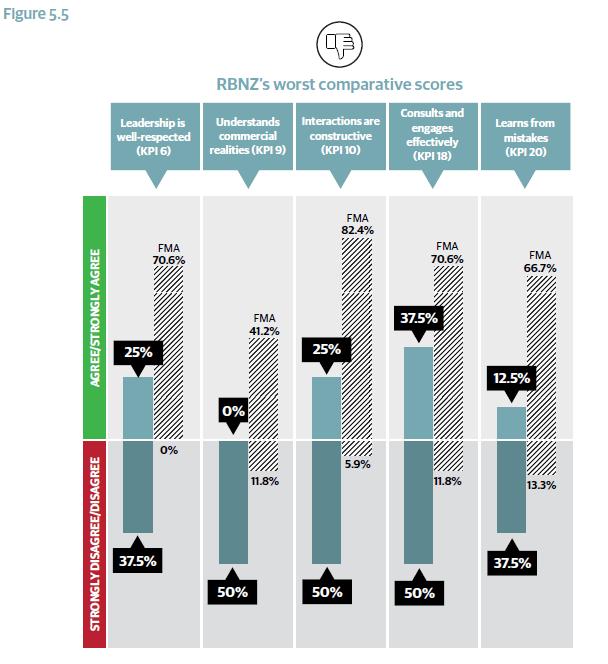
In this survey, the Reserve Bank’s financial regulatory areas scores astonishingly badly.   I first saw the results months ago when I was asked for comments on the draft report, but even with that memory in mind, rereading the Reserve Bank results (from p 60) over the weekend made pretty shocking reading.

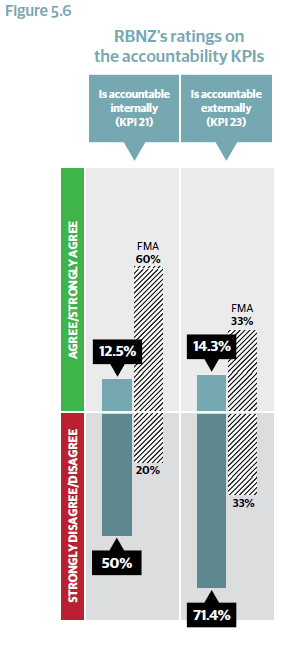
Here is one chart from the report, comparing Reserve Bank and FMA results for the KPIs where the Reserve Bank scores worst.
partridge 1

In summary

In the ratings, the RBNZ’s overall performance across the 23 KPIs was poor. On average, just 28.6% of respondents ‘agreed’ or ‘strongly agreed’ that the RBNZ met the KPIs and 36% ‘disagreed’ or ‘strongly disagreed’. These figures compare very unfavourably with the FMA’s average scores of 60.8% and 10.3%, respectively.  They also compare unfavourably (though less so) with the Commerce Commission’s averages of 39.9% and 25.8%, respectively.

There simply isn’t much positive to say.

One of my consistent themes has been the lack of accountability of the Reserve Bank, across all its functions.  The regulated entities seem to share those concerns.
partridge 2

As part of the survey, interviews were also conducted to fill out the picture the data themselves provided.

Like the survey results, the views of interviewees were also largely [although not exclusively] negative.

The criticisms related both to the RBNZ’s capabilities and processes, and the substance of its regulatory decision-making.
In relation to process and capability, criticisms included the following issues:
a. Lack of consistency in process: One respondent noted that the internal processes of the RBNZ’s prudential supervision department, which is responsible for prudential supervision, can be ‘random’. The respondent referred to long delays between steps in a process involving regulated entities, followed by the imposition of requirements for more-or-less immediate action from them.
b. Lack of relevant financial markets expertise among staff: This was a common
theme. One respondent noted that until the 2000s, there was “regular interchange
of staff between the banks and RBNZ,” meaning RBNZ regulatory staff had firsthand finance industry expertise. But this has changed with the banks moving their head offices to Auckland and the RBNZ based in Wellington. As one respondent said, “They will always struggle to get good people [with financial markets expertise] in Wellington, especially with the banks now in Auckland… this makes interchange impossible.” Another said, “RBNZ [staff are] completely divorced from the reality of how things are done.”  More colourfully, another said, “[RBNZ] is all a little archaic… Entrenched people don’t get challenged.” Another said, “On the insurance side, the level of capability is less than with the banks. There is a potential risk to policyholder protection. RBNZ ends up just focussing on the minutiae.”
c. Lack of commerciality: This concern is allied to both the expertise issue noted above, and the materiality issue noted below. As one respondent said about the RBNZ’s ‘deafness’ to the need for a materiality threshold before a matter becomes a breach of a bank’s conditions of registration, “RBNZ says, ‘If it’s not material just disclose it’. But that’s a regulator way of thinking. They don’t understand the commercial, reputational implications.”
d. Unwillingness to consult or engage: As one respondent said, “I would call them out for not truly consulting.” Another said, “The RBNZ upholds independence to the point that it precludes constructive dialogue.” Several respondents drew a contrast with the FMA, noting that the RBNZ was happy to issue hundreds of pages of “prescriptive, black letter requirements,” but “without much or any guidance” for the banks on their application. One respondent did note, however, that the RBNZ “isn’t resourced to spend time doing this [issuing guidance].”
e. Lack of internal accountability: Several respondents perceived a lack of oversight from the most immediate past Governor, Alan Bollard, in either engaging with the banks over concerns about prudential regulation or trying to resolve them. One respondent noted, “Staff are often running around doing things without serious scrutiny from above.” Another said there is a group “with no accountability within the RBNZ… They favour form over substance and seem to enjoy exercising power.” Another commented it was “unclear how much information flowed up to the RBNZ Board,” but that if the Governor were accountable to the board for prudential regulation, then the board “could be useful in pulling up entrenched behaviour.” Another noted that the RBNZ’s  governance structure meant it did not benefit from outside perspectives: “[t]he value of diverse thinking is to challenge, so you don’t get capture by one person’s view.”

Two main criticisms were made in relation to substance:
a. Materiality thresholds: Several respondents highlighted the lack of a ‘materiality
threshold’ before RBNZ approval is needed either for:
• changes to banks’ internal risk models in the Conditions for Registration of
banks; or
• changes to functions outsourced to related parties.
One respondent noted that without a materiality threshold, the new requirement
for a compendium of outsourced functions – and for approval of any change to
outsourcing arrangements with a related entity – could lead the Australian-owned
banks to cease outsourcing functions to related entities, thereby increasing costs and
harming customers.  Several respondents noted that the lack of a materiality threshold could be attributed to a lack of trust in the banks by the RBNZ staff responsible for prudential regulatory decisions. As one respondent put it, this led the RBNZ to “insist on approving absolutely everything.”

Although this view was not shared by all banks, one respondent noted that even
APRA – long regarded as a more heavyhanded, intrusive regulator than the RBNZ
– was “now more reasonable to deal with than the RBNZ.”

b. Black letter approach: Along with the lack of a materiality threshold in the RBNZ’s
regulatory regime, several respondents commented on the RBNZ’s “black letter”
approach to interpreting its rules: “If RBNZ had two or three public policy experts
who could bring a ‘purposive approach’ to interpretation, that would be hugely positive.”   Another said, “[The RBNZ] has an overly legalistic approach which ignores the purpose of the legislation,” and that “what they’re doing undermines [public] confidence over things that are of no risk.” Several survey recipients noted that this was in stark contrast to APRA’s approach to public disclosure in Australia.

Another respondent put the concern differently, saying the problem was less
about the RBNZ’s ‘black letter’ approach to its rules, and the opaqueness of the rules,
and more about the lack of guidelines from the RBNZ explaining them, an issue the
respondent put down to a lack of resources.

There is more detail there than most readers will be interested in. I include it because the overall effect builds from the relentness of the critical comment.   I’m not even sure I agree with everything in those comments –  but they are clearly perspectives held by regulated entities –  and I suspect that reference to Alan Bollard is really intended to refer to Graeme Wheeler.  But taken as a whole, it is an astonishingly critical set of comments and survey results, that most reflect very poorly on:

  • former Governor, Graeme Wheeler,
  • former Head of Financial Stability (and Deputy Governor and “acting Governor” Grant Spencer),
  • longserving head of prudential supervision, Toby Fiennes
  • the Reserve Bank’s Board, including particularly the past and present chairs, Rod Carr (who had had a commercial and banking background) and Neil Quigley.

And given the enthusiasm of the Bank to emphasis the role of the Governing Committee in recent years, it probably isn’t a great look for the new Head of Financial Stability, and Deputy Governor, Geoff Bascand – he of no banking/markets experience, no commercial perspective, and little regulatory experience – who sat with Wheeler and Spencer on the Governing Committee over the previous four years.

One would hope that the new Governor, the new Minister, and the Treasury and the Board, are taking these results very seriously, and using them to, inter alia inform the shaping of Stage 2 of the review of the Reserve Bank Act.  I’ve not heard any journalist report that they’ve approached the Reserve Bank  –  or the Board or the Minister – for comment on the report and the Bank-specific results.   But such questions need to be asked, and if the Bank simply refuses to respond or engage that in itself would be (sadly)telling.

In the report the New Zealand Initiative authors make much of comparisons with the FMA.  In respect of the survey results, that seems largely fair.  The data are as they are.  But as I’ve noted in commenting a while ago on an op-ed Roger Partridge did foreshadowing this report, I’m not entirely convinced (nor am I fully convinced about the criticisms of the FMA’s predecessor the Securities Commission, which was asked to do a different job).

Partridge cites the Financial Markets Authority as a better model.  In many respects, the FMA is structured like a corporate: the Minister appoints (and can dismiss) part-time Board members, and the Board hires a chief executive.  But it is worth remembering that the FMA has quite limited policymaking powers: most policy is made by the Minister, whose primary advisers on those matters are MBIE.   The FMA is largely an implementation and enforcement agency.  That is a quite different assignment of powers than currently exists for the Reserve Bank’s regulatory functions (especially around banks).  Also unaddressed are the potentially serious conflict of interest issues around the FMA Board, in its decisionmaking role. More than half the Board members appear to be actively involved in financial markets type activities (directly or as advisers), and even if (as I’m sure happens) individuals recuse themselves from individual cases in which they may have direct associations) it is, nonetheless, a governance body made up largely of those with direct interests that won’t necessarily always align well with the public interest.

Reasonable people can reach different views on the performance of the FMA. I gather many people are currently quite pleased with it, although my own limited exposure –  as a superannuation fund trustee dealing with some egregious historical abuses of power and breaches of trust deeds – leaves me underwhelmed.  It is certainly a model that should be looked at in reforming Reserve Bank governance –  it is, after all, the other key financial system regulator –  but I’m less sure that it is a readily workable model for the prudential functions, even with big changes in the overall structure of the Reserve Bank, and some reassignment of powers.  It certainly couldn’t operate well if both monetary policy and the regulatory functions are left in the same institution.  It doesn’t seem to be a model followed in any other country.  And it isn’t necessary to deal with the core problem in the current system: too much power is concentrated in a single person’s hands.  In a standalone regulatory agency, I suspect an executive board –  akin to the APRA model –  is likely to be an (inevitably imperfect) better model.

Whatever the precise model chosen, significant reform is needed at the Reserve Bank.  Some of that is about organisational structure and governance –  I’ve made the case for a standalone new Prudential Regulatory Agency –  but much of it is about organisational culture, and that sort of change is harder to achieve.  I hope Adrian Orr has the mandate, and the desire, to bring about such change.  I hope Grant Robertson insists on it.

Readers will that early last year, Steven Joyce – as Minister of Finance –  had Treasury employ a consultant to review aspects of the governance of the Reserve Bank, particularly around monetary policy.  Extracting details of the review, undertaken by Iain Rennie, from The Treasury proved very difficult.  It took almost a year for the report to be released.  I’ve had various Official Information Act requests in, including for the file notes taken from the (rather limited) group of people outside The Treasury that Iain Rennie engaged with (within New Zealand it turns out that he talked to no one outside the public sector).  That one ended up with the Ombudsman.  A week or so ago I finally got an offer via the Ombudsman’s office –  Treasury would release a document summarising those meetings if I discontinued my request for the full file notes.  Somewhat reluctantly –  balancing the point of principle, against getting something now – I agreed, and last Friday Treasury released that summary to me.  For anyone interested it is here.

Rennie review Summary of discussions with External Stakeholders

There is some interesting material there, including on meetings with the Reserve Bank Board –  where he showed no sign of having grilled the Board on what it accomplishes or adds –  and with some overseas people Rennie talked to.  But what caught my eye was the record of a meeting Rennie (and Treasury) held with the Reserve Bank management (Wheeler, Spencer, McDermott and a couple of others) on 14 March last year.  At the meeting, the Bank seems to have set out to minimise any change and sell Rennie on the virtues of the current informal advisory Governing Committee.

Here are relevant bits of the record (as summarised now by Treasury)

Current Governing Committee (GC)
o The GC reflects public sector reforms, there are checks and balances, which help with accountability.
o It has become important to focus more on the Reserve Bank as an institution, rather than just on the Governor, as the Reserve Bank has taken on more and more responsibilities over time.
o Discussed different overseas models, including strengths and weaknesses of different approaches.
o The approach to decision-making and communications needed to be consistent with the Reserve Bank’s approach (e.g. must be appropriate in the context of forward guidance).

Codification of the Committee Structure
o Codification’s advantage was that it could prevent a future Governor from moving back to a single decision-maker. However, that hasn’t been a problem in Canada, and it would be difficult for a Governor to roll the current committee approach back.

Effectiveness
o The cohesion of the GC and the cooperative nature were identified as the most important factors in its success. The GC was relatively informal with collective responsibility, and that worked well.
o Discussed how the current committee operated, and some strengths and weaknesses of the approach.
o Discussed the effectiveness of different options for decision-making and communications design, such as voting and minutes (neither supported).

Some of this is almost laughable, a try-on that surely they should not have expected anyone to take very seriously (and, to Rennie’s credit, he came out with recommendations that went far further than the Bank liked, earning him soe quite critical comment from the Bank).

Take that very first bullet, the claim that the Governing Committee model “reflects public sector reforms”.  I’m not sure how.  It has no basis in statute, the members are all appointed by and accountable to the Governor, and there is no transparency, and no accountability.  The Bank has, for example, consistently refused to release any minutes of the Governing Committee –  on any topic –  if indeed, substantive minutes are even kept.

Or the fourth bullet, the suggestion that “the approach to decision-making and communications needed to be consistent with the Reserve Bank’s approach”, which is a typical bureaucrat’s attempt to reverse the proper order of things.  The Reserve Bank is a powerful public agency, created by Parliament and publically accountable (well, in principle).  The design of the governance and accountability arrangements should reflect the interests and imperatives of the principal (public and Parliament), not those of the agent (the Bank itself).  Officials work within the constraints Parliament establishes.

Or the third to last bullet, about the cohesion of the Governing Committee, collective responsibility etc.  Again, I’m sure they believed it, but on the one hand, we build public institutions to provide resilience in bad times (or bad people) not so much for good times, and on the other there is no collective responsibility –  the Governor alone has legal responsibility, and there is no documentation at all on the Governing Committee processes.  And legislating to entrench a committee in which the Governor appoints all the members, might be a recipe for cohesion, but it is also a high risk of a lack of challenge, debate and serious scrutiny.

And, finally, just to confirm that consistent opposition to anything approaching serious scrutiny, in that final bullet, the Bank reaffirms its opposition to published minutes –  something most of central banks now manage to live with, in some cases with considerable detail.

At one level, these comments no longer matter much.  Graeme Wheeler and Grant Spencer have moved on, and the new government has made decisisions on the future governance of monetary policy.  But they nonetheless highlight the sort of closed culture fostered at the Reserve Bank over the past decade or more, whether on the monetary policy side or on the regulatory side (the latter vividly illustrated in the NZI report).  Comprehensive reform is overdue.  It would make for a better Reserve Bank internally – and/or a better Prudential Regulatory Agency –  and one more consistently open to scrutiny, challenge, and debate, which in turn will reinforce the impetus towards better policy, better analysis, and better communications.

 

“12 Angry Men” and the Reserve Bank

It wasn’t me that introduced that wonderful 1957 movie to discussions about Reserve Bank governance, but them.  I’ll get back to that.

Yesterday the Bank released its first on-the-record speech of the Orr era, although it must surely have been largely written before the new Governor came on board.  Chief economist John McDermott and one of his staff had prepared a paper for a Reserve Bank of Australia conference.  The title of the paper was Inflation targeting in New Zealand: an experience in evolution.   

I’ve not typically been a fan of McDermott’s speeches (eg here) but this one reads quite well.  It is mostly a background account of how inflation targeting developed and evolved in New Zealand, culminating in some brief, and fairly innocuous, comments on  the pending changes to the Reserve Bank Act that the government has recently announced.  For anyone looking for background or longer-term context on New Zealand monetary policy in recent decades, I’d happily suggest it as a reference (in fact, I just did for one reader).

I don’t have much problem with the description of the history –  and they draw on an old article of mine on the origins of inflation targeting – and although I’d describe a few things differently I think it is mostly a fair account.  As ever, I think the Bank tends to caricature the early days of inflation targeting to some extent, suggesting that things were done fairly rigidly or mechanically when the truth is –  whatever some of the rhetoric at the time – quite the opposite.    Then again, as I reflected on the speech I realised that there is –  as far as I can work out –  no one now at the Reserve Bank who was involved at all in monetary policy for the first seven or eight years of inflation targeting.  I guess it is a quarter of a century ago now, but even so that took me a little by surprise.  The Governor, for example, first joined the Bank in mid-1997 just in time to share responsibility for one of the more embarrassing episodes of the last 30 years, the Monetary Conditions Index.  (I’ve been meaning to write up that episode, which seems to me not well-documented, and now that Orr is back at the Bank perhaps it is time to do so.)

As it happens, the Monetary Conditions Index –  when for a year or more we set things up in a way that foreseeably introduced extreme short-term volatility to interest rates –  remains the only mistake the Bank seems willing to concede over almost 30 years (“the MCI was a branch that we lopped off fairly quickly”).  Certainly nothing about the persistent failure, over seven years now, to have core inflation near the 2 per cent focal point of the inflation target –  or the attempt to aggressively tighten policy in the midst of that –  all while, on their own numbers, unemployment was above estimates of a NAIRU.

But the prompt for this post was mostly some comments McDermott made about the planned introduction of a statutory Monetary Policy Committee, finally moving away from the single decisionmaker model that has few/no parallels among other central banks and financial regulators, and none among other New Zealand public sector agencies.

This was the paragraph that caught my eye

Of course, the creation of a formal (or indeed informal) committee does not guarantee superior outcomes. How the MPC will operate in practice is also extremely important. Committees are more successful when they have processes in place that aim to minimise various human biases, such as the pressure to conform, confirmation bias, and a tendency to rely on the most recent events to a greater extent than is sometimes warranted.[24] The Bank will continue to ensure our internal processes aim to maximise the benefits that committees can provide.

The footnote 24 reads as follows

24  The movie 12 Angry Men (1957, MGM) provides an excellent demonstration of how ‘committees’ (a jury in this case) should not behave, for example publicly revealing individual priors at the start of the meeting.

Of course, I agree that simply creating a legislated committee does not guarantee superior outcomes.  Much of the time it shouldn’t make much difference at all to the setting of the OCR –  whether for good or ill (thus the former Governor wanted his internal committee enshrined in law, and since it was gung-ho for tightening in 2013/14 as advisers, it is hard to believe they’d have taken a different collective view as decisionmakers).  Committees are, in large part, about institutionalising resilience, to protect us to some extent against idiosyncratic or bad actors (in this case, a bad Governor –  but it generalises in that Prime Ministers govern in Cabinets, higher courts operate as benches of judges, and so on).   Layers of review –  eg appeal courts –  can perform much the same sort of function.  Committees can help instill confidence, perhaps especially when –  as with the higher courts –  all judges are free to record, and have published, their considered opinions.   In many of these areas –  probably including the setting of the OCR – there is no objectively right or wrong answer, only a final one (for now).

McDermott rightly notes that there can be problems that undermine the effective contribution of legislated committees.  He notes “the pressure to conform, confirmation bias, and a tendency to rely on the most recent events to a greater extent than is sometimes warranted”, but there are others, including the possibility of individual committee members free-riding.  But he makes no attempt to relate the structure of committee that the government has chosen –  which seem to largely mirror the Bank’s preferences –  to the sort of biases and risks he is concerned with.  How does the chosen structure allay those risks?

Thus, the government has chosen to adopt a model in which:

  • outsiders will always be numerically dominated by insiders,
  • the Governor –  an insider in these terms – chairs the committee and controls all the resourcing of, and paper flow to, the committee, and where
  • the Governor will have a big influence on all the appointments to the committee (several will be his own staff, appointed on his recommendation, and the others will be appointed by the Minister on the recommendation of the Bank’s Board –  but with the Bank’s Board historically having served mostly to assist the Governor).
  • and outsiders (and insiders for that matter) will be unable to articulate their individual views in public, and won’t be held individually accountable for those views (or for their contribution to the committee).

In the hands of an exceptional Governor –  one genuinely open to debate and challenge, through the worst of times –  none of that might matter.  But we don’t legislate on the presumption that men are angels.   For a typical Governor –  moderately competent, moderately defensive, moderately arrogant –  it is a recipe for something as close as possible to the status quo.   And, frankly, for typical other members: insiders won’t see much payoff in resisting a Governor with a strong view, collegiality among management will encourage caucusing and a fairly common insider view, and anyone willing to take appointment as an outside member might be readily content to settle for the prestige, and the inside view of the process, rather than supposing that they have much chance of making much difference.   There will be no cost to just going along, and in the papers the Minister raised the threat of being dismissed if an outside member does make life awkward for the Governor.

I don’t want to overstate things. But the chances of getting the real benefits of a committee on this particular topic (monetary policy) have been undermined by the choices the government has made and the Bank appears to have supported.  Bureaucratic interest appears to have trumped the public interest.

And that footnote concerned me on a number of counts.  It obviously wasn’t just a throwaway line –  having been deliberately included as a footnote in a published text, which will have gone through numerous drafts.   It is an odd example to use in many ways. For example, a jury is a one-shot game (jurors typically don’t know each other previously, they decide one case, and then may never see each other –  let alone meet for another deliberation –  again).  Monetary policy decisions, by contrast, are a repeat game: the OCR is reviewed every six weeks or so, and the same individual or group of people make the decision for years at a time.  They bring their priors, their experiences, their past mistakes to the table, and are encouraged to do so.   It is also deliberating on issues where everyone –  inside the committee and outside –  has access to the same information, and no information is inadmissible. (And where the financial markets are trading that information continuously.)

McDermott seems to take as the lesson of 12 Angry Men that members of a committee should not outline their individual initial views at the beginning of the meeting.  Perhaps that is arguable (in principle), but in the case of the jury in question the “meeting” began only after all twelve jurors had been exposed to all the evidence in court –  defence and prosecution.  In that sense, the start of the jury deliberations in the movie reminded me quite a bit of OCR Advisory Group meetings I sat on for years:  we’d have spent several days listening to presentations, asking questions, listening to the questions of others, and then the small group would retire.  And often the Governor would go round the table and invite each member in turn to outline their view.  When we wrote our formal advice to the Governor, we were all supposed to do so independently –  and not read anyone else’s until we’d sent off our own.  And when the group reconvened there was never an opportunity to seriously debate the issues, or challenge the arguments that (say) an 11:1 majority of the Governor’s advisers were using.  In some ways, it felt a lot like 12 Angry Men, except without the heroic denouement in which truth was outed, and the majority converted.

The parallels are weaker than they might look.  For a start, no one’s life is on the line (as in the movie).  Perhaps more importantly, an OCR decision made today can be, and is, revisited 6-8 weeks hence.  And if all the members aren’t necessarily expert they at least have some ongoing familiarity with the subject matter, and exposure to the views of equally capable people outside the institution, in real-time.

But the challenge remains for the Bank (and the government).  How does it propose that the new committee will overcome the tendency for the Governor’s preference –  backed by resourcing, control of pay etc for internal members, an inbuilt majority, and an appointment procedure that will encourage the appointment only of house-trained outsiders –  to go on dominating, whether the Governor’s view (or the collective inside view) is right or not.  Sometimes it will be right, but those arguments should prevail on their merits, not on institutional biases that strengthen the hand of one dominant individual and his clique, and make unlikely the prospect that a single outsider will ever be able to make the sort of difference the (heroic) 12th juror in the movie made. Of course, it is only a movie…..then again, it was the Bank that introduced the reference, not me.

Far better to institutionalise a system more explicitly designed to air, test, and challenge the full range of views:

  • all members appointed directly by the Minister of Finance,
  • a majority of the members being non-executive outsiders,
  • those outsiders having access to (a limited amount of) resources to do/commission their own analysis research,
  • individual OCR votes being recorded, and published, by name,
  • full minutes –  with views attributed on a named basis –  be kept and published (paralleling the Swedish system, and –  in a slight different way –  the way the higher courts work),
  • individual members being free to engage externally (including making speeches) articulating openly their views and questions.

In the nature of the monetary policy issues –  repeat game, same information base open to everyone, huge uncertainty –  it seems like a model better designed to get the most from a committee system, and to be consistent with commitments –  from the government –  to more open government.  Of course, the Bank –  at least under the previous management –  never really wanted more than an fig-leaf committte. Any analysis of bureaucratic incentives means that shouldn’t be a surprise.  From McDermott’s comments yesterday, it isn’t clear that anything has yet changed.  But the bureaucrats –  with interests to protect –  shouldn’t be the ones driving the reforms.

Immigration policy: bus driver edition

Most of my discussion of New Zealand’s immigration policy centres on the residence approvals programme.  There is a good reason for that: it is where the numbers (of people) are.    In per capita terms, we grant about three times as many residence approvals as the Clinton/Bush/Obama United States did.

In the past 20 years, 864915 people have been approved for residence here.   MBIE data suggest that 80 to 90 per cent of those people are still here five years after approval (that proportion has been gradually trending upwards).   Assume that on average over the 20 years, 85 per cent have stayed on, and the residence approvals programme has boosted our population, all else equal, by about 735000 people.   That means a lot more houses are required –  and roads, schools, hospitals, shops etc –  and a lot more income-earning opportunities abroad need to be found (by the market –  it isn’t a central planning thing) to meet the appetite for stuff the rest of the world produces that each of us in a modern market economy has.

By comparison, as at 30 June last year, it is estimated that there were about 76000 people here on student visas, and 152000 holders of temporary work visas (some students have work rights, but they are still counted here as being student visa holders).

So if one has concerns about New Zealand’s immigration policy they should mostly centre on the residence approvals programme.   Mostly, but not exclusively.

In fact, over the last few years, changes in the stock of people here on short-term visas make up quite a large proportion of the overall net inflow of non-citizens.  Over the five years to June 2017, 225000 people were granted residence approvals.  Assume that the retention rate is around 90 per cent now, and in effect around 200000 of those people will still be here.

Over the same period:

  • the stock of people here on temporary work visas has increased by 62000 and
  • the number of people here on student visas has increased by 20000 (and student work rights were liberalised in that period).

In other words more than a quarter of the contribution of non-citizen immigration –  to things good, bad, or indifferent –  has come from the much-increased stock of people on temporary visas.  The individuals may change –  most temporary people go home again –  but the stock has increased sharply.   Changes in stocks (rather than specific individuals) matter for resource pressures, labour supply etc.

Student visas, in and of themselves, don’t bother me.  Education is an export industry, which just happens to be delivered to people here.  My unease is about the work rights, and preferential access to residency points –  which mean that immigration policy is, in effect, corporate welfare (implicit export subsidies) for universities, PTEs, etc competing in that market.

What prompted this post was the story this week about a bus company – Ritchies –  wanting immigration approval to recruit foreign bus drivers.  Bus drivers don’t make the list MBIE released of occupations for which there were more than 100 (so-called) Essential Skills visas issued last year, but these occupations were some that did.

Essential skills visa approvals 2016/17
Truck Driver (General) 400
Winery Cellar Hand 396
Waiter 345
Sales Assistant (General) 320
Personal Care Assistant 289
Massage Therapist 259
Baker 231
Painting Trades Worker 220
Builder’s Labourer 185
Kitchenhand 181
Fast Food Cook 118
Farm, Forestry and Garden Workers nec 116
Bar Attendant 102

On the face of it, such roles don’t seem notably more (or less) taxing than being a bus driver.  It is a responsible role, but not one requiring huge amounts of skills or training (according to the story I linked to above 6 to 8 weeks training suffices).    It isn’t the sort of role one naturally thinks of when officials and ministers talk about skills-focused immigration programmes.

The case Ritchies make is that they can’t find locals –  New Zealanders, or people already here –  to fill new roles.

Auckland Transport awarded Ritchies Coachlines the contract to run buses on the North Shore from September.

But the company said so far it had not been able to find enough drivers locally and had asked Immigration New Zealand if it could bring in 110 of them from overseas to plug the gap.

And I’m sure that is correct.  If you pay low enough wages, it is hardly surprising that people with other New Zealand options, aren’t lining up to work for you.

At least on the union’s telling

“The problem with Ritchies is that they pay over a dollar an hour less than the industry so their retention rates are minimal. People get trained up then they’ll go to other bus companies where the rates are better. Again Ritchies brings it upon themselves.

On the face of it, it looks like another case of a service contract won largely on the basis of (assumed) low labour costs.

The company more or less acknowledges the point

Mr Todd said the company would continue trying to recruit locally but only had until late June before it would need to look overseas for drivers including in Fiji, Samoa and the Philippines.

He admitted the $20.20 an hour it paid drivers would be difficult to get by on in Auckland but said this was the budget it had to work with.

“Lets face it, any job in the world, if you pay enough, you’ll get people to do it but…those costs will have to be passed on.”

Which is why I don’t really see the specific company as the bogey-man here.  They are operating in an environment –  bidding for public contracts –  where the overall level of funding seems to implicitly rely on access to very cheap labour (in this case, according to the company, from Fiji, Samoa, and the Philippines –  the jobs presumably not being attractive to bus drivers from the advanced world, since New Zealand is now a low income advanced country).

The same goes, more or less, for some other public-funded industries. Rest-homes, for example, rely heavily on immigrant labour from poorer countries: the existing level of rest-home subsidies constrain their options pretty severely.

No individual firm has a great deal of market power.  But the overall market is nonetheless skewed by policy choices successive governments have made about access to immigrant labour to fill what are mostly quite modestly-skilled roles.  Thus, rapid population growth, in a country with a modest savings rate, has pushed up the real exchange rate, meaning that at the margin individual farmers or individual tourism-service operators often genuinely can’t afford to pay higher wages  (and our overall tradables sector has shrunk too).    It is why we need not small tweaks at the margins –  should or shouldn’t bus drivers (waiters, kitchenhands, or whatever) be on the approved list – but an overhaul of the entire immigration system.

But as part of that we should:

  • establish a strong presumption against use of unskilled immigrant labour (which mostly –  although not entirely –  competes with and tends to drive down returns to domestic unskilled labour), and
  • get ministers and officials out of the game of determining which specific roles people can and can’t hire short-term immigrant workers for.

To that end, I’ve argued previously for a system in which Essential Skills visas are granted on these terms:

a. Capped in length of time (a single maximum term of three years, with at least a year overseas before any return on a subsequent work visa, with this provision to apply regardless of skill level).

b. Subject to a fee, of perhaps $20000 per annum.

If an employer really can’t find a local hire for a modestly-skilled (or unskilled) position, they’d be able to get someone from overseas, but only by paying (to the Crown) a minimum annual fee of $20000.  It is pretty powerful incentive then to train someone local, or increase the salary on offer to attract someone local who can already do the job. If you can’t get a local to do a job for $40000 per annum, there might well be plenty of people to do it for $50000 (and still cheaper than paying the ongoing annual fee for a work visa employee).

It isn’t, by any means, the full answer.   A much lower real exchange rate has to be an integral part of fixing the overall system, and that is only likely –  on a sustained basis –  if serious inroads are made on the residence programme.  But it would be a start.  It would increase the pressure to fix the residence programme, and it would also re-establish the presumption that one of the purposes of economic life and economic policy is to (sustainably) lift the wages of all New Zealand workers, and perhaps especially those at the bottom of the heap.    Economists might respond that there are gains from trade to be had by bringing in more unskilled people, and that (in principle) the domestic “losers” from such a policy can be compensated.  Of course, they never actually are compensated.  And it just isn’t the way most New Zealanders want their country to be.

By all means, lets welcome a small number of really able people migrants, and meet our international humanitarian obligations around refugees.  But lets drop the misguided belief, that has shaped policy now for too long, that bringing in lots of not-very-skilled people is somehow making us all better off.  It hasn’t, it isn’t, and it seems very unlikely to do so in the foreseeable future.


A double standard…or not

There has been plenty of criticism of the Labour-New Zealand First government for their failure to act meaningfully in support of the United Kingdom and other traditional western friends and allies, responding to the poisoning in Salisbury of the Skripals.  I’d agree with the critics.  Even Ireland –  not in NATO, Five Eyes or other military/intelligence alliances –  expelled a Russian diplomat in response.  But not New Zealand.   Add in that refusal to act to the Minister of Foreign Affairs’ attempts to minimise Russian responsibility for the downing of MH17 or to suggest Russian hadn’t been attempting to meddle in the US 2016 election, and it must be increasingly difficult for our friends and allies to take us seriously as either.

I don’t suppose Russia is much direct threat to New Zealand –  though cyber threats aren’t restricted by physical proximity.  But that shouldn’t really be the point.     Countries simply shouldn’t be able to get away with killing (or in this case, so far, attempting to kill) people going about their lawful business in other countries without some response.     And the provision of support in times of need is what friends and allies do –  in fact, it is one of test of friendship.  Kicking out diplomats (for a few months) is a feeble enough response, longer on symbolism than substance.  But the New Zealand government wasn’t even willing to get onside with the symbolic response.    Instead, we find our ourselves in the company of Greece – a country with very close historical and contemporary political, cultural and religious ties to Russia.

With enough determination even a country –  Russia – whose real GDP (in purchasing power parity terms) is only a third of that of just the biggest four west European economies combined, and about 20 per cent of that of just the United States, can wreak a lot of havoc if it chooses, especially to its smaller and weaker neighbours.  But it is still a country in relative decline.

So there is Russia and then there is the People’s Republic of China.  I’ve recently been reading the book Henry Kissinger wrote a few years about China, including US relations with the People’s Republic in recent decades.  It was a useful reminder that when the PRC and the United States opened up to each other almost 50 years ago now it was, from both sides’ perspectives, substantially about dealing with the greatest geopolitical threat of that era –  the Soviet Union, which had armies (and nukes) perceived to threaten western Europe, and armies massed on the northern borders of China.

Here was the relative economic capacities (real GDP in purchasing power parity terms) of the three countries in 1970.

econ resources 1970

Of course, the PRC had enormously more people than either of the other countries (and, as Kissinger reports, Mao had often talked of China’s ability to absorb losses of a few hundred million people in a nuclear attack).   Add in, on one side, the rest of NATO and, on the other side, the rest of the Warsaw Pact, and the western economic capacity was far far greater than that of the Soviet Union.    But states like the USSR could still pose a threat, by devoting a far larger proportion of their resources to military purposes.  Pre-war Germany was, after all, materially poorer than Britain and France (and respective empires) combined, and even a bit poorer than just the Soviet Union.  Real GDP in Japan in 1940 was about a quarter of that of the United States.  Japan and Germany lost –  they were both poorer, and had fewer people than the countries they took on – but it tooks years and enormous sacrifices to beat them.

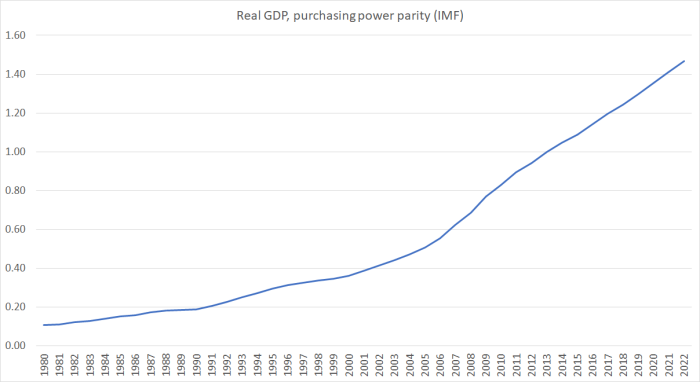
What of the situation now?   This chart shows the ratio of PRC to US total real GDP, again in purchasing power parity terms, from 1980 (when the IMF database starts) through to forecasts for 2022.

econ resources us vs china

In PPP terms, the size of the PRC economy exceeded that of the US a few years ago.  Even if you think China might have some rocky times ahead –  the overhang of all the internal debt – it seems highly unlikely that the PRC economy will ever again be as small as that of the US.  On IMF numbers, in 2022 total GDP in China will be roughly equal to that of the US, Japan and Germany combined.   Of course, material living standards in the PRC are much lower than those in the United States, but on the IMF projections by 2022 real GDP per capita in China is forecast to be about a third of that in the United States.  Soviet Union real GDP per capita in 1970 was about a third of that in the United States then.

There is plenty of talk from the PRC of its “peaceful rise” or “peaceful development”.  But even if we set Tibet to one side, this is the regime that has fought three aggressive wars (Korea, India, and Vietnam), which has used military action to seize islands and reefs in the South China Seas and which to this day has never ruled out the military conquest of its neighbour –  the now prosperous democracy of Taiwan.   If anything, the rhetoric around Taiwan has only been stepped up in recent years.  In defiance of international law, the regime has created artificial islands from rocks and reefs, and continues to expand its military capability on those “islands”.  The regime menaces Japan around the Senkaku Islands, and only last year there was the Doklam standoff with India.  If you are worried about Russian support for separatists in eastern Ukraine –  as most rightly are –  there is plenty enough to match it in the aggression of the PRC.  The PRC bullies and bribes regional goverments to gets its way (eg here) . And yet rarely a word is openly uttered by most Western governments, including our own.

And if Russia’s latest offence – egregious enough –  was attempting to murder a couple more Russian citizens in Britain, what of the People’s Republic?  There was a fascinating, and pretty disconcerting, article in Foreign Policy only a few days ago headed “The Disappeared” about the (alleged) activities of the PRC regime in kidnapping or otherwise coercing people who have left China –  who may even be citizens of other countries (and the PRC doesn’t legally recognise dual citizenship) –  to return.    There is even a suggestion, from a former Chinese diplomat who defected to the West a decade or so ago, that such activities may have occurred in New Zealand.

One of the first cases to spark debate dates to 2005, when Chen Yonglin, a Chinese diplomat who had defected to Australia, accused security forces of having drugged and kidnapped Lan Meng, the son of a former deputy mayor of Xiamen, five years earlier. Lan was allegedly drugged by Chinese security forces and transported from Australia back to China on a state-owned shipping vessel.

Chen, who was assigned to China’s consulate in Sydney at the time of his defection, claimed that Chinese officials abducted Lan in order to force his father, Lan Fu, to return to China from Australia to face criminal corruption charges. (Lan Fu returned to China in 2000 and is now serving a lifelong prison sentence.) Australian officials have contested Chen’s claims, and the alleged victim, like numerous others, apparently denied the story to Australian federal police.

But Chen remains adamant. Reached by phone in Australia, he confirms his account of Lan Meng’s rendition, citing numerous conversations about such abductions with Chinese military, intelligence, and diplomatic officials during his tenure at the Chinese Ministry of Foreign Affairs. He says while in office, he heard of at least one other Chinese-sponsored seizure in Australia, as well as one in New Zealand. Chinese operatives also performed similar kidnappings in Vanuatu and Fiji during this period, he says. (Chen says the New Zealand case involved a woman named Xie Li, who was kidnapped in Auckland in 2004 and returned to China via a state-owned shipping vessel.)

It would be interesting to know what the New Zealand government’s position is on this claim.  (Probably wishing it had never been aired, lest they be put on the spot.)

Along similar lines is a new article in The Economist, which cites that way the PRC regime uses threats to families back in China to coerce silence or return from dissidents abroad –  again, often citizens of other countries.   It reminds us again of the case of the Swedish citizen Gui Minhai

In countries with closer ties to China, agents have occasionally dispensed with such pressures in favour of more resolute action. Wang Dan, a leader of the Tiananmen Square protests of 1989, says that he and other exiled dissidents have long avoided Cambodia, Thailand and other countries seen as friendly to China for fear of being detained by Chinese agents. The case of Gui Minhai, a Swede who had renounced his Chinese citizenship, suggests they are right to do so. He was kidnapped by Chinese officials in Thailand in 2015 and taken to the mainland. In a seemingly forced confession broadcast on Chinese television, he admitted to a driving offence over a decade earlier.

It all seems as least as lawless as Russia, quite probably more so.   And yet in some parody of good government and the rule of law, a PRC senior official now heads Interpol.

We could go on, and focus on the PRC theft and dubious acquisition of all manner of intellectual property.

Or, then again, we could simply look at New Zealand itself, where the PRC is generally accepted as having exerted its energies here –  among New Zealand citizens of Chinese descent –  to get effective control of almost all the Chinese language media here (and something similar in Australia), and many religous and cultural bodies patronised by New Zealanders of Chinese descent.  Or we could look at the Labour Party MP who was adopting slogans from Xi Jinping for Labour’s campaign among the New Zealand Chinese community.   Or the National Pary MP, formerly a member of PRC military intelligence establishment, member of the Chinese Communist Party (which controls the PRC government), who closely associates with the PRC Embassy in New Zealand, and who has never once in his political career been heard to utter a criticism of the regime’s activities –  whether here, abroad, or back in China itself.    Who admits he lied about his background –  at the direction of the PRC regime –  when he came to New Zealand.  Perhaps the regime exercises leverage over him by threats to his family back in China.  If so, he clearly doesn’t have the capacity to operate as a member of Parliament in the interests of all New Zealanders. And if not, why can’t he bring himself to utter a word of criticism of such a noxious regime? (More generally, why won’t he front the English language media –  the bits not until PRC/CCP control –  at all?).

I wrote a post a few months ago, when the Jian Yang affair first broke about how it would have been inconceivable to have had a former KGB/GRU official in our Parliament in the 1970s –  at very least, not one who wasn’t a trenchant critic of the USSR he had left behind.  But I could bring that up to date.  Imagine if there was a former GRU officer in the House of Commons, or our Parliament, today.  It is inconceivable.  And yet that is the equivalent situation we face with Jian Yang as a New Zealand MP today –  something that no politicial figure will express any serious concern about, or that the National Party will do anything about.

Oh, and one of the responses to renewed Russian aggression in recent years has been to put on ice negotiations for a preferential trade agreement with Russia.  That suspension seemed prudent and appropriate –  both in managing relations with our friends in Europe, and on the substance of the case and the nature of the regime.  And yet our government –  and its predecessor –  seem quite unbothered about a preferential trade agreement with the PRC, or –  more pointedly –  about continuing to negotiate right now for an upgrade to that agreement.

I’m disappointed that our government has refused to join the Western (symbolic) response to the apparent near-certainty of Russian government responsibility for the Salisbury attack.  But in the scheme of things, the complaisance, the silence, the desire to do deals with the PRC –  the refusal to confront even a situation like the Jian Yang one domestically – concerns me, and should concern New Zealanders, considerably more.  If there is a serious double-standard at work in those who criticise the government about the Russia response, while never raising even a murmur about the PRC, perhaps there isn’t one in the government at all.  They seem simply supine all round.

There was a column in The Australian the other day from a former deputy head of the Australian Department of Defence (and now head of a think-tank) in which he observed

Sadly, New Zealand’s failure to join other democracies in expelling Russian spies and Wellington’s kowtowing to Beijing shows that this is one old ally that already has given up the fight for Western values.

One hopes that is a premature conclusion, but there doesn’t seem to be much evidence for the other side at present.  And it isn’t just a matter of values, or friendship, but of interests.  If the Soviet Union was the biggest geopolitical threat in 1970, it is hard not to conclude that the People’s Republic of China –  bigger and relatively richer than the Soviet Union ever was –  holds that title today.  Toadying served no country’s long-term interests in the 1930s, or during the Cold War.  It doesn’t today either.  Selling your birthright for a mess of potage wasn’t a great strategy for Esau, nor should it be for any one else with a modicum of self-respect.

Work visa numbers soar

Working my way through the text and tables that make up MBIE’s very-belated Migration Trends and Outlook for the year to June 2017, I found this on the very first page.

Temporary worker numbers continue to grow

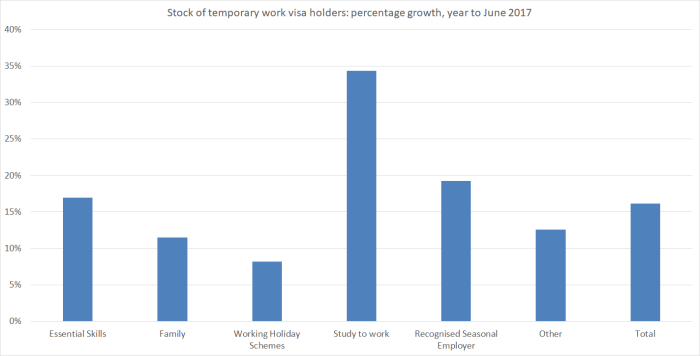
At 152,432, the number of temporary workers present in New Zealand on 30 June 2017 was 16 per cent higher than the year before.

That is a staggering increase in a single year.  Perhaps just as well for MBIE –  and political advocates of the status quo – that these data are held so tightly and released so belatedly.  If this was normal economic data –  released, in accessible formats, every month a few weeks after the end of the month –  that sort of statistic would have been a valuable addition to the pre-election debate.      As it is, it is now 31 March 2018, and we have no idea whether the numbers have gone on increasing as rapidly this year.  Even if MBIE gets back to its normal publication schedule, we won’t know for another seven or eight months.    For a government that talks of a commitment to more open government, that should be inexcusable –  whether you support the current immigration policy or not.

There are various different classes to temporary work visas.  Here are the growth rates for each of the main classes, as reported by MBIE.

work visas stock

There were big increases in the so-called Essential Skills category, but far and away the largest increase was in the Study to Work category –  people graduating from tertiary institutions, and granted the right to work here for a year in any job whatever.  Many of these people will, presumably be hoping to graduate to an Essential Skills visa or a residence visa.  Essential Skills (so-called) numbers aren’t capped, but residence visas are managed to a numerical target, reduced a little by the previous government.

Perhaps you had the impression that most temporary work visas were issued subject to some sort of labour market test (to be clear, I don’t favour such tests).  If you thought that, you were wrong.

work visas 2

Of the top 4 categories, only the Essential Skills visas are subject to a labour market test.  And Essential Skills visa holders make up just under a quarter of the people here on temporary work visas.

The number of people here on temporary work visas has increased by 63 per cent since 2009.   For those interested in nationalities, the main countries with large increases have been India and France (the latter presumably mostly Working Holiday visas).  The number of people here from the UK has increased a little, while numbers from Fiji and South Africa have actually fallen.

And these are the occupations where more than 500 Essential Skills visas were granted in 2016/17

Occupation Number %
Chef 2,178 6.6%
Dairy Cattle Farm Worker 1,617 4.9%
Carpenter 1,478 4.5%
Retail Supervisor 961 2.9%
Cafe or Restaurant Manager 942 2.9%
Retail Manager (General) 767 2.3%
Aged or Disabled Carer 748 2.3%
Dairy Cattle Farmer 508 1.5%

There might have been a building boom on, but actually that apparently-chronic shortage of chefs continues to dominate the numbers.   You may recall my pre-election post noting that the actual make-up of migrant numbers was exacerbating –  not easing –  workforce issues in the construction sector.

Here is another way of looking at the skill level of the people getting Essential Skills visas last year, using the broader occupational categories MBIE reports.

Occupations of people granted essential skills visas, per cent of total
Food trades workers 8.9
Hospitality, retail and service managers 7.1
Labourers 17.6
Community and Personal Service Workers 11.9
Machinery Operators and Drivers 4.4
Sales Workers 4.7
Clerical and Administrative Workers 3.2
Sub-total 57.8

When the labourers make up 18 per cent of those getting Essential Skills visas, I think people might reasonably conclude we’ve been sold a pup.   To be sure, only a small number of those people will end up getting permanent residence, but a large stock of imported labourers –  even if the people themselves are rotating –  is still more likely to be depressing New Zealand wages in those particular sectors, than adding to trend productivity for New Zealanders.  For those sceptical of any adverse wage effects, simply listen to the squawks of employer lobbyists when there is any talk of tightening the criteria.  The natural response when particular types of labour is scarce is for the price of that labour (wages) to rise.

On which note, I happened to read the “China Business” supplement that came as part of Thursday’s Herald –  mostly apparently paid for by firms wanting to keep on good terms with the People’s Republic.    One article that caught my eye was by the National Party’s spokesman for foreign affairs and trade, Todd McClay.    It was a curious article in some respects.  There was this claim, for example

Trade flows remain remarkably balanced for two countries whose economies are of such different size. This is not by chance, but a direct result of successive governments, officials and particularly Foreign Affairs and Trade Ministers regularly visiting China, to secure opportunities for Kiwi exporters.

I have not the slightest idea what the first sentence is supposed to mean (and it is only a few weeks since the China Council was touting that New Zealand trade with China was unbalanced –  more New Zealand exports to China than imports from it).  Surely, the Opposition must have some advisers who know some economics?

Then there was this

As a parliamentary colleague often says “words have meaning”. This is particularly true when Ministers speak of our international relationships. In fact when it comes to trade, “words have consequence”.

One certainly hopes words have meaning –  although sadly one fears that with politicians that isn’t always the case.  Quite what point McClay is making here also isn’t remotely clear, although perhaps it is a dig at anyone suggesting that, as regards China, New Zealand politicians might ever stand up for New Zealand values?

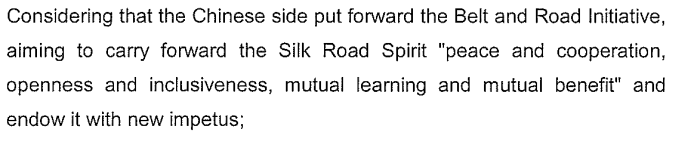
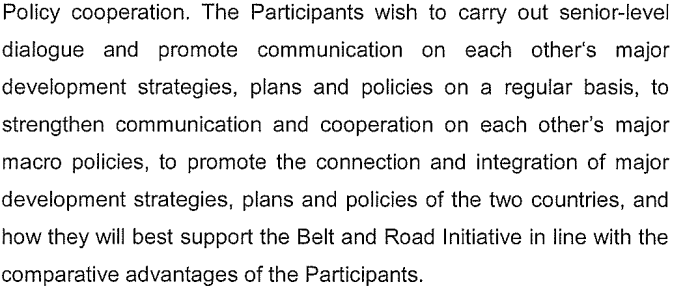
Then again, if words have meaning, what did Mr McClay –  Trade Minister at the time –  mean by these words when his government signed on to the People’s Republic Belt and Road Initiative last year?

BRI 2

Or did those words not have meaning?  “Fusion of civilisations” with such a noxious regime……..

But the main reason for linking to McClay’s article was his comment about negotiations to upgrade the New Zealand-China (so-called) Free Trade Agreement.

China can be expected to push for better access for investment and labour. The revised TPP has doubled the OIO investment threshold from $100m to $200m for China under a most favoured nation clause, but this has already been banked. Given the importance of China to the economy you can expect this will be a hot topic for negotiation.

So too will be access for temporary labour. It is a demand they have made of others and it is likely to be a demand they will make of us.

It is a “demand” that our government should simply refuse.   But as successive governments have traded away the interests of New Zealand low-end workers, in the way they’ve run our own immigration and work visa policies, it is difficult to summon much optimism that they will in fact resist.  From the tone of McClay’s comments, the National Party doesn’t seem to believe they should.

The failed economic strategy goes on

MBIE has finally released its annual Migration Trends and Outlook report.   This is an annual publication, in this case covering the year to June 2016.   When it was finally released –  five months later than usual –  it was nine months since the end of the year to which the data related.  And all of this is simply adminstrative data –  in MBIE’s own computer systems and files.  Government agencies manage to collect and publish building permits data within a few weeks of the end of each month.  MBIE’s performance here is inexcusable – the more so, as immigration policy is one of the major instruments of economic and social policy that the government wields.

When I’ve had time to work through the report and associated tables, I will no doubt have some more posts.  In the meantime, I will simply leave you with this extract.  From the roughly half of people granted residence approvals who come under the Skilled Migrant category, these are the top 4 occupations of the principal applicants (typically, almost by definition, any spouses will be less skilled –  if not, they themselves would presumably have been the principal applicant).

Recall the nonsense MBIE –  and to a lesser extent Treasury  –  have run about immigration policy as a critical part of economic transformation strategy (“critical economic enabler” used to be MBIE’s description).    It would be great to see some evidence for the transformative effect –  productivity gains for all, not wage reductions for New Zealanders in these and associated occupations –  of the annual influx of so many people “skilled migrants” to our restaurants, cafe, and shopping sectors.  Or, indeed, the aged care sector, where – as I’ve argued before –  the so-called pay equity settlement looks to have been mostly not a response to gender-discrimination, but to glutting the market with immigrant nurses (and, in work visas categories, other aged care workers).

Main occupations for Skilled Migrant Category principal applicants, 2016/17  
   
Occupation 2016/17
Number %
Chef 684 5.7%
Registered Nurse (Aged Care) 559 4.6%
Retail Manager (General) 503 4.2%
Cafe or Restaurant Manager 452 3.7%

MBIE is so slow in releasing the data that all these approvals occurred under the previous government. Sadly, there is no sign that things will be any different under the new government. Presumably, buying a franchise for a coffee shop will continue to be a path to –  in effect, buying –  New Zealand residence, and all the associated family immigration this new resident aspires to.  It probably wasn’t what the designers had in mind when they thought of entrepreneurial immigration, but it is the sort of shabbiness that our immigration system has been reduced to.

Eaqub on NZ policymaking

Shamubeel Eaqub’s column in yesterday’s Sunday Star-Times got me thinking.

The column is headed Policy flip-flopping on the road to progress although Eaqub seems to lament two quite different things.  The first is what he suggests is a tendency for policy to reverse course depending on which party is in office.

On tax, we have seen little leadership. The Helen Clark-led Labour government raised income taxes for high income earners, because they wanted a progressive tax system.  The John Key-led government then lowered those taxes, as it took its turn at the policy-making helm.

This kind of turn-based policy making which favours ideology is bad. It creates instability and loses sight of the long-term issues governments should be dealing with.  Instead we need a long-term and deliberate approach which can overcome this kind of policy yo-yo.

And the second is something about failures of New Zealand policymaking more generally

Bad policies often hang around like weeds, because we don’t have a good system to review past policies and undo them if necessary.

The demands for action and leadership are justified. But we should not be so hasty to deride collaborative and transparent approaches to policy development.

They are a good counter to the current way that has allowed big social and economic issues to accumulate over decades.

I’m not convinced on the first score.  For decades now, the similarities between our two main parties have been much more apparent than the differences.  Even in the brief periods of radicalism, Labour briefly wrong-footed the National Party in the mid 1980s, then National had its own brief spurt of reforms in much the same general spirit, and then before long both parties had settled back to doing not very much at all.  In many ways, the similarities aren’t so surprising –  there is plenty of political science and economics literature to predict that sort of clustering to the centre.

There are exceptions of course –  such as the maximum marginal tax rate example Eaqub describes.   Another example might have been the 90 day trial periods promised (and implemented) by National in 2008, and being partially unwound now.   And the exceptions aren’t necessarily a bad thing.  We do, after all, live in a democracy, where parties compete for your vote.  One likes to think that at least some of that competition might be based around different visions, and differences of the best practical ways to achieve even agreeed outcomes, not just on (say) who has the cutest kids or makes the best pizza.  Reasonable people will, at times, take a quite different view on (a) priorities, and (b) mechanisms (not just what “works” but what is “socially acceptable”).   The hankering for “a long-term and deliberate approach which can overcome this kind of policy yo-yo” has disconcerting similarities to the talk of the alleged superiority of the approach adopted in the People’s Republic of China: one party, and now one leader, indefinitely supposedly facilitates good long-term reform.  None of that pesky competition of ideas, interests, and individuals.  Shame about the outcomes there.

So which party is in office is supposed to make a difference –  and not just to the faces on the covers of the women’s magazines.

But I’m much more sympathetic to Eaqub in his concern about longer-term policymaking and associated advisory capability.   And that probably does spillover into Eaqub’s concerns about some of those short-term initiatives parties promise to win elections

Too many policies are populist, turn-based or just ill-thought out

Eaqub laments the state of the public service.

The civil service has a role here, as the generators and repositories of policy ideas, rather than just the delivery mechanism of ministers’ ideas that it has become.

Beaten into submission over decades, our civil service is more likely to say “more research required” on a problem, like an academic, rather than offer a well-formed recommendation.

In some respects it is hard to disagree.   Observing the quality of the analysis and advice coming out of The Treasury and MBIE instills no confidence whatever.  But while ministers have not often not welcomed, and at times actively discouraged, free and frank advice, the problem isn’t only with politicians.  The Treasury’s continued failure to have a compelling narrative of why our economic performance continues to lag behind isn’t really Bill English’s fault –  it is the failure of the institution itself (more interested, apparently, in well-being studies) and perhaps of those –  the State Services Commission –  that appoints heads of government departments.  Sir Robert Muldoon –  no great fan of The Treasury –  didn’t prevent The Treasury being well-positioned in 1984 with ideas, analysis and energy that helped facilitate the reforms of the following decade.  But that was probably an historical exception, and perhaps it is unrealistic –  even in a small country –  to really expect the public service to lead in ideas-generation around desirable reforms.  Apart from anything else, the incentives are all wrong, and the inevitable constraints militate against it.

Perhaps we have bigger weaknesses than our public service?    Think-tanks are few –  and our most consistently fertile one (the New Zealand Initiative, and is predecessor the Business Roundtable) tends to be located towards a libertarian end of the spectrum where very few likely voters are.  And in many areas, the contribution to policy-related analysis and debate from university academics is pretty thin, or often almost non-existent.  There are understandable reasons –  the PBRF ranking/funding model prioritises refereed journal articles and academic books, and recruitment policy (no doubt for good short-term economic reasons) often prioritises cycling through young foreign academics with little knowledge of, or interest in, the specifics of New Zealand.   Whatever the reasons –  and some of them may just be the limits of a small country – the policy-related inputs are often pretty thin.

But I wonder if the bigger issue still isn’t the lack of demand for anything different.  After the ructions of the 80s and early 90s there seemed to be both a shared elite consensus that reforms had been done pretty well, and it was only a matter of time until we saw the fruit.  And when the fruit (mostly) didn’t show up to the extent hoped for, there was a shared reluctance at a political level to risk more change –  perhaps particularly on the left (where the Labour Party had split).   For many people, life in New Zealand isn’t too bad at all, so why risk rocking the boat –  memories (and folk memories now) of the 80s and 90s.

And the “policy elite” (whether or a broadly-left or broadly-right persuasion) still mostly tend to hold some views that probably haven’t served New Zealand that well.  For example:

  • the broad-based low rate (BBLR) tax system, which keeps getting praised (including abroad) but typically isn’t imitated.   We tax returns to savings materially more heavily than most countries do, and that is increasingly true of business investment too,
  • the deep-seated belief that high levels of immigration are a “good thing” –  generally, and for New Zealand (even as the proponents are unable to produce evidence of those benefits for New Zealand).  The belief might be rooted in history (settler societies and all that), general economics literature, and the dread fear of being accused –  eg by the NZ Initiative –  of “racism” or “xenophobia, but whatever the reason, it no longer serves us well,
  • the endless deference to the People’s Republic of China, and the narrative that has somehow been allowed to grow up that somehow our fragile prosperity depends on keeping on side with the PRC,
  • the indifference to the fact that New Zealand has had consistently the highest real interest rates in the advanced world (and amomg the slower rates of productivity growth) –  the rhetoric for a long time (again a legacy of past decades) was that such differences can’t persist, unless they are risk-based,
  • a shared belief in the importance of technology and the tech sector, and more of a desire to belief than a willingness to ask hard questions about the likelihood of such industries developing, and remaining, here,
  • the implicit belief that our physical location doesn’t matter much (occasional talk about “costs of distance” notwithstanding) and thus an implicit view that analysis fit for small northern European countries is just fine for a really remote South Pacific one,
  • a largely shared indifference to the persistence of a very high real exchange rate.  Some of this indifference no doubt relates to the memories of controlled exchange rates past, or to journal articles characterising exchange rates as random walks, but again whatever the reason, it holds people back from seriously engaging with this symptom of our problems.

Of course, there are other issues on which the “policy-elites” are on the side of the angels –  there is probably a pretty strong consensus on raising the NZS age and even age-indexing it in future –  but there are high political barriers.

And other issues like house prices – perhaps even family breakdown –  where New Zealand’s policy failures aren’t much different from those in many other parts of the Anglo world.

Probably it is much easier to do reform, and even craft some sort of elite support for it, when the issues look like ones that involve converging towards what everyone else is doing.   That was, more or less, the story we told in the 80s and early 90s.  Even when the details of things done here were sometimes world-leading, the overall narrative was one in which we had failed to open up and reform in a way that other countries had, or were doing.  We just need to catch-up, and in the process could do some innovative stuff.

But what of now?  No country anywhere is doing much to do structurally with house prices –  and for most people in most of the rest of the world, those successful parts of the US without the problem seem to be treated as little more than a curiousity, of which most are barely aware.  No one is fixing the “family breakdown” issues either, and so we drift like the rest.

And addressing our economic underperformance looks as though it might require stepping away from some of the OECD rhetoric.   That can be hard to do (perhaps especially for officials), absent some compelling figure with an alternative narrative and the political skills to take people with him/her.

To get back to Eaqub’s article, he began by noting that

When a new government forms, there is usually a flurry of studies, task forces, working groups and advisory panels.

That has been right, at least with recent governments.  But perhaps what is most notable about many of those groups is the typically limited resources and limited time they are given.  He cited the Jobs Summit –  done over a couple of months, culminating in a one-day jamboree –  or the 2025 Taskforce (so under-resourced the one foreign appointee couldn’t really believe it). But he could have mentioned the current Tax Working Group too, which is operating on pretty tight deadlines, with limited specialist expertise.   Some of these groups, even with limited time/resources, have produced some useful material.  But they are often more about political management than about actually getting to the bottom of some serious and knotty problem.

This post has been pretty discursive, probably more useful for clarifying my thinking than for anyone else.  I think my bottom line is something along these lines:

Political flip-flopping is the least of our problems.   And the public service –  while quite degraded in its policy capabilities –  is perhaps not a body one could ever hope for much from on a sustained basis.  Our university and think-tank sectors are weak, when it comes to policy analysis and associated innovation.  But perhaps the biggest obstacle to change –  whether around the issue this blog most often focuses on, productivity underperformance, or most others –  is the absence of any political (or, presumably, public) demand for different outcomes, buttressed by “policy-elites” who seem to share assumptions and presuppositions that might have looked fine 25 years ago, but which –  on my argument – don’t do so now.  Without alternatives –  that might go over well at the OECD, the IMF or the like – it is just easier to hold on to those presuppositions, and the comfortable life most enjoy.       It is a recipe for continued drift, which is of course what we saw under the last two governments and what we seem set for under the current one.   It isn’t obvious what, or who, might credibly lead us to something different.

What do we want with the Belt and Road?

Readers will recall that the New Zealand China Council was set up by the government a few years ago, and is largely funded by the government, to promote

deeper, stronger and more resilient links between New Zealand and China

The Council includes the heads of government departments/agencies (MFAT and NZTE), and includes plenty of people –  including retired politicians – with strong business links to the People’s Republic of China.    A significant part of what they do –  see their Annual Report – is a “communications and advocacy programme”, designed –  it seems – to help ensure that as far as possible New Zealanders see things their way, and don’t create trouble around either the character of the regime (and the party that controls it), or that regime’s activities at home, abroad, and in New Zealand itself.   There are, after all, deals to be done, political donations to be solicited, friends to be protected, and so on.

Stephen Jacobi is the executive director of the Council, and its public face.  In the last few weeks I’ve written about a speech Jacobi gave recently in which he attempted –  without much depth or rigour –  to bat away concerns about PRC activities and risks, and also about a rather economics-lite press release he had put out attempting (Trump-like) to make much of the current trade surplus with the People’s Republic of China.

This week Jacobi was out with another speech, this one on Investing in Belt and Road – A New Zealand Perspective.  “Belt and Road Initiative” (or BRI) is the most recent label (previously “One Belt, One Road”) on a somewhat ill-defined but expanding PRC programme, partly about improved infrastructure (initially in and around central Asia) and partly –  some argue mainly – about extending PRC geopolitical interests in ways that display scant regard for recipient countries’ debt burdens, social or environmental standards, transparency and so on. A few weeks ago, a Bloomberg story reported that Xi Jinping had just added the Arctic and Latin America to the areas (now almost the entire world) supposedly cover by the Belt and Road initiative

BRI graphic

Or as a recent New Yorker story put it

“Across Asia, there is wariness of China’s intentions. Under the Belt and Road Initiative it has loaned so much money to its neighbours that critics liken the debt to a form of imperialism.  When Sri Lanka couldn’t repay loans on a deepwater port, China took majority ownership of the project”

I’ve also linked previously to a recent report on the potential debt risks associated with the BRI programme.

Last week’s speech isn’t, of course, the first time Jacobi has been talking about the BRI.  In a Newsroom article last year he was quoted this way

Jacobi says “the real play” in our corner of the world is less about infrastructure and more about connecting up with China through including the flow of goods, services and people.

“I’ve even heard reference to the Digital Silk Road, the vision is expanding … there’s a bit of talk in China about Belt and Road being a new way to manage globalisation instead of the old ways, which have been done off the back of trade liberalisation in particular.”

But it wasn’t very clear, at all, what it meant for New Zealand

Jacobi says New Zealand shouldn’t let too much time go by before it develops more concrete ideas for what Belt and Road could achieve in New Zealand.

“We’ve really got to move from a very conceptual phase to talking about more definite projects: I can see scope for some projects that exist at the national level between New Zealand and China on bigger picture economic cooperation-type matters, and I can see scope for more discrete projects with individual provinces.”

But what did Mr Jacobi have to say this week?

He mightn’t be sure quite what the substance of the Initiative is, but Jacobi seems pretty sure it is a good thing.

Meanwhile China under its newly-empowered President is proceeding to implement the Belt and Road Initiative (BRI) as a new model for globalisation, precisely at the time when people all around the world are calling for new ways to make globalisation work better.

What China –  with far-reaching restrictions still in place on foreign access to its market, especially around services –  means by “globalisation” isn’t what most people think of.

And so he tells us that

It is the assessment of the NZ China Council that New Zealand cannot afford to stand aside from developing a contribution to Belt and Road.

If we choose not to engage, others most certainly will and we will find our preferential position in the Chinese market further eroded.

There is the odd caveat

At the same time, we need to proceed carefully and in a way which matches our interests, our values and, especially, our comparative advantage.

although I don’t think I noticed any substantive discussion of our values or what they might mean in this context.

The context for any New Zealand involvement is a Memorandum of Arrangement signed by the two governments a year ago.

As Jacobi puts it

The MoA is non-binding and largely aspirational –  it set a timetable of 18 months for the development of this co-operation – we understand the official wheels are now in motion to put some greater flesh on the bones of how we might co-operate in the future.

And the China Council is working up its own ideas.

We suspect the greater benefit for NZ is likely to be in the “soft infrastructure” rather than the “hard infrastructure” – the way goods, services, capital and people move along the belt and road rather than building the road itself.

New Zealand has wide policy expertise and commercial services to offer in this area which matches a number of the policy areas China has highlighted for Belt and Road including policy co-ordination, investment and trade facilitation, and cultural and social exchange.

And they’ve had a consultant’s report done –  to be released in May –  with proposals.

Count me a little sceptical.  When Statistics New Zealand released the country breakdown of goods and services exports a few weeks ago, I had a look at the services exports of New Zealand firms to the PRC.  Under services exports –  themselves only 20 per cent of the total –  were tourism, export education, and travel/transportation.  Fifth on the list of “major services exports” was “other business services”.  Last year, that totalled $32 million – a fraction of 1 per cent of total exports to China.  It isn’t surprising, given that tight restrictions China has on most services sector trade, but it does leave you wondering what Mr Jacobi has in mind from his champion of globalisation.

I hadn’t previously got round to reading the Memorandum of Arrangement.  On doing so, it was hard to disagree with Mr Jacobi’s “aspirational” characterisation.  But equally, one had to wonder whether these were aspirations we should share (with Simon Bridges, who signed the agreement for the previous government).

It was, for example, a little hard to take at face value this bit of the preamble

BRI 1

and a bit further on the preamble started to get positively troubling, the Participants

BRI 2

I’m quite sure I – and most New Zealanders –  have  little interest in pushing forward “coordinated economic…and cultural development” with a state that can’t deliver anything like first world living standards for its own people (while Taiwan, Singapore, South Korea etc do) and whose idea of cultural development appears to involve the deliberate suppression of culture in Xinjiang, the persecution of religion (Christian, Muslim, Falun Gong or whatever), the denial of freedom of expression (let alone the vote) and which has only recently backed away from compelling abortions.  And that is just their activities inside China.    “Fusion among civilisations” doesn’t sound overly attractive either –  most of us cherish our own, and value and respect the good in others, without wanting any sort of fusion,and loss of distinctiveness.  But perhaps Simon Bridges saw things differently?

The next section is “Cooperation Objectives”.  There is lots of blather, including this

BRI 3

Hard not to think that “regional peace and development” might be better secured if the PRC forebore from creating new articial islands, seizing reefs etc in the South China Sea, or patrolling menacingly around the Senkaku Islands, engaging in military standoffs with India, or even making threatening noises about Taiwan.  There seem to be two main threats to regional peace, and the other is North Korea.  But you’d never hear anything of that sort from a New Zealand government.

The next section is “Cooperation Principles” under which the governments agree to

BRI 4

In other words, if New Zealand keeps quiet and never ever upsets Beijing, whether about their domestic policies (economic, human rights, democracy), their foreign policies (expansionist and aggressive) or their influence activities in other countries, including our own, everything will be just fine, and the PRC will keep dealing with us.  And on the other hand…….?

There are then  five “Cooperation Areas”.   Apparently, we are going to actively conduct “mutually beneficial cooperation in….public financial management” (hint: that “wall of debt” is a sign things haven’t been done well so far).  But the one that really caught my eye was under the heading “policy cooperation”, where Simon Bridges committed us to

BRI 5

It isn’t obvious New Zealand now has any “major development strategies” (see sustained lack of productivity growth) or that the PRC ones offer much to anyone –  well, individual business deals aside –  when compared with, say, those of Taiwan, Singapore, or Korea.     And what is this bit about strengthening “communication and cooperation on each other’s major macro policies”?     Why?  To what end?     And who thinks it is desirable for New Zealand to “connect and integrate” our (largely non-existent) “major development strategies”, and our “plans and policies” with those of the PRC?  A country that, as even Mr Jacobi recognised in his earlier speech, has fundamentally different values.

And the agreement concludes

bri 6

One has to wonder how it is in the interests of the people of New Zealand (as a whole –  as distinct perhaps from some individual businesses looking for a good deal), or consonant with their values, to support such an initiative, or a regime such as that of the PRC. Apart from anything else, it all seems curiously one-sided: the agreement isn’t to support New Zealanders, but rather to advance a geopolitical projection strategy of a major power, with very different values than our own.   Can anyone imagine us having signed such an agreement with the Soviet Union in the 1970s?

We can only wait and see the details of what the China Council will propose in their paper in May.   And, even more interestingly, what the government comes up with –  being bound to formulate a detailed work plan by September.  Winston Peters may regret the previous government signing up, but he is now stuck with the agreeement for four more years.  One hopes the government will find a way to some minimalist, not very costly, arrangements, but given how keen governments of both major parties have been to cosy up to Beijing –  party presidents praising Xi Jinping –  it is difficult to be optimistic.  On the other hand, it is difficult to see quite what any New Zealand involvement might amount to, and perhaps Beijing has already had the real win –  getting a Western country, a Five Eyes member, to sign up to such a questionable deal with such an obnoxious regime.

But to get back to Mr Jacobi’s speech, nearing the end he observes

There is currently a debate in New Zealand about the extent of Chinese influence in our economy.

I am on record as being concerned about some of the “anti-China” narrative in that debate, especially in the unfortunate targeting of prominent individuals in the Chinese community, but there is nothing wrong with a debate focused on how to build a resilient relationship with China given the difference political values between our two countries.

While I welcome his final half-sentence, it is a little hard to take seriously when he never – at least in public –  engages seriously with the concerns that people like Anne-Marie Brady have been raising.  As I noted about his earlier speech, among other things he will simply never

  • address why it is appropriate to have as member of Parliament in New Zealand a former Chinese intelligence official, former (at least on paper) member of the Communist Party, someone who now openly acknowledges misrepresenting his past on forms to gain entry to New Zealand (apparently because that is what the PRC regime told people to do),
  • address the PRC control of the local Chinese language media, and associated (and apparently heightened) restriction on content,

Instead he falls back on plaintive laments about the “unfortunate targeting of prominent individuals in the Chinese community”.   These same people –  since presumably he has in mind Jian Yang and Raymond Huo –  sit on his own advisory board.  And both are not members of the public, but elected members of Parliament: not in either case elected by a local constituency (and certainly not by “the Chinese community”), but by all New Zealand voters for their respective parties.     And yet both of them –  but particularly Jian Yang –  simply refuse to answer questions or appear in the English language media to explain and defend (in Yang’s case) the background, and their ongoing ties to the PRC and apparent reluctance to ever say a critical word about that heinous regime.

It must now be six months –  since the Newsroom stories first broke –  since Jian Yang has appeared.   At the moment, it looks much less like “unfortunate targeting”, than quite specific and detailed targeting, with unfortunate defence and distraction being played by key figures in the New Zealand establishment, including Mr Jacobi.  Perhaps people might be more persuaded by Jacobi’s case –  that working closely with, and constantly deferring to, the PRC was in the best long-term interests of New Zealanders, if he called for his board members to front up, rather than giving them cover to simply shut up.

In concluding the post a few weeks ago about Mr Jacobi’s earlier speech, I had a speculative paragraph on some uncomfortable parallels between the PRC now, and Germany in the 1930s.  If the parallel isn’t exact –  and we must hope not, given how the earlier episode ended –  it still seems closer than any other historical case I can think of, including the same desperate desire to appease, to understand, to get alongside (key figures in the British Cabinet were still hoping to do economic deals with Berlin well into 1939), and the same reluctance to confront evil or take a stand (even at some cost to some businesses).  In a week when the PRC “Parliament” passed the amendment to remove the term limit on the office of President with 2958 votes in favour and two against, I decided to check out the results of the referendum Hitler staged in August 1934 after President Hindenburg died, to finally concentrate all power in his own hands.  This was 18 months into the Nazi era.  Despite widespread intimidation, almost 10 per cent of voters (on a high turnout) felt free to dissent

For 38,394,848 88.1
Against 4,300,370 9.9
Invalid/blank votes 873,668 2.0
Total 43,568,886 100

There is something to be said for our governments openly and honestly confronting the nature of the Beijing regime.   We can’t change them, and it isn’t our place to, but we can choose with whom we associate, we can choose how often we just keep quiet, and how much of our own values (and the interests of many of our own Chinese citizens) we compromise in the quest for a few deals for a few businesses (and universities) – and a steady flow of political party donations.   And we can, and do, as I’ve pointed out before, make our own prosperity.  If individuals firms want to deal with the PRC, on its terms, then good luck to them I suppose, but we then need to wary of those same firms and institutions, and to ask whose interests they are now, implicitly or explicitly, championing.

There is a weird line in Matthew Hooton’s column in today’s Herald in which he asserts that no one should be critical of China because “China is just doing what emerging Great Powers always do”.  That may be a semi-accurate description.  It didn’t stop us calling out, and resisting, the expansionist tendencies of Germany, Japan, or the Soviet Union.  It shouldn’t hold us back in recognising the threat the latest party-State, the People’s Republic of China, poses both abroad and here.


Census day

It is census day.  I’d probably be filling in my census forms now, except that they haven’t yet arrived.  We wanted paper forms, and I rang to request them within minutes of the initial SNZ letter arriving, with the access codes.  That was 10 days ago now.  So I’m less than impressed.  Doubly so as one of my kids is off at a school camp, and whereas I’d planned to fill out most of her form for her and send it along with her, since the forms haven’t arrived some teacher will presumably be overseeing her completion of the form, including a bunch of quite sensitive information that is simply none of the teacher’s business.

There is an article in the Dominion-Post this morning (“An intrusive, insulting exercise”)  from a journalist attacking the very existence of the census.  I’m torn.  I’m a keen user of some census data.  But I can’t help wondering what business it is of the state to coerce –  under direct threat of prosecution –  much of this information out of people.  As the journalist notes, threats to government data security have become more real.  And I also wonder whether Statistics New Zealand is not increasingly an instrument of a socio-political agenda (note the several pages of defensiveness about the absence of “gender identity” questions – this time).    Glancing through the questions, I’m also struck by the imprecision of several of them (eg under “Which country were you born in?” the third option is “England”, which is barely more of a country than, say, Canterbury or Otago are –  the latter two had their own parliaments rather more recently (1876) than England did (1707?).

The ethnicity question has been in the media in the last few days, with some  people bothered that “Pakeha” isn’t an option.  I guess they have a point.  But what bothered me was something else. Here is the question.

ethnicity.png

How many Niueans are there in the entire world?   Apparently about 25000.  At the last census there were more than 200000 people in New Zealand born in “England” –  plus others who probably identify as English.   And yet SNZ don’t even list it as one their top 8 options.  It would be interesting to understand why.  I’d probably normally tick the form as “NZ European”, but I think that (when the forms finally arrive) this time I might write down English, Scottish, Northern Irish, and perhaps British as well.  Since SNZ tell us ethnicity is, on their reckoning, self-perceived, the answers won’t (can’t really?) be wrong –  and those places are where my ancestors come from.

There are questions that leave one wondering about the reliability of the results of the census.  Here is a language question

language

On a form in English, they feel the need to remind us to remember to mark English if we can have a conversation in English?.  Quite how thick do they think respondents are that they need to talk down to us thus?   (And why is it any business of the government whether someone can hold a conversation in, say, Pukapukan or Polish? –  English, Maori, and Sign Language might, arguably, be a different matter.)

Then there is the religion question.

religion

I consistently refuse to answer this question, not because I’m ashamed of my faith – Christian – but because it is the one question I’m lawfully allowed to refuse to answer.   The government and SNZ attempt to market the census on the basis of all the important public policy/spending choices it will inform, but it isn’t clear what decisions they think they will be making on the basis of individual’s declared religion (or lack of it).   And then there is the picky point: few Presbyterians will think of “Presbyterian” as a religion, but as a denomination within Christianity.

And then there is the question that probably bothers me most.

disability

Quite what business is any of this to the government?  Frankly, if I had difficulty washing or dressing, I’d rather take the risk of being prosecuted (or perhaps even lie) than face the humiliation/embarrassment (as many will regard it) of writing that down on some government official’s form.

There are the questions that look like some activist’s request

tobacco

What marks out cigarettes, in the minds of the bureaucrats who put this together, from pipes or cigars?  What business is it of the government’s.    And if cigarettes, what about alcohol, drugs, or other things people might think of as social vices –  “have you ever requested a single-use plastic bag?” for example.  Then again, perhaps I shouldn’t encourage them.

And, to the very end, the worthy social agenda continues.  The form ends –  the sample on-line firm, not yet having got my forms –  thus.

recycling

Actually, if there are blank unused forms, I’d prefer to rip them up, drop in the rubbish bin and see them off to the landfill.  But quite what I do with my rubbish shouldn’t really be any concern of Statistics New Zealand.

For much of the sort of information in the questions I’ve highlighted, it is hard to see a legitimate public policy interest in the information (coerced as you’ll recall) and also hard not to think that to the extent that there is interest in the issues in some quarters, reasonable steers could not be obtained much more cheaply, and non-coercively, through the use of well-designed voluntary surveys, undertaken at the expense of those interested in the data, and without the privacy concerns regarding the provision of so much joined-up data in one place to public servants.


Causes of financial crises

Earlier in the week I wrote about a couple of the surveys, of US academic economists, conducted out of the University of Chicago by the IGM economic experts panel.

But another of their 2017 surveys caught my eye.  It was about the financial crisis of 2008/09.

Panellists (US ones, and those of the sister European panel) were asked (with detailed wording of each item at the link)

Please rate the importance (0=none; 5= highest) of each item below (presented to panelists in randomized order) in contributing to the 2008 global financial crisis.

And this was how the results came back (using the version where respondents indicated how confident they were of their views).

2007 IGM weighted-graph

For the most part, the European and American responses were pretty similar (not that surprising given (a) that they were asked about the same events, and (b) that quite a few of the US panel were academics who’d migrated from Europe).  Perhaps the only material differences are on the questions around the role of savings and investment imbalances, and around the role of direct government involvement in the housing finance market.  In neither case do the (weighted) average respondents think these issues were top-tier factors but in Europe extremely large current account deficits (savings/investment imbalances) were much more salient (Ireland, Greece, Spain, as well as various eastern European countries) –  as were the “reinvestment” pressures on eg German banks.  And on other other hand, in the United States, between the role of the agencies (Fannie Mae et al), the FHA, and direct federal pressure on banks to lend to support home ownership, the government has a far larger role in housing finance than in most countries.  And US housing finace was the epicentre of the crisis.

In some ways, it is a funny mix of questions/options.  Even if all these factors contributed in one sense or another to the 2008 crisis, they must have done so in quite different ways.  Take, for example, funding runs, resulting from maturity mismatches (short-term liabilities funding long-term assets).  Clearly they were a phenomenon observed in the crisis –  whether at Bear Stearns or Northern Rock or…. –  but since every banking system in the world, strong or otherwise, operates that way, it isn’t clear that the funding structures (or the runs) were a material cause of the crisis.

And one can criticise the rating agencies all one likes –  and I’m sure most of the criticism is well-warranted – but few people were compelled to use credit ratings to guide their asset allocation choices.  And, for all their faults, the rating agencies were generally only responding to much the same incentives that drove other active participants in the system.

And what might lament that regulators and supervisors didn’t catch the building risks before the crisis broke, but (a) they rarely do, and (b) generally, prudential regulators did not compel or coerce willing borrowers and willing lenders to undertake the transactions that ended badly.

It is interesting to see that the “too big to fail beliefs” item is ranked a fair way down the scale (the specific question is about the beliefs of bankers that their own bank was too big to fail).     That sounds about right.  In boom times, most participants are focused on maximising the upside, with little focus on the possibility of things going very badly.  And for the management and Boards of banks, even if their own bank does prove “too big to fail” it is probably little solace to the people involved –  they will still be ousted (RBS, for example, still trades but Fred Godwin –  knighthood and over-generous pension too –  is long gone).

I’m not quite sure what two or three factors I would rate most important.  But one that would rank fairly highly isn’t even directly on the IGM panel’s list: the creation of the euro and the inclusion of so many peripheral states in it.  That choice –  giving German interest rates to Ireland, Greece, Spain, and associated flows of capital –  greatly accentuated imbalances that might already have been there.   Again, it caused no bad loans directly, but fostered an environment in which they became more likely.

And I still find quite persuasive –  more so than the panels clearly –  the story around the importance in a US context (and the US crisis contributed greatly to crises in the UK, Germany and several other European countries)  of government efforts to promote easier access to housing credit.  As I summarised the story former US official Peter Wallinson told

It is that without repeated, sustained and frighteningly successful US government efforts – under both Clinton and Bush administrations – to promote easier access to housing credit, particularly through the agencies (Freddie Mac and Fannie Mae), there would most likely have been no serious US financial crisis.  Wallinson documents how government mandates compelled the agencies to drive down their lending standards, and how because of the dominant role of the agencies in the market, this contributed to a sustained deterioration in the quality of new housing loans being made across the United States.  As late as 2004, new mandates were imposed, forcing the agencies to meet higher low income lending targets with loans for new purchases, excluding any refinancing or equity withdrawal loans.

Finally, it is interesting to note that household debt (specifically “Elevated levels of US household debt as of 2007”) also doesn’t rank that highly as an explanation.  That has long seemed right to me –  apart from anything else, debt to income ratios at the time were higher in New Zealand and Australia (which had no crisis at all) and in the UK (which had no domestic housing finance crisis) than in the US.   But the Reserve Bank has tended to put (in my view) too much weight on the debt stock.

I noticed this week that credit growth in New Zealand (household or total) has now again dropped a little below the rate of growth of nominal GDP.  I don’t supppose it portends anything very much, but if our debt levels in 2007 didn’t cause a local crisis, the current debt levels don’t seem likely to either.

(with an estimate of Dec quarter 2017 GDP)debt to GDP NZ

It is striking just how little has changed in aggregate.   Debt stocks that, as a per cent of GDP, have barely changed over a decade, are very rarely the stuff of which crises are made.  Big increases in those ratios can sometimes be associated with subsequent crises –  that was what New Zealand had in the 00s, and thus we were worried in 2007 – but very bad banking seems to be what really matters, and in a well-disciplined market economy, “very bad banking” and “more debt” aren’t synonymous.