Is this what leadership looks like?

When the news broke earlier in the year that Canterbury University academic Anne-Marie Brady’s house and office had been broken into, and that the only things taken seemed to relate specifically to her longrunning research work on the People’s Republic of China, the initial response from the government didn’t seem too bad.

Ardern said at the post-Cabinet press conference on Monday that “everyone would be concerned” if Brady had been targeted because of her academic work.

“If there’s evidence of that, we should be taking stock and taking action,” Ardern said. “I will certainly ask some questions.

“I would certainly want to be informed if there was evidence that this was a targeted action against someone who was raising issues around foreign interference.”

Brady  herself was impressed (although I think I thought –  and perhaps wrote – at the time that these comments seemed more designed to encourage the Prime Minister, rather than accurately describing any evidence to date of taking foreign interference “very seriously’).

“I am very heartened to see the Prime Minister is taking the issue of foreign interference activities in New Zealand very seriously and that she has instructed the security agencies to look into the break-ins I have experienced,” Brady said.

The story has been back in the media again thanks to the persistent efforts of Matt Nippert of the Herald.  Last weekend there was his widely-viewed (and linked to abroad) article “The curious case of the burgled professor”, and this morning the front page of the Herald has the story “SIS sweeps prof’s office“.

Electronic surveillance specialists from the Security Intelligence Service have carried out a search for listening devices at the University of Canterbury office of the professor revealed to be a possible target of Chinese espionage.

News of the sweep, confirmed by several university staff, comes as academic colleagues of Anne-Marie Brady came out in support of the China specialist….

The Herald understands a similar search for bugs by the Security Intelligence Service (NZSIS) has also been conducted at Brady’s Christchurch home, the site of another suspicious burglary being investigated by authorities.

From what is reported in that story, and in Radio New Zealand’s interview this morning with Anne-Marie Brady, the Police and the SIS seem to be doing a pretty thorough job.  Brady herself praises what she has seen and heard of their efforts.

But what of the Prime Minister?  Remember that this is the “leader” of whom Matt Nippert has reported

She won’t talk about the general issue, and here she is (quoted in Nippert’s article this morning) on the specific one.

Prime Minister Jacinda Ardern, asked about the case on Monday at her post-Cabinet press briefing, said she had yet to be briefed on whether the episode could be attributed to China.

“I have not received any further advice on that, but nor have I sought it. As it were, nothing has since been raised with me to suggest that it was, or wasn’t,” she said.

“Speaking more generally, what the underlying suggestion here is of foreign interference. I’ve been very, very cautious around always stipulating that New Zealand needs to be live to general issues of interference, and that’s something we keep a watching brief on.”

She hasn’t asked.  How convenient.  If she were really concerned about the issue, and the potential, you’d have thought she –  and her office –  would be all over an issue of this sort (as a matter of sovereignty, national security, defence of academic freedom etc, not as “interfering” in a potential criminal prosecution).

And as for that final paragraph, if that is “leadership” we’ve lost all sense of how a leader might actually act or speak.   Of course she probably isn’t in a position to make specific accusations –  especially not having asked for the information –  but what would have been so wrong about a clear and strong statement that she, and New Zealanders, would deplore and push back strongly against any foreign interference in New Zealand, and in particular if agents of a foreign power were found to have been responsible for the Brady break-ins.  She could even have gone on to say that if such evidence were found then –  even if it were not possible to launch criminal prosecutions (after all, we don’t have an extradition treaty with China) –  the damage to our bilateral relationship with such a country would be severe.

Instead we get this vacuous waffle

I’ve been very, very cautious around always stipulating that New Zealand needs to be live to general issues of interference, and that’s something we keep a watching brief on.

saying precisely nothing, from someone who appears to desperately hopes to avoid the issue.  Her response here is much weaker than her February one.

Does the Prime Minister stand for academic freedom in New Zealand, for the rights and freedoms of New Zealanders to do research, to speak out, to challenge other countries here in New Zealand, the rights of New Zealanders to be secure in their homes?  “Stand for” in the sense of being willing to pay a price to protect and defend?  Or is she more interested in doing everything possible to be able to look the other way, prioritising party fundraising, trade agreements, the interests of a few big corporates (and universities) and visits to Beijing over the values and freedoms of New Zealanders, including those like Professor Brady who’ve done in-depth research on PRC efforts here?

She, her party president, and their peers in the National Party together.

An age of diminished expectations?

The Westpac McDermott Miller consumer confidence survey results are out this morning.  To the extent they get any media coverage, no doubt the focus will be on the headline result.  Here is the summary chart.

westpac 1

In Westpac’s words

Consumer confidence fell sharply in September, taking it to its lowest in six years.

There probably isn’t much predictive value in these results for actual economic data, but I find the results interesting in their own right: how people generally are feeling about their economic fortunes and the economy more broadly.  After all, respondents aren’t just the “ideological enemies” of the government.

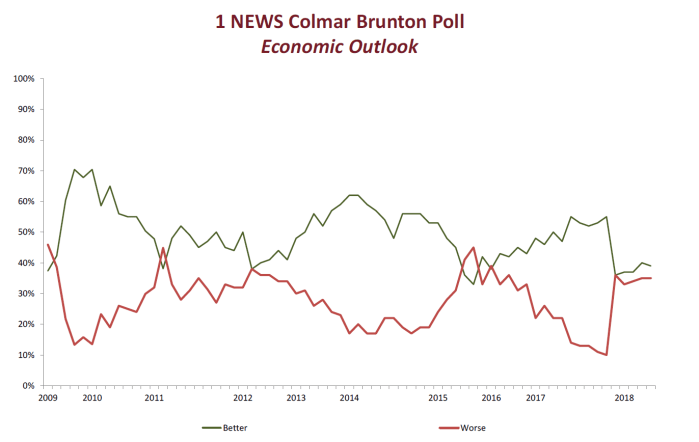
The Westpac results don’t seem out of line with the most recent Colmar-Brunton poll (taken six weeks ago) in which respondents are asked a single question.

“And do you think during the next 12 months the economy will be in a better state than at present, or in a worse state?”

colmar brunton

The public no longer seem very optimistic at all.

But in some ways I was more interested in the longer-term trends in a couple of the sub-components of the Westpac index.   For example,

westpac 2.png

People are now less optimistic about improvements in their own personal position than at any time in the last 30 years outside periods when the economy was already in the midst of a recession (and materially lower than in the fairly shallow 1997/98 recession).  And look at the contrast between confidence levels from say 1994 to 2007 (across two different governments) and those now.  It looks a lot like a fairly steady trend decline.

And then there is the question about the longer-term prospects for the economy itself.  Respondents might not know much analytically about the issue, but their perceptions are interesting nonetheless.

westpac 3

The latest observation isn’t startlingly bad (and there was that sharp –  but brief – dip a couple of years ago) but look how diminished expectations are now (last three years or so) relative to the entire history of the series.  There are individual quarters that are weaker (though note, not in the 2008/09 or 1997/98 recessions) but in thirty years there has been no three year period where medium-term optimism has been weaker than over the last three years (under National and Labour governments).   And this pessimism isn’t tied to the last recession –  look how upbeat people briefly were in the couple of years after the recession ended.

(The medium-term picture is less bad in the ANZ’s consumer confidence survey, (which has a much shorter run of data) and it would interesting to know the precise question asked, to help understand that difference.)

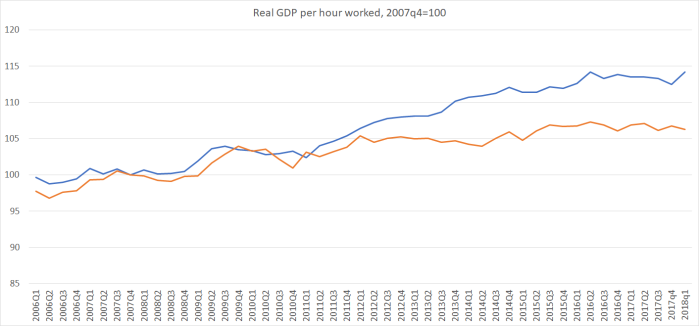
Then again, in an economy that has managed very little labour productivity growth in the last five or six years, and none at all in the last three years, perhaps it shouldn’t surprise.

real GDP phw jul 18

In an economy where the promises of economic reform decades ago came to little  (for younger readers, that is the then Minister of Finance back in 1989/90)

caygill 1989 expectations

And where none of the political parties – especially not National or Labour that have led all our governments – seem to care much if at all, or have any serious proposals for turning around the continuing decades of underperformance, isn’t the public quite rational in being much less optimistic than they were?

A more interesting question is why they/we don’t find a way of demanding something better.

Having read the Our Plan speech

The Prime Minister’s speech on Sunday has attracted quite a lot of, generally not very favourable, attention.  I was interested in a few things that were there, and a few others that weren’t, particularly when compared to the Speech from the Throne that inaugurated the government’s programme last November.

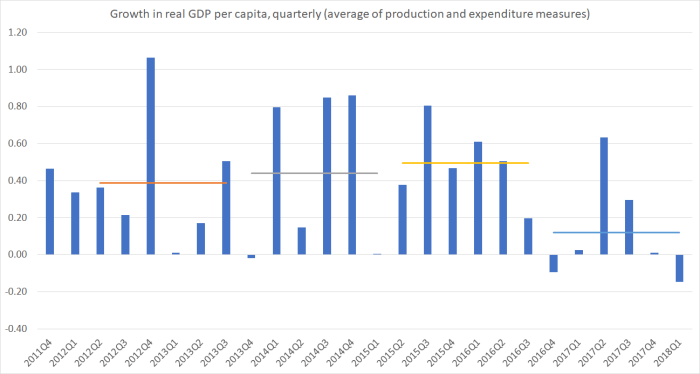
The first was the apparent lack of ambition around the economy.    The Prime Minister continues to repeat the meaningless claim that “we’ve enjoyed enviable GDP growth in recent years”, as if headline GDP – as distinct from GDP per capita or GDP per hour worked –  means anything at all.    Here’s the track record: it has been pretty poor over the last couple of years (we’ll get an update on Thursday).

gdp pc to mar 18

Productivity growth has been even worse, and for longer.  Here, for example, is the comparison with Australia.

aus nz rgdp phw

The Prime Minister seems to sort of know there is an issue.

We cannot continue to rely on an economy built on population growth, an overheated housing market and volatile commodity markets. It’s not sustainable, and it risks wasting our potential.

That’s why our first priority is to grow and share more fairly New Zealand’s prosperity.

That means being smarter in how we work. It means an economy that produces and exports higher value goods, and one that makes sure that all New Zealanders share in the rewards of economic growth.

So what will we do?

First, we need a concerted effort to lift the prosperity side of the ledger. Working alongside business, we will encourage innovation, productivity and build a skilled workforce better equipped for the 21st century.

But what Our Plan has to offer is slim pickings indeed.  The only specific is

We are doing that by bringing back significant support for businesses to expand their investment in research and development through the R&D tax incentive, a key component of building a new innovative economy.

Perhaps you think R&D subsidies are a good idea. I’m rather more sceptical, and worry that there is no sign the government has thought hard about why firms don’t regard it as being in their interests to spend more here on R&D.   But don’t just take it from me.  I was interested that in the Secretary to the Treasury’s speech about productivity a couple of weeks back, which I wrote about here , there was no mention at all of R&D subsidies/credits as any part of the answer to our sustained underperformance.  If R&D subsidies were the answer, it would have to be a pretty small question, and our economic underperformance is much worse than that.

It was also interesting that the tax system seemed to have disappeared from the list of answers to our economic underperformance.    In the Speech from the Throne this

The government will review the tax system, looking at all options to improve its structure, fairness and balance, including better supporting regions and exporters, addressing the capital gain associated with property speculation and ensuring that multinationals contribute their share. Penalties for corporate fraud and tax evasion will increase.

and in various speeches since the Minister of Finance has continued to talk up tax system changes,  but in Our Plan on Sunday the only reference I could see to the tax system was those R&D subsidies.

And then there was this

After all, we have always been inclined to do things differently. Or to do them first.

Whether it’s Kate Sheppard championing the right to vote, Michael Joseph Savage designing the welfare state, or Sir Edmund Hillary reaching brave new heights – we don’t mind if no one else has done something before we do.

But we do mind being left behind.

and

You asked us to make sure New Zealand wasn’t left behind.

But the problem is, Prime Minister, that we’ve fallen badly behind, and nothing you or your predecessors did seems to be stopping, let alone reversing that decline.  Nothing.

Here are a couple of productivity charts, comparing New Zealand and some other advanced countries in 1970 (when the OECD data start) and 2016 (the last year the OECD has data for all countries).

First the G7 countries.

G7 comparison

As recently as 1970, real GDP per hour worked in New Zealand was more or less that of the median G7 country (100 years ago, we would have been ahead of all but one, and basically level with the US).    Now it would take a 30 per cent lift in New Zealand productivity –  with no changes in the G7 countries –  to get us back to parity with these big advanced economies.

And here is the same comparison for the (small) Nordic countries.

nordic comparison

It would take a 50 per cent lift in New Zealand productivity –  all else equal –  to match the median of these countries.    Even in 1970 we’d fallen behind them, but 100 years ago  –  in fact even when Michael Joseph Savage was in office – we were richer and more productive than all of them.

We’ve been left behind, and our politicians show no sign of doing anything to remedy the failure.

One could say much the same about housing.  The Speech from the Throne –  only 10 months ago –  was actually quite encouraging.  There were hints –  nothing specific of course –  that the government might actually want to lower the real prices of houses, reversing at least some of the disgraceful lift in house and land prices that policy (various strands interacting) has helped deliver over the last 25 years or so.

But what about in Our Plan?  There is talk of warm dry homes, and of the Kiwibuild lottery for the lucky few (“I cannot tell you how exciting it was to open the ballot for those first homes this week”), but of the market generally only this

“But not everyone wants to own, or can right now.”

And nothing –  at all – about what the government might do to systematically transform the outlook for those –  all too many –  who can’t.  It might be terribly exciting for the Prime Minister that a few can win the lottery –  as no doubt it is in the weekly Lotto draw –  but in a serious government wouldn’t it be much more satisfying to have laid the ground work for systematic, across the board, affordability?  In a country with so much land (in particular), it is pure political choice that we fail to have better outcomes.

There were a couple of other bits that took my eye.  There was this, in prominent bold letters.

That’s why our first priority is to ensure that everyone who is able to, is either earning, learning, caring or volunteering.

Frankly, what business is it of the government’s.  We aren’t resources at their disposal.  Provided someone isn’t a financial burden on the state, why does the Prime Minister think it is for her to suggest –  nay propose to “ensure” – that a life of leisure is not an option?  The mindset is disconcerting to say the least.

And then there was the international dimension.

That brings me to our final priority area- creating an international reputation we can be proud of.

In this uncertain world, where long accepted positions have been met with fresh challenge – our response lies in the approach that we have historically taken.  Speaking up for what we believe in, pitching in when our values are challenged and working tirelessly to draw in partners with shared views.

This Government’s view is that we can pursue this with more vigor – across the Pacific through the Pacific reset, in disarmament and in climate change, and in our defence of important institutions.

Ultimately though, my hope is that New Zealanders recognise themselves in the approach this Government takes.

I’d be ashamed if I recognised myself in the approach this government –  and its predecessors – take.  A government that is slow and reluctant to condemn Russia’s involvement in the Skripal poisoning, a government that appears to say nothing about the situation in Burma, a government that says not a word about the Saudi-led US-supported abuses in Yemen (trade deals to pursue I suppose).  And then there is the People’s Republic of China.

The Prime Minister apparently won’t say a word (certainly not openly –  and yet she talks about “transparent” government) about:

  • the aggressive and illegal militarisation of the South China Sea,
  • the growing military threat to Taiwan, a free and independent democracy,
  • about the Xinjiang concentration camps, the similarly extreme measures used against Falun Gong, or the growing repression of Christian churches in China,
  • about new PRC efforts to ensure that all Chinese corporates are treated, and operate, as agents of the state (is the Prime Minister going to do anything about Huawei for example?)
  • about the activities of the PRC in attempting to subvert democracy and neutralise criticism in a growing list of countries.

And what is she going to do about the Belt and Road Initiative, which the previous government –  in the specific form of Simon Bridges – signed onto last year, enthusing about a “fusion of civilisations”?

But then, why would we be surprised by this indifference.  Her own party president, presumably with her imprimatur, praises Xi Jinping and the regime.  Her predecessor, Phil Goff, had his mayoral campaign heavily funded by a large donation from donors in the PRC.   And she won’t even criticise the fact that a former PRC intelligence official, a keen supporter of the PRC, sits in our Parliament, refusing to answer any substantive questions about his position.

If those are her values, they certainly aren’t mine. I hope they aren’t those of most New Zealanders.

If her “response lies in the approach that we have historically taken” it must seem pretty unrecognisable to the people, many on her side of politics, who protested French nuclear tests, or against apartheid in South Africa (and associated rugby tours).   And would surely be unrecognisable to the ministers and Prime Ministers of that first Labour government, who were among those (internationally) most willing to take a stand against Italian and German aggression and repression in the 1930s.


Orr on women, and himself

Six weeks or so ago, I wrote a couple of posts in quick succession on issues fitting under the loose heading “women in economics”.   I commented on a recent conference paper produced by a couple of senior Treasury officials (one of whom was male), and on the situation at the Reserve Bank prompted by some comments from the (male) Governor and the release of some statistics on the proportion of female applicants for various positions, including that of Governor.    My overall sense was something along the lines of “there seems to be a real and longstanding problem –  perhaps not easily fixed – at the Reserve Bank, but that it was less clear that there was a wider problem”.    Those posts were not universally well-received, and I received various comments, open and private, suggesting that as a mere male I had no right to comment on these issues, that any perspectives had –  by assumption –  no value, and (in the words of one particularly strident commenter) that I should withdraw quietly and “reflect on how your internal biases are harming women”.

And then a few weeks ago, there was a newsletter around from GEN (the Government Economics Network) advertising a launch event for a Women in Economics Network (for anyone interested, they have a LinkedIn group here), at which the speaker was to be Governor of the Reserve Bank, Adrian Orr.  It was advertised as open to anyone, and since I have an interest in the issues –  particularly as they affected the Reserve Bank (where I was manager for a long time), and the contrast between their experience and that of other entities – I signed up to go along.  I also attended because it must be a decade since I’d heard Adrian Orr speaking in the flesh, and as I’ve been quite critical of some aspects of his nascent governorship, including his speeches, I was interested to see how he now came across to a live audience.

It seemed like a fairly well-attended event, held at The Treasury.  The audience apparently included some high school students and teachers, as well as lots of public service types, and was (as one would probably expect) around 85 per cent female.

The event began a bit oddly, with some sort of introductory greeting or welcome from Gabs Makhlouf, the politically-correct British Secretary to the Treasury.  It was in Maori, and I’d be surprised if more than a handful of attendees had a clue what he was saying.

The Governor was introduced by Vicki Plater, chair of the new network and a senior manager at The Treasury.  She noted in her introduction how, particularly as a  macroeconomist (a sub-discipline of economics with a particularly preponderance of men), it was a common experience to be (or feel like) the only woman in the room.

That resonated.  And so it was strange, and rather tin-eared, for the Governor to stand up and say, in his best jesting style “you know Vicki, most male economists also think they are the only economist in the room”.   It was, no doubt, a self-deprecating dig at a tendency of smart opinionated people to think, or act as if, they have “the” right answer to whatever is being debated.  But it seemed oddly inappropriate, as if to –  no doubt unconsciously – minimise the perspective and experience of women in (macro)economics –  the subject he’d been invited to address.

(It was also a bit strange that in the course of his comments –  speech and later panel discussion – Orr’s only unscripted references to individuals in the audience were to men.)

It wasn’t a long speech, but it was also striking how little content there was.   It was a paean to diversity and inclusion, but only in the most general and unspecific form.  We were told about some project the Bank has underway to re-tell its own story in terms of some Maori metaphor or mythology (the connection to the issue at hand being less than clear).  He asserted that somewhere around the Industrial Revolution humans had lost “the talent of working together in teams”, and we heard a brief snippet of his own experience of perceived exclusion at the recent Jackson Hole seminar (for top central bankers and the like).  He owned up to not himself being a great listener.   It wasn’t necessarily off the subject, but it all seemed pretty tangentially relevant.  If I was looking for the consistent theme it would be something around having to make an effort and break out of the constraints of established, unquestioned, ways of doing things.   There wasn’t much to disagree with, but equally you wouldn’t know that he was head of (and formerly held other senior positions in) an institution that has never had a women in a senior management role in policy or core operational areas in its 84 year history.  Perhaps that wasn’t the point; perhaps the point just was that senior male leaders (Governor and Secretary) cared enough to turn up.

Following the Governor’s talk there was a panel discussion, involving the Governor and a senior academic economist and an MBIE principal advisor (both women).   The Governor was again on form.  The MBIE principal adviser (of a Pacific background) noted that Pacific people in economics had few role models, and that the Governor was the pre-eminent role model.  His response: “I don’t know about being a role model; perhaps a sausage roll.”

There was a great deal of (seemingly) unquestioning acceptance of the unconscious bias model, with quite a few (unexamined) claims of conscious bias thrown in.    There was no discussion at all of how some occupations, and academic disciplines, end up very heavily female and others very heavily male, no discussion of the apparent “gender equality paradox” , just an inchoate sense of something, generically, being wrong. Quite what, specifically, wasn’t clear.

The Governor was the most confident communicator of the three, and since he tends to wear his heart on his sleeve we heard a few interesting anecdotes.  One was, I think, designed to illustrate how those in power can be unaware of the impact they are having on others.  He noted that shortly after his appointment as Governor was announced he’d had an email from a former staff member, who lambasted Adrian for the severely adversely impact he had apparently had, in some past professional role, on this person’s life.  This had apparently come as total news to the Governor, and it sounded as if the searing email had shaken him at least momentarily.  But the effect of the anecdote was rather undermined when he rushed on noting “but I got over it”.   Perhaps the problem really was with the writer, but it seemed to be a strange way to end –  perhaps confirmation of Orr’s earlier acknowledgement that he isn’t a good listener.

There was some discussion on calling out actions or words that display –  or are perceived to display – bias (the senior academic noted that she how did so openly and straightaway –  although when a new graduate later asked about this, it was acknowledged that it was not necessarily an option prudently open to everyone).   Orr told us about coming back from an appearance at Parliament’s Finance and Expenditure Committee and noting that all the Reserve Bank team had been male, suggesting that needed to change.  Apparently –  as these things do –  word got out, and down the organisation, crystallising in an email from somone (a manager I gathered) that in future appearances only women were wanted.   The point of the anecdote was that apparently someone had called this to the attention of the Governor and he’d corrected the messaging.  But it actually sounded more like a warning about the risks of loose words, emoting without a proper framework, from a new CEO.

In fact, you wondered whether those people at the Reserve Bank had really got the wrong message.  There was a question from the floor about quotas and whether or not they were a good idea.  All three panellists seemed a bit ambivalent, but the Governor actually came back to elaborate his initial quick response and stated that “positive discrimination is needed sometimes”.   That such discrimination would almost certainly be against the law seemed not to concern this senior public servant, speaking in an open forum.

In some respects, the Governor was in fine form on Friday.   The phrase “consummate communicator” was running round in my head, but as I reflected further I realised that that isn’t an accurate description at all.  Orr has a great way with words, and can be very entertaining, but effective communication involves getting appropriate alignment between audience, subject matter, and occasion.  In a senior public servant, gravitas also matters (pompous and old-fashioned as it might sound to some).  And as some of the comments above suggest, he tends to be a bit tone-deaf.   At the time, Orr was appointed, I included this snippet (drawing on a Bernard Hickey story)

Only a few weeks ago – when he must already have known that he was likely to become Governor –  Orr gave a speech to the Institute of Directors, in which he reportedly dismissed the views of Deputy Prime Minister on the economy as “bollocks” and went on to suggest, in answer to a question about nuclear risks in North Korea, that perhaps two issues could be solved at once ‘because Winston is going to North Korea”.  Recall that at the time, Orr was not some independent market economist, but a senior public servant.     He might well have been right in his views on the economy, but is this how senior public servants should be operating?

In his talk on Friday –  mostly among public servants – he probably was more relaxed than he usually is in public; it was very similar to the way he used to be when we both worked at the Bank.  But listening to Orr again, I was reminded of David Lange, who also had a great way with words.  Lange’s way with words developed, as I think even he recognised, as a defence mechanism  –  the way an overweight child pushed back and held his own in the playground.  I’m not sure what it is with the Governor, but perhaps he hinted at it himself in his remarks on Friday, noting that having grown up far from the halls of, say, Christ’s College, Auckland Grammar (or the female equivalents) – although didn’t most people? –  he had felt that he was having to push to be accepted, and in turn had had to come to accept that people with other upbringings also have valid and useful perspectives, their own strengths and weaknesses.  It isn’t clear to me that he has yet fully got over that background and the associated insecurities.  Perhaps a lot of it is just shtick –  a comedy routine –  but it is striking how often one hears from the Governor, or sees in profiles, references to his friends and relatives in Taupo and Rotorua, particularly those who didn’t have much formal education or interest in book-learning.  Have I ever heard, I wonder, any senior figure –  not running for office –  reference his conversations with his mates at the TAB (or the Wellington Club, or the golf club, or the church, or….well anywhere)?

The Governor is a smart guy.  No one disputes that.  But there are questions about his depth, his seriousness, and his judgement (see, for example, my comments last week on his recent speech).  Add in a dominant personality and a self-acknowledged reluctance to listen –  although, of course, self-recognition is some small progress –  and it reinforces the doubts about vesting so much power in his hands, or of structuring a Monetary Policy Committee in a way that continues to ensure his total dominance.

Meanwhile, we are still waiting for a thoughtful on-the-record speech on monetary policy and/or the Bank’s financial stability responsibilities.  I’m still waiting for a response to my OIA request about his, apparently rather loose, speech to INFINZ a couple of weeks ago.

And the specific issues at the Reserve Bank, where women have rarely (well never) achieved really senior roles in the central areas of responsibility, await the Governor’s attention.   It is, in my view and my experience, a complex story, but if it isn’t addressed seriously and well over the next few years –  better management, better structures, better people –  it will be increasingly awkward for the Governor and the Board (around half female) paid to hold him to account.


Recycled rubbish

That’s the title of my former colleague Ian Harrison’s response to the government’s consultative document on getting rid of (some types of) plastic bags.  The consultation itself closed yesterday, but nobody supposes the consultation itself was remotely serious –  the irrational ban is going to happen anyway.  Having dug fairly deeply into the material used to support/underpin the consultative document, Ian illustrates just how little substance there is to the case.

Here are his key conclusions

Supermarket checkout bags do not materially contribute to littering.  Common sense and overseas evidence tells us that supermarket checkout bags are not littered frequently. There is more littering of very small bags, but mostly they will not be caught by a ban. Supermarket bags possibly contribute only around 0.1-0.2 percent of littered rubbish by weight. The Ministry has neglected to conduct a survey on the actual extent of supermarket bag littering.

Supermarket checkout bags are efficient and cheap.  Checkout bags cost about 2 cents, weigh between 4 and 7 grams, and are generally reused for other purposes. They are best described as ‘double-use’ bags. The amount of plastic in supermarket bags has fallen by 75 percent over the past 20 years. Compliant ‘emergency’ bags weigh around 6 times as much and reusable bags 20 times as much. Research shows that they are typically not reused frequently enough to offset the higher weight, so the use of plastic in shopping bags could actually go up.

Impacts can be perverse.  A shopper cannot be given a cheap lightweight plastic bag that is used to transport goods, and serve as a bin liner. But she can buy a much more expensive lightweight drawstring bin liner, which is used only once.

Supermarket bags likely to have a lower overall environmental impact than many alternatives. Alternatives bags have a much higher environmental impact that is unlikely to be offset by the higher number of times they are used.

Reusable bags are a health risk.   Research shows that reusable bags harbor dangerous bacteria and are not cleaned frequently. Supermarket double-use bags are safe.

A ban is unlikely to materially reduce marine littering.  The reduction in the small amount of plastic entering the marine environment of plastic checkout bags will tend to be offset by increased number of heavier bags littered.

The circular economy approach to environmental and economic management is often irrational.  The circular economy approach to the economy is centered in China and has been part of their 5-year plans. China has one of the worst marine pollution records in the world. The circular economy can be an empty slogan, but if taken seriously it can result in very inefficient decision making because it tends ignores the impact on people and the community when recycling is pursued at all costs.

A ban cannot be imposed by regulation.  Under the Waste Minimisation Act the Minister must be satisfied that the benefits of a ban exceed the costs. As there is no analysis of the cost and benefits in the consultation paper, the Minister cannot be satisfied, unless serious work is done to assess the costs and benefits.

Evaluation methodology rigged to generate the right answer.  The weights and evaluation criteria were set to bolster the score of the preferred option of a ban. The evaluation methodology has many flaws and is not a substitute for a proper cost benefit analysis.

A ban will have an economic cost of more than $75 million per year.  A cost of $75 million a year is our assessment from an illustrative costing model.

A minimum charge is a more efficient response than a ban.  The minimum charge that would reflect the costs of provision and associated environmental and social costs would be about 3 cents per bag.

Many of those points aren’t new in themselves (I made some myself in earlier posts on this issue), although I was interested to learn of the origins of the “circular economy” nonsense that now seems to appear in many government documents and even ministerial speeches.  Nonsense?  Well, here are Ian’s words

It is way of thinking, that comes out of the ‘limits to growth’ perspective (Boulding 1966). The earth is finite, resources are finite, so they must be recycled and not lost to the economy. While this finite resources proposition is literally true in the very, very long run, what the approach tends to downplay or ignore, is the role of the price system in allocating resources. As resources become scarcer, prices increases, resources are allocated to the most valuable uses, and innovation is encouraged that finds new ways of doing things. More natural resources are discovered because they are more valuable. The world economy does not suddenly collapse when the resources suddenly run out.

Prices simply don’t appear at all when the “circular economy” is being discussed.

For anyone interested in looking behind some of the material used to make up the case in support of eliminating supermarket shopping bags, Ian’s paper is useful because he made the effort to read the background papers (those cited and those that should have been), and to work through the logic of the case ministers and MfE are making.   It has its lighter moments, as when he suggests supplementary measures, banning Christmas (all those plastic toys) or

Ban on the sale of pianos.  Littering of pianos on beaches and dumping in the marine environment have been of historical concern in New Zealand (Campion 1993). Piano littering poses a threat to fish and marine mammals, and to human health. The enjoyment of piano playing is a colonial construct and has no place in a modern inclusive multicultural society.

And a much serious side in suggesting that if New Zealand governments really wanted to help make a difference, there are some obvious places to start.

Alternatively we could do something that actually makes a difference.

In 2009 Sustainable Coastlines did a cleanup, with wide community support, on a small Tongan island with a population of 4600. They removed 50 tonnes of rubbish, compared to around 80 tonnes for all their New Zealand opertions spanning seven years.
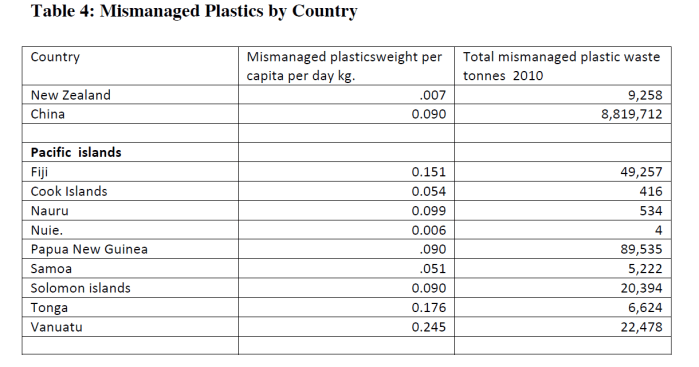
Below is a table taken from the report (Jambeck 2015) that provided the estimate of 8 million tonnes of plastics going into the oceans each year that has receivedwide spread attention. it shows annual total of mismanaged plastic waste, but this figure appears to be about four times larger than actual flows into oceans. While the individual country figures, the inputs and the methodology may be questionable in some respects, the data provides a reasobable representation of the scope for making improvement in the performance of our Pacific neigbours. Because New Zealand already has a robust refuse collection sytem and a reasonably good antilittering culture, the scope for large cost effective improvements here are limited. As we have demonstrated a plastic bag ban will make almost no difference, but has a large cost.

plastics

Our best strategy is to continue to build on voluntary efforts to clean up the coastal environment and to redirect, or supplement, our aid budget, to Pacific countries, where there will a much higher payoff in terms of reduced plastic pollution.

It is the sort of analysis one might do, or commission, if one were serious about looking at costs, benefits, and ways of maximising payoffs, as distinct from the sort of puff and rhetoric government agencies publish under the guise of analysis when they have a solution their masters want regardless and need to try to make some sort of case.


Electricity prices

I have fairly omnivorous interests but electricity, and the attendant policy issues, has never been among those interests.  When the sector was being reformed 20 years ago, it was one of the topics –  endlessly discussed on Radio New Zealand’s Morning Report – that I would simply zone out as I drove to work.  I don’t know how much our household pays each month for electricity and without looking it up couldn’t even name who our supplier is.

I hear the stories that appear each winter about the pressure some people face as regards electricity costs.  My (uninformed) presumption usually is that any issue is mostly about the shockingly poor rates of labour productivity in New Zealand, in turn reflected in the relatively low incomes the New Zealand economy supports, with some mix thrown in of changing tastes, poor disciplines, bad luck, and perhaps some issues at the margin around how the welfare system treats a handful of people.  Life is tough at the bottom.  Our “bottom” is so much worse than it need be, and successive generations of politicians should be held accountable for that.

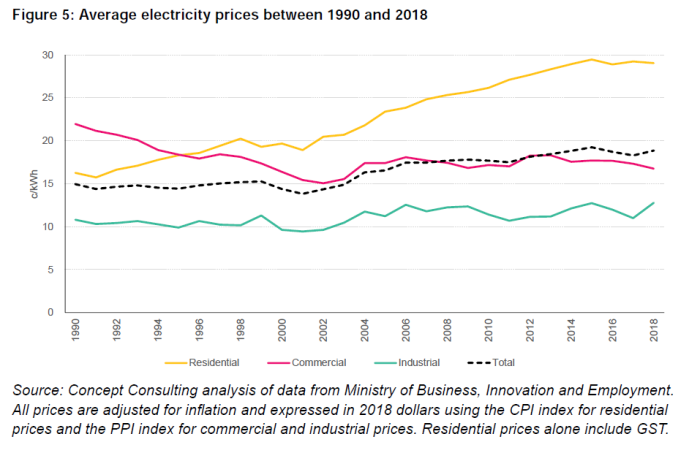
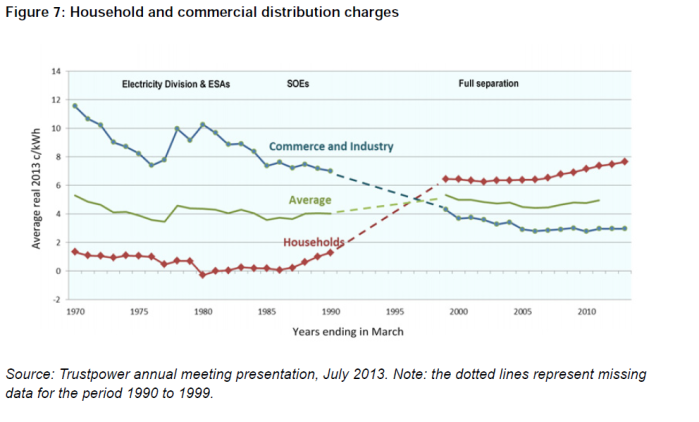
But when the electricity review document was released the other day, I decided to dip into some numbers and see what I could find out.   As has been highlighted repeatedly, there has been a big shift over recent decades such that residential user (real) power prices have risen substantially while commercial and industrial (real) prices have been pretty flat or even falling.

electricity 1So the argument goes, there was previously considerable cross-subsidisation in favour of domestic users.  In particular, there has been a big change in how distribution costs are allocated.

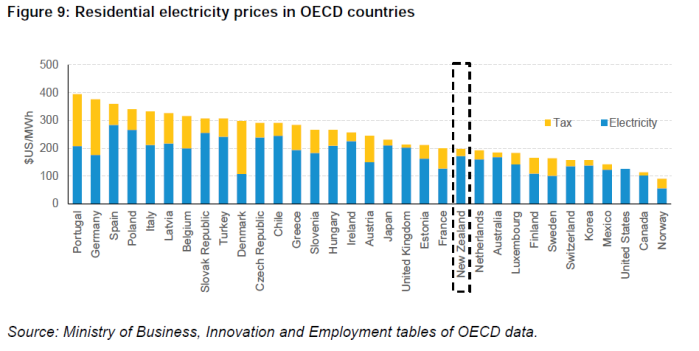
electricity 2But how do New Zealand prices compare with those in other advanced countries?  The review report has some charts showing those numbers, using OECD data (all national data is converted into USD using PPP exchange rates).

Here are household charges

electricity 3

Just focusing on the blue bars, the basic (ex-tax) electricity prices New Zealand households face is around those of the median OECD country.   We are, of course, poorer and less productive than the median OECD country, so the burden of any of the necessities of life will tend to fall more heavily here than in many other advanced countries.

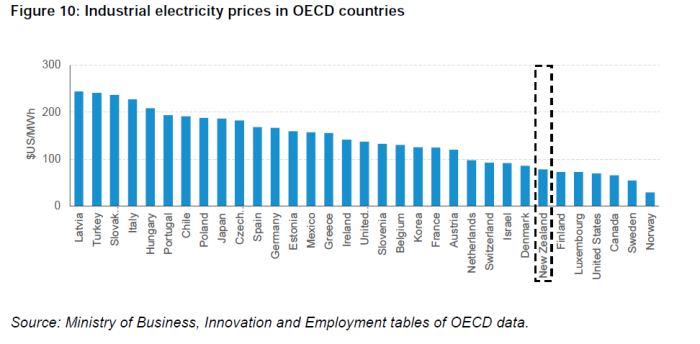
What about industrial prices?  Here is another chart from the review.

electricity prices

New Zealand prices for industrial users are among the lower in the OECD.

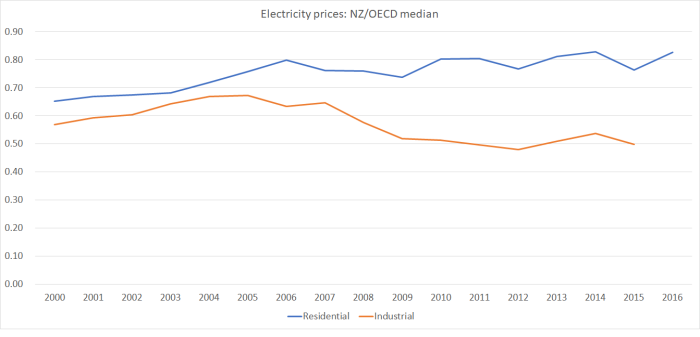
The OECD data MBIE reports goes back only to 2000, but here is how New Zealand prices have changed relative to those of the median OECD country over that period for both the residential and industrial series (using only the countries for which there is a complete series of data).

electricity 5

For what it is worth, there hasn’t been much change in the blue (residential) line over the last decade.

I was interested not just in the medians, but in the countries with the lowest power prices.  After all, it used to be something we boasted of here –  one of the great advantages of life (and business) in New Zealand: one of the arguments for the establishment of Comalco decades ago.   Norway, Canada, the US, Sweden, Finland, and Denmark (ex taxes) all have among the lowest electricity prices for both residential and industrial users.  In Norway, in particular, both lots of prices are far far lower than those in New Zealand.   And in Norway –  notwithstanding all that oil and gas –  something between 95 and 99 per cent (depending on which source you look up) of electricity generation is from hydro sources –  where the energy source itself comes, in effect, free.   The hydro+geothermal share in New Zealand also used to be above 90 per cent.

One reason why the hydro share of electricity production has dropped away in New Zealand is our relatively rapid population growth.  There are only so many rivers (and environmental/political constraints on using more anyway) and lots more people.

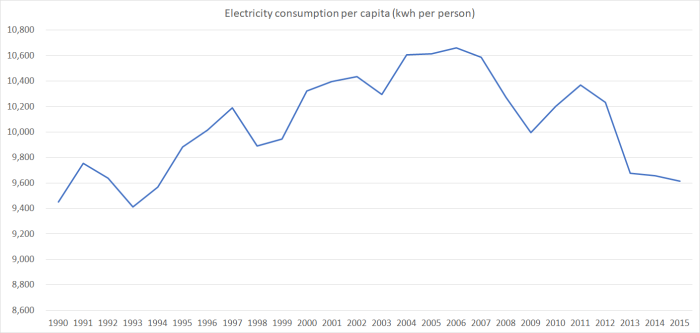
For a long time, the biggest factor driving electricity consumption/production wasn’t the number of people, but their (per capita) demands to use electricity.   I looked up an old yearbook.  Between about (I’m eyeballing a small chart) 1942 and 1955 electricity consumption per capita doubled.  Between about 1955 and 1971 it doubled again.  MBIE data show that by 1996 it had doubled again.   But here is the MBIE data on per capita electricity consumption since 1990 (sadly only updated to 2015).

electricity 6.png

Consumption per capita peaked in 2006, and in the most recent year was below the 10000 Kwh per capita first reached in 1996.  But our population now is almost a third larger than it was in 1996, and all of us (well, a few hermits aside perhaps) need/use electricity.

The new SNZ preferred (and genuinely better) measure of net migration only starts from 2001 and is only available up to early 2017.  But over just that period, net immigration of non New Zealand citizens –  with the most aggressive (per capita) immigration policy anywhere over most of that period – has contributed directly 741000 new people of a total population increase in that period of 936000.   All those people, natives and migrants, will have added to electricity demand.

Of course, the other factor that greatly influences the level of electricity production in New Zealand and, thus, the marginal price is the aluminium smelter at Tiwai Point, reported to consume perhaps 13 per cent of total electricity production.   The smelter was kept open a few years ago only as a result of new taxpayer subsidies (described by sceptics from the left and right as “corporate welfare”).

It is hard not to think that if our politicians had not been so determined to keep Tiwai Point open, and so determined to rapidly drive up our population in a unpropitious location (and despite the complete lack of evidence of resulting productivity gains), electricity prices for all other users would be rather lower.   Oh, and those with a renewables target in mind would have been able to rest easy too.

Then again, having adopted strategies that successfully lifted productivity –  clearly requiring something different in key areas to the approaches followed here for decades – would also have eased the burden on poor households of electricity prices.


The Secretary to the Treasury and productivity

As I noted in Saturday’s post about The Treasury, the Secretary to the Treasury –  he of the rushed citizenship presumably on the grounds of some exceptional services the previous government thought he might offer to New Zealand –  gave a speech last week on productivity.

One can feel a little sorry for senior public servants venturing into the public domain.  After all, there are limits as to what the head of a government department can really say, while still retaining the confidence of his/her minister (let alone that of the State Services Commissioner).  Political masters change and with those changes there are changes in what can’t really be said in public by their most senior advisers.  All of which is probably a good reason why heads of government departments shouldn’t really give any but the most anodyne (or perhaps obscurely technical) public addresses (in fact, most simply keep quiet in public – do a search for speeches by the Secretary of Justice or the chief executive of MBIE and you won’t find much, if anything).  After all, their primary job is to advise ministers, not to act as public lobbyists for their own policy preferences  Upon leaving office they are, of course, free to champion whatever causes they like.

But all that assumes some idealised fine public servants, who have laboured to generate judicious but penetrating insights.  Wise men and women whose words shed light in dark corners, enrich our understanding, and could –  if only we listened – help resolve some of these intractable challenges that face any modern government and society.

And then there are the Makhlouf speeches.  I written about several of them here (eg here, here, here and here).  They often read fluently enough at a first glance, before quickly turning to dust under any close examination.

Last week’s effort wasn’t that much better.  At least the Secretary to the Treasury was talking about productivity –  something I noted was strangely totally absent from The Treasury’s Briefing to the Incoming Minister last year – but he didn’t have a credible or robust story to tell.

The speech was delivered in Queenstown, so Makhlouf began with some local colour –  some good, some bad.  Among the less positive indicators was

The mean income for people in the Queenstown-Lakes District in 2017 was about $51,000 compared with the national mean of $59,000.  With low incomes but the highest average weekly rental cost in the country and an average house value of more than $1.1 million, the housing affordability problem in Queenstown is in the same league as Auckland.

To which the Secretary’s response was

In response, the Government’s Housing Infrastructure Fund is contributing $76 million in 10-year interest-free loans to support an increase in Queenstown’s housing supply.

So the Secretary to the Treasury now thinks interest-free loans by the government are sensible economic policy?    This isn’t supposed to be some local MP’s party-political broadcast, but the Secretary to the Treasury, guardian of the public purse.

The Secretary then touches on the failure that is New Zealand productivity growth, recognising that we’ve done poorly (while taking no responsibility as head of the leading economic advice agency).  But there is nothing new, and litttle specific.

There are various unsupported assertions  (emphasis added)

We know that our productivity levels stem from a number of factors including weak international connections, the small size of domestic markets, low investment in knowledge-based capital and weaknesses in the allocation of labour.

as if symptoms (in some cases arguable ones) are causes, and then a string of platitudes

It remains a fundamental truth that successful economies need, among other things, a stable and sustainable macroeconomic framework, sound monetary policy and a prudent fiscal policy. It remains true that a well-regulated financial system matters, that properly functioning markets matter, that price signals matter and that incentives matter. And, perhaps most important of all, it remains true that productivity matters.

No doubt largely true (I’d quibble about the “well-regulated” financial system, substituting “sound and stable) but New Zealand has had these features for decades, and we are just slowly drifting further behind.

The second half of the speech builds off this paragraph

The Treasury believes there are a number of factors that always matter for productivity: our human capital, the management of our resources, our international connections, the dynamism of our markets and the effectiveness of our rule-making. I want to say a few words about each of these. To improve our productivity we will have to be more effective in their utilisation and the interactions between them.

First, skills matter.  As if we didn’t know.

There seemed to be two areas of focus

In the Treasury’s view, to help achieve this there should be an emphasis on attainment of cognitive and non-cognitive foundational skills and social skills that are transferable and support life-long learning, as well as greater rates of progression to higher tertiary qualifications.

But I’m not sure what the first half of the sentence really means (Great Books programmes for all, to teach people to think and write?) and the second half looks like a bid for even more tertiary education, when there is little sign that the massive public and private spend on tertiary education in recent decades has been reflected in commensurate increases in productivity or earnings.  And none of this seems embedded in some comparative analysis about whether, and to what extent, New Zealand is doing worse than other advanced countries.

The other specific was slightly surprising

I should also add that we will need to look carefully at whether our social welfare system – which was initially set up to help people make transitions from one job to another in what was expected to be a similar trade – is optimal for the changing world ahead of us.

I presume he means the bits of the system around the unemployment benefit (or whatever it is now called) since most of the social welfare system wasn’t set up to support employment transitions at all (age pensions, widows’ pensions, DPB, sickness and invalid pensions etc), but as his current political masters have, as a matter of policy, been weakening the sanctions in the welfare system that were, supposedly, designed to assist such transitions, I’m left a bit puzzled as to what the Secretary means by this cryptic observation.  Perhaps he is toying with notions of a Universal Basic Income (but, charitably, I’ll assume not)?

Then there is a section on resources.  Some of it seems sensible enough, including around water use rights.  I’m right with him when he favours congestion charging.  But I’m left wondering whether he or The Treasury really believes that either is a significant part of the story explaining our severe relative underperformance.  I don’t.

And lets just say that I rather doubt the robustness of The Treasury’s analytical framework when the Secretary includes these sentences.

The Emissions Trading Scheme is a good example of a tool that can promote the more productive use of resources. Including agriculture within its scope would provide incentives for investment in R&D or innovation in on-farm practices and improve productivity.

An ETS can, no doubt, be a good mechanism for constraining emissions, and even for doing so in a way which might be economically efficient.  But it simply isn’t a way to improve New Zealand’s economywide relative productivity and/or incomes.  Impose an impost (perhaps quite justifiably) on firms in a particular industry, and those who survive will have to adapt their production techniques, perhaps even lifting their own firm productivity.  But it will also considerably shrink the industry in question, when it is an internationally tradable industry, when efficient alternative technologies don’t yet exist, and when other countries aren’t adopting the intervention The Treasury proposes.  All else equal, New Zealanders would be poorer rather than richer if this bit of the Secretary’s prescription was adopted –  the government’s own commissioned economic modelling, by NZIER says as much.

Then Makhlouf moves on to “international connections”, one of the ill-defined buzzwords in this debate.

Mostly it is just empty conventional slogans

Improving the flow of people, capital, trade and ideas will help improve productivity. Strong people-to-people relationships build confidence and understanding and promote learning. They help our businesses to identify capabilities that will help them improve their productivity and ultimately compete and succeed in both domestic and global markets.

All of which would have sounded good in 1984, and yet we greatly liberalised immigration, got rid of most tariff barriers, signed up to all manner of trade agreements, and……the productivity gaps are larger than they were, and actual trade (exports and imports as a share of GDP) is smaller than it was.  The Secretary is either unaware of these basic facts, or simply chooses to ignore them.

I’m closer to the Secrerary’s position when it comes to foreign investment –  where he has to step delicately around the recent legislative choices of his masters –  but there is no sign that he has thought hard about why foreign investment here isn’t more attractive or, indeed, why not many New Zealand based firms do much foreign investment themselves.

There is a section on “markets” that I’m going to skip over.  I don’t particularly disagree with much in it, but there also isn’t much specific there, and nothing to suggest The Treasury has thought seriously about the connection to sustained New Zealand relative productivity underperformance.  Much the same goes for the section on Rules.  I’m all in favour of robust policy evaluation –  it is a shame it hasn’t been applied to Treasury advice on productivity –  and I’m sure there are real opportunities there, but again is there any evidence that things on that score are worse here than in other countries?  Perhaps, but if so he doesn’t mention it.

(The dig at the massive taxpayer subsidy to the cattle industry was interesting, and welcome

Speaking of incentives, I find the situation around the eradication of mycoplasma bovis an interesting one. Responsibility for the genesis and subsequent spread of the mycoplasma bovis outbreak sits with the cattle industry. The question is, should the taxpayer compensate those affected, or should the industry pay for the consequences of the industry’s making? We might also ask what incentives are signalled to the industry by these different options.

And yet, how different is it anywhere else? )

There was an odd section on co-operatives, as if it was a matter for governments to decide on the appropriate sort of vehicles through which business activity is undertaken, and one on public sector productivity, which was really no more than a footnote.

And then there was tax reform.  Mostly, it was in praise of the New Zealand tax system, including the –  highly questionable –  claim, that

the New Zealand tax system is much less distortionary than the tax systems of other OECD countries

That might be true, more or less, if we look only across activities in the same time period, but is demonstrably not true once we take account of intertemporal dimensions.  Not consuming your income now and delaying until later (ie saving –  particularly retirement savings) is much more heavily penalised by the tax system here than in almost any other advanced economy.  That is a distortion The Treasury has been consistently reluctant to address or (it seems) even acknowledge.

There is also no recognition of the possible connections between low rates of foreign investment, and low rates of business investment (symptoms he touches on elsewhere) and business tax regime, where (for example) our company tax rate –  a key consideration for foreign investors –  is now towards the upper end of the OECD range.

And then it was interesting to see that in a speech on productivity, the specific policy proposal that the Secretary devotes most space to (in the entire speech, not just this section) was the call for a capital gains tax.

But there is one area where we stand out as an outlier and which I think needs further attention. The current approach to the treatment of capital income – in particular, capital gains – is highly inconsistent. Some gains are already taxed but others are not. The result is therefore something of a patchwork, the results of which can be unfair, regressive and distortionary. A more consistent approach to the taxation of capital gains would increase the fairness of the tax system, and reduce distortions by levelling the playing field between different types of investments.

For these reasons, the Treasury has long believed there is a real case to extend the taxation of capital income. I recognise that this would come with its own risks, and give rise to higher compliance and administration costs. But there are interventions available to address these risks. The extent to which the impacts are realised – whether positive or negative – will depend significantly on the design of policy.

Some readers will support a capital gains tax.  I don’t particularly, partly because a real-world one (ie the sort many other countries actually have) just introduces a whole new set of distortions, but does anyone seriously believe that a capital gains tax –  whatever the case on “fairness” grounds –  is going to make any material difference to economywide productivity?  And if there is such a case, not even the Secretary to the Treasury advances it.

The Secretary, of course, has to keep on side with his masters, so we read this

I should also add that there are many things being done to address points I’ve just raised. The government has been working on education and training, welfare reform, tax reform and trade relations, to name just a few of the actions happening.

If the Secretary to the Treasury really believes that the goverment’s policy agenda –  at least as revealed to the public –  is going to make a helpful difference in reversing the decades of relative productivity decline, he must surely be the only such person.    But I guess that if he is going to speak in public, he has to say such stuff.

In the final paragraph of the speech there is material for both a brickbat and a rare bouquet.

The brickbat?

And the ‘we’ means everyone: businesses, workers and government seizing the opportunities offered by being part of, and closer to, the fastest-growing region in the world.

Which is simply nonsense of course,   New Zealand is incredibly remote from Asia, or from any other major part of the world economy.     We might be a little less far from some of Asia than we are from Europe or much of North America, but we aren’t even a little close to the major bits of Asia, let alone “part of” it (whatever that means).  When the Seceretary was at home in London he was closer to Mumbai or Bangalore or Delhi than he is in Wellington.  He was actually a little closer to Seoul or Shanghai too.

It is a fundamentally unserious “analysis”.

But there is a bouquet.   Early in his speech, the Secretary was rather downplaying the failure of New Zealand policy, and policy advisers, in observing that labour productivity is “now about 20 per cent below the OECD average”  –  an average considerably lowered by the entry to the OECD of a large group of emerging countries (especially in eastern and central Europe), all of whom throughout modern New Zealand history were considerably poorer and less productive than New Zealand.

But the Secretary ends

Recent research indicates that if New Zealand’s productivity caught up with the better-performing countries in the OECD, our incomes would be 50-60% higher.

It doesn’t take much “research” –  a quick download of an OECD table does the job.   Here is an extract of that table I did recently for a paper I’ve been writing on these issues.

GDP per hour worked
USD, constant prices, 2010 PPPs
1970 1990 2017
New Zealand 21.4 28.6 37.2
Netherlands 27.4 47.5 62.3
Belgium 25.0 46.7 64.6
France 21.7 43.3 59.5
Denmark 25.1 44.8 64.1
Germany 22.3 40.7 60.4
United States 31.1 42.1 63.3
Median of six 25.1 44.1 62.8
NZ as per cent of median 85.4 64.9 59.2
Source: OECD

If anything, a 50-60 per cent lift is an understatement: it would take a two-thirds lift in New Zealand productivity to match the average of this group of high-productivity countries.   And such a lift could be expected to be mirrored in commensurately higher living standards,

But it is great to see the stark magnitude of our failure –  and “failure” is the only honest word for it – as the note the Secretary ends on, even if there isn’t much sign the institution he leads has any serious answers.

And, to be entirely fair, the Governor of the Reserve Bank’s own speech last week makes the Secretary’s effort look like a fine piece of public sector analysis and communications by comparison.  I will write about the Governor’s extraordinary speech tomorrow.


Orr off the record on major policy matters

A reader mentions news that Reserve Bank Governor Adrian Orr was in typically loquacious form at a finance industry “networking event” held in Wellington last night.

Typically loquacious but, so the report suggests, perhaps going rather beyond the Bank’s public lines on monetary policy as articulated in the August Monetary Policy Statement, in a very dovish direction.     And weighing in on what sort of person he wanted (and did not want –  economists apparently not wanted) on the new Monetary Policy Committee –  the one where the Minister supposedly makes the appointment, the one where the legislation has not yet been dealt with by the relevant select committee.

Central bankers need to be very cautious in their communications around monetary policy.  The standard approach has been to communicate primarily via Monetary Policy Statements, where everyone has access to the same information (although I gather the Bank still holds confidential debriefs for bank economists as a group after each release, and if that isn’t potentially market sensitive it is hard to imagine what would be).  That approach is sometimes supplemented with speeches: on-the-record ones where there is anything at all interesting, important, or potentially sensitive being said, and off-the-record ones where it is just repeating the same lines previously made public.

The speeches themselves are not without their problems as the Reserve Bank of New Zealand handles things.  For instance, although the Governor has been in the role for five months now, there has been no on-the-record speech at all.  And even when Governors have spoken in the past, there is often considerable potential for nuance or shades of information in the Q&A sessions afterwards.  At the Reserve Bank of Australia, it is common practice for those Q&A sessions to be recorded and made available on the RBA website.  There is nothing comparable here, and the Bank has often refused to allow media access to events where the Governor –  a senior public official – is speaking.  If you are lucky enough to be there you get information that the market as a whole doesn’t have.  That simply shouldn’t be acceptable.

Perhaps some journalists might like to find out from participants, or from the Governor, what he actually said last night, complete with (potentially market-moving) nuances.  Any other readers who were there who want to flesh out the account I’ve heard feel free to get in touch or comment (anonymously if you like) below.

But as it was relayed to me, it doesn’t sound like the sort of approach we should expect from any serious person holding a major public role.

Do they expect to be taken seriously?

I don’t really have time for this today, but….

I wrote again yesterday about how getting rid of departure cards seems set to degrade the quality of our timely net migration data (currently some of the best available anywhere in the world, which we need since our net migration flows are large and volatile).  SNZ has previously promised that future PLT estimates

will be generated through a probabilistic predictive model of traveller type (ie short-term traveller, or long-term migrant), based on available characteristics of travellers. Such a model will provide a provisional estimate of migration, which we can then revise (if required) as sufficient time passes for us to apply the outcomes-based measure.

In media commentary yesterday, the Minister of Immigration was heard to suggest that under the new system the data will be better than what we’ve had now.

That seemed unlikely, but later yesterday morning SNZ put out a media release including this

Moving to the new methodology means it will be 17 months before final migration estimates are available. That’s because someone has to be in the country for 12 months out of 16 before they can be classified as a long-term migrant.

“A delay of that length would have been unacceptable to those who rely on migration data for planning and analysis, so we are developing a statistical model that will provide a provisional estimate of migration. A first look at provisional external migration estimates will be released tomorrow,” said Mrs Theyers.

In future, statistics for New Zealanders travelling overseas will be largely based on when they return. Some variables – including occupation and country of next residence – will no longer be available.

That statement itself confirmed one of my points –  some important data is going to be lost altogether (eg data on net outflows to Australia will in future have to be inferred, rather than available directly –  and while I’m sure that isn’t the motivation, that will be convenient for governments).  But there was a promise that they would reveal more today.  I was hopeful we might get a proper discussion paper, with details of their modelling techniques, and the results of backtesting, and (for example) the identification of key periods (especially around turning points –  a key focus of macroeconomic analysts) where the new procedure worked well and when it hadn’t.

But no.

What was released this morning was three charts and a page of text.  There is nothing about methodology, nothing about backtesting, nothing about the identification of turning points, in fact nothing that any serious analyst is likely to find useful.

We are told

To mitigate the impacts of such a delay, we are developing a statistical model that gives provisional estimates of migration to give a timelier statistic. The first provisional migration estimates are now available.

“Preliminary data presented today gives our customers their first glimpse of what migration statistics will look like once the outcomes-based approach becomes the official way we measure migration in New Zealand,” population insights senior manager Brooke Theyers said today.

But nothing at all about the model.

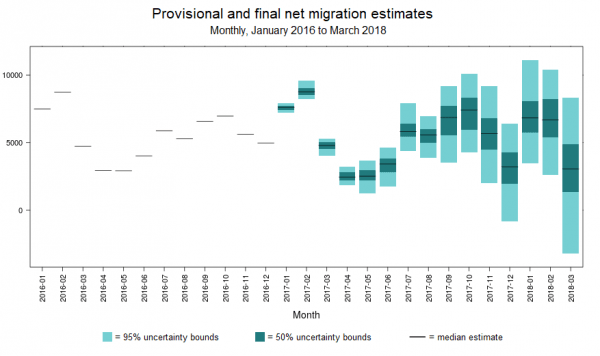
But here are results they are happy to show us

Provisional-and-final-net-migration-estimates2

(I presume that these numbers are not seasonally adjusted, which probably accounts for some of the jumping around in the median estimates from month to month).

Recall that under the 12/16 methodology, the numbers from 17 months ago become final (and are, in many –  but not all – respects better quality than the current PLT numbers).  But the latest monthly data has huge margins of errors –  even a 50 per cent confidence interval looks to be about 3000 people wide (on a monthly basis –  and bearing in mind that the average monthly inflow in recent years has been about 6000 people).

But to repeat:

  • no model,
  • no series as to how the estimates have evolved over time with the addition more data,
  • no backtesting,
  • no analysis of turning point information

Almost nothing at all.  And none of this is being consulted on, instead the government and SNZ are simply junking one of our best high frequency sets of economic data, about a variable which adds considerable volatility to the New Zealand economy.   We should expect a lot more, especially from a notionally independent national statistics agency.


Tossing away valuable emigration data

We had confirmation yesterday that departure cards are to be scrapped.    This was flagged by the Prime Minister a few months ago, and I wrote about the issue here.   Since then it appears that there has been no proper public consultative process.

As I noted in March

I’m sure airlines and airport operators hate the cards.  There have been prevous efforts to get rid of them.  They are, nonetheless, a core element of the data collections (in conjunction with arrivals cards) that give us some of the very best immigration data anywhere.  In a country with –  year in, year out – some of the very largest immigration, and emigration, flows anywhere in the advanced world.

We are told by the government that this brings us more into line with other countries

On Sunday, Lees-Galloway said the move would bring New Zealand into line with other countries, few of which had departure cards with the level of detail required by the New Zealand card.

(although even then we appear to overshooting in scrapping the cards completely).

But the statistical and related policy issues New Zealand grapples with are different from those in many other countries, most of whom don’t have big outflows of their own citizens, or big cyclical fluctuations in those flows.     Immigration of non-citizens is managed through the administrative approvals required to get a visa.  But people don’t need government approval to leave again and New Zealanders (of course) are free to come and go without any prior approval from the New Zealand government.

So departure cards captured the intentions of people coming and going.  Those stating that they intend to have changed countries for 12 months or more make up the permanent and long-term migration data that, for decades, has been a major and very timely indicator of what is going on, in a country with some of the largest swings in net migration of any country in the world.   It isn’t as perfect indicator by any means –  very timely ones rarely are – but it has consistently contained valuable information, especially around turning points.   And now the government proposes to scrap this data collection.

The Minister of Customs reckons the cards aren’t necessary

Customs Minister Meka Whaitiri said the cards were no longer needed for their original purpose – to account for all passengers crossing the New Zealand border.

“We have smarter systems now that capture passenger identity information and travel movement records electronically,” she said.

“Information captured by the departure cards is now mainly used for statistical purposes.

“Statistics NZ has developed an alternative way to produce migration and tourism statistics, based on actual movements rather than passengers’ stated intentions on the departure cards.”

I certainly agree that departure cards aren’t needed to capture the total flows, but it is the timely breakdown of that data that has been extensively used for decades.   And the operative word there is “timely”.  The new 12/16 method data –  looking back and seeing how long people were actually here/away – is better for long-term analytical purposes, but it is available only with a 17 month lag, whereas the departure card based data is available within weeks.  That difference matters, and it is worth bearing in mind that 17 months is almost half a parliamentary term.

We are told that Statistics New Zealand has “developed an alternative way to produce” the data, but we’ve seen no details of this, and there has been no consultative document made available for comment.  In  my earlier post I included this quote from SNZ claiming that in future estimates of the PLT breakdown

will be generated through a probabilistic predictive model of traveller type (ie short-term traveller, or long-term migrant), based on available characteristics of travellers. Such a model will provide a provisional estimate of migration, which we can then revise (if required) as sufficient time passes for us to apply the outcomes-based measure.

I commented then

I hope that they plan to rigorously evaluate the accuracy of such models, including when they’ve worked well and when they haven’t, and how well they capture the effects of policy changes, and that they expose their models and evaluation to external scrutiny before scrapping such a valuable source of hard data as the departure card.

But we have seen no sign of such an evaluation at all, and yet in a few months that data that have been used for decades will be discontinued, with  no ability to recreate it in future if the new models that are talked about prove not to have been very good.

Without seeing the models it is hard to comment on where they might go wrong.  But the key point is that statistical models often work fine when past behavioural patterns keep on as they were in the past, and they often fail when behaviour changes.   It is the behavioural changes that are often of most interest to the analyst, and it looks as though there will now be very long lags before we have the data to enable any such changes to be recognised.

I just heard Iain Lees-Galloway claiming on Radio NZ that future statistical information will be improved by scrapping the departure cards.  That seems very unlikely – essentially impossible, because you cannot really know the intentions of travellers other than by asking them, and intentions actually matter in this business.

I could add to the lament around official immigration statistics that there has still been very little progress in making available regular, timely, seasonally adjusted, accessible data from MBIE on visa approvals.  These are major economic and social data for New Zealand, which should be readily available almost instantly, including through SNZ’s Infoshare site.  There is no reason why immigration approvals data should not be at least as readily useable as, say, building approvals data. I know MBIE has a project underway to improve the situation, and make available an immigration data dashboard, but it seems to be moving very slowly –  it must be a year now since MBIE first told me about it, and it is months since the person doing the work invited me to provide comments on a prototype.  It is encouraging that something appears to be in the works, but in the meantime we limp on with inadequate, not user-friendly, administrative data, while the government simply abandons the best timely data we have on what people leaving New Zealand are planning to do.