Geoeconomics: fragmentation & the future of globalisation

That was, more or less, the title of two events I attended at the University of Auckland last Thursday. With the help of generous funding from the Sir Douglas Myers Foundation (in particular), the university had been able to bring in a bunch of well-regarded overseas academics and prominent “public intellectuals” for several events focused on issues around the potential and actual disruption to economic globalisation as a result of overt political choices (notably, the tariff policies of recent US administrations). The key person driving the programme seems to have been Prasanna Gai, professor of macroeconomics at Auckland (and, of course, a member of the Reserve Bank Monetary Policy Committee, where he sets something of an example to his colleagues by actually being willing to deliver speeches and outline his thinking).

I gather there was a more technical academic-focused event on Friday, but the two events I attended were the full day workshop on “Geoeconomics and the Future of Globalisation”, and an evening public dialogue event “Geoeconomic Fragmentation: Challenges and Opportunities”.

The workshop was conducted on Chatham House rules so I can comment only on what was said and not who said it. Attendees were a mix of academics, market economists and the like, and public servants and people with official roles. I’m not quite sure why the presentations – mostly from academics – were non-attributable (several speakers drew on their published papers) but anyway, those were the rules.

The evening event featured two visitors, in dialogue (of sorts) moderated by Gai. The first was Andy Haldane, formerly of the Bank of England and now one of the great and good, whose op-eds on all sorts of interesting issues, and angles on those issues, pop up not infrequently in places like the Financial Times (one of those Brits you feel sure will end up with a knighthood or perhaps a peerage). And the second was Laura Alfaro, currently chief economist of the Inter-American Development Bank, on secondment from an academic position at Harvard Business School, and also a former minister in her native Costa Rica. I doubt I am seriously breaching the rules if I say that Haldane’s remarks at the evening event (see below) were very very similar to those at the earlier workshop.

The whole area of so-called geonomic fragmentation should be fascinating (indeed, one panellist went so far as to call it “the only topic”) After all, not only do we have Trump (and between his terms Biden, who didn’t exactly dismantle Trumpian protectionism from the first term), but issues around both the political and economic rise of China, the widespread use of unilateral US sanctions (a recent book on which I wrote about earlier in the year), and of course the intense efforts from some countries (including little old New Zealand) to use sanctions to put pressure on Russia and its ongoing war on Ukraine. In our own remote corner of the world, I presume New Zealand restricting aid to the Cook Islands over apparent geopolitical concerns won’t exactly be good for bilateral trade.

There were some interesting presentations. I particularly enjoyed a keynote address on global value chains and geonomics, and especially the way in which connections of individual firms are often more important to focus on than industries or countries per se (thus, the dependence of TSMC on single firms in Holland (ASML) and Germany (Zeiss)). We were also reminded that most firms that import buy a particular product from a single supplier, with little or no effective diversification, something extreme tariff uncertainty may change. This presenter also reminded us that up to 40 per cent of US trade now involves dual-use products where national security considerations can reasonably come into the mix. That lecture concluded with a reminder that trade policies will be shaped by whatever it is that governments want to maximise at a point in time, and there is no necessary reason why that goal should be maximisation of near-term GDP. National security considerations are to the fore much more than they were, or than was readily conceivable, in the 1990s and 2000s. But there was also a reminder that if private firms will never internalise all externalities, those same private firms will innovate quickly when the rules of the game change (thus China’s current chokehold on “rare earths” is unlikely to last long).

There were also useful reminders as to just how much the tariffs etc have changed trade between US and Chinese firms: China’s share of US imports has now dropped back to around where it was 20 years ago. And yet at the same time both Chinese exports and US imports in total have continued to grow. There was an argument made by several speakers that as yet there is little sign of overall globalisation having gone into reverse. In his evening address, Haldane was particularly strong on this claim, arguing that flows of goods, and people, and money (and even more so information) are at levels never before seen, and (more ambitiously) that the benefits of these flows were at least as large as economists like him had argued for (I was curious where he was going to find the evidence of the economic benefits of large scale immigration to his own country, it of the underperforming economy, but no one asked). Haldane argued that much of what was wrong with political tides, public mood etc, was that economists had underestimated the social and redistributive effects of globalisation. Count me rather sceptical, but Haldane – a technocratic social democrat – saw it as grounds for more and smarter government, to enable people to reskill, retrain etc. He was also openly championing industry policy – seeming to conflate legitimate national security issues with the rather more dubious of politicians and officials trying to pick winners (and wasn’t even that compelling on the national securituy side in suggesting a place for food protectionism). And if he was overall optimistic (self-described) he still saw risks of all falling apart, an unravelling of open trade, and risks around a crisis over high and rising public debt. Quite what the latter had to do with geoeconomics wasn’t clear to me.

Haldane was a funny mix. He seemed keen on international financial institutions leading the public dialogue on the benefits of globalisation (as if such agencies – IMF etc – commanded mass public trust…..), and also called on business to play a more prominent role (good luck with that). But when asked about the role of technical experts I thought he was to the point in asserting that they need to wear lightly what expertise they have, and be much more willing to own up to mistakes (“we all make them after all”). I don’t recall if he mentioned them specifically, but central banks seemed to be among those he had in mind. If you like citizen panels to deliberate on policy issues, Haldane too was keen. Quite what it had to do with the geoeconomic challenges wasn’t quite clear, although I think that he, like some other participants, were inclined to aa view that if only the public were made to see what was good for them normal service could be resumed (one speaker at the workshop was robustly, but shallowly, of that view regarding mass immigration). Quite how it took account of the activities of places like Russia and China wasn’t clear.

Of the evening speakers, I found Alfaro (from the IADB) much the more interesting, partly presenting work she’d done for a Jackson Hole paper a couple of years ago and in pushing back on some of Haldane’s enthusiasms (industry policy for example). Like many speakers she noted that the US protectionism was unlikely to dissipate quickly – that the political environment had changed, and that little about that was unique to Trump. She reported some results in which public respondents were very sceptical on trade, and retained that scepticism even when presented with apparently hard evidence of the benefits. She stressed the decoupling of trade between the US and China, but also argued that so far that had proceeded smoothly, often supported by banks to enable firms to reallocate business, and that there was little evidence of overall deglobalisation. As for whether the vaunted “rules-based-order” could re-establish itself, she placed considerable weight on the willingness, or otherwise, of the US to assume leadership in a multilateral context. I got the impression she was not optimistic.

There was quite a strong sense from speakers of hankering for a better time (perhaps 15-20 years ago). I was less convinced that this particular group of speakers had much to offer in thinking through the economics of geopolitics and associated fragmentation issues. No doubt they were experts in their own narrow fields, but perhaps those were more about “what are the effects and where do they show up” (interesting in its own right) rather than in how best, and when, to deploy economic policy instruments. China itself attracted very little attention – whether for example modern slavery issues and associated restrictions, political interference, alliance with Russia, threat to Taiwan, or whatever. Politics – geopolitics especially – just wasn’t the comfortable place for most of these presenters.

One speaker – who has a lot of published material in this area – was among those emphasising a standard result that if, say, the US imposes large tariffs on other countries they should not retaliate as doing so would only make the retaliating country poorer. On the assumptions in the model, of course that is sensible – overall, the cost of trade protection are mostly and ultimately borne by consumers in the country imposing the restrictions. But one of those assumptions – in fact a critical one – seems to be that trade policy retaliation does not then change, for the better, the behaviour of the original protectionist power. But there was no analysis of when and whether that might, or might not, hold. Alliances were mentioned a few times during the day, but never very systematically. One of the things that was striking to me back in March/April was the way countries seemed to make no effort at all to work together to push back on the rogue actor in Washington (in our part of the world, for example, Luxon and Albanese offered no vocal support to the Canadians). I have no idea whether a more concerted effort might have deflected Trump (perhaps it would have worsened things) but you might have hoped for more analysis of the issue.

It is easy for economists to simple wish that politics would stay out of the way, and derive results that assume it away. It is also easy to focus on GDP maximisation (or some less crude utility form of that), but – as above – much depends on what politicians actually want to maximise. No doubt modellers in August 1939 would have told us that retaliating against the next German aggression would only make us poorer – and of course, it did so dramatically, as massive cost of blood and treasure – but a handful of courageous countries (Britain, France, New Zealand, Australia, Canada, South Africa) concluded that it was a price worth paying for a better, but risky, outcome. No doubt when China invades Taiwan, modellers – and firms – will produce results showing that retaliation will only make the rest of us poorer. No doubt, but do we just sit by? Most of the West has chosen not to in respect of Russia even when, as in the New Zealand or Australian case, Russia poses little or no direct threat to us. In my view, we were right to do so. And then of course, which instruments work best, which risk being self-liquidating (eg concerns about US overuse of unilateral sanctions motivating innovative to reduce that exposure).

Finally, there was quite a strong sense that the workshop and dialogue were quite northern hemisphere focused. Amid all the upbeat reminders about the ongoing reach of globalisation I don’t recall anyone all day pointing out that, at least on trade in goods and services, globalisation in New Zealand has been going backwards for 20 years now, without anyone even consciously trying.
Lest I sound unduly negative, I enjoyed the day, caught up with people I hadn’t seen for a while, and appreciated the invitation. And surely the benefit of events like these is if attendees coming away thinking a bit deeper or broader themselves, even if a little orthogonally to the actual papers presented.

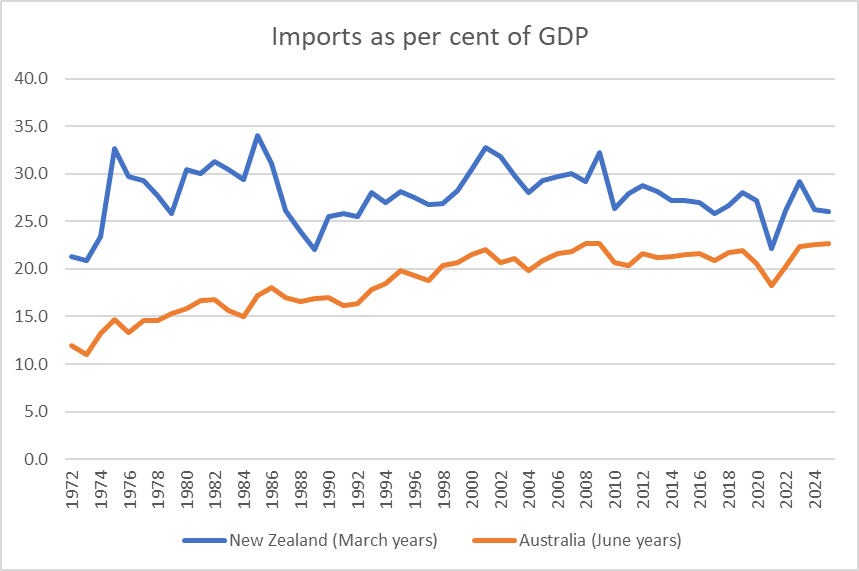
Trade: NZ vs Australia

For years now it has been recognised that New Zealand’s foreign trade (share of GDP) is small compared to what one would expect to see in a small country. Small countries generally sell to and buy from firms abroad to a greater extent (relative to the total size of the economy) than larger ones. There is nothing surprising about that: there are simply fewer domestic opportunities in a small country than there are in a large one. The United States, for example (and well before Trump), has exports of around 11 per cent of GDP. But New Zealand’s foreign trade share is small by the standards of small countries, and actually not many large countries now have a smaller trade (exports or imports) share than New Zealand. I’ve done various posts on variations of this issue over the years.

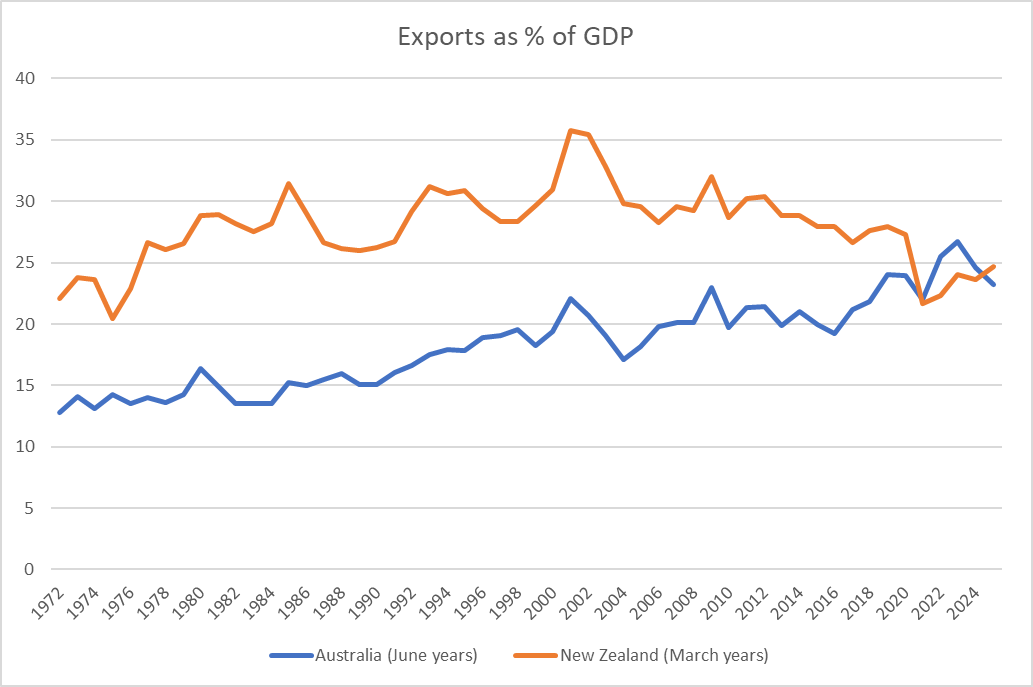
But time passes and I hadn’t noticed that exports from Australia – a country with a population more than five times ours – are now about as large a share of GDP as those from New Zealand. I put this chart on Twitter yesterday, with the observation that Australia itself is hardly a stellar success story.

Even back in the bad old protectionist days, when New Zealand tended to have higher trade barriers than Australia did, the value of exports as a share of GDP was higher in New Zealand than in Australia.

The imports chart is not as stark, but the gap has been narrowing (Australia now has a current account surplus after some decades of having run substantial deficits like New Zealand).

And, of course, from a New Zealand perspective don’t lose sight of the fact that as a share of GDDP both exports and imports are now well below the peaks, themselves well in the past. It isn’t exactly a marker of a successful economy. I’ve made this point numerous times before but I’ll say it again anyway: it isn’t that exports are special, simply that in successful economies it is usual for domestically-operating firms to find more and more opportunities to sell successfully in the rest of the world. You’d certainly expect to see it in any economy that was successfully closing the gaps to the rest of the world. Which New Zealand isn’t.

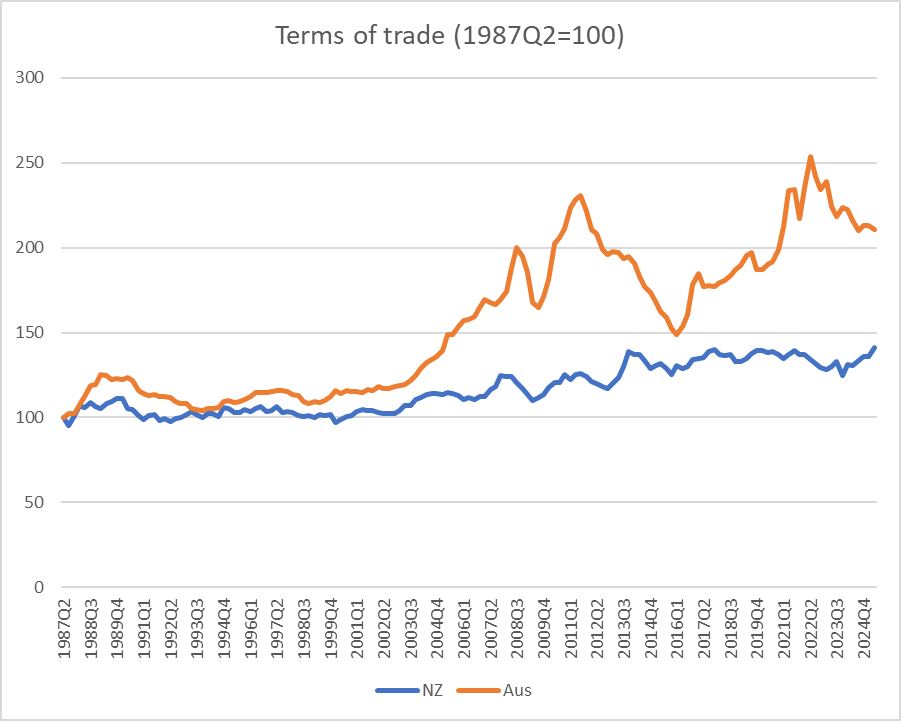
Export revenues result from the mix of price and volume. By wider advanced country standards our terms of trade have been pretty good in the last couple of decades. But Australia’s terms of trade (export prices relative to import prices) have been much more favourable – although also more variable. In the near-term, terms of trade for commodity exporting countries are largely outside their control, but over the longer-run firms presumably invest in anticipation of a particular view of future average selling prices.

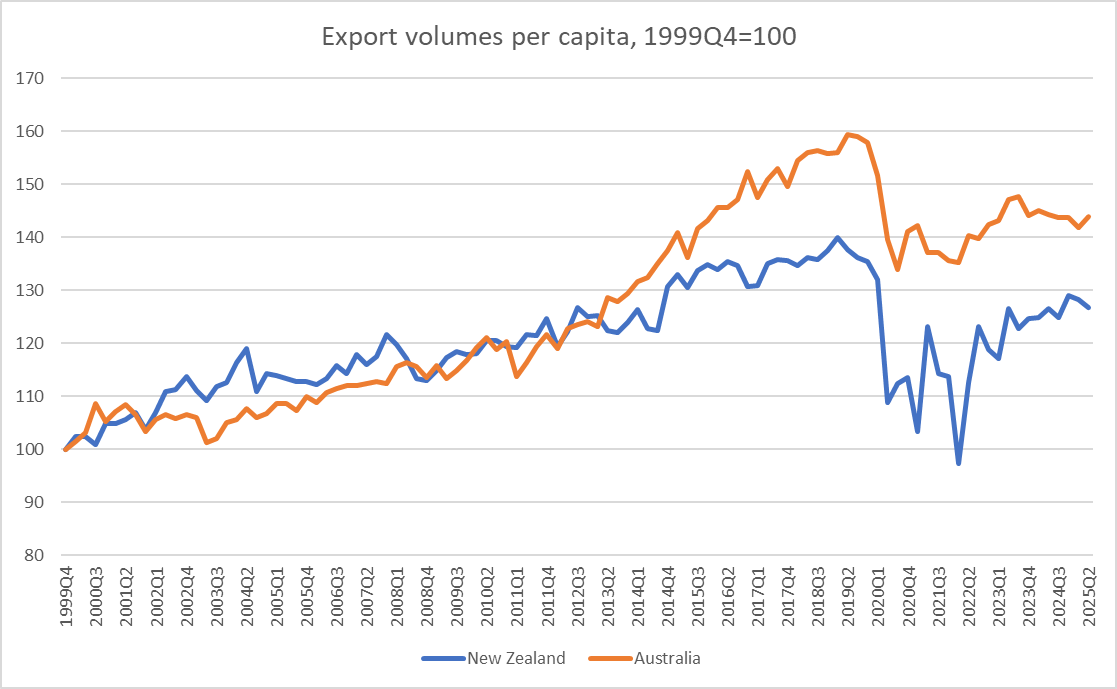
What about export volumes? Using the constant price exports series for each country, here is how the volume of exports per capita has unfolded in the two countries this century.

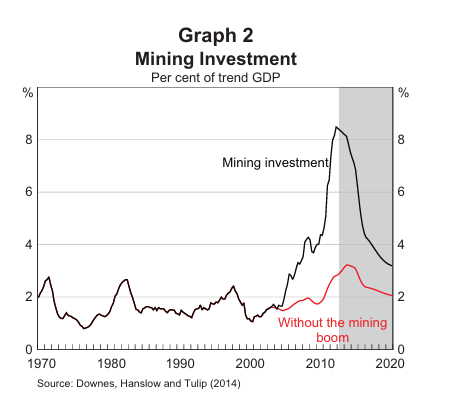
The two lines don’t materially diverge until the last decade or so,

as the massive Australian mining investment boom translated into materially higher export volumes (and revenues). New Zealand simply had nothing similar.

One sobering snippet I took from that export volumes chart is that New Zealand export volumes per capita are no higher now than they were in 2012, 13 years ago now. As a share of GDP total export revenues are now at a level first reached in 1977.

But the other sobering snippet from that volumes chart is Australian export volumes per capita haven’t grown now for almost a decade (and so the gap between the New Zealand and Australian lines isn’t widening further). But then, as I noted already, Australia isn’t a stellar economic success story – and productivity growth there in the last decade has been next to non-existent – just richer and more successful than New Zealand, and the easy exit option for our people.

Both the New Zealand and Australian economies are very heavily reliant on natural resources for their exports to the rest of the world, and that shows little or no sign of changing. If, as the Australian economy did, firms can bring newly to market a huge swathe of natural resource exports things tend to go better for you, as a very remote economy, than if you can’t or don’t.

Tariff madness and monetary policy

We’ve seen this morning the latest step up in the Trump-initiated trade war, with the additional 50 per cent tariffs imposed on imports from China. If the tariff madness persists – but in fact even if were wound back in some places (eg some of the particularly absurd tariffs on supposed US allies in east Asia, or 48 per cent tariffs on Madagascar’s vanilla) – it is going to be extremely damaging to global economic activity in the (probably protracted) transition. A global recession would then be the best forecast (through a whole variety of channels including, but not limited to, extreme uncertainty – fatal for investment, which can usually be postponed – and wealth losses). Faced with severe adverse shocks, and extreme uncertainty, layoffs happen and firms close faster than replacements emerge.

(The longer run effects will also be adverse, lowering potential GDP in all the countries that participate in the “war”, which consciously and deliberately put sand in the wheels of their own economic performance, but economies adjust – you can have full employment in a highly protected economy with impaired productivity growth (see NZ in the 50s and 60s) or in a high-performing open and competitive economy.)

The direct effects of the tariff war on New Zealand are still probably pretty limited. Our goods exporters to the US face the lowest tariff band, lower than those facing many competitors (eg European wine exporters) and the amounts involved are just a small fraction of GDP anyway. But as pretty much every commentator is now pointing out, the indirect effects will swamp any direct effects. It is perhaps a bit like early 2020 when government agencies were initially focused on the damage to a few New Zealand exporters (lobster, universities etc) from China’s disruptions, only for those modest effects to be totally swamped by the wider global effects and our own experience with Covid (pre-emptive adjustments and lockdowns). In a global recession there is pretty much no place to hide.

But what does, and should, it mean for monetary policy, here and abroad (if the madness persists)?

In the US, it is near-certain that there will be a material increase in consumer prices. Headline inflation will, all else equal, increase over the coming few months. To the extent there is any logic in the madness, that is part of the point. Higher prices in the US increases returns to domestic producers and make foreign produced products relatively less attractive (of course, in many cases, US producers will also face higher costs on imported inputs). From a revenue perspective, it is also akin to a big increase (inefficient and all as it may be) in consumption taxes – reportedly the largest US tax increase in some decades. So prices will rise and real household disposable incomes will fall.

A sensible central bank will always have to play things by ear to some extent. No idiosyncratic event is ever quite like another. It isn’t impossible that the higher tariffs will translate into behaviours consistent with households expecting inflation to be permanently higher. If that happened, the Fed would need to lean against that risk – hold policy tighter than otherwise.

But an alternative scenario might be one akin to an increase in GST. Increasing consumption taxes raises consumer prices and headline inflation. We’ve had three experiments of this sort in New Zealand in our post-liberalisation years: when GST was first imposed in 1986 (a 6%+ lift to the price level) and when it was increased in 1989 and 2010 (each increasing consumer prices by a bit over 2%). On none of those occasions did the Reserve Bank seek to tighten monetary policy in response, and with hindsight that was the right call on each occasion. The lift in prices was (at least implicitly) recognised by the public as a one-off lift in inflation, that dropped out of the headline rate again a year later.

How likely is something like that in the US at present? Given the chaotic policy and political processes, and the fact that – unlike with GST changes – prices won’t all change on one day, perhaps there is less reason for optimism there. And perhaps all bets are off if the public and markets come to think there is a credible threat to sack and replace existing Fed decisionmakers.

But, even if household expectations (beyond 12 months ahead) and behaviour do rise – and surveys and behaviour are two different things – there is still the big hit to real household disposable income to consider. Such hits happen with some GST adjustments (the NZ 1989 one was intended as a fiscal consolidation) but not others (the NZ 2010 GST change was intended as a tax switch). And in addition to the direct effects of the tariffs, there are wealth losses (see stockmarket) and the impact of business disruption and business uncertainty delaying investment spending. Real activity, and pressure on resources and capacity, seem almost certain to ease. All else equal, a reasonable conclusion should be – and market pricing is consistent with this – that the Fed is more likely to need to ease than it would otherwise have thought, consistent with keeping core inflation near to target.

There is rhetoric around that somehow the lesson of the last few years is not to ease in the face of adverse supply shocks. But a lot depends on the nature of your supply shock. This isn’t (for example) a case of literally shutting down the economy and people going home (voluntarily or otherwise) to avoid a virus. The labour is still there, the capital equipment is still there. It can all be used – capacity is real – but the demand for resources is likely to diminish quite considerably. Monetary policy cannot (of course) do anything about the longer-term adverse effects of a shift to a more protectionist economy and policy regime. If the regime persists, Americans will be poorer than otherwise. But monetary policy often has a role to play in smoothing the dislocations, in trying to replicate what a market interest rate would be doing – reconciling desired saving and investment plans – absent a central bank. One parallel, for example, is the recession and financial crisis in the US in 2008/09. Monetary policy couldn’t fix the misallocation of resources and bad choices that led to the financial crisis in the first place. To the extent financial crises impair productivity, monetary policy also couldn’t do much about that. But not many people think that simply holding the Fed funds rate at mid 2007 levels in the face of the dislocation and associated severe recession would have made much sense.

What about New Zealand (and countries like us). If we see higher prices directly as a result of the tariff war, they should be fairly scattered and limited. It isn’t at all impossible that we might see import prices, in foreign currency terms, falling as (for example) Chinese manufacturing exporters look for alternative markets where they won’t face 100 per cent plus tariffs. With a fairly limited manufacturing sector ourselves, that terms of trade gain might be fairly unambiguously welcomed. We might get (temporarily) lower headline inflation and slightly higher real disposable incomes.

But, and on the other hand, a global recession would almost certainly more than cancel out that effect. We’d see materially lower export prices for commodities, and lower volumes for many other exports (eg tourism, students). It doesn’t matter that the initial crisis/shock wasn’t generated here, any more than it mattered in 2008/09.

I put this on Twitter this morning

and, of course, once the recession really took hold we got a big decline in (imported) oil prices but it wasn’t enough to stop the terms of trade overall falling by 10 per cent.

Assuming the tariff madness persists (see mercurial and unpredictable occupant of White House) it is very difficult to see how we – and other countries – avoid something similar this time round. I’m glad I’m not an economic forecaster paid to put specific numbers to it – this is just another case of extreme uncertainty making all but the most highly conditional numerical forecasts barely worth the paper they are written on – but the direction is clear, the severity of the shock is clear, our (non-unique) exposure is clear. All else equal, the OCR is likely to need to be a lot lower than otherwise, and since it is starting out still above neutral and with core inflation not far from target, that suggests a lot lower in absolute terms. To be clear, this is not a forecast, but in past serious downturns – demand led – short-term interest rates have often fallen something like 5 percentage points (in New Zealand, but also actually in the US).

The Reserve Bank’s MPC has its latest OCR review announcement out this afternoon. They are in a difficult position: they have only an acting Governor (who was responsible for the Bank’s macro and monetary policy functions when the really bad calls in 2020 and 2021 were made), a deputy chief executive responsible for macro who has no expertise or background in the subject, and so on. Being an interim review, they won’t have a full sort of forecasts and scenarios of the sort done for the quarterly MPS. They’ve also continued the madness of scheduling OCR reviews a week before the CPI comes out so they won’t even have a good read on the baseline – pre tariff madness – state of core inflation. And policy out of Washington (and Beijing and Brussels) can shift by the day.

Most people seem to expect the MPC to stick to the 25 basis point cut foreshadowed at the last MPS. On the domestic macro data they’ll have to hand – all from before the latest tariff madness (which even Jerome Powell has noted is worse than had been expected) – that would be perfectly defensible.

But so would a somewhat larger adjustment. After all, the external environment has changed, the effect is not likely to be small (or to be fully reversed even if we woke up tomorrow to find the last week had just been a bad dream), and even the government, channelling Treasury, is now warning of the adverse economic effects and risks. It isn’t time for dramatic emergency moves – that time may come, although one hopes we never need to see a 150 basis point cut ever again, as in late 2008 – but a rate that seemed fitting, to the New Zealand inflation outlook, 10 days ago, shouldn’t seem right today. And for all that they have only an acting Governor they may feel less locked into Orr’s February commitments than he might have were he still there. The risks are pretty moderate, especially as on the Bank’s own estimates the OCR is still above neutral and the output gap is estimated to be materially negative.

What are some counter-arguments? There is always the “six weeks doesn’t make any macro difference” so why not wait until the (full forecasts) and the May MPS. Perhaps there will be fuller information. I don’t think it is particularly compelling as it seems quite unlikely that the fog of war will have disappeared by next month (the macro implications will just be starting to become apparent), and if a large adjustment is eventually needed it may be best to get started. If it isn’t eventually needed a larger move today doesn’t take the Bank beyond where it thought things would level out at.

I heard one market economist on the radio this morning suggests that a larger cut today might rattle people. Quite probably, but most likely they should be rattled. This is a really serious economic policy shock Trump has launched on the world.

And then there is the exchange rate. People – reasonably – note that in severe downturns the New Zealand exchange rate usually falls a lot. That will tend to raise the prices of tradables, all else equal. It hasn’t really happened yet – if anything the TWI is a bit stronger – but it seems a pretty plausible story. It is just that in serious downturns previously – most notably 2008/09 – the direct price effects of a lower exchange rate ended up being outweighed by the disinflationary effects of the downturn on non-tradables inflation. An exchange rate adjustment is likely to be part of the overall response to the tariff madness shock, but not a substitute for action by the MPC.

We’ll see this afternoon what the MPC has come up with, but we shouldn’t be surprised if they do cut by more than 25 basis points, and doing so would probably be the right call. If they don’t, then I guess even more attention than usual will be paid to the wording of their statement, recognising that with the loss of a Governor some changes in wording may just be idiosyncratic – linked to one person’s stylistic or other preferences.

Once were a trading nation

I’ve used here before the snippet from older books that in the decades before the Second World War it was generally accepted that New Zealand had the highest value of foreign trade per capita of any country.  Estimates of historical GDP per capita suggest we also had among the very highest levels of real GDP per capita.

That was then. Yesterday I noticed this tweet from a Herald journalist. I presume the chart was taken from The Treasury’s Briefing to the Incoming Minister.

2021 wasn’t a great year for comparisons, since our border had been largely closed, directly affecting exports and imports of tourism services, but perhaps it was the most recent complete data Treasury had back in October.

This is the New Zealand story in isolation, for as far back as the quarterly national accounts data go.

You might discount the peak in 2000 (coincided with a shortlived trough in the exchange rate), but however you look at the chart, external trade as a share of GDP hasn’t been growing for 30 years. In the last decade it has been shrinking. Ministers and trade lobbyists, touting their preferential trade agreements, would prefer you didn’t notice these actual outcomes.

How does New Zealand’s experience compare to that of the other OECD countries (large and small)? The OECD database is complete from 1995, so here is the change in the average share of exports and imports from then to 2022.

Most OECD countries have seen quite a big increase in foreign trade shares over that period. Some of that will have been a rise in trade in intermediates. One could look at the OECD data on trade in value-added, but there is a multi-year lag in the availability of that data..

Can you spot New Zealand? That’s us over on the very far right of the chart, one of just a handful of countries to have had no growth in foreign trade as a share of GDP over those decades (as it happens - and I’m not here arguing causation – each of that handful of countries have been long-term OECD productivity underperformers).

What about the level of trade as a share of GDP (which is what that Treasury chart is showing). Here is the 2022 data for all the OECD countries (in case you are worried that pandemic effects are still distorting the picture the 2019 chart is very little different).

There are two regularities when looking at the extent of cross-country trade, neither very surprising:

  • all else equal, big populous countries tend to do less foreign trade (share of GDP) than smaller ones, and
  • all else equal, remote countries tend to do less foreign trade (share of GDP) than ones close to lots of other (advanced) countries.

Most OECD countries aren’t large (22 of 38 have populations of 12 million or less) and most of them are close to other centres of advanced economic activity.

What of New Zealand?   We have the 5th lowest foreign trade share of any OECD countries.  Of the four lower than us, three are large countries and the fourth (Australia) has a population five times our size.   Every single other small country has trade shares higher than New Zealand’s.  In all but Israel’s case, materially higher, and Israel is another example of a country fairly geographically remote (surrounded by plenty of other countries but not wealthy advanced economies, and wealthy advanced economies tend to trade a lot with other countries like them).

And if you inclined to read this and note it as just one of those things, here is how New Zealand stood in 1995.

trade 1995

Not great…..and still smaller than all the small OECD countries other than Greece…..but a substantially different picture than the 2022 one, and one that does not flatter New Zealand.

(And yes, for many purposes it does make sense to discount the numbers for Ireland and Luxembourg, but doing so won’t really change the underwhelming picture of New Zealand’s place among OECD countries.)

New Zealand: the foreign trade failure

To have listened to Winston Peters’ speech in Parliament the other day –  which wasn’t all as bad as the media reporting had led me to believe – or the joint Herald op-ed from the New Zealand, UK, Australian, and Singaporean trade ministers, you might have supposed that New Zealand’s was some great foreign trade “success story”.  I put it in quote marks because of course Winston Peters –  our Foreign Minister –  seems to want to undo some of that alleged “success”, seeking “far greater autonomy for New Zealand”.  Here is the full relevant quote

Now, New Zealand First is resolved that our future economy will have these features about it, because they’ve learnt something. One: far greater autonomy for New Zealand. In short, if we can grow it or make it at near competitive prices, then we will grow it or make it, use it or export it, rather than use valuable offshore funds importing it.

Some mix of mercantilism  (more exports good for their own sake) and insulationism (less international trade all round).

And here was a key quote from the article by David Parker and his peers

We are four independent trading nations who have derived success by operating globally. Almost two-thirds of Britain’s economy is made up of trade. One in five Australian jobs is trade related. In New Zealand that number is one in four. Nearly two-thirds of Singapore’s GDP is generated by external demand.

Success story? That would be the country that has spent 70 years slipping, sporadically but decisively (never really interrupted) down the OECD productivity league tables.  Productivity growth, after all, being the main basis for improved material living standards, and for many non-material options.

Here is foreign trade as a per cent of GDP (average of imports and exports) for each OECD country for the latest calendar year the OECD has data for (mostly 2019).

foreign trade as % of GDP

I use foreign trade (imports and exports) to make the point that, for a whole economy, we mostly export to import (some of vice versa as well).  But we are also fourth to bottom if one looks as exports alone.

Perhaps you think that doesn’t really matter much; after all, much richer Australia and the United States have lower trade shares than us.  Unfortunately for that story, larger countries tend to do a lot less foreign trade (as a share of GDP) than smaller ones –   there simply are lots more home markets for firms in the US – and even Australia has a population five times our size.

Ah, but we opened up our economy decades ago –  all that stuff Winston Peters lamented much of –  and we’ve signed all those trade agreements ministers and officials like to boast about.  Surely, then, we trade more heavily than we used to, surely we’ve improved our relative performance?

foreign trade since 1970

But no.    New Zealand’s foreign trade now is a bit less (share of GDP) than it was in 1980, and if we started behind the other small countries, we’ve lagged further behind, especially this century.

And since the OECD only has data for all countries since 1995 here is the NZ vs small countries comparison just since 1995.

foreign trade since 95

I suppose at least the gap hasn’t widened further in the last five or six years.

And then people (reasonably) point out that in some countries –  notably in Europe –  there is a lot of cross-border trade in partly-assembled products.  That is a plus for those countries, whose firms really can gain by specialisation in specific aspects of a production chain, but it does inflate the gross foreign trade numbers.

Fortunately, the OECD has developed indicators of the amount of domestic value-added in each country’s exports  (there is a range of other indicators in the value-added database as well, but here I’m just going to fall back on exports).  In some (particularly central European) countries only just over 50 per cent of gross exports represent domestic value-added.  In New Zealand (and Australia and the US) that share is close to 90 per cent.

So how does domestic value-added in exports look as a share of GDP across the OECD countries (these data are available only with quite a lag, so the latest numbers are for 2016)?

value added exports

It lifts New Zealand slightly up the league table, but all the countries below us have much larger populations –  and domestic markets –  than we do.  By contrast, all the countries to the right of the chart are small (or in the Dutch case just a bit above small).  And of the small countries – 12 million or fewer people (from where there is a step up to the Netherlands) our population is pretty close to the median.

dom value add and popn

It isn’t the tightest relationship in the world –  there is a lot else going on –  but the point that small countries tend to export (and import) more is pretty clear.  And New Zealand –  red dot –  stands out well below the line.

Our trade performance has been –  is –  woeful.  We simply don’t export (or import) much for a country as small as we are. In fact, not many countries –  even very large ones –  export/import less than we do as a share of GDP.

So the self-congratulatory lines that David Parker (and MFAT officials, and a succession of previous National trade ministers) run is deeply flawed.  But at least, in some sense, their hearts are in the right place, seeming to recognise that a more outward-oriented New Zealand is the only sustainable path to much greater prosperity.  From Winston Peters, on the other hand, the idea that we should be importing even less –  in a small country that already imports the fourth lowest share of GDP in the entire OECD –  is just headshakingly bad.

(If perhaps not quite as bad as Steve Keen who proposes that New Zealand and Australia are ideally placed to be some sort of long-term “trade bubble” –  doing as little as possible, even beyond Covid –  with the rest of the world, as if we’ll suddenly become a major market for coal, LNG, and iron ore and they will suddenly become a leading market for dairy, lamb, and export education.)


Contemplating trade restrictions and industry protection

I’m just back from a family holiday in sunny south-east Queensland.  Being a New Zealander, I have a visceral fear of snakes, but as we saw them only in the zoo, one could concentrate on the upsides of Australia.   Seriously good newspapers for example.  Daily surf swims in the middle of July.  Plastic bags in plenty of shops (Queensland seems to have outlawed – the very useful –  thin supermarket bags but not others).   And, of course, one could look around, and read the papers, and contemplate what productivity and higher material living standards really mean.  It was a while since I’d been in Brisbane, and the central city certainly had a look and feel more prosperous than what one finds in Auckland (or Wellington).

At the turn of the century, GDP per hour worked (PPP terms) was about 31 per cent higher in Australia than in New Zealand, and on the latest OECD estimates than gap is now 41 per cent.    And it isn’t as if Australia itself is some stellar productivity performer.  (Those with longish memories may recall a time barely 10 years ago when there was serious political talk of closing the economic gaps with Australia, but –  as a result of policy choices of both National and Labour governments –  the gaps have just widened.)

I couldn’t see state-level GDP per hour worked data for Australia,  but there is GDP per capita data.  The gaps between New Zealand and Australia aren’t as large for per capita income as for labour productivity, simply reflecting the longer hours the typical New Zealanders engages in paid work over their lifetime.  For Australia as a whole, GDP per capita (PPP) terms is “only” 34 per cent higher than in New Zealand.  In Queensland –  with below average state GDP per capita –  that gap is “only” about 25 per cent.   Even a 25 per cent difference purchases a lot of (say) cancer drugs, new cars of whatever other public or private goods and services people aspire to.  I’m sure the Australian health system has its problems, but I was struck reading three papers a day over 10 days not to see stories about health underfunding.    And yet the (various levels of ) Australian governments spend a smaller share of GDP (35 per cent) than New Zealand governments do (38 per cent).

So there was sun, surf, papers, productivity in Queensland.  And there was another thing I always look out for abroad.

trout 2

I prefer fresh but the little supermarket near where we were staying “only” had smoked.  Not, in this case, the Australian product but (so I was surprised to notice when opening the packet) Norwegian.

trout 3.jpeg

The wonders of a global market and all that.   But just not in New Zealand.

There are, of course, plenty of trout in New Zealand –  all descendants of trout introduced in the 19th century (it isn’t exactly a native species).  In fact, some of the trout species in Australia was introduced from New Zealand.

But if there are lots of trout in New Zealand, the only way you can consume any is to go and catch one yourself, or make friends with someone who fishes for them and who will gift a trout to you.   It is as if I could only consume milk if I owned a cow or had someone close by who would give me milk.  Perhaps the first half of that sentence did describe much of the world prior to the 20th century, but even then the sale of milk wasn’t banned.  But the New Zealand government has for decades now banned the sale of wild trout.

When I went looking, I discovered that the sale of other trout isn’t outlawed in New Zealand, but as a recent regulatory impact statement prepared by the Department of Conservation put it.

The sale of trout (except for wild trout) is allowed in New Zealand. The reason it is not available for sale is because there is no way to obtain trout to sell – trout farming, selling wild trout, and importing trout are all prevented by legislation or the CIPO.

(that’s a customs import prohibition order).  The prohibition extends to smoked trout.  Here is the latest version of the restriction, just renewed a few months ago.

Read literally, clause 4(1)(b) appears to suggest that the imports for sale are only prohibited if they are for amounts of less than 10 kgs.

trout 4.png

That can’t have been what was intended, but it appears to be what the law says. [UPDATE: I misread it.]

There was a policy process undertaken last year that led up to the government’s decision to renew the import ban.  It was weird policy process, described thus

There has been no public consultation on the options covered by this paper. The views of the various interest groups are well known to officials, but there may be Treaty implications if a firm decision was taken without formal consultation with iwi. The nature of the issues mean that a decision has to be made as to which set of interests should be given precedence.

Officials –  of course –  consider they know all that needs to be known.  And quite Treaty issues arise in respect of foreign trade in a species itself introduced to New Zealand is beyond me –  but fortunately I’m no longer a public servant.

Of the official agencies that were consulted, MFAT actually favoured allowing the import restriction to lapse. I’m not usually a fan of MFAT –  and had Beijing objected for some reason, no doubt they’d have taken the other side –  but well done them on this one.  It isn’t a good look when New Zealand prattles on about open trade, rules-based orders, when it maintains in place a near-absolute prohibition of the importation of an innocuous, but tasty, food product.

I guess no one looks to the Department of Conservation for high quality and rigorous policy analysis, especially on economic issues.  Their RIS on the trout CIPO did nothing but reinforce those doubts.

The entire official case for the prohibition of imports of trout (and, by implication, for continuing restrictions on domestic trout farming –  although that isn’t the focus of this particular policy process) appears to rest on supporting the recreational trout fishing industry.

22. The import prohibition and the prohibition on the farming of trout are aimed at protecting the New Zealand wild trout fishery.

Like, for example, banning deer farming to protect hunting of deer in the bush?  Or pig farming?  Or salmon farming?

The officials even acknowledge that (for example) allowing the sale of salmon has not led to widespread salmon poaching, and that other countries successfully manage to have wild trout fishing and trout sales.  But, they plaintively suggest, New Zealand is somehow different.   For example

If imported trout could be sold, the illegal sale of wild trout would be much more difficult and costly to detect.

Which is, of course, not an argument for maintaining the existing restrictions but for removing both import and domestic sales (and farming) restrictions, not continuing to run industry assistance to a small tourism sector –  somewhat akin to the protection that used to be offered to the New Zealand car assembly industry or the New Zealand television assembly industry.  You get the impression reading the document that the DOC officials have simply got all too close to their mates in Taupo, and are subject to regulatory capture.

The documents contains this paragraph

42. The Government’s objectives in regard to the issues examined in this paper can be summarised as follows:
• Maximise recreational and tourism values of wild trout fishery
• Maximise employment and economic values of wild trout fishery
• Maximise economic growth and employment opportunities in the wider economy
• Provide for maximum consumer choice in purchasing decisions
• Minimise risk of friction in negotiations with trading partners.

These objectives are not referenced to any fuller document in which “the government” makes its case, and they have the feel of being made up on the fly with little or no supporting analysis.   They go on to state

43. The interactions between these issues mean that it is not always possible to progress all of these objectives simultaneously. Actions that could advance some of the objectives may restrict progress on other objectives. Decisions on which objectives should be given precedence therefore need to be made by elected Ministers.

In a way, of course, that is true.   If your goal is to maximise the size of the protected sub-industry, whether buttressed by direct subsidies (think film), import bans (trout), domestic production of a related product (trout farming ban) it will conflict with overarching goals about consumer choices and economic efficiency (as well as that lesser goal about living the words about a free and open economy with respect to trading partners).  But, as in so many industries in the past,  that tension should be resolved in favour of the consumer and of economic efficiency.  In this case, it isn’t even clear that there really is much of a tension.  DOC’s RIS offers not the slightest evidence that allowing imports of trout meat (smoked or otherwise), or even allowing domestic farming of trout, would make any difference whatever to the number of North American anglers who come to Taupo.  Perhaps on the domestic side there might be a smaller number of trout fisherman…….in the same way that a much smaller proportion of us milk house cows, collect our own eggs, or whatever than we once used to.   The only “value” really being protected here is that people who don’t go fishing shouldn’t be able to eat trout in New Zealand.  If that is a values-based policy framework, it is a pretty weird one.  Logically, one might apply the same daft policy to native fish too.

It is really quite shoddy advice, in support of shoddy policy.   As one gets to the end of the RIS one gets the impression a reasonable number of government departments are beginning to conclude that the policy around trout is a nonsense and should eventually be revisited.   But it isn’t clear that DoC is among them –  then again, they are probably brought up to dislike all introduced species (may not even be too keen on people, disturbing that natural environment), and they simply aren’t the agency that should be responsible for an issue of industry protection policy and interfering with the ability of New Zealanders to easily consume a safe and lawful product.

There was petition last year seeking to introduce trout farming in New Zealand.  Whether it gets anywhere, only time will tell, but it is hard to be optimistic when the current government extended the existing import ban again only last year.   Perhaps New Zealand consumers will have to hope that foreign governments will take up the issue more seriously, and put more sustained pressure on the New Zealand government to remove the barriers between consumers and trout (more cheaply and efficiently than holidaying abroad).


Over-egging the pudding

Yesterday it was one of our leading political journalists suggesting of the proposed agreement between the EU and New Zealand

But a free trade deal with Europe has the potential to be transformative for the entire country, with the potential to grow this little rock-star economy even further.

And today on Stuff we find Business New Zealand’s chief executive Kirk Hope, suggesting that such a deal would be the “holy grail” (this is in fact the headline in the hard copy version), and ending by asking

Could now be NZ’s long-awaited hour?

That scale of benefits is about as well-grounded in fact, and unlikely, as the creative literature around the grail itself.

It would be one thing if a genuine free-trade agreement were in prospect –  although even then the scale of the possible would scarcely be transformative for New Zealand –  but Kirk Hope, and everyone else from the Minister on down, knows it isn’t.

But he seems determined to keep up the spin

Such deals are central to NZ’s prosperity

Well, no.  There are, probably, some modest economic benefits that have flowed from some of deals done over recent decades, but not even MFAT would claim for the China-New Zealand deal the scale of benefits Kirk Hope wants to claim (the entire increase in New Zealand exports since then).   Such assertions are nonsensical, without foundation, and arguably worse than that.   People discredit the worthy, indeed noble, cause of free trade with such over-egged claims.

And ‘central to our prosperity” in a country that has experienced barely any productivity growth for five years, and where overall exports and imports as a share of GDP have been shrinking?

Then there is the questionable, not entirely straightforward, representation of New Zealand’s trade with the EU countries.

New Zealand is well known as an agricultural producer, but we are more than just that – our services trade to the EU made up 41 per cent of our total exports in 2017.  These ranged from the education and training industry to financial and insurance services, alongside professional services such as engineering and architectural consultancies.

Well, yes, no doubt.  But as I pointed out yesterday by far the largest component of New Zealand services exports to the EU (or the euro-area) is in the form of Europeans taking holidays in New Zealand.  Export education also ranks quite high on the list.  Neither is likely to be affected at all by any EU-New Zealand deal.

Canada and the EU reached an agreement a few years ago (the Comprehensive Economic and Trade Agreement), still not fully in force because of obstacles in the ratification process.  I had a quick look round to see what the estimates were of the gains to Canada.

I found a study by the Canadian Parliamentary Budget Office. It won’t be the last word by any means, but equally it wasn’t just done by a couple of backroom opponents of the deal.  This is some of what the study says of that deal

  • CETA will lead to some gains for Canada, but they will be modest.
  • Canada and the European Union have different tariff levels going into the agreement. Canada’s tariffs are higher on average (weighted). Canadian and European exporters both faced tariffs greater than 10 per cent on almost 500 products (Harmonised System, 6-digit level).
  • Canada will gain in terms of increased economic output (almost $8 billion, or 0.4 per cent of GDP, over the long term) and investment (0.6 per cent of GDP), even though the trade balance deteriorates. Greater specialisation and increased production efficiency lead to net economic gains.
  • The diversion of trade to the EU will reduce Canada’s exports to the United States by more than a billion 2015 dollars over the long term. To the rest of the world, by another third of a billion dollars.

The predicted gain (in the quantifiable areas) to GDP is 0.4 per cent (not very different from the 0.5 per cent estimate –  from an EU study –  bandied around in talk of a New Zealand deal), for a country that is reducing its tariffs by more than the EU will be.  That wouldn’t be the case in a New Zealand deal –  and recall that tariffs mostly hurt the citizens of the country that imposes them.  It is also good to see, amid all the talk of possible increased EU-NZ trade, estimates of the extent of trade diversion: one of key risks/costs of such preferential agreements.

None of this is to suggest that the Canada deal is bad for Canadians (or Europeans for that matter), just that if there are gains, they are small.  It is most unlikely to be any different for a New Zealand-EU agreement.    And whatever the trade effects, reaching behind respective borders to constrain the freedom of governments to regulate, or not, is pernicious, chipping away at the flexibility of elected governments.  That might be part of the raison d’etre of the EU hierarchy, but it isn’t supposed to be the New Zealand way.

Perhaps the clue to this over-egged, utterly unconvincing, piece is in the final paragraph.

To pull off an FTA with the EU would be an outstanding achievement for this still-new Government.

Anyone can do a deal, the question (as yet unknown) is the character and quality of any deal.  But from the tone of that final comment, one might deduce that Hope’s column is more about trying to curry favour with the new government –   business and the government being offside on various other issues –  than it is about serious analysis.  Stuff should probably have charged him for the sycophancy: advertising space rather than the business op-ed pages would have been a better positioning for it.

(What was going to have been today’s more substantive post will be along later.)

Some scepticism about EU trade

Count me more than a little sceptical about the agreement the government and the EU are planning to negotiate over the next few years (should be EU itself survive long enough –  the latest threat being Italy).   It isn’t even clear how to describe the proposed deal.  Champions seem to like to talk of “free-trade agreements”, but of course this will be anything but on the trade side (no free trade in agriculture is in prospect), with lots of more regulatory stuff in the agreement as well, often in areas that are likely to impose additional burdens on economic activity or constrain the government’s future freedom of regulatory action.  Throw in some additional bureaucratic overhead in various areas, and perhaps the proposed agreement should just be called “Agreement between New Zealand and the EU on sundry matters”.  New Zealand officials and ministers have long been aggrieved that the EU wouldn’t negotiate such an agreement with New Zealand, so for them it is, no doubt, a win.  Whether it is much, if any, of a win for New Zealanders is another matter.

Peak hype seemed to be reached in Stacey Kirk’s column in the Dominion-Post this morning in which we are told

But a free trade deal with Europe has the potential to be transformative for the entire country, with the potential to grow this little rock-star economy even further.

That would be the “rock-star economy” that has had almost no productivity growth for the last five years, and where exports and imports as a share of GDP have been shrinking?

And when Kirk says “transformative”, it must just be intended to sound good.  A couple of paragraphs later, we read

But early estimates suggest an EU free trade agreement could add another $1b-$2b to New Zealand’s annual GDP over time, with a 10 to 22 per cent increase in trade volumes.

Since annual GDP is already around $280 billion, even on those numbers it is a gain of perhaps 0.5 per cent.  I know productivity gains have been in short supply in New Zealand recently, but on no measure is a 0.5 per cent gain (probably arising over 10-20 years) anything resembling “transformative”.

Government releases have noted that total two-way trade with the EU is around $20 billion at present ($22 billion in 2017). Of that, around $4.5 billion is with the UK, which is leaving the EU next year (and where the New Zealand and British governments plan to sign their own agreement).

But it is worth noting that we import a lot more from the EU than we export (exports are about two-thirds of imports).  That isn’t a problem at all, but it is a reminder that from a New Zealand perspective, this agreement isn’t about $22 billion of trade, but about $5.6 billion of exports to EU countries other than the UK.  Stacey Kirk tells us that “the cost of importing European goods would be significantly reduced”.  That doesn’t seem very likely as most of our tariffs are low already.  More importantly, if we wanted to achieve those particular gains (however large they are) we could do it tomorrow: just lift the tariffs we impose, and which tax our own people.

And what is it that New Zealand firms export to the EU?

Major goods exports $m 2017
Meat and edible offal           1,543
Fruit              649
Wine              562
Fish, crustaceans, and molluscs              233
Optical, medical, and measuring equipment              205
Major services exports
Travel services           2,369
      Business travel               91
      Education travel              209
      Other personal travel           2,069
Transportation services              437
Other business services              224

By far the largest items are “other personal travel” (holidays) and meat.    There are no tariffs (or quotas) on EU people holidaying here –  so no gains from the mooted agreement there –  and meat seems likely, on past EU form, to be a considerable sticking point, where any gains are small and quite a long time coming.   “Educational travel” also seems unlikely to offer any gains.

If we focus just on trade with the euro-area (the summary numbers SNZ provides –  and the biggest difference between the EU and the eurozone is the UK) personal travel and meat are still by far the biggest exports.

But, as already noted, it is just goods and services.  On Kirk’s telling

The final deal with include requirements around sustainability and climate change, labour standards and animal welfare.  Parker has already suggested that New Zealand might face barriers over whether its goods and deemed to be environmentally friendly or sustainable enough.

Intellectual property isn’t an area in which the EU is known for its liberal approach. Thus, in the same newspaper this morning, trade consultant/lobbyist and former MFAT staffer Charles Finny notes that

Patents for medicines, geographic indications (such as Parmesan cheese), data localisation rules and investment will all be difficult to resolve.  This will also be one of the first negotiations where New Zealand will be arguing for provisions on gender and indigenous issues.

What?  Finny points out that we have an indigenous chapter in the New Zealand agreement with Taiwan.   In it the two sides commit (p199) as follows

2. The Parties shall, through their coordinating authorities:

(a) hold at least one meeting each year for the planning of measures designed to enhance economic, cultural and people-to-people contacts between the indigenous peoples in the Separate Customs Territory of Taiwan, Penghu, Kinmen and Matsu and New Zealand’s Māori;

(b) promote and facilitate the exchange of experiences relating to indigenous peoples’ issues, including the following areas: economic and business development, tourism, natural resource development, artistic performances, agricultural production, culture, language promotion, education, human rights, land ownership issues, employment, social policy, biodiversity, sports and traditional medicine;

(c) promote and facilitate the development of direct contacts with or between academic institutions, non-governmental organisations, local government bodies and tribal authorities, to support these endeavours;

(d) promote indigenous personnel exchanges in academic, cultural and business exchanges through conferences on a rotation basis, including educators, cultural workers, language instructors, writers and artists, linguists, and ethnologists;

(e) promote stronger relationships between Māori exporters and importers in the Separate Customs Territory of Taiwan, Penghu, Kinmen and Matsu;

It might be mostly bumpf, but it all costs money, and involves the state going where it really has no business.  Then again, I don’t suppose the EU will be agreeing to recognise that rights and interests of the Catalans.

Perhaps too we’ll find everyone in New Zealand required to adopt something very like the incredibly onerous new data protection and privacy regime just coming into effect in the EU.  And for what?

Assessing any economic benefits depends a lot on the specific details of any agreement that might be reached (and ratified –  as the EU/Canada agreement illustrates, ratification is no sure thing in Europe).  But I noticed some results from a paper ,with an interesting discussion of the potential issues relevant to New Zealand and including some modelling, done a couple of years ago by some Lincoln University researchers.  I can’t speak to the quality of the modelling, so am just passing on what I read.

A scenario of full trade liberalisation between the EU and New Zealand was modelled. Whilst an unlikely outcome of the free trade negotiations between the EU and New Zealand, it is an important indicator of the most extreme potential economic outcomes of more likely moderate agreements. This scenario can be thought of as the upper-bounds of any trade agreement outcomes.

(remarkably, this scenario includes New Zealand removing remaining tariffs on milk powder imports)

And here is their summary of the modelling results (again, for a full liberalisation scenario)

Importantly these results show that for the agricultural commodities considered in the modelling exercise, total producer returns in both the EU and New Zealand are expected to increase, be it marginally. The most significant changes would be for apple production and returns in New Zealand which rise significantly, whilst sheep and wool returns are expected to drop slightly. Most other changes are marginal, although wine producers in New Zealand are expected to experience an increase in returns of almost 10 per cent even given a drop in production.

In another article in the last couple of days we read

Dairy Companies Association executive director Kimberly Crewther said New Zealand dairy exports to the EU were “highly constrained” and the elimination of all existing tariff barriers should be a priority.

“In 2017, just 9000 of the more than two million tonnes of butter consumed in the EU was imported. Maintaining this level of protection does not make sense when the EU is a competitive dairy exporter in its own right.”

A laudable goal –  indeed, getting to the crux of the issue – but I doubt anyone thinks it is going to happen.  This simply won’t be any sort of agreement providing for free-trade.

I would commend the government on its decision to exclude ISDS provisions from future agreements, and the Minister’s comment here

“At the start of negotiations, we’ll be releasing a package of information outlining our negotiating priorities for this agreement and how we will be engaging with New Zealanders as negotiations progress,” David Parker said.

suggests the beginnings of a more transparent approach.  But it is far from clear that there are net benefits to New Zealanders from the sort of deal the government is actually likely to conclude.  No doubt, some classes of firms will be a bit better off –  and those gains will be concentrated, so those interests will be vocal –  but there are many areas in which New Zealanders as a whole could find themselves potentially worse off, and with the potential for future governments to take a different stance constrained by an ever-more-complex web of international agreements.

I’m all for free trade.  Among an group of (genuine) market economies and democratic countries, I’d also have a pretty much open-slather approach to foreign investment.   New Zealanders would benefit from that. But we’d also benefit from retaining a freedom to regulate, or not, domestic activities according to our own analysis, and our own preferences.  And leaving citizens and governments in other countries free to govern themselves.   But that isn’t what is on offer in this agreement.  There is a risk that it is more about political symbolism –  the interests of politicians –  that of substance that benefits citizens as a whole.

Bad economics from the China Council

For several years, Donald Trump has made much of the bilateral trade deficits between the US and Mexico, and between the US and China.   That rhetoric was to the fore again last week when Trump announced the imposition of steel tariffs.  This was from one of Trump’s tweets on Friday

Example, when we are down $100 billion with a certain country and they get cute, don’t trade anymore-we win big. It’s easy!

I’m not aware of a single economist –  with the possible exception of Trump adviser Peter Navarro –  who regards this focus as meaningful or as sensible economic analysis. At an aggregate level, a country’s overall current account balance is a reflection of the savings and investment choices of its own residents.  Thus, if for some reason one were concerned about a US current account (or trade) deficit, one thing that might make a difference could be a cut in the US fiscal deficit (lowering public dis-saving).

The mercantilist mentality, revived by Trump, sees trade deficits as, in some sense, a loss to the country, perhaps by analogy to the situation of a company running deficits (losses).  But the parallel is simply wrong.  Trade deficits are no more presumptively bad than trade surpluses are presumptively good.   Both can be reflections of bad policies, or indeed of good policies.  To the extent that the purpose of economic activity is to consume, trade deficits typically mean that of what your country produces not much is sold abroad, relative to what is purchased from abroad.  If product isn’t sold abroad it is available for domestic consumption.  And trade surpluses can be indicative of a deflationary impulse emanating from your country –  you are selling stuff abroad (absorbing demand from other people), but not matching that with an equivalent demand for the stuff others have produced.

I don’t want to be read as taking these arguments too far.  There have been plenty of trade imbalances (current account imbalances) that proved to be quite unsustainable, and the subsequent adjustment process was often quite messy and costly.  In the very long-term, and roughly speaking, people consume what they earn.  So sometimes, large aggregate imbalances can be a prompt to review policies.  Large surpluses in a fixed exchange rate country, for example, might finally trigger an upward exchange rate adjustment (as in China a decade ago).

But the argument is even more than usually flawed when focused on individual bilateral surpluses/deficits, which have almost no economic meaning.  That, in turn, is so for a variety of reasons.   At a statistical level, in an age of global value chains, any finished product (especially manufactured products) is likely to have been added in a number of countries, but the country where the finished product is exported from will record all the value in its gross exports.   An Airbus aircraft, for example, might have its final assembly in France.  If the plane is sold to, say, a Turkish airline, the full value of the plane will be included in the Turkey-France trade balance, even though much of the value might have been added by firms in, say, Germany or the UK.

And at an economic level, since money is fungible –  and we aren’t in a world of 1930s bilateral clearing agreements – why should anyone in the United States care whether there is a trade deficit with Canada and a surplus with France, or vice versa?   What is earned in one place can be spent in another.   Almost all of us, as individuals, have a goods deficit with the local supermarket, offset by the primary income surplus derived from selling our labour to some other firm.

At a country level, a country exporting mostly, say, diamonds might have a huge trade surplus with Belgium and Israel (places with specialist diamond-cutting industries), and large deficits with most other countries (spreading consumption more broadly).  What of it?  New Zealand won’t export many dairy products to, say, Ireland or Denmark, but might to desert places with not much of a dairy industry.  And what of it?

None of this is to suggest that there aren’t bad policies, or policies which distort the trade numbers.  But if the policies are bad –  eg China’s restrictions on access to its markets for service sector firms, or lack of market disciplines on firms in some sectors with major overcapacity, large US fiscal deficits when the economy is back near full-employment, or New Zealand policies which, in effect, subsidise export education by bundling immigration access with the commercial product –  they are bad on their own terms, regardless of any impact on particular bilateral trade balances.

But this isn’t a post about Trump and his take on economics. It was prompted by a rather similar outbreak of Trumpian economics from someone local who really should know a lot better.    I wrote last week about the speech from Stephen Jacobi, the Executive Director, of the New Zealand China Council attempting to push back against concerns raised in various quarters about the influence activities in New Zealand of the People’s Republic of China and the Chinese Communist Party.  Jacobi doesn’t have any specialist background on China –  he’s a paid advocate –  but he does apparently have a strong background in trade issues, from his time at MFAT, and subsequently as a lobbyist for trade liberalisation.

But his latest statement, released on Friday, left me thinking he must have put any economics to one side.    We were told that

China trade surplus shows relationship working in our favour

March 2, 2018

New figures out today showing a $3.6 billion trade surplus with China demonstrate the value of our growing economic connections with China, according to the New Zealand China Council.

It does no such thing.   Bilateral trade surpluses aren’t “a good thing” (or a “bad thing”) and bilateral trade deficits aren’t “a bad thing” (or “a good thing”).  They just are.

Here is a chart showing the bilateral goods and services trade surpluses/deficits for the top 25 “trading partners”, taken straight from an SNZ table.

bilateral trade surpluses

It is a mildly interesting chart, but I’m not sure it tells us much about anything, and certainly not about trade or economic policy.   Should we think better of Algeria and Sri Lanka  (which presumably have a taste for milk powder) than of Switzerland and Thailand?  I can’t think why we should.  And I suspect that if the bilateral balance with China ever swung into deficit –  and it does move around quite a bit with milk powder prices –  Mr Jacobi would be the first to (rightly) push back against true local mercantilists suggesting that such a deficit was reason for concern.

It isn’t even as if the trade by New Zealand firms with Chinese firms is extraordinarily large.  It is about the same size as our trade with Australia –  a country with about 2 per cent of China’s population.  Overall exports/imports as a share of GDP aren’t large at all for a country our size.  And here is quick table New Zealand China-based economist Rodeny Jones put out last week

NZ has only middling trade exposure to China by regional standards:

% of exports to China/HK 2017

Taiwan 41%
Australia 37%
Korea 32%
Singapore 27%
Philippines 25%
NZ 25%
Japan 24%
Malaysia 19%
Thailand 18%
Indonesia 15%

Mr Jacobi’s argument has the feel of rank opportunism.   Perhaps that might be acceptable in a corporate lobbyist (although I doubt it in the longer run) but Jacobi’s salary as Executive Director of the New Zealand China Council is largely paid by the New Zealand taxpayers.  We deserve better.

As it is, Mr Jacobi’s questionable economics is just the basis for another bid for New Zealand to maintain its subservient, deferential, attitude towards Beijing, and not get bothered about an expansionist hostile power seeking to exert influence in New Zealand politics.

“We need to see China as more than just a market. In New Zealand, China is looking for a long term, reliable partner which means working hard to build cooperation, trust and mutual respect even despite our obvious differences.

Indeed, the PRC is more than “a market”.  It is the government of a repressive dictatorial state, unable to produce for its own people the sorts of living standards places like Taiwan and South Korea have achieved, with an active agenda –  hardly masked –  of projecting its powerful and fundamentally different values [Jacobi’s own term from his recent speech] into countries and regions around the world, defying international law, and attempting to cow any country that makes a stand for its own values and its own self-respect.  It isn’t a regime worthy of trust, or respect.  Perhaps there are some trade opportunities for individuals, but it should be a clear case of “seller (or buyer –  but the sellers tend to have more concentrated interests) beware”,  in which it is more recognised that every time you defer to the regime, you advance an evil cause.

A bit like our politicians really.  Just occasionally, there is reason to think that perhaps our Minister of Foreign Affairs might take a different view.   There were the very delicately-phrased words in his speech the other day about Chinese activity in the Pacific.  There was the response, in after-speech questions, about the memorandum of understanding the previous government signed with the PRC on the Belt and Road Initiative (“I do regret the speed with which the previous government signed up”).

But what does it amount to?  Here is Winston Peters on Q&A yesterday, from the transcript

CORIN You know full well that the Chinese will be watching every word you’re saying right now. Are you worried that there could be—? They don’t like public declarations about the South China Sea from New Zealand. I know that. Are you concerned?

WINSTON No one has been more respectful of the place of modern China in the world than New Zealand First and Winston Peters.

Or

CORIN So do think there is too much? Because, I mean, we’ve got Anne-Marie Brady’s report. We’ve got Rodney Jones, Michael Reddell, others raising concerns and wanting a debate about Chinese influence in New Zealand – politics, but wider life. Do you think there is too much influence?

WINSTON Look, if you’re concerned about too much Aussie influence when it comes to banking you should say so upfront, and I have. If you think there’s been too much untoward American influence in this country in some ways then we should be upfront and say so, and I have. It doesn’t matter where it emanates from.

And thus our Foreign Minister, in his own inimitable style, but in much the same patterns as decades of his predecessors, trivialises the issue.  Just like Mr Jacobi in that speech a week or so back,

Of course, the other side of politics is no better.   Simon Bridges was also on Q&A.  Here he is on the Belt and Road initiative, a mechanism for Chinese power projection in many countries, partly (but not exclusively) by loading pliant recipient countries up with debt they have little prospect of servicing.

[UPDATE: Just after completing this post I noticed this new report on the debt aspects of OBOR.]

CORIN Give me an example of what the Belt and Road means?

SIMON Well, it means economic opportunity, and what do I mean by that? Infrastructure. You’re seeing China invest significantly in infrastructure around the world–

Never mind the strategic foreign policy perspectives, but there might be some consultancy opportunities for New Zealand firms.  It is reminiscent of Lenin’s line about the capitalists selling the rope they will, in time, be hung by.

I also heard Bridges on Morning Report this morning. It was straight out of the John Key playbook.  We will “engage positively”, and might even (quietly) mention the rule of law, democracy etc, all while avoiding the issues that should matter rather more to other countries, including New Zealand –  the expansionist efforts of the PRC beyond its own borders, and the influence activities in an increasing range of other countries, including our own.  I haven’t yet heard Bridges grilled about his MP Jian Yang, but on what we’ve heard so far there seems no reason to believe that he has departed from the Key/English approach (largely shared by the Labour Party) –  selling out our birthright, little by little, for the proverbial mess of potage.   Keep the deals flowing for the selected business elites, keep the party donations flowing and never mind any self-respect, or frank discussion of the nature of the regime, and the nature of the threats it poses.


The costs of Brexit

That was the theme of a presentation in Wellington on Monday, organised by the research institute Motu, by visiting British economist Richard Harris.  Harris is a professor of economics at the Durham University business school, but had apparently spent some time at Waikato early in his career.

The presentation was promoted as an update on the Brexit negotiations, seven months into the two year Article 50 notice period.  Of course, it takes not much more than a cursory glance at your British media outlet of choice to know that things are not going that well, not helped by the tenuous hold on office the current government has.   Competing agendas all round don’t help either.  Plenty of people in the British government –  and the Opposition –  didn’t want to leave.  For them, minimal change from the status quo would be the best outcome. But for those who actually favoured Brexit that solution would, understandably be anathema –  the goal for many of them was to restore the UK’s freedom of action to that of a typical sovereign state.    And on the other side, some countries face pretty bad outcomes if there is a hard British exit.  For others it isn’t much of an issue. For some it might even be an opportunity, to attract multinationals –  including in the financial sector – that have operations currently based in Britain.    And although everyone knows that rising trade barriers comes at a (likely) cost to all countries, the EU doesn’t want any other countries –  or regions –  getting the idea that leaving the EU was a serious option.

Harris’s presentation helped me see more clearly where the EU “divorce bill” demands are coming from, and put the numbers in some sort of context.  At present the UK pays a net 14.6 billion pounds a year into the EU, and the sort of numbers observers like the FT think the EU might accept are only the equivalent of two or three years’ “membership fee”, in a club that apparently operates five year budgets.  At present though, as the FT observes, a number acceptable to Brussels would be “deadly” in Westminster.

It was also interesting to see some numbers on how restrictions on trade between the UK and the rest of the EU would rise if there is no trade deal and the two sides fall back to trading on WTO terms.   On goods, tariffs would rise from zero at present to around 4.4 per cent on average.   On services, where barriers are mostly non-tariff, the restrictions would rise from a tariff-equivalent of around 2 per cent to something nearer 8 per cent.   In principle, the UK could offset this to some extent by securing early trade agreements with other countries –  including countries that the EU does not have deals with –  but good deals, with significant countries, aren’t likely to be secured easily or quickly.  As various commentators have noted, the EU-Canada trade agreement took eight years. New Zealand is already among several countries objecting to early EU/UK proposals to divvy up agricultural import quotas.

Even though there is a lot of talk about smoothing the customs barriers between the UK and rest of the EU –  including on the Ireland/Northern Ireland border –  to faciliate, for example, the value-chains in manufacturing that rely on the seamless movement of goods, there doesn’t seem to be any great optimism as to whether any of these schemes can be made to work well.   That matters, even more than to the UK, for Ireland in particular, which has a very large share of its trade with the UK (and not just with Northern Ireland).  The Irish have been making opportunistic bids to try to semi-detach Northern Ireland from the rest of the UK.

It was pretty clear that Harris hadn’t voted for Brexit, and didn’t support it now.  But he had a pretty hard-headed assessment: the decision had been made and there was no imaginable way it was going to be reversed.   He couldn’t see how effective deals could be in place in March 2019, and even talk of transitional periods beyond that had all sorts of (technical and political) problems.  He envisages a pretty “hard Brexit”, and is very gloomy as to how the UK will cope.

In fact, that was one of the odder aspects of his talk.  He presented a (familiar) chart showing that in the 20 years to 2007. British productivity growth had been faster than that in most other major advanced economies.  But since 2007 there has been no productivity growth at all in the UK.  No one quite knows why, or even how much of what we see might be measurement and how much genuine.  Performance has been poor recently, but that has nothing apparent to do with Brexit.

And yet Harris used this record to claim that if Britain was to take advantage of Brexit, it needed to have a high productivity economy to benefit from comparative advantage.  He said it twice, so it presumably was an intentional statement.  But Stage 1 economics students learn that everyone has a comparative advantage: economy B might be better at producing all sorts of different goods that economy A (that’s absolute advantage), but comparative advantage just tells you that economy A will nonetheless be occupied producing the things it is relatively less bad at producing.     Misunderstanding that point didn’t fill me with confidence in the rest of the presentation, although I’m guessing he just meant that one might be more optimistic about British economic outcomes –  in or out of the EU –  if it was managing decent productivity growth now.

Harris did present the results of a couple of modelling exercises that have been done on how large the real economic costs of Brexit might be.  They usefully highlight that the costs won’t just fall on the United Kingdom –  indeed, one of them envisages job losses (transitional presumably) twice as large for the rest of the EU as for the UK (the EU is of course much larger).    There are losses in this scenario because, even with full free trade with the rest of the world (which won’t happen any time soon), there are typically fewer profitable trade opportunities with places further away than with places close to home (one of NZ’s problems).

In one paper (by Vandenbussche et al), it is estimated that the level of British GDP will fall by 4.5 per cent in a “hard Brexit”.   What I hadn’t realised –  or thought about before –  is that Britain might not be the biggest loser.  In this particular model, Irish GDP would fall by almost 6 per cent, and that of Malta –  with close historic ties to the UK –  would also fall by 5 per cent.    If a 5 per cent loss of GDP seems large, no one really knows the likely absolute magnitudes. Harris quoted estimates from another study by Dhingra et al: they in turn had bad and less-bad scenarios, but the central estimate of lost GDP for the UK was around 2 per cent.

There is a pretty widespread view among economists that these costs, whatever the precise number, are both large and avoidable.  Of course, they might be avoidable, if Brexit was to free up Britain to adopt far-reaching microeconomic reform and liberalisation.  Sadly, that doesn’t seem remotely likely at present –  and of course, many of the costly restrictions the UK imposes now (eg land use restrictions) are entirely home-grown.

Instead, economic elites lament the choice to exit the EU and wish, longingly, that it could be reversed.  That sentiment is perhaps particularly evident in places like the IMF and the OECD –  and Harris cited quite a bit of material from the latter organisation, which has an institutional bias away from the national in favour of the multinational.

I suspect, by the tone of the questions, and the sympathetic murmurs when Harris made particular points, that there weren’t many people in Monday’s seminar who were sympathetic to Brexit.  I am.  Were I a Brit, I’m pretty sure I’d have voted for it –  although, in truth, I’m not sure I’ve ever voted in New Zealand for a programme that might reduce GDP per capita by 4 per cent.  But Brexit has just never seemed primarily like an economic issue, and that seems to be the difference between the public –  polls suggest they are still pretty evenly divided as they were last June –  and most economists.

And so I stuck up my hand and suggested that if we’d been doing this sort of modelling 60 years ago, as territories pondered the possibility of independence from Britain, the results would surely have shown that, for almost all of them, they would be worse off economically than if they’d stayed with Britain.  (And that modelling would never have allowed for the gross mismanagement that followed in many of the newly independent African countries in particular).  And yet if they had been presented with estimates of a 5 per cent loss of GDP, how many would have turned down the chance to be independent – to be free?  Even now, decades on, few probably regret the independence choice –  Somalis might be an exception.   The essence of my point of course was along the lines of why shouldn’t Britons today make a similar choice about the EU.  (And, of course, a 4 per cent loss of productivity sounds big, but it is the loss of 2 or 3 years productivity growth in normal times, invisible over a 50 year horizon.  Adding another week’s annual leave probably reduces GDP per capita by a couple of per cent.)

I’ve made this point here previously, but I was interested in how Harris was going to respond to it.  His response was to acknowledge that many Scots had certainly favoured independence, even at an economic cost – although of course they, like the Quebecois in the 1990s – decided to stay part of the larger country.  But then he fell back on avoidance, arguing that the issues were different for India or Zambia, as their cultures had been squelched by the British etc, and no one could suggest that anything of the sort could be said of Britain and the EU.  Had I had the chance of a rejoinder, I’d have noted that my points would have applied to the choices New Zealand, Australia, and Canada (and Ireland –  although the cultural issues were a bit different) had made to progress towards full economic and political independence.  It may well have come at a cost, but few then –  and fewer now –  will have regretted the choice.  And in all three countries the predominant population was English.  Probably few Slovaks regret their divorce from the Czechs.

Harris’s fallback was that “the EU was always only an economic club, and it remains an economic club”.      That was the conceit of many in Britain.  It was never the vision of the founders of the EU, or of those driving it today.  The very treaties envisage an ‘ever-closer union”, and even today newspapers such as the FT are full of talk of plans for closer banking or fiscal unions, even talk of an EU finance minister.   New entrants to the EU – although not Britain, Sweden and Denmark –  are obliged to commit to enter the euro.  And –  as a matter of conscious and deliberate choice –  being part of the EU means individual nations surrender the right to legislate for themselves in many areas.  That is a (lost, or foregone) freedom that many Britons seemed (and seem) willing to pay some price to reclaim.  If you don’t value the nation state –  or you aspire to some mega European state –  you’ll think that choice irrational.  But most people do seem to value the nation state –  and not just in the UK.    And the British exit polls last year suggested that it was just those sorts of “chart one’s own destiny” considerations that counted with those voting to leave.

Nearly half (49%) of leave voters said the biggest single reason for wanting to leave the EU was “the principle that decisions about the UK should be taken in the UK”. One third (33%) said the main reason was that leaving “offered the best chance for the UK to regain control over immigration and its own borders.” Just over one in eight (13%) said remaining would mean having no choice “about how the EU expanded its membership or its powers in the years ahead.” Only just over one in twenty (6%) said their main reason was that “when it comes to trade and the economy, the UK would benefit more from being outside the EU than from being part of it.”

In the end, who knows whether it will matter much.  All the modelling assumes that the EU itself carries on much as it is.  A pessimist – perhaps an optimist –  might wonder whether the EU itself will last in its current form for much longer.  Public opinion in other EU countries seems to ebb and flow.   The next recession –  whenever it is –  is just going to accentuate the tensions already apparent in many countries, given that few EU countries have any material “fiscal space” and the ECB is likely to go into the recession with interest rates already at or below zero.  Perhaps in the end Britain will prove to be a pathbreaker –  something the eurocrats and EU-oriented elites must fear very deeply.

Harris concluded with a couple of slides making the point as to how little trade New Zealand firms/individuals and those in the UK now do.   He was inclined to the view that, therefore, what happens around Brexit doesn’t really matter to us.   I’m not sure he is right there –  even setting aside wishful thinking about full free trade between us, including in agriculture.    Even in the transition, a disruptive hard Brexit is the sort of event that could –  in the wrong circumstances –  matter for the world economy in 2019.  And for a small country, looking to materially increase its export orientation, we should certainly be hoping that a country of the size and sophistication of the UK can make it –  and prosper –  alone.  If they can’t, it wouldn’t bode well for us.