Officials in pursuit of more powers

It is a big few weeks for the Reserve Bank and, in particular, the Governor.   This week the Monetary Policy Committee is gathering for its deliberations leading to next week’s  Monetary Policy Statement.  A couple of weeks later there is the Governor’s six-monthly Financial Stability Report,  and the week after that we are told that the Governor will descend from the mountain-top and reveal his decision on bank capital.   There are at least two press conferences scheduled (MPS and FSR) and given that he has deliberately chosen to release the momentous capital decision only after the FSR press conference one has to hope that he will make himself available to explain and defend his choices (and, although he has staff, all the decisions –  and responsibility for them –  are his alone).

Meanwhile stories rumble around about the possibility that the Bank’s Board has,for once, found its voice and suggested to the Governor that he needed to change his style.  I heard yesterday another version of a story that culminated in the Governor yelling at the chair of the Board after the latter (so it was reported) suggested that aspects of the Governor’s conduct were unacceptable.   I have no way of knowing whether these stories are true, or are just wishful thinking, but given the quiescent and deferential track record of the Board over many years, it would be perhaps a little surprising if there was nothing to the stories now.

One of the other projects the Reserve Bank has underway, which attracts less attention and controversy, is that around the future of cash.  It is both an apt issue to be focusing on and, at the same time, something of an odd one.  And, remarkably, in the discussion document the Bank put out a few months ago there was no mention –  at all, as far as I can see – of the most immediately pressing issue: the limits on the ability to cut the OCR that arise because of the (near) free option people have to shift from bank deposits etc to physical cash.

The future of (physical) cash is somewhat of an odd issue to be focusing on because cash outstanding has been rising relative to GDP.    This chart is from the Bank’s discussion document

cash 1.png

It tends to exaggerate the point, by starting from the trough.  Here is a longer-term chart from a post I wrote on these issues a while ago
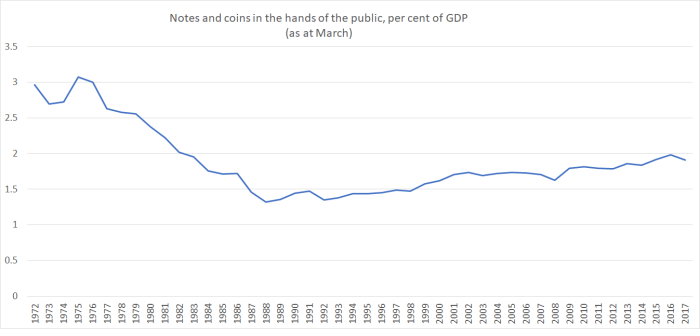
notes and coin

All else equal, when interest rates are very low (and inflation is low too) people are more ready than otherwise to hold on to physical cash.  Of course, quite who is actually holding the cash, and for what purpose, is a bit of a mystery, one not really addressed in either the Bank discussion document or in the poll results they published last week, framed in terms of a high preference for using electronic payments media whenever possible.

The Bank included an interesting chart in its document illustrating that although the ratio of cash to GDP is quite low in New Zealand, the rise in that ratio wasn’t out of line with what has been seen in quite a few other advanced countries.  Sweden and Norway –  where the ratios have fallen –  are outliers.

cash 3.png

There is quite a strong suggestion that in the most recent period a big part of what is holding up currency in circulation was the surge in overseas tourism, especially from China.

cash 4

Overseas tourism remains one of the areas where physical cash is much more likely to be used than in normal domestic spending.

Notwithstanding these routine and entirely legitimate uses of physical cash, it is still hard not to conclude that a large chunk of the physical cash on issue –  in excess of $1000 per man, woman, and child –  is held to facilitate illegal transactions, including tax evasion.   That was Rogoff’s view, and as I wrote about here he –  against my priors – converted me to that way of thinking.

So there would seem to be no risk of cash disappearing from the New Zealand scene any time soon.   And yet the monetary policy constraint arguments, that the Bank simply doesn’t address in its discussion document, suggest that if anything the use of Reserve Bank cash (and especially the potential use of cash) should be constrained more tightly than at present.  The Governor may repeatedly assert that unconventional monetary policy options will do just fine, but few other people would look at the international experience of the last decade without thinking that monetary policy ran into limits.  Those limits arise mostly because of the non-interest bearing nature of the cash and the near-free option of converting into physical cash if returns on other short-term securities go, and are expected to stay, materially negative.

This limit need not exist, or at very least could be greatly eased.  Abolish the $100 note, for example, and at very least you double physical storage costs of secure large cash holdings.  Abolish the $50 note and you more than double the costs again (while the ability to give your kids pocket money in cash, or to use cash at the school fair isn’t materially affected).  That was, basically, Ken Rogoff’s argument in the US (restrict central bank notes to no more than $20 bills).  I’ve argued for one of a range of more-wholesale solutions that have been proposed: put a physical limit (perhaps indexed to nominal GDP) on the volume of currency in circulation (perhaps with overrides for bank runs), and auction the right to purchase new issuance (there is no reason why newly-issued cash has to trade at par).  Do that –  perhaps even set the limit fairly generously –  and the effective lower bound, as a convertibility risk issue, is abolished at a stroke.

This is coming close to being a fairly immediate issue.  No one supposes the Reserve Bank could, on current technologies, usefully cut the OCR by 200 basis points or more in a new recession, and yet in typical New Zealand recession something more like 500 basis points has been required.

It is pretty staggering that they haven’t addressed these considerations at all in their document.  Instead, having had submissions (lots of them) on the first consultation document, they issues another consultation document (deadline for submissions tomorrow) bidding for more Reserve Bank powers over the currency system.

The currency system seems to have rubbed along tolerably well for the 85 years since Parliament gave the Reserve Bank a statutory monopoly on the issuance of bank notes  (it seemed to function just fine in the earlier decades as well: whatever the case for setting up a Reserve Bank there was never a robust case for the statutory monopoly on bank notes).

But none of that deters the Reserve Bank.  It is a rare bureaucracy that looks to shrink itself, or is averse to an expansion of its powers, and the modern Reserve Bank seems to be no exception.  This is their bid

cash 5.png

As they note, there is no need for any such powers at present.  Which really should be determinative.  It isn’t like preparing for an extreme national disaster, where it makies sense to have some precautionary powers on the books.  This is about a payments media that is gradually being used less and less (for payments) and where change is exceptionally unlikely to happen overnight.     Were there ever to be severe problems, surely Parliament could address such issues when they arose, rather than inventing new laws now –  and delegating the use to unelected, not very accountable, officials –  just on the off chance?

There should be a strong pushback against this bid for power.  Their (short) document makes no compelling case for legislative action –  and more discretionary regulatory power – now.  Indeed, as they note

There is a host of international examples where cash system participants have found different solutions to fit their unique economies.

It is what the private sector does –  innovate in response to market incentives and opportunities.  They worry –  as busy bureaucrats will –  that “no single organisation has system-wide oversight of the cash system or a formal role to support it”.   There is no such organisation for, say, the corner dairy sector either.  Nor an obvious need for one –  let alone for the government to be taking charge.  They complain that they don’t have information gathering powers over participants who aren’t banks, but offer no analysis or convincing demonstration as to why they should have such powers.

They offer no analysis either as to why the market could adequately manage issues around ATMs or other processing machines, or even for the quality of the notes retained in circulation.    Much of it seems to be made up on the fly –  so it seems, to catch the decisionmaking process around other changes to the RB Act.  Thus they talk of powers to compel banks to distribute cash, but seem to have thought through very of this bid for power for hypothetical circumstances.  This, for example, is the last substantive paragraph of the document.

How accountability would be defined under such regulation, and therefore how sanctions could be applied, warrants further consideration. Banks could be held collectively accountable for the provision of cash services, meaning that banks would share the responsibility for providing access to cash, and all banks within scope would face sanctions for each case of noncompliance. This would be a novel regulatory structure in New Zealand, but might be practically workable and might encourage greater cooperation among banks. Alternatively, each bank could be individually accountable for the provision of certain services in certain areas. However, this presents challenges around how accountability is allocated. Both options present considerable practical challenges, which will need to be investigated in consultation with relevant parties if any policy is developed.

Doesn’t exactly instill much confidence.

Many of the problems the Reserve Bank worries about (perhaps arising one day) would, in any case, largely be a reflection of the statutory monopoly on banknotes. So perhaps a better legislative route would be to look at repealing that restriction –  simple one clause amendment to the Act would do it –  and allow banks to issue their own notes.   Perhaps it is now a little late for that, but we don’t know if we keep on ruling out the opportunity for innovation.  It might be considerably cheaper for banks to issue their own notes (as they issue their own deposits) –  since they wouldn’t have to worry about returning them to a central point for value –  and, conceivably, technological innovation might even allow interest-bearing bank notes  (it is the zero interest nature of  the existing notes that creates the lower bound issue for monetary policy).

Bids for new regulatory powers are often a response to issues, problems (or possible future risks) thrown up by existing regulatory or legislative interventions.  The Bank’s latest bid for more discretionary powers seems exactly in that class of bureaucratic initiatives.   The Minister of Finance should say firmly no to this latest bid, should insist on the Bank openly addressing the effective lower bound issue, and might consider asking the Bank what public policy end –  other than higher taxes –  is served by maintaining the 85 year old monopoly on note issuance.  We got rid of most statutory monopolies a long time ago.
 

Monetary policy communications and the lack of transparency

The Reserve Bank’s Assistant Governor for monetary policy and financial markets, Christian Hawkesby, went off to Sydney earlier this week to talk to some investors about New Zealand monetary policy communications.  Hawkesby now has tenure and independence –  at least in principle – as a statutory officeholder, a member of the Monetary Policy Committee, appointed directly by the Minister of Finance.

It was perhaps telling that (a) the speech was delivered on a New Zealand public holiday, (b) the text wasn’t released for another 24 hours, and (c) we have no record of what Hawkesby actually said, including in response to questions.  That is no way to do monetary policy communications.

Perhaps while he was in Sydney Hawkesby dropped in on his peers at the Reserve Bank of Australia.   The RBA has about 45 speeches/presentations from senior managers showing on its Speeches page for 2019.   For all but three of them –  and none of those three on topics that appear market-sensitive –  there is video, audio or a Hansard transcript (several of the Governor’s appearances were to parliamentary committees).  It doesn’t seem to make any difference to the RBA whether the speeches etc are given overseas, out in the provinces in Australia, or in downtown Sydney or Melbourne: the standard they set for themselves is that when they say something, it is made generally available.    Anything else poses a risk –  actual or in appearances –  of unequal access to potentially market-moving, or just insightful, official information and perspectives.  That is just one aspect of communications on which the Reserve Bank of New Zealand falls a long way short of best practice.  There are 12 speeches from senior managers on the Reserve Bank of New Zealand’s Speeches page for 2019, and for only of them is there video footage (that a puff piece by the Governor –  which I wrote about here).

Hawkesby’s speech came in two parts.  The first was devoted to repeating longstanding Reserve Bank spin about how transparent it is, supplemented by some Orr-esque lines about how surprising the market is no bad thing (the second part was defensive play around the surprise August 50 bps OCR cut).  There were no fresh insights or arguments, which in itself was a bit disappointing from so senior a figure, relatively newly returned to the Bank  –  despite the relatively junior-sounding title, Hawkesby is, in effect (and in Wellington public service lingo) a deputy chief executive responsible for half the Bank’s core functions.  Anywhere else in the world he’d carry a Deputy Governor title.   Those are the standards his speeches should be held to.

The Reserve Bank (longstanding) main claim to being highly transparent is that it publishes a future track for the policy interest rate (the OCR) for a period two to three years ahead.  We were the first central bank to do so, in 1997.  As Hawkesby notes, despite 22 years experience, only a handful of other central banks  (four small advanced country ones) have followed our lead.  Reasonable people can debate whether publishing a forward interest rate track is the best way to do things (I’ve never been convinced myself) but when none of the world’s leading central banks have taken that path –  and all will, quite seriously, proclaim a commitment to transparency –  it probably isn’t something to put quite as much weight on as the Bank has done (through successive Governors/staff).

I’ve characterised the publication of the forward interest rate track as being highly transparent about something the Bank (now, at least formally, the MPC) knows almost nothing about.  Economic forecasting is a mug’s game, and there is little evidence that anyone can usefully forecast economic developments more than perhaps a quarter or two ahead….and yet, monetary policy works with a lag, so a medium-term OCR projections (for, say, 2.5 years ahead) implicitly requires –  to be meaningful – some intelligent view of inflation prospects perhaps four years hence.  No one can do it in a way that has any useful substantive information.

And if the Reserve Bank is pretty transparent about the stuff it knows almost nothing about –  and has to divert scarce resources to generating such tracks –  it is really quite strikingly non-transparent about the stuff it does know more about.  For example:

  • we have a Governor, clearly the most important player in the system, who has not yet given a particularly substantive speech on monetary policy, the economy, and inflation (which would otherwise offer insights on his thought processes, his mental models, his ability to process and analyse data etc),
  • we have a Chief Economist –  also a statutory appointee as member of the Monetary Policy Committee –  who has not given a speech or said a substantive word in public since he was appointed,
  • as above, the Bank isn’t particularly transparent around the speeches it does give (and especially around answers to questions),
  • we have three non-executive members of the Monetary Policy Committee from whom not a word has been heard since they were appointed.  We know nothing about how any of them think about the policy targets towards which they are working, about how economic developments are unfolding, or about the “reaction functions” they use  (and this is so even though the rules allow them to speak), and
  • the Bank is totally untransparent about the background analysis produced to support monetary policy decisionmaking.   The current government –  not naturally particularly transparent –  has adopted a practice of pro-active release of Cabinet papers, many Budget-related papers have long been pro-actively released, but ask for any background papers re monetary policy decisions –  even with quite a lag –  and the Bank will simply refuse (and, sadly, they have the ineffectual Ombudsmen –  over several appointees – wrapped around their little finger in clasping this taxpayer-funded analysis tightly to their chest).  Perhaps it is lawful, but it simply isn’t transparent.   (A few years ago, after many months of trying, I managed to get them to release background papers for an MPS from 10 years previously –  but no one supposes they would release such material from, say, two years ago.  If there is a decent argument for any confidentiality around this material, it could only credibly mounted for the period from one MPS to the next –  ie three months or so – at most.)

That isn’t good monetary policy transparency, nor is good open government (the latter not being a consideration that ever weighed much with the Bank).

Hawkesby attempts a defence of the Bank’s preferred practice, in which only the Governor speaks about monetary policy (no speeches of course, just MPS press conferences) and to the extent that underlings like Hawkesby speech they largely parrot the Governor.   This is the best he can manage

A third limitation of transparency is the noise that it can create – an example of this is how to capture the diversity of views of individual members of a committee tasked with setting interest rates.

An example of this is how to capture the diversity of views of individual members of a committee that sets interest rates. Each individual member regularly sharing their views on the economic and policy outlook can make it harder for financial markets to interpret the reaction function of the collective group. While I worked at the Bank of England, I always remember the head of communications bemoaning the cacophony of voices. More transparency around the perspectives of individual members could also create incentives for those individuals to hold on to a previously published position even as new information emerges, for fear of being seen as ‘conceding’ their position.

A paradox of these limitations is that greater transparency does not necessarily equate to increased clarity for market participants and the general public. Just because more information is available does not necessarily mean the audience will have a greater understanding of how and why central banks make decisions.

But there isn’t much there.  Of course Communications managers are keen on message discipline –  always have been, always will be –  and at the Bank of England management was long not very keen on the independence of the external MPC members anyway.  But isn’t it striking that whereas the Reserve Bank seems to believe that New Zealanders –  public, markets –  can’t cope with a diversity of views (about a highly uncertain business), the national central banks for the largest advanced economies –  the US, Japan, and the UK –  in fact do cope quite well with having MPC members explicitly voting against a majority view, or articulating a model or analytical insights a bit different from that of others on the relevant committee.   Sweden is a succesful small country example.  The ECB is a bit different –  and there are some reasons why, around minimising pressure on members to act for their own country’s national interests –  but even in the ECB there is plenty of open recognition of differences of view among the monetary policy decisionmakers.   It isn’t as if central bankers know from year to year –  often not from quarter to quarter –  what they are going to do: events happen, interpretations evolve, and particular hypotheses are openly challenged and scrutinised (including those of monetary policy decisionmakers, when we are allowed to see them).

So, no, the Reserve Bank of New Zealand really isn’t particularly transparent at all.  And the newly published minutes really represent not much of a step forward at all.

One of Hawkesby’s points is that the Bank is keen to learn from outsiders –  yes, even “bloggers”.

When private sector economists, analysts, commentators or bloggers don’t agree with our policy decisions or our projections for the economy, it can be an uncomfortable message to hear. But it is an invaluable exercise to test our assumptions and reasoning, even if we don’t agree with their conclusions, we inevitably learn something along the way and strengthen our analysis of the issues.

Good to know (although it is a bit to take seriously when we see how the Governor responds to challenge, criticism, or alternative perspectives on another of those highly complex and uncertain issues –  appropriate bank capital requirements).

But this line is really used to buttress a rather silly line the Governor has run on a few occasions about the (alleged) dangers of the markets paying too much attention to trying to guess what the Bank is up to, in turn (allegedly) reducing the information the Bank itself can get from market prices.   This is, we are told, one reason why it is just fine for the Bank to do things that take markets totally by surprise (notably, the 50 basis point OCR cut in August).

It really is a nonsense argument, even if he can find a couple of footnotes to attempt to buttress his case. In fact (and in effect) he more or less concedes later in the speech when he highlights things like falling medium to long-term inflation expectations (including from the indexed bond market –  a welcome Hawkesby innovation to have the Bank even acknowledge the indicator) that were concerning the MPC when they made their decision.  Almost certainly those indicators –  eg from 10 year bonds – would have been just as they were whether markets thought the Bank was going to cut 50 bps in one go, surprising almost everyone, or (say) spread the cuts over two 25 bps cuts.

I’m not one of those who think that monetary policy decisionmakers should always deliver on market expectations. But usually if market expectations are very wrong (not –  eg –  just 10 expected a cut, 12 expected no change) it is the fault of the monetary policy decisionmakers themselves.   In those circumstances, they add noise and volatility that is simply unnecessary and has no redeeming societal merit.

And as I noted at the time of the August MPS, the 50 point cut looked a lot like a rather rushed last minute decision, that wasn’t really supported by other the numbers (they themselves produced) or the MPS text.

And what makes it a bit more concerning is that it is pretty clear the Bank itself wasn’t intending to move by 50 basis points even a few days ago.  The projections they published yesterday were finalised on 1 August (last Thursday).   On those numbers, the projections for the OCR (quarterly average) were:

September quarter 2019    1.4 per cent

December quarter 2019     1.2 per cent

March quarter 2020            1.1 per cent

With the next OCR review in late September and the following one in md-November, those projections –  adopted by the whole MPC – clearly envisaged not getting to a 1 per cent OCR even by the end of the year.

The bulk of the Monetary Policy Statement itself is written in the same relatively relaxed style, with no hint of a change in policy approach, and thus no proper articulation of the reason for it, or (hence) for how we should think about how the Committee will react, in principle, at future OCR reviews.   The Bank has added to uncertainty around policy, not reduced it.    In a similar vein, there is a new two page Box A in the statement on “monetary policy strategy”, intended to run each quarter, which is so general as to add nothing to the state of understanding of what the MPC and the Bank are up to.

And you will look in vain for any real insight from the minutes of the MPC meeting.   We are told

The members debated the relative benefits of reducing the OCR by 25 basis points and communicating an easing bias, versus reducing the OCR by 50 basis points now. The Committee noted both options were consistent with the forward path in the projections. [a claim that demonstrably isn’t true –  see above] The Committee reached a consensus to cut the OCR by 50 basis points to 1.0 percent. They agreed that the larger initial monetary stimulus would best ensure the Committee continues to meet its inflation and employment objectives.

But nothing about the considerations Committee members took into account in belatedly lurching to a 50 point OCR cut, or how they think about the conventions and signalling around using 25 point moves vs 50 point moves (when things aren’t falling apart here –  and it was the Governor yesterday who announced, oddly, of New Zealand that “the country is in a great condition”).

That wasn’t good or effective monetary policy communications.  It wasn’t a transparent insight on how the Committee is operating, the sort of reaction functions members are using, their view of MPS reviews vs the other OCR reviews.    It was –  or came across as –  a lurch (even if, like me, you thought that the OCR needed to come down quite a bit, quite quickly).

I’m going to end with two more examples of a lack of serious transparency.  Near the end of his speech Hawkesby observes

There are plenty of communication challenges ahead, especially if monetary policy in New Zealand moves into a less conventional territory, and we end up adopting new tools and approaches.

These will need to be explained clearly to both financial markets and the people of New Zealand.

No doubt, but would be an open and transparent central bank, wanting to build and maintain confidence in (a) its potential instruments, and (b) its actual decisionmakers and their advisers want to be much more open than the Reserve Bank has actually been?  Wouldn’t discussion documents outlining potential issues and options be a good idea?  Wouldn’t seminars and workshops with outside experts and market participants be a good idea?  Apart from anything else, at least in principle (as the Assistant Governor said) the Bank learns something from such engagement, challenge, and critique and in the process improves its own understanding and analysis.  It isn’t as if anyone is suggesting they pre-commit to when particularly instruments might be used, so this stuff shouldn’t really be market-sensitive, but it is quite important, potentially to us all (and was we know the Bank’s own research capability has been gutted this year).  And it isn’t as if the Bank’s background analysis on other matters –  bank capital again –  should fill us with confidence and willingness to simply “trust us, we know what we are doing”.

And on a smaller note, the next Monetary Policy Statement  and OCR decision is on 13 November.  As the Assistant Governor highlighted, inflation expectations are quite a significant influence in Bank thinking at present (rightly or otherwise).  And yet the main inflation expectations series –  the two year ahead measure in the Bank’s own survey –  isn’t scheduled for release until 12 November.   I participate in that survey.   Responses were due by midday last Tuesday (22nd). It is an electronic survey and if the results are not already in the Bank’s hands, they assuredly could be (it is pretty simple survey with fewer than 100 respondents, taking a matter of hours to compile at most).  And yet the Bank is sitting on this information until the very last minute.  By the time we get it, their decision will have been all-but-finally made, their MPS document completely written. If they were really serious about the desire to listen and learn, from markets, commentators, nay even “bloggers”, they’d have made sure the information was compiled and published quickly, allowing the Bank itself to listen to the response of outsiders in processing the significance of such important (to them) economic data.

If they were really serious…..instead, they mostly seem interested in fending off critics and keeping to themselves the stuff they know, while distracting us with their transparency about the stuff they don’t know much about at all (and where most central banks have not thought it advisable to follow the New Zealand lead).


Dear Board members

You’ll recall that in Sunday’s newspaper Reserve Bank Board chair Neil Quigley declared, when asked by a journalist, that

Orr’s chequered behaviour is not something on which the Reserve Bank chairman, Neil Quigley, is prepared to act.

“I have not received a formal complaint from any party about the governor’s interaction with them,” he said. “The Board has full confidence in Adrian Orr’s leadership.”

Such an underwhelming attempt to avoid any pro-active responsibility to look into concerns in plain sight, let alone those under rocks.  He hadn’t had a “formal complaint” (but had presumably heard quite a few informal expression of concern) “from any party about the governor’s interaction with them” (suggesting that if someone had expressed concern to Quigley about how the Governor had treated other people, let alone other issues or processes, it wasn’t covered by his denial.  And all that without acknowledging the difficulty many people would have in formally complaining –  even if they had any confidence in the Board itself – given the Governor’s power over numerous financial sector businesses.  But it was all too much par for the course from the Board, which consistently seems to act as if it is more interested in covering for the Governor (whichever one) than in acting on behalf of the Minister and the public.

But as I noted the other day, Quigley’s narrow comment could be seen as a bit of an invitation for people to lodge expressions of concern.   I heard that someone had written to the chair of the Board expressing various concerns and calling on them to exert greater leadership in holding the Governor to account, and that in response Quigley had indicated the issue would be discussed at the Board’s regular meeting on Friday (Orr himself is a Board member, so one hopes at least some of the discussion occurs in his absence).  I decided to add my tuppenceworth to the mix and wrote to the Board last night.  As I’ve noted here, I’ve not had any bad interactions with the Governor myself, but what I’ve seen and heard of other episodes, and the succession of issues around poor process, poor policy substance, and poor communications were, to me, ample to think that the Board really needs to start taking these issues seriously.    It is hard to think of an advanced economy where so many people have had such broad-ranging concerns about an incumbent Governor –  and our one has more power than most.

The full text of my letter is here

Letter to RB Board re Orr October 2019 FINAL

Here is some of the text

You will, no doubt, be aware of the recent series of articles by the Stuff journalist Kate MacNamara. One does not have to be persuaded by all her arguments, or those of the individuals she quotes, to be seriously disconcerted by the perspectives on the Governor’s conduct that she reports. Some of the questionable conduct – the Governor’s treatment of Jenny Ruth at a recent press conference – was visible to all. Others weren’t. Perhaps all those other stories are false, perhaps all are grossly exaggerated. You would surely want to know whether or not that was so – MacNamara clearly having talked to people who are at least somewhat well-informed and the claims having been run prominently in a major mainstream media outlet – but you cannot have that assurance yourselves, or offer it to the public or Minister, without a serious review of the allegations, and of the wider “culture and conduct” that are claimed to have characterise the Governor increasingly in recent months. And yet your chair, when approached for comment, simply fell back on the line of “we haven’t received a formal complaint” (clearly suggesting you’d heard the informal unease many are feeling) as if that meant there was thus no need to do anything more. Frankly you owe it to the Governor, almost as much as to the public, to treat these issues seriously. If there is nothing to the stories – bullying, intimidation, bad-mouthing critics in public fora etc – surely the Governor’s name deserves to be cleared? If there is much to the stories, you need to act, and – having let things drift to this point – to be known to have acted.

And towards the end

Most recently, there was the statement released late last week by the Bank’s senior management – but clearly under the Governor’s aegis and in the Governor’s personal style. Anyone I know who has read it – and fortunately perhaps it hasn’t had much coverage – has been incredulous. How could the Governor of the central bank – the most powerful unelected person in New Zealand – be reduced to so much bluster, and attempts at distraction, trying to suggest that critics were raising unfair issues about Bank staff, when almost all concerns I’ve seen or heard have been about the Governor himself and, to a lesser extent, his senior management? The fact that his handpicked senior management went along with that statement, and were fully party to it, should itself raise further concerns for the Board (including because you also have statutory responsibility for keeping under constant review the performance of the Deputy Governor).

I could go on, but won’t. But there are ample prima facie reasons why the Board should be concerned about how the Governor is conducting himself and how he is conducting public affairs, and why that concern needs now to result in some open-minded but searching investigation and some serious accountability.

We should have a right to expect a Governor who is temperate, who displays gravitas, who demonstrates rigour, who recognises that every one of us has blindspots and is prone to making mistakes, who is open to genuine debate and challenge, who exercises a judicious authority, and models this sort of behaviour to the staff in the organisation he leads. You were responsible for Adrian Orr’s appointment. You need to act to ensure he operates in a manner consistent with those reasonable expectations. If you don’t, the Bank will be diminished – substantively, and in the eyes of domestic and foreign observers – the conduct of policy will be impaired, whatever potential Adrian has to be good Governor will never be realised, and your own standing as guardians of the public interests in the Bank will rightly -and perhaps irretrievably – be stained.

I gather from Neil Quigley that my letter will also be discussed by the Board on Friday.

I also wrote this morning to the Minister of Finance, partly to send him a copy of the letter to the Board, but also to highlight to him his responsibility for the Bank and for the Governor.

In many areas of the Bank’s operations the Governor operates independently of the Minister of Finance, and the Reserve Bank has day-to-day responsibilities for monitoring the Governor’s stewardship and conduct. But none of that diminishes your responsibilities as Minister of Finance. You appoint the Governor (on the Board’s recommendation) and the Deputy Governor, you appoint Board members (and now, specifically, the chair) and it is only on your recommendation that, if things got particularly bad, that either Board members or the Governor (or the Deputy Governor) can be removed from office. Moreover, you are the only person referenced in the Reserve Bank Act who is directly accountable to Parliament and to the public. If serious issues or concerns arise it is not satisfactory for a Minister of Finance to fall back on lines about operational independence or about leaving the Board to do its thing. You are responsible to ensure that all these appointees are doing their jobs to the high standards the public should expect from public officeholders.

and

These are serious matters and need to be addressed as such by both you and the Board. To the extent that concerns raised are either ungrounded or exaggerated, it is important that the Governor’s name be cleared. But to the extent that those concerns are warranted, it is important that they are addressed and issued remedied, for the sake of the Bank itself (including its staff), for the sake of good quality policymaking, in the interests of good governance in New Zealand more generally, and (frankly) for the Governor’s own sake. It isn’t good enough for the chair of the Bank’s Board – who is directly responsible to you – to suggest that not having received a “formal complaint” there is no need for the Board to do anything. Anyone charged with a monitoring responsibility needs to be much more pro-active than that.

One of criticisms of the Governor has been the lack of any serious or substantive speeches from him on topics he is responsible and accountable for.  As I noted to the Board, apart from anything else, such speeches can be one way of benchmarking the Governor’s performance.    As it happens, late this morning the Bank issued a speech by the Deputy Governor. I haven’t yet read it –  so reserve the right to disagree and criticise specifics (good serious speeches create the basis for intelligent discussion and debate) – but flicking through it it simply looks like a serious speech, of the sort a thoughtful central banker would give anywhere in the advanced world.  Of the sort unseen from Adrian Orr.  Bascand has his weaknesses (I’ve written about some of them here, including his apparent reluctance to make a stand) but back in 2017 he told media that he had applied to be Governor (which I wrote about here).  He missed out.  But whatever his other weaknesses, it is impossible to imagine that anyone would be raising the range of concerns –  process, substance, conduct –  had the Board and Minister appointed Geoff Bascand as Governor.


Holding the Bank to account: OIA requests

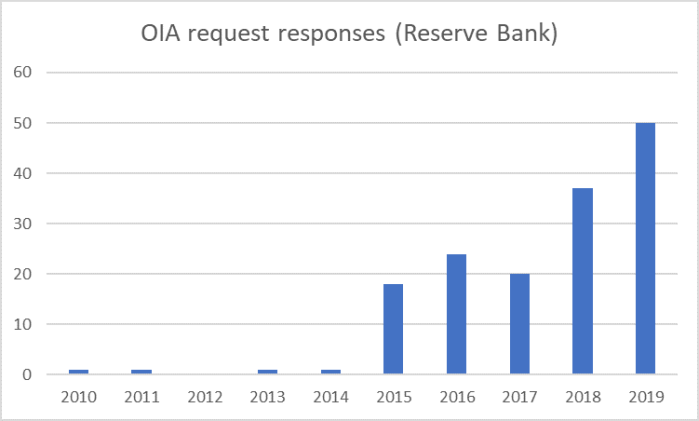
I was looking for something this morning on the Reserve Bank website and was surprised to find a very long list of Official Information Act responses this year.   When I counted, there were 50 for year to date, and it is only mid-October.

Here is the number of responses the Bank has on the website for each year since they started publishing.

RB OIA responses.png

I’m pretty sure it isn’t a consistent series.  Back in the earlier years, they seem to have only published the odd high-profile release (eg papers on South Canterbury Finance, or a joint one with The Treasury on the earthquakes).   They will, almost certainly have had more requests than were recorded here (even abstracting from the technical point that any request for information from a public agency –  be it ever so small a statistical query – is covered by the Official Information Act).

My interest is mainly in the years from 2015.  As it happens, I left the Bank in early 2015 and lodged a number of requests that year, perhaps a third of those shown.  I’ve remained a moderately active user of the Act –  which is what it is there for –  in requesting information from the Bank and the Board.  But the sharp increase in the number of responses shown  in the last couple of years has nothing directly to do with me.

I’m still a bit sceptical as to whether there is really a consistent series. I know that some of the responses I’ve had from the Bank have been published on the website and some not (ones to the Board seem to have been less likely to be published).  And this specific response –  to a National Party request asking for the number of requests the Bank had handled in a particular quarter –  confirms, by implication, that they are not publishing all the responses.  But a minimum of 50 requests over the course of this year to date is many more than the Bank was facing just a few years ago.

For such a powerful agency, making controversial policy and organisational changes, and subject to a review of its legislation, it doesn’t seem an unduly large number.  A few years ago, the Bank got very upset about the (then) rising number of OIA requests (this was 2015/16) suggesting that they were facing unreasonable burdens, threatening to charge etc etc.  As I pointed out at the time, there was no evidence they were facing as large a burden as (say) The Treasury –  which has 87 responses published so far this year – and I hope it has been something of a salutary lesson for them that the number of requests has only increased over the last few years.

The Reserve Bank Board may choose to do no serious scrutiny, to do little about holding successive Governors to account, but Parliament long ago provided for citizen scrutiny, through the (much abused and avoided) mechanisms of the OIA.  It is good to see people using those provisions.

Better still, of course, would be if the Board and the Minister of Finance were adequately doing their job, holding the Governor and the Bank to account on process, substance, and conduct.


Unfit to govern?

I’m presuming Stuff’s Kate MacNamara won’t be very welcome at the Reserve Bank for quite some time.

She was the author of the double-page spread in last week’s Sunday Star-Times about the Governor (“Portrait of the Governor as a strongman” – note that is one word, not two, and the difference is quite important).  I wrote about that earlier in the week.  As a reminder of some of that article, it included this

The video of the conference remains on the Reserve Bank’s website. Some reporters said they were stunned Orr would air his anger so publicly and called it bullying.

But other observers were not surprised. Details of Lubberink’s experience were already circulating in Wellington and industry sources say they match a pattern of hectoring by Orr of those who question the Reserve Bank’s plan.

“There is a pattern of [Orr] publicly belittling and berating people who disagree with him, at conferences, on the sidelines of financial industry events,” said one source who’s been involved in making submissions to the Reserve Bank on the capital proposal.

There have also been angry weekend phone calls made by Orr to submitters he doesn’t agree with.

“I’m worried about what he’s doing.”

The source said some companies have “withheld submissions,” for fear of being targeted by Orr.

“They’re absolutely scared of repercussions. It’s genuinely disturbing,” he said.

and this, re the Governor’s approach around the bank capital debate

In the cut and thrust of the debate, Orr’s jokey style and everyman charisma fell away. In recent months he’s dogmatically insisted the cost of his plan would be minimal and has picked personally at critics in the media, academia, and the financial services industry.

He’s been variously described as defensive, bullying, and perilously close to abusing his power.

“He’s in danger of bringing scorn on his office,” said long-time industry watcher David Tripe, professor of banking at Massey University. “I used to know him well. I no longer feel so confident.”

The Governor was reported to have refused any comment when approached for that story.

MacNamara followed her story up with a detailed piece on the Bank’s staffing and the loss of a succession of highly-qualified and experienced researchers over this year.  Names were named –  people who probably hoped never to see their  names in the general media –  and specific information was clearly provided to the journalist from insiders and people still very well-connected to the Bank’s Economics Department.  The story listed the departure of seven capable researchers who had left in the last year or so (and, at that, missed another name).  Those are large numbers.   In my time at the Bank it would have been rare to have had more than perhaps 10 researchers across the (then) Research and Modelling teams.

MacNamara’s sources were clearly keen on promoting a narrative of a hugely important and influential research function.  One might perhaps say, if only.  I have a high regard for several of the people in the list of the departed.     But the Bank’s key policy initiatives in recent years, whether in monetary policy or financial regulation, didn’t stem from, and were rarely directly supported by, good quality research generated by Bank researchers (there was some good work done, but often fairly tangential to the Bank’s immediate interests/needs).   The sources were also apparently keen on recently departed, having been effectively demoted, former chief economist John McDermott.  I have been on record as believing that Orr’s decision re McDermott was one of the better he has made, and as senior manager in charge of the research function McDermott has to take responsibility for the limited relevance of the research function over the last decade.    Even the Bank’s macroeconomic analysis was pretty underwhelming over much of that period.  All that was under previous Governors.   I’m critical of Adrian Orr for many things, but he can’t be blamed for that (whatever mix of factors played a part in the individual choices of the researchers to leave – and several of those who left were foreigners who had probably never seen their long-term future being in New Zealand).

The Bank must have been taken aback by MacNamara’s forthcoming story

A Reserve Bank spokeswoman said she could not answer quickly questions about staff departures and replacements.

She was unable to say how many staff with graduate degrees in economics or finance have departed in the last 18 months.

Neither could she tally immediately how many staff have joined in that time with similar academic credentials.

Pretty bad staff work, given that they must have known this issue was a point of vulnerability –  even the Annual Report had included a table showing high total staff turnover –  for which they should have been prepared.    Since the Bank publishes a page with details of their Economics Department research and analysis staff, it only took me a few minutes to run down the list and find several new PhD staff the Bank had hired relatively recently (albeit, by the look of it, only one with any knowledge of New Zealand).   It shouldn’t have been hard for the Bank to have got that information to the journalist.

(The article is mostly focused on the Economics Department, and although the journalist attempts to draw connections to the Bank’s poor performance around the bank capital proposals that is a bit unfair to the Governor – only rarely have Economics Department research staff had anything much to do with financial regulatory issues. Maybe it would be better if they did –  I used to argue for a broader focus (ie some actual research around the regulatory functions –  but the choice not to also long pre-dates Orr.  The absence of these particular researchers will have made little or no effective difference to how the bank capital proposals were made and marketed –  those choices were the Governor’s.

The sources who spoke to MacNamara were clearly also keen on PhD qualified staff.  The story highlights that there is no PhD held by anyone in the top-tier of the Bank (first time since 1988 I think), and repeats the contrast between the qualifications of McDermott and his replacements (new chief economist, new Assistant Governor).    Personally, I think this issue in considerably overdone.   Qualifications are not without value, of course, but research qualifications only take you so far in managing and leading a public sector policy organisation.  As I’ve pointed out, over the last 40 years the Bank has had 10 chief economists, only four of whom had PhDs, and at least on my reckoning both the best and worst of them had PhDs.   During the period when the Reserve Bank of Australia was widely-regarded as one of the best central banks in the world, it was led by people with much the same sort of academic qualifications as, say, Adrian Orr.  The presence or absence of a PhD at the top table is not what gave us a rushed, over-reaching, capital proposal with no ex ante cost-benefit analysis.  That is much more about the temperament and character of the Governor (and his right hand people who clearly weren’t willing or able to insist on something better).  In fact, the chair of the Bank’s Board not only has a PhD but is a university vice-chancellor no less, and he claims (in the recent Annual Report) that all is just fine at the Bank.

In many respects I don’t disagree with Eric Crampton’s concluding comment in the article

Eric Crampton, chief economist at the public policy think tank The New Zealand Initiative, said it mattered more in a small country like New Zealand that the Reserve Bank has internal research depth.

“There are very few academic macroeconomists and monetary theorists who pay much attention at all to New Zealand policy. There are, at most, a small handful who do.

“That means that having some of that serious firepower in the Bank matters more,” Crampton said.

Except that, in reality and in other countries, research depth inside and outside the central bank tend to be complements rather than substitutes.  And there is little point in having much of a research capability if it isn’t used to support robust policymaking and analysis. It hasn’t been for some time at the Bank, and that is mostly a reflection on a succession of senior managers and Governors (now including Orr), not on the staff involved.

The real prompt for this post was when, by chance, I noticed a statement from the Bank on its website, apparently released with no fanfare yesterday.  Here is the whole thing.

integrity.png

Get the sense Orr is feeling a bit embattled?

But instead of fronting up to, say, Kate MacNamara we get bluster and distraction (and this common confusion –  often found among senior public servants these days –  about the name of the country).

No one criticised their individual staff.  If there are criticisms to make they are of the leadership itself, mostly that of the Governor –  both because he is chief executive, and because he has a long track record of surrounding himself with people who will do his bidding and not challenge him.

See how the Governor suggests that the Bank somehow has a higher capacity for identifying what is good for New Zealand (yesterday, today and forever) than others, or even that they have a mandate to do so (they don’t).

See his claim that he holds “informed and mature conversations”, and contrast that with, for example, the rushed way they put out the bank capital proposals, the backfilling they had to do as the year went on, the refusal to engage on the substance of any concerns/challenges, the attempts to slur critics and regulated institutions alike, and those descriptions above of Orr’s “angry weekend phone calls” and the like.  This is the same Governor who has not given a single substantive speech on either of his core areas of policy responsibility in over 18 months in office.  It would be unheard of in any other other advanced democracy.

It is past time the Minister of Finance took the situation in hand. He is the one actually accountable to the public for the Reserve Bank.  He needs to be asking the Board chair and the Governor just what is going on, and why they are content for bluster to substitute for serious analysis and considered engagement –  not from staff, but from the Governor himself.   The problems at the Bank are at the top –  Board, Governor, and a weak senior management team –  not among the staff.   The Governor’s statement is an attempt at distraction, trying to suggest he is sticking up for staff (who don’t need it) when the problems start with him (and those paid to hold him to account).

Bluster shouldn’t be able to substitute for serious accountability.


The NZIER Economics Award: creative writing

An Eric Crampton tweet earlier this week brought the news that former Reserve Bank chief economist John McDermott had been awarded the NZIER Economics Award.

John was my boss for six years or so.  We sat across from each other and exchanged notes on all sorts of things, including our (then) young families, which has always left me a bit hesitant about writing about him.  But when you hold a high profile, influential, public position you have to be open to challenge and scrutiny.  My summary: nice guy, wrong job (notwithstanding the Yale PhD).

The NZIER award, typically offered annually, used to be a high profile, and quite lucrative, thing –  Qantas were sponsors and, from memory, there used to be a decent airfare on offer.   It has been awarded for 25 years now, and the list of past recipients is, in many respects, a moderately impressive one, at least by New Zealand standards. It isn’t clear what the selection criteria are, but winners have been drawn both from academe and from “the great and good” officeholders more generally.   There is, perhaps, a hint of the establishment looking after its own  (it isn’t obvious for example what Paula Rebstock has done for or with economics), but perhaps that isn’t very surprising from such an establishment body as the NZIER, and when the Governor of the Reserve Bank and the Secretary to the Treasury have representatives who make up two of the six person selection panel.  There are a few surprising omissions, even among establishment figures.

Since the selection criteria are unknown, it is hard to tell whether the McDermott award is really justified.  Of those who weren’t primarily academics up to when they received the award, all of them seem to have run something (Suzi Kerr founded Motu and Brian Easton was head of NZIER for a time), while McDermott only ever held a second-tier position, albeit as manager in charge of one of the larger groups of economists in the country.   He has published some research –  I recall him telling me a few years ago that some work he’d done in his youth at the IMF meant he was still the most-cited economist in New Zealand –  but most of it was a long time ago.

Having said that, the reason for this post isn’t really to question whether McDermott should have received the award, although with two of his former staff (including his successor) on the selection panel there is the risk it could be seen as something of a consolation prize, McDermott having been somewhat sidelined and demoted by Adrian Orr last year, prompting his departure from the Bank.    But if the establishment want to give each other baubles –  even as the New Zealand economy continues its long-term underperformance –  I’m not really going to quarrel much.

My problem is with the citation which seems to be an almost entirely imaginary recreation of history.  Whoever wrote it doesn’t know what they are talking about –  or, just possibly (since the Bank’s chief economist is on the committee) did but made stuff up anyway.  It starts this way

Dr John McDermott has been the foremost macro-economist in New Zealand policy circles for at least the past decade.

Perhaps, but there are slim pickings.   And one might reasonably expect the chief economist of the Reserve Bank –  in its monetary policy responsibilities, a macro institution –  to be counted thus, at least if (as in this case) successive Governors and Deputy Governors didn’t qualify.    After all, “foremost” doesn’t mean “best” or “most productive”, “most insightful” or “most challenging” but

“most prominent in rank, importance, or position”

Thus far, the award seems to be for turning up to his well-remunerated job.   But it goes on

He was Chief Economist and Assistant Governor at the Reserve Bank of New Zealand from 2007 to 2019. Over this period, John has been a beacon in ensuring that economic rigour is brought to bear on policy formulation.

I just cannot believe that anyone around the Reserve Bank over that period could say that stuff (“beacon” etc)  with a straight face.   It just wasn’t so, whether on monetary policy or in the other areas of Bank policy (where, as Assistant Governor, he sat on the key advisory committees).   On monetary policy, in particular, I’m not wanting to suggest that he was opposed to rigour or anything of the sort, but there was simply nothing very distinctive about the voice he brought to the monetary policy table, or to the analysis/advice that staff provided.  A few years ago, a former colleague noted to me that –  now outside the Bank –  he’d been digging into old Monetary Policy Statements and that what was noticeable was how mechanical they had become (this over John’s time).

On the other areas of Bank policy, John might as well not have been there.  Perhaps things changed in his last few years, but for years we both sat on key internal committees responsible for financial system oversight, macro-financial policy, and the Bank’s own balance sheet.   John might as well not have been at them –  and frequently bemoaned having to attend (some of the FSO papers were really pretty dull).  When LVRs were first in the wind, for a while he refused to believe the Governor was serious, and then was more interested in closing down any criticism or attempts to improve the supporting analysis (probably more as His Master’s Voice more than from his own preferences) than in leading the charge for rigour.    Sure, he had a busy management role in his own department………but contributions beyond that are largely imagined.

Then we get the GFC puffery

John began his senior role at the Reserve Bank of New Zealand just prior to the onset of the Global Financial Crisis. It is difficult at times such as this to draw on experience of prior crises because, by nature, crises are rare and each differs from the one before. It is at times such as this when a combination of a deep understanding of economic forces plus common sense is required. The team at the Reserve Bank, led by Dr Alan Bollard and supported by the macroeconomic expertise of John McDermott and his colleagues, ensured that the GFC impinged only marginally on New Zealand (relative to most other countries).

Um….there wasn’t a financial crisis in New Zealand, we had a fairly deep recession and a slow recovery, and on the monetary policy side the Bank –  a little belatedly –  did what it had to do, and cut the OCR dramatically.  It is what inflation targeters do.   Liquidity support measures weren’t led from the Economics Department –  former chief economist and then Deputy Governor Grant Spencer led those functions – other interventions were led from The Trasury, and if anything John’s Economics Department was slow to recognise the seriousness of what was unfolding abroad (in late 07 and early 08). John himself in mid-2008 was still more worried about rising inflation expectations.   I think Alan Bollard deserves a fair degree of recognition for that period-  but he has already received the NZIER award.

Then we get onto research

John’s contributions have shone through not just in his direct contributions to policy-making (such as during the GFC) but also through his championing of economic rigour amongst his colleagues within the department that he led at the Bank. Policy-relevant research from experienced colleagues such as Ozer Karagedikli and Christie Smith are relevant examples.

I hope Ozer won’t mind me saying so, but this is pretty extraordinary stuff as mostly he and John didn’t get on that well, and I recall plenty of management meetings with John bemoaning Ozer’s contribution (which personally I thought was pretty significant, and his departure abroad recently is a significant loss).

More generally, the Bank’s research function has constantly struggled for viability and regard from the Bank’s senior management, even though the chief economist himself had a strong interest, and past experience, in research.    John should have been able to shape the flow of research product, and shape the interests of the senior management customers, in a way that made a more secure, and central, place for good quality research, whether on macro or financial regulatory issues.    But he didn’t.

More specifically, if one looks back over the 12 years McDermott was chief economist it is hard to spot any really influential New Zealand specific research generated by the Bank.  I’m not saying there was not some good stuff done –  some overseas awards were even won – but there is no distinctive and insightful Reserve Bank take on, for example, inflation processes over the last 10 or 15 years, the conduct of monetary policy, or really anything or the sort.

And is there a single compelling insight –  whether from speeches, press conferences  comments or whatever –  that one associates with McDermott?    An Andy Haldane or Ben Broadbent he hasn’t been.

As we get towards the end of the citation, the gush only flows more freely

John’s academic credentials are undisputed. What sets him apart from many of his highly trained academic colleagues is his ability to bring those academic credentials to play in shedding light on real world problems facing central bankers and other macroeconomic policy-makers.

John has set an example to colleagues and institutions alike: top class economists can make very important contributions to real world policy-making, while good economic policy requires the input of rigorous thinking from excellent economists. John has set a very high standard over an extended period showing how this match can work for all concerned.

They are almost unrecognisable descriptions, better suited perhaps to the creative fiction department, or a volume of hagiography.

I could go on.   I think John had a degree of genuine intellectual curiousity, and he read fairly widely.  But too often –  apparently under pressure from above – he became an agent for shutting down debate or discussion (internally) rather than opening it up.   And, as I’ve noted here previously, his speeches tended towards the ponderous, rarely offering any particular insight.  If his instincts were sometimes sound –  if perhaps not when he was championing a 50 basis point OCR hike in late 2011 –  he too often found himself not shaping the organisational view but forced to parrot the gubernatorial line.

And for all the talk of insight and rigour, wasn’t John responsible for the forecasting function of the Bank that provided the underpinnings that led the Reserve Bank into two post-crisis tightening cycles, both of which had to be fairly quickly unwound?   Was there any evidence that this was going against John’s best insights or endeavours?  Not that I observed?   Even late in his term, did anyone reading Bank material have a real sense that the Bank –  with John supposed to be at the intellectual forefront –  was breaking new ground, was ahead of the pack in understanding quite what was going on with the economy?

Oh, and when it comes to shutting down debate/discussion/criticism, I was being reminded yesterday of John’s part in the Toplis affair.    You might recall that in 2017, Graeme Wheeler took offence at some critical commentary on the Bank’s monetary policy by BNZ economist Stephen Toplis.  All sorts of things bother chief executives, but in the circumstances, the role of the Bank’s chief economist (and the rest of the senior management) should have been to get the Governor to see sense, to calm down, and to recognise that debate and strongly-held differences of view are part of being in public office.  Instead, McDermott allowed himself to be actively used by Wheeler in attempts to put pressure on Toplis, both directly and through pressure on the BNZ itself, to shut him down, and get him to stop being so critical.   I’m told that McDermott’s managers were all cheering on this effort, so there is no sign that he was even a reluctant participant.  In someone who had themselves been a trading bank chief economist, it was particular disappointing and inappropriate performance.    But across his entire term, he functioned more as His Master’s Voice (really why he’d been hired –  as safe) rather than as the sort of intellectual or policy leader the NZIER citation makes out.  He wasn’t even a champion of greater openness or transparency –  and I will always remember the complaints about independent voices on Monetary Policy Committees (he had a particular aversion to Lars Svensson’s –  correct –  opposition to the premature Swedish tightenings).

If there really was a heyday for Reserve Bank research, intellectual ferment, and policy leadership it probably dates back several decades now to the time of Roderick Deane (an early recipient of the NZIER award).   The last decade wasn’t disastrous – at times there were good initiatives, at times good people –  but the legacy of McDermott’s term (whether in people, policy outcomes, policy analysis, or Bank reputation) isn’t one that looks as though it warrrants anything like the creative puffery in this citation.

The award seems like a rather sad reflection on the diminished state of the New Zealand economic policy institutions.

As for Eric, with a bit of feedback from a correspondent (not me) he has now revised his view (the last sentence of that tweet at the start of this post).

Monetary policy speeches and conferences

This week marks 17 months since Adrian Orr took office as Governor of the Reserve Bank.  In that time, there has been not one consequential on-the-record speech from the Governor on the areas of his core responsibility: monetary policy and financial regulation/stability.  It is a quite extraordinary record.  It is probably not matched by any of his predecessors for decades, if ever –  and for the most of the period prior to 1989 Governors had little formal power, and thus perhaps there were fewer expectations about scrutiny/accountability etc.  It is all the more puzzling in an individual who doesn’t seem shy of the limelight on other matters and who, if the substance is often lacking, is never short of a good turn of phrase.

The Governor currently wields great power personally, and alone, on bank regulation.  The bank capital review is proceeding, and yet we’ve had not a single speech from the Governor about this most consequential judgement that he alone will take –  nothing, for example, on his framework for thinking about the issues and risks, nothing about key uncertainties, just nothing.

On monetary policy, legal responsibility is now shared around a bit.   There are now three external (part-time) MPC members, and not a word has been heard from any of them. whether in interviews or in speeches.  There have been a couple of sets of remarks by Assistant Governor, Christian Hawkesby, but it looks as if central bankers have to leave New Zealand before they are allowed to give speeches: both sets of panel remarks were to groups of central bankers at overseas conferences.  Of the first of those, I noted

it was disappointing, to say the very least, how much political spin suffused the speech, and how lacking in analytical substance it was. 

The more recent effort was better, but still with little to suggest senior people with a really good grasp of the issues and challenges, or willing to make themselves accountable for their analysis and reasoning.

Oh, and you will recall the Bank’s apparent reluctance to engage openly on any of the issues, or work they are undertaking, around potential issues and options if the OCR reaches the effective lower bound (on current laws and technologies).

And all this while they repeatedly try to tell us how open and transparent they are.

On Friday a press release from the Reserve Bank dropped into my email inbox.    The subject line was, no doubt, designed to impress

RBNZ and IMF join efforts on the future of inflation targeting

The Reserve Bank –  constantly complaining it is short of money –  and the International Monetary Fund are, we were told, this week hosting an international conference (“delegates from around the world”).  There was LOTS of enthusiastic rhetoric.

From the Reserve Bank

While inflation targeting has had a history of success in delivering low, stable inflation and substantial macroeconomic stability over the past several decades, the last 10 years have proven to be challenging for monetary authorities.

RBNZ Assistant Governor and General Manager of Economics, Financial Markets and Banking Christian Hawkesby says: “We are now faced with stubbornly low inflation and low interest rates, driven by structural and cyclical factors. If monetary policy is to be successful for a further 30 years, we need to confront these challenges.

“This is what this conference is about — understanding the big questions about inflation targeting and considering how we need to adapt to continue being as successful as possible.”

And from the IMF

The IMF’s Director of the Office for Asia and the Pacific, Chikahisa Sumi, says that the conference is a timely event.

“New Zealand pioneered inflation targeting three decades ago. Most recently, the RBNZ has again been among the pioneers in the central bank community when revisiting its monetary policy framework.

“Discussions about these frameworks currently happen not only in advanced economies but also in many emerging market countries. This conference is happening in the right place, at the right time, and with the right participants.

“We are delighted to work closely with the Reserve Bank of New Zealand in providing this opportunity for experts from both advanced and emerging economies to share and gain cutting-edge insights about the future of monetary policy making.”

Which all sounds rather impressive, even if one couldn’t help wondering about exercises like this going on behind closed doors –  rather than, say, open speeches – as they debate things safely with those on the approved list.

And yet for all the fine rhetoric, the conference programme –  there was a link attached –  didn’t really seem to match up.   Once again, the Governor isn’t speaking.  Neither are any of the external MPC members.     There are eight quasi-academic papers being presented, only one (on a non monetary policy topic) by a relatively junior Reserve Bank researcher (who is also the only Reserve Bank discussant).   Perhaps more interestingly, despite all that talk about “confronting the big questions about inflation targeting”, not one of the eight academic papers looks as though it is likely to do anything of the sort (judging by the titles).  There are a couple of panel discussions in which the Assistant Governor and the Deputy Governor are participating, but an hour and four panellists suggests something more akin to once-over-lightly  – even if important issues might get briefly mentioned –  than in-depth scrutiny.

Remarkably, as the advanced world is now in a renewed easing phase, and the worrying scenario of going into a new downturn with little or no conventional monetary policy capacity is now an immediate issue, not a single paper at the conference looks to be addressing any of these issues, or whether (for example) differently-specified targets might have avoided the current predicament or might help emerge from it.

In sum, it looks as though they will be spending a lot of taxpayers’ money on a series of very detailed papers, looking at issues of (at best) second-order importance, while trying to spin the conference as something “cutting edge about the future of monetary policy making” when there is little sign of it being anything of the sort.  In that respect, the conference –  despite the hype –  looks like a pallid imitation of one held here five years ago that really did attempt to address at least some of the bigger-picture issues.

I was intrigued by the IMF Director’s comment

This conference is happening in the right place, at the right time, and with the right participants.

Dissidents, critics, and sceptics seem not to the “right participants”, but I have lodged an Official Information Act request with the Reserve Bank to find out who was invited and who has accepted the invitation.

For New Zealand, it is hard not to think that a more open forum, engaged with the specifics of the New Zealand economy, and the issues and options facing policymakers in New Zealand (informed, of course, by overseas experience) would have been a better, and more legitimate, use of public money.    Perhaps even a speech on monetary policy by the Governor.


Appointing an MPC: worse than Trump?

Interest.co.nz had a story yesterday picking up on the Official Information Act releases (from the Minister and from the Board) I wrote about the other day about the appointment of the members of the new Monetary Policy Committee.  The story focused on the weird decision to exclude from consideration “any individuals who are engaged, or who are likely to engage in future, in active research on monetary policy or macroeconomics”.     This wasn’t just a hypothetical: at least one person who could have been quite suitable for the MPC was actively turned away on these grounds.

The tweet promoting the story sums up reaction quite well

One measure of how crazy this is, is that Don Brash has been willing to comment on the record.  Whatever else he talks openly about, Don has generally been very careful not to comment much about Reserve Bank matters since leaving office as Governor, and he is the chair of a bank the Reserve Bank (prudentially) regulates.  And yet this time he has spoken out.

“One would’ve expected the members of the MPC to be experts in monetary policy, or at least macroeconomics more generally. It seems quite extraordinary to exclude people who would have that kind of expertise…

The claim has been that the issue here is about “conflicts of interest”.   Conflicts of interest were, and always will be, a real and important issue to consider in putting together an MPC.   We couldn’t, for example, have as an MPC member someone who was advising clients on monetary policy and macroeconomics, or who was actively trading financial markets themselves.  I hope all the MPC members have suitable stand-down periods written into their terms and conditions that mean that members can’t leave the MPC one day and turn up advising a bank or hedge fund on New Zealand monetary policy a very short time later.

But “conflict of interest” is one of those labels that is sometimes flung around loosely, as a weapon against people someone is trying to exclude, without sufficient calm deliberation as to the specific nature of any alleged conflict.    There is simply no conflict of interest involved in having someone on the Monetary Policy Committee who is doing, or is likely to do, active research in monetary policy or macroeconomics.  In fact, it would be highly desirable to have at least one such person on an MPC.  It isn’t a conflict so much as a natural complement.

There might, appropriately, be rules about such a person not being able to, say, sell their research findings to a hedge fund or an advisory firm.  There might, appropriately, be rules about them not trying to trade the research results (in the unlikely event that the research results were that good.  That would be no different than (see above) prohibitions on selling advice on related issues.  And any (external) member of the MPC should have no better access to –  or ability to use for research –  Reserve Bank data than any other researchers.    But actually having someone on the MPC who was thinking and writing about monetary policy and macroeconomics –  whether quantitatively or through other approaches – would normally be a plus rather than a minus.

In truth, there aren’t that many people in New Zealand who would fit the description (researching now, or likely to in the future, monetary policy or macroeconomics), but that isn’t really the point (and overseas people with such expertise should have been able to have been considered for at least one slot).  One of the old arguments against a committee was that it would be hard to fill it: harder still (with capable useful people) if you rule from the start people actively engaged in thinking and/or writing about the issues.

And it isn’t as if the management majority on the MPC is so stocked with monetary policy or macroeconomic expertise and experience that any more might simply be redundant (although diversity of view and perspective, and informed challenge, would be valuable even then).   Of the four internals, probably only the Governor has ever done anything that might reasonably be called research on monetary policy and macroeconomics, and that will have been the best part of 20 years ago.

In a comment on my earlier post someone (whom I deduce to have been a former Reserve Bank staffer) noted

A former colleague used to say that if Bernanke, Yellen, Williams, Orphanides, Bean, Forbes, Posen, Pagan or Gregory were Kiwis they would have stood no chance for a role at the RB. I started agreeing with him more.

That covers the Fed, the ECB (central bank of Cyprus), the Bank of England, and the RBA. And it isn’t even remotely an exhaustive list of the people serving on decision-making monetary policy committees in the last few decades (whether in executive or non-executive roles) who would have been excluded on the bizarre criteria the Minister and Board have cobbled together.

There is a list of all former UK MPC members here, and the sort of people Robertson, Quigley and Orr would have excluded would include (in addition to those in the quote above) (and still non-exhaustively) Charles Goodhart, Willem Buiter, Sushil Wadhwani, David Miles, Danny Blanchflower and, of course, Andy Haldane.    Lars Svensson (and a bunch of other who served at the Riksbank) would be excluded.    So too would Alan Blinder (former vice-chair of the Fed), Stan Fischer (another former vice-chair and former Governor in Israel) Ric Mishkin, Jeremy Stein and, just of the current FOMC and alternates, John Williams (president of the New York Fed) and several others.    It is simply an absurd stance.

One measure of the absurdity is that Donald Trump –  hardly a byword for trust in expertise –  hasn’t applied the same sort of standard.  One of his latest two nominees to the Board of Governors is Chris Waller, Director of Research at the St Louis Fed –  who had a new empirical article out on monetary policy just a couple of months ago.  Earlier Trump sought to nominate Professor Marvin Goodfriend, an active researcher on monetary policy issues (and often more “hardline” than the Fed).  It is the sort of standard people generally expect to be applied –  not all active researchers by any means, but nothing like the sort of Robertson-Quigley-Orr (RQO) blackball  – when it comes to the monetary policy decisionmaking body.

By the RQO logic, you wouldn’t anyway actively engaged in monetary policy research as one of the internal appointees either.  Which would be equally absurd.  Just as well, I suppose, as none of them are, but in most central banks –  with four internals on a committee –  you’d probably expect at least one would meet that standard.

What do the Minister and Bank have to say for themselves?

Here is the Minister’s take

Robertson admitted: “It was a difficult balance to strike and we certainly had conversations about where it should lie.

“The idea is that we want the person to be able to focus on the MPC work; that we’re not looking for a lot of public comment on that work.

“It’s where you draw the line between somebody’s professional working life and commenting on aspects of the economy or aspects of monetary policy that the Committee would be considering.”

Robertson didn’t accept the argument those with the skills to be on the MPC were the sorts of people highly likely to do “monetary policy” or “macroeconomic” research when their terms were up, and ruling them out would severely limit the talent pool.

Robertson said members having a good understanding of monetary policy was important, as was ensuring they have a range of backgrounds.

“Over time this will evolve. What I’m trying to say is that I actually have some sympathy with the view that we do want informed people on the committee. I think we’ve got that, but we do have to get a balance.”

(Note that there was no hint of those “conversations” was in the OIA releases from either the Minister or the Board.)

To be fair, it doesn’t sound as if this blackball was really his idea.  Perhaps he isn’t even really that keen.  But it still isn’t a very convincing response.  Being an external member of the MPC isn’t a full-time role –  it was advertised as being about 50 days a year –  so you might have supposed that someone (eg an academic) doing research in the broad area of monetary policy or macroeconomics (macro is a big field might offer a bonus –  the taxpayer gets the benefit of that work without having to pay them to do it.    And quite how doing academic (or similar) research on macro issues after they left the MPC should be disqualifying, well….tells you all you really need to know.  The aim was about excluding capable, energetic, knowledgeable people –  experts who might have made a valuable, if potentially awkward for management, contribution to a diverse committee.   And, to sheet home responsibility, I don’t suppose Robertson really cared that much but Bank management will have.

The Bank’s response was interesting.  Recommendations of MPC appointments were a matter for  the Board, chaired by Waikato University Vice-Chancellor Neil Quigley.   Quigley apparently wasn’t commenting –  rather makes my point about an unaccountable shadowy Board, in this one of their few areas of formal power –  but a Bank staffer provided this comment.

The RBNZ spokesperson likewise said: “The full seven-member monetary policy committee has a broad range of economic expertise that does include monetary policy, labour markets, macroeconomics, asset markets, financial markets, agricultural economics, international trade, fiscal issues, taxation, etc.”

(Without getting into the substance of those claims) that response simply doesn’t address the issue at all.  It is little more than stonewalling and distraction.   Part of the point about externals was to provide a counter-balance, an alternative perspective, on management.  What possible grounds could the Bank have had for such a blackball on specific research expertise and interest in monetary policy or macroeconomics?  An academic expert in wellbeing is fine apparently, but not one who is actually expert in monetary policy, macro or financial markets.   Almost beyond belief.

Almost, but not quite.  Because in all these debates over the last five or six years that presaged the move to a committee, management never ever wanted to materially dilute its influence, power and control (Wheeler wanted to set up a statutory committee that was only him and his senior staff, appointed by him).  In response to a question from Eric Crampton on my post the other day I noted

I don’t think it is really a conflict of interest issue, but more one about the “collegial” model that the Bank management largely persuaded Robertson to go along with. They don’t really want MPC members taking an independent stance, or presenting conference papers that might raise questions (no matter how indirectly). Bank management tended to have a very negative view of the role Lars Svensson played at the Riksbank, and were also influenced years ago by negative views from BOE management about the way some external MPC members played their (then) new roles. They don’t want “big beasts” – they want people who will go along or (charitably) who will quietly ask not-too-hard questions in the closed confines of the Board room.

Remember that even when the Bank favoured a move to a committee – Wheeler tried to get the legislation changed – they never wanted to diminish management influence (that was explicit in Wheeler’s proposal, but strongly suffused what they got Robertson to sign up to). There is no sign Robertson much cared, and altho Tsy was probably a positive influence at the margin, the Bank was more invested in the issues than Treasury.

That still seems about right to me.   Even though –  against the Minister’s initial stance, persuaded by the Bank  – Treasury eventually managed to get provision in the MPC rules for individual members to speak openly, it never seemed very likely those provisions would be used much if at all –  and thus we’ve heard nothing from any of the external MPC members since they were appointed.  After all, the Governor is the boss of the internals (a majority of the committee), not known for his tolerance for dissent (or competing egos), and he played a huge role in appointing the externals (one of a three man interview panel, and the one with time, resources, and knowledge at his disposal).  The prohibition from the start on anyone who knows too much, and might want to go on thinking and researching, was just one more element in the winnowing process to make sure that they secured a tame and safe team.   Buckle, Harris, and Saunders may even add a little value at times, but it will all be terribly safe, and not very demanding. Just the way management like it –  and of course, the Board has always acted as defensive cover for the Governor.  (This hypothesis may also explain how Buckle got on the MPC –  he is now retired, but has done research on macro, and even written a little about monetary policy: the OIA from the Board showed that his name was suggested by……management.)

It might be one thing –  although still pretty undesirable –  if the Bank had covered itself with glory in the conduct of monetary policy and associated economic analysis in the last decade. But that is so very far from being the case –  not only has inflation consistently undershot, but Bank speeches and research offer little that is interesting, insightful or challenging.  And there is little sign now that management is any nearer to having rebuilt an internal capability of excellence –  indeed, reports suggest the internal research capacity has been gutted.  Add in a closed and defensive culture, and the sort of challenge and contest that a couple of people actively working on monetary policy or macro could have brought to the table should have been exactly what the situation demanded.

But management won and mediocrity prevailed.  Robertson, Orr, and Quigley deserve to be the laughing stock of international central banking –  worse than Trump on this score, the only people responsible for advanced country central banking who wanted to ensure that no one with any real expertise –  who might add real value – got near monetary policy decisionmaking (even as the Bank’s own internal research capability has been gutted).¹  The Bank’s international reputation in the 1990s was always a bit overdone (better than deserved), but those who were involved then, and those who once sang the Bank’s praises then – could probably never have imagined things would quite come to this.  But bureaucrats guard their bureaucratic empires, and ministers often let them get away with that.  And so mediocrity triumphs and the opportunity to produce a good quality MPC has passed for now.  Fortunately, the prohibition on expertise isn’t in the Act, this Minister won’t last for ever, Quigley’s term ends soon, and the very future of the Board is up for grabs.  But if you don’t start off new institutions strongly, it is hard to pull them up to a better, more internationally comparable standard, at some later date.  Such a shame.  Such a lost opportunity.

  1.  Well, perhaps they and the Irish Minister of Finance.


Disclosing regulatory actions

I haven’t followed the CBL saga very closely at all. (Disclosure: until the end of 2014 I was a member of the Reserve Bank’s Financial System Oversight Committee, which advised the Governor on prudential policy matters, including insurance prudential supervision.  That Committee rarely dealt with individual institution issues, but nonetheless was part of the overall atmosphere around the Bank’s approach to regulatory and supervisory issues.)

But the one aspect of the CBL story I had paid attention to was the decision by the Reserve Bank in 2017 to ban CBL from telling shareholders, policyholders (actual or prospective), or other creditors of the Bank’s regulatory actions and interventions (specific directions).  It seems extraordinary to say that managers and directors of a company cannot tell their owners –  the people they actually work for – about important developments affecting their (the owners’) company.   It runs against most canons of what we understand about the importance of trust, or disclosure, and of the relationship between principals (owners) and agents (managers and directors).

I also haven’t yet read the full report the Reserve Bank commissioned on its handling of the CBL affair (and remain sceptical that a report commissioned by Bank management –  and which apparently sought no outside perspectives – was likely to be even close to a definitive assessment).  But I did turn to the short chapter 15 (from p136) on “Confidentiality and Disclosure”.

In that section, the reviewers outline the relevant parts of the legislation that the Reserve Bank was using, and was constrained by.   They refer first to Section 135 of the Insurance (Prudential Supervision) Act covers the protection of data supplied to the Reserve Bank for prudential purposes.  This provision is not actually very relevant here: it is mainly designed to ensure that the Bank –  and Bank staff –  can’t, by accident or intent, treat confidential information lightly.     And even then, the Bank itself can choose to release material in a number of circumstances, including these two

(c) the publication or disclosure of the information, data, document, or forecast is for the purposes of, or in connection with, the performance or exercise of any function or power conferred by this Act or any other enactment; or
(e) the publication or disclosure of the information, data, document, or forecast is to any person that the Bank is satisfied has a proper interest in receiving the information, data, document, or forecast; or

Section 136 also allows the Bank to approve publication.   And so stories that suggest that the Reserve Bank was not free to publish information about its concerns or its actions, under pain of potential heavy fines, are just not correct.  The reviewers themselves run this quite misleading line.

The confidentiality obligation on the Bank is an onerous one. Officers and employees of the Bank, and investigators, are liable on conviction to up to three months’ imprisonment and/or a fine up to $200,000 if they do not comply with this provision.

Rogue or cavalier employees are (rightly) at risk.  The Bank itself has considerable protections and freedom of action (again, largely rightly so).

The reviewers then turn to the (much more relevant) provisions around the disclosure of the giving of directives.  In July 2017, the Bank issued to CBL Insurance a direction covering a variety of matters, operating under section 143 of the Act.   Section 150 of the Act makes it an offence for anyone to disclose (other than to directors and advisers of the directed entity) that a direction has been given.      Again, there are substantial fines for breaches.  But, again, this provision of the Act did not constrain the Reserve Bank, because the Bank itself is free to disclose the existence of the direction, or to allow others to disclose the fact of the direction.

The Bank itself has subsequently sometimes sought to imply that really the confidentiality of the directions was CBL’s choice, arguing (factually correctly) that when in February 2018 CBL requested that the confidentiality restriction be lifted, the Bank agreed.    But that looks a lot like distraction. It is clear that, whatever the views of CBL managers and directors, in July 2017 the Reserve Bank was insistent on keeping the fact and content of the direction confidential. It acknowledged as much in a response to an OIA request from NBR in April 2018.

The Reserve Bank’s self-chosen reviewers (the one with some expertise in the field being a former Australian insurance regulator) backed the Reserve Bank’s call on this point.

It was appropriate to maintain confidentiality over these steps. Matters were at a fact-finding stage. The Bank had serious concerns that warranted action, but it had not yet gathered the relevant information, tested it with CBL, and arrived at a sufficiently informed position. Obviously public disclosure of the fact of an investigation or initial concerns that have not yet been tested would be highly damaging to the reputation of CBL and to the value of its parent.

Except that by this time matters don’t seem to have been just at the fact-finding stage.  Rather, the direction imposed specific restrictions on CBL Insurance’s business –  the sort of action the Reserve Bank never engages in lightly (and, as the rest of the report apparently elaborates, coming after several years of concerns and fact-finding).

The reviewers go on to defend the Reserve Bank, arguing

The primary reason for confidentiality is that the Bank, quite correctly, is cautious about releasing information on any licensed insurer (or licensed bank) that may affect public confidence in the licensed company until the Bank is sure of its position. The confidentiality requirement, however, creates a quandary for the boards of listed companies who have a continuous disclosure obligations under NZX rules/Corporations Act 2001 (AU) rules.

In the CBL case, the position is also confounded to some extent by the fact that CBL Insurance is a subsidiary of the listed entity, CBL Corporation, which itself is not licensed.

Given the risks to public confidence in a licensed insurer if the Bank is carrying out an investigation or otherwise querying the credentials of an insurer before anything is proven, it is entirely appropriate for the Bank to maintain confidentiality by not making any public disclosures itself and also exerting control over any potential disclosures by the insurer.

Expressed another way, it is important that the Bank retain the power to intervene at any time in the affairs of an insurer. The Bank has to be able to recognise and choose to act early on any potential risk issue that it identifies and it also has to be able to stand back, without adversely affecting public confidence in the insurer, if the potential risk is not realised.

Before concluding

The Bank’s actions in relation to confidentiality and disclosure in 2017–2018 were appropriate.

We do not consider there was any earlier occasion when it would have been appropriate for the Bank to make public disclosures.

The lack of disclosure at the time of interim liquidation can be said to have been awkward for shareholders because, with no prior disclosure by the Bank or CBL, they were deprived of information that they may well have judged to be relevant to their position as investors. Arguably it was also awkward for policyholders, but that is a secondary matter in the eyes of investors.

On that point we note that CBL Corporation issued two relevant press releases in August 2017. In the first, on 18 August 2017, it disclosed concerns by the Gibraltar FSC over Elite’s claims reserves, the Gibraltar FSC’s reference to possible inadequacy of CBL’s claims reserves, and announced a reserve adjustment. The CBL Corporation share price reacted at the time, falling some 30%, but a week later there was a second press release that promoted the company’s prospects and gave a purported explanation for the claims reserving adjustment. The share price recovered by around 10% and then remained more or less static until suspension of trading in February 2018.

It is the policyholders, however, to whom the Bank owes its responsibility, not the investors. The Bank’s essential prudential concern always must be that policyholder promises can be honoured, irrespective of the fate or views or fortunes of shareholders.

I’m not entirely persuaded, on a number of counts.  And I say that even though it is quite plausible that the way the Reserve Bank handled this specific aspect of the affair (non-disclosure) might have been in accord with common supervisory practice.

Here it is worth having a look at some of the specifics of the New Zealand act.  For example, the purpose provisions in the legislation

IPSA 1

When this legislation was being planned I argued that only the first strand should be included, and recall arguing explicitly that having “promote public confidence in the insurance sector” could, at some future date, be used to defend keeping real problems secret, in ways that might support short-term confidence, but would risk undermining long-term confidence in the sector and in the regulation/supervision of the sector.  That seems like a valid concern.  But even with that provision in the legislation, it provides no clear guidance on whether specific regulatory interventions should be kept secret, since the goal is not to protect individual firms, but with a sectoral focus.  And if one believes in the efficacy of supervision –  I tend to be sceptical –  knowing that the regulator is (a) on the ball, and (b) not hiding stuff, is most likely to support a sound and efficient sector over time, and support public confidence in the bits of the sector where such confidence is warranted.

The Act next has a long laundry list of “principles” –  no hierarchy, no weighting, no nothing (the sort of list Paul Tucker, in his book on delegated power, including to central banks, frowned on).

IPSA 2.png

But they are still worth mentioning because, contrary to what the reviewers imply, the New Zealand framework is not exclusively built around policyholder protection; indeed, even the one bullet that explicitly mentions policyholders puts the “public interest” as of equal importance.  As importantly, look down a couple of rows and you find another principle:  “the desirability of providing to the public adequate information to enable members of the public to make those decisions” (ie regarding insurance), which might argue for as much transparency as possible.  In short, you could pick any approach you like out of these purposes and principles (which makes it bad legislation from a citizen perspective –  albeit beloved by officials), and none of these specific considerations are discussed by the reviewers in considering the disclosure/confidentiality issues around CBL.  At least from the wider public perspective, that was a missed opportunity.

It is worth bearing in mind that as a society we have generally come to favour the continuous disclosure approach various stock exchanges have now adopted. Inside information is supposed to be kept to an absolute minimum, with owners being presumed to be entitled to know of any material developments affecting their companies.  Shareholders provide the capital than underpins the provision of services and markets, including those in insurance.  Continuous disclosure provisions typically have a carve-out where disclosure is prevented by law, and that is what the parent of CBL Insurance relied on in this case (that NBR OIA I linked to earlier has the text of email exchanges with CBL’s lawyers on non-disclosure to the market).   In this case, there was no automatic protection for information about the Reserve Bank’s direction –  which was highly relevant to shareholders, and others dealing with the company and its associates – since the Reserve Bank had full discretion to allow the fact of the direction to be disclosed (an option it explicitly rejected in an email dated 22 August 2018).

In this case, it may well have suited both the Reserve Bank and CBL managers/directors to keep the directions confidential, but their interests are not necessarily representative of either the public interest, or of the specific interests of the owners of CBL, or those dealing with the company. It isn’t even clear that their preferences aligned with the interests of policyholders, here or abroad: rather it is a paternalistic approach that says that the supervisor is better placed to look out for the interests of policyholders than are (actual or potential) policyholders themselves.  The evidence for that proposition seems slim –  including, in this particular case, based on what we read of the Bank’s handling of CBL over several years.

There are no easy or straightforward answers to these issues, which is why it would be valuable to have a fuller, and more open, exploration of the issues.    In principle, I believe it would be better –  including reducing the risk of the supervisory being morally liable for any later losses in a failure event –  for the default presumption to be that any use of formal direction (or similar) powers by a prudential regulator should be disclosed by that regulator, and should be subject to usual continuous disclosure provisions in the case of listed entities.     The alternative both corrodes public trust in regulatory agencies –  what are they up to that we don’t know about? –  and corrodes the trust that needs to exist, and be robustly nurtured, between managers/directors and owners and creditors of private business entities

But there are risks to adopting this approach.  The ones I’m concerned about – at least in the insurance sector –  aren’t some sort of market panic (runs on insurance companies don’t have the meaning they do for banks).  The share price of a listed entity might fall sharply –  but that seems an appropriate possibility –  and people might become more reluctant to deal with the firm (ditto, at least until after hard questions have been adequately answered).   My concern is more that disclosure might make the supervisory entity more reluctant to act when it should, and more reliant on moving into the non-legal shadows, relying on pressure and threats of direction.  Perhaps too we would risk seeing courts more actively involved as the regulated entity sought injunctions to stop a supervisor using directive powers?     Those are real risks that need debating, but they should not be conclusive arguments, especially when the alternative involves the regulator and managers/directors getting together to keep highly valuable information from shareholders (whose money is mostly at stake), policyholders, prospective policyholders, and other creditors.

My interests are really less on the specific CBL case –  although specific cases help focus attention –  than on thinking about potential problems with banks at some future date.  There are very similar powers in the Reserve Bank Act re the confidentiality of directions to banks, and the issues get even more complicated because (a) bank runs are a real issue, (b) our bank supervision legislation does not have a depositor protection focus, (c) the disclosure regime has been designed to encourage creditors to take responsibility for themselves, (d) the proposed deposit insurance regime is very limited in scale, and (e) most of our banks are subsidiaries of foreign listed entities (can the Reserve Bank enforce directions on Australian parents?).  My own prior is that the world’s banking regulators do not have such a stellar record that we should be entrusting them with such powers of coerced silence, preventing companies telling their shareholders and creditors etc that they are subject to directions from the regulatory authority.  Perhaps the best thing might be more directions, made public at the time they are given as a matter of routine, so that markets, media, and the public can learn to weigh and evaluate the significance or otherwise of the issues and risks the regulator is highlighting.

I’m sure mine is a minority position, and I’m putting the issue out there as much as anything to try to encourage some reflection and debate on the issues.  In reality, perhaps the issues are not be black and white (in general –  although each specific involves final decisions), but regulators need to demonstrate that they have earned the trust, and extensive powers, reposed in them.   And our laws, and the applications of them, should be framed against principles of open government, accountability for regulatory agencies, and a belief that –  within government and within firms –  sunlight is typically the best disinfectant.

On which note, it is now the school holidays and we are heading off to find some sunshine and warmth.  Most likely there won’t be another post here until 23 July.


Cavalier lawlessness

There does seem to be a growing sense among far too many public agencies that laws don’t really apply to them, only to other people.    This is particular so in respect of the Official Information Act.

A TVNZ journalist nicely illustrated this sort of contempt for the law in a tweet the other day

In similar vein, I had an experience a couple of months back in which the Police simply ignored the statutory deadline (“no later than 20 working days”).  Since they were the Police – ideally, examplars of upholding the law –  I lodged a complaint with the Ombudsman.  The Ombudsman actually dealt with the complaint reasonably promptly and I had a letter from them basically saying “we pointed this out to the Police, who accepted that they had missed the deadline”,  and “and now there is nothing more we can do”.  There are no sanctions in the Act, and not even the pretence of an apology from Police.

The Ombudsman also dealt reasonably promptly with a similar complaint about the Reserve Bank.    They had delayed and slow-walked (using the formal extension provisions in the OIA) the release of material supporting their position on the bank capital proposals –  material which, when finally released, turned out to be quite limited, and which had been given to other members of the public long before.     The extension looked to have been pure delaying tactics, deliberately obstructive, and so I complained to the Ombudsman.  And, much to my surprise, I had a letter earlier this week from a new Assistant Governor at the Bank

rb apology

That was a first.

Sadly, it doesn’t seem to be a marker of a genuine change of approach, just that they are a bit more bothered (than Police, say) of falling foul of the Ombudsman.  They tend to delay until the Ombudsman belatedly determines there is a problem, and then suddenly play nice.

In late March, the Minister of Finance announced the appointment of the members of the new Monetary Policy Committee. On 29 March (three months ago tomorrow) I lodged Official Information Act requests with the Minister of Finance and with the Reserve Bank Board (responsible for determining the names the Minister could accept or reject).   Given that, on paper at least, this was a powerful new body, it seemed not unreasonable to ask questions, including about any back channels through which (say) the Minister might have sought to get his preferred people onto the Board’s list (in most countries, the Minister of Finance can simply appoint directly the people conducting monetary policy).

Both the Minister and the Board initially extended my request.  I didn’t have much problem with that (plausibly there was quite a bit of paperwork to sift through etc) and the issue wasn’t overly urgent.   The Minister of Finance complied with the law and released a set of papers to me a few weeks ago.

Not so the Board (or the Bank handling the processing for them).  They initially extended my request to the same date as the Minister had done.  That didn’t seem unreasonable, even if the delay was quite long, and I’d envisaged there might need to be consultation between the two offices.  But deadline day arrived.  The Minister responded, and sent the requested material.  But the Reserve Bank Board (staff on their behalf) sent me an email saying they were further extending the deadline to 26 June (Wednesday this week)

“because of the consultations necessary to make a decision on the request such that a proper response to the request cannot be made within the original time period”

And so time passed. I fully expected a response on Wednesday –  it was, after all, almost three months they’d had by then.  But midnight came and went and there was nothing.

And so, having had that nice letter from the Bank’s Assistant Governor early in week, I sent her an email yesterday morning, reminding her that the extended deadline, set by the Bank itself, had passed.  I ended

I hope this further delay is pure oversight and that I will have a response very very shortly.

But no.  I didn’t actually get a reply to that email, but it clearly sparked action because much later in the day I had an email from someone down the line.

rb delay.png

Well, that’s nice isn’t it.  Not even a new deadline, just an indication.

So this is the third extension on a single request.  The first was made (well) within the orginal 20 days, the second was made on the final day of the extended period, and the third quasi-extension, well it came after the second deadline had already expired, and it looks as if it might not have made at all if I hadn’t approached the Assistant Governor.

But there is this thing called the law, under which agencies are required to operate. It is not voluntary, or just a nice idea, it is the law.   And here is what the Ombudsman’s office has to say about agencies extending request (the document is their guidance to government agencies on handling OIA requests).

Nothing in the OIA prevents multiple extensions being made, providing any extensions are made within the original 20 working day time period after receiving the request. For example, if an agency notifies the requester of a one week extension, and then later realises that a two week extension is actually necessary, a second extension may be notified as long as the original 20 working day time period has not yet passed.

You simply can’t extend a request again once the initial 20 day period has passed (in this case, that date would have been in late April).  That isn’t my reading of the Act, my opinion, it is the determination of the Ombudsman, who is responsible for enforcing the Official Information Act and holding agencies to account.  As it happens, the State Services Commission has also issued OIA guidance to agencies, and their text on extensions repeats the Ombudsman’s stance, without question or challenge.

Perhaps the Reserve Bank’s lawyers have a different interpretation (untested in the courts, the only way the Ombudsman’s view could be overturned). Or perhaps the Bank just doesn’t care.  Laws are for other people.

The Ombudsman even offers some suggestions for agencies (I guess unexpected obstacles do come up from time to time).  It is commonsense really, the sort of thing any decent public-spirited person would want to do anyway (but not apparently the Bank).

If it looks like it will not be possible to meet either the original or an extended maximum time limit, the agency should consider contacting the requester to let them know the current state of play and reasons for the delay. Requesters will appreciate being kept informed, and may be more understanding if the agency ends up in breach of the timeframe requirements.

Agencies should be aware, however, that a failure to comply with a time limit may be the subject of a complaint to the Ombudsman.

And so, in the spirit of sweating the small stuff –  how are public agencies to be held to account if we don’t make a fuss and use the avenues that are open to us? – but with a somewhat heavy heart (couldn’t they just obey the law instead?), I will be lodging another complaint with the Ombudsman later this morning.

The request was made to the Board of the Reserve Bank.  They don’t work for the Governor or the staff, rather the staff provides secretarial and adminstrative support to the Board.  Neil Quigley, vice-chancellor of Waikato University, is chair of the Board, and he and the Governor between them need to take responsibility for this lawless obstructionism.  “Culture and conduct” is one of the Bank’s trendy mantras.  It really needs to start close to home.

UPDATE: The Governor recently told an acquaintance of mine that he doesn’t read this blog, but clearly someone at the Bank does.  I finished the post, went off to clean the house, and came back to find this.

RB OIA

Again, that’s nice, and slightly better than nothing.  But, the law…….  As the law is written, and applied by the Ombudsman, the response was finally due on 11 June.

The law.