Helping achieve a robust economic recovery

I suggested last week that I might devote a post to picking through the arguments that the New Zealand Initiative’s Bryce Wilkinson and the Social Credit group have been making –  including in attacks on each other – about fiscal policy, monetary financing etc.  Even with another round of full-page adverts from Social Credit in the weekend papers, I’ve decided to set that to one side for now.  I guess my bottom line is that I think Social Credit is quite wrong in the longer-term.   I disagree with them less about the near-term, in fact there (as I put it in my previous post) I think they are insufficiently ambitious.  Anyone interested can read that previous post (I had a polite and engaging email from the leader of Social Credit who thought the post was “most even handed”, even though he disagreed with my bottom lines).

Instead, I want to work through a post on how one might best respond to a really sharp and substantial economic contraction – partly government-induced, but increasingly just a response to seriously adverse exogenous events.  In this case, of course, the issue is, the global pandemic, the effects of which seem likely to be with us for some time (quite possibly at least several years).

Before doing so, while there will be lots about governments and central banks here, it is worth remembering that economies (firms, households etc) can and would adjust themselves anyway.  But there is a fairly strong consensus that macroeconomic policies, done reasonably well, can asssist in getting the economy back to full employment faster (perhaps quite a bit faster, but we don’t know the counterfactuals with any certainty) than by simply leaving people to sort things out themselves.  That won’t always be the case –  there is a reasonable case that governments made things worse for quite a bit of the Great Depression – but I’m happy to take it as a starting presumption.   And whether or not you or I agree, government agencies are going to do stuff anyway.  This is an attempt to contribute to debate about what they should do.  My worry, to put my cards on the table, is that they won’t do enough, and that what is done will be quite misfocused.

In a really severe downturn we typically look to some mix of monetary policy and fiscal policy to help out.  In the case of fiscal policy, the default is mostly about being helpful by sharing the losses.   In effect, our tax system makes the government something like an equity partner in all economic activities:  when times are good government revenues rise strongly and when times are bad revenue falls away a lot.  Typically, we look to governments to position themselves to ride through most of the cyclical fluctations, such that debt ratios fall (somewhat) in good times and rise (somewhat) in bad times.  That is what is known as “letting the automatic stabilisers work”.  The biggest effects are on the revenue side, but there is some expenditure impact as well: more unemployed people means more spending on unemployment benefits.

On the monetary policy side, central banks have to actually act to be helpful.  That is because our system works through central banks setting a short-term policy rate (here the OCR) at a level economic conditions (including inflation) call for.  When circumstances change, only the central bank can change that policy rate.  Longer-term rates are, of course, free to move, but they are influenced not just be savings and investment preferences –  the core fundamentals that drive where interest rates should be –  but by what people think central banks will do.

For really big adverse shocks, those fiscal effects (the “automatic stabilisers”) aren’t small.   Suppose that GDP for the year to March 2021 were to be 15 per cent less than normal –  not a forecast, but not a wildly implausible number either.  If there was a balanced budget at the start of the period, it would be easy to envisage a  deficit of 5-6 per cent of GDP, just by doing nothing.   That would, typically, be regarded as a “good” deficit –  the sort any well-managed government should certainly be willing to run in such circumstances.

Then again, think about the –  quite serious –  recession we had in 2008/09.  The level of GDP fell then by about 3 per cent.  Underlying trend growth might have been about 2 per cent per annum, so a gap of about 5 per cent of GDP (similar to the peak output gap estimates for that period).   Automatic stabilisers might then be worth only 1-2 per cent of GDP.

By contrast, the OCR was cut by 575 basis points during that period.  Short-term retail rates fell by less than that, and inflation expectations also fell during the period, but there were significant reductions in real retail interest rates.  In addition, the exchange rate fell, by 25 per cent or more.   As was typical in floating exchange rate countries –  ie ones that could set their own monetary policy –  the bulk of the adjustment burden was put on monetary policy.

In quite a few countries there were also quite big discretionary fiscal stimulus packages as well, on top of the automatic stabilisers.   Nothing of that sort was done in New Zealand after the recession became apparent,  However, as it happens, the Labour government (in office until November 2008) had put in place a fairly stimulatory fiscal policy anyway, when they (and their Treasury advisers) assumed times would stay good.  On OECD metrics  –  cyclically-adjusted and underlying balance estimates – those measures generated a fiscal impulse equivalent to 4 per cent of GDP (the change in the structural balance from the position in 2007 to that in 2009).  It was a larger stimulatory effect than seen in some countries that launched crisis discretionary stimulus packages.   If it hadn’t been for that fiscal stimulus that happened to be in place anyway, the case for even deeper OCR cuts would have been strong.

In combination these were really quite large effects:

  • 575 basis points of OCR cuts,
  • a 25 per cent fall in the exchange rate,
  • a four per cent of GDP fiscal impulse

as well as all sorts of guarantees and liquidity measures to limit the extent to which monetary conditions tightened.

And yet it is worth remembering that it was 10 years before New Zealand’s  unemployment rate got back to about the sort of rate many economists –  and the Reserve Bank I think –  would think of as the normal level (or NAIRU) given labour market restrictions etc.  It took seven years for the employment rate –  which has been trending up over time –  to get back to pre-recession level.

And that was even with the fair winds of a robust terms of trade and a big boost to demand from the Canterbury repair and rebuild project.   And from a starting point in 2007 in which there was not that much cyclically wrong with the New Zealand economy.

What about our previous really severe recession –  worse in almost every regard for us than 2008/09 – at the end of the 1980s and early 1990s?  Of course, there was lots else going on –  lots of reforms and structural change that were shaking loose from the labour market, and a mania that had huge amounts of very bad lending, and misallocation of investment resources, in the run up.  In addition, policy was still trying to drive inflation down.     And, of course, there were structural tightenings going on in fiscal policy –  although by this time less than is often supposed (perhaps a couple of percentage points of GDP, on OECD numbers).    The unemployment rate rose from about 4 per cent to about 11 per cent.

In response, and in real terms, the short-term interest rate fell by probably 700 basis points (over several years).  The exchange rate fell by 20 per cent.   But even then it took years to get us back to something akin to full employment.

So typically with very nasty recessions we see very big macro policy responses, sometimes passive (those automatic stabilisers, which are weaker in New Zealand than in many OECD countries).

Monetary policy typically does the bulk of the work.  There is good reason for that:

  • official interest rates can be adjusted very quickly (basically instantaneously) and –  as it happens –  can be unwound quickly too,
  • interest rate “get in all the cracks” –  affect people and firms across the economy,
  • at a time when the economy has got poorer (even if just for a time), interest rate cuts spread losses, taking income away from existing savers and redistributing it back to existing borrowers (at least those among both classes who have voluntarily contracted to live with the risk of variable interest rates).
  • lower interest rates tend to draw spending forward in time (to the period now where there is excess capacity and a shortfall in demand) –  not just, or even primarily, by encouraging new borrowing from banks, but simply by prompting people to think that the reasons to put off spending aren’t as strong as previously,
  • particularly for a country like New Zealand (it is different in the US, or countries with big positive NIIP positions like Switzerland or Japan) lower interest rates also tend to lower the exchange, encouraging New Zealanders (at the margin) to consume locally, increasing returns to those selling abroad, and attracting some demand from abroad towards New Zealand producers rather than foreign ones.

In fact, big reductions in (real) interest rates are what would happen in a market economy if a central bank were not setting a policy rate.  In the end, what interest rates do in an economy is to reconcile savings preferences and investment intentions.  In severe downturns, all else equal, investment intentions at any given interest rate plummet (whether by firms or households), and private savings preferences (firms or households) also tend to increase at any given interest rate.  The reconcilation of those two forces is that the equilibrium interest rate –  including the one consistent with promoting a speedy return to full employment –  will fall, quite a lot.  Broadly speaking, the job of the central bank is to follow those changes, and get market rates into line  (that might involve specific liquidity interventions in quasi-crisis conditions, but it will certainly involve OCR adjustments).

And the beauty of relying –  as countries were typically doing previously –  on interest rates and monetary policy is that no one is compelled to do anything.  If you didn’t want to be exposed to interest rate risk, you’d have taken a fixed-rate contract.  If you didn’t want near-term exchange rate exposure, you’d hedge as much as you could.  And if the interest rates fell sharply and you didn’t want to change your behaviour in response, you didn’t have to.  Those with the most flexibility, those with the best opportunities, did the adjustment.  It might be unsatisfying to politicians – no big announceables, no specific identifiable spender –  but there is nonetheless a pervasive stabilising and supportive effect.

But this isn’t at all what is going on in the present savage recession –  the one that, even as the most severe of the regulatory restrictions is lifted, is likely to see us left with a recession, and excess capacity in the economy, as severe as anything we’ve seen for a very long time almost nothing is happening with monetary policy.    Real interest rates have barely moved: that’s true whether one looks as short-rates and adjusts for the fall in surveyed inflation expectations, or looks at the yields on the range of inflation-indexed bonds the government has on issue (where yields are no lower now than they were late last year).   Oh, and the exchange rate hasn’t fallen by much at all either.

Sure, there has been plenty of activity to support liquidity in financial market.  That has stopped conditions tightening, but done nothing material to ease conditions.

Instead, all the talk is of fiscal policy.

The automatic stabilisers will be at work, and although we haven’t yet seen much of that effect in the numbers it will be real in time.   Plausibly, the automatic stabilisers alone could yet add 15 percentage points to the ratio of public debt to GDP over the next few years.

But the talk isn’t really of those pre-set conditions, but off the discretationary measures already announced with the prospect of more to come (perhaps including in Thursday’s Budget).

We’ve seen big dollops of money already, notably the $10 billion of so (just over 3 per cent of pre-crisis GDP) for the wage subsidy programme paid out already.   Amid the numerous other big numbers tossed around, it isn’t clear how much else has actually been paid out (let alone how much of that will represent net fiscal costs over time).   There have been additional real resources committed to the health sector, but in the macro scheme of things those effects are likely to be fairly small.

Probably no one really begrudges spending of that sort over recent weeks (even if there might be reasonable debate over some of the parameters of the wage subsidy scheme), but big as the numbers are, they also aren’t really the issue now:  the money has already been spent, and probably even held up (to some extent) actual spending (on the little that was permissible) during the “Level 4” and “Level 3” periods.

But that issue is where to from here, as we head out of the worst of the restrictions into an environment where even later this year GDP might still be 15 per cent below normal –  stop and ponder that gap; it is too easy to get too used to really big numbers.  An environment where the world economy is in deep recession, where the virus and uncertainty about it still stalks the earth (and even affects directly New Zealanders, who can’t safely assume there will be no return of the virus or restrictions) and where there is little prospect of our borders being very open at all.  It isn’t as if it looks likely that we can simply count on animal spirits or even just the rest of the world to lift demand quickly in a way that would promptly get us back close to full employment.

Almost certainly, a prompt return to full employment will take a great deal more policy stimulus.   But there is little sign it is likely.

The Reserve Bank is clearly reluctant to cut the OCR further, and has actually pledged not to do so before March.  They talk (a lot) about their bond purchase programme being in some sense equivalent to substantial OCR cuts, but frankly that is just unsubstantiated nonsense (when neither the exchange rate nor real interest rates –  anywhere along the curve – have fallen much if at all, all they’ve done is limit any unintended tightening).   What scarces me is that people who count –  notably the Cabinet, and the Minister of Finance in particular – may believe them.

And there seem to be a growing number of signals suggesting not that much can be expected from fiscal policy – whether comments from the Minister of Finance and the Prime Minister or, for example, the thoughtful column on the Herald  website by Pattrick Smellie (once upon a time press secretary to Roger Douglas as Minister of Finance).  I’m sure there will be baubles thrown around, old programmes repackaged, and some genuine stimulus proposals (some of which may never actually begin before the economy is pretty close to fully-employed anyway, even if that takes years).  But this is a huge recession, it isn’t going away quickly, and for now the Minister of Finance seems content to have the Reserve Bank do nothing.   It is a recipe for economic activity lingering unnecessarily below capacity for years, for unemployment lingering high for years –  permanently scarring the lives of many of those affected.

At one extreme of the current debate there people who reckon going big on fiscal policy is something closely akin to a “free lunch” (Social Credit may actually believe it, but others come close).   That almost certainly is not true.

If, perchance, monetary policy does nothing and stimulatory fiscal policy could speed up the recovery somewhat, then there is a modicum of truth in the “free lunch” concept –  at least some resources which would never otherwise have been used will have been employed and productive.  Even then, of course, the people who gain and the people who pay will be two different groups.

Ah, but some say, the additional debt just never needs to be repaid.   And it is certainly true that (a) a well-governed market economy with a flexible exchange rate can run reasonably high levels of public debt, and (b) with very low long-term interest rates there may be a reasonable argument that the sustainable level of public debt (share of GDP) is higher than it was.  It is also true that in a growing economy, so long as the budget gets back to balance (even if it takes five years from now), the debt to GDP ratio will gradually erode (with 2.5 per cent nominal GDP growth, the debt ratio would halve in 30 years).

(Oh, and ideas about the Reserve Bank somehow “writing off” the government debt it holds also change nothing –  there would be just an intra-government book-keeping entry.)

But even having made all those points, there is still an opportunity cost to consider.    Suppose that it really was now prudent to aim for a public debt to GDP ratio of 60 per cent, rather than something like 20 per cent hitherto.   That gives government some additional deficit capacity for some years –  getting to the new higher level –  but surely we should want that capacity used for the highest returning projects.   To some, that might (for example) be lower taxes on business income.  To others, it might be better quality schools, or investment in public R&D, or even just higher benefit levels for those genuinely unable to provide for themselves (views will differ).   Simply throwing money willy-nilly now at things that might help return to full employment quickly will preclude those options being exercised.

That is especially so when the monetary policy option is on the table.  If the Governor and the MPC refuse to use it aggressively, the Minister of Finance could simply insist.  The law was written that way 30 years ago, and the provisions were reaffirmed when this government reviewed the monetary policy aspects of the Act just a couple of years ago.    Or he could get a new Governor/MPC, since the incumbents clearly aren’t doing their jobs.  Shocking?  Perhaps, but so should persistent high unemployment be.

All that is especially so when there are a variety of reasons why using monetary policy aggressively now should be attractive:

  • savings just aren’t very valuable to anyone else right now (what should drive the returns), when there is a strong desire to save, and little willingness to invest, and yet term depositors are still earning positive after-tax real interest rates on very low risk investment (as the economy goes backwards),
  • the government finds it appropriate to lend to businesses at zero interest rates (via the IRD, to people who presumably can’t fund themselves elsewhere) and yet the typical retail interest rate for existing borrowers –  most of whom will be highly creditworthy taken together –  is still significantly positive,
  • for all the reported angst about commercial rents –  which mostly are fixed-term commitments –  there seems to be little focus on lowering explicitly variable-rate interest rates (plenty of attention on deferring interest, even though –  as above – the market would naturally lower those interest rates significantly),
  • the biggest winners from avoiding using monetary policy are (a) the relatively older segments of the population (those with the largest term deposit base, directly or through managed funds), (b) while the opportunity cost of using up fiscal space now will fall most heavily on the relatively younger segments of the population, as does the burden of servicing the existing private debt at interest rates the Reserve Bank refuses to cut.   Not to be too delicate about these things, the older segements of the population were/are most at risk from the virus,
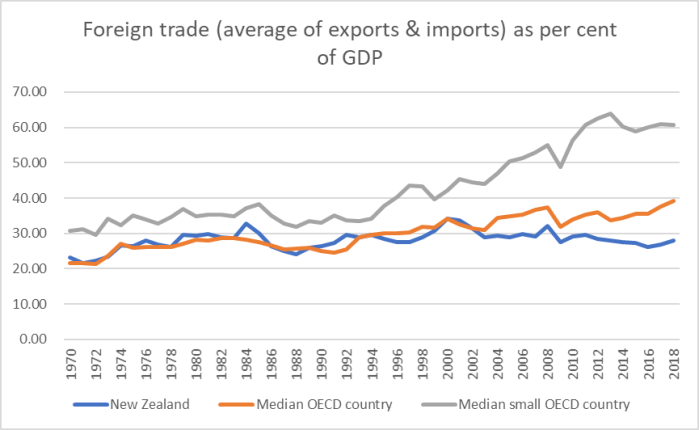
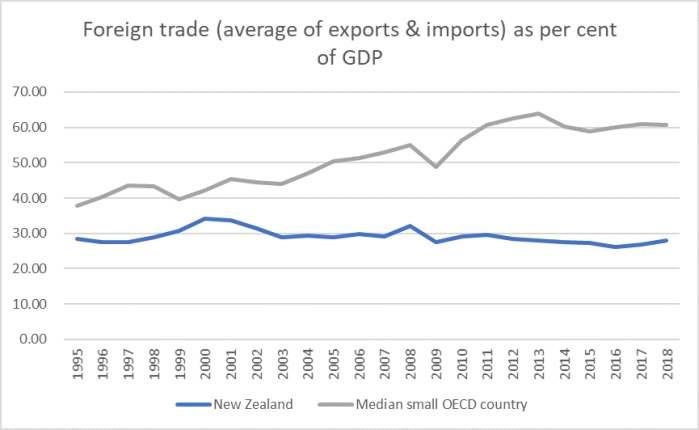
  • all else equal, heavy reliance on fiscal policy will hold up the real exchange rate and tends to advantage (a) urban consumers, and (b) inwards-focused New Zealand firms relative to those in the tradables sector.  Given that foreign trade as a share of GDP has been falling this century, that skew would not seem well-aligned with what we might need to be a more highly productive economy longer-term.
  • and, as noted above, monetary policy takes effect immediately and has a pervasive effect, while leaving individual choices open to each individual and firm.

By contrast, fiscal policy involves politicians’ grubby fingers all over choices about who benefits and how (for example, the proposed temporary RMA reform which might empower projects that get the imprimatur of the Minister, but do nothing for genuine private sector opportunities), and serious policie/projects often taken rather a long time to implement, especially if done well.  I was exchanging notes with Tony Burton, until last year deputy chief economist at The Treasury  –  and occupying a very different spot on the political/social spectrum than I do.   He has a fairly brutal and succinct style when he chooses and his comment this morning (passed on with permission) on the notion of national-level “shovel-ready projects” as “complete drivel”  caught my eye.  It was hard to disagree.

Of course, it is fair to ask if there are things fiscal policy could usefully do that monetary can’t right now (after all, there will inevitably be some fiscal component to any effective and aggressive policy response).

One possibility is that banks might be more hesistant than usual to lend at present.  Of course, additional private spending does not have to involve more borrowing, but some would.  Governments can take risks private banks might not be willing to, but…….the caution of banks is likely to be largely quite rational (they don’t know the future any more than the government does), and that in turn should be a caution to governments rushing in where the private sector (with more on the line) would not.

Perhaps there really are some very high value projects all ready to initiate –  things the government was planning to do next year anyway. To the extent there are some such things, it might be perfectly rational to bring them forward (just as someone who was planning to buy a car next year anyway might bring the purchase forward if the forecast glut of rentals really does hit the market, or someone planning to paint the house next year might do it this year if painters are cheaper).

And, of course, the government may be able to offer something like the sort of “national; pandemic income insurance”, of the sort I’ve proposed: a bit more certainty, paid for through the “premium” of slightly higher taxes in normal times, might support private spending and credit now, complementing what monetary policy could achieve.

As I come to the end of this (long) post, which was partly for me about getting some lines straight, I want to stress that I am not opposed to the use of fiscal policy in this crisis –  if anything, in the short-term I have argued for an approach more generous than the government’s to date, and I’ve also suggested another pervasive instrument (a temporary reduction in GST) as one possible component of a whole-of-government stimulus approach.

But when monetary policy options are open but policymakers simply refuse to use them, I worry that too little will be done in aggregate (monetary policy has always been a key part in countering any serious downturn).  Perhaps there will be a really big fiscal policy push but, as above, that has a lot of downsides, including that it would materially constrain future policy options in a wide range of areas.

But I suspect that perhaps heeding all the caveats about fiscal policy, the authorities will simply be content to let unemployment linger at unnecessarily high levels for years.  That happened after 2008/09, from a relatively low peak of unemployment.  It would be shameful if it were allowed to happen again –  perhaps especially so if it happened under a Labour-led government.

Fiscal policy should not, and probably cannot, effectively carry the main burden of the huge additional policy stimulus the current situation calls for.

Monetary policy needs to be set to do its job, and do it aggressively.  At present, it is simply playing distraction theatre (here and in most other countries).  As the golden fetters had to be broken in the early 1930s, so what I’ve called the “paper chains” (so easy to break, and yet central bankers won’t do it) that stop interest rates going deeply negative as they should be for for time need to broken decisively, here and abroad.


The Government Response Stringency Index

Having mentioned yesterday the Oxford Covid-19 Government Response Stringency Index, I was playing around with variants of this chart, tracing the responses of various governments through time.

stringency index

On this variant I’ve included the Anglo countries and most of the countries of western Europe.

It is only one index, and only as good as the presumptions about what mattered of those who put it together, but it is now quite widely used and cited.

In detail of course it is hard to read, but my main interest was in New Zealand relative to where the generality of other western countries were, and you can read the New Zealand line: throughout the “Level 4 lockdown” the compilers of the index judged our restrictions to be the most stringent of any of the countries, although as at the last updates –  and they aren’t updating every country every day – we had dropped a bit below Italy and France.   The Australia line is hard to see individually, but you can see from the listing at the right that as of now it has the third least stringent regime of any of the countries shown.

(Note that some countries –  including Australia and the United States –  are federal systems with differing degrees of restrictions in individual states: I presume the index is capturing some sort of representative degree of restrictiveness.)

Here is the same chart showing New Zealand, Australia and the east Asian advanced countries.

stringency 3

Singapore is, of course, the salutary case.

Those who read my post yesterday will have seen that I reckon it is plausible that GDP will fall by about 25 per cent in the June quarter, similar to the Bank of England expectation for the UK.  I was interested yesterday afternoon to see that the Reserve Bank of Australia is expecting “only” a 10 per cent fall in GDP in the June quarter.   Even our market economists are materially more pessimistic than that for New Zealand.

Now, as everyone recognises, big GDP losses were going to happen whatever governments did.  The data in the US indicate clearly, across states, how much economic activity had already fallen away before state or city governments imposed severe restrictions.  We saw signs of that here too – I recall going to Auckland a few days before the move to “Level 4” was announced and talking to taxi drivers who’d waited six hours for a single ride.    But, equally, there is little doubt that the extent of the restrictions has affected the extent of the loss of economic activity now (it is an open question whether there are large trade-offs re future losses of activity: only time and lots of research will tell fairly conclusively).   New Zealand’s near-term economic loss looks likely to have been larger than most –  a lot larger than Australia’s, at least if the RBA is to be taken seriously.

Perhaps some will think of this as just a perspective of hindsight.  But there is reason to think it shouldn’t be seen that way.

For example, my interest was piqued when I saw this this morning

I haven’t yet read the Ministry of Health paper referred to  (the pro-active release documents are all here), but I did watch the interview and James Shaw didn’t dispute that it was an accurate account of the Ministry’s advice, apparently on 21 March.

And one can add to the mix the paper Ian Harrison, of Tailrisk Economics, wrote several weeks ago casting doubt on the modelling that the Prime Minister has cited in defence of her government’s stance.

At very least, it should lead to some quite stringent questioning for the Prime Minister and other senior Cabinet ministers about the robustness of their advice and their decisionmaking.  I will look forward to tracking down, among the papers released, the cost-benefit work (formal or informal) that The Treasury and/or the Ministry of Health provided Cabinet before the decisions were made.   Perhaps if these papers had been released contemporaneously –  given that magnitude of the decisions involved –  not six weeks later, these questions might have been posed much earlier, when doing so might have made a difference to outcomes.  Of course, no one can know counterfactuals with any certainty –  partly because no one can also know quite what difference the marginal interventions themselves made – but that shouldn’t stop the scrutiny and challenge, even if it only highlights other failures in our systems that perhaps might have made such intense restrictions, such large near-term economic losses, more necessary or justifiable.

The macro outlook

I noticed last evening that the Bank of England had released its Monetary Policy Report with some rough and ready GDP estimates/forecasts.  They reckon UK GDP probably fell by about 3 per cent in the March quarter (which would be a smaller fall than in quite a few other big European countries) and then by about a further 25 per cent in the June quarter.   In previous comments both the Bank of England and the Office for Budget Responsibility had estimated that during the lockdown itself GDP would be perhaps 35 per cent less than normal.

The Bank of England described their numbers as rough and ready.  I pulled out an old envelope and sketched out on the back of it some week by week stylised “rough and ready”) numbers for New Zealand.   In part I was curious to see what it would take to produce a similar June quarter fall in New Zealand, and to benchmark that against some of the numbers in my post yesterday.   Bear in mind that even though our restrictions have been eased somewhat, on the widely-used Government Response Stringency Index our restrictions have been tighter than those in the UK and remain so today, although it is possible that over the next few weeks our easings will go further than those in the UK.

We don’t have a good read on the March quarter, and given the difficulties SNZ has reported with some of its collections late in the quarter there may well be quite a bit of uncertainty for a long time, perhaps always.  I’ve assumed that the economy was running as normal during January (growing slightly) so that the notional level of GDP at the end of January would represent normal.   I then allowed for a 1 per cent drop from there to about 10 March, another then a 0.5 per cent the following week, and a 1 per cent drop the week after that (recall that tourism was dropping away sharply and distancing and uncertainty were mounting locally).  The last six days of March were at the so-called “Level 4”.  Treasury assumes GDP was 40 per cent smaller than usual during that period (as discussed yesterday, the Reserve Bank guess is a bit smaller, mine a bit larger).  Apply that for the final six days and one ends up with GDP down by 2.7 per cent for the quarter.  Realistically, I suspect the truth could be anything perhaps two percentage points either side of that (although my bias is probably something on the weaker side).

What about the June quarter?  Here are two scenarios

june gdp scenarios

Assume –  with Treasury –  that GDP was 40 per cent below normal in the “Level 4” period (one day short of four weeks of April).   Then I’ve assumed a lift to operating at 70 per cent of normal in “Level 3” (consistent with comments in yesterday’s post) and that that period only lasts two weeks.  Then I assume we move up to 80 per cent of normal in “Level 2”.  You’ll recall that the Reserve Bank numbers looked more optimistic than that, but as I noted yesterday their estimates seem to be closer to the legal practical capacity of the economy, not the level of actual utilisation of that capacity.  I remain pretty comfortable with an 80 per cent –  and perhaps the more so after reading about and listening to reactions to the practical constraints that “Level 2” regime would pose.

But perhaps I’m too pessimistic, so my alternative scenario has the economy adding another full percentage of normal each week for the rest of the quarter so that by the last week of June –  still “Level 2” by assumption –  the economy is at 86 per cent of normal.  In previous posts I have suggested that while the border remains largely closed then direct and indirect effects (uncertainty, weak world etc) –  and lack of much monetary policy support –  could easily see the economy running 10-15 per cent below normal.

On my central scenario, GDP in the June quarter is 25.7 per cent lower than in the March quarter.  But even on the less pessimistic scenario –  since the further recovery comes late in the quarter – June quarter GDP is still 24 per cent lower than in the March quarter.

Those losses are quite a lot larger than I gather the bank economists are forecasting.   On the other hand they are pretty similar to “around 25%” fall Treasury had in its Scenario 1 (which, in terms of restrictiveness, seems closest to what we are likely to see).  Since the fall also happens to be fairly similar to those Bank of England numbers –  and we’ve had until now tighter restrictions (especially on economic activity) than them – they have the feel of being in the right ballpark to me.   You could add five percentage points to each of my less-pessimistic scenario numbers (so starting “only” 35 per cent below normal in Level 4, as the Reserve Bank thinks), and you still get a June quarter fall of  about 19 per cent.

(Of course, if things go more or less to plan, all of these scenarios would have significant positive growth rates for September.)

For anyone tempted by still more positive views, I found the indicator shown here – suggesting China may still be running 20 per cent below normal even now –  salutary.

The other reason I went to the effort was that the Reserve Bank yesterday released the results of the latest Survey of Expectations.  Normally no one pays much attention to most of the questions (inflation expectations aside –  and I’ll come back to them), but this time there is so much uncertainty and so little hard data that it was always going to be interesting to see what this group of semi-experts (a large number of economists are on the panel) thought on average.   The survey forms were completed in the week ending 24 April.

Three months earlier, respondents on average expected GDP growth in each of the next two years to be around 2.2 per cent.   Now they expect (on average) a fall of 4.9 per cent in the year to March 2021 and a rise of 3.2 per cent the following year.  Note that the survey asks about growth from the March quarter of 2020 to the March quarter of 2021; they are – in the jargon –  point to point estimates, not annual averages.

That fall to March 2021 might not sound too bad.  But bear in mind that almost everyone probably expects the worst quarter to be the current quarter and much of those losses will have been reversed over the following few quarters.  Unfortunately, the survey no longer asks about expectations for the most recent quarter, but (see above) most likely GDP had already fallen in the March quarter.

If I take my estimates for the March and June quarters, and then apply the March year expectations from the Bank’s survey, one could see a path for real GDP a bit like this (blue line).

stylised GDP

That still leaves real GDP in the March 2022 4.5 per cent below the level it was in December last year.   Respondents aren’t asked about potential GDP, but if it grew by even 1 per cent per annum over the next two years (some mix of a bit of population growth and a bit of productivity growth) it would still leave GDP 6.6 per cent below potential.    If so, then even in two years’ time these respondents views might be consistent with a negative output gap then which was still quite a bit larger than the Reserve Bank estimates the output gap to have been at the worst in 2009.

This is all very stylised and little more than illustrative, but there is nothing at all encouraging about those GDP growth expectations.    Consistent with that, respondents expect the unemployment rate to still be above 7 per cent in March 2022 (rather more pessimistic than the Treasury’s extra-stimulus scenarios, although more optimistic than my response to the survey.)

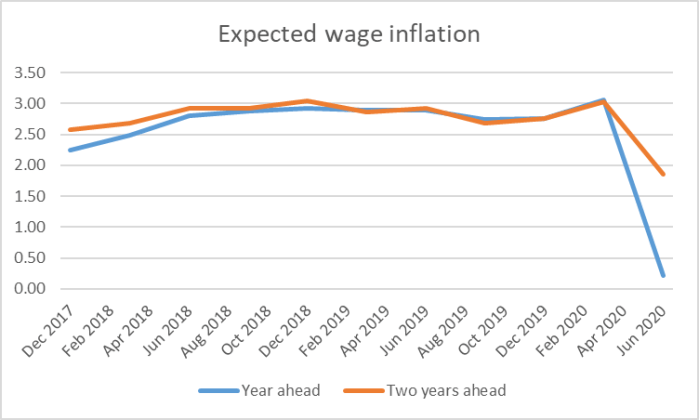
What else was in the survey?  There was the record low wage inflation expectations (the survey has been running since 1987), although I suppose even in the first year the expectations are still just positive.

wage inflation

For the coming year, house price inflation expectations also went negative (but those questions haven’t been asked for long, so it is hard to benchmark the answers).

Then there were the questions about monetary conditions.  Respondents are asked to indicate how tight or loose they think “monetary conditions” are on (as I recall) a seven point scale.  “Monetary conditions” is in the eye of the beholder –  not specifically defined – but although interest rates are part of the story, they’ve never been the whole story.  That is particularly clear this time.

Respondents are asked about three dates: right now, at the end of the next quarter (September in this case) and in a year or so’s time (March 2021).  On both the first two questions the mean responses were that “monetary conditions” are tighter now than respondents thought they were in late January (previous survey) or in October 2019 (after the MPC’s unexpected 50 basis point cut).    Since nominal interest rates across the board are lower and the exchange rate is also a bit lower than in January, I presume respondents have in mind some mix of share prices and credit conditions.  I don’t want to make too much of the responses, but they should be a bit sobering for the MPC as they prepare their Monetary Policy Statement  –  after all, management keep telling us how much they’ve done to ease conditions.

And then, of course, there are inflation expectations.  The Reserve Bank used to put considerable emphasis on the two year-ahead expectation (the one year ahead one is thrown around by tax changes, sudden oil price changes etc).    Sometimes it has looked as though it was quite influenced by recent inflation outcomes.  That clearly isn’t so this time.

2 yr expecs may 20

Thirty years of inflation targeting, 12 years in which the target was lower than it is now, and never have these medium-term inflation expectations been lower than they are now (1.24 per cent).    The median response is a bit higher than the mean, but both about  70 basis points lower than they were in January.  You’ll recall that the OCR has been cut by 75 basis points since then. In real terms, the OCR has barely changed, in the face of the biggest economic slump in a very long time.

You might perhaps look at that chart and take some very slight consolation from the fact that expectations are still above the bottom of the 1-3 per cent target range.  Even on its own, that shouldn’t be reassuring given (a) the self-imposed limits on the OCR, and (b) that the Remit requires MPC to focus on the 2 per cent midpoint.

But it may also be worth remembering that for the last decade, as medium-term expectations have clung close to 2 per cent, the Bank’s preferred measure of actual core inflation has consistently undershot.

expecs and actuals

Also a little concerning to the MPC should be the expectations of inflation five years hence. It is a relatively new question and until now responses have clung very close to 2 per cent.  This time, the average response is 1.8 per cent –  for a period five years hence.

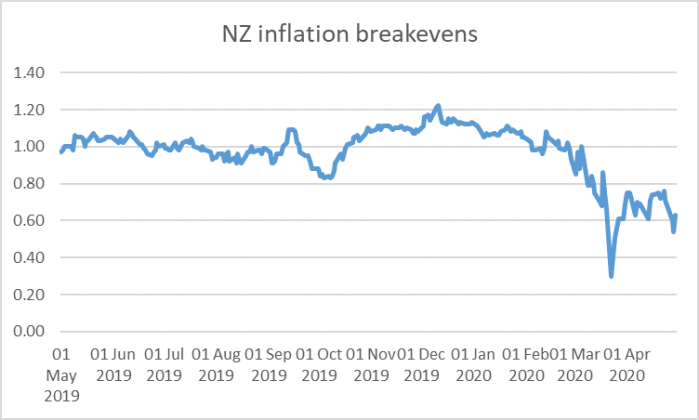
And, of course, there are the breakeven inflation rates from the government bond market.  For some reason, the Reserve Bank seems to disdain these indicators and hardly ever refers to them, but not only have the implied expectations fallen this year, they’ve edged a bit lower again since those Reserve Bank Survey of Expectations forms were completed.

breakevens may 2020

It isn’t just New Zealand – less liquid markets and all that. The fall in the implied expectations in the United States has been very similar to that in New Zealand.

This stuff really should be worrying the MPC.

(It should be worrying the bank economists too, but for some reason they all seem to think no further effective monetary policy easing is required –  except perhaps for the Bank to buy some more bonds, which might hold bond yields low, but will have little more useful impact on the New Zealand macro/inflation outlook than what has been announced already.   In fact, since the notion that MPC would materially increase the bond purchase programme has been around for weeks, any benefits there might –  or that respondents might think there might be –  should already largely be incorporated in these gloomy expectations above.)

The MPC hasn’t been doing its job at all well (as well as being exceedingly non-transparent and noon-accountable).  Next Wednesday is an opportunity to redeem themselves.  If they won’t –  as they won’t –  the Minister of Finance should insist, if he is at all serious about fast return to something like full employment.


Reserve Bank on the economic impact

In mid-April, The Treasury released some economic scenarios for how things might play out as the country and economy work through –  and perhaps beyond – Covid-19.  I wrote about that document here.  The focus of those scenarios was on peak levels of (for example) unemployment, and on the multi-year path back to full employment.  It was a quite limited exercise –  although valuable for what it was –  in that all the variation across the scenarios was about the degree of government (a) restrictions, and (b) stimulus.

A day or two later, the Reserve Bank appeared before the Epidemic Response Committee and they gave the Committee some numbers for the estimated GDP losses at each level in the government’s (then) schema of alert levels –  this was before the current “Level 3” rules were adopted, let alone the new (“Level 2”) ones to be announced today.   The comparative losses across the various levels at that point were as follows

Loss of GDP (%) while restrictions in place
Treasury Reserve Bank
Level 4 40% 35%
Level 3 25% 20-25%
Level 2 10-15% 10%
Level 1 5-10% 5%

In a post a day or two later, focused on the loss of GDP during the “Level 4” period, I suggested that the Reserve Bank in particular was probably understating the severity of the loss.  I noted that senior officials in some European countries had been talking of a 35 per cent loss during the period of peak restrictions, and yet our own restrictions then were regarded as among the most stringent anywhere in the advanced world.  As a cross-check on my thinking I went through the 50+ sub-sectors of GDP that SNZ publishes data for and made some back-of-the-envelope estimates for each, which ended up in aggregate consistent with my view that even The Treasury might be a little light (although the uncertainties are huge). Checking my spreadsheet, I see that the final number I came to them was a 42 per cent loss relative to normal, which I’d be happy to call “40-45 per cent”.

Yesterday, the Reserve Bank released a staff working paper with some more detailed estimates.  This will be background material for the MPC’s deliberations in advance of the Monetary Policy Statement next week.  They appear to have revised some of their estimates since that select committee appearance in mid-April.  The centrepiece of the publication is probably this table.

RB scenarios may 20

At least for the stage we are now in and those ahead of us (one hopes no more “Level 4”, but who knows), these estimates are lower –  less heavy losses-  than those the Assistant Governor gave Parliament (see earlier table).    Of course, there are huge margins of uncertainty that render all point estimates things to be used advisedly, but when the same institution publishes point estimates a few weeks apart, the differences may still be worth paying some attention to.

On the other hand, there are things that confound the comparison.  For example, the actual “Level 3” rules we currently live under are more constraining than the “Level 3” the government initially published in late March (or which we lived under for two days in late March).  But that then makes the contrast between the “Level 3” estimates given to Parliament a few weeks ago, and those they are coming up with now, a bit puzzling.   Despite what still seem like relatively tight restrictions, the Bank thinks half the fall in GDP in “Level 4” is recovered in “Level 3”.

Another important aspect is that the Bank appears to be trying to be clearer about what the current numbers actually represent.  This is their description

This paper estimates the direct costs to economic activity while the measures are in place. Any ongoing impacts to GDP, or to wellbeing are beyond the scope of this analysis.

We estimate the impacts on GDP of the following measures:

• Lock down of all non-essential activity (alert level 4)

• Restrictions on trading activity (alert level 3)

• Border restrictions

• Domestic travel restrictions

• Mass gatherings and public venues

Now even this isn’t quite right, since as they note in passing later much of the fall in GDP would have happened anyway, with no New Zealand government restrictions at all: tourism was falling away sharply, as was domestic air travel, physical distancing was becoming increasingly prevalent and so on.

And as the restrictions are eased back, what is lawful is not necessarily what will occur.

In “Level 4” however, things are a bit clearer.  Things were –  often rather loosely –  described as “essential” (those Cookie Time biscuits, cigarettes, Arobake cakes etc), and what could lawfully be done was (largely) the binding constraint.   So for Level 4 what could be done and what were done were probably quite tightly aligned: if there were to be a GDP  figure for that month or so, the Bank presumably thinks it would have been 37 per cent lower than normal.

But that won’t be the case as the restrictions are wound back.  As one –  probably extreme – example much as the Bank thinks a lot more of the economy can operate now, no one in my (high income) household has spent an additional cent on any New Zealand business that we weren’t patronising in “Level 4”.    It seems that what the Bank is actually describing for Levels 3, 2 and 1 is something much closer to the lawful capacity of the economy (including the reduced productivity of many operations that are allowed to open in some form or other, or work from home) than to the actual likely GDP effect.  Thus, they appear to be saying that 81 per cent of the normal level of the economy could be produced in “Level 3”, not taking a view on the extent of demand.  Actual GDP may be –  I suspect probably is –  much weaker than that.

Of course, as one runs up the levels, things get murkier again. At “Level 1” it appears that everyone in the economy could work, and perhaps only international airline operations would be (in effect) regulatorily restricted; it is just that a key chunk of demand just won’t be there (Rotorua and Queenstown hotels/motels will be quite free to open –  as they are now I think –  but there might be rather few takers).  And since this is a stylised exercise, that does not include the effects of fiscal or monetary policy responses (feeble as the latter has been so far), they can’t be thought of a forecast that, say, if we are at Level 1 in three months’ time, GDP will then only be 3.8 per cent less than normal.  The Bank’s exercise also makes no attempt to allow for confidence factors, no attempt to allow for the derived loss of activity elsewhere in the economy from a shock to a particular sector, no attempt to factor in a severe world economic downturn (in a wider world when Covid is still far more present), and so on.

These are not, repeat not, criticisms of what the Bank has published.  What they have published in a useful exercise, all the more so for the detail they have provided, but it is important to recognise what it is and what it is not.  Especially beyond “level 4”, it can’t be thought of as a GDP forecast at all.

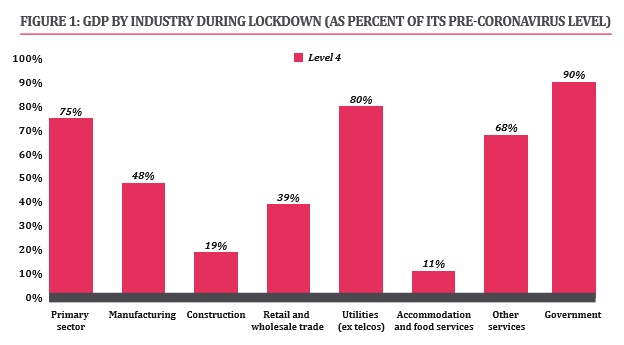
They have a summary chart of the sectoral effects in “Level 4”.

rb sectoral

There is also a more detailed table at the 19 sector level, with their estimates for both “Level 4” and “Level 3”.   I went through the detailed spreadsheet I did on 18 April and compared my numbers with theirs for “Level 4”.   For some sectors, my estimates of losses were a bit smaller than the Bank’s (notably primary) but for others mine were larger. I really struggle to see, for example, how the “Government” sector (Public Administration and Safety) will have been operating at 90 per cent of normal during “Level 4”, or how “Health care and social assistance” will have been operating at 90 per cent, when all elective surgery was cancelled and GPs reported a significant drop in business.   “Education and training” operating at 90 per cent also seems ambitious –  especially as I get emails from my children’s schools telling me they are having to cut back their NCEA credits offered this year (suggesting effective productivity is well less than 90 per cent).

For what it is worth, I’m still comfortable with my 40-45 per cent.  I’d say “time will tell” but it won’t.  For a start, we don’t have much good monthly official data in New Zealand, and Statistics New Zealand seems to have been quite badly prepared for a serious pandemic and is going to really struggle to produce even decent quarterly estimates (especially those productivity losses, even if people have been getting paid).

I don’t have detailed “Level 3” estimates of capacity to compare with those the Bank has put out.  But I’d just reinforce my point: what they seem to be describing is something more akin to capacity than to actual, and the actual level of GDP now may well still be more like 30 per cent below normal even if the Bank is right in saying that in principle it could trade up to 80 per cent of normal.  Few of the scattered aggregate indicators we have suggest anything like that sort of actual rebound –  and my anecdote of the day was wandering past a local cafe this morning offering coffee and food (presumably within the rules) with, at the time, precisely no customers whatever.

What time will tell is what the Reservev Bank and the MPC have come up with in their publications next week.  The Governor has talked in terms of a scenarios focus, and that makes a fair amount of sense, but I hope we will get much detail than (say) the Treasury scenarios document offered, and some richness in thinking about how private sector behaviour might respond, how the severe global downturn will affect us, and so on.  Precise numbers will only take us so far – especially as the Bank may have to choose whether to forecast reality or what SNZ might first publish –  but they should be a framework for something more specific than we have now, and something to compare (one hopes) with whatever The Treasury comes out with in the Budget the following day.

(The Bank’s paper would, however, have been better without awkward injections of commentary about their estimates of the effects on the “Maori economy” – something never defined.  There was, for example, no commentary on the Presbyterian economy, the Asian economy, the left-handers’ economy and so on –  not even the “European New Zealanders” economy.   There is, it seems, no stopping the energetic political signalling, and associated abuse of once-scarce public money, by the Governor.)


Negative interest rates

How long have I been banging on about the potential limitations of monetary policy in the next recession and issues around negative interest rates?  The first such post I could find on the blog was almost five years ago to the day, and as I’ve noted previously it had been a concern for some time before, going back to 2010 in the wake of the last serious recession and then the internal working group I chaired at the Bank when Alan Bollard rightly was concerned about downside risks at the height of the euro crisis.  (That was the report, adopted by senior management, which recommended that steps be taken to ensure that banks could operate effectively with negative interest rates.)

Ken Rogoff has been writing about such issues, and publishing in various prestigious fora, for at least as long.   And Rogoff is a Professor of Economics at Harvard and also served as Chief Economist at the IMF for a couple of years.    He and Carmen Reinhart wrote the book This Time is Different: Eight Centuries of Financial Folly  that attracted so much attention in the wake of the 2008/09 crisis.   As I noted in a post a couple of years ago he and another former IMF chief economist Olivier Blanchard proposed dealing with the lower bound issues by raising inflation targets (the suggestion at the time was to something like 4 per cent), which would –  if successful –  raise neutral nominal interest rates and provide more policy leeway in the next recession.

In the last few years his focus has shifted to addressing the lower-bound issues at source.  There was his 2016 book The Curse of Cash which I wrote about here in which –  among other issues physical cash raises –  he addressed the lower bound issues and proposed to address them in part by progressively removing higher denomination banknotes, leaving in time nothing higher than a $20 note.  More recently still there have been various papers, including last year’s paper (with a PhD student co-author) “The Case for Implementing Effective Negative Interest Rate Policy”.   And there have been a couple of short papers in recent weeks.    There was a piece on Voxeu by Rogoff and LIlley about three weeks ago.  This was the abstract

In the aftermath of the Global Crisis, conventional monetary policy has been constrained by low interest rates in many major economies. This has spurred debates on the possibility of introducing negative interest rates in the monetary policy toolkit. This column uses evidence from the US to show that not only do the markets expect the low interest rates to persist into the future, but they also expect the use of negative interest rates down the line.  Moreover, markets no longer believe that even quantitative easing can bring inflation to target, which leaves very few alternatives for monetary policy apart from negative interest rates.

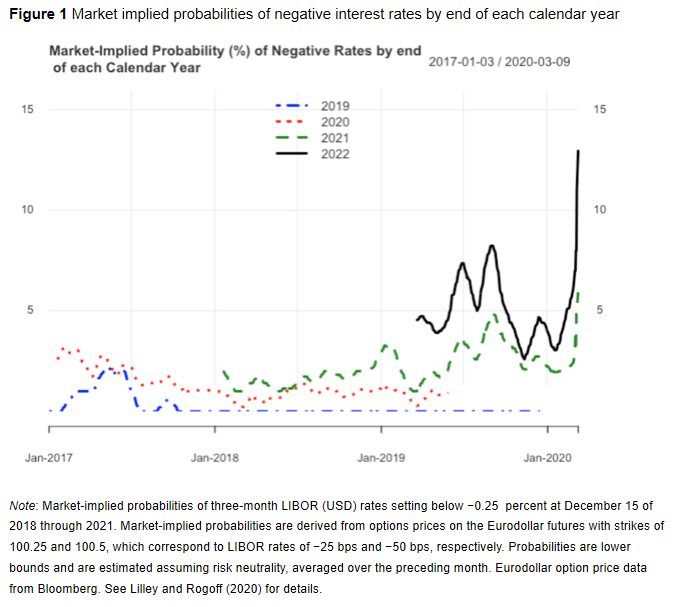
As here, breakeven measures of implied inflation expectations in the US are now well below target.  There is a nice chart for the US suggesting that (at least then) markets there had already moved to put a non-trivial probability on materially negative short-term interest rates in the next couple of years.

rogoff

Focusing on the medium-term implied inflation expectations they note that this

…suggests that the market’s change in beliefs has moved beyond the present crisis, and it now has re-evaluated the extent to which it expects the Fed to be constrained more generally. One problem with such a scenario is that it poses a perverse feedback loop. As the Fed becomes more constrained by the zero lower bound, the expected inflation rate falls, lowering the neutral nominal interest rate, which in turn makes the zero lower bound more binding.

Very much the same point I’ve been making here.

This week Rogoff has a very accessible piece on Project Syndicate (thanks to a reader for drawing it to my attention) under the simple and stark heading “The Case for Deeply Negative Interest Rates”.  His summary

Only monetary policy addresses credit throughout the economy. Until inflation and real interest rates rise from the grave, only a policy of effective deep negative interest rates, backed up by measures to prevent cash hoarding by financial firms, can do the job.

Some of the emphases are a bit different in a US context  (where much of government at all tiers is highly indebted)

For starters, just like cuts in the good old days of positive interest rates, negative rates would lift many firms, states, and cities from default. If done correctly – and recent empirical evidence increasingly supports this – negative rates would operate similarly to normal monetary policy, boosting aggregate demand and raising employment. So, before carrying out debt-restructuring surgery on everything, wouldn’t it better to try a dose of normal monetary stimulus?

More generally

It is not rocket science (or should I say virology?). With large-scale cash hoarding taken off the table, the issue of pass-through of negative rates to bank depositors – the most sensible concern – would be eliminated. Even without preventing wholesale hoarding (which is risky and expensive), European banks have increasingly been able to pass on negative rates to large depositors.

Some issues are relevant to the US and the euro-area but not in same form to us

A policy of deeply negative rates in the advanced economies would also be a huge boon to emerging and developing economies, which are being slammed by falling commodity prices, fleeing capital, high debt, and weak exchange rates, not to mention the early stages of the pandemic. Even with negative rates, many countries would still need a . But a weaker dollar, stronger global growth, and a reduction in capital flight would help, especially when it comes to the larger emerging markets.

In our case, a much lower exchange rate would make a material difference to the fortunes and prospects of the tradables sector.

Rogoff ends

Emergency implementation of deeply negative interest rates would not solve all of today’s problems. But adopting such a policy would be a start. If, as seems increasingly likely, equilibrium real interest rates are set to be lower than ever over the next few years, it is time for central banks and governments to give the idea a long, hard, and urgent look.

From which I’d depart only in replacing that “long” in the final line with a “short and intense” –  this isn’t the time for year-long reviews, but for early and decisive action (as has been managed on so many other fronts in recent months).

There has been a view in some quarters over the last few years that negative interest rates don’t work (in the sense of boosting demand, credit, inflation or whatever) and could actually be contractionary in their effect.  I’ve been sceptical of that, but also inclined to wonder whether results for slightly negative interest rates  –  where there might be threshold effects –  would generalise to deeply negative wholesale and policy rates.   Rogoff links to a recent paper, newly updated last month, by several researchers mostly at the ECB which uses very disaggregated data to suggest that actually negative interest rates in Europe have worked.   Their abstract is as follows

Exploiting confidential data from the euro area, we show that sound banks pass on negative rates to their corporate depositors without experiencing a contraction in funding and that the degree of pass-through becomes stronger as policy rates move deeper into negative territory. The negative interest rate policy provides stimulus to the economy through firms’ asset rebalancing. Firms with high cash-holdings linked to banks charging negative rates increase their investment and decrease their cash-holdings to avoid the costs associated with negative rates. Overall, our results challenge the common view that conventional monetary policy becomes ineffective at the zero lower bound.

The channels they examine look to work a little differently with negative than with positive rates, but not less effectively.

Another central bank with significant experience with mildly negative rates in Sweden’s Riksbank.  A year or so ago, a couple of Riksbank researchers published an accessible treatment of the Swedish experience, from a top-down perspective.    They summarise their results (with all sorts of caveats in the body of the paper) this way

It has been suggested that the response of bank lending rates to interest rate cuts may become weaker when the policy rate passes below a certain level. This column argues that in the case of Sweden, the pass-through of policy rate cuts below zero to the economy has been reasonably good and monetary policy has been effective even at negative policy rate levels.

As all researchers in this area recognise, a big problem is that limited data.  Only a few central banks have had negative policy rates, almost entirely in a single economic cycle, and none of them have taken the policy rate very deeply negative and dealt directly to the ability for big players to convert into physical cash.  So we cannot say with certainty what would happen if we took the – fairly straightforward –  steps that would enable the OCR to be cut to -3 or -5 per cent.  But the signs look fairly promising, whether on the limited experience we have, or  pretty basic economic theory (all else equal, holding New Zealand dollars will typically be much less attractive if NZD assets are earning a lot less than those in other countries).  And the idea of simply letting the Reserve Bank sit on its hands and do almost nothing that matters macroeconomically (hand-waving around big bond purchase programmes is mostly a distraction in macroeconomic terms, whatever value it might initially have added to market functioning).

You’ll recall that Westpac’s economists last week came out picking that the MPC will abandon its firm pledge not to cut the OCR further and go modestly negative later this year.  That would be welcome –  better than the status quo –  but inadequate, and not commensurate with the scale of the adverse economic shock.  In my post the other day I argued that in next week’s Monetary Policy Statement

The MPC on 13 May should:

  • abandon the “no change for a year pledge”,
  • cut the OCR to zero,
  • announce that the OCR will most likely be cut further in June (which would get many of the benefits immediately, but give a little time if there are some real system issues re a negative OCR), and
  • commit to have in place by June robust mechanisms that for the time being removed, or greatly eased, the current effective lower bound on short-term wholesale interest rates.

As it happens there have been a few other contributions on monetary policy locally this week.

Yesterday morning I heard the local chief executive of Westpac on RNZ talking about all the system and documentation changes that would be needed –  one has to assume he was talking about his bank, as he was quite specific in some cases –  to cope with negative (retail?) rates.  Unfortunately, the interviewer simply took Mr McLean at his word, and didn’t either challenge him on just how vital these things were or why – with 10 years global notice – a big bank like his appeared to have done nothing before now. (My initial reaction was a bit like that to the Governor –  if Mr McLean had spent less time championing all the right-on causes he and the Governor are so fond of –  especially climate change –  and actually managed his bank, his borrowers might be rather positioned now.)  Of course, from a public policy perspective, the bigger question is about years of failure from the Reserve Bank –  under Wheeler, his “acting” replacement, and more recently under Orr –  to ensure that the banking system could readily cope with the sort of cuts to the OCR that it was easily foreseeable some shock soon might make necessary.  In Orr’s case, it is particularly inexcusable given that big interview he gave eight months ago articulating why he favoured negative interest rates as a policy option.  “Saving the world” might seem more glamorous, but stabilising the local economy and keeping inflation target was actually his job.

Then there was a strange comment reported from the Leader of the Opposition.

Bridges said fiscal policy, rather than monetary interventions from the Reserve Bank, would need to do the heavy lifting in the Covid-19 response.

That clearly isn’t true –  it is simply a choice by the MPC to do nothing, and by the government which does not use clear legal statutory powers to compel them to act differently.  Sadly, it is still too much of the conventional wisdom.   I’d probably have forgotten about except that this morning Bridges is reported as worrying about risks of too much public debt being taken on.  Macro policy squares that circle –  delivers accelerated recovery without lots more debt –  by using monetary policy: yes, deeply negative rates in this context, to provide the support and stabilisation into the recovery towards full employment.  Such, it seems, is the power of conventional wisdom and the fear of successive Oppositions –  Robertson in Opposition was quite as bad, in less important circumstances –  to challenge anything that the (on their record) not-overly-capable RB/MPC does.

And finally, another reader this morning sent me this clip from a recent BNZ research report, previewing next week’s MPS.

We would strongly argue that lowering the cash rate further would provide almost no assistance to the economy. The cost of debt is the last thing on anyone’s mind now. The lack of availability of debt might be a concern and, for many, the lack of income to repay debt will be a pressing problem. Pushing interest rates sub-zero will do nothing to ameliorate those issues. Moreover, even if the cash rate was to go negative, it would not be fully passed on to borrowers as the banks will still be funding themselves with positive interest rates. Term deposit rates are excruciatingly low for many as it is. The last thing the household sector would want is zero rates across the board. And even at zero, it would mean bank funding costs well above the cash rate.

The research report is headed “RBNZ Can’t Save the World”, to which one can only agree.  What it can do –  what it is charged with doing –  is keep inflation and inflation expectations at around 2 per cent, and support as rapid as possible a return to full employment.  At present, those two goals are tightly aligned, given how high unemployment is forecast to be, and how far medium-term inflation expectations have fallen.

Perhaps it as well to remember here that the BNZ has been the most consistently “hawkish” –  pro tightenings, often uneasy about easings –  of any of the local banks for many years.  That has made them more wrong than most.

But that specific extract above simply makes little sense.  Sure, most businesses would probably prefer a quick and full rebound in demand/activity over a fall in their debt interest rate, but it isn’t as if the two concerns are in conflict –  in fact, lower interest rates and lower exchange rate will, in time, do their bit to support a stronger recovery.  And despite the bank economist’s claim that no one much cares about interest rates, the evidence is pretty clearly against that in the very low interest rates being offered on the government’s scheme (and the Opposition’s proposal yesterday).  In fact, the worst credits in the country –  those who can’t raise funds elsewhere –  get the cheapest rates, while deposit rates –  in the middle of a savage slump – remain positive in real terms, barely down this year, sending all the wrong signals.  And then there is the distraction: as BNZ knows only too well, if the OCR were taken to -0.5 per cent –  as Westpac suggests will happen and should happen –  retail rates, deposits and lending rates, would be still positive.  For now, negative retail rates are some way away.

And if, perchance, depositors were reacting negatively to, say, 1 per cent term deposit rates, what are they going to do instead?  Spend the money?  Well, that’s good – that is monetary policy working.  Shift it to another currency? Well, that’s good –  a lower exchange rate would be monetary policy working.  Seek to buy another asset?  Well, that’s pretty good too –  increasing both wealth effects and Tobin’s Q effects encouraging new investment, so that’s monetary policy working.  And, of course, in aggregate it is not as if deposits are going anywhere –  it is a closed system, with a floating exchange rate.  Your purchase is my sale etc etc.   Oh, if it makes people worry a bit about future inflation, that’s good too –  that’s monetary policy working to hold up, or lift, inflation expectations to something like target.

Like Ken Rogoff, I think the case for deeply negative interest rates now is pretty overwhelming.  It would ease the pressure on fiscal policy, it would support the tradables sector (on which our future prosperity rests), it would ease servicing costs on existing borrowers (and bring market rates closer to rates the government itself is happy to lend at).  There is nothing particularly odd about negative rates, at a time when savings preferences are high and investment intentions are very weak –  the interest rate simply serves to reconcile the two, while getting the economy towards full employment –  and in the particular circumstances of New Zealand, a materially negative OCR would be needed to even get retail interest rates close to zero.  As it is, recall that New Zealand now has materially higher retail rates than Australia, despite the deeper economic slump. That is a choice –  an anti-stabilisation choice –  made by the MPC, blessed by the Minister of Finance.


The Douglas-MacCulloch plan

I was going to attempt to articulate today where I agreed and disagreed with both the New Zealand Initiative’s Bryce Wilkinson and Social Credit on money, banking, fiscal policy etc (Social Credit having taken out a half page advert in Saturday’s Herald to attempt to rebut Bryce’s recent Herald op-ed, itself drawing on a longer recent Initiative publication).  Perhaps tomorrow.

But in this morning’s papers I saw reference to a new plan (and/or critique of other plans) for policy in responding to the economic challenges of Covid, under the joint authorship of former Minister of Finance Roger Douglas and Auckland University economics professor Robert MacCulloch.  MacCulloch kindly sent me a copy of the ten page underlying paper which goes under the title “In a New World, New Thinking is Required: Why Prioritization of Resources is Crucial to New Zealand’s Economic Recovery in the Wake of Covid-19”.  MacCulloch’s Herald op-ed puts it more pointedly and succinctly under the headline “The time has come for trickle-up economics“.

Here is their Executive Summary

The Covid-19 outbreak has not only precipitated a health emergency, but also an economic crisis, unparalleled in modern history.  For New Zealand to emerge from that crisis in a relatively healthy state, the Labour government will need to provide a clear framework for recovery, implementing policies which clearly prioritize those most affected by the societal and economic lockdown necessitated by the outbreak. To date, such prioritization has been lacking, with the Wage Subsidy Scheme unfairly advantaging big business and the professional elite, at the cost of money and resources which could have been better directed towards assisting the newly unemployed – namely workers, their families, and small business owners.

Ultimately, poorly targeted support in the form of helicopter payments, wage subsidies, or broad-based tax cuts (such as a moratorium on GST) is wasteful, and will only serve to entrench inequalities that existed prior to the pandemic.  Equally, the time and costs inherent in planning large-scale new infrastructure projects – and the fact that they offer little practical help to the majority of workers who require help now – means that they should not be regarded as a panacea, aiding economic recovery.

Instead, clear, innovative policies, which not only prioritize those most in need, but which also lay the groundwork for further social and economic reform in the medium to long term, are required.  For workers and their families, support can be offered via the mechanism of special risk accounts, tailored to meet their individual needs.  For small business, help can be provided by facilitating conversations between businesses, landlords, and banks, as well as providing – upon the provision of an approved business plan – forgivable government loans.

Finally, to help manage the recovery, and ensure our younger generations are not saddled with debt, the government must also identify, and eliminate, unnecessary spending, privilege, and waste.  It can find an extra $15 billion per annum by doing so, contributing to the recovery in the short term, and – more generally – to implementing wider scale reform once the immediate crisis has been put behind it.

It is an interesting argument.   If it weren’t already a sadly-debased word, one might almost be tempted to label it “populist”.  Douglas and MacCulloch don’t seem to have a problem with the idea of a wage subsidy scheme per se, but object to big businesses having claimed it.

Whilst the scheme, which already comes at a cost of $10 billion, has undoubtedly provided short term support to those who needed it – workers and small businesses – it has also been used to prop up corporate monoliths and institutions who should have been left to fend for themselves or – at the very least – should have received assistance in the form of a loan, instead of a handout.

But it isn’t clear why they think small businesses are worthy but big businesses (and the employees of the respective businesses) aren’t.     Big businesses can often operate on very tight margins, and plenty of small businesses have had no special problems at all.

Personally, I’m not persuaded of the merits of how the wage subsidy was designed: as I’ve noted before the roots were in that perspective from months ago when the government thought the coronavirus issues were about China and the slow recovery of New Zealand exporters to China (including tourism).  You had only to affirm that your revenues would be down 30 per cent in one month to get three months of wage subsidies, even though the “Level 4 lockdown” – the worst, government-imposed, period for many – was only about five weeks.   But the large vs small company distinction simply doesn’t make a lot of sense to me, and (relative to need) there is no obvious reason why large companies should have more resources to tap than small companies.

My own unease about large companies is the special unit the government has set up in The Treasury to assist big companies.  Since the initial Air New Zealand bailout not much has been heard of its activities, but the risk is that prominent, persuasive and well-connected big firms will end up much better treated than the small firms.  Partly as a result, as far as possible, I favour one model for all.   Done openly and transparently (there being all too little of that, not just around eg Cabinet papers and associated advice, but I think I saw an article recently noting that the deeds under which the Business Finance Guarantee Scheme are operating are also not being disclosed).

In many respects, however, the focus of the Douglas/MacCulloch paper is more forward looking from here.

They start with a point on which I totally agree with them

To date, there has been little sense that the government has a cohesive economic plan to take us forward, either in terms of building the solid foundations required to help navigate our way out of the crisis (the short term response), or in terms of preparing the policies that will help New Zealand not simply recover, but stand stronger than ever (the medium to long term response).

They set out quite a lengthy list of “objectives for reform”, most of which I’d agree with, before moving on to some specifics, noting that

Right now, the protection of individual New Zealanders and their families must be the government’s number one priority.

They propose moving away from a model that has worked by funding employers to funding households/individuals directly

The mechanism for such support would be a special risk account, tailored to meet the specific needs of individuals and their families (if they have one). It would operate as follows:

• Step One: A company or employer makes it clear in writing that they cannot support an employee during the crisis or in its immediate aftermath.

• Step Two: The employee is either made redundant, or temporarily underemployed/unemployed, with the expectation that they will be re-employed once the crisis has passed and the business – inasmuch as it is possible – resumes its normal footing.

• Step Three:  A special risk account is set up and documentation downloaded into that account for the employee to fill out.  This documentation will help him/her identify any special support they require, including meeting mortgage or rent payments, as well as family, sickness, or any other (pre-qualified) payments.

• Step Four: Government provides payment (for a prescribed term and up to a specified limit) directly into the special risk account. If the account holder is already receiving unemployment support, which will be the case in many instances, then this payment will top up that support.

It does seem materially more resource-intensive than the wage subsidy scheme, so could not have been put in place at scale as quickly.  I suppose it has the advantage of directly getting money in the hands of households, but then the established welfare system does that anyway (complete with supplements like the Accommodation Supplement).

The authors argue

By tailoring assistance to individual workers, the government can ensure that the support it provides meets specific needs, in a way that poorly targeted helicopter payments, subsidies provided to businesses, or even broad based tax cuts (such as a moratorium on GST) cannot.  Not only that, such support also provides workers with a measure of respect, as well as a sense of autonomy and self-responsibility, that can only help to engender confidence, both at an individual and societal level.

There is something to the first sentence, relative (say) to those favouring lump sum handouts to everyone. On the other hand, some of the other ideas they seem to be pushing back against are more about demand stimulus in a recovery phase, rather than dealing with the direct income support issues.

The second section of the plan is about small business.  It begins

Small businesses are the lifeblood of New Zealand’s economy.  Sadly, not all of them are going to survive the health imperatives of the Covid-19 outbreak, which saw their closure.  It is important, however, that as much as can be done, is done, to help viable businesses recover.  In the short term at least, this will require other interested parties to step up, including banks and landlords, proffering help to small business owners by sharing their burden.

Not too sure about that “lifeblood” bit –  there are lots of them but the smaller number of much larger businesses also employ a lot of people and are the vehicles through which much GDP is generated.  But set that to one side now.   What about those “banks and landlords”?

In such an environment, the hard-nosed approach adopted by some landlords is short-sighted.  If a small business owner cannot meet the costs of a lease, and is forced to relinquish his/her business, then the property is likely to sit empty, with little prospect that it will be leased again in the short term. Much better – and more realistic – is the approach taken by groups like Westfield, who have signaled their intent to drop rents in their malls.

One might well agree with all that – and it would be consistent with an interesting post from Bob Jones a day or two back from his perspective as a large landlord –  but it isn’t really clear what it has to do with the government.  After all, tenants and landlords agree on how to allocate risk within their relationship, and they can also agree to vary those provisions, so what role for the government.

Similarly, the banks

 Here, the banks have an important role to play, coming to the party by negotiating adjustments to mortgage payments that reflect the new economic realities of life, post-Covid.

And, of course, banks have put in place residential mortgages “holidays” (delayed payments) and put a lot of commercial customers temporarily onto an interest-only basis.   But again, if customers have taken a fixed interest rate that was an agreed commercial risk-sharing arrangement.  And if they are on a variable rate, it might be better to look to our central bank, which sets the short-term interest rates that influence variable loan rates –  and which, thus far, refuses to cut them any further come what may.  Surprisingly, in a piece on macrostabilisation and recovery, monetary policy isn’t mentioned at all.

Douglas and MacCulloch go on

Of course, simply reducing rents, or even imposing a ‘rent holiday’ for a couple of months, will not be enough to save many businesses.  It is here that the government has a role to play, supporting viable businesses in the form of forgivable loans.

And their plan?

The following, four-step strategy, is suggested as a way of supporting small businesses in trouble:

• If a business is unable to meet the costs required to open its doors again, or faces short-term difficulties, it will be required to meet with a business consultant, accountant, or government appointed consultant.

• As part of the consultation, it will be determined whether or not the business has a viable future.  If a path forward can be found, then a business plan will be created.

• In the first instance, this plan will form part of any conversation that takes place between the business owner and his landlord, as a means of setting new, realistic rent payments that will help keep the business afloat.  If necessary (and in the manner outlined above), the landlord’s bank should also be party to this conversation.

• Should rent mitigation not be enough, the business owner can also approach the government for a forgivable loan.  An assessment will be made at this point about the viability of the business plan, and – if successful – a tailored loan will be provided to help the business recover.

It should be noted that the intent of this plan is not to provide loans to companies that have access to plenty of liquidity and other sources of capital.  Rather, given the large sums that will inevitably be involved, the plan is for the benefit of those businesses that have been unduly affected by the lockdown and which need our support in the short-term.

It isn’t clear what the criteria would be for forgiveness?  Presumably many businesses will end up defaulting anyway –  as under the government’s IRD scheme for SMEs –  but is the debt forgiven if your business survives or if it fails?

What is also striking –  and this is a point I’ve made about many schemes –  is that there are likely to be many businesses that, in principle, could be viable if we could simply wipe 2020 from the calendar and resume life in 12-18 months time.  But in many cases it simply will not be worthwhile –  the business will never generate enough –  to justify taking on a lot more debt now.

The third strand of their plan is under the heading Infrastructure.  They are sceptical of large-scale infrastructure projects

Put simply, large scale infrastructure projects are not only expensive, they take a long time to plan and implement; time we simply don’t have right now.

Mostly, as I’ve written elsewhere, I agree, although not always for their reasons (I rather doubt availability of labour is going to be a big constraint).    They are keener on the housing side

If the government is to institute a big infrastructure push, then housing is perhaps the one area where this makes sense.  It is an industry that employs a large number of people, and new housing stock can help resolve a long-standing social and economic problem confronted by many New Zealanders – the inability to afford their own home.

Perhaps, but as they surely know land prices –  not houses –  are the biggest obstacle.  Not in the paper itself, but included in a Stuff article on the paper, Sir Roger is quoted thus

One area where there should be increased stimulatory spending is housing. In this area, Douglas described something like a supercharged KiwiBuild paired with planning reform and a shared-equity scheme.

Douglas said the key to getting housing right was “making a large quantity [of houses] available”.

The Government had to go into section development, while making sure land was released for building by reforming planning laws. There was plenty of land out there, but not enough capital to develop it.

Low-income people could be helped into housing through a shared-equity scheme, where the Government would take on part of their mortgage.

When asked how his state-backed building scheme would succeed where KiwiBuild failed, Douglas said it was a matter of getting the right people involved to notch up big productivity gains.

Among other issues one could raise, it isn’t fully clear to me how they can tell big business to look after themselves because there is plenty of capital available, while telling us the problem around housing is lack of capital to develop land.   And I’m not sure the label KiwiBuild should really ever be used again for something an advocate wants taken seriously.

The penultimate section of the paper is headed “Where Will the Money Come From?”, which doesn’t really seem to distinguish between the large deficits that are more or less inevitable (even on their reckoning) right now, and the fiscal prospects in say five years time (which don’t look bad at present to me, especially given our low starting level of debt and low debt service costs).    Anyway, their specifics are

It is also why we must look to eliminate privilege and waste, both of which have been part of New Zealand’s economy for too long. In total, there are $15-16 billion dollars of savings we might make per annum, simply by removing unnecessary government spending:
1. Ending Waste: By removing Kiwi Saver tax breaks and subsidies, by ending future government contributions to the New Zealand Super Fund, by retargeting income derived from those funds, and by reducing the excessive Votes available to government departments, we can quickly access approximately $9 billion per annum

2. Eliminating Privilege: Unnecessary privilege is entrenched in New Zealand society.  By ending corporate grants and tax breaks, by stopping the Provincial Fund, by removing high income families (approximately 15% of the population) from access to Working for Families and Winter Energy subsidies, and by ending tertiary education grants for students other than those from low capital and low income families, we can make further savings around $7 billion per annum.

That is a bit of a mixed bag.  They aren’t specific on the “corporate grants and tax breaks” they want to end, although if that includes film subsidies I’d certainly agree with them.  But not all these savings are real savings, except within the current government accounting framework.  I might (do) agree we shouldn’t be putting money into NZSF, but it is still government money – it is why when I talk about net debt I always use an NZSF-inclusive figure.  Stopping contributions might free up some cash, but cash isn’t the real constraint here.  Similarly, they might want to take NZSF earnings straight into the Budget, but it doesn’t change the substance – the earnings still improve the Crown’s position.    I could happily sign up to a list of perhaps 20 government agencies to abolish entirely, but……sadly or otherwise, those aren’t where the big bucks are.

Douglas and MacCulloch end their paper with a section on “Building a Better Future”.    Like me, they are energised by the continuing relative decline in New Zealand’s productivity performance (and, I think, fearful that things may only worsen relatively in a post-Covid world).  Douglas and MacCulloch have written previous papers about far-reaching welfare reforms –  I wrote (sceptically) about one such presentation here –  and it is clear that that is still a focus now.  They end this way

In an upcoming paper, the authors will examine in more detail what has gone wrong, why we should immediately set up working committees (SOE style) to make recommendations for the future, how we can free up an extra $20 billion via vastly improved productivity outcomes thanks to structural social welfare reform, and how we can use that money (along with the $15 billion previously freed up thanks to the elimination of waste and privilege) to institute innovative policies in areas as diverse as health, housing, education, welfare, personal tax, company tax, and superannuation.

Ultimately, we have a choice. We can either muddle through as we are – relying on policies that haven’t worked since the 1950s and which are ill-suited to our quickly changing world – or we can opt for a reset, introducing social and economic policies that will make New Zealand not only a richer but more equitable place to live; a country where every New Zealander has the chance to take control of their lives and secure a better future for themselves and their families.

It will be interesting to see their fuller plans.  I wholly agree on the need for something quite different, although am more sceptical than they are that the welfare system as currently configured can explain any material amount of our continuing long-term relative economic decline.

I ended that earlier post this way

In many respects, the saddest line of the day was one made almost in passing by Professor MacCulloch. He told us that he administers a fairly generously-funded visiting professorship at the University of Auckland, which aims to bring in distinguished or innovative, leading international thinkers to contribute to policy debate and development in New Zealand. But the last three people who had been invited had declined the invitation to come. There was, so far as they could tell, nothing bold or interesting on the table here, no real prospect of significant reform, or interest in it from our political leaders.

Things were very different, in that regard, 20 or 30 years ago. It is not as if, sadly, we have in the interim solved all our problems, and re-establishing a position as a world-leading economy, or a world-leader in dealing with the various social dysfunctions. We just drift, and allow our elites to tell themselves (and us) tales about how everything is really just fine.

I guess at least we know things aren’t fine right now, but the contest ahead at present seems to be mostly between those who think New Zealand as it was last year is fine and those keen on building some version of new inward-focused Jerusalem that does not involve successfully earning our way in the world.

As for me, I still think some variant of my “national pandemic insurance” approach is the best – and most equitable – way to frame and think about immediate assistance, continue to think that monetary policy should have a key stabilisation, support and recovery role, and that we need to be looking outwards much more, with activity led from the private sector if we are (a) to get back to full employment as quickly as possible (not repeating the very slow post-2009 fall in unemployment) and (b) have some chance of finally building a more productive and prosperous New Zealand, reversing the gaps to much of the rest of the advanced world that have opened up and kept widening for decades now.


Two recent contributions

For anyone interested, here is the link to my discussion with Prof Steve Keen on Jim Mora’s show on Radio New Zealand yesterday morning.    Despite the RNZ headline, the trans-Tasman travel “bubble” idea wasn’t any sort of focus, although Keen and I have quite different views on the issue beyond the very short-term.  The thrust of my policy prescription post-Covid is outward to the entire world as much as we can, on the basis that there is no credible alternative path to a more productive and prosperous future.  Keen, by contrast, favours a future in which New Zealand and Australia together trade as little as possible with the rest of the world.   It seemed like a pretty bleak future to me, but at least he was honest enough to acknowledge that his preferrred path is one in which as nations we would be materially poorer in future, for the environment.

Sadly, the discussion did not get to Keen’s “modern debt jubilee” proposal that I discussed in a post last week.

The Small States and the New Security Environment (SSANSE) project is a collaboration of university researchers in a number of countries, including (in New Zealand) Canterbury University’s Anne-Marie Brady.   Here in New Zealand, the initiative seems to encourage research and debate on a wider range of issues than the programme title itself might imply, and they have a page of contributions on a range of policy issues from quite a range of authors, under the heading “Pop-up Think Tank“.  Anne-Marie has launched what she calls a Commission for a Post-Covid Future, and invited various people to contribute short papers.

As her tweet says, mine is apparently the first such paper to be released, in an abbreviated form on The Spinoff this morning.  (The fuller version should eventually be on the SSANSE site, but here it is as well

Rebuilding New Zealand’s shattered economy post-Covid

(UPDATE: More nicely formatted on the SSANSE site here)

From the first page

post-covid 1

and from the body

post-covid 2

Macro policy has a big part in getting back to full employment

post-covid 3

And longer-term, there are bits my friends from the market-oriented right will like

post-covid 4

and a bit many of them will deplore

post covid 5

ending this way

post covid 6

For anyone doubting that “we haven’t done well” bit in the last few lines, I refer you to the charts in my post on Saturday.

Oh, and the allusion to the once-upon-a-time campaign promise to “restore New Zealand’s shattered economy” was conscious and deliberate.  They had good intentions too, even did some useful reforms, but they wouldn’t embrace the outward-oriented market-led approach that the situation really demanded.  In many respects, our starting position now is quite a bit worse than it was then.


New Zealand: the foreign trade failure

To have listened to Winston Peters’ speech in Parliament the other day –  which wasn’t all as bad as the media reporting had led me to believe – or the joint Herald op-ed from the New Zealand, UK, Australian, and Singaporean trade ministers, you might have supposed that New Zealand’s was some great foreign trade “success story”.  I put it in quote marks because of course Winston Peters –  our Foreign Minister –  seems to want to undo some of that alleged “success”, seeking “far greater autonomy for New Zealand”.  Here is the full relevant quote

Now, New Zealand First is resolved that our future economy will have these features about it, because they’ve learnt something. One: far greater autonomy for New Zealand. In short, if we can grow it or make it at near competitive prices, then we will grow it or make it, use it or export it, rather than use valuable offshore funds importing it.

Some mix of mercantilism  (more exports good for their own sake) and insulationism (less international trade all round).

And here was a key quote from the article by David Parker and his peers

We are four independent trading nations who have derived success by operating globally. Almost two-thirds of Britain’s economy is made up of trade. One in five Australian jobs is trade related. In New Zealand that number is one in four. Nearly two-thirds of Singapore’s GDP is generated by external demand.

Success story? That would be the country that has spent 70 years slipping, sporadically but decisively (never really interrupted) down the OECD productivity league tables.  Productivity growth, after all, being the main basis for improved material living standards, and for many non-material options.

Here is foreign trade as a per cent of GDP (average of imports and exports) for each OECD country for the latest calendar year the OECD has data for (mostly 2019).

foreign trade as % of GDP

I use foreign trade (imports and exports) to make the point that, for a whole economy, we mostly export to import (some of vice versa as well).  But we are also fourth to bottom if one looks as exports alone.

Perhaps you think that doesn’t really matter much; after all, much richer Australia and the United States have lower trade shares than us.  Unfortunately for that story, larger countries tend to do a lot less foreign trade (as a share of GDP) than smaller ones –   there simply are lots more home markets for firms in the US – and even Australia has a population five times our size.

Ah, but we opened up our economy decades ago –  all that stuff Winston Peters lamented much of –  and we’ve signed all those trade agreements ministers and officials like to boast about.  Surely, then, we trade more heavily than we used to, surely we’ve improved our relative performance?

foreign trade since 1970

But no.    New Zealand’s foreign trade now is a bit less (share of GDP) than it was in 1980, and if we started behind the other small countries, we’ve lagged further behind, especially this century.

And since the OECD only has data for all countries since 1995 here is the NZ vs small countries comparison just since 1995.

foreign trade since 95

I suppose at least the gap hasn’t widened further in the last five or six years.

And then people (reasonably) point out that in some countries –  notably in Europe –  there is a lot of cross-border trade in partly-assembled products.  That is a plus for those countries, whose firms really can gain by specialisation in specific aspects of a production chain, but it does inflate the gross foreign trade numbers.

Fortunately, the OECD has developed indicators of the amount of domestic value-added in each country’s exports  (there is a range of other indicators in the value-added database as well, but here I’m just going to fall back on exports).  In some (particularly central European) countries only just over 50 per cent of gross exports represent domestic value-added.  In New Zealand (and Australia and the US) that share is close to 90 per cent.

So how does domestic value-added in exports look as a share of GDP across the OECD countries (these data are available only with quite a lag, so the latest numbers are for 2016)?

value added exports

It lifts New Zealand slightly up the league table, but all the countries below us have much larger populations –  and domestic markets –  than we do.  By contrast, all the countries to the right of the chart are small (or in the Dutch case just a bit above small).  And of the small countries – 12 million or fewer people (from where there is a step up to the Netherlands) our population is pretty close to the median.

dom value add and popn

It isn’t the tightest relationship in the world –  there is a lot else going on –  but the point that small countries tend to export (and import) more is pretty clear.  And New Zealand –  red dot –  stands out well below the line.

Our trade performance has been –  is –  woeful.  We simply don’t export (or import) much for a country as small as we are. In fact, not many countries –  even very large ones –  export/import less than we do as a share of GDP.

So the self-congratulatory lines that David Parker (and MFAT officials, and a succession of previous National trade ministers) run is deeply flawed.  But at least, in some sense, their hearts are in the right place, seeming to recognise that a more outward-oriented New Zealand is the only sustainable path to much greater prosperity.  From Winston Peters, on the other hand, the idea that we should be importing even less –  in a small country that already imports the fourth lowest share of GDP in the entire OECD –  is just headshakingly bad.

(If perhaps not quite as bad as Steve Keen who proposes that New Zealand and Australia are ideally placed to be some sort of long-term “trade bubble” –  doing as little as possible, even beyond Covid –  with the rest of the world, as if we’ll suddenly become a major market for coal, LNG, and iron ore and they will suddenly become a leading market for dairy, lamb, and export education.)


Looking towards the MPS

It must be a busy busy time in the upper ranks of the bureaucracy and their political masters as they rush to complete the Budget –  due on the 14th –  and whatever schemes, plans, and campaign promises the governing parties have in store for us.  Between the three parties that make up the current governing majority, it is sadly hard to think of a single policy proposal in the last couple of months that might actually improve New Zealand’s woeful longer-term economic performance.  Indeed, the risk seems to be that the three parties between them have in mind something more akin to a Great Leap Backwards.

But it is policy deliberation time at the Reserve Bank too.  Their next Monetary Policy Statement is due on the 13th.  In many respects, it should not be very interesting.   After all, only little more than six weeks ago the Monetary Policy Committee firmly pledged to not change the OCR at all –  no matter how bad things got – for the coming year.   Quite possibly, the MPC will decide to increase its bond purchase programme, but if you think that will make much difference in macroeconomic terms, I’m sure vendors could interest you in all sort of dodgy deals (bond purchases aren’t dodgy per se, but just don’t achieve much useful and are mostly political theatre here in the current context).

What the Monetary Policy Committee should be doing is quite another matter.  When they made that rash commitment not to cut the OCR any further, no matter what, for at least a year, the Governor was still in some sort of alternative reality: at the press conference after the announcement he was refusing to concede that New Zealand would necessarily experience a recession, and seemed to have no conception of what was already breaking over the world and what was about to break over New Zealand.  He wasn’t alone –  this was, after all, still in the days of mass gatherings that even the PM was keen on –  but he and his Committee are the ones charged with the conduct of monetary policy (I was going to say “responsible for monetary policy”, but the Act is quite clear that the Minister of Finance shares that responsibility).

The economic situation has got a whole lot worse since then.   And that is so even if you are optimistic that New Zealand might soon emerge to the government’s “Level 2” –  whatever that will specifically mean by the time we get there.  Apart from anything else, the rest of the world –  including China –  is in the midst of a very severe economic downturn.  Recall 2008: there wasn’t too much initially wrong here, but a very sharp global downturn still had big adverse ramifications for us and our economy, that took years to recover from.

And with the deterioration in the economic situation, confidence that the Bank will deliver on the inflation target the government has set for it has also drained further away.   That was a risk that greatly concerned the Governor only six or eight months ago when the MPC acted boldly last year.  It should concern him/them much more now when are actually in the midst of a savagely deflationary shock (globally).

Westpac’s economics team had an interesting note out earlier in the week  in which they noted –  correctly in my view – that

In our assessment, the RBNZ is going to have to deliver much more monetary stimulus.

They still seem to be believers in the bond purchase programme but argue that even after an increase in that programme

 In our assessment even more monetary stimulus will eventually be required.

They now expect that the Reserve Bank will move to a modestly negative OCR,  in November.

As they note, there are two possible obstacles.  The first is this claim the Bank keeps making that “not all banks’ systems can cope with negative interest rates”.   Westpac –  being a bank I guess-  seems to think this is some sort of adequate excuse.  I certainly don’t.  Even allowing for the Governor’s utter negligence in not having ensured all systems were in place  –  the Bank having been aware of the possibility of negative rates for years – it is simply inconceivable that any significant financial institution can be unable to cope with the sorts of modestly-negative OCR levels Westpac is talking about (-0.5 per cent).  Perhaps they and the Reserve Bank really have been remiss and some banks’ retail systems or documentation aren’t really positioned for negative retail rates, but with term deposit rates above 2 per cent and lending rates a lot higher than that, negative retail rates simply aren’t a material issue at present if the OCR is only going to go to -0.5 per cent.   We need the additional monetary policy support now, not months from now when the Bank and the banks might finally have sorted things out.   Institutions that might not be able to cope should simply be left exposed.

And Westpac again

The second impediment is that lowering the OCR this year would break the RBNZ’s commitment to keep the OCR at 0.25% until March 2021. The RBNZ could probably hold its head high by pointing out that the Level 4 lockdown was a truly extraordinary event, and we doubt they would come in for much criticism. However, any move to break an earlier commitment would have to be carefully explained and justified.

I don’t think any of that makes much sense.  If the Bank on 16 March didn’t realise the risks ahead of them –  lockdowns weren’t exactly unknown globally by then, and a sharp downturn was on its way anyway –  the MPC members simply aren’t fit to do their job.  Of course, they could shamefacedly say “Oops, sorry, looks like we made a pretty bad misjudgement, and we now need to change course”, but actually acknowledging error isn’t the official style, let alone Orr’s.  And as for “carefully explained and justified”, well maybe, but Orr’s style so far has been nothing like that  –  we’ve just seen one lurch after another (recall the 50 basis point cut last year, not foreshadowed at all) where they mostly make up the rationalisations after the event.

We get to a similar bottom line I guess….and I suppose Westpac has to be more respectful of the Bank or else senior officials might (a) stop talking to them, and/or (b) complain to the chief executive.

Westpac expects that Bank will walk away from the “no cuts for a year” line in August, preparing the way for an actual cut in November –  six months from now.

A journalist asked me yesterday if I thought they would abandon the pledge in May. My response then was a quick no –  it seemed too close to when the pledge was first made, and to walk away at the first opportunity would deeply degrade the value of any future forward guidance commitments the MPC might offer.   But on further reflection I wonder if there isn’t more chance than I initially thought that they will simply walk back much of the “no cuts” commitment this month.  After all, their messaging and policy haven’t been consistent and discplined through time in the MPC’s first year, so why suppose it would start now?   And, realistically, against this economic backdrop it just looks silly to continue to pledge not to cut the OCR come what may.   After all, some journalist might actually ask hard and persistent questions challenging the Governor to justify that bizarre pledge (not likely, but you never know), and that might be a challenge even for our loquacious Governor.   Then again, maybe we would simply get handwaving and more claims about all the good the bond purchase programmes have done –  bluster over analysis

And there seems to have been something of a change in market sentiment too.  The 90 day bank bill rate has fallen by 17 basis points since mid-April and is now at a level consistent with markets pricing a reasonable probability of an OCR cut at some point in the next three months.  Longer-term rates are falling too –  the 10 year nominal government bond yield this morning was a mere 0.69 per cent.

But long-term bond yields don’t really matter much in New Zealand –  to anyone other the government,  It isn’t as if there are lots of long-term fixed rate mortgages repricing off the 10 or 15 year bond rates.

And if wholesale interest rates have been falling this week, the exchange rate hasn’t been.  In fact, yesterday’s reading of the TWI was less than 5 per cent below the December average –  and in those far flungs days people were getting upbeat about economic prospects here and abroad this year.    Back on 16 March, the Governor claimed the exchange rate was doing its “buffering” job…….but not really very much at all, relative to the scale of the shock.

And what about inflation expectations?  If there was a modicum of relief in the specific inflation expectations questions in the ANZ Business Outlook survey yesterday, there was none in the “pricing intentions” results (or, for that matter, in the volatile ANZ consumer expectations measures out today).    And what of the wholesale markets?   This is the chart of inflation breakevens –  the gap between nominal and indexed 10 year bond yields.

breakevens may 20

These implied expectations had already fallen away quite a lot over the last few years –  a 1 per cent average of 10 years is just not even close to the 2 per cent target –  but have dropped away quite a bit further since then (five year breakevens are even lower).  And recall that these are the same upbeat global markets that now have equity markets showing strength that puzzles most economic analysts: it is hardly as if an excess of gloom is currently driving markets.

It also isn’t just some New Zealand idiosynrasy –  thin markets and all that.    The drop in the implied US breakevens is of similar magnitude to that in New Zealand (and I happened to watch a webinar yesterday run by Princeton economics department and in an online poll of their viewers, the breakeven numbers weren’t regarded as out of line with reality).

In other words, real retail interest rates have not come down much at all, the exchange rate has not come down much at all, and inflation expectations have been (a) falling and (b) always well below the target midpoint.  Add in the unemployment we are seeing, rising by the day, it is a standard prescription which in normal times a central bank would see as a pretty compelling basis for a much looser monetary policy.

With an economy that has been shrinking fast, and seems set to remain well below normal for quite some time, it remains pretty extraordinary that both term deposit rates and low-risk retail lending rates (conventional variable mortgage rates) are still materially positive in real terms.    Run your eye down the term deposit offerings listed on interest.co.nz and the big banks are typically still offering 2.3 per cent for six months, and their standard variable rate mortgage seems to be priced between 4.4 and 4.6 per cent.

Cross-country comparisons of retail rates are hard –  product features differ etc, and our sort of variable rate mortgages are largely unknown in the US –  and so I rarely do them.  But I thought some Australian comparisons might be relevant –  after all the RBA’s policy rate is also 0.25 per cent.  But the gap between the policy rate and retail rates is larger here than in Australia.

Thus, whereas ANZ in New Zealand is offering 2.3 per cent for NZD six month deposits, ANZ Australia isoffering 0.9 per cent for AUD six month deposits.    Westpac NZ is also offering 2.3 per cent, while in Australia they are also offering 0.9 per cent.

For a variable rate mortgage, ANZ locally is offering 4.44 per cent.  In Australia, ANZ will lend Australian dollars on a variable rate mortgage at as low as 2.72 per cent (although there is myriad of product offerings).  The best Westpac offering I could see (in Australia) was a bit higher, but still a long way below Westpac’s New Zealand variable rate of 4.59 per cent.    This issue here is not about bank margins (between borrowing and lending rates) but about monetary policy, which influences the overall level of rates.

And if Australian nominal retail interest rates are lower than New Zealand’s, recall that the RBA’s inflation target is centred higher than New Zealand’s –  centred on 2.5 per cent inflation –  so that in real, inflation-adjusted, terms the gap in favour of Australian’s retail customers is even greater.   Now, to be sure, Australian real retail rates are usually lower than New Zealand’s –  all New Zealand’s real interest rates generally usually are  – but when we have a larger adverse shock than Australia, that shouldn’t be the case right now.  And when the Governor tries to tell us –  as he tried to tell Parliament –  that New Zealand interest rates are as low as they can go, he is simply wrong.  Real retail interest rates are far too high for this economic climate and need to come down.

Getting them down further remains technically easy.   Simply lower the OCR to -0.5 or -0.75 per cent and there will be no large-scale transfer to physical cash.  And as I’ve argued before dealing with the large-scale cash conversion risk is also relatively trivial as a technical matter.  The Reserve Bank simply refuses to do it, and the Minister of Finance apparently refuses to insist on it.  In this climate –  and given the margins between the OCR and retail rates in New Zealand –  an OCR of -5 per cent would be more appropriate, and if it were implemented decisively –  lowering the exchange rate, boosting inflation expectations, easing servicing pressures (why all the focus on rents, and almost none on interest rates?) and signalling a climate supporting a quick return to full employment – the extremely low rates might not even be needed for long.  But stick around current levels and the growing risk is that it takes many years to get off the lows, and inflation expectations keep drifting down, reinforced by repeated weak actual inflation outcomes.

The MPC on 13 May should:

  • abandon the “no change for a year pledge”,
  • cut the OCR to zero,
  • announce that the OCR will most likely be cut further in June (which would get many of the benefits immediately, but give a little time if there are some real system issues re a negative OCR), and
  • commit to have in place by June robust mechanisms that for the time being removed, or greatly eased, the current effective lower bound on short-term wholesale interest rates.

An apology would be good too, and some long-overdue openness from the invisible –  but supposedly accountable – external members.  But I won’t push my luck.  If they got the substance of policy right now, the past failures could be largely set to one side.

(Oh, and if they wanted to they could offer to buy some more government bonds, but get the basics right and the theatre won’t be necessary.)

A debt jubilee?

In the Western tradition, the idea of the year of jubilee comes to us from the Old Testament.    The idea was to avoid permanent alienation of people from their ancestral land –  in effect, land transfers were term-limited leases, and if by recklessness or bad luck or whatever people lost their land it was for no more than fifty years. In the fiftieth year –  the Year of Jubilee –  all would be restored: land to the original owners and hired workers could return to their land.   It wasn’t a recipe for absolute equality –  the income earned wasn’t returned etc –  but about secure long-term economic and social foundations.

For many –  for me –  it has an appeal, although one could argue that in many respects modern society already reflects some of the vision underlying the original near-eastern ideas: after all, we prohibit slavery, we allow personal bankruptcy (and discharge from bankruptcy without paying all the original debts), we provide education free at the point of use, and a welfare system for those who might otherwise fall through the cracks.

But this post isn’t about exploring those ideas, but about one very specific modern championing of the idea that we hear a bit more of again at present: the idea of some sort of debt jubilee in which, in a highly-indebted system, the outstanding debt is, in some form or another, simply written off.

One person who has been championing such a scheme for some time is Professor Steve Keen, an Australian economist now teaching at a university in London.   He has quite a following in some circles – I used to read his blog moderately regularly for a time, and perhaps 7 or 8 years ago The Treasury hosted a visit here (in the course of which his stocks sank among most officials).  However, he was interviewed a few weeks ago by Gareth Vaughan at interest.co.nz on his ideas for policy in the wake of the coronavirus.  He and I share the view that the biggest macroeconomic risks at present are deflationary rather than inflationary but, it would seem, we agree on little else.   You can read or listen to his other ideas for yourselves if you choose, but one strand of what he was championing was a “modern debt jubilee”.

I do not wish to be seen to be critiquing or attacking a straw man, but I have had difficulty finding anything online that sets out in very specific terms exactly what he has in mind.

Here is what he said in the interview

Firstly, Keen says, they should be implementing a modern debt jubilee now.

“It’s quite feasible to do it [but] I never thought it would happen. People asked me what chance I thought this had of happening. I said it’s less than a snowflake’s chance in hell. We are in hell now and the only way out of hell, as well as getting a vaccine for the virus, is to reduce this burden of private debt otherwise we’ll have a financial collapse after the coronavirus,” says Keen.

The alternative, he argues, is mass loan defaults.

“You simply have to accept that debt can’t be repaid when too much debt has been issued. So we have to reduce private debt and we have to do it now. [We] should do a debt jubilee now, not once we get through this crisis. Otherwise there’ll be many people who can’t pay their rent, as well as people who can’t pay their mortgages,” says Keen.

“If we do it now we’ll enable the payments system to continue functioning. If we don’t do it now then it’s quite possible the payments system will collapse. Small businesses won’t get any cash income, households won’t get wages. Everybody will end up having no money in their bank accounts because that money will be used to pay off debt.”

What Keen’s advocating for is governments’ capacity to create fiat money being utilised to distribute an equal amount of money per person across entire countries.

“And people who were in debt would get their debts reduced, either by an offset account or by actually paying their debts down. People who are not in debt get a cash injection. And that cash injection can also be used to buy newly issued corporate shares which are used to pay down private debt. So as well as reducing household debt, you reduce corporate debt and you also democratise the ownership of corporations,” says Keen.

And although I have found a couple of other references (including here and here)  there is still no sight of some critical parameters.

Nonetheless, it is worth bearing in mind that elsewhere in the interview he describes the large increase in household debt in recent decades as “unconscionable debt” and repeatedly highlights the very large increase in the ratio of household debt to GDP in New Zealand since about 1990 (about 30 per cent then, about 100 per cent now).   And although he talks about “reducing” household debt, “jubilees” have connotations of very substantial writedowns, so he clearly isn’t talking about something like dishing out, say, a mere $10000 per household/person.  The Reserve Bank tells us that as at the end of last year recorded household debt was about $310 billion.

Moreover, Keen also tells us (see extract above) that he thinks the same amount should be distributed to everyone.  I’m not sure whether he really means “everyone” or just adults, but since under-18s can’t contract binding debts there shouldn’t be any need for jubilees for them.  That still leaves 3.8 million residents (and here I’ll just ignore the fact that a significant number of them are temporary non-citizen residents; I just want to get a sense of the plausible scale of what Keen might be calling for, not tie down every detail).

As we all know, recent first home buyers in Auckland typically have to take on fearsome levels of debt.   They appear to be the sort of people Keen focuses on, since he blames the rise in house prices on banks and their over-aggressive (“unconscionable”) lending setting up a house of cards that might otherwise be about to tumble.  I presume a $500000 mortgage isn’t at all uncommon (last year the nationwide average first home buyer mortgage was about $400000) and many will be larger than that.

Now, of course the typical new buyers are a couple, but for those marginal Auckland purchasers that might still be $250000 each.

I presume Keen does not have in mind giving them –  and all the rest of us –  $250000 each, although doing so would certainly allow most (but not all) mortgage debt to be fully repaid.     But even if we wanted to make possible a 60 per cent writedown for those couples with the new unconscionable $500000 mortgage, he’d still have to be looking at $150000 each, as gift/grant from the Crown.  Across 3.8 million adults, that seems to come to $570 billion dollars.

All paid for, in his own words, through the Crown’s ability to create fiat money –  change the Reserve Bank Act and get for the Crown an (interest-free) overdraft of $570 billion.  Halve the payment and it is still serious money.

You’ll have noted that Keen is also concerned about corporate debt –  a big concern at present in some countries (where it has grown rapidly in recent years) but much less so in New Zealand.  For those –  most of us –  without mortgages (whether because we have paid them off, or never been able to get into the housing market in the first place), we get a rather large addition to our bank balances.   Keen notes that the proceeds could be used to buy “newly issued corporate shares which are used to pay down private debt”.

I don’t know about you but I know what I would be doing not just with my $150000 but with all my non-indexed financial wealth the minute I thought that anything like what Keen was proposing was likely to be implemented: I’d be looking to put it into real property (houses, gold, whatever) or getting it into the currency of a country not adopting such a policy.  Anyone with non-indexed debt at present would prudently be doing the same –  and locking in a long-term fixed interest rate – not using the proceeds to pay off debt.  It might be hard to generate inflation at present, under present –  largely self-imposed – constraints, but simply handing $570 billion will do it.

I hope all regular readers will recognise that I am not one of those looking for inflation under every stone.  I worry about deflationary risks at present –  as does the market – and I do not believe monetary policy is doing anything like enough to respond to those risks at present.  Much as I am sceptical of the idea of giving out some modest amount (say $2000) to everyone as some sort of stimulus, in the current climate – large negative output gap, little or no inflation –  such a payment, even funded directly by the Reserve Bank –  would be net stimulatory in the near-term.  There is a considerable amount that can be done to get us back towards full employment as soon as possible.

But not by simply handing out $570 billion, with no obligation to repay.

(Presumably Keen does not think his scheme would dissolve into very high inflation, but I’ve never seen him anywhere articulate the case for why not.)

When I think of debt writeoffs, I think of explicitly recognising that someone has to bear those costs –  on any very substantial scale there are few/no free lunches.  Banks will have to write off some debt –  perhaps quite a lot –  over the next few years, and their shareholders will bear that cost.  That is the business they went into.  Writing off mortgage debt more generally on the sort of scale Keen seems to envisage can only be done by imposing fearsome losses on others.  It is so utterly different from that Old Testament conception (which, in effect, limited the scale of liabilities anyone could run up in the first place).

I have some sympathy with the view that requiring young –  and now not so young –  people to take on multiple hundreds of thousands of dollars of debt to get into a basic house in our cities is pretty unconscionable and deeply unjust. But, frankly, that isn’t fault of the banks but of the central and governments that make land –  a resource we have in abundance – artificially scarce.  In fact, I’ve even gone so far as to argue that if ever we managed a government with the courage to fix the land market, it might be both opportune (building coalitions) and just to offer some compensation to the losers –  those more or less compelled to take on very high debt in recent years just to get a foot on the ladder.   But there would be an explicit, shared, cost to that.

And more generally I’m not persuaded that current debt levels –  public, private or total –  in New Zealand pose any vast threat of economic or financial collapse.  Keen likes to highlight how much debt has risen since, say, 1990, but it isn’t obvious why that is the most relevant benchmark.  In a speech I wrote with Alan Bollard a few years ago, I included a chart showing that mortgage debt (house and farm) was materially lower then  as a per cent of GDP than it had been in 1920s New Zealand,  I rechecked the numbers this morning and the picture today is the same as it was in 2011.  Contrary to Keen, our banking system looks pretty robust, not ricketty.

I also take the view that there is plenty that can and should be done to assist individuals and firms through the next few months.  There is a strong case for income support (broadly defined) or even income insurance (of the sort I’ve championed here) but that is very different proposition than somehow looking to wipe out debt without identifying whose claims to real resources will be wiped out to pay the economic cost of that (as distinct from the “which account to write the cheque on” issue that Keen deals with).

You might be wondering why I bothered with this post, or dealing this extensively with a pretty extreme idea.  The reason is that Radio New Zealand is recording tomorrow (for broadcast on Sunday morning) an interview with both me and Keen. I might have more to say about some of his other ideas –  some of which make Winston Peters championing New Zealand manufacturing seem moderate –  next week. In the meantime I wanted to understand as well as I could what Keen was actuallly championing on the debt front.  As I said, I don’t want to attack a straw man –  that never persuades anyone –  but I simply haven’t yet found an articulation of what he is proposing that looks economically feasible or sensible.