Pandemic income insurance

Way back on 16 March, the day before the government brought down the first of its pandemic economic response packages, I ran a post here in which – among other strands of an approach to the rapidly worsening economic situation – I suggested that the government should legislate quickly to provide, for the coming year, a guarantee that no one’s income would fall below 80 per cent of what it had been in the previous year. The proposed approach was to treat individuals and companies in much the same way. The underlying idea was to provide some certainty – to individuals, firms and lenders – without offsetting all losses (society was going to be poorer) and without locking people in to employment or business relationships that may have been sensible/profitable previously, but which wouldn’t necessarily be in future. And to recognise that individual firms and people are better placed to reach those judgements – about what makes sense for the future, what makes sense (say) to borrow to support – that government ministers or officials.

I knew that any such scheme might be very expensive, and rereading the post I see that I proposed it even though I was talking about economic scenarios for potential GDP losses that were materially worse than most think we will now actually face. But part of the mindset was the parallel with ACC – our no-fault accident compensation system. Being able to treat people in a fairly generous way when a serious pandemic – that was no one’s fault – hit could be conceptualised as one of the bases for the low-debt approach successive governments had taken to fiscal policy over recent decades. And it did not require governments to pick winners – firms they thought might/should flourish – or pick favourites.

Since it was sketch outline of a scheme, dreamed up over the previous few days, I was always conscious that there were lots of operational details that would have to be worked through before an idea of this sort could be implemented, and any scheme would need to be carefully evaluated for the risks that might lie hidden just beneath the surface. But evaluated not relative to standards of perfection, but relative to realistic alternatives approaches in a rapidly unfolding crisis.

I wrote a couple of other posts (here and here) touching on aspects of the pandemic insurance idea, and as I reflected a bit further and discussed/debated the idea with a few people, I suggested some potential refinements, including greater differentiation between companies and individuals. Other people, here and abroad, also suggested ideas that had some similarities in spirit to what I was looking to achieve.

Of course, nothing like the pandemic insurance scheme was adopted. Instead, we had a flurry of schemes and of individual bailouts, the main attraction of which seemed to be a steady stream of announceables for Cabinet ministers in election year (generally a negative in terms of the public interest, in which similar cases should be treated similarly), all while offering little or no certainty to individuals, firms, or their lenders.

I’ve continued to regard something like the pandemic insurance scheme as a superior option that should have been taken, but mostly I moved onto writing about other things. But the return of community-Covid, more or less severe government restrictions on economic (and other) activity, and arguments about whether and for how long the wage subsidy should be renewed only reinforced that sense that there would have been a better way. But a few tweets aside, I hadn’t given the issue much thought for a while until a few weeks ago a TVNZ producer got in touch to say that they had found reference to the pandemic insurance idea in an OIA response they had had from The Treasury, and asking if I’d talk to them about it.

It was only late last week that I got to see the response Treasury had provided (Treasury having fallen well below their usual past standards has still not put the response – dated 12 August – on their website (or even acknowledged my request for a copy of the same material). A little of the subsequent interview with TVNZ was aired as part of their story on Saturday night, itself built around the notion that the government had rejected this (appealing sounding) idea.

OIA Response Pandemic Insurance etc

The TVNZ OIA request had actually been for material on “helicopter payments”, which was refined to mean

“one-off payments made by the Government to citizens with the purpose of stimulating the economy,

(which in some respects does not describe the pandemic insurance idea well at all).

And yet most of the material in the quite lengthy OIA response (77 pages) turned out to be about the work The Treasury had undertaken on the pandemic insurance idea over the couple of weeks from 7 April, including some advice to the Minister of Finance.

There seems to have been quite serious interest in the option, and there is paper to the Minister of Finance providing a fair and balanced outline of the scheme – merits and risks – dated 9 April

tsy pandemic

and suggesting that if the Minister was seriously interested Treasury would do more work and report later in the month. Although there is no more record of the Minister’s view, he must have been sufficiently open for more work to have been done, including drawing in perspectives from operational agencies (including IRD and MSD) on feasibility and operational issues.

My impression is that Treasury did a pretty good job in looking at the option.

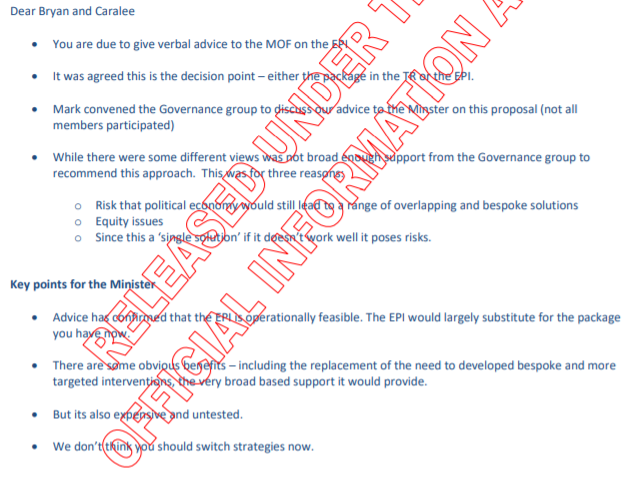
tsy pandemic 2

That final paragraph was always one of the key attractions to me.

As I went through the papers, I didn’t find too many surprises. The issues and risks official raised were largely the ones I’d expected – including, for example, the risk that some people might just opt out of the labour market this year and take the 80 per cent guarantee, and issues around effective marginal tax rates for those facing market incomes less than 80 per cent. Perhaps the one issue I hadn’t given much thought to was a comment from IRD about the risk of firms being able to shift revenue and/or expenses between tax years, with the observation that existing rules were not really designed to control that to any great extent. But, and operating in a second-best world, the officials involved generally seem to have regarded few of these obstacles as insuperable, bearing in mind the pitfalls of (for example) the plethora of alternative schemes.

The work seems to have come to an end on or about 23 April with Treasury finally deciding not to recommend the pandemic insurance approach. This email is from a Principal Advisor heavily involved in the evaluation to the Secretary and key (on the Covid issues) Deputy Secretary.

tsy pandemic 3

It probably shouldn’t surprise readers that I think the wrong call was made in the end, but equally it is probably not that surprising that the decision went the way it did. One reason – not, of course, acknowledged in the Treasury papers – is how slow officials were (across government) in appreciating the seriousness of what was already clearly unfolding globally – and as a major risk to New Zealand – by the end of January. As I’ve noted before there is no indication in any of the papers that have been released, or public comments at the time, that (for example) Ministers or the heads of the key government departments had begun serious contingency planning – devoting significant resource to it – any time before mid-March. This particular work didn’t get underway until well into April, by when a great deal had already begun to be set in stone, and when rolling out bite-sized new announcements – robust or not – no doubt seemed, and was, easier than a new comprehensive approach.

As it happens, even though there was a great deal of concern back in April about the affordability of the pandemic insurance scheme, with the benefit of hindsight there is a reasonable argument that it could even have been cheaper than the approaches actually adopted (GDP losses having been less severe, on a sustained basis, than feared in April), which in turn might have left more resources for the stimulus and recovery phase (pandemic insurance – like wage subsidies – was always more about income support and managing uncertainty in the heat of the crisis than about post-crisis recovery stimulus).

From my perspective, the post was mostly about recording my pleasant surprise at how seriously the pandemic insurance idea (mine, and some other variants) was taken by officials, and by what appears to have a pretty good job in evaluating it as an option, in what will have been very trying and pressured times.

From this vantage point – with the advantage of knowing how the first six months of the virus went, and with a sense of the economic ramifications – I still reckon it would have been a better approach. And yet – and I don’t recall seeing this in Treasury’s advice (perhaps it isn’t the thing for officials to write down) I can also see political pitfalls – around very large payouts to some companies, even if they weren’t gaming the system – that might have made it impossible, and unsustainable if tried, without (at least) a very strong degree of political leadership and marketing that such a no-fault no-favour approach was a better way to have gone. As I noted in an earlier post, I’d have hated having the Crown pay out to casino companies, but I would have endured for the sake of a fair across the board scheme. But every single person, every single lobby group, would have found some potential recipient to excoriate.

The TVNZ interviewer asked me about the pandemic insurance idea still had relevance for the future. My initial response to him was that yes it did, and that we might be much better off to have the infrastructure required to make it work in place and on the shelf ready to go for when future pandemics happen. Taxes will, after all, be a bit higher than otherwise as we gradually lower debt ratios, amid repeated talk of being ready for the next major adverse event, whether earthquake, volcano or pandemic.

And yet reflecting on it again over the weekend, I’m no longer quite so confident of that answer. More detailed work, and more thought, is probably required once this pandemic is behind us to strike the right balance – individuals vs firms, generosity in a no-fault shock vs moral hazard as just some of the examples of issues to be thought through, and planned for, ideally in a way that would survive contact with a new real severe adverse shock.

Macro policy pitfalls and options

The sad sight of someone who has seemed to be a normally honourable man –  Greens co-leader James Shaw – heading off down the path of Shane Jones-ism, is perhaps a general reminder of the temptations of politics and power, but also of much that is wrong about how the government is tackling the severe economic downturn we are now in.   Fiscal discipline around scarce real resources, always pretty weak at the best of times. is flung out the window and there is a mad scamper for ministerial announceables, and thus rewards to those who successfully bend the ear of ministers in a hurry.  Connections, lobbying, and the ability to spin a good yarn seem to become foremost, with a good dose of partisanship thrown in too.   The extraordinary large grant to a private business  planning to operate a school is just the example that happens to have grabbed the headlines, but there will be more no doubt through the list (apparently not all yet announced) of “shovel-ready projects”, and we’ve seen many through the Provincial Growth Fund almost from day one of its existence.

Don’t get me wrong.  I’m not opposed to the government running deficits –  even really rather large deficits – for a year or two.   Some mix of external events and government actions have tipped the economy into a severe recession and –  against a dismal global backdrop – the outlook is not at all promising.  Tax revenue would be down anyway, and that automatic stabiliser is a desirable feature of the fiscal system.   And one can make –  I have made –  a case for a pretty generous approach across the board to those, through no direct fault of their own, are caught in the backwash of the pandemic.  I’ve argued for thinking of such assistance as if we some ACC-like pandemic insurance, for which we paid the premiums in decades past through higher tax rates/lower government spending rates –  and thus lower debt – than would otherwise have been likely.

And some aspects of the government’s economic policy response have –  whatever their other faults –  had elements of that broadbased no-fault/no-favours approach.   I guess ministers couldn’t put a press statement for each individual who benefited from the wage subsidy, or the weird business tax clawback scheme.  But beyond that, and increasingly, what is supposed to be countercyclical stabilisation policy has become a stage for ministers to choose favourites, to support one and not another, to announce particular bailouts as acts of political favour.  It is a dreadful way to run things, rewarding not just ministerial favourites but the chancers and opportunists who are particularly aggressive in pursuing handouts.  So some tourist operators get handouts and other don’t.  Some sports got handouts and others don’t.     Favoured festivals –  I see the nearby festival on the list this morning –  get handouts.  And, in general, unless you are among the favoured, businesses (the myriad of small and low profile ones) get little or nothing at all.  James Shaw’s green school gets a huge capital grant and while no one –  of any ideological stripe –  should be getting such handouts, we can be quite sure no-one of a different ideological stripe than those associated with the governing parties would be getting one.    Perhaps many people involved really have the best of intentions, but frankly it is corrupt, and predictably so.

I was reading last night an open letter on economic policy that Keynes had addressed to Franklin Roosevelt in late 1933.  It was a bit of mixed bag as a letter, and had really a rather condescending tone, but the couple of sentences that caught my eye were these

“our own experience has shown how difficult it is to improvise useful Loan-expenditures at short notice. There are many obstacles to be patiently overcome, if waste, inefficiency and corruption are to be avoided”

Quite.

Now, of course, elections have consequences, and one would expect a government of the left to be deploying public resources in directions consistent with (a) manifesto commitments, and (b) their own general sympathies.    But in this case (a) the government was elected on a promise (wise or not) of considerable fiscal restraint, and (b) whatever the broad tenor of their policy approach, we should not expect public resources to be handed to individuals or favoured groups and companies, solely on the basis of the ability of those entities to get access to, and bend the ear of, ministers.  And it is not necessary to do so to deploy very substantial fiscal resources –  whether with a focus on consumption, investment, or business etc support more generally.  Broadbased tools, that do not rely on rewarding favourites, aren’t hard to devise or deploy.

More generally, of course, monetary policy is an option that has barely been used at all.   We have a severe recession, with little or no relief in sight (including globally) and yet whereas, faced with a serious downturn, we usually see perhaps a 500 basis point fall in interest rates and a sharp fall in the exchange rate, we’ve had no more than a 100 basis point fall in interest rates and no fall at all in the exchange rate.  And not because of some alarming inflationary threat that means further monetary support can’t prudently be risked…..but because the appointed Monetary Policy Committee, faced with very weak inflation forecasts and lingering higher unemployment, choose to do nothing.  And those with responsibility for the Bank –  the Minister of Finance, and the PM and Cabinet –  seem to be quite content with this abdication.

The beauty of monetary policy, and one of the reasons it has been a preferred stabilisation tool for most of the time since countercyclical macro policy became a thing, is that even if ministers are the ones making the day to day decisions –  and they usually aren’t because we mostly have central banks with day-to-day operational autonomy –  they don’t get to pick which firm, which party favourite, gets the benefit of lower borrowing costs, who suffers from reduced interest income, or what is affected by the lower exchange rate.    It is broad-based instrument, operating without fear or favour, and doing so pervasively –  it takes one decision by the relevant decisionmaking body and relative prices across the whole economy are altered virtually immediately, not some crude process of ministers and officials poring over thousands of applications for grants and loans and deciding –  on who knows what criteria –  whether or not to grant them.  And it has the subsidiary merit, when used wisely, of working with market forces –  in times like these investment demand is weak and precautionary savings demand is high, so one would normally expect –  if no government agency were in the way – the market-clearing interest rate would fall a long way.

On the left there still seems to be a view that monetary has done a great deal, and perhaps all it could.  I saw the other day a commentary from retired academic Keith Rankin on fiscal and monetary policy.  He claims not to be a “left-wing economist” –  although I suspect most would see him as generally being on the left –  but has no hesitation in pegging me as “right-wing economist”.  Apparently “right-wing economists tend to have a philosophical preference for monetary policy over fiscal policy”.   Anyway….he was picking up on some comments I made in a recent interview on Radio New Zealand.

To a non-right-wing economist, Reddell’s position in the interview seems strange; Reddell argues that New Zealand has – so far during the Covid19 pandemic – experienced a large fiscal stimulus and an inadequate monetary stimulus. In fact, while the fiscal outlay is large compared to any previous fiscal stimulus, much of the money available may remain unspent, and the government is showing reluctance to augment that outlay despite this month’s Covid19 outbreak. And, as a particular example, the government keeps pouring salt into the running sore that is the Canterbury District Health Board’s historic deficit (see here and here and here and here); the Minister of Health showed little sign of compassion towards the people of Canterbury when questioned about this on yesterday’s Covid19 press conference.

Further, monetary policy has been very expansionary. In its recent Monetary Policy Statement (and see here), the Reserve bank has committed to ongoing expansions of the money supply through quantitative easing. Because the Reserve Bank must act as a silo, however, it has to participate in the casino (the secondary bond market) to do this; perhaps a less than ideal way to run monetary policy. Reddell has too much faith in the ability of the Reserve Bank to expand business investment spending.

Reddell is a committed supporter of negative interest rates – indeed he cites the same American economist, Kenneth Rogoff, who I cited in Keith Rankin on Deeply Negative Interest Rates (28 May 2020). This call for deeply negative rates is tantamount to a call for negative interest on bank term deposits and savings accounts; that is, negative ‘retail interest rates’. While Reddell does not address the issue in the short interview cited, Rogoff notes that an interest rate setting this low would require something close to a fully electronic monetary system to prevent people withdrawing wads of cash to stuff under the bed or bury under the house.

I struggle to see how anyone can doubt that we have had a very large fiscal stimulus this year to date.  One can debate the merits of extending (or not) the wage subsidy –  personally (despite being a “right-wing economist”) I’d have favoured the certainty my pandemic insurance scheme would have provided –  but it doesn’t change the fact a great deal has been spent.  Similarly, one can have important debates about the base level of health funding –  and I’ve run several posts here in recent years expressing surprise at how low health spending as a share of GDP has been under this government, given their expressed priorities and views –  but it isn’t really relevant to the question of the make-up of the countercyclical policies deployed this year.  With big government or small government in normal times, cyclical challenges (including serious ones like this year’s) will still arise.

And so the important difference seems to turn on how we see the contribution of monetary policy.  Here Rankin seems to run the Reserve Bank line –  perhaps even more strongly than they would –  about policy being “highly expansionary”, without pointing to any evidence, arguments, or market prices to support that.  It is as if an announced intent to swap one lot of general government low-interest liabilities (bonds) for another lot (settlement cash deposits at the Reserve Bank) was hugely macroeconomically significant.  Perhaps it is, but the evidence is lacking…whether from the Reserve Bank or from those on the left (Rankin and others, see below) or those on the right (some who fear it is terribly effective and worrying about resurgent inflation.

While on Rankin, I just wanted to make two more brief points:

    • first, Rankin suggests I “have too much faith in the ability  of the Reserve Bank to expand  business investment spending”.  That took me by surprise, as I have no confidence in the Bank’s ability to expand investment spending directly at all, and nor is it a key channel by which I would be expecting monetary policy to work in the near-term.  It really is a straw man, whether recognised as such, often cited by those opposed to more use of monetary policy.  Early in a recession –  any recession –  interest rates are never what is holding back investment spending –  that would be things like a surprise drop in demand, heightened uncertainty, and perhaps some unease among providers of either debt or equity finance.  Only rarely do people invest into downturns,  When they can, they will postpone planned investment, and wait to see what happens.  There is a whole variety of channels by which monetary policy works –  and I expect I’m largely at one with the Reserve Bank on this –  including confidence effects, wealth effects, expectations effects and (importantly in New Zealand) exchange rate effects.  Be the first country to take its policy rate deeply negative and one would expect a significant new support for our tradables sector through a much lower exchange rate.  In turn, over time, as domestic and external demand improved investment could be expected to rise, in turn supported by temporarily lower interest rates, but that is some way down the track.
    • second, as Rankin notes I have continued to champion the use of deeply negative OCR (and right now any negative OCR at all, rather than the current RB passivity).  As he notes, in the interview he cites I did not mention the need to deal with the ability to convert deposits into physical cash at par, but that has been a longstanding theme of mine.  I don’t favour abolishing physical currency, but I do favour a potentially-variable premium price on large-scale conversions to cash (as do other advocates of deeply negative policy rates).  Those mechanisms would be quite easy to put in place, if there was the will to use monetary policy.

From people on the left-  at least in the New Zealand media –  there also seems to be some angst that (a) monetary policy has done a great deal, and that (b) in doing so it has exacerbated “inequality” in a way that we should, apparently, regret.   I’ve seen this line in particular from interest.co.nz’s Jenee Tibshraeny and (including again this morning) from Stuff’s Thomas Coughlan.  On occasion, Adrian Orr seems to give some encouragement to this line of thinking, but I think he is mostly wrong to do so

Perhaps the most important point here is the otherwise obvious one.  The worst sort of economic outcome, including from an inequality perspective (short or long term) is likely to be one in which unemployment goes up a long way and stays high, and where labour market participation rates fall away.  Sustained time out of employment, involuntarily, is one of the worst things for anyone’s lifetime economic prospects, and if some of the people who end up unemployed have plenty of resources to fall back on, the burden of unemployment tends to fall hardest on the people at the bottom, people are just starting out, and in many cases people from ethnic minorities (these are often overlapping groups).  From a macroeconomic policy perspective, the overriding priority should be getting people who want to work back into work just as quickly as possible.   That doesn’t mean we do just anything –  grants to favoured private companies to build new buildings are still a bad idea  – but it should mean we don’t hold back on tools with a long track record of contributing effectively to macroeconomic stabilisation because of ill-defined concerns about other aspects of “inequality”.

Asset prices appear to worry people in this context.    I’m probably as puzzled as the next person about the strength of global equity prices –  and I don’t think low interest rates (low for a reason) are a compelling story –  but it is unlikely that anything our Reserve Bank is doing is a big contributor to the current level of the NZX indices.  Even if it were, that would not necessarily be a bad thing, since one way to encourage new real investment is as the price of existing investment assets rises relative to the cost of building new.

And if house prices have risen a little (a) it is small compared to the 25 year rise governments have imposed on us, and (b) not that surprising once the Reserve Bank eased the LVR restrictions for which there was never a compelling financial stability rationale in the first place.

More generally, I think this commentators are still overestimating (quite dramatically) what monetary policy has done.   I read commentaries talking about “money flowing into the hands of asset holders” (Coughlan today) from the LSAP programme, but that really isn’t the story at all.  Across this year to date there has been little change in private sector holdings of government bonds, and certainly no large scale liquidation by existing holders (of the sort that sometimes happened in QE-type programmes in other countries).  Most investors are holding just as many New Zealand government bonds as they were.  All that has really happened is that (a) the government has spent a great deal more money than it has received in taxes, (b) that has been initially to them by the Reserve Bank, and (c) that net fiscal spending is mirrored in a rise in banks’ settlement account deposit balances at the Reserve Bank.  It would not have made any difference to anything that matters much if the Reserve Bank had just given the government a huge overdraft facility at, say, 25 basis points interest, rather than going through the bond issuance/LSAP rigmarole.  The public sector could have sold more bonds into the market instead, in which case the private sector would be holding more bonds and less settlement cash.  But the transactions that put more money in people’s pockets –  people with mortgages, people with businesses –  are the fiscal policy programmes.   Without them we might, reasonably, have anticipated a considerably weaker housing market.  Since few on the left would have favoured less fiscal outlays this year –  and neither would I for that matter –  they can’t easily have it both ways (Well, of course, they could, but the current government of the left has been almost as bad as previous governments of the left and right in dealing with the land use restrictions that create the housing-related dimensions of inequality.

Coughlan also seems to still belief that what happens to the debt the government owes the (government-owned and controlled) Reserve Bank matters macroeconomically.  See, on this, his column in last weekend’s Sunday Star-Times.   As I outlined last week, this is simply wrong: what matter isn’t the transactions between the government and the RB, but those between the whole-of-government and the private sector.  Those arise mostly from the fiscal policy choices.  The whole-of-government now owes the non-government a great deal more than it did in February –  reflecting the fiscal deficit.  That happens to take the form primarily of much higher settlement cash balances, but it could have been much higher private bond holdings.   Either way, the asset the Reserve Bank holds is largely irrelevant: the liabilities of the Crown are what matter.  And as the economy re recovers one would expect that the government will have to pay a higher price on those liabilities.   It could avoid doing so –  simply refusing to, engaged in “financial repression” –  but doing so would not avoid the associated real resource pressures. The same real resources can’t be used for two things at once.  Finally on Coughlan’s article, it seems weird to headline a column “It’s not a question of how, but if we’ll pay back the debt” when, on the government’s own numbers and depending on your preferred measure, debt to GDP will peak at around 50 per cent.  Default is usually more of a political choice than an economic one, but I’d be surprised if any stable democracy, issuing its own currency, has ever chosen to default with such a low level of debt –  low relative to other advanced countries, and (for that matter) low relative to our own history.

Monetary policy really should have been –  and should now, belatedly –  used much more aggressively.  It gets in all the cracks, it avoids the temptations of ministerial corruption, it works (even the RB thinks so), and it has the great merit that in committing claims over real resources the people best-placed to make decisions –  individual firms and households, accountable for their choices –  are making them, not politicians on a whim.

For anyone interested, the Reserve Bank Governor Adrian Orr is talking about the Bank’s use of monetary policy this year at Victoria University at 12:30pm today.  The event is now entirely by Zoom, and the organisers invited us to share the link with anyone interested.

MMT

So-called Modern Monetary Theory (MMT) has been attracting a great deal more attention than usual this year.  I guess that isn’t overly surprising, in view of (a) the severe recession the world is now in, and (b) the passivity and inaction (and the ineffectiveness of what actions they do take) of central banks, those with day-to-day responsibility for the conduct of monetary policy.

Until about three years ago I had had only the haziest conception of what the MMTers were on about.  But then Professor Bill Mitchell, one of the leading academic (UNSW) champions of MMT ideas, visited New Zealand, and as part of that visit there was a roundtable discussion with a relatively small group in which I was able to participate.  I wrote about his presentation and the subsequent discussion in a post in July 2017.   I’d still stand by that.  (As it happens, someone sent Mitchell a link to my post and he got in touch suggesting that even though we disagreed on conclusions he thought my representation of the issues and his ideas was “very fair and reasonable”.)  But not many people click through to old posts and, of course, the actual presenting circumstances are quite a bit different now than they were in the New Zealand of 2017.  Back then, most notably, there was no dispute that the Reserve Bank had a lot more OCR leeway should events have required them to use it.

Among the various people championing MMT ideas this year, one of the most prominent is the US academic Stephanie Kelton in her new book The Deficit Myth: Modern Monetary Theory and How to Build a Better Economy (very widely available – I got my copy at Whitcoulls, a chain not known for the breadth of its economics section).   Since it is widely available –  and is very clearly written in most places – it will be my main point of reference in this post, but where appropriate I may touch on the earlier Mitchell discussion and this recent interview on interest.co.nz with another Australian academic champion of MMT ideas.

As a starting point, I reckon MMT isn’t particularly modern, is mostly about fiscal policy, and is more about political preferences than any sort of theoretical framework (certainly not really an economics-based theoretical framework).     But I guess the name is good marketing, and good marketing matters, especially in politics.

The starting proposition is a pretty elementary one that, I’d have thought, had been pretty uncontroversial for decades among central bankers and people thinking hard about monetary/fiscal interactions: a government with its own central bank cannot be forced –  by unavailability of local currency –  to default on its local currency debt.  They can always “print some more” (legislating to take direct control of the central bank if necessary).  So far so good.  But it doesn’t really take one very far, since actual defaults are typically more about politics than narrow liquidity considerations and governments may still choose to default, and the actual level of public debt (share of GDP) maintained by advanced countries with their own currencies varies enormously.

A second, and related, point is that governments in such countries don’t need to issue bonds –  or raise taxes – to spend just as much as they want, or run deficits as large as they want.  They can simply have the central bank pay for those expenses.  And again, at least if the appropriate legislation was worded in ways that allowed this (which is a domestic political choice) then, of course, that is largely true.  That means governments of such countries are in a different position than you and I –  we either need to have earned claims on real resources, or have found an arms-length lender to provide them, before we spend.    Again, it might be a fresh insight to a few politicians –  Kelton spent a couple of years, recruited by Bernie Sanders, as an adviser to (Democrat members of) the Senate Budget Committee, and has a few good stories to tell.  But to anyone who has thought much about money, it has always been one of the features –  weaknesses, and perhaps a strength on occasion – of fiat money systems.

Kelton also devotes a full chapter to the identity that any public sector surplus (deficit) must, necessarily, mean a private sector deficit (surplus).  Identities can usefully focus the mind sometimes in thinking about the economy, but I didn’t find the discussion of this one particularly enlightening.

It all sounds terribly radical, at least in potential.  One might reinforce that interpretation with Kelton’s line that “in almost all instances, fiscal deficits are good for the economy. They are necessary.”

But in some respects –  at least as a technical matter –  it is all much less radical than it is sometimes made to sound.   As a matter of technique and institutional arrangements, it is mostly akin to “use fiscal policy rather than monetary policy to keep excess capacity to a minimum consistent with maintaining low and stable inflation”.    Supplemented by the proposition that advance availability of cash –  taxes, on-market borrowing –  shouldn’t be the constraint on government spending, but rather that the inflation outlook should be.

Quoting Kelton again “it is possible for governments to spend too much. Deficits can be too big”.

What isn’t entirely clear is why, as a technical matter, the MMTers prefer fiscal policy to monetary policy as a stabilisation policy.    In the earlier discussion with Bill Mitchell, it seemed that his view was the monetary policy just wasn’t as (reliably) effective as fiscal policy.  In Kelton’s book, it seems to reflect a view that using monetary policy alone there is inescapable sustained trade-off between low inflation and full employment (a view that most conventional macroeconomists would reject), and that only fiscal policy can fill the gap, to deliver full employment.    Kelton explicitly says “evidence of a deficit that is too small is unemployment” –  it seems, any unemployment, no matter how frictional, no matter how much caused by other labour market restrictions.

I can think of two other reasons.  The first is quite specific to the current context.  Some might prefer fiscal policy because they believe monetary policy has reached its limits (some effective lower bound on the nominal policy rate).   Kelton’s book was largely finished before Covid hit –  and US rates at the start of this year weren’t super-low –  but it seems to be a factor in the current interest in MMT.     The other reason –  not really stated, but sometimes implied by Kelton – is that central bankers might have been consistently running monetary policy too tight – running with too-optimistic forecasts and in the process falling down on achieving what they can around economic stabilisation.  Since 2007 I’d have quite a bit of sympathy with that view –  although note that in New Zealand prior to 2007 inflation was consistently too high relative to the midpoint of the target ranges governments had set.  But it is, at least initially, more of an argument for getting some better central bankers, or perhaps even for governments to take back day-to-day control of monetary policy, than an argument for preferring fiscal policy over monetary policy as the prime macro-stabilisation tool.

But in general there is little reason to suppose that fiscal policy is any more reliably effective than monetary policy.  Sure, if the government goes out and buys all the (say) cabbages in stock that is likely to directly boost cabbage production.  If –  in a deep recession – it hires workers to dig ditches and fill them in again that too will directly boost activity.  But most government activity –  taxes and spending (and MMTers aren’t opposed to taxes, in fact would almost certainly have higher average tax rates than we have now) –  aren’t like that.  If it is uncertain what macro effect a cut in the OCR will have, it is also uncertain how  –  and how quickly – a change in tax rates will affect the economy, and even if governments directly put money in the pockets of households we don’t know what proportion will be saved, and how the rest of the population might react to this fiscal largesse.  In principle, there is no particular reason why fiscal policy should be better, as a technical matter, than monetary policy in stabilising economic activity and inflation.  But Kelton just seems to take for granted the superiority of fiscal policy, and never really seems to engage with the sorts of considerations that led most advanced countries –  with their own central banks, borrowing in local currencies –  to assign stabilisation functions to monetary policy, at arms-length from politicians, while leaving longer-term structural choices around spending and tax to the politicians.

These probably shouldn’t be hard and fast assignments. In particular, there are some things only  governments (fiscal policy) can do.  Thus, if an economy largely shuts down –  whether from private initiative or government fiat –  in response to a pandemic, monetary policy can’t do much to feed the hungry.  Charity and fiscal initiatives are what make a difference in this very immediate circumstances –  just as after floods or other severe natural disasters.    And we consciously build in some automatic stabilisers to our tax and spending systems.  But none of that is an argument for junking monetary policy completely, whether that monetary policy is conducted by an independent agency, or whether such agencies (central banks) just serve as technical advisers to a decisionmaking minister (as, for example, tended to be the norm in post-war decades in most advanced countries, including New Zealand).

The MMTers claim to take seriously inflation risk.  This is from the Australian academic interest.co.nz interviewed (Kelton has very similar lines, but I can cut and paste the other)

“They should always be looking at inflation risk. Because when we say that our governments can never become insolvent, what we are saying is that there is no purely financial constraint that they work under. But there is still a real constraint. So New Zealand has a limited productive capacity. Limited by the labour and skills of the people and capital equipment, technology, infrastructure and the institutional capacity of business organisations and government in New Zealand. That limits the quantities of goods and services that can be produced there is a limitation there. Also it depends on the natural resources of a country,” says Hail.

“If you spend beyond that productive capacity it can be inflationary and that can frustrate your objectives, frustrate what you’re trying to do. So it’s always inflation risks that’s important. Within that productive capacity, however, what it is technically possible to do the Government can always fund. So yes, you can fund any of those things but there’s always an inflation risk and that inflation risk is not specific to government spending. It’s specific to all spending.”

There is a tendency to be a bit slippery about this stuff.  Thus Kelton devotes quite some space to a claim that government spending/deficits can’t crowd out private sector activity.  And she is quite right that the government can just “print the money” –  so in a narrow financing sense there need not be crowing out –  but quite wrong when it comes to the real capacity of the economy.  Real resources can’t be used twice for the same thing.  When the attempt is made to do so, that is when inflation becomes a problem –  and the MMTers aver their seriousness about controlling inflation (and I take them at their word re intentions).

Partly I take them at their word because Kelton says “the economic framework I’m advocating for is asking for more fiscal responsibility from the federal government not less”.     And it certainly does, because instead of using monetary policy, the primary stabilisation role would rest with fiscal policy.  That might involve easy choices for politicians flinging more money around to favoured causes/people in bad times, but it involves exactly the opposite when times are good, resources are coming under pressure, and inflation risks are mounting.  Under this model, a government could be running a fiscal surplus and still have to take action to markedly tighten fiscal policy because –  in their own terms –  it isn’t deficits or surpluses that matter but overall pressure on real resources.  And they want fiscal policy to do all the discretionary adjustment.

Maybe, just maybe, that is a model that could be made to work in (say) a single chamber Parliament, elected under something like FPP, so that there is almost always a majority government.  Perhaps even in New Zealand’s current system, at a pinch, since to form a government the Governor-General has to be assured of supply.

But in the US, where party disciplines are weak, different parties can control the two Houses, and where the President is another force completely.     What about US governance in the last 30 years would give you any confidence in the ability to use fiscal policy to successfully fine-tune economic activity and inflation, while respecting the fundamental powers of the legislature (no taxation without representation, no expenditure without legislative appropriation)?   In a US context, I’m genuinely puzzled about that. [UPDATE:  A US commentator on Twitter objected to the use of ‘fine-tune” here, suggesting it wasn’t what the MMTers are about.  Perhaps different people read “fine-tune” differently, but as I read MMTers they are committed to maintaining near-continuous full employment, and keeping inflation in check, and even if some like rules –  rather than discretion –  it seems to me frankly no more likely that preset rules for fiscal policy would successfully accomplish that macrostabilisation than preset rules for monetary policy did.  “Successfully managed discretion” is what I have in mind when talking about “fine-tuning” in this context.]

But even in a relatively easy country/case like New Zealand using fiscal policy that way doesn’t seem at all attractive.    It takes time to legislate (at least when did properly).  It takes time to put most programmes in place, at least if done well –  and don’t come back with the wage subsidy scheme, since few events will ever be as broad-brush and liberal as that, especially if fine-tuning is what macro-management is mostly about.   And every single tax or spending programme has a particular constituency –  people who will bend the ear of ministers to advance their cause/programme and resist vociferously attempts to wind such programmes back.  And there are real economic costs to unpredictable variable tax rates.

By contrast –  and these are old arguments, but no less true for that  – monetary policy adjustments can be made and implemented instantly.  They don’t have their full effect instantly, but neither do those for most fiscal outlays –  think, at the extreme, of any serious infrastructure project.   And monetary policy works pretty pervasively –  interest rate effects, exchange rate effects, expectations effects (“getting in all the cracks”) –  which is both good in itself (if we are trying to stabilise the entire economy) and good for citizens since it doesn’t rely on connections, lobbying, election campaign considerations, and the whim of particular political parties or ministers.  And what would get cut if/when serious fiscal consolidation was required?  Causes with the weakest constituencies, the least investment in lobbying, or just causes favoured by the (at the time) political Opposition.     Perhaps I can see some attraction for some types of politicians –  one can see at the moment how the government has managed to turn fiscal stabilisation policy into a long series of announceables for campaigning ministers, rewarding connections etc rather than producing neutral stabilisation instruments –  but the better among them will recognise that it is no way to run things.  It is the sort of reason why shorter-term stabilisation was assigned to monetary policy in the first place.

Reverting to Kelton, her book is quite a mix.  Much of the first half is a clear and accessible description of how various technical aspects of the system work, and what does and doesn’t matter in extremis.   But do note the second half of the book’s title (“How to Build a Better Economy”): the second half of the book is really an agenda for a fairly far-reaching bigger government – (much) more spending, and probably more taxes.    There is material promoting lots more (government) spending on health, welfare, infrastructure, and so on –  all the sort of stuff the left of the Democratic Party in the USA is keen on.

That is the stuff of politics, but it really has nothing at all to do with the question of whether fiscal or monetary policy is better for macro-stabilisation.   I guess it may be effective political rhetoric –  at least among the already converted –  to say –  as Kelton does –  “cash needn’t be a constraint on us doing any of this stuff”.  But –  and this is where I think the book verges on the dishonest (or perhaps just a tension not fully resolved in her own mind) – the constraint, or issue, is always about real resources, which  – per the quote above –  can’t be conjured out of thin air.    Resources used for one purpose can’t be used for others, and even if some forms of government spending (or lower taxes?) might themselves be growth-enhancing in the long run, that can’t just be assumed, and almost certainly won’t be the case for many of the causes Kelton champions (or that local advocates of MMT would champion).

I can go along quite easily with much of Kelton’s description of how the technical aspects of economies and financial systems work, but the really hard issues are the political ones.   So, of course, we needn’t stop government spending for fear that a deficit will quickly lead to default and financial crisis, or because in some narrow sense we don’t have the cash available in advance.   But we still have to make choices, as a society, about where government programmes and preferences will be prioritised over private ones –  the contest for those scarce real resources, consistent with keeping inflation in check.    And we know that rigorous and honest evaluation of individual government tax, spending and regulatory programmes is difficult to achieve and maintain.  And we know that programmes committed to are hard to end,  And that government failure is at least as real a phenomenon as market failure –  and quite pervasive when it comes to many spending programmes.    And so while Kelton might argue that, for example, balanced budget rules (in normal circumstances, on average over the cycle) are some sort of legacy of different world, something appropriate and necessary for households but not a necessary constraint for governments, I’d run the alternative argument that they act as check and balance, forcing governments to think harder –  and openly account for –  choices they are making about whose real resources will be paying for the latest preferrred programme.

Kelton tries to avoid these issues in part by claiming that “outside World War Two, the US never sustained anything approximating full employment”,  and yet she knows very well that real resource constraints still bind –  inflation does pick up, and was a big problem for a time.  Hard choices need to be made –  not by the hour (government cheques can always be honoured) but over any longer horizon.

There are perfectly reasonable debates to be had about the appropriate size of government. but they really have nothing to do with the more-technical aspects of the MMT argument.  Even if, for example, one accepted the MMT claim that there was something generally beneficial about fiscal deficits, we could run deficits –  presumably still varying with the cycle –  with a government spending 25 per cent of GDP (less than New Zealand at present) or 45 per cent of GDP (I suspect nearer the Kelton preference).

This post has probably run on too long already.  Perhaps I will come back in another post to elaborate a few points.  But before finishing this post I wanted to mention one of the signature proposals of the MMTers – the job guarantee.  There is apparently some debate as to just how central such a scheme is –  that is really one for the MMTers to debate among themselves, although it seems to me logically separable from issues around the relative weight given to fiscal and monetary policy.   I covered some of the potential pitfalls in the earlier post and I’m still left unpersuaded that the scheme has anything like the economic or social benefits the MMTers claim for it, even as I abhor the too-common indifference of authorities (fiscal and monetary to entrenched unemployment.  In the current context, one could think of the wage subsidy scheme as having had some functional similarities, but it is a tool that kept people connected to (what had been) real jobs, and which works well for identifiable shocks of known short duration.  That seems very different from the sort of well-intentioned job creation schemes the MMTers talk about. From the earlier post

It all risked sounding dangerously like the New Zealand approach to unemployment in the 1930s, in which support was available for people, but only if they would take up public works jobs.  Or the PEP schemes of the late 1970s.   Mitchell responded that it couldn’t just be “digging holes and filling them in again”.  But if it is to be “meaningful” work, it presumably also won’t all be able to involve picking up litter, or carving out roadways with nothing more advanced than shovels.  Modern jobs typically involve capital (machines, buildings, computers etc) –  it accompanies labour to enable us to earn reasonable incomes –  and putting in place the capital for all these workers will relatively quickly put pressure on real resources (ie boosting inflation).   If the work isn’t “meaningful”, where is the alleged “dignity of work”  –  people know artificial job creation schemes when they see them –  and if the work is meaningful, why would people want to come off these government jobs to take existing low wage jobs in the private market?

And much of Kelton’s idealistic discussion of the job guarantee rather overlooked the potential corruption of the process –  favoured causes, favoured individuals, favoured local authorities getting funding.  It is a risk in New Zealand, but it seems a near-certainty in the United States.

Choices and options, public and private

I was going to move on to another topic, but last night University of Waikato economics academic John Gibson sent me the links to a couple of other papers I hadn’t seen, and I thought it might be worth writing about them. Gibson is one of New Zealand leading empirical research economists and during the lockdown I wrote about one of his efforts to think through, and put numbers on, the costs and benefits of the lockdown, linking lost GDP to possible reductions in life expectancy.

The first of the links Gibson sent through probably won’t appeal to most readers. In this paper, two Motu research economists, Arthur Grimes and Benjmain Davies, set out to formalise how one would apply what is known as “real options analysis” to the choices the government made in late March.   Real options analysis was an addition to the economics literature in the 1990s.  In many ways, it was one of those blindingly obvious ways of looking at things that was probably second nature –  often unconsciously so – to many people making all sorts of decisions in life, but which hadn’t been part of the formal economics toolkit until then.   As Grimes and Davies describe it

A standard result from real options theory (Dixit & Pindyck, 1994; Guthrie, 2009) is that delaying decisions to act can be valuable when (i) decision timing is flexible, (ii) some outcomes are partially or fully irreversible once action is taken, (iii) uncertainty exists about the evolution of an exogenous process that impacts the outcomes of interest, and (iv) the decision-maker can learn about the evolution of the exogenous process over time. Delaying action preserves the option to make a future decision without locking in irreversible costs prior to new information arriving.

It is often applied to private sector investment decisions, but can just as much be applied (and probably should be more often) to some government investment or regulatory etc decisions (or other private choices –  one might think, for example, of a proposal of marriage).

But as Davies and Grimes note, in the choices the government faced in late March, there was uncertainty and potentially irreversible losses whichever direction the government took. In their words

Conditions (i)–(iv) were all met at the outset of COVID-19. However, the two-sided uncertainty at that time made it unclear which option should be preserved: the option to protect economic output initially (by avoiding lockdown) or the option to preserve the chance to eliminate COVID-19 (by entering lockdown).

This is, of course, something of an oversimplification, since there were degrees of possible regulatory responses (and “elimination” itself was not yet the government’s stated goal at the time),  and many –  but probably not all –  of the economic losses would have happened anyway, as individuals and firms responded to perceived risks –  but the point of the short paper is to illustrate the framework, not to offer empirical answers.   The authors chose the March lockdown decision to illustrate the framework, but they could just as well –  or so it seems to me –  have applied it to, for example, the decision to close the border to travellers from the PRC in early February, or to the decisions the government took last week regarding the latest Covid outbreak.

It would seem, also, to be a useful framework in which to think about the way ahead from here –  not in any mechanical sense, but as a way of helping to organise thinking.

The second paper, by Gibson himself, is likely to be of more general interest and –  since it does reach a specific conclusion –  controversial.  I’m a little surprised it doesn’t seem to have been covered elsewhere already.  An earlier version of Gibson’s paper is available here as a University of Waikato Working Paper, and although I will be quoting from a more recent version that Gibson sent me, the abstracts of the two versions are word-for-word identical.

On this occasion the conclusion is well-captured in the title of the paper, “Government Mandated Lockdowns Do Not Reduce Covid-19 Deaths: Implications for Evaluating the Stringent New Zealand Response”.    Capture your interest?  It certainly did mine.

It is an empirical paper using US county-level data, and thus taking advantage of the fact that regulatory powers on these matters typically do not rest at federal level.

Gibson begins by noting that epidemiologists’ simulation models are simply not fit for purpose when it comes to evaluating likely deaths (and, thus, deaths saved from interventions).  Writing of the apparent influence such models had –  whether for support or illumination –  in New Zealand, Gibson writes

It is unfortunate that epidemiological simulations had such impact. The Susceptible,
Infected, Recovered (SIR) epidemiological model, and variants with Exposed and Dead (SEIRD), have infectious people mixing (homogeneously) with others; each person has equal chances to meet any other, regardless of their health status. Yet in reality, people engage in preventative behaviour to reduce risk of exposure; allow for this, and some public actions designed to reduce disease spread may do more harm (Toxvaerd, 2019). These models also have too many degrees of freedom, so are poorly identified from short-run data on cases. For example, Korolev (2020) shows long-run forecasts of U.S. COVID-19 deaths from observationally equivalent SEIRD models ranged from about 30,000 to over a million.

Forecast deaths depend on arbitrary choices by researchers, and data at the time cannot show which forecast is right as so many models are observationally equivalent in the short-run. Elsewhere, Swedish researchers using the Imperial College approach forecast (in mid-April) 80,000 Covid-19 deaths by mid-May (Gardner et al, 2020). In fact, just 3500 died by May 15, with the forecast more than 20-times too high. A final example is the Otago forecasts, which had assumed no case tracing and isolation; using the same simulation model, Harrison (2020) set tracing and isolation success at 50% and forecast deaths fell by 96%.

Harrison(2020) is Ian Harrison’s paper that I have previously written about here.

Gibson’s approach is different

My research design exploits variation among U.S. counties, over one-fifth of which just had social distancing rather than lockdown. Political drivers of lockdown provide identification. If the Prime Ministerial claim, that sans lockdown tens of thousands of New Zealanders would die, is correct then one would expect to see more deaths in places without a lockdown. This may explain global fascination with Sweden, as a country without lockdown. However a within-country research design has two benefits; less variation in measuring Covid-19 deaths than for between-country comparisons, and it better suits the highly clustered nature of Covid-19. For example, Lombardy’s Covid-19 death rate was 1500 per million versus 300 per million elsewhere in Italy. The New York death rate (by May 15) was 1410 per million but just 190 per million in the other 49 states. Taking China’s data at face value, Hubei’s death rate was 76 per million versus 0.12 per million elsewhere. With such clustering, analyses using national averages may mislead.

In practical terms, his regression model is as follows

The regressions use 22 control variables, including county population and density, the elder share, the share in nursing homes, nine other demographic and economic characteristics and a set of regional fixed effects. These controls explain about two-thirds of variation in log deaths (as of mid-May). Even with these controls, the errors for the log death equations may correlate with treatment status, if selection into the treatment group (77% of counties) is due to unobservables. Political drivers of lockdown are plausible instruments; counties without lockdown are all in states with Republican governors and if a gubernatorial election is set for November 2020 (11 are) lockdown was more likely. Conditional on the state-level factors, the extent a county became more partisan between the 2012 and 2016 Presidential elections, relative to the state-level change, affects odds of lockdown. It is hard to think of other paths for these variables to affect Covid-19 deaths than via political calculations about lockdown.

There is a fair amount of technical detail in the paper. Many of the expected things do turn out to have mattered.  Thus

…almost two-thirds of variation is explained by early May. The models show deaths are higher if the elderly or those in nursing homes are more of the population; patterns noted in popular discussion of Covid-19. Deaths are higher if whites are a lower share and blacks a higher share of the population, as noted by Millett et al (2020). Counties with higher inequality and more people without health insurance experience more deaths. Fewer deaths occur if the smoking rate is higher, similar to what is found in the U.K. for 17 million NHS patients, where Williamson et al (2020) find current smokers less likely than others to die (as hospital in-patients) with confirmed COVID-19

But this is Gibson’s summary of his results

So the firmest conclusion is that over more than two months after New Zealand’s March 23 lockdown decision, there was no evidence of more Covid-19 deaths in places without lockdowns.

Moreover, he suggests that this was apparent from data that would have been available to New Zealand policymakers when they made lockdown decisions from March to May (and, presumably, of course for this month’s decisions).

Some readers may be inclined to instantly dismiss Gibson as some sort of off-the-planet person simply out to get the government.  I have no idea of his personal politics – and, as I’ve noted, he is a highly regarded New Zealand economists who seems to go where the data lead – but in any case as he notes it isn’t as if he is the only one to find similar results

This ineffectiveness has several causes: real-time activity indicators suggest threat of Covid-19, rather than lockdown per se, drives behaviour (Chetty et al, 2020). Just one-tenth of the 60% fall in consumer mobility in the U.S. was from legal restrictions, with the rest from people voluntarily staying home to avoid infection (Goolsbee and Syverson, 2020).

I don’t suppose anyone has Raj Chetty pegged as (say) a Trump supporter, and as for Goolsbee, that is Austan Goolsbee, former chairman of the Council of Economic Advisers in the Obama administration.  In addition to his paper, there is an accessible interview with Goolsbee here.   This bit captures the point

Adi Kumar: You and Chad Syverson recently published a paper with the National Bureau of Economic Research called, Fear, lockdown, and diversion: Comparing drivers of pandemic economic decline 2020.1 There you attribute most of the drop in business activity in the United States to people’s own decisions to stay at home, rather than government-imposed restrictions. Can you explain your hypothesis and its implications for policy makers grappling with strategies to reopen the economy?

Austan Goolsbee: We looked at phone records that tracked the locations of 2.3 million businesses around the country. These were mostly retail and services, the kinds of places people physically visit. When we plotted business activity against lockdown timelines through the pandemic, we found that consumer behavior was not aligning with lockdown orders. The visits had trailed off before these were imposed.

We began asking whether government orders drive behavior or not. It’s the classic “identification problem” in economist language—was it causation or just correlation? The disease triggered fear and led people to stop going outside. Then authorities passed laws requiring that they stay at home. So it’s important to figure out how much of what happened next—the sharp fall-off in consumer activity—came from individual choice and how much from public policy.

Our basic idea is to compare places where policies are different on either side of a state border. In Illinois we had shutdown orders, but across the border in Iowa they didn’t. Several metro areas span that border and we have 110 different industries. Take barber shops as an example. If the policies were driving the activity, then we should have seen people still getting haircuts in Iowa but not in Illinois. But that didn’t happen. In the same week, everyone stopped getting their hair cut by similar amounts. That kind of evidence leads to the conclusion that the 60 percent drop in consumer activity from pre-COVID-19 times to the depths of the pandemic was more about individuals’ own decision to stay home. We found that only about 7 percent of the fall-off was due to the policy. Everything else we attribute to other factors, mostly fear.

Those results aren’t about deaths directly, but about mobility and economic activity, but of course the logic of the case for lockdowns is that it is those reductions – forced interpersonal distancing –  that reduces future case and death numbers.

We saw this in New Zealand itself before official restrictions were put in place.  I guess everyone has their own story: mine was of a trip to Auckland on 19 March, before there were any domestic restrictions in place.  Flights were already being cancelled, Wellington airport mid-morning was largely deserted, and my taxi drivers in Auckland told of the hours they had spent waiting for a single fare.

So what are the implications?  This is from Gibson’s abstract

Instead, I use empirical data, based on variation amongst United States counties, over one-fifth of which just had social distancing rather than lockdown. Political drivers of lockdown provide identification. Lockdowns do not reduce Covid-19 deaths. This pattern is visible on each date that key lockdown decisions were made in New Zealand. The ineffectiveness of lockdowns implies New Zealand suffered large economic costs for little benefit in terms of lives saved.

He is, at least implicitly, arguing that we’d have had just as much distancing, in aggregate, without lockdowns (in this case he refers to so-called Level 3 and Level 4 restrictions), as with them.  (As he and others –  including Grimes and Davies – have noted, official advice later released reveals that as late as 20 March official advice to the government had been to stay at the new “Level 2” for 30 days.)

From the final page of his paper

In terms of implications for the future, these results add to the evidence that lockdowns are ineffective. This was also the prior view in public health; for example Inglesby et al (2006: 371) noted: “It is difficult to identify circumstances in the past half century when large-scale quarantine has been effectively used in the control of any disease.”  So when the next pandemic occurs, the Covid-19 lockdowns should not be considered a success that should be replicated. …..If decision-making from March and April is reviewed, any claim that lockdown was necessary to save lives can be treated with strong scepticism. It is especially concerning that there were data available, on the dates of those key decisions, to show that lockdowns are ineffective at reducing Covid-19 deaths.

How plausible is all this?   Perhaps experts in the specific data Gibson uses, or specialist econometricians, can pick some holes and raise some specific doubts.   But as Gibson notes his isn’t the only paper pointing in this sort of direction (and he tells he is finishing another paper suggesting that for a major emerging country “the mobility declines predated the local lockdown orders by two weeks”.   One should probably never revise one’s view too much based on a single set of results, but they can’t be discounted either.

Note also that these results are about “lockdowns”, and are not a direct commentary on the role and value of things like enforced isolation of those found to have the infection or, at least as I read it, on border closures and associated managed isolation policies.  If so, perhaps it is plausible to suppose that private choices –   firms, households, rest homes, community, sporting and religious groups etc –  would have brought about sufficient distancing in New Zealand to have resulted in eventual (domestic) elimination, perhaps at no more deaths than actually occurred in New Zealand.   Perhaps.

If that were so, of course, it would pose questions about the value of the partial lockdown Auckland is currently experiencing.

As Gibson notes, the response of some people is likely to be along the lines of saying that even if his results are (a) robust and (b) applicable to New Zealand, why does it matter?  We (and those US counties that saw deaths fall) got there anyway.

A non-economist might say “what difference does it make?” If people would reduce
interactions anyway, due to perceived Covid-19 risks, having government force them to stay home would seem costless. Yet as economists know, a government diktat approach runs into the central planning problem; no central planner has all the information (collectively) held by parties involved in voluntary exchange (Hayek, 1945). For example, absent lockdown, if a butcher felt they could operate safely and if customers felt they could safely shop at this butchery, voluntary and beneficial exchange could occur. Instead, under the central planning approach applied in New Zealand, butchers were shut but supermarkets selling meat were not. Potentially, much economic surplus (for both consumers and producers) was lost.

And that would seem to be just a small part of it (Gibson was tightly word-count constrained).   We currently have massive overlays of officials deciding who/what is or isn’t a permitted exception to the internal border restrictions –  the sort of thing that should have been sorted out months ago, given the lockdown policy was always potentially regional –  and associated delays, rather than private firms and households making their own choices about what risks to run, or not.   Or we had the official gross over-reach that prohibited you from going for a quiet solo swim at a calm suburban beach in mid-autumn, that makes rules on where, when and what you could hunt  –  none of which had anything to do with public health.  Or that prohibited a priest attending in person to a dying – or bereaved – parishoner, or that prohibited funerals altogether for a time.  Or that banned people from making choices to have small distanced outdoor services –  having advice to hand about risks –  to celebrate Easter, because presumably such things were too hard for officials, unimportant to our ministers etc.   Or –  in my case, and perhaps trivially –  the lockdown rules prohibited me taking my son out for driving lessons, again with no public health implications for anyone.

All that of course, assumes that Gibson’s results are robust.  But it all goes to the more general point that proper marginal cost-benefit analyses should have been being done by officials and ministers –  should now be being done –  and aren’t.  It has been known from the start that private distancing choices would make a material difference, but those rational private choices have too rarely been seen factored into New Zealand official decisionmaking.

There is, however, one area in which I think Gibson overstates his case, perhaps quite materially, and that is on the economic consequences of the lockdown choices.   He notes that

Treasury assume that output at Level 4 was reduced by 40%, at Level 3 by 25%, and
at Level 2 by 10-15% (Treasury, 2020). So even with a V-shaped shock and recovery rather than a U or L shape, 33 days of Level 4 and 19 of Level 3 (that ended May 13) would reduce output by ten billion dollars (ca. 3.3% of GDP) compared to staying in Level 2 throughout.

and

 In terms of the (recent) past, the ineffectiveness of lockdowns implies that New Zealand suffered large output losses, of ten billion dollars or more, for no likely benefit in terms of lives saved as a result of the decision to move almost immediately from Level 2 to Level 4.

But this is almost certainly wrong, and in fact inconsistent with many of the other sorts of results re mobility etc that Gibson cites.   We simply do not know how large a share of those (guessed) Level 3 and Level 4 losses would have occurred anyway, as people and firms wound back their own activity.  I know that I had already decided that our children would not have been going to school the next day, if the government had not pre-emptively closed the schools.  Not many people would have been at restaurants, cafes, movie theatres or perhaps even churches in late March and early April, no matter what the government had decided (perhaps especially if they’d still been waving around scary death predictions).   Quite possibly much of the construction sector would have stayed working throughout –  even officials wanted to keep that open in Level 4 but ministers refused –  but a large chunk of the lost output would have happened anyway, at least for several weeks.  From my exchange with him last night, I get the impression Gibson is more optimistic about the economic difference than I would be, but the 3.3 per cent of GDP number must be seen as an overstatement of the economic cost of the lockdown itself.

As I’ve said repeatedly in this series of posts, I’m not championing any particular policy approach from here (although I have been inclined to the view –  in March and now – that the government itself has been inclined to over-react, using sledgehammers (at little or no cost to themselves and officials, in fact possibly feeding saviour narratives) when something more nuanced could credibly have done the job).  I’m not even fully convinced by the Gibson story but  –  in particular coming from someone of his stature –  it deserves to be taken seriously, tested and critiqued rather than –  as some will be tempted to, for a variety of different reasons –  dismissed out of hand.


Reflecting on choices and options

In my post late last week I wrote about Martin Lally’s attempt at a cost-benefit analysis around the current government’s strategy of eliminating Covid from (the wider community in) New Zealand.    I was interested in it as much as anything because there was, and is, no sign that the government –  or official agencies (notably Health and Treasury) – has attempted anything of the sort.  As I noted in the body of the post, whatever view one takes on events of the last six months, decision-making from here requires a genuinely marginal analysis, setting aside sunk costs and benefits and focusing just on things that can be controlled or influenced from here on, by New Zealand.

Prompted by that observation, Martin Lally modified his paper slightly to introduce an explicit forward-looking dimension (both versions are now linked to in the earlier post).  He ended up with this strong conclusion

“Switching to a Sweden-style approach is therefore clearly warranted.”

For various reasons, I didn’t think his analysis supported such a strong conclusion.  But as I said in the earlier post, and will no doubt reiterate at the end of this, I don’t have a strong view myself on what the appropriate approach for New Zealand now to take is.    And that is so even though if a coordinated global lockdown for six weeks would in fact wipe out the virus –  and I don’t purport to know if it would – I could imagine endorsing such an approach.   New Zealand voters, New Zealand governments, have to take the rest of the world as it is, not as we might wish it to be.

Probably like quite a lot of other people, I’ve spent a fair amount of time over the last few days trying to think through even how to think about the best answer to the “what approach should New Zealand take?” question. I was prompted initially by the columns by Matthew Hooton and Kate MacNamara in Friday’s Herald, but I’ve been trying to work through my own thoughts, not theirs.

There are too-easy approaches on both sides of the arguments.  As one extreme, there was this the other day from a Nobel (Memorial) Prize winning economist.

Which demonstrates about as little as, say, contrasting New Zealand’s expected fall in June quarter GDP (about 15 per cent) with the (much smaller) reported fall in Swedish GDP, and in turn contrasting those numbers with the respective number of Covid deaths.    Neither set of comparisons sheds almost any light at all, even on the handling of the last 5-6 months, let alone on the way forward.    Samples of one comparator rarely do, unless you are really confident that in all other respects your comparator is near-identical to your country.

But I’ve increasingly come to wonder whether GDP comparisons can tell us much at all for these purposes.    Perhaps they would do so, at least in principle, if governments only took –  or failed to take – public health measures, but in fact they do palliative economic stuff as well.    In principle, it isn’t that hard to keep measured GDP up even in a tight lockdown –  all sorts of government-funded make-work activities could achieve that (measured) effect.  But even without going to that extreme, a government that throws huge amounts of income support at people whose normal business/work is impeded by lockdowns –  or private social distancing –  will, in the short-run, generate more GDP than an alternative strategy (simply not letting people starve).    And yet in doing so it constrains future fiscal policy choices –  real choices around government goods and services and future income support and taxes –  in ways that won’t show up in short-term GDP calculations, perhaps not even in long-term ones.

No actual advanced country government has gone to either extreme –  keeping GDP all the way up “artificially”, or providing just enough support to avoid starvation –  but there is quite a range of support measures that have been put in place, differing in generosity,  duration, incentives effect, etc etc.   And it is very hard to do good cross-country comparisons.  I noticed on Stuff an op-ed from the local economist Shamubeel Eaqub.   He seems to be a supporter of the current elimination approach,  and believes it is a win-win (health and economics approach).   In many respects his short article is a not-unreasonable discussion of some of the issues.  But then notice this line, used in discussing this year’s economic outcomes for New Zealand and Sweden

The scale of fiscal stimulus has been larger than in Sweden. The IMF’s tallies show Sweden’s stimulus of 11 per cent to 17 per cent of GDP, compared to 21 per cent in New Zealand. It is difficult to tell how much of the difference is because of the public health approach versus other considerations. But the fiscal stimulus is around $15b to $33b larger, some of which will be simply spent (for example wage subsidies), while others will add infrastructure and future economic growth. These are not yet possible to tease out – but gives a sense of the difference in government response.

Which on the one hand acknowledges that our economic outcomes might in part simply reflect a choice to put more of a fiscal mortgage on our future, but on the other fails to distinguish what has been spent over recent months, what is just provisions either uncommitted or for future years, let alone the composition of that support.   The New Zealand government’s total commitments might be 20+ per cent of GDP, but what has been actually paid out this year is some relatively modest fraction of that.  Presumably there are similar issues with every country’s numbers.   In New Zealand the immediate relevance is the point many commentators have made: as the wage subsidy ends it is likely our economic activity will fall away, independent of any different choices around public health interventions.

There are similar issues down the track.  For example, Lally attempted to use the comparison between The Treasury’s December 2019 and May 2020 economic projections as a base for thinking about what economic difference the health intervention might have made.  But if fiscal policy can support incomes/GDP in the short-term, as it has done this year, macro policy more generally (fiscal and monetary policy) can support demand and activity over the sort of multi-year horizon (a) Treasury’s forecasts looked at, and (b) that we realistically face on current policies, given the needed border restrictions.  A sufficiently aggressive macro policy could get us back to full employment fairly quickly, and if Treasury or the Bank don’t forecast that that is a reflection on expected stabilisation policy choices, not on the merits, cost, or otherwise of the elimination strategy.     And, on the other hand, even achieving full employment that way might result in its own distortions.

It is likely that a national elimination strategy will lower potential output relative to the pre-Covid counterfactual but that effect might be quite modest, relative to the gains from getting actual output and employment quickly back to potential.    And it still doesn’t answer the question –  the important economic question – of whether, for New Zealand, a national elimination strategy will lower potential output (including per capita) over (say) the next five years in total by more or less than some mitigation strategy would.  And again, specifics are likely to matter.  If you are in an economy in which foreign tourism matters enormously the answers may differ somewhat than if your economy is one that prospers almost entirely by exporting things (without needing much people movement).   “May” in part because we don’t know how much travel would occur voluntarily even if travel were relatively unrestricted among a (hypothetical) group of countries pursuing something less than elimination.   European evidence this (northern) summer suggests that would not be close to zero.

And as I noted the other day, one of the biggest problems in all this is that no one –  certainly no one championing the elimination strategy –  can articulate a credible exit strategy from the regime of tight border controls, with –  in effect – heavy effective taxes on people who do move.  I read an interesting piece on Newsroom this morning by a journalist who appears to have fully convinced himself of the case for the status quo.   But there was no discussion at all as to where and how it all ends.   We cannot –  it seems from all I read –  simply assume a widely available fully effective vaccine in short order.  We cannot, it seems, simply assume the virus will go away in short order.  And we cannot assume the rest of the world suddenly adopts strategies that might lead to general suppression and/or elimination.

Now perhaps we can move to a model in which the testing at the border is finally being done consistently, competently and comprehensively –  as we were promised a couple of months ago – so that the threat of lurching into fresh lockdowns with no notice (and, evidently, with grossly inadequate preparations by ministers and officials) is largely, if never completely removed.    That sounds more or less plausible.  But it had better be true, since the fresh uncertainty that last week’s episode reintroduced is itself no small thing.

But even managing that won’t change the border being largely closed, indefinitely (even if at some point there is a pleasing travel “bubble” with Taiwan and the Cook Islands).   At a personal level, the border doesn’t greatly affect me now.  I wasn’t planning on going anywhere any time soon, and I’m among what might be a small minority of New Zealanders (let alone resident foreigners) with no close relatives living/working overseas (very few distant ones either).  No one in my family depends on the tourism sector.  But some 28 per cent of people resident in New Zealand are foreign born, and a fair chunk of those born in New Zealand in recent decades are now living overseas.  A large chunk of people work in businesses that depend on foreign tourism, export education etc.

Personal connections matter, even if they don’t show up in GDP numbers.   Weddings missed, funeral missed, Christmases not shared, grandchildren/grandparents not hugged all matter. They are the sort of things that make for a full life.  And sure technology helps, but no one really thinks it is the same, not for years and years anyway.

Now, a reasonable counter to these points is a reminder that New Zealand can only control what we do.  The rest of the world will do what it will.  Australians aren’t even free to leave the country at present –  whether for New Zealand or anywhere – and won’t let New Zealanders in anyway.  They’d presumably be even less likely to if we took a mitigation path instead.

If I were really forced to make a pick, I would probably go with the view that a well-managed  elimination approach will have a lower GDP cost (even with all the caveats above) than a mitigation approach.  But no one really knows do they?   As an example, case numbers and deaths have tailed off in Sweden too, but no one knows whether that is sustainable, or what the longer-term costs of their (private and government) restrictions and distancing measures might be (or what they might be applied to another country, like New Zealand.

And then one is still left trying to weigh the other costs and risks and implications of what maintaining the elimination strategy might mean, especially if we continued to have a government that didn’t do the basics well and then relied on extreme measures to contain relatively limited outbreaks (as happened in April –  recall the toughest lockdown in the world, the ban on swimming, the ban on funerals).     Tough restrictions might be tolerable in a very time-limited scenario –  the big wave of the 1918 flu in New Zealand swept through in about six weeks – but we are already months into Covid and, to repeat, there is no obvious end in sight.

There is a group of people –  presumably mostly on the left –  who seem only to happy to coerce populations without limit, talking (for example) of mandatory masks apparently indefinitely, or constraining capacity on individual buses and trains while doing nothing to increase capacity, or having lockdowns on a whim (even with compensation).  These same people are probably also quite happy to have people increasingly dependent on the grace and favour of governments, for handouts (new wage subsidies), for favoured stimulus programmes (the reward to lobbying and connections), and who are quite unbothered by –  for example –  banning the public celebration of Easter this year, even outdoors, even in modest gatherings.   Or banning funerals, some of the sorts of things that define our culture, our humanity.   There are people, even on the right, who seem only too happy to have privacy protections tossed out the window, allowing the state to track us all for the (indefinite) duration.  Of course, Covid is not some conspiracy to enable bigger more powerful governments –  any more than, say, World War Two was – but it, and the indefinite elimination approach, tends to have that effect anyway.

There don’t seem to be easy answers.  I –  unaffected much by the border – might prefer something like a highly-capably managed version of our elimination approach for now.  If it works, we mostly keep our freedoms, even if we are poorer.  There is also the option value of waiting –  if we abandon the elimination approach, it would be expensive to reinstate it later, and there are no commitment mechanisms to keep a government to a mitigation path after once it decided to try it.

But I can understand that for many the freedom to travel – without huge effective taxes –  is one of the important freedoms.   And again not one really captured in GDP.

I haven’t said much here about the likely increase in lives lost (and impairment of quality of life for some who didn’t die) were we to move to a mitigation strategy.  That is not because those effects are unimportant.  I touched on them in the earlier post, but I don’t purport to have a distinctive perspective on anything around how the virus itself might then progress through New Zealand.  But again, the absence of a credible exit strategy puts those costs, those people (who could be you, or me, or our families) in a different light.  One parallel that struck me some months ago were the lives we put on the line in World War Two.   No one really wanted a war, but in the end no one could see a satisfactory outcome unless we committed to war, knowing that would involved –  almost certainly –  large losses of lives of young men (mostly).    The parallel isn’t exact by any means, but I still find it worth reflecting on.

This has all been rather discursive, and inconclusive –  as much about helping to sort through my own thinking as anything else.  To repeat, I am not championing any specific strategy for New Zealand at present.  And I remain worried about the apparently weak levels of capability in our public service and political system to evaluate options and/or effective and efficiently operate whatever option is chosen from time to time.

For those interested in understanding Sweden itself, I saw a link the other day – I think on Marginal Revolution –  to this interesting, but avowedly incomplete, look at some of the distinctive features of the Swedish experience and system.

Evaluating choices

Back in the last “lockdown” I linked to various pieces of work by other economists attempting to make sense of, evaluate etc, choices the government was making.   There was Ian Harrison’s work challenging some of the modelling estimates the Prime Minister liked to wave around and some aspects of the “Level 4” restrictions.  There was an early attempt at a cost-benefit analysis by Bryce Wilkinson of the New Zealand Initiative, and another exercise looking at a similar question in a different way by John Gibson at Waikato University.  There was another exercise that I never wrote about, but which is reported and linked to here, by Martin Lally, a consultant economist and former Victoria University academic.

What was striking, even at the time, was that there was no sign that the government had commissioned from officials, or officials had undertaken anyway, any sort of serious cost-benefit analysis of the sorts of intervention they were looking at and imposed.  It always seemed likely at the time that there was nothing of the sort –  the public sector had, after all, been woefully underprepared, sluggish in getting any serious planning underway, and complacent for too long that this was largely someone else’s (PRC’s) problem  Anyway, when the government finally got round to publishing the relevant documents, sure enough there was no serious structured attempt to cost and evaluate alternative policy options.  (It is not, I hasten to add, that any cost-benefit analysis can give one “the” answers, but it provides a disciplined framework to analyse the options, assumpions and sensitivities.)  But there was nothing –  even though the New Zealand authorities had the best part of two months of lead time.

These issues take on a fresh salience with this week’s out-of-the-blue partial lockdown of Auckland, and the government decision later today.  It prompted me to finally go and take a look at an exercise undertaken by an economist at the Productivity Commission in early May, illustrating for the benefit of The Treasury –  who we used to assume were the champions of robust cost-benefit analysis –  how the decision in late April on whether to extend “Level 4” for another five days might have been rigorously analysed in a careful cost-benefit framework, looking only at the marginal costs and benefits of the two options the government had had in front of it.    The author concluded that, with the information available at the time, the extension was probably not justified, but that is less relevant than the fact that an economist at another agency was having to do this for The Treasury after the event.  Apparently neither The Treasury nor ministers had been interested in getting such analysis done when the decisions were being made.

Restrictions –  border restrictions –  have remained in place, but there seems to have been relatively little interest in evaluating the costs and benefits of those choices.  But this week’s restrictions have brought the issue back into focus.     There have been a couple of newspaper articles, notably in today’s Herald: this by Kate MacNamara, and a column by (newly returned from working for the National Party) Matthew Hooton.  MacNamara explicitly ends her piece with the argument

“There will be a time when the best option is to ease border restrictions, abandon lockdowns, and let our health system, including tracking and tracing, do the heavy lifting. We need credible analysis to help us know if that time is now.”

I’d say “perhaps” to the first sentence –  and it remains troubling that there is no identified or championed (by the government) credible exit strategy from our current eliminationist/closed-borders model – but would strongly echo the call for serious, open, analysis on the issue and options.

Martin Lally’s latest paper on a cost-benefit approach isn’t that analysis –  we need proper marginal analysis on the costs and benefits from here, with what has happened to now in principle largely irrelevant (sunk costs and all that).  But Martin’s paper, which he has given me permission to share

Martin Lally cost-benefit assessment of Covid lockdown August 2020

is still a useful look back at the merits of choices made over recent months, and probably sheds at least some light –  poses some questions –  on how the choices going forward might look.

His conclusion is as follows (QALY = “quality-adjusted life year”)

This paper considers the effect of the New Zealand government adopting a suppression policy versus a milder mitigation policy, with the actions of other governments taken as given. The cost per QALY saved from doing so would seem to have been vastly in excess of the currently used value for a QALY of $45,000. Consideration of alternative parameter values and recognition of factors omitted from the analysis would not likely reverse this imbalance in cost per QALY saved versus currently accepted figures for the value of a QALY. The suppression policy was therefore dramatically inconsistent with long-established views about the value of a QALY.

The broad approach is to look at lives saved by the government’s elimination approach and the (primarily) economic costs of that strategy.   Neither is necessarily straightforward.  On the economic side, one sometimes hears champions of the government touting a view that there is no such economic cost –  in fact, I heard former Labour leader Phil Goff make exactly that claim this morning. Locking down hard, while costly initially, is –  these champions conveniently claim – its own reward; initial losses more than outweighed by the subsequent gains (faster sustained recovery etc).  But there is no actual evidence for these claims –  at best such an outcome could be considered as one scenario.  (In the early days, the PM was claiming support from 1918, suggestions I looked at here.)

Perhaps that line might have seemed more plausible to some just a few days ago.  But then, with essentially no notice, our largest city was flung back into a partial-lockdown, and whatever choices the government announces today, we are told to expect more of these events, timing and size of course unknown and unknowable.    So we take further real output losses now and –  perhaps at least importantly – fresh huge uncertainty (affecting all manner of firms, and households too).    Perhaps the government can finally fix up border testing –  isn’t it just staggering that two-thirds of people working at aiports/MIQ facilities etc haven’t been tested at all? – reducing the chance of further outbreaks/lockdowns.  But even if that were done as best as humanly possible, it wouldn’t change the limitations of the closed border itself.

And the difficulty for champions of the “own reward” model is the absence of a compelling exit strategy.   If we could count on the virus simply dying out, going away, by some clearly defined date next year, the calculations change quite a lot.  There is a credible exit strategy then, and we just have to hold on til then.  Similarly it we could count on a highly effective vaccine being generally available by some clearly defined date next year, again things look more encouraging for the “own reward” story.   Perhaps those too are scenarios to add into a serious evaluation of the strategy.  Along with scenarios in which there is never a very effective vaccine and/or the virus remains much as it is indefinitely.

In any case, what Lally does is to assume that some –  quite moderate –  proportion of the difference between the Treasury’s GDP forecasts from last December and those from this year’s Budget should be treated as the cost of the elimination approach.  His central case assumes 25 per cent.  That may be too high.

The other side of the equation is, of course, lives saved (and reductions in impairments to the quality of life, of those with serious but non-fatal Covid).  Of course, some of that early modelling suggested catastrophic losses if we hadn’t gone to a fairly severe lockdown.  But if, as Harrison suggested, those numbers didn’t look that plausible at the time, they look much less so now.    Lally focuses on the case of Sweden, which has pursued –  not always well –  something closer to a mitigation policy.

To date Sweden has suffered 570 deaths per 1m of population and the increase in the rate is tailing away to zero.  New Zealand’s population of 5m implies 2,850 deaths under a Sweden-style mitigation policy. The QALYs saved would then be (2,850 – 22)*5*0.5 = 7,070.

It is a sample of one, but again he illustrates that you can assume a materially higher numbers of QALYs saved and the calculations still don’t end up very favourable to the New Zealand approach.   A further caveat is that, although he notes the point, Lally does not explicitly allow for the QALYs saved in respect of the people with serious non-fatal Covid cases.  The Productivity Commission piece does include some estimates, and if I’ve read document correctly, the effect is to double the overall QALYs saved.

Lally is very conscious of the sensitivities in his analysis. This is the last extract I’m going to quote.

The parameters used in this analysis are debatable. The death rate under a mitigation policy may be much larger than estimated here. If it is doubled, the cost per QALY saved would halve to $4.25m, but would still be 94 times the usually accepted figure. The GDP loss from the current path relative to that if there is no curtailment in economic activity could be smaller. If it were halved, in addition to the death rate being doubled, the cost per QALY saved would fall further to $2.12m but this would still be 47 times the usually accepted figure. The remaining parameter is the proportion of the GDP loss due to lockdown rather than mitigation, which is unknown. However, any reasonable proportion will produce a cost per QALY saved well in excess of the usual figure of $45,000.

(Incidentally, I prefer a high number for the value of a QALY –  the Productivity Commission paper discusses some of the options.)

My point in this post is not to articulate a strong personal view on what the government should have done, or should do now.  As I’ve said in past posts, my visceral reactions tends to be more cautious than my analytical one, and one shouldn’t discount visceral reactions.  And in the last lockdowns, my bigger concerns were about the overreach in many of the non-economic restrictions –  remember the government that totally banned funerals, or a solitary swim at a quiet suburban beach.

But I reckon there is crying need for more analysis –  open and transparent, disciplined analysis, exploring a wide range of asssumptions and scenarios.  As I noted, Lally’s paper isn’t that for the period ahead –  we need marginal analysis from here, that explicitly takes account of the uncertainty of the relevant end dates –  but it is still worth reading, perhaps especially so in conjunction with the (slightly longer, more detailed, and better-tabulated) Productivity Commission piece, which represents the sort of analysis we should be expecting from our core government officials –  notably The Treasury –  were they adequately (well, excellently) doing their job.   And as the government ploughs on –  apparently supported by all other parties –  with their eliminationist approach, we deserve a credible, carefully evaluated, exit strategy.  At present, there is none.

UPDATE: Lally has responded to my point that his paper is not a marginal approach (costs and benefits from here) and so can’t shed light on choices from here, and has added a paragraph (in this version) offering one way of looking at that question concluding that

“Switching to a Sweden-style approach is therefore clearly warranted.”

Those who believe that virtue is its own reward (as above) will certainly not be persuaded.   My own reaction is that  –  as per my final paragraph –  more analysis is needed, drawing on the combined expertise of economists and epidemiologists.


Perhaps they should start a bank?

In the last few days speeches by two of the Reserve Bank’s senior managers have been published.   The first was from the Deputy Governor Geoff Bascand –  delivered on no obvious occasion to “banking industry representatives in Wellington” –  and the second by Toby Fiennes, formerly head of supervision (operations and policy) but now reduced to Head of Financial System Policy Analysis, at one of those commercial training ventures that are always keen to have (free) speakers from places like the Bank.

Bascand and Fiennes have often been among the better people in the upper reaches of the Reserve Bank.  I’ve been on record suggesting –  before the appointment and since –  that Bascand, if not ideal, would have been a better appointee as Governor.  His speeches have typically been quite materially better than those of his senior management colleagues –  more akin to what we see from people at Deputy Governor level in other advanced country central banks –  although that is true more of his speeches on economic topics than those on banking and financial stability.    Perhaps that isn’t surprising –  his background was in economics, and he had no background in financial stability or regulation until he took up something like his current job three or four years ago.

In this post I want to focus mostly on Bascand’s speech.  He is the more senior figure and is across all the functions of the Bank –  including apparently enjoying the confidence of the Minister as a member of the statutory Monetary Policy Committee.   And if Fiennes’s speech raises one or two points, Bascand’s is really quite egregious in places.

As befits one of Orr’s deputies, the speech pays due obeisance to the public sector employees’ campaign to change the name of the country.     The title?  “Banking the economy in post-COVID Aotearoa”.    As it happens, they the drop one more “Aotearoa” into the first page before reverting, almost without exception, to “New Zealand” (actual name of the country, actual name of the Reserve Bank of New Zealand) for the rest of the speech.

The bottom line message of the speech, however, seemed to be an injunction to banks to lend more.  So much so that, as per the title of this post, one was left wondering why if Messrs Orr and Bascand know so well what the profitable risk-adjusted opportunities are they don’t step down from their secure and quite highly-paid public sector perches and start a bank, or at least offer their services to the credit and risk departments of some existing insurgent bank.

It starts on the first page

In the face of these challenges, the banking sector could choose to hunker down and seek to ride out the storm until the good times roll again. Or, the banking system could continue to step up and play a crucial part in supporting New Zealand’s economic recovery and maximise its potential competitive advantage of relationship lending and customer information. …..

Maintaining institutional resilience while continuing to serve customers in an uncertain environment will demand expertise, courage and an unwavering belief that the people and businesses of Aotearoa will find a way to come out of these challenges.

In periods of extreme uncertainty, isn’t the rational –  and prudent – response of most people to “hunker down”?   And this is an environment of really quite extreme uncertainty –  a point I’m sure we will hear emphasised (again) by Orr and Bascand next week when they put their monetary policy hats on and deliver the Monetary Policy Statement.

But here –  playing with other peoples’ money – they want bank managers to ride blindly –  but “courageously”-  into the cannon fire, as if they (Orr and Bascand) either know better than the shareholders what is in those shareholders’ interests, or just don’t care.   And it is pretty rich coming from people who, with their monetary policy hat on (the tool actually designed to support recoveries) are doing almost nothing.

It is really remarkable for the lack of nuance and subtlety.  I scrawled in the margin against that first paragraph “presumably some mix?”     I doubt there has ever been a market-oriented banking system that-  in a severe downturn – has ever either called in every loan possible at the first sign of trouble, or rushed out boldly to encourage a wide range of borrowers to take more credit.    But there is nothing of this in Bascand’s speech, nothing either about how serious downturns should prompt both lenders and borrowers to reassess the assumptions they were working on, in turn prompting greater caution –  the more so, the more uncertain the path ahead.     Thus it is fine for central bankers to fling out rhetoric about “unwavering belief”, but no one knows which forward path the economy will actually take, how long it will take to get securely on that path, or what crevices there might yet be along the road.  It will make quite a difference to plenty of credit assessments –  whether for existing debt, or those interested in taking on new debt (around many of whom there may be adverse selection risks).

A bit later on there is an entire section of the speech on “Reserve Bank actions to support bank lending”.    It is about as thin.

For example, we get overblown claims like this

Cash flow and confidence became key to New Zealand’s financial stability.

I know “cash flow and confidence” was a mantra of the Governor’s but –  and as the Bank itself would tell us any other time –  the financial system’s soundness was much greater than implied by this assertion of Bascand’s, reinforced a sentence later when he tries to claim that various initiatives had “kept the financial system stable”.   These measures, apparently, included the small cut in the OCR (virtually no change in real terms), whatever the LSAP did to long-term rates, and a list of other regulatory measures which –  useful as most may have been –  will have done little or nothing to “keep the financial system stable”.   System stability is mostly about disciplined lending in the good times.  All evidence suggests –  and other Reserve Bank commentary suggests they agree –  we had that.  One of the risks at present is that if anyone in the banks paid much heed to the Reserve Bank’s rhetoric, those lending standards could be considerably debauched now.

Bascand goes on, being really rather self-congratulatory

Taken together – and without being too self-congratulatory – these initiatives have had a significant impact on supporting the short-term financial needs of households and businesses. This was important to limit failures of businesses with good long-term income prospects, and prevent mortgage defaults and foreclosures for borrowers facing temporary decreases in income.

All this without a shred of evidence to support his claims to have made much difference at all.   In this Bascand world, banks would have been rushing into mortgagee sales, closing businesses galore, without any regard at all for longer-term relationship prospects etc, if it hadn’t been for the Reserve Bank.    It is the same spin we used to get from the Governor, and the same lack of evidence.     We’ve had fairly sound and well-managed banks for 100 years or more –  recall that the closest to a bank failure in the immediate post-liberalisation period were two government-owned entities-  but the Governor and his Deputy believe that they are the hope and salvation.

Bascand goes on to talk threateningly about banks retaining their “social licence to operate” –  if there is such a thing, it is really no business of a central bank charged only with prudential supervision of banks.  And then we get to what seems to be the climax of his lecture on lending

But a key determinant of the success of New Zealand’s economic recovery to come will be the willingness of banks to lend to productive, job-rich sectors of the economy so that we can collectively take advantage of New Zealand’s enviable position of having eliminated community transmission. Now is the time for banks to prudently drawdown on their buffers to support their customers. Shareholders will have to be patient for longer-term payoffs, but this forward-thinking, long-term approach will stand bank customers, banks, shareholders, the financial system and Aotearoa in the best position.

Given banks are anticipating a deterioration of their loan portfolios, hunkering down and tightening lending standards may seem to them to be the optimal response to perceived increased risk. However, given banks dominant role in New Zealand’s financial system a synchronised lending contraction across the banking sector would risk a ‘credit crunch’ amplifying the economic downturn (Figure D). Therefore ultimately it is in banks’ own interest to maintain the flow of credit and contribute to the long-term stability of the banking system by preventing large scale borrower defaults and disorderly corrections in asset markets.

There is so much problematic about this it is difficult to know where to start.  There is. for example, the small point that highly productive sectors tend –  almost by definition, and it is a good thing –  not to be ‘job rich”.  For the rest, as noted earlier, you get the impression that people with no experience in banking at all –  or indeed in Bascand’s case any in business at all –  are best-placed to tell private businesses and their shareholders what is in their own best interests.  Based on what evidence, what analysis?   And isn’t it all rather lacking in nuance, since few of these sorts of decisions are ever all or nothing.   And despite the wider economic responsibilities of the Bank, it isn’t even obvious where Bascand thinks these profitable creditworthy projects are to be found –  or how he could be confident of his judgement even if he and his staff could identify some.     Surely a more general answer would be that private agents (banks and other firms and households) are best placed to make their own assessments about choices and risks, but that macro policy (and perhaps now public health policy) can provide the best possible supporting climate for those private decisions to be made.  As it is, even later in this speech Bascand concedes that “our economic challenges remain severe”.   Not exactly a climate for much private sector risk-taking, whether by banks, firms or households.  But it might, for example, be time for a monetary policy central bank to start doing its job.

Risking other peoples’ money was the theme of that bit of the speech. But Bascand also took the opportunity to comment on the Governor’s bank capital review –  the one that will require a huge increase in bank capital to support the existing level of business.   The one that banks, and many outside experts –  not, contrary to the Governor’s claims, just those paid by banks –  warned would lead to some credit contraction, some disintermediation from the banking system, and some higher costs.

Likewise, capital metrics were strong going into this crisis, boosted by Basel III regulatory requirements, a number of years of favourable economic performance, and preparations for the impending implementation of the Reserve Bank’s Capital Review. The COVID-19 crisis has underscored the importance of banks having sound capital buffers; increased provisions for expected credit losses have, so far, been easily absorbed by existing capital buffers. Healthy capital buffers are necessary not only to ensure banks survive crises, but to ensure banks survive ‘well’ and are able to continue to lend to creditworthy borrowers throughout a downturn. The Reserve Bank remains committed to fully implementing the outcomes of the Capital Review. However, as we indicated this past March, this will be delayed one year and not occur until July 20212. We expect to communicate further on the implementation of the Capital Review by the end of the year.

There are really two main points here.  The first is the claim –  that Orr has made repeatedly –  that banks were well-positioned this year partly because they had been acting preemptively to raise more capital in anticipation of the higher capital requirements, which were supposed to be phased in from this year.  Victoria University banking academic Martien Lubberink has addressed directly this claim in a post on his blog.   As everyone recognises, capital ratios have increased since prior to the previous (2008/09) recession, under the influence of some mix of regulatory and market/ratings agency pressure.  But here is Martien’s chart showing total capital ratios for several of main banks operating here for the period, in early 2018, since Orr took office.

total capital ratios

He has another chart showing core (CET1) capital ratios, which also suggests no lift in capital ratios over the last couple of years.

The Bank has been attempting a difficult balancing act: trying to assure us (of what is almost certainly true) that the local banks are very sound, but at the same time trying to get cover for the scheduled large increase in capital requirements.  There would be some reconciliation if banks had been raising actual capital in anticipation of those new requirements but….the Bank’s own data, the useful dashboard, confirms that it just isn’t so.    It is just spin, it is a lot worse than that.

Oh, and note that Bascand reaffirms that the Bank is still committed to moving ahead with the higher capital requirements –  even though it expects the banks to come through the current severe test just fine.    The implementation was delayed by a year back in March, but that is now five months ago, and July 2021 really isn’t far away –  particularly in a climate of heightened uncertainty, including about likely loan losses out of the current recession.  So on the one hand the Deputy Governor and his boss are out their urging banks –  almost suggesting it is some sort of moral duty –  to lend more freely, and on the other hand they are still pushing ahead with their plans to hugely increase actual capital requirements, something even their own modelling suggested would have adverse transitional effects in more-normal times. (Oh, and did I mention all while doing nothing to actually lower real interest rates across the economy, in ways that might improve servicing capacity on current debt, and provide a boost to aggregate demand and –  over time – to credit demand.)

And here I want to refer to the other speech, by Toby Fiennes; in particular this extract (emphasis added)

At the end of May we released our six monthly Financial Stability Report (FSR) which assesses the health of the financial system. This assessment presents particular challenges during more volatile and uncertain times; we want to report openly and fully about the state of financial stability and the risks that we see, but we have to be mindful of the risk of exacerbating the situation, and further undermining confidence.

We used stress tests to inform ourselves and our audience about banks’ and insurers’ resilience. We developed two scenarios to test the banking system, which had similar economic projections to the Treasury’s COVID-19 scenarios 4. Results from our modelling indicated banks would be able to maintain capital above their minimum capital requirements under a scenario where unemployment increased to over 13 percent and house prices fell by a third. However, a second more severe scenario showed the limits of bank resilience. Under this scenario with unemployment of over 18 percent and house prices falling by half, banks would likely fall below minimum capital requirements without significant mitigating actions.

I should note that bank capital buffers have increased significantly in the past decade, in response to actual and forthcoming increases in regulatory requirements; therefore the banks entered the Covid-19 pandemic in a sound position. Additionally, since early April the Reserve Bank has prohibited banks from paying dividends to their shareholders, which further supported the capital positions of New Zealand banks. This gives banks headroom to continue to supply credit, which will play a large role in supporting the economic recovery.

Note that he repeats the same outright misrepresentation –  the bolded phrase –  as his boss.

But it was the rest I was more interested in.  He highlights again the updated stress tests reported in the FSR.    I might be more pessimistic than most economists, so I reckon the 13 per cent unemployment scenario sounds like a good and demanding test.  As with previous similar RB stress tests, Fiennes reports that the banks come through just fine –  at least so long as they don’t markedly lower their lending standards in response to regulatory pressure.  But again –  as was argued during the capital review debates last year –  if the system is resilent to such an adverse shock before capital ratios are raised, what possible credible case can their be for markedly further raising capital requirements?  Especially when the Bank is trying to twist banks’ arms to maintain/increase new lending?   There is just no apparent rigour or coherence to the Bank’s position.

Much the same goes for the line about prohibiting dividends.  I didn’t have too much problem with the temporary ban when it was announced  – on good prudential grounds that in the very unlikely event that our banks got into serious trouble we didn’t want resources being transferred back to the parent, leaving larger losses for New Zealand creditors and taxpayers.   But it is just bizarre to suppose that banning banks from paying dividends will increase their willingness to make new good loans.  If anything, it is only likely to reinforce unease about doing business in New Zealand (at the margin), and since credit demand has fallen notably –  a point Bascand acknowledges-  and actual capital ratios were well above current regulatory minima it isn’t obvious that some shortage of capital in the New Zealand business was likely to be a big influence on lending policy just now.  The suggestion that suspending dividends will “play a large role in supporting the economic recovery” is without support, and if seriously intended is almost laughable.

There is more in Bascand’s speech I could devote space to.   At least what I’ve covered up to here is within the Bank’s statutory mandate re the soundness of the financial system as a whole.    The same can’t be said for this stuff, pursuing the Governor’s personal political agendas on issues where there may be real issues, but they have nothing to do with the Bank’s mandate or powers.

Financial inclusion has become an increasingly important part of the Reserve Bank’s policy agenda in our capacity as a Council of Financial Regulator member and our own Te Ao Māori strategy. The Strategy helps to guide the bank in understanding the unique prospects of the Māori economy, how Māori businesses operate, and what lessons the Bank may learn in setting systemically-important policy with this view in mind. An important part of the Strategy is making clearer the unintended consequences of our policies on unique economies like the Māori economy.

Or one of the Governor’s favourites, climate change.  Here I will just quote one line from the speech

Managing major and systemic risks to the economy, such as climate change, sits squarely within our core mandates.

It simply doesn’t    The Bank has an important, but narrow, statutory role and set of powers around the soundness of the financial system.  Climate change(and policy responses to it) may well represent a significant threat to our economy, our way of life, and so on. But unless –  and even then only to the extent –  it poses a threat to financial stability, not taken account of by private borrowers and lenders, it is really no particular business of the Bank.  Any more than other serious risks –  management of Covid itself as just a contemporary example –  are anything much to do with the Bank.

But the Governor has personal ideological agendas to pursue, and (ab)uses public resources and staff to pursue them.

Standing back from the Bascand speech, what is really rather striking –  and disappointing –  is the lack of an overall framework, the lack of any real rigour or discipline, and a lack of straightforwardness.  Clearly his boss has a cause –  more lending –  to pursue, but like Orr Bascand offers no reason to suppose, or evidence to support the implication, that banks are not acting prudently or appropriately.  And never seriously engages with the implication that if the banking system is sound now and has plenty of headroom, why would it make sense for the Bank to be imposing big new capital requirements, which will assuredly be reducing the willingness of banks to lend.

But, as I noted earlier, if the opportunities are so real no one is stopping Orr and Bascand leaving their safe official perches and starting –  or joining –  a risk-taking bank.  A good supervisor would, however, be keeping a very close eye on any bank riding courageously into the cannon fire –  of extreme economic uncertainty, severe challenges –  in the way Bascand appears to suggest.

Perhaps better if Orr and Bascand turned their minds, and attention, to using monetary policy in the way it was designed to be used, instead of sitting idly by six months into a severe economic shock, with real interest rates barely changed, and the real exchange rate not changed at all.


Not expecting enough inflation

I’ve been banging on about the decline in inflation expectations, and the apparent indifference of the Reserve Bank to that, for most of this year.

It was different late last year.  Then, the Bank was making the case –  at least after the event –  for easing monetary policy fairly aggressively with one of the considerations being avoiding the risk of inflation expectations settling lower than was really consistent with the target.  Then –  last year –  the Governor went so far as to suggest that he would prefer to be in a situation where hindsight proved that they had overdone things a little, with expectations rising, and needing to think about raising the OCR again.   They were totally conventional sorts of line for central bankers to enunciate, especially if they were getting uneasy about approaching the conventional limits of the OCR.  I commended the Bank at the time.

This year the Bank –  Governor and MPC –  seem to have given up again, just when it matters; amid the most severe economic downturn in ages, amid significant actual falls in inflation expectations.  As a reminder, unless steps have been taken to remove the effective lower bound on nominal interest rates (and that has not been done anywhere yet) then the lower inflation expectations are, all else equal, the less monetary policy capacity there is to do the core macro-stabilisation job of monetary policy.   And that risks being a self-reinforcing dynamic.

There is no single or ideal measure of inflation expectations.  There are different classes of people/firms for whom such expectations matter, and different time horizons that matter.   Very short-term expectations get thrown around by the short-term noise (notably fluctuations in oil prices).  Very long-term expectations (a) may not matter much (since there are few very long-term nominal contracts) and (b) probably won’t tell one much about the current conduct of macro policy (whatever inflation is going to be between, say, 2045 and 2050 isn’t likely to much influenced by whatever is going on now, or those –  ministers or MPCs –  making monetary policy decisions now.

For a long time, the Reserve Bank’s preferred measure of inflation expectations was the two-year ahead measure from the Bank’s survey of the expectations of several dozen moderately-informed or expert observers.  Two years got beyond the high-frequency noise, and the survey only added questions about five and ten years expectations in 2017.

2 yr expecs july 2020

In the latest published survey expectations fall very sharply.    There will be an update on this series published next week.  I wouldn’t be surprised if there was a bit of a bounce, but I wouldn’t expect it to be large.  The Reserve Bank’s own Monetary Policy Statement will be released the following week.  Perhaps they may have become a bit more optimistic, but recall that in May their inflation outlook –  even backed by their beliefs about the efficacy of their LSAP bond purchases –  was very weak.   Two years ahead their preferred scenario had inflation just getting back up to about 1 per cent.

Now, of course, things are somewhat freer in New Zealand than they were back when those earlier surveys and forecasts were done –  perhaps even more so, sooner, than most expected back then.  On the other hand, the border restrictions remain firmly in place and the wider world economy –  which seems to get all too little comment here –  is only getting worse.   I noticed in the Dom-Post this morning that that is now the official advice of The Treasury to the Minister of Finance.

All of this is, however, known by people participating in the government bond market.  And since the New Zealand government now issues a fairly wide range of bonds, and a mix of conventional bonds and inflation-indexed bonds, we can get a timely read on the inflation rates that, if realised, would leave investors equally well off having held a conventional bond or an inflation-indexed bond (the “breakevens”).   They aren’t a formal measure of inflation expectations, and at times can be affected by extreme illiquidity events, but it is also unlikely there is no relevant information (although Reserve Bank commentary tends to act as if this data can/should be completely ignored).

For a long time, there was only a single indexed bond on issue in New Zealand.  The Bank had persuaded the government to issue them back in the mid 1990s, but then emerging budget surpluses meant issuance was discontinued.  The single indexed bond matured in February 2016.  For a long time the longest conventional bond was a 10 year maturity.  But even with all those limitations, the gap between the indexed bond yield and the Bank’s 10 year conventional bond rate looked plausibly consistent with “true” inflation expectations.  Through much of the 00s, for example, the breakeven was edging up to average about 2.5 per cent.   Recall that there was never much of the indexed bond on issue, and never much liquidity either.

Since 2012 there has been a new programme of inflation-indexed bond issuance, and there are now four maturities on issue (September 2025. 2030. 2035, and 2040).   Go back five or six years to the time when the Reserve Bank (and most the market) thought higher interest rates were in order and you find that the breakevens were close to 2 per cent.  Given that in 2012 the government had slightly reframed the Reserve Bank’s monetary policy goal to require them to focus on the target midpoint of 2 per cent, breakevens around that level were what one would have hoped to see.  And did.

After that, things started to go wrong, with the breakevens beginning to fall persistently below target.  As it happens, of course, by this time it was increasingly realised that actual core inflation was also falling below target.

But what of the more recent period?   One problem in doing this sort of analysis, if you don’t have access to a Bloomberg terminal, is that the data on the Reserve Bank website used to provide yields for the four individual inflation-indexed bonds, but only benchmark five and ten year yields for conventional bonds (ie not yields on specifically identified individual bonds).  That didn’t much over very short-term horizon –  there just aren’t that many bonds on issue –  but potentially did for slightly longer-term comparisons.  However, in the last week the Bank has started releasing daily data on yields on all the individual government bonds on issue, indexed and conventional, back to the start of 2018.  That is most welcome.  As it happens, the government has also now started issuing a conventional bond maturing in May 2041, reasonably close to the maturity of the longest inflation-indexed bond.

In this chart I’ve calculated breakevens as follows:

  • take each of the indexed bond maturity (September 2025, 2030, 2035 and 2040)
  • use conventional bonds maturing in April 2025 and May 2041, and interpolated between bonds maturity in April 2027 and April 2033, and between bonds maturing in April 2033 and April 2037 (to give implied conventional bond yield for April 2030 and April 2035)
  • calculate the difference between each indexed bond and the yield on the conventional bond with the closest maturity date.

long-term breakevens

These breakevens, or implied inflation expectations, were uncomfortably low (relative to the target) even back in 2018. Things have only got worse since then.

Not that these are not breakeven inflation rates (or expectations) for a single year –  say 2025-  in the way that survey expectations (including the RB survey) are.  They are indications about average CPI inflation over the whole period to, say, 2025.

I thought there were several things that were interesting about the chart:

  • breakevens seemed to be trending downwards (if only modestly) well before the current recession began.  That seemed pretty rational –  the growth phase (here or abroad) wasn’t likely to last forever, and it was becoming increasingly clear that central banks were likely to feel quite constrained in the next downturn,
  • the divergence between the blue line and the other two this time last year.  That was when the Reserve Bank felt obliged to cut the OCR quite bit, and to start running those lines I referred to at the start of this post about downside risks around inflation expectations.  One could interpret the subsequent closure of the gap as a mark of some credibility for the Reserve Bank.  Expectations of inflation over the next five years rose a bit, and the gap between the 2025 and later expectations closed up again.
  • the sharp decline in the breakevens, for all three maturities, beginning in March.  Some of that will have been about the extreme illiquidity event in global (and local) bond markets in mid-March (something similar happened in 2008/09), prompting various central banks, including our own, to intervene in bond markets,
  • perhaps most importantly, the substantial divergence that has now opened up between the breakevens for the period to 2025 and those for the longer maturities.  All three lines picked up to some extent after the Reserve Bank added inflation-indexed bonds to the list of assets they would buy under LSAP, but since then the breakeven for the period to 2025 has gone basically nowhere, sitting at just above 0.4 per cent per annum (compared to an inflation target over the period of 2 per cent per annum).  By contrast, the grey line is back close to 1 per cent, not that much below where it was last year.   Even these lines understate the extent of divergence, because the breakeven to 2035 includes the five years to 2025.    If we could back out an implied breakeven just for the five years from 2030 to 2035 it might be around 1.3 per cent –  still not great, still not consistent with the target, but no worse than last year.
  • to the extent one can yet read anything into the 20 year numbers, and implied breakeven inflation rate for 2035 to 2040 would be higher still, although still below 2 per cent.

There are pluses and minus to be taken from all this.

The positive feature is that if one looks 15 years ahead, markets don’t expect New Zealand to deliver on a 2 per cent inflation target, but their (implied) view on that is no worse now than it was last year.  That isn’t great but it is better than the alternative.   On the other hand, it tells you almost nothing about the current conduct of monetary policy, since (a) current monetary policy won’t be affecting inflation outcomes 15 years hence, and (b) almost certainly, neither will the current key players (Orr or Robertson).

The negative feature is just how weak those five-year average expectations are, averaging around 0.4 per cent, well below the bottom of the target range, let alone the 2 per cent midpoint the MPC is supposed to focus on.   And this is the horizon that current monetary policy is affecting, and which the current key players (Orr, Robertson, and the MPC) will be affecting.    And these breakevens are down so far this year that real interest rates have not fallen much at all.   Here, for example, is the real yield on the 2025 inflation-indexed bond.

2025 real yield

No change over a year.  Or even if there was something odd going on at the end of July last year, no material change since (say) February this year, even as a severe recession and deflationary shock hit New Zealand and the world.  Even with the Reserve Bank intervening to support this market.   That is a pretty damning commentary on monetary policy simply not doing its job –  real yields over a five year horizon will always be heavily influenced by expected changes in short-term real policy rates.

As a final cautionary note, the deflationary shock was pretty much global in its effect, but here is the five year breakeven chart for the United States since the start of 2018.

US 5 yr

Not only can you see how much closer the breakeven has been to the Fed’s target for the inflation rate but, more importantly in the current context, how strongly the five-year breakeven has rebounded since March.   It is a very different picture to what we’ve seen in New Zealand.   There are some differences: the respective inflation-indexed bonds are slightly differently specified, and the Fed is not buying indexed bonds (unlike the RBNZ). But all else equal, the fact that the RB is buying indexed bonds and the Fed is not should be pushing New Zealand breakevens up relative to those in the US.  [UPDATE: A reader  draws my attention to the fact that the Fed is buying TIPS.]

The Governor and the MPC seem to have been all too keen to abdicate responsibility in this crisis, deferring almost everything to fiscal policy and simply refusing to cut the OCR further.  How much fiscal stimulus to do is a political matter outside the Bank’s control, but however much the government has done –  and it will soon be doing less, as the wage subsidy ends –  it is increasingly clear that the Reserve Bank is simply not doing enough.  Low and falling inflation expectations are inappropriate, inconsistent with the mandate, at the best of times, but far more troubling when central banks are unwilling to take official short-term rates deeply negative.  The Governor and his colleagues seemed to know that last year when it wasn’t much of an issue, but to have forgotten –  or simply chosen to ignore it –  this year.  It is as if they are simply indifferent to the (un)employment consequences.  That shouldn’t be acceptable, including to the Bank’s Board and the Minister of Finance who are responsible to us for the MPC’s stewardship.


Empty vessels

A month or so ago I went along to hear the Governor of the Reserve Bank speak at the Law and Economics Association in Wellington.   LEANZ is a pretty geeky sort of organisation (or attracts pretty geeky sorts of people) and against the background it was quite surprising how little substance there was to the Governor’s speech, which was billed as “Delivering on Great and Best” at the Reserve Bank.  That is the Governor’s grandiose vision: his predecessor claimed to want the Bank to be the “best small central bank” in the world (although did little or nothing about it, including no relevant benchmarking) but Orr takes that a giant step further and claims to want to be the best central bank in the world.   You might think that harmless –  always good to aim high etc –  but in a small country, not very prosperous, it isn’t clear that it is even a sensible goal, and in practice it seems to function mainly as a way of distracting attention from the manifest inadequacies of the Bank, especially under the stewardship of Orr.

I don’t want to spend any time on last month’s speech –  there really isn’t much there –  but it came to mind when I read yet another empty piece from the Governor yesterday, this time a column in the Sunday Star-Times. I don’t suppose economists were the target audience, but a couple of non-economists I talked it over with seemed to have much the same reaction to it that I did.

It is framed as some sort of disclosure of the inner secrets of the central bankers’ temples.

As New Zealand’s Reserve Bank we hear directly ‘from the horse’s mouth’ what our global colleagues are experiencing and doing.

Thing is, there is this new-fangled invention called the internet, and we too can read all about the activities of other central banks, the speeches of their bosses, the minutes of their decision-making committees.    In New Zealand’s case, of course, there has been not a single serious speech on monetary policy or the economic situation from the Governor or any other member of the MPC since they finally woke up to the economic threat Covid, and associated responses (public and private), posed.  But that generally isn’t the case in other advanced countries.   Check out, just as examples, the websites of the Fed, the ECB, the RBA, or the Bank of England.   We can read them, or media reports of them, for ourselves.

But, setting that to one side for the moment, what fresh insights does the Governor have for us from his chats with his central banking peers abroad?

From our most recent interactions it is clear that the common and (almost) simultaneous Covid-19 health shock is impacting nations in similar ways, but the policy reactions and outlooks ahead vary greatly.

Hard to know what the first part of this is actually supposed to mean –  after all, the health risk might have been similar across countries, but the actual experience of the “health shock” varied, and varies still, very greatly.  And as for the second half of the sentence, it isn’t clear whether he is talking about economic policy responses, public health responses or what, let alone which outlook –  economic or virus – he is talking about.  It seems to be the economic side of things, judging from the next sentence.

The differences are in large part explained by the initial health of their economy, the underlying drivers of economic activity, and the degree of success in containing Covid-19.

But then it is not clear at all what he is basing anything of this on.   Some countries have a rich array of high frequency official data, in some cases even monthly GDP data.  Here in New Zealand, our latest official labour market relates to the March quarter.     We’ll get an update on that –  for the whole of a quarter centred back in mid-May –  early next month, but we’ll have no read at all on GDP for that June quarter until mid-September.  Not that long ago there was a general sense that our June quarter GDP might have fallen quite a bit further than that in most other advanced countries –  sufficiently onerous (rightly or wrongly) was our “lockdown” – but we are still flying blind even on that.

The column appears to be some sort of effort to suggest the New Zealand economy is now doing (relatively) well, but Orr cites no data to support that implication, unsurprisingly perhaps as there really is little such data.

He goes on

The more robust an economy was when first impacted by the pandemic, the more options and flexibility its local policymakers had to respond.

I guess it must be some sort of self-reinforcing conventional wisdom among economic policy elites, but where is the evidence for the claim?   Almost every advanced country has done very little very monetary policy and a great deal with fiscal policy –  whether it is the highly indebted US and UK, or countries with little public debt like New Zealand and Australia.

Orr continues

Amongst this ‘robust’ group, the initial policy actions have been very similar.

They generally included: ensuring credit and cash is cheap and accessible, increased government spending and investment, support for employers to pay wages and access credit, and additional welfare payments.

Although, of course, as already noted the typical central bank –  including the RBNZ –  has done very little that matters (lots of sound and fury though), and although I haven’t checked I’d surprised if credit conditions haven’t tightened in other countries too, as they have in New Zealand.   And what Orr doesn’t seem to want you to reflect on is that most of the sorts of measures he lists are palliatives: there is place for those, but they do little or nothing to get economies promptly back towards full employment.    That is/was the job of monetary policy, but central banks –  including our MPC –  seem to have abdicated that responsibility, with politicians (including ours) apparently content to let them.

However, the economic impact has varied significantly, especially across sectors of each economy.

The more reliant a nation is on primary production (especially food export revenue) and the manufacture of durable goods (especially e-technology), the better it has fared.

By contrast, the more reliant a nation is on the provision of face-to-face services (e.g., tourism and hospitality) the bigger their fall.

There seems to be no evidence for the loose claims in the second sentence.  At least in the OECD there is really only one country heavily reliant on “food export revenue”, and we just don’t have any data yet on how overall economic performance is doing, let alone how it will do as, for example, the wage subsidy ends.   (Oh, and if you are tantalised by, say, PMI readings above 50 –  as I heard the Minister of Finance going on about in the House last week –  recall that (a) these are directional measures only, and (b) our initial trough, even on these surveys was deep)

Then there was this odd comment

Common for all nations is that uncertainty and economic confidence is highly-related to perceptions that the pandemic is regionally ‘contained’.

Not quite sure what “regionally” has in mind here, but in New Zealand itself at present there appears to be no locally-transmitted Covid, in the wider South Pacific and east Asian region there isn’t much, and yet uncertainty remains high, confidence remains modest, because people realise (a) how easily things could unravel, and (b) increasingly, the severity of the worldwide economic downturn.

There was then this loose comment

The common view amongst our international colleagues is that their local economy cannot perform at capacity with the pandemic.

I guess it depends how you define capacity, but sure when people were forced by state edict to stay home many could not work at all.  Once we are beyond that point, again Orr’s interpretation of what his colleagues are saying seems like an abdication of responsibility by central bankers.  There are market-clearing interest rates (and exchange rates), but central bankers have decided to do little or nothing about getting actual rates to line up with those market-clearing rates.  They are simply content, it seems, to accommodate sustained higher unemployment.  Coming from someone who last year was only too keen to talk up the new employment references in the Bank’s mandate, it is somewhat surprising.

In general, household spending and business investment continues to lag behind incomes and earnings. This highlights one limitation of easy monetary conditions in expanding demand.

It does nothing of the sort.  What it highlights is the utter failure of macro policy in current conditions.  The first sentence of the Governor’s comment –  re saving and investment – is almost a classic statement of the case for temporarily much lower interest rates.  And yet, in New Zealand, the Governor and the MPC have pledged not to do anything about the OCR until at least March, never mind the attendant excess capacity.

The Governor turns to the future

Looking ahead, accurate prediction is impossible, but preparedness is necessary and feasible.

The type of scenarios policymakers are mulling include: options for when/if a vaccine is developed; the establishment of Covid-19 ‘safe’ trade and travel bubbles; and the management of rolling waves of regionally-contained Covid-19 outbreaks.

Accurate prediction is always impossible.  But that second paragraph is all about stuff that has nothing whatever to do with central banks.  And as he comes towards the end of his columns we get a series of content-lite bromides.  Thus

Globally, the general conclusions are that economic activity needs ongoing support by both government and central banks, and that government fiscal policy is the most potent.

Yes, we know that central banks have done almost nothing, so it is hardly surprising that whatever mitigation of the economic damage is being done by fiscal policy.  The Governor seems unable to distinguish timeframes: fiscal policy is/was good at offsetting immediate income losses, but monetary policy works powerfully on slightly longer lags, and the economic challenges aren’t going away.

Oh, and even the Governor recognises the limitations –  technical, or more likely political – to fiscal policy

There is also much awareness that fiscal policy cannot subsidise everyone forever. Examples of more targeted government interventions – such as sustainable infrastructure initiatives, and retraining and people mobility are being shared.

These policies are more complex to create and implement, especially at pace and scale.

Interest rates and exchange rates, by contrast, adjust almost instantly, get in all the cracks, and require no state mortgage on all our futures.

The Governor moves on to matters perhaps a bit closer to his responsibility.

Financial stability is also a key focus. The current broad consensus is that banks must be focused on the long-term interests of their customers, which will take strong regional bank leadership.

But it is not clear, at all, what that second sentence means.  Whose “broad consensus”?  And what about the interests, short or long term, of the people who actually own the banks.  And what is this “strong regional bank leadership” all about.   Oh, and how does the Governor square whatever it is with the (apparently entirely rational) tightening in credit conditions reported in the Bank’s recent survey.

Then we get this strange paragraph

The financial markets’ tools for measuring risk and allocating money must also be switched on and working, to best assist the reallocation of economic effort. The current big change drivers are more local-regional trade, simpler supply chains, and the rapid adoption of technology to deliver services.

Whatever it is supposed to mean, you might suppose that adjustments in interest rates and exchange rates would be among those “financial market tools”.  And quite what relevance does “simpler supply chains” have in a New Zealand, where few firms are part of complex supply chains, and I’d have thought we really didn’t want many people focused on “more local-regional trade” when our ministers and officials keep talking up keeping international trade connections strong.

And he ends

New Zealand had a robust economic starting point at the onset of the pandemic. We have a backbone of primary production and exports. And, for now, a credible containment of the Covid-19 virus.

But, we also have significant reliance on services that require face-to-face interaction. We need to be prepared for multiple health and economic scenarios so as to best manage through the pandemic and arrive at a more sustainable economic place.

But even if you agree with each of those individual sentence (and, at a pinch, I probably could) aren’t you left wondering “so what?”   And with no sense at all that whatever happens here, we in the teeth of a worsening global economic downturn, with monetary policy doing little or nothing and even the Governor –  most vocal champion of more use of fiscal policy in recent years – articulating a view that fiscal policy has its limits.

Surely we deserve more substance, on stuff the Bank is actually responsible for, from the Governor?  And from his senior management members of the MPC.  As for the external members, they collect a lot of money from the taxpayer each year, and yet seem to operate as if being invisible, silent, and unaccountable is some sort of badge of honour.

One would like to think that there is more depth, more substance, to offer but the Bank refuses to release any supporting analysis, publishes no relevant research, exposes most of the MPC members to no public scrutiny, and for those we do hear from –  the Governor foremost –  there is a disturbing sense of people really rather out of their depth, and perhaps just not that interested.  More fun to play tree gods and talk climate change than to actually do the core macro stabilisation role Parliament has charged them with, in the midst of the most severe global downturn in a long time, one in which little beyond immediate mitigation is being done to get countries quickly back to full employment.  Policymakers here are no better, but whatever is being done here, the less that is being done abroad, the more we need our own policymakers to be doing.  Unemployment is a terrible thing, and yet it barely rates an allusion in the Governor’s column.  As for inflation, it is a core part of the Bank’s responsibility, expectations have been falling here and abroad –  risking compounding the macrostabilisation challenges –  and it got not a mention at all.

Back in that speech a month ago, the Governor indicated that the government would be introducing new legislation reforming Reserve Bank governance before the House rises for the election (so this week or next).  That reform is long overdue, but under current stewardship –  Governor, Minister –  we should no more expect improvement from these next changes that we secured from the establishment of the MPC.  You’ll recall that the Governor and Minister got together to blackball anyone with current monetary policy or macro expertise from serving on the MPC.    That gap is really starting to show up now.

Credit conditions

The Reserve Bank conducts a six-monthly survey of banks on aspects of credit conditions, trying to get at things not just captured in headline base bank lending rates.  The last regular survey was conducted in March but, of course, quite a lot has happened since then.  So, to their credit, the Bank has conducted a one-off additional survey in June to try to get a sense of how Covid and the associated economic disruption has changed things.    The numbers and the Bank’s write-up are here.  There is a good series of summary charts at the back of the write-up, some of which I will be using in what follows.

The survey has both current/backward looking questions and questions about the outlook, differentiated by type of borrower (SME (turnover less than $50m per annum), household, corporate, agriculture, and commercial property).   Here is the Bank’s note

The June Survey was completed in the last two weeks of June 2020 by 12 New Zealand registered banks, including all of the five largest banks. The period covers credit conditions observed over the first six months of 2020 and asks how banks expect them to evolve over the second half of the year.

In the face of a severe, unexpected, economic downturn, and a substantial lift in uncertainty about the outlook, you’d probably have expected credit conditions to have tightened.  For any given level of interest rates, banks would be less willing to lend.   That would be an entirely rational response, even if banks were quite confident about their overall financial health based on the existing loan book.  Credit demand –  which respondents are also asked about –  is a bit more ambiguous: credit demand for new activities might reasonably be expected to take a hit, but some borrowers will have a heightened demand for credit to tide them over a sudden unexpected loss of income.

What we see in the survey is, more or less, what one might have expected.  Sadly, the survey hasn’t been running long enough to benchmark the data against developments in previous recessions.

On the demand side, the two competing effects are most visible in the responses for SMEs.

cconditions 1

Working capital demand has increased a lot, and is expected to increase a lot more in the second half of the year, while demand to finance capital expenditure has fallen quite a bit and is expected to fall a lot further.     The picture for bigger corporates is similar, if perhaps not as stark.   Overall demand for credit increased for these two business categories, but fell for all the others.  “Credit availability” fell, as one would expect, across all these subsectors, and is expected to tighten further in the second half of the year.

One of the good things about this release write-up is that the Reserve Bank has released detailed disaggregated data from the survey that they do not usually publish.  Quite why they don’t publish it routinely is an interesting question, but then this is an organisation not exactly known for its routine transparency –  although you’d think that data collected under a statutory mandate, collated at tsaxpayers’ expense, should be routinely published.

Anyway, the data are there this time.    First, there is a distinction between the price and non-price aspects of credit availability, actual and expected.  Higher credit spreads will be the key aspect of price.

For households (mortgage and personal lending) all the actual and expected tightening in credit availability took the form of non-price measures, but for all four business categories the price effect (higher credit margins over base lending rates) dominated.  Here again, as illustration, is the chart for SMEs.

c conditions 2

There is a further degree of disaggregation on the aspects of the credit availability responses, but only for the period already been.  For each subsector respondents are asked about:

  • collateral requirements,
  • serviceability requirements,
  • maturity and repayment terms,
  • covenants,
  • interest markups
  • other price factors.

For households, the only material changes were (tighter) serviceability requirements.  That is interesting –  if not too surprising –  given (a) slightly lower interest rates, and (b) some temporary easing in the Bank’s LVR restrictions.

Here is the chart for SMEs

CC SME

and for larger corporates

CC corporate

There are some interesting differences, but the stark similarity is in the higher interest rate mark-ups.  For both subgroups, covenant requirements appear to have eased – one guesses semi-involuntarily as many borrowers will probably have blown through previous loan covenants.  I don’t know quite what to make of the differences in the green bars –  “other price factors” – but would welcome any comments/suggestions.

What of commercial property loans?

cc comm property

That’s pretty stark.  For every component, policies and conditions have tightened, apparently quite materially.  Perhaps not too surprising –  and in many past downturns –  commercial property loans, especially those on new developments, have been a key source of bank losses-  but interesting nonetheless.

And, finally, agricultural loans.  Farmers keep farming, and –  for the moment anyway –  commodity prices have held up. But in any global economic downturn, commodity prices often bear the brunt. In this case, the adjustment by lenders appears to have been mostly in the interest mark-up agricultural borrowers face.  As the graph shows, credit spreads have been widening for some time, in the face of some mix of factors including the Bank’s markedly increased capital requirements (farm borrowers tend to have alternative sources of finance).

cc agric

The final component of the survey asks about factors influencing the availability of credit.  There isn’t a line for “severe unexpected recession etc”, but here were the interesting aggregate responses to the standard list of items.

cc factors

Cost of funds is almost invisible as an issue –  whether wider credit spreads in funding markets or lower base (OCR etc) rates –  and so is any change in competitive pressures.

Respondents suggested that regulatory changes had been helpful –  presumably this will refer to the temporary suspension of the OCR restrictions, the temporary delay in the increase in minimum capital ratios, and perhaps the temporary reduction in the minimum core funding ratios.  Together these changes have, as one might expect, worked to mitigate a tightening in credit availability, but note the aggregate effect is not that large.   On the other side of course, the two material effects are an adverse change in the banks’ assessment of risk, and in the willingness of banks to take any given level of risk.  Both seem highly rational and sensible responses in a climate like that of recent months.

What to make of it all?   Probably none of the results is terribly surprising, and it will be interesting to see how these results compare with those of the next regular survey in September (when we must hope the Bank will again release more-disaggregated data).

I guess what struck me was the widening in the credit spreads business borrowers have been facing.  The published time series data from the Reserve Bank on business lending rate is pretty lousy –  a single series for “SME new overdraft rate”.   That headline rate has fallen only about 70 basis points this year.   That isn’t too surprising –  since the OCR has fallen 75 basis points, and floating mortgage and bank bill rates not much more.  The credit conditions survey tells us that typical business credit spreads over base rates have risen (probably quite rationally so in the changed economic climate).  But we also know that inflation expectations have fallen quite a lot –  data from the indexed bond market suggests about 70 basis points this year.  In other words, the combination of increased risk perceptions and a passive central bank doing little or nothing, in the face of one of the most severe economic downturns, here and abroad, for many decades, real business lending rates are rising.     That is quite insane outcome, but a choice made by Orr and the MPC, and apparently condoned by the government (and the Opposition for that matter).  It is quite extraordinary, almost certainly without precedent in a country with (a) a floating exchange rate, and (b) a sound financial system, and (c) sound government finances.

One half of the government’s brain seems to recognise the issue.  They just extended the scheme whereby small businesses can get interest-free loans from the government.   Quite why they think those favoured few –  in many cases, probably some of the worst credits –  should be able to borrow at zero while the rest of the economy  (but especially the business sector) borrows at materially positive real interest rates, often complemented by tightening non-price conditions is a bit beyond me.

Oh, and remember that this surveys suggest banks expect credit conditions to tighten further from here.