Paying MPs

So poor have the economic outcomes been in New Zealand for decades –  that slippage from number one or two, to an also-ran lost well down the rankings –  that one could probably mount a reasonable case for asking all those who’ve been MPs –  or ministers at least –  for a refund on the salaries they’ve been paid.  The honourable ones among them should really hang their heads in shame.

But setting aside that perhaps unreasonable hankering, what to make of the latest angst over salaries for our members of Parliament?

First, what has become of the process doesn’t reflect well on either the previous government or the current government.  Both government seem to have panicked in the face of numbers that might have made awkward headlines (but typically involve small changes, the overall effect of which –  including any anomalies –  are likely to wash out over a period of several years), and rushed for crude interventions (freezes, legislation under urgency).  Take the current government as illustrative, they knew the previous government had passed legislation tying increases in MPs pay to public sector pay, and they knew on coming into office that public sector pay was going to be one of the pressure points they would face.   So why, if they weren’t willing to live with the current formula, didn’t they put in place a review (yes, another) as soon as they took office, 10 months ago.  Had they done so, any proposed changes could have extensively consulted on, perhaps even legislated by now.

Second, there is no way to put the setting of MPs salaries at a total remove from the political process.  The enabling legislation has to be passed by Parliament itself, and what is passed by Parliament can be amended by Parliament, even retrospectively.   But we should be looking to develop and maintain systems, and conventions, by which the main parties (a) agree on the rules, and (b) agree to live with the results.  It shouldn’t be that hard –  Parliament doesn’t remove judges who rule against them, and mostly doesn’t even legislate to overturn specific decisions the political process doesn’t like.   All sorts of things embarrass MPs and ministers, but when our system works well, it is just something they have to live with.  I guess it must be tempting to play politics with MPs pay, but it isn’t in the interests of our system of government in the longer run to do so.  It also isn’t in the interests of the systems to have MPs or ministers choosing not to take increases.  Nothing stops them donating to charity, but let their good deeds be done in secret, not as political plays.

There is an article in today’s Dominion-Post by Stacey Kirk taking a cursory look at how the pay of our MPs compares with that in the other Anglo countries (all of whom have considerably higher average per capita GDP than New Zealand does).

The superficial comparisons tend to suggest that our MPs do rather well.  But those comparisons don’t mean much for several reasons:

  • the conversions in the article are done at current market exchange rates, but New Zealand’s exchange rate is generally regarded as being structurally overvalued.  On such comparisons, all wage rates in New Zealand will be flattered.
  • as the article notes in passing, the comparisons she does only cover base salaries. It isn’t generally true that “perks and supplements” are “hidden” (her word), but they can be challenging for outsiders to fully track down, and put a price on.  Defined benefit pensions, for example (still provided in the US and UK for example, but not here), can be extremely valuable in a low yield environment.
  • the comparisons don’t take any account of post-political opportunities which in some countries (notably the US) can be very lucrative (arguably corruptly so).

There is no unalterably right or wrong answer to how much we should pay MPs (absolutely or relative to prevailing incomes in the economy).  Presumably no one favours the old UK (pre 20th century) system in which MPs were not paid at all.  The presumption was that MPs would have another income, which –  of necessity –  meant that the only people who could become MPs were those who did.   If it didn’t necessarily lead to much actual corruption in that historical context, it would certainly open the way for corruption if adopted today.  And I don’t suppose anyone much would support a system in which MPs were all paid $1 million a year: it might attract some really able people, but you’d also be pretty sure that most people competing for the role would be in it for the money.     Putting my cards on the table, I’m sure I wouldn’t want to pay MPs and experienced teachers the same, no matter how good the teacher (a principal of a decent-sized school might be another matter).

It pays to stand back and think about what we should expect from MPs.  There are only 120 of them ( almost a quarter of whom currently serve in the executive), with primary responsibility for scrutinising and holding to account the vast establishment that is the New Zealand government (myriad public agencies and departments, endless regulations and related instruments, and lots of new proposed legislation).  They aren’t the only bulwarks to be sure, but they are the ones with the formal powers and responsibilities –  the ability to summon public servants before select committtees, to demand answers from ministers in Parliament, to insist on changes in legislation, even on occasion to disallow regulatory instruments.  Details matter, context matters, principles matter.   The responsibilities range very broadly (not to mention the hours, for a job decently done).  These aren’t, or shouldn’t be, roles for some amiable person fresh off the street.  And, even in a small country, the public sector is formidably well-staffed, and well-resourced, relative to MPs.

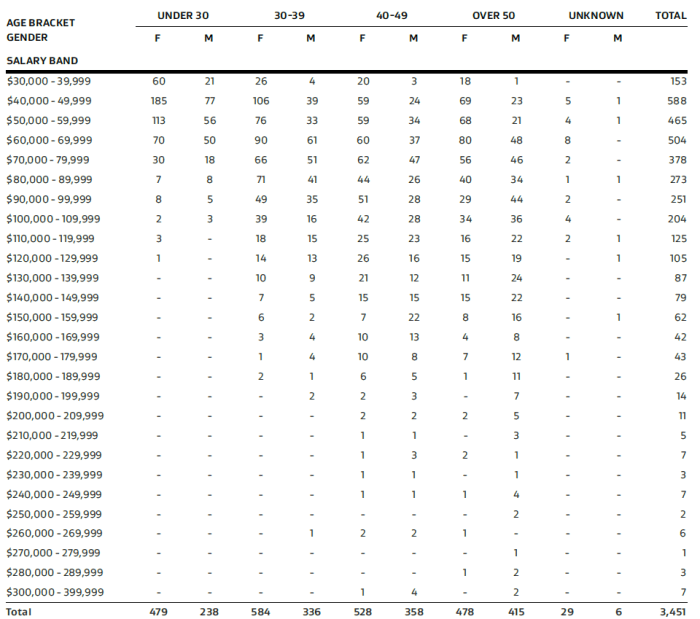
Take, for example, our largest government department, MBIE.  I went to their annual report and found the table of salaries.

MBIE salaries

Perhaps you could treat that very top-tier (chief executive and deputy CEs) as the equivalent of Cabinet ministers.  But this one agency also has 45 people earning between $200000 and $300000 per annum.  These will probably mostly be third-tier managers.    Some of you might be inclined to object that these people are themselves overpaid, but I rather doubt it for what we should be expecting from the sort of people who should fill these sorts of roles.    Of course, they are well above average salaries –  we expect much more than average sorts of skills from people filling them.

And these are sort of people whose work we expect MPs to challenge/scrutinise etc (without any of the sort of staff resources these public sector senior managers have at their disposal).

So I don’t have a sense at all that our MPs are overpaid, and wouldn’t have begrudged them a pay rise this year, or any year (in which private wages were rising).    There are perhaps anomalies in the sense that a new 25 year old MP gets the same as an immensely-experienced former Cabinet minister, but there is no easy way round that feature.  And we should steer well clear of the absurd suggestion from the far-left leader of the Greens, who proposed that MPs should get only the same dollar increase as in the average wage –  thus compressing the relative margins between MPs and the rest every future year for ever (well, unless we have a burst of deflation).

I’m not altogether persuaded by the story that able people won’t go into politics because the pay is too low.  No doubt it is so for some. For others, it will be the hours, the separation from family, the public spotlight or whatever. But we should be careful not to increase the risks of such a system, in some self-reinforcing spiral, in which we complain of dud MPs, and then set a reward structure which only increases the probability of disproportionately getting such people in future.  Ours is a thin democracy, with few effective protections against executive over-reach and the like.  We should be looking for very able people to fill select committee positions –  not just as a passage towards promotion, but as a vital role in and of itself.  I’ve argued previously we should provide more resources to members and select committees –  the public goods of good government need to be properly funded, not skimped on –  but while we consistently refuse to do that the calibre of people serving as MPs is all the more important.


If pushed on the New Zealand situation, the person I suspect could be overpaid in our system is the Prime Minister.  It is a big job to be sure, but it really isn’t one people pursue for the money.  No one we would want to be Prime Minister is likely to look, before entering Parliament, at the PM’s salary to decide if they can support a family on it.  As Stacey Kirk’s article points out, on the (crude) international comparisons we appear to pay our Prime Minister quite generously

Data released by international consultancy group IG in May showed Ardern was the fifth highest paid leader in a comparison of 32 members of the Organisation for Economic Cooperation and Development (OECD).

In a study of the pay gap between world leaders and average citizens, Ardern ranked third, earning 8.63 times the average New Zealand wage.

Post-politics opportunities are probably better for many of the heads of government in these other countries –  Bill Clinton or Barack Obama make their money from being President once out of office. Or Gerhard Schroder or Tony Blair.   That isn’t a model we could, or should want to, emulate. I’d rather pay the Prime Minister a decent salary, and expect a considerable degree of self-discipline and restraint once out of office.

As a bonus, perhaps they could take the steps need to reverse the decades of economic underperformance, that have depressed the earnings of most New Zealanders (and led so many to leave altogether).

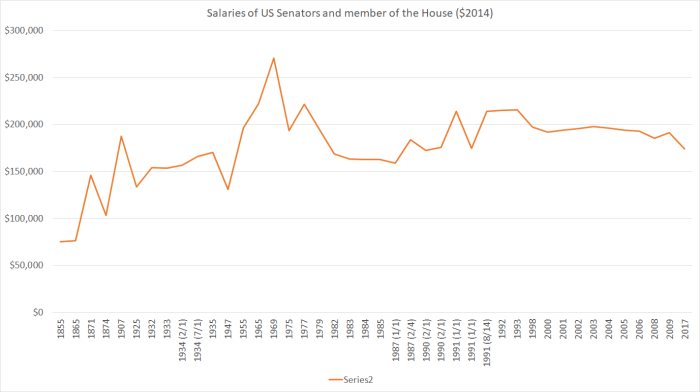
PS.   In digging around before writing this post, I stumbled on some data on the inflation-adjusted salaries of US Senators and members of the House of Representatives

us senator salaries

The dates aren’t evenly spaced, but remarkably there has been no growth in real salaries since the 1950s (and no growth in nominal salaries since 2009).  Real per capita GDP in the US today is about three times what it was in the mid 1950s.   That, at least, seems like a benchmark of badness, and something to avoid –  so bad is the US system, the members get no accommodation allowances, and so not a few sleep in their offices while in Washington, and look to opportunities to cash out in new roles in K Street.

Reflecting on the government and the PRC

Early last month, the government published its Strategic Defence Policy Statement.   That was the one that caused a bit of a flurry because of the inclusion of the odd, rather mild, honest statement that appeared to that put noses out of joint among the tyrants of Beijing and their representatives and advocates (not all PRC citizens) in Wellington.

And that was so even though early on the document reminded us that

New Zealand continues to build a strong and resilient relationship with China. Defence and security cooperation with China has grown over recent years, supported by a range of visits, exchanges, and dialogues.

It isn’t clear what values or interests the People’s Republic of China and New Zealand would share.   We knew better 50 years ago when we didn’t do military exchanges and joint exercises with the Soviet Union.

The pandering goes on with talk of how “China is deeply integrated into the rules-based order” (one of those much-used but very ill-defined phrases that seems to bear little relationship to reality).

Moving along, the report gets a little more frank, but in repeating lines that are news to no one.    China is not  –  and shows no sign of or interest in becoming – a liberal democracy, and its “views on human rights and freedom of information…stand in contrast to those that prevail in New Zealand”.   The document notes also growing Chinese military power and a disregard for international fora in dealing with “the status of sovereignty claims” in “disputed areas of maritime Asia”.     There is, rather brief, reference to attempts to “disrupt and influence Western nations’ political systems from the inside”, although those comments aren’t specific to China.

And (in a statement of what one would have hoped would have been blindingly obvious) there is this

Developments in Europe and Asia have crystallised a sense that non-democratic and democratic systems are in strategic competition, and that not all major powers’ aspirations can be shaped in accordance with the rules-based order [whatever the government means by that], in the way that had been hoped until recently.

And yet, if this is partly in reference to China, what have the presidents of both the Labour and National parties been doing praising Xi Jinping and the contribution of the PRC?  There has been no sign of them recanting.

A little later on in the document, there are two paragraphs specifically about China.  They are purely descriptive, with not a word of disapproval to be found among the descriptions of China’s aggression in the South and East China Seas, the construction of military bases on artificial islands in contested waters.  Remarkably –  but no doubt pleasingly to both Beijing and our Ministry of Foreign Affairs and Trade –  there is apparently no mention of Taiwan, a key potential flashpoint, at all.

You could perhaps read the document more charitably than I have done –  for example, hints of unease about Chinese activity in Antarctica –  but it is still a pretty anodyne document.  There is no explicit or outright criticism.   Even China’s major geopolitical initiative, the Belt and Road Initiative, is described in positive terms.

But Beijing didn’t like it

At a press conference in Beijing on Monday, China Foreign Ministry spokeswoman Hua Chunying said the country had taken note of the defence policy statement and “lodged stern representations with New Zealand on the wrong remarks it has made on China.”        …

“We urge New Zealand to view the relevant issue in an objective way, correct its wrong words and deeds and contribute more to the mutual trust and cooperation between our two countries.”

Quite telling that wording.  Not a matter, apparently, where reasonable people might disagree, but rather “wrong words” (and “deeds”) that need correcting.   New Zealand should abase itself.   And the PRC sometimes wonders why it doesn’t have more genuine friends….

The document itself is now rather old news.  But what struck me in the days and weeks after its release was that, anodyne as it was, it was made even weaker by the complete silence of the Prime Minister and senior Labour Party figures (and, for that matter, the Greens).  Labour is by far the largest component of the government, and not a peep has been heard from the Prime Minister (conveniently on leave when the policy statement was released).  But that is par for the course from the Prime Minister –  I wrote here about a speech she gave earlier in the year to the China Business Summit in Auckland.   There was no sign of any moral core to her views.   Not surprisingly, since her own party president has been in Bejing, since she became leader, praising Xi Jinping.   It is sickening.

Incidentally, for anyone inclined to look favourably on New Zealand First’s involvement in all this, I stumbled on an article on the PRC Embassy’s website about an event in Wellington a couple of weeks ago to celebrate the 91st anniversary of the People’s Liberation Army.  Among the speakers were our Defence Minister, Ron Mark, and our new Chief of Defence Force, Kevin Short.  Various other senior New Zealand officials also attended.  Neither man published the text of his remarks, but the Chinese Embassy reported them.

Here was Ron Mark

The New Zealand Minister of Defence Ron Mark extended his heartfelt congratulations on the 91st anniversary of the founding of the PLA and expressed his admiration for the contribution of the Chinese army towards safeguarding world peace. The Honourable Ron Mark noted that China is New Zealand’s strategic partner and that the relationship with China is one of New Zealand’s most important and valuable relations with foreign countries. Over the past 30 years since Royal New Zealand Navy frigates visited Shanghai in 1987, China-New Zealand military-to-military relations have continued to develop on the basis of openness and mutual respect.

What planet is the man on?  He’d probably have had a good word for the Wehrmacht and the Luftwaffe in 1938 as well.

As for the Air Marshal

Mr Short noted that over the past 91 years since its founding, the PLA has made tremendous contributions to China and the world.

A decades-long civil war, enabling one of the brutal and murderous regimes on the planet, and now  –  according to our own Strategic Defence Policy Statement

China’s military modernisation reflects its economic power and growing leadership ambitions. China’s growing military capabilities raise the costs of any potential internvetion against its interests and include stronger expeditionary capabilities, including a military presence in the Indian Ocean.  China has expanded its military and coastguard presence in disputed areas of maritime Asia. It has determined not to engage with an international tribunal ruling on the status of sovereignty claims.

Perhaps all that had slipped the Air Marshal’s mind when he made the kowtow before the PRC Ambassador, presumably with the approval of his Minister?

Distasteful as the PRC regime is, at least there was a bit more honesty in some of their reported remarks

In his speech, Defence Attaché Li Jingfeng stated that as socialism with Chinese characteristics entering a new era, the building of the PLA has also reached a new stage. With the deepening of defence and military reforms, the entire army adheres to the absolute leadership of the Chinese Communist Party and resolutely implements President Xi Jinping’s thought on building a strong military. By constantly advancing the policy of developing the military through political work, strengthening it through reform, and governing it according to law, the PLA’s combat effectiveness has been significantly enhanced

Against what external threat, other than those generated by the PRC’s own aggression, one has to wonder?

As the PRC Embassy reported it

The atmosphere at the reception was cordial and friendly. The participating New Zealand guests spoke highly of the achievements made by the Chinese armed forces and their contribution to world peace,

I guess we can take such propaganda with a pinch of salt, but it clearly wasn’t a remotely awkward occasion for such an expansionist power just a few weeks after that defence policy document had been released.  It should be a cause for shame among our ministers, officials and senior defence force officers.

And if I’m critical of our government and its officials, the Opposition is no better.  After all, they still have former PLA intelligence staffer Jian Yang –  the man who acknowledges he misrepresented his past to get into the country –  as one of the lesser lights of their parliamentary caucus.    Their leader was the man who, as a senior minister last year, signed New Zealand up to the Belt and Road Initiative, in a document full of nauseating and ingratiating rhetoric (next steps of which are due, in terms of the agreement, in the next six weeks).  Perhaps worse, when the government came out with its rather mild Strategic Defence Policy Statement, mostly just stating –  barely even criticising –  the blindingly obvious, Simon Bridges was all of a flutter.  The government couldn’t possibly say such things: it might upset Beijing.  There would be consequences he ominously warned.    Does the man have no respects for the values and systems of his own country at all?  Is he only interested in the perspective of a few businesses (including universities) that want better trade terms, never mind the character of the regime they pander to?  Never, ever, apparently must a disrespectful word be uttered.

There have been a few interesting articles around from abroad in recent weeks that are worth reading.  Perhaps most directly salient was a substantial piece in the Australian magazine The Monthly by John Garnaut, formerly a senior Fairfax journalist (and long-term China correspondent), more latterly an adviser to the Australian government.    His article is on the challenge PRC influence strategies pose in many countries –  in Asia, the Pacific, Europe and the Americas.

Garnaut writes

The CCP’s international influence system is a complex, subtle and deeply institutionalised set of inducements and threats designed to shape the way outsiders talk, think and behave. The modus operandi is to offer privileged access, build personal rapport and reward those who deliver. It seeks common interests and cultivates relationships of dependency with chosen partners. The Party uses overt propaganda and diplomacy, quasi-covert fronts and proxies, and covert operations to frame debates, manage perceptions, and tilt the political and strategic landscape to its advantage.

Beyond the foundational assumption of a single, civilisational “China”, the specific demands of United Front work are framed by permutations of three narratives: China is inherently peaceful and beneficent, the growth of Chinese power is inexorable, and China is vengeful and dangerous if provoked.

These narratives are internally contradictory but consistent over time. The first two are delivered openly by leaders, diplomats and state propaganda. The third is usually delivered via back channels with plausibly deniable connections to the state: PLA “hawks”, specialist military hardware websites, academic forums, personal meetings with top leaders, editorials in the Global Times. Together, this messaging orchestra is designed to condition audiences into believing that the rewards are great, resistance is futile, and outright opposition may be suicidal.

The meta-narrative of Beijing’s ever-growing power is the drumbeat that accompanies China’s policies of territorial coercion across its southern and eastern seas. It is the subtext that persuades foreign governments to remain silent as Beijing abandons restraint in the restive borderlands of Tibet and Xinjiang. It is also the incentive for economic beneficiaries to avoid seeing, or to rationalise, or to even actively support the Party’s efforts to degrade the values and institutions of civil society.

That final sentence sounds a great deal like the New Zealand situation.

But Garnaut isn’t just writing about distant places like New Zealand and Australia.  Of Taiwan he writes

In May I attended a closed-door forum hosted by the Taiwan Foundation for Democracy that was publicly opened by the deputy foreign minister, François Chih-Chung Wu. He set aside diplomatic platitudes to issue this plea for international help:

“In Taiwan, and in countries elsewhere, China moves from soft power to sharp power, and then to hard power. And it is becoming more brazen every day … In other countries, this process may begin with a Confucius Institute, scholarships, grants, but the next thing you know you must self-censor discussions China considers sensitive … In the face of this authoritarian onslaught of China’s misinformation, cyber hacking, bribery, economic coercion, theft of technology, and intrusion in internal politics – Taiwan is crucial. If it can hold on, other democracies will be able to hold on. But if it fails, there will be no security for the democratic governments of the world.”

He also writes about the Singaporean government’s expulsion last year of a resident Chinese-born US citizen, a reasonably prominent academic, for being an “agent of influence for a foreign country”.     Garnaut writes

What is striking about this official statement is that it makes detailed allegations relating to a form of espionage that sits a long way from the traditional Western counterintelligence agenda. The intelligence officers who were allegedly behind this operation were not stealing secrets. And nor were they aiming to directly control any policy lever. Rather, they were allegedly planting or nurturing a series of words and ideas in order to tilt the strategic decision-making landscape in a particular direction. They didn’t want to force Singaporean policy makers to make decisions in their favour. Rather, they wanted to condition policy makers to make such decisions of their own volition.

He quotes a recent speech from a retired top Singaporean diplomat (reprinted in the government-managed media in Singapore)

“China does not just want you to comply with its wishes. Far more fundamentally, it wants you to think in such a way that you will of your own volition do what it wants without being told. It’s a form of psychological manipulation.”

As I read that, it brought to mind Beijing’s description of the New Zealand defence document: “wrong words”.

Garnaut reports his own experiences, and the attempts of the regime to suborn his reporting

At first, my exposure to United Front work was all about inducements, with an occasional warning to keep me on my toes. I was offered red envelopes, neatly packed with US$100 bills. And sounded out for a lucrative “consultancy” arrangement with a Hong Kong bank. In one encounter, I was offered air tickets, hotel accommodation, a five-star family holiday, a job, and a gift bag containing bottles of Bordeaux wine valued at up to US$2000 each. These were all reciprocity traps, to be avoided at all costs. Gradually, over time, the ratio of carrots to sticks was inverted.

Garnaut was recently the subject of legal action by one extremely wealthy PRC resident in Australia,  put out by his open and sceptical reporting.

Another recent piece people might like to read was piece by Didi Kirsten Tatlow, long-serving (and then China-resident) journalist, and currently visiting fellow at the (German) Mercator Institute for China Studies, on some of the ideas, values, and language (often ancient) that seem to guide PRC actions today, including around the United Front activities  (“Imperial philosophy meets Marxist orthodoxy in Beijing’s global ambitions”).

In one quote, resonant of Beijing’s descriptions of the defence policy document,

A direct consequence of this worldview is that, from the party’s point of view, China’s sovereignty applies everywhere in the world. The party-state reserves for itself the right to negate values such as freedom of speech anywhere if it feels these challenge its sovereignty.

This stance is often expressed in terse demands to “outsiders” to apologize for getting things “wrong,” such as classifying Taiwan as a nation, or referencing the Dalai Lama in an advertisement, as happened recently to western airlines, hotels and car companies. These demands are increasingly coupled to direct threat to trade, in a classic example of jimi.

Rarely is the rationale behind the demand spelled out, but it was, in January, in an article in Global Times. The article responded to a previous New York Times article that documented how Chinese diplomats and soccer officials were interfering in political and speech freedoms in Germany. (That article was by this author.)

Efforts in Germany to support the rights of Tibetans were not a question of free speech, wrote Zhang Yi in Global Times: “What the author fails to understand is that the Tibet question is a matter of Chinese sovereignty; the Tibetan separatists aimed at splitting China and they should not use freedom of speech as an excuse,” Zhang wrote.

In that quote the underpinnings of the democratic order are removed and the intrinsic value of free speech negated everywhere. This isn’t simply change. This is revolution, in the sense of overturning. While the Global Times is not the party or government, the sovereignty argument expressed by Zhang cleaves to official thinking.

Towards the end of her paper, Tetlow notes

How can an anti-democratic, universalist China be accommodated and managed?

Firstly, a mental reset is needed. In a time of system competition it is of utmost importance to understand one’s competitor. Chinese officials and official commentators often talk about “changing and improving” global governance – pluralist societies must assume they mean to do it. Open societies must stop seeing the People’s Republic of China as a paler copy of themselves, merely lagging in terms of democratic modernity. Such teleology is unjustified, barring major political change in China.

By seeing the threads that the party is picking from the past and weaving into the future, we see China as it is – human yet totalitarian, strong yet weak, defensive yet aggressive, and ultimately a great challenge to democratic nations. When China calls for a tianxia-esque, civilizational system such as the “commonwealth of human destiny,” we must listen carefully, analyze closely the historical context and development of the term, identify the techniques used to achieve it, and assume party leaders mean to implement it if they can.

And what of the vaunted Belt and Road Initiative, that local taxpayer-funded PR outfits like the China Council and the Asia New Zealand Foundation are constantly keen to talk up (and on which the New Zealand government soon has to make decisions)?  I noticed a new short piece out of a US think-tank suggesting that all might not be well with the programme even inside the PRC.

the PRC’s policymaking apparatus appears to have already responded to concerns of BRI overreach by adjusting the scale of lending to limit possible financial risk. BRI lending by major PRC banks has dropped by 89% since 2015, and lending by commercial banks—who are dealing with their own financial issues domestically—has ceased almost entirely. Policy banks have also scaled back, despite their status as arms of PRC government policy.

What are these concerns?

On July 20, Sun Wenguang, a retired professor of physics at Shandong University, penned an open letter criticizing China for “offering almost CNY 400 billion in aid to 166 countries, and sending 600,000 aid workers” (Canyuwang, July 20). On August 1, as he expanded on his concerns in an interview with the US-based Voice of America, police forced their way into Sun’s apartment. As he was taken away, Sun could be heard saying, “Listen to what I say, is it wrong? Regular people are poor, let’s not throw our money away in Africa … throwing money around like this doesn’t do any good for our country or our society.” (VOA Youtube, August 2)

Ah, the character of the regime our politicians and officials pander to…..

As the author notes

Although a Western observer might dismiss a few professors’ unhappiness with the BRI as ivory tower grumbling, PRC academic critiques are worth noting, since outspoken academics are often the channel through which other PRC societal elites communicate their dissatisfaction with the CCP.

And draws atttention to one much-better-connected leading academic’s recent essay.

Although Sun has long been a government gadfly, he is also long retired, and resides far from the center of power in Beijing. But similar criticisms have found voice much closer to the corridors of power. On July 24, Xu Zhangrun (许章润), a professor at Beijing’s elite Tsinghua University, published an extraordinary essay entitled “Imminent Fears, Imminent Hopes” (我们当下的恐惧与期待). Among many other criticisms, Xu excoriates Xi’s government for its profligacy abroad, saying:

At the recent China-Arab States Cooperation Forum [on 10 July 2018], [Xi Jinping] announced that twenty billion US dollars would be made available for ‘Dedicated Reconstruction Projects’ in the Arab world, adding that [China] will investigate offering a further one billion yuan to support social stability efforts in the [Persian Gulf]. Everyone knows full well that the Gulf States are literally oozing with wealth. Why is China, a country with over one hundred million people who are still living below the poverty line, playing at being the flashy big-spender? (China Heritage, August 1)

Xu Zhungrun’s essay is a fascinating read (the readily available, and extensively quoted, translation was done by the Australian China scholar living in the Wairarapa).   As the translator notes in his introduction

On 24 July 2018, Xu published a lengthy online critique of China’s present political and social dilemmas. In issuing his Jeremiad, Xu, who is something of a latter-day  儒, locates himself in the Grand Tradition by effectively addressing a Memorial to the Throne, 諫言 or 上書. Given the relentless police repression and intensifying ideological clamp-down in Xi Jinping’s China, this is a daring act of ‘remonstrance’ 諫勸.

The professor doesn’t pull his punches

Over-investment in international aid may well result in deprivations at home. It is said that China is now the world’s largest source of international aid; its cash-splashes are counted in billions or tens of billions of dollars. For a developing country with a large population many of whom still live in a pre-modern economy, such behaviour is outrageously disproportionate. Such policies are born of a ‘Vanity Politics’; they reflect the flashy showmanship of the boastful and they are odious. The nation’s wealth — including China’s three trillion dollars in foreign reserves — has been accumulated over the past four decades using the blood and sweat of working people, in fact, it has actually been built up as a result of successive policies and countless struggles dating from the time of the Self-Strengthening Movement [launched during the Tongzhi Restoration during the 1860s when, following its defeat in the Second Opium War, the court of the Qing-dynasty adopted the first modernising reform agenda in Chinese history. By saying this Xu, to an extent, indicates that he does not completely embrace the Communist narrative or its soteriology]. How can this wealth be squandered so heedlessly?

The era of fast-paced economic growth will come to an end; how can such wanton generosity be tolerated — a generosity which, in many ways, replicates [the vainglorious Maoist-era policies when China boasted that it was the centre of world revolution to] ‘Support Asia-Africa-Latin America’ [which meant that an impoverished China was generously giving aid to Third World countries in an effort to gain political advantage and counter the influence both of the American imperialists and the Soviet revisionists] that led to countless millions of Chinese being forced to tighten their belts simply to survive, and which even saw the corpses of those who had starved to death scattered in the fields.

Recall that New Zealand too –  far richer than China per capita –  is a recipient of this lavish PRC “foreign aid” –  paying for language teaching assistance in numerous of our state schools,  all encouraged by our government at the expense of poor Chinese.

Average Chinese are most frequently offended by the way the state scatters large sums of money through international aid to little or no benefit. China is still slowly making its way up the steep slope of development. In terms both of basic infrastructure and social facilities, as well as in regard to people’s ability to access welfare, we are confronting massive problems; our burden is great and the road ahead leads far into the distance. And I make this point without even mentioning the crisis in aged care, or issues related to employment opportunities and education.

Or

Even the most commonplace international meeting organised in China involves extraordinary levels of expense. There is no regard for budgets; fiscal waste and the heedless loss of human work hours is considerable. Such activities are content-free and superficial. It’s all about pursuing ‘Vanity Politics’ not ‘Practical Politics’, let alone ‘Hard-edged Politics’. Such events have nothing to do with the so-called ‘venerable traditional of warmth and hospitality demonstrated by the Chinese people from ancient times’; only the most vain and self-serving [leaders and bureaucrats like to] indulge in such things. If foreigners were to copy what we ar constantly doing here, then the VIP-filled headquarters of the United Nations in New York would be on police lock-down 24/7, and the headquarters of the numerous international organisations based in Geneva and Paris would perforce have to stage nightly fireworks displays with their personnel expected to be decked out in all their finery all the time.

One might think of cocktails to celebrate the 91st anniversary of the PLA.  But more tellingly one might think of PRC gifts to PNG (a fancy convention centre and a new six lane highway for example) to enable it to host APEC this year.

Or

An emergency brake must be applied to the unfolding Personality Cult. Who would have thought that, after four decades of Reforms and the Open Door, our Sacred Land would once more witness a Personality Cult? The Party media is going to extreme lengths to create a new Idol, and in the process it is offering up to the world an image of China as Modern Totalitarianism. Portraits of the Leader are hoisted on high throughout the Land, as though they are possessed of some Spiritual Mana. This only adds to all the absurdity. And then, on top of that, the speeches of That Official — things previously merely to be recorded by secretaries in a pro forma bureaucratic manner — are now painstakingly collected in finely bound editions printed in vast quantities and handed out free throughout the world. The profligate waste of paper alone is enough to make you shake your head in disbelief.

Didn’t former Labour leader Phil Goff pay for a large chunk of his mayoral campaign auctioning off collected works of Xi Jinping, to PRC-based donors?

It is a bracing read, and one can wonder at the likely fate of the courageous author.

Meanwhile, our Prime Minister –  and her Opposition counterpart – refuse ever to utter a critical word about the regime, or what it represents here  (Jian Yang, the infiltration of Chinese community groups, control of the Chinese language media), abroad (South and East China Sea), or back home.    The most egregious recent example is around the mass concentration camp (actual detention, and extreme surveillance for those not detained) in Xinjiang.    What would it take for Jacinda Ardern, Simon Bridges, Winston Peters, Ron Mark, James Shaw, Marama Davidson to speak up and speak out.   Does nothing but a dollar matter in their world nowadays?  It looks a lot like civilisational decadence taken to whole new levels.  So well-schooled it doesn’t even occur to them to speak up.     Another cocktail party perhaps?  Pass the canapes, and quietly ignore the great evil Beijing and the CCP are responsible for –  not just in decades past, but (in more refined, and perhaps unnerving) forms right now.

These were parties that once prided themselves on standing against (variously) apartheid South Africa, French nuclear testing, the Soviet Union, Nazi Germany, mass murder in Cambodia or Rwanda, and so on.  Is there anything left they believe in enough, or care about enough, to speak up, take a stand, or do something?


Plastic bags

There is a reason why we do not let primary school children make policy or vote.  They are children, precious and growing but prone to all the enthusiasms of children, easily influenced, and not responsible (as taxpayers or anything else) for their expressed preferences.   And yet, as the Prime Minister was reported, it seemed that the fact that lots of school children had written to her about plastic shopping bags was almost enough in itself to justify a decision to ban them.  And how many of those letters in turn were subtly –  or not so subtly –  prompted by teachers, themselves disproportionately likely (at least based on the sample I’ve seen over 10 years and four schools) to be Labour and Greens supporting?  Has a child in central Wellington ever came home enthused by a teacher regaling them with the creative wonders of the market, of innovation, or prosperity?  (Let alone any other traditional virtues.)

Having now read the government’s consultative document on the planned ban on plastic shopping bags, I was pretty staggered by how bad it was.   Since the document is actually released under the name of the Ministry for the Environment, has the New Zealand public service now sank to such a low level of “analysis” and evaluation?  Or were they simply overruled by ministers with an agenda, and no analysis?  Either way, there is little positive that can be said for it.

Just for clarity –  since this didn’t really come through in the media reporting I saw – this is what it is proposed to ban:

A new plastic bag (including one made of degradable plastic) which has handles and is below a maximum level of thickness. The terms ‘plastic’ and ‘degradable’ (including ‘biodegradable’, ‘compostable’ and ‘oxo-degradable’) would be defined in regulations with reference to international standards.

Thus, oddly, of the 31 bags I brought home from the supermarket the other day, only 15 will be outlawed.  But there is no hint in the document as to why one sort of bag –  that one might put beans or apples in, or in which bread rolls might come wrapped –  is less problematic environmentally than the bags (with handles) that I might then carry the groceries home with.

Since one tends to notice these things once attention is drawn to them, I’m also relieved to find that the two newspapers a day that arrive at our house will still be able to be wrapped in plastic (definitely never re-used after it is ripped open), and that the various magazines that arrive each week wrapped in plastic will also still be okay.  But why?  What is the difference?    Will the bag my newspaper was in be less likely to blow round than the bags the groceries were in?  No evidence or argument is offered.

It is a simply incoherent approach, apparently grounded on no analysis whatever (at least none they have sufficient confidence in to expose to scrutiny –  perhaps it will biodegrade in sunlight?)

As it is, the document highlights just how small a problem – if “problem” they are – plastic bags are.   Here is total use

Industry estimates of current consumption in New Zealand of standard supermarket single-use shopping bags are 154 bags per person per year. This is about 750 million bags per year, or about 0.01 per cent by weight of total waste in levied landfills.

0.01 per cent of landfill waste.

There is more

Published urban litter count data does not differentiate plastic shopping bags from ‘unclassified packaging’, which makes up 10.8 per cent by count in ‘visible litter’. Takeaway food and drink packaging makes up an estimated 40.2 per cent, and non-packaging litter makes up 42.4 per cent.

And recall that the proposed ban isn’t going to ban all plastic shopping bags, only the ones with handles, which must make up quite a small proportion of even that 10.8 per cent of total “unclassified packaging”.

Or take these (unverified) estimates from various “coastal clean-up events”

Figure 1: Coastal clean-up data, New Zealand, top litter categories by … weight

plastics 2

(the orange bars are items wholly/largely made of plastic).

So even if you were wanting to focus policy on the potential impact of plastic litter on marine life etc, it is far from clear why you would make a start on plastic bags (again, recall that the class of plastic bags the government proposes to ban is only a fraction –  no estimates from them as to what fraction –  of total plastic bags).  Rope and buoys/floats do rather stand out, as do plastic drink bottles.    As I read the consultative document, it is all plastic, and will also break down over time into stuff that might do bad stuff to marine life or even humans.   But the government is just coming for our shopping bags.

I used the word “might” a couple of sentences back.  I don’t claim any expertise in the science: here instead I’m quoting the Associate Minister for the Environment, Eugenie Sage in her Message at the front of the consultative document.

There is early evidence of the toxicity of these plastic particles to marine species, and potentially the human food chain.

I was quite surprised by her rather modest claims (“early evidence”, “potentially”).  Surely that uncertainty would then be reflected in the cost-benefit analysis for any regulatory intervention?  Oh, silly me.  That assumes there is a cost-benefit analysis, but in this document there is nothing even remotely resembling such a standard part of the policy analysis toolkit.   And that is even though they explicitly acknowledge of what evaluation they did do

This assessment was based on information from overseas experience, which has many gaps in relation to these goals.

So what is the rush?  Why not do your evaluation rigorously and robustly, clearly identifying your assumptions when there is (as there always is) inevitable uncertainty?  And how about pricing the option of waiting, or incentivising the development of genuinely biodegradable bags?

But actually the clue to what is going here is actually repeated several times in the document, this from the Executive Summary.

plastics 3

In other words, we want to be in your face about it, and we can inconvenience almost everyone.

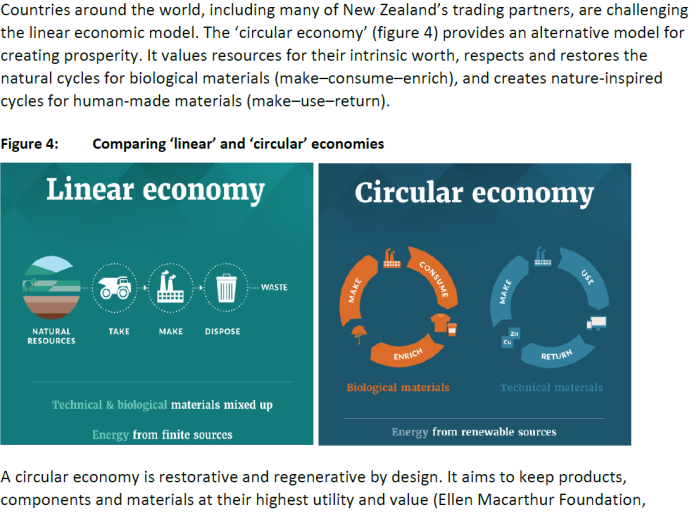
It isn’t about marine pollution or the potential toxicity of plastics, but a stake in the ground for a strategy which, if pursued, would up-end the way we do things across the spectrum of economic life, all based on the new dogma known as “the circular economy”.

I’d noticed a reference to this concept a few months ago in a speech by a senior Labour minister (this stuff isn’t just Greens flakiness) but hadn’t paid it much attention.  But here is what the government says in the latest consultative document.

plastics 4

With not a single reference, at all, to the role of the price system in signalling the best uses for resources, best productive processes etc etc, it looks a lot like economic illiteracy hallowed by a major government ministry.  There is, for example, no hint in any of this –  presented as some easy alternative –  about the labour costs in each of these approaches.   No one doubts that the earth has finite resources –  heck, even the sun will burn itself out one day –  but on this standard of analysis, government would never have let the Industrial Revolution (or all the huge improvements in material living standards that flowed from it) occur.

If there are unpriced externalities, identify them, estimate the significance of them, and look at the options for pricing them.  That would be pretty standard economic analysis.  You might even focus first on the most significant sources of marine pollution, not the feel-good ones, deliberately designed to inconvenience almost everyone.

Because this isn’t just some new analytical framework for academics to play with. It seems to be a policy agenda

Actions to phase out aspects of a linear ‘throwaway culture’ are part of a transition to a circular economy.

If the Prime Minister, James Shaw, Eugenie Sage and the rest of them haven’t come for your water bottle, your disposable coffee cup, your newspaper wrapper, your fresh produce bag at the supermarket, the tray supermarket meat comes on, or the carton your Chinese takeaways come in, this document suggests it is only a matter of time.  Standard economic analysis would suggest that provided the true economic cost of landfill provision is charged for (eg) these are cheap and efficient technologies improving the living standards of New Zealanders.

As I’ve already noted, there is no cost-benefit analysis in the document.  Specifically, there is no overall summary estimate.  But there is also no attempt to put a dollar value on any one of the various potential costs and benefits (some identified, others ignored completely).  How do we value the potential reduction in the poisoning etc from marine life? I have no idea of the appropriate number, and the documents suggests (by silence) that MfE and the government have no idea either.  Since that is, purportedly, the main benefit of the policy, it seems like quite a gap.

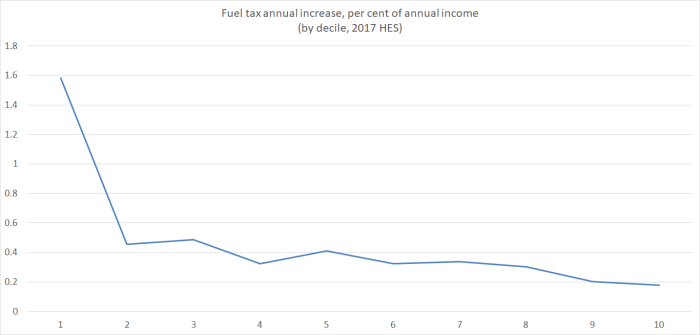
And if there is no cost-benefit analysis, there is also no decent distributional analysis. But there is this stark statement

Some consumers on low incomes may nonetheless find the up-front cost of multiple-use bags unaffordable. One possibility is to provide support, such as offering discounted bags to holders of Community Services Cards and Gold Cards.

So yet another policy proposal –  from the party the campaigned that it was on the side of the poor and the marginalised – that will hit the poorest hardest (as the net-zero climate proposal will).  And that on the government’s own reckoning.    But it does rather highlight the point about why supermarket shopping bags with handles exist: because they are cheap and efficient.

Strangely, there is also no real analysis of where the savings to retailers (from not providing bags) are likely to go.   Again, from a left-wing government, the first option listed in a “windfall profit” to retailers –  transferring value from poor people to supermarket shareholders?  My starting point would be that, over time, any savings to retailers would be competed away, but I know that serious people have concerns about the degree of competition in the New Zealand supermarket sector.  On which note, it would be interesting to know –  and tempting to OIA –  whether the supermarket chains have lobbied for this ban, including in its very particular form.    Quoting again from the Associate Minister,

Government working alongside industry can be very powerful

No doubt, but there should be no presumption –  perhaps especially from left-wing parties, if they seriously care about consumers and the poor –  that such working together will generally be in the public interest.

I have noted already that some costs are not even identified at all.   At present, if I go to the supermarket I give no thought to what I will bring my purchases home in.  Supermarkets provide plastic bags (as do many other retailers).  If every trip to the supermarket were in future to involve 30 seconds to collect reusable bags before heading out, then across tens of millions of trips to the supermarket each year, the value of that time alone will be non-trivial.

The authors of the consultative document also seem conveniently oblivious to how people actually live.  This is from a post by Eric Crampton this morning.

We have a few reusable bags at home. The ones we have get reused a lot, because we use them on planned trips to the store. But most of our trips aren’t like that. Most of them are grabbing a few things on the way home after getting off the bus. Maybe other people are happy to carry around reusable grocery bags every day on the off chance that they might need to grab milk, bread, eggs and butter on the way home. I’m not. On those trips, we use the disposable plastic bags. Because what else are you going to do? Walk home, get a bag, walk back to the shop? It’s absurd.

Or my own experience as a semi-retired suburban homemaker.   I go for an hour-long walk most days.  About three-quarters of the way round, I pass the local supermarket, and perhaps most days I pop in and get one or two things.  A light supermarket shopping bag, with handles, equips me for the walk back up the hill home again.   Zealots will no doubt argue that I should carry a reusable bag with me all the way round my walk.  By why would I want that inconvenience?  Or this morning, when I went out I planned to pick up just one small thing, that I might have carried home without a bag at all. But passing the supermarket I noticed a generous discount on something I stock up on whenever it is on sale.  I bought five of that item.  With a supermarket shopping bag, with handles, it was not a problem.  Without that option, I am more likely to use the car and drop back down to the supermarket later in the day, extra carbon emissions and all.  All these sorts of forced changes of behaviour should be identified, and efforts made to price them, weighed up against serious estimates of any possible benefits.

The consultative document does, at least, include a table showing estimates of how many times different types of alternative bags have to be used to have less environmental impact (over 14 different measures) than a standard supermarket shopping bag.  At the absurdist end of the spectrum –  and yet these the sorts of options Greens like to talk up in other contexts –  an organic cotton bag would, we told, need to be reused 20000 times: roughly once a day for each of 60 years.  In a sense that difference is one of the marks of how much progress society has made in identifying products as cheap and useful as the supermarket shopping bag.  Organic cotton, after all, was all the cotton there was a few hundred years ago.

Lest you be unable to believe that there is no evaluation framework at all, MfE do offer one up in the document.    It is captured in this subset of their table.

plastics 5

This framework is not designed to assess whether there is a policy problem that can be cost-effectively addressed.  Rather, it assumes there is a major policy problem  (note that triple-weighting on the first criterion, and how broadly and loosely defined it is) and then it set up to demonstrate the superiority of the option the government plans to ram through.  There is no obvious reason (from a public perspective) why the ability to impose a ban without new legislation should be favoured over an option that requires new legislation (in fact, rather the contrary given the pervasive –  deliberately so –  effect on this proposed ban).  And on the other hand, the evaluation framework gives no weight at all to issues around personal freedom and choice.  Thus, some of the other options – tax or mandatory-charge based –  would be likely to generate substantial reductions in plastic bag use, while allowing those for whom use of such bags was particularly convenient or valuable to continue to do so.  It is, for example, the approach adopted in the UK.   The consultative document offers no good economic reason not to take that path here.

Finally, it is perhaps worth noting that some media outlets have reported there being 104 countries to have adopted such a ban.  In fact, the consultative document is quite clear that there are 104 jurisdictions –  anything from local councils to national governments.  Recall that there are 70 odd territorial local authorities in New Zealand alone.  And that local councils –  here and (no doubt) abroad –  do all sorts of daft and damaging things without adequate scrutiny and evaluation (see, for example, our housing markets).   Going by the table in the document, the number of countries that have actually and enforced imposed bans (especially as far-reaching as our government plans) seems able to be counted on the fingers of one hand.   We deserve much better analysis; it is not a case of New Zealand simply copying what every other advanced economy is already doing.

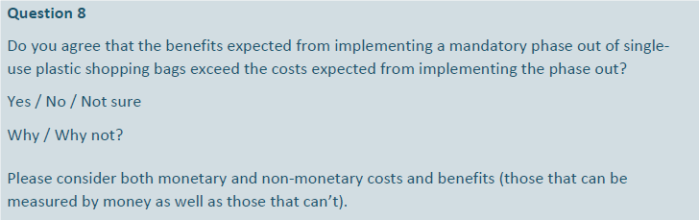
It is a shockingly poor document, perhaps summed up best in this question for submitters

plastics 6

Perhaps it is mostly a fair enough question, but given all the analytical resource and money (from taxpayers) the government and MfE have at their disposal, surely they could have at least made a stab at estimating the costs and benefits themselves, setting down their workings as a basis for submitters to agree or not.

But that perhaps assumes that this is a real consultation.  I suspect the school children can be counted on to write in assuring the Prime Minister and her colleagues that it is a wonderful plan and everyone will feel better for it.  Such a sound way to make policy.

A case for more MPs?

One of my kids is quite sympathetic to ACT.  So when the news emerged yesterday that ACT was adopting NZ First policy, and calling for a reduction in the size of Parliament to 120 MPs, we had a bit of a chat and I offered a few alternative perspectives.

One of those alternative perspectives is captured in this nice chart from a Czech mathematican and blogger.

parliament-per-capita

New Zealand has 120 MPs and a population of 4.9 million.  In other words, 24.5 members of Parliament per million people (a number that is dropping quite steadily given our relatively rapid population increase –  in 1993 when MMP was voted in, 120 MPs was equivalent to about 33 MPs per million people).

Look at that Europe chart, which helpfully includes numbers for some of the very small countries.

Of the large democratic countries (Spain, France, UK,  Italy Germany, Poland), the average number of members of Parliament (upper and lower house) is about 15 (and even that number is skewed up by the part-timers in the House of Lords),  Ukraine, Russia and Turkey –  big countries, if not always terribly democratic –  also have a small number of MPs per capita.

And what of the very small countries?   Iceland, Luxembourg, Andorra, Malta, Montenegro, Cyprus.  Among those countries, the median number of members of Parliament per million people is over 100.

And what of countries very close to New Zealand in size?  There are six EU countries with between four and six million people.  Here are the number of members of Parliament per million people in each of them, as per the chart above

Denmark                            32

Finland                               37

Slovakia                             28

Norway                              33

Ireland                               49

Croatia                               36

I could go on, but I’m sure you get the point.   Big countries have lots fewer members of parliament per capita than very small countries, and of the advanced European countries around our size all have more MPs per capita than we do.   There are outliers and exceptions of course  –  among advanced countries Israel (also with 120 MPs and more people than we have) is one.   But I suspect ACT and NZ First would struggle to find a useful cross-country metric that suggested we had too many MPs.    And unlike most of the larger countries, we don’t have federal system, so there are no state-level MPs.  And there is no second (reviewing) chamber.

It seems perfectly sensible to expect that the number of MPs per capita will be diminishing quite a bit with population.  There are economies of scale to many of the more critical functions we expect from our members of Parliament.  In fact, the same goes for many central government functions (central banks, diplomatic services, supreme court and so on).

You might think that there are too many minister and under-secretaries –  something I do agree with ACT on  –  but even Mr Seymour’s proposal of 20 would give us a ministry about the same size as the Cabinet in the United States or the United Kingdom.   There are certain number of jobs that need doing even if you are a small state.  Just as local councils in towns of 20000 people still have many of the same functions as the Auckland council.

But staffing the executive ministerial roles probably isn’t the most important role of Parliament.   At least as important is the challenge and critical scrutiny that MPs can and should provide on legislation, on the performance of ministers, and on the performance of government agencies  (there are, inevitably –  and even in Mr Seymour’s small government world –  many of them, through which all-too extensive powers are exercised).

In particular there is the work of select committees.   Select committees in New Zealand are poorly resourced, but even members of select committees are typically spread very thinly.  Scrutiny – whether of proposed legislation or of ministerial/agency performance –  doesn’t happen with anything like the regular depth or intensity it should.  And that isn’t because individual MPs are slackers –  most appear to work excruciatingly long hours.

Add in issues around competence and incentives and it reinforces the case that we have barely enough MPs.   Of 120 MPs, inevitably some will be duds –  people who got on the list, or won local selection, for reasons that have nothing to do with their ability to be effective legislators, or those holding the executive to account.  Likeability, or to keep someone else out.  Fundraising or ticking diversity quotas, for example.  Others linger beyond their use-by date.  (None of this makes Parliament necessarily much different from many other workplaces.)

On the government side, senior roles on important select committees are typically filled by people who are (a) well-regarded by their seniors, and (b) on the fast-track into the ministry itself.  Not a recipe for consistent critical scrutiny.   The chair of the Finance and Expenditure Committe used to be such a role –  now made worse in that both the chair and deputy chair this term are already under-secretaries, and even less likely to want to make life awkward for their colleagues.   Things are different on the Opposition side (making life difficult for the government is a big part of your reason for being), but parties typically get into Opposition after losing an election –  at which point, from both the individual and the party, there is pressure for turnover, and so a lot of experience is lost.   We don’t have much of a hinterland of people who either were ministers and are so no longer, and have been content to find a niche as, say, a select committee chair, bringing experience and a not-much-to-lose perspective to bear including in holding their own senior colleagues to account (as seems to happen in, for example, the UK).   We seem to have a Parliament of people for most of whom being a minister is the focus of ambition.   And with 120 MPs, that is realistic ambition for many/most.    I’d argue that what we need is more able people who want to be very good select committee operators, and perhaps even compelling speakers in the House itself.

Perhaps there are other papers, but in a quick look I found a piece from 2007 looking at the cross-country relationship between population and number of MPs.   The authors find a power law –  number of MPs per capita diminishing with population –  holds, and end up classifying countries into five groups, one of which includes New Zealand

The nations with abnormally sub-optimal representations: Israel, New Zealand, the Netherlands and above all, the USA. Nations in the last group are all close to a ratio of 65% of their optimal representation level.

As I noted, when MMP was voted for it involved 33 MPs per million people.  In 1951, after getting rid of the Legislative Council, we had 80 MPs ( 42 MPs per million people).  Even allowing for some economies of scale, it is far from clear that there is a credible case for reducing the number of MPs, even if (and here I sympathise with Mr Seymour) one did favour less regulation, less legislation, and a smaller role for government.

None of which is to defend our MPs from the generally appalling job they have done for decades, presiding over our steady relative economic decline (and the many other failures people could list according to taste).  But demolishing one wing of the house –  chopping out 20 MPs –  isn’t going to fix that problem.

The debate on PRC influence on Q&A

Late last week I posted as a standalone item the comments that Peter Jennings, director of the Australian Strategic Policy Institute (and former senior Australian defence strategy official), had made in response to my post about last week’s Asia New Zealand foundation roundtable on People’s Republic of China (PRC) influence/interference in New Zealand.   Jennings was pretty critical of successive New Zealand governments’ attempts to pretend there is no issue.

This morning someone pointed out to me that Jennings had been interviewed on TVNZ’s Q&A programme on Sunday, so I took a look.  His comments were pretty moderate (especially about New Zealand), and largely focused on the Australian situation, and the new foreign interference laws passed with support from both the Liberal-National coalition and the Labor Party.   He highlighted issues around political donations, the Sam Dastyari affair (Labor senator forced to resign over inappropriate activities in this area), and noted that, between Federal and state Parliaments, there was concern that Dastyari’s wasn’t the only worrying case.

Re New Zealand, he noted that New Zealand seemed to face similar pressures as Australia, and that things weren’t that different in Canada, in the UK, and in many EU countries, and that in his view it would be smart if New Zealand and Australia tried to align their approaches.   While noting that New Zealand and Australia had different geographies and different strategic imperatives, he noted some risk to the bilateral relationship (important to both sides) if our governments don’t take the PRC intrusions seriously.

Corin Dann, the interviewer, pushed back, suggesting for example that Sir Don McKinnon would see things differently.  McKinnon is, of course, head of the government-sponsored China Council, designed never to see anything concerning, never to say anything upsetting, about Beijing and its activities.   As Jennings noted, there is an interest in having an effective relationship with the PRC, but that all countries needed to recognise that there were downsides as well as upsides in relationships with such a massive power, in the process of being more dictatorial.   He argued that even if officials were confident they had things under control –  something he was explicitly sceptical of in his comments here –  it was important for governments to take publics with them, and engage in open dialogue on the issues, risks, and responses.

Dann again attempted “what-aboutism” – every country spies, there is no military threat etc.  Tell that to Taiwan –  or countries with lawful claims in the South China Seas –  was my reaction, but Jennings was a bit more emollient, simply pointing out that countries like ours did not engage in large scale intellectual property theft by cyber-hacking etc.

And finally, asked about the PRC backlash to the new Australian laws, Jennings noted that the PRC (and some its populist media) didn’t like the new approach, but that the relationship goes on.  He argued that there was a mutual interest in a “steady relationship”, and that the PRC would come to recognise that Australia couldn’t do less than say “thus far and no further”.   Given past PRC attempts at economic coercion (which I wrote about here) that seemed optimistic.

All in all, it was pretty emollient stuff, and there wasn’t even any material bad-mouthing of New Zealand governments –  an approach which, fair and accurate or not, tends to get the backs of New Zealanders up.

But it was still all too much for two members of the Q&A panel, political scientist Bryce Edwards and former Minister of Defence, Wayne Mapp.  The word “overwrought” appeared so often that one could almost use it to describe their reaction.

Edwards began claiming that there “no compelling evidence of a problem” in New Zealand, and asserted that the new laws continued Australia’s journey down a path towards being an authoritarian illiberal state, where people could no longer participate freely in political debate and protests.  To be honest, I wasn’t really sure what he was on about – and I hold no brief for the specifics of Australian legislation.  The BBC –  no right-wing authoritarian outlet – summarised the law thus

The laws criminalise covert, deceptive or threatening actions that are intended to interfere with democratic processes or provide intelligence to overseas governments.

They are designed to include actions that may have fallen short of previous definitions of espionage.

Industrial espionage – the theft of trade secrets – is among new criminal offences, while people who leak classified information will face tougher penalties.

The government also plans to ban foreign political donations through a separate bill later this year.

But I presume that what Edwards is on about is material in this Guardian article.   But even if the specific points the critics make were sound  –  and both government and opposition disagree with them – they are details, perhaps even important ones, not a challenge to the basic proposition about PRC activities and agendas in Australia and similar countries.

Former Defence Minister Wayne Mapp then joined in, claiming that Australia would not put any pressure on us to follow suit, because our political donations laws were very tight.  That would, presumably explain how former Foreign Minister Phil Goff was able to get a very large donation to his mayoral campaign from a PRC-based donor, through a charity auction organised by, among others, Raymond Huo?  I’m not disputing that the New Zealand laws are tigher than Australia’s, but here is the relevant section from my post on the Asia NZ roundtable last week.

There was clear unease, from people in a good position to know, about the role of large donations to political parties from ethnic minority populations –  often from cultures without the political tradition here (in theory, if not always observed in practice in recent decades) that donations are not about purchasing influence.  One person observed that we had very much the same issues Australia was grappling with (although our formal laws are tighter than the Australian ones).  Of ethnic Chinese donations in particular, the description “truckloads” was used, with a sense that the situation is almost “inherently unhealthy”.

Dr Mapp went on to claim that there was no need at all for new laws in New Zealand, lauded New Zealand’s role as a pioneer in relations with the PRC, and highlighted favourably the New Zealand government’s choice to eschew the term “Indo-Pacific” in favour of “Asia-Pacific”.   I can’t excited about that latter point –   New Zealand has no exposure to the Indian Ocean, and on the other hand Asia is a big place, including Israel and Syria as well as the east Asian bit.  But Mapp went on to declare that concerns about New Zealand were ‘overwrought” and that he would put his trust in his former National Party colleague Don McKinnon, over the perspectives of Peter Jennings.   The McKinnon approach, like that of the China Council more generally, has been to consistently pooh-pooh any concerns, and in the article I linked to a few lines back even asserted that

To suggest we are too scared or cautious to ever rock the boat with China is simply incorrect.

I think most of us –  agreeing or disagreeing with the stance –  will take the evidence of our senses over Don McKinnon’s make-believe.

At this point, Anne-Marie Brady’s work, and her Magic Weapons paper, finally came up.  Bryce Edwards volunteered that she had raised some points, especially about particular MPs (Jian Yang and Raymond Huo) and their closeness to PRC interests, that hadn’t really been debated, and which needed to be debated.  But this was all too much for Wayne Mapp, who asserted that we hadn’t had the debate because we didn’t need to –  the claims were all overwrought.  Weirdly he then went on to assert that we wouldn’t go down the Australian path because we don’t have overwrought debates like the Australians do.  One can only assume he was determined to keep it that way, and keep on avoiding debate and serious scrutiny of the issues.

So, for example, one can only assume that Dr Wayne Mapp, former Cabinet minister, former military intelligence officer, former law professor, and current Law Commissioner, is quite unbothered about such facts as:

  • his own party putting Jian Yang on its list and, through successive elections, never disclosing his past.
  • that past included study and work as part of the PRC military intelligence system, and
  • membership of the Communist Party
  • (experts point out that no one voluntarily leaves the Chinese Communist Party, and that given his military intelligence background he would only have been allowed to go abroad if was regarded as politically sound)
  • Jian Yang himself now acknowledges, after the media exposed his past, that he had withheld key details from the New Zealand immigration authorities, and that the PRC authorities had encouraged him to do so,
  • that in seven years in Parliament he has never once said anything critical about the PRC regime, whether about Tianammen Square or more recent abuses (domestic and foreign),
  • that a prominent former diplomat and lobbyist has gone on record of Jian Yang (and Raymond Huo) that both are close to the PRC embassy, and that he is careful what he says in front of either man.
  • or about the efforts of his own former Cabinet colleague, Chris Finlayson, to tar Anne-Marie Brady as some sort of xenophohic racist –  one of the more despicable events of the last election campaign.

No, according to Dr Mapp, there is no problem here, just a few “overwrought” claims.

But, as I’ve pointed out previously, calling things “overwrought” or “sensational” is no substitute for dealing with the specifics of Brady’s paper.  I’m not aware that anyone has rebutted anything much in her paper, despite plenty of opportunities over almost 10 months now.  They aren’t just about Jian Yang, or even Raymond Huo.  There are the party presidents grovelling to the regime, whether for fundraising or trade purposes.  There are things like a former MP trying to block out from local Council minutes any record of listening to citizens with an alternative view on the regime.  And it isn’t as if the issues and threats are all in past either –  I was told just this morning about a university which has, under pressure, withdrawn, permission to screen a documentary on campus about aspects of the PRC regime.  And much of it is about pressure on New Zealand citizens of ethnic Chinese orientation, unseen to most of us, but no less real for that.

It was a pretty extraordinary performance from Dr Mapp in particular.  As Jennings had usefully pointed out, it is not as if these issues are unique to New Zealand  But the sustained denial –  whether wishful thinking or a deliberate choice to look the other way –  of any issue, any risk, any problem, does seem to be something rather more specific to successive New Zealand governments and the Wellington establishment.  They seem willing to sacrifice self-respect, and any interest in our friends and allies in other democratic countries including in east Asia, for the mess of pottage –  some mix of trade for a few firms, and keeping the flow of political donations flowing.

Eaqub on nationalism

I guess one views, and experiences, a country differently when one is an immigrant, even one who came involuntarily as a child.   And since all of us are either immigrants or –  mostly –  not (with perhaps a few shades of grey for people who think they have come somewhere temporarily, but year succeeds year and they never actually go/come home) it can be hard for any of us to see the perspective of the other person.

That was my initial reaction when I read Shamubeel Eaqub’s latest column, headed (online, although not in the hard copy version),  Forces of nationalism a spoke in the wheels of trade.   It was, probably, a slightly unfair reaction, as there are staunch globalists (from strands of both the left and the right), almost embarrassed by the particularities and heritage of our own culture, among those whose ancestors have been here for generations.  But it is probably an easier stance to adopt when you have few or no roots in a particular country.   And many of the staunchest opponents of anything resembling nationalism seem to be immigrants themselves.  For them it seems to mean no more to move from one country to another than to move from, say, Hamilton to Tauranga.    Most people, across most pairs of countries, simply don’t see it that way.   Many, perhaps, feel an attachment even more specific: to a town or region where they may have spent all, or most, of their lives.   It is how most people live.  And the pride they often take in place, and the people of that place, is often what helps build strong functioning communities.   There is a sense of identity, shared destiny, and shared assumptions about how things are done.   It isn’t that, at least in any serious sense, one’s own community is in some objective sense “better” than the others, but it is mine, and a bit different (for good and ill) from other places.

Eaqub begins his column lamenting the rise of “nationalistic fervour”.  It isn’t abundantly clear what he means by that phrase, but in his book whatever it is counts as a bad thing.   It isn’t, he says, “just” Donald Trump or Brexit –  as if the two phenomena (two narrow victories) really have much in common.   But it isn’t clear what it is.  And he seems to have no sense that people tend to become more vocal, and intense, in defence of what they value when they perceive that someone is threatening to take it away.   There is nothing in the column that suggests he sees any value in communities (town, regions, countries –  perhaps even families) nurturing their own heritage, and what it is that makes them what they are.  Perhaps he hasn’t noticed the trend, over perhaps 100 years now, for a greater number of independent states to emerge.   It seems unlikely that that trend has exhausted itself.  And the world seems a better place for the Czechs and Slovaks to be able to have their own countries, or the Slovenes and the Croats, or the Poles – unhappily suppressed for 120 years –  or the Dutch, the Finns, the Estonians, Lithuanians or Latvians. Or at least the inhabitants of those countries seem to think so.

Instead, we get this sort of empty stuff.

Nationalism by definition prizes nationhood and pits nations against each other. It makes cooperation between countries harder, and tensions more likely. Nationalists have much in common, but even they cannot get on with each other.

Of the first half of that paragraph, he seems to have things almost completely the wrong way round.  It is no more true than to claim that because I prioritise my own house and family over those in the rest of the street that I either think badly of, or wish ill to, the rest of residents.  I don’t, I imagine Eaqub doesn’t, and I suppose only a very few people do.   At a national level, England/Britain and France both have strong national traditions, and it has been more than 200 years since those two countries were at war with each other.  Do New Zealanders resent Australians because they are a different country/nation?  It seems unlikely.

And “makes cooperation harder”?   Well, again I doubt it, except perhaps in some trivial sense that were there a single world government, its regulatory reach would cover the entire world, and none of us would have any choice, any exit options.  It doesn’t sound remotely appealing to me (and in my culture, has resonances of the Tower of Babel, which didn’t end well).   We managed to fight World War Two, beating such aggressive determined powers as Germany and Japan, without losing sight of the fact that the United Kingdom, the United States, the Soviet Union, South Africa, the Netherlands, New Zealand, Australia, and Canada were all independent states, with a shared commitment to a common goal, as well as individual national interests.

And what of “nationalists have much in common, but even they cannot get on with each other”, well since the phrase is used so broadly, in such an ill-defined sense, no doubt is true –  I doubt Michael Gove and Vladimir Zhirinovsky have almost anything in common, but one could define another side almost as broadly, and meaninglessly, and make almost exactly the same observation.  Close to home, for example, and within a single professional discipline, I doubt Eric Cramption and Shamubeel Eaqub – who would probably both accept a non-pejorative descriptions of “globalist” – have a great deal in common.

Eaqub goes on

The nationalist agenda seems to converge across three main areas: anti-immigration; protectionist economic policies; and a distrust of global institutions.   Anti-immigration and nationalism go hand in hand. At the core of nationalism is the nation state and the right to belong to it.

I’m not sure that this is necessarily true, but it is particularly unhelpful because Eaqub makes no effort to distinguish between legal and illegal migration.  Most of the debate in the United States, for example, seems to stem from the substantial stock of illegal migrants, and the renewed salience of the issue in much of Europe also seems to substantially reflect the wave of illegal migration.   That –  not the high legal numbers –  was also what has given the issue salience at times in Australia as well.

But then we are straight back to casting nonsensical aspersions, with little or no historical foundation

Being a citizen is the critical element, and easily leads to demands for tougher controls on who can come in.

It is then a small step to conflate citizens’ culture and racial makeup as different and better than those looking to come in. Language we have seen previously in precursors to discrimination, war and genocide become easier: like pests, lock-em-up and exterminate.

He simply seems to have no concept that in the same way that I don’t think badly about my neighbour, but I don’t wanting them occupying my house, people might simply value what they have, and the culture – in all its dimensions (about trust, and the way things are done, as well as arts, cuisine, religion, literature, language and so on) –  they and their ancestors have built and fostered, and be uneasy about things which threaten it. I suspect many citizens of Invercargill would be uneasy if 100000 Aucklanders moved south, and they are citizens of one country.   Arguably, it is those mass movements of people –  especially those of quite different cultures –  which sow the seeds of future tensions, and perhaps worse.    Whatever economic gains there may have been to Maori from large scale immigration since 1840, it sowed seeds of tensions that are likely to be with us for generations.  It wouldn’t have been unreasonable –  although it might have been infeasible, given the technological imbalances –  for Maori in 1840 to have said, “no, we prefer to kept these islands predominantly Maori –  we don’t think poorly of you English, and indeed we are happy to trade with you –  but we think we’ll be better, our heritage will better sustained, if we stay here and you stay there (or just in Australia)”.   By what criteria does Eaqub say they would have been wrong to have done so?

I’m not sure if I really qualify as a “nationalist”.  Even though my ancestors have been here since 1850, I feel a strong affinity for the UK and for Australia –  in many respects shared cultures, and common histories – and I count myself fortunate that the interests of those three countries haven’t collided very much, very materially, in my lifetime (let alone the century prior to that).   There are things we do differently and distinctively here,  and memories/experiences/reference points that are specific to individual countries (or regions, or cities) but I suspect I share considerably more in common with middle-aged co-religionists in Australia and the UK (perhaps even the US to some extent) than with my own mayor or Prime Minister.  My views about New Zealand immigration policy –  too many migrants, but it doesn’t much matter for those purposes whether they come from Birmingham, Banglalore, Brisbane, Beijing, or Buenos Aires –  are about the economic interests of a group called New Zealanders, and thus “nationalistic” to that extent.  If that is “nationalism”, then I’d happily sign up.

And that should be uncontroversial (even if views differs as to how best to advance the economic interests of New Zealanders).   In raising my kids, I look primarily to their interest  –  not exclusively so, not seeking harm or wishing ill on anyone else’s kids, and even feeling some attentuated responsibility (through the political system among other avenues) for those of others.  I’d lay my life on the line for my kids. I can’t automatically say the same for others, and probably no one can.   And those rare people who perhaps profess an equal interest in everyone, often in practice end up neglecting those for whom they have a particular responsibility.  Dickens treated such people in the form of Mrs Jellyby.

So I do think policy should be made at as low a level as it feasibly can, primarily with the end in view of benefiting the group those governing are responsible for.   Had I been British I’d almost certainly have voted for Brexit, and been among the many who did so (so the exit polls tell us) simply on the grounds of wanting to make our own laws.  In that vein, I think it was right that New Zealand should have its own government –  not still be part of an empire administered from London (as it was for a very short period).

And I am “suspicious” (well, more like generally disapproving, and favouring the winding of many of them) of global institutions, regarding many of them as primarily serving the interests of those who staff them (I sat on the board of one of them for a couple of years).  And if some of the more prominent ones are ever effective, it is often in constraining the future (legitimate) choices of individual countries’ citizens, in ways we simply wouldn’t accept within a single country.  So probably in Eaqub’s terms I count as a nationalist.  If so, I’ll wear the badge happily –  I even found a Guardian columnist a few weeks ago noting, perhaps reluctantly, the possibilities of a good nationalism, based around the things –  in many cases the very considerable achievements –  we’ve built together.

And, if I count as a “nationalist”, I’m a free trade and open markets one. Nationalism isn’t and never was, at least in our Anglo tradition, primarily mercantilist  The bit I liked best –  perhaps the only bit –  in Eaqub’s column was his praise of trade (his focus is external but I presume he means internal as well) –  not exports, but trade, exchange, specialisation and so on.  But for all his attempts to write about some very broad-brush “nationalism”, it isn’t obvious that he is even generally right about economic protectionism.  Perhaps I’ve missed something, but last time I looked Michael Gove was pretty keen on something approaching free trade, and whatever the concerns of governments or prominent parties in the Netherlands, Germany, Austria, Poland or Slovakia, there doesn’t seem to be much of those parties wanting to take a protectionist path.  No doubt, the gains from international trade are too little appreciated –  and thus New Zealand still has tariffs in place, disadvantaging New Zealanders –  but the push for increased use of tariffs seems to be a distinctly Trumpian theme, rather than one appearing more generally.  What, perhaps, there will be –  and rightly so in my view –  is resistance to preferential trade deals (often at best orthogonal to free trade) attempting to tie the hands of future national governments on domestic regulatory issues.  Our own government –  and its predecessor –  seem too keen on such deals (even if now, no longer on removing disputes from the jurisdiction of domestic courts).

Eaqub, by contrast, seems rather keen on such deals, and rules, and structures, and institutions.

This is why global rules on trade, travel, finance and standards have developed over time. To make it easier to connect with each other and to also use a rules-based system to deal with bad behaviour by countries.  As nationalists pull away from these global institutions, there seems little realisation that these greased the wheels of global trade, which helped their exporters and domestic producers too.

To the extent, he is specifically referring to the Trump administration approach to the WTO, I share his view.     But mostly trade has grown because of the opportunities it offered (both parties), and those opportunities aren’t going away.

Eaqub has long been a fan of immigration in New Zealand, and he returns to that theme in his columm

The global environment for migration is becoming more hostile. New Zealand can follow on a similar path, or be more organised in nabbing the best and brightest.

Being open in a closed world can be a boon. We need to actively consider our inward migration policy.

New Zealanders who have long been used to leaving for other countries, mainly for economic opportunities, will find their choices becoming more limited.

We should think about what to do with the many bright and hard working locals who will no longer leave.

It could delay the provincial decay of recent decades, which has been hastened by young people leaving.

Which seems wrong on every count.  There is no –  repeat, no –  evidence that our large scale immigration policy has been of economic benefit to New Zealanders as a whole.  There is little reason to believe that we could attract many of the “best and brightest” even if we set out to –  short of the early days of some Neville Shute On the Beach scenario, we are remote and not that wealthy, and it isn’t obvious why anyone (well, many of them) with the sort of drive, creativity and determination that might really make a difference somewhere would choose this “where”.   And as for New Zealanders leaving, perhaps the Australians will make it even harder for New Zealanders (and Australia is overwhelmingly the destination of New Zealanders that leave), but if they can’t go to Australia, I doubt it makes them much more likely to stay in Taihape.   People will flow to where the best opportunities are, whether elsewhere in New Zealand or abroad (and contra Eaqub, I’m not that worried about individual towns rising or –  in most cases –  modestly falling).

Eaqub ends with a call for New Zealand to join some group of countries with liberal views.

As nationalistic tendencies rise in many countries, we can expect a grouping of countries with liberal political and economic views.

New Zealand has an opportunity to be a strong player in this grouping. We have a strong track record in leading multilateral trade negotiations and championing liberal ideals.

We should get our house in order on migration and imports, then lead a charm offensive to place ourselves firmly in the liberal team in a divided world.

I’m not quite sure where he expects to find these countries, given how broadly he cast his “nationalistic” aspersions.  Nor is it likely to be, consistently, in the interests of New Zealanders to do align with them if they are found.  People will, perhaps annoyingly, insist on governing themselves, and form and maintain distinctive communities, and those who attempt to trade away that freedom risk creating in time backlashes, which are typically more unsavoury than a realistic regard for human nature, and the sense of place, or community, and culture that most people value in some form or other.

You’ll have noticed the sly attempt in Eaqub’s article to suggest that any scepticism about immigration is “racist”.  Perhaps because I’m still annoyed at the way Eaqub attacked me as “racist” several years ago for my arguments around immigration and New Zealand economic performance (remember, doesn’t matter: Birmingham, Bangalore or Buenos Aires) I thought I’d draw attention to a chart I saw over the weekend that perhaps captured quite starkly the differences on such issues, at least in the US context.   It was from a New York Times article, in turn reporting some work done a year or so ago by a leading UK-based political scientist Eric Kaufmann

Kaufman chart

I was stunned by the differences.  I’d not have been a Trump or a Clinton voter, and my views on New Zealand immigration (as economic instrument) apply as much to British immigrants as any others, but it reinforced a sense that the word is one that should be retired, as all but useless for any purpose other than abuse.  Debate the substance of the policy by all means –  in a New Zealand context, for Maori to oppose all further immigration to safeguard their position in New Zealand seems a reasonable option (not necessarily one I –  non-Maori –  would welcome) and not in any meaningful, ie pejorative, sense “racist” –  but drop the descriptor.

Regressivity, petrol taxes, and ministerial PR

Someone around home mentioned this morning that there was a confused article on the Herald website about the progressivity (or otherwise) of the fuel tax increase.   I didn’t pay much attention until I read the paper over lunch, when I was a bit staggered by what I found.

This was the centrepiece chart

fuel tax

The line of argument from opponents has been that the fuel tax increase will fall more heavily on low income people.   But according to the Herald’s journalist, channelling Phil Twyford.

 in a startling revelation, the ministers claim that the wealthier a household is, the more it is likely to pay for petrol. They say the wealthiest 10 per cent of households will pay $7.71 per week more for petrol. Those with the lowest incomes will pay $3.64 a week more.

I still don’t understand what the journalist finds startling.  It is hardly surprising that higher income households spend more on petrol than lower income households do.  They spend more on most things.

But he goes on to claim

This is a complete reversal of the most common complaint about fuel taxes, which is that they are “regressive”. That means, the critics say, they affect poor people more than wealthy people.

The suggestion that these data are some sort of “complete reversal” of the claim the tax is regressive is itself just nonsense.  One would need to look at the impact of the fuel tax increase as a proportion of income.  And households in the top decile earn about ten times as much as households in the bottom decline, according to the same Household Expenditure Survey.

So I went and got the income by decline data for the June 2017 year from the Household Expenditure Survey.  The income data is presented in range form, so for each decile I used the average of the high and low incomes for that decile.  And then I took the Auckland fuel tax increases numbers in the right hand column of the table above, and calculated them as a annual percentage of annual household income by decline.  (The income numbers are for 2017, and the fuel tax increases phase in to 2020, so the absolute percentages will be different –  incomes will have risen – but what won’t change materially is that high income households earn a lot more than low income ones.)

fuel tax by decile

On the numbers the Herald themselves used, apparently supplied by the Ministry of Transport, the  direct burden of the fuel tax increase will fall much more heavily on low income people than on those further up the income scale.   The extremely high number for the lowest decile masks how significant these effects are even for other groups: the second and third deciles of household income will see an increase twice as large, as a percentage of income, as those in the 9th decile.

I’m driving to Auckland later this afternoon for a wedding, and planning to get out again on Sunday without having paid the increased Auckland fuel levy.

Sir William and the rockstar economy

I don’t really want to revisit the questions of whether retired politicians and senior public servants should be given honours largely for just turning up and doing a (fairly reasonably remunerated) job, or even whether there are really 15 people per annum in this country deserving of knighthoods.  I touched on those issues in a post in January.

But two awards in yesterday’s list caught my eye.  The first was the knighthood to former Prime Minister and Minister of Finance Bill English, and in particular the descriptions of Bill English’s contribution.

There was the official citation, the words put out under the name of the Governor-General, but presumably supplied by the current Prime Minister and her department

As Finance Minister from 2008 until 2016, Mr English oversaw one of the fastest-growing economies in the developed world, steering New Zealand through the Global Financial Crisis and the Christchurch earthquakes and ensuring the Crown accounts were in a strong financial position.

And, even more incredibly, a story by Stuff political reporter Stacey Kirk in which she noted that the official citation had been expressed “rather dryly”, as if it didn’t do full justice to the man’s contribution, and going on to observe, without a trace of critical scepticism or irony,

More colourful commentary at the time would globally brand him the man responsible for New Zealand’s “Rockstar Economy” – the envy of government’s worldwide and a textbook example of how to pull a country out of recession.

From a sudden jump yesterday in the number of readers for an old post of mine from 2015 on the emptiness –  or worse –  of the “rockstar economy” claims, it seemed that at least a few others might have been a bit sceptical of Kirk’s column.

I’m not going to quibble about everything.  The Crown accounts were in a strong position when National took office in 2008, and were in a fairly strong position when they left office.  Net debt was higher when they left office than when they took office, but the deficits which were emerging in 2008 as the recession took hold –  recall that only a few months earlier in the 2008 Budget, Treasury’s best estimate was that the budget was still in (modest) surplus – were gone and the budget was back in surplus when National left office.

The terms of trade make a big difference to the government’s finances.  Here is Treasury’s chart from this year’s Budget, illustrating how much help our unusually high terms of trade have been in recent years.

cab with tot adj

It is a real gain, but it is an exogenous windfall, not something any government or politician could simply conjure up.

What about the official claim that Bill English was responsible for “steering New Zealand through the Global Financial Crisis”.   It has become part of established rhetoric, but it has never been clear to me –  and I was working at The Treasury at the time –  that there was anything of substance to it.    As ever, the biggest single contributors to getting New Zealand through this particular recession were (a) time, and (b) monetary policy.    The crisis phase in other countries had been brought to an end by about March 2009 –  initially as a result of extensive interventions in those countries (bailouts, fiscal stimulus, lower interest rates, and so on).  That took the pressure off the rest of us.  And our own, operationally independent, central bank had cut the OCR by 575 basis points by April 2009 (having begun to cut well before National took office in mid-November 2008), and some mix of the sharply lower interest rates, global risk aversion, and lower commodity prices had also lowered the exchange rate a lot.  The Reserve Bank also put in place various liquidity assistance measures, at its own initiative.

What role then did New Zealand politicians play in “steering us through”?  The previous Minister of Finance had put in place the deposit guarantee scheme, designed to minimise any risk of panicky runs on New Zealand institutions. I happened to think (having been closely involved) that was a good and necessary intervention, even if on important details the Minister departed from official advice, in turn increasing the later fiscal cost.  On taking office, the new Minister of Finance, Bill English, made no material changes to the scheme, and took no material steps to rectify its weaknesses.   Mr English did approve the (better-designed) wholesale guarantee scheme, designed to assist banks tap international wholesale funding markets in a period when those markets had largely seized up.  It didn’t end up being extensively used, but was also the right thing to have done at the time.

What else was there?  In the 2009 Budget –  delivered after the crisis phase abroad had passed –  a couple of rounds of tax cuts, promised in the 2008 election campaign (itself occurring in the midst of the crisis) were cancelled.  That was prudent –  given other fiscal choices the government had made –  but there wasn’t anything extraordinary or particularly courageous about it.   There was no discretionary fiscal stimulus undertaken in response to the crisis by either government –  or nor was it needed, given the scope monetary policy here had.

The truth of the international financial crisis of 2008/09 is that the New Zealand was largely an innocent bystander, caught in the backwash.  There wasn’t much governments could, or did, do about it, and – to a first approximation –  what they (Labour and then National) could do, they did.   Both supported an operationally independent Reserve Bank and it, largely, also did what it could do (if, arguably, a bit slow to get off the mark).  And then the storm passed and we started to recover, in a pretty faltering sort of way.

What about the other bit of that official citation, the claim that “as Finance Minister from 2008 until 2016, Mr English oversaw one of the fastest-growing economies in the developed world”?    Why does the current Prime Minister continue to buy into this sort of nonsense –  the myth  (no, sheer falsehood) of the “rockstar economy”?    To the extent the claim has any meaning at all, it simply reflects the much faster rate of population growth New Zealand experienced, especially in the last five years or so.   Over that five year period (2012 to 2017), New Zealand’s real GDP per capita increased at almost exactly the rate of the median OECD country.   Which is okay, I suppose, but nothing to write home about, especially once one remembers that we are poorer than most of these countries, and are supposed to have been trying to catch-up again.

But, one more time, let’s dig a little deeper.

Productivity growth is the only sure foundation for sustained improvements in material living standards.  Over the full period 2007 (just prior to the recession) to 2016 (the last year for which there is data for all OECD countries), New Zealand experienced labour productivity growth basically equal to that of the median OECD country.  Again, perhaps not too bad, but no sign of any catching up.     What about the last four years, the period to which most of the “rockstar economy” claims related?

real gdp phw english

Spot New Zealand –  if you can –  down next to Greece.  And adding in 2017 –  for which we have data, but some other countries don’t yet –  would not improve the picture.  Our recent productivity record –   through the period presided over by Bill English (and John Key and Steven Joyce) –  has been really bad.

What that means is that, to the extent that real GDP per capita growth has been middling, it has all been achieved by more inputs (mostly –  since business investment is weak –  more hours worked), not smarter better ways of doing things, old and new.  Perhaps it really is a rockstar economy: a John Rowles or Cliff Richard one, belting out the same 1960s favourites over and over again?   Recall that, being a poor OECD country, New Zealanders work more hours per capita than most other advanced countries do.

And despite more hours worked, it isn’t even as if we were particularly good at keeping the economy fully-employed during the English tenure.  In this chart, I’ve standardised the unemployment rates of the G7 group of big advanced countries and of New Zealand so that both are equal to 100 in 2007q4, just prior to the recession.

U rates g7 and NZ

Our unemployment rate went up about as much as the G7 countries (as a group) did, but just haven’t come back down anywhere near as much.  For the G7 as a whole –  which includes such troubled places as Italy and France, and is mostly made of countries that exhausted conventional monetary policy capacity –  the unemployment rate is now lower than it was before the recession. But not in New Zealand.

Politicians don’t directly control the unemployment rate (or most of the other measures in this post), but it is pretty amenable to micro reforms, and (within limits) to monetary policy action.  Under Bill English’s oversight, minimum wages kept on being raised, and nothing was done about a Reserve Bank that consistently kept monetary policy too tight (evidenced by the persistent undershoot of the inflation target set by the same Minister of Finance).

And what about foreign trade as a share of GDP?  Successful economies tend, over time, to have a rising share of GDP accounted for by foreign trade (exports and imports).  Small countries that succeed tend to have much larger foreign trade shares (since abroad is where the potential markets –  and products –  mostly are).

Foreign trade as per cent of GDP
2007 2016
Exports New Zealand 29.3 25.8
OECD median 40.5 42.3
Imports New Zealand 29.1 25.5
OECD median 39.2 39

But from just prior to the recession to 2016 (again the last year for which there is a full set of comparable data), New Zealand’s foreign trade shares shrank, even as those of the median OECD country held steady (imports) or increased (exports).  Relative to our advanced country peers, our economy became more inward-focused.

And that is despite the fact that we’ve had the second-largest increase in our terms of trade of any OECD country –  very different from the other commodity exporters (Norway, Mexico, Chile, Canada, and even Australia).

OECD TOT

Fortune favoured us, and we –  our political leaders, the long serving Minister of Finance foremost among them –  accomplished little with that good fortune.

Of course, not everything has been in New Zealand’s favour.  We didn’t have a material domestic financial crisis, we weren’t locked into a dysfunctional single currency, we went into the lean years with a healthy fiscal position, we had more space to adjust conventional monetary policy than almost any other advanced country, and we’ve enjoyed a strong terms of trade.  For enthusiasts for immigration, we’ve continued to draw in large numbers of permanent migrants, and have accelerated the inflow of temporary migrants.

But there were the earthquakes.  I’m not about to deny that they have held back economic performance, compelling resources to shift into domestically-oriented sectors, rebuilding (and inevitably/rightly so) rather than doing other things.  But even the earthquakes need to be kept in perspective: they were seven years ago now, and in wealth terms were more than paid for by the combination of offshore reinsurance and the lift in the terms of trade. There is still no sign of things turning round now –  of higher business investment, or a greater export orientation, of a recovery in productivity growth.  It is just, at best, a mediocre story.

And did I mention house prices?

real house prices OECD

There are, of course, some other black marks against Bill English.  There were the questions of integrity around the Todd Barclay affair.  There was the willingness to lead his party into an election with a candidate who’d been part of the PRC military intelligence operation, and a member of the Chinese Communist Party, all things hidden from the electorate, and then to go on defending the indefensible as it became clear that important elements of this past had also been withheld from the immigration authorities.

But, even on his own ground – the economy –  the record just doesn’t add up to much at all.

Oh, and as for the other top award that caught my eye yesterday, that was this astonishing one.  I’ll probably write about that elsewhere. [UPDATE: Here for anyone interested in this non-economics issue.]


New Zealand, the PRC…and the 29th anniversary of Tiananmen Square

The (generally subservient, or even servile) relations between New Zealand and the People’s Republic of China have been back in the news this week.  It isn’t as if there have been material new developments –  except perhaps confirmation that Winston Peters (who won’t tell New Zealanders, let alone the PRC, what his government thinks of the PRC’s latest steps in militarising artificial islands illegally created in the South China Sea) is a fully paid up member of the “never ever upset Beijing” establishment.

The news was mostly just a couple of reports: testimony at a US Congressional commission (and the subsequent train wreck of the radio interview of one of those testifying) and the publication of material from a Canadian security services academic conference.  In both cases, perhaps it was newsworthy that such events were taking place abroad, and that New Zealand’s experience was being aired more widely.   But both lots of material seemed to draw entirely from material already in the public domain, including notably Professor Anne-Marie Brady’s Magic Weapons paper.  The Canadian material is all published under Chatham House rules –  in this case, no ascription of authorship at all – but when I read the material on New Zealand it was so similar to Brady’s other published material, that I just assumed she was the author.

As I noted the other day, in Radio New Zealand’s interview with him, former CIA analyst Peter Mattis, one of those who testified before the Congressional commission, performed really badly.    He just didn’t know the material, and appears to know nothing about New Zealand beyond what he had read in Brady’s paper.     Unsurprisingly some of the more vocal defenders of the “nothing to see here” club were pretty exuberant.  Here was the Executive Director for the (taxpayer-funded) New Zealand China Council

This interview reveals fully the appalling use of innuendo and conspiracy theory in the “debate” about Chinese influence. Well done for exposing it!

But, as I outlined in my post on Monday, none of what Mattis referred to in his testimony –  or indeed of the activities Anne-Marie Brady has written about has been refuted.   Nothing.

Meanwhile the Prime Minister confirmed her membership of the “nothing to see hear” club,  claiming that none of the Five Eyes countries had raised issues with her (as distinct from raising them with diplomats and senior public servants?) and answering questions thus

When asked what specifically was being done to review the country’s safeguards she said the Government made “independent decisions based on evidence and the best option for New Zealand”.

“For example, there is a national security test in our law governing space and high altitude activities.

“Parliament has regulated for national interests in the telecommunications area [TICSA]. We have strong provisions to counter money laundering and the financing of terrorism.”

Which gets to the issue hardly at all –  no doubt deliberately.

Over the course of the week, I found one interesting article commenting on these issues, from an American security expert who lives in New Zealand, former academic Paul Buchanan.  He notes

The impact of Chinese influence operations has been the subject of considerable discussion in Australia, to the point that politicians have been forced to resign because of undisclosed ties to Chinese interests and intelligence agencies have advised against doing business with certain Chinese-backed agencies. As usual, the NZ political class and corporate media were slow to react to pointed warnings that similar activities were happening here

and

unlike the US and Australia, NZ politicians are not particularly interested in digging into the nature and extent of Chinese influence on the party system and government policy. This, in spite of the “outing” of a former Chinese military intelligence instructor and academic as a National MP and the presence of well-heeled Chinese amongst the donor ranks of both National and Labour, the close association of operatives from both parties with Chinese interests, and the placement of well-known and influential NZers ….. in comfortable sinecures on Chinese linked boards, trusts and companies

Buchanan thinks these matters are worth investigation, but notes that

….the more interesting issue is why, fully knowing that the Chinese are using influence operations for purposes of State that go beyond international friendship or business ties, do so many prominent New Zealanders accept their money and/or positions on front organisations? Is the problem not so much what the Chinese do as as a rising great power trying to enlarge its sphere of influence as it is the willingness of so-called honourable Kiwis to prostitute themselves for the Chinese cause?

There wasn’t anything like the same willingness to associate with causes of the Soviet Union, arguably a less repressive and less aggressively expansionist power than the PRC –  and certainly less active in the political life of countries such as New Zealand and Australia.

Buchanan is keen to stick up for the current New Zealand government, suggesting that the Peter Mattis testimony (see above) had attempted to suggest the current government was particularly bad (which wasn’t the way I read it, and certainly isn’t the thrust of Professor Brady’s paper, which came out before the election).

Let’s be very clear: for the previous nine years National was in power, the deepening of Chinese influence was abided, if not encouraged by a Key government obsessed with trade ties and filling the coffers of its agrarian export voting base. It was National that ignored the early warnings of Chinese machinations in the political system and corporate networks, and it was Chinese money that flowed most copiously to National and its candidates. It is not an exaggeration to say that Chinese interests prefer National over Labour and have and continue to reward National for its obsequiousness when it comes to promoting policies friendly to Chinese economic interests.

and

Labour may have the likes of Raymond H[u]o in its ranks and some dubious Chinese businessmen among its supporters, but it comes nowhere close to National when it comes to sucking up to the Chinese. That is why Jian Yang is still an MP, and that is why we will never hear a peep from the Tories about the dark side of Chinese influence operations. For its part, Labour would be well-advised to see the writing on the wall now that the issue of Chinese “soft” subversion has become a focal point for Western democracies.

As for what Labour (and New Zealand First) will be like in government, it is still early days.  But, at present, it is hard to put any daylight betweeen the approaches of National and Labour.  No doubt that is welcome to the MFAT officials and the business interests that need to keep things sweet with Beijing, and local party officials who need to keep up the fundraising.  But it is as if they are happy for New Zealand to be almost a vassal state, corrupting our own historical beliefs and values in the process.

Thus, it is fine to say that Jian Yang reveals problems in National.  And isn’t it a disgrace that not a single National MP, present or past, has been willing to stand up, speak out and say that is simply unacceptable to have a former PRC military intelligence official, former (?) member of the Chinese Communist Party, in our Parliament?  But…….not a word on the subject has been heard from anyone in the Labour Party either.  By your silence Prime Minister –  and all your senior colleagues –  you too become just as complicit.  All else equal, it should have been easier for people in the political opposition to speak out than for someone in Jian Yang’s own party (for some of his own party people there is more at stake, including perhaps a list ranking).  But not a word.

And, of course, National makes no effort to call out Raymond Huo, or Labour’s use of a Xi Jinping slogan as part of their advertising campaign last year.    Once we expected higher standards than this from our members of Parliament.  But now, it seems, there are deals to be done, campaigns to finance, and so on.   And so the presidents of both major political parties can laud a tyrannical expansionist regime which, not incidentially, brutally suppresses its own people (as just another example, this article from the latest Economist.)   It wouldn’t have happened (and rightly so) with apartheid South Africa, with the Soviet Union –  or perhaps these days even with US political parties.

Just a few weeks ago, it was that denizen of the centre-left, Hillary Clinton, who was highlighting the risks in her speech in Auckland.  To deafening silence from our own centre-left government.

I don’t suppose any of this reluctance has anything to do with illusions about the nature of the regime.   Our political leaders know about the near-complete suppression of free speech, the prison camp that Xinjiang has become, about suppression of freedom of worship, and about decades of forced abortions.   They know about the PRC’s aggressive and illegal expansionism in the South China Sea, and its increasing intimidation of free, democratic and prosperous Taiwan.  They know about the (in many cases) successful attempts to corrupt political systems in various places around South Asia.  And they know about the activities, and strategies, of PRC authorities in countries like New Zealand, Australia, and Canada (as only three of many) to exert control over ethnic Chinese groupings, including Chinese language media.  They know the PRC now takes the view that ethnic Chinese abroad –  even citizens of other countries –  are expected to work in the interests of Beijing, and are at times coerced to do so (imagine if the British government acted thus among those of us of British descent in New Zealand).   They know our schools (my daughter’s high school among them) and universities are taking money from the PRC regime, on its terms.

But, knowing all this, they just don’t seem to care.  Or if, in some back recess of the brain there is some sense in which they vaguely lament all this, it doesn’t motivate them to do anything about it, or even to have an honest and open conversation engaging New Zealanders.  It is just a corrupted system.

There is a lot of focus at present in Australia –  a country facing very similar issues, but at least with an active and open political debate (including in the Labor Party) as to how best to deal with them –  on legislative changes designed to combat (mostly) PRC influence.   Perhaps there is a case for some legislative initiatives here (eg around former ministers taking up roles serving foreign governments, or organisations controlled by foreign governments), but –  and this comes back to Paul Buchanan’s point –  I suspect the bigger issues aren’t legislative but attitudinal.    On both sides of politics.

Jian Yang would be out of Parliament tomorrow if Simon Bridges and his National colleagues had an ounce of decency on these sorts of issues (and if, somehow, Jian Yang was resistant, at least he’d be an isolated backbencher, out of caucus for the rest of the term).   Jian Yang would be explaining himself to the English language media if there were an ounce of decency and respect for standards in public life.

Confucius Institutes’ activities could be banned from our state schools if either main party actually cared. Universities, supposedly bastions of free speech. could –  as some overseas have done –  close their Confucius Institutes –  but most have made themselves quite dependent on the flow of PRC students.

Ministers and senior Opposition figures could openly lament the aggressive expansionist appraoch of the PRC in the South and East China Seas.  Closer to home, they could ensure they avoid United Front controlled organisations, and speak out for a diverse Chinese language media market.  And so on.

But, instead, they seem terrified. If they did any of that there might not be an upgrade to the preferential trade agreement between New Zealand and China.  And party fundraising might get quite a bit harder.  Some New Zealand exporters might find more technical roadblocks in their path, as some Australian firms have been recently.

This isn’t the approach of a political system that has retained any self-respect whatever.  It is sad to watch, and shaming that these people represent us.  It is, purely and simply, appeasement at work.   As if nothing can be done, and nothing should be done.  Worse than Neville Chamberlain on my reading, because so much here seems to be just about the economic dimensions.

Taking a stand would, most likely, have a short-term cost.  But China does not, and never has, determined our material living standards or those of Australia.  We –  our resources, our people, our institutions –  determine that.  (It isn’t even as if the PRC is one of the economic success stories of Asia –  at best a middle income country, in a region of Korea, Japan, Taiwan, and Singapore.)    If you have a business that is heavily reliant on the PRC –  our universities (basically SOEs) and some tourism operators mostly – you might take a hit.  But, as the old saying goes, when you dine with the devil you need a long spoon.  More specifically, you knew the sort of regime you were dealing with, and you dealt anyway.  It isn’t clear why the rest of us need to be sold-out, or have our values ignored, to serve your particular business interest.  It is one of the (many) downsides of bilateral trade agreements that it encourages ministers to put values to one side, or even a clear assessment of longer-term foreign policy threats, in the interests of corporate interests wanting to increase profits now.

Incidentally, I also doubt that changes to electoral donations laws are very relevant here, Unlike Australia, we already have laws preventing large foreign donations (except, for example, large ones such as those to Phil Goff’s campaign through auctions).  And many of the issues of real concern in Australia relate to very large donations by relatively new Australian citizens of PRC origins.  Unless one wants to move to exclusively state funding of political parties (and I certainly don’t) you can’t pass laws to stop people giving to a party on the basis of the policies such a party professes and practices –  however pernicious such policies might be.  Rather, it comes back to attitudes and to leadership.  Whatever ongoing diplomatic relations –  correct but formal –  our governments need to have with those of the PRC –  there can be no reason for party Presidents to be praising such a dreadful regime.  Perhaps we should revert to the practices of decades past where MPs and party leaders had little or no involvement in, or knowledge of, party fundraising.  And perhaps party leaderships needs the courage to turn down donations when the motives appear questionable.   Would it come at a cost?  Most probably it would, at least in the short term.  But, in a sense, the only real test of a system’s integrity (or that of an individual) is when they are willing to pay a price for what they believe.

Finally, this weekend marks the 29th anniversary of the massacre, by PRC authorities, of hundreds (or perhaps thousands) of unarmed students in and around Tiananmen Square.  The anniversary will go unmarked, and unremarked on, in the PRC of course.  That is the sort of regime our governments and business leaders defend.

This was how National MP Jian Yang alluded to these events in his maiden speech in Parliament

In April 1989 a great opportunity was opened up for me when I received a scholarship from the Johns Hopkins University in America. However, in the weeks following, student demonstrations swept China. The Chinese Government’s policy change afterwards prevented me from leaving to study in the United States.

Perhaps this weekend some journalists could invite him to flesh out his remarks.  An openly critical comment on the PRC –  who embassy he seems to remain very close to –  would certainly be a first.  A refusal to even engage –  by an MP paid and elected by all New Zealanders –  is, of course, more likely.  Perhaps they could also ask Labour MP, Raymond Huo –  also an adult in the PRC in 1989, now chair of the New Zealand Parliament’s Justice Committee – for his take on the events of 4 June 1989, and the sort of regime/Party that undertook such actions and now forbids its own people to even discuss them.   It isn’t as if either MP is a Cabinet minister.  But perhaps speaking out would interrupt the flow of party donations, upset some people doing business in China.  One often reads of PRC authorities using threats to family back in China to keep ethnic Chinese overseas in line.  If that sort of constraint exists in either case, an MP subject to such pressure might have our sympathy, but clearly would not be free to fulfil his duties to New Zealanders.

New Zealand’s establishment and the PRC

Two interviews on Radio New Zealand’s Morning Report this morning followed on from the news, reported in the local media on Saturday, of a US Congressional commission having held hearings on PRC influence in New Zealand politics (and that of various other countries).

I wrote about the testimony and related issues here.   As I noted in that post, it was pretty clear that the testimony, by a couple think-tank staffers (one former US Defense Department, one former CIA), was secondhand, reporting (sometimes in slightly garbled form) the work of Anne-Marie Brady in particular, and people like Australian journalist John Garnaut.  Of itself, that isn’t a criticism – in any inquiry of this sort, looking into a number of different countries and not in great depth, it makes a lot of sense to draw on the work of others closer to the specific country.   What was interesting about the US inquiry was that it was happening at all, and that the New Zealand situation was getting this degree of visibility, and that is was before a longstanding commission with representatives from both sides of politics.

On Morning Report, one of the think tank staffers, Peter Mattis was interviewed.    I’m not going to suggest it was an impressive performance, because it wasn’t.    He didn’t have a good command of the sources he was drawing on, and seemed unable to cite specific examples of the sorts of behaviours and developments here that concern him.  Painting with a broad brush risks getting dismissed with a broad brush, and that is more or less what happened –  Mattis’s weak answers (unfortunately) spoke for themselves, and the tone was also evident in the voice of the interviewer, Guyon Espiner.

But let’s have a look at what Mattis said in his testimony (from p114) to the Congressional commission, and see what (if any) of it is wrong, or has been satisfactorily refuted.

First point is that Australia and New Zealand both face substantial problems with interference by the Chinese Communist Party. In both cases, the CCP has gotten very close to or inside the political core, if you will, of both countries. The primary difference between the two has simply been their reaction.

The problems that are there include the narrowing of Chinese voices, the CCP’s essential monopolization of the media outlets, the takeover of community organizations, and in a sense denying the rights of Chinese Australians and Chinese New Zealanders to exercise the rights of freedom of association and freedom of speech in public forums. And this relates to the political systems of these countries primarily because if these are the–if CCP backed people are the heads of these Chinese community organizations in those two countries, and politicians use them as their sort of advisors or their guide to what the Chinese community is thinking, it means that they really essentially have a CCP firewall, if you will, between the political class in both countries and the Chinese communities that live within them.

Of the “political core”, well no one now disputes that National MP Jian Yang was (and probably is –  since in CCP terms, no one leaves without being expelled) a member of the Chinese Communist Party, which controls the PRC.  Jian Yang served for some years on Parliament’s foreign affairs committee, and accompanied the Prime Minister and trade minister on official visits to the PRC.   This was the same Jian Yang who now openly acknowledges that he misrepresented his past as part of the Chinese military intelligence system (and who has now gone to ground, not accepting any interview requests from the English language media for many months now).

And on the other side of politics is Raymond Huo, currently chair of Parliament’s Justice committee (dealing, for example, with electoral law).  Huo may not have the same questionable background as Jian Yang, but was –  so it is reported, and hasn’t been denied –  responsible for taking a slogan of Xi Jinping’s and using it as a centrepiece in Labour’s election campaign among ethnic Chinese voters last year.

Of both Jian Yang and Raymond Huo, former senior diplomat, and now trade consultant and lobbyist, Charles Finny was interviewed on TVNZ’s Q&A show last year. As I recounted it

Finny confirmed that he knew both Jian Yang and Raymond Huo, the latter less well.  He observed that he thought it was great that we had Chinese MPs, and had no problem with them being in our Parliament.  But then he went on to note that he was always very careful what he said to either man, because he knew that both of them were very close to the Chinese Embassy.

As for community organisations, Chinese language media, and so on, no one has attempted to refute the claims made about the situation both here and in Australia.  From everything I’ve read and heard, it would be pointless to attempt to do so. It is just the way things now are.

Mattis went on

There’s also the issue of what you might call a three-way transaction where retired officials or politicians take on consulting jobs, if you will, and when a company tries to open their business in China and open sort of different avenues where they need political support, the CCP side simply says, well, you need to pay so-and-so to open the doors for you and to arrange the meetings, and that way there is never a direct, direct CCP payoff to a Western consultant or person, but rather it’s done through the companies themselves so it’s a bit of a proof to the pudding of Lenin’s apocryphal comment that only a capitalist will pay for the rope that’s used to hang him.

To the extent he is referrring specifically to New Zealand, some of this seems a little overwrought (although there is the egregious case in Australia of Andrew Robb, the former Trade Minister who went straight from Parliament to a (NZ)$1m a year part-time job working for business interests with close connections to the Chinese state).  But even here, we have former senior politicians on the boards of PRC (government-controlled) banks, and a former Prime Minister serving on a PRC forum, focused on extending the Belt and Road Initiative, all while also serving on the board of the New Zealand government funded New Zealand China Council.

Mattis again

With respect to the reactions, in New Zealand, both the last prime minister, Bill English, and Jacinda Ardern, have denied that there’s a problem at all, and although the current prime minister has said that the attempts to intimidate and to steal materials from scholar AnneMarie Brady will be investigated, that’s a far cry from any sort of productive action when you have people who have lied on immigration forms that are now sitting as members of parliament.

That’s pretty much a statement of fact.   No party leader seems bothered by the presence in Parliament of a former member of the Chinese military foreign intelligence system (who has never once been heard to criticise the PRC), or even by the acknowledged fact that he misrepresented his past to get into New Zealand.

And from the subsequent interchange with members of the Commission

MR. MATTIS: The answer is yes, that’s precisely what I was implying, that it should be considered on an ongoing basis, and the way some of what was described to me is that, yes, some of these individuals had not, don’t have direct access to the product of NZSIS or the Ministry of Defense, but because they were close to the prime minister, in the case of Bill English, that anything on China that was briefed to Bill English was briefed to Mr. Yang Jian, and therefore it may not be sort of official day-to-day access, but in terms of the conversations, the briefings, it was entirely present within the system.

And I think because it has gotten very close to the political core, one of the major, one of the major fundraisers for Jacinda Ardern’s party has United Front links, that you have to say this is close enough to the central political core of the New Zealand system that we have to think about whether or not they take action and what kinds of action, what do they do to reduce the risk, because especially once, once it involves members of parliament, it requires the prime minister to make a decision themselves of whether or not there’s an investigation of them. If the prime minister is not going to make that decision, then nothing can happen below that.

I presume here that Mattis is relating (in somewhat garbled fashion) the claim that Jian Yang, when travelling with official delegations to the PRC, is likely to have had access to highly classified briefing material prepared for senior ministers –  material for which, were he not a member of Parliament, he would never have been granted access to (as, given his background, he would never have been granted a high level SIS security clearance recommendation).   I’m not sure if this claim  –  regarded Jian Yang’s past access –  has been confirmed, but I’m confident that no effort has been made to refute it.  And recall Charles Finny’s observation –  confirmed in numerous bits of photographic evidence, including on Jian Yang’s own website –  of how close Jian Yang is known to have been to the PRC embassy.

Here is Brady

Yang accompanied New Zealand PM John Key and his successor PM Bill English on trips to China and in meetings with senior Chinese leaders when they visited New Zealand. This role would have given him privileged access to New Zealand’s China policy briefing notes and positions. Under normal circumstances someone with Dr Yang’s military intelligence background in China would not have been given a New Zealand security clearance to work on foreign affairs. Elected MPs are not required to apply for security clearance.

And what of the fundraising aspects?  Note that Mattis did not –  contra the Herald headline –  suggest that the Chinese Communist Party was funding Labour.  His specific suggestion, channelling Brady, was

one of the major fundraisers for Jacinda Ardern’s party has United Front links

The Labour Party General Secretary and President claim no knowledge of what this refers to (Nigel Haworth went so far as to say Labour had no one working for them that fitted the description.   Anyone who has read Brady’s paper will recognise the reference to Labour MP (ie paid by the taxpayer) Raymond Huo.    Here is Brady

Even more so than Yang Jian, who until the recent controversy, was not often quoted in the New Zealand non-Chinese language media, the Labour Party’s ethnic Chinese MP, Raymond Huo霍建强 works very publicly with China’s united front organizations in New Zealand and promotes their policies in English and Chinese. Huo was a Member of Parliament from 2008 to 2014, then returned to Parliament again in 2017 when a list position became vacant. In 2009, at a meeting organized by the Peaceful Reunification of China Association of New Zealand to celebrate Tibetan Serf Liberation Day, Huo said that as a “person from China” (中国人) he would promote China’s Tibet policies to the New Zealand Parliament.

Huo works very closely with the PRC representatives in New Zealand. In 2014, at a meeting to discuss promotion of New Zealand’s Chinese Language Week (led by Huo and Johanna Coughlan) Huo said that “Advisors from Chinese communities will be duly appointed with close consultation with the Chinese diplomats and community leaders.” Huo also has close contacts with the Zhi Gong Party 致公党 (one of the eight minor parties under the control of the United Front Work Department). The Zhi Gong Party is a united front link to liaise with overseas Chinese communities, as demonstrated in a meeting between Zhi Gong Party leaders and Huo to promote the New Zealand OBOR Foundation and Think Tank.

It was Huo who made the decision to translate Labour’s 2017 election campaign slogan “Let’s do it” into a quote from Xi Jinping (撸起袖子加油干, which literally means “roll up your sleeves and work hard”)

and

During his successful campaign for the Auckland mayoralty, in 2016, former Labour leader and MP, Phil Goff received $366,115 from a charity auction and dinner for the Chinese community. The event was organized by Labour MP Raymond Huo. Tables sold for $1680 each. Because it was a charity auction Goff was not required to state who had given him donations, but one item hit the headlines. A signed copy of the Selected Works of Xi Jinping was sold to a bidder from China for $150,000.

I’m not aware that any of this has been refuted, even if Andrew Kirton and Nigel Haworth wish to attempt to plead ignorance.

(And to be clear, there is no suggestion that Labour operates much differently in this regard than National. I presume Mattis referred to Labour because they happen to be in office now.)

There is no suggestion in any of this that New Zealand electoral laws have been broken –  charity donations like that to the Goff campaign are not illegal.  But the suggestion Mattis made –  of close ties near the top of the political establishment –  appears to be on pretty safe ground.

Following the Mattis interview this morning, Morning Report also had on Labour Party President Nigel Haworth, who wasn’t exactly pushed very hard.      But why focus just on MPs raising funds for the party, when we could look at the role of party presidents, National and Labour, themselves.  From a post late last year.

A month or two ago, at the time of the 19th Communist Party Congress, it came to light through the Chinese media that the presidents of both the National and Labour parties had been sending warm greetings and congratulations.   This last weekend, the Labour Party went one step worse.

The Chinese Communist Party held a congress in Beijing for representatives of such political parties from around the world (300 from 120 countries) as it could gather to its embrace.    Most of them were from developing countries.  Nigel Haworth, the President of the New Zealand Labour Party, attended.   Here is how one Chinese media outlet reported the event.

The CPC in Dialogue with World Political Parties High Level Meeting was the first major multilateral diplomacy event hosted by China after the recently concluded 19th CPC National Congress.

It was also the first time the CPC held a high-level meeting with such a wide range of political parties from around the world…..

During the closing ceremony, Chinese State Councilor Yang Jiechi stressed that the meeting was a complete success with a broad consensus reached. He also said CPC leaders elaborated on the new guiding theory introduced by the 19th CPC National Congress.

“The innovative theoretical and practical outcomes of the 19th CPC National Congress not only have milestone significance for the development of China, but also provide good examples for the development of other countries, especially developing countries,” Yang said.

The Beijing Initiative issued after the meeting states that over the past five years, China has achieved historic transformations and the country is making new and greater contributions to the world.

It also highlighted that lasting peace, universal security, and common prosperity have increasingly become the aspiration of people worldwide, and it’s the unshakable responsibility and mission of political parties to steer the world in this direction.

“The most important thing between the 18th and 19th CPC party congress was the belt and road initiative,” according to the Russian Communist Party’s Dmitry Novikov. “And the most important thing about the initiative is the economic cooperation among various countries. Such cooperation leads to the promotion of relations in culture and politics.”

And the President of the New Zealand Labour Party was party to all of this.    In fact, not just a party to it, but someone who was willing to come out openly in praise of Xi Jinping.

Here he is, talking of Xi Jinping’s opening speech  (here and here)

“I think it is a very good speech. I think it is a very challenging speech. I think he is taking a very brave step, trying to lead the world and to think about the global challenges in a cooperative manner.  Historically we have wars and we have crisis, but he is posing a possibility of a different way of moving forward, a way based on collaboration and cooperation.  Making cooperation work is difficult, but he think that’s a better way for mankind. I think we all share that view.”

It is shameful.     Probably not even Peter Goodfellow would have gone quite that far –  if only because there might have been some (understandable) rebellion in the ranks if he had gone that public.

To which one could add that it appears that Peter Goodfellow and Jian Yang actually share business interests (and here) in promoting the PRC government’s Belt and Road Initiative.

To repeat, no one –  not Brady, not Mattis –  is suggesting that anything illegal is going on (except perhaps for the acknowledged and documented failure of Jian Yang to disclose his PRC intelligence past, apparently on PRC instructions, when entering the country). But they are suggesting a willed indifference to the nature of the PRC regime, and its activities threatening its own citizens (perhaps the least important issue for outsiders), threatening the interests of other countries that share our historic commitment to democracy and the rule of law, and its activities in New Zealand, at a political level and among New Zealand ethnic Chinese communities.    This isn’t just any other foreign government.  The United Front approach isn’t, for example, that of the British Council – the shameful sort of parallel that Guyon Espiner seemed to attempt to introduce in his interview with Nigel Haworth.

The (Beijing affiliated) New Zealand China Friendship Society also entered the fray.  Morning Report reported a text or tweet from their president suggesting that it was past time for a critical examination and review of Professor Brady’s paper.  I’m sure Professor Brady would welcome that –  it is how academe works –  and it has been nine months now since her paper was released, and I’ve not seen any serious attempt to refute or disprove any significant element of her paper.   Surely if she had just got the wrong end of the stick it would be easy to disprove? Perhaps the NZCFS would have asked someone to do so?  I had a look at their website, and found that their annual conference was being held this last weekend.  There was nothing on the conference programme suggesting any serious engagement with the issues.   Perhaps that would have been awkward for the sponsors.  Brady again:

The Xi administration’s strategy of working more with local governments for economic projects has now revitalized the CPAFFC, as well as the local equivalents they work with such as in New Zealand, the New Zealand-China Friendship Society (NZCFS). NZCFS, like their parent organization, went into decline from the 1980s on, and struggled to attract membership. Now thanks to significant support from both the PRC and the New Zealand government, a re-invigorated NZCFA is again promoting China’s interests, but this time it is an economic agenda—One Belt, One Road.

The Herald’s article on Saturday had some political reaction to the story.  Perhaps unsurprisingly, it was just another round of “nothing to see here” from both the Prime Minister and the Leader of Opposition.    In their never-ending pursuit of yet another trade deal –  serving the specific interests of a few influential business groups (including the universities) –  they sell New Zealanders, and our values, short, unbothered apparently  by the corruption of our own system. or the activities of the PRC regime.     And their craven stance –  never ever critical of anything the PRC do –  appears to have been ably represented this weekend by our Minister of Foreign Affairs.

When asked whether he would raise issues regarding the South China Sea, after China landed a bomber on one of the islands in the disputed territory, he said he expected the issue to come up, but said he would not do Chinese politicians and officials the “discourtesy” of airing New Zealand’s specific position on the matter via the media.

“The Chinese would not have any respect for me if I did that, and I do want them to respect me.”

(I wonder if he will ever tell us  –  citizens, voters, taxpayers – “New Zealand’s specific position on the matter”?)

One can only imagine that the PRC regime has about as much respect for Winston Peters (or Simon Bridges –  who wanted to sign us up for a “fusion of civilisations –  or Jacinda Ardern) as Hitler had for Neville Chamberlain.