Inconsistent with the scale of the challenge

A few weeks ago I received an invitation from the OECD to this (Zoom) event

Going for Growth is one of the OECD’s flagship economics publications in which, among other things, they identify for each member country what their indicators and models suggest should be structural reform priorities. As the title suggests, the focus is – or at least used to be – productivity, labour market utilisation and the like. The latest New Zealand note, released in May, is here. There is often a fuller treatment in the OECD’s Economic Survey for each country, which they are working on now, having done the rounds (by Zoom) of New Zealand officials and other people (me included) a couple of months back.

Yesterday’s event had potential. The Director of the OECD’s Economics Department spoke, as did one Productivity Commissioner for each of New Zealand and Australia, and then three non-government economists (two from Australia, one from New Zealand), followed by questions from the audience. I wasn’t able to stay to the end, but heard all but one of the presentations (and the one I missed was by an Australian bank economist, presumably focused on Australia). They said that a recording of the event will be posted on the OECD website but as of this morning it didn’t yet appear to be there.

First up was Luiz de Mello from the OECD. With the New Zealand note having opened highlighting how far behind productivity lags in New Zealand one might have hoped for far-reaching policy suggestions. Instead, we got a boringly familiar list, most of which make sense but – realistically – none (individually or collectively) offer the prospect of dramatic macroeconomic change. De Mello was speaking about both New Zealand and Australia, and given how far behind Australia New Zealand average productivity lags that probably further limited the value. Anyway, his list was as follows:

  • he highlighted a component of the OECD’s Product Market Regulation (PMR) indices, suggesting that for both New Zealand and Australia licences and permits (presumably cost or timeliness) were much more of an obstacle than in the top 5 OECD countries (Australia worse than New Zealand),
  • he highlighted the bad scores both countries get on the OECD FDI restrictiveness index (New Zealand worse than Australia)
  • he highlighted the variance in PISA scores, which is higher in New Zealand and Australia than in most small advanced countries and the UK (having, somewhat to my surprise given our slide down the PISA rankings, noted in the report itself that New Zealand “educational achievement is high on average”.
  • he highlighted how high housing expenditures are relative to the OECD for the bottom quintile, and
  • he highlighted the OECD’s view that too much of greenhouse gas emissions in both Australia and New Zealand were “underpriced”.

Beyond that, they seemed keen on a large social safety net –  addressing “child poverty” directly, and smoothing the income of the unemployed.

Most commentators in New Zealand probably think the government has done little useful structural reform –  with a growth/productivity focus –  but the OECD begs to differ, talking in their final paragraph of the “significant actions” taken in recent years in key priority areas.  Weird housing tax measures, for example, seem to win favour from an organisation that used to favour neutrality in the tax system.

So the session wasn’t off to a great start at this point.  Whatever your view on pricing emissions, increasing those prices is not going to boost incomes and productivity, and the other four items – while each no doubt pointing towards useful possible reforms –  are simply not likely to be game-changers.

The next speaker was one of the New Zealand Productivity Commission members, Gail Pacheco.  She too started with a bow to history, highlighting our decades of languishing productivity performance.  She chose to pick up some points from a couple of the Commission’s recent reports.  From the Future of Work she noted, reasonably enough, that New Zealand probably did not have enough technology and that a successful New Zealand economy would see more technology adaptation and diffusion, but she offered no thoughts on what changes in the economic policy environment might create conditions in which firms would find such investment worthwhile.  She seemed more interested in the Commission’s social insurance idea –  now being picked up by the government –  which would pay more to people unemployed at least in their first few months of unemployment.     There might be a case for such a policy – I’m pretty ambivalent –  but in a country where it is not that hard to close business and lay off staff, it has never been obvious (and Pacheco made no effort to elaborate yesterday) how this had anything to contribute to creating a climate supporting higher business investment and stronger productivity growth.

She then moved on to the recent Frontier Firms report and briefly ran through a list of things she thought would help, including

  • significant (government?) investment in a handful of chosen focus areas/sectors,
  • coordinated effort across government
  • everyone working together across the wider community,
  • transparent and adaptive implementation,

all of which, she claimed, would lead to (the current government’s mantra) a “more sustainable, inclusive and productive” economy.

Now, in fairness, each speaker did not have a great deal of time, but there was nothing in Pacheco’s speech that suggested that she had got anywhere near the heart of the issue, had any real sense of the market and private sector, or saw the answers as anything more than well-intentioned (we hope) ministers and Wellington officials trying more (seemingly) smart interventions, preferably without pesky disagreement or robust accountability (she talked of long-term predictable policies).

Pacheco was followed by one of the Australian Productivity Commissioners, Jonathan Coppel, who seemed to have a rather more robust grasp of the economy.    Interestingly –  to me anyway, it wasn’t his point –  he opened with a chart using new historical estimates suggesting that New Zealand’s decline (relative to both Australia and the US) can be dated earlier than Pacheco suggested or than the previous Maddison estimates suggested.  His point was that Australia has made no real progress in closing their (smaller) productivity gaps to the US –  US 30 per cent ahead of Austraia – repeating a line often heard out of Australian recently that the 2010s were the worst decade for Australia –  growth of GNI per capita –  for six decades.  He seemed keen to stress the importance of building on the reforms of the 80s and 90s, rather than discarding them, but it wasn’t that obvious how his suggestions – reduced reliance on income taxes, good regulatory practice, and a focus in post-school education/training on competition and lifelong learning –  were likely to be equal to the task.   He did stress the idea that economists needed to do more communicating with, and persuading the public, re the case for change, not leaving everything to the politicians. 

The next speaker was an Australian private sector economist, Melinda Cilento who –  she spoke very fast –  had a long list of things she wanted in Australia, almost all of which seemed peripheral re longer-term productivity, and several of which were simply out and out redistribution (for which there may or may not be a good case in Australia).

The final speaker I heard was Paul Conway, formerly of the Productivity Commission and now chief economist of the BNZ.  HIs was perhaps the most promising of all the presentations, even if he seemed implausibly optimistic when he talked of the “once in a lifetime opportunity” to fix the New Zealand economy, end its “muddling along” performance, and (the government mantra again) deliver a more “sustainable, productive and inclusive economy”.  He didn’t point to a single sign that either the government or their Opposition were interested in anything serious along those lines.

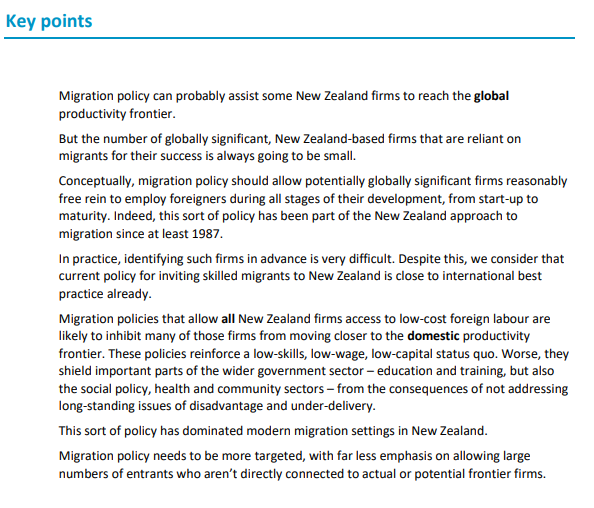
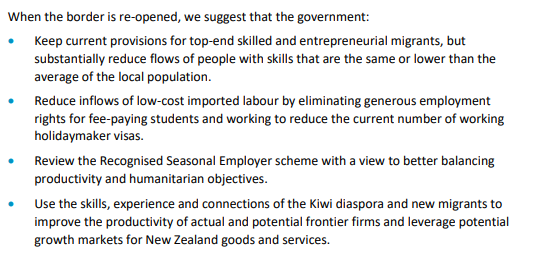
But he did highlight the need to think carefully about policies that “fit us here” including taking explicit account of our remoteness. He called for a much deeper understanding of the problem, for a priority on good economic research, for the development of credible narratives that explain our underperformance and ground sold recommendations for policy changes. Much of this reflected Paul’s efforts at the Commission, including the narrative he drove (and wrote) –  which I wrote about here.   In some of his work, Paul has expressed sympathy for aspects of my story around immigration policy, and noted that he welcome the current Productivity Commission inquiry.

Some of his specifics I’m less convinced of, and he noted that his own views have a lot of overlap with the OECD’s Going for Growth proposals (see above for how limited they are) –  while noting that he had been involved in the very first Going for Growth, back in 2005 when he worked at the OECD, and the ideas mentioned for New Zealand then were much the same as those now.

Conway ended with a call for specifics, for work with policy people and lawyers, and for a lot more emphasis on communications and doing the “hard sell” to our “lawmakers”, claiming that as he had got older he was increasingly convinced that the task was mainly marketing good ideas –  “we know what needs to be done” – and building consensus, rather than devising new ideas.

And at that point I had to leave.  Perhaps the follow-up questions generated some startling insights, but probably not (and I have no idea how many New Zealand focused people were even in attendance).  My biggest criticism is for the OECD –  which, after all, put the event on and their ideas on the table –  who seem simply inadequate for the task pf offering serious, analytically and historically grounded, advice to New Zealand authorities (or others here who might want to champion actually doing something about decades of failure) on making a dramatic difference to economywide productivity outcomes here.  It must be more than a decade now since I attended a workship in Paris where OECD staff presented modelling suggesting that on their standard prescriptions New Zealand should be much much richer and more productive, which suggested that there was something quite seriously wrong with their model, at least as applied to (really remote) New Zealand (I’ve long held the view that –  unsurprisingly – the OECD has model and mentality that probably primarily adds value in small European countries (a lot of those in the OECD).   One might argue that it doesn’t matter, since no politician here is serious about change (at least for the better, the current government is pursuing paths likely to worsen things) but that isn’t really the point of the exercise.   As various speakers noted yesterday socialising ideas, persuading people, showing what might be possible are all a significant part of a prelude to action (just possibly one day).   I disagree with Paul Conway that there is consensus about what needs to be done: there clearly isn’t, and may never be, but we might expect an entity with the resources and expertise of the OECD to be offering a lot more insight, a lot more recommendations commensurate with the scale of the failure, than we are actually getting.

As for the New Zealand Productivity Commission, they seem to be on a downhill path, more interested in cutting pies differently than growing them, too confident in politicians and officials, and more inclined to wishful thinking than serious analysis indicating what might really lift our productivity levels back towards the top tiers of the OECD.    I guess there is cause and effect at work, but it is no wonder politicians aren’t serious about change when the advice they get from high-powered official and international agencies is so thin.  It is a lot easier to just cut the pie differently and dream up more announceables, but reversing the relative productivity decline is really what matters for our future material wellbeing –  those at the top and those at the bottom –  ours, our children, our grandchildren.  If we don’t fix it, exit will remain an increasingly attractive option for many.
Immigration policy for New Zealand post-Covid

It must be quite a challenge for Rotary clubs to maintain a regular roster of speakers. Four years ago someone at the Wellington North Rotary Club had heard about my ideas on immigration policy and New Zealand’s lamentable economic performance and they invited me along to tell my story. The text I used then is here. A little while ago they invited me back and when we discussed what I might talk about I agreed to pick up where I’d left off in 2017 – at the very peak of the then immigration surge – and reflect on a better immigration policy for New Zealand as and when the borders eventually reopen (in the year to April, SNZ estimates a net outflow of about 9500 non-New Zealanders who’d been here for some substantial period of time.

So I spoke to them yesterday. One can’t cover everything – or even anything much in the depth the subject warrants – in 20-25 minutes, but for those interested my text is here.

Sadly, of course, the stylised facts of New Zealand’s economic underperformance haven’t changed for the better over the intervening four years. Productivity levels remain low and growth weak. Business investment has been pretty sluggish around low rates, and if anything the export/imports shares of GDP have probably fallen a bit more (even before Covid at least temporarily cut both further). Our real exchange rate stayed high, and if long-term real interest rates have fallen they were/are still well above those in almost all other advanced countries.

What has changed, for now anyway, is the substantially closed borders, which mean that it is very hard for most non-New Zealanders (Australians aside) to get in. No one envisages, or wants, current arrangements – or anything like them – to be permanent, but it does mean the conversation and debate starts from a rather different place than it might have a few years ago.

Perhaps what hasn’t changed so much is that much of the media debate – and apparently the political interest – seems to be on short-term visa holders. And almost every day now we hear stories from employers complaining about how hard it is to get staff, holding the border restrictions responsible.

It isn’t surprising that there has been some dislocation, disruption, and difficulty for some firms. After all, the borders were basically closed overnight, for public health reasons, and that disrupted a lot. That included typical sources of labour firms had become used to tapping, but it also included changes in the patterns of consumption demand (and the derived demand for labour). Add to the story, of course, the surprising pace of the overall economic rebound – spurred by huge fiscal deficits (not just last year when they were needed, but now when they aren’t) – which has led some economists to conclude that the economy and labour market are now operating at very close to full capacity. At full capacity you would hope it wasn’t always easy, or cheap, to find staff (on the other hand, it might be relatively easier for people to find jobs).

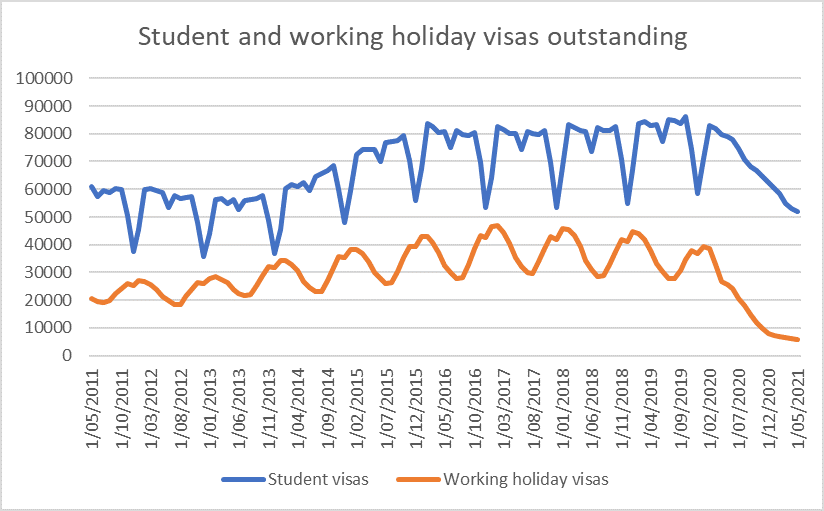
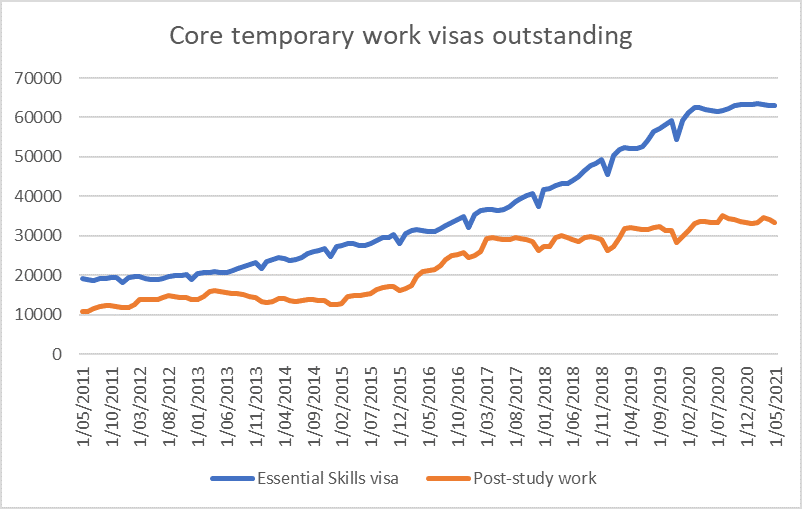
I don’t intend to make this a long post, but before running some quotes from my speech, I thought I’d include a couple of charts with some data that surprised me a bit when I dug it out. The first is the number people here on two of our main short-term work visa programmes – Essential Skills visas (a label that really should be in quote marks, or prefaced by “the so-called”) and Post Study Work visas.

visa 1

I knew the government had offered visa extensions in many cases, but if you’d asked I’d have guessed that total numbers would have dropped anyway as a reasonable number of people went back home. But, in fact, the numbers here – in these two most skills-focused categories – are almost the same as they were at the start of last year. And numbers on both visas are a lot higher than they were even five or six years ago.

Now, there have been material drops in the numbers here in a couple of other categories (both series quite seasonal).

visa 2

And those patterns are pretty much what I’d have expected. People have gone home as they’ve finished courses of study, or working holidays, and few/no new people have arrived. But on the working holiday front remember the counterpart – not too many New Zealand young people will have been heading off on their OEs over the last 15 months or so. The types of jobs (here) the two groups might have been looking for may have been a bit different – so some real mismatch issues in some places/roles – but it isn’t as if there are fewer potential workers overall.

As I noted in my speech – bearing in mind the rapid growth in short-term visa numbers in the run-up to Covid.

No doubt some firms have specific difficulties from the sudden dislocation. But there is something wrong with the story when it is seriously claimed – and this is the implication of what so many of these businesses are saying – that a low productivity economy, achieving underwhelming productivity growth, needs more and more immigrant workers each year just to function effectively.   Such a story might – just might – have a modicum of plausibility if this was a dynamic fast-growing economy where more and more firms were finding more and more opportunities to successfully compete on a world-stage.  But that is nothing like New Zealand’s story.  

And, as I’ve noted previously, most OECD countries are not only more productive than New Zealand they are also less reliant on migrant labour. Many business concerns reflect – understandably so – the (sometimes quite legitimate) perspective of a company, but economic policy management is about a country, and the two are quite different.

All that said, one of the points of my speech was to argue that the longer-term immigration settings, around residency approvals, matters far more to economic performance than the rules around limited period work visas. At 45000 residency grants a year, in 22 years the population will be heading for a million more than otherwise (by contrast, at peak there are about 100000 people here on Essential Skills and Post-Study work visas). If you believe in the enabling economic power of immigration, or think that in New Zealand’s case large-scale non-citizen immigration has been quite damaging economically, that is really where one should focus. Open borders people do – in principle, they’d allow (almost) anyone in, to stay. And so do I.

Here is the text from the last couple of pages of my speech on the way ahead

A couple of weeks ago the Minister of Immigration gave a speech foreshadowing changes to policy settings around immigration, apparently with a focus on the limited period visas.  There were no specifics, and there was no supporting analysis.   There are probably some sensible changes that could be made, but like their predecessors, this government seems all too fond of having officials and ministers decide who should be able to use migrant labour, where and when.  I’d rather go in the opposite direction and get officials out of things as much as possible. 

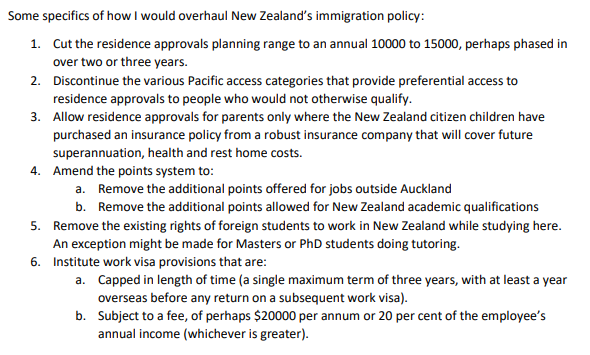
I would favour two main changes.  First, I would reverse the decision a few years ago to allow students to work while here. If you are here to study, study, don’t compete at the low end of the labour market.   And I would get governments out of approved lists, or even salary thresholds, and replace it all with a model in which any employer could hire a person on a temporary work visa but that visa would be

  • Subject to a fee, payable to the government (perhaps $20000 per annum or 20 per cent of the employee’s annual income, whichever is greater). That sets a clear and predictable test for whether non-New Zealand recruits are really required, and a genuine incentive on employers to search for and develop New Zealanders (especially for less well-paid positions).
  • Subject to a term limit (no individual could be here on one of these visas for more than three years, without at least a one year return home)

But despite the headlines these short-term work visas are still the second order issue.  Much more important is whether the government is willing to make any significant changes to the residency programme, or whether business as usual will shortly be resumed.

Neither the government nor the Opposition seen willing to engage on that issue.  And if the government deserves a little credit for very belatedly asking the Productivity Commission to report on the New Zealand immigration model, strangely they seem to be proposing to make policy before the Commission reports.

What should they be doing?

First, we need to explicitly recognise that the residency programme (the driver of medium-term policy-led population growth) itself comprises several different types of people. 

It includes people we are never going to restrict.  If your daughter does an OE in London and finds a British man to marry, he’ll be entitled to move here permanently.  No one would want to restrict those numbers, and there is no quantitative limit. 

It includes those we take in as refugees.  There is no economic motive for the refugee quota, it is all about humanitarianism.  

But the bulk of the programme is purely discretionary.  And the numbers involved have borne no relationship to the rather limited (highly productive) economic opportunities here.

There are all sorts of myths about migrants to New Zealand.  By international standards the skill levels mostly aren’t too bad – being a distant island means you really only get in legally, and it is an economics (rather than family) driven programme.  But the skill levels aren’t spectacular.  And why would they be?  Much as New Zealand is a pleasant enough, and peaceful, place to live it is (a) remote, and (b) now not very prosperous, and (c) small.   The smartest and most ambitious and most driven of the potential migrants are much more likely to go to other migration-welcoming countries if they can get in.  A country whose own people leave en masse isn’t a great advert for abundant economic opportunities.

And we aren’t even ruthless about demanding highly-skilled people.  We run specific programmes for people from Pacific countries who don’t have the skills/education to qualify as skilled migrants.  And we give extra points to people who are willing to live outside the main centres, even though the main centres are where most of the economic opportunities and higher paying jobs are.  We structure the system to subsidise NZ universities, by favouring applicants with NZ degrees and work experience even though NZ universities are nowhere near best in the world, and NZ’s economy is a low productivity beast.   And so on.  There is talk from time to time about attracting the best tech people, but why would they come here – small, remote, not very wealthy, no great universities, no relevant centres of expertise or funding, and so on? 

And so we bring in lots of pretty-average people, adding nothing systematically to NZers’ prospects   There is nothing wrong with being “pretty average” – that’s most people – but it isn’t going to do anything to transform our productivity performance.  Hasn’t so far, and no reason to suppose it will any decade soon.

New Zealand’s economy could do such much better.  But all the signs are that it probably can’t match the best with a population that is growing rapidly – much more rapidly than the productivity frontier countries.  Distance hasn’t been defeated and if anything may have become more important.  There is lots of wishful thinking around the New Zealand debate, but any serious confrontation with the stylised facts of New Zealand’s experience, augmented with the experience of other former settler societies, is that large-scale immigration just hasn’t helped for a long time.  You might think the US is an exception, but it isn’t really.  It was – like us – one of the handful of richest countries in the world 100 years ago, and despite having had much more rapid population growth than European countries (and no ravages of war or communism) the gaps have narrowed.     Denmark is probably the standout performer today.  

If political parties were serious about reversing the decades of relative productivity decline – and there is no sign of it – there is a variety of things mutually reinforcing things that should be done, which together would prompt much more business investment and a more outward-oriented economy: 

  • We should take a much more open approach to foreign investment – I’d remove all controls in respect of investors from OECD countries.
  • We should be lowering the tax rate on business investment – our company tax rate (which matters a lot for foreign investors) is in the upper part of the OECD range, and what you tax you get less of.
  • We need to free up land use, within our cities and across the country.

One could list other things (GE issues for example).

But most importantly, we need to end the delusion – for that is what it is – that a very remote country, which lots of its own people leave, which has fallen steadily behind an increasing number of other countries, and where foreign trade is shrinking as a share of GDP, is a sensible place for government policy to promote large scale immigration.  It wouldn’t make sense for Taihape; it doesn’t make sense for New Zealand.    Immigration policy is one of the largest structural policy interventions in our economy.    And now – before we reopen the borders – is the time to act.

So let’s not go back to granting huge numbers of residency permits.  Cut out the Pacific quotas – no reason to favour people from those countries any more than those from (say) Britain and Ireland (that we once favoured), and cut back the total approvals to, say, 5000 to 10000 really highly-skilled people (if we can find them) with no preferences given to NZ qualifications and experience, simply looking for the best and most energetic.  Add in refugees and the spouses/partners of New Zealanders, and you’d be looking at an overall number of residency approvals each year of 10000 to 15000.  In per capita terms that would be a similar rate to the US. 

Successful countries make their economic success primarily with and for their own people.  We can again do it here. We have talented and fairly well-educated people, we have reasonably open markets, we have a history of innovation, but distance really works against us and we will mostly prosper by doing better and smarter with (and investing more heavily in) the natural resources we have – things that really are location-specific.  Lots of other bright ideas are, and will be, dreamed up by people here.  But if those ideas work well, they’ll typically be much more valuable abroad.   You may not like it – neither do I really – but it is what experience shows.  We’d be foolish to simply start up the same old model and expect better results in future.

Productivity growth: failures and successes

As a parent I find it particularly disheartening to observe the near-complete indifference of governments and major political parties that might hope to form governments to the atrocious productivity performance of the New Zealand economy. If the last National government was bad, the Labour or Labour-led governments since 2017 have been worse. It is hard to think of a single thing they’ve done to improve the climate for market-driven business investment and productivity growth, and easy to identify a growing list of things that worsen the outlook – most individually probably quite small effects, but the cumulative direction is pretty clear. Before I had kids I used to idly talk about not encouraging any I had to stay in New Zealand, so relatively poor were the prospects becoming. It is harder to take that stance when it is real young people one enjoys being around, but…..at least from an economic perspective New Zealand looks like an ever-worse option, increasingly an inward-looking backwater.

One of the ways of seeing the utter failure – the indifference, the betrayal of New Zealanders – is to look at the growing list of countries that are either moving past us, or fast approaching us. Recall that for 50 years or more New Zealand was among the handful of very highest income countries on earth.

For doing those comparisons I prefer to focus on measures of real GDP per hour worked, compared using purchasing power parity (PPP) exchange rates. It is, broadly speaking, a measure of how much value is being added by firms – mostly in the private sector – for each unit of labour those firms are deploying. Real GDP per capita can be useful for some purposes – actual material living standards comparisons – but can be greatly, directly, affected, by demographics, in ways that don’t reveal much about the performance of the economy and the environment for business investment.

When I run charts here about productivity comparisons across countries I mostly use OECD data. Most – but not quite all – of what we think of as advanced economies are in the OECD (as well as a few new entrants that aren’t very advanced at all, and seem like “diversity hires”, incidentally making New Zealand look a bit less bad in “whole of OECD” comparisons). But once in a while I check out the Conference Board’s Total Economy Database, which has a smaller range of series for a rather wider range of countries, advanced and emerging. The latest update was out a few weeks ago.

As regular readers know I have highlighted from time to time the eastern and central European OECD countries – all Communist-run until about 1989 – that were catching or moving past us. I first noticed this when I helped write the 2025 Taskforce’s report – remember, the idea that we might close the gaps to Australia by 2025, when in fact policy indifference has meant they’ve kept widening – in 2009, so that must have been data for 2007 or 2008. Back then only Slovenia had matched us, and they were (a) small and (b) just over the border from Italy and Austria. The OECD and Conference Board numbers are slightly different, but by now probably four of the eight have matched or exceeded us (and all eight managed faster productivity growth than us over the last cycle). Turkey – also in the OECD – has also now passed us.

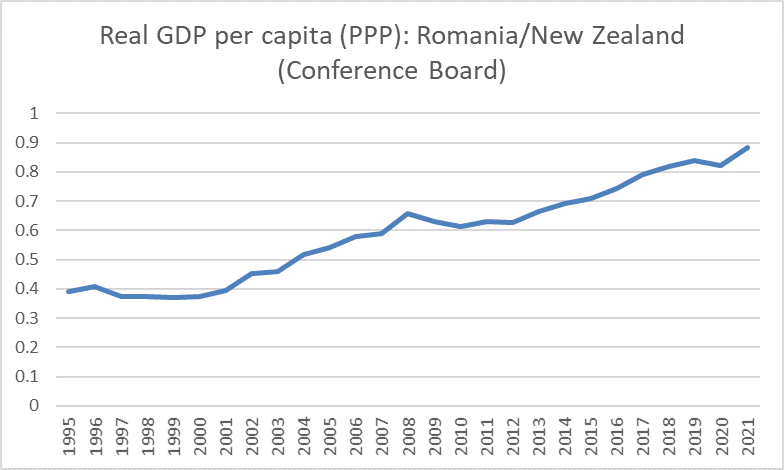
But what about the central and eastern European countries that aren’t in the OECD? As I glanced down the tables I remembered a post I’d written four years ago about Romania and comparisons with New Zealand’s economic performance. Romania had been achieving quite strong productivity growth prompting me to note

….one of the once-richest countries of the world is on course for having Romania, almost a byword in instability, repression etc for so many decades, catch us up.  It would take a while if current trends continue.  But not that long. Simply extrapolating the relative performance of just the last decade (and they had a very nasty recession in 2008/09 during that time) about another 20 years.

So how have things been going?

romania 21

Even if we focus just on the last hard pre-Covid estimate (for 2019) they were up to about 84 per cent of average New Zealand labour productivity. If these trends continue, they’d catch us by about the end of the decade.

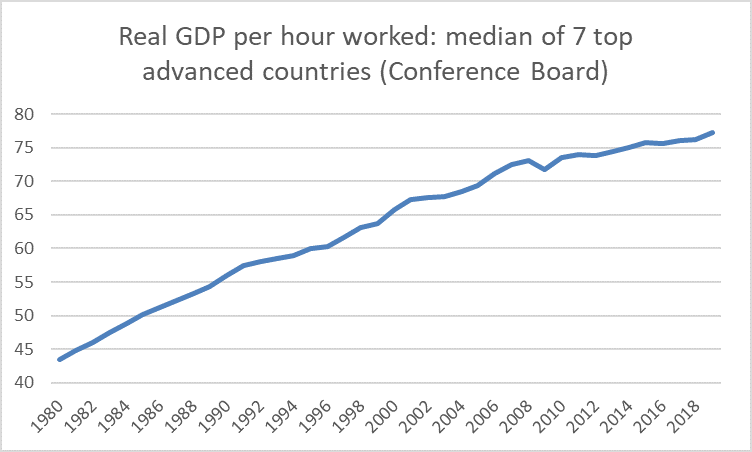
To be clear, it is generally a good thing when other countries succeed. It is great that these central and eastern European countries moved out from the shadow of the USSR and non-market economies and are now achieving substantial lifts in living standards. The point of the comparisons is not to begrudge their successes – which have a long way still to run to match most of western Europe – but to highlight the failure New Zealand governments have presided over. We were richer than all these countries for almost all of modern New Zealand history, and soon our economy will be less productive than all or most of them. We were also richer and better off than most or all of today’s most productive advanced economies, and now we just trail in the their wake. Even as the most productive advanced economies have experienced a marked slowing in their productivity growth in the last 15 years or so

prod growth advanced

we’ve really only managed little more than to track their slowdown – and recall that the median of these countries has average labour productivity two-thirds higher than New Zealand’s so – as in the central and eastern European countries – there were big gaps that might have been closed somewhat. Most of those countries did so, but not New Zealand.

To revert to Romania for a moment, it is not as if it is without its challenges. It ranks about 55th on the World Bank’s ease of doing business index, and has been slipping down that ranking (although still doing very well on a couple of components). Corruption seems to be a major problem. The neighbours aren’t the best either – including Ukraine and Moldova. Reading the latest IMF report (pre-Covid) there were signs of some looming macro imbalances but the latest IMF forecasts suggests a pretty optimistic outlook still, including investment as a share of GDP climbing back to about 25 per cent of GDP. Perhaps something is going to derail that productivity convergence (with New Zealand) story but it isn’t there in the forecasts at present. And if corruption has to be a drag of some sort (but how large can that effect be?) government spending and revenue are both smaller as a share of GDP than in New Zealand.

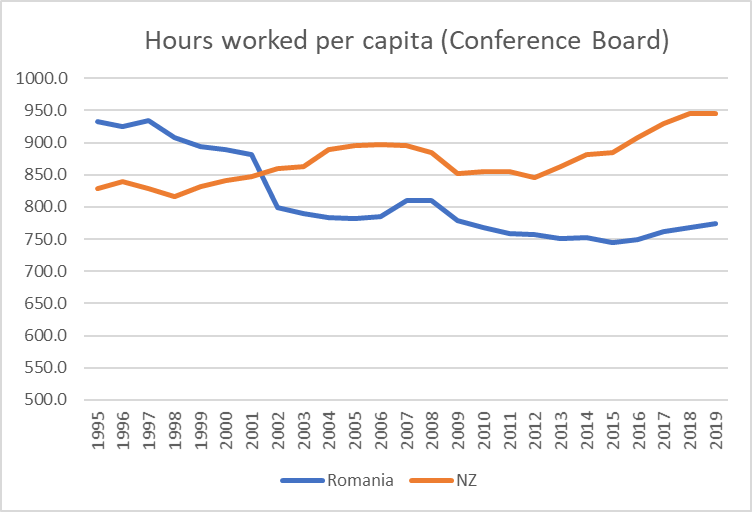
In GDP per capita terms the picture (Romania vs New Zealand) is not quite as grim. That mostly reflects differences in hours worked

Romania hrs

Some of that is demographics, some not. Either way, hours worked are an input – a cost – not (mostly) a good thing in their own right. New Zealand struggles to maintain upper middle income living standards for the population as a whole by working a lot more hours (per capita) than many other advanced countries.

And then of course there is the difference that must be quite uncomfortable for the political and bureaucratic champions of “big New Zealand” – those politicians (both sides) just champing at the bit to get our population growing rapidly again.

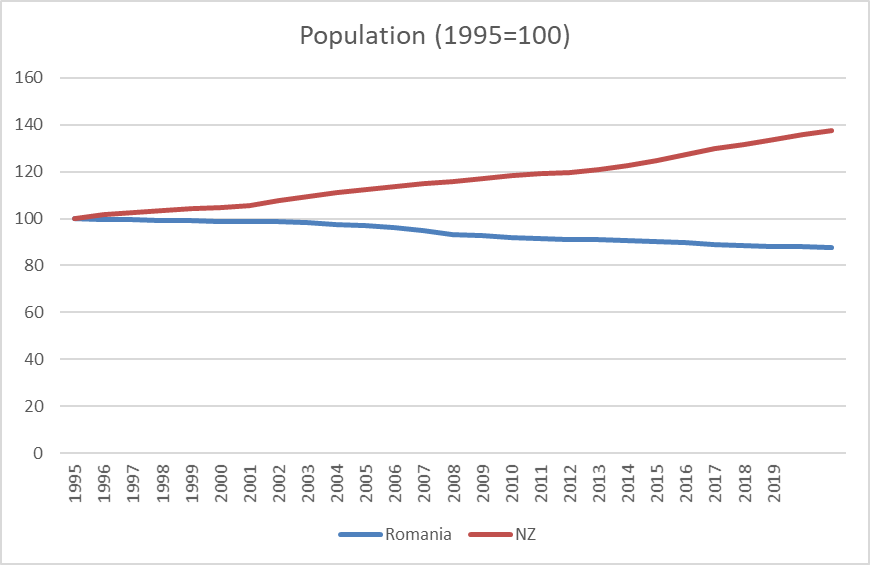
romania popn

Romania is a pretty big country. When this chart started it had almost six times our population. 25 years on Romania’s population is a bit under four times ours. I mentioned earlier the investment share of GDP: Romania’s is averaging a little higher than ours, even with these massive population growth (shrinkage) differences, so just imagine how much more of those investment resources are going to deepen capital per worker (even public infrastructure per citizen). (For those interested the total fertility rates of the two countries are now very similar: the differences in trend population growth are largely down to immigration/emigration.)

Now, of course, I haven’t mentioned being in the EU or being located not too far from many of the most productive economies on earth (although Bucharest to Zurich isn’t much less than the distance Wellington to Sydney). Those are advantages. Of course they are. But then why do New Zealand officials and policymakers continue to champion a (now) purely policy-driven “big New Zealand” when (a) almost nothing has gone right for that story in (at least) the last 25 years, and (b) when so much else of policy choices only reduces the likelihood of the future under such a strategy being any better?

Romania really is a success story, and I’d like to understand a bit better why (for example) it has been doing so much better than Bulgaria and Serbia. But it isn’t an isolated success story: in addition to the OECD eastern and central European economies, Croatia isn’t doing too badly either.

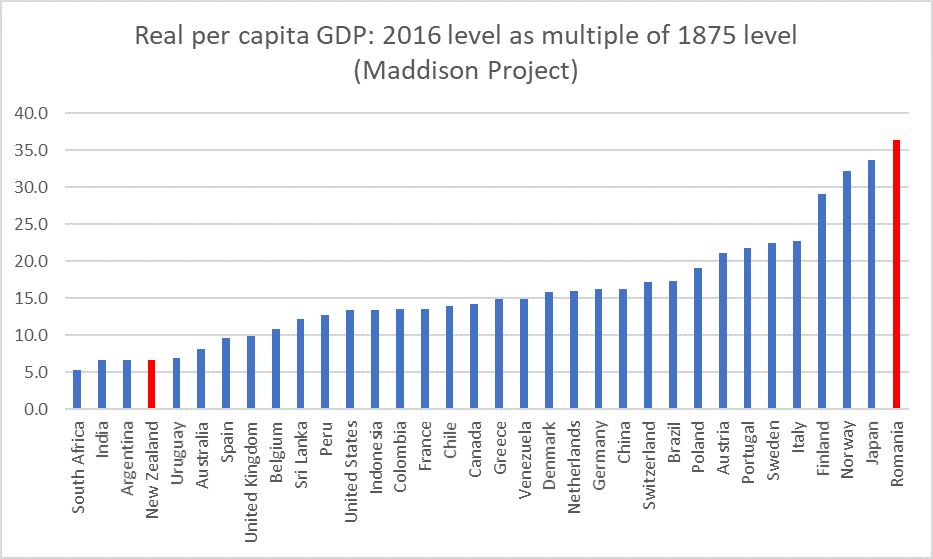
But – and taking a much longer span – this chart still surprised me. It draws on different database – the Maddison Project collection of historical real GDP per capita data. Since it is per capita data it includes all those differences in hours worked per capita (data which simply isn’t available for most countries in the distant past). I’ve started in 1875 simply because that is when the Romania data start. I’ve shown only the countries for which there is 1875 data (the last observations are 2016 simply because that is when this particular database stops), with the exception of China and India which I’ve added in for illustrative purposes because there are a couple of estimates for years between 1870 and 1887 which I’ve simply interpolated. The chart shows the ratio of real per capita incomes in 2016 as a ratio of those in 1875.

romania maddison

Best of them all. New Zealand not so much (and yes we were about the top of the class in 1875, but the New Zealand story is submergence not convergence, given how many of these countries are now richer than us).

To be clear, over the last 140+ years New Zealand has been a far better – safer, more prosperous, fairer, more open – country in which to live than Romania. Whether it will still be so for most the next century is increasingly a very open question. Our politicians seem unconcerned, and if any of them have private concerns they do nothing about them – no serious policies in government, so no serious policy reform options in Opposition. Nothing. They seem to just prefer nothing more than the occasional ritual mention.

Still on matters productivity, I finished reading last night an excellent new book on productivity: Fully Grown: Why a Stagnant Economy is a Sign of Success by Dietrich Vollrath, a professor of economics at the University of Houston. It is incredibly clearly written, and is a superb introduction to economic growth and productivity for anyone interested (I”ll be commending it to my son who has just started university economics). I’m not really persuaded by his story about the US, but it is well worth reading if you want to think about these issues as they apply to one of the highest productivity economies on earth. It suffers (as so many US books) do from being exclusively US-focused, even though there is a range of northern European economies with productivity levels very similar to (a bit above, a bit below) those in the US and one might think that their data, their experiences, might be a cross-check on some of his stories. To be clear, his focus is on a frontier economy, not ones – whether New Zealand or the central and east European ones, or even the UK and Australia – which start so far inside the frontier. But it is a very good introduction to how to think about sum of the issues, and a summary of many of the papers that the research-rich US economy generates.

Economic coercion

It is pretty clear that the main (external) reason our two main political parties have been so reluctant to say very much at all critical of the increasing threats posed – to people in China or abroad (not overlooking there the ethnic Chinese New Zealanders) – by the CCP-controlled People’s Republic of China relates to the fear that New Zealand exporting firms might find themselves subjected to the PRC’s attempts at economic coercion. Quite possibly the flow of political party donations might be part of the story. No doubt the anti-Americanism that pervades much of the left in New Zealand (and a detestation of the current Australian government), combined with that weird belief that somehow New Zealand is better than both – perhaps able to be some sort of “honest broker” – plays some part. That self-regarding nonsense of the “independent foreign policy” – as if we didn’t make our own choices (rightly and wrongly) to support the UK in the Chanak crisis, to support sanctions in the 30s at the League of Nations Council, to enter World War Two, to offer support on Suez, to participate in Vietnam, to provide a frigate at the time of the Falklands, to play a part of the first Iraq war, and not to play a part the second – seems to be there, although mostly as cover, an excuse. Perhaps for a few individuals the prospect of lucrative or prestigious post-government roles plays a part, although I doubt that is really a serious driver for many (though those now holding such posts – and wishing to continue doing so – are themselves effectively silenced).

But no one really doubts that the biggest consideration is trade. There was a time when we used to hear, over and over again, the nauseating line that “New Zealand’s foreign policy was trade”, but if that line hasn’t been heard much in recent years, it is the subtext to so much around the PRC. In fact, often not even the subtext: Newshub had a story in the last day or so in which National’s foreign affairs spokesman Gerry Brownlee is quoted. The first bit sounded relatively encouraging (for the National Party)

Gerry Brownlee, National’s Foreign Affairs spokesperson, hopes Mahuta shares any information she receives with other parliamentary parties. He’s also pushing for an independent observer to be sent to Xinjiang. 

“I think that should be advanced as soon as possible as this isn’t going to go away until there is greater certainty about it nor can there be a clarity of action until there is a greater certainty about it one way or another,” he told Newshub.

He said if there are atrocities found to be taking place “on the scale we are told about, that might make the genocide test”.

But….

“But you have got to bear in mind that there are hundreds of thousands of New Zealanders at work today largely because of our trade with China. It is not a simple matter, it is not a straightforward matter, it is one the Government should definitely have a position on.”

“Genocide” (or even “just” gross and systematic state sponsored and administered human rights abuses) or trade. Sounds like Mr Brownlee thinks it a tough choice. (And in fairness, if it is particularly crassly expressed, there is no sign his basic view is much different from of his Labour counterparts).

There seem to be twin (related) mythologies at work. The previous National government sometimes liked to run the (deeply fallacious) line that somehow New Zealand firms’ trade with PRC entities had “saved” the New Zealand economy from the ravages of the 2008/09 recession – which allegedly would otherwise have been much worse here otherwise. No evidence was ever advanced for this proposition – that Murray McCully seemed particularly found of – and it seemed to (conveniently) escape notice that New Zealand’s total trade shares (of GDP) were falling not rising over this period, that New Zealand’s productivity performance over this period was woeful, and that it took 10 years for our unemployment rate to get back to pre-recession levels, slower even that the US – the country at the epicentre of the financial crisis that helped precipitate that recession.

And that mythology – less heard these days – is supplemented by a story that – so it is claimed – much of our prosperity (such as it is) rests of trade with the PRC, with the implication (from some) that we should be suitably grateful, or at least simply keep quiet, think kind thoughts privately, and be thankful for small mercies (our prosperity). Again, the argument simply doesn’t stack up. To a very large extent, countries (all of them) make their own prosperity (or lack of it). We weren’t among the very richest countries in the world in the first half of last century because of any other country, but because of some mix of technology, institutions, people, natural resources and so on. We don’t languish well down the per capita income league tables (albeit still a long way ahead of China) because of anyone else’s choices, but mostly because of our own policies. China didn’t make us rich or poor. It made China first (last century) poor, and eventually middle-income.

Now, middle-income only as the PRC may now be, there are a lot of Chinese, so China’s share of total world economic activity and demand is substantial, and likely to be growing for some time. And perhaps there are a few products and a few countries where it might be said that China makes a real and sustained difference to the country concerned: Australia, for example, has 30 per cent of the world’s iron ore reserves (and a larger share of production) and China currently consumes a very large share of world iron ore production. But even if Chinese demand makes a difference to Australian average incomes, Australia was a prosperous first world country before Chinese iron ore demand became so large, and would be still without it. Total gross iron ore exports from Australia are equal to about 5 per cent of Australia’s GDP.

The world price for commodity products is determined by world demand and supply conditions, a point given far too little attention in the timid New Zealand discussion of PRC issues. A severe and sustained recession in China would represent a significant (but cyclical) blow to the world economy, and to New Zealand – and would do so whether or not New Zealand firms traded much directly with PRC counterparts. That is also true – as we saw in 2008/09 – of severe US recessions. That sort of shock – and others like them, at home or abroad – is why we have a floating exchange rate and discretionary monetary and fiscal policy.

What is much less clear is how significant the economywide impact might be of any one country – the PRC – attempting economic coercion on New Zealand. There would clearly be an impact on some individual firms (big and small) but that shouldn’t be a first order consideration for New Zealand governments in setting foreign policy and considering articulating perspectives on human rights abuses.

We can set some issues to one side. Yes, we are small, but that isn’t terribly relevant to anything. Yes, New Zealand firms trade internationally, but contrary to the rhetoric about being a “small highly open economy”, actually the share of our economy accounted for by foreign trade (exports and imports) is (a) much less than one would normally expect for a country our size, and (b) has been shrinking. And, yes the PRC recently moved a bit ahead of Australia as the country where the most two-way trade is done with, but – as people have noted for decades – one notable thing about New Zealand is that our trade isn’t very concentrated with any single other country/region (much less so than is the case for Australia). Total New Zealand exports to China, pre-Covid, were about 5 per cent of GDP. Even the EU apparently now has the PRC as the country with which the most foreign trade is done.

I’ve written on this issue before, and suggested then that the sectors of greatest vulnerability might be export education and tourism. As it happens, Covid has dealt to those particular markets for the time being (as it has for Australia). That isn’t a good thing in and of itself, but it does take those considerations off the table if the government were to think of taking a stronger stance at present. The focus for now is commodity exports (dairy, forestry, meat, crayfish etc).

And here it is helpful to look at the experience of (a) the Australian economy, and (b) Australian firms – keeping the two as distinctly different – in the face of blatant PRC economic coercion over the last year or so. There are some sub-sectors and firms that appear to have had it very tough – watch the ABC documentary screened the other day – and listen to the anguish of some of the small crayfish operators (who could still sell crayfish, but only at much lower prices). For reasons that aren’t clear to me, the wine producers exporting to China don’t yet seem to have been able to re-direct their sales (fortunately, in that sense, New Zealand wine exports to China are small). On the other hand, barley producers don’t seem to have been that much adversely affected at all. That is pretty much what you’d expect in a commodity product: some cost, some disruption, some stress for firms involved, but at the end of the day overall global demand and supply conditions won’t have changed much if at all. What we don’t see is any sign of severe economywide consequences: there is no mention of the issue (or risks) in the Reserve Bank of Australia’s latest (lengthy) minutes (by contrast, changes in New Zealand population growth actually get a mention). It seems to a third-order issue at a macroeconomic level – and the overall economy is what governments should be thinking about when they consider economic risks and consequences.

Were it otherwise, by the way, that is what we have macroeconomic policy for, fiscal and monetary, to help smooth the economy in the face of disruptions, whether Covid, coercion, or whatever.

Would it be any different for New Zealand? It is always possible, but it is not as if Australia is the only country the PRC has tried coercion on. They’ve had a go at Norway, at South Korea, at Taiwan, at the Philippines, at Mongolia, at Japan, in one form or another. In some case the governments have buckled – lobbying for special interests will do that – but in no case was there any evidence of a very large adverse macroeconomic effect. Nothing of the bogeyman story that our “elites” would like us to believe, that to offend China would be to jeopardise our very economic security or prosperity.

Of course, people will point out that China has not yet tried sanctions on Australian iron ore (but they did with coal, only to run into problems, because they still needed coal). But isn’t dairy different? The whole path of industrial development and infrastructure does not hang on dairy in the way perhaps it does on iron ore. No doubt, but PRC consumers have a clear demand for milk products, Chinese production is still nowhere near Chinese consumption, and the PRC has a history of attempting coercion mostly on things that don’t affect them, and their people, too much. So, sure China could ban New Zealand dairy exports for a time, but the underlying demand won’t change, and if China takes a large chunk of New Zealand exports at present, China’s imports are small chunk of world production. Now there are complications: “dairy” is not some single homogenous product, and cross-border trade in dairy is small compared to global production, but markets will adjust. Perhaps the world price for our specific products would fall a bit, and for a time, but….the nature of commodity markets is that prices are volatile. Perhaps luxury products like lamb for the restaurant trade might be a more likely target, but then the experience with Norwegian salmon was that total Chinese imports of salmon barely changed, with suggestions that quite a bit of Norwegian made its way back into China via Vietnam.

Whatever the potential disruptions for individual firms – and they are real (for them) – it simply is not credible – given the (smallish) size of our total exports, the commodity nature of most, the share of trade with China – that any sort of conceivable economic coercion would represent a serious sustained threat to the New Zealand economy. Production of most of our commodity products would be unlikely to change much at all, and if the prices of some were to fall, well we are not unused to terms of trade fluctuations. And floating exchange rates are part of the mechanism for buffering such shocks if they do end up a bit larger than expected. The Governor continues to swear by the potency of monetary policy and the many champions of active fiscal policy do the same for it. There is little that is unique about our economy or our risks vis-a-vis China. Just the choices of our governments, egged on by business and university leaders (the interesting thing about Australia now is the lack of business voices calling for the government there to pander anew).

Perhaps also we might have more sympathy for individual New Zealand exporting firms if it was five years ago, when PRC issues and risks were just beginning to emerge, and the experience of economic coercion was both newer and little known here. But no firm that trades with Chinese counterparts now can say they are unaware of the risks. They continue to trade with their eyes wide open (or prefer to pretend a different reality). When you sup with the devil, the standard advice is to take a long spoon. It simply isn’t obvious why firms that deal with Beijing – that perhaps have CCP cells in their subsidiaries in China – warrant our sympathy or support at all; one might argue rather the contrary, in that their voices – lobbying the government to do and say as little as possible – serve the interests of Beijing more than those of New Zealanders as a whole. (And one can’t help wondering how willing New Zealand firms will be to send staff to China once travel is easier, given the sort of travel warnings other countries have issued – and the arbitrary kidnappings the regime has engaged in).

Thus, when the government talks of how it wants to “respect” China – and even has the gall to suggest Australia might show more “respect” – the “respect” they want to offer to these thugs and bullies (to understate the evil of one of the very worst regimes of the planet) is a kowtow not on behalf of you and me – the voters who elected them, the citizens they supposedly represent – but a small group of firms (small and large) only too happy to have you and me pay the price of insurance for their business (we see it also in the substantially government-funded China Council which mostly serves business interests too). The government might want people to believe all those interests are aligned, but they aren’t.

The government has talked a little of encouraging diversification, and of the need for firms to have resilience plans. It probably doesn’t have much substance unless and until the government is willing to tell firms that they are on their own, and to back that up consistently. Most firms don’t trade with Chinese counterparts because of any love for the CCP, but because they perceive the risk-adjusted returns are best there. But that risk seems to be underwritten – diminished sharply – at our expense by a government that chooses to go as soft as it possibly can on Beijing, to feed lines that – wittingly or not, and probably not intentionally – give aid and comfort to the regime.

Finally, it is worth remembering that there is no suggestion that New Zealand should cut trade with the PRC (although individual New Zealanders might increasingly choose to avoid tainted products and companies). The trade threat we are discussing here is entirely something the PRC might choose. It isn’t the way normal or decent states operate, and yet our government would prefer us to pretend that the PRC is just a normal state, run by decent “respectful” people. We can’t stop them disrupting two-way trade – which isn’t some gift to New Zealand firms, but of mutual benefit in normal circumstances – but we can be clear about the values we hold, the interests we want our governments to serve, the real threats that everyone knows but which the government refuses to discuss openly. Values are things that you are willing to pay a price for, and the test of whether they really are values only comes when the possible price has to be faced. I don’t suppose Jacinda Ardern, Nanaia Mahuta, Judith Collins or Gerry Brownlee really like the CCP and its action any more than I, or many readers of this blog, do. I don’t suppose the CCP thinks they do either. They don’t care a jot what leaders think privately. It is what they are willing to speak up about, and act on, that bothers them. And they are right to draw the distinction: private thoughts and feelings signify nothing, especially in a purported leader, without follow through.

As it happens, any “price” New Zealand as a whole might pay seems likely to be modest at worst (worse for some firms, but they’ve chosen – entirely voluntarily – to keep trading with the thugs). It isn’t as if any better stance New Zealand might take would now be world-leading or ahead of the pack. And there would be the comfort of working together – with likeminded countries, of the Five Eyes or beyond, to name evil where it is found, where it threatens values we hold dear, other democratic countries, and the freedoms of the Chinese people themselves.

Forecasting failure

The International Monetary Fund last week released their latest World Economic Outlook and associated economic forecasts. The value of these forecasts is not so much that they are likely to be correct – economic forecasting is, after all, largely either a mug’s game or a delusion – as that (a) their forecasts for all countries are done in a fairly common way, and (b) their previous forecasts are well-documented and readily accessible.

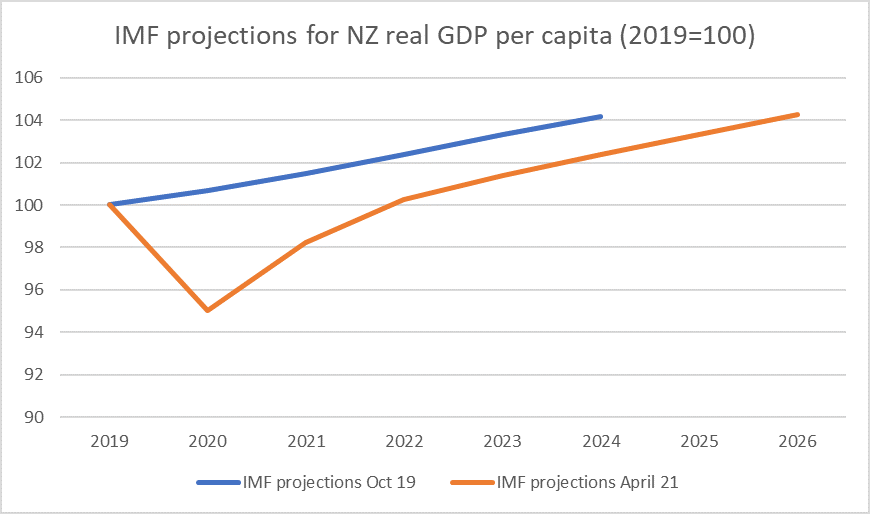
I took a look at a few of the IMF’s New Zealand projections. This chart, which I showed on Twitter last week, compares the IMF’s October 2019 (ie last pre-Covid) and April 2021 projections for New Zealand’s real GDP per capita for the period 2019-2026.

IMF projections for NZ

I thought three things were interesting about these IMF projections:

  • over seven years, the IMF thinks that real per capita GDP will have increased by a little over 4 per cent (a bit under 0.6 per cent per annum),
  • even by 2024 (three years away) the IMF still thinks that New Zealand’s real GDP per capita will be almost 2 per cent lower than they thought it would only 18 months ago,
  • the total gap between the two lines over the 2020-2024 period (covered by both sets of forecasts) is almost 15 per cent of a year’s GDP – simply gone, and with no sign in these projections that that loss will ever be recovered (even if, at some distant date, perhaps the two lines eventually converged).

This isn’t a comment about Covid or New Zealand’s Covid policy – all sorts of things may be going on in the thinking of the Fund’s forecasters – just a report of how much poorer the IMF now thinks New Zealand will be over the coming years than it thought only 18 months ago.

But perhaps, charitably/hopefully, you are thinking “well, that doesn’t look too good, but surely the rest of the world – Covid mess and all – must be worse, or at least as bad?”.

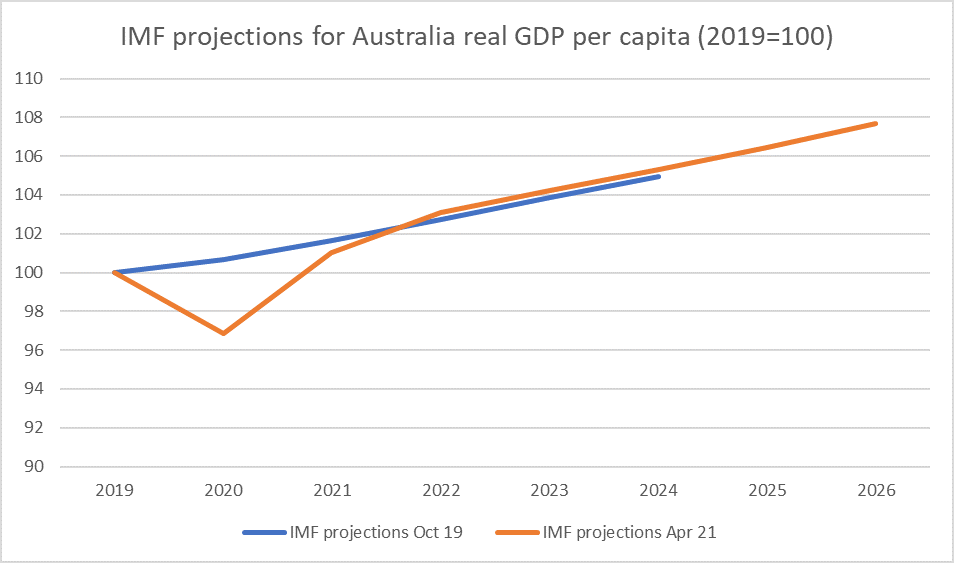
So here is the same chart for Australia.

imf aus

Which is probably the picture most countries would hope to have seen – some (inevitable) income losses last year, but a quick rebound and perhaps even a move to a future slightly higher growth trajectory. Note the other contrast to New Zealand: over 7 years the IMF thinks Australia will manage per capita growth of almost 8 per cent. Some part of the difference – although not the bulk of it – will reflect the fact that the IMF expects Australia’s unemployment rate by 2026 to be below 2019 levels, while in New Zealand the unemployment rate is expected to linger a bit higher than the pre-recession trough (itself higher than the previous pre-recession trough).

I didn’t do this comparison for a large group of countries, although for what it is worth the US chart looks more like Australia’s and that for Canada (not a stellar productivity performer in recent decades either) looks more like New Zealand’s.

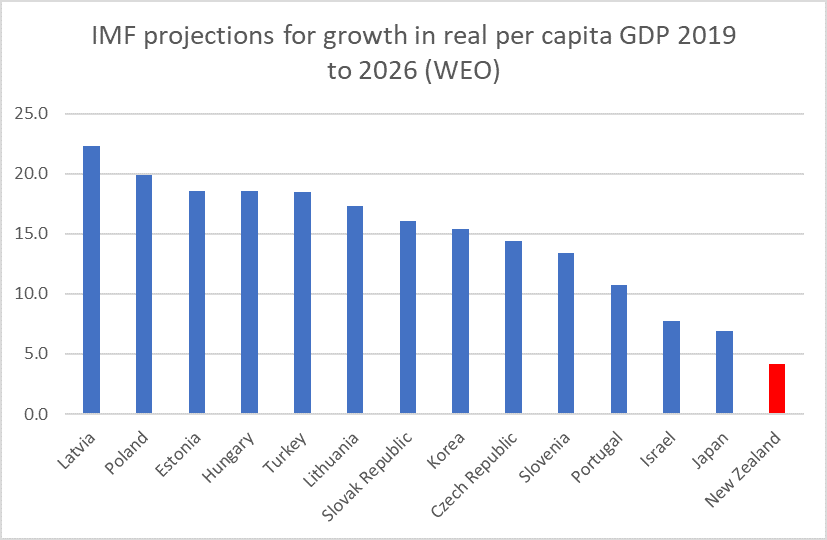
I did have a look at the IMF’s forecasts for growth in real per capita GDP across all the advanced economies in the OECD (and the few non-OECD advanced countries). Over the period 2019 to 2026 we were well into the bottom quartile of OECD countries, at least on the Fund’s view of the outlook.

But it was this chart I found most sobering. Many of the countries we often like to compare ourselves with – from days past – are now much richer and more productive than New Zealand is. They are nearer the productivity frontier, and future growth can’t “just” be catching up. But in this chart I’ve shown the IMF’s forecasts for real per capita GDP for the countries with a 2019 level of labour productivity (OECD real GDP per hour worked, in PPP terms) roughly 10 per cent either side of New Zealand (the IMF does not publish productivity forecasts).

IMF projections for NZ and productivity peers

Just woeful.

Of course, the IMF could be quite wrong, not just about the absolute outlook for the world economy (that is almost certain) but also about the relative performance of New Zealand. But when independent observers take a look at your country, its performance, and its suite of policies and think you will over the next few years do so much worse than a group of your peers (whether, in our case, considerably richer and more productive Australia – to which it is easy for young New Zealanders to move – or to a group of advanced countries with similar levels of productivity to New Zealand, all looking to catch up) it really should be a wake-up call for our political and official “leaders”.

But in New Zealand it seems that all those responsible would prefer that no one noticed, prefer to ignore the utter failure projected (on top of past decades of relative decline), to burble on about wellbeing, and to deliver to our kids some deeply diminished legacy and opportunities. We once were world leaders, but now this.

(Out of interest, I wondered what the IMF was assuming about immigration/population: of all those advanced economies – not just the ones in the chart – we are forecast to have the third fastest rate of population growth over 2019 to 2026.)

Exporting: how does NZ compare?

In preparation for a meeting earlier this morning, I’d downloaded the OECD data on exports as a share of GDP. I thought it might be useful to share of a few of the charts. Most are updates of charts I’ve shown in years gone by, but it is good to be reminded of what has happened in New Zealand and how we compare with other OECD countries. In all the charts that follow I’ve excluded 2020 for two reasons: first, not all countries yet have data (at least in this database) and second, Covid, which affected individual countries quite differently and which should over time prove to be a blip. In all the charts other than the first I’ve shown data from 1995, which is when the OECD has complete data from.

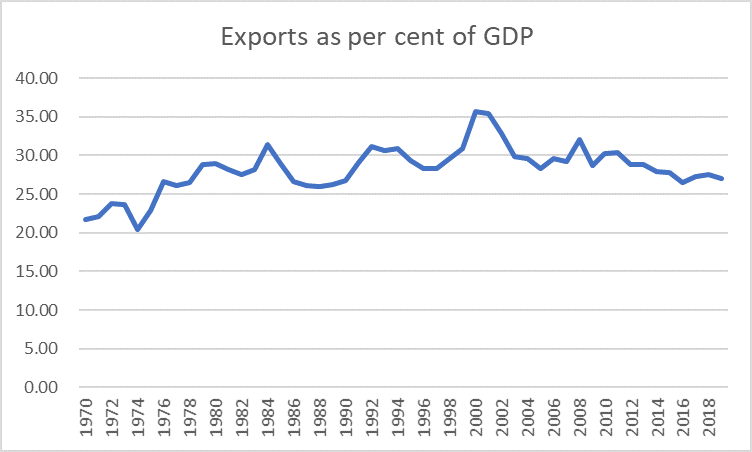
Here, as context, is the New Zealand data since 1970. 1995 was not an outlier, high or low.

exports 1

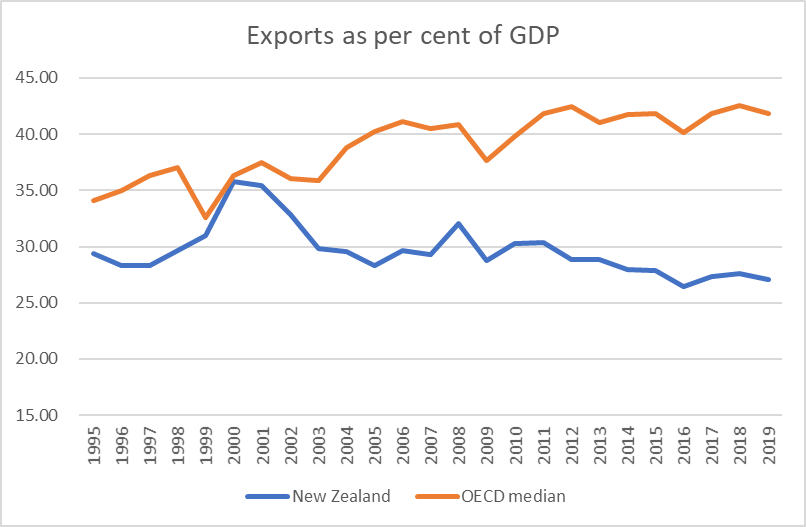
Here is New Zealand relative to the median of all OECD countries (note that the OECD keeps doing its best to keep us near the more prosperous part of the OECD, by letting in new poorer countries: the latest country invited in (and now in the data) is Costa Rica).

exports 3

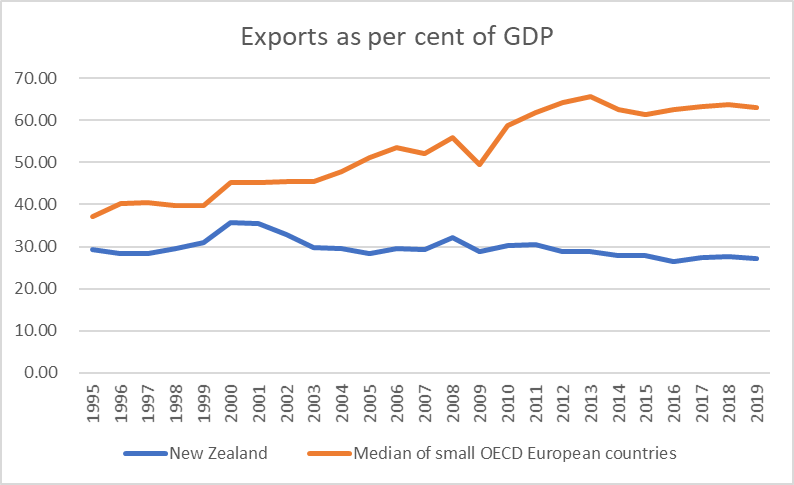
From the beginning of this chart, we’ve always exported a smaller share of GDP than then median OECD country has, and that gap has widened.

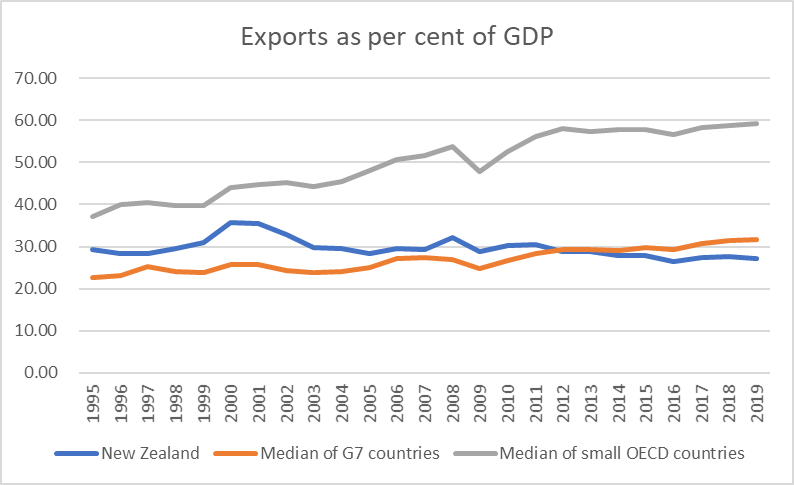
But, of course, one could expect the picture for other small countries to look different than one that included large countries. All else equal, large countries tend to do a smaller share of their GDP in foreign trade, just because there are relatively more opportunities at home (in the US, at one extreme, exports are equivalent to 12 per cent of GDP).

So in this chart I’ve shown (a) New Zealand, (b) the median for the G7 (larger) countries, and (c) the median for the small OECD countries (Belgium on down).

exports 4

And in this chart I’ve shown New Zealand against the small European countries (including Iceland).

exports 5

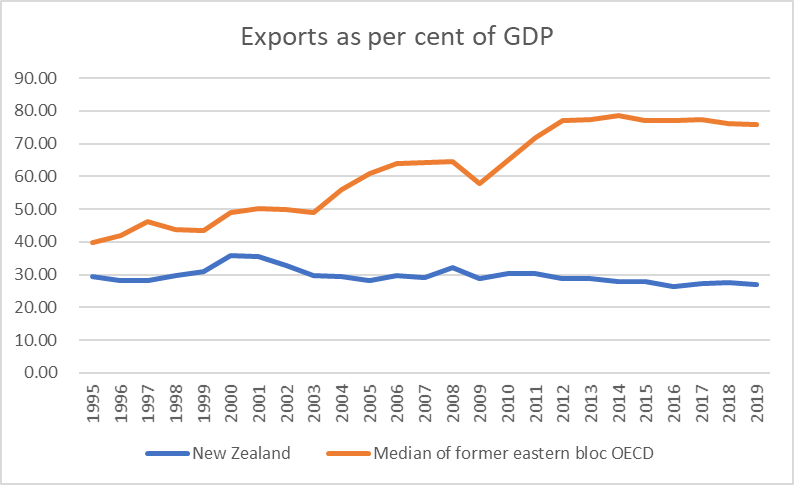
And New Zealand against the former Communist countries of eastern and central Europe, all small except Poland.

exports 6

These central and eastern European countries, all part of the EU, and often closely into supply chains for things like the German car industry, have been managed significant productivity growth, closing the gaps to some extent with the OECD leaders, over the last couple of decades.

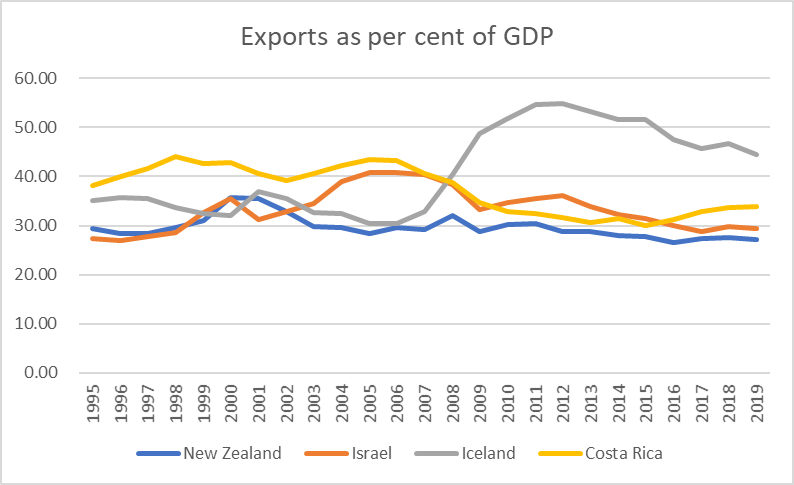
There aren’t that many OECD countries that are both small and remote. In many respects both Iceland and Israel count, Costa Rica does, and so does New Zealand. Here are the records of those four countries.

exports 7

I’ve been increasingly intrigued by Israel which for all the reputation it has for high-tech industries, has done about as badly as New Zealand. Israel has a similar (modest) level of real GDP per hour worked to New Zealand and – coincidentally or not – has had very rapid population growth.

People are sometimes inclined to discount the central and east European story, noting (correctly) that the gross exports numbers used here don’t represent the extent of value-added in the respective economies, and thus may overstate the apparent success.

The OECD reports data on the extent of domestic value-added in gross exports, but only with a lag. The most recent data are for 2016 and that year two thirds of the exports of the median eastern/central European OECD member were domestic value-added, little changed over the previous decade. In New Zealand, by contrast, domestic value-added accounted for 87 per cent of total exports in 2016. The gap – between the export performance of New Zealand and that of the central and east European countries – is (very) real.

As I’ve said often here, exports are not uniquely special – indeed, I could have done the charts of imports and most of the pictures would have been quite similar – but that successful small economies (fast growing productivity growth ones) tend to be ones generating (or attracting) companies that find plenty of buyers for lots of their output abroad as well at home. That simply does not describe the New Zealand experience.

Questions

I’m a bit puzzled as to quite what has gone on in the New Zealand economy over the last year.

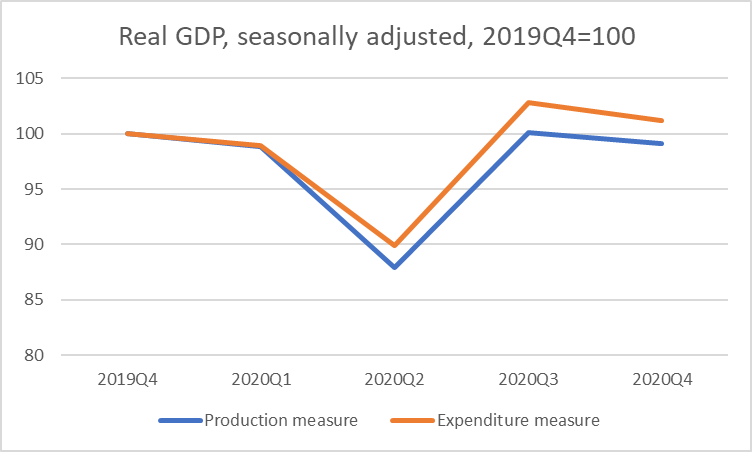
Of course, to some extent Statistics New Zealand must share that puzzlement. On their two real GDP measures – and there is no particular reason to favour one rather than the other – they aren’t sure whether by the December quarter last year real GDP was a bit higher or a bit lower than it was a year earlier. One measure shows a 1.2 per cent increase, and the other a 0.9 per cent fall. I tend to average the two measure, so a best guess now might be the GDP in December 2020 was about the same as in December 2019.

two GDP measure

The difference in the New Zealand GDP measures is almost the least of my concerns. Unfortunately there is always some difference in these two measures (trying to measure the same thing) and things have been a bit more difficult than usual during 2020 (especially so in the June quarter). We’ll keep getting that history revised for several years.

In Australia, the (generally highly-regarded) ABS reconciles their two real GDP measures: according to them Australia’s real GDP in the December quarter was 1.1 per cent lower than in the December 2019 quarter. On the face of it, such a difference seems plausible. We both had closed international borders, but Australia had more intensive sustained closed internal borders, and a few more Covid restrictions in place. (As it happens, if one looks at 2020 as a whole the falls in real GDP in New Zealand and Australia were more similar, reflecting our horrendous June quarter.)

But dig a little deeper and things get more curious. I’m really interested in labour productivity, and have regularly run here charts of labour productivity growth (and lack of it). So I checked out the hours data. We have two measures in the New Zealand: the HLFS measure of (self-reported) hours worked, and the QES measure (based on sample surveys of firms) of hours paid.

According to the QES, hours paid in the December 2020 quarter were 0.3 per cent higher than in the December 2019 quarter. That didn’t sound too implausible, especially if GDP (see above) hadn’t changed much over the period as a whole.

Unfortunately, the HLFS reports an increase of 3.9 per cent in hours worked over the same period. And while there are always differences in the two measures (a) over a full year they aren’t usually anywhere near that large, and (b) there was nothing like such a difference in the first year of the 1991 and 2009/09 recessions. Oh, and if one was going to expect a difference in 2020 one might have thought hours paid would have held up better than hours worked (between government wage subsidies, employers trying to hold onto staff, and public servants (eg immigration and biosecurity staff who don’t have much to do, but who couldn’t be laid of, by government decision). And since the HLFS employment rate – reported by the same people – fell by 0.8 percentage points over the year (and the unemployment rate rose) it really doesn’t seem very likely that the hours worked really jumped by 4 per cent.

In Australia, by contrast, the employment rate also fell by 0.8 percentage points last year and hours worked fell by 3.5 per cent. Which sounds fairly plausible: some job losses and a wider group of people working fewer hours than previously.

So what does all this mean for productivity? In the ABS official series, real GDP per hour worked rose by 2.5 per cent from December 2019 to December 2020. That seems plausible, not because Covid and closed borders were good for productivity but because tourism and related sectors (including eating out) have been particularly hard-hit, and those are typical low wage/low productivity sectors. Even if no individual worker is any more productive, the temporary loss of those lower-skilled jobs/hours will have averaged up real GDP per hour worked over the whole economy. A clue that this is what is going on is that the lift in average reported productivity was much larger in the June quarter (more Covid restrictions), unwinding to some extent subsequently,

What about New Zealand? I usually report an indicator of labour productivity growth calculated by averaging the two GDP series and the two hours series. If I do that for last year, we experienced -2.1 per cent average growth in real GDP per hour worked. And I simply do not believe that. But even if I just use the QES hours paid measure, we end up with a 0.1 per cent fall in real GDP per hour worked for the year, much worse (on those estimates, which will be revised over time) than Australia.

Closed borders etc should be bad for productivity. If we had true estimates, adjusted for changes in capacity utilisation, we might expect to see a fall in both countries. But there isn’t really a credible explanation for New Zealand doing quite so much worse than Australia last year (in December on December comparisons), other than problems with the data.

But then I’m also left with doubts about the GDP numbers themselves. Partly because in putting together quarterly estimates of GDP – and they really are just estimates at this stage – Statistics New Zealand needs to have some sense of how many people are here, as something to calibrate their sample surveys with. And there are oddities there too, highlighted by comparisons with Australia.

Recall that both countries have had largely closed borders since about this time last year. In the year to December 2019, Australia’s population was estimated to have risen by 1.5 per cent, while ours was estimated to have risen by 1.9 per cent. And yet in the year to December 2020 our population is estimated to have increased by 1.7 per cent, and Australia’s by 0.7 per cent. Both countries have rates of natural increase, that don’t change much year to year, of currently about 0.5 per cent per annum.

Of course, as we know people have continued to cross the borders, but in greatly reduced numbers. In New Zealand, for example, a net 39000 more people left New Zealand from the end of December 2019 to the end of February 2021 (more than the natural increase over that period). There have been net outflows (mostly quite small now) each month since March last year (125000 outflow from March to February). And yet the SNZ estimate is that the official (resident) population measure has grown almost as rapidly in 2020 as in 2019. Now, of course, lots of holidaymakers went home/came home – they were always “resident” at home, wherever they were spending at the time. Lots of temporary dwellers went home/came home. But the rate of population increase SNZ is reporting doesn’t make very much sense. Again, especially relative to Australia, which has had a 180000 net outflow over the twelve months to February (and presumably quite similar dynamics to New Zealand – lots of people leaving and really only Australian citizens and permanent residents coming in).

Perhaps both numbers are right, perhaps one country’s is and the other’s isn’t. Both are using (what I thought were similar) model estimates. But on the face of it, the Australian change in resident population looks a lot more plausible than New Zealand’s (and I’m not even reporting here GDP per capita numbers).

It isn’t obvious that we have any really good, timely, independent checks on these New Zealand numbers. I’m not offering answers, just highlighting questions and uncertainties. Unfortunately it might be a few years yet until we have a really good steer on what went on last year (if ever re the June quarter specifically) and what the new emergent trends are, including re relative productivity performances of Australia and New Zealand.

Productivity, Productivity Commission, and all that

I’ve written various pieces over the years on the Productivity Commission, both on specific papers and reports they have published, and on the Commission itself. I was quite keen on the idea of the Commission when it was first being mooted a decade or so ago. There was, after all, a serious productivity failure in New Zealand and across the Tasman the Australian Productivity Commission had become a fairly highly-regarded institution. But even from the early days I recall suggesting that it was hard to be too optimistic about the long-term prospects of the Commission, noting (among other things) the passing into history of the early Monetary and Economic Council, which had in its day (60s and early 70s) produced some worthwhile reports. In a small, no longer rich, country, maintaining critical mass was also always going to be a challenge, and agencies like The Treasury might be expected to have their beady eye on any budgetary resources allocated to the Commission, and on any good staff the Commission might attract or develop (a shift to another office block at bit further along The Terrace was unlikely to be much of a hurdle).

What I probably didn’t put enough weight on in those early days was the point that if governments weren’t at all interested in doing anything serious about New Zealand’s decades-long productivity failure, there really wasn’t much substantive point to a Productivity Commission at all, unless perhaps as something to distract the sceptics with (“see, we have a Productivity Commission”).

Ten years on, it isn’t obvious what the Commission has accomplished. There have been a few interesting research papers, some reports that may have clarified the understanding of a few policy points. But what difference have they made? Little, at least that I can see. Is the housing market disaster being substantively addressed? Is the state sector better managed? Is economywide productivity back on some sort of convergence path? Not as far as I can tell. Mostly that isn’t the Commission’s fault, although my impression is that the quality of the reports has deteriorated somewhat in recent years. But if politicians don’t care about fixing what ails this economy, why keep the Commission? It might be no more pointless than quite a few other government agencies and even ministries, but they all cost scarce real resources.

For the last 18 months I’ve been looking to appointment of the new chair of the Commission, replacing Murray Sherwin who has had the job for 10 years, as perhaps one last pointer to the seriousness – or otherwise – of Labour about productivity issues. There wasn’t much sign the Minister of Finance or Prime Minister cared much at all – or perhaps even understood the scale of our failure – but just possibly they might choose to appoint a new chair of the Productivity Commission who might lead really in-depth renewed intellectual efforts to address the failure, perhaps even in ways that might, by the force of their analysis and presentation, make it increasingly awkward for governments (Labour or National) to simply keep doing nothing. I wasn’t optimistic, partly because I’d watched Robertson and Ardern do nothing for several years, but also because – to be frank – it really wasn’t clear where they might find such an exceptional candidate even had they wanted one.

But then they removed all doubt last week when they announced the appointment of Ganesh Nana as the new chair. There is a strong sense that he is too close to the Labour Party. If that wasn’t ideal, it might not bother me much – especially given the thin pickings to choose a chair from among – if it were matched with a high and widespread regard among the economics and policy community for his rigour and intellectual leadership, including on productivity issues. Or even perhaps if he knew government and governent processes inside out (Sherwin, after all, was a senior public servant rather than himself being an intellectual leader). I don’t suppose the Nana commission is simply likely to parrot lines the Beehive would prefer – and can imagine some of Nana’s preferences being uncomfortable for them from the left – but this is someone who has spent 20+ years in the public economics debate in New Zealand, from his perch at BERL, and yet as far as I can tell his main two views of potential relevance are that (a) inflation targeting (of the sort adopted in most advanced economies) is a significant source of New Zealand’s economic underperformance, and (b) that a much larger population might make a big difference (notwithstanding use of that strategy for, just on this wave, the last 25 years or so.

Then there was this bumpf from the Minister’s press statement announcing the appointment

Ganesh Nana said he is excited to take up the position and looks forward to working with other Commission members and staff to focus on a broad perspective on productivity.

“Contributing to a transformation of the economic model and narrative towards one that values people and prioritises our role as kaitiaki o taonga is my kaupapa.  This perspective sees the delivery of wellbeing across several dimensions as critical measures of success of any economic model.

“Stepping into the Productivity Commission after more than 20 years at BERL will be a wrench for me and a move to outside my comfort zone.  However, this opportunity was not one I could ignore as the challenges facing 21st century Aotearoa become ever more intense.

“The role and nature of the work of the Commission is set to change in light of these pressing challenges.  I am committed to ensure the Commission will increasingly contribute to the wider strategic and policy kōrero,” Dr Nana said.

Whatever that means – and quite a bit isn’t at all clear to me – it doesn’t suggest any sort of laser-like focus on lifting, for example, economywide GDP per hour worked, in ways that might lift material living standards for New Zealanders as a whole.

(And then there was the unfortunate disclosure in the final part of the Minister’s press statement that the government has agreed that while functioning as a senior economic official, paid by the taxpayer, Nana is to be allowed to retain his almost half-share in his active economic consulting firm BERL. There is the small consolation that the Commission itself will not contract any business with BERL, but that should not be sufficient to reassure anyone concerned about what is left of the substance or appearance of good governance in New Zealand.)

A couple of weeks ago the Productivity Commission released a draft report on its “Frontier Firms” inquiry. The Commission does not control the inquiries it does – they are chosen by the government – and this one also seemed a bit daft to say the least, since “frontier firms” always seem much likely to arise from an overall economic policy environment that has been got right, rather than being something policymakers should be focusing on directly. But the Commission might still have made something useful, trying to craft something a bit more akin to a silk purse from the sow’s ear of a terms of reference.

I had thought of devoting a whole post to the draft report, and perhaps even making a formal submission on it, but since the report will be finalised under the Nana commission that mostly seems as though it would be a waste of time. And there is the odd useful point in the report, including the reminder that our productivity growth performance has remained dreadful by the standards of other modestly-productive advanced economies, and that we have relied on more hours worked, and the good fortune of the terms of trade, to avoid overall material living standards slipping much recently relative to other advanced economies. Productivity growth – much faster than we’ve achieved – remains central to any chance of sustainably lifting those material living standards and opening up other lifestyle etc choices.

But mostly the report is a bit of a dog’s breakfast. Just before the draft report was released the Commission released a short paper on immigration issues that they had commissioned. I wrote about that note, somewhat sceptically, at the time – sceptical even though the gist of the author’s case might not be thought totally out of line with some of my own ideas. It turned out that the Fry and Wilson work was the basis for the Commission’s own discussion of immigration in the draft report, a discussion that neither seems terribly robust nor at all well-connected to the “frontier firms” theme of the report. Perhaps the RSE scheme has problems, perhaps some low-skilled work visas are issued too readily, but…..apple orchards and vineyards didn’t really seem to be the sort of “frontier firms” the Commission had in mind in the rest of the report.

Perhaps my bigger concern was about their attempts to draw lessons from other countries. They, reasonably enough, suggest that there might be lessons from other small open advanced economies, perhaps especially relatively remote ones. But then they seem to end up mostly interested in places like Sweden, Finland, Denmark and the Netherlands – all of which are in common economic area that is the EU (two even with the euro currency, most with no disadvantages of remoteness). I don’t think there was a single reference to Iceland, Malta, or Cyprus. Or to Israel – that country with all the high-tech firms and a productivity performance almost as bad as ours. And – though it might not be small, it has many similar characteristics to New Zealand – no mention at all of Australia. Remote Chile, Argentina and Uruguay get no mention – even though two of those three have had strong productivity growth in recent times – and neither, perhaps more surprisingly, do any of the (mostly small) OECD/EU countries in central and eastern Europe, many of which are now passing New Zealand levels of average labour productivity.

There wasn’t any systematic cross-country economic historical analysis or a rigorous attempt to assess which examples might hold what lessons for New Zealand. Instead, there a mix of things that might be music to the ears of a government that wants to be more active, and perhaps to punt our money again on the emergence of some mega NZ excellent firm(s) – without any demonstrated evidence that it (or its officials) can do so wisely or usefully – plus the odd thing that must have appealed to someone (eg the material on immigration – a subject that might still usefully warrant a full inquiry of its own, if the government would allow it, and when better than when we are in any case in something of a hiatus).

This will probably be the last post for this year, so I thought I’d leave you with a couple of charts to ponder.

The first is a reminder of just how little we know about what is going on with productivity – or probably most other aggregate economic measures – right now. As regular readers will know, I have updated every so often an economywide measure of labour productivity growth that averages the two different real GDP series (production and expenditure) and indexes of the two measures of hours (HLFS hours worked, QES hours paid).

mix of econ data

First, there is the huge difference in the two GDP measures. Whichever one one uses – but especially the expenditure measure – suggests a reasonable lift in average labour productivity this year (on one combination as much as 5 per cent). In the period to June there was an argument about low productivity workers losing their jobs, averaging up productivity for the remainder, but how plausible is that when hours are now estimated to be down only 1% or so on where they were at the end of last year (much less than, say, the fall in the last recession)? And thus how plausible is the notion of an acceleration in productivity growth given all the roadblocks the virus, and responses to it, have put in place this year. And although SNZ’s official population estimates have the population up 1.5 per cent this year (to September), if we take the natural increase data and the total net arrivals across the border data, they suggest a very slight drop this year in the number of people actually in New Zealand. I’m not sure, then, which of the economic data we can have any confidence in, although I’ll take a punt that the single least plausible of these numbers is the expenditure GDP one, and any resulting implication of any sort of real lift in productivity this year. SNZ has an unenviable job trying to get this year’s data straight.

But, of course, the real productivity challenge for New Zealand was there before Covid was heard of, and most likely be there still when Covid is but a memory. As we all know, New Zealand languishes miles behind the OECD productivity leaders (a bunch of northern European countries and the US), but in this chart I’ve shown how we’ve done over the full economic cycle from 2007 to 2019 relative not to the OECD leaders but to the countries that in 2007 either had low labour productivity than we did, or were not more than 10 per cent ahead of us then. For New Zealand I’ve shown both the number in the OECD database, and my average measure (which has the advantage of being updated for last week’s GDP release).

productivity 07 to 19

Whichever of the two NZ measures one uses, we’ve done better only than Greece and Mexico. Over decades Mexico has done so badly that the OECD suggests labour productivity in 2019 was less than 5 per cent higher than it had been in 1990. Even Greece has done less badly than that.

(As a quick cross-check, I also looked at the growth rates for this group of countries for this century to date. We’ve still done third-worst, beating the same two countries, over that period.)

It is a dismal performance. And there isn’t slightest sign that our government cares, or is at all interested in getting to the bottom of the problem, let alone reversing the decades of failure. Talking blithely about alternative measures of wellbeing etc shouldn’t be allowed to disguise that failure, which blights the living standards of this generation and the prospects of the next.

(And, sadly, there is no sign any political opposition party is really any better.)

Could do better?

Minus the question mark, that is the title of a new and fairly short report undertaken for the Productivity Commission by economists Julie Fry and Peter Wilson on “Migration and New Zealand’s frontier firms”. The Commission itself has been charged by the Minister of Finance with reporting on what could be done about so-called “frontier firms”, and has been casting about for various possible angles (apparently their draft report is due later this week). There is a Stuff article on the Fry and Wilson paper here, which begins this way

Despite its best efforts to become the next Silicon Valley, New Zealand has instead attracted a lot of nice people but very few trailblazers.

There probably have been – and still are – a few with that “next Silicon Valley” type of aspiration, but the key point is more like “lots of individually nice people, but probably not much economic gain to New Zealanders as a whole”.

Fry and Wilson’s own summary runs this way

Fry and Wilson key points

Fry and Wilson themselves seem a bit more sceptical on the economic value (to New Zealanders) of New Zealand’s large-scale immigration programme than they were in their short 2018 book that I wrote about here.

I’m a bit ambivalent about the report, even though – considered broadly – it goes in somewhat the same policy direction as the approach I’ve been championing for much of the last decade. Perhaps that is mostly because the Productivity Commission didn’t offer to pay very much for a report, and so the authors didn’t have the time or resource to consider the issues around the economics of New Zealand immigration in any great depth. A serious look at New Zealand’s immigration policy and the connection to New Zealand’s underwhelming economic performance would require, for example, a full Productivity Commission inquiry devoted just to that issue, but the government determines inquiry topics and I gather they’ve refused to have an immigration policy one done, even though immigration policy is one of the larger discretionary government structural policy interventions in the economy. But I can’t blame Fry and Wilson for that.

But unfortunately the (presumed resource) constraint means that the report really isn’t much more than an initial view that large scale immigration over the last 30 years probably hasn’t done much good for New Zealanders, and that hence somewhat less in future would more likely be beneficial. I don’t disagree – and, of course, have gone further than the authors in my hypothesis about the damage large scale immigration may have done (a story they describe as “plausible but untested”) – but who is the report going to persuade? The report doesn’t seek to engage with a broader academic literature that tends to be quite positive about economic gains from immigration, at least in the advanced world as a whole, or with the advocacy for it – including in a New Zealand context – by outfits like the IMF or the OECD. They might – as I do – think many of these results don’t stand up to close scrutiny (eg on the IMF here, or the OECD here), or may not have much application to a single extraordinarily-remote location, but they neither engage with the papers, not articulate their critiques. There isn’t much New Zealand specific formal research, but somewhat to my surprise, there wasn’t even a reference to the big advocacy piece the New Zealand Initiative did in 2017 (reviewed and critiqued at length here).

But in the rest of this post I wanted to comment mostly on two areas where I wasn’t particularly convinced, even as someone generally somewhat sympathetic to the thrust of the report. The first is the claim – also in those Key Points above – that New Zealand’s policy for attracting skilled migrants is “close to international best practice already”. The authors seem to offer little or no support for this proposition, but even if it were true it would not be particularly reassuring given that (a) we take a lot of migrants, as a percentage of New Zealand’s population, and (b) the evidence suggests that on average migrants are no more skilled than comparable New Zealand cohorts. The large numbers of people who have managed skilled migrant entry as low-level retail or cafe managers, for example, suggests that if this is world best practice, world practice is pretty poor (which in many cases is true no doubt, but that is their problem not ours). But more specifically, we also know that the New Zealand system for granting residency to “skilled migrants” is now strongly skewed in favour of people who are already in New Zealand – explicitly favouring people from abroad with New Zealand qualifications and New Zealand work experience (with bonus points for living in remote corners of this remote country). That favours absorption and integration, but generally not outstanding excellence: our universities generally not being top-tier, and our economy not being some global centre of excellence. It simply isn’t that easy for, say, a young family – parents perhaps good graduates of top 20 overseas universities – to just get residency in New Zealand, not without first relocating temporarily to the ends of the earth on a short-term visa in the hope residency eventually works out. To the extent there is benefit for New Zealand putative “frontier firms” in migration, it some of those sorts of people – with some proven work experience globally – who are likely to be more valuable than some 21 year old student studying at Massey who couldn’t get into Stanford or Cambridge.

Of course – and here I think Fry and Wilson probably agree – not that many top tier foreign people are likely to want to live and work here (as distinct from the boltholers), but lets not get complacent that our current skilled migration system is really fit for purpose, whether as to target number or conditions of entry (and although it isn’t dealt with in this report, a lot of our residency grantees don’t even come in via the skilled migrant pathway).

(On that “not that many top tier foreign people are likely to want to live and work here”, see my doubts expressed a few years ago about the the-new Global Impact Visas. Rereading that old post yesterday, nothing in what we have seen and heard of the scheme’s operation so far would lead me to materially alter my view of the prospects.)

The Productivity Commission over the last couple of years has emphasised quite a bit a desire to see New Zealand-based firms investing more beavily in technology. I’ve been uneasy about this line of argument because at times the Commission has seemed to put the cart before the horse, not digging deeply enough to understand why the New Zealand economy is underperforming and more profitable business opportunities aren’t apparent. This emphasis seems to carry over to the Fry and Wilson report – no doubt delivering something consistent with what the client was looking for. There are several pages (in what is really only a 30 page report) on opportunities (“very significant upside productivity potential”) if only we made it materially harder for firms to hire foreigners.

The predominant mechanism they seem to have in mind – whether in relation to students, working holidaymakers, or RSE workers (there is a whole section on the fruit industry) – is that if labour is harder and more expensive to get, firms will invest in technology. On the one hand, they seem to be buying into a model in which immigration has driven down wage rates (for which the evidence, considered broadly – as opposed to a few concentrated subsectors – is quite thin; in New Zealand wages have risen faster than GDP per hour worked over the last few decades). But there are also disconcerting parallels with a couple of very shaky arguments. Back in the disinflationary 1980s there was sometimes an argument used (in the UK and here) that a high real exchange rate – pretty much an inevitable part of a transition towards low inflation – was really quite good because it would encourage strong firms to invest more heavily in advanced technology etc to retain competitiveness. There was never much sign of that in the aggregate. And more recently we here claims that materially increasing minimum wages, from already quite high (relative to median wages) levels, will itself boost productivity and stimulate investment in technology. There might be some of that – firms will look for ways to mitigate the forced increase in labour costs – but there is no evidence in support of it as some sort of economywide pro-productivity strategy. And so I’m also uneasy when this argument is applied so simply to immigration. Perhaps there is something to it at an individual firm level, but it is unlikely to hold much at an economywide level. (Relatedly, much of the discussion in the paper seems to be about average labour productivity, and very little about the – conceptually more important – total factor productivity. One can raise labour productivity in ways that still leave the overall economy worse off – Think Big in the 1980s was probably such an example.)

The authors seem to favour a much lower level of non-citizen immigration to New Zealand (on average over time), not just nipping and tucking in a few individual migration approval streams. But if so, then their paper seems to neglect a rather important adjustment channel. As they note, historically New Zealand economists tended to emphasise the significance of the short-run demand effects of migration (and the well-established point that the short-run demand effects tend to outweigh near-term supply effects plays an important part in my own story). But if immigration by non-citizens is cut back markedly and for a prolonged period we would expect to see a reduction (perhaps a quite significant one) in the real exchange rate. And – to take the fruit industry as an example – a lower exchange rate might well more than outweigh any sector-specific wage effects from reduced access to migrant workers, leaving no particular incentive for the industry to invest more aggressively in technology to replace labour (for the existing tradables sector this is my story of how adjustment works once reform is done not just to an indvidual firm – deprived of access to labour – but at an economywide level). It isn’t that I really disagree with the Fry and Wilson direction of policy, but their analysis seems a bit too simple, and also inclined to treat the existing structure of the economy as a given (whereas on my argument I think we would, over time, see quite a different mix of sectors).

Fry and Wilson end their paper with some specific post-Covid suggestions for the government

fry and wilson 2

I’m sceptical that the 4th bullet has any content to it, although the broad direction of their recommendations isn’t one I’m uncomfortable with. My own suggestions (from a speech a few years ago) are along somewhat similar lines.

reddell immigration specifics

Finally, in their paper Fry and Wilson note of my views

While plausible, Reddell’s hypothesis has not been tested empirically. However, it is
possible that the natural experiment provided by the Covid-19-induced border closure will
enable more solid conclusions to be drawn.

I don’t think that is so. Most importantly, for a natural experiment you really want New Zealand immigration policy changed with all else unchanged, but this year too much has changed all at once for any sort of read, let alone a clean one. Among those changes, the differential ways different countries have handled Covid, massive fiscal stimulus (which, all else equal, tends to put upward pressure on the real exchange rate), most other countries also closing their borders to a greater or lesser extent, and a big disruption to key elements of our tradables sector. Oh, and all parties expect – political parties seem to champion – a return to the immigration status quo ante just as soon as possible.

For anyone wanting to read more of my story, there is this older paper from 2013, a speech on related topics from 2017, and a chapter in a recent book on New Zealand policymaking in which I look at some of the issues around New Zealand’s long-term economic underperformance, with an emphasis on the notion that however sensible large scale immigration may be for some countries, it seems not to have been more recently so for a remote land heavily reliant on a fixed stock of natural resources, and with few or no asymmetric shocks having worked in our favour for 100 years or more.

Coda

And so we now have a single political party in a position to form a majority government. Between our single-chamber Parliament and the historically very tight party discipline on Labour MPs, the new government will be able to do whatever they like over the next three years. And where significant things are not done, it will be entirely down to them: their choice.

Of course, they didn’t promise much, so most don’t seem to expect much. But the issues, challenges, and problems don’t go away just a party or government chooses to ignore them. House prices for example – where the Prime Minister has consistently refused to suggest she might act in ways designed to markedly lower the price of urban land/houses.

Or, and the economic issue that mostly drove the creation of this blog, New Zealand’s dismal long-term economic performance. In short, productivity growth (and the lack of it), and our continued decline relative to other advanced economies.

The outlook wasn’t good before Covid – the last government was doing nothing, and Labour was promising nothing, that would have prevented those well-established and dismal trends continuing. But now there is Covid to confront too.

One view of the outlook was contained in the International Monetary Fund’s World Economic Outlook forecasts published last week. The IMF doesn’t have a particularly good track record as a forecaster, but its forecasts do have two particular values at present: first, they are compiled consistently for a wide range of countries, and second, they forecast/project five years ahead, which on most readings is currently far enough out that one could think of things by then being back to some sort of new normal. For what it is worth, the IMF also has no particular partisan interest in New Zealand, but has also, over the years, tended to run relatively upbeat stories about New Zealand when it does comment.

Unfortunately, the IMF does not publish productivity (eg real GDP per hour worked, or MFP) forecasts. But here is a chart showing their forecasts for growth in real GDP per capita for their “advanced country” grouping over the period from 2019 (pre Covid) to 2025).

IMF WEO 0ct 20

Third worst of all the advanced countries over this period, at least on the IMF’s telling. And do note that the countries a few to either side of us all have materially higher levels of labour productivity than New Zealand does, while the countries to the far left of the chart – best-performers – are mostly the countries (I’ve previously highlighted here) that started way behind and are now matching, and move to roar ahead of, New Zealand. On these projections, our relative decline – underway now for 70 years – keeps on keeping on.

Are there any silver linings? I couldn’t find any when I dug a bit deeper:

  • as I noted, since these numbers are for 2019 to 2025 they shouldn’t be affected by either measurement challenges, or real differences in economic structure, that contribute to quite different GDP outcomes for some quarters this year,
  • the difference also can’t be down to differences in how quickly unemployment drops back to normal (itself a thing amenable to policy, especially in a country with its own exchange rate): in most countries by 2025 the IMF thinks that unemployment rates will have got back to pretty close to 2019 levels (NZ’s is about 5 per cent, so not quite there, but it won’t explain anything like the differences in the real GDP chart).  For what they are worth, the IMF also publishes output gap estimates for G7 countries, and they are also back near zero by 2025. 
  • I didn’t look deeply into what border assumptions the IMF is making, but I did check their population growth projections, and they continue to forecast high rates of population growth over 2019 to 2025 (hardly lower than the rate for the previous six years, and third fastest in this group of countries), which again suggests they must think something like a new-normal re-establishes before too long.
  • the IMF seems to think that investment as a share of GDP will also be more or less back to pre-Covid rates by 2025 (unfortunately in New Zealand business investment in the last decade was very subdued, especially once one took account of the needs of a rapidly-rising population).

Sadly, the only realistic interpretation one can take is that the IMF thinks that over 2019 to 2025, on current government policies, New Zealand’s productivity growth performance –  labour productivity and MFP – will be simply shocking.  Most probably negative –  the only way to square falls in real GDP per capita, unemployment returning towards normal, and a reasonable level of investment – and almost certainly far worse than in almost all other advanced economies, and especially far worse than the performance in the countries that were aiming to close gaps with the OECD leaders.

It is a really dismal outlook.

Of course, it is only one set of forecasts.  The IMF may be completely wrong, even specifically about New Zealand’s relative performance.  But it isn’t clear what about policy or the economic environment should be expected to generate decent productivity growth over 2019 to 2025, especially after the fairly dismal performance in the pre-Covid years.

One would like to suppose it was the sort of issue the Minister of Finance would be intensely focused on.  One would like to think that The Treasury’s post-election briefing would have extensive analysis on the issue and possible remedies, and indeed how political party promises may even worsen the outlook.  But such is the malaise around New Zealand economic policy and performance that it seems unlikely.

Changing tack, for some months I’ve been writing much less here than I’d really intended or hoped to. I’ve made occasional references to my indifferent health. I’ve had bugs occasionally in the past that have hung around for a couple of months, never amenable to medical diagnosis, and then eventually gone away and I kept expecting this would be the same. But despite some moderately good weeks at times – this week wasn’t one of them – it hasn’t, and my doctor now reckons that I have some – perhaps fairly moderate – version of chronic fatigue syndrome. And while it still seems most likely that it will eventually go away again, there is no immediate timeframe for that. It seems a rather pathetic thing to have, but I can’t really ignore, say, the three daytime naps I needed on Tuesday.

As a result, I’ve decided for the time being to stop attempting to maintain any sort of regular blog output. As I’ve said to various people who’ve asked, I’m probably only able to operate at 50 or 60 per cent of normal, and while I’m fortunate in not having to try to hold down a fulltime job, I have other fixed commitments (household and other) that demand almost all that energy. Since there are good days, and even a few relatively good weeks, and there many issues (even if I don’t have the concentration to dig into all of them as I’d like), I expect I will probably post here from time to time. But I won’t be trying to meet any schedule. For anyone who wants to not miss out on those posts, feel free to subscribe to get posts by email, and I also use Twitter (@MHReddell) to, among other things, provide links to any posts here.

And now it is time for a lie down…..