The Shadow Board on the OCR

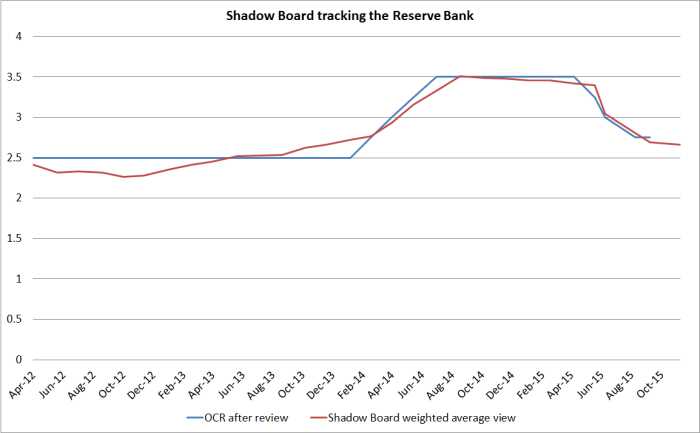
Some months ago I wrote about the NZIER’s Shadow Board, a panel of expert and informed observers who are each asked prior to each OCR review to provide a probability distribution as to what OCR is “appropriate for the economy”.  It isn’t quite the same job as the Reserve Bank has –  the Bank has to follow the PTA, and in principle the panel members might, say, agree with the two NZIER economists who recently argued for nominal GDP targeting.

There isn’t usually much information in the results of the Shadow Board exercise.  They usually track remarkably closely with the Governor’s own choice about the OCR, so they are right or wrong about as often as the Governor is.

That pattern continues this month.  The mean expectation across the respondents has dropped a little, from 2.70 per cent in October to 2.67 per cent  this time.  Whichever way the Governor goes tomorrow the Shadow Board will have been close.

shadow board tracking RB

I’ve been more struck by the lack of much diversity in the views (across panel members) and the high degree of confidence with which each panel members appears to hold his view.  This time the lower quartile expectation is 2.5 per cent and the upper quartile is 2.75 per cent.  According to these respondents there is only a 12 per cent chance that something other than 2.5 or 2.75 is the right OCR for the economy.

I don’t really understand how anyone can be that certain, given the uncertainties about the current state of the economy, the future, and about the connections between real activity and inflation (or other nominal variables monetary policy can target).

I told an interviewer this morning that I thought the economy would be better off with the OCR at 1.75 per cent than at 2.75 per cent.  I hadn’t distributed my probabilities then, but I’ve put them in the chart below (and compared them to those of the Shadow Board).  My numbers effectively say that I think there is roughly a 30 per cent chance that the consensus view is correct.

shadow board and me

It would be interesting to know the probabilities the Governor and his chief advisers would assign.  We’ll know the mean tomorrow, but almost certainly will learn little or nothing about the distribution.  Having information of that sort –  whether as a table like the Shadow Board provides, or as fan charts  –  would provide useful information on how these senior officials think about the economy.


What should the Governor do?

Tempting as it is to write about the Ombudsman’s weak report on the OIA, or to carry on looking at the Wellington airport proposal (taxpayer subsidies for long haul holidays for Wellingtonians, the return of a Think Big mentality, as Brian Easton suggested here), it is time to get back to macro.

Tomorrow is the final Reserve Bank Monetary Policy Statement for the year.  The focus, of course, is on whether or not the Governor chooses to cut the OCR, but it is worth briefly looking at what Parliament requires from the Reserve Bank in its MPSs.  That is set out in section 15(2) of the Reserve Bank Act.

The policy statement shall be signed by the Governor and shall—

(a) specify the policies and means by which the Bank intends to achieve the policy targets fixed under section 9:

(b) state the reasons for adopting those policies and means:

(c) contain a statement of how the Bank proposes monetary policy might be formulated and implemented during the next 5 years:

(d) contain a review and assessment of the implementation by the Bank of monetary policy during the period to which the preceding policy statement relates.


As I’ve noted previously, this bit of the legislation needs updating.  But it is the law, and it isn’t typically followed very closely by the Bank.  MPSs tend to be full of data analysis –  important and sometimes interesting –  but light on policy.  There is never much, for example, on the reasons why the Reserve Bank is adopting one particular approach to policy rather than another.   And when there is such discussion it is never very serious –  it is almost always a caricatured or straw man alternative  Scrutiny and accountability involves, in part, the ability to assure ourselves that powerful policy officials have thought seriously about the alternatives.  For example, at the start of last year, the alternative of not raising the OCR.

MPSs never look five years ahead, but then there isn’t much they can usefully say about such a horizon.  Whenever core inflation gets back to target they should envisage keeping it there, absent the unforeseen and unforeseeable shocks.  As I said, the legislation needs amending.

And MPSs don’t often contain much in the way of serious review and self-critical assessment of past policy.  In one respect that is understandable.  Bureaucratic incentives don’t encourage open self-scrutiny. But that is precisely why Parliament puts such provisions in legislation, to lean against the natural self-protective tendencies of powerful agencies.  We’ve heard defensive lines from the Governor –  “of course I was right” –  but little to give us (public, Board, FEC) much confidence that the Bank has really thought hard about its monetary policy performance in the last few years.   Given the target Parliament set for the Governor, it looks as though mistakes have been made.  Contra Donal Curtin, it isn’t a “gotcha culture” to suggest as much, simply a recognition of the difficulty of doing monetary policy consistently well.

But what of tomorrow?    Most economists apparently expect the Governor to cut the OCR, even if market pricing is less certain.  I don’t claim any insight into what he will do, but I am clear that the OCR should be cut.  And that the likelihood of further cuts next year should be foreshadowed.

Liam Dann had a piece in the Herald the other day looking at the pros and cons of cutting now.  I was a bit surprised to see him listing the prospect of a drought this summer as a reason to cut now.  I disagree.  Apart from anything else, it is too late to make any material difference: the biggest impact of further OCR cuts now will be seen next summer, and I doubt anyone has any particular insights on what the weather will be like then (or even on what the after-effects, eg on pasture or stock condition, of this year’s drought might be).

But also, even if a drought were to temporarily knock real GDP, it is not clear it would make much difference to incomes (nominal GDP) –  Reserve Bank research done at the time of the last drought found, somewhat surprisingly, that New Zealand droughts tend to raise world diary prices.  If so,. some people will be worse off, but some will probably be better off.  Monetary policy can’t usefully deal with distributional issues.

And, of course, the fall in real GDP associated with a drought is also a temporary reduction in the supply capacity of the New Zealand economy, so it doesn’t have very obvious implications for the level of excess capacity or of inflation pressures.

Droughts can be nasty things for rural producers, but mostly they are best looked through by monetary policy makers.

I was also a bit surprised by one of the items on Dann’s lists of reasons to hold.  This was the suggestion that the economy had been doing quite well, in maintaining real GDP growth of around 2 per cent, perhaps even picking up to around 3 per cent next year.  I highlight this not to pick on Dann, but because it is such a common line.  People seem to lose sight of the fact that Statistics New Zealand estimates that New Zealand’s population grew by 1.95 per cent in the year to September, faster than almost any advanced country.  In other words, 2 per cent real GDP growth would represent no per capita growth at all. Perhaps we are living in an age of diminished expectations, but since when was almost zero per capita growth a mark of a reasonably well-performing economy?

As a reminder, the unemployment rate has risen back to 6 per cent this year.  With inflation as low as it has been, monetary policy should have been set looser.  If it had been not only would inflation have been a bit higher, but the economy would have been growing rather faster.  That would have been a good thing, not a bad one.  Over the 17 years 1992 to 2008, real GDP growth averaged 0.8 per cent per quarter.  Since then it has averaged 0.5 per cent.    Monetary policy can’t materially influence the longer-term structural performance of the economy, but when inflation is so low we should be expecting to see growth rates materially above potential.  Monetary policy choices have meant that hasn’t happened.

Here is another way of looking at the disappointing performance of the economy in the last few years. The trend line is the path the economy would have followed if it had sustained the average growth rates of 1992 to 2008, and the red line is the actual path.  The gap between the two is now equivalent to around 15 per cent missing GDP.

real gdp pc trend and actual

There is also the argument that the OCR should not be cut because of property price inflation in Auckland (perhaps Hamilton and Tauranga too).  Reasonable people can debate the merits of whether house prices (or perhaps credit growth) should be part of the goal for monetary policy.  But they are not at present.  And the job of the Governor is to implement policy in accordance with the Policy Targets Agreement.

My view is that house prices should generally not be part of what monetary policy is targeting.  High house prices, particularly in a single city (even the largest) are largely a real relative price phenomenon –  in this case, the interaction of supply restrictions and policy-induced population growth.  Monetary policy is singularly badly suited to trying to deal with uncomfortable relative price movements –  doing so involves throwing the whole rest of the economy round to make up for some other microeconomic policy failures.  We should always be vigilant about the possibility of emerging financial stability threats, while being modest about how much we (or the Reserve Bank) really know about those risks.  But if policy responses are needed to contain those risks, there are perfectly good conventional options open to the Reserve Bank –  increasing the risk weights on housing loans and/or increasing overall capital requirements.  Such approaches are effective in limiting the potential damage to the financial system if things go wrong, while imposing minimum distortionary effects on the rest of the economy now.   And, of course, while its gets boring to say so, monetary policy works in part by lifting the demand for, and price of, long-lived assets.

A final line I’ve seen repeated several times in recent days is the suggestion that in any case monetary policy can’t do much to raise inflation.  I’ve not seen any very serious analysis or argumentation in support of that view, and it seems to simply to reflect the fact that inflation is low relative to target in much of the advanced world.  But in most of the advanced world, the scope of conventional monetary policy to do more has been long since exhausted –  interest rates have been at or near zero for years.  Neither we, nor Australia, are in that position.  We can cut the official interest rate.  And even if some are sceptical that lower domestic interest rates will do much to boost domestic demand, lower interest rates would almost certainly lower the exchange rate.  A lower exchange rate will, all else equal, boost domestic prices to some extent. And, more importantly, it will over time encourage more investment, production and employment in the tradables sector of the economy.  There is no reason to believe that something closer to full employment of domestic resources would not tend to lift core inflation.

As I’ve noted repeatedly, core inflation has been below the target midpoint –  the number explicitly highlighted in the PTA –  for several years.  There is no sign that anyone really fully understands quite why or (hence) that the Reserve Bank has been able to adequately correct its models and forecasts to avoid a repetition of this outcome in the future.   Given that, it would be prudent for the Reserve Bank to be acting now in a way that it believes would actually deliver core inflation in the upper part of the target range.  Act on the basis of forecasts that you think will deliver, say, 2.5 per cent core inflation 18 months hence.  If the Bank did that, they might be right and core inflation might end up higher than the midpoint.    If so, as it became more certain that was the case, there would be plenty of time to tighten gradually.  But if the forecasting  (or understanding) errors of the last six years continue, it is likely that core inflation would end up somewhere near 2 per cent.  The latter would be an unambiguously good outcome –  good in its own terms, and also good for the unnecessarily unemployed.

At present, by contrast, and unless the MPS tomorrow reveals some startling new analysis, we have simply to take on faith the Bank’s view that the current approach to policy and forecasting  is enough to get back to 2 per cent, even though it has not been enough for years now.  With the zero-bound no longer that far away, and with nothing in the domestic or global environment suggested any sustained acceleration in growth or inflation pressures any time soon, it is an approach that should have been seriously considered.  And if it isn’t adopted, perhaps in scrutinising the MPS tomorrow, FEC members might ask the Governor about the reasons he has chosen to adopt one policy approach over the other.

Nominal GDP targets for New Zealand?

I urged again the other day that there should be an open process of research and debate leading towards the negotiation of the next Policy Targets Agreement in 2017.  These documents matter.  Monetary policy is the main tool for short-term macroeconomic stabilisation, so the PTA sets the “rule” (well, loose guide) for how the short-term fluctuations in the economy will be managed.  The Reserve Bank –  and the Treasury and Minister –  has often had a tendency to treat deliberations around the PTA as technocratic in nature (which in some ways they are), and hence not something with which to trouble the natives.  The standard Reserve Bank response to any suggestion of greater openness was “but we already tell them what we want them to know”.  But open government is not just about releasing finished products, after the event, in bureaucratically-approved formats.

Two other former Reserve Bank staff, Kirdan Lees and Christina Leung, both now at NZIER, have made a useful contribution to a debate about the future of New Zealand’s monetary policy.  They put out a note the other day headed Time to reassess inflation targeting, which concludes with a pretty strong leaning towards adopting nominal income targeting instead.  I don’t think they will get far with the current Governor on that one – he used to bristle and react very frostily whenever anyone so much as mentioned nominal income targeting  – but he won’t be Governor for ever, in the end the Minister of Finance calls the shots, and whether the Governor likes debate or not, it is an important part of good public policy processes.

However, I’m not convinced by the Lees/Leung argument.  In particular, I’m not persuaded that the form of the rule makes a great deal of difference to assessing the appropriate stance of monetary policy now.  Nor am I convinced it would have made a great deal of practical difference over the pre-recession years.  And if we were going to move away from inflation targeting, I’m not convinced that nominal income targeting is the alternative I would adopt.

Lees/Leung have a number of strands to their argument.

First, they argue that “supply shocks” have become more important relative to “demand shocks”.  Perhaps, but where is the evidence for that proposition in New Zealand or in other countries?  They seem, in part, to be arguing from the presence of a number of phenomena (fracking, the internet etc) which are improving productivity.  All of them are real, but in aggregate productivity growth has been materially slower in the last half dozen or so years than in the previous decade.  And, in any case, the issue for monetary policy would not normally be the trend rate of productivity growth, but shocks –  surprises, which can go either way.   There is, of course, one area where supply shocks have become more important for New Zealand –  terms of trade volatility has been much greater in the last decade than in the previous 15-20 years (apparently driven mostly by the fairly extreme dairy price volatility).  We’ll come back to terms of trade shocks.

Second, they point out that many advanced countries have seen inflation undershoot respective targets.  That is, of course, true, but most of the countries on their chart have largely exhausted the potential of conventional monetary policy.  Interest rates are basically at zero, and have typically been so for quite a few years.  There are reasonable arguments that a different target might make it a little easier to get out of the current “trap”, but they aren’t relevant to New Zealand at present.  Our Reserve Bank has undershot the inflation target not because it couldn’t cut interest rates enough, but because it chose not to.  That failure probably wasn’t wilful –  largely it was because they misread the data.  They (and other central banks) misread the data on the other side during the boom years.  Forecasting is difficult, but it is a problem that bedevils any of the rules under discussion.

Third, they point out the well-known proposition that, in principle, nominal GDP targeting can generate better short-term macroeconomic performance (eg less output variability) in the presence of supply shocks.  In the example they cite, faced with drought, an inflation targeting central bank will tend not to adjust policy (since inflation, and especially core inflation, won’t change much) while a nominal GDP targeting central bank will tend to ease policy to lean against the drought-induced fall in GDP.  But, in fact, whichever rule was adopted, the central bank would almost certainly be reacting to forecasts (whether of inflation or nominal GDP), since monetary policy only works with a lag.  Droughts typically aren’t recognised by central banks until we are in the midst of them, and when they are recognised they are typically assumed to be shortlived.  Faced with the prospect of a drought this summer, the Reserve Bank will typically (and reasonably) assume that next summer will be normal, and since monetary works with a lag they wouldn’t change policy under either regime.

Fourth, they argue that the difference between inflation targeting and nominal GDP targeting is quite material for where the OCR should be set right now.    It is certainly feasible that in some circumstances there could be quite a difference, but they don’t make a persuasive case that this is one of those times.

They compare inflation rate targeting with nominal GDP level targeting.    Either prices or nominal GDP can be targeted in rate of change terms (inflation rates) or in levels terms.  No country in modern times has adopted levels targets for either prices or nominal GDP.  The Bank of Canada looked quite carefully at the option of price level targeting a few years ago, and concluded that it would not represent an improvement over inflation targeting.  One reason levels target don’t appeal to practical policymakers is that if one makes a mistake and prices or nominal GDP rise unexpectedly strongly, one can’t just treat bygones as bygones –  one has to tighten to drive the level of prices (or nominal income) back down again.    Whatever the theoretical appeal of such an approach, it seems unlikely to command much public enthusiasm or support –  and hence seems unlikely to prove durable.

Much of the older literature around nominal GDP targeting was done in terms of rates of change (nominal GDP growth rates).  But since the 2008/09 recession there has been renewed interest in the idea of a level target for nominal GDP.  The argument made, most prominently by US economist Scott Sumner, has been that a target for the level of nominal GDP would have (a) prompted an earlier easing in monetary policy, and (b) would underpin expectations (especially in the US and Europe) that interest rates would stay low for a long time.

Lees/Leung acknowledge that the current inflation targeting framework invites further cuts in the OCR  (we’ll see next week whether the Governor agrees, although recall that it is a forecast-based framework, so OCR cuts aren’t warranted if the Bank can convincingly show that core inflation is heading back to 2 per cent reasonably soon on current policy).  But then they suggest that using nominal GDP levels targeting “interest rates are about right”.

They appear to base that observation on this “illustrative example”.

ngdp

In this chart, they appear to have simply drawn a trend line through actual nominal GDP since 1998 and then calculated the difference between the trend line and actual. That difference is small.

But to adopt a nominal GDP levels target, one would need to define an appropriate trend period first.  And it isn’t clear to me why this is the right one.  Most advocates of nominal income targeting at present argue for using something like the pre-recession trend (since the arguments are about whether policy has been sufficiently loose in the year since 2008).  In a New Zealand context, in both 1996 and 2002 policymakers decided that New Zealand should have a faster trend rate of nominal GDP growth (since they revised up the inflation target).  Alternatively, a common approach in New Zealand has been to look at the entire period since low inflation (and lowish nominal income growth) was established, around 1992.

I’m not sure that a trend starting from 2002 to, say, 2008, is that enlightening.  After all, there was a common view that monetary policy was too loose over at least several years of that period (Alan Bollard has openly acknowledged as much).  But if we used that as the trend, this is what the picture looks like (using logged data).
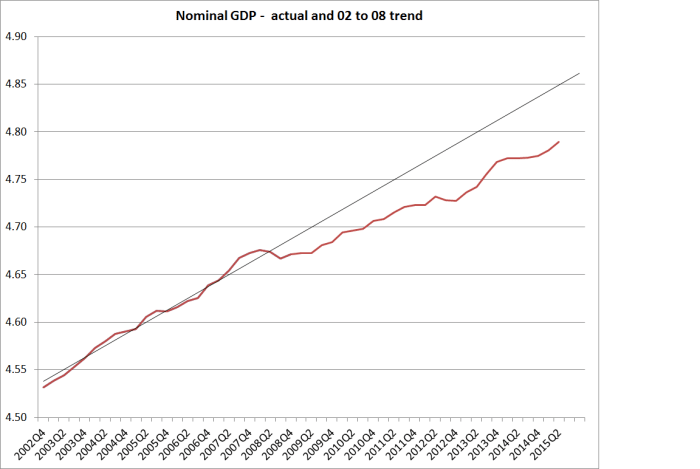
ngdp 02 to 08 trend

Nominal GDP is well below that pre-recession trend (as it is in most countries), arguing for looser monetary policy now as well.

Or we could use a trend done over 1992 to 2008 and one ends with a similar gap.
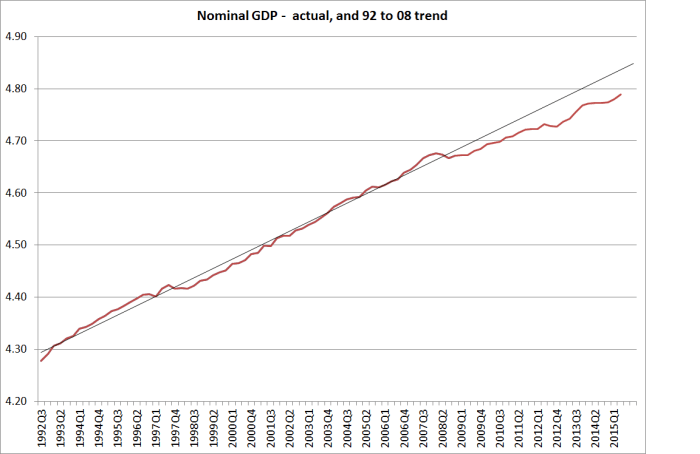
ngdp 92 to 08 trend

Levels targeting does require identifying a starting level (which is neither easy nor uncontentious).  But what if we just look at nominal GDP growth rates?

ngdp apcs since 92

Not only has nominal GDP growth averaged far lower since 2008 than it did over the previous 17 years, but the most recent observation (annual growth of 3.9 per cent) is right on the average for the post-2008 period.    If we are happy with something like 2 per cent inflation (few have argued for lowering the target) and have a population growth rate of almost 2 per cent per annum, then 5 per cent nominal GDP growth might be a reasonable benchmark.  Current nominal GDP growth is well below that, just as current inflation (headline or core) is well below the 2 per cent inflation target.

So, shifting between CPI or nominal GDP based rules, levels or rates of change, looks as though it would not make much difference to how one thinks about appropriate monetary policy at present, at least on the current data.

But as I noted earlier, central banks aim to base policy on forecasts, so the issue is not so much where inflation or nominal GDP is right now, but where the central bank thinks it will be in a year or two’s time.  My proposition is that most of the mistakes central banks have made in the last decade or two have been forecasting mistakes rather than policy rule mistakes.  Monetary policy wasn’t tightened soon enough during the boom years partly because Alan Bollard was a dove, but partly because the Bank –  and most other forecasters even more so –  recognised the immediate inflation pressures, but forecast that they would soon dissipate.  They were wrong, and as a result inflation and nominal GDP growth were higher than forecast.  Similarly in the last few years, central banks have underestimated how weak both inflation and nominal GDP growth have been.  If one could forecast nominal GDP more reliably than inflation, perhaps the case for change would be stronger, but outside recessions the big source of fluctuations in New Zealand’s nominal GDP is international commodity prices.  They are highly volatile, and the volatility dominates any trend movements over the sorts of period relevant to monetary policy.

An international conference was held in Wellington a year ago this week to mark 25 years of inflation targeting, and the papers have recently been published.  Several academics presented a paper looking at how inflation targeting compared with nominal GDP targeting for New Zealand.  They looked at a variety of different time periods, including the pre-liberalisation period, the transition to a more liberalised economy, and the current period.  The authors were sympathetic to the case for nominal GDP targeting.  I was asked to be the discussant, bringing a practical policy perspective to bear on the issues raised in the paper.  In my remarks, I set out some of the reasons why I’m not convinced that a practical nominal GDP rule would represent a material advance over (practical) inflation targeting.

One of the attractions of nominal GDP targeting is that it prompts a monetary policy tightening when export commodity prices rise, even if there is no immediate rise in consumer prices. But as I noted one needs to think specifically about the characteristics of the particular economy.

In thinking about an export price shock, it might also be important to understand the transmission of the shock across the rest of the economy. A highly open economy, in which a generalized export price shock affected firms across an employment-rich wide-ranging export sector, might look considerably different than a sector-specific shock in a moderately open economy where the commodity production sectors employ relatively little labor (the story in New Zealand dairy, and much more so in Australian minerals and gas extraction). If New Zealand experiences a surge in dairy prices, and much of the proceeds are saved by farmers—perhaps because they are very conscious of the volatility of prices—why would one want to tighten monetary policy against that lift, if there was little or no apparent spillover to domestic (wage or price) inflation? Perhaps if the shock destabilized wage expectations there could be a basis, but there has been little sign of that sort of wage-setting behavior in response to recent export price shocks. The issues are even more stark in Australia, where most of the profit variability in the face of export price shocks accrues to non-Australian owners of capital (whose consumption choices are likely to put few pressures on domestic resources in Australia).

Partly for this reason, over several years I have been drifting towards the conclusion that if one were to replace inflation targeting with another rule, in New Zealand’s case nominal wage targeting might have rather more appeal.   I noted

Much of the academic discussion of inflation targeting focuses on the idea of stabilizing the stickier prices in order to minimize the real costs of adjustment to shocks. Since, as this paper agrees, wages are typically among the stickier prices, perhaps we should be more seriously considering the merits of nominal wage targeting, as Earl Thompson argued decades ago. I have noted elsewhere (Reddell 2014) that such a rule could even have financial stability advantages. Nominal wages are the prime basis for servicing the nominal household debt that dominates the balance sheets of our banks. Faced with adverse shocks, and especially deflationary ones, nominal debt is arguably the biggest rigidity of them all. It would be interesting to see such a rule evaluated in a suitable model.

But…..

If productivity shocks were the dominant source of dislocations in New Zealand, such a wage rule could also have considerable appeal— shifting the variability into the price level rather than into (sticky) nominal wage inflation. As it is, over the last twenty years, wage inflation has followed a rather similar path to core CPI inflation— and does not look much like fluctuations in the path of nominal GDP (or in NGDP per capita, or NGDP per hour worked). So perhaps, at least over that period, policy should have looked very little different under a wage rule than under the CPI inflation targets that successive ministers and governors have agreed upon.

Of course there might be considerable political/communications difficulties with wages-targeting.  But this would be nominal wage targeting: actual real wages and the labour share of income would still emerge from the market process.   But given these communications difficulties, the case for change would have to be stronger than it is right now (although for what it is worth, current wage inflation also probably argues for looser monetary policy –  just like the CPI or nominal GDP).

I have little doubt that inflation targeting is not the “end of history” for monetary policy.  But the choice between inflation, nominal GDP, or wage targets –  in levels or growth rate terms –  doesn’t seem to be the biggest issue we face in designing monetary policy and the related institutions.  In practical terms, each would rely on forecasts, and our forecasts simply aren’t very good.  And each still faces the issue of the near-zero lower bound.  There are arguments that levels targets might help alleviate the ZLB, but only zealots think that in isolation it would make a huge (or sufficient) difference.  We need much more energy being applied to either removing the ZLB constraints (which are essentially regulatory in nature) or raising the target for inflation (or nominal GDP or wages growth) sufficiently so that the zero bound is no longer likely to be binding.  The Bank of Canada is right to be looking at this issue.  Other central banks and finance ministries need to be doing so.

And I still think the other issue is one of just how much accountability there can actually be for autonomous central banks implementing monetary policy.  As I have noted recently in both the New Zealand and US contexts, in practical terms there is very little.    In the United States, John Taylor has argued for legislating something like a Taylor rule as a benchmark against which the Federal Reserve’s judgments can be formally evaluated, requiring the Fed to explain deviations from the recommendations of that rule.  Some on the political right argue for a return to the Gold Standard.  I don’t think either would be desirable, but in a sense both are reactions against the delegation of too much unchecked power to central banks.  The original conception in New Zealand was of a high degree of effective accountability –  an easy test as to whether or not the Governor has done his job. Money base target ideas had a similar conception –  plenty of delegation, but plenty of effective accountability.  It turned out not to be so easy.  But if we cannot meaningfully hold these powerful independent agencies to account –  in ways that mean real consequences for real people –  I suspect the debate will begin to turn again as to whether the power should be delegated to unelected officials at all.  Citizens can vote governments out of office, and that has real consequences for real decisionmakers.
Thinking further about employment and unemployment

Just when I’d been writing yesterday that I was puzzled that so many of New Zealand’s elite seem to think that New Zealand has done quite well in recent years, and seemed quite indifferent to the number of people unemployed, along comes another example.

In his column (not apparently online) in this morning’s Dominion-Post, Pattrick Smellie leads with this line

“On any rational analysis, New Zealand’s employment statistics are among the strongest in the developed world”

How could one “rationally” disagree?  Well, it is certainly true that the ratio of employment to population in New Zealand is quite high by international standards (though any table in which, as with Smellie’s, New Zealand is bracketed between Colombia and Russia should probably be a bit of a warning), but by what criteria is Smellie judging this to be “a good thing?  There is no real hint in the article, except perhaps a Stakhanovite sense that more paid labour must somehow be a good thing, for someone.  For“the national interest” perhaps?

But labour is a costly input –  costly not just to the employer who has to write the cheque to pay for it, but for the employee who gives up the time and opportunities he or she would otherwise have.  Some people have a real passion for the paid employment they do, but for most they work because they have to, to provide the basics for themselves and their families, and because the value to them of the things they get to consume (or risks they get to allay) as a result of working outweighs the cost of giving up free time.

I’m disgruntled that our governments have continued to run policies that mean that 10 per cent of working age adults are on welfare benefits (and did I really hear that, despite this, the ACT Party last night voted to raise real welfare benefits?).  I’d prefer that most of those people were providing for themselves –  which for many/most would involve paid employment  A move in that direction would tend to raise our labour force participation and employment rates.

But equally I’m glad that my elderly mother does not (have to) work  A larger share of the population in much older age groups will, quite reasonably, tend to lower labour force participation and employment rates, even if we could get the NZS eligibility age raised somewhat.   And polling data shows that many parents would prefer that one of them was able (financially) to stay home full-time  at least when they had young children –  but our scandalously expensive house prices, especially in Auckland, make that very difficult for most.  Reforming land and housing markets to make housing more affordable might lower participation and employment rates –  and that would seem likely to be a good thing, (given private preferences).

There are reasons to be concerned if public policy measures are unreasonably discouraging people from participating in the labour force.  But a measure of a country’s success is not the proportion of its adult population that is in the paid labour force (or the hours they work – see, eg, Korea). Personally, I counted it as a measure of our family’s modest success that I’m not in the labour force any longer, and have no intention of being regularly in it again.    I get to do for my kids what my mother did for me.  That is gain not a loss.

And that is, of course, why most attention in the labour market data goes on the unemployment rate, because it is a measure of the people who want to work, are actively looking for work, are available for work now, but don’t have a job[1].  As a general proposition, the lower that number is the better.    These people would prefer to be working –  not necessarily in just any job, but in a job  – and are taking active steps to find one.

One can take the economist’s tack and (somewhat queasily) compare people unemployed to goods on the shelf of a supermarket.  I can always buy butter when I want it only because the supermarket stock enough to cope with fluctuations in demand.  Those stocks serve a valuable purpose (which is why the supermarket owners willingly pays the cost). The unemployment story is a bit different; a pound of butter is a fairly homogeneous commodity, and people are not.  The search and matching process –  matchng the “right” job to the “right” worker –  takes time and effort.   Mostly, workers would probably prefer to do that matching while they are still in another job (whereas a pound of butter can’t be in my fridge and simultaneously available for another casual customer wandering into the supermarket), but sometimes unemployment actually allows the time for a more intensive search (or search in a different city).  At the margin, unemployment benefits make that a more feasible option than it would otherwise be (as, of course, do private savings, and the pooling of multiple incomes within a household).

But unemployment is not something we can, or should, be complacent about.  I think there was something profoundly right about the post-war emphasis on achieving full employment, even if it was carried too far, and pursued in ways that were probably detrimental to the longer-term economic performance of the country.  “Full employment” barely even figures in modern discussion, except perhaps when macroeconomists are tempted to treat a NAIRU as something akin.

New Zealand has had a mixed historical record on unemployment.  Here is how our unemployment rate has compared with the median OECD country’s unemployment rate, and that for the median of the other Anglo countries (Australia, Canada, Ireland, US and UK) since the HLFS was set up.

U nov 15

Mostly, we haven’t done too badly –  the big exception being, of course, the late 1980s and early 1990s, when inflation was being brought down and a good deal of structural reform was going on.  Things are not terribly bad compared to these other countries right now, but they aren’t that good either.  The United States and the United Kingdom, both of which went through nasty financial crises, have lower unemployment rates now than we do.  And both had long since more or less exhausted the room for conventional monetary and fiscal policy to do much about helping to deal with any cyclical components of unemployment.  We haven’t.

Even the US unemployment rate of 5.1 per cent is still, as I noted yesterday, consistent with every person spending two years, in a forty year working life, officially unemployed.  Markets look as though they should be able to work better than that.

That should disquiet our political leaders, but it is not clear that it does..  A local political blog the other day highlighted this exchange from the House on Wednesday:

Andrew Little: What responsibility, if any, does he take for unemployment rising to 6 percent?

Hon BILL ENGLISH: Of course, if unemployment was a direct choice of the Prime Minister of New Zealand, there would be none of it. You would just decide to have none. But, of course, it is not.

The flippancy is perhaps par for the course in the House (question time is partly about “gotcha”), but I looked at Hansard and nothing in the answers to the supplementaries gave me any greater confidence that the issue was being taken very seriously.

The question wasn’t about the absolute rate of unemployment, although there must be plenty of structural stuff governments could do to lower that over time, it was about the increase in unemployment that has now gone on for several quarters, and is apparently forecast to go further.

As I’ve noted previously, it is fair for the Minister of Finance to respond that he doesn’t directly control the principal lever of stabilisation policy, which is monetary policy.  But he hires, sets the goals for, and fires the person who does –  the Governor of the Reserve Bank.  We depend on the Minister of Finance to hold the Governor to account, both directly and through the sort of people he appoints to the Reserve Bank Board.  Judging by the Minister’s public silence, by the absence of any concern about the issue in his annual letter of expectation to the Governor, and by the “we look after the Governor’s back” approach taken by the Board in their Annual Reports, unfortunately he associates himself with the errors the Bank has made, and keeps on making.  The Governor’s errors are those of commission and the Minister’s might be those of passivity or omission, but they are choices nonetheless.  The increasingly large number of people unemployed suffer the consequence.

In closing, a final observation on the Smellie article.  He claims that our participation rate/employment rate are remarkable because they are coinciding with “unprecedented” [not actually, but rapid certainly] population growth, reflecting strong net inward migration.  I reckon he has that story the wrong way round.  For decades, every economic forecaster in New Zealand has worked on the basis that the short-term effects of immigration are such that the boost to demand that results exceeds the boost to supply.  Immigrants have to live somewhere, and need roads, schools, shops etc –  so they need day-to-day consumption, and a material addition to the physical capital stock.   That is why the Reserve Bank tends to tighten monetary policy, all else equal, when immigration picks up.  There is lots of debate about the long-term effects of immigration, but there has never been much doubt about the short-term effects.  Immigration to New Zealand doesn’t boost unemployment; all else equal it lowers it.  If we’d not had the impetus from immigration over the last couple of years, we’d be grappling with even weaker inflation pressures and more of a need for the Reserve Bank to have cut interest rates further.

[1] Simply noting here, but skipping over, the wider measures of unemployment and underemployment.

How the Reserve Bank thinks we should evaluate its monetary policy

The Reserve Bank released a new issue of the Bulletin yesterday headed “Evaluating Monetary Policy”.   Bulletins carry the imprimatur of the Bank itself, and in this case the key messages are conveyed in quotes from Assistant Governor John McDermott in the accompanying press release.  I’m sure Graeme Wheeler himself will have gone through this quite carefully before agreeing to its release, and we can assume that the article speaks for the Governor.

In principle, the article isn’t a bad idea.  It is worth having an accessible summary reference that outlines the key legal provisions that govern the Bank’s accountability for monetary policy, and which articulates some of the real challenges in scrutinising and holding the Bank to account in the approach to conducting monetary policy (“flexible inflation targeting”) that is now pretty widespread.  As I’ve pointed out previously, the Act was written for a simpler (not very realistic) conception of monetary policy.

But it is also the sort of article that needs to be written rather carefully and modestly.  The people (or institution) being held to account are not the ones who get to define how we review and assess them, and hold them to account. That is up to us –  whether “us” is citizens, markets, MPs, media, lobby groups, the Minister of Finance, or whoever.  If it ever comes to a question of dismissing the Governor, the formal legal provisions would have to be considered very carefully, but short of that  –  and I hope we are always short of that –  a wide range of factors will, and should, be taken into account.  Some of them are the rather narrowly technocratic items in the latest Bulletin.  But many aren’t.  And an article of this sort from the Board –  who are actually paid to hold the Governor to account –  might have been more valuable.

In publishing this Bulletin, I suspect the Bank had a couple of motivations.  One probably was genuinely didactic and informative – the public service of reminding readers of some of the issues.  But I suspect the rather more important consideration was defensive. It looks like an attempt to get critics off their back, and perhaps even to fend off doubts that even some Board members might have had (the Board, while compliant overall, has always had its awkward characters)  about just how well the Governor has been doing in ensuring that the Bank achieves the policy targets.  An article like this will have been in the works for several months.

I don’t think the article does either job well.  If anything, it raises more concerns about the depth and authority of the key policymakers and advisers at the Reserve Bank.    My advice to them, had they asked, would have been that there might have been a useful role for two quite separate articles:

  • One on the framework itself, a reminder of how the accountability system is designed, and is evolved.
  • A separate one that reviewed , with the benefit of hindsight, the conduct of monetary policy over the last few years.   Would we have learned anything from the latter?  Perhaps not, but having the Governor make the strongest case he could, including showing us how he has learned from mistakes and the flow of new information, would have been revealing, however good or bad the document actually was.

Except in passing I’m not going to debate here the record of the last few years.  The article touches on it directly in a rather unconvincing box (pages 16 and 17), but in fairness it is difficult to do justice to the arguments on either side in five charts and six short paragraphs.  But, as a hint, if you want to persuade thoughtful people of your case, it is good to actually engage with the arguments or alternative perspectives the critics have offered.  Anyone can beat a straw man, but what is gained by doing so?

My copy of the article is riddled with comments in the margins, and I won’t bore readers by going through them all.

But let’s start with John McDermott’s press release, which pummels a straw man and declaims what should be a platitude.

The straw man?  We are told, portentously, that “it is not sufficient to look at inflation outcomes alone when assessing the conduct of monetary policy”.  Indeed, but whoever said it was?

And the platitude?  This point is repeated so often, between the article and the press release, that they really must want us to take notice: “a central bank should make full use of all relevant information, and learn from new information and forecast errors as these come to light.”   Really?    I’m sure we hadn’t thought of that before.    Of course, but critics will suggest that it is precisely what the Reserve Bank has not been doing in recent years.  They haven’t convinced us –  and don’t really try to do so in the article – that they have taken the best possible approach to learning from their mistakes.  That cause is not helped when the Governor is so reluctant to concede that any mistakes were ever made.

The article has a number of curious features even in its description of the formal accountability process.  For example, the phrase “Minister of Finance” does not appear at all.  And yet the Minister of Finance:

So how did the Bank manage to write a whole article about monetary policy accountability and not mention the Minister of Finance?  Ours is quite a different system than those in most other countries.

I think it is partly because they use a muddled concept of accountability.  The article is headed “evaluating” monetary policy, which  – at least to some ears –  has rather technical connotations to it.  But even allowing for that,  there is an important distinction between people having views on the monetary policy performance, and people with the power to do something about it.  Real accountability implies the presence of remedies –  the Board and the Minister have them, but we don’t.

The article also veers down an odd line of argument that confuses transparency and accountability (and evaluation for that matter).  Take this paragraph:

Well-informed oversight from external stakeholders benefits the Bank in two ways. Firstly, a clear understanding of the Bank’s policy goals, and how it might be assessed against those goals, helps external stakeholders predict how the Bank is likely to react to new information. This improves the efficacy of monetary policy, since agents in the economy can react instantly to new information, rather than having to wait for guidance from the Bank. Secondly, it provides several avenues – in addition to the role played by the Board – for direct feedback to improve the Bank’s decision making. Well-informed feedback can help the Bank identify faster the need for policy adjustments.

But “oversight” isn’t there to benefit the Bank –  it is supposed to protect the public and the country.  There is certainly a reasonable argument that transparency about the goals the Bank is working to and the “reaction functions” it uses can be helpful in engendering public and market responses to data that are consistent with how the Bank will eventually adjust monetary policy (so, could we see that model?), but that is a different matter from policy evaluation or accountability.  One can be predictably wrong –  as the Bank has become over the last couple of years-  as well as predictably right.  And, incidentally, it would be interesting to know whether any feedback from anyone has made any difference to “improve the Bank’s decision making” or “identify faster the need for policy adjustments”

But perhaps the critical caveat is “well-informed”?  Is there any feedback or criticism about monetary policy that the Bank (current Governor) has regarded as well-informed?

The Bank goes on to note that “self-assessment by the Bank is an important part of the accountability framework”.   The willingness to recognise mistakes and learn from them should be one of the characteristics the Board and the Minister should be looking for in evaluating the Governor’s performance.  I’m not sure, though, that I have seen those aspects commented on in the Board’s Annual Reports.

And it is a little surprising that the article does not refer to the one place in the Act where the Bank is required to undertake and publish self-assessment and review.   Section 15 of the Act governs Monetary Policy Statements, which are formally only required every six months. But each such statement must

contain a review and assessment of the implementation by the Bank of monetary policy during the period to which the preceding policy statement relates.

This section of the Act certainly needs updating, but the Bank does not even try to comply with the spirit of what those who drafted the law were about.  After constant nagging, they started publishing a box in each MPS which probably barely meets the formal legal requirements –  it briefly describes monetary policy over the preceding period, but makes no attempt at assessing or evaluating such policy  (as distinct –  and the distinction is important –  from defending it).  I used to argue that perhaps once every two years such a review and evaluation should be undertaken as a major special chapter in a Monetary Policy Statement, perhaps informed by commissioned reports from independent experts.   (The article also omits to mention the legal requirement on the Board to “ determine whether policy statements made pursuant to section 15 are consistent with the Bank’s primary function and the policy targets agreed to with the Minister under section 9 or section 12(7)(b)”)

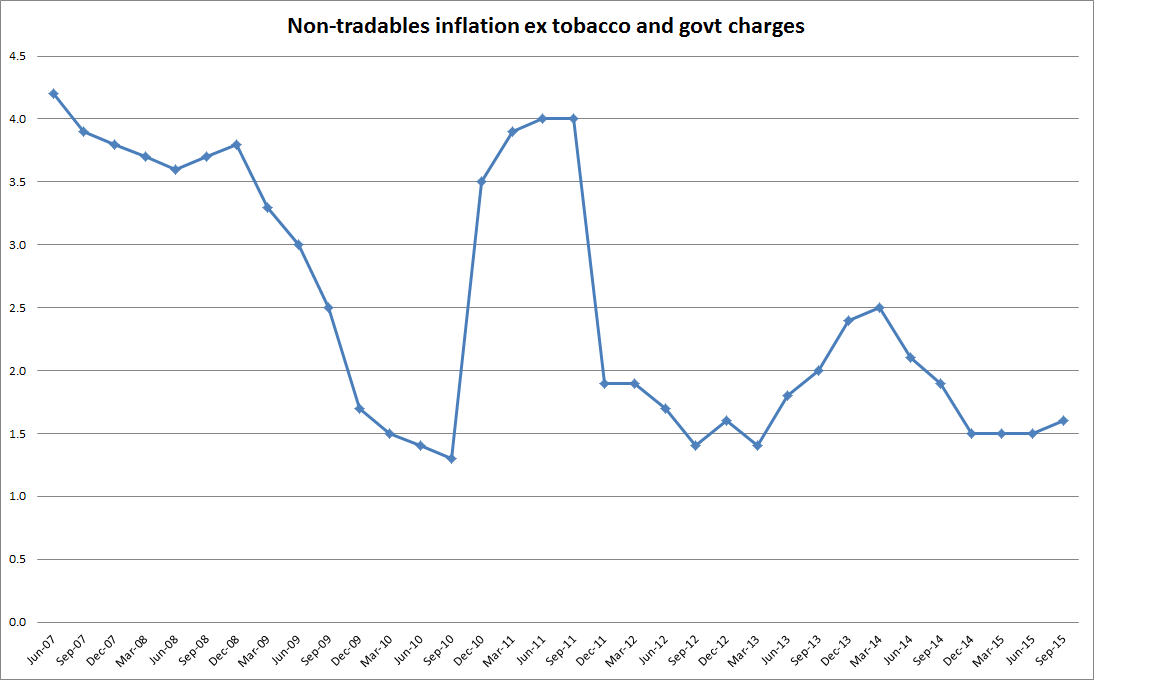
Changing tack for a moment, there are a couple of interesting and slightly surprising observations in the article that bear on current policy.  I and various market commentators have been critical of the Bank in recent months over the claim it is making that things are okay, because inflation will be back well inside the target range by early next year.  The Bank’s forecasts are quite clear that this happens only because of the direct price effects of a lower exchange rate.  As outsiders have noted, one-off shifts in the price level are not the same as the medium-trend in inflation, and there was little basis to think that temporarily higher headline inflation foreshadowed rising core inflation.

It was, therefore, both reassuring and discomforting to find this quote in the article

Tradables inflation tends to be more affected by short-term disturbances, due to exchange rate movements and volatility in international prices. It is therefore more common for the Bank to look through short-term variability in the prices of tradable items.

Reassuring, since staff clearly haven’t abandoned the framework –  trends in the persistent components of inflation are really what matter to them.  But discomforting because in press release after press release (it was there again last week), speech after speech, the Governor tries to get us to focus on a headline inflation rate that is just temporarily boosted by the lower exchange rate.   That isn’t accountability or clear communications.  It looks a lot like just trying to muddy the waters to distract people from the persistent undershoot in core inflation.

The article also discusses the timeframe over which the Governor aims to get inflation back to target. But it is a puzzling discussion because it concludes with a quote from a speech Alan Bollard gave in late 2002, shortly after he had become Governor.  The target inflation rate had been raised and (arguably) some more flexibility had been added into the PTA. The Governor (and we his advisers) wanted to help outsiders understand how we would apply the new PTA.  He stated that his interpretation of the PTA was that following deviations from the inflation target range, things would be on course if “projected inflation will be comfortably within the target range in the latter half of the three year period.”  In other words, current inflation might be above target, but for the period 18 months to three years ahead, the Bank’s forecasts should show inflation settling “comfortably within” the target range, on credible assumptions.  Alan was a dove, who was keen to “give growth a chance”.   He proved content to have forecasts settling back to around 2.5 per cent in that 18 month to three year window.

The Reserve Bank in this article has now reaffirmed that approach to the PTA.  Which is puzzling, because the 2002 PTA made no reference to the midpoint.  That was something Alan often reminded us of –  getting to the midpoint might be nice if we got there, but there was no pressing need to do anything active about it.   But, as the current Governor has often reminded us, the reference to a focus on the 2 per cent midpoint, added in 2012, was put there for a reason – to help anchor inflation expectations near the midpoint of the target range.  But how can we –  or markets –  take seriously the PTA’s focus on the midpoint if the Bank is going to run the Bollard rule, and suggest that so long as its forecasts show inflation 18 months to three years ahead at, say, 1.5 per cent, that is consistent with the PTA?  Perhaps they mis-stepped in putting this article together, and no one noticed this tension?  If so, a clarification might be in order in the December MPS.  But if it is deliberate, those paid to hold the Bank to account –  the Board and the Minister –  should surely ask the Governor some fairly pointed questions?

Two final observations on the accountability material.  The Bank, as it always does, puts great store by the material that it publishes, and which it chooses to make available to people scrutinising its performance.  Perhaps just because the article was written by macroeconomists (who don’t tend to pay much attention to public policy and governance frameworks more generally) it did not mention at all the Official Information Act, which applies to the Bank as well and exists in part to enable better scrutiny of public agencies. Of course, the track record suggests that the Reserve Bank regards the Official Information Act as a regrettable legal obligation, to which minimalistic compliance may be necessary, but only after as much delay and obstruction as possible.  Self-selected transparency is not a great basis for scrutiny, challenge and review –  although the resistance to greater transparency may provide useful signals about the more general approach of the organisation.

And I was (somewhat geekishly) interested that the article does not seem to contain even once the word “model”.  It is difficult to evaluate monetary policy without a model in mind of how the economy works.  The Bank has prided itself over the decades on the extensive investment it has put into developing formal models of the economy, and undertaking formal structured research.  I’ve never been entirely sure that it was money well-spent (and the main model is still held secret), but John McDermott took a different view (and in the recent round of cost-cutting, the Bank’s research and modelling functions were not cut  back at all).    The authors of the article cite various academic articles from abroad, and most of them use formal models for policy evaluation.  I can quite understand that the Governor might not want the Bank to come across as too geeky and unrealistic, but if the Bank has really lost so much confidence in these more formal approaches to evaluation, even as inputs provided to those holding the Governor to account, that in itself is quite revealing.

Almost finally, I was mildly amused that the authors chose not to reference the previous article on the Bank’s website that dealt with these issues.  It is a few years old now, but the relevant legislation and economic challenges haven’t changed.  I’m sure there was a good reason for not doing so.  Like the current article, it (no doubt had to) understates the  limitations of the Board as a monitoring agent, but it did include a slightly richer list of the sort of things those looking to hold the Governor to account might reasonably be expected to take into account.

Some of the items the Reserve Bank’s Board might be expected to concern themselves with in fulfilling the monetary policy monitoring role include:

  • The processes the Governor uses to gather and interpret economic information.
  • The choices the Governor makes in allocating resources areas of the organisation relevant to monetary policy (including judgements he makes on whether to seek more, or fewer, resources, when the five-yearly funding agreement is negotiated)
  • The means the Governor uses to ensure that he is exposed to alternative perspectives.
  • The quality of the people the Governor appoints to advise him on policy choices.
  • The way in which the Governor applies section 3 and 4 of the PTA (dealing with deviations from the target range, and the avoidance of unnecessary instability).
  • The way in which the Governor thinks about and responds to the uncertainties around monetary policy.
  • The ability of the Governor to articulate the reasons for his policy choices, and his ability to convince others of his case.
  • The processes the Governor uses to assess past policy and learn from experience.
  • The stability through time in the Governor’s policy choices.

It would be interesting to see an article of this sort dealing with the Bank’s financial soundness and efficiency functions and responsibilities.  If effective accountability for monetary policy is hard, except perhaps at the point of any gubernatorial reappointment, it must be well-nigh impossible for the Bank’s other main functions.

Who speaks for the 35000 unnecessarily out of work?

The Labour Party’s finance spokesperson, Grant Robertson, yesterday took the opportunity of today’s OCR review to make another statement on monetary policy.  I was pretty critical of his previous effort, which seemed to involve trying to blame Bill English for Graeme Wheeler’s errors and misjudgements.

The latest statement is little more inspiring.  It was good to see him focus on the high and rising rate of unemployment, and to point out that inflation hasn’t been at the 2 per cent midpoint since that target was set three years ago.

But he wants to use this record as a basis for amending the Reserve Bank Act to “put employment up as a core objective“.  I presume he would really mean low unemployment, since the Reserve Bank would (reasonably) point out that employment growth and participation rates have done quite well over the last few years.  And unemployment is the measure of excess capacity in the labour market.

Robertson talks about a dilemma that the Governor apparently faces.  But there simply isn’t one.  Inflation (and more particularly core inflation measures) is well below where it should be, and unemployment is (rising and is) much higher than it needs to be (than any plausible NAIRU).  That is a classic case of a demand shortfall, and the standard prescription is looser monetary policy.  Lower interest rates and a lower exchange rate will tend to raise both activity and inflation, and lower unemployment.

There are times when monetary policy faces hard choices –  when keeping inflation near the target might involve measures that will temporarily raise unemployment.    Some of them are explicitly addressed in the Policy Targets Agreement (and have been ever since 1990), and others are captured in a more general way –  the PTA is quite clear, for example, that the focus of monetary policy is supposed to be on the medium-term trend in inflation, not the near-term wobbles.  And, for better or worse, for 15 years the PTA has explicitly enjoined the Bank to avoid unnecessary variability in output.

I’m not a diehard defender of the way the monetary policy bits of the Reserve Bank Act are worded, or even of inflation targeting itself.  There might even be some sensible ways of formulating section 8 of the Act to include references to unemployment.  But section 8 of the Reserve Bank Act has almost nothing to do with the combination (persistent low inflation and persistent high unemployment) that Robertson rightly worries about.   Rather those outcomes are about a persistent series of misjudgements by the Governor (and, apparently, most of his advisers).

I’ve pointed out previously that central banks in other countries have also been taken by surprise by the events of the last few years.   But most of them have reached the limits of conventional monetary policy.  Several – including the ECB and the Swedish Riksbank –  even started to tighten, only to have to fully reverse those tightenings.   But the Reserve Bank of New Zealand is the only advanced country central bank that has (a) never been constrained by the near-zero bound on nominal interest rates, and (b) has twice (repeat twice) started tightening only to have to reverse itself again.    Taken together with the outcomes (too-low inflation, and too-high unemployment) it is a pretty poor track record.  And the Bank –  the Governor, recalling that the system is one of personalised accountability – has not been seriously called to account for that failure.

Legal responsibility for calling the Governor to account rests with the Minister of Finance and the Reserve Bank’s Board.  As I’ve noted, the Board seems to see itself as champions and defenders of the Bank, rather than being there to provide serious scrutiny and challenge.  And it isn’t clear that the Minister does more than grumble privately, and occasionally make slightly cryptic public asides.

But where has the political Opposition been?  In both his last two statements, Robertson absolves the Governor of any responsibility –  in his view the problem is the mandate, or even the Minister, not the month to month choices the Governor has actually been making.

Perhaps it is easy to call for changes in the mandate. It isn’t going to happen any time soon..  It might be harder to actually have a go at the Governor.  And one shouldn’t do so lightly, but this is an episode of repeated failure, and a stubborn reluctance to acknowledge, or learn the lessons from, those failures.  Of course, lots of the great and good have agreed with the Governor’s stance –  as I’ve pointed out before the NZIER Shadow Board’s recommendation have tended to mirror what the Governor actually does.  But they have been wrong, not just once, but again and again.  And the Governor is the person who is paid to get it right more often than not.   Why isn’t Robertson taking more of a stand and saying so.

And what about the governance arrangements?  Robertson notes that the Act was passed in the 1980s and is ‘out of date and out of touch with changes in the global economy’.  But if he looks at central banking legislation around the world what he will really find is that it is the governance aspects of the Bank –  the single decision-maker –  that look odd.  As the Reserve Bank’s survey showed, there is a wide variety of ways of expressing the statutory objectives for monetary policy, but there has been no trend away from something like a medium-term focus on price stability.  Our Governor simply has too much power.  Treasury reports that the Minister likes the current model because it provides better accountability, but where is the evidence of the accountability in the failures of the last few years?  The Minister can’t be blamed for who was appointed as Governor –  he had to appoint someone the Board nominated –  but he and the Board can, and should, be blamed for how little effective accountability there has been.

The unemployment rate is currently 5.9 per cent (and expected to rise further).  A reasonable estimate of the NAIRU might be 4.5 per cent.  If so, that is about 35000 people who are unemployed now who might not be unemployed if the Governor had run monetary policy, within his current mandate, rather better.  Even if the NAIRU, is nearer 5 per cent, it is still more than 20000 people unnecessarily out of work.   Does he get out and meet any of these people?  If so, I wonder how he explains his failure, and excuses the way his choices have blighted the lives of these people?

I suspect the answer to my question is “no”.  In fact, I just had a quick look through the list of audiences the Governor has given on-the-record speeches to since he took office.   There are various official forums and conferences, but not one of the remaining nine speeches was to groups representing workers, beneficiaries, or the wider community.  Most are to top-end business audiences (the “Admiral’s Breakfast Club” in Auckland, the Institute of Directors, INFINZ, Chambers of Commerce etc), and speeches given by the Deputy Governors seem to be to equally select audiences.  Perhaps the Governor gets no invitations from other sorts of groups, although in my experience that is unlikely.  Perhaps he gives lots of off-the-record speeches to such groups, and just by coincidence it is only the on-the-record speeches that were to upper-end business groups?

I’m not suggesting that the Governor is exercising anything other than his best judgement in making OCR decisions.   And his business audiences would also typically have been better off if the Bank had not been persistently and unnecessarily holding back the recovery, but his choices typically hit hardest on those at the bottom.  And it isn’t apparent that he is even listening to their plight, simply taking comfort from the echo chamber of the elite.

Traditionally, one might have expected an Opposition Labour Party to be their loud and clear voice.  Robertson’s is currently anything but that.

Fallow: the case for a lower OCR is compelling

Brian Fallow’s weekly column in the Herald yesterday  was fairly pointed.

Some further easing in the official cash rate seems likely, Reserve Bank governor Graeme Wheeler reiterated last week.

Well, good.

Because the case for more easing is compelling.

I agree with him.  Whatever measure of inflation one uses –  headline, exclusion measures, filtered measures  –  inflation has been persistently below where the Governor agreed to keep it, and shows no sign of rising (much or for long) any time soon.  On the Reserve Bank’s own numbers, the output gap is still modestly negative, and the unemployment rate has risen and is above any sort of NAIRU estimate.

But that wasn’t my reason for writing.  Instead, Brian notes a few considerations, including those mentioned in the Governor’s recent speech,  that might hold the Governor back

Housing is the first.  The Governor appears to have reversed himself, and gone back to thinking that (Auckland) house prices should be a factor in setting monetary policy.  But the Minister of Finance mandated him to target the medium trend in consumer price inflation, and New Zealand’s measure of consumer price inflation does not  –  rightly in my view (and that of most others) –  include existing house  prices or land prices.   House price inflation in Auckland is certainly scandalous, but the responsibility for that outcome is directly attributable to the choices of elected central and local governments.  The Reserve Bank’s role should simply be –  and in statute is –  to ensure that banks are sufficiently resilient to cope if nominal house prices ever fall sharply.

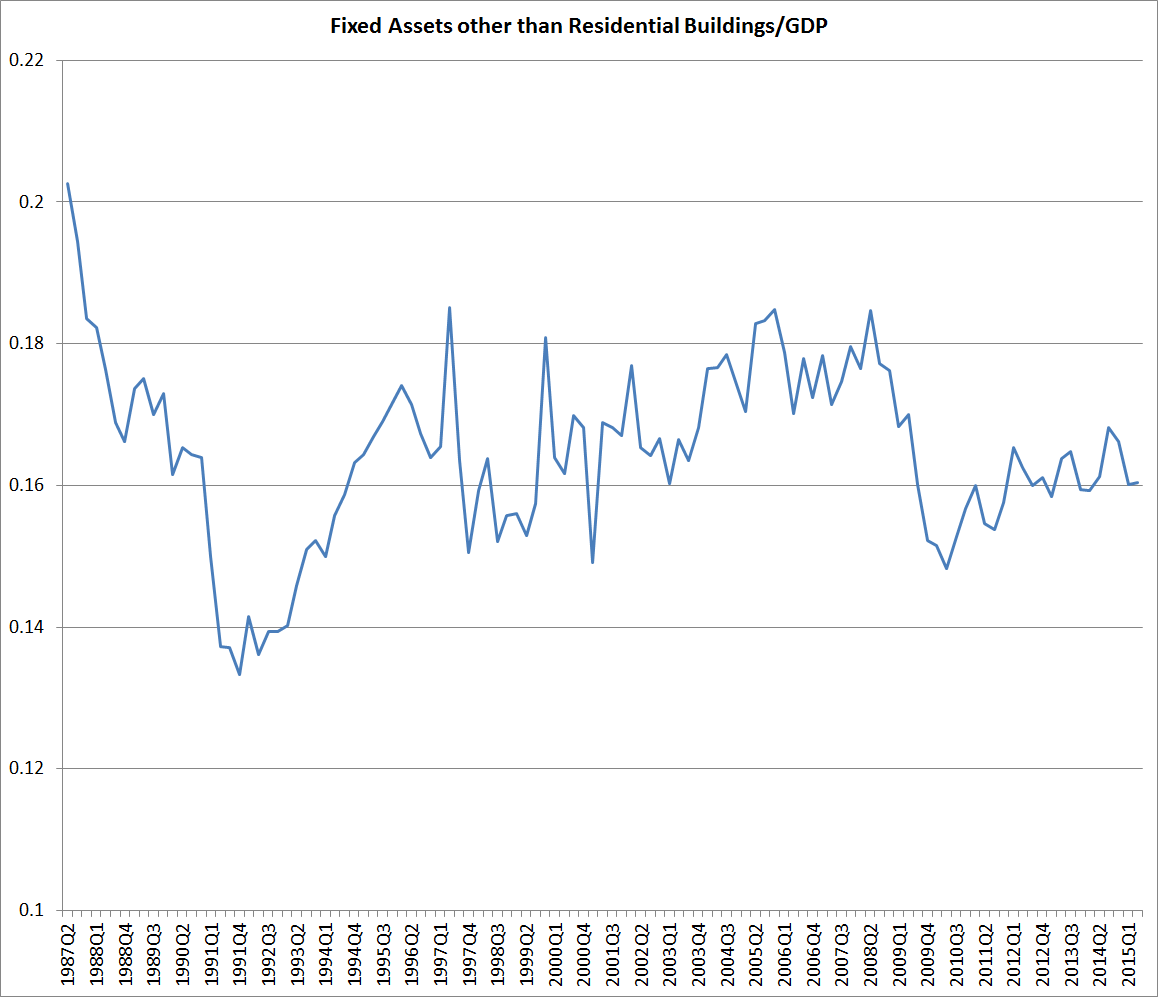
The second issue related to investment.  The Governor had suggested that the Bank needed to ask “whether borrowing costs are constraining investment”.   It isn’t clear why the Governor regards that as a relevant consideration –  absent some wild investment excess (1987 perhaps?), more private sector investment is generally a good thing.   Brian Fallow suggests that investment is sufficiently strong that there is no issue on that score anyway.  I’m not sure I agree.  Excluding residential investment, investment as a share of GDP remains pretty subdued. Historically, business investment as a share of GDP has been surprisingly low  in New Zealand relative to that in other advanced countries, given our faster trend rate of population growth, and now investment is low even relative to that history.  And that despite the rapid rate of population growth in the last couple of years.

investment to gdp

Not that the government’s ambitious export growth target is any concern of the Reserve Bank’s, but it is difficult to see anything like the targeted transformation in export performance occurring with these sorts of investment rates.  Of course, the big issue there is likely to be the real exchange rate –  still sufficiently high that even the Governor seems to comment on it whenever he can.

I touched last week on how odd it is to think of holding back on cuts now to save ammunition in case things get really bad again.  But Brian comes back to this issue by another angle.

But we can’t forget that New Zealand remains abjectly reliant on importing the savings of foreigners. The risk premium they demand to keep on doing that puts a floor under banks’ funding costs and the interest rates borrowers see, regardless of how low the OCR might go.

Here I think he is wrong.  I’ve dealt previously with the question of whether foreign lenders typically demand a “risk premium” for lending to New Zealanders (in NZ dollars).  The evidence strongly suggests that they don’t – and haven’t.    But if they were particularly concerned about New Zealand risk, there are two ways to get compensated for that risk.  The first would be to seek a higher interest rate.  They couldn’t typically get it at the short end, since the Reserve Bank itself directly sets the OCR based on domestic conditions.  They might perhaps get it on longer-dated assets (bonds), but expectations of the future OCR typically play the most important role in influencing the level of longer-term interest rates.

A much more plausible place to see any risk premium, in a floating exchange rate country, would be in the level of the exchange rate –  in other words, a surprisingly weak exchange rate.  Nervous foreign investors would be reluctant to buy NZD instruments at the interest rate set on those assets by domestic economic conditions.  But they might be happier to do so if the exchange rate were lower.  A lower exchange rate today, all else equal, means more prospect of some appreciation (and extra returns) in future.  It is a bit like the share market –  if concerns about a company, or the whole market rise, investors get compensation for the additional risk through a lower share price.  The lower exchange rate, in turn, helps rebalance the economy and reduces, over time, perceptions of risk.

But in thirty years of a floating exchange rate, I can think of only a handful of occasions when New Zealand’s exchange rate has been surprisingly weak (relative to New Zealand cyclical fundamentals)  –  most obviously at the height of the global crisis in 2008/09.  Global risk aversion was then at its height, and the NZD was caught in the backwash.  It isn’t a remotely typical story, and there is no sign that it is relevant now.  As the Governor keeps noting, the exchange rate is still rather high.

A materially lower OCR would lower domestic borrowing rates, which would provide a little support to lift investment.  But even if it did nothing at all on the score, it would work by lowering the exchange rate, in turn boosting returns to actual and prospective exporters.  Yes, it would increase the cost of domestic consumption a little, but the trade-off would be a stronger recovery, more resilient against any new wave of adverse shocks, lower unemployment, and –  not at all incidentally –  measures of medium-term inflation which would be rather nearer the rate the Minister of Finance asked the Governor to achieve.

The Reserve Bank apparently agonised for a while in 2008/09 about this idea that a too-low OCR might somehow create troubles with foreign investors.    Given the pace of the fall in the exchange rate during the international crisis, and the novelty of such low interest rates, they were perhaps understandable questions then.   But I doubt it is a factor that weighs much in the Governor’s deliberations now.  We shouldn’t welcome foreign investor concerns or heightened perceptions of risk –  they are a real cost –  but if those concerns exist, we are likely to be much better off absorbing them in a depreciated exchange rate, than trying to lean against them with unnecessarily high interest rates.  The alternative (‘lean against”) approach has usually been damaging, or disastrous, wherever it has been tried (think of all too many emerging market crises).

In the end, I think Brian agrees.

Even so, rather than keeping powder dry, the better way of mitigating the effects of another negative shock from the rest of the world might be for the bank to impart as much momentum as it can to the economy before the headwinds turn gale force.

It isn’t always and everywhere good advice, but given our continuing anaemic economic performance, it seems like very good advice right now, whether or not the headwinds ever gain further strength.  The debate probably shouldn’t be around whether the OCR should be 2.75 or 2.5, but why it should not quickly be cut to something more like 1.75 per cent.

On macroeconomic policy options

There have been a couple of odd comments this week about the use of macroeconomic policy tools in New Zealand.

In his weekly column yesterday, Brian Fallow suggested that it had been unwise to have put so much emphasis on getting the budget back to balance, and that it was time for more fiscal stimulus.  Of course, there is nothing sacrosanct about getting back to balance by any particular date, but if anything I thought our government had been rather too slow to get there.  With the benefit of record –  and probably unsustainable –  terms of trade – there wasn’t really much excuse for having run deficits in the last few years.       And a tighter stance of fiscal policy should, at the margin, have eased the upward pressure on demand, the OCR, and the exchange rate.

Fallow draws on the generalised advice of the IMF to advanced economies.  But most of those advanced countries can’t do anything much with conventional monetary policy even if they wanted to.  Quite a few advanced countries (including the euro area) already have negative policy interest rates, and many of the others –  US, UK, and Japan among them – are essentially at zero.  Perhaps new rounds of QE might make some difference –  I rather doubt they could do much – but to all intents and purposes monetary policy options are exhausted.    That is partly the fault of central banks and finance ministries that have done nothing material over eight years to remove the near-zero lower bound on nominal interest rates but, choice or not, it is the situation today.

If there is still excess capacity in many of those countries, and if many of them face widening output gaps if world activity growth continues to slow, the appeal of looking to fiscal policy for stimulus is understandable.  In general, I’m not sure it is a call that should be heeded to any great extent, as most of the larger countries already have rather sick fiscal positions –  made considerably worse when those countries resorted to fiscal stimulus, to loud cheering from the IMF, in 2008/09.

New Zealand –  and some other advanced countries such as Sweden, Finland, Estonia, Australia, and Switzerland –  is in the fortunate position of having a low level of public debt.  That means we do have some room  to use fiscal policy if such stimulus is required.  But even that potential isn’t limitless. Faced with another severe recession, even allowing the automatic stabilisers to work would add materially to the government’s debt over several years.  In such a downturn, it is probable that the government’s speculative investment vehicle – the New Zealand Superannuation Fund –  would lose a lot of money.  And for those who worry about the financial stability risks of the house prices more than I think warranted, bear in mind the potential need to bail out banks and their creditors.   If there is a severe downturn, we need the political room to allow those buffers to work, not to have to resort to pro-cylical fiscal policy

Fallow –  and many international commentators –  have favoured additional government spending because interest rates are low.  But remember that interest rates are low for a reason –  it isn’t just some number thrown up by a random number generator.  I’ve argued previously that the effective cost of capital the government should be using in deciding on even good quality projects is probably in excess of 10 per cent (the sort of standard private businesses use), not something close to the government bond rate.   And all this is before the questions that must be asked about the poor quality of too much government spending.

There are distinct political limits to how much fiscal stimulus any government can do, even in a crisis.  Why fritter away that potential now, when our OCR is still 2.75 per cent?  New Zealand has far more monetary policy headroom still open to it than most other countries do.  There are real macroeconomic issues in New Zealand –  as Fallow points out, the high and rising unemployment rate suggests that the economy continues to run below capacity  –  but as Eric Crampton noted in his response to Fallow yesterday, it is not as if monetary policy has been tried and failed.  Rather, because of the repeated mistaken calls by the Reserve Bank, monetary policy has barely been tried.

ANZ advocated fiscal stimulus back in July.  I set out here the reasons why I thought that was the wrong call. I don’t think I’d resile today from anything in that piece.

But the other odd comment on New Zealand macroeconomic policy came from someone who really should have known better.    In his speech on Wednesday, the Governor of the Reserve Bank

It is important also to consider whether borrowing costs are constraining investment, and the need to have sufficient capacity to cut interest rates if the global economy slows significantly.

I’ll largely ignore the first part of the sentence (although if inflation is low and unemployment still high, isn’t more private sector investment generally likely to be a good thing?).  It was the second half of the sentence that really reads oddly –  and arguably, worse than oddly.

This idea of keeping some powder dry in case there is a renewed sharp slowdown pops up from time to time in international commentary.  We’ve even seen the argument made that the Federal Reserve should raise interest rates now so that it has room to cut them if there is a future slowdown.  But it is a deeply flawed argument.  It may have some merit on the fiscal side –  higher public debt now leaves less room to run up more debt later on  – but in respect of monetary policy it is just wrong.

Monetary policy that is tighter than strictly necessary (in terms of the PTA) now, is likely to both weaken the economy (relative to the counterfactual) over the coming 12-18 months, and further low inflation and inflation expectations.  Lower inflation is undesirable (in terms of the PTA itself) and low inflation expectations are deeply problematic.  Lower inflation expectations, all else equal, raise real interest rates for any given nominal interest rate.  The experience of advanced world since 2007 says that one of the biggest macro management problems of a sharp slowdown in the presence of low inflation is getting real interest rates low enough.    It was easy to get real interest rates materially negative in the high inflation 1980s but it is almost impossible to do so now.  In other words, holding up nominal interest rates now increases, perhaps materially, how much one might need to cut rates if a severe downturn happens, while doing nothing to create that extra space.

The Governor has rather reluctantly come to acknowledge that global deflationary risks.  The last thing anyone in his position should be doing right now is making choices that would make it harder to handle the next sharp slowdown.  But that is what he appears to be set to do.

If anything, those countries that still have monetary policy room to move should be doing so now.  Real interest rates should be as low as possible, consistent with the PTA –  and perhaps especially in a country that starts with the highest real interest rates in the advanced world.  Rather than core inflation of 1.5 per cent or less, the Governor should be rather more comfortable with core inflation around 2.5 per cent.  The best way to get that sort of outcome would be to have cut the OCR over the last couple of years, not raised it.

As a commenter here the other day put it, this idea that we should hold the OCR up now so that it can be cut later “is like keeping your shoe laces tied so tightly that it cuts off your circulation, just so it feels good to loosen your laces later.”

Between the failure to do anything about the zero lower bound –  which the Governor now (belatedly)  implicitly acknowledges to be an issue –  or, absent that, to consider a higher inflation target, the Governor and the Minister have left New Zealand less well placed than it could have been if there is a new sharp global slowdown in the next few years. But the decisions that keep on delivering such unnecessarily low rates of core inflation (and high unemployment) are those of the Governor alone.

Plenty of market economists have commented on yesterday’s inflation numbers.  My only contribution is a simple chart of a new series Statistics New Zealand has just started publishing.

Non-tradables inflation has long been the focus for analysis of the underlying inflation position.  Tradables inflation is thrown around by short-term swings in international oil prices and level shifts in the exchange rate, and non-tradables inflation should provide a better guide to underlying inflationary pressures. But non-tradables inflation is made harder to read because of repeated tax increases (notably tobacco taxes) and changes in government charges –  which don’t reflect anything about the state of the domestic economy.   It is quite common internationally for statistical agencies to publish series excluding taxes and government charges.  And now SNZ has provided us with this series for New Zealand.  It has the advantage, over the Bank’s sectoral core factor model measure, that it is not prone to revisions.

PNT ex

Note that this measure of non-tradables inflation is running at only 1.6 per cent, barely above recessionary low.  Non-tradables inflation should be expected to run above tradables inflation on average over time (there is typically more scope for productivity gains in tradables than in many non-tradables).    Indeed, if CPI inflation was going to average around 2 per cent –  the Bank’s target  –  non-tradables inflation shoiuld probably average somewhere in the 2.5-3 per cent range (and perhaps tradables might be in the 1-1.5 per cent range).     Non-tradables inflation is extremely low in New Zealand –  it is too low and should, as a matter of active policy, be raised.

No doubt the Governor and his economists will say that that is what they have been trying to do.  But if so, they have repeatedly failed.  Becoming reluctant to cut the OCR further because of the housing market (one of the channels through which lower interest rates work –  a buoyant housing market is a desired feature not a bug) or for fear of hitting zero in a global downturn is a recipe for continuing the mistakes of the last few years.

To repeat Eric Crampton’s line: monetary policy has scarcely been tried.  It should be.

The Raft of the Medusa and New Zealand monetary policy

I learned something from Graeme Wheeler’s speech this morning. Having not gotten round to reading Andrew Graham-Dixon’s Caravaggio, which has now lingered on our bookshelves for five years, it hadn’t occurred to me that the Gericault painting The Raft of the Medusa was influenced by Caravaggio; in Graham-Dixon’s words, it is a “modern secularised version of an altarpiece by Caravaggio”.

It is a striking painting, but this was a strange speech – and nowhere more so than in the concluding reference to The Raft of the Medusa.

There was plenty of routine material I agreed with. It gets boring to say it, but central bankers have to go on making the point that monetary policy has no material impact on longer-term real interest rates, longer-term average real exchange rates, or the longer-term real growth performance of the economy. For 25 years, real interest rates and the real exchange rate have averaged too high here, and real per capita growth has been too low. There are things that could have been done to change that, but changing the monetary policy framework isn’t one of them.

But beyond that it all got rather strange. He started his speech with the references to Caravaggio to play up the dark and turbulent nature of the last few years (as he sees them). How difficult it all is for small country central banks. More so, he suggests, than previously.

I guess Graeme Wheeler is a latecomer to central banking. He’s been Governor for only three years and spent most of his career doing stuff other than macroeconomic policy. So perhaps recency errors should be pardoned. But it isn’t clear why he thinks, or wants us to think, that his job is harder than that of his predecessors (Don Brash, the challenges of disinflation, or Alan Bollard, and the massive credit boom). Self-pity is rarely an attractive quality, and perhaps especially so when it comes from highly-paid powerful public officials. The Governor has been given a relatively straightforward job to do by Parliament, and – unlike many of his offshore peers – he still has all the conventional tools at his disposal. He has made some mistakes along the way, as his predecessors did (and his successors no doubt will too), but it just is not that hard to get it roughly right.

There are some analytical puzzles to be sure, but we (taxpayers) don’t pay Wheeler to answer all those. We pay him to keep medium-term trend inflation near 2 per cent. And he hasn’t done that job very well. Inflation has surprised on the weak side for several years. It has surprised both the Bank and the markets, but the Bank has the job of delivering inflation near target. Having fairly consistently failed to do so, a reasonable rule of thumb might have been something along the lines of “core inflation has been below the midpoint of the target for so long, and we don’t fully understand why, so we’ll hold fire, and not raise interest rates until (say) core inflation is actually back to around 2 per cent”. It isn’t a perfect rules – in an imperfect world there are no such rules – but it would be better than what we’ve had.

Part of Graeme Wheeler’s defensive strategy – which shouldn’t really be needed, because there should be no great shame in recognising a mistake and owning up to it – is to cloth himself in the problems of other countries. Many other advanced economies have also struggled with at best modest (per capita) economic recoveries, and surprisingly weak inflation. But most of those countries had little or no conventional monetary policy ammunition left. Interest rates were at zero. I don’t think Wheeler’s speech even mentions the point.

By contrast, New Zealand’s OCR at 2.75 per cent means the Governor (and his predecessor) had plenty of room, if he (they) had chosen to use it, to secure a rather more conventional recovery in New Zealand. As I’ve pointed out previously, in conventional New Zealand recoveries we see a couple of years of 4-5 per cent GDP growth. We’ve seen nothing like that since 2009, despite the very rapid population growth in the last year or two. The number of people unemployed has stayed high, and has recently been rising again. That isn’t because of the travails of the rest of the world, but because of the Governor’s misjudgements. Inflation wasn’t rising. He didn’t need to raise interest rates.

As he winds up his general observations, Wheeler includes a couple of other curious paragraphs. He claims that “economic management has come a long way since Paish described it in the 1960s as like driving a car with a brake and an accelerator and only being able to look through the back window.” He backs this claim, that things have come a long way, by reference to sophisticated models used by central banks today [and when is that expensive model, developed at taxpayers’ expense, finally going to be published?]. But then he changes course midstream, concluding that really the models can’t tell one much and are more use for posing questions than delivering answers. I entirely agree with that final observation, but then it is a puzzle as to why the Governor thinks that economic management has improved a lot since the 1960s. As the Governor found with his ill-fated tightening campaign last year, forecasting remains hard, especially about the future. And even the rear-view mirror is prone to mislead at times.

And then Wheeler winds up the whole speech with his paragraph about The Raft of the Medusa, the “forlorn and exhausted sailors” and the “wild seas” which are apparently “symptomatic of the world central bankers are trying to navigate”. It is all bizarrely self-pitying, especially for a Governor with instruments at his disposal. The steering wheel isn’t broken.  The hull isn’t holed.

Here is the Wikipedia summary of the story of the painting.

it is an over-life-size painting that depicts a moment from the aftermath of the wreck of the French naval frigate Méduse, which ran aground off the coast of today’s Mauritania on July 2, 1816. On July 5, 1816 at least 147 people were set adrift on a hurriedly constructed raft; all but 15 died in the 13 days before their rescue, and those who survived endured starvation and dehydration and practiced cannibalism. The event became an international scandal, in part because its cause was widely attributed to the incompetence of the French captain

Great painting, but of a terrible event, for which the captain had to take blame.  The French public knew that.

The mismanagement of New Zealand’s monetary policy in recent years springs to mind. Fortunately, no one dies from those sorts of mistakes, but thousands of people are unemployed today who would not have been if the Reserve Bank of New Zealand – and specifically its Governor – had not made repeated choices – and it was pure choice, unlike the situation in ZB countries – to hold interest rates persistently higher than they needed to be. The apparent indifference of New Zealand’s elites – and of the Governor and his Board – to the awfulness of the involuntary unemployment (“forlorn and exhausted”?) is something I still struggle to understand.

Some thoughts on Bernanke’s book

Ben Bernanke must have been busy.

Passing through Denver airport last Tuesday, the day after the book had been released,  I found a large pile of autographed copies of Bernanke’s new book The Courage to Act.    That was one bookshop in one city (not even one of the twenty largest in the US), and it had me wondering just how many days the former head of US central banking system had had to devote to autographs.  I guess even eminent  authors have to earn their –  no doubt rather large –  advances.

The stock of books on the post-2007 financial and economic crises continues to grow.  And it is still early days.  We can expect many more in coming decades –  akin perhaps to the continuing flow of works on the Great Depression, and the unresolved controversies that still  surround that episode.

Many of the key US participants have now published their accounts:  Hank Paulson, Secretary to the Treasury (to January 2009), Tim Geithner (New York Fed, and then Secretary to the Treasury), Sheila Bair (head of the FDIC).   And now Bernanke has joined them.  Each has a story to tell, and a case to make –  typically, a reputation to burnish or defend.

Bernanke’s book written for a mainstream intelligent lay audience. Plenty of copies are likely to be unwrapped on Christmas morning

For anyone who closely followed the crises, and their aftermath, there isn’t much new in Bernanke’s book.  It is a good refresher as the specific dates and events begin to blur in the memory.  And although no one will buy the book for story of his upbringing story, I found his account of a Jewish boy growing up in protestant South Carolina in the 1950s and 60s interesting.

It isn’t a great book by any means.  The writing often feels a bit pedestrian, and although he enlisted a former reporter to work with him on the book, that former reporter was on a year’s leave from the Public Affairs Division of the Federal Reserve.   Enhancing the sense of being written a little too close to the events and people he describes, Bernanke records that after leaving the Fed on Friday 31 January 2014 he started work in the book, from his new perch at Brookings, the following Monday.  I guess market demand (and the scale of publishers’ advances) was at its peak immediately after he left the Fed.  I hope he thinks about another substantive and more reflective contribution, perhaps aimed at a narrower audience, in 10 or 15 years’ time.

Bernanke does acknowledge the odd mistake, but they are “easy” ones, around the timing of particular interest rate adjustments.  Mostly this is a defence of his record, without actually engaging with any more-substantive critiques or alternative views.  In some ways, I found that a little surprising, especially in view of the dismal economic performance of most of the advanced world since the crises.  Arguments that seemed compelling in 2008 or 2009 – when a fairly fast snap-back in economic activity, employment  and inflation pressures were expected  – must surely look at least a little different now?

Here are some of the specific aspects of the book that struck me:

Bernanke doesn’t seem to have met a bailout he didn’t like.  Even in hindsight he does not think Bear Stearns should have been allowed to fail and close. He wanted to bail-out Lehmans (constrained only by lack of legal authority for either the Fed or the US Treasury) despite the enormous losses that Lehmans incurred.  He thought that holders of sovereign debt in Europe should not have been exposed to the possibility of loss, and appears not to consider that (eg) wholesale creditors of Irish banks should have been exposed to losses.  Somewhat to my surprise, he is not critical at all of the far-reaching guarantees offered to Irish bank creditors in October 2008, which triggered the range of guarantees around the world.  And he acknowledges that he favoured putting in place comprehensive guarantees for US banks (rather than the targeted, on new issues, wholesale guarantee approach that was eventually adoped [and which was also adopted for wholesale issues in New Zealand]).

In his defence, Bernanke might argue that the US did not in 2008 have good mechanisms for dealing with failing banks.  But in an interview with PBS the other night, I heard him acknowledge that “too big to fail” issues have still not been fully addressed in the US.    And in the book there is nothing sustained on the nature of the moral hazard to which such bailouts –  and the prospects of them being repeated in future –  is likely to give rise to.  Having come through the largest financial crisis in US history that is disappointing.

It is easy for people who spend their entire working lives in the public sector to assume too readily the benevolence and competence of government agencies and interventions.  Most of Bernanke’s career was spent in academe, but he has a fairly heroic view of public officials and their contributions.  There is no sense at all, anywhere in the book, of any concept of “government failure”, or of any sense that well-intentioned official interventions can sometimes (often?) have unintended adverse consequences.  Not unrelatedly, without directly addressing the issue, there is a strong sense that the crises were caused by the private sector, with courageous government officials intervening to save the private sector from itself.  It is a common view, but one might have hoped that someone with Bernanke’s academic stature might have been better able to make the case, including by dealing with stronger arguments of the sceptics.  His is a technocrat’s world. The one group he is consistently critical of is the US Congress and although one might sympathise to some extent, Bernanke shows little sign of appreciating the importance (or reality) of genuine differences of ideology or worldview.  Like many bureaucrats, he has lofty distaste for political theatre and the messy world of dealmaking –  but then, like them, he never had to face an election.

There is a paragraph towards the end of the book when Bernanke recounts a farewell dinner held in early 2013 when Tim Geithner ended his term as Secretary to the Treasury.    The attendees were former Treasury secretaries and former heads of the Fed.  Bernanke reflects:

Government policymaking at the highest levels involves long hours and near-constant stress, but it is exciting to feel part of history, to be doing things that matter.  At the same time, we all knew the frustrations of struggling with extraordinarily complex problems under unrelenting public and political scrutiny.  Rapidly changing communications technologies….seemed not only to have intensified the scrutiny but also to have favoured the strident and uninformed over the calm and reasonable, the personal attack over the thoughtful analysis.  In a world of spin and counterspin, we all knew what it was to become a symbol of a moment in economic history –  to serve as an unwilling avatar of Americans’ hopes and fears, to become a media-constructed caricature that no one who knew us would ever recognise.  But that’s the baggage that comes with consequential policy7 jobs, as we all knew too well.  The deepest frustration we shared, it soon became clear, was not with the baggage but with government dysfunction itself.

Technocrats as sacrificial heroes, saving the world from politicians and private markets…..

And yet, curiously, Bernanke seems untroubled by the continued growth in the size of government (whether spending/GDP, or the regulatory state). Ultimately those are choices made by the same Congresses that he views with such disdain.

I could go on at length, but there were several other areas of the book that left me disappointed:

  • There was no sustained engagement with the question of why, eg, real GDP per capita is still so far below the pre-crisis trend level (or, for all the contrasts he attempts to draw between himself and the Depression-era policymakers, why in many countries the record eight years on from 2007 is worse than that eight years on from 1929)
  • Bernanke is confident that (successive rounds of ) QE was the right policy, but actually offers little substantive basis for believing that QE made very much sustained difference at all.  Would US bond yields really have been much higher in the last few years absent QE?
  • Somewhat relatedly,  Bernanke does not discuss at all issues around removing or alleviating the zero lower bound on nominal interest rates.  In one sense that isn’t too surprising  – he started writing the book just a few days out of office, and ZLB issues can quickly get quite technical –   but for someone of the academic stature of Bernanke not even to have addressed the issue is a bit disappointing.    Perhaps he thinks nothing can be done, or should be done, but with year after year of policy interest rates near zero, it is not as if the ZLB proved to be a short-lived (or Japanese) curiosity that no one now needs to worry about.
  • Bernanke had a US-specific job, but I thought his treatment of the rest of the world was disappointingly weak.  Of course, US readers often aren’t that interested in the rest of the world, but I thought he was far too easy or glib about what could or should have been done in Europe (the poor old German taxpayer, facing not-low debt levels and a falling population, should apparently have spent a lot more).  And I spluttered when I got to the references suggesting that the IMF, under Strauss-Kahn and Lagarde, had shown no signs of favouring Europe.    And, as a hobbyhorse of mine, there wasn’t much sign that Bernanke has ever thought seriously about what marked out the countries that experienced crises from those that did not (there is, for example, only very brief reference to Canada), and whether the incidence of financial crisis can explain much about how respective economies have performed since 2007).
  • And there was nothing at all on the still extraordinarily large role the government plays in the housing finance market in the United States –  something that goes well beyond anything seen in most OECD countries, and which at least some observers suggest might have contributed to the severity of the US crisis..

I had been meaning for some time to write something about the contrasts between the legal constraints on central banks and government ministers in the United States on the one hand, and New Zealand on the other.  This was prompted by reading a fascinating book, To the Edge: Legality, Legitimacy, and the Responses to the 2008 Financial Crisis, by Philip Wallich, and contrasting it with our law, and my experiences in our Treasury during the 2008/09 crisis.  The powers of the Reserve Bank of New Zealand and New Zealand’s Minister of Finance in dealing with financial crises are extraordinary broad by comparison with those of the US authorities (either in 2008/09 or now).  No question could have arisen as to the Reserve Bank’s ability to lend to any institution it chose, or as to the ability of the Minister of Finance to guarantee any liability or institution he chose.  The US situation was very different, as Bernanke recounts.   There is a real tension here.  The New Zealand powers are frighteningly broad in the wrong hands –  as I read the Public Finance Act, the Minister of Finance could at a stroke bankrupt New Zealand, with no requirement for Cabinet or parliamentary approval –  but they are also very flexible.  I’m not at all sure what the right balance is, but would have been interested in Bernanke’s view on such issues in the light of his experience.  My guess is that he would favour more flexibility than the US had then or now, but how are citizens to be protected from official caprice and well-intentioned misjudgement?  Congress might be quite as bad as Bernanke suggests, but it is they who have an electoral mandate that the best central banker will never have.

Finally –  and perhaps mercifully –  there was nothing in the book of the numerous visitors who must have tramped through Bernanke’s offices over the years.  I wonder what he made of repeated meetings with visiting New Zealand delegations (that I used to read the file notes of) or those of the myriad visitors from other countries.  As a reserved academic, I suspect it wasn’t a highpoint of the job, but….at least they weren’t members of the US Congress.

I suspect Bernanke would have felt more at home in a system of government –  akin to ours, or that of Canada or the UK –  in which the legislature was kept more firmly in its place by the political executive, and there is perhaps less robust media scrutiny.    He ended the book

It is hard to avoid the conclusion that today we need more cooperation and less confrontation in Washington.  If government is to play its vital role in creating a successful economy, we must restore comity, compromise, and openness to evidence.  Without that the American economy will fall tragically short of its extraordinary potential.

For all its problems, of course, the US remains strikingly more successful economically than most of the countries  –  even the advanced democracies – where MPs make rather fewer problems for senior officials.