Greenspan and pressure on independent central bankers

I’ve been reading a succession of long biographies of influential Americans.  The US election result prompted me to read biographies of the four presidents from Eisenhower to Nixon – one president with no prior experience in elected office, and three very flawed individuals –  and in the middle of all that I read (to review) Sebastian Mallaby’s big new biography of Alan Greenspan, The Man Who Knew.  There is some overlap:  Greenspan played a role in Nixon’s 1968 election campaign  – in domestic policy, and in doing polling analysis (his economic consultancy/forecasting firm had just acquired its first computer) –  and Greenspan was nominated to his first official government job, Chairman of the Council of Economic Advisers, in the last days of the Nixon administration.

I’d strongly recommend the Greenspan book.  It is well-written, deeply-researched (the author notes that one of his research assistants read the full transcripts of every FOMC meeting in the 19 year Greenspan term), and as interesting for the pre-Fed period as for Greenspan’s lengthy term as Chairman.  For some there might be a little too much on his succession of girlfriends over 40 years –  of one, we learn what she was wearing when Greenspan first encountered her in the Oval Office –  or the tennis holidays, but it is a biography of the man and his times, not the story of monetary policy.  Even in New Zealand bookshops, the price of the 750 page hardback isn’t extortionately expensive.

I’m not going to attempt a full review here.  Instead, I wanted to highlight Mallaby’s account of one interesting little episode from the early 1970s, when Greenspan was still prospering from his success as an economic adviser to major corporations (“the man who knew”).

As I noted, Greenspan had been quite involved in the 1968 Nixon campaign –  Nixon built a fairly formidable team of policy advisers, and carried many of them into the White House with him.    Greenspan had turned down the offer of a fulltime government position after the election, reckoning that the only positions that interested him were ones he was not yet senior enough to be offered (eg Secretary to the Treasury).  But he stayed involved, serving on the commission that (sucessfully) recommended the abolition of military consciption and on a presidential commission on financial reform.

By 1970, the chairman of the Federal Reserve was Arthur Burns, one of Greenspan’s former professors with whom Greenspan had stayed close.  Burns had also been quite involved in both Nixon presidential campaigns, and (somewhat against his own wishes, so his diary records) had been brought into the White House at the start of Nixon’s term as Counsellor, with Cabinet rank.

One of Nixon’s perennial concerns (he was a politician after all) was his re-election prospects.  As it happened he needn’t have worried –  his 1972 margin of victory was one of the largest ever – but he did, obsessively.  And in mid 1971 he was very concerned about what the state of the economy might be by the election time in 1972.   He had been convinced that Fed misreading of the state of the economy had contributed to his narrow defeat by Kennedy in 1960.

On 23 July 1971, Mallaby records,

Nixon invited three advisers to join him on the presidential yacht, Sequoia, for a Friday-night cruise on the Potomac.  The men kicked about ideas on how to deal with the wayward Fed chairman. Burns was behaving like a professional Eeeyore, talking down the economy with one gloomy comment after another…..Building on a suggestion from John Connally, the Treasury secretary, Nixon and his henchmaen settled on a plan.  They would make Burns shut up by planting a negative story in the press about him.

Burns had been urging the president to take a stand against inflationary wage increases. the Nixon men resolved to tell the press that Burns had simultaneously been lobbying behind the scenes for a personal pay raise [in fact, he had argued for an increase in the Chairman’s salary, but starting from the commencement of his successor’s term].  Coupling this charge of hypocrisy with crude intimidation, they would also inform reporters that Nixon was contemplating a reorganization of the Federal Reserve to curb the chairman’s authority.

Four days later the story appeared in the press, and the President’s press secretary “gave the story legs by refusing to deny it”.

With Burns now on the defensive, Nixon’s men moved in for the kill.  They would get a message to Burns demanding a positive speech on the economy. If the Fed chairman wanted to avoid all-out war he would have to cry uncle.

Charles Colson, a member of the Sequoia trio who would later serve jail time for organising Nixon’s dirty tricks, tracked down Greenspan.  He phoned him in New York and asked him to get Burns to change his tune on the economy.

Years later Greenspan insisted he refused to do Colson’s bidding.  But Colson’s handwritten notes from the conversation suggest otherwise.  After taking Colson’s phone call, Greenspan spoke at length to Burns.  Then he reported back to the White House.

Burns were seriously put out –  “very disturbed” was Greenspan’s description.  Mallaby continues for a couple of pages, with accounts of conversations between Nixon, his chief of staff Haldeman, and Connally about keeping up the pressure on Burns, including Greenspan’s role.

And then

Within twenty-four hours, the Fed chairman caved and Nixon appeared at a press conference to disavow the shameful attacks on his good character.  “Arthur Burns has taken a very unfair shot,” the President said, explaining how Burns had in fact turned down  a pay increase when the White House budget office had recommended one. A transscript of Nixon’s remarks was forwarded to Burns, who was soon on the phone to express his gratitude.

“It warmed my heart,” an elated Burns told Nixon’s speechwriter, William Safire.  “I haven’t been so deeply moved in years. I may not have shown it, but I was pretty upset.  This just proves what a decent and warm man the president is.  We have to work more closely together now.”

Burns’s diary for the years 1969 to 1974 has been published –  and is a good read for junkies.  Unfortunately, it is a little patchy and doesn’t cover July 1971.

Mallaby asserts that this episode, in which Greenspan appears to have played a not unimportant role, was a key turning point in the whole of monetary policy in the 1970s (Burns remained chair until 1977) when inflation became an increasingly serious problem, not just in the US, but around much of the advanced world.

In fact, distasteful as the episode is , reflecting no credit on anyone involved, Mallaby probably exaggerates when he writes that

The central bank had not been so clearly under the thumb of the White House since the Fed-Treasury accord of 1951. Politics had triumphed, and Greenspan had been a party its victory.

It is worth remembering the timing.  All this happened just a few weeks before the US suspended gold convertibility and the Adminstration imposed wage and price controls and temporary import levies.  They weren’t normal times, and nor  –  as the fixed exchange rate era broke down –  was it an era in which one might expect the usual distance between the White House and the Fed.

As importantly though, White House pressure on the Fed wasn’t new.  Burns’s diary on 21 March records his request for a meeting with Nixon “to have a candid talk about the war of nerves the White House gang had set in motion”.

And nor was the tension within Burns, between his anti-inflation instincts and his apparent desire for access to, and influence with, the President new.  In the same entry he records:

I informed the President as follows: (1) that his friendship was one of the three that has counted most in my life and that I wanted to keep it if I possibly could; (2) that I took the present post to repay the debt of an immigrant boy to a nation that had given him the opportunity to develop and use his brains constructively; (3) that there was never the slightest conflict between my doing what was right for the economy and my doing what served the political interests of RN; (4) that if a conflict ever arose between those objectives I would not lose a minute in informing RB and seeking a solution together; (5) that the sniping in the press that the White House staff was engaged in had not the slightest influence on Fed policy, since I will be moved only by evidence that what the Fed is doing is not serving the nation’s best interests

and so on.  He notes “RN seemed pleased by my reassurances to him, indicated that he never had  any doubts, that he would put an end promptly to the sniping about the Fed that has been going on at the White House…”

Perhaps more useful still, is Allan Meltzer’s comprehensive history of the Federal Reserve.  Meltzer was a monetarist and in the 1970s had not been particularly supportive of the rather ad hoc way in which the Fed ran monetary policy and allowed inflation to build up.   But in his careful discussion, and analysis of the documentary record, Meltzer absolves the Fed of the charge that in the run-up to the 1972 presidential election it was shaping policy according to political imperatives.  As he notes, the FOMC votes were rarely close (typically unanimous), and the FOMC itself was manned by plenty of independent-minded people who had been appointed by Presidents Kenndy and Johnson (one of the most independent had been appointed first by another Democrat president, Truman).

As he notes

Burns was able to get a majority vote of the FOMC because he could appeal to beliefs that considerable resources were idle, that inflation would be held back by price controls, and that their principal mandate was to contribute to full employment.  This was compatible with service to the president’s reelection campaign.

It is an alien world in many respects –  quite different models of how to think about inflation, the primary role of the central bank etc –  and none of the key figures emerges that well –  Nixon, Burns, Greenspan, Colson, Connally, Haldeman.  Some of that is clearer with hindsight, others should have been clear at the time.  But it wasn’t a case of the President’s placeman successfully orienting policy simply to re-election.

One of the themes of Mallaby’s book is how Greenspan, who started out very close to Ayn Rand, quickly gravitated towards the centre of affairs –  at times willing to compromise perhaps rather too much to retain that place. Mallaby praises Greenspan’s deft political management skills.  I couldn’t help feeling slightly uncomfortable.  One example was the account of the way Greenspan hosted annual 4 July parties at the Fed, at his own expense, for the movers and shakers of Washington and their families –  effectively buying influence and regard.  I came away from the book with a strong sense that 19 years was just too long for any one unelected official to hold such an influential office –  and as the book illustrates there is no evidence that Greenspan was uniquely well able to read the economy, or judge the best policy response –  but perhaps that is a topic for another post another day.

Still reluctant to lower interest rates

I was a little late to the Monetary Policy Statement. The actual OCR cut yesterday was very well foreshadowed, and I wasn’t expecting much else.  And in fact there weren’t many surprises in the document.  But that is shame, because the Reserve Bank still seems trapped in much the same mindset that has delivered inflation below the midpoint of the target range (the explicit required focus of policy since 2012) for the last five years or so.  And it isn’t just headline inflation –  thrown around by petrol prices, tobacco taxes, ACC levies etc –  but whichever one or more core inflation measures one cares to focus on.  At present, the median of half a dozen core inflation measures is around 1.2 per cent.

And despite the rather self-congratulatory tone of the document, and particularly of yesterday’s press conference with the Governor and Assistant Governor, even on the Bank’s latest projections it is still another two years until inflation is expected to be back around 2 per cent.  And, of course, we’ve heard that line before, repeatedly.  As everyone knows, a lot can happen in two years, and it is most unlikely that things will unfold as the Bank (or any other forecaster expects) but there is nothing –  not a word, sentence, or paragraph –  in the latest MPS to explain why it is more likely today that inflation will now track back to settle around 2 per cent than it has been for the last five years.   Why should we be comfortable that the Bank has it right this time?

The Governor continues to repeat the line favoured by the government, emphasising recent annual GDP growth of around 3.5 per cent.  He does so in a way that suggests that all is pretty rosy, and my goodness if we were to do anything more there would be real risks of nasty overheating and intense volatility.  But like the government, the Governor rarely bothers to mention per capita growth.  Here is the chart of annual average growth in real per capita GDP (using the average of expenditure and production GDP).

real-gdp-pc-nov-16

At its brief best, several years ago, real per capita GDP growth never got anywhere near the rates of previous recoveries.  At something around 1 per cent now (1.5 per cent of an apc basis) it not anything to be encouraged by.  Sure, some of the weaker growth reflects the deteriorating productivity growth trend –  which the Governor can’t do much about –  but not all of it by any means.  With 2 per cent population growth, we probably should be getting a bit uneasy if over GDP growth were at 6 per cent –  and the unemployment rate was falling quickly below the NAIRU –  but that just isn’t the way things have been in New Zealand in the Wheeler years.  And the disconcerting thing is the Graeme seems to think that is a good thing.  Monetary policy could have done more, but consistently and consciously chooses not to do so.

Instead he repeats, over and over again, the point that tradables inflation has been negative for several years, making his life oh so hard (hard to get overall inflation back to 2 per cent).  From a New Zealand consumer’s perspective, low tradables is a good thing.  And from a New Zealand producers’ perspective it is typically should be quite a good thing as well.  Persistently weak tradables inflation creates room for the Reserve Bank to cut New Zealand interest rates further, in turn lowering the exchange rate (relative to the counterfactual).  A lower exchange rate would raise tradables inflation a bit, but also increase domestic economic activity and raise returns to our own tradables sector producers.    The headline inflation rate would rise as, over time, would core measures.

It is one of aspects of Graeme Wheeler’s stewardship that I don’t purport to adequately understand.  In almost every statement he repeats the plaintive line “a decline in the exchange rate is needed” but isn’t willing to do much about the one thing in his control that really makes some difference: lowering interest rates.

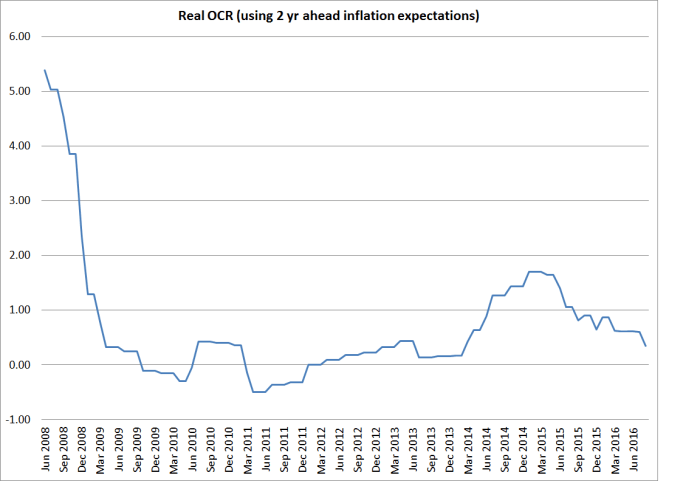
You might think that is a little unfair.  After all, the OCR has been cut by 175 basis points in the last 16 months.  But then it was unnecessarily raised  by 100 basis points over 2014.  Overall, the nominal policy interest rate has fallen over the last three years, but once one takes account of the fall in inflation expectations, there has been hardly any fall in the real OCR at all.  And that despite three more years of inflation persistently undershooting the target (and three more years of an unemployment rate above the NAIRU).

And they aren’t even providing much to boost domestic demand and activity.  The Bank ran this chart in yesterday’s MPS

funding-costs-nov-16-mps

It isn’t that easy to read, but just focus on the top and bottom lines. The top line is an estimate of the weighted average cost of new bank funding (retail, wholesale, onshore, offshore).  The bottom line is the OCR.  That marginal funding costs measure hasn’t fallen much at all this year, despite the continuing falls in the OCR.  Over the last three years taken together, the fall in marginal funding costs has not even quite kept up with the fall in inflation expectations.  Is it any wonder that core inflation has stayed low, and if there is any sign of some lift in inflation, it is at a very sluggish rate?

The Governor devoted a paragraph in  his main policy chapter to a discussion of the helpful things (in terms of lifting resource pressure and inflation) lower interest rates are doing.  There was a striking omission: frustrated as he no doubt is with the level of the TWI, it is almost certainly lower today than if the Bank had not cut the OCR.  But no mention of the exchange rate connection at all, even though it is probably one of the most important monetary policy transmission mechanisms in New Zealand.

But I was also struck by one of the observations the Governor did make.  He noted that low interest rates “are encouraging businesses to undertake investment they may not have done otherwise”.  So far, so conventional, and I wouldn’t disagree at all.  But here is a chart of investment (excluding residential investment) going back almost 30 years.

investment

Investment in things other than building new houses is certainly off the recessionary lows, but it is still a considerable way below the typical share of GDP seen in the mid-late 1990s and the pre-recessionary 2000s.  And that is (a) with some considerable activity related simply to rebuilding in Christchurch following the earthquakes, and (b) the most rapid population growth rate we’ve had for decades.  Many more people should mean a lot more investment (simply to maintain the capital stock per person).  With current rates of population growth, and the Christchurch effects, perhaps we might be a little uneasy, concerned about overshooting, if the investment share (ex housing) was much above say 18 per cent (around the pre-recession peak). But it isn’t, and there is a little sign of business investment accelerating.

Monetary policy doesn’t make that much difference to an economy in the long run.  But in the short to medium term it can make quite a difference.   If a central bank is reluctant to cut policy rates further when

  • core inflation is well below the target focus (and has been for years),
  • when the unemployment rate is falling only slowly and is still well above the NAIRU,
  • when per capita GDP growth remains modest at best,
  • when the exchange rate is well above appropriate long-run levels, despite a languishing exports/GDP picture,
  • and when business investment itself is pretty modest, especially given the unexpectedly rapid population growth

it is leaving New Zealanders poorer, and more of them unemployed, than is necessary, or desirable.

Perhaps the bit of yesterday’s press conference that frustrated me most was the response by John McDermott, the Bank’s chief economist and Assistant Governor to a question.  The questioner asked about whether the Bank had given any thought to the idea Janet Yellen had openly toyed with, of deliberately aiming for a period of above-target inflation –  whether to in some sense “make up” for the period of below-target inflation and cement in slightly higher inflation expectations, or just to “give growth a chance”, including the chance that additional demand growth might stimulate new supply and productivity growth.   As the next recession –  and the next need to cut rates –  can’t be that many years away –  whether by accident, exhaustion or unintended trade war – the “overshoot” approach might just be prudent risk management in the current circumstances.

There are a number of problems with the idea.  In a US context, I don’t find that argument that weak demand has held back productivity growth that convincing –  and they managed very rapid productivity growth during the Great Depression –  and there are questions as to whether a central bank could credibly commit to overshoot its target for a time (aren’t the incentives to renege as soon as inflation actually starts getting near the target?).  And in the US, the unemployment rate is already back to around pre-recession lows.

But the Bank’s chief economist simply didn’t address the question.  Perhaps he didn’t hear it clearly, or misinterpreted what was being asked, but he simply gave the rather self-satisfied response that if one looked at the Bank’s projections, inflation was heading back towards target, and that “sounds like the plan being implemented”.

It is nothing of the sort.  What the Bank is doing is pretty mainstream inflation targeting, on the assumption that their forecasting models and understanding of the economy is roughly correct.  And it is surely exactly the same approach they’d take if the target was, say, centred on 5 per cent, and core inflation measures were around 4.2 per cent.

It is also exactly the approach they’ve taken throughout the Wheeler term, when they have proved to be consistently wrong.  Inflation has simply kept on undershooting.

The approach that was asked about, at least as I heard it, was whether the Bank should not cut more aggressively now, actively aiming to get (core) inflation up to perhaps around 2.5 per cent for a time.  If the Bank’s forecasting models are still wrong –  and they’ve given us no basis to believe something has changed and they now have it right –  perhaps actual core inflation would turn out around 2 per cent.    But if the models are right, we’d have a few years where inflation was a bit above target.  There would be few obvious downsides to that.  The next recession –  whenever it is –  would be likely to see inflation fall again.  But we’d see inflation expectations pick up –  from the current 1.6 to 1.7 per cent – to something more like 2 per cent, and we’d see a phase of stronger real GDP growth (per capita), stronger business investment, and the unemployment rate might finally –  eight years on from the recession –  get back to something like the NAIRU.  Indeed, perhaps it might undershoot the NAIRU for a year or two, likely a welcome outcome for the people concerned.

And then there is the looming issue of the near-zero lower bound on nominal interest rates. The Bank has just cut the OCR to a new record low of 1.75 per cent, and projects that it will remain at that level for the next three years.  They think the economy already has a small positive output gap.  So if the next recession comes in the next few years, there will be only around 250 basis points of leeway to cut the OCR if required.  In past cycles, the Bank has often needed twice that capacity.  And yet the Bank has shown no sign of having any preparations in train to make the lower bound less binding.

Far better to take a more aggressive path now.  Actually push real interest rates well below where they were in the years when inflation has consistently undershoot.  Get inflation up sooner, and perhaps even overshoot for a time.  Get growth in real GDP per capita up, and drive unemployment down.  And in the process, get inflation expectations –  what people treat as normal –  up again. The best way to preserve capacity for the next recession is to get inflation expectations up –  at or above target midpoint –  now, while there is still discretionary capacity.

There are counter-arguments to this sort of approach –  no doubt, many would mention house prices –  but the Bank simply ignored the quite reasonable question.  It is as if they really just don’t care.  Not, I’d have thought, ever an appropriate response from a body given such great delegated power, but perhaps less so than ever in a week when voter rebellion against the elites, perceived not to have the interests of ordinary people at hear, hog the headlines.

As a final thought, while I welcomed the move to publish the interest rate projections in terms of the OCR (rather than the 90 day bill rate), given that the Bank adjusts the OCR in increments that are multiples of 25 basis points, it is rather odd to give the interest rate projection to only one decimal place.   Over the next few months, the OCR will either be 1.5 per cent, 1.75 per cent (as presumably the Bank thinks), or 2 per cent.  It won’t be 1.8 per cent or 1.7 per cent.  The Governor seemed to suggest yesterday that 1.7 per cent was implying a 20 per cent chance of a further OCR cut.  But, even if so, how do we know whether 1.8 per cent is simply 1.75 per cent rounded, or is intended as a 20 per cent chance of an OCR increase?  The move to using the OCR was designed to improve clarity.  They could do a little more in that direction (and in ways that might reduce the temptation to micro manage market expectations).


The Reserve Bank interest rate projections

The other day the Reserve Bank slipped out an advisory informing people that whereas they have previously published projections for the interest rate on 90 day bank bills, in future they will be publishing projections for the OCR itself.

The Reserve Bank has published economic projections since the early 1980s, and began publishing projections –  as distinct from simply technical assumptions –  for short-term interest rates in 1997.  Back then, we didn’t have a policy interest rate that the Reserve Bank set, and the 90 day bank bill rate was the most heavily-traded short-term interest rate and the most useful indicator of short-term money market conditions.

Somewhat belatedly (by international standards) we introduced the Official Cash Rate (OCR)  in March 1999.  The OCR wasn’t a rate that directly affected anyone outside the banking sector  – at the time it was introduced it wasn’t even a rate directly received or paid by anyone, simply the midpoint between the rate we paid banks on their deposits, and the rate we were willing to lend to banks on demand at.  But the OCR quickly established the expected quite tight relationship with rates that did affect firms and households in the real economy.  It was never a precise relationship –  one was for overnight money, one was for a 90 day term; one was for unsecured interbank lending and the other for almost risk-free transactions –  but it was close.

I don’t know recall whether we had much of a discussion at the time the OCR was introduced as to whether the projections should be published in terms of the OCR or the 90 day bill rate –  and there is no reference to the issue in the Bulletin article we wrote at the time.  But probably the view at the time (which I’d have endorsed) was that we should stick with the 90 day bill rate because (a) it was a rate that more directly affected real people, and (b) all our models were built in terms of the 90 day bill rate (and we had no time series of the OCR to re-estimate them).    After years of not directly controlling interest rates at all, we probably also liked the additional degree of ambiguity that the gap between the 90 day bill rate and the OCR provided in our communications.

Seventeen years on, it probably does make sense to switch over to using the OCR.  This post isn’t to disagree with the Bank’s change –  which, in the scheme of things, is a pretty minor matter.

But I was a bit puzzled by some of the reasoning the Bank advanced for making the change.   They mentioned two considerations.  The second one they list is fine

The publication of OCR projections as opposed to 90-day bank bill rate projections also brings the Bank into line with the practice of other central banks that publish expected policy paths.

Not many other central banks do publish short-term interest rate projections, but those that do use the policy rate itself, rather than some market rate closely linked to the policy rate.

But their main argument is that the relationship between the OCR and the 90 day bill rate (and perhaps, by implication, other rates that affect real economic activity and inflation) had changed or even broken down.

Historically the 90-day bank bill rate has provided a good gauge for the stance of monetary policy because it typically moves in a consistent manner with the OCR. Variations in the past have generally been temporary and experienced during periods of financial stress. More recently, regulatory changes in global financial markets have also been altering the relationship between the 90-day bank bill and OCR, complicating the Bank’s communication of the monetary policy outlook.

I knew things had gone a little haywire during the financial crisis –  relative to risk-free assets, yields on anything involving bank risk had gone much higher than usual.  But that was some years ago and –  frankly –  in the middle of a global crisis of that severity, projections are even less use than usual anyway.  But what about over the longer sweep of history, pre-crisis and more recently?  Here is a chart of the OCR and the 90 day bill rate.

ocr-and-90-s

And here is the gap between them.

90s-less-ocr

Not much looks to have changed.  If anything the gap is a bit less volatile since the 08/09 crisis, but that is probably mostly because the OCR itself has been less variable. That might change again at some point.

And it is worth noting that the relationship hasn’t changed materially even though what the OCR itself is has changed over the years.  It started out as the mid-rate between the Reserve Bank’s deposit and lending rates, but for the last decade or so it has been the deposit rate the Bank pays on (the bulk of) bank settlement account balances at the Reserve Bank.

Economic activity and inflation pressures aren’t directly affected by the OCR.  What matters more to firms and households are the rates they themselves receive and pay.  The Reserve Bank doesn’t publish very good data on those rates, but they do publish a number of long-running indicator series.

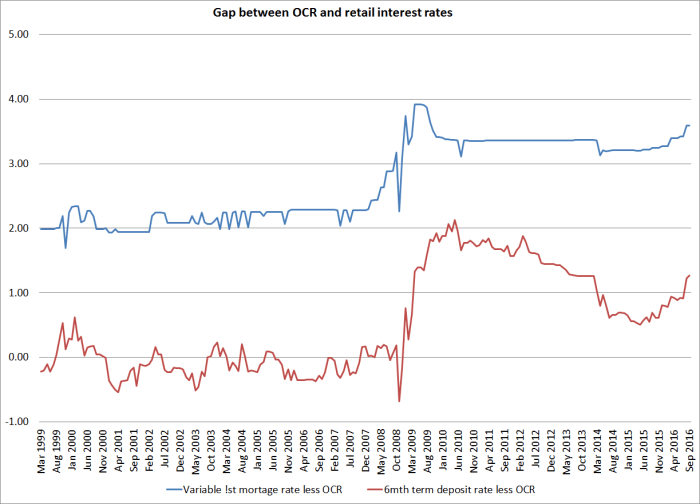
And there have been some significant changes in the relationships between wholesale interest rates and some of these key retail rates in the years since the financial stresses of 2008/09.    Here is the gap between the 90 day bank bill rate and (a) variable first mortgage rates, and (b) six month term deposit rates.

retail-wholesale-gap

Retail term deposits matter much more to banks now than they did, for some combination of regulatory and market reasons (and the cost of longer-term foreign wholesale funding –  not shown – influences just how eager banks are to pay up for term deposits).  As a result, both term deposit rates and floating mortgage rates are much higher, relative to 90 day bill rates, than they were in the pre-crisis years.  That is a major change that the Reserve Bank had to take into account (and consistently has).

But here is the same chart, except that this time I’ve used the gap between the OCR and the retail rates.

ocr-retail-gap

As you’d expect –  because the OCR and 90 day bill rates track so closely –  they tell almost exactly the same story.

I don’t doubt that, as they say

The Bank views publishing a projection for the OCR as a more transparent way of presenting the expected policy actions needed to achieve its inflation target.

But the gains will be small at best.  They will still be publishing smoothed quarterly projections, rather than specific projections for each OCR review –  the latter, which I’m not advocating, would take the transparency about policy rate expectations to the extreme.  And the Governor is still likely to be torn between times when he really wants to give a clear strong signal, and times when he is uncertain enough about the future, even a few months ahead, not to want to do so.

There is a reasonable case for the change the Bank is making, but –  contrary to what they suggest -the justification isn’t in any change in the relationship between 90 day bill rates and the OCR itself.  There hasn’t been one.   And if there have been problems with the Bank’s communications over the last few years –  and there have –  those problems have had very little, arguably nothing, to do with the precise short-term interest rate variable the Reserve Bank chooses to publish projections for.

In many respect, the bigger questions –  which everyone would grant are more important –  are whether

(a) the Reserve Bank should publish policy rate projections at all, and

(b) more radically, it (and other central banks) should publish economic projections at all.

I could devote entire, lengthy, posts to each, but won’t do so today.  My own view is that central banks shouldn’t publish policy rate projections –  most don’t –  and that if they publish economic projections at all, there is no value in projections for much more than a few quarters ahead.  The reason is really quite simple: central banks know almost nothing about the future (and neither, with any degree of confidence, does anyone else).

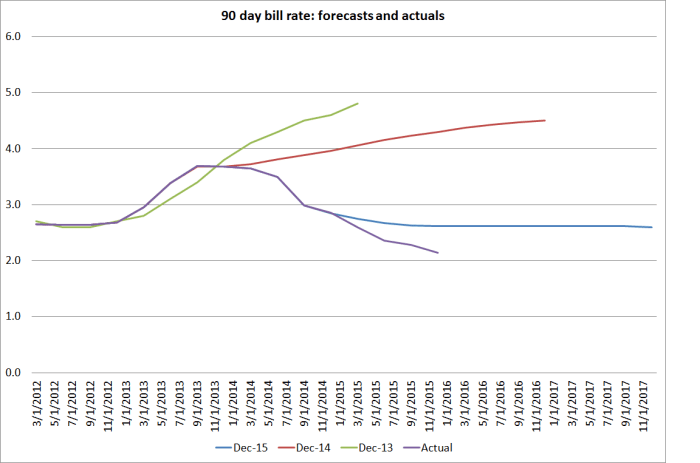
Here (purely illustratively) is the chart of 90 day bill rates, and Reserve Bank forecasts from each of the last three December MPSs.

90s-forecast-and-actual

These haven’t been uniquely difficult years. There was no domestic recession –  forecasters never pick recessions – the unemployment rate didn’t change very much, and if there were ups and downs in some of our export sectors it isn’t obvious that taken together things were much harder to read than usual.   And yet the Reserve Bank really had no idea where the OCR/90 day bill rate would be.  At times I’ve been quite critical of their specific misjudgements, but poor as some of those were, over long periods of time our Reserve Bank is probably no better or worse at medium-term forecasting than any of their peers.  It typically isn’t, and probably can’t, be done well.

A common defence is “oh, but we know the projections won’t be accurate, but at least we can give a sense of how we might react if (when) things turn out differently”.    But even that isn’t very persuasive. If they really think they can give us useful stable information about how they will react to changing circumstances, it should be enough to publish the model (s) they are using and the reaction function embedded in them.  As it is, I’m skeptical there is very much information in either those model reaction functions or in the published policy rate projections.  They might tell you how the Governor thinks now we would react in, say, 18 months time, but in truth he won’t know until he gets there –  partly because there will be a lot of contextual material not captured in today’s forecasts.  In the current New Zealand context, the medium-term forecasts are particularly useless –  the current PTA expires in only 11 months and, most probably, the current Governor will have retired and been replaced by then.  Different Governors will read the same data, and even the same PTA, differently.

Does it matter?  After all, if the policy rate projections –  beyond perhaps the next quarter –  have almost no useful (forecasting) information, perhaps they just do no harm?   I think they do do some harm, simply because resources are scarce and policymakers and their analytical staff have to choose where to focus their efforts. In my experience at the Bank, considerable time was devoted to trying to divine the future –  and haggle about the policy track that we would present.  Time spent on that, largely fruitless, task is time that couldn’t be spent making sense of what we already know, but don’t adequately understand: what has already happened (eg to core inflation) and why.  Central bankers –  and others –  whether here or abroad don’t have adequate answers to that, and without such answers attempts at projecting future policy rates etc are even more futile than usual.

When the Reserve Bank Board begins to turn their attention to choosing the next Governor, I’m sure they won’t be looking for a “soothsayer in chief” –  and they would be foolish to do so.  They will, I would expect, be looking for someone with the temperament and judgement to react wisely to events as they actually unfold, and to lead an organization as it does likewise.  It is hard to enough to do that, and even often to make sense of actual incoming (prone to revision) data, without maintaining the pretence that central banks –  or anyone else –  can read the future, and usefully tell us now where they think interest rates might be 12 or 18 months hence.


Experts: harness them, don’t let them set the course

There was interesting long article in The Guardian the other day by Sebastian Mallaby, the author of a new biography of Alan Greenspan, on “The cult of the expert – and how it collapsed”.  His focus is central banking, but his concerns range much wider. For Mallaby, the (alleged) “collapse” of this “cult” is something to lament.

Of course, when you are brought up the son of a former senior British ambassador, educated at Eton and Oxford, previously a columnist for the Financial Times and then the Washington Post, when you are married to the editor of The Economist, when your books are biographies of two prominent unelected figures – Greenspan and James Wolfensohn, former head of the World Bank –  and when your column is published in The Guardian –  house journal of the British left-liberal technocratic elite – such a lament might be seen as not much more than a piece of class advocacy.

But I’ve usually found Mallaby interesting, and this column – which is well worth reading – had me reflecting again on quite what I think experts should be for.  To get ahead of myself (and pre-empt a long post), my answer was “advice” and “execution”, but only rarely for “decisions”.  That is a quite different answer than the one Mallaby offers. For him, experts simply need to sharpen up their act, become a bit more politically savvy, and show that they deserve the power they have assumed.

Quite early in his article, Mallaby poses the question thus

No senator would have his child’s surgery performed by an amateur. So why would he not entrust experts with the economy?

That one seemed pretty straightforward to me.  When one of my kids needed surgery a few years ago, I wanted expert advice on the options, risks and implications, and I wanted an expert carrying out the surgery, but the decision to proceed with one option rather than another wasn’t the surgeon’s.  It was mine.  The doctor has some specialized knowledge and technical skills, on the sort of case he had probably seen hundreds of times before (and I’d seen not at all).  And if the doctor ended up doing a completely different procedure than the one I’d authorized, or botched the operation, I had specific remedies and complaints procedures I could follow.  I’m sure there are complex cases, and sometimes genuine debate among medical professionals about the best way to treat some conditions, but ultimately the decision to proceed or not is made by the patient (or parent/guardian).

The same might go for house renovations.  A good architect, and capable expert builders and other tradespeople, can together enable an outcome that I couldn’t deliver myself.  Most of us need, and value, expert advice, and expert execution, but the decision to renovate the house, and how far to go, is the customer’s.  It is about choices and preferences on the one hand, and advice from experts who actually usually know what they are doing on the other.

It isn’t clear to me that there are very many areas of public policy where arrangements should be much different.

There are plenty of areas where in the administration of policy we don’t want politicians to have a hands-on role.  It is one of the cornerstones of our system that rules and laws, once established, should be applied impartially, without fear or favour.  Whether it is Supreme Court judges interpreting and applying the laws, or clerks administering benefit eligibility rules in WINZ, we don’t want politicians –  or any other of the “powerful” – getting a better deal, and more favoured treatment, than anyone else.  It is an ideal, and it isn’t always perfectly realized, but it is an ideal that is important to keep before us in designing and monitoring systems.  But it isn’t mostly an issue about technical expertise, but about impartiality in deciding on the administration of the rules.

Setting the rules themselves is quite a different matter.  That is, in many respects, the essence of politics and political debate –  hard choices, conflicting interests, conflicting evidence, and sometimes conflicting values.

As Mallaby notes, central bank operational independence, especially around monetary policy, became something of a stalking horse for people with interests in many other fields of policy.

The key to the power of the central bankers – and the envy of all the other experts – lay precisely in their ability to escape political interference. Democratically elected leaders had given them a mission – to vanquish inflation – and then let them get on with it. To public-health experts, climate scientists and other members of the knowledge elite, this was the model of how things should be done. Experts had built Microsoft. Experts were sequencing the genome. Experts were laying fibre-optic cable beneath the great oceans.

He draws on the published thoughts of Alan Blinder, Princeton economist, who spent time as chairman of the Council of Economic Advisers, and as vice-chairman of the Federal Reserve.  As Mallaby tells it:

His argument reflected the contrast between his two jobs in Washington. At the White House, he had advised a brainy president on budget policy and much else, but turning policy wisdom into law had often proved impossible. Even when experts from both parties agreed what should be done, vested interests in Congress conspired to frustrate enlightened progress. At the Fed, by contrast, experts were gloriously empowered. They could debate the minutiae of the economy among themselves, then manoeuvre the growth rate this way or that, without deferring to anyone.

To Blinder, it was self-evident that the Fed model was superior – not only for the experts, but also in the eyes of the public.


…..Blinder advanced an alternative idea: the central-bank model of expert empowerment should be extended to other spheres of governance.

Blinder’s proposal was most clearly illustrated by tax policy. Experts from both political parties agreed that the tax system should be stripped of perverse incentives and loopholes. There was no compelling reason, for example, to encourage companies to finance themselves with debt rather than equity, yet the tax code allowed companies to make interest payments to their creditors tax-free, whereas dividend payments to shareholders were taxed twice over. The nation would be better off if Congress left the experts to fix such glitches rather than allowing politics to frustrate progress. Likewise, environmental targets, which balanced economic growth on the one hand and planetary preservation on the other, were surely best left to the scholars who understood how best to reconcile these duelling imperatives. Politicians who spent more of their time dialing for dollars than thinking carefully about policy were not up to these tasks. Better to hand them off to the technicians in white coats who knew what they were doing.

And yet, 20 years on, there is no sign that the public  –  really anywhere in the advanced western world –  wants to hand more policy-setting power over to technocrats and unelected officials.  (On other hand, the power grab by officials –  and even ministers averse to the involvement of legislatures –  goes on in almost every country; the administrative state keeps growing.)

The Reserve Bank of New Zealand Act gets a brief mention in Mallaby’s article.  In conception, it was perhaps the strongest possible case for delegating operational policy decision to officials (“experts” –  although none of the three decision-making Governors since 1989 would really have qualified as monetary policy experts when they were appointed).   It seems to me that three or four beliefs/propositions underpinned the case for handing over decision-making power around the conduct of monetary policy:

  • politicians had all the wrong incentives and would almost invariably postpone hard decisions, creating a bias towards inflation, and excessive economic variability,
  • it was relatively straightforward to specify the goal society wanted pursued with monetary policy (so officials weren’t being asked to make meaningful trade-offs, just “read the data, and do the right thing –  the latter according to the societal rule”)
  • it was relatively straightforward for able technocrats to make the right decision –  consistent with the societal rule.
  • holding officials to account was quite straightforward.

There is a small element of caricature in the way I’ve written that list, but I think it gets at the essential assumptions behind the monetary policy bits of the Reserve Bank Act.

Perhaps it was a reasonable story for ministers and officials to tell themselves in the early post-liberalization years.  But none of it bears much relationship to reality.

Perhaps politicians postpone hard decisions on monetary policy –  though it has never been clear to me why this should have been more of a problems in respect of monetary policy (where the lags are quite short) than in other areas of public life (where the lags are often long, and adverse consequences hard to pin down even years later).  And, of course, we’ve now spent the best part of decade grappling with inflation rather lower than most official targets suggest desirable.

And people pretty quickly realized that technical experts could disagree –  at times quite vociferously –  and that there was no very obvious reason to consistently favour one technical expert over another.  And there were/are real choices being made –  on things that matter to voters, such as how much to prioritise lingering unemployment gaps, and on things where it isn’t easy for society to write down in advance how it wants to technical experts to manage the tensions and trade-offs.  And there is no reason to think that “technical experts” are any better placed to decide those trade-offs (or less prone to be influenced by their own class or educational interests/biases) than the public as a whole through the political process.

And, largely as a result, effective accountability for central bankers is limited at best –  really only at the time of potential reappointment.  There are no complaints procedures or expert review and investigatory bodies.  And while the New Zealand case isn’t general, in our case not only is the power handed over to an unelected agency –  notionally ‘expert’ –  but it has been handed over to a single individual for many years at a time.  That isn’t done in other areas of public policy, even when policymaking powers have been delegated by Parliament.

A fundamental part of any proposal to delegating policymaking power to “experts” has to be that such “experts” really know what they are doing.  But the evidence for that, even as regards monetary policy is now pretty slender.  I certainly wouldn’t be hiring as builder or a surgeon someone who had as bad a track record as the world’s central bankers have had over the last decade or so.  That isn’t intended as a personal criticism of any of them, all of whom have no doubt sought to do their best.  But they’ve constantly misjudged inflation pressures, and not randomly but systematically.  I’m not even suggesting replacing them with another bunch of superior experts.  It is just that the limitations of our knowledge are simply too great.  Even if we could all agree that the only thing we wanted from our central banks, year in year out, was 2 per cent inflation, there is no expert consensus on how best to deliver it, and what expert consensus there is has a pretty poor track record.

And, of course, there is even less agreement in practice –  where society seems not just to want 2 per cent inflation, year in year out. In the current climate, some favour a more aggressive use of monetary policy, perhaps to use demand to soak up laid aside labour and prompt a resurgence in the supply side of the economy (Janet Yellen’s recent speech seemed to point a bit in that direction).  Others are quite content to put inflation targets somewhat on the backburner for a while, out of fear of incipient financial crises (in this part of world, both Graeme Wheeler and Phil Lowe) seem inclined to that sort of thinking.  In Sweden not long ago the monetary policy decision-making body was torn apart by the tension between these sorts of views.  There is no straightforward generally agreed analytical framework, revealed only to the “experts”, enabling them to make such decisions better than anyone else.

Thus, I was bit troubled when I read Phil Lowe’s first speech as Governor.  In it he notes some of these choices and trade-offs, but then falls back on the (non-statutory) concept of “the public interest” (the RBA’s statutory goals are much vaguer than those of the RBNZ, but “the public interest” doesn’t feature, at least not directly).

He notes

So when thinking about what type of variation in inflation is acceptable, it is natural for us to start by asking ourselves: what is in the public interest?

But

Granted, this can be hard to define and opinions can differ

And

This might all be less tightly defined than some people would like. But given the uncertainties in the world, something more prescriptive and mechanical is neither possible nor desirable. Inevitably, judgement has to be exercised. Successive governments have appointed nine dedicated Australians to the Reserve Bank Board to exercise that judgement in the public interest.

I have a lot of sympathy for the view that a “more prescriptive and mechanical” target for discretionary monetary policy isn’t really possible.  But if it isn’t possible, why should suppose that Lowe, his deputy, the Secretary to the Treasury, and the non-executive directors –  not one of whom ever faces an electoral test –  are best placed to work out what is in “the public interest”?  Better than the (somewhat dysfunctional) elected governments?    If there is going to be an operationally independent central bank, I think the Australian governance model is clearly superior to our own (though in turn probably inferior to the UK’s) but why would one delegate such discretionary powers at all?  One could no doubt mount an argument for lower, or higher, interest rates in Australia at present, even with a shared assessment of the outlook for inflation.  The differences will turn on preferences, values and –  frankly –  hunches.  They won’t turn on, say, the sort of solid track record of a surgeon who has done much the same operation hundreds of times before.  None of us –  central bankers, outside economists, politicians, the public –  have ever seen quite such conjunctions of economic circumstances before.

None of which is some call for rank populism.  As I said very early on in this post, there is a valuable role for experts in advice and execution.  We want capable people who know exactly what they are doing conducting the market operations that implement monetary policy.  And it is likely that economists and related experts can offer some useful advice on the options that societies face around monetary policy and the underperformance of economies in recent years.  But the “experts” just don’t know that much at present – that isn’t an accusation, it is a fairly neutral description of what one reads in speech after central bank speech.  And it isn’t a matter of shame, but of alignment.  We shouldn’t –  and generally don’t –  delegate policy decisions when the evidence base is weak and there are real and contested tradeoffs.

And all this has been about monetary policy, where perhaps once the case for delegation looked strongest.  Banking regulation is perhaps a clearer illustration of my point: we want people administering the rules without fear or favour, we need detailed expertise on specific instruments or institutions, and we need expert advice as input to policymaking.  But in setting policy there are real and inescapable choices, and there is little obvious reason to think decision-making on what the rules should be should be delegated to “experts”.  Take LVR policy as a recent New Zealand example: all the choices have distributional implications, there is little or no established body of knowledge of research, and in the end the decisions that have been made rest on little more than educated hunches, and about risks, costs and tradeoffs.  Perhaps they are the right hunches, but we have no way of knowing. It isn’t remotely like asking a doctor to use his expertise to reset a broken bone.  If the case for such policy is so strong, let the experts persuade the politicians –  who are elected, and can be unelected.

Mallaby is writing with two backdrops in mind.  The first is his recent biography of Greenspan, who appears as a hero in the story.  And the second is what he appears to regard as the “disaster” of Brexit and the Trump insurgency (even if the latter now appears unlikely to storm the citadel).  About Greenspan, you can read Mallaby’s argument for yourself.  I’m more inclined to the view, reflected in Peter Conti-Brown’s book that I wrote about earlier in the year, that Alan Greenspan is an argument for term limits for heads of central banks.  Over 19 years as head of the Federal Reserve he became such a dominant presence, including in the political debate, that (among other things) his views somewhat overshadowed the looming risks that eventually culminated in the 2008/09 crisis.  And frankly, no matter how able –  and Greenspan didn’t walk on water –  there is something amiss when a technocrat, never facing an election, wields that much power.

I was (and am) a Brexit supporter, so I can’t share Mallaby’s distaste for Michael Gove’s dismissal of “experts” in that debate.  How one’s country should be governed, in close association with which other countries, seem quintessentially like an issue on which the public might quite reasonably have a view.  To be sure, as always, there is a place for expert advice on the issues and implications of the various possible choices, but “experts” have interests too, and they are necessarily or always those of the wider public.  As I noted earlier in the year, in many cases the end of the British empire led to independent successor states that struggled economically.  Perhaps independence was a “sensible economic choice”, but in sense that is the point; people value different things, and perhaps put a premium in that case on self-government, even if at some economic cost.

Towards the end of his article, Mallaby notes

Democracy is strengthened, not weakened, when it harnesses experts.

And I agree.  But the operative word there is “harnessed”.  Experts have a valuable role as advisers and –  in policy matters often a different set of “experts”  –  as implementers.  Expert advice can help illuminate the costs and consequences of the choices and tradeoffs societies make –  whether relatively mundane ones around monetary policy, or more existential ones around decisions to go to war, to construct welfare states or whatever –  but “experts” are typically ill-equipped to make those decisions for us.  In fact, often enough, even what appears to be a consensus of expert opinion –  or establishment opinion (often the same thing) – is left in tatters by experience.  To end on a note more of politics than economics,  there was a column in the New York Times a few days ago

Almost every crisis that has come upon the West in the last 15 years has its roots in this establishmentarian type of folly. The Iraq War, which liberals prefer to remember as a conflict conjured by a neoconservative cabal, was actually the work of a bipartisan interventionist consensus, pushed hard by George W. Bush but embraced as well by a large slice of center-left opinion that included Tony Blair and more than half of Senate Democrats.

Likewise the financial crisis: Whether you blame financial-services deregulation or happy-go-lucky housing policy (or both), the policies that helped inflate and pop the bubble were embraced by both wings of the political establishment. Likewise with the euro, the European common currency, a terrible idea that only cranks and Little Englanders dared oppose until the Great Recession exposed it as a potentially economy-sinking folly.

Like most cults, the “cult of the expert” is more dangerous than Mallaby –  or most of the expert class – acknowledges.  And hotly contested political debate, messy as it often, wrong directions that it sometimes takes, are how we make the hard choices, the trade-offs, amid the inevitable uncertainty. Abandoning that model is akin to gutting our democracy of much of its substance.  So I still want an expert operating on my child, but I want parliaments making laws and setting taxes (not officials) and parliaments taking us to war (not generals).  And I increasingly wonder whether monetary policy decisions should be left to officials either –  no matter how technically able, and how many of them on the decisionmaking panel.


Getting back to monetary policy

Sometimes ill health does strange things. I’ve been quite unwell for the last couple of months (slowly getting back to normal now) and in that time my interest in current monetary policy and the monetary policy words/actions of the Reserve Bank dropped right away (displaced, according to my book list,  by copious Trollope novels and books of early 20th century history). I didn’t write a post about the last OCR review, and it is more than eight weeks since I last wrote a post about current monetary policy issues at all.

In the grand scheme of things, monetary policy just isn’t that important.  Bad monetary policy won’t impoverish us, and the best monetary policy possible won’t make any material difference in reversing our decades of economic underperformance.  But the same is true of lots of things, and monetary policy is one of the things I know.  And over shorter-term horizons it makes more difference to the fortunes of individuals (and firms) than many other things government agencies do.

The Reserve Bank is charged with keeping annual CPI inflation “near” 2 per cent on average.  Monetary policy takes time to work, and there are all sorts of “one-offs” that muddy the water, so no one would ever expect out-turns averaging bang on 2 per cent, except by chance.  The Policy Targets Agreement talks about “near”, and outlines various reasons why actual inflation might appropriate deviate from the target.  One of the salient ones is the direct impact of government taxes and charges: when the government raises tobacco taxes or cuts ACC levies, those aren’t things you hold monetary policy to account for, or expect monetary policy to try to offset.  Any other approach would deliver daft results.

So how do things stand on inflation now, four years into the Governor’s term?

Here is headline CPI inflation, the focus of the Policy Targets Agreement.

inflation-target-and-outcomes

The 2 per cent focal point has only featured in the Policy Targets Agreement since the end of September 2012  (although prior to that 2 per cent was also the (unstated and unfocused on) midpoint of the target range).

The Governor has often rightly called our attention to the role falling global oil prices have played in dampening headline inflation.  The CPI ex petrol series somewhat overstates the contribution of falling oil prices, because exchange rate pass-through into domestic prices is pretty full and immediate for oil/petrol, and the Governor’s monetary policy choices are one of the things that has held up the exchange rate.  But setting that caveat to one side for the moment, here is the CPI ex petrol series.

cpi-ex-petrol

Inflation on that measure is not only well away from the 2 per cent focus, but it is below the bottom of the 1 to 3 per cent target range.  And doesn’t really look to be picking up much, unless perhaps you put a great deal of weight on the one particularly low annual number at the end of last year.

What of the various other core measures?  At times, the Governor has put a very heavy weight on the Bank’s sectoral core factor model measure of inflation.  It has shown some signs of having turned a corner, and started picking up.  Unfortunately, the way that measure is calculated leaves it prone to quite significant revisions as new data are added (if I recall rightly, back in 2011, the real-time estimates suggested core inflation was above 2 per cent).

sectoral-core-revisions

In this chart, I’ve just shown the estimates for the sectoral core measure a year ago, and those now.  In that time, new data have led to past estimates of the sectoral core inflation rate being revised further down (ie the trough was worse than the Bank realized).  And the current estimate of 1.5 per cent is slightly lower than the 1.6 per cent being reported only a few months ago.

There is no perfect measure of core inflation –  empirically, or perhaps even conceptually.   And the measures the Bank and SNZ report show quite a range of numbers.

Annual inflation year to September 2016
Weighted median 1.7
Sectoral factor model 1.5
Factor model 1.3
CPI ex food and energy 1.1
CPI ex petrol 0.8
Trimmed mean 0.7

The median of those estimates is 1.2 per cent.

We are approaching the next Reserve Bank Monetary Policy Statement.  As everyone is aware the Reserve Bank has cut the OCR quite a long way over the last 16 months, and has indicated that its projections suggest further cuts will be needed to ensure that inflation settles back near 2 per cent.

Only two years ago, in its December 2014 Monetary Policy Statement, the Governor indicated that he expected further increases in the OCR, from the then level of 3.5 per cent.  They soon realized that was a mistake.  But here are those core measures for the year to September 2014 (the latest CPI data in December 2014) and for the most recent year.

Annual inflation year to September
2014 2016
Weighted median 1.7 1.7
Sectoral factor model 1.3 1.5
Factor model 1.4 1.3
CPI ex food and energy 1.4 1.1
CPI ex petrol 1.2 0.8
Trimmed mean 1 0.7

On only one of those six measures is core inflation any higher now than it was then, although in all cases there were lower numbers at some point between then and now.   The cuts in the OCR –  reversing the unwarranted 2014 increases – may have helped stem the decline in core inflation, but haven’t yet done much to get it back to near 2 per cent.

Perhaps there are still further increases in core inflation in the pipeline?  But recall that the largest cuts in the OCR were concentrated in 2015 –  100 basis points of cuts between the June and December 2015 MPSs.  Not all the effects of those cuts will yet have been felt, but the effects are likely to start waning fairly soon.   This year so far we’ve had 50 basis points of OCR cuts, some of which simply offset the impact of falling inflation expectations.  And the exchange rate has been rising this year.

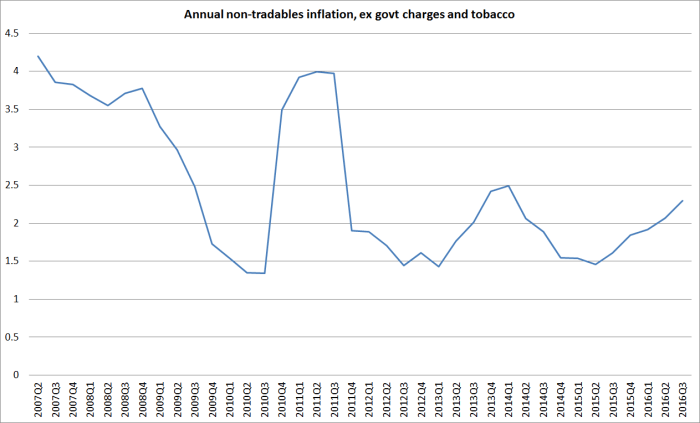
As I noted earlier, when governments raise indirect taxes (eg on tobacco) or cut government levies (eg the ACC component of vehicle registration fees) one really wants to look through such effects.  Unfortunately, SNZ does not publish a series for the CPI excluding taxes and government charges –  and I would urge them to consider doing so – but they do publish a series of non-tradable inflation excluding government charges and the cigarette and tobacco subgroup.  At present, those two exclusions capture the tobacco tax and ACC effects.  Non-tradables inflation typically averages well above tradables inflation (for various reasons) and so can’t meaningfully be compared with the CPI inflation target midpoint, although some people –  including some who should know better –  do so.  Here is the chart of that inflation series.

nt-ex-govt-charges-and-tobacco-oct-2016

To be consistent with overall CPI inflation of around 2 per cent, this series would have to be inflating at somewhere nearer 3 per cent per annum.  But this inflation rate has picked up quite a bit, and quite steadily over the last year or so.  That should be a slight cautionary note when considering what should be done with the OCR from here, but it is worth noting that this series also picked up quite a bit in 2013 and that proved to be a false signal.

Like the Reserve Bank, I do think the OCR should be cut further, and I expect it will be cut.  But I might be a little more cautious now than perhaps I would have been at the start of the year about just how large future cuts might desirably be.

Of course, in part that depends on one’s sense of the strength of the economy.   The global picture looks no rosier, and although dairy prices have picked up somewhat, other impulses must be waning.  Growth in tourist arrivals seems to be slowing, as does the sharp growth in foreign student numbers (and the residence approvals programme numbers have been cut a bit).  The Christchurch rebuild impulse is well past its peak, and I don’t see much reason for optimism about a renewed surge in other private domestic construction.  Then again, interest rates work with a lag, and although real interest rates are still higher than they were say three years ago, they are lower than they were 12 to 18 months ago.  And between new prisons (another non-tradables shock tending to boost the real exchange rate) and other government capital expenditure to catch up with the unexpectedly rapid growth in the population, there probably isn’t much reason to expect the modest per capita growth over the last couple of years to slow that much in the next year.

As I’ve said before, however, forecasting is a bit of a mug’s game.  For me, two considerations still tilt me to favouring at least another 50 basis points of cuts:

  1. The unemployment rate is still lingering well above official estimates of the NAIRU, and that is something monetary policy can do something about, and
  2. Because we will go into the next recession (whenever it is, although history would suggest some time in the next five years) with much less ability to cut the OCR than we have had in past recessions, in the current climate if monetary policy errs at all it should be erring towards delivering inflation outcomes perhaps a little above target (even if still “near 2 per cent”) rather than quite a way below target as in recent years.  Inflation expectations for the next few years quite a bit higher than we have now would be a positively desirable outcome.    The Bank doesn’t really have a mandate to target expectations much above 2 per cent, but if it is going to err –  as it has, quite materially, in recent years – better now to err on the high side.

And for all the rhetoric from the government and their cheerleaders, it is not as if the economy has been doing that well.  Non-existent productivity growth and no better than middling per capita GDP growth aren’t signs suggesting we should just ignore low inflation and bask in our “economic success”.


Should the PTA be changed? Business leaders seem to think so

A couple of weeks ago, the Herald ran their annual Mood of the Boardroom survey, capturing the views of 101 (mostly) chief executives on a wide range of business, political and policy issues.  It is a slightly frustrating survey because, despite the heavy coverage the Herald gives it, they don’t report the exact questions, and as everyone surely recognizes, how one frames a question influences –  intentionally or otherwise –  the answers one gets.

Often enough the answers are pretty predictable.  Sometimes predictably depressing.  Daft and detached from reality as I’ve argued that the Prime Minister’s line about New Zealand as a haven for the rich, the “Switzerland of the South Pacific” is, the CEOs (79 per cent of them) seem to like it.

But the question that caught my eye was one about monetary policy.  Asked whether the government should “rewrite its agreement with the Reserve Bank”, so as to “consider wider economic factors beyond inflation” the answers reported were:

Yes                                    48 per cent

No                                      38 per cent

Unsure                              14 per cent

It is now less than 12 months until a new Policy Targets Agreement is required, and the Minister of Finance has poured cold water on the idea of major changes in the PTA.  But on this occasion, business leaders –  often important defenders of the status quo around monetary policy – seem to be calling for change.  As the Herald notes, it is “a marked change from previous surveys”.

It would be interesting to know quite what these CEOs had in mind, as there isn’t much hint in the supporting article.  One CEO is quoted as suggesting that the Reserve Bank needs to think about economic growth too, and that is about all.  There is no reference in the article to the exchange rate, unemployment, asset prices, credit or any of the considerations that people sometimes argue that the Bank should pay more attention to.  But since these respondents aren’t monetary policy experts, we can assume they don’t just have in mind minor technical rephrasing on some clause or other in the PTA.  There must be some genuine angst in CEO-land about how monetary policy is being run.

Without more follow-up questions, it is hard to know what the balance of thinking among respondents was.  Some will probably will favouring lowering the inflation target, to bring the target into closer alignment with actual inflation outcomes in recent years.  Perhaps some favour linking monetary policy and the Bank’s regulatory powers more closely.  Some might be channeling stuff they read from abroad suggesting a new approach to monetary policy is needed, with little real sense of what a different approach might look like (no other country having changed its framework).  But others might be reflecting more of a Labour/New Zealand First unease about the framework, emphasizing perhaps international competitiveness, or more of a focus on full employment.  Perhaps some are just reacting to the failings of the current Governor in conducting policy?

We don’t know what the balance is, but the survey result does feel rather like a straw in the wind, something for the powers that be to focus on as the negotiation of the new PTA next year approaches.  The latent unease among business leaders –  whatever motivates it –  reinforces the argument I’ve made here several times in the past that the process leading to negotiating a Policy Targets  Agreement really should be a much more open one.  The PTA is the principal guide to short-term macroeconomic management in New Zealand, for five years at a time, and yet it is a process shrouded in secrecy from beginning to (well after the) end.   There was no public consultation on the changes to the PTA in 2012 (or those in 2002), and even after the event the Reserve Bank has refused to release background papers relating to the PTA negotiation.

Perhaps none of this matters very much if there is a strong consensus in favour of the status quo –  although even then it is as well to have to articulate the case from time to time, and deal with the challenges, even if they come from only a small minority of voices.  But this time, according to this survey, a plurality of business leaders favours changing the PTA.  Regulatory agencies have to publish consultative documents on proposed changes. New legislation has to be worked through a select committee. The government publishes a Budget Policy Statement setting out in advance the key considerations that will shape its subsequent Budget.  But there is nothing remotely similar around the key policy guide to short-term macroeconomic management, the PTA.  Democratic deficits abound in matters relating to the Reserve Bank, but this is one that could be quite easily fixed.    As part of the lead-up to next year’s PTA, the Minister of Finance should announce that the Treasury will be hosting a workshop/conference, perhaps around six months from now, to consider papers on the appropriate content and structure of the Policy Targets Agreement.  Several background papers could be commissioned, the Reserve Bank and Treasury themselves might submit papers (with some caution about those from the Reserve Bank, given that it is the institution whose conduct the PTA is supposed to shape, and hold to account), and outside experts (academic and otherwise) and interested parties could be invited to contribute.

No doubt some would worry about “upsetting the markets” but (a) this is a democracy, and one that often espouses the importance of open government and (b), as importantly, markets can read too.  The Mood of the Boardroom results are no secret, and nor is the unease that most Opposition parties feel about the New Zealand monetary policy framework.  Nor, for that matter, is the ongoing international debate about how best ot run monetary policy in future a secret.

To be clear, I am not myself advocating material change.  If I were starting from scratch, I would rewrite the PTA at about half its current length, but would not change any of the central features of the current document.  That isn’t because the current system is perfect, or likely to be the end of monetary history (the system we still have 100 years hence), but because the case for any real-world alternative has not yet been made compellingly.  And because I think getting the forecasts more accurate, and reforming the governance of the Reserve Bank –  including getting the right people running the place – are more important than tweaking the target.

I was, however, interested in one of the Herald survey’s advocates of changing the PTA.  Don Brash, former Governor of the Reserve Bank, was included in the survey as chair of ICBC, one of the Chinese banks operating in New Zealand.  Don is quite clear in his view that

over the longer term monetary policy can’t significantly effect an improvement in real economic growth or employment.

But, he argues,

And the Government should probably either reduce or widen the inflation target band. It’s not obvious to me that an average movement in the price of goods and services (as measured by the CPI) of say 0.5 per cent a year should be regarded as a serious problem to be solved.

“There’s not much evidence of people holding off spending because the CPI is at current levels,” said Brash

I think Don Brash is just wrong on this one.

First, he ignores the extent to which the unemployment rate (just over 5 per cent) is still above the natural or sustainable rate in New Zealand –  estimated by Treasury at around 4 per cent.  Very low inflation is not necessarily a problem in itself, but it can point to an extent of unused capacity in the economy.  That is most obvious in the unemployment numbers, but is also reflected in just how weak per capita GDP growth has been in the current upswing.  We simply could have done better.

But my bigger concern is about what lowering the inflation target would do to our capacity to cope with future severe economic downturns.  I’d be happy, in an ideal world, to lower the inflation target, back to perhaps 0 to 2 per cent per annum (there are some modest upwards biases in the CPI measure of inflation).  Apart from anything else, the closer to price stability the economy averages the less distortionary the tax system is.

But…the rest of the advanced world has spent the last decade discovering the limitations of conventional monetary policy.  With current technologies, laws, and central bank practices, no one thinks that nominal policy interest rates can be cut much below zero (something around -0.75 per cent seems to be accepted as near a practical floor).  Fortunately, New Zealand hasn’t faced those constraints yet.  We had to cut the OCR as much as almost anyone in the advanced world, but since our interest rates have averaged so much higher than those in other countries, the OCR hasn’t yet fallen below 2 per cent (and even the doves don’t think it needs to go below 1 per cent).

As the Reserve Bank has noted, weak inflation over recent years has been accompanied by falling inflation expectations.  But those inflation expectations have typically fallen quite sluggishly, partly because people still seem to think that eventually inflation will get back to something around 2 per cent.  If the target was changed, to say 0 to 2 per cent, they would have no reason to expect inflation to average anywhere near 2 per cent, and their expectations (explicit and subconscious) would be revised down towards 1 per cent.  All else equal, that would amount to an increase in real interest rates –  and to prevent inflation falling further, nominal interest rates would have to be cut even more.

In typical downturns in New Zealand, the OCR (or the 90 day bill rate pre 1999) have been cut by hundreds of basis points (500 basis point falls haven’t been unusual).  Even with an inflation target centred on 2 per cent, we don’t have anything like that sort of leeway when next a recession hits New Zealand.  We would simply be foolish to give away any of the capacity we do have by cutting the inflation target now.  Of course, if the government, the Treasury and the Reserve Bank were finally going to get serious about taking the sort of steps that would largely remove the near-zero bound on nominal interest rates it would be a quite different matter.  But this issue need to be taken seriously in any discussion of future PTA options.


Raising the inflation target….in 2002

There is a bit of discussion around (internationally more so than in New Zealand) about the possible merits of raising inflation targets, to something centred on 4 or 5 per cent annual inflation, rather than the 2 per cent focal point of most countries’ targets today.  The main argument for doing so is to raise nominal interest rates in more normal times, in turn creating scope to cut policy interest rates further in real terms in future serious downturns.

I doubt it is a viable option at present for most inflation targeting countries, simply because most have largely exhausted conventional monetary policy capacity –  policy interest rates are already near or below zero –  and many are struggling to achieve their current inflation targets.  It is, probably, still an option for New Zealand (with the OCR still at 2 per cent), although in my view raising the target is less attractive an option than taking action to reduce the impact of physical cash in creating a near-zero lower bound on nominal interest rates.  The costs of positive inflation rates may not be that large, but they increase as the target inflation rate increases –  and perhaps especially so in a country like New Zealand where income on financial savings (eg interest, which includes compensation for inflation) is taxed just the same as labour income.

Unlike most inflation targeting countries, New Zealand does have a history of having raised its inflation target.  We started out aiming for 0 to 2 per cent annual inflation rates, and then raised that target to 0 t0 3 per cent at the end of 1996, as one aspect of the National/New Zealand First coalition deal.  The Bank acceded to the change, but had not sought it.

Yesterday I was asked a question about the background to the second increase in the target.  In September 2002 the inflation target was raised from 0 to 3 per cent per annum, to the current 1 to 3 per cent per annum.  Why?   My short answer was “politics”, and this is my fuller answer.  I was quite closely involved –  at the time I was one of the Governor’s three direct reports –  but others will no doubt have slightly different memories/perspectives.

The opportunity for a change in the Policy Targets Agreement (PTA) opened up when in late April 2002 the long-serving Governor, Don Brash, unexpectedly announced his resignation from the Bank, effective immediately, so that he could contest the forthcoming general election as a National Party candidate.  Key figures in the governing Labour Party – in particular the Prime Minister, Helen Clark – were furious, including with the Reserve Bank’s Board which had agreed terms and conditions with Brash that had not required any stand-down periods when he left office.  I can’t speak for all my then colleagues of course, but my impression was that many people at the Bank, while perhaps wishing Don well personally, thought that resigning as Governor to go straight into party politics wasn’t quite the done thing, and risked undermining (albeit at the margin) the reputation of the Bank.

The Bank’s (and Brash’s in particular –  as single decisionmaker) stewardship of monetary policy had been contentious in some circles for a long time.  Both National and Labour stood solidly behind the Reserve Bank Act, and especially its monetary policy arrangements, but the Minister of Finance, Michael Cullen, had been uneasy for a long time as to whether the target framework was too restrictive.  Back in the mid 1990s, as Opposition Finance spokesman, he had actually campaigned to widen the target band to -1 to 3 per cent per annum, and when he had become Minister in 1999 he added to the PTA the explicit requirement to  “seek to avoid unnecessary instability in output, interest rates and the exchange rate”.   No one ever –  in fact, still –  knew quite what it meant, but it was a response to the continuing unease, including that around the monetary conditions index debacle of 1997 to 1998.

The Labour-Alliance government which came to power at the end of 1999 commissioned, as had been promised, an international review of New Zealand’s monetary policy arrangements and the conduct of monetary policy.  Michael Cullen wasn’t looking for radical change –  or he would not have appointed Lars Svensson, one of the academic experts on inflation targeting, as the reviewer –  although there was a sense that he would not have been averse to a recommendation to shift to a committee or Board system for making monetary policy decisions.  In the end, the review was pretty tame –  I was part of the secretariat, at the same time as being a Bank senior manager, and we went to some lengths to encourage Svensson not to be too effusive about the Brash stewardship, fearing that otherwise the report would lack credibility.    Svensson did recommend a move to a committee system, but his proposal –  for a committee of internal senior managers, somewhat akin to Graeme Wheeler’s Governing Committee  – got no political traction.    There was no political mileage in legislating to shift from one technocratic economist making the decision to four or five technocrats making the decisions.

There was also longstanding unease, and puzzles, as to just why New Zealand’s relative economic performance had not improved.  At the time, our exchange rate wasn’t high, but our interest rates were still high relative to those in the rest of the world, and there was no sign that the income or productivity gaps to the rest of the OECD were beginning to close.  There was questions around whether somehow something in the way monetary policy was being run, or the way the target was specified, was somehow contributing to the medium-term real economic underperformance.  Were we, for example, by holding interest rates so high unintentionally lowering potential GDP growth? In some circles there was a sense that the Bank jumped at shadows –  raising interest rates at the first hint of inflation, and never “gave growth a chance”.  As people pointed out from time to time, our inflation target was lower than Australia’s, but our interest rates typically weren’t.

Add into the mix the government’s unease with Don Brash’s views of the wider economic policy framework.  His speech at the August 2001 Knowledge Wave Conference, on how best to accelerate economic growth, didn’t go down well with the government (understandably –  I think those internally who had seen the draft were all pretty much of a view that it was material that should be saved for his retirement).  It all seemed to just add to a sense that something was wrong at the Bank, and in how monetary policy was being run.

Actually, the Bank had been quite aggressive in easing policy during 2001, probably more so that (with hindsight) was warranted.  The US recession, and the 9/11 attacks, prompted pre-emptive easings, from an institution determined not to make Asian crisis mistakes again.  But by early 2002, the talk was turning again to the prospects for OCR increases.  There had already been two 25 basis point increases by the time Don Brash resigned, and the projections and policy statements foreshadowed a lot more increases to come.

It is also worth remembering that, at the time, just over a decade into inflation targeting, the Bank had had inflation out-turns averaging well above the midpoint of the inflation target range.  That track record continued right through until the 2008/09 recession, and it made us unusual by the standards of inflation targeting central banks –  the more so, perhaps, because our rhetoric often stressed the importance of focusing on the midpoint of the target range (to maximize the chances the inflation would be within the target range).     This chart illustrate the track record –  although note that, at the time, we did not have either of these particular core inflation measures (they are just readily to hand).

target change in 2002

Inflation had been above the target midpoint throughout almost all the inflation targeting period, had never (in core/underlying terms) been in the 0 to 1 per cent part of the range, and by now (mid 2002) inflation was not only in the upper half of the range, but was rising.

Deputy Governor Rod Carr was appointed as acting Governor once Don Brash resigned, and he took the next few OCR decisions, and did the associated communications.  The OCR was raised at both of his first two OCR decisions, and in the May 2002 MPS in particular, Carr’s rhetoric was (and was widely seen as) very hawkish –  words of man who might be champing at the bit to raise the OCR.  The May projections had envisaged another 150 basis points of OCR increases over the following year or so which would, so the projections showed, bring inflation progressively back to around the middle of the inflation range.

In the Beehive, there seems to have been a sense that they definitely didn’t want the Board nominating a “Brash clone” as Governor, and a real unease about what another 150 basis points of OCR increases would do to the prospects for the sort of “economic transformation”, including the growth in the export sector, they were seeking.  What, people might have asked themselves, was the point of having really large OCR increases to get inflation to the midpoint of the target range when it had never been there for long previously?  And since (core/underlying) inflation had never been in the zero to one percent part of the target range, why not just pull the range up a bit?  To do so, it could be argued, wouldn’t change anything much.

Throughout this period, Bank staff were at work on a major series of background briefing papers to help whoever was nominated as Governor, and perhaps the Minister, in negotiating a PTA.  For the first time, since the Act had come into effect, we passed the real possibility of an outside appointee, perhaps with little or no background in monetary policy.  I can’t now see that collection of papers on the Reserve Bank’s website (but will happily link to them if they are there: UPDATE: they are here) but suffice to say that they did not advocate a change to the PTA, or to the inflation target specificially.  They were not, by any means, doctrinaire on the importance  of the current target range, but saw little prospect of any real economic gains from raising the target.

In the Beehive, there was also a bit of a sense that if Australia could do just fine –  indeed, so it was seen, to prosper – with an inflation target centred on 2.5 per  cent annual inflation, perhaps we should move to adopt the same target.  I gathered that the Prime Minister in particular was quite keen on that option.

In the end, the Secretary to the Treasury, Alan Bollard was appointed as Governor.  He agreed to change the target in two ways.

The first was eliminating the 0 to 1 per cent part of the target range, so that in future the target would be 1 to 3 per cent annual inflation.  My understanding/memory is that he did not see this as a route to higher inflation, but rather to cementing in something more like the average inflation outcomes of the previous few years.  But it ruled out the need to tighten simply to get back to a target midpoint on 1.5 per cent.  To Alan’s credit, he strongly resisted the Prime Ministerial preference for adopting the RBA’s target, centred on 2.5 per cent.  Staff advice was that a target as high as that could not really be considered consistent with the statutory requirement to pursue and maintain price stability.

The second was to introduce the concept of a medium-term horizon explicitly into the PTA, as in these extracts

For the purpose of this agreement, the policy target shall be to keep future CPI inflation outcomes between 1 per cent and 3 per cent on average over the medium term.

3. Inflation variations around target

a) For a variety of reasons, the actual annual rate of CPI inflation will vary around the medium-term trend of inflation, which is the focus of the policy target.

Since we had always run inflation targeting looking out at the medium-term projections, it was never entirely clear to what extent this change was substantive, and to what extent it was (as with many PTA changes) rhetorical –  making explicit what was already happening.

Shortly after he took office, Bollard gave a speech in which he tried to explain how he interpreted the new PTA.  The speech was much haggled over internally, and so what emerged was pretty carefully considered drafting. The key passage was

The key change in the agreement is that the inflation target has been explicitly defined in terms of “future inflation … on average over the medium term”. This implies that monetary policy should be forward-looking, and avoid getting distracted by transitory fluctuations in the inflation rate. In typical circumstances, we expect to give most attention to the outlook for CPI inflation over the next three or so years. If the outlook for trend inflation over that period is inconsistent with the target, we will adjust the Official Cash Rate. Our intention will be that projected inflation will be comfortably within the target range in the latter half of the three year period.

Note that the “key change” in his view was not the increase in the target –  consistent with the notion that the unused portion of the range was just being dropped off –  but the “on average over the medium-term wording”.  There are no references left to the midpoint of the target range, just a focus on being “comfortably within” the target range when we looked at projections 18 months to three years ahead.

I recall writing an internal paper, probably as part of haggling over this speech, arguing that if anything the new PTA might have given us less (or at least not more) flexibility –  a narrower target range balanced against the “on average over the medium-term” wording.

Bollard operated with the same operational autonomy over the OCR as others Governors had.  But I think those of us there at the time felt that he had much the same unease about how the Bank had been run –  and about the anti-inflation inclinations of key personnel –  as the Beehive did.  It wasn’t that long after he took office that the OCR was cut by 75 basis points.  As always, there were economic arguments that could be made for and against those cuts –  at least one seemed reasonable to me at the time –  but they proved quite ill-fated.  They had to be reversed, and more, although it took too long to do so –  and to his credit, at the end of his term, Bollard explicitly acknowledged that the cuts had been unnecessary.  The cuts, and the slow reversal of them, set the stage for core inflation increasing to above 3 per cent over the following few years.   Without the Policy Targets Agreement change, it would have been a little harder for that particular mistake to have been made.

(In discussions about raising inflation targets, a focus is often on the response of inflation expectations.  In a sense, Alan Bollard was gifted a modest “free lunch” –  he could stimulate the economy a bit more than otherwise in the short-term –  because there was no immediate increase in survey measures of inflation expectations when the target midpoint was raised, perhaps reflecting some sense that –  whatever our rhetoric –  the 0 to 1 per cent part of the old range had already become something of a dead letter.)

So, as I said, it was politics rather than solid economic analysis that drove the 2002 PTA changes.  To the extent that it reflected unease about New Zealand’s economic performance, they were good questions, but the wrong answer.  The same could, of course, be said for the desire of Labour, the Greens and New Zealand First to change the Reserve Bank Act now (rather than just the PTA).  There are real economic challenges and puzzles around New Zealand’s long-term economic underperformance, but changing purely nominal measures – like the way an inflation (or related) target is specified  –  is likely to be almost wholly irrelevant to responding to those problems,


The Governor has form

If one had simply been handed the Governor’s speech this morning, with no other knowledge of the New Zealand data, or of the Governor’s stewardship of monetary policy in his four years in office, it might have seemed quite reasonable.  And a person who had a good track record in making sense of inflation pressures and adjusting the OCR to keep inflation fluctuating around the target would have built a store of reputation and credibility.  Backed by all the analytical resources at his command, one might be inclined to be influenced by such a person’s analysis and storytelling.

But Graeme Wheeler is not that sort of person. Instead, he –  and his advisers –  badly misread inflation pressures, and after champing at the bit to raise interest rates, he launched an ill-judged, unnecessary, and ill-fated tightening cycle.  He set out on his quest talking up a coming 200 basis points of OCR increases, before finally bowing to reality after 100 basis points, and has only, and mostly very grudgingly, lowered the OCR since then.  In real terms, the OCR today is no lower than it was before that tightening cycle began.    And so core inflation lingers well below the midpoint of the target –  a focus he and the Minister had explicitly added to the PTA in 2012 –  and the unemployment rate is now into an eighth year materially above anyone’s estimates of the NAIRU.

Of course, forecasting and policy mistakes are, to an extent, inevitable.  No one is granted the gift of perfect foresight –  and if anyone had, they’d be better employed somewhere other than a central bank.  But what has compounded the problem –  the reasons not to take too seriously what the Governor says –  is his continued failure to even acknowledge mistakes, let alone express any contrition.  It is hard to have any confidence that someone has learned from their mistakes if they won’t even own up to having made obvious ones.  And while no individual speech can cover everything, it is striking how totally absent any treatment of the Bank’s conduct of monetary policy over the last four years was from this one.

Since my wife will be ticking me off for overdoing it and not resting if I write too much, I wanted to pick up on just two points in the speech.

The first was the Governor’s apparent model of inflation.

low inflation in some countries is linked to demographic change, especially in countries with a declining workforce and rapidly ageing population. Low inflation is also due to technological change around information flows and energy production, and to the global over-supply of commodities and manufactured goods;

Which sounded depressingly like the excuses and alternative explanations that were touted, in reverse, in the 1960s and 1970s.  At that stage people talked about the role of union power, occasionally even about demographics, about oil prices and resource scarcity and so on.  Each of those phenomena were real –  as those in the Governor’s list are –  but to cite them as explanations for persistently high, or persistently low, inflation is some mix of cop-out and analytical failure.

Persistent inflation –  or the absence of persistent inflation – is always and everywhere a monetary phenomenon.  By that, I don’t mean printing banknotes, and I don’t mean particular levels or growth rates for things central banks call “monetary aggregates”.   I mean simply that monetary policy can, if it chooses (or is permitted to) counter the impact of the sorts of factors the Governor listed and deliver an inflation rate that averages around target.  If they no longer believe that, the Reserve Bank should hand back its remit.

Sometimes, the job of monetary policy is harder than normal, and sometimes easier.  In the 1960s and 70s, with overfull employment in many countries, lots of union power, and lots of demand pressure associated with a rapidly growing workforce, it took a lot of effort to get and keep inflation under control.  Some countries did pretty well.  Others –  and New Zealand and the UK were two prime examples –  did poorly.  In the current climate, there seem to be a variety of ill-understood factors dampening inflation pressures globally.  Some countries have done well in countering them –  Norway is an example, and on Stan Fischer’s reckoning the US might be too.  Others less so.  But last year, on IMF numbers, around 90 countries had inflation in excess of 2 per cent, and almost 70 had inflation in excess of 4 per cent

Of course, the current effective lower bound on nominal interest rates, a bit below zero, does constrain many countries’ freedom of action.  But it doesn’t change the fact that inflation is a monetary phenomenon –  it is just that regulatory and administrative practices hamstring the ability to use monetary policy to the full in those countries.  Low inflation in other countries doesn’t make the Reserve Bank of New Zealand’s job harder. although common global factors –  affecting us as much as other countries –  may do.

Before turning to the second main aspect of the speech I wanted to comment on, I would note that there was plenty in the speech that I agreed with.  My differences with the Bank have never been about how the inflation target is specified and I agree that the government should not be considering lowering the target when the next PTA is signed next year. There might be a case for considering raising the target –  to minimize the risk that the near-zero bound becomes a problem –  but that is a topic for another day.   As the Governor notes, no other governments in other countries have changed the inflation targets their central banks work to, or abandoned inflation targeting.

The second area I wanted to focus on was the section devoted to explaining why the Governor disagrees with people like me, who think that interest rates should be cut further now.  Here is what the Governor has to say.

This view advocates bringing inflation quickly back to the mid-point of the inflation band by rapidly cutting the OCR. Driving interest rates down quickly would lower the exchange rate, contributing to increased traded goods inflation and stronger traded goods sector activity. The ensuing increase in house price inflation is not seen as a consideration for monetary policy, even though there would be an increased risk of a large correction in the housing market and associated deterioration in economic growth.

There would be considerable risks in this strategy. An aggressive monetary policy that is seen as exacerbating imbalances in the economy would not be regarded as sustainable and would not generate the exchange rate relief being sought.

With the economy currently growing at around 2½ – 3 percent and with annual growth projected to increase to around 3½ percent, rapid and ongoing decreases in interest rates would likely result in an unsustainable surge in growth, capacity bottlenecks, and further inflame an already seriously overheating property market. It would use up much of the Bank’s capacity to respond to the likely boom/bust situation that would follow and would place the Reserve Bank in a situation similar to many other central banks of having limited room to respond to future economic or financial shocks.

Such consequences suggest that a strategy of rapid policy easing to extremely low rates would be counter to the provisions in the PTA that require the Bank to “seek to avoid unnecessary instability in output, interest rates and the exchange rate” and to “have regard to the soundness of the financial system”.

Do note the rather loaded language throughout this section.

Note too, as context, the chart of the real OCR

real ocr to aug 16

To this point, far from having seen “rapid” OCR cuts, the OCR in real terms hasn’t yet got back down to where it was before the ill-judged tightening cycle began.  Context matters: if the Governor were making these sorts of arguments when the real OCR was already 100 bps below previous record lows, with the labour market overheating and inflation rapidly heading back to 2 per cent, they might sound more plausible

As it is, I’m not  quite sure what to make of the comments.  On the one hand, in the first paragraph he accepts that such a strategy would work by lowering the exchange rate. But then in the next paragraph he appears to suggested that unexpectedly rapid OCR cuts would not in fact lower the exchange rate.  We all know that foreign exchange markets can be fickle things, but I’m pretty confident that if he’d come out this morning and said “you know, on reflection it does look as though interest rates will need to be quite a bit lower than we had thought.  We’ll do whatever it takes to get inflation fluctuating back around 2 per cent, and at present it looks as though that might mean the OCR has to head towards 1 per cent” that the exchange rate would be quite a lot lower.

And what of GDP growth?  Recall, that the Bank has persistently overestimated how rapidly spare capacity has been used up.  Their forecasts currently have GDP growth accelerating to 3.5 per cent. But the expectations survey they run  –  and apparently now want to gut – suggests informed observers don’t agree: latest expectations among that group were for growth of 2.5 per cent and 2.4 per cent in each of the next two years.   On that basis, those observers don’t expect the substantial excess capacity in the labour market to be absorbed any time soon.  And as a reminder to the Bank, to absorb an overhang of unemployed people the economy has to have a period of faster-than-sustainable growth.  To get core inflation back to target typically involves much the same sort of pressures.

In fact, most of this is –  as always with this Governor –  about house prices.  In his description of the “further cuts” view, the Governor notes that for those running this view

The ensuing increase in house price inflation is not seen as a consideration for monetary policy

That is because it is not, under the current Act and PTA, a relevant consideration for monetary policy.  The target is medium-term CPI inflation.  House prices don’t figure in that index and –  unless they have had a major recent change of view –  the Bank doesn’t think they should.  Monetary policy has one instrument and can really only successfully pursue one target.  The Minister of Finance and the Governor agreed that target would be medium-term CPI inflation.

But perhaps my biggest concern is that the Governor is now falling back, quite openly and formally, on the spurious argument that if he cut more now, he would only increase the chances of running into the near-zero lower bound at some future date.   His logic here is totally wrong, and his approach is only increasing the risk of lower-bound problems becoming an issue for the Reserve Bank of New Zealand.

With hindsight that is pretty clear. Remember that I’ve pointed out that we’d have been better off if the Governor had done nothing at all on monetary policy in his four years in office.  Actual inflation would be a bit higher –  since average interest rates would have been lower, and no doubt the average exchange rate –  and, on the Bank’s own reckoning (they point out that expectations appear to have become more backward looking) inflation expectations would have been higher.  Higher inflation expectation would, in turn, have supported higher nominal interest rates now (for the same real interest rates).    But the same analysis applies looking ahead.  If the OCR were cut further and faster than the Bank currently plans then, on their forecasts, inflation and inflation expectations would rise, helping to underpin higher nominal interest rates in future.  The risk of the current strategy –  especially given the Bank’s asymmetric track record –  is that actual inflation continues to undershoot, excess capacity lingers, and in response inflation expectations drift ever further downwards.  If that happens, the nominal OCR will have to be lowered just to stop real interest rates rising.

The lesson from a wide variety of advanced countries over the last decade is surely that, with hindsight, they didn’t cut their official interest rates hard enough and far enough early enough.  I stress the “with hindsight” –  there was little good basis for knowing that in 2009, but there is much less excuse for central banks, like the RBNZ and RBA, that still have conventional policy capacity.

On which point, two other observations:

  • there was still no reference in the speech to New Zealand doing anything about making the near-zero lower bound less binding.  There is simply no excuse for the New Zealand authorities to have done nothing pre-emptive to ensure that the ability to use monetary policy aggressively in the next downturn is not constrained by artificial constraints around the price of physical banknotes.
  • in his alarmist rhetoric about “further inflaming” the housing market, the Governor appears to have forgotten completely the line the Bank used when LVR restrictions were first imposed.  Asked then why not use monetary policy instead, the (correct) response was that our modelling suggesting that it would take 200 basis points of OCR increases to have the same impact on the housing market as the (quite limited) estimated impact of LVR controls.  No one –  not even me –  is suggesting that the OCR should be cut by 200 basis points now.  And if the Bank is concerned about banking system risks from high house prices, it has capital requirements that it could adjust.

Once again, this is a speech that reflects a key aspect of the Governor’s underlying “model” –  his fear that inflation might be just about to break out, all while taking little or no responsibility for the fact that it repeatedly fails to do so.  I’m caricaturing a little bit, but not a lot. Go back and read what he was saying leading into the 2014 tightening cycle, and then read those paragraphs from today’s speech that I included above –  written from a point where the real OCR is still slightly higher than it was before the tightening cycle.  That mindset clearly shapes how he thinks about policy and his asymmetric view of risks.  Past performance might not be a good predictor of future performance in investment management, but in senior managers and key decisionmakers it often is. It is hard to self-correct unrecognized biases –  perhaps especially if the decisionmaker thinks those biases are actually strengths.   The Governor has form. Unfortunately, it is has mostly been poor form.  It is not clear why that bad run is about to break.

In passing, it is just worth noting one of the Governor’s final observations

Central banks do not have special powers of market foresight or a franchise on wisdom. But they do have significant research and analytical capacity that can deliver valuable insights, and this is being applied to challenges associated with the current global economic and financial developments.

And yet, neither in the text of the speech nor in any of the 11 footnotes, is there any reference to any Reserve Bank research at all.

English demonstrates why monetary policy governance needs to change

Writing about monetary policy the other day, I observed that

we all know that ex post accountability for monetary policy judgements means little in practice (perhaps inevitably so)

Our (unusual) system for the governance of monetary policy was built around the presumption that such accountability could be made effective, but it has long been clear that wasn’t correct.  The Acting Chief Economist of Westpac, Michael Gordon, is quoted in the Herald saying:

“There needs be tighter enforcement of it [inflation targeting]. The problem at the moment is the only option the Finance Minister or the Reserve Bank board has is the nuclear option of sacking the governor, and of course they don’t want to do that, so it’s just left to drift.”

I think that is only partly right (and actually the Board can’t dismiss the Governor, only the Minister can).  The issue isn’t so much the lack of powers as the lack of will (in turn perhaps reflecting lack of incentives).  The Board and the Minister could give the Governor a very hard time –  well short of sacking him (something I doubt anyone wants) –  but don’t.

The Reserve Bank’s Board met yesterday and, if past practice is anything to go by, it will have been the meeting at which they finalized their Annual Report –  their job being, primarily, to monitor and hold to account the Governor.  It has been a pretty bad year for the Bank and the Governor.  Inflation continued to undershoot the target, communications has been patchy at best, and the analysis in support of the Governor’s housing finance market controls remains at least as poor as ever.  And then there was the OCR leak.  These things happen –  sometimes it takes a breach to highlight system vulnerabilities –  but the refusal to take any responsibility, and then to resort to smearing the person who brought the leak to their attention, showed something of the character of the Governor, his Deputy, and the Board members who –  passively or (in the case of the chair) actively – backed his approach.  In a post last month, I suggested what a good Board Annual Report might actually look like –  one that took seriously the problems, as well as seeking to build on the strengths of the institution.  We’ll see when the report is finally published, but I’m not optimistic that there will be any evidence of serious scrutiny or accountability.

The Minister’s approach to all this was nicely reflected in another useful Bernard Hickey story

English was asked if the Governor had failed to meet his PTA target with English.

“I think that’s an unfair assessment in the circumstances,” English told reporters in Parliament.

So inflation, on the Bank’s own forecasts, will be away from target for seven years and that’s okay according to the Minister of Finance.  Of course, the first year or two of that wasn’t the current Governor’s responsibility, but it seems unlikely that in the five years of inflation outcomes he is responsible for, inflation will get to 2 per cent at all.   And yet Mr English and Mr Wheeler explicitly inserted that 2 per cent focal point into the PTA.

I’m not sure that “failed” is open to an easy yes or no answer.  But it wouldn’t have been hard for the Minister to have noted that “look. pretty obviously there have been some mistakes and misjudgments, at least with the benefit of hindsight, and that’s unfortunate.  But humans make mistakes –  even politicians do –  and, as I think the Governor has pointed out, often private economists had even higher inflation forecasts than the Bank did”.

But, no.  Instead, the Governor is absolved of all blame/responsibility.

“If world inflation was 2-3% and we were wandering along at 1% and had high unemployment then I think you could say that,” he said.

As the Treasury has pointed out –  to him and to us –  the unemployment rate is still well above the NAIRU, and has been for the whole of the Governor’s term (in fact, almost the whole of the government’s term).  Oh, and there is that pesky new under-utilisation series as well –  almost 13 per cent.

And then there was the first half of that sentence.  It sounded a lot like the sort of nonsense criticism we used to get back in the late 1980s when the price stability target was being set: Winston Peters, for example, used to argue that we couldn’t possibly get inflation lower than that of our trading partners.  Perhaps it was true in the days of fixed exchange rates, but securing that monetary independence was one of the reasons the exchange rate was floated 30 years ago.  If your target inflation rate is lower than that of your trading partners, you should expect to see the exchange rate appreciate over time, and if your target inflation rate is higher, than the exchange rate should depreciate over time.

And as it happens, when I checked the IMF database, world inflation last year was 2.8 per cent last year, a little lower than the 3.2 per cent the year before.  I suppose the Minister had in mind other advanced economies or the G7 –  they each had an inflation rate last year of around 0.3 per cent.

The Minister goes on

“But the fact is we’re dealing with the threat of deflation around the world.”

Well yes.  Many countries have exhausted their conventional monetary policy capacity, and are stuck.  We aren’t, and there is simply no reason why a country with policy interest rates well clear of the effective floor can’t keep core inflation relatively near target.  As Norway has done, for example.

I suspect the Minister knows all this very well, but it is easier and less politically risky to blame deep foreign trends outside our control, than to cast any doubt on the performance of the Governor for whom he is responsible, and risk reflecting adversely on his own government’s economic performance.  He did fire the odd shot across the bows of the Governor last year –  which never came to much, even in his annual letter of expectation –  but perhaps the government itself was under less pressure then?

The Minister continues with his defence, falling back on the “quality problems” approach preferred by his leader.

English said any assessment had to take into account that the economy was growing at faster than 3% with stable interest rates and moderate wage growth.

“These are characteristics of an economy that is actually succeeding, not one that’s failing, and that’s the important context of the discussion you have about the Reserve Bank,” he said.

“Whatever the niceties of Reserve Bank monetary policy, the fact is the economy is producing jobs, it’s lifting incomes and that’s relatively unusual.”

GDP growth has been around 3 per cent in the last year –  but then population growth has been just over 2 per cent.  That’s pretty feeble per capita income growth.  Perhaps GDP growth will strengthen from here –  as the Reserve Bank forecasts –  or perhaps not.

And I’m not sure what to make of the final phrase in that block, the claim that “the economy is producing, jobs, it’s lifting incomes and that’s relatively unusual”.   I’ve been among those making much of the dismal long-term economic performance of the New Zealand economy, but per capita real income growth is the norm not the exception –  and typically at a faster rate than we’ve had in the last few years.

But perhaps the Minister has in mind international comparisons.  Since 2007 we’ve done a little better than the median advanced country in GDP per capita comparisons.  Good quarterly estimates are harder to come by, but I did find some on the OECD website.  Of the 28 member countries for which they have data, the median increase in real capita GDP in the most recent year (typically year to March 2016, as for NZ) is 0.9 per cent.  In other words, per capita growth in the typical advanced country is running about as fast (or slow) as that in New Zealand.  Few people anywhere in the advanced world think that is a mark of success.

Pushed further, the Minister reverts to his “it is all too hard” defence of the Bank (and, by implication, himself):

“But any reasonable person would think that it’s quite difficult when you’ve got a deflationary effect around the world, where deflation has become the big threat, rather than inflation. Our Reserve Bank is trying to achieve the target in a global context where inflation is zero and interest rates are negative in some places,” English said, adding it was challenging for the Reserve Bank to hit its target.”

Many “reasonable people” might think that –  it might sound initially plausible when the Minister of Finance says it –  but they would be wrong.  Many other countries have largely run out of policy capacity.  We haven’t, but we –  or rather the Governor –  have simply chosen not to use it.  Perhaps few people would want to hold against the Bank the initial failure to recognize what was going in the wake of the 2008/09 recession, but it is seven years later now.  We spend a lot of money employing capable people in the Reserve Bank to recognize trends promptly and respond sufficiently firmly to keep inflation near target.  Perhaps one day we’ll also have exhausted conventional monetary policy capacity –  sadly, more probable than it needs to be because the Minister and Governor have done no planning to remove the roadblocks that create effective lower bounds –  but we are nowhere near that situation now.

As I noted the other day, all the Governor has needed to do over his entire first four years in office was…..nothing.  If he’d just left the OCR at 2.5 per cent then, whatever, the global pressures, inflation (and inflation expectations) would be nearer the 2 per cent target today.  I’m sure the Minister knows that.  He probably knows that the 2014 tightening cycle was completely unnecessary, and that subsequent reversal was –  and remains –  grudging at best.  But the Minister won’t say any of that, even in more muted and diplomatic terms.

And I can sort of understand why not.  After all, the economy isn’t in fact doing that well.  Unemployment remains disconcertingly high, the government’s export target is totally off track, per capita income growth is subdued, and there is no sign of governments fixing the disaster they’ve made of the housing market.  But if the Minister is critical of the Governor’s performance –  even though that is the model the Act envisages –  it will probably blowback on the Minister himself.   The Governor isn’t up for election, but the Minister and his colleagues are.

And that was my starting point: the sort of ex post accountability the current legislative framework is built around is simply unrealistic in all but the most egregious (almost inconceivable) circumstances.  And that makes it all the more important to the get the right people for the job in the first place, including not putting so much power in the hands of single unelected person who most probably won’t effectively be held to account if that person does make mistakes or prove not well-suited to the job.  The current Governor only has a year to go on his term.  It is tempting to suggest, quoting Cromwell to the Rump Parliament or (more recently) Leo Amery to Neville Chamberlain

You have sat too long here for any good you have been doing. Depart, I say, and let us have done with you. In the name of God, go!

In fact, we’ll just have to wait out the end of the Governor’s term, and the Minister –  despite his defence –  may be as pleased as anyone to see that term end.  There is a real challenge in finding the right replacement –  there is no obvious Churchill figure (nor, fo course, a crisis of that magnitude)  –  but the focus should really be on reforming the institutional arrangements so that no one person carries that much power without effective responsibility.  Other countries don’t do it.  And we don’t do it in other areas of government.  It is time for a change.

(And it is also time for a break. I’ve been slowly recovering from surgery last week. I have a reasonable amount of energy for the basics, but none to spare, and next week I have some other stuff I just have to do. If there are any posts next week, they will be few in number.)

.

Debating monetary policy

Monetary policy matters.

Other things matter more of course.  Even in the economic area, the long-term prosperity of a country and its people is affected very little by the quality of the country’s monetary policy. But the short to medium term matters too.  And monetary policy can make quite a difference to how the economy performs, and the employment opportunities open to its people over horizons of typically a couple of years, but potentially stretching out to five years.

So it is encouraging to find various people weighing in on how monetary policy should be conducted –  partly on the questions of where the OCR should be right now (about which there will always be quite a bit of uncertainty even if everyone agreed on what target monetary policy should be pursuing), but more importantly on what target monetary policy should be aimed at.  In this post, I’m going to disagree with several recent contributions to the debate, but differences of view are vital if there is going to be debate at all.

Of course, many of these issues are addressed and dealt with –  passively or actively –  in the design of the Policy Targets Agreement.   Those documents matter, a lot.  In the PTA, the Minister of Finance constrains the otherwise unchecked power Parliament gives to a single unelected individual (a person in turn chosen by faceless company directors with no democratic mandate or public accountability) to run monetary policy as s/he chooses.  The process behind agreeing the PTA is clothed in secrecy –  even years afterwards the Reserve Bank refuses to release the relevant papers.  It needn’t (and shouldn’t) be so.  This isn’t just a bureaucratic piece of paper, but the design of the policy “rule” that will govern New Zealand’s short-term stabilization policy for the following five years.

I’ve noted previously the much better approach taken in Canada –  where the Bank of Canada had an open process of research and reflection in advance of the next review of its equivalent of the PTA.  There is no reason at all why New Zealand shouldn’t do that, and more.  Instead of relying on occasional passing comments from the Minister of Finance or the Secretary to the Treasury about their views on the (absence of a) case for substantive change to the PTA, the Treasury and the Reserve Bank, supported by the Minister of Finance, should be promoting an open research programme, inviting outside submissions, and looking to host a conference/workshop early next year where interested parties could engage and offer advice to the Minister and whomever the Board determines will be next Governor.  Among the many issues such a work programme might look at is how best to design the policy rule to cope with the risk that New Zealand hits the near-zero lower bound in the next five years (as an illustrative piece  –  see Fig 1 – by a senior Treasury economist highlights, it is hardly a trivial risk).  It might seem uncomfortable for the Bank –  once upon a time, as an insider, I’d probably have pushed back too.  But it is what open government should actually look like.  In practice, we all know that ex post accountability for monetary policy judgements means little in practice (perhaps inevitably so).  Getting the “rules” right at the start  –  and appointing good people, which probably includes shifting towards a committee decision-making model for monetary p0licy – probably matters more.    (For avoidance of doubt, I’m not championing any particular changes to the PTA, although there are a few matters that could usefully be tidied up.)

But to come back to the various contributions to the debate that I’ve seen over the last few days.

In their weekly commentary, the ANZ economics team says they will offer some more detailed opinions on the framework “down the track”, but for now they offer two suggestions:

It’s arguable whether CPI inflation is the right target. It might be better to include a basket of various price indices. Some back-casting to see whether policy and economic outcomes would have been improved under different targets or a basket would also be useful

We need a better framework for driving more co-ordination between fiscal and monetary policy.   …there are limits to what monetary policy can do. It is now widely appreciated that fiscal policy and structural reform need to do more heavy lifting to generate better growth outcomes globally. But that is easy for many to say when there are no mandates or requirements to follow through. Monetary policy needs mates

On fiscal policy, I offered some skeptical responses to the ANZ’s thoughts in this area last year.  I remain skeptical.  If they are arguing for a more expansionary fiscal policy at present (as they were last year) it is a recipe for a higher exchange rate, and no higher  growth (other than around the near-zero lower bound, monetary policy offsets the demand effects of fiscal policy).  I’m not opposed in principle to greater coordination of fiscal and monetary policy –  and as we near the lower bound on interest rates it may become more important – but now hardly seems the time for more spending.  Our debt isn’t that low, and that borrowing capacity could yet be very important.  If “monetary policy needs mates” in the current context, some mix of more extensive land use deregulation and reduced medium-term immigration targets look more appropriate.  But both would make sense on their own terms, whether or not monetary policy faced particular challenges.

But perhaps the more interesting question is whether the CPI itself is the “right” target.   There is no compelling theoretical reason to prefer CPI inflation over any other of the range of possible nominal targets (individually or in combination).  One could think of using various wage indices, the private consumption deflator, nominal GDP, a differently constructed CPI, or perhaps even the exchange rate itself.  One could target levels instead of rates of change.  One could, to be deliberately absurd, consider anchoring to the price of tomatoes, or the prices of houses or –  oh, we’ve been there before –  the price of gold.     Plausible arguments could be mounted for most of those options.   We ended up, 25 years ago, settling on the CPI (more or less) because it was prominent measure, somewhat understood by the public.  There wasn’t a huge amount of analysis behind the choice at the time –  and we knew the CPI had its pitfalls, more so then than now – but it has stood the test of time.  Almost all the countries that have adopted inflation targeting, use CPI-centred targets.  The important exception, the US, uses the private consumption deflator.

Having said that, it is also important to recognize that monetary policy has never just been driven off the CPI inflation rate.  First, there are all manner of exclusions and adjustments to get to a sense of where some “core” or “underlying” measure of CPI inflation is right now. Few people, for example, are particularly bothered by the fact that annual headline CPI inflation is currently 0.4 per cent.  What bothers them more is the interpretation of that data –  hence the range of estimates suggesting “core” CPI inflation is probably somewhere in a range of 1 to 1.5 per cent.  And, as importantly, policy has never targeted current inflation.  No matter what the Reserve Bank did it couldn’t make any material difference to inflation for the September quarter of 2016.  So policy looks ahead to forecasts of (CPI) inflation.  But when it looks ahead a couple of years, the precise index the Bank is using doesn’t matter very much.  Their forecasting models embed assumed relatively stable relationships among the various elements of the economy –  and if they think the economy is going to evolve in a way that will lift pressure on resources over the next few years, that will show through typically in whatever variable they are forecasting –  whether it is the CPI, private consumption deflator, wages or whatever.   Some of those series might be more volatile than others, and so if one did shift to using them as the basis for the PTA target, one could have to take that into account in the design of the PTA.  One can’t simply assume that all the rest of the parameters of the PTA could sensibly be left unchanged if one replaced CPI with some other price/wage/income index as the centerpiece of policy.  The LCI, for example, is much less variable than the CPI –  so small movements in it tend to matter more.

I’m not, at all, opposed to further work being done on evaluating alternative rules.  But my prior is that most of the alternatives would make little difference (when evaluated using forecast data).  The bigger issues –  and disputes –  have not really been about what index the Reserve Bank might be targeting but about (a) their overall read on the outlook for resource pressures, and (b) which risks they choose to tolerate.  Neither seems likely to have been much different if they’d been handed a different index (and a suitable target for that index) some years ago.  They –  and most of the market economists –  thought inflation (however defined) would pick up quite strongly (hence the presumed need for such large interest rates increases).  They were wrong, but a different target wouldn’t have changed their model of how they thought the economy was working.

Shamubeel Eaqub’s latest weekly column has thoughts along similar lines to the ANZ’s. but he is a bit more specific, arguing (if I read him rightly) that the Reserve Bank should be charged with targeting an index that includes house prices.

There is nothing sacrosanct about how our CPI treats housing (actual rents, and the cost of constructing a new house, but not the land price).  It isn’t an uncommon approach –  and is used in Australia for example.  One could easily argue for an alternative approach – the one used in the US (and in our private consumption deflator) –  in which actual and imputed rents (the latter in respect of owner-occupied houses) were used, but not construction costs.    That latter approach was long the preferred option of the Reserve Bank, and I still have a hankering for it.  In fact, for a few years in the early days of inflation targeting, for accountability purposes the target was expressed not in terms of the CPI, but of an alternative index that used the imputed rents approach.  But for the last 20 years, the Reserve Bank has been content with, and positively endorsed, the current “acquisitions” approach.

Eaqub argues that if land prices had been included in the CPI – I’m not sure what weight he envisages –  inflation on that measure would have been “2.5 per cent or more for the last three years”.  Perhaps so, but we’d also have switched to using an index that was much more variable than the CPI, and that greater variability would need to be taken into account in writing the PTA.  Moreover, given that the combination of land regulation and immigration policy (or tax policy problems, as Eaqub might argue) have imparted a very strong upward bias to real land prices over several decades, that would also need to taken into account in setting the appropriate target range.  It seems to be an argument that would have led to higher real interest rates over history.  But, if so, it is worth reflecting that we’ve already had the highest interest rates in the advanced world for the last 25 years, and a mostly overvalued real exchange rate to match. I’m not sure how exacerbating those imbalances looks preferable to what we’ve had.  Add to the mix of challenges that monetary policy runs off forecasts, and no one has good forecasting models for urban land price fluctuations. and at best I think such a suggestion would require a lot more in-depth evaluation.    Or we could just fix up the structural distortions that mess up our urban land market –  but not, say, those of Houston, Atlanta, or Nashville.

The final contribution to the monetary policy debate that I wanted to touch on today was a thoughtful column by my former Reserve Bank colleague (now apparently the chief investment officer for a funds manager) Aaron Drew.  Aaron believes that  interest rate cuts are doing more harm than good (globally and in New Zealand).  In taking that view, he isn’t alone.  The BIS in particular has at times argued that the world would be better off if only central banks got on and lifted policy rates back to some more-normal level.  I’ve thought there was a germ of an insight there in that monetary policy can’t make much difference to the long-term structural prospects of the economy –  and the biggest challenges many countries face are the widespread decline in productivity growth.

Beyond that, I think the argument is just wrong.    After all, we’ve already twice tried the experiment of raising interest rates in the years since the 2008/09 recession.  Both prove rather short-lived experiments.  Aaron cites two arguments in support:

Two key arguments are made as to why cutting rates may be making things worse rather than better. The first is essentially a confidence argument. Cutting rates to very low levels, and in the extreme case to negative levels, signals that things are very wrong with the economy. Households and firms react to this by pulling-back spending.

The second key argument is that cutting interest rates to very low depresses, rather than boosts, household spending because the negative impact it can have on savers and the retired outweighs positive impacts elsewhere.

On the first of these arguments, I’d question just where the evidence anywhere is to support it.  It is certainly true that whatever forces have led central banks to adopt such low (or negative interest rates) are extraordinary –  out of our range of historical experience.  And the associated weakening of income growth prospects should have led people to become quite a bit more cautious –  prospects now just aren’t as good as they seemed 10 years ago.  But if central banks simply pretended those pressures weren’t there, it doesn’t suddenly make them go away.  But whatever the arguments about negative interest rates, that isn’t an issue New Zealand currently faces –  our OCR is still higher than the US’s policy rate has been at any time in the last seven years or more.

The second is an empirical matter. Aaron argues that, in contrast to the usual experience, in the current climate lower interest rates are dampening demand and inflation, not contributing to raising them.  It could be so, but it isn’t obvious why it should be.  He emphasizes the adverse impact of low interest rates on those –  the retired –  consuming from the earnings of fixed income assets, as well as on those saving for retirement.  But the flipside of that approach is the lower servicing costs of debt –  especially for the people who already had debt outstanding before the latest surge up in house prices.  And real interest rates have been falling for 25 years now.

But even if the income effects in New Zealand did work in Aaron’s direction, the substitution effects don’t.  All else equal, lower interest rates make it more worthwhile to do a project today than it would have been without that interest rate cut.  And, perhaps more importantly, for all the fuss around exchange rate movements on the day of MPS announcements, I don’t know anyone who thinks that if New Zealand had kept interest rates much higher –  and Drew is quite open that he was arguing against cuts (and still thinks he was right to do so) even a year ago –  we would not have a higher real exchange rate today.  That was the certainly the view the Governor took last week, and I agree with him.

There are some nasty distributional implications of what has gone in the last decade. Many of the old are unexpectedly much worse off (but most aren’t because most are largely reliant on NZS).  The implications for other age groups are much less clear.  But distributional consequences are an almost inevitable part of unexpected real economic changes. If there aren’t the high-returning projects to generate lots of new investment, the value of (returns to) savings will fall.  Central banks can’t alter that, and any slight difference they can make will be marginal at best.   As I noted yesterday, it is not as if central banks are holding policy rates down while long-term bond rates linger high.  Rising house prices are , of course, a big burden on the young –  but, at least technically, that effect is easily mitigated, by reforms to land use regulation and/or changes to immigration policy.  And recall that in real terms, nationwide house prices today are little different than they were in 2007 –  when interest rates were much much higher.

Aaron claims he doesn’t want to abandon inflation targeting, but I’m not sure what his alternative would practically look like.   He thought the OCR was already too low last year when it was 3 per cent.  Perhaps he is right that raising the OCR back to, say, 3.5 per cent would lift business and household spending and raise inflation.   But the evidence to back such a strategy seems slender at best.  To adopt such an approach would involve the Reserve Bank going out on such a limb –  adopting an approach so different to every other advanced country central bank –  that we would have to impose quite a burden of proof on anyone advocating such a strategy.

This post has got longer than I expected.  Apologies for that.  There are important issues and debates to be had.  We should be encouraging the debates, and associated research programmes, not assuming that the answers are already all in.