Unpicking the inflation numbers

On the face of it, the CPI numbers released earlier in the week seemed quite noteworthy.  The Reserve Bank’s preferred sectoral core measure of CPI inflation is still clearly below the 2 per cent the Bank has been told to focus on, and was last at 2 per cent in the year to December 2009, almost a decade ago.  But the sectoral core measure has increased again, now up to 1.7 per cent, having averaged about 1.4 per cent (without a lot of short-term noise) for the previous five years.   If the trends suggested by this series continue, sectoral core inflation could be back to 2 per cent some time next year.

sec core infl to june 18

That would, all else equal, represent good news not bad (after all, three successive governments now have taken the view that a target midpoint of 2 per cent inflation is best for New Zealand).

But even on this series alone there is still some reason for caution.  The sectoral factor model filters the data, and the nature of the filter means the endpoint estimates (in particular) are prone to revision, and as the paper I just linked to illustrates there are margins of error around any of these estimates.  I’m reluctant to back away from the sectoral factor model numbers –  it has generally been quite a good guide in the years since it was introduced, and tells plausible stories about history.  But, equally, it doesn’t make sense to focus only on this one series.

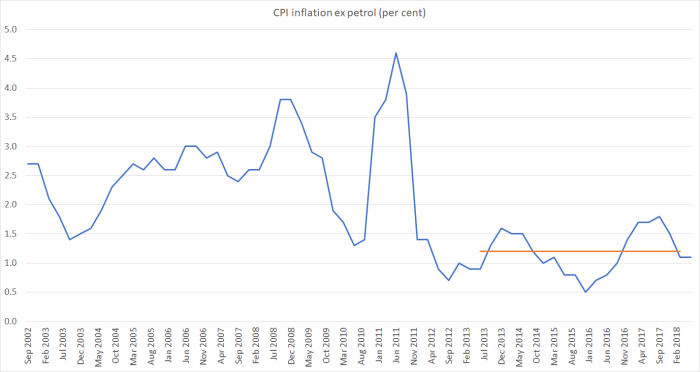
For example, the CPI ex-petrol is a very simple core measure.  Petrol prices are quite volatile.

CPI ex petrol to June 18

And yet the latest observation in this series is still a touch below the average inflation rate for the previous five years (and at 1.2 per cent well below the target midpoint).  And that is so even though the exchange rate has been unusually high in the last 12-18 months (headline CPI is sensitive to changes in the exchange rate).

There isn’t much sign of rising core inflation being an issue abroad either.  Here is the OECD data on CPI inflation ex food and energy, for the G7 grouping as a whole, and the median of the countries/areas with their own currencies (thus the euro area, like the US, is just one observation).

OECD core inflation jul 18

Both series bounce around a bit, but there isn’t much sign of any sort of breakout to a consistently higher rate of inflation.  Even among the G7, the latest observations suggest that if US core inflation is edging up a bit, that in the UK and the euro-area is falling back a bit (Japan’s June numbers aren’t available yet).

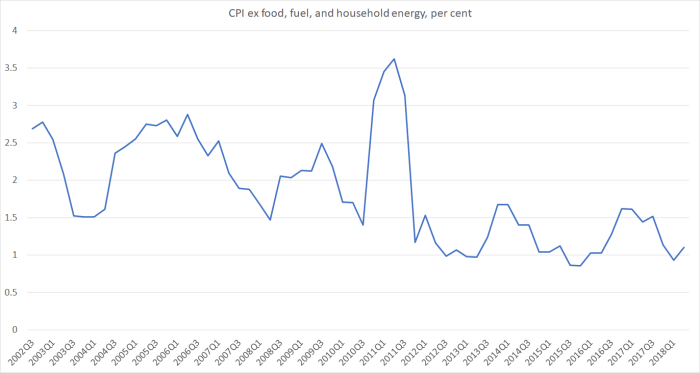
New Zealand might be different of course.  It isn’t obvious why we would be – eg our unemployment rate hasn’t fallen away further or faster than those in most other OECD countries –  but we might.   Here is the NZ version of the same series: CPI inflation ex food, vehicle fuels, and household energy.

cpi ex nz jul 18 2

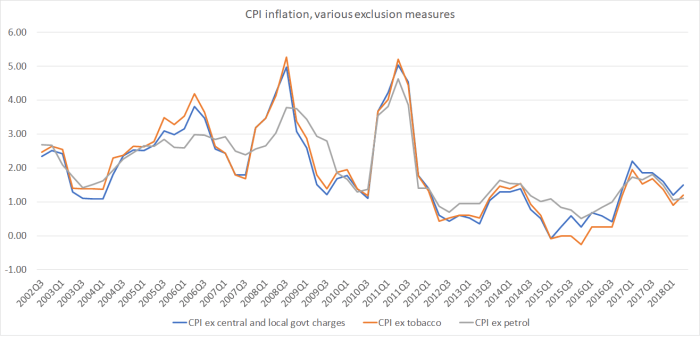
Indirect taxes and government charges also complicate the interpretation of the inflation numbers.  Weirdly, SNZ still does not publish a straightforward series excluding these effects, to give us a clean read on market prices.  It is not as if these are trivial issues either –  there was the GST increase a few years ago, there are large increases in tobacco taxes every year (which have had the effect of materially increasing the tobacco weight in the CPI), and there are changes in things like ACC levies and (this year) in government subsidies for tertiary fees.

Here are some individual exclusion measures.

cpi ex jul 18

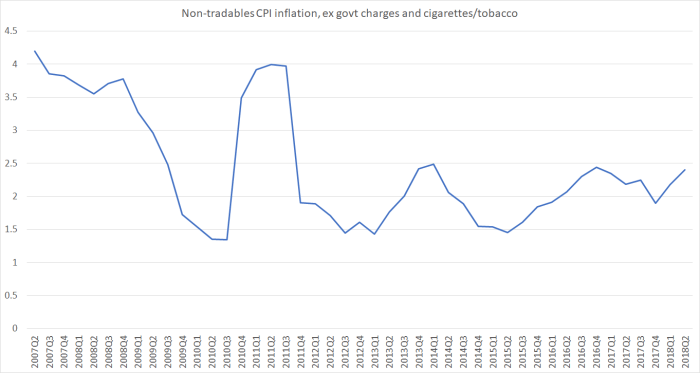
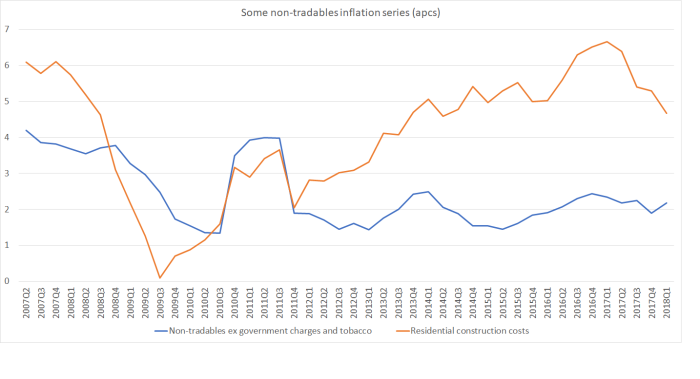
And here is a series SNZ does publish: non-tradables inflation excluding both central and local government charges and tobacco.

NT ex govt and tobacco jul 18

That might suggest a moderately encouraging story, of core non-tradables picking up.  But even if so, it would be the third pick-up in the past five or six years, and neither of the previous ones amounted to much.   Perhaps this time will be different?

One reason to think it might be a little different is developments in housing inflation: construction costs and rents make up quite a substantial proportion of non-tradables.

housing components

Rents are a much larger component of the CPI (9.2 per cent) than construction costs of new houses (5.5 per cent) but most of the cyclical fluctuations are in the construction cost component.   Construction cost inflation has been dropping away quite markedly since the start of last year (and for all the talk of renewed waves of housebuilding –  which I rather doubt will happen) there isn’t any obvious reason to think that phase of the cycle will reverse soon.   Some of the earlier increases in core non-tradables inflation will have reflected increasingly high inflation in construction costs, but since construction costs have been slowing for the last 18 months, the latest pick-up can’t be simply written off as a construction story.  But, whatever the story, core non-tradables inflation of only around 2.4 per cent is simply not going to be high enough to be consistent with core CPI inflation getting back to 2 per cent.  We’d need to see further increases in core non-tradables inflation from here, and with the rate of growth of demand having weakened it isn’t yet obvious that that is the most likely outcome.

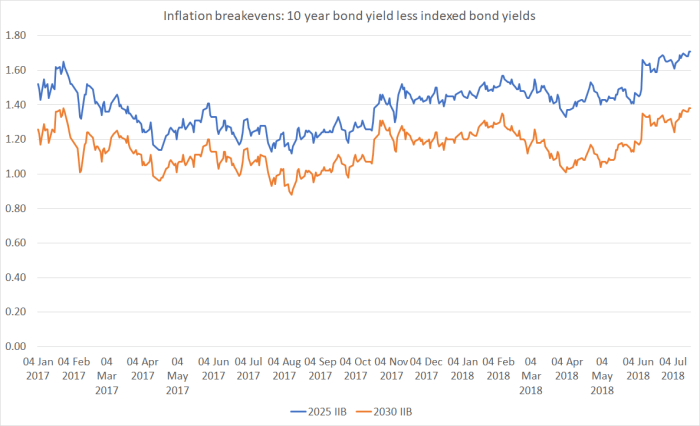
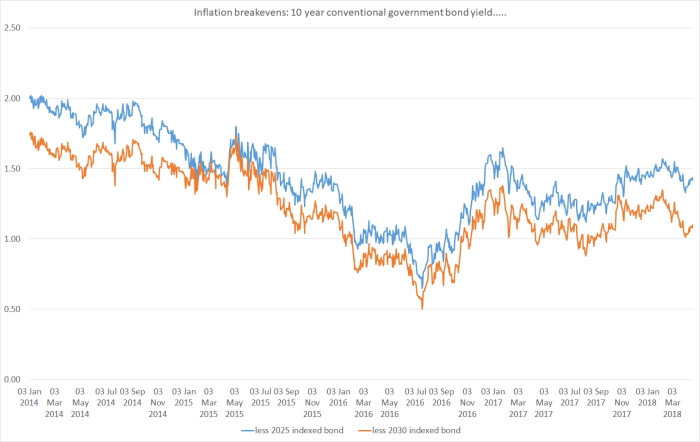
And what do the bond markets make of the situation?  Recall that there are two indexed bond maturities either side of the 10 year nominal bond.

IIB breakevens jul 18

There has been some drift high in the inflation breakevens, or implied inflation expectations, over the last 12 months or so.  But however one looks at things, it is hard to see the market pricing average inflation for the next decade much higher than about 1.6 per cent.  That is still a long way from the target midpoint of 2 per cent.

So where does all that leave me?    At very least, there is no sign that core inflation is falling and perhaps some reason to be encouraged, and to think it is picking up.   But however one looks at the numbers, current core inflation isn’t even close to 2 per cent, and by this stage of a long-running cycle (especially one characterised by weak productivity growth) one might have hoped –  even expected –  that core inflation might be running a bit above any target midpoint.   Notwithstanding the sectoral core measure, it seems too early for too much encouragement –  perhaps things are finally on course for a return to 2 per cent, but there are conflicting signs, and not too many compelling reasons to yet think that this time will be different.

What of the outlook?   With ebbing population pressures, weak business confidence, no fixes for the over-regulated and dysfunctional urban land markets, and various policy proposals that not only engender uncertainty but could act as considerable drag on actual and potential growth (eg net zero emissions targets), it isn’t obvious why core inflation is likely to rise from here.   Headline measures will, as always, be tossed around by oil prices developments (and petrol taxes), and a weakening exchange rate will push prices up a little.    Some might argue that public sector wage pressures, and higher minimum wage rates, will themselves contribute to higher domestic inflation.   Perhaps so, although I remain a bit sceptical that they will amount to much (even if there are some material relative price changes).   And, although no one knows when, the next recession is coming –  here and abroad.  From an inflation perspective, including positioning ourselves for the next downturn, we’d have been better off if the OCR had been a bit lower over the last couple of years

When economists all agree

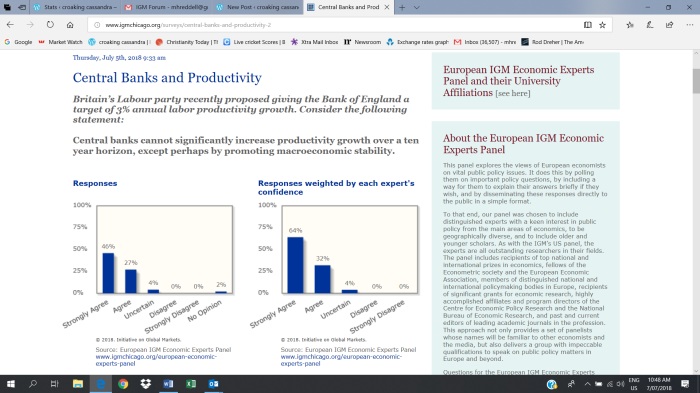
There was a new survey out last week from the European IGM panel of economics experts, about the recent proposal from the UK Labour Party to give the Bank of England an economywide productivity objective.  These were the results:

IGM productivity

Not a single economist in the panel seemed to think this was a good idea. Not one thought that central banks can make any material difference to productivity growth, except by promoting or maintaining macroeconomic stability.  Note that the question wasn’t just about monetary policy, and the Labour Party policy talks of the use of regulatory tools as well.

I share the view of the panellists, but it is interesting to see the answers coming through so strongly when the Bank of England itself (notably the chief economist Andy Haldane) has at times been quite vocal in arguing (drawing from this speech) that the costs of financial crises are large, and are either permanent or semi-permanent.    I’ve long been rather sceptical of that proposition (some arguments developed at the first link in the previous sentence).   Whether the respondents to the IGM survey connected the two stories I don’t know –  many would probably just have been running the conventional macro story that monetary policy is more or less neutral in the longer-run –  but the results are a useful reminder of just how limited monetary policy and banking regulation are in doing good, once one gets beyond the relatively short-term (perhaps three to five years).

It being school holidays, I’m taking a break and will resume late next week.   There are many things I haven’t got round to writing about so far this year, and I hope to put some of them high on the priority list in the coming weeks, including taxation.  For example, there are the officials’ papers for the Tax Working Group, in which it is recommended that rates of taxation on business incomes should not be lowered.    With such weak long-term rates of business investment, and low rates of productivity growth, you might have thought this was an obvious place to look.  But not, apparently, to the Treasury and IRD officials.  The bacillus of Treasury’s wellbeing approach has reached even into these background papers: lower rates of business taxation would, it is asserted, damage “social capital”.


What the Bank tells you ten times, still isn’t true

“Just the place for a Snark! I have said it twice:
That alone should encourage the crew.
Just the place for a Snark! I have said it thrice:
What I tell you three times is true.”

(Lewis Carroll, The Hunting of the Snark)

This was only the new Governor’s second OCR announcement, but the pattern seems to be getting quickly re-established.

This was the Governor in May

The emerging capacity constraints are projected to see New Zealand’s consumer price inflation gradually rise to our 2 percent annual target.

And this was the Governor today

inflation is expected to gradually rise to our 2 percent annual target, resulting from capacity pressures.

But this was the former (but unlawful) “acting Governor” in March

Over the medium term, CPI inflation is forecast to trend upwards towards the midpoint of the target range

And this was Spencer in his first pronouncement last September

Non-tradables inflation remains moderate but is expected to increase gradually as capacity pressure increases, bringing headline inflation to the midpoint of the target range over the medium term.

And this was the former Governor a year ago

Non-tradables and wage inflation remain moderate but are expected to increase gradually.  This will bring future headline inflation to the midpoint of the target band over the medium term

In one form or another, in fact, it was the story he told throughout his five year term.

And yet it just hasn’t happened.  And, as I illustrated the other day, market prices still don’t suggest it is expected to happen.

In the real world, saying it over and over again doesn’t make it any more likely to happen.   It might happen nonetheless –  there is a great deal of uncertainty about macroeconomics – but the Reserve Bank still isn’t giving us a compelling story as to why, having been wrong for years, we should now believe they have it right.  As I noted at the time of the May MPS, those doubts were only increased by his enthusiastic endorsement of his predecessors’ record

Perhaps even more startling, was his response when asked a question in which it was noted that Graeme Wheeler had failed to hit the inflation target midpoint, and Orr was asked whether he would be happy to be judged on his performance against that metric.  That seemed to set the Governor off in defence of his predecessors, claiming that the economy was in near-ideal cyclical sweet spot, and that he could not imagine a better place to start from as Governor.  A bit later he chipped in that he thought the Bank had been doing a ‘remarkable” job in forecasting core inflation –  a variable that hasn’t been anywhere near the explicit 2 per cent target since that target was put in place by Bill English almost six years ago. 

One can’t expect a full story in a one page OCR announcement such as today’s, but there wasn’t anything much more compelling in the MPS either.  And three months into his term we have not had a single on-the-record speech from the Governor about monetary policy, which is still his prime statutory function.     Lots of chatty greetings, but not a great deal of substance.

And all in a global climate that seems to be getting much more hostile, and risky.

But it isn’t inconsistent with the Bank’s Statement of Intent the other day.  In it, we are told that

 we will promote a deeper understanding at the Bank of tikanga Māori and te Reo Māori.

with no obvious connection drawn, that I could see, with anything in the Bank’s statutory mandate.  It will no doubt win the Governor feel-good points with his political masters, as he fights turf battles in the months to come.  But there was still nothing at all on ensuring that the Bank, and New Zealand policymakers more generally, are ready when the next serious recesssion hits –  stuff at the heart of what we have a monetary policy and central bank for.

In his statement today, the Governor included this, largely meaningless, line

The Official Cash Rate (OCR) will remain at 1.75 percent for now. However, we are well positioned to manage change in either direction – up or down – as necessary.

Of course he can move the OCR up or down 50 basis points (to me, the data –  as distinct from the vapourware masquerading as economic forecasts – suggest down).  But the big problem is that if circumstances ever require him to cut the OCR more than say 250 basis points –  and something in excess of 500 basis points has been more normal in serious downturns, here and abroad –  he can’t do it.  He knows it, and the markets know it.       Failure to do anything meaningful to reduce or mitigate those risks, and to communicate those plans to the public and markets, risks accentuating any downturn when it comes.

(I’ll be away for the next few days, but will come back next week to write about the Bank’s speech earlier this week on digital currency, perhaps best summarised as “how best to serve the banks, rather than the public”.)


Getting prepared for the next serious recession

Not infrequently over the last few years, I’ve criticised the Reserve Bank (and The Treasury and the Minister of Finance, both at least equally responsible) for the lack of any real sign that they were taking seriously the potentially severe limitations on the use of stabilisation policy (monetary policy in particular) in the next serious recession.  The topic never featured in speeches from the Governor, there was no published research on related issues, and getting ready never featured as a priority in the Bank’s annual Statements of Intent.

The potential problem, of course, is that – as things stand – the OCR can probably be lowered another couple of hundred basis points (to around -0.75 per cent) but for anything beyond that conventional monetary policy will quickly become quite ineffective, as large depositors (I’m thinking financial institutions and investment funds mostly) would exercise their option to switch into large holdings of (zero interest) physical cash.   People will still use bank accounts (negative interest rates and all) for most day to day transactions, but most financial assets aren’t held for immediate transactions purposes.

In typical past downturns OCR cuts of 500 basis points or more have been judged necesssary (the Reserve Bank cut by 575 basis points in 2008/09).   Similar magnitudes of adjustment have been made in, for example, the United States.

It is now almost 10 years since the Reserve Bank first cut the OCR to 2.5 per cent.  In the early years after that, the assumption was that (a) the 2008/09 recession had been unusually large, and (b) interest rates would soon need to be raised quite considerably, and so that whenever –  perhaps a decade hence –  the next recession happened New Zealand wasn’t likely to face a problem.  That was then.  As late as 2014 the then Governor was loudly talking up his plans to raise interest rates a lot, to –  as he saw it –  ‘normalise’ monetary policy.

But now it is 2018, and nominal interest rates are even lower than they were in 2008/09, and no serious observer thinks the Reserve Bank will have 500 basis points of policy leeway if another recession were to strike in the next few years (many doubt that the OCR will be raised much, if it all, in the intervening period, and a few –  including me –  think cuts would be more appropriate).  Most likely, the New Zealand economy will go into the next recession –  whenever it comes –  with the OCR 50 basis points either side of the current 1.75 per cent.  That just isn’t enough.   And the problem will be (greatly) compounded by the fact that central banks in almost all other advanced countries will be in much the same situation of worse (several already have their policy interest rates at -0.75 per cent.

If your central bank can’t cut policy rates (very much), and markets and firms/households know it, any incipient recession is likely to be worse than otherwise, and worse than we are used to (when downturns happen, central banks cut policy rates, often quite aggressively (if also often a bit belatedly), and people know/expect it).  Expectations of inflation may also drop away more sharply than we are used to, compounding the problems (real interest rates could raise, with nominal rates already on the floor).  Monetary policy has been the key stabilisation tool for decades, and (at best) it will be hobbled in any recession in the next few years.   For those who argue that interest rates don’t affect anything much domestically (a) I think you are wrong, but (b) the connection to the exchange rate is vital.   In monetary policy easing cycles in New Zealand, we also typically see big exchange rate adjustments, and that is part of how the economy stabilises and the next recovery begins.

Which is all a fairly long introduction to welcoming a new issue of the Bulletin published a few weeks ago by the Reserve Bank under the heading Aspects of implementing unconventional monetary policy in New Zealand.   As the introduction puts it

This article provides an overview of the experience with unconventional monetary policies since the global financial crisis of 2007/8, and assesses the scope for unconventional monetary policy in New Zealand. While there is no need to introduce unconventional monetary policies in New Zealand at this time, it is prudent to learn from other countries’ experiences and examine how such polices might work in New Zealand if the need arises.

It is, unambiguously, good to see such an article being published by the Bank.  Unfortunately, there is a degree of complacency about the content –  echoing remarks the Governor made at a recent press conference suggesting there was nothing to worry about – that should be quite disconcerting.  Complacency on such matters might be expected from politicians, with a tendency to live from one news cycle to the next.  We should not expect it from our central bankers.

As a brief survey of what other countries have done, the article is not bad.  There is some discussion of the experience with negiative policy rates, which comes to the pretty standard conclusion that policy rates probably can not usefully be taken below about -0.75 per cent.  There is a fairly long discussion of large scale asset purchases (mostly the government bond purchasing programmes) and some discussion of targeted term lending programmes operated in a few countries in the wake of the 2008/09 crisis.

Of large scale asset programmes, the Reserve Bank authors cautiously conclude

A large body of evidence shows that LSAPs were successful in easing financial conditions, through lower bond yields, higher asset prices and weaker exchange rates.11 The forward looking nature of financial markets means that most of the impact occurred on announcement, rather than when purchases were executed. As highlighted by Gagnon (2016), LSAPs can be especially powerful during times of financial stress, although the signalling and portfolio balance channels should still have a significant effect in normal times. There may, however, be diminishing returns through these channels. In particular, given the lower bound on short-term interest rates, there will be a limit to how far interest rates can be reduced via the signalling channel. Similarly, there is likely to be a lower bound on long-term interest rates (as investors have the option of holding paper currency with a fixed yield of zero) meaning additional purchases might not drive yields much below zero.

What really matters for central banks is whether LSAPs helped central banks achieve their mandates, related to achieving inflation, output and employment goals. While most studies into the effect of LSAPs in the post 2007/8 global financial crisis period find positive effects, they must be treated with caution. In part this is because of measurement issues: LSAPs have been implemented over a relatively short period since the 2007/8 global financial crisis, and previous historical relationships can have been expected to have changed. Overall, early work suggests LSAPs can be a beneficial monetary policy tool in exceptional circumstances. However the nature and extent of the transmission of these polices to inflation and activity is still being established.

Cautious as that is, I suspect it is not cautious enough.  For example, if one takes a cross-country approach there is little sign that long-term interest rates have fallen further relative to short-term interest rates in countries that did large scale asset purchases than in those which did not (for example, New Zealand and Australia).   Whatever the headline or announcement effects –  and some probably real effects in the midst of the crisis itself – without those longer-term effect on real bond rates, it is difficult to believe that the asset purchase programmes really made much difference to stabilisation and recovery.

Relatedly, as the authors note, the real test is surely progress towards meeting inflation targets and getting unemployment rates back down again quickly.  Against that standard, with the best unconventional tools central banks could deploy, on top of large reductions in policy rates, the experience has been very troubling –  the weakest recovery in many decades.  With that set of tools, the outlook the next time a serious recession hits has to be, almost by construction, worse than over the last decade.

But in many respects, the most interesting part of the article is the second half, exploring options for New Zealand.   Unfortunately, they do not seem to have moved very far at all from past work.  Just based on things I personally was involved in, in the late stages of the last recession I spent quite a bit of time at Treasury looking at options that might be deployed in things worsened further, and when the euro crisis was at its height in 2012 I led a Reserve Bank working group looking at some of the issues around how far we could go with conventional monetary policy, and what other instruments were then at our disposal.     The sorts of options we looked at then were helpful (and even then we reckoned the OCR could be cut to perhaps -0.75 per cent) but pretty limited.  The Bank seems no further ahead now and –  disconcertingly –  seems unbothered by that situation.

What tools do they have in mind?

The first is a negative OCR.

Overall, it appears that the Reserve Bank could implement negative interest rates, with the potential leakage into cash relatively small in value terms at modestly negative rates.

That seems right to me.  It would not be expected to involve, say, negative mortgage interest rates, but there have been some examples even of those in Scandinavia.

But it is the limits to the negative OCR which are the issue.

The second possible instrument they cover in the option of large-scale asset purchases.

As they note, there are not many (liquid) bond issues in New Zealand other than government bonds, and even the stock of government bonds is (generally fortunately) smaller than in many other advanced countries (including the US, UK, Japan and the more troubled parts of the euro-area).    And many passive holders of government bonds –  having made long-term asset allocation choices –  will not be that interested in selling.

In a New Zealand specific severe recession, these constraints might not matter very much.   Many of our government bonds are held by foreign investment funds, who have no natural (benchmark) reason to be in New Zealand.  Shake them loose by offering a high enough price and not only might bond yields fall quite a bit – at least initially –  but the exchange rate could be expected to fall too.  That latter channel would probably be much the most important one (since few New Zealand borrowers issue long-term debt, and those that do will typically swap it back into a floating rate exposure).

But if the downturn is pretty synchronised across a range of countries (as it was in 2008/09), that is a less compelling story.  Everyone will be trying to cut policy rates, and pretty everyone will be coming up against practical lower bounds.   Everyone can try to depreciate their currency, but in aggregate that ends up with not much expected change.  I’ve argued previously that if our OCR is ever around that of other advanced countries, our exchange rate should fall quite a lot, but at present the margins between our OCR and those of other countries is already smaller than we often find going into past recessions.

The Reserve Bank authors also note that the Bank could engage in (unlimited) unsterilised exchange rate intervention, buying assets in other countries’ currencies, and selling (‘printing’) New Zealand dollars, which the Bank can do without technical limit.   All else equal, that should tend to lower the exchange rate.

This might be more of an option for a small and inobtrusive country like New Zealand –  among the majors ‘currency war’ rhetoric would soon be flying. But even then, it isn’t likely to be a terribly effective policy.  The Reserve Bank notes some of the reasons (other countries trying to do the same thing – eg Australia our largest trade/investment partner).  But the other reason involves thinking about transmissions mechanisms: printing lots more New Zealand dollars creates more interest-bearing assets in New Zealand.  In normal circumstances, unsterilised intervention will drive down domestic interests rates, setting in train a mechanism that will lower the exchange rate, raise inflation etc etc.  But in this scenario, by construction, short-term interest rates can’t fall any further.    And there is no compelling reason to suppose that the holders of those new New Zealand dollars will want to spend more on goods and services (a channel which really might raise inflation).

The Reserve Bank briefly discusses the option of transacting the derivatives market, via interest rate swaps (larger and more liquid than the bond market).  This idea has been around for years.  There is no doubt it would enable the Reserve Bank to, say, cap the long-term (synthetic) interest rate, but it isn’t clear what good that would do, and there is no sign in the article of any new thinking in that regard.  The Bank talks of signalling gains –  communicating a commitment to keep the OCR low for a long period –  but I doubt that does much good beyond the short-term announcement effect.  For one, central banks can’t pre-commit, and markets and other observers will make their own judgements based on their read of the emerging economic data.

The final option they discuss is targeted term lending.   What they have mind here isn’t replacing market credit when funding markets seize up (as happened in 2008/09) but direct intervention in which the government and the Reserve Bank try to target credit to particular sectors.

This type of facility would provide collateralised term lending to banks at a subsidised rate if banks met specified lending objectives. These criteria would ensure that the low policy rate was being passed on to households and businesses. Holding collateral against the loans would mitigate the risks to the Reserve Bank’s balance sheet. Since a targeted lending scheme could see banks taking on more credit risk than they might otherwise choose, it would need to be carefully managed.

That final sentence is an understatement to say the very least.  Policies of this sort are really fiscal policy and, if done at all (which they should not be) should be done by the government itself, not the autonomous central bank.   Government involvement in encouraging credit provision to particular sectors has a poor track record, here or abroad (see US crisis ca 2008/09).   And when the Reserve Bank takes collateral to try to encourage/coerce banks into providing credit they would not otherwise provide, it is directly preferencing itself relative to other creditors (including depositors) if things later go wrong.

In an article about monetary policy, it is not surprising that the Bank gives little space to discretionary fiscal policy. But it is disconcerting that when they do touch on it, they get their basic facts wrong.

And in New Zealand, fiscal policy played an important role in the response to the 2007/08 global financial crisis.

Discretionary fiscal policy played no role at all in responding to the recession of 2008/09 (if anything, it was marginally contractionary given the cancellation of promised tax cuts in 2009).  Yes, the overal fiscal position slid into deficit but that was wholly because of (a) policy choices made before the government or Treasury realised there was a recession, and (b) automatic stabilisers, which are weaker in New Zealand than in most advanced countries.

As I said earlier on, the degree of complacency –  and refusal to confront options that really could make a significant difference –  is disconcerting.    The Bank argues

The Reserve Bank would look to communicate well in advance of any of unconventional policies being implemented, so as to enable financial markets and the government to prepare.

A nice sentiment, but as they note a few sentences later

we are rarely given the luxury of time when financial crises [or other recessions] hit

including because central banks are usually slow to recognise what is happening.  When you only have 200 basis points of conventional policy leeway –  and everyone knows that (a point not touched on in the article at all) –  they will need to be willing to signal a credible strategy very early.  And, on the evidence of this article, they do not have one (that would be likely to make any very material difference).

I suspect the authors really know that too, but prefer not (or are institutionally prevented from) saying so.  After all, they each smart people, and they know how poorly the world economy coped with, and recovered from, the last downturn, even deploying all sorts of unconventional policies  (fiscal and monetary) on top of the considerable conventional monetary policy leeway that existed going into that recession.  Even here –  where we never reached the limits of conventional policy –  the output gap remained negative, and the unemployment rate above official estimates of the NAIRU for eight or nine years.   Eight or nine years……..  That is just a huge amount of lost capacity, and of lives that are permanently blighted (prolonged involuntary spells of unemployment do that to people).

Perhaps the implicit argument is that we, and other countries, will do even more next time round.   But that isn’t likely.   Perhaps fiscal policy is, or should be, an option, at least in modestly-indebted countries like New Zealand, but any sober observer will recognise the real world political constraints other countries faced in using active fiscal policy to any great extent, for long, in the last recession.  Why is New Zealand likely to be different?

For much of the last decade, one has had the feeling –  in gubernatorial speeches and other commentary –  that, when it comes to it, the Reserve Bank really isn’t that bothered by lingering unemployment, excess capacity, or undershooting inflation.  One would like to think –  given his new mandate –  that the new Governor is different.  But this article isn’t really evidence for the defence on that score.

It is striking that the article does not engage at all with either of the two more radical options debated in other places and other countries:

  • reconfiguring the target for monetary policy.   This could take the form of a higher inflation target or, for example, the use of a price level or nominal GDP level target.  Each approach has its weaknesses, but either –  done in advance of the next serious downturn, not in midst when much of the opportunity is lost –  could help raise, and hold up, expectations about the path of the nominal economy, including inflation.
  • taking steps to material reduce the extent of the effective lower bound on nominal interest rates.

The latter remains my preference, for a number of reasons (including that the existing problem arises largely because central banks have  –  by law – monopolised note issue, and then not proved responsive to changing circumstances and technologies. Problems are usually best fixed at source.

If there is still a useful role for physical currency (I discussed some of these issues here), the ability to convert huge amounts of financial assets into physical currency, on demand, without pushing the price against you, is now a material obstacle to monetary policy doing its job in the next recession.    There is a good case for looking seriously at a variety of reform options, such as:

  • phasing out large denomination Reserve Bank notes (while perhaps again allowing private banks to offer them, on their own terms, conditions and technologies),
  • capping the physical Reserve Bank note issue, scaled to growth in, say, nominal GDP (perhaps with provision for overrides in the case of financial crisis runs),
  • putting a spread (between buy and sell prices) on Reserve Bank dealing in bank notes, or
  • auctioning a fixed quota of bank notes, and thus allowing the price to adjust semi-automatically  (when currency demand rises, as when the OCR goes materially negative) the cost of conversion rises.

These sorts of ideas are not new.  They do not get rid of the entire issue –  at an OCR of, say, -10 per cent, even transaction demand for bank deposits might dry up –  but they would go an awfully long way to ensuring that the next recession can be dealt with more effectively than the last.

If, for example, you thought the OCR was going to be set at -3 per cent for two years, then once storage and insurance costs are taken into account (the things that allow the OCR to be cut to around -0.75 per cent now), even a lump sum conversion cost (deposits into physical cash) of 5 per cent would be enough to keep almost everyone in deposits and bonds (even at negative yields) rather than physical cash.  That is a great deal leeway than the Reserve Bank has now.   Having that leeway –  and being willing to use it – helps ensure nominal rates don’t need to stay extremely low for too long.

In principle, many of these sorts of initiatives probably could be done in short order in the midst of the next serious downturn.  But we shouldn’t have to count on unknown crisis responses, the tenor of which have not been consulted on, socialised, and tested in advance.  It may even be that some legislative amendments might be required.

In summary, I welcome the fact that the Reserve Bank has begun to talk more openly about the potential limitations in its response to the next recession, but it is disconcerting that they still seem to be trying to minimise the potential severity of the issue.   In that, they aren’t alone.  I’m not aware of any central bank that has yet laid out credible plans to minimise the damage (although senior officials of the Federal Reserve have been more willing to talk about the issues openly).  In that, they are doing the public a serious dis-service, and risking worse outcomes than we need to face –  repeating the sort of reluctance to address issues that saw the world drift into crisis in the early 1930s.  Fortunately for the central bankers perhaps, it won’t be central bankers personally who pay the price.  That won’t be much consolation for the many ordinary people who do.

Since politicians, and not central bankers, are accountable to the voters, the Minister of Finance should be taking the lead in requiring a more pro-active (and open) set of preparations to be undertaken by the Reserve Bank and The Treasury.

UPDATE (6 July):   I have only just discovered that one of the authors of this article, whom I had known –  although not been close to  – for 35 years, had died shortly before publication.    Rereading this post, I don’t particularly resile from any of the content, but had I known I’d have written differently.



(Lack of) transparency at the Orr Reserve Bank

Since I have to spend a large chunk of the day at the Reserve Bank –  among other things, checking out how serious the Governor is about customer focus and about remediation when customers have problems (among the things he claims the right to demand from banks and insurers) in the case of the superannuation fund the Bank (=Governor) sponsors –  it seemed fitting to have a brief post focused on a Reserve Bank issue.

Long-term readers will recall that the previous Governor was notoriously secretive, except when it suited him.   Among the things he always refused to release were any minutes of any meetings of the Governing Committee (him and his two or three most senior staff).  The Governing Committee had been set up by Graeme Wheeler, and was sold to the world as the forum in which major decisions were made –  whether monetary policy, regulatory policy or whatever.   You might suppose that the records of such meetings would be of considerable public interest, and it is common internationally for the minutes of the meetings of any body responsible for monetary policy to be published, with a (typically) quite short lag.  But Graeme Wheeler seemed to think there was no legitimate case for such material to be released –  his model was that he should be obliged to tell us only what he wanted to tell us, how he wanted to tell it, and when he wanted to tell it.  That isn’t how the Official Information Act works, but that consideration never seemed to much bother the then-Governor.

But that was then.  Wheeler has left, bearing his CNZM, and we have a new Governor.  He talks a good talk about communicating more or better with outside audiences.  We’ve even had cartoons to help illustrate official documents, and at one press conference I think the assembled journalists were greeted in four languages.

So he seeks to build an impression of a more open Governor –  including by his (ill-judged)  willingness to talk freely about all manner of things that aren’t his responsibility.  And almost simultaneously with the Governor taking office, the Minister of Finance announced reforms he plans to legislate later in the year.  Under those (inadequate) reform proposals, there will be a statutory committee to make monetary policy decisions and –  fulfilling a Labour Party campaign pledge –  the minutes of the meetings of that new Monetary Policy Committee are to be published.  I’m sure that, if the Minister sticks to plan, they will be fairly anodyne minutes, but the indication has been that the minutes will outline any differences of view (even while not putting names to views or votes).  It will be a step forward when it happens.

And so, going into last month’s Monetary Policy Statement I noted that the new Governor could perhaps show his seriousness about being different from his predecessor, and get ahead of the forthcoming legislative provisions, by beginning to publish now the minutes of the Governing Committee (for meetings relevant to that MPS).   Ideally, as I noted, he would also pledge to publish the background papers for each MPS with a suitable lag (perhaps six weeks).

Nothing was forthcoming with the release of the Monetary Policy Statement –  just the cartoons, multi-lingual greetings (and a document itself that seemed to go down well with market economists).  So I lodged a request for the minutes of the Governing Committee meetings relating to the May MPS.

And last week I got my response.

…the Reserve Bank is withholding the information for the following reasons, and under the following provisions, of the Official Information Act (the OIA):

  • section 9(2)(d) – to avoid prejudice to the substantial economic interests of New Zealand; and
  • section 9(2)(g)(i) – to maintain the effective conduct of public affairs through the free and frank expression of opinions by or between officers and employees of the Reserve Bank in the course of their duty.

As advised previously, the Reserve Bank recognises the tension between disclosure and confidentiality and has considered your request in light of that tension. Public disclosure, in summary form, is essentially what happens with monetary policy decisions in a carefully considered media release and the full text of the Monetary Policy Statement. The process of deciding what to publish in these documents recognises and balances the tension between disclosure and confidentiality.

In other words, exactly the same approach adopted by the secretive and defensive Graeme Wheeler, and nothing is released at all.  Thus:

  • the date of the meeting,
  • the place the meeting was held,
  • the attendees at the meeting,
  • confirmation of the minutes of the previous meeting,
  • any subheadings outlining the nature of material discussed at the meeting,
  • and the final OCR (itself already published in the MPS)

all, in the Governor’s view, had to be withheld to protect the “substantial economic interests of New Zealand” or to protect “free and frank expression”.  I wonder if the Governor was worried there might one day be a debate about what day of the week it was.    The claim is so absurd it is hard to believe that serious people –  required to operate according to the principles of the Official Information Act –  could make the claim.  But the Governor does.

I can barely imagine a circumstance in which disclosure of material in such minutes could undermine the “substantial economic interests of New Zealand” (NB these aren’t the same as the “economic interests” of the Bank), especially when released several weeks after the MPS to which the discussion relates.  We aren’t talking about imminent bank failures here.  But perhaps there are such circumstances, in which case specific deletions  could be made and justified under this subsection.  Officials make such specific deletions every day (although not commonly, I gather, under this particular provision of the OIA).

The same goes for “free and frank”.  In the (extremely unlikely event) that the minutes ever recorded that the Deputy Governor (say) thought the Governor’s ideas about the OCR were barking mad, there might be a case for withholding that particular detail.  But no official writes minutes like that.    And recall that the Minister of Finance has already committed to the publication of minutes of the MPC a few months hence, once the legislation is in place.  Differences of view are supposed to be highlighted (even if not attributed by name).  It will be a small step forward, and the Minister has already decided that “free and frank” isn’t a good reason to withhold such material.

But the Governor clearly disagrees.  Perhaps he just wants to enjoy his last few months as the single decisionmaker.   But then –  it suiting him to do so –  he has already told us that all his advisers were unanimous last month that the OCR shouldn’t be changed.  So what can he possibly have to hide in those Governing Committee minutes?  The short answer is likely to be “nothing at all”, but he has quickly imbibed the traditional Reserve Bank resistance to Official Information Act scrutiny.

It is not a good sign.  I’ve been concerned that the reforms the Minister announced will be too weak to make any material difference, and suspicious that they will allow a Governor so inclined to dominate the new committee, suppressing debate and the serious examination of alternative interpretations or policy approaches.  Since Orr has never been one to encourage challenge or debate, that seemed a quite real and specific risk.  Which is why I thought I’d test the waters.  Had the Governor agreed to the release of MPS Governing Committee minutes (even with odd specific deletion) I’d have lauded him, and revised up my probabilities on his governorship, and the new MPC, proceeding well.

By simply refusing to release anything, it looks as though he has once again confirmed some of the fears people held (mostly quietly) about his appointment.  If so, that is a shame.   And however many languages he greets journalists in, however many cartoons he adds, serious scrutiny of powerful independent public agencies –  particularly as at present when all power is vested in one individual –  requires access to official information that won’t always suit the Governor.  Minutes of his policy committees are a good example, one most other Governors in advanced countries have come to live with, or even champion.

I’ve appealed this decision to the Ombudsman –  I might have a response by the end of next year –  but in a sense the point has already been made.  When it comes to things he is responsible for, Adrian Orr is no more open and transparent than his predecessor, who set the benchmark in quite the wrong places.  A government committed to more-open government (as the current one says it is) would have a quiet word to the Bank’s Board, and to the Governor, encouraging the Bank to think again.

Voting on monetary reform

This coming Sunday, voters in Switzerland get to vote on the future monetary system.  I don’t share the New Zealand Initiative’s enthusiasm for Switzerland –  the only OECD country since 1970 to have had slower productivity growth even than New Zealand –  but I do like the element of direct democracy in their system: binding referenda on matters initiated by citizens.  No doubt it produces some silly results at times, but that’s part of democracy –  not ideal, just better than the alternatives.    And it isn’t as if our own system is immune to silly policies, unaccountable institutions etc.

I’d forgotten that the Vollgeld referendum was coming up until I saw yesterday that the eminent Financial Times economics columnist Martin Wolf was expressing the hope that the Swiss vote for change this Sunday.  It isn’t clear that he really favours the general adoption of the specific system called for in the Swiss referendum but, in his words,

Finance needs change.  For that, it needs experiments.

Dread word that: experiments.  I remember the efforts we went to one year to get all uses of the word out of the OECD’s review of the New Zealand, in the midst of the reforms of the late 1980s and early 1990s.   For better or worse, one can’t do randomised control trials in macroeconomics and monetary policy: “experiments”, if tried at all, have to be done on entire nations.

What are the Swiss being asked to vote on next week?  The Vollgeld (“full money”) initiative is described by its proponents here, and described/analysed by a couple of independent Swiss economists here.

The key element of the proposal is this

The 100% reserves requirement means that all sight deposits in Swiss Francs (CHF) in Switzerland would have to be entirely kept as reserves in the Swiss National Bank. This implies that commercial banks would not be able anymore to use a fraction of these deposits to finance their lending activities, as they currently do. Swiss money would then entirely become “sovereign money”, controlled by the Swiss National Bank.

Proponents of the Vollgeld approach put a great deal of emphasis on something they label as “money”.   As they note, the issuance of notes and coins is controlled by the state –  even if in practice, supply simply respond to demand –  and argue that the same should apply to other transactions balances (eg a traditional cheque account).    Some seem to argue from a principled position that money creation is a natural business of the state, and thus direct control over the quantity of transactions balances created is simply a logical corollary.   Of course, in New Zealand it was almost 80 years after the establishment of responsible government before the state here issued any payments media (coincidentally, but not inconsistently, we were the highest income country in the world through much of that period).  Personally, I’d continue to mount an argument for removing the current state monopoly on the issue of bank notes.

Others focus on more pragmatic arguments around monetary and financial stability.  If all demand deposits are fully backed by deposits at the central bank – or, at the limit, if all demand deposits were directly claims on the central bank – and were held on a separate balance sheet, there would be no more bank runs on demand deposits.

Ideas of this sort aren’t new.  Proponents often hark back to the so-called Chicago Plan proposed by some prominent US economists in the 1930s, and at one stage in his career as orthodox a figure as Milton Friedman favoured 100 per cent reserve requirements for demand deposits.

But if the broad ideas aren’t new then, as the independent Swiss economists observe, runs on demand deposits also aren’t the main issue in real-world financial fragility.  They put that down to the existence of deposit insurance –  although Vollgeld advocates argue that under their system deposit insurance could be got rid of – but whatever the explanation

…the main source of fragility of modern banks is …..rather the wholesale short term debt issued by banks and held by professional investors, including other banks. These investors, who are not insured, may suddenly stop lending to a bank (this is called a wholesale run) if they suspect that the bank may have solvency problems. This wholesale short term debt is an important source of funding for the banks in the current system, but it is also a source of fragility, as the Global Financial Crisis of 2007-2009 has shown. The 100% reserves requirement would not apply to short term debt.

Wholesale funding markets seizing up was an issue even for Australasian banks in 2008/09.

Vollgeld advocates (at least those looking at the issue in detail) are aware of these other sort of “runs”, or market refusals to rollover funding at maturity, but don’t have a detailed response.

To tackle it, paragraph 2 of article 99a of the VGI mentions that the SNB would have the power to set a minimum duration for the debt issued by commercial banks. The VGI does not give much detail on this question, but it is clear that a new liquidity regulation would have to be introduced as a complement to the 100% reserve requirement. Indeed, financial stability can only be guaranteed in the Vollgeld system if the banks are strictly limited in their ability to issue wholesale short term debt as they do today.

I’ve long argued that the issue goes beyond even that.  One could have all –  or almost all – lending done by closed-end mutual funds (ie no early redemption at all, you just sell your claim on the open market) –  something like the model favoured by prominent US economist Larry Kotlikoff – and there would still be financial crises, they would just take a different form.   The nature of a market economy is that people get optimistic, and then over-optimistic, about particular industries, or the economy more generally.  And then opinion changes –  actual outcomes don’t quite meet expectations or whatever – and the flow of new investment, the flow of finance dries up.  The dot-com boom, and subsequent bust, were good examples of that.  So, in their way, were the Australasian post-deregulation booms and subsequent busts in the 1980s (they involved some bank failures late in the post-bust adjustment, but those failures were incidental).

And nothing in the Vollgeld proposals (or in similar Sovereign Money proposals in other countries, including New Zealand) deals with that.  Nor does it really deal with the fact that many countries –  including New Zealand and Australia and Canada –  have gone for a very long time without bank failures (except in that brief post-deregulation transition period), and yet not been immune to recessions, periods of ill-judged investments, or prolonged booms or prolonged periods of underperformance.

Some advocates of reform put a great deal of emphasis on the alleged problem that lending simultaneously creates deposits, at a systemwide level.  This is a feature not a bug.  Lending transfers claims on resources from one person to another, and both sides of that need to be recorded –  if I borrow to buy a house, the counterpart to that is that the seller of the house collects the proceeds of the sale.    These people tend to confuse the position of an individual bank –  for whom secure access to funding is absolutely critical – from the macroeconomics of the system as a whole.   No (later troubled) New Zealand finance company –  none of whom banked with the Reserve Bank – conjured its deposits out of nowhere: they first persuaded depositors and debenture holders to back their business model, and finance all manner of (often quite bad) projects.   The finance companies didn’t fail because they had on-demand deposits (mostly they didn’t) but because they made really bad loans, and were part of the associated misallocation of real resources.  Nothing in the Vollgeld initiative (or similar Sovereign Money proposals) seems to address that.

So why does someone as eminent as Martin Wolf encourage Swiss voters to vote for the Vollgeld initiative on Sunday?     Mostly, it seems from reading his article, because he grossly exaggerates the real economic cost of financial crises, conflating the headline events (runs on banks, wholesale or otherwise, bailouts etc) with the correction for the misallocation of real resources that occurrred during the boom years and (in the case of 2008/09) treating all the slowdown in productivity growth as a consequence of “the financial crisis” when signs of it were already apparent before the crises. (I dealt with some of these issues in this post some time ago. )   Changing the rules around transactions balances just wouldn’t make that much difference.  And although Martin Wolf and the Vollgeld advocates talk bravely of how such reforms might allow governments to more readily walk away from failing banks (ie the bits not offering transactions balances) at best that is aspirational.   AIG and the federal agencies weren’t offering transactions balances –  and were bailed –  and even in New Zealand one of the key motivations for the OBR model isn’t about transactions balances, but about maintaining the credit process (all the information on firms that enables banks to continue to provide working capital finance with confidence).

Over the years, I’ve spent lots of time looking at various monetary reform proposals.  When I was a young economist, Social Credit was still represented in the New Zealand Parliament, and their acolytes regularly wrote to the Governor and the Minister of Finance.  Their ideas genuinely were wrongheaded and dangerous.  In my experience, though, most such proposed reforms aren’t, and they often capture important elements of truth.  But the proponents typically oversell the likely gains from what they are proposing.  I don’t think the Vollgeld initiative model would be particularly damaging or costly –  although there are a lot of details not spelled out, and the transition could be very unsettling (especially in a world of zero or negative interest rates) – but it just wouldn’t offer the gains the proponents claim.  Monetary matters are rarely quite that important and in a market economy, human nature will have its head, and sometimes things will turn out badly.  More often, of course, real financial crises reflect wrongheaded policy interventions that skewed choices and incentives and made the bad outcomes more likely (I’d include both the US crisis of 2008/09, and the Irish crisis in that category –  and probably the Australasian and Nordic crises of the late 80s and early 90s).

In truth, calls for reform (from people like Wolf) and public support for ideas like the Vollgeld one (apparently perhaps 35 per cent of people may vote for it), probably stem more from some ill-defined sense that something is wrong (with economic and political outcomes).  Banks and monetary systems are a convenient target –  just like the idea here that somehow fixing monetary policy might make a material difference to our economic underperformance – but probably the wrong one.

Readers sometimes suggest that the Reserve Bank is reluctant to ever fully engage with alternative models. I’m not sure what they’ve been doing more recently, but when I was at the Bank I spent quite a bit of time over the years unpicking various proposals and trying to understand their strengths and weaknesses.  It wasn’t always very systematic, and often depended on the interests of individuals, but I’d be surprised if the Bank is that much different now.  We even used to send people along to debate some of those proposing alternative models.  A speech I did along those lines is here.   I’m not sure I’d stand by absolutely everything in it today, but we were an institution willing to engage.

Something of a mixed bag

The Monetary Policy Statement was released this morning, followed by the Governor’s press conference.  It was less entertaining than I’d feared, and he mostly stayed on mandate – albeit drifting off onto answering several questions about bank conduct (with no real attempt to tie his rhetoric to the Bank’s statutory responsibilities) rather than monetary policy.  Then again, the journalists seemed to give him a fairly easy time.  I’ll come back to some of the comments and questions a bit later.

I heartily commend the Bank on one thing.  This is from the first paragraph of the MPS

The direction of our next move is equally balanced, up or down. Only time and events will tell.

That puts them in a quite different place than the financial markets as a whole, or than respondents to the Bank’s survey of expectations, where almost everyone is convinced the next OCR change will be an increase.  After my post yesterday on the Survey of Expectations, the Bank sent out to respondents their slightly more detailed report.   That showed that none of the 41 respondents expected the OCR a year from now to be lower than it is today (I do, but although I printed off a copy of my answers, I seem to have omitted to submit them).    Sure, each individual respondent will have a probability distribution around their own responses, but it is a telling contrast to the Bank that not one has a central expectation of a lower rate.  Presumably the Governor’s willingness to be so upfront about this even distribution of risks over the next year or two (albeit not substantively that different from the line the Bank has taken previously) will have contributed to the fall in the exchange rate this morning.

That said, I’d issue the same caution as I’ve made previously. The Governor claimed, in his very first line that

The Official Cash Rate (OCR) will remain at 1.75 percent for some time to come.

“Will” is a very strong statement in a very uncertain situation (domestically and globally).  Wise central bankers don’t hold themselves out as knowing more than they do.  The Governor’s hunch at present might be that the OCR won’t change for a while, but he doesn’t (and can’t) know that much, and bald statements of this sort risk leaving the Bank more unwilling to move quickly (up or down) than might prove warranted.  The contrast with the modest tone of current RBA statements is striking.

We also had an outburst of transparency. The Governor told us that the decision to hold the OCR had had the unanimous support of his Governing Committee colleagues, and his internal Monetary Policy Committee staff advisers.    It is nice of him to tell us.  Graeme Wheeler did that once, apparently to buttress the case for the move he was then making, but then adamantly refused to release the same information about other (historical) decisions –  I discovered recently that the Ombudsman is still working his way towards a decision on my request that he review Wheeler’s decision.  Perhaps the new Governor could change courses and make this information routinely available, with a suitable (but modest lag).   Disclosure of information can’t threaten the national economic interest –  Wheeler’s assertion –  just when it happens not to suit the Governor for it to be released.

There was plenty of gush about the economy.  This line took me a bit by surprise

The recent growth in demand has been delivered by an unprecedented increase in employment.

But this is the chart of the HLFS employment (corrected for the series break in 2016).

HLFS E

Perhaps he just meant “unprecedented” since the last growth phase?

And amid all the talk about employment –  and the welcome (overdue) focus on labour market indicators –  the word “productivity”, and the near-complete lack of any growth it over recent years, appeared not once in the text of the entire document.  Nor in the Governor’s discussion of what he saw as puzzlingly low wage inflation.

In the course of the press conference, the Governor talked about his goal being to communicate better and more widely –  not just to “four bank economists” –   and about how the Bank would have to learn to communicate in plain English.  It is a laudable goal I guess, but it did sound a lot like the lines Graeme Wheeler was using only a few years ago.  Wheeler avoided one on ones with journalists of course (at least ones that might ask awkward questions), which Orr does not seem likely to do, at least in his early stages.  But Wheeler also made much of the number of speeches he and his staff were doing up and down the country in his early years.  Communication seems easy when you are starting out, and aren’t on the back foot.

I mentioned earlier that the Governor mostly stayed on mandate in the press conference.  There were a couple of small exceptions.  The first was when he was asked about what the obstacles were in the housing market, and his first clear simple response was “lack of affordable land”.   Graeme Wheeler was simply never that clear, and it was never clear if he actually appreciated the importance of the land issue and the associated regulatory failures.  Housing policy isn’t a matter for the Bank, but it is encouraging that the new Governor appears to recognise, at an analytical level, the core failure.   The other exception, which seemed to pass unnoticed (or not followed up anyway) was when the Governor suggested that with interest rates at current levels the government should be doing more investment spending.  Those aren’t calls for the central bank, on an issue where there will considerable partisan division of views.

Two aspects of the monetary policy responses puzzled and disconcerted me.

Bernard Hickey asked the Governor what he thought of the argument that central banks should be raising inflation now, so as to raise nominal interest rates, to provide more policy leeway in the next serious recession.   Orr’s rather glib response was that “I don’t think much of it at all”, suggesting that (a) central banks should just do what is right now, and (b) that there are other tools, methods and instruments.   Which is fine except that core inflation – even in New Zealand –  has been well below target for years so that, at least with hindsight, the central bank hasn’t been doing the right thing now.  Partly as a result market measures of inflation expectations are well below target.  And there is no other country where supplementary instruments (eg QE) have been so demonstrably successful that core inflation has quickly got back to target, even in a gradual recovery phase.   The Governor needs to get to grips with preparing more seriously for the next recession.  It will be along, perhaps before too long.

Perhaps even more startling, was his response when asked a question in which it was noted that Graeme Wheeler had failed to hit the inflation target midpoint, and Orr was asked whether he would be happy to be judged on his performance against that metric.  That seemed to set the Governor off in defence of his predecessors, claiming that the economy was in near-ideal cyclical sweet spot, and that he could not imagine a better place to start from as Governor.  A bit later he chipped in that he thought the Bank had been doing a ‘remarkable” job in forecasting core inflation –  a variable that hasn’t been anywhere near the explicit 2 per cent target since that target was put in place by Bill English almost six years ago.  I wouldn’t have expected him to criticise his predecessors explicitly –  although he more or less did so when discussing communications approaches –  but surely we should have hoped that the new Governor might have regretted that inflation had so persistently undershot, and committed to do everything in his power to avoid a repeat?   His failure to do so is a little disconcerting to say the least.    Even with a focus on employment/unemployment, the Governor’s own charts suggest that the labour market was allowed to run with quite unnecessary excess capacity for several years because the Bank misjudged the extent of inflation pressures.

Once again, we have a set of Bank projections that suggest things are just about to come right.  Productivity, for example, is just about to pick up, and so is inflation.  The Bank thinks that in two years time we will be almost back to 2 per cent inflation.  The problem, of course, is that the Bank has been running the same line for years now, and it just hasn’t happened.  Partly perhaps because he embraced the record of his predecessors, the new Governor gave us no reason to be confident that this time things really will be different.  That is quite a gap.

I see that ASB, continuing the plays on the Governor’s name, deems it an “Orrsome start”.  I wouldn’t call it an “Orrful start”, but if there are some encouraging aspects, there is plenty of room for improvement.  The Governor  –  being fluent –  seems to be prone to speaking a bit more quickly than he thinks.  Over time, that won’t necessarily serve him, or the Bank, that well.     But the absence of solid answers about why this time inflation really will get back to target –  in an economy that seems unlikely to grow even as fast as (the modest rates) managed over the last few years –  remains the most obvious gap.  Perhaps MPs could consider asking the Governor this afternoon about why we should believe him and his colleagues this time?

A sadly diminished central bank

Under the Reserve Bank Act as it stands at present, before a Governor is formally appointed the Minister of Finance is required to reach agreement on a Policy Targets Agreement (on monetary policy) with that person.  It is a strange system –  again one no other country has chosen to follow in law.  A Governor-designate may, for example, not know a great deal about monetary policy before taking up the job.  And it also appears to give a great deal of policy-setting power to an unelected official, treating the Governor-designate as almost an equal with the elected Minister of Finance.   Since the Governor-designate will generally be ambitious for the role –  and as even potential Governors give some deference to, for example, electoral mandates – in fact the Minister of Finance has the greater say.

The system is shortly to be replaced.  Here is what the Minister of Finance had to say in his announcement on the Reserve Bank reforms in late March.

Currently, the PTA is an agreement between the Minister of Finance and the Governor. Looking forward, as the MPC will be collectively responsible for making monetary policy decisions, it would be inappropriate for the Governor to be the sole member of the MPC to agree the operational objectives for monetary policy. As a result, we are changing to a model where the Minister of Finance sets the operational objectives for monetary policy. These objectives will be set after nonbinding advice from the Reserve Bank and the Treasury (as the Minister’s advisor) is released publicly.

The approach the Government has agreed to for the setting of operational objectives going forward was recommended by the Independent Expert Advisory Panel. This approach imposes discipline on the decisions of the Minister, given the fact that the Minister’s decision will need to take account of publicly disclosed advice from the Reserve Bank and the Treasury. Further accountability measures, such as requiring the Minister to justify decisions before the House, will be considered in the detailed design of this policy proposal.

It is also intended that the setting of monetary policy objectives going forward will involve greater transparency and public input. Decisions on monetary policy objectives are important, and therefore public debate and understanding should be required.

There are still a few unanswered questions, details to be fleshed out, but that looks a largely sensible approach.  I especially welcome the emphasis on

a) the routine pro-active disclosure of official (Treasury and Reserve Bank) advice on the setting of the operational objectives for monetary policy, and

(b) greater ex ante transparency, public input, and public debate.   Setting the operational objectives for monetary policy is the key bit of policy around macroeconomic stabilisation, and is far too important to be done secretly by the Minister and a few internal advisers.  In almost other area of multi-year policy, proposed frameworks would be open for much more public consultation, scrutiny and debate.  I’ve written previously about the much more open approach adopted to the five-yearly refresh of monetary policy targets in Canada.

So, well done Minister.

But despite the admirable promises about the future, in the most recent PTA (that signed with Adrian Orr in late March, a day before he took office), the process seems to have borne no resemblance to what the Minister promises for the future.

There was no public consultation (indeed, the Treasury papers that have been released talk of some consultation with some market economists in 2016 –  under a different government with a different view on monetary policy and the Reserve Bank).

The Treasury advice to the Minister has been pro-actively released (I wrote about it here), but it was disturbingly thin in key areas (issues around the effective lower bound for nominal interest rates, and the next recession).

And what of the Reserve Bank?  One might expect that the Reserve Bank itself would have the greatest concentration of official expertise on monetary policy and related issues –  not just drafting issues, but the key economic issues, including some of those monetary management issues that are just over the horizon).  One certainly wouldn’t want only Reserve Bank perspectives taken into account –  after all, one key part of the PTA involves the Minister, acting in the public interest, disciplining and holding to account the Reserve Bank –  but it would be astonishing if they didn’t have useful perspectives to add.   Perspectives that really should be seen by both the Minister of Finance and by the Governor-designate.  The Minister’s statement about future arrangements would suggest that, at least in principle, he’d agree.

When the Policy Targets Agreement was released I noted that I had lodged an Official Information Act request for the Reserve Bank’s analysis and advice on PTA issues, but that I didn’t really expect much, because I expected to be obstructed and delayed.

There was a bit of delay, in that the Bank took almost the full 20 working days to respond when –  as will shortly be clear –  they could have (and by law should have) responded almost immediately.

This was what I asked for

Copies of any papers relating to the new Policy Targets Agreement signed earlier this week.  I am interested in any advice to the Minister or his office, and any advice provided to the then Governor-designate, as well as any substantive internal advice or analysis papers prepared or obtained in the period since the current government was formed.

and this was the response

The Reserve Bank didn’t provide advice about the Policy Targets Agreement (PTA) to Adrian Orr prior to his start as Governor, and advice to the Minister of Finance was provided by the Treasury rather than the Reserve Bank.

That is a categorical statement: no advice (written or oral) to the Minister of Finance, and no advice (written or oral) to the Governor-designate.

In a follow-up email exchange, I also clarified with them that there were no “substantive internal advice or analysis papers prepared or obtained in the period since the current government was formed” either.

And there was also nothing of this sort in the Briefing for the Incoming Minister released late last year either.

It is almost literally incredible –  ie impossible to believe.  Public servants of my acquaintance have suggested that the Bank might just be lying, but I don’t believe that.  Or perhaps I crafted my request too narrowly?  Perhaps they had done substantive analytical pieces before the election rather than after it, but given the differences in emphasis between the two main parties it doesn’t seem likely that one would really be a substitute for the other.  And they probably will have provided comments to Treasury on drafts of its advice to the Minister, but nothing in that advice is a distinctively Reserve Bank contribution.

It seems rather a sad commentary on what the organisation seems to have become over recent years.  There has been much talk about collective monetary policy decisionmaking –  and ministerial commitments to legislate –  and yet the new Governor apparently neither sought nor received any advice from his (new) senior colleagues on the drafting of the Policy Targets Agreement, the key macroeconomic stabilisation policy document.  The Reserve Bank has substantial experience with the conduct of monetary policy here,  substantial exposure to what is done in other countries, and a significant research capability funded by taxpayers (presumably, at least in part, to shed light on such issues).   The Minister of Finance says he wants future PTAs (or their equivalent) to benefit from (published) advice from both the Reserve Bank and the Treasury, and yet he sought –  or at least received –  none this time from the Reserve Bank.  And yet the Bank itself, if its OIA response is to be believed, had done no substantive analysis or internal advice on PTA issues in the months between the government  – with, for example, its new emphasis on employment – taking office and the signing of a new PTA.

It seems like some sad mix of abdication of responsibility, and the sidelining of the institution that is supposed to be centre of official professional expertise in the area.

It is a far cry from, for example, the approach taken fifteen years earlier.  In April 2002 Don Brash resigned as Governor, and Rod Carr was appointed to act, holding the fort until a new permanent appointment could be made.  That process in turn spanned a general election.  At the time, Reserve Bank senior management took the view that it would prudent and useful for us to invest quite heavily in preparing background papers which could assist the Minister of Finance, The Treasury, the Board, and whoever was being considered for appointment as Governor to (a) get to grips with the issue, and (b) see where our reading of the evidence and arguments had led us to.  The resulting 100 page document is here.    And that wasn’t the limit of our involvement.  We provided advice to Alan Bollard (before he took office) for his discussions with the Minister of Finance, and participated directly in at least one (I say “at least” because I attended one  myself) of his meetings with the Minister on detailed issues around the negotiation of the Policy Targets Agreement.   It wasn’t a climate in which Reserve Bank staff and management perspectives were necessarily overly welcome –  the Bank was to some extent seen as almost an ideological “enemy” (see, as one cause, Don Brash’s 2001 speech I wrote about recently) and there was a great deal of opposition in the Beehive to the idea of anyone internal getting the job as Governor.     But it didn’t stop the Bank preparing and supplying what was (to my mind) reasonably good quality analysis and advice.

As I’ve said previously, the Reserve Bank certainly shouldn’t have a monopoly on advice/analysis in this area –  and much of its analysis on various issues in recent years has been less good than it should –  but the apparent complete lack of any serious analysis or advice to the Minister or the Governor-designate reflects pretty poorly on all involved –  Minister, “acting Governor”, Governor-designate.   It tells of a sadly diminished central bank.

Designing monetary policy committees, revisited

(This post is likely to interest only those with a relatively detailed interest in the reform of the Reserve Bank.)

A month or so ago the Minister of Finance announced the outline of his planned legislative reforms of the monetary policy provisions (objectives and decisionmaking) of the Reserve Bank of New Zealand Act.  According to the material released then

What are the next steps for progressing the outcomes of Phase 1 of the Review?
Officials will advise the Minister of Finance on detailed implementation issues associated with the high-level Phase 1 decisions by late May.

so presumably Treasury is beavering away at present, with the Reserve Bank chipping in to try to retain as much effective control with the Governor and his management team as possible.  Unless, that is, the new Governor is taking a quite different –  and more open and legitimacy-focused –  approach than the Deputy and Assistant Governor he inherited from Graeme Wheeler.   Legitimacy is a key focus in a major new book (Unelected Poweron the institutional design of central banks –  and other autonomous government policy/regulatory agencies – published a week or so ago, and written by Paul Tucker former Deputy Governor of the Bank of England.

I’ve written various posts on aspects of the detailed design issues.  And in a post last week, I dealt with a recent conference presentation on these and related issues by two former central bank officials, one of whom was David Archer, former Assistant Governor (and successively head of financial markets and head of economics) of the Reserve Bank, and now head of the department for central bank studies at the Bank for International Settlements (a “club” for central banks).

I’ve been learning from –  and often disagreeing with – David for almost 35 years now, since he was briefly my boss in my first year out of university, when I was tossed a paper he was writing on reforming the operational aspects of monetary policy and asked for my comments.  He was my boss in a couple of other stints, and then for most of his last few years at the Reserve Bank, he was head of economics and I was head of financial markets.  Frustrating as he could sometimes be –  and I’m sure the sentiment was reciprocated at times – I reckon that in many respects he’d have made a pretty good Governor, at least of a monetary policy focused central bank.  These days he has the advantage of moving among a bunch of very able experts, and perhaps the disadvantage that those people are mostly insiders (formally or not), and his employer is an organisation that doesn’t need to worry much about legitimacy.  Readers may think I’m given to idealism, but on a pragmatism-idealism scale, I’m further to the pragmatic/political end of the spectrum and David towards the idealistic/technocratic end.

As I hope was apparent in post last week, there is a great deal David and I agree on in the context of designing laws, and associated rules, for monetary policy.

  • moving away from a single decisionmaker model (an innovation in the 1989 Act that no one chose to follow, and which has become increasingly less appropriate),
  • that public confidence in the legitimacy of the institution is crucial if operational independence is to be sustained,

Thus far, most people would agree. But we go further:

  • groupthink is a serious risk in any institution, and in any Monetary Policy Committee, and groupthink can seriously undermine the advantages of establishing a committee,
  • free-riding is also a risk in any such committee, and thus
  • a Monetary Policy Committee should have a clear majority of outside members,
  • and those members should be individually accountable for their advice and their vote,
  • a diversity of views/perspectives should be sought, and encouraged (consistent with the high degree of uncertainty and the risks of groupthink in any institution),
  • a role for parliamentary scrutiny (in my case) or approval (in David’s) for people nominated to serve on an MPC,
  • proper and substantive minutes of MPC meetings should be published, with no more than a short lag.  Such minutes should capture and convey the differing perspectives that individual members bring to the discussion (whether about specific OCR decisions, or the approach the committee is taking to monetary policy).  A parallel exists in the form of the range of (majority and minority) opinions judges of higher courts often deliver in deciding cases.
  • individual MPC members should be free to give speeches or interviews articulating their perspective on monetary policy issues, and not be bound to present only a majority institutional view,
  • appointment terms should be staggered, and of a significant length.   David favours prohibiting reappointment, although I’m more hesitant about going that far (because very long term weakens the effective accountability we both seek).
  • periodic external reviews of monetary policy have an important role to play, and should be an established feature of the system (rather than, say, a response to specific episodes of discontent).

Since my post last week, David and I have been exchanging notes on a couple of the issues where our views diverge.  (There are probably others –  while I’d not be averse to a single non-New Zealand member of an MPC, David would  – on past form –  be more open to a larger foreign participation.  For me, one element of legitimacy is about –  in Paul Tucker’s phrase –  perceptions of “values compatibility”.  The New Zealand public need to be confident that an autonomous central bank is working for them, and that is more likely –  at the margin – when the decisionmakers are themselves drawn from that community).  David has given me permission to quote from our exchange.

In my earlier post, I quoted from the Archer/Levin slides

The MPC should formulate a systematic and transparent strategy that guides its specific policy decisions over the coming year or so.

and observed

Easy enough to write down, but hard to make it mean anything particularly specific.

In response he noted (emphasis and link added)

As in my comments on Rennie, and as in Andy’s presentation, I see 3 layers for policy. Call them framework, strategy and tactics. They correspond roughly with what goes into a PTA; the policy reaction function that goes into the forecasting model (alternatively, a Taylor rule or alternative rule that captures the systematic aspects of policy in pursuit of the target(s)); and the stuff around nowcasting and forecasting. Andy and John Taylor and others argue that the Fed should be articulating its strategy, and disclosing that, though Andy is more open on the form in which the strategy is articulated that John appears to be. You and I argue that the RBNZ should disclose its model, also so that the systematic parts of the Bank’s thinking are on display. We’re all talking about central banks being more open about the systematic elements that are under the their control, to improve discipline and legitimacy.

So I actually think we’re in a similar place. We might disagree on whether a Taylor Rule type of PRF [policy reaction function] “dumbs down” the policy process too much – in my view, the ability of the Taylor Rule (or variants thereof) to capture the essence of policy needs is remarkable and telling, as is the regularity with which departures from TRs have turned out to be mistakes. And we share the view that central banks should be required to explain why they think this time is different, which is helped by having a publicly disclosed benchmark.

We both agreed that forecasting is of little value.

Part of the context here is about proposals in the US to require, by law, the Federal Reserve to publish the reasons why its interest rate decisions deviate from the recommendations of, say, the Taylor rule (a fairly simple, but at times surprisingly useful, guide to how central banks (should/do) run monetary policy (using just a neutral interest rate, an output (or employment) gap, and the gap between the inflation rate and target).  David is more sympathetic to something along those lines than I am, and sees the primary role of an MPC as to formulate and articulate a strategy to guide monetary policy.

In response I wrote

I’m inclined to agree that the Taylor rule seemed to do a remarkably good job for a period, although am less sure of its value in the last 5-10 years, because one of the key questions that central banks have had to grapple with (implicitly or explicitly) is what is happening to the natural interest rate itself –  and Taylor can’t offer useful insights on that.  As you note, I would favour the RB publishing its forecasting model, including the reaction function (as part of much greater sense of input-transparency all round), altho I’m more sceptical about the ability of the reaction function to really represent all the contingencies a committee of policymakers (esp an individualistic one) is likely to have in mind.  I’d probably put more weight on the potential for good minutes –  of the sort you suggest –  combined with a requirement for MPC members to publish their individual estimates of key system parameters (neutral interest rate, NAIRU –  akin to the final observation in the Fed dot-plot) to provide a steer as to thinking, and something later to use for some sort of accountability.

In other words, I’m all in favour of an MPC publishing lots of its inputs (eg the background staff papers it receives) and a lot about individual members’ priors.  Like David, I favour the publication of good minutes.   But I’m sceptical that an MPC can usefully go very much beyond what is captured in a PTA –  the bit the Minister of Finance controls.   There is just too much uncertainty about how the economy works at any particular point in time –  more so in the last decade with a great deal of uncertainty about “the” neutral interest rate – for statements of MPC strategy to add very much value.

Our other area of disagreement seems to be over the type of people who should be appointed to serve on a statutory Monetary Policy Committee.

In his announcement of the proposed New Zealand reforms, the Minister of Finance indicated his view on that issue as follows:

External members will have knowledge and experience in relevant policy areas (such as economics, finance, banking, or public policy). However, members will not be limited to monetary policy experts. External members will need to be free from conflicts of interest and will not be on the MPC to represent a particular sector.

It is worth noting that there is no particular reason to expect that most of the internal members will be monetary policy experts either.  At present, for example, the Governor is chief executive for a broadranging organisation, and may not have had a strong background in monetary policy (neither Brash, Bollard nor Wheeler did), and the current deputy governor is a career public servant with an economics background mostly in labour and fiscal issues.

I wasn’t unhappy with Grant Robertson’s description of the sort of people he expected would be appointed.  But in the Archer/Levin slides, they argued

…..the MPC should comprise a diverse group of experts who are individually accountable for their policy decisions.

To which I responded briefly.

I’m not totally persuaded by the “experts” line myself –  one needs lots of expert input/advice to policy, but when it comes to decisionmaking, soundness is at least as important as cleverness.

To which David responded (we both agreed that the value of outsiders shouldn’t be in bringing a better class of business anecdote to the table –  the role the external advisers play at present)

….the big issues in policy-making, the ones that impact on welfare, concern choices of framework and choices of strategy. Right now, as you also argue, the greatest attention by far should be on whether policy design is right. Do we have the right tools? Can we get interest rates to move enough in response to demand perturbations, without banging into lower bounds? What do we think about the appropriate speed of response? If we had a price level “attractor”, would that help induce stronger responses to negative perturbations that risk acquiring a deflationary dynamic? When might asset prices or other indicators of collective manias sensibly affect policy making? Questions about the variability of the exchange rate come into play in open economies. These are the things that can make a real difference. Tactics don’t. So if we’re staffing a policy committee, we should staff it to be capable of handling such questions, and bring a diversity of approach to the thinking on them. From my observation, it’s in relation to these questions where Group Think has its greatest hold. People find it easy to disagree on timing and tactics, but find it very hard to challenge accepted frameworks.

Hence I come down in favour of a diversity of people with the expertise and inclination to handle evaluations of frameworks and strategy, rather than something aimed to reflect the composition of society or of economic activity. And I acknowledge a cost to that approach: political legitimacy is less readily supported, because the policy committee members are not obviously “like us”.

It is an ambitious vision.  I wasn’t persuaded though

…..where we disagree is whether one looks to the MPC members primarily as expert analysts and decisionmakers/communicators in one, or as customers/purchasers for expert analysis, and then decisionmakers/communicators.  I can’t think of many (any?) bodies in our society that function in the former way.  …..  I guess I”m inclined to think that I want MPC members (including the Governor) who will create a climate that encourages debate, and research, and engagement –  inside and outside the Bank –  on all the sorts of issues you raise, and more, rather than being those experts themselves.  It doesn’t mean I’m opposed to have some genuine experts on the committee, but it might be undesirable (even if enough were available) for them all to be experts. For a start, those people won’t necessarily have the (eg) communications skills a public agency needs, or the institutional political skills.  And realistically, not one of the Governors in my career (here and abroad, …..) has been what I would call a monetary policy expert.   Arguably, none of the deputy governors have been either.  Perhaps that should be changed, but there are pretty slim pickings, and frankly what worried me more about Graeme wasn’t his lack of expert background as his lack of openness to debate/challenge scrutiny.  Realistically also, even if we had resident academics who were strong in these areas, many might be better used –  and themselves prefer –  to be based in the academy, generating research and then interacting with policy people, than devoting large chunks of their time to “tactics” and related stuff.
You also note that “People find it easy to disagree on timing and tactics, but find it very hard to challenge accepted frameworks.”.   Maybe, altho your great chart from the Sept 08 FOMC [reproduced in last week’s post] argues against that (at a time when it counted).
On my telling, an MPC should be a balanced panel of people, dominated by outside non-executives, but drawing on high level technical expertise (staff and outside resources).  Since I favour separating monetary policy and regulatory functions into separate institutions, I would favour seeking a monetary policy expert as Governor (and chief executive).   To me, the parallel is with something like the Cabinet –  drawing on expert advice, sometimes ignoring it completely, without themselves being the experts.   That seems more like the way in which we typically run institutions in our society (a telecoms company board will typically benefit from having some people who really know tech/telecoms but will rarely be exclusively comprised of such people).
David responded, having emphasised his view that frameworks and strategies, rather than specific OCR decisions, are mainly what we want an MPC for.

How does one evaluate alternative frameworks and strategies? With extensive modelling exercises, and empirical evaluation of results of different frameworks and strategies at work in practice in comparable countries. Evaluating, making sense of, and extracting the lessons from such research is thus the main task. The expertise required should be sufficient to evaluate research effectively, but not necessarily to design and conduct that research. What the candidate MPC member needs is sufficient training in economics to understand the research they are being presented with. There’s a specialised vocabulary involved. Different research methods take quite some time to understand, especially in terms of the implicit assumptions involved in the choice of method. Perhaps most importantly, even very experienced lay people struggle to grasp the general equilibrium mind set, which is crucial to comprehending how the macroeconomy responds to various impulses over the time frames relevant to the design of frameworks and strategies.

…. Experts should not be equated with PhDs with great track records for research and publication (though they shouldn’t rule the person out).

I’m not persuaded.  There is certainly a need for plenty of background research, and the synthesising and application of that research to a New Zealand context. But I don’t think decisionmakers need to be literate in the issues in the sort of depth David suggests, and I think there is a real risk that – even if enough such people could be found in New Zealand –  such a panel of people might prove more interested in the esoterica of some of the debates (and the important issues that really matter, like the near-zero lower bound) than about actually making good OCR decisions that deliver inflation consistently at or near whatever target the Minister of Finance has set.  This is a point Paul Tucker makes in his book: reputation is a key element of public sector accountability, but for it to work, the appointed policymakers have to care about the stuff the public is looking for from th institution.   People with a stronger interest in the international conference circuit (I’m caricaturing, but it is a risk) than in short-medium term New Zealand macro outcomes, won’t end up with very much effective domestic accountability.

Tucker also makes a point I’ve made here repeatedly.   Requiring technical expertise to be brought to bear before decisions are made does not mean that the technical experts should be the decisionmakers.   We need to bring a lot of technical expertise to bear around monetary policy (tactical decisions and framework design) but in my view much of that expertise should reside on the staff of the Reserve Bank, and it should be one of the prime roles of the Governor to (a) foster such expertise, and (b) ensure it is exposed to external challenge and scrutiny (and alternative external perspectives) and (c) to ensure the results, and alternative interpretations, are translated into language decisionmakers –  on the MPC –  can make sense of, and can question and challenge (and where those decisionmakers have the incentive to do so).  I’m sure there is a place for some monetary policy experts on an MPC –  including among the externals – but the MPC should no more be dominated by such people than (say) major decisions on war and peace should be made by generals (no matter how valuable their technical advice might be).    Legitimacy is rarely achieved simply by technical expertise.

These are important issues to be thought through in the design of the new MPC for New Zealand, and in the process of making the first wave of appointments (which will establish much of how the MPC works).  In practice, in a New Zealand context (given limited pools of candidates) I’m not sure how far apart David Archer and I would end up being, but I hope Treasury and the Minister are giving some thought to the sorts of issues raised here.


Inflation still looks pretty subdued

The latest CPI data were released a couple of days ago.  Perhaps the only real news was that nothing much seemed to have changed, here or abroad, in the last few months’ data.

Here is a chart of OECD core inflation rates

oecd core inflation apr 18

I’ve shown a few different indicators.  Whichever you prefer there isn’t much sign of inflation picking up in the rest of the advanced economies.

Here is the Reserve Bank’s preferred core inflation measure.

sec fac model april 18

If there has been some hint of inflation picking up a little, it remains as excruciatingly slow as ever.   In a series with lots of persistence, the 2 per cent target midpoint seems a long way away.   And although the Reserve Bank and some outside analysts like to suggest this is all about tradables inflation (a) the gap between the core tradables and non-tradables inflation at present is just around the historical average, and (b) tradables inflation, in New Zealand dollar terms, is at least in part an outcome of monetary policy (the exchange rate directly influences it).

Here are a couple of non-tradables series I’ve shown before.

NT inflation bits

This measure of core non-tradables remains persisently below the rate (somewhere near 3 per cent) that would be consistent with overall core inflation remaining around the 2 per cent target.    The extent to which construction cost inflation has been falling away again is now quite marked: it doesn’t just look like noise.

And what of market implied expectations of future inflation from the government bond market?

IIB breakevens Apr 18Nowhere near 2 per cent, and if anything a bit lower than they were three months ago when the last inflation numbers were released.

Pictures like these should be a challenge for the new Governor as he ponders his first OCR decision and associated communications.   After all these years, there still isn’t much sign of (core) inflation getting back to 2 per cent, and there doesn’t seem much impetus from either domestic demand (for which construction cost inflation is often an important straw in the wind) or foreign inflation.

Some who have previously been “dovish” now point to higher oil prices as a reason –  either directly, or just as a straw in the wind – why perhaps core inflation will finally pick up.  Perhaps, but it is hardly been an infallible indicator historically.  Others note that our exchange rate has fallen.  That’s true too, but at present the TWI is about 2-3 per cent lower than the five-yearly average level (not much more than noise), and historically falling exchange rate have often been associated with falling non-tradables inflation (depending what drives the particular exchange rate move).

Time will tell, but in his RNZ interview the other day I heard the Governor praising the “courage” of central banks internationally for having held interest rates so low for so long, despite very strong growth, to help get the inflation rates back up to target.  I wasn’t sure I recognised any element of the description –  in the advanced world, central banks have mostly been reluctant to have interest rates low, and growth has rarely been particularly strong (both caveats seem to describe New Zealand).  But perhaps the Governor needs to consider displaying some of courage he says he has admired and take steps to get New Zealand inflation securely back to target.