Scattered MPS points

I don’t want to say much about yesterday’s Monetary Policy Statement itself. It was the last before the MPC knocks off for their very long summer holiday and the last for the temporary Governor, the last of the old MPC who were responsible for the inflationary mess (and all those LSAP losses). A 25 basis point OCR cut seemed like it was probably the right call, but it was good to see some evidence of a range of views (in the form of one dissenting vote).

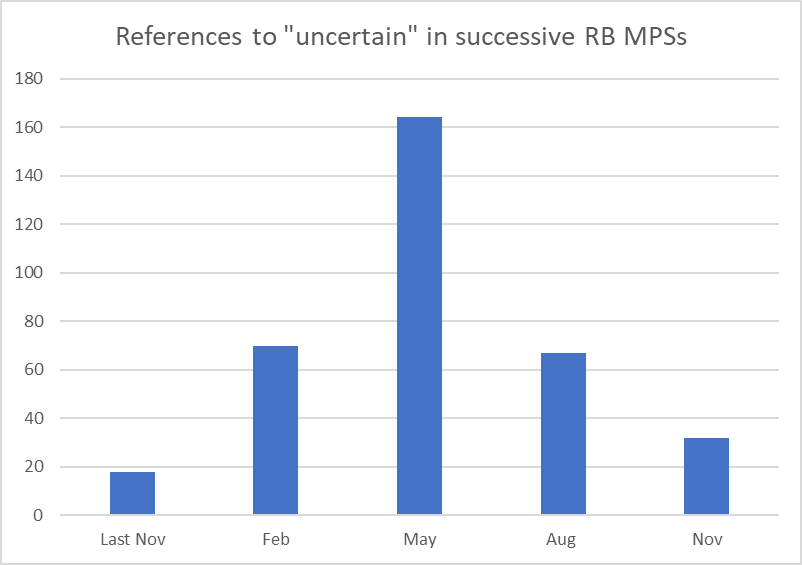
I didn’t watch the press conference yesterday (and the video of it doesn’t yet seem to be available). Someone who did watch it told me that Hawkesby had suggested that the dip in economic growth in the June quarter was mostly due to Trump and the extreme uncertainty about US tariffs policy (and, I guess, how other countries might respond). He is reported as having suggested that otherwise the recovery had been on track. Such a line would certainly be consistent with the very heavy rhetorical emphasis the MPC, and one of its members in speeches, has been putting on uncertainty in recent months, albeit the frequency of use of the term in the MPSs seems to be dropping back again.
I don’t know precisely what words Hawkesby used, so perhaps it wasn’t as stark as what was passed on to me (the MPS text itself is fairly non-specific, while correctly noting that the -0.9 per cent was almost certainly not representative of how deep the real fall had been).

[UPDATE: In fact both Hawkesby and his chief economist – the latter more expansively – ran this line, citing not a shred of evidence in support of their story.]

But I’m sceptical that the (very real) heightened uncertainty around foreign tariff policy had anything much to do with the overall performance of the New Zealand economy in the June quarter. There simply aren’t any particularly obvious channels by which there would have been such effects. We weren’t Canada (directly in Trump’s firing line for a while), we weren’t subject to unusually large proposed tariffs (and our government was fairly clear they didn’t support retaliation), we weren’t likely to be facing higher prices (if anything lower, if large scale trade diversion happened), and while uncertainty can be a killer for investment projects few/none will turn on a dime (in terms of actual real outlays) anything like that quickly. None of which is to say that Trumpian tariffs are anything but bad for the world, and us (and I’ve consistently agreed with the RB view that they are, if anything, a negative aggregate demand shock from the rest of the world to us).

And if there was a material tariffs-uncertainty effect on New Zealand in Q2, surely we’d expect to have seen such an effect across many other countries, and showing up to a greater extent in many of those countries (in April appearing to face much higher tariffs or more dependent on US markets – remember (my post yesterday) we don’t export much by advanced country standards)?

What then do the data show (bearing in mind that all recent data are prone to revisions)? The OECD has a database of quarterly real GDP growth for member countries. Here is how quarterly real GDP growth in Q2 compared with that in Q1 (I’ve left off the US itself – source of the issue – and Ireland where tax effects mean quarterly growth rates are all over the place.)
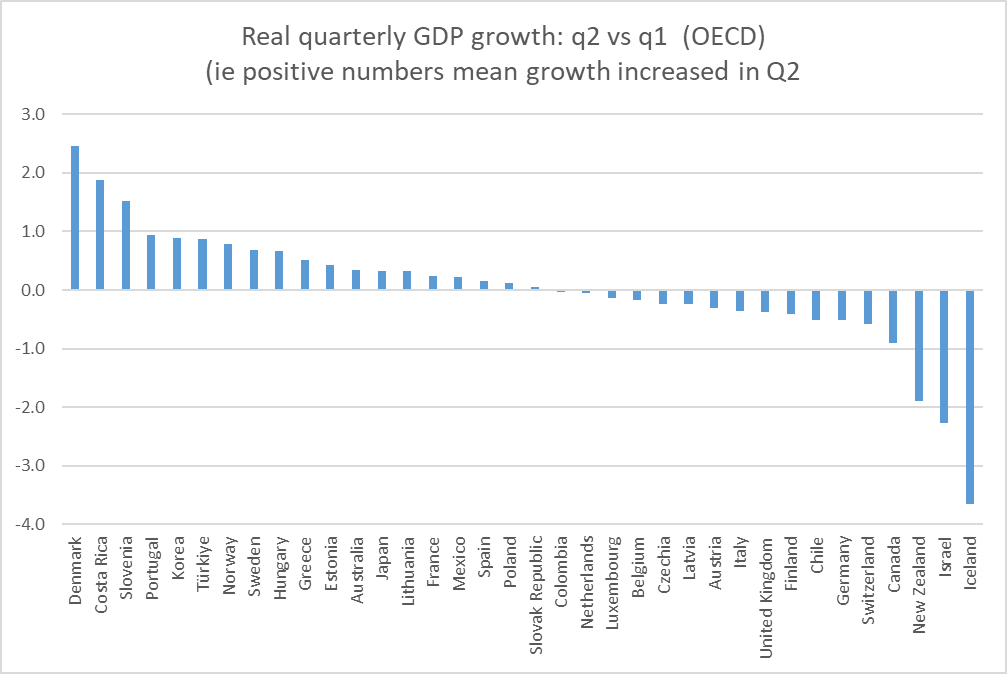
There is no consistent pattern, but actually slightly more countries saw higher growth (often only slightly) in Q2 than in Q1.

And here is another chart, this time comparing Q2 growth with the average growth rate for each countries over the previous four quarters. Still no consistent pattern (although this time slightly more countries had lower growth than higher growth).
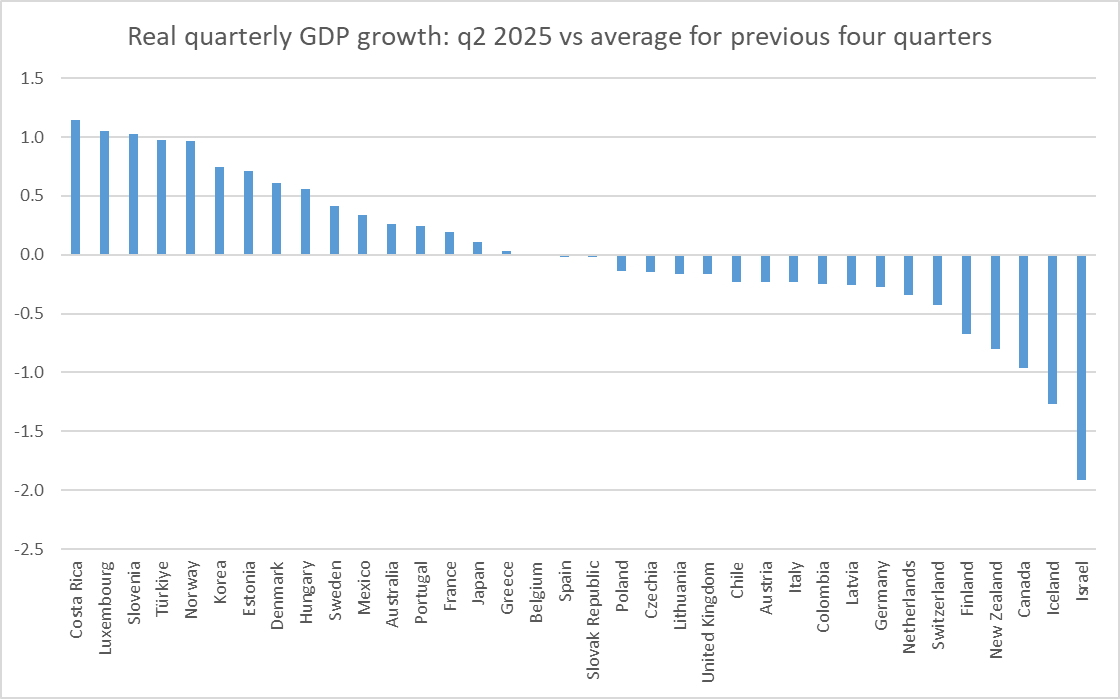
They are the sort of charts you might have thought the MPC would think to stick in the MPS. It may be – well, it is to me – a little surprising that global economic activity has held up as well as it seems to have this year in the wake of the tariff uncertainty, but…..for now, that is where the data seem to point. Perhaps effects begin to cumulate from here, but whether that happens or not, it is just hard to see much sign of Q2 New Zealand growth having been materially adversely affected. If the departing temporary Governor agrees, so much the better.

Since I was putting together this post I will add in here, as much for ease of future reference as anything, a few charts I put on Twitter yesterday, mostly going to one of my multi-decade hobbyhorses (dating back to 1997) of doubts about the merits, and value, of central banks publishing forward interest rate forecast tracks (not many do still).

This chart shows the Reserve Bank’s OCR projections through successive MPSs since late 2020.

They really had no idea what was going to be required. To be clear, I am not here bagging the RB MPC specifically (I’m pretty sure similar charts from the other central banks that publish endogenous forward tracks would look much the same). It is an observation about the (very limited) state of knowledge any and all central banks (and outside commentators) have, especially when anything interesting is going on with inflation.

To illustrate the point with just one date, here are the MPC’s successive forecasts for the OCR in the final quarter of this year (daily average).
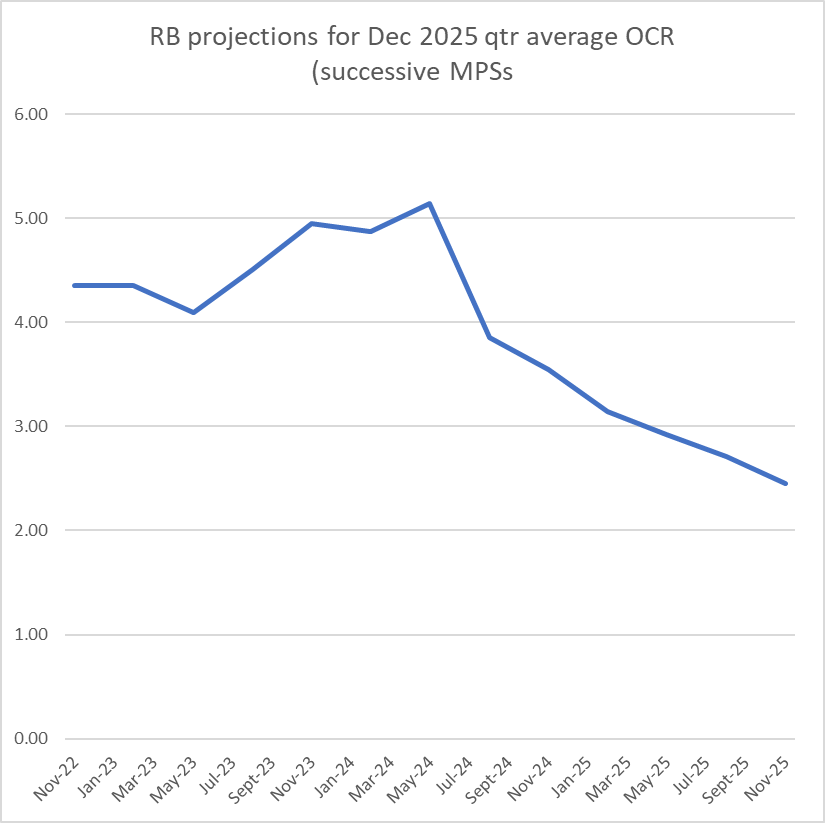
18 months ago they thought the OCR – which they set – would be around 5 per cent by now. Yesterday they actually set that rate at 2.25 per cent (and I could show you similar charts for various market economists, so again this is not about bagging our specific group of MPC members). Sometimes of course really nasty exogenous shocks happen: it would be unfair to look at MPC forecasts from early 2019 and compare them with what happened in 2020, since Covid was essentially unforeseeable (for central bankers in particular). But nothing very dramatic has happened in or to New Zealand in the last eighteen months. The Bank simply misread how much pressure would be needed to get core inflation near target.

You can also see that with this chart, showing the Bank’s successive estimates of how much excess capacity was going to be needed at peak to get inflation down. In the scheme of things – data uncertainty, revisions etc etc – those estimates have really been quite stable.
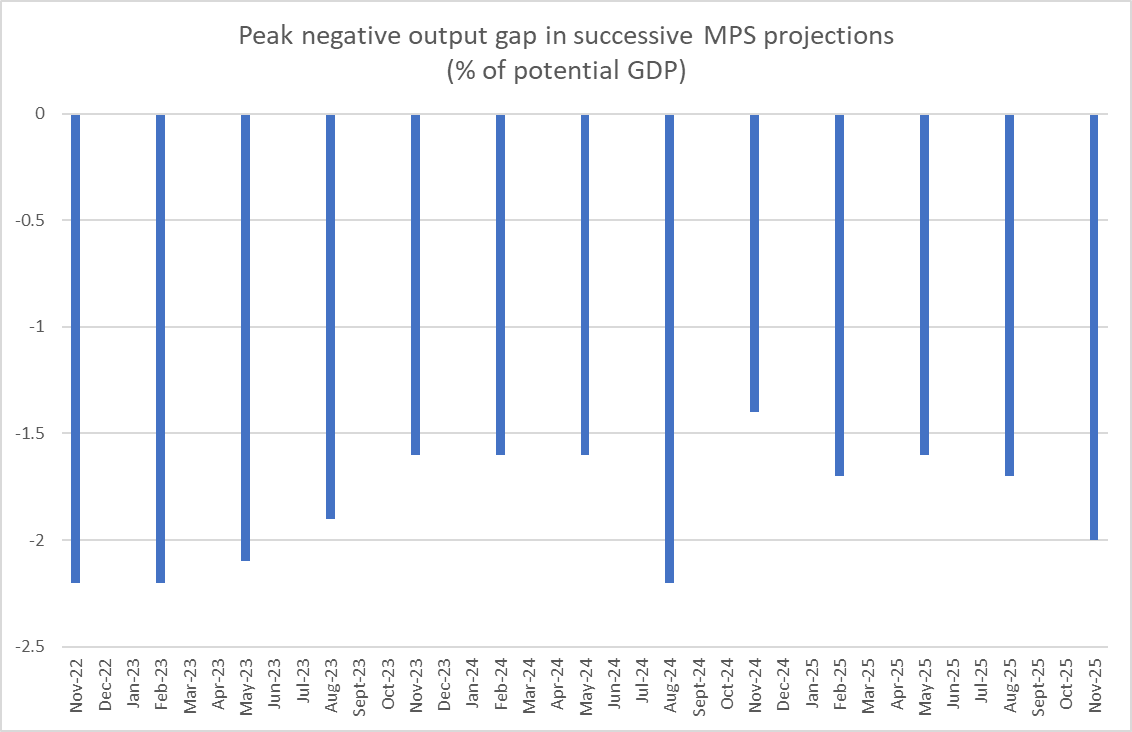
But – see the earlier charts – they had no real idea what monetary policy settings would be required to deliver.

As I noted in my post last week on the new Governor, she has talked about improving transparency, and if the Bank follows through then that would be a good thing. But there is distinction between things you can be transparent about – the views, arguments, votes etc in any particular meeting – and things where you can certainly publish numbers but really there isn’t much value at all. Now, to be clear, market economists pay attention to those future tracks because the MPC produces them, and – if things are anything like what they were in my day – large amounts of time and effort goes into producing them (precisely because the MPC will know markets look at the track because the RB publishes it). But there is no substantive value at all – the MPC just does not have any decent idea what will be required 12-24 months ahead. Often enough – as we’ve seen this year again – they often don’t have a reliable or consistent view on the next quarter. Much better to focus energies on this quarter and next, recognising that almost all the information new to the Committee each time it meets is about the (quite uncertain enough) recent past with just a few pointers to the very near-future. You need mental models to think about medium-term implications etc, and perhaps formal ones for research purposes, policy scenarios etc but….forecasting really is a mug’s game, and in a central bank context the medium-term forecasts, notably for the OCR, add very little value.

And I can’t face writing anything much about this morning’s dismal announcement from the Minister of Finance. When expectations are low, she still undershoots.

Central banks expressing uncertainty

Last Friday I noticed in a story on interest.co.nz this chart taken from a recent BNZ commentary.

I stuck it on Twitter and then to illustrate more starkly something about the contrast with the pandemic period followed up with this

In 2020 there was (inevitably) extreme uncertainty about the outlook for Covid, for any possible vaccine, for border restrictions, and (you might have thought) for what it all meant for inflation. By mid 2021 the conditions that gave rise to the worst outburst of core inflation in many decades were all in train, and yet the MPC seemed not to feel (or, at least, state) any particular uncertainty at all.

Quite what, if anything, it meant wasn’t really clear. Perhaps they really were pretty complacent back in 2020 and 2021 (as the time series chart shows despite the apparent magnitude of the shock, and the lack of precedents, “uncertain” was not being used a lot more than usual). Or perhaps this year’s heavy use of the term is some sort of reaction to past mistakes, or Trump just makes an easy target? Perhaps, having suddenly lost a Governor (who’d overseen all the other MPSs used in this chart), things went a little wild in the latest statement with the new and inexperienced guy in charge?

So I wondered what a similar chart looked like for other central banks. I had a look at the Reserve Bank of Australia, the Bank of England, and the Bank of Canada, all of whom publish similar documents on a quarterly cycle (Canada in Jan, Apr, July, the others in Feb, May and August).

Three things caught my eye:

  • First, how similar the RBA and RBNZ usage frequency has been through these episodes. Not identical but quite close
  • Second, how much more commonly the Bank of England was referring to uncertainty through the pandemic period. The most recent statement still has a lot more references than back then, but the contrast is much less stark. For the pandemic period I’d say that is to their credit.
  • Third, the Bank of Canada had the fewest uses of “uncertain” in all five periods, including – and most strikingly, given Canada’s vulnerability to US tariffs etc – in the most recent set of reports (the Canadian one came out on 16 April, the period of peak “Liberation Day” tariff concern globally).

I also had a look at the final Monetary Policy Statement/Report for 2019 for each central bank (wholly pre-Covid). As it happened, the Bank of England had used “uncertain” 214 times in their November 2019 document, mostly as regards Brexit.

I don’t want to draw any strong conclusions from any of this. And I don’t even particularly disagree with the MPC’s on-balance assessment of where the US tariff risks lie (mainly in a disinflationary direction for New Zealand), but you do have to wonder about just how they went so far over the top in last week’s document with the number of references to “uncertainty”. The Trump stuff matters – both the uncertainty about the policies themselves (and retaliation) and uncertainty about the economic impact – but it isn’t clear that the degree of uncertainty we (or the MPC) face is anything like that during the early months of the pandemic or (though they did not recognise it at the time) the big policy mistakes leading to outburst of core inflation that we are still living with the aftermath of.

And how does uncertainty compare now to that at the height of the financial crisis in 2008/09? I’d have thought that, particularly for monetary policy purposes, the financial crisis offered at least as much uncertainty for the global macro outlook (as it affected New Zealand) than the current tariff chaos. But judging by MPS uses of uncertainty, the Reserve Bank appears not to have thought so.

All a bit puzzling really. I wouldn’t make too much of it, but the data are perhaps something for the MPC to reflect on.

(Incidentally, in case anyone is wondering about the Fed, they don’t do a six-monthly statement. On the couple of occasions when the dates aligned, including February 2025, they used “uncertain” less often than the central banks I looked at here.)

MPC members speaking

In both The Post and the Herald this morning there are reports of interviews with executive members of the Reserve Bank’s Monetary Policy Committee: the Bank’s chief economist Paul Conway in The Post and his boss, and the deputy chief executive responsible for monetary policy and macroeconomics, Karen Silk in the Herald. In a high-performing central bank the holders of these two positions should be the people we look to for the most depth and authoritative background comment on monetary policy and economic developments. But in New Zealand we are dealing with the legacy of the Orr/Quigley years where we struggle to get straightforwardness, let alone depth and insight.

Now, to bend over backwards to be fair, interview responses will depend, at least in part, on what the journalist concerned chooses to ask. But then standard media training advice is to answer the question you wish they’d ask, not (necessarily or only just) the one they did. An interview with a powerful decisionmaker is a platform for the decisionmaker.

The Conway interview appears somewhat meandering and not very focused. I wanted to touch on three sets of comments in it.

First, asked about the transition after Adrian Orr’s sudden (and unexplained) departure, he says it is business as usual and it has been “a very smooth transition”.

“I think this institution is bigger than even Adrian Orr [it was certainly bigger – much bigger – as a result of Adrian Orr]……There’s a real sense of the ‘show must go on’ and it really has. We miss Adrian. It is a bit less fun around the place, less jokes going on – probably more appropriate jokes”, he smiles again.

So in addition to Orr being a bully, an empire builder, and someone well known for freezing out challenge and dissent, he also created an uncomfortable and inappropriate working environment? Or at least that is what Conway appears to be saying about the man who recruited him.

But you also wonder about just how straight Conway is being (and why the journalist didn’t ask more). After all, the Bank itself tells us there are big changes afoot (presumably consequent on the new Funding Agreement, prospect and actual). In the just over two months since Orr resigned, the top tier of management has been brutally slimmed down (credit to Hawkesby). At the start of March there was the Governor and an Executive Leadership Team of seven Assistant/Deputy Governors and one “Strategic Adviser”. Since then, Kate Kolich, Greg Smith, Sarah Owen, Simone Robbers and Nigel Prince have all either left already or we’ve been advised they will soon be doing so (none with an announced job to go to). Governor plus eight has been reduced to Governor plus four. And

That first group is Conway’s own level (though presumably the Bank will continue to need a chief economist). And then on down to the staff (and much of this is because Orr/Quigley massively blew the budget limit Grant Robertson had set for them and went on one last hiring spree last year). You somehow suspect that all is not exactly sweetness, light, and engagement at the Reserve Bank.

And then there was this

Conway is on record as a bigger-government sort of guy (we had his extra-curricular stuff last year, as an example) but what possessed him, interviewed as an MPC member and senior central banker, to suggest that more state interventions and bigger government might be “worth thinking about”? It simply isn’t in his bailiwick, and he shouldn’t have allowed himself to be dragged into responding to a hypothetical, especially about one outside the Bank’s responsibilities.

And finally, we got the meandering thought that “it’s possible that we get to a point where people just adjust their behaviours and ‘uncertainty’ becomes the new normal and we just get on with it. I’ve got no ’empirics’ to base that on – it’s just, I think, a very interesting thought-stream.”

Really? A “very interesting thought-stream” that people do in fact adapt to the world as it is? Startling and insightful (not).

Then, of course, there is his boss, Silk. Most serious observers regard her as fundamentally unqualified for her job, and not the sort of person who would be likely to be on an MPC anywhere else in the world, let alone as the deputy primarily responsible for monetary policy. She can be counted on to safely deliver speeches on operational topics that others have written for her, and to answer purely factual questions at MPS press conferences and FEC about what has happened to swap yields and mortgage rates. And that is about all.

She also seems to have a mindset in which rates being paid on existing mortgages are what matter rather than the rates facing marginal borrowers and purchasers. Perhaps it is what comes from a non-economics background in a bank? Thus, in the Herald interview we are told that she claimed that “the effects of the 225 basis points of OCR cuts the committee had delivered in less than a year were yet to be widely felt”. The journalist added some RB data on average actual mortgage rates which might appear to back that up. Of course, expected cash flows matter as well as actual ones – if your fixed rate mortgage is going to roll over in a couple of months onto a much lower rate that will almost certainly be affecting your comfort, confidence, and willingness to spend now. But more to the point, marginal rates for people looking at buying a property or otherwise taking on new debt have come down a long way, and were already down a long way months ago. This chart is from the Bank’s own website, showing short-term fixed mortgage rates.

As at yesterday, rates were a few basis points lower again than the end-April rates shown here. 200 basis points plus down from the peak, and that not just yesterday. And falling wholesale rates, which underpin these falls in retail rates, also affect the exchange rate, another important part of the transmission mechanism. (And, of course, with all Silk’s focus on the cash flows of existing borrowers, she never ever mentions the offsetting changes in the cash flows for existing depositors – I’m of an age to know!)

So far, so predictable (at least from Silk). But then there was this (charitably I’ll assume the word “fulsome” was not hers)

Reasonable people might differ over the inflation outlook and the required future path for the OCR, except that we were told in the MPS that there was unanimous agreement from the MPC to the forecast path for interest rates. And that is a path that is lower from here than the path published (again unanimously) in the February MPS (the deviation begins after the May MPS, not at it). In other words, not only did the February path show some further easing from (where they expected to be, and were, by) May onwards, but the May path shows even more easing from here forward.

And yet Silk talks of a “much stronger easing signal” sent in February.

Frankly, they seem all over the place. If the Committee (as it did) unanimously agrees to publish a (somewhat) steeper downward track than the one you had before then either you have an easing bias – always contingent on the data of course – or you made a mistake in adopting the track you did. And if you are comfortable with the track, it feels like a mis-step for the temporary fill-in Governor to announce that there was no bias. I guess Silk might have got stuck having to cover for her fill-in boss, but it is a pretty poor look all round. Surely (surely?) they must have rehearsed lines about biases before the press conference? Surely, if so, someone pointed out the disconnect between the proposed words and the chart above?

And finally from Silk we learn that “price stability is one of the conditions you need for growth”. It simply isn’t – and the economists on the committee are usually much more careful, with the standard central banker line being that price stability, or low and stable inflation, is the best contribution monetary policy can make (many muttering under their breath that that contribution isn’t necessarily very large). Not to labour the point but the economy was still growing, reaching its most overheated point in late 2022, when core inflation was around its worst.

All in all, not a great effort at communications from the MPC this week. As I noted in my post on Thursday, there was none of the prickly frostiness of Orr, and no sign of deliberately or conscious setting out to mislead Parliament, but it simply wasn’t a very good performance. And while Hawkesby is new to the role, chairing MPC and acting as its prime spokesperson on the day, Conway and Silk have no such excuse. Someone flippantly suggested that perhaps there is something about May and the MPC – last May was when the MPC went a bit wild talking of raising rates further (the OCR was still going to be above 5 per cent by now), and then Conway tried to blame his tools, rather than the judgements of him and his colleagues, for the associated forecasts.

If the government is at all serious about a much better, world class, Reserve Bank, they need to work with the Board to find a Governor who will lift the game and the Governor/refreshed Board will need to work with the Minister to produce a stronger MPC. It would seem unlikely that in such an improved Bank/MPC there would be a natural place for either Conway or Silk, pleasant enough people as they may be.

May Monetary Policy Statement

Procrastinating this morning, I asked Grok to write a post in my style on yesterday’s Monetary Policy Statement. Suffice to say, I think I’ll stick to thinking and writing for myself for the time being. Among the many oddities of Grok’s product was the conviction that Adrian Orr was still Governor. Mercifully that is not so, even if – despite all the questioning yesterday – we are still no closer to getting straight answers on the explanation for the sudden, no-notice, accelerated departure of the previous Governor. Perhaps responses to OIAs will eventually help, but some basic straightforwardness from all involved – but especially Quigley and Orr himself – would seem the least that the public is owed, especially after all the damage wreaked on Orr’s watch.

Yesterday’s Monetary Policy Statement certainly made for a pleasant change of tone. Stuff’s Luke Malpass captured it nicely: “A lack of journalists being upbraided at times for not reading the materials in the hour allowed, or for asking the wrong question, was a change from previous management”. I watched about half of the Bank’s appearance at FEC this morning, and it was as if it was a whole different Bank. Not necessarily any deeper or more excellent on substance, but pleasant, respectful, engaged people accounting to Parliament, as they should. And, setting the standards low here, there wasn’t any sign of attempts to actively mislead or lie to the committee (Orr, just three months ago in only the most recent example).

I don’t have any particular quibbles with yesterday’s OCR decision. It was probably the right thing to do with the hard information to hand, but we won’t know for quite some time whether it really was the call that was needed. The NZIER runs a Shadow Board exercise before each OCR decision where they ask various people (mostly, but not all, economists) where they think the OCR should be at this review and in 12 months time, and invites them to provide a probability distribution. I’m not part of that exercise but I put my rough distributions on Twitter earlier in the week (in truth the blue bars should probably have been distributed in a flatter distribution – we really do not know)

The Bank’s projection for the OCR troughs early next year at 2.85 per cent and, as the scenarios they present reinforce again, there is a great deal of uncertainty about just what will be required (and not just because of the Trump tariff madness and associated uncertainty).

One of the interesting aspects of yesterday was that for only the second time in the six year run of the MPC that there was a vote (5:1 for a 25 point cut rather than no change). But, of course, being the non-transparent RBNZ we do not know which member favoured no change, so cannot ask him or her to explain their position, let hold them to account or credit them when time reveals whether or not it was a good call. As it happens, despite the vote the MPC reached consensus on a forecast track for the OCR and since that track embodies a rate below 3.5 per cent as the average for the June quarter and yesterday’s was the final decision of the June quarter, I’m not sure what to make of what must really have been quite a small difference. The bigger issue remains that there is (almost always) huge uncertainty about what monetary policy will be required over the following three years (the standard RB forecast horizon) and yet never once has any MPC member dissented from the consensus track. Groupthink still appears to be very strong. And notwithstanding the Governor’s claim that there is “no bias” one way or the other for the next move or the next meeting, the track – which all the MPC agreed on – clearly implies an easing bias (even if not necessarily a large one for July rather than August).

Hawkesby, unprompted, was yesterday championing the standard approach under the agreement with the Minister which enjoins the committee to seek consensus and only vote as a last resort. He acknowledged it is now an unusual model internationally, but claims it was preferable because it means – he claims – that everyone enters the room with a completely open mind about what should be done, whereas in a voting model people tend to enter the room with a preconceived view. Perhaps it sounds good to them, but it simply doesn’t ring true (and there is no evidence their model – which, among other things, saw them lose the taxpayer $11bn – produces better results in exchange for the reduction in transparency and accountability.)

It rang about as false as yesterday’s claim from the chief economist that the uneventful (in markets) transition when Orr resigned was evidence for the desirability of the decisionmaking committee. I’m all in favour of a committee (although a better, and better designed committee) but my memory suggested (and the numbers seem to confirm) that there were also no market ructions when Don Brash resigned, in the days of the single decisionmaker model.

There were a few things worth noting in the numbers. First, the Reserve Bank expects much weaker GDP growth than the Treasury numbers released with the Budget last week (Treasury numbers finalised in early April)

and as a result, significant excess capacity persists for materially longer than in the Bank’s February forecasts

And I’m still not sure where the rebound (above trend growth reabsorbing all the excess capacity) is really supposed to come from, on their telling, given that the OCR is still above their longer-term estimate of neutral, and never drops below it in the projection period. Reasonable people can differ on where neutral is likely to be (when the OCR was last at this level, less than three years ago, the Bank thought neutral was nearer 2%, now they estimate close to 3%), but it is the internal consistency (or lack of it) that troubles me.

I had only two more points to make, one fairly trivial, but the other not.

The trivial one first. In the minutes there was this paragraph about the world economy.

I don’t have any trouble with the (“weak world”) bottom line, but two specific comments puzzled me. The first was that difference in tone in the commentary on fiscal policy in China and the US: one might use “sizeable fiscal stimulus” (with no negative connotations) and of the other (and much more negatively) “fiscal policy could place strains on the sustainability of its public debt”. It wasn’t at all clear that the MPC realises that China’s government debt is almost as large as the US’s, and as a share of GDP has been increasing (and is expect to increase) much more rapidly than that of the US.

In a similar vein, this chart from the recent IMF Fiscal Monitor suggests that on IMF estimates China is already in a deeper fiscal hole, needing more fiscal adjustment (% of GDP) than the US to stabilise government debt.

Of course, the rest of the world is much more entangled with US government debt instruments than with Chinese ones, but it was a puzzling line nonetheless.

I’m also at a loss to know quite what the MPC was getting at with the line about ‘the decline in the quality of macroeconomic institutional arrangements [was] likely to result in precautionary behaviour by firms and households’. Not only is it not clear what decline they are talking about – are the Fed and the ECB not still independent, and the PBOC still far from it, and fiscal policy seems to have been on its current track for some years (in multiple countries). Is Congress bad in the US? For sure, but it has been so for a long time. I guess it might have been the relaxation of the German debt brake they had in mind, but….probably not. I was also a bit unsure how all this was supposed to play out. If, for example, there was an increased perceived risk of government debt being inflated away, wouldn’t the rational reaction be to increase purchases of goods and services on the one hand, and real assets on the other to get in before the inflation? Private indebtedness tends to rise when interest rates are modest and inflation fears are rising. In the end, who knows what they meant. Which isn’t ideal. They should tell us.

The more important issue is the Reserve Bank’s treatment of fiscal policy, where the bad old ways of Orr were again on display yesterday, in ways that really should undermine confidence in the Bank’s analytical grasp (and, frankly, its willingness to make itself unpopular by speaking truth in the face of power).

In his press conference yesterday the temporary Governor was asked about the impact of the Budget on the projections and policy decisions. He noted that they were glad to have all the information but that really it hadn’t made much difference, noting that any stimulus from the Investment Boost policy was offset by the impact of spending cuts. This is made a little more specific in the projections section of the document (a small increase in business investment, and on the other hand “on net, lower government spending reduces inflationary pressure”).

Readers with longer memories may recall that this issue first came to light a couple of years ago. Until then, for many years, the Bank had presented the impact of fiscal policy on demand primarily through the lens of the Treasury’s fiscal impulse measure, which had originally been developed for exactly that (RB) purpose. The Treasury has made some changes to that measure a few years ago which, in my view, reduce its usefulness to some extent, but certainly doesn’t eliminate it. Treasury continues to present the numbers with each Economic and Forecast Update. The basic idea is that increased taxes reduce aggregate demand and increased spending increases demand, but (for example) some spending is primarily offshore and thus doesn’t directly affect domestic demand. It is a best approximation of the overall effects on domestic demand of changes in fiscal policy. You can have a positive impulse while running a surplus (typically, if the surplus is getting smaller) or a negative one with a deficit (typically, if the deficit is getting smaller). It is straightforward standard stuff.

And yet two years ago the Bank simply stopped talking about this approach and replaced it with an exclusive focus on government consumption and investment spending (ie excluding all transfers – a huge component of spending – and the entire revenue side). This sort of chart has appeared ever since

and, probably not coincidentally, projections of (real) government consumption and investment have been trending downwards over that entire period. (This was the same vapourware I referred to in Monday’s fiscal post, where both Grant Robertson and Nicola Willis have repeatedly told us – and Treasury – that future spending will be cut.).

Back when this started, I OIAed the Bank for any research or analysis backing this change of approach. Had there been any of course they would already have highlighted it. There was none. But the switch had allowed the Governor to wax eloquent about how helpful fiscal policy was being, even as by standard reckonings (Treasury, IMF, anyone really) that year’s Budget had been really quite expansionary, complicating the anti-inflation drive.

The temporary Governor – who is presumed to be seeking the permanent job – seems, whether consciously or not, to be engaged in the same sort of half-baked analysis that avoids saying anything that might upset the government. Yes, on the Treasury projections government consumption and investment spending are projected to fall. But what does the Treasury fiscal impulse measure show?

At the time of the HYEFU last December, the sum of the fiscal impulses for 24/25 and 25/26 fiscal years was estimated to be -0.47 per cent of GDP (with a significant negative impulse for 25/26, thus acting as a drag on demand). By the time of last week’s Budget, not only was the impulse for 25/26 forecast to be slightly positive (this is consistent with, but not the same as, the structural deficit increasing) but the sum of the impulses for the two year was now 0.7 per cent of GDP positive. Fiscal policy, in aggregate is adding to demand (and by materially more than estimated at the last update). And the incentive effect of Investment Boost on private behaviour is on top of that.

Absent some serious supporting analysis from the Bank or its temporary Governor for its chosen approach (focus on just one bit of the fiscal accounts), it looks a lot like an institution (management and MPC) that now prefers to avoid ever suggesting that the fiscal policy effects might ever be unhelpful. After all, all else equal a positive fiscal impulse reduces the need and scope for OCR cuts – and we all know (we see their press releases) how ministers love to claim credit for OCR cuts.

If there is a better explanation, they really owe it to us. If they aren’t any longer happy with Treasury’s particular impulse estimate, they have the resources to come up with their own. But there is no decent case for simply ignoring developments in the bulk of the fiscal accounts. Wanting the quiet life simply isn’t a legitimate goal for a central banker, and if Hawkesby continues with the dodgy Orr approach – and he has been part of MPC all along – it does call into question his fitness for the permanent job. It isn’t the Reserve Bank’s job, except perhaps in extremis, to be making calls on the merits or otherwise of the fiscal choices of governments, but they are supposed to be straight with us (and, by default, with governments) on the demand and activity implications of those choices. They aren’t at present.

Tariff madness and monetary policy

We’ve seen this morning the latest step up in the Trump-initiated trade war, with the additional 50 per cent tariffs imposed on imports from China. If the tariff madness persists – but in fact even if were wound back in some places (eg some of the particularly absurd tariffs on supposed US allies in east Asia, or 48 per cent tariffs on Madagascar’s vanilla) – it is going to be extremely damaging to global economic activity in the (probably protracted) transition. A global recession would then be the best forecast (through a whole variety of channels including, but not limited to, extreme uncertainty – fatal for investment, which can usually be postponed – and wealth losses). Faced with severe adverse shocks, and extreme uncertainty, layoffs happen and firms close faster than replacements emerge.

(The longer run effects will also be adverse, lowering potential GDP in all the countries that participate in the “war”, which consciously and deliberately put sand in the wheels of their own economic performance, but economies adjust – you can have full employment in a highly protected economy with impaired productivity growth (see NZ in the 50s and 60s) or in a high-performing open and competitive economy.)

The direct effects of the tariff war on New Zealand are still probably pretty limited. Our goods exporters to the US face the lowest tariff band, lower than those facing many competitors (eg European wine exporters) and the amounts involved are just a small fraction of GDP anyway. But as pretty much every commentator is now pointing out, the indirect effects will swamp any direct effects. It is perhaps a bit like early 2020 when government agencies were initially focused on the damage to a few New Zealand exporters (lobster, universities etc) from China’s disruptions, only for those modest effects to be totally swamped by the wider global effects and our own experience with Covid (pre-emptive adjustments and lockdowns). In a global recession there is pretty much no place to hide.

But what does, and should, it mean for monetary policy, here and abroad (if the madness persists)?

In the US, it is near-certain that there will be a material increase in consumer prices. Headline inflation will, all else equal, increase over the coming few months. To the extent there is any logic in the madness, that is part of the point. Higher prices in the US increases returns to domestic producers and make foreign produced products relatively less attractive (of course, in many cases, US producers will also face higher costs on imported inputs). From a revenue perspective, it is also akin to a big increase (inefficient and all as it may be) in consumption taxes – reportedly the largest US tax increase in some decades. So prices will rise and real household disposable incomes will fall.

A sensible central bank will always have to play things by ear to some extent. No idiosyncratic event is ever quite like another. It isn’t impossible that the higher tariffs will translate into behaviours consistent with households expecting inflation to be permanently higher. If that happened, the Fed would need to lean against that risk – hold policy tighter than otherwise.

But an alternative scenario might be one akin to an increase in GST. Increasing consumption taxes raises consumer prices and headline inflation. We’ve had three experiments of this sort in New Zealand in our post-liberalisation years: when GST was first imposed in 1986 (a 6%+ lift to the price level) and when it was increased in 1989 and 2010 (each increasing consumer prices by a bit over 2%). On none of those occasions did the Reserve Bank seek to tighten monetary policy in response, and with hindsight that was the right call on each occasion. The lift in prices was (at least implicitly) recognised by the public as a one-off lift in inflation, that dropped out of the headline rate again a year later.

How likely is something like that in the US at present? Given the chaotic policy and political processes, and the fact that – unlike with GST changes – prices won’t all change on one day, perhaps there is less reason for optimism there. And perhaps all bets are off if the public and markets come to think there is a credible threat to sack and replace existing Fed decisionmakers.

But, even if household expectations (beyond 12 months ahead) and behaviour do rise – and surveys and behaviour are two different things – there is still the big hit to real household disposable income to consider. Such hits happen with some GST adjustments (the NZ 1989 one was intended as a fiscal consolidation) but not others (the NZ 2010 GST change was intended as a tax switch). And in addition to the direct effects of the tariffs, there are wealth losses (see stockmarket) and the impact of business disruption and business uncertainty delaying investment spending. Real activity, and pressure on resources and capacity, seem almost certain to ease. All else equal, a reasonable conclusion should be – and market pricing is consistent with this – that the Fed is more likely to need to ease than it would otherwise have thought, consistent with keeping core inflation near to target.

There is rhetoric around that somehow the lesson of the last few years is not to ease in the face of adverse supply shocks. But a lot depends on the nature of your supply shock. This isn’t (for example) a case of literally shutting down the economy and people going home (voluntarily or otherwise) to avoid a virus. The labour is still there, the capital equipment is still there. It can all be used – capacity is real – but the demand for resources is likely to diminish quite considerably. Monetary policy cannot (of course) do anything about the longer-term adverse effects of a shift to a more protectionist economy and policy regime. If the regime persists, Americans will be poorer than otherwise. But monetary policy often has a role to play in smoothing the dislocations, in trying to replicate what a market interest rate would be doing – reconciling desired saving and investment plans – absent a central bank. One parallel, for example, is the recession and financial crisis in the US in 2008/09. Monetary policy couldn’t fix the misallocation of resources and bad choices that led to the financial crisis in the first place. To the extent financial crises impair productivity, monetary policy also couldn’t do much about that. But not many people think that simply holding the Fed funds rate at mid 2007 levels in the face of the dislocation and associated severe recession would have made much sense.

What about New Zealand (and countries like us). If we see higher prices directly as a result of the tariff war, they should be fairly scattered and limited. It isn’t at all impossible that we might see import prices, in foreign currency terms, falling as (for example) Chinese manufacturing exporters look for alternative markets where they won’t face 100 per cent plus tariffs. With a fairly limited manufacturing sector ourselves, that terms of trade gain might be fairly unambiguously welcomed. We might get (temporarily) lower headline inflation and slightly higher real disposable incomes.

But, and on the other hand, a global recession would almost certainly more than cancel out that effect. We’d see materially lower export prices for commodities, and lower volumes for many other exports (eg tourism, students). It doesn’t matter that the initial crisis/shock wasn’t generated here, any more than it mattered in 2008/09.

I put this on Twitter this morning

and, of course, once the recession really took hold we got a big decline in (imported) oil prices but it wasn’t enough to stop the terms of trade overall falling by 10 per cent.

Assuming the tariff madness persists (see mercurial and unpredictable occupant of White House) it is very difficult to see how we – and other countries – avoid something similar this time round. I’m glad I’m not an economic forecaster paid to put specific numbers to it – this is just another case of extreme uncertainty making all but the most highly conditional numerical forecasts barely worth the paper they are written on – but the direction is clear, the severity of the shock is clear, our (non-unique) exposure is clear. All else equal, the OCR is likely to need to be a lot lower than otherwise, and since it is starting out still above neutral and with core inflation not far from target, that suggests a lot lower in absolute terms. To be clear, this is not a forecast, but in past serious downturns – demand led – short-term interest rates have often fallen something like 5 percentage points (in New Zealand, but also actually in the US).

The Reserve Bank’s MPC has its latest OCR review announcement out this afternoon. They are in a difficult position: they have only an acting Governor (who was responsible for the Bank’s macro and monetary policy functions when the really bad calls in 2020 and 2021 were made), a deputy chief executive responsible for macro who has no expertise or background in the subject, and so on. Being an interim review, they won’t have a full sort of forecasts and scenarios of the sort done for the quarterly MPS. They’ve also continued the madness of scheduling OCR reviews a week before the CPI comes out so they won’t even have a good read on the baseline – pre tariff madness – state of core inflation. And policy out of Washington (and Beijing and Brussels) can shift by the day.

Most people seem to expect the MPC to stick to the 25 basis point cut foreshadowed at the last MPS. On the domestic macro data they’ll have to hand – all from before the latest tariff madness (which even Jerome Powell has noted is worse than had been expected) – that would be perfectly defensible.

But so would a somewhat larger adjustment. After all, the external environment has changed, the effect is not likely to be small (or to be fully reversed even if we woke up tomorrow to find the last week had just been a bad dream), and even the government, channelling Treasury, is now warning of the adverse economic effects and risks. It isn’t time for dramatic emergency moves – that time may come, although one hopes we never need to see a 150 basis point cut ever again, as in late 2008 – but a rate that seemed fitting, to the New Zealand inflation outlook, 10 days ago, shouldn’t seem right today. And for all that they have only an acting Governor they may feel less locked into Orr’s February commitments than he might have were he still there. The risks are pretty moderate, especially as on the Bank’s own estimates the OCR is still above neutral and the output gap is estimated to be materially negative.

What are some counter-arguments? There is always the “six weeks doesn’t make any macro difference” so why not wait until the (full forecasts) and the May MPS. Perhaps there will be fuller information. I don’t think it is particularly compelling as it seems quite unlikely that the fog of war will have disappeared by next month (the macro implications will just be starting to become apparent), and if a large adjustment is eventually needed it may be best to get started. If it isn’t eventually needed a larger move today doesn’t take the Bank beyond where it thought things would level out at.

I heard one market economist on the radio this morning suggests that a larger cut today might rattle people. Quite probably, but most likely they should be rattled. This is a really serious economic policy shock Trump has launched on the world.

And then there is the exchange rate. People – reasonably – note that in severe downturns the New Zealand exchange rate usually falls a lot. That will tend to raise the prices of tradables, all else equal. It hasn’t really happened yet – if anything the TWI is a bit stronger – but it seems a pretty plausible story. It is just that in serious downturns previously – most notably 2008/09 – the direct price effects of a lower exchange rate ended up being outweighed by the disinflationary effects of the downturn on non-tradables inflation. An exchange rate adjustment is likely to be part of the overall response to the tariff madness shock, but not a substitute for action by the MPC.

We’ll see this afternoon what the MPC has come up with, but we shouldn’t be surprised if they do cut by more than 25 basis points, and doing so would probably be the right call. If they don’t, then I guess even more attention than usual will be paid to the wording of their statement, recognising that with the loss of a Governor some changes in wording may just be idiosyncratic – linked to one person’s stylistic or other preferences.

Bernanke on inflation targeting

Former chairman of the Federal Reserve Board of Governors (and FOMC) Ben Bernanke was yesterday the first of two keynote speakers at the Reserve Bank’s conference to mark 35 years of inflation targeting, which first became a formalised thing here in New Zealand.  He indicated that he’d be speaking about inflation targeting in general and then about “some lessons from the recent global inflation”.  (I’ve linked to his text above, but you can also find the full session including the Q&As on the Reserve Bank’s Youtube channel).  

Bernanke was the first speaker of the morning and he began his remarks, perhaps somewhat bemusedly, noting that it was “the first conference I’ve ever attended that was preceded by a concert” (half an hour or so of it apparently, including singalongs, and reportedly described by senior Reserve Bank staff as “beautiful”).    That, I guess, was the Orr-led central bank to the last. 

I’ve seen suggestions from a couple of people that Bernanke may have been paid some staggering amount of money to speak.  He certainly still seems to command a high price on the US lecture circuit.  But I’d be surprised if Bernanke cost taxpayers more than return business class airfares and associated accommodation etc.   This conference was a non-commercial event inside the central banking world.  And a year or two back Bernanke did a major review of forecasting for the Bank of England, and seems to have been very generous with his time and own resources.   Call it a loss leader, or just something he was interested in.  Either way, the British taxpayer didn’t pay much at all.  [UPDATE: An OIA response from some months ago appears to confirm the fares & accommodation only basis for Bernanke.]

Unfortunately, if Bernanke didn’t cost much, he didn’t offer much beyond his name.    It was a fairly short speech (7.5 pages of text), the first two-thirds of which was about inflation targeting in general.  It would be really surprising if anyone at the conference either learned anything new from that section or was prompted to think differently about any aspect of monetary policy or inflation targeting.  It was almost entirely descriptive, with no attempts to suggest refinements or even to knock down what he might think were dead-end suggested variants.  There wasn’t even a mention – amid the observation that the Fed’s target is “well understood by financial markets, legislators, and other observers” – of the questionable experiment with “flexible average inflation targeting”.

Close readers might note that he apparently takes for granted that “clarity about the strategy – and internal debates about the strategy [emphasis added] – also helps the public understand and predict how policy is likely to change when…the world evolves in unexpected ways”.  If anyone had noticed, no one questioned him about this observation, which is of course quite at odds with how the New Zealand Monetary Policy Committee has operated since its inception.  There is little sign that debates even exist, let alone the nature of them.

He also noted that inflation targeting “does not prevent policy mistakes”, but then he didn’t identify any of those, whether from his own experience or from his subsequent observation as a scholar, let alone discuss the nature of mistakes, or how we learn from them or how policymakers might be held to account. 

All in all, it was very much a complacent end-of-history and inside-the-club sort of treatment.   I suppose everyone wants to feel good about what they do, and Bernanke is certainly an eminent person to bestow his blessing (Nobel Memorial Prize and all).  But it was advertised as a research conference –  something about learning, improving, evaluating etc.   And there was none of that from Bernanke.  Unfortunately it reminded me of his 2022 book, 21st Century Monetary Policy, which also erred sufficiently on the complacent side as to make it of little interest beyond perhaps an undergraduate (or similar) audience.

There was perhaps more interest in the final 2.5 pages devoted to the inflation of the last few years.  Unfortunately his story –  which, admittedly, might have warmed the heart of the Governor if he’d been there and hadn’t resigned and stormed off the day before – wasn’t very convincing either.

In fact, it was really quite astonishing that there was no analysis and almost no discussion of monetary policy at all.  There was not even any mention of central bank responses during the early stages of the pandemic itself.    What there was was the claim – supported by no analysis at all – that “my overall conclusion is that, in terms of actual policy choices, most central banks did about as well as they could in the post-pandemic period, given what they knew at the time”.

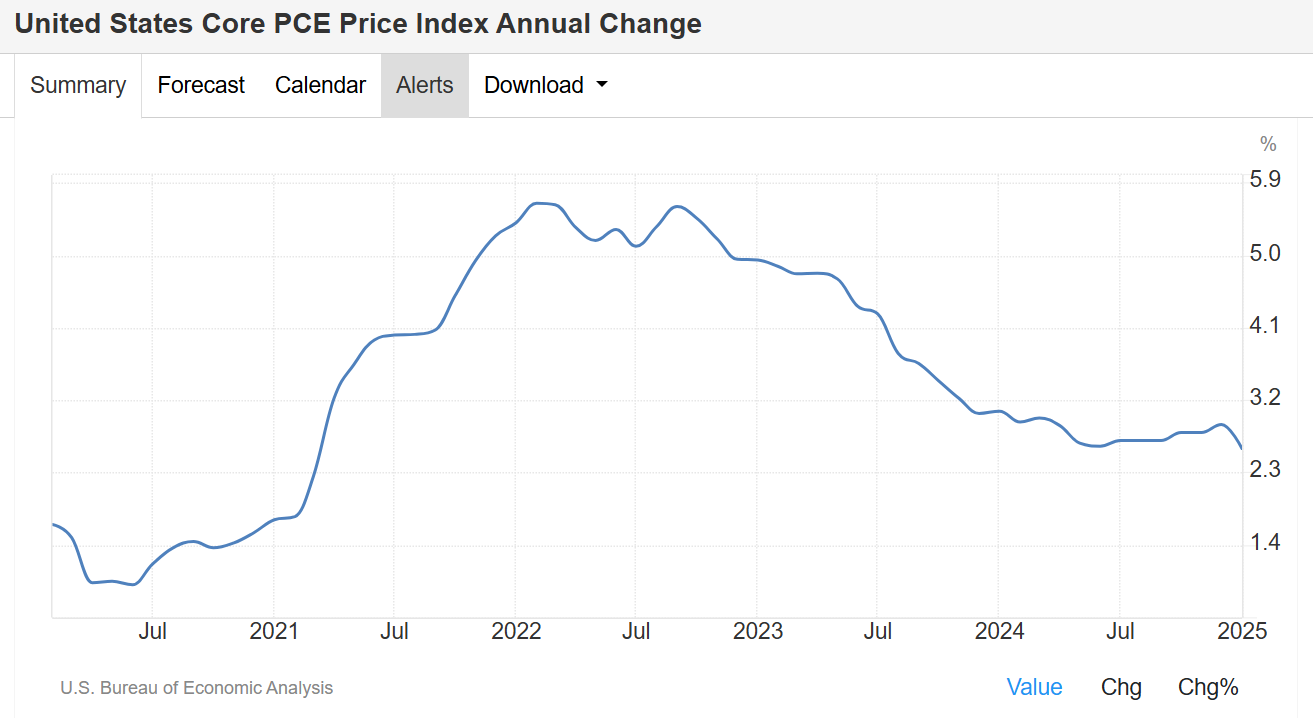
Which is pretty remarkable when you realise that, to take just the US as an example, annual core PCE inflation – core PCE is the one the Fed tends to focus on, and which removes food and energy – peaked in February 2022.  The Fed’s first increase in its policy target rate came in March 2022.

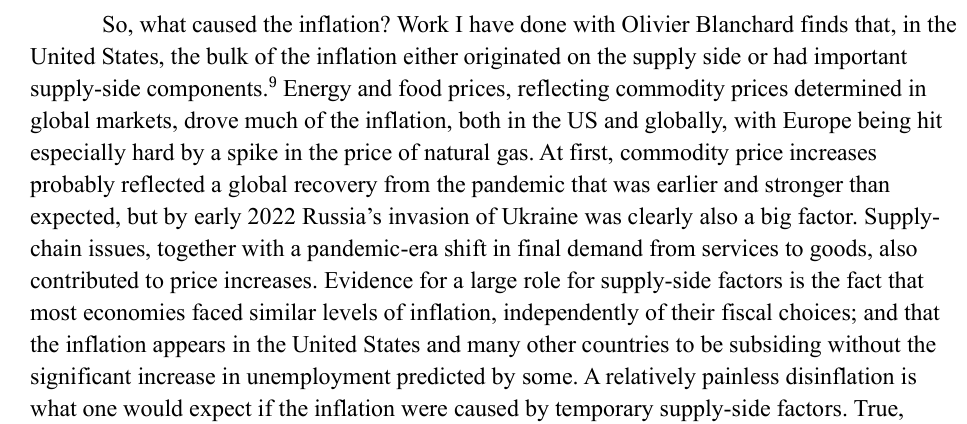
Bernanke devotes considerable space to the question of whether (pandemic and post-pandemic) fiscal policy caused the outbreak of inflation. Of course it didn’t, because monetary policymakers (a) know about fiscal policy news, and b) move last. Except at the extremes of fiscal dominance – not even close to being reached in advanced economies in recent decades – fiscal policy is never the primary culprit. If it was, we wouldn’t have made central banks independent. You can have bad or good fiscal policy, necessary, wise, or otherwise, and monetary policy is supposed to counter the (core) inflation effects. And no one really doubts that monetary policy settings once the pandemic really took hold – and for a couple of years thereafter – were expansionary not contractionary.

With hindsight – and only really with hindsight – it might at least be reasonable to note that the initial monetary easing was unnecessary and inappropriate (central banks – and markets – simply didn’t understand pandemic macro well enough). And it is pretty universally acknowledged now that (almost all) central banks were slow to begin to tighten again (even Orr has reluctantly acknowledged that the RBNZ should have started sooner). But apparently that wasn’t something Bernanke wanted to touch on even in passing, perhaps taking politeness to your central banking hosts rather to an extreme.

The essence of Bernanke’s arguments is here

This paper got a fair amount of attention when it was published in 2023. The Reserve Bank even did a version here which, as Bernanke notes, found a larger role for demand – and thus monetary policy – factors. The paper looked at quite a range of variables, but the centrepiece was around headline CPI inflation. Headline inflation, of course, gets affected by the sorts of supply shocks to prices (energy and food) that we saw, in particular, around the time of the invasion of Ukraine. As he notes, headline inflation in Europe was particularly badly affected by the extreme gas price shock (something not affecting NZ at all, detached as we are from the global LNG market).

Central banks though (rightly) tend not to focus on headline inflation – worrying only about whether headline effects spill into inflation expectations and then into price and wage-setting behaviour over longer horizons. Now, simply excluding food and energy inflation isn’t the only sort of core measure central banks and other analysts like to look add in difficult times, but it is what we have reasonably consistent international data for.

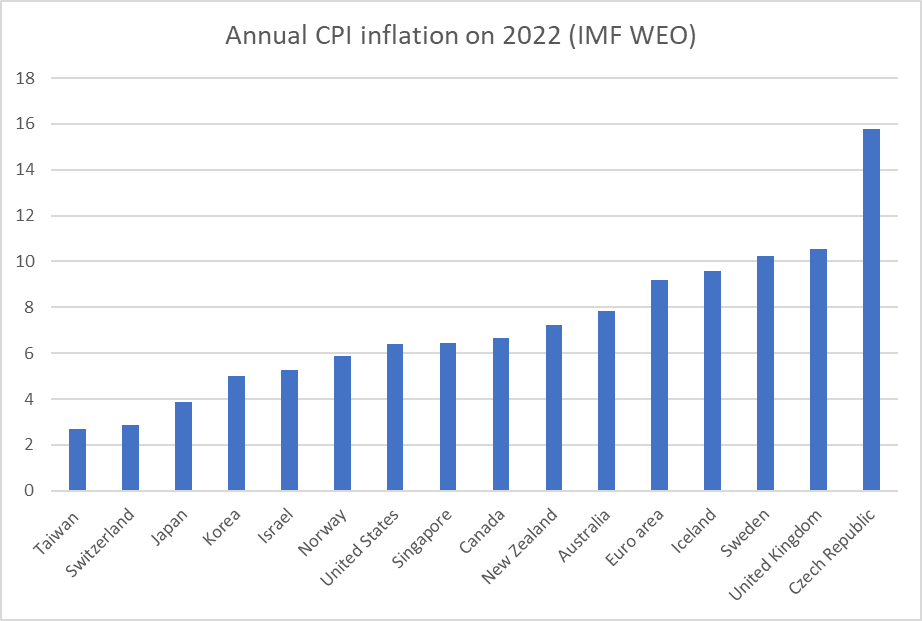
Bernanke claims as evidence for his story that “most economies faced similar levels of inflation, independently of their fiscal choices”. But even on headline inflation that isn’t really so.

which is a much greater degree of cross-country variation than we were seeing pre-Covid, even if one discounts the (geographically specific) gas price shock countries at the far right of the chart.

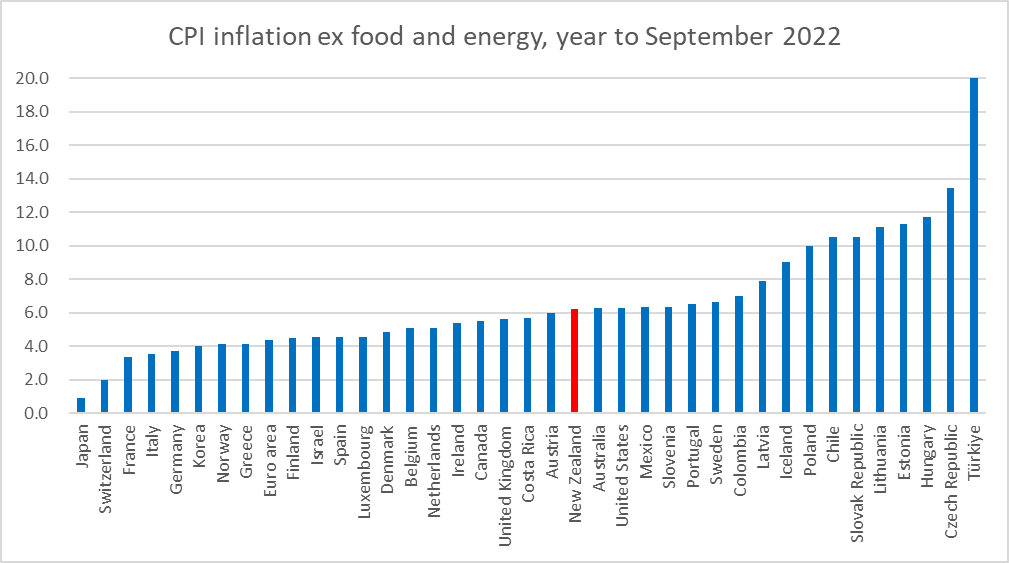
As for core CPI inflation (ex food and energy), the OECD databases have become painful to use, but I dug this chart out of an old post (ideally I’d show all the euro-area countries just as a single observation, although you can see the overall euro area number towards the left of the chart)

Quite some cross-country variation (even excluding the monetarily wayward Turkey). Is it, for example, pure coincidence that the two OECD central banks that didn’t ease monetary policy going into Covid – Japan and Switzerland – managed the lowest inflation? And to the extent that there was similarity- recall, this is in core inflation – across some countries (eg US, NZ and Australia) mightn’t it possibly reflect something about common mindsets and approaches to policy (and even, across those three countries, a fairly common pace of rebound in GDP following the initial 2020 lockdowns etc)?

And if the primary driver for (core measures) of inflation was really supply shocks (that should be largely looked through) rather than central bank choices, there must surely be at least two outstanding questions:

  • Why is it that all (or certainly almost all –  someone can to point me to an exception if they know of one) advanced country central banks would still today describe their monetary policy stance as being on the restrictive side of neutral?  The ECB eased today, to 2.5 per cent, and repeated that interpretation of their policy rate, and it is certainly the RBA and RBNZ stance.    (For the US things might be different. Policy is still described as restrictive, but while Bernanke noted that the CBO estimate of the output gap for the US in 2021 and 2022 never got very large (IMF estimates show the same thing), the most CBO recent estimates for the end of last year now point to a large and growing positive output gap.)
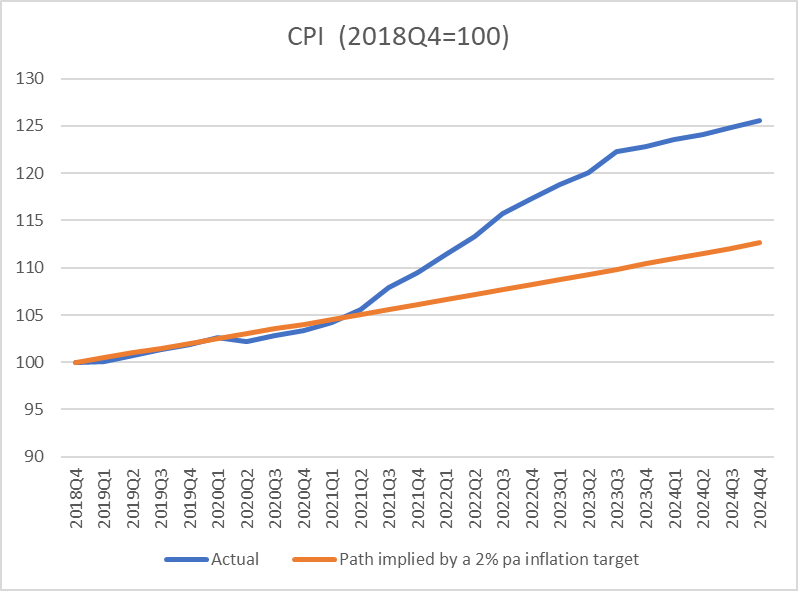
  • If the story of the surge in inflation really was mostly about supply shocks why, given that those shocks have now fully reversed hasn’t the price level dropped back?    Even in nominal USD terms, world oil prices are back to around where they were in 2018 and 2019, the same goes for wheat, and even European gas prices don’t seem dramatically higher in real terms than they were before the pandemic and war.  In all cases, real prices have fallen a lot (shipping and componentry disruptions also largely sorted themselves out), and there simply has not been any period in which headline inflation has substantially undershot the core measures, while the price level  –  headline or core –  remains well above the trajectory implied by central bank targets projected forward from 2019.   Central banks don’t pursue price level targets, but successful flexible inflation targeting, that simply looked through the ups and downs of supply shocks to prices (when shocks fairly quickly reverse), would look a lot like medium-term price level targeting.   Here is what a chart for New Zealand looks like

In broad outline, this sort of chart for many other advanced countries would look quite similar.

I don’t think anyone accuses central banks of malevolence during the last few years (Covid and inflation). No doubt they were all trying to do their best. But the evidence just isn’t there to support Bernanke’s claim that they did as well as they could have with the information they had (unless that last phrase is somehow shorthand for “on the mental models they happened to be using”, which unfortunately too often turned out to be wrong).

You can’t cover everything in a fairly short speech, but it was also worth noting that there was no mention of the (really large) losses incurred by taxpayers from the QE-type operations (bond purchases) undertaken by central banks during the Covid period, when bond yields were already at extraordinarily low levels. In his book, finished about three years ago, he affected a fairly blithe indifference, noting that any losses this time could be considered against the gains central banks had made on earlier QE. That seemed a pretty rash approach to public sector risk-taking, and would be small comfort to taxpayers in places like Australia and New Zealand where the central banks had not previously done QE. (In fairness, one can make a slightly stronger argument for the QE – beyond the immediate crisis of March 2020 – in the US, where long rates really matter, than here.)

And of course, because pretty much all the chaps (of either sex) had really done their best, there was of course nothing in Bernanke’s discussion about practical accountability. It might at least have been interesting to hear him on that in principle – what would or should it take for powerful independent decisionmakers to warrant losing their jobs? Again, the US system is different than ours (and in fact each country has different specific provisions for removal) but the price of operational autonomy was supposed to be serious accountability – something more, at least when inflation targeting was conceived and idealism was afoot, than just marking your own performance after the event, with barely a hint of contrition.

It was a shame. Surely Bernanke could have offered something deeper and more stimulating (it didn’t even stimulate searching questions from the floor). Then again, I guess Orr and his team had chosen him deliberately. And they’ll have been rather pleased with that “did as well as they could” summary assessment. Wouldn’t want any awkwardness now would we? (Other perhaps than the unplanned unexpected absence of the Governor from his own “celebration” – the word Acting Governor Hawkesby had used in introducing Bernanke.)

Doing monetary policy well in tough times isn’t easy. Glib lines about “it is only about 25bps up and down every so often” are just that – glib. Humans make mistakes, but they – and their institutions – learn when they are willing to confront and explore them.

Forty years of floating

Last year there was an interesting new book out, made up of 29 collected short papers by (more or less) prominent economists given at a 2023 conference to mark Floating Exchange Rates at Fifty. The fifty years related to the transition back to generalised floating of the major developed world currencies in 1973 (think USD, JPY, GBP, and the West German deutschemark, plus the Canadian and Swiss currencies). It was quite an interesting collection and even has some discussion of emerging markets. What was striking, reading it at this end of the world, was the almost complete absence of any discussion of the experience of smaller advanced countries – this isn’t just a matter of places like New Zealand or Norway or Israel or Iceland, but not even Australia gets a mention in the index.

As it happens, this weekend marks 40 years since New Zealand floated our exchange rate. It was announced at 10:30am on Saturday 2 March 1985 (timing set for after the Friday close of the New York foreign exchange market), and trading commenced on Monday 4 March.

I was working in the Monetary Policy Section (all 3 or 4 of us) of the Reserve Bank’s Economics Department at the time but although there had been talk of floating for months (pretty much since the devaluation in July 1984) and real policy challenges around maintaining the fix, the actual timing of the move was successfully kept very tight (I was never quite sure even whether my boss had known), and I learned of the news when later that afternoon I wandered down to the Hataitai dairy to buy my Evening Post.

It was the same day as David Lange’s Oxford Union debate on nuclear issues, and the Reserve Bank’s Deputy Governor, Rod Deane, had had to fly to London to brief Lange and secure his final agreement to the move (my diary the following week records him telling us that he had been most impressed with Lange’s questioning etc).

The Evening Post’s journalists must have been pretty busy as they’d managed to get comment from all manner of people in the couple of hours they had. Some of them are still commenting today

Bob Jones was another whose views were reported, claiming that by floating “New Zealand has now joined the rest of the world as a sophisticated economy” which wasn’t really true as by this point there were still lots of smaller advanced countries who weren’t floating at all (Australia had done so only a year or so previously), and many of the European countries were running their collective Exchange Rate Mechanism, designed to severely limit fluctuations.

The comments in that old paper that most caught my eye ((bottom right story in the first photo above) were from my old macro lecturer Merv Pope who was very critical, stating that in his view “the economy would suffer severely”.

There are books and articles that discuss the politics and bureaucracy of the period leading up to the float, and I know there are some people who read this blog who were closely involved in it all (who are welcome to add comment/context), so I’m not going to attempt to cover that.

The journey to floating mainly dates to the events around the July 1984 devaluation and the early days of the 4th Labour government. The establishment view in early-mid 1984 was that the New Zealand dollar was seriously overvalued in real terms, and in that sense the mid 1984 devaluation had been welcomed. All that said, as was perhaps necessary in the market circumstances, the extent of the devaluation – 20 per cent – had been set to eliminate the likelihood of further downward pressure, and thus to some extent probably represented an adjustment larger than the medium-term macroeconomics might have warranted.

Going pretty much hand in hand with the devaluation was the removal of the interest rate controls that the previous government had put in place over the past year, combined with a new willingness to fund the government’s deficit primarily by wholesale domestic debt sales, taking whatever price the market charged. With the prospect of rising inflation (if only from the devaluation itself) and large fiscal deficits, it had the makings of considerable difficulties in achieving effective monetary control. Exchange controls on capital transactions were still in place but they were porous (and more designed to limit outflows than inflows) and one of my tasks in August 1984 had been to sift carefully through the records of foreign exchange inflows looking for evidence of capital inflows drawn by the combination of high interest rates and a, possibly, undervalued exchange rate. A fixed exchange rate meant that we – the RB – were committed to buying whatever foreign exchange was offered at the fixed (against the TWI) rate, and all those purchases immediately added to domestic liquidity.

In an earlier post some years ago I noted

One of the starkest memories of my first year at the Reserve Bank, fresh out of university, was being minute secretary to a meeting in late 1984 attended by the top tiers of the Reserve Bank and The Treasury.  It was a just a few months after the big devaluation that ushered in the reform programme: senior officials were explicitly united in emphasising how vital it was to “bed-in” the lower exchange rate, and ensure that the real exchange rate stayed low.

The risk was that if we didn’t succeed in getting monetary conditions under control, all the pain of the devaluation might go for nothing (ending up with no real devaluation at all, as in a number of past devaluations here and abroad). And yet with high market-determined interest rates, it was going to be difficult to stop capital coming in. We still had tools like reserve ratios but (a) the goal was to move away from them not become more reliant, and b) they became much less effective in a deregulated interest rate market. We sold government debt aggressively, aiming to mop up the excess liquidity, but the more debt we sold, the more tended to come in (those yields were attractive, and the exchange rate was fixed).

Among the various Ministers of Finance (Douglas and associates) there was a desire to float, but when? It didn’t make a lot of sense to contemplate floating the exchange rate while exchange controls were still in place (although the UK had in the 1970s), and exchange control removal didn’t happen until the Friday before Christmas 1984. And no one really had a good sense as to what the market would deliver (particularly in terms of liquidity and volatility) when the float happened (I’m pretty sure no countries as small as New Zealand were floating were by then, and although Switzerland wasn’t hugely larger it was home to a fairly major banking and financial centre).

Short-term interest rates began 1985 in the mid-teens (the Reserve Bank’s data has the overnight cash rate at 13.4 per cent and the 90 day bill rate at 15.3 per cent in early January. Capital inflows tended to dampen rates, while our monetary policy actions sought to underpin them or push them up (the medium-term goal being to consolidate fairly low and stable inflation, after 10-15 years of high and volatile inflation).

But the backdrop turned fairly quickly. This is from the Bank’s June 1985 review

Pressures built further in February and by 15 February short-term rates had increased by another full percentage point. But it was in the final week of February that things culminated, with significant foreign exchange outflows, reflecting at least in part a sense that a float was likely sooner rather than later, and that when it happened the exchange rate was likely to fall. As the Bank’s Bulletin article records, foreign exchange outflows had been particularly heavy on 28 February and 1 March, transactions due for settlement two working days later. By Friday 1 March, overnight cash rate were at 38 per cent and the 90 day bill rate was at 25 per cent. If you really thought the exchange rate was going to depreciate quite a bit in short order, paying interest rates of under 10bps a day to fund a position taken on the back of that view wasn’t too much of a problem.

(Meanwhile in the Monetary Policy Section we were hard at work devising projections and policies designed to keep inflation in check, all based on a continuation of a fixed rate.)

While the exchange rate was fixed, the Bank was committed to buying and selling whatever it took to maintain the rate, and each such transactions had counterpart domestic liquidity consequences (the Bank was not then doing routine daily open market operations to stabilise the level of settlement cash). Those fx outflows just prior to the float sharply lowered liquidity in the banking system. And once the float happened, the door was closed.

On the first day of trading (4 March) the exchange rate did fall (down around 2 per cent against the USD, which itself was stable against the JPY and DEM) but the dynamic changed pretty quickly. Those liquidity pressures really started to bite, and anyone who wanted to bring funds back to New Zealand needed to find a market seller of NZD, rather than a fixed price central bank. Short-term interest rates skyrocketed

and although the official data has a peak cash rate of 265 per cent, my memory (and my contemporary diary records) suggests peaks in excess of 500 per cent (still only around 1 per cent day per day). Within a couple of days the NZD exchange rate was 4 per cent higher than it had been just prior to the float, and probably would have jumped even further had the Bank not eventually intervened. By 20 March, short-term rates were down to about 24 per cent. It had been a wild ride.

Could the float have been avoided back on 2 March. Most likely it could have. The big problem in July 1984 had been a combination of a) perceptions that the exchange rate was fundamentally overvalued, b) perceptions that Roger Douglas, likely finance minister if Labour won, wanted to devalue, and c) the fact that interest rates were controlled, and so sales of foreign exchange by the Bank had no countervailing interest rate effect. But the broad direction of economic policy was to free up financial market prices, and so there would have been little good reason to delay further.

It is interesting to ponder what might have happened had the government decided instead to a) liberalise interest rates, and b) remove exchange control but c) to keep on with a fixed exchange rate, at the post July 1984 level. The monetary policy trilemma says that in the world you lose control of domestic monetary conditions (and thus the ability to control your own inflation outcomes). By 1984/85, the inflation rates in most major western economies were already more or less in check (think UK, US, West Germany, Japan), and with a fixed exchange rate we might have been expected to have seen New Zealand converge in time to around the average of our trading partners. But I suspect it would have been a wild ride, and would not have ended well. For example, in March 1985 the effective Fed Funds rate was 8.5 per cent and three month rates in Germany were about 6 per cent. With those sorts of interest rates in New Zealand through that period – and that is what a credible exchange rate peg would have delivered – the credit boom, commercial property boom, sharemarket boom etc might well have been even larger, and ultimately messier to resolve, than what we were actually to experience a few years later (the Nordics, for example, went that sort of route, only to float some years later). (It also isn’t wildly different that what Ireland and Spain experienced in the 00s, except that – in adopting fit-for-Germany interest rates they may have been less badly prepared than New Zealand firms/banks might have been in the mid 80s.)

This isn’t a post to review New Zealand’s experience with floating. Perhaps I will attempt something like that over the next few weeks. There have been persistent critics, even beyond the Day 1 ones cited above, perhaps most notably the economist Brian Easton. There were endless debates in the late 80s under the broad heading of “sequencing”: there were models under which things might have been less messy if the order of liberalisation had been different: external trade and labour markets before financial markets (and particularly the capital account and exchange rate). We’ll never know, although (as just one illustrative example) it was never plausible that even the 4th Labour government was ever going to lead with labour market reform, so perhaps there was never a real choice.

Back in one of those early quotes, Rob Campbell commented critically about the increased room for “speculative moves” around the New Zealand dollar. I suspect that many of those who broadly supported the move to floating will still have been taken by surprise by the amplitude of the cyclical fluctuations in the exchange rate, and the incidence of large single day movements over the following few years. Then again, another mystery of the New Zealand experience is why an exchange rate that was so variable until about 15 years ago hasn’t been since. Perhaps that will be the topic for another exploratory (because I don’t think I know the answer) post

Orr at it again

I decided not to bother listening to the Reserve Bank’s appearance at FEC yesterday morning. After all, the OCR decision had been much as expected and foreshadowed, the forecast tracks etc hadn’t changed much, and – with all due respect to some new FEC members – how searching was any questioning really likely to be?

But an old colleague listened in, and was rather concerned to hear Orr’s deputy chief executive for macroeconomics and monetary (the one with no qualifications or background in either subject) Karen Silk making what appeared to be the claim that the Bank and MPC had got the trends in inflation about right. On listening to the relevant section myself I reckon she was trying to claim that the Bank had been broadly right last year that inflation would come down a lot last year. If so, I’d give her a pass, or perhaps half a one. After all, the questioning just prior to her comment had been about how much the Bank’s overall forecasts had changed in recent quarters, and as I illustrated in yesterday’s post there were really big changes

when the underlying state of the economy and estimates of inflation pressure weren’t changing much at all. So, yes, they were right that inflation would at last come down, but quite at sea on what monetary policy it would take.

The questioning was coming from National MP Dan Bidois who is, I think, the only economist in Parliament. He started by asking about the change from the August 2024 MPS. Orr, either getting things wrong or simply playing distraction knowing what he was saying simply wasn’t true, claimed that actually the August MPS projections for monetary policy had been pretty much bang on. In August the Bank projected that the OCR for the March quarter would be 4.62 per cent (4.36 per in the June quarter). In fact, the OCR will average about 4 per cent for the March quarter and no more than 3.75 per cent for the June quarter.

Orr went on to suggest that Bidois probably really meant the May 2024 MPS – at which point the MPC was actually talking of possibly raising the OCR further. That, of course, looks even worse for the MPC. Back then – only 9 months ago – they reckoned the OCR for this quarter would be 5.62 per cent.

Orr attempted to explain it away by data problems. And it is certainly true that historic GDP numbers have been quite materially revised by SNZ late last year. But changes to historic GDP numbers also change estimates of potential output. On the Bank’s own numbers – their published projections spreadsheets – their view of the size of the negative output gap as at early last year (say March quarter 2024) in the May 2024 MPS (-1.6% of potential GDP) was barely different from their current estimate of the output gap as at March quarter 2024 (-1.4 per cent of potential GDP). Back in May the chief economist was blaming his tools, now he and his boss are blaming the data. What is pretty clear is that the Bank still has had an inadequate understanding of what is going on with inflation, and what it would take to keep it in check (back in 2020 to 2022) or to bring it back down.

Bidois’s questioning had actually started with something more general, encompassing the whole of the last five years. He noted that people had observed that the Bank had been both too slow to tighten and, perhaps, more recently too slow to ease. What changes, he wanted to know, had the Bank made to be more accurate in its forecasts (and, presumably, appropriate in its policy calls). It was a pretty good question from a new member of the committee.

Orr’s response? Handwaving, bluster, and what are little more than outright (repeated) lies. He really wanted to be able to “move on” from the last five years – I’m sure he would, so bad and expensive were the calls made by his MPC – but in any case, he claimed, it was all okay because the Bank had done its own review of experience and all the answers were in that report, and the lesson had been adopted he said. Orr was referring to their (required statutory) review of themselves, covering the period 2017 to 2022. It had big problems and deficiencies, not least of which was that the Bank management was reviewing themselves (as it happens, 2+ years on I am still waiting for the Ombudsman to rule on a request for the input of external MPC members on this review – such is the Bank’s commitment to (anything but) openness).

And it was published on 10 November 2022. By then – the November 2022 MPS – they’d decided that the OCR would need to go to 5.5 per cent, but they reckoned that by now (early 2025) it would still be over 5 per cent. Now, over a horizon of 2+ years that might not be thought to be a huge error, except that – see graph above – they were still well off the mark 18 months on in the middle of last year.

To be clear, making sense of the last five years has been hard. Many private forecasters have probably, on average, been about as bad as the Bank. But the private forecasters a) aren’t paid to run monetary policy, b) tend not to boast about that period, and c) don’t just make things up, and actively seek to misrepresent things and thus mislead Parliament (in ways that now can only be considered knowing and intentional).

Orr also claimed that the Reserve Bank had been among the first central banks to tighten and among the first central banks to ease. On the tightening point, I’ve previously documented that they were in fact about 7th of the OECD central banks to tighten (out of about 20 separate monetary authorities) but that – much more importantly – the positive output gap they had allowed to build up in New Zealand was materially larger than that of any other OECD country for which the IMF produces estimates. On the Bank’s own numbers it was huge (almost 4 per cent of GDP), and monetary policy isn’t a cross-country race, but is about dealing with your domestic circumstances, and the excess inflationary pressures they allowed to build up before slowly beginning to tighten was huge, and the seeds of many/most of our subsequent cyclical problems. As for easing again, and again what matters is not a cross-country race but domestic inflation (actuals and forecast), I found at least 11 OECD central banks had cut before the RBNZ Monetary Policy Committee did. Orr has to have known this. He simply made stuff up for the MPs, counting on the high likelihood that none of them would have enough data at their fingertips to contradict him there and then. Simply egregious behaviour. (But he has misled FEC so often in recent years – many episodes documented on this blog – with no apparent consequences that, if such is your approach to integrity and transparency (lack thereof), then I guess, why not.)

And then it was just more of the cavalier dismissal of the last few years. It was, he claimed, a great achievement to get through with inflation peaking at “only” around 7 per cent (core inflation probably peaking around 6 per cent, the target the committee had agreed to take on when they accepted appointment was 2 per cent). No mention at all of the arbitrary income and wealth redistributions or of the massive dislocations in both inadvertently grossly overheating the economy and then having to squeeze the inflation out again (let alone the $11 billion of taxpayers’ money simply lost, to no useful macroeconomic end). Never mind, stuff happens, was the impression we got – just keep on paying me $800000 a year, reappointing me and my MPC members, and boosting my budget.

An appropriate contrast, he suggested, was the Great Depression, in which he – weirdly – claimed that there had been hyperinflations (where precisely?) Things hadn’t been that bad really.

[UPDATE 11/25. Reading the transcript it seems likely Orr was listing a series of different economic disruptions rather than suggesting hyperinflations had occurred during the Depression itself].

Then he had the gall to suggest that really the Bank was quite budget-constrained. They’d been doing what research they could on their “limited budgets”. Now, it is true that the resources they have chosen to devote to monetary policy in recent years haven’t increased – perhaps they should have – but this is the organisation whose staff numbers have more than doubled on Orr’s watch, still rising now, with an abundance of positions advancing management’s ideological causes rather than the Bank’s quite limited statutory objectives.

Orr also mentioned the closed-door conference they are holding in a couple of weeks’ time, inviting in experts to help assure themselves that their research was at the cutting edge and up with the state of play in other central banks or academe. That should be a short conversation. This is their entire list of published Discussion Papers (the peer-reviewed work) in the last five years

not one of which is directly relating to inflation or monetary policy, and one of which was primarily written by authors from other agencies. It is slim pickings indeed, compared (say) to the previous five years (33 such papers).

It was all pretty extraordinary, at one level, but also all too ordinary for Orr. Orr and his offsiders blustered and made stuff up again, and laughed along with the committee members in a very chummy sort of engagement. When there were decent questions (and Bidois’s were good but rare for FEC)….well, they just made stuff up again and actively misled Parliament. That is supposed to be a very serious offence – as Parliament’s website tells us (and a year or so even an MP was reprimanded for misleading the House) – but such is the diminished state of things in New Zealand, I don’t suppose there will be any more consequences this time than all the previous times. In a well-functioning democracy you might hope that the Minister of Finance would take to task a Governor who so obviously and deliberately misled MPs (including one of her own) but……no one now expects anything of Willis when it comes to the disreputable central bank and its Governor. One might even hope that the external MPC members – who do not work for Orr – might distance themselves from this shabby and dishonest conduct. But they seem to prefer the quiet life, and just go along with Orr, by default associating themselves with his standards.

At the end of the session the discussion moved to productivity. It isn’t really the Bank’s field, and Orr’s own contributions on the subject tend to veer between mechanistic growth accounting stuff and the “failures” of this, that, or the other group of people in the private sector (today’s villains appeared to be people who took dividends from companies rather than reinvesting). His chief economist, who knows more about productivity, has already shown his hand as a bigger-government statist, advancing personal political agendas under his Reserve Bank title.

But today Orr was claiming that the Reserve Bank has a lot to offer on productivity (policy). Not, you understand, anything to do with the risk-weighted bank capital requirements (where he was blustery and dismissive without even being asked any direct question), sectoral risk weights etc (and where I suspect he is probably about half right in substance). No, what he had to offer was a central bank digital currency (CBDC). It was in development, could be in place by 2030, and would – he claimed – make a great deal of difference. It wasn’t at all clear how, despite his mutterings about how it would enable the state to deal directly with people – unlike, say, the way it pays welfare benefits now, and isn’t a CBDC a liability of an independent Reserve Bank, not something governments have access to? It would, we were told, “fundamentally change this society” – which is sort of what scares many of the more conspiratorially-minded sceptics, even though there is little reason to think such a product would meet with any material demand, or be at all widely used. It remains, in the words of successive submissions I’ve made on the issue, a solution in search of a problem, and a bigger-government one at that.

Orr’s words clearly excited one National backbencher who wanted to know when it would be in place, and what it would take. Orr’s response (in addition to the 2030 date) was “significant government support”. One can only imagine how much money (scarce taxpayer money, adding to the deficit) they are spending on this work (of course no one asked that) and wonder why it is that Nicola Willis has not closed it down already.

Quite sad what officialdom has been coming to in New Zealand, and the apparent indifference of those whom we elect to hold officials to account.

The MPC returns from its summer holiday

It is almost never an (unconditionally) good thing if an official policy interest rate (in our case the OCR) is being adjusted in large bites, whether that is (for example) 175 basis points of cuts in the last six months or 375 basis points of increases in just twelve months a couple of years back. One can think of rather hypothetical exceptions: a civil war ends and the reckless central bankers who financed it are suddenly sent on their way (so actual and neutral rates fall a lot), or a bold reforming government takes office with an immediate policy programme likely to dramatically lift potential growth, and involving lots of new investment (pressure on resources) in the transition (so actual and neutral rates rise a lot). But that isn’t the story of New Zealand in the last few years (or any of our advanced country peers). Really big changes in official interest rates are usually a reflection of bad stuff having happened: that might be a really nasty external shock (as in late 2008) or past mistakes by the central bankers responsible.

But of course you get no hint of this from the Governor speaking for the MPC. The general gist I’ve seen in headlines reporting his comments in the last 24 hours is to talk things up. Rather than watch the Governor’s FEC appearance I went for a walk this morning, but as I was walking I happened to note this

It might be necessary at this point (almost certainly was) but it isn’t an unconditionally good thing, and it would be good if he (and the political cheerleaders trying to muscle in and claim credit – Luxon, Willis, Seymour) showed even some sign of recognising it. But I guess contrition is a bygone word. (Opposition political parties tend to use the point – big cuts generally mean something bad happened – only to switch rhetoric when they in turn hold office.)

In truth, the Reserve Bank and its MPC really does not know what it is doing. Their own successive forecasts show it. In this chart I’ve taken their projections for the OCR in the June quarter of 2025 for each of the last five MPSs. Only 9 months ago they thought the OCR in the June quarter would average more than 200 basis points higher than they now think.

That might be pardonable if some really big external shock had hit the New Zealand economy. But there hasn’t been any such shock. Commodity prices haven’t plummeted, fiscal policy hasn’t suddenly tightened, no financial crisis has broken upon us

The MPC’s output gap estimates for around now have bobbled around a little, but haven’t really changed a lot (and recall that monetary policy works with a lag, so for example the December data – the GDP input for which we finally get next month – won’t have been materially affected by OCR cuts late last year).

The MPC might respond – if they ever engaged – that perhaps they haven’t usually been much worse than the typical market forecaster. But we – citizens – don’t employ those forecasters, while we delegate a great deal of power and prestige to this supposedly expert committee.

They might also argue that they are doing their best. No doubt, but their best isn’t very good. And what that means is that we are still in a phase – as we have been for the last five years – where neither we nor they can have any confidence whatever in their numbers or statements about what comes next or where the OCR might be at, say, the end of the year. After all, that is 10 months away, and 10 months ago they thought the OCR now would be 5.6 per cent. They simply do not have a good understanding of the inflation process – a big part of the job they are charged with doing. Perhaps we’ll still be at 3.75 per cent, or perhaps we’ll be at 2 per cent: neither seems that implausible, given how inadequate the understanding of the inflation process has been, even without really big external shocks.

Which brings me to some more mundane observations and puzzles around the numbers they did produce in yesterday’s statement.

The big one relates to the fact that, on the Bank’s own telling, the OCR is above its best estimate of neutral now and never drops below neutral (the Bank’s current estimate is 2.9 per cent, while the OCR doesn’t drop below 3.1 per cent). And the current (negative) output gap is estimated (by the Bank) to be about 1.5 per cent of GDP (and the unemployment rate, picked to peak about now at 5.2 per cent, is also well above the Bank’s estimate of a NAIRU). And yet, as if by magic – because there is no visible explanation – quarterly GDP growth is expected to bounce back almost immediately to well above potential, and the unemployment and output gaps close over the next couple of years. But how (on the Bank’s numbers)? When one gets into an economic slump (material negative output gaps), it is normal for policy rates to undershoot neutral for a while to provide the impetus to get the economy back on course (and avoid inflation undershooting). The current slump (negative output gap) isn’t as deep as in, say, 2009, but it isn’t nothing either.

But then there is the other puzzle. Why isn’t inflation falling further (on the Bank’s numbers)? The Bank doesn’t help people trying to make sense of their inflation projections because (a) they don’t publish projections for core inflation (quite a major gap now), and b) they don’t publish their inflation projections in seasonally adjusted terms. But when the output gap is forecast to be negative for the next couple of years (and materially so this year), surely we should be expecting to see inflation fall further. But it doesn’t seem to.

Non-tradables is not core inflation, but it is the best they provide (bearing in mind that non-tradables historically averages well above headline, and so isn’t expected to settle anywhere near 2 per cent per annum). Their non-tradables forecasts for 2025 are already as low as they are ever thought likely to get.

I can do same sort of chart for their LCI wage inflation forecasts. The trough is already reached in the June quarter this year (just a few weeks away) with the unemployment rate still above 5 per cent.

It doesn’t seem to hang together very well as a story.

There aren’t many interesting charts in the MPS itself, but this one caught my eye.

It is based on a working paper that hasn’t yet been published (less than ideal) but seems to show that the bits of non-tradables inflation that are most responsive to monetary policy pressure have already fallen too or below the rates of inflation experience during the pre-Covid decade, where core inflation quite materially undershot the midpoint of the target range, that the MPC is required to focus on. It isn’t an ideal chart, including because it doesn’t show the earlier period when core inflation got beyond the top of the target range, but – given that the latest (Dec) outcomes will have been driven by the OCR at 5.5 per cent, and that (as above) the OCR never gets below neutral, you’d have to think it likely to more disinflation was already in the works, including with the OCR now at 3.75 per cent.

Perhaps there are good answers, but if so (a) they aren’t in the MPS, and b) the MPC members never give speeches or serious searching interviews.

I have noticed that the Bank has consistently been forecasting a large rise in the terms of trade – for reasons that elude me – and perhaps that is some part of a story, but surely any effects of even that puzzling projected rise are already included in those (disinflationary) output gap, unemployment gap, and OCR gap numbers?

Two final thoughts.

When the MPC was established six years ago, the hope – and perhaps promise – was that we would have better quality decision-making and more transparency and accountability. Sadly, any such suggestions have quickly turned to dust, whether under Grant Robertson as Minister of Finance or, more recently, Nicola Willis. The quality of the external members has improved a little over the last year, with two new appointments by this government, although one elderly retired academic who served on the committee from the start (through all the costly mistakes of 2020 to 2022) has recently been extended again by the Minister of Finance. But we hear nothing from any of these people, whether in speeches, interviews, testimony to Parliament’s FEC. Or the minutes of the MPC meetings (the Summary Record of Meeting, which takes up the first three pages of the MPS). These documents have become utterly pedestrian and largely repetitive of material elsewhere in the document. And perhaps more to the point, there is rarely if ever any sense of divergences of view or serious explorations of alternatives, this around subject matter where (see above) the consensus view has so often been so wrong in recent years. Here is the final page of yesterday’s Summary Record of Meeting, where there is just nothing suggested any sort of range of views.

One hears on the grapevine suggestions that the MPC does in fact sometimes have robust debates. Perhaps, but they give no hint of this – in a field that everyone knows is characterised by huge uncertainty, and where challenge and contest of ideas and evidence is vital – and there is no serious accountability. One can only hope that one day, perhaps looking to the end of the Governor’s final term (in March 2028) the Minister of Finance might seek some advice from The Treasury on how to finish the work that Grant Robertson began, but let run off the rails. Some of these people might be uncomfortable about having to front up with their views and analysis, or having to account for their judgements, but – academic or otherwise – if that is so they simply aren’t the right people for such powerful policymaking positions.

And finally, someone reminded me yesterday that the Reserve Bank is holding a closed-door conference in a couple of weeks to mark 35 years since the Reserve Bank Act of 1989 came into effect, and inflation targeting in New Zealand – pioneering as it was – took formal legal effect. They look to have a couple of good keynote speakers (Ben Bernanke, and Bank of England MPC member Catherine Mann – whose BOE speeches are always worth reading, even if her contribution (in a former role) to debate on New Zealand productivity and immigration a few years ago was spectacularly bad). I’m sure the select invitees will enjoy a good time and some expensive hospitality.

The Reserve Bank says that the aim is as follows

One hopes then this will include serious and self-critical reflections on how the last few years came to happen. The promise of inflation targeting was that serious outbreaks of core inflation – and aassociated real unexpected redistributions of wealth, and nasty adjustments to get things back under control – simply would not happen again. And yet they have. Much of the promise in the New Zealand context was that in exchange for delegating huge power to the Reserve Bank, we’d see serious accountability when mistakes were made – and yet, as far as I can see, no central banker anywhere has paid a price for the mistakes of recent years. Or perhaps they may reflect on the not-so-small matter of the massive financial losses central bankers here and abroad ran up on the taxpayers’ bill over the last few years. But – based on the approach of our own Governor, MPC and ministers in recent years – probably not. I’m certainly still in the camp that sees inflation targeting as better than the alternatives – at the 25th anniversary conference I offered some thoughts on why nominal GDP targeting didn’t seem a better choice for New Zealand, in 1989 or more recently – but I’m much less convinced than I was decades ago that delegating the power to central bank Governors or MPCs makes sense. We need expert advisers, but accountability for central bankers has proved so elusive we might be better off putting the decisionmaking back with the people we can toss out, the politicians.

PS: I also saw this comment, presumably from the Governor’s FEC appearance. If this means an end to the long summer holidays and a return to eight meetings a year then it would be most welcome.

Orr on Q&A – Part II

My post this morning was based on Adrian Orr’s Q&A interview as found on TVNZ+. However, it turns out that that wasn’t the full interview which (thanks to the kind people at Q&A for pointing me to it) is now available on Q&A’s Youtube account here. The full interview is almost half an hour, and is probably worth watching if you haven’t already watched the selections on TVNZ+ – it is a more rounded presentation and chance for Orr to tell his story.

As in the previous post, there was something in this bit of the interview where I welcomed the Governor’s comments. He lamented the underinvestment in official economic statistics, that has gone on for decades now, and suggested governments really should do better. And while he noted (fairly) that there is a lot more other data than there used to be, it remains something of an open question (would be interesting to see RB analysis of it) as to whether the Bank and other forecasters have gotten any better at recognising early quite what is going on in the economy and inflation. Perhaps 2020/21 was an unfair test, but we’ve seen a lot of lurches even this year from the MPC. But if the Governor is championing full monthly CPI and HLFS data and more timely GDP data, I can only agree with him.

But if that was the positive, there were plenty of things to lament in the Governor’s comments in the extended interview.

There were, for example, outright falsehoods. Thus, he talked of his European peers having struggled with inflation in excess of 20 per cent per annum. As far I can see, the only OECD European central bank that faced an inflation rate that high was Hungary (briefly) although a couple of others were in the high teens for a while. Gas prices severely affected headline – but not core – inflation, and New Zealand (and Australia) weren’t exposed to that post-Ukraine shock. In the euro-area (most of Europe) headline inflation peaked – gas shock – at 10.6 per cent. The Governor then claimed that the UK had had 15 per cent inflation. That didn’t sound right either.

11.1 per cent isn’t even close to 15 per cent. Why does he just make these things up?

(And a reminder of the graph in this morning’s post: on core inflation (the bit central banks do much about) we were simply middle of the pack in the OECD.

I noted this morning that the LSAP hadn’t come up in that bit of the interview. It did in the fuller interview, and sure enough we get the repeated Orr make-believe blustery arguments. Not only had the Bank’s interventions saved the economy from a “deep recession” (quite how when as the Governor correctly notes the lags in monetary policy are long, and GDP here quickly rebounded after the first lockdown), but the costs (the $11bn or so of losses to the taxpayer) were “more than overwhelmed” by the “net benefits”. The net benefits have never been successfully identified, and the absurd claim needs to be read against the fact that overall Reserve Bank monetary policy calls led to the economy massively overheating, a severe outbreak of core inflation, big redistributions, and then a protracted – if not overly deep – recession to get things back to balance. Whatever the good intentions, there simply were no “net benefits” (probably few gross ones either) and large losses to the taxpayer. But Orr never engages straightforwardly on such issues. (For anyone who listens he cited some IMF work – I picked apart an earlier piece from the IMF on this issue here : the IMF had simply imagined a world (and economy) quite different from what New Zealand actually experienced.)

There were two other interesting lines from Orr.

The first was a bold statement that banks had been making “excessive profits”. Not high, but “excessive”. Quite what basis he as prudential regulator had for that claim isn’t clear, but he has long had it in for the Australian banks. He seems to consider it somehow unfair that the Australian banks are efficient low-cost operators.

And the second was the claim that we are seeing unusual (greater than previously) changes in relative prices globally. Since oil prices were one of those he mentioned, here is a long-term chart

The alleged greater volatility isn’t apparent there. Perhaps there is something to the claim more generally (would be interesting to see the analysis and data), but it seems unlikely, and perhaps particularly in the New Zealand context, where one of our most important relative prices is the exchange rate, which has displayed remarkably greater stability in the last decade or more than in the first 25 years after it was floated.

Orr also claimed that inflation itself was going to be more variable, but again it isn’t obvious. There has been a bad outbreak of inflation a few years ago, now brought back under control, but is there really any evidence (beyond the Governor’s desperate desire to talk about climate change) for the proposition, or that it would matter if it were true (headline vs core considerations again)?

Towards the end, Orr was talking up the strength of the Bank, notably the Board (signally underskilled in fact, with a chair reappointed who did/said nothing about the mistakes of recent years) and the MPC (most of whom we never or very rarely hear from, at least one of whom has no relevant qualifications at all). As for the rest of the senior management, those I have anything to do with (several) simply aren’t very impressive (in two cases “not very impressive” is to flatter). Perhaps when standards are that low Orr gets away with the sort of loose language, bluster, and Trumpian-style false claims internally (as well as the intolerance of dissent etc that he is known for). But it shouldn’t be acceptable in such a powerful figure, and if central bank Governors are never going to be some sort of single source of truth, at very least they should (a) prompt one to think, and b) not prompt one to worry that yet another claim just bore little or no relation to reality.

But this is latter day New Zealand.