A British visitor championing free trade and open borders

Last Thursday British journalist and economist Philippe Legrain gave a lunchtime address at Victoria University (of Wellington).   Legrain was apparently in the country mainly to talk about some work he does on refugees and employment, but this particular event (hosted by the New Zealand Initiative) was on the topic “How our open world is under threat, and why it matters”.   He is a Blairite (ie active government)  globalist (a term I don’t mean in any pejorative sense) –  favouring, it appears, as much open trade, open investment, and open migration as possible, and then some.   For anyone sufficiently interested, the Initiative has now posted a video of Legrain’s talk.

I found it a strangely unsatisfying talk on a number of counts.   Perhaps it worked for those already converted to his cause, but even then there wasn’t anything new, or any fresh arguments or evidence.   And it didn’t greatly help that despite being an obvious fan of New Zealand (or at least of the fourth Labour government) he didn’t know much about it, despite speaking to a central Wellington audience probably largely made up of policy wonks and junkies.

In his younger days, Legrain had worked as an adviser to Mike Moore in his time as head of the WTO.  There, I presume, he had picked up stories about the sheer dreadfulness of New Zealand 35 years ago, and heard tales of the subsequent reforms.  We were, he claimed, in some respects the “birthplace of globalisation”, which still – reflecting on it days later –  seems a very odd claim.  The reformers of the 1980s mostly saw the reforms as being about bringing New Zealand policy back more into line with the mainstream  of advanced country practice (even if, with a small single chamber parliament, some reforms could be pushed through in more elegant and intellectually appealing ways than some other countries managed).   Lamenting (quite rightly) the insanity of the days when New Zealand assembled television sets (and cars) here from disassembled kits, Legrain (again, fairly enough) observed that New Zealand needed to do more international trade.

But then his tale became rather more detached from reality.  We were told that New Zealand had “flourished” since the early 1980s, we were “richer, freer, more diverse, better connected”, we’d found niches in world markets (he mentioned film-making, apparently oblivious to the subsidies so generous they’d have made an early 80s sheep farmer blanch), had better economic growth, and higher living standards.  All because we’d opened to the world.

All of which would have been a good story.  It was, after all, the way things were supposed to be.   But what of the evidence?

Foreign trade for example?  Successful small economies tend to do a great deal of it, and there is no doubt that the protective structures we wrapped around the economy for 40 years or so tended to reduce both exports and imports as a share of GDP.  But here is how the export and import shares of the New Zealand economy look, for the first four years of the 1980s and for the last four years.
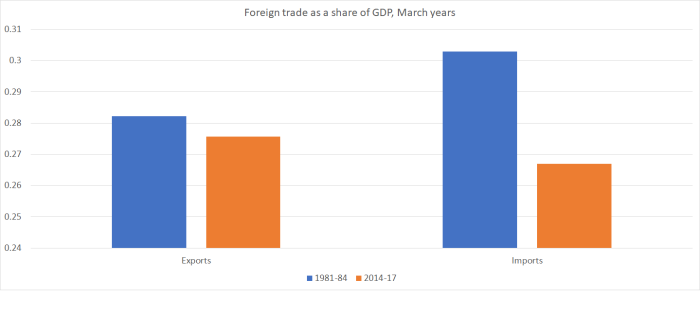
foreign trade

I think I am pretty safe in saying that no one involved in the reform process 30 years ago envisaged our foreign trade shares shrinking.

And what of the “richer” claim?  Well, certainly real GDP per capita and real productivity measures are higher than they were, but that is true almost everywhere (Venezuela perhaps excepted): there are common global forces, technological innovation etc, at work.    What matters, in assessing the success of New Zealand policy, is how New Zealand has done relative to the rest of the world, and in particular to the other advanced economies we’d been falling behind for several decades.   Since 1983, New Zealand’s productivity growth (real GDP per hour worked) has been in bottom quartile of the 25 countries the OECD has complete data for.  If you prefer simple GDP per capita comparisons, then despite a big sustained gain in New Zealand’s terms of trade  –  almost totally beyond our control –  we’ve fallen further behind the G7 industralised countries on that score over the same period.

It isn’t even as if things went badly worse for a few years and are now coming right: trade shares are still trending down, we’ve had almost no productivity growth in recent years, and so on.   If New Zealand really was the “birthplace” of globalisation, advocates such as Legrain should be looking to bury the evidence –  or, more to the point, think more deeply about what aspects haven’t worked well, and whether some things matter here in ways they mightn’t matter elsewhere.

He was a bit hazy on his geography too.  In (fairly) noting that trade deals between a post-Brexit Britain and New Zealand won’t make much difference for either country, he launched into the old line about New Zealand’s future being in Asia, and our great good fortune in being on the doorstep of the fastest-growing part of the world.  It probably escaped his attention but Wellington and London are each about the same distance from Shanghai, and London is much closer to Delhi or Mumbai than Wellington is.

Legrain’s misconceptions about New Zealand continued to the present.  He is a big fan of immigration –  having written a whole book about it under the heading Immigrants: Your Country Needs Them – and lamented that New Zealand was slashing its immigration numbers by a third.   I presume this was an allusion to the Labour Party’s policies in last year’s campaign, which might (on their estimates) have reduced the net inflow by about a third for one year.  But perhaps he hadn’t caught up with the fact that the government seems to be following through on very little of that, and (more importantly) that they never promised, or even suggested, any reduction in the annual target for new permanent migrants.  That target remains probably the highest, per capita, anywhere in the world.  But never mind; don’t let troublesome details get in the way of a rhetorical flourish.

Perhaps my description of Legrain as a “globalist” was best-exemplified by one of the items on his list as to how the world is going to pot.  He was, he noted, disturbed that New Zealand had a party in government whose name was “New Zealand First”.    I’m no fan of the party itself –  any more than any of our parliamentary parties –  but precisely whose interests does he suggest that governments should govern in?    He didn’t elaborate, but pursuing first and foremost the interests of your own citizens (or even residents) seems pretty basic to me.  And not very contentious among most citizens –  here or abroad.    Quite often, of course, what is good for us is good them (and vice versa)  –  free trade in goods and services is generally the prime example –  but the case for any New Zealand government action should be that it advances the interests, attitudes and values of New Zealanders.  Sometimes those decisions will be altruistic in nature –  taking in refugees for example  – reflecting the values of New Zealanders.  But most of us want our governments to respond to, and promote, the best interests of New Zealanders.  Legrain clearly doesn’t.

Now, I should make clear that I am a strong supporter of free trade in goods and services.  I’ve long argued, for example, that we should remove all our remaining tariffs unilaterally.  Legrain hates Brexit, but the fact remains that the current difficulties are mostly arising because the EU does not believe in, or practice, that sort of free trade.    I’m also a supporter of a pretty open approach to foreign investment, at least when it doesn’t involve state actors (and even Legrain noted that, thus, China should be something of an exception).   Actually we also apparently share a view that trade agreements among advanced countries –  if we must have them at all –  are not a place for things like ISDS agreements or intellectual property rules.

Where we differ quite strongly –  and this would be particularly so on New Zealand, although the point generalises –  is probably around immigration.    Because in his paean to globalisation he draws no distinction between free movement of goods, of capital, and of people.    But voters appear to, and often for good reason.  Legrain, unlike many voters, doesn’t appear to have much time for concepts of nationhood, or cultures which bind societies together.   As the child of immigrants (French and Estonian) himself, perhaps that isn’t overly surprising, but most people have a different, more localised, background.

10 years or so ago, Legrain wrote a book in praise of immigration, an excerpt from which is available on the web. In it he declares himself scandalised that a politician can win an election on the promise that “we will decide, and no one else, who comes to this country” or that people would think it “normal and reasonable” to control migration flows.  He laments the fact that migration policy is largely decided on national grounds.

It was a book written just before the 2008/09 recession, when Blairite globalists of his sort were in the ascendant –  things felt rather good, especially if you were a successful middle class person in a major financial centre like London.   He captures some of that in this extract

the debate that is at the heart of this book: should we welcome or seek to prevent the unprecedented wave of international migration that is bringing ever greater numbers of people from poor countries to rich countries like Britain, Spain and the United States? Fear of foreigners versus the dynamism of multicultural London: a microcosm of the wider debate about immigration that is raging around the world.

As if these are the only choices; the only (or best) way of framing any debate.

He didn’t actually use the word “xenophobia” there, but that is what “fear of foreigners” is: apparently the only grounds why anyone might be sceptical of large scale permanent immigration.  But however things might have looked in 2007 –  when the UK and Spanish economies were indeed booming –  the subsequent decade isn’t necessarily such an advert for Legrain’s open border approach (the UK, for example, having had almost no productivity growth at all since then).

And although Legrain continues, as he did in his lecture the other day, to champion the view that countries need migrants, he offered very little in support of such a view.   The potential for relative prices to change –  whether to attract aged care workers or strawberry pickers, or substitute technology –  never seems to enter his calculus.  You might suppose his own country would be a prime illustration of his point: if relatively open immigration really offered the large gains to recipient countries’ own nationals as Legrain claims, a country that had very little immigration for a long time, and then opened up quite a lot should be a great case study.  That was the UK experience after 1997.  And yet, a couple of decades on, where can people like Legrain find the whole-economy evidence of how Britons have benefited to any great extent (and this in a country in a very favourable geographic location, with foreign trade heavily dominated by services and other intangibles)?  If there are macroeconomic gains, they look pretty hard to find even there (and even if one simply abstracts from the house price disaster –  as Legrain does with an wave of the hand, and a simple “well just build more houses”.  Would that it were politically that easy, there or here.)

And New Zealand, of course, should be able to be his other showcase economy.  After all, we’ve had high levels of target non-citizen immigration –  much higher per capita than the US and the UK –  for a long time now.  But, beyond the handwaving and the pretty trivial (Legrain mentioned an apparent choice of Cambodian restaurants in Wellington), even the defenders of the current policy approach find it difficult to demonstrate the economic benefits to natives, and often seem left falling back on a “well, it would have been even worse otherwise” type of assertion.   Legrain’s world doesn’t seem to have much place for geography or natural resources –  perhaps not that surprisingly when you come from London – and, as already noted, he seemed oblivious to the failure to grow the trade sector of the economy, or the continued heavy dependence on natural resources, not obviously enhanced by simply bringing in lots more people to one of the most remote places on earth.

I think the New Zealand arguments are, or should be, different from those in countries nearer the centre of affairs.  But even in those countries, the advocates of relatively large-scale migration –  and actually in all European countries the numbers (per capita) are modest by New Zealand, Australian or Canadian standards –  struggle to demonstrate that citizens of recipient countries are benefiting.  Perhaps some of the middle classes do so –  cheaper nannies or strawberry pickers (the sort of complementarity story Legrain advances) –  but as I’ve noted before, to the extent this argument has force, it explicitly involves a redistribution in which poorer or less skilled natives are further disadvantaged.  If we should expect our governments to govern first and foremost in the interests of their own people, I’d argue that it is also important that governments govern with a particular eye on the interests of the most vulnerable or disadvantaged of their own people.   And there is no real evidence of the sorts of economic gains people like Legrain, or international agencies like the IMF have touted.  Of the IMF modelling, as I wrote a while ago

…the model also implies that if 20 per cent of New Zealanders moved to Australia (oh, they already have) and an equivalent number of Australians moved to New Zealand, we could soon be as wealthy as Australia is now, simply by exchanging populations.   Believe that, as they say, and you’ll believe anything.

As it is, large-scale non-citizen migration has skewed the entire structure of the New Zealand economy against producing competitively with the rest of the world (the real exchange rate has got quite out of line with the productivity performance and opportunities here).   We are reduced to living with sustained underperformance (often while our leaders pretend otherwise), with subsidies for trees (lots of them), trains, and other provincial baubles to attempt to buy off simmering discontent in parts of the country that should be doing really well.

Globalists like Legrain seem reluctant to accept that large scale immigration is mostly oversold as an economic instrument (if there are gains to natives, even in the North Atlantic countries, they appear small) or that the angst that he worries about (in lamenting Trump, Brexit etc) about it is often cultural and national in nature at least as much as it is economic.  For people like him, the world is made up of autonomous individuals, in which people of a country are united by, if anything, only a common passport and the authority of a common government.   Most voters in most countries see it as more than that –  they put a value, not just sentimental but practical, on common cultures, shared history and experiences and so on.  My own arguments about New Zealand immigration don’t really go along those lines –  I’ve repeatedly made the point that all our migrants could be from Bournemouth, Brisbane, Buffalo or Banff and the economics still wouldn’t work out well –  but people who champion an open economy, and the real gains on offer from foreign trade, risk losing that battle if they don’t wake up to the fact that people movements are different in all sorts of ways, and support for free trade has no natural or inevitable implications for a view on appropriate immigration policy.


Eaqub on nationalism

I guess one views, and experiences, a country differently when one is an immigrant, even one who came involuntarily as a child.   And since all of us are either immigrants or –  mostly –  not (with perhaps a few shades of grey for people who think they have come somewhere temporarily, but year succeeds year and they never actually go/come home) it can be hard for any of us to see the perspective of the other person.

That was my initial reaction when I read Shamubeel Eaqub’s latest column, headed (online, although not in the hard copy version),  Forces of nationalism a spoke in the wheels of trade.   It was, probably, a slightly unfair reaction, as there are staunch globalists (from strands of both the left and the right), almost embarrassed by the particularities and heritage of our own culture, among those whose ancestors have been here for generations.  But it is probably an easier stance to adopt when you have few or no roots in a particular country.   And many of the staunchest opponents of anything resembling nationalism seem to be immigrants themselves.  For them it seems to mean no more to move from one country to another than to move from, say, Hamilton to Tauranga.    Most people, across most pairs of countries, simply don’t see it that way.   Many, perhaps, feel an attachment even more specific: to a town or region where they may have spent all, or most, of their lives.   It is how most people live.  And the pride they often take in place, and the people of that place, is often what helps build strong functioning communities.   There is a sense of identity, shared destiny, and shared assumptions about how things are done.   It isn’t that, at least in any serious sense, one’s own community is in some objective sense “better” than the others, but it is mine, and a bit different (for good and ill) from other places.

Eaqub begins his column lamenting the rise of “nationalistic fervour”.  It isn’t abundantly clear what he means by that phrase, but in his book whatever it is counts as a bad thing.   It isn’t, he says, “just” Donald Trump or Brexit –  as if the two phenomena (two narrow victories) really have much in common.   But it isn’t clear what it is.  And he seems to have no sense that people tend to become more vocal, and intense, in defence of what they value when they perceive that someone is threatening to take it away.   There is nothing in the column that suggests he sees any value in communities (town, regions, countries –  perhaps even families) nurturing their own heritage, and what it is that makes them what they are.  Perhaps he hasn’t noticed the trend, over perhaps 100 years now, for a greater number of independent states to emerge.   It seems unlikely that that trend has exhausted itself.  And the world seems a better place for the Czechs and Slovaks to be able to have their own countries, or the Slovenes and the Croats, or the Poles – unhappily suppressed for 120 years –  or the Dutch, the Finns, the Estonians, Lithuanians or Latvians. Or at least the inhabitants of those countries seem to think so.

Instead, we get this sort of empty stuff.

Nationalism by definition prizes nationhood and pits nations against each other. It makes cooperation between countries harder, and tensions more likely. Nationalists have much in common, but even they cannot get on with each other.

Of the first half of that paragraph, he seems to have things almost completely the wrong way round.  It is no more true than to claim that because I prioritise my own house and family over those in the rest of the street that I either think badly of, or wish ill to, the rest of residents.  I don’t, I imagine Eaqub doesn’t, and I suppose only a very few people do.   At a national level, England/Britain and France both have strong national traditions, and it has been more than 200 years since those two countries were at war with each other.  Do New Zealanders resent Australians because they are a different country/nation?  It seems unlikely.

And “makes cooperation harder”?   Well, again I doubt it, except perhaps in some trivial sense that were there a single world government, its regulatory reach would cover the entire world, and none of us would have any choice, any exit options.  It doesn’t sound remotely appealing to me (and in my culture, has resonances of the Tower of Babel, which didn’t end well).   We managed to fight World War Two, beating such aggressive determined powers as Germany and Japan, without losing sight of the fact that the United Kingdom, the United States, the Soviet Union, South Africa, the Netherlands, New Zealand, Australia, and Canada were all independent states, with a shared commitment to a common goal, as well as individual national interests.

And what of “nationalists have much in common, but even they cannot get on with each other”, well since the phrase is used so broadly, in such an ill-defined sense, no doubt is true –  I doubt Michael Gove and Vladimir Zhirinovsky have almost anything in common, but one could define another side almost as broadly, and meaninglessly, and make almost exactly the same observation.  Close to home, for example, and within a single professional discipline, I doubt Eric Cramption and Shamubeel Eaqub – who would probably both accept a non-pejorative descriptions of “globalist” – have a great deal in common.

Eaqub goes on

The nationalist agenda seems to converge across three main areas: anti-immigration; protectionist economic policies; and a distrust of global institutions.   Anti-immigration and nationalism go hand in hand. At the core of nationalism is the nation state and the right to belong to it.

I’m not sure that this is necessarily true, but it is particularly unhelpful because Eaqub makes no effort to distinguish between legal and illegal migration.  Most of the debate in the United States, for example, seems to stem from the substantial stock of illegal migrants, and the renewed salience of the issue in much of Europe also seems to substantially reflect the wave of illegal migration.   That –  not the high legal numbers –  was also what has given the issue salience at times in Australia as well.

But then we are straight back to casting nonsensical aspersions, with little or no historical foundation

Being a citizen is the critical element, and easily leads to demands for tougher controls on who can come in.

It is then a small step to conflate citizens’ culture and racial makeup as different and better than those looking to come in. Language we have seen previously in precursors to discrimination, war and genocide become easier: like pests, lock-em-up and exterminate.

He simply seems to have no concept that in the same way that I don’t think badly about my neighbour, but I don’t wanting them occupying my house, people might simply value what they have, and the culture – in all its dimensions (about trust, and the way things are done, as well as arts, cuisine, religion, literature, language and so on) –  they and their ancestors have built and fostered, and be uneasy about things which threaten it. I suspect many citizens of Invercargill would be uneasy if 100000 Aucklanders moved south, and they are citizens of one country.   Arguably, it is those mass movements of people –  especially those of quite different cultures –  which sow the seeds of future tensions, and perhaps worse.    Whatever economic gains there may have been to Maori from large scale immigration since 1840, it sowed seeds of tensions that are likely to be with us for generations.  It wouldn’t have been unreasonable –  although it might have been infeasible, given the technological imbalances –  for Maori in 1840 to have said, “no, we prefer to kept these islands predominantly Maori –  we don’t think poorly of you English, and indeed we are happy to trade with you –  but we think we’ll be better, our heritage will better sustained, if we stay here and you stay there (or just in Australia)”.   By what criteria does Eaqub say they would have been wrong to have done so?

I’m not sure if I really qualify as a “nationalist”.  Even though my ancestors have been here since 1850, I feel a strong affinity for the UK and for Australia –  in many respects shared cultures, and common histories – and I count myself fortunate that the interests of those three countries haven’t collided very much, very materially, in my lifetime (let alone the century prior to that).   There are things we do differently and distinctively here,  and memories/experiences/reference points that are specific to individual countries (or regions, or cities) but I suspect I share considerably more in common with middle-aged co-religionists in Australia and the UK (perhaps even the US to some extent) than with my own mayor or Prime Minister.  My views about New Zealand immigration policy –  too many migrants, but it doesn’t much matter for those purposes whether they come from Birmingham, Banglalore, Brisbane, Beijing, or Buenos Aires –  are about the economic interests of a group called New Zealanders, and thus “nationalistic” to that extent.  If that is “nationalism”, then I’d happily sign up.

And that should be uncontroversial (even if views differs as to how best to advance the economic interests of New Zealanders).   In raising my kids, I look primarily to their interest  –  not exclusively so, not seeking harm or wishing ill on anyone else’s kids, and even feeling some attentuated responsibility (through the political system among other avenues) for those of others.  I’d lay my life on the line for my kids. I can’t automatically say the same for others, and probably no one can.   And those rare people who perhaps profess an equal interest in everyone, often in practice end up neglecting those for whom they have a particular responsibility.  Dickens treated such people in the form of Mrs Jellyby.

So I do think policy should be made at as low a level as it feasibly can, primarily with the end in view of benefiting the group those governing are responsible for.   Had I been British I’d almost certainly have voted for Brexit, and been among the many who did so (so the exit polls tell us) simply on the grounds of wanting to make our own laws.  In that vein, I think it was right that New Zealand should have its own government –  not still be part of an empire administered from London (as it was for a very short period).

And I am “suspicious” (well, more like generally disapproving, and favouring the winding of many of them) of global institutions, regarding many of them as primarily serving the interests of those who staff them (I sat on the board of one of them for a couple of years).  And if some of the more prominent ones are ever effective, it is often in constraining the future (legitimate) choices of individual countries’ citizens, in ways we simply wouldn’t accept within a single country.  So probably in Eaqub’s terms I count as a nationalist.  If so, I’ll wear the badge happily –  I even found a Guardian columnist a few weeks ago noting, perhaps reluctantly, the possibilities of a good nationalism, based around the things –  in many cases the very considerable achievements –  we’ve built together.

And, if I count as a “nationalist”, I’m a free trade and open markets one. Nationalism isn’t and never was, at least in our Anglo tradition, primarily mercantilist  The bit I liked best –  perhaps the only bit –  in Eaqub’s column was his praise of trade (his focus is external but I presume he means internal as well) –  not exports, but trade, exchange, specialisation and so on.  But for all his attempts to write about some very broad-brush “nationalism”, it isn’t obvious that he is even generally right about economic protectionism.  Perhaps I’ve missed something, but last time I looked Michael Gove was pretty keen on something approaching free trade, and whatever the concerns of governments or prominent parties in the Netherlands, Germany, Austria, Poland or Slovakia, there doesn’t seem to be much of those parties wanting to take a protectionist path.  No doubt, the gains from international trade are too little appreciated –  and thus New Zealand still has tariffs in place, disadvantaging New Zealanders –  but the push for increased use of tariffs seems to be a distinctly Trumpian theme, rather than one appearing more generally.  What, perhaps, there will be –  and rightly so in my view –  is resistance to preferential trade deals (often at best orthogonal to free trade) attempting to tie the hands of future national governments on domestic regulatory issues.  Our own government –  and its predecessor –  seem too keen on such deals (even if now, no longer on removing disputes from the jurisdiction of domestic courts).

Eaqub, by contrast, seems rather keen on such deals, and rules, and structures, and institutions.

This is why global rules on trade, travel, finance and standards have developed over time. To make it easier to connect with each other and to also use a rules-based system to deal with bad behaviour by countries.  As nationalists pull away from these global institutions, there seems little realisation that these greased the wheels of global trade, which helped their exporters and domestic producers too.

To the extent, he is specifically referring to the Trump administration approach to the WTO, I share his view.     But mostly trade has grown because of the opportunities it offered (both parties), and those opportunities aren’t going away.

Eaqub has long been a fan of immigration in New Zealand, and he returns to that theme in his columm

The global environment for migration is becoming more hostile. New Zealand can follow on a similar path, or be more organised in nabbing the best and brightest.

Being open in a closed world can be a boon. We need to actively consider our inward migration policy.

New Zealanders who have long been used to leaving for other countries, mainly for economic opportunities, will find their choices becoming more limited.

We should think about what to do with the many bright and hard working locals who will no longer leave.

It could delay the provincial decay of recent decades, which has been hastened by young people leaving.

Which seems wrong on every count.  There is no –  repeat, no –  evidence that our large scale immigration policy has been of economic benefit to New Zealanders as a whole.  There is little reason to believe that we could attract many of the “best and brightest” even if we set out to –  short of the early days of some Neville Shute On the Beach scenario, we are remote and not that wealthy, and it isn’t obvious why anyone (well, many of them) with the sort of drive, creativity and determination that might really make a difference somewhere would choose this “where”.   And as for New Zealanders leaving, perhaps the Australians will make it even harder for New Zealanders (and Australia is overwhelmingly the destination of New Zealanders that leave), but if they can’t go to Australia, I doubt it makes them much more likely to stay in Taihape.   People will flow to where the best opportunities are, whether elsewhere in New Zealand or abroad (and contra Eaqub, I’m not that worried about individual towns rising or –  in most cases –  modestly falling).

Eaqub ends with a call for New Zealand to join some group of countries with liberal views.

As nationalistic tendencies rise in many countries, we can expect a grouping of countries with liberal political and economic views.

New Zealand has an opportunity to be a strong player in this grouping. We have a strong track record in leading multilateral trade negotiations and championing liberal ideals.

We should get our house in order on migration and imports, then lead a charm offensive to place ourselves firmly in the liberal team in a divided world.

I’m not quite sure where he expects to find these countries, given how broadly he cast his “nationalistic” aspersions.  Nor is it likely to be, consistently, in the interests of New Zealanders to do align with them if they are found.  People will, perhaps annoyingly, insist on governing themselves, and form and maintain distinctive communities, and those who attempt to trade away that freedom risk creating in time backlashes, which are typically more unsavoury than a realistic regard for human nature, and the sense of place, or community, and culture that most people value in some form or other.

You’ll have noticed the sly attempt in Eaqub’s article to suggest that any scepticism about immigration is “racist”.  Perhaps because I’m still annoyed at the way Eaqub attacked me as “racist” several years ago for my arguments around immigration and New Zealand economic performance (remember, doesn’t matter: Birmingham, Bangalore or Buenos Aires) I thought I’d draw attention to a chart I saw over the weekend that perhaps captured quite starkly the differences on such issues, at least in the US context.   It was from a New York Times article, in turn reporting some work done a year or so ago by a leading UK-based political scientist Eric Kaufmann

Kaufman chart

I was stunned by the differences.  I’d not have been a Trump or a Clinton voter, and my views on New Zealand immigration (as economic instrument) apply as much to British immigrants as any others, but it reinforced a sense that the word is one that should be retired, as all but useless for any purpose other than abuse.  Debate the substance of the policy by all means –  in a New Zealand context, for Maori to oppose all further immigration to safeguard their position in New Zealand seems a reasonable option (not necessarily one I –  non-Maori –  would welcome) and not in any meaningful, ie pejorative, sense “racist” –  but drop the descriptor.

Don’t just avoid the politically awkward issues

When in late April the Productivity Commission released its draft report on a transition to a low emissions economy, I took them to task for completely (and presumably consciously and deliberately) ignoring the role of New Zealand’s immigration policy in driving up New Zealand’s emissions –  albeit they acknowledged that “population growth” was a factor.  Perhaps more importantly, they didn’t address at all the possibility that –  however we got to where we are today – cuts to the target rate of non-citizen immigration might offer a more cost-effective way –  less damaging to productivity and the living standards of New Zealand –  of meeting the sort of carbon reduction targets governments commit themselves to.    I suggested that they were playing politics, trying to keep onside with a new government.

That still seems the most plausible explanation for the complete silence.   If they thought my argument was wrong, or had some modelling suggesting that other abatement strategies offered lower-cost adjustment, they could readily have reported those arguments and any such evidence.   But they just stayed silent.

The only real justification for having a body like the Productivity Commission –  funded by your taxes and mine –  is that they are at sufficient arms-length from ministers, and don’t just play political games, to say the uncomfortable, or to address the politically unpalatable issues and options.  Having a longer-term focus, if they don’t get traction today, they might tomorrow.

We should hope that even government departments would do that –  offering the sort of free and frank advice that Chris Hipkins was calling for yesterday – but too often they just won’t (and as I saw that last year when I OIAed MfE and MBIE and found that they’d offered no advice or analysis at all on the immigration/emissions/low-cost abatement nexus).  But it is inexcusable when an independent body like the Productivity Commission just rolls over and takes the path of least resistance.  As I noted in a post when the draft report was released

In the short run that might make it more likely they get a hearing from the government. In the long run, that sort of approach to issues won’t stand them  –  or the cause of good policymaking and analysis in New Zealand, already enfeebled enough – in good stead.

As I’ve said before, convinced as I am of my own arguments, I’m not complaining that the Productivity Commission doesn’t reach the same conclusion I do.  My complaint is that they haven’t even been willing to address the issue, when they know that it makes a real difference.    Confront the issue, look at the evidence and arguments, analyse and test them, and reach your (well-supported) conclusions (and leave the goverment to decide policy, sensible or otherwise).    But don’t just pretend there is no issue: that is a betrayal of your mandate from Parliament.

Submissions on the draft low emissions report close tomorrow.  I put in a brief submission this afternoon.

Submission to Productivity Commission climate inquiry draft report

There isn’t much new in it, but I ended this way

There probably won’t be off-the-shelf modelling exercises from other countries you can simply look to in evaluating such options  [low target immigration options] (and you are now under self-imposed time constraints, having failed to consider the issue in your draft report).    But in a sense that is the point of this submission.  The issues facing New Zealand in meeting emissions reduction objectives are different from those facing many other countries and we need analysis that takes specific accounts of the issues, options, and constraints that New Zealand itself faces.

 In conclusion, I would urge the Commission to begin to take seriously the role that rapid immigration policy led population growth has played in explaining the growth in New Zealand emissions since 1990, and the possible role that modifications to our immigration policy could play in facilitating a reduction in emissions, consistent with current or possible alternative official targets.   No doubt technological advances will offer options for relatively painlessly reducing emissions to some extent.  But those options will be available to all countries.  As official agencies already recognise, New Zealand faces some specific challenges that are quite different to those other advanced countries will be dealing with.  We make it much harder for ourselves to meet the emissions targets our governments have committed to if we persist with such an unusually large non-citizen immigration programme.    The aim of a successful adjustment to a low-emissions economy is not to don a hair shirt and “feel the pain”.  The aim should be to make the adjustment with as small a net economic cost to New Zealanders – as small a drain on our future material living standards – as possible.  Lowering the immigration target looks like an instrument that needs to be seriously considered if that goal is to be successfully pursued.   In particular, you cannot legitimately ignore the issue –  in what looks disconcertingly like a reluctance to tackle controversial or politically awkward options –  and still lay claim to being the source of independent fearless advice and analysis that is really the only good argument for having the Productivity Commission in the first place.

Leaving them with the visual reminder of the cross-country correlation between population growth and growth in total emissions (which relationship exists even just for agricultural emissions)

total emissions

and that, in New Zealand, with birth rates well below replacement for several decades, immigration is increasingly the main reason why the population is still growing much at all.

And immigration doesn’t appear to be making New Zealanders better off (higher productivity) just…..more congested, with higher house prices, and with more emissions that other (themselves costly) tools have to be adopted to offset or abate.

Breathtaking indifference

On TVNZ’s Q&A programme yesterday, the Minister for Workplace Relations, Iain Lees-Galloway was interviewed.

The Minister and his government are keen to increase union membership and are putting in place further significant increases in the minimum wage.

From his interview yesterday, here is part of the Minister’s story

….all the evidence from around the world shows us that when you have more people covered by collective agreements, that helps to drive wages up. It also helps to drive productivity, and yes, we’re a government that’s focused on transforming our economy into one that’s productive, more sustainable.

It almost invites one of those Tui ads.  We’ll come back to wages in a moment, but just consider for moment that claim that there is causal relationship between steps to increase union membership (and collective bargaining) and higher (economywide) productivity.  It is a shame the interviewer didn’t push the Minister on the point, but his comments suggest that he really has little idea what productivity is.   It is about businesses, old and new, finding new products, new markets, new ways of doing things, new ways of combining capital and labour in ways that successfully take on the world.   I’m not suggesting that unions can never play a constructive role –  although they can also play a destructive one.  But the Minister offers no credible story for how a greater role for unions in New Zealand will make any material positive difference to the ability of firms operating in New Zealand to take on the world from here.

That is especially so because he is quite open that his goal to shift the balance in the labour market, so that a larger share of GDP flows to labour.

CORIN So the purpose of these changes is to boost union power.

IAIN Well, it’s to get a better share of the economy. We’ve talked about having an economy that’s more inclusive, where working people can actually bargain for a fair share of a prosperous economy. That’s what we’re trying to achieve.

I’m not going to debate what is “fair” here, but as a matter of arithmetic, more for one side means less for the other, unless somehow the size of the cake itself increases faster.  And since firms are the ones making the investment and location decisions, it isn’t self-evidently obvious that increased union power would lead to faster rate of real GDP growth.

In support of his claims, the Minister attempted to use the example of Australia.

If you look at the wage gap between us and Australia, that has broadened over the last 30 years. Australia didn’t dismantle their collective bargaining framework in the same way that New Zealand did. That’s part of the story, but absolutely, we’re strongly of the view that people not being in a strong bargaining position has meant they haven’t been able to make the demands on the employers.

Reading that, I had hazy memories of some posts last year (eg here) drawing attention to an increase in the labour share of GDP in the last 15 years.    But what about the comparison with Australia?

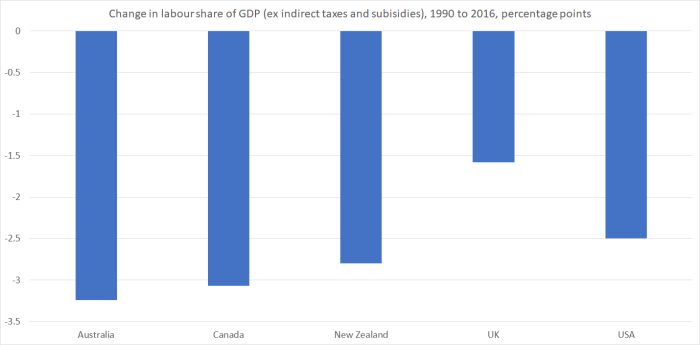
Here is the change in the labour share of GDP (less net production taxes and subsidies) since 1990.  Why 1990?  Well, the Minister talked about the last 30 years, but also explicitly highlighted the labour market reforms most of which date to 1991.   I’ve shown the numbers not just for New Zealand and Australia, but also for the other three Anglo countries.

lab share may 18

New Zealand is the median country.  The labour share of income fell a bit less here than in Australia.   If one takes the comparison just over the terms of the last two governments, so starting from 1999, the labour share of income here has increased – and in each of these other Anglo countries, it either fell or increased less than the increase in New Zealand.

I don’t want to make very much of pretty small differences.  But the numbers just don’t seem to support the Minister’s case.  And to revert to productivity, Australia has had one of the faster rate of productivity growth (real GDP per hour worked) among the older OECD countries since 1990.  I’m not aware of any evidence suggesting that collective bargaining and the role of unions has been a material (positive) part of that story.   A rather more common story is to emphasise the role of the rapid increase in Australia’s mineral exports.

The interviewer moved onto minimum wages

CORIN You talk about balance. How fair is it for a business, let’s say a business making a product that’s sold globally, with 25 staff, to now face the higher minimum wage; they lose their fire-at-will rights; they’re going to face much stronger unions, more compliance costs; they are operating in a global marketplace; they’ve lost their flexibility; how fair is it for that business?

IAIN I don’t think they’ve lost any flexibility at all. And operating in a global market means that businesses need to be resilient. They need to be able to work with the different market forces. Now, if a small change to the minimum wage is going to be that detrimental to them, they don’t sound resilient, and so what we actually need is to signal to businesses, as we have done, what our plans are for the minimum wage and for our other industrial law changes, give them an opportunity, if they don’t feel like their business model can operate in those in that environment–

CORIN So tough luck if they can’t make that work?

IAIN To give the opportunity to transition. Because we need businesses to transition into an environment where in a high-skill, high-wage economy, they are able to operate.

CORIN I think there’ll be plenty of people watching this morning who run small businesses, very frustrated and will be yelling at the TV, saying their margins are small; they’re battling away; they’re trying to employ Kiwis. They will see these changes, and certainly Business NZ is arguing that this week, as being unfair and unreasonable.

IAIN Look a lot of businesses come and go, regardless of any changes the government makes. So, yeah, most start-ups, for instance, don’t actually last beyond a couple of years. That’s the nature of doing business. What we as a government have to do is make sure there is an environment in which new businesses can develop; new jobs can be created; and as thing change for people, new opportunities become available for them. That, I think is the most important thing – that we have a strong economy where if businesses do come and go over time, which they do, that there are new opportunities for people to take up.

Now, no one is going to dispute that firms come and go, that is the nature –  the desirable nature –  of a market economy.  But the indifference of the Minister here is all but breathtaking.   His attitude appears to be that somehow we don’t want firms that can’t manage to turn a profit paying what has already been one of the highest minimum wages (relative to median wages, or to the overall productivity of the economy) anywhere.

He mightn’t, but the people who hold those jobs at present might have a rather different attitude.  Sure, they’d prefer a higher wage, all else equal.  Who wouldn’t?  But that isn’t the scenario the Minister paints.  It isn’t even the usual line the advocates of higher minimum wages run, that somehow hardly any jobs will be lost.  The Minister seems to recognise that some firms will be forced out of business, and he just doesn’t care.  Because amid all the blather about “new opportunities” and the earlier rhetoric about “transforming our economy into one that’s productive”, there is nothing in what the Minister is saying –  or what his leaders and colleagues have been saying –  to give anyone any confidence that government policy is about to transform our underwhelming productivity performance.

It is true, of course, that there might be some small measurement effects from big increases in the minimum wage.  If some people are priced out of work altogether they will tend, on average, to be the least productive workers.  Average productivity of those who remain may be a little higher as a result. But that is no comfort to anyone, and doesn’t earn New Zealand as a whole better opportunities in the wider world.   In some cases, firms may even respond to higher minimum wages by mechanising more, but again that isn’t a gain for New Zealanders as a whole –  but rather a second-best response (not the production process they’d have preferred, and which market opportunities would have warranted) to a direct government intervention.    Pricing some people out of the labour market is no way to improve opportunities (and incomes) for all.

It is also not as if the increases in minimum wages are small.  The minimum wage was set at $15.75 last April, and under coalition agreement it is to reach $20 per hour in April 2021.  That is a 27 per cent increase in four years.  There will be some inflation over that period.  But on the Reserve Bank’s forecasts the other day, that will total only 6.7 per cent over four years.  In real terms, minimum wages are rising by 19 per cent in only four years.

All of which might be fine if there was productivity growth to match.    Over the last five years there has been only about 1.5 per cent productivity growth in total.

real GDP phw may 18

Perhaps the next few years will be different?  But there is nothing in the Minister’s remarks offering any sort of credible explanation as to how, or why we should expect something better?  Most likely, some firms –  not very resilient, in the Minister’s terms –  will be forced to close, to downsize, or to adopt production patterns that are less efficient than market opportunities and market prices would lead them to prefer.

Those losses are more likely to be concentrated in the outward-facing tradables sectors of the economy.   Domestically-oriented firms don’t have unlimited pricing power, but they often have some –  especially when across the board regulatory changes like this are put in place.  Most outward-oriented firms –  whether in tourism, export education, farming or wherever –  have very little, if any.

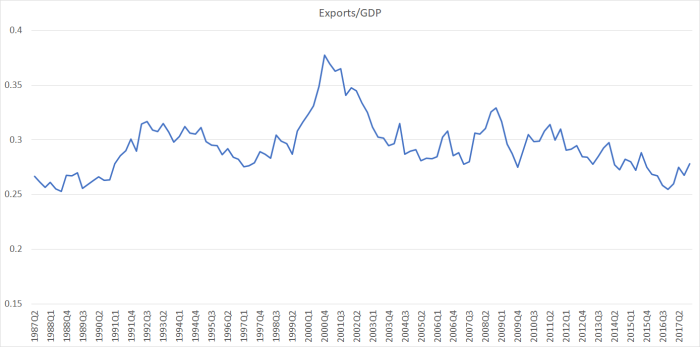
And it is not as if the economy has been successfully becoming more outward-oriented over recent years either, even before this latest scheduled lift in the real (unit labour cost) exchange rate.

export share may 18

One mark of a successful economy tends to be an increasing share of the economy accounted for by exports and imports –  local products and services successfully taking on the world, enabling locals to consume the best the world has to offer.

Perhaps the Minister wishes for a world of abundant home-grown high-performing, high margin businesses.  It might even be a worthy aspiration, but wishing doesn’t make it so, and there is no sign that government has any credible story as to what might make it so.

Changing tack, as I noted in my post on Saturday, I did an interview with Wallace Chapman for yesterday’s Sunday Morning  programme on Radio New Zealand.   Later in the same programme, Chapman had an interview on population issues with Massey university sociologist Paul Spoonley (he runs the government-funded immigration advocacy research programme CADDANZ) and with environmental economist Suzi Kerr, of Motu and Victoria University.

It was a slightly unnerving discussion, at least to anyone who counts children as a blessing.  Kerr seemed set on encouraging people to have fewer children for the “sake of planet” (observing that she and all the people she worked with had chosen to have two or fewer), observing that adjustment to climate change would be easier with fewer people.  In the course of the discussion, she was careful to disavow any particular expertise in immigration –  and didn’t come across as a particular immigration booster (countering Spoonley’s arguments in a couple of placs) – but never once did she suggest that if we were concerned about reducing the number of people here that immigration policy –  affecting non-New Zealanders –  would be an obvious place to start.  Non-citizen immigration is, after all, an increasingly large share of New Zealand’s population increase, and the total fertility rate here is already below replacement, reaching a record low last year.    I suspect she isn’t much interested in New Zealand specifically and is more interested in “saving the planet”, including talking of redistributing people round the world.  It was a little disconcerting given that she has just been appointed as a member of the government’s new Climate Change Commission (a fact Radio New Zealand failed to point out in introducing her).  One hopes that in her new official role she will think rather harder about the easier options –  if not ones necessary welcome to the political masters to whom the owes her appointment –  open to New Zealand to ease the cost of adjustment to the government’s carbon targets.

As for Spoonley, he asserted –  of my comments on immigration (lack of NZ specific evidence of benefits) in the earlier interview –  that I was partly right and partly wrong.    If he remains convinced of the economic benefits of immigration to New Zealanders as a whole, perhaps he could engage with some of the indicators I’ve referred to in various recent posts (eg here and here) –  the underperforming Auckland labour market, the outflow from Auckland of New Zealanders, the way in which the margin by which real GDP per capita in Auckland exceeds that in the rest of the country is small and shrinking, all in an economy with an underwhelming overall productivity performance, and a shrinking share of the outward-oriented sectors.  Spoonley’s apparent preference –  to encourage/incentivise immigrants to move to places other than Auckland – is no (economic) solution either, just transferring the problems to even less productive places.


Some public opinion on immigration

Over the course of the last week, I’ve noticed a couple of interesting polls on attitudes to (some aspects of) immigration.

First was a note by Katharine Betts, for The Australian Population Research Institute, drawing on data from the 2016 Australian Election Survey.   Two of the questions asked were

A1: ‘Do you think the number of immigrants allowed into Australia nowadays should be reduced or increased?’

A2:  ‘The number of migrants allowed into Australia at the present time has: gone much too far, too far, is about right, not gone far enough, not gone nearly far enough’

And one of the very interesting aspects of the survey is that election candidates were asked the same questions as general (voter) respondents.

Recall, too, that the target level of non-citizen immigration to Australia was increased a lot about a decade ago, and is now similar to –  just a little less than – New Zealand, in per capita terms.

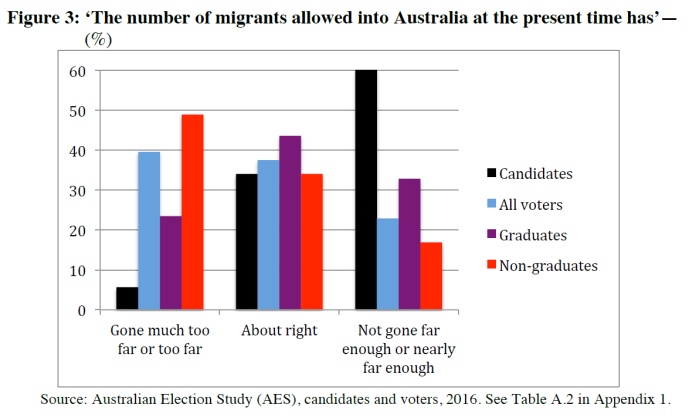
Here is a chart of the summary responses to that second question.

betts a2

Among all voters, more think things have gone too far than think there hasn’t been enough migration.  On the other hand, a majority favour either keeping things at the current high level or increasing immigration further  (the results are similar for the first question, the wording of which is more explicitly flow-based).

But what is most striking is the contrast in views between voters and candidates.   60 per cent of candidates favoured further increasing Australia’s rate of immigration while only 6 per cent favoured a reduction (a net 54 per cent favouring an increase).   By party, that result is massively dominated by Labor and Greens candidates, with Coalition candidates more evenly divided.    By contrast, among voters a net 17 per cent favoured a reduction, and among non-graduates a net 32 per cent favoured a reduction.

It will be interesting to see the results of any immigration questions in the New Zealand 2017 Election Survey, including the results by party.  In last year’s election, two of our now governing parties campaigned on policies intended to have the effect of reducing immigration (one half-heartedly, and one not very specifically).

The other poll results were from the UK-based CANZUK International, which has been calling for free movement between Australia, Canada, New Zealand and the UK.  In New Zealand, some pro-immigration advocates –  including ACT’s David Seymour – have been championing the cause (and I noticed these results thanks to Eric Crampton of the New Zealand Initiative).

This was the question posed in New Zealand (country names re-organised according to which country is being polled)

“At present,citizens of the European Union have the right to live and work freely in other European Union countries. Would you support or oppose similar rights for New Zealand citizens to live and work in Canada, Australia and the United Kingdom, with citizens of  Canada, Australia and the United Kingdom granted reciprocal rights to live and work in New Zealand?”

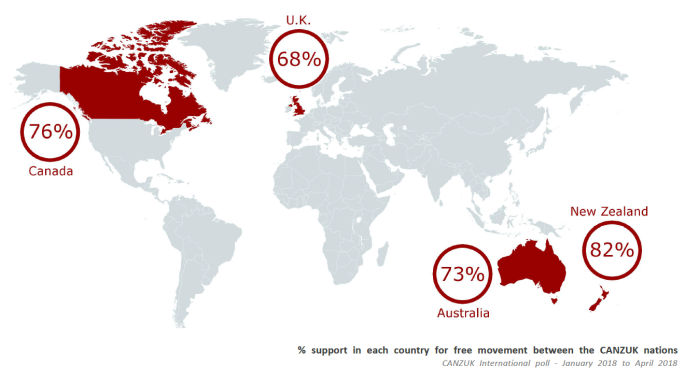
And this is their summary graphic.

CANZUK

Pretty overwhelming support in all four countries (at least as the question is worded).  Interestingly, support is strongest in New Zealand –  perhaps because New Zealanders have been the biggest beneficiaries in recent decades of freedom to go to another of these countries (Australia)?

I’ve never been quite sure what to make of the CANZUK cause. I read a lot of imperial/Commonwealth history, and ideas like this sort of free movement area among the old ‘white Dominions’ are strikingly reminiscent of calls for an imperial federation or, much later, for imperial trade preferences (which became a big thing as the UK moved away from free trade itself).  I could be a little provocative and suggest that is wasn’t entirely dissimilar to the sort of immigration policies New Zealand and Australia ran until a few decades ago, that could be  –  not entirely inaccurately –  characterised as “white Australia” or “white New Zealand” policies.  In that sense, I’ve always been a bit puzzled by Eric Crampton’s enthusiasm for this particular formulation, when he is so ready to characterise sceptics or opponents of New Zealand’s current immigration policy as “xenophobes”.   The logic of his position looks as though it should favour open borders more generally, not just among these four advanced, fairly culturally similar, countries.  And yet, for example, even as an example of Commonwealth sentiment, not even South Africa –  let alone Zimbabwe, Kenya or Namibia – appears in the CANZUK proposal.

Of course, there is a pretty straightforward answer.   Almost invariably, public opinion in almost any country is going to be more open to large scale (or at least unrestricted) migration when it involves culturally similar countries than when it involves culturally dissimilar ones. In fact, there are good arguments that, if there are gains from immigration they could be greatest from people with similar backgrounds (and of course counter-arguments to that).  Reframe the question as “would you support reciprocal work and residence rights among New Zealand, France, Belgium and Italy?”, and I suspect the support found in the CANZUK poll would drop pretty substantially –  my pick would be something no higher than 50 per cent.  Reframe it again to this time include Costa Rica, Iran, and Ecuador (let alone Bangladesh, India, and China –  three very large, quite poor, countries) and people will start looking at you oddly, and the numbers will drop rapidly towards the total ACT Party vote (less than 1 per cent from memory).

And thus my own ambivalence about the CANZUK proposition.  If I were a Canadian (of otherwise similar Anglo background to my own) I’d say yes.  The historical and sentimental ties across these four countries –  less so Canada –  mean something to me.  I’d probably even add the US into the mix.  And across Australia, Canada, and the UK incomes and productivity levels are pretty similar –  although the prediction would still presumably be that there would be an increased net flow of people from the UK to Australia (in particular) and Canada.  As it is, I’ve repeatedly noted that my economics of immigration argument doesn’t distinguish between whether the migrants come from Birmingham, Brisbane, Bangalore, Buenos Aires, or Beijing.   We’ve made life tougher (poorer, less productive) for ourselves by the repeated waves of migrants since World War Two –  in the early decades, predominantly from the UK, and in the last quarter century more evenly spread.  Even though we are now materially poorer than the UK, enough people from the UK still regard New Zealand as attractive, that free movement – the CANZUK proposition –  would probably see a big increase in the number of Brits moving here (big by our standards, not theirs).  That might be good for them –  that’s up to them –  but wouldn’t be good for us.  Perhaps the effect would be outweighed by more New Zealanders moving to the UK long-term, but I’d be surprised if that were so.

The CANZUK proposition is an interesting one, and is worth further debate.  Apart from anything else, it might tease out what people think about nationhood, identity, and some of the non-economic factors around immigration (including some of those Wilson and Fry suggest).  As I noted, at present public opinion appears to be strongly in favour, but on the specific question asked in isolation.  It would be interesting to know, if at all, how responses would change if the option was free CANZUK movement on top of existing immigration policy, or (to the extent of the new CANZUK net flow) in partial substitution for existing immigration policy.   The two might have quite different economic and social implications.

Finally, on immigration-related issues, I recorded an interview yesterday with Wallace Chapman for broadcast on tomorrow’s Sunday Morning programme on Radio New Zealand.  It was prompted by a lecture I’m giving this week for Presbyterian Support Northern in their series on different angles on responding to (child) poverty –  mine being a focus on productivity.  My focus in the lecture isn’t on specific solutions, but rather on the need to make lifting productivity a top national economic priority, since in the longer-term productivity is the only secure foundation for much higher material living standards.  I’ll put up the text of my lecture here later next week, but the interviewer was more interested in possible specific solutions and thus quite a bit of our discussion was around immigration policy issues.   Not thinking very fast on my feet that day, I forgot to respond to his suggestion that higher minimum wages might be part of the productivity answer by noting that we already have one of the highest ratios of minimum wages to median wages anywhere…….and one of the worst productivity records over many decades.  Whatever the case for some mimimum wage, raising it is not part of the overall answer to fixing our productivity failures.


A generous subsidy championed by the beneficiaries

Reading the Herald over lunch, I chanced upon a story under the headline $50m PhD subsidy pays off.   That is the $50 million per annum subsidy put in place more than a decade ago that allows foreign PhD students to study at domestic fees (apparently a saving for them for more than $30000 per annum each), allows full domestic work rights for them and their partner, and free access for their children to New Zealand public schools.

The story says it is based on a new report from Education New Zealand.  Education New Zealand, of course, is not exactly a disinterested party.  It is the government agency that champions the export education industry.  In their own words

ENZ is New Zealand’s government agency for building international education. We promote New Zealand as a study destination and support the delivery of education services offshore.

But I went looking anyway and found the new report.  They got a research firm to produce it for them, not (as far as I could see) involving any new research themselves.

There didn’t seem to be a great deal in the ENZ report on the PhD subsidy scheme, but there was this

Since the introduction of the PhD policy in 2005, the number of international PhD students has increased, and now makes up 45% of all PhD students. Berquist (2017) finds indicators that suggest this policy has been effective, such as an increase in New Zealand’s research output, with the rate of citation of New Zealand research rising from 0.96% of the world average before the strategy, to 1.26 times the world average for 2010-2014. The academic impact of research from New Zealand is also rising; and at a rate faster than Australia. In addition, all eight New Zealand universities are now in the top 450 of the QS world university rankings, compared to three in 2005.

That sounded quite good –  to be perfectly honest I didn’t have any strong priors on the merits of this programme –  but it did leave me wondering why, if it was such a good deal for the universities, they didn’t just price PhD products this way themselves, rather than turn to the taxpayer for more subsidies?

Here was what the Herald article reported the university lobby as saying

Universities NZ director Chris Whelan said the subsidy gave NZ universities an advantage over their overseas counterparts.

“We don’t know of any other jurisdiction that does it,” he said.

“Lifting rankings has a flow through to our ability to recruit students, and our ability to recruit world-class academics, and our ability to collaborate with researchers overseas.

“It’s this that is really strongly contributing to the rankings of a university like Auckland and feeding that virtuous cycle which works to attract more international students.”

The fact that no one else runs a programme like this should probably be a red flag –  the more so, as it is now 13 years since New Zealand introduced the subsidy.  Call it marketing spending, or whatever other label you like, but if the university lobby is right surely there is no reason for them not to fund it from within their own resources: their own argument is that it generates a virtuous circle for them?

But I was still curious about the evidence in support of the claims.  In that ENZ quote there was after all a reference to “Berquist (2017)”.  So I tracked that paper down.

It turned out not to be journal article or anything of that sort, but a paper that had been given at a conference in Australia a year or two ago.  Which might be fine, except that as I flicked to the end of the paper it showed the author

Brett  Berquist,   Director  International,   The  University  of  Auckland

In fact, his entire career seems to have spent in doing/promoting/facilitating international education.

I’m not here to criticise Mr Berquist. He has a job to do, and a business to promote, and may well do it very effectively.  He just wrote a conference paper; it was ENZ that chose to use it as the evidence for the effectiveness of this (really quite large) subsidy scheme.  All that said, Mr Berquist didn’t exactly bring a detached “academic” tone to his conference paper.

In  our  international  education  industry,  where  many  people  have  chosen  this  line  of  work  from  a   deep  personal  conviction  or  experience,  we  sometimes  seem  to  assume  that  the  general  public   shares  our  logical  views,  even  if  they’ve  not  had  our  personal  experiences  of  what  a  powerful   and  beneficial  force  international  education  can  be.

Subsidised industry =  logical views.  Anyone sceptical, presumably not so much.

I suspect there are plausible arguments to be made on both sides of this particular issue.  It is plausible that by means of this subsidy we end up attracting to stay some highly-skilled and innovative migrants who otherwise wouldn’t have considered New Zealand.  But even if so, we really need a proper cost-benefit analysis, because the upfront cost per person isn’t small and (according to the paper) the typical person finishing their PhD on this programme is already in their 30s.  On the other hand, there is the selection bias problem.  Really able people don’t pay fees to do PhDs at top overseas universities –  in fact, the top universities compete to get these people.  And since New Zealand universities aren’t top tier (even in many individual subjects), and we are offering a cheap programme, with attached work/residence points rights, it might be reasonable to wonder quite what quality the median foreign PhD student we are subsidising is.   I don’t know the answer.  And there might be some foreign students who really prefer Auckland or Victoria to Harvard, Chicago, NYU, Stanford (places young Reserve Bank economists have gone off to do PhDs at) or Oxford or Cambridge.     But, for now, we don’t seem to have the evidence.   It would benefit everyone –  well, perhaps not the universities –  for such in-depth research to be done by independent rsearchers.

I’m also a little puzzled about the reported cost of the programme.  The Herald article says

Numbers have leapt from less than 700 in 2005 to 4475.

The subsidy means doctor of philosophy (PhD) students at the University of Auckland pay only $6970 a year, the same as domestic students, compared with $39,529 for international doctoral students in education, fine arts, music and clinical psychology.

Nationally, the subsidy is budgeted to cost $50m in this financial year.

But if we now have 4475 foreign students doing PhDs, and are subsidising them each $32559 (on these Auckland numbers), that seems to multiply up to about $145 million per annum.  (And some of them would have been here anyway even without the subsidy –  arguably the better ones, for whom it was worth meeting the cost or who could earn the university’s own scholarships?)  And any domestic school fees, for those with kids, is on top of that.

Whatever the answer to that particular issue, for now one would have to say of the subsidy programme “case not proved”,  and take the Herald article with a considerable pinch of salt.  ENZ is probably always just going to produce as much propaganda as it can get away with, but I wonder if The Treasury has attempted a proper evaluation of the programme?


Auckland labour market outcomes: do any political parties care?

Among the various arguments advanced for why we should expect that large-scale government-led non-citizen immigration will prove economically beneficial to New Zealanders are claims about the labour market.

There are, for example, suggestions that the unemployment rate will tend to be (a bit) lower than otherwise, because ready access to offshore labour facilitates better skill-matching.  Larger labour markets  might work in the same direction –  easier for people displaced, or new entrants, to find jobs in a deeper more diverse market.

And there is the suggestion that average GDP per capita is likely to be raised just because the average immigrant is more likely to be of working age (few countries let in many 75 year olds). On this telling, even if there were no productivity gains (ie lifts in, say, GDP per hour worked) from large scale immigration, average incomes would be raised simply because of the implied higher rates of labour force participation.  In fact, this argument was run only a matter of weeks ago in an official Australian government document, a defence of Australia’s large-scale immigration programme published by the Federal Treasury and the Department of Home Affairs (the department directly responsible for immigration matters).  From page 27

After trending upward for almost three decades, Australia’s labour force participation rate declined from the early 2010s through to 2016 (Figure 22). This decline coincided with a large cohort of baby boomers reaching retirement, which weighed on Australia’s participation rate. Yet evidence shows that migrants, particularly skilled migrants, have helped curb the ageing of the population by boosting the labour force. Without the contribution from migrants, all else being equal, Australia’s participation rate would be lower than at present.

Many of these claims had initially seemed plausible enough to me.  In fact, in a major modelling exercise done for one of MBIE’s predecessor departments a decade ago –  and widely touted at the time –  the only overall economic gains from immigration resulted from this assumed higher participation rate.

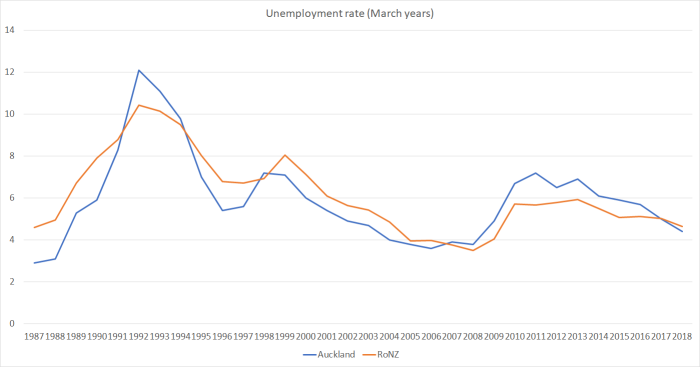
But a while ago I noticed that the unemployment rate in Auckland hadn’t been any lower than that in the rest of New Zealand.  This chart uses annual data, up to and including the latest release last week.

U rate akld and RONZ

Auckland is a good place to focus on. Not only is it by far the biggest labour market in the country, but it also has by far the highest proportion of foreign-born residents, and receives a disproportionate –  but not surprising –  share of the new migrants, temporary and permanent.    Labour market laws apply nationwide, but you might think that some would be a little less binding in Auckland than elsewhere –  for example, there is a nationwide minimum wage, but average productivity is higher in Auckland than on average in the rest of the country.  All else equal, again one might expect Auckland’s unemployment rate to have been a little lower than that in the rest of the country.

And yet over the 32 years for which we have the data there is no sign that unemployment rates in Auckland have been lower than those elsewhere.  There might be a bit of a cyclical pattern –  Auckland does worse in downturns (see early 90s, and the period from 2008 until recently), and better in periods of strong economic growth (and that cyclicality may itself be exacerbated by the large New Zealand cycles in net migration) – but there is no sign of much beyond that.

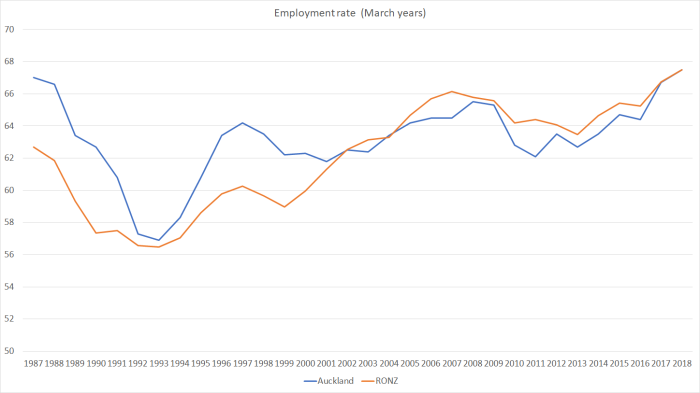
What about employment rates (calculated as the share of those aged over 15 in paid employment)?

E rates akld and ronz

Interestingly, employment rates in Auckland used to be quite a bit higher than those in the rest of New Zealand, but they aren’t now.    Perhaps the difference in the earlier period reflects differences in how the economic restructuring and reduction in trade protection affected different regions –  it seems plausible (although I’m happy to see any confounding evidence) that the initial job losses might have been more heavily concentrated outside Auckland, with the gap closing again over time.  Whatever the explanation for the earlier period, average Auckland employment rates have struggled to match those in the rest of the country over the last 15 years or so (periods encompassing two big waves of non-citizen migration).

And as I thought about it, this chart started to puzzle me more.  After all, the denominator is the population of working age, which includes all the elderly, and yet as the recipient of the largest share of migrants wouldn’t one expect Auckland’s working age population to be concentrated in the age ranges with the highest rates of labour force participation?   And there are the persistent stories of old people moving out of Auckland –  the money tied up in the overpriced house goes further in the provinces.

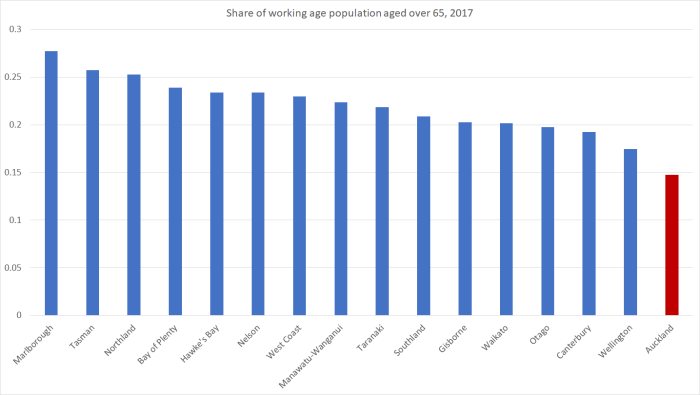
And, sure enough, here are the official estimates of the share of the working age population aged over 65 in 2017 (the numbers aren’t materially different from the firmer numbers from the 2013 Census).

over 65s wap

Auckland has by far the lowest share of its working age population aged over 65.  Across the country, those aged over 65 have an average employment rate of about 24 per cent, while for the working age population as a whole the employment rate is more like 68 per cent.    And yet, despite having so many fewer old people the overall employment rate in Auckland is no higher than in the rest of New Zealand taken together.

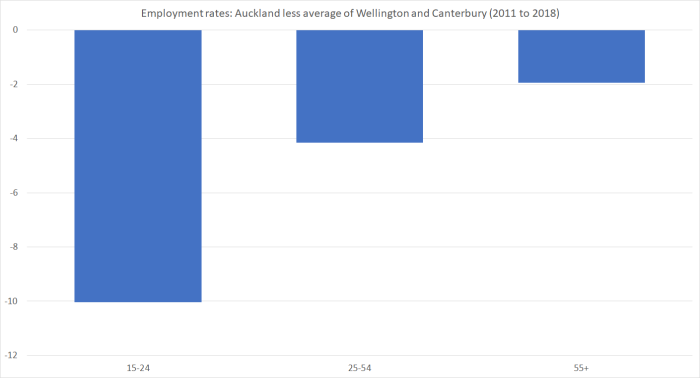
There isn’t a great of information about labour force status disaggregated by both age and regional council, but I did find some data for the last few years comparing Auckland and the Wellington and Canterbury regional council areas.

e rates by age and regional council

Even among the older cohort, employment rates in Auckland have been a little below those in Wellington and Canterbury (in not a single year was the Auckland rate higher than in either Wellington or Canterbury –  despite the smaller number of over 65s).  But in the younger cohorts the differences are quite a bit larger.   Perhaps some of the difference among the 15-24 cohort reflects the presence of foreign students (although many of them are working), but in the prime age cohort (25 to 54) the average employment rate in Auckland over the last eight years has been, on average, a full four percentage points lower than that in Wellington and Canterbury.

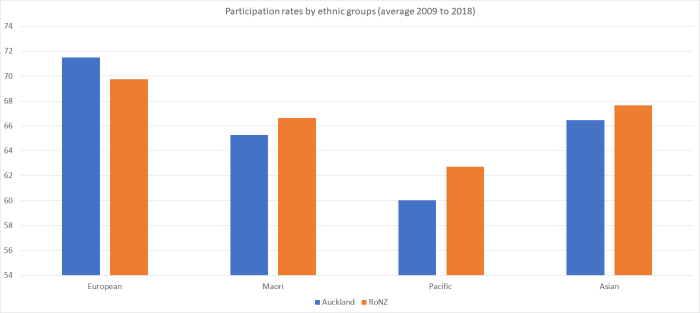
To be clear, this is a not a comment on the employment rates of recent immigrants (which may well be quite – even very –  high).  The HLFS simply doesn’t have that sort of data.  It is an estimate based on the Auckland economy as a whole.   And quite what explains it, I’m not quite sure.   For anyone wondering if the ethnic composition of Auckland’s population is part (cause or consequence) of the story –  whatever factors result in lower Maori and Pacific participation rates – here are the average participation rates for the last decade by ethnicity for Auckland and the rest of the country.

partic rate by ethnicity

European participation rates have actually been higher in Auckland than in the rest of the country.   But Maori and –  especially –  Pacific participation rates average materially lower.

Whatever the explanation, it isn’t obviously a story in which one of the largest non-citizen immigration programmes anywhere in the world, over decades, has produced an Auckland labour market that seems to be functioning in a way that might suggest economic gains across the board.  Unemployment rates are no lower than in the country as a whole, employment rates are materially lower once one allows for the much smaller number of old people in Auckland, and there might be straws in the wind (that final chart) suggesting that the ethnic groups that typically do most poorly in New Zealand anyway are even less likely to be engaged in the labour market in Auckland than in the rest of the country.

Throw in the data I mentioned the other day –  average GDP per capita in Auckland lower relative to that in the rest of the country than it was at the turn of the century, and the internal migration data suggesting that (in modest numbers) New Zealanders (net) are leaving Auckland – and it should leave the champions of current immigration policy very much on the defensive.  Unwilling or unable to fix the housing/land market, and with no obvious productivity or labour market gains to show for their Auckland-focused strategy, it increasingly looks like a Think Big disaster of a severity and pervasive effect (including on many of our most disadvantaged) that makes the 1980s version (the shockingly uneconomic energy projects) look like a mere bagatelle.

But, remarkably, no political party –  major or minor –  seems bothered.

(And before anyone pops up to remind me that I often point out that employment is an input not an outcome –  not, in itself, a measure of economic success –  that is, of course, true.  Nonetheless, there aren’t particularly good reasons to suppose that working age Aucklanders have stronger leisure preferences than otherwise similar people in the rest of the country –  faced with, eg, the same tax rates –  and some reason to suppose it might be the other way round (eg the sheer cost of purchasing a house).)

Immigration policy and wellbeing: Part 2 (aggregate economic outcomes)

Last week I wrote some brief introductory remarks about the new book by economists Julie Fry and Peter Wilson, Better Lives: Migration, Wellbeing and New Zealand.  

Unfortunately, like so much of the current bureaucratic and political enthusiasm in New Zealand for focusing on “wellbeing”, the book seems to be built on a straw man.   To listen to Treasury’s champions of the “living standards framework”, or Cabinet minister championing the proposed “wellbeing” framework for the Budget, you would suppose that all key decisions in the past have only ever been made on the basis of the impact on GDP (per capita) or some similar national accounts indicator.   That that notion is just nonsense takes no time at all to demonstrate: no one seriously supposes that we have a huge welfare system because governments have believed that by doing so GDP per capita will be maximised.   Raising the NZS eligibility age would most likely increase GDP per capita (and maybe even GDP per hour worked) but as a society we’ve chosen to leave it at 65.  And so on.   Advocates of almost any policy will try to argue for some material economic benefits (or to minimise the costs), but public support for this, that or the other policy is only occasionally directly dependent on expected real GDP per capita gains.

It is the same straw man that suffuses the Fry/Wilson book (and the various associated articles or interviews I’ve seen).    Their claim is that immigration policy has been driven by a near-exclusive focus on boosting real GDP per capita (or, again, some variant –  eg real net national income (NNI) per capita) –  economic considerations, and that they are preparing the way for something richer and better.  Here is the last two sentences of the book.

We are confident that using a wellbeing approach is the right way to think about migration.  It enables us to consider important broader issues that a simple focus on per capita GDP allows us to ignore.  The result should be a more effective and more sustainable immigration policy for New Zealand.

But in the entire book, not once did they seek to demonstrate that anyone individually (or New Zealand governments as a whole) has been driven solely by a focus on something like real GDP per capita.  That isn’t surprising.   Here is a summary table of residence visa approvals in 2016/17.

Category Number
Skilled Migrant         24,140
Residence from Work           2,353
Investor           1,418
Entrepreneur              594
Business Immigration Policy – Other*              141
Subtotal  (Skilled/Business)         28,646
Partner         10,914
Parent           1,820
Dependant Child           1,937
Sibling and Adult Child              346
Subtotal  (Family)         15,017
Refugee Quota           1,218
Samoa Quota           1,121
Pacific Access Category              655
Convention Refugees and Protected Persons              236
Refugee Family Support              302
Other special residence policies              489
Subtotal (International/humanitarian)           4,021
Total        47,684

I’m sure that in the first category (the Skilled/Busines sub-total) policy is driven primarily by economic considerations, perhaps encapsulated in a goal of lifting productivity and real GDP per capita.   But nobody supposes that parent or sibling visa policies were motivated by national economic considerations, let alone the two Pacific quotas or the refugee and related policies.  We take refugees because it is the sort of people that we are, and doing so captures or reflects things we care about, without too much consideration for economics.

Even in respect of the people here with short-term work rights, national economic benefit has never been the only consideration.  We didn’t enter a plethora of new Working Holiday visa schemes to maximise the GDP per capita of New Zealand, but through some mix of benevolence (its good for young people to see the world) and (so it seems) a pursuit of other countries’ votes for a Security Council place for New Zealand.  Even the recognised seasonal employer (RSE) scheme bringing temporary workers from the Pacific, is as much about aid to those countries and their people, and boosting political relationships with those countries, as it is about possible economic gains to New Zealanders.

And yet the authors claim that they are offering a whole new way of seeing immigration policy issues, thinking of dimensions other than the economic implications.    They know it isn’t so –  I heard one of the authors interviewed on Newshub Nation explicitly note that “of course politicians look at many of these things now” –  in which case you have to wonder what the fuss is about.  They seem to be arguing that if it were developed their framework (which is really no more than a concept at present –  a bid for consultancy contracts from government departments to flesh it out?) might enable a greater degree of transparency around the considerations guiding immigration policy decisions.  But you can’t help wondering what they have to offer that the release of Cabinet papers and regulatory impact statements, and the availability of speeches/interviews of relevant ministers does not already provide.   There is, perhaps, a bureaucrat’s appetite (and both authors are former bureaucrats) for tidiness –  boxes to tick, and perhaps a common agreed evaluation framework –  but not much of life is like that.

The authors adopt a list of 12 other considerations that they think immigration policy should take into account –  11 from the OECD, plus a Treaty of Waitangi dimension.  One could debate the relevance or role of many of them, but equally I could throw in five quite different factors.  No doubt, at one extreme, the National Front, and at the other extreme open borders globalists could throw in their own five distinctive angles.  There is no aggregation framework, no way for officials or “expert” advisers to decide which factors should count and to what extent.  What there is is the political process, messy as it often (perhaps inevitably) is.  As it is, Fry’s and Wilson’s own political worldviews –  if rarely directly stated –  suffuse the book (although they might be hard for many bureaucratic and political readers to recognise, since so many of them share that sort of worldview).

Perhaps all the Fry/Wilson (conceptual)framework might be useful for is reminding fellow economists on the odd occasion when some might be tempted to think that immigration policy is, or should be, only about aggregate economics (GDP and all that).  If some economists ever fall into that trap –  and I doubt many do –  few others do.

In some ways, the most interesting part of the book is an attempt to suggest thinking about New Zealand immigration policy through a Treaty of Waitangi lens.  I’m sceptical –  and think they avoid most of the hard issues – but want to come back and devote a separate post to that material.

Today I wanted to focus on the bit of the book that bugged me, and puzzled me, most.

There are repeated claims –  in the book text itself, and in associated articles/interviews – that New Zealand’s immigration policy has produced good economic outcomes for New Zealanders (at least in aggregate).    One chapter starts this way

“Migration is good for economies.  But is it good for people?”.

The final chapter beings

“But despite its economic benefits, migration remains a controversial topic”

In their presentation at Treasury a couple of weeks ago, Fry asserted that

“Immigration is economically beneficial, but the public is not fully comfortable”

And in a Newsroom column the other day they note that

“justifying high levels of migration by the fact that it boosts GDP or even GDP per capita has done little to resolve debates about migration”

To be clear, the authors aren’t championing a claim that there are large economic benefits (and they are focused on per capita gains, or lifts to productivity, not headline GDP effects).  In fact, they explicitly claim that

“The available evidence suggests that in modern times, the economic effects of immigration to New Zealand are likely to be positive but modest at best.”

But, remarkably, they offer no evidence for the claim that the effects have been positive at all (lifting economywide productivity –  and as they note, our productivity record has been pretty woeful –  of lifting the per capita incomes of New Zealanders (as distinct from the gains, reflected in average GDP, to the migrants themselves.     They make no attempt to engage with the stylised facts of New Zealand’s economic performance –  or even the huge scale (relative to most other countries) of our migration programme (permanent and temporary).

For “evidence” they seem to refer readers on several occasions to Julie Fry’s previous book (with Hayden Glass) Going Places: Migration, Economics and the Future of New Zealand.  In that book (which does touch on some of my arguments about rather worse results –  described as “a plausible idea but difficult to prove or disprove”) the authors have no sustained discussion of the New Zealand experience – poor productivity growth, despite huge immigration inflows, weak tradable sectors, limitations of geography –  and also adduce no empirical evidence of the economic benefits of large scale immigration (as it has actually been run) for New Zealanders.    That latter omission isn’t surprising as –  as even advocates of high immigration acknowledge –  there are no such papers.  But, if anything, in Going Places Fry and Glass seemed more cautious  –  noting the importance of the quality of the migrants, and doubts about how well New Zealand has been doing on that score –  than Fry and Wilson are in Better Lives.

It is all doubly perplexing because on the one hand they repeat standard lines about how immigration, even of the unskilled, probably hasn’t made much differences to wages, while at the same time arguing that large inflows of unskilled migration (notably in the US) had, by lowering the cost of various household services (childcare, gardening etc) enabled many more women (in particular) to move into the labour force.  You really can’t have it both ways.

I’m not sure why in the latest book they seem so confident that New Zealand’s large scale planned immigration programme (three times the size per capita of the US programme –  under such nativists as Clinton and Obama –  and larger, per capita, than those of any other OECD country) over the last quarter century or more has been economically beneficial.

There seemed to me at least three possibilities:

  • the first was that they had made a rhetorical or positioning choice.  After all, if they had taken a stance that our immigration policy, as run, had actually been costly to New Zealanders, most of their other list of “wellbeing” considerations would fall away.   We might still want to take some refugees, but there would be any other very compelling case for large numbers of other migrants –  open borders ideology aside.  Moreover, since their target audience is typically pretty pro-immigration (officials, National/Labour/Greens politicians, and other “urban liberals”) casting doubt on whether there had been any economic gains might have led those people to simply refuse to consider their arguments, and the framework they were touting.
  • the second was that they had just taken the international economics literature –  which tends to produce results suggesting gains in productivity and per capita income (often implausibly – incredibly – large estimates) from immigration, and assumed that (a) these estimates were valid, and (b) they applied to New Zealand, without any specific consideration of New Zealand’s actual experience, or
  • third, that the authors had themselves thought hard about the New Zealand experience, including its overall economic performance in the context of a large scale immigration programme, and had come to an independent view that there had been gains to productivity etc here (and perhaps didn’t have space in this book to write up those views –  arguably, the economic effects are the focus of the book).

And so I asked the authors. Of the third bullet I noted

If the latter, I’m a bit puzzled as to how you deal with such stylised facts as the persistently high real interest and exchange rates, the decline in the foreign trade shares of GDP, and the long-running weakness of business investment.   Where do you turn for evidence –  formal statistical or the marshalling of other material –  of the gains you proclaim?   And how, for example, do you grapple with the fact that (true) fixed factors –  land and natural resources –  appear to play a much larger role in NZ than the (almost non-existent) role in typical models, or than in many norther European economies.
A few days later I got a response.

On your specific question, we didn’t write the book to resolve the issue of the effects of migration on GDP or any of its components or derivatives, like TFP.  Indeed, the core element of the book is that GDP and its derivatives are poor metrics of welfare, both generally and in relation to migration.   If you are using a wellbeing framework, what matters is the capabilities that people have to lead the lives they value, not their command over commodities. So the effect of migration on GDP, GDP per capita or TFP isn’t the focus.

Which might be fine in the abstract, but really rather avoids the specific issue.  If they didn’t think productivity or real GDP per capita outcomes were meaningful –  and most will beg to differ –  why would they keep on repeating a claim that there have been gains to New Zealanders on exactly these counts?  And if they do believe there have been gains –  as they state repeatedly in the book and associated media material –  where are the New Zealand specific arguments and evidence for those claims?  It isn’t as if there is a single mention made only in passing: the proposition that New Zealand immigration policy has been economically beneficial to New Zealand suffuses the book.

Immigration policy and wellbeing

Last week BWB Books published Better Lives: Migration, Wellbeing and New Zealand by Peter Wilson and Julie Fry, two consulting economists (as the authors explicitly note, one has lived overseas for a long time now, and the other is an immigrant to New Zealand).    It is an attempt to think about New Zealand immigration policy, and experience, in a framework broader than just economics.  And “wellbeing” is the new flavour of the year –  at the heart of The Treasury’s (questionable) Living Standards Framework, adopted by the government as nice-sounding rhetoric and a lens for next year’s Budget.  And, of course, there are various scholars overseas, and international agencies, doing work in the area.  In fact, the OECD’s Better Life Index provides the list of categories –  other than aggregate economic out-turns –  that Fry and Wilson use to frame their discussion of immigration policy.

Julie Fry has now been writing about New Zealand immigration policy for several years (having initially worked on it as a young Treasury economist 25 years previously).  There was the paper she wrote for Treasury, subsequently published as a Treasury Working Paper.  That paper had an explicitly economic focus (and I was quite involved with her work at that time). Her abstract for that paper concluded

More work is required to assess the potential net benefits of an increase in immigration as part of a strategy to pursue scale and agglomeration effects through increased population, or whether a decrease in immigration could facilitate lower interest rates, a lower exchange rate, and more balanced growth going forward.

At the time, the paper was quite controversial within Treasury because it wasn’t automatically supportive of the “big New Zealand” approach.

A couple of years ago Fry and Hayden Glass published a book (also by BWB) called Going Places: Migration, Economics and the Future of New Zealand .  That book seemed generally positive about the –  modest – economic contribution of immigration, but argued that any such gains could be maximised by focusing on bringing in as far as possible people who could make a real difference (noting that many of those coming under current policies don’t).

Our view is that New Zealand should seek more people who will contribute to economic transformation. By their nature, these are people who do not just fit in: we are looking for those who might disrupt, transform, provoke and cajole, connect New Zealanders with others and change the way this country does things.

Things like the Global Impact visas –  launched a year or two ago – fitted this description.

And then Fry and Wilson teamed up to do this new work, attempting to look at immigration policy through a wellbeing lens, including an attempt to find a way to think better about the potential relevance of the Treaty of Waitangi to the issues (my own early thoughts on some Maori dimensions of this policy issue are here).  As I understand it, the work began with some modest NZIER funding –  from their “public good” programme –  for an article on the issue.  It grew into a 275 page book (admittedly, BWB Texts pages are quite small) –  a big commitment by the authors.

They have had quite a bit of coverage.  There was a nice introduction to it on interest.co.nz, the authors were interviewed on Newshub Nation on Saturday, and The Treasury invited them in for a guest lecture last week (which I attended).

I haven’t read the book yet, and I don’t want to write about it substantively until I have done so.  Nine months ago I gave them extensive comments on a draft of what later became the book, but I expect that much will have changed since then.

Having said that, I’m instinctively sceptical of the wellbeing approach – especially if it is anything more than a relabelling of the economist’s basic tool, utility maximisation.   That doesn’t mean I think non-economic considerations are, or should be, irrelevant, but I’ve not yet seen any convincing sign that these proposed frameworks are generally very enlightening in helping shape policy positions.  Often they seem to provide cover –  sometimes unwittingly – for whatever cause or preferences the particular analyst favours (eg in The Treasury’s recent working paper on social capital I saw the suggestion that cars might perhaps be discouraged as being invidious to this particular analyst’s conception of “social capital”).  In this case, I think some pro-immigration people are sceptical that applying a wellbeing approach to immigration policy is not much more than an attempt to justify less immigration even if there are economic benefits.  Since I don’t believe that in New Zealand’s case in recent decades there have been such benefits, I’m probably more concerned about the (possible lack of) rigour of any attempt to broaden out the range of considerations, and uneasy that one or other component of the framework will be latched onto to make the case for more immigration (when what we’ve had looks to have been economically costly to New Zealanders as a whole).

But, as I say, I want to withhold substantive comment until I’ve finished the book –  so most likely I’ll write about it next week.  This post was prompted by various comments to other posts highlighting the new book, seeking comment, and in some case I thought unfairly criticising the authors.  I’d recommend people read the book –  it is pretty cheap –  or at least the article-length version of the argument published in Policy Quarterly, the Victoria University publication, in its pre-election issue last year.  Here was their conclusion in that article

Migration has been good for New Zealand, but it has not been great. We think using a well-being framework has the potential to make it better. Focusing on smaller numbers of more highly skilled immigrants, and considering important broader issues that a simple focus on per capita GDP allows us to ignore, should lead to more effective and more sustainable immigration policy for New Zealand.

As you imagine, I have mixed feelings about that conclusion, but it is worth reflecting on and engaging with.

Bus drivers and Essential Skills visas revisited

Last week I wrote a bit about bus drivers.  Not a usual topic here, but there were media stories about Ritchies in Auckland apparently being unable to recruit New Zealanders (or foreigners with existing work rights) to staff the new bus routes they’d won through the Auckland Transport tender programme.  My suggestion was that the company had probably deliberately bid at a price at which it could make money only if it could use government immigration policy to hire migrant labour.

In a typical market, there aren’t sustained physical shortages –  the price adjusts.  If in this case the price (driver wages) wasn’t adjusting –  if anything there was a suggestion Ritchies would be paying less than the previous operator –  it suggested the plan was to close the gaps another way (bringing in more relatively unskilled people from abroad.)    Ritchies has moral agency in that –  they made a choice to bid that way, and should live with the consequences if it doesn’t work (if, for some reason, MBIE turns down their application to bring in relatively unskilled workers from abroad).   But I didn’t want to focus on the individual company, since they are responding to incentives set up by various arms of government –  Auckland Transport offering the contracts, and even more so MBIE (as part of the New Zealand government) in making immigrant labour relatively readily available for what are really quite unskilled roles.    And it isn’t as if Ritchies is the only company operating this way.   Another operator has won most of the bus routes in Wellington, to take over in July, apparently operating on very similar assumptions about access to new immigrant labour.

(Just to clarify one thing.  My view is that managerial changes, or new technologies, that improve efficiency and/or lower the demand for labour in a a particular firm or industry are generally a good thing.   They aren’t always easy for the people concerned, but over time productivity –  the essence of higher living standards –  involves getting more output from the same inputs or (in many individual firms, industries) getting the same output with fewer inputs.   There are many fewer telephone operators or night soil collectors, and that is unquestionably a good thing.  Productivity gains make possible new firms, and new industries, and overall employment rates remain high.  Real wages, across the economy are far higher than they were a century ago –  and that too is a good thing.  It is a desirable outcome of economic progress.   If there were serious inefficiencies in the bus industry, I’d not be concerned out at all about those being rooted out.  But that doesn’t seem to be the issue here.)

In addition to the various visible comments on the post, I had some comments directly from people involved in the industry, on both sides.  In substance they were making quite similar points.  As one observed, demand growth (in this case for bus drivers) can always be met by expanded capacity (immigration) or higher prices (or wages).  They went on to argue that the ability of some companies to import drivers meant they won contracts, and that it was as clear a case of immigration driving down wages as you could find.

Of suburban driver jobs, I observed last week

It is a responsible role, but not one requiring huge amounts of skills or training (according to the story I linked to above 6 to 8 weeks training suffices).    It isn’t the sort of role one naturally thinks of when officials and ministers talk about skills-focused immigration programmes.

One driver confirmed that training story noting that his employer

…took me on with just a car licence. They spent about 8 weeks training me up and paid for the costs of getting a heavy traffic licence and a P endorsement (essentially a “fit and proper” test.)

In terms of (price-based) evidence of labour market pressures, this driver observed that over five years or so his basic hourly rate has increased by only around 1 per cent per annum (if so, that would be less than the average rate of CPI inflation, so a reduction in real wage rates).

There seem to be a variety of ways to spin the story as to how much bus drivers are being paid, and what the new entrants (Auckland and Wellington) are offering or planning to offer.   On old contracts there are basic hourly rates (pretty modest –  in fact about (in real terms) what the government wants the minimum wage to be a couple of years from now), but there are also shift allowances and penal rates for weekend work.  Relative to what the new operators are proposing/offering, there also appear to be differences on rules around split shifts (maximum number per day) and whether drivers get paid for the time positioning buses (to the start of a run or back to depot).    There doesn’t really seen to be much dispute that the new operators –  claiming an inability to find sufficient local labour –  are not offering drivers more than the current operators.  Indeed, the general sense seems to be that pay for equivalent effort would be less than at present.

And in a typical, well-functioning, market, when demand exceeds supply –  and not just for a day or two  –  the price of the product or service in question will rise (not fall).   Quite how much the rise will be will depend on the elasticities of supply and demand –  maybe a lot more potential drivers would emerge for slightly higher wages (or maybe not), and maybe bus patronage would drop away sharply with slightly higher fares (wages are by far the largest component in bus company costs) or maybe not.  But you wouldn’t expect to see the relevant price –  bus driver wages –  under downward pressure when there is incipient excess demand for drivers.

(It is not as if the outgoing operators have had abundant labour.  As one correspondent noted “Go wellington have about 340 drivers for the current contract but even with huge active recruitment and training from scratch they only get 100 new per annum which is as many as they lose”.)

In fact, the way the bus driver labour market exists seems to be possible only because our governments –  present and past –  have opened up a channel through which supply can be increased, at or below the current price.  Open up incipient excess demand at current –  or lower –  than prevailing wages, and then get in workers on a (so-called) Essential Skills visa.

Bus drivers aren’t an occupation that appears on the official “skill shortage list” (if they were there would no further labour market test involved for any firm wanting to hire foreign labour).  Occupations such as bricklayers, plasterers, bakers, and jockeys are on the list.   But not being on the list doesn’t mean bus companies can’t hire foreign drivers.  There are just more hoops to jump through –  which is why employers who think they might have multiple vacancies (like the bus companies) are strongly urged (by MBIE) to seek an “approval in principle”.

MBIE’s employer guide is here.   You’ll see that for unskilled or modestly skilled jobs, part of the required test is to check with WINZ as to whether there are New Zealanders seeking work they can refer to the employer.   Bus drivers are in that category.

Here is the Work and Income process, as MBIE describes it

You can contact Work and Income at the same time (or before) you advertise the vacancy. Once the vacancy is submitted to Work and Income it will be listed immediately. Work and Income will search its database for suitable clients, and suitable candidates will be referred to you for consideration. Candidates referred can either have the required skills, or be readily trained to do the work on offer. If you don’t believe the candidates referred are suitable, you should discuss the results with Work and Income.

If you want to support a work visa application, you should request a Skills Match Report. Work and Income will gather information about unsuccessful candidates and complete a Skills Match Report. Work and Income will provide the Skills Match Report to you and Immigration New Zealand within five working days of the date they close the vacancy.

Which sounds reasonable enough, if rather bureaucratic.   But given the huge increase in the number of people here on temporary work visas over recent years –  even as the unemployment rate has been at or above typical NAIRU estimates – it doesn’t seem to have been much of an obstacle to enabling firms to bring in workers to fill roles that aren’t particularly highly-skilled.  It isn’t clear that bus drivers roles will be any different (certainly there has been no change in government policy signalled since the change of government.)

Then you have to advertise the roles (which, I gather, the bus companies have already done).  There are various restrictions –  you can’t expect, for example, to get a work visa approval if you only advertise in Samoan (say) or in media that only foreigners are likely to read.  In the official guide to employers, wage or salary rates don’t seem to be part of the relevant test at all, although if you dig far enough there is an operations manual in which it states

For the purposes of these instructions an employer is not considered to have made genuine attempts to recruit suitable New Zealand citizens or residence class visa holders if:

  • the employer has advertised the work in such a way that no New Zealand citizen or residence class visa holder will or is likely to apply e.g. making foreign language skills a requirement when it is not necessary for the performance of the work; or
  • an employer has advertised the work at terms and conditions that are less than terms and conditions New Zealand citizens or residence class visa holders typically receive for equivalent work.

That looks mildly encouraging.  You can’t just offer the minimum wage (for a job in New Zealand typically paying $5 an hour more than that) and expect to get your approval in principle to bring in foreign workers.   But if your wage contract is a little different from other operators (perhaps base rates are a bit higher, but other payments are lower?)  or even if you can find one other company somewhere in the country paying the same overall rate, you have to wonder (based on total numbers approved if nothing else) how rigorous MBIE is in enforcing the test.  And why, for example, it isn’t given more prominence in their guide to employers?

Because, you see, MBIE is really keen that firms hire foreigners.    In fact, they have whole website pages devoting to extolling the virtues of immigrant labour –  so much so that one has to wonder whether they really see themselves working in the interests of New Zealand citizens.    Employers are told

“Hiring migrants is a great way for you to maintain and grow your business”

And then the first item under that “Why hire migrants?” employers are told

Migrant workers can do more than just fill a gap in your staffing. They bring with them an international perspective and connections, provide support to up-skill local employees, add diversity, and generally can help businesses to stay ahead of their competition.

The “international perspective and connections” being oh so important for bus drivers, bricklayers, or even the cafe or retail managers or aged care nurses (occupations topping the work visa approval list).    There is no hint for example that there might be any disadvantages –  eg lower returns to New Zealanders in similar occupations, or the simple fact that, in aggregate, migrants add more to demand pressures (including for labour) than they do to supply in the short-term.

If we are going to have government officials administering something like a mass market Essential Skills visa scheme, and deciding who does and doesn’t get approval, surely a key aspect of any labour market test should be something along these lines?

“has the effective wage or salary rate for this occupation risen materially faster than wages and salaries more generally in New Zealand over the past couple of years?”

If not, how can you seriously use the term “skill shortage”?    Even if wages in a particular occupation have risen faster than the norm, it takes time for locals to respond and shift occupations, so one wouldn’t necessarily want to jump at the first sign of a bit of real wage inflation in a particular occupation, but if after a couple of years the pressures were persistent then some sort of Approval in Principle for temporary migrant labour –  at wages at or above those now prevailing in the domestic market – might make some sense as a shock absorber.  But MBIE seems perennially averse to markets adjusting in ways the generate higher real wages, even though that outcome is one core part of what we look for from a successful economy.  Successive Ministers of Immigration –  from both main parties –  seem to buy in to the story, and believe that central planning by them and MBIE bureaucrats is going to work better than the price system.  It wasn’t a good system in the Soviet Union, and it isn’t here.

I can’t see a reason why we should be giving Essential Skills visas for suburban bus drivers, and we shouldn’t be creating a system where firms are encouraged to bid in the expectation that they can use that system, rather than pay a market-clearing wage for New Zealand resident workers.

More generally, I don’t think there is particular merit in a system in which officials are picking and choosing which firms can and can’t hire short-term workers.   As I noted in my previous post I favour something along these lines

To that end, I’ve argued previously for a system in which Essential Skills visas are granted on these terms:

a. Capped in length of time (a single maximum term of three years, with at least a year overseas before any return on a subsequent work visa, with this provision to apply regardless of skill level).

b. Subject to a fee, of perhaps $20000 per annum.

If an employer really can’t find a local hire for a modestly-skilled (or unskilled) position, they’d be able to get someone from overseas, but only by paying (to the Crown) a minimum annual fee of $20000.  It is pretty powerful incentive then to train someone local, or increase the salary on offer to attract someone local who can already do the job. If you can’t get a local to do a job for $40000 per annum, there might well be plenty of people to do it for $50000 (and still cheaper than paying the ongoing annual fee for a work visa employee).

There are lots of operational details that would need to be refined, but as a starting point it seems like a pretty attractive system.  In the current situation, if bus companies really can’t find New Zealanders to drive, they could hire foreigners, but would have to pay an additional annual fee to the Crown of $20000 for each approval (but also wouldn’t otherwise have to jump through bureaucratic hoops, legal fees etc).  I’d be really surprised if there were any bus drivers then on Essential Skills visas or –  reprising the list from my previous post – kitchenhands, waiters, or massage therapists.  But, you never know.   If the market price adjusted that much that it was still better to hire a foreigner, that price adjustment might be a pretty compelling argument for a rather more genuine “skill shortage” than what we have now.

Perhaps in the end, MBIE won’t allow the bus companies to hire immigrant labour to fill the vacancies.  I’d welcome that, but the bigger issue isn’t any particular role, but how the system as a whole is designed and operated.

(And, to be clear, the overall wage effects of high immigration are ambiguous, in part because in aggregate immigration boosts demand more than supply in the short run, and there are repeated waves of migrants, and thus repeated short-runs.  I am not one of those arguing that immigration policy is driving wages systematically down.  This post is about the impact in specific localised markets, and even more about the rules regarding labour market tests.)

Hiring migrants is a great way for you to maintain and grow your business

Hiring migrants is a great way for you to maintain and grow your business

Hiring migrants is a great way for you to maintain and grow your business