Spending….just as we have for decades

There was a strange editorial in the Listener this week, lamenting what they see as New Zealanders’ mania for consumption spending.  The editorial starts from the fact that the proportion of New Zealanders reaching age 65 mortgage-free has been in decline, and goes off half-cocked from there.   There is no mention at all, for example, of the other important fact that New Zealand real house prices have risen very sharply and are now, relative to incomes, some of the most expensive in the world.  You would expect that would change the distribution of indebtedness and make it more likely that more old people would still have debt (as well as an artificially more valuable, not very liquid, asset).

But whoever wrote the editorial is convinced that the problem is consumption.

“We’ve felt freer to upgrade the car, have a holiday or renovate using debt rather than savings”

“Loans have seemed so affordable, and consumer goods so increasingly accessible, that the “on-the-house” habit has done further damage to the economy.  It has three highly undesirable featires: low to stalled productivity, very low income growth and consumptive spending bounding ahead.”

“…a more deep-seated problem than our failure to tax capital gains. It’s about how we’re spending –  and perhaps more importanyly, why we’re spending.  The internet has made every product imaginable deliverable to our doors –  amped up by such marketing constructs as Black Friday – and ambient anxiety-fuelling over “not missing out” at Easter, Christmas, Halloween and the like have stoked our spending to ever higher records.”

and so on.

But it is, pretty much, a fact-free zone.

It shouldn’t be surprising that (real) spending is higher than it used to be and that people are buying more stuff.   We have higher incomes than we used to have.  Yes, I bang on more than most about the failure of policy here and weak productivity growth, but real per capita GDP is now about 90 per cent higher than it was in 1970.   All else equal, one might expect the typical New Zealander to be consuming a lot more stuff (goods and services) –  they can afford to.

And how has consumption spending tracked relative to income?   This chart shows all consumption (public and private) as a share of net national income.  Net national income is the measure of how much income residents of New Zealand have available to spend: relative to GDP, it subtracts the bit of New Zealand production that actually accrues to foreigners (well, non-residents), and also subtracts an allowance for depreciation (some of gross earnings needs to be spent on just maintaining/replacing the capital stock that helps generate the income).  To believe the Listener story, the line should be trending upwards, perhaps especially since the financial system was liberalised in the mid 1980s.
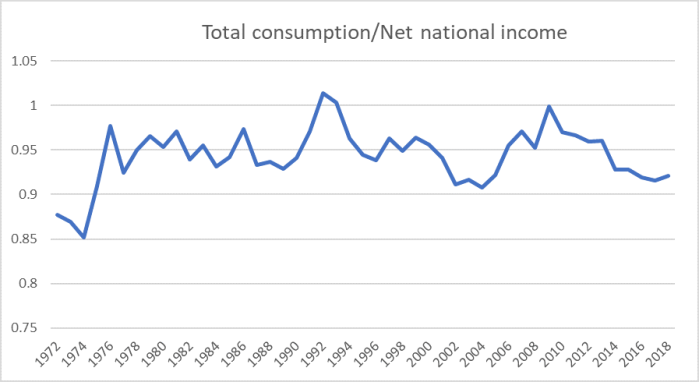
consumption to NNI.png

It doesn’t of course.   The trend has been dead-flat for decades now.  There is some cyclical variability –  those last two peaks were the years of serious recessions (March years 1992 and 2009) – since consumption spending tends to be more stable than national income.      Fiscal policy makes a difference too: when governments are running big surpluses (as in the early 00s) the consumption share of income tends to be temporarily subdued.   On the other hand, there is no sign that, in aggregate, financial liberalisation made any material difference.  Markedly higher house prices haven’t either –  which shouldn’t really be surprising, as for every person who feels a bit wealthier, there is another for whom home purchase is that much further off.

And there just is no story, able to be defended from the data, about New Zealanders in aggregate on a consumption splurge.   Sure our savings rates are modest by international standards, but they’ve been so for a long long time.  And, to repeat, consumption is consistently less than income (see chart).  Mr Micawber would approve

“Annual income twenty pounds, annual expenditure nineteen [pounds] nineteen [shillings] and six [pence], result happiness. Annual income twenty pounds, annual expenditure twenty pounds ought and six, result misery.”

That long-term chart used total consumption (public and private).  For many purposes that is the right metric to use: there is a considerable degree of substitutability between government consumption and private consumption. (And if, for example, the government gave you a voucher to pay for your kids’ schooling redeemable only at the local state school, the resulting education services would probably be measured as private consumption rather than –  as at present –  government consumption.  Nothing of substance would have changed, just the labelling).

But there is a breakdown between public and private consumption going back as far as 1987.  Here is that chart, with the components again shown as shares of net national income (March year annual data).
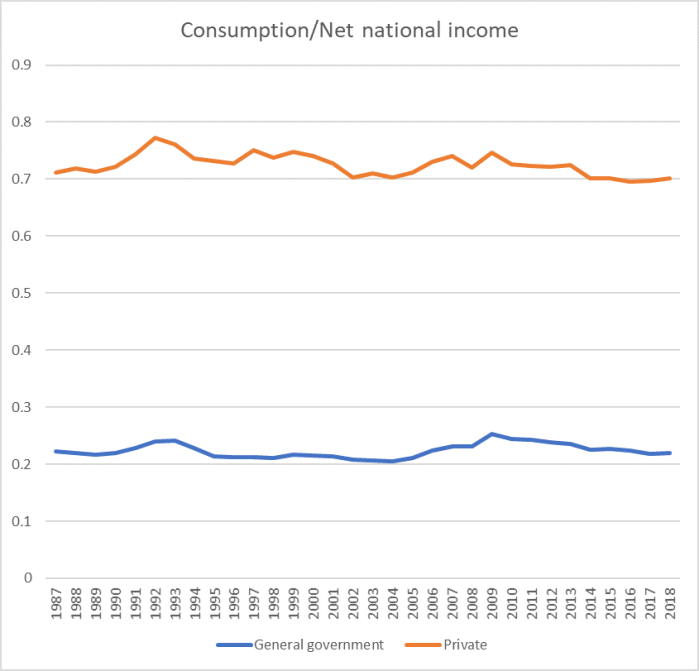
consumption 2

No trend (beyond “almost dead flat”).  For what little it is worth, in the most recent year both public and private consumption spending were a touch below the respective 30 year averages.

The sad truth is that actual consumption in New Zealand is probably quite a bit lower than it should be.     Back in 1970, real GDP per capita in New Zealand was about the same as that in Germany.   These days, average GDP per capita in Germany is about 30 per cent higher than that in New Zealand (and hourly productivity is about 60 per cent higher).  The Germans not only get to consume more stuff but (in economist-speak) to consume more leisure (hours worked per capita are much higher in New Zealand than in Germany).    If we’d managed to match German economic performance, almost certainly the typical New Zealand household would be consuming more, not less.  Quite possibly our average savings rate might be a bit higher too.

I’m a Puritan by upbringing and inclination and so when I read lines like this from the Listener editorial

“Popular TV home-renovation contests and “property porn” create a chronic sense of FOMO, with faddy edicts: one must refit one’s kitchen and bathroom every five years; last year’s wallpaper is now dated.”

I can nod along (even while wondering just how many people actually behave that way).  Being Puritan by background, middle-aged, and male, the idea of “fast fashion” just seems weird. “Black Friday” is an alien import, and I buy books from (among other places) charity shops (rather than providing them –  as the editorial puts it  –  with “unsaleable dumpings from nouveau declutterers”).    But odd as some of these phenomena might be, they really don’t seem to add up to much in the aggregate consumption data.

There are big problems around the housing market, almost entirely the result of central and local government choices.   We should worry –  as the Listener does – about the growing share of people carrying debt into old-age, or never having been able to buy a house in the first place.  But the issues have very little to do with some wholly-mythical national consumption splurge.   And responsibility needs to be sheeted home to central and local governments, not to consumers trying to make the best of their, increasingly constrained, options.
 

Read this and weep

I’ve never been to Las Vegas, and have no intention of ever doing so.  The idea of living there (desert, casinos etc) mostly seems quite unappealing –  although I can imagine people from Las Vegas may feel the same about living on an earthquake fault line and sending your kid to school in a spot the inevitable Hikurangi trench tsunami will one day sweep through.

But a reader was in Las Vegas earlier this week and left this comment here last night.

I just got off the plane from Las Vegas yesterday. I stayed there with a nice young couple who live in a townhouse about 10 years old. He’s an iPhone repairman and she’s a stay at home mom. He makes enough money to rent their nice, 10 year old, 140sqm 4 bed 2.5 bath townhouse with garage. I viewed an open home of an identical property going for US$275,000. They’re a short 3 [minute] drive from plenty of public amenities and only about 15 minutes from the city center. Driving around I saw a lot of new properties from single family homes to apartment buildings all prices at commensurate levels. Those properties were built en masse, in large developments each about half a square km block at a time. Similar young kiwi couples in their early 20s can only dream of this relatively idyllic lifestyle in cities of anywhere near similar size!

These were the kind of communities that made headlines 10 years ago for plummeting property prices in the subprime mortgage crisis. Now, they’re affordable, new, well-built homes for young families and in spite of the relatively low prices, developers are still hard at work building block after block of new market-rate affordable housing.

A cruel irony of New Zealand is things here cost more, but you still earn less. I thought the example in Las Vegas put to shame supposedly progressive polities like Los Angeles, San Francisco, and New Zealand, all of whose governments virtue signal in favour of “affordable housing” but cannot deal with market realities.

Sure, you always have to be a little careful in cross-country comparisons of individual house prices.  In the United States in particular, properties can come with quite high ongoing obligations to cover infrastructure costs etc (in New Zealand much of that cost falls directly on developers and is embedded in section prices).    But there is no credible way those sorts of charges are going to explain the differences between the prices of those Las Vegas townhouses and what our politicians here inflict on New Zealanders.

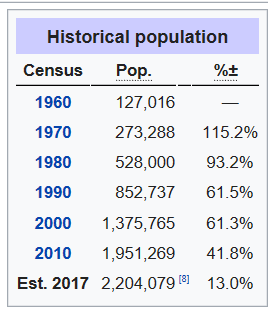
If I’m not keen on the idea of Las Vegas, it seems that many Americans are.  This is the data for the population of the metropolitan statistical area including Las Vegas.

las vegas

Lots of people, rapid population growth (faster than Auckland’s), and (it appears) wholly affordable housing.

As it happens, there is a big (well, by Wellington standards) townhouse development going on 100 yards or so, as the crow flies, from here. I think the individual townhouses have mostly been presold, but I did find one advert still online.  These places are perhaps 3 minutes drive from the park and beach, 15 minutes drive from the centre of town. But they are only two bedrooms, have a carpark rather than a garage, a single bathroom,and are only 76 square metres.  The asking price was $735000.

And this is Wellington, not as bad as Auckland.

You have to wonder why there isn’t more public outrage about a situation that gets worse (more people hooked into debt based on current high prices) with each passing year.

But what of our so-called leaders –  Ardern, Bridges, Twyford, Collins, Goff, Lester (and 30 years of their predecessors) who let this situation develop, know the problem (well, most of them do), and still have done nothing to fix the mess.  Not one of them will even suggest that house prices as cheap as those in Las Vegas is something we can and should aspire too.   What are they, by their indifference, doing to our kids?

Addendum

I know the distributional challenges of fixing this mess, once National and Labour in turn got us into it, are real.  A couple of years ago, in a post on options a new Labour government could consider if they were serious about reform, I proposed a compensation scheme.  If it helped overcome the obstacles to the sort of reform Phil Twyford and Judith Collins both talk about wanting, I’d support something like this.

No one will much care about rental property owners who might lose in this transition –  they bought a business, took a risk, and it didn’t pay off.  That is what happens when regulated industries are reformed and freed up.    It isn’t credible –  and arguably isn’t fair –  that existing owner-occupiers (especially those who just happened to buy in the last five years) should bear all the losses.   Compensation isn’t ideal but even the libertarians at the New Zealand Initiative recognise that sometimes it can be the path to enabling vital reforms to occur.  So promise a scheme in which, say, owner-occupiers selling within 10 years of purchase at less than, say, 75 per cent of what they paid for a house, could claim half of any additional losses back from the government (up to a maximum of say $100000).  It would be expensive but (a) the costs would spread over multiple years, and (b) who wants to pretend that the current disastrous housing market isn’t costly in all sorts of fiscal (accommodation supplements) and non-fiscal ways.

Nurses, pay equity, and the real structural problems

I’ve heard or read a couple of strange stories in the last day or so about the nurses’ trade union making the case for a “pay equity” settlement for their members.

Of course, the very notion of “pay equity” settlements is bizarre, fit only for somewhere like the old Soviet Union.  Some government officials decree that job x should be paid the same as job y, as if the price of a banana should be adminstratively and arbitrarily set equal to, say, the price of a kiwifruit because the two might have (say) similar nutritional value.

But what interested me were two lines being used by the nurses in support of the view that they were underpaid (neither line seemed to have much to do with the false equivalency of “pay equity”, but were rather intended to support the claim that nurses were –  absolutely –  underpaid).

The first, reported here, was this

“In Australia, nurses can be paid as much as $90,000 as a base rate with penal and on-call rates as well. The limit in New Zealand sits around $68,000.”

Last I looked, real GDP per hour worked in Australia (in comparable – PPP –  terms) was 41 per cent higher than in New Zealand.  That is the best aggregate measure of labour productivity.  You’d expect wages and salaries for most jobs to be higher in Australia than they are in New Zealand.   That appears to be so for nurses.   A larger share of New Zealand’s population is in paid employment than is the case in Australia, so the difference in per capita income is a bit smaller, but still just over 30 per cent.  In material terms, Australia is now a richer and more successful country than New Zealand is.  Those gaps keep (slowly) getting wider.

Because of the somewhat-common labour market between the two countries that creates some specific problems for New Zealand.  Plenty of people will look across the Tasman, weigh up the pros and cons of the heat, the snakes and spiders, and the challenges and opportunities of big cities, and move.    Since our somewhat-common labour market applies across the board (not just, say, to public sector nurses), it isn’t a problem we can fix by simply agreeing to all pay ourselves more.  Those sorts of outcomes have to be “earned”  –  not about individuals working harder, but about the economy as a whole finding better and remunerative opportunties, lifting earning possibilities for everyone.  Do it enough, and one day that might even be a net flow of New Zealanders coming back from Australia (Ireland managed it, it can be done).

I’m sure the Nurses Organisation is better connected to people at the top of the government than I am, so I can only urge them to suggest to their friends and allies who currently hold office that economywide productivity might be elevated quite a long way up the list of government priorities (in the Labour Party “Our Plan for New Zealand” brochure dropped in my letter box the other day it featured not at all).  Remind them, perhaps, that for decades New Zealand has been failing on this count, reducing successive governments to pretending to a success that just hasn’t been achieved.  In consequence, wages are much lower than they really should be, and we’ve been more limited than anyone would have liked in dealing with all sort of other social problems.

(Of course, from a Nurses Organisation perspective the strategy I’m proposing would fail any sort of cost-benefit assessment: neither National nor Labour show any sign of being seriously interested in doing what it might take to generate much better productivity and incomes, and (by contrast) the nurses seem to have the government wrapped around their little finger on the pay-equity path to improving their own position. But I’m sure nurses are public-spirited people, and they have children too, not all of whom will choose to be nurses.)

The other strand of the nurses’ argument was a bit closer to home. A Wellington hospital nurse was quoted as saying

Only a quarter of the nurses she worked with lived within walking distance of their hospital.  The result was that only a quarter of the nurses Ms Hopkinson worked with lived within walking distance of their hospital.

“We can’t afford to live in the communities we nurse in, we’re priced out of these neighbourhoods.”   12 years ago when she started, nurses lived in the central city, but that was no longer the case.

“They’re commuting from Featherston, from up the Kapiti Coast, Upper Hutt; they’re a long way away and they won’t be able to make it to us after an earthquake.”

Even in Wellington, it did seem a bit of a stretch to argue for a pay rise so that nurses could walk to the hospital when the 1 in 300 year earthquake hits.  The present value of the cost of that possible post-quake complication will be pretty small indeed.

Now, as it happens I do live within walking distance of Wellington hospital. It is a pleasant middling suburb, and when I was younger I knew lots of nurses who lived in the neighbourhood, attended our church etc etc.  It was close to their work and convenient.  As I’ve noted previously, I bought my first (three bedroom, 30 year old) house in this same suburb 30 years ago –  actually bought it from a teacher who was moving to Wanganui where housing was more affordable (it was near the peak of the then-boom).  The Reserve Bank’s inflation calculator tells me I paid about $296000 in today’s money for that house.

Real wages and productivity have increased since then.  Real GDP per hour worked has risen by a third, so roughly speaking spending $400000 on a house today would bear a similar relationship to incomes as $300000 then.

You cannot buy any house in Island Bay –  still less a three bedroom house, 30 year old, decent-sized section, garage etc – for $400000.  As it happens, earlier this week a real estate agent sent me a several page list of sales in the area in the last few months.  The cheapest property sold was a unit with no land at all, and 60 square metres of house: that went for $400000.  The next two cheapest ($507K and $570K) were also units and had 60 and 70 square metres respectively.  The cheapest house that looks roughly comparable (size, age, but much smaller section) to that first house of mine went for $805000.   The median price across those particular 37 properties was $960000.

It is insane.  No wonder nurses can’t afford to buy anything decent reasonably close to Wellington Hospital (there are slightly cheaper suburbs, but they’ll all have had much the same escalation).   It is not that nurses are underpaid.  And it isn’t just the nurses.  Anyone in a moderate-income job –  especially if there is only one income, or one fulltime and one part-time income –  will really struggle.  And, much as I quite like Island Bay, it isn’t Fendalton or Remuera or St Heliers –  yes, we have a beach too, but even with warming sea temperatures the sea is always more ‘refreshing’ than inviting.

It simply isn’t an issue about nurses, or nurses’ pay.  It is a straightforward consequence of vicious choices that a series of central and local governments have made to mess up urban housing markets.  Government has failed, very badly.  And if it perhaps doesn’t impinge too terribly on the children of the wealthy, it greatly restricts the options of most everyone else looking to get into the housing market, nurses included.  They are, to put it, colloquially, stuffed.  And if that isn’t you or your children yet, it will be mine in a decade’s time.  (Rents are not my primary focus, but in an age in which real interest rates are at record low, real rents should also be lower than ever.)

I’m sure the Nurses Organisation is better connected to people at the top of the government than I am, so I can only urge them to suggest to their friends and allies who currently hold office that fixing the urban land market might be elevated quite a long way up the list of government priorities (in the Labour Party “Our Plan for New Zealand” brochure dropped in my letter box the other day it featured not at all).   Nice Mr Twyford appeared to understand the issue when he was in Opposition, but there has been as little action from him in government as there was from the class enemies of the Nurses Organisation, the previous government.   Remind him, perhaps, of those fast-growing cities across swathes of middle America where good houses really are still affordable.  There is no shortage of land in New Zealand, not even in Wellington (except to the extent the Nurses Organisation friends at the Wellington City Council make it artifically so.   Do not just paper over the cracks, but fix the problem at source.

(Of course, from a Nurses Organisation perspective the strategy I’m proposing would fail any sort of cost-benefit assessment: serious land-use reform from either National or Labour still seems like a long shot (by contrast) the nurses seem to have the government wrapped around their little finger on the pay-equity path to improving their own position. But I’m sure nurses are public-spirited people, and they have children too, not all of whom will choose to be nurses. All of whom will eventually want houses.)

From any sensible policy perspective, so-called pay equity is just daft.  From the perspective of any particular group of workers, perhaps it is the fastest path ahead –  zero-sum game (well, worse) across the whole economy, but beneficial for those particular individuals. But, probably without really being aware of it, the Nurses Organisation put their finger on two really big symptoms of policy failure in New Zealand –  productivity/earnings and housing – that affect almost everyone.   While pursuing their own short-term self-interest, I would urge them to add their voice to the call for serious structural reform in these two areas.   They need it.  We all need it.  Political parties, meanwhile, keep on failing to deliver.

Pondering localism

I’m spending much of the day at Local Government New Zealand’s Localism Symposium

When it comes to centralisation, New Zealand is an outlier amongst developed countries, with decision making heavily concentrated in central government politicians and officials. For every tax dollar spent by local authorities, Wellington spends $7.30.

This is not a record to be proud of. Comparisons with OECD countries show that productivity per capita and decentralised decision making are correlated, and on both measures New Zealand ranks back of the developed world pack. More practically, New Zealand’s diverse communities have long outgrown one-size-fits-all policy making, and there is a growing acceptance that we need to devolve and decentralise decision making to celebrate and leverage our differences.

The challenge is how do we do it?

Local Government New Zealand and The New Zealand Initiative have joined up to develop a policy roadmap on just how to devolve and deconcentrate power through our Localism Project.

On 28 February 2019, LGNZ and the Initiative will present the first cut of this work at the Localism Symposium. We invite interested parties to come and critique our work in a workshop session in Wellington to help develop a robust framework through which communities can have their decision making powers restored, and share insights into public perceptions of localism and local government.

Count me sceptical.  I’m unpersuaded the local authorities should get more power.  Given the choice between the New Zealand government –  of whatever stripe –  and Wellington City Council, I’ll take the former any day.  Not only are they generally more competent (and regular readers will know I’m no fan of any recent government) but it is a great deal easier to monitor them and hold them to account.   Then again, perhaps I’m just a died-in-the-wool central government bureaucrat (“you can take the boy out of the bureaucracy, but not the bureaucracy out of the boy”).   But what could one reasonably expect of the council of one of my old haunts, Kawerau (population <7000)?

And I’m more than a little sceptical about whether there is any meaning in that reported correlation: after all, the United States has plenty of fiscal decentralisation, but New Zealand is about the same size (population) as the median US state.

The New Zealand Initiative has been championing varieties of decentralisation models for some time.    I wrote, sceptically, here about one of their earlier reports.   As I noted, among various other points

I’m a South Islander by birth and inclination, and if someone proposed a genuine federal model for New Zealand –  South Island, lower North Island, and Upper North Island –  I’d probably be emotionally sympathetic to it.  But even then I’d refer supporters to the Australian experience, and wonder just how much genuine decentralisation would occur and for how long. 

Australia struggles to maintain effective federalism.

In the material they’ve sent out for the workshop today, there are some interesting ideas I could probably support and even champion.  For the rest, I guess I’ll be a voice of critique…..and open to being persuaded that more of the case is persuasive than I think now.  I suspect a really compelling case for decentralisation relies either on geography, strong and settled regional identity, or history.  We are a small country, fairly recently settled, and there will be few people for whom (say) the sense of being a Taranaki-ite is at least as important as being a New Zealander (unlike, say, the situation in Scotland or Texas).    To that point, US state boundaries haven’t changed in a very very long time, while two of the four local government areas I lived in while growing up simply don’t exist any more – abolished at the stroke of a ministerial pen.

Had we kept the provincial government system  –  avoided the Vogel money grab –  perhaps we’d now have a similarly long tradition of decentralised government. In days of easy travel and easier technology it is hard to create a stable and enduring constituency –  other than local government politicians and officials –  for trying to create it de novo.   And –  although we can’t run the experiment –  I’d bet against it having made much difference to things that ail us, like house prices or productivity.

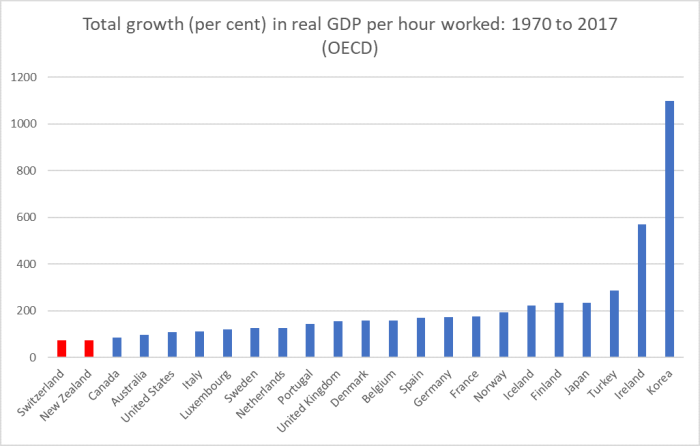
I did notice however that the New Zealand Initiative’s enthusiasm for Switzerland –  which really does have lots of decentralisation –  carries over into the material.  The Initiative has long been keen on singing the praises of Switzerland, which is much richer than we are.  But, as a reminder to people, here are the productivity growth performances of the OECD countries since 1970 (when the OECD databases start).  This is total growth in real GDP per hour worked from 1970 to 2017.

Switz

Bad as New Zealand’s productivity growth performance has been over this period, Switzerland is still the only OECD country to have had (slightly) less productivity growth.    And it isn’t just the early part of the period: for the period since 2000 you need to go to two decimal places to separate the (lower quartile) productivity growth rates of the two countries.

Switzerland is rich, and pleasant in many respects.  But relative to the rest of the OECD it used to be much richer.  Appealing as the Swiss decentralisation seems in some ways –  and much of that reflects deeply rooted histories of separate distinct communities, including linguistic and religious differences –  it isn’t obvious why it offers some path to better productivity growth in New Zealand.

Fixing the housing mess is also claimed as one of the possibilities of the sort of reforms LGNZ and the New Zealand Initiative are suggesting.  Did I ever mention –  why, yes I think I did – that Switzerland not only has very high house prices, very high levels of household debt, and very low levels of home ownership?    Not outcomes to envy.   They aren’t (I presume) because of decentralisation, but they’ve happened despite it.


KiwiBuild: the Reserve Bank and crowding out

Last week, in association with the Monetary Policy Statement, the Reserve Bank published a short separate paper outlining how it was treating KiwiBuild for forecasting and monetary policy purposes.   The bottom line was

The Bank has assumed that half to three quarters of what KiwiBuild contributes to residential investment will be offset by crowding out of other private investment over the forecast horizon.

It isn’t that different an assumption than they have been making since the current government first took office.   This was what they wrote in the November 2017 Monetary Policy Statement

The Government has announced an intention to build 100,000 houses in the next decade…..our working assumption is that around half of the proposed increase will be offset by a reduction in private sector activity.

But, of course, then they refused to show us their workings or give us any supporting analysis.

I made brief reference to the new paper in my post last week on the MPS.  My main point then was to commend the Bank for publishing the separate paper, but in passing I noted.

(As it happens I remain rather sceptical of the assumption that KiwiBuild is going to be a significant net addition to total residential investment over the next decade.  Why would it, when the main issues in the housing market are land prices and, to a lesser extent, construction costs, and it isn’t obvious how KiwiBuild deals with either of them?  If it proves to be a net addition, it will probably be because it is a subsidy scheme for the favoured –  lucky – few.)

Today I went to spend a bit of time elaborating on that argument, and unpicking some of economic arguments in the Bank’s paper.

(Note that although the Bank’s paper has been reported as making difficulties for the government – and perhaps it has – in fact some of it is written as if it were a publication from the government.  It (repeatedly) talks of KiwiBuild houses as affordable, with no quote marks around that description/claim let alone any analysis of what affordability might really mean.  And there is the heartwarming talk of how it designed to “increase home ownership among New Zealanders”.)

The most puzzling aspect of the paper is that the Bank focuses wholly (but only partially) on one possible channel for crowding out and totally ignores another.

Their focus is on capacity constraints in the construction sector.   The claim is that there just isn’t enough labour, and that if the Crown insists on building 10000 additional houses each year it just won’t be possible, as there won’t be the workers.   That doesn’t seem a particularly compelling argument to me, at least over a multi-year horizon.

Over the past year, the national accounts records constructions (residential, non-residential, and other) of almost $40 billion in New Zealand.  Add on top of that (this is all hypothetical) say $2-2.5 billion of KiwiBuild spending a year (the government provision was $2 billion, and the Bank is assuming  –  after crowding out two-thirds –  a net total addition of $2.5 billion over three years) and it would represent an increase from the current level of not much more than 5 per cent.   And, sure, the construction workforce in New Zealand is quite large at present (240000 employed, in the HLFS) –  thus, the Bank argues it can’t really increase further –  but it looks to have been about the same size in Ireland at the peak of their construction boom, when their population was 10-15 per cent less than ours is now.    People change jobs, people postpone retirement, people put off going to Australia (as examples) if the price is right, if the good opportunities are there.  And, although the Bank’s analysis doesn’t mention it,  Australian residential construction activity is now tailing off quite sharply so – again, if the price is right –  you might expect some Australian builders, or expat New Zealanders, to try their luck back here.

I mentioned price a couple of times in that paragraph.    The Reserve Bank’s document doesn’t do so at all (aside from a couple of references to price caps on KiwiBuild houses).  Prices are signals and rationing devices.  You’d have thought the Bank’s economists would think to mention them.  In fact, prices (changes therein) are typically how crowding out works (eg in a fully-employed economy an increase in government spending will tend to boost demand, but will drive up interest rates and the exchange rate –  prices –  crowding out other activity and leaving the overall level of economic activity little changed.    But the fact that the multiplier might be zero doesn’t mean a central bank could just ignore a government that talked of a big increase in spending in a fully-employed economy.  Part of the crowding-out process arises from the monetary policy response (otherwise, it would happen through inflation).

And so the oddity of the Bank’s crowding-out analysis is that it seems to (a) focus on resource availability, and yet (b) simply assumes that the crowding out occurs without any associated price signals or inflation pressures.  Markets tend not to work that way.

At least in the abstract you would have thought the Bank would have wanted to treat the entire KiwiBuild programme as an exogenous boost to demand (whether or not they think it will actually happen their standard operating procedure is –  prudently so –  to assume that government policy is as stated), and then trace through the mechanisms whereby any crowding out occurs.  In this case, for example, one might perhaps expect to see higher wages, higher construction costs (a direct component in the CPI), and perhaps even a higher OCR (than otherwise) as part of the freeing-up/crowding-out process.   The bottom line still might have been the equivalent of half to three quarters of other investment crowded out. But how you get there matters.  If it is a resource constraint story, you can’t simply assume resource constraints have no price consequences.  But, as they’ve told the story, the Reserve Bank seems to have.

Of course, “capacity constraints” is a politically convenient story.  It links to government rhetoric on skills, for example, and even (fallaciously) to the government’s enthusiasm for immigration.  And it channels an implicit story –  never backed with evidence –  that there is some unexploited wedge out there in which, given current laws and regulation, construction material costs, and bureaucratic practices, new houses (including land) can be built more cheaply than current house (including land) prices.  It is only “capacity” –  or just possibly finance –  that holds us back.  I doubt any serious analyst really believes such a story.  There is also an implied story about homelessness –  as if there would be 300000 not housed at all (or grossly inadequately housed) if the government didn’t initiate 100000 new dwellings, “affordable” or otherwise.  Again, that just isn’t plausible.

So, although I do want to run a “crowding out” story, it is a quite different one than the Reserve Bank is spruiking.  On my story, there could be as many builders and associated tradesmen and labourers as you like –  resources flowing easily, with high elasticities, into building as required, with barely any change in prices –  and over any reasonable horizon (say, five to ten years) a credible government announcement that it will build 100000 more houses will, to a first approximation, reduce the construction of other houses by 100000 over that period.    It almost has to be that way because:

  • announcing that as a government you are going to build lots of houses doesn’t change land use law or land availability.  It is what it is –  whether in Auckland or elsewhere.  Everyone recognises that (artificially regulated) land scarcity is a huge component in the high cost of New Zealand houses.   Other government policy measures may yet act on the land use issues, but this is a debate about KiwiBuild, in the existing regulatory system,
  • announcing that you are going to build lots of houses isn’t likely to materially alter the price of building materials in New Zealand, and
  • it isn’t going to materially alter regulatory approval timeframes and related things that (for example) affect financing costs.

In other words the marginal supply price of a new residential property –  like for like in its features –  doesn’t change.    Fix those things and there will be more effective demand for houses from the existing (and projected) population: building activity could really step for quite a while (and some of those capacity constraint and resource pricing issues could be relevant for a few years).    But if you don’t change any of those things –  and KiwiBuild doesn’t materially change any of them –  you’ll end up with no more houses, unless (and only to the extent) that the government-sponsored construction doesn’t cover true costs, and effectively offers a subsidised entry to the market for the favoured few.  Even then, the effect will mostly be to drive out more private construction, but there might still – at least for a time –  be a net increase in the housing stock.

Rational owners of developable land (whether on the fringes or where there is scope for intensification) and potential developers will either know all this consciously, or discover it as they explore the economics of projects they have in mind. KiwiBuild isn’t like (say) a large scale government motorway expansion scheme, when the government has a monopoly on motorway supply.  If the government is determined to build more houses under its badge, there would then (prospectively) be more competition and the expected profits margins and the ability of the private developer to get the returns he or she hoped for will be undermined.  There aren’t super-profits in this business, and if projects no longer look as profitable, many just won’t proceed.   It isn’t as if the government can gear up housebuilding faster than they can either wind back their projects, or look to get their projects branded KiwiBuild, or their land and resources used for KiwiBuild.

To be sure, all this is highly-stylised.  Champions of KiwiBuild will tell me that the programme will build a specific type of house that the market isn’t building.  And perhaps that is even true, but there is plenty of substitutability within the housing market.  And my focus is primarily on the entire life of the planned KiwiBuild programme, whereas the Reserve Bank is (rightly) focused on the next two to three years, the period relevant to today’s monetary policy and related economic forecasts.   So I’m not suggesting one should automatically assume full crowding out without any further thought but rather that (a) capacity constraints are unlikely to be the main consideration (and in any case usually involve price/wage adjustments to make them happen) and (b) full crowding out is probably a reasonable starting point for analysts, who should then justify any deviations they believe it is warranted to assume.

Perhaps the designers and champions of KiwiBuild really believed it would boost home-ownership (as the Reserve Bank claims) or boost overall housing supply. It has always had more of the feel of something with a strong sense of “we need to be seen doing something” and “doesn’t the memory of nice M J Savage bring warm fuzzies memories/feelings to mind”.  Charitably, the official policy position of the Labour Party suggested they were actually going to fix the land market – in which case KiwiBuild would just have been an unnecessary (in economic terms) inefficiency.  Sadly, a few weeks short of halfway through the government’s term very little or nothing has been done on things that might make a real difference –  actually render decent housing affordable again –  while KiwiBuild has become a politically troublesome distraction.

House prices and building: Australia and NZ

You may, like me, be intrigued by the stories emerging from Australia about falling house prices.    The fall in nationwide house prices isn’t that large –  still less than we experienced in New Zealand in 2008 – but (a) the economy isn’t in a recession, and (b) there is little sign yet that the falls are about to end soon.  Lower house prices would seem likely to mostly be “a good thing” –  cheaper goods and services typically are – and the banks are well-capitalised to cope with even some serious combination of bad economic times and falling house prices.  But on the other hand, whatever was causing this particular fall, I’d heard little to suggest that land-use rules were being substantially liberalised in Australia (any more than in New Zealand), so I’ve been –  and remain –  quite sceptical about the idea that Australian house prices would fall sharply and stay down.  And, of course, of anything similar in New Zealand.

Time will tell, but out of curiosity I decided to dig out a few numbers.   The first was a comparison of residential investment as a share of GDP.   This chart is in nominal (current price terms).

res nz and aus 1

And this is in real terms (which isn’t strictly kosher and is an approach frowned on by SNZ, but some analysts do it anyway).

res nz and aus 2

There are differences between the two charts, but the bit that caught my eye was that New Zealand has been devoting a larger share of GDP to house-building (and additions and alternations etc) than Australia for almost the entire decade.

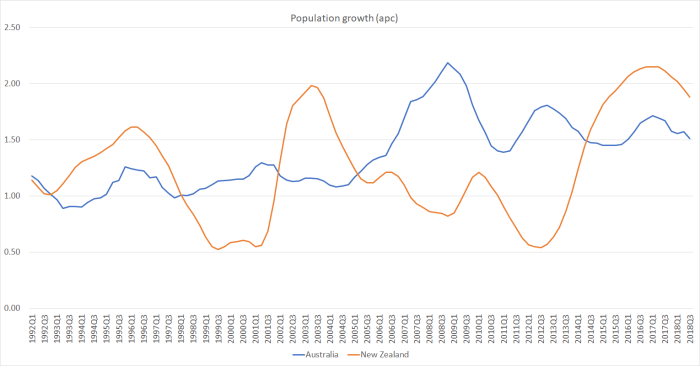
Population growth is one of the biggest determinants of how much accommodation will be demanded.  Here is annual population growth in the two countries.

popn nz and aus

Over the last four to five years, our population growth rate has run quite a bit ahead of Australia’s.   All else equal, one percentage point faster population growth requires something like two percentage points of GDP larger share of residential investment (the net stock of residential dwellings – themselves depreciated –  is well above 100 per cent of GDP).

At least two other things complicate comparisons.  First, a big chunk of residential investment spending in New Zealand for several years after the Canterbury earthquakes was about repair and rebuild, not adding to the housing stock (relative to the pre-quake situation) at all.  There was nothing comparable in Australia, and so all else equal one should have expected a larger share of resources devoted to housebuilding here than in Australia.  And the other relevant factor is that intensification often involves the demolition (and loss) of existing dwellings: even in normal (non-quake) times not all new dwelling approvals add to the housing stock.

New Zealand has a reasonably long-running quarterly series on the estimated number of private dwellings.   I could only find the comparable Australia series back to 2011.  But this is what trends in the number of people per dwelling look like over the last few years.

people per dwelling

On the face of it, that is a pretty startling difference. (I did find reference to some Australia census data suggesting that in 1991 population per dwelling in Australia was also around 2.7.)

A declining ratio of people per dwelling is what might one expect in functioning house and land markets.  After all, both countries are getting richer, birth rates are lower than they used to be, people are living longer (ie a larger share of life after kids have left home), lifelong marriage from an early age doesn’t seem to be becoming more a thing.  But it –  a fall in the ratio –  is much harder to achieve when regulatory obstacles mean house prices are driven sky-high.   Then people squash together a bit more.

Another way of looking at the last few years of that chart is that over the seven years to September 2018 Australia had population growth of 11.8 per cent and the stock of dwellings increased by 12.7 per cent.  In New Zealand, over the same period, the population is estimated to have risen by  11.6 per cent and the stock of dwellings increased by only 8.6 per cent.   For the entire housing stock –  slow-moving at best –  that is a really big difference.

I haven’t mentioned (a) the large share of apartments built in Australia in recent years (which some look on favourably –  the Reserve Bank here always used to tout that record –  and others are more inclined to mutter about future potential urban slums etc), or (b) differences in credit conditions on the two sides of the Tasman (responsible, on some tellings, for the recent weakness of the housing market).

But looking across the numbers I’ve presented here, and bearing in mind that there has been little or no effective liberalisation of land use laws in New Zealand (or a fix to the construction products market), it is hard to see any good reason to expect that we will see any material or sustained drop in house and urban land prices here.

house prices jan 19

There will be a recession along eventually, ringfencing and a capital gains tax (both dubious new economic distortions) might dampen things a little, and the Reserve Bank’s capital proposals if implemented might exacerbate any downturn, but in the end if land remains artifically scarce (a bit like new cars in 1950s New Zealand) it remains hard to envisage a serious or substantial adjustment.   And responsibility for that failure –  and failure it is –  has to be sheeted home to the political parties that vie to govern us, notably National and Labour.

Where have real house prices risen and fallen?

The QV house prices indices for November for each of the territorial local authority areas were released last week.  Much of the headline coverage is around the fact that in the last year Auckland prices have barely changed, while those in places like Dunedin, Invercargill, Palmerston North and Whanganui have shown double-digit rates of increase.  Even Wellington prices rose 7.4 per cent –  something brought home to me when a house across our driveway went for $2 million recently (a very big house).

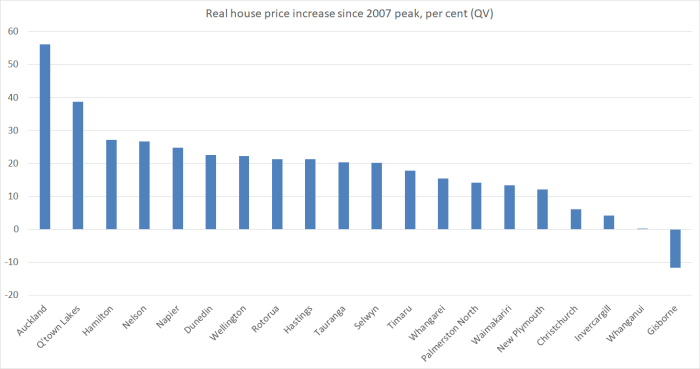
Cycles are often not in synch from place to place and I’ve sometimes found it an interesting reference point to look back and see how (real) house prices have changed since the peak of the previous surge upwards in house prices, in mid 2007.  That, of course, was just before the onset of the last recession in New Zealand.

Here is a chart showing (mostly) the cities

house prices 2018 1

Auckland is, of course, still far worse –  total real increases (as well as levels) –  than any of the other cities.  But I was interested in a couple of things.

First over the (little more than a) decade. the increase in real house prices in Dunedin is well above that in many urban areas, and about the same as the increase in Wellington prices.  In the absence of population pressures, that Dunedin increase took me a bit by surprise.

And second was Christchurch.  There was a big rise in Christchurch prices a few years ago –  housing was in genuinely short supply following the earthquakes –  but looking back to before the recession and earthquake, and forward to today, Christchurch house prices haven’t increased in real terms very much at all.   Christchurch city has had less population growth than, say, Auckland or Wellington, but is still estimated to have 6 per cent more people than it had in 2007.

Much of the population growth (about 75 per cent of it) in greater Christchurch since the earthquakes has been in the Selwyn, in particular, and Waimakariri districts.  People sometimes talk about how responsive the two councils’ policies have been in facilitating this growth.  There is clearly something to that, but it is worth noting that neither locality seems to offer anything like the sort of easy ability to build and develop land that we can observe in many fast-growing places in the United States.  Real house prices in Selwyn, for example, have risen by about 20 per cent in the last decade.  And there is are enormous amounts of flat land in Selwyn.

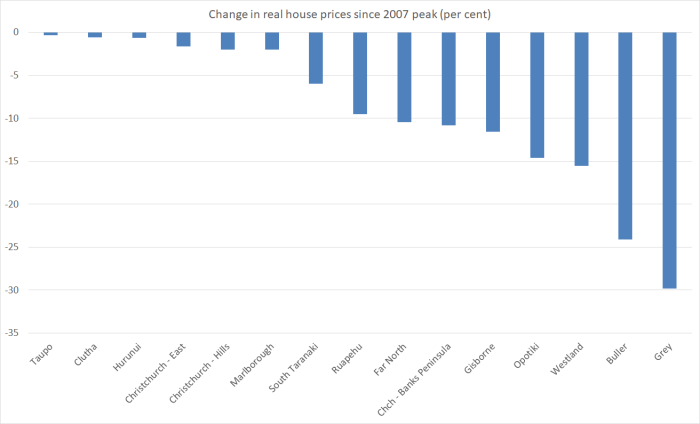
And my other chart is of the TLAs at the bottom of the scale –  the places where real house prices are still lower than they were at the peak of the boom in 2007.

house prices 2018 2

Not, it seems, because (say) land use laws were freed up and the cost of bringing new houses to market has fallen.  In some of these places, prices are probably now below replacement cost (at least on existing land use regulation).    Most, if not all, look like the sorts of places that would benefit from the sort of much lower real exchange rate that I remain convinced has to be a part of any successful economic adjustment in New Zealand –  not that either main party seems to have any interest in effecting such a transition.

It is a sad and shameful record for our politicians.  One neither hears them talking of a goal to get house prices back down again, nor sees them implementing or advocating policies that might make a credible long-run difference.  I guess it won’t greatly matter for the kids of people like the Prime Minister or the Leader of Opposition, but what about the kids of the rest of us? It saddens me to listen to my kids talking about how difficult they think it will be to ever afford a house (in places with decent jobs), but it angers me how (practically) indifferent our political leaders –  central and local – seem.

LVR restrictions: towards the FSR

The Reserve Bank’s latest Financial Stability Report is due out on Wednesday.  Perhaps we will see some further articulation of the Governor’s strange vision of the Bank as a tree god, but I guess the main interest will be in what, if anything, the Governor does with the loan to value controls rushed into place, and then frequently amended, by his predecessor a few years ago.  It is as well to recall that although legislation is going through Parliament at present that will, at least on paper, modestly weaken the Governor’s personal power over monetary policy, in respect of banking regulation his statutory powers remain untrammelled, and unchannelled.  There are few legal constraints on what he  –  an unelected official whose appointment was controlled by unelected and unaccountable academics and company directors –  can do.

Market economists are, understandably enough, focused on the narrow question of whether there will be any changes to the rules announced this week. You can read a summary of their views here.   I remain less interested in that (forecasting) issue than in the cases for and against having such controls in the first place.   They are a new thing: we never had some legal restrictions in the bad old days of a heavily regulated financial system prior to 1984.  But, like weeds or wilding pines, once regulatory controls get in place people come to treat them as normal, the only debate tends to occur around the edges, and it takes huge effort to do something serious about fixing the problem.  Years ago, when the LVR restrictions were first introduced, we were assured they would be temporary (I was still inside the Bank at the time, and as far as I could see senior people genuinely believed it) but now the very idea that willing lenders and willing borrowers should be free to contract on mutually agreeable terms seems to be becoming lost.

The Herald’s economics columnist Brian Fallow used his column last Friday to argue to “Keep the brakes on houses”.  I can’t see the column on line, but the gist of his article is that house prices are high and household debt is high and that unless that combination changes the Reserve Bank shouldn’t think of lifting the LVR controls.  It doesn’t matter that stress tests repeatedly show that banks can cope with big falls in house prices and even big rises in the unemployment rate.  It doesn’t matter that our banks came through the last serious recession –  when household debt to GDP was about as high as it is now –  unscathed. It doesn’t matter that high house and land prices are mostly a phenomenon of the artificial scarcity created by land use restrictions (with high construction costs into the mix).  It doesn’t even seem to matter than there is no evidence that the LVR controls have made banks safer (banks with fewer individual risky loans also need to hold less capital) or the economy more stable.  It doesn’t seem to matter that the LVR controls have acted to favour established (cashed-up) buyers over new entrants to the housing market.  No, even though there is no threat to financial stability, and everyone recognises that LVR limits impede the efficient functioning of financial markets  (and those are the only two criteria the law allows the Bank to act under), the call is simply to leave the controls in place.

It was a bit like people in earlier decades who opposed removing import licenses or exchange controls because of the “foreign exchange constraint” (imports might increase if we took the controls off): papering over symptoms rather than tackling causes is rarely a sensible approach to policy.  Sadly, this government, like its predecessor, seems to be doing almost nothing to fix the underlying problem (and when I heard the UDA announcement over the weekend cited as something that had “worked well” in the UK and Australia one was reminded a new of just how obscene house prices in the UK and Australia remain).  But if the government isn’t doing anything serious, they will no doubt be grateful for the cover the Reserve Bank provides, claiming that somehow it is “doing its bit”, when it has no responsibility (there is “our bit”) for the fundamental problem.

But, of course, with no evidence whatever, the Governor is convinced that he knows best, the banks and markets are too “short-sighted” and so no doubt the controls will remain.  If the Governor is really so convinced he should at least really go to the effort of persuading the Minister of Finance to agree to extend the restrictions to other non-bank lenders.  The LVR controls only apply to banks because they are the only lenders the Reserve Bank Governor himself can order round in this way –  restrictions on other non-bank deposit-takers require the agreement of the Minister of Finance.  We have been fortunate in the last few years that there has been less disintermediation of mortgage business to non-bank lenders than most (including Reserve Bank staff doing the evaluation) had expected.   But if we learned anything from the decades of heavy controls prior to 1984, over time risk-taking will gravitate to institutions where it can occur.  Putting in place a competitively-neutral regulatory framework (treating banks and non-banks similarly) was a huge step forward in the 1980s, and it is unfortunate that the Reserve Bank now treats the same risks differently depending on whether an institution wears a “bank” or “non-bank” label.

At the press conference a few weeks ago for the Monetary Policy Statement, the Governor and his deputy (once a fairly market-oriented economist) indicated that in the forthcoming Financial Stability Review the Bank was planning to outline a more disciplined framework or road-map for assessing when, and whether, adjustments should be made to the LVR controls.  In principle, that sounds sensible and welcome. In principle, it should involve the Bank setting out some markers against which they can be held to account when the next decisions/reviews come round.  Whether it is so in practice only time will tell, but I was disconcerted when I heard them talking of this new framework as something similar to what they have for OCR decisions.

While we have a Reserve Bank there have to be regular monetary policy decisions.  That isn’t so for LVR restrictions, and it would be unfortunate if the initiative the Bank has foreshadowed was also about entrenching LVR controls as a permanent feature of New Zealand’s financial system.  Capital and liquidity requirements, backed by regular and robust stress tests, should remain the heart of our banking regulatory framework, rather than having bureaucrats reach into private businesses –  well-run over decades –  and tell them who they can and can’t lend to, or who they can and can’t employ.  But bureaucrats have incentives to build up their bureau and are typically reluctant to give up powers they’ve once got their hands on.  They are just human, and in their shoes you and I might face similar temptations.  We need banking regulation and supervision –  mostly, in my view, because politicians will bail out large banks in crises and everyone knowing that efforts need to be made to limit the risks –  but its appropriate place is distinctly limited, accountable, and kept in fully in check.   Instead, those paid to hold the Bank to account –  ministers, the Board, FEC –  mostly just accommodate the regulators, at times even egging them on.

On a totally different matter, for anyone interested in a some snippets of New Zealand economic history, you might want to try the latest Newsroom/Radio New Zealand Two Cents’ Worth podcast, which was built around the odd coincidence that –  if you look at the data a bit loosely and from the right angle – for several decades in a row, years ending in 8 had also seen a New Zealand recession.  I did an interview with Bernard Hickey for the podcast, in which he had me run quickly through aspects of the New Zealand economy in each “8” year since 1918.   As I noted to Bernard, there is now a rather large hole in the market for a up-to-date economic history of New Zealand (the last full one appeared in about 1985 and much has been done, much has happened, since then).  Brian Easton’s long-awaited history of New Zealand from an economics perspective – his framing –  is still awaited.

Did state houses make much difference to housing supply?

I’ve been among those suggesting that the KiwiBuild programme –  even if it involved the government itself directly commissioning the building of new houses that no existing developer already had in prospect –  was unlikely to increase overall housing supply very much, or affect overall average house prices very much.  It was never clear how such a programme could affect overall housing supply very much.  For it to do so, there would have to be large unexploited profits left sitting on the table by private developers (properties selling for far more than it would cost to bring new developments to market).  If that isn’t so –  and we don’t see any obvious signs of such unexploited opportunities – whatever the government itself builds or commissions is just likely to mostly displace and replace houses that the private sector would have built.   (There is another possibility, that the government not only displaces most private building, but goes on building at a loss even beyond that point, but there is nothing in the PR around the programme to suggest that is what they have in mind.)

I also know the line the government and its defenders run that somehow KiwiBuild will “work” –  whatever that means –  by building particular types of houses the market isn’t providing.  But even to the extent that is so, what of it?   If the morass of regulation makes it uneconomic to build many new moderate-sized homes (although do recall that the flagship houses are four bedrooms), demand reallocates.  Decades ago many young couples started out with a brand new (small) house in a remote suburb with few facilities and not even a lawn (I’m just old enough to remember our (new) street in Christchurch where what would become front lawns were planted with potatoes, apparently to get the impurities out of the soil).  These days they don’t.   But is there any sign that the prices of the existing modest-sized houses have increased disproportionately relative to house prices more generally?  I’m not aware of any, and that isn’t really surprising, when by far the biggest issue in high urban house prices is land prices.   And KiwiBuild does nothing at all about them.

In my post earlier in the week, I mentioned the state house building programme initiated by the first Labour government, and often touted as the inspiration for today’s KiwiBuild programme.   In passing, and thinking as I wrote, I wondered if the (substantial) construction programme associated with the state houses programme had made much difference to overall housing supply.  It wasn’t something I’d ever given much thought to previously, but once one begins to think about it, of course it makes sense to doubt that that massive state intervention really made much difference on that specific count.  (It is quite probable that it materially increased availability for some –  small –  class of potential tenants private landlords were reluctant to touch.  It is also clear that it chewed up vast amounts of land, probably rather inefficiently – a couple of weeks ago I was driving through a state house neighbourhood a few blocks from where I grew up in Auckland and marvelled  –  not in a positive way – to see such small state houses on such large sections.)

There isn’t any easy way to compellingly answer my question.  Perhaps some academic researcher could turn their attentions to it at some point.   But out of interest I dug out a few charts.

This one (from Te Ara) shows the stock of state houses.

stock of state houses

(Interesting to see that the stock actually dropped a little during the term of the Kirk-Rowling Labour government).

And this chart shows annual data for both the number of new state houses built and those existing ones sold (something initiated by the 1950s National government).

state-houses-built-and-sold-graph

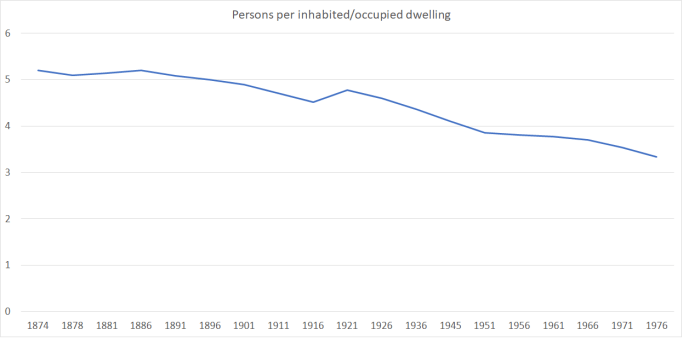
One way of looking at whether there is prima facie reason to think the state house programme might have made much medium-term differenc is to look at the population to dwellings ratio.

This chart is drawn from census data reproduced (up to the 1970s) in Bloomfield’s collection of New Zealand historical statistics.

person per dwelling.png

The spacing isn’t even –  censuses were skipped in 1931 and 1941 –  but all I really wanted to highlight was the strong downward trend over the 90 years from the mid 1880s to the mid 1970s.  The only interruption to the trend was in the single inter-censal period from 1916 to 1921.  It is more or less what one would expect, as people got wealthier, families got smaller (and, at least late in the period, divorce got more common).    Had the state not been building, there isn’t much reason to suppose that –  over time, and in the absence of building and land use restrictions –  the private sector would not have done so.  After all, they had done so in the decades prior to the state housebuilding programme (I was little surprised to see that even over the period encompassing the Great Depression –   1926 to 1936 –  the population to dwellings ratio fell).

Sadly, what might have been the cleanest test –  the 30000+ state houses built in the first decade or so of the programme –  also happened to mostly coincide with World War Two and the period of tight controls on all manner of things (including existing house sales) in the years following the war.  And government-imposed credit constraints remained an issue for the private sector for much of the post-war decades.

But I’d suggest that the burden of proof is really on the advocates of KiwiBuild to show that even very big government-inspired housebuilding projects really make much difference to the overall housing supply situation in the long-term.  After all, when the government owned many of our banks, most of our power companies, most of our radio and TV, and so on, mostly it didn’t supplement the stock of private businesses, it (rationally, from a private sector perspective) displaced them or crowded them out.  If the government were really serious about fixing the housing market, and making housing once again affordable for working class families, not just helping along well-paid professional couples, they’d free up the urban land market.  Sadly, there is no more sign of that under this government than under its predecessor.

On which note, there is a column today on interest.co.nz by Peter Dunne in which he begins thus

Kiwibuild is beginning to look more and more like no more than one of Edmund Blackadder’s cunning plans.

He has some good lines

It is worth recalling that in its election policy just one year ago Labour promised that it would “build 100,000 high quality affordable homes over 10 years”. The policy went on to talk about curbing homelessness through building affordable homes in the $350-450,000 price range.

The implication was unambiguous – Labour’s approach was going to be far more activist than National, and Kiwibuild would be Its primary policy to deal with homelessness and the housing crisis.

and

So far, just 18 Kiwibuild homes have been built, and another 447 are on track for completion by July 2019, leaving a shortfall of 535 on its first year 1,000 homes target.

Put another way, a first year achievement rate of just under 47%. And there has been a subtle but clear rewrite of the Kiwibuild objective.

According to the Kiwibuild website, the objective is now the much more passive one to “deliver 100,000 homes for first home buyers over the next decade”.

So, no longer will the government build “100,000 high quality affordable homes”. And no longer does “affordable” mean $350-450,000, but $650,000.

Moreover, now the plan is merely to “deliver” 100,000 homes, which, in the best Blackadder fashion, means accumulating all the new homes already being built over the next 10 years by the private sector anyway, and dressing them up as Kiwibuild homes.

But it is perhaps worth recalling here that Peter Dunne was a minister in the previous National-led government, and in particular held the one vote in Parliament that was sufficient to block the reforms (inadequate and insufficient as they would have been) that National was seeking to make.  I hope I don’t need to say again that I’m no defender of National’s record –  and lack of courage –  in this area in government, but it is a little rich for Dunne to snipe from the sidelines (legitimately in substance perhaps) when he personally blocked beginning to tackle some of the root causes of our obscene housing market failure.


Too few mortgagee sales?

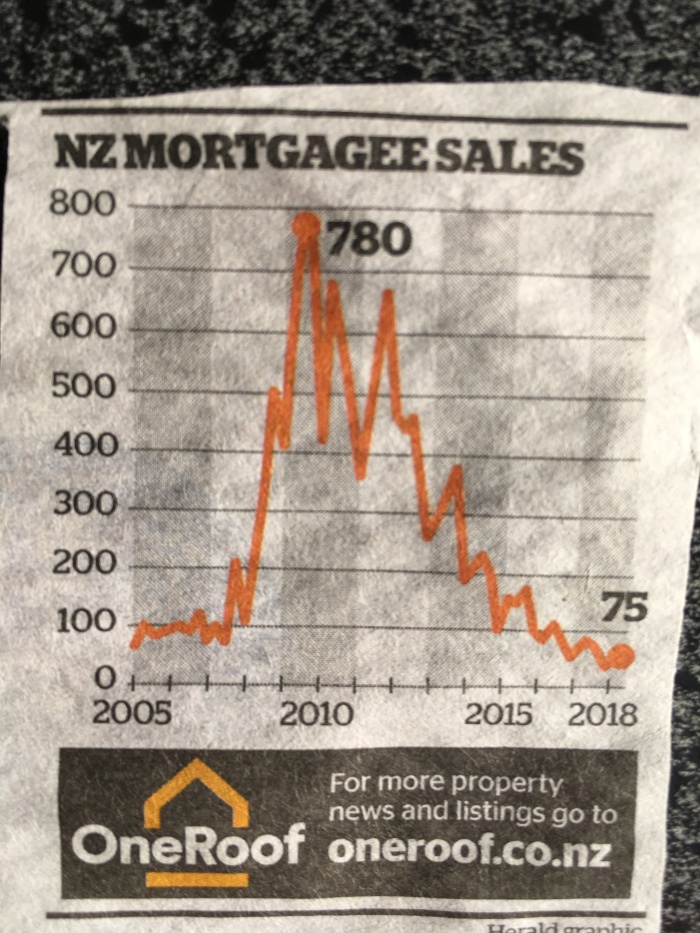
This chart appeared in an article in yesterday’s Herald, heralding (so to speak) mortgagee sales of houses hitting the lowest level for more than a decade.

mortgagee sales

The chart isn’t clearly labelled, but it appears to be quarterly data.  Elsewhere in the article, it is noted that the peak in annual mortgage sales was 2616 in 2009 –  the trough of the last recession, when the unemployment rate had risen quite sharply and nominal houses had fallen quite a bit (down 9 per cent nationwide in the year to March 2009).

In many respects, one wouldn’t wish a mortgagee sale on anyone.  But one also wouldn’t wish any individual to find themselves overstretched and having to sell the house themselves (and thus not a mortgagee sale).

But, equally, risk is part of a market economy.  And the housing stock financed by mortgage isn’t just the (sympathetic) case of the first home buyer owner-occupier, but also investment properties, beach houses, and fancy houses (the Herald story includes a piece about a pending mortgagee sale of a $3 million house in St Heliers).   In a country of almost five million people (and more than 1.8 million dwellings) one might reasonably wonder whether a mere 250 to 300 mortgagee sales in an entire year is lower than might be, in some sense, entirely desirable.   After all, the nature of taking risk –  and both purchaser and financier do –  is that sometimes things will go wrong.   The optimal number of mortgagee sales is very unlikely to be anywhere near zero.

The key combination of factors that tends to drive the number of mortgagee sales sharply upwards is higher unemployment and falling nominal house prices occurring together.  If unemployment rises but house prices stay high then even if the borrower runs into servicing difficulties they can usually sell the house themselves, repay the mortgage, and move on, without the additional and humiliation of being sold up by the bank.   If nominal house prices fall but unemployment is still low, borrowers will typically still be able to service the debt, and banks are reluctant to sell up people with negative equity who are still servicing the debt, even though they are legally entitled to do so.

We had that combination in 2009 (although in neither case to extremes) and you can see the consequence in mortgagee sales in the chart.

What is often lost sight of is that in a properly functioning housing and urban land market, mark to market losses on houses shouldn’t be uncommon, even in nominal terms (with, say, a 2 per cent national inflation target).   In such markets, land use can readily be changed in favour of housing development, and new houses/apartments readily consented and built.  In such markets there is no reason to expect a trend increase in real house prices, even if the population is growing rapidly.  Across a full country, some areas will do well and some not.  So some localities will more often see, perhaps modest, trend falls even in nominal house prices.  And, of course, without ongoing maintenance individual properties would depreciate in most localities.

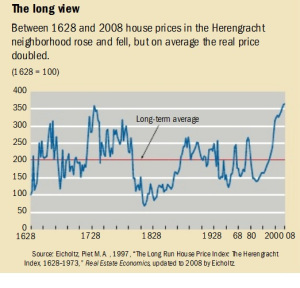
For those who doubt that such things are possible, I could bore you with charts from US cities where the markets function well, but instead I will use it as an excuse to reproduce what was for a long time one of my very favourite charts (written up here), showing prices for a street of houses in central Amsterdam from 1628.

herengracht11

There are ups and downs, but over several hundred years no strong trend.

And, of course, that is now what marks out housing markets in New Zealand (and Australia, and various other places, including parts of the US, where land use restrictions have become binding).   In recent decades there has been a strong upward (regulation-facilitated or induced trend) in real (and even more strongly in nominal terms) house prices.  As I noted yesterday, REINZ numbers show that over the last five years prices in Auckland and out of Auckland have averaged 8-9 per cent increases every year.  And that was on top of substantial increases in the 1990s and the 2000s.  It isn’t that easy (although not impossible) to get yourself into a position where the bank sells you up when house prices are rising that strongly.  But in a well-functioning market, we wouldn’t see such pervasive trend increases.

It is interesting that the number of mortgagee sales is now lower than it was in the mid 2000s (even though the housing stock is bigger now than it was then).      The unemployment rate has come down quite a long way, but is still about a full percentage point higher than it was in 2006/07 (and underemployment rates linger high).  For the sort of people –  a diminishing number –  who can afford a house anyway now, unemployment probably isn’t a big consideration now.  But, again, in a well-functioning housing market –  in which the Prime Minister wasn’t doing photo-ops with professional couples who’d won the lottery to buy a subsidised four bedroom house, but appearing with a working class couple of similar age able to buy their first house in one of our larger cities –  it might well matter more. Downturns hit harder people in less skilled jobs, and with more marginal attachments to the labour market.  In a better functioning system, more of those sorts of people would be buying houses, and some would end up unlucky and having to sell up later.   That is the “price” we pay for better access to the home ownership market.

The other relevant consideration is access to finance.   If a bank won’t lend more than, say, 40 per cent of the value of the property, it would be extremely difficult to ever see a mortgagee sale (only, say, idiosnycratic shocks such as the house burning down when the borrower had forgotten to pay the insurance bill or some such).     At the other extreme, of course, if banksare  lending 115 per cent of the value of the property –  in some over-exuberant mood in which everyone believes property values only ever go up, and where new buyers want to have extra cash for, say, fancy furniture, then it doesn’t take very much to go wrong for there to be lots of cases of negative equity, and potentially lots of mortgagee sales.  Mostly –  and to the credit of the banks –  we’ve avoided those sorts of excesses.

But for five years now we’ve had the unprecedented situation of the Reserve Bank limiting how much banks can lend to individual purchasers of residential properties (LVR limits).   We went through successive waves of these controls, and although they were eased somewhat last year binding restrictions are still in place.   The economic case for these controls was never robustly made (the Bank could never quite get round the fact that its own stress tests kept showing that banks were in fine health, or that mortgage lenders –  public and private –  had for decades been lending 90 per cent LVR loans in New Zealand and been able to managed the associated risks).

The Reserve Bank has been keen to boast about how effective these controls were in limiting the amount of high LVR lending banks were taking on.  They always presented this as “a good thing” even though they could never demonstrate (a) that banks were safer as a result (all else equal, banks need less capital when they have fewer risky loans),  or (b) that their judgement on prudent lending standards was better grounded than that of willing borrowers and willing lenders, with their own money at stake, or, incidentally (c) what other risks banks might have chosen to take on to keep up profits if prevented by regulation from lending to housing borrowers.

There wasn’t much doubt, though, that LVR controls applied tightly enough –  and the RB controls became increasingly tight – could restrict the amount of high LVR housing lending.  And high LVR loans will be disproportionately represented among those where a mortgagee sale eventually occurs.  So, even in a period of moderate unemployment, it is quite likely that LVR restrictions have reduced the number of mortgagee sales.

But it simply doesn’t follow that that is a good thing.  The other side of the same equation is that some people who would otherwise have been able to purchase a property using credit, whether owner-occupiers or investors, won’t have been able to do so.   Perhaps those people will have got into the market a few years later, but in the interim they will have missed out on the opportunities of home ownership –  and in most localities, being forced to wait means the entry price will be higher than it would have been if Reserve Bank controls had not intervened.   Those are real missed opportunities, while regulations skewed the playing field (cheaper entry levels) for cashed-up buyers.

In a well-functioning market, house prices rise and fall (although typically not that dramatically) and it is unlikely anyone will be much good at forecasting the movements that do happen.  With the best will in the world, and the best countercyclical monetary policy, economies will fluctuate, and some people who’ve taken on debt will find themselves unable to service the loan.  Painful as that no doubt it, it is only one of the many potential vicissitudes of life –  probably not the end of the world if you are in your 20s and have decades to get back in the market.  The alternative to expecting that a reasonable number of people will eventually have to sell up, in a world of uncertainty and unforecastability, is to have credit policies so tight that they also exclude substantial cohorts for much longer than necessary from being able to enter the housing market at all, whether as owner-occupiers or investors.

I don’t wish a mortgagee sale on anyone, any more than I’d wish a business failure or a redundancy on anyone. Even the transactions costs associated with any of these of events are often non-trivial.   But without them –  while still in a world where the future can’t be foreseen – we’d be living in an economy so cossetted that many opportunities –  for individuals and for the economy as a whole –  would be missed.  In the housing market, between regulatory restrictions on access to housing credit and other regulatory restrictions which impart a strong upward bias to real house prices, we are probably in that sort of situation now.  Too few people can get into the market at all, and too little risk may well mean we are in a position where a higher level of mortgagee sales might be desirable for the efficiency of the economy, the financial system, and the housing market itself.