Some longer-term house price charts

Reflecting further on the risks facing our banking system, I dug out some fairly long-term house price inflation data from the BIS for 19 OECD countries.  I was slightly hesitant about doing so, because there is a risk of feeding the narrative that vanilla lending secured on residential property is likely to be an important independent element in any financial system stress. As the Norges Bank has pointed out, and as the Reserve Bank has affirmed, that just hasn’t been so historically. To the extent that the United States last decade may have appeared an exception, it is important to recall that the heavy role Congress and the Federal government played in driving down lending standards, and the non-vanilla nature of much of the lending.

But for what it is worth, here are a few charts. In all cases, the latest observations are for the December 2014 quarter, which is as up to date as the BIS data are.

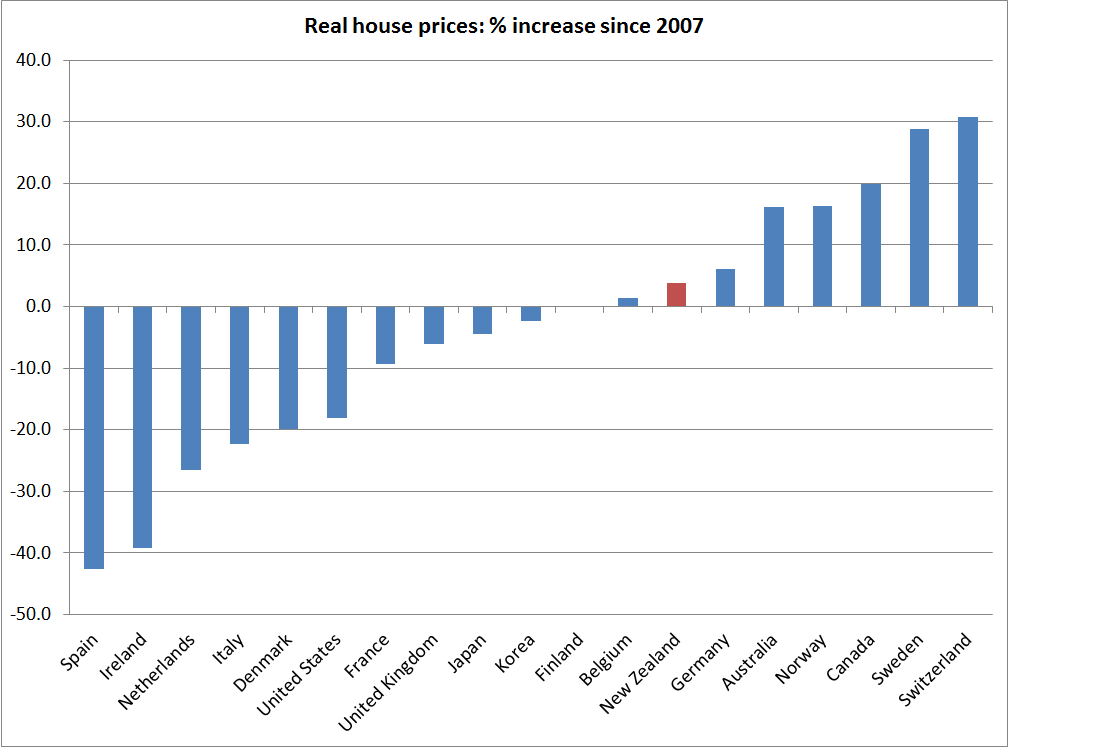
Here are real house prices changes since 2007 (most countries had a peak in or around 2007).

house prices since 2007

Real house prices in New Zealand have increased by less than those in Australia and Canada – and yet it is New Zealand banks that have been downgraded to BBB+, a rating not much higher than that held by South Canterbury Finance in 2008. As we’ve seen previously, New Zealand credit growth has done no more than roughly track nominal GDP growth over that period.

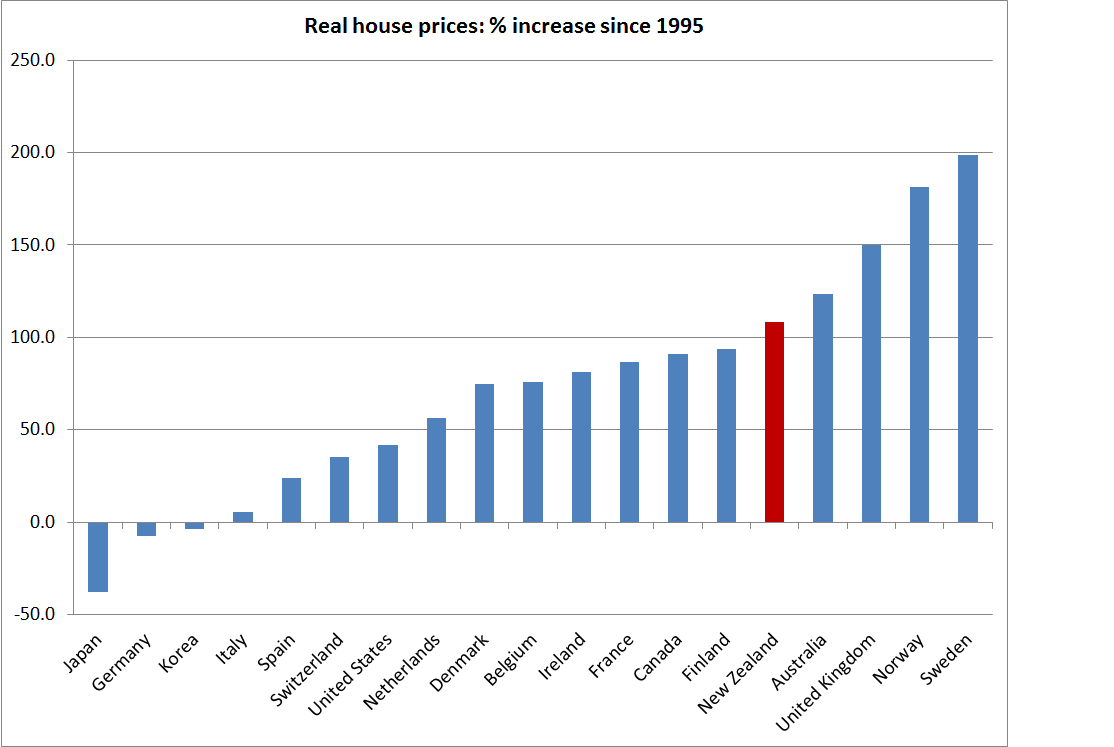
The BIS base their data at 1995. There is nothing special about 1995, although in most of these countries it was before any of the strongest house price booms had got underway.

house prices since 1995

Even over the whole 20 years, New Zealand real house prices have increased less than those in Australia and the UK. For the boom period itself (1995 to 2007) New Zealand’s house price inflation was only a touch stronger than that of the median country in this sample.

For most of the countries the BIS has data back to 1970, but for all 19 countries they have data back to 1976. Whether one starts from 1970 or 1976, New Zealand has had less real house price inflation than Australia and the UK, although more than Canada.

house prices since 1976

And what about periods of falling real house prices? There have been 53 episodes across these 19 countries of real house price falls in excess of 5 per cent.   Germany and Belgium have had only one such episode each. Five countries – including New Zealand – have had four such episodes each (including the 15 per cent real fall in and around the 2008/09 recession).

None of this is intended to convey any sort of sense of complacency about house prices in New Zealand (and especially Auckland). They are a scandal, resulting primarily from the acts (of omission and commission) of central and local government), but if anything have increased a little less than we’ve seen in countries with similar planning and land use restrictions (the UK’s are probably tighter, but population growth pressures are less there than in New Zealand and Australia).

But singling out the New Zealand banking system – as S&P appears to have done – seems unwarranted. There is no obvious material differentiation in the sorts of housing risks being taken on by New Zealand banks. Perhaps S&P are right about New Zealand. But the Reserve Bank’s stress tests results don’t suggest so. And, perhaps as importantly, historically, vanilla housing loans don’t lead to bank collapses, and systemic banks don’t collapse (or even come under severe stress) when credit has been growing no faster than GDP.  Reckless property development lending is a much more plausible culprit –  and we haven’t had it in the years since the recession.

Not entirely unrelatedly, I saw a piece the other day by Auckland City’s chief economist in which he cited some work done for the Council by NZIER suggesting that part of the growth in Auckland house prices can be explained by the proposed district plan changes that will allow for greater intensification in some parts of Auckland. I’ve seen a similar argument made by the Westpac economics team. But I must be missing the point. I can easily see why allowing more intensification on a particular section will increase the relative price of that section, but I cannot see how it can be raising prices of houses and land across Auckland as a whole.   Reducing land use restrictions – whether in respect of intensification, or allowing more dispersed development – increases the effective supply of land. And it seems unlikely that increasing supply will itself materially alter demand (eg materially increasing population growth, most of which is now driven by immigration policy). At least when I did introductory economics, increased supply would generally lower the price. It is easy to see why the relative (and perhaps even absolute) prices of some sections might rise if the reforms are for real, but surely any such effect should be more than offset by a fall in urban prices more generally?   If there is serious scope for more intensification, and that potential is expected to be utilised, then rational potential buyers all over Auckland should already expect less intense competition in future for this now less-scarce resource.  If anything, those prospective regulatory changes should be lowering prices now (perhaps only a little, because no one knows yet what real effect they will have), not raising them.

The same Chief Economist also noted that

“we need to economise on the massive amount of urban land we already have, and use it to its best effect. Acukland needs to treat its land like gold dust and a little needs to go a long way”.

I’ve got no problem with removing land use restrictions, whether they are on outward or upward development, but lets recall that the only thing that makes Auckland urban land remotely comparable to gold dust is the regulatory regime which the Auckland Council administers and imposes. Yes, Parnell might always be expensive, but there is simply no reason why  sections in middling suburbs should be. Historically, as cities become richer they have less dense, not more dense.   Planners, councillors, and associated bureaucracts are the people who systematically impede that normal and natural process.

Standard and Poor’s: probably wrong on New Zealand banks

I’ve been puzzling over S&P announcement (and supplementary Q&A material)  the other day, lowering the stand-alone credit ratings of the major banks and the Banking Industry Country Risk Assessment (BICRA) score for New Zealand.  The BICRA was lowered from 3 to 4, on a 10 point scale, where the banking industries of Greece and the Ukraine score 10.

As I noted on Friday, the S&P ratings appeared somewhat inconsistent with the Reserve Bank’s 2014 stress test results, in which even some very severe adverse shocks did not generate loan provisions/losses that were large enough to induce material annual losses in any year of the scenario for any of the major banks.

As a reminder, S&P did not lower the actual issuer credit ratings of any of the major banks. Those issuer ratings incorporate the probability of parental support, and the possibility of government support, in the event that one of the banks got into difficulty. The issuer credit ratings remain at pretty respectable levels, with each of the big four banks at AA-.    This table, taken from sorted.org.nz, draws on Reserve Bank resources to summarise the ratings scale.

Capacity to make timely payment

Description Standard & Poor’s scale Moody’s scale Fitch scale Approx. probability of default over 5 years*
Extremely strong AAA Aaa AAA 1 in 600
Very strong AA Aa AA 1 in 300
Strong A A A 1 in 150
Adequate BBB Baa BBB 1 in 30

* The approximate, median likelihood that an investor will not receive repayment on a five-year  investment in time and in full based upon historical default rates published by each agency.

Source: Reserve Bank

So the chances of getting your money back, from the big New Zealand banks, are still rated extremely highly. That seems about right to me. The chances of the parent banks, and the Australian and New Zealand governments, allowing creditors of these major subsidiaries of big Australian banks to lose money seems very small.   In that sense, creditors of the New Zealand banks may be slightly better-placed than creditors of the Australian banks – there is no large parent, with concerns about contagion risks, standing behind the Australian banking groups themselves.

But the focus of last week’s announcement was not on the issuer ratings, but on the standalone ratings, and the wider environment in which the banking industry is operating. Standalone ratings look at the ability of the bank concerned to meet claims on it without extraordinary parental or government support. In other words, primarily, the quality of the loans on the bank’s books and the level of capital it has to absorb any losses.

And there, having read the S&P documents, and the limited media accounts of their follow-up comments, I am still puzzled.   Three of the big banks now have standalone ratings of BBB+ (while ASB is one notch stronger, and KIwibank and Rabobank are one notch weaker). As the table above suggests, a rating at that level is not much better than adequate. Based on historical experience it is really quite risky. When the Reserve Bank sets minimum capital requirements for banks – and all these banks have capital well in excess of the minimum – they are looking at something much more robust than that.

An S&P spokesman is quoted as saying ‘I think we are on the same page, more or less, as the RBNZ”. But I don’t see how they can be.    Here are the loan losses from the Reserve Bank’s stress test scenarios.
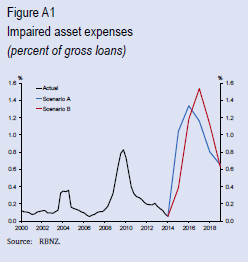
stress tests impaired assets

And here are the key capital indicators from the November FSR.
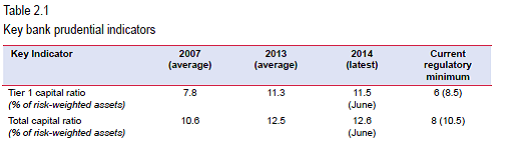
stress tests prudential indicators nov 14 FSR

Capital ratios are much higher than they were in 2007 (and the risk weights are now typically more demanding as well), and there is a substantial buffer over the regulatory minima. The Reserve Bank’s stress test loan loss estimates could be understated by half, and the soundness of the banking system as a whole would still not appear likely to be in jeopardy.

But there are other puzzles in the S&P material:

There is no mention at all of the banks’ heavy dairy sector exposures, even though risk on that book is no longer a “low probability event” but something that is crystallising now, as weak world dairy prices and a continued high exchange rate combine to create severe cash-flow difficulties for many farmers, and the likelihood of a significant reduction in the value of the collateral banks have. After all, in a case of somewhat mixed messages, even the government is now belatedly talking of selling dairy farms.

If there is one area where one might be a little critical of the Reserve Bank’s stress tests it is around the dairy scenario, which assumes payouts of just over $5 for several years. Payouts at that level would be not much different, in real terms, from the longer-term historical average levels. There is a real risk already of something more severe than that scenario.   I think the Reserve Bank scenario came out this way because it was built on a severe recession (to trigger the big housing market correction and sharp rise in unemployment). A severe recession would be likely to see a much steeper fall in the exchange rate than we’ve seen so far, which would support the NZD value of returns to dairy farmers. In other words, potential losses on dairy debt aren’t additive to potential losses on housing loans – the scenario in which one might be very bad will typically be offset by less bad losses on the other portfolio. In the current climate, the dairy books look rather sick, while housing losses remain trivially low. If the housing situation worsened markedly (unemployment rose to anything like the 13 per cent in the Reserve Bank’s scenario), the exchange rate would probably be revisiting the lows seem in 2000 (around 50 on the TWI) and net returns to dairy farmers wouldn’t look anywhere near so bad.

But having said all that, it is still surprising that S&P didn’t even mention dairy exposures, by far the largest non-housing economic exposures on New Zealand bank balance sheets.

And S&P still regard any major rapid correction to house prices as “unlikely”.   From his public comments the Governor appears to think the risk is rather greater than that, even while reporting stress test results suggesting that the banks can cope with such a shock. It is all very well for S&P to talk about how a major house price correction would also have wider adverse economic ramifications. Everyone probably agrees with that – at least, unless the house price fall resulted from regulatory liberalisation, which might well be net stimulatory – but New Zealand authorities have far more room to lean against a severe economic slowdown than do authorities almost anywhere else in the advanced world (most of whom have interest rates stuck near zero already). Even relative to Australia (of which more below), the Reserve Bank has an additional 100 basis points available to cut the OCR.

And in either country, interest rates cut to zero would be expected to result in a very large further fall in the exchange rate. Puzzlingly, in their supplementary material, S&P highlight such a depreciation as a risk. They talk of a possible fall in the exchange rate, following a sharp house price fall, as “damaging confidence and potentially limiting monetary policy flexibility”, but they provide no basis for these interpretations. Since both banks and borrowers are pretty well-hedged to exchange rate fluctuations, a sharp fall in the exchange rate would almost certainly be a helpful mitigant. And I’m not aware of any floating exchange rate country in the 2008/09 cycle where the fall in the exchange rate was regarded as problematic or a constraint on monetary policy flexibility. Perhaps Iceland is an exception, but no one thinks of the New Zealand banking system as akin to Iceland’s (even today Iceland gets a BICRA score of 7 from S&P).

Some of the cross-country perspectives don’t make a lot of sense either.   Just a couple of weeks ago, S&P was talking of upgrading the standalone credit ratings of the Australian banks, from A to A+, if those banks raised more capital to meet the higher minimum risk weights APRA is to require. But, as the IMF has recognised and is I think well-understood by the banks themselves, risk weights on housing loans have been materially more demanding in New Zealand than in Australia (or other advanced countries), thanks to the appropriately conservative approach taken by our Reserve Bank. APRA’s latest announcements probably only have the effect of bringing risk weights on Australian mortgage loans up to towards those already in use in New Zealand (the AFR reports average risk weights will have to be increased from a minimum of 16 per cent at present to a minimum of 25 per cent in future). House price inflation has also been strong in Australia – Sydney prices are even more unaffordable than those in Auckland –  and, if anything, credit growth has been running faster in Australia than in New Zealand. It is difficult to see quite how, on the material they have put out, the New Zealand subsidiaries warrant standalone ratings that would be three notches lower than those of the parents.

Finally, S&P defended the BICRA score (the move from 3 to 4) by noting that only 23 other countries had higher scores than New Zealand. That doesn’t sound too bad – although a far cry from “one of the strongest banking systems in the world”) if one thinks of 200 countries in the world, but in fact they only seem to do BICRA scores for about 85 countries. According to this document, from last November, only Switzerland scores a 1. At the time, countries with a 3 were Chile, Denmark, France, Korea, Netherlands, New Zealand, the UK and the US. That was, perhaps, questionable enough company given that Denmark, Netherlands, the UK and the US had all had banking crises in the last few years, and France was saved from one by the Greek bailout in 2010.   In group 4, along with New Zealand now, we find the Czech Republic, Israel, Kuwait, Malaysia, Mexico, Oman, Peru, Qatar, Slovakia and Taiwan. By contrast, Australia (and Canada) still scores a 2. I struggle to see how the risks in New Zealand look more similar to those “4” countries than they do to those in Australia and Canada (or even the UK). In each of those latter countries, house prices – at least in major cities – have got detached from sensible unregulated longer-term fundamentals.   And even S&P reckon that New Zealand house prices are not a “bubble” about to burst. Each has a floating exchange rate – a major element in economic resilience – and New Zealand banks seem particularly strongly and conservatively capitalised (the combination of risk weights, and actual capital ratios). Historically, residential mortgage loan losses not played a key role in systemic bank failures, and yet they are far the biggest exposures on New Zealand bank balance sheets.

The S&P model appears to put quite a lot of weight on New Zealand’s relatively high negative NIIP position. But I think they are largely wrong on that score too. First, the NIIP/GDP ratio has been fluctuating around a stable average for 25 years now. That is very different from the explosive run-up in international debt in countries such as Spain and Greece prior to 2008/09. But also the debt is largely taken on by the government (issuing New Zealand dollar bonds) and the banks. No one seriously questions the strength of the government’s balance sheet, or servicing capacity, even after years of deficits. And the ability of banks to borrow abroad largely depends on the quality of their assets and the size of their capital buffers. If asset quality really is much poorer than most have recognised, rollover risk could become a real problem, but it isn’t really an independent source of vulnerability

I’m not sure where I come out on all this. Even though the Governor is acting as if he doesn’t really believe the stress tests, neither he nor staff have given us any good reason to think their estimates – suggesting a highly resilient banking system at present – are wrong. Then again, people pay substantial amounts of money for S&P’s ratings services. It would be more reassuring if, in the follow-up commentary S&P had directly and specifically explained why they found the stress test results unpersuasive, or even why they think the risks to New Zealand banks are so much greater than those in, say, Australia or Canada.  Banks just don’t fail when they are (a) privately-owned, (b)  operating in a fairly stable environment (ie not newly deregulated), (c) not subject to government pressures to take on inappropriate risks, (d) where total assets have been growing no faster than nominal GDP for years, (e) strongly (and increasingly) capitalised, and (e) where the largest component of assets is residential mortgage loans.

As some commenters have pointed out, having been somewhat burned in 2008, perhaps rating agencies have an incentive to overstate risk at present. But even if that is true – and I’m not sure it is, after all the last few years have been characterised by a renewed and rather desperate global search for yield, any yield – it still can’t explain why S&P seem to see so much risk in New Zealand relative to the situation in other floating exchange rate advanced countries. Of flexible exchange rate OECD countries, only Turkey, Iceland and Hungary now have BICRA scores worse than New Zealand.

I don’t believe it.
New Zealand credit growth in recent years

As the near-inevitable aftermath of China’s extraordinary government-led credit boom gathers pace, and the global deflationary risks mount, I thought it might be timely to have a look at credit growth in New Zealand in recent years.

I was partly prompted to do so by some reactions yesterday to my AUT Briefing Papers piece on housing. Several commenters at interest.co.nz were convinced that I was letting the banks off the hook, and that the creation of credit to finance house prices must be, in some substantial measure, to blame for high house prices (in Auckland).

In one sense, that reaction isn’t surprising. A similar model seems to have been implicit in the Governor of the Reserve Bank’s 2013 LVR restrictions and the new Auckland-specific investor finance restrictions he is consulting on at present.   After all, prudential regulatory powers of the Bank should, as per the provisions of the Reserve Bank Act, be used only when action is need to promote the soundness of the financial system.

Without covering old ground in detail, I don’t believe that there is any such systemic threat. The Reserve Bank has not made a persuasive New Zealand-specific case, and the one piece of careful analysis that has been presented (the stress test results) suggest that the banking system would be robust to even some very severe shocks.

The international literature suggests that probably the single best (albeit not very good) predictor of crises is rapid growth in the ratio of credit to GDP. We had that in the years prior to 2007. China has had it, much more dramatically, in the last five years or so. Many countries have had periods of very rapid growth in credit, and no banking crisis I’m aware of was not preceded by a period of very rapid credit growth. New Zealand’s stresses from 1987 to 1991 are an example.   But many, perhaps even most, episodes of rapid domestic credit growth have not ended in domestic systemic banking crises. New Zealand post-2007 was just one example.

The record suggests, unsurprisingly, that the quality of lending matters a lot. And the quality of lending tends to deteriorate a lot when, either

  • Government agencies are directing that lending or setting up incentives that drive banks to undertake poor quality lending (the US housing finance boom of the 00s and the recent Chinese credit boom are good examples), or
  • Where the regulatory shackles have just been taken off, and no one –  banks or regulators –  has much experience with a liberal market-based economy and appropriate credit standards (New Zealand, Australia, and the Nordics in the 1980s were good examples).

None of that looks to be the case in New Zealand at present.  We have credit data to the end of June, and GDP data only to March, but for the rest of this I’ll just assume that seasonally adjusted nominal GDP showed no growth in the June quarter.

Since December 2007, just prior to the big recession, New Zealand’s nominal GDP has risen by just under 30 per cent, and the four different measures of private sector credit have risen by about 33 per cent. But the pre-crisis dairy lending boom went on well beyond the end of 2007   If we start our comparisons from December 2009, we find that nominal GDP since them has increased by around 26 per cent and PSC by around 21 per cent. Within that total, lending to households has increased by 22 per cent.  Whatever the base period for comparisons, credit growth has been fairly subdued relative to GDP.

credit growth since dec 07
credit growth since dec 2009
And it is not that nominal GDP growth has been rampant. In the seven years to March 2015, NGDP increased by 27.4 per cent, down from 55.1 per cent growth over the previous seven years. As is now well-recognised, given the inflation target, monetary policy has been too tight over the last few years, not too loose.

Annual nominal GDP growth fluctuates a lot, largely with fluctuations in the terms of trade. At present NGDP growth is slowing rapidly. Credit growth is currently growing faster than nominal GDP growth   The strongest component of that is agricultural credit, up 7.6 per cent in the last year. But whatever the overall state of banks’ dairy exposure – and I suspect they will lose quite a lot of money, without it being a systemic threat – the current growth in dairy credit is not the sort of lending that is recklessly bidding up asset prices, it is a reflection of the severe drop in farmers’ income –  if anything, a buffer rather than the initial source of any problem.

In short, when credit has been growing at only around the (rather subdued) rate of growth in nominal GDP for the last 6-8 years

(a) it is difficult to credibly blame bank lending policy for growth in specific asset prices (Auckland house prices) without independent evidence of a decline in lending standards (which neither the Reserve Bank nor anyone else has sought to demonstrate), and

(b) we just don’t have the basis for expecting any severe stress on or threat to the soundness of the strongly-capitalised financial system.   Rising house prices certainly generate a demand for additional credit, but it is the rather more fundamental forces (driven by governments) –  land use restrictions and policy-driven immigration flows – that are the source of the underlying pressure on prices. The same banks operate nationwide, and there is no sign of house price inflation in Invercargill, or even Wellington.

Of course, a rather nasty economic slowdown appears to be already underway, and that could worsen a lot yet. If so, that will put a lot of pressure on a lot of borrowers.

AUT Briefing Papers on housing

AUT University has, over the last few weeks, been running a series of short essays on housing-related issues, in their Briefing Papers series.  There are now seven contributions from a range of different perspectives –  from economics, to social housing and health issues.  My contribution to the series is up today.  In it I reprise (briefly) my story that persistently high house prices, especially in Auckland, are best seen as the result of policy blunders of successive governments: land use restrictions running head-on into high target rates of inwards non-citizen migration.

For regular readers there will be nothing new in the latest piece.  For others, a fuller version of that story is here, and a complementary piece explaining why Reserve Bank investor finance restrictions are not a sensible or appropriate response to a problem of this nature is here.

Investor finance restrictions: the Reserve Bank asserts a right to secrecy

The Reserve Bank has been consulting on a proposal to ban any lending with an LVR greater than 70 per cent to residential property rental businesses in Auckland.   I have been noting that the Governor acts as investigator, prosecutor, judge and jury in his own case in matters like this. I have also noted the contrast between the way the Bank handles submissions on its consultative documents, (releasing only a (self)-selected summary after the final decision has been made), with the process used in respect of submissions to parliamentary select committees, in which submissions are published (and the committee members are not themselves final decision makers on legislation).  This is a serious democratic deficit –  a unelected decision-maker keeping secret submissions on major economic policy initiatives, which will have pervasive effects on potential borrowers and on the efficiency of the financial system.

Under the Official Information Act, I asked for copies of the submissions the Reserve Bank has received on the Governor’s latest proposed controls.  This afternoon I received the letter below, refusing my request (it is, however, far the fastest they have responded to any of my OIA requests).

I have no idea whether their stance is legal, and will consider lodging a complaint with the Ombudsman, on the grounds that there is a strong public interest in having this information available.  Whether or not it is legal, it hardly seems wise for an unelected individual who exercises so much power, and who has already been challenged as having apparently misrepresented material in his consultative documents and responses to submissions.

There is a serious democratic deficit in the way the Reserve Bank is structured.  The Governor could choose to allay some of those concerns by the way he operates, but instead he adopts a secretive style while one individual makes these decisions, which appear to be at best weakly justified under the provisions of the Reserve Bank Act, which require its powers to be used to promote the soundness and efficiency of the financial system.  It is difficult for the public to have trust in a Governor who will not even make public the submissions he receives on his proposals, and is himself responsible for any summary of submissions that may later be published.

Dear Michael

On 14 July you made an Official Information request seeking: Copies of all submissions made to the Reserve Bank on the proposed changes and extensions to LVR restrictions.

The Reserve Bank recognises that there is a tension between the public interest in full disclosure and the statutory requirement to maintain the confidentiality of information we use to regulate banks. In order to balance transparency with confidentiality, our long-standing practice is to publish a summary of submissions rather than publish original documents submitted to us. We currently have work underway to publish a summary of submissions relating to our consultation on adjustments to restrictions on high-LVR mortgage lending.

Official Information Act section 16(2) says that we should provide requested information in the way that a requester prefers to receive it, unless doing so would:

(a)    impair efficient administration, or

(b)   be contrary to our legal duty in respect of the document.

Official Information Act section 16(1)(e) allows that information may be made available by giving an excerpt or summary of the contents.

Much of the information contained in the submissions that you have requested must be withheld in order to comply with the confidentiality provisions of section 105 of the Reserve Bank of New Zealand Act, and it would be administratively inefficient to publish our summary and repeat the work of summarising by redacting documents that are already being summarised for publication.

Accordingly, your request is refused on the following two grounds of the OIA:

  • s18(c)(i) – providing some of the information would be contrary to another Act; in this instance, section 105 of  the Reserve Bank of New Zealand Act, and
  • s18(d) – that the information is or will soon be publicly available; in this instance, as a summary.

The Reserve Bank expects to publish its summary of submissions near the end of August. The summary of submissions will include names of people and organisations that provided submissions, which gives you the option to directly approach submitters to ask if they will provide you with the information you’re seeking.

You have the right to seek a review of the Bank’s decision under section 28 of the Official Information Act.

Yours sincerely

Angus Barclay

External Communications Advisor | Reserve Bank of New Zealand

2 The Terrace, Wellington 6011 | P O Box 2498, Wellington 6140

www.rbnz.govt.nz

From: Michael Reddell ] Sent: Tuesday, 14 July 2015 11:59 a.m. To: macroprudential Subject: RE: Submission on proposed investor finance restrictions

Thanks Daniel

This is to request, under the Official Information Act, copies of all submissions made to the Reserve Bank on the proposed changes and extensions to LVR restrictions.

Regards

Michael

Lending to investors: still no smoking gun

I hadn’t paid any attention to the Reserve Bank’s new data providing somewhat more disaggregated information on new (ie the flow not the stock) residential mortgage lending. But the Herald’s cover story this morning sent me off to have a look.

There is only 10 months of data, and the housing market has some seasonal features. And the mortgage market has already been distorted by the Reserve Bank’s first set of LVR controls – which were always likely to have impinged most heavily on first-home buyers – so we aren’t even getting a clean read on the underlying patterns of mortgage demand.   But, from my perspective, the data reveal very few surprises, and the only thing that really took me by surprise was a pleasant surprise.

Here were a few of the points I noted as I worked my way down the Bank’s spreadsheet:

  • By value, 69 per cent of new mortgage loans over these 10 months were to owner-occupiers.  30 per cent were to “investors” (they have a residual category called ‘business” accounting for around 1 per cent).  According to the most recent census, the proportion of houses that was owner-occupied was less than two-thirds.  (The two numbers aren’t directly comparable, as local councils and Housing New Zealand own significant numbers of rental properties.)
  • By number, 81 per cent of new mortgage loans over these 10 months were to owner-occupiers.
  • By value, 15 per cent of loans to owner-occupiers were to first home buyers.  That might have been a touch lower than I expected.  First home buyers will generally be borrowing a larger proportion of the value of the house, but will also be buying cheaper houses.  FHBs will have been disproportionately squeezed by the Reserve Bank’s LVR controls.
  • By number, 8 per cent (by number) of owner-occupier loans were to FHBs over this period, but they accounted for a third of all owner-occupier loans with LVRs above 80 per cent.
  • Investors accounted for only 11 per cent (by number and value) of over 80 per cent LVR loans.
  • By number, 27 per cent of new FHB borrowers were borrowing in excess of 80 per cent LVR, and about 4 per cent of other owner-occupier, and investor borrowers.

high lvrs

  • 46 per cent of new investor loans were for LVRs of over 70 per cent (for some reason, the Bank is not collecting/reporting this data for the other categories of borrowers).

Almost all of that was quite unsurprising. And note that although the Herald devotes a lot of space to contrasting “first home buyers” with “investors”, it would seem more natural to compare all owner-occupier borrowers with all investors. Just possibly a comparison between FHBs and “first investment property purchasers” might be interesting, but we don’t have that data.

Perhaps the one thing that surprised me a little was how little high LVR lending has been going to investors over this period. Unfortunately, the period is distorted by the Bank’s controls, and it is at least possible that banks have been favouring FHBs since the LVR restrictions were put in place. And although the reporting is done at a highly aggregated level, I have heard stories of an upsurge in the proportion of loans being written by 79 per cent LVRs. If so, there is little or no effective risk reduction.   The Reserve Bank keeps on asserting that 70 per cent LVR loans to investors are just as risky as 80 per cent loans to owner-occupiers, but as Ian Harrison has been arguing, as yet they have produced little or no robust evidence to support that assertion.

I suppose what I take from these data is that, once again, there is no smoking gun to justify the Governor’s apparent determination to ban banks from lending a cent to residential rental services businesses in Auckland, when they have even a moderately high LVR.   Banks and borrowers are deeply irresponsible, and the Governor knows better….or so we are apparently to believe.   Recall that, across the whole country, between 3 and 4 per cent of new investor mortgages in the last 12 months have had initial LVRs in excess of 80 per cent.  Even if the number is double that in Auckland (and I’m not aware that anyone has that data), it hardly has the feel of reckless lending or borrowing behaviour.

The Reserve Bank has produced no evidence of any serious deterioration in lending standards. Add into the mix the still rather modest rate of growth in overall household lending, and the very encouraging results of the Reserve Bank’s own 2014 stress tests, and the case for such intrusive restrictions – with all the attendant efficiency and distributional costs – imposed by a single unelected official, is just not convincing.  Even if there were more substantial evidence to support the Governor’s concern, the soundness and efficiency of the financial system –  the only goal towards which the Bank can use its powers –  would be at least effectively protected, at less cost to individuals and to economic efficiency, through higher capital requirements.

David Parker and non-resident housing demand

David Parker has an interesting piece in the Herald, on how the various free trade agreements New Zealand governments have signed affect the ability of New Zealand to restrict non-resident purchases, should it wish to do so.  The heart of his argument is here:

The most favoured nation provision in article 139 does apply to existing investments and controls on new investments. If we want to further restrict the sale of farmland or houses to Chinese investors, we can. Article 139 simply requires NZ to treat China no less favourably than other countries. Clause 3 of article 139 means earlier agreements with our Australian and Pacific Island neighbours are not affected, and do not flow into the China FTA. Later agreements do flow through.

National does not believe there should be more restrictions on foreign buyers, and so the South Korean FTA does not contain the protections found in the China FTA. This creates risks if New Zealand moves to restrict or ban South Korean investment in residential property. Screening or bans are allowed for existing categories but not new categories, that is farms but not houses.

Article 139 of the China FTA means NZ can’t properly ban sales to Chinese investors but allow them to South Korean investors. Even the South Korean FTA does not limit the sovereignty of a future New Zealand government to restrict house sales to foreigners, but it does create a risk of South Korean claims.

If Parker’s reading is correct, it does appear to leave some options open. According to the MFAT website, the New Zealand-Korea FTA has not yet been ratified, and so is not yet in force.

Rodney Jones proposed a 20 per cent stamp duty on non-resident purchases in Auckland. Such restrictions or taxes are not a first-best solution. Particularly if the non-resident demand from China is likely to persist over the medium to long term, it would be much better to liberalise land-use restrictions and make it much easier to supply new houses and apartments. It is an export industry.  (But if the demand was likely to prove pretty short-term in nature, it might actually be preferable to simply absorb excess demand in temporarily higher house prices.)

But I don’t see any sign of wide-ranging liberalisation of land-use restrictions in the next few years. As I’ve noted previously, I’m not aware of other countries or major cities that have had tight supply restrictions and materially and sustainably liberalised them. Surely it must come some day, but regulation once established tends to linger for a long time. Import controls, from New Zealand’s history, were another good example.

I don’t think there is any obvious welfare gain for New Zealand in allowing extensive non-resident purchases of houses/apartments if governments also make it hard to bring new urban land to market and utilise it intensively in response to changes in demand. There is none of the technology transfer that might be associated with FDI. There is simply a redistribution – windfall gains to those who happen to own property in Auckland before the demand picked up, and windfall losses to those who would have wanted to purchase in the future. And the gain is simply the result of government-imposed and maintained supply restrictions. In that climate, I see no major problem in principle with some sort of restrictions.

And yet, I remain a little uneasy. In terms of accommodation itself – surely more important than home ownership – it is purchases of houses that are then left vacant that have the stronger adverse effects. Houses that are bought and put back on the rental market maintain the supply of accommodation. And yet we have no data on how important this “left vacant” component might be, and I don’t think the new post-October information requirements will provide any data on this split. Given that demand for house-buying seems relatively price-inelastic, even if the “left vacant” component is itself quite small, as a marginal boost to demand it could still be having quite an impact on price.

Perhaps this is where advocates of the Australian rule (“you can buy, but only a new build”) come in. The Australian rule doesn’t seem to have been very effective, but perhaps a similar one could be much more effectively policed if the authorities were serious about doing so? Perhaps it really is the minimally distortive approach if there is to be new regulation at all? The caveat to that proposition is that if the offshore demand were to prove short-lived we could be left with a nasty over-supply of the sort of housing not overly popular with most New Zealanders. An ample supply of (cheap) apartments sounds good, but real resources will have been diverted into building the properties, skewing the rest of the economy. Real resource misallocation tends to be more costly than changes in asset prices in isolation.  Perhaps that should be less of a concern starting from current house/land prices than in other circumstances?

I’m usually reasonably settled in my views as to appropriate policy responses. For now, on this issue, I’m not. Waiting for October’s data is a convenient line, but I suspect it is a bit of a cop-out. I am left rather closer to Rodney’s 20 per cent stamp duty than I was previously.

How not to have a “reasoned and deliberate discussion” of housing and immigration

I noted in my post yesterday that I was a little surprised at how NBR had characterised differences between Shamubeel Eaqub and me around how to think about the contribution of immigration policy to housing demand. The description was “war of words”, something I didn’t recognise. But I hadn’t seen the article then.

As I noted yesterday, the difference is simply about how to interpret net PLT migration figures. Shamubeel uses them to conclude that immigration policy has not been a major influence on housing demand over 50 years. I pointed out, in response, that immigration policy is about how many non-New Zealanders we let in, and how long we let them stay. It does not affect the movement of New Zealanders at all. Accordingly, if we want to understand the role of immigration policy, we should focus mainly on data on the movement of non-New Zealand citizens. I have used the net inflow of non-New Zealand citizens as a proxy, while noting that it is not a perfect proxy.  On that measure, most of the trend increase in household numbers is now down to immigration policy choices.

So far I thought we just had the sort of difference that crops up all the time in analysing data. Someone proposes a hypothesis, with some numbers, and others respond questioning whether, for example, the data cited are showing quite what the first analyst thought they were. That sort of debate is how we advance our understanding. I didn’t (and don’t) challenge the accuracy of Shamubeel’s numbers (and I’m sure he isn’t challenging mine). The only issue should be what light each set of numbers sheds on the issue (and which issues they each shed light on). As I put it yesterday, if people prefer I’m quite happy to say that (given land use and housing supply restrictions) the large net outflow of New Zealanders has greatly eased pressure on house and urban land prices, and the (even larger) policy-facilitated net inflow of non-New Zealanders has greatly exacerbated pressures.    But only one is a immigration policy matter.

To the extent I had given it any thought, I assumed Shamubeel was approaching the discussion in the same dispassionate way.   In his book (page 129) he notes:

Economist Paul Collier, in his book Exodus argues that we need to talk openly about immigration. Not through the lenses of envy and racism, but in the context of a reasoned and deliberate discussion of why we want immigration, how many people we want, and what kind of people we want.

I nodded, largely agreeing, when I read that passage. Collier’s book is also worth reading.

But this morning I picked up a copy of the print edition of NBR and understood immediately Jenny Ruth’s “war of words” description. Instead of “reasoned and deliberate discussion” my argument is simply dismissed by Shamubeel as “That’s racist”, and “he’s always had this thing about non-New Zealanders. That’s pretty much been the tenor of his work over the last three years”, and “he’s taken a biased approach”.

And there is nothing more than that. There is no sense as to why, as a descriptive exercise, he disagrees with my interpretation of the role of immigration policy in explaining medium-term demand for housing.

Perhaps he provided a more substantive response to the journalist and she didn’t report it, preferring only to report the slurs?  (With apologies to Jenny Ruth) I rather hope so, because Shamubeel is someone whose contributions to economic analysis I have had some time for (indeed on this blog, I encouraged people to read his book) . I think he is much better than is suggested by simply falling back on labels like “racist”, or even “he has this thing about non-New Zealanders”, when someone challenges his framing of the numbers.

I’ve been posing some questions around New Zealand’s immigration policy and the implications for understanding economic performance for five years now. When one is discussing, or researching, the implications of immigration policy, inevitably one is focusing on non-New Zealanders. That is who immigration policy affects. As Shamubeel notes, we (and every country probably) need “reasoned and deliberate discussion of why we want migration, how many people we want, and what kind of people we want”.

In that time I’ve debated the issues and analysis with many people- here and abroad, New Zealand born and foreign born – and I’m pretty sure no one has ever previously accused me of racism.  These are important analytical and policy questions, and the prospects for reasoned and deliberate discussion recede further when people contributing to it the discussion are simply labelled “racist”, rather than engaging on the substance of the issues and analysis.

I hope that Shamubeel will, on reflection, withdraw his slur. As ever, I would be very happy to engage him (or anyone) on the substantive issues (whether interpretative, analytical or policy). And I still think people will benefit from reading his book.

Two comments on housing

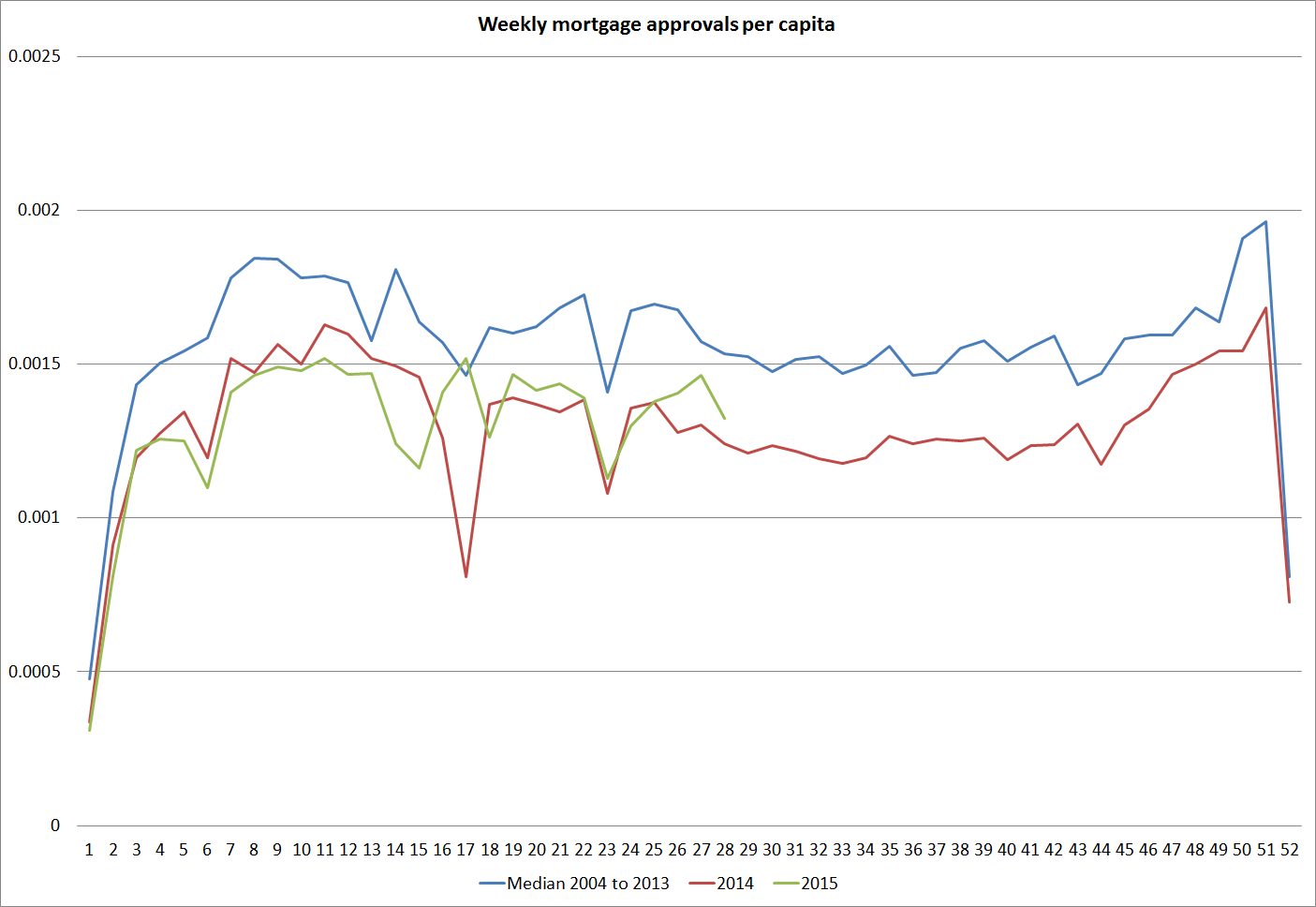
This morning I updated my chart of mortgage approvals per capita. I’ve shown it previously and I like it because it is very timely data.  As you can see, the number of mortgage approvals per capita is running just slightly ahead of last year’s level. But the number of approvals is running below the average, for the time of year, in the 12 year history of the series. In fact, in only three years (2010, 2011, and 2014) have approvals been lower than they are this year.

mortgage approvals 2

What do I take from this? First, it reiterates the point that across the country as a whole the housing markets are not particularly buoyant. House sales per capita are far below the peak in the previous boom. Most places have real house prices below previous (2007) peaks, and in most places nominal house prices are pretty flat.

Auckland is a (big) exception. If we had mortgage approvals data on a regional basis, perhaps we’d find that Auckland’s were nearer to or even above the historical median, while the rest of the country might be tracing the lows. But the non-resident demand for houses in Auckland may also be relevant here. We don’t know how large the contribution of that demand to rising house prices is, but much of those purchases (however large or small they are) are probably either cash purchases, or perhaps financed with credit from abroad (not captured in New Zealand data).

I think these data also tend – not conclusively, but suggestively – to confirm the line I ran in my submission last week on proposed investor finance controls. There is simply no evidence that rising house prices in Auckland are to any material extent the result a credit-driven process. If they were, not only should the Reserve Bank be able to point to concrete evidence of deteriorating lending standards, but we would also expect to see lots of mortgages being approved. In fact, only three years have been weaker.

Changing tack, I see that print edition of the NBR has an article about what is described as a “war of words” between Shamubeel Eaqub and me, about the contribution of immigration policy to the house prices pressures in Auckland over time.  I didn’t recognise the description (“war of words”)  and the print edition of NBR isn’t sold this far out in the suburbs so I haven’t yet seen the article, but I just wanted to explain again the difference in how Shamubeel and I are interpreting the same data. I set it out here a few weeks ago.

Shamubeel notes (correctly) that net migration has accounted for only 9 per cent of household formation in New Zealand over the last 50 years. My point is quite simply that net PLT migration (which is probably understated on average over time) is not a description of the contribution of immigration policy. Immigration policy affects the arrival (and duration of stay) of non-citizens. Using the net flow of non-citizens as a proxy for the policy-controlled bit, I concluded that immigration policy accounts for most of the household formation in New Zealand in the last couple of decades. Since 2006, on this proxy, it accounted for 106 per cent of household formation.

I think it would be entirely reasonable to say that, on the one hand, the large net migration outflow of New Zealand citizens over decades has greatly eased pressure on the housing market (taking as given land use restrictions), and, on the other hand, the large net inflow of non-NZ citizens, which is over time a policy-controlled variable, has (even more) greatly exacerbated those pressures. The net effect of the two independent forces might have been modest over 50 years, but one limb is the endogenous behaviour of private NZ citizens, and the other is the direct outcome of policy choices. I might comment further later when I’ve seen the NBR piece.

Offshore demand for houses – some further thoughts

Rodney Jones has a nice piece on the Herald website about the non-resident property issue, perhaps slightly oversold by the sub-editors as “How he’d solve the property crisis”.  Before non-resident purchases were a material issue, house prices (especially in Auckland) were still hugely distorted by poor domestic policy.

Rodney’s approach to understanding the issue is very similar to that in my post yesterday, emphasising how historically unusual the situation is in which a large economic power has such weak domestic institutions that its citizens are looking to buy individual houses in other countries.  As he notes “to express concern about the potential impact of these flows is not racism”.

Rodney goes further than I would yet do.  He proposes a 20 per cent stamp duty on non-resident purchases of Auckland [residential?] property.  Turnover taxes generally make me feel queasy, and I’m always reluctant to endorse a regional approach to tax policy in a unitary state – which creates its own new distortions.  Since there is probably relatively little offshore demand for property outside Auckland there would be no harm in extending such a tax, if it were adopted, to the entire country.   But I suspect that the terms of our various free trade agreements might be more of a constraint.  Some FTAs might allow such restrictions, and some might not, but the China agreement for example does not allow us to adopt measures that discriminate against China relative to other countries (and we have a strong commitment to an open market between New Zealand and Australia).  And I doubt that such a tax could credibly be sold as a “macro-prudential” measure.  But Treasury and MFAT should be carefully exploring the legal options,  and the implications of our interacting web of FTAs, if they have not already done so.   It is not impossible that there is nothing that could legally be done that would not cause more distortions and costs than they would be worth

Rodney’s is a much more substantive contribution to the debate than the lofty op-ed penned by former Foreign Minister (and head of something called the New Zealand China Council) Don McKinnon.  In this surveillance age, the article is somewhat ominously titled “China listening to our housing debate”.  Then again, perhaps we should celebrate the fact.  We are open society, and have our debates openly.  China doesn’t, and its people are the poorer for that.

Or what of the reported comments of Pat English, executive director of the New Zealand China Council.  He claims that “New Zealand has a superb relationship with China. But Labour has done immeasurable damage to that relationship, due to where the debate has ended up”.   Really?  Where is the evidence?  Of course, he may be literally correct – since any damage is unable to be measured.  But any relationship that can’t stand the strain of open public debate is one of rather questionable value.   And these issues are being debated in many other countries too.

In open societies sometimes mixed messages might be heard.  And actually sometimes ambivalence is real and appropriate.  I suspect we’d be happier, and China’s citizens would be happier and better off, if they had the ability to, for example, buy secure freehold title to property in China. Or a system with the sort of economic governance, and rule of law, that the US or the UK had as they rose to dominant positions in the world economy, that made “capital flight” simply unnecessary.  China would probably be better off if, as an emerging economy, it were running current account deficits (drawing capital in from the rest of the world) rather than current account surpluses.  Of course, China’s brutal authoritarian leaders might be less happy and less secure, but that is scarcely a priority for New Zealanders.