Should household debt be a worry?

Westpac had a note out the other day under the heading “Household debt levels now higher than before the financial crisis”.  Using December data for household and consumer debt (including debt used to finance residential rental businesses) and comparing it with household disposable income, they calculated that household debt was 162 per cent of income, compared to 159 per cent at the previous peak in September 2009.

Using slightly different numerators or denominators alters the picture only a little. Debt to income ratios fell back during and after the 08/09 recession, and have been increasing quite a bit in the last couple of years.  Credit growth has picked up and income growth has slowed.  I prefer to focus on debt to GDP measures, and here is my version of the chart.

household debt to gdp

The ratios haven’t yet reached the previous peaks, but aren’t that far away, and may well go past the previous peak this year.  One gets much the same picture looking at broader credit aggregates relative to GDP.

One could look at these trends in a variety of ways. I’d tend to emphasise the fact that over the last 7.5 years there has been no growth at all in the ratio of household debt to GDP, whereas over the previous 15 years that ratio had increased by around 60 percentage points.   Westpac seems much more worried than that.

But there are a couple of important things we know (or know we don’t know):

  • that we have no idea what any sort of “equilibrium” ratio of household debt to income is.
  • that when household debt levels were first at these sorts of levels, around the time of the 08/09 recession, it didn’t lead to any serious stresses on the financial system –  we had a pretty serious recession, mostly reflecting global developments, and yet there was never any question about the soundness of the New Zealand financial system.
  • that vanilla household debt has very rarely been at the heart of serious financial system problems in this or other countries  –  the Reserve Bank drew our attention to that in an article only a couple of years ago. Lending on speculative commercial (and residential) developments, and other (typically unsecured) business lending, has usually been the presenting source of financial system problems.

But I’m also puzzled by two points about the Westpac piece –  one presence, and one absence.

Westpac talks of high house prices boosting consumption.

household C to GDP

But household consumption as a share of GDP is currently just slightly below the average ratio for the last 30 years or so.  This shouldn’t be very surprising –  higher house prices don’t make New Zealanders as a whole any better off.  A longer discussion of this issue is contained in this Reserve Bank Bulletin article from a few years ago.

The “absence” is any sense that changes in household debt to GDP (or income) ratios are not mostly some exogenous phenomenon of reckless banks and households taking on new debt with gay abandon.  I discussed this issue a couple of weeks ago.  If there are shocks to the population, and land supply restrictions exist, then house prices will rise.  New purchasers will typically (and probably rather reluctantly) need to take on more debt than their predecessors did.  As a result, debt to income ratios will rise. Since the housing stock turns over only quite slowly, an initial shock boosting house prices will go on boosting debt to income ratios for many years.

In the chart below I’ve done a very simple exercise.  I’ve assumed that at the start of the exercise, housing debt is 50 per cent of income, house prices and incomes are flat, and people repay mortgages evenly over 25 years.  Only a minority of houses is traded each year, but each year the new purchasers take on new debt just enough to balance the repayments across the entire mortgage book.

And then a shock happens –  call it tighter land use regulation –  the impact of which is instantly recognized, and house prices double as a result.  Following that shock, house purchasers also double the amount of debt they take on with each purchase, while the (now rising) stock of debt continues to be repaid in equal installments over 25 years.

In this scenario remember, house prices rose only in year 1.  There is no subsequent increase in house prices or incomes.  But this is what happens to the debt to income ratio:

debt to income scenario

In this particular scenario, 100 years after the initial doubling in house prices, the debt to income ratio is still rising, solely as a result of the initial shock, converging (ever so slowly by then) to the new steady-state level of 1.  One could play around with the parameters, but a permanently higher level of real house prices will, in almost any of them, produce a permanently higher level of gross housing debt, and it will take many years to get to that new level.  The flipside, which I could also show, is the deposit balances of the other parts of the household sectors – the young who have to save for a higher deposit (even for a constant LVR) and the older cohorts who extract more money from the housing market when they downsize or exit the market.  Higher house prices do not, of themselves, require banks to raise more funding offshore.

This is deliberately highly-stylized, but it is designed to illustrate just two main points: higher debt ratios can be primarily a symptom of higher house prices (rather than any sort of cause) and the adjustment upwards in debt levels following an upward house price movement can take many years to work through.

Given the huge population pressures, especially in Auckland, and the lack of much material progress in easing land use constraints, it is hardly surprising that real house prices have increased quite a lot further in some places. If anything, it might be a little surprising that debt to income ratios have not increased more. But these things take time – the point of the chart above.

Westpac has long been of the view that low interest rates have been a major factor explaining rising house prices.  I’ve never found that story particularly persuasive.  We’ve had a 600 point cut in the nominal OCR since 2008 (and a bit more in real terms).  If all else was equal and the Reserve Bank had not cut the OCR as much no doubt house prices would be lower (and quite a lot of other aspects of the economy would be doing even less well).  But the OCR cuts have been done for a reason: the economy hasn’t been performing that well, and inflation has persistently surprised on the downside. In Wicksellian terms, it looks a lot as though the natural interest rate has fallen quite a bit.  Westpac worries about what happens when (if) interest rates rise, but they are only likely to rise much if the economy is performing much better, and is generating much stronger income growth (which would support the existing debt).

There is a still a strong sense around that, when it comes to housing, what goes up must come down.  But when a market is so heavily influenced by regulatory factors, there is no such natural adjustment.  As a loose parallel, we have plenty of people who find it hard to get a job, but the minimum wage keeps on being increased.  Urban residential property prices, especially in Auckland, are a disgrace –  the responsibility of the choices (active and passive) of a succession of central (and local) government politicians. They are hard to defend under any conception of justice or fairness. But there is little sign that they are any sort of macroeconomic risk.  Debt to income is little higher than it was a decade ago, consumption to GDP has not gone crazy, there is nothing of the sort of debt fuelled speculative construction boom seen in, say, Ireland, and there is no sign of reckless behaviour by lenders.  And the banks are very well-capitalized.  It is awful for the many adversely affected, but there is no reason why things should necessarily change much for the better any time soon,

Finally, one of the points of the Westpac note seemed to be to foreshadow the risk of new layers of regulatory controls (so-called “macro-prudential” measures) being imposed on the banking system by the Reserve Bank.  Perhaps they are right about what might be coming. But there would be no good (financial system soundness) basis for further intrusions on the ability of borrowers and lenders to freely arrange finance.    There is simply no evidence that the soundness of the financial system is at risk –  or would be even if, say, the population pressures reversed and land use restrictions were freed up.  Then again, the last two sets of LVR restrictions, undermining the efficiency of the financial system and the wider economy in the process were unwarranted, but that didn’t stop the Reserve Bank charging ahead then.


Regional GDP revisited: has Auckland really been that weak?

In a couple of posts earlier last week, I used the regional (nominal) GDP data, showing how weak Auckland’s per capita GDP growth appears to have been over the last 15 years (the period for which the data exist).   And it didn’t appear that terms of trade changes could explain the regional patterns, since most of the gains in New Zealand’s terms of trade has reached our shores in the form of lower import prices, the effects of which should have been quite pervasive across the economy.

But as I got to the end of the second of those posts, I started to get a bit uneasy about the data.  I had noted that over the 15 years, Auckland’s population had increased by 30 per cent, and that of the rest of the country by only 13 per cent.  And yet, over the years (to 2013, for which we have detailed industry breakdowns), construction had been a smaller segment of Auckland’s GDP than in most other regions in the country. This was the chart:

construction share of gdp

I started digging into the data a bit further, and also got in touch with Statistics New Zealand (who provided me with some prompt, very helpful, assistance, including suggesting that some readers might be interested in how they put the numbers together).  My digging didn’t resolve any puzzles, but it didn’t highlight any very obvious errors either.

In a city with a rapidly growing population one would normally see a larger share of GDP devoted to construction (than at other times, or other places).  Construction isn’t just about houses, but the whole panoply of structures that a growing population needs over time.

Over the 15 years to 2015, Auckland accounted for 50 per cent of all the population growth in New Zealand.  And yet here is the Auckland share of the value of all building consents, and the Auckland share of the construction component of GDP (for which we only have regional data to 2013).

akld consents

One wouldn’t expect an exact mapping, since the two series are measuring quite different things (quite a bit of construction won’t need a building consent), but both are a long way below Auckland’s share of population growth  (and Auckland’s share of population growth was highest in 2001 and 2002).

The regional GDP data also have two components that should normally have a strong relationship with housing, and also with population growth.  These are:

Rental, hiring, and real estate services
Owner-occupied property operation

The latter series is straightforward –  in effect, the rental value of living in an owner-occupied house, which is proxied using market rental data.

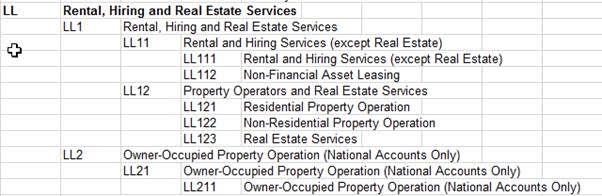
The “rental, hiring, and real estate services” is more complex.  It includes various sub-categories, for which the data are not provided separately.  Here is what is included, from a table SNZ sent me:

reg gdp categories

Ideally, I would like to look at only the LL12 and LL2 components, and thus exclude the non real estate leasing services (eg cars, machinery etc), but the data aren’t publicly available.

Surely, I thought, if Auckland’s population has been growing so much faster than the population in the rest of the country, this should be reflected in faster growth in these components of GDP.  I didn’t really expect it in respect of owner-occupied dwellings, because although Auckland rents have risen a bit faster than those in the rest of the country, rates of owner-occupation have been falling faster.  But everyone needs to live somewhere, renting if not owning, so I thought the effect should still show up if I combined the two components.  After all, the rental component also includes non-residential property, and more people generally implies more offices and shops too.

But this scatter plot is what I came up with (population growth on the x axis and growth in the sum of the two GDP components on the y axis):

housing scatter plot

I’d expected to see an upward-sloping relationship (recall, these aren’t GDP per capita components, but total GDP).  As I put it to SNZ, isn’t it a bit puzzling that growth in these two nominal GDP components over 13 years was greater in Southland than in Auckland?  Given where all the other regions sit, in a well-functioning housing market surely one might have expected the growth in these GDP components for Auckland to be up in the 140 to 160 range?

SNZ were able to tell me that there was a large growth, from a low base, in non-financial non real estate asset leasing in Southland.  That might help explain why these GDP components together grew surprisingly fast in Southland.  But it doesn’t explain why Auckland has been so weak relative to almost all the other regions (given the extent of its population growth).

Here is a chart showing Auckland’s share of total nominal GDP for each of these two components.

akld shares

And yet over this period Auckland’s share of the total population increased from 31 per cent to 33.5 per cent.

I guess that, overall, this is not wholly inconsistent with the divergence that has opened up in the population per dwelling numbers: trending down in the rest of the country but not in Auckland as house prices become increasingly unaffordable.

Out of curiosity, I redid the per capita regional GDP numbers excluding these two real estate related components.  In my original chart, Auckland had the third slowest growth in nominal per capita GDP from 200 to 2015.   In this alternative chart, we have the data only to 2013.    Over that period, Auckland had the slowest per capita total nominal GDP growth of any region.

What about on this adjusted, non-real estate, measure?

adjusted regional GDP growth

It doesn’t improve the picture.

I’m still not quite sure what to make of all this.  Ideally, we would have regional real GDP  data, but unfortunately that does not appear likely any time soon.  But on the basis of what we have, Auckland seems to have done particularly poorly over the last 15 years, despite (or partly because?) all the policy-induced population growth.  Some of that seems to relate to the poorly functioning housing supply market.  But even abstracting from the direct effects of that, it has to be seen as a pretty disappointing outcome, leaving many questions on the table.

(It also leaves me with some new questions, which I have not yet attempted to work through in my own mind, about my explanation for New Zealand’s persistently high (relative to other countries) real interest rates.  A topic for another day.)


Housing: what can be done

In the seemingly-endless housing supply debate, there is often a divide between those favouring greater intensification, and those favouring a larger physical footprint for growing cities.  My own policy view is squarely in the “it should be a matter of individual choice, provided the infrastructure etc costs of development are appropriately internalized, and the rights of existing property owners are protected” camp (and yes, I recognize that the definition of almost every word in that statement could be extensively debated). My practical prediction is that New Zealand is a society where most people –  people in their child-raising years –  will prefer to have a decent backyard (those living in Hastings or Timaru don’t flock to high rise apartment buildings or town houses with tiny sections), so long as regulatory restrictions don’t make that infeasible.  It was quite possible 50 years ago, when New Zealand incomes were much lower.  There is simply no reason, in a country with this much land, why it shouldn’t be now.

Apologists for the current disgraceful situation constantly cite Sydney, or Vancouver, or San Francisco or London, as if absurd regulatory restrictions in other places make it okay for us to mess up our housing/land supply market this badly.  Others look to the experience across the huge range of US cities.

Someone drew my attention to the chart below, drawn from the Wall Street Journal’s economics blog, and on a day when the house is over-run with builders (and holidaying children), it seemed worth reproducing.

scale of cities and house prices

Cities with rapidly growing populations (those big blue circles in the bottom right) have seen little or no increase in real house prices over the period 1980 to 2010.  They made it possible to build, relatively easily, and in turn made themselves attractive places for people to live.

I don’t know how large the increase in Auckland’s “developed residential area” has been over 1980 to 2010, or even how to go about trying to measure it, but I’d be astonished if it was anything close to even 100 per cent.

It is quite possible to accommodate rapid population growth without anything like the scandalous increases in real house prices we’ve seen in Auckland (or even, to a much lesser extent in many other urban areas in New Zealand).   Political leaders, of both main parties, who have failed to make it possible, posing a near-impossible burden on younger people in Auckland who don’t come from advantaged backgrounds, should really be held to account.  High house prices aren’t something to celebrate (NB Prime Minister)  –  and not even most existing home owners are better off, as they aren’t going anywhere –  but should really be a source of shame to those who rigged the market (or let the market stay rigged) and made it happen.

Big banking systems and house prices

On Saturday afternoon I found myself in an email exchange with a couple of people about how the composition of bank lending had changed since 1984.  I wasn’t quite sure where the table I was responding to had come from, but when I eventually got to the business section of Saturday’s Herald I found the answer.  Brian Gaynor had devoted his column to a discussion of the changing significance of banks in recent decades, portentously headed  “Banks’ long shadow over New Zealand economy”.   I found myself agreeing with almost none of his interpretation.

My alternative story has two key strands:

  • the institutions we label “banks’ have become more important in the financial system as the incredible morass of restrictions built up since the days of Walter Nash were removed, first (too) slowly, and then in a great rush over 1984/85.  That has allowed the financial system to become much more efficient.  Financial intermediation is now undertaken mostly by those best placed to do it, rather than increasingly by those either subsidized by the government to do it, or just outside the network of controls and so still free to do it.
  • total credit to GDP (and especially the housing component) has risen mostly because of regulatory restrictions on building and, in particular, on urban land use. Higher housing credit is mostly an endogenous response to this policy-created scarcity.

There are all sorts of caveats to the story.  In some respects, banks are much more heavily and directly regulated now than they have ever been (and that burden is only getting heavier with LVR controls which threaten a new wave of disintermediation).  The “too big to fail” problem probably skews things a little too far towards banks (but adequately price deposit insurance and banks will still remain dominant), and at times banks get over-enthusiastic about increasing lending to particular sector and sub-sectors.  But, fundamentally, the rising importance of banks (relative to other intermediaries) has been a good thing not a bad one, and if one might reasonably be ambivalent or even concerned about the rise in household credit, that has been an almost inevitable consequence of artificial shortages created by central and local government.  Given the determination of our leaders to mess up urban land supply, in a country with a fast rising population, it would have happened in one form or another, and it is better that it has been done by efficient intermediaries.  Concerns should be addressed to central and local government politicians who keep the housing supply market dysfunctional, not to bankers.

At this remove, it is probably hard for many to appreciate quite what the New Zealand financial system was like in the heavily regulated decades.  Old New Zealand Official Yearbooks will give a good flavour, and the Reserve Bank published in 1983 a 2nd edition of its Monetary Policy and the New Zealand Financial System, which has lots of detail (the 3rd edition is a quite different book –  a weird confusion, which I take responsibility for).

In addition to the Reserve Bank  –  which lent, not just to its staff, but also to the major agricultural marketing bodies –  we had:

  • trading banks (each established by statute, with no new entrants for many decades)
  • private savings banks (savings banks subsidiaries of the trading banks, introduced in the early days of deregulation in the 1960s)
  • trustee savings banks (a different one in each region, some large and strong, some tiny)
  • the Post Office Savings Bank
  • the Housing Corporation (government mortgage finance)
  • the Rural Banking and Finance Corporation (govt rural finance)
  • the short-term official money market
  • finance companies
  • the PSIS
  • building societies (terminating and permanent)
  • life insurance and pension funds (large and fast-growing supported by a tax regime, and fairly large lenders)
  • the Development Finance Corporation
  • stock and station agents

And that was just the institutional entities –  almost all with different statutory and regulatory powers and restrictions.  And there was a very large non-institutional market in finance –  notably, the role of solicitors’ nominee companies in mortgage finance.

Trading banks had never been dominant providers of finance in New Zealand –  since they had not historically provided mortgage finance, whether to farmers or for households –  but even in their role as providers of, typically, short-term finance to business, they had been withering (under the burden of regulatory restrictions) for decades. As the Reserve Bank noted in its 1983 book, “trading bank loans and investments have fallen from being around 50 per cent of GNP in 1930 to around 25 per cent of GNP in 1981”.    As far as I can tell –  it was my impression back then, when writing an honours thesis on the disintermediation process, and it is my impression now –  that the only people who benefited from this state of affairs were the people running the entities subject to a lighter burden of regulation.  My schooling was mercifully free of so-called “financial literacy” education, but the one message I recall being drummed in repeatedly (reinforcing the one from my father) was that it was very difficult to get a mortgage, and one had to spend years building a track record that might allow one to go, on bended knee, to a lender, seeking as a special favour access to such credit.  But if you were on a lower income, the state would provide.  Alternatively, coming from a well-off family, or getting a job in an organization with concessional staff mortgages, was the way to go.  (Reserve Bank concessional loans were very good, although in the end I had one for only 2 months.)

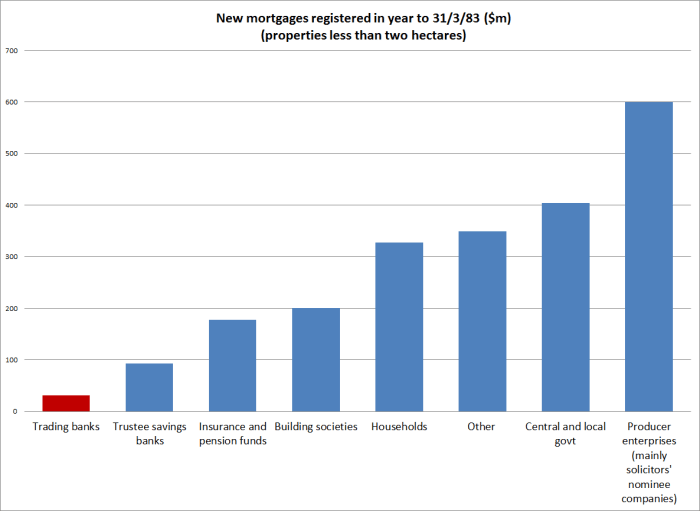
Gaynor quotes statistics showing that trading bank housing lending was 14 per cent of total lending in 1984 and is 52 per cent now.  But look who did housing lending back then.  This chart is drawn from the 1984 New Zealand Official Yearbook, and shows the flow of new mortgages (on properties less than 2 hectares, so largely excluding farm mortgages) in the year to 31 March 1983.

mortgages 1983

Trading banks barely figure at all (and this includes their private savings bank loans, and loans to staff).  Most mortgages by then were being made through the Housing Corporation, within families, or through solicitors’ nominee companies.  Neither of the latter two offered much diversification, a key way of making available affordable finance.  Call me a relic of the 1980s if you like, but I count it as huge step forward that large and efficient private sector entities are now the main vehicle for residential mortgage finance.

I mostly want to focus on housing lending, but Gaynor also notes in support of his case

The first point to note is the huge fall in lending to the manufacturing sector, from 24.5 per cent of total bank lending 30 years ago to only 2.8 per cent at present. This reflects the deregulation and demise of manufacturing, which was also the result of policy initiatives by Sir Roger Douglas and the fourth Labour Government.

Yes, the relative importance of the manufacturing sector in the economy has shrunk –  perhaps more than it would have in a better-performing economy  –  but by my calculations drawn from Gaynor’s table, trading bank lending to manufacturing ($1.6 bn) was around 3.5 per cent of GDP in 1984 and at $11.4 bn is around 5 per cent of GDP now.  Across all the financial intermediaries that existed in 1984, the share would have been higher, but the overall picture is a quite different one from that Gaynor paints.

But what about housing lending?   Gaynor asserts that

The clear conclusion from this is that anyone who bought a house in the early 1980s has been extremely fortunate because aggressive bank lending has been a major contributor to the sustained rise in house prices over the past few decades.

Since 1980/81 was the trough of a very deep fall in real house prices, there is no doubt that it was an ideal time to have bought.  And there is also no doubt that there has been an aggressive (and almost entirely desirable) process of re-intermediation.  Some entities that weren’t trading banks became trading banks (or ‘registered banks’ as we now know them) – think of Heartland, SBS, ASB, PSIS –  or were directly purchased by banks (think of the United or Countrywide building societies, or Trustbank or Postbank), and in other cases banks just won market share away from other participants in the market (no need for a solicitor’s second or third flat (short-term interest only) mortgage when you could get a 80 per cent table first mortgage at the local bank branch).

But is there any evidence that “aggressive lending” by the financial sector (now mostly ‘banks’) has been a “major contributor” to the huge rise in real house prices in recent decades?    I think the evidence is against that claim.  Why?

First, “aggressive lending” usually ends badly.  It did for the banks when they lent on the massive commercial property and equity boom post-1984.   It did for the finance companies with aggressive property development lending in the years up to 2007.  It did for the banks with dairy lending (both in 2008/09 with a surge in NPLs and perhaps again now –  going even by the Reserve Bank’s own stress test).  Housing lending, by contrast, has not ended badly, even though the push by banks into housing lending has been going on now for more than 25 years, through several economic cycles and one very nasty recession.  It is easy to say “just wait”, but history is strongly against that proposition.  Inappropriately aggressive lending goes wrong much faster than that.

Second, while the lending terms of banks have become easier than they were 25 years ago –  when banks were just finding their way in this new market for them, and nominal interest rates were still extraordinarily high – they are not noticeably looser (at least in asset-based terms) than the terms applied by other housing lenders in earlier decades. 80 or 90 per cent 30 year mortgages from the Housing Corporation weren’t uncommon (or inappropriate for a young couple with decades of servicing capacity ahead).  Banks, including the Reserve Bank, had long lent those sort of proportions to their own staff.  And, on the other hand, we have not had any material amount of mortgage business written with LVRs above 100 per cent, or with terms of 100 years or beyond (things seen in various European markets at times).  Overall, credit conditions are probably easier than they were, but not in way that is self-evidently inappropriate or overly risky for either borrowers or lenders.  The Reserve Bank’s housing stress test backs that conclusion  – taking account of the joint risk of losses in asset values, and losses in servinig capacity (if unemployment were to rise sharply).

Third, there is a simpler explanation for high house and urban land prices.  Regulatory land use restrictions combined with population pressures (including policy-driven immigration ones) are a more persuasive story, including in explaining why house prices in Auckland have increased so much more than those elsewhere.  In New Zealand we have only one fairly large city, but think of the situation in the United States: there is a fairly unified financial system (albeit with some state level differentiation in restrictions) and yet we find huge increases in house prices in places like San Francisco (with tight land use and building restrictions) and very modest real increases in large and growing places such as Houston, Atlanta, Nashville and so on.  High house prices, and high house price to income ratios, are not an inevitable feature of a liberalized financial system.  They aren’t an inevitable feature of tight land use restrictions either, but the correlation across cities is pretty good.

demogrpahia 2016And if finance were primarily responsible, finance would also have brought forth lots of new supply.  That is way markets work –  it is part of the reason why credit-driven booms don’t last that long.  Instead, prices have been bid up largely as a result of regulatory constraints: there are not consistently excess profits lying around that developers can readily take advantage of.
Of course, higher house prices typically mean that buyers of houses need more credit than they otherwise did.  If house prices suddenly double because some regulatory change makes land scarcer, then with incomes unchanged either people can wait (much) longer to buy, saving a larger deposit, or they can borrow more to complete the purchase.  If the people who wanted to buy, but are reluctant to take on more debt, do hold back, someone else will buy the property.  And that person will need finance –  either debt or equity.  If banks are reluctant to lend on houses, then houses will tend to be owned by people who are least dependent on debt: those with large amounts of established wealth already.  All else equal, since few people get into the owner-occupied housing market without debt, that would be a recipe for even larger falls in owner-occupation rates than we have already seen.

Much of the overall increase in housing debt in New Zealand (and other similar countries) in recent decades has been the endogenous response to the higher house prices, rather than some independent factor driving up prices.  And these forces take a long time to play out.

In the chart below I’ve done a very simple exercise.  I’ve assumed that at the start of the exercise, housing debt is 50 per cent of income, house prices and incomes are flat, and people repay mortgages evenly over 25 years.  Only a minority of houses is traded each year, but each year the new purchasers take on new debt just enough to balance the repayments across the entire mortgage book.

And then a shock happens –  call it tighter land use regulation –  the impact of which is instantly recognized, and house prices double as a result.  Following that shock, house purchasers also double the amount of debt they take on with each purchase, while the (now rising) stock of debt continues to be repaid in equal installments over 25 years.

In this scenario remember, house prices rose only in year 1.  There is no subsequent increase in house prices or incomes.  But this is what happens to the debt to income ratio:

debt to income scenario

In this particular scenario, 100 years after the initial doubling in house prices, the debt to income ratio is still rising, solely as a result of the initial shock, converging (ever so slowly by then) to the new steady-state level of 1.  One could play around with the parameters, but a permanently higher level of real house prices will, in almost any of them, produce a permanently higher level of gross housing debt, and it will take many years to get to that new level.  The flipside, which I could also show, is the deposit balances of the other parts of the household sectors – the young who have to save for a higher deposit (even for a constant LVR) and the older cohorts who extract more money from the housing market when they downsize or exit the market.  Higher house prices do not, of themselves, require banks to raise more funding offshore.

This is deliberately highly-stylized, but it is designed to illustrate just two main points: higher debt ratios can be primarily a symptom of higher house prices (rather than any sort of cause) and the adjustment upwards in debt levels following an upward house price movement can take many years to work through.    And there is one more important point: this a process that mostly reallocates deposits and credit among participants in the housing market: it needn’t materially affect the availability of credit, or economic opportunities, in the rest of the economy.

None of which is to suggest that higher house prices, as a result of some combination of regulatory measures (eg land use restrictions and high non-citizen immigration), are matters of indifference.    They have appalling distributional consequences, and prevent the housing supply market working remotely efficiently.   But the banks aren’t the people to blame: that blame should be sheeted home, constantly, to the politicians responsible for the regulatory distortions.   We get bigger banks as a result –  more gross credit has to be distributed from one group in society to another –  but if we are going to mess up the housing and land supply markets, bigger banks are almost an inevitable, perhaps even second-best desirable, outcome. The alternative would be whole new waves of disintermediation, and a housing stock ending up (even more) increasingly owned by those not dependent on debt.

The preferable path would be one in which land use restrictions were substantially removed, and house and urban land prices once again reflected market economic factors rather than regulatory impositions.  That would be a path towards smaller banks –  but just as in my chart above, the adjustment would take many years.

Real food prices….and housing market activity

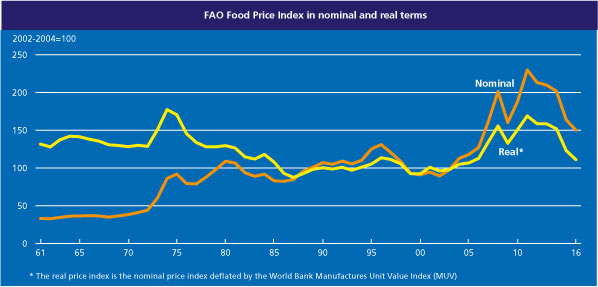
I stumbled on this chart yesterday.

fao chart

It shows the FAO’s food price index, all the way back to 1961, including a real series in which the nominal FAO index is deflated by the World Bank’s Manufactures Unit Value Index, “a composite index of prices for manufactured exports from the fifteen major developed and emerging economies to low- and middle-income economies”.   The FAO index itself is a weighted average of the international prices for cereals, vegetable oil, dairy, meat, and sugar.

Never knowingly optimistic, I was still a little surprised by the picture.  After all, a dominant story of the last 25 years has been one of falling prices of manufactures, driven in large part by the industrialisation of China, and reflected in (for example) sharp falls in the terms of trade for Japan and Taiwan.   And optimists around New Zealand have told stories about the growing global scarcity of water, rising Asian demand for high quality protein, and so on.   And yet on this measure real food prices –  the amount of manufactures a given amount of food commodities would purchase –  have been no better than flat.  If anything, at present prices seem to be moving back towards the lows of the 20 years from the mid 80s to the mid 00s.  And the dairy component doesn’t appear to have been behaving much differently than the other components of the index.

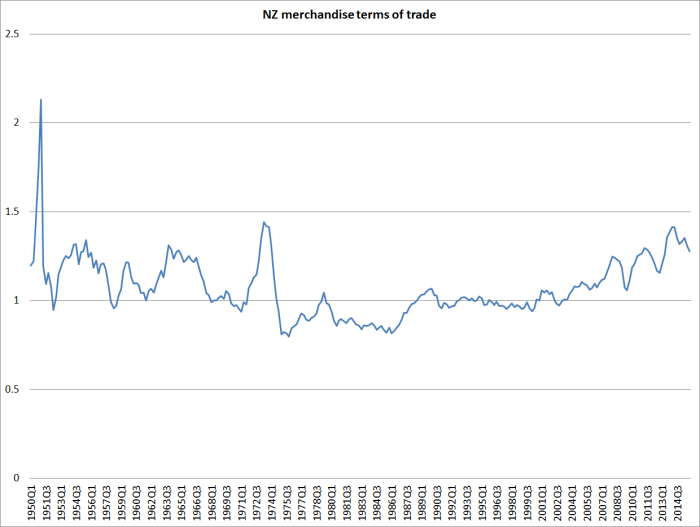
Of course New Zealand isn’t a low or middle income country, so perhaps this World Bank index isn’t representative of our purchases over time.  The WTO also has an index for prices of imports and exports of manufactures: it has only been running since 2005, and over that period prices of manufactures have increased less than those of food (as reflected in the FAO index).  Our own overall terms of trade  –  for a wider range of exports than food, and imports than manufactures – have still been quite good by historical standards (although even in the 1950s and 60s our incomes were drifting down relative to the rest of the advanced world).

merchandise tot

There appears to plenty of scope for productivity growth in agriculture (although there hasn’t been much in New Zealand in recent years), but there isn’t any more land being made here, and environmental/water concerns are limiting just how much more intensively existing land can be used.   For a country with a fairly rapidly growing population, that is still heavily dependent on its food exports, the prospects for sustained high incomes seems to rest on some combination of high productivity and high prices.  Or, of course, the rapid growth in other exports –  but over decades now that latter just hasn’t been happening.

On  completely different topic, this is one of favourite housing charts.

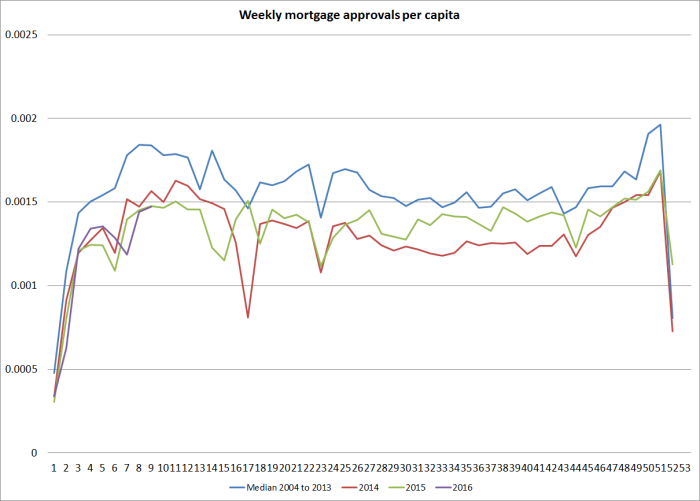
mortgage vols

It shows the number of weekly mortgage approvals (with a rough adjustment to turn it into a per capita measure) for each week of the year, numbering 1 to 52/53.  That deals with (a) the rising trend in the population over time (material over a decade), and (b) the fact that the data aren’t seasonally adjusted.

I haven’t shown a (hard to read) version with lines for each year for which the Reserve Bank has data.  But you can see how much more active the mortgage market was on average over the first decade of the data than it has been over the last few.  In fact, in 2007, the peak year of the previous boom the line was around .0025 at this time of year –  in other words, more than 60 per cent more mortgages were being approved per capita at this time of year in 2007 than was happening this year (or last year).

The housing finance is now, unfortunately, quite badly distorted by the Reserve Bank’s increasing range of direct controls, but there is just nothing in this data to suggest a frenzied speculative boom.  In such booms, volumes tend to be very strong –  not just new loans, but turnover per capita too.  There was a plausible story like that, backed by the data, in the previous boom from 2002 to 2007.  There hasn’t been, and isn’t, in the last few years.  Individual potential buyers have no doubt been very worried about missing out, perhaps permanently, but the main factors behind what strength there has been in house prices –  considerable in Auckland-  was the government.  It encourages rapid population growth through a liberal immigration policy, and at the same time is responsible for the legislative framework that makes urban land scarce and impedes the physical expansion of the city.  That seems that like a crazy policy  mix to me, but it isn’t a frenzied credit boom –  and isn’t obviously any sort of “bubble” either.  The definition of a bubble is rather elusive, but suggests something completely detached from fundamentals.  But government policy parameters are fundamentals.  They could change, but there is little or no sign of them doing so.

Why harp on the point?  In the lead-up to next week Monetary Policy Statement some of those opposing OCR cuts do so on the basis of house price concerns.  House prices aren’t in the Reserve Bank’s monetary policy remit, but in any case there is no sign of irrational exuberance –  whether by buyers or financiers –  driving what is going on.  Rising (and absurdly high) real house prices in some areas appears to be largely a relative price change, attributable to pretty easily identifiable structural factors.  Orienting monetary policy around the price of a good, itself largely shaped by government structural policy choices, would be even odder than orienting it around, say, the price of gold –  a product which, at least, governments did not directly influence the supply.

The other relevant consideration is the question of just how much difference monetary policy shocks, and adjustments to the OCR, actually make to house prices.  In support of its LVR policies, the Reserve Bank used their model a couple of years ago to argue that achieving the same impact on house prices as they expected to achieve using LVR restrictions, they would have to lift interest rates (relative to baseline) by around 200 basis points.   The LVR restrictions were expected to lower house price inflation by around 1-4 percentage points in the first year (the effect fading away thereafter).  Modelling house prices well isn’t easy, but if this Reserve Bank analysis is even remotely right it seems unlikely that further cuts to the OCR over the next few quarters of even 50 to 100 basis points, offsetting falling external incomes, falling inflation expectations and rising offshore funding costs, would materially affect the level of national house prices.


Unprecedented…in a sample of four

The Reserve Bank had an interesting brief issue of the Bulletin out yesterday, reporting the results of some fairly straightforward data analysis as to how house prices (more accurately, house plus land prices) have behaved over the last fifty years or so, and how prices in Auckland relative to those in other parts of the country have behaved going back a few decades.  It is almost wholly a descriptive piece, offering no views on why things happened as they did, and little on what those patterns might mean.

The author –  Liz Kendall –  has done to work to construct a quarterly series for each TLA and a range of regional indices, using QVNZ data.  It would be nice to have those indices generally available, but perhaps restrictions on the use of the QV data precluded that?

The author identifies six distinct upswings in real national house (+land) prices since 1965, and as she notes the recent one has been relatively muted (for the country as a whole) –  despite all the fevered talk of low interest rates driving prices higher, ignoring the fact that interest rates are low for a reason (weak demand at any higher rates).

There wasn’t much of a upward trend in real New Zealand house prices, as far as we can tell, until the last 15 or 20 years.

rb housing 2

There was a huge boom in the early 1970s, as some combination of very low real interest rates and very rapid inward migration drove prices up.  But that increase was fully reversed over the following few years as credit conditions tightened, real incomes came under pressure, and significant net outward migration relieved pressure on the housing (house+land) stock.  The lack of any strong trend is consistent with what we see in the advanced countries that have a much richer longer collection of historical data –  including Australia and the United States.

Kendall illustrates that house prices in Auckland have not always been that highly correlated with those in the rest of the country.  There is clearly a common element to house prices in the country as a whole, but there are times when each region- including Auckland – “does its own thing”.  For example, in the 2002 to 2007 boom real house prices rose by materially less in Auckland than they did in the rest of the country (taken together).  And in the last three or four years, Auckland prices have risen much faster than those in the rest of the country.

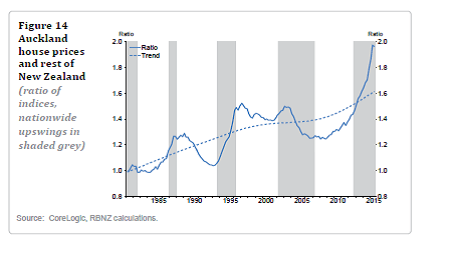
The punchline of the article appears to be this chart

RB housing 1

For the period since 1981 –   only 35 years –  it shows the ratio between Auckland house+land prices and those in the rest of New Zealand, and a moving average trend in this ratio.  The trend has no economic significance –  it simply smooths through the ups and downs in the actual data, and the more recent observations might end up being quite materially revised (up or down) as new data emerge (there are always “end point problems” with these sorts of filters).  The ratio is currently 22 per cent above this particular trend line, but when we look back 10 years hence who knows how large we will estimate that gap to have been.

I had just a few other thoughts on the article:

First, it was a shame that the authors did not look at Christchurch separately.    They look at an entity called “Greater Wellington” (Wellington, Upper and Lower Hutt, Porirua and Kapiti) but it is puzzling that they don’t even break Christchurch (an urban area of a similar population) out separately (just bunching it with Nelson, Dunedin and Invercargill), let alone look at a combined “Greater Christchurch” entity (Christchurch, Selwyn and Waimakariri).  At least in recent years, it has only made sense to think of the three TLAs together –  and price behaviour in that area has been distinctively different from, say, the rest of the South Island).

Second, it might have been interesting to see whether the differences between prices in other TLAs and the rest of New Zealand (perhaps excluding Auckland) were similar to, or different than, the pattern we observe in Auckland, including whether those patterns have been changing over the relatively short period under study.

Third, I would go easy on the word “unprecedented”.  In a short article, it is stressed several times that the gap between the increase in Auckland house (+land) prices and the increase in prices elsewhere in the country is “unprecedented”.  But they have regional data only since 1981, and in that period there have been a grand total of four upswings.  It is true that there is no precedent in the data, but there isn’t much data.

Relatedly, the article highlights how ill-served New Zealand is with historical economic and financial data.  That isn’t the responsibility of the Reserve Bank –  largely a policy and operational agency –  but it is a limitation that all users face.  Between the continued underinvestment in historical official statistics, and the lack of academic economists working on New Zealand economic history, and doing the leg-work to develop longer-run analytical series (as has been done for house prices in Australia, the US and various other countries), we have a relatively poor sense of what is normal or abnormal.  For example, it would be interested to know whether similar divergences occurred in the early 70s, in the post WW2 house (+land) price boom (when wartime controls were lifted), to be able to see what sort of regional divergences occurred during the Great Depression, and to be able to understand 19th century regional house price shocks (for example, the impact of the gold rushes on Dunedin prices, or of the land wars on Auckland prices).

The subtext in the Reserve Bank article is that what goes up comes down again.  In this article, it isn’t a particularly powerful point (and, in fairness the article doesn’t make much of it directly), since there will always be times when one region or another (even the largest) lags behind house price inflation in the rest of the country.  But there is no natural equilibrium  relationship between Auckland prices and those in the rest of the country –  as experience in the US demonstrates, it is mostly a matter of policy choices.  With weaker immigration and more liberal land-use policy around Auckland, real Auckland house+ land prices could be much lower absolutely, and relative to the rest of the country than they have been in recent years.  Many cities much bigger than Auckland in the US have house prices much cheaper, relative to surrounding areas, than Auckland does (I stayed recently with some friends in a small college city in the middle of the US where house prices were higher than those in the nearest, fairly prosperous, city of a million or more).

Finally, on the housing sector, SNZ released building consent data yesterday, completing the data for 2015.  The authors of the press release pointed out that the number of residential consents was the ninth highest ever –  which isn’t very impressive, since most macro series reach their highest or maybe second highest level each and every year.  What wasn’t pointed out was the way New Zealand’s population has increased –  not only is stock of people living here much higher than it was in previous housing booms, but the population increase over the last year or so has been larger –  even in percentage terms –  than at any time for decades.  Unfortunately, we don’t have an official population series that goes back prior to 1991, but using one of those from the international databases, here are residential building permits per capita since the series the mid 1960s.

residential building permits per capita


Last year’s building permits per capita were only just back to the average for the last 35 or so years –  even though the fast rate of population growth might normally have suggested, in a less regulatorily-impeded market, that consents per capita might have been considerably higher than the average over that period.

An interesting approach to urban land use property rights

Last week I put out a post on possible mechanisms to enable groups of neighbours to protect their interests in their own and each others’ properties, while allowing the flexibility for them, rather than councils, to determine what, if any, and when changes in the land use rules affecting that group of properties would be put in place.  It was prompted by a combination of the Productivity Commission’s recent discussion of the private covenants that reportedly apply to most new developments, and  the conflict in various Wellington suburbs around the council’s desire to determine which suburbs should be more intensively built and which should not.  Neither the Commission’s apparent distaste for private covenants, nor the situation where councils can somewhat arbitrarily –  and without any compensation for the regulatory taking –  alter private property rights, seemed very appealing.

This afternoon, I stumbled on this post from the Not PC blog.  It is several years old, but still seems very relevant.    The gist of his proposal is as follows:

FIRST, ENACT A CODIFICATION of basic common law principles such as the Coming to the Nuisance Doctrine and rights to light and air and the like.

Second, register on all land titles (as voluntary restrictive covenants) the basic “no bullshit” provisions of District Plans (stuff like height-to-boundary rules, density requirements and the like).

Next, and this will take a little more time, insist that councils set up a ‘Small Consents Tribunals’ for projects of a value less than $300,000 to consider issues presently covered by the RMA and by their District Plans. These Consents Tribunal should function in a similarly informal fashion as Small Claims Tribunals do now, with the power to make instant decisions.

This would mean that instead of talking to a planner about your carport, about which he couldn’t give a rat’s fat backside, you decide for yourself.  And, if your carport would violate one of the covenants, you then talk about it to your neighbour—with whom you and he would have plenty of negotiating room.  And once you (and your neighbour if necessary) have made your mind up, The Consents Tribunals would consider your small project on the basis of the codified common law principles, the voluntary restrictive covenants on your title, and the agreements (if necessary) you’ve negotiated with your neighbour(s). Simple really.

You should be able to reach agreement in an afternoon, and have your title amended the next day.

No doubt there are pitfalls in this scheme that I don’t see. But I thought it was worth drawing attention to.  Finding mechanisms that allow both greater flexibility and protection of property rights, but on a basis that puts more weight on mutual consent, and rather less on rather arbitrary administrative or political fiat, should have considerable appeal.

What has been happening to private rents?

I don’t usually look at Sunday’s Herald but I was filling in time in an airport yesterday and noticed an article on private residential rents, drawing on MBIE’s tenancy bond database.  I don’t think I had previously realised that the data were easily available, at both a TLA and regional level.

One of the striking aspects of the house price boom has been the way rents have lagged well behind house prices.  House price to rent ratios have increased substantially.  Of course, in many ways that should be no surprise.  After all, real interest rates have fallen very substantially over the last 25 years or so  (having risen sharply over the previous decade).  Even in New Zealand – with the highest real interest rates in the advanced world –  real interest rates are lower than at any time in modern history (the heavily regulated period of the 1970s and early 1980s excepted).  Falling rental yields might reasonably have been expected, and that is what we have seen.

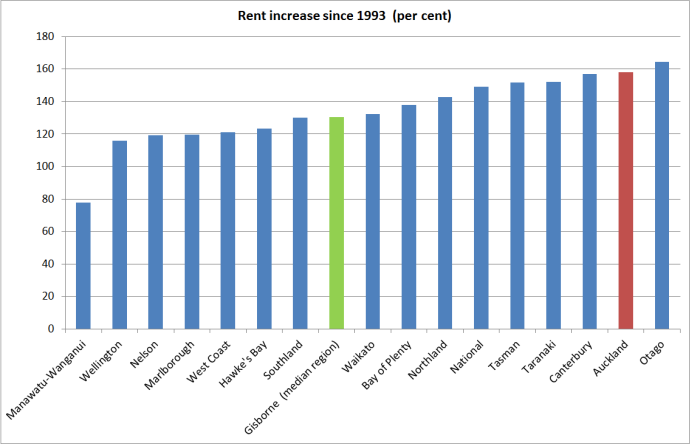
The MBIE data go back to the start of 1993. Since then, consumer prices (the CPI) have risen by around 60 per cent.   Average private rents on this measure have risen by about 150 per cent in that period.  The QV measure of house prices has risen by just over 300 per cent in that time.

Perhaps what is most striking, and something the Herald article didn’t bring out, is how similar Auckland’s experience has been to that of much of the rest of the country.    Since the start of 1991, Auckland rents, on this measure, have risen by 158 per cent.  Those in Gisborne –  the median regional council – have risen by 130 per cent.  Auckland rents have risen faster than those in most of the country, but they just don’t stand out the way that the increases in Auckland house prices do.

rents since 93

And if we restrict the analysis simply to the period since, say, 2007, the picture is not materially different.

And what of incomes?  Nominal GDP per capita increased by 144 per cent from 1992q4 to 2015q2.  Even in Auckland, rents have not increased much relative to (national) average per capita GDP.  Purchasing a house might have become “unaffordable” for many, but accommodation doesn’t appear to have.

And that conclusion is reinforced when one recognises that these MBIE data do not purport to be like for like measures.  The average house today is larger than the average house in 1993.  The average house is better appointed now than in 1993 (more likely to have double-glazing, heat pumps, or central heating).  And as the home ownership rate has dropped in the intervening years, it is likely that the median rental property in 2015 is further up the 2015 spectrum of New Zealand houses than the median rental property in 1993 would have been along the spectrum of New Zealand houses in 1993.

In the CPI, Statistics New Zealand attempts to adjust for the quality and compositional issues.  However, they only appear to report, in Infoshare, rental prices since 1999.  And even that series, which includes both public rentals and private rentals, is made harder to read by the abandonment of market-related rents for state houses in 2000/01.  But since 2001 (ie after the levels adjustment from the policy change), the CPI rentals component has risen by 37 per cent (very similar to the change in the CPI over that period), whereas the MBIE private rents series has risen by 87 per cent.  Per capita nominal incomes have risen by 71 per cent over that same period.    Even over the period of the biggest house price boom in modern history, a constant-quality house looks to have become more affordable to rent, not less.  And, of course, that is what one would normally expect.  Stable long-term ratios of house prices to incomes, for example, tend to reflect the fact that as incomes rise, the size and quality of houses tends to increase.

Of course, if land use restrictions –  in conjunction with policy-driven population pressures –  had not driven urban land (and house) prices sky high, we might perhaps have expected to see real rents falling.    All else equal –  which it never is –  sustained lower real interest rate lower the real cost of providing rental accommodation services.  But the fact that Auckland rents have not increased enormously relative to those in the rest of the country tends to reinforce the idea that it is not so much an issue of an extreme shortage of accommodation in Auckland, as of the regulatory restrictions on land use.  Such restrictions, which “bite” more in Auckland because of the population pressures, offer returns to landlords through actual/expected capital gains.

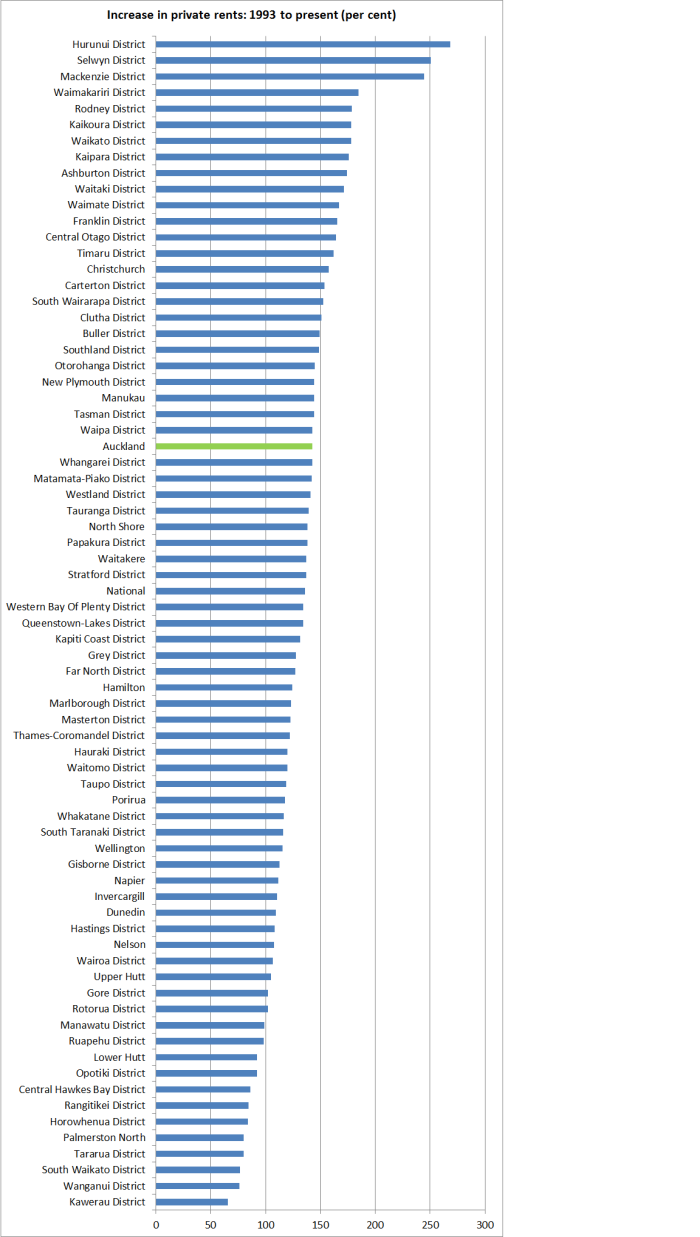
And for anyone interested in the rental increases at the TLA level, here is that chart.  (To deal with a few missing observations at the start of the period, this chart uses the percentage increases from the first 12 months of the series  to the most recent 12 months).

rents since 93 by TLA

Housing: what would the market do?

My post last week about the Wellington City Council’s consultation meeting, on its proposals to amend the district plan to allow more medium-density housing in Island Bay, attracted some attention and a range of interesting and thoughtful comments.  Readers seem to have taken from the post what they wanted (those opposed to more density focused on the critical comments about the Council’s case, those in favour on the critical comments on the residents and the planner mentality that dominates the Council).   Perhaps that reflects my own ambivalence.  In general, I favour allowing greater flexibility to property owners, but I don’t think we  would see much pressure for the sorts of development that concerns many residents, at least beyond the immediate fringes of the central city (Thorndon, Mt Victoria, Kelburn etc) if councils did not continually and actively resist the expansion of the physical footprint of cities.

It perhaps also reflected the fact that I’m not overly affected personally.  We are probably 12 minutes walk from the “town centre”, not the rather arbitrarily-chosen 5 or 10 that the Council focused on.  If a slightly largely population increased the chances of the convenient neighbourhood supermarket surviving into the years of my dotage, so much the better.   And it would be almost impossible for any conceivable development to materially impair either our sun or our views.

However, there is no point pretending that the sentiments of residents are just illegitimate or misguided.  Or that what happens elsewhere in their neighbourhood cannot impinge on their wellbeing. Nor do I favour riding roughshod over the concerns –  in fact, on a city or countrywide basis it is just not going to happen.  As I’ve pointed out previously, I’m not aware of any examples anywhere where tight land use restrictions, once put in place, have been substantially unwound.

Perhaps as importantly, the  private marketplace itself has mechanisms to deal with the sort of issues and concerns that drive the vocal residents of Island Bay or Khandallah, at least in respect of new developments.

As the Productivity Commission’s recent land supply report noted

Restrictive covenants in new subdivisions are a very common feature of property developments in New Zealand.  The mayor of one fast-growing New Zealand city told the Commission that all subdivisions in their area were subject to detailed covenants.

And according to one source I looked at, around 55 million Americans now live in “homeowner association” complexes –  some mix of apartment blocks and suburban developments/gated communities etc.    These arrangements  presumably exist because they meet a demand, and hence enable developments to occur more profitably than otherwise.  They add value to the people’s homes.    They are not just a legacy of centuries gone by, but have become much much more popular in the last few decades (at a time when local authority planning restrictions have also become more onerous).

I’m no expert in these sorts of arrangements.  As the Commission notes, in some cases they just last until all the homes in a particular development have been built (ie they govern what is first put on the section, and nothing subsequent to that), but many others are permanent.  The rules are often very detailed –  the example the Commission cites particularly caught my eye when it specified the details of the size and construction of the letterbox.  The focus is clearly intended to be on collective action provisions that limit the possibility that some future action of a neighbour might impair the value of my property.

I wouldn’t want to live in such a tightly restricted subdivision myself.  As one succinct summary put it, they aren’t the place for people who don’t like being told what to do.

The Productivity Commission seemed rather ambivalent about these covenants.  They had three “findings” and one “recommendation”.  One was arguably just a factual statement

Covenants established in new subdivisions are increasingly common and impose detailed restrictions on purchasers.

although that could easily have been reworded to include the phrase “provide considerable protections, and impose detailed restrictions on, purchasers”.  That is, after all, what contracts do in all areas of life.

The Commission finds that

regulatory controls on covenants should reflect both the costs and benefits of covenants

which is fair enough perhaps, but fails to recognise that these are already a market solution to a revealed demand.  Market contracts might reasonably be assumed to have internalised the costs and benefits already.  The case for regulation isn’t really made.

The Commission also notes that

Covenants reduce the flexibility of land use now and in the future, and increase the cost of constructing dwellings.

Of course, the first part of the sentence is true, but really the point of these voluntary contracts.  Voluntary contracts exist to enhance welfare.  Flexibility is not an unalloyed good.  The second point is unsupported in the report –  all it seems to amount to is that buyer and sellers have voluntarily agreed that, as a condition of buying in that development, they will not use certain lower end building materials. Why is that a public policy issue?  It does not detract from the ability of other people to build using those materials and technologies.  And each covenanted development presumably has to survive the market test, in competition with other covenanted developments, and standalone dwellings (new or existing).

Consistent with the uneasiness that pervades the discussion, the Commission then recommends (page 118) that

The Ministries of Justice and of Business, Innovation, and Employment should review the legislative provisions governing covenants with a view to:

  • reducing the proportion of landowners required to agree to covenant changes from all to a super-majority; and
  • introducing a statutory sunset period on restrictive covenants of 25-30 years.
I don’t have a particular problem with super-majorities (they are not uncommon in other collective action areas, eg bondholders dealing with distressed debtor).  But, equally, nothing stops such contracts developing voluntarily, and it isn’t clear what the Commission sees the problem as being.  Nor is it clear how the Commission would minimise the risk of abuses of minorities.  Perhaps, at minimum, any super-majority would have to be prepared to offer to purchase the property of an aggrieved minority at a price which reflected the assessed benefit of the changed provisions to the majority.
More egregious is the suggestion of mandatory sunset clauses, effectively banning private property owners from voluntary collective action solutions for more than, say, 25 or 30 years (and as property will trade on the basis of expected future use, even the value of a 25 year covenant will start to decay pretty quickly after, say, 15 years or so).  Again, what is the public policy interest that should override the freedom of homeowners to enter voluntarily into contracts?   The Commission cites one jurisdiction in which the term of covenants is statutorily limited (Ontario, at 40 years), and one example (Massachusetts) where after 30 years covenants can be renewed for 20 years at a time.  But it appears that the rest of the 55 million Americans living in such developments are free to establish permanent covenants, which can generally only be dissolved by unanimous agreement.

The Productivity Commission is uneasy about these increasingly widespread private contracts.  But I wonder if we shouldn’t think about moving in the opposite direction.  Why not facilitate covenants of a sort in existing neighbourhoods?  Is there any obvious reason why, say 1000 households in Island Bay or Khandallah should not be able to  mutually agree that only, say, the current planning rules will apply to their sections in perpetuity, with perhaps a 75 per cent majority required to change those rules in future?  I can’t think of one.  I guess one can argue that the developers, and purchasers, in 1890 should have envisaged these issues and established the covenants then.  But, actually, the then borough had only 600 rateable properties, and if they have given the matter any thought the residents might reasonably have assumed they had effective control through the ballot box.    When Councils pick off one suburb at a time –  as opposed, say, to amending the district plan to allow more medium-density housing everywhere in the city –  effective control through the ballot box is much attenuated.  Which suburb has the “misfortune” (from the aggrieved residents’ perspective) to be chosen for medium-density housing, is no longer a matter of collective agreement among affected residents, but of who can lobby the most effectively and  shift the issue onto some other suburb.  That isn’t the market at work.

I’m not sure what the current legal position is.  Perhaps local property owners could already put in place such restrictive covenants now, with the consent of every one of those involved?    But why not consider amending the relevant legislation to provide for a standard set of rules that a group of homeowners could voluntarily adopt, by say, a 90 per cent initial majority of those in the area concerned?    That would empower homeowners (you would presumably vote for change when the increased value of your land, under rules allowing more intensification outweighs the risks of loss of sun, views or the “changing character of the neighbourhood”).  And it would remove the arbitrariness that exists in the current law.  I’m not suggesting giving legal force to an ability to force your number to mow his or her lawns, or get rid of the gaudy letterbox, but it would enable communities to “protect” themselves (mutually agreeing to entrench existing planning laws for their own properties)  –  or to remove those protections themselves to take advantage of new opportunities –  at a level that existing planning legislation often attempts to do, until it doesn’t (ie until some distant planner or councillor suddenly decides it is time for change).

Perhaps the grand houses that once filled The Terrace might once have been subject to such covenants.  Such houses are probably not the best used of that land today.  Owners would be free to recognise that opportunity, but to do so collectively.

Half of me thinks this is a second-best suggestion, but so widespread are such covenants in private developments here and abroad that I’m not even sure that is true.

Of course, the quid pro quo for such an amendment –  which would, at the margin, probably slow any process of intensification of a particular neighbourhood that might otherwise take place –  would have to be legislative provisions that removed the  ability of councils to restrict the physical expansion of cities and towns.  If, say, all land was automatically zoned residential (in addition to any other approved uses it might have)  and, as a default, was able to be built on to a height of two storeys, there would be ample scope for population pressures –  themselves largely now the consequence of policy choices – to be met with new building on new sites.

From voters’ perspectives, such a bundle of changes look as though it ticks most boxes.  It allows much more new peripheral development more cheaply than occurs now [1].  That, in turn, would remove some of the artificial pressure for intensification  –  arising from councils directly, and from the market because councils restrict the physical expansion of cities.  And, at the same time, it recognises a right for local communities, at a much lower level than whole cities (or even whole wards), to collectively make decisions about the nature of future potential land use changes for their properties.  Since such contracts are increasingly widespread in new developments here and abroad, they seem to reflect real pressures that have real economic value to citizens as property owners.

There is no real, or necessary, tension between keeping housing affordable and allowing property owners to act collectively, in response to opportunities (costs and benefits) to make decisions as to how their land is able to be used.

[1] And, yes, pricing the infrastructure and transport connection issues still has to be resolved.

Medium-density housing in suburban Wellington

Partly in the cause of research, and partly because I have a bit more time these days, last night I went to my first ever Wellington City Council public consultative meeting.  The Council is keen to promote more medium-density housing in Island Bay (and several other suburbs).  To their credit, they have gone beyond the formal requirements of the RMA and are undertaking an informal community consultation, with information delivered to every household, very early in a process that they hope will eventually lead to a change in the district plan. I think I recall seeing a comment in the recent Productivity Commission report commending this WCC initiative.

The meeting wasn’t an edifying experience, but then I’m not sure that was a surprise.

It doesn’t help that the Council doesn’t have a great reputation in Island Bay at present, despite (or perhaps even because of ) the Mayor being a local resident.  There has been a sense of them ignoring community opinion –  the seawall, severely damaged in a storm almost 2.5 years ago, still not repaired, and a hugely acrimonious debate over a rather expensive new cycle-way which can’t pass any conceivable cost-benefit test.   All that makes for a degree of cynicism –  vocally expressed last night – about the genuineness of any consultative process.  (And all that is before one considers the folly and hubris of an organisation that wants to put tens of millions of dollars into an uneconomic airport runway extension. )

There is also a degree of hostility to the local Special Housing Area. I don’t fully understand that hostility.  The moribund buildings of a former Catholic school (closed by the church 35 years ago) are less than a couple of hundred metres from our place, and I have long looked forward to them being replaced with houses or apartments[1].   Island Bay is a popular place to live, and this private land is not currently being used at all.  If someone is keen, at last, to develop it, it might be small step towards keeping housing only moderately unaffordable.

But that is all by way of background to the medium-density housing consultation, which continues to puzzle me.  Question 1 on the WCC consultation form says “Where should medium-density housing development happen in your suburb?”, which on the one hand presumes that people agree that such development should happen at all, and on the other leaves me scratching my head thinking “well, surely on any site where someone finds it worthwhile to do so”.   And then “what standards of design should the medium-density housing meet?”, and I’m thinking “whatever works best for developers and willing buyers”.   But I’m pretty sure I was the only person in the room last night thinking anything remotely along those lines.  Not that I would be any more sympathetic if it was, but Island Bay is not some olde worlde place with uniform Edwardian architecture.  It is a pleasant mix of the old and new, where the number of dwellings per square kilometre has increased enormously in the 37 years since I first came here (through some mix of infill, new streets further up hills, and medium-density developments on several larger existing sites).

Instead, it was a case of the regulatory state run rampant (from both the supply and demand side).  The Council staff had a Powerpoint presentation which started well –  headed “Housing Supply and Choice”- but it was pretty much downhill from there.  Instead of a focus on facilitating landowner rights, consumer choice, and competition, the whole thing flow from a central planner’s identification that Island Bay is one of those places with a strong “town centre” and hence a candidate to promote medium-density dwelling.  I was trying to work out why Island Bay is identified and not, say Seatoun –  similar public transport, similar vintage houses –  and I can only conclude that it is because the latter lacks a supermarket, an anchor of the “town centre”.  It puzzles me what happens to the Council’s logic if the(small by modern standards) supermarket were to close –  or if the Council were, for once, to do a hard-headed cost-benefit analysis and close the small local library.    The local identities who have run a stationery and children’s bookshop for the last 40 years are just about to retire, and the chances of that business continuing can’t be strong.

But part of the consultation is about preparing a “plan to guide development in Island Bay town centre”.  The so-called “town centre” is perhaps 15 private shops, in a higgledy-piggledy variety of styles, several of which are threatened by the Council/government earthquake-strengthening requirements.  But why do we need bureaucrats “planning” a “town centre” to “ensure coherency across different developments and help contribute to a more attractive and vibrant centre”?    At the meeting, the bureaucrats talked of checking to ensure that “we have located the town centre in  the right place” –  to which one response might be that the market already resolved that one more than 100 years ago.  Sometimes I think I must be missing something important, but then I think it is just bureaucrats and local politicians run amok.

And the Council draws on some demographic projections for the next thirty years to argue that they need to facilitate housing for older people who will want to downsize but stay in the neighbourhood.  Quite possibly there will be such a demand –  I expect to be one of the older people, although I don’t intend going anywhere  – but when you rely on such projections, and especially when you can’t even adequately explain how they are done, you are on a hiding to nothing.  Council staff drew a lot of fire for those numbers.  Much of it was quite ill-informed, but it was hard to have much sympathy.  Inevitably, holes appear the moment you prod, ever so gently, a projection of that sort. Choice and flexibility etc should be the watchword not “we wise bureaucrats have identified this specific need 25 years hence and want to change the law now to meet it”.

And then Council staff talk of undertaking a “character assessment of the suburb”, and burble on about wanting to “make sure that all new development is high quality, the design and appearance fits in with the surrounding environment, and it can stand the test of time”.    Just like the IMF the other day, the Council is keen on only “high quality” housing, but why is that something for them to decide, rather than willing buyers and sellers?

And so it goes on.  Bureaucrats talk of a desire to “decrease private motor vehicle use” and “encourage more walking”  (and hence medium-density housing might be encouraged five minutes walk from the town centre but not seven).  What happened to facilitating choice I wondered?  Oh, and fixated on accommodating possible demands from old people, the chief planner present commented that the Council wanted to encourage medium density housing in which the core living facilities were on the ground floor.  It gets tedious to say it, but isn’t there a market test in these matters?  Dwellings that meet market demand will sell better than those that don’t.  And aren’t maximum site coverage rules one of those things that work against single storey dwellings?

So the Council staff were bad, but they met their match in the residents.  There was a strongly negative reaction to the notion that anyone outside Island Bay should have any say on the proposed changes – forcing staff to downplay the very suggestion.  There was a great deal of concern about protecting people’s house prices (up), but no apparent sense that allowing land to be used more intensively would, all else equal, make it more valuable not less.  There was concern about what sort of socially-undesirable people might move into these new dwellings (and this is one of the more left wing suburbs around), and so many demands for controls and restrictions that –  briefly – the Council staff were forced to defend the ideas of choice and private property rights.  One person was appalled at the idea of three storey dwellings – this is a suburb surrounded by, and partly built on, high hills. And not a mention from the floor – although it was hard to get a word in – of the idea that people should be able to use their own land as they liked, or of the attractions of helping keep places only moderately-unaffordable so that perhaps one day our children might be able to buy here.

Council officers were reduced to plaintive observations that “the city is growing and people have to live somewhere” (downtown high rises appeared to be the response from the floor), which I might have sympathised with were it not for the historical evidence that as cities get richer they tend to get less dense not more dense –  something the planners are no doubt oblivious to, and perhaps disapproving of.  Harder to encourage walking I suppose, as if technological change had not given us options.  The invention of the tram helped open up places like Island Bay in the first place –  otherwise it was a bit far to walk to work.

I recently criticised the Productivity Commission for the bits of its land supply report that appeared to endorse the way some (most?) Councils were setting out to promote compact urban forms (rather than to facilitate choice and respond to individual preferences).  I came away from last night confirmed in that view.  I’m all for allowing more intensive development, not just in individual suburbs but across Wellington (and all other areas for that matter).  But the pressures to do so, and the sorts of vocal clashes I witnessed last night, arise largely because Councils are reluctant to see the physical size of the city grow.  Wellington might not have much flat land –  although most people probably don’t live on flat land in Wellington anyway –  but any time I fly in or out of the place I’m reminded that it is not short of land.   Regulatory restrictions –  and perhaps at the margin the rating system –  combine to make it optimal for developers to release land only slowly, and that helps keep the price of all urban land high.  For landowners in existing suburbs part of the appeal of more intensive housing (eg infill on existing rules) is realising the value that regulatory restrictions had artificially added to land prices.  If a section on our main (flat) street, The Parade, is worth $500000 or more, subdivision and more intensive development must be attractive.  If it were worth $150000 –  which it might well be if  new building opportunities were readily available on the periphery (or in greater Wellington’s case, most actually between Wellington on the one hand and Porirua and Lower Hutt on the other)), more people would probably prefer to keep a decent-sized backyard or front lawn.  I’d probably still favour allowing more intensive development, but I don’t think we’d see much of it, especially this far from the centre of town.  Space appears to be a normal good.

As it is, the confrontations will go on.  I don’t like to predict how our one will end, but whatever the outcome the process is a pretty unedifying, and unnecessary, one.

[1] There is a beautiful chapel in the buildings, and I would be sorry to see it go. But I’d also be reluctant to see my rates used to save it, especially if doing so compromised the development opportunities of the site.