$492500000000

That’s the Herald’s headline for its new “Nation of debt” series, where they state “New Zealand now owes almost half a trillion in debt”.

Whatever “New Zealand” and “owes” might mean.

The New Zealand government has some debt –  $109 billion of it, in gross terms, according the Herald’s numbers, spread between central and local government.  Of course, these very same entities have financial assets as well.  The financial assets aren’t as large as the financial liabilities, but by most reckonings the New Zealand public sector isn’t particularly indebted.

Another way of reckoning ‘New Zealand’s debt might be the amount New Zealand firms, households and governments owe to foreigners.  That isn’t $500bn, but –  according to Statistics New Zealand – $247 billion (gross).  Again there are some assets on the other side.  And actually the net amount of capital New Zealand resident entities have raised from abroad is largely unchanged, as a share of GDP, for 25 years.  It is quite high by international standards, but the ratio isn’t going anywhere.

But the Herald chooses to focus simply on the gross debt of New Zealand entities, and pays no attention to what might be going on elsewhere in the balance sheet.  Since they end up focusing on households, lets do that.  The Herald focuses on $232.9 billion of gross household debt, but pays no attention to what has been going on with household deposits.  Here is the chart, using the Reserve Bank’s household statistics, of the gap between household debt and household deposits.

household debt to deposits

It rose very rapidly in the boom years of the 2000s, but has gone nowhere at all for seven or eight years now.   GDP has gone up a lot in that time, so that the ratio of this gap (between loans and deposits) to GDP is materially lower than it was back in 2007/08.    This isn’t some novel point –  the Reserve Bank has been mentioning it in FSRs for years now.

Even ignoring deposits, household debt to GDP itself has gone nowhere for eight years, after a huge increase in the previous 15 years.

household debt to gdp

Probably these ratios will increase somewhat over the next few years.  HIgh house prices, and a housing stock that turns over only quite slowly,  does that.  Here is a chart I ran a while ago illustrating how debt to income ratios keep rising for quite some time –  all else equal –  even if there is just a one-off increase in house prices.

In the chart below I’ve done a very simple exercise. I’ve assumed that at the start of the exercise, housing debt is 50 per cent of income, house prices and incomes are flat, and people repay mortgages evenly over 25 years. Only a minority of houses is traded each year, but each year the new purchasers take on new debt just enough to balance the repayments across the entire mortgage book.

And then a shock happens – call it tighter land use regulation – the impact of which is instantly recognized, and house prices double as a result. Following that shock, house purchasers also double the amount of debt they take on with each purchase, while the (now rising) stock of debt continues to be repaid in equal installments over 25 years.

In this scenario remember, house prices rose only in year 1. There is no subsequent increase in house prices or incomes. But this is what happens to the debt to income ratio:

debt to income scenario

None of this is reason to be indifferent to the scandal of house prices, especially those in Auckland.  But high house prices –  that result mainly from the interaction of population pressures and the thicket of land use restrictions which rig the market against the young – tend to increase the amount the young need to borrow from, in effect, the old to get into a first house.  It is quite risky for the borrowing cohort, but on the other side are much higher financial assets held by the older cohort, who sold the young the houses.  “New Zealand” isn’t more indebted –  one significant cohort of New Zealanders have much more debt, and others have much more financial assets.  And that outcome is mostly down to choices made by successive governments.

The Herald is also keen to run the line that people are treating their houses like ATMs –  drawing down on the additional equity to boost consumption.  No doubt some are –  and for many it will be quite rational to do so.  If you are 60 now, living in Auckland, and thinking of moving to Morrinsville or Kawerua to retire, you might as well take advantage of the rigged housing market now and spend some of your equity.  On the other hand, people trying to get on the housing ladder are having to save ever more to get started in the market (through some combination of market constraints and regulatory restrictions).  But whatever the case at the individual level, here is a chart I’ve run a couple of times recently, showing household consumption as a share of GDP.

household C to GDP

If you didn’t already know there had been a massive increase in house prices, and gross household debt, over these decades, there is nothing in overall consumption behavior to suggest a problem (or even an issue).  High house prices don’t make New Zealanders as a whole better off, they simply involve redistributing wealth from one cohort to another.  If they don’t make New Zealanders as a whole better off, we wouldn’t expect to have seen a surge in consumption.  And we don’t.

I’d hate to be one of the young taking on mortgages of the staggering size that are all too common today.  Even if house prices never come down much –  quite plausible if the land supply mess is never properly fixed –  they face a heavy servicing burden for decades.  If house prices do fall a lot, those people risk carrying an overhang of debt that could make it all but impossible to move.  And some risk of serious distress if the borrower were to be out of a job for very long.

But it isn’t “New Zealand” that owes this money.  It is one lot of New Zealanders who owe it to another lot of New Zealanders, in a market rigged by governments.  Fortunately –  and I didn’t see this in the Herald story –  even our Reserve Bank (constantly uneasy about debt and housing) has repeatedly run severe stress tests and found that the banking system is robust enough to cope with even some nasty adverse shocks.  The same, of course, won’t necessarily be able to be said for all the borrowers if something very bad does happen.


Loan to income limits, housing etc

I did a brief radio interview this morning on the (hardly surprising) news that the Reserve Bank had approached the Minister of Finance for initial discussions on the possibility of adding loan to income limits to the list of (so-called) macroprudential instruments the Reserve Bank could use.  Preparing for that prompted me to dig out the material on what has been done in the UK and Ireland.

It is worth remembering that the Reserve Bank does not need the Minister’s approval to impose loan to income limits.  Some years ago, Parliament amended the Reserve Bank Act in a way that seems to have given the Reserve Bank carte blanche to impose pretty much any controls it chooses, so long (in this case) as they can squeeze them under the heading of matters relating to

risk management systems and policies or proposed risk management systems and policies

This was the basis they used for the two rounds of LVR controls, and various amendments, to date.  In principle, controls could be challenged, on the basis that they were inconsistent with the statutory requirement to use the regulatory powers to promote the soundness and efficiency of the financial system.  But the reluctance of banks to take on the Reserve Bank openly –  the Bank always has ways of getting back at banks – and judicial deference on contentious technical matters effectively leaves the Governor free to do pretty much whatever he wants, at least as far as banks are concerned (the legislation gives him much less policy power over non-bank deposit takers, and none at all over lenders who don’t take deposits).

The memorandum of understanding with the Minister of Finance is non-binding, but ties the Bank’s hands to some extent.   The MOU contains an agreed list of the sorts of direct controls the Bank might use.  Legally the Bank can ignore that list.  Practically, it can’t.   But the Minister of Finance is also in something of a bind.  Since the government has been unwilling to do very much to deal with the fundamental factors driving house prices, it would risk accusations of complete dereliction of duty if the Governor came asking for the power to impose new direct controls and the Minister turned him down.  The controls might be daft, costly, and probably ineffective, but refusing the Governor’s request would be a gift to the Opposition (“do nothing Minister just doesn’t care; ignores sage Governor”, and so on).  So most probably, if the Governor wants loan to income limits added to the MOU list, they will be added.  It is still the Governor’s decision whether and how to use those powers, and if they go wrong, or prove unpopular, blame can be deflected to the Governor.  (Unlike the Minister, the Governor doesn’t have to front up in Parliament for question time each day, can’t really be sacked, and generally faces limited effective accountability –  ie questions with consequences.)

If and when loan to income restrictions are added to the list of permitted controls (not just when the Bank wants to deploy them), we should expect to see some rigorous and comprehensive analysis from the Reserve Bank, complemented by the Treasury’s advice to the Minister.  Something that showed signs of thinking hard about the possible pitfalls, and which addressed the strongest case sceptics might make would be particularly welcome from the Bank –  and novel.

Loan to income ratio limits have been applied recently in the UK and Ireland. I was interested to see a comment yesterday from Grant Robertson, Labour’s Finance spokesman, indicating that

his party could be willing to back central bank debt-to-income ratios, if they can be tailored to target investors.

However, Mr Robertson said it would not support a blanket debt-to-income ratio being introduced by the Reserve Bank as it would unfairly target first home buyers.

Presumably Robertson is unaware that in both the UK and Ireland loans to finance the purchase of rental properties (“buy to let” loans as they are known there) are explicitly excluded from the loan to income limits.  It is an instrument that, if used at all, is in effect targeted at first home buyers, usually the owner-occupiers who will borrow the largest amount relative to income (quite rationally, since they also have the longest remaining span of working life).

The fact that a few other countries adopt controls does not make them a sensible response in New Zealand.  But it is worth bearing in mind that the UK controls –  under which mortgage lenders cannot lend more than 15 per cent of their total new residential mortgages (by number) at loan to income ratios of 4.5 times or above – were explicitly envisaged as non-binding at the time they were imposed.  The Bank of England indicated that “most lenders operate within its new limit, so the measure will simply insure against potential risks to financial stability if mortgage lending standards loosen markedly in the future”.

Ireland is a little different, having come through an extreme house price boom and bust cycle, although even they noted that there was little sign that bank lending behavior was a problem in Ireland at present.  In Ireland, no more than 20 per cent of the euro value of all new housing loans for owner-occupied properties can have loan to gross income ratios in excess of 3.5.

In neither case is there a blanket ban on loans with high loan to income ratios.  Both countries have structured their limits as “speed limits” (as was done with the LVR limits here).  Presumably the same would be done here, if LTI limits are introduced.  Encouragingly, in both countries there is no differentiation by region, and our Reserve Bank should resist pressure for any regional differentiation here.

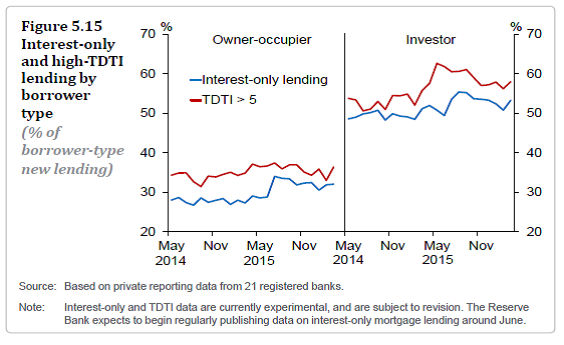
The controls are not easily compared across countries.  In one case, the limit is by number of loans, and in the other by value.  Both appear to use gross income in the denominator, but tax rates differ from country to country, and so the effective impact of the restrictions will differ for that reason alone.  Our Reserve Bank recently published a chart suggesting that around 35 per cent of new owner-occupier loans have a debt to income ratio greater than or equal to five, but since this data is the fruit of “private reporting”, and is described as “experimental and are subject to revision”, we have no way of knowing whether either the “debt” or “income” concepts they are using –  which may well differ by bank –  are even remotely comparable to those used in the UK or Irish regulation.

dti

(But it is worth noting that in the short run of experimental data, there is no sign of an explosion in the share of high debt to income lending.)

The income of a potential borrower is clearly one of things a prudent lender would take into account in deciding whether to lend money, and how much.  The same goes for the value of any collateral the borrower can pledge, any other conditions or covenants that are part of the loan contract, and as host of other factors.  But the fact that these considerations might be relevant to assessing the creditworthiness of the borrower does not mean they are things that should be regulated.  As the Irish central bank noted in its consultative document

An acknowledged weakness in the use of LTI as a guide to creditworthiness is the fact that income at the time of borrowing may not be a good guide to average income over the life of the mortgage or to the risk of unemployment. Lenders need to take this into account in their lending decisions and must not rely mechanically on LTI.

And yet LTI limits increase the likelihood that banks will manage to the rules –  breaches of which expose them to severe penalties –  rather than to the underlying credit risk  (where, all other factors aside) it is overall portfolio risk rather than the risk of an individual loan that probably matters a lot more –  especially for systemic soundness.  Curiously, an LTI limit risks making finance relatively more available to those borrowers with highly variable income –  borrow in a good year, and your loan might not be excess of the LTI threshold, and no one at the central bank cares much that in another year’s time your income might have halved.  It might be an unintended effect, but it won’t an unforeseeable one.

More generally, there is no good external benchmark for what an appropriate or prudent loan to income ratio should be.  At least with LVRs there is a certain logic in suggesting that, say, a loan in excess of the value of the property changes the character of loan (the top tranche is unsecured).  No one has any good basis for knowing whether a debt to income ratio (however either of those terms is defined) of 3 or 5, or 7 is unwise or excessively risky.

I don’t personally have a high appetite for debt – I’ve taken two mortgages in my life, both were about 2 times income, and both felt forbiddingly large at the time.  Then again, the interest rate on the second of those loans were something like 10 per cent.  But if, say, nominal mortgage interest rates were to settle at around 5 per cent –  not low by longer-term international historical standards –  then why would it be imprudent for a young couple aged 25 to take a 40 year mortgage at, say, six times their (age 25) income?  The upfront servicing burden would certainly be high, but twenty years hence even general wages increase (no ,movement up respective scales) would have halved the burden.  And why would it be imprudent for a bank to have a portfolio of mortgages which had some new mortgages at high LTIs and some well-aged mortgages with much lower LTIs?

(The same might go for investment property loans.  If someone is running a rental property business, the prudent ratio of debt to income –  whether wage income of the borrower or rental income – is likely to be much higher when rental yields are, say, 4 per cent than when they are 8 per cent.)

Don’t get me wrong.  There is something obscene about house prices in New Zealand –  and a bunch of similar countries with dysfunctional land supply markets. There is no reason why we can’t have house prices averaging perhaps 3 times income –  with mortgages to match –  but our policy choices have rigged the market, delivering absurdly high house prices.  If so, people need to be able to borrow at lot just to get a toe on the ladder.  Try to prohibit willing borrowers and willing lenders from agreeing such loans and you simply further skew policy in favour of the “haves”, and create an industry in getting round the controls.  There hasn’t been that much effort so far to get round the LVR controls –  through quite legal means, involving unregulated lenders –  but recall the Deputy Governor’s comments at the last FSR, that controls might now be with us for much longer than the Reserve Bank had first envisaged.  I’m not sure why the non-bank (and especially non deposit-taking) lenders have not been more active to date, but a further intensification of controls surely heightens the likelihood of larger scale use of alternative lenders.

Loan to value ratio controls haven’t solved, or materially alleviated, housing market pressures.  For all the rhetoric, not even the Reserve Bank’s modelling suggested they would. There is some short-term relief –  helping those not affected directly, at the cost of the more marginal potential borrowers –  but it doesn’t last.  There is no reason to think that loan to income ratio controls would be different. They tackle, rather ineffectually, symptoms rather than causes, and over time mostly alter who owns houses, not how much is paid for them.  The Reserve Bank will argue that even if the controls don’t change house prices, they still enhance financial stability, but there is not even any serious evidence of that. First, they have not shown any evidence that financial stability is threatened –  and their own tough stress tests keep delivering quite reassuring results –  and second, and perhaps as importantly, they have made no effort to analyse what risks banks will take on if controls prevent them lending as much on housing as they might like.  Banks are profit-maximizing businesses, and deprived (by regulation) of some opportunities they will surely seek out others.

Far better for the Reserve Bank to recognize that it has no mandate to control house prices (or even the growth of housing credit), and in any case it has no tools that will do much over time anyway.  Its responsibility is the overall soundness of the financial system.  If the risk weights on housing loans look wrong, let them make the case for higher weights and consult on that. If the overall capital ratios look too low, then again make the case.  Using those tools will do less damage to the efficiency of the financial system, and better secure the soundness of the system, that one new wave of direct controls after another.  At the current rate, Graeme Wheeler will be giving a good name to Walter Nash, the first person who imposed so many controls on our financial system. (I usually eschew references to Muldoon in this context, but over his full term he deregulated the financial system more than he reregulated it).

Of course, there is still no sign of those actually responsible for the house price debacle doing much about it.  I haven’t yet read the full proposed National Policy Statement, but the material I have read is full of central planner conceit, and seems unlikely to achieve very much.  And I find it seriously disconcerting –  if perhaps not overly surprising –  that the Ministry for the Environment released a supporting document yesterday on “International approaches to providing for business and housing needs” .  But this survey of international approaches drew exclusively on the UK and two Australian states (New South Wales and Victoria).  Since London, Sydney and Melbourne are some of the cities with the most dysfunctional housing markets in the world, indicated by price to income ratios similar to, or even higher than , Auckland’s, you have to wonder why MfE would look to those places for guidance or insight.  When the Productivity Commission report on land supply was released last year, I criticized them for a similar focus –  they’d visited various places, but not the functioning land supply markets of the US.

One might have hoped that government agencies, and ministers, who were serious introducing a well-functioning competitive urban land market might have devoted at least some serious analytical attention to the experiences of thriving cities in the US which manage to cope with rapidly rising populations with markets in which house price to income ratios fluctuate somewhere near 3.

Having said all this, I’m not very optimistic that the house price problems will be solved. I went to a good lecture yesterday on housing by the Chief Economist of Auckland Council, Chris Parker.  He has a lot of good analysis and ideas which I can’t discuss here –  he told us it was under Chatham House rules, under which we could say what was said, but not who said it, but he was the only speaker….. –  but I wanted to ask him the same question I’ve posed here previously: is there any example anywhere of a city or country that has materially unwound the thicket of planning controls once they were in place.  If not, perhaps we can be first.  But, if so, it doesn’t look as though we are getting there fast.

(Which does make the government’s continued indifference to the huge population growth, largely driven by immigration policy when there is no evidence that that population growth has been systematically benefiting New Zealanders, ever more inexcusable).


Was the Governor on the money?

That was the question a radio interviewer asked me this morning, about the talk of new Reserve Bank direct controls on banks’ housing lending.  He wanted a succinct answer.  Mine was simple: No.    The question was about talk of loan to income ratio restrictions, but the answer would be the same even if the question had been about the Financial Stability Report as a whole.

Take the talk of loan to income restrictions on banks’ housing lending first.  There was no mention  of this in the FSR itself, and even in the press release there was just a brief, but telling, reference:

The Reserve Bank is closely monitoring developments to assess whether further financial policy measures would be appropriate.

And yet clearly it is a major issue.  In fact, it dominated the press conference later in the morning.  Journalists asked question after question, and slowly drew information out from the Governor and Deputy Governor.  But there seemed to be no clear communications plan, and no developed messaging.  And none of the material was in the statutory accountability document they had just published.  It wasn’t impressive.

As Treasury pointed out last year, in many ways if the country is going to be dragged down the path of direct restrictions on banks’ loan portfolios, it would have been better to have looked  first at loan to income restrictions (“speed limits”) rather than loan to value restrictions.  Servicing capacity is typically more important than the current value of collateral.  The Reserve Bank could have adopted loan to income restrictions back in 2013.  But the Governor was in a hurry.    There was, in his telling, a desperately urgent issue and the Bank simply couldn’t wait: it had to do something, and LVR restrictions were what could be done very quickly.  The policy process in the lead-up to those restrictions was shockingly bad –  one (unelected) man had a bee in his bonnet, and there was little or no debate or discussion allowed (trying to pose some questions was when I got offside with the Governor).

Back almost three years ago when those restrictions were put in place, all the talk was of the temporary nature of the restrictions.  When people discussed it internally, I think most people had a sense that “temporary” might mean a couple of years.  The true believers thought that the top would have been knocked off the housing market by then, with the LVR restrictions having limited the new debt taken on in the last upward surge, and then things could get back to normal –  leaving bankers to decide the composition of their own portfolios.

But then we had a new wave of LVR restrictions last year.  In 2013, the Bank had not only seen the restrictions as temporary, but it was staunchly opposed to having different policies for different regions. By last year we had new LVR restrictions –  this time some mortgage borrowers were judged better than others, even for exactly the same underlying risk characteristics, and banks were allowed to lend in some places but not others.  And now the drums are beating for yet more restrictions –  perhaps even tougher, perhaps more differentiated, LVR restrictions, or perhaps loan to income restrictions.  There seems to be no end in sight.

Asked about this yesterday, the Bank seemed a bit bashful. The Deputy Governor noted that the Bank had never seen these things are permanent but………housing and financial cycles can be very long, so “temporary” might still be rather a long time.  I suppose exchange controls –  and all the other restrictions that Walter Nash and his successors imposed on us in decades past –  weren’t permanent either.  It “only” took 36 46 years to get rid of exchange controls.

Frankly, the Bank seems torn between two poles, and just hasn’t done the hard thinking or analysis –  or been exposed to the hard questioning by MPs and the media – to reconcile the two stances.

On the one hand, as they note in the opening sentence of the press release “New Zealand’s financial system is resilient”.   (That was also the story three years ago, when LVR limits were first imposed, but then the excuse was “but it might not stay that way if we let things carry on”).   As I noted (at length) last year, the stress tests the Bank had done in conjunction with APRA also suggested that the banking system could cope with very severe adverse shocks (including surges in unemployment on a scale beyond anything ever seen in floating exchange rate countries).  The latest FSR reported the results of new stress tests (reported in Box C of the document), done late last year.  The Bank did not publish a great deal of detail this time, but if anything the shocks look to have been a little more severe than those used in the earlier stress tests (no doubt befitting the further rise in house prices).  Once again, banks seemed to come through largely unscathed.  Total loan losses amounted (over several years) to around 4 per cent of initial assets – similar to the 2014 result.  Of this, 0.6 percentage points related to Auckland property lending.  As the Bank noted, loan loss rates on the housing mortgage books were only around 40 per cent of those observed for most other sectors.    There is simply no evidence that banks –  individually or collectively –  have been doing housing lending in a way that would jeopardise their own financial soundness or that of the financial system.  That is consistent with the international results –  which the Bank has previously cited – in which vanilla housing lending has rarely played an important role in systemic financial problems (especially in floating exchange rate economies).

And yet, and yet…..they reach for ever more direct restrictions on banks.  Now don’t get me wrong.  The New Zealand housing market (and especially that in Auckland, which is exposed to more pressures) is a disgrace.  There is no excuse for price to income ratios of 5, let alone those of around 10.  And central and local government policymakers are almost entirely responsible for those outcomes.    The Bank seems to half recognize this.  They talk of the interacting pressures of high rates of immigration at the same time that the urban land supply market isn’t working well.    But they don’t follow this point to its logical conclusion.  If the prices are largely the outcome of structural policy choices, there is no particular reason to think they are the fault of banks, or borrowers, let alone the despised class of “property investors”.    The Reserve Bank’s job is to use its regulatory powers to promote a sound and efficient financial system.  But the stress tests –  and their own regulator judgements, expressed in the press release –  suggest that the system is sound, robust and resilient.  And yet with every new set of restrictions they further undermine the efficiency of the financial system.

There are severe housing market policy problems, but there is no evidence that they are problems the Reserve Bank is responsible for, or needs to take action to try to remedy or ameliorate.  As I noted the other day the Reserve Bank has two main jobs.  The first is the soundness and efficiency of the financial system, and the second is keeping inflation near target.  At present, they are failing at the latter, are continually compromising the efficiency of the financial system, and all while skewing are policy (both regulatory policy and monetary policy) towards action supposedly designed to make safe a financial system that they tell us is already robust.

I couldn’t check this electronically this morning, but my impression was that there was almost no discussion at all in the FSR on the efficiency of the financial system, and the impact of Reserve Bank regulatory measures on the efficiency of the system.  That looks to be out of step with the statutory requirements for these documents.  I also thought it was interesting that there was little or no discussion of banks’ lending standards and practices.  I know the Bank is dominated by people with a macroeconomics background, but surely we expect to learm something in a document of this sort about the judgements the Bank, and its supervisors, are making about credit standards?

I wanted to pick up just three more dimensions of the material the Bank covered in the FSR. 

The Bank went to some lengths to argue that the LVR restrictions might have had only a “transitory” impact on house prices (the Deputy Governor’s words) but had led to a structural improvement in the quality of loans on bank balance sheets.  In support of this claim they produced a chart showing a reduction in the share of mortgages with LVRs in excess of 80 per cent.  In fact, there are all sorts of problems with this claim.  First, they don’t show us what has happened to the proportion of loans with LVRs just below 80 per cent (or just below 70 per cent for Auckland investors).  The difference in the riskiness of a loan with an 80.1 per cent LVR and one with a 79.9 per cent LVR is trivial, and yet regulatory restrictions typically impose these sorts of cliffs, with lots of loans gathered just on the approved side of the limit (and in ways which don’t appear when there are no regulatory restrictions).  The data mean different things in a regulated environment.

But that isn’t the end of the issue.  First, if people couldn’t borrow 85 per cent of the value of a house from a bank themselves, some will deterred from buying for the time being.  They might save a bit more and then go and buy.  But others will turn to other sources of credit.  The Bank correctly notes that there has not been a big increase in housing lending by non-bank lenders (not covered by the LVR restrictions, since the Bank has no legal power to impose such restrictions on them).  In itself, that lack of (this form of)  disintermediation is interesting – and perhaps worthy of further analysis (especially as it points to quite high efficiency costs from the restrictions).

But non-bank lenders aren’t the only alternative sources of credit, In many cases, parents or family members will have been tapped.  In some cases, those family members will be in a very good financial position and might be happy to lend from their credit balances.  But in other cases, a lower mortgage for the child might be offset by a higher (if still less than 80 per cent) mortgage for the parent.  In a crisis it is not individual loans that threaten the soundness of banks, but the exposures across whole portfolios.  It is quite possible that much of the apparent reduction in risky housing lending is offset by a general weakening in the overall credit quality of the portfolio.  If not, it would still be useful for the Reserve Bank to have engaged with the issue and explained why it concluded that these issues were not material.

Relatedly, the Reserve Bank has simply never engaged with the behavioural responses of banks to direct restrictions on portfolio composition (which we had simply never had in New Zealand prior to 2013).  These are profit-maximizing businesses.  If Reserve Bank restrictions limit high LVR housing lending, it reduces profit opportunities (and use of capital) in that part of the business. But what have banks done to maintain their profits and ensure that capital is fully deployed?  Surely a common take on regulatory restrictions is that they might dampen the risks we can see, while encouraging additional risk taking in less obvious areas.  I don’t know how banks responded to the LVR restrictions, but I’m pretty sure the response to the LVR restrictions wasn’t “you know, Graeme, you are right: we shouldn’t be seeking so much profit, and instead we’ll send the capital we would have been using in that business line back to Australia”.  I think we are owed better analysis of these issues from the Reserve Bank (and its large pool of analysts) before we accept that LVR restrictions have actually improved the soundness of the financial system.

In a sense, what each new set of regulatory interventions seems to do is the provide cheaper entry levels to the market for those purchasers who aren’t directly affected by the regulatory restrictions.  Each time a new set of interventions is announced there is a bit of a pause, and those pauses look like buying opportunities for those who can (at the expense –  pure and simple –  of those who can’t – those upon whom the Reserve Bank looks unfavourably).   The favoured might be the middle-aged trading up, cashed-up New Zealanders returning from abroad, those whose value to the banks means they are favoured recipients of credit from within the speed limits, those with wealthy parents etc (and even the non-resident foreign buyers, a significant part of net new demand in the Auckland market).  In general, the interventions advantage the haves at the expense of the have-nots.    Such redistributive policies might be what we elect politicians to do, but they shouldn’t be what unelected central bankers are about.

One keeps hearing disapproving comments –  including from the Reserve Bank –  about people purchasing residential properties to run  rental services businesses.  I know there is a strong community bias in favour of owner-occupation, and that the rate of owner-occupation has been falling.  But here the Reserve Bank –  and others who engage in this tarring of people in the rental services business –  is simply engaged in scapegoating.  All societies need scapegoats –  to bear symbolic responsibility  for what has gone wrong –  but if they are going to be part of a good policy regime there needs to be rather more robust differentiation between symptoms and causes.  If central and local government policies on immigration, land use, and building, combine to make house prices unaffordably high to young couples starting out, it is hardly surprising that those people end up renting (for longer) instead.  And someone has to own the houses.    The Reserve Bank was again citing yesterday statistics suggesting that around 40 per cent of housing sales are to “investors”, but why would this be a surprise (or even a concern, giving the “rigged” housing market?).  The home ownership rate itself is dropping towards 60 per cent, most rentals are provided by the private sector, and the median investment property is probably turned over a bit more frequently that the median owner-occupied house.

Finally, the Reserve Bank notes –  in a concerned fashion –  that household debt to income ratios are now (just) around the pre-recession peak.  In itself, this is a fair enough observation, but as so often in these documents it is the context or interpretation that is missing.  As I’ve noted before , there was no sign that the level of household debt as it was in 2007/08 lead to serious or systemic  financial problems.  And that was so even though all the research evidence suggests that it is large increases in debt to income/GDP ratios in short periods of time that has often foreshadowed financial crises.  The fact that debt to income ratios now are not materially higher than they were eight years ago –  coming off 15 years in which that ratio had increased enormously –  should be a source of comfort rather than concern.  We simply don’t have a good sense of what an “equilibrium” debt to income ratio is, and (in any case) such an equilibrium is likely to be highly endogenous to the extent to which the housing market is distorted by structural factors.  In Atlanta –  where median house prices are around US$180000 and house price to income ratios ar around 3 –  household debt to income is likely to be much much lower than it is in Auckland.

And the causation runs largely from housing distortions and house prices to debt, and not the other way round.  It is disappointing that the Reserve Bank never explicitly recognizes that if house prices are driven higher by the interaction of immigration and supply restrictions –  and that is exactly what the Governor says – younger generations will need to have more gross debt relative to income to buy the housing stock from older generations, than would be the case in a less distorted (much cheaper) market.

There was some interesting material in trhe FSR, but in the end it fell well short of what we should expect –  or even of what the law requires.  Wielding so much discretionary regulatory authority single-handed –  in a way that simply shouldn’t be happening in our parliamentary democracy –  the unelected Governor surely owes the public much more in-depth analysis of the issues and risks before we lurch into yet another ill-considered hasty patch on the symptoms of a serious problem, responsibility for which rests in the Beehive and –  to a lesser extent – in council chambers up and down the country?   The quality of the supporting analysis for last two LVR interventions was threadbare (or worse).  As they continue to undertake the analysis on further restrictions  – and talk to the Minister and Treasury, as part of getting loan to income limits on the (non-binding) list of tools in the MOU –  lets hope that the quality of the argumentation and research evidence rises to much better levels than we have seen to date.

As a final point, there was some mention in the FSR of the results of the Reserve Bank’s regulatory stocktake released late last year.    In that stocktake there was encouraging talk from the Bank of adopting longer consultative times for regulatory proposals and of possibly finally moving to routinely publishing the submissions they receive (as many other agencies, and select committees do, but which the Reserve Bank has consistently refused to do.).  There was nothing on either of these points in the discussion in the FSR yesterday.  I hope they are not backing away again.

UPDATE: This afternoon the Reserve Bank has put out a consultative document on the possibility of publishing submissions.  It appears to be strongly skewed towards maintaining the status quo.


Looking to the FSR

This Wednesday brings the release of the latest Reserve Bank Financial Stability Report.  With pre-release lock-ups having (appropriately) been discontinued, the Governor’s press conference will, for the first time, occur an hour or two after the release.  That will mean that journalists will have had a chance to talk to analysts and industry representatives before questioning the Governor.  In principle, that should make for some more searching questioning and scrutiny.

Presumably the document will focus on the two main areas of credit exposure in the New Zealand financial system: dairy, and housing.

It isn’t that long since the Bank released the write-up of the dairy stress test it did with the major rural lending banks last year.  I thought that write-up was a bit too optimistic  – in particular, it was based on a stress test assuming a fall in dairy farm prices much less than the fall in Auckland house prices that they had assumed in their earlier housing shock stress test – but I don’t see any reason to change my view that the dairy book does not represent a systemic threat to the soundness of the New Zealand banking system.  It would be good to see a discussion this time based on some less positive scenarios, (and hopefully without the Governor taking on the mantle of a politician in trying to offer guidance to –  or exert moral suasion on –  banks as to how they should deal with farmer clients).

But most interest is likely to centre on the Bank’s discussion of the housing market, any resulting risks it sees to the health of the financial system, and whether the Bank is planning to devise yet more direct regulatory controls on banks’ housing lending activities.

On the policy front, the best thing they could do would be to simply abolish the various LVR restrictions puts in place over the last three years.  Those restrictions were ad hoc, ill-grounded, intrusive, and unnecessary.  If the Reserve Bank has concerns about the ability of the banks to withstand severe adverse shocks –  and if they do, those concerns have not been laid out in public backed by robust analysis – it is free to propose, and consult on, requirements for banks to fund a larger share of their assets from capital rather than deposits.  Capital requirements are less costly, less intrusive, and require considerably less knowledge by offficials.

Of course, the Reserve Bank won’t be lifting the restrictions, and the real interest seems to be whether the tentacles of this one-man branch of the administrative state will extend even further into the business operations of private companies (and their customers). Will LVR limits be further refined, and extended?  And will the Bank decide to try (consulting on) limits on the debt to income ratios of borrowers?

Consistent clear communication has not been the Governor’s strong point, so in a sense it is anyone’s guess.    The Reserve Bank does have a non-binding Memorandum of Understanding with the Minister of Finance on (so-called) macro-prudential policy.  In that document, the Bank undertakes that

The Bank will consult with the Minister and the Treasury from the point where macro-prudential intervention is under active consideration, and will inform the Minister and the Treasury prior to making any decision on deployment of a macro-prudential policy instrument.

We have heard noises from the Prime Minister about possible land taxes, but nothing about new banking regulatory controls.  And, although the document is non-binding, limits on debt to income ratios are not, at present, included in the MOU’s list of possible instruments “considered useful in the New Zealand context”.   That said, debt to income limits were preferred by The Treasury to the Auckland investor LVR restrictions imposed last year.

If the Reserve Bank is going to propose yet more new controls, one can only hope that the rationale, and supporting analysis, will be done to much higher and more demanding standard than what was offered in 2013 when LVR limits were first imposed, or last year when the investor restrictions were introduced, and the regional differentiation of LVR limits was imposed.  One of the things I pointed out then was how little research the Reserve Bank seemed to be doing, or publishing, in support of its new enthusiasm for direct controls on the banking system.  That doesn’t seem to have changed.

There has not, for example, been a single Discussion Paper, Analytical Note, or Bulletin in the last 18 months on the efficiency of the financial system and the way regulatory imposts affect efficiency, or any cross-country research evidence on what marks out financial systems that have had domestic financial crises from those which have not.    No more has been heard recently of the loose comparisons they attempted to draw last year between New Zealand and the experience in Ireland and the United States, but instead of replacing those comparisons with more in-depth research and analysis there has just been silence.    Given (a) the scale and nature of the Bank’s regulatory interventions and inclinations, (b) the potential size of the risks, and (c) the significant research resources they have been funded for, that silence doesn’t seem very satisfactory.

It would, for example, still be good to know whether the Bank has been able to identify any examples of countries with banking systems which have come under severe stress from housing lending when

(a) there is little of no direct government intervention in housing finance,

(b) when debt to income ratios have been little changed from those over the previous decade, and

(c) in a floating exchange rate country.

As the Bank has noted previously, vanilla housing loans have rarely, if ever, been at the heart of a systemic financial crisis.  For all the worries about Ireland, for example, the problems there were mostly those of speculative building (commercial property in particular, but also residential), and a monetary system that meant interest rates were set for German and French conditions, not those in Ireland itself.

The Reserve Bank Act sets out the bare minimum of what Financial Stability Reports must contain

A financial stability report must—

a)  report on the soundness and efficiency of the financial system and other matters associated with the Bank’s statutory prudential purposes; and
(b) contain the information necessary to allow an assessment to be made of the activities undertaken by the Bank to achieve its statutory prudential purposes under this Act and any other enactment

Typically FSRs have not done the basics well.  The Reserve Bank might prefer that “efficiency” did not feature so much in the various bits of legislation it is responsible for, but Parliament has chosen otherwise.  And yet the reporting on the efficiency implications of regulatory policy has typically been quite weak –  and there has been no research the Bank has done to draw on or refer to.  In one sense, it may not have mattered much when the Bank’s policy approach was fairly non-intrusive.  But the current Governor clearly believes he is better able to determine the structure of banks’ loan portfolios than they are.  However, he has offered no analysis of the efficiency implications of his choices, or even a discussion of how best to think about the issue.

It is now almost three years since the first LVR limits were announced.    Surely we should also be expecting to see some good empirical analysis of what impact those restrictions have had?  And not just on the things the Governor cares about –  house prices and financial stability –  but the side-effects and distributional implications that got so little attention in the regulatory impact assessment the Bank prepared when it imposed the policy.    The investor finance restrictions are newer, so it will be hard to provide much concrete analysis of the impact just yet, but the Act requires them to make the effort.   Of course, it isn’t enough simply to say ‘house prices are materially higher than they were when the regulatory restrictions were imposed’  but citizens might reasonably ask what useful impact these intrusive new controls –  imposed on the whim of one unelected individual –  have had?  And how, for example, does the Bank think banks themselves have responded?  Since the banks are profit-maximizing entities, and the Reserve Bank has constrained one line of business, where have banks sought profits instead?  And can we be confident that even if the level of risk in the directly-constrained books has been reduced slightly, that the restrictions have made any difference to the overall riskiness of the banks, and the system?

There may well be good answers to these questions, but so far there has been little sign of the Reserve Bank providing the analysis that would enable us to be comfortable.  And recall that providing the material necessary to allow readers to assess the Bank’s regulatory activities is not an optional extra, but a statutory requirement.

Of course, to make the point is also to recognize how weak the system actually is for promoting effective accountability:

  • The Governor personally decides on all the regulatory measures, and is also personally responsible for the contents of the FSR.  It isn’t plausible to expect that FSRs will ever contain anything suggesting doubts about choices a Governor has made, and it is unlikely that they will ever contain a balanced and comprehensive set of material allowing readers to draw their own conclusions. The Act describes the FSR as an accountability document.  In fact, it is better seen as a marketing document.
  • The Bank’s Board has some responsibility for scrutinizing the Governor, including around FSRs.  But the Board has limited resources, is too close to management, and has a track record of seeing its role as being to provide cover for the Governor, and to assist the Bank in its outreach activities (see last year’s Annual Report).  The Minister’s recent letter of expectations, which explicitly asked  the Board about the balance between soundness and efficiency may help a little, but it is going to be difficult for the Board to ever adopt anything other than a pro-management perspective.
  • Parliament’s Finance and Expenditure Committee has limited resources for scrutiny.

There is never going to be perfect scrutiny or accountability, and being a small country brings inevitable resource constraints.  But there are some possible institutional improvements.  For example, a separation of the role of chief executive of the institution from that of policy decision-making would be a step in the right direction.  And I’ve argued previously that there is a case for something like a Macroeconomic Policy Council, a small body that would have responsibility for undertaking or commissioning independent reports on aspects of the conduct of fiscal analysis and policy, monetary analysis and policy, and financial regulatory policy.  Operating at arms-length from the Reserve Bank and Treasury, such a body would contribute to a better quality debate on policy issues in these areas, and help provide the assurance to citizens, and MPs, that the quality of policy, and of supporting policy analysis and advice, was running consistent up to the sort of standard we should expect.  Our current system puts too much legislative weight on self-assessments (in the case of the Bank, both for MPSs and FSRs).  They typically don’t happen to any great extent at present, and it is probably unrealistic to think that institutional incentives will ever allow them to happen in a way that offers much genuine insight on policy choices and analysis, and certainly not when the results might be awkward for the institution and individuals publishing the self-assessment.  If we are serious about scrutinizing powerful unelected individuals wielding huge discretionary powers, which we should be, that really needs to change.

By the way, it is worth remembering when the FSR comes out that the Reserve Bank has no statutory responsibility for the housing market.  It has just two main roles:

  • maintaining a stable general level of prices, and
  • using its various regulatory powers to promote the soundness and efficiency of the financial system.

Dysfunctional housing markets are a matter for elected national and local government politicians.


Should household debt be a worry?

Westpac had a note out the other day under the heading “Household debt levels now higher than before the financial crisis”.  Using December data for household and consumer debt (including debt used to finance residential rental businesses) and comparing it with household disposable income, they calculated that household debt was 162 per cent of income, compared to 159 per cent at the previous peak in September 2009.

Using slightly different numerators or denominators alters the picture only a little. Debt to income ratios fell back during and after the 08/09 recession, and have been increasing quite a bit in the last couple of years.  Credit growth has picked up and income growth has slowed.  I prefer to focus on debt to GDP measures, and here is my version of the chart.

household debt to gdp

The ratios haven’t yet reached the previous peaks, but aren’t that far away, and may well go past the previous peak this year.  One gets much the same picture looking at broader credit aggregates relative to GDP.

One could look at these trends in a variety of ways. I’d tend to emphasise the fact that over the last 7.5 years there has been no growth at all in the ratio of household debt to GDP, whereas over the previous 15 years that ratio had increased by around 60 percentage points.   Westpac seems much more worried than that.

But there are a couple of important things we know (or know we don’t know):

  • that we have no idea what any sort of “equilibrium” ratio of household debt to income is.
  • that when household debt levels were first at these sorts of levels, around the time of the 08/09 recession, it didn’t lead to any serious stresses on the financial system –  we had a pretty serious recession, mostly reflecting global developments, and yet there was never any question about the soundness of the New Zealand financial system.
  • that vanilla household debt has very rarely been at the heart of serious financial system problems in this or other countries  –  the Reserve Bank drew our attention to that in an article only a couple of years ago. Lending on speculative commercial (and residential) developments, and other (typically unsecured) business lending, has usually been the presenting source of financial system problems.

But I’m also puzzled by two points about the Westpac piece –  one presence, and one absence.

Westpac talks of high house prices boosting consumption.

household C to GDP

But household consumption as a share of GDP is currently just slightly below the average ratio for the last 30 years or so.  This shouldn’t be very surprising –  higher house prices don’t make New Zealanders as a whole any better off.  A longer discussion of this issue is contained in this Reserve Bank Bulletin article from a few years ago.

The “absence” is any sense that changes in household debt to GDP (or income) ratios are not mostly some exogenous phenomenon of reckless banks and households taking on new debt with gay abandon.  I discussed this issue a couple of weeks ago.  If there are shocks to the population, and land supply restrictions exist, then house prices will rise.  New purchasers will typically (and probably rather reluctantly) need to take on more debt than their predecessors did.  As a result, debt to income ratios will rise. Since the housing stock turns over only quite slowly, an initial shock boosting house prices will go on boosting debt to income ratios for many years.

In the chart below I’ve done a very simple exercise.  I’ve assumed that at the start of the exercise, housing debt is 50 per cent of income, house prices and incomes are flat, and people repay mortgages evenly over 25 years.  Only a minority of houses is traded each year, but each year the new purchasers take on new debt just enough to balance the repayments across the entire mortgage book.

And then a shock happens –  call it tighter land use regulation –  the impact of which is instantly recognized, and house prices double as a result.  Following that shock, house purchasers also double the amount of debt they take on with each purchase, while the (now rising) stock of debt continues to be repaid in equal installments over 25 years.

In this scenario remember, house prices rose only in year 1.  There is no subsequent increase in house prices or incomes.  But this is what happens to the debt to income ratio:

debt to income scenario

In this particular scenario, 100 years after the initial doubling in house prices, the debt to income ratio is still rising, solely as a result of the initial shock, converging (ever so slowly by then) to the new steady-state level of 1.  One could play around with the parameters, but a permanently higher level of real house prices will, in almost any of them, produce a permanently higher level of gross housing debt, and it will take many years to get to that new level.  The flipside, which I could also show, is the deposit balances of the other parts of the household sectors – the young who have to save for a higher deposit (even for a constant LVR) and the older cohorts who extract more money from the housing market when they downsize or exit the market.  Higher house prices do not, of themselves, require banks to raise more funding offshore.

This is deliberately highly-stylized, but it is designed to illustrate just two main points: higher debt ratios can be primarily a symptom of higher house prices (rather than any sort of cause) and the adjustment upwards in debt levels following an upward house price movement can take many years to work through.

Given the huge population pressures, especially in Auckland, and the lack of much material progress in easing land use constraints, it is hardly surprising that real house prices have increased quite a lot further in some places. If anything, it might be a little surprising that debt to income ratios have not increased more. But these things take time – the point of the chart above.

Westpac has long been of the view that low interest rates have been a major factor explaining rising house prices.  I’ve never found that story particularly persuasive.  We’ve had a 600 point cut in the nominal OCR since 2008 (and a bit more in real terms).  If all else was equal and the Reserve Bank had not cut the OCR as much no doubt house prices would be lower (and quite a lot of other aspects of the economy would be doing even less well).  But the OCR cuts have been done for a reason: the economy hasn’t been performing that well, and inflation has persistently surprised on the downside. In Wicksellian terms, it looks a lot as though the natural interest rate has fallen quite a bit.  Westpac worries about what happens when (if) interest rates rise, but they are only likely to rise much if the economy is performing much better, and is generating much stronger income growth (which would support the existing debt).

There is a still a strong sense around that, when it comes to housing, what goes up must come down.  But when a market is so heavily influenced by regulatory factors, there is no such natural adjustment.  As a loose parallel, we have plenty of people who find it hard to get a job, but the minimum wage keeps on being increased.  Urban residential property prices, especially in Auckland, are a disgrace –  the responsibility of the choices (active and passive) of a succession of central (and local) government politicians. They are hard to defend under any conception of justice or fairness. But there is little sign that they are any sort of macroeconomic risk.  Debt to income is little higher than it was a decade ago, consumption to GDP has not gone crazy, there is nothing of the sort of debt fuelled speculative construction boom seen in, say, Ireland, and there is no sign of reckless behaviour by lenders.  And the banks are very well-capitalized.  It is awful for the many adversely affected, but there is no reason why things should necessarily change much for the better any time soon,

Finally, one of the points of the Westpac note seemed to be to foreshadow the risk of new layers of regulatory controls (so-called “macro-prudential” measures) being imposed on the banking system by the Reserve Bank.  Perhaps they are right about what might be coming. But there would be no good (financial system soundness) basis for further intrusions on the ability of borrowers and lenders to freely arrange finance.    There is simply no evidence that the soundness of the financial system is at risk –  or would be even if, say, the population pressures reversed and land use restrictions were freed up.  Then again, the last two sets of LVR restrictions, undermining the efficiency of the financial system and the wider economy in the process were unwarranted, but that didn’t stop the Reserve Bank charging ahead then.


A dairy stress test

I’ve been a bit slow to get around to writing about the material the Reserve Bank released last week about the dairy stress test it conducted with the five largest dairy-sector lenders late last year.

I’ve long been of the view (and on record here) that, almost no matter how severe the dairy situation becomes, dairy loans would not represent a threat to the soundness of the New Zealand financial system.  That is a top-down analysis based on

  • the size of capital of the New Zealand banking system (around $36bn),
  • the overseas ownership of all the main dairy-lending banks, and the absence of correlated exposures in most of them (dairy loans aren’t a big part of the Australian parents’ books),
  • the fact that any losses on the dairy book will crystallise gradually, allowing other retained earnings, or outside injections of new capital, to buttress the overall position of the New Zealand banks, and
  • that while dairy losses could in time be a part of a wider set of banking system losses (eg if severe losses also mounted on the housing portfolio), it is almost inconceivable that in such a scenario New Zealand’s exchange rate would not fall a lot further.  A NZD/USD exchange rate of, say, .39 (where it got to in 2000) covers over quite a lot of weakness in the international prices of whole milk powder (in turn mitigating the severity of the dairy losses themselves).

There are counters to each of these points, but in the end I think they come down to this: if the Australasian banks ever face really large losses on their housing loans, the banks could be in trouble.  I think that is very unlikely: house prices are held up by a combination of regulatory land use restrictions and population pressures, and vanilla housing lending has rarely if ever collapsed a banking system (as the Reserve Bank itself has acknowledged).  You might disagree, but my real point is that dairy loans themselves aren’t going to threaten the soundness of the system. Much wealth will be lost.  And many of the individual loans may have been ill-judged (by borrower and lender) but that is a different issue, and almost in the nature of a market economy operating under (the real world) conditions of uncertainty.

That is all top-down perspectives. But the stress test was useful precisely because it aims to be a bottom-up approach: working with the banks on how their actual dairy portfolios would behave under two pre-specified scenarios.  Note what the exercise wasn’t: it didn’t look at the implications for loans to dairy companies themselves, or to suppliers to the dairy industry (companies or farmer), and also didn’t look at the impact on loan losses elsewhere in the portfolio resulting from the stresses on the dairy sector itself (eg retailers or builders or residential mortgages or… in dairy-dependent towns).  Note that it was also only a rather provisional exercise, indicative more than definitive, and a basis for ongoing discussions between the Reserve Bank and individual banks.

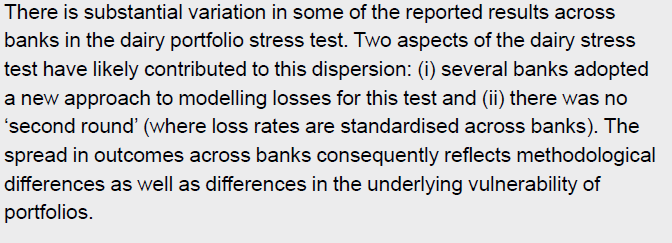
stress test extract

That does tend to suggest we should use the higher loss estimates rather than the lower ones (since banks have fewer incentives to overstate the loss implications than to understate them).

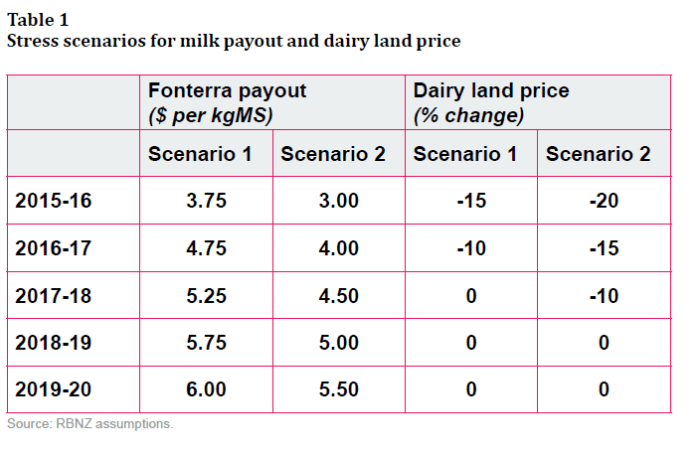
Here are the scenarios the Reserve Bank specified.

stress test scenariosI’m largely going to ignore Scenario 1 from here on.  As the long-term average real milk price is probably only around the assumed 2017/18 level, Scenario 1 doesn’t represent much of a stress test at all.  The banks and the industry would have to be have been very rickety for a scenario like that to have presented a banking system problem.  I think the Reserve Bank should also have discounted these results, rather than highlighting them in their press release.

Scenario 2 does look much more like a real stress-test.  But even if one thought the series of payout assumptions might be reasonable (2015/16 won’t have been that low, but some of the out years could still be lower than assumed here), I was surprised by the dairy land price assumptions.  Despite a really severe adjustment in the payout path (absolutely, and probably relative to farmer expectations), dairy land prices are assumed to fall by just under 40 per cent (the cumulative effect of those three annual falls).

That might sound like a lot, but:

  • when the Reserve Bank did its housing stress test, it assumed a 50 per cent fall in Auckland house prices.  People still need to live somewhere, while they don’t need to farm cows.
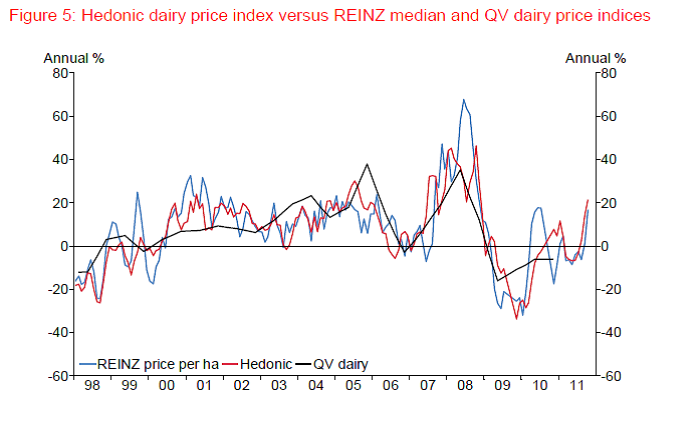
  • we’ve already a dairy land price scare not long ago.  Here is a chart of the (“hedonic”)dairy land price index the Reserve Bank developed for REINZ (despite which, we don’t have general access to the series).

dairy farm pricesIn a single year, dairy land prices fell by more than 30 per cent –  and that was a severe, but very short-lived, fall in milk prices, and a rise in dairy non-performing loans that was still moderate compared to what we see in Scenario 2 in the current stress test.   Perhaps deliberately, the Reserve Bank’s stress test does not seem to have taken account of a second round of selling (forced or voluntary), and the potential for that to drive land prices well below what might be a longer-term equilibrium level.  Overshoots routinely happen in such markets, where liquidity is thin to non-existent, uncertainty is rampant, and potential buyers are few.  As Eric Crampton’s discussion highlights, one difference between now and 2009 will be that potential buyers are probably much more aware of how significant the barriers are to any offshore buyers (who might otherwise be a stabilizing force in the market).

Loan losses evaluated on total dairy land prices falls of perhaps 60 per cent might be a more realistic stress test –  recall, that stress tests aren’t central predictions, they are a scenario to test robustness against.  Loan losses went up by 5 percentage points on the move from the (not very stressful) Scenario 1 to Scenario 2.   The pattern of losses on loans should rise non-linearly as the test gets more stressful, and moving from a 40 per cent land price fall scenario to a 60 per cent scenario is a bit more of a land price adjustment than moving from Scenarios 1 to 2.

There are lots of other points of detail I could question (some things in the article just aren’t made as clear as they could be), but will just highlight one.

The Reserve Bank has long emphasized the desirability of having a capital framework for banks in which risk weights (whether imposed by the Bank, or flowing from the internal models of the major banks) do not have the effect of making capital requirements pro-cyclical.  If capital requirements fall in asset booms and rise in shakeouts, the capital requirements will tend to amplify credit and asset price cycles (an existing stock of capital will go ever further as the boom proceeds, and ever less far – encouraging banks to rein in lending even more –  as the bust proceeds).  And yet the stress-testing article suggests that pro-cyclicality is deeply embedded in the modelling, at least for the dairy portfolio –  itself the largest single chunk of banks’ commercial lending.

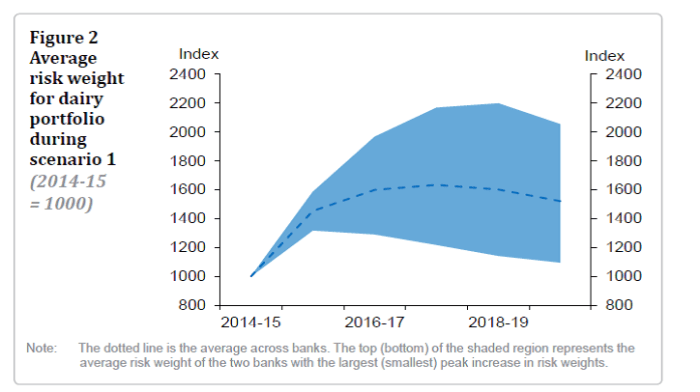
Here is what I mean.

risk weights dairy

This chart shows the average risk weight for the banks’ dairy portfolios under Scenario 1.  Recall that Scenario 1 was not very demanding at all, and yet the average risk weight on dairy loans increases by 60 per cent  (eg, from, say, 70 per cent to 112 per cent).  No doubt deliberately, the Bank does not reveal how much further risk weights increase in the much more onerous Scenario 2.     Even if it is not that much further, this sort of highly pro-cyclical pattern of risk weights looks like a bug that needs some serious attention.

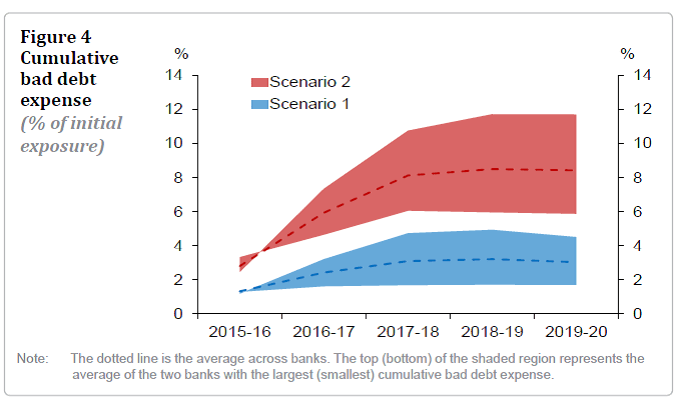
To recap, in Scenario 2, bad debt expenses average 8 per cent of dairy exposures.

dairy bad debts

But, as the Bank noted (see extract above), not all banks were as conservative as others.  If we take the pessimistic end of the Scenario 2 range, we would have bad debt expenses of perhaps 11.5 per cent of dairy exposures.  But, as noted above, the near-40 per cent fall in land prices  in Scenario 2 still looks too shallow for such a fully-worked-through scenario.  If land prices were to fall 60 per cent would it be implausible that in such an scenario, with all the second round effects accounted for and allowing for the non-linear loss profiles, the banks could face losses not of the “3 to 8 per cent of their total dairy exposures”  that the Reserve Bank highlighted, but something more like 20 to 25 per cent of their total loans to dairy farmers?    I deliberately pose it as a question, rather than a confident assertion, and it is –  deliberately – the result of a stressed scenario, but it is probably a question people should be posing to the Reserve Bank.

Australia’s tradables sector….and Eaqub on the RB

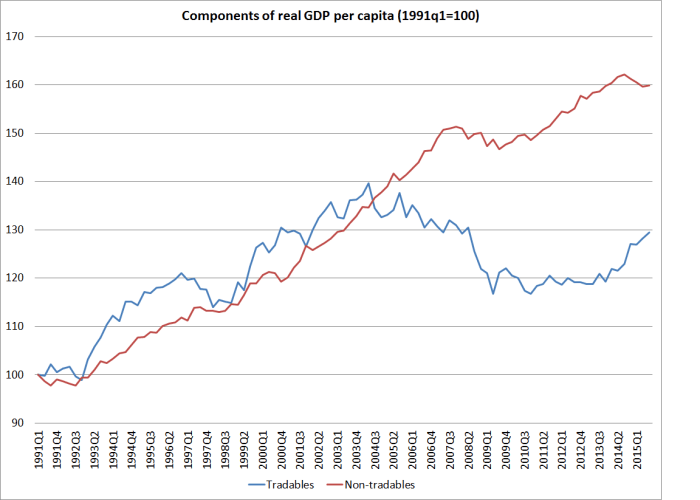
In a post on Thursday I showed this chart, a rough and ready decomposition (pioneered by the IMF) of real GDP per capita into that produced by tradables sectors (bits exposed to competition from the rest of the world) and non-tradables sectors.  My proposition was that successful high-performing economies will usually be led by strong tradables sector growth.
tradables and non-tradables gdp

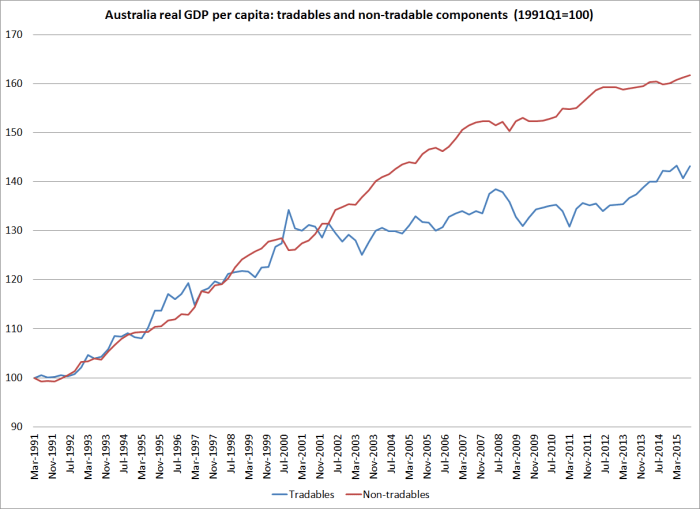
I was curious about how the comparable chart would look for Australia.

aus t and nt

Total growth in non-tradables per capita has been almost identical in the two countries over these 25 years (around a 60 per cent increase).

But look at the differences in recent years in (this proxy for) tradables sector output, per capita.

aus and nz T sector

In New Zealand, (this proxy for) tradables sector output per capita hasn’t increased over 15 years (notwithstanding the strong last few quarters).  In Australia –  which certainly isn’t a stellar economy –  the picture is much less negative.

At a sub-sectoral level, manufacturing output in Australia (per capita) has been even weaker than in New Zealand over the full quarter century.  The big difference, of course,  is simply the rapid growth in mining output.

Changing tack, just briefly…

Some readers perhaps find this blog a fairly unremitting critique of the Reserve Bank of New Zealand.  But today I’m sticking up for them.

Independent economist Shamubeel Eaqub has a column in today’s Dominion-Post, which in the hard copy version runs under the heading “Gorging a warm-up act for debt horror show”.   And “gorging” is Eaqub’s word, not just some sub-editors hype.   According to Eaqub, all New Zealand’s debt chickens are about to come home to roost –  notwithstanding, apparently, the fact that debt/GDP ratios are little changed over the last eght or nine years, and that no one has any good sense of what a sustainable, optimal, or equilibrium level of such ratios might be.

But according to Eaqub

The Reserve Bank is complicit, as they regulate banks. They say that the banking sector is not at risk. Their modelling shows sufficient capital buffers – which influence banks’ risk appetite to lend and vulnerability in a recession.

Their modelling has also shown higher inflation and interest rates for the last seven years – mistakenly.

It’s time the Reserve Bank better regulated banks to stop the repeating cycle of debt gorging and economic vulnerability.

This is really just a “guilt by association” slur.  Yes, the Reserve Bank has got its inflation and interest rate forecasts badly and repeatedly wrong, but what possible connection does that have to the question of whether banks hold adequate capital (whether risk weights, or required capital ratios)?    Or whether the stress test results are plausible?  Eaqub produces precisely no evidence to support his insinuations.  It is a short column to be sure, but surely he could at least offer readers a hint.

Lets recall that the stress tests involved a 40 per cent fall in house prices across the country, and something like a 50 per cent fall in Auckland.  And they involved an increase in the unemployment rate larger than any seen in any advanced economy with a floating exchange rate since World War Two.  And the banks still looked pretty resilient.

And as the IMF has previously noted, when they looked at a variety of other countries, risk weights on housing lending in New Zealand were materially higher than those in other countries.

I suspect there are tough times ahead for the New Zealand and world economy.  One can always argue for more capital, but to do so from the current situation  –  where New Zealand banks are better-capitalized than most –  one really needs more than simply the claim that “they got monetary policy wrong, so we shouldn’t give them credence on any other score”.


John Kay on banks, regulators and politicians

The Treasury has had Professor John Kay in town this week.  Kay has had a long and distinguished (microeconomics-focused) career in the United Kingdom as an academic, adviser, FT columnist, author etc and last year published a new book Other People’s Money: Masters of the Universe or Servants of the People, the introductory chapter of which is here.  Key’s Treasury guest lecture was built around the ideas in this book.  To be clear, I have not read the book –  although despite the skeptical comments that follow I may now do so.

It wasn’t a lecture, and apparently isn’t a book, about the 2008/09 financial crisis per se.  That said, the book probably wouldn’t have been written without the crisis, and he clearly sees the crisis as a manifestation of what, in his view, has gone wrong with the financial sector. In a line from his website :

The financial crisis of 2007-8 has dominated subsequent discussion of economic policy. In my view the responses are characterised by two widespread misunderstandings. The first mistake is to believe the crisis is an inexplicable, once in a lifetime, event, rather than another demonstration of an increasingly dysfunctional financial system.

Kay began with a line many have used –  the changing nature of the people who go into banking.  In the 1960s, when he grew up in Edinburgh, banking was for the people not quite smart enough to get into university (as in New Zealand, only a small proportion of school leavers then went to university).  By contrast, these days finance attracts many of the smartest graduates from top universities.  The range of products is, of course, much more complex.  But not, Kay would argue, so correspondingly socially useful, despite the staggering remuneration on offer to a fairly small number of people in these institutions (if I recall rightly, he notes that most people in the big UK bank Barclays actually earn less than the UK median wage).  And, of course, the incidence of financial crises is much greater today than it was in the post-war decades.

For a time, politicians across much of the advanced world fell at the feet of bankers.  Kay showed an amusing clip of Gordon Brown, then Chancellor of the Exchequer, opening a new headquarters in Europe for Lehmans only 10 years or so ago.  And in the United States in particular, there is the ongoing unease over the revolving door that seems to operate between senior government positions and highly-remunerated positions in the financial sector  (it isn’t just Goldmans’ alumni going into government and back into the financial sector (eg Robert Rubin), but the flow from government positions into the financial sector –  be it Bernanke, Summers, Geithner or whoever).  Bernie Sanders is currently tapping that anxiety.

Kay isn’t “anti-finance”.  As he notes

A country can be prosperous only if it has a well-functioning financial system, but that does not imply that the larger the financial system a country has, the more prosperous it is likely to be. It is possible to have too much of a good thing. Financial innovation was critical to the creation of an industrial society; it does not follow that every modern financial innovation contributes to economic growth. Many good ideas become bad ideas when pursued to excess.

And so it is with finance. The finance sector today plays a major role in politics: it is the most powerful industrial lobby and a major provider of campaign finance.

He seems to be arguing some combination of the following:

  • Banks are too large, and encompass too many different types of activities within them,
  • Banks should be broken up.
  • There is “too much finance”
  • Banks have huge political clout (especially in the US and the UK), and exercise that in their own interest, in particular in the (successful) pressure for bailouts.
  • Someone should pay for what went wrong in 2008/09.
  • Banking regulation has become too prescriptive and detailed.

I didn’t find the overall story that persuasive, partly because it doesn’t seem to generalize across countries, and partly because it doesn’t even seem to get to the heart of the 2008/09 issues.  There are bits of the story I agree with  –  concerns about the volume of increasingly detailed, lawyer-driven, focus of regulation, often in effect more concerned with process and form than with economic substance.  And I sympathise with his unease about the hubris implicit in the belief among central bankers that they can somehow determine what risk weights to use for each and every type of credit.

So what bothers me?

First, is there any evidence that banks were “bailed out” because of the political clout of the sector?  I’ve read huge number of the books written since the crisis, and tracked events through the crisis very closely, and that interpretation simply just doesn’t ring true –  in the US, the UK, Ireland, or anywhere else for that matter.  After all, by and large it was not bank shareholders (or senior management) who were bailed out –  and many of the senior management of banks had large proportions of their own wealth tied up in shares in their own banks.  The bailouts typically primarily benefited creditors  (not exclusively –  after all, even Bear Stearns shareholders walked away with a small amount of their money)  and – so the argument went –  the economy as a whole.  Creditors weren’t always voters, but most voters were creditors of banks in one form or another, and most were employees –  alarmed at the prospect of extreme economic disruption.

This isn’t the place to debate whether any or all of the bail-outs were good things or not, simply to note that –  as things were by 2008 –  they would have happened, largely as they did, if financial sector interests had had no clout and no superior access to politicians at all.

And what of the line that banks are simply too big and complex to be run effectively?  Well, for decades we saw that argument run about corporate conglomerates across the western world (including our own Fletcher Challenge).  But actually the market had ways of taking care of that problem –  companies were bought up, restructured, dismantled etc, by purchasers who could make more of the assets that the unwieldy conglomerates could.    The “asset strippers” weren’t always attractive personalities, and some probably went close to (or even beyond) the edge of the law, but the point simply was that the market has a way of ensuring that assets are owned by those who can place the highest value on them.   Bank takeovers aren’t always easy, but they happen.  It isn’t obvious what the (financial stability) policy problem is, unless a strong case can be mounted that some combination of size and complexity effectively buys a bailout insurance policy.  I don’t think the evidence for that point is particularly persuasive either.

At one point is his lecture drew the distinction between whether we thought as banks as a “den of thieves” or as a “monastery”.  I’m not sure either description is remotely warranted.  Avaricious, arrogant and unpleasant as many of these leading bankers seem to have been, I don’t see any sign that the crises of 2008/09 –  in any country –  occurred because anyone systematically set out to dupe anyone else.  Don’t get me wrong: I’m not suggesting there was none of that sort of activity, simply that much more of what went on is down to some combination of:

  • choices of politicians (choosing to adopt the euro, which involved holding interest rates well away from natural interest rates for year after year –  most obviously in Spain and Ireland –  and the high degree of political pressure brought to bear in the United States on the financial system to take on low quality housing loans)
  • collective over-optimism, among borrowers, lenders, citizens and politicians.

Were people let down?  Yes, no doubt.  Banks failed, but so did most of the world’s leading regulators and central bankers (as Kay put it, the effortless subsequent continued rise of several, who had been quite dismissive of risk before the crisis, illustrates the “unimportance of being right”), and most of the world’s leading finance ministers (and most of those who might have wanted to replace those central bankers and finance ministers).  So who should pay, and in what form?

And of course there is the “so what” question.  If one believes that the financial crises (or even the build up of debt prior to the crisis) was responsible for the world’s current economic travails (eg GDP per capita 15 per cent or more below pre-crisis trends) one might perhaps regard the financial sector as a dangerous bacillus, attacking the common wealth.  But as I’ve noted here several times, I don’t think the case is that strong.  Through its history, for example, the US was plagued by financial crises, and yet each time the economy bounced back  – usually quite quickly –  to much the same growth path it was previously on

What of New Zealand?  Is there too much finance here?    We don’t have complex banks (they lend, mostly in quite vanilla forms, and the borrow –  domestic households and institutions, and from abroad.)  We don’t have many complex instruments either –  actively traded or not.  It isn’t obvious banks have huge political clout either –  for better or worse, in the midst of the crisis we forced them to join the deposit guarantee scheme, we forced through the local incorporation policy, we compelled them to pre-position for OBR, and we’ve imposed higher effective minimum capital requirements than most of the countries.  We didn’t have a domestic loan losses financial crisis during 2008/09 (actually neither did the UK), and yet, as I’ve repeatedly highlighted, our economic performance over the last decade has been distinctly mediocre.  There is a lot going on globally, insufficiently understood, but it isn’t yet remotely clear that finance is the problem, rather than just another symptom.

finance and insurance

The New Zealand financial sector is larger than it once was. But much of that isn’t about  over-mighty financial institutions and their “master of the universe” bosses  – although we had our period of craziness in the mid-late 80s.  But if high house prices here  –  as in much of the West –  are about the interaction of supply restrictions and population pressures, the increase in the stock of credit is substantially an endogenous response to those structural distortions.  If governments make urban land really scarce and expensive, younger generations will need to borrow more real resources from older generations to be able to afford a house at all.  The stock of credit (on the one side) and deposits (on the other side) rises, and financial institutions facilitate that-  and value-added associates with that activity and accordingly appears in the national accounts.  Don’t blame banks for that, but governments that so badly mess up the markets in housing supply.

I’m left uneasy about what social value much of the activity in the financial sector generates.  As an analyst, even as a citizen, I’m curious about that.  But I’m not sure that Kay –  or others –  have made a convincing case that is deeply harmful either. In principle it could be –  as others might argue that sugar, alcohol, fast food, or fast cars could be harmful.    Kay avers that he wants less intrusive regulation, but in fact the thrust of his arguments tends to give aid and comfort to those who want more of it.  That appeals to regulators, responds to a public itch “something is wrong, and banks aren’t overly sympathetic causes”, but doesn’t rest sufficiently on a hard-headed analysis of the role of governments and regulators in past crises, and the importance of markets –  messy as they often are – as “a chaotic process of experimentation…the means through which a market economy adapts to change”.

That last quote comes from an excellent lecture, The Future of Markets, which I return to often, given by one John Kay in 2009.

In conclusion, I would just note that at one of his sessions this week, Kay was apparently asked about deposit insurance. He asserts that it is simply imperative: without it the pressure for bailouts of all creditors inevitably becomes almost impossible to resist.  It was a point I made here last week, and remains good advice for our political parties, our government, and for those among the official agencies who continue to believe that the OBR tool deals with these pressures.

Government bailouts and market discipline

The speech and Bulletin put out by the Reserve Bank yesterday made much of the importance of market discipline in the financial sector.  The two documents have slightly different lists of conditions which the respective authors think make it more likely that market discipline will be effective, but a common element is “market participants [must] have incentives to monitor financial institutions”.  Toby Fiennes argues that in the New Zealand context:

“some aspects of the regulatory framework, such as Open Bank Resolution (OBR) and no deposit insurance, reinforce these incentives.”

and O’Connor-Close and Austin, in the Bulletin, add in

“nor is there any policyholder protection scheme for insurance firm customers.”

This has been a longstanding view held by the Reserve Bank.  I’ve long thought it was wrong.

Of course, if you were confident that, were a bank to fail in which you were holding deposits or other interest-bearing securities, you would lose money, and no one would bail you out, you would have quite a strong incentive to pay attention to the health of any institution in which you had a reasonable amount of money, and (to economise on monitoring costs) to hold  your money, as far as possible, with those institutions generally regarded as safest.

Same goes for insurance.  If you had your house insurance with an insurance company, and no one would bail you or it out if the company failed, you’d have quite an incentive to insure with companies that would prove resilient through the worst of shocks.

In the case of banks, OBR is designed to make it more technically feasible for political leaders to let major banks fail.  In that model any losses  (mostly) fall on the creditors, and yet the failed bank can quickly re-open, keeping the day-to-day flow of transactions and routine business credit operational.  It is technically elegant system.  But whether or not it is ever used is not up to the Reserve Bank.  That is matter for whoever is Minister of Finance at the time –  and no doubt the Prime Minister of the day too.

Suppose a big bank is on the brink of failure.  Purely illustrative, let’s assume that one day some years hence the ANZ boards in New Zealand and Australia approach the respective governments and regulators, announcing “we are bust”.

Perhaps the Reserve Bank will favour adopting OBR for the New Zealand subsidiary (since the parent is also failing they can’t get the parent to stump up more capital to solve the problem that way).    But why would the Minister of Finance agree?

First, Australia doesn’t have a system like OBR and no one I’m aware of thinks it is remotely likely that an Australia government would simply let one of their big banks fail.  But in the very unlikely event they did, not only is there a statutory preference for Australian depositors over other creditors, but Australia has a deposit insurance scheme.

I’m not sure of the precise numbers, but as ANZ is our largest bank, perhaps a third of all New Zealanders will have deposits at ANZ.

So, if the New Zealand Minister of Finance is considering using OBR he has to weigh up:

  • the headlines, in which ANZ depositors in Australia would be protected, but ANZ depositors in New Zealand would immediately lose a large chunk of their money (an OBR ‘haircut’ of 30 per cent is perfectly plausible),
  • and, even with OBR, it is generally accepted (it is mentioned in the Bulletin) that the government would need to guarantee all the remaining deposits of the failed bank (otherwise depositors would rationally remove those funds ASAP from the failed bank)
  • and I’ve long  thought it likely that once the remaining funds of the failed bank are guaranteed, the government might also have to guarantee the deposits of the other banks in the system.  Banks rarely fail in isolation, and faced with the failure of a major banks, depositors might quite rationally prefer to shift their funds to the bank that now has the government guarantee.

And all this is before considering the huge pressure that would be likely to come on the New Zealand government, from the Australian government, to bail-out the combined ANZ group.  The damage to the overall ANZ brand, from allowing one very subsidiary to fail, would be quite large.  And Australian governments can play hardball.

So, the Minister of Finance (and PM) could apply OBR, but only by upsetting a huge number of voters (and voters’ families), upsetting the government of the foreign country most important to New Zealand, and still being left with large, fairly open-ended, guarantees on the books.

Or, they could simply write a cheque –  perhaps in some (superficially) harmonious trans-Tasman deal to jointly bail out parent and subsidiary  (the haggling would no doubt be quite acrimonious).  After all, our government accounts are in pretty reasonable shape by international standards.

And the real losses –  the bad loans –  have already happened.  It is just a question of who bears them.  And if one third of the population is bearing them –  in an institution that the Reserve Bank was supposed to have been supervising –  well, why not just spread them over all taxpayers?    And how reasonable is it to think that an 80 year pensioner, with $100000 in our largest bank, should have been expected to have been exercising more scrutiny and market discipline than our expert professional regulator (the Reserve Bank) succeeded in doing?  Or so will go the argument –  and it will get a lot of sympathy.

(There is provision in the OBR scheme for a “de minimis” amount below which the haircut might not apply.   If the de minimis amount is, say, $500 –  roughly a fortnightly New Zealand Superannuation amount for a couple –  it is neither here nor there for the scheme as a whole.  But a high de minimis amount looks a lot like ex post unfunded deposit insurance.)

Note that I’m not arguing that bailouts are “a good thing”, simply that having the OBR tool really does not dramatically alter the incentives politicians will face in dealing, at the time, with the imminent failure of a large bank.   And rational investor know that.  For the case of a large bank, OBR simply isn’t really a time-consistent strategy for politicians.

Some people at the Reserve Bank will accept the point, but argue that we still need OBR to have a credible weapon to wave in front of the Australians in a crisis.  If they think New Zealand might just be “crazy” enough to use it, it might  –  so it is argued – help us negotiate a slightly less unfavourable bail-out deal.  Perhaps.  But Australians can read domestic politics too.  I have no problem with having it in the toolkit –  perhaps it could be useful for a small bank  –  but no one should pretend that it solves bail-out risks and restores retail market discipline, red of tooth and claw.  And the probability of a bail-out, with a focus on protecting retail deposits, probably weakens market discipline at the margin even among wholesale investors.

And what are the precedents?  25 years ago the Bank of New Zealand was bailed out.  Yes, the government was the largest shareholder at the time, but I didn’t detect any sense –  at the very peak of the Douglas-Richardson era – that ownership determined whether the government of the day let the BNZ survive or fail.

More recently, the retail deposit guarantee scheme was put in place in late 2008 – not just for finance companies, but for the big banks too.  The decision was made by the previous Labour government – but it was endorsed by the Key/English led Opposition, and was recommended (in substance if not in precise detail) by the Reserve Bank and Treasury. I wrote many of the papers.

And more recently still, AMI was bailed out –  by the current government, on the recommendation of the Reserve Bank and Treasury.

In his speech, Fiennes note that

“it is of course true that many people expect governments to stand behind their deposits. That expectation was reinforced by the widespread Government guarantees (including in New Zealand) during the GFC.  The existence of an expectation, though, is not a sound reason to adopt deposit insurance”.

That might be true if depositors had no leverage.  But they do. It is called the ballot box, and politicians are very well aware of it.

If depositors, or policyholders, expect bailouts, and political leaders have incentives to respond to, and deliver on those expectations, then it may be a much less inferior option to adopt an explicit retail deposit insurance scheme upfront.

Deposit insurance need not be a substitute for OBR, but may actually make it a little more credible that OBR could be allowed to work.  If there is a bail-out, it will benefit not just New Zealand retail depositors, but wholesale lenders too, domestic and foreign.  There is likely to be much less political appetite for bailing out the wholesale creditors (especially the foreign ones), but a simple bailout does not enable one to distinguish.  By contrast, a properly specified deposit insurance scheme enables one to be very clear upfront which deposits are likely to be covered, and which not –  and to charge for that coverage accordingly.  In event of a bank failure, OBR could be applied to all creditors, with the deposit insurance scheme “reimbursing” the retail depositors to the extent defined in the scheme.  And in the event of a serious bank failure, the ability to impose loss on (particularly) foreign lenders (though in practice all wholesale creditors) is a net welfare gains to New Zealanders.  Letting losses fall on New Zealand retail depositors might be reasonable economics, but (a) it probably doesn’t work politically, and (b) it simply transfers the losses from one set of New Zealanders to another.

Deposit insurance schemes are not ideal –  and the Reserve Bank speech and article repeat some of the challenges.  But bailouts are not ideal either, and experience suggests very strongly that bailouts remain the preferred default option at the point of crisis.  As someone put it to me recently, in some sense if you don’t have an explicit limited deposit insurance scheme then, de facto, you have an implicit unlimited deposit insurance scheme (ie bailouts).  And reasonable depositors will know it.

And if deposit insurance schemes aren’t ideal, they are fairly ubiquitous.   As this recent IMF Working Paper points out (p32) every single advanced economy member of the IMF has an explicit deposit insurance scheme, with the exception of Israel, San Marino, and New Zealand.  San Marino aside, every European country, advanced or emerging, has such a scheme, and Africa is the only continent where a majority of countries do not have such schemes.  It has never been clear why the Reserve Bank thinks New Zealand can, or sensibly should, sustain being different, given the political economy pressures that all governments face.

And it is not as if deposit insurance has been withering since the financial crises of 2008/09.  As the IMF paper illustrates, coverage has often been extended, and co-payments wound back.

I noted this morning that, for all its insistence on having regular private data that creditors can’t get access to, the Reserve Bank continues to assert that, in effect, it has no financial “skin in the game” –  the risks are with creditors. In a second-best world, a deposit insurance scheme actually helps ensure that government agencies really do directly have skin in the game; financial risk if things go wrong.  That might actually sharpen accountability.

It was really rather naughty, and unhelpful, of the Reserve Bank not to have devoted some space to the political economy pressures, and the New Zealand bailouts/guarantees to which they (and The Treasury) have been party.  Of course, it might have been difficult to have done so, and would have undermined a good story, but it would have got us closer to better understanding the real choices and tradeoffs that societies face and make in this area, ex ante and ex post.

Of course, the decision on a deposit insurance scheme is not one for the Reserve Bank.  It is a government decision, and one that would require legislation to implement. It is understandable that the current government feels badly burned by the cost of the guarantee of South Canterbury Finance.  But given the incentives that governments will inevitably face if a major bank, or insurer, is on the brink of failure, it is surely time to shift direction, and put in place an explicit insurance scheme, for which depositors would be charged. Doing so would probably, overall, strengthen market disciplines a little, not weaken them as the Bank argues.  Bailouts of all creditors might still happen –  between Australian government pressure, and the threat of disrupted access to foreign funding markets –  but at least (a) the government would have raised some revenue in advance of the costs, and (b) we would be able to have more rational, and emotionally (and politically) plausible, arguments about the reasonableness of allowing unsophisticated investors who had taken little or no obvious risk (deposits in one of our larger banks) to face large unanticipated losses.

At interest.co.nz, Gareth Vaughan recently had a nice piece also making the case for deposit insurance in New Zealand.
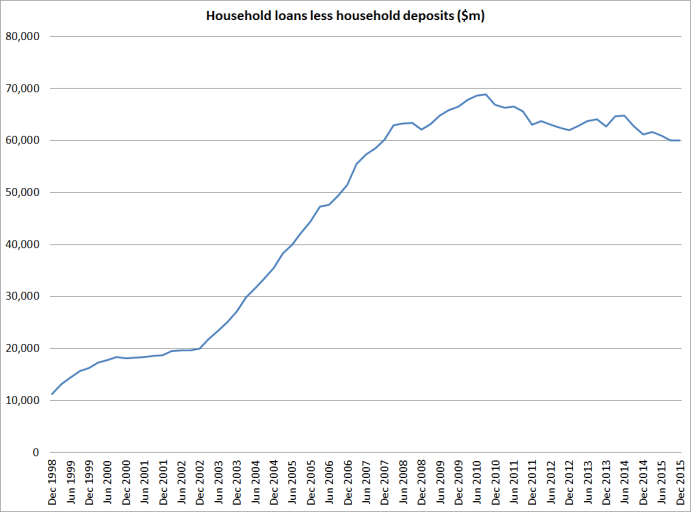
 

Bank regulation: the Reserve Bank’s unease about transparency

The Reserve Bank has been firing out on-the-record speeches this week. I discussed the Governor’s troubling effort here, and may come back to that again in the next few days.  I probably won’t say much about the Assistant Governor’s lecture yesterday –  except perhaps to draw attention to his claim that ‘there are times when the Bank will know more about the economic situation and outlook than does the public or market participants’.  Really?   I guess the last three years, when the Governor has consistently failed to get inflation near the 2 per cent target, and has had to dramatically and grudgingly reverse his own rather strident policy stance, hasn’t been one of those times.

Perhaps more interesting were the two releases late yesterday afternoon on the role of market discipline in the context of prudential regulation of banks (in particular).   Toby Fiennes, the head of the Bank’s prudential supervision area delivered a speech to some of those he regulates headed “Regulation and the Importance of Market Discipline” , and an issue of the Bulletin by two of his staff headed “The importance of market discipline in the Reserve Bank’s prudential regime” was released.    In both of yesterday’s releases there is a refreshing reaffirmation of the importance of market discipline –  even if the actual direction of policy isn’t really that consistent with the rhetoric.

The Fiennes speech is a mix: in part a lecture on the Bank’s view of the importance of market discipline, and partly a report on the outcome of the Bank’s recent tidying up exercise, the so-called  “regulatory stocktake”.  I wrote about the results of that process here (and a mere four months after first requesting them I have recently had released to me around half of the submissions the Bank received on the stocktake consultation ) [1].

I wanted to touch on just two aspects of the stocktake material.  I was one of several submitters who had made the case that all submissions on Reserve Bank consultative documents should be published (as is now common practice in other government agencies and parliamentary select committees).  The Bank has always been very resistant to such openness. But in its release in December, there were encouraging signs

Our current approach is based on our understanding that respondents prefer to keep their submissions confidential. Prior feedback indicated that banks, in particular, were reticent to share cost information and the Reserve Bank is concerned that the publication of submissions would impact the quality and detail of the submission feedback. On the other hand we also recognise the importance of transparency in the policy-making process, so we will return to this issue and consult on a revised approach under which the default position would be that all submissions are published on our website (although submitters could ask to have any confidential information in submissions redacted).

Unfortunately, the discussion in last night’s speech –  when Fiennes went out among the banks –  was weaker than what they put out in December.

Some submitters suggested that we publish all written submissions on our public consultations. Our current approach is based on prior feedback, which indicated that respondents prefer to keep their submissions private on the grounds of commercial confidentiality. We will test this more rigorously with stakeholders. The alternative would be to publish all submissions by default unless submitters ask for them to be withheld or redacted.

Talk of a new default position of publication has disappeared.  What I wrote in December seems even more apposite in light of last night’s comments

I think this statement tells one a lot about the extent to which the Reserve Bank sees its clients as primarily the institutions it regulates, rather than the public the institution exists for.  I’m sure that banks would generally prefer to keep their submissions confidential, and it is precisely for that reason that their submissions, in particular, should be made public.  It is too easy for a cosy relationship to develop between the regulator and the regulated

I hope that the Reserve Bank remembers that its primary stakeholders are the public, and the representatives of the public (the Minister and members of Parliament), not the entities they are statutorily charged with regulating.

But to balance that unease, I want to give Fiennes kudos for one aspect of his speech. In my submission to the stocktake I had argued that if the Bank was serious about promoting market discipline, it shouldn’t be devoting undue time to refining disclosure statements, which the Bank quite openly states don’t contain the information the Bank itself uses. Instead, I argued, the Bank should require that all the private information the Reserve Bank now collects should be published on the relevant bank’s website at the same time it is supplied to the Bank.  Recall that the Bank is keen to emphasise that creditors, not the Reserve Bank or the Crown, bear the losses in the event of a bank failure.

The Bank’s published response to the submissions did not deal with that proposal at all.  But last night’s speech did.  Here is what Fiennes said

As some of you may have read, several submitters argued that we should publish all of the information we receive through private reporting, potentially publishing a monthly dashboard of this information.

While this principle has some appeal, there are two main reasons why we do not consider it appropriate.

First, the potential trade-off between timeliness and data quality. We sometimes accept a marginal reduction in data quality in private reporting in exchange for receiving the information quickly. While this is appropriate for supervisory purposes, public disclosure needs to maintain a high minimum accuracy in order to support the credibility of the regime. This is underscored by the penalties in the legislation for false disclosure, and is an issue we are giving careful thought to in the design of the dashboard.

Second, there is the issue of commercial sensitivity. Often the private data we received is commercially sensitive, or might be open to misinterpretation if released without the appropriate context – especially if this was occurring in a situation of rapidly rising financial system risk.

At least now we can better understand the Bank’s objections. But I don’t find the counter-arguments persuasive.

Fiennes asserts that the Bank can “sometimes” live with a “marginal reduction in data quality…in exchange for receiving the information quickly”,  but that they can’t possibly expose the public to this “marginal reduction”.  But it is the money owned by the public that is at stake in these banks: Reserve Bank staff and management have nothing directly at stake.  More generally, the Bank doesn’t seem to recognise that all sorts of real and financial markets trade on imperfect information all the time –  in monetary policy, the constant revisions to GDP data for years afterwards are just the most obvious example.  If the information is sufficiently valuable to the Reserve Bank that it will use statutory powers to compel banks to supply it (without charge) that information, then such timely information should be at least as valuable to the public who are investing with the banks.  If the data really helps shed light on the financial positions of banks, investors have more use for it than officials.

The Reserve Bank’s other counter-argument is “commercial sensitivity”.  But if the Reserve Bank really needs this timely information to do its job, how can depositors and other lenders not need it to evaluate the changing nature of the risks they are running?  No doubt the same sorts of arguments were run when disclosure statements were first developed in the 1990s.  Fiennes is also concerned that data might be “open to misinterpretation if released without the appropriate context” –  but nothing stops the disclosing bank itself, or the Reserve Bank , or any private sector commentators providing that context.  Any data can be misinterpreted   – and can also be explained.  Fiennes amplifies the point by arguing that misinterpretation is perhaps especially likely “in a situation of rapidly rising financial system risk”.   But disclosure isn’t overly valuable to any creditor in good times – the value of having that information is precisely when actual and perceived risks are rising.  And, to be boringly repetitive, it is depositors’ and investors’ money that is at stake.

Here was some of my discussion of the issues in my original submission:

Moving in the direction discussed just above would, of course, represent a substantial change in  approach.  Timely statistical returns of the sort banks supply to the Reserve Bank can’t first go through a full audit sign-off and director attestation, but the Reserve Bank itself –  by its own  revealed preferences –  clearly thinks that in terms of knowing what is going on on a timely basis, those protections are less important than getting timely information.  If things are very timely there will almost inevitably be the occasional error, but that is not an argument against the idea.  After all, even Statistics New Zealand (perhaps even the Reserve Bank) occasionally finds mistakes in its data.  The concern shouldn’t be errors –  people are human and will err –  but about the risk of being deceived.  But adequate protections against deliberate attempts to deceive either the Reserve Bank or creditors (by deliberately supplying erroneous or misleading information) surely either already exist in statute or common law, or could be legislated separately.  And the fact that the Reserve Bank’s own analysts would be reliant on the same data that were going public would provide an additional layer of comfort –  since the Bank is readily able to ask, and require answers to, probing follow-up questions.

I am also not suggesting an absolutist approach to this issue.  I have no problem with the answers to  ad hoc inquiries by the Reserve Bank of an individual bank not being published.  And in times when an individual institution may be approaching crisis, there probably inevitably needs to be a degree of confidentiality around the handling of that detailed information involved in crisis management (although such material should probably still be discoverable after the event).  Indeed, protecting that sort of information was a part of the justification for the (now abused) section 105 secrecy provisions in the Reserve Bank Act.  There is no foolproof dividing line, but I would suggest as a starting point that any statistical returns which are (a) regular, and (b) required of all (or a significant subset of) banks should be subject to my immediate disclosure rule.  And perhaps the Reserve Bank Board could offer an attestation in its Annual Report that it has satisfied itself that staff and management are operating the system in a way that ensures all regular supervisory information is being made available to depositors and other creditors.

I still think the case for full and immediate publication of all regular bank statistical returns is strong.

New Zealand’s regime around depositor protection is extremely unusual internationally –  something I will come back to in a follow-up post.   We don’t protect depositors.  Perhaps keeping information private –  having the real oil only going to the Reserve Bank –  might be acceptable in some idealised world in which bank regulators were consistently wise, insightful, benevolent and consistently right. (“we’ll look after everything for you”).   But they aren’t.  They are human beings, and their track record (around the world) isn’t particularly good.  That isn’t a comment about the Reserve Bank of New Zealand in particular –  it hasn’t been put to the test in the last 20 years –  but about bank regulators more generally (and other regulators for that matter).

Regulators simply do not have the incentives to process and interpret information correctly –  and it isn’t their money at stake.  Sometimes they get too cosy with those they regulate.  At other times, they get too cosy with their political masters. And often enough – being human –  they simply pursue their own bureaucratic interests –  a bigger agency, with more power, more information, not too much scrutiny and a quiet life.  There isn’t much reason to think that Reserve Bank regulators will consistently make better use of ‘private data’ from banks better than the people who have lent to those banks will.  Disclosure can be messy, and bureaucrats abhor messiness.  But the contest of ideas and interpretations, and the intense scrutiny of available information (partial as it might often be), is the essence of competitive market processes.  Tidiness, not so much.   If regulators need data promptly, so do those who invest with the banks they regulate.


[1] The Bank told me a week ago they were going to post that release on their website (here), but have not yet done so.  If anyone wants a copy of those submissions please email me.  [UPDATE: The Bank has now posted the release.]