Big scary numbers

When our kids were little one of the books we often read them was “Bears in the Night” in which the young bears, hearing a noise outside, sneak out of the house at night, climb Spook Hill and then, terrified by the sudden appearance of an owl – not the most threatening of birds – whose call they’d heard, rush back to the comfort and security of home and bed.

It came to mind when reading some of the arguments being advanced by government officials and banks over the Credit Contracts and Consumer Finance Amendment Bill currently making its way through the Finance and Expenditure Select Committee.

The key controversial bit of the bill is the proposal to legislate retrospectively to close down class action suits currently before the courts against ANZ and ASB in respect of flaws in loan variation procedures etc that occurred between 2015 and 2019. The Credit Contracts and Consumer Finance Act had been amended in 2015 in ways that provided (MBIE’s words here) “that the borrower is not liable to pay interest or fees over any period of non-compliant disclosure made before loans are entered into or varied”. In late 2019 the Act was further amended so that for future breaches courts would have “explicit discretion to extinguish or reduce the effect of this provision in order to reach a just and equitable outcome”. That amendment was deliberately and consciously not made retrospective, but the current government now proposes to further amend the Act to apply the post-2019 regime to breaches that arose between 2015 and 2019.

Retrospective legislation is, almost without exception, an odious concept. Perhaps one might make an exception where, say, there was a clear typo in the legislation, giving a quite different meaning to the words of the legislation than Parliament had clearly intended. That wasn’t the case here. Rather, right or wrongly, Parliament changed its mind in 2019 about what the law should be going forward. Now the government – egged on by the banks – wants to make it as if a consciously and deliberately chosen law never was.

(Perhaps one might also make an exception to the general principle against retrospectivity if it was belatedly realised that the words Parliament had enacted enabled the strong to egregiously exploit the weak. I don’t know that that exception is in the typical lawyers’ list, but as a citizen/voter I could see the possibility (perhaps a parallel to exercise in criminal cases of a royal prerogative of mercy).)

What is puzzling is why the government would propose to amend the law retrospectively to help out large and highly profitable foreign banks. And in so doing to bypass what is apparently usually the practice when (as happens on rare occasions) retrospective legislation is passed, when cases already before the courts are (apparently) protected.

I hadn’t paid an awful lot of attention to the whole issue until two or three weeks ago when big scary numbers generated by the Reserve Bank were reported (eg here) and thus entered the public debate under headlines (not, to be clear, sourced to the Reserve Bank) about threats to the financial system unless this retrospective law was passed. $12.9 billion (the maximum estimate reported) sounded like a lot of money (but just glancing at articles I didn’t have a basis for knowing what a right number might actually be), even if stories about threats to the soundness of the financial system never rang true even for a minute.

And I still didn’t pay a lot of attention until the media reporting this week of the appearances before the select committee of the Bankers’ Association (strongly in support of the proposed amendment), the lawyers for the plaintiffs in the class action suits, and representatives of the litigation funders, LPF. The video of those appearances, and associated questions and answers, is currently here.

Yesterday, one of LPF’s representatives rang me, apparently given my name by several people as someone who might write a critical piece for them, especially on the Reserve Bank numbers, and the uses and abuses being made of them. I don’t really do submissions for hire, and am not taking any money from them, but my interest was piqued, and I benefited from a couple of useful conversations with them. More importantly, they sent me the document that contains the material from the Reserve Bank, a paper from MBIE to the then Minister of Commerce and Consumer Affairs (Andrew Bayly) from October last year which includes “Annex Two: Summary of RBNZ modelling and advice”. That annex appears to have been written by the Bank. The full document is here

MBIE Paper on CCCFA retrospectivity amendment 10 October 2024

Here is what there is on the estimates

In other words, we know nothing about the model, the scenarios, assumptions etc although it appears – from the OIA exclusion ground cited – that they must have obtained some data from one or other of the banks to somehow inform their numbers.

Note, though, that even the “big scary number” scenario, isn’t exactly a grave financial stability risk: “low to medium impact on capital ratios” is the Reserve Bank’s own line. Big numbers but if the underlying business models are profitable (as New Zealand banking typically is) then even in a hypothetical like this recapitalisation wouldn’t be expected to be an issue (whether from direct shareholder injections or retained earnings). Aside from anything else, and as they note, litigation will roll on for years. Losing on the scale of this “big scary number scenario” would be painful, but from the outside you could conceptualise it as a bit like a backward-looking windfall tax which, justified or not, wouldn’t normally really affect future behaviour. And when bureaucrats and the like come up with three scenarios, or three policy options, they typically expect people will be drawn to the middle one as perhaps best expressing their view or preference (and to be clear in this Annex the Reserve Bank is not taking a position on the merits of the proposed retrospective amendment).

It really isn’t clear how the Reserve Bank came up with the big scary number. Over the period in question – 2015 to 2019 – total housing and consumer loans averaged about $275 billion. If the average interest rate over this period was about 5 per cent, the average disclosure failing occurred half way through the period, and a third of all retail loans in the economy (by value) were subject to disclosure failings, the total interest involved would have been be about $10 billion, which is (I guess) in the same order of magnitude as the Reserve Bank’s $12.9 billion number (especially if one allows for interest on such an amount through to today).

But we know, for multiple reasons, that this cannot be a number to take seriously.

For a start, if the Bankers’ Association and its members thought it was even roughly accurate as an estimate of the sector’s exposure, they’d have hired a consultant economist to churn out quickly a well-explained and documented version of their own (rather than just waving around the worst Reserve Bank numbers, where any details as to how it was done are – perhaps conveniently for them – blacked out). It wouldn’t take long, and the Bankers’ Association clearly isn’t short of money to deal with this issue: at their FEC appearance they brought along three [UPDATE: two apparently] KCs to help testify and answer questions on legal dimensions. One of those KCs – James Every-Palmer – actually told FEC (at about 24 minutes in) that the sums being sought in the cases against the ANZ and ASB were “as I understand it, hundreds of millions of dollars” (before then handwaving to tie this to a system-wide $12.9 billion dollars). ANZ and ASB together make up the best part of half the banking system, so if the Bankers’ Association understands the claims against them to be “hundreds of millions” then even if that represented $1 billion in total, it is all but impossible to see how the rest of the system could be exposed to $12 billion of claims.

There are several reasons for that statement: no other claims have been lodged, the litigation funders told the committee they had heard of no other claims (and any such claims could really only go forward with litigation funding given the cost of civil justice), and the existing legislation is written in such a way that any further claims, not already lodged, would almost certainly be out of time (more than five years on from when breaches were disclosed). I’ll leave those points to the lawyers to argue about, but there is also some hard data on the numbers of customers involved.

The Commerce Commission reached settlements with the four big banks (and Kiwibank) some years ago, and those settlements (which involve compensation for actual loss, and did not preclude civil action by customers) are all sitting on the Commerce Commission website to consult.

Take the ANZ first. This is what had happened.

102000 customers were affected. That appears to have been around 30 per cent of ANZ’s mortgage customers in 2015, and at 31 December 2015 ANZ had about $63 billion of retail credit outstanding.

Under the existing provisions of the CCCFA, customers were not liable for interest in the period between an erroneous notification and either when it was corrected and they were notified, or when they next made a (validly informed) change to their loan. Someone who changed the fixed term of their mortgage in December 2015 (getting incorrect disclosure) is likely to have changed it again before the end of 2019 – say, on average, December 2017 – and received correct information then.

However, as I understand it, the (potential) ability to claim back all interest also only applies to those loans which had been taken out from 2015 onwards, so it is likely to be only a minority who are covered by the current class action suits, given that the poor disclosures only occurred for one year.

It isn’t impossible – depending on the specific assumptions – to get up to a total towards $1 billion of exposure, BUT we already know that is a) more than Bankers’ Association lawyer suggested the claims were, b) more than implied by the plaintiffs’ settlement offer this week (around $300m, suggesting that was around two-thirds of the total exposure).

The ASB situation is a little murkier. For ANZ, the bank knew exactly who’d been affected (and so past actual reimbursements were for actual errors). At the time of its Commerce Commission settlement, ASB did not know how many or who had got the wrong disclosure, only that in total 73000 customers were potentially affected.

The breach went on for longer so a larger proportion of those customers are likely to be able to potentially claim back the interest and fees paid over those years (the median such customer in principle having a claim for about two years of interest). But we have no idea how many customers actually got the correct disclosure – ASB seems not to have had the systems to know, but presumably if this case proceeds will go to lengths (costly lengths) to ensure that the actual victims of procedure “not consistently followed” are identified and only for them might there be an exposure (in the Commerce Commission settlement all 73000 were paid a fixed and modest lump sum, presumably cheaper then than trying then to go through every customer file).

If 20 per cent of the affected (post 2015) customers got the incorrect disclosures, I could produce an estimate as high as $700-800 million. But again, as with ANZ, these numbers seem higher than material in the public domain from those better placed to know already suggests. And even taken together with a high-end estimate for ANZ, nowhere near half of the $12.9 billion for the Reserve Bank’s high-end scary number scenario.

And those are the two banks against whom a case is actually being taken.

Of the other two big banks, BNZ accepted a warning from the Commerce Commission. The number of customers involved was much smaller (11956 in total) of whom 2300 had been directly compensated by BNZ. Meanwhile, the Westpac settlement involved new credit card customers only (so, on average, far smaller loan balances) and only 19000 of them. Kiwibank – while smaller in total – has a substantial retail customer base and seems to have had a similar issue to ASB. It had 35000 new borrowers with a variation potentially affected. But it is hard, even adding all three up, to get to more than another $1 billion maximum exposure. And, to repeat, no class action civil case has been taken against those banks, or indeed any of the smaller lenders, about whom MBIE purported to be so worried. Even if things were not out of time, smaller lenders who’d breached might in any case have been unlikely to have sufficient customers to attract a potential litigation funder).

Only someone with access to really detailed information at an individual bank level could come up with a reasonably robust system-wide estimate of potential exposure in the now, almost impossible event, that cases were to have been taken against any other institutions. But it still looks as though even the Reserve Bank’s second scenario – which they describe as “low impact” on capital ratios – would err on the high side. Based on what the Bankers’ Association lawyers have said, based on what the plaintiff’s lawyers have said, and taking account of the absence of other claims and the likely out-of-time nature of any further claims, it is difficult to see how a worst case involving actual claims before the courts exceeds $1 billion in total.

You can understand why the ANZ and ASB and their shareholders would prefer not to pay such a sum, and would (a) fight it in court, and b), if they could, lobby for a retrospective law change. But it simply isn’t a financial stability issue. It is worth remembering that 15 years ago a big tax case went against the banks, costing them $2.2 billion in an economy then about half the size (nominal GDP) of today’s (and in the midst of a severe recession). Banks affected emerged just fine. When MBIE advised the Minister last October to act to “immediately alleviate distress in the market”, there was (and is) no sign of distress in the market – as it affected ability or willingness to lend, of large players, players being sued, or other lenders – just some “distress” in the local board rooms of ANZ and ASB.

(And note that MBIE’s own advice a month later – page 31 here – was that the proposed amendment was “not clearly necessary to address concerns about the financial position of either ANZ or ASB” and “we acknowledge that applying this amendment to the active class action has “upside” potential for the banks only”.)

Without someone launching an OIA – which the Bank might well stall for several months – we have no way of knowing what the Reserve Bank makes of the use being made by the Bankers’ Association of the $12.9 billion number, or even whether they would still stand by it as a plausible scenario now, 9 months on. But it is pretty clear that – with material then in the public domain – a number on that scale never made any plausible sense, and that the only cases that are actually before the courts – the only cases now likely ever to be – probably involve total stakes less than 10 per cent of that “big scary number”. The banks affected will know that too, but in expected value terms it is no doubt better them to just repeat over and over the “big scary number” and hope to scare the government into passing this retrospective law than to come straight out and acknowledge the plausible maximum scale of any exposure if they lose in courts (and several rounds of appeals) and if the courts made awards fully consistent with the plaintiffs’ claims.

I took from the select committee appearances the other day that while the plaintiffs and their funders oppose the use of retrospectivity on principle, they would (unsurprisingly perhaps) be content with a carveout that meant that the proposed amendment did not apply to cases already before the courts. You can understand why ANZ and ASB would not like that, but why shouldn’t the government and Parliament, particularly once they realise that the big scary number is just a fairy tale, although being used rather more maliciously than a typical parent readings Bears in the Night to their young ones? And yet lawyers for ANZ have the gall to suggest that the plaintiff’s settlement offer this week is “a cynical attempt to influence the law reform process currently before Parliament”. One might well understand why the plaintiffs might make a settlement offer when ANZ and ASB seem to have the government lined up in their corner, but there is no mistaking that brandishing the poor old Reserve Bank’s big scary number is much more evidently an attempt to keep the select committee in line and make public opinion a little less unsympathetic to a law change designed specifically (and only) to help two big (foreign) banks.

For anyone interested, there is a column by Jenny Ruth ($) on related issues this morning.

Finally, regular readers will know that I am not exactly a “bank basher” and have often here derided the rather desperate anti-Australianism implicit in a lot of the NZ political attacks on banks. I think we have a pretty good banking system generally. I’m not necessarily a big fan of the CCCFA in any of its forms (and thought the actual plaintiff who was wheeled up to the select committee the other day was singularly unpersuasive – unlike his lawyer). But I don’t like people playing fast and loose with “big scary numbers”, when they know (or could reasonably be expected to know) that they, and claims made for them, bear little or no relationship to reality. And I don’t like retrospective legislation one little bit.

Inquiring into banking

Hard on the heels of the Commerce Commission’s inquiry into some aspects of banking competition, Parliament’s Finance and Expenditure Committee is also holding an inquiry. Submissions weren’t open for very long and have now closed, but the full terms of reference are here. It is a select committee inquiry, so it is hard to be optimistic anything very useful will come from it. Select committees are poorly resourced, even if they wanted to make a serious contribution, and the incentives seem to be almost entirely partisan political in nature.

A few submissions have so far seen the light of day. Those I’ve seen are:

None is particularly long, although Body’s piece has several appendices of past contributions in this general area.

The Reserve Bank’s contribution is mostly defensive in nature: if there are any issues, responsibility doesn’t rest with us or with our regulatory model. Which is, of course, pretty much what you would expect them to say, as an entrenched and powerful independent existing regulator, who no doubt believe that all the policy judgements they’ve made have been wise, in the best interests of New Zealanders etc. But just because it is them saying it doesn’t automatically mean they are wrong.

And in some areas no doubt they are right. As they note, having four big banks isn’t at all unusual. And some scepticism of state-enabled “maverick disruptors”, especially in the form of an unimpressive modest retail bank, is likely to be well-warranted. They also fairly note that patterns of finance have changed over time, something particularly evident in rural lending (where Rabobank is now the second biggest lender) and in corporate lending (where even on the data they have access to – and big corporates can tap international markets directly – overseas banks other than the big 4 apparently now have 30 per cent of the market).

And I (have always tended to) share their view that (approved regulatory) relative risk weights, used in calculating capital requirements matter a lot less than is often made out. In principle they should make no systematic difference at all since the aim of relative risk weights is more or less to reflect true differences in the underlying riskiness of different types of credit (eg a residential mortgage, with a 40 per cent LVR, is likely to be much much less risky, individually and as part of a portfolio, than an unsecured loan to a B-rated corporate). In practice, things aren’t that simple, including because the dividing lines between different types of lending and associated risk aren’t always clear or straightforward, and which side of a rather arbitrary line something falls can matter. And since no one – regulator or regulated – knows with any great certainty how (relatively) risky different types of loans are (mercifully, very bad crises don’t come along very often, and so data are scarce and open to contextual interpretation – regulators can get things wrong, and impose risk weights on particular types of lending that are quite at odds with the views of the lenders themselves. And any mapping for particular Reserve Bank imposed risk weights to either the pricing or availability of individual loan products is likely to be fuzzy and indirect at best.

Most importantly, relative risk weights simply do not explain why bank balance sheets are chock-full of residential mortgages. Rather, the artificial scarcity of houses and land, imposed over decades by central and local government, has led to hugely expensive houses, which each incoming generation needs to finance. Bank balance sheets would be much smaller if regulatory reform successfully delivered enduring low prices of houses and urban land.

All that said, one shouldn’t be too keen to come to the defence of the Reserve Bank as regulator. This is an agency with very limited specialist expertise at the top (see, notably, the Bank’s Board which now wields the policymaking power), has a culture of being aggressively dismissive, produces no serious research or analysis on financial regulation or stability (even though these functions now comprise the largest chunk of the Bank’s staff) and so on. What speeches there are lack any real depth or insight.

As I noted at the start, the New Zealand Initiative’s submission is brief. There are, broadly speaking, two aspects to it. The first is about efficiency considerations – a dimension unfortunately now lost from the legislation

Of course, any bureaucracy can produce a cost-benefit analysis of sorts of justify its own choices. I didn’t find the case for the 2019 decisions compelling, but a review now – especially if the reviewers were appointed by the RB or those sympathetic to it – isn’t really the answer (and under current legislation the Minister of Finance can’t direct the Bank in this area). My own view remains that (a) key people matter, and b) key policymaking decisions (as distinct from implementation on individual instruments and institutions) should be moved back to the Minister of Finance, who has both some real accountability (governments get tossed out, and question in Parliament routinely) and better incentives to balance the competing imperatives around any regulatory structure. It is very unusual to delegate major regulatory choices to an unelected agency (the more so, one with little demonstrated depth, expertise, and commanding little respect).

The New Zealand Initiative doesn’t go that far. They propose instead

I’ve written previously in favour of splitting around a NZPRA, which would have advantages for both those functions and for the Reserve Bank’s monetary policy and related functions. As they note, a suitably-qualified FPC might be a halfway house, although I’m not sure that the MPC – as staffed, and (not) scrutinised and held to account for the mistakes of recent years – is a great advert.

(I’m less convinced of the merits of taking the Governor off the Board. The FMA is primarily an implementation agency without much of a public face. The Reserve Bank, or major policymaking committees, are a different matter…….and for what it is worth it would be quite anomalous internationally not to have the Governor on the central bank board.)

The main prompt for doing this post was Andrew Body’s submission, which he was kind enough to send me. I don’t agree with everything in his submission – we’d disagree I think mainly on the risk weights issue (see above) – but the bulk of the submission captures a number of areas where the current Reserve Bank is ill-equipped for its job, and not doing that job well. His submission is an easy read. Here are a few extracts.

It is often forgotten just how much of an impost was imposed on banks the local incorporation and outsourcing requirements.

What I’m less sure of is how much of this is idiosyncratic to New Zealand, and how much is a general tendency of regulators and the regulated. The stylised wisdom when I was at the Reserve Bank was that banks were typically under orders from Australia to be very reluctant to upset or call out the regulator (there or here). Of course, when your regulator – as Graeme Wheeler did here – takes offence at anodyne critical comments from a bank economist, and calls in the heavy artillery to get the economist silenced, it sends a message. Banks have a lot at stake, and the Reserve Bank has a lot of power, which can be wielded for good or ill.

Before turning to governance

Much of that makes a lot of sense. But, of course, there is no sign that the Minister of Finance has any interest whatever in a better Reserve Bank, whether in its monetary policy or regulatory functions. She just reappointed the chair, has left Board vacancies unfilled, and included nothing about a reorientation in her Letter of Expectation. Instead, she seems to have been toying with arbitrary new taxes on banks.

Standing back from all three submissions, a few things struck me. The first (and most important) is that neither the Reserve Bank in its defence or the critical submitters mentioned the APRA regulatory requirements and how they affect things in New Zealand (neither did the FEC’s terms of reference). That should be really quite surprising as most of the grumbling is about the four big Australian banks, all of which are part of Australian-based consolidated banking groups, regulated as such by APRA (eg capital requirements that apply to group exposures as a whole). There is no doubt that more onerous regulatory requirements can materially affect the New Zealand subsidiaries, but in any area in which the RBNZ’s requirements were less burdensome than APRA’s it might make or little or no difference here, as the group would still be constrained by group-wide regulation. I’ve never been quite sure how it all works out in practice – how banks do their pricing and risk allocation etc having regard to these distinct regulatory regimes – but it is surprising not to see it mentioned once. At an aggregate level, I’m inclined to the view that the Reserve Bank never made a compelling case for the extent of the 2019 increases in New Zealand capital requirements (and that the heavy focus on high capital is somewhat misplaced, relative to the much-harder-to-measure/observe changes in credit standards), but markedly lower requirements might well become non-binding.

I’ve long been a bit puzzled as to why more non deposit-taking entities don’t lend directly into the New Zealand market (at least if, as we are often invited to believe, there are excess profits on offer here). I recall being heavily involved in some work almost 20 years ago now on possible alternative approaches to monetary policy implementation, and one thing we focused on a lot then was the possibility of entities lending mortgages (say) directly into New Zealand from abroad. Disintermediation was also in focus when the first LVR restrictions were put in place. But none of it ever seem to have come to much. I was exchanging notes with a banking lawyer recently and asking why, say, Macquarie – an aggressive new entrant to the Australian mortgage market – couldn’t just lending into New Zealand as “Cheap Mortgage Loans Limited” (so wouldn’t need to be a New Zealand bank), but the person I was engaging with noted that people who had considered such options were scared that the Reserve Bank would act to stop them (and apparently there are designation powers in the new deposit-takers legislation). You have to wonder why it would: no New Zealand depositors’ funds would be at risk, and new competition would be injected to the system. I note it mainly because it isn’t entirely compelling that everything sensible has been done by the Reserve Bank to reduce unnecessary barriers to entry. Better “Cheap Mortgage Loans Limited” than a juiced-up Kiwibank, in which taxpayers’ money is directly at stake.

I have no expectation that the FEC inquiry will produce anything useful. It isn’t set up to. The submission time was short – who could commission serious or fresh analysis in that time? – and the committee has few resources, no specialist support, and its members don’t appear overly strongly qualified, except to pursue narrow political agendas (some of which might be sensible, but most won’t). And thus how equipped are they going to be to evaluate competing claims in the submissions they receive? It isn’t like a court case in which expert witnesses are grilled by counsel for both sides, and arguments, evidence, and implications tested. A proper workshop, with major submissions presented as papers with discussants and audience questions might have offered the prospect of shedding some serious light. But the political process is all too often interested more in heat than light.

UPDATE: Martien Lubberink (VUW) draws my attention to his submission here. A one sentence summary might be that we should be at least somewhat grateful for what we have – a stable, predominantly foreign-owned, system – and wary of the siren calls to any sort of quick fixes to apparent problems. Thus far, it is hard to disagree (although I have a few specific areas in which I might reach different views than he does).

Conflicts of interest, and public life and policy

I have become increasingly concerned about the declining standards in New Zealand public life, where things that come close to corruption get justified or excused, with very little attention from main Opposition political parties or the media. Labour has been in government for the last six years, so many or most recent examples have featured Labour ministers or appointees (eg the Public Service Commissioner simply lying to the public, one of his proteges (who would not still be in office if ministers took standards seriously) who took lavish taxpayer-funded gifts etc when changing government jobs and was very slow to pay back the money when concerns started coming to light, a senior minister attempting to pressure Radio New Zealand re the employment of someone close to her (and then refusing all attempts to get the text of her remarks released), or Cabinet ministers left in office by the PM even as their spouses are soliciting business contracts from agencies the relevant minister has responsibility for – contracts that, by the nature of marriage, they are direct personal financial beneficiaries from). And so on.

But as the prospect of a change of government has increased, so has my level of concern that the leadership of the National Party has made fairly little of such episodes and tendencies, and in particular has refused to take a strong stance making clear that such behaviours would be dismissable offences under a National government and its Prime Minister. I am generally reluctant to quite concede Matthew Hooton’s suggestion that each MMP government is worse than the one before it, but when it comes to standards in public life it is increasingly hard not to think he is right (although whatever United Front interests/individuals are now going to be in Parliament I suppose we should be grateful there is no one quite as egregious as Jian Yang now in prospect).

I have also been on record for years being concerned about former senior ministers and Prime Ministers moving effortlessly from politics into highly-paid private sector positions. I’d rather we paid retiring senior politicians a decent pension than to never be quite sure that people were not governing with a view to their next appointment. Being Prime Minister should be a stepping-stone to….retirement, the grandkids, and perhaps doing good and charitable deeds.

This post was prompted by an article in The Post this morning, a feature interview with John Key about campaigning, the election, Christopher Luxon etc. It highlights another area of risk/threat, which I hope gets some scrutiny.

Were John Key simply a retired former Prime Minister now tending his garden, his golf or his helicopter (it gets a mention in the article) it would be no problem at all. He has real campaign experience and can offer some potentially useful insights on the man, campaigning and so on. Especially when we learn (to no one’s surprise) that

But John Key is also chairman of New Zealand’s largest bank, ANZ, something which features prominently and deliberately in the article.

and lest there was any doubt (could, just possibly, this be a personal office that just happened to be in the ANZ building)

It is the ANZ chairman’s office. Key could easily have arranged to have the interview over lunch in a restaurant, at home, almost anywhere really…..but he chose to have it in the office of the chair of the biggest bank in the country. His office, in that Bank.

Now, if one were an ANZ customer (I am as it happens) it might or might not bother one to have the chair of one’s bank so openly aligned with the (likely) incoming Prime Minister and his party. There is certainly no sign that Key has become an uncontroversial non-partisan figure in his late middle age. Personally, that aspect doesn’t really bother me.

What I’m concerned about is that big banks are heavily regulated entities (far too heavily in my view, but what is is), and – most importantly – entities where there is a very strong expectation that if they get into trouble governments will bail them out one way or the other. Bail-out decisions aren’t a matter for central banks but (and rightly) for elected governments (no one more so than the Prime Minister and the Minister of Finance). Not only that, but although much of the implementation of regulation is done at arms-length (Reserve Bank and FMA) much of the policy-authorisation requires ministerial say-so. Plus, of course, ministers appoint the boards of both the Reserve Bank and the FMA.

And so in a few weeks it seems we will have chairing the board of our biggest bank someone who describes himself (quite credibly from all else we’ve seen and heard over the years) as “quite close” to the new Prime Minister, with the new Minister of Finance one of his own former staff.

It is a really serious conflict, and one of those where even if all the individuals involved actually act honourably, always and everywhere, neither they (unconscious bias, subconscious motivations etc) nor the rest of us can be confident that would be so, most especially in times of stress and crisis.

Banks being run by close affiliates of senior political figures are a well-recognised risk in the banking regulation/supervision area. The risks here may be a bit different from those in some deeply corrupt developing countries – not, eg, a matter of soft loans to the politicians etc – but that doesn’t mean they don’t exist. Public confidence in our system relies on the public having good grounds for being sure that only the public interest is shaping major policy and regulatory interventions. No might how honourable the individuals concerned here might be (I am making no observation on that), we simply cannot be that confident when a close confidante of the (probable) incoming PM and MoF – and former leader of their own party – is chairing the biggest bank in the system. That is so in the stress events I most worry about, but it is also so around the more fevered politicised debate about bank profits and whether anything should be done about them.

I would note that this is not one of those problems that is either inevitable everywhere, or innate to a fairly small country like New Zealand. It is also a different issue than ones around wholly state-owned banks (dubious as the appointments of Bolger and Cullen to NZ Post/Kiwibank were). The issue is also not about whether Key might have some pre-politics expertise that otherwise equips him for an ANZ role.

If you check the main boards of the big Australian banks by contrast you will find no former Australian politicians on any of them (although Key is also on the main ANZ Board). And, as it happens, the ANZ main board also has on it a New Zealand citizen (albeit resident in Melbourne) – a long time ago even a Treasury official – with much more banking experience, and no obvious political party affiliations. The other big banks in New Zealand manage without such political figures in prominent Board positions.

I hope National has thought seriously about this looming issue (not really an issue while they were in Opposition) and has plans for how to handle it. Other political parties and the media should be asking questions now, because voters deserve to know (both on the specific, but also on the more general approach to standards in public life an incoming government would propose to take). The best we can hope for is high enunciated standards now, as things tend to corrode under the actual pressure of office.

It isn’t obvious what the solution should be from National’s end. The Prime Minister and Minister of Finance can hardly stand aside from bank crisis resolution issues, not just because potentially huge amounts of money will be at stake, but also because resolution is likely to be highly political and involve high-level haggling with the Australian government. Nor does recusing themselves from bank regulatory issues really work – some junior minister might get to make the formal decision, but junior ministers are ambitious to be senior ministers. Perhaps – yes this tongue in cheek – Winston Peters might have to be delegated that specific power, as I’m sure there is no love lost between him and Key.

Key could of course resolve the issue, and if he were to do so it would prove him to be an honourable person, by stepping aside from his ANZ roles if National is elected, recognising that otherwise the appearance of conflict will never go away, and neither he nor Willis/Luxon, nor the ANZ will ever be free of either controversy or suspicion. Even if all acted otherwise honourably in the presence of such a conflict.

But it needs to be addressed now.

UPDATE (2/10). Thinking about this issue a bit further, while it might not be a fully adequate solution one step Luxon and Willis could take is to cut ties with Key (no meetings, no texts, no nothing), for as long as he is chair of ANZ. That would be an indication that they took actual and perceived conflicts seriously.

For those still doubting there is an issue it was reported this morning that in an interview with Mike Hosking Luxon had made these comments. Much of it is probably empty pre-election rhetoric, but they are his own words…..”constantly monitoring” a bank chaired by his mentor, close adviser etc, about matters which aren’t delegated to independent agencies. Again, no matter how honourably all involved believed they were individually behaving, no one (including the people concerned) could really be verifiably confident of that. Hard lines have to be drawn when monitoring (in this case of politicians/private business figures etc) is impossible and the issues/entities not small.

Project Cricket (and other nonsense)

I’ve been reading the papers released the other day by Treasury (in one case written jointly with IRD) on the Minister of Finance’s hankering to tax Australian banks more heavily, retrospectively.

There seem to be three such papers, a 10 February Treasury Report, a short 17 February Treasury aide-memoire, and a 10 March joint Treasury/IRD report. Nothing appears to have been withheld from the first two, but there are several, quite lengthy, bits withheld from the 10 March paper, in many cases apparently references to legal advice officials may have received.

The 10 February paper is titled “Windfall gains in the New Zealand banking sector, and responses”, apparently part of something called “Project Cricket”. Retrospective taxes targeted at companies the Minister of Finance doesn’t like and are just considered politically ripe for the plucking are…..really not cricket. But perhaps that irony escaped both the authors and the Minister. The paper is signed by Treasury’s Manager, Tax Strategy, and as tends to be the way with Treasury, when one looks him up he seemed to have no background at all in tax (or banking), and little in New Zealand either. It wasn’t a promising start.

It is a fairly long paper (24 pages)

The Minister already had his enemies in sight but wanted a fishing expedition as well.

The Treasury paper wasn’t a very compelling piece of work. Without any serious analytical framework at all, it (slightly grudgingly, or perhaps just diplomatically) concludes “there is no clear evidence that banks made windfall profits during the recovery from COVID-19”. And instead of concluding strongly that since there is not the slightest evidence of anything that could seriously be called “windfall profits” and thus there was no serious analytical case at all for anything like a “windfall profits tax”, we just get this lame conclusion

as if otherwise it would okay.

As for those other sectors

All based on this

Quite how the agricultural sector “may have derived windfall gains” is left to the reader (and us) to guess. It all seems very loose and incoherent stuff. (Had one been interested in regulatorily-induced windfall profits, surely one place to look might have been the supermarkets that were given a monopoly position during Covid lockdowns at the expense of other food retailers, but….lets not encourage them.)

So lacking in any serious analytical framework is the discussion around “windfall profits” that Treasury apparently never thinks to point out that an unexpected burst of inflation (perhaps a 10 per cent change in the price level, engineered – albeit inadvertently – by the government’s own central bank), came closest to a true set of windfall gains and losses. Who gained – entirely unexpectedly? Why, that would be people with long-term fixed rate debt. And which party has the most long-term fixed rate debt on issue? Why, that would be the government itself. On the other hand, holders of fixed rate financial instruments were subject to fairly marked, close to genuinely “windfall”, losses.

I mentioned there windfall losses. That is more than the Treasury (or Treasury/IRD) advice ever does. Over time, true windfalls, such as they are, are pretty randomly distributed – gains, losses, sectors, individuals. But of course there was no sense here of a coherent or comprehensive approach to the issue, some systematic search for windfalls across the economy that the government might tax (or compensate). No, the MInister had his four Australian banks in target. With not the slightest evidence – even with Treasury doing what it could to try to find it for him – that there was anything that anyone other than the Green Party could seriously consider “windfall profits”.

And in this first paper, officials didn’t even think to point out that retrospective legislation of any sort – but perhaps particular one targeted at four of the king’s (or his Minister of Finance’s) enemies is generally pretty abhorrent. If anything, they seemed to quite like the idea of a retrospective tax (check the table on p15 of the release). On whatever strange definition of “coherence” these officials were using a retrospective tax aimed by four companies, when the advice said there was no serious evidence of windfall profits, also apparently raised no concerns.

(In passing, I would note that the Treasury is quite open in calling the Reserve Bank’s Funding for Lending programme a direct “subsidy” to banks. That is, perhaps unsurprisingly, not language the Reserve Bank has used. But as Treasury notes, there does seem to have been reasonable evidence that the subsidy – put in place as a conscious matter of policy – had mostly been passed on the customers.)

Somewhat surprisingly, when providing the Minister with advice on a tax that would be targeted at four specific Australian-owned companies, there is no discussion at all of the likely reaction of the companies’ owner, or of their government, or of whether and how such an arbitrary tax might raise difficulties in the trans-Tasman halls of financial regulators. Oddly, in all three papers there was not a single mention of the fact that the parents of these four wholly-owned companies also had active operating branches in New Zealand, and what (if any) implications there might be for the future mix between branch and subsidiary business.

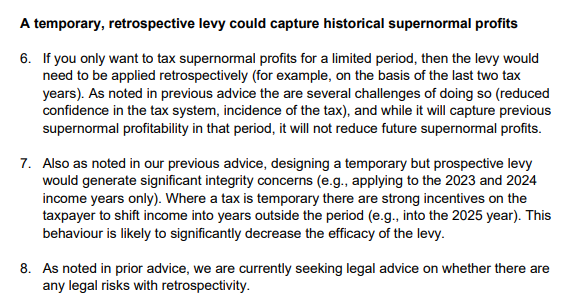
Despite Treasury’s recommendation in that 10 February paper, the Minister of Finance must have disagreed. The 17 February aide memoire ( 2 pages only) sets out briefly options that could be done for the Budget, then only three months away. They were retrospective and prospective levies. This was what they had to say about the former

There seems to be no sense that this would be something of a constitutional outrage. Sure, they say they were checking whether there were legal risks (perhaps anything in CER?), but as they and the Minister know Parliament in New Zealand is sovereign and the government easily has 61 votes for budget legislation.

This paper was for a meeting with the Minister on 20 February. The Minister was apparently undeterred.

The final paper in this suite is joint Treasury/IRD report of 10 March (also referring to “Project Cricket”). The introduction to that paper’s Executive Summary illustrates just how far off the rails the Minister was heading.

It was bad enough that the Minister was seriously considering a retrospective tax restricted to four foreign companies he didn’t like, in the face of official advice that there was no evidence of anything seriously akin to “windfall profits”, but now he was proposing such an arbitrary tax-grab specifically to help cover a cost pressure elsewhere in his budget which had nothing whatever to do with the four companies he wanted to tax or any of their activities. One hopes that privately officials were well and truly rolling their eyes by this point.

One might acknowledge that this advice – or perhaps another captain’s call from Hipkins – finally brought this work stream to a halt, but it simply wasn’t very good advice (at least based on what the government has chosen to release). Mightn’t one, for example, have expected some serious reference to a likely Australian reaction? Mightn’t one have expected some serious discussion of the precedent such an arbitrary tax might establish (actual or perceptions)? There is some reference to it – amid a weird sentence that talks about “the favourable position of New Zealand as an investment destination” – on what metric one might ask? – but it is all very muted. There is no discussion at all of the intellectual incoherence of picking on individual profitable firms ministers don’t like and not (say) responding symmetrically when unexpected sharp falls in profits happen (perhaps officials thought it not worth dignifying this nonsense on stilts?). There is no mention of the branches, or anything serious on the possible reduction in the availability of debt finance to New Zealand households and small and medium businesses (really big businesses can finance globally). We even find abstract comments, no doubt tantalising to the Minister, that “in theory, a one-off retrospective tax will not affect behaviour”. That sort of line might be fine from a traineee analyst fresh out of a basic university course, but this was serious budget advice from responsible Treasury and IRD officials

In what they published (perhaps it was in what was withheld, though there is no obvious reason to withhold_, there is also no reference at all to the New Zealand legislation guidelines, which state

Pretty sure the Minister not liking four particular foreign companies isn’t one of those “limited circumstances” in the final bullet.

What was proposed was an abomination, but – even though they didn’t favour what the Minister was hankering for – you get little sense of that in The Treasury/IRD advice. I’ve seen people responding “ah well, didn’t matter, as he didn’t go ahead”. Donald Trump didn’t go ahead with most of his mad, bad, or evil schemes either, but that is slim consolation. We should expect better from someone who has been New Zealand’s Minister of Finance for 5.5 years.

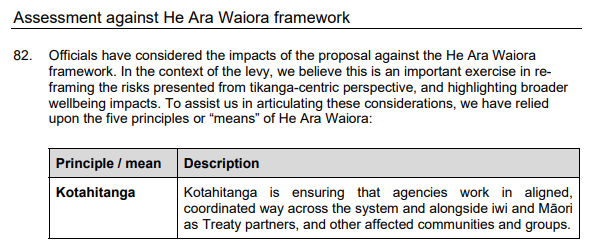
But at this point the advice gets a whole lot worse, losing all touch with reality and descending into some spirit world of officials’ imagining. I’m including the entire section

One wonders if officials are able to opt out of this nonsense on grounds that no one should be forced to practice someone else’s religion. Do other worldviews count? I guess not, at least if this advice is to be taken seriously.

Or which of “our Treaty partners” were consulted on this highly sensitive matter of tax policy, even in a not very material way?

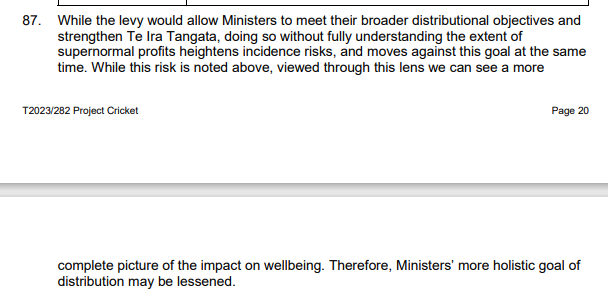
Or look at that footnote 87: a retrospective tax grab from four named foreign companies for purposes unrelated to anything to do with the activities of those companies would apparently “strengthen” “the human domain” (whatever that means). I suppose it would indeed have played to the “concept of power” – power in an arbitrary retrospective way, much more akin to an abusive act of attainder than anything. People would then have known the Minister (and his ministerial colleagues with him) as an unconstitutional thug.

In the end, Robertson didn’t proceed with his egregious scheme and for that small mercy we should be grateful. But we now know that ideas of such egregious grabs do play in his mind – not just an idle fancy, but weeks of work – and who knows when they might return, or which other company or individuals might then be in his sights. It wasn’t exactly Treasury at its best either.

UPDATE:

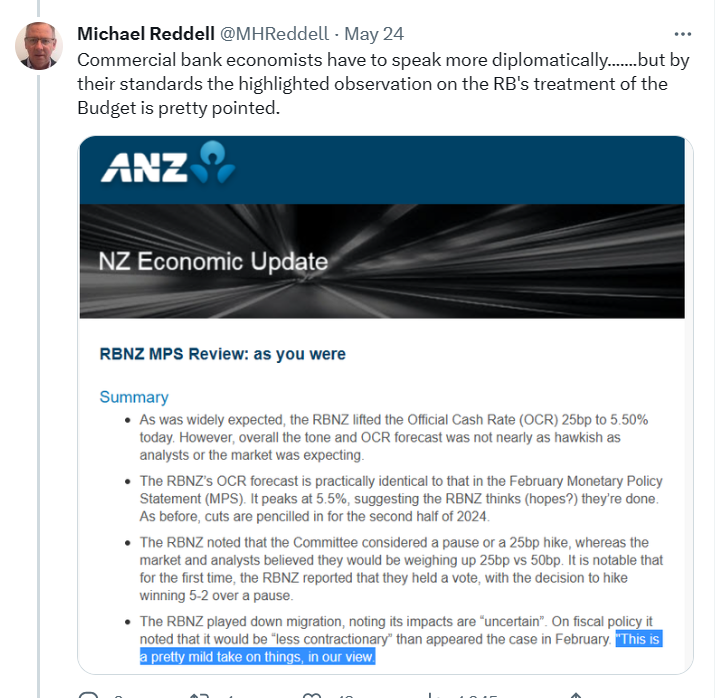
Meant to include this tweet

What risks should the state protect people from?

Later yesterday morning, before major international markets opened for the week, the US authorities announced two steps in response to the failure of SVB Bank

  • first, depositors not covered by the FDIC (amounts in excess of US$250000) would in fact be completely covered, with the costs to be covered by levies (taxes) on other US banks,
  • second, a new Fed lending facility was set up, backed by the US Treasury, under which banks could borrow at market rate against securities that for these purposes would be valued at face value not market value.   For most longer-term securities issued in the last decade, market value is currently less than face value.

Legislative changes after 2008/09 were supposed to make bailouts much harder and less likely, but at the first real test – in respect of one failed bank that was 16th largest in the US (and another a bit smaller still) – there were significant elements of a bailout anyway. In respect of a bank that mostly had large deposits (this wasn’t an entity where just a few people had a bit more than $250K on deposit), all depositors were made whole. Most of the commentary suggests that had the assets been liquidated and depositors and other creditors been paid out what was left they’d probably have got back more than 90 cents in the dollar, and the FDIC resolution procedures could readily have allowed those larger depositors access to some portion of their money upfront (this incidentally is/was similar in this respect to the way the Reserve Bank’s Open Bank Resolution model was envisaged as working). The precedent value of this action suggests that in future any depositors at even a moderate-sized US bank are likely to be made whole (“what do you mean you aren’t going to bail out depositors in a failed bank in my district when you bailed out those Silicon Valley tech companies?”)

The main focus of yesterday’s announcement seems to have been to snuff out the risk of further bank runs. Signalling to depositors that they won’t lose their money (no matter how large and otherwise sophisticated they are) is one way of doing that. Another is providing ready access to liquidity for other banks, to signal that such banks would have no problem paying any requests for accelerated withdrawals that did arise. It bears some resemblance to a classic lender of last resort (a function of central banks that few have too much problem with in principle), except that whereas Bagehot counselled that central banks should lend readily on good collateral at a high price, yesterday’s announcement really only met the first element of that test. Much of the collateral has a market value less than the valuation being used to secure these loans (that isn’t good collateral, even if the bond itself is issued by the US government), and the loans are simply at normal market prices. It is, in effect, subsidised lending by the state.

Perhaps some might be inclined to pardon less than ideal policy responses when things have to be done in a rush. And I’m sure the weekend was pretty fraught for many relevant officials and politicians. But the US is a big country with huge bureaucracies and ample time and resources to have robustly war-gamed how failures and potential failures of significant-sized institutions would and should be handled, including thinking hard about the lessons from such exercises for future incentives. If state insurance of all deposits made sense, it made sense a couple of years ago, not just today. But that wasn’t the model adopted. It is hard to believe that lending on collateral using face rather than market value, at normal market rates, would ever make a lot of sense (at least outside some deep and severe systemic crisis where wholesale securities markets had become deeply dysfunctional).

Various people point out that the moral hazard is not complete. After all, SVB’s management will have lost their jobs (but not presumably past salaries and bonuses), shareholders will have lost their money (but not past dividends), and other creditors including any bondholders will not be made whole. But the benefits of yesterday’s bailout will also flow to the management, shareholders, and other creditors of other banks with somewhat similar (albeit typically less extreme) business models. And if the quid pro quo for the heightened moral hazard is supposed to be heightened regulation and supervisory intensity, how much confidence should people really have in that given the evident failure of supervisors and regulators in this case? Perhaps exemplary bank regulation might act as an adequate counter, but in the real world of US banking/regulatory politics?

I’m not one of those opposed to all deposit insurance. Well before the current government decided to introduce deposit insurance to New Zealand I was arguing for it as a second-best response because absent a limited deposit insurance system it seemed all but certain that in a stress event for any major bank (and perhaps some less major ones) in New Zealand, all creditors would end up being bailed out, and no one would have paid the Crown anything for the insurance that was being provided. Even in conjunction with Open Bank Resolution as an option in the toolkit there is still a high risk of a full bailout of creditors of the larger banks – partly because of the pressure that will almost certainly come from the Australian government – and at the margins actions like yesterday’s from the US authorities only increase that likelihood. Perhaps in truth, our deposit insurance scheme will end up only ever being practically relevant should banks like TSB or Heartland be close to failure (in terms of relative size comparisons they are our SVB).

There are people who believe that it is practically desirable, or at least unproblematic, to provide full deposit insurance. My stance is much closer to that of Peter Conti-Brown (professor of financial regulation and author of a stimulating book on various Fed governance issues) than to the former chair of the US Council of Economic Advisers.

And I’m not uninfluenced by having observed, and been involved with, our own NZ retail deposit guarantee scheme in 2008 where once guarantees were in place money flooded towards entities (notably South Canterbury Finance) that offered slightly higher yields. It isn’t a perfect comparison, since prudential supervision of finance companies wasn’t a thing at the time, but it is a useful cautionary experience nonetheless. And my perspective on bank runs is that generally they happen too late and too rarely, rather than seeing them as typically some random or fundamentally unwarranted event. The threat of a run is an important element in market discipline.

But I guess my wider caution is around the question that is the title of this post? What economic risks should the state be offering full protection against?

I can see a reasonable case for retail transactions balances being protected, even guaranteed. In that vein of course, people can choose to use Reserve Bank banknotes. More seriously, one reason why I have always been inclined to favour allowing the general public access to individual Reserve Bank settlement accounts (in modern parlance a CBDC) is precisely to provide such a credit risk-free option (even as, as I noted in my CBDC submission, I do not believe there would be a great deal of demand for such a product). But even then, an overnight Reserve Bank deposit account for transactions purposes might be free of credit risk and market risk, but it is hardly free of inflation risk (any more than a commercial bank deposit).

But if you or I have half a million dollars on deposit with a bank (let alone if an investment fund has $10m or $100m), there is no obvious public interest in the state guaranteeing that you will never lose the nominal value of your deposit. No doubt it would be tough to be substantially hair cut if your bank happened to fail and the assets came well short of covering 100 cents in the dollar but (a) you did have choices (under the proposed NZ system protection will be limited to $100K, so you have a reasonable option of spreading your deposit across five banks and securing full protection), and (b) there are so many other economic risks in life against which the state provides at most limited protection (all while providing a basic welfare system where entitlement in case of need is near universal, in the case of age universal).

I’ve already mentioned inflation. Out of the blue, quite in breach of their published targets, central banks in the last couple of years have delivered a quite unexpected 10 per cent boost to the price level. That is pure windfall gain if you have borrowed money in a conventional nominal loan, and pure windfall loss (not likely to be, or able to be, recouped) to those holding conventional nominal financial assets. Sensibly enough in macro terms, we don’t have price level targets, so no effort will be made to reverse these transfers, but for many the losses are real. For someone with $500000 in the bank, the real loss of purchasing power might be similar to many retail bank failure haircuts. It has surprised me a little – and is useful data after decades of low stable inflation – that more is not made of this arbitrary state set of wealth transfers.

House prices are falling at present in much of New Zealand. For many people – those of us without mortgages, and with a natural position long one (and only one) house – it doesn’t make much difference to anything. But there are plenty of people for whom it does – whether the owners of investment properties, or those who borrowed heavily at the peak of the most recent boom. If you had bought a house in Wellington 2 years ago rather than now you are perhaps 20 per cent worse off for that choice. And there is no state compensation scheme.

Share prices- and market values of Kiwisaver accounts – go up and down and no one proposes compensation (even champions of a capital gains tax are rarely keen on full offsetting of losses, which itself would still only offer partial compensation).

We have a system of accident compensation in New Zealand. I generally support it. It pays income-related compensation for loss of earnings, but only partially (80 per cent) and only up to a threshold (maximum liable income about $130000 per annum). Beyond that even for those risks, you are on your own (albeit with private options). And for many disabling conditions the state provides no specific insurance or compensation at all beyond the basic welfare system (and the health system itself of course). EQC cover is also capped.

Same goes for human capital or the fortunes of particular towns/regions. Or the real economic costs of a failed marriage. Many of these potential economic losses run far beyond the plausible scale of what an individual might have exposure to in a bank failure. And yet while we often sympathise individually, and support having in place a welfare system for basic support, we don’t as a society collectively attempt to compensate individuals for such losses. For most of such losses, no modern state – no matter how socialist in its reach – has ever really attempted to. We have debates at the margin – eg the government’s preferred social insurance scheme – but relative to many of the potential losses such instruments don’t really go very far.

So I struggle to see a strong principled case for treating larger bank depositors more generously. Yes, sometimes bank failures can appear to come from the blue, but they rarely do. Diversification is usually an option (and typically much more readily than you can, say, diversify your human capital or housing or relationship exposures), and so is private insurance. I suspect that few would really disagree as a matter of principle, and much just comes down to “its easier not to let any depositor lose their money” and associated fear of (the minority of ill-founded) bank runs, or “it is too hard to envisage our politicians even being willing to let big banks fail at all”, and living with the third-best consequences of that resigned stance. It isn’t a good place to be – especially when the beneficiaries of these resigned third-best policies will often be among the wealthier parts of society – although even as we try to change the politics, or create better options, there is no point pretending the politics are other than as they are.

UPDATE: Meant to include a mention of the NZ government’s choice – incredibly, on the advice of both the RB and The Treasury – to bail out all policyholders in AMI when that insurer failed after the Christchurch earthquakes. Not only were there no risks of contagious runs – insurance just isn’t like banking – but even if you thought there was a case for bailing out the less-wealthy policyholders, how could it possibly have been a wise, or priority, use of public money to be bailing out people with insurance on a high-end house who, at worst with a severe haircut, might have had to lower their housing sights.

I mean, in this country – as no doubt most – you can be charged by the state for serious offences and a couple of years later acquitted, or wrongfully imprisoned for multiple years and still find it a major hurdle to get serious economic compensation. (To be clear, I do favour erring on the generous side when mistakes are made when the coercive powers of the state are exercised in such ways.)

Banks, housing lending, and fixing housing

In my post yesterday about the Reserve Bank’s FSR and the subsequent press conference conducted by the Deputy Governor I included this

The sprawling burble continued with questions about whether banks should lend more to things other than housing – one veteran journalist apparently being exercised that a large private bank had freely made choices that meant 69 per cent of its loan were for houses. Instead of simply pushing back and noting that how banks ran their businesses and which borrowers they lend to, for what purposes, was really a matter for them and their shareholders – subject, of course, to overall Reserve Bank capital requirements – we got handwringing about New Zealand savings choices etc etc, none of which – even if there were any analytical foundation to it – has anything to do with the Bank. 

Someone got in touch about the 69 per cent line and suggested that it must be a sign of something being wrong, going on to suggest that the Reserve Bank’s capital framework and associated risk weights was skewing lending away from agricultural and (in particular) business lending.

My summary response was as follows:

I guess where I would come close to your stance is to say that if we had a properly functioning land market producing price/income ratios across the country in the 3-4 range (as seen in much of the US, incl big fast-growing cities) then the share of ANZ’s loan book accounted for by housing lending would be much less than 69%, and in fact the total size of their balance sheet would be much smaller.  But my take on that is that the high share of housing loans is largely a reflection of central and local govt choices that drive land prices artificially high, and then we need financial intermediaries for (in effect) the old to lend to the young to enable houses to be bought.  The fault isn’t the ANZ’s and given the capital requirements in NZ there is little sign that the overall balance sheet is especially risky, and therefore should not be of particular interest to the RB (except perhaps in a diagnostic sense, understanding why balance sheets are as they are).  I’m (much) less persuaded that there is a problem with the (relative) risk weights, given that every comparative exercise suggests that our housing weights are among the very highest anywhere (and, in effect, rising further in October).

But to elaborate a bit (and shift the focus from one particular bank) across the depository corporations as a whole (banks and non-banks) loans for housing are about 62 per cent of total Private Sector Credit (and total loans to households are about 64 per cent). A large chunk of the balance sheets of our financial intermediaries are accounted made up of loans for housing.

The gist of my response was that that shouldn’t surprise us at all, given the insanity of the land use restrictions that central and local government impose on us, rendering artificially scarce – and expensive – something of which there is an abundance in New Zealand: land. If, from the perspective of the economy as a whole, relatively young people are buying houses from relatively old people (or from developers) the higher house/land prices are the more housing credit there needs to be on one side of banks’ collective balance sheets and – simultaneously – the more deposits on the other. If median house prices averaged (say) $300000 – as they do in much of the (richer) US – there would be a great deal less housing credit in total.

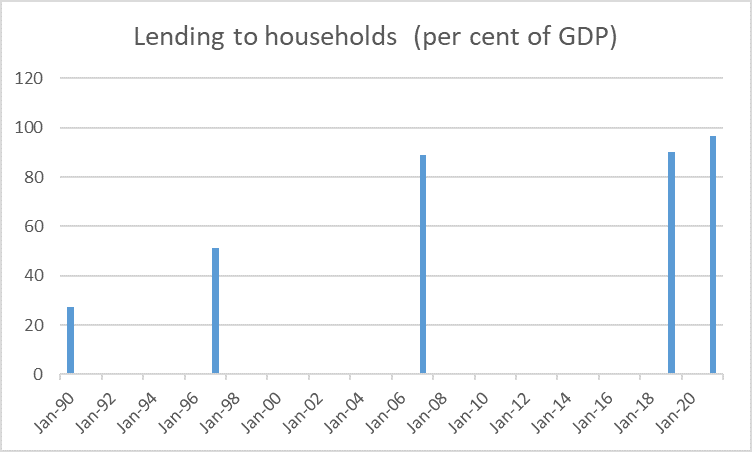
One other way to look at the stock of housing credit is to compare it to GDP – in effect, all the economic value-added in the entire country. Since the GDP series is quarterly and the credit data are monthly, I haven’t shown a full time series chart here. The data start from December 1990, and then only for an aggregate of housing+personal loans (but personal loans are small in New Zealand). So I’ve shown lending to households in Dec 1990, in mid-97 (roughly the peak of the business cycle), Dec 2007 and Dec 2019 (two more business cycle peaks), and March 21 (for which we have credit data, but only an estimate for GDP).

lending to households

There was a huge increase in the stock of lending, as a share of (annualised) GDP over the first 17 years of the series. What I’ve long found interesting is how little change there was over the following full business cycle (there were ups and downs in between the dates shown), and then we’ve had a bit of a step up in the last year or so (and even if house prices stay at this level, future turnover will tend to further increase housing debt expressed as a share of GDP).

Since real house prices have more than tripled since 1990 it is hardly surprising the stock of housing debt (share of GDP) has increased hugely. Were real house prices to, for example, halve then we might over time expect to see the stock of housing debt drift gradually back – it could take decades – towards say the 1997 sort of number.

Implicit in the journalist’s comment was a suggestion that lending to housing somehow limits how much lending banks do for other things. That generally will not be so. Banks (as a whole) are generally not funding-constrained – not only do loans create deposits (at a system level) but international funding markets are available (and used to be very heavily used, when NZ had large current account deficits). Of course, there is only so much capital devoted to New Zealand banking at any one time, but in normal circumstances capital flows towards opportunities.

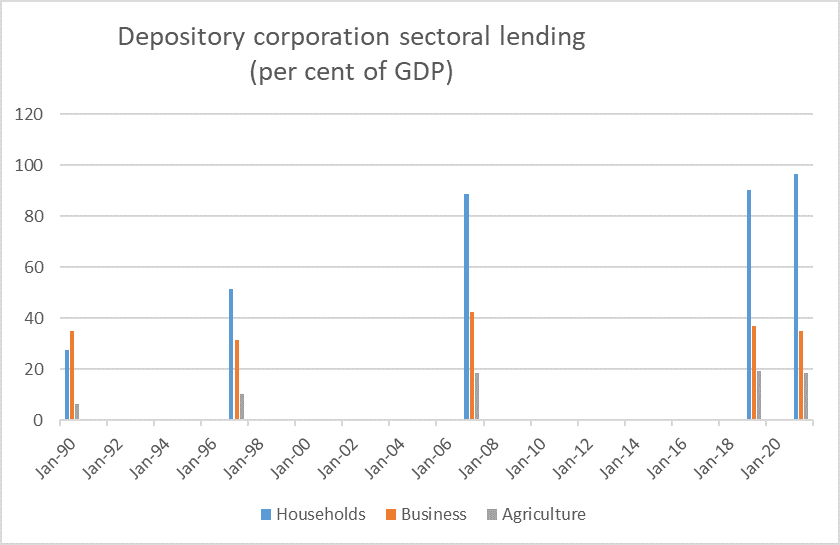
But what has the empirical record been? The Reserve Bank publishes data for business lending from banks/NBDTs (which isn’t all business borrowing by any means – between funding from parents and the corporate bond market) and for agricultural lending.

Here is how the full picture looks

sec lending

For what it is worth, intermediated lending to business in March was exactly the same as a share of GDP as it was in December 1990. For younger readers, December 1990 was just a couple of years into banks working through the massive corporate debt overhang that had built up in the few years immediately following liberalisation. Farm credit, of course, has increased very substantially – again particularly over the years leading up to 2007/08 with the wave of dairy conversions and higher land prices.

On the business side of things, it is worth bearing in mind that business lending (share of GDP) was consistently weak throughout the last business cycle. Some will argue that banks had some sort of structural bias against business but even if so (a) over that decade or so there was no growth in the stock of housing lending as a share of GDP, and (b) there is little compelling evidence that systematic and large unexploited profit opportunities were going begging over that decade. It seems more likely that the markets – including banks – financed the profitable opportunities that were around, but there just weren’t many of them.

So my story remains one that if central and local government were to free up land markets and house price to income ratios dropped back to, say, 3-4 then over time the stock of housing debt (share of GDP) would shrink, a lot. There are some stories on which much cheaper house prices generate fresh waves of business entrepreneurship etc with workers able to flock to those opportunities, but I don’t find those stories convincing in New Zealand (in the aggregate). But simply repressing the financial system some more – the agenda the Reserve Bank and the government have been pursuing for several years now – will not change those business opportunities one iota.

(This post hasn’t tried to deal with the riskiness of the housing loans. My take on that is really the same as the Reserve Bank’s – at least when it isn’t champing at the bit to intervene. Capital requirements (and actual ratios) are high – materially higher than they were – and they are calculated in a fairly conservative way, with risk weights on housing that are fairly high, including by international standards. For what it is worth, the ratings issued by the agencies seemed aligned with that interpretation. )

That we have such a large share of total credit for housing isn’t, prima facie, a banking system problem – banks will follow the opportunities that (in this case) bureaucratic distortions create, and our central bank has demanding capital standards and in APRA one of the better banking regulators around – but rather just another indicator of how warped our housing market has been allowed – by governments – to become. But we knew that already. In fact, governments knew it to, but they prefer to try to paper over cracks, hide behind ever more pervasive RB controls, rather than tackle the core issue.

On which note, a couple of months ago the Wellington magazine Capital asked if I would contribute an article on what might be done to fix the housing market, with a Wellington focus. I wasn’t really familiar with the magazine – having previously seen it only in hairdressers, takeaway outlets and the like, for readers to glance through while they wait – but I said yes, and looking through the edition I picked up this week it looks like a mix of fairly geeky material (eg a whole article on lead-rubber bearings) and the lifestyle stuff.

Since I didn’t give them my copyright, many readers are out of Wellington. and the issue with my article seems to have been on sale for a while now here is the piece I contributed.

Free up the land: unravelling the unnatural housing disaster

Michael Reddell[1]

April 2020

New Zealand house prices, even adjusted for inflation, have more than tripled over the last 30 years.  The persistent trend was unmistakeable even before the latest surges.   Million-dollar houses were once the rare exception in Wellington, but now are almost the norm in too many suburbs.  The Wellington region median house price is now perhaps 10 times median income, putting home ownership increasingly beyond the reach of an ever-larger share of those in their 20s and 30s.

Most of the talk is loosely about “house” prices but what has really skyrocketed is the price of land in and around our urban areas; whether land under existing dwellings, or potentially developable land.  And this in a country with so much land that all our urban areas cover only about 1 per cent of New Zealand.

It is scandalous, perhaps especially because it is an entirely human-made disaster.   Land isn’t scarce, and hasn’t become naturally much more scarce, even as the population has grown.  Instead, central and local governments together have put tight restrictions on land use.  They release land for housing only slowly and make it artificially scarce, not just in and around our bigger cities but often around quite small towns.   And if there is sometimes a tendency to suggest it is “just what happens”, citing absurdly expensive (but much bigger) cities such as Melbourne, San Francisco or Vancouver, nothing about what has gone on is inevitable or “natural”.   

The best way to see this is to look at the experience in the United States, where there are huge regions of the country – often including big and growing cities – where price to income ratios are consistently under 4.    Little Rock, for example, is the state capital of Arkansas. It has a growing metropolitan population of just under 900,000, and a median house price of about NZ$300,000 –  little changed, after allowing for inflation, over 40 years.    The US also helps illustrate why it is wrong to (as many do) blame low interest rates:  not only are interest rates the same in both San Francisco and Little Rock, but US longer-term real interest rates are typically a bit lower than those in New Zealand.  The same goes for tax arguments: they have much the same tax code in both the high-priced growing US cities as in (much) more affordable ones.  High real house prices are a policy choice;  not necessarily the desired outcome of central and local government politicians, but the inevitable outcome of the land use restrictions they choose to maintain.

Both central and local government politicians sometimes talk a good game about making housing more affordable, but neither group seems to have grasped that in almost any market aggressive competition among suppliers is what keeps prices low.   People sometimes suggest there isn’t enough competition among, for example, supermarkets or building products suppliers, but if we really want widely-affordable housing again in New Zealand what we need is landowners aggressively competing with each other to get their land brought into development.  And that has to mean an end to local councils deciding where they think development should happen, whether within the existing footprint of a city or on its periphery.    We need a presumptive right for owners to build, perhaps to two or three storeys, on any land (and, of course, councils need to continue to be able to charge for connecting to, for example, water and sewerage networks).   It could be done now.  That it isn’t tells us that councils are the problem not the solution.  Too many –  including in Wellington –  seems to think it is their role to use policy so that in future lots of people are living in townhouses and apartments, even as experience suggests that what most (but not all) New Zealanders want, for most of their lives, is a place with a backyard and garden.  And they seem to fail to understand that simply allowing a bit more urban density, perhaps in response to a build-up of population pressure, hasn’t been a path anywhere else to lowering house prices. Instead, such selective rezoning simply tends to underpin the price of those particular pieces of land. 

Sometimes people suggest that even if this sort of approach would be viable in Hamilton or Palmerston North, it isn’t in rugged Wellington.    But as anyone who has ever flown into or out of Wellington knows there is a huge amount of undeveloped land in greater Wellington.    And if the next best alternative use should be what determines the value of land that could be used for housing, much of the land around greater Wellington simply does not have a very high value in alternative uses (not much of it is prime dairying or horticulture land).  Unimproved land around greater Wellington should really be quite cheap, although the rugged terrain would still add cost to  developing it to the point of being ready to build.

Some worry about, for example, the possibility of increased emissions.  But once we have a well-functioning ETS the physical footprint of cities doesn’t change total emissions, just the carbon price consistent with the emissions cap.  And for those who worry about traffic congestion, congestion charging is a proven tool abroad, which should be adopted in Wellington (and Auckland).

I’m not championing any one style of living.  The mix between densely-packed townhouses and apartments on the one hand, and more traditional suburban homes on the other, shouldn’t be determined by the biases and preferences of politicians and officials but by the preferences of individuals and families, exposed to the true economic costs of those preferences.  Similarly, policymakers should respect the (changing) preferences of groups of existing landowners what development can, or cannot, occur on their land.

The behaviour of councils over many years reveals them as, in practice, the enemies of the sort of widely-affordable housing which the market would readily provide (as it does in much of the US).  If councils won’t free up the land, to facilitate the aggressive competition among land providers that would keep prices low, central government needs to act to take away the blocking power of local councillors.

And this need not be the work of decades.  Of course, it takes time to build more houses, but the biggest single element of the housing policy failure is land prices. Once the land use rules look as though will be freed up a lot, expectations about future land prices will adjust pretty quickly, and prices will start falling.   We could be the boutique capital city with widely-affordable housing.  The only real obstacles are those who hold office in central and (especially) local government.


[1] Michael Reddell was formerly a senior official at the Reserve Bank, and also worked at The Treasury and as New Zealand’s representative on the board of the International Monetary Fund. These days, in additional to being a semi-retired homemaker, he writes about economic policy and related issues at http://www.croakingcassandra.com

On the ANZ affair

I’m no great fan of David Hisco, perhaps even less of John Key, and hold no particular brief for the ANZ either. I don’t now, and never have, worked for commercial banks.   I’m an ANZ customer, although largely by inertia rather than enthusiastic loyalty –  I was a happy National Bank customer, uneasy about the ANZ takeover, but actually I’ve not had any bad experiences so never went to the effort of changing banks.   But even with all that, and a couple of days on from my initial one-paragraph comment, I’m still at a loss to understand (substantively) why the Hisco expenses issue is exciting so many people and generating so much coverage from so many (ok, yes I’m now adding to it).

As a reminder, the ANZ New Zealand operation is a subsidiary (there is a branch as well, but ignore that) of a large Australian bank that has been operating in New Zealand since 1840.   There aren’t many post-settlement entities that have been operating here continuously for longer than that (Anglican, Catholic, and Methodist churches, and ……?). In that time, ANZ hasn’t failed, hasn’t been bailed out by the Crown, and has provided bank services to New Zealand well enough to, these day, be the largest player in the New Zealand banking market.

As customers, I’d have thought the main two things we’d want from our banks were that (a) they didn’t lose our money (or through some TBTF mechanism get the government to bail them out, and (b) that they provided the transactions and recordkeeping services tolerably well enough.  People can moan about banks all they like, and it can be a hassle to change banks in the shorter-term, but here we are talking about a bank operating in New Zealand for 179 years and counting.   Plenty of banks and quasi-banks have come and gone from the market in that time, as customers (new generations thereof) have preferred one institution over another.    Even the fact that today’s ANZ has grown partly by takeovers (Rural Bank, Postbank, Countrywide, National Bank) doesn’t change that story very much –  the most recent of those takeovers was 15 years ago, and ANZ must have offered the best deal to the vendors (presumably believing they could add most value through the purchases).   People can badly misjudge takeovers but, decades on, ANZ is still here, strongly capitalised and profitable (it isn’t, for example, akin to RBS taking over ABN-AMRO at the end of a frenzied boom).

What else might bother people?  Well, there is always the issue as to whether banks are “excessively” profitable.  I suppose my instinctive bias here is that of an old-fashioned central banker, preferring a profitable bank to the alternative.  But even setting that to one side, I’ve always been rather sceptical of the “excessively profitable” story, partly because the balance sheets of the New Zealand subsidiaries don’t tell the full story: the profits are not just a return on balance sheet equity, but also on the implied support of the parent banks in Australia.  I’ve also tended to emphasise the relatively open regulatory regime we have here, allowing new entrants to set up and take advantage of any (allegedly) excess returns.  But even if there is less to those stories than I have allowed, the merits of such arguments –  which might argue for a more active Commerce Commission involvement –  really shouldn’t be materially affected by the question of a (now-departed) CEO’s expenses, legitimate or otherwise, properly documented and reported internally or not.

I also get that some people are bothered by the level of senior executive salaries.  To be honest, at times I’m inclined to share those concerns (at least a little), perhaps especially around people who are really only second-tier employees in big Australian banking groups.  But what of it?  It is a private business, in a market where customers have alternatives.  If I really don’t like the fact that ANZ remunerates its top managers so well, I could shift my banking to, say, TSB.  They won’t be paying their CEO and top management anything like as much as ANZ is.

And then, of course, there is a scale of this particular issue.  We are told that the amounts involved are mid tens of thousands of dollars, spread over 10 years, so perhaps $5000 a year.   In respect of a person whose total remuneration over that ten years probably averaged $2million a year.  It seems quite appropriate for the ANZ’s group chief executive to want to tidy things up, and to be uneasy about how these expenses may hav been reported internally (details of which the public haven’t been told), but why is it a matter of any public – or legitimate political –  concern.  It is a private company.   Perhaps some people might be puzzled as to quite why ANZ pushed Hisco out over what looks like quite a small matter –  the question has been asked, is there something more to it –  but again, it is a private company, and Hisco is well-equipped to look out for his own interests, including ensuring that he has had good legal advice etc.    Perhaps one might expect the Reserve Bank, as prudential regulator (and that is all), to ask the ANZ a few questions, to ensure that the expenses issue isn’t a cover for more serious problems on Hisco’s watch but assuming it isn’t –  an ANZ would be in serious trouble, including with the ASX, if they were misrepresenting that  – that is about all the legitimate regulatory/political interest I can see.

The story has been used by people on the left, including trade unions, to run a “a bank teller would never get away with it” sort of line. But even if that has some rhetorical force, it shouldn’t.  For better or worse, a bank teller –  one of thousands doing similar jobs, on standard contracts –  would simply not have found themselves in the sort of situation where there was ambiguity about what was acceptable, or what had been subject to an oral agreement.  And had they somehow done so, and been fired, they’d have had recourse to their union and to the protections of employment law.

In various articles in the last few days, I’ve seen references to the idea that the banks somehow owe New Zealand for its support (as if to justify public involvement in the Hisco-Key affair).  There have been silly references –  no doubt channelling flawed lines from our bombastic populist Governor –  that somehow the banks were bailed out by the governmment in 2008/09.  They simply weren’t.  There was no risk of any significant bank failing in New Zealand at that time, whether from the funding/liquidity side or from credit losses and insufficient capital.  It is certainly true that there were various Reserve Bank and government direct interventions during that period, but those interventions were not about “saving the banks”, as about limiting the potential damage to the economy that might have arisen otherwise (extremely risk-averse banks – in the middle of a global crisis – would have pulled in lending more aggressively etc).  And cutting the OCR was no “favour” – in downturns, market interest rates tend to fall, and the Reserve Bank’s hand on the OCR is really just meant to mimic that.   I don’t want to take this line too far –  there is some interdependence, and banks operate in a system governed by parameters the political system has set up (eg having our own currency etc) –  but the robustness of the banks in 2008/09 was a credit primarily to them, their owners/managers etc, not to the New Zealand authorities.

We’ve also heard people talking about about the case for a Royal Commission into something around banking, the call we heard last year in the context of the Australian Royal Commission.    And here there is the suggestion –  I saw it in the Herald this morning –  that somehow again the banks owe the Reserve Bank and the authorities, because the latter “went out on a limb”, or “stuck their necks out” to protect the banks.  That is simply rubbish.  Rather, the Governor of the Reserve Bank (and to a lesser extent the FMA) were playing a populist political card when they launched their inquiry last year  – in an area where, as even they acknowledged, they had no statutory powers.  After all the hullabaloo, they found basically nothing (not that surprising, given that different context in which banks operate here and in Australia, especially as regards superannuation), but it hasn’t stopped them using the issue to claim some sort of moral authority over these private banks, operating in markets where customers have choice.

But even if there had been something to the conduct/culture issues, surely those were supposed to be about public facing issues, things directly affecting customers.  Whether some small portion of David Hisco’s large expenses bill was questionable, seems –  to say it again –  like a matter for the Board and management of the ANZ, perhaps even for the staff (confidence in the integrity of your leader) but simply not a matter for government agencies at all.

I guess that among the sound and fury on this issue, there will be a range of interests and motivations.  Some will even be quite genuine and public spirited.  But it is hard not to read the coverage of the last few days and think that at least some people are playing distraction.  Banks are never likely to be that popular, perhaps especially not Australian ones (despite the fact that New Zealand benefits from having its bank part of bigger offsore groups) and they make a convenient scapegoat. Perhaps that is especially so when the old enemy of the left –  John Key –  is chair of the bank’s local board (as I’ve written here before, I happen to think it is unfortunate –  at best –  to have former politicians so quickly on such boards).    It shouldn’t have been a great week for the government –  what with the GJ Thompson affair, meningitis injections, and so on –  and it hasn’t been a great time for the Reserve Bank (all that pushback against their unsupported radical bank capital proposals) , and one is left   –  perhaps unduly cynically – thinking that in some quarters there will have been quite an interest in playing distraction by feeding a beat-up on the ANZ, for what really looks to be a rather small, albeit untidy, mostly internal affair.  For me, if they keep my money safe, do my transactions competently, and don’t rort others on any sort of systematic basis, I’ll be pretty content.

Throughout this note, I have stressed that bank customers have choices and alternatives.  Faced with overly powerful, weakly accountable, government agencies, citizens really don’t.     When Peter Hughes gives gushy speeches about Gabs Makhlouf –  the man he is supposedly investigating –  we are stuck with the clubby system.  When a Supreme Court judge thinks it is just fine to go on holiday with a senior lawyer in a case before the Supreme Court, we have few effective protections.  And when the Governor of the (monopoly) Reserve Bank never gives substantive speeches about things he is actually responsible for, plays fast and loose with the Official Information Act, claims he has no resources to properly oversee the bank capital system (internal models and all) that the Bank itself put in place, all while spending a million dollars on a Maori strategy (for a body with little or no public-facing role), devoting his time and professional energies to personal passions, be it climate change, infrastructure, or whatever, there is also nothing we can do about it.  The amounts involved –  money diverted from core functions (under budgetary pressure) to finance the Goveror’s personal causes and whims –  is probably already at least as much as the Hisco case over 10 years.  But we can’t change central banks, can’t dump our shares in the Reserve Bank.  Perhaps these issues (for some reason) excite fewer people, but when the abuses and slippages are by high government officials, they need to be taken much more seriously, precisely because exit isn’t (for us, citizens) an options.  The small(ish) stuff needs to be sweated.

On which note, I saw a piece on the ANZ affair by Auckland lawyer Catriona MacLennan, I very rarely agree with anything she writes, but her final paragraph did strike a nerve.

I have been on the board of a non-governmental organisation for three years. We are not paid a cent for our work, but I and the other board members would consider we had completely failed in our responsibilities if we let unauthorised expenditure go unchecked for nine years.

The Governor, the Bank’s Head of Financial Stability, and the (outgoing) chair of the Bank’s Board Audit Committee, might like to reflect on questions around unauthorised (operational) expenditure over at least as long a time.

Fit and proper?

Should Jenny Shipley be on the board (actually chairing it) of the local arm of China Construction Bank?   A question primarily, you might have thought, for the owners (CCB in China), perhaps taking account of the views and behaviour of the bank’s customers and investors.  I’d be pretty hesitant about putting my money in a bank (or any other company) that had as the Board chair someone against whom there was the sort of civil judgement that was delivered yesterday by the High Court in the Mainzeal case.  But I’m not, so I don’t really have a strong view on the matter.   And I might be as worried about having a former primary school teacher with no particular expertise in banking, and no reputation for being willing to ask awkward questions and follow through, as chair of the Board of any bank I had money in.

The Reserve Bank doesn’t have the luxury.

And here I’m going to rerun much of an old post on the matter of “fit and proper” rules.

Under Reserve Bank rules (outlined here):

no appointment of any director, chief executive officer, or executive who reports to, or is accountable directly to, the chief executive officer, may be made in respect of the registered bank, and no person may be appointed as chairperson of the board of the bank, unless the Reserve Bank has been supplied with a copy of the curriculum vitae of the proposed appointee and has advised that it has no objection to that appointment.

“Fit and proper” requirements are pretty common internationally.  But citizens should reasonably ask “to what end, and with what evidence that the requirements make a useful difference?”

The Reserve Bank’s prudential regulatory powers have to be used to promote the soundness and efficiency of the financial system (sec 68 of the Act).  The focus of the suitability (“fit and proper”) tests is presumably on the soundness limb of that provision.  Prior Reserve Bank “non-approval” must be expected to reduce the threat to the soundness of the financial system (not just the individual institution, but the system itself).  How might it do that?  The Reserve Bank says it focuses on integrity, skills and experience.

At the (deliberately absurd) extreme, if the Reserve Bank were blessed with the divine quality of omniscience, they could see into the soul of each potential appointee, and discern accurately how those individuals would respond to the sorts of threats, risks, shocks ,and opportunities they would face while serving with a New Zealand registered bank.  No one prone to deceive under stress, to breach internal risk limits, or to take “excessive” risk would get appointed.  That sort of insight would be very helpful.  But it isn’t on offer.

Instead, the Reserve Bank’s document suggests a backward-looking focus – checking out past appointments, past criminal convictions, and the like.  All of which is fine, but all of that information is known (or knowable) to those at registered bank concerned who are making the appointment.  And most of the stuff that is really interesting, and telling, is likely to be about character.  That isn’t knowable in advance, and certainly not by Reserve Bank officials.  What expertise do Bank economists and lawyers –  many very able people – have in second-guessing the judgement of the banks themselves in making such appointments?  And what incentive do they have to get it right?  The model looks like one that favours the appointment of grey colourless accountants and lawyers, who have not yet blotted their copybooks – perhaps never having taken any risk – with a bias against anyone who has learned banking, and what it is to lose shareholders’ money, the hard way.

Banking regulators worry about the risks to depositors and taxpayers if widespread or large banking failures occur.  But the first people to lose money as a result of mistakes, misjudgements, or worse are usually the shareholders in the bank concerned.  They might reasonably be assumed to have more at stake from bad appointments of directors or senior managers than central bank regulatory officials do.  New Zealand has in place pretty demanding bank capital requirements.

No doubt there will be people (and perhaps there already have been) who were employed by failed finance companies coming up for Reserve Bank approval in the next few years.  In some cases, those people will have had no responsibility for the failure, and in others there may have been some culpability.  But business failures happen, and they aren’t always a bad thing (indeed, unlike some systems, our banking regulatory system is explicitly designed not to avoid all failures).  Why is the Reserve Bank better placed than the registered bank concerned to reach a judgement on whether any previous involvement with a failed finance company should disqualify someone from a future senior position in a bank (or other regulated financial institution)?

In a similar vein, I wonder if the Reserve Bank has done a retrospective exercise and asked itself how likely it is that, with the information available at the time, it would have rejected any (or any reasonable number) of those responsible for the 1980s failures of the DFC and the BNZ.  Done in a suitably sceptical way, it would be an interesting exercise

I’m not suggesting there be no rules at all.  Perhaps conviction for an offence involving dishonesty in the previous [10] years should be an automatic basis for disqualification from such senior positions?  It wouldn’t be a perfect test, but it is certain and predictable, and probably better than a “we don’t like the cut of your jib” sort of discretionary judgement exercised by regulatory officials.  It doesn’t hold the false promise of regulators being able to sift out in advance people who might, in the wrong circumstances, later be partly responsible for a bank failure.

Perhaps too there might be a requirement that a summary CV for each director and key officer be shown on the registered bank’s website.  Those summary CVs might be required to list all previous employers or directorships.

But the current fit and proper tests seem to be an additional compliance cost, for no obvious public policy benefit.  It has the feel of something they feel the need to be seen to be doing, to be a “proper supervisor”, and get ticks in the right boxes when the next IMF FSAP comes through, rather than something where there is evidence that the rules have advanced financial system soundness in New Zealand.

Provisions of this sort cost money, both to banks to comply with and to taxpayers to administer the provisions, and impede business flexibility.  Individually, the amounts involved and the degrees of inconvenience, are probably not large, but the old line remains true “take care of the pennies and the pounds will take care of themselves”.     There should be a general presumption against regulatory burdens – particularly where they impinge directly on the lives and professional careers of individuals – and an onus on the regulators to show that their provisions are making a material net difference to worthwhile public policy objectives.

2019 here again:

I can’t see that the Reserve Bank will have any choice but to indicate to CCB that they would object to the contined presence of Jenny Shipley on the Board.    The Mainzeal case involved the failure of a substantial institution while Shipley was chair of that Board, and not because of some unforeseeable shocks out of the blue, but because of actions and choices that the Board had control over.  The record suggests, apparently, that Shipley had expressed some unease on the Board.  That’s good, but of little or no value to anyone if it changed nothing, and she then did nothing further.

Of course, there is almost no chance the local CCB is going to collapse –  any problems are much more likely to be group ones, over which the local board will have no control.  But rules are rules, and how could the Bank’s fit and proper regime have any residual credibility if Shipley remains chair of the New Zealand registered, Reserve Bank supervised, bank’s board?  And this isn’t a time for pleasantries.  Whether or not she stands aside voluntarily, or the owners remove her, the Reserve Bank should make clear that her continued presence on the Board (let alone chairing it) would not be acceptable to the Reserve Bank.

One could, of course, argue that no CCB New Zealand problems have become apparent on Shipley’s watch.  I presume that is true, but it is also irrelevant.  Since (see above) the regime has no way of knowing who will turn out to be a dud as a director, it can really only exercise condign discipline after the event.  And I don’t think there is really a case for waiting for any appeals either.  The judgement has been delivered.  Perhaps a higher court will interpret the law differently, but there seems to be less dispute about the facts than about the legal implications, and frankly whether or not the directors are finally held financially liable, if a fit and proper regime is to mean anything it has to mean holding people to a higher standard, as bank directors, than is evident in the record at Mainzeal.

As I say, it shouldn’t be a matter for the Reserve Bank.  There is so much high profile coverage of this case that no one can seriously claim to be unaware, and if Shipley’s presence bothered them, they can bank elsewhere.  If enough people are bothered enough, the self-interest of the owners will resolve the situation.  It shouldn’t be the Reserve Bank’s business,  but it is.    They need to be seen to act pretty quickly.

As for Shipley’s membership of the executive board of the China Council……surely that tawdry taxpayer-funded body that sticks up for Beijing at every turn, has Jian Yang on its advisory board, defends Huawei, and won’t stick up for Anne-Marie Brady is just the place for her?  Then again, if the government doesn’t want the last vestiges of any credibility its propaganda body still has to be in shreds, they should probably remove her too.  But that was probably so anyway after all those pro-Beijing words she gave to the People’s Daily in December.   Effective propaganda can’t be too overt.

Stress tests and bank capital

Just before Christmas the Reserve Bank released a consultative document on the Governor’s idiosyncratic proposal to increase required bank capital ratios to levels unknown anywhere else in the world.    I will have some fairly extensive commentary on aspects of that (unconvincing) document over the next few weeks, but today I wanted to focus in on stress tests –  something the Reserve Bank would prefer you paid little or no attention to in thinking about the appropriateness of their proposal.

Over the last decade or so, bank stress tests have come to play an important role in assessments of the soundness of banks, and banking systems, in many countries.   Devise a sufficiently demanding shock (or set of shocks) and then require banks to test their individual loan portfolios on those assumptions and see what losses would be thrown up.     Sometimes there has been a sense of the system being gamed – the shocks and associated assumptions deliberately set in such a way that banks the supervisors want to protect don’t emerge too badly.  There were suspicions of such issues in the US in 2009, and in the euro-area stress tests more recently (I heard a nice story about the clever way one set of tests were set up to minimise the adverse results for some Greek banks).    When you are in the middle of a crisis, that sort of thing is always a bit of risk: supervisors and their political masters have rather mixed motivations in those circumstances.

But there haven’t any credible suspicions of this sort of “rigging the game” in the stress tests conducted in New Zealand (and Australia) this decade.  That is no real surprise.  Our banking systems have appeared to be in good shape, and it wasn’t obvious that there was anything the supervisors and regulators would want to hide.  If anything, with both APRA and the RBNZ champing at the bit to interfere more in banks’ choices (especially around housing finance), the incentives ran the other way (if you could show more vulnerability, your case for intervention was stronger).  I was still at the Reserve Bank when the first results came in for the stress tests published in late 2014, and I vividly call a seminar in which various sceptics (me included) pushed and prodded, unconvinced that the results could possibly be as good as they appeared to be.  But, various iterations later, the broad picture of the results stood up to scrutiny.

There have been several stress test results published in the last few years (nota bene, however, that unlike the Bank of England, the Reserve Bank has not published results for individual banks.  The Bank of England approach should be adopted here –  publishing individual bank results should be a key component of disclosure and transparency.)  One of those was a dairy-specific stress test, about which I’m not going to say anything more  here (I had a few sceptical comments here).

The other two stress tests  are more useful in thinking about the overall soundness resilience of the banking system, in the face of severe adverse shocks.

The first set was published in late 2014.   This is how they described the main scenario

In scenario A, a sharp slowdown in economic growth in China triggers a severe double-dip recession. Real GDP declines by around 4 percent, and unemployment peaks at just over 13 percent. House prices decline by 40 percent nationally, with a more marked fall in Auckland. The agricultural sector is also impacted by a combination of a 40 percent fall in land prices and a 33 percent fall in commodity prices. The decline in commodity prices results in Fonterra payouts of just over $5 per kilogram of milk solids (kg/MS) throughout the scenario.

Auckland house prices were assumed to fall by 50 or 55 per cent (as large as the biggest falls seen anywhere).   In a 2015 commentary on these stress tests I pointed out just how demanding this stress test was, especially as regards the increase in the unemployment rate (around 8 percentage points).

My point is simply to highlight that the Reserve Bank’s stress tests were very stringent, using an increase in the unemployment rate larger than any seen in any floating exchange rate country in at least 30 years.  It is right that stress tests are stringent (the point is to test whether the system is robust to pretty extreme shocks)  but these ones certainly were.  And yet not a single one of big banks lost money in a single year.  That might seem a bit optimistic –  it did to me when I first saw the results –  but they are the Reserve Bank’s own numbers.

No bank lost money in a single year, and –  this is the Bank’s own chart –  none of them even had to raise any new capital (none would otherwise have fallen below minimum required capital ratios).

box-a-fig-a3-fsr-nov14

This should have been a bit of a problem for the Reserve Bank, as they published these results –  sold at the time as an indication of a sound and resilient system – just a few months before the then-Governor launched a new wave of LVR controls on housing lending.  I wrote various commentaries on this point back in 2015, and occasionally the Governor and his deputy seemed to squirm a little (one example here), but not ones to let rigorously done stress tests get in a way of a favoured intervention, they went on their merry way.   Ever since then, they’ve been trying to convince us that their interventions further reduced the risks associated with the New Zealand financial system.

In 2017, the results of another set of stress tests were published.     Here was how they described the main scenario in that set of stress tests.

The four largest New Zealand banks have recently completed the 2017 stress testing exercise, which featured two scenarios.1 In the first scenario, a sharp slowdown in New Zealand’s major trading partner economies triggered a downturn in the domestic economy. The scenario featured a 35 percent fall in house prices, a 40 percent fall in commercial and rural property prices, an 11 percent peak in the unemployment rate, and a Fonterra payout averaging $4.90 per kgMS. Banks were required to grow their lending book in line with prescribed assumptions, and also faced funding cost pressures associated with a temporary closure of offshore funding markets and a two notch reduction in their credit rating.

(By then, the unemployment rate was starting from a slightly lower level).

If this test was less demanding regarding the fall in house prices, it not only explicitly assumes huge losses in asset values across the full range of types of collateral banks take in their lending, but also imposed material increasses in funding costs (rather than allowing any such pressures to emerge endogenously), and required banks to keep on growing their lending through a savage recession (in which demand for credit is in any case likely to be very subdued).   If there are one or two areas where this stress test could have been made a bit more demanding, overall the test is likely to materially overstate the potential loan losses in an economic downturn of this sort, because large dairy losses and large housing/commercial losses are highly unlikely to occur at the same time.  In any serious adverse economic shock, both the OCR and the New Zealand exchange rate are likely to fall –  typically a long way.   A fall in the exchange rate acts as a huge buffer to the dairy payout, even if global dairy prices fall a long way in an international recession.   These are details –  perhaps important ones –  but they go to the point that overall the 2017 stress test was a pretty demanding one (which is what one wants –  there is no value in soft tests, especially in good times).

And again, no bank made losses, and no bank fell below the minimum capital requirements. Here is some of the Bank’s text.

Credit losses: Due to the deteriorating macroeconomic environment in the scenario, cumulative credit losses associated with defaulting loans were around 5.5 percent of gross loans. Losses were spread across most portfolios, with residential mortgages and farm lending together accounting for 50 percent of total losses. Credit losses reduced CET1 ratios by 600 basis points.

RWA growth: The key driver of RWA outcomes were (i) risk weights increasing in line with deterioration in the average credit quality of nondefaulted customers and (ii) the requirement that banks’ lending grows on average by 6 percent over the course of the scenario. RWA growth reduced CET1 ratios by approximately 160 basis points.

Underlying profit: The banking system’s net interest margin declined by approximately 50 basis points per annum in the scenario. Banks only gradually passed on higher funding costs to customers, reflecting a desire to maintain long-term customer relationships and that some customers are on fixed rates. Underlying profits remained sufficient to provide a substantial buffer of earnings that accumulate to around 550 basis points of additional capital for the average bank.

The banking system survived, quite comfortably, the very demanding test thrown at it, based on bank loan books as they stood in early 2017.  As the Bank goes on to note, the results are sensitive to the assumptions used, but the Reserve Bank had no incentive whatever to understate the potential scale of the losses –  after all, these stress test results were released when they already had their capital review project underway.

Of course, we had one more “stress test”; the actual events of 2008/09.   Going into that recession, the Reserve Bank had been becoming increasingly uneasy about bank balance sheets.  There had been several years of rapid growth in housing lending, but there had also been very rapid growth in commercial property and other business lending, and in farm lending, and a sense that not all of this lending had been done with anything like the discipline that might have been prudent.    The 2008/09 recession was pretty severe, and quite a bit of poor-quality lending was revealed (especially in the dairy sector).  And yet, of course, the banking system came through that shock substantially unscathed.   One could argue that the test really wasn’t that demanding, since asset prices didn’t stay down for long, but in a sense that was the point: even with a severe international recession, and lending standards that did seem to have become quite relaxed, we experienced nothing like the sort of asset price or unemployment adjustments that the stress tests assume.   Capital ratios then were lower than they are now –  the latter now regarded by the Bank as totally inadequate.    Really severe adverse events don’t arise out of the blue, they are typically a reflection (as in Ireland or Iceland) of severe misallocations and reckless lending in the years leading up to the reckoning.   This latter point is one that seems lost on the Reserve Bank.

You’d have thought the Reserve Bank couldn’t have it both ways.  Sure, the most recent stress test results are now two years old, but they’ve spent the last few years telling us that they are pretty comfortable with lending standards (especially after imposing their LVR controls).  What used to be a focus of particular concern –  Auckland housing –  has largely gone sideways since then, and overall credit growth has been pretty subdued.  There is no credible story they can tell (and they haven’t even tried) as to how robust balance sheets in 2017 are now such as to make it imperative –  using the coercive power of the state –  for banks to have much higher capital ratios again.

Stress tests do get a (brief) mention in the capital consultation document.  They acknowledge the results

64. Recent stress tests have found that the banking system can maintain significant capital buffers above current minimum requirements during a severe downturn. During the 2017 stress test, the capital ratios of major banks fell to around 125 basis points above minimum requirements, while earlier tests had a trough buffer ratio of around 200 basis points. However, stress test results are sensitive to assumptions on the scale and timing of credit losses, and on the ability of banks to generate underlying profit under stress.

To which one might reasonably respond with “well, sure, but that is the sort of things you are supposed to test”.

But where they get rather desperate is in the next paragraph.

stress test from consultative doc

And here we have come full circle, back to rather strained reliance on the US, Spain, and Ireland in the 2008/09 crisis.

This chart attempts to imply that there is something wrong with the stress test results, rather than drawing the more obvious conclusion that they say something good about the health of the New Zealand and Australian banking systems, and about the macro environments within which those systems are operating.

Take the first panel of experiences, those from the late 1980s and early 1990s.  All five countries had newly liberalised their financial systems.  Neither banks nor borrowers nor supervisors (to the extent that the latter even existed) new much about lending or borrowing in a market economy.  In New Zealand and Australia there was wild corporate exuberance.  And in the three countries where there were systemic banking crises, all that was compounded by fixed exchange rate regimes –  that misallocated resources during the boom phase and then compounded the adjustment difficulties in the bust.

And what of the second panel?   In both Spain and Ireland there was a fixed exchange rate (membership of a common currency, but it amounted to much the same thing for practical purposes), and in the United States there was a deeply government-distorted housing finance market.   None of those cases bear any resemblance whatever to the situation of the New Zealand economy (and banks) in 2019.   We haven’t had the reckless lending, and although a future severe recession will involve losses, there is no reason to think that the 2017 stress test results materially misrepresent the health of the system.  (As the Bank has noted in the past, research suggests that in most serious banking crisis it isn’t residential lending that is the problem, but corporate and property development lending. The Bank has also previously been on record highlighting the importance of the floating exchange rate in providing a buffer in severe shocks, but now they seem to wilfully downplay or ignore that.)

The consultative document is now out for….consultation (although I think few believe the Governor is serious about taking on board other perspectives, and being open to changing his view).    But a story out the other day suggests they aren’t content to wait calmly for submissions to come in, and that the Governor has returned to the fray already in a letter to a single media outlet

Orr was responding to a BusinessDesk story questioning whether the central bank’s proposed new capital requirements for the major banks amount to gold-plating.

(I’ve asked them for a copy of this letter –  clearly already in the public domain –  but even though the Official Information Act requires them to respond as soon as reasonably practicable, I’m still waiting).

And what does the Governor have to say?

Reserve Bank governor Adrian Orr says stress tests of banks have inherent limitations, suggesting they shouldn’t be relied on.

“We emphasise in our public articles that stress testing results should not be read at face value,” Orr says in a letter.

“Both the significant modelling uncertainties, and the fact that the banks know how/when the stress situation ends, limits the value of stress tests,” Orr says.

“Further, passing a stress test covering only dairy portfolios is not a meaningful indication of overall capital strength, given it is only approximately 10 percent of banks’ exposures.”

As Newsroom notes, the final point is simply irrelevant –  the Governor attempting to play distraction –  when as the Governor and anyone else interested knows the Bank has done economywide stress tests, across the entire loan books of the banks (see above).

And of course stress tests have inherent limitations.   That is one of the reasons to have as much transparency as possible about the tests so that users can evaluate for themselves just how demanding the Reserve Bank has been.   And while the Governor seems to want to imply that the limitation he highlights could understate the potential loan losses etc, there are alternative perspectives.  For example, knowing at the start of the stress test just how severe and lengthy the eventual shakeout (asset price falls, high and enduring unemployment) will prove to be may lead to more loans being called in earlier, perhaps at larger losses.    One thing we saw in the US in 2007/08 was that banks were able to raise fresh capital early on, at a time when few appreciated just how bad things were going to get.

I don’t, for example, recall anyone suggesting (for example) that the stress test results should result in a reduction in minimum capital ratios (despite the ample margins).  They are one input, but they should be something the Governor engages with a great deal more seriously, particularly when he proposes to go out on a limb and adopt capital requirements out of step with those anywhere else in the world.   And if he wants to run these arguments, it might be better form to do so in the published consultative document, than in knee-jerk responses to individual people casting doubt on his preferred option.  I can think of one or two half-decent counter arguments –  and I’ll come back to them in a later post –  but they aren’t ones the Bank has ever advanced.

Reality is that in thinking about the consultative document, on the one hand we have detailed and specific results from repeated stress tests (and the aftermath of a period of rapid lending growth and loose lending standards not many years ago), using the specifics of banks’ loan books as they stand.   A stake in the ground as it were.   And on the other hand, we have numbers that –  despite pages and pages of the document –  are really just plucked out of the air –  both the proposed requirements themselves, and the economic and financial consequences if those whims eventually form policy.

But more on some of those issues over the next few weeks.


The tree god again

Some months ago the Governor of the Reserve Bank inaugurated his audacious bid to have his institution –  seen by most as a official agency created by, and accountable to, Parliament –  seen as some sort of local pagan tree god, with him (I assume) as the high priest in the cult of Tane Mahuta.  We’ve been told, by the Governor, that a people –  New Zealanders –  walked in economic darkness until finally the light dawned with the creation of the Reserve Bank.  It is pretty absurd stuff, not even backed by decent history or analysis, and one might be inclined just to ignore it, but the Governor seems serious.  In particular, he keeps returning to his claim. In fact, he was at it again –  claiming the mantle of Tane Mahuta –  yesterday with another little release that poses more questions than it offers answers (and which presumably means we’ll end the year still with no substantive speech from the Governor on anything he actually has statutory responsibility for).

Readers might recall that there was a damning report on the Reserve Bank as financial regulator, drawing on survey results of regulated institutions, released in April by the New Zealand Initiative.    This chart summed it up quite well

partridge 1

It has, presumably, been a priority for the Governor to improve the situation.   After all, even the Bank’s Board –  always reluctant to ever suggest any weaknesses at the Bank, even though their sole role is monitoring and accountability –  was moved to comment on this report, and the issues it raises, in their Annual Report this year.

And thus the Governor begins

In a step toward achieving the best “regulator-regulated” relationships possible, the Reserve Bank (Te Pūtea Matua) has established a Relationship Charter for working effectively with banks. The Charter will also be discussed with insurers and non-bank deposit takers in the near future.

One might question just how “best” is to be defined here –  after all, the public interest is not the same as that of either the Reserve Bank or of the banks, and there have been many examples globally of all too-comfortable relationships between regulators and the regulated.

But it was the next paragraph that started to get interesting.

Reserve Bank Governor Adrian Orr said the Relationship Charter commits the Bank and the financial sector to a mutual understanding of appropriate conduct and culture. “This is underpinned by the principle ‘te hunga tiaki’, the combined stewardship of an efficient system for the benefit of all,” Mr Orr said.

I’m not sure that understanding is necesssarily advanced when an institution operating in English introduces little-known phrases from another language to their press releases.  Here is how Te Ara explains “te hunga tiaki”

Te hunga tiaki

The Te Arawa tribes use the term ‘te hunga tiaki’ instead of kaitiaki, explains Huhana Mihinui.

The prefix ‘hunga’ is more common than ‘kai’ amongst Te Arawa, hence te hunga tiaki rather than kaitiaki. The essence of hunga is a group with common purpose. Hunga may also link with the sense of communal responsibilities. The same meaning is not conveyed with ‘kai’ … te hunga tiaki likewise invokes ideas of obligations to offer hospitality, but also to manage and protect, with the implicit recognition of the group’s mana whenua [customary authority over a traditional territory] role in this respect. 1

Which sounds pretty problematic frankly.  Banks and the Reserve Bank do not have a common purpose or a common set of responsibilities.  The Reserve Bank has legal responsibilities to the people of New Zealand, and the banks have legal responsibilities to their shareholders.  The two won’t always be inconsistent, but at times they will and there is little gained (and some things risked) from trying to pretend otherwise.  In both cases –  but particularly in that of the Reserve Bank –  there are limits on the ability of the principals (citizens and shareholders) to ensure that the boards and/or managers are actually operating according to those responsibilities.   Shareholders can sell.  Citizens are stuck with the Governor.

The statement goes on

“Writing it was the easy part. Operating consistently with the conduct principles is the challenge. We will regularly mutually review behaviours with the industry. Appropriate conduct is critical to the trust and wellbeing of New Zealand’s financial system, and the Reserve Bank – the ‘Tane Mahuta’ of the financial garden,” Mr Orr said. 

It is the tree god again –  a tree god that has some considerable way to go in improving its own conduct, be it around attempting to silence critics or whatever.

But this is also where I started to get puzzled.   In both those last two paragraphs from the statement, there is a suggestion that this document is some sort of agreed position between the banks and the Reserve Bank.   It is there in the charter document itself –  a one pager, complete with cartoonish tree god characters.

RBNZ-Relationships-Charter

(What I didn’t see was, for example, “we will avoid abusing our office and putting pressure on regulated bank CEOs to silence their economists when those economists write things we don’t like”.)

The word “mutual” is there twice, clearly suggesting that the banks have signed on to this.

But, if so, isn’t it a little strange that there are no quotes from any bankers, or the Bankers’ Association, in the press release, just the Governor’s own spin?   And when I checked the Bankers’ Association website, there was no statement from them. In fact, I checked the websites of all the big four banks and there was not a comment or statement from any of them.   Frankly, it doesn’t seem very “mutual”.   It looks a lot like gubernatorial spin.

And, to be frank, I don’t really see any good reason why there should be such mutual commitments.   Regulated entities don’t owe anything to the regulators.  They may often be intimidated by them, (privately) derisive of them, or even respect them.  But the regulated entities are just private bodies trying to go about their business in a competitive market.  By contrast, the Reserve Bank  –  the Governor personally –  carries a great deal of power over those entities, and they have few formal remedies against the abuse of that power.   What might reasonably be expected is unilateral commitments by the Governor as to how his organisations will operate in its dealings with regulated entities, standards (ideally measurable ones) that they and we can use to hold the regulator to account.      But that is different from what purports to be on offer in yesterday’s statement.

Of the brief specifics in the list of commitments, I don’t have too much to say.  There is a big element of “motherhood and apple pie” to them, and a few notable elements missing.  There is nothing about analytical rigour, nothing about transparency, nothing about remembering that the Bank’s responsibility is primarily to the New Zealand public, nothing about maintaining appropriate distance between the regulator and the regulated.  But I guess those would have been inconsistent with the fallacious claims about all being in it together and working for common goals.

It is at about this point that the Bank’s press release changes tone quite noticeably (not quite sure what happened to “one organisation, one message, one tone”).   Deputy Governor Geoff Bascand takes over and claims

Deputy Governor Geoff Bascand said the Reserve Bank’s recent announcement of a consultation with banks about the appropriate level of bank capital highlights the usefulness of the Relationship Charter.

And even in that one sentence he captures some of the mindset risks.  As I read the announcement the other day, it was a public consultation about the appropriate level of bank capital, and yet the Deputy Governor presents it as a “consultation with banks”.  If the Bank is going to run with this “Relationship Charter” notion, perhaps they could consider one for their relationship with the only people who give them legitimacy, Parliament and the public (having said that, perhaps I should be careful what I wish for).

And then weirdly –  in a press release supposed to highlight a new era of comity, open-mindedness etc –  the Deputy Governor launches into an argumentative spiel about the proposed new capital requirements.

“There is a natural conflict of interest. Banks will want to hold lower levels of capital to maximise returns for their shareholders. However, customers and society wear the full economic and social cost of a bank failure. We represent society’s interests and will naturally insist on higher capital holdings than any one individual shareholder,” Mr Bascand said.

Strange use of the phrase “conflict of interest”, which usually relates to a person or an organisation having two competing loyalties (perhaps personal and institutional), but even if one sets that point to one side for now, the rest is all rather one-dimensional and not terribly compelling.  He seems unaware, for example, that banks often hold capital well above regulatory minima –  creditors and rating agencies have perspectives too –  or that in most industries firms happily determine their own levels of capital, and somehow society manages (and prospers).  And, of course, there is not an iota of recognition of the way in which bureaucrats all too often serve bureaucratic interests (rather than societal ones), of the distinction between loan losses and bank failures, or of how the interventions of official and ministers often create the problems in the first place.

And then there is the final paragraph

“Following our Relationship Charter, we long signalled the purpose of our work and shared our analysis and consultation timetable. We have also committed significant time to engage with banks and provide a sensible transition period to make any changes we decide on. The Charter means what we are looking to achieve can be discussed professionally, while we continue to build appropriate working relationships. Outcomes will be superior and better understood and owned by society,” Mr Bascand said.

Of course, for example, whether the proposed transition period is “sensible” is itself a matter for consultation (one would hope –  and not just with banks).  Given the high probability of a recession in the next five years –  and the limited firepower here and abroad to deal with a severe recession –  some might reasonably wonder at just how wise it would be to compel big increases in capital ratios over that five year period, at a time when the Bank’s own analysis repeatedly suggests the banks are sound with current capital levels.   Credit availability might well be more than usually constrained.

One might go on to note that the level of disclosure in the consultative document is seriously inadequate for such a substantial intervention –  one that would take New Zealand further away from the international mainstream not closer to it.   As I noted in a post a few days ago, back in 2012 the Bank published a fuller cost-benefit analysis of the sorts of capital requirements that were then in place.  There is nothing similar in the consultative document issued last week, not even (I gather) any engagement with the previous cost-benefit analysis.  Given the amounts of money involved, that is simply unacceptable.  I’ve lodged an Official Information Act request for the (any) modelling and analysis they’ve done, but I (and others) shouldn’t have needed to; it should have been released as a matter of course.  In fact, even better they should have published a series of technical background papers over the year, held discussions with a range of interested parties (not just banks) before coming to the decisions they chose to formally consult on.      That is what good regulatory process might have looked like.

And then there is that bold final claim

Outcomes will be superior and better understood and owned by society

I’m all for effective and professional relationships between the Reserve Bank and the banks it regulates.  Perhaps that may even lead to better policy outcomes, but there is no guaranteee of that (after all, at the end of it all the law allows the Governor to make policy pretty much on a personal whim –  which is a lot like what the proposed higher capital ratios feel like).  But quite how a better relationship between the Reserve Bank and the banks will make outcomes “better understood and owned by society” is a complete mystery to me.   There are plenty of examples of regulators and the regulated ganging up against the public interest, and others of the regulators ramming through changes that might –  or might not –  be in society’s interest.  There is simply no easy mapping from a better relationship between the Bank and the banks, and good outcomes for society, let alone ones that –  whatever it means –  are “owned by society”.   Good outcomes rely heavily on very good and searching analysis.  And nothing in the Charter commits the Bank to that.

When one reads the argumentative second half of the press release it is little wonder the banks themselves wanted nothing to do with the statement.   I guess there isn’t much chance of the banks and the Reserve Bank getting too close to each other in the coming months as they (and the bank parents and APRA no doubt too) fight over the billions of additional capital Adrian Orr thinks they should have.

Meanwhile, the Governor can play at tree gods.  But it would be much better for everyone, including most notably citizens, if he were to engage openly and (in particular) more substantively on the issues he has legal responsibility for.   Cartoons and glib statements don’t build confidence where it counts.