Safer banks = poorer society?

The Reserve Bank Deputy Governor’s speech yesterday was released under the title Safer banks for greater wellbeing, while the handout at the venue went even further and was headed (in a very big font indeed) Safer banks = safer society.    Count me sceptical.

It was a disaappointing speech.  Plenty of people turned up to the university at lunchtime, including such eminent figures as the Governor and the former Deputy Governor (Grant Spencer), but we were treated to something not much more than the ECON101 case for huge increases in bank capital requirements.  Geoff Bascand’s speeches have typically been the most thoughtful and considered of those given by Reserve Bank senior management.  This latest effort didn’t reach that standard.  Instead we had alarmist rhetoric about history, key charts deployed for support rather than illumination, and no attempt to dig deeper and use whatever that digging might throw up to shed light on the case the Bank is making (in a cause in which it is prosecutor, judge, and jury in its own case).

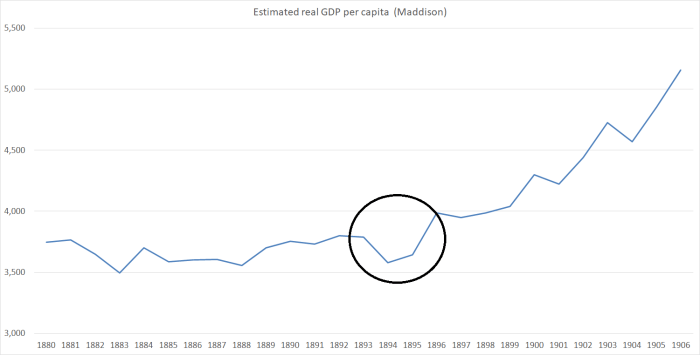
History first.  As Bascand noted, New Zealand hasn’t had much history with systemic financial crises (although there is an interesting article here on the two episodes we have had).  The first was in the 1890s, culminating in the bailout (and partial nationalisation) of the BNZ in 1894 (and the fiscal cost of that bailout (per cent of GDP) was a bit larger than in the more recent BNZ bailouts).  Bascand really only notes this episode in passing but here is the chart of (estimated) GDP per capita during that period.
BNZ 1890s

It was certainly a nasty recession –  in an era when economies were more volatile than they are now –  but it didn’t last long, and even if you attributed all the lost output to the financial crisis itself (and none to the misallocation of resources and bad lending that led to the banking problems) you only end up with total lost output of around 10 per cent of GDP.   And that in a regime in which the exchange rate was fixed and New Zealand had no discretionary control of interest rates.   (The 1890s crisis in Australia would have provided much stronger superficial support for Bascand’s argument, but with the same attribution issues.)

The more recent episode was involved two recapitalisations of the BNZ (and the failure of DFC, the travails of NZI Bank etc) in the late 1980s and early 1990s.  Bascand notes that he lived through this period as a Treasury official and goes on to say

If you ask someone who’s lived through a banking crisis, they’ll likely tell you that the impacts were not only significant, but lasting. Perhaps the person you talk to may have lost their job as a result of the crisis, and if not, it might have been their spouse, a friend, or a neighbour. Maybe you speak to a young couple that had purchased their first home just prior to the crisis, only to see its value decline by 30% in the months following the crisis, forever altering their outlook on the economy and their willingness to make another significant investment. Or maybe you speak to someone who just graduated from university prior to the crisis, only to enter a depressed labour market, and forced to accept work well below their educational qualifications and abilities, forever altering their desired career path.

Talk to these people, and I think they will tell you that banking crises have altered their lives in ways they wished it hadn’t. I think they will also tell you that banking crises should not be accepted as an unavoidable fact of life.

For those that lived through the recession we experienced here in the early 1990s, you will recall that some industries were decimated, and a generation of workers lost. Many of these workers were not able to re-enter the workforce easily and lost valuable skills while trying to find suitable employment. And while recessions sometimes occur in the absence of a banking crisis, it is common for banking crises to ultimately result in recessions.

Actually, most recessions (not just “sometimes”) don’t involve banking crises, and it is asserting that which needs to be proved to suggest that banking crises “result in” recessions.  Yes, banking crises often happen at the same time as recessions.    Initial waves of bad lending, over-optimism, and misallocated lending often contribute to both the economic downturn and to the banking sector problems.   Big increases in capital ratios from already high levels won’t change any of that.  Quite possibly any disruptions to the intermediation process associated with banking failures (or near failures) exacerbate the economic downturn, or slow the subsequent recovery,  but the Bank cites no studies (and I’ve not seen any) that attempt to separate out those effects.  Implicit in a lot of this is handwaving around the poor global economic performance in the last decade, when countries that haven’t had financial crises have (on average) not performed much better than those that have.

And, of course, in the New Zealand in the early 1990s there was a great deal else going on.   Although he doesn’t do so in the text, in his address Bascand did acknowledge that point, but simply acknowledging the point in passing –  while talking at the same time of 11 per cent unemployment – isn’t really enough.    We had the combined effect of:

  • disinflation (getting inflation down from 10-15 per cent to something in the 0-2 per cent range),
  • significant fiscal adjustment (recall the large deficits at the end of the Muldoon term),
  • far-reaching structural reforms in the New Zealand public sector, including the new SOEs, that involved laying off lots of workers,
  • significant reductions in trade protection,
  • and the after-effects of an asset price and commercial property boom, with considerable misallocated resources (all of which had occurred fresh out of liberalisation, when neither borrowers nor lenders –  let alone regulators – really knew what they were doing, what the relevant parameters and possibilities of the new market economy might have been.  In the aftermath, whatever happened to the supply of credit, there wasn’t much demand for it either.

So I’m quite happy to believe that the banking crisis itself may have had some economic costs, but if the Bank wants to argue that they were more than a small fraction of overall costs of that period the onus is surely on them to produce the research in support.  As it is, (and despite paying little attention at the time to potential financial intermediation channels) the Reserve Bank’s forecasters were surprised by the speed of the economic recovery from the 1991 recession.  But I guess it is easier to simply fling round emotion-laden rhetoric about mental health etc.

And even narrowing things down to the BNZ problems, it is worth keeping that episode in perspective.  The paper I linked to earlier records that the recapitalisation of the BNZ cost around 1 per cent of GDP.  Better never to have had to do it, but that is pretty small by the standards of serious systemic banking crises (and, as I understand it, the direct outlay was fully recouped later).  Perhaps relevantly to this debate, I was tempted to ask Bascand yesterday if he had any idea what risk-weighted capital ratio the BNZ would have had in the late 80s.    Hard to estimate without someone doing some very detailed research, but I talked to someone else who was around at the time who estimates that at present (before the latest Reserve Bank proposals) the BNZ would be at least twice, possibly three times, better capitalised now than it was then.  But of course you get none of this flavour from Bascand’s speech, or from any of the Reserve Bank documents published in recent months.

The Bank’s stress tests didn’t get a mention in the speech but a questioner asked about them.    Bascand attempts to parry the question noting that they were “slightly artificial constructs” (sure, and so are any analytical techniques) but offered, without further prompting, that they certainly suggested “pretty resilient banks”.  Nothing was offered in elaboration as to why, if severe stress tests show that banks not only don’t fail they don’t even fall below existing minimum capital ratios, regulators should be so insistent on such large further increases in the required capital ratios.  I guess it is a bit awkward for them, and silence is easier than explanation?   (Incidentally, the same questioner asked if much higher capital ratios would have some quid pro quo in lower supervisory intensity, but Bascand declared that not only would capital ratios be increased but that the Bank will increase its supervisory intensity.)

One of the areas the Bank has been pushed on is how their proposals compare to what is being done in other advanced countries,  They’ve still given no satisfactory answers, not even something as (apparently) simple as an indication of the all-up expected capital ratios (core equity and total) APRA will expect for the Australian banking groups.  An apparently knowledgeable commentator here has suggested that the total capital requirements are likely to be similar, but that the Reserve Bank is insisting on a much larger share of that being made up of (expensive) common equity.    If true, that would be useful context for evaluating the Bank’s proposals.  It is the sort of information they should have presented when the proposal was first released, more than two months ago now.

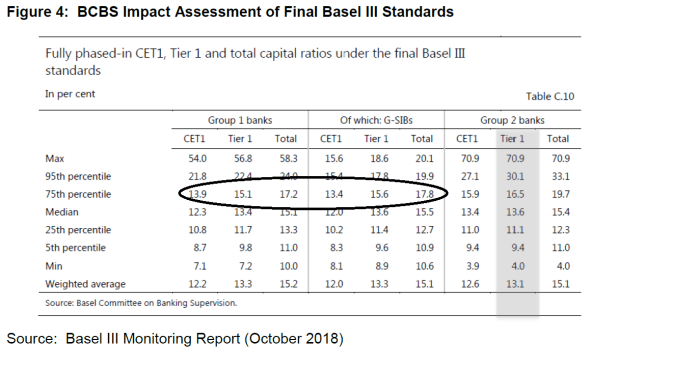
In the speech itself, Bascand included a couple of charts/tables intended to support his view.   The first was this one (I’ve added the circling), included in the speech with no elaborating comment at all.
bascand table

The table is taken from a 180 page paper, and is supposed to represent an estimate of where banks in other countries will get to when the Basle III standards are fully phased in.  It isn’t clear –  from the speech or from skimming through the 180 pages, although I presume there is a simple answer –  whether these numbers are minimum required capital ratios or forecast actual capital ratios.

I’ve highlighted the numbers for the 75th percentile for the Group 1 banks (which includes the Australian parent banks) and the globally systemically significant (GSIB) subset of those.    The Reserve Bank’s current proposals will require the four largest New Zealand banks to have minimum capital ratios of 16 per cent of risk-weighted assets.  Actual capital ratios –  and it is actual capital ratios that provide the buffer not minima –  will be higher again.   These are higher than the 75 percentile for the world’s biggest and most problematic (if anything goes wrong) banks.  The G-SIB banks are typically complex, and cross multiple national boundaries, and there is no clear or robust idea how any potential failure will be resolved.   On any sensible framework you would suppose that minimum capital requirements for such banks would be materially higher than those for vanilla retail banks operating in a single country, with large and strong parents.  But not, it seems, to the Reserve Bank of New Zealand.

And, as it happens, this table doesn’t help us with one of the biggest differences between the way New Zealand capital ratios have been calculated and those in many European countries (in particular).    The minimum risk weights here are generally accepted to be materially higher than those applied in many other advanced countries.  Using the same sorts of risk weights used in many other countries, the capital ratios of our banks would appear quite a bit higher.

How much higher?   Well, a couple of papers the Reserve Bank itself released (here and here) commenting on some PWC analysis shed light on that.    Take the Australian situation first.  PWC did some work there which concluded that Australian risk-weighted capital ratios were understated by 4 percentage points.  APRA didn’t agree.  They did their own study and concluded that the difference was “more like 3 percentage points”.  That is stilll a big difference.  PWC’s work on New Zealand concluded that the difference here was more like 6 percentage points.  The Reserve Bank  didn’t do its own study, but the internal note they did do concluded

….even after correcting for these biases, there may well continue to be a degree of reported conservatism, such that while we do not have much confidence in the 600 basis point figure they reach, we would accept the overall assessment that we are likely to be more conservative than many of our peers;

Since minimum risk-weights imposed by the Reserve Bank were typically higher than those imposed by APRA, it would seem unlikely that the difference here is less than the 3 percentage points APRA accepted in their study.

And much of this carries over to the new Reserve Bank capital proposals.  Among its plans, the Bank is proposing to use a floor such that the big banks (using their internal models) cannot have capital ratios less than 90 per cent of what would be generated if the standardised approach (applying to other banks) were applied to their portfolios.  That is one of the changes that looks broadly sensible to me.  But apparently most other advanced countries are planning to use a floor of 72 per cent.   All else equal, a 16 per cent capital ratio calculated on Reserve Bank rules could easily be equivalent to something like 19 per cent in many other countries’ systems.   And not even the 95th percentile of G-SIB banks will –  according to the BCBS table –  have a Tier 1 capital ratio of 19 per cent.

I quite accept the Deputy Governor’s point that doing international comparisons well is hard.    But the Reserve Bank has a lot more resources, including membership of international networks of regulatory agencies, than most people reacting to their proposals.  And yet they’ve made little or no effort to engage in robust, open, benchmarking against what other countries are doing –  not even Australia, when resolution of any problems in the big 4 banks will inevitably be a trans-Tasman affair.

The Deputy Governor then included another chart, with not much more comment

bascand 2

It certainly looks helpful to the Reserve Bank’s case, suggesting that current capital ratios (calculated this way) for big New Zealand banks are currently low by international standards and would still be not-high if the new proposals were applied (the Bank assumes quite a small margin of actual capital over minimum required – for reasons that have some plausibility).

But one needs to dig behind this chart and see what is going on.  The rating agency S&P engages in its own attempt to calculate risk-weighted capital ratios for a large number of banks, using its own risk-weighting framework.   But a great deal depends on the “economic country risk score” the S&P analysts assign.    And they take a dim view of New Zealand, assigning us a score of 4 (on a 10 point scale).  Here is what that means for housing risk weights

S&P risk weights

And there are similarly large differences for the corporate risk weights.

As I said, S&P gives New Zealand a 4.   But Sweden, Norway, Belgium, Switzerland, and Canada all get a 2.    You might think there are such large systematic economic risk differences between New Zealand and those countries, but I doubt the Bank really does, and I certainly doubt. I wrote about this a few years ago where I noted

The S&P model appears to put quite a lot of weight on New Zealand’s relatively high negative NIIP position. But I think they are largely wrong on that score too. First, the NIIP/GDP ratio has been fluctuating around a stable average for 25 years now. That is very different from the explosive run-up in international debt in countries such as Spain and Greece prior to 2008/09. But also the debt is largely taken on by the government (issuing New Zealand dollar bonds) and the banks. No one seriously questions the strength of the government’s balance sheet, or servicing capacity, even after years of deficits. And the ability of banks to borrow abroad largely depends on the quality of their assets and the size of their capital buffers. If asset quality really is much poorer than most have recognised, rollover risk could become a real problem, but it isn’t really an independent source of vulnerability.

Score us as a 3 or even a 2 and suddenly the Deputy Governor’s chart will have the implied capital ratios for New Zealand banks a lot higher.

There aren’t easy right or wrong answers to some of these issues, but the uncertainties just highlight how much better it would have been if the Reserve Bank had engaged in an open consultative process at a working technical level, before pinning their colours to the mast with ambitious far-reaching proposals.      As another marker of what is wrong with the process, the Deputy Governor told us yesterday that the Bank will be releasing an Analytical Note on the Bank’s estimates of the costs of their proposals: it will, we were told, be out in a “couple of weeks”, by when two-thirds of the (extended) consultative period will have passed.

In the question time yesterday, the Deputy Governor was given the opportunity by a sympathetic questioner to articulate why the Bank should be conservative relative to many other overseas banking regulators.   He didn’t offer much: there was a suggestion that New Zealand is particularly subject to shocks, and a claim that New Zealanders are strongly risk-averse (but not evidence, let alone that these preferences are stronger than those of people in other advanced countries).  I can identify grounds on which some regulators might sensibly be more conservative than the median:

  • if you were in a country with a bad track record of repeated financial crises.  But that isn’t New Zealand,
  • if you were in a country where much of credit was government-directed (directly or through government-owned banks).  But that isn’t New Zealand.
  • if you were in a country that depended heavily on foreign trade and yet had a fixed nominal exchange rate. But that isn’t New Zealand.
  • or no monetary policy capability of its own. But that isn’t New Zealand.
  • or if you were in a country where the public finances were sick.  But that isn’t New Zealand,
  • or if you were in a country where the big banks were very complex and you weren’t confident you understood the instruments. But that isn’t New Zealand.
  • or if you were in a country where the big banks had no cornerstone shareholder, were mutuals, or where the cornerstone shareholder was from a shonky regime. But that isn’t New Zealand.

The case just doesn’t stack up.

And, as I noted yesterday, using the numbers the Deputy Governor himself cited, a simple cost-benefit assessment doesn’t seem to stack up either.  We are asked to give up quite a lot of income (PV of $15 billion on his numbers) for some wispy highly uncertain probability of easing a recession in perhaps 75 years time.

If there is a robust case for what they want to do, it just hasn’t yet been made.

Not worth the insurance premium

At lunchtime I went to hear Reserve Bank Deputy Governor Geoff Bascand make the case for his boss’s proposal to require the locally incorporated banks operating in New Zealand to fund a much larger proportion of their balance sheets with equity capital.  I will write tomorrow about a range of other points that were, and weren’t, made.  But for now I wanted to pick up just one number he used in making the case.

In the course of his presentation, Bascand used a slide which reported the Bank’s view that these changes in capital requirements will lower the long-run level of GDP by a bit less than 0.3 per cent.  I hadn’t seen the number before (maybe it was in the documents, in which case I missed it), but what struck me was Bascand’s suggestion that this is “not a very big number”.

Looked at quickly, perhaps that is true.  But it is a price the economy will have to pay each and every year.  Using the standard Treasury discount rate (6 per cent real), the present value of those costs is about 5 per cent of one year’s GDP ($15bn or so in today’s money).   The precise number isn’t certain –  could be less, could be more – but whatever the cost, we are stuck with it, year in year out, for as long as this policy proposal was in place.

And what are getting in return for our lost $15 billion?

And that is where things get very uncertain.  The Bank will tell us that we are avoiding the terrible costs of a financial crisis.  They will quote various numbers at you, but on this occasion Geoff Bascand included a slide in which a typical advanced country financial crisis had a cumulative economic cost (lost output) of 23 per cent of GDP.

But even if one uses that number as a starting point, an increase in capital ratios of the sort the Bank proposes aren’t going to save all that lost output because:

  • as I’ve noted repeatedly, much of any output loss associated (in time) with a financial crisis is the result of the bad lending and misallocation of real resources that may have led to the crisis, but did not result from it. It would happen anyway. We don’t know what the right split is –  as I noted yesterday, I’m not aware of any papers that really make the attempt –  and the Reserve Bank hasn’t told us its estimate, and
  • we aren’t starting from near-zero capital, but from actual capital ratios that even the Bank concedes are relatively high by international standards at present, and
  • even these capital requirements are not supposed to spare us from all crises, just keep them to no more than 1 in 200 years.

It is the additional reduction in output losses (not the total loss) resulting from these  capital proposals that has to be compared to the annual output loss (the “insurance premium” if you like) of simply putting the policy in place.

As I noted yesterday, the policy proposals aren’t supposed to protect us from a 1 in 200 year crises, but they should protect us from, say, a 1 in 150 year crisis.   Perhaps we –  generously in my view, on my reading of the historical experience –  take the view that the further increase in capital requirements can save us from a 10 per cent of GDP loss when the crisis happens.

We don’t know when in the 150 years the actual crisis will happen, so lets assume that it happens in year 75 (half way through).    We could discount back that saving –  10 per cent of GDP 75 years hence – at a 6 per cent discount rate and the resulting present value is about 0.15 of GDP.   In other words, the present value of what we save –  that quite severe event, but a very long way in the future – is a bit less than one year’s insurance premium.

Another way of looking at that number is to take the 10 per cent of GDP (not) lost and spread it out over 150 years.   That becomes an annual saving of 0.06 per cent of GDP.  In exchange for which we pay a premium of getting on for 0.3 per cent of GDP.   It would take a future crisis event hugely more costly to make the insurance even remotely worthwhile.

And all that assumes we know that we’ll actually protect ourselves.  But we don’t.  Up front, we know that the banks at present are pretty strong (as even the Reserve Bank acknowledges, and that is what the stress tests show).  There is no chance that this really severe crisis will happen in the next few years.   And, on the other hand, there is no pre-commitment mechanism to guarantee that the new capital requirements are kept in place for 50, 75, or 150 years.  No pre-commitment mechanism, and no probability either –  just look at how often regulatory rules change, in this and many other areas.

And while the Reserve Bank’s GDP loss numbers are about long-term levels, there is also the transition to consider.  Most probably, in the course of the transition credit will be less readily available.  Most probably, during the transition the next recession will occur (not because of the policy change, but just the passage of time and accumulation of external risks),  and in that environment banks seeking to pull back on credit or widen margins are likely to result in a bit more of output cost than the long-term estimate.

In other words, if the Bank goes ahead with this proposal, we will be poorer by up to 0.3 per cent per annum for each and every year the new rules are in place.  There will, most likely be some additional losses in the transition period.     And to gain what?   Basically nothing in the next few years – lending standards have been sufficiently robust there is no credible way over that period banks will run through existing capital over that horizon, let alone the new higher levels.  And beyond that, the annualised gain (or PV of a lump sum saving decades ahead) is just tiny on plausible estimates of the marginal GDP savings higher capital ratios might one day deliver us.

To sum up, there are certain to be annual costs, exacerbated in a transition.  There is no certainty future Governors will stick to the policy even if it is adopted this year (if they don’t we will have paid the premium and got nothing), and even if they do it would require incredible (ie literally unbelievable) future GDP savings – in the event of a far-distant crisis –  to make paying the insurance worthwhile.

0.3 per cent per annum –  in a country struggling for all the productivity it can get – might look like “not a very big number”.   But the protection it purports to buy us looks to be of derisory, and highly uncertain, value.  Against that backdrop, the (capitalised) $15 billion price tag could be spent on a lot more worthy things.   The Deputy Governor’s speech attempts to tie the Bank onto the wellbeing bandwagon (“Safer banks for greater wellbeing”).  Well, you can buy a really large amount of, say, mental health services (to take a theme from this morning’s Herald – and from Bascand’s speech) with a $15 billion lump sum.


More on bank capital proposals

( I guess Adrian Orr will now have to add to the “two bloggers” –  the only people he concedes were critical of his tree god shtick – a pretty well-respected columnist in the nation’s largest-circulation newspaper?   When you masquerade as a tree god –  weird metaphors, worse history and all –  it might risk someone suggesting you were away with the fairies? It is a bad metaphor, badly used and shedding little light, instead serving mostly to misrepresent and exaggerate the contribution and place of the Reserve Bank itself. )

The Governor’s proposals to increase massively the amount of capital banks have to have are back in the spotlight.  There was apparently a briefing on Friday for favoured media/commentators, but they still won’t lay out some of the basics that (they say) support their claims.  One journalist emerged from the Friday briefing and rang me seeking a bit of information (that I didn’t have at my fingertips) that you’d have thought the Reserve Bank would have been proactive about having out there.   We’ve seen nothing from them on the expected transition (eg a range of scenarios as to how banks and markets will respond, and what the output and efficiency implications might be) and we still don’t have any analysis supporting their claims that (a) the new proposed capital requirements would be “in the pack” internationally, or (b) that there is a free lunch on offer (more stability and higher GDP).  Remember this graph from the Bank’s consultative document.

something for all

They never spelled out the analysis in support of it –  indeed, they largely eschew modelling, suggesting that they really have no idea where that “optimal” point might be (or, thus, whether we might not already be near it, or even above it (in capital ratio terms)).  Perhaps in tomorrow’s speech the Deputy Governor might finally set out the case in a more convincing terms –  he might even consider discussing why it is that if his boss really thinks big bank failures are what we have to worry about, they plan to still insist on tiny banks having almost as high capital ratios as, say, the ANZ or BNZ.  Or why, for example, the Reserve Bank has refused until now to allow Kiwibank to compete on the same (capital) terms as the big banks.  Or to carefully recognise that “levelling the playing field” (perhaps a worthy goal) is something quite different  – and needs to be evaluated separately – to raising the hurdle for everyone.  The case for something like the former might be easy enough to make.  The case for the latter really hasn’t yet been made at all.

The Bank attempts it with more folksy analogies.

Bascand said at a news briefing that the bank’s proposals were about “putting the roof on while the sun is shining”

That’s generally a good idea –  putting a roof on.  But when credible analysis –  an internal commentary on which was released by the Reserve Bank here – suggests that the actual capital ratios of New Zealand banks are already relatively high by international standards a better analogy might be putting on a whole new roof over the top of an existing one when the existing one was perfectly serviceable and about only five years old.   That would be worse than gold-plating, it would be just a rank waste of resources and a whole new layer of regulatory inefficiency.

Much of the Bank’s rhetoric about these proposals has been built around the notion of the probability of crisis.  This is from the Governor’s speech notes of 30 November

In making this assessment, our recent work makes the explicit assumption that New Zealand is not prepared to tolerate a system-wide banking crisis more than once every 200 years.  

That is an annual crisis probability of 0.5 per cent or less.

It has a ring of science around it, but when one digs into the background papers the Bank has (belatedly) released, it is striking how flimsy this number seems to be.   Just a few weeks prior to that speech of the Governor’s a decision paper was put up

36. We believe a reasonable interpretation of ‘soundness’ in the context of capital setting is to cap the probability of a crisis at 1% (or 0.5% if we wish to mirror approaches taken in insurance solvency modelling).

So staff actually thought that a one in 100 year crisis was the appropriate number, but included the 1 in 200 approach almost parenthetically, very late in a longrunning review.  In principle, that difference should, in turn, make a big difference to the appropriate minimum capital requirements. In practice, it looks as though the Bank had some capital ratio requirement numbers in mind, and then cast round for some props to support them.

As it is, the risk-appetite framework (the 1 in 200 year benchmark) is pretty questionable as a starting point.  In part, that is because any well-designed regulatory intervention needs to look at both the costs and benefits of a particular intervention. It is largely meaningless to put a stake in the ground (whether 1 in 100 year or 1 in 200 year) without some robust sense of what the efficiency implications of the resulting interventions might be.  There is little sign that any serious analysis of that sort was done before the Governor plumped, late in the piece, for his 1 in 200 standard.

But there is also no “state of the art” when it comes to either defining financial crises, the cost of those crises, or the contribution that bank capital requirements could plausibly make in reducing those probabilities/alleviating those costs.   That really is the guilty secret here.  And it would involve no shame if the people involved were upfront and honest about what we don’t know –  there is lots in many areas of life.  Instead, largely-imaginary castles in the air are being built and marketed, used by people whose incentives aren’t necessarily that well-aligned with the longer-term public interest.

It is worth appreciating just how limited the data really are.  Consider that 1 in 200 year standard the Governor articulates. In principle, one might like 10000 years of data –  in fact we don’t have much more than 100 years of data, and for not much more than a handful of (advanced) countries.     And even of that supposed 100 years of data, a huge number of the observations of actual crises were really a single observation of one (interconnected) crisis, in 2008/09.   But even then, these are not physical processes (like storms or floods or earthquakes) we are dealing with, but human ones, and humans change and learn (for good and ill).   And there is rarely any serious consideration of the countries that didn’t experience crises, or of what contribution (if any) differential capital requirements made to those outcomes.

There is no agreement in the literature on whether the output effects of financial crises are temporary or permanent, let alone how large those effects actually are.  It makes a huge difference what you assume.   Perhaps it is fine for an academic modeller to drop in some median estimate, but that number will be almost meaningless if plucked from a relatively small number of studies, producing a very wide range of different results.

Linked to this (and crucially), it is very rare to see any papers in this area (and the Reserve Bank’s latest consultative document is no exception –  although its 2013 cost-benefit analysis supporting the now-current capital requirements did note the point) distinguishing between any costs that result from the misallocation of capital during the boom phase and any costs that results from systemic bank failures themselves.   Higher bank capital requirements can probably do something about the latter, but they can do nothing at all about the former –  in fact, there is an argument that unreasonably high capital requirements could induce some more reckless lending/borrowing, as banks attempt to maintain rates of return.   I’m not aware of any paper that has seriously attempted to estimate separately the two effects (if anyone is, please let me know).

Ireland over the last decade is a good example of the significance of this point, as are New Zealand (or the Nordics) in the late 80s and early 1990s.  There was plenty of reckless lending/borrowing, on over-inflated assumptions about future asset values, economic growth etc etc.  Much of the (building in particular) activity that followed simply involved wasted resources.  It wasn’t apparent during the boom –  it never is –  but the bust is partly about those effects crystallising.  If no bank had failed in the aftermath, all of those particular wealth losses would still have occurred, banks and potential borrowers would still have had to reconsider and review their business models, identifying better just what were good credits in thos particular economies.  I’m not suggesting that bank failures themselves had no adverse aggregate economic effects –  quite possibly they did –  but even if you could safely identify all the output losses relative to a pre-crisis trend, it would still no be remotely safe to ascribe all those to the banking failures.  And bank capital requirements will only affect the probability of banking failures.

One could throw in more points.  For example, the Reserve Bank has periodically tried to claim that there is good reason for New Zealand to be more cautious (in setting capital requirements) than other countries because of some specific New Zealand vulnerabilities.  But they simply never seriously spell-out the nature of those (asserted) greater vulnerabilities.  One might, for example, be more cautious if bank balance sheets were chock-full of complex instruments.  Our banks aren’t.  Or were very heavily exposed to new and highly uncertain industries. Our banks aren’t.  Or if your big banks were co-ops (with little ability to raise new capital if times get tough).  But our banks aren’t.  Or even if the government’s own finances were severely impaired.  But our government’s aren’t.  Or if your banks and country were part of a monetary area such that you had no independent monetary policy and no floating exchange rate.  That is the situation for much of the OECD, but it isn’t for New Zealand.   These are plain vanilla banks, mostly with parents that are among the better-rated banks in the world, operating in a country with a floating exchange rate and robust government finances.    But you won’t here those lines from the Reserve Bank –  well, you will when they proclaim, in every FSR, that the New Zealand financial system is sound and robust, but not when they assert (as here) that the system is far less sound than it should be and (expensive) core capital should be almost doubled.

And then there is question of the appropriate discount rate.  If we are worrying 1 in 200 year crisis we are worrying about events that are (probabilistically) a very long way in the future.   As even the Reserve Bank acknowledges (page 9, they don’t do their own modelling but they report that of other central banks), studies to date all use discount rates below those required by the New Zealand Treasury when agencies are evaluating potential investment projects and regulatory interventions.    Treasury’s latest recommended default discount rate is 6 per cent real.

Suppose we are worrying about preventing a shock 75 years hence (the Bank’s proposals envisage that we would still suffer than 1 in 200 year event, but would prevent, say, the 1 in 150 year event) that might cost 10 per cent of GDP then.  Discount that 10 per cent loss back at a 6 per cent real discount rate and the present value of what you are trying to prevent is tiny (about 0.5 per cent of GDP even if allow some reasonable productivity growth, such that 10 per cent of GDP 75 years hence is quite a bit more than 10 per cent of today’s GDP).  A 6 per cent discount rate is, itself, ludicrously low in this context: it is not like evaluating a known technology (recall all those highly uncertain points I discussed above).    There are reasons why private businesses typically use hurdle rates of return well above estimated firm weighted average cost of capital (essentially what the Treasury numbers are based on).

hurdle rates

Apply a higher discount rate –  even just take it up to 10 per cent real (just 4 percentage points above the Treasury-estimated WACC) – and the estimated future GDP savings 75 years hence reduce to near-invisibility.   You do not then need many costs upfront (say in the proposed five to seven year transition period, almost inevitably spanning the next recession) for this proposed regulatory intervention to fail the simplest sort of cost-benefit assessment.

And this current proposal is the whim/preference of one Governor.  He will not be Governor is 75 years time.  Most likely he will not even be Governor 10 years from now.  So there is no pre-commitment mechanism.  We could end up paying all the transitional costs only to find that 10 years from now some new Governor, some new government, some new studies all end up concluding that –  actually- the sorts of risk-weighted capital ratios we have right now were really just fine after all.

On which note, my former colleague Ian Harrison (now of Tailrisk Economics), who built the model the Reserve Bank used to evaluate capital requirements in 2012/13 and who thus know whereof he speaks, has been beavering away on his own review and critique of the Reserve Bank’s consultative document, drawing on a detailed examination of the documents the Bank has published and those they cite.   He sent me a draft and suggested I might like to highlight a few of his points, a teaser for the full publication expected in the next couple of weeks.    There is a lengthy and serious assessment, done in considerable detail, and accompanying it is a set of Pinocchio awards, evaluating the Bank documents using an approach adapted from the Washington Post’s fact-checking methodology.   Thus

One Pinocchio:  Some shading of the facts. Selective telling of the truth. Some
omissions and exaggerations, but no outright falsehoods.  ……

Four Pinocchios: Whoppers

On Ian’s assessment, the Bank’s material scores, shall we say, poorly.

From the more substantive document

The costs of the policy receive little attention. It is admitted that the higher capital requirements could make it more expensive for New Zealanders to borrow, but the Bank claims that  the impact will be ‘minimal’ and that they have taken it into account.  However, even on the Bank’s own assessment of 8 basis points[1] for each percentage point increase in the capital ratio, the cost to New Zealand will not be minimal. It is likely to cost around $1.5 billion per year, and possibly more.

The present value of the cost of the policy could reasonably be assessed at $30 billion. ….  A homeowner with a $400,000 mortgage could be paying an additional $1000 or more a year.

[1] This is the number that appears in the decision document. A figure of 6 basis points appears in the consultation document but there is no explanation for the difference.

(Wider margins could affect depositors as much as borrowers, if there is some OCR offset, but either way the effects are not trivial.)

Or

The central question that is addressed in this paper is whether the benefits, (‘being more resilient to economic shocks’) are worth more than the $30 billion. Our assessment is that it is not.  New Zealand could secure nearly all of the benefits of higher capital by increasing tier two capital, as the Australians are proposing to do, at about one fifth of the cost of the Reserve Bank’s proposal.  The Reserve Bank has not seriously considered this option.

Or

The Bank’s assessment that the banking system is currently unsound [implicit in the proposal to require such huge increases in  capital] is at odds with rating  agency assessments and borders on the irresponsible. The rating agencies’ assessment of the four major banks is AA-, suggesting a failure rate of 1:1250.

Ian concludes that using credible inputs to established Basle models, the Governor’s 1 in 200 year target would be adequately met with lower minimum capital requirements than we have at present.

Perhaps all the answers will be in the speech from the Deputy Governor tomorrow. Whether they are or not, this far-reaching proposal needs much more robust analysis in support. Declarations from the oracle of the forest really are not enough.

The apostle of the tree god

There wasn’t going to be a post today but then someone sent me the link to a super-soft interview the Herald’s Liam Dann had done with Reserve Bank Governor Adrian Orr.   Had the Bank’s own PR consultants been scripting the interview it would scarcely have been softer (in fact, they might have advised a couple of serious questions to give the resulting interview a bit of credibility).

Orr will by next week have been in office for 11 months, wielding vast amounts of policymaking power singlehandedly, and yet we’ve still not had a single speech on either of his main areas of responsibility; monetary policy, and the regulation of much of the financial system.  But there is still time to play the tree god line (that’s the Herald headline: “Orr embraces the forest god”).

I’ve written about this silliness before.  Extracts

The latest example was the release on Monday of a rather curious 36 page document called The Journey of Te Putea Matua: our Tane Mahuta.   Te Putea Matua is the Maori name the Reserve Bank of New Zealand has taken upon itself (such being the way these days with public sector agencies).  It isn’t clear who “our” is in this context, although it seems the Governor  – himself with no apparent Maori ancestry – wants us New Zealanders to identify with some Maori tree god that –  data suggest –  no one believes in, and to think of the Reserve Bank as akin to a localised tree god.  Frankly, it seems weird.  These days, most New Zealanders don’t claim allegiance to any deity, but of those of us who do most –  Christian, Muslim, or Jewish, of European, Maori or any other ancestry – choose to worship a God with rather more all-encompassing claims.

But the Governor seems dead keen on championing Maori belief systems from centuries past.    In an official document of our central bank we read

A core pillar of the evolving Māori belief system is a tale of the earth mother (Papatūānuku) and the sky father (Ranginui) who needed separating to allow the
sun to shine in. Tāne Mahuta – the god of the forest and birds – managed this task after some false starts and help from his family. The sunlight allowed life to flourish in Tāne Mahuta’s garden.

This quote appears twice in the document.

All very interesting perhaps in some cultural studies course, but what does it have to do with macroeconomic management or financial stability?  Well, according to the Governor (in a radio interview on this yesterday) before there was a Reserve Bank “darkness was on our economy”.  The Reserve Bank was the god of the forest, and let the sun shine in.  Perhaps it is just my own culture, but the imagery that sprang to mind was that of people who walked in darkness having seen a great light.   But imagine the uproar if a Governor had been using Judeo-Christian imagery in an official publication.

On the same page we read

Many of these birds feature on the NZ dollar money including the kereru, kaka, and kiwi – core to our belief system and survival.

I’m a bit lost again as to who “our” is here.  I’m pretty sure I’m like most New Zealanders; I never saw a bird as “core” to my “belief system”.  Perhaps the Governor does, although if so we might worry about the quality of his judgements in other areas.

As I say, it is an odd document.  There are pages and pages that have nothing whatever to do with monetary policy or the financial system.  Some of it is even quite interesting, but why are we spending scarce taxpayers’ money recounting stories of New Zealand general history?  …. There is questionable history,….highly questionable and tendentious economic history, and overall a tone (perhaps comforting to today’s liberal political elite) that seems embarrassed by the European settlement of New Zealand.     There is lots on the difficulties and injustices that some Maori faced, and little or nothing on the advantages that western institutions and society brought.  Reasonable people might debate that balance, but it isn’t clear what the central bank –  paid to do monetary policy and financial stability –  is doing weighing in on the matter.

As I noted earlier, in a radio interview yesterday the Governor claimed that prior to the creation of the Reserve Bank ‘darkness was on our economy’, that the Reserve Bank had let the sunshine in, and that Australia and the UK had somehow turned their backs on us at the point the Bank was created.   In fact, here it is – Reserve Bank as tree god –  in the document itself.

The Reserve Bank became the Tāne Mahuta of New Zealand’s financial system, allowing the sun to shine in on the economy.

I think there was a plausible case for the creation of a central bank here, but to listen to or read the Governor you’d have no idea that New Zealand without a Reserve Bank had been among the handful of most prosperous countries in the world.  Here from the publication, writing about the period before the Reserve Bank was created

The infrastructure funding was further hindered by the banks being foreign-owned (British and Australian) and issuing private currency. Credit growth in New Zealand was driven by the economic performance of these foreign economies, unrelated
to the demands of New Zealand. Subsequent recessions in Britain and Australia slowed lending in New Zealand when it was most needed.

Very little of this stands much scrutiny.  You’d have no idea from reading that material that the New Zealand government had made heavy and persistent use of international capital markets, such that by 1929 it –  like its Australian peers –  had among the very highest public debt to GDP ratios (and NIIP ratios) ever recorded in an advanced country.  You’d have no idea that New Zealand was among the most prosperous countries around (like Australia and the United States, neither of which had had central banks in the decades prior to World War One).   You’d have no idea that the economic fortunes of New Zealand, trading heavily with the UK, might reasonably be expected to be affected by the economic fortunes of the UK –  terms of trade and all that.   Or that economic cycles in New Zealand and Australia were naturally quite highly correlated (common shocks and all that).  And of course –  with all the Governor’s talk about how we could “print our own money” – within five years of the creation of the Reserve Bank, itself after recovery from the Great Depression was well underway, that we’d not unrelatedly run into a foreign exchange crisis that led to the imposition of highly inefficient controls that plagued us (administered by the evil twin of the tree god?) for decades.  Or even that persistent inflation dates from the creation of the Reserve Bank

One can’t cover everything in a glossy pamphlet, even one that seems to purport to be aimed at adults (including Reserve Bank staff according to the Governor), but there isn’t much excuse for this sort of misleading and one-dimensional argumentation, aka propaganda.

The propaganda face of the document becomes clearer in the second half.   Among the issues the government’s review of the Reserve Bank Act is looking at is whether the prudential and regulatory functions of the Bank should be split out into a new standalone agency, a New Zealand Prudential Regulatory Authority.  …. There are arguments to be made on both sides of the issue, but you wouldn’t know it from reading about the Governor’s vision of the Bank as a Maori tree god, where one and indivisible seems to be the watchword.      Everything is about “synergies”, and nothing about weaknesses or risks, nothing about how other countries do things, nothing about the full range of criteria one might want to consider in devising, and holding to account,  regulatory institutions for New Zealand.

I don’t have any problem with officials, including from affected agencies, offering careful balanced and rigorous advice on the pros and cons of structural separation. But that is a choice ultimately for ministers and for Parliament.  And among the relevant considerations are issues of accountability and governance.  Neither word appears in Governor’s propaganda piece.   But then tree gods probably aren’t known for accountability.  New Zealand government regulatory institutions should be.   If ministers and Parliament decide to opt for structural separation, I wonder how the Governor will revise his document –  his tree god having been split in two.

Among the tree god’s claims about financial regulation and what the Bank brings to bear was this breathtaking assertion, prominently displayed at the head of a page (p27).

The Reserve Bank is highly incentivised to ‘get it right’ when it comes to prudential regulation. We have a lot at risk

It is an extraordinary claim, that could be made only be someone wilfully blind –  or choosing to ignore –  decades of serious analysis of government failure, and the institutional incentives that face regulators, regulatory agencies, and their masters.

There is nothing on the rest of that page to back the tree god’s claim.   On any reasonable and hardheaded analysis, the Reserve Bank has very weak incentives to “get it right”, or even to know –  and be able to tell us –  what “get it right” might mean.   When banks fail, neither the Reserve Bank Governor nor any of the tree god’s staff have any money at stake (at least in their professional capacity, and as I recall things, Reserve Bank staff – rightly –  aren’t allowed to own shares in banks).  It is all but impossible to get rid of a Reserve Bank Governor, and it is even harder to get rid of staff (for bad policy or bad supervision).  Most senior figures in central bank and regulatory agencies of countries that ran into financial crises 10 years ago, stayed on or in time moved on to comfortable, honoured (a peerage in Mervyn King’s case) retirements, or better-remunerated positions in the private sector.

And when the Reserve Bank uses its powers in ways that reduce the efficiency of the financial system, or stopping willing borrowers and willing lenders writing mortgage contracts, where are incentives on the Reserve Bank to “get things right”.  There are no personal consequences –  the Governor and his senior staff either won’t have, or would have no problem getting, mortgages.  The previous Governor got to exercise the bee in his bonnet about housing crises, and to play politics, with no supporting analysis and no effective accountability.    The current head of the tree god opines that lenders and borrowers can’t be trusted –  but tree gods apparently can –  but when challenged produced no analysis to support his claim.  That sort of system creates incentives for sure, but they aren’t to “get it right”.

End of extracts.  2019 here again.

The Governor was at it again in the interview, including running his bizarre version of economic history in which “sunshine” was let in upon the New Zealand economy in 1934  (there was also the surprising claim that the banks had chosen to graft themselves into the Reserve Bank, apparently oblivious to the fact that the main banks have been around New Zealand a lot longer than the Reserve Bank).

The Governor claims his metaphor is wildly popular –  except among “two bloggers” apparently (although I could give him a rather longer list of sceptics) –  and I’m sure it is in some quarters. It probably sounds cool, accessible, relevant and so on. But metaphors can be used for good and for ill, and the Governor attempting to have us all think of the Bank as akin to a tree god doesn’t serve the public interest well at all, even if it happens to suit his personal campaigns.

There were plenty more questionable claims made by the Governor is the course of the interview.  Some of them literally invite questions –  they might be true, or they might not, we just don’t know.  For example, the Governor claims that his proposed new capital requirements will be “in the pack” by international standards, but they’ve not yet shown any evidence to support this claim (especially once one takes account of their irrational distaste for cheaper Tier 2 capital, and for the high minimum overall risk weights they are planning to impose).  It should be a simple matter to put the evidence and analysis out there for scrutiny, but instead apparently we are simply supposed to trust this apostle of the tree god.

Then there was the claim –  made in the consulative document but not supported with one shred of serious analysis or evidence –  that the Bank’s proposed capital requirements will make the economy not only safer but also more efficient.  I’ve shown this chart previously

something for all

In today’s interview he explicitly asserted that New Zealand –  and all other advanced economies –  are to the “south-west” of that green dot.     Perhaps he’s right, but you’d think there would be some support offered for these “free lunch” claims.  It isn’t in the consultative document, it wasn’t in the Governor’s interview.  Perhaps  (at last) it will be in the Deputy Governor’s speech next week?

The interview ended with a super-soft invitation to the Governor to campaign for more taxpayer’s money, more staff, and more financial resources.   Perhaps there is a case for more  (actually I suspect there is).   But the idea that we should put more of our scarce money in his hands isn’t as persuasive as it should be when we get repeated doses of this tree god silliness, attempts at playing politics, repeated bold claims that just aren’t supported (complete with assertions that people who disagree him haven’t read his documents –  the problem is, they have), diversions onto all manner of things that just aren’t his responsibility, and a lack of serious –  as opposed to superficial –  transparency and accountability.

UPDATE: The interview and accompanying article might have been incredibly soft, but in many respects the sub-editors of the hard-copy Herald say it all with their headline on the front page of Saturday’s business section: “How Maori myth is guiding the Reserve Bank”.    Were it so –  and even I don’t think it really is –  it would explain a lot about the policy and comms mis-steps……

And as a commenter overnight observed

It shows how bad things have gotten in New Zealand – not so much that he makes these examples but because no one else even thinks to challenge it. Imagine the reaction if the Bundesbank president started discussing policy in terms of Odin and Thor…. he’d get locked up…


See, not so hard after all

Back in November 2017, just after the government took office, the Reserve Bank in its Monetary Policy Statement identified various assumptions they had made about the impact of various of the new government’s policies.  Some of these assumptions made quite a difference to the outlook, but no analysis or reasoning was presented to give us any confidence in the assumptions they were (reasonably or unreasonably) making. One of those new policies was KiwiBuild.

Seeing as the Bank is a powerful public agency, it seemed only reasonable to request copies of any analysis undertaken as part of arriving at the assumptions policymakers were using.   The Bank refused and many many months later the Ombudsman backed them up (if ever there was a case for an overhaul of the Official Information Act, this was a good example).  The Ombudsman did point out that he had to rule as at the date the request had been made.  So, a year having passed, I again requested this material.  The Bank again refused (and I haven’t yet gotten round to appealing to the Ombudsman).     Quarter after quarter the Monetary Policy Statements talk about KiwiBuild, but we’ve never seen any supporting analysis.   A state secret apparently.

Until yesterday that is.  In the latest Monetary Policy Statement there was the usual discussion of KiwiBuild –  potentially a big influence on one of the most highly-cylical parts of the whole economy –  but there was also a footnote pointing readers to an obscure corner of the Bank’s website, and a special background note on KiwiBuild, and the assumptions the Bank is making.  All released simultaneous with the statement itself.   See, it just wasn’t that hard.  And has the sky fallen?

(As it happens I remain rather sceptical of the assumption that KiwiBuild is going to be a significant net addition to total residential investment over the next decade.  Why would it, when the main issues in the housing market are land prices and, to a lesser extent, construction costs, and it isn’t obvious how KiwiBuild deals with either of them?  If it proves to be a net addition, it will probably be because it is a subsidy scheme for the favoured –  lucky – few.)

As for the overall tone of the monetary policy conclusions to the statement, count me sceptical.  At one level it is almost always true that the next OCR move could be up or down –  and in that sense most forecasting (especially that a couple of years ahead) is futile: useless and pointless.   But for the Governor to suggest that the risks now are really even balanced, even at some relatively near-term horizon, seems to suggest he is  falling into the same trap that beguiled the Bank for much of the last decade; the belief that somewhere, just around the corner, inflation pressures are finally going to build sufficiently that they will need to raise the OCR.   We’ve come through a cyclical recovery, the reconstruction after a series of highly-destructive earthquakes, strong terms of trade, and a huge unexpected population surge, and none of it has been enough to really support higher interest rates. The OCR now is lower than it was at the end of the last recession, and still core inflation struggles to get anywhere 2 per cent.    There is no lift in imported inflation, no significant new surges in domestic demand in view, and as the Bank notes business investment is pretty subdued.  Instead actual GDP growth has been easing, population growth is easing, employment growth is easing, confidence is pretty subdued, the heat in the housing market (for now at least) is easing.  Oh, and several of the major components of the world economy –  China and the euro-area  –  are weakening, and the Australian economy (important to New Zealand through a host of channels) also appears to be easing, centred in one of the most cyclically-variable parts of the economy, construction.   It was surprising to see no richness or depth to any of the international discussion –  and to see the Bank buying into the highly dubious line that any slowing in China is mostly about the “trade war”.   Few other observers seem to see it that way.

From a starting point with inflation still below target midpoint after all these years, it would seem much more reasonable to suppose that if there is an OCR adjustment in the next year or so, it is (much) more likely to be a cut than an increase.      Time will tell, including about how long the 1.5 per cent lift in the exchange rate will last.

Commendably, the Bank is now talking openly about many other economies have limited capacity to respond to a future serious downturn.  That is welcome acknowledgement, but it would count for more if the Bank were taking seriously the real (if slightly less binding) constraints New Zealand will also face in the next future serious downturn.

A couple of other things in the document caught my eye.  One was this chart

NAIRU 2019

The Bank seems to be trying to tell us that it really has no idea whether the unemployment was above or below the NAIRU at any time in the last 17 years.  I don’t suppose in practice they operate that way, but when they present a chart like this it is a bit hard to take seriously the other bits of their economic analysis.

The other specific was some rather upbeat comments on productivity performance in recent years, which has led the Bank to the view that they now to expect no acceleration in productivity growth in the years ahead.  The Governor always seems to err on the (politically convenient) upbeat side.  I’m not sure quite how the Bank derives their productivity measure –  I’m guessing as some sort of per person employed measure –  but as a reminder to readers here is the chart of real GDP per hour worked, the standard measure of labour productivity.  To deal, to some extent, with the noise in the individual series, I use both measures of quarterly GDP and both (HLFS and QES) measures of hours.

real GDP phw dec 18

There has been no labour productivity growth for the last three or four years, and little for the last six or seven.  I wouldn’t be surprised if the Bank is right to expect no acceleration (on current policies), but if we keep on with near-zero labour productivity growth it is a rather bleak prospect for New Zealanders.

A great deal of the press conference was taken up with questions –  generally not very sympathetic –  about the Governor’s proposals to increase substantially capital requirements for banks.   In the course of the press conference he and Geoff Bascand made some reasonable points –  including about the merits of putting the big 4 banks and the smaller banks on a more equal footing in calculating requirements – and at least fronted up on the other questions.  It is just a shame this was being done reactively now, rather than pro-actively when the proposals were first released in December.

I remain rather sceptical of the Bank’s case –  in which everything is a win-win, in which the economy is safer, more prosperous, and even with lower interest rates.  If you doubt that I’m characterising their bold claims correctly, this is the stylised diagram that leads the consultative document.

something for allIt is a free lunch they are claiming to offer.  I suspect few will be convinced.

In the course of the press conference, the Governor asserted that the Bank’s proposals will, if implemented, mean that future capital ratio requirements would be “well within the range of norms” seen in other countries.  I found that a surprising claim, and there is nothing –  not a word – in the consultative document to back it up.  If true, it would be material in thinking about the appropriateness of the Bank’s proposals.  But where is the evidence (granting that this is something that can’t be answered in a ten second Google search)?  I’ve lodged an Official Information Act request for the analysis the Governor is using to support his claim.  It would, surely, be in his interests to have such analysis out there.

Also at the press conference, there was the hardy perennial claim that inflation expectations are “well-anchored” at 2 per cent, and everyone believes that monetary policy is just fine.  As my hardy perennial response, here are inflation breakevens from the government bond (indexed and conventional) market.  The last observation is today’s data.

IIB breakevens feb 19

People with money at stake don’t seem to believe you Governor.  Last time things got this low a series of OCR cuts only helped, at least partially, rectify the position.

And, finally, who does the Bank suppose gets any value at all from the cartoon version of the statement?  For example

cartoon

Is the Monetary Policy Statement now a set text in intermediate school?  If the kids are especially naughty do they have to read it twice?   Even your average MP, sitting on the Finance and Expenditure Committee and supposedly holding the Bank to account, has to be able to cope with a little more than that.  I’m not expecting much of the new statutory MPC, but perhaps they could prevail on the Governor to drop the cartoons and simply write in reasonably accessible English?

Later this morning we get the Remit (PTA replacement) and Charter for the new Monetary Policy Committee.  I’m sure I’ll have some thoughts about them tomorrow.

How much equity do banks voluntarily choose?

The Reserve Bank Governor is proposing that banks should have to fund a much larger share of their balance sheet with equity rather than debt.  So weak is our system that one unelected person –  on this occasion, one without much specialist expertise – can, more less on a whim, compel bank shareholders to either put billions of dollars more into their businesses, or to markedly downsize those businesses (most probably some combination of the two).    So long as the Governor jumps through the right procedural hoops, there are no appeals, and there is little formal public accountability.     Perhaps political pressure will mount on the Bank?  In these circumstances, one can only hope so.

Today I wanted to focus on a couple of strands in the arguments often used by academics and regulators to support the case for higher minimum capital requirements.   (Upfront I should say that they were arguments I used to be persuaded by, and to deploy myself.)  The post is a bit discursive: I’ve partly used writing it to help clarify my own thoughts.

Champions of higher bank capital ratios often note that bank capital ratios a hundred (or more) years ago were materially higher than those we observe today.    A good example of what they have in mind is this chart, taken from a speech a few years ago by a senior Bank of England official.

capital ratios

These aren’t, typically, risk-weighted capital ratios, just capital as a percentage of total assets.

One argument tends to run along the lines that if bank capital ratios were so much higher then, it could hardly be harmful for them to be much higher now.  And that claim is buttressed by the observation that deposit insurance (and a more general tendency for governments to bail-out all creditors of large banks) should have tended to reduce the  capital ratios banks would choose to run, in ways that are not necessarily socially desirable.   Thus, it is argued, one can’t deduce anything from observed capital ratios in recent decades since they, so it is argued, just result from subsidies (implicit or otherwise) to banking.   These sorts of arguments are made extensively by, for example, Professors Anat Admati and Martin Hellwig in their 2013 book The Bankers’ New Clothes  (Admati and Hellwig have both been recent professorial fellows at the Reserve Bank, Admati in 2016 and Hellwig late last year).

In principle, there is clearly something to the argument.   Were governments to guarantee all bank creditors full and timely payment of all their claims, and impose no obligations on banks (shareholders or management) in return, some banks might well rationally (if dishonourably) choose to run with hardly any capital at all: all losses would be borne by the taxpayer and all gains would be captured by the shareholders and promoters.

That, of course, isn’t the world we live in.  Even in places where there is deposit insurance (these days, most advanced countries other than New Zealand), wholesale and commercial creditors aren’t guaranteed.   And even when there is a strong too-big-to-fail presumption around some institutions (probably including the big banks in New Zealand) that presumption doesn’t apply to all institutions –  and even when the presumption exists, it is never held with certainty.

Many writers in this area come from countries with pretty comprehensive deposit insurance (from a depositor perspective, the system is the same whether you bank with Wells Fargo or some one-branch bank in the middle of nowhere).  But that isn’t so in New Zealand, so we should still be able to garner some useful information from the choices made around banks where there is, almost certainly, no strong expectation of a bailout.   This chart is from the Reserve Bank’s dashboard.

capital ratios dashboard

The regulator-required minimum capital (to risk-weighted assets) ratios are all the same (with the temporary exception of Westpac, after the never-adequately accounted for episode discussed here).   But what is striking is that there is no systematic difference between the actual capital ratios of the big-4 locally incorporated banks and those of the four smallish New Zealand owned banks.

Perhaps you see things differently, but I’d assume that depositors (and probably all other creditors) in the big-4 would end up fully-protected in any event much short of the physical destruction of New Zealand.  Between parent support and the political imperatives, that seems a pretty safe bet (at least a 95 per cent chance).  Neither the parent nor the government is charging upfront for that likely support.  I’d also assume Kiwibank creditors would be bailed out, for a slightly different mix of reasons (it is still 100 per cent government-owned).   And, on the other hand, the chances of the Crown bailing out creditors of the four small New Zealand banks  –  other perhaps than in a crisis that was taking down the whole system –  seem much much smaller.  It might even be credible to suppose that the OBR tool would be used if one of those banks were to fail.

And yet there is a striking similarity in the capital ratios across all these banks (and a striking similarity in the margins above minimum regulatory requirements). It doesn’t appear that consistent with a story in which the big banks are now able to get away with artificially low levels of capital because of the actual or implied bailout and guarantee risks.   And that is especially so when one recognises that none of the four small local banks has a deep-pocketed parent who might be prevailed on to recapitalise the bank if it got into trouble.

There is a caveat to this comparison.   The smaller banks (including Kiwibank) have to use the standardised approach to calculating regulatory requirements, while the big four are allowed to use (a constrained form of) their own internal ratings-based models.    For many assets, the latter approach will result in a bank being required to use less equity funding (for the same actual loan) than is required under the standardised approach (narrowing that gap is one aspect of the Reserve Bank’s current consultation).  If the big-4 banks were required to report on the same basis as the other banks, their reported capital ratios would be somewhat lower, but it wouldn’t change the fact that none of the smaller New Zealand banks have actual total capital ratios now as high as what the proposed Reserve Bank requirements will involve in the future (taking account of the buffers above regulatory minima banks will choose to maintain).

So how do we think about the long-term historical experience, of the sort captured in that earlier Bank of England chart?  If we go back 140 years, British banks in this sample had ratios of equity to total assets of around 15 per cent, and US banks something more like 23-24 per cent.

If we are thinking about a small listed New Zealand bank mostly doing business lending, I was interested to see from Heartland Bank’s latest disclosure statement that total balance sheet equity was about 14.7 per cent of total balance sheet assets.

But if we are comparing big New Zealand or Australian banks to those in the US or the UK in 1880, we are really comparing apples and oranges.   The biggest single difference is the predominant nature of the credits.   The biggest single chunk of loans on the balance sheets of New Zealand banks now are residential mortgages (followed by farm mortgages) –  secured by the considerable collateral of the underlying assets. Nineteenth century banks were typically didn’t lend to house purchasers (or farm purchasers) –  for that matter, 1960s trading banks in New Zealand didn’t either.      Loan losses on diversified portfolios of residential mortgages loans are not typically high.  My supposition –  I haven’t checked this story out –  is that 19th century banks will also have typically had larger peak exposures to a small number of borrowers.

In the US in particular, geographic diversification was often almost impossible to achieve (branch banking restrictions and all that).  You might reasonably respond that New Zealand is small, but even today New Zealand has slightly more people than the median US state, and most US banks were historically more tightly constrained than even a single state (one of the reasons they’ve had repeated banking crises and, say, Canada hasn’t).

And one could add that 19th century Britain and the United States were countries with fixed exchange rates, the US wasn’t long out of a civil war, and other aspects of its monetary system made its banks prone to liquidity crises.  The experience of the last 50 years or so –  with floating exchange rates –  is that countries with fixed exchange rate have more difficulty coping with economic shocks than countries with floating exchange rates.    We’ve seen that most recently in places like Ireland and Spain.

It may also be relevant to note that 140 years ago concepts of limited liability (including in banking) were still relatively new.  It takes time for the market (broadly defined) to work out what financing structures are sustainable and appropriate, balancing risk and opportunity.

We have another class of financial intermediaries in New Zealand that, almost certainly, no one expects would be bailed out if they got into trouble.  Non-bank deposit-takers  are now under the regulatory oversight of the Reserve Bank, with minimum capital requirements imposed by the Minister of Finance by regulation.  But these are minima only.  If there is no credible expectation of a bailout if things go wrong, any capital ratio materially above the regulatory floor must presumably reflect the judgement of shareholders, depositors, managers etc about the best (for that firm) mix of debt and equity.  I don’t have time or energy to go through the accounts of all the NBDTs, but I dug out those for the Nelson Building Society, a longstanding entity that mainly does residential mortgage lending, and without a huge amount of geographic diversification.  They report a risk-weighted (using RB approved weights) capital ratio of 10.09 per cent (equity is 6.7 per cent of unweighted total assets).  NBS’s credit rating isn’t particularly high –  were I a depositor I’d probably be keen on them having a higher capital ratio – but for a small not-overly-well diversifed lender, there is no sign of the market demanding anything like the 20 per cent (risk-weighed) capital ratios that will be implied by the Reserve Bank’s current proposals.  (Checking another building society, the Wairarapa Building Society reports an 11.7 per cent risk-weighted capital ratio.)

Finally, I suspect a great deal of the push for higher capital ratios is at least buttressed by the Modigliani-Miller story.   One of the Bank of England papers in this area (one of those cited by the Reserve Bank) gives this nice summary of the idea

Modigliani and Miller (1958) showed that, under certain assumptions, moving to higher levels of funding in the form of common stock, and therefore lower levels of debt and financial leverage, would leave the total cost of funding unchanged. In particular, the Modigliani-Miller (MM) theorem implies that as more equity capital is used, return on equity becomes less volatile and debt becomes safer, lowering the required rate of return on both sources of funds. It does so in such a way that the overall weighted average cost of funds remains unchanged. This idealised situation represents the case where there is a complete (100%) offset in relative funding costs as the debt and equity compositions change.

In other words, financing structures don’t really matter much (on certain assumptions), leading to a view that it doesn’t really matter much then if officials and regulators insist on one financing structure (a large share of equity) over another.   Pretty much everyone accepts that Modigliani-Miller (MM) doesn’t hold perfectly, but equally that it does hold to some extent (all else equal, over time, expected returns will be lower  –  and less volatile –  in a business with a greater share of equity funding).    One of the reasons MM often doesn’t hold fully in practice is the tax system: most tax systems tax equity returns more heavily than debt returns (often double-taxing equity returns, both when earned in the company and then when distributed to the owners).

But that wrinkle isn’t an issue for locally-owned institutions in either New Zealand or Australia (both countries run dividend imputation systems).  In other words, even if there is a systematic bias away from equity in other countries (including in the financial systems), there is no reason to expect to see it here, for locally-owned entities.  So when we look –  see above –  at the risk-weighted capital ratios (or simple ratios of capital to assets) for small New Zealand owned financial entities, not only is there little or no bailout risks factored into the chosen ratios, but there should be no tax system bias either.

More generally, if MM were the key insight on financing structures –  as distinct from being one element in a complex mix –  shouldn’t we expect to see capital ratios scattered almost randomly between (something close to) zero and a hundred per cent?  After all, the financing structure doesn’t affect the total cost of finance.  But that isn’t what we see at all.  Sure, there are some companies (even listed ones) that choose to have no (net) debt at all, although even that choice seems often to relate to anomalies in the tax system.  Financing structures tend to bunch by industry, suggesting in each case something about the nature of the industry itself influences those choices (something that won’t always be apparent to keen regulators).  That appears to be true for the financial sector as well –  even in parts of it where there is no credible bailout risk.

I’m not opposed to regulatory minimum capital requirements.  If governments are going to either provide deposit insurance, and/or behave in ways that create a perception of probable bailouts, some regulatory minima are almost certainly needed.   But where there is no deposit insurance, and there is little or no bailout risk, private market choices about financial structures in banking look as though they should tell us something about the economics of the industry.   All else equal, there might be a good case for ensuring that minimum ratios for banks that might be expected to be bailed out are in the ballpark of those intermediaries with no such (probable) assurances.  But in a New Zealand context, there doesn’t seem to be anything in the practice of those smaller institutions that would point in the direction of regulatory minimum capital requirements anywhere near as high as what the Reserve Bank is proposing.

Sadly, it probably won’t surprise you now to know that in their consultative document the Reserve Bank does not engage with these sorts of perspectives or experiences at all.

On another matter, I noted the other day that someone had started a Twitter account linking to various posts from this blog.   Having listened to the arguments of the (anonymous to me) person behind that account, I have activated a Twitter account of my own.  Not many of my arguments usefully reduce to 280 characters, so for now anyway I expect to use it mainly for links to new posts, or perhaps the occasional article that I think readers might find interesting or an old post relevant to some topic that has come to the fore again.

Raising bank capital requirements

I’ve been a little slow to get round to much comment on the Reserve Bank Governor’s proposals to require banks to fund a much larger share of their balance sheets with equity capital.  These aren’t small changes: from a starting point where they more or less accept that New Zealand bank capital ratios are already higher than those in most advanced countries, they want to compel banks incorporated here to adopt capital ratios that would be higher than (almost?) anywhere else in the world (including, notably, higher than in Australia).

I had a couple of initial posts (here and here) immediately after the consultative document was released, and one a couple of weeks ago on the way in which the Bank has continued to discount the results of demanding stress tests it has required banks to undertake.     Since I wrote that post the Reserve Bank has finally released (in response to OIA requests from me and others) various background papersOne of them specifically addressed the issue of the stress tests.  Suffice to say, whatever the validity of some of the specific points the authors identified, it did not materially my view of an awkwardness that the Bank still has to contend with; repeated very demanding stress tests suggests a very robust system, and yet the Bank proposes to go out on a limb with its capital requirements for banks incorporated here.  Various other people have written comments on the Reserve Bank’s proposals, and I’d commend to your attention most of a column by my former Reserve Bank colleague Geof Mortlock, and some observations from Roger Partridge of the New Zealand Initiative on the striking absence from the consultative document of any serious attempt at a cost-benefit analysis.

It is striking just how little substantive supporting analysis, and robust testing of alternatives, there is in the consultative document.  And although they have finally released various background documents, some of which are interesting, as those papers stretch back over almost three years through a couple of changes of Governor, it is impossible to know what bits the current Governor is or is not drawing from in reaching his proposals.  There has been no substantive speeches from, or searching interviews with, the Governor or his deputy since the document went out.

Of course, the Bank has a long history of not taking consultation very seriously –  they’d jump through the formal required hoops, and perhaps even amend the odd working detail here or there, but there was never much of a sense of being genuinely open to alternative perspectives.   On this particular proposal, so much money is involved that one can only hope that they are eventually forced to do better.  Perhaps there really as a compelling case for going out on a limb as they propose, but if so that case has not yet been made.  On the specific issue –  imposing more-demanding capital requirements than almost any of our peers (eg small open floating-exchange rate countries, with moderate-sized locally-focused banking systems, and government finances in good order) – nothing in the consultative document even makes the attempt.  Apparently we are just supposed to take the Governor’s word for it that it is all fine; that he knows what is best for us.

There is a range of areas where the analytical support is very weak.  I might come back to some of them. But today I’m going to start at the end and highlight one absence that I found particularly glaring.   Having reached the conclusion that a 16 per cent capital requirement would be appropriate for the large locally-incorporated banks, there is almost no discussion at all as to how banks and the financial system more generally might respond, whether in the protracted transition or in the longer-run.   Which might be okay in some quasi-academic document (of the sort they cite from overseas, trying to estimate “optimal” capital ratios), but shouldn’t be remotely acceptable when a regulator is consulting on far-reaching proposals, directly affecting private businesses (and potentially firms and households more generally), that it wishes to put the force of law behind.   We should expect to see that regulator lay out its workings, and tell us how it thinks things will unfold, in the specifics of the New Zealand economy and financial system.  Only then can we really unpick and challenge their reasoning and assumptions (implicit or otherwise).

The bottom-line appears to be that they think bank lending margins will rise to some extent (they report  –  reasonably enough –  not believing that Modigliani-Miller offset effects hold in full, at least in a potentially protracted transition) but that otherwise banks’ shareholders will happily divert most of their profits over the next few years into reinvesting in the business.  But they show no sign of having tested those assumptions, let alone of having thought more widely.

Why, for example, would the Reserve Bank not suppose that existing locally incorporated banks would respond to large increases in capital requirements in part by pulling back on their willingness to lend?  There are two ways to increase actual capital ratios: increase capital or reduce the volume (at least the growth rate) of assets relative to your prior plans.  It is not as if no banks anywhere have ever responded to increased capital ratio expectations (market or regulatory) by looking to reduce risk-weighted assets (it was a common in the EU after the last crisis).  Whether or not, in the long run, Modigliani-Miller effects really hold nearly in full, shareholders don’t tend to believe they do,  and if the New Zealand authorities insist on higher capital requirements, lending into the New Zealand market is going to look less attractive to shareholders in banks subject to those requirements.  Perhaps the Governor thinks there is already too much credit in the New Zealand economy and wouldn’t be unhappy if it becomes harder to get.  But none of that is discussed or analysed in the discussion document.

Similarly, there is no discussion at all of the fact that we are now eight or nine years into a growth phase, and that most probably there will be another recession along at some stage in the next five years (the planned transition period).  Now, of course, in truth the best time to increase capital requirements was always five years ago, but it doesn’t change the fact that  –  with capital ratios already comfortably high by international standards –  the specific proposal is to increase them over the next five.  In recessions borrowers tend to become more reluctant to borrow, and (typically quite rationally) lenders become more reluctant to lend, but if we go into a new recession in the next few years with banks still facing several years of increased capital requirements, isn’t it quite plausible that banks would become even more reluctant to lend than usual, exacerbating –  or dragging out –  the downturn.  And recall that the Reserve Bank has nowhere near as much monetary policy leeway in the next downturn as it did in previous ones.  That might reasonably make one more nervous than otherwise about ramping capital requirements over the next few years even if one could make a decent case in the abstract.  But none of this –  none –  is discussed, not even to allay concerns, in the consultative document.

There is also no discussion or analysis of the way in which the proposals will affect Australian (and other foreign) locally-incorporated banks differently than New Zealand owned banks.   Dividend imputation means that debt and equity are taxed similarly for New Zealand owned companies.  But dividend imputation doesn’t hold for foreign-owned companies, and substantial increases in capital requirements will impose a direct additional cost on the shareholders in foreign-owned banks (in this case, the Australian parents).   In other words, the Governor’s proposals skew the playing field away from the Australian banks (large and more diversified) in favour of the domestic banks (small, undiversified, and typically capital-constrained).  The Governor is known to have some animus towards the Australian banks –  and on that score he might even have political sympathisers (at least from rabble-rousers like Shane Jones) –  but none of this is identified or discussed in the consultative document.   I’d argue that we are generally better off having big banks that are part of offshore banking groups. Perhaps the Governor disagrees, but if so the onus should be on him to make his case, not to attempt to slip through regulatory measures that consciously disadvantage the foreign-owned banks incorporated here.  It is far from clear that boosting the competitive position of a 100% state-owned bank (Kiwibank) is any sort of longer-term gain to financial system soundness or efficiency.

There was also no discussion in the consultative document on the potential lenders who will not be subject to the Governor’s proposed capital requirements.  For example, those requirements will not apply to non-bank deposit-taking lenders (let alone any lenders who aren’t deposit-takers at all).  NBDT capital requirements aren’t something the Reserve Bank can set itself (same goes for LVR restrictions, which is why LVR restrictions were never applied to the NBDTs) and so it would appear that one set of regulated intermediaries will have materially lower capital requirements than another set.  All else equal, mightn’t we expect to see at least some disintermediation to these lenders?   At the other end of the spectrum, banks that aren’t locally incorporated are also not subject to Reserve Bank capital requirements.  If the Governor proceeds with his proposals, wouldn’t we expect to see more lending gravitate towards these lenders (subject to the local incorporation threshold limits), and at the “big end of town” to banks that aren’t registered in New Zealand at all.   The SME down the street might need to get credit from a local lender, but Fonterra or Air New Zealand don’t.   These effects wouldn’t arise if authorities around the world were all raising capital requirements to a similar extent, but they aren’t.   Not even APRA.  And yet there is no sign the Reserve Bank has thought hard about the potential disintermediation issues.

And even if all banks (broadly defined) globally were subject to much the same capital requirements, one might have to think about disintermediation to non-institutional providers of credit.  If capital requirements on a portfolio of mortgage loans are increased markedly and there is incipient pressure for bank lending margins to rise, it opens the door for more securitisation options.   But, again, none of this is touched on in the consultative document.

There have been suggestions, notably from at least one investment bank/broking firm, that the Reserve Bank’s capital proposals could increase New Zealand lending interest rates by as much as 100 basis points.   That, frankly, seems unlikely to me, not because banks (especially the Australian banks) won’t pull back on the supply of credit or because bank shareholders won’t look to maintain high targets ROEs for a while, but because of the potential disintermediation from the existing big-4 institutions.   Those alternatives limit the extent to which lending margins could increase (while the potential for offsetting OCR adjustments limits the extent to which retail lending rates themselves would rise).     On my story, there is a cost to the efficiency of the financial system –  a key constraint the Bank is required by law to take account of.   The core big institutions –  already very robust –  might be made a bit stronger, but in the process they would be of diminished importance in the financial system.  Any gains from stronger core institutions could be compromised by the greater proportion of credit flowing through other channels.  (A topic for another day is that entire proposal is built around the idea that the costs policy should try to mitigate relate narrowly to the failure of regulated institutions, rather than to the gross misallocation of credit –  and investment resources – in the good times, whether or not any core institutions fail when the reckoning occurs.   But there is no sign the Reserve Bank has considered whether the allocation of credit, and lending standards, will be maintained if there were to be significant disintermediation.)

I could go on, but won’t for now.  My point wasn’t to attempt to isolate every possible channel, but to note that in their consultative document –  where they are judge and jury in their own case –  the Reserve Bank has provided no analysis of any of these issues, not even to set our minds at rest.   Just nothing.  We should be able to expect better.


Planning for the next recession

In a post earlier this week, I made passing reference to a new opinion piece on Newsroom headed “Why we need a recession plan”.  The article is written by another former Reserve Banker, Kirdan Lees, who these days divides his time between the University of Canterbury and economic consulting.  His article is organised around a list of five reasons, although it combines his arguments about the form any such plan should take.

I strongly agree that we need some serious, credible and open planning for the next recession (whenever it comes, but it is now eight or nine years since the last one and neither the foreign nor domestic outlooks are looking particularly rosy).  Indeed, in respect of monetary policy, it is a case I’ve been making for about as long as this blog has been running.    The case might have seemed a bit abstract four years ago –  especially to anyone who paid much attention to the Reserve Bank’s pronouncements (that interest rates were rising, and inflation would soon be getting back to target).  It should be much more pressing now, as the growth phase has got old and yet (New Zealand) interest rates are at record lows and inflation still isn’t back to target.  But, unfortunately, there has been nothing serious from the Bank –  under Wheeler, (unlawful) Spencer, or Orr.  They claim to believe there just isn’t a problem; that monetary policy can do as much as ever.

This is, more or less, Kirdan’s first reason.

Reason 1: The outlook now points to recession risk with little room for interest rates to do much

But interest rates have never been so low, leaving little headroom for monetary policy to kick in. Mortgage and lending rates can’t fall by much if the big banks are to retain margins. 

As a reminder, the real obstacle is around wholesale deposit interest rates. By common consensus, official interest rates could be lowered to perhaps -0.75 per cent, but any lower and the strong incentives are for people (including particularly wholesale investors) to convert their assets into physical cash and use safe-deposit boxes and strongrooms.  Conventional monetary policy no longer works then.     That means our Reserve Bank could cut the OCR by up to around 250 basis points –  more than many advanced country central banks could –  but in typical recessions they’ve needed to cut interest rates by 500 basis points (575 basis points last time, and the recovery then was very muted).

There are ways around this lower bound constraint, but the Reserve Bank and the government have shown no signs of any action (or even any serious analysis).  In principle, things could be done in a rush in the middle of the next recession, but that is almost always a bad way to make good policy, and by failing to clearly signal in advance that the authorities have credible responses in hand they are likely to worsen the problem (see below).

Kirdan doesn’t seem to see much scope for doing anything to increase the flexibility of monetary policy.  His focus is on fiscal alternatives.

Reason 2: By the time Treasury calls a recession it’s too late to trigger a fiscal stimulus plan

Not just Treasury of course.  Economic forecasters and analysts are hopeless at recognising recessions until they are well upon us (among the reasons why no one at all should take any comfort from the latest IMF update –  international agencies are among the worst in recognising things before they break).

It would always be better to have good forecasts, even so-called nowcasting (where is the economy right now –  given that our most recent national accounts data relates to the July to September period last year, and even that is subject to revision).      Kirdan is an optimist and believes we can do (materially) better than just waiting for the GDP data.

Today, a myriad of timely data exists: across transport movements, customs data, privately held data on small businesses (such as Xero) and consumption (such as Paymark). A small panel of experts could use that data to gauge recession risk and tell us when to pull the trigger.

In principle, of course, all these data are available to Statistics New Zealand (which could require them to be provided under the Statistics Act), and if the data could be available to “a small panel of experts” it could presumably be available to the Treasury and the Reserve Bank.

But even if these data can provide a few weeks advance notice of negative GDP quarters, there are bigger questions which more-timely data can’t answer.   The first is how long any downturn will last.  That matters quite a lot.   A couple of weak quarters might sensibly lead the Reserve Bank to consider a cut to the OCR, and probably the exchange rate would be weakening anyway.   But that is very different from a couple of weak quarters foreshadowing a deep and prolonged recession.   Telling the difference isn’t easy.  And who seriously supposes that –  in a democracy –  we are going to hand over to a panel of experts (self-appointed or otherwise) decisions about when to trigger big fiscal stimulus programmes which –  whatever their composition –  have huge distributional consequences.  These are inherently political choices, which will benefit from technical input, but the accountability needs to rest with those we elect (and can eject).

On which note

Reason 3: Economic theory can help: a fiscal plan needs to follow three principles
When it comes to fiscal stimulus principles, macroeconomists have their own triple-T: stimulus needs to be timely, targeted and temporary.

Which looks fine on paper, but is much less help in practice.  If you want “timely”. monetary policy can typically be adjusted faster than fiscal policy –  exchange rates, for example, adjust almost instantly to monetary policy surprises, and often in anticipation of monetary policy actions.   And monetary policy moves are designed to be temporary, but without tying anyone’s hands: you raise the OCR again when you are pretty sure inflation is going to back to target.

In the UK they tried what looked like a clever fiscal wheeze in the last recession: cutting the rate of VAT for a year, and only a year.  It looked like a fairly sensible move at the time it was announced –  encouraging people to bring forward consumption.  And it probably would have been if the downturn had been short and sharp, but it wasn’t.  More generally, people like the IMF championed fiscal stimulus in 2008/09, but again implicitly on the view that economies could rebound quickly.  When they didn’t, the mix of economic and political arguments about “austerity” took hold and only complicated the handling of the economy.

Of course, if you get can get your legislation through Parliament you can write cheques (electronic equivalent) quite quickly –  Kirdan is keen on focusing temporary additional spending on “poorer families” –  but you can’t do the same for the sort of infrastructure spending that those keen on fiscal stimulus often champion.

Kirdan’s reason 4 had me puzzled.

Reason 4: Trotting out the same tired approach will provide the same tired results 

One of the enduring traits of fiscal policy is tacking on extra spending in good times and taking away spending just when it is needed.

Hard to disagree too much with that second sentence –  pro-cyclical fiscal policy is a problem.

But even if you think there is a role for some active counter-cyclical fiscal policy, I wasn’t clear on the connection to what came next

Governments seeking a labour boost need a better targeted fiscal stimulus. That means targeting labour-intensive industries such as such as health and education, construction, horticulture, accommodation and retail industries. ….

But identifying labour-intensive industries is not enough. Maximum effectiveness comes from targeting the labour-intensity of the entire supply chain: labour-intensive industries that in turn use labour intensive inputs from other industries are the best bets for fiscal stimulus.

It seems to be an argument for, in effect, targeting reductions in average labour productivity –  by focusing on boosting industries that are (directly or indirectly) more labour-intensive.  Perhaps –  just possibly –  there is a case for something of the sort, as a pure short-term palliative, in a very deep economic depression, but in an economy where lack of productivity growth has been a decades-long problem (and particularly evident in the most recent growth phase) targeting low productivity industries doesn’t seem a particularly sensible medium-term approach.

Which brings us to the last point in Kirdan’s article

Reason 5: Articulating a trigger for the fiscal plan shapes the expectations of Kiwi businesses

I don’t think ministers can articulate a highly-specific trigger for action –  so much will depend on context (what is going on here and abroad) –  and attempting to do so is only likely to create a rod for the government’s back.  But where I do agree is that there needs to be a clear and credible commitment from both the government and the Reserve Bank that prompt and firm action will be taken if the economy turns down substantially, and particularly if that is in the context of a serious global event.

Kirdan’s focus is fiscal, and I have no problem with his points that (for example) debt to GDP should be expected to rise in a severe downturn, without threatening the medium-term commitment to moderate debt levels.  In fact, we would probably agree that there should be some public debate now about how the next downturn should be handled, as there is a risk that we get a serious downturn and the government is still fixated on its medium-term debt target (and avoiding leaving a target for National to attack them), even if that isn’t what is needed in the short-term.

But in my view, the argument generalises.  One of the problems we face going into the next severe downturn –  whenever it occurs –  is that (a) every serious observers knows that monetary policy has limited capacity, even in New Zealand and much more so in many other places (in the euro-area for example, the policy rate is still negative), and (b) that there are real political/social constraints on the flexibility of fiscal policy in many places (partly because debt levels are often high, partly because of distributional considerations, partly memories of post-stimulus austerity).  I’m not necessarily defending these constraints, just attempting to identify and describe them.

Faced with these limitations, the quite-rational response to a downturn will be to assume that there isn’t that much authorities will be able to do about it.  That, in turn, will deepen any downturn, and be likely (for example) to lower inflation expectations, making the recovery job even harder (it is going to be even harder to generate inflation in the next recession than it was in the last one).   Perhaps the general public don’t yet recognise these constraints, but many more-expert observers already do, and the news will rapidly spreads if and when a serious downturn gets underway.  What, people in Europe would reasonably ask, can the ECB do?  How much, Americans will reasonably ask, will the Fed be able to do?  And what appetite will there be for much large scale on the fiscal front.   These things matter to us, even if our government has more fiscal leeway than most, precisely because recoveries from serious recessions often result from the combined efforts of many authorities at home and abroad.  Many engines are likely to be missing in (in)action next time round.

I’m critical of our own government and Reserve Bank on these issues.  It isn’t clear that other countries’ authorities are doing anything much more –  there seems too much of simply hoping the situation will never arise and interest rates will get back to “normal” first.   But we can’t do anything about other countries, and we can get ready –  and have the open conversations – ourselves, taking account of the probable constraints other countries will face.     There may well be a place for some fiscal action in the next serious domestic recession, but monetary policy is better-designed for stabilisation purposes and we could be taking action now that would give people and markets much greater confidence that the lower bound won’t bind.      To the extent there is a role for fiscal policy, it is more likely to be used well if there is open debate and contingency planning now –  although my expectation is that, however much advance discussion there is, political constraints (community tolerance) will bite quite quickly.  We shouldn’t need discretionary fiscal policy in a short sharp recession, and it is unlikely to be there long enough in a deep and prolonged recession.

Finally, to anticipate comments about quantitative easing programmes.  Reasonable people can interpret the evidence about those programmes differently (I tend towards the sceptical, once we got out of the midst of the immediate crisis) but I’m not aware of anyone who regards even large scale QE programmes as more than pallid supplements to what conventional monetary policy could usually be able to do.

A serious Reserve Bank would be engaging –  indeed leading, given its role in stabilisation policy –  this sort of discussion and debate.  At our Reserve Bank the Governor has now been in office for 10 months and we’ve had not a single speech on monetary policy issues.  Quite extraordinary really.

(UPDATE: In my post last Friday about stress tests and the Reserve Bank’s plans to increase bank capital requirements, I referred to a letter the Governor had sent to a journalist who had written a critical article.  I noted then that I had lodged an OIA request for the letter, and that the Bank is legally required to respond as soon as reasonably possible.  Given that the letter was already in the public domain (the recipient being a private citizen) there were no obvious grounds for any deletions, except perhaps the name of the recipient.  The letter had been written only a couple of weeks ago, so there were no search problems, and no good “holiday period” grounds for delay.  That request was lodged nine days ago and I’ve still not had a response (and we also still haven’t seen the background papers the Governor promised in the letter that he was just about to release).     As it happens, the recipient of the letter –  Business Desk’s Jenny Ruth –  has now sent me a copy, which I appreciate, but that doesn’t justify this small scale Reserve Bank obstructionism around a major public initiative –  capital requirements –  in which the Governor will act as a one-man prosecutor, judge and jury in his own case –  at potentially large cost to the rest of us.)


Stress tests and bank capital

Just before Christmas the Reserve Bank released a consultative document on the Governor’s idiosyncratic proposal to increase required bank capital ratios to levels unknown anywhere else in the world.    I will have some fairly extensive commentary on aspects of that (unconvincing) document over the next few weeks, but today I wanted to focus in on stress tests –  something the Reserve Bank would prefer you paid little or no attention to in thinking about the appropriateness of their proposal.

Over the last decade or so, bank stress tests have come to play an important role in assessments of the soundness of banks, and banking systems, in many countries.   Devise a sufficiently demanding shock (or set of shocks) and then require banks to test their individual loan portfolios on those assumptions and see what losses would be thrown up.     Sometimes there has been a sense of the system being gamed – the shocks and associated assumptions deliberately set in such a way that banks the supervisors want to protect don’t emerge too badly.  There were suspicions of such issues in the US in 2009, and in the euro-area stress tests more recently (I heard a nice story about the clever way one set of tests were set up to minimise the adverse results for some Greek banks).    When you are in the middle of a crisis, that sort of thing is always a bit of risk: supervisors and their political masters have rather mixed motivations in those circumstances.

But there haven’t any credible suspicions of this sort of “rigging the game” in the stress tests conducted in New Zealand (and Australia) this decade.  That is no real surprise.  Our banking systems have appeared to be in good shape, and it wasn’t obvious that there was anything the supervisors and regulators would want to hide.  If anything, with both APRA and the RBNZ champing at the bit to interfere more in banks’ choices (especially around housing finance), the incentives ran the other way (if you could show more vulnerability, your case for intervention was stronger).  I was still at the Reserve Bank when the first results came in for the stress tests published in late 2014, and I vividly call a seminar in which various sceptics (me included) pushed and prodded, unconvinced that the results could possibly be as good as they appeared to be.  But, various iterations later, the broad picture of the results stood up to scrutiny.

There have been several stress test results published in the last few years (nota bene, however, that unlike the Bank of England, the Reserve Bank has not published results for individual banks.  The Bank of England approach should be adopted here –  publishing individual bank results should be a key component of disclosure and transparency.)  One of those was a dairy-specific stress test, about which I’m not going to say anything more  here (I had a few sceptical comments here).

The other two stress tests  are more useful in thinking about the overall soundness resilience of the banking system, in the face of severe adverse shocks.

The first set was published in late 2014.   This is how they described the main scenario

In scenario A, a sharp slowdown in economic growth in China triggers a severe double-dip recession. Real GDP declines by around 4 percent, and unemployment peaks at just over 13 percent. House prices decline by 40 percent nationally, with a more marked fall in Auckland. The agricultural sector is also impacted by a combination of a 40 percent fall in land prices and a 33 percent fall in commodity prices. The decline in commodity prices results in Fonterra payouts of just over $5 per kilogram of milk solids (kg/MS) throughout the scenario.

Auckland house prices were assumed to fall by 50 or 55 per cent (as large as the biggest falls seen anywhere).   In a 2015 commentary on these stress tests I pointed out just how demanding this stress test was, especially as regards the increase in the unemployment rate (around 8 percentage points).

My point is simply to highlight that the Reserve Bank’s stress tests were very stringent, using an increase in the unemployment rate larger than any seen in any floating exchange rate country in at least 30 years.  It is right that stress tests are stringent (the point is to test whether the system is robust to pretty extreme shocks)  but these ones certainly were.  And yet not a single one of big banks lost money in a single year.  That might seem a bit optimistic –  it did to me when I first saw the results –  but they are the Reserve Bank’s own numbers.

No bank lost money in a single year, and –  this is the Bank’s own chart –  none of them even had to raise any new capital (none would otherwise have fallen below minimum required capital ratios).

box-a-fig-a3-fsr-nov14

This should have been a bit of a problem for the Reserve Bank, as they published these results –  sold at the time as an indication of a sound and resilient system – just a few months before the then-Governor launched a new wave of LVR controls on housing lending.  I wrote various commentaries on this point back in 2015, and occasionally the Governor and his deputy seemed to squirm a little (one example here), but not ones to let rigorously done stress tests get in a way of a favoured intervention, they went on their merry way.   Ever since then, they’ve been trying to convince us that their interventions further reduced the risks associated with the New Zealand financial system.

In 2017, the results of another set of stress tests were published.     Here was how they described the main scenario in that set of stress tests.

The four largest New Zealand banks have recently completed the 2017 stress testing exercise, which featured two scenarios.1 In the first scenario, a sharp slowdown in New Zealand’s major trading partner economies triggered a downturn in the domestic economy. The scenario featured a 35 percent fall in house prices, a 40 percent fall in commercial and rural property prices, an 11 percent peak in the unemployment rate, and a Fonterra payout averaging $4.90 per kgMS. Banks were required to grow their lending book in line with prescribed assumptions, and also faced funding cost pressures associated with a temporary closure of offshore funding markets and a two notch reduction in their credit rating.

(By then, the unemployment rate was starting from a slightly lower level).

If this test was less demanding regarding the fall in house prices, it not only explicitly assumes huge losses in asset values across the full range of types of collateral banks take in their lending, but also imposed material increasses in funding costs (rather than allowing any such pressures to emerge endogenously), and required banks to keep on growing their lending through a savage recession (in which demand for credit is in any case likely to be very subdued).   If there are one or two areas where this stress test could have been made a bit more demanding, overall the test is likely to materially overstate the potential loan losses in an economic downturn of this sort, because large dairy losses and large housing/commercial losses are highly unlikely to occur at the same time.  In any serious adverse economic shock, both the OCR and the New Zealand exchange rate are likely to fall –  typically a long way.   A fall in the exchange rate acts as a huge buffer to the dairy payout, even if global dairy prices fall a long way in an international recession.   These are details –  perhaps important ones –  but they go to the point that overall the 2017 stress test was a pretty demanding one (which is what one wants –  there is no value in soft tests, especially in good times).

And again, no bank made losses, and no bank fell below the minimum capital requirements. Here is some of the Bank’s text.

Credit losses: Due to the deteriorating macroeconomic environment in the scenario, cumulative credit losses associated with defaulting loans were around 5.5 percent of gross loans. Losses were spread across most portfolios, with residential mortgages and farm lending together accounting for 50 percent of total losses. Credit losses reduced CET1 ratios by 600 basis points.

RWA growth: The key driver of RWA outcomes were (i) risk weights increasing in line with deterioration in the average credit quality of nondefaulted customers and (ii) the requirement that banks’ lending grows on average by 6 percent over the course of the scenario. RWA growth reduced CET1 ratios by approximately 160 basis points.

Underlying profit: The banking system’s net interest margin declined by approximately 50 basis points per annum in the scenario. Banks only gradually passed on higher funding costs to customers, reflecting a desire to maintain long-term customer relationships and that some customers are on fixed rates. Underlying profits remained sufficient to provide a substantial buffer of earnings that accumulate to around 550 basis points of additional capital for the average bank.

The banking system survived, quite comfortably, the very demanding test thrown at it, based on bank loan books as they stood in early 2017.  As the Bank goes on to note, the results are sensitive to the assumptions used, but the Reserve Bank had no incentive whatever to understate the potential scale of the losses –  after all, these stress test results were released when they already had their capital review project underway.

Of course, we had one more “stress test”; the actual events of 2008/09.   Going into that recession, the Reserve Bank had been becoming increasingly uneasy about bank balance sheets.  There had been several years of rapid growth in housing lending, but there had also been very rapid growth in commercial property and other business lending, and in farm lending, and a sense that not all of this lending had been done with anything like the discipline that might have been prudent.    The 2008/09 recession was pretty severe, and quite a bit of poor-quality lending was revealed (especially in the dairy sector).  And yet, of course, the banking system came through that shock substantially unscathed.   One could argue that the test really wasn’t that demanding, since asset prices didn’t stay down for long, but in a sense that was the point: even with a severe international recession, and lending standards that did seem to have become quite relaxed, we experienced nothing like the sort of asset price or unemployment adjustments that the stress tests assume.   Capital ratios then were lower than they are now –  the latter now regarded by the Bank as totally inadequate.    Really severe adverse events don’t arise out of the blue, they are typically a reflection (as in Ireland or Iceland) of severe misallocations and reckless lending in the years leading up to the reckoning.   This latter point is one that seems lost on the Reserve Bank.

You’d have thought the Reserve Bank couldn’t have it both ways.  Sure, the most recent stress test results are now two years old, but they’ve spent the last few years telling us that they are pretty comfortable with lending standards (especially after imposing their LVR controls).  What used to be a focus of particular concern –  Auckland housing –  has largely gone sideways since then, and overall credit growth has been pretty subdued.  There is no credible story they can tell (and they haven’t even tried) as to how robust balance sheets in 2017 are now such as to make it imperative –  using the coercive power of the state –  for banks to have much higher capital ratios again.

Stress tests do get a (brief) mention in the capital consultation document.  They acknowledge the results

64. Recent stress tests have found that the banking system can maintain significant capital buffers above current minimum requirements during a severe downturn. During the 2017 stress test, the capital ratios of major banks fell to around 125 basis points above minimum requirements, while earlier tests had a trough buffer ratio of around 200 basis points. However, stress test results are sensitive to assumptions on the scale and timing of credit losses, and on the ability of banks to generate underlying profit under stress.

To which one might reasonably respond with “well, sure, but that is the sort of things you are supposed to test”.

But where they get rather desperate is in the next paragraph.

stress test from consultative doc

And here we have come full circle, back to rather strained reliance on the US, Spain, and Ireland in the 2008/09 crisis.

This chart attempts to imply that there is something wrong with the stress test results, rather than drawing the more obvious conclusion that they say something good about the health of the New Zealand and Australian banking systems, and about the macro environments within which those systems are operating.

Take the first panel of experiences, those from the late 1980s and early 1990s.  All five countries had newly liberalised their financial systems.  Neither banks nor borrowers nor supervisors (to the extent that the latter even existed) new much about lending or borrowing in a market economy.  In New Zealand and Australia there was wild corporate exuberance.  And in the three countries where there were systemic banking crises, all that was compounded by fixed exchange rate regimes –  that misallocated resources during the boom phase and then compounded the adjustment difficulties in the bust.

And what of the second panel?   In both Spain and Ireland there was a fixed exchange rate (membership of a common currency, but it amounted to much the same thing for practical purposes), and in the United States there was a deeply government-distorted housing finance market.   None of those cases bear any resemblance whatever to the situation of the New Zealand economy (and banks) in 2019.   We haven’t had the reckless lending, and although a future severe recession will involve losses, there is no reason to think that the 2017 stress test results materially misrepresent the health of the system.  (As the Bank has noted in the past, research suggests that in most serious banking crisis it isn’t residential lending that is the problem, but corporate and property development lending. The Bank has also previously been on record highlighting the importance of the floating exchange rate in providing a buffer in severe shocks, but now they seem to wilfully downplay or ignore that.)

The consultative document is now out for….consultation (although I think few believe the Governor is serious about taking on board other perspectives, and being open to changing his view).    But a story out the other day suggests they aren’t content to wait calmly for submissions to come in, and that the Governor has returned to the fray already in a letter to a single media outlet

Orr was responding to a BusinessDesk story questioning whether the central bank’s proposed new capital requirements for the major banks amount to gold-plating.

(I’ve asked them for a copy of this letter –  clearly already in the public domain –  but even though the Official Information Act requires them to respond as soon as reasonably practicable, I’m still waiting).

And what does the Governor have to say?

Reserve Bank governor Adrian Orr says stress tests of banks have inherent limitations, suggesting they shouldn’t be relied on.

“We emphasise in our public articles that stress testing results should not be read at face value,” Orr says in a letter.

“Both the significant modelling uncertainties, and the fact that the banks know how/when the stress situation ends, limits the value of stress tests,” Orr says.

“Further, passing a stress test covering only dairy portfolios is not a meaningful indication of overall capital strength, given it is only approximately 10 percent of banks’ exposures.”

As Newsroom notes, the final point is simply irrelevant –  the Governor attempting to play distraction –  when as the Governor and anyone else interested knows the Bank has done economywide stress tests, across the entire loan books of the banks (see above).

And of course stress tests have inherent limitations.   That is one of the reasons to have as much transparency as possible about the tests so that users can evaluate for themselves just how demanding the Reserve Bank has been.   And while the Governor seems to want to imply that the limitation he highlights could understate the potential loan losses etc, there are alternative perspectives.  For example, knowing at the start of the stress test just how severe and lengthy the eventual shakeout (asset price falls, high and enduring unemployment) will prove to be may lead to more loans being called in earlier, perhaps at larger losses.    One thing we saw in the US in 2007/08 was that banks were able to raise fresh capital early on, at a time when few appreciated just how bad things were going to get.

I don’t, for example, recall anyone suggesting (for example) that the stress test results should result in a reduction in minimum capital ratios (despite the ample margins).  They are one input, but they should be something the Governor engages with a great deal more seriously, particularly when he proposes to go out on a limb and adopt capital requirements out of step with those anywhere else in the world.   And if he wants to run these arguments, it might be better form to do so in the published consultative document, than in knee-jerk responses to individual people casting doubt on his preferred option.  I can think of one or two half-decent counter arguments –  and I’ll come back to them in a later post –  but they aren’t ones the Bank has ever advanced.

Reality is that in thinking about the consultative document, on the one hand we have detailed and specific results from repeated stress tests (and the aftermath of a period of rapid lending growth and loose lending standards not many years ago), using the specifics of banks’ loan books as they stand.   A stake in the ground as it were.   And on the other hand, we have numbers that –  despite pages and pages of the document –  are really just plucked out of the air –  both the proposed requirements themselves, and the economic and financial consequences if those whims eventually form policy.

But more on some of those issues over the next few weeks.


Bank capital proposals: a few initial comments

I wasn’t planning to write today about the Reserve Bank’s proposed new bank capital requirements, announced yesterday.  I’ll save a substantive treatment of their consultative document until (after I’ve read it and in) the New Year.   But I found myself quoted in an article on the proposals in today’s Dominion-Post, in a way that doesn’t really reflect my views.  Perhaps that is what happens when a journalist rings while you are out Christmas shopping and didn’t even know the document had been released. But I repeatedly pointed out to him that, despite some scepticism upfront, I’d have to look at documents in full and (for example) critically review any cost-benefit analysis the Bank was providing before reaching a firm view.

The gist of the proposal was captured in this quote from Deputy Governor Geoff Bascand

“We are proposing to almost double the required amount of high quality capital that banks will have to hold,” Bascand said.

Or in this chart I found on a quick skim through the document.

capital requirements

These are very big changes the Governor is proposing.   As I understand it, and as reflected in my comments in the article, they would leave capital requirements (capital as a share of risk-weighted assets) in New Zealand higher than almost anywhere else in the advanced world.

These were the other comments I was reported as making

The magnitude of the new capital required by banks surprised former Reserve Bank head of financial markets, Michael Reddell, who now blogs on the central bank.

A policy move of this scale would have an impact on the value of New Zealand banks, though ASB, BNZ, Westpac and ANZ are all owned by Australian companies listed on the ASX sharemarket.

“If these were domestically listed companies, you would see the impact immediately,” Reddell said.

That would be through a fall in the price of their shares.

Many KiwiSaver funds own shares in the Australian banks.

I think the journalist got a bit the wrong end of the stick re the first comments –  perhaps what happens discussing such things, sight unseen, in a carpark.  In many respects the magnitude of the increase isn’t that surprising given that the Governor had already indicated –  a week or so before –  his desire to have banks able to resist sufficiently large shocks that, on specific assumptions, systemic crises would occur no more than once in 200 years.  That is much more demanding than what previous capital requirements have been based on –  the same ones the Reserve Bank produced a cost-benefit analysis in support of only five or so years ago, and which have had them ever since declaring at every FSR  how robust the New Zealand banking system is.

As for the second half of the comments, they were a hypothetical in response to the journalist’s question about whether higher bank capital requirements would be felt in wealth losses by (for example) people with Kiwisaver accounts who might hold bank shares.  He was uneasy about the line the Bank used that the increased capital requirements were equivalent to 70 per cent of estimated/forecast bank profits over the five year transitional period (of itself, this isn’t an additional cost or loss of wealth).  My point was that if the New Zealand banks (subsidiaries of the Australian banks or Kiwibank) were listed companies, such an effect would be visible directly, because (rightly or wrongly) markets tend to treat higher equity capital requirements as an additional cost on the business, and thus we could have expected the share price of the New Zealand companies to fall, at least initially.    As it is, I’d have thought it would be near-impossible to see any material impact on the share price of the parents (or thus on the value of any shares held in Kiwisaver accounts).

My bottom-line view remains the one I expressed here a couple of weeks ago

Time will tell how persuasive their case is, but given the robustness of the banking system in the face of previous demanding stress tests, the marginal benefits (in terms of crisis probability reduction) for an additional dollar of required capital must now be pretty small.

And, thus, I’m looking forward to critically reviewing their analysis, including in the light of that previous cost-benefit analysis.   Is it really worth compelling banks to hold much more capital than the market seems to require (even from institutions small enough no one thinks a government will bail them out)?

In thinking through this issue, there are some other relevant considerations to bear in mind.  The first is to reflect on just how unsatisfactory it is that decisions of this magnitude are left to a single unelected individual who, in this particular case, does not even have any particular specialist expertise in the subject.  And his most senior manager responsible for financial stability only took up his job a year ago, having previously had no professional background in banking, financial stability or financial regulation.   The legislation is crying out for an overhaul –  big policy decisions like these really should be made by those we can hold to account (elected politicians).    And note that banks have no substantive appeal rights in these matters, even though the Governor is, in effect, prosecutor, judge and jury, and (in effect) accountable to no one much.

The other is to note that there is likely to be very considerable pushback from Australia on these proposals –  both the parent banks of the subsidiaries operating here and, quite probably, from the Australian regulator (APRA) itself.   The proposed new capital requirements here are far higher than those required in Australia (and for the banking groups as a whole).  APRA has adopted a standard that Australian banks should be capitalised so that the system is “unquestionably strong”, but their Tier 1 capital requirement is apparently “only” 10.5 per cent.       Of course, subsidiaries operating in New Zealand are New Zealand registered and regulated banks, and our authorities should be expected to regulate primarily in the interests of New Zealand.   We won’t look after Australia, and they are unlikely to look after us, in a crisis (and coping with crises are really what bank capital is about).  But you have to wonder why we should be inclined to place such confidence in our Reserve Bank’s analysis, relative to that of APRA –  an organisation with (especially now) much greater institutional depth and expertise.  Given the legislated trans-Tasman banking commitments, and the common interests of the two sets of authorities in the health of the banking groups, one can’t help thinking that it would have been more reassuring to have seen the two regulators (and the two governments for that matter – limiting fiscal risks in the event of bank failure) reach a rather more in-common view on the appropriate capitalisation of banks in Australasia.

But perhaps the Governor really is leading the way, supported by compelling analysis.  More on that (superficially unlikely) possibility in the New Year.   In the meantime, for anyone interested, there is a non-technical summary of their proposal (although not of any supporting analysis) here.