Outstanding questions

A couple of nights ago, shortly after the Minister and Treasury finally released the suite of texts between Willis and Rennie, ZB featured interviewer Heather du Plessis-Allan talking to Herald journalist Jenee Tibshraeny (who has been over the Orr/Quigley/Willis saga issue from day one). There wasn’t anything concrete that was new in the conversation but it was the ending that struck me.

Tibshraeny: In this instance I’m disappointed by the lot of them. I can’t even distinguish who is most culpable and feel like as a member of the public I’ve been misled and it is disappointing.

Du Plessis-Allan: It just looks like a giant cover-up doesn’t it?

Neither of them seem like zealots, let alone anti-government zealots with an agenda. So what a sad state of affairs we’ve come to in this country.

But the Minister has clearly found herself some supporters in The Post (their journalists have also been a bit sympathetic to Orr) with an article this morning where they claim – it must have been music to Willis’s ear – that “overall, Willis appears to have helped rather than hindered the fuller facts going on record while not at any point seeming to defend the Reserve Bank’s own miscommunications”. Which would be an extraordinary claim anyway, but it was belied by the fact that a few paragraphs earlier they had reminded readers that on 5 March, after the deeply problematic Quigley press conference, Willis told The Post journalists that she was satisfied with the explanation Quigley had given for the Governor’s departure. And, of course, none of the explanations given that day (and there were several, mostly designed to have us accept something like “inflation is in the target range, time to do something different, nothing to see here”) were at all convincing, and the Minister – who had urged Quigley to do the press conference – knew that the public had been actively misled then. And if perhaps she coulddn’t predict quite how badly Quigley was going to do when she got him to go out there, there is no sign – not the slightest – that she either expected or wanted him to tell the truth. And, of course, over the subsequent months she did occasionally wring her hands in public, regretting eventually that the Bank wasn’t being a bit more open. But…..she is the Minister of Finance, with knowledge and leverage, not “helpless mother from Karori” putting her thoughts in Letters to the Editor of The Post. She could have acted, she chose not to do so, and if it hadn’t been for the Ombudsman we might still have been dealing with official denial and avoidance, enabled by her. That she enabled the obstruction and coverup for months is nicely captured in this exchange with Heather du Plessis-Allan just six weeks or so ago.

Of course as I noted last Friday there are still material unanswered questions about how the choices – big picture and detailed – of communication of the Governor’s departure (and supportive messaging etc) came together. Statements of that sort don’t emerge in half an hour, and there were material choices to be made. It is hard to believe that no one in the Minister’s office had any involvement, or that they and the Minister were not actively thinking through the issues and risks and options pretty much from the time the Minister got that text from Rennie on the evening of 27 Feb suggesting things would now come to a head fairly quickly. I’ve lodged one more OIA on those matters this morning.

And then of course there is the Reserve Bank itself. The temporary Governor turned up yesterday to speak at the Financial Services Council and began this way

I suppose we should give him a little credit for even mentioning the “test of trust and confidence in us as an organisation”, except that….having giving it a passing mention he went on to talk about inflation.

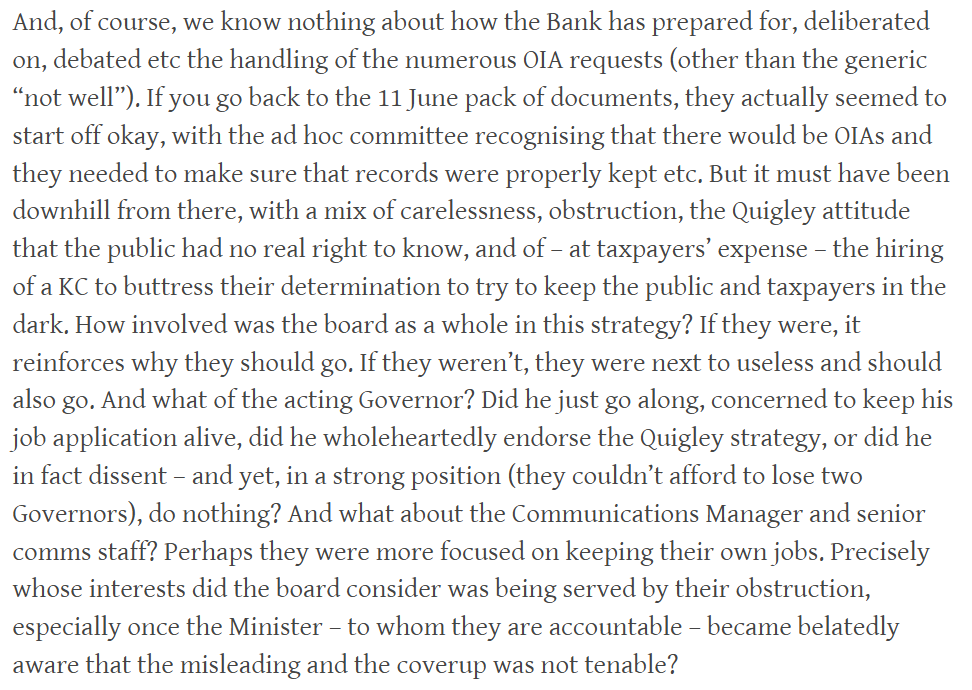
There are still serious questions for all those involved at the top level of the Bank (temporary Governor, board members, key communications staff etc). Rather than write it all again here is a paragraph from last Friday

I’ve also lodged an OIA on those issues those issues this morning. But the wider questions for the Board become even more pointed now that we know they were so intent on getting Orr out that they were likely to recommend the Minister to dismiss him just a few days after their formal process had begun (predetermination and all that?). And yet they still apparently thought it just fine to deceive the public – approving Quigley’s actions presumably – and to go on doing so for months. People of integrity would resign at this point.

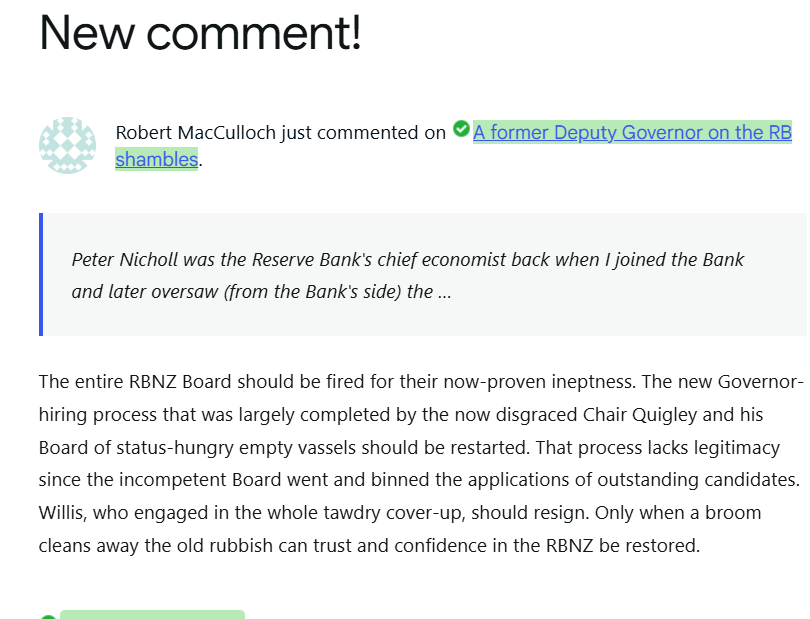
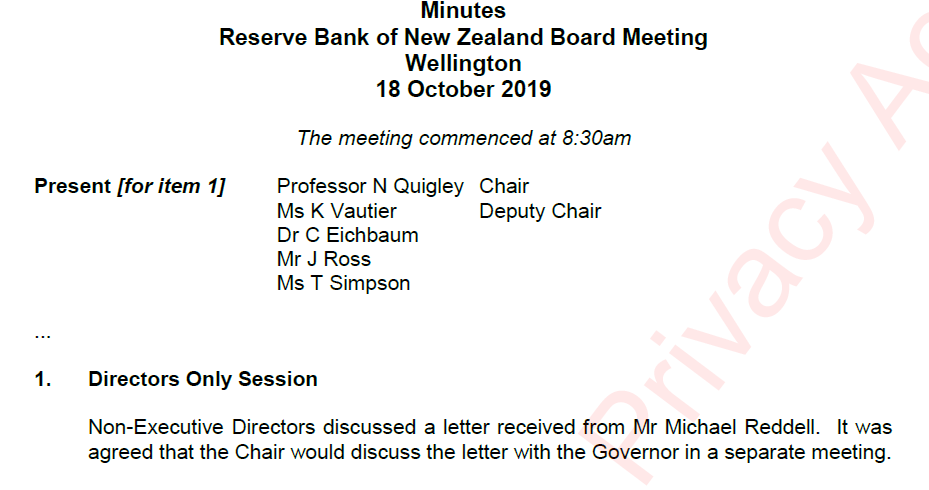
Late yesterday after my short post with former Deputy Governor Peter Nicholl’s article on the Reserve Bank shambles (and specifically the governance failures), Auckland university professor of economics Robert MacCulloch left this comment

Taking his point about the questionable legitimacy of the Quigley-led (and rest of Board) process for selecting a nominee, I’m not sure I’d go quite as far as he does. Time is moving on, and there is a pressing need to have permanent new management in place. On the other hand, quality really matters. So my stance is probably that the Minister (and the wider Cabinet) need to ask themselves very seriously whether any nominee they have settled on really reaches the standard needed now: a first rate independent highly credible person of gravitas, management capability, and some intellectual stature. If they have, well and good. If not, then there would be a case to reopen the process (preferably after sorting out the board members themselves). Rumour hath it (well, a journalist told me) that the nomination has already gone out to the other political parties for consultation. Here the role of Barbara Edmonds becomes really quite important. If she can really be persuaded that a nominee is not just “any warm body, because the job needs filling” but a serious credible and respected figure, then that could be quite persuasive (and recall that the legislative provision Labour introduced requiring consultation with other parties was presumably done in the spirit of the notion that a person appointed as Governor really should command at least grudging respect across the spectrum). But if Edmonds isn’t convinced – and the situation has deteriorated further in the last couple of weeks – she and her leader need to be willing to take Willis aside and say so.

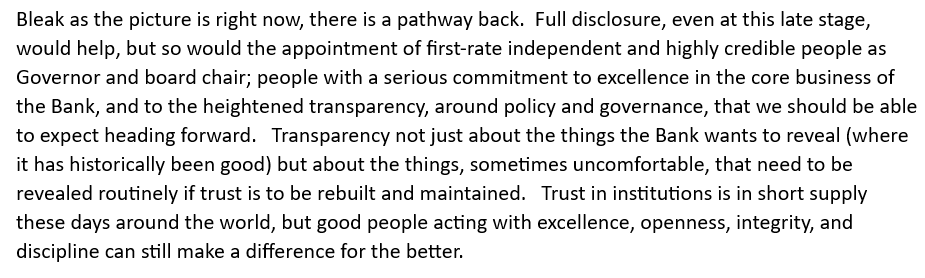
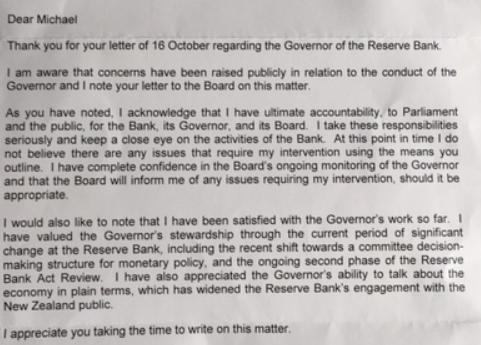
And finally for now on this issue, this is the closing paragraph of a piece I wrote earlier this week on the whole grim saga.

And is that for a while. My wife are heading off on a month’s holiday tonight so it will be at least a month before there is anything more from me here. By then, one hopes, there might have been announcements of strong credible independent people to take up the two key roles, Governor and board chair (and, actually, a new MPC member too). Perhaps some new commitments to greater monetary policy transparency too, along the lines Kelly Eckhold at Westpac suggested last week. But we’ll see.

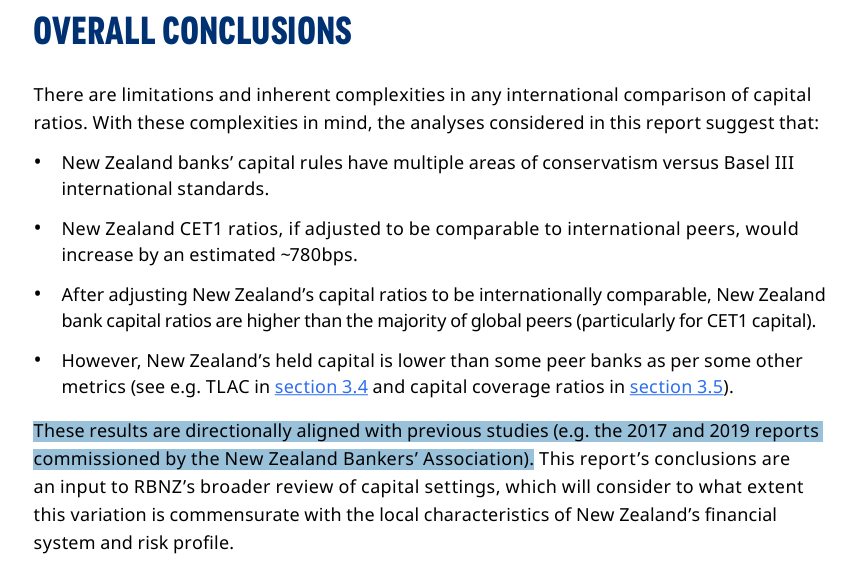
And that means that among the various other things I just never got to in recent weeks was making a submission and a substantive post on the Reserve Bank’s consultation on the capital requirements review that the Minister prompted them to initiate once Orr had gone. As it happens, I don’t have much problem with what they are proposing, and I really strongly welcome the fact that the interim guard (Hawkesby/Quigley) did go to the effort of commissioning a decent external consultant to review bank capital levels in New Zealand and those in a bunch of other somewhat comparable advanced economies (a measurement exercise rather than a policy one). Orr refused to commission anything of the sort when he was still unilaterally in charge in 2019. This was the conclusion of that new report.

My own issue with the entire framework – 2019 (eg here and here) and now – is that it is built on assumptions about the (GDP) cost of banking crises (themselves, the bits able to be ameliorated by capital buffers) that bare no relationship to reality in advanced economies, no matter many decades one looks back. The Bank now justifies sticking with this assumption – which is crucial to any serious cost-benefit analysis – on the grounds that it is “internationally conventional” in such work. No doubt “Internationally conventional” provides a safe harbour for bureaucrats, but it is no substitute for serious thought and critical review.

It is arguable that this unsafe assumption may not matter unduly at present, if market demands (shareholders, bondholders) mean that banks would choose to hold quite high capital ratios even if regulatory requirements were set lower. And of course – another thing not mentioned in the consultation – is that for our largest banks it would be APRA rules that would still be binding even if the Reserve Bank were to adopt an even less demanding model. But we really should be able to expect a higher standard of analysis – including such basics as the ability to distinguish the costs of misallocating credit and real investment in the preceding boom from those narrowly from actual bank failures or near-failures themselves – from our financial stability and bank regulatory agency.

That 24 February meeting again

After The Treasury released their file note of that 24 February meeting between the Reserve Bank, Treasury, and the Minister of Finance (full copy here) a few people got in touch directly about a couple of aspects of what was written there, and what I’d made of it.

The file note indicated at one point that in the middle of the Funding Agreement discussion “The Governor left the meeting”. A couple of charitable people (not typically Orr allies) suggested that perhaps I was overinterpreting things to suggest that he’d walked out. I think they were pretty readily convinced that this was a very unlikely interpretation (in a meeting of which the Minister of Finance had already said that it had been clear to her that “emotions were running high”).

Former academic and now consultant economist Martin Lally then sent me this rather neat piece. Some of the non-economists among you might roll your eyes and suggest ‘that’s economists for you”, but I thought it was a nice example of the use of the technique to help discipline thinking.

Seems like a great opportunity to apply Bayesian analysis. 

The hypothesis (H) is that Orr stormed out of this meeting.  Your background data concerns his type of behaviour on other occasions.  Suppose this alone leads you to the view that H has a 10% chance of being true.  This is likely to be too low.  The odds on H being true are then at least 1/9. 

The next piece of evidence is the anonymous information about Orr’s behaviour at the meeting.  I sense that you think this evidence would be much more likely to arise if H were true than if H were not true; maybe five times as likely?  So, the Likelihood ratio for this evidence is 5.  The odds on H being true now rise from 1/9 to 5/9. 

The next piece of evidence is the meeting at Treasury a few days before the meeting in question here, on the same funding issue, after which Quigley apologised on Orr’s behalf for Orr’s behaviour.  Since it was on the same contentious topic, this evidence seems much more likely to arise if H were true than if H were not true; maybe five times as likely.  So, the Likelihood ratio for this evidence is 5.  The odds on H being true now rise from 5/9 to 25/9. 

The last piece of evidence is the minutes of the meeting in question, which reveal that Orr left during discussion about the funding issue, which Orr had very strong feelings on.  If H were true, this evidence or something even more damning would be almost certain to arise because the minute taker would be most unlikely not to have recorded that Orr left.  Say a prob of 0.95.  If H were not true, the minutes could still have recorded him leaving at the time he did but in that case it would have to be due to quite extraordinary information he had just received that demanded his immediate departure from a discussion he would otherwise have strongly desired to be present for.  It could be news of his house burning down or a serious injury to a loved one.  These things happen but it would be extremely unlikely to have occurred in the 45 minute time slot in question.  So, if H were not true, the prob of his departure from the meeting at this time is close to zero.  Suppose events like his house burning down etc happen once every 6 months, so 1/180 chance of it happening on that day and, if on that day, 1/10 of it happening during the 45 minute duration of the meeting on that day, so 1/1,800 of it happening during the meeting, which is 0.0005.  So, the Likelihood ratio for this evidence is about 0.95/0.0005 = 1900.  The odds on H being true now rise from 25/9 to 47,500/9, so the prob that H is true is now 47,500/(47,500 + 9) = 0.9998, i.e., 99.98%. 

So, with all this evidence, it is virtually certain that Orr stormed out of the meeting. This nicely illustrates the power of Bayesian analysis.

A few other people got in touch about the earlier part of the meeting, on banking regulation and competition matters. This part of the meeting was attended by Reserve Bank Deputy Governor Christian Hawkesby, whose day job at the time was financial stability, supervisory and regulatory etc issues (and he left the meeting when his item ended, thus missing the – apparent – fireworks).

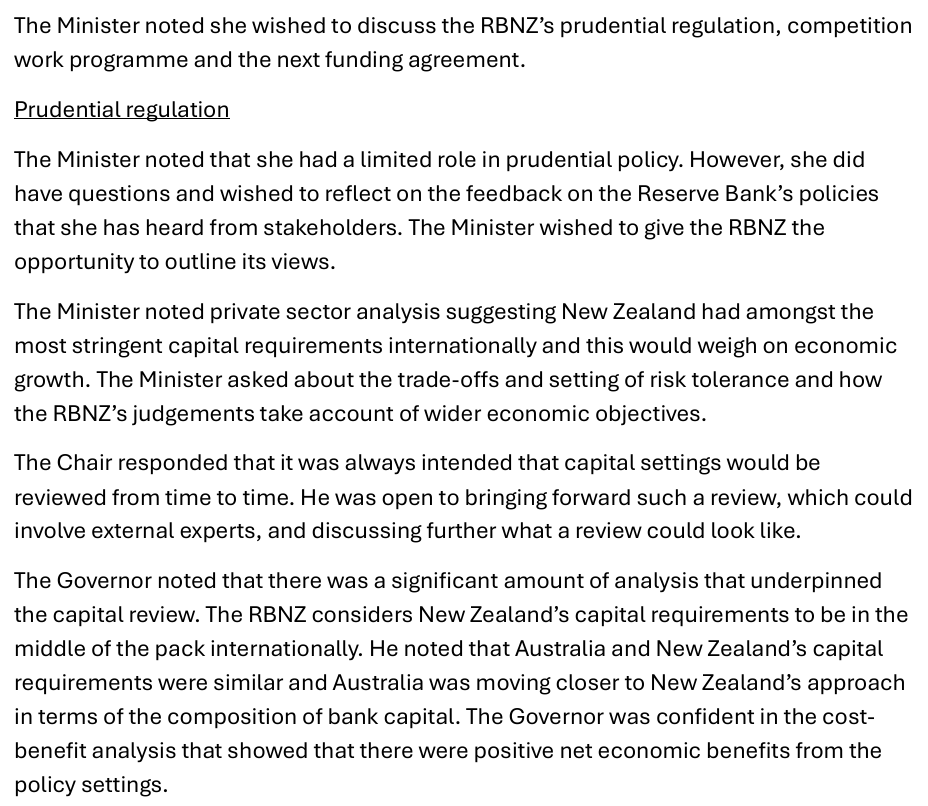
The relevant bit of the file note was this

It is pretty clear from that that the Minister of Finance wanted a review. Perhaps she didn’t say it directly, but it is the clear implication of what is recorded in those first two paragraphs, and Quigley clearly recognised it as such, noting (folllowing the Minister’s remarks) that he “was open to bringing forward such a review….and discussing further what a review could look like”.

Why raise this now? Because Hawkesby is currently the temporary Governor, and supposed in some circles to be keen on getting the permanent job. Even if he doesn’t want to be permanent Governor, he is the deputy chief executive of a major government agency and a statutory appointee to the Monetary Policy Committee. Those who got in touch earlier this week reminded me that a few months ago (8 May) Hawkesby had been asked at Parliament’s Finance and Expenditure Committee about this meeting. Radio New Zealand’s report is here.

The first part of Hawkesby’s remarks seem fine

But then FEC was told this

The meeting had been only two months previously, it had been only a 45 minute meeting (of which he was only there for half an hour or so), on matters he had direct responsibility for, and the meeting itself has to have stuck in his mind given the role it seems to have played, within days, in the Governor’s departure. What’s more, surely you’d normally expect that coming out of a meeting like that there’d have been some sort of file note (especially when his boss and the board chair had appeared to be singing from different song sheets) or even an email to his direct reports in that area, and if he was really in doubt as to what went on I guess he could have asked Treasury for their file note. And yet we are supposed to believe that whether or not the Minister had requested (or only strongly implied) that a review should be undertaken was “not something that I sort of generally get into”. It reads a lot like misleading Parliament – in much the same way Orr had done repeatedly, often with Hawkesby in the room.

To be clear, I’m sure he is quite correct that “the decision to do a capital review was the Reserve Bank’s”, but in much the same way that the Governor’s decision to resign was a “personal decision” – at one level it was, but he was clearly prevailed on, pressured to go. Under the law as it stands Willis couldn’t directly compel the Bank to undertake such a review, but it will have been the less bad choice for them (she could have changed the legislation or commissioned her own review for example). And it was also a time – the end of March when the final decision to do a capital setting review was announced – where it probably will have suited Quigley and Hawkesby not to have been difficult; Quigley wanted his medical school, and Hawkesby may well have wanted to be made permanent Governor. The review would not have happened when it did without the Minister’s lead.

(And, to be clear, I don’t think that is a problem. As I’ve noted repeatedly, I think the law should be changed so that big picture prudential policy choices are made by ministers, with the Bank acting as (a) expert advisers, and b) implementing agents. I don’t think the Minister’s involvement here is inappropriate – whatever one’s view of actual capital settings – but really senior officials should not be misleading Parliament. And when they do, and when they sit silent while their bosses mislead Parliament, they really should not be serious contenders for high and very powerful office. Misleading Parliament is supposed to be a serious matter, and if MPs seem to have given up bothering over much (except when it suits), the rest of us should still insist on higher standards of integrity.

It is, in addition, supposedly one of the Reserve Bank’s own values

But perhaps those are just words. The actions at the top certainly haven’t aligning with the words for some time.

Reserve Bank, bank capital etc

Things seem to be at a pretty low ebb in and around the Reserve Bank. There was, in particular, the mysterious, sudden, and as-yet unexplained resignation of the Governor (we’ve had four Governors since the Bank was given its operational autonomy 35 years ago, and only two have completed their terms and left in a normal way, which must be some sort of unwanted advanced country record). Having slimmed down the bloated number of Orr’s deputies by one last year, another of them quietly resigned and left last month on (apparently) short notice and no specific job to go to. Of those who remain, two are (at best) ethically challenged and one is simply unqualified for the job she holds.

And then there is the mystery as to why a temporary Governor (specifically provided for in the Act) has not yet been appointed, even though it is now four weeks since Orr tossed his toys and walked out (formally finishing on 31 March, but no longer present). I wrote about this briefly on Monday morning when it emerged (in The Post) that despite what the Minister and Bank had led us to believe on the day Orr resigned (effective 31 March), there would not be a temporary Governor in place from 1 April. The Bank’s spokesperson, quoted in the Post article on Monday so badly misread the relevant provisions of the Act that the Bank seemed to feel it necessary to issue a release yesterday, which added nothing but at least didn’t muddy the water further. The Bank’s Board has to (finally) make a recommendation of a person to serve as temporary Governor by 28 April, but even once she gets such a nomination the Minister of Finance can take as long (or short) as she likes to make an appointment (or, presumably, knock back a recommendation and send the Board away to make another).

Reasonable people would have assumed that within a few days of Orr announcing his resignation (and storming off), the Board would have met and made a recommendation. With more than three weeks notice (at least on paper) having been given there was really no excuse for not even having a recommendation on the Minister’s desk by the end of March. We are left to wonder why. Perhaps Hawkesby didn’t want the job? Perhaps the Board doesn’t have confidence in him to do even the fill-in role? Perhaps the Minister had indicated that she didn’t want him? We don’t know, and neither do international markets who (like the rest of us) were taken off-guard by Orr’s resignation. It really isn’t a good look. And if for some reason Hawkesby isn’t an option (and there are very slim pickings among the other 2nd tier managers), perhaps they could twist the arm of former Deputy Governor Grant Spencer and bring him back for a second stint filling in between Governors (only it would be legal this time)?

The unsatisfactory picture was compounded just a little later on Monday morning when Hawkesby and the Board chair Neil Quigley fronted up to the Finance and Expenditure Committee to announce that they were after all going to have a review of bank capital requirements (their opening statements are here). This had all been arranged with the Minister of Finance, who put out a simultaneous statement welcoming the review, and confirmed by the Bank’s Board at a meeting last week (which the outgoing – but still in office, and thus still a Board member – Governor did not attend).

[UPDATE: Meant to mention that Hawkesby did himself no favours – if he aspires to be seen as anything other than Orr’s man – when he opened his FEC statement this way (emphasis added)

“I’d like to begin by acknowledging our Governor, Adrian Orr, who over 7 years would have attended FEC hearings more than 50 times and always been engaging.  We are looking forward to continuing that relationship.”

Orr actively misled FEC repeatedly, and the frostiness of his encounters with any questioning FEC members has been repeatedly commented on. ]

Recall that, rightly or wrongly (I think wrongly), Parliament has given policymaking powers on such matters to the Bank (and specifically to the underqualified Board). Recall too that just a few weeks ago the Minister of Finance had indicated that she was seeking advice on ways to compel the Bank to change policy. Presumably the Board – and perhaps management – reading which way the political winds were blowing simply caved and arranged Monday’s FEC appearance and announcement, rather than risk losing their powers. They were, after all, in a weak position: as far as we know the Bank’s Funding Agreement for the next five years has not yet been approved (the Minister has talked of coming cuts), there wasn’t a permanent Governor in place, and even the appointment of a temporary Governor seemed to be hanging in some sort of limbo.

It is always possible that the Bank itself (especially now minus Orr – who last year was vociferously defending current policy and, as so often, attacking any critics) thought that a review was (substantively) timely and appropriate, but it looks a lot like bowing to political pressure, at a point of particular weakness. In an independent agency. And, frankly, since I believe that big policy calls should be made by elected politicians, I’d rather the government had actually legislated to shift big-picture prudential policymaking powers back to the Minister of Finance, while retaining a vital role for a better-performing Reserve Bank to advise and to implement (essentially the model in most other areas of government policymaking).

There are also lots of questions about where to from here with the review. The suggestion from Quigley is that the review will be completed by the end of the year, but while decisions are finally a matter for the Bank’s Board, it does invite the question of what role (if any) the new permanent Governor is to have (at least if it is anyone other than Hawkesby). By law, the temporary Governor can (eventually) be appointed for six months, extendable for another three. Even if the Board gets on and advertises for a permanent Governor this month, at best it will be several months before a new Governor is on board (eg there was roughly six months between Don Brash resigning and Alan Bollard starting work). With a non-expert Board wouldn’t one normally expect the Governor to be taking the lead in formulating the advice on which the Board would finally make decisions? Or is the new person to be presented with a fait accompli?

And then of course, there are questions about the nature of the review itself. Is it purely appearance theatre (“we need to look like we are doing something”) or is it genuinely a case of an open-minded reassessment? There is talk of consulting banks before any changes are made, but what about the wider group of interested experts and commentators (many of whom submitted on the 2019 policy proposals/decisions)? And for all the talk of commissioning “international experts”, surely only the most naive would take that at face value. You choose your expert according to your interests (eg a different group if one wanted people likely mostly to reaffirm your priors than if you were genuinely opening things up). I reread yesterday my post about the “international experts” Orr had commissioned in 2019, and the rather limited (and conveniently-supportive, having been chosen for a purpose) contribution they made. Those earlier experts were barred from talking to anyone in New Zealand other than the handful the Bank approved. Will it be any different this time?

And although back in 2019 the law was such that the decisions were still those of Orr alone (the Board then had a different role), Quigley was also the Board chair then and has had Orr’s back right throughout his time in office – apparently serving the Governor’s interests more than the public’s interest. His own questionable relationship with the facts on a number of occasions has also been documented here on various occasions. Apparently Quigley presented quite well at FEC on Monday, but so what? When he isn’t under pressure – and FEC was more attuned to welcome the review than ask very searching questions – he is a smooth operator (when he is under pressure, well…..see his press conference on the afternoon Orr resigned).

My own view, back in 2019, was that even the final Orr position – which pulled back from the initial proposals – went further than was really warranted. But one of the things I’d be looking for as part of the Bank’s review this year – and as a test of seriousness and openmindedness – is a rigorous and transparent comparison of the New Zealand capital requirements (for large and for small banks) with those of other countries. The Reserve Bank made no atttempt whatever to provide those sorts of comparisons in 2018/19.

One might think of countries like Norway, Sweden, Denmark, Australia and Canada, but perhaps also advanced countries where the bulk of the banking system is made up of subsidiaries of much-larger foreign banks (for example, the Baltics). To do this properly isn’t a superficial exercise of comparing headline capital ratios. One needs to look at things like the composition of balance sheets (in a quite granular way), risk weights on individual types of exposures (standardised and IRB) and so on. One might, in principle, take the business structure of one or more New Zealand banks and actually apply the rules in other countries to see how much capital they would be required to have on those rules, relative to the rules here.

If the current Reserve Bank policy, and scheduled further increases in minimum required capital, ended up pretty much in the pack, relative to the situation in other advanced countries, it might be considered the end of the matter. There might not be anything very optimal about what those other countries have chosen to do, but the case for any revision to the New Zealand rules would be that much harder to sustain than if (for example) the full New Zealand requirements imposed much higher capital requirements on much the same sort of portfolios. There is no compelling reason to believe that the exposure to really serious adverse shocks is any greater in New Zealand than in other advanced economies, so absent a compelling argument that the rest of the world is just “too lax”, being somewhere around the median of other countries might be a reasonable benchmark for New Zealand authorities (in a world of inevitable great uncertainty). (Incidentally, there would be no point in having requirements lower than those applied by APRA, since their requirements would set a floor for the Australian banking groups as a whole – there has been too little mention of the APRA group requirements in the recent New Zealand debate).

Reviewing some old posts yesterday I also stumbled on this chart, taken from a 2019 working paper of the Basle Committee on Banking Supervision (which I wrote about here)

I don’t want to fixate on the individual numbers, but simply to reiterate the point that any wider economic gains from higher required minimum capital ratios abate quite quickly as those requirements are increased. Actual numbers that might emerge will depend heavily on things like assumed discount rates (the ones used in these studies are far below the standard discount rates for us in New Zealand public policy evaluation), and the ability (or otherwise) of high capital ratios to save us from financial crises with severe economic consequences (a point quite in contention in 2019, when I observed that the numbers used by the Bank and their supporters were grossly implausibly large).

(Finally, on this topic, it is worth remembering that capital buffers are very useful to absorb losses, but that what matters even more – including as regards real economic losses and dislocations – is the quality of bank assets, and thus bank lending standards. A bank can have pretty large capital buffers and yet can still go off the rails quite badly in a surprisingly short space of time if lending standards degrade and/or management/Boards start chasing lending opportunities which look fine and good in the heat of a boom only to prove anything but as the tide recedes. Probably the largest real economic losses don’t arise from a bank itself coming under stress, but from the gross misallocation of real economic resources that can occur all too easily when undisciplined or excessively risky lending occurs, and those costs are already baked in when the lending and associated real investment choices are made, even if they only become apparent when the shakeout happens.)

Anyway, we will see what comes of the Bank’s review. And if, as Hawkesby/Orr [previously]/Quigley claim, the Bank’s policies are basically right, whether they can make a compelling case to persuade the public, external commentators….and of course the Minister of Finance who, I guess, still has the threat of legislating up her sleeve.

Changing tack completely, today marks 10 years since I left the Reserve Bank. As I noted at the time, that move was something of a double coincidence of wants: Graeme Wheeler really wanted me out, and I really wanted out, to be around as a house husband for our kids. It was a great move and I’ve not had the slightest regret (indeed, one shudders at the thought that I might otherwise have been there when the Orr years started). Being available for the kids, and helping to enable my wife to hold down busy jobs, will always count as one of the blessings of my life (and a few weeks ago the youngest left for university).

Every so often I think about where to next. The blog has been less frequent in the last few years (including due to 2-3 years of fairly indifferent health including post-Covid, but now passed). Circumstances change and I’ve got busier. I have occasionally thought about shutting it down and doing other stuff – I had an outline on my desk when the BPNG appointment came through of a time-consuming project I’d still like to pursue. For now, various circumstances and considerations mean I’m going to try to discipline my public comment more narrowly. There has been an increasing range of things I’d like to have written about but it wasn’t possible/appropriate. For this blog that will mean primarily Reserve Bank things, fiscal policy, productivity and not much else, which was the original intended focus. (And if a capable, even excellent, Governor is appointed, consistently lifting the performance of the Bank, and its efficiency, openness and transparency, perhaps even Reserve Bank commentary will die away. There are much bigger economic policy challenges.)

Inquiring into banking

Hard on the heels of the Commerce Commission’s inquiry into some aspects of banking competition, Parliament’s Finance and Expenditure Committee is also holding an inquiry. Submissions weren’t open for very long and have now closed, but the full terms of reference are here. It is a select committee inquiry, so it is hard to be optimistic anything very useful will come from it. Select committees are poorly resourced, even if they wanted to make a serious contribution, and the incentives seem to be almost entirely partisan political in nature.

A few submissions have so far seen the light of day. Those I’ve seen are:

None is particularly long, although Body’s piece has several appendices of past contributions in this general area.

The Reserve Bank’s contribution is mostly defensive in nature: if there are any issues, responsibility doesn’t rest with us or with our regulatory model. Which is, of course, pretty much what you would expect them to say, as an entrenched and powerful independent existing regulator, who no doubt believe that all the policy judgements they’ve made have been wise, in the best interests of New Zealanders etc. But just because it is them saying it doesn’t automatically mean they are wrong.

And in some areas no doubt they are right. As they note, having four big banks isn’t at all unusual. And some scepticism of state-enabled “maverick disruptors”, especially in the form of an unimpressive modest retail bank, is likely to be well-warranted. They also fairly note that patterns of finance have changed over time, something particularly evident in rural lending (where Rabobank is now the second biggest lender) and in corporate lending (where even on the data they have access to – and big corporates can tap international markets directly – overseas banks other than the big 4 apparently now have 30 per cent of the market).

And I (have always tended to) share their view that (approved regulatory) relative risk weights, used in calculating capital requirements matter a lot less than is often made out. In principle they should make no systematic difference at all since the aim of relative risk weights is more or less to reflect true differences in the underlying riskiness of different types of credit (eg a residential mortgage, with a 40 per cent LVR, is likely to be much much less risky, individually and as part of a portfolio, than an unsecured loan to a B-rated corporate). In practice, things aren’t that simple, including because the dividing lines between different types of lending and associated risk aren’t always clear or straightforward, and which side of a rather arbitrary line something falls can matter. And since no one – regulator or regulated – knows with any great certainty how (relatively) risky different types of loans are (mercifully, very bad crises don’t come along very often, and so data are scarce and open to contextual interpretation – regulators can get things wrong, and impose risk weights on particular types of lending that are quite at odds with the views of the lenders themselves. And any mapping for particular Reserve Bank imposed risk weights to either the pricing or availability of individual loan products is likely to be fuzzy and indirect at best.

Most importantly, relative risk weights simply do not explain why bank balance sheets are chock-full of residential mortgages. Rather, the artificial scarcity of houses and land, imposed over decades by central and local government, has led to hugely expensive houses, which each incoming generation needs to finance. Bank balance sheets would be much smaller if regulatory reform successfully delivered enduring low prices of houses and urban land.

All that said, one shouldn’t be too keen to come to the defence of the Reserve Bank as regulator. This is an agency with very limited specialist expertise at the top (see, notably, the Bank’s Board which now wields the policymaking power), has a culture of being aggressively dismissive, produces no serious research or analysis on financial regulation or stability (even though these functions now comprise the largest chunk of the Bank’s staff) and so on. What speeches there are lack any real depth or insight.

As I noted at the start, the New Zealand Initiative’s submission is brief. There are, broadly speaking, two aspects to it. The first is about efficiency considerations – a dimension unfortunately now lost from the legislation

Of course, any bureaucracy can produce a cost-benefit analysis of sorts of justify its own choices. I didn’t find the case for the 2019 decisions compelling, but a review now – especially if the reviewers were appointed by the RB or those sympathetic to it – isn’t really the answer (and under current legislation the Minister of Finance can’t direct the Bank in this area). My own view remains that (a) key people matter, and b) key policymaking decisions (as distinct from implementation on individual instruments and institutions) should be moved back to the Minister of Finance, who has both some real accountability (governments get tossed out, and question in Parliament routinely) and better incentives to balance the competing imperatives around any regulatory structure. It is very unusual to delegate major regulatory choices to an unelected agency (the more so, one with little demonstrated depth, expertise, and commanding little respect).

The New Zealand Initiative doesn’t go that far. They propose instead

I’ve written previously in favour of splitting around a NZPRA, which would have advantages for both those functions and for the Reserve Bank’s monetary policy and related functions. As they note, a suitably-qualified FPC might be a halfway house, although I’m not sure that the MPC – as staffed, and (not) scrutinised and held to account for the mistakes of recent years – is a great advert.

(I’m less convinced of the merits of taking the Governor off the Board. The FMA is primarily an implementation agency without much of a public face. The Reserve Bank, or major policymaking committees, are a different matter…….and for what it is worth it would be quite anomalous internationally not to have the Governor on the central bank board.)

The main prompt for doing this post was Andrew Body’s submission, which he was kind enough to send me. I don’t agree with everything in his submission – we’d disagree I think mainly on the risk weights issue (see above) – but the bulk of the submission captures a number of areas where the current Reserve Bank is ill-equipped for its job, and not doing that job well. His submission is an easy read. Here are a few extracts.

It is often forgotten just how much of an impost was imposed on banks the local incorporation and outsourcing requirements.

What I’m less sure of is how much of this is idiosyncratic to New Zealand, and how much is a general tendency of regulators and the regulated. The stylised wisdom when I was at the Reserve Bank was that banks were typically under orders from Australia to be very reluctant to upset or call out the regulator (there or here). Of course, when your regulator – as Graeme Wheeler did here – takes offence at anodyne critical comments from a bank economist, and calls in the heavy artillery to get the economist silenced, it sends a message. Banks have a lot at stake, and the Reserve Bank has a lot of power, which can be wielded for good or ill.

Before turning to governance

Much of that makes a lot of sense. But, of course, there is no sign that the Minister of Finance has any interest whatever in a better Reserve Bank, whether in its monetary policy or regulatory functions. She just reappointed the chair, has left Board vacancies unfilled, and included nothing about a reorientation in her Letter of Expectation. Instead, she seems to have been toying with arbitrary new taxes on banks.

Standing back from all three submissions, a few things struck me. The first (and most important) is that neither the Reserve Bank in its defence or the critical submitters mentioned the APRA regulatory requirements and how they affect things in New Zealand (neither did the FEC’s terms of reference). That should be really quite surprising as most of the grumbling is about the four big Australian banks, all of which are part of Australian-based consolidated banking groups, regulated as such by APRA (eg capital requirements that apply to group exposures as a whole). There is no doubt that more onerous regulatory requirements can materially affect the New Zealand subsidiaries, but in any area in which the RBNZ’s requirements were less burdensome than APRA’s it might make or little or no difference here, as the group would still be constrained by group-wide regulation. I’ve never been quite sure how it all works out in practice – how banks do their pricing and risk allocation etc having regard to these distinct regulatory regimes – but it is surprising not to see it mentioned once. At an aggregate level, I’m inclined to the view that the Reserve Bank never made a compelling case for the extent of the 2019 increases in New Zealand capital requirements (and that the heavy focus on high capital is somewhat misplaced, relative to the much-harder-to-measure/observe changes in credit standards), but markedly lower requirements might well become non-binding.

I’ve long been a bit puzzled as to why more non deposit-taking entities don’t lend directly into the New Zealand market (at least if, as we are often invited to believe, there are excess profits on offer here). I recall being heavily involved in some work almost 20 years ago now on possible alternative approaches to monetary policy implementation, and one thing we focused on a lot then was the possibility of entities lending mortgages (say) directly into New Zealand from abroad. Disintermediation was also in focus when the first LVR restrictions were put in place. But none of it ever seem to have come to much. I was exchanging notes with a banking lawyer recently and asking why, say, Macquarie – an aggressive new entrant to the Australian mortgage market – couldn’t just lending into New Zealand as “Cheap Mortgage Loans Limited” (so wouldn’t need to be a New Zealand bank), but the person I was engaging with noted that people who had considered such options were scared that the Reserve Bank would act to stop them (and apparently there are designation powers in the new deposit-takers legislation). You have to wonder why it would: no New Zealand depositors’ funds would be at risk, and new competition would be injected to the system. I note it mainly because it isn’t entirely compelling that everything sensible has been done by the Reserve Bank to reduce unnecessary barriers to entry. Better “Cheap Mortgage Loans Limited” than a juiced-up Kiwibank, in which taxpayers’ money is directly at stake.

I have no expectation that the FEC inquiry will produce anything useful. It isn’t set up to. The submission time was short – who could commission serious or fresh analysis in that time? – and the committee has few resources, no specialist support, and its members don’t appear overly strongly qualified, except to pursue narrow political agendas (some of which might be sensible, but most won’t). And thus how equipped are they going to be to evaluate competing claims in the submissions they receive? It isn’t like a court case in which expert witnesses are grilled by counsel for both sides, and arguments, evidence, and implications tested. A proper workshop, with major submissions presented as papers with discussants and audience questions might have offered the prospect of shedding some serious light. But the political process is all too often interested more in heat than light.

UPDATE: Martien Lubberink (VUW) draws my attention to his submission here. A one sentence summary might be that we should be at least somewhat grateful for what we have – a stable, predominantly foreign-owned, system – and wary of the siren calls to any sort of quick fixes to apparent problems. Thus far, it is hard to disagree (although I have a few specific areas in which I might reach different views than he does).

Tightening LVR restrictions

The Reserve Bank’s faux “consultation” on tightening LVR controls closes today. If you felt so inclined the consultation document is here, but it isn’t clear why you’d bother except for the record. Poor performance by powerful government agencies shouldn’t go unremarked.

I have put in a a short submission, simply to document some of the many problems with the consultation.

submission to RB on tightening LVR restrictions Sept 2021

Much of the text simply elaborates points I noted in a post last week. But here are a few extracts

More substantively, there is no discussion at all in the consultation document of the Reserve Bank’s capital requirements or the capital positions of the banks you are putting more controls on. As you will be well aware, the risk-adjusted capital ratios of New Zealand banks are high by international standards, and will be increased further – as a regulatory requirement – over the next few years.   Capital is, and always should be, the key buffer against loans going bad, and we know that the New Zealand framework imposes relatively (by international standards) high capital requirements in respect of housing loans, including high LVR ones.   It is simply unserious – or a desire to operate ultra vires – not to engage with the capital position of the banking system.  That is especially so as your consultation document acknowledges that tighter LVR controls will impair the efficiency of the financial system.  Given that acknowledged cost, there has to be a clear gain to financial system soundness (the other limb of your statutory goals/purposes) from any new regulatory impost, but your document makes no effort to quantify such a gain (reduced probability of failure), or to demonstrate that tighter LVR controls are the least-cost way to generate such a reduction.   There is not, I think, even any attempt to engage with the “1 in 200 years” failure framework that the Bank dreamed up a few years ago to support the capital proposals it was then consulting on.

….

The Bank’s consultative document also attempts to make quite a bit of an argument that somehow LVR restrictions now can dampen the size of future “boom-and-bust cycles” in the economy, even going so far as to claim these incremental restrictions will improve the medium-term performance of the economy. But none of this argument engages with the (very healthy) capital position of the banking system and at times it seems internally contradictory.  Thus, in paragraph 47 the Bank worries about dampening effects on consumption and economic activity from “increased serviceability stress” as a result of some future increase in interest rates, but never seems to recognise that the reason the monetary policy arm of the Bank would be raising interest rates is to dampen demand and inflationary pressures.  If anything, the Bank’s argument would seem to suggest that more high-LVR lending would, if anything, and in those circumstances increase the potency of monetary policy, and reduce the extent of any required OCR increases.    More generally, the Bank continues to place a considerable reliance on claims about a significant housing wealth effect on consumption that appear inconsistent with New Zealand macroeconomic data over many decades, and which appear to over-emphasise existing homeowners while largely ignoring the loss of wealth/purchasing power for those who do not (yet) own a house.

….

In conclusion, the Bank has simply not made any sort of compelling case for further tightening of LVR restrictions. At very least, such a case would have to involved a careful and documented cost-benefit analysis, that included engagement with the bank capital regulatory regime.  There is no pressing financial stability risk, and so this proposal – in practice, these new rules – has the feel of action taken for the sake of action, perhaps to provide some cover for a government that fails to address the house price issue at source, or to fend off (misguided) critics of the Bank’s LSAP monetary policy programme.   That isn’t a good or acceptable use of the powers of the state. 

To the extent the initiative is about protecting borrowers from themselves – as your communications sometimes suggests – it may be nobly intended but is no part of the Bank’s statutory responsibility (and thus not a legitimate basis for use of regulatory powers). Perhaps as importantly it seems to assume the current crop of central bankers and regulators knows more about the risks of house prices falling substantially and sustainably than (a) borrowers and their bankers (each with money on the lines) and (b) than their central banking predecessors over 30 years did (each Governor having at some point or other anguished about the risks of falls, even as central and local government policy continued to underpin the decades-long scandalous lift in real house prices). No evidence is advanced for either proposition.


My former Reserve Bank colleague – now Tailrisk Economics – Ian Harrison had a similarly cynical view on the consultation process but also put in a short submission, which he has given me permission to quote from.

Ian makes a number of serious analytical points about the substantive weaknesses in the Bank’s document

Introduction

It is clear that, from the content of the consultation paper and the time given for submissions, the consideration of submissions and final decision making, that this is not a serious consultation, and that submissions will mostly be ignored.  In that vein not all of this submission is entirely serious.  Part A discusses some key elements of the Bank’s analysis.  It shows that the Bank’s concerns appear to be driven by a data error and a lack of understanding of how loan portfolios evolve over time.

The Bank has suppressed lending to housing investors following the Minister’s wish to give first time homebuyers a better chance of securing a property.  Now that this demand has emerged the Bank wants to choke it off. 

This is based on an almost irrational obsession with housing lending risk.   Even when high LVR loans are a small part of banks’ portfolios, and its own stress testing shows that housing losses will account for a relatively small part of overall losses in fairly extreme stress events (about 28 percent), it does not seem to be able to resist tinkering with quantitative interventions.

The easiest and most effective solution to the identified problems would be to increase housing interest rates, but that option is not even mentioned.

Part B of this submission provides a different professional perspective on the Bank’s behavior.

But sometimes points are made more potently – at least in responding to unserious spin masquerading as policy analysis – by satire. And this is Ian’s Part B

Part B 

Meduni Vienna, Department of Psychiatry and Psychotherapy

Währinger Gürtel 18-20
1090 Vienna, Austria 

Consultation report

 Patient : R. Bank 

Date:   7/9/2021

Diagnosis:

From our consultation with the patient R. Bank we observed the following clinical symptoms.  Our consultation conclusions are based on the patient’s writings (in particular the document loan-to valuation ratio restrictions) and our observations of behavior over the last three years.

Moderate paranoia: The patient had a tendency to blowup the risks of everyday life into impending disasters.

Hyperactivity: There was a pronounced tendency to do things when nothing needs to be done.

Megalomania: The patient exhibits the classic signs of megalomania: overestimation of one’s abilities, feelings of uniqueness, inflated self-esteem, and a drive to maintain control over others.

Misplaced empathy:  The patient exhibited some concern that others may make mistakes but uses this as a reason to exercise control over them.

Irrationality: There was a lack of capacity to identify real problems and connect them with solutions.

Unwillingness to listen to others:  The patient will pretend to listen to alternative views but this is almost always a sham.

Treatment:

  • Heavy sedation
  • Counselling

The patient should be removed from positions of authority until there is a pronounced improvement in behavior.

Albert Pystaek Phd., Dip. A.E.M, Fm.d, Head of Clinical Psychiatry

Perhaps they should start a bank?

In the last few days speeches by two of the Reserve Bank’s senior managers have been published.   The first was from the Deputy Governor Geoff Bascand –  delivered on no obvious occasion to “banking industry representatives in Wellington” –  and the second by Toby Fiennes, formerly head of supervision (operations and policy) but now reduced to Head of Financial System Policy Analysis, at one of those commercial training ventures that are always keen to have (free) speakers from places like the Bank.

Bascand and Fiennes have often been among the better people in the upper reaches of the Reserve Bank.  I’ve been on record suggesting –  before the appointment and since –  that Bascand, if not ideal, would have been a better appointee as Governor.  His speeches have typically been quite materially better than those of his senior management colleagues –  more akin to what we see from people at Deputy Governor level in other advanced country central banks –  although that is true more of his speeches on economic topics than those on banking and financial stability.    Perhaps that isn’t surprising –  his background was in economics, and he had no background in financial stability or regulation until he took up something like his current job three or four years ago.

In this post I want to focus mostly on Bascand’s speech.  He is the more senior figure and is across all the functions of the Bank –  including apparently enjoying the confidence of the Minister as a member of the statutory Monetary Policy Committee.   And if Fiennes’s speech raises one or two points, Bascand’s is really quite egregious in places.

As befits one of Orr’s deputies, the speech pays due obeisance to the public sector employees’ campaign to change the name of the country.     The title?  “Banking the economy in post-COVID Aotearoa”.    As it happens, they the drop one more “Aotearoa” into the first page before reverting, almost without exception, to “New Zealand” (actual name of the country, actual name of the Reserve Bank of New Zealand) for the rest of the speech.

The bottom line message of the speech, however, seemed to be an injunction to banks to lend more.  So much so that, as per the title of this post, one was left wondering why if Messrs Orr and Bascand know so well what the profitable risk-adjusted opportunities are they don’t step down from their secure and quite highly-paid public sector perches and start a bank, or at least offer their services to the credit and risk departments of some existing insurgent bank.

It starts on the first page

In the face of these challenges, the banking sector could choose to hunker down and seek to ride out the storm until the good times roll again. Or, the banking system could continue to step up and play a crucial part in supporting New Zealand’s economic recovery and maximise its potential competitive advantage of relationship lending and customer information. …..

Maintaining institutional resilience while continuing to serve customers in an uncertain environment will demand expertise, courage and an unwavering belief that the people and businesses of Aotearoa will find a way to come out of these challenges.

In periods of extreme uncertainty, isn’t the rational –  and prudent – response of most people to “hunker down”?   And this is an environment of really quite extreme uncertainty –  a point I’m sure we will hear emphasised (again) by Orr and Bascand next week when they put their monetary policy hats on and deliver the Monetary Policy Statement.

But here –  playing with other peoples’ money – they want bank managers to ride blindly –  but “courageously”-  into the cannon fire, as if they (Orr and Bascand) either know better than the shareholders what is in those shareholders’ interests, or just don’t care.   And it is pretty rich coming from people who, with their monetary policy hat on (the tool actually designed to support recoveries) are doing almost nothing.

It is really remarkable for the lack of nuance and subtlety.  I scrawled in the margin against that first paragraph “presumably some mix?”     I doubt there has ever been a market-oriented banking system that-  in a severe downturn – has ever either called in every loan possible at the first sign of trouble, or rushed out boldly to encourage a wide range of borrowers to take more credit.    But there is nothing of this in Bascand’s speech, nothing either about how serious downturns should prompt both lenders and borrowers to reassess the assumptions they were working on, in turn prompting greater caution –  the more so, the more uncertain the path ahead.     Thus it is fine for central bankers to fling out rhetoric about “unwavering belief”, but no one knows which forward path the economy will actually take, how long it will take to get securely on that path, or what crevices there might yet be along the road.  It will make quite a difference to plenty of credit assessments –  whether for existing debt, or those interested in taking on new debt (around many of whom there may be adverse selection risks).

A bit later on there is an entire section of the speech on “Reserve Bank actions to support bank lending”.    It is about as thin.

For example, we get overblown claims like this

Cash flow and confidence became key to New Zealand’s financial stability.

I know “cash flow and confidence” was a mantra of the Governor’s but –  and as the Bank itself would tell us any other time –  the financial system’s soundness was much greater than implied by this assertion of Bascand’s, reinforced a sentence later when he tries to claim that various initiatives had “kept the financial system stable”.   These measures, apparently, included the small cut in the OCR (virtually no change in real terms), whatever the LSAP did to long-term rates, and a list of other regulatory measures which –  useful as most may have been –  will have done little or nothing to “keep the financial system stable”.   System stability is mostly about disciplined lending in the good times.  All evidence suggests –  and other Reserve Bank commentary suggests they agree –  we had that.  One of the risks at present is that if anyone in the banks paid much heed to the Reserve Bank’s rhetoric, those lending standards could be considerably debauched now.

Bascand goes on, being really rather self-congratulatory

Taken together – and without being too self-congratulatory – these initiatives have had a significant impact on supporting the short-term financial needs of households and businesses. This was important to limit failures of businesses with good long-term income prospects, and prevent mortgage defaults and foreclosures for borrowers facing temporary decreases in income.

All this without a shred of evidence to support his claims to have made much difference at all.   In this Bascand world, banks would have been rushing into mortgagee sales, closing businesses galore, without any regard at all for longer-term relationship prospects etc, if it hadn’t been for the Reserve Bank.    It is the same spin we used to get from the Governor, and the same lack of evidence.     We’ve had fairly sound and well-managed banks for 100 years or more –  recall that the closest to a bank failure in the immediate post-liberalisation period were two government-owned entities-  but the Governor and his Deputy believe that they are the hope and salvation.

Bascand goes on to talk threateningly about banks retaining their “social licence to operate” –  if there is such a thing, it is really no business of a central bank charged only with prudential supervision of banks.  And then we get to what seems to be the climax of his lecture on lending

But a key determinant of the success of New Zealand’s economic recovery to come will be the willingness of banks to lend to productive, job-rich sectors of the economy so that we can collectively take advantage of New Zealand’s enviable position of having eliminated community transmission. Now is the time for banks to prudently drawdown on their buffers to support their customers. Shareholders will have to be patient for longer-term payoffs, but this forward-thinking, long-term approach will stand bank customers, banks, shareholders, the financial system and Aotearoa in the best position.

Given banks are anticipating a deterioration of their loan portfolios, hunkering down and tightening lending standards may seem to them to be the optimal response to perceived increased risk. However, given banks dominant role in New Zealand’s financial system a synchronised lending contraction across the banking sector would risk a ‘credit crunch’ amplifying the economic downturn (Figure D). Therefore ultimately it is in banks’ own interest to maintain the flow of credit and contribute to the long-term stability of the banking system by preventing large scale borrower defaults and disorderly corrections in asset markets.

There is so much problematic about this it is difficult to know where to start.  There is. for example, the small point that highly productive sectors tend –  almost by definition, and it is a good thing –  not to be ‘job rich”.  For the rest, as noted earlier, you get the impression that people with no experience in banking at all –  or indeed in Bascand’s case any in business at all –  are best-placed to tell private businesses and their shareholders what is in their own best interests.  Based on what evidence, what analysis?   And isn’t it all rather lacking in nuance, since few of these sorts of decisions are ever all or nothing.   And despite the wider economic responsibilities of the Bank, it isn’t even obvious where Bascand thinks these profitable creditworthy projects are to be found –  or how he could be confident of his judgement even if he and his staff could identify some.     Surely a more general answer would be that private agents (banks and other firms and households) are best placed to make their own assessments about choices and risks, but that macro policy (and perhaps now public health policy) can provide the best possible supporting climate for those private decisions to be made.  As it is, even later in this speech Bascand concedes that “our economic challenges remain severe”.   Not exactly a climate for much private sector risk-taking, whether by banks, firms or households.  But it might, for example, be time for a monetary policy central bank to start doing its job.

Risking other peoples’ money was the theme of that bit of the speech. But Bascand also took the opportunity to comment on the Governor’s bank capital review –  the one that will require a huge increase in bank capital to support the existing level of business.   The one that banks, and many outside experts –  not, contrary to the Governor’s claims, just those paid by banks –  warned would lead to some credit contraction, some disintermediation from the banking system, and some higher costs.

Likewise, capital metrics were strong going into this crisis, boosted by Basel III regulatory requirements, a number of years of favourable economic performance, and preparations for the impending implementation of the Reserve Bank’s Capital Review. The COVID-19 crisis has underscored the importance of banks having sound capital buffers; increased provisions for expected credit losses have, so far, been easily absorbed by existing capital buffers. Healthy capital buffers are necessary not only to ensure banks survive crises, but to ensure banks survive ‘well’ and are able to continue to lend to creditworthy borrowers throughout a downturn. The Reserve Bank remains committed to fully implementing the outcomes of the Capital Review. However, as we indicated this past March, this will be delayed one year and not occur until July 20212. We expect to communicate further on the implementation of the Capital Review by the end of the year.

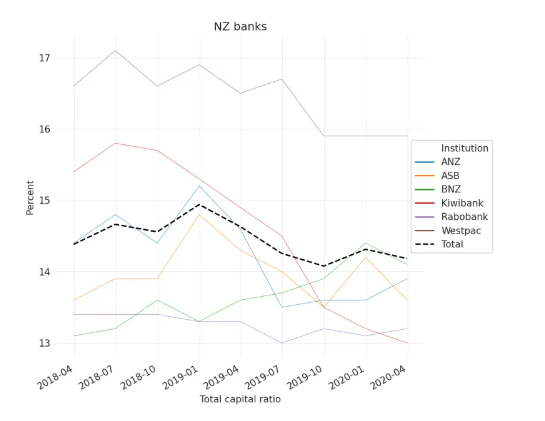
There are really two main points here.  The first is the claim –  that Orr has made repeatedly –  that banks were well-positioned this year partly because they had been acting preemptively to raise more capital in anticipation of the higher capital requirements, which were supposed to be phased in from this year.  Victoria University banking academic Martien Lubberink has addressed directly this claim in a post on his blog.   As everyone recognises, capital ratios have increased since prior to the previous (2008/09) recession, under the influence of some mix of regulatory and market/ratings agency pressure.  But here is Martien’s chart showing total capital ratios for several of main banks operating here for the period, in early 2018, since Orr took office.

total capital ratios

He has another chart showing core (CET1) capital ratios, which also suggests no lift in capital ratios over the last couple of years.

The Bank has been attempting a difficult balancing act: trying to assure us (of what is almost certainly true) that the local banks are very sound, but at the same time trying to get cover for the scheduled large increase in capital requirements.  There would be some reconciliation if banks had been raising actual capital in anticipation of those new requirements but….the Bank’s own data, the useful dashboard, confirms that it just isn’t so.    It is just spin, it is a lot worse than that.

Oh, and note that Bascand reaffirms that the Bank is still committed to moving ahead with the higher capital requirements –  even though it expects the banks to come through the current severe test just fine.    The implementation was delayed by a year back in March, but that is now five months ago, and July 2021 really isn’t far away –  particularly in a climate of heightened uncertainty, including about likely loan losses out of the current recession.  So on the one hand the Deputy Governor and his boss are out their urging banks –  almost suggesting it is some sort of moral duty –  to lend more freely, and on the other hand they are still pushing ahead with their plans to hugely increase actual capital requirements, something even their own modelling suggested would have adverse transitional effects in more-normal times. (Oh, and did I mention all while doing nothing to actually lower real interest rates across the economy, in ways that might improve servicing capacity on current debt, and provide a boost to aggregate demand and –  over time – to credit demand.)

And here I want to refer to the other speech, by Toby Fiennes; in particular this extract (emphasis added)

At the end of May we released our six monthly Financial Stability Report (FSR) which assesses the health of the financial system. This assessment presents particular challenges during more volatile and uncertain times; we want to report openly and fully about the state of financial stability and the risks that we see, but we have to be mindful of the risk of exacerbating the situation, and further undermining confidence.

We used stress tests to inform ourselves and our audience about banks’ and insurers’ resilience. We developed two scenarios to test the banking system, which had similar economic projections to the Treasury’s COVID-19 scenarios 4. Results from our modelling indicated banks would be able to maintain capital above their minimum capital requirements under a scenario where unemployment increased to over 13 percent and house prices fell by a third. However, a second more severe scenario showed the limits of bank resilience. Under this scenario with unemployment of over 18 percent and house prices falling by half, banks would likely fall below minimum capital requirements without significant mitigating actions.

I should note that bank capital buffers have increased significantly in the past decade, in response to actual and forthcoming increases in regulatory requirements; therefore the banks entered the Covid-19 pandemic in a sound position. Additionally, since early April the Reserve Bank has prohibited banks from paying dividends to their shareholders, which further supported the capital positions of New Zealand banks. This gives banks headroom to continue to supply credit, which will play a large role in supporting the economic recovery.

Note that he repeats the same outright misrepresentation –  the bolded phrase –  as his boss.

But it was the rest I was more interested in.  He highlights again the updated stress tests reported in the FSR.    I might be more pessimistic than most economists, so I reckon the 13 per cent unemployment scenario sounds like a good and demanding test.  As with previous similar RB stress tests, Fiennes reports that the banks come through just fine –  at least so long as they don’t markedly lower their lending standards in response to regulatory pressure.  But again –  as was argued during the capital review debates last year –  if the system is resilent to such an adverse shock before capital ratios are raised, what possible credible case can their be for markedly further raising capital requirements?  Especially when the Bank is trying to twist banks’ arms to maintain/increase new lending?   There is just no apparent rigour or coherence to the Bank’s position.

Much the same goes for the line about prohibiting dividends.  I didn’t have too much problem with the temporary ban when it was announced  – on good prudential grounds that in the very unlikely event that our banks got into serious trouble we didn’t want resources being transferred back to the parent, leaving larger losses for New Zealand creditors and taxpayers.   But it is just bizarre to suppose that banning banks from paying dividends will increase their willingness to make new good loans.  If anything, it is only likely to reinforce unease about doing business in New Zealand (at the margin), and since credit demand has fallen notably –  a point Bascand acknowledges-  and actual capital ratios were well above current regulatory minima it isn’t obvious that some shortage of capital in the New Zealand business was likely to be a big influence on lending policy just now.  The suggestion that suspending dividends will “play a large role in supporting the economic recovery” is without support, and if seriously intended is almost laughable.

There is more in Bascand’s speech I could devote space to.   At least what I’ve covered up to here is within the Bank’s statutory mandate re the soundness of the financial system as a whole.    The same can’t be said for this stuff, pursuing the Governor’s personal political agendas on issues where there may be real issues, but they have nothing to do with the Bank’s mandate or powers.

Financial inclusion has become an increasingly important part of the Reserve Bank’s policy agenda in our capacity as a Council of Financial Regulator member and our own Te Ao Māori strategy. The Strategy helps to guide the bank in understanding the unique prospects of the Māori economy, how Māori businesses operate, and what lessons the Bank may learn in setting systemically-important policy with this view in mind. An important part of the Strategy is making clearer the unintended consequences of our policies on unique economies like the Māori economy.

Or one of the Governor’s favourites, climate change.  Here I will just quote one line from the speech

Managing major and systemic risks to the economy, such as climate change, sits squarely within our core mandates.

It simply doesn’t    The Bank has an important, but narrow, statutory role and set of powers around the soundness of the financial system.  Climate change(and policy responses to it) may well represent a significant threat to our economy, our way of life, and so on. But unless –  and even then only to the extent –  it poses a threat to financial stability, not taken account of by private borrowers and lenders, it is really no particular business of the Bank.  Any more than other serious risks –  management of Covid itself as just a contemporary example –  are anything much to do with the Bank.

But the Governor has personal ideological agendas to pursue, and (ab)uses public resources and staff to pursue them.

Standing back from the Bascand speech, what is really rather striking –  and disappointing –  is the lack of an overall framework, the lack of any real rigour or discipline, and a lack of straightforwardness.  Clearly his boss has a cause –  more lending –  to pursue, but like Orr Bascand offers no reason to suppose, or evidence to support the implication, that banks are not acting prudently or appropriately.  And never seriously engages with the implication that if the banking system is sound now and has plenty of headroom, why would it make sense for the Bank to be imposing big new capital requirements, which will assuredly be reducing the willingness of banks to lend.

But, as I noted earlier, if the opportunities are so real no one is stopping Orr and Bascand leaving their safe official perches and starting –  or joining –  a risk-taking bank.  A good supervisor would, however, be keeping a very close eye on any bank riding courageously into the cannon fire –  of extreme economic uncertainty, severe challenges –  in the way Bascand appears to suggest.

Perhaps better if Orr and Bascand turned their minds, and attention, to using monetary policy in the way it was designed to be used, instead of sitting idly by six months into a severe economic shock, with real interest rates barely changed, and the real exchange rate not changed at all.


Almost literally unbelievable

Our central bank that is.

Except that I had to believe it.  The Governor himself was being quoted again in a Stuff article and the video footage of a full interview with his deputy (on the economics and markets side) Christian Hawkesby was on interest.co.nz.

On Tuesday, as I wrote about in my post yesterday, we had the Governor telling us that monetary policy would have no more than a supporting role –  despite being the main cyclical stabilisation tool – that there would be no “knee-jerk reactions”, that we were in “a good space” and  –  perhaps most incredibly of all –  that “confidence and cashflow will win the day”.  Confidence that had tanked, cashflow that was rapidly becoming a problem for many.  It was –  or one really wished it was –  unreal.

But Orr and Hawkesby –  both statutory officeholders charged with the stabilisation role of monetary policy –  were back at it yesterday.  Clearly, the Governor’s voice is most important –  especially with no deep or authoritative figures elsewhere on the MPC –  so we’ll take his new comments first.

Not all of it was silly.  There was the standard advice to firms to talk to their banks early (I imagine that, where they still can, firms might be well advised to draw down any credit lines early too).  But then we get lines like this

Reserve Bank governor Adrian Orr has advised businesses to focus on things they can influence and banks to consider their “social licence” and play a long game to bridge the gap in activity created by the coronavirus pandemic.

“That is it all it is, just a gap,” he said.

Talk about minimisation.  If a firm takes a deep hit to its revenue for six or nine months, and has fixed commitments it can’t get out of at all, and other semi-fixed commitments, what was a viable business can quickly run through any remaining collateral and not be viable at all (the underlying business might be, but not the existing owners).  So sure it is a “gap”, but it could be a mighty big one, with quite uncertain horizons for anything like normality returning.

Most especially because the Governor –  like the Minister of Finance – gives no hint of recognising that the worst  (probably a lot worse) is yet to come.

(And what about that strange suggestion that firms should focus on what they can influence?    What they can’t, really at all, influence is what is likely to be worrying most, more so by the day.)

But the interview goes on

He said he did not believe there was a perception that the bank had been slow to respond to date.

Instead, there were benefits in the central bank getting more information about how consumer and investor behaviour was unfolding and the response of global governments, he said.

“While some talk about ‘what is your interest rate response?’, at times like this central banks have a much broader and important role which is around financial-market functioning and financial institution stability,” he said.

“There, we certainly aren’t sitting on our hands, watching, worrying and waiting.

“We are on high alert around how the financial markets are operating and our role in the provision of liquidity.”

I guess he isn’t reading much of anything –  unless he now has his media clippings selected only for their favourability to him –  if he really believes that first sentence.  Perhaps the case for an OCR cut at the MPS was borderline, but there were plenty of sceptics even then as to whether their talk was taking things seriously enough.  And I haven’t seen many people who thought has remarks on Tuesday were appropriate, responsible, timely, or whatever.  In the meantime, central banks in Australia, the US, Canada and now the UK have acted.

But it was the rest of that quote that really staggered me –  the claim that the Bank had a “much broader and more important role” in this situation around market functioning and financial institution soundness.  Again, what planet is he on?   No one, but no one, believes the coronavirus shock’s economic effects are primarily a financial stability issue.  Really severe recessions could in time generate significant credit losses, but that is well down the track (for banks of our sort).  In things to do with the Bank this is primarily a severe adverse shock to demand (almost wholly a demand shock for New Zealand so far, something neither Orr nor Hawkesby seem to grasp).  These are the guys who go on and on about their new employment-supporting mandate.  Lots of jobs are being lost right now, and will be over the coming weeks and months.   There may be other things governments can/should do, there may be other stuff other wings of the central bank need to focus on, but monetary policy is their macroeconomic business, the tool that can be deployed quickly and flexibly, and which has been in every past crisis.  But Orr and Hawkesby seem to prefer to sit on their hands and gather more information (of the gathering of information in fast-moving, exponential, crises there is no end).

Before coming back to Orr’s final comments, I add some remarks on Hawkesby’s interview.

Assistant Reserve Bank Governor Christian Hawkesby says the RBNZ’s main focus at this point of the coronavirus crisis is making sure the banking system remains strong.

Echoing comments Governor Adrian Orr made on Tuesday around confidence and cashflow being key, Hawkesby said the RBNZ is looking at how funding markets and banks’ relationships with their coronavirus-affected clients are holding up.

“That’s really our first point of call and our main focus – at least in these initial stages,” he told interest.co.nz.

Much the same themes, but how utterly irresponsible.  No sense of his responsibility as a (statutory) monetary policymaker, explicitly charged with a macrostabilisation role.  Doubly so because, as he goes on to acknowledge (and unlike, say, Italy)

“We have a well-capitalised banking system and a well-funded banking system.”

So try looking under the right lamp-post for issues that need to be addressed.

Hawkesby, like Orr on Tuesday, hosed down expectations of large, if not emergency, Official Cash Rate (OCR) cuts in the immediate future.

He said the government could move with more haste than the RBNZ, targeting those most affected by coronavirus.

He also claimed it was “early days”: early days was a month or six weeks ago, when the Bank was doing its MPS forecasts.  This is now a full-throated downturn –  where even the local banks are now talking, belatedly, of recession.

And what of that nonsense about the government being able to move faster.  Not only is it generally not true –  OCR decisions can be taken and implemented almost instantly –  but on this occasion neither party has actually done anything yet.   In  fairness to Hawkesby when I listened to the interview he seemed to be trying to make a point that sectoral issues are better targeted with sectoral policies, but that doesn’t really help him this time, as he went on to say

Hawkesby said: “What we need to think through is, to what extent is it [coronavirus] a supply-side issue around supply chains; around specific sectors being affected – in which case monetary policy can’t provide direct help.”

He said monetary policy would be useful if there is a spill-over effect and a lack of demand and confidence across the economy.

Perhaps he missed the data release on Tuesday showing that business confidence had fallen to levels last seen in 2009.  And when you are talking about the temporary collapse of one of our largest economic sectors –  overseas tourism –  you are dealing with pervasive effects that really only macro policy can do much to lean against.

It is almost as if these guys think they are running some sort of academic seminar, rather than being alert to real world developments –  here and abroad, including monetary policy responses abroad.  Whatever the explanation –  and no one seems to have a good one, they are just failing to do the basics of their job.  In none of any of that was there any mention of the idea that (at least temporarily) neutral interest rates will have plummeted –  the fall in very long-term bond yields is probably a bare-minimum estimate of how much –  and that much of the job of monetary policy is keeping actual short-term rates in line with shifts in neutral.  These guys would appear to prefer to do nothing, even as real retail interest rates are rising. (I’m sure they will move, perhaps quite a lot, as spiralling global crisis will produce a lot of reality to mug them with in the next couple of weeks.)

Oh, and as in the Governor’s remarks on Tuesday, there was nothing in either interview about the threat to inflation expectations. They are falling around the world, and in New Zealand –  seen in the bond market and in the ANZ business survey.  As I noted towards the end of yesterday’s post, it is a strange omission, because only a few months ago both Orr and Hawkesby were dead-keen on emphasising downside risks to inflation expectations and making the case for pro-active least-regrets monetary policy adjustments.  Good and sensible quotes from both of them are included in this post from late last year.    Not sure what happened to those central bankers.  The threats/risks must be much greater now.  But it all fuels a sense that these guys are just out of their depth, with no consistent mental models or sense of the world (or this event) found especially wanting by a crisis.

By contrast there was good workmanlike speech on coronavirus economic issues yesterday by Guy Debelle, Deputy Governor of the Reserve Bank of Australia, Hawkesby’s direct counterpart.  It was what serious normal central banking looks like.

But I wanted to come back to Orr’s final comment in his Stuff interview.

The coronavirus was a reminder of why policies such as the Reserve Bank’s decision to increase the capital requirements of the major banks and to ensure they could operate on a standalone basis had been pursued, Orr said.

“We try to implement them in peace time, because it is hard to implement them in war time – not that I am saying we are in war time.”   

He probably should get his lines sorted out with his deputy: you’ll recall that Hawkesby quote that, at current levels before any of the increased capital requirements take effect, we have a “well-capitalised” banking system.   Which is what the Bank’s demanding stress tests have always shown, and what numerous serious critics pointed out in the consultation process last year.

But even if we take Orr’s comment in isolation, he seems not to recognise at all that whether his announced higher capital requirements made sense in some long-run steady-state, they will have some adverse effects on the availability of credit, rates of investment etc through the transition period.  Orr confirmed that capital requirements in December and they are to be phased in over seven years.   Unfortunately, the beginning of that transition period – when bank behaviour is already being affected (and we saw this in the last credit conditions survye months ago – the next one, presumably taken this month, will be fascinating) – happens to coincide with the nastiest economic shock we’ve had in a long time.   But, at present, no bank’s capital ratios will be any higher now than they would have been if Orr had seen sense and not proceeded (so there is none of the additional buffer he is implying).   As it happens, reported capital ratios  –  though not of course actual dollar capital – would drop before long, because the change to the rules around aligning minimum risks weights for iRB banks with the standardised rules is being frontloaded.

And while no one could foresee that we’d have a severe pandemic shock this year, Orr was warned of exactly this sort of issue: in a climate with little conventional monetary policy capacity, sharply increasing capital requirements over a period when a new recession was fairly probable at some point would simply compound the real economic and economic policymaking challenges.  This was from my submission

Finally, in this section, there was no discussion at all of the macroeconomic context in which these proposals would take effect.  The proposals involved a transition over five years.  Nine years into an economic recovery, with slowing domestic growth and growing global risks there has to be a fairly significant chance that the next significant recession will occur in the next five years (i.e. during the proposed transition period).  That means a significant risk that regulatory policy would be exacerbating any downturn (through tighter credit constraints, reduced credit appetite, and potential higher pricing), in a downturn in which monetary policy is likely to be hard up against conventional limits (the Bank’s own analysis has suggested the OCR might be able to be cut only to around -0.75 per cent).  Of course, if bank balance sheets were looking shaky it would be prudent to move ahead anyway – better ten years ago, but if not then now – but nothing in the Bank’s published analysis (past FSRs, stress tests, consultation document) nor in the credit ratings of the relevant institutions suggests anything like that sort of vulnerability.  Without it, you will – with a reasonable probability – make economic management over the next few years more difficult (additional upfront potential economic costs), in exchange for the modest probability of making any real difference to (already very low) financial system risks over that period. It isn’t a tradeoff that appears to be worth making – at least not without much more supporting analysis than we have had to date.

I’ve seen no sign Orr or his colleagues ever engaged with this point.

And before passing on, don’t overlook this bit from Orr

“not that I am saying we are in war time”

Relentlessly determined to minimise just what is going on and the extremely challenging period –  of indeterminate length –  we are now entering.

But whatever should have been, the new capital requirements are what they are.

There is some discussion as to whether it might make sense to suspend implementation of the new requirements.  In the UK, the Bank of England last night released their Countercyclical Capital Buffer (an element of their capital requirements).  More generally, people are looking at the merits of some regulatory accommodation.

For now at least, I have to say I’m quite sceptical, at least in New Zealand (and I noticed Hawkesby suggested these were conversations for well down the track).  Sure, capital is there to be used as loan losses mount (which, of course, they haven’t yet).  But it is always worth remembering how important expectations are to behaviour –  for bank/bankers as much as anyone else.  So, sure, Adrian Orr could suspend the implementation of the higher requirements, but why would that materially alter the attitude of banks to taking on additional risk?  After all, the Governor tells us this is just “a gap”, but even when reality finally mugs him, the banks –  and their parents in Australia –  will know that the Governor is still sitting there waiting to resume the steady escalation in capital requirements as soon as some modicum of normality returns.   I’m not going to oppose suggestions of a temporary suspensionm but I doubt there would be much bang for the buck in doing so, at least while Orr is still Governor.

It really has been a reprehensibly bad performance so far in this crisis from the Governor, his monetary policy deputy, and the Monetary Policy Committee as a whole (all of whom must, for now, be presumed to be on board – although will the next OCR decision be the first time someone on MPC is willing to record a dissent?).  Looking to the statutue books, you might have been hoping that the chair of the Bank’s board and/or the Minister of Finance –  both responsible for the Governor and the MPC –  would be demanding something better, but I’m not holding my breath about either of them.

There are, of course, more ultimate statutory provisions.  They won’t be used.  But the case is mounting that the Governor, the Bank, Hawkesby, and (as far we can tell) the external ciphers on the MPC simply are not doing their monetary policy job.  It is an utter failure of leadership, something we are now seeing far too much of at the top levels of government as this crisis deepens.  We are paying for unserious appointments, weakening public institutions, in the quiet times.


What does bank capital do?

Reflecting a bit further on the Reserve Bank Governor’s decision to increase very substantially the proportion of locally-incorporated banks’ balance sheets that need to be funded by capital, and on some of the points I’ve made over the year, I was trying to distinguish in my own mind quite how the Governor seems to see bank capital (the differences it can/does make) and how I see it.   This post is an attempt to jot some of that down, and to clarify a bit further some of my own thinking.

Loss absorption at or very near the point of failure isn’t really a point of difference.

Take a bank approaching the point of failure, with signs that the value of its assets might be less than the liabilities to creditors (including depositors).  If some fairy godmother suddenly injects a lot more capital, not only might the bank not fail at all, but if it does nonetheless fail the losses creditors will face will be greatly reduced.   Creditors/depositors generally like capital and will typically charge a higher price to lend their money to a bank that is perceived not to have very much of it.  That is a market process, and is how small entities (in a system with no deposit insurance, such as New Zealand at present) function routinely.

Government bailouts have the same sort of effect at/near point of failure, whether they take the form of guarantees that are paid out in liquidation (eg South Canterbury Finance under the deposit guarantee scheme) or a government recapitalisation of a bank as a going concern (eg, in a New Zealand context BNZ in 1990, or numerous more recent examples abroad).     The money taxpayers put in is a cost to them (us) and a gain to the creditors/depositors who would otherwise face losses.

The bailout transaction is a transfer: from the government (taxpayers) to the subset (large or small) of creditors and depositors.   If most creditors/depositors are locals that transfer doesn’t make New Zealanders as a group worse off; it largely just transfers resources to one particular class of New Zealanders.   As a society we might reasonably be unwilling to pay a high (permanent) costs, from newly intensified regulation, simply to avoid the possibility of such transfers once in a while.

You and I might not like such bailouts but the fiscal cost of them isn’t a good reason for much higher capital requirements.  Apart from anything else, it shouldn’t really be a concern of the central bank –  which isn’t a fiscal authority and was charged by Parliament with focusing on the possibility of “significant damage to the financial system” from bank failures, a proxy for potential damage to the wider economy.    If the potential fiscal cost of bank failures were to be a prime consideration, you might then expect the government (responsible for fiscal matters) to have some considerable and formal say in decisions around bank capital.  In doing so, they might evaluate the deadweight losses from slightly higher taxes to fund bailouts (if they happened) against the costs to the economy of higher minimum capital ratios and, in principle, decide which was less costly to society as a whole.    (Or they might look at the feasibility of tools like the OBR, which might allow losses to lie where they fall, potentially reducing the likelihood of bailouts.)

In fairness to the Governor, the Bank’s arguments for much higher capital ratios here have not rested heavily on fiscal cost arguments.  But it is something higher bank capital can (probably/largely) mitigate, at least if injected at/near what would otherwise be the point of failure.

Instead, the Bank/Governor have made much bigger claims for what much higher bank capital requirements can do, and they are really where the differences lie.

This paragraph is taken from the Bank’s decision document

It is an established finding in the economic and financial literature that shareholders invest less capital in banks than is socially optimal. This problem has been evident since the middle of the 20th century.  The problem arises in large part because shareholders and creditors expect governments to bail out banks that are at risk of failing and whose failure would bring widespread social and economic costs. The expectation of bail-outs means creditors are prepared to lend to banks when capital levels are low, generating socially sub-optimal levels of bank capital.

I think they overstate their case (“an established finding”) but as a theoretical point it seems fine: in an over-simplifed model, if everyone thinks governments will bail out large banks in trouble (without properly pricing that risk in, say, risk-adjusted deposit insurance premia), creditors will not insist on banks holding as much capital and failure events will be more common.  More risky lending is also likely to be done, since shareholders can capture the upsides, while downside risk to creditors is off-laid to the Crown.  Not everyone will behave that way and managers/Boards still have reputational risk to consider, but if bailout risk is real (which it demonstrably is, including here) and can’t be dealt with/limited directly (an open question, at least in a realpolitik world) it would be simply foolish not to have some sort of minimum capital regime.

But that doesn’t really help us, in thinking about what should be done right now.  It makes for good rhetoric perhaps, but only among people who aren’t aware (a) that regulatory minimum capital requirements have been in place for decades (in fact, even in the dim darks, double liability for bank shareholders was often a requirement –  the chair of the Reserve Bank Board wrote about such things earlier in his career), and (b) of the sorts of capital ratios maintained by intermediaries where there is little or no credible prospect of bailouts.  The Reserve Bank –  and their peers abroad – has made no attempt to show that, absent bailout risk, banks would operate with higher capital ratios than they have now.  Perhaps that is a more pardonable oversight in countries with comprehensive deposit insurance regimes, but it is much less excusable here.

And the rhetoric conveniently elides what is really a very important distinction.    Take government bailout risk out of the picture, and banks –  including their shareholders –  and their customers (“the market”) will work out financing structures and pricing that provide some reasonable balance of risk and return.  There would probably be a spectrum of types of institutions –  rock-solid ones offering lower interest rates to potential lenders, and more risky ones.  Individuals can make choices about which to deal with.   It is how things work in the rest of the private sector.  And there would be failures from time to time.  Shareholders would lose their money.  Creditors would lose (some of) their money.    Borrowers with revolving credit lines might face disruption to their ability to pay their bills.   Employees and managers would lose their jobs,  And so on.  But all those parties can (in principle) evaluate and price those risks, and choose different options if the particular risk on offer (job, deposit, or whatever) is too high for comfort.

The way government bailout risk affects bank’s own choices (“moral hazard”) is not really the central issue at all.    What is really going on in Reserve Bank thinking is the idea of externalities; the adverse effects of a bank failure on other people.  Effects that bank managers and shareholders have no incentive to take account of in making decisions about capital structures.  There are no market feedback mechanisms (or, more realistically, insufficiently strong ones) to encourage them to do otherwise.   What drives the Reserve Bank is a belief –  and it really is not much more than belief –  that (a) these potential externalities are very large, and (b) that much higher bank capital requirements can make a material and substantial difference in allevating them.   I think the evidence of economic history is that they are wrong on both counts.

Listen to the Reserve Bank or read their material and you will be presented with tales of woe, reminders of the 2008/09 crisis, and talk of huge economic and social costs.  Many of the numbers that are cited are shonky at best (I’ve touched on that in previous posts and may come back to the issue next week).  But what you won’t be presented with is any careful evidence or analysis to show how much higher capital ratios would have prevented these costs (not just alleviated them at the margin, but substantially prevented both the crisis itself and the costs the champions of change seek to highlight).

There is little or no engagement with economic history including the specifics of what was going on –  including elsewhere in policy –  in the lead-up to the (relative handful of examples of) advanced country financial crises.   And there is almost no recognition of the fact that financial crises (or, more specifically, major bank failures or near-failures, involving large credit losses) do not happen in isolation, because some uncontrollable unforeseeable thunderbolt hits a particular economy.      Rather the seeds of future crisis are laid in a succession of bad lending and borrowing choices –  borrowers here matter quite as much as lenders – typically over a period of several years.     Of course, in one sense the “badness” of those choices only becomes apparent later, when the losses happen, and thus the argument risks being a bit circular, but it can be framed this:   lending standards, and a willingness to borrow, become much freer and looser than the standards that prevail in more normal times.

If we look back over economic history and financial crises those mistakes seem to arise in a variety of contexts.  Sometimes it is when government regulations directly mess up the market.  One could think of the US housing finance market in that context.  Sometimes, governments skew important relative prices – in pursuit of other apparently worthwhile objectives.  Here one could think, for example, of small countries that previously had high interest rates entering the euro and finding (a) finance more readily available than usual, and (b) good times interest rates people hadn’t seen before for a long time.  In a similar vein, one could think of newly liberalised markets, where no one much (regulators, borrowers or lenders) really knows quite what they are doing and what risk and opportunity really look like in the new world (one could think of the late 80s New Zealand –  or Australia or the Nordics – in this vein).  Or of stunning new growth phases –  much of which might be genuinely well-grounded –  that create a pervasive (among governments, borrowers and lenders) air of optimism, a belief that the world is different, an uncertainty about just what will and won’t prove robust.  Perhaps Ireland and Iceland fitted in that camp to some extent –  some in New Zealand in the mid-late 80s thought that was us too.)

In these climates eager borrowers and eager lenders get together and make choices, that have very little to do with bank capital levels, that often prove, with time, to have been misguided.  But although neither side knows it, the damage is really done when the initial loans are written and resources used on projects that really aren’t economic. In this phase there are often what look and feel like positive externalities –  the extreme optimism and exuberance (and high incomes) that pervaded much of Ireland in the early 00s for example.  Some people probably got into houses –  and are still grateful for it –  who otherwise wouldn’t have done so in the housing finance boom in the US.

Higher bank capital might stop the eventual realisation of the losses falling directly on bank creditors and depositors (that redistributive effect, see above) but it won’t stop the losses themselves (on the bad projects that were funded), it won’t stop those particular markets seizing up and demand no longer being there (no one much wanted to build any more new offices in late 1980s Wellington after the scale of the incipient glut became apparent), it won’t stop people across the economy (lenders, borrowers etc) having to stop and reassess how they think the economy works, their view on what might really be viable projects and so.   And they won’t stop the realisation of wealth losses –  the wealth that was thought to be there has gone, the only question is who now actually bears the losses.

Perhaps if pushed Reserve Bank officials would concede these points, but since they haven’t been pushed  they continue to claim, and act a basis justified only if, all the economic and financial losses associated in time with significant bank failures (or near-failures) are (a) caused by those failures (or near-failures) themselves, and (b) relatedly, would be avoided if only capital levels were (much) higher.    Neither makes sense. Neither squares with the experience of history.  But in the process they massively over-estimate the economywide benefits of their regulatory interventions.

Quite possibly there are some adverse economic effects from the failure of a significant bank that aren’t already made inevitable by the bad lending (and borrowing) and misallocation of resources and misperceptions of opportunities that created the difficulties in the first place.  There is a fair degree of consensus on the desirability of avoiding the quite intense short-term disruption (and it is short-term, not reverberating decades down history) of the closure of a major retail bank – that was the logic of the OBR mechanism –  but there is no way that the cost of such a closure, conditioned on big credit losses having happened anyway, are anywhere near 63 per cent of GDP (the number used in the Reserve Bank’s analysis).  To believe otherwise is to (a) grossly overstate the power of policy (specifically bank capital policy) and (b) to seriously underweight the capacity of the market and private sector to adapt and adjust.

And in all this I’ve implicitly assumed –  as the Bank does – that much higher minimum bank capital ratios do not have other deleterious effects themselves.  For example, it isn’t impossible that higher bank capital ratios, imposed by regulators, will induce more risk-taking behaviour from at least some industry participants, trying to maintain previous target rates of return on equity.  It probably isn’t a dominant element of the story, where there are reasonable market disciplines as well, but there is some evidence of such behaviour.

Perhaps more concerning is the risk that by focusing very heavily on even higher capital ratios –  in systems that have already proved robust –  supervisors and regulatory agencies put their focus in quite the wrong place.    Recall the comment from the Bank’s own appointed academic expert, David Miles.

The RBNZ has adopted a principle of being conservative as regards bank capital to offset possible risks from its light-handed approach to supervision. That is a choice and one partly based on the view that having very large resources devoted to intrusive oversight of banks is not the most efficient road to go down. That is a conclusion that engineers and safety experts often apply when dealing with the design of structures. There is a choice between building bridges many times stronger than you expect them to need to be OR you having large teams of inspectors who pay frequent visits to examine all bridges and monitor flows of traffic over them.  It is clear that nearly all countries follow the first strategy.

That may be a useful guide for bank supervision.

If it really is sustained periods of greatly diminished lending standards that lead to most of the eventual costs the Bank is worrying about, it might be better for the Bank to be focusing more of its energy on understanding bank lending standards and how they are changing, and on understanding and drawing attention to important distortions in the policy or regulatory system that may be misleading borrowers and lenders alike, and so on.  I’m not that optimistic that bank regulators can really make that much difference –  for various reasons (including their own personal incentives) it is hard to imagine even the best central banks being that influential with governments, or being paid much heed by banks (let alone borrowers and investors not reliant on local credit).  But really high capital ratios have a substantial cost to the economy and it just not obvious that they are particularly potent as an instrument to limit the sorts of (overstated) costs the Bank worries about.  Other big policy distortions, messing up incentives, making it harder to lend or borrow well, might just be one of the messy facts of life.   High capital ratios will always appeal to central bankers –  when your only tool is a hammer, all problems tend to be interpreted as nails –  but they are costly for the economy and whatever gains (beyond the merely redistributive) they offer seem, from experience, likely to be slight.

And what we do need when things go badly wrong, and a whole of reassessment is taking place, is a robustly counter-cyclical monetary policy.  The worst costs of serious economic shocks and misperceptions crystallised are around sustained unemployment for the individuals affected.  Neither monetary or bank regulatory policy can do much about potential GDP growth or productivity, and they can’t prevent real wealth losses when bad choices have been made in the past,  but they can do a great deal to alleviate the adverse cyclical consequences, to keep unemployment as low as possible, consistent with price stability, and deviations from that (unobservable) point as short as possible.

If you assume policy is powerful, you can justify almost anything

So, what to make of the Governor’s final decisions on bank capital?

If you are a bank or bank shareholder, you are presumably just grateful for small mercies, the modest extent to which the Governor changed his mind and allowed the banks to use cheaper forms of capital to meet the new requirements.   Consistent with that, the share prices of the parent banks recovered some ground yesterday.

Since banks are scared of their regulators and –  both here and in Australia –  are very reluctant to seek judicial review, despite the very strong sense of pre-determination about this process, and the evident failure to engage seriously with substantive concerns raised by submitters, there isn’t much else they can do.  Their behaviour –  willingness to provide credit into this economy –  can, and probably will, adjust.  But if they won’t, or can’t, do anything more about the policy decision, grizzling won’t get them anywhere.  Rightly or wrongly, big banks don’t command much public sympathy.

But I’m neither a bank nor a bank shareholder, so I have some different perspectives.

First, a couple of process-y points out of yesterday.     We learned from the Governor’s press conference that the banks themselves had been briefed on the announcement early yesterday morning at meetings at the Bank.  They had to sign up to a non-disclosure agreement to attend, but once the meeting was over they were allowed to leave and go about their business, hours before the public announcement.  Given that the information they’d been given was highly market-sensitive (as we saw in the movement of both bank share prices and of the exchange rate) this was extraordinarily cavalier on the part of the Bank –  only 3.5 years on from the last lock-up they ran, where systemic failures on their part allowed a leak from the lock-up itself, in turn leading to a discontinuation of regular lockups.

There was also a lock-up for journalists yesterday morning  (who weren’t allowed then to leave before the public announcement, not even if they promised to be on their best behaviour). One journalist told me it was pretty chaotic (adminstratively –  access to power etc), but my real concern is what protocols and procedures were in place that would have prevented the sort of leak we saw in 2016 (which involved a journalist in the lock-up emailing the information back to their office).  Apparently, there was also a non-disclosure agreement, but how much protection would that have been if someone had attempted a repeat of 2016?

One element of yesterday’s announcement that was new, relative to the consultation document, was a commitment to an annual review of how things are going as the new policy takes effect (progressively over the next seven years).  That looks, on paper, quite a reasonable initiative by the Bank, except that……the Bank will be reviewing how a controversial decision they themselves took will be going (more specifically, staff who work to the Governor will report to the Governor their assessment of how the Governor’s own decision is going).   It isn’t exactly a recipe for hard-headed or sceptical evaluation.  It reminds me of the clause that was in the Reserve Bank Act that required us to report in each Monetary Policy Statement on how monetary policy had been conducted – the original intent clearly being some critical self-scrutiny.  The provision fell into disuse, until I persuaded people that we really should follow the law.  A box was added to each MPS to deal with the issue.  Unsurprisingly perhaps, in the almost 15 years since no fault was ever found with any past monetary policy action or choice.    That isn’t really to criticise the individuals involved –  except perhaps Governors: the incentives were just set up badly.    Wouldn’t it be better to have some independently-appointed party evaluating things, perhaps not every year, but halfway through the seven years and at the conclusion of the process?   If, that is, the intent was serious, rather than being mere window-dressing.

But none of those are the big issues that emerge, unaddressed, from yesterday’s decision.  The Bank claims to have another document coming, later in the month, that will articulate how they have responded to various points made in submissions, and why.  Maybe that will offer some useful insight in time (maybe), but for now we have only what they released yesterday, which included a 20 page document on the decisions themselves and a 111 page regulatory impact assessment and cost-benefit analysis.

Much of the latter was fairly much a warmed-over rehash of material they had published earlier in the year.  Believe their numbers and New Zealanders collectively will be about $1.3 billion each and every year better off a result of (being compelled) to take this insurance policy.  That is equal to about 0.4 per cent of GDP, a number which might not sound a lot but (a) is pretty large for an estimate of any microeconomic reform measure, and (b) capitalises up to a very large number (on their preferred discount rate, probably well in excess of $40 billion).

The costs and benefits taken into account in reaching this number include both GDP effects and GNI effects.  Specifically, one area the Bank has greatly improved on in the final document is that it now takes explicit account of the fact that higher bank capital ratios will result in materially higher total dollar profits accruing to foreign shareholders in banks.  This had been an omission Ian Harrison was particularly forceful on in his submissions and papers on the capital proposal.     In other words, some larger proportion of GDP won’t be accruing to New Zealanders, and the cost-benefit analysis rightly focuses on the impact on residents.

Here is the Bank’s helpful summary table.
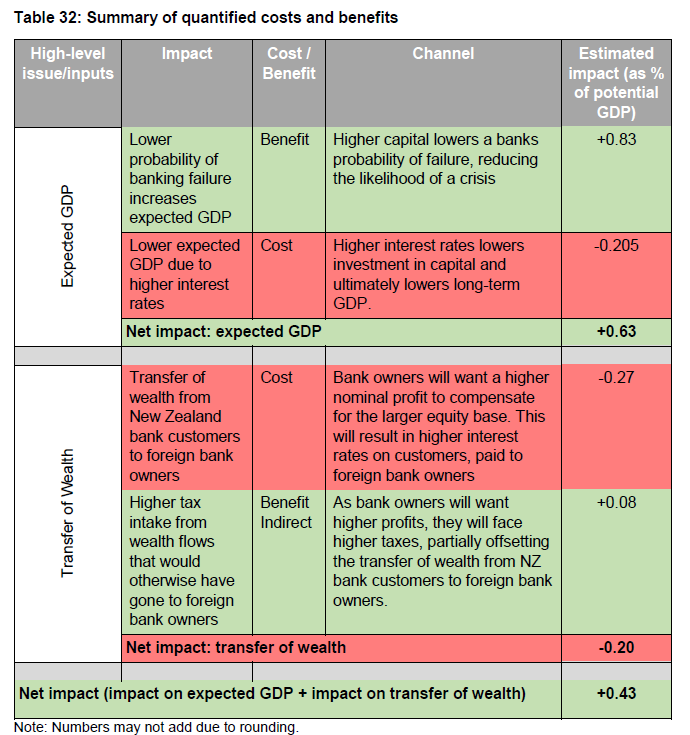
summary CBA.png

Red effects are costs, while green effects are benefits.  Focus on the costs first.

The first of them is the lower level of GDP (permanently lower) as a result of the higher interest rates estimated to flow from this proposal.    The number  – minus 0.21 per cent of GDP –  is a bit smaller than the Bank estimated in the original documents, consistent with them allowing some of the additional capital to be raised from lower-cost instruments.  We don’t know it with certainty, but there hasn’t been that much argument about this number. I’m happy to work with the Bank’s number, while noting that most of the alternative views are of a larger negative effect, not a smaller one.

The second negative effect is the income (rather than wealth) transfer effect to overseas shareholders.    Again, there is some uncertainty about the precise magnitude of the number, but I doubt anyone will argue very much with the broad scale of the number.  The Bank treats the gross effect and the tax offset as separate items, but on their estimates the after-tax effect is equal to -0.2 per cent of GDP.

Thus, the cost of the insurance policy –  on the Bank’s own estimates –  is equal in total to -0.41 per cent of GDP.  Use their discount rate and plausible assumptions about growth in potential GDP (see my treatment of this earlier), and that is akin to spending a discounted present value $40 billion to buy the insurance the Bank is now compelling us to take.  That’s a pretty pricey policy.  The precise magnitudes of the costs have margins of uncertainty around them, but we are near-guaranteed to be paying a substantial premium each and every year,  as long as this policy is in place  (the current Governor, of course, can’t commit beyond his own terms, and there have been numerous changes in the regulatory environment over the decades).

For that (relatively certain) cost, the (expected) benefits had better be good.     The Bank reckons (with inevitable margins of error) that they are equal to 0.83 per cent of GDP each and every year.    And where do they get that number from?  They assume –  it is simply an assumption –  that by bumping up the capital requirements so much they can  –  singlehandedly –  avert a really serious financial crisis at some point in the future which would have (unaverted) a cumulative output cost of 63 per cent of GDP.

Unfortunately, the Bank shows little sign of having really thought hard about the nature of financial crises or really large nasty economic adjustments.  It is all very abstract and ungrounded. Neither in the earlier consultation documents nor in yesterday’s paper was there any sign that the Bank had sought to distinguish the costs that might arise from a crisis itself as distinct from the prior bad borrowing/lending decisions, and resulting misallocation of resources, that may have predisposed a banking system to a crisis.   Higher capital ratios may be able to do some good in minimising the former costs, but it is very unlikely they will make any useful difference to the latter ones, especially if one is starting from capital ratios already high by modern historical and international standards.  In their defence, they will claim to have taken assumptions from “the literature”, much of which was generated by motivated researchers (often working for central banks) looking to build a case for higher capital ratios.  None of the Bank’s work seems to stand back from the numbers and equations to ask what should be elementary questions (even if not always easy to answer).   I touched on many of these points in my submission, from which here are some extracts.I made these points in my submission.

Linked to this point, there is very little recognition (none in the main document, and very little in subsequent papers) that many or most of the output losses associated (in time) with financial crises have to do with the misallocation of resources (bad lending, bad borrowing, bad investing) in the preceding boom years.  Your documents recognise that one cannot simply measure output losses from a pre-crisis peak (typically a period with a positive output gap) but do not go anywhere near far enough to recognise the significance of this, rather larger, point. In such circumstances, estimates of potential GDP itself may be materially overstated.  As far as I can tell, the research papers you quote are open to the same criticism (which is not a defence for the Bank, but – probably – an indication of the predispositions of many of the chosen researchers and their institutional sponsors).

When an economy and financial system has gone through several years of badly misdirected lending, borrowing, and investment, not only is there an inevitability about output losses because of the bad prior choices crystallising, but there is a near-inevitability about both lenders and borrowers being hesitant about doing new business in the wake of the realisation of past mistakes.  Prior assumptions and business models prove invalid, and it takes time for risk appetite to revive, and to identify like projects that would prove profitable.  That is likely to be so whether or not banks emerge from the crystallisation phase with ample levels of capital.       At best, it is only the marginal additional output losses from banks falling into “crisis” (however defined) that is likely to be eased by much higher initial capital ratios – and yet you made no attempt to distinguish this effect.

The Bank also showed no sign of having done any sort of comparative analysis (of that sort done previously on my blog e.g. here https://croakingcassandra.com/2017/07/06/reservebank-dtis-and-the-cost-of-crises/, or here https://croakingcassandra.com/2019/03/04/banking-crises-are-bolts-from-the-blue/ or by PIIE’s William Cline) comparing the output and/or productivity experiences of countries that underwent financial crises with those that did not.  This is particularly important in thinking through the experience around 2008/09, when many countries experienced crises and many others did not, all overlaid on what appears to have been a common global productivity growth slowdown.     Reasonable people might differ as to how best to do such an adjustment or assessment, but the Bank shows no sign of having even tried.  Any plausible assessment of this sort would, however, conclude that plausible additional output losses saved by reducing the probability of any particular loan book incurring losses large enough to run through capital would be much lower than the estimates the Bank uses.    Note also that the Cline methodology still overstates the amount that higher capital ratios alone might save, since his output path comparisons include (for the crisis countries) both kinds of losses – from the initial misallocation of resources, and the pure crises effects.   Only the latter should be relevant in assessing the costs and benefits of higher minimum capital ratios.

As a simple illustration of some of these points, the US experienced in 2008/09 one of the very worst financial crises in advanced countries for many decades and New Zealand experienced only a very minor financial crisis.  And yet the paths of GDP per capita for the two countries were strikingly similar: both were underwhelming, but it isn’t credible to ascribe all the underperformance of the US economy to financial crisis effects, when various other countries had similar experiences (actually US productivity growth (a) slowed prior to the crisis, and (b) post-crisis has been less poor than in many non-crisis countries, including New Zealand).

A much more plausible estimate of the actual GDP savings as a result of averting the true marginal economic costs of a crisis, might be more like 10 per cent of GDP (and even that is large, especially in a floating exchange rate economy).    Assume GDP is, say, 1.5 per cent lower than otherwise for seven years –  simply as a result of the bank failures, not of the crystallisation of bad decisions pre-crisis – and I reckon you’d have a much sounder basis for evaluating the merits of higher capital ratios.    The Bank didn’t even include a number like that in the range of scenarios they looked at (the lower bound they used was 19 per cent, and yet even so in around 15 per cent of their –  skewed high –  scenarios the benefits weren’t worth the costs we’ll all be paying).

On a similar note –  the Bank showing no sign of actually having thought hard about financial crises, nasty economic adjustments etc, as distinct from dropping numbers in a model –  is the issue of stress tests.  As I and others have pointed out repeatedly, the various stress tests the Bank (and APRA) have run over they years suggest that the banks would come through in pretty good shape even really severe assumed shocks (eg a halving of house prices and a deep and pretty prolonged recession, very large sustained rise in unemployment).   That was with the capital levels banks chose to hold, faced with the minimum capital requirements in place for much of this decade.   We all know, too, that the banks came through just fine the 2008/09 recession, despite a huge credit boom and substantial asset price inflation in the years prior to that recession.  How then can so much higher capital ratios be justified?

As it happens, the Herald yesterday reported that MPs had grilled them on exactly this point as a select committee hearing (on Wednesday) on the latest FSR –  good to see some scrutiny.  Here is how Hamish Rutherford reported what the Governor said

“While they’re interesting tests, they are not a one in 200 year test,” Orr said of the stress tests, theoretical studies of how banks would cope in times of financial or economic strain.   “They’re a one in 50 year test…”

They had a similar line in yesterday’s document

While stress tests are one useful lens on the calibration of capital requirements, there are several reasons why there is no automatic link between the two. First, a given stress scenario will not capture all possible risks facing the banking system, particularly the type of extreme scenario that is being contemplated in the capital ratio calibration of a 1-in-200 year event. The Reserve Bank’s stress tests typically assess a severe but plausible macroeconomic downturn event, the type of which may happen once over a period of several decades. Second, it is difficult to capture the real-world complexities of a financial crisis. Moreover, stress tests only consider the banking system as it is currently. As a result, stress tests did not play a strong role in determining 16 percent as the capital ratio required to deliver a 1-in-200 year risk appetite.

Frankly, it is almost nonsensical –  perhaps worse, intentionally –  to suggest that the sorts of shocks applied to the Australian and New Zealand banking system in these stress tests are no more than “once in several decade events”.    As I’ve pointed out on several occasions –  and the Bank has not sought to rebut – there is no example of a modern floating exchange rate economy (and floating matters in the ability to absorb shocks) in which the unemployment has risen by 8 percentage points.  There is no example in modern times in which real and nominal house prices have fallen materially more than the sorts of shocks the Bank assumed.  And although modern history doesn’t encompass 200 years, it encompasses 40 or 50 years experience for perhaps 30 advanced economies (1200 or more annual –  but somewhat correlated of course –  observations).

If these aren’t the sort of shocks the Governor has in mind when he thinks of his 1 in 200 year event, perhaps he could tell quite what such an event looks like?  So far, through all the consultation documents, there has been no hint of that characterisation.    He can’t, surely, have in mind a rerun of the Great Depression –  largely a consequence of pre-modern monetary mismanagement, in a climate of fixed exchange rates.  If not, then precisely what sort of historical event –  or even what sort of stylised event –  is he making us pay this huge premium to try to avert?

When he simply refuses to tell us, reasonable people might reasonably fall back on the very stringent stress tests –  and all those new supervisors he tells us he plans to hire –  to suggest that some of the highest effective capital ratios in the world (right now) are about all the (capital) insurance we probably need.  The Governor noted yesterday the banks tend to hold less capital than is socially optimal, which happens because a pattern of government bailouts encourages those who deal with banks to believe they’ll happen again (viz, most recently here AMI).  But we’ve had minimum regulatory capital ratios in place for decades now, so simply asserting that –  left to themselves – (big) banks might hold less capital than is optimal, tells us nothing about the merits of further increases from the current starting point.

There are plenty of other points I could raise. For example, the Bank depends their discount rate on the grounds it is consistent with the literature, without ever acknowledging that New Zealand interest rates are consistently higher than those in other advanced countries –  still true today.

But the final main point I wanted to note was around international comparisons (or, rather, lack of them).   Right through the year, from the first release of the consultative document to the documents supporting the final decisions yesterday, the Bank has never attempted to provide a robust comparison of its own capital proposals (now decisions) with the capital requirements in other similar advanced countries.  That is particularly extraordinary in the case of the Australia, given that our big banks are all subsidiaries of Australian parents and also affected by APRA’s capital requirements.  It should have been a simple and straightforward matter to have

(a) illustrated the headline differences in the minimum ratios APRA proposes and those the Reserve Bank has chosen,

(b) adjusted for the higher floor the Reserve Bank is choosing to apply (risk-weighted assets for IRB banks will have to be no less than about 90 per cent of what the standardised approach would imply, a much higher floor than used elsewhere, and

(c) to have provided a compelling rationale for the resulting (substantial difference).

Here is a quote from an article in this morning’s Australian

The New Zealand reforms require the big four banks to have tier one capital of at least 16 per cent of risk-weighted assets, and total capital of at least 18 per cent. Of the 18 per cent, at least 13.5 per cent will be common equity tier one (CET1) capital of the highest quality, with other tier one capital including redeemable preference shares contributing 2.5 per cent, and tier two capital including long-term subordinated debt accounting for a further 2 per cent. In comparison, Australian rules require banks to have a CET1 capital of 10.5 per cent.

It is a substantially more onerous regime here, with the differences further widened by the differences in the floors in place for IRB bank risk-weighted asset calculations (all else equal, the difference could be as much as another 2.5 percentage points of CET1 capital).  These are huge differences, never articulated by the Bank and never persuasively defended –  even though, for examples, our banks have large (well-capitalised) parents, and the Australian parents/groups do not.

At FEC the other day, the Deputy Governor attempted to defend the extreme caution

Asked whether the idea of coping with one in 200 year storms was too conservative, deputy governor Geoff Bascand said New Zealand was subject to “an enormous array of shocks”.

“Obviously seismic [shocks], but also as a small, open, trading economy with very high debt levels, we’re exposed to international shocks of potentially great momentum, and so a high level of resilience has some real worth to it.

Bascand has previously tried to claim that New Zealand is materially more risky than Australia –  a claim I rebutted here and here.   I didn’t see the specific claim repeated in yesterday’s document.  Instead, in effect they fall back on bluff and obfuscation, by simply not providing good robust international comparisons, not attempting to justify their stance, and hoping no one much notices.

All this, an enormously expensive additional insurance policy, in a banking system that is already sound and well-capitalised, really does end up looking as though we will pay the (high) price for nothing more than a gubernatorial whim.

(On a final note, for all the talk of seven year transition periods, remember that firms (banks) will adjust their behaviour based on expectations, now knowing the essence of  the regulatory environment they will face in New Zealand for the next few (Orr) years.  We’d already seen in the Bank’s credit conditions survey that conditions are already tightening, largely due to regulatory factors –  points not addressed yesterday or in the FSR.  We should continue to expect to see the largest transition –  actual scale and distribution uncertain –  in the next year or two, not somehow evenly spread over the coming seven years.)

As we await the Governor’s final decision

At midday the Governor of the Reserve Bank will descend from the mountain-top, having communed with himself for some months, and tell us how much more capital locally-incorporated banks will have to hold for each dollar of (risk-weighted) assets.

It is one of the more stark of the democratic deficits in the current Reserve Bank law –  which grew like topsy over the years –  that a single unelected official, largely appointed by more unelected part-timers,  has the unchallengeable power to make such far-reaching decisions, when there is no shared agreement about the appropriate goal policy should be set to meet, no shared agreement on the relevant models of the economy and financial system, and no ongoing accountability for whether this single individual’s choices end up effectively serving the public interest.  Instead, we are left with one individual’s whims – in this case, an individual without even much in-depth expertise or long well-regarded professional experience – and one individual’s personal views of “the public interest”.    Usually, that is the sort of thing we hire/elect politicians for, including because we have recourse –  we can toss them, and their party, out again.

With a better Governor and a better institution beneath/behind him, the legislative framework would still be deeply flawed in principle.  In practice, it might matter rather less.    But instead we have a relatively inexperienced Governor, a similarly inexperienced (in banking, financial stability and associated regulation) Deputy Governor and a fairly weak bench as well.  Search the Reserve Bank’s publications and you will find precisely no serious research or analysis on issues relevant to financial stability or bank regulation.  That isn’t the fault of individual staff, but of choices of successive waves of senior management.  Key management figures are widely known for their aggressive, but insular, approach, and it is only a couple of years since the independent stakeholder survey of the Reserve Bank as regulator produced damning results.   Regulatory capture is often a big concern the public should have about regulatory agencies, and that seems unlikely to be the Reserve Bank’s particular problem.   But analytical excellence, an open and consultative approach, willingness to engage, listen, and reflect, willingness to work effectively with others, are the sorts of areas where the Reserve Bank falls well short.  A system where the Governor is prosecutor, judge and jury in his own case, with no feasible rights of appeal, doesn’t conduce to things being better than they are.

And thus we come back to the Governor’s proposals for markedly increasing bank capital.   These were launched a few days short of a year ago.  There had been no working level technical consultation or wider socialisation of analysis and research on any dimension of the issues.  There was no cost-benefit analysis –  in fact, there still isn’t, we only finally get to see one today and can be sure that will have been artfully constructed to support the Governor’s decision.  As the background papers finally came out it emerged that the 1 in 200 year framework had been chosen at the very last minute.  There was no evidence of close engagement with APRA, despite (a) most of the major banks being subsidiaries of Australian banks, (b) economic and financial risks being similar, and (c) APRA having greater depth and expertise.   To this day we’ve had no serious analysis comparing and contrasting effective capital requirements here and in Australia.

And so it has gone on.  The Bank did publish a few more papers designed to support their case.  They very belatedly hired some hand-picked chosen overseas experts to give the Governor’s plans a tick –  people with no expertise specific to New Zealand.  And even then the ticks weren’t exactly ringing endorsements –  recall David Miles noting that one could grosly over-specify a bridge, or employ engineeers to do regular inspections and assessments.   We’ve had the odd speech –  although never once a serious effort from the Governor, the sole decisionmaker –  including, most recently, the half-hearted ill-supported attempt by the Deputy Governor to claim that New Zealand was much riskier than Australia.  But no indications of any serious engagement with people who had lodged submissions raising technical points of one sort or another on the proposal.

And then, of course, there was the Governor’s style.    There were the attempts –  open and public –  by the Governor to suggest that anyone who disagreed with him was “bought and paid for”, in league with the banks.   Even if it were true –  which it demonstrably wasn’t –  isn’t the onus on a decent policymaker, particular such a powerful one, to engage on the substance and to show where and why someone with an alternative perspective might be wrong.

And then you might recall the succession of Stuff articles on other aspects of how the Governor has been operating this year.

The video of the conference remains on the Reserve Bank’s website. Some reporters said they were stunned Orr would air his anger so publicly and called it bullying.

But other observers were not surprised. Details of Lubberink’s experience were already circulating in Wellington and industry sources say they match a pattern of hectoring by Orr of those who question the Reserve Bank’s plan.

“There is a pattern of [Orr] publicly belittling and berating people who disagree with him, at conferences, on the sidelines of financial industry events,” said one source who’s been involved in making submissions to the Reserve Bank on the capital proposal.

There have also been angry weekend phone calls made by Orr to submitters he doesn’t agree with.

“I’m worried about what he’s doing.”

The source said some companies have “withheld submissions,” for fear of being targeted by Orr.

“They’re absolutely scared of repercussions. It’s genuinely disturbing,” he said.

and

In the cut and thrust of the debate, Orr’s jokey style and everyman charisma fell away. In recent months he’s dogmatically insisted the cost of his plan would be minimal and has picked personally at critics in the media, academia, and the financial services industry.

He’s been variously described as defensive, bullying, and perilously close to abusing his power.

“He’s in danger of bringing scorn on his office,” said long-time industry watcher David Tripe, professor of banking at Massey University. “I used to know him well. I no longer feel so confident.”

Or the strange statement the Governor corralled his entire senior management to sign, rejecting attacks on Bank staff –  and thus attempting to play distraction, since most of the concerns were about the Governor himself and his (now) handpicked senior management.

(As I’ve noted previously, I don’t have a personal dog in this fight.  If he has been abusing me –  which wouldn’t surprise me – I don’t know of it, and fortunately wasn’t one of the submitters subject to one of those “angry weekend phone calls”.   But New Zealand deserves a lot better from such a powerful public figure.)

The Reserve Bank’s Board and the Minister of Finance are jointly and individually responsible for the Governor.  I wrote to both a couple of months ago expressing my concern, partly because the chair of the Board tried to bat away the issues by suggesting that he had had “no formal complaints” (as if that was the appropriate threshold for concern, in an industry where the Governor has great power to make things difficult for at least soe troublemakers).  My letter to the Board was here.   I also knew that I wasn’t the only person writing to the Board.

I lodged a request under the Privacy Act for (basically) any Reserve Bank senior management mentions of me during October (the time of the Stuff articles and the letters to the Board).  I was mostly after the flavour of the period.

For anyone interested the response (not particularly long) is here

Reddell Personal Information 281119 (1)

It includes the letter, Geof Mortlock, former Reserve Bank (and APRA) official, wrote to the Board chair Neil Quigley (because he referenced something I’d written), quite critical of both the Governor and the Board.

Here was how one of Orr’s deputy chief executives responds when Neil Quigley forwarded the letter on.

robbers 1.png

I thought that “Sigh” was pretty telling.  The SLT statement to which she refers was that extraordinary to suggest that it wasn’t fair that people were beating up on their staff when…..no one was.  Play distraction rather than addresss any issues about policy or the Governor.

I sent my letter later the same day.  This was the Robbers unguarded response

robbers 2

(I have never met her, but I can assure her (and her bosses) that I’m not “bitter” –  I’m not sure what I’m supposed to be “bitter” about, but it is clearly a theme that makes Bank management feel better –  and if they looked at all carefully they would find I typically express my concerns more moderately than some others commmentators on the Bank –  see eg some of the Mortlock articles and, indeed, letter to the Board.  Never mind though, she is “calm and serene”).

Having received my letter, Quigley contacted Orr.  An excerpt

quigley 1

Actually, I didn’t ask for it to be discussed at the Board (although I appreciate the fact that it was so discussed – see below).  More importantly, perhaps, I had not talked to Kate MacNamara for the articles, and have never had any contact with her.

Orr responds a few minutes later, not at this stage having seen the letter

orr letter

One has to chuckle at the lack of any apparent self-awareness in that second paragraph, written just days after the Governor had had his SLT put out that unsolicited statement attempting to distract from real concerns.  I guess it wasn’t the Governor who was making those “angry phone calls”, or engaging as he did with Jenny Ruth, and so on.

A few minutes later Quigley responds, rather characteristically it would seem (one of the consistent criticisms of the Board is that they repeatedly acts as if their role is to cover for the Governor, not –  as the law provides –  to hold the Governor to account on behalf of the public and the Minister.

quigley 3

This is, presumably, a reference to the episode in which Graeme Wheeler used public resources and his official position to attack me as “irresponsible” for bringing to light what proved to have been a leak of the OCR and associated systemic failures, and when I expressed concerns to the Board –  on which Quigley was then a member (generally one rather sceptical of Wheeler) –  they all circled the wagons to defend the Governor.

The Board met a few days later.  A few days later Quigley confirmed to me that the non-executive directors (Orr is also a director) had discussed my letter.  The Board’s minutes confirm this.

board

We don’t know what was said (and even if it were recorded, it would –  rightly –  not have been disclosed), although there are rumours –  heard from several sources –  that the subsequent meeting between Quigley and Orr was a fiery one, suggesting that the Board may actually have taken seriously some of the concerns raised.   There were signs in the Governor’s demeanour at the last two press conference that he may have been counselled to rein himself in and act with a bit more gravitas and dignity.

As it happened, I had lodged a parallel Official Information Act request in which I asked for

·         all communications received from outside the Bank by Board members (including the Governor) during October 2019 regarding the Governor’s performance or conduct, including (but not limited to) issues raised in recent articles by Stuff’s Kate MacNamara

·         any comments on those communications made by the Governor

·         details of any external speaking engagements, or contributions to written publications, where the Bank had initially indicated that the Governor would speak but which, during October 2019, were either rescheduled, cancelled, or assigned to some other Bank staffer.

The response was due last Friday.  It wasn’t an onerous request.  There can’t have been many such communications to Board members, nor (presumably) many written comments by the Governor.  The third strand was to attempt to find out whether the reported story was correct, that the Governor had chosen or being prevailed on to pull out of some engagements after the criticism.

Anyway, the Bank has extended the deadline for this request by another 2.5 weeks, claiming the need for “consultations”.   But I guess it also conveniently pushes any release beyond today and close to the Christmas break.   Perhaps there is more there than I assumed.  More probably they are just being deliberately obstructive.

As I noted, I also wrote to the Minister of Finance about these issues, mostly to reinforce the point that the Governor was his responsibility, and he couldn’t just fob things off to the Board.  The Minister’s stance right through this year has been to distance himself from the proposed major new regulatory initiative, claiming it is just up to the Governor, and refusing to exercise any of the powers he does have.    Here is that letter.

Letter to MOF re Orr Oct 2019

I didn’t really expect to get more than a one sentence reply, but a fuller response turned up in the post the other day.  Here is the heart of it

robertson.png

I thought there were two interesting statements in this letter, neither of which he was compelled to make:

  •  first, the statement of “complete confidence” in the Board, even though almost non one shares that view, and his own consultative documents as part of the Phase 2 Reserve Bank Act review recognised the serious weaknesses of the current model and proposed scrapping it, and
  • second, the line that “I have been satisfied with the Governor’s work so far”.  I guess “satisfied” isn’t a terribly strong endorsement, and arguably “work” might not include style, but it clearly sees the Minister of Finance line up behind the Governor including around the Bank capital proposals and decisions (almost certainly the Minister would have been informed of the final decision by last week when the letter was dated).  That is a brave choice, given the serious pitfalls in the Bank’s work in this area that I and various others have highlighted.

Before long we will have the Governor’s final decision.  Perhaps after a year and more of weak performance, his presentation (there is apparently a press conference) will be marked by grace, insight, rigour, and gravitas, and the documents will be penetrating, complete and convincing, addressing comprehensively, whether directly or by implications, many of major concerns that have been raised.  Perhaps, but it seems unlikely.   If it so, I hope I will one of those saying tomorrow how pleasantly surprised I was.

We need a high-performing Governor, a robust and rigorous Bank, and the sort of openness that really should characterise a strongly-performing powerful institution in a free society.  On each count, they’ve been a long way short this year, covered for by both the Bank’s Board (in pretty predictable fashion) and now by a Minister of Finance who refused to take any responsibility –  including when questioned on the issue in Parliament –  and now seems happy to line up behind the flawed Governor he is responsible for –  but, no doubt, a Governor whose personal politics and championing of issues well outside his lane warms the hearts of MPs on the government benches.

New Zealanders deserve better –  behaviour and substance – than we’ve had this year.  As I noted just last week, even at this late date the groundwork the Governor was laying for this decision was shaky and incomplete at best.