Yet another policy lurch

Having now read the Financial Stability Report, and listened to the Governor’s press conference, I was surprised by the poor quality of the Report and of the policy that it discusses.  The FSR is supposed to contain material to enable us to assess the effectiveness of their use of their powers (here and here).  This one just does not.

Policy seems to be lurching from one intervention to the next, without any compelling analytical framework or evidence.  There also appears to be little sign of any historical memory.

For example, only six months ago the Bank was reporting the results of its own stress tests, which suggested that the major New Zealand banks (and presumably the financial system) were resilient to even very severe shocks to asset prices and servicing capacity.  And yet, despite announcing its intention to impose yet more, quite invasive, controls on bank lending to one sector of SMEs, there was no reference at all to this assessment and experience.  Perhaps the Bank does not believe the results of the stress tests, but if not surely they it owe it to us to explain why.  .

Similarly, the Bank laments that investors have become a larger share of property purchasers in Auckland (what is the “right” or “appropriate” share, and where is the “model” to determine that, we might reasonably ask them) but they don’t seem to see any connection between the imposition of the first LVR speed limit 18 months ago –  which will have borne most heavily first-home buyers, who have always been those who relied most heavily on debt finance –  and the greater presence of investors in the market.  At the time their own analysis and modelling (eg see chart on page 9) made the point that potential buyers who were displaced would, over time, be replaced by other buyers.  Their modelling also showed that the most that could be expected of the speed limit was a dip in house price inflation for a year or so, which would then be reversed as the new buyers entered the market.

If amnesia is a problem, so apparently is schizophrenia.  On the one hand, the FSR and the press release tell us that “New Zealand’s financial system is sound and operating effectively”, but on the other hand they apparently think that banks are operating so recklessly that not a single Auckland investor purchaser should be able to take a loan of over 70 per cent of the value of the property, no matter how sound a proposition that borrower might otherwise appear to his/her lender (including their flow servicing capacity).    Continuing the theme of an institution that can’t quite make up its mind – or perhaps doesn’t want to scare the investor horses, but wants cover for yet more regulatory interventions – the Governor told us in the press conference that he was becoming seriously concerned about financial stability risks.  If so, perhaps the first sentence of the Report should have been written somewhat differently.

The Bank also doesn’t seem to display much regard for good process.  It is going to produce a consultative document shortly on its proposals to restrict investor loans in Auckland (which I hope will have much more substantive justification for the proposed policy than is in the FSR), and yet it ‘‘expects banks to observe the spirit of the restrictions” now.  “Consultation” is supposed to have substantive meaning, and not just around the fine details of the regulations.  Is the Reserve Bank open to countervailing arguments, or has it already made up its mind and just going through the motions?  If the latter, it might leave itself exposed to the risk of someone seeking judicial review.

The Bank blunders in with these policies, each no doubt well-intentioned, but with little apparent recognition of the way that its actions affect real people, their lives and their businesses.  18 months ago a nationwide LVR speed limit was put in place, apparently because the Bank thought that house price inflation and associated credit growth was going to become a widespread problem.  If the Bank was omniscient it might be one thing, but they were simply wrong.   Ordinary house-buyers in Invercargill or Wanganui had to delay purchasing a house because of a mistaken Reserve Bank hunch.  And these weren’t measures that were ever necessary –  by contrast there will always be an interest rate in an economy –  since large capital buffers were already in place.  And in Auckland, the Reserve Bank’s earlier policy won’t have materially adversely affected those from upper income families, where parental support will have helped young people get around the 80 per cent limit.  But what about those without wealthier parents, who are surely disproportionately Maori and Pacific? There was no hint of that distributive impact in the Regulatory Impact Statement for the earlier restriction.    In Auckland the earlier restriction provided cheaper entry levels for the lucky (those who got inside the speed limit), the wealthy, investors, and cashed-up purchasers.  Is that good public policy?

Who will be adversely affected and who will benefit this time?  One group that springs to mind who might benefit are the fabled offshore investors.  No one has any good idea how many of these people there are, but as Grant Spencer acknowledged in the press conference his regulatory restrictions won’t bear on them.   From a financial stability perspective that might not matter to the Reserve Bank, but I suspect that to voters it will.  First penalise first home buyers. Then penalise people looking to build a rental property business (and perhaps those who rent from them).  And who will that leave?  The middle-aged cashed-up purchasers, and any offshore purchasers.  It doesn’t look fair, it doesn’t look like a reasonable use of Reserve Bank powers (when less intrusive instruments, such as risk weights and overall required capital ratios are available), and frankly it doesn’t look very democratic.

Of course, Parliament gave these powers to a single unelected official –  although I doubt that anyone in 1989 ever envisaged them being used for such purposes.  Jim Anderton, a staunch opponent of that Act, must now be rubbing his eyes in disbelief.  And, on the other hand, the current government was supposedly committed to reducing the burden of regulation, not increasing it.  One wonders if the Reserve Bank given much thought to the lobbying it now opens itself up to  –  carving out one set of rules for Auckland will, in time, open it to lobbying for special rules for other areas.   Cashed-up purchasers wanting to buy more cheaply in Queenstown might be knocking on the Governor’s door before too long.   If we must have regional policies (in bank regulation or other areas), let the choices be made by those whom we elect, and can toss out.

And then we are back with the larger questions.

  • Is there any evidence, from anywhere, ever, of a systemic financial crisis in a country where credit has been growing around the rate of growth of nominal GDP, and has been doing so for the last six or seven years?  The Bank has produced some interesting new data on gross credit flows, but it doesn’t change the underlying evidence from the international literature: when credit is not growing fast relative to GDP one of the key risks of a future crisis is missing.
  • Where is the evidence that loans to investors, all else equal, are riskier than other residential property loans?  Repetition of the claim over and over again is not the same as evidence.  As I have noted previously, the evidence from Ireland and the UK (tho in UK loan losses were always small) is not particularly enlightening, since the rush into buy-to-let properties was very much a late cycle phenomenon.  None of the sources the Reserve Bank mentions look at losses on like for like (eg similar age, similar LVR) loans.    In an earlier post, I questioned whether the Reserve Bank had any domestic evidence on losses on loans to investors, as compared to those to owner-occupiers, in those places where nominal house prices have fallen considerably in recent years.  If there really is the sort of difference the Reserve Bank asserts, surely it should be showing up in New Zealand data.   The one area where international evidence does seem to suggest that loan losses are greater is new house building –  but the Reserve Bank is still carving that out from the limits.

One word that appeared very little in today’s document was “efficiency”.  The Act talks repeatedly about the “soundness and efficiency” of the financial system. The efficiency references were put in for good reason – to limit the risk of recourse to direct controls, of the sort that plagued our system for decades.   By almost any definition, somewhat arbitrary controls like the LVR speed limit and the proposed new Auckland investor lending limit impede the efficiency of the financial system.  Almost inevitably there is some trade-off between soundness and efficiency considerations in any set of prudential measures, but in this document the Reserve Bank gives us nothing to allow us –  or those paid to hold the Bank to account –  to see how and why they have made the trade-offs they have.    What basis is there, for example, for imposing a blanket ban of any investor loans in Auckland in excess of 70 per cent LVR[1] when, for example, the soundness of the system could have been protected at least as well –  if there is a material threat at all –  with, say, higher risk weights for Auckland property loans more generally, which would not skew the playing field between different classes of potential borrowers/purchasers at the whim of the Governor.   There may be good grounds for the trade-off that is made, but they simply aren’t presented.  How can people assess the effectiveness of the Bank’s exercise of its prudential powers?

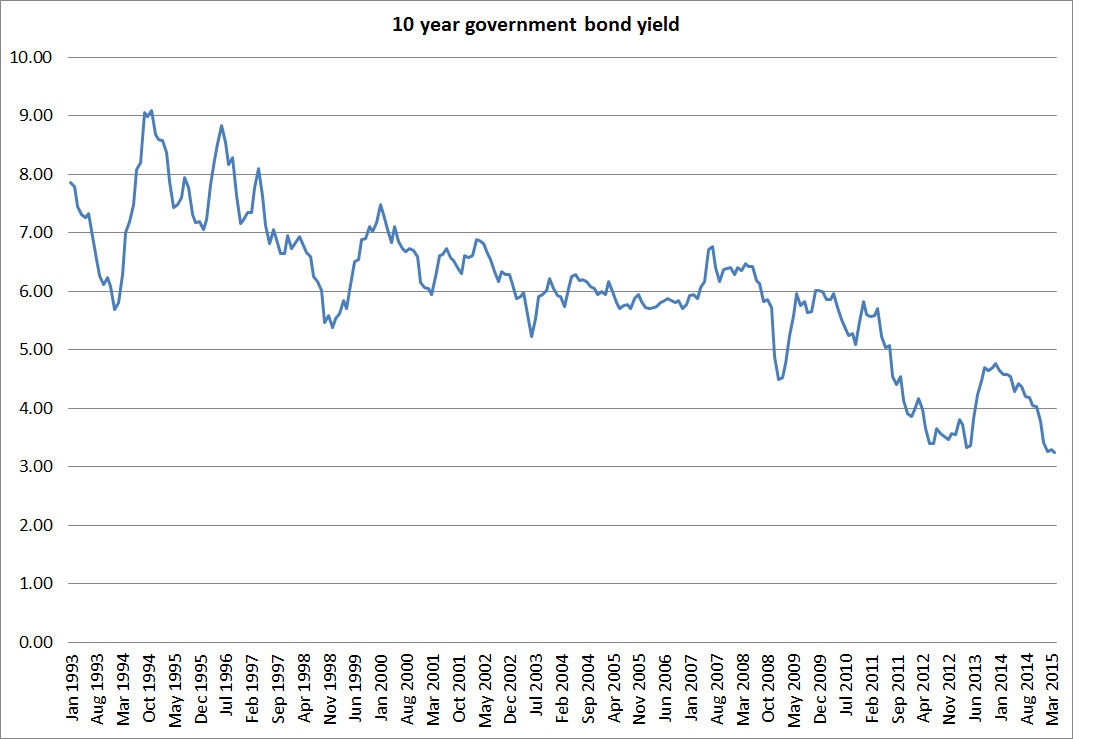
Finally, the Bank partly justifies its targeted intervention in Auckland, against one class of potential buyers, on the basis of rental yields in Auckland.  They argue that rental yields in much of the rest of the country are around 10 year average levels, but are at record lows in Auckland.  But has the Bank looked at a chart of New Zealand bond yields recently?  New Zealand 10 year bond yields are now at the lowest level probably ever (and certainly in the 30 years on the Reserve Bank’s website).  And the market now expects that the Bank will have to cut the OCR not raise it.  Shouldn’t we expect rental yields to bear some relationship to yields on alternative investments, such as long-term government bond yields.  Of course, the Bank would no doubt defend its stance by reference to the abnormally low level of bond yields globally.  And it is true that they are very low  (while NZ’s remain high by cross-country comparison), but the Reserve Bank –  even more than its overseas counterparts –  has been getting the future path of interest rates wrong for six years now.  Perhaps they will be right this time, but why should we be confident that they know better than the market?

10yr

It is difficult to fully make sense of what the Governor is up to. I suggested a few weeks ago that he didn’t want to be the person who presided over a NZ version of the US experience of 2006 onwards.  Which would be a laudable goal if there were any evidence that circumstances were even remotely similar. But there isn’t: overall credit growth is subdued, the Bank presents no evidence of a systematic deterioration in lending standards, and fundamental factors  provide a good basis to explain what is going on in house prices, both in Auckland and in the rest of the country.  Perhaps the Governor just wants to “do his bit” to solve the problems in Auckland, but (a) the Reserve Bank has no statutory mandate to focus on trying to manage house price cycles, especially in a single city, and (b) it isn’t clear how impeding access to finance (in a climate of modest per capita housing turnover, modest volumes of mortgage approvals and modest overall credit growth) is going to in any sense help deal with the structural problem.  There just isn’t a financial system problem –  and if there is the Bank just hasn’t made its case, and should get the evidence out there –  and it feels as if the Bank is misusing its extensive powers, based on a flawed reading of what is going on, and a failure to give due weight to how often past regulatory interventions have just made problems worse.

I pointed out a few weeks ago that it was now over a decade since the words “government failure” had appeared in a document on the website of the State Services Commission.  The Reserve Bank is now a major regulatory agency, exercising more and more powers by the decision of single unelected official.  I checked the Bank’s website, and the phrase “government failure” appeared only once (in a Bulletin article on historical crises), and “regulatory failure” appeared not at all.  It should disconcert citizens –  and those paid to hold the Bank to account –  that there is not more evidence of the Bank having reflected seriously on what that entire literature, and the experience of countless other regulatory bodies, might mean for how they should exercise their powers.

PS    In the press conference the Bank seemed to back away (perhaps just diplomatically) from the Deputy Governor’s expressed support for a capital gains tax. Almost a month ago, I lodged an OIA request for any material the Bank had considered on a CGT.   Since the Bank has taken so long to respond, and is required by law to respond “as soon as reasonably practicable”, I’m assuming they must have a considerable amount of substantive material that needs review.

[1] And, on the other hand, no such restrictions in Christchurch even though the Governor observed that he thought a glut of houses in Christchurch was quite likely.

Reviewing and challenging economic policy agencies

The Reserve Bank’s Financial Stability Report is due out later this morning.  As I have a few other things to do, and I want to read the whole thing (well, I might make an exception for the payments system discussion) I don’t expect to comment on it today.

Instead, I wanted to prompt some thought about how in New Zealand we ensure that there is adequate scrutiny and contest of ideas around powerful government agencies operating in the economic and financial area.

Late last year, Ross Levine, a professor at Berkeley, visited Victoria University and the Reserve Bank.  It was a very stimulating visit. One of Levine’s books, written with a couple of co-authors, is Guardians of Finance, in which he argues that US financial regulators are too close to those they are regulating, and that something needs to be done to counterbalance that bias.  To be clear, Levine is not alleging any personal financial corruption on the part of anyone involved, but rather highlighting the role played by the large financial resources of the sector, the complexity of the issues, and the revolving door which sees people moving between regulatory and regulated institutions.  The authors also highlight what they call “home-field advantage”  –  drawing from evidence from sports, they suggest that regulators will naturally become attuned to, responsive to, and share to some extent the perspectives of those whom they regulate (moving within a common professional, and sometimes personal, milieu).

Levine argues that these weaknesses were a significant part in explaining the 2008/09 crises, and that institutional change is needed as some form of counterbalance.  I found the connection to the crisis unconvincing for a variety of reasons, including but not limited to the fact that senior regulators who had tried to stand up against the risks building up in the system would almost certainly not have been reappointed.  But I was most interested in his proposal for a new US agency –  the Sentinel.

The one power this small institution would have would be the right to obtain any information it wanted/needed from financial regulatory agencies.  It would be insulated from short-term political pressure to some extent, by being funded by a prior claim on seignorage.  It would be shielded from too much financial sector or financial regulator influence by restrictions on the ability of staff to move from the Sentinel into financial sector or financial regulatory positions.  Any useful impact it had would come from the quality of its research and analytical material.   It is proposed that the agency would pay well, and offer a prestigious and influential opportunity for top-notch people from across a range of disciplines.

In reading Levine et al’s book, and in discussion with Levine during his visit, I had been thinking about the relevance of his insights to New Zealand.    The result was this discussion note

discussion note thoughts prompted by Levine et al’s Guardians of Finance

which I jotted down on the Saturday before Christmas, when my wife and kids had already left town.  (At the time, it was mainly for my then colleagues at the Reserve Bank, but since I expected to be leaving the Reserve Bank shortly I deliberately wrote it out of Bank time and off Bank premises.)

In it, I explore the idea of introducing greater challenge and contest in respect of a range of economic policy and advice functions in New Zealand  (not just, and not even primarily, financial regulatory ones).  The issues are different in New Zealand to those in the US in a wide variety of ways, but the lack of scrutiny and challenge is a much more serious problem here than there –  not through ill-will or malevolence on anyone’s part, but mostly because of being a small country.

I highlight the way that review agencies have been set up in many areas of New Zealand government in the last 30-40 years, and suggest that the scrutiny and review of the economic policy and advice functions now lag behind.  My concrete proposal was the establishment of a small Macroeconomic Council, to independently scrutinise and challenge thinking and policy (advice) emerging from agencies such as the Treasury, the Reserve Bank, the FMA, and MBIE.  Such an agency would deliberately operate outside government –  a contrast, say, with the Productivity Commission (which has done some very good work, but operates –  by statute –  inside government, largely on topics assigned by ministers).

There are weaknesses with the proposal, and if I were writing the note today I would make some of the case differently.  But I think there is a real weakness in our system, and the confidence that the public can have in the quality of regulatory and advisory processes suffers because too few resources are devoted to scrutiny and challenge.  In some ways, I’m uncomfortable suggesting spending more public resources, but as even the 2025 Taskforce pointed out, the things that governments really needs to do need to be done excellently.

In the meantime, I hope that the Financial Stability Report has complied with Parliament’s requirements and will

contain the information necessary to allow an assessment to be made of the activities undertaken by the Bank to achieve its statutory prudential purposes under this Act and any other enactment.

Remember, it is for us –  citizens, Parliament –  to make our own assessment.  The Bank’s own assessment is likely to be interesting, but we need the information and perspectives to evaluate their case, and their activities, to ensure (in the words of Levine’s sub-title) that regulators really are working for us.

Negative nominal interest rates

Late last week the New York Fed posted some interesting  and thoughtful speech notes by James McAndrews, their Director of Research, on “Negative Nominal Central Bank Policy Rates: Where is the Lower Bound” (see also some comments here from John Cochrane).

But McAndrews doesn’t really answer the question he poses, and instead offers a series of thoughts on some of the issues (institutional and policy) associated with negative nominal interest rates.   If it seems somewhat geeky it is, or should be, a pressing issue.  Four countries already have modestly negative policy interest rates for some balances.  Most other advanced countries have policy rates at or near zero and even in “high” interest rate Australasia the buffers are no longer large.

McAndrew outlines seven ”complications” with negative interest rates.  I won’t touch on them all –  read the speech.

The first, and best-known, is “avoidance”, the possibility of shifting into physical currency (which, at present, carries a zero nominal return).  He argues that currency is a less effective substitute for electronic money than many realise, and seems to put quite a lot of weight on the inconvenience of physical currency.  But that case seems a great deal stronger for mid-sized transactions than for the  store of value function of money.  I’m a trustee of a pension fund  and, to take an extreme example,  if nominal interest rates ever got to, say -10 per cent, I can’t envisage that I would have many qualms in agreeing to the bulk of the fund’s assets being held in secure (and insured) physical currency form, rather than interest-bearing securities as at present.  Yes, we would still need some electronic balances available to make our routine pension payments, but those transaction balances are small relative to the stock of assets.  In the same way that most of us still held zero-interest transactions balances in the high inflation era, we might still be quite comfortable to have, say, one week’s salary in an account earning a material negative interest rate simply because it is more convenient.  To settle wholesale payments, the transfer of claims over physical bank notes seems quite feasible (with time, and an expectation that interest rates would stay negative for a prolonged period).  The big risk central banks are concerned about is not that your cheque/EFTPOS account would be converted back into physical currency, but that banks and large investors would choose to convert their assets (where choices are heavily driven by relative expected returns).

Abolition of physical currency would, of course, eliminate this problem altogether.  I’m not in the camp of those who favour that option, and neither is McAndrews.  Indeed, I’m not sure that elimination of physical currency is even a legitimate call for a government to make.  As I outlined last week, I would rather go in the other direction, removing the government monopoly on banknotes[1], and allowing market competitive forces to get to work, including innovating smart ways to provide positive and negative returns on these nominal liabilities.  Central banks are monopoly providers, not known for their innovation and product development (an interesting OIA request might be to ask how many resources the RBNZ or RBA have devoted to product development and innovation in respect of physical currency, security features aside).  In time, whatever product innovation succeeded in the market could end up adopted by central banks themselves.  More immediately, central banks should be working on developing a retail electronic outside money product, which might in time displace physical central bank currency.  Banks have access to electronic outside money: why not the public?

In the shorter-term, abolition of physical currency is not even needed to provide material additional room for negative nominal interest rates.  A cap on total issuance, and allowing the conversion rate to fluctuate, would be enough to prevent wholesale conversion of electronic balances into physical currency.  It would be a significant step – two sets of central bank liabilities would have different values –  but not one that is either irrevocable, or particularly difficult to implement.

McAndrew also outlines various institutional frictions that might evolve differently if substantial negative nominal interest became more established.  For example, the ability to prepay tax obligations, or to delay depositing a cheque, could all represent ways to avoid a negative interest rate.  Frankly, most of these seem rather small issues, especially when weighed against the economic conditions that have led to negative interest rates becoming a realistic policy option.   Surely, for example, it would be easy enough for banks to alter their rules to require all cheques to be deposited more quickly than the current rules, perhaps especially those for large amounts?  And, if the US government has not already done so, the establishment of an interest rate (positive or negative) on prepaid taxes doesn’t appear that difficult.

I’m not going to go through each of McAndrews’ seven points, but will touch briefly on his two final ones.  He worries that establishing negative nominal interest rates might adversely influence public expectations of inflation, entrenching expectations of deflation.  Of course, anything is possible, but this seems very unlikely.  When policy rates around the world were slashed in 2008/09 that didn’t lead to a collapse in inflation expectations –  if anything there was unjustified degree of concern about future risks of high inflation.  In the end, decisive action to counter the risk of excessively low inflation (or deflation) seems much more likely to keep inflation expectations near target.   Indeed, one could that if the public realises that the limits of conventional monetary policy have largely been reached, then whenever the next downturn happens there is a more serious risk that inflation expectations will fall  much more rapidly than happened in 2008/09

His final point is about public acceptance.  Yes, negative nominal interest rates are a new phenomenon, and not one anyone has much familiarity with.  And no doubt central bankers, and politicians, would get many letters from aggrieved pensioners – just as happened when real and nominal rates fell over the 15-20 years prior to the recession. But the job central banks have taken on is one of macroeconomic stabilisation – stable inflation (or wages or nominal income) at as close to effective full employment as possible.  Big changes in relative prices (eg real interest rates) have distributional consequences.  Compensating losers is an option for governments and legislatures, but central banks need to keep a focus on cyclical macroeconomic stabilisation.  Yes, negative interest rates would be a communications challenge.   But prolonged high unemployment –  the risk if real interest rates can’t be cut enough –  is rather more serious than that.  Dealing with the unfamiliarity can’t be done fully until countries actually find themselves with negative interest rates, but central banks can make considerable progress –  especially in countries like New Zealand where negative rates are still some way away –  by starting early, preparing the ground and giving people a sense of what is at stake.

McAndrews ends this way:

Addressing the complications of negative nominal interest rates includes redesigning debt securities; in some cases, redesigning financial institutions; adopting new social conventions for the timeliness of repayment of debt and payment of taxes; and adapting existing financial institutions for the calculation and payment of interest, the transfer and valuation of debt securities, and many other operations. These innovations will require considerable time, resources, and effort. A benefit-cost analysis thus must weigh the potential advantages of negative rates against the costs of pushing back the tide of all of these conventions and institutions that have proven useful under positive nominal interest rates. That calculation likely will differ across countries, across institutional environments, and across the expected levels and duration of negative rates.

Much of that is fine, but it also reads rather complacently. In particular, it seems indifferent to the macroeconomic conditions that have given rise to discussions of this sort (and to negative nominal rates in several countries).    A common view, not universally shared but common, is that the US could usefully have had real short-term interest rates perhaps five percentage points lower than they were during the Great Recession of 2008/09  (in other words, given inflation expectations as they were, a negative nominal policy rate of perhaps -5 per cent).  The inability to do so meant, presumably, a material loss of output at the time, and a material number of people who spent time unemployed that would not otherwise have been necessary.  Those losses mount quite quickly.

Perhaps there is a strong public policy case for avoiding negative nominal policy interest rates.  I can’t see myself,  but if a consensus were to form on that side of the argument then, as I outlined a couple of weeks ago, there would be a strong case for a materially higher inflation target. Macro-stabilisation seems to require, at times, more deeply negative real interest rates than was generally appreciated when 2 per cent inflation targets were adopted.

But adopting higher inflation targets has its own institutional challenges and costs –  in particular, tax systems that are pervasively not designed to operate well with materially positive rates of inflation (and the non-payment of interest on physical currency).   And there is the practical problem that for most countries at present –  without the ability to take policy interest rates materially negative –  it is difficult to get inflation much higher than it is now.   It would seem preferable for finance ministries, legislatures, and central banks to now treat as a matter of some urgency the removal of as many as possible of the policy or regulatory roadblocks that limit the scope for materially negative policy interest rates before the next recession hits.

I have heard mention that Miles Kimball is visiting New Zealand shortly. If so, I hope the Treasury (and the RB) use the opportunity to explore options more seriously, and that the media take the opportunity to give the issue some more coverage.

[1] To repeat, this is NOT free banking.

It isn’t 1987 again…or even 2007

Terry Hall’s column in the Dominion-Post this morning is headed “Auckland housing ‘bubble’ has worrying shades of 1987”.

This just seems wrong.  Following 1987 New Zealand experienced a pretty severe financial crisis in which many corporates collapsed, and several major financial institutions either collapsed, or had to be bailed out by shareholders (including, in the BNZ’s case, the government).

It came, as financial crises typically do, on the back of several years of extremely rapid credit growth, far outstripping the rate of growth in incomes (or nominal GDP).  Private sector credit growth exceeded 30 per cent per annum for several years (charts here)  It was an environment of debt-fuelled craziness, of a massive commercial construction boom, and credit extended to “investment companies” with, it seemed, nothing behind them either than the hope-and-credit-fuelled values of other investment companies.  Claims were heard that New Zealand had a comparative advantage in takeovers.  Newly deregulated New Zealand and Australian lenders seemed to have few disciplined skills in credit or analysis, and as happened in several other countries at around the same time (eg the Nordics) it ended badly.

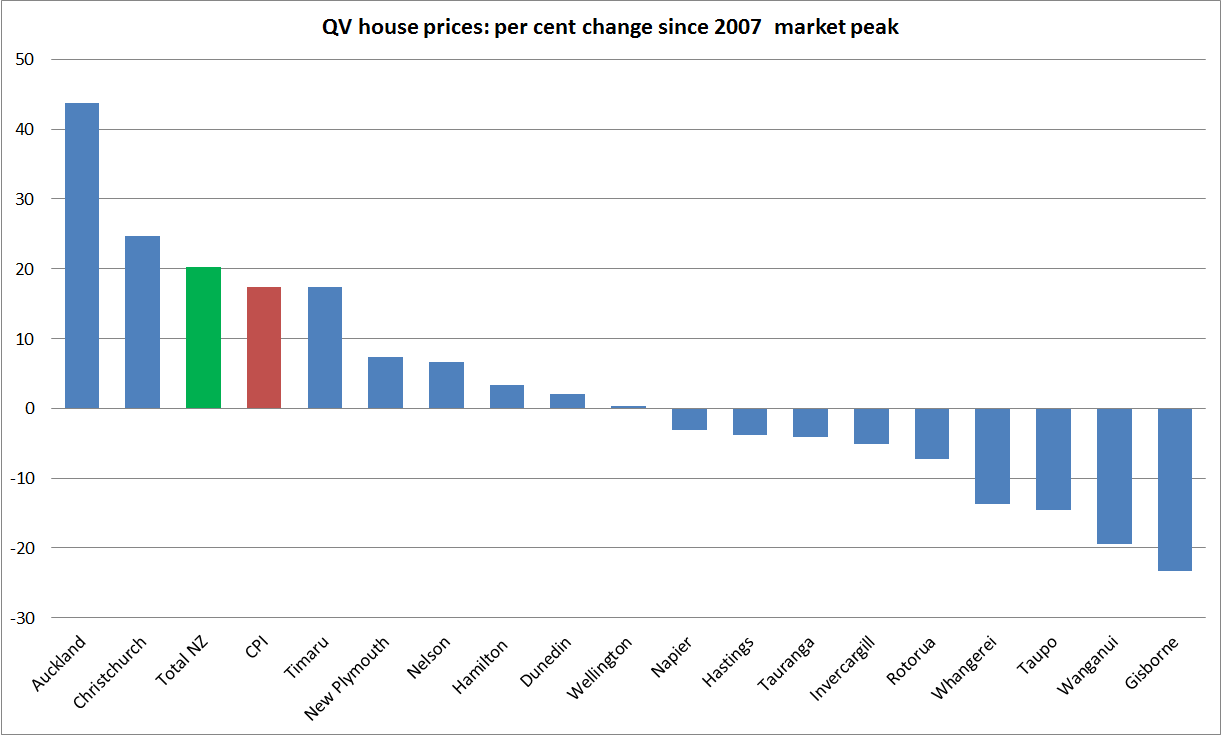
Take the current situation by contrast.  Yes, Auckland house prices are a social and political scandal, but they seem quite easy to explain on the basis of some simple fundamentals: restricted effective supply of developable land on the one hand, and rapid population growth (fuelled by cyclical differences between here and Australia, and an aggressive government programme of inward migration).  Where that combination of pressures isn’t apparent (which is most of the rest of the country) there is no particular or unusual upward pressure on house prices.  Indeed, in large parts of the country real house prices are lower than they were in 2007, the peak of the previous boom and just prior to the recession.

qv

It is difficult to think of a serious or systemic financial crisis anywhere that has not been preceded by rapid credit growth.  There may be exceptions – and I’ve urged the Reserve Bank to document those cases for us, if they can find them – but it is wise for regulators (and investors/shareholders) to be more uneasy than usual when credit is growing rapidly.  In those environments, lending standards tend to drop, and poor quality borrowers too readily get credit for propositions that won’t look good in the cold light of day.  But if credit growth is subdued, and has been for some years, the risk of any sort of financial crisis is likely to be very small.  In a New Zealand context, a prudential regulator might reasonably have been worried in 2007.  As it happened, without cause:  despite very rapid credit growth in the preceding years, bank lending decisions turned out to have been pretty robust.  Funding structures were a different matter.

But what is the situation now?

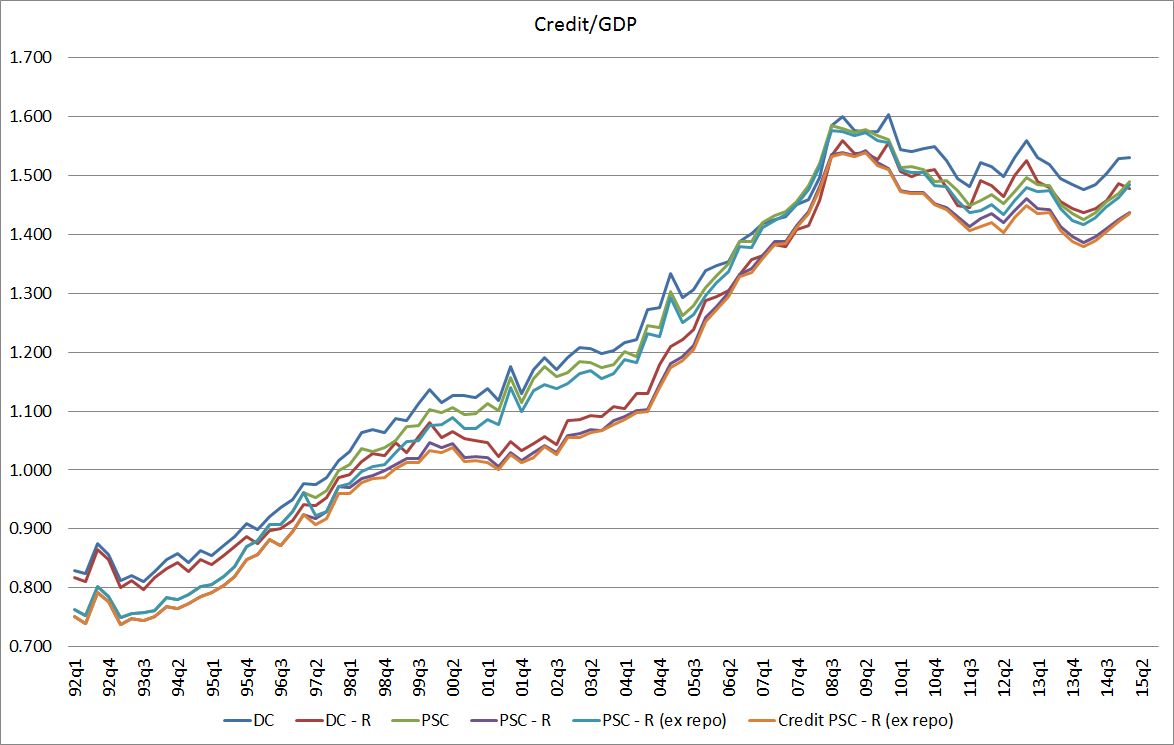
The Reserve Bank has six credit aggregates on its website.  Each has its advantages and disadvantages, but the overall picture is much the same whichever one one looks at.  This chart shows all six, as a ratio to nominal GDP, up to March 2015 (I’ve included a guess for nominal GDP growth in March quarter).  Credit to GDP peaked back in 2008, and in the seven years since then has shown no hint of moving to new peaks.  Given the sharp upward trend over the 15 or so years prior to 2008, this is a huge change.

credit to gdp

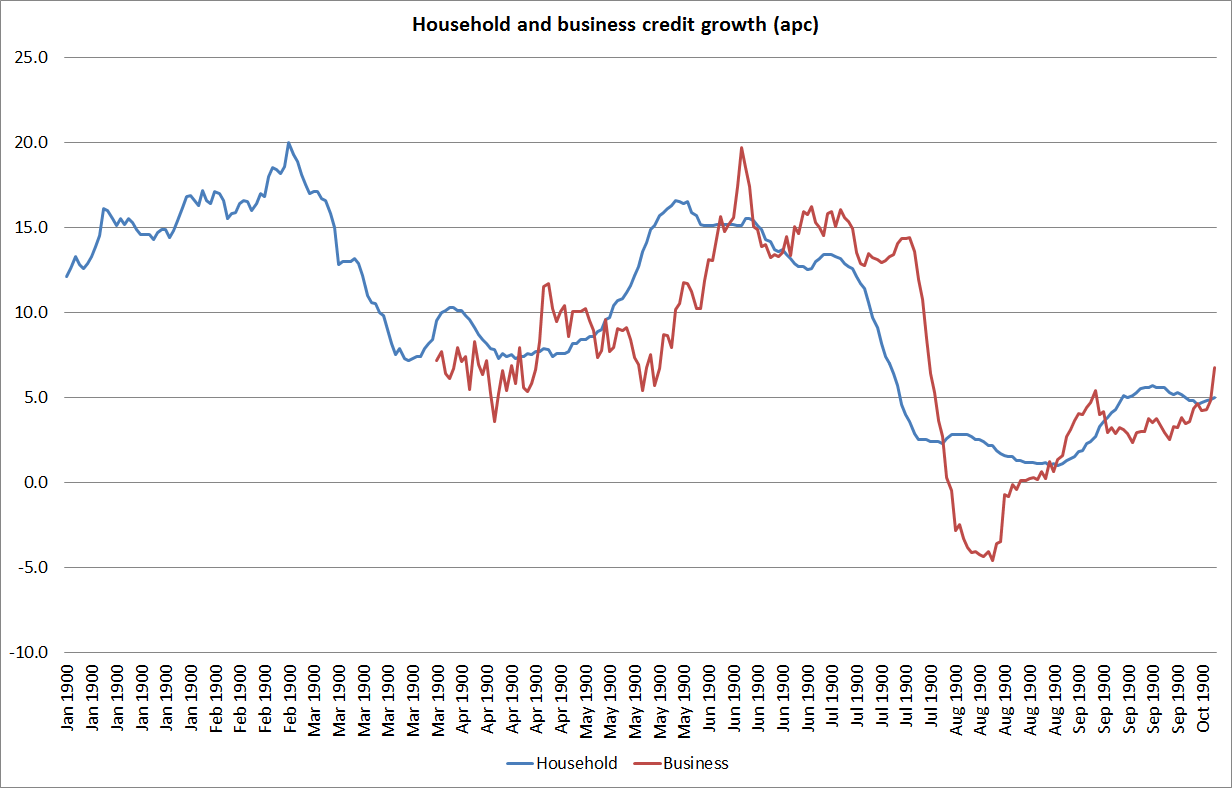
And what of annual growth.  This chart shows lending to households and the businesses (the latter including agriculture).  Lending growth to households has only been materially lower than it is now during the 2008/09 recession.
household credit
And it is often forgotten that there is still momentum behind the stock of household credit as a result of the increase in house prices last decade.  Houses don’t turn over that frequently and many properties being purchased today, in parts of the country with little or no new house price inflation, are being bought at prices higher than the vendor bought the house for (and took a mortgage for) perhaps 10 or 20 years ago.

For the current situation, consider the volume of new mortgage approvals – in recent months running below last year’s level, and well below levels seen in the boom years.

All of which brings us back to the Reserve Bank’s own stress test, reported in the last Financial Stability Report.  This was the most interesting scenario

In scenario A, a sharp slowdown in economic growth in China triggers a severe double-dip recession. Real GDP declines by around 4 percent, and unemployment peaks at just over 13 percent. House prices decline by 40 percent nationally, with a more marked fall in Auckland. The agricultural sector is also impacted by a combination of a 40 percent fall in land prices and a 33 percent fall in commodity prices. The decline in commodity prices results in Fonterra payouts of just over $5 per kilogram of milksolids (kg/MS) throughout the scenario.

And this was the result

Higher credit losses, combined with a decline in net interest income due to increased costs for bank funding, resulted in a significant decline in bank profitability. However, reflecting strong underlying earnings in the New Zealand banking system, these factors were only sufficient to cause negative profitability in a single year in each scenario

A repeat of 1987 is just not remotely in prospect at present.  If bank balance sheets start growing rapidly it might be time for some more concern, but at present issues around Auckland housing should be seen for what they are –  the outcome of policy blunders in which restricted supply runs into rapid population growth – rather than any sort of material threat to financial or macroeconomic stability.

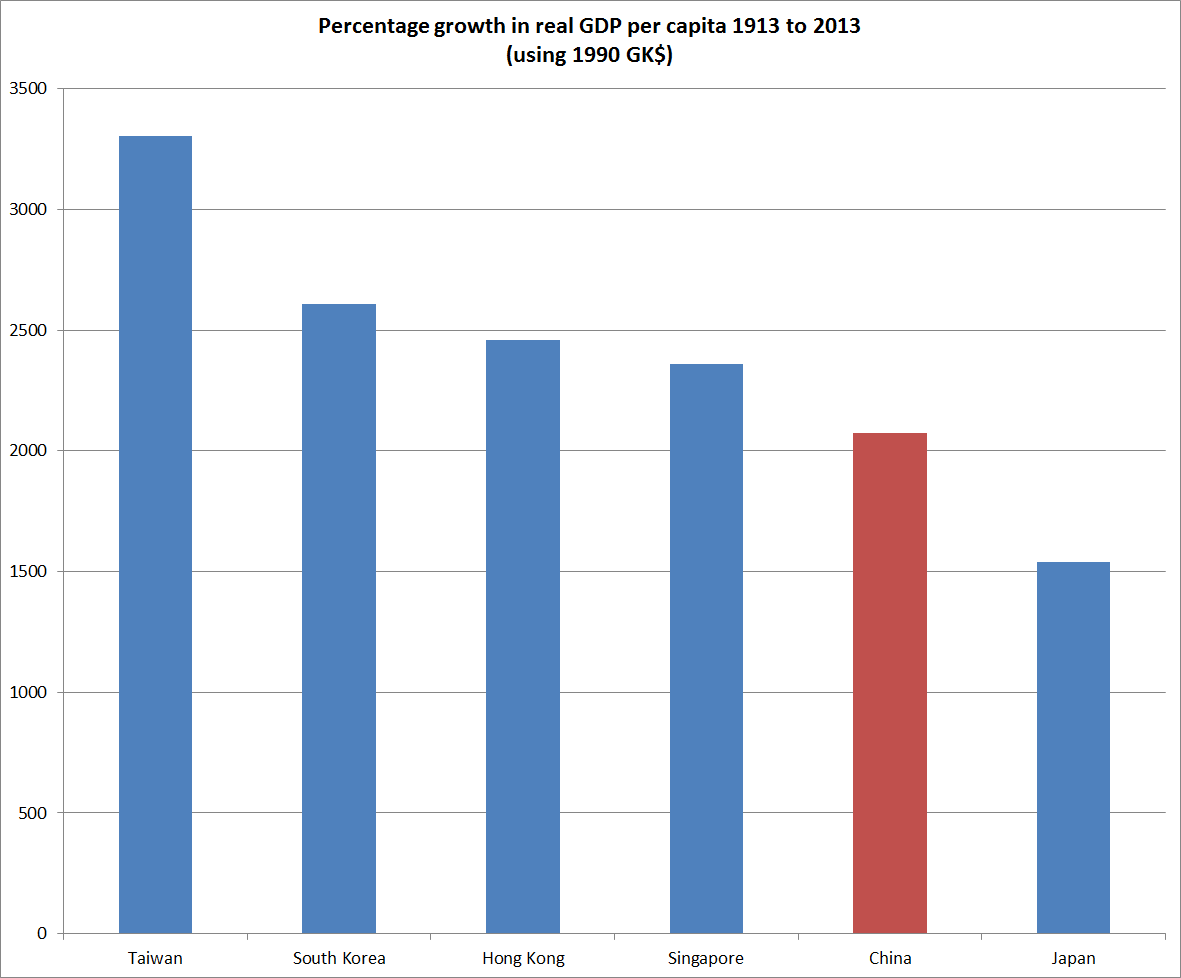
I also noticed Liam Dann’s column in the Herald on a similar topic –  the headings are so similar the two papers could be sharing sub-editors.  Dann is clearly very influenced by his recent trip to China, with his explicit hankering for new controls and restrictions.  It is worth remembering not just that China is coming off a huge government-fuelled credit boom –  outstripping anything ever seen in New Zealand, even in the heady pre-1987 period – but also that the People’s Republic of China remains the outstandingly poor performer of the group of Chinese economies in East Asia. Over the long haul it is an underperforming middle income country with few or no policy lessons for New Zealand.

asiaGDP

Is the UK really a “significant success story”?

I wasn’t really intending to post anything today, but this morning I was sitting in the sun watching my daughter’s soccer and reading last week’s Spectator, where I found Nigel Lawson –  former Conservative Chancellor of the Exchequer  – suggesting that:

It is widely accepted overseas that the UK economic recovery since the 2008 banking meltdown is a significant success story, certainly compared with all other major economies except that of the US

That hadn’t been my impression, but (even allowing for the political motivation behind the comments) I thought it was worth having another quick look at the data.  I wasn’t sure which countries Lawson might have had in mind, but I took the G7 countries, and added Spain and Korea (both bigger than Canada) and the Netherlands.  That made 10 countries in total.

Not wanting to attempt anything very ambitious I downloaded some series from the latest WEO database and looked at a few charts.

The first was per capita real GDP growth from 2007 to 20014.  The median country had had around zero growth over 7 years, while per capita GDP fell 2 per cent in the UK.
uk1
The second was the change in per capita growth, comparing 2007 to 2014 against the previous seven years, 2000 to 2007.  As the UK had had the second fastest growth of this group of countries from 2000 to 2007, the slowdown subsequently was huge – almost as bad as that in Spain.  The IMF reckons that the UK had (just) the largest output gap of any of these countries in 2007.  One might be a little sceptical of that –  more pressure on resources than in Spain? – but the differences aren’t going to redeem the UK picture.

uk2

Unemployment rates in 2014 were higher than those in 2007 in eight of these ten countries.  Here the UK scores relatively well, with an increase less than one percentage point.

uk3

Investment as a share of GDP differs widely across countries, but in all but one of our countries, the investment share was lower in 2014 than in 2007.  The UK doesn’t do too badly on this measure either.

uk4

Much of the political-economic debate around the UK in recent years seems to have been around fiscal “austerity”.  The IMF estimates that the UK’s structural fiscal deficit, as a share of GDP, was a bit smaller than it had been in 2007.  But…..the imbalance in the UK’s fiscal accounts, on this measure, last year was still third largest of these 10 countries.

uk5

And finally, the current account balance.  At 4.8 per cent of GDP, the UK had the largest current account deficit of any of these countries.  If we look at the change in the current account balance from 2007 to 2014, the UK has had the third largest reduction in the current account surplus (or increase in the deficit).  There is no simple way to interpret whether this is a good or bad thing, but I imagine the UK authorities would be feeling a touch nervous if the deficit were to get much larger than it is now.

uk6

So what to make of Lord Lawson’s story?  The advanced world has done very badly since 2007, and that UK hasn’t been exempt.  It is by no means the worst of this group of countries, but I probably wouldn’t score it as even second best either.   But then the UK had a pretty stellar couple of decades prior to the recession.

If the IMF is to be believed, there is still a lot of fiscal adjustment to do at some point.  When it might be prudent to do that is not going to be an easy call for the reappointed Chancellor, with a increasingly fragile eurogroup just across the Channel.

What was The Treasury thinking?

Kim Hill’s Saturday morning radio programme each week features Playing Favourites,an opportunity for Kim to talk to someone about their life and some of their favourite music.

This morning, somewhat unusually, it featured Girol Karacaoglu, Chief Economist and Deputy Secretary, Macroeconomics at The Treasury.  Girol is the one senior manager at The Treasury with a strong professional background in economics and so should be a key adviser to governments.

He has an interesting story –  growing up in Turkey as the child of Armenian and Lebanese parents, studying in Hawaii and ending up in New Zealand in the early 1980s  (where he was one of my lecturers at Victoria).  And even the shift from hardline “monetarist” –  25 years ago he used to routinely harass the Reserve Bank for insufficiently cleaving to Milton Friedman’s approach –  to now what I might characterise as “activist OECD social democrat“.  But it seemed quite unusual for a very senior serving public servant to be appearing on such a show while still in office, and all the more so as the discussion turned to policy issues.  Top public servants should be largely invisible, as advisers to ministers, and not making a public case for their  own policies, preferences, priorities and frameworks. Not once did Girol mention that the role of public servants is to provide advice, and analysis, to help frame issues for ministers and then to implement ministers’ decisions.  Instead we got commentary on the unfortunate political situation in Turkey (what must MFAT have been thinking as they listened?), his views on foreign purchasers of Auckland houses, advocacy of a particular model of policy coordination (fiscal, monetary, and prudential), and, of course, a championing of The Treasury’s Living Standards Framework, the somewhat amorphous social-democratic idea that Treasury has been toying with for the last decade.

At its best, the framework restates the obvious point that GDP isn’t everything (who ever thought it was?).  More generally it articulates, not always overly well, a quite ideological (social-democratic) basis for active government policy.   As one candidate vision in the contest of ideas it might be plausible, but we usually leave that role to political parties and think tanks.  Girol and Treasury don’t, of course, see the framework as ideological, but it clearly reflects a view of what matters, and what should be valued, that would see Treasury being more comfortable with a Labour-Greens type of government than with, say, a National-ACT one.  That is a difficult position to be in, since Treasury needs to have the confidence of whoever is in government.  But it is not helped by the decision to have so senior a figure out in public advocating his own views and approaches.  Perhaps fortunately for Girol, the interviewer herself is fairly leftish in her persuasions, and in her questioning, so nothing that he was saying was very aggressively challenged or questioned.

Financial stability (and efficiency) reports

The Reserve Bank’s next Financial Stability Report is due out next week.

As a reminder of what Parliament requires from the Bank in these documents:

165A Financial stability reports

(1) The Bank must, not less than twice in every calendar year,—

  • (a) deliver a financial stability report to the Minister; and
  • (b) publish the report on an Internet site maintained by, or on behalf of, the Bank.

(2) A financial stability report must—

  • (a) report on the soundness and efficiency of the financial system and other matters associated with the Bank’s statutory prudential purposes; and
  • (b) contain the information necessary to allow an assessment to be made of the activities undertaken by the Bank to achieve its statutory prudential purposes under this Act and any other enactment.

Financial stability reports date back to before this legislation was passed in 2008.  Such reports can contain any material, descriptive or analytical, that the Bank judges appropriate and interesting, but each report must meet these statutory requirements.  And for some years, I’ve thought the reports were deficient in respect of 2(b) above (and  have made the point internally).

Plenty of people produce descriptive material on New Zealand, but these documents are primarily intended to be accountability documents –  allowing citizens, investors, Parliament, the Bank’s Board and the Minister of Finance to evaluate the Bank’s extensive and increasingly intrusive activities supervising banks, non-banks, and insurance companies.  Thus the Act requires that the FSRs “contain the information necessary to allow an assessment to be made of the activities undertaken by the Bank to achieve its statutory prudential purposes”.

In fairness, this is not an easy test to meet, but it is not being met now (nor was it in earlier years).  FSRs tend to include a lot of descriptive material and sometimes some interesting analytical perspectives on that data, but when they get to the Bank’s policy activities – the making and implementing of supervisory policy –  the reports tend to be rather light.  There is typically a focus on new initiatives but very little material attempting to evaluate the impact, good or ill, of the Bank’s existing regulatory measures.  Of course, the Bank can’t cover everything in every report, but perhaps it could consider in each FSR taking one aspect of prudential regulatory policy and providing a range of perspectives to enable readers to assess and evaluate what the Bank is doing.  Since it is difficult to assess oneself objectively, or even present information in a balanced and open way, it might be wise to consider a panel of external advisers to review and critique such material.  A good place to start might be an easy and self-contained area, like the fit and proper person requirements.  Perhaps more pressingly, what material might enable us to evaluate and assess the LVR restrictions against the statutory purposes for the Bank’s prudential powers?  Are they actually enhancing financial system soundness, and at what cost to efficiency of the system?

No doubt most focus next week will be on the Bank’s perspectives on the housing market, and the possibility of yet more regulatory interventions.  We might hope for some hard-headed, but open-minded, analysis of the nature and scale of the actual financial stability risks New Zealand is (or is not) facing.

I was reading this afternoon the IMF’s latest Regional Economic Outlook on Asia and the Pacific.  With these sorts of documents, the text is often less interesting than a good chart or table.  I was interested in this one, a “heat map” of risks in a number of Asia-Pacific economies.  It is just one lens on the issues, and isn’t that easy to read – New Zealand is the 9th column from left in each of the three variables.  Green and blue scores suggest rather little risk.  Reading down the table we move from 2008 to the present.

heatmap

So, for what it’s worth, the IMF doesn’t seem to see big financial stability risks in New Zealand –  even the housing score is pretty unthreatening.  In its last FSR, the Reserve Bank reported that it saw four big risks.  I thought they were all well-overstated, but will be interested to see how they make their case next week.

Parliament’s Finance and Expenditure Committee typically hears from the Governor on the FSR a few hours after the release.  No doubt the timing is good for attracting media coverage, but I’m not sure it is conducive to doing the scrutiny and accountability job particularly well.  FSRs are not short or easy documents, and it might be preferable if MPs were to take a few days to read the report in more depth, read the commentaries and take advice on possible lines of questioning.  At times like the present, I’m sure both market commentators and the media would still be keenly interested in what MPs had to ask of the Governor, and how he replies.

Superannuation and savings: Australia

Arguments have run around for years about New Zealand’s relatively low national savings rate, Australia’s relatively high national savings rate, and the Australian compulsory private savings system.

Doesn’t NZS just contribute to New Zealand’s “savings problem” and haven’t the Australians shown the way to boost national savings?

A universal age pension will have reduced private savings, relative to a benchmark system in which there was no state age pension at all.  But it won’t have done so for everyone.  Many people never earn enough to have saved any material amount for retirement. For them, the absence of something like NZS would simply mean they went on working until they no longer physically could, and would then rely on family and private charity.  GDP might be higher, but savings rates probably wouldn’t be materially different.   And at the other extreme, it seems unlikely that Graeme Hart or others on the “rich list” will save one cent less because they too may receive a modest universal pension payment at 65.

But it makes a difference for people in the middle.  The knowledge that, in retirement, the state will provide an annual income of around $25000 per couple makes a huge difference to how much a family earning $100000 might need to save to support their desired consumption in retirement.  Whether it lowers national savings isn’t possible to tell a priori –  that depends on what the government does.  If we had no NZS, would government savings –  and accumulated government debt –  be higher, lower or no different?

But the choice isn’t universal NZS or no age support at all.  Some argue for means-testing for NZS, as was done from the mid 80s until the late 1990s.   There could be some real fiscal savings to be made from no longer paying NZS to upper income or wealthier people.    But to get material savings the system has to start abating NZS payments at relatively modest levels of other income/assets, and the people who are likely to be affected will alter their behaviour accordingly.  A lot of fiscal savings can be made, but only with the probability of further discouraging many middle income people from saving for their own retirement.  Again, it won’t make a difference to anyone with really high wealth/income, but for someone who was planning to provide themselves with, say, $30000 per annum on top of NZS it could make a real difference  – both to planned savings, and to a willingness to stay in the workforce beyond 65.

I also asserted yesterday that our NZS system probably discouraged private savings less severely than systems in many other OECD countries.  In many countries, people receive state pensions that are calculated based on the earnings of the individual concerned (sometimes lifetime average earnings, sometimes only the later years’ earnings).  A person with average lifetime earnings of say $80000 will get a state pension materially higher than someone whose lifetime earnings averaged $40000. In New Zealand, no matter how much you’ve earned over your life, the state pension is still only around $25000 per couple.  Fair or not, the point here is just that in New Zealand if you want more than the basic $25000 you have to provide it for yourself.  In many other systems, the state provides it, but the state has not funded that cost as the prospective liability has accumulated.  So our system probably deters private savings  – among those with the capacity to save materially – less than many of the schemes in other countries do.

Ah, but what about compulsory private schemes?    Australia is one of the few that has been in place for quite a long time.  And, of course, it is a scheme directly relevant to many New Zealanders, given the extensive New Zealand migration to and from Australia.

The national savings rate in Australia is relatively high – something that tantalises many in the New Zealand debate.   Often the gross national savings rate as a percentage of GDP is quoted.  But I don’t think it is the best measure of savings.  In the rest of this piece, I will be using net national savings as a percentage of net national income.  “Net” here means net of depreciation.  Australia has some very capital-intensive production structures, and a high proportion of its gross income needs to be applied to cover depreciation on the capital.  And “national” here means the incomes, and savings, of – in this case – Australians.

The OECD has a pretty good collection of data on these two series for around 20 member countries going back to 1970.  Australia had pretty high net national savings rates right back at the start of the period, a few percentage points above the median of this sample of OECD economies.  Quite why, I’m not sure, and I haven’t seen any good studies looking at that particular cross-country comparison.  But what I wanted to focus on is what has happened over the period since 1970, in Australia and in other advanced economies.

Australia’s net national savings rate was at or above the level of these other countries until around 1990.  But for the following 15 years, Australia’s savings rate was well below those in the other advanced economies, and lower than it had been in the 1980s.  It is only with the huge terms of trade boom from the middle of the 2000s that Australia’s national savings rate surges up again. As the terms of trade falls away forecasts suggests the national savings rate will drop too.
australia1

How does compulsory private savings fit in this picture.  David Gruen, former Deputy Secretary of the Australian Treasury, gives us the summary history:

The compulsory superannuation system began with industrial award-based superannuation, agreed by the Government of the day and the Australian Council of Trade Unions as part of the 1985 Prices and Incomes Accord. A 3 per cent superannuation contribution was paid by employers into employees’ individual accounts in nominated superannuation funds, rather than being paid as a wage rise.5

The coverage of award superannuation was expanded significantly in 1992, with the introduction of the Superannuation Guarantee Levy, which required employers to make superannuation contributions on behalf of their employees, and enshrined superannuation contributions in federal legislation rather than relying on the award system.

The then Government announced plans to gradually increase the minimum contribution rate to 9 per cent by 2000-01

So from the mid-1980s, and particularly from 1992, Australian employees were compelled to progressively increase the proportion of their incomes put away in designated superannuation savings vehicles.    And yet, at an aggregate national accounts level there is little sign of it.  Not only is Australia’s national savings rate in the 1990s lower than it was in the 1980s, but it was lower relative to those in other advanced economies.

aus3

And what about the comparison with New Zealand?  Again, Australia has had a higher net national savings rate than New Zealand throughout, but the gap has been smaller in the last couple of decades than it was in the first two decades.  And in this comparison, it is worth bearing in mind that in the 70s and 80s, New Zealand had in place very concessional tax treatment for private superannuation vehicles, which might (if anything) have tended to boost savings rates here.

aus2

The picture doesn’t look much different if we compare Australia with the median of the other Anglo countries (Canada, Ireland, New Zealand, the US and the UK).

aus4

Several empirical studies have suggested that the compulsory savings scheme has boosted savings rates in Australia.    The reported evidence has been stronger in respect of household savings than for national savings, although David Gruen (who cites these studies) is confident that the arrangements have boosted Australia’s national savings rate.

Perhaps.  And. as ever, we can’t know the counterfactual. But it isn’t obvious at a macroeconomic level. There might be small positive effects that just can’t be seen at this level of aggregation – other forces would have driven national savings rates in Australia even lower, and compulsory private savings prevented those full effects being seen in the data.  But it is difficult to know quite what those effects would have been, and why for example they might have affected Australia more severely than New Zealand and other advanced economies.  At very least, it is hard to see that the really far-reaching changes Paul Keating established, and subsequent governments have persisted with, has been any sort of game-changer as far as Australia’s national savings is concerned[1].   And, as I noted yesterday, it is not as if the Australian arrangements have ended up fiscally cheaper than New Zealand’s either.

[1] And that is without even mentioning the distortions to private choices and balance sheets, the “subsidies” to funds managers and tax accountants, and so on.  The scheme will have changed many individual balance sheets, and has probably left the household sector more leveraged than otherwise, and perhaps the Australian gross international investment position too.

New Zealand Superannuation

Yesterday I mentioned that it is often forgotten that we already have a near-universal indexed annuity that ensures that no elderly New Zealander need ever end up in extreme poverty.

New Zealand Superannuation is paid from age 65 to any citizen or permanent resident living in New Zealand who meets some (relatively undemanding) accumulated residency requirements, at a rate equal to (for a couple) 66 per cent of the average net wage.

Of course, nothing is risk-free in life.  The New Zealand government is most unlikely to directly default on its debts in the next few decades.  But there is “policy risk”: as the 2025 Taskforce put it a few years ago “New Zealand has a long history of revisiting its state pension arrangements”.  But for resident New Zealanders at the bottom of the income distribution it makes perfect sense to rely almost solely on NZS for income support in old age.  Whatever changes have been made, or seem plausibly likely to be made in the next few decades, we are most unlikely to revert to the sort of good character test that was part of the 1898 scheme, or to impose new filial responsibility laws to push the responsibility for the elderly poor back onto families.

NZS has a number of pretty attractive features:

  • It is administratively simple (near-universal schemes tend to be)
  • It has contributed to New Zealand having one of the lowest elderly poverty rates in the OECD
  • It focuses on a moderate level of basic needs, and leaves those with aspirations to a higher standard of living in retirement to save for themselves.
  • Because it is not abated against other income there is no direct deterrent to people remaining in the workforce beyond 65 (and partly as a result New Zealand has relatively high voluntary labour force participation rates for people aged 65 and over).
  • Because it is tied to earnings, at least in principle it avoids periodic battles over distribution of the gains from growth (which CPI indexed would tend to induce)

On the other hand, the scheme costs a lot of money, discourages some private savings (although there is no easy way of knowing if it discourages national savings), and seems to have a created a sense of entitlement .  The availability of a near-universal income from 65 will discourage some labour force participation (itself a double-edged argument, since presumably no one wants infirm 85 year olds sent out to work), reducing average GDP per capita.  The other double-edged feature is that there is no relationship at all between one’s ability to draw NZS and any contribution one may have made to the New Zealand tax system (whether as an individual or as part of a family).

I noted that NZS is expensive, and that cost is rising quite rapidly now each year, as the baby boomer generation reaches 65 and beyond.  But high as the absolute cost is, it is worth bearing in mind that New Zealand’s public spending on pensions and other old age support is pretty low compared with that in other OECD countries. In 2011 only six of the 34 OECD countries spent a smaller share of GDP than New Zealand did.

pensions

By contrast, in 1980 not only did New Zealand spend a larger share of its GDP than it did in 2011, but only six OECD countries then spent more.  We made big changes after that –  increasing the eligibility age back to 65, and lowering the payment as a share of income.  Note that, despite the compulsory private savings scheme, Australia has been spending a little more on pensions etc than New Zealand does.

It isn’t a perfect system by any means, but I think it would be foolhardy to try to change the essential characteristics.  Those old enough to remember 1984 (or even 1973) to 1999 will recall how intense the controversies were around superannuation, all for not really that much change in the end (from, say, the 1972 system to that prevailing after the late 1990s).

Reasonable people can differ on whether the appropriate formula is 66 per cent of wages, or something a bit lower.  A case could be made for something lower (perhaps 60 per cent) but I also think it is a second or third order issue.  Sure the direct fiscal costs are not trivial, but it is mostly a distributional choice about how generously, or otherwise, we want to treat the elderly.  And even if some government was bold enough to lower NZS to 60 per cent of wages, it simply invites a future electoral auction, pushing the percentage back to (or even beyond) the current level.

The bigger issue surely is about the age of entitlement.  In 1898 life expectancy at birth was around 57, so probably well under half of people reached 65 at all.  Those who did still had a reasonable life expectancy, but rather less so than the life expectancy of the overwhelming bulk of the population who now live to 65.   Not only are more people living to 65, and living for more years beyond 65, but the average health status of those who do is much higher than it was in earlier decades.   And, in any case, fewer jobs now require hard physical labour.  It all adds to a story which suggests that if society is going to provide a near-universal income for the elderly, “elderly” doesn’t, and shouldn’t, start at age 65.    We’ve all heard the lines about 70 being the new 60 etc

If, as Brian Easton suggests, life expectancy at 65 is now five years longer than it was in 1898, perhaps we should be thinking of an NZS eligibility age nearer 70, especially as people typically enter the labour force much later in life than they were doing 100 years ago.  In 1898 someone turning 65 would have spent 50 or more years in the fulltime labour force (or as spouse to someone in the paid labour force).  Today, anyone graduating university or polytech will have spent 45 years at most in the fulltime paid labour force by 65.

Of course, one of the fruits of greater prosperity is the opportunity to consume more leisure, but in discussions around NZS we aren’t dealing with private preferences (eg to work fewer hours a week, take longer annual holidays, or to retire at 55) but about the basic state provision.  It isn’t obvious why NZS should be available at an age much less than 70.  Lifting the eligibility age over time to 70 would make a significant, and probably more enduring, contribution to easing the fiscal burden of public pensions.  In addition to the direct savings, higher labour force participation among people aged 65-69 would lift tax revenues.  Even health spending might be a little lower (people tend to remain in better health if they stay active longer).

These are difficult – but not impossible – issues for politicians to tackle, even though pretty much everyone knows that some change is coming.  Partly for that reason, in contemplating any change in the next few years making the system robust to future changes in life expectancy is probably as important as whether NZS should cut in at 68 or 70.  Life expectancy has been rising by around two years a decade, and public health alarmism notwithstanding there isn’t any sign of that changing yet.   We shouldn’t need to struggle to revisit this issue every two decades   Denmark has put in place a system of indexing the age of eligibility to changes in life expectancy –  although it is fair to say that no such adjustment will be made until 2025.

But I think two more changes need to be made.

New Zealand has a high rate of inward migration.  The target level of non-citizen immigration is around 1 per cent of the population per annum.  Many of those people come to New Zealand young and will spending most of their working lives contributing to New Zealand and its tax system.    But to collect a full rate of NZS you need only have lived in New Zealand for 10 years (at least 5 after the age of 50), so many people will be able to collect a full New Zealand pension having been in New Zealand for not much more than a quarter of a working life.  New Zealand does enforce quite strict offset rules on those who have accumulated foreign pension entitlements, but many migrants now come from countries with little or no public provision of pensions.  Surely it would make more sense to introduce a graduated scale –  perhaps paying half the full NZS after 10 years residence, and a full rate only after someone has lived here for 30 years?

I had always assumed that New Zealanders who had emigrated to Australia in their hundreds of thousands over the last 40 years or so would be unlikely to come back to New Zealand when they were old, because they would have to live here for five years after age 50 before being eligible for NZS.    I wasn’t the only one to assume that – I was corrected recently by a public servant doing some work in the area who had just discovered that residence in Australia (and several other countries with whom New Zealand has social security agreements) counts as residency in New Zealand for NZS purposes.  It looks as though people can leave New Zealand at 20, spend an working life in Australia, accumulate significant private assets under the Australian compulsory private superannuation scheme (enough that they would not be eligible for the Australian age pension), and having cashed in those assets could return to New Zealand at 65, claiming a full rate of NZS never having worked, or paid tax, in New Zealand at all.  Indeed, one might even be able to go on living in Australia.  Perhaps I have misunderstood the rules, but this structure strikes me as pretty scandalous.  What New Zealand public policy interest is served by such a generous universal approach to people who have not lived here for a very long time?

Personally, I’m happy that we should treat quite generously people who have spent most of their life in New Zealand and have reached an age that can genuinely be considered “elderly”[1], but I don’t feel the same sense of generosity towards those who have migrated here quite late in life, or to New Zealanders who have spent most of their working lives (and taxpaying years) abroad.

In a second-best world, I reckon NZS is a pretty good scheme.  It costs government less than schemes in many other countries, it deters private savings and labour force participation less than most other advanced country schemes, and it largely avoids severe poverty among the elderly.  But it isn’t a perfect scheme.  I reckon politicians should be focusing on two areas:

  • Progressively raising the age of eligibility (perhaps to 68 or 70), and indexing it to life expectancy changes
  • Reducing the rate of NZS for those who have spent less than 30 years in New Zealand after the age of 20, whether naturalised New Zealanders (or migrant permanent residents) or native New Zealanders who have chosen to spend much of their working lives abroad.

[1] Or who may be genuinely physically unable to work.

How much longer will the unemployed have to wait?

New Zealand’s quarterly suite of labour market data came out yesterday, and it seems to have shifted markets –  and some domestic economists –  a bit closer to expecting OCR cuts later this year.

Before getting to the substance, it is worth noting again some of the deficiencies in New Zealand’s (official and survey) macroeconomic data.  Of 34 OECD countries, for example, we are one of only two without a monthly unemployment rate series.  And neither of the two main business surveys –  the QSBO and the ANZBO – has a question on wage expectations.  The QSBO is a wonderful resource, and has  a very long time series even by international standards.  But sometimes history can be an obstacle: 25 years ago, when New Zealand wage-setting was being liberalised I encouraged the NZIER to include a wages question, and the response was “oh, we wouldn’t want to disrupt a survey with such a long time series”.   The Reserve Bank pays to help keep the QSBO going, so perhaps they might renew the approach one day.

In one sense there was nothing very new in yesterday’s numbers, but the data will have unsettled those backing the Reserve Bank’s stance precisely because there was no sign of wage inflation picking up or excess capacity being reabsorbed.   Employment growth continued, but in a way that continues to imply pretty poor productivity growth against a backdrop of reasonable (but unspectacular) GDP growth.

There is a variety of different wage measures in the QES and the LCI.    I’ve charted some of them below.  As former colleagues know, I’ve long had a bias towards the LCI analytical unadjusted series –  both during the boom, and in more recent years.  It is smoother than the QES hourly earnings series, and it is a wages series, rather than an attempt at a ULC measure.  But we have all the series, and we should probably look at them all.

wages

None of them suggests any recovery in wage inflation.  The chart shows annual growth rates.  There is seasonality in quarterly wage inflation, and SNZ does not seasonally adjust any of the series, but the data showed the equal lowest quarterly increase in the LCI since the recession began in 2008, and the lowest quarterly increase in the analytical unadjusted LCI since the recession began  (the QES is too noisy to make anything much of quarterly changes).

And remember that these trends are consistent with what businesses have been expecting in the wages question in the Reserve Bank’s own smaller survey of expectations.

business

Wage inflation tends to lag a bit behind activity in the labour market, so we probably shouldn’t normally put too much weight on wages numbers.    Unemployment (and underemployment) measures are another matter, and they don’t make a welcome picture.  Recent unemployment rates were revised up a touch, and there was no change in the unemployment rate in the most recent quarter.  The official unemployment rate lingers at 5.8 per cent –  and I know no one who thinks the New Zealand NAIRU is that high –  but it has come down by around one percentage point from the average level over 2009 to 2012.

The same can’t be said for some of the other measures.  SNZ has a couple of measures worth looking at, although unfortunately neither of them is seasonally adjusted.

One of them is to look at part-time workers who would like more hours (underemployment).  These are people already holding down jobs – not detached from the labour market or losing basic work skills.   We can distinguish between those actively seeking (a specific SNZ definition) and those wanting more hours but not actively seeking.    Both represent additional available labour, but the former more immediately than the latter.  It is the former category –  those actively seeking extra hours – that rose sharply during the recession and has not come down at all since.    The latest March observation is higher than the observation for March 2014.

underemployed

And then there are the people without jobs who would like one, but who don’t meet the definition of official unemployment (available to start work now and actively looking now).  These measures of excess capacity have barely come down at all (and again, as a crude attempt to deal with seasonality, this March’s numbers are higher than those for last March).

jobless

I’m not suggesting one can simply add the various underemployment measures to the official unemployment rate to get a measure of excess labour market capacity.  But looking across the range of measures, suggests that there hasn’t really been much excess labour market capacity absorbed in the last few years, and probably none at all over the last 12 months or so.  That might be a quite welcome outcome if the New Zealand economy was near functional stable-inflation-consistent full employment.  But it isn’t, and hasn’t been now for some years.  Real people’s lives go on being marred by unnecessarily high unemployment.

And, yes, I’m well aware that participation rates have been rising.  And no doubt that is welcome –  some mix of voluntary optimising choices, and a bit of help from welfare reform.  But excess capacity –  supply relative to demand  –  is what should matter for monetary policy.  Demand just has not been strong enough to soak up the additional labour.

Finally, a trans-Tasman comparison.  The Reserve Bank of Australia cut it policy rate again earlier this week.  Australia’s inflation rate (headline and underlying series) is less far below target midpoint than is the case in New Zealand.  But it was the unemployment rate comparisons I wanted to illustrate.
U

New Zealand’s unemployment rate is a little below Australia’s.  But that has been the normal of state of affairs since New Zealand liberalised its labour market regulation in the early 1990s.  From 1992 until the end of 2007, New Zealand’s unemployment rate averaged just over 1 percentage point lower than Australia’s –  a credit, mostly, to New Zealand’s generally more flexible labour markets.  During those 16 years there was only one period when New Zealand’s unemployment rate matched and briefly went above Australia’s – the period associated with the 1998 recession, a period in which everyone agrees that the Reserve Bank of New Zealand did not exactly cover itself with glory (the MCI, and holding monetary policy far too tight too long during the Asian crisis).

The unemployment rates in both New Zealand and Australia rose in 2008/09.  But what is striking, and sobering, is how long New Zealand’s unemployment rate stayed above Australia’s.  Even now, the gap is only 0.4 percentage points.  Defenders of the Reserve Bank’s stance might point out that Australia experienced a huge investment boom in response to the high terms of trade.  And New Zealand saw nothing of the sort.   That is of course true, but we might reasonably wonder what New Zealand’s economy might have looked like if the OCR had been cut further and held lower after 2009. With hindsight there was no reason not to have done so.   Unlike many advanced countries, our Reserve Bank was not constrained by either actual or perceived near-zero lower bound issues.  It was simply a repeated misreading of the inflation outlook –  not a no-cost mistake either but one that has left the unemployment rate lingering so much higher, and for longer, than it needed to be.  And, as I noted last week, our real economic recovery, measured in terms of real GDP growth, has not been strong by historical standards either, despite the initial deep recession.

What of the current situation?  Our unemployment rate is below Australia’s again, even if less far below than the historical average.  But both countries have unemployment rates above any reasonable NAIRU estimates –  and with no sign now of falling unemployment rates.  One country has been steadily cutting interest rates, to new historical lows.  The other first distinguished itself from the rest of the advanced world by raising interest rates even as inflation fell further below target, and then has resisted the increasing calls to do something about reversing last year’s mistake. Overseas commentators tended to see the mistake first, but even domestic bank economists are now beginning to recognise that something went wrong.  How long will it take for the Reserve Bank of New Zealand to act?

It surprises me a little that the political Opposition has not made more of this bad misjudgement by the Reserve Bank, and its consequences for the unemployed.  We don’t want a situation in which every OCR decision is a partisan contest, but an essential feature of the monetary policy framework is supposed to be serious accountability for the Governor.  Perhaps some of that is happening behind closed doors, but the next time the Governor appears before the Finance and Expenditure Committee on monetary policy we should hope that our representatives ask him some pretty searching questions about what increasingly look like costly monetary policy misjudgements.