Are we just pulling consumption forward?

I was having a discussion with someone the other day about interest rates, the OCR, and how we should think about what has been going on in recent years.  The person I was talking to was worried that, whatever short-term support lower interest rates might be providing to demand, activity and employment, it was at the expense of simply pulling forward consumption.  And (lifetime) income which is spent today can’t be spent again tomorrow.

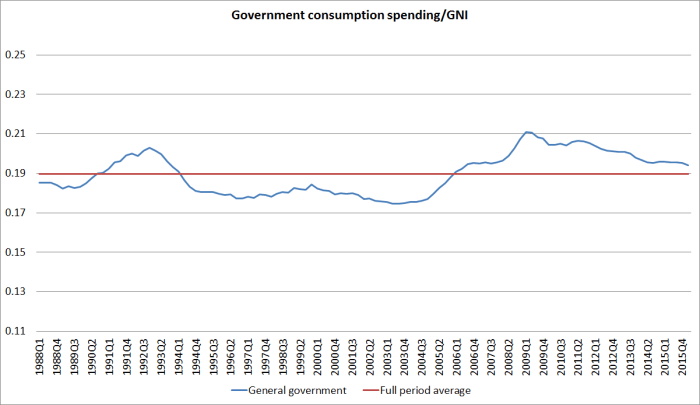
My usual starting point in such discussions is to draw attention to the little-recognized fact that consumption as a share of GDP has been largely flat in New Zealand for decades.  There is some cyclical variability –  consumption is a bit more stable than income, so the ratio tends to rise in recessions, and falls back as the economy recovers –  but the trend has been almost dead flat.  Actually, GDP isn’t the best denominator, because GDP measures what is produced here, not what accrues to New Zealanders (the difference is mostly the income earned by foreigners on the relatively large negative NIIP position New Zealand has). GNI is a measure of the aggregate incomes of New Zealanders, and here I’ve shown the various components of consumption relative to GNI since 1987, when quarterly national accounts data are available from (but using four-quarter running totals)

First, private consumption (including non-profits)

pte consumption to gni

And then general government consumption
govt consumption to gni

And then total consumption

total consumption to GNI

I’ve shown full period averages for each.  The only component of consumption where the share of GNI is a bit above the long-term average is general government consumption, the bit that is least likely to be sensitive to changes in interest rates.

Of course, if interest rates had been kept arbitrarily higher then consumption as a share of GNI might well be weaker now than it actually is, but there is really isn’t any sign of a great consumption splurge –  a society desperately (over)spending now and thus increasingly likely to come a cropper later.    (And as I’ve noted previously there is also nothing in any of these charts to suggest some large average wealth effect from the sharp rise in real house prices in recent decades –  not surprisingly, since wealth is being transferred among New Zealanders, but no additional real wealth –  future purchasing power –  has been created in aggregate).

As we continued our discussion, the person I was talking to reminded me that the US picture has been somewhat different.

Here I draw on the OECD database, which has annual data for most of its members back to 1970. Here is total consumption (public + private) as a share of GDP for the United States, United Kingdom and New Zealand.

consumption us uk and nz

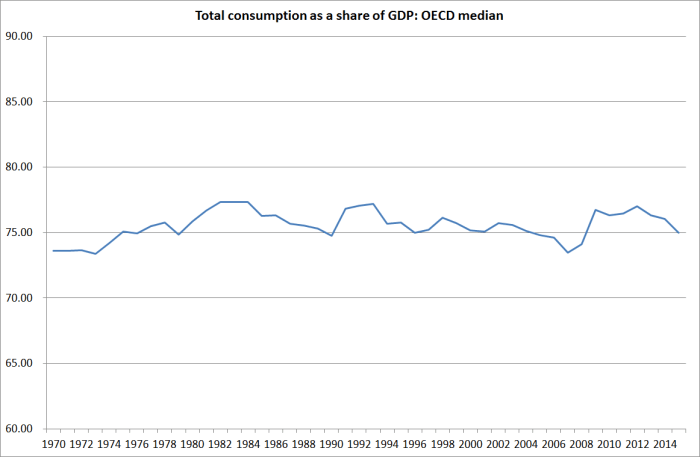
Even over the full 45 year period there is no upward trend in the consumption share in New Zealand.

And here, on the same scale, is the consumption share of GDP for the median OECD country.
oecd median consumption

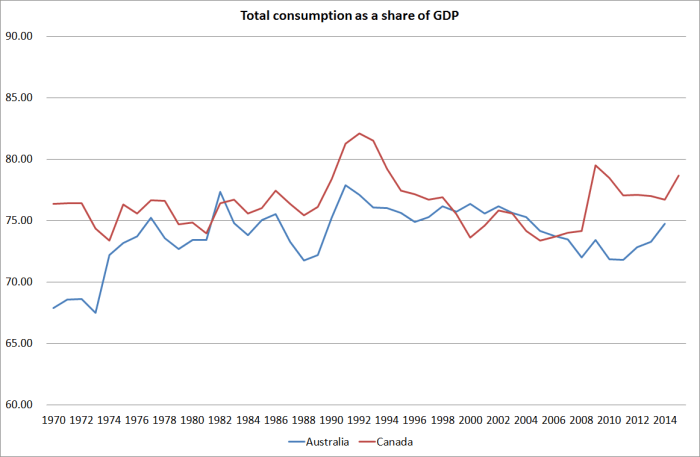
And here are Australia and Canada

consumption aus and canada

Like New Zealand, no trend in either country, at least (see Australia) since the mid 1970s.

And here is Actual Individual Consumption (private consumption plus the stuff the government purchases but individuals consume directly eg healthcare and education) as a per cent of GDP for New Zealand, Australia and Canada.

aic consumption

I’m not quite sure what was happening to this data in New Zealand around 1985, but again for the last thirty years there has been no upward trend in consumption as a share of income.

What does all this mean?  To be honest, I’m not quite sure.  After all, if population growth rates have been slowing, less of GDP needs to be devoted to investment and that might mean more is available for consumption.  But in the UK in particular, population growth rates have been somewhat faster in the last couple of decades than they had been previously.    And things like defence spending trends can also complicate the picture –  weapons system purchases are now part of investment, and we know in the US (and the UK) defence spending as a share of GDP is much lower than it was some decades ago.

I guess all I take from it is my original point. At least in New Zealand –  and in most of the OECD –  there is no sign that lower interest rates are resulting in a large scale bringing forward of consumption, for which at some point there must be payback.  But that shouldn’t be too surprising.  After all, interest rates are as low as they are for a good –  if ill-understood by anyone –  reason: in summary, because if they weren’t this low, consumption and investment spending would be even weaker.  That, in a market economy, is really all interest rates do: they balance desired savings and investment patterns.  Central banks that are too slow to adjust to changes in desired savings or investment patterns –  at any given interest rate –  can slow the adjustment, but in that respect a good central bank shouldn’t be trying to stand in the way of the sorts of real adjustments the private sector has underway,  A century or more ago Wicksell introduced the concept of a neutral or natural interest rate.  Those rates change over time, for reasons that aren’t always easy to recognize.  Markets don’t need a fully convincing analytical reason –  they just reflect the changing balance of demand and supply.  Central banks shouldn’t let the difficulty of finding a good explanation stand in the way of allowing what would be the market processes to work

But quite why consumption shares in the US and UK have risen so much is an interesting question –  to which I don’t have any good answers right now.


Wellington Airport: a factual high level summary

This morning’s Dominion-Post features a full page advert, notionally inviting people to make submissions on the resource consent application to extend the runway at Wellington Airport.

In fact, the advert is mainly an opportunity to tout the case for the hugely-expensive proposed extension –  in what must be one of the most expensive locations in the world in which one could add 300 metres to a runway (and still not comfortably meet international safety guidelines).  The pretty graphic highlights 20 Pacific Rim cities which planes could reach from Wellington –  without ever mentioning that the most likely outcome, if the project succeeds at all, is flights once or twice a week to one or two of them.

All one really needs to know about the proposal is that the owners of the airport think the project is sufficiently unattractive that there is no way they would proceed with the extension if it involved investing their own money.

The owners –  WIAL, majority-owned by Infratil – have been quite clear that the project will only proceed, even if it gets resource consent, if there is a massive public subsidy –  huge contributions from some combination of local, regional, and central government that would not be reflected in a commensurate ownership interest in the airport.  But there is no mention, at all, of this fact.

In a little note at the bottom of the advert  it is described as a “high level factual summary of some of key effects from the extension”.   I did spot the odd fact in the advert, but mostly it was boosterish opinions, clothed in consultants’ reports – and  all summarized in the huge alleged national benefit estimates.  I’m deeply unconvinced by the economic case for this airport runway extension –  the benefits appear to be overstated, and the discount rate used to evaluate them seems too low – but would have no real objection if private shareholders were paying for it.  But they aren’t.

I wrote a few posts about this proposal late last year, here, here, and here. Ian Harrison, at Tailrisk, has a nice piece here on the same issue.

I’m not making a submission.  As a matter of principle, I don’t think the Resource Management Act should be used to block business developments, unless there are compelling environmental grounds –  and I have no expertise in environmental issues, and am interested only to the extent Lyall Bay remains a pleasant spot for the family to swim.

The real debate should be around decisions new local and regional councilors consider making about injecting public subsidies to this operation (over and above what has already been spent). The quality of public sector investment spending is typically quite poor, and around the country airport investments (see eg Rotorua) are no exception.   As the local body elections are just weeks away, the focus needs to be on the attitude towards the project that each candidate takes.  So much money is involved, and attitudes to this project seem to reveal so much about candidates’ views on the role of local and regional government, that for me it will be a defining issue.  I will be seeking out candidates who are clearly opposed to spending public money on the extension.  In the huge field of mayoral candidates there appear to be a couple of options –  but their fine print needs checking out.  I haven’t yet done my research on the council and regional council candidates.  I encourage greater Wellington readers –  because although the Wellington City Council has been driving this, they’ll be looking for money from other local authorities in the region –  to prioritise this issue.

My fear is that once the election is over, there will be a behind-closed-doors process rushed through, with no rigorous evaluation of the economics of the project.  Cheer-leading from the local business community –  always keen on the sort of public subsidies and activities that don’t face the market test that keep Wellington afloat – reinforces the risk.

Surveyed expectations

The Reserve Bank’s quarterly survey of semi-expert opinion on the outlook for various macroeconomic variables was out the other day –  a bit earlier than usual, presumably because of the changes in the schedule of MPS releases.  This is a really rich survey, covering a wide range of variables, and has been running now for nearly 30 years.  But I noticed that the number of respondents is now down to only 52 (and on some questions there were fewer than 40 answers).  Once upon a time, if my memory isn’t failing me, there were nearer 200 respondents.

My impression is that the Bank’s aims have shifted over time: when the survey began in 1987 it was designed to capture the expectations of people making key transactional decisions in the economy.  There were always some economists, but quite a lot of effort went into getting business people and –  reflecting the much greater role of collective employment contracts then  – union officials to participate.   We even had large enough samples that we used to report responses separately for the different classes of respondents.  For some years, we ran a staff survey in parallel, which occasionally highlighted interesting differences between staff and external expectations for the same variables.    I’m not sure who is captured in the 52 respondents the survey now has, but I suspect economists must now make up quite a large proportion.  There isn’t necessarily anything wrong with that –  I suspect few people other than economists have explicit expectations for most macroeconomic variables (inflation might be an exception) and if they ever need such forecasts, they will typically draw on the numbers prepared by economists.  But it probably means the survey is drifting progressively ever closer to something like a consensus forecasts exercise of economists, rather than capturing how people are necessarily thinking in the wider economy.  It is broader than, say, the NZIER Consensus exercise, or than the pool of forecasters the Reserve Bank benchmarks its forecasts against (after all, it includes views of people like me who don’t prepare formal forecasts), but it is a similar class of exercise.

But what to make of the latest survey?  Only one thing really took me by surprise and that was that inflation expectations didn’t fall further.  I revised mine down, after having been stable for several quarters, and had expected the overall survey to show something similar.  After all, the June quarter CPI had surprised on the low side, the exchange rate had increased quite markedly and –  for what its worth –  the breakeven inflation rates derived from indexed and conventional government bonds had fallen further.  In fact, there was barely any change  –  if anything, a barely perceptible increase.

But it is worth remembering just how very weak these inflation expectations are.  The target midpoint –  which the Bank is required to focus on –  is 2 per cent, and last survey in 2014 was the last time two year ahead expectations were as high as 2 per cent.  And that was before the easing phase even got underway.  There have only been two quarters in the last four years when one year ahead expectations have been as high as 2 per cent.  Many of the deviations aren’t that large, but respondents really don’t believe the Bank will be delivering inflation fluctuating around 2 per cent.  That should trouble the Reserve Bank, and must trouble those paid to hold the Bank to account.  After all, actual inflation has been below 2 per cent for a long time now.

There is some short-term noise in the inflation expectations series, and there is some seasonality in the CPI.  But here is another way of looking at the data.   I’ve just averaged the last four observations for each of the four inflation expectations questions (this quarter, next quarter, year ahead, two years ahead) and annualized the two quarterly numbers. In the chart, I’ve shown them against the target midpoint, going all the way back to the end of 1991 –  which was when inflation dropped into the target range for the first time.

inflation expectations ann avg

That prompts several thoughts:

  • we’ve never previously seen all the measures below the midpoint. The last eighteen months or so really is different
  • we’ve never previously seen the two year expectations measures detach from all the other measures for so long,
  • when the shorter-term expectations often ran above the two year measure during the pre-2008 boom, it was the shorter-term measures that better aligned with (I’m hesitant to say “predicted”) what happened to the core inflation measures (the Bank’s own preferred, quite stable, measure peaked above 3 per cent).

The Reserve Bank might defend itself arguing that the fact that the two year expectations are still not too far below 2 per cent is reassuring –  “people trust us, despite the short-term variability”.   I don’t think that is a particularly safe interpretation –  especially when for the shorter-term horizons, about which respondents have much more information, expectations just keep on tracking very low.  Another common response from the Bank is to highlight exchange rate and oil price movements –  but most of the collapse in oil prices was 18 months ago now, and the current exchange rate is around the average for the Governor’s term to date.

A couple of other aspects of the survey caught my eye.  The first was the question about monetary conditions.  Here is what respondents said when asked about the conditions they expected a year from now.

mon conditions yr ahead.png

For seven surveys in a row, respondents have revised down their future expectations. This question has only been running since 1999, but that sort of run of downward revisions has no precedent –  not even during the 2008/09 recession.  Typically, the Bank raises or lowers the OCR and people seem to eventually expect policy to work and conditions to get back to normal. You can see that during 2008/09  –  by the June 2009 survey, respondents were already beginning to revise back up their future expectations.   But not –  yet –  this time.  I’d argue that isn’t surprising –  after all, the 2014 tightening cycle was a mistake, and even now with the OCR at 2.25 per cent, real policy interest rates are still higher than they were as that cycle was getting underway.  But perhaps there is another interpretation that is more favorable to the Bank?

I was also interested in the responses on expected 90 day interest rates –  a close proxy for the OCR.  Quarter ahead and year ahead expectations both fell by 10 basis points, but by next June the median respondent still thinks the 90 day rate will be 2.1 per cent.  That is probably consistent with the OCR at 1.85 per cent.  Respondents expect one more OCR cut –  most probably next week, according to the survey responses, but aren’t sure there will be anything much beyond that.  Perhaps more surprising, the lower quartile response for the year ahead was 2 per cent.  No one can tell the future with any great confidence, but I’d have thought there was rather more of a chance than that that the OCR might need to be cut to 1.5 per cent, or even below, to get inflation back nearer target.

It isn’t obvious how it is going to happen otherwise.  Respondents expect GDP growth to remain around 2.5 per cent.  And they don’t expect any material further reduction in the unemployment rate –  even though I see that Treasury has now revised its NAIRU estimate to 4 per cent –  and they expect only as very modest increase in nominal wage inflation (and of course those responses were completed before yesterday’s wages data).  It typically takes increased capacity pressure to get an acceleration in core inflation, and there is little or no sign of those sorts of pressures emerging in this survey.

So perhaps what we have is respondents reading the Governor much the way I do –  really reluctant to cut the OCR, but he will do so if events overwhelm him (his recent statement suggests next week’s MPS might be that time, if there hasn’t been another miscommunication or policy reversal).  But such a stance offers little chance of inflation getting sustainably back to around 2 per cent in the foreseeable future –  unless there is some really big unforeseen demand shock.

So those two year ahead survey expectations of inflation still look too high to me.   For many years, the ANZ’s survey of (non-expert) small and medium businesses had inflation expectations results above the Bank’s two year ahead survey.  Even those non-expert respondents now have (year ahead) expectations of only 1.49 per cent –  and that much larger survey has had an upside bias, over-predicting actual inflation, over the years.  I still feel pretty confident that the OCR will get to 1.5 per cent before too long –  but the sooner it is done, the less the risk of having to cut even further to restore practical confidence that future inflation will be averaging near the target the Bank has been set.  Sadly, with only 13 months of his term to go, it seems unlikely that Graeme Wheeler will ever preside over a 2 per cent inflation rate, let alone one that averages 2 per cent. But he can still set a better platform now for his successor.


Let’s not give even more statutory powers to the Reserve Bank

This morning the Reserve Bank released a variety of material that followed on from the leak of OCR at the time of March MPS.    Slipped out quietly onto their website – in response to an OIA request from me – was what might best be called the second stage of the leak inquiry report.  It is a document written by Deloitte almost a month after the release of what the Governor has called the “summary report” that was released on 14 April, and in places it is clearly phrased to respond to criticisms made after the release of that report.  I’ll have more to say about that document another day, but would just note that I was touched by the solicitousness of the Bank in deleting my name from a report they were releasing to me, apparently so as to “protect the privacy of natural persons”.  Perhaps they thought I’d forgotten my involvement?

The Bank also put out a press release headed “New Reserve Bank procedures for policy releases”.   After the discontinuation, from 14 April, of pre-release MPS and FSR lock-ups for journalists and analysts, there was pushback, especially from journalists, seeking the reinstatement of media lock-ups, under new and improved security arrangements (as distinct from what Deloitte call the “very high trust” arrangements –  under  which journalists could simply email from the lock-ups whenever they liked –  which had been found sorely wanting).   The Governor had indicated that the Bank would consider the options, and apparently commissioned a “security review” to explore the feasibility of lock-ups with much tighter security.  That review was undertaken under the leadership of Deloitte, but from the text the Bank has released today it is clear that it had a high degree of Reserve Bank staff involvement.

At the end of the process, the Governor has come to the right conclusion.  Lock-ups are not being reinstated, whether for analysts or journalists.  That was an approach I recommended at a time when the Bank itself didn’t even believe there had been a leak.  I commended the Governor’s initial decision to terminate the lock-ups, and I commend him again today.  There is simply no need for such lock-ups, and to hold them inevitably exposes the Bank to unnecessary security risks and/or unnecessary costs.  The public might have been well-served by lock-ups in a pre-internet age –   when it was hard to get timely access to the released documents –  but with today’s technology, the text is open to everyone at much the same time, and the onus is on the Bank to write its documents in a way that clearly communicates the messages it wants to convey.

Of course, the Bank is not seriously committed to openness or competitive neutrality in the access to information.  I have heard that they are still running briefings for analysts after the release.  [UPDATE: A market economist tells me that although they had such a briefing in June, there won’t be any in future]  An overseas expert on central bank communications has recommended –  and I agree with him –  that if such briefings are to be held (and there may be a useful place for them) they should be webcast, so that everyone has access to the same information/interpretation, not just the invited few who find it worthwhile to come all the way to Wellington (recall that most trading in the NZD is done offshore, and most New Zealand government bonds are held offshore).

[UPDATE: On further reflection, I would argue that such a post-release briefing, provided it is made openly available, would be a sensible option and cannot really understand why the Bank has scrapped them.  At a minimum it is less bad (and less costly in time) than lots of analysts approaching the Bank individually, and getting answers that could be (a) inconsistent across analysts, and/or (b) could be influenced by how well the analyst in question gets on with – eg  doesn’t criticize too much – the Bank and its senior economic staff in particular.]

For the media, the Bank notes that

We will also be placing additional emphasis on other opportunities for media access, such as on-the-record media briefings which have been trialled successfully this year.

There may be a place for such briefings, but if they are on-the-record again there is a strong case for webcasting them –  or even quickly publishing a transcript –  again so that everyone has the same information on a timely basis.  And, of course, on-the-record briefings –  with an emphasis on what the Bank wants to tell the media –  are very different from the sort of on-the-record searching interviews that the Governor consistently refuses.

I noted the other day that the Bank is sheltering behind an old provision of the Reserve Bank Act which, they argue, imposes serious sanctions (including a large fine or a term of imprisonment) if they were to release submissions –  especially from banks –  on proposed changes in regulatory policy.  I argued that if they had any sort of commitment to open government they should be promoting a simple amendment to the Act, to ensure that such submissions were fully, and simply, within the ambit of the Official Information Act.  If the Bank won’t promote such a change, perhaps an MP with a commitment to open government might.

So when I read through the Deloitte security review document, I was struck by the number of times that report had encouraged the Bank to seek a change to the Reserve Bank Act, this time to provide criminal sanctions for the early unauthorized release of OCR or MPS (or FSR?) material.  I suspect the idea for such a change did not come from Deloitte, but from Bank management themselves – in particular from the Deputy Governor responsible for such things (and former Government Statistician) Geoff Bascand.  In previous material released on the OCR leak, Bascand was on record as noting that Reserve Bank material of this sort did not have the sort of protections the Statistics Act provided to Statistics New Zealand.

It is really important that when the coercive powers of the state are used to compel individuals and firms to provide information to state agencies that people can be confident that that information is held securely.  Severe punishment for the inappropriate release of private information supplied by other people is quite appropriate.  But in fact, both the Statistics Act and the Reserve Bank Act already provide such penalties –  under the Reserve Bank Act someone can be sent to prison for three months, or a company can face a half million dollar fine.

But the economic forecasts and policy views of a government official (the Governor in this case) are a quite different matter.  And in many respect, that sort of information is not so different than the private information a firm might hold about a proposed merger or acquisition, about its planned dividend, about a new investment project, or –  in the New Zealand case –  Fonterra’s expected dairy payout.  Perhaps I’m wrong, but I’m not aware that there are criminal sanctions that protect, say, government Budget documents, or any other release of planned policy or legislation by government ministers.

In all those cases, confidentiality is clearly important to the information holder.  But in each case there would appear to be civil procedures open to information holders to protect the confidentiality of their information.  Typically, some staff in the relevant organization would have access to such information, and early unauthorized release would typically be a grounds for disciplinary action or perhaps even dismissal.    But other parties might too –  government Budget documents are printed externally, as is the MPS.  Sometimes professional advisers –  eg lawyers –  will be involved. And in some cases, entities will choose to provide information under embargo, or even to hold a lock-up.  In each and every case, it is open to the owner/provider of the information to specify in contract the confidentiality obligations of any party receiving the information.   Remedies for breaches of those policies are the responsibility of the institution providing the information.  There is no obvious need for criminal sanctions to be introduced in the process.  I hope that the Reserve Bank thinks again, and decides not to seek amendments of the sort Deloitte (no doubt at the Bank’s prompting) has suggested.  There is simply nothing that special about the OCR information –  it is not private information involuntarily provided to a government agency, and nor is it (say) material relating to national security.

In conclusion, it is interesting that in all the material that has emerged in recent months there has been little or no mention of one of the greatest security risks the Bank –  quite unnecessarily  – faces.    In most countries, the OCR decision is made and released on the same day –  that will have been what happened at the RBA yesterday.  The Reserve Bank has considerably shortened the lags over recent years, but as their recent article on the monetary policy process decision illustrates, the OCR decision to be released next Thursday will be made by the Governor this Friday.  There is six whole days when the information about the decision is known within the Bank.  Even if the formal knowledge is kept to a relatively small group –  when I was involved it was 10 to 15 people – it is simply an unnecessary risk.  With the best will in the world,it is almost inevitable that one day some one will let something slip, and there will be a huge uproar.  In terms of tightening security, still the best reform the Bank could make would be to release the OCR decision on the day it is made.


Wellington…still growing sluggishly

There was an annoying story on the front page of the Dominion-Post this morning.  The online version of the story is headed “The big squeeze: Wellington’s population could almost double in the next 30 years”, a proposition which appears to be based on nothing more than compounding last year’s estimated population growth for the Wellington city area.  I suppose anything could happen.  The annual immigration target could be doubled or trebled, central government could go on a massive expansion path, or the private sector could discover hitherto untapped opportunities in Wellington.

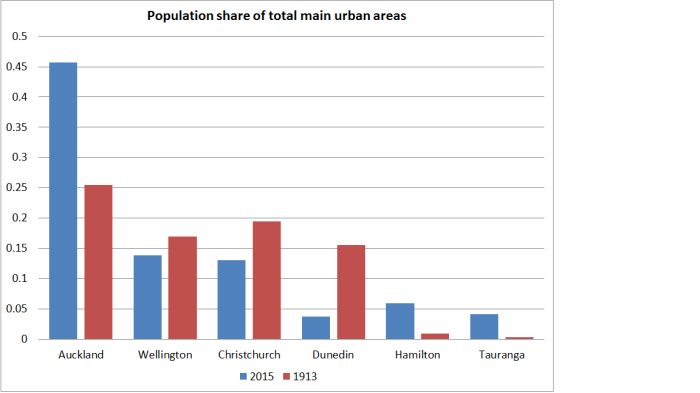
But if Wellington has outstripped Dunedin over the years, it has hardly managed strong growth.  I went back to my 1913 New Zealand Official Yearbook.  Back then, greater Wellington made up 17 per cent of the total population of the 14 large urban areas (a group made up of the places that were largest then, and those which are largest now –  eg in 1913 Hamilton and Tauranga barely figured, while Gisborne and Timaru did).  Today, the population of greater Wellington (including Kapiti) is about 14 per cent of the population of those 14 urban areas.

population shares wgtn

More recently, SNZ reports estimated data for urban area populations from 1996 to 2015.  Over that period, even Wellington city’s population growth has only slightly exceeded population growth for the country as a whole  –  and been ever so slightly slower than population growth in Nelson.  Take the greater Wellington area and population growth has been slower than that in greater Christchurch, despite the massive disruption from the earthquakes.

population growth since 1996

I’m not sure that this should greatly surprise anyone.  Wellington has been helped by the growth of government (the regulatory state needs staff and it keeps growing, even if the tax share in GDP doesn’t) and by happening to have industries which it remains fashionable to subsidise (the film industry).  On the other hand, it has a somewhat bracing climate –  albeit one staunchly defended by some true Wellingtonians.    There have been some good market-driven businesses built here, but not many choose (and find it optimal) to stay in the longer-term.

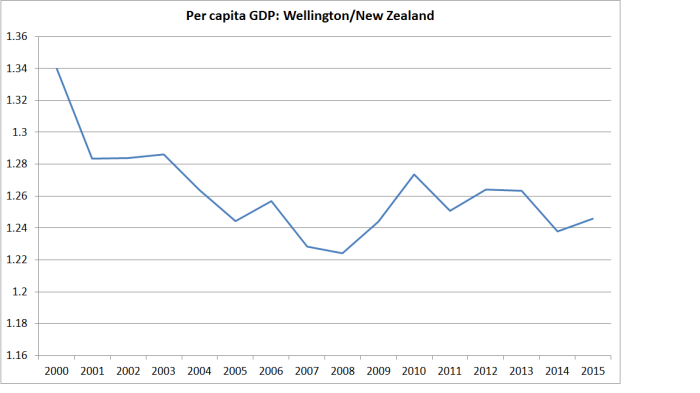
Average GDP per capita in Wellington is higher than that in New Zealand as a whole –  no doubt reflecting some combination of the huge number of professional government and government-dependent roles, and the fact that Wellington tends to be attractive to young people not old ones (it is windy and not very warm).  The labour force participation rate in Wellington averages higher than those in, say, Auckland and Christchurch.  But over the 15 years for which we have regional GDP data, average per capita GDP in Wellington has been growing more slowly than that in the rest of the country (a similar story to Auckland).

wgtn regional GDP

So I don’t really see much chance that the population of Wellington – even just that of Wellington city –  is going to double over 30 years.   Even the Wellington City Council’s “chief city planner” (shouldn’t anyone from outside the old eastern-bloc be embarrassed to hold such a title?) acknowledges it is unlikely.

But the focus of the Stuff article was on the Wellington housing market.    Of course, since it is an article about local authorities perhaps it isn’t too surprising that the word “market” does not appear at all –  not once in a reasonably substantial article.  The Council’s British chief bureaucrat, Kevin Lavery, is quoted instead as saying

Lavery said the 15 people who find themselves sitting around the Wellington City Council table after October’s election will have some big decisions to make on the supply, quality and diversity of housing in the capital.

Which really sums up all that is wrong with our system of local government.  Councils and their officials simply should not be in the business of making decisions on the “supply, quality, or diversity” of housing in the city.  That is what we have –  or should have –  markets for.  They are the mechanisms through which private tastes and preferences are reflected and private businesses respond to that (actual and anticipated) demand.  We need local authorities to do things like pave the streets, manage the water and sewerage, provide parks, and perhaps even run libraries.  We don’t need them deciding what sort of houses people are living in and where   The problems –  including the affordability problems – mostly arise when officials and councillors get in the way.  Now if Mr Lavery had simply been noting that no one can really predict what future population growth rates will be, or where people and businesses will prefer to operate, and that Council rules need to be sufficiently minimalistic and flexible to enable housing supply to easily respond to emerging demand, I’d have applauded him.  But no, he doesn’t see a dominant role for the market, but for 15 elected individuals, with neither the expertise nor the incentives to get those decisions right –  and that is no criticism of them individually, no one has that knowledge.

But the “chief city planner” is worried.

The danger was that developers would concentrate more on packing people in than on good design. “We’re not out to generate developments and profit margins for developers. We’re building communities.”

Council bureaucrats are “building communities”?  The mindset is really quite starkly on display.  In market economies, profit margins are part of what makes people willing to take risks, and build businesses –  even develop new subdivisions or apartment blocks –  taking the risk that things might actually go badly wrong.  But “profit margins” seem anathema to the chief planner.  And “good design” seems mostly to be a mantra to impose the tastes of some on everyone, and raise costs of housing.  Again, why is it a matter for local government?

It isn’t just the bureaucrats. Here is our Mayor, presumably somewhat torn between her Green Party credentials (supposedly sceptical of population growth) and her local authority boosterism.

Wellington Mayor Celia Wade-Brown said she believed her council had done plenty during her six years in charge to set the city up for a population boom.

It had signed off on a number of special housing areas with the Government, and was actively consulting communities in several suburbs on potential medium-density housing rules.

Establishing an Urban Development Agency this year would also help increase the city’s housing stock and keep prices in check, she said. The agency will be able to buy and assemble land parcels, and partner with developers.

It is all about bureaucrats and politicians, not at all about empowering markets.  Nothing about respecting property rights or promoting market solutions –  just put your trust in the Mayor and Council staff.  I’m wryly amused by her references to SHAs. There are a few not far from here.  One –  on the site of an old church –  now has a few townhouses almost completed. A much larger one, not 200 metres from where I sit, remains as overgrown, dark, brooding, and undeveloped as ever.  I’m keen to see it developed – though I know many locals aren’t –  but there is simply no sign of any progress.

I guess the election is coming up and the incumbent isn’t well-positioned but when she can end with the observation that

“When our average house price is $560,000 and the Government considers $600,000 to be affordable in Auckland, then I think our city is looking pretty good.”

it is as if very small ambitions indeed have triumphed.

One only has to fly over Wellington to realise just how much land there is in both Wellington city, and the greater Wellington area.  No doubt, the development costs are higher than those for flat cities such as Hamilton, Palmerston North or Hastings.   But there is little excuse for average house prices of $560000 –  responsibility  for that mostly rests with the mayor, councillors and their legion of planners, aided and abetted by central governments that have allowed councils to have such powers.

The Productivity Commission’s draft report on a new urban land use policy framework is apparently due out next month.  They had a mandate to be ambitious in their proposals.  The Commission has so far shown a disconcerting enthusiasm for giving more powers to councils and governments, not fewer (they are bureaucrats themselves, so perhaps even if disappointing it shouldn’t be so surprising). I hope they take seriously the possibility of largely withdrawing the state (central and local) from the urban planning business.  There was a nice piece the other day from a US commentator, Justin Fox, marking the 100th anniversary of zoning in New York.

It also appears to have been the first set of land-use rules in the U.S. that (1) covered an entire city and (2) used the word “zone.”

That was 100 years ago Monday. So happy birthday, zoning! OK if we kill you now — or at least maim you?

There’s a thought. Put markets, and private contracts, back in the driver’s seat, and let local authorities respond to private sector developments, efficiently delivering the limited range of services we really need councils to provide.  Don’t “plan communities”, but provide services to ones that develop.  (And that doesn’t include airport runways.)

Time to let the sunshine in

Former US Supreme Court Justice Louis Brandeis was the author of the famous line that sunshine is the best disinfectant, arguing for greater transparency in government agencies and the political process.   There is no perfect system, and probably no country reaches an ideal standard, but as governments around the world have become more intrusive and more powerful there have at least been some important counterbalances developed.  One of the most important has been the passing of freedom of information acts –  our own dating from 1982 –  which typically help move towards a presumption that information held by government agencies is accessible to citizens unless there is a compelling reason otherwise.  In making primary legislation (passing Acts of Parliament) Parliament now uses select committees much more extensively than was once the case and there is recognition, reflected now in established practice (Parliament itself not being subject to the OIA), that submissions to such committees, from people trying to influence our laws, should be made public on a timely basis.

The timely publication of submissions –  whether to, eg Productivity Commission enquiries, to local councils reviewing district plans, or to government regulatory agencies –  is increasingly becoming the norm.

There is, however, one notable blackspot in this generally positive story.  The Governor doesn’t invite public submissions on the OCR, but if you send him one anyway, it will be discoverable under the Official Information Act –  there is presumption in favour of release, unless there is a compelling specific ground not to.  But make a submission on a regulatory initiative –  where the Bank is required to consult, take submissions, and have regard to those submissions when the Governor makes his final decision – and anyone who wants to see that submission will face a barrage of obstructionism, some of it enabled by old legislation that simply hasn’t kept up with how the Bank’s extensive powers have evolved.

Last year, for example, various government agencies were doing things about housing.  The new brightline test and associated tax number provisions required parliamentary legislation.  All the submissions on these issues were published shortly after they were received.  The Reserve Bank put out proposals for a new round of LVR controls.  The Bank first refused absolutely to publish any of the submissions, even after the event, arguing that the summary of submissions that it wrote itself should be quite enough.  After several OIA requests, it finally backed down a little and agreed to release the submissions made by people who weren’t themselves regulated entities (ie those of people like me)-  but by then it was well after the decision had been made.

In their regulatory stocktake last year the Bank responded to several submissions and indicated that it would take another look at moving towards routine publication as the norm.  That sounded encouraging, but nothing was heard for many months, and then finally in May they released a consultative document on the publication of submissions on consultative documents.   By this time, they were clearly mostly interested in defending the status quo  –  publishing only their own, belated, summary of submissions.  That is apparent in the text, and also in the time they allowed for consultation: not seeking to change the status quo, they allowed almost three months for interested parties to make submissions.  By contrast, on stuff where they want change –  eg the latest LVR proposals –  three weeks’ consultation is deemed more than enough (“more than” since they are urging banks to apply the “spirit” of the new rules, even though the Bank has to be open to reaching a different view in light of submissions received).

My own submission on the consultation on the publication of submissions is here.

Submission to RBNZ consultation on publication of submissions Aug 2016

The Bank outlined two options

  • the status quo (summary of submissions and whatever they might eventually be forced to release under the OIA)
  • an alternative in which the Bank would publish all or part of submissions (timing of publication not clear) but only when submitters given their explicit consent.

The second option is not really a step forward at all.  The submissions the public need to be most worried about are those where submitters might refuse consent.  What, we might reasonably, wonder are they trying to hide –  wanting influence over our laws, without enabling the public to know what they are arguing.  This is particularly an issue in respect of regulated entities, where regulators can get all too solicitous of the interests of the regulated.  But it isn’t just regulated entities who should concern us.

The Reserve Bank’s stance seems to be a combination of genuine obstructiveness –  “rules and principles that apply elsewhere in government really shouldn’t apply to us” –   and some genuine legislative constraints.  Section 105 of the Reserve Bank Act –  and parallel provisions in other legislation the Bank operates under –  prohibits the Bank from releasing “information relating to the exercise, or possible exercise, of the powers conferred by this Part” of the Act (prudential regulatory and crisis management powers).  The Bank argues that they can –  but don’t want to –  release submissions from other interested observers, but simply cannot –  even if they wanted to –  release submissions on possible rule changes from regulated entities.

But here’s the thing: in section 105 there is no distinction drawn at all between information or views obtained from “regulated entities” and that from citizens more generally.  If the Reserve Bank really thinks these provisions apply to submissions on possible law changes (in this case, changes in banks’ conditions of registration), it cannot release any submissions at all.  But it can’t just pick and choose which it wants to release and which it does not.  They haven’t produced anything more than assertions in support of their interpretation.  One alternative possibility is that these provisions apply only to commercially confidential information –  which is in any case protected by the OIA, but which does not include an institution’s views on appropriate regulatory policy.

But there is a solution –  and really rather an easy one.  If section 105 really does constrain the Bank’s ability to be open and transparent, it is open to them to approach the Minister of Finance (and Treasury) and seek a simple change to the Act.  It should be easy enough to draft a short clause that provided that any submissions, from any party, on possible rule changes affecting all, or significant subset, of a class of regulated entities were not subject to section 105, and were fully subject to the provisions of the Official Information Act. Ideally, such a amendment would go a little further, and require all such submissions to be published on the Bank’s website on the day submissions close.  It is difficult to imagine who would oppose such an amendment.  Which opposition party is going to vote for greater bureaucratic secrecy? Perhaps some banks might object –  but these same banks know that when they make submissions to select committees or to other regulatory bodies those submissions will typically be published on a timely basis as a matter of routine.  If the Minister of Finance –  who seems strangely reluctant to touch the Reserve Bank Act –  wasn’t willing to make even this simple amendment, perhaps some backbencher with a serious commitment to open government could put such a provision in a draft bill in the members’ ballot.

I said that the legislative constraints mostly reflected old legislation that hadn’t kept pace with the changing role and powers of the Bank.  The section 105 provision dates back to 1987, a time when the Reserve Bank had very few supervisory or regulatory powers.  The older banks were established by their own acts of Parliament (rather than Reserve Bank registration) and these confidentiality provisions were, in effect, mostly about the ability of regulated entities to provide sensitive material to the Bank in an urgent and unfolding crisis situation.  Most people probably have little problem with protections of that sort –  although arguably the OIA provided them anyway.  There were no consultations on discretionary changes in regulatory policy, because there were no such changes.    LVR restrictions have really been the discretionary initiatives which have had the most pervasive effects – using conditions of banks’ ongoing registration as an instrument of short-term macroeconomic policy.  But the Reserve Bank did not even have the powers to impose LVR restrictions until an amendment to the Reserve Bank Act in 2003.  And even then, for a decade afterwards such powers weren’t used.

So if section 105 really protects the confidentiality of submissions on new regulatory initiatives, it is an unintended consequence. It is a most unfortunate one –  in an open society, lawmaking and the material lawmakers draw on, should be open to public scrutiny.  But it is also an easily remediable one.  It would be good to see the Reserve Bank re-think its stance, and approach the Minister of Finance seeking the sort of change I outlined above.   At present, foreign regulators have better access to the views of people maming submissions on our laws than our own citizens do.     And it is all the more important to fix this issue given that so much power in vested in a single unelected official –  who faces little or no effective accountability, and too little responsiveness to the concerns of citizens and voters. The Reserve Bank is a regulatory agency, not an institution warranting the deference and protections that, say, the Supreme Court might enjoy.

(An interesting example of where we really should have timely access to all submissions is highlighted by the article a couple of weeks ago from the ANZ’s Australian head of New Zealand operations, David Hisco.    Hisco argued that the new LVR restrictions should be even more onerous than what the Reserve Bank was proposing. But is he serious, or was he just wanting to convey the impression that he was a “banker who cared”?   There are not entirely-public-spirited reasons why bankers might favour tight restrictions on new business –  they might for example think they would be more temporary than higher capital requirements –  but at present we don’t even know whether Hisco is serious in his call for even tighter LVR controls.  His economics team didn’t seem very convinced even by what the Reserve Bank was proposing, but if he is really serious about the substance of his proposal, presumably it will be reflected in ANZ’s submission to the Reserve Bank this week or next, complete with supporting analysis.  If not, we can draw our own conclusions.  Either way, if the Reserve Bank has its way, we simply won’t be able to know.)

As this consultation itself (on the publication of submissions) is not about the exercise of powers under Part 5 of the Reserve Bank Act, I have lodged an OIA request for all submissions the Bank receives on it.


An economist for President?

My two young US citizens have been badgering me about the US election, and when I tell them I’m just glad I don’t have to choose this year, one says “but what if someone had a gun at your head and forced you to choose between Trump and Clinton?”.  Watching Trump’s convention address last week confirmed many of the reasons why I would not support him, and watching Clinton’s address yesterday had much the same effect for her.  Last week’s New Yorker had an interesting profile of the Libertarian Party candidate Gary Johnson, but the more I read about him the less appealing he also seems to be.   I’m still glad I don’t have to choose –  and, what’s more, get to live in a country that has had women as head of state for 128 years of its 176 year modern history.

About the same time I was reading the Johnson profile, I stumbled on “Kotlikoff for President“: prominent economist Laurence Kotlikoff (a professor at Boston University) is running for President, urging voters to give him –  and his running mate, another prominent economist, Ed Leamer (at UCLA) –  a write-in vote in this year’s presidential election.  Kotlikoff is perhaps best known for his push to ensure that governments are fully transparent about the nature of the intergenerational fiscal obligations they take on.

A quick skim through Kotlikoff’s campaign website confirms that there are many issues I disagree with him on – not limited to his banking reforms proposals, contained in his 2010 book. Jimmy Stewart is Dead: Ending the World’s Ongoing Financial Plague with Limited Purpose Banking which he presented, and I had a chance to discuss with him, when he visited New Zealand two or three years ago.  It wasn’t so much that I thought his proposal was wrong, as that I thought he was much too optimistic as to what difference it would make –  my typical reaction to monetary reform proposals.

But what really interested me in working through his economics material was his discussion on immigration and population issues, in particular the bolded passage.

Immigration

Immigration has been a major topic in the Republican Presidential debates. But the discussion has been remarkably disconnected from the facts. Notwithstanding the suggestion that illegal immigrants are overrunning our borders, there are and have been more illegal immigrants leaving our country than entering it. Indeed, over the last decade, roughly 1 million more illegal immigrants have left our country than have entered it. This is tribute, in large part, to our immense, decades-long effort to secure our borders. We still need to work extremely hard on border enforcement to eliminate illegal entry to our country. But we shouldn’t presume nothing has been accomplished.

The real issue with immigration is legal immigration. We are adding 1 million legal immigrants to the population each year. The great majority are unskilled. This isn’t hurting investment bankers or the software engineers at Google. This is hurting low-skilled U.S. workers. It’s the last thing we need if we are trying to restore our middle class.

Population Explosion

Legal immigration is also fueling a veritable population explosion. Unless we reduce legal immigration, our population will rise by one-third – over 100 million people – in just 45 years. That’s the current population of the Philippines. Most of these additional people will locate in the nation’s major cities. Driving in our major cities at peak hours is already a major challenge. With one-third more people, driving in our major cities may be like driving in Manila – an experience I don’t recommend.

Kotlikoff’s academic speciality is public finance, and Leamer specialises in trade and econometrics, but it was unusual to see  any such prominent academic economists speak up on the issue, expressing unease about the US immigration policy.  And recall that legal US immigration –  the bit Kotlikoff and Leamer focus on –  is one third the size, in per capita terms, of New Zealand’s non-citizen immigration programme.  The US grants around one million green cards a year –  every year roughly one new person for every three hundred already there. We aim to grant 45000 to 50000 residence approvals a year –   every year roughly one new person for every hundred already here.  In a single year, that difference might not sound like much.  Over even 20 years, it is enormous: over 20 years the US will have let in one person for every 15 already there, and we’ll have given the right to live here to one person for every five already here.

I’ve been reluctant to focus on the implications of immigration for wages.  My focus has been on the more macro perspectives: the potential impact on real interest rates, the real exchange rate, and tradables sector growth and investment prospects, in a country that has a modest savings rate and is constrained by its remoteness from the rest of the world.  I’ve also been a little uneasy about the wages story in aggregate in the short-term, since I read the evidence as suggesting that in aggregate immigration tends to boost demand more than it does supply in the short-term.  If anything, surprise immigration surges tend to lower the unemployment rate not raise it, at least in the short-term.

But the repeated (fallacious) insistence of business groups that large scale immigration eases skill shortages for the economy as a whole –  a proposition I dealt with here – eventually forced me to realise that at least in those occupational groupings where there is substantial immigration, that immigration simply must be holding down wages for New Zealanders in those sectors below what they would otherwise be.    The effect might be quite small at an economywide level, but if your sector can persuade the central planners in MBIE (and their Minister) to allow relatively easy recruitment of immigrant labour it simply must dampen the wage rate you as employer would otherwise have to pay.   If the available supply of labour diminishes, the typical response will be for the price to rise.

One could readily think of a number of occupational groupings that stood out when I looked last year at either residence approvals’ occupations or those getting Essential Skills work visas (and that is before starting on the sorts of role the people on working holiday visas tend to cluster in), such as

  • chefs
  • retail managers
  • dairy workers
  • aged care worker or nurse
  • restaurant or café managers
  • cook
  • truck driver

For each of these occupations, the alternative to a ready availability of immigrant labour must have involved, at least in part, higher wages.  Each firm would tend to pay higher wages to attract good people from other employers, and the industry as a whole will end up paying higher wages which will, over time, attract more locals into the industry.  Sympathetic as I am to aged care workers, it has always seemed that the heavy reliance –  as a deliberate matter of policy – on immigrant labour probably explains rather more about the pay differentials they complain about in pay-equity suits, rather than any sort of structural gender-based discrimination.

I understand why government politicians will want to deny these sorts of adverse wages effects. It is more puzzling why Opposition ones do  – especially Opposition parties with their roots in the trade union movement.  And even more so why most economists are at pains to try to deny any adverse effects on anyone.    Unless there are big productivity spillovers from the sheer presence of super-talented foreigners –  and in the New Zealand, most immigrants just aren’t super-talented (any more than most locals are), and no one has been able to find evidence of such spillover benefits at all – if there are any medium-term economic benefits from immigration at all they result from dampening the price of labour relative to the price of capital.  If labour is cheaper more projects are viable than would otherwise be the case.

In case anyone thinks this is just crazy stuff, there is a huge  formal literature on how immigration worked, and affected economic outcomes, in the first great modern age of immigration – the 50 to 70 years prior to World War One.   I’ve touched this in a previous post, referencing a piece by leading Irish economic historian (and professor at Oxford), Kevin O’Rourke.    Overnight, I stumbled on a new accessible essay by O’Rourke written prompted by the recent 100th anniversary of the Irish rising of 1916.  Here is what he has to say about the implication of emigration for wages.

Ireland was hardly the only country to experience mass emigration in the nineteenth century. If its emigration rates were particularly high, this was not due to a uniquely repressive environment (of either Irish or British origin). Irish wages were much lower than American wages, Ireland’s marital fertility rate was high, and there was a large stock of previous migrants to facilitate the transition to a new life in a New World. High emigration is precisely what would be predicted under such circumstances; the Irish were not unusually prone to emigrate, other things being equal.

And as was the case elsewhere, high emigration had a profound impact on the Irish economy, lowering the supply of workers competing for jobs, and raising wages. The wages of unskilled Irish building labourers rose from around 60 per cent of what their British counterparts were earning in the 1830s, to more than 90 per cent in the decade before World War I. Something similar happened in economies as superficially dissimilar as Italy and Norway, and in all three countries emigration was largely or entirely responsible for this wage convergence.

Irish wage convergence was emphatically not due to a superior Irish growth performance

This is just a standard non-contentious result in the modern literature about this historical period –  for anyone interested check out the writings of Hatton, Williamson and O’Rourke himself, for example. Emigration from Europe to the New World (including New Zealand) lowered wages here and raised them in the source countries. It greatly helped the process of income convergence –  although in New Zealand’s case, it took significant public subsidies to make even the high wages on offer here attractive to “enough” people.

There are occasional attempts to explain why the 19th and early 20th century experience might not be applicable today, but I’ve not found any of them even remotely persuasive. Instead,  most modern academic enthusiasts for high immigration to Western countries are either altogether unaware of the historical literature, or simply choose to ignore it.    That is particularly unfortunate –  one could think of worse descriptions –  in the New Zealand case, where since the 1970s we have had huge net emigration of New Zealanders and since the end of the 1980s huge policy-facilitated and promoted immigration of non-New Zealanders.  If it had just been the outflow of New Zealanders, the 19th and early 20th century experience might have led us to expect a substantial measure of income convergence between New Zealand and Australia (as outflows from Invercargill or Taihape helped keep factor returns in those places somewhat in touch with those in the rest of the country).  But if such a process had been incipiently at work, the policy programme to bring in so many non New Zealanders to a country no longer sufficiently attractive to its own would have worked to directly stymie the prospects of such convergence.   And yet in none of the MBIE or Treasury work on immigration I’ve seen has the historical convergence literature been applied to the New Zealand experience.  That seems like quite an omission.

It seems like a good year for Kotlikoff and Leamer to get some coverage for the issues they are promoting. I hope their sensible comments on the immigration policy issues do get some more attention.   And that as we approach our election next year –  with one of the largest controlled non-citizen immigration programmes anywhere in the world (and one of the worse long-term productivity performance –  we can have some thoughtful engagement with the costs and benefits of immigration, including the distributional ones, informed by the historical experience, as well as by the models of modern academic immigration enthusiasts.


Reviewing government assistance to business

The Australian Productivity Commission’s latest annual Trade and Assistance Review was released quite recently.  These, statutorily required, reviews contain

the Commission’s latest quantitative estimates of Australian Government assistance to industry

as well as useful discussion and analysis of key recent developments in the trade and industry assistance area.  As the Commission notes in the Foreword to this year’s report

Views inevitably differ on what constitutes industry assistance and whether it is warranted. Fundamental to these questions is transparency of measures. The annual Review seeks to identify government arrangements that may be construed as assistance, as well as their target, size, and nature. This information provides a basis for considered assessment of the benefits and costs of the arrangements.

Transparency  alone usually can’t stop daft policies being adopted or continued, but without good empirical estimates and disinterested analysis it is harder to push back against the special interests lobbying governments for this deal or that.  Such deals are almost invariably dressed up as being in the public interest, but perhaps rarely are.

The Commission highlights one particularly egregious example in this year report –  the decision to build the new submarine fleet in Australia  (characterized by many as marginal seat retention scheme  –  and the Cabinet minister most often mentioned did retain his seat at the recent election).  As the Productivity Commission’s report tartly observes

Paying more for local builds, without sufficient strategic defence and spillover benefits to offset the additional cost, diverts productive resources (labour, capital and land) away from relatively more efficient (less assisted) uses. It can also create a permanent expectation of more such high‑cost work, as the recent heavily promoted ‘valley of death’ in naval ship building exemplifies. Such distortion detracts from Australia’s capacity to maximise economic and social wellbeing from the community’s resources. The recent decision to build the new submarines locally at a reported 30 per cent cost premium, and a preference for using local steel, provides an illustrative example of how a local cost premium can deliver a very high rate of effective assistance for the defence contractor and the firms providing the major steel inputs (box 3.1). While based on hypothetical data, the example reveals that the effective rate of assistance provided by purchasing preferences can be higher than the peak historical levels recorded for the automotive and textiles, clothing and footwear industries prior to the significant economic reforms of protection. It is notable that this cost premium does not include any delays in deploying the new submarine capability.

Effective rates of protection, in 2016, higher than those provided to automotive, textile, clothing and footwear industries in the bad old days of high industry protection.

I wrote briefly about last year’s review, which included material which the Sydney Morning Herald described as scathing attack on preferential trade agreements of the sort that Australia (and New Zealand) governments have been enthusiastically signing.  The Australian Productivity Commission  –  a body strongly committed to open and competitive markets – has a well-established record of skepticism around the wider economic benefits of such deals.  Here is their box summarizing the issues and concerns.

Box 4.1           Conclusions in regard to the merits of trade agreement

The Commission has previously raised questions about the merits of trade agreements (including PC 2010, and the Trade & Assistance Review 2014‑15). The overall conclusions are as follows:

·       Multilateral trade reform offers potentially larger improvements in national and global welfare than a series of bilateral agreements. While the slow progress of the Doha Round of multilateral trade reform has accelerated preferential agreement making, the trade‑diverting effects of bilateral agreements should not be forgotten.

·       Australia gains more from reducing its own tariff barriers than from the tariff reductions of a bilateral trade agreement partner.

·       The benefits of increased merchandise trade emanating from bilateral trade agreements have been exaggerated.

·       Different and complex rules of origin in Australia’s preferential trade agreements are likely to impede competition and add to the costs of firms engaging in trade.

·       The nature and scope of negotiating remits should be assessed from a national structural reform perspective before entry into negotiations, rather than primarily for export opportunities. The text of proposed trade agreements should be made public and a rigorous analysis independent of the negotiating agency published with the final text.

·       The Australian Government should seek to avoid the inclusion of Investors‑State Dispute Settlement (ISDS) provisions in bilateral and regional trade agreements that grant foreign investors in Australia substantive or procedural rights greater than those enjoyed by Australian investors.

·       The history of Intellectual Property (IP) being addressed in preferential trade deals has resulted in more stringent arrangements than contained in the multilateral agreed Trade‑Related Aspects of Intellectual Property (TRIPS). Australia’s participation in international negotiations in relation to IP laws should focus on plurilateral or multilateral settings. Support for any measures to alter the extent and enforcement of IP rights should be informed by a robust economic analysis of the resultant benefits and costs.

It isn’t exactly the enthusiasm of New Zealand or Australian governments for deals such as TPP (although the Commission does not comment at any length on that specific deal).

One can always argue what value publications like these add – given the fondness for daft policies that governments continue to show. But given how badly the incentives are skewed against citizens, provisions that require officials to publish reports of this sort seem appropriate. Information is one of the few tools citizens have to push back.

In New Zealand, the Taxpayer’s Union has done sterling work in highlighting some of the cost of “corporate welfare”, but it might be a good part of improving New Zealand’s economic governance if provisions requiring an annual report of this sort were included somewhere in New Zealand legislation.  At very least, it would help to prompt something like the annual modest round of stories in the Australian media about just what governments are doing  –  and at what cost –  in this area.  In a small country, with a lightly-resourced media, we probably need such official reports even more than Australia does.

A couple of cartoons

I mentioned this morning that talk of slow and controlled adjustment down in house prices reminded me of a cartoon from the 1980s, contrasting the Douglas and Anderton approaches to economic reform.    Having dug around in my garage, here is the cartoon.

douglas

There are no totally easy or fail-safe ways to unwind the disaster that the New Zealand –  especially Auckland –  housing market has become.  But this is a clear example where the sooner it happens the better.  If house prices rose sharply one day and were reversed the next, almost no one suffers.  If prices rise sharply for six months and then fully reverse, a few people will have difficulty –  but the losses will be isolated and limited, posing no sort of systemic threat.  But if real house prices stay at current levels for the next 20 years, most of the housing stock will have been purchased (and borrowed against to finance) at today’s incredibly high prices.  There will have been a massive real wealth transfer to this generation of sellers (sellers, not owners).  And that transfer itself simply can’t be unwound no matter what happens to house prices.  If house prices were to fall now, there has still been quite a redistribution, but four years of turnover is quite different from 20 years of turnover.

In the Douglas-Anderton debates illustrated in the cartoon there were some real and legitimate choices about timing.  If one is stripping away industry protection, or substantially restructuring government agencies, there are some reasonable questions about how much notice one gives people to reorient their lives, and businesses, and find new options.  The protected industries were mostly pretty static, and a signal that protection would be stripped away over five years would call a halt to most new investment anyway.   The house price situation is different.  Even if prices go no higher from here –  the sort of the thing the government and Labour Party seem to want –  more and more people are getting caught in the web of paying (and borrowing) too much for houses with every passing month, just through normal housing turnover.  For each new borrowing family, that choice will affect their consumption options for the rest of their lives.

But lets take a deliberately extreme contrast: on the one hand, house prices fall 50 per cent tomorrow, and in the alternative scenario they fall 50 per cent steadily over the next five years.   Who would gain from the gradual adjustment?  There is no obvious gains to banks –  the debt is what it is, and at least conceptually they’d want to mark down the value of the collateral straightaway.  There is no obvious gain to existing owner-occupiers.  There is no  obvious gain to the economy as a whole –  indeed, arguably a climate of expected continuing falls in house prices might be worse for activity than a single sharp adjustment. Of course, there would be some winners and some losers –  the losers would be the people who for some reason simply had to buy a house in the next few years (they’d pay more than in the sudden adjustment scenario) and the winners are the few smart or lucky people who manage to offload their properties before the full adjustment occurred.  In fact, what we would see is turnover in the housing market dry up for several years, which would also make it more difficult for those who simply had to transact to do so.  Again, not an obvious social gain.

Sadly, it isn’t going to happen, but given the mess successive governments have created a 50 per cent fall in house prices tomorrow as a result of land use liberalisation would be one of the single best things that could happen –  and much better than the false promise of some sort of controlled gradual fall (such things just don’t happen). Sure, it wouldn’t be easy for some, but the number of people who will be adversely affected if the housing problems are ever really resolved grows by the day.

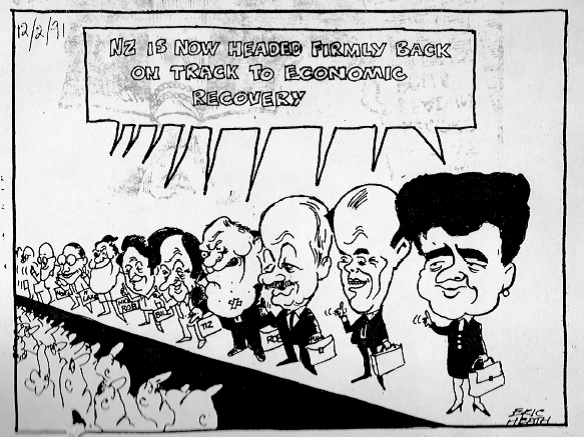
Changing tack, on the front cover of my cartoon collection I have this cartoon from early 1991.

richardson

For some years, I had it pinned to the wall in my office –  the sad procession of successive Ministers of Finance who for decades (this cartoon implies back to the 1950s) had promised that New Zealand’s decline would be reversed (made worse in this case in that Ruth Richardson must have said something along these lines in February 1991, just as the severe recession of that year was taking hold).      Since then, we’ve had Bill Birch, Winston Peters, Bill English, Michael Cullen, and Bill English again, and although we’ve had plenty of cyclical ups and downs, never at any time have we looked like successfully or sustainably reversing our relative economic decline.   It saddens me every time I look at this cartoon –  so many decades, so much failure.

Kudos to the Greens

I’m not usually much inclined to support the Green Party on anything –  their interest in reforming the governance of the Reserve Bank being an admirable exception.  And political courage on doing something about house prices –  and being honest about what making house and urban land more affordable means  – had seemed to be in really short supply from all across the political spectrum.  I’m not sure even the current ACT leader has been willing to openly suggest that if prices in Auckland fell 70 per cent it would only bring them into line with the price to income ratio of around 3 that has been a typical benchmark of affordability (happy to be corrected if I’m wrong on that).

And so I can only commend the Green Party for being willing to say it: house prices should fall, especially those in Auckland, and the fall needs to be large.

On Wednesday Turei, the Greens co-leader, put her neck out politically calling for house prices to be slashed, particularly in Auckland, where the average is knocking on $1 million.

She’s considering policy that house prices drop to about three to four times the median household income.

As the Stuff story puts it

Her party’s approach is not dissimilar from former Reserve Bank chief economist Arthur Grimes and former National and ACT leader Don Brash, who are calling for a 40 per cent drop and as much as a 60 per cent fall respectively.


Don Brash would probably describe himself as being on the right of New Zealand politics, while Grimes has always struck me as being (non-partisan but) a denizen of the mild centre-left.  This isn’t an ideological issue (at least on any traditional left-right spectrum) –  but one about facing facts, and prioritizing people who currently have little hope of ever being able to afford a house.  There is simply no excuse for that sort of systematic exclusion.

Turei says she’s doing work around what a policy would look like but she’s taking a lead from initiatives, such as Auckland Council chief economist Chris Parker’s report picked up by the council to aim for house prices five times the household income by 2030.
“We are saying it like it is. Most people believe house prices are far too high, most people believe house prices need to come down.”
The sad thing is the light that Turei’s comments shed on the leaders of our two largest parties.  We already know that the Prime Minister has dismissed the Grimes call as “crazy” –  not demanding, not uncomfortable for some, just crazy.   And as for the Labour Party.
But Little says the solution is stabilising house prices by cracking down on speculators, building more houses and lifting wages – not crashing the market.
So house prices should stay at these levels and in 40 or 50 years time wages might have caught up –  and our grandchildren might perhaps finally be again able to purchase a house at reasonable multiples to income?
No doubt both sides have been polling furiously on these sorts of issues –  trying to detect whether there is a tipping point in public opinion approaching.  As I’ve said before there is no doubt that sharp falls in prices could be uncomfortable for some.  But the potential unpleasantness is typically much overstated –  at least if a correction were to happen soon.  Most people haven’t entered the house market in the last  four or five years, and many of those who have will have envisaged paying off a mortgage over their working lives.  Our banking system is robust, and there is no chance of some repeat of the US 2008 financial crisis here.  But for some highly-leveraged investor purchasers, a sharp fall could mean a business failure.  That wouldn’t be pleasant for them, but it is in the nature of a market economy –  people take risks, many are rewarded, and others fail.  It is also in  the nature of unwinding distortionary controls that have skewed markets against ordinary people –  whether that is land use restrictions or in years past farm subsidies, import quotas or whatever.
The main point of this post is to praise the Greens.  But having done so, I would add that I’m much less convinced that they have the answers as to how to get prices down again
Turei says addressing the issue involves a capital gains tax, a state house building programme, both state houses being built and a state programme for building houses for sale, the unitary plan and supply.
And I’ve been puzzled for some time as to why a party that is concerned about the impact of people on the environment is so opposed to adjustments in immigration policy being part of the mix.
I also part company from them on timing

Any approach to bringing down house prices needs to be done in a controlled way and over a long period of time, she said.

I think that is exactly the wrong approach –  and the idea of “controlling” the pace of adjustment seems far-fetched.  Turei’s comments remind me of a cartoon –  which I might track down later in the day –  from the 1980s contrasting the Roger Douglas and Jim Anderton approaches to economic reform.  Dressed as surgeons, confronting a gangrenous limb, one advocates lopping off the entire limb in a single blow, while the other advocates removing tissue just a slither at a time.

The sooner house prices come down the easier the adjustment will be –  politically and economically.  The longer the current disaster goes on the larger the proportion of people who will have borrowed and entered the market on the basis of current high prices, and harder it will be, on both political and economic grounds, to secure the support for the necessary adjustments –  the more there will simply be a push to wait out the problems and leave affordable housing as a dream for a couple of generations hence.  That really would be a national failure (well, National and Labour).

A journalist asked me the other day for some comments on the housing market.  They don’t seem to have been used, so I’ll reproduce them here

Do you think the Auckland housing bubble will burst and why/ why not?
 
The best way to think about Auckland house prices is that they have reached their current outrageous levels because of the interaction of rapid population growth (mostly on account of immigration) and tight land use restrictions.   Whether prices, or price to income ratios, ever fall back very sharply mostly depends on what, if anything, governments do about alleviating those pressures.  Net immigration does ebb and flow, but around a very high annual target for the inflow of non-citizens.  There doesn’t seem to be much political appetite to change that target, and there also seems to be only limited appetite for really freeing up land use restrictions.  Allow any land within 100 kilometres of downtown Auckland to have even two storey houses built on it, and the price of urban land would quickly fall a very long way –  owners of land on the margins of the city will be keen to utilize the land as soon as possible, not as slowly as possible.  But far-reaching reform like that doesn’t seem that likely.  So, sadly, while we might see house prices fall back 10 or even 20 per cent in the next recession –  whenever that is –  it is difficult to be optimistic that price to income ratios will drop back to around 3 (where they should be) any decade soon.
If yes – any idea about when?
Forecasting is a mug’s game.  All that can really be said is “please, as soon as possible”.  The longer the eventual adjustment is delayed the more people –  owner-occupiers and investors –  who will caught having borrowed hugely to pay today’s massively distorted prices.  The longer prices stay at these, or even higher levels, the more difficult the economics and politics of ever making Auckland housing affordable again.
To all of which I’d add that I also have no problem with greater intensification, but these things should be decided by landowners, not by councillors, or hearings panels.  Assign property rights in the existing plan provisions to groups of homeowners –  say 500 house groups –  and let them trade changes in those rights.  Use collective action clauses – as are often used in modern bond contracts –  so that a vote of say 80 per cent of land owners in a neighbourhood would be enough to agree changes for that neighbourhood.  It might sound messy, but compared to the current situation it sounds like a path that would actually generate change –  and ensure that affected parties sort these things out in the market, without anguished arguments on Checkpoint about bureaucrats and judges deciding the fates of Panmure, Mission Bay, or wherever.