Coronavirus and the OCR

A month ago there were no commentators suggesting the OCR should be raised at the next review.   Since then we’ve watched day-by-day as the news about the coronavirus (now named “SARS-CoV-2” and the disease it causes “COVID-19.”) has got relentlessly worse.   Against that backdrop, the case for an OCR cut today looks pretty unanswerable. Not because an OCR cut will make any material difference to March quarter GDP – it won’t –  but because the job of discretionary monetary policy is to lean against demand shocks, positive or negative, so long as inflation is well in check.

As I noted the other day, core inflation hasn’t got as high as the target midpoint for the whole of the last decade.  In that context, when there is a clear-cut (if not readily calculable) adverse demand shock, the Monetary Policy Committee would be remiss if it simply sat on the sidelines today, suggesting that they would merely be “watching closely” and be ready to act down the track.  In the current macro climate –  quiescent inflation, flat or falling inflation expectations –  there is simply no downside to acting now.    There is no particular virtue in instrument stability: the instrument exists to lean against macroeconomic instability (doing what it can to maintain “maximum sustainable employment”, in the current jargon).

Even a couple of weeks ago one might perhaps reasonably have reached a different view.  But now we have Chinese inbound tourism cut to almost nothing overnight (first as a result of Chinese restrictions and then our own), and confirmation from the universities that perhaps 60 per cent of their PRC students are still out of the country and unable to travel here.    We have much the same situation in Australia, a key economy for us, and in China itself –  one of the world’s largest economies –  huge economic disruption, and a spreading range of restrictions on movement, social gathering etc etc.  We see photos of largely empty streets or public transports in big Chinese cities that aren’t locked down, quite limited returns to work after earlier shutdowns, and so on. From Hong Kong there are reports of more cases, but again the bigger impact is probably people staying home, avoiding social gatherings etc.  Investment banks doing business in China –  ie quite severely constrained in their freedom to run negative lines –  have been marking down their 2020 Chinese and global economic forecasts.  Even the WHO –  which previously presented as relatively complacent – is now talking of this as

WHO chief Tedros Adhanom Ghebreyesus told reporters in Geneva the vaccine lag meant “we have to do everything today using available weapons” and said the epidemic posed a “very grave threat”.

“To be honest, a virus is more powerful in creating political, economic and social upheaval than any terrorist attack,” Dr Ghebreyesus said.

“A virus can have more powerful consequences than any terrorist action.

I’ll leave the florid rhetoric to him, but if there was a good case for cutting the OCR after the 9/11 attacks and after the February 2011 earthquake (and I think there was) that case is at least as persuasive –  compelling in my view –  now.

It isn’t really clear to me why, faced with a decision to make today (not, say, a week ago as with the RBA), anyone would favour not cutting the OCR.   The OCR (monetary policy more generally) is designed to be flexible and responsive (easing and, if warranted later, reversing such easing).  The OCR isn’t about support for individual adversely affected sectors –  if that is really needed in some areas it is a fiscal policy/government matter –  but about stabilising the overall economy faced with (in this case) clear negative shocks.  The tool is fit for purpose.

One argument sometimes heard is that we shouldn’t do anything because things are so uncertain.  But that argument should run exactly the other way round. The high degree of uncertainty, which is probably now rising by the day, is exactly the conditions in which people put off spending, put off travel, are a bit warier about eating out, and so on. It represents a likely material adverse demand effect on top of the specific channels (tourists, students) we already knew about.  Think of travel.  You might have been planning a business trip into Asia.  You might be happy enough to go today, and yet you look ahead and wonder what things might be like when you want to get home again, let alone what conditions might be like if somehow you got sick.  I reckon we’ll see an increasingly number of non-essential trips postponed, whether business or leisure.  And that won’t be so just in New Zealand.   With each passing week, we’ll also see more spillover effects into spending elsewhere in the economy and the confidence surveys –  whatever we make of them –  are likely to take a hit.

There is also the argument that things will snap back once the virus is behind us.  No doubt that is the most sensible assumption, but an increasing number of commentaries are noting that a full snap back isn’t likely to be a matter of a few weeks: it seems increasingly likely that the level of economic activity over much of this year, in much of the world, will be weaker than otherwise –  perhaps not a lot by the end of the year, but that is still 10-11 months away.    And assuming things will simply snap back risks being a recipe for doing nothing with monetary policy when it was actually needed (there are plenty of things forecasters think will be shortlived, but turn out to drag on rather longer).

I’ve also heard a story that the Reserve Bank cutting the OCR by 50 basis points last August may have instilled in some a sense of unjustified worry, becoming a bit of an own goal. Is there a risk of something similar now?    First, the August cut wasn’t well-handled.  It may have been substantively justified, but was poorly communicated and was not clearly tied to specific and very visible adverse developments here and abroad.  As it happens, I don’t think the “own goal” effects, if they existed at all, lasted for long at all (little sustained evidence in eg confidence surveys).    What about a move now?  Sure it would be unexpected, in that surveys of economists were all picking no change.  But (a) those surveys were often done a week or more ago, (b) economists generally aren’t asked what they think the Bank should do, and (c) there is a very clearly identified adverse event, which every commentator will be focusing on.  It would be quite easy for the Bank to credibly justify a cut today, specifically tagged to the coronavirus (and referring to 9/11 and 2011).  And if in doing so the Bank raised a bit more public consciousness of the mounting economic issues, it would probably be no bad thing anyway.

Perhaps the final caveat I’ve seen is that global equity markets seem quite surprisingly sanguine.  If they aren’t pricing something quite bad –  or even high risk – why should central banks react?  It is a fair question.  One answer is a matter of different time-horizons.  Equity markets are pricing earnings prospects over the life of the firm, while central banks are (by design) supposed to be focused more on the short-term.  A few bad months might not rationally affect the value of most firms much, but might still warrant lower policy interest rates. It is just a different game.  But it is also worth noting that New Zealand markets are pricing an OCR cut by the end of this year.   If it is needed, and likely to be useful, in a coronavirus context, it is much more useful –  and more likely –  frontloaded.

Time (not long now) will tell what the Monetary Policy Committee decides to do.  I am encouraged by two things: first, was the MPC’s willingness to act decisively last August (even if the accompanying communications etc were hamfisted) on much less clear-cut evidence, and second by the fact that one of the external members of the MPC (retired economics professor, Bob Buckle) was heavily involved in The Treasury’s early work on pandemic economic effects last decade.

Whatever the MPC chooses to do, the Reserve Bank has introduced an interesting new exercise in transparency.  If you are on Twitter you can ask the Bank directly a question during the press conference this afternoon.

Product market regulation

Writing yesterday about the Productivity Commission’s draft report on why firms don’t invest more (in “technology”), prompted me to take a look at the OECD’s Product Market Regulation (PMR) indicators.    In the OECD’s own words

The economy-wide PMR indicators measure the regulatory barriers to firm entry and competition in a broad range of key policy areas, ranging from licensing and public procurement, to governance of SOEs, price controls, evaluation of new and existing regulations, and foreign trade.

There is both a summary economywide indicator (the focus here) and a range of detailed component indicators and sectoral indicators.   As always with cross-country attempts to assess policy, the indicator(s) won’t be perfect, but such indicators can still shed some light on differences across advanced economies and across time –  the OECD has published the data every five years starting in 1998.

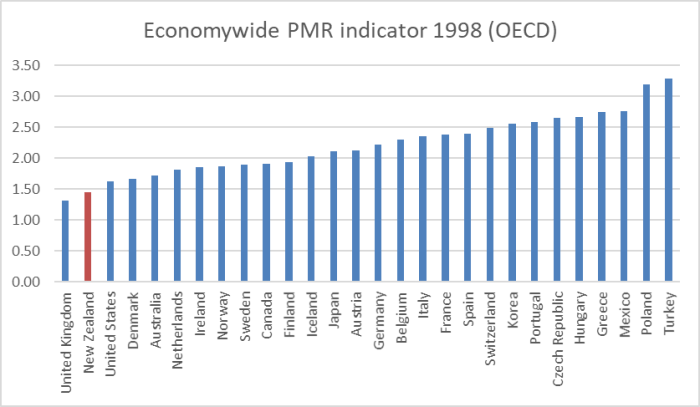
Here are rankings for 1998.  (On this measure, the lower the score the less burdensome -or whatever your descriptor – the product market regulation is.)

PMR 1998

In the wake of those numbers, when people talked about the productivity performance in New Zealand you’d often here something like “well, our business regulation is less burdensome than almost anywhere in the OECD” so (among the optimists) gains will follow or (among those less sanguine) whatever the big issues are they seem unlikely to be those relating to product market regulation.   A few years on we were still 2nd (in 2003) or 3rd (in 2008).

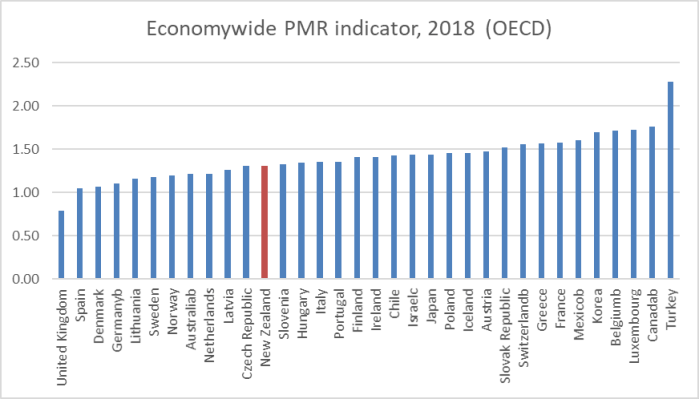
But by 2013 we were only ranked fifth.  Perhaps not disastrous, but some slippage evident.  And here are the 2018 numbers, fairly newly released (data for two countries still not there) assessing things as they stood on 1 January 2018.

pmr 2018

That is now a pretty unambiguous drop back in the rankings.   And three former Communist countries now beat us, with another two just slightly behind.

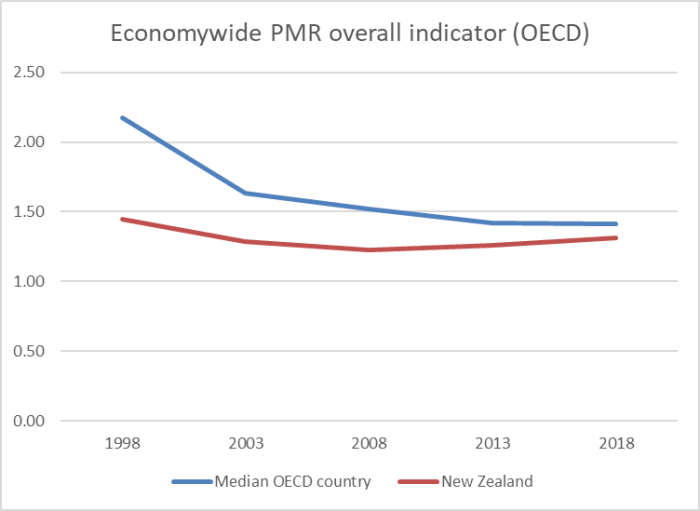
And it isn’t as if New Zealand has just been improving a bit more slowly than the rest of the OECD.  Here is the absolute score for New Zealand and for the median OECD country (no material differences if I used just the subset of countries for which there is a score on all five dates).

PMR 3

We’ve gone backwards, in absolute terms, since 2008.

I get quite a few comments whenever I write about productivity, suggesting that the web of regulation has been more constraining and all-encompassing over the years.  I have a fair amount of sympathy with many of those comments, even while doubting that such regulations will explain much of our poor productivity performance.   But in the PMR indicator we score poorly in a quite different area of government involvement.

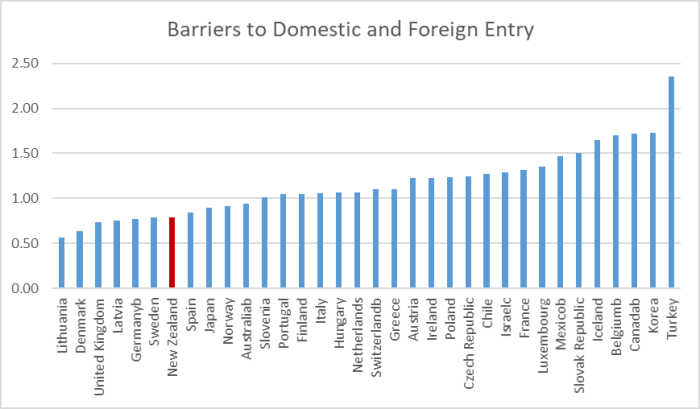
The OECD publishes the data broken out into two “high-level indicators”.  One is “Barriers to domestic and foreign entry” and the other is “Distortions induced by [direct] state involvement.   Here is how we did in 2018 on the first of those.

PMR 4

Not too bad I suppose –  5th equal, and very close to the couple of countries just above us.

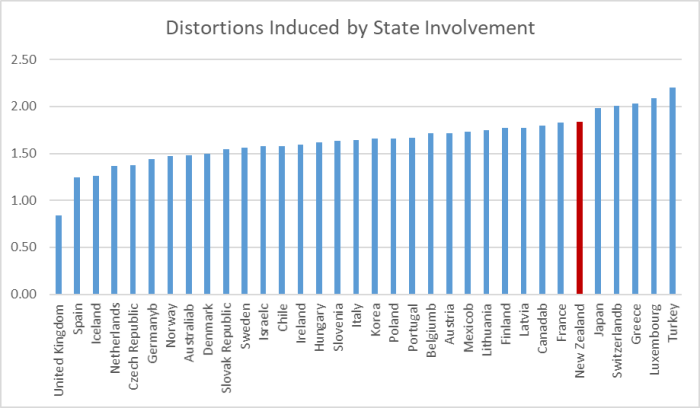
But here is the other high-level indicator

PMR 5

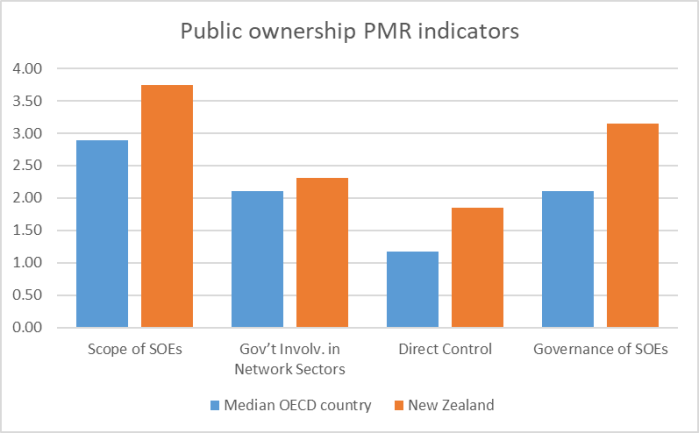
In turn, there are four sub-components to public ownership bit of this high-level series, and on each of them we score less well than the median OECD country.

PMR 6

On the “involvement in business operations” sub-components of the “distortions induced by [direct] state involvement high-level indicator we are the OECD median on one, and do a little than the median on the other two.

Of the other sub-components in the overall indicator, there were six where New Zealand scored materially differently than the median OECD country: three better, three worse.  Of the “worse” ones, only six countries score worse than New Zealand, and on the FDI one (and I know the interpretation is contentious) we score worst of all: none look like the sorts of areas a small economy, with persistent current deficits, should aim to score poorly.

New Zealand Worse
Assessment of impact of regulations on competition
Complexity of regulatory procedures
Barriers to FDI
New Zealand Better
Admin requirements on new companies
Barriers in service sectors
Treatment of foreign suppliers

One could go playing around in the relevant spreadsheets (economywide, and the additional sectoral ones) at great length.  Perhaps I will come to them in another post next week.

One can also debate just how much regulatory and state intervention poor scores really matter in terms of overall economic performance.  It is no doubt easy to point to any of the sub-components and find some highly successful country scoring poorly.  But when you are starting as far behind the leaders as New Zealand now is, then even if regulation and state control issues –  of the sort captured here –  aren’t the key factors, if we are serious about improving productivity we should be doing whatever we can wherever we can to provide a more facilitative climate for firms to prosper on their merits.

UPDATE: An OECD economist, in comments below, has helpfully drawn my attention to some methodological changes in the 2018 PMR which mean that scores cannot be compared (reliably) across time (the 1998 to 2013 ones should work, but there is a discontinuity to 2018).   I think her comments leave most of this post looking okay (the relative rankings should still be meaningful, and the identification of where we now do poorly) but one should be a little cautious about the time series chart (noting, however, that the trends I was highlighting were already apparent by 2013).

The Productivity Commission again

The Productivity Commission looks into topics the government of the day asks them to.  The current government asked for a report on issues around the “future of work” (a favoured topic of the current Minister of Finance when he was in Opposition) and the final report is due out next month.

The Commission has released a series of five draft reports looking at various aspects of the issue.  Late last year I wrote quite critically about one of those reports in which the Commission championed the case for a larger and more active welfare state, claiming that by adopting such policies New Zealand’s productivity performance might be improved.  As I noted

What it boils down to, amid various reasonable insights, is a push for a much bigger welfare state, allegedly in the cause of lifting average New Zealand productivity (and sustainable wages), without a shred of evidence or careful considered analysis connecting one to the other.    It is the sort of thing you might expect a political party to come out with –  the Labour Party conference, for example, is meeting shortly –  but not so much independent bureaucrats supposedly focused on productivity.

It was one of the less impressive pieces I’ve seen from the Productivity Commission.

Just recently I noticed the Commission announcing the release of the last of its draft reports.  I was a little surprised that they were allowing only just over two weeks for submissions (they close next Monday if anyone is interested).  When I finally read the latest draft, “Technology adoption by firms”,  I was less surprised: there was very little of substance there (including only about 20 pages of core text).  There was, of course, a summary recapitulation of the argument that people who lose their jobs should get from the state.

Beyond that, and as often with the Commission, there were some interesting perspectives and charts.   They have apparently had some new research done (as yet unpublished) on the implications of land-use restrictions for worker mobility, and there are a couple of charts from that forthcoming paper but (a) it is hard to know what to make of them without seeing the underlying paper, and (b) there is no sign they done anything cross-country thinking on the issue (bad as land use restrictions often are, it seems unlikely that they explain much about New Zealand –  or Auckland –  economic performance relative to Sydney, London, San Francisco, Hong Kong or wherever.  It is a hobbyhorse cause of the Commission’s – and one I mostly agree with them on –  but the case for a strong connection to New Zealand aggregate productivity performance is poor (and our labour market functions pretty well as it is).

Of course, since the focus of the paper is on firms (mostly private entities) and the question seems to be why those firms operating in New Zealand don’t invest more heavily in technology (or, I suppose, why there aren’t more such firms), the answer surely has to be (when all boiled down) “because the risk-adjusted returns to doing so don’t seem sufficiently attractive”.    And yet I don’t think that line appeared at all.  Nor, therefore, is there any sense that we should assume firms, and their owners, are already doing what is in their own economic best interests.    If so, the focus should be less on individual firms – although perhaps case studies can sometimes enlighten –  and much more on the wider economic policy settings (and any exogenous constraints- remoteness possibly being one of them).

Some regard for history might be helpful too. The Commission suggests on a couple of occasions that policy stability can be important, which is no doubt true in the abstract, but might offer less than they suggest in a country where economic policy has been pretty stable for most of the last 25 years, but that particular stable policy regime has not been accompanied by good economic performance.  Materially different and better outcomes are likely to require some quite different policy approaches.

Instead, what they have to offer is really not much more than a grab-bag, not supported by much.  Perhaps it was telling that of the two case studies mentioned in boxes in the draft report, the one on Weta never mentioned the massive taxpayer subsidies to the industry/firm, and the other Zespri never seemed to mention that export monopoly Zespri has, even though the Commission has often pointed to the importance of competition and easy entry and exit.

At the policy level, it was notable that three whole-economy variables/tools did not get a mention at all.  There was no mention of the real exchange rate, even though ours have unfolded this century in ways quite out of step with productivity growth differentials.  There was, as far I could see, no mention of company tax rates, even though ours are now quite high by international standards, particularly as they affect overseas investors.  And despite the scale of New Zealand migration, there was no mention –  good or ill –  of how the system might be affecting firm incentives to invest.    Foreign investment doesn’t even get much of a mention, other than to note the way the recent foreign buyer restrictions might be limited new housebuilding.

And of what was there was fragmentary at best.   Thus, we are told that “increasing emissions prices” “would encourage technology adoption by firms”.   Quite possibly so, but with no way of knowing whether the resulting technology adoption would be good for the economy or otherwise (one of the Commission’s messages is that we should embrace technology to lift material living standards).  Higher minimum wages can also encourage “technology adoption”, as firms try to substitute away from the now artificially more expensive input.  All sort of regulations can require investment in new technology, but that isn’t –  simply by assumption –  a good thing from a living standards/productivity perspective.

We are also told that strengthening something called the “national innovation system” would help, but  –  as was the case when the government brought back R&D subsidies –  no serious attempt to analyse why the returns to private firms to invest more heavily seem to be not-overly-attractive (when there are other countries, without subsidies, that see high private R&D spending).

We are told that targeted government intervention can have a role.  At times you get a sense that here they are pandering to the government, citing the “industry transformation plans” that are currently in the works (actually, I hope they are pandering there). But they go on to attempt to spell out examples of “successful targeted interventions” in New Zealand’s history.  Their first item is “industry training” –  it is no more specific than that, so I can’t quite tell what they mean.  And the second is this

encouraging technology development, diffusion and adoption in New Zealand’s agricultural industries (eg, the establishment of experimental farms, a “farm extension service” to spread good practice, and research institutions such as Lincoln Agricultural College, Massey University and the Department of Scientific and Industrial Research)

Even if you thought these were all success stories –  I don’t claim the specific knowledge to know –  they date from 100 years ago (DSIR founded in 1926) or even 150 (Lincoln founded in 1878).   It isn’t exactly a compelling narrative of modern “targeted interventions”.

Much of the rest is similarly scattergun in nature.  I’d happily see some regulatory reform around genetic modification, perhaps there is a case for competition policy changes (but the Commission doesn’t really claim to know –  “competition laws have not been fundamentally reviewed to assess their suitability for the digital age”).  Perhaps legislation around “consumer data rights” has a place, but they don’t seriously attempt to link this to obstacles to business investment.  And so on.

It isn’t that I think most of the specific policy suggestions are wrong –  some may be, most probably aren’t, some I’d support quite strongly –  but that they are little more than grab-bag of favoured measures, not well-grounded in any compelling narrative about New Zealand’s economic underperformance, and the obstacles to matching our strong labour market performance with a highly productive overall economy.  The Productivity Commission has been around for almost 10 years now, and we really should have been able to hope for more.   But I guess some of the issues get awkward (for Commissioners and their masters) and politically uncomfortable, so it is easier to play at the margins.  Amid the championing of personal political/policy preferences, there will probably be the odd bit of interesting analysis, perhaps some useful peripheral reforms, but the core challenges will be no closer to being addressed.

But then it isn’t as if the Prime Minister and Minister of Finance want anything much different –  unless some magic fairy dust somehow conjured up better outcomes –  and there was that sadly telling quote the other day from the man who would be Minister of Finance.

How will doing more of what we’ve done for the past three decades finally make us wealthy? I asked. Goldsmith offered no explanation.


The OCR should be cut

The Reserve Bank Monetary Policy Committee releases its next Monetary Policy Statement and Official Cash Rate (OCR) decision next Wednesday –  the first we’ve heard from them since November.

Until a couple of weeks ago you could probably mount a pretty strong case for the status quo. If the MPC was right to have left the OCR unchanged at 1 per cent in November,  it probably looked as if that was still going to be the right decision in February.  I thought they should have cut in November, and so was still inclined to think they should cut now –  but it wasn’t a particularly strongly held view.  It is worth remembering that after all these years, the Bank’s favoured core inflation measure still isn’t back to 2 per cent (it was last there in 2009) and there wasn’t a lot in the wind suggesting it was likely to rise further.   But there hadn’t looked to be a lot in it.

The Reserve Bank’s Survey of Expectations, released at 3pm today, looks to be not-inconsistent with that sort of status quo story.  But the survey closed a week ago, and opened two weeks ago –  the Bank doesn’t tell us when responses came in, but I know I completed mine on 25 January.

Since then coronavirus has become a huge story.  From an economic perspective, the issue isn’t so much the number of deaths –  50 or so in total two weeks ago and 640 now, on official figures –  as the policy and personal responses, here (and in other similar countries) and in China.    Two weeks ago, perhaps optimists might have hoped a one week shutdown over Lunar New Year might break the back of the problem.  But then, of course, ever more cities in China were locked down, the PRC authorities banned most outbound tourism, countries starting putting restrictions on arrivals of non-citizens who’d been in the PRC, and finally New Zealand –  apparently dragged along by Australia –  banned the arrivals of anyone other than citizens (and their close family members) who’d been in China recently.  We’ve also seen dairy product prices falling, talking of serious disruption in the logging industry, and so on.   We’ve even seen some more-domestic effects, including the cancellation of the Lantern Festival in Auckland.  Oh, and there seems to be no sign in the PRC responses that suggests they think they’ve already got on top of the problem.

No one knows how long these effects will last, or whether things may yet get (perhaps materially) worse from here (I was talking to a journalist the other day about possible extreme scenarios, and it doesn’t really do to contemplate what would happen to world trade –  perhaps only for a short period – in such scenarios).

When I say ‘no one”, that of course includes the Monetary Policy Committee, who will have not a shred more information on the underlying situation –  and probably very little more on domestic economic effects – than you, I, or anyone else.   Any data available just yet –  perhaps daily air arrivals, or electronic transactions volumes in (say) Queenstown –  will be fragmentary at best, and there won’t even be new local business survey data for a few weeks.  So they have to work with what we know, perhaps how things would be likely to play out if the policy responses (here and abroad) remain much as they are for any length of time, and within a framework for thinking about risk and regret.

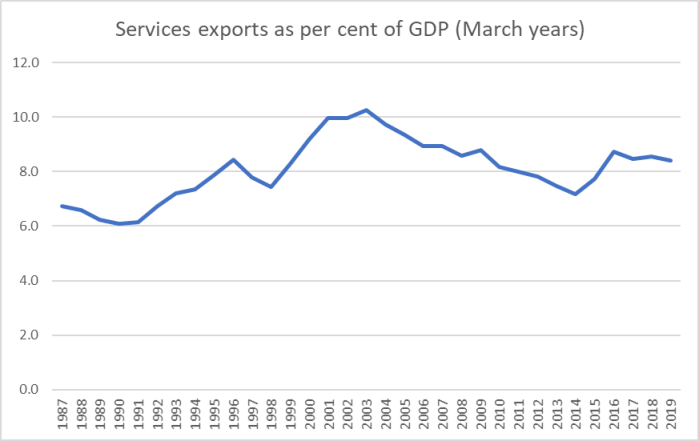
All of which looks a lot like the classic sort of shock monetary policy is designed to help manage (lean against).  Aggregate demand in New Zealand will take a not-insignificant hit: tourism and export education from the PRC is about 1 per cent of GDP, and tourist numbers will dry up almost completely for now, and (if our numbers are similar to those in Australia) the export education numbers are likely to more than halve.

These effects might not last long, but they are the situation we face now and no one has any idea how long the adverse effect will last.

But these aren’t the only demand effects.   Australia and the PRC are our two largest overall export markets: economic activity in China is likely to have taken a substantial hit this quarter, and Australian universities are (for example) even more dependent on the PRC student market than the New Zealand ones are.

And how would you respond to uncertainty if you were in business, or were (for example) a lending institution.  The rational response is to put projects on hold where possible.  That seems likely to happen –  perhaps on a very small scale initially (few new projects start each week, but mounting as the situation becomes more protracted (and perhaps doubts grow about just how quickly business might rebound).

Also, although the focus to date has been on services exports (tourism and export education), and a couple of goods export sectors, even if goods can be still shipped out to China, you have wonder how soon the flow of imports is going to be affected –  people who’ve been in China in the last 14 days can’t enter Singapore, Australia, PNG, Fiji, Taiwan or…..New Zealand (and, I understand it, much of New Zealand’s trade is trans-shipped through Australia or Singapore).  Ships need sailors.

I don’t know what the Reserve Bank will have chosen to do about their formal economic forecasts.  In their shoes, I’d probably publish ex-coronavirus forecasts, and then a series of scenarios around coronavirus effects (what else can they do: they usually treat other policies as a given, and in this case the ban of people who’ve visited the PRC is scheduled to lift next Sunday, but I doubt anyone much expects it will be, and more importantly neither they nor anyone else can credibly forecast the path of the virus, including how its is beginning to spread outside China).

But whatever they do in the body of the document is much less important than the policy call they make.     This is the time to cut the OCR. perhaps even by 50 basis points.  It would be a mix of risk-mitigation and responding to a real loss of demand (very rarely do we see such hard early evidence of a specific source of demand drying up so quickly).

The standard counter-argument is something along the lines of “early days”, “likely to rebound quite quickly –  eventually”, and so on.  But here is the thing about monetary policy: it can be adjusted quickly (to cut and to raise); it is the tool designed for short-term macro-stabilisation (unlike fiscal policy) and some of the channels –  notably those to the exchange rate –  work really quite quickly.  I’m not suggesting that cutting the OCR would make more than a trivial difference to GDP in the March quarter (the tourists and students still won’t have come), but if the effects are any longer-lasting we would start to see the benefits.

Twice before the Reserve Bank has cut the OCR is response to truly-exogenous external events.  The first was the unscheduled 50 basis point cut in September 2001 (a week or so after the terrorist attacks).  Here was the case we made then

“It seems more likely now that the current slowdown in the world economy will worsen. In these circumstances, New Zealand’s short-term economic outlook would be adversely affected, although any downturn might well be relatively short-lived.
“New Zealand business and consumer confidence will be hurt by recent international and domestic developments, and today’s move is a precaution in a period of heightened uncertainty.

I still reckon that was an appropriate response at the time, even though we had (a) no new survey or hard data, (b) there were no foreign or domestic government restrictions which would have the direct effect of biting into domestic demand in New Zealand and (c) the exchange rate –  already low –  was by this point almost 5 per cent lower than it had been on 11 September.  It was explicitly precautionary, but in a climate where our best judgement told us that if there was any effect it was going to be adverse (disinflationary).

The second such 50 point cut was in March 2011, after the severe February earthquake.    As the Governor put it at the time

“The earthquake has caused substantial damage to property and buildings, and immense disruption to business activity. While it is difficult to know exactly how large or long-lasting these effects will be, it is clear that economic activity, most certainly in Christchurch but also nationwide, will be negatively impacted. Business and consumer confidence has almost certainly deteriorated.

Going on to observe

We expect that the current monetary policy accommodation will need to be removed once the rebuilding phase materialises. This will take some time. For now we have acted pre-emptively in reducing the OCR to lessen the economic impact of the earthquake and guard against the risk of this impact becoming especially severe.”

We knew that the longer-term impact of the earthquake would be a big positive boost to demand (all that rebuilding activity, which would crowd out other activity in time) but still concluded that it was appropriate to cut early and quite hard to lean against adverse confidence effects etc (and some direct adverse demand effects –  eg to South Island tourism).    Perhaps we just got lucky, but it still looks like an appropriate response to me, even with years of hindsight.

In June 2003, SARS also played a role in the Bank’s decision to cut the OCR then.  I wasn’t involved in that decision –  I was working overseas –  so don’t have as strong a sense of the balance of factors.  One can mount an argument that it was unnecessary to have cut  –  the Governor eventually concluded as much –  but much of that argument was with the benefit of a hindsight that real-time decisionmakers could not have had (about how quickly the virus would be contained).

Set against the backdrop of those three cuts, I reckon the case for an OCR cut now –  even it had to be pullled back in six months’ time –  is stronger than in any of those other cases.  We have clear adverse domestic demand effects, that aren’t just about confidence but about policy choices in China and in New Zealand (and, more peripherally, in other countries), we don’t just have a one-day event which we live with the aftermath of (rather an ongoing situation, which is probably still worsening), the epicentre of the issue is in the world’s largest or second-largest economy which itself is taking a large negative economic hit for now, and Australia –   our other main trading partner, and major source of investment –  faces very similar issues to New Zealand.

Against that backdrop, it isn’t obvious what the downside would be to an OCR cut next week.  Core inflation is still below the target midpoint, and yet the demand shock is adverse.  Perhaps things resolve themselves very quickly in a couple of months and the Bank is slow to pull back the OCR cut.  The worst that could happen then might be core inflation going a bit above 2 per cent.  But since 2 per cent isn’t supposed to be a ceiling, and we’ve haven’t even been to 2 per cent in the last decade, that might count as a gain not a loss, in terms of supporting core medium-term inflation expectations.

Then, of course, think about really bad scenarios, and a world with very limited fiscal and monetary policy capacity to respond to a serious downturn. It really is important to keep those expectations up.  Recall that that was one of the stories the Reserve Bank told for a while after the unexpected 50 basis point cut last August.

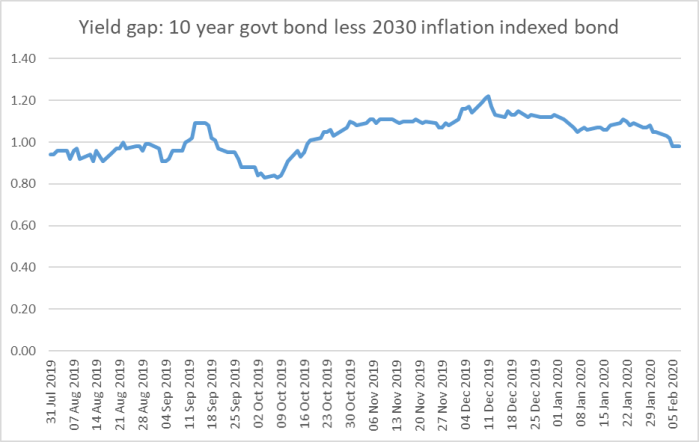
But here is the implied inflation expectation measure from market prices, right up to today (the difference between yields on nominal and indexed 10 year government bonds)

IIB jan 2020

There was a bit of lift in this measure of implied expectations late last year (partly global, but a range of central banks were responding similarly).  But now we are pretty much back to where we were before the Bank cut the OCR unexpectedly sharply six months ago (and this even after bond yields have bounced off their lows earlier this week).   I guess we should take some comfort that implied expectations aren’t lower than those in August, but 0.98 per cent is a long way from 2.

And as one last straw in the wind, in 2017 the Bank (helpfully) added a couple of questions asking about respondents expectations for inflation five and ten years hence.  The answers have hewed pretty close to 2 per cent –  I usually put in 2 per cent for 10 years hence, noting that the current MPC/government won’t have any effect on those outcomes –  but when I opened the survey results today I noticed that even these expectations (which the Bank likes to boast of, as a sign of confidence) have been edging down.

long-term expecs

The differences are small, and in isolation I wouldn’t put much weight on them.  But not much is moving in the right direction, and these results were surveyed two weeks ago when most respondents thought the policy status quo was just fine for now.

It seems a pretty obvious call to me that they should cut on Wedneday –  absent some startling positive turn in the virus and related news between now and Wednesday morning –  rather than just idly handwringing about “watching and waiting”.  And the Governor/MPC was willing to make some big and unexpected calls (wisely or not) last year.    The Bank wouldn’t be the first central bank to move either.

Who knows whether or not the Bank will actually move on Wednesday – quite possibly not even them yet – but I’m sure the MPC will have been looking for some analysis of past responses to out-of-the-blue shocks and thinking about the similarities and differences here.    Whichever path they finally choose, that thinking should be laid out – not just noted – in the MPS and/or the minutes.


Never mind democracy or effective accountability

Bernard Hickey had a column on Newsroom yesterday, on which the summary reads as follows

A generation of baby-boomer leaders revolted at Robert Muldoon’s conservatism and rewrote the nation’s software in 1989. So what should Gen X/Y/Zers do if they win power in the next decade? Bernard Hickey argues they should give the Infrastructure and Climate Change Commissions Reserve Bank-like independence and tools to target housing affordability and carbon zero by 2050.

He starts with a look back to the reforms of the 1980s and early 1990s. I’m not quite sure why he centres on 1989 (as “year zero…in modern New Zealand”), a year when the governing Labour Party was tearing itself about and heading towards one of its biggest defeats ever, but it was the year the Reserve Bank Act was passed –  near-unanimously in Parliament, and yet with large amounts of opposition (just short of a majority in National’s case) in both main party caucuses.  And the Reserve Bank framework appears to be Hickey’s model for how some new generation of reformers should deal with such major public policy challenges as “housing affordability and carbon zero by 2050”.

Thirty-one years on, the country could have used the creation of the Climate Change Commission and the Infrastructure Commission to acknowledge these problems and take the long-term decisions out of the hands of politicians and the three-year electoral cycle.

That would have involved giving the commissions clear targets and control over tools to achieve those targets.

For example, the Infrastructure Commission could control the balance sheets of NZTA and Kāinga Ora in a way that allows them to borrow and build to achieve targets such as carbon zero by 2050 and housing costs of around 30 percent of disposable income for the bottom quintile of households under the age of 65.

I guess at least we should be grateful he proposes boards with multiple members (not mostly owing their jobs to the chief executive) –  at the Reserve Bank all power was vested in one man for 30 years, and even now the Governor  –  himself not even appointed by a minister – controls a majority of the MPC.

There can be case for the delegation of some operational policy decisions to unelected boards (and, of course, we typically want the application of rules to individuals and individual companies to be determined by people who aren’t politicians).   And we want judges to be independent.   But if you are at all committed to a democratic system of government and to effective accountability for decisionmakers, the range of policy issues appropriately delegated is remarkably narrow. In fact, I’d argue it is very close to an empty set.

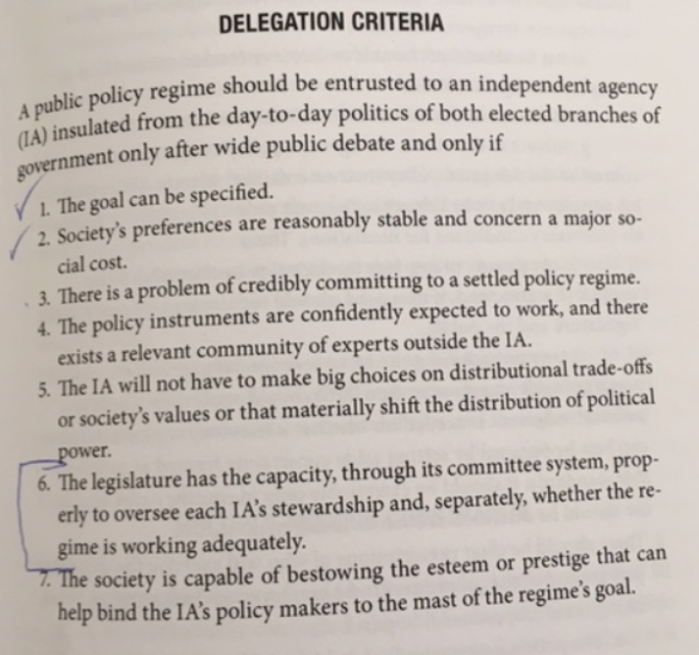
I’ve written here previously about the book Unelected Power published a couple of years ago by Princeton University Press, and written by former Bank of Engand Deputy Governor Paul Tucker.  In the book he deals with exactly these sorts of issues: what sorts of decisions should be delegated to the unelected, and under what circumstances.   He draws heavily from his career as a central banker, but his focus is broader than that.    I’ve found this little table an effective summary of his case

Tucker

(IA here is “independent agency”).

One could debate some of these points at the margin, but broadly speaking they seem like a good framework against which to evaluate proposals to delegate policymaking to the unelected.  I think it is pretty arguable whether even monetary policy would pass that test, but think about it in light of Tucker’s points.

If there wasn’t general agreement in 1989 about the appropriate target for monetary policy (recall that in 1989, “inflation targeting” barely existed outside a few internal Reserve Bank memos), there was pretty general agreement that we wanted inflation rates that were a lot lower and more stable than they’d been for the previous couple of decades.  These days, there is pretty strong agreement on something like 2 per cent inflation as the target.

There is also a reasonable consensus of relatively-expert opinion that, in the longer-term, there are no adverse trade-offs such that (say) maintaining inflation at around 2 per cent would make us poorer than maintaining inflation at 4 per cent.   The monetary policy framework, and the delegation to the Governor/MPC, is based on the notion of the long-run neutrality of money (monetary policy).  There are short-term trade-offs, which do need to be managed, and dealing with those is why we have active monetary policy.

And monetary policy in 1989 wasn’t a new thing.  There had been literatures on money and prices going back a couple of hundred years, active use of monetary policy since the 1930s, and not even central bank operating autonomy was new (we’d had it previously, and in places like the US, post-war Germany, or Switzerland, it had never been otherwise).

And while the Parliament was giving  Reserve Bank powers that were fairly pervasive in effect –  the point about monetary policy is getting in all the cracks, and influencing aggregate demand across the whole economy –  in fact no one was compelled to deal with the Reserve Bank, the Bank had no regulatory powers (as regards monetary policy) and could really only influence –  later set directly, once the OCR was adopted –  a single short-term interest rate.   In giving the Bank operational independence, Parliament also removed the Bank’s ability to set, for example, reserve ratios and similar direct controls.  (And it is worth noting that the independent Reserve Bank doesn’t even really decide whether the OCR will be 8 per cent or (say) 1 per cent –  monetary policy is adjusting the actual OCR relative to the changing (not directly observable) neutral rate.)

And then it is worth recalling that the Reserve Bank Policy Targets Agreements were signed for five years at a time, but for quite some time rarely lasted anything like that long: between 1990 and 2002 there were three  (arguably four) different targets for the rate of inflation, and two different targets for just the time horizon to get down to the level, as well as frequent changes in how the Bank was supposed to deal with short-term deviations.  Almost all these changes were driven from the political side –  no complaints about that, they were elected.  Oh, and at all times Parliament reserved to the Minister of Finance the power to override the target signed with the Governor and impose a quite different goal for a time (a power never used, but Michael Cullen as Minister mused aloud about the option).

And it is also worth remembering that we’d already broken the back of (really) high inflation before the Reserve Bank ever came into effect (and that some other countries with formally independent central banks –  including the US and Australia –  had also had quite bad experiences with inflation in the 1970s and early 80s).

I am not, repeat not, arguing against operational independence for the Reserve Bank on monetary policy (although I think the case is less strong that I once thought, including because the challenge of the last decade has been central banks delivering inflation too low, contrary to the propositions that underpinned the case for autonomy).  But monetary policy is pretty straightforward, fairly fast-acting, working within what had been generally agreed frameworks, and with few or no long-term distributional/values-based choices/consequences (although the shorter-term ones are greater than most involved in 1989 probably realised). And it uses a single instrument that alters incentives, rather than directly (regulatorily) affecting individual firm or households.

Contrast that with what Bernard Hickey seems to be championing.

One might start by wondering where we would be on housing if we’d given “independent experts” free reign in 1989 or 1991.  First, you’d have to know which “experts” managed to get hold of the levers of power in this area.  Some might have produced quite good outcomes (or rather facilitated the private sector doing so) but most likely the same planning establishment that still infests most of local government and much of central government (“highly productive” land consultations anyone) would have taken charge with their visions for what towns and cities should look like.   There is little reason to suppose outcomes now would be any better for removing what little democratic accountability there was.  If anything, they might have been worse.   And the distributional effects of those choices are (a) very large, and (b very long-lasting.   Contests of that are inherently political.

And while it is fine to suggest some independent commission might be charged with delivering a particular cost of housing by taking control of large chunks of the government balance sheet (leaving the associated large financial risks to the rest of us), a) there is no agreement that housing affordability issues are mostly about (insufficient) government capital spending, b) no agreed and generally accepted model for what should be done where, and c) if a Commission’s only tool is infrastructure, but the main causes lie elsewhere (whether you believe land use law, taxes or whatever) the independent commission will be incentivised to grossly overdo the infrastructure spend in a futile, and distortionary, attempt to make up for other problems.  And no one, but no one, is going to delegate to an independent agency all the laws and regulations that might affect housing affordability (be it RMA provisions, Local Government Act provisions, CGT or land tax, transport charging, immigration or whatever).  Let alone offer protection against agencies pursuing their affordability target by structuring policy to force us all into tiny houses.   It simply will not happen.  And neither should it.  There is no conceivable agreed monitoring and accountability framework either.   We need to be able to toss out the people who make these decisions.  And the political process needs to grapple with the tough choices.

What about climate change?  Here’s what he has to say

And for the Climate Commission?

Another set of tools could be used by the Commissions working in tandem to hit zero carbon by 2050, including controlling a carbon price in the same way the Reserve Bank controls the Official Cash Rate, and controlling emissions standards and import regulations for petrol and diesel engine cars.

Of course it technically could be done.  In our system of government, Parliament can give away whatever power it likes whenever it likes –  but can also always grab them back again – but it shouldn’t be.  This is about a target 30 years hence, which makes sense (or not) only in the context of what the rest of the world is doing, with huge distributional distributional consequences, and no agreed models on what measures (or carbon prices) would be required, and thus no ability to assess ex ante an expected cost of the policy.    No one has any idea what technologies will emerge either, whether to ease adjustment or reduce the case for it.     There is almost nothing about the issue that suggests it would naturally be something where we could safely and prudently trust the matter to a particular group of experts or “experts” (and don’t come at me about existential threats, since whether or not climate is really such, it is so almost entirely independently of whatever New Zealand does).

If one were looking for parallels in history, perhaps one might think of World War Two, a pretty serious threat to the world as we knew it, and our side was very much of the backfoot for a couple of years.   You can fight wars without any democratic independent –  broadly describes Germany, Japan, Italy, and the Soviet Union.   But we  –  the Anglo world, including New Zealand –  prided ourselves that we didn’t do things that way.  The big calls, the big choices (many of which changed through time as events unfolded) were made by the people’s elected representatives.  Some of us –  including New Zealand –  even had elections during the war, and an active parliamentary Opposition almost throughout.  Sometimes those elected leaders did really badly.  But the process mattered; it was part of what we were fighting for.

I guess lots of people are frustrated by a variety of poor outcomes in New Zealand –  be it productivity, house prices, climate change or whatever.   But big and hard choices are what we elect politicians for, and the accountability (ability to toss them out) is one of our few real protections.  In very few areas of policy –  and probably generally not very interesting ones –  is there the degree of consensus that anything like what Bernard Hickey is proposing might require.   There is a class of technocrats who would really like to turn politicians/Parliament into little more than a nominating committee, occasionally passing legislation on the current whim of the technocracy.  It is a system I suppose, but long may it not be ours.

(And all that defence of politicians from one so disillusioned with our actual politicians/parties that at present I’m minded to choose to not vote at all this year.  To my mind, the issue is not that we don’t give enough power to “experts”, as that there is singular abandonment of leadership among our political class.)

“Please limit the number of my competitors”

There is often quite some competition for the oddest story in newspaper  (this morning, in the Dominion-Post, it was surely the little piece telling readers that the Mormons were pulling 21 missionaries out of Liberia –  not, it appeared, because they had been kidnapped to threatened but because Liberia’s economy was proving pretty dysfunctional).

In Saturday’s Herald I reckon it was a big feature article in the business section calling for the Auckland Council to cap the number of restaurants/cafes, at least in “certain areas” of Auckland.  Perhaps the oddest thing about the whole substantial article was that it was mostly built off the complaints of one owner, Renee Coulter of Coco’s Cantina, who is quoted at length.  Such a cap would, she says, ease “pressures around staffing and fierce competition”, which would no doubt be in her own interest (but not, one assumes, those potential staff owners are competing for) but she offers not the slightest hint as to how such restrictions –  less competition, as she says –  might be in the wider public interest (and there is no sign that journalist pushed her on the point).  Coulter reckons that if you want to enter the industry you should have to buy an existing establishment.

“There’s too many dining establishments, and that’s not me being a big cry baby”, or so she says but it sounds a lot like it.

The article goes on to quote her claiming that “it’s competitive to the point where people aren’t actualy making money, they are just staying trading so that they don’t go under”

But if that were an accurate description –  and it must surely be considerably exaggerated – the market has its own mechanisms: eventually, people will go out of business, and those with the best business models for the current market will survive.

Now don’t get me wrong.   As someone who doesn’t eat out that much –  five adult appetites gets expensive no matter how competitive the market, and anyway I like cooking –  I’m always surprised quite how many restaurants and cafes there are. I walked through Newtown this morning –  for non-Wellingtonians, a funny mixed sort of suburb with lots of council housing but also absurdly expensive (mostly) small houses, a couple of hospitals and a university just down the road –  and counted, quite literally, dozens of eating places, none particularly fancy, some new and some which have been there for decades.  I don’t know how they all survive, but I don’t need to: the owners make that assessment, day by day, and there is no obvious need, or public policy interest, in councils getting involved.

The Herald’s reporter managed to find one other owner to offer half-hearted support to Ms Coulter, but even then Krishna Botica (who owns a couple of outlets) said

“Certainly I think it is worth looking into, whether they could come up with something that was accurate and fair, I think there is a larger question mark over that.”

Among other problems, indeed.

But Botica does add some other complaints.  Apparently “everybody who lives in Auckland..finds it hard to keep with all the new eateries”, claiming that everyone rushes around all of which is “giving restaurants a very limited time to develop relationships”.

One can see that that might be challenging for business owners.  But it is their problem, not ours, not the Council’s.

Botica goes on to complain that business has become too “transactional” which means apparently “survival of the fittest”.  Or, on Ms Coulter’s telling, survival of zombie businesses that are making no money?   Either way, it just isn’t obvious why it is anyone’s problem other than the owners (and perhaps their immediate families).   A restaurant just isn’t one of those entities –  unlike, say, a life insurance company – that one really needs to know will still be around 30 years hence.

The Herald did go one better than just two somewhat aggrieved struggling (?) restaurant owners.   They tried to talk to the Council, who quite rightly pointed out that they had no legal powers in the matter (that’s good).  And then they went to the Hospitality Association.  The chair of that grouping didn’t support the idea of capping licence numbers, but he went one better in his calls, claiming that New Zealand needs to have a Minister of Hospitality.  To the extent that there is such a function at all at present, it is all under the wing of the Minister of Tourism but (according to Botica, the restaurant owner) “you can not lump them together anymore” given the size and attention they both need.     The mind boggles, wondering quite how much government attention –  food safety aside –  these people think their restaurants and cafes really need.  Then again, government’s set a dreadful lead with all the identity or industry-serving ministers they do create (be it Tourism, Women, Pacific Peoples, Ethnic Affairs, Racing, MPI or whatever).

The Herald also talked to the Restaurant Association, who seemed to represent a rather divided membership, noting that “competition can be a good thing and those managing their business well will come out on top” so “whilst we continue to monitor the idea of a cap, we are mindful of the potential limits this could put on creating valid opportunities for new owners”.

Normally, one might suppose that when there was a severe shortage of staff –  as those quoted in this article claim –  wages for those types of people would rise, perhaps quite a lot.  And if that, in turn, left some business unable to operate profitably, those less profitable operators would leave the market.    It is how resources are reallocated in a competitive market

But that doesn’t appear to be what these operators have in mind at all.  Not once in the entire article is there any reference to (relative) wages rising sharply.   No data are cited suggestig they are.   Instead, we get the plaintive calls for more cheap migrant labour.    Now I might even concede some sympathy with them around MBIE processing times –  the stories you hear really should shame a first world country that likes to boast of its good government, responsive services etc –  but the idea that governments should be, in effect, capping wages in particular sectors, in effect subsidising operators in thoese sectors, by allowing in ever more migrant labourers, typically with low reservation wages, really should be anathema.

But there is the thrust of the case: push for councils to cap the number of restaurant and cafe licences to reduce competition and choice for the public, all while pushing central government to impose more competition on lower-end New Zealand workers, or squeezing them out of the sector altogether, in favour of cheaper foreigners, temporary or permanent.   Wouldn’t life be sweet for the less-than-best operators if somehow government and council were to accede to their calls?

The thing I found remarkable about the article –  and it was quite a substantial piece, not a five line snippet –  was that there was no sign that the journalist had made effort (or bosses insisted) to get a perspective from anyone who might have other interests at heart.  Consumer groups for example, or even an economist specialising in competition and regulation.  It was as if it was producer (firm) interests that mattered, not consumers (or even workers), even though –  presumably even among readers of the Herald business pages there must be more consumers (that’s all of us) than firm owners.    There will always be industry voices calling for reductions in competition –  that is in the (at least temporary) interests of the incumbents  Governments are supposed to be there for the wider public interests, and –  temptations to be too close to business notwithstanding – you’d hope that major media outlets would at least want to sure that the wider public interest was represented when they allow their pages to be used to promote campaigns to limit competition and make life easier for business operators.

(Since I  get commenters bagging the Herald more generally, I might take this opportunity to point out the stark contrast in today’s papers between the Dominion-Post (and, I assume, other Stuff outlets) and the Herald coverage of the economic/trade effects of the coronavirus and the various restrictions in place, in China and abroad.  The Herald’s coverage is head-and-shoulders better –  although even it has important omissions –  than the Dominion-Post , and the latter (despite its large public service readership) doesn’t even compensate by superioru isight on the political/bureaucratic machinations.   Issues like whether our Foreign Minister really told the Chinese Foreign Minister on Saturday that we were imposing no restrictions, only for the government to adopt the diametrically opposite policy in announcements the following day.)


Flu and coronavirus thoughts

Ten days or so, prompted by the news emerging from China, I’d gone and found the pile of books I’d accumulated –  and in many cases not read –  over the years on pandemics, plague etc etc.  Since then I’ve read three of them, including two on the 1918 flu pandemic.

The first, published in the 1970s, was Richard Collier’s  The Plague of the Spanish Lady, a week by week treatment, drawn from some mix of contemporary accounts and survivors’ memories, of the experience with the flu pandemic (which got associated with Spain, mostly because Spain wasn’t at war and so there wasn’t the press censorship there was in many other countries).  It isn’t a global perspective, but he captures accounts from across the Anglo countries and northern Europe –  with quite a surprising number of snippets from New Zealand (the author apparently got a good response here when he advertised for survivors’ memories).   It isn’t an analytical treatment by any means –  there are various other good books for that –  but it was an absorbing impressionistic read.

Someone asked me the other day whether it was “scary”, and I guess in a way it was.  But I was more struck by the complex mix of responses, individual and institutional.  At the official level, often a reluctance to disrupt the ordinary course of business, life etc –  all compounded by the fact that there was still a war on.  It is always difficult to tell whether, in its early stages, something will turn really serious, and to judge best which risks to run.  But if those sorts of errors were pardonable, others were almost inexcusable –  the French Governor of Tahiti, and the New Zealand Administrator in western Samoa being just two prominent examples.  There are stories of sheer horror –  an Eskimo village in northern Canada where many human victims were finished off, and dead human bodies eaten, by ravenous dogs that no one was well enough to feed –  but also those of immense personal sacrifice, of people –  professional and otherwise –  rising to the occasion in ways they themselves might never had imagined, and so on.     And there was the sheer number of deaths in a matter of weeks – New Zealand lost half as many to the flu in little more than a month than we’d lost in four years of World War One.     Western Samoa is estimated to have lost 22 per cent of its population (while American Samoa lost no one).

The second was Prof Geoffrey Rice’s Black November: The 1918 influenza pandemic in New Zealand.  I was reading the 2005 version, but there is a new, and shorter, version still in print.   Rice –  an academic historian –  records that he had known nothing of the pandemic until he had an after-dinner conversation in 1977 with his father, who’d been a child in Taumaranui in 1918 and whose grandmother had been the final death in that unusually severely-affected town (if I recall rightly, around 80 per cent of Taumaranui’s population had come down with the flu and almost 2 per cent of the population had died (the national death rate was under 1 per cent).    That conversation sparked Rice’s interest, and a sustained research project, culminating in a first edition of his book in 1988.

The more formal side of the book was built on a reassessment of the death toll, based n a careful examination of all New Zealand death certificates during the period of the flu  (the advantage of a small population).   The book includes the detailed data by suburb (and town/county) –   18, or just under 0.5 per cent, in Island Bay for example.  And the data is there too (and a whole chapter of the text) for the staggeringly bad Maori death rate (4.2 per cent of the population died), although as Rice notes even in other years the Maori flu death rate far exceeded that for the European population up to at least the 1930s.

A significant chunk of the text is three chapters on each of the Auckland, Wellington, and Christchurch/Dunedin experiences –  city death rates (especially Auckland and Wellington) were consistently above those in the rest of the country – but there is a selection of detailed small-town accounts too (more than I’d ever previously read on Temuka).  The book is liberally illustrated –  photos, charts, and various survivors’ accounts (Collier providing his full New Zealand material) – and a nice mix of the more-analytical and the impressionistic/anecdotal.   I’d strongly recommend it to anyone interested in the period.    There is much the same mix of impressions –  positive and negative- as in the Collier book, but with more space and a single country, more depth and insight.

There was the New Zealand Ministry of Health with a grand total of about 11 staff.  A Minister of Health –  George Russell –  who was initially sceptical but then energetic, hard-driving, and pretty effective, even as he got offside with numerous local authorities.  There was the heavy community engagement in many places –  including an important role played by, for example, Boy Scouts in delivering messages, meals etc –  but Rice highlights the difficulty local organisers had in finding enough volunteers to help in Wellington (life still going on, the mayor had lamented seeing various young and fit people playing tennis one weekend, even as the pandemic raged).  There were doctors who gave everything and others who wanted only to tend their own patients.  There was the extreme – but shortlived – commercial disruption, even a week-long “bank holiday” (for all banks other than the Post Office, which apparently attracted more deposits that week).   There was the university exams suspended –  it was November –  after one student died while sitting his exam (the Chanceller of Victoria, former Prime Minister Sir Robert Stout, was outraged at the Minister of Health interfering in the internal affairs of the university).  The residents at Te Araroa who, collectively, got out their shotguns to prevent (anyone who might carry the) disease entering their settlement. And the deaths, so many deaths.  And the funerals –  elaborate funerals and funeral processions being a more important element in society then.   And perhaps in a testimony to some bits of government working better and faster then, the epidemic had only run its course in New Zealand by mid-December 1918, but the Epidemic (Royal) Commission’s report was presented to Parliament on 13 May 1919.

(Oh, and for those marvelling at China’s ability to build a new hospital in a week, I even noticed a couple of references in Rice’s book to small New Zealand towns  – with limited people and technology –  building new hospital wings in a matter of days.)

That’s enough history for now.

Ten days or so ago I also wrote a post, almost entirely hypothetical at time, about pandemics and potential economic effects when/if there ever were a serious one again.  Much of it had just drawn on thinking I’d been part of back in the 00s when there was a major official government effort to prepare against the risk of pandemic (H5N1 being around at the time).  But as I noted then –  it was the standard view in that earlier planning exercise

….in a modern economy a serious pandemic could have major economic consequences, less because of the loss of life itself (although the loss of 1 per cent of the population would, all else equal, lower potential GDP semi-permanently by around 1 per cent) than because of the disruption, the fear, and the voluntary or semi-compulsory social distancing that would be put in place to try to minimise the risk of the virus spreading or of particular individuals contracting it.  In a quarter in which an outbreak was concentrated, it is quite conceivable that GDP could fall by as much as 20 per cent  (if every worker was off work for just a week –  whether sick themselves or caring for others –  and that was the only adverse effect –  it wouldn’t be –  that alone would be a loss of almost 8 per cent).   Even if the outbreak was quite concentrated in time and normal economic activity resumed in full very quickly, in such a scenario GDP in the year of the outbreak would be 5 per cent less than otherwise.

Ten days on, that must be a lot like what is going on in Wuhan – and, it seems, an increasing number of Chinese cities.  Read the stories, watch the video footage etc and it is hard not to suppose that GDP in these parts of China will not be very very sharply lower in the first quarter (whatever the official statistics eventually say).  And all that with “only” 17000 offically confirmed cases –  that is a lot of people in absolute terms, but a tiny share of the population relative to (say) 1918 or those earlier pandemic planning scenarios.  There are doubts among some experts as to whether the PRC numbers are being properly collected/reported, but whether that is so or not, the economic effects (in large chunks of one of the world’s biggest economies) are already looking real and substantial.

And that is just China.   What about here, where there has not yet been a confirmed case?  We already had some direct effects last week (on the small scale, crayfish exporters and on the much larger scale, the PRC authorities themselves banning any outbound tourism (booked through official agencies, but we are told that is most of it)).   And non-trivial numbers of people wouldn’t have been able to travel anyway because they were locked down in their own cities or even neighourhoods in China).     But now we have joined a range of other countries in banning entry to non-citizens who had been in China in the last 14 days.  Probably the Chinese students coming for secondary school were mostly already here –  the treasurers of the respective boards of trustees will be grateful for that –  but the university year is still several weeks away and there are normally lots of PRC students (new ones, and ones returning after the long break).  For the time being none will be arriving.

Despite the idle government talk –  unquestioningly repeated by most of our media –  there seems very little chance that this ban will be only for 14 days.  It wouldn’t take that long presumably before, even if the ban was lifted, it wasn’t worth coming for the rest of the first semester.  There is a lot of revenue at stake for most of universities (and plenty of other tertiary institutions).  Tourism and export education receipts from the PRC alone make up 1 per cent of our economy –  direct effects only.   Once this is all over it would be interesting to launch a series of OIAs to discover how much education sector lobbying of the government was going on last week –  “never mind about public health risks, think about our bottom line”, and if you think that is excessively cynical, recall that this is basically the approach our universities take to the PRC more generally (“don’t expect us to be critic and conscience, there are joint ventures to be done, revenues to raise”).

(As it happens, this episode looks like an interesting quasi case study on PRC issues more generally.  In writing about the appalling way our political classes pander to the PRC, I have pointed out that export education and tourism are the two sectors that are most vulnerable –  commodities are sold in a global market.  One could envisage the PRC “punishing” New Zealand if it ever chose to speak out and push back more seriously –  has happened to other countries – but probably the most severe scenarios wouldn’t have envisaged PRC tourism and export education revenues being shut off almost completely overnight.  These will not be trivial effects, but I’ve argued that we could expect exchange rate adjustment and monetary and fiscal policy offsets, and that in the event of any such “punishment” it would not in any sense be catastrophic for the New Zealand economy, tough as it might be for individual over-exposed firms.  Time will tell how this particular unfortunate “experiment” plays out.)

It is very hard (for anyone) to know what the right policy response for countries like ours (or the numerous others that have imposed similar restrictions) might be.    You could mount a fairly good case, I’d have thought, for putting in place these sorts of restrictions a week ago –  after all, the Chinese authorities are the ones with the only real and hard information and they’ve imposed unprecedented lockdowns and stopped their citizen tourists going abroad (the latter arguably a very public-spirited approach to the rest of the world).   The revealed preference signals were pretty strong, and have only got stronger as the week has gone on.  You might also be troubled –  as I’ve been –  by the small number of cases the PRC is reporting completed and discharged.    The WHO might not approve of restrictions –  appears still not to –  but the WHO is responsible to no citizens or voters.  But our government was almost entirely silent all week –  nothing at all from the PM, little or nothing from the Minister of Health and mostly sunny upbeat stuff from the Director-General of Health and his staff.   They seemed to think this wasn’t a matter they needed to engage seriously on, and the media seemed to not pursue the issue in any meaningful way.

There were telling comments in an (otherwise strange) interview on Radio New Zealand this morning with the PRC Consul-General in Auckland.    Having taken the lead in banning its own people from heading abroad as tourists, the PRC now appears to have got grumpy at countries imposing their own restrictions.  The Foreign Minister has been quoted criticising the US restrictions.  And here is the Consul-General (and recall this is an agent of a highly authoritarian state, he won’t going off-message or talking out of school).

The Chinese people are now isolating the coronavirus, but New Zealand is … joining efforts to isolate the Chinese economy. That’s why I feel very disappointed.

“I think the epidemic will certainly have a impact on the business between the two countries. China is New Zealand’s largest trading partner … as I said before trade should be based on a normal exchange on people. But this sudden travel ban will worsen the current situation. If Chinese economy suffers from international isolation, the New Zealand economy will also be in a loss.”

No one here is trying to “isolate the Chinese economy”: rather our authorities are simply doing what the PRC had already been doing.  You and I are free to buy stuff from China: the big question this week is how many Chinese factories or offices will be actually at work.  If China is suffering, it is from a virus that got started in China (and which was covered up initially be the Chinese authorities).

But my real interest was in the Consul-General’s comment on the New Zealand government

“I can tell you that only two days ago, our foreign ministers talked over the phone about the outbreak… Foreign Minister Winston Peters said that New Zealand will maintain normal exchanges and people’s flow between the two countries. However, just overnight, the New Zealand changed its mind.

Now that is very interesting. It suggests that as recently as Friday or Saturday our deputy prime minister –  presumably reflecting whole of government policy – was telling the Chinese Foreign Minister that we would be imposing no travel restrictions.  I suppose the PRC could have got the wrong end of the stick, or be misrepresenting the conversation, but someone should surely be asking Winston Peters some hard questions about just what went on the inner counsels of our government (all this apparently without a Cabinet meeting).

Because suddenly yesterday afternoon we were imposing travel restrictions, much the same of those imposed by various other countries –  against WHO preferences apparently – a day earlier.  The notable late movers were the United States and Australia.

One has to wonder what the New Zealand government learned in the 24 hours prior to yesterday afternoon that led to such an (apparently) sharp change of stance.    I wonder whether pressure was put on them by the Australian government?  One could imagine the Australians thinking “well, if we put on restrictions and New Zealand doesn’t, the virus could get established there, and with incubation periods etc that would allow backdoor entry to Australia. “Nice visa-free entry to our country you have there: shame if something got in the way of it” might have been the message, express or implied.  Perhaps someone might ask our government, or Australia’s.

(Having imposed the restrictions, I presume the government is now thinking hard about what criteria it would use in deciding whether to extend the ban to people who’ve been in other places.    Will 100 human-to-human cases in Australia, or Hong Kong, or the US, or the Philippines, be enough for a ban on people having visited those countries. If not 100, then how many?  I don’t know the answer, but I hope the government has one in mind.)

And an almost-final thought for now, I’ve been staggered at how poor the New Zealand media coverage of these issues –  as they directly involve New Zealand policy choices –  has been.  It is easy to run foreign stories on events in China, but what we also need is seriously reporting and scrutiny of choices made, risks run (or averted here).  Last week, our media seemed simply engaged in channelling Ministry of Health lines, and a few personal stories.  In today’s media there still isn’t much sign that anyone has done any digging, talked to inside sources etc, to understand the dynamics of government decisionmaking.  And there is hardly any mention –  I saw one very brief snippet in the Herald – of the economics of the tertiary education sector, no attempt to talk to vice-chancellors, no attempt to talk to other commentators.  (Not even any apparent attempt to talk to the China Council, who must be torn –  when David Clark says the Chinese authorities were relaxed about NZ government choices, and the Consul-General says the opposite).   And there has been no serious challenge or discussion on the “14 day ban” –  which seems to risk giving quite misleading signals to people in relevant industries, against a global backdrop where unease is increasing, not showing any sign of relief).

And a final purely anecdotal point.  I was staggered over the weekend to hear of two teenagers, one of whom was reluctant to go into central Wellington over the week for fear of being exposed to coronavirus, and another whose parents forbade her to go.  And then this morning I was in the supermarket and noticed a customer in front of me (as European-looking as me) coughing her way down the aisle, not covering her mouth at all.  I suspect at another time I wouldn’t even have noticed, and yet I was brought up short –  not because I have any unease at all about being out and about anywhere in New Zealand, but in realising what the recent news had made me take notice of.   One has to wonder how much self-initiated social distancing will start going on here.  It doesn’t take much – rational or not – to put a dent in entertainment etc spends.
The Retirement Commissioner and “ethical investment”

Presumably someone pointed the Retirement Commissioner to my post yesterday ,as I gather the online version of the triennial report now has a “Foreword”, rather than the “Forward” that appeared until yesterday.  We all make mistakes, typos, and literals, but you’d suppose that well-funded government agencies would have prominent parts of high-profile documents proofread.     Anyway, enough of that (perhaps rather petty) point.

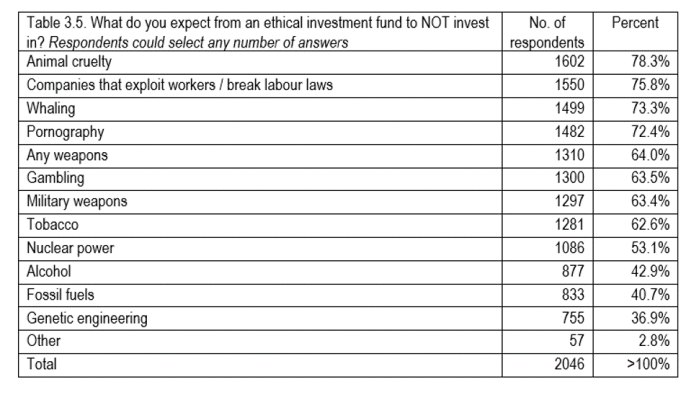
One other aspect of the Commissioner’s report that caught my eye was the bit about “ethical investment”.  This was prompted by the government, which had asked the Commissioner to report on

Information about the public’s perception and understanding of ethical investments
in KiwiSaver, including:
a) The kinds of investments that New Zealanders may want to see excluded
by KiwiSaver providers; and
b) The range of KiwiSaver funds with an ethical investment mandate.


As I noted yesterday, there is a make-work element to the Commissioner’s role (and his supporting office, the so-called Commission for Financial Capability).  You might have supposed that firms operating Kiwisaver schemes, or attempting to sell their products to managers of Kiwisaver funds, might be best placed to work out what, if any, investments “New Zealanders” didn’t want to invest in.  It is a (potential) marketing opportunity, and one the providers are strongly-incentivised to tap.  They also get to experiment, and see which products actually attract (or turn off) savers –  revealed preference often being quite different than (say) idle costless, perhaps even virtue-signalling, response to surveys.

Strangely, the Retirement Commissioner starts this section of the report by mischaracterising the terms of reference

In term of reference five, the Government asked us to provide information about the public’s perception and understanding of ethical investment.

Except that (see above) that wasn’t what was asked for at all.

Anyway, they commissioned a report from consultants at KPMG.  KPMG appear not to like the notion of “ethical” investment, and prefer “responsible investment” instead.    I guess if you poll people and ask if they want “responsible investment” you’ll probably get 100 per cent saying yes.  It all rapidly becomes rather empty –  your “responsible” is, often enough, my “deeply corrosive”, and vice versa.  You can read the KPMG report and all the discussion of how funds can/do try to take account of ESG (environmental, social, governance) considerations.  But there isn’t really much there –  in my observation (as trustee of a couple of funds)  much of it is marketing hype.  Perhaps the one bit of the KPMG report that caught my eye.

kpmg resp i

The key sentence is that one just above the table.   It (and the data in the table) do not make into the Retirement Commissioner’s report.

The Retirement Commissioner’s report then moves on to public opinion noting that

In addition to the KPMG work, CFFC includes ethical investment in its own regular surveys of the public.

There is a footnote there to this internal note, but unfortunately there is no link to the full results of the poll, including either the exact wording of the questions or the respondent comments (selected ones of which are quoted in the report, but with no way to judge how representative these observations are).

They are keen to talk up the results

From this, we know that ethical investment is important to the majority of
respondents, with only 26% of overall respondents, and 18% of contributing KiwiSaver members, stating that they are NOT interested in ethical investment.

Actually, I was little surprised that 18 per cent of respondents were prepared to tell a survey taker that they had no interest in an ethical approach to their investments.  But just saying it just doesn’t mean much.

Anyway, this was the main table on specific types of industries (although it isn’t clear whether respondents were prompted –  I’m guessing so –  with this particular list, or whether everyone came up with their own preferences).

ethical investment

The Commissioner writes about this table thus

We also know that:
• In terms of which investment most want excluded from investments, animal cruelty, worker exploitation, whaling and pornography top the list, with over 70% of
respondents agreeing these are exclusion priorities.

But without knowing the precise wording of the question, we can’t even be sure that is right. The Commissioner seems to interpret the results as meaning people don’t want to invest in these industries, but the description in the table suggests the question might have along the lines of “if there were an “ethical investment fund which industries should be excluded”.  They are two quite different things, as revealed preference seems to confirm.  It is, for example, hard to believe that 43 per cent of New Zealanders really don’t want beer or wine company shares in their Kiwisaver investment –  it not being 1918, and the near vote for Prohibition, actual teetollars being probably no more than 20 per cent of the population.  But perhaps they think it is what an “ethical investment fund” might exclude?  And since parties supporting disbanding the military are notable by their absence, one might also be a little sceptical about what people actually had in mind –  feel-goodness apart –  in their weapons answers.

(There is some interesting demographic data, notably that in all the categories above women were more likely to favour exclusion than men.)

Then it starts to get a bit awkward

A majority of respondents are satisfied with available ethical investment options within KiwiSaver and of those contributing, 70% are satisfied with the range of ethical investment options.

This high level of satisfaction is a surprise because most ethical investment funds do
not meet the expectations reported by survey participants.

But perhaps not so much, because in the internal research note –  but not in the published report –  we find this

However, only a minority selected ethical investment when asked about the criteria for selecting a fund. A possible explanation is that respondents show social desirability bias (select the “right” answer) when asked about ethical investment directly, but their actual behaviour shows limited consideration of ethical investment in KiwiSaver funds.

Revealed preference seems to be that the public don’t really care much at all (and/or, it might be hard/costly to evaluate funds for your own preferences).

But despite all this, the one recommendation in this section of the report is

PUBLICLY FUND MINDFUL MONEY TO ERASE ANY POTENTIAL CONFLICTS
OF INTEREST: INTRODUCE TAXPAYER FUNDING FOR MINDFUL MONEY TO GUARANTEE THE CHARITY CONTINUES TO PUBLISH UNBIASED, RESPONSIBLE INVESTMENT INFORMATION.

Of Mindful Money

Mindful Money is a charity that promotes ethical investment, and was recently
launched (September 2019) in response to the public demand for more knowledge
and options to invest ethically. Mindful Money’s mission statement is to: ‘empower
investors and make investment a force for good. Over the next five years we aim to
switch $6 billion of investment funds away from pollution, exploitation and inequality towards a low emissions, sustainable and inclusive economy.’

It is run by someone who was a Green Party MP until the last election.

So, the public show little practical sign of caring very much, civil society has set up its own entity (which has managed to attract some commissions for referrals) and yet one well-funded government agency’s proposal is that yet more public money should be pushed in the direction of this charity.

As they recognise, simply funnelling money to one brand-new private charity would be unusual

While conscious that the regular process would be to go to tender first, we think in
terms of efficiency and cost, and considering that the public want information now so that they can make informed choices that align with their personal values, funding Mindful Money is the most efficient and simple step for the Government to take.

Oh well, never mind about good process, or whether Mindful Money might just be channelling a particular subset of distastes….toss them some public money.  Barry Coates must have welcomed the report.

As I noted at the start, the Retirement Commissioner was landed with this particular term of reference, so they had to write something.   But how they responded was up to them, and it simply wasn’t particular thoughtful or rigorous, more about how do we get on the bandwagon.

In truth, ethical investment is hard, and something of challenge to each of us as to how much we care about particular issues.     Personally, if I were buying company shares directly, I would refuse to purchase companies operating in the small handful of the sectors listed in the CFFC table above (gambling, pornography, and –  depending on definition – animal cruelty).  But there are plenty of other activites I would also refuse to invest in (including hospital companies providing abortions, any PRC company, companies that actively facilitate the interests of the worst regimes on the planet –  including the PRC).   That is easy to say, and actually fairly easy to do.

But once you get into collective investment vehicles –  where the diversification gains and low transactions costs (and even PIE tax rates) are very real advantages –  it quickly becomes very difficult.  For example, much of my retirement savings is in a scheme I joined –  as a manadatory condition of service –  almost 40 years ago.  My ethical views aren’t necessarily those of other members, and even though I’m a trustee of the scheme I have legal constraints on my ability to make what seem like ethical choices to me (and that is probably as it should be).  I’d find it all but impossible to find a Kiwisaver vehicle offering my list of exclusions –  and, on the other hand, I’m very happy to have an interest in shares in arms companies, oil companies etc –  and so, in practice, I do not do anything about the issue.  I’m a trustee of another pension fund –  where there might actually be some commonality of ethical preferences among members –  but even then it is difficult to get members to reveal those preferences consistently and (again) legal constraints.

But all of these issues are yet another reason why I favour winding up the New Zealand Superannuation Fund.  Holding a particular Kiwisaver fund is strictly voluntary (you might not find an ideal fund, but there is quite a bit of choice), but your exposure or mine to the assets held in the New Zealand Superannuation is inescapable.  They like to boast about what “responsible” investors they are, but all that really tells you is that they line up with the personal political/ethical preferences of Matt Whineray and his Board (or Adrian Orr before that).   We simply should not have money coercively taken from us and invested in causes and companies we individually find distasteful, even reprehensible.   That is true whether your burning concern (so to speak) is fossil fuels, pornography, marijuana, abortion, the whales, or whatever.  There is no compelling public policy case for the fund, and the way its investment policy trespasses – ignores – the ethical preferences of many citizens  simply further undermines that case.

Some thoughtful discussion of issues like that might usefully have found a place in the Retirement Commissioner’s report.  It didn’t of course.   Some hardheaded analysis of just how much people really valued “ethical investing” might have made it into the report.  But it didn’t either.

It was a pretty disappointing report all round.


Retirement, NZS and all that

How the years fly by.  My youngest child headed off to high school for the first time this morning.  Only five years of the school system to go.

But it was the other end of the age spectrum I wanted to write about today, in particular the recent report of the Retirement Commissioner (in this case the interim one), reviewing –  as required by law to do  –  retirement income policies.    Very conveniently for a government going into an election with the key party (Labour) campaigning against (its own previous policy, not that many years ago) any idea of raising the age of eligibility for New Zealand Superannuation, the Interim Retirement Commissioner has come out in support of that conclusion.  Apparently, according to Mr Cordtz, the age that was chosen in 1898 –  when the new age pension was hard to get –  is still appropriate into the indefinite future now when (a) health standards are so much better, (b) most jobs are less physically demanding, and (c) the benefit is universal.   Take a look at theterms of reference for this latest review and it looks as though the government was looking to the Commissioner to steer away from any suggestion that raising the NZS age might be a good idea.  So they will be pleased –  not so much by the substance of the report (there isn’t much there) as by the headlines, which are all most will see.

I’ve never been persuaded that taxpayers get any real value out of having a Retirement Commissioner, or the supporting staff in the “Commission for Financial Capability”. That has been so whether or not, from time to time, I might have agreed or disagreed with particular suggestions they were making.    It is a classic make-work bureaucracy, costing quite a bit of money, serving no useful purpose, and typically run by people with no particular relevant expertise, other (presumably) than appealing to the government of the day.  That was true of the previous troubled Retirement Commissioner (who seemed to know about marketing), the current Interim Retirement Commissioner appointed by the current government who seems to know quite a bit about rugby league, and also of the incoming commissioner Jane Wrightson, whose expertise seems to consist in getting a succession of small government chief executive roles.   The money spent on this body could almost certainly be more effectively spent…..almost anywhere in government (health, educations, statistics, whatever).  And at very least it is time to rethink whether we really need a triennial report on these issues (as I noted in a previous post, Parliament should also revisit the current statutory requirement for a Long-Term Fiscal Statement every four years).

But if one is going to write about a report one should actually read it.  Perhaps the low point of the entire document was the Interim Retirement Commissioner’s opening statement.   It was headed “Forward”, but I have to assume he really meant “Foreword” –  especially as he ends his comments  with a pithy quote

“I walk backwards in the future, with my eyes fixed on the past”

that seems singularly inapt when even the government’s terms of reference asked the Commissioner to focus on the future.

Much of the “Forward” reads like something a zealous 22 year old might have written, but which his or her boss would have sent back for a rewrite.  The Retirement Commissioner had no boss, no Board (for example) to which he was accountable.

And so we read

In approaching this review as Interim Retirement Commissioner, I have of course brought my own views and experience to bear, which are naturally different to those of previous commissioners – and no doubt, of future ones also. I come with perhaps less direct experience of the inner workings of government or of the financial sector than some previous commissioners, but believe I have brought a more hands-on view of how a diverse array of lower income and vulnerable New Zealanders experience material hardship.

So, he’ll be out of the job again in a few weeks, knows little or nothing about the policy issues, but he has apparently had a bit to do with poor people.

Then we get a rant about how in his view differing average life expectancies  of Maori and other New Zealanders is somehow a breach of the Treaty of Waitangi.  Err, but…

But I am also aware it is not the role of the Retirement Commissioner to make
findings about breaches of the Treaty, and accordingly my recommendations focus on improving the system for all New Zealanders.

Might have been better to skip the rant then.

Then we get a little essay (“A Note on Language”) about how uncomfortable he is with the term “retirement”, but is constrained by the Act and has to use it to some extent.     It seems never to have occurred to him that an age benefit might originally have had in mind people who were doing exactly that –  retiring –  generally because they had got to the point where it was physically difficult to work.   The fact that “retirement” might not describe the experience now of many 65 year olds should probably be a hint that we shouldn’t be paying a universal welfare benefit to everyone at 65.  But Mr Cordtz shows signs of being keen on a UBI, so I guess that thought didn’t cross his mind.

Then we are told that “NZ is good value”, and with a dig at his predecessors, Corditz claims to offer “a more nuanced point of view” than they did –  this despite earlier suggesting himself that he limited expertise in this area.   He quotes a net fiscal cost of NZS, and then a few lines later goes on to claim that there is a significant offset to the NZS cost because NZS recipients pay tax on their NZS (hint: that is how you get to net numbers).

The benefits abound apparently

NZS also enables many NZ Superannuitants to undertake unpaid, voluntary work in their community. This is a huge contribution relied on in many communities and which should be accounted for in considering the costs and benefits of NZS.

Well, no doubt, except that as he noted lots of people  in their late 60s are still in paid work, and more would be if the NZS age was raised.  There are benefits in paid work too, including in the additional tax revenue.  And the relevant debate isn’t whether we should have an NZS but whether it should be all-but universal at 65, even as life expectancy has increased a lot.   And there is no hint from the Interim Retirement Commissioner that he recognises that NZs universal at 65 also helps to pay for more than a few European holidays in New Zealand winters (probably quite a few good quality European cars as well).

I”m pretty sure that not once in the report did I see any mention of the trend in so many other OECD countries to raise the age of public pension eligibility beyond 65.  And while there are repeated references to how NZS lifts the material living standards of quite a few people who transition onto it (NZS is paid at higher rate, and with fewer conditions, than other benefits), this is presented as a good thing, rather than as incidental feature of a universal system.  You get the impression that Mr Cordtz would be a champion of higher benefits all round.

Now, I’m not suggesting that are no useful –  if unoriginal  –  lines in the report.  Ruinous land use and housing policies are making things ever harder for a ever-larger proportion of the population, including now the newly-old. But it isn’t as if the Retirement Commissioner has anything useful to add to debate around the best policies in that area, other than more roles for government.   And there is little or no rigour in what is there. The report touches on growing life expectancy, but offers nothing on (for example) ideas for sharing the gains of life expectancy increases by progressively (but not necessarily fully) raising the state pension age.   And it barely mentions at all issues around the easy eligibility for NZS of people who haven’t spent much of their working lives in New Zealand (whether migrants or New Zealanders working –  and paying taxes –  abroad).

And, as it happens, I don’t totally disagree with Mr Cordtz that fiscal considerations alone do not compel us to change our NZS policy.  We could afford to keep the system as it is.  But we shouldn’t do so.   Here was the last few paragraphs of a post on these issues late last year

As for NZS itself, personally I’m not overly interested in arguing the case for reform on fiscal grounds but on a rather more moral ground.    Even if we could afford it, even if there were no productive costs from the deadweight costs of the associated taxes, there just seems something wrong to me in providing a universal liveable income to every person aged 65 or over (subject only to undemanding residence requirements).    45 per cent of those 65-69 are now in the labour force –  suggesting they are physically able to work –  which is substantially greater than the 30 per cent of those aged 60-64 who were in the labour force 30 years ago when NZS eligibility was at age 60.

I don’t consider myself a welfare hardliner.  I think society should treat quite generously those genuinely unable to work, especially those who find themselves in that position unforeseeably.  Old age isn’t one of those (unforeseeable) conditions, but personally, I have no particular problem with something like the current flat rate of NZS, or even of indexing it to wage movements (which would be likely to happen over time anytime, whether it was the formal mechanism from year to year), from some age where we can generally agree a large proportion of the population might not be able to hold down much of a job.  I don’t have a problem with not being overly demanding in tests for those finding work increasingly physically difficult beyond, say, 60.   But what is right or fair about a universal flat rate paid – by the rest of the population – to a group where almost half are working anyway?  It is why I would favour raising the NZS age to, say, 68 now (in pretty short order) and then indexing the age in line with further improvements in life expectancy, and I’d favour that approach even if long-term fiscal forecasts showed large surpluses for decades to come.    At the margin, I’d reinforce that policy change with a provision that you have to have lived in New Zealand for 30 years after age 20 to be eligible for full NZS (a pro-rated payment for people with, say, between 10 and 30 years of actual residence).  Why?  Because in general you should only be expected to be supported by the people of New Zealand, unconditionally, in your old age, if most of your adult life was spent as part of this society.

Reasonable people can, of course, debate these suggestions.  But they are where I think the debate should be –  about what sort of society we should be, what sort of mix between self-reliance and public provision there should be, even about what mix of family support and public support there should be, or what (if any) stigma should attach to be funded by the taxpayer in old age –  not, mostly, about long-term fiscal forecasts.

And it doesn’t seem as though the Retirement Commissioner –  interim or otherwise –  has much to add to those inherently political, even moral, debates.   The latest report seemed particularly poor, but I guess it (those headlines) will have been welcomed in the Beehive.

In truth, the Treasury’s Long-Term Fiscal Statement –  due, I think, in March –  is also not likely to add much new, but it is at least likely to be a bit more rigorous.  And if there is an opening comment from the chief executive, the title is more likely to be Foreword.


An intriguing possibility raised by the RB

I was chatting yesterday to someone about what might be in the Reserve Bank speech today on “The Global Economy and New Zealand” . I noted that whatever else the Assistant Governor might have to say we could be pretty confident that he would be repeating the line that changes in the world economy typically affect New Zealand trade – as a commodity exporter –  more through price changes (adjustments to the terms of trade) than through volume changes.  That is particularly so for dairy –  cows are still milked –  but it makes us somewhat different from economies whose external trade is heavily manufacturing in nature, often as part of multi-stage international supply chains.

Sure enough, there it was in the speech

When considering global influences on New Zealand exports, we have historically focused more on export prices than volumes.  This reflects that in the past New Zealand’s exports have been dominated by primary sector products whose production volumes are relatively insensitive to fluctuations in short-term demand.  Export prices tend to fall in tandem with the global economy—low global demand should lower prices. 

While waiting for the speech to be released I had been playing around with some numbers to illustrate the point, at least with reference to the last significant global downturn, the recession of 2008/09.   Here is a chart of the percentage change in the volume of goods exported from each OECD country from peak to trough over the 2007 to 2009 period (both peak and trough quarters differ from country to country).   Disruptions to trade finance was also a material factor in some countries during that particular period.

goods x 08

And here, by contrast, is much the same graph for the volume of services exports

services x 2008

Our services exports –  concentrated in discretionary items notably tourism and export education –  actually dropped slightly more than those of the median OECD country (as did that other commodity exporter Norway, and even Australia had a reasonably material fall in services exports).    Note how different the Japanese and New Zealand goods exports experience were but how similar the services exports outcomes.

To illustrate the price effect I’ve chosen to use the terms of trade rather than export prices.   Here is the peak to trough fall in the quarterly terms of trade for each OECD country over the 2007 to 2009 period,

TOT 08

Most of the countries with the largest falls in the terms of trade over this particular period were primarily commodity exporters.  But although our terms of trade did fall by more than the median country New Zealand’s fall was not that severe (much less so than Chile and Norway, or even Australia), and was slightly smaller than the fall Japan experienced.  (I suspect that if we could break out goods and services terms of trade separately, we might find that the services terms of trade improved (often happens, especially around tourism, when the exchange rate falls) while the goods terms of trade fell quite sharply.)

Some of these results will be idiodyncratic to the particular event, so I wouldn’t want to make too much of them, but the services chart in particular is a reminder that for some –  quiter labour-intensive – components of exports, the volume channel is just as important here as in many other advanced economies.

What of the Assistant Governor’s speech itself?    There wasn’t really that much there, and one can’t help suspecting that anything of interest was in the Q&A session afterwards, especially given the potential short-term disruptions from the coronavirus.  Recall that whereas the RBA makes available recordings of Q&A sessions after speeches by its senior managers, the Reserve Bank of New Zealand does not.  That is not very satisfactory.

I was, however, struck by a few errors and what looked like government-aligned spin.

Hawkesby asserted that 

Another development worth noting is the increasingly diverse nature of our exports, with the growing importance of our service exports and the growth in the technology sector.

Well, here is the data from the latest annual national accounts

services x annual

As a share of GDP, services exports peaked in the year to March 2003, almost 17 years ago now.  Even over the last few years, there has been a slight shrinkage.  Who knows what the Reserve Bank had in mind, but these are the official data.

Oh, and then there was the misleading statistic that will not die, because it keeps getting run out by ministers, industry advocates, journalists (who perhaps know no better), and now (apparently) the Reserve Bank.  

While our exports are still dominated by primary goods and tourism, technology is now New Zealand’s third largest export sector, with exports growing 11% to $8b 

There is a footnote on that statistic to the TIN Report.  But even the TIN people will concede, if you dig deep enough in their reports, that this simply isn’t an apples for apples comparison. It might be quite interesting to know how much New Zealand owned companies sell globally, but that is quite different matter/statistic from New Zealand exports (which are about production here, whether by foreign or domestic-owned companies).    I highlighted some of the problems in this tech story in a post a couple of years ago (when the underlying picture didn’t look flattering at all). I don’t expect the Reserve Bank to read my posts, but I do expect the Assistant Governor for economics to know what exports actually are.    As it is, his is an apples and oranges “comparison”.

In fact, if he’d wanted to give his audience a fairer picture of New Zealand the global economy he might have mentioned that overall exports as a share of GDP are weak (well below peak, well below what one might expect for a country our size) and that tradables sector output has long been similarly subdued.

And then there was the final piece of spin

Climate change is also likely to impact New Zealand’s economy in a number of ways in the future.  Growing environmental regulation of the primary sector, for example, could result in an acceleration in the diversification of our export industries.  

No doubt that final sentence is some part of the story, but it seems to rather ignore the main event: whether or not one agrees with policies the government is adopting in this area, the overall effect seems more likely to be a shrinkage in the path of primary sector production, at least relative to the counterfactual.  But I guess the Governor and the government wouldn’t have been too keen on him mentioning that.    (I’m not really suggesting he should have –  these long-term issues don’t have anything much to do with the Reserve Bank, but playing parts of the story that suit political masters wasn’t necessary either.)

But then on the final page there was another longer-term reflection that caught my eye

There are uncertainties, for example, about the future openness of international trade and labour markets.  There has been a growing geopolitical trend globally towards protectionism and lower migration.  Rising global protectionism could reduce our export opportunities and lower migration into New Zealand could dampen our growth, but might spur investments in domestic productivity.

I’m not sure that second sentence is empirically well-supported, at least as regards the migration bit.   I’m curious which countries the Assistant Governor has in mind, and noted only the other day achart highlighting the significant increase in work visas being granted in the US in recent years (and governments in other big recipient countries, notably Canada, Australia, New Zealand and Israel, don’t show much/any sign of reduced enthusiasm for immigration).  But what interested me was the final sentence and the suggestion that (structurally?) lower migration to New Zealand “might spur investments in domestic productivity”.   I think so –  it is a key element in my story, about reducing pressure on the real exchange rate, narrowing the gap between New Zealand and world real interest rates, reducing the need to focus investment (including public) simply on keeping up with population growth – but was (pleasantly) surprised to see the Reserve Bank saying so.  Intriguing, to say the least.

Perhaps unsurprisingly, there was only passing mention in the speech –  no doubt mostly finalised last week – of the coronavirus.  There was a reference to the SARS experience providing some possible parallels –  at least if the virus ends up being contained.  But it is worth remembering that the PRC is a much larger share of the global economy than it and/or Hong Kong were in 2003, that the shutdowns already seem much more extensive than happened then, and that tourism from the PRC –  almost entirely a discretionary item, much already interrupted by the PRC –  is a much more important share of the New Zealand economy than it was then.   And in 2003 SARS was one of the factors the Bank cited to justify cutting the OCR that year.