A bare pass mark for the Board

The Reserve Bank’s Annual Report was published yesterday.  I’m not overly interested in the Bank’s own Annual Report, although a couple of things (one an omission) caught my eye.

The first was the sharp increase in staff turnover last year

RB turnover

Staff turnover of almost 20 per cent is very high.  The Bank explains it this way

Staff turnover increased during the year to an unusually high level for the Bank, in part due to an increase in the number of retirements and staff going on external secondments for development.

But it (even the “in part” bit) isn’t a very compelling explanation –  although I suppose both the Governor and Deputy Governor retired –  and the Bank hasn’t had any material changes in responsibilities, reduced budgets etc in the last year.  It would be interesting to know what the results of their most recent staff engagement survey looked like –  probably not that good when turnover is that high.

And it was a touch surprising that the Bank’s (self-adopted) Maori name doesn’t appear in the text at all, and even more surprising that the Governor’s new enthusiasm for talking of the Bank as some mythological pagan tree god doesn’t appear at all.   The report was signed off only three weeks ago, and we know this nonsense was well underway by then.   Perhaps the Governor didn’t think it would play well with Parliament –  although I’d have thought it might be one of the few places where it might be well-received.

But my main interest was in the Annual Report of the Bank’s Board –  a separate statutory requirement.   I’ve written about these reports each year (2015, 2016, and 2017), mostly repeating the points that:

(a) the Board isn’t like a real board of a business, a Crown entity, or even a charity or sports club having few/no decisionmaking responsibilities, instead

(b) the main role of the “Board” is to monitor and hold to account (on behalf of the Minister and the public) the Governor, and yet

(c) the Board has consistently acted, and communicated, as if their primary role was to have the back of the Governor, serving his interests not those of the  public.

And so no discouraging or critical word was ever heard from the Board, even in (say) egregious instances of the Governor attacking individuals.   From reading Board annual reports over the years you’d have to suppose that the Bank was perfect –  the sort of entity unknown to humankind – or that the Board was supine, and useless to taxpayers.

Consistent with all this, the Board’s Annual Report has been buried inside the Bank’s report –  you can’t even find it separately on the Bank’s website.  There is no press release from the chair about the Board’s report, and no mention of the Board’s annual report in the Governor’s own press release.   It still has the feel of a tame appendage of the Bank, working mostly in the Governor’s interests  (even if this year, for some reason, the Board’s report this year features first in the combined document itself).

But there has been some improvement over recent years.  A few years ago, the Board’s report was a mere two pages, and now it is five pages (with some other relevant descriptive material –  eg around conflicts of interest and remuneration of directors –  included in the Bank’s report).     There is also still a (relatively minor perhaps) factual error.   But there are some signs in this year’s report suggesting that just occasionally the Board thinks for itself.  Perhaps this isn’t unrelated to the fact that the second stage of the review of the Reserve Bank Act is looking at, among other things, the role of the Board and whether it adds any real value in its current form.

What in this year’s report makes me just slightly encouraged?

It certainly isn’t the treatment of monetary policy.  Reading the report you wouldn’t know that core inflation had been below the midpoint of the inflation target for eight years, even after the midpoint was made the explicit focus of monetary policy (by agreement between the Governor and the Minister) in 2012.  Instead, there is simply heartwarming praise of the policy processes, and if there are any issues at all about inflation they are, apparently, all the fault of the “global environment”.  Then again, none of the Board has any particular expertise in monetary policy.

But there were several positives.

First, while backing the inquiry into banking conduct and culture in New Zealand being undertaken by the FMA and the Reserve Bank, they explicitly note that

“conduct concerns are formally within the remit of the FMA”

which is a point I’ve been making for months, but which the Governor has never been willing to acknowledge, preferring to be the most visible face of an issue that really isn’t his responsibility.    It is a small acknowledgement, but they didn’t need to say it, and yet they chose to do so.  That deserves credit.

Second, the Board’s report explicitly refers to the damning survey results on the Reserve Bank published earlier this year in the New Zealand Initiative’s report on regulatory governance.  This was the report which summarised the results thus

In the ratings, the RBNZ’s overall performance across the 23 KPIs was poor. On average, just 28.6% of respondents ‘agreed’ or ‘strongly agreed’ that the RBNZ met the KPIs and 36% ‘disagreed’ or ‘strongly disagreed’. These figures compare very unfavourably with the FMA’s average scores of 60.8% and 10.3%, respectively.  They also compare unfavourably (though less so) with the Commerce Commission’s averages of 39.9% and 25.8%, respectively.

The Board writes

The Bank’s own relationships with regulated entities came under scrutiny with the publication of an independent review of regulatory governance in New Zealand. The Board met with the Chairs of the Boards of the four large trading banks as a means of gauging whether the opinions expressed in the review are widely held. Both the Board and the Governors are looking for continuous improvement in how the Bank interfaces with the regulated entities, specifically how it assesses the soundness and efficiency of its own regulatory actions (including the risks of unintended and inefficient consequences); how it assesses any tradeoffs between these two objectives; and how it reports on efficiency as well as soundness.

Pretty tame stuff, but better than nothing, and at least a recognition that there has been a problem.    The Governor’s own statement, by contrast, explicitly mentions the IMF FSAP and questions about the handling of CBL, but doesn’t mention at all this heavy criticism from well-informed locals, and the body of the report appears to brush off the NZI report results as largely resulting from one particular disputed policy (which frankly seems unlikely –  well-regarded and trusted institutions don’t score that badly when there is simply one specific thing that happens to upset people).

On CBL, however, the Board seem mostly in the mode of covering for management.

Given the public comment that was associated with the Bank securing interim liquidation of CBL Insurance Limited,  the Board requested information on the legal advice obtained and the reasons why the Bank’s investigation was not disclosed prior to court action being sought. The obligation to make disclosures to the share market rests with company directors, and a statutory requirement for confidentiality applied to the Bank’s investigation.

It is good that the Board asked the questions, but the answers don’t seem very satisfactory.  It was, after all, as I understand it, the Reserve Bank that compelled CBL not to tell shareholders (or, indirectly, creditors) what was going on.

My third small positive related to how the Board tells the story of what it does.

In the past, the Board has talked about cocktail functions it holds (for local elites) around various Board meetings this way

With most Board meetings…the Board hosts a larger evening function to engage with representatives of many local businesses and organisations, and to enhance our understanding of local economic developments and issues……. This outreach is a longstanding practice of the Board to ensure visibility of its role among the wider community, and to facilitate directors’ understanding of local economic developments, and the wider public’s understanding of the Bank’s policies.

But here they are this year

The Board met with business representatives and other important stakeholders over lunch at many of its meetings, and also hosted functions for local stakeholders following its regular meetings in Auckland and Wellington. These functions provide an opportunity for stakeholders to discuss issues with the Board and Governors following a presentation by Governors. The Board pays particular attention to any feedback on the messaging, transparency and accountability of the Bank, and is looking to the new Governor to ensure that there are improvements in some key stakeholder relationships in the next year.

If they still seem to tie themselves too closely to the Governor, there is a clear shift of emphasis – at least in how they sell themselves in public –  recognising a little more that their job is not to promote the Bank’s policies, but to ensure that the Governor is doing his job.  The explicit final sentence is the sort of thing one should expect, from time to time, from the Board, but which has been notably absent over the previous fifteen years of reports.  It is a welcome step forward and thus –  credit where it is due – I’d give them a (bare) pass mark this year.

Under the amending bill currently before Parliament the Board’s powers are to be beefed-up further, as regards the new Monetary Policy Committee.  I regard that as quite inappropriate: the Board members have no relevant expertise, and no legitimacy in their role determining who will set macroeconomic policy for New Zealand.  But the bigger questions are still to be addressed in the second stage review of the Reserve Bank Act, and so no doubt the Board needs to be seen on its best behaviour, at least looking as if it is adding some small amount of value.

But the institutional incentives, and resourcing (lack of it) mean that any improvements are unlikely to be durable or amount to much, even if individual board members were well-intentioned.

Thus, welcome as the small improvements in this year’s report are, I remain of the view that the Board in its current form should be dis-established,  If, as I would favour, the Bank is eventually split in two, there should be proper decisionmaking boards for each of the monetary policy and financial regulatory agencies.  That is how most Crown entities –  large and small, visible and not –  are governed.   Scrutiny and review mostly always will –  and probably should be –  done by those outside the Bank: the Treasury, MPs, financial markets participants, academics, and independent commentators, supported by pro-active practices and statutory provisions around the release of relevant documents .  In support of those efforts, I will continue to argue that the proposed independent fiscal monitoring agency should be broadened to include responsibility for providing independent monitoring and commentary on monetary policy and the Bank’s financial stability responsibilities.   Board members, sitting with management every month and with the Governor as a Board member, resourced by the Bank itself, simply can’t hope to be able to provide the level of detached scrutiny the public deserves of such a powerful public agency.
The government keeps film subsidies on

Subsidies and special deals for favoured firms/industries seem to have been becoming increasingly common in New Zealand.  There is Tiwai Point, the Sky City convention centre, the forestry industry, the export education industry and probably others I’ve forgotten.   There are the R&D tax credits the Prime Minister touts at every turn –  the only substantive item in her (very short) list of things the government is doing to reverse the atrocious productivity performance.

And then there is the film industry, into which many hundreds of millions of dollars have been poured over the last couple of decades.  There is an industry there, but one which official advice to the government makes clear has no prospect of viability without heavy subsidies.  That should be a good test as to whether there is any robust case for the subsidy.  Barring something like national defence considerations, any industry that has no credible prospect of ever standing on its own feet without subsidies or protection should be allowed to left to itself, probably to wither and die, but just possibly to transform itself.  And given the skewed incentives facing ministers, officials, and those in the industry – when such interventions are launched and when they are later evaluated – the standard of proof even for transitional assistance should be very high indeed.  It rarely is, of course.

This is another of those areas where there seems to be no discernible difference between National-led and Labour-led governments (and going by his comments in the last few days it isn’t even clear that the ACT Party is much different).

The current government showed some initial interest in looking to pull back on these taxpayer subsidies.  But, so we learned over the weekend, having had a look, they’ve backed away, and the party of workers, of the low income and disadvantaged, is going to keep right on with the big production subsidies.

The government has abandoned plans to rein in ballooning subsides for Hollywood, citing film industry opposition and the threat of lawsuits from the producers of James Cameron’s Avatar films.

But yesterday Parker, speaking from Australia, said following consultations with industry around the viability of their business – and thousands of accompanying jobs – without subsidies, and legal advice over a 2013 deal signed with Avatar producers, said cuts or changes to the subsidy scheme were now off the table.

“We’re not proposing to introduce a cap. We accept that the subsides are necessary, and we accept there’s a benefit to the country,” he said.

and

Parker said he wasn’t entirely dismissing the criticism by officials but said international rivals for film work were also offering subsidies.

“There’s something in that, but it’s also true that you have to balance that with whether you want to have a major industry. It’s a binary decision here – you either have this subsidy, or you don’t have an industry.”

“You’d be a foolish government to allow the film industry to fail, you might never get it back,” he said.

Now quite possibly they were on the hook over the Avatar deal, but that isn’t an argument for keeping the whole scheme in place (even if it might require a specific carve-out that respects the terms of a specific deal the previous government signed with the Avatar people).

Various official papers are linked to in those articles (notably these), which make it pretty clear that even MBIE’s hired-gun economic consultants were reluctant to attempt to put a number on the alleged economic benefit of the film subsidies, and other consultants hired to peer review the estimates the first ones eventually came up with were less than convinced by the results.  The Treasury estimated that net economic benefits were negative –  which is pretty much what one would expect when such large subsidies are required to keep the industry in business, and those funds have to coercively raised from other taxpayers.

But, notwithstanding all this, the Minister is convinced there is a benefit.  It would be nice to see his analysis.  Something for example about why, in a sector in which other countries’ taxpayers are wasting their money on subsidies, we should even be participating in such bidding wars.  And about why and how subsidising/protecting the film industry is so very different from all the other protected/subsidied industries we once had in New Zealand, that were in time forced to either stand on their own feet, or die.  And which, while they lasted, detracted from New Zealand’s overall economic performance, part of the decades-long story of declining relative productivity.

There are attempts at more sophisticated analysis in various reports MBIE and other agencies have commissioned (including this piece from last year by NZIER).  But I just had a quick look at a few summary indicators I could find.  Here, for example, is a line from a detailed table of New Zealand services exports (June years, $m)

2014 2015 2016 2017
Audiovisual and related services 504 490 397 280

Not exactly the trend enthusiasts would have been looking for.

The NZIER report has a chart of the estimated contribution of the screen industry to GDP over this decade.  In 2010 the estimate was 0.46% of GDP and in 2015 (the most recent year) 0.41 per cent of GDP.

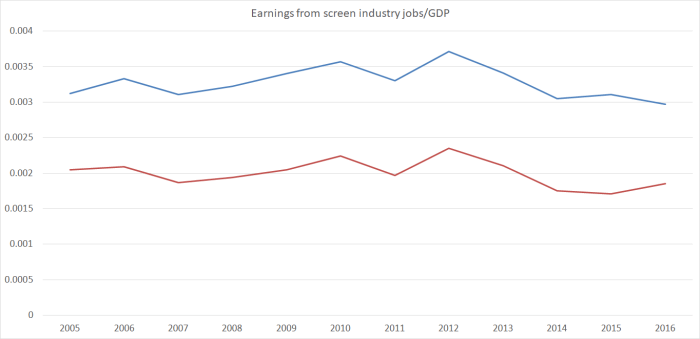
In the annual SNZ release of screen industry data there is a table of earnings from screen industry jobs.  Here are those earnings shown relative to GDP.

screen industry jobs

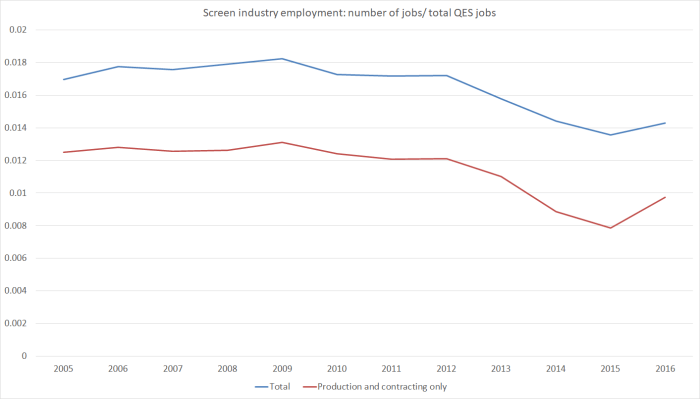
On this measure, the relative share of the industry is a bit smaller than it was in 2005, despite all those subsidies.

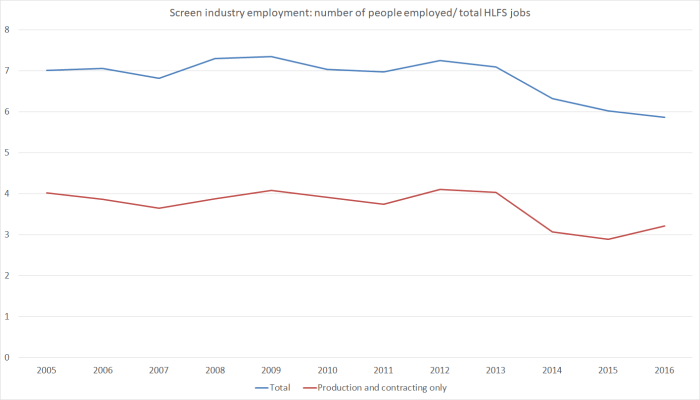
There is also a similar length series of (a) the number of people employed, and (b) the number of jobs, which I’ve shown relative to the HLFS data on total employment.

screen E

And here is the same breakdown in respect of the number of jobs shown relative to the QES jobs filled data.

screen e 2

Employment isn’t everything –  there just might be stellar productivity growth going on.  But what NZIER could find on that front wasn’t particularly impressive –  and as they note, the numbers are shaky at best.  And in a sector of this sort, where New Zealand is a small part of a global industry, if there were really stellar productivity gains being achieved one might expect them to show up in a growing market shares, including (for example) rapidly rising exports and a rising share of total employment.  There is simply no sign of any of that.

Advocates seem reduced to some pretty feeble arguments not much different from “it feels good”.  In their taxpayer-funded report, NZIER devoted several pages to trying to make the claim that film subsidies are an effective part of “soft diplomacy”, exemplified apparently by cases like these

The German-aired Emilie Richards series (case study 6 over the page) is not well known in New Zealand, but in Germany it played a role in cross-cultural understanding. In the case of 800 Words (case study 7 overleaf), our Trans-Tasman relationship plays out in a drama series featuring New Zealanders and Australians together in daily life.

But as the discussion of these two cases unfolds it all seemed to reduce to not much more than “if you subsidise something, you will get –  and may even grow –  some firms and jobs that depend wholly on those subsidies”.  That is no sort of robust test.

Film subsidies look like a classic case in which, once established, it is extremely difficult to overcome the concentrated vested interests that want the subsidy to continue, even if there is no sign that New Zealanders as a whole are benefiting.  Perhaps there is a better class of cafe in Miramar as a result, perhaps ministers like hobnobbing with film industry people (although given the revelations of the MeToo movement it is hard to know why), and there are (of course) individual employees who would be adversely affected by the discontinuation of the subsidies –  as there is in any economic change, including the cyclical ups and downs in places like the construction industry.  But it isn’t a good basis for taking your money and mine to provide subsidies to the likes of Richard Taylor and Peter Jackson, talented as they (and their staff) may individually be.   Economic policy should be premised on considerations like economic efficiency, with any interventions benchmarked against credible performance data.  On that score, film subsidies were flawed from inception, and they clearly fail now.

Against values tests

New Zealand First’s conference over the weekend apparently supported some form of values test for immigrants.  It has been ACT Party policy too –  perhaps one of the few things the two parties (one strongly pro-immigration, one ostensibly a bit sceptical) actually agree on.

Such provisions aren’t unknown: Australia has its Australian Values Statement , a pretty watered-down thing that newcomers have to subscribe to. It isn’t clear that doing so makes any useful difference at all.    As I noted in an earlier post

My concerns are about two, perhaps opposing, risks.  The first is that any values statement becomes a lowest common denominator statement as to be totally meaningless.  The second is that the wording of any values statement –  if taken seriously –  would be hotly and continuously contested, as culture wars ebbed and flowed. 

Here, any serious suggestion of a values test just seems to offer another avenue for fighting the culture wars, in ways that would – among other things – end up delegitimising the deeply held views of many New Zealanders (native and non).   According to Newsroom’s account of the New Zealand First proposal

The bill would legally mandate new migrants and refugees to respect sexual equality, “all legal sexual preferences”, religious rights, and that alcohol was a legal substance that could not be campaigned against.

I certainly don’t respect “all legal sexual preferences”, let alone the acting out of those “preferences”.   And, on the other hand, the public health academics at Otago seem to lament that alcohol is legal.  More generally, for 100 years or so –  ending only 30 years ago –  we used to have a referendum every three years at which one of the options was Prohibition.   Kate Sheppard and the WCTU campaigned for women’s suffrage partly as a means to the desired end of Prohibition.     It is a long time ago now, but I suspect I probably voted for prohibition myself, and my (New Zealand born) father was a leading figure in the Temperance Alliance, which campaigned for it.    And what of “sexual equality”?  Who knows precisely what it is meant to mean here –  or in the Australian Values Statement –  but perhaps it means faithful Catholics would be banned from migrating to New Zealand because they don’t believe a woman can (from the nature of things) serve as a priest?    I don’t suppose that is what NZ First will mean, but some Green MPs might think that sort of restriction was rather appealing.

And does anyone suppose that if such a values test was established in New Zealand it wouldn’t include something about the Treaty of Waitangi, and something rather heavily loaded towards an interpretation that would have been unrecognisable 50 years ago.  Perhaps migrants would be required to undertake to “respect” the Treaty, whatever that means, or something that went even beyond that.   Or that if a values test was imposed by the current government it wouldn’t be full of rhetoric about the environment, climate change, and other left-wing priorities.

I dealt with this in an earlier post when, a couple of years ago, ACT was championing its proposed values test.

And where would it stop?  I had a quick look this morning at statements I could find in which each of the three largest political parties describe their values.  There was some overlap (and the particular Labour Party document I found had three of four pages of text, while the Greens and National Party had quite short lists), but there were quite a few substantial differences.  Which is what one might expect: a significant part of political debate is the contest of ideas and values, particularly in an era of cultural transition (eg secularization, in which culture and religion are no longer intrinsically interwoven).

I might find the references to loyalty to the sovereign, and limited government, in the National Party’s list appealing.    Many other New Zealanders wouldn’t.   “Respect the planet” might be something central to a Green view on things, but to me the concept of respecting an inanimate object just seems weird.  And even though there was serious uncertainty about the consequences of doing so, I’m glad our ancestors took decisive action to confront Hitler, rather than “take the path of caution”.

As far as I can see, none of the values statement (yet) talk of the rights of the unborn, or transgender rights to bathrooms –  to take just a couple of issues that have convulsed American debate.

Perhaps we might get agreement on process issues –  parliamentary sovereignty, a universal franchise, the rule of law etc –  but even on process it might be thin pickings.  There are probably plenty of supporters here of moving to a written constitution, and others who still hanker for a return to FPP.  In the end, is there genuine common ground on very much at all, other perhaps than that change should occur non-violently?  We can all agree that individuals do and should have rights, and probably all agree that in some circumstances the needs/interests of the “community” override those individual rights.  But where that boundary is, and how it should shift, is the intrinsic stuff of politics.  We can’t agree among ourselves, so what is there for immigrants to sign up to, other than today’s (temporary) shifting majority.  I was amused, for example, to read the Prime Minister’s [John Key] rewriting of history, in answering the values question, noting that for him it included “understanding that New Zealand’s always been a tolerant society”.   Really?  To name just one low-key example, our treatment of conscientious objectors during the two World Wars meets no reasonable definition of “tolerant”.

And yet the people who call for migrants to sign values statements do capture a fair point.  When large numbers of people are allowed by our governments to come and live in New Zealand they have the potential to change our society.  People are not just bloodless economic units –  dessicated calculating machines.  They bring their own attitudes and values, and while the new arrivals are likely to be changed by living here so –  if the numbers are large enough – is our society.  One need only think of European migration to New Zealand over the last 200 years –  we their descendants may be changed by living here rather than in, say, the United Kingdom, but the similarities with modern Britain are probably greater than those with pre-1840 Maori society.  The point is not that modern New Zealand is better or worse for those migrants (and their values/attitudes/technologies), but that the fact of change is inescapable and largely irreversible.  Seeking that sort of change is itself a political act.

Which is one of a number of reasons why I’m skeptical that –  even if there were material economic benefits to residents of the recipient countries – large scale immigration programmes are normally a legitimate role of government at all.  We’ll always have some immigration.  New Zealanders travel, and some will meet and marry foreigners.  Often enough the new couple will want to settle here.  And our humanitarian impulses will, rightly, drive us to take some refugees.  But in neither case –  both on generally quite a small scale – do we grant permission to reside here with a goal of changing our society.

But once we get into large scale immigration programme, governments are in the culture change business, actively or passively, often without even realizing it. In terms of the domestic culture wars, and ongoing debates, the ability to attract more people like one side or another skews the playing field.  Instead of working out our differences, and debating change, within the existing community of New Zealanders, we tilt the playing field one way or the other. I might be comfortable with a large influx of mid-western evangelicals, while most Wellingtonians might prefer liberal Swedes.  I might be happy with strongly Anglican Ugandans or Kenyans, while many would prefer secular French.   In the specific New Zealand context, few migrants have any strong reason to feel a commitment to the Treaty of Waitangi, and for those New Zealanders for whom that is an important issue, any large scale immigration skews the game against (that representation) of Maori interests

It is far easier to resolve disputes, and find an ongoing place for each other, among communities with shared memories, experiences and commitments.  Families do it better than countries.  Countries do it better than the world.  Globalists might not like to acknowledge that, but it doesn’t change the reality.  Families don’t usually resolve their differences –  sometimes painful lasting differences –   by injecting new members into the family.

It is one of the reasons why I’m opposed to large scale immigration programmes at all.  They allow governments to attempt to skew the playing field one way or other, rather than letting the inevitable cultural/values conflict play out, and be sorted out,  by New Zealanders themselves, as New Zealanders.  Perhaps it is a little different when the immigration largely involves people with similar backgrounds (culture/religion) to those of people already in the recipient country.   One might argue that was the case in New Zealand for a long time, although even then one could only do so by ignoring the position of Maori in New Zealand.

I also dealt with some of this stuff in a post on the culture/identity aspects of last year’s New Zealand Initiative report on immigration.

So long as we vote our culture out of existence the Initiative apparently has no problem.  Process appears to trump substance.  For me, I wouldn’t have wanted a million Afrikaners in the 1980s, even if they were only going to vote for an apartheid system, not breaking the law to do so.  I wouldn’t have wanted a million white US Southerners in the 1960s, even if they were only going to vote for an apartheid system, and not break the law to do so.  And there are plenty of other obvious examples elsewhere –  not necessarily about people bringing an agenda, but bringing a culture and a set of cultural preferences that are different than those that have prevailed here (not even necessarily antithetical, but perhaps orthogonal, or just not that well-aligned).

When governments facilitate the inward migration of large numbers of people –  as ours is every year –  they are changing the local culture in the process.  Now, cultures and sense of national identity are not fixed and immutable things, but cultures also embed the things that the people of that country have come to value and which have produced value.  Those people (“natives”) typically aren’t seeking change for its own sake: the culture is in some sense the code “how we do things here”, that built what people value about the society in which they live.  Whether it is comfortable or not to say so, in the last few centuries, Anglo cultures have tended to be among the most stable, prosperous and free.  So it is far from obvious why should embrace change so enthusiastically, or why we would want to adopt the Initiative’s stance, and only want to exclude those whose views and actions are “antithetical” to our own, or who might want to topple our society illegally.

Perhaps if there were really substantial economic gains to New Zealanders from bringing the huge numbers of non-citizens to live in New Zealand it might be different. At very least, we might face the choice –  give up on some of our culture and sense of national identity in exchange for the economic gains.  In some respects, that was the choice Maori faced when the Europeans came –  a clearly more economically productive set of institutions etc, but on the other hand the progressive marginalisation of their own culture. ….

There is also a degree of naivete about the Initiative’s take on culture and/or religion (and the two overlap to a considerable extent).  Back in one of the earlier quotes, the Initiative argued that it was fine with people of whatever belief coming, and

Within New Zealand, people are free to pursue their beliefs, be they spiritual or corporeal, provided these do not impose on other people’s pursuit of the same.

They don’t seem to recognise that most people hold to beliefs that they think should influence how society is organised.  Even libertarians do. This is particularly obvious in Islam, which has never had a very strong distinction between ‘state’ and “church’, but it is no less true of Christianity.  Both are evangelistic religions, proclaiming what they believe to be true – and seeing truth as an absolute concept.  Both can, and have, survived at times and in places as minority faiths, but neither has ever been content to believe that its truths are just for its people, and not for export. I’m not so sure it is really much different either for today’s “social justice warriors”, or for libertarians –  whose proposed rule is, essentially, that we should all just leave each other alone (even though this has never been, and never seems likely to be, how human beings have chosen to organise themselves).

I’m not convinced that stable democratic societies can survive that long without a common culture and/or common religion (the two aren’t the same, but they overlap considerably, and necessarily).  It is hard to know.  We don’t have a long track record of democratic states –  a few hundred years at most (even if one doesn’t use universal suffrage as the standard), and then only for a handful of countries.

…..

Democracy involves agreeing to live by a set of common rules, agreed by some sort of majoritarian process.  In almost any state, those rules include procedures for handling those least able to support themselves (whether it was Old Testament gleaning rules, the Poor Law, or the modern welfare system).  In a democracy, the willingness to help and support others is likely to be limited, to a considerable extent, to those with whom one feels a sense of shared identity.  The boundaries aren’t absolute, but revealed preference –  and introspection –  suggests that almost all of us are willing to do much more for our own families, and then perhaps for friends or members of other close communities of interest (neighbourhoods, church groups etc), and then for others in one’s own country, and only then for citizens of the world.  Is it a desirable model? I’m not sure. But it is human one, one that seems fairly ineradicable at a practical level.   Speaking personally, I don’t feel a strong sense of obligation to support someone down on their luck just because they became a New Zealander yesterday.  And I don’t feel a strong sense of obligation to support someone who won’t work to support themselves.  But I’m much more willing to vote my taxes to support those people than I am to support those down on their luck in Birmingham or Bangalore.  It is partly in that sense that “being a New Zealander” matters.  Mostly, humans will sacrifice for those with whom they sense a shared identity –  and generally that isn’t just the Initiative’s line about a shared belief in equality before the law, free speech etc etc (important to me as those things are).

Of course, what unites and divides a “country” or community changes over time.  In the wake of the Reformation, divisions between Protestants and Catholics were sufficiently important to each to make it practically impossible for both groups to co-exist for long in any numbers in the same territory/polity.  And, sure, multi-national multi-faith empires have existed for prolonged periods –  the Ottomans and Habsburgs were two examples – but not as democracies. Prudent repression can maintain stability for a long time.  But it isn’t the sort of regime that Anglo countries (and many others) have wanted to live under.

But the New Zealand Initiative report doesn’t seem to take seriously any of these issues, not even to rebut them.  They take too lightly what it means to maintain a stable democratic society, or even to preserve the interests and values of those who had already formed a commuity here.    I don’t want stoning for adultery, even if it was adopted by democratic preference.  And I don’t want a political system as flawed as Italy’s, even if evolved by law and practice.   We have something very good in New Zealand, and we should nurture and cherish it.  It mightn’t be –  it isn’t –  perfect, but it is ours, and has evolved through our own choices and beliefs.  For me, as a Christian, I’m not even sure how hospitable the country/community any longer is to my sorts of beliefs – the prevalent “religion” here is now secularism, with all its beliefs and priorities and taboos – but we should deal with those challenges as New Zealanders – not having politicians and bureaucrats imposing their preferences on future population composition/structure.

Values tests simply aren’t any sort of sensible answer, and particularly not in western societies  whose “values” and “religion” are not remotely stable or settled.   Perhaps it would work in Saudi Arabia.  Perhaps it even could have worked in many places in the 19th century.   And if such tests were seriously adopted in a society like New Zealand they would probably end up being used most against the sorts of people who now call for them.  Our culture’s heritage once included Test Acts, and I hope we resist the growing pressure to establish some modern form of them.  We can’t avoid the cultural conflicts within our own society, but we can give ourselves space to work them through as New Zealanders, people with some sort of shared commitment to this place and its people, that few newcomers –  wherever they are from, whatever their values, whatever their religion – are likely to share.