Shameless and shameful

On Monday, just across the road from Parliament, Victoria University’s Institute for Governance and Policy Studies hosted a lunchtime lecture from Professor Anne-Marie Brady.  The lecture was built around her Magic Weapons paper on the extent of Chinese government/Party influence activities in New Zealand (and elsewhere), and her shorter policy brief with some specific proposals for the new government on how to deal with the issue (I wrote about that latter piece recently here).     (Radio New Zealand also had a good interview with Brady this morning, prompted by the new legislation announced yesterday by the Australian government, as part of its efforts to deal with this official Chinese interference.)

New Zealanders owe Professor Brady a considerable debt of gratitude for, first, writing her detailed paper, and secondly for deciding to put it in the public domain (it was done as part of an international project on Chinese influence-seeking activities globally, and the papers by other scholars have not yet been made public).    Her paper has found a receptive audience internationally (and she mentioned that Francis Fukayama has underway work for a similar paper on Chinese influence-seeking in the US).

Listening to her, one gets the sense that she isn’t that comfortable in the public spotlight.  Many academics aren’t.   In her lecture the other day she felt the need to include a photo of her Chinese husband and her three half-Chinese children –  no doubt a push back against the sort of despicable pre-election attempt to discredit her and her research tried by the then Attorney-General.  It can be a lonely position for an academic when her expert and well-documented research runs head-on into a wall of political indifference (or worse), vested interests, and a media which seems not quite sure whether or not this is a “proper” issue even to be talking about.    It is not as if (I’m aware that ) anyone has seriously sought to question the factual basis of her paper, or has demonstrated major flaws in her analysis and reasoning.   It seems as if there is just a desperate desire that she, and the issue, would go away.    Absent that, the political and business elites simply want to pretend it doesn’t exist.   I hope she doesn’t just retreat to her study.

Her Victoria lecture the other day covered pretty familiar ground (although many of the attendees indicated that they hadn’t read either of her papers so much will have been new for them).     There was:

  • the active efforts (largely successful) of the Communist Party to get effective control of almost all Chinese language media in New Zealand (similar story in Australia) –  and thus the story of the issues she is raising goes unreported in that media,
  • the efforts of suborn former senior politicians, with roles that align their personal economic interests with those of the Chinese authorites,
  • concerns about political donations, especially from individuals/entities with close ties to the CCP, and the associated close ties between political party leaders and China,
  • Chinese government interests in influencing New Zealand, both to stay quiet on issues of concern to China, and to detach New Zealand from its historical defence and intelligence relationships,
  • China’s interests in Antartica,
  • Confucius Institutes, funded and controlled by China, as part of New Zealand universities, complete with restrictions on what can be talked about,
  • efforts to promote ethnic Chinese New Zealand citizens, with those ties to the Embassy/CCP, into electoral politics –  in New Zealand’s case, both Jian Yang and Raymond Huo.

Huo is now chair of Parliament’s Justice Committee – the same Huo who, as she pointed out, is responsible for Labour campaigning for the Chinese vote under a Xi Jinping slogan, and who – Professor Brady reports –  was present at a meeting in Auckland earlier this year in which Communist Party propaganda chiefs (“propaganda” is apparently a literal translation of the role/office) met with local Chinese language media to offer “guidance” on how issues of interest to China should be reported.   A serving member of New Zealand’s Parliament…….

Brady noted that the Communist Party’s United Front work has always been an integral element in how the Party works, but that the efforts are now being undertaken with an intensity and importance that is greater than at any time since 1949, when the CCP took power.  It is a China that has thrown off Deng Xiaoping’s injunction (post Tiananmen) that China should mask its growing power and bide its time.

When it came to the New Zealand government, in some respects I thought Professor Brady pulled her punches (although she was happy to note that she couldn’t understand how it was that National Party MP Jian Yang – self-confessed Communist Party member, former member of the Chinese intelligence services, and someone who has acknowledged misrepresenting his past on residency/citizenship application papers –  is still in Parliament).   I’m not sure how much of that is tactical –  giving the new government a chance, hoping to be heard by talking constructively.   I fear that any such hope is misplaced.

In just the last week we’ve had a couple of episodes that confirm that the new government is quite as craven –  indifferent, obsequious –  as its predecessor.

A month or two ago, at the time of the 19th Communist Party Congress, it came to light through the Chinese media that the presidents of both the National and Labour parties had been sending warm greetings and congratulations.   This last weekend, the Labour Party went one step worse.

The Chinese Communist Party held a congress in Beijing for representatives of such political parties from around the world (300 from 120 countries) as it could gather to its embrace.    Most of them were from developing countries.  Nigel Haworth, the President of the New Zealand Labour Party, attended.   Here is how one Chinese media outlet reported the event.

The CPC in Dialogue with World Political Parties High Level Meeting was the first major multilateral diplomacy event hosted by China after the recently concluded 19th CPC National Congress.

It was also the first time the CPC held a high-level meeting with such a wide range of political parties from around the world…..

During the closing ceremony, Chinese State Councilor Yang Jiechi stressed that the meeting was a complete success with a broad consensus reached. He also said CPC leaders elaborated on the new guiding theory introduced by the 19th CPC National Congress.

“The innovative theoretical and practical outcomes of the 19th CPC National Congress not only have milestone significance for the development of China, but also provide good examples for the development of other countries, especially developing countries,” Yang said.

The Beijing Initiative issued after the meeting states that over the past five years, China has achieved historic transformations and the country is making new and greater contributions to the world.

It also highlighted that lasting peace, universal security, and common prosperity have increasingly become the aspiration of people worldwide, and it’s the unshakable responsibility and mission of political parties to steer the world in this direction.

“The most important thing between the 18th and 19th CPC party congress was the belt and road initiative,” according to the Russian Communist Party’s Dmitry Novikov. “And the most important thing about the initiative is the economic cooperation among various countries. Such cooperation leads to the promotion of relations in culture and politics.”

And the President of the New Zealand Labour Party was party to all of this.    In fact, not just a party to it, but someone who was willing to come out openly in praise of Xi Jinping.

Here he is, talking of Xi Jinping’s opening speech  (here and here)

“I think it is a very good speech. I think it is a very challenging speech. I think he is taking a very brave step, trying to lead the world and to think about the global challenges in a cooperative manner.  Historically we have wars and we have crisis, but he is posing a possibility of a different way of moving forward, a way based on collaboration and cooperation.  Making cooperation work is difficult, but he think that’s a better way for mankind. I think we all share that view.”

It is shameful.     Probably not even Peter Goodfellow would have gone quite that far –  if only because there might have been some (understandable) rebellion in the ranks if he had gone that public.

This is the same Chinese Communist Party (and associated state) that

  • flouts international law, including with its aggressive expansionism in the South China Sea,
  • denies any political rights to its own people,
  • that is directly responsible for the deaths of tens of millions of people (and which only just pulled back from its forced abortions practices),
  • lets dissidents die in prison,
  • has no concept of the rule of law,
  • persecutes religious believers (Christian, Muslim, Falun Gong or whatever),
  • actively interferes in the domestic politics of other countries in all manner of different ways,
  • and so on.

In her lecture the other day, Professor Brady mentioned Haworth’s comments, but this was one of the places she pulled her punches.  She asked, rhetorically, if we could imagine a New Zealand political party president attending a Republican Party convention and making such public remarks.   Or even a Russian political event.    At one level it is a fair point –  Haworth’s participation in this CCP event, and his positive comments, have gone totally unremarked in the New Zealand media (or from Opposition parties), in a way that would be simply inconceivable in those other cases.    But at another, it falls into the trap beloved of China-sympathisers and people on the left (one such academic at her lecture attempted this), of drawing a moral equivalence between, say, the United States and the UK on the one hand, and Communist China on the other.    A much better comparison would be to ask if we could imagine a major New Zealand political party President attending Nazi Party congresses pre-war or Soviet Communist party congresses?  And whether, even if it had happened, we would look back now with equanimity at associating so strongly with such an evil.  Such is the CCP.   The fact that certain New Zealand firms make a lot of money trading with them –  or that our political parties appear to raise large donations –  doesn’t change that character.

Former National Party Prime Minister, Jenny Shipley, was apparently also at the meeting, speaking warmly of China’s One Belt One Road initiative (all about geopolitical influence).

Yesterday, we had yet more proof of how far gone the New Zealand authorities (and the new New Zealand government are).     As I’d noted a couple of weeks ago, Victoria University (specifically its China-funded and controlled Confucius Institute) and the New Zealand Institute for International Affairs put on a half day symposium (celebration?) of 45 years of diplomatic relations with the People’s Republic of China PRC).   Not a word of scepticism or criticism was to be expected from the programme –  there wasn’t for example an opportunity for Professor Brady to present her work, and alternative perspectives on it to be heard.

Quite late in the piece, reportedly, the new Minister of Foreign Affairs agreed to be a keynote speaker at this forum, his first major speech as Minister.  Winston Peters had, in Opposition, occasionally been heard to express some unease about the activities of the PRC in New Zealand, including the questions around National Party MP Jian Yang (recall that even Charles Finny, former senior diplomat, noted that he is always very careful about what he says in front on Yang and Raymond Huo, given their closeness to the PRC Embassy).   In office, the Rt Hon Winston Peters not just tows the MFAT line, repeating the same obsequious words as former National Party ministers, he takes it up another step.

There was the published text, which was bad enough.   In entire speech he could only manage this, that might be pointed to for a modicum of self-respect.

New Zealand supports a stable, rules-based order in the Asia-Pacific region in which free trade and connectivity can thrive.  We urge parties to resolve disputes in accordance with international law, on the basis of diplomacy and dialogue.

New Zealand and China do not always see eye to eye on every issue; we are different countries and New Zealanders are proudly independent.  However,  China and New Zealand have a close, constructive and increasingly mature relationship.  Where we do have different perspectives, we raise these with each other in ways that are cordial, constructive and clear.

“New Zealanders” might be proudly independent, but it isn’t clear that our governments are.  At a New Zealand event –  so it wasn’t even a matter of talking politely in China itself –  our Foreign Minister can’t bring himself to name any specific concerns or risks (despite rising international unease, and the material documented by Professor Brady).   And if he ever has concerns he’ll raise them in “cordial” way………”cordial” and direct interference by a foreign power in New Zealand, undermining the freedoms of hundreds of thousands of our own people (ethnic Chinese) doesn’t strike me as the sort of words that naturally belong together.  At least in a country whose government retains any self-respect.

But then it got worse, at least according to the Stuff report of how Peters departed from his written text.

“We should also remember this when we are making judgements about China – about freedom and their laws: that when you have hundreds of millions of people to be re-employed and relocated with the change of your economic structure, you have some massive, huge problems.

“Sometimes the West and commentators in the West should have a little more regard to that and the economic outcome for those people, rather than constantly harping on about the romance of ‘freedom’, or as famous singer Janis Joplin once sang in her song: ‘freedom is just another word for nothing else to lose’.

“In some ways the Chinese have a lot to teach us about uplifting everyone’s economic futures in their plans.”

It is so remarkably reminiscent of the Western fellow travellers of the Soviet Union in decades past –  tens of millions might die, but not to worry, a new Jerusalem is on the way to being built.   Basic rights and freedoms might be trampled on, or simply not exist at all, but not to worry….what is freedom after all?

Personally, I don’t think the biggest issue in the China/New Zealand official relationship should be how the Chinese party/state treats its own people –  abominable as that is.  The issues people like Professor Brady are raising are about the direct, systematic, in-depth, interference by another country  –  a hostile power, run by a regime with mostly alien values –  in the domestic affairs of other countries.  Our own most of all.  International expansionism and defiance of the rule of international law might matter too.  And none of that has any connection whatever to improvements in material living standards in China.

And what to make of the nonsense claim that “the Chinese have a lot to teach us about uplifting everyone’s economic future in their plans”.  That is about as ignorant as it is offensive.

I’ve shown this chart before

Here is a chart showing GDP per capita for China, and a range of now-advanced Asian countries/economies.  I’ve shown each country’s GDP per capita as a percentage of that for the United States for each of 1913, 1950, and 2014, using the Maddison database for the 1913 observation and the Conference Board (which built on Maddison’s work) for the more recent observations.  Data are a bit patchy in those earlier decades, but 1913 was before China descended into civil  and external wars (from the late 1920s), and 1950 was the year after the Communist Party took control of the mainland.

asia gdp pc cf US

What stands out is just how badly communist-ruled China has done economically, and especially relative to the three other ethnic-Chinese countries/territories.  Substantial re-convergence has happened in all the other countries on the chart, but that in China has been excruciatingly slow.  A few buoyant decades (the aftermath of which we have still to see) struggle to make up for the earlier decades of even worse Communist mis-rule.

Or how about this one, using Conference Board data for real GDP per person employed (they don’t have real GDP per hour worked for China, but estimates are very low)?

china GDP ppe

Even on official Chinese data, the record is pretty poor: China barely matches Sri Lanka which was torn apart by decades of civil war, and doesn’t even begin to match the performance of the better east Asian economies (none of which has anything like the waste, the massive distortions, of China).   Surely China is best seen as a (potential) wealth-destruction story?  Taiwan’s numbers might be a reasonable benchmark for what could have been.  Taiwan threatens no one.

Just to cap an egregious speech, the Opposition foreign affairs spokesman indicated that he didn’t disagree with what Winston Peters had had to say  (well, after his government’s track record of cravenness, he would, wouldn’t he).

I came home from Anne-Marie Brady’s lecture the other day and pulled off the bookshelf my copy of The Appeasers, written in the 1960s by Martin Gilbert and Richard Gott, a heavily-documented account of British appeasement of Germany from 1933 onwards.    As I started reading, lots seemed to ring true to today.

Two situations are never fully alike.  For a start, New Zealand isn’t a “great power” and China is (as Germany was becoming again).    And Germany had little real interest in interfering in domestic British politics –  and there was no large German diaspora in the UK to attempt to corral and control.    But there is a lot of the same willed blindness to the evil that the regime represented.    In the 1930s, it wasn’t the bureaucrats who were the problem –  from the very first, British Ambassadors in Berlin recognised and reported on the nature of the regime, its domestic abuses and its external threats.     There were various forces at work it seemed –  a fear of Communism (and thus Nazism as perhaps some sort of bulwark against something even worse), unease and even guilt over some of the Treaty of Versailles provisions, the fear of new conflict (only 15 years after the last war), and often some sort of admiration for the order the new German government was bringing to things (and some philo-Germanism among many of the British upper classes).  As Gilbert and Gott summarise it

“Like alcohol, pro-Germanism dulled the senses of those who over-indulged, and many English diplomats, politicians and men of influence insisted upon interpreting German developments in such a way as to suggest patterns of cooperation that did not exist.”

Britain and France could (and should) have stopped Germany earlier.  New Zealand can’t stop China, of course, but we can assert ourselves, and reassert some self-respect, for our system, our freedoms, and for the interests of like-minded countries.    We can call out, firmly (not cordially) Chinese influence-seeking etc where we see it –  as the Australian government has been much more willing to do.  We can cease to pander to such an obnoxious regime that not only abuses its own people (including failing to deliver economically) but represents a threat to its neighbours, and which persists in seeking to interfere directly in other countries, whether in its neighbourhood or not, whether with large ethnic Chinese minorities (as NZ, Australia, and Canada) or not.  Our politicians shame us by their deference to such an evil power –  and frankly, one that has little real ability to harm us (as distinct from harming a few vested interests).

In her lecture the other day, and in her policy brief, Anne-Marie Brady called for our political leaders to insist that none of their MPs will have anything further to do with entities involved in the PRC United Front efforts.   That would certainly be a start –  though the Jian Yang stain on our democracy really needs to be removed altogether –  but it is probably a rather small part of the issue: we need political leaders who will recognise  –  and openly acknowledge –  the nature of the regime, and stop fooling themselves (and attempting to fool us) about the nature of the regime they defend, and consort with.   Perhaps our leaders are no worse than, say, British Cabinet ministers in the 1930s who enjoyed hunting with Hermann Goering, but if that is the standard they are comfortable with, New Zealand is in an even worse place than I’d supposed.   In their book, Gilbert and Gott quote from the former head of the British foreign service:

“Looking back to the pre-1939 era Vansittart wrote: “I frequently said that those who ask to be deceived must not grumble if they are gratified”

Indeed.

I said that I thought Professor Brady was inclined to pull her punches a bit.  Asked what New Zealand can do,  she began her response claiming that “Australia can be more forceful”.   No doubt Australia is, and will remain, more forceful –  we’ve seen in the DFAT Secretary’s speech, in the ASIO report, in the foreign affairs White Paper, and in the new legislation details of which were announced yesterday.  But “can” isn’t the operative word.   If trade is your concern, Australia trades more heavily with China than New Zealand firms do.  If distance is your concern, Australia is physically closer to Asia –  and the waterways of the South China Sea.  Our political leaders – National, Labour, New Zealand First, Green –  could speak out, could act forcefully.  But they won’t.

Shameless and shameful.


UPDATE: As I pressed publish, I discovered that I’d been sent a link to some other reflections on Peters and Haworth by China expert Geremie Barme.


Whither cash?

Last week the Reserve Bank released an interesting Analytical Note on “Crypto-currencies – An introduction to not-so-funny moneys” .    If, like me, you hadn’t paid a great deal of attention to Bitcoin and the like, it is a very useful introduction to the subject, from a monetary perspective (including some of the potential policy and regulatory issues).  At least for me, it struck just the right balance of detail and perspective.

Analytical Notes are published with the standard disclaimer that the material in them represents the views of the authors rather than, necessarily, of the Bank.  (That said, I’m pretty sure nothing has ever been published in one that the Bank was unhappy with.)  They are mostly written by researchers rather than policy people.  So it was interesting, and perhaps a little surprising, to get to the second to last page of this paper and find this

Work is currently under-way to assess the future demand for New Zealand fiat currency and to consider whether it would be feasible for the Reserve Bank to replace the physical currency that currently circulates with a digital alternative. Over time, analysis associated with this project will filter through into the public domain.

Interesting, because that is quite a radical and specific suggestion: to replace physical currency with a digital alternative.   And surprising because there was no hint of this work –  on a pretty major issue affecting all New Zealanders –  in the Reserve Bank’s Statement of Intent released only a few months ago.   Statements of Intent can seem like just another bureaucratic hoop to jump through, but the requirement to prepare and publish them was put in place for a reason: it is supposed to be the vehicle through which the Minister of Finance can inject his or her views on what the Bank’s work priorities should be, and is supposed to enable stakeholders and the public more generally to get a sense of what the Bank is up to.

I’m pleased the Reserve Bank is now doing this work on the future of currency.  Over the last couple of years I have been critical of the fact that, in published documents, there was no sign of any such preparatory work going on (including, more generally, around dealing with the problems of the near-zero lower bound, which will almost certainly become binding for New Zealand in our next recession).  In this year’s Statement of Intent, for example, published as recently as the end of June, there was 1.5 pages (pp 28-29) on the Bank’s currency functions, and not a hint of any work on the possibility of replacing physical currency with digital currency.   Perhaps doing the work is an initiative of temporary “acting Governor” –  but then he was required, by law, as Deputy Governor, to sign the Statement of Intent.  Or perhaps it was just the Bank deliberately keeping things secret?

As usual with the Bank, they talk loftily about how the analysis will eventually “filter through to the public domain”.  That isn’t good enough –  this is publicly funded work on a matter of considerable potential significance – , and I have lodged an Official Information Act request for the research and analysis they have already done.

I’ve come and gone for decades on what the best approach to physical currency is.  I’ve long been troubled by the monopoly Parliament gave to the Reserve Bank over the issuance of physical notes and coin.  There is no good economic reason for it (nothing about the efficacy of monetary policy for example) –  and for half of modern New Zealand history it wasn’t the situation in New Zealand.  For decades it may well have led to inefficiently low currency holdings: in a genuinely competitive market there is a reasonable chance that (eg) serial number lotteries would have provided a (expected) return to holders of bank notes.  In the high inflation years –  and especially as interest rates were deregulated –  holding as little currency as possible was the sensible thing to do.

notes and coin

As the chart shows, the ratio of notes and coins (in the hands of the public) to GDP troughed in the year to March 1988 –  when inflation and interest rates were both high (and, of course, returns to holding currency were zero).

At one level, the partial recovery in the amount of physical currency held isn’t too surprising.  Inflation has been low for decades, and interest rates are now very low too.  Holding physical currency isn’t very costly at all.

Then again, there have been huge advances in payments technologies.   Even when I started work, the Reserve Bank still offered to pay its staff (I think perhaps only the clerical and operational staff) in cash, and that wouldn’t have been too uncommon then.  ATMs didn’t exist then –  it was the queue at the local bank branch each Friday lunchtime –  let alone EFTPOS, internet banking and so on.   These days, by contrast, a huge proportion (by value) of transactions occur electronically.  Even school fairs –  often held out previously as the sort of place one really needed cash for –  have often gone electronic to some extent at least.

And although the ratio of cash to GDP is quite low in New Zealand (by international standards –  in many advanced economies something around 5 per cent isn’t uncommon –  there is still a lot of cash around.    The numbers in the chart are equivalent to a bit more than $1000 per man, woman, and child.    For a household like mine, more than $5000.    I’m a slow adapter, and almost always do have a reasonable amount of cash on me, but I’d be surprised if on an average day our household had more than $250 in cash in total (surveys from other countries suggest that isn’t unusual).   I’m not sure I’ve ever had a $100 bill, but Reserve Bank data suggest that on average each man, woman, and child has $400 in $100 bills.

As it happens, last week I was reading (Harvard economics professor) Ken Rogoff’s book The Curse of Cash.   As he notes, in the United States, there is around $3400 per man, woman, and child outstanding in US $100 bills –  while surveys of what ordinary consumers are actually carrying suggest that no more than 1 in 20 adults has a $100 bill on them at any one time.    Rogoff makes a pretty strong case that the bulk of physical currency holdings – even allowing, in say the US case, for the use of the USD in other countries – is held to facilitate illegality.   That could be outright illegal activities –  the drugs trade for example –  or tax evasion in respect of the proceeds of lawful activities.  The likely revenue losses, on his estimates, are very substantial.    The scale of the problem is probably smaller here, but there is no point pretending that the issue is specific to the United States (and, as Rogoff documents, a number of European countries have now put limits on the maximum size of cash payments –  although such rules seem more likely to catch those who comply with the law, rather than those who knowingly break it).

Somewhat reluctantly, Rogoff’s book has shifted my perspective on the physical cash issue.    As a macroeconomist, my main interest in this area in recent years has been to do something about the near-zero lower bound on nominal interest rates.  If the Reserve Bank cut interest rates to, say, -5 per cent, it would be attractive for people to pull money out of banks and hold it in physical currency in safe deposit boxes. If that happened to any large extent it would substantially undermine the effectiveness of monetary policy.  The fear that it might happen has already constrained central banks in various countries, and no one has been willing to cut official interest rates below 0.75 per cent (which was also about how far we thought the OCR could be cut when I led some work on the issue at the Reserve Bank some years ago).

Getting rid of physical currency altogether would solve the problem.  If there is no domestic cash, clearly you can’t hold any.  Of course, you could always seek out foreign cash, but the process of doing that would lower our exchange rate –  one of the ways monetary policy works, and thus not a problem.    But one doesn’t need to get rid of cash –  or even just large denomination notes –  to limit that risk.    There are various clever options that have been developed in the literature (effectively involving an exchange rate between physical and electronic cash), and as I’ve noted here previously, one could achieve the same result by simply putting a physical limit on the amount of currency the Reserve Bank issues, and then auctioning it to the banks (if demand surged this would, in effect, introduce an exchange rate or a fee).    It is disconcerting that, as far as we can tell, no country is properly prepared to use options like these in the next recession (which, in itself, risks exacerbating the recession because smart observers will recognise that governments have fewer options than usual) –  no one has (at least openly) done the preparatory legal work, or prepared the ground with the public.  Our Reserve Bank is, as as we can tell, no exception.

I’ve resisted the idea of getting rid of physical currency on both convenience and privacy grounds.  There is, as yet, no real substitute for cash if –  say –  one wants to send a child to the local dairy to buy the newspaper when one is on holiday.   And the ability to conduct entirely innocent transactions without the state being able to know what one is spending one’s money on (or one’s bank for that matter) remains a very attractive ideal.

And yet….and yet…..I wonder if it is a real freedom now to any great extent anyway.   We might not gone all the way –  yet –  to China’s “social credit” scoring system, but you have to be pretty determined to avoid the gaze of a government determined to find out what you’ve been up to.  Some of that is voluntary –  people choose to carry phones around, for example, which locate you –  and some of it isn’t (local councils put up CCTVs, and so do all too many retailers). AML provisions, and know-your-customer rules are ever more pervasive and intrusive.   Sure, using cash enables one to keep from a spouse what one spent on a birthday present, or where it was bought from, but it is a pretty small space left.

And so perhaps it is best for us to think now about serious steps towards phasing out physical currency.  Rogoff himself doesn’t recommend complete abolition at this stage, but rather ceasing to issue, and then over time withdrawing, high denomination notes.   Our largest note isn’t very large at all (NZD100 is only around USD70) but as I noted earlier a huge share of currency in circulation is in the form of $100 bills, even in New Zealand, which few people use for day-to-day transactions that are both lawful in themselves and where there is no intention to evade lawful tax obligations.   But if we were to amend the law to prohibit the Reserve Bank from issuing notes larger than (say) $20 –  and this is a decision that should be made by Parliament or at least an elected minister, not by a single bureaucrat –  we’d still make small cash transaction easy enough (school fair, or the kid sent to buy the newspaper, while greatly increasing the difficulty of a major flight to cash in the next serious recession, and increasing the difficulty of tax evasion and other criminal transactions.

If the government were to choose to go this way, it would still make sense for active precautions to be taken now to reduce the risk of the effectiveness of monetary policy being undermined even by a flight to $20 notes –   they take up roughly five times as much space as the equivalent amount in $100 notes, but you can still fit a lot of money in a secure vault.   Whatever the mix of measures, it is really important that the authorities –  Bank, Treasury, IRD, government, FMA –  adopt a greater degree of urgency.  No one knows when the next serious recession will be, but it isn’t prudent (ever) to assume it is far away.

And what of the Reserve Bank’s own scheme: the possibility of replacing physical currency with digital Reserve Bank currency?   We need to see more of what they have in mind.  My own long-held prediction is that they are two quite different products –  only the RB can issue physical notes, while anyone can issue electronic transactions media –  and that in normal times demand for a Reserve Bank retail-level digital currency would be almost non-existent.   That doesn’t mean they shouldn’t do it: there is something about the democratisation of finance, in enabling the public to hold the same sort of secure liability banks already can (in their case electronic settlement account balances), and  –  as we saw globally in 2008 –  banks runs can still happen.   Unless society decides to completely up-end the entire monetary system (and I have readers who favour that), we need an “outside money” that people can convert their bank liabilities into if/when they lose confidence in the issuing institution or system.    For most purposes, a digital Reserve Bank retail currency should be able to do that at least as well as physical banknotes.

Most….but not necessarily all (when serious people worry about EMP attacks on/by North Korea, there is no point pretending electronics is the answer to everything).   Those are the sorts of issues that need to be carefully examined, preferably in an open way, rather than with conclusions loftily filtered out to the public when it suits the officials.

Rogoff’s book is worth reading, especially (but not only) if you are new to the issue.  He covers a range of issues I didn’t have space for, including natural disasters (where cash might be more useful than cards, but most people don’t hold much cash anyway, so it actually isn’t that much of a help.)  Like the Reserve Bank paper, he also points out that things like Bitcoin offer a lot less effective anonymity than many people realise.


Exports in a cross-country perspective

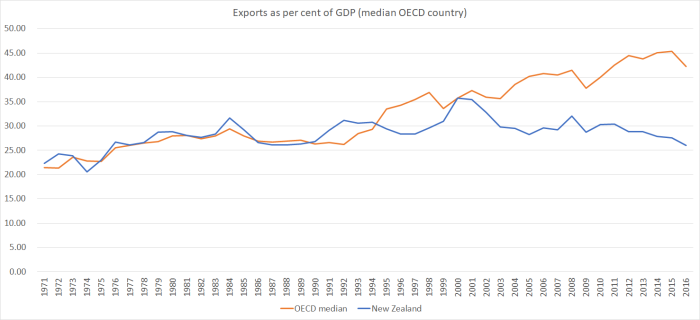
Across the advanced world, exports have been becoming a larger share of most countries’ GDP.  This chart shows the median export share for OECD countries going back to 1971.

export % of GDP OECD

The OECD only has complete data for all its member countries since 1995, but in that time total exports as a share of total OECD GDP have risen from 19.5 per cent to 28.3 per cent.

There is some short-term variability –  I’m not sure what explains the 2016 dip –  but the trend has been pretty strongly upwards.  That’s encouraging: trade (imports and exports, domestic and foreign) is a key element of prosperity.

For quite a while, New Zealand’s performance was very similar to that of the median OECD country

export %

and then it wasn’t.    The last time New Zealand’s export share matched that of the average OECD country was around 2000/01, when our exchange rate was temporarily very low (and commodity prices were quite high).   At very least, we’ve been diverging for 15 years now, although it looks to me that the divergence really dates back at least 20 years to the early-mid 1990s.

Once upon a time –  well before these charts –  New Zealand traded internationally much more than most other countries.   With a high share of exports in GDP, and a high GDP per capita, a common line you find in older books was that New Zealand had among the very highest per capita exports of any country.    These days, not only is GDP per capita below the OECD median, but so is our export share of GDP.

Small countries typically have a larger share of exports in their GDP than large countries.  That isn’t a mark of success for the small country, just a reflection of the fact that in a small country there are fewer trading partners.  If your firm has a great world-beating product and yet is based in the US quite a large proportion of your sales will naturally be at home.  If your firm is based in Iceland or Luxembourg, almost all your sales will be recorded as exports.  US exports as a share of GDP are about 12 per cent at present, but divide the country into two separate countries and even if nothing else changes the exports/GDP shares of both new countries will be higher than those of the United States.   The median small OECD country currently has gross exports of around 55 per cent of GDP  (New Zealand 26 per cent).

On the other hand, we also expect to see countries that are far away do less international trade than countries that are close to other countries (especially countries at similar stages of economic development).   That isn’t just a statistical issue, an artefact of where national boundaries are drawn.  Distance is costly –  there are fewer economic opportunities for trade.     That has become over more apparent in recent decades as cross-border production processes have become much more important: in the course of producing a complex product, component parts at different stages of assembly may cross international borders (and be recorded as exports) several times.   This has been a particular important possibility in Europe, and has been part of the success of formerly-Communist countries like Slovakia.    Distance is an enormous disadvantage –  enormous distance (such as New Zealand suffers) even more so.

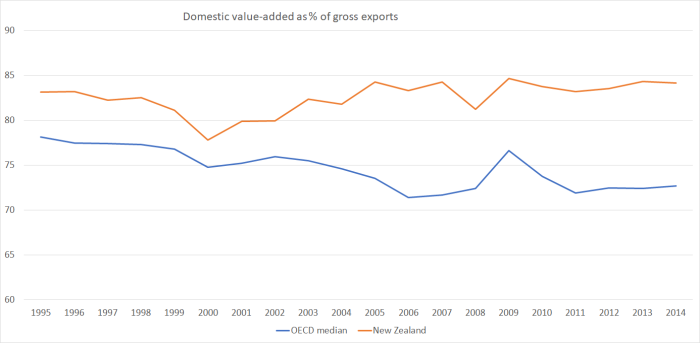
The OECD is now producing data on the share of domestic value-added in a country’s exports.  The data only go back to 1995, and are only available with quite a lag (the latest are for 2014) but you can see the difference between New Zealand’s experience and that of the median OECD country.

value-added

These opportunities (gains from trade that weren’t economically posssible a few generations ago) generally aren’t available to New Zealand based firms.  Then again, a widening in this particular gap isn’t the explanation for the divergence between New Zealand’s export performance over the last decade and that of the median OECD country (since the gap hasn’t widened further).

New Zealand has just been doing poorly.

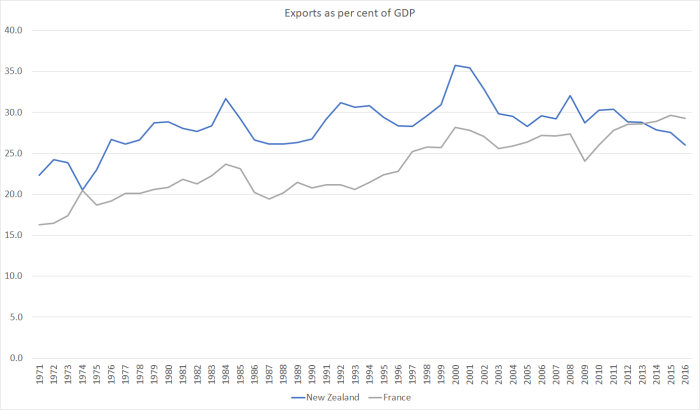
Here is one comparison I found interesting.

nz vs fr

France has more than ten times the population of New Zealand and yet its foreign trade share now exceeds that of New Zealand.    The United Kingdom –  similar population to France –  also now has a higher trade share than New Zealand.   And the difference isn’t just down to components shuffling back and forth across frontiers in the course of manufacturing (eg) Airbus planes.  New Zealand’s exports have a larger domestic value-added share than those of the UK or France, but adjust for that and all three countries now have export value-added shares of GDP of around 21 per cent.  In a successful small country you would expect –  and would typically find –  a much higher percentage.

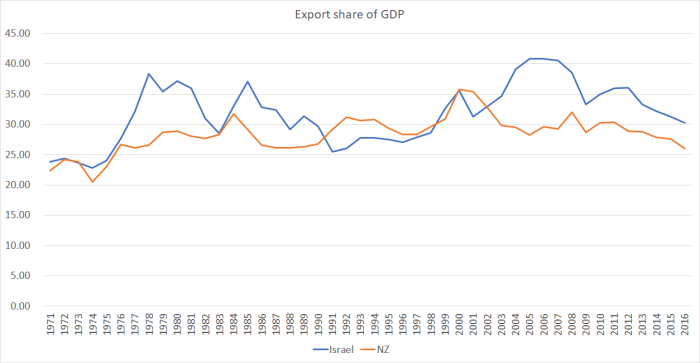
Remoteness looks like an enormous disadvantage for New Zealand, at least for selling anything much other than natural resource based products  (even our tourism numbers aren’t that impressive by international standards).   Here is the comparison with another small remote country, Israel  (it is both some distance from other advanced country markets, and made more remote by the political barriers of its location/neighbours).

nz vs israel

The Israel series is more volatile than New Zealand’s –  probably partly reflecting the extreme macroeconomic instability in the Israel earlier in the period –  but the overall picture is depressingly similar (and that in a country where R&D spending is now around 4 per cent of GDP).    The other similarity with New Zealand: very rapid immigration-driven population growth, into an economically difficult location.  As I’ve illustrated in previous posts, Israel has struggled to achieve much productivity growth and has a similarly low level of real GDP per capita.

Looking back over the last few decades, it is sobering to note that natural-resource dependent advanced economies are foremost among those that have struggled to achieve higher international trade shares of GDP.    It isn’t some sort of fixed rule: if, like Australia, vast new deposits of minerals become economically exploitable, a remote natural resource dependent economy can see its export share of GDP rise.  And if you have enough natural resources and few enough people, you can be very well-off indeed, even if the export share of GDP isn’t rising (Norway is the only OECD country where exports have’t risen at all as a share of GDP since 1971).  But if you are very dependent on natural resource exports –  and that dependence doesn’t seem to be changing –  then you’d probably want to be very cautious about actively using policy to drive up the population unless –  as with Australia –  there are new waves of nature’s bounty to share around.

New Zealand –  apparently structurally unable to secure rapid growth in exports based on anything other than natural resource –  looks not only like the last place on earth, but the last place in the advanced world to which it would make sense to actively set out to locate ever more people.  And yet is exactly what one government after enough does, apparently blind to paucity of economic opportunities here.    They might wish it was different, and perhaps one day it even will be, but for now there is just no evidence to support their strategies.  Every year, in following that course, governments make it harder for New Zealanders as a whole to prosper.

Oh, and what changed in the last 20 years or so –  to go back to that second chart?  After 20 years of quite low levels of immigration, active pursuit of large non-citizen immigration targets became a centrepiece of policy again.   Without great economic opportunities here –  already or created by the migrants –  that renewed population pressures just made it even harder, despite all the good work on economic reform in the previous decade –  for outward-oriented firms to succeed, and made the prospects of ever closing the income and productivity gaps to the rest of the OECD more remote than ever.

No fix for the flawed fundamentals

I’ve had fairly low expectations of what a change of government might mean for overall economic policy, but at present the new government seems to be charting a course to under-deliver even those low expectations.

The Minister of Finance yesterday gave his major public speech since taking office, explicitly selling it as an outline of the government’s economic strategy.     Sadly, there wasn’t very much there, and much of what was there focused –  as his speech title did –  on sharing and redistributing, with very little on reversing the decades of dismal economic underperformance.   Simply cutting the pie differently is no long-term solution to the sort of failure that has seen almost a million New Zealanders (net) leave New Zealand for a better life, for them and their families, abroad.

During the election campaign I was somewhat critical of Labour for simply accepting the National government’s narrative that the economy was basically doing fine.  But at least then I could sort of understand why they might do it –  something about not scaring the voters in the centre ground and not coming across as alarmist when they didn’t have much of a solution.    It is bit more surprising, and much more disappointing, to see that narrative carried over into office.

Here is what the Minister of Finance had to say this morning

While the fundamentals of our economy were, and are, strong, the purpose of it had become lost.

Again, perhaps after some bad business confidence numbers he doesn’t want to scare the horses.  But (a) you don’t produce better outcomes without actually facing what has gone wrong in the past, and (b) it is starting to seem as though the Minister of Finance actually believes the story on some level.

Grant Robertson was born in 1971.  Even by then, our economy had been in relative decline for a couple of decades –  and all the contemporary experts knew it.  But if we were no longer among the most productive and wealthiest of the then advanced economies, at least we were still in the middle of the pack.  Since then, we’ve just lost further ground –  the relative decline was particularly bad in the 1970s, but there has never been a sustained period since then when we’ve looked like reversing any of the relative decline.  Not under National governments, and not under Labour government’s either.    When Grant Robertson went off to university, eastern and central Europe was still Communist-run, with highly inefficient poorly-performing economies.    These days, the better performing of those countries –  Slovakia, Slovenia, the Czech Republic – are closing in on New Zealand levels of productivity/income, and places like Hungary and Poland aren’t that further behind.   Turkey is on the brink of going past us.   They’ve done quite well, but still have a long way to go to catch up with the West European leaders.  We’ve just done really rather badly; mediocre at a (generous) best.

Economies that are performing well  are typically ones in which the tradables sector of the economy is growing.   Local firms are finding more products and services which they can sell to, or compete with, the rest of world.   But we’ve had no growth in real per capita tradables sector GDP since around 2000.  Exports are a share of GDP are, as I illustrated the other day, now at the lowest level since 1976.

Over the last quarter century – even after the economic reforms –  our productivity growth has been among the lowest in the OECD (and we started from a bad position).  Most starkly –  and this a point that Robertson does mention –  we’ve had no productivity growth at all for the last five year.

And then, of course, there is the disastrously dysfunctional housing/land market: a country with so much land nonetheless has some of highest house price to income ratios anywhere in the advanced world.

Frankly, the “fundamentals of our economy” are pretty poor, especially if what we care about is the ability to support high incomes (fairly shared) for all of our people.  Yes, there are some things we can chalk up on the other side:  we’ve largely avoided a domestic financial crisis, our government accounts are sound, our people are pretty highly skilled (we’ll come back to that one), and our unemployment rate isn’t too bad (even if it is still above a NAIRU).   But mostly those are ‘inputs”: the “outputs” and “outcomes” don’t look very attractive at all.  And that makes it all the harder to deal effectively with some of the pressing social (and environmental) issues.

You might think an incoming government was well-positioned to point this stuff out.  But I guess there is no point in doing so if you haven’t got a strategy that is likely to be (a) materially different from what went before, and thus (b) likely to produce material different outcomes.

Instead, they seem to want to play down the dismal economic data and follow The Treasury down the not-particularly-well-grounded path of the Living Standards Framework (which I wrote about a couple of weeks ago)

I have asked the Treasury to further develop and accelerate the world-leading work they have been doing on the Living Standards Framework.  This focuses on measuring our success in developing four capitals – financial, physical, human and social. These give a rounded measure of success and of how government policy is improving our well-being.

This is a far better framework for judging our success.

As I’ve suggested previously, it looks more like a way of avoiding confronting our really bad long-term economic performance and the very large trend outflow of our own people.

The Minister of Finance claims they will keep a focus on productivity.

Low productivity has been a cloud over the New Zealand economy for decades and previous governments have failed to tackle this issue – this government will not.

Which sounds okay, perhaps even momentarily encouraging.  But how are they going to do this?  The Minister identifies only two areas.   The first is skills.

Lifting the skills of our people is critical to solving the productivity challenge.

In fact, there is not the slightest evidence for this proposition, which would lead the reader to suppose that skill levels in New Zealand lagged behind those in other, more economically successful, OECD countries.   No doubt we can do better (and there are specific pockets of underperformance), and there have been some disconcerting developments in the PISA results in recent years.  But the OECD produced data only last year suggesting that New Zealand workers were among the two or three most highly-skilled in the OECD.      They used three measures and this was one of them

oecd problem solving

As I summed it up at the time

Looking across the three measures, by my reckoning only Finland, Japan, and perhaps Sweden do better than New Zealand.

Increased subsidies for tertiary education (the policy Robertson then advances) will, no doubt, serve a redistributional function (even if one of questionable merit –  and I say that as a parent with three kids likely to go to university in the next eight years).  But there is little evidence they will do anything to close aggregate productivity gaps –  which, in New Zealand, aren’t about the skills or energies workers bring with them, or even about our legal institutions, but about the profitable business opportunities firms can find here.

And the second strand to Robertson’s response to our productivity failure is R&D.

Also critical for lifting productivity is increased investment in Research, Development and Innovation. The first step in this is the introduction of an R and D Tax Credit.  Beyond that we will move to work smarter, adding value to change the mix of our exports and using and creating new technologies.

I’m not aware of any serious observer, even among supporters of R&D tax credits, who believe that such credits are likely to make a transformative difference.

This is the data from the national accounts (March years) for research and development spending as a share of GDP.

R&D

It would be interesting to know quite what was going on in the 1970s, but really ever since then there hasn’t been much change in the share of GDP devoted to R&D (as captured by Statistics New Zealand).  Interestingly, the most recent year saw the highest R&D share in the 45 year history of the series.

Many observers point out that New Zealand is relatively unusual among advanced countries in not having an R&D tax credit.  There are various other countries, including Denmark and Switzerland, but on the extreme far end of the OECD’s chart of a summary indicator of such matters are New Zealand and Germany.

And yet here is the OECD’s data on R&D spending.  For this particular series they don’t have data for New Zealand for every year, but the picture is still clear enough.

R&D 2

The New Zealand R&D spend (as a share of GDP) is well below the OECD total, and Germany’s has been consistently above (as are those in Denmark and Switzerland).   And neither country has R&D tax credits.  In fact, when the OECD totted up all the different sorts of government support for business R&D, the New Zealand government was considerably more generous than Germany.

It suggests, as I’ve argued here for some time, a need to stand back and think about what it might be in the New Zealand economic environment that means so little R&D occurs here.  Firms typically take the risk of investing in R&D when they think the opportunities for profitable businesses are good.     That doesn’t appear to have been the case in New Zealand (in contrast, say, to Germany), and consistent with that overall business investment as a share of GDP in New Zealand has been low by advanced country standards, for decades, even though our population growth rate has been much faster than that in the typical OECD country (more people will typically require more business investment if living standards are to keep pace).   This is not the place for a lengthy discussion of factors that might discourage firms from investing here, but high interest rates (relative to those abroad), an out of line real exchange rate, and being the most remote advanced country on earth (at a time when personal connections, value-chains etc seem to have become more important) might be things to think about.  Not one of them appears in the Minister’s speech.


Perhaps the closest he comes is in a summary of the government’s approach

In other words, we’ll be swapping out population growth and the buying and selling houses to each other as our two main growth drivers for much more sustainable ones. That sounds like a good description of our plan.

But they aren’t changing the medium-term immigration targets at all (and various media report that the Prime Minister isn’t even keen on implementing Labour proposed changes re student and work visas),  and simply buying and selling houses has never, of itself, been a “growth driver”.

There is the beginning of an idea here, but sadly nothing in government policy –  as outlined so far – is likely to represent any sort of fix.  After all, a key thrust of government policy is to build lots more houses, and they plan to just keep on keeping on issuing 45000 residence approvals a year for people to settle in such a remote, unpropitious (from an economic perspective) location.  Perhaps worse still, they seem keen on continuing, and beefing-up, the previous government’s misguided approach of trying to steer migrants to places other than Auckland (which is, on my telling, to put the cart before the horse).

One gets to the end of the speech confident that the government knows how it wants to redistribute more/differently than what went before (much the same could be said of Phil Twyford’s housing speech yesterday), but without any sense of a compelling strategy that is likely to do anything to reverse New Zealand’s long-term economic underperformance, to fix those flawed fundamentals.  I hope they really care about fixing the fundamentals and are just keeping quiet because they don’t have any compelling ideas –  and aren’f finding them in The Treasury’s post-election advice.  I fear that, a bit like their predecessors, it is some mix of putting the problems in the too-hard basket, and of no longer really caring that much.

Transparency: Bank of England vs RBNZ

Open government –  or the lack of it –  has been getting a bit of attention in recent weeks.  The previous National-led government was pretty poor in that area, and if anything there now seems to be a risk that the current government could be worse.  But at least there is some debate around the issues.  Former Cabinet minister, and now Speaker, Trevor Mallard, had one promising suggestion in an article this morning

“Eventually getting some websites going which contain most of that material, for example, Cabinet papers two months after they’ve been to Cabinet automatically up unless there’s a good reason not to, just that sort of stuff would mean you’d have a lot of access to, actually quite boring information, but access to what’s going on.”

Easy to suggest, of course, when you are no longer a minister.  I hope the new Speaker will be as keen on extending the provisions of an (overhauled) Official Information Act to cover Parliament itself.

The Reserve Bank is one of the bodies that likes to claim that it is highly transparent.    There are plenty of counter-examples –  and occasional examples that might suggest that progress is actually being made –  but I stumbled across an interesting contrast this week between our central bank and the Bank of England, the central bank of the United Kingdom.  Recall that the British public sector was notoriously secretive for a very long time, and our Official Information Act was enacted many years before the UK’s comparable legislation.

In its Financial Stability Report this week, the Reserve Bank released a high-level summary of the results of its latest stress tests on the four major banks.  What they released was interesting enough but there wasn’t much of it; 850 words and a couple of charts.  There was, for example, no information on individual banks –  despite a disclosure-focused system –  and no detail on housing mortgage losses –  despite the active regulatory and rhetorical focus on those risks for the last five years.

Earlier in the week, the Bank of England released its Financial Stability Report, and as part of that they released their latest stress test results.  Their release –  on the stress tests alone –  was 64 pages, with a great deal of detail, on the test scenarios themselves, on the overall results, and on the results for individual banks.   It even has an interesting annex on how markets’ view of banks square with the stress test results.

To be sure, the UK banks are typically more complex than the New Zealand banks (some, such as HSBC, are primarily global banks with big international exposures), and there are more of them (seven in this test) so we might not expect 64 pages of results here.  But we really should be entitled to more than the Reserve Bank is giving us.  There is no obvious (good) reason for withholding the material –  including that at an individual bank level.  Disclosure statements are actually already supposed to disclose banks’ risks, and  stress tests are just shocks designed to test the circumstances under which those risks turn bad.  And, in the end, it is banks (individually) that fail, or not, not “banking systems”.

Sure, there is probably some cost to pulling all the material together and presenting it nicely, but those costs will be trivial compared to the costs the banks face in doing the stress tests, or even than the Reserve Bank faces in conducting them and writing them up for senior management and/or the Board.  Accountability provisions and openness do have direct costs –  and, for that reason among others, aren’t typically popular with bureaucrats – but we put them in place for good reason.  With such large and powerful governments we are long past the days when we could safely accept an approach of “trust us, we know what we are doing”, all the more so when it involves agencies – such as the Reserve Bank –  with huge power concentrated in one person’s hands and little direct effective accountability (we can’t vote him out).

I could, of course, lodge an Official Information Act request .  If I did they would probably release some more aggregated material.  But I wouldn’t get very far, as the Bank continues to shelter –  with the protection of the Ombudsman –  behind the egregious (or, more accurately, egregiously abused) section 105(1) of the Reserve Bank Act.  When the Reserve Bank Act is reviewed, doing something about that provision needs to be on the action list.

If the British can manage this high degree of openness around banking sector stress tests –  only a few years after they had to grapple with actual bank failures – surely so can we.

On the Reserve Bank FSR

There are some interesting things in the Reserve Bank’s Financial Stability Report, some questionable ones (including, at the mostly-trival end of the scale, Grant Spencer’s assertion that he is “Governor” when by law he is, at best, “acting Governor”) and some things that are missing altogether.

The Reserve Bank observes that banks have tightened their own (residential mortgage) lending standards

Banks have tightened lending standards, reducing the borrowing capacity of households. Typically, banks are using higher interest rates when assessing the ability of borrowers to service a new mortgage and their existing debt, restricting the use of foreign income in serviceability assessments, placing stricter requirements on interest-only lending, and ensuring that living expenses assumed in a loan assessment are reasonable given the borrower’s income.

If so, you have to wonder why the Reserve Bank is still intervening in such a heavy-handed way in the decisions banks would otherwise make about their mortgage lending.

But they go on to back their claim with an interesting, but on the face of it somewhat dubious, chart

The overall impact of the tightening in banks’ lending standards is illustrated by the Reserve Bank’s recent hypothetical borrower exercise,  which asked banks to calculate the maximum amount that they would lend to a range of hypothetical borrowers. This repeated an exercise that was conducted in 2014. The 2017 results suggest that maximum borrowing amounts have declined by around 5-10 percent since 2014 (figure 2.3).

max lending amounts

But it is hardly surprising that, with the same nominal income, banks would lend a little less now than they would have been willing to do so in 2014.  After all, there has been three years’ of inflation since then.   Even if the borrowers had declared the same monthly living expenses to their bank, banks use their own estimates/provisions for living expenses in deciding how much to lend.  Supervisors, indeed, encourage them to do so, and to be sure to leave adequate buffers.   An income of $120000 would comfortably support more debt in 2014 than the same income does in 2017  (the reduction in the maximum amount lent to owner-occupiers was 3.5 per cent in the chart).  It would probably be better to do all these comparisons using inflation-adjusted inputs.

In this FSR, the Reserve Bank reports the results of their latest set of bank stress tests.    This year’s macro stress test didn’t seem particularly demanding in some ways.

stress test.png

Previous scenarios have featured falls in house prices of more like 50 per cent (in Auckland) and 40 per cent nationwide, which seemed like suitably tough tests.  Previous test also featured an increase in the unemployment rate to 13 per cent (which was so implausible that I pointed out then that no floating exchange rate advanced country had ever experienced such a large sustained increase in its unemployment rate).

But there are several unrealistic things about this scenario

  • it is highly improbable that even a severe recession in another country would lower New Zealand house prices by 35 per cent.  A massive over-supply of houses here might do so, or even the end of a massive credit-driven speculative boom, but neither an Australian nor Chinese recession is going to have that sort of effect.  In the 2008/09 recession –  as severe a global event as we’d seen for many decades – we saw about a 10 per cent fall in nominal house prices in New Zealand.
  • it is also highly unlikely that house and farm prices would fall by much the same amount in this sort of scenario.  Why?  Because in this scenario it is all but certain that the exchange rate would fall a long way (helped by the fact that the Reserve Bank has more scope to cut interest rates than their peers in other countries), in which case the dairy payout (and any fall in farm prices) will also be buffered relative to the fall in prices of domestic-focused assets.
  • But perhaps most implausible of all was the requirement that “banks’ lending grows on average by 6 per cent over the course of the scenario”.   Governments of the day might, at the time, be keen for banks to keep taking on more credit exposures, but those private businesses –  amid a pretty severe shakeout –  are unlikely to be willing to do so.  And there wouldn’t be many potential borrowers. If the asset base was stable –  or even shrank a bit, as it would tend to do naturally with sharply lower asset prices –  a fixed stock of capital goes quite a bit further.

As it is, once again the stress tests suggests that on the lending practices banks have operated under over recent years –  and they can change –  our big banks are impressively resilient.   Here is the key chart.

buffer macro

The chart is presented to make the deterioration in banks’ capital positions look large (by being presented as a margin over the minimum regulatory capital, rather than an absolute capital ratio –  creditors lose money when banks run out of capital, not when they get to the regulatory minimum).   But even then, look at the results.   The blue line is the result if the banks do nothing in response.  Which bank would do that in the middle of a period of multi-year stress?  But even then, at worst, the banks in aggregate end up with a buffer of capital of 2 percentage points above their required minimum.  With mitigants –  the red line –  they never even dip into the capital conservation buffer (the margin over the minimum; if banks dip into that zone there are limits of their ability ot pay dividends).

It is good that the Reserve Bank does these stress tests.  It would be better if they provided more information on the results (eg in this scenario they tell us that half the credit losses come from farm lending and residential mortgage lending, but don’t provide the breakdown –  from previous tests’ results, I suspect the residential contribution is relatively small  –  and don’t give any hint where the other half of the losses is coming from (given that housing and farm lending get most of the coverage in FSRs).

It must surely be hard to justify onerous and distortionary controls on access to credit for one large sector of borrowers when year after year the results come back showing that the banks look pretty robust to pretty severe shocks.  And when the Bank also tells us that the prudential regime isn’t designed to avoid all failures.  In combination, could one mount an argument that banks aren’t being allowed to take enough risk?

Operating in a market economy, banks in New Zealand –  and those in Australia and Canada –  appear to have done a remarkably good job of managing their own risks and credit allocation choices.  It is, after all, more than a 100 years since a major privately-owned bank has failed in any of those three countries.  Things can go wrong –  and often have in heavily distorted financial systems (eg that of the United States) – and bank regulators are paid to be vigilant, but it might be nice –  just occasionally –  to hear senior Reserve Bankers pay credit to the competent (never perfect) management of the risks our banks take with their shareholders’ money.

I mentioned things that were missing entirely from the FSR.  

The Reserve Bank Act requires FSRs to be published

A financial stability report must—

(a) report on the soundness and efficiency of the financial system and other matters associated with the Bank’s statutory prudential purposes; and
(b) contain the information necessary to allow an assessment to be made of the activities undertaken by the Bank to achieve its statutory prudential purposes under this Act and any other enactment.

That second item is no less important than the first.  And when the Reserve Bank has, during the period under review, imposed significant regulatory sanctions on a major bank you might have supposed that in the next FSR there would be a substantial treatment of the issue (there is, after all, more space than in a press release).  It is, after all, an accountability document, designed to allow the public (and MPs) to evaluate the Reserve Bank’s handling of its responsibilities.

But in the case of the recent Westpac breach (operating unapproved capital models), which resulted in big temporary increases in Westpac’s minimum capital ratios and –  it appears –  a requirement that Westpac issue more capital over and above those minima you would be quite wrong.  I read the entire document yesterday and didn’t spot a single reference.  A proper search of the text revealed a single footnote, which simply noted that Westpac’s minimum capital ratios had been increased, with a link to last week’s Reserve Bank press release.

This really should be regarded –  by the Board, by MPs, by citizens and other stakeholders –  as unacceptable: an organisation, that despite its constant claims, seems to regard itself as above any sort of serious public accountability, despite the clear requirements imposed by Parliament.    You will recall that last week I noted that there was a range of unanswered questions about this whole episode (here and here).  The FSR answered none of them.  For example:

  • who discovered the error, and how?
  • how did it happen (both at the Westpac end, and at the Reserve Bank end)?,
  • what confidence can we have that there are not similar problems at other banks?,
  • what changes has the Reserve Bank made to its own procedures to reduce the risk of a repeat?
  • why was there no reference in the Reserve Bank statement to the failures of Westpac directors (even though director attestation is supposed to be central to the regulatory regime)?
  • did the Reserve Bank compel Westpac to raise new capital?
  • how much difference did the use of unauthorised models make to Westpac’s capital ratios?

Jenny Ruth of NBR (who covered the story in a column last week, noting that the Bank’s failure then to provide more information was “appalling”) asked some questions about the issue at press conference yesterday.     The answers weren’t particularly clear or helpful.

She asked why no directors were prosecuted (these were, after all, strict liability offences, and director attestations are a key part of the regime).  Grant Spencer basically refused to answer, just claiming that the steps they had taken were a “strong regulatory response”.

She asked about the other internal-ratings banks and whether there were such problems with them.  The first answer seemed to suggest that the Bank was confident, having checked, that there were not.  But as Spencer and Bascand went on, even that seemed to become less clear.  By the end it seemed to be a case of “we aren’t aware of any other problems and we are encouraged that some are having a look to check”.  It didn’t exactly seem like an aggressive pro-active response by the Reserve Bank, to a potential problem it has known about for more than a year (since the Westpac issues first came to light).  It turns out that ASB has had other problems around its capital calculations (apparently without penalty).

We learned one thing.  Asked who first uncovered the issue –  Ruth suggested she had heard that Westpac had uncovered the problem itself –  the Bank representatives responded that they had had their own suspicisions and had raised the matter with Westpac, who had then confirmed that there was a problem.   That was good to know, but it was only one small part of the questions that should be answered.

It is, perhaps, getting a bit repetitive to say so, but if the new government is at all serious about more open government –  and serious media outlets have raised questions about that in recent days –  then the Reserve Bank would be a good place to start.   The culture needs changing, and culture change is only likely to come from the (words and actions at the) top.    How the government can expect to find a Governor who would lead the Bank into a new era of openness and transparency when they are relying on the Board –  always emollient, always keen to have the Governor’s back, never revealing anything, never even documenting their meetings in accordance with the law,  – is a bit beyond me.  Sadly,a more probable conclusion is that the government doesn’t really care much, and that the repeated promises  by Labour, the Greens, and New Zealand First around the Reserve Bank were more about being seen to make legislative changes, rather than actually bringing about substantive change in the way this extraordinarily powerful, not very accountable, agency operates.  If so –  and I hope it isn’t –  that would be a shame.


Very slowly lifting LVR controls

It is a strange form of democracy in which an unlawfully appointed (and certainly unelected) bureaucrat, who faces little or no effective accountability, can descend from the mountain-top and decree new limits for how much different types of (potential) house buyers can borrow from banks.  But that is what Grant Spencer of the Reserve Bank did this morning with the release of the latest –  his one and only –  Financial Stability Report.  Our politicians seem to see nothing strange about this –  rabbiting on about “respecting Reserve Bank independence” in an area where there is no obvious reason for Reserve Bank independence at all.  If we have to live under the burden of regulation –  especially of the sort that directly affects ordinary citizens –  those controls should be imposed, or lifted, by politicians.  We can toss them out.  In this particular case, it is not as if there is even a clear statutory framework: the Reserve Bank is required to exercise its powers to promote “the soundness and efficiency of the financial system”, but neither they –  nor anyone else –  can really tell us what that means, or hence what limits, if any, it places on a Governor’s (or “acting Governor’s”) freedom of action. Arbitrary whims aren’t a good basis for government.

Don’t get me wrong.  I’m pleased to see the Reserve Bank making another start on easing the LVR controls (there was a partial easing a couple of years ago, but that didn’t last long).     The controls should never have been put on in the first place.   They started as a knee-jerk reaction from the previous Governor, without any good supporting analysis, and –  as so often happens with controls –  one control, originally sold as temporary, soon led to others, ever more onerous, with ill-founded exceptions.   As I summed up LVR restrictions a few months ago

They are discrimatory –  across classes of borrowers, classes of borrowing, and classes of lending institutions –  they aren’t based on any robust analysis, as a tool to protect the financial system they are inferior to higher capital requirements, they penalise the marginal in favour of the established (or lucky), and generally undermine an efficient and well-functioning housing finance market, for little evident end.  Oh, and among types of housing lending, they deliberately carve-out an unrestricted space for the most risky class of housing lending –  that on new builds.

That discrimination?

We have direct controls on lending secured on housing, but none on lending secured on farms or property development –  even though the FSR notes that the dairy debt position still looks stretched, and recognises that internationally many of the losses in financial crises are on commercial property (especially development) loans.

We have much more onerous direct controls on potential owner-occupiers than on investors, even when the nature of the underlying collateral is identical.  Even if the investor borrower might, objectively, be a much better credit  (think of someone with a really secure job like a teacher or police officer buying a first investment property, and contrast then with a person (with the same income) with a job in a highly cyclical sector (thus at considerable risk of unemployment in the next recession) buying an owner-occupied dwelling).

And we have direct controls on housing lending by banks, but not by other lending institutions.

And, again as I noted earlier

You’d never know, from listening to the Governor or reading the Bank’s material, that New Zealand banks – like those in most other floating exchange rate countries –  appear to have done quite a good job over the decades in providing housing finance and managing the associated credit risks.   We had a huge credit boom last decade, followed by a nasty recession, and our banks’ housing loan books –  and those in other similar countries –  came through just fine.

The Reserve Bank has never seriously engaged with this sort of perspective, and never told us why we should be confident that they are better-placed to make credit allocation judgements than experienced bankers whose own shareholders’ money in on the line.

Some months ago the former Prime Minister called on the Bank to lay out clear and explicit markers that would see the LVR limits wound back and eventually removed.   Unfortunately we got nothing of the sort today (indeed, the idea that the restrictions will eventually go altogether –  and we can back to having banks making credit allocation decisions, at an individual and portfolio level –  got barely a mention in the FSR itself or in the subsequent press conference).    No doubt, the bureaucrats like having toys to play with.  They stress how hard it is  for them to lay down clear markers, but appear to put no weight at all on how hard it might be for citizens who have to make their own decisions against a backdrop of such regulatory uncertainty.  Sadly, there are few effective incentives to ensure that bureaucrats and politicians internalise those costs at all.   Politicians have to face re-election (and scrutiny in the House each day), but the Reserve Bank bosses face no such pressure.

Now, to be fair, this mess was primarily of Graeme Wheeler’s making, and Spencer and Bascand are left to tidy up the mess.  Since the LVRs were never grounded in good analysis in the first place, it is hard to set out analytically robust markers for lifting them.  But if analysis couldn’t offer much, perhaps there should have been a premium on predictability: the Bank could have laid out an expected numerical path under which over the next two years the LVR limits would be removed completely, with modest easing scheduled for each quarter.  Sure, they couldn’t have made binding commitments –  apart from anything else, some as-yet-unknown person will be calling the shots as Governor after March –  but indicative plans help provide certainty to banks, their competitors, to borrowers, and to other participants in the housing market.  And they create some hurdles that the Reserve Bank would need to get over before deviating from the announced path.    As it is, we have no idea –  no clues at all –  as to what pace the controls might be lifted at.

As a reminder, if the Reserve Bank is really concerned about the soundness of the financial system –  let alone the “efficiency” of the system, a key part of the mandate –  capital requirements (risk weights and required capital ratios) clearly dominate direct (and discriminatory) intervention in the credit allocation process.     That sort of insight was behind getting rid of direct controls back in the 1980s.

The Bank did attempt to lay out the criteria it would be using  in assessing whether and when to relax LVR limits further.  There were three.

  • Evidence that house price and credit growth have fallen to around the rate of household income growth.
  • A low risk of housing market resurgence once LVR restrictions are eased.
  • Confidence that an easing in policy will not undermine the resilience of the financial system.

The second and third aren’t specific at all, and provide little basis for citizens to hold the Bank to account.   But the second is also problematic, because the Bank has always claimed that its goal isn’t to eliminate, or even to materially dampen, house price cycles (the “acting Governor” this morning reiterated that there will always be housing cycles).  That second criterion only makes sense if there is evidence that house price cycles/increases are mostly caused by changes in bank lending standards, and the Bank has never produced any evidence for that in a New Zealand context.

The first criterion looks slightly more useful –  at least we can see the data for that.  But I’m not sure it is very robust.  First, why “household income”, when many of the houses are now bought by the small business sector –  nominal GDP growth might be as useful.  But, more importantly, the Bank’s criterion seems to cement in the current ratios of price and debt to income as some sort of equilibrium.   And they have absolutely no evidence at all for such a claim.  As they surely know, if land use is heavily-regulated then fresh shocks to demand –  from any source, including unexpected population growth –  will tend to raise debt and price to income ratios, with no particular reason to think that such movements raise financial stability concerns.  Lending standards are really what matter, not macroeconomic indicators.  And, of course, in floating exchange rate countries with a market-led allocation of housing credit, I’m not aware of a single case where housing loan losses have been central to systemic financial crises.

There was the customary self-congratulation this morning about the contribution the LVR controls have made.  The Bank keeps telling us LVR restrictions have “substantially improved” the resilience of the financial system.  It is another claim for which they advance no serious evidence.  They correctly note that the volume of high LVR loans is lower than otherwise (although a little footnote on page 6 suggests even that effect might have been quite modest), but they never ever explicitly recognise that if banks have fewer high-LVR loans they will be required to hold less capital than otherwise.  Or that since the incentive was now to lend lots of, say, 79.99 per cent LVRs –  not economically different from a loan of 80.01 per cent –  and yet capital requirements are typically materially lower on lower LVR loans, it is quite possible that the effective resilience of the banks has actually worsened a little.  As it is, their stress tests have told throughout that the banks are robust.

Two final points:

The first is that in some respects today’s moves further increase the regulatory wedge imposed between access to credit for investors, and that for owner-occupiers.  In essence, no one (or almost no one) can borrow from a bank to buy a residential rental property using a mortgage of more than 65 per cent of the value of the property.  (There is provision for up to 5 per cent of such loans to be above 65 per cent, but given the larger buffers banks operate to ensure that they don’t breach conditions of registration, it is effectively a near-zero limit).  That isn’t a decision of a professional credit-manager.  It is regulatory fiat, from people with little or no experience in credit allocation.  By contrast, 15 per cent of owner-occupied housing loans can now be to borrowers with LVRs in excess of 80 per cent.  If banks judge it prudent –  and it might well be, depending on the borrower and the overall portfolio –  some owner-occupiers will be able to borrow perhaps well above 90 per cent.    The Reserve Bank has not produced a shred of evidence –  in the past or today –  for such a huge gap, on identical collateral.   Recall my example earlier: lending an 82 per cent LVR loan to the police officer buying an investment property is likely to be materially safer than lending to, say, a person on the same salary buying a first home, but working in a highly-cyclical sector (eg construction or tourism).  Banks can make those sorts of distinctions – they get to know and evaluate their customers –  but the Reserve Bank can’t. Instead, we get crude controls slapped on and maintained for years.  It looks and feels a lot more like politicised credit preferences – owner-occupiers favoured over investors.  When politicians do it it might be odious and undesirable but….they are politicians, and they have to face the voters.  When bureaucrats do it, it is highly inappropriate.

As I noted in my housing post yesterday, in some ways it is a bit odd for the Reserve Bank to be starting to declare victory now.  For the last few years there has been little or no prospect of any material oversupply of physical dwellings (or urban land).  There was little effective liberalisation and huge population pressures, and much of the new building has been on a pretty small scale, done by the private sector.   But now net immigration looks as if it may have turned a corner, easing some of the demand pressures.  A series of tax and regulatory changes will also dampen demand, at least temporarily, a little.     And the government is talking up “build, build, build”, in a government-led process designed to generate a huge number of new houses in the next decade  You might be sceptical, as I am.  But it is explicit government policy.  And government-led investment projects face considerably weaker market disciplines –  and often operate on a considerably larger scale –  than private sector ones.    Government interventions in the housing finance market were a big part of what went wrong in the United States. Physical oversupply was a big issue in Spain, Ireland and (parts of) the United States.   How confident can the Reserve Bank be that if Kiwibuild really gets going at the scale envisaged that the risks can be effectively managed?   It is, after all, almost certain there will be at least one recession  –  wich won’t be foreseen – in the 10-year horizon of Kiwibuild.     I’m not using this as an argument for keeping LVR restrictions on –  they aren’t fit for purpose, and in any case the Bank bowed to political pressure to exclude loans for building new houses (the riskiest sort of housing loans) from the LVR controls altogether.  But I think they are wrong if they believe, as they stated this morning, that risks are now easing.  And capital standards are a better, less intrusive, way to manage any risks.

The sooner the LVR controls are behind us the better,  Sadly, unless the right Governor is chosen, that day doesn’t seem likely to be soon.

I’ll have some comments tomorrow on some other aspects of the FSR.

Why do our politicians ignore PRC influence?

Our leading politicians appear quite unbothered about the rise of China and the way it is happening.   We don’t see emerging an open, free, peaceful, and democratic state  –  as with Taiwan, Korea or Japan.    We don’t even see something that looks like a large Singapore.    Instead we see a very large totalitarian party-state, suppressing most meaningful freedoms for its own people –  in ways reminiscent of the Soviet Union or Nazi Germany –  and increasingly willing to use the combination of size and wealth (not high per capita, but there are a lot of people) to throw its weight around internationally, at times (as in the South China Sea) in flagrant and ongoing violation of international law.  It is increasingly well-documented that that strategy includes attempting to exert control over ethnic Chinese cultural and religious groupings and media outlets in other countries, to suborn (with all sorts of blandishments, whether financial, access, or whatever) key figures in other countries, and to exert influence on the domestic politics of other countries, including encouraging ethnic Chinese in other countries who have suitably close ties to the Communist Party to run for elective office in those countries.

It is easy for the world-weary, and those who want to avoid confronting the issue, to respond “but everyone does it; every country seeks to exert influence”.   And, no doubt to some extent or other, that is true.   And so we need to look to the character of the country, and political regime, in question.  The People’s Republic of China today still looks much like the Soviet Union and Nazi Germany, two of the more odious regimes (at least among large countries) in the 20th century.  We –  citizens and governments –  should be treating it as such.

Instead, all our political parties, and their leaders, seem determined to look the other way, to try to pretend –  even though surely they know otherwise –  that China is some sort of normal state.   Why, the party presidents of National and Labour were recently sending warm fraternal greetings on the occasion of the five-yearly Communist Party Congress.     Would they have turned up to the Nuremberg rallies as well?   I guess political fundraising is a difficult business, but you might have hoped that former Foreign Minister Phil Goff would walk away from a $150000 donation to his mayoral campaign from an offshore donor.  Perhaps such donations should be illegal?

And then there are the elected politicians.  We have two elected members of Parliament who left China as adults and settled in New Zealand.    One appears to have misrepresented his past in his residency/citizenship application, and certainly hid it from the public when he first ran for Parliament.  That past: membership of the Communist Party, and being a member of the Chinese military intelligence system, clearly sufficiently in the good graces of the Party to have been allowed to move abroad.  The same MP remains very close to the Chinese Embassy, and has never been heard to utter a word of criticism of Chinese government policy.   And ever since the story broke, just before the election, he has gone very quiet: refusing to account to the voters (at least as represented by the English language media).

The other member of Parliament is a less egregious, but still troubling, case.  Raymond Huo is a Labour MP, also apparently widely known to be very close to the Chinese Embassy.  Of him, Professor Anne-Marie Brady wrote

Raymond Huo霍建强 works very publicly with China’s united front organizations in New Zealand and promotes their policies in English and Chinese. Huo was a Member of Parliament from 2008 to 2014, then returned to Parliament again in 2017 when a list position became vacant. In 2009, at a meeting organized by the Peaceful Reunification of China Association of New Zealand to celebrate Tibetan Serf Liberation Day, Huo said that as a “person from China” (中国人) he would promote China’s Tibet policies to the New Zealand Parliament.

It was Huo who made the decision to translate Labour’s 2017 election campaign slogan “Let’s do it” into a quote from Xi Jinping (撸起袖子加油干, which literally means “roll up your sleeves and work hard”). Huo told journalists at the Labour campaign launch that the Chinese translation “auspiciously equates to a New Year’s message from President Xi Jinping encouraging China to ‘roll its sleeves up’.”  ……    Xi’s catchphrase has been widely satirized in Chinese social media.   Nonetheless, the phrase is now the politically correct slogan for promoting OBOR, both in China and abroad. ……. In 2014, when asked about the issue of Chinese political influence in New Zealand, Huo told RNZ National, “Generally the Chinese community is excited about the prospect of China having more influence in New Zealand” and added, “many Chinese community members told him a powerful China meant a backer, either psychologically or in the real sense.”

So whose interests does Huo represent in our Parliament?  They are quotes from his own speeches/interviews, which I’m not aware that he has contested.  He has also been remarkably quiet since the Brady paper was published in September.

Recall that on TVNZ a few weeks ago, veteran diplomat (and now lobbyist) Charles Finny, who has been keen to stick up for both men and celebrate their membership in our Parliament, explicitly stated that he was always very careful what he said in front of either man, as he knew –  and given his diplomatic/trade background he would know – that they were both close to the Chinese Embassy.   If Finny always takes care what he –  just a private citizen lobbyist now –  says in front of Yang or Huo, how should ministers or senior opposition MPs react?

In fact, their reaction tends to be to pretend there is no issue.  Bill English has simply refused to answer any serious questions, referring journalists to Jian Yang as if he can answer questions about his own suitability for office, even if he were willing to make himself available for journalists.  The previous Attorney-General, and Minister for the GCSB and SIS, tried to pretend that any concerns were just racist or anti-foreigner –  as if no one could tell the difference between, say, Joseph Goebbels and Dietrich Bonhoeffer or between Xi Jinping and Liu Xiaobo.   It was pretty despicable.

Not that there was ever much hope that the Labour Party (or their partners) would be any different.  As Opposition leader, Jacinda Ardern sought to simply avoid the issue –  as, I suppose, you would when you had Huo on your list.  People who live in glasshouses and all that, I suppose.

And so it proves in government.   Last week, Raymond Huo was confirmed as chair of the Justice select committee of Parliament.    They do the triennial inquiry into the conduct of each election.  They handle legislation around such matters as political donations, the electoral system, the rule of law, and so on.    And the government is quite happy to have as chair of that committee, someone known to be close to the embassy of the dreadful People’s Republic of China, a government with little or no regard for the rule of law –  whether domestically or internationally.  Someone who channels quotes from Xi Jinping to win votes for Labour.  Who seems to think that China having more influence in New Zealand is a good thing.

I’d be uncomfortable with an American or a Briton who had become a New Zealand citizen championing greater influence of their country in New Zealand.  But there isn’t a moral equivalence between the UK, the USA, and the People’s Republic China.  The latter is a force for evil.   And you will, it seems, never hear that from Raymond Huo.

But, of course, the National Party seems unbothered.  People in glasshouses, I suppose.

And then as if to bring the last few months full circle, there was an interview on Newsroom last week with the new minister responsible for the GCSB and the SIS (and various other portfolios, including those around electoral law), Andrew Little.  Buried down at the end of a lengthy interview, Little was asked about the issue of Chinese influence

One thing that Little is not concerned about is any perceived growing influence of China in New Zealand.


When questioned about the issue and Yang, Little will not reveal if he had received any related briefings but says he has no concerns.

“There’s nothing here that’s alerted me to any Chinese nefarious influence in institutions like universities…I know there’s often the line about political influence but our donations regime is pretty transparent.

“That’s a legitimate public debate right now because it’s [Yang’s background] been revealed, he said he didn’t know he was teaching spies? I can’t recall what his defence is, he’s made it into Parliament because the National party wanted him to be there, people are going to have to form an opinion themselves.”

Asked if Yang should have been allowed to stand for Parliament or if he should have been granted citizenship, Little says he does not have enough background to comment on the latter but was more comfortable with the National MP being an elected official.

“He’s a New Zealand citizen, that entitles him to stand for Parliament. There’s a variety of backgrounds. Sue Bradford, who was a regular radical protestor, took on the police, took on the establishment, she became an MP.

“I’d be very worried about saying there were criteria beyond citizenship that we should add to about whether you can stand for Parliament.”

It doesn’t look to have been the most searching interview ever, with no questions at all about Huo, but at least the journalist asked about some things.  And as he asks, Andrew Little is scampering for cover, and in the process insulting Sue Bradford (of whom I’ve probably never knowingly previously defended). Our minister for the intelligence services compares a former spy, member of the Chinese Communist Party, and someone with close ongoing ties to a heinous regime and its representatives in Wellington (the validity of whose citizenship he doesn’t feel comfortable commenting on), with a domestic activist and protestor exercising –  and perhaps occasionally stepping over –  her rights as a New Zealand citizen.  I’m not aware anyone has ever questioned Sue Bradford’s loyalty.

And even if Jian Yang’s citizenship is securely grounded, is this senior minister really serious about that final sentence?  I don’t suppose anyone is proposing amending the Electoral Act to provide specifically that (unrepentant) members of the Chinese Communist Party, past or present, and past Chinese spies, should be disqualified from Parliament.  I wouldn’t want to amend the Act to legally disqualify a whole bunch of other people either.   If some former apartheid South African BOSS agent had somehow got New Zealand citizenship, s/he might be legally entitled to run for Parliament but –  without some serious exercise in penitence and contrition –  I hope no serious political party would consider nominating him/her.  Graham Capill is probably eligible to run again for Parliament –  and I’m a Christian, and believe in forgiveness and restoration – but no party that nominated him would ever get my vote.  And so on.  The law can’t and shouldn’t try to cover all circumstances.  But decent political parties should be able to draw lines themselves.  Ours don’t seem to anymore  (our version of Roy Moore and John Conyers perhaps?)   There is no way Jian Yang should be in our Parliament at all, and if Raymond Huo won’t distance himself from the PRC –  and call out its evil and abuses, domestic and foreign, neither should he.   Decent parties simply shouldn’t select them (being list MPs, the public have little or no direct effective recourse).

These issues of Chinese influence in other countries aren’t unique to New Zealand  (there is a good recent podcast from an Australian academic on these issues in an Australian context) although from what I’ve read of countries such as Australia, Canada, and the United States, New Zealand is the only country yet with two MPs with these close PRC ties in our national Parliament.

Quite why our politicians aren’t bothered is a bit of a mystery.  There is clearly an element of not upsetting Beijing, and with it a desire not to rock the boat in ways that could have short-term economic cost through the trade ties of some large New Zealand entities with close traditional ties to our governments.   Perhaps the political donations are part of the story as well.   That’s the shameful side of the story.  Is this what it must have been like in the 1930s, when plenty of politicians wanted to smooth things over with Germany, and more egregious abuses just made the cause of appeaement seem more urgent?

But the other side must be that the voters just don’t care very much, if at all (as European populations didn’t for a long time in the 1930s).    Perhaps that is understandable.  There isn’t a lot of foreign news in our papers and other media, and certainly not on stories that deal much with China.  We don’t have good foreign affairs think-tanks, and on the one hand taxpayer money is devoted to keeping the good news stories flowing, and journalists value the opportunity of funded trips to China.  How, then, will the average voter know what our political parties make themselves –  and by extension us –  party to?

It doesn’t make it less shameful though, and it isn’t even clear what our politicians think they achieving in selling out our values, the principles our society is built on, in keeping quiet about China.  There is the mythology that somehow China makes us (or Australia) wealthy.  It’s nonsense of course.  China is a middle-income country with a badly distorted economy.  More to the point, countries almost always make (or break) their own fortunes.  I’ve pointed out before how small a share of GDP is represented by the exports of New Zealand firms to China.  Of course, that trade matters a lot for some firms, but it doesn’t matter that much at all for the nation’s overall prosperity.  Politicians seem to sell out our soul for the financial interests of a small group of exporters, whose interests are not necessarily our own.

No doubt, MFAT advisers periodically remind any minister tempted to acquire some backbone of the potential for China to disrupt the trade of New Zealand firms.   You can read the stories about Mongolia, Norway, the Philippines, and –  most recently – South Korea.  There is some potential for disruption –  the Chinese seem to have been particularly willing to cut off the tourist flow when a country steps “out of line”, and presumably the international student market is also vulnerable.  In both cases, blocking trade hurts the seller (NZ) but doesn’t make much difference to the buyers (Chinese tourists just go to, say, France that year).    But is this the sort of country we want to become, where we quail before the butchers of Bejing, rather than standing for our own values and institutions, and telling anyone who wants to export to China –  to deal with a regime on a par with Soviet Union or Nazi Germany – that they are on their own?   South Korean firms are learning now, having experienced the nature of the Chinese state, that diversification is prudent.

There seems little doubt that Chinese global influence will only increase, and that that of the United States will continue to diminish. Perhaps one day, the Communist Party will be toppled and that influence will be more benign, but that isn’t the prospect for now.  Particularly for a country as far from China as we are, that still leaves us with choices.  I’d rather our politicians (and public) decided to take a stand.  Dealing with the PRC –  dealing with Chinese entities on PRC terms –  on other that proper and limited diplomatic terms, should be no more socially or politically acceptable than pandering to the Germans was in 1939.

Not, of course, that there is any likelihood of our government taking a stand.  Flicking through the Herald over lunch I noticed an advert from a Chinese-government affiliated entity celebrating the “New Zealand China Young Leaders’ Forum” held on Sunday which, we were told, was “setting NZ up for a bright future”.  Just like China you mean?  No political freedom, no religious freedom, no freedom of expression, just the dominance of the Party (and a mediocre economy)?   The Chinese premier, Li Keqiang had, we were told, sent his greetings and the Chinese delegation was led by a Vice-Minister.   And guess who opened this forum?   Well, that was Michael Wood, Parliamentary Under-Secretary to the Minister for Ethnic Communities.  I guess he was about as far down the official food chain as it was possible to get, but one likes to think that the British government wouldn’t have been sending a representative in 1939 to open some joint forum with, say, the Hitler Youth.

Our political leaders, apparently without exceptions (certainly none with the courage to speak out even timidly) disgrace us.

Housing policy and prospects

I’ve been wary for some time of Labour’s approach to the disgrace that is the New Zealand housing and urban land market –  a mess created, and/or presided over, by successive National and Labour-led governments.

Eric Crampton and Oliver Hartwich at the New Zealand Initiative (bastion of quasi-libertarian public policy analysis) had been consistently pretty upbeat about Labour’s proposals, and particularly about the stated desire of (then housing spokesman, now Minister of Housing, Phil Twyford) to free up the urban land market and fix problems around infrastructure financing.  There was the famous joint op-ed in the Herald a couple of years ago.    I have never been sure how much the NZI people really believed Labour was committed to letting the market work, how much they simply wanted to reinforce that strand of Labour’s thinking with support from a business-funded body, and how much it was just about building relationships with a party that would, one day, no doubt be back in government.   Perhaps there was an element of all three?

As for me

I’ve liked the talk, but have been a bit sceptical that it will come to much.  In part, I’m sceptical because no other country (or even large area) I’m aware of that once got into the morass of planning and land use laws has successfully cut through the mess and re-established a well-functioning housing and urban land market.  In such a hypothetical country, we wouldn’t need multiple ministers for different dimensions of housing policy.  I’m also sceptical because there is a great deal local government could do to free up urban land markets, but even though our big cities all have Labour-affiliated mayors, there has been no sign of such liberalisation.    The Deputy Mayor of Wellington for example leads the Wellington City Council ‘housing taskforce”.  Paul Eagle is about to step into a safe Labour seat.   His taskforce seems keen on the council building more houses, and tossing more out subsidies, but nothing is heard of simply freeing up the market in land.  Or even of looking for innovative ways to allow local communities to both protect existing interests and respond, over time, to changing opportunities.

There was also the fact that any Labour government was likely to depend on Green votes in Parliament, and there was no sign the Greens were keen on land-use liberalisation.

And then there was little sign of leadership commitment.

Labour’s leader, Andrew Little, devoted the bulk of his election year conference speech to housing, complete with the sorts of personal touches audiences like.  Media reports say the speech went down well with the faithful…….

But in the entire speech –  and recall that most of it was devoted to housing –  there was not a single mention of freeing up the market in urban land, reforming the planning system etc.  Not even a hint.    I understand that giving landowners choice etc probably isn’t the sort of stuff that gets the Labour faithful to their feet with applause.   But to include not a single mention of the key distortion that has given us some of the most expensive (relative to income) house prices in the advanced world, doesn’t inspire much confidence.

It has been no different since Jacinda Ardern took over as leader.

Sure, as defenders point out, reform of the planning system does appear in Labour’s manifesto, and there was a brief mention in the Speech from the Throne.  But mostly what we hear about are the same, consistently emphasised, lines they’ve been running for at least the last year:

  • the ban on non-resident non-citizens buying existing residential property,
  • the extension of the brightline test (from two years to five years),
  • ringfencing, so that rental property losses can’t be offset by other income, and
  • Kiwibuild.

As well as measures to impose new higher standard on rental properties.  In practice, the new Tax Working Group also seems likely to be focused on housing-related tax issues (capital gains tax in particular).

Two things in the last few days reinforced my unease.

The first was the new “independent stocktake of the housing crisis” the Minister has commissioned.  Given that it was announced on 25 November, and is to report “before Christmas”, it is hard to believe that the group will come up with much new and different.  Probably, that isn’t even the point.

Here is how the Minister framed the work

“Shamubeel Eaqub, Philippa Howden-Chapman, and Alan Johnson are among New Zealand’s foremost experts on housing. Their insight will be invaluable.

“This report will provide an authoritative picture of the state of housing in New Zealand today, drawing on the best data available. It will put firm figures on homelessness, the state of the rental market, the decline of homeownership, and other factors in the housing crisis.

“The Labour-led Government is already pushing ahead quickly with initiatives to make housing more affordable and healthy, including banning overseas speculators, passing the Healthy Homes Guarantee Bill, cancelling the state house selloff, and setting up KiwiBuild. This report will help the Government refine and focus that work where it is most needed.

Each of the members has some expertise in aspects of housing, but none has any expertise  in –  or known sympathy with arguments for – freeing up land-use restrictions, and allowing the physical footprint of cities to grow readily as the population does.  And then there is the third paragraph –  the same old list of direct interventions, with nothing at all about liberalisation of the land market, even though it is vital if the long-term structural problems are to be effectively addressed.

Now perhaps the Minister will argue that planning reform is proceeding on a separate track, or even point to the responsibility of his colleague, the Minister for the Environment, David Parker.  But the fact remains that in all the talk about fixing the badly-distorted housing market there is little open emphasis on land-use law, nothing on reducing the price of urban land, and nothing on (finally) letting the market work effectively.

And then there was a substantial interview  the other day with Phil Twyford on interest.co.nz.   And it was much the same again.  There was plenty of talk of the coming tax changes and the proposed foreign ownership ban.  And there was great deal of talk about Kiwibuild.  There was reference to using Crown and Council-owned land in Auckland to build on.  But there was nothing at all, in the entire 23 minute interview, on reforming or freeing up the market in urban land.  There were defensive references –  it would be hard to produce ‘affordable” houses in the $500-600K range because land was ‘absurdly expensive” –  but nothing,  not a word,  about reforms that might effectively, and enduringly, lower land prices.

There was. of course, lots of talk of how “we have to build more houses”, but no attempt to seriously address the argument that, given land-use restrictions, there may not be any material unmet demand for houses at the prevailing price.   Talk about a shortage of 71000 houses –  or whatever the latest guess is –  is mostly nonsense unless the land market is fixed, and the price of land falls considerably.  At much lower land prices, I think there is little doubt that there would be more effective demand for housing –  and no obvious reason why the private sector would not meet that additional effective demand.  That would be a highly desirable outcome, but in his interview the Minister studiously avoided any suggestion of land prices falling.   And at current (very high, but currently stable) prices, there isn’t obviously any unmet effective demand in Auckland at present.

All the Minister’s talk seems to be of state-led projects to build more houses, including more ‘affordable’ houses, and more state houses.   In some cases, it seems, it will just involve the state participating in developments that were already planned.    But unless land prices are going to fall materially, it is really hard to see how any big increase in state-associated housebuilding isn’t going to largely displace private sector building that might otherwise have taken place.    For all the talk about building at different price points, and actually building more so-called “affordable houses”, houses are substitutable, to a greater or lesser extent.  A new small place on a tiny amount of land at, say, $600,000 (a price point which even the minister conceded would be a stretch) is going to be competing with existing houses in that price range in, say, Manurewa.  Perhaps additional state-led building can alter relative prices a bit but (a) if so, it seems likely too be only by use of government subsidies (the Minister indicated that the government will not be charging for the development risk, in a way that any private developer would need to), and (b) nothing about the underlying scarcity (regulation-induced) of land will change.

In their recent Monetary Policy Statement, the Reserve Bank indicated that it was assuming that half of the Kiwibuild activity displaced other construction.    They didn’t elaborate on that point, but I have an Official Information Act request in with them asking for the analysis they did in support of that assumption.

(Incidentally, while I am keen to see LVR restrictions come off –  since they never should have been put on –  it would be quite curious to see them beginning to be removed at just the sort of time when –  on government policy –  the risks around housing lending might increase quite considerably.   If the government is to be taken at its word, and we really are to see a massive increase in housebuilding, led by government initiatives rather than market forces – and at a time when many forecasters expect net immigration to be dropping away –  the risks of an oversupply of physical housing (as in Spain, Ireland and parts of the United States) would have to be considerably greater than they’ve been in recent decades.  Of course, weirdly, LVR restrictions have never applied to the most risky type of housing lending, that for houses being built.)

Two final points:

The Minister indicated, again, that one of the government’s motivations in its housing reforms is to “shift investment”, so that people don’t so much buy houses, as buy shares etc.  On this point, they seem as confused as ever.  If there really is a physical shortage of, say, 71000 houses and that is to be met over the next few years, there will have to be much more physical investment in building houses.  And someone will need to own those houses –  whether owner-occupiers, the state, or private rental businesses.  Real resources devoted to one use can’t be devoted to another use.  And, for any given stock of houses, it isn’t that evident that it is likely to make much difference to economic performance who (among New Zealand residents) owns those houses.  I’m all for home ownership, but if owner-occupiers buy houses (with large mortgages) it isn’t obvious why capital markets etc, or investment choices by businesses elsewhere in the economy, will be much different than if rental property owners buy houses (with large mortgages).

In his interview, the Minister was also lamenting large boom-bust cycles in residential construction, and suggesting that was part of the problem in New Zealand. I was a bit puzzled by that suggestion, and wondered if there was any evidence that the fluctuations in residential building activity were larger here than in other advanced economies.  It was possible they were –  after all, our population growth rates are quite variable, mostly because of swings in the flow of New Zealanders going to Australia.  So I dug out the data, for residential investment as a share of GDP, going back to 1995 (when complete data is available for most OECD countries).  This chart shows the coefficient of variation (ie the standard deviaton divided by the mean).

construction coeff of var

At least over this period, residential building activity (as a share of GDP) in New Zealand has been less variable than in the median OECD country, and far less variable than in the countries to the far right of the chart.  Over a longer period, back to 1970, there is no sign that New Zealand’s residential investment cycles have been larger or more variable than those in Australia or the United States.  Investment is variable –  typically the most variable component of GDP.  It is how market economies work.

Where does all this leave me?  With the new government’s apparent determination to continue to pursue a “big New Zealand” approach, without any material change to immigration policy, the need for additional housing will continue to grow largely unabated (tax changes and foreign ownership bans won’t make much more sustained difference here than they have abroad).   Perhaps the government has plans, currently kept quiet, for far-reaching land use reforms that will enable the market to meet changing demands, at genuinely affordable prices –  as happens in much of the US.  But at present it looks disconcertingly as though the centrepiece is going to be a government-led house building programme that (a) never gets to grips with the land issues, (b) will substantially displace private sector building, and (c) runs all the sorts of risks that government-led investment projects are often prone to.

Perhaps it will work. But it is hard to be optimistic at present.


UPDATE: An interesting piece from today’s Herald on the way land prices render even moderate intensification not really consistent with more “affordable” house prices in Auckland.

UPDATE (Friday):  Twyford speech on the government’s housing policy does nothing to allay any of the concerns in this post.   Land use reforms appear, a little cryptically, very briefly and near the end of the speech.


An underwhelming top 200

In last Friday’s Herald there was a weighty supplement headed “Dyanamic Business”, reporting/celebrating the results of the annual Deloitte Top 200 (companies that is) business awards.  It seemed to be an opportunity for mutual self-congratulation, bonhomie, and a bit of virtue-signalling thrown in as well (eg the MBIE-sponsored award for “diversity and inclusion”).  And a few oddities as well: the award for “excellence in governance” went to a company that is majority state-owned and subject to quite real moral hazard risks (see 2001), and I don’t suppose the Reserve Bank will have been best-pleased to see the chair of Westpac New Zealand Limited –  the subsidiary just last week subject to Reserve Bank sanctions for failures of governance –  as a runner-up the “Chairperson of the Year” stakes.

But what caught my eye flicking through the supplement was this table for the top 200 (non-financial) companies in New Zealand.

Annual % growth 2016/17
Revenue 4.3
Pre-tax profits -6.4
Tax paid 22.7
EBITDA 2.9
Assets -5.7
Equity 2.9

(Tax aside) those numbers didn’t look very impressive.  Total revenue was up 4.3 per cent (and the accompanying article says that in the previous year revenue actually fell).  Profits and total assets actually fell, and both EBITDA and total equity were up by 2.9 per cent.

And what happened to the whole economy?  The Top 200 numbers use the latest audited accounts of each company, so there is a mix of balance dates.   But in the year to June 2017 (the latest quarterly data we have), nominal GDP rose by 5.9 per cent.  The last annual national accounts came out late last week: on those numbers, nominal GDP has risen 6.2 per cent in the year to March 2017, and 5.1 per cent in the year to March 2016.   Against that backdrop, the performance of the top 200 companies was, if anything, surprisingly weak.

Big companies, in aggregate, doing less well than the economy as a whole needn’t be a concern.  It could, after all, be a sign of thrusting new companies surging ahead and displacing the tired old giants.  But there isn’t really much sign of that sort of process in at work in New Zealand –  see, for example, the tech sector.   And, of course, our overall per capita growth in real GDP (let alone productivity growth) has been pretty deeply underwhelming.

In a way, a simple list of the top 10 most profitable companies (dollar value of profits) is quite revealing:

Fonterra
Spark
Air NZ
Ryman Health
Kaingaroa Forest
Auckland Airport
Transpower
Z Energy
Meridian Energy
Mercury

Of those 10, we have four majority state-owned companies (one a natural monopoly), a chain of petrol stations, a property-boom play, and a co-op whose profits are largely driven by swings in global commodity prices.   There wasn’t much new or very dynamic about it.  In a way, the list of top 10 money-losing companies looks more interesting – in addition to Tasman Steel (No 1) and Kiwirail (No 2), it does feature Xero and Orion Health.

It is a very different list than, say, one of the top most profitable non-financials in the US, which does feature (relative) newcomers like Apple and Alphabet (Google) and where almost all the companies have a strong international focus.

I mentioned those new annual national accounts numbers.  No doubt I’ll be using the numbers in various posts in the next couple of months, but for now just a couple of charts.

I’ve noted in various recent posts the fall in the export share of GDP over recent years.  There was always the hope that some of that might have been revised away when the annual numbers were published.  But no.

X and M share of GDP

As a share of GDP, imports haven’t been lower since the depths of the recession in the year to March 1992.  Exports haven’t been lower, as a share of GDP, since the year to March 1976 –  more than 40 years ago.     There was, so it was claimed, a policy focus on increasing the outward orientation of the New Zealand economy.  If so, it failed.

And what of business investment as a share of GDP  (as previously, this is total gross fixed capital formation less government and residential investment)?

bus investment

It picked up a couple of years ago from recession-era lows, but has gone sideways since, and is nowhere the rates reached in the previous expansion.

When profit growth in our top 200 companies has been relatively subdued perhaps it shouldn’t be surprising that not very much business investment is occurring.   And those export/import numbers shown earlier strongly suggest that what business investment is occurring will have been disproportionately concentrated in the non-tradables bits of the economy, those that don’t (be definition) face much international competition.

Deloittes and the Herald might think this is a “dynamic economy” –  and I’m sure there are plenty of small exciting firms in it –  but once we stand back and look at the aggregate numbers the picture isn’t very encouraging at all.  If change is constant, the change here seems –  in aggregate –  to more akin to drifting slowly backwards.

That was the legacy of the now-departed National-led government.  That government’s policies were not, in relevant areas, materially different than those of the previous Labour-led government.    The worry now is whether there is any realistic basis for expecting something different, and better, from the new centre-left government.  At present, it isn’t obvious why the future should be any better than the performance over the last 20 years or so.