New Zealand, the PRC, and our traditional partners

An interesting, thought-provoking, comment appeared yesterday afternoon, in response to Thursday’s post prompted by the Prime Minister’s claims (reported here, with a link to the original radio interview) that New Zealand was free of foreign interference (particularly from the People’s Republic of China).   The comment was from Peter Jennings, head of the think-tank the Australian Strategic Policy Institute.  Jennings was previously a senior Australian defence and national security official.   This was the text of his comment.

I listened to Jacinda Ardern’s Radio NZ interview and in fairness to her, she does say that the issue of Chinese interference is ‘a live item for me’ that ‘we’re never not looking’ and that ‘constant vigilance’ is being applied.

I take that to mean that the NZ national security establishment and intelligence services are indeed doing their job. The problem is that NZ politicians have no appetite to tell their voters what is really going on.

Contrast that to the very active political debate in Australia and even more strident comments by US Vice President Mike Pence in a speech to the Hudson Institute earlier this month (which I write about here: https://www.aspistrategist.org.au/the-us-shift-on-china-australias-options-narrow/.)

New Zealand’s allies are showing increasing alarm about China’s disruptive role in regional security, their industrial scale use of cyber and human intelligence to steal intellectual property and their active promotion of United Front organisations and political donations to ‘influence’ local politics.

NZ political and media sensitivities being what they are, I’m loath as an Australian to offer any advice, but it must surely be a worry to some in Wellington that NZ’s closest partners are taking a radically different approach to dealing with China. How will this impact on Wellington’s relations with Canberra and Washington DC?

You will know of Hugh White book, The China Choice, which argued that Australia’s ‘ultimate’ choice was between siding with the US or with China as the two countries contested for primacy in the Asia-Pacific. If New Zealand has a China choice it is surely between Canberra and Beijing. So what Australia thinks about China should matter to New Zealand.

Does what New Zealand’s leaders think about China matter to Australia? Most certainly. I regret that Canberra doesn’t pay as much attention to NZ as the relationship really deserves, but the current passivity among NZ’s leadership towards Beijing’s influencing of your own political system is most certainly being watched with concern in Canberra. I ask a genuinely open question: does NZ still value the defence and intelligence relationship it has with Australia?

On the first paragraph, I think that is probably a fair summary.    We can reasonably conclude that the intelligence services are probably doing their job, and the Prime Minister explicitly referred to espionage and telecommunications laws.   This is also consistent with what (little) was released of the intelligence agencies’ post-election briefings last year, and to what I heard at this session earlier in the year, attended by people in a position to know.

Speakers were keen to convince us that officialdom was right up with the play (the issue being “owned” overall by DPMC), and working hand in hand with our Five Eyes partners,  They weren’t, we were told, “naive and unprepared” but rather actively engaged in “detecting and countering interference” –  apparently some overseas partners are even envious of some of the telecommunications legislation implemented here a few years ago (an observation that should probably leave New Zealanders a bit nervous).  Any suggestion of a threat to our membership of Five Eyes is, we were told, “spurious”.  I presume that means “false”.

I guess I came away with the impression that officials think they are more or less on top of the outright illegal stuff.   One hopes they are correct.

But that stuff wasn’t really the focus of the interviewer’s question earlier in the week to the Prime Minister.

It was the other stuff, mostly (perhaps all) legal, that was where the concerns were being raised, and the questions posed to the Prime Minister.    And there I don’t think the issue is just (in Jennings’ words) that

The problem is that NZ politicians have no appetite to tell their voters what is really going on.

It is worse than that.  By her own behaviour –  mostly by neither doing nor saying anything, just letting things be – the Prime Minister demonstrates that she does not believe there is a problem at all, or that if there is stuff going on, it just doesn’t matter. (The Opposition is at least as bad, but they aren’t now in government.   Things like

  • she is content to have (well, she appointed him) Raymond Huo, reportedly heavily involved in various United Front groups, chairing a major parliamentary committee,
  • she is content to have Labour campaign among the Chinese community using a Xi Jinping slogan,
  • she is content to have her party president praise Xi and the regime  (although it was marginally encouraging to read this story this morning and see that Nigel Haworth had declined to become an honorary president of one of Yikun Zhang’s activities –  unlike Peter Goodfellow, Jian Yang, and Raymond Huo.)
  • she was content to honour Yikun Zhang,
  • she has expressed no discontent at the large mainland donations her predecessor Phil Goff used to fund his mayoral campaign (or initiated any law changes to close that loophole in future),
  • she is content not to call out the Jian Yang situation as unacceptable,
  • she seems content with the dominance of the local Chinese-language media by interests sympathetic to Beijing, and PRC news sources.
  • she seems content with Confucius Institutes –  funded from Beijing –  in our universities and schools,
  • she is apparently content with public universities forming close commercial and research partnerships with PRC universities, themselves increasingly under the thumb of the regime (in the last few days a former security official was appointed head of Peking University) and with
  • the increasing reliance of our universities on (the income from) students from the PRC.
  • and despite her calls for “kindness” to be some sort of watchword guide to policy, she is apparently content with the way no one in the New Zealand political system –  her party or others –  ever says a word of criticism of Beijing, despite the growing internal repression and the external expansionism.

Either she is blind, or she simply doesn’t care about this quasi-vassalage and the debauchment of our political system.   I’m not sure which would be worse.   Just possibly, she isn’t that comfortable with the situation personally but….she isn’t just any citizen, she is the Prime Minister.

Jennings goes on to note how the approach of the New Zealand political establishment (National and Labour, New Zealand First and Greens) seems increasingly out of step with that of our “closest partners” –  he mentions the US and Australia, but there is also increasing sign of the UK taking the issues more seriously, including having ships assert freedom of navigation rights in the South China Sea.  He wonders “how will this impact on Wellington’s relations with Canberra and Washington DC?” and goes on to note, and pose a question, as follows

….the current passivity among NZ’s leadership towards Beijing’s influencing of your own political system is most certainly being watched with concern in Canberra. I ask a genuinely open question: does NZ still value the defence and intelligence relationship it has with Australia? 

One of the interesting things about the Australian situation –  where former Labor Foreign Minister Bob Carr is a vocal defender of Beijing and suggests there are few/no issues for Australia –  is that the leaders of the two main parties seem fairly united in treating the issues as serious, including in passing the recent new legislation.  No one can seriously suggest that Australia has dealt with all the issues –  only yesterday the PRC successfully managed to go behind the Federal government’s back and get Victoria to sign up to the Belt and Road Initiative –  but they seem in a much better place than the New Zealand situation, where the leaders of all the parties (especially the two main ones) seem united in an unspoken agreement not to call out any behaviour.  Australian Labor got rid of Senator Sam Dastyari; New Zealand Labour won’t even criticise the presence in our Parliament (on the other side) of a former PRC intelligence official, one who acknowledges deliberately misrepresenting his past to get into New Zealand.

But Jennings’s question is an interesting one?  Does “New Zealand” still value the defence and intelligence relationship it has with Australia (or the United States)?   I presume the answer depends on who you are talking about, and perhaps there are parallels to the rupture with the US – which also put us offside with Australia –  in 1985?  Back then, the defence and intelligence hierarchy probably put a great deal of weight on those relationships.  But in the end it didn’t matter.  Probably not many politicians really wanted to break with the US even then, but no one was willing to pay the price –  perhaps small internationally but substantial in terms of internal party politics – to avoid it.   The New Zealand public had probably never been that consistently keen on the US relationship –  it had been a relatively new thing after all, mostly post-Suez –  and there was enough angst and disapproval of Ronald Reagan, and reaction post-Muldoon, that an isolated little country was willing to step off the playing field.

I wonder how different it is now.    (Probably like most Australians) most New Zealanders are strongly anti-Trump (and instinctively Democrats), and if anything the fact that Trump and Mike Pence are talking about issues around China, including domestic political interference, probably inclines many New Zealanders to downplay the issue further.  As for Australia, (justifiably or not –  I think mostly not) there is a widespread disapproval here around the treatment of illegal migrants, asylum seekers (“boat people”) by Australia (easy for New Zealanders, when we are so far from the immediate risk), and a resentment among many about Australia’s deportations of some of the shady New Zealand citizens who’ve fallen foul of Australian law.  New Zealand governments have, over the years, become mendicants, begging on behalf of their “guest workers” in Australia, and it doesn’t automatically foster attitudes of trust or camaraderie as regards Australian governments.  I’m not defending these attitudes in New Zealand – mostly I don’t share them –  just attempting to describe them.

And, of course, as in most countries most citizens most of the time don’t give much attention to defence or foreign policy, let alone the subtleties of the activities here of a regime like the PRC.  And with no moral leadership from the heads of our political parties, no real leaders calling out the nature of the risks/threats, it is hard to imagine that the mass of New Zealanders would be unduly bothered if at some point in the next few years New Zealand were eased (or booted) out of the Five Eyes grouping.  Many –  that strange mentality that seems to value “independence” for its own sake, regardless of the rights and wrongs of the alternative sides (and how much “whatabout-ism” do we hear, suggesting that somehow US “interference” here is a thing –  let alone a thing on a par with the PRC) –  might well wear it as a badge of pride, as (in different circumstances) so many did in the mid-80s.   At least the 80s stance had an (arguable) moral dimension, but whatever moral clothes people attempted to wrap around an opting out now, they would be threadbare at best, given the nature of the PRC regime, and the threat it poses now here, and abroad, let alone to its own people.

Of course, it is worth noting that the government did announce a few months ago the purchase of the P8 aircraft.   That suggests some value being put on maintaining the US and Australian relationships.  Still, one has to wonder whether a Labour/Greens government –  feasible if last week’s poll numbers carried into an election –  would have been willing to have paid that price.    And that price didn’t involve making any calls that, at least directly, upset Beijing.  But when a few weeks later the government released a defence policy paper, with a few mild remarks about the PRC, (a) the Prime Minister never associated herself with that stance, and (b) the leader of the National Party took the opportunity to warn the government not to upset Beijing.

So there is no political leadership apparently willing to take any stands, and without it probably few New Zealanders will much care that our traditional partners and allies are taking a different stance.  Many would probably wear it as a badge of pride.   Perhaps it would be different if the White House changes hands in 2021, or when (as seems most probable) Labor takes office in Australia next year, but I rather doubt it –  and it is worth remembering that Labor was in power in Australia in 1985.

I’m not sure what the circuitbreaker could be, what might shift politics and political debate to a more serious and self-respecting plane.  More likely, as with the continued failure to do anything about decades of relative economic decline, the established political parties just will keep on together, debauching our system and society, too craven ever to make any sort of stand, somehow persusaded that on the one hand Beijing holds the whip hand (it doesn’t) and on the other, that it really doesn’t matter much and no one cares.   If so, the sad and shameful degradation of New Zealand will continue.

Meanwhile, anyone interested in yet more on the evil way in which Beijing treats its own people –  while our government (and most others) say nothing –  might consider reading this article, detailing how the regime simply (compulsorily) moves its agents (a million of them reportedly) into the houses of Uighur people in Xinjiang province –  those not already in concentration camps – to live alongside them.  The agents are supposed to chivy people into conformity and report any deviations –  diet, ideology, religion, or whatever –  to the authorities.   And this is the regime our political “leaders” provide cover for.  They court –  and even honour – its agents and supporters, take their money, recruit them into Parlisment, act as honorary patrons to their organisation, and seem to care not a jot what the regime does here, at home, or anywhere in between.

Australia: not even close to the most successful economy

In another useful reminder as to why I don’t subscribe to The Economist –  with a news, politics, and international affairs junkie 15 year old I’m tempted from time to time – it was hard to go past the heading of that magazine’s lead story this week:

What the world can learn from Australia: It is perhaps the most successful rich country

In the text, they make it clear that the “most successful” claim specifically includes economic success.

Okay, I’m happy to grant that Australia has done well around fiscal policy –  government revenue and expenditure as a share of GDP have been stable and moderate, and government debt has been kept low.   But Switzerland does about as well, and Sweden has much lower net government debt (large net assets), and both those countries manage productivity levels that are reasonably materially higher (almost 10 per cent more) than Australia.

Productivity is, in the old phrase, if not everything in the longer-term about economic performance then almost everything.  And here is a simple chart showing two comparisons, using OECD data which start in 1970.   The first line compares Australia’s real GDP per hour worked to the median of the top-tier group I’ve used in various posts and articles this year (the US, France, Belgium, Netherlands, Germany and Denmark).   And the second line compares Australia to Norway.

australia performance

Did anyone in The Economist think of Norway –  not only does it have much higher average productivity (think oil and gas and few people –  and good institutions/smart people) but huge net government financial assets?

Average productivity in that frontier group of six is 20 per cent higher than in Australia.  In Norway it is 50 per cent higher.  And 50 years ago, Australia outperformed the median member of the six, and was level pegging with Norway.   Sure, the last 25 years or so haven’t been too bad, but at that rate of convergence it would take another couple of hundred years  (or more) to catch up again to the top tier group.    And even the very modest convergence has been supported by massive new natural resource developments.  Blessed with those opportunities if a country can’t do better than Australia has done, there looks to be something quite badly wrong.

And here is the ABS measure of real net national disposable income per capita, which takes account of (a) changes in the terms of trade, and (b) the portion of the GDP gains accruing to Australians.

RNNDI

They had a good 15 years, but there has been no growth in this measure of real purchasing power this decade.

What might be so very wrong?   Well, I’m sure there are plenty of micro regulatory things Australia  –  like every country –  could do better.      But what really stands out about Australia, relative to the other countries, is its rate of population growth.   Indeed, this is what The Economist really seems to like about Australia, lauding the country’s “enthusiasm” for immigration.   Whether one looks from 1970, or just over the last quarter century or even the last decade, Australia’s rate of population growth has materially outstripped those of the other countries.   In the last 25 years, Australia’s population (UN annual numbers) increased by 41 per cent, while the population of the median of those high productivity group of six rose by 13 per cent.    The difference isn’t wholly about migration, but immigration is the bit governments make choices about.

In a country with an export base almost entirely dependent on a fixed stock of natural resources –  farm products, mineral products, tourism – and actually with foreign trade shares of GDP among the very lowest in the OECD, it is bordering on the insane to be actively importing lots and lots more people (as successive Australian governments have been doing in the last 15 years or so).     It is a quite different matter in countries –  like most advanced OECD countries now –  that are trading the fruit of ideas, or that are tightly bound into sophisticated manufacturing supply chains.  But this is Australia –  one of the most remote countries on that planet which (like New Zealand) has failed over decades to develop many outward-oriented industries that don’t depend largely on natural resources (or immigration subsidies around export education).    The fruit of the (vast) natural resources is, to a first approximation, just spread more thinly.   Being based in a global city –  the ultimate ideas trading location –  in northern Europe I guess these considerations simply never occur to The Economist’s writers, who probably enjoy the beaches and the climate when they jet into Australia without troubling themselves over whether or not the natives are actually earning leading first world incomes.  Hint: they aren’t (any longer).

And thus I end up agreeing with The Economist. 

“Even more remarkable is Australia’s enthusiasm for immigration”

Truly astonishing in fact, in the specific circumstances of Australia.  The enthusiasm of Australian governments for high immigration to Australia is just as wrongheaded –  and more culpable –  as that of The Economist’s editorial writers.  All sorts of daft ideas have had their day over history.   This one –  at least in modern Australia –  seems based more on belief and ideology than any serious evidence that Australians themselves might actually be benefiting from the immigration.

(And that without even considering the house prices, traffic congestion etc –  all of which, immigration advocates will note, could –  in principle – be fixed separately, but of course in practice aren’t. )

UPDATE: A post from a couple of months back that made similar points, but with some different data and a longer time horizon.


“Free from interference” – Ardern

In an interview earlier this week the Prime Minister claimed, once again, that New Zealand politics was free from interference from the People’s Republic of China (or anywhere else).     Were that statement true, it seems pretty clear that we’d be unique.  And yet she makes it anyway.  (And, of course, no leader of any other political party challenges her fairyland denial.)

I could, but won’t, link to stories and reports of PRC interference activity in pretty much every other country.  There are the obvious places like Taiwan.  And there are the places New Zealanders barely even think of, such as Greenland.  And almost everywhere in between – Tonga, Palau, Norway, Sweden, the Czech Republic, Papua New Guinea, Australia, the United States, Greece, Israel, numerous countries in Africa, the Maldives, Pakistan, Malaysia, Cambodia and so on and so on.   There just isn’t anything that unique about New Zealand –  indeed, Anne-Marie Brady’s paper was written as one case study of how the PRC operates in many different countries.

What about Australia, for example?  There was a new, and substantial, article out yesterday.   It opens this way

CHINA has a concerning plan to infiltrate and interfere with Australia at the highest levels. And it has national security experts on high alert.

And proceeds to quote extensively a number of Australian experts in the area.

Here is Prof Rory Medcalf of ANU’s National Security College

But a determined focus by China to influence and take control of the “tone and policy choices” of decision-makers in the West has been a game-changer for spying, he said.

“In some ways, the espionage problem is probably worse than it was during the Cold War.”

and

But a determined focus by China to influence and take control of the “tone and policy choices” of decision-makers in the West has been a game-changer for spying, he said.

“In some ways, the espionage problem is probably worse than it was during the Cold War.”

and

Professor Medcalf claimed China operated entire departments whose goal is “to co-op and exploit goodwill and friendly voices in foreign countries in order to increase China’s power and influence” abroad.

“That’s all kinds of seemingly innocent friendship societies and business lobby groups and so forth, but it provides a bridge for long-term Chinese influence,” he said.

In a New Zealand context, think Yikun Zhang or Raymond Huo, for example.

Another expert

The telecommunications giant Huawei was blocked from bidding to develop and rollout Australia’s 5G mobile network due to security concerns.

According to ASPI cybersecurity expert Tom Uren, it would have been impossible to employ Huawei without some degree of risk.

“The main concern is that they could covertly intercept our communications and get access to our devices — computers, phones, anything with a signal,”

Perhaps the PM thinks this just isn’t an issue here?

Controlling members of the Chinese community in Australia seemed to be a major priority, Prof Medcalf said.

“We’ve got a large and diverse number of Chinese communities — 1.2 million people approximately — and the Communist Party wants to silence descent and criticism. In order to stay in power, the Chinese regime needs complete content from its own population.

“Criticism anywhere is a threat, especially criticism that can echo from outside within China.”

Summing up

But what is the actual goal of this new and unprecedented era of espionage, particularly for a participant as active as China?

“It differs from country to country but I think there are three or four key objectives for China in respect to Australia,” Prof Medcalf said.

“China wants to weaken the Australia-US alliance to reduce the possibility that Australia would support America in a conflict in the Asian region.

“It’s also trying to silence Australia’s independent voice in the Indo-Pacific region to make it less critical of Chinese policy. Many countries in South-East Asia look to Australia to be a solid voice. If that can be silenced, other voices can potentially be silenced as well.”

China also has an interest in growing its technological advantage in both a military and civilian sense, and Australia is home to both quality, cutting-edge research and sensitive materials shared by allies.

“And as I’ve pointed out, the final goal is to do with seeking to control Chinese communities in Australia,” Prof Medcalf said.

“It’s really important to note that this increased awareness is not about being anti-Chinese. It’s about protecting Australia and Australians. That includes Chinese Australians. If we let foreign powers intimidate communities here, we have failed to protect their freedoms.”

Perhaps one day our Prime Minister could enlighten us on where she thinks the issues, and threats, are so different (non-existent apparently) for New Zealand?      She might, perhaps, one day, comment on the presence in our Parliament of a former PLA intelligence official, Communist Party member, and close associate of the PRC Embassy.  No problems there either I guess?   There are none so blind as those who determinedly refuse to see.

It all seems to be part of the same scared-of-your-own-shadow, never ever risk upsetting Beijing, policy –  betokening a craven lack of any self-respect (let alone engaging honestly with voters) that has come to increasingly characterise New Zealand governments and political parties over the last decade or more.    Mostly it probably doesn’t need overt Beijing pressure: rather our political “leaders” have trained themselves to anticipate potential pressure points, with discretionary grovelling (adulation of the regime from party presidents Haworth and Goodfellow) thrown in for good measure.

I was reading a piece the other day that reminded me of visits in times past by people Beijing was most unhappy with.  There was the Dalai Lama for example, or democracy advocate and imprisoned (and then exiled) dissident Wei Jingsheng.   Looking up the latter’s visit in 2002 I stumbled across this piece, from the days when ACT was more courageous.

The chairman of the Overseas Chinese Democracy Movement – Wei Jingsheng is in New Zealand for a week. Mr Wei has spent nearly 20 years in jail in China. He wrote some of the more famous statements calling for democracy 10 years before the Tianamen Square protests.

Parliaments around the world have honoured Mr Wei for his principled stand for democracy. The Australian Parliament last week put on a function for him. Then he comes to Helengrad. Foreign Affairs Minister Phil Goff only agreed to meet him in his electorate office. Rodney Hide attended a function for Mr Wei on Saturday night at Auckland’s Dynasty Restaurant, organised by the Auckland Chinese community. He was surprised to see Jonathan Hunt attending a Labour Party function in the next room.

“This is a stroke of good fortune,” thought Rodney. “I’ll introduce the Speaker to Mr Wei.”

“I’d be honoured to meet him,” Hunt said, “but at the appropriate time” – ie after China becomes a democracy.

The Speaker let Tu Wylie camp in Parliament but he won’t meet the man whom millions of Chinese recognise as their “Nelson Mandela”.

At least Goff met him somewhere.

There was the reminder that in 2002 then Acting Prime Minister Jim Anderton and Foreign Minister Phil Goff had met the visiting Dalai Lama at Parliament.

(These days, Phil Goff funds his mayoral campaign with a large mainland donation, and is routinely photographed with prominent United Front figures and visiting members of the brutal regime in Beijing.)

A few years later, Helen Clark was willing to have only a chat in an airport lounge in Brisbane, and by the time John Key took office he was ruling out such a meeting altogether.

And so we move forward in time. In 2015, MFAT –  at the request of their minister – was issuing warnings to National MPs not to attend Falun Gong celebrations, because the Chinese wouldn’t like it.  Or two years ago when then Deputy Prime Minister Bill English refused –  at the last minute, having previously accepted the meeting  – to meeting two leading figures in the Hong Kong pro-democracy movement.  Mr English denied this cancellation had anything to do with Chinese political pressure, while conceding that

Mr English said a scheduled meeting with Anson Chan and Martin Lee did not go ahead earlier this week after he was informed there were diplomatic sensitivities.

In other words, the PRC Embassy saw that the message got to MFAT, who strongly advised the Deputy Prime Minister to cancel.   Back in those days –  was it only two years ago – there was even an Opposition spokesperson willing to take a stand.  Just before leaving politics, Labour’s foreign affairs spokesman, who did meet with Martin Lee and Anson Chan –  both highly respected figures –  noted

The government should not have cancelled the meeting with Mr English, he said.

“It is a point of principle that New Zealand decides who it meets with, without interference from other countries – it’s very, very simple.

Who supposes now that either Labour or National leaders or ministers –  maybe not even the most junior of backbenchers –  would agree to meet Martin Lee, Anson Chan, the Dalai Lama, Wei Jingsheng.  Or those investigating serious claims of official murders to support organ transplant businesses. Or…or…or.

What MP or Minister, let alone Prime Minister or Leader of the Opposition will call out some of the most egregious abuses of recent times –  the mass imprisonment in Xinjiang?

Call it interference, call it influence, call it whatever you like, but it is an approach totally out of step with New Zealand values and aspirations, and all too much in step with Beijing.   And, on the other hand, both National and Labour party president seem to fall over themselves to praise the regime and its leader.

Call it coincidence if you like (but no one will believe it) but our (hand selected) ethnic Chinese list MPs, aren’t New Zealand born and raised, but recent migrants with strong ongoing ties to the Beijing regime, both never ever heard having uttered a disapproving word of Beijing and its approaches.   Same goes, it appears, for Yikun Zhang’s associate Colin Zheng –  who National Party president Peter Goodfellow is keen to encourage into the candidate selection process.  Is it remotely likely that either main party would countenance an ethnic Chinese candidate who was themselves Falun Gong, or someone with the House Church background, or who advocated vocally for independence for Taiwan, or who simply spoke out strongly against all manner of PRC human rights abuses and foreign policy aggressions?    What planet does the Prime Minister think we live on when she claims there is no PRC interference/influence on New Zealand politics.  In areas like these, New Zealand politics seems almost totally compromised by Beijing?

Of course, it isn’t all about party donations – disclosed or not, carefully kept below disclosure thresholds or not.  Trade matters too, but again that is simply to make the point about how New Zealand leaders have allowed themselves to be cowed by Beijing.  Decent countries don’t engage in attempts at economic coercion when someone says something they don’t agree with.  Beijing does, repeatedly.  And our politicians behave like battered wives, making excuses for their abuser, and reluctant (with less excuse than the abused wife) to actually make a stand.   If anything, they feed a sense a vulnerability, with lectures (false) about New Zealand economic dependence on China, and encouragement to the tourism and export education industries to make themselves more exposed to trade with a country that has proved quite willing to use threats and economic coercion to bring countries back into line.  (By contrast, there have been calls recently in Australia for universities to look to better manage their exposures, to reduce their vulnerability to future disruptions to the flow of Chinese students –  a rather more robust approach than anticipatory caving in to Beijing’s preferences.)

The measure of what you value is the price you are willing to pay for it.  Our politicians seem to put almost no value on a robust independence from Beijing, even though in New Zealand’s case the maximum conceivable downside (in economic terms concentrated in tourism and (subsidised) export education) is so much smaller than for many countries nearer China.  Too many donations, and too much pressure from a few entities at the “big end” of town, all aided and abetted by our Ministry of Foreign Affairs and Trade.  Our universities, where you might in some ideal world hope for a robust defence of freedom, and freedom of speech, seem more interested in business deals with PRC government entities –  see, just this week, Victoria University’s membership of a partnership of universities to promote the Belt and Road Initiative.

A commenter asked me the other day what I thought should be done.  My response was along these lines.

There are also gradations of response. I’m not suggesting NZ put itself in the vanguard of an international move to consistently fight the PRC’s domestic human rights abuses – dreadful as they are, and good as the occasional word would be. It would be a good start if our political parties stopped praising the regime and its leader, stopped telling stories (self-serving) about our economic reliance (stressing instead that we make our own prosperity), and agreed – perhaps in some sort of accord – that (that includes the Phil Goff mayoral campaign) would not take donations from abroad and would not take donations or support/associate with people regarded as having strong ties to the PRC and its United Front organisations. The removal of JIan Yang and Raymond Huo from Parliament would be good – quietly perhaps (outcome matters more than noise) – and – wary of identity politics as I am – I’d be delighted to see selected for lists or seats ethnic Chinese NZers who were (say) Falun Gong practitioners, advocates of Taiwanese independence, or (individually) willing to speak up and speak out about the human rights abuses.

Mostly these aren’t matters of legislative change, but about self-regard and self-reliance.

(And, of course, for other –  macroeconomic –  reasons I would sharply reduce our immigration targets generally, which would have the incidental, but helpful ,specific side effect of stopping future influxes of Beijing-sympathetic migrants, and allow more space for the existing ethnic Chinese NZers to build and maintain independent and diverse media, community associations and so on.)

We can’t change the world.  But we can change ourselves, demand better from our politicians, look out better for the interests of our fellow citizens, the ethnic Chinese New Zealanders, many of whom never came from the PRC at all, and many of those who did came to embrace the sort of freedom, democracy, and rule of law that has long prevailed here.  Sadly, the current crop of politicians have no interest, and simply abet the Prime Minister in her absurd claims that there is no PRC interference/influence in New Zealand –  the PRC being not just any state, but one of the more heinous on the planet.

Finally, many readers will already have seen it, but Anne-Marie Brady posted this last night.

The list is longer than is immediately visible there. It brings together links that demonstrate something of the character and connections (and alleged treatment of people in his own home area), and sympathies/loyalties of Yikun Zhang, the man both National and Labour are happy to court – and to honour.   Both sides should be ashamed.  Both should urgently revisit their fundraising, and if they had really discovered any decency would consider returning all and any donations arranged by or on behalf of Yikun Zhang and others (no doubt a small group at his level) of his connections and apparent loyalties.

And voters in Southland might start demanding answers as to quite what their mayor is doing trailing round China with Yikun Zhang, such a close associate and supporter of such an evil regime.

A troubled recruitment process?

Early last month I wrote about the advertisements placed on behalf of the Reserve Bank Board, presumably with the acquiescence of the Minister of Finance, looking for people interested in becoming external (part-time) members of the new Monetary Policy Committee, to be established once the amending legislation –  currently before a select committee –  is passed.   Recall that under this legislation the Minister of Finance would be able to appoint only someone recommended by the Board.   Applications closed on 7 September.

I was fairly sceptical as to who would be interested in these roles –  which might seem attractive at first glance, but are much less so at second or subsequent glance.

It will be interesting to see what sort of people the Board and the Minister come up with, assuming that Parliament eventually passes legislation along the lines of the current bill (and bear in mind that we have a minority government again).  It is hard to see why the roles –  probably little more than silent adjuncts to the Governor – would be attractive to really good people, or who will really be free to take them up (even an academic –  apparently not wanted by the Governor –  might struggle to commit 50 days a years, spread over the year, not just in the long summer vacation).

and

And so it will be interesting to see what people they finally manage to attract, both in the first round, and a few years later when the novelty has worn off.  A smart (but deferential) semi-retired person would probably fit the bill quite well, but since the government and the Bank have been clear they don’t want people who might rock the boat, and they apparently aren’t keen on economists, and since even the externals together will be a perpetual minority, you wonder why someone good would be interested.   Pocket money probably shouldn’t be the motivation, at least if the government were serious about putting in place a strong, well-functioning, MPC.  Of course, as it is, there is no evidence of such intent.

A few days ago I was having a conversation with someone about these roles, which prompted me to wonder about progress, about what sort of applicants they had attracted, and so on.   Given that applications closed on 7 September, you’d have assumed that by now they would be well through the process of getting towards a list of names the Board could recommend to the Minister of Finance.

But apparently not.

On Tuesday I lodged an OIA request with the Board, asking for

  1. total number of applications received,
  2. the proportion of total applications received from women (as best the Board or its agents could tell),
  3. the proportion of total applications received from people currently resident in New Zealand, and
  4. the proportion of total applications received from people currently employed at a university.

and for the same information for the applications taken further (ie not immediately dismissed as unsuitable by the Board or its recruitment firm).

On Wednesday, I had a impressively quick response to the second half of the request. I was told

No applicants have been selected yet for further consideration.

It must, in that case, be one of the slowest recruitment processes ever.

As it happens, I still had the information pack provided to anyone expressing interest in the positions (which I had requested purely for research purposes), and on flicking through that I found an approximate timeline, which indicated that the original plan was for a shortlist to be presented to the Board at its meeting last week.  The Board only meets once a month, and Board papers usually go out a week prior to the meeting.  As applications had only closed on Friday 7 September, this seemed like a normal and expected timeframe –  the first Board meeting after applications closed at which names could (reasonably) be considered.   The implication of the timeline was that last week’s Board meeting would approve a shortlist, because it goes on to indicate that interviews would be occurring in late October/early November.

It isn’t clear quite what is going on.  But one hypothesis is that the pool of applicants was sufficiently small and mediocre that the Board (and perhaps the Minister) has been left in a bit of a quandary.  If there were even three or four able and impressive people applying there should have been no difficulty in drawing up a shortlist (the Minister plans to make three appointments) and sending a “thanks, but no thanks” response to the others.  Instead, they probably have a very small pool of applicants, a few of whom might at a (considerable) pinch fit the bill, but none of whom would add lustre or credibility to the government’s claims about the fresh perspectives outsiders would add to the new MPC.

As I suggested the other day, one problem with this (highly unusual) appointment process, in which the Minister cannot simply appoint people in whom he (in this case) has trust, is that if the Minister wants to inject names to the process he has to do so behind the scenes (a word in the ear of the Board chair), in a non-transparent (and thus not very accountable) way.    Suggest a fairly borderline political crony and so long as he can persuade the Board to recommend that person –  and the Board has ongoing battles to fight, including around its own role after the rest of the RB Act review –  the Minister is substantially immunised against Opposition attacks (“but I only acted on the recommendation of the Board”) in a way he wouldn’t be if he were directly responsible for all appointments.

Who knows quite what is going on at present.  Perhaps the Board chair has just had a prolonged illness and been unable to deal with the matter (in which case he has my sympathy).  More probably, they (Board and Minister) have found it a lot harder to interest good and credible people in the role –  the more so after the Governor was openly expressing his distaste for economists in the role –  and are now casting around trying to work out what to do next, whose arm to twist (to try to interest).   If so, it isn’t too late for them – Board, minister, Treasury –  to think again and propose amendments to the legislative model (and to official statements as to how it will work), in ways that might attract really able people, and make this reform the landmark step forward it could have been (but at present is unlikely to be).

No plan, but not much sign of aspiration either

There was a not overly good article in the Financial Times yesterday marking the first anniversary of the Labour/New Zealand First (and Greens) government.   Among its odd features was the final sentence which reported the suggestion from political scientist Bryce Edwards that the Prime Minister “is now seen as an icon of good family values”.   Really?  By whom?  The FT’s journalist also claimed that the Prime Minister had achieved “near-celebrity status” abroad.   If that were true I’m not even sure it would be a good thing, but is it?  I read pretty widely internationally and I don’t see much sign of it.

But the primary focus of this blog is still economics, and what really caught my eye was this comment from a former ANZ chief economist:

“I’d give the coalition an A grade for aspiration due to their ambitious reform agenda,” said Cameron Bagrie, founder of Bagrie Economics. “But the problem is they haven’t got an economic plan in place yet.

I’d certainly agree with the second sentence (no plan).  But Cameron Bagrie seems to be far too charitable is his talk of an “A for aspiration”, let alone the puzzling talk of an “ambitious reform agenda”.

Sure, ministers occasionally run the line about building a more productive and sustainable economy, with occasional suggestions of shifting the “growth engines” of the New Zealand economy.  But after only a year it has already become nothing more than a cliche, recycled in speeches and press releases, signifying almost nothing, and with no sign of any passion or serious aspiration underpinning it.

And it really doesn’t mark them out from most of the decades of governments that have gone before them, since the problems  –  and underperformance – of the New Zealand economy first started to become apparent, back in the 1960s.  All of them talk about producing something better and then, after they’ve been in office long enough, start pretending that there really isn’t a problem after all (John Key, you may recall, resorted to talk of “quality problems” –  dreadful congestion, and unaffordable house prices.)   There is talk of a more outward-orientation to the New Zealand economy, of a stronger productivity performance, of closing the large gaps that have opened with the older OECD countries.  And then, in most cases, almost nothing happens.  Governments occupy office, and then leave it, and the fundamental failures aren’t addressed.   Housing is a more recent utter failure than productivity –  only really dating back 25 to 30 years –  and again governments talk about how things will be different, but do little of much substance, and never show any evidence that they care much.  To date, the current government doesn’t look materially different on that count.

Has anyone heard rhetoric from the Prime Minister or her ministers about getting house prices back down again –  to perhaps three times income that looks to have been a longer-term norm?   They won’t even say the words, let alone suggest that have a well-researched carefully thought out plan (economic and political) to make it happen.   There is nothing specific either to their talk of a more productive economy –  no benchmarks to which we can hold them to account, no nothing (and indeed things like the oil and gas exploration ban, and net-zero targets that will likely make it much harder to pursue such goals –  if the government were actually serious about them).   There is no sense of open alarm (which a new government could afford, responsibility for those outcomes not yet resting with them) at five years of very little productivity growth –  even though productivity growth almost alone underpins prospective improvements in material living standards –  let alone the decades of relative underperformance that has helped give the outcomes the government probably does care about more (eg child poverty), and the decades-long exodus of New Zealanders to Australia.  If there is “aspiration” –  as Bagrie suggests –  around economics it seems to involve using just enough of the right words to get and hold office.

I wrote the other day about the vacuous nature of the new Business Advisory Council (and a Herald columnist had some other criticisms which mostly rang true). The Prime Minister talked up the Council when she first launched it, but which seems more likely to be a sop to the (upper end) business community than a sign of, or source of serious ideas for, any serious commitment to a much better economic future.  There isn’t a plan –  that much is obvious.  But there is also no sign of a serious aspiration –  the sort that shapes how the government operates in its determination to give concrete form to a better future –  either.  Sadly, that doesn’t mark them out from their predecessors.

What if they really were serious?  Well, of course, then they’d have used the long years in Opposition rather better.  That is water under the bridge now.   But even now they could be looking seriously for some better, more compelling, answers.

Business leaders aren’t typically the place you would be looking to find those sorts of answers –  an economy is, in crucial ways, not like a company.   Economists, for all their faults, are much more likely to be able to help in getting to the bottom of the problem, and identifying policy measures that have a serious prospect of making a real difference.  There are stories and proposed solutions around.  I’ve been developing one, and arguing it here, for some years, but I’m not alone.  Paul Conway at the Productivity Commission has also developed sustained analysis and arguments about the productivity failure –  in some areas, his analysis overlaps with mine and in others not.  If the leadership of the key government  agencies –  Treasury and MBIE –  is beyond hope, there are still individuals in Treasury (in particular) who have thought hard about, and written on, some of these issues.  There are people like David Skilling, now based offshore but formerly at Treasury and the New Zealand Institute, and the academic Phil McCann.  There would, no doubt, be others who would invest in the hard thinking and analysis if a government were to show signs that it was really serious about New Zealand doing better.

I’ve argued for years that what is needed is a serious contest of competing narratives –  credible, well-documented, stories, well-grounded in the specifics of New Zealand’s situation and experience that explain New Zealand’s underperformance and how any policy proposals fit in to such a narrative.   Probably no one story or set of proposals will get everything right, but the active contest of ideas and arguments is a big part of the way in which we could make progress towards a deeper, and shared, sense of what has gone wrong and what could –  and should – be done in response.

But, of course, there is no sign that the Prime Minister or the Minister of Finance, or the leaders of her coalition/support parties, care.  There is no sign that they have anything like the sort of aspiration –  on matters economic (including housing) –  that the Financial Times reports Cameron Bagrie suggesting they have.   That is beyond a shame, and more like a disgrace –  like their predecessors, people who hold office and yet do little or nothing, presiding over a continued relative decline of a country once the most prosperous on earth, that once –  and not that long ago –  had affordable housing for its people.

Disagreeing with Amy Adams

Late last week, National Party finance spokesperson Amy Adams gave an interview to Bloomberg on the rather limp and half-hearted reforms underway to the monetary policy bits of the Reserve Bank Act.  The planned amendments are currently being considered by Parliament’s Finance and Expenditure Committee.

Adams isn’t too keen on the proposed amendments to the statutory goal of monetary policy.   I agree that the wording in the bill is poor, and suggests that there is room for semi-permanent tradeoffs that simply don’t exist.  But I don’t agree with the National Party’s specific concern

Adams said National has concerns about the dual mandate because the minister will have the power to dictate which goal the RBNZ prioritizes, which could result in monetary policy being looser than it should be.

Not to put too fine a point on it, but (a) elected politicians should determine the goals of the central bank, and (b) throughout most of the previous government’s term (including the whole time Amy Adams was a Cabinet minister) there is a reasonable case to be made that monetary policy was tighter than it should have been.  After all, inflation consistently undershot the target –  the 2 per cent focal point – her colleague Bill English had explicitly added to the Policy Targets Agreement.  Current inflation outcomes – core inflation still below 2 per cent –  are largely the outcome of choices made under the rules (the PTA) set by the previous National government.

More generally, it might be nice if the National Party could point to any advanced economy at present which is having problems with consistently too high inflation.  Australia perhaps, where the RBA has a statutory goal with some similarities to what the government is proposing?  But no, core inflation in Australia has also been undershooting their target for some years now.

But my bigger disagreement with Amy Adams is over what appears to be her bigger concern.  She doesn’t seem to like the proposed Monetary Policy Committee at all.  She says she isn’t opposed in principle to a committee but doesn’t like the specifics

New Zealand’s opposition party has voiced “serious concerns” about government reforms of the central bank, saying they could undermine its independence and turn it into a political tool.

“I would hate to see the Reserve Bank becoming a little bit like the U.S. Supreme Court, where it’s all about stacking it with your people,” National Party finance spokeswoman Amy Adams said in an interview Thursday in Wellington. “It’s too important for that.”

I don’t like the specifics either, but that is because they leave far too much power in the hands of the Governor (directly or indirectly) and give the Minister of Finance astonishingly little role in key appointments.

You will recall that:

  • while the Minister appoints the Governor, he can only appoint someone recommended by the Bank’s Board,
  • in future the Minister will be able to appoint the Deputy Governor, but again only someone recommended by the Bank’s Board,
  • the remaining members of the Monetary Policy Committee are also appointed by the Minister, but he can only appoint people recommended by the Bank’s Board, and
  • the Bank’s Board members are appointed to five year terms, so for most of a new government’s first term, typically a majority of the Board will have been appointed by the previous government (and thus, in the current situation, under a different mandate and legislation).

And, of course, the Reserve Bank Governor himself sits on the Reserve Bank Board.

The Minister can, of course, propose to the Board names of people he would like to see appointed –  perhaps he is already doing that, given that the selection process is well underway, even though the Act is not close to being passed (and if so, it feeds a non-transparency about the system that isn’t ideal – but he has no ability to appoint his own person to any of the direct decisionmaking roles (only – gradually –  Board members themselves).  And this is although the Minister will –  rightly, this being a democracy –  be held to account if Reserve Bank monetary policy choices/analysis turn out to have been poor.   And that most of the Board members have backgrounds that make them ill-suited to determining who our key monetary policy decisionmakers should be, suggesting that they will mostly defer to the fulltimer –  the Governor, who has long had too much barely trammelled power.

In a democracy, key appointments should be made directly by those whom we have elected.  They can take advice, can consult etc, but the choice – and the responsibility –  should lie with those whom we can toss out.  Under the Reserve Bank bill, that still won’t be the case.

Amy Adams worries –  in a totally overblown way –  about comparisons with the US Supreme Court.  On the one hand, perhaps she could turn her attentions to our own higher courts –  where the incumbent Attorney-General (a fully political Cabinet member) gets to appoint whoever he or she wants.   And on the other, perhaps she could show signs of actually understanding quite what (little) the Monetary Policy Committee –  as being established in the bill – will be able to influence.  The US Supreme Court isn’t controversial because the President nominates and the Senate confirms, but because far too much power has been given to the Supreme Court, covering almost every sphere of American life, and the members once appointed serve for life.  The comparison with the government’s proposed MPC is so overblown as to be laughable.

And it isn’t as if the National Party spokesperson can point to other countries where monetary policy committees have ended up created the sorts of problems she worries about here.  Especially not tame ones –  majority internals, inability for members to speak openly, short terms etc.   Take Australia, for example, where all the members of the Reserve Bank of Australia’s Board –  the monetary policy decisionmaking body – are appointed (unconstrained) by the Federal Treasurer.  Or the UK where most of the MPC members are appointed directly (unconstrained) by the Chancellor.  Or the US, where members of the Board of Governors (who serve on the FOMC) are appointed by the President, subject to the advice and consent of the Senate –  just like the Supreme Court, and yet not having taken the path Amy Adams worries about here (indeed, Trump quite recently nominated a technocrat who is a registered Democrat).   Perhaps Amy Adams has other problematic monetary policy committees in mind?  If so, perhaps she could let us in on her data?

The other area where Adams expresses concern is regarding the provision in the new bill for a nominee of the Secretary to the Treasury to serve as a non-voting participant in the MPC.

Treasury Secretary Gabriel Makhlouf will take the observer role and start attending RBNZ policy meetings from the end of this month.

“Treasury have wanted more control over the Reserve Bank since Adam played fullback for the apostles,” Adams said. “It also suits the government’s agenda. It’s in the government’s interest to be able to much more strongly dictate to the Reserve Bank what they should say about government policy and its effect on the economy.”

She said Treasury would effectively be “pushing the government line” in a room of policy makers appointed by the minister who “could be inclined to want to do the minister’s bidding.”

“That is an incredible weakening of the Reserve Bank’s independent and autonomous assessment” of government policy, Adams said.

Not quite sure about her biblical imagery (the story of Adam and the record of the apostles being quite widely separated in time), but even setting that to one side, is there anything to her concerns?

Having Treasury representatives on Monetary Policy Committees isn’t extremely common, but it isn’t unknown either.  In Australia, the Secretary to the Treasury is a voting member, while in both the UK and Japan (both systems overhauled in recent decades) there is a non-voting Treasury observer.  Perhaps Amy Adams can point to examples of how those systems have run into problems because of the Treasury participant?  But I suspect not.

This is one of those issues on which reasonable people can reach different views, while recognising that the final choice probably doesn’t make that much difference.  Personally, I’ve wavered on this one, but finally concluded that a non-voting Treasury observer could, on-balance, be a useful reform –  although I took that view in the context of also favouring a much more open and independent MPC, less under the thumb of an ambitious Governor.  But to suggest – on no evidence whatever –  that it  “is an incredible weakening of the Reserve Bank’s independent and autonomous assessment” of government policy” seems so overblown as to discredit any serious points Amy Adams wants to make about the legislation.  Remember, for example, that the “room full of policymakers” will mostly have been appointed by the Governor himself and his Board.  The Minister’s participation will typically be ceremonial and – to the extent it is more than that –  hidden from view.

Having said that, one transitional arrangement announced last week does concern me.  The Reserve Bank announced a few days ago that the Secretary to the Treasury himself (not a nominee) will from now on be invited to attend the monetary policy decision and deliberation meetings, in advance of the new legislation being passed and coming into effect.  I found this a little worrying on three counts:

  • first, this is a significant time commitment for one of our most senior public servants.  What won’t he be doing while he is sitting as a non-voting member of the Bank’s internal committees, at which the Governor finally takes an OCR view?   If you think he already spends too much time, say, cosying up to Beijing or promoting vapid schemes around “wellbeing budgets” and Living Standards Frameworks, you might think this distraction was net gain for public policy. But I don’t suppose his employers quite see it that way.  (As Makhlouf’s own term expires next year, it is not even as if he is going to be involved in the new committee on an ongoing basis),
  • second, the bill envisages a nominee of the Secretary to the Treasury serving on the MPC –  perhaps a Deputy Secretary responsible for macro policy or the Chief Economist (both of whom have currently have central banking backgrounds).  Makhouf, by contrast, has no evident expertise in macroeconomics or monetary policy, and
  • third, the bill does envisage a Treasury observer, but it also provides for several external voting members, who –  so we are told, although I don’t take it very seriously –  will play an important role in the new committee, including balancing out internal perspectives.  Bringing in the Secretary to the Treasury himself now –  months before the first externals appear (and the current “external advisers” do not attend Governing Committee meetings) –  does risk creating a climate in which the Treasury perspective and presence (even though formally non-voting) is prioritised over the externals.   That risk may be able to be managed, but it needs to be, including by the appointment of strong, capable, committed externals (and, as I’ve noted before, it is not clear why good people would seek the role).

Overall, this specific announcement was a mis-step.  It was probably good for the Governor, but what is good for the Governor typically won’t be good for New Zealand (nothing personal –  it is almost a precept of institutional design that the interests of the agent are often not that well aligned with those of the principal).

It is a shame that the National Party isn’t using the opportunity of the Reserve Bank Amendment Bill to push the case for a much more open, and democratically appointed and accountable, Reserve Bank.


Circling the wagons

Even fewer people than usual probably watched TVNZ’s Q&A programme on the Sunday evening of a long weekend (I didn’t either), but I hope many take the opportunity to download and watch the interview with Professor Anne-Marie Brady about Yikun Zhang –  initiator/organiser (or whatever) of the $100000 donation to the National Party –  the Chinese party-state’s United Front Work programme, and what New Zealand could or should do in response.   Perhaps equally worth watching –  for altogether different reasons – is the subsequent panel discussion.  I’ll come back to that.

Professor Brady was asked first about whether there was any evidence that Yikun Zhang is involved in United Front activities.  She was clear that his active involvement, both in the PRC and in New Zealand, is very well-documented in Chinese language sources (I touched on this last week, but for anyone who hasn’t read it I can also recommend this article by Branko Marcetic on The Spinoff,  which is full of useful links).  She was also careful to distinguish between welcoming, even encouraging, participation of new citizens, of whatever origin, in our political processes, and drawing a line when those activities are led by people with close ties to foreign governments, especially ones with deliberate and active strategies to exert influence over, or in, other countries.   She argued that we need to set boundaries around “inappropriate behaviour”.

Reprising arguments she has made consistently in public over the last year or so she highlighted two strands of the PRC’s United Front activities in countries like New Zealand:

  • neutralising the Chinese diaspora, including the Chinese language media and community associations, and
  • winning support, or acquiescence, for the PRC’s foreign policy agenda, including the place of the Belt and Road Initiative (ill-defined as it is), in the pursuit of a China-centred global order.

Asked what we could, or should do, Professor Brady listed these items:

  • a careful official investigation of the extent and nature of PRC influence activities in New Zealand (“as Australia, the US, and now the UK have done”)
  • “obviously” reform our election finance laws,
  • stand down periods for former MPs and minister (before taking up roles which might be seen as being in the gift of PRC entities –  or, presumably, other foreign powers),
  • look more carefully at whether MPs can lawfully be members of foreign political parties (the strong suggestion being that Jian Yang in still a member of the CCP),
  • take steps to help restore the autonomy of the New Zealand Chinese community, protect their freedoms, and promote (the restoration  of) an indigenous and diverse Chinese language media here.

She noted that the Five Eyes grouping had recently agreed on a programme to counter foreign influence, suggesting that our authorities will be doing something already.  (The article at that link is interesting reading, but when I read it last week my reaction was to be sceptical it meant anything much in the New Zealand context –  nothing suggesting any change of emphasis having been heard from the mouths of any New Zealand ministers or officials.)

Professor Brady noted that the political “bloodbath” we saw last week was an opportunity for the major parties to come together –  since they are being targeted by the PRC –  and devise better ways to build a constructive, but bounded, relationship with the PRC.

In concluding the interview, Brady was asked whether she had any concerns herself about speaking out.  She noted that it was, in law, her duty as an academic to do so, and noted that although there was some personal cost, to her and her family, she saw these issues as so important, to the integrity of our system, that she is willing to stand up and speak out, expressing the wish that more people would do so.   The still unsolved burglary of her house and office wasn’t explicitly referred to, but was a clear subtext.

The contrast between Professor Brady and most of her academic colleagues is pretty striking.  Our multi-university Contemporary China Research Centre –  chaired by Tony Browne (of the Confucius Institutes and other institutional arrangements with the Chinese Communist Party), and with representatives of MFAT, MBIE, NZTE etc on its Advisory Board – seems, from its website, more focused on dialogues with official visitors from the PRC  and the forthcoming year of Chinese tourism.  Not one of its key people has been heard from in the media and public debate on these issues, whether last week or in recent months.  In many respects, they seem little better than our politicians –  scared of their own shadows and reluctant to say anything lest visas, access, (New Zealand government) funding or whatever are jeopardised.   Any sense of that “critic and conscience” role, that the Education Act rather grandiloquently talks of for academics, seems dulled at best, or lost altogether.

But what of the panel discussion?  There was Bryce Edwards the political scientist, and three old tuskers from the big parties: former National Party president Michelle Boag, former National Party minister Wayne Mapp, and former Labour party president Mike Williams.

Bryce Edwards argued that out of last week’s maelstrom the Chinese influence/donations issue was the one that had attracted the least attention so far, and needed to have more.  The interviewer suggested something like a select committee inquiry, which Edwards seemed to think had merit, adding that there was no chance of any party in Parliament now picking up the issue.

And as if to prove him right, the old guard  – the other panellists –  rushed in to play down the issue.   Wayne Mapp went first, denying that there is any PRC influence in New Zealand politics, noting that he had never seen any evidence, and suggesting that having been Minister of Defence he would have seen it if it was there (he went on to suggest that the PRC issue was mostly one about the great powers, and the extent to which we were in some sense caught between them).   Michelle Boag chipped in to suggest that if there was a PRC influence strategy it would have to be counted a miserable failure –  there was, after all, only one “Chinese MP” (as if the fact that that one MP was a former PRC intelligence official, Communist Party member, actively associated with the PRC Embassy, and never ever heard to say anything critical about the PRC wasn’t in its own small way evidence of influence).  Mike Williams declared that he mostly “agreed with Wayne”.

It was sad, but it was worse than that.   People who are smart enough to know better, playing distraction (totally ignoring, for example, the way in which PRC activities and attitudes are compromising the rights and freedoms of ethnic Chinese New Zealanders who aren’t at all sympathetic to Beijing and its agenda) in defence of what has become the established way of doing things in New Zealand (both main parties).   It trivialises a serious domestic issue –  including the utter reluctance of any of our senior politicians to say anything that might possible disconcert Beijing and the willingness to court, and take money from, people who closely associate with one of the more evil regimes on the planet – ignores the international nature and reach of the PRC programme, completely discounts the threats to other peaceful and democratic countries in east Asia, let alone the growing repression of many of the PRC’s own populations.   People like those three know better, but choose not to see, or to care.  They actively choose to turn a blind eye to the character of the regime and its activities –  whether here, at home, or in the rest of the world.  Rather like their own current party leaders –  Nigel Haworth and Peter Goodfellow (united in perhaps nothing else but (a) the defence of the way things are done and (b) the celebration of Xi Jinping), Jacinda Ardern and Simon Bridges (and John Key, Bill English, Phil Goff and Andrew Little before them).

And this, of course, is where I part company to some extent from Anne-Marie Brady. At least in her public comments she seems to assume that our political leaders have an interest in doing the right thing, and only need to have specific suggestions made to them.  I see zero evidence of that.  I’m quite prepared to believe that both parties value the defence and intelligence relationship with the US and Australia, and will do the minimum to maintain it – and the rest of Five Eyes will cut us lots of slack, because it would be a PR coup for Beijing if it were ever to come about that we –  small as we are –  were no longer part of that partnership.

But there is no sign of any interest in doing anything about the domestic situation –  whether as regards party donations, a willingness to speak openly against external aggression or domestic human rights abuses, or about the situation of the ethnic Chinese New Zealanders who want to be free of Beijing and its abuses.  No sign last year (all parties kept quiet about Jian Yang), no sign this year (National and Labour combine to honour Yikun Zhang for what appears to be, in effect, services to the PRC), and no sign now.   This isn’t a case of good men and women being misled, and people like Professor Brady drawing things to their attention for the first time.  It is a system run by people who have allowed it, knowingly (but probably gradually and subtly), to be corrupted.    Labour and National (and ACT) seem as bad as each other, two sides the same coin.  New Zealand First is arguably worse, because it occasionally talks a good talk in Opposition, but then gets into government and just goes along.  And as for the Greens –  who don’t seemed to be reliant on donations from these sources –  and who sometimes in past appeared willing to bring a moral dimension to politics, where are they?  In government I guess, and perhaps strongly advised –  directly or indirectly –  by MFAT not to jeopardise the tourism year, or the “FTA” renegotiations.  If you just go along, you make yourself complicit.

(It was hard not to utter a wry chuckle at the suggestion of a select committee inquiry into such matters.  After all, the Justice select committee has its triennial inquiry into the election underway at present. But who chairs the Justice committee?  Why, Labour MP Raymond Huo, who –  as Professor Brady has documented –  is very actively engaged with various United Front organisations, who organised the event at which the very largest mainland donation to Phil Goff’s mayoral campaign was arranged.  If anything is ever going to be done, the stables –  party organisation and Parliament – need cleansing first.)

Wrapping up this post, I would draw your attention to a few things I saw over the weekend.

First, a reader sent me this (translated) extract from an essay/article by Auckland-based Chinese activist and dissident Chen Weijian which “examined how Zhang Yikun achieved his political promotion in three years in China and in the international Chinese community as well as his business achievements in NZ”.

The photo below was taken in Beijing on 30 Aug 2018 where Zhikun Zhang visited the Chaoshan (TeoChew or Chaozhou) Association  of Beijing along with the heads of other Chaoshan associations of the USA, Canada, Thailand etc.
永远.png
The poster on the wall they are reading is titled of ” Always go with the Party (the Communist Party).
Zhikun Zhang who joined the PLA in 1990,  the next year after the CCP sent troops to shoot unarmed Chinese young students in Tiananmen Square on 4 June 1989.
 After 29 years, on the same day of 4 June, the former PLA member was awarded of MNZM, an award to a person who ” in any field of endeavour, have rendered meritorious service to the Crown and nation or who have become distinguished by their eminence, talents, contributions or other merits”,[1] to recognise outstanding service to the Crown and people of New Zealand in a civil or military capacity.
 
Within only three months after receiving this honor, he was recognized by the CCP for his devotion to this most evilest political Party: always go with the party.
And this is the man our Prime Minister is photographed with, our Opposition leader courts, and Jami-Lee Ross, Sarah Dowie, Paula Bennett, Andrew Little, Phil Goff, Peter Goodfellow, Nigel Haworth-  and probably plenty more – are happy to associate with, happy to pursue and take donations he arranges, and so on.
How can anyone suppose his political activities in New Zealand are primarily about the best interests of New Zealanders?
“Always the Party” –  source of so much evil, past and present.

And then there are the Xinjiang concentration camps, that (all) our politicians are studiedly silent on.  I thought this thread was pretty telling (drawing on the point I’ve made here previously that in many important respects the PRC party-state is the late 1930s party-state Germany of our era)

This is regime Yikun Zhang associates with and supports.

Does this stuff not bother Jacinda Ardern or Simon Bridges at all?

Another reader sent me this over the weekend.

PRESS RELEASE – Tuesday 16 October 2018, London, UK.
Independent people’s tribunal is established to investigate forced organ harvesting
in China.

An independent tribunal to inquire into forced organ harvesting from prisoners of conscience in China has been established as an initiative of the International Coalition to End Transplant Abuse in China (ETAC).

The Tribunal will investigate if any criminal offences have been committed by state or state-approved bodies / organisations in China concerning forced organ harvesting.

You can read (a lot) more about this here and (more generally) here.   For any sceptical that there is an issue here, I’d suggest listening to this two-part BBC World Service investigation, in which they walk carefully through the reasons to strongly suspect that the PRC is killing prisoners of conscience (probably mostly Falun Gong, but not exclusively) to be able to undertake the huge number of transplants occurring in China –  for Chinese and foreigners, pretty much on demand (subject to payment) –  each year, in a culture averse to voluntary organ donation.

This is the regime Yikun Zhang associates with and supports.

While our politicians do and say nothing.

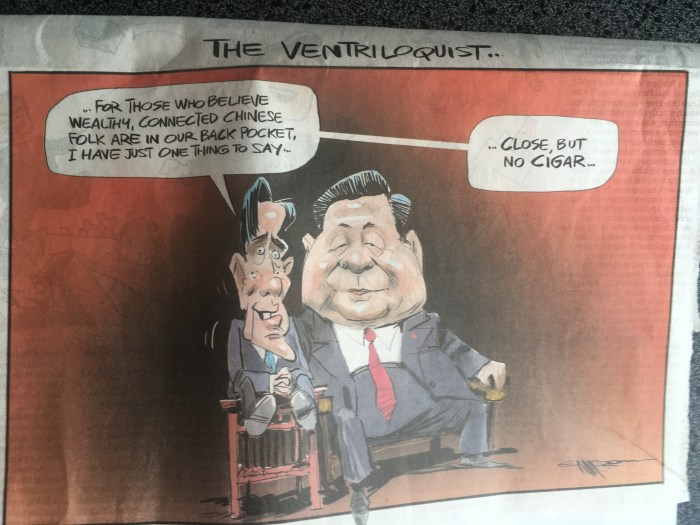
And finally, the Herald ran this cartoon on Saturday

ventriloquist

It is good that they are airing the issue.  But it still puts the responsibility on Beijing, and not where it actually lies, with our political leaders and heads of political parties.  Beijing does not force them to do or say (or not say) anything. They are moral agents, and they freely choose to allow the interests of New Zealand and New Zealanders to be compromised by their willing pursuit of, and association with, money rather strongly tinged with PRC political agendas and interests.

I was dipping into the famous Francis Fukayama book The End of History and the Last Man yesterday.   In his introduction he includes this line

For democracy to work, citizens need to develop an irrational pride in their own democratic institutions

That sounds generally right –  the fierce attachment that creates a willingness to defend something when it is threatened.  Given the way our political leaders are debauching New Zealand institutions at present, any such pride almost has to be irrational.  But perhaps there is a potential leader somewhere who will help restore our system?  Bob Jones played that role –  as regards the economic mess New Zealand had gotten into – in 1983/84.  The present challenge is greater, because all the main parties are equally compromised.  But so is the need for action.

UPDATE: Late this aftermoon today I was rung by Roy Morgan Research and participated in a quite detailed survey about trade, defence, values etc issues as regards New Zealand and each of Australia, India, Japan, China, and the United States.   Whoever was behind the survey (the Asia NZ Foundation perhaps?) I hope we eventually get to see the results.


The void where an economic strategy should be

During the week, rather lost amid the Jami-Lee Ross claims and counter-claims (how did a major party have the indecency to keep on rapidly promoting the man when their hierarchy clear knew at least a couple of years ago –  and kept quiet about – his character?  Unless of course, the main required quality for a National MP is now fundraising –  often of the most questionable kind –  not character or legislative/policy skills) the Prime Minister announced the membership of her Business Advisory Council.

This is the group

Prime Minister’s Business Advisory Council members

Christopher Luxon (Chair)                  Air New Zealand
Peter Beck                                                Rocket Lab
Barbara Chapman                                 Professional director
Jacqui Coombes                                   Bunnings
Anna Curzon                                           Xero
Andrew Grant                                        McKinsey & Company
Miles Hurrell                                          Fonterra
Bailey Mackey                                        Pango Productions
David McLean                                        Westpac
Joc O’Donnell                                          HW Richardson
Gretta Stephens                                     Bluescope/NZ Steel
Rachel Taulelei                                      Kono
Fraser Whineray                                   Mercury

And the terms of reference are here.

Here is how the Prime Minister’s statement begins

Prime Minister Jacinda Ardern has announced a diverse cross section of leaders from the business community will form her Business Advisory Council to advise the Coalition Government as it works on building a productive, sustainable and inclusive economy that improves the wellbeing of New Zealanders.

And here is how she was talking a couple of months ago when the Council was first foreshadowed.

“The Council will provide a forum for business leaders to advise me and the Government and to join us in taking the lead on some of the important areas of reform the Government is undertaking,” said Jacinda Ardern.

“The Council will report to me on opportunities it sees and identify emerging challenges. It will bring new ideas to the table on how we can scale up New Zealand businesses and grow our export led wealth.

“I want to work closely with, and be advised by, senior business leaders who take a helicopter view of our economy, who are long term strategic thinkers who have the time and energy to lead key aspects of our economic agenda.

Perhaps all the people on her group are very able at what they do.  Perhaps many are even good at thinking about the implications for their own businesses of specific technical advice.

But not one of them seems to have the background or skill set that suggests they have anything more to add to fixing New Zealand’s woeful economic underperformance –  over multiple decades –  than, say, the first 100 people in the Wellington phone book.

Drawing on old article from Paul Krugman, when this Council was first announced I wrote a post about how a company is not a country, and the skills that equip someone to run a company bear little or no relationship to those involved in identifying the economic failings, and appropriate remedies, for a country.

Expertise on economic management, and the particular confounding challenges the New Zealand economy faces, just aren’t the sort of thing that tends to be fostered in the course of a corporate career.   Many of these people might have been superb marketers, exceptional operations managers, corporate finance whizzes, smooth operators around the edges of regulation and the tax system, and have risen to assume overall responsibility for (by New Zealand standards) fairly large organisations. They are absolutely vital skills, and business roles done well are a big part of how, in pursuing the interests of shareholders, society is also made better off.   But those skills bear no resemblance to the issues involved in addressing long-term economic underperformance.  For a start, the things businesses have to take as given are precisely the sorts of things governments often can vary, and (as Krugman eloquently notes) the sorts of constraints even a large business faces are very different from those an entire economy faces.   And so on.

It is great that these individuals care about New Zealand’s economic performance, but there is no particular reason to believe that in general they will have more useful perspectives to offer than the average moderately-educated voter chosen from the phone book at random.  Running a business no more equips you to provide useful advice on economic policy more generally (as distinct perhaps from specific bits around your industry) than it does to, in Krugman’s words, write great poetry or make military strategy.

What isn’t clear is whether the Prime Minister genuinely expects this group to make a difference –  successfully identifying the key issues governments need to address –  or is simply buying a bit of time and goodwill with the big end of town in the hope that something will turn up.   One interpretation would suggest extreme naivete and the other a quite cynical approach.  Take your pick which you think is worse.  Perhaps it is just wishful thinking?  But whatever the answer, a year into the government’s three year term, there is no economic strategy, nothing that anyone credibly thinks will lift our long-term productivity underperformance, successfully reorient the economy outwards.    For a short time perhaps any goodwill around the creation of this council will paper over the void…..but a void it is.

Meanwhile,

  • the level of productivity is flat or even falling,
  • the export and import shares of GDP have been falling,
  • in per capita terms, the tradable sector of the economy hasn’t grown at all this century.
  • (and if we want to talk “inclusion” there is no sign of a structural fix to the housing o or urban land supply market),
  • while we are left with a structurally overvalued real exchange rate and the highest average real interest rates in the OECD.


What’s happening with immigration?

It is a serious question.  MBIE’s immigration data are pretty hopelessly poor –  not published in readily usable formats, not seasonally adjusted etc.   The Migration Trends and Outlook publication for 2017/18 is still not available.  I know they have plans afoot to improve things, but it is past time they did: immigration, after all, being one of the major instruments of economic (and social) policy in New Zealand.

But from time to time, I have a look at what they do publish –  huge tables in small fonts, from which one has to transcribe numbers if you want to do anything with them.  And the other day I had a look at the latest residence approvals data, and was quite surprised by what I found.

This chart shows the number of people approved for residence in each June year.  The 2018/18 number is the annualised number based on September quarter actual data.

residence 1

The “target” rate of approvals was around 47500 per annum for a long time, lowered slightly to something centred on 45000 per annum late in the previous government’s term.  As you can see, give or take 5000 or so people, they more or less meet that target. And so last year’s drop took me by surprise.  I didn’t make anything much of it then, when the numbers finally came to light: after all, announced policy hadn’t changed much, and perhaps it was just noise.

But the early data for the current year suggest something more than noise.  If the September quarter rate of approvals was kept up only about 33000 residence approvals would be granted in 2018/19.  Perhaps there is some seasonality in the series –  did I mention that MBIE don’t publish seasonally adjusted data, or make the raw data available in a form in which I could see for myself? –  but if not, it would represent quite an undershoot relative to the official target.

I don’t usually pay much attention to the nationality of those getting residence –  my arguments about immigration are mostly macroeconomic in nature, indifferent as to whether the migrants come from Bangalore, Birmingham, Brisbane or Beijing.  But as I’d been writing about the PRC and our political parties, out of curiosity I checked the residence approvals granted to people from the People’s Republic.  And finding those interesting, I looked a bit further.

residence 2

That (the blue line) is a staggering drop-off in approvals from China.   Again, perhaps there is some seasonality –  but it isn’t obvious why there should be, given that most residence visas are granted to people already in New Zealand, initially on other visas.

The falls in approvals from India and the Philippines are also pretty large.  And yet clearly the fall isn’t across the board. So far this year approvals from the UK are running at about the same (annualised) rate as last year (as were, more or less, when I checked, those from South Africa another significant source country, and those –  much fewer –  from Singapore and Taiwan).

I’m puzzled by what is going on.  I’d taken the new government at its word when it swore that it wasn’t changing the residence approvals target, but if not it looks as if something is going on that is markedly reducing the number of eligible people (especially from China and India) applying. (In another of the huge, not user-friendly, documents MBIE puts out, it looks as though there are also fewer applications in hand now than usual.) Perhaps it has something to do with the earlier wave of foreign students studying here, but although there has been a significant drop in numbers from India those from China haven’t changed much.  Perhaps there is something in the publicity around foreign investment restrictions –  which don’t of course apply to those who have residence?

I’m puzzled.  And, of course, I’ve spent years calling for a reduction in the residence approvals target, so in one sense I’m not unhappy to see the reduced numbers.  But I also strongly favour open and transparent policy, and there has been nothing announced suggesting that we should have been expecting –  or that the government was seeking –  such a large reduction in the number of residence approvals being granted.

If any officials or industry experts have informed insights on what is going on the comments section is open.


Thoughts prompted by the tape

What to take from Jami-Lee Ross’s tape of his conversation with his (then) boss?  I’m not interested in Bridges’s vulgar and insulting talk about his own MPs (although being, like him, a child of a Baptist manse, I can only surmise that he wasn’t raised to use that sort of language) or even that interested in the minutiae of whether and how donations are recorded and disclosed, including to the party hierarchy itself (significant as those issues probably are generally).

As compared to the situation a few days ago, we know that there was a $100000 donation to the National Party, initiated apparently (whatever final form the lesser components took) by Auckland businessman Yikun Zhang who (despite apparently coming here as a poor former PLA soldier 18 years ago) doesn’t speak English.   The first person I asked the other day about Yikun Zhang responded along the lines of “bad news”, and the more I read around the various sources which various Chinese speaking commentators have highlighted, the truer that summary description appears to be.

Several things struck me about the Bridges-Ross conversation:

  • the first was about how normal both of them  (one the leader, one the 8th ranked front bench MP) seemed to regard this sort of tawdry business.  Sure, fundraising is a vital function of a political party, but it is a far cry from Barry Gustafson’s description in his 50th anniversary history of the National Party: “an unwritten but scrupulously observed rule has always been that no MP should be placed in the position of seeking, receiving, or even being made aware of money collected on behalf of the party” (p201).   Perhaps (although I don’t know) National is no worse on this score than other parties, but it is a pretty bad situation that has been allowed to develop –  or, more to the point, actively fostered.
  • the second was about how utterly unbothered they were (leader and no. 8) about the Jian Yang situation.  Sitting in your caucus is a former PLA intelligence official, Communist Party member, close asociate of the PRC Embassy, someone who acknowledges misrepresenting his background when he came to New Zealand, and someone who even a former diplomat –  who knows him well – says he is careful about what he says in front of the man.  As leader, perhaps you are under pressure to defend the man publicly.  But perhaps, a very generous –  naive – observer might have thought, after last year’s fuss had died down, and some face saved, the party would be looking for a way to quietly retire, and replace, Jian Yang going into the next election.    But when Simon Bridges is caught talking about his colleagues, we hear about the unfortunate Maureen Pugh, about those (Finlayson, Wagner and Carter) everyone assumes would go before long,  but the only reference to “Chinese MPs” is to adding another one.  Jian Yang’s continued presence seems just taken for granted: none of that background stuff apparently bothering either of them in the slightest.  Lacking any decency themselves –  and not facing any uproar from other parties –  Jian Yang is presumably much too valuable in tapping the potential donors.
  • third was the utterly transactional way in which they approached the donation Yikun Zhang proferred (and presumably arranged) and the bid for another ethnic Chinese National MP.

    Ross: Yeah they’re good people. Now there’s no catch or anything to it. You may recall at the dinner they did discuss candidacy, and another Chinese candidate.

    Bridges: Two MPs, yeah.

    Ross: Colin Zhang? The younger one, he’s put his name in for Candidates’ College and so I assume he’ll get through and we’ll make some decisions as a Party further down the track as to what we want to do with candidates.

    Bridges: I mean, it’s like all these things, it’s bloody hard. You’ve only got so much space. Depends where we’re polling, you know? All that sort of thing…two Chinese would be nice, but would it be one Chinese or one Filipino? What do we do?

    Ross: Two Chinese would be more valuable than two Indians, I have to say.

    It was fine for Ross to say “there’s no catch or anything to it”, but everyone involved knows  how reciprocity works.  It is about an exchange of favours over time.  When, in the same conversation a wealthy businessman talks of a big donation and proposes that one of his staff might get a winnable place on National’s list, and they take the donation anyway, there is a quid pro quo, in expectancy, if not in some written contract.  No sense presumably, either at the earlier function or in this phone call of anything improper or unethical.  It is clearly just the way the National Party now does things.

But bad –  really bad –  as all this is, I think what disgusts me is the utter indifference of either Bridges or Ross (and to the extent there is ongoing silence from elsewhere in the party, or anywhere else in the political spectrum, the rest of our political class) to the character and interests of the man they were dealing with.  Not at a basic interpersonal level –  frankly it sounds hard not to be a nicer person than, say, Jami-Lee Ross –  but as someone actively and on an ongoing basis fully involved with the PRC government and its activities, in China and abroad.   And this seems to be the bit that most of our mainstream media is either missing or downplaying.

If we are going to have private funding of political parties (which I happen still to favour), the issue isn’t whether immigrants of whatever ethnicity or natives (of whatever ethnicity) should be able to donate to political parties.  It is much more specific than that, about whether political parties (openly or secretly) should be taking substantial sums of money –  indeed, actively pursuing it –  from people who they either know, or really should know, are in league with or in active support of hostile or egregiously awful foreign powers.  From people over whom the hostile foreign power has leverage, direct or indirect.  And when the egregiously awful foreign power has a track record of using threats, and economic leverage, to buy silence (or worse).    And with the question in the background: in what ways are we tailoring what we do or say –  party presidents, for example, praising the egregiously awful regime and its leader – to keep that donor flow going.

The issues could arise from somone in league with any egregiously awful foreign power but – not having many North Korean migrants –  the PRC is the one we in New Zealand need to be most worried about right now.  At some other time, it might have been the Soviet Union, Nazi Germany, or maybe even apartheid South Africa.  In the 1980s, emigre French business people, with close links to the DSGE, donating large amounts to our politicians, would rightly have attracted extreme disapproval.  There never were such donations, but today both main parties enrich themselves from donors with close ties to Beijing.

I noticed that Stephen Jacobi, the (NZ) taxpayer-funded lobbyist for keeping New Zealanders in line on things Beijing, was out today suggesting that perhaps state funding of political parties might be desirable after all.  His argument was a bit different from most though.

I haven’t seen anyone suggest that Yikun Zhang shouldn’t allowed to donate, or even to talk to politicians.  I have seen, and made, suggestions that our political parties shouldn’t touch his money –  or that channelled through bodies he runs or influences –  with a barge pole.   The suggestion is that the man is being “vilified”, but all I’ve seen so far is straight reportage –  often drawn directly from bodies he is involved on, or the Chinese language media – about his involvements and associations.  At least in Chinese –  he not speaking English –  he seems rather proud of and unapologetic for those involvements.

For those with Financial Times access, there is a nice article here which captures some of his close ongoing official involvement with the PRC government.  In a formal sense, he seems to have much stronger ongoing ties to the regime than (for example) Jian Yang does.   For others, and anyone interested, I suggest keeping an eye on these two Twitter accounts (both have been posting copious snippets of Yikun Zhang’s associations here and in the PRC): @geoff_p-wade and @jichanglulu.    As Wade (an Australian) urges

Reading the local media coverage, it strikes me that most of the local media is still reluctant to engage with the nature of the PRC United Front programme/agenda.   These aren’t just people who happen to have a few incidental ties to the homeland. Their organisations aren’t just neutral bodies.    The PRC is widely recognised as having an active agenda of influence –  and to say so isn’t vilification, but analysis, description, and reading.  As I noted, many of the links aren’t hard to find, at least for those with the language skills (to whom the rest of us can be grateful).   Some of it is even just pictures

This afternoon, for the first time in a while, I went back and read the whole of Anne-Marie Brady’s Magic Weapons paper, which has had so much attention (arguably more abroad than here, given the studied disinterest of our political leadership) since it was released last September.

Here are a few relevant snippets

United Front Work Department personnel often operate under diplomatic cover as members of the Ministry of Foreign Affairs, using this role to guide united front activities outside China, working with politicians and other high profile individuals, Chinese community associations, and student associations, and sponsoring Chinese language, media, and cultural activities. The Party has a long tradition of party and government personnel “double-hatting”; holding roles within multiple agencies. 17 Chinese consulates and embassies relay instructions to Chinese community groups and the Chinese language media and they host visits of high-level CCP delegations coming to meet with local overseas Chinese groups. The leaders of the various China-connected overseas Chinese associations in each country are regularly invited to China to update them on current government policies.

Yikun Zhang appears to have been on such missions regularly, and he (and the acolyte he wants to put into Parliament) are apparently in the PRC now (hosting the mayor of Southland).

And this longer piece

1. “Bring together the hearts and the power of the overseas Chinese”  Xi Jinping’s ambitious strategy to harness the overseas Chinese population for the CCP’s current economic and political agenda, builds on existing practices and then takes it to a new level of ambition.

Agencies: State Council Overseas Chinese Affairs Office, CCP United Front Work Department, Ministry of Foreign Affairs, Ministry of State Security, PLA Joint Staff Headquarters’ Third Department, and other relevant organs.

Policies:

• Monitor the local long term Chinese community via community organizations (侨务社团工作); establish Overseas Chinese Service Centres (海外华侨华人互助中 心) to coordinate this work, cherry pick which groups to work with.

• Sponsor and support the emergence of new united front organizations to represent the overseas Chinese, recognizing that they are a diverse group and flexibility is required to establish a positive working relationship with them. Avoid directly interfering in overseas Chinese community affairs unless there is a situation that directly affects China’s political interests,….

• Unite the ethnic Chinese communities through nurturing and subsidizing authorized Chinese cultural activities.

• Supervise Chinese students and visiting scholars through the united front organization the Chinese Student and Scholars Association (中国学生学者联合会).

• Encourage influential figures within the overseas Chinese community who are acceptable to the PRC government to become proactive in helping shape ethnic Chinese public opinion on political matters.

• Encourage wealthy overseas Chinese who are politically acceptable to the PRC government to subsidize activities which support China’s political agenda.

• Draw on China’s agents and informers abroad to enhance China’s political influence.

• Encourage political engagement of the overseas Chinese community (华人参 政). This policy encourages overseas Chinese who are acceptable to the PRC government to become involved in politics in their host countries as candidates who, if elected, will be able to act to promote China’s interests abroad; and encourages China’s allies to build relations with non-Chinese pro-CCP government foreign political figures, to offer donations to foreign political parties, and to mobilize public opinion via Chinese language social media; so as to promote the PRC’s economic and political agenda abroad.

It doesn’t seem unreasonable to wonder whether the Chao Shan General Association –  so much in the media in recent days as one of Yikun Zhang’s key involvements –  is not one of those “new United Front organisations”; able to attract many key figures of the New Zealand political establishment to its functions.

Political donations aren’t the whole story by any means.  They are simply the bit brought into focus, almost incidentally, in Jami-Lee Ross’s revelations of the questionable activities he was, apparently, a leading figure in.  The other half of the story is, of course, trade.  The PRC has a now-established track record of using economic coercion to attempt to silence any government that ever takes a stand or utters more than the meekest and mildest concerns.  As I’ve noted here before, most of what New Zealand firms export to the PRC is fairly homogenous commodities which if not sold to China would be sold somewhere else (someone else in turn selling to China).  In other areas –  notably tourism and export education –  there are greatly vulnerabilities. But no doubt representatives of all these industries also bend the ears of our political leaders, providing them another excuse for staying silent –  or worse, gushing in praise –  of one of the more heinous (and getting worse) regimes on the planet.   Perhaps it is really true that even without the donations, the politicians (all of them) would still lack any willingness to speak out, but the donor flow –  whether direct or through charity auctions – seems likely to reinforce the supine shameful state of New Zealand political leaders as regards the PRC.

The situation needs to change, but not one person on the New Zealand political scene offers any hope of making it happen.  Jami-Lee Ross probably only wanted to be at the top table making the “sellout” of New Zealand longer-term interests and values happen his way.  I did a media interview yesterday about some of these issues, and was asked about the potential cost of making a stand –  even just separating ourselves from Beijing-affiliated ethnic Chinese money.  As I noted to the interviewer, the only real test of what you value is what you are willing to sacrifice  –  pay a price –  for.  On the evidence to date, the integrity of our political system –  let alone the freedoms of other democratic states in east Asia –  clearly isn’t one of those things for the current crop of politicians, from any party.

Bernard Hickey has a nice article on some of these issues at Newsroom.  I agree with most of what he says, and commend it to your attention.   Of the Prime Minister’s responsibility he writes

Prime Minister Jacinda Ardern has been conspicuous in her lack of comment on Jian Yang and on the role of Chinese influence in New Zealand politics. She has also not criticised China directly over its South China Sea incursions or the persecution of minorities in China.

She should draw a line under New Zealand’s acquiescence to China and review the transparency of the Electoral Finance Act in relation to overseas influence. She should call for Jian Yang to resign from Parliament at the least, and follow the example of her Australian counterparts by asking for an official inquiry into China’s influence in politics here.

The Prime Minister talked a good game about human rights and sovereignty at the United Nations recently. How serious is she when her own party’s finances may be affected by pushing back against China?

Not talking, as the PRC Embassy reported her recently, of strengthening ties between the Labour Party and Communist Party of China.

And, finally, Anne-Marie Brady has re-linked to a couple of pieces she wrote late last year (here and here) on what can and should be done, including by the new government.  I will always defer to her expertise on the nature of the PRC programmes and interventions, although in thinking about policy responses, she probably put relatively more emphasis on national security issues, (while –  charitably? – presuming governments will want to do something serious), while I tend to emphasise the problems that lie within our own political processes.  In my view, it isn’t that people don’t know what could be done, rather that our politicians simply don’t want to do anything, or be seen to express serious concerns.    In that sense, the bigger problem –  the one we could control but refuse to –  lies here, not in Beijing (evil states will do what evil states do, including suborning the locals, encouraging the mindset of a tributary. Our political processes –  in a state far away from Beijing, and simply not that reliant on them for anything much –  make choices whether to fall into line, or whether to stand up.   Of course, one test may loom quite soon: what, if anything, will our government be prepared to do if is found that PRC agents were responsible for the break-ins at Anne-Marie Brady’s house and office.  Will we even be told?