The China Council defends itself

After my interview on Morning Report yesterday about Jenny Shipley and the New Zealand China Council, the Executive Director of the China Council Stephen Jacobi was tweeting that it had been a “hatchet job”.    This morning Radio New Zealand interviewed him: he observed that my comments, noting that the China Council in effect served as a propagandist for Beijing’s interests, had “put me off my muesli”.

It was a fairly soft interview that really did nothing to dispel the suggestion that the China Council – substantially funded by the government, with two very senior public servants on the Board –  serves, in effect, as a propagandist for Beijing’s interests.  The fact that the people involved probably think they are primarily serving their own commercial interests, and perhaps even some warped conception of the national interest, doesn’t change that.   Unfortunately, the interviewer didn’t ask Jacobi for a single example of a case where the China Council had been critical of the PRC.  For the record, I haven’t been able to find a single example.   Around a regime so egregious –  in the way it operates at home, in other countries, in New Zealand, in commercial and in political spheres –  that really tells you all one needs to know.   It looks a lot like a body solely motivated by deals, dollars, and donations, and using public money to try to keep the public quiet.   When you treat as normal a regime that represents so much that is evil, you serve their ends, even if that is not necessarily your conscious intent.   A well-publicised gala dinner for the emissary of the CCP/PRC, just helps make that more egregious.  Supping with the devil, without even a desire for a long spoon.

But the interview probably was useful in explaining to listeners some of how the China Council works.  It is an incorporated society, sponsored by the previous government, with substantial government funding (and senior public servants on the Board).  The rest of the funding comes from the corporate or individual members of the Council, who are able to leverage the government funding to advance their business interests around the PRC (not necessarily directly –  as Jacobi notes, Fonterra doesn’t need the China Council to handle its relationship with the PRC –  but in managing the climate of opinion in New Zealand, attempting to neutralise any criticisms of the PRC).  There is no PRC government money involved, but two of the Executive Board members also hold positions in PRC-sponsored entities in China (the Confucius Institute worldwide programme and the Boao Forum).   One of the Advisory Board members was a former member of the PRC military intelligence system, and a Communist Party member.

Jacobi claims that the China Council works for all New Zealanders and in the national interest. You might have supposed that that is what we have the Ministry of Foreign Affairs and Trade (even NZTE) for, and what we elect politicians for.  The former work to politicians, and the politicians themselves we can toss out.    The China Council seems more about trying to articulate a view of the national interest that happens to suit the commercial imperatives of those involved.  Of course, it is pretty well-aligned with the views of senior figures in both main political parties, which boil down to “if at all possible, never ever say anything that might upset Beijing”, while cowering in the corner even when friends and allies (or fellow New Zealanders) are under attack.  If a life worth living is about more than just dollars, it is a pretty sick conception of a “national interest”, although easy to see how it might be in the narrow individual business interests of some firms, universities etc.   Jacobi claimed that none of the people involved would allow themselves to be duped or a mouthpiece for a foreign government.  At one level I’m sure that’s true: they aren’t duped, they are simply prioritising their commercial interests over any sense of decency, or of the integrity of our own political and social system.   These things just don’t matter (enough) to them.

I had a look yesterday at the rules of the China Council

china council rules incorporated society

I was interested to learn that, for a body set up and sustained by the government, allegedly to advance the “national interest”, actually it is a self-perpetuating oligarchy.   You can only join this Council (not the Executive Board, but the society itself) if you are invited to do so by the Executive Board.  And who appoints the Board?  Why, the Board itself appoints its own members.    In a genuinely private organisation that might be just fine  (their choice) but this is a publicly-funded, government-sponsored body, where two of our most senior public servants themselves sit on the Board.   Don’t expect (for example) Anne-Marie Brady to be showing up on the council any time soon –  a Council that can’t even bring itself to express concerns about the way a New Zealand citizen, expert on the PRC, appears to have been harrassed and worse by people rather more directly attempting to serve PRC interests.

As I said, it was a pretty soft interview.   Jacobi was asked about my suggestion that the Council never ever says a word critical of the PRC.  He parried this by observing (correctly enough) that they do note from time to time that there are differences in our systems, and that he even says (again from time to time) that the way we interact with the PRC needs to take account of our values.    But it just doesn’t make any practical difference, and neither Jacobi nor his masters (on the Executive Board or in Wellington) seem to want it to.  Such things shouldn’t get in the way of the dollars (whether exports or political party donations).    When news of possible ban on Huawei emerged, the China Council’s statement seemed a lot more concerned to protect Huawei than it did about the national security etc of New Zealand.  When the GCSB was issuing a statement about PRC state-sponsored intellectual property theft, the China Council was totally silent –  not a press statement, not a tweet nothing.    When serious concerns have been raised by Jian Yang’s past, included acknowledged misrepresentations on his immigration/citizenship forms, the China Council goes into bat for this former PRC intelligence officer, keeps him close on their Advisory Council, and repeatedly attempts to invoke the x word.   When public debate, led by the work of Anne-Marie Brady, gets going, the China Council can only lament it.  It never substantively engages –  for example with the specifics of Brady’s work.  And that is the sort of thing I mean when I say that the China Council (whatever their individual subjective intentions) objectively serves Beijing’s interest and ends.

As I said the other day, there might well be a place for some public funding for a serious think-tank or independent body devoted to serious analysis, research, and debate around the nature of the relationship with the PRC.  It is a big and a powerful country, with values very much not our own, and there are all manner of dimensions to a relationship.  The China Council is nothing of that sort –  in its own purpose statements, it is an advocacy body, championing ever-closer relationships with a regime so evil, with no serious interest in exploring risks, threats, or downsides.  That serves Beijing’s interests.

Towards the end of the interview Jacobi was asked about the position of Jenny Shipley on the China Council’s Executive Board.  Jacobi attempted to parry that by suggesting it was above his pay grade (a matter for the Executive Board) –  which might leave one wondering why Don McKinnon (the chair) didn’t front up instead.   Jacobi told us that McKinnon had spoken to Shipley, but said that he wasn’t aware of the content.    With a full week having now passed since the High Court judgment was handed down, and with the Prime Minister not willing to express any concern, it looks as though she is going nowhere.  In fact, Jacobi went on to speak highly of Shipley (former Prime Minister, “widely respected in China”), and to note that the China Council is not a financial institution or a commercial organisation.  That’s true.  It is more than that; it is a New Zealand government sponsored organisation.    I’m sure there is some fondness for Shipley in Beijing –  cover for Jiang Zemin against protestors all the way through to interviews declaring how wonderful the Belt and Road Initiative is.   But this is someone who presided over the failure of a major company in New Zealand, allowing it to trade for years while insolvent, failing in her basic duties.   That isn’t acceptable conduct in New Zealand.  A person with that track record –  perhaps especially when a former Prime Minister –  shouldn’t be holding high-profile semi-government appointments.  For her to keep on doing so tells you about the Prime Minister’s, the Foreign Minister’s, and the China Council’s Board and Executive Director’s values and priorities.  Again, it wouldn’t appear to be decency and integrity.

As it happens, skimming through the China Council rules I came to the section headed “Expulsion”.  It had this provision under which the Board could expel a member

expulsion

Seemed to cover the Mainzeal situation and the recent High Court ruling quite well.

But if the self-perpetuating business and political people on the China Council board –  including the Secretary of Foreign Affairs no less –  think Shipley’s ongoing presence among them isn’t unbecoming or damaging to their interests, it really probably tells you all one needs to know about the tawdry China Council, simply pursuing the dollars and always looking away from the evils –  at home, abroad, and here –  of one the worst regimes on the planet today.  Propanda isn’t just telling upbeat lies, it can include minimising evil and treating as normal and respectable the perpetrators of those evils.

But quite at home with Ardern, Haworth, Bridges, McClay, Goodfellow and the rest of our political “leaders”.

Postlude

In a post the other day, I ran an extract from this article about PRC forced labour camps from the Italian site Bitter Winter.  A prominent New Zealander later told me it had shaken him.  Here is another extract

The living conditions in prisons are deplorable. Prisoners often eat vegetable-leaf soup with insects floating in it. As a result of malnutrition, they often feel dizzy and do not have the strength to work.

To ensure that prisoners complete their work even when physically exhausted, the prison authorities resort to torture.

The interviewees report that prison guards incite the more vicious prisoners to discipline other inmates. Thus, it is common to be beaten by “prison bullies” when someone fails to complete the task. Mr. Zhu told Bitter Winter, “If a prisoner cannot complete their task, the prison guards will tie the prisoner’s hands and feet to an iron fence, and they are forced to stand continuously except during meals. Whether in winter or summer, they remain continually tied up for three or four days and aren’t allowed to sleep.”

This sort of thing is just fine by the China Council, Jenny Shipley, or Stephen Jacobi?  Or do they just not care.  Hard to tell which is worse.

We can’t fix other countries.  We can demand some self-respect and decency around how we do things here.   Neither Jian Yang nor Jenny Shipley has any place near a China Council that really served New Zealand interests, consistent with New Zealand values.


 

“The 30 billion dollar whim”

A week or two back I foreshadowed a forthcoming paper by my former colleague Ian Harrison reviewing the Reserve Bank’s proposals under which the banks would have to greatly increase the volume of capital simply to carry on doing the business they are doing now.

Like me, Ian spent decades at the Reserve Bank.  But much of his time was spent specifically in the area of banking regulation and bank supervision, including leading much of the modelling work done a few years ago as part of the Basle III process, which resulted in something like the current bank capital requirements.   He knows the detail in this area, has consulted on this sort of stuff since leaving the Bank, and has invested a great deal of time and effort over the last couple of months in getting to grips with the Bank’s proposals, reviewing the various papers they’ve published, and going back and reviewing the papers the Bank has cited in support of their case.   The result is his (50 page) review document.   Here are his key conclusions (overlapping in various places with points I’ve made in post here). Ian does not pull his punches.

Part two: Key conclusions

1. The ‘risk tolerance’ approach is a backward step that ignores a consideration of both the costs and benefits of the policy. The soundness test is based on an arbitrarily chosen probability of bank failure that ignores the cost of meeting the target. The Bank has ignored its own cost benefit model which did take the probability of bank failure, the costs of a failure, the interest rate costs of higher capital and societal risk aversion into account.

2. Bank decision based on fabricated evidence. The Banks’s decision to pursue a 1:200 failure target was purportedly based on evidence from a version of the Basel advanced model. It was manipulated to produce the right answer. Initially, a 1:100 target was proposed, but when this couldn’t generate a capital increase, the target was switched to 1:200 at the last minute.

The Bank’s model inputs were not credible. It was assumed that all loans were higher risk business loans and that the probability of loan default, a key model input, was more than two and a half times the estimates the Reserve Bank has approved banks to use in their capital modelling.

The Bank’s analysis was embarrassingly bad, so it attempted to cover this up with a subsequent information paper that was written after the decision was made, and after the Consultation paper was released. It reached the same conclusion on the required level of capital, but only by assuming a 1:333 failure probability, and by using model inputs that were still not credible.

3. A 1:200 target can be met with a capital ratio of around 8 percent. If the Basel model were rerun using credible inputs if would probably show that a 1:200 failure rate can be met with a capital ratio of around 8 percent.

4. The policy will be costly. The Bank has down played the interest rate impact of the policy, saying any increases will be ‘minimal’. Based on its own assessment of the interest rate impact, the annual cost will be about $1.5-2 billion a year. The present value of the cost of the policy could be in excess of $30 billion.

A homeowner with a $400,000 mortgage could be paying an additional $1,000 a year. A business with a $5 million loan could be paying an additional $50,000.

5. The Bank’s assessment that the banking system is currently unsound is at odds with rating agency assessments and borders on the irresponsible. The rating agancies’ assessment of the four major banks is AA-, suggesting a failure rate of 1:1250. The Bank is now saying that, at current capital ratios, the banking system is ‘unsound’ because the failure rate is worse than 1:200. Or in other words the New Zealand banking system is not too far from ‘junk’ status. The international evidence does not support the Bank’s contention that the probability of a crisis is worse than 1:200. The Bank has ignored the fact that banks will need to hold an operating margin over the regulatory minimum, and has not adjusted New Zealand capital ratios to international standards to make a fair like-for-like comparison.

6. The Bank‘s analysis ignores the fact that the banking system is mostly foreign owned. Foreign ownership increases the cost of higher capital because the borrowing cost increases flow to foreign owners. Foreign owners will support their subsidiaries in certain circumstances, which reduces the probability of a bank failure. There is little point in having a higher CET1 ratio than Australia, because if a parent fails then it is highly likely that the subsidiary will also fail, because of the contagion effect. A New Zealand subsidiary might still appear to have plenty capital, but depositors will run and the Reserve Bank and government will have to intervene.

7. The Australian option of increasing tier two capital has been ignored. APRA is proposing to increase bank capital by five percentage points, but will allow banks to use tier two capital to meet the higher target. This provides the same benefits, in a crisis, as CET1 capital, but at about one fifth of the cost. New Zealanders will be required to spend an additional $1.2 billion a year in interest costs for almost no benefit in terms of more resilience to a severe crisis.

8. The benefits of higher capital are modest. Most of the costs of a banking failure are due to borrowing decisions made before the downturn. This will impose costs regardless of the amount of capital held. With current levels of bank capital failures will be rare, with the main cost likely to be a government capital injection. The experience with most banking crises, in countries most like New Zealand, is that governments have recovered most of their costs when the bank shares are subsequently sold.

9. The Bank is mis-selling insurance. The Bank is selling a form of insurance to the New Zealand public, but it vague about the premium costs and has exaggerated the benefits. The premium is the $1.5-2 billion. The benefit would be around a 10 percent reduction in the economic cost of a financial crisis, with an expected return of a few tens of millions.

An informed, rational public would not buy this policy.

10. New Zealand banks already well capitalised compared to international norms. A recent PricewaterhouseCoopers report argued that if New Zealand bank capital ratios were calculated using international measurement standards they would be 6 percentage points higher, placing New Zealand in the upper ranks of well capitalised banking systems. The Reserve Bank critised some details in the report, but has not produced is own assessment as Australia’s APRA has done.

11. The Bank has forgotten about the OBR.   The Open Bank Resolution (OBR) bank failure mechanism, was originally conceived as a substitute for higher capital to reduce fiscal risk, and to reduce the costs of a bank failure. While banks are been required to spend almost $1 billion on outsourcing policies to supportthe OBR, it does not appear in the capital review at all – despite the Governor’s arguments that the main justification for capital increases is to reduce fiscal risk.

The bottom line?

An informed, rational public would not buy this policy.

But, as it happens, an informed rational public won’t get a say. The Governor proposes and (under New Zealand law) disposes: prosecutor, judge, jury, and appellate court in his own case.

Partly, I gather, for his own amusement, and partly to help respond accessibly to some specific assertions/arguments in the more accessible material the Bank has put out to support the Governor’s case, Ian has a separate document, the Pinocchio awards.

pinocchio 2pinocchio 1

The Governor is a great deal smarter and more analytically capable than Donald Trump, but on Ian’s reading, he is resorting to the financial regulator’s equivalent of questionable Trumpian rhetoric to champion the indefensible.  Against Trump there are the courts and Congress.  Against a Governor with a whim and the bit between his teeth……well, nothing really.

It would be interesting to see what the Reserve Bank makes of Ian’s arguments and evidence.

UPDATE: A fairly accessible summary of some of Ian Harrison’s key argument in this article by veteran journalist Jenny Ruth.


Shipley and the China Council

Last week I wrote a post about Jenny Shipley’s position in the wake of the High Court judgment against her and other directors of Mainzeal.

I noted then that her position as chair of the local China Construction Bank was almost certainly untenable.  Even if, for some reason, the owners (the parent bank) had still been happy to have her, the Reserve Bank could not have allowed her to remain in her post and still retained any credibility around its “fit and proper person” regime. The Mainzeal board, chaired by Shipley, had continued trading for years with negative equity, with only the weakest suggestions of possible support from the parent.  Corporate law is designed to protect creditors from that sort of corporate (mis)governance.

Shipley has now announced that she will be leaving the China Construction Bank board.   We don’t know how much of a role the Reserve Bank played in that departure. No doubt they would hide behind the Official Information Act (or worse, section 105 of the Reserve Bank Act) and refuse to tell us.  That is a shame: it is a lost opportunity to demonstrate to the public that the regime has teeth when it comes to seriously problematic individuals. Mind you, I guess it might also leave them open to questions about how it is that they were happy to have Jenny Shipley chairing a New Zealand bank for the last several years, as more and more information about the Mainzeal situation emerged.

The focus now turns to Shipley’s role on the Executive Board of the New Zealand China Council.   In my earlier post I commented on this only briefly

As for Shipley’s membership of the executive board of the China Council……surely that tawdry taxpayer-funded body that sticks up for Beijing at every turn, has Jian Yang on its advisory board, defends Huawei, and won’t stick up for Anne-Marie Brady is just the place for her?  Then again, if the government doesn’t want the last vestiges of any credibility its propaganda body still has to be in shreds, they should probably remove her too. 

Shipley has clearly been very much in the good graces of Beijing over the years.  It wasn’t long ago that she had actually been on the parent board of the China Construction Bank, and she is now on the board of the regime-sponsored Boao Forum.   She has a long history of giving cover (literally in this case) to Beijing, going back to her brief time as Prime Minister.   Even that interview she gave to the People’s Daily back in December suggests a strong (and useful to Beijing) alignment between her public views and the preferred stances of Beijing.

But it isn’t clear whose interests are now really being served if she remains on the Executive Board of the China Council –  except perhaps those like me who poke the stick at this taxpayer-funded pro-Beijing advocacy and propaganda body.

Perhaps it suits Beijing to have such a tainted individual on their tame domestic lobby group.  See, democracy  and ‘doing the right thing’ is so enfeebled in New Zealand that our friend gets to retain her public position despite the very evident systematic poor governance on display at Mainzeal.   Perhaps, but Shipley’s failings are now sufficiently evident –  and will now always be associated with her name – that is doesn’t look as though it would really help the cause of keeping New Zealanders lulled into obliviousness about the nature of the regime.  The China Council is supposed to look like a bunch of decent public-spirited New Zealanders.

For similar reasons it can’t really be in the interests of the China Council itself for Shipley to stay on.  All the other, individually decent, people who sit on the Executive Board will be tarred by association.  You can’t so fundamentally mismanage a major business, resulting in huge losses for many people as a result of choices that were irresponsible and probably illegal, and expect to keep right on in prominent governance roles.    It wasn’t one small mistake early in someone’s career, but a big and very costly mistake for someone with the seniority and experience people should have been able to count on.  Shipley might still be well-connected in China, but there are other people with connections (if not, I’m sure Madame Wu at the PRC Embassy could help with introductions).  And everyone knows that neither corporate governance nor political governance in the PRC operate to the sorts of standards we expect in New Zealand.    If the China Council really wants us to believe that they champion New Zealand standing for New Zealand values, standards, and interests –  not just pre-emptively submitting to Beijing’s preferences – it should be in their interests too to get Jenny Shipley off their board, and quickly.

In a sense who owned Mainzeal shouldn’t be that relevant here –  the failure of the directors was alarming and unacceptable whoever the shareholders had been – but the fact that the firm was owned by someone originally from the PRC, and with extensive interests back there, just strengthens the argument around appearances.   The suspicion has been that, in effect, the China Council serves PRC interests more than those of New Zealanders.  A harsh critic might suggest something similar (perhaps unfairly) about the Mainzeal board.

And it shouldn’t be in the government’s interest for Jenny Shipley to remain on the China Council board either.  I was staggered at the way the Prime Minister the other day sought to avoid any responsibility or any involvement.

Prime Minister Jacinda Ardern was earlier asked whether she had any problem with Shipley being on the New Zealand China Council. She said it was not an appointment the Government had any role in.

The rules of the incorporated society that is the China Council are not readily available, so I’m not sure quite what the formal mechanism is for appointments to the Executive Board.  The China Council’s website also doesn’t say.   But it shouldn’t matter greatly.  The government pays

The Council receives approximately two thirds of its operational funding from the New Zealand Government through an annual grant from the Ministry of Foreign Affairs and Trade. 

[UPDATE: The latest set of accounts suggest just under half now, but with the government clearly the single largest funder.]

and very senior government officials serve on the Executive Board with Shipley.

The Secretary of Foreign Affairs and Trade and the Chief Executive of New Zealand Trade and Enterprise are both ex officio members of the Executive Board.

It is a creature of the New Zealand government and the Prime Minister simply can’t avoid responsibility.  I wonder what the Foreign Minister –  no fan of Shipley –  thinks?  Is the Secretary of Foreign Affairs and Trade really comfortable serving on an Executive Board with someone like Shipley?

Perhaps there are discussions going on behind the scenes, but after a week since the judgment was handed down, it is quite inappropriate that Jenny Shipley is still on the Executive Board of this prominent government-funded body, and that the Prime Minister won’t express a view on the appropriateness of Shipley’s position.

I was debating this point with someone the other day who argued that if the Prime Minister expressed a view she would open herself to attacks from the National Party (presumably something about inappropriate interference, or upsetting (Todd McClay’s, Jian Yang’s, Peter Goodfellow’s friends in) Beijing).   Well, maybe, but I wouldn’t have thought Jenny Shipley, in her current position, is someone even National would want to touch with a barge pole.  Are those the sorts of business governance practices National wants to defend, in public?  I can’t imagine so.

And so if the Prime Minister won’t express concern about a senior figure, found to have grossly underperformed in a very prominent governance position, it risks looking as though (a) the Prime Minister isn’t bothered by such misconduct (generally) or (b) remains more interested in not upsetting friends of Beijing and Beijing’s sensitivities than about defending acceptable standards of corporate governance and decency here in New Zealand.  She associates herself with all the tawdriness of the China Council –  defences of Huawei, silence on Jian Yang, silence on Anne-Marie Brady, and a general reluctance ever to articulate New Zealand interests when, as inevitably happens, those sometimes clash with those of the PRC. Perhaps it buys her an easier life in the short-term.  In the longer-term it further corrodes whatever reputation for decency she might once have had.  It simply shouldn’t be in her interests, or that of the government, for Shipley to remain on the China Council board.  And no one really doubts that – as the agency holding the purse strings –  if she wanted Shipley gone she would very soon be gone.

Whatever other contributions Jenny Shipley may have made over the years, her record at Mainzeal now means that she diminishes the standing and reputation of any body or individual that continues to use her in governance roles, or which support her in such roles.  Foremost among those now, the Prime Minister and the China Council itself.   As one expert noted in the Dominion-Post this morning, the market has ways of taking care of these issues – Shipley (and her other fellow Mainzeal directors) might now struggle to get directors and officers liability insurance.   But those mechanisms can’t protect us when it comes to public bodies. Only leadership protects us there.  But at present there seems to be a void – an abdication – where leadership on this issue should be.

I did an interview with Morning Report on this issue this morning.  If they put the audio up I will link to it.  [UPDATE: In fact, here it is.]

UPDATE:  A reader has pointed me to where the constitution and rules of the China Council are online (details in a comment).  It appears that the Executive Board is self-selecting and self-perpertuating

CC rules

The point remains that if the Prime Minister, representing by far the largest funder, wanted Shipley off the Executive Board (a) she would almost certainly be gone quite quickly, and (b) even if she wasn’t, the PM would have made clear her refusal to countenance the standards of corporate governance on display in the Mainzeal case.

Unelected officials wielding too much power

The Governor of the Reserve Bank is currently consulting on his own proposal that would markedly increase the share of their balance sheets New Zealand registered and incorporated banks have to fund from equity.     Whatever the possible merits of this proposal –  saving some possible, but highly uncertain, costs in several decades’ time – it is an expensive proposition.   From the economy’s perspective, if his deputy is to be believed, we’ll all be poorer (level of annual GDP permanently lower) by about 0.25 per cent.  In present value terms, that is a cost in the range of $15 to $20 billion.    As for the owners of the banks themselves, they will have to stump up billions in new capital just to keep doing the business they are doing now.  Among other options, the Deputy Governor cavalierly observes, they could simply sell off part or all of their business (which seems to be one of the possible outcomes the Governor would quite like –  with no statutory authoritiy – to see).

All on a whim, supported by flimsy analysis at best.  And with few or no protections for citizens or for the owners of the directly affected private businesses.  Government in a free society shouldn’t be done this way.   And mostly it isn’t.   Mostly there are a lot more checks and balances.   But not when it comes to the Governor of the Reserve Bank exercising his extensive regulatory powers over banks.

Typically, if a bureaucrat has a bright idea about a new rule or law, he or she first has to persuade the bosses of their own agency.    Even if they are persuaded, the boss then has to persuade the relevant minister.  The minister might have to persuade his or her Cabinet colleagues (at which point other relevant government agencies will have input to the Cabinet paper).  And Cabinet may even need to persuade Parliament, a process which involves select committee submissions (which are public), deliberations and reports back, sometimes through a committee chaired by an opposition party MP.   Even if it is the minister who has the bright idea –  and ministers are actually elected, and can be tossed out again (either by the PM instantly or at the next election) –  it will still typically have to go through much the same sort of process –  referred to the relevant agency/department for advice, and so on as above.    Heads of agencies/departments don’t set out to gratuitously upset ministers, but they do have an degree of independent status and authority and can, and sometimes do, offer free and frank advice on a minister’s bright ideas.

Contrast that with what happens when the Reserve Bank has a bright idea around the regulation of banks (“hey, how about we double the amount of capital banks have to have?”).  If there are any formal checks and balances, they are about process only.  I’m sure staff still come up with ideas –  good ones and daft ones –  and not all of them are accepted by management.

But if an idea comes from the Governor, or is once accepted by the Governor, things quickly become all-but-unstoppable.   After all, all the power (around the regulation of banks) rests with the Governor personally.     Someone who wasn’t elected, and wasn’t even directly appointed by someone who was elected –  rather he was chosen by half a dozen faceless company director types who themselves have no accountability and little or no subject expertise.     All the executive power with in the Bank also rests with the Governor personally (not necessarily a problem in itself, except in conjunction with that extensive policymaking power).   If we blessed with a highly competent saint as Governor –  of equable temper, open mind, encouraging dissent etc etc –  none of this might matter much.    But such people will be (exceedingly) rare: we need to build institutional arrangements around the crooked timber of humanity; people with all their flaws, biases etc.   Few of us are as ready to acknowledge the weaknesses in cases we are advancing, championing, as might objectively be warranted.  That is human nature, not something to specific to central bank governors.  It becomes harder to change our minds the more we’ve nailed our personal colours to the mast.   Everyone recognises that, which is why most serious decisions involve multi-stage processes, appeal or review rights etc.  In the criminal system, you can’t be prosecutor, judge, jury, and appellate court in the same case –  even in places like the PRC, in the deference vice pays to virtue, they observe the form of distinctions like this, although not the substance.

And yet that is exactly how the bank capital proposals are handled.    It is not even as if there was any socialisation of the ideas, testing of the argumentation, with interested and/or expert parties in advance of the Governor’s proposal being announced.  Instead, with little or no preparation of the ground, the person who will be the final decisionmaker launched his radical proposal.   Understandably, he and staff now champion that proposal in public fora (interviews, speeches etc).  But how then do we suppose that the Governor will be able to bring the requisite degree of objectivity and detachment to the submissions that come in.       No doubt, he will do enough to get through the legal hoop of “having regard to” the material in the submissions, but that is much much too weak a standard when he is prosecuting a case in which he will also be judge.  Imagine a criminal case in which the prosecutor was also judge (and there were no substantive appeal rights): the prosecutor/judge might swear black and blue that they would take seriously defence evidence/arguments, but no one –  no one –  would regard that as a credible or appropriate model.   It isn’t either when it comes to multi-billion dollar regulatory decisions.

The problems are compounded when the people most directly affected by the Governor’s regulatory whims have to keep on his good side because the Governor wields a great deal of discretion around other things that matter to individual banks (approval of models, approval of instrument, approval of individuals).  That has typically left banks very reluctant to say anything much in public about what the Governor might be proposing, no matter how potentially costly or troublesome those proposals might be.  From their own perspective, that might be the best course open to them.  It isn’t a pathway to good policymaking, or robust decisionmaking around bank regulatory matters.

There is no need for things to be done this way.   A more-normal process would involve major policy decisions being made by the Minister of Finance, or preferably Cabinet.  The Minister would want to take expert advice from the Reserve Bank and from the Treasury, and it might even open to those agencies to champion their preferences in a consultative document.   But when unelected people are championing change, they shouldn’t also be the ones making final decisions, with no appeal or review rights.  (All the more so in a structure like the current Reserve Bank one in which all power rests with a single individual –  a highly unconventional, inappropriate, governance structure for major regulatory powers.)

The specific issues are totally unrelated, but I had much the same thoughts –  too much power resting with unelected unaccountable bureaucrats –  when I listened to the Police Commissioner on Morning Report yesterday asserting his absolute right to decide whether or not Police routinely carry guns.   (This is the same Police Commissioner who thought it appropriate to give the eulogy, praising the man’s integrity, at the funeral of a former policeman found to have planted evidence.)  The mantra of “operational independence” was chanted, in ways reminiscent of the Reserve Bank.

I’m not clear whether the Polce Commissioner really has the power he claims (although successive ministers seem to have been willing to defer to that view), but when I looked up the Policing Act it contained a high-level distinction between matters for the minister and matters for the Commissioner that seemed appropriate.

police

The items under 16(2) seem like exactly the sort of areas we don’t ministers involved in: the Minister of Police should never be able to tell Police to arrest, or not arrest, a friend or enemy  (any more than the Minister of Finance should be able to tell the Governor to go easy on bank x and hard on bank y, where cronies might be involved) or interfere in individual personnel decisions

But applying the law to all people without fear, favour or political interference is very different than a general policy question as to whether, say, Police should routinely carry guns.  That is the sort of choice (including about what sort of society we want to be, what risks we will accept, or not) that only elected politicians – directly accountable to us –  should be making.    The incentives are all wrong otherwise.  I’m strongly opposed to routinely arming Police, but I’m even more opposed to letting the Police Commissioner get away with assertions that it is a decision for him alone to make.  If that really is the law, it should be changed.    No matter how much Police Commissioners like to tell you they serve the public, historically they (and probably any bureaucracy) will tend to serve its own interests more.  Thus, I noticed an article in which the southern police commander, asked what kept him awake at night, replied that it was safety of his officers.  That is natural, and not even necessarily inappropriate (and health and safety laws apply to Police management too) but against that has to be weighed other interests – for example, the rights of law-abiding citizens not to live in fear of Police, the rights of innocent people not to be deprived of life by a Police officer acting rashly (it happens) and so on.  It is simply unreasonable and inappropriate to allow Police themselves to make such policy decisions.

Democracy isn’t perfect by any means, just less bad than the alternatives.  And one of those alternatives involves delegating a great deal of power to unelected unaccountable bureaucrats.   When big policy decisions –  whether about capital structures of banks, or routinely arming the Police force –  are involved, only those who are elected –  and thus able to be unelected – should be making the decisions.  And when officials are championing any particular cause, they shouldn’t be the ones making the final decisions, the more so when there are no appeal rights.  Too often, of course, it suits politicians to opt out –  not just here, it has been a huge problem in the US Congress for decades –  but if they aren’t willing to make and defend hard decisions themselves perhaps they should consider another occupation.   We want and need experts for (a) advice, and (b) implementation.  But the big choices should be made only be those whom we elect, and can toss out again.   Neither Adrian Orr nor Mike Bush has got themselves elected.


Banking crises are not bolts from the blue

The Herald’s economics columnist Brian Fallow devoted his column last Friday to the Reserve Bank’s proposal to massively increase the proportion of their balance sheets banks would have to fund by equity.  He ended on what seemed to be a moderately sceptical note.

So we are left trying to weigh a highly debatable but significant cost against an incalculable benefit.

As I’ve noted here, the sort of cost-benefit calculus we can glean from various Reserve Bank publications just doesn’t stack up at all.    In his speech the other day (which a couple of readers have suggested I was too generous towards), the Deputy Governor indicated that the level of GDP might be up to 0.3 per cent lower (permanently) as a result of these changes.    Call it an annual insurance premium of 0.25 per cent of GDP (and bear in mind that the estimates Bascand is using don’t take account of the implications of most of our banks being foreign-owned, which raises the cost to New Zealand).

If we knew with certainty that:

(a) adopting these much higher capital ratios would prevent a crisis in 75 years time that would have otherwise cost 40 per cent of GDP (recall that the proposals aren’t supposed to prevent 1 in 200 year crises, but are presumably supposed to prevent 1 in 150 years crises, and 75 years is halfway through 150 years –  the crisis could happen next year, or in year 149), and

(b) that the new higher capital ratios would be applied consistently for the next 75 years

that might be a borderline reasonable bet –  the benefits might roughly match the costs.

If you thought instead there was no more than a 50 per cent chance that the new policy would be applied consistently for 75 years  (and given how politics, personalities, and conventional policy wisdom has changed quite a bit, to and fro, since 1944 that seems generous) , you’d need to be preventing a crises twice as large for the insurance policy to be worthwhile.

As a benchmark for how serious these events can be, you could think about the United States since 2008.   Over 2008/09, the United States experienced the most severe banking crisis of (at least) the modern era, since (say) the creation of the Federal Reserve.   (The Great Depression itself was, of course, worse, but it was mostly a failure of monetary policy management and institutional design rather than a banking crisis).

I’ve shown this chart previously.  Real GDP per capita for the US and New Zealand from 2007q4.

crisis costs 2019

The United States was the epicentre of the systemic banking and financial crisis.  New Zealand did not experience a systemic banking crisis at all.  At least on the OECD’s estimates, the output gaps of the two countries were pretty similar in 2007.   And there is no just credible way you can come up with estimates that have the United States doing (cumulatively, in present value terms) 40 per cent of GDP worse than New Zealand.   Do the comparisons of the US with other OECD countries that didn’t run into serious banking problems –  eg Australia, Canada, Norway, Israel, Japan –  and you still won’t find cumulative output losses sufficient to justify the sort of tax the Reserve Bank of New Zealand wants to lump on our economy.

In fact, for what it is worth, here is the cumulative labour productivity (real GDP per hour worked) growth of the United States and those non-crisis countries for the period 2007 to 2017 (from the OECD databases).

United States 10.6
Australia 14.0
Canada 9.6
Israel 10.1
Japan 8.3
Norway 3.0
New Zealand 4.4

Sure, there are all sorts of other things going on in each of these countries.   But bad as the 2008/09 banking crisis was in the United States, it is all but impossible to come up cumulative cost estimates that would reach even 20 per cent of GDP (crisis country experience over the experience of non-crisis countries).

And if the Reserve Bank continues to believe otherwise, the onus should be on them to make the case, to set out their arguments, assumptions, and evidence.

(Note, that none of this is to suggest that the 2008/09 recessions were anything other than undesirable and costly.  Recessions generally are.  But there are lots of low probability bad things in our world, and not all of them are worth paying the price to try to prevent.)

But even having come this far, I’ve risked conceding too much to the Reserve Bank ‘s story.  In part, that is because the storytelling implicitly treats higher capital ratios as sufficient to spare an economy all the costs associated with a banking and financial crisis.  And in part (but not unrelated to the previous point) because it tends to treat systemic banking crises as bolts from the blue –  unlucky bad draws imposed on a country when the Lotto balls are selected.   Neither is true.

Unfortunately, Brian Fallow seemed to buy into some of this sort of implicit reasoning in his column.

But in a complicated and perilous world it is idle to suggest that stress tests or banks’ internal modelling can accurately quantify the probability and magnitude of a major economic shock that could threaten the solvency of banks. Or even forecast the nature of the shock: another global financial crisis, perhaps?

The last one inflicted the deepest recession New Zealand had suffered since the 1970s.

A pandemic against which we are pharmacologically defenceless? It’s 100 years since the Spanish flu killed more people than WWI.

International hostilities breaking out in some surreptitiously weaponised but systemically vital realm of cyberspace?

Or a more conventional geopolitical conflict? The current crop of world leaders do not inspire confidence.

One might note first that the stress tests the Reserve Bank requires banks to undertake have deliberately used highly adverse combinations of shocks (rising unemployment, falls in house prices etc).  They are deliberately designed to look at really adverse events.

One might also note that –  contrary to the implication here and in Geoff Bascand’s speech –  the banking crisis (failure of DFC, need to recapitalise BNZ) did not “inflict the deepest recession New Zealand has suffered since the 1970s”, rather it was one (probably rather modest) factor in a range of contributors (disinflation, structural reform, fiscal adjustment, downturns in other countries etc).

But what I really wanted to focus on were the final three paragraphs in that extract, which imply that banking crises arise out of the blue.  And they just don’t.  They never (or almost never) have.  Might they in future?  Well, I suppose anything is possible, but we can’t sensibly take precautions against everything.

The prospect of a serious pandemic is pretty frightening.  But awful as the episode 100 years ago was, it didn’t result in systemic banking crises.    Cyber-warfare sounds pretty scary as well, but it isn’t remotely clear how higher bank capital requirements protect us against that.   World War Two was dreadful, but it didn’t result in systemic banking crises either.    There was a serious financial crisis at the start of World War One, but it was a liquidity crisis not a solvency one, and capital requirements (then, or in some future unexpected outbreak of hostilities) are pretty irrelevant in a crisis of that sort.    Do the leaders of the world as individuals or a group command much confidence?  Well, no, but then in the last 100 years or so periods when it was otherwise seem rare enough  (the PRC and USSR border war of 1969 anyone)?  I suppose if we go back far enough a repeat of the Black Death –  wiping out a third of the population –  wouldn’t be great for the value of bank collateral, but (a) capital proposals aren’t supposed to counter 1 in a 1000 year shocks, and (b) you might think there would be bigger things to worry about then (and a high likelihood of statutory interventions to redistribute gains and losses anyway).

Systemic banking crises –  one where banks and borrowers lose lots and lots of money and 5 per cent, 10 per cent or more of bank loans are simply written off in a short space of time –  simply do not arise out of the blue, as decent well-managed banks and universally responsible borrowers are suddenly hit by some totally unforeseeable event.  Rather they are –  always and everywhere – the outcomes of choices made over the years (typically only a handful) previously.    Lenders and borrowers make bad –  wildly overoptimistic  –  choices, some just going along for ride, others actively pushing the envelope.  In the process, real resources in the economy in question are misallocated, perhaps quite badly, but that cost is something that is really only apparent (only crystallises) when the boom comes to end, whether it ends in a whimper or a bang.   Sometimes government policies can play a direct part in helping to generate the mess.  In the United States, for example, the heavy state involvement in the housing finance sector greatly exacerbated the imbalances that crystallised in 2008/09.  In Ireland, for example, entering the euro and taking on the interest rate fit for Germany and France when Ireland might have been better with New Zealand interest rates, was a big part of the story.  Fixed exchange rates have often been a significant factor, both giving rise to initial imbalances, and aggravating the difficult resolution afterwards).  Transitions out of periods of heavy regulation can play a role too: in New Zealand (and various other countries) in the late 80s, neither lenders nor borrowers really had much idea of operating in a liberalised financial system.  You can go through every modern financial crisis –  and probably plenty of the older ones too – and point to the excesses, the over-optimistic lending and borrowing that accumulated in the preceding years.  Japan –  crisis of the 1990s – was yet another prominent example (Zambia in 1995, a crisis I was quite involved in, was the same).

Would higher required capital ratios have prevented any (many) of these episodes?  One can’t answer with certainty.  They might have prevented some bank failures themselves, but that isn’t the issue I’m focused on here (which is about the bad lending/borrowing in the first place).    Perhaps a few banking systems really went crazy because creditors thought they could offlay all the risks on the state, but that isn’t a compelling story more generally.  After all, shareholders still stood to lose everything.   A more plausible interpretation (to my mind) of those periods of undisciplined lending/borrowing is that people simply misjudged the opportunities, and got carried away by excess optimism, in ways that meant they just pay much less attention to the potential downsides.  The world was different (so people were being told, or they told themselves).  If so, most of the misallocations of real resources would happen quite independently of the levels of bank capital requirements that were imposed.  And you can mount an argument that high capital requirements may tend to encourage banks to seek out more risks than they would otherwise take, especially in buoyant times, concerned to keep up rates of return on equity.    Even if that doesn’t happen, disintermediation would see more risks to be taken on in the shadows –  no less resource misallocation in the process, but rather less visibility to the authorities and resolution agencies.

Perhaps good and active bank supervision can prevent those excesses, and misallocations, building up.  But that is a (very) different case from one in which ever-more-demanding capital buffers  supposedly eliminate (or reduce to minimal levels) the costs when the bad lending crystallises.  It isn’t a case the Reserve Bank has made –  and they probably wouldn’t, as historically they have been (rightly) fairly sceptical about the value hands-on supervision can add.  And it is a case I am pretty sceptical of.   And for which there is not much evidence (even allowing for the fact that crises avoided tend to be not very visible).   Much as APRA likes to suggest it is an example (in the 2000s) I don’t think they were really tested.

Bank supervisors –  and their bosses in particular –  breath the same air as everyone else in a society, and when lending and borrowing in a particular country is going badly off course, it is unlikely that the bank supervisory agency will be taking (for long) a very different stance from those around them, and those who appoint them.   This isn’t an argument about corruption –  although regulators perceived to be realistic and responsive will no doubt attract a better class of well-remunerated job offer –  but about political and economic realism.  But even if better Irish regulators (say) could really have made a difference in the 2000s, what was really needed were different lending/borrowing practices, not just more capital.  More capital wouldn’t have avoided a nasty aftermath (even if it would have reduced some fiscal costs) –  and at the peaks of self-confident booms, capital is cheap and easy to raise.

And so we are brought back to the specifics of New Zealand where:

  • repeated stress tests conclude that our banking system is resilient to very very nasty shocks,
  • the Reserve Bank tells us at every FSR that the financial system is strong and sound,
  • we have control of our own monetary policy, including a floating exchange rate (34 years today),
  • we have healthy public finances,
  • we have little active involvement of the government is directing finance

Against that backdrop, and against the experience in which it is hard to conclude that banking crises themselves (as distinct from the bad lending that later gave rise to them) are worth more than a few percentage points of GDP, in a country not prone to systemic financial crises (the episode doesn’t even meet the test in many collections of crises), with our banks owned mostly from a country also with no track record of frequent serious financial crises, the case just hasn’t been at all convincingly for compelling banks to fund so much more of their balance sheets with equity.  Doing so will, on the Reserve Bank’s own telling, involve real economic costs.  For benefits that are, at best, tiny and far-distant.

It is disconcerting that in none of the Reserve Bank’s material do they ever show signs of engaging with any of this sort of analysis.  Instead, they have a policy preference and prefer assertions and flimsy analysis to any serious engagement with the issues and experience.

My former colleague Geof Mortlock has another piece on interest.co.nz making the case for splitting up the Reserve Bank and creating a separate Prudential Regulatory Agency.  I strongly agree with him on that –  and have argued the case here last year.  Geof is probably more optimistic than I would be about what bank regulators can add, but on this particular item we seem to be as one.   Among his long list of what is wrong with the Bank’s conduct of its financial regulatory functions, introduced thus

Geof Mortlock argues the Reserve Bank is about as much use as a financial regulator as is a cricket umpire who is nearly blind and who understands little about the game

is this:

the recent release of bank capital regulation proposals that would see banks in New Zealand being required to hold a very high level of capital compared to other countries, with potentially adverse consequences for borrowers’ access to credit, an increase in interest rates and adverse impacts on the economy – and all on the basis of shockingly flimsy analysis by the Reserve Bank.

Quite.


Standing for what they believe in

There was a story on Stuff yesterday (in the Domininion-Post this morning) about Air New Zealand’s “generous provision” of free airfares to the New Zealand China Council.  The China Council, you will recall, is the largely taxpayer-funded propaganda body set up by the previous government to champion good and quiescent relationships with the party-State in Beijing, the People’s Republic of China.  “Good” relations with the PRC, of course, means never ever saying or doing anything they don’t like.  Friendships aren’t like that.

Air New Zealand’s funding for the China Council bothers me no more or less than the mindset that governs the whole relationship with the PRC, whether among officials, politicians, or business leaders (and if there are any exceptions, they keeep very very quiet).  It seems that, pure and simple, it is all about the money – whether trade deals, sales in the PRC, or the flow of political donations.  If Air New Zealand wants to fly to the PRC, it needs to keep sweet with the regime, and needs to keep the New Zealand government (and public) on the straight and narrow, not making difficulties for them, as far as possible.  If the China Council can help them do that, why wouldn’t they –  having decided to sup with the devil – provide support for those who can help their cause.  It isn’t done out of the goodness of their heart, but out of pretty cold commercial calculation.   And since the taxpayer has already been coerced to cover much of the China Council’s activities, it is probably pretty cheap PR expenditure.   Whether Air New Zealand is majority state-owned (as it is) or not isn’t really relevant.

I don’t suppose most people associated with the China Council really see themselves as getting involved to serve Beijing’s interests (there might be exceptions –  individuals on the Advisory Board with close ties to the regime, including its United Front organisations, and individuals on the Executive Board –  including our former Ambassador to the PRC and our former Prime Minister – who hold positions in regime bodies).  Probably most of them think of themselves as serving “New Zealand’s interests”, but people have a funny way of interpreting their own personal (or business) financial interests as being much the same thing as the “national interest”; perhaps the more so, more money is involved.  But whatever story they tell themselves, they nonetheless objectively do serve the PRC regime’s interests.  That is the effect of their involvement, their choices, their silence.

When you walk by evil every day, when your organisation exists to minimise and distract from evil, when you are indifferent to the values of New Zealanders, and the abuse of those values in the PRC, you serve the regime’s end.  It is as simple as that.  And for a regime that is among the most evil on the planet today –  certainly the most of evil of those who in any material way impinge on New Zealand.  Air New Zealand is part of that.  So are Don McKinnon, Jenny Shipley, Tony Browne, Grant Guilford, Cathy Quinn and the rest of them (including their hired gun and front person Stephen Jacobi).

I’m an economist by training, so I’m quite happy to sign up to the notion that trade is generally mutually beneficial for those directly participating.  But each of us, actively or passively, makes moral choices about those with whom we deal.   Big companies and their bosses, even more than individual citizens, have real and effective choices.  Those who associate themselves with a tawdry body like the China Council reveal the nature of their choices, of their values.

It is not as if the China Council exists to encourage real and open debate about the PRC and how New Zealand should engage with, respond to, and deal with it.   Such a body might, arguably, be a useful thing for taxpayers’ money to be spent on.   After all, it is a big country, and that sort of debate doesn’t even exist to any serious extent in our universities –  keen on their PRC students, (several) keen on the (PRC) Confucius Institutes, and where the Contemporary China Research Centre is chaired by someone who helps promote the regime agenda through the Confucius Institute movement.

But that isn’t the China Council.  The China Council is about keeping the (New Zealand) peasants in line and pandering to the regime in Beijing – that gala dinner, for example, for the new Ambassador.   To make out that the PRC is a normal, honourable and decent regime.

Where’s the evidence?   All around really.  Reports (pretty lightweight ones) championing one of the regime’s key geo-strategic initiative (the Belt and Road), public statements defending Huawei (and never any examination of the other side of that story), the constant attempts to trivialise –  or tar as racist or “xenophobic” –  any serious debate about the PRC and New Zealand.  This, as a reminder, was from their Annual Report last year

An, at times, unedifying debate about the extent of foreign influence in New Zealand risks unfairly targeting New Zealanders of Chinese descent

And you’ve never seen the China Council engage with the substance of Anne-Marie Brady’s work, never heard them express concern about the apparent threats to Brady’s physical safety, never heard them express concern about the regime control of most of the local Chinese language media, never ever heard them express concern about human rights abuses –  on the most egregious scale – in the PRC, and never heard them express concern about the growing evidence of PRC attempts to interfere in countries around the world, about the threat to Taiwan, or the militarisation of the South China Sea.  We’ve never heard them express concern about PRC attempts at economic coercion –  other perhaps than encouraging pre-emptive submission.  They just aren’t a serious body.  They are a cynical propaganda body –  largely paid for by your taxes and mine – serving the business interests of those involved, and –  in effect –  the wider interests of Beijing,  The test: when there has been any clash between the interests/values of the regime and the interests/values of New Zealanders, have they ever openly sided with the latter?  Not once (that I’m aware of).

If the private sector was stumping up all the funding for this lobbying and propaganda effort, we might just call it freedom of expression I suppose.  If you choose to sell your soul, then (within limits) I guess you can champion your cause.   As it is, taxpayers’ money –  and the choices of successive New Zealand governments –  is being used to serve the personal interests of these businesses, and of the political parties concerned.   I’m not suggesting private or public companies should be banned from doing business in the PRC, but they should be told much more than is common anywhere that they are on their own.  Dine with the devil if you must, be take a long spoon, and don’t be asking for support from the rest of New Zealand.   But we’d be better off as a country –  have rather greater moral clarity –  if there was less business undertaken with the PRC, given the nature of the regime.  There might be a modest economic cost –  but it would be modest – but let’s be grateful that business interests weren’t allowed to distract us from eventually standing up and taking on the Nazi regime 80 years ago.  The parallels with the PRC today are almost too numerous to list.

But, of course, it isn’t just businesses that have sold their souls.  Successive governments and political parties are at it too –  recall those National and Labour party presidents off in China praising the regime.  This one seems to be no different in substance.

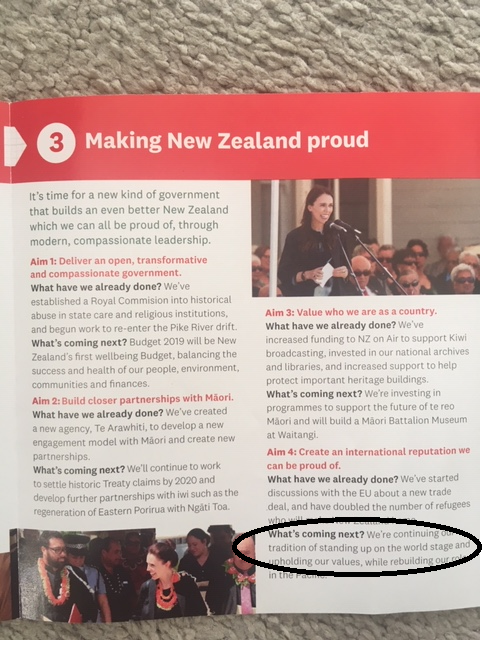
Yesterday a local Labour Party supporter dropped into my letterbox a Labour brochure headed “Our plan for New Zealand”, replete with photos of the Prime Minister.  I might write about the (lack of) economic substance in another post, but what caught my eye was this page.

ardern 2

The Prime Minister promises to “make New Zealand proud”.  How?  “By continuing our tradition of standing up on the world stage and upholding our values”.

And we are supposed to take this seriously?  A Prime Minister who will not talk openly about Xinjiang, who will not talk openly about the abducted Canadians, who will not talk openly about the militarisation of the South China Sea or the growing threat to Taiwan, who will not talk openly about the regime’s intellectual property theft, who says nothing about Jian Yang, who never utters a word about the sustained persecution of Falun Gong followers, Christian believers, civil rights activists and so on, and who won’t even stand up pro-actively in defence of Anne-Marie Brady.  If she herself won’t speak about, she also shows no sign of welcoming or encouraging those who do.

She probably isn’t any worse than the other lot (Todd McClay and the “vocational training centres” that are really no concern of ours), although her approach is made all the more nauseating by the pretence to representing something better –  all that talk of kindness, empathy, values, and so on.   The best test of a person’s values is how they choose to act.  Evidence to date is that our Prime Minister shares much the same “values” as the China Council –  don’t rock the boat, never stand for anything other than commercial interests (and party donations).  What you won’t pay a price for is in no serious sense a “value”.

I read this morning an article from the Italian site Bitter Winter.   Perhaps I could commend an article like this to the Prime Minister and to Mr Jacobi (or to Simon Bridges, Christopher Luxon, Don McKinnon, Tony Browne, Jenny Shipley, Jian Yang, Raymond Huo and the others).

One Christian who was previously assigned to work in a brick kiln described his working environment. “The brick kiln’s temperature can reach 60 or 70 degrees Celsius (about 140-160 degrees Fahrenheit). If prisoners are careless, they will be scalded, and their hair will be scorched. The prison authorities do not provide temperature-resistant shoes. Prisoners must stand on one foot, shifting from the left to the right. If someone spends too long on one foot, he will get burned and develop blisters. New prisoners couldn’t even last for five seconds before having to run out of the kiln. But whenever the manager saw someone running out, he would flog them with a pipe.”

Heavy labor made this Christian think about death. One time, after he tried to commit suicide, the team leader disciplined him by beating him and shocking him with an electric baton.

The living conditions in prisons are deplorable. Prisoners often eat vegetable-leaf soup with insects floating in it. As a result of malnutrition, they often feel dizzy and do not have the strength to work.

To ensure that prisoners complete their work even when physically exhausted, the prison authorities resort to torture.

The interviewees report that prison guards incite the more vicious prisoners to discipline other inmates. Thus, it is common to be beaten by “prison bullies” when someone fails to complete the task. Mr. Zhu told Bitter Winter, “If a prisoner cannot complete their task, the prison guards will tie the prisoner’s hands and feet to an iron fence, and they are forced to stand continuously except during meals. Whether in winter or summer, they remain continually tied up for three or four days and aren’t allowed to sleep.” In order to avoid corporal punishment, Mr. Zhu had to work hard to complete his production task.

I don’t suppose any of those people would be comfortable reading this sort of stuff (perhaps Jian Yang would be different –  he actually worked for the regime for years) but squirming slightly uncomfortably as you read it means nothing if you don’t –  when you can – do or say something.  There are plenty of areas in which I disagree with much of the consensus opinion of those who hold power in New Zealand, but what really upsets me about the PRC issue is the utter practical indifference to stuff these people all individually and privately know and agree is evil; stuff they’d not even considering supporting here.  And yet each of them choose –  by their actions and their passivity –  to give cover to such evil, on large scale and small.   They compromise themselves –  and they take our money to do it.

One day, I guess, they’ll be judged before the bar of history –  as the appeasers of the 1930s, the fellow-travellers with the Soviet Union were – but in the meantime I guess they’ll keep the dollars (deals and donations) flowing.  And evil will prosper just a little more because of choices those people make.

Wages and productivity

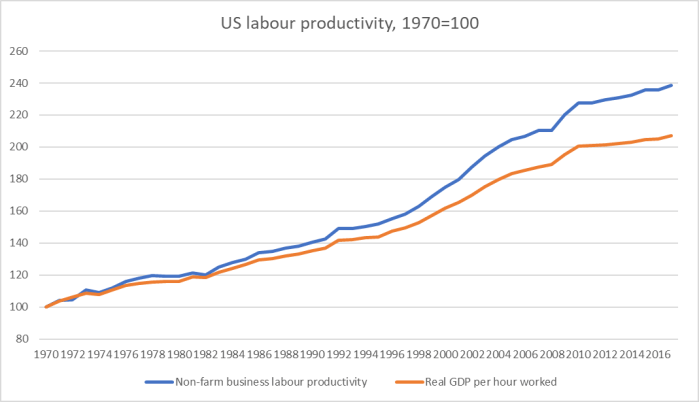
There has been a longrunning US debate/puzzle around the relationship (or apparent lack of it) between productivity growth and growth in wages/compensation. It was revisited earlier this week in a (very long) post on the excellent Slate Star Codex blog.  The author introduces his post with this chart, pretty familiar to anyone aware of this issue.

wages US

I’ve always found the issue interesting, but been content to do little more than read the occasional summary article.  Arguments often seem to turn on rather arcane measurement issues and I just don’t know the very detailed US data that well.

But as I read through the long post, I noticed something that probably hadn’t struck me previously.  The productivity measures used in this chart (and others like it) are those for the non-farm business sector.   That is the series that gets the most focus in the US, which makes some sense in that it is (a) regularly published by US official agencies, and (b) if you are interested in the performance of the business sector (and not wanting to be thrown around by climatic effects) it is probably natural to focus on.

By contrast, I tend to focus on measures of GDP per hour worked.   That is mostly because (a) it is what is available on a fairly consistent basis for a wide range of countries, and (b) because it is what is readily able to be calculated quarterly for New Zealand, using published data.  And my interests tend to be the economy as a whole.

In the US context it can make quite a lot of difference which series one focuses on.   In this chart, I’ve shown the two series, starting from 1970 (which is when the OECD real GDP per hour worked data starts from).

US productivity.png

It shouldn’t be much of a surprise that whole economy productivity growth is slower than that for the non-farm business sector: incentives (lack of them) and opportunities (types of activities governments do) both tend to work that way.

And then, of course, I noticed that charts like the first one tend to use real variables, which opens up all manner of issues about the “correct” deflator, including issues as to whether the CPI was well-measured in years gone by (there were some fairly significant biases).    But quite recently, I’d compared nominal wage growth in New Zealand to growth in nominal GDP per hour worked, which abstracted from deflator issues (even if it might raise other questions), so I thought I’d do the same for the United States.

I took the compensation per hour series for the US non-farm business sector (official US series) and nominal GDP per hour worked (from the OECD), indexed them all to 1970, and divided one series by the other.  This is the the result.

us compensation

On this measure, US wage growth has lagged a bit behind the growth in the overall economy “ability to pay”.  But it is a hugely smaller gap than is suggested by something like the (widely-used) first chart in this post.

Is nominal GDP per hour worked a reasonable benchmark?  I reckon it is.  Growth in nominal GDP per hour worked captures both real productivity effects and changes in the terms of trade (which have been adverse for the US over this fifty year period).    As ever, there isn’t likely to be some mechanical relationship between labour earnings and GDP per hour worked.  Market pressures shift over time, and so does (for example) the relative importance of capital in generating what growth there is.   Labour shares of the total economy’s output always have, and probably always will, fluctuate over time.   But it seems at least as good a benchmark against which to analyse developments as most others on offer.

Since most of my readers are from New Zealand, two final charts as a reminder of how things are here.

First, a chart comparing real GDP per hour worked with the measured sector labour productivity data.   We don’t have such long runs of data, so this is just since 1996.

NZ productivity measured and total

Unsurprisingly, whole economy productivity growth lags that in the measured sector (that excludes much of goverment activity).

And here is a chart I’ve shown previously showing how wages (the analytical unadjusted LCI series) have grown relative to nominal GDP per hour worked.

wages and GDP

Whatever the story in the US, wage rates in New Zealand have been increasing faster than nominal GDP per hour worked (loosely, “the ability of the economy to pay”).

That might seem quite good for New Zealand employees.  But it is worth bearing in mind that since 1995, we’ve had about 28 per cent growth in labour productivity (real GDP per hour worked) and the US has had about 44 per cent growth in economywide labour productivity.  The windfall of a higher terms of trade has helped us, but if your economy isn’t generating much real productivity growth it isn’t a good outlook for anyone much (workers or owners) in the longer term.


Fit and proper?

Should Jenny Shipley be on the board (actually chairing it) of the local arm of China Construction Bank?   A question primarily, you might have thought, for the owners (CCB in China), perhaps taking account of the views and behaviour of the bank’s customers and investors.  I’d be pretty hesitant about putting my money in a bank (or any other company) that had as the Board chair someone against whom there was the sort of civil judgement that was delivered yesterday by the High Court in the Mainzeal case.  But I’m not, so I don’t really have a strong view on the matter.   And I might be as worried about having a former primary school teacher with no particular expertise in banking, and no reputation for being willing to ask awkward questions and follow through, as chair of the Board of any bank I had money in.

The Reserve Bank doesn’t have the luxury.

And here I’m going to rerun much of an old post on the matter of “fit and proper” rules.

Under Reserve Bank rules (outlined here):

no appointment of any director, chief executive officer, or executive who reports to, or is accountable directly to, the chief executive officer, may be made in respect of the registered bank, and no person may be appointed as chairperson of the board of the bank, unless the Reserve Bank has been supplied with a copy of the curriculum vitae of the proposed appointee and has advised that it has no objection to that appointment.

“Fit and proper” requirements are pretty common internationally.  But citizens should reasonably ask “to what end, and with what evidence that the requirements make a useful difference?”

The Reserve Bank’s prudential regulatory powers have to be used to promote the soundness and efficiency of the financial system (sec 68 of the Act).  The focus of the suitability (“fit and proper”) tests is presumably on the soundness limb of that provision.  Prior Reserve Bank “non-approval” must be expected to reduce the threat to the soundness of the financial system (not just the individual institution, but the system itself).  How might it do that?  The Reserve Bank says it focuses on integrity, skills and experience.

At the (deliberately absurd) extreme, if the Reserve Bank were blessed with the divine quality of omniscience, they could see into the soul of each potential appointee, and discern accurately how those individuals would respond to the sorts of threats, risks, shocks ,and opportunities they would face while serving with a New Zealand registered bank.  No one prone to deceive under stress, to breach internal risk limits, or to take “excessive” risk would get appointed.  That sort of insight would be very helpful.  But it isn’t on offer.

Instead, the Reserve Bank’s document suggests a backward-looking focus – checking out past appointments, past criminal convictions, and the like.  All of which is fine, but all of that information is known (or knowable) to those at registered bank concerned who are making the appointment.  And most of the stuff that is really interesting, and telling, is likely to be about character.  That isn’t knowable in advance, and certainly not by Reserve Bank officials.  What expertise do Bank economists and lawyers –  many very able people – have in second-guessing the judgement of the banks themselves in making such appointments?  And what incentive do they have to get it right?  The model looks like one that favours the appointment of grey colourless accountants and lawyers, who have not yet blotted their copybooks – perhaps never having taken any risk – with a bias against anyone who has learned banking, and what it is to lose shareholders’ money, the hard way.

Banking regulators worry about the risks to depositors and taxpayers if widespread or large banking failures occur.  But the first people to lose money as a result of mistakes, misjudgements, or worse are usually the shareholders in the bank concerned.  They might reasonably be assumed to have more at stake from bad appointments of directors or senior managers than central bank regulatory officials do.  New Zealand has in place pretty demanding bank capital requirements.

No doubt there will be people (and perhaps there already have been) who were employed by failed finance companies coming up for Reserve Bank approval in the next few years.  In some cases, those people will have had no responsibility for the failure, and in others there may have been some culpability.  But business failures happen, and they aren’t always a bad thing (indeed, unlike some systems, our banking regulatory system is explicitly designed not to avoid all failures).  Why is the Reserve Bank better placed than the registered bank concerned to reach a judgement on whether any previous involvement with a failed finance company should disqualify someone from a future senior position in a bank (or other regulated financial institution)?

In a similar vein, I wonder if the Reserve Bank has done a retrospective exercise and asked itself how likely it is that, with the information available at the time, it would have rejected any (or any reasonable number) of those responsible for the 1980s failures of the DFC and the BNZ.  Done in a suitably sceptical way, it would be an interesting exercise

I’m not suggesting there be no rules at all.  Perhaps conviction for an offence involving dishonesty in the previous [10] years should be an automatic basis for disqualification from such senior positions?  It wouldn’t be a perfect test, but it is certain and predictable, and probably better than a “we don’t like the cut of your jib” sort of discretionary judgement exercised by regulatory officials.  It doesn’t hold the false promise of regulators being able to sift out in advance people who might, in the wrong circumstances, later be partly responsible for a bank failure.

Perhaps too there might be a requirement that a summary CV for each director and key officer be shown on the registered bank’s website.  Those summary CVs might be required to list all previous employers or directorships.

But the current fit and proper tests seem to be an additional compliance cost, for no obvious public policy benefit.  It has the feel of something they feel the need to be seen to be doing, to be a “proper supervisor”, and get ticks in the right boxes when the next IMF FSAP comes through, rather than something where there is evidence that the rules have advanced financial system soundness in New Zealand.

Provisions of this sort cost money, both to banks to comply with and to taxpayers to administer the provisions, and impede business flexibility.  Individually, the amounts involved and the degrees of inconvenience, are probably not large, but the old line remains true “take care of the pennies and the pounds will take care of themselves”.     There should be a general presumption against regulatory burdens – particularly where they impinge directly on the lives and professional careers of individuals – and an onus on the regulators to show that their provisions are making a material net difference to worthwhile public policy objectives.

2019 here again:

I can’t see that the Reserve Bank will have any choice but to indicate to CCB that they would object to the contined presence of Jenny Shipley on the Board.    The Mainzeal case involved the failure of a substantial institution while Shipley was chair of that Board, and not because of some unforeseeable shocks out of the blue, but because of actions and choices that the Board had control over.  The record suggests, apparently, that Shipley had expressed some unease on the Board.  That’s good, but of little or no value to anyone if it changed nothing, and she then did nothing further.

Of course, there is almost no chance the local CCB is going to collapse –  any problems are much more likely to be group ones, over which the local board will have no control.  But rules are rules, and how could the Bank’s fit and proper regime have any residual credibility if Shipley remains chair of the New Zealand registered, Reserve Bank supervised, bank’s board?  And this isn’t a time for pleasantries.  Whether or not she stands aside voluntarily, or the owners remove her, the Reserve Bank should make clear that her continued presence on the Board (let alone chairing it) would not be acceptable to the Reserve Bank.

One could, of course, argue that no CCB New Zealand problems have become apparent on Shipley’s watch.  I presume that is true, but it is also irrelevant.  Since (see above) the regime has no way of knowing who will turn out to be a dud as a director, it can really only exercise condign discipline after the event.  And I don’t think there is really a case for waiting for any appeals either.  The judgement has been delivered.  Perhaps a higher court will interpret the law differently, but there seems to be less dispute about the facts than about the legal implications, and frankly whether or not the directors are finally held financially liable, if a fit and proper regime is to mean anything it has to mean holding people to a higher standard, as bank directors, than is evident in the record at Mainzeal.

As I say, it shouldn’t be a matter for the Reserve Bank.  There is so much high profile coverage of this case that no one can seriously claim to be unaware, and if Shipley’s presence bothered them, they can bank elsewhere.  If enough people are bothered enough, the self-interest of the owners will resolve the situation.  It shouldn’t be the Reserve Bank’s business,  but it is.    They need to be seen to act pretty quickly.

As for Shipley’s membership of the executive board of the China Council……surely that tawdry taxpayer-funded body that sticks up for Beijing at every turn, has Jian Yang on its advisory board, defends Huawei, and won’t stick up for Anne-Marie Brady is just the place for her?  Then again, if the government doesn’t want the last vestiges of any credibility its propaganda body still has to be in shreds, they should probably remove her too.  But that was probably so anyway after all those pro-Beijing words she gave to the People’s Daily in December.   Effective propaganda can’t be too overt.

Safer banks = poorer society?

The Reserve Bank Deputy Governor’s speech yesterday was released under the title Safer banks for greater wellbeing, while the handout at the venue went even further and was headed (in a very big font indeed) Safer banks = safer society.    Count me sceptical.

It was a disaappointing speech.  Plenty of people turned up to the university at lunchtime, including such eminent figures as the Governor and the former Deputy Governor (Grant Spencer), but we were treated to something not much more than the ECON101 case for huge increases in bank capital requirements.  Geoff Bascand’s speeches have typically been the most thoughtful and considered of those given by Reserve Bank senior management.  This latest effort didn’t reach that standard.  Instead we had alarmist rhetoric about history, key charts deployed for support rather than illumination, and no attempt to dig deeper and use whatever that digging might throw up to shed light on the case the Bank is making (in a cause in which it is prosecutor, judge, and jury in its own case).

History first.  As Bascand noted, New Zealand hasn’t had much history with systemic financial crises (although there is an interesting article here on the two episodes we have had).  The first was in the 1890s, culminating in the bailout (and partial nationalisation) of the BNZ in 1894 (and the fiscal cost of that bailout (per cent of GDP) was a bit larger than in the more recent BNZ bailouts).  Bascand really only notes this episode in passing but here is the chart of (estimated) GDP per capita during that period.

BNZ 1890s

It was certainly a nasty recession –  in an era when economies were more volatile than they are now –  but it didn’t last long, and even if you attributed all the lost output to the financial crisis itself (and none to the misallocation of resources and bad lending that led to the banking problems) you only end up with total lost output of around 10 per cent of GDP.   And that in a regime in which the exchange rate was fixed and New Zealand had no discretionary control of interest rates.   (The 1890s crisis in Australia would have provided much stronger superficial support for Bascand’s argument, but with the same attribution issues.)

The more recent episode was involved two recapitalisations of the BNZ (and the failure of DFC, the travails of NZI Bank etc) in the late 1980s and early 1990s.  Bascand notes that he lived through this period as a Treasury official and goes on to say

If you ask someone who’s lived through a banking crisis, they’ll likely tell you that the impacts were not only significant, but lasting. Perhaps the person you talk to may have lost their job as a result of the crisis, and if not, it might have been their spouse, a friend, or a neighbour. Maybe you speak to a young couple that had purchased their first home just prior to the crisis, only to see its value decline by 30% in the months following the crisis, forever altering their outlook on the economy and their willingness to make another significant investment. Or maybe you speak to someone who just graduated from university prior to the crisis, only to enter a depressed labour market, and forced to accept work well below their educational qualifications and abilities, forever altering their desired career path.

Talk to these people, and I think they will tell you that banking crises have altered their lives in ways they wished it hadn’t. I think they will also tell you that banking crises should not be accepted as an unavoidable fact of life.

For those that lived through the recession we experienced here in the early 1990s, you will recall that some industries were decimated, and a generation of workers lost. Many of these workers were not able to re-enter the workforce easily and lost valuable skills while trying to find suitable employment. And while recessions sometimes occur in the absence of a banking crisis, it is common for banking crises to ultimately result in recessions.

Actually, most recessions (not just “sometimes”) don’t involve banking crises, and it is asserting that which needs to be proved to suggest that banking crises “result in” recessions.  Yes, banking crises often happen at the same time as recessions.    Initial waves of bad lending, over-optimism, and misallocated lending often contribute to both the economic downturn and to the banking sector problems.   Big increases in capital ratios from already high levels won’t change any of that.  Quite possibly any disruptions to the intermediation process associated with banking failures (or near failures) exacerbate the economic downturn, or slow the subsequent recovery,  but the Bank cites no studies (and I’ve not seen any) that attempt to separate out those effects.  Implicit in a lot of this is handwaving around the poor global economic performance in the last decade, when countries that haven’t had financial crises have (on average) not performed much better than those that have.

And, of course, in the New Zealand in the early 1990s there was a great deal else going on.   Although he doesn’t do so in the text, in his address Bascand did acknowledge that point, but simply acknowledging the point in passing –  while talking at the same time of 11 per cent unemployment – isn’t really enough.    We had the combined effect of:

  • disinflation (getting inflation down from 10-15 per cent to something in the 0-2 per cent range),
  • significant fiscal adjustment (recall the large deficits at the end of the Muldoon term),
  • far-reaching structural reforms in the New Zealand public sector, including the new SOEs, that involved laying off lots of workers,
  • significant reductions in trade protection,
  • and the after-effects of an asset price and commercial property boom, with considerable misallocated resources (all of which had occurred fresh out of liberalisation, when neither borrowers nor lenders –  let alone regulators – really knew what they were doing, what the relevant parameters and possibilities of the new market economy might have been.  In the aftermath, whatever happened to the supply of credit, there wasn’t much demand for it either.

So I’m quite happy to believe that the banking crisis itself may have had some economic costs, but if the Bank wants to argue that they were more than a small fraction of overall costs of that period the onus is surely on them to produce the research in support.  As it is, (and despite paying little attention at the time to potential financial intermediation channels) the Reserve Bank’s forecasters were surprised by the speed of the economic recovery from the 1991 recession.  But I guess it is easier to simply fling round emotion-laden rhetoric about mental health etc.

And even narrowing things down to the BNZ problems, it is worth keeping that episode in perspective.  The paper I linked to earlier records that the recapitalisation of the BNZ cost around 1 per cent of GDP.  Better never to have had to do it, but that is pretty small by the standards of serious systemic banking crises (and, as I understand it, the direct outlay was fully recouped later).  Perhaps relevantly to this debate, I was tempted to ask Bascand yesterday if he had any idea what risk-weighted capital ratio the BNZ would have had in the late 80s.    Hard to estimate without someone doing some very detailed research, but I talked to someone else who was around at the time who estimates that at present (before the latest Reserve Bank proposals) the BNZ would be at least twice, possibly three times, better capitalised now than it was then.  But of course you get none of this flavour from Bascand’s speech, or from any of the Reserve Bank documents published in recent months.

The Bank’s stress tests didn’t get a mention in the speech but a questioner asked about them.    Bascand attempts to parry the question noting that they were “slightly artificial constructs” (sure, and so are any analytical techniques) but offered, without further prompting, that they certainly suggested “pretty resilient banks”.  Nothing was offered in elaboration as to why, if severe stress tests show that banks not only don’t fail they don’t even fall below existing minimum capital ratios, regulators should be so insistent on such large further increases in the required capital ratios.  I guess it is a bit awkward for them, and silence is easier than explanation?   (Incidentally, the same questioner asked if much higher capital ratios would have some quid pro quo in lower supervisory intensity, but Bascand declared that not only would capital ratios be increased but that the Bank will increase its supervisory intensity.)

One of the areas the Bank has been pushed on is how their proposals compare to what is being done in other advanced countries,  They’ve still given no satisfactory answers, not even something as (apparently) simple as an indication of the all-up expected capital ratios (core equity and total) APRA will expect for the Australian banking groups.  An apparently knowledgeable commentator here has suggested that the total capital requirements are likely to be similar, but that the Reserve Bank is insisting on a much larger share of that being made up of (expensive) common equity.    If true, that would be useful context for evaluating the Bank’s proposals.  It is the sort of information they should have presented when the proposal was first released, more than two months ago now.

In the speech itself, Bascand included a couple of charts/tables intended to support his view.   The first was this one (I’ve added the circling), included in the speech with no elaborating comment at all.

bascand table

The table is taken from a 180 page paper, and is supposed to represent an estimate of where banks in other countries will get to when the Basle III standards are fully phased in.  It isn’t clear –  from the speech or from skimming through the 180 pages, although I presume there is a simple answer –  whether these numbers are minimum required capital ratios or forecast actual capital ratios.

I’ve highlighted the numbers for the 75th percentile for the Group 1 banks (which includes the Australian parent banks) and the globally systemically significant (GSIB) subset of those.    The Reserve Bank’s current proposals will require the four largest New Zealand banks to have minimum capital ratios of 16 per cent of risk-weighted assets.  Actual capital ratios –  and it is actual capital ratios that provide the buffer not minima –  will be higher again.   These are higher than the 75 percentile for the world’s biggest and most problematic (if anything goes wrong) banks.  The G-SIB banks are typically complex, and cross multiple national boundaries, and there is no clear or robust idea how any potential failure will be resolved.   On any sensible framework you would suppose that minimum capital requirements for such banks would be materially higher than those for vanilla retail banks operating in a single country, with large and strong parents.  But not, it seems, to the Reserve Bank of New Zealand.

And, as it happens, this table doesn’t help us with one of the biggest differences between the way New Zealand capital ratios have been calculated and those in many European countries (in particular).    The minimum risk weights here are generally accepted to be materially higher than those applied in many other advanced countries.  Using the same sorts of risk weights used in many other countries, the capital ratios of our banks would appear quite a bit higher.

How much higher?   Well, a couple of papers the Reserve Bank itself released (here and here) commenting on some PWC analysis shed light on that.    Take the Australian situation first.  PWC did some work there which concluded that Australian risk-weighted capital ratios were understated by 4 percentage points.  APRA didn’t agree.  They did their own study and concluded that the difference was “more like 3 percentage points”.  That is stilll a big difference.  PWC’s work on New Zealand concluded that the difference here was more like 6 percentage points.  The Reserve Bank  didn’t do its own study, but the internal note they did do concluded

….even after correcting for these biases, there may well continue to be a degree of reported conservatism, such that while we do not have much confidence in the 600 basis point figure they reach, we would accept the overall assessment that we are likely to be more conservative than many of our peers;

Since minimum risk-weights imposed by the Reserve Bank were typically higher than those imposed by APRA, it would seem unlikely that the difference here is less than the 3 percentage points APRA accepted in their study.

And much of this carries over to the new Reserve Bank capital proposals.  Among its plans, the Bank is proposing to use a floor such that the big banks (using their internal models) cannot have capital ratios less than 90 per cent of what would be generated if the standardised approach (applying to other banks) were applied to their portfolios.  That is one of the changes that looks broadly sensible to me.  But apparently most other advanced countries are planning to use a floor of 72 per cent.   All else equal, a 16 per cent capital ratio calculated on Reserve Bank rules could easily be equivalent to something like 19 per cent in many other countries’ systems.   And not even the 95th percentile of G-SIB banks will –  according to the BCBS table –  have a Tier 1 capital ratio of 19 per cent.

I quite accept the Deputy Governor’s point that doing international comparisons well is hard.    But the Reserve Bank has a lot more resources, including membership of international networks of regulatory agencies, than most people reacting to their proposals.  And yet they’ve made little or no effort to engage in robust, open, benchmarking against what other countries are doing –  not even Australia, when resolution of any problems in the big 4 banks will inevitably be a trans-Tasman affair.

The Deputy Governor then included another chart, with not much more comment

bascand 2

It certainly looks helpful to the Reserve Bank’s case, suggesting that current capital ratios (calculated this way) for big New Zealand banks are currently low by international standards and would still be not-high if the new proposals were applied (the Bank assumes quite a small margin of actual capital over minimum required – for reasons that have some plausibility).

But one needs to dig behind this chart and see what is going on.  The rating agency S&P engages in its own attempt to calculate risk-weighted capital ratios for a large number of banks, using its own risk-weighting framework.   But a great deal depends on the “economic country risk score” the S&P analysts assign.    And they take a dim view of New Zealand, assigning us a score of 4 (on a 10 point scale).  Here is what that means for housing risk weights

S&P risk weights

And there are similarly large differences for the corporate risk weights.

As I said, S&P gives New Zealand a 4.   But Sweden, Norway, Belgium, Switzerland, and Canada all get a 2.    You might think there are such large systematic economic risk differences between New Zealand and those countries, but I doubt the Bank really does, and I certainly doubt. I wrote about this a few years ago where I noted

The S&P model appears to put quite a lot of weight on New Zealand’s relatively high negative NIIP position. But I think they are largely wrong on that score too. First, the NIIP/GDP ratio has been fluctuating around a stable average for 25 years now. That is very different from the explosive run-up in international debt in countries such as Spain and Greece prior to 2008/09. But also the debt is largely taken on by the government (issuing New Zealand dollar bonds) and the banks. No one seriously questions the strength of the government’s balance sheet, or servicing capacity, even after years of deficits. And the ability of banks to borrow abroad largely depends on the quality of their assets and the size of their capital buffers. If asset quality really is much poorer than most have recognised, rollover risk could become a real problem, but it isn’t really an independent source of vulnerability.

Score us as a 3 or even a 2 and suddenly the Deputy Governor’s chart will have the implied capital ratios for New Zealand banks a lot higher.

There aren’t easy right or wrong answers to some of these issues, but the uncertainties just highlight how much better it would have been if the Reserve Bank had engaged in an open consultative process at a working technical level, before pinning their colours to the mast with ambitious far-reaching proposals.      As another marker of what is wrong with the process, the Deputy Governor told us yesterday that the Bank will be releasing an Analytical Note on the Bank’s estimates of the costs of their proposals: it will, we were told, be out in a “couple of weeks”, by when two-thirds of the (extended) consultative period will have passed.

In the question time yesterday, the Deputy Governor was given the opportunity by a sympathetic questioner to articulate why the Bank should be conservative relative to many other overseas banking regulators.   He didn’t offer much: there was a suggestion that New Zealand is particularly subject to shocks, and a claim that New Zealanders are strongly risk-averse (but not evidence, let alone that these preferences are stronger than those of people in other advanced countries).  I can identify grounds on which some regulators might sensibly be more conservative than the median:

  • if you were in a country with a bad track record of repeated financial crises.  But that isn’t New Zealand,
  • if you were in a country where much of credit was government-directed (directly or through government-owned banks).  But that isn’t New Zealand.
  • if you were in a country that depended heavily on foreign trade and yet had a fixed nominal exchange rate. But that isn’t New Zealand.
  • or no monetary policy capability of its own. But that isn’t New Zealand.
  • or if you were in a country where the public finances were sick.  But that isn’t New Zealand,
  • or if you were in a country where the big banks were very complex and you weren’t confident you understood the instruments. But that isn’t New Zealand.
  • or if you were in a country where the big banks had no cornerstone shareholder, were mutuals, or where the cornerstone shareholder was from a shonky regime. But that isn’t New Zealand.

The case just doesn’t stack up.

And, as I noted yesterday, using the numbers the Deputy Governor himself cited, a simple cost-benefit assessment doesn’t seem to stack up either.  We are asked to give up quite a lot of income (PV of $15 billion on his numbers) for some wispy highly uncertain probability of easing a recession in perhaps 75 years time.

If there is a robust case for what they want to do, it just hasn’t yet been made.

Not worth the insurance premium

At lunchtime I went to hear Reserve Bank Deputy Governor Geoff Bascand make the case for his boss’s proposal to require the locally incorporated banks operating in New Zealand to fund a much larger proportion of their balance sheets with equity capital.  I will write tomorrow about a range of other points that were, and weren’t, made.  But for now I wanted to pick up just one number he used in making the case.

In the course of his presentation, Bascand used a slide which reported the Bank’s view that these changes in capital requirements will lower the long-run level of GDP by a bit less than 0.3 per cent.  I hadn’t seen the number before (maybe it was in the documents, in which case I missed it), but what struck me was Bascand’s suggestion that this is “not a very big number”.

Looked at quickly, perhaps that is true.  But it is a price the economy will have to pay each and every year.  Using the standard Treasury discount rate (6 per cent real), the present value of those costs is about 5 per cent of one year’s GDP ($15bn or so in today’s money).   The precise number isn’t certain –  could be less, could be more – but whatever the cost, we are stuck with it, year in year out, for as long as this policy proposal was in place.

And what are getting in return for our lost $15 billion?

And that is where things get very uncertain.  The Bank will tell us that we are avoiding the terrible costs of a financial crisis.  They will quote various numbers at you, but on this occasion Geoff Bascand included a slide in which a typical advanced country financial crisis had a cumulative economic cost (lost output) of 23 per cent of GDP.

But even if one uses that number as a starting point, an increase in capital ratios of the sort the Bank proposes aren’t going to save all that lost output because:

  • as I’ve noted repeatedly, much of any output loss associated (in time) with a financial crisis is the result of the bad lending and misallocation of real resources that may have led to the crisis, but did not result from it. It would happen anyway. We don’t know what the right split is –  as I noted yesterday, I’m not aware of any papers that really make the attempt –  and the Reserve Bank hasn’t told us its estimate, and
  • we aren’t starting from near-zero capital, but from actual capital ratios that even the Bank concedes are relatively high by international standards at present, and
  • even these capital requirements are not supposed to spare us from all crises, just keep them to no more than 1 in 200 years.

It is the additional reduction in output losses (not the total loss) resulting from these  capital proposals that has to be compared to the annual output loss (the “insurance premium” if you like) of simply putting the policy in place.

As I noted yesterday, the policy proposals aren’t supposed to protect us from a 1 in 200 year crises, but they should protect us from, say, a 1 in 150 year crisis.   Perhaps we –  generously in my view, on my reading of the historical experience –  take the view that the further increase in capital requirements can save us from a 10 per cent of GDP loss when the crisis happens.

We don’t know when in the 150 years the actual crisis will happen, so lets assume that it happens in year 75 (half way through).    We could discount back that saving –  10 per cent of GDP 75 years hence – at a 6 per cent discount rate and the resulting present value is about 0.15 of GDP.   In other words, the present value of what we save –  that quite severe event, but a very long way in the future – is a bit less than one year’s insurance premium.

Another way of looking at that number is to take the 10 per cent of GDP (not) lost and spread it out over 150 years.   That becomes an annual saving of 0.06 per cent of GDP.  In exchange for which we pay a premium of getting on for 0.3 per cent of GDP.   It would take a future crisis event hugely more costly to make the insurance even remotely worthwhile.

And all that assumes we know that we’ll actually protect ourselves.  But we don’t.  Up front, we know that the banks at present are pretty strong (as even the Reserve Bank acknowledges, and that is what the stress tests show).  There is no chance that this really severe crisis will happen in the next few years.   And, on the other hand, there is no pre-commitment mechanism to guarantee that the new capital requirements are kept in place for 50, 75, or 150 years.  No pre-commitment mechanism, and no probability either –  just look at how often regulatory rules change, in this and many other areas.

And while the Reserve Bank’s GDP loss numbers are about long-term levels, there is also the transition to consider.  Most probably, in the course of the transition credit will be less readily available.  Most probably, during the transition the next recession will occur (not because of the policy change, but just the passage of time and accumulation of external risks),  and in that environment banks seeking to pull back on credit or widen margins are likely to result in a bit more of output cost than the long-term estimate.

In other words, if the Bank goes ahead with this proposal, we will be poorer by up to 0.3 per cent per annum for each and every year the new rules are in place.  There will, most likely be some additional losses in the transition period.     And to gain what?   Basically nothing in the next few years – lending standards have been sufficiently robust there is no credible way over that period banks will run through existing capital over that horizon, let alone the new higher levels.  And beyond that, the annualised gain (or PV of a lump sum saving decades ahead) is just tiny on plausible estimates of the marginal GDP savings higher capital ratios might one day deliver us.

To sum up, there are certain to be annual costs, exacerbated in a transition.  There is no certainty future Governors will stick to the policy even if it is adopted this year (if they don’t we will have paid the premium and got nothing), and even if they do it would require incredible (ie literally unbelievable) future GDP savings – in the event of a far-distant crisis –  to make paying the insurance worthwhile.

0.3 per cent per annum –  in a country struggling for all the productivity it can get – might look like “not a very big number”.   But the protection it purports to buy us looks to be of derisory, and highly uncertain, value.  Against that backdrop, the (capitalised) $15 billion price tag could be spent on a lot more worthy things.   The Deputy Governor’s speech attempts to tie the Bank onto the wellbeing bandwagon (“Safer banks for greater wellbeing”).  Well, you can buy a really large amount of, say, mental health services (to take a theme from this morning’s Herald – and from Bascand’s speech) with a $15 billion lump sum.