That is the title of a new paper, intended (it appears) to inaugurate an annual series, from the Productivity Commission. It is full of interesting tables and charts, and usefully drives home the point – made repeatedly on this blog, and elsewhere – that (a) longer-term productivity growth in New Zealand has been poor, and (b) that productivity growth matters for all sorts of other things New Zealanders individually or collectively care about.
Productivity growth in New Zealand has lagged since at least the 1950s. On the data we have, the worst decade (falling further behind) was the 1970s, but the Productivity Commission usefully highlights that we have on slipping even in the last couple of decades. This is one of their charts, showing the level of labour productivity in 1996 (about when the full OECD data series starts) and growth in productivity since then.

Broadly speaking, the cross-country story has been one convergence: countries with lower initial productivity catching up (top left quadrant) and those with higher initial productivity growing more slowly (bottom right quadrant). There is only one country in the top right quadrant (Ireland), but that is substantially a measurement issue stemming from the corporate tax rules.
But, as the Commission highlights, New Zealand is in the bottom left quadrant: countries that had only modest productivity levels in 1996, and still managed to grow slowly in the subsequent decades. The real basket-case is, of course, Mexico, but we find ourselves grouped with Portugal and Greece, and Israel and Japan (as I’ve noted here previously, it is well past time people in New Zealand stopped talking of Israel as some sort of high-growth exemplar).
I like the chart, and I’ve highlighted here previously the contrast between the productivity growth performance of the central and eastern European OECD member countries (top left) and New Zealand, including noting that several of them now have productivity levels very similar to those in New Zealand and are still growing fast. I dug out the data for a similar chart going back to 1970 (when the OECD database begins, but for a smaller sample of countries). Over that full period, we stand out as the underperformer.
But the Productivity Commission does rather tend to pull its punches (they are a government-funded agency, and depend wholly on (a) the resources the government allocates to them, (b) the quality of the Commissioners governments appoint, and (c) the character of the issues governments invite them to investigate). (On (b) it seems somewhat overdue for the government to announced a replacement for now-departed former Secretary to the Treasury, and highly-regarded economist, Graham Scott, who has served as a Commissioner since the Productivity Commission was founded).
Pull its punches? Reading “Productivity by the Numbers” you would have no idea how absolutely poor our labour productivity performance had been over the last few years.
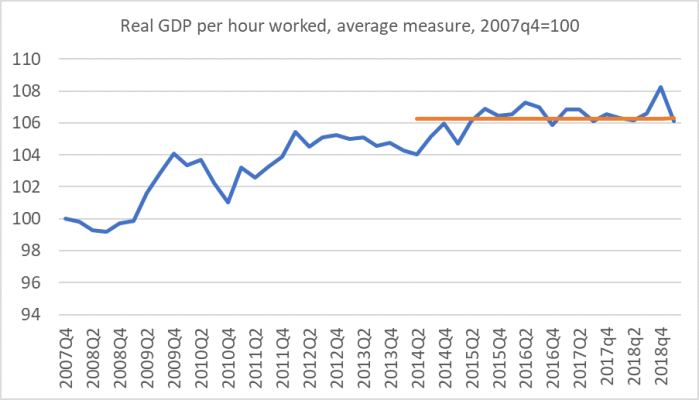
And there is, therefore, no sense of what light this experience might shed on possible explanations for our continued long-term underperformance.
They are also a bit self-promoting, suggesting that reversing the productivity underperformance “has been a central theme of the Productivity Commission’s work since 2011”. If anything, the opposite has been true. The Commission research team (when led by the now-departed Paul Conway) has at times produced some interesting papers on the issue, but the Commission’s core work is the inquiries successive governments have asked them to undertake, and not one of those inquiries has had as its focus economywide productivity failures and challenges. Some of the inquiries have led the Commission down pathways which can, at best, be described as limiting the (economic) damage – eg the low emissions inquiry. On the other hand, the Commission has done a (mostly) positive job in helping to develop a more widely shared recognition that land use regulatory restrictions (and associated infrastructure financing perhaps) are at the heart of the housing disaster successive central and local governments have presided over for the best part of three decades.
“Productivity by the numbers” is mostly descriptive – tables, charts, and comments thereon – but the authors do weigh in a little on possible explanations. They include this table, taken from another recent article
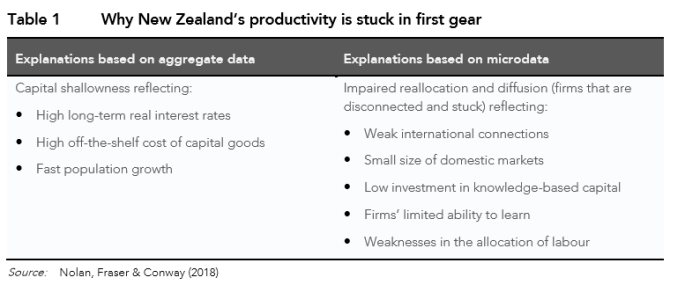
A couple of the items in the left-hand column are clearly intended as a nod in the direction of my ideas (referenced in the article the table is drawn from), and I welcome that. But it isn’t clear that the Commission – let alone the government’s official departmental advisers – is even close to a current integrated and persuasive narrative of what has gone wrong and how, if at all, things might be fixed. As is perhaps inevitable in a summary table, many of the items are at best stylised facts (some probably not even facts).
The report goes on
This work has highlighted that New Zealand’s poor productivity performance has been a persistent problem over decades and turning this around will require consistent and focussed effort over many fronts and for many years. There is no simple quick fix.
It is a convenient line – especially as there is no political appetite for change anyway – but I don’t believe it is true. Sure, we aren’t going to close the productivity gaps overnight, and sure there are (always) lots of useful reforms that could make a difference in a small way. But here we aren’t dealing with the small differences between, say, productivity in the Netherlands and that in Belgium. For an underperformance as large and as sustained as New Zealand’s – in what is substantially a market economy with passable institutions (rule of law etc) – it is highly likely that there are (at most) a handful of really important policy failures (things done or not done) where most of the mileage from reform would be likely to arise. And there the Commission just does not engage. Instead it tries to move on to a more upbeat story, and to shift the “blame” onto the private sector.
Indeed, work is already taking place in many areas, including in competition policy, infrastructure, science and innovation, and education and the labour market. There is growing interest in the need to improve Kiwi firms’ management practices and ability to learn (absorptive capacity), which shape their ability to innovate and improve their productivity (Harris & Le, 2018).
To me, much of this seems like dreamland stuff, deliberately choosing to avoid hard questions, while flattering the egos of ministers and officials in Treasury or MBIE. Whatever the Productivity Commission thinks is good among those topics in the first sentence (and I struggle to think of anything much), it isn’t credible to suppose that the things they like about current policy even begin to make the sort of difference required to reverse the productivity failures. And much as officials and academics like to suggest there is something wrong with New Zealand businesses (convenient that), there is no evidence that New Zealand firms and employees (managers and others) would be any less able to identify and respond to opportunities if government roadblocks and obstacles, including distorted relative prices, were fixed.
In the report, the Productivity Commission highlights how much we will miss out on if productivity growth continues to underperform the (somewhat arbitrary) 1.5 per cent per annum growth assumption in Treasury’s medium-term fiscal model. The point is that small differences compound in ways that make for big differences in material living standards and opportunities. And on that count I totally agree with them. I made a similar point the other way round in a post on productivity last year.
I’ve banged on here about how dismal productivity growth in New Zealand has been in the last five years in particular. The best-performing OECD countries over the most recent five years were averaging more than 2 per cent productivity growth per annum – and all of them were countries catching up with the most productive economies, just as we once aspired to do. If we’d managed 2 per cent productivity growth per annum in the last five years, per capita GDP would be around $5000 per head higher (per man, woman, and child) today.
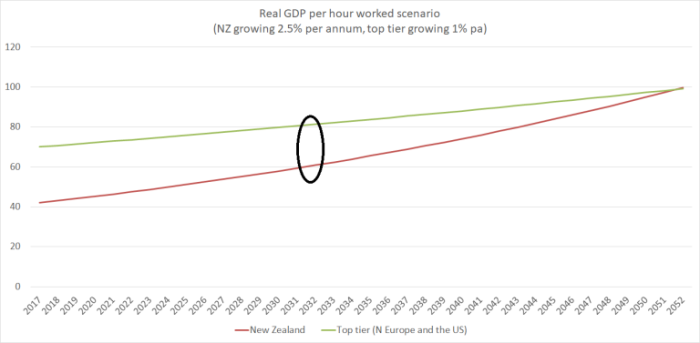
Catching up to the top tier will, in a phrase from Nietzche, take a “long obedience in the same direction” – setting a course and sticking to it. But here is a scenario in which the top tier countries achieve 1 per cent average annual productivity growth, and we manage 2.5 per cent average annual productivity growth. Here’s what that scenario looks like:
I’ve marked the point, 15 years or so hence, where the gap would have closed by half.
I don’t usually quote Nietzsche, but here is the full quote
“The essential thing ‘in heaven and earth’ is… that there should be a long obedience in the same direction; there thereby results, and has always resulted in the long run, something which has made life worth living.”
What matters in an economy like New Zealand now isn’t finding 100 or 300 things to reform – sensible as many of them might be – but finding the one (or two or three) things that might make a real difference, adjusting policy accordingly, and then persevering long enough to start seeing real and substantial results. There is no reason why New Zealand should not again manage something close to top tier OECD average labour productivity, but – on the demonstrated – there is no reason to suppose that (a) anything like the current policy mix will deliver it, or (b) that tiny changes at the margin will deliver very substantially different results. Welcome as the Productivity Commission’s statistical compilation is, those are the messages that need to be heard more loudly.
Sadly, of course, not a single political party seems to have any appetite for reversing our decades of economic decline. But, just possibly, a compelling narrative from an authoritative body like the Productivity Commission might one day begin to change that. At present, instead, the Commission seems in some unsatisfactory place where they don’t have the answers, and to the extent they sense some elements of an answer, they don’t want to upset anyone.




 croaking cassandra