Conflicts of interest

A while ago I stumbled on the report of Kristy McDonald QC, dated 22 February 2022, which had been commissioned by Hon David Clark, then Minister of Commerce, into aspects of the appointment of the default Kiwisaver providers, and specifically around the handling of conflicts of interest involving the then chief executive of the Financial Markets Authority (FMA) whose brother-in-law was the chief executive of one of the providers. The FMA provided a strictly limited bit of advice to the Minister.

I was less interested in the specifics of the case - which didn’t reflect very well on the FMA or its board/chair, but was (from the report) hardly the worst thing in the world - than in Ms McDonald’s observations on conflicts of interest. This is probably the most useful excerpt from her report (the document mentioned in italics is from the Public Service Commission).
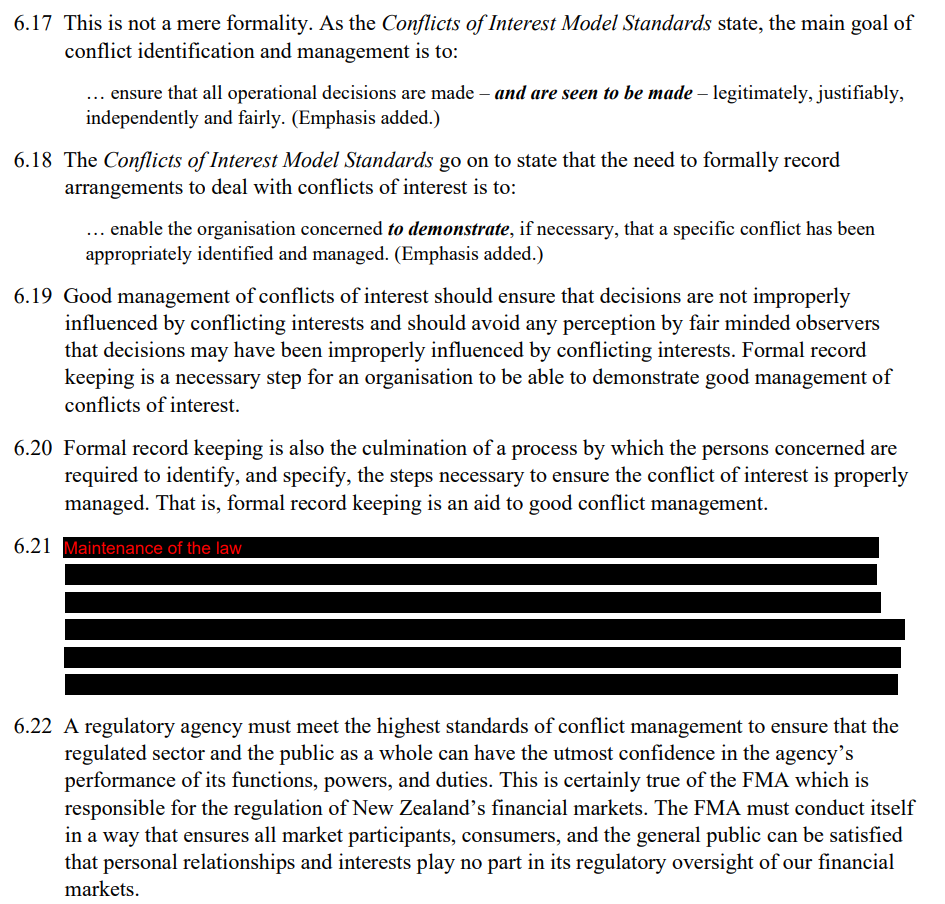
There is a heavy emphasis on three things really. First, avoiding actual conflicts of interest. Second, ensuring that outside (“fair minded”) observers can be confident that decisions have not been improperly influenced. And, third, documentation, documentation, documentation (which helps demonstrate, at the time and if necessary later, that actual and apparent conflicts have been recognised and dealt with appropriately).  As McDonald notes in 6.22 you’d think considerations like these should be particularly important in a regulatory agency, especially one - such as the FMA - with regulatory responsibilities in the financial sector. This is from the very top of the front page of the FMA’s website

You’d really have hoped that the Financial Markets Authority would have gone above and beyond in setting and applying standards for its own people, But…..no. You might remember them banging on a few years ago about “culture and conduct” in the private financial sector. I guess those were aspirations for other people.  One hopes that, in the light of the McDonald report, the FMA has now lifted its game in handling such issues in its own organisation. One might hope…..

One of the classes of financial product/entity that the FMA has regulatory responsibility for is superannuation schemes. It has particular responsibility now for a class of so-called “restricted” schemes, closed off to new members and generally in multi-decade run-off.  One of the FMA’s predecessor entities was the office of the Government Actuary which had in times past been required to consent to any changes in superannuation scheme rules. In old-style defined benefit superannuation schemes - a form of deferred remuneration where the effects (contributions/entitlements), even for an individual, stretch over decades – those sorts of protection and oversights, whether embedded in statute law or in the deeds of schemes are vitally important.  Such schemes are typically established as trust structures in which all trustees are required to undertake their duties with the best interests of members in mind. Being a trustee is, or should be, no small thing, not a duty entered upon lightly.

Conflicts of interest can, at times, be a significant issue. In a typical employer-sponsored superannuation scheme some of the trustees will be elected by members and some will be appointed by the employer. These days - in what is mostly regulatory impost (thank you Key government) – schemes are also required to have a Licensed Independent Trustee. (There were hazy warm thoughts at the time that these might be courageous independent thinkers who’d be a force for good, but the model really seems built more to encourage box-ticking – there are lots of boxes to tick – establishment figures earning a bit of pre-retirement income: you aren’t likely to be appointed to such roles if there is any fear you might rock the boat.)

In a scheme that defers for decades employee remuneration there can be material tensions between the interests of the employer and the members.  But much of the time there aren’t such conflicts. The day-to-day responsibility is to ensure that the pensions are calculated correctly and paid reliably, that member queries are dealt with in an appropriate and timely way, that statutory reporting and compliance requirements are met, and that money is collected properly and invested prudently.  I’ve been a trustee of the Reserve Bank scheme for 15 years and those issues go by pretty harmoniously, with any differences of view rarely falling along Bank-appointed vs member-elected trustee lines. And if the rules are clear and discretion strictly limited the room for seriously conflicting interests is minimised.

But the differences come to the fore when there is any consideration of material changes to the rules or the status of the scheme. Things are especially problematic if employer-appointed trustees form a majority. That is why, for example, it is common to require regulator consent to change rules and to include protections such that member consent is required from any members who might be made worse off by a rule change (to which they might still consent if, for example, one adverse rule change was balanced by other changes the member considered was to their benefit).

And here the situation is supposed to be pretty clear. A member-elected trustee is not generally regarded as intrinsically conflicted simply by virtue of being a member (since the entire purpose of the trust is to benefit members, whose interests all trustees are supposed to advance). A member-elected trustee can, of course, be specifically conflicted and should then recuse themselves (as an example, it turned out some years after I left the Bank that my retirement benefits from the pension scheme had been materially miscalculated. I stood aside for any deliberations on that matter). But the situation of employer-appointed trustees is generally regarded as different: often they will be senior managers or Board members of the sponsoring employer and the potential conflicts between the interest of the employing firm and that of the trust (and its beneficiaries) can be all too evident.

There is very little regulator guidance on these issues in New Zealand - perhaps not surprising when the FMA hadn’t really handled its own well - but shortly after I became a trustee I found a lengthy guidance note from the UK Pensions Regulator, which I have since regarded as something of a guidepost (it is still current). It is a different country to be sure, but with broadly similar culture, a large DB pension sector, and much of the case law that gets cited here comes from the UK. In any case, the question here is not what is lawful, but what is proper (substantively and in terms of perceptions and appearances).

You might remember that the whole “culture and conduct” tub-thumping exercise a few years back was done jointly with the Reserve Bank. You’d have thought that the Reserve Bank might be some sort of exemplar of good conduct, and concerned to be seen as such. I guess you might have thought that of the FMA too. More fool us.

For the last decade the trustees of the Reserve Bank pension scheme have been grappling with arguments and evidence around claims that several significant deed amendments done in the white heat of the reform era (late 80s, early 90s) were not lawfully made and are thus invalid. No one really quite knows what the implications would be if these changes were to be held to be invalid, but it would be unlikely to be good for the Reserve Bank (either reputationally or financially). It would, I think, generally be conceded now that the rule changes were, to say the very least, not handled well by former trustees and management (eminent figures such as Sir Spencer Russell, Don Brash, Suzanne Snively, but also able members’ trustees). In fact, Don Brash himself has raised specific concerns with trustees regarding events on his watch - and trustees simply refused to ever meet him.

Three of the six trustees are appointed by the Board of the Reserve Bank from among directors or staff members (a fourth – the LIT – is chosen by other trustees but long ago declared he never wanted to come between member and employer interests). Those Bank-appointed members can be replaced at will for any reason or none. Over the decade they have included a Governor, a Deputy Governor, a deputy chief executive, a couple of Board members, and a long-serving relatively junior staffer.  As we have dealt with the issues over ten years there has never been any sign of these appointees putting member interests first. It is not that nothing has happened - some serious mistakes have been acknowledged and or fixed – but only things that are not awkward or potentially costly for the Bank. It is, of course, impossible to know whether these trustees have actually prioritised Bank interests, but it is impossible to tell apart their actual approach from the sort of approach that would be predicted were Bank interests to be prioritised.  Nothing has ever been done to acknowledge the serious conflicts of interest or to document how those conflicts are being managed or dealt with (and the Bank trustees have consistently refused suggestions of either using an arbitrator or approaching the courts for (definitive) guidance and resolution).

Tomorrow morning in Wellington there is a meeting of the members of the Reserve Bank scheme, called by a group of members (including two former senior Reserve Bank managers) under the provisions of the Financial Markets Conduct Act. The members say that they want to seek explanations for the thinking behind various decisions the trustees have made (usually by majority). Rather than engage, it appears that the intention of the Bank-appointed majority is to stonewall. The current chair – one of Adrian Orr’s many deputies - appears more interested in pursuing me for openly articulating my dissent and criticisms of trustee processes and advice than in engaging with members or getting to grips with the substance of the issues. And - par for the course – never seems to recognise any sort of conflict.

I’ve put as much emphasis on atrociously poor processes (in one part of the decade I was moved to describe what was going on as a “corrupt process”, words today’s trustee wanted excised from the version of minutes provided to members for tomorrow’s meeting). But the process problems go back to the start.

Way back when these issues were first raised with trustees, Geoff Bascand - at the time one of Graeme Wheeler’s deputies, with overall responsibility for Bank HR and finance issues - was the chair of trustees. His quick response to the initial approach - itself in the form of a letter and 30 page document- was to suggest, in writing, to trustees that we simply write back to the member who had raised concerns stated that the issue was closed. He sought to reassure trustees that they needn’t worry because even if anyone took legal action trustees were indemnified by the Reserve Bank. Bascand was later Deputy Governor and Head of Financial Stability at the time of the “culture and conduct” campaign.

Things, and processes, were mostly a bit less blatantly egregious after that, but the conflict of interest issue was simply never addressed, and the process was often Potemkin-village-like (expensive, time-consuming, but pretty much working towards innocuous ends). On all hard decisions the Bank-appointed trustees voted for the interests of the Bank……and all of them were left in office by a Bank management and Board that (fully informed throughout) no doubt appreciated their services….in the best interests of members of course, as the law required.

I have written a retrospective assessment of the experience.

The Indifference of the Powerful RBNZ Superannuation and Provident Fund, Reserve Bank, and the FMA

It is probably of most interest to present and past members of the pension scheme, but it is - to me - a fairly egregious example of simply ignoring serious conflicts of interest.  The scheme is not itself a regulatory body, but it is sponsored and underwritten by one, and the bulk of its trustees serve wholly at the pleasure of the government-appointed board of another of our financial regulatory agency (Orr and Quigley cannot escape responsibility).

As for the Financial Markets Authority, they’ve displayed almost no interest whatever. I imagine it is mostly a matter of being too small, too hard, and too unglamorous but……this entity’s forerunner (the Government Actuary) actually approved some of the more egregious rule changes, so perhaps turning over rocks would be uncomfortable for them, and of course, the FMA and the Reserve Bank work closely together. You might think that something of a conflict, and a dimension that might mean one needed to be seen to go above and beyond to reassure fair-minded observers. But….this is New Zealand and here you’d be dealing with the FMA and the Reserve Bank.

The latest Transparency International Corruption Perceptions Index is, on past timings, due out any day now. No doubt it will repeat the self-congratulatory self-perceptions that are so standard. No doubt too there are many places more corrupt than New Zealand. But maintaining and preserving standards involves sweating the small stuff….or the not so small when they involve key financial regulatory agencies.

UPDATE: As it happens, the Transparency International results were out less than two hours later, with New Zealand slipping out of the top two places. Seems overdue in multiple ways, sadly.
Avoiding scrutiny

Regular readers will recall that I have, intermittently, been on the trail of the approach taken to the selection (and rejection) of external MPC members when the current crop were first appointed in 2019. I have been pursuing the matter since a highly credible person who was interested in being considered for appointment told me that (a) the Bank’s search company had informed my interlocutor that they would not be considered because they had active research expertise in areas around macroeconomics, and (b) having been somewhat puzzled by this response they had personally checked this understanding with the chair of the Reserve Bank’s Board, Neil Quigley, who had confirmed that was the policy. (The person concerned has never challenged my understanding of those conversations and has reiterated concerns over the years). OIAed documents from the Minister of Finance in mid-2019 confirmed that that approach had also been The Treasury’s understanding at the time (Treasury having responsibility for the ministerial/Cabinet side of the process); indeed that the Minister himself had endorsed/agreed to the ban.

I’m not going to repeat the entire subsequent chain. Everyone believed there had been such a blackball in place (it was even in an OIAed contemporaneous summary of a Board meeting discussion), and that included now-former senior central bankers (eg John McDermott) and the former economic adviser to Grant Robertson. These people may or may not have agreed with the ban, which the Minister himself and the Bank had defended on record in comments to media, but there was no doubt it had been there.

But then last year Quigley told Treasury that there had never been a restriction and Treasury - despite a bit of scepticism from a couple of senior officials – put out an official comment stating that there had never been a ban, and that the particular 2019 document from Treasury to the Minister was all a misunderstanding by another fairly senior Treasury figure (who had - conveniently - now left The Treasury, and whom they appeared never to have checked their new view with). More recently, a former Reserve Bank Board member - who had also been a member of the Board’s selection sub-committee in 2018 – confirmed to the Herald that there had been a ban of the sort generally understood (although his comments suggested Quigley may have conflated in his mind - years on – two quite separate sets of discussions).

The renewed interest last year prompted me to go back and check the OIA response the Reserve Bank itself had provided me in 2019 about the selection process for MPC members.  They had then provided a lot of useful material, but it also became clear that they had chosen to exclude - and not to identify for withholding under specific OIA grounds - all dealings between the Board and management on the one hand and the Board’s search company (Ichor) on the other, even though it was pretty clear that any and all such material had been within the scope of the initial request (“all material relating to the Board’s selection and recommendation of potential MPC members”). This was pretty egregious conduct by the Bank: it is one thing to identify that things have been withheld, and to provide specific grounds, and another to just ignore a whole class of material and never bother mentioning it. 

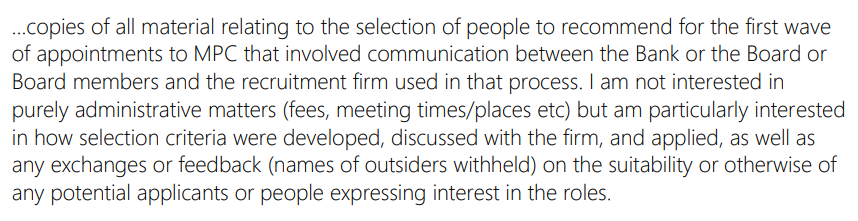
Anyway, I decided to lodge a new OIA, including explicitly highlighting that the material requesting should already have been covered by the 2019 request. My request (from 7 September) was as follows for:

When the Bank’s response finally came back they explicitly identified 26 documents (all of which should have been covered by the 2019 request), and had explicitly evaluated each of them against the criteria in the Act, concluding that 17 could be released in full, 9 in part (mostly it appeared withholding names on privacy grounds, which - per my request - is just fine), and identifying no documents in scope that would be withheld altogether.

But, nonetheless, they were not going to send me the information, and instead wanted to charge me $786.60, citing “the amount of time required to process your request and the frequency of requests from you over the last three months”.

I was briefly tempted. I have had run-ins with the Reserve Bank over proposed charges previously (some years ago). Almost always in the cases I’m aware of (my own and some other people) their attempts to charge have been, pretty clearly, straight-out obstructionism, when the Bank would really prefer people did not see the documents they had no grounds to withhold.

In this case, the Bank told me it had taken 10 hours to process the request. At just over a day of one person’s time that doesn’t seem particularly unusual – or out of step with requests I and others have previously lodged with them – and there was never an attempt to invoke a common agency line (often used to justify extensions) about needing to search a particularly large or ill-defined body of material (this was a specific request about one search firm on one project in one few-month period, so it must have been very easy to quickly find anything in scope, and it was all several years old). Moreover, they had made no attempt to reach out to narrow down the scope of the request or to suggest ways which might limit the risk of charging - the sort of good faith steps they are required to do, if acting lawfully and in good faith.

Had I made a few requests in the previous few months? Yes, I had, including on matters around MPC appointments, and on the Reserve Bank’s puzzling treatment of fiscal policy issues. They were relevant issues to the scrutiny of a very powerful, but underperforming - and not straight with the public - public agency, whose Board chair had already pretty clearly been shown to have actively misled Treasury and, in turn, the public. (Oh, and one was a request for a specific 2016 document, that was about two pages long and not itself contentious or on matters of policy, for which I gave them the title, the author, the date, and the document number in their document management system - I already had a copy but wanted to be free to use it with another audience.)

I’ve been sitting on the Bank’s response for a couple of months - other stuff demanding my time and attention - not quite sure what to do. I’d be astonished if the Ombudsman did not uphold an appeal against the Bank’s attempt to charge for this request – but that might take two years – especially given that the material should have been included in a response to a request that the Bank had responded to (otherwise) appropriately in 2019, and is on a matter of significant interest to those attempting to monitor and hold the Bank to account (it was after all prompted ultimately by Quigley’s and Treasury’s egregious attempts to rewrite history - and if Quigley really was, after all, telling the truth, these documents should if released support his position: almost certainly they do not).

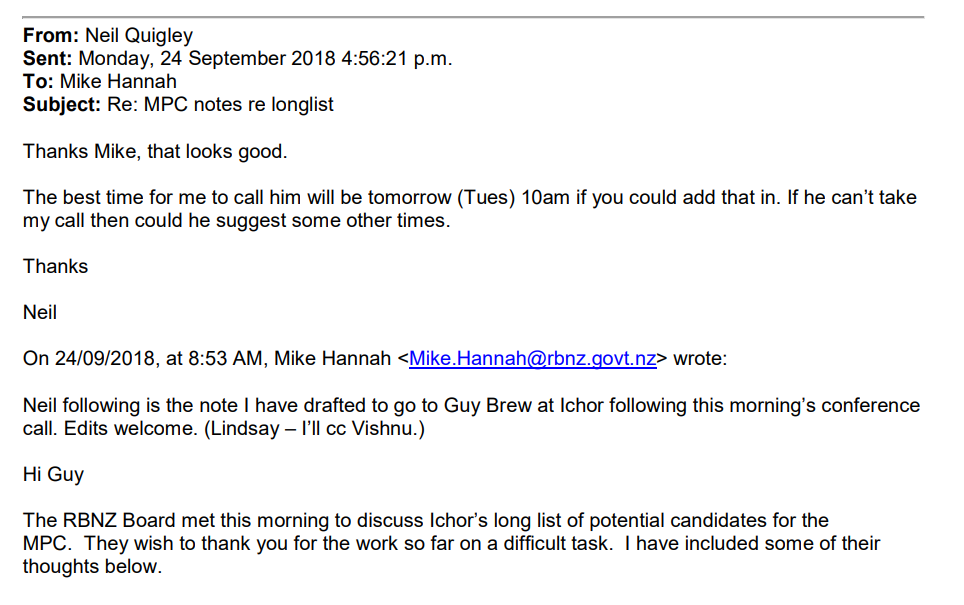
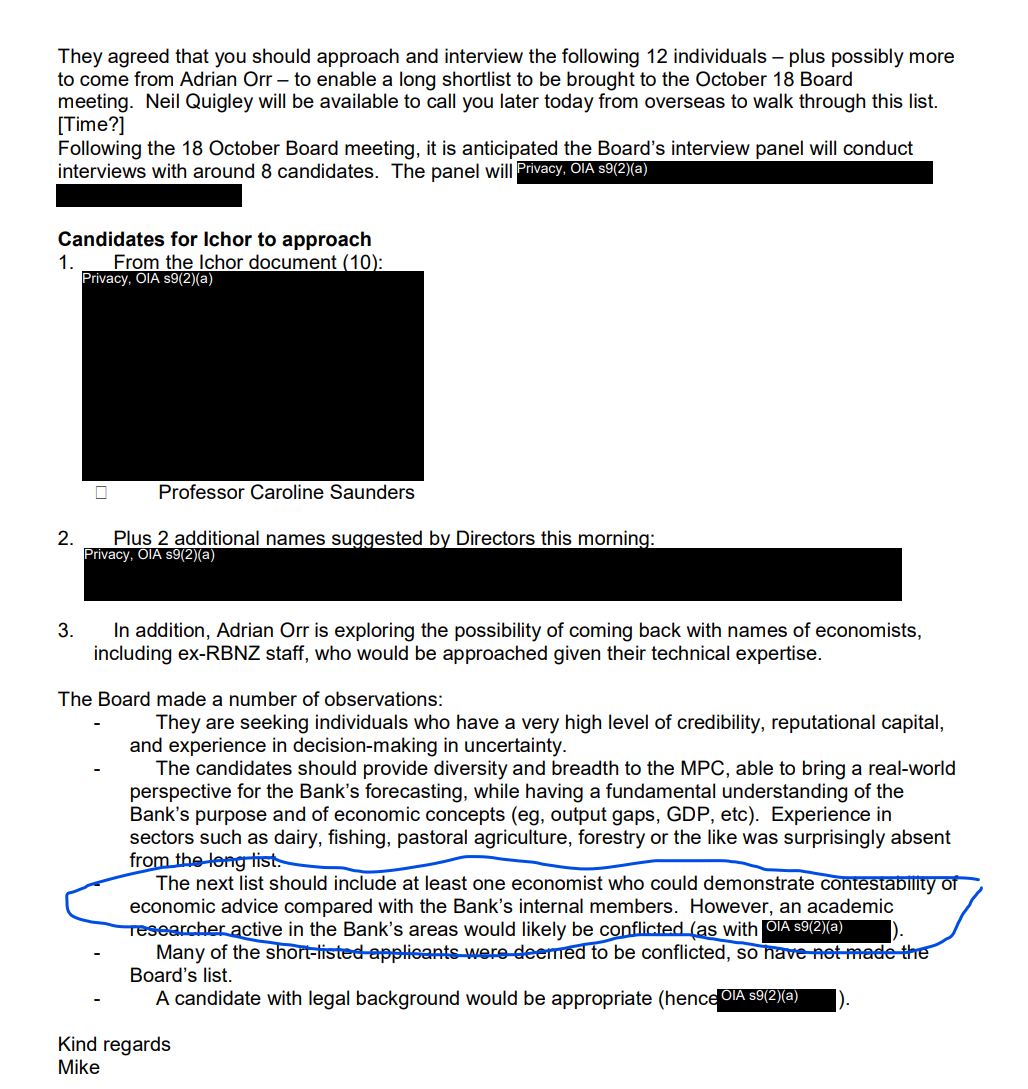
Just briefly, why do I say that they almost certainly do not? Among other things because in the material the Bank released to me in 2019 there was this email that I’ve included in previous posts on the MPC appointments issue (Mike Hannah then being the Secretary to the Board)

That said, since I have not lodged any OIA requests with the Bank for more than three months now, I am pondering resubmitting my request (it was, after all, them who cited as an excuse for attempting to charge a concentration of requests in a three-month period).

Alternatively, here is the full Bank response

RB OIA response re request for information on Ichor and the 2019 appointment of external MPC members

Anyone else could feel free to submit the request themselves (the exact words are in the document, as is the complete list of documents they had identified and already reviewed, so there will be almost zero marginal cost for them to handle such a request, and no legal basis for attempting to charge.   If anyone else does choose to make the request, I’d be happy to hear/see the response in due course (mhreddell@gmail.com).   

[UPDATE: The Bank’s contact email for OIA requests is rbnz-info@rbnz.govt.nz ]

As it is the clock is now ticking on the terms of two of the MPC members which expire (finally, with no possibility of reappointment) in the next few months.   The documents released last year suggest there is no longer a bar on specialist expertise in external MPC appointments, although the suspicion remains that Orr and Quigley (and the tame underqualified Board) will instead have imposed a bar on anyone who might make life at all awkward for the Governor.   To date, the new Minister of Finance has given no hint of reopening the application or selection process –  despite it all having occurred under the previous government and its appointees – and I guess only time will tell whether she has been willing to go along with such a bar, which might be less visibly egregious, but no better in terms of building a strong and open MPC, the need for which is only made more evident by the deep failures of the current MPC under Orr in the almost five years since the current externals were appointed.

Productivity woes….continued

In my post on Monday I drew attention (again) to the fact that New Zealand has made no progress at all in reversing the decline in relative economywide productivity (relative to other advanced countries) since what was hoped to be a turning point, with the inauguration of widespread economic reforms after the 1984 election. If anything, the gaps have widened a bit further, and more countries (most former Communist ones) have entered the advanced country grouping, first matching and now overtaking us. Despite being so far behind the OECD leaders there are also clear signs that labour productivity growth has slowed further in the last decade or so.

All that discussion proceeded using simple measures of labour productivity (real GDP per hour worked).  The data are readily available for and are more or less comparable across a fairly wide range of countries, and there is meaningful levels data. Labour productivity is a common measure in such discussions, even though total (or multi) factor productivity (TFP or MFP) is the in-principle preferred measure. It is the bit of growth in output or output per capita that can’t be explained just by the addition of more inputs (labour or capital). Some decades ago the late Robert Solow, recently deceased, observed that in modern economies perhaps 80 per cent of the growth in output per capita had been attributable to TFP.

It is a line that should be taken with several pinches of salt since in practice (a) TFP is an unobservable residual, and b) much of the innovation and new knowledge often thought of as the basis for TFP growth is probably embedded in better human and physical capital and the disaggregation is a challenge (to say the least).  Thriving economies are likely to have better smarter people, better tangible and intangible capital, all used in better smarter ways etc.

But with all these caveats I thought it might still be worth having a fresh look at the OECD’s MFP data for the last few decades. They only have MFP (growth) data for a subset of (24) member countries (mostly the “old OECD”, and including none of the central European countries). For New Zealand, the first MFP growth data is for 1987, and with the annual data available only to 2022 that gives us 36 years of data.

There is a lot of year to year noise in the series, but for illustrative purposes I simply split the data in two, to compare the record for the 18 years to 2004 with the 18 years to 2022. As it happens, the global slowdown in productivity growth in leading economies (US and northern Europe) can be dated to about 2005.

New Zealand averaged annual MFP growth of 0.9 per cent in the first 18 year period, and only 0.2 per cent per annum in the second 18 year period to 2022. It is a pretty dire picture. (All data in this post use arithmetic averages, but using geometric would not make any material difference.)

Now, champions of the reform story might be tempted to look at that simple comparison and say something like “yes, you see. In the wake of the decade of far-reaching reform New Zealand made real and substantial economic progress, but then after the reform energy faded and drift took hold it all faded away to almost nothing.

Unfortunately for that story, here is how New Zealand MFP growth record compares (on the OECD’s particular methodology) for New Zealand and (the median) for the other countries (most of them) for which there is a complete set of data.

We all but matched the average growth performance of those other advanced OECD economies in the earlier period, in the wake of our reform process, but even then didn’t do well enough to begin to close the large levels gaps that had opened up in earlier decades. And then in the more recent period, we’ve done worse again: the comparator group (typically richer and more productive, nearer the productivity frontiers) slowed markedly, but we slowed a bit more still. When you start so far inside productivity frontiers there is no necessary reason why New Zealand could not have made some progress closing the gaps even if the frontier countries themselves ran into difficulties. But no. (Over that second 18 year period when New Zealand averaged 0.2 per cent per annum MFP growth, South Korea - also well inside productivity frontiers on an economywide basis – is estimated to have averaged 2 per cent per annum MFP growth).

It is only one model, and only one set of comparators but there is simply nothing positive in the New Zealand story. There is, and has been, no progress in closing those gaps, and our living standards suffer as a result.

And what of Solow’s 80 per cent? In New Zealand real GDP per capita increased by an average of 1.7 per cent per annum between 1987 and 2004. MFP growth averaged 0.9 per cent over that period. For the period 2005 to 2022 average annual growth in real GDP per capita increased by an average of 1.4 per cent per annum, but over that period MFP growth averaged just 0.2 per cent per annum. (The comparisons are no more flattering if one uses the OECD “contributions to labour productivity growth” table as the basis for comparison.)

Whichever measure of productivity one looks at the New Zealand performance is poor. Champions of reform 40 years ago would, I think, have been astonished if they’d been told how poorly New Zealand would end up doing. I hope they’d be even more alarmed at the indifference to that woeful record that now seems to pervade official and political New Zealand.

[And since I’ve already had one past champion of the reforms objecting to my characterisation in this post and Monday’s post, I’m equally sure that all serious observers now - ie excluding our political leaders and officials - have their own story about what else should (or in some cases shouldn’t) have been done over recent decades. That doesn’t change the fact - on my reading and my memory – that if asked in say 1990 most would have envisaged several decades of catch-up growth as the decline of the previous decades was slowly reversed. It is quite clear from the documentary record that that was the goal, and the intense political disputes of the era were not about that goal.]

40 years on

2024 will mark 40 years since the great acceleration of policy reform that began with the election on the 4th Labour government in July that year and ran for the following decade or so. I’m sure there will be lots (and lots) of reflections on the period later this year, most especially from the left where the ongoing political angst seems greatest (yes, it really was a Labour Cabinet that kicked off the process and did many of the lasting reforms, much as some on the left remain very uncomfortable about that).

If one thought about the big economic issues that were around at the time, they could probably be grouped under three broad headings:

  • inflation
  • fiscal deficits and government debt, and
  • productivity

One might add to the list the balance of payments current account, which became no longer a policy problem once capital controls were lifted at the end of 1984 and the exchange rate was floated in early 1985. (Yes, recent deficits have been very large, but as a symptom of other imbalances, rather than a policy issue in its own right.)

Of that list, New Zealand has done fairly well on the first two items. 

We used to have among the worst inflation record among the advanced countries (high and variable), but in recent decades we - like most advanced countries - have done much better. The last three years have been a bad lapse, but if that never should have been allowed to happen, the ultimate test is whether things are got back under control, and we seem now to be on course for that (eventually the lagged infrequent data will emerge). I’m not here going to get into lengthy debates about other countries, but whatever the common shocks once a country floats its exchange rate its (core) inflation outcomes over time are its own choices (see Turkey for any doubters).

We’ve also done pretty well on fiscal policy imbalances. There are plenty of leftists around who think taxes and spending should have been, and should now be, higher, but my focus is imbalances (deficits and debt). Again, the last few years (post Covid spends) have been bad, but under governments led by each main political party, New Zealand has over decades done a reasonably good job of keeping debt low and reining back in deficits when they have first blown out. And our system of fiscal policy transparency is pretty good too (although like almost anything could be improved).

One could throw financial stability into the mix. Almost every country that liberalised in the 80s ran into serious financial sector problems a few years later (neither the private sector lenders and borrowers nor the putative regulators really knew what they were doing, perhaps unsurprisingly after decades of financial repression), but the last 30 years have been pretty good. Lots of finance companies failed 15 years ago, which wasn’t necessarily a bad thing (risk and failure are integral parts of a market economy), but the core of the financial system has been sound and stable. Plenty of countries would have traded that record for their own experience.

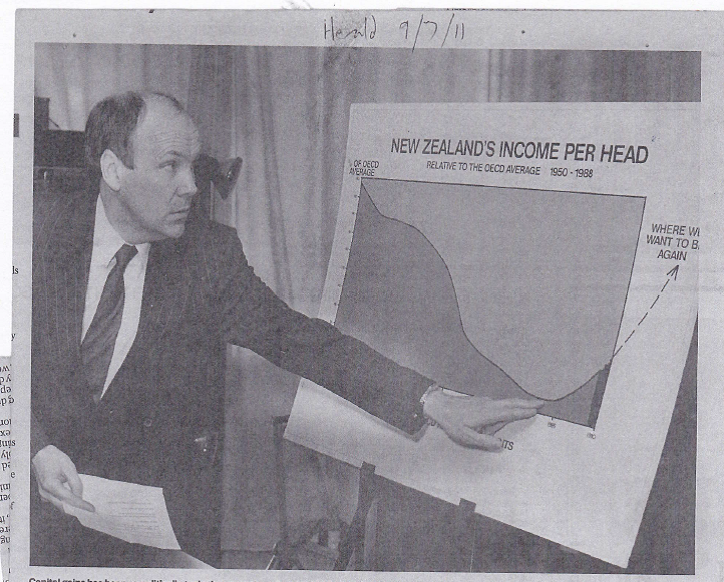
The big hole in the story has been around economywide productivity. 40 years ago people were highlighting how far New Zealand’s performance had fallen (official reports from as early as 60 years ago were already drawing attention to growth rates having slipped behind), and the hope/aspiration was to turn that around. This is one of my favourite photos (reproduced in the Herald a decade or more ago, but showing late 80s Minister of Finance David Caygill)

Even though there had been not-insignificant economic reform and liberalisation over the previous few decades, in the early-mid 80s it was easy to highlight the many very obvious inefficiencies in the New Zealand economy (car assembly factories dotted around the country to name but one example). The previous decade in particular had been a very tough time for New Zealand - hardly any productivity growth at all after 1973/74 – probably less because economic policy became particularly bad (one could quite a long list of useful and important reforms, alongside other problems and new distortions - eg Think Big) than because the terms of trade were very weak.

Almost as bad as the worst of the Great Depression, but averaging low for longer. Exogenous adverse shocks to both export and import prices impeded the ability of the economy to generate high average rates of real productivity.

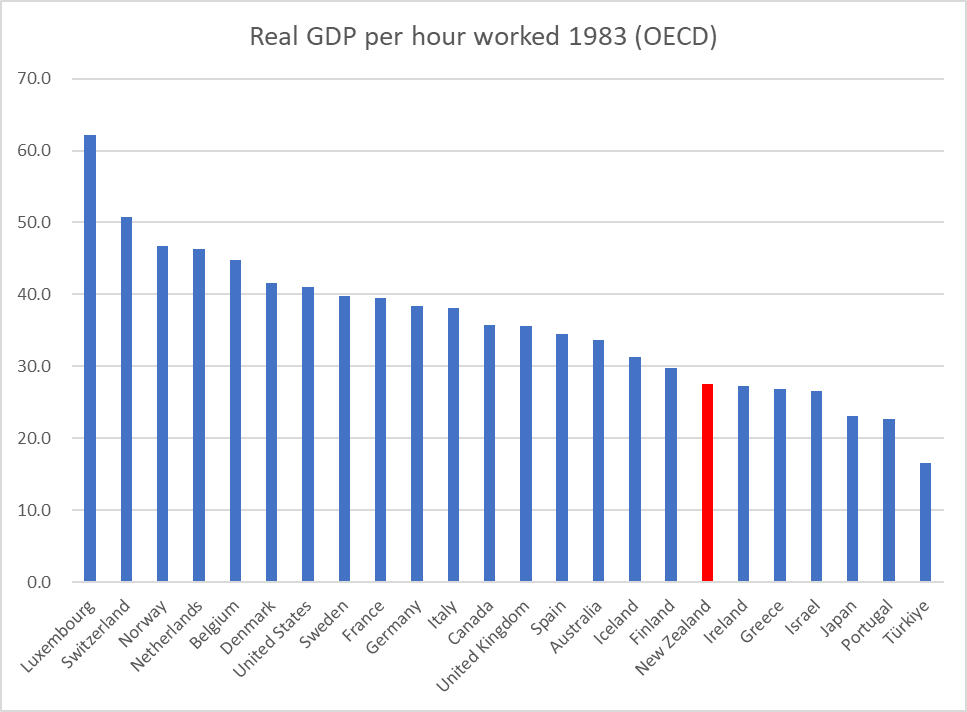
As recently as 1970 (when the OECD real GDP per hour worked data start) and despite decades of inward-looking policies New Zealand’s average productivity still didn’t look too bad. We were below the median OECD country but not by much, just under the G7 median, and more or less than same as the big European countries (UK, Italy, France, Germany). By the time of the 1984 election we’d slipped a long way further.

We were by then around the same as Greece, Ireland, and Israel, and of the G7 well behind all except (still fast-emerging) Japan.

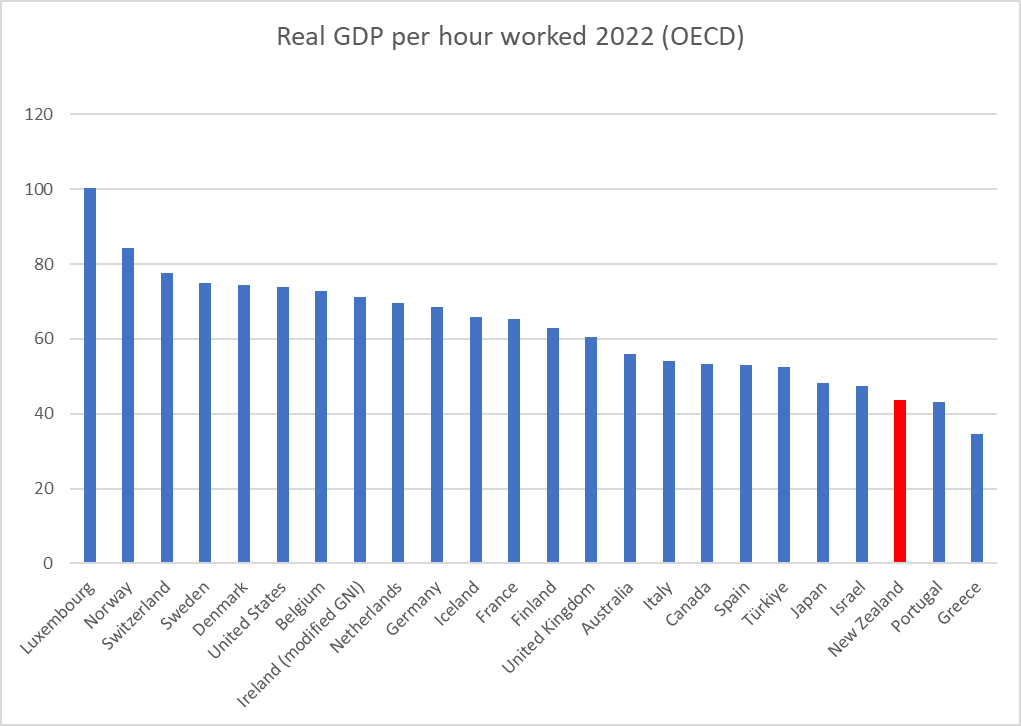
Here is where we are relative to the same group of OECD countries in 2022

We’ve clearly pulled away from Greece, but that is about the only semi-positive I could find (and yes, the gap to Italy has closed somewhat as well). For what it is worth, on the data to hand so far 2023 looks to have been a year when New Zealand average productivity fell.

Of course, the rate at which we’ve been falling down the league tables has slowed. But then remind yourself what happened to the (merchandise) terms of trade

They have trended upwards since the late 80s (I remember our puzzlement at the RB when the first late 80s lift happened) and especially in the last 20 years. On this measure (which excludes services, to get a long-term consistent series) the terms of trade have averaged higher than at any time in the last century. And yet still average productivity languishes.

There are of course a whole bunch of new OECD members since 1984. A large group of them were then either part of the Soviet Union or communist-bloc countries, even the least bad of which had much more messed up economies than New Zealand’s. This is how we compare now with that group

Middle of that pack to be sure, but probably not for long on the trends of the last couple of decades. South Korea is just about to go past us too.

It really has been a shockingly bad performance by New Zealand, against what would normally have seemed a propitious background - a sharp sustained recovery in the term of trade and a much greater reliance on letting market price signals work.  There isn’t much serious basis for wishing away this failure.

And yet there seems to be little sign that our politicians or their official economic advisers have much interest, or any serious ideas for finally reversing the decades of real economic relative decline.

It is as if the powers that be and those around them have simply become resigned to our diminished fortunes, indifferent to what that failure means for actual material living standards now, and those for our children and grandchildren to come.

Unconvincing

The Herald ran an op-ed yesterday under the heading “Why the Government’s new Reserve Bank mandate may lead to worse outcomes”. It was written by Toby Moore who served as an economic adviser in Grant Robertson’s office while he was Minister of Finance (a fact the Herald chose not to disclose to its readers).

I’m more interested in the substance of his argument. Moore is a serious guy, and I suspect he’d run his arguments whether or not he’d ever taken up a role with Robertson. But I think his core argument ends up not very persuasive.

Moore opens his article pointing out that there isn’t an overly strong economic case for having reverted to something very like the old statutory objective for monetary policy. There are certainly bigger economic challenges (albeit probably not ones the law draftsmen could tackle as quickly). As the Governor repeated again yesterday – while trying to minimise the extent to which the previous wording was actually a “dual mandate” (a point on which he was correct, but not a point he’d have made often under the previous government) – no monetary policy decision in the last few years was made differently because of the revised wording of the statutory mandate. That is entirely convincing: the Reserve Bank’s big mistakes (and they were very big mistakes) were forecasting ones. Given their forecasts their OCR choices made (more or less) sense. But they misunderstood how the economy was operating and how real the inflation risks were.

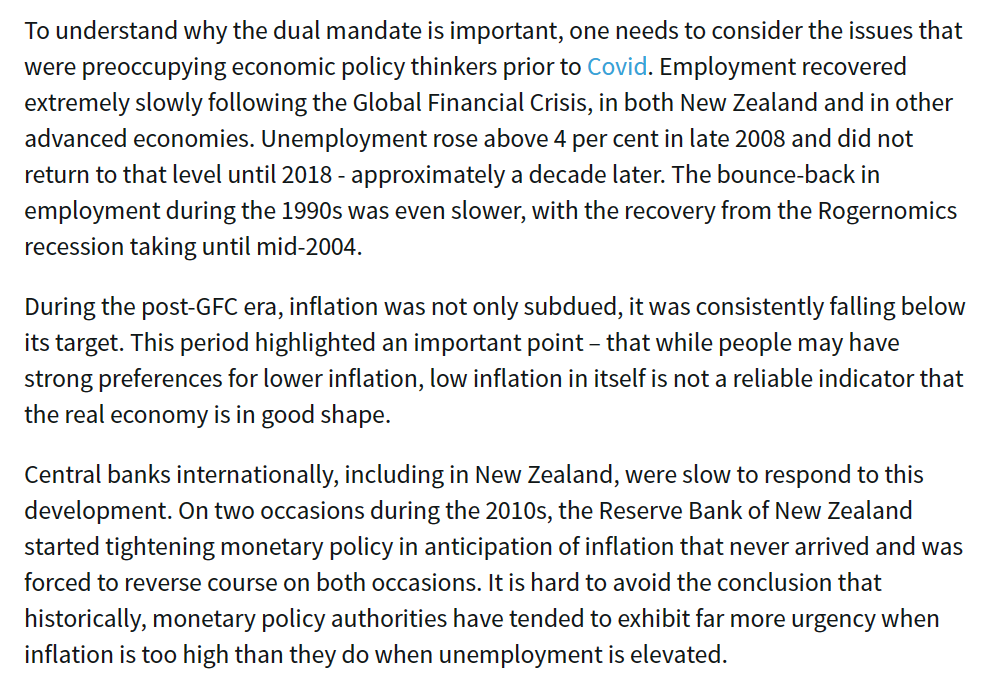
But then Moore attempts to argue that much of the previous 30 years would have been different (and better) if only the Reserve Bank had spent those decades operating under the statutory mandate it had from 2019 to 2023. The episode I want to focus on is that from a decade or so ago. These are his words

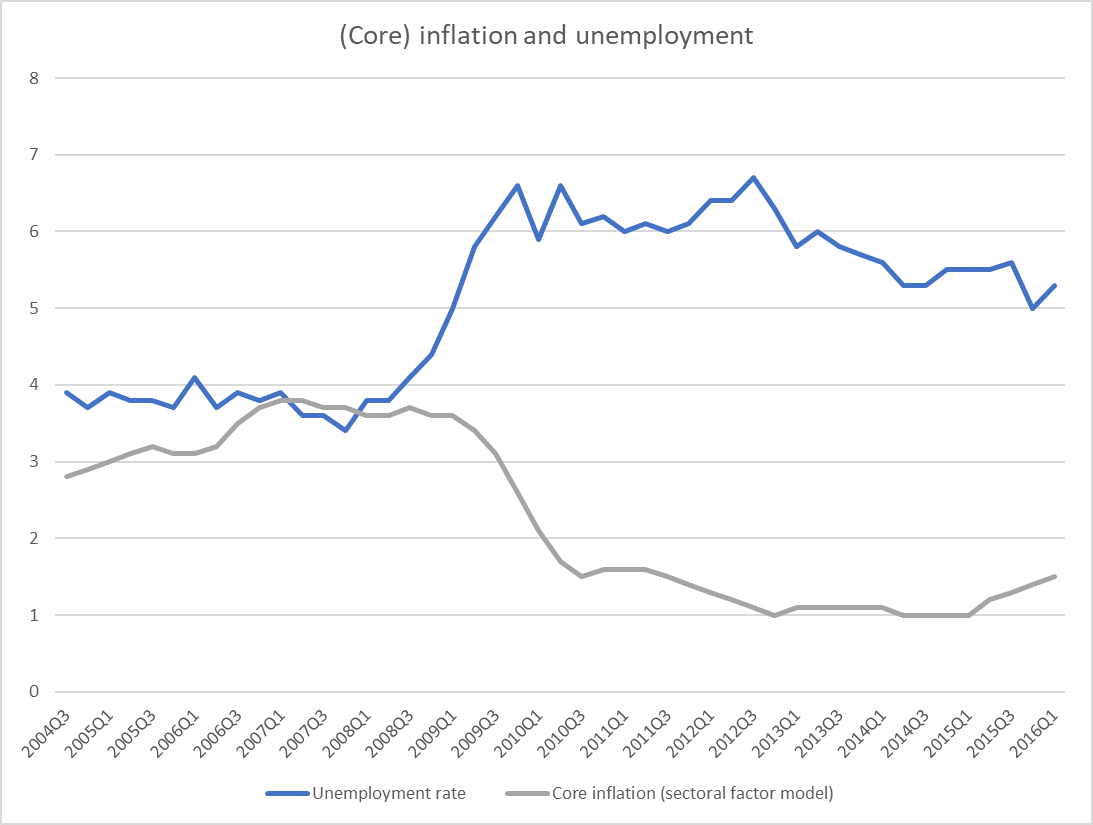
One can see the issue more starkly in this chart

As one added bit of context, in 2012 a requirement was added to the Policy Targets Agreements requiring the Governor to focus on delivering inflation near 2 per cent, the midpoint of the 1-3 per cent target range.

I agree with Moore that a series of bad monetary policy choices were made by the Reserve Bank during this period. In fact, while I was still at the Reserve Bank I argued against the proposed tightening cycle that eventuated in 2014 on the twin grounds that core inflation was very low, and (consistent with this) evidence from the labour market suggested quite a lot of slack still in the economy. Once I left the Bank in early 2015, it became a regular theme in commentary on this blog.

But…..the key point is that, once again, economic forecasts were very wrong. The Bank’s forecasts during this period usually had core inflation coming back to the midpoint and needing higher interest rates to keep it there.

And actually I think there is a fair argument - that should appeal to Moore, although not to some others - that during in 2010s one problem was that the Governor, having recently returned from a long sojourn in the US, became fixated on the housing market and the US crisis of 2007-09, and constantly wanted to orient policy to lean against such risks, without ever stopping to consider (a) similarities and differences between NZ and the US, or (b) his statutory mandate. It wasn’t the biggest factor in setting monetary policy wrongly – policy that delivered core inflation bouncing near the floor of the target range for years – the problem was forecasting failure and bad models – but it didn’t help either.

A central bank in the early 2010s (a) strongly focused on the inflation target, and (b) with better forecasts/models (or just looking out the window) would have delivered a lower OCR during that period, and in particular would not have championed a substantial tightening in 2014. That would have had better outcomes for inflation and for unemployment.

Reasonable people can differ on how best to specify and to articulate what we look to the Reserve Bank to deliver with monetary policy, but the problem a decade ago wasn’t some excessive focus on inflation, but a poor understanding (shared of course with many others here and abroad) of just what was going on.  Arguably, looking out the window - at actual headline and core inflation - might have given a better steer during that period. A ‘dual mandate’ simply wouldn’t credibly have made any difference, given all else we know. The unemployed paid a price for those limitations/mistakes (as holders of fixed nominal financial assets have paid a big price for central bank mistakes in the last year or two).

Excellent central banks matter. They make a difference to real people, real outcomes. It would be good if we had one, and/or a government seriously resolved to deliver a better one.

Not exactly encouraging

[NB: I wrote a few quick paragraphs here before fully appreciating that nothing of the government’s own policies were being allowed for in the numbers (which itself seems unsatisfactory). Nonetheless I am leaving the post up because (a) I don’t want to pretend it wasn’t written, and b) the Treasury’s own comment (see below) that, to a first approximation, government plans to date do not seem likely to improve the outlook, and c) the fact that the Minister’s statements give no particular reason to think actual policy will be better than what is allowed for in these numbers. Fiscal policy has been badly mishandled in recent years and we should not be looking at deficits for the next few years.]

As I wrote prior to the election, both in the PREFU (reflecting Labour’s plans, some plucked from the ether just in time for Treasury to do the numbers) and in National’s Fiscal Plan, there was a strong element of either wishful thinking or vague “trust us, we’ll do it” about the numbers. Both parties talked up getting the operating balance (OBEGAL) back to surplus by 2026/27, but neither gave us any specifics as to quite how the substantial structural deficit was going to be closed. There were lines on a graph, and that was about it. In its pre-election plan National indicated that by 2026/27 it would deliver a slightly large surplus than Labour (in PREFU) had foreshadowed.

That was then. In their pre-election fiscal plan, National’s numbers were for an OBEGAL surplus in 2026/27 of $2.9 billion. In the first EFU of the new government, incorporating the new government’s fiscal plans [UPDATE: the government’s plans are not included, but - see note below - Treasury’s best guess so far is that for things foreshadowed or announced they would make little difference], that surplus has been revised down to $140 million, basically zero (Treasury shows it as 0.0% of GDP). Recall that under the previous government, the date for a return to surplus was always just somewhere over the (rolling forward) horizon. Is it any different now? And the revisions aren’t just to that one year: for 2025/26, the Fiscal Plan foreshadowed a deficit of $1.0 billion, but the HYEFU numbers now show a deficit that year of $3.5 billion.

Core Crown spending was, unambitiously, supposed to fall to 31.0 per cent of GDP by 2027/28 (the only year for which the Fiscal Plan gave us numbers), but HYEFU has spending that year of 31.4 per cent of GDP. Perhaps unsurprisingly, net debt by 2027/28 is also a couple of billion higher in 2027/28 than National’s plan had portrayed.

In the grand scheme of things, these dates are quite a long way away, and the changes are, in isolation, perhaps of only middling significance. But from a starting point of (a) years of structural deficits (when one, just possibly two, years of deficits might have been warranted by Covid), and (b) repeated revisions which pushed further into the future the return to surplus, it is hardly an encouraging sign from the new government and its Minister of Finance (whose comments on the HYEFU bottom lines seems to take them for granted, rather than foreshadowing something materially less bad).

And all this in a “mini-Budget” (perhaps itself an ill-advised pre-election promise, which put the Minister against very tight deadlines) that seems to offer nothing any more specific about how the government proposes to return to surpluses, and what (at scale) it proposes to spend materially less on.

It was all rather underwhelming, and the slippage relative even to what National was promising just over two months ago is disappointing. It is though perhaps consistent with the pre-election rhetoric from National that seemed very little bothered by the size and duration of the run of fiscal deficits Labour had run, and proposed to carry on running.  Sure, they have to deal now with coalition partners, but when the first fiscal numbers have a worsened outlook it hardly speaks of a strong and demonstrated commitment to “getting New Zealand back on track”. On these numbers, we’ll have had eight years in a row without an OBEGAL surplus…..and even those numbers rely on high-level wishful plans rather than concrete specifics.

On the economic numbers, much will have been superseded by the surprises in the GDP numbers last week. But it is perhaps worth noting that - working with much the same information the Reserve Bank had for its MPS late last month – the Treasury reckoned that the economy was still runnjng excess demand to a greater degree than the Reserve Bank (a positive output gap on average for the year to June 2024), but that the Treasury also envisaged earlier room for OCR cuts (having the OCR at 4.9 per cent by June 2025, while the Reserve Bank was projecting 5.4 per cent), with a weaker exchange rate too.

UPDATE

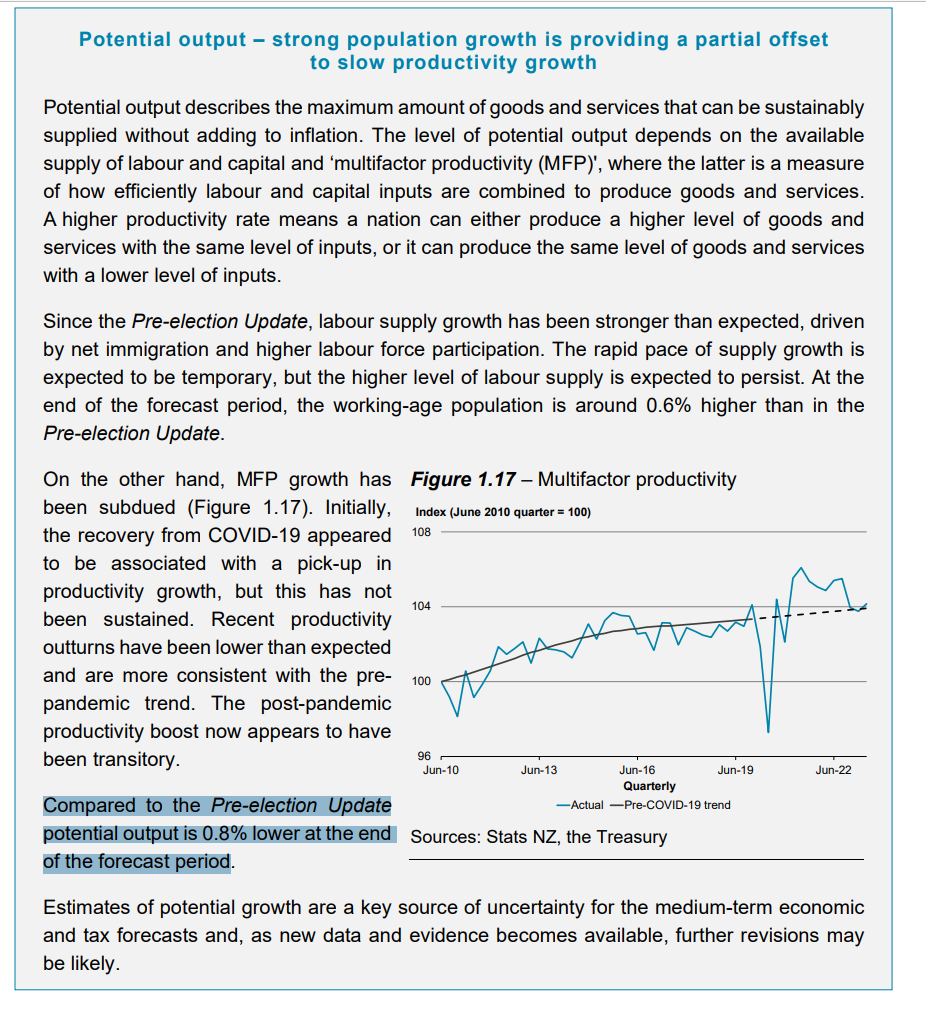
From the HYEFU document.

UPDATE:

Notwithstanding the Treasury headline, the highlighted sentence is probably more pertinent. With a higher than previously forecast population, potential output has still been revised down, so mediocre is the NZ productivity story. Treasury should probably have been more careful earlier about believing that somehow productivity growth had accelerated in the wake of Covid, something for which there was never any a priori reason to expect/believe.

Deep falls in real per capita GDP

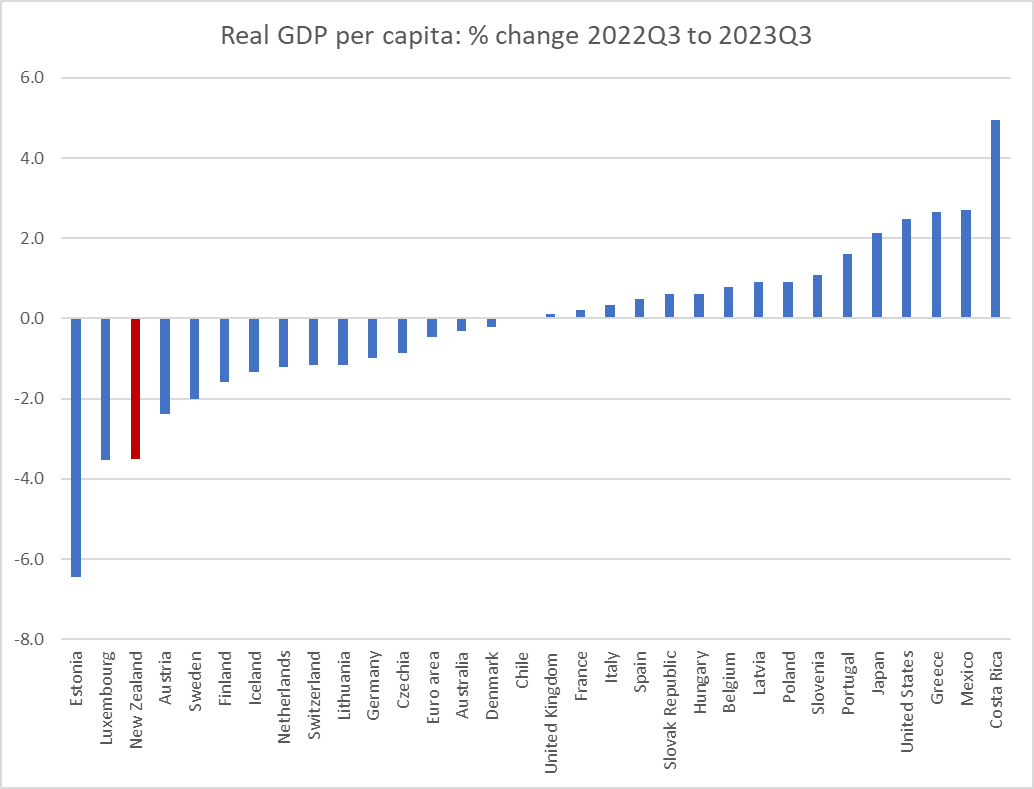
I ran this chart in a post the other day

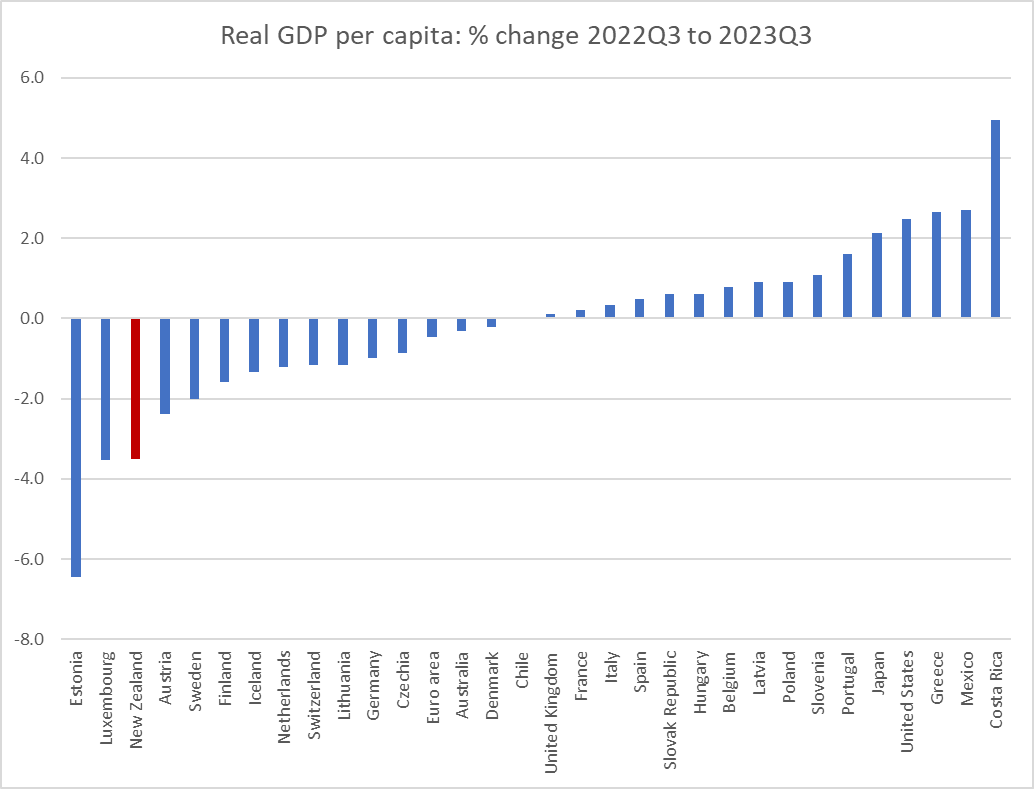
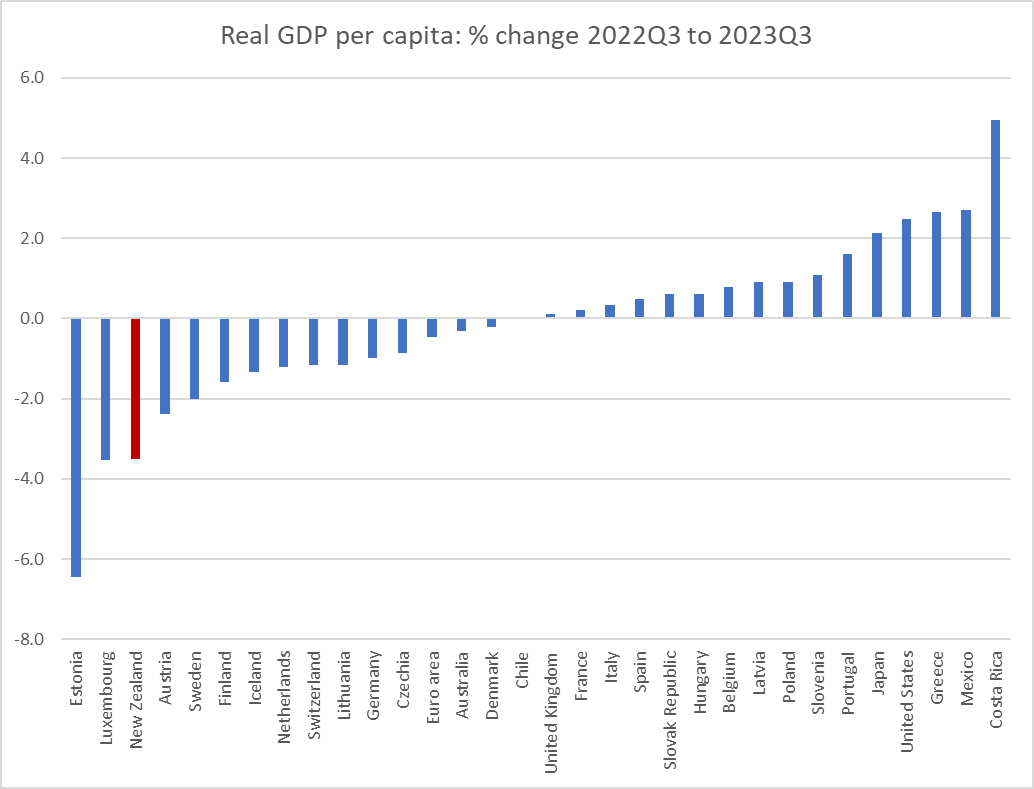
The fall in New Zealand’s per capita real GDP (averaging production and expenditure measures) over the last year has been quite striking set against other advanced (OECD) countries for the same period. We are equal second-worst, and quite a bit worse than the next country with its own monetary policy (Sweden) - I’m mainly interested in the inflation situation.  The fall in real per capita GDP in New Zealand thus far isn’t much short of the fall experienced in the 2008/09 recession.

With recent data it is certain there will be revisions and thus it isn’t impossible that the last year might end up looking a bit less bad. But for now, the published data are the best official guesses - for us, and for fiscal and monetary policymakers.

The OECD has data on quarterly real per capita GDP, going back a fair way (a lot further for some countries than for others, but pretty comprehensive for current members from the mid 1990s). I was curious how common falls in real per capita GDP had been in that database.

For the 1980s there isn’t data for many countries, but we find large annual falls in real per capita GDP as follows

  • Australia 1982/83
  • Canada 1982 (at worst about -5% per annum), and
  • the United States 1982 (the recession that saw them get inflation down.

Coming forward to the early 1990s we find

  • Finland 1991/92 (some mix of domestic financial crisis and the fall of the Soviet Union)
  • Canada 1991
  • Iceland 1992
  • (New Zealand would probably be on the list but our official population series begins in the middle of the early 90s recession)

Moving on a few years and we have

  • Chile 1998/99
  • Israel 2001/02

In 2008/09 all but a handful of countries saw a significant fall in real per capita GDP.  It was, of course, the recession that ushered in the decade or so of surprisingly low inflation.  At worst, per capita real GDP fell by about 5 per cent per annum in the US and 6 per cent in the euro-area (and about 4 per cent here).

In and around 2012 various euro-area countries (but notably Greece) did dreadfully, but the euro-area as a whole only saw real GDP per capita falling at about 1 per cent per annum during that period.

Covid intervened –  when we shut down economies for a time and deliberately wound back economic activity – but otherwise there are no big falls in per capita GDP on an annual basis in places with their own monetary policy until……New Zealand right now.

What we have seen over the last year isn’t normal or small, but a large fall, of the sort seen in advanced economies only in pretty adverse times. 

Why focus on real per capita GDP?  The public commentary tends to focus on GDP itself, with all the attention on whether the total size of the economy is rising or shrinking.   But for most economic purposes, and certainly for inflation purposes, it isn’t a very relevant measure.  Zero per cent growth in GDP means something a great deal different if the population is static or falling than if it is growing at 2.5 per cent per annum.  It is (much) more likely that excess demand pressures are easing if  –  absent really nasty supply shocks – per capita real GDP is falling, even if there is still some headline growth in GDP itself.

That said, all such comparisons, especially across time, take one only so far.  In an era of really strong underlying productivity growth, even a moderate GDP or real per capita GDP growth might be consistent with easing excess demand pressures, and if productivity growth is historically modest –  as it has been in much of the advanced world for almost 20 years now – even falling per capita GDP might not be consistent with much or fast easing in capacity pressures. 

But a fall of 3.5 per cent in real per capita GDP over the last twelve months probably deserves more attention than it has been getting thus far (even if headline unemployment has still been quite low).

Economic underperformance

With both the annual and quarterly national accounts data having come out recently it is time for a quick update of some old charts.

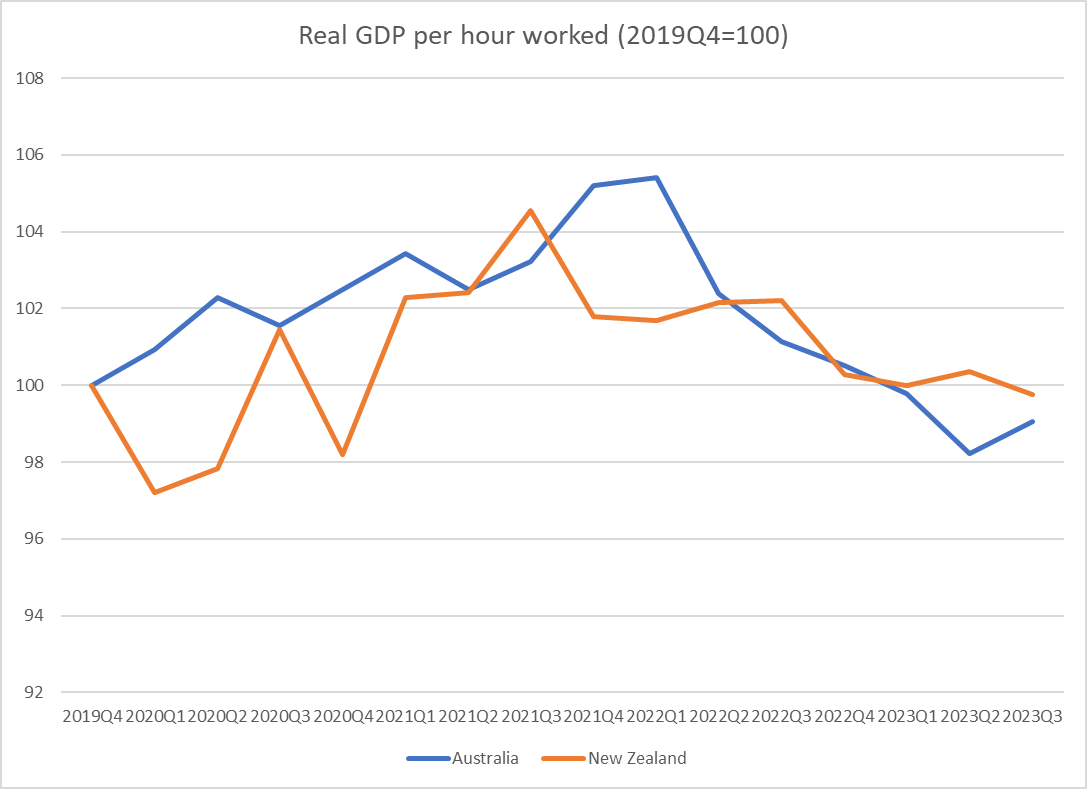
First, labour productivity (real GDP per hour worked). This chart is from the period since just prior to Covid, and for both New Zealand and Australia

If you want some slight consolation, at least we haven’t lost any ground relative to Australia over this period, but for both countries it is (on current readings) almost four wasted years, with no economywide productivity growth at all.

And whereas Australia’s terms of trade have risen by 11 per cent over that period New Zealand’s have fallen by about 5 per cent. That’s an additional income difference in their favour of 2-3 per cent.

(NB for resident UK pessimists, note that on current readings the UK has done less badly on labour productivity than either New Zealand or Australia over the Covid/inflation period.)

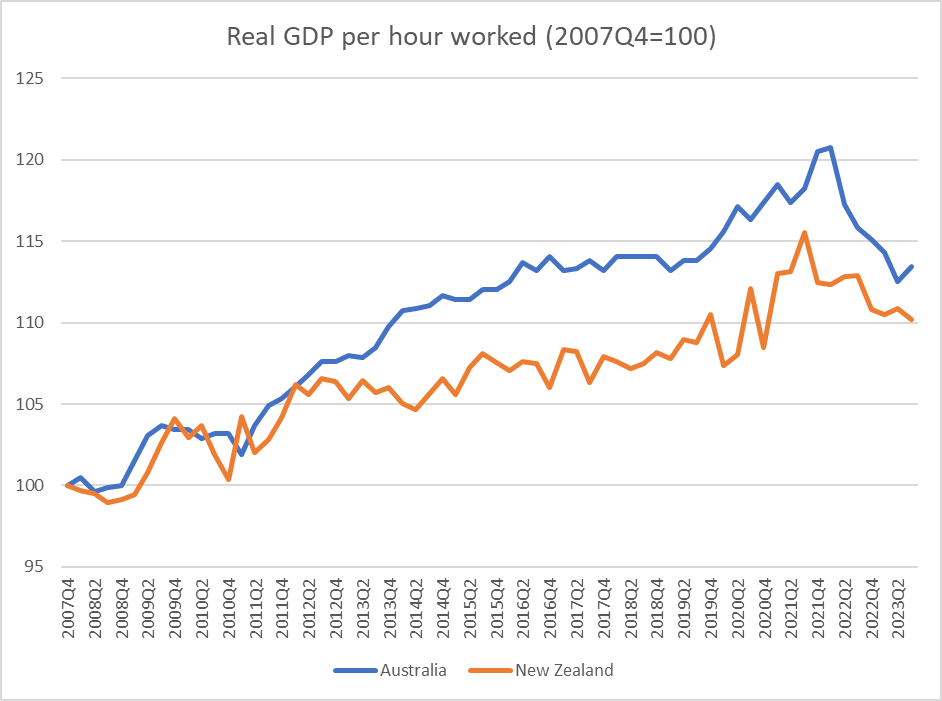
What about the longer-run series? This one is since just prior to the last big recession.

Pretty dismal productivity growth in both countries - less than 1 per cent per annum on average over the full period – but, as usually, we have done a bit worse than them over the full period. Note that although Australia is much more productive on average than New Zealand, it is also well behind the global frontier advanced economies.

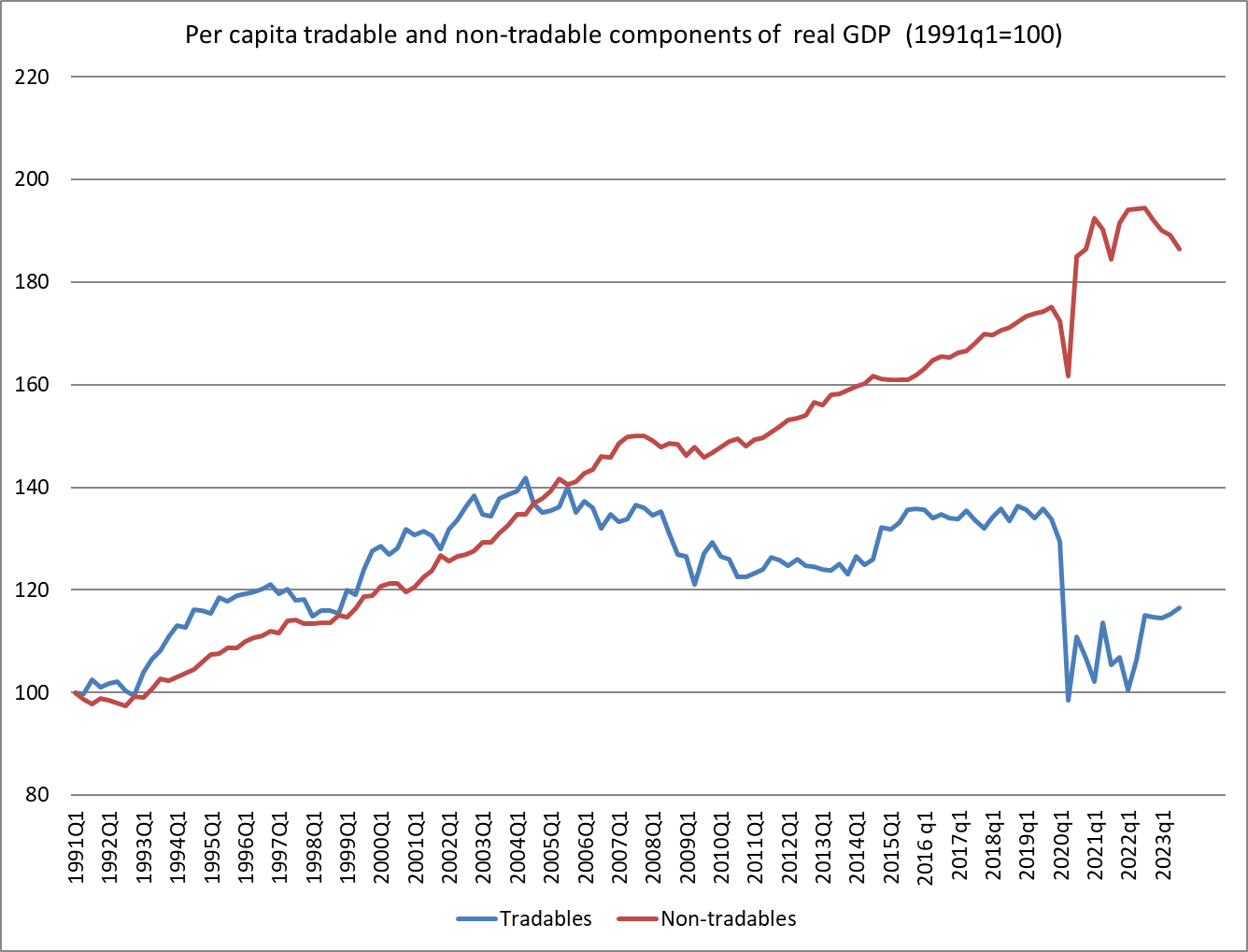
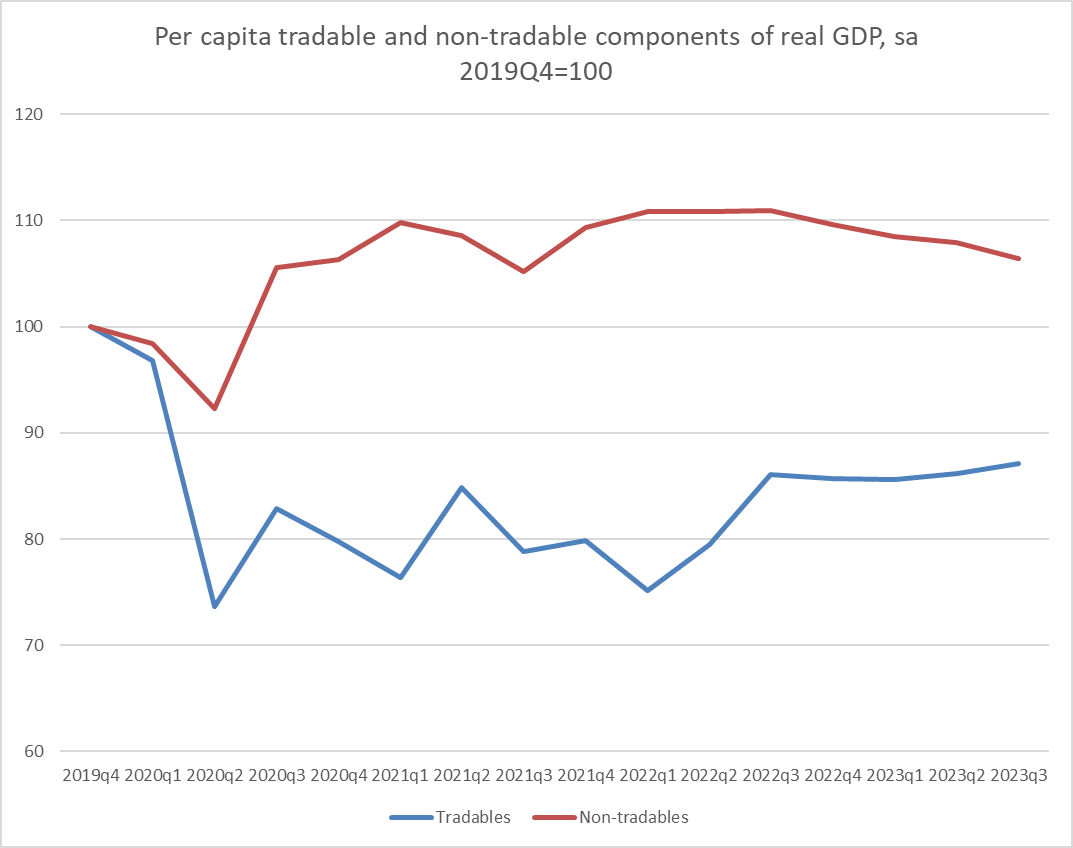
Here is another of my longstanding charts, an inevitably crude breakdown of GDP (per capita) into tradables and non-tradables components.

First, covering the entire period back to 1991

and then just for the Covid/inflation period, when the gap between the two lines has widened markedly (as you would have expected initially) and (so far) stayed wide.

On this measure, per capita (real) tradables sector production now is about where it was almost 30 years ago and is about 15 per cent less than it was at the peak 20 years ago.

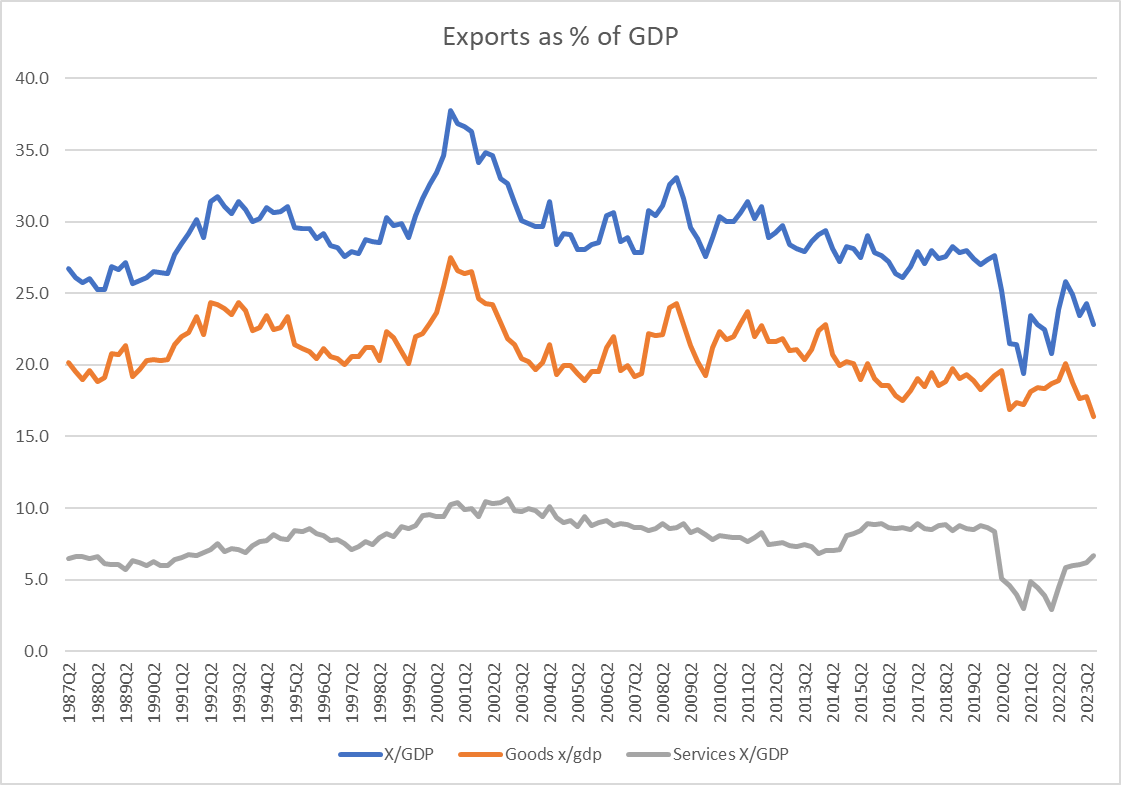
And then one final graph. This one shows (nominal) exports as a share of GDP

Total exports as a share of GDP have recovered somewhat after the Covid border restrictions but to a level (share of GDP) not seen pre-Covid since 1972 (off this chart, but using SNZ annual data).

And somewhat to my surprise, it is goods exports - not materially hindered by the border restrictions of 2020-2022 – that look really weak, now making new multi-decade lows as a share of GDP. Perhaps one shouldn’t have to say it: exports aren’t special. But successful economies tend to be ones where firms find more and more opportunities (and more firms find those opportunities) to take on world markets and succeed. The economy’s problems can’t be solved by exporting per se (which would be to put the cart before the horse), but successful and competitive economies will typically have a lot of firms succeeding internationally. New Zealand, by contrast (and for all the individual success stories that can be found) is an economy that seems to have become increasingly inward-oriented, increasingly less successful competing internationally. And these aren’t just narratives about one government, or one term in office; they are multi-decade failures.

But each government bears responsibility for their acts of commission and omission, and we now have a new government.

Sadly, there is little sign that senior ministers have absorbed just how poorly things have gone in New Zealand - and were doing when the National Party was last in office - or to have any driving commitment to much better outcomes, or (and the two are no doubt related) any driving narrative for what has gone wrong and what might make a difference. And, of course, there is little sign of an engaged and energetic bureaucracy offering the sort of analysis and advice that might, just possibly, engage a minister or Prime Minister who one day wondered what sort of economy their kids and grandchildren might inherit, if those generations are rash enough to stay.

For reference, and least those Australia comparisons at the top provide some sort of excuse for do-nothing complacency, recall that over the last 10 years half a dozen countries have gone past us on the OECD productivity (GDP per hour worked) league table.

Monetary policy turning points

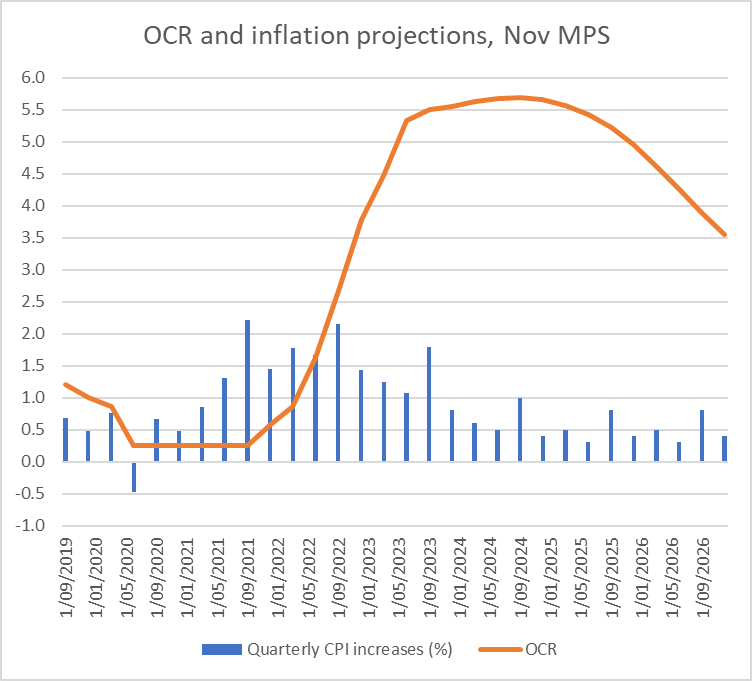
When the Reserve Bank MPC came out late last month with its last words on monetary policy before its extended summer break, my post then was headed “Really?“. It was a commentary on the disjunction between the Reserve Bank’s inflation forecasts on the one hand, that showed quarterly inflation collapsing (not really too strong a word for it) over the next few quarters, and on the other hand the Bank’s OCR projections that showed a better than even chance of a further OCR increase early next year and an OCR at or above current levels well into 2025.

It wasn’t as if the Reserve Bank even gave us a compelling story as to why (a) they expected inflation to be just about to collapse or b) why they were talking in terms of further OCR increases. It just didn’t make a lot of sense, and they seemed doomed to be wrong on one count or another. And here remember the lags (something the Governor himself reminded people off in his press conference): whatever core inflation is going to be by the middle of next year is (unknown but) baked-in already. Changing monetary policy would make little or no difference to most of next year’s inflation.

Now, it is quite fair to note that there hasn’t been much sign so far in the official CPI data of the core and persistent parts of inflation coming down much, if at all. As ever in New Zealand, things aren’t helped by infrequent and lagging data (our last comprehensive CPI data are reading things as at mid-August). Neither the trimmed mean nor weighted median measures are done on seasonally-adjusted data (SNZ, please fix this), but the latest quarterly observations for both measures were about the same as in the September quarter a year earlier. We do have a seasonally-adjusted quarterly non-tradables inflation data, and the latest observations are down from the peak, but the September quarterly inflation rate was still no lower than June’s. There is enough in those official data to suggest core inflation has definitely peaked - which isn’t nothing - but having gotten things so wrong a couple of years ago you can understand why MPC members might still be a little nervous if they were just looking at the CPI (although if you were really that nervous why project such a sharp fall in inflation so soon?)

The issues are compounded for the Reserve Bank - and anyone else trying to make sense of what is going on now and what might happen soon – by the fact that two big and powerful countervailing forces have been at work. On the one hand, we had the OCR raised by 525 basis points in little more than 18 months, an usually large move in such a short space of time (the only move really comparable was in 1994 - focus then on the 90 day bill rate). And, on the other hand, record net migration inflows. In isolation one is a sharply disinflationary force while the other has added to inflationary pressures (although on the Bank’s forecasts net migration is forecast to be sharply lower next year, and if so that is likely to be a disinflationary shock). Since the Bank’s models - and anyone else’s – didn’t do very well at all in picking the sharp increase in core inflation, there is probably little reason for them (or anyone else) to have much confidence now.

All that said, it is getting increasingly hard not to think that inflation is about to fall away pretty sharply, and would keep doing so for some considerable time if the OCR were left at current levels or even raised a bit further.

There are straws in the wind from the partial (monthly) price data that SNZ releases. Indicators from the labour market suggest it is much easier to find staff (much harder to find a job) than was the case just a few months ago (at the level of anecdote I’ve been surprised by stories from my university student kids about how much problem many young people they know have had getting holiday jobs). The experience of several other countries is also not likely to be irrelevant - where inflation has also (finally) seemed to have begun to fall away faster than seemed to likely to policymakers earlier this year (and bear in mind that if the RBNZ was not one of the first advanced country central banks to raise the OCR in 2021 (it was about 7th), it was moving earlier than central banks in the US, the euro-area, Canada, or Australia.

But then there are things like the GDP data. This was from my post on Saturday

Now, it is fair to note that on some international estimates New Zealand had a larger positive output gap than most other advanced countries when inflation pressures were at their peak last year. On that basis, it might take more work - more loss of output - to get inflation back down here than in many other advanced economies. But when you have the second worst growth in GDP per capita of any OECD economy (and materially weaker, on current estimates, than the next country with its own monetary policy - Sweden) it might seem like a reasonable hunch that enough has been done. Of course, there will be revisions to come, but the December quarterly GDP release (ie last week’s) is generally the least unreliable because it benefits from the recent updates of the annual national accounts.

Now, is it impossible that inflation could stay high - or fall only very sluggishly - even if GDP (and GDP per capita, which is more important here) are very weak. In extreme scenarios of course not. But the economy hasn’t been suffering from really nasty adverse supply shocks over the last year, extreme political instability is not a feature (transfers of office happened as normally as ever), and……inflation expectations have stayed encouragingly subdued throughout the last couple of years, and are modest now.  In a rag-tag sort of way the system seems to have worked (central banks messed up really badly in 2020 and 2021 - and that can’t be lost sight of – but when all the alternatives had been explored seem to have done what was required). The high inflation of the last couple of years is going to be a nasty memory for quite a while (here as elsewhere), but there is little sign anyone much thinks inflation is going to settle outside the target range.

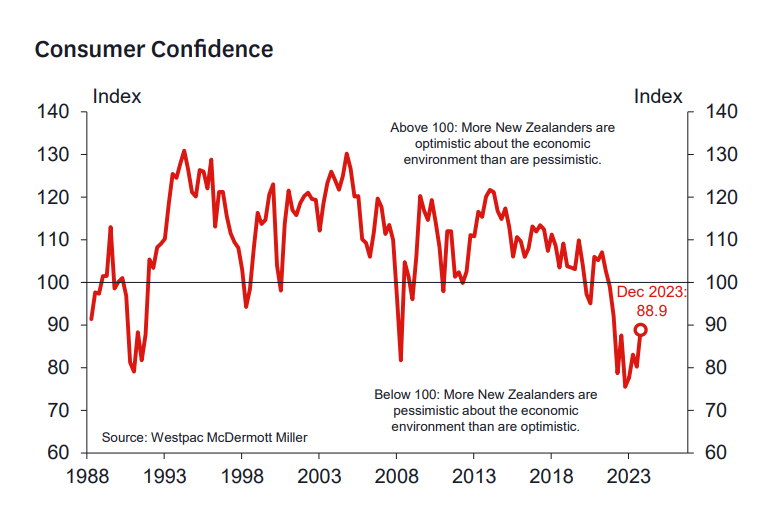
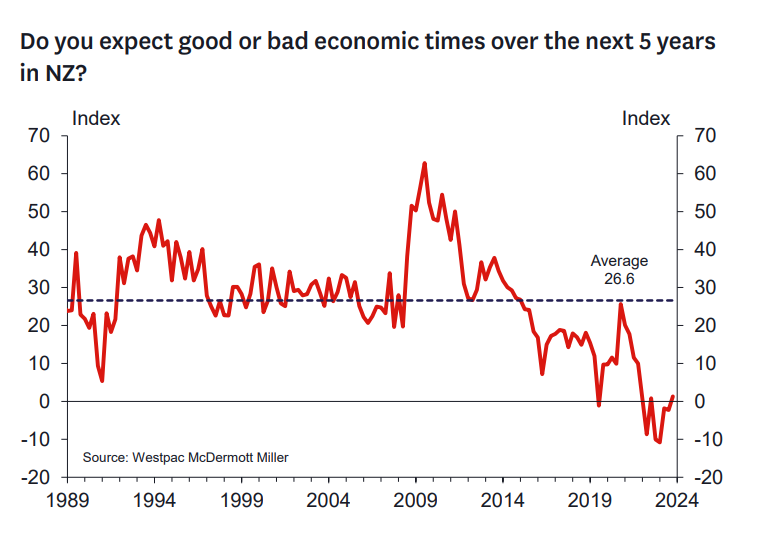
Worriers may point to recent pick-ups in confidence survey measures. This (Westpac) one just turned up in my email inbox

Being off the lows here still leaves it not far above troughs in the most recent two severe recessions in New Zealand. All the confidence measures are still in contractionary territory, and the medium-term mood is about as bleak as ever.

One reason sometimes mentioned for why central banks would be cautious is that - after the mistakes of 2020 and 2021 - it would be quite unfortunate if they were to sound softer now only to find that inflation was hanging up and that renewed tightening was eventually needed to finally get things back near target.

As a psychological consideration it is no doubt real.  But central bankers shouldn’t be purging their own “guilt” or past incomprehension by holding tight indefinitely. Rather they need to recognise those personal biases etc and correct for them.

Against that backdrop I found it useful to look back at some of the last big easing cycles that the Reserve Bank presided over. A couple of weren’t very enlightening: the increases in the OCR in 2014 were never justified in the first place so when they were finally unwound didn’t offer much. And in the mid 90s there was enough weirdness - and volatility - about the management of monetary conditions (for those with long memories, think of the Monetary Conditions Index). But I had a look at 1990/91 and at 2008. In both cases, short-term interest rates fell by 500+ basis points (in the first case, accommodated by the RB – this was pre OCR – and in the latter by direct Reserve Bank decision). In both cases, inflation had been or become quite a problem. In 1990 core inflation had been stuck around 5 per cent and the goal – a couple of years out - was 1 per cent (midpoint of the 0-2 per cent range), and in 2008 headline and core inflation had moved persistently above 3 per cent, the top of the target range (best current estimates have core inflation peaking in that cycle near 4 per cent).

Go back to 1990/91. The first negative GDP quarter was March 1991. That data won’t have been available until late in the June quarter of 1991, but by the month of March 1991 90 day bill rates had already fallen by about half (250 basis points) of that total fall that year. At that point, the most recent (December) quarterly inflation data were hardly better than they’d been a year earlier (although it was to fall away very sharply in the next few quarters). Two-year ahead inflation expectations were still about 4 per cent.

With the benefit of hindsight, if anything we were too slow and reluctant (for a long time) to let interest rates fall that year. Much as we expected inflation to fall, we (like almost everyone else) was taken by surprise be the speed and size of the fall.

What about 2007/08, when the inflation target was much the same as it is now, and the monetary policy implementation system (the OCR) was the same?

Going into 2008, the OCR was at 8.25 per cent, a level it had been raised to in mid 2007 (at the time on the back of rising international commodity prices, when core inflation had already got troublingly high). What was to become labelled as the “global financial crisis” is conventionally dated as beginning in the northern hemisphere in August 2007 but even by mid 2008 it wasn’t seen as a huge factor in New Zealand (within the Bank there were competing views) - the galvanising events (eg Lehmans) weren’t until September that year. The world oil price had peaked - at still all-time highs - a bit earlier that year.

The New Zealand economy could hardly be said to have been in fine good heart. The lagged effects of several years of OCR increases were increasingly evident. But the unemployment rate by mid year was only a little off its lows (3.8 per cent), there’d been just a single quarter of falling GDP published (and some of that had been weather-related), but the first OCR cut was in July 2008.  Two-year ahead inflation expectations are the time were about 2.9 per cent (a touch higher than they are right now). I recall the MPC/OCRAG debates at the time, which with hindsight were a bit surreal as there was much discussion about whether just possibly we might be able to cut by as much as 100 basis points over the following year (actual 575 basis points, and probably should have been more).

With hindsight - and here I would put more stress on hindsight – we were too slow to start moving then. It was perhaps understandable given where core inflation was, and the difficulty of anticipating the full gory mess about to break on us from abroad, but it was too slow. But my point was that it was long time afterwards before it was clear that core inflation was actually back near target or even that the unemployment was back around some sort of NAIRU (it was early February 2009 before the Bank knew the unemployment rate had got to 4.4 per cent).

Have there been mistakes in the other direction? Of course. The 2020 monetary policy easing was clearly a mistake. But there have also been a couple of times when we (the Bank) thought we’d done enough only to have to resume tightening (one might think of 2005/6) but the message from the data now is becoming fairly clear. At some point - perhaps before too long - much the bigger risk is likely to be holding the OCR at peak for too long.

Go back a year or so and there was quite a bit of debate about what the neutral OCR might be? No one really had any idea, and in truth no really does now. But……the developments in core inflation globally (and in GDP and jobs ads data locally) given us a much stronger reason now to be confident that policy rates are contractionary than perhaps we’d have had at the start of the year.  And central banks do purport to run a system that puts quite some weight on forecasts of inflation. In practice, there is less reliance than is implied by the rhetoric (and models), which reflects the fact that forecasting is hard.

In debates here and abroad about the appropriate stance of monetary policy one often sees mention of two things. First, the notion that “the last mile” might prove materially harder than the first steps downwards in inflation. Mostly that seems like handwaving, especially when the focus is – as it should be - on measures of core inflation. There doesn’t seem to be much evidence from past cycles (including in New Zealand when we were first securing something like price stability in the early 1990s) of a “last mile” problem, and it seems no more plausible this time when inflation expectations have been subdued (and when in New Zealand the exchange rate remains fairly high and stable). The other argument is that central banks need to be sure we are going to get back to target. That is an argument that puts no weight on forecasts at all. I’m not one with any particular confidence in published central bank forecasts, but in most past big falls in inflation it would have proved to be a mistake (as indeed it was two years ago when central banks were slow to tighten).  As time passes, there is more reason for confidence than there might have been even six months ago. Even in principle, that confidence isn’t enough to suggest policy rates should be back to neutral - wherever neutral is - but it should be enough to suggest that less contractionary settings might be required to give one the same level of confidence one was seeking 6-9 months ago when policy rates were first approaching what now seems to be the peak. We don’t have any real idea as to whether the OCR settles at 1.5 or 3.5 per cent, but it seems most unlikely it will settle anywhere near 5.5.

I’m still quite deeply perplexed by the Reserve Bank’s stance last month (assuming that it wasn’t - and they say it wasn’t - just about playing games with markets to hold expectations up). It is less than satisfactory that (a) they’ve gone off for a three month summer break (in contrast, the Cabinet seems to get about four weeks between meetings), (b) that there are no speeches or serious interviews exploring the issues, outlook, and risk (without a Parliament there wasn’t even the theatre of an FEC hearing [UPDATE: Shortly after this post went out the RB put out an advisory that there will be an FEC MPS hearing at 8am on Wednesday}). We are left with no insight on the Reserve Bank thinking, or the range of risks, hypotheses etc they are exploring or how well they are marshalling evidence in support etc. It is our inadequate MPC on display again, summoning no confidence in them whatever even if (just possibly) somehow they are right.

If the meaningful dataflow this year is largely already at an end - hard to see the HYEFU or the micro-budget telling us much – the CPI data in late January, the suite of labour market data in early February, and the monthly spending indicators (including those banks are now producing of own customer activity) should be telling us (and the MPC) a lot.  If things are as weak as many recent indicators have suggested and inflation pressures are (finally) abating fast, the possibility of an OCR cut in late February shouldn’t be thought completely impossible or inappropriate.

GDP per capita growth

The quarterly GDP data were out on Thursday. Quite how one reads them probably depends on bit on where your focus lies. To the extent that the focus is on squeezing out inflation then any data that points to excess demand dissipating a bit faster is mostly a good and welcome thing. The sooner inflation is back to around 2 per cent, after three years away, the better.

On the other hand, real GDP per capita is the average real incomes of New Zealanders. And since not only did real per capita GDP fall in the September quarter but some other recent quarters were revised down there is the gloomy side to the story as well.

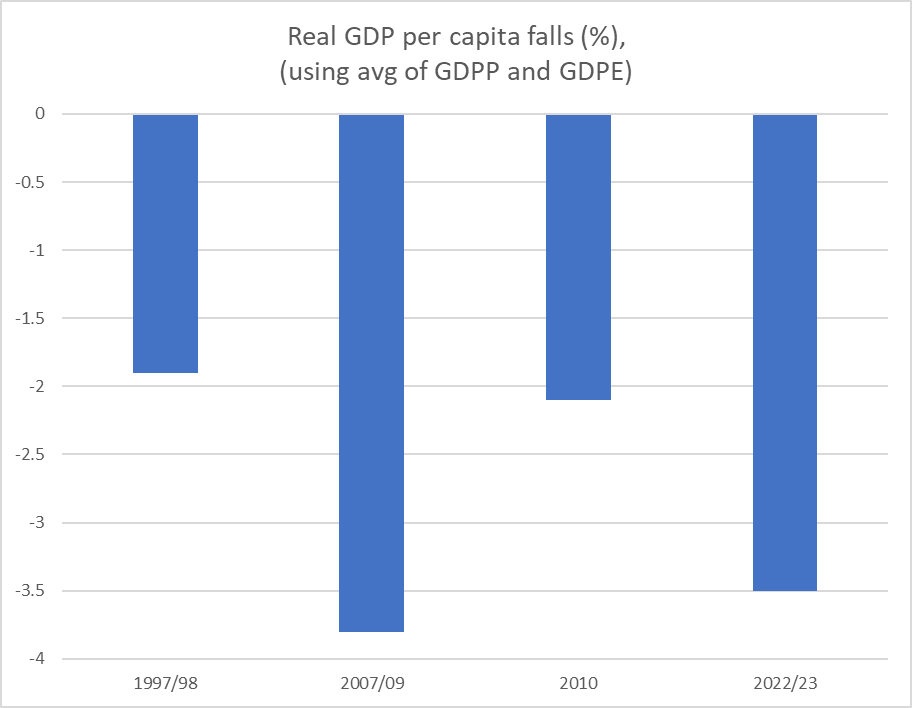
I put this chart on Twitter on Thursday

Looking back over recent recessions in New Zealand, real GDP per capita has already fallen by almost as much as it did in the 2008/09 recession. It isn’t that headline GDP is plummeting, but record non-citizen immigration inflows means the population has been growing at a rate not seen since 1947. This chart is from a BNZ report.

But how has per capita real GDP growth (or lack of it) here compared to the experiences of other OECD countries? The OECD doesn’t yet have quarterly per capita data for all member countries, but here is what they do have.

This chart shows the increase/decrease in real per capita GDP from 2022Q3 to 2023Q3. About half the countries have experienced falls in real GDP, but New Zealand’s has been the second largest fall (I’m guessing Estonia is an energy-shock effect).

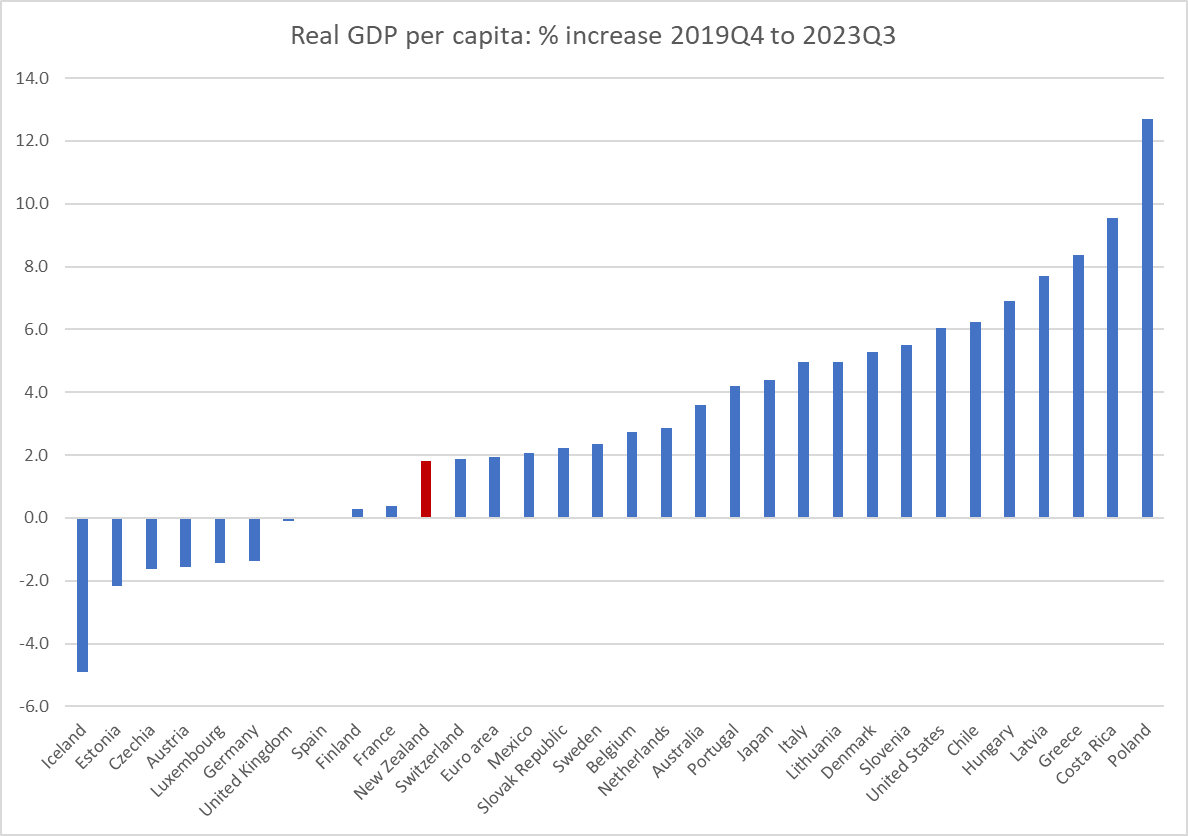
And here is the cumulative change for the same group of countries from just prior to Covid (2019Q4) to now (2023Q3)

Less bad of course, but (a) less growth than the median country, and (b) bar Iceland, all the countries with a worse performance than New Zealand were severely hit by the gas price/supply shock after the invasion of Ukraine (I’m not sure what the Iceland story is, but I checked the Icelandic statistics office website and the numbers appear to be correct).

It is a far cry from the stories we used to hear - backed by data - a year or two back about the initial post-Covid rebound having been fairly strong, by international standards, in New Zealand.