Not the usual stuff of this blog, but at lunchtime yesterday I went along to this well-attended event (St Andrew’s was full).
I had a few reactions and didn’t think I could do them justice in a few quick tweets.
Why did I go along? Well, several reasons really. Being semi-retired one has time, in principle the topic sounded interesting and important, I’d never heard Salmond speak before, and I have some time for Boston. I can’t say I necessarily expected to agree with the thrust of the promised “conversation”, but it is always good to hear people you disagree with make their best cases. Boston noted that it was a rare event at which he lowered the average age (and he is a few years older than me).
As it happened, Salmond did most of the talking, while Boston acted more as guide and host to the conversation (although he threw in some more comments in the Q&A session, including stating his preference to raise the NZS eligibility age to 70 – I clapped at that point). He sought to structure the discussion under 4 headings: treaty issues, environmental issues, the future of democracy, and “what on earth should we do now”.
Of course, I should have anticipated that the “conversation” wasn’t really going to be anything at all disinterested. If you were concerned about the way in which politics and society were going, and were interested in exploring common ground, rebuilding trust, engaging in efforts towards mutual understanding etc, you certainly wouldn’t have taken Salmond’s approach. From Salmond’s side in particular, it was mostly a series of sneers and laments about this government (David Seymour in particular, and Christopher Luxon who seemed to have fallen into the hands of bad people).
(As regular readers will know I am not myself a particular fan of this government, have little time for either Seymour or Luxon, and do not support Seymour’s Treaty Principles Bill.)
If inflammatory language is one of the problems of our day, Salmond contributed more than her fair share in just one session. Had anyone who strongly disagreed with her own politics been present they’d not have felt as if Salmond had any interest in them, except to sort them out and put them on the straight and narrow, or any recognition that there might be legitimately competing interests, world views, models for how policy should be done or New Zealand governed. Instead – particularly on treaty issues – we got sneers at how David Seymour couldn’t read Maori (which seemed particularly strange from someone of wholly European ancestry re someone of part Maori ancestry), claims that his approach was “impertinent”, that it was all “heartbreaking”, and that “it takes a lot of work to remain as ignorant as many of us have been”. It was, apparently, okay to have a discussion about the Treaty of Waitangi, “but not like this” – more, it seemed, a case of it was okay for the unwashed to ask questions of the experts and be put back on the right path, as if historical research (fascinating as it often is) was the answer, rather than one contribution to dialogue and debate as to how a modern New Zealand should best be governed, and what (if any) ongoing role an 1840 treaty might play in that.
The government was then accused – in the calm moderate language that fosters dialogue – of an “ambush of our democracy”, a claim which appeared to apply not just to treaty things but to the environment. This government, we were told, “is going in the opposite direction to our survival as a species”. Strangely – or perhaps not – the fact that the ETS continues in place, which caps emissions across the economy as a whole, was never mentioned. The fast track list seemed very unpopular……and yet of course there was no mention of projects fast-tracked under the previous government. Perhaps one line I might welcome was that there wasn’t much evidence of the coalition agreement commitment to evidence-based policymaking, if only it weren’t that successive governments – of both political stripes – have been so poor on that score.
And if the rhetoric hadn’t been amped up enough, we were then told that the government was “tossing whole categories of people on the rubbish heap”, while being invited to evaluate the government on how many New Zealanders were leaving, the suggestion being that it was because of this “ambush of democracy” – as if this hadn’t been a stark and sad feature of New Zealand, across governments except when the borders were closed, for too many decades.
I’m sure it was quite entertaining and emotionally satisfying for the much of the audience – and there were audible gasps of approval when she quoted Nobel economics winner Paul Romer to the effect that “we must stop apologising for regulation. It is the only thing that protects us from the abyss” – as if no one had noticed that David Seymour’s own new ministry is actually called the Ministry FOR Regulation.
I suspect that Boston was pretty sympathetic to a fair amount of Salmond’s commentary but he did inject a moment of realism, noting that the government (and its component parties) are about as popular now as they were in the election last year. If good Christopher Luxon (Salmond had been keen on him at Air NZ) really had fallen among the disreputable, “many of our fellow New Zealanders” seemed to quite like what he was doing.
(Now again to be fair, Boston seemed distinctly unimpressed with the Labour Party, and Salmond with the Green Party, so perhaps they might think it was all just the failures of the Opposition).
Salmond seemed dead keen on allowing New Zealand policy to be shaped by international “great and good” people: we got repeated references to various reports of Nobel Prize summits. It wasn’t quite clear how this was going to help her treaty concerns, but I guess she had in mind the environment. Quite why we’d want New Zealand policy to be guided by a bunch of people who are very expert in usually quite narrow technical areas, when most political hard choices are about values and distributional tradeoff, wasn’t ever made clear. Salmond seemed very keen on “citizens’ assemblies” and exercises in so-called “deliberative democracies” but presumably only so long as people like her got to guide the material these selected citizens were presented with. More money for journalism, and public broadcasting in particular, seemed to be a policy line both Boston and Salmond were championing, seemingly utterly oblivious to the declining public trust in journalism.
Perhaps weirdest of all was the way Salmond ended. Apparently oblivious to Boston’s reminder that the current government isn’t exactly unpopular (at least outside central Wellington) there was an impassioned plea that we should “let leaders lead”. Since I doubt she in mind Seymour, Shane Jones, or even the diminished Luxon, one can only assume it was only the right sort of approved leaders who should be allowed to lead. In a final flourish of no nuance whatever, we were told that we needed leaders who would look to the interests of their children and grandchildren, not to the interests of donors. A particular unconstructive approach to enhancing mutual respect etc to simply assert that everyone who disagrees with you is either ignorant or in the thrall of donors, and has no concern for next generations (even their own) at all. It really was quite breathtaking.
Perhaps if one went along to an ACT rally, or even a New Zealand Initiative members’ retreat, it might all be about as bad on the other side: the dismissive sneering and the automatic assumption of a single right pathway, if only the peasants could be cowed or brought to understand. Maybe (I genuinely don’t know). For myself, I’m sceptical of constant calls for “social cohesion” etc, since there are really big and important differences and values and world views and priorities, and there isn’t much point in assuming that one side or the other only needs to be enlightening (or perhaps silenced). But it really was astonishing that someone as able in her own field as Salmond evidently is, had no apparent interest in anyone else’s models or values or frameworks, or even a conception that there could be such things: the people of goodwill and intelligence might genuinely, deeply, and perhaps intractably disagree.
But it probably all played well to the elderly base present at the meeting. Just like so many gatherings – so much social media for that matter – do.
On Friday morning I picked up my copy of The Post to find on the front page a story clearly handed to Stuff’s political editor Luke Malpass, about a shiny new intervention that ministers were to announce later that morning to help out residential property developers. It was, we were told, going to offer free downside price/liquidity insurance to large and established property developers. It would be sold as strictly “time-limited” except that there would, in fact, be no time limit specified.
My reaction on Twittter was “What…….” and it brought to mind that old jeer about business-friendly (as opposed to pro-market) governments and an enthusiasm among some of their supporters to “capitalise the gains and socialise the losses”. Little did we imagine that this would in fact become declared and intended policy of this National/ACT/NZ First government (not in the midst of a crisis, where sometimes these things happen, but as a whole new policy tool). I’m not generally an ACT fan, but……you have to wonder what the point of an allegedly pro-market anti-intervention libertarian party is if they wave things like this scheme through Cabinet (and not even their backbenchers have issued statements of disapproval, they being rather freer than ministers).
Malpass’s report was quickly proved accurate, with the announcement later that morning by Chris Bishop and Chris Penk (ministers of housing and of building and construction respectively) of the Residential Development Underwrite scheme.
The fact that it appeared to replace but considerably extend schemes in place under Labour was not a point in its favour
Funding for the RDU will be redirected from unused funding from the Kiwibuild and BuildReady Development Pathway programmes. Both of these programmes are now closed to new applications.
This government (rightly) having made much of inheriting a large structural fiscal deficit, and wanting to get government out of business, instead jump in boots and all. And all apparently on the basis that a couple of Cabinet ministers and their MHUD officials know better than the market what should be built when, where, and by whom, and thus who will win the benevolence of the free government underwrite.
There was more information on the MHUD website, but it was no more reassuring. There was no sign of any analytical framework behind any of it (no analysis at all, let alone anything serious or rigorous. of market failures or any sort of cost-benefit analysis or risk assessment). In fact, there was a distinct sense of something that had been rushed out. Some property developers had presumably been bending the ears of ministers. As the Herald put it “the government is riding to the rescue of stressed property developers”, in a distinctly picking-winners approach to the recession. Plenty of people and firms will have undergone huge stress in the last couple of years, as inflation was squeezed back out of the system. It was and is a necessary adjustment. But most apparently didn’t enjoy the favour of ministers.
And will no doubt do so again. In one article on Friday, Bishop was quoted thus
Bishop said the scheme wouldn’t be in place forever and Cabinet would make decisions about when to “turn it on and off” depending on demand and construction activity.
So that would no predictable and rigorous framework, but rather a great deal of trust in ministers’ ability to forecast construction cycles and housing demand, or to respond to pressures of the electoral cycle or developers bending their ears. Good regulation – like a good tax system – is stable and predictable, not turned on or off at the whim of ministers. This is poor policy, done poorly. And isn’t it simply dishonest for a government department to repeat ministerial spin about the intervention being “time-limited” (and MHUD does exactly that upfront) when there is no time limit at all? After all, in the grand scheme of things every policy intervention will eventually be altered/amended.
In essence what the scheme involves:
the government will guarantee to purchase at an agreed (in advance) price houses that don’t sell at an (approved) market price within an approved period of time,
only large-scale developers will be eligible for this assistance, preferably those building in Auckland, Wellington, Christchurch, Hamilton, and Tauranga [a little surprised Queenstown wasn’t on the favoured list),
no fee will be charged for this put option that is being granted to the developers
The rationale appears to be that banks and other potential lenders aren’t sufficiently willing to take risks on this projects, even at high fees/interest margins, but……government knows better/best. Quite why we are supposed to believe this self-delusion (ministers and officials falling for it is perhaps more understandable – if no more excusable – given the nature of their incentives) is never made clear. Minister are, it appears, blessed with some special insight into the state of the economy and the timing/speed of the recovery, and instead of just (say) publishing that analysis, they prefer to give handouts (and that is what free price/liquidity insurance is) to developers.
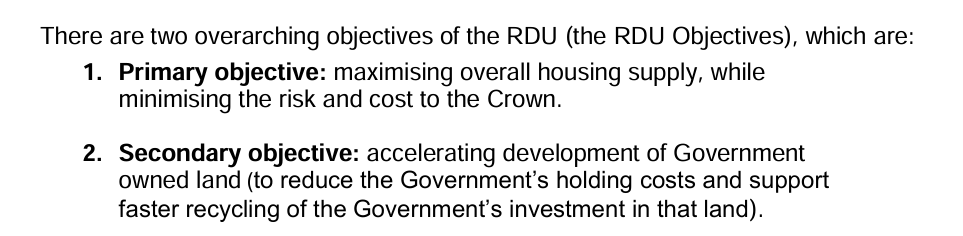
In the MHUD document there is this statement upfront
The secondary objective never seems to get another mention, but the ‘primary objective” is almost worse, for being functionally meaningless. You minimise the cost and risk to the Crown by simply not offering free insurance, and if you must offer such insurance you should do so with a disciplined and transparent model (to, for example, estimate the economic price of the option). But there is nothing of that sort in any of the MHUD material, just a lot of mention of the (extensive) discretion afforded to officials, of whom we may be left wondering both what their expertise is and what their incentives are. Why would we back them to make better choices than financial market participants? And as for “maximising housing supply”, there seems to be no analytical framework there either, including around incentives on developers (who will, of course, prefer free insurance and can be expected to try to game the rules). Will there be any material impact on supply, will any impact be any more than timing, and how will MHUD rigorously evaluate claims put to them by developers? Oh, and isn’t developers finding themselves with overhangs of houses and land part of the way that much lower house prices actually come about?
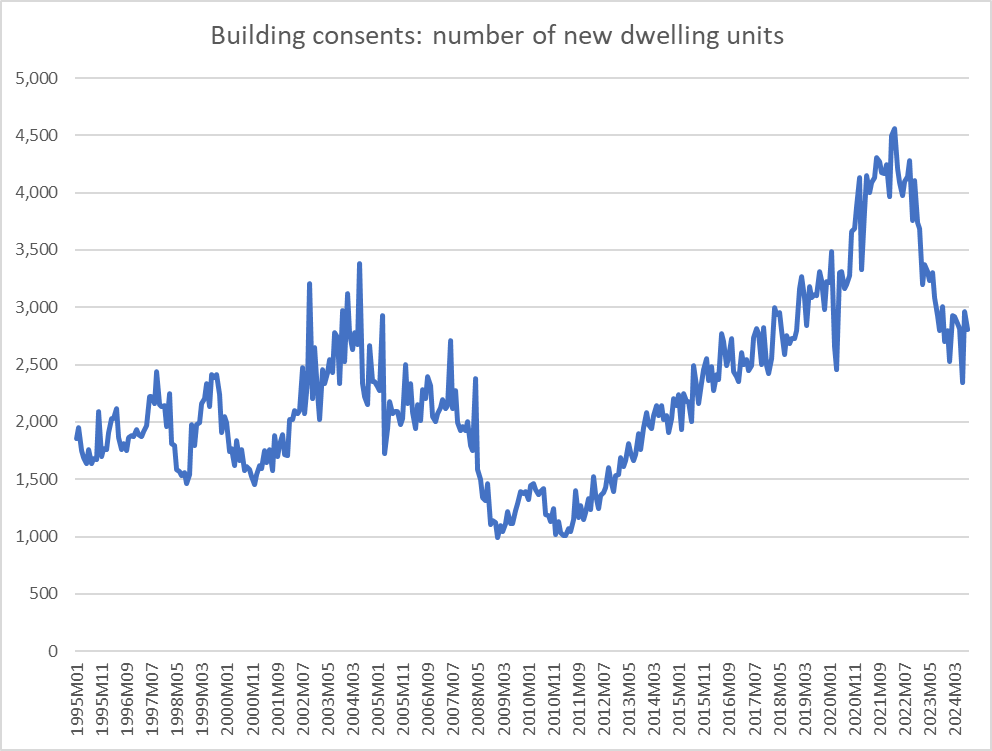
It is possible the scheme won’t end up being hugely costly. After all, house prices might take off again as interest rates fall. Or officials might err on the very cautious side and very few underwrite grants might be made (or at such deep discounts that the real insurance cost is cheap). But there is just no good or compelling analytical foundation for any sort of intervention of this sort (none provided, none readily conceivable). Even the business cycle argument seems rather flakey. Ministers seem to lament the cyclicality of residential construction (globally, it tends to be one of the most cyclically variable components of GDP), but when they lament the state of the industry, they don’t mention that new residential dwelling consents are still running around twice the level at the trough of the 2008/09 recesssion.
There is also talk about helping to get the cyclical economic recovery underway. Pretty much all the arguments against using fiscal policy for that purpose – I’ve outlined them here repeatedly – apply at least as much to discretionary sector-specific interventions like the Residential Development Underwrite. And, of course, were the Reserve Bank to regard this scheme as being likely to make a material difference it should, all else equal, make them more reluctant to, with less scope to, cut the OCR a lot further.
It is a rather sad reflection of how the quality of New Zealand policymaking has fallen. Perhaps we should be grateful that exchange rate cycles aren’t what they were – and that past governments were less prone to scheme like this – or who knows what sort of free insurance the government would be dreaming up for exporters.
Who knows what the relevant government agencies thought of this scheme. I’ve lodged OIA requests and am particularly interested in any analysis and advice from The Treasury and the Ministry for Regulation.
Hard on the heels of the Commerce Commission’s inquiry into some aspects of banking competition, Parliament’s Finance and Expenditure Committee is also holding an inquiry. Submissions weren’t open for very long and have now closed, but the full terms of reference are here. It is a select committee inquiry, so it is hard to be optimistic anything very useful will come from it. Select committees are poorly resourced, even if they wanted to make a serious contribution, and the incentives seem to be almost entirely partisan political in nature.
A few submissions have so far seen the light of day. Those I’ve seen are:
None is particularly long, although Body’s piece has several appendices of past contributions in this general area.
The Reserve Bank’s contribution is mostly defensive in nature: if there are any issues, responsibility doesn’t rest with us or with our regulatory model. Which is, of course, pretty much what you would expect them to say, as an entrenched and powerful independent existing regulator, who no doubt believe that all the policy judgements they’ve made have been wise, in the best interests of New Zealanders etc. But just because it is them saying it doesn’t automatically mean they are wrong.
And in some areas no doubt they are right. As they note, having four big banks isn’t at all unusual. And some scepticism of state-enabled “maverick disruptors”, especially in the form of an unimpressive modest retail bank, is likely to be well-warranted. They also fairly note that patterns of finance have changed over time, something particularly evident in rural lending (where Rabobank is now the second biggest lender) and in corporate lending (where even on the data they have access to – and big corporates can tap international markets directly – overseas banks other than the big 4 apparently now have 30 per cent of the market).
And I (have always tended to) share their view that (approved regulatory) relative risk weights, used in calculating capital requirements matter a lot less than is often made out. In principle they should make no systematic difference at all since the aim of relative risk weights is more or less to reflect true differences in the underlying riskiness of different types of credit (eg a residential mortgage, with a 40 per cent LVR, is likely to be much much less risky, individually and as part of a portfolio, than an unsecured loan to a B-rated corporate). In practice, things aren’t that simple, including because the dividing lines between different types of lending and associated risk aren’t always clear or straightforward, and which side of a rather arbitrary line something falls can matter. And since no one – regulator or regulated – knows with any great certainty how (relatively) risky different types of loans are (mercifully, very bad crises don’t come along very often, and so data are scarce and open to contextual interpretation – regulators can get things wrong, and impose risk weights on particular types of lending that are quite at odds with the views of the lenders themselves. And any mapping for particular Reserve Bank imposed risk weights to either the pricing or availability of individual loan products is likely to be fuzzy and indirect at best.
Most importantly, relative risk weights simply do not explain why bank balance sheets are chock-full of residential mortgages. Rather, the artificial scarcity of houses and land, imposed over decades by central and local government, has led to hugely expensive houses, which each incoming generation needs to finance. Bank balance sheets would be much smaller if regulatory reform successfully delivered enduring low prices of houses and urban land.
All that said, one shouldn’t be too keen to come to the defence of the Reserve Bank as regulator. This is an agency with very limited specialist expertise at the top (see, notably, the Bank’s Board which now wields the policymaking power), has a culture of being aggressively dismissive, produces no serious research or analysis on financial regulation or stability (even though these functions now comprise the largest chunk of the Bank’s staff) and so on. What speeches there are lack any real depth or insight.
As I noted at the start, the New Zealand Initiative’s submission is brief. There are, broadly speaking, two aspects to it. The first is about efficiency considerations – a dimension unfortunately now lost from the legislation
Of course, any bureaucracy can produce a cost-benefit analysis of sorts of justify its own choices. I didn’t find the case for the 2019 decisions compelling, but a review now – especially if the reviewers were appointed by the RB or those sympathetic to it – isn’t really the answer (and under current legislation the Minister of Finance can’t direct the Bank in this area). My own view remains that (a) key people matter, and b) key policymaking decisions (as distinct from implementation on individual instruments and institutions) should be moved back to the Minister of Finance, who has both some real accountability (governments get tossed out, and question in Parliament routinely) and better incentives to balance the competing imperatives around any regulatory structure. It is very unusual to delegate major regulatory choices to an unelected agency (the more so, one with little demonstrated depth, expertise, and commanding little respect).
The New Zealand Initiative doesn’t go that far. They propose instead
I’ve written previously in favour of splitting around a NZPRA, which would have advantages for both those functions and for the Reserve Bank’s monetary policy and related functions. As they note, a suitably-qualified FPC might be a halfway house, although I’m not sure that the MPC – as staffed, and (not) scrutinised and held to account for the mistakes of recent years – is a great advert.
(I’m less convinced of the merits of taking the Governor off the Board. The FMA is primarily an implementation agency without much of a public face. The Reserve Bank, or major policymaking committees, are a different matter…….and for what it is worth it would be quite anomalous internationally not to have the Governor on the central bank board.)
The main prompt for doing this post was Andrew Body’s submission, which he was kind enough to send me. I don’t agree with everything in his submission – we’d disagree I think mainly on the risk weights issue (see above) – but the bulk of the submission captures a number of areas where the current Reserve Bank is ill-equipped for its job, and not doing that job well. His submission is an easy read. Here are a few extracts.
It is often forgotten just how much of an impost was imposed on banks the local incorporation and outsourcing requirements.
What I’m less sure of is how much of this is idiosyncratic to New Zealand, and how much is a general tendency of regulators and the regulated. The stylised wisdom when I was at the Reserve Bank was that banks were typically under orders from Australia to be very reluctant to upset or call out the regulator (there or here). Of course, when your regulator – as Graeme Wheeler did here – takes offence at anodyne critical comments from a bank economist, and calls in the heavy artillery to get the economist silenced, it sends a message. Banks have a lot at stake, and the Reserve Bank has a lot of power, which can be wielded for good or ill.
Before turning to governance
Much of that makes a lot of sense. But, of course, there is no sign that the Minister of Finance has any interest whatever in a better Reserve Bank, whether in its monetary policy or regulatory functions. She just reappointed the chair, has left Board vacancies unfilled, and included nothing about a reorientation in her Letter of Expectation. Instead, she seems to have been toying with arbitrary new taxes on banks.
Standing back from all three submissions, a few things struck me. The first (and most important) is that neither the Reserve Bank in its defence or the critical submitters mentioned the APRA regulatory requirements and how they affect things in New Zealand (neither did the FEC’s terms of reference). That should be really quite surprising as most of the grumbling is about the four big Australian banks, all of which are part of Australian-based consolidated banking groups, regulated as such by APRA (eg capital requirements that apply to group exposures as a whole). There is no doubt that more onerous regulatory requirements can materially affect the New Zealand subsidiaries, but in any area in which the RBNZ’s requirements were less burdensome than APRA’s it might make or little or no difference here, as the group would still be constrained by group-wide regulation. I’ve never been quite sure how it all works out in practice – how banks do their pricing and risk allocation etc having regard to these distinct regulatory regimes – but it is surprising not to see it mentioned once. At an aggregate level, I’m inclined to the view that the Reserve Bank never made a compelling case for the extent of the 2019 increases in New Zealand capital requirements (and that the heavy focus on high capital is somewhat misplaced, relative to the much-harder-to-measure/observe changes in credit standards), but markedly lower requirements might well become non-binding.
I’ve long been a bit puzzled as to why more non deposit-taking entities don’t lend directly into the New Zealand market (at least if, as we are often invited to believe, there are excess profits on offer here). I recall being heavily involved in some work almost 20 years ago now on possible alternative approaches to monetary policy implementation, and one thing we focused on a lot then was the possibility of entities lending mortgages (say) directly into New Zealand from abroad. Disintermediation was also in focus when the first LVR restrictions were put in place. But none of it ever seem to have come to much. I was exchanging notes with a banking lawyer recently and asking why, say, Macquarie – an aggressive new entrant to the Australian mortgage market – couldn’t just lending into New Zealand as “Cheap Mortgage Loans Limited” (so wouldn’t need to be a New Zealand bank), but the person I was engaging with noted that people who had considered such options were scared that the Reserve Bank would act to stop them (and apparently there are designation powers in the new deposit-takers legislation). You have to wonder why it would: no New Zealand depositors’ funds would be at risk, and new competition would be injected to the system. I note it mainly because it isn’t entirely compelling that everything sensible has been done by the Reserve Bank to reduce unnecessary barriers to entry. Better “Cheap Mortgage Loans Limited” than a juiced-up Kiwibank, in which taxpayers’ money is directly at stake.
I have no expectation that the FEC inquiry will produce anything useful. It isn’t set up to. The submission time was short – who could commission serious or fresh analysis in that time? – and the committee has few resources, no specialist support, and its members don’t appear overly strongly qualified, except to pursue narrow political agendas (some of which might be sensible, but most won’t). And thus how equipped are they going to be to evaluate competing claims in the submissions they receive? It isn’t like a court case in which expert witnesses are grilled by counsel for both sides, and arguments, evidence, and implications tested. A proper workshop, with major submissions presented as papers with discussants and audience questions might have offered the prospect of shedding some serious light. But the political process is all too often interested more in heat than light.
UPDATE: Martien Lubberink (VUW) draws my attention to his submission here. A one sentence summary might be that we should be at least somewhat grateful for what we have – a stable, predominantly foreign-owned, system – and wary of the siren calls to any sort of quick fixes to apparent problems. Thus far, it is hard to disagree (although I have a few specific areas in which I might reach different views than he does).
It was a tweet from Olivier Blanchard, emeritus professor of economics at MIT and former chief economist of the IMF, that first drew my attention to the book
Please, please, read it. It is worse than you imagined… (and the book is a page turner). Then, worry about the following headline from Axios today: "1 big thing: Crypto dominates corporate election spending." https://t.co/riryXjtiLI
“A brilliant and fascinating description of crypto. It makes painfully clear that, on the buying side, there is no limit to human credulity, and the faith in magic returns. And, on the selling side, no limit to hubris, deception and scamming. Read the book, and cry.”
As I sat reading the book yesterday I kept wondering quite how it had got through the publishers’ lawyers. But it seems to have been written under a pseudonym and various significant names have been changed, including that of the UK-based crypto firm (that briefly became one of the biggest crypto marketing companies around) in which the author was a senior figure, and more than a few of their client firms. Presumably that was seen as enough to reduce the legal risks sufficiently to publish.
Readers should be grateful: it is an easy and absorbing read, and if you are anything like me you’ll read it with some mix of astonishment, despair (human nature and all that), and moral outrage. I’m pretty sure the author intends to prompt readers to think more regulation is an obvious and necessary response, but I’m less easily persuaded on that count. Fools and their money…. If there are decent people and firms in the sector, operating consistently ethically, there is pretty strong incentive on them to differentiate themselves from the (apparently) very many rogues and rank opportunists.
“Donoghue” (from here on I’ll drop the quote marks) – who seems to be still quite young (says he was still a student in 2016) – had a background in PR, apparently in both finance and politics in the UK, before he jumped aboard a crypto startup being put together by an old university friend and the friend’s cousin. In the early days – Donoghue still holding down a fulltime PR job elsewhere – it seems not to have been much more than three or four of them, chasing the dream of “generational wealth”. The plan was to launch a gambling platform – on the future price of Bitcoin – with an associated crypto token. As Donoghue writes it now – while claiming, perhaps plausibly as he was the PR guy, not to have realised it at the time – it was a “totally implausible business model”. Which, in the crypto sector, didn’t stop lots of weird projects getting off the ground, and a lot of wealth being redistributed (and some apparently made – with an emphasis on the “apparently”; it was close to the sort of stuff J K Galbraith was writing about when he coined the phrase “the bezzle”). The shortlived boom Donoghue was in the midst of collapsed in late 2022, most prominently including the fall of Sam Bankman-Fried’s FTX.
It is a lively story. Donoghue’s firm started with its own platform/token, but very quickly found that there was more money to be made parleying their experiences and expertise (such as it was) into selling marketing and promotional services around the launch of new crypto firms/products/token to the myriad of other ambitious opportunists wanting to get on the boom quickly. In some cases, firms were almost throwing money at Moonshot (the pseudonym of the advisory firm). There are weird tales of the launch of improbable NFTs (non-fungible tokens) – who, they wondered, was going to want to buy NFTs of pictures of the football players of some US team, whose CFO had got keen on the idea, especially when there was no easy way – for those not already engrossed in the crypto world – to buy the product. But it sold. Or an NFT of a stamp, when one could simply own the stamp itself (as I recall it, that one didn’t get off the ground).
There are plenty of accounts of “influencers” being paid in heavily discounted crypto tokens they were to hawk, never disclosing to the influenced their own direct stake in the success of the token/platform. Or of venture capital firms issued with deeply discounted tokens, typically undertaking next to no due diligence, and wanted less for the immediate money they provided, than for the apparent (but highly misleading signal) that if the VCs were on board, it must be okay for the public to buy. And the parties, so many parties, so lavish.
In Donoghue’s words:
It’s an insider’s view, into the lives and livelihoods of some of the inner circle to which I used to belong. It’s a record of the sheer extravagance, excess and absurdity, which seemed to take place on a daily basis. And what it illustrates is how the people behind one of the most captivating, disruptive and incomprehensible industries the world has ever seen act when the cameras are off, and their guards are down.
I strongly recommend the book. And if the recommendation of someone like Blanchard (and blurbs from two Nobel memorial prize in economics winners) isn’t the thing for you, it also comes blurbed by people like Frank Abagnale (subject of Catch Me if You Can), Izabella Kaminska, Frank Partnoy, William Cohan and Dan Davies, authors many of you will recognise. Oh, and by Andy Verity, whose excellent book – published by the same firm – on the scandalous prosecutions that followed the LIBOR issues in 2008/09 I wrote about here last year.
As it happened I had a couple of emails from Donoghue himself a couple of weeks ago offering me a review copy (not sure why, this being a fairly obscure blog, but I guess PR was his expertise. And I’d already ordered a copy). This is how he describes his own book.
The book is a narrative non-fiction account of my time spent working in the cryptocurrency industry. It’s a cautionary tale of the scams and fraud endemic to the space, and the often-devastating consequences inflicted on ordinary investors who get caught up in these.
For several years, I ran one of the most prominent marketing agencies in the industry, working with some of the largest companies and projects in the space. I was also on the founding team of a number of projects myself, one of which obtained an all-time-high fully diluted market capitalisation of $300 million.
My book now seeks to shed light on the corruption and malpractice which I saw unfold on a daily basis.
What could usefully be added is the line from the end of the book’s Prologue: “In order to tell that story, I first need to tell my own. It’s the story of a player on the inside who became so blinded by greed that he didn’t even realise he’d lost his way until it was almost too late”. It was a wild ride, and perhaps one he is now ashamed of. His penultimate paragraph is a good place to end.
I can only hope that, after the actions of SBF, Do Kwon, and the countless other characters in the rogues’ gallery of crypto we haven’t heard of – who will all hopefully get their day in court sooner rather than later – people will be dissuaded from having a punt in the murky and malevolent markets of crypto.
A few weeks ago I wrote a post about an article the Herald’s Jenee Tibshraeny had written based on an interview she’d done with the Minister of Finance. Willis was reported as toying with a number of fairly questionable ideas around the Reserve Bank (none involving actually replacing the Board chair). One of those involved the interest rate paid on banks’ settlement account balances at the Reserve Bank. Those balances are currently high (something that is entirely determined by the Reserve Bank; banks themselves can influence only the distribution of the aggregate balances among them).
I wrote then
It would be an arbitrary bank tax, even if Willis amended the Reserve Bank Act to mandate such an approach
I ended the post noting that I had lodged an Official Information Act request with the Minister for all the advice etc she had received on the matter. You will note (above) that Grant Robertson had been pretty responsive to OIA requests on this issue a couple of years ago (and appropriately so, given the OIA’s presumption in favour of disclosure.
The current Minister of Finance’s response came back this morning (and yes, I just noticed that her office dated it 9 August rather than 9 September)
It is pretty remarkable that she is withholding absolutely everything (down to and including titles of papers etc, or initial briefings from many months ago). Not the approach of a Minister with any sort of interest in or commitment to open and transparent government, let alone either the letter of spirit of the OIA (perhaps this is why the annual pro-active disclosure of official papers relating to the Budget has still not happened, more than three months on).
Some weeks ago, after I wrote my post, Jenee Tibshraeny kindly offered me the opportunity to listen to the full interview she’d done with Willis. There were a number of interesting aspects that hadn’t really come out in the article (space constraints and all that), but what really caught my attention was that she mentioned almost in passing that she’d be keen to see the advice on this issue, to which the Minister’s response was that she couldn’t do that as the matter was “under active consideration”.
Section 9(2)(f)(iv) – the clause the Minister cited – is generally interpreted as providing some protection when matters are under active consideration (Ombudsman’s guidance note), in which case we are left to conclude that not only was the matter still being considered when Tibshraeny did the initial interview more than a month ago, but that it is still under active consideration now. She seems to be seriously toying with a law change to allow an arbitrary distortionary and inefficient tax on banks. It is quite extraordinary (or perhaps would be if this were not the Minister of Finance who has already increased taxes on business – removing depreciation provisions on buildings – and whose government last week imposed an arbitrary export tax (on overseas tourism), in what seems to be a pure revenue grab so flagrant that even Steven Joyce – no free market purist – was prompted to attack the move in his Herald column).
One can only hope that there is a less-bad interpretation, but the Minister herself has chosen to go public with the comment to Tibshraeny that she could consider legislative intervention, and the Minister herself is now refusing to release any material on the issue.
Any such “tax” would be a seriously retrograde step and would be a signal that the government was much more interested in populist bank-bashing (Green Party style, worse than Grant Robertson) than in serious policymaking. It would be a pure revenue grab, that might even garner a few cheers from the cheap seats, but would command not a shred of respect (for her or for New Zealand policymaking more generally) from serious observers, here or abroad.
If, for example, the high level of settlement cash balances troubles her – and it should, as a reflection of past mistakes – perhaps she should have done something about (eg) replacing the Board chair and filling the Board vacancies, with people who are serious about holding Orr to account, and getting a more rigorous approach to policymaking at the Bank. There has been quite enough bad policymaking in recent years without Willis and Luxon adding to it.
The Treasury this morning hosted a guest lecture on the merits (or otherwise) of a Fiscal Council, hosted by the acting Secretary to the Treasury, Struan Little.
A Fiscal Council in this context is something quite different from the sort of state-funded policy costings office that many of the New Zealand political parties seem to be gravitating towards thinking would be good idea (more state funding, under the guise of something in the public interest, so why should we be surprised). Over the years I’ve written consistently sceptically about the policy costings unit idea, and was only reinforced in that view by my involvement last year in the contretemps over the costings of National’s proposed foreign buyers tax.
The general idea of a Fiscal Council is to have an independent expert-led small agency that provides independent and non-partisan analysis, research and advice on aggregate fiscal policy, aiming to improve the overall quality of debate on fiscal policy issues and, so it is hoped, improve fiscal policy itself. Such bodies have become flavour of the decade over the last 15 years or so. Fiscal councils are particularly common in Europe, where the macroeconomic issues are generally rather different: countries in the euro-area not only give up the option of monetary policy for national cyclical stabilisation (leaving any such national countercyclical activity to fiscal policy), but are also subject, loosely as it may be, to European Union rules.
The idea of establishing a New Zealand fiscal council has been championed by the OECD (but there have been other advocates, including a report from a former top IMF fiscal official done for The Treasury a decade or so ago, and the New Zealand Initiative). I also tended to be somewhat sympathetic (but see below).
The speaker at this morning’s lecture was Sebastian Barnes, a (British) mid-level manager in the OECD’s Economics Department, and (while working for the OECD) a former long-serving member (and then chair) of the Irish Fiscal Advisory Council (IFAC), that had been set up in 2011 in the wake of the Irish financial and fiscal crises of the previous few years.
My impression, from a distance, of the IFAC had been fairly positive over the years, and nothing Barnes said this morning shifted that sense. IFAC is a pretty lean body (apparently costing about EUR1 million per annum), with five part-time council members (a mix of academics and people with more of a policy background), and a secretariat of five fulltime economists and one administrator (they apparently share premises, and admin support with the main national economic research institute). If you look at the current council, three of the five members seemed to be non-Irish (two UK-based and one Italian – a retired IMF official who used to be the desk economist for Ireland).
Barnes spoke very positively about the Irish IFAC. That wasn’t exactly surprising – he’d spent 10 years on the Council, was present at its creation, and works for the OECD, which has called for New Zealand to set up a Fiscal Council – but his comments and experiences were interesting. For a small entity, they are pretty active and publish quite a few regular reports each year, as well as more occasional (but not infrequent) research. Barnes noted that the role of IFAC was threefold: monitoring compliance with the fiscal framework, improving fiscal and economic analysis in Ireland, and promoting informed debate on fiscal issues (and not just among technocrats and politicians).
He claimed (and I have no reason to doubt him) that IFAC had become a fairly respected and well-regarded entity on the Irish scene, and that (for example) it had established a strong reputation with the media as a credible analytical agency and a clear communicator. Barnes reckoned IFAC’s presence had helped strengthen parliamentary oversight on fiscal policy issues. One thing that he was at pains to stresses is that IFAC focuses on analysis and avoids getting into normative debates. Here he seemed to be primarily referring to choices around raising taxes or reducing spending (as ways to maintain overall fiscal balance and moderate debt), let alone to specific tax policy or (say) pensions spending. There is, it seems, quite enough to do in deepening understanding of the fiscal arrangements and highlighting risks around fiscal policy becoming pro-cyclical, a big issue for Ireland leading up to 2007. It is worth noting that Ireland now has some very distinctive issues, notably an abundance of tax revenue from foreign multi-nationals (and a big budget surplus), of the sort that may (or may not) prove particularly sustainable, and where the associated tax bases are not always hugely well understood.
It is difficult to see that the IFAC has done any particular harm. Perhaps it has even done some good for overall economic policy in Ireland. It doesn’t appear to have become politicised, it has maintained a clear sense of an expert-led analytical and advisory body. And it hasn’t cost the Irish taxpayer very much at all.
But it is still rather hard to pin down quite what useful difference fiscal councils, there or elsewhere, have made, and thus whether New Zealand really should regard the establishment of one as a medium-term priority. Barnes did note that a very visible effect of establishing fiscal councils had been that more people were now working on fiscal policy issues (he reckoned at least 100 more across Europe) and argued that fiscal policy issues had tended to be under-researched, especially relative to monetary policy. He several times referred to their inspiration as being expert-led research-oriented central banks. More research isn’t necessarily a bad thing, but…
I posed a question, noting that across the OECD there had been a proliferation of fiscal councils and yet it wasn’t obvious that overall fiscal management was getting better (he’d opened his talk with a multi-country chart of gross debt as a share of GDP, and if not every country had gotten worse over the decades, the upward trend (dominated by large countries) was pretty clear). Perhaps things were improving relative to a counterfactual (not directly observable) or perhaps fiscal councils might be more in the nature of a nice-to-have, a luxury consumption item – and good for the employment of macroeconomists and public finance people – rather than an effective contributor to better fiscal policies?
His (honest) answer was that we “can’t really tell”, but that he thought some had had “some incremental impact”, while going on to note that some of the better-regarded ones were in places (like Netherlands, Denmark, and Sweden) which had long managed themselves fairly well anyway. Perhaps a decent Fiscal Council was then a common output of a wider disciplined approach to good government and effective fiscal management? As for Ireland, I was struck the other day by a feature article in the FT about Ireland’s fiscal challenges (those big surpluses from the corporate tax revenue), in which numerous Irish commentators were quoted/mentioned, but there was no reference to IFAC or its analysis at all.
It was an interesting presentation, but if it was the best case for a Fiscal Council here (and it should have been given his OECD and IFAC background) I didn’t find it very persuasive. It wasn’t helped by the New Zealand experience of the last decade, where (a) the central bank has become anything but expert-led and produces little serious research or analysis of its own (for all its limitations, Treasury is now producing more), and (b) a Productivity Commission was set up, with a vision of being expert-led, and has now disappeared again, amid a sense (well-justified in my view) that the previous government had substantially degraded it (and to be clear this isn’t a partisan critique – active partisan seem to have been appointed by this government to several boards which should be known for being highly non-partisan). How optimistic could one be that a Fiscal Council could avoid being quickly degraded and politicised, in the New Zealand as we now find it? And do we really think that our fiscal challenges – as we drift towards being a normal OECD country in that regard – have to do with lack of sufficient analysis (official or public)?
A decade ago I had a somewhat different view. About the time I was leaving the Reserve Bank I wrote a discussion note for my then colleagues, prompted by a recent visit from US academic economist Ross Levine who was championing an arms-length monitoring body for banking regulation, suggesting that perhaps there was a case for a Macro Council, providing arms-length and independent analysis, research and review around fiscal policy, monetary policy, and financial regulation. I put the discusssion note on this blog back in its early days.
These days I’m pretty deeply ambivalent. While such a body might, perhaps, play a useful role (mostly as luxury consumption item, but if one is wealthy and successful there is nothing wrong with luxury consumption) in enriching debate/analysis in a successful and well-governed New Zealand, if I was a Minister of Finance seriously interested in much better institutions for economic policy etc in New Zealand, it isn’t where I would start. Whatever really able people are available, whatever financial resources can be spared, which be much better used in seeking to overhaul and get to (or in some case back to) real and sustained analytical and policy expertise. If I had in mind particularly the Reserve Bank, it is far from being the only economic institution with diminished capabilities (and perhaps limited demand for something better from successive ministers). And it is difficult to see how an effective Fiscal Council, let alone a Macro one, would be appointed (and able composition maintained). We have very few academics working in the area, no non-partisan research institutes, and while there are partisan people with real expertise attempting to tap them is just a recipe for repeated games of partisanship in appointments. And while I quite like the Irish use of foreign expertise, the realistic pool is limited to Australia (travel distance still matters a lot) and that pool itself doesn’t seem deep). And Ireland doesn’t need to stock a quality MPC.
It was an interesting presentation, it was good of Treasury to host it, but count me unconvinced.
Back in June the Minister of Finance (and the coalition government more generally) surprised many/most observers by reappointing, for another two-year term, the chair of the Reserve Bank Board, Neil Quigley. Quigley, you may recall, has been on the Bank’s Board since 2010, has been chair since 2016, and in 2022 (when the new Act and Board structure came into effect) had been appointed for what then seemed like a two-year transitional (ie final) term by then Minister of Finance Grant Robertson.
I wrote about this astonishing (to put it politely) reappointment at the time, and then lodged an Official Information Act request with the Minister of Finance for any and all material relating to Board appointments or non-appointments (there are still vacancies on the Board and to date the Minister appeared to have done nothing about filling them either). Nothing about either the conduct or the policy performance of the Reserve Bank over recent years suggested that simply reappointing the Board chair would make a lot of sense, at least for a government that cared two straws about institutional quality, massive losses to the taxpayer, let alone debacles like the worst outbreak of core inflation in decades (recall the “cost of living crisis” that helped see off the previous government).
It took the Minister a long time to reply, running over her own extended deadline, but the results finally turned up last week. The response didn’t shed much light on the reappointment, but I’ll come back later to what little we did learn. There was, however, some interesting snippets on other aspects of the Minister and the Reserve Bank.
The first was about appointments to the Monetary Policy Committee (there were two new external appointments earlier in the year). I hadn’t asked about MPC appointments, but I guess they must have got caught up in the response because the Board recommends these appointments.
The new appointees – Carl Hansen and Prasanna Gai – represented a step forward (including final confirmation that the absurd Quigley blackball on expertise on the MPC had well and truly gone). They were announced on 28 March, four months into the government’s term. But what the OIA response showed was that the nominations had been delivered to the Minister in a paper dated 15 December 2023, just a couple of weeks after the government took office. It confirmed, what had seemed likely, that the MPC appointees had been selected by the Labour-appointed Board to selection criteria that had been developed much earlier last year, under Labour. My OIA response doesn’t specifically show that Gai and Hansen were those nominated in December, but there is no hint in any of the papers that the Minister of Finance pushed back at all on those nominations, or did anything about seeking to reconfigure the way the MPC works to encourage more openness and accountability. Instead, the pre-election nominations simply worked their way slowly through the system, and were finally announced just before the first appointee needed to take office. Neither appointee was, on the face of it, bad (although we have yet to see any evidence that either has made a positive difference), but the process revealed a Minister who wasn’t very interested and just went along.
The other unrelated aspect that the OIA revealed something about was the government’s approach to Reserve Bank spending. I’ve previously noted my surprise that there had been nothing in the 2024 Letter of Expectation from the Minister to the Board calling for expenditure savings or strongly stating that the next five-yearly funding agreement (from 1 July 2025) would do something about the bloat that had grown up under Orr/Quigley/Robertson.
But it turns out that there were actually two letters of expectation, only one of which has been disclosed pro-actively.
The mention of a “savings target” for next year and beyond of 7.5 per cent is, I guess, a start, and better than nothing from the Minister, although seems rather light given the huge increase in spending and staff numbers the Bank has undertaken over the last few years, including (for example) the 27 comms staff.
But then there is no sign at all of anything pro-active in the Reserve Bank’s response, or even in the Minister’s follow-up. The contrast with ACC is stark. It also isn’t directly Budget funded so also wasn’t included in this year’s fiscal savings targets but this was the CEO in February
Seemed like the approach of a responsible CEO and Board.
But very different from the Orr/Quigley approach. As they are required to by law, the Reserve Bank at the end of June released its Statement of Intent and Statement of Performance Expectations. The draft Statement of Intent has to have been provided to the Minister early, the Minister can provide comments, and the Bank must consider those comments. But there is little or no substantive mention in either the Statement of Intent or the Statement of Performance Expectations of the forthcoming new funding agreement, nothing at all about cuts, savings targets or anything of the sort. And, you may remember that for 24/25 the Board had approved budgets with a further 21 per cent increase in staff expenses.
Doesn’t quite seem to compute, against the reported talk of a 7.5 per cent savings target from next year.
(One person I discussed this with suggested – flippantly I think – that perhaps the 21 per cent increase included big redundancy costs, but I think we can discount that rather charitable interpretation.)
Where was the Minister of Finance in all this? Why, she was finalising the further reappointment of the Board chair. It seems to speak to an extraordinary degree of indifference.
What do we learn from the OIA about that reappointment. To be honest, not a great deal. We do learn that the Opposition political parties (who she was required by law to consult) raised no objection (but then Robertson had appointed Quigley in the first place and run defence for the Bank over recent years, backing the Board’s recommendation to reappoint Orr).
But there was also this line in the talking points provided by The Treasury to the Minister of Finance to accompany the reappointment paper she was taking to Cabinet’s Appointments and Honours Committee in early May (this sentence was the only content on reasons for the proposed reappointment).
It was pretty staggering stuff really. A Governor whose personal conduct leaves a great deal to be desired, who repeatedly misleads (or worse) FEC, treats MPs (including Willis when she was in Opposition) with disdain, and who had presided over the worst monetary policy failures in decades, with not a word of contrition or straightforward reflection and ex post analysis……and what is supposed to commend the Board chair (himself with a fairly shady record, misleading Treasury) is that he works well with the Governor. Just astonishing. Now, to be sure, one would not want a Board chair who was perpetually unnecessarily at odds with the Governor, but one of the prime jobs of the Board and its chair is to hold the Governor and MPC to account, and – in the wake of failures of recent years – you might hope that things between the Board and Governor were actually a bit tense, with pressure on the Governor to markedly lift his game. (Cabinet in early May wasn’t to know that they were just about to be treated to another example of MPC/Governor very poor performance, with the baffling MPS in May, the quick U-turn, and then the attempt by the Governor to suggest that anyone suggesting there’d been a U-turn shouldn’t be taken seriously.)
It is always easier to reflect on what is in documents (and OIA releases) than what isn’t there. But reflecting on this bundle of documents, what is striking is that there is no written advice at all from The Treasury to the Minister on the performance of the Board or the Board chair (and my request specifically encompassed such advice). Part of the overhaul of the Reserve Bank Act was to give Treasury a clearer and more explicit (and better-funded) role in monitoring the Bank and its Board. And yet……there was just nothing when it came to the decision whether or not to reappoint the incumbent, who’d presided through the years of woe (and whose Board Annual Reports, supposedly providing accountability, never expressed any concerns whatever). Whether this was Treasury falling down on the job (quite badly) or just keeping quiet because the new Minister had been clear from the start that she was reappointing Quigley anyway is impossible to tell from this set of documents. Even if it was the latter, you might have hoped that a fearless Treasury, serious about its new monitoring role, would have recorded some advice anyway. But apparently not.
When Willis announced the reappointment of Quigley, her statement included this line
You were left wondering why a new Minister of Finance wouldn’t have just got on and made appointments when she could (she’d already been Minister of six months then, and pretty everyone outside thought the current Reserve Bank Board was seriously underqualified).
On 29 May, Treasury provided some advice to the Minister about future Board appointments, notably a “late 2024 appointment round” that they were proposing. Much of it is fairly sensible stuff, and they clearly had in mind the eventual replacement of Quigley proposing to find a new member “with specialist domain knowledge and the potential to succeed Professor Quigley as chair”, and noting later again the need for a succession plan for Quigley’s position as chair.
The paper has a timetable, that envisaged getting onto things pretty promptly, with nominations/applications to fill the various vacancies to close on 24 June, appointments to be formally made late last month, with the appointees taking up their new positions on 9 September. Which would have been all well and good, but…..there is no sign (either in the release, or in anything seen in public since) that the Minister accepted this advice or that anything has anything has yet happened.
And so we are just left with not much further insight, but perhaps a confirmation that the Minister of Finance really didn’t care much. Which really shouldn’t be good enough, in an institution (management, Board, and MPC) that has done so poorly in recent years on so many dimensions.
I don’t usually find cynical explanations that convincing, so I’ve been reluctant to take very seriously the line that Quigley was reappointed because he was in league with National Party figures (be it Steven Joyce, the very expensive lobbyist Quigley had hired, or Shane Reti and the promise of “a present” for a second term in government that a new medical school would be). If I had a cynical explanation of my own it might be along the lines that National really had no reason to be concerned about all those Reserve Bank failures because, after all, the dreadful inflation outcomes helped them win the election. What wasn’t to like? But I don’t really believe that is the answer either.
And so I fall back on the idea that Willis just doesn’t care very much. There might be no political price to pay for making a start on sorting out the Reserve Bank, but there probably is no price to pay among the general public for doing nothing about it all. So, if you really are mostly just a political operative, why bother? Who cares? That should be a fairly damning indictment of the individuals involved, and of the system, but it is hard to think of a better story. (Lines about needs for succession planning ring pretty hollow: plenty of Crown entity chairs have been replaced in short order, and it is hardly as if anyone outside the Bank seems to think the Orr/Quigley Bank had been doing a good or professional job.)
I’m not going to repeat all the text I wrote when the Quigley reappointment was first announced, but I’ll end with just a few sentences from that post
Even among those with low expectations of the current Minister of Finance, it was pretty astonishing news. It isn’t really possible to get rid of the Governor – unless he had been inclined to do the honourable thing, including accepting responsibility for the macro mess, and resign – but the Board chair’s term expired just six months after the new government took office. Of the three parties in the government, the two who had been in Parliament last term – ACT and National – had both objected to Orr’s reappointment when, as his new law required, Grant Robertson had consulted them. And it was the Board, led by Quigley, that was responsible for choosing to recommend Orr.
Just astonishing. But remember that “excellent working relationship” he has with Orr…..
PS Not that is a particular concern of mine, but I noticed in the documents that Quigley is getting paid $2300 a day for his Reserve Bank role. Last year’s Annual Report showed that he received $170127, or about 74 days at that approved daily rate. That seems like a large chunk of time for someone with a fulltime chief executive role, as a university Vice-Chancellor, to be able to devote to an outside Board position
It didn’t used to be terribly controversial that powerful independent government bodies and powerful statutory officeholders should “stay in their lane” or “stick to their knitting”. Those entities/individuals typically have a pretty narrow set of official statutory responsibilities and if they are exercising power independently of the naturally-partisan governments of the day, they should focus their energies on those official responsibilities and keep quiet about, and keep out of, other stuff. Central banks are a classic example. Independent central bankers exercise enormous delegated power in some narrow and specific areas (monetary policy, banking regulation). Part of the way they build and retain trust – our willingness to delegate that power to them – is by doing the day job excellently. But one of the other ways is by staying out of other highly contentious and/or party political stuff. We need to be able to be confident that these very powerful people aren’t using their (rather limited) official position to advance personal ideological or political agendas. And, frankly, that should be so whether or not we as individuals might happen to agree with a particular cause the powerful decisionmaker happens to be advancing (I’ve written here previously (see link above) about Orr in this respect, but also the very dubious case of Don Brash – as Governor – and the Knowledge Wave speech, some of which I did agree with). As I noted in an earlier post
We should value a good independent central bank, but the legitimacy of the institution – and its ability to withstand threats to that independence – will be compromised if Governors play politicians or independent policy and economic commentators.
And that applies to statutory members of the Monetary Policy Committee too, especially ones employed fulltime in the service of the Reserve Bank.
(Here I would note that, rightly or wrongly, central bankers have tended to be given more societal leeway to weigh in on this, that or the other policy issue when the central bank itself is perceived to have been doing its day job excellently. No serious observer would accord that description of the Reserve Bank of New Zealand in the last few years,)
I opened The Post this morning to find a headline “Cutting a $20b fossil fuel bill”, and read on. It was a report on a new paper from a think tank called “Rewiring Aotearoa” championing widespread electrification and all sorts of policy levers in support of that end. Fair enough you might suppose, were it coming from the Helen Clark Foundation, or really anyone independent. They are welcome to present their arguments and make their case. But it wasn’t until I got halfway through the article that I learned that “it was co-written by Reserve Bank chief economist Paul Conway”.
The chief executive of this think tank, one Mike Casey, was at pains to assure us that
So, at least according to Casey, the Reserve Bank didn’t “endorse” the document, but had it seems done enough checking to know that it was all “economically viable”. Quite whether that is how the Reserve Bank would see it – having its imprimatur asserted by Casey – is not clear (one would hope not). Casey himself seems like a pretty entrepreneurial guy – and was featured on Country Calendar last year around his impressive central Otago cherry orchard – but……he isn’t a central bank statutory officeholder wielding considerable power/influence over the macroeconomy and not supposed to be using his office, or associations, to advance personal agendas.
I went and downloaded the report, which was apparently released yesterday at an online event in which the two speakers were an Australian entrepreneur/author and Conway. There were four authors of the paper but Conway is one of the two used to market the release.
I opened the report and the concerns grew. On the first page I found this
So Conway’s involvement in this report is explicitly linked to his rather important day job as chief economist of the Reserve Bank. Conway must have been aware of this, highly inappropriate, linkage being drawn (he is a co-author, it is on the very first page).
Then I went looking for any sort of disclaimer. Often enough, when official agencies publish their own research reports there is a standard disclaimer noting (generally not very credibly) that views expressed are those of the individual and not necessarily those of the institution they work for and which is publishing the research. Here, as illustration, is an example from a recent Reserve Bank research Discussion Paper
But there is no disclaimer at all on the Rewiring Aotearoa paper that Conway co-authored and fronted, even as he is presented by them as the chief economist of the Reserve Bank. Conway simply cannot be unaware of this lapse: even if he was authorised by the Reserve Bank to get involved in this project in whatever spare time he has, surely they and he would have been bending over backwards to ensure that there was no association between this involvement and the Bank? A disclaimer would have been the bare minimum. At least among central bankers with any regard at all for appropriate boundaries.
Perhaps you wonder if all this is just very technical and not worth bothering about. Well, here (from Rewiring Aotearoa’s LinkedIn)
This is a highly political project. And there is nothing wrong with that – it is how policy debate goes – but not the place for the central bank’s chief economist (and even less when pro-actively identified as such, with not even a hint of a disclaimer in the official report, even while the champion of the project claims that the Reserve Bank thinks it is all very robust or they wouldn’t have let their chief economist get involved.)
Or there is this from the report itself
I’m sure parts of the political spectrum will really welcome the report and be cheering on its state-led approach. But senior central bankers aren’t supposed to be championing divisive causes – at least not ones other than those Parliament has specifically assigned to them.
You’ll note earlier that the report described Conway as having given his “personal time” to working on this report. One does wonder quite how much spare time a senior manager of the Reserve Bank actually has. After all, this is an agency that has been coming off the back of the biggest policy failure, in Conway’s own area, in decades (the sustained outbreak of inflation, only just now getting back inside the target range). It was Conway himself who was on record after the May Monetary Policy Statement lamenting potential problems with either the modelling tools or the Bank’s use of them (both things the chief economist might be thought primarily responsible for). Mind you, this was the same Conway who chose to take his holidays and miss the (July) Monetary Policy Committee meeting where the MPC executed perhaps its biggest U-turn in decades in such a short space of time. Very few people looking at the conduct of monetary policy over the last six months (hawkish lurch in May, quick reversal in July, rate cut in August, all on not much new data) would think that all was well in the economics functions of the Reserve Bank, and that it was appropriate for the Bank to be signing off on its senior officeholder getting heavily involved in any other project, no matter how non-political or innocuous.
And is if all that wasn’t enough, it is worth remembering the Code of Conduct governing MPC members
Conway’s boss is the underqualified Karen Silk, but it is hard to believe that this involvement wasn’t signed off by the Governor himself. It shows remarkably poor judgement by all three of them (Silk, Conway, and Orr), around both the initial involvement and the active identification of Conway’s involvement in the Rewiring Aotearoa report and the absence of any serious disclaimer (not that the latter would have materially allayed concerns).
I’m sure work in the area of this report was after Conway’s own heart. His inclinations seem to be to the technocratic left, and his professional experience has been most strongly in these microeconomic areas and issues around productivity. But he chose to take up a role as a senior statutory officeholder, wielding huge influence over the near-term performance of our economy. That needs to be his focus, and we need to be able to trust that he – and his colleagues – are using their professional endeavours only for the narrow task Parliament has given them.
In a serious world, the Minister of Finance and the chair of the Reserve Bank’s Board would be asking hard questions about all this, including around the judgement of those involved. In latter day New Zealand (with Quigley and Willis in those offices) it seems sadly unlikely. And so standards degrade even further, and there is a bit less reason still to have any trust in or respect for our central bank.
As the executive members of the Reserve Bank’s MPC have fanned out in an attempt to put a favourable gloss on what everyone else recognises as a really sharp change of view between May and July/August (call it a U-turn or a flip-flop, or just a change a view sharper in a short space of time than ever seen from the Reserve Bank absent an exogenous external shock) there have been various rather dubious attempts to rewrite history. There was the Governor of course, but in the last couple of days we’ve also heard from Deputy Governor Christian Hawkesby, and from the deputy chief executive responsible for macroeconomics and monetary policy, Karen Silk. Whether these MPC members, really highly-paid senior officials, actually believed what they were saying when they said it (most likely) or were deliberately setting out to deceive, it really isn’t good enough.
As regards Hawkesby, interest.co.nz’s Dan Brunskill captured in this Twitter thread and the article he links to there.
Had an enjoyable but confusing interview with Dep Gov Hawkesby on Friday.
The news-y bit was that the committee would have taken a different stance in May if it had the revised GDP forecasts.
And then there was Silk. In almost any other advanced country central bank, the holder of a position like her’s would be a highly-regarded economist who, if one didn’t always agree, could at least be counted on to be on top of the facts. Not so Silk, on either count.
She gave an interview to NBR and someone sent me a link to the article. It included these lines, attempting to explain the shift of view
That highlighted bit didn’t sound right, but…….she is the highly-paid statutory officeholder. So I thought I should look up the Bank’s own numbers.
The May MPS was finalised in the middle of the June quarter. In that set of forecasts their best guess was that the output gap had been negative in the March quarter, and was substantially negative in the June quarter. In fact, since May they’ve become less optimistic on when the crossover (to negative output gap) occurred, and for the first half of 2024 as a whole there is no material difference in the output gap view. It is really pretty basic stuff that commentators shouldn’t have to go round fact-checking, as if it was a politician on the campaign trail they were dealing with. (And yes, the Reserve Bank has become more pessimistic – larger negative output gaps – for Q3 and Q4, which is a point she could legitimately have made, but wasn’t (at all) the one she actually tried to put over.)
But digging into my table of old output gap estimate prompted me to look again at how they’d evolved, and when the Bank first estimated that the economy was really quite badly overheated (ie published a real-time estimate of a big positive output gap). They now reckon the output gap peaked in the September quarter of 2022 at about 4.5 per cent of GDP. That’s a dreadful reflection, but it is also an estimate with the benefit of hindsight.
What counts as “big”? If we look back to the 00s – and by 2007 there wasn’t much doubt that the economy was really overheated – the Reserve Bank now estimates a peak positive output gap then a 2.8% (of potential GDP).
As early as the November 2021 MPS, the Bank estimated that in the June quarter of 2021 the output gap had reached 2.6 per cent of GDP. Now, things got messed up by the lockdowns in the second half of 2021, but even in November 2021 the Bank thought the output gap would be back up to 2 per cent by the following quarter (March 2022).
Perhaps more strikingly, by the May 2022 MPS, the Reserve Bank estimated that the output gap for the quarter they were actually in was 2.7 per cent of GDP. As time passes it is so easy to lose sight of what happened when, but the May 2022 MPS was the one in which the Bank raised the OCR to the giddy heights of 2 per cent, pretty much bang on the midpoint estimate of the neutral nominal OCR (as published in that same MPS). Why would you (MPC) consider it appropriate to have the OCR only at neutral when the economy was already, on your own estimates, badly overheated? As an independent check on overheating, the unemployment rate for the March quarter (which the MPC had when they made their decision) was a multi-decade low of 3.2 per cent.
Now, it is certainly fair to note that the May 2022 MPS included a projected track of further OCR increases over the following year to a peak of around 3.9 per cent. But – as we’ve just seen again since May – forward tracks are to a considerable extent vapourware; the hard decision was the OCR decision made that day by that committee (which incidentally included both Silk and Hawkesby, and the then new chief economist Paul Conway).
It is easy to look back and criticise historical forecasts that turn out to be quite wrong. But that isn’t my point here. On the Reserve Bank’s own forecasts and estimates – of two unobservable variables (neutral interest rates and output gaps), but ones that play a significant part in the Bank’s rhetorical framing – things were badly overheated and yet the OCR had barely got to neutral. And it wasn’t as if there was no inflation evident: in May 2022 the latest estimate from the Bank’s own slow-moving sectoral factor model measure of core inflation was already at 4.2 per cent (later revised a bit further up), miles above the top of the target range, let alone the target midpoint that the MPC was supposed to have been focused on.
There really isn’t much excuse. On estimates the Bank had in front of them – and was willing to publish – the inflation drama could by now have been over a year ago had they adopted an OCR that their own forecasts/estimates pointed to. But the MPC chose not to (just as, for some weird reason, they kept on pumping out modestly-subsidised (so-called) Funding for Lending loans to banks – a Covid support measure, designed when the concern was deflationary risks – for many months more. Remarkably, there are still $15 billion of these loans outstanding.
The MPC’s stewardship of monetary policy in the last few years has been pretty consistently bad. If you might reasonably make allowances for 2020 – it was a very unusual event and set of circumstances and almost everyone found it hard to read (but the MPC is paid to be more expert than most) – nothing really justifies the delayed start to OCR hikes, or the sluggish response even at a point (mid 2022) when the Reserve Bank itself told us the economy was grossly overheated and core inflation was already well outside the target range. Against that backdrop, one can mount a reasonable case that this year’s policy flip-flop doesn’t matter hugely in macroeconomic terms. But it shouldn’t have happened – its view in May was not only clearly wrong, but it was clearly an outlier (views of other economists don’t provide them much cover – and when it did, we shouldn’t have to put with supposedly expert powerful officials just making up lines, apparently indifferent to the facts. Nor, of course, with a Governor who treats both facts and MPs (at FEC, the committee charged with scrutiny of the Bank) with such disdain whenever challenged.
Over the last few years, The Treasury seems to have been toying with bidding for a more significant role for fiscal policy as a countercyclical stabilisation tool It seemed to start when Covid hubris still held sway – didn’t we do well? – and the first we saw of it in public was at a Treasury/Reserve Bank conference in mid 2021, at which both the Secretary and some of her staff were advancing thoughts of that sort (I wrote about it here). More recently, this mentality has shown up in the commissioned report from US economist Claudia Sahm (post here) and in the consultation for The Treasury’s forthcoming long-term insights briefing (post here).
Last week they issued three papers in this vein (all carrying standard disclaimers that the views presented are not necessarily those of The Treasury itself, let alone the government).
The first one (long, and I haven’t read it yet) appears to be a fuller and final version of something presented at the 2021 conference. The second, quite short, is Sahm’s report (how much did the taxpayer pay for it?). The focus of this post is the third paper.
In the interests of full disclosure, the author is a former colleague and was my first substantive boss decades ago at the Reserve Bank. We have ongoing connections through the troubled Reserve Bank superannuation scheme, where Bruce has been a dogged campaigner for the trustees (appointments of most controlled by Orr/Quigley) to do the right thing, fixing some pretty egregious historical errors, and he was for a time a trustee himself. We have spent many many hours over the decades debating issues around macro stabilisation, in the 20+ years our Reserve Bank careers overlapped and since.
It is a 40 page paper covering multiple decades and so I’m not going to try to review the entire document, but rather to pick out a few themes that struck me, including revisiting my ongoing scepticism about Treasury (or Treasury staff/consultants) bids for a new and bigger role. Doing core fiscal policy, and associated analysis, seems quite challenging enough – and if ever that was in doubt the last couple of years should have brought it back into focus. Sticking to your knitting (and doing your own core job excellently) is typically good advice for government agencies.
Particularly if you are young, or haven’t followed New Zealand macro policy developments closely, there is useful background material in Bruce’s paper. It is easy for detail and institutional context to be lost as time passes, memories fade, (and embarrassing episodes – think the Monetary Conditions Index – are quietly swept under the carpet, the place the Reserve Bank would probably now like the LSAP losses to disappear to).
But I’m inclined to think that the paper is mis-titled. On my reading of things – and I was reasonably close to macro policy from the inside for much of the period – there was very little of what could properly be described as “fiscal – monetary coordination” over the last 35 years. That was mostly by design, and in my view was (and is) mostly a good thing. There have at times been tensions, but that isn’t necessarily a bad thing, but not usually much coordination. It generally hasn’t been needed. The approach was, and is, pretty standard among countries of our sort. So the paper is more of a retrospective on the parallel developments in each of fiscal and monetary policy, with some added thoughts on whether, and if so how, there might be room for more in future.
Contrary to one claim in White’s paper, active monetary policy isn’t new. But for a long time, in those countries that had central banks (we didn’t until 1934), interest rate (and related instrument) policy adjustments were mostly about defending exchange rate pegs (Gold Standard or simply fixed exchange rate choices). In the post-war decades fiscal policy sometimes played a part in that (think of prominent episodes like the 1958 “Black Budget” or adjustments following the wool price collapse in 1966), and through those decades in New Zealand both fiscal and monetary instruments were directly in the hands of the Minister of Finance.
Floating the exchange rate (in 1985) and making the Reserve Bank operationally independent in conducting monetary policy (formalised in law from 1 February 1990) opened the way for what we call the “consensus assignment” of tasks. The Reserve Bank would focus on delivering inflation at or around target, and in the process – and particularly in the presence of demand shocks – would do something towards leaning against big swings in real economic activity. And the Bank would be accountable for its stewardship. Fiscal policy would be made as transparent as reasonably possible (so that the Reserve Bank could properly take fiscal developments into account), but that fiscal policymakers (ministers) could concentrate on doing stuff voters expect with the public purse (schools, hospitals, Police, Defence, roads or whatever) while keeping debt to tolerable and sensible levels. There were, of course, the “automatic stabilisers” (mostly, the fact that taxes are proportional or progressive, and so government revenue shares some of the gains/losses when times are particularly buoyant or subdued) but they operated in the background, not overly strongly. Any macro stabilisation dimension was an incidental nice-to-have (eg we don’t pay unemployment benefits to try to keep GDP up, but because we don’t think people should simply be left to their own devices and whatever private charity can offer when times get (perhaps very) tough).
The separation was pragmatic and practical in the world New Zealand has chosen. People will rightly point out that fiscal choices can, in the extreme, end up dominating monetary policy (hyperinflations are always political – and fiscal – phenomena), but not when government debt as a share of GDP is in the sort of ranges it has been for (say) the last 80 years in New Zealand.
And so it has largely proceeded, really since the late 1980s (ie before the changes to the Reserve Bank Act or to the Public Finance Act (or what was initially a standalone Fiscal Responsibility Act). Sometimes the stance of fiscal policy has been working in the same direction (affecting demand) as monetary policy, and sometimes in opposite directions. Sometimes those similarities or differences have been helpful, sometimes not. But there really hasn’t been much co-ordination, in the sense of the Governor and the Minister of Finance getting together and agreeing which party (which policy) would do what when.
In his paper, White often conflates “working in the same direction” and “co-ordination”. He recognises that it is his definition, but I genuinely don’t find it helpful and, if anything, I think that usage muddies the water.
For example, if there is a really big earthquake at a time when the economy is badly overheated, you’d expect the aggregate effect of the resulting fiscal choices and pressures to be adding more to demand/activity but at the same time would expect that monetary policy would be acting to dampen overall demand (in practice, squeezing out some private sector spending/activity to make room for the post-earthquake repair and rebuild spending). That is a good example of both sets of policies doing what they do best, within a policy framework recognised by both the Minister (and her Treasury advisers) and the Governor (and his MPC colleagues). There is no particular for any further coordination because both parties know how things work. You might – as always – expect that Reserve Bank and Treasury officials would be exchanging notes (understanding respective models and analytical frameworks, and ensuring the RB is well aware of the fiscal plans, including timing) but the ground rules are clear.
And if the huge earthquake happened to come when there was a great deal of slack in the economy then we might have a very stimulatory fiscal policy (all that rebuild spend) but monetary policy might still need to be expansionary (just less so than otherwise). Policies now look like they are both working in the same direction, but in fact it is exactly the same framework – no more or less coordination – with the only difference being the (macro) starting point. I was bit surprised that in his account of how fiscal and monetary policy have operated over recent decades, including following shocks, there was little no reference to output gaps (or, less technically, to the starting point, whether of excess demand or excess capacity). It really matters: in 2007/08 for example the Bank’s best estimate was that economy had been badly overheated and thus contractionary monetary was required, whatever fiscal policy was doing, while by 2010/11 (earthquakes) economywide excess capacity was again a thing. But neither earthquakes nor pandemics (or foreign financial crises/downturns for that matter) can be counted on to conveniently time themselves to the state of the NZ business cycle.
White covers what is probably the closest example of fiscal-monetary coordination over the 30+ years he looks at.
It is good for governments to be conscious of where their fiscal choices might put pressure on monetary conditions but…..as both Brash and White note…..it often isn’t a particularly robust basis for making fiscal choices. Macro forecasting is notoriously challenging.
I don’t think the exercise has been repeated in quite that way. And perhaps, for various reasons, it is better not to. One could think of this year’s tax cuts for example. The government knew that, all else equal, tax cuts would put a bit pressure on demand and inflation but actually neither they, nor their Treasury advisers, nor the Reserve Bank knew whether by the time any cuts came that would be particularly problematic or not. And to, in effect, invite the Reserve Bank to exercise a yea/nay call on whether the political promise of tax cut proceeds seems to risk undesirably politicising the Bank.
White structures his discussion of history around four sets of shocks: the Asian crisis in 1997/98, the “global financial crisis” of 2008/09, the Christchurch earthquake(s), and the Covid pandemic.
I wasn’t fully sure how helpful this was. Discretionary countercyclical fiscal policy really didn’t play a material role in either of the first two episodes. In the late 00s, fiscal policy had moved into a quite expansionary mode but that had more to do with politics (Labour’s position was slipping, and large surpluses over many years had become an appetising opportunity for the Minister of Finance’s colleagues) and a rather belated – and, it turned out, erroneous change of heart by Treasury, which advised governments that revenue had moved sustainably high – than anything designed to be deliberately countercyclical. As it happened, fiscal policy was expansionary into the recession, but that was more by chance and poor forecasting than by design. Beyond the 2008 Budget, the Crown offered guarantees (for retail deposits and new wholesale bank funding), and that was an area in which the RB and Treasury worked closely together, but the overwhelming bulk of the macro policy discretionary adjustment was monetary policy. We ended up with one of the very largest cuts in our Tpolicy rate of any advanced economy (partly because our economy had been more overheated, and inflation more troublesome, than many other advanced economies).
Treasury officials (and advisers/consultants) seem more enamoured with the earthquake and pandemic stories. I don’t think either has much to offer in favour of more coordination. The series of earthquakes from September 2010 created fiscal obligations (legal and political), for spending that needed to happen over a succession of years. At the Reserve Bank, we knew that the earthquakes (especially from February 2011 on) represented a substantial positive shock (positive in a “pressure on resources” sense; serious earthquakes are themselves not positive events) over several years. It wouldn’t have made sense for the government to have tried to hold back the repair and reconstruction effort because there was going to be pressure on whole-economy resources; rather they got on and got things done, and the Reserve Bank was left to manage economywide pressures (and all the uncertainty around them) to keep overall inflation more or less in check. As per the earlier discussion, as it happened, the output gap was negative and the unemployment rate was high at the time, so the OCR stayed pretty low. But bad earthquakes can happen in badly overheated economies too.
What of the pandemic? Officials are – probably rightly – proud of the fact that they could roll out the wage subsidy scheme so quickly. They needed to. Their political masters had decreed that we all had to stay home for weeks on end – likely time initially unknown – and thus that many people would have no way of earning an income. The wage subsidy scheme was (largely) an income replacement scheme, with a leavening of “keep existing firms together as far as possible”. The point was not to maintain GDP, or to avoid people being (in economic substance) temporarily under or unemployed (not actually working) – the sort of traditional countercyclical stabilisation goals. If anything, the goal was to shut down a lot of the economy for a while, but to ensure not too much damage (including to individual ability to feed their kids and pay their mortgage) was done in the meantime. It was probably a worthy goal (certainly a politically necessary one) but it really does not have implications for countercyclical stabilisation policy. After all, if the pandemic had struck when the economy was grossly overheated (eg the 4.5% positive output gap the Bank now estimates for late 2022) no serious person would have said “oh never mind about a wage subsidy, it is a good chance to get inflation down”. Any more than we cut off unemployment benefits at the peaks of booms. They are instruments and tools for particular purposes (eg some sense of fairness), but those purposes just aren’t primarily countercyclical macro stabilisation. We have monetary policy to do that.
The pandemic is also a good example where the “both pulling in the same direction” approach to coordination is flawed. With hindsight it is pretty clear that the best policy mix in March/April 2020 would have been a stimulatory fiscal policy (the macro effects of the measures governments needed to take to assist the populace – notably the wage subsidy) and a contractionary monetary policy (a higher OCR). Again, that wouldn’t have been a case of policy being at odds, but of the framework working – governments being free to do what the circumstances demanded (and having the balance sheet capacity to do it), while not having to worry about what if anything it might mean for inflation because the Reserve Bank had that covered. (As it is, both the Reserve Bank and The Treasury misread the macro situation and what was really warranted from monetary policy, but that doesn’t change the conclusion. But just think if the Reserve Bank had done its job better – and been raising the OCR in mid 2020 – how much pressure they might have come under from the fiscal – political – authorities, had their been a more-formally coordinated model.)
You could imagine a half-respectable case being made back in 2019. Back then, the public finances were in reasonable shape and (after far too long) inflation was also back to around target. If someone had been doing a scenario exercise around a pandemic it would have been easy to talk about fiscal policy: yes, we can do something quickly (timely), temporary and targeted. And, as noted earlier, on the narrow issue of the wage subsidy they did. But what happened to fiscal policy subsequently? It was thrown badly of course, and we now sit here in 2024 – having come thru post-Covid booms and busts still with not the slightest idea as to when the operating balance might be returned to surplus. There was a decent case for some big fiscal outlays in 2020 and 2021, but…..we are years on now, and nothing of the fiscal predicament is directly caused by Covid. But the legacy is still problematic, and the record suggests that Treasury advice was (to put it mildly) not always helpful in that regard. Officials don’t seem to have been focused on the basics – getting back to balance. As a matter of realpolitik it is simply much more difficult to change track on fiscal policy than it is on monetary policy. The Reserve Bank did badly over recent years, but by late 2022 monetary policy was on a contractionary footing and inflation has now largely been beaten. As for fiscal policy, this year’s Budget was still expansionary and no one knows when we might next see a surplus. How much riskier if we were to empower ministers and officials to use fiscal policy more routinely for countercyclical purposes (in reality, almost inevitably, much more enthusiastically to boost demand than to restrain it)? The temptation should be resisted by officials, not encouraged.
If there hasn’t been much fiscal and monetary policy coordination over the years, that doesn’t mean there haven’t been tensions between them, and between ministers and the Bank. It also doesn’t mean there haven’t been times when reasonable people have argued that a different fiscal policy might help ease some of the burden on monetary policy and monetary conditions. Decades ago, before the RB become legally operationallly independent, I ran a small policy team that wrote a monthly memo to the Minister of Finance on monetary policy and conditions: every single one of them ended with what became almost a ritual incantation that faster progress in reducing the fiscal deficit would ease pressure on monetary policy. I doubt our view ever made much difference – it was hard enough to get the deficit down just focused on fiscal issues and associated political constraints.
White notes that one of the big presenting issues over the years was the exchange rate. Intense upward pressure on the exchange rate would reawaken these issues: all else equal, a tighter fiscal stance would mean slightly lower interest rates and less pressure on the real exchange rate. It was an issue for decades, until it wasn’t. One of the little appreciated aspects of the last decade or more is how much less volatile our real exchange rate has been than it was in the period from 1985 to about 2010 (for reasons that I don’t think are that well understood by anyone).
The last such period of angst was in about 2010. After the recession the exchange rate rebounded very strongly, and there was quite a sense of “oh no, here we go again”, including among senior ministers. At about that time, then private citizen Graeme Wheeler encouraged the government to move faster on fiscal consolidation, to take pressure off the exchange rate, citing experiences from 1990/91. It came to nothing much, but did prompt me to write a paper for my colleagues on that earlier experience. After I left the Bank I OIAed that document and wrote about it here.
Over the years, there was angst on both sides of the street. Don Brash was well known (to his colleagues and others) for his hankering for “tweaky tools” – things that might ease the exchange rate pressures. After his departure, Michael Cullen became increasingly exercised about the exchange rate implication of our tightenings in the mid 00s, to the point where we and Treasury were commissioned to provide a joint report on Supplementary Stabilisation Instruments, and then a follow-up report on a scheme for a Mortgage Interest Levy (taxing mortgages to keep down the extent of OCR adjustment). I wrote about that episode in a post on Cullen’s autobiography. Very late in his term, Cullen became quite vocal – even talking of overriding the RB – and in particular was exercised by our public view that expansionary fiscal policy was exacerbating pressures on interest and exchange rates (his claim was that this could not be so since the budget was still in surplus, but it is changes in balances not the levels of them that matter for these purposes). An open clash of view culminated in a two page box in the December 2007 MPS, articulating our approach to these issues.
The established framework does rest partly on the willingness of the Reserve Bank to identify honestly fiscal pressures as they arise. A couple of decades ago The Treasury developed the fiscal impulse measure specifically for the Reserve Bank, to help provide a common framework. Over the last 18 months there have been signs of considerable slippage. I wrote last year about how the Bank had suddenly stopped referring to overall fiscal balance measures and fiscal impulse type indicators, and had switched to focusing on just one part of the overall fiscal mix, the level of real government consumption and investment spending. OIAs revealed, unsurprisingly, no serious analytical basis for such a switch, and the most likely story seemed routed in opportunism: government spending was projected to fall as a share of GDP (including from Covid peaks), which distracted attention from the fact that last year’s Budget was really quite expansionary (as the IMF pointed out in public even as the Reserve Bank refused to) and this year’s was also modestly expansionary. Those are political choices open to the politicians, and we shouldn’t expect the Reserve Bank to make a song and dance about them (whether the budget is in surplus or deficit) but we should expect some honest, balanced, and calm analysis of fiscal pressures on demand (as for any source of pressure). We aren’t getting it at present.
This has ended up being a long post and only partly focused on the White paper. My view remains pretty strongly that both the Reserve Bank and the Minister/Treasury should continue to specialise; that countercyclical macro stabilisation is best assigned to the Reserve Bank (for various reasons, notably around reversibility, but illuminated by the dubious record of the last 2-3 years), and with the Reserve Bank held to account for its performance in that role. One of the developments of the last half dozen years was the addition of a Treasury observer (formally the Secretary but usually a deputy) on the MPC, as a non- voting member. I championed such a move and welcomed the change that Grant Robertson introduced. That said, I have been struck over the years by the lack of any evidence in the record of MPC meetings that the Treasury observer or the Treasury presence has made any difference (positive or negative) whatever. Perhaps that is just about how the record is written, but perhaps not either. And yet the presence of senior Treasury officials in the MPC meetings must, at the margin, fix them with some sense of ownership for the resulting policy, and in turn impede their willingness and ability to ask hard questions of the Bank – when things turn out poorly, as they have in recent years – and to be part of supporting the Minister of Finance in holding the Bank to account.
Tantalising as it might be to Treasury officials to be more active in the countercyclical space, it isn’t a good idea. They have quite enough to do in just sticking to their knitting and doing that excellently.