Another Orr interview

The Governor of the Reserve Bank was interviewed over the weekend on Newshub Nation. Perhaps even fewer people than usual watched the programme, since it was  on over a holiday weekend, but I saw a few comments –  public and private –  suggesting it was a rather odd performance so I finally had a look myself.  I had to agree with the commenters.

There were three broad topics covered in the interview:

  • infrastructure finance,
  • bank conduct issues, and
  • mortgage lending.

Of those three topics, only the third is really within the ambit of the Governor’s responsibilities.

On infrastructure finance, you’ll recall that a few weeks ago the Governor weighed in on this issue, claiming to be speaking both in his former capacity of head of the New Zealand Superannuation Fund (NZSF) and in his current role as Governor.  He was venting about his frustration that NZSF had not been able to invest in infrastructure projects in Christchurch after the earthquakes.

“My single biggest frustration when I was at the Super Fund was the inability to be able to invest in New Zealand infrastructure.

“We never got to spend a single penny in Christchurch. I stopped going down. It became too hard,” Orr said.

“I went down, even once CERA [the Canterbury Earthquake Recovery Authority] was formed, and the person said ‘it’s great to see you here, Minister [Gerry] Brownlee is very pleased you’re here. Now, tell me again which KiwiSaver fund you’re from’.”

Understandably, that upset Gerry Brownlee and prompted a rare criticism of a central bank Governor from the Leader of the Opposition and a suggestion that the Governor should stick to his knitting –  the core stuff he now has legal responsibility for.

Orr now claims he wasn’t being specifically critical of the Christchurch situation –  although see the quote – and that he was just making a general point, one he is not defensive about at all.  There isn’t, in his view, enough “outside capital” being brought into infrastructure development, here and abroad.

His mandate, so he claimed in this latest interview, was his obligation to contribute to “maximum sustainable employment” –  the words recently added to the Policy Targets Agreement governing the conduct of monetary policy.   As I’ve pointed out recently, this argument just doesn’t stack up: the words in the PTA are about the conduct of monetary policy (interest rates and all that) not a licence for the Governor to get on his bully pulpit and start lecturing us –  politicians and citizens –  about all manner of other policies he happens to think might be a good idea.   It is a doubly flawed argument because even the new monetary policy mandate is about employment –  not productivity or GDP per capita –  and the Governor will know very well that you can have a poor fully-employed economy or a prosperous fully-employed economy.   Infrastructure finance –  even well done –  has almost nothing to do with sustainable levels of employment.

In the latest interview, he was asked (very first question) about the recent bid by NZSF to invest in light rail in Auckland.  Instead of gently reminding the interviewer that such things aren’t his responsibility any longer, the Governor weighed in.  Any opportunity for outside capital should be welcomed, we were told.  The Governor went on to lament the “hang-ups” people have –  “people”, we were told, were the problem here, “getting in the way” of sensible solutions.  The Governor complained that all this leads to infrastructure being financed by debt or taxes, when it really should –  in his view –  be financed by equity (perhaps he didn’t notice that the NZSF itself was, and is, funded by debt and taxes, or that he has previously called for governments to take on more debt).  The Governor complained about politicians being scared of tolls, and argued that they “need to get over it”.     Challenged as to whether these were not political debates, the Governor argued that he was trying to get these out of the political debate –  as if mere citizens, the dread “people”, might not reasonably have a view not only on what projects should be done, but how they should be owned/financed.   Wrapping up that particular segment of the interview, the Governor opined that the wider economic benefits of light rail were “incredibly important” to maximising sustainable employment”.

It all remains, as I put it some weeks ago, very unwise and quite inappropriate.  Even if his views had merit (which, I would argue, they mostly don’t), these are issues which have nothing to do with the Reserve Bank (where the Governor wields a great deal of barely trammelled power).  As I put it in an earlier post

The Governor holds an important public office, in which he wields (singlehandedly at present) enormous power in a limited range of areas.  It really matters –  if we care at all about avoiding the politicisation of all our institutions –  that officials like the Governor (or the Police Commissioner, the Chief Justice, the Ombudsman or whoever) are regarded as trustworthy, and not believed to be using the specific platform they’ve been afforded to advance personal agendas in areas miles outside the mandate Parliament has given them.   We don’t want a climate in which only partisan hacks have any confidence in officeholders, and only then when their side got to appoint the particular officeholder.  And that is the path Adrian Orr seems –  no doubt unintentionally – to be taking us down. 

The arrogance of it all is pretty breathtaking too –  we “the people” are the problem.  Officials and politicians sometimes say things like that in private (feeling that they really deserve a better class of “people”), but generally not in public.  And the Governor seems to have no conception of the way in which genuine outside capital in a private project in a competitive industry, where all the gains and losses accrue to the private providers, differs from the public-private partnerships he waxes lyrical about (even while championing what would, at best, have been only public-public partnerships, since NZSF is just another pot of government money).    Contracting, in ways that both preserves the public interest and ensures continuity of high quality service, has proved hellishly difficult.   Providers of outside capital in PPPs –  whether state entities of the sort Orr has championed or private ones –  don’t care at all about the fundamental merits of a particular project, so long as they can write a contract that more or less guarantees returns to them.  In such a world, easy access to money can be a recipe for a smoother road to more really bad projects being done –  anyone recall the synthetic petrol plant, as an example of outside capital and guaranteed rates of return?

I’m not suggesting the Governor is totally wrong –  I’m pretty sympathetic to congestion pricing on city roads for example –  but in his official capacity, it is none of his business.    There is a vacancy coming up for Secretary to the Treasury; perhaps could apply for that position?  Or he could run for Parliament –  though probably not with that dismissive attitude to “the people” –  or retire and get a newspaper column.  But it is nothing to do with the Reserve Bank, and he jeopardises the Bank’s position –  both the ability to do its day job with general support, and increasing the chances of future partisan hack appointments –  if he goes on this way.

And what about his claim that infrastructure finance is really core to what the Reserve Bank does?  There was this from his public statement a couple of weeks ago

I have spoken about specific issues recently because increased infrastructure investment opportunities provide sound investment choices, risk diversification for financing goods and services, and improves maximum sustainable employment by relieving capacity constraints.

These are all core components of the Reserve Bank’s role and something we often speak about in our Financial Stability Reports.

In the last month, we’ve had a Monetary Policy Statement and a Financial Stability Report.  There were no mentions at all of infrastructure in the Monetary Policy Statement and, once again, a single mention in the Financial Stability Report –  a brief reference to “market infrastructure”.  The Governor just seems to be making it up on the fly, when these issues are no more part of his official brief than most other areas of government policy are.  

The second strand of the weekend interview had to do the ongoing banking conduct investigation  –  in which the Reserve Bank and the FMA demand banks and insurers prove their innocence, on points which (at least in the Reserve Bank’s case) are really not the government agency’s business.  There wasn’t much new in this part of the interview, apart from the somewhat surprising claim that the Reserve Bank has a very good insight into banks and insurers (which makes you wonder how CBL failed, or Westpac ended up using unapproved capital models for years, or how a few weeks ago the Governor could have been convinced there were no problems here, but now leaves open the possibility that he could recommend a Royal Commission).

As the Governor ran through his checklist of issues, it was more and more clear how little any of this had to do with the Reserve Bank’s statutory responsibilities.  He was concerned, for example, as to whether banks were “customer-focused”.  Personally, I rather hope that, as private businesses, they are shareholder-focused, working first in the interests of the owners.   Now, working in the interests of the owners does not preclude caring a great deal about good customer service (whether in banking or any other sector) but it shouldn’t be the prime goal.  And whether or not banks offer good customer service has very little to do with the Reserve Bank’s statutory focus on the soundness and efficiency of the financial system.    Perhaps we all wish it did, but some friendly customer-focused banks fail, and most flinty hardnosed one don’t, and vice versa.  There is no particular connection.

Similarly, the Governor was concerned about remediation when customers have problems with their banks.  Perhaps there is a role for some agency of government to take an interest (perhaps…..) but there is no obvious connection to the Reserve Bank’s prudential regulatory functions.  Over the years I’ve had plenty more complaints about my supermarket than about my bank, but (fortunately) no one seems to think governments should regulate customer service in supermarkets.

The Governor has found a partial defender in Gareth Vaughan at interest.co.nz.  But as Vaughan notes, it hasn’t typically been the Reserve Bank way

In 2015 when Australian authorities were probing high credit card interest rates, my colleague Jenée Tibshraeny tried to find someone, anyone, in a position of power in New Zealand to take an interest in credit card interest rates here that were at similar levels to Australia. This is what a Reserve Bank spokesman told Jenée;

“The Reserve Bank of New Zealand regulates banks, insurers, and non-bank deposit takers (NBDTs) at a systemic level – i.e. to make sure the financial system remains sound.”

“We don’t regulate from an individual customer protection perspective and don’t have comment to offer about pricing of products and services offered by banks, insurers and NBDTs,” a Reserve Bank spokesman said in 2015.

That stance is entirely consistent with the legislation the Reserve Bank operates under.  Vaughan concludes

Personally I welcome the Reserve Bank thinking of consumers, be they borrowers, savers or insurance policyholders. By taking an interest in consumer outcomes Orr is humanising the Reserve Bank, and making it more relevant to the general public.

However, if this is the path the Reserve Bank wants to go down, and has government support to do so, then perhaps phase 2 of the Government’s Reserve Bank Act review is a good opportunity to enshrine this more consumer outcomes focused role into the Reserve Bank Act. The terms of reference for Phase 2 are due to be published during June.

In a sense, that is the point.   Responsibilities of government agencies are something for Parliament –  the pesky “people” and their representatives again –  to assign, not for individual officials to grab.  I happen to disagree with Vaughan here –  between the FMA and generic consumer protection law, there is no obvious gap for the Reserve Bank –  but it should be a matter for Parliament.

It remains hard not to conclude that Orr is driving this populist bandwagon for two reasons:

  • to avoid letting the FMA take the limelight (the Reserve Bank has never been keen to play second fiddle to the FMA, especially on anything affecting banks) and
  • to distract attention from the Reserve Bank’s own poor performance as a prudential regulator, encapsulated in the recent scathing feedback in the New Zealand Initiative report.

He seems to have been remarkably successful so far – journalists seem to have been so pleasantly surprised by on-the-record media access to the Governor that they don’t bother asking the hard questions, and the Governor gets to portray himself as some sort of tribune of the abused masses (with or without evidence).

Personally, I find the sort of concerns outlined in today’s Australian about the Royal Commission itself , or concerns about the potential for these show trials to reduce access to credit, including (in particular) for small businesses, ones our officials or politicians might take rather more seriously.  But, probably, feel-good rhetoric is more satisfying in the short-term.

The final part of the Governor’s interview was about mortgage lending.  It wasn’t impressive.  The Governor declared that “we’re scared” about the high debt to income ratios evident among households with mortgages, but then in the next breath stressed that banks were very well capitalised and highly liquid etc.     Those two observations are simply inconsistent: if the Reserve Bank really has grounds to be scared (a) bad outcomes should be showing up in their stress tests (which they don’t) and (b) the Bank should be articulating a concern that banks are insufficiently capitalised and raising capital requirements further.  And it isn’t clear how the Governor thinks that, in a regulatory climate in which land prices are driven artificially high, ordinary people would be able to buy a house without a very high initial debt to income ratio.  But this seems to have become an evidence and argument-free zone, in favour of emoting about the “high debt” (not, as I noted last week, much higher relative to income than it was a decade ago).

The final question in the entire interview was about whether loans for Kiwibuild houses should be exempt from the LVR restrictions.  The Governor’s initial response was that he didn’t know, and couldn’t answer.  But then, pushed a little further, he expressed a view that such loans should be exempt……..they were, after all, about adding supply, and doing it quickly, and helping low income people into homes who might not otherwise be able to manage it.

Quite what was going on there wasn’t very clear.  There is already an exemption for people purchasing new houses (and any debt developers take on in the construction phase isn’t covered by LVR restrictions anyway).

The new dwelling construction exemption applies to most residential mortgage lending to finance the construction of a new residential property.

The construction loan should either be
(1) for a property where the borrower has made a financial and legal commitment to buy in the form of a purchase contract with the builder, prior to the property being built or at an early stage in construction. This could be traditional ‘construction lending’ where the loan is disbursed in staged payments, or it could be a loan to finance the purchase of a property, which will be settled (in one payment) once the build is complete.

(2) For a newly-built entire dwelling completed less than six months before the mortgage application. The dwelling must be purchased from the original developer (the contract to buy at completion can be agreed while the building is still being constructed).

This exemption didn’t exist when LVR were first rushed in by the previous Governor, but pretty quickly industry and political pressure built up and the Reserve Bank amended the policy.  In doing so, they revealed the fundamental incoherence of the LVR framework:  the Reserve Bank has always claimed that it is about protecting financial stability and reducing (their view) of excess risk in bank mortgage books.  And yet, lending on new properties –  all else equal – is riskier than lending on existing houses.  Existing houses are, for one thing, finished.  They are also in areas that have been occupied for some time.  By contrast, new houses –  especially in new subdivisions –  can be left high and dry when and if the property turns, or the economy turns down.  Think of the pictures of abandoned subdivisions on the outskirts of Dublin, or of some US cities in the last downturn.

And the Governor’s, apparently off the cuff, suggestion that credit restrictions should be easier for low income people who might not otherwise be able to get into a house, was distressingly reminiscent of the US policies –  political and bureaucratic – in the decade before the US crisis, which ended badly (for banks, and for many borrowers).   It is a recipe for encouraging banks –  supposed to be “customer-focused” in the Governor’s view –  to be more ready to lend to people relatively less able to support debt.  It is, frankly, irresponsible.   (And all this is before one even gets to questions about the extent to which Kiwibuild will simply crowd out other construction –  the Bank’s analysis on which they simply refuse to release, despite having opined on the issue in past MPSs.)

The quality of policymaking – official and political – in New Zealand has fallen away quite sharply in the last 15 or 20 years.  Sadly, Adrian Orr as Governor increasingly seems at risk of averaging it down further.  All while showing no sign of addressing the problems in his own backyard –  whether as regulator, analyst, or as sponsor.

Sir William and the rockstar economy

I don’t really want to revisit the questions of whether retired politicians and senior public servants should be given honours largely for just turning up and doing a (fairly reasonably remunerated) job, or even whether there are really 15 people per annum in this country deserving of knighthoods.  I touched on those issues in a post in January.

But two awards in yesterday’s list caught my eye.  The first was the knighthood to former Prime Minister and Minister of Finance Bill English, and in particular the descriptions of Bill English’s contribution.

There was the official citation, the words put out under the name of the Governor-General, but presumably supplied by the current Prime Minister and her department

As Finance Minister from 2008 until 2016, Mr English oversaw one of the fastest-growing economies in the developed world, steering New Zealand through the Global Financial Crisis and the Christchurch earthquakes and ensuring the Crown accounts were in a strong financial position.

And, even more incredibly, a story by Stuff political reporter Stacey Kirk in which she noted that the official citation had been expressed “rather dryly”, as if it didn’t do full justice to the man’s contribution, and going on to observe, without a trace of critical scepticism or irony,

More colourful commentary at the time would globally brand him the man responsible for New Zealand’s “Rockstar Economy” – the envy of government’s worldwide and a textbook example of how to pull a country out of recession.

From a sudden jump yesterday in the number of readers for an old post of mine from 2015 on the emptiness –  or worse –  of the “rockstar economy” claims, it seemed that at least a few others might have been a bit sceptical of Kirk’s column.

I’m not going to quibble about everything.  The Crown accounts were in a strong position when National took office in 2008, and were in a fairly strong position when they left office.  Net debt was higher when they left office than when they took office, but the deficits which were emerging in 2008 as the recession took hold –  recall that only a few months earlier in the 2008 Budget, Treasury’s best estimate was that the budget was still in (modest) surplus – were gone and the budget was back in surplus when National left office.

The terms of trade make a big difference to the government’s finances.  Here is Treasury’s chart from this year’s Budget, illustrating how much help our unusually high terms of trade have been in recent years.

cab with tot adj

It is a real gain, but it is an exogenous windfall, not something any government or politician could simply conjure up.

What about the official claim that Bill English was responsible for “steering New Zealand through the Global Financial Crisis”.   It has become part of established rhetoric, but it has never been clear to me –  and I was working at The Treasury at the time –  that there was anything of substance to it.    As ever, the biggest single contributors to getting New Zealand through this particular recession were (a) time, and (b) monetary policy.    The crisis phase in other countries had been brought to an end by about March 2009 –  initially as a result of extensive interventions in those countries (bailouts, fiscal stimulus, lower interest rates, and so on).  That took the pressure off the rest of us.  And our own, operationally independent, central bank had cut the OCR by 575 basis points by April 2009 (having begun to cut well before National took office in mid-November 2008), and some mix of the sharply lower interest rates, global risk aversion, and lower commodity prices had also lowered the exchange rate a lot.  The Reserve Bank also put in place various liquidity assistance measures, at its own initiative.

What role then did New Zealand politicians play in “steering us through”?  The previous Minister of Finance had put in place the deposit guarantee scheme, designed to minimise any risk of panicky runs on New Zealand institutions. I happened to think (having been closely involved) that was a good and necessary intervention, even if on important details the Minister departed from official advice, in turn increasing the later fiscal cost.  On taking office, the new Minister of Finance, Bill English, made no material changes to the scheme, and took no material steps to rectify its weaknesses.   Mr English did approve the (better-designed) wholesale guarantee scheme, designed to assist banks tap international wholesale funding markets in a period when those markets had largely seized up.  It didn’t end up being extensively used, but was also the right thing to have done at the time.

What else was there?  In the 2009 Budget –  delivered after the crisis phase abroad had passed –  a couple of rounds of tax cuts, promised in the 2008 election campaign (itself occurring in the midst of the crisis) were cancelled.  That was prudent –  given other fiscal choices the government had made –  but there wasn’t anything extraordinary or particularly courageous about it.   There was no discretionary fiscal stimulus undertaken in response to the crisis by either government –  or nor was it needed, given the scope monetary policy here had.

The truth of the international financial crisis of 2008/09 is that the New Zealand was largely an innocent bystander, caught in the backwash.  There wasn’t much governments could, or did, do about it, and – to a first approximation –  what they (Labour and then National) could do, they did.   Both supported an operationally independent Reserve Bank and it, largely, also did what it could do (if, arguably, a bit slow to get off the mark).  And then the storm passed and we started to recover, in a pretty faltering sort of way.

What about the other bit of that official citation, the claim that “as Finance Minister from 2008 until 2016, Mr English oversaw one of the fastest-growing economies in the developed world”?    Why does the current Prime Minister continue to buy into this sort of nonsense –  the myth  (no, sheer falsehood) of the “rockstar economy”?    To the extent the claim has any meaning at all, it simply reflects the much faster rate of population growth New Zealand experienced, especially in the last five years or so.   Over that five year period (2012 to 2017), New Zealand’s real GDP per capita increased at almost exactly the rate of the median OECD country.   Which is okay, I suppose, but nothing to write home about, especially once one remembers that we are poorer than most of these countries, and are supposed to have been trying to catch-up again.

But, one more time, let’s dig a little deeper.

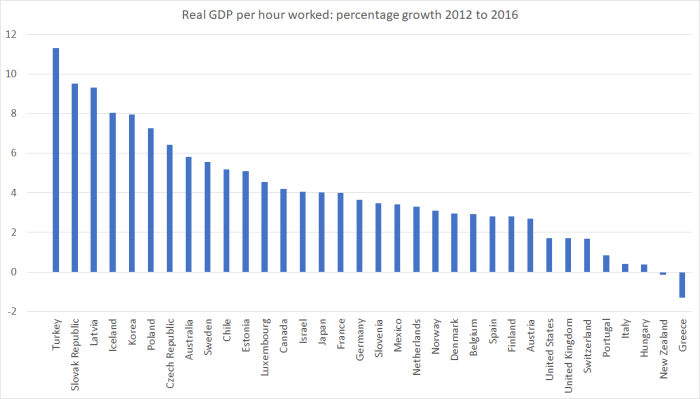
Productivity growth is the only sure foundation for sustained improvements in material living standards.  Over the full period 2007 (just prior to the recession) to 2016 (the last year for which there is data for all OECD countries), New Zealand experienced labour productivity growth basically equal to that of the median OECD country.  Again, perhaps not too bad, but no sign of any catching up.     What about the last four years, the period to which most of the “rockstar economy” claims related?

real gdp phw english

Spot New Zealand –  if you can –  down next to Greece.  And adding in 2017 –  for which we have data, but some other countries don’t yet –  would not improve the picture.  Our recent productivity record –   through the period presided over by Bill English (and John Key and Steven Joyce) –  has been really bad.

What that means is that, to the extent that real GDP per capita growth has been middling, it has all been achieved by more inputs (mostly –  since business investment is weak –  more hours worked), not smarter better ways of doing things, old and new.  Perhaps it really is a rockstar economy: a John Rowles or Cliff Richard one, belting out the same 1960s favourites over and over again?   Recall that, being a poor OECD country, New Zealanders work more hours per capita than most other advanced countries do.

And despite more hours worked, it isn’t even as if we were particularly good at keeping the economy fully-employed during the English tenure.  In this chart, I’ve standardised the unemployment rates of the G7 group of big advanced countries and of New Zealand so that both are equal to 100 in 2007q4, just prior to the recession.

U rates g7 and NZ

Our unemployment rate went up about as much as the G7 countries (as a group) did, but just haven’t come back down anywhere near as much.  For the G7 as a whole –  which includes such troubled places as Italy and France, and is mostly made of countries that exhausted conventional monetary policy capacity –  the unemployment rate is now lower than it was before the recession. But not in New Zealand.

Politicians don’t directly control the unemployment rate (or most of the other measures in this post), but it is pretty amenable to micro reforms, and (within limits) to monetary policy action.  Under Bill English’s oversight, minimum wages kept on being raised, and nothing was done about a Reserve Bank that consistently kept monetary policy too tight (evidenced by the persistent undershoot of the inflation target set by the same Minister of Finance).

And what about foreign trade as a share of GDP?  Successful economies tend, over time, to have a rising share of GDP accounted for by foreign trade (exports and imports).  Small countries that succeed tend to have much larger foreign trade shares (since abroad is where the potential markets –  and products –  mostly are).

Foreign trade as per cent of GDP
2007 2016
Exports New Zealand 29.3 25.8
OECD median 40.5 42.3
Imports New Zealand 29.1 25.5
OECD median 39.2 39

But from just prior to the recession to 2016 (again the last year for which there is a full set of comparable data), New Zealand’s foreign trade shares shrank, even as those of the median OECD country held steady (imports) or increased (exports).  Relative to our advanced country peers, our economy became more inward-focused.

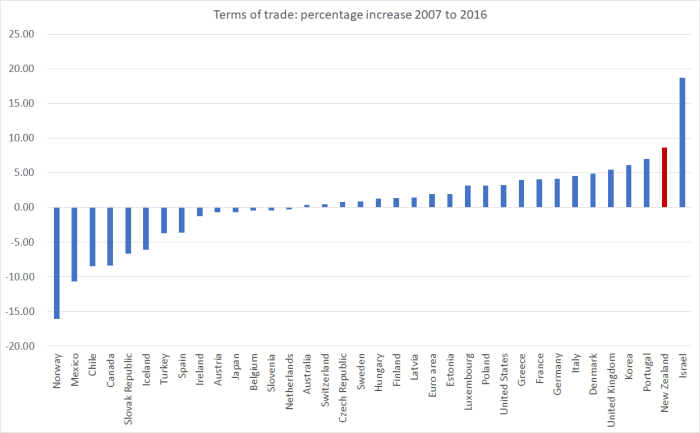
And that is despite the fact that we’ve had the second-largest increase in our terms of trade of any OECD country –  very different from the other commodity exporters (Norway, Mexico, Chile, Canada, and even Australia).

OECD TOT

Fortune favoured us, and we –  our political leaders, the long serving Minister of Finance foremost among them –  accomplished little with that good fortune.

Of course, not everything has been in New Zealand’s favour.  We didn’t have a material domestic financial crisis, we weren’t locked into a dysfunctional single currency, we went into the lean years with a healthy fiscal position, we had more space to adjust conventional monetary policy than almost any other advanced country, and we’ve enjoyed a strong terms of trade.  For enthusiasts for immigration, we’ve continued to draw in large numbers of permanent migrants, and have accelerated the inflow of temporary migrants.

But there were the earthquakes.  I’m not about to deny that they have held back economic performance, compelling resources to shift into domestically-oriented sectors, rebuilding (and inevitably/rightly so) rather than doing other things.  But even the earthquakes need to be kept in perspective: they were seven years ago now, and in wealth terms were more than paid for by the combination of offshore reinsurance and the lift in the terms of trade. There is still no sign of things turning round now –  of higher business investment, or a greater export orientation, of a recovery in productivity growth.  It is just, at best, a mediocre story.

And did I mention house prices?

real house prices OECD

There are, of course, some other black marks against Bill English.  There were the questions of integrity around the Todd Barclay affair.  There was the willingness to lead his party into an election with a candidate who’d been part of the PRC military intelligence operation, and a member of the Chinese Communist Party, all things hidden from the electorate, and then to go on defending the indefensible as it became clear that important elements of this past had also been withheld from the immigration authorities.

But, even on his own ground – the economy –  the record just doesn’t add up to much at all.

Oh, and as for the other top award that caught my eye yesterday, that was this astonishing one.  I’ll probably write about that elsewhere. [UPDATE: Here for anyone interested in this non-economics issue.]


A decade of real house prices

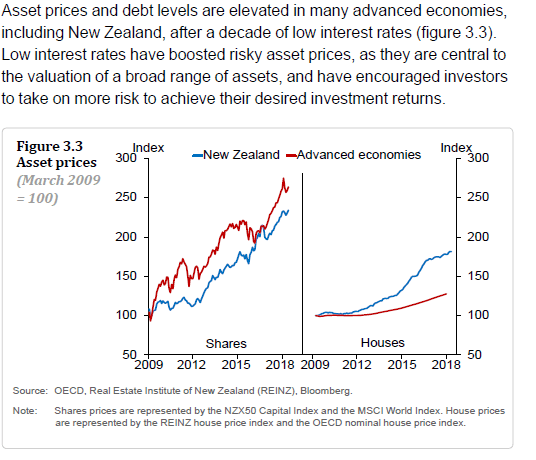
In their Financial Stability Report the other day, the Reserve Bank suggested that low interest rates are a significant part of the story as to why house prices have risen so much, and are so high. I showed this snippet in an earlier post.

fsr chart 1

Not only was there no sign of any analysis of the reasons why interest rates remain low –  they aren’t just some random variable delivered to us from on high, but arise from the interplay of real economic forces –  but they started their analysis from the trough of the financial crisis and (just to compound things) showed asset prices in nominal terms.

The Reserve Bank indicated that they were using the OECD house price index, so I had a look at that data.  Conveniently, the OECD presents the data in real terms, and they provide individual country data for most member states.

In this chart, I’ve shown three lines –  each starting from 2007q4, just prior to the international (and domestic) downturn beginning.   It wouldn’t materially change the chart if I started a year earlier (the peak in US house prices was 2006q4.   Here I’m showing real house prices for New Zealand, for the median of the 30 or so OECD countries for which there is complete data, and the OECD total series (the real equivalent of the line the Reserve Bank showed).

real house prices OECD

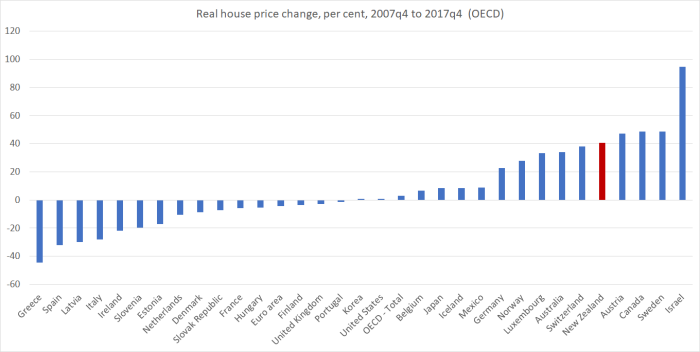
Over the full ten year period, real house prices in the advanced world as a whole have barely changed, while in New Zealand real house prices are now 40 per cent higher than they were at the previous peak (having already risen more than in the typical OECD country in the previous surge).   Not one of these countries –  well, there is a possible exception of Turkey, in the midst of a currency crisis at present –  has interest rates anywhere as high as they were 10 years earlier.

In this chart, I’ve just shown the individual country data.

real OECD house prices

New Zealand’s experience isn’t uniquely bad by any means, but it isn’t representative either.  It didn’t have to be this way, but it was a predictably awful outcome once one knew that land-use laws weren’t being materially altered, and the sheer scale of the population pressures government policy has contributed to.    The combination has been toxic, especially for young people who were already struggling to get into the market.

It isn’t even some sign of general success either.  Your eye might go to Greece and Spain at the far left of the chart.  But other countries to the left of us include, for example, the group of central and eastern European countries that I’ve written about previously, who’ve been catching-up and achieving consistently better productivity growth than New Zealand (the Czech Republic and Poland aren’t on the chart because the data for each doesn’t cover quite the full period –  but on the data we have both would also be well to the left of New Zealand).   Our house price debacle has been a disaster all of our own –  well, our central and local politicians’ –  making.  It just didn’t need to be that way.


There is abundant land

Sometimes –  well, quite often actually –  I’m tempted to despair of the elected leadership in this country.  For decades they’ve failed to reverse –  barely even stopped –  our decline in the international league tables, when productivity growth is the only secure foundation for sustained improvements in material living standards.  They’ve presided over an economy that has mostly been inward-looking –  remember, foreign trade shares have been shrinking, as has the relative size of the tradables sector of the economy –  when increased international trade is a typically a key marker of a successful economy.  Business investment has been weak, for decades.  And they’ve managed to preside over a situation in which, in a land-rich country, we have some of the most unaffordable houses in the advanced world.    And still, apparently, they and their advisers think they know best.    And they wonder why life is tough for altogether many people, as they run around proposing band-aids, while never sorting out the fundamental problems.  Arguably, in fact, they are simply making them worse.

The prompt (the latest one) for that paragraph was an article that appeared on Stuff a couple of days ago (and made it to the hardcopy Dominion-Post this morning).   In it, we read

Wellington region’s population, including the Hutt Valley and Porirua, will increase from 413,400 to 459,200 over the next 25 years, according to Statistics New Zealand.

Wellington City Council district plan manager John McSweeney​ said there was about 290 hectares of greenfield land left to develop in the region – enough for about 3500 houses, based on existing residential subdivision plans which allows up to 12 houses per hectare.

McSweeney said it was likely that the council would have to encourage developers to build more houses closer together.

When I checked, I found that Wellington City covers an area of 29024 hectares.  And yet the Wellington City Council’s (WCC) planning pooh-bah claims there is a mere 290 hectares of land left to develop –  not just in Wellington City, but in the entire region.

This is how much land is in each of the five local authority areas that make up greater Wellington.

Wellington City                         29024 hectares

Hutt City                                     37664 hectares

Upper Hutt                                 53992 hectares

Porirua                                       18251 hectares

Kapiti                                          73148 hectares

Wellington City itself has more than 40 per cent of the population of the greater Wellington region, less than 15 per cent of the land, and yet –  check out the map at this link (and especially the satellite image https://satellites.pro/Wellington_map.New_Zealand#-41.286600,174.776000,12) –  less than half of Wellington City land is in built-up area.

There is abundant land.  Visible, in particular, to anyone who ever flies into or out of Wellington.

And if you object that much of the land is quite hilly, well take a look at the existing city.  This is part of the view from my study.

hills of Wgtn

Hills are everywhere.  Die-hard locals (the sort who find plausible Deutsche Bank’s claim that Wellington is the most liveable city in the world –  of whom I’m not one) even claim to like them, but at very least we all live among, or on, them.   And, in among that vast undeveloped area of Wellington City is lots of pretty-flat land –  the Ohariu Valley for example.

The Wellington City bureaucrat, presumably channelling his political masters, decrees that

The council was looking at options in some of the northern suburbs where land could be rezoned from rural to residential, McSweeney said.

That could create enough residential land for another 10 years of housing developments.

When the real question for him, and for Justin Lester and each councillor, should be, why is all of Wellington City not zoned residential (with appropriate requirements on developers regarding infrastructure provision)?

As one my readers notes, the only way that house prices can be where they really should be –  and for a long time were – at around three times median income is when developers can buy rural land at rural land prices (in turn, requiring that there is plenty of competition so that no potential seller can corner the market, holding the only parcels of (lawfully) developable land.    And yet what we see in and around Wellington –  and around so many other cities and towns – is almost the precise opposite.

Thus, there was a story the other day about the sale of 386 hectares of farm land just north of Wellington (in Porirua city).

The land is currently zoned for farming, but is part of the Porirua City Council Northern Growth Structure Plan. In 2016, it had a rateable value of $3m, but has previously been assessed as being worth more than $60m.

It is obscene.  “Value” created by bureaucrats and politicians, at the expense of potential home owners in greater Wellington, in this case apparently accruing to a family that has held the land since the 1960s.

It calls to mind a conference the Reserve Bank and Treasury held a decade or so ago at which a very able senior figure on the Wellington city council staff spoke.  He noted that most of the developable land (ie zoned residential) was owned by perhaps four groups who, of course, managed the release of this land in a drip-fed way, so as not to dampen the price of their land.    There was, of course, no thought to zoning all the land residential, or even applying land value rating which, at the margin, creates more of an incentive to actually use the land.

Meantime, each new rising generation suffers the heavy burden of trying to get into the housing market, all while bureaucrats and their political masters talk of a “need” to squash people in tighter or live in apartments without gardens etc.

It is 40 years and a few weeks since I first moved to Wellington.  Coming from Auckland as a teenager in 1970s, I still vividly remember the shock I experienced as we drove in Newtown and Berhampore (for those who know the place, think Rintoul St and Adelaide Road) for the first time, on our way through to Island Bay.  Was this the New Zealand equivalant of Coronation St, I wondered even then?   Most of Wellington (city in particular) is pretty densely populated as it is by New Zealand standards, and even the roads are often pretty narrow.  And yet the bureaucrats and politicians want everyone to squash in tighter.  It isn’t how economic development is supposed to work –  space is, after all, a normal good and, in New Zealand, there is no shortage of land.

For once, I’m with a real estate agent, quoted in the original story linked to above.

Bayleys Wellington general manager Grant Henderson said the thousands of sections set to come on market was not enough.

“For Wellington to continue to keep up, it has to keep developing greenfields. It’s crucial we do the developments.”

The latest residential development is earmarked for Plimmerton Farm, which was sold to Upper Hutt developer Malcolm Gillies and his business partner Kevin Melville.

The duo plan to create more than 1500 sections and 60 lifestyle blocks on the site, with some lots expected to hit the market in late 2020.

Up to 100 sites a year would be developed, meaning it would take about 20 years to complete.

By then, the region’s population will have grown by 45,800.

Henderson said there was a lot of residential land yet to be unlocked in Wellington.

“There are huge opportunities, and the sooner we get some supply into the marketplace, the better.”

And Council planners, even if they had the best will in the world –  about choice, and options, and lowering house prices –  still couldn’t tell what would be enough.  That is one of things we have markets for.

Elected councillors do make an appearance in the article

Wellington City Council councillor Andy Foster, who is in charge of urban development, said about 40,000 houses needed to be built in Wellington to cater for population growth over the next 30 years.

This did not include growth in the wider Wellington region, he said.

The council has commissioned research to establish how much space was left to develop and if the city could hold another 40,000 houses, he said.

“Most likely we can’t, and we are very much expecting that. So then we have to say, ‘Well where are they going to go? What do we need to change to accommodate growth?'”

There was a need to densify further. However, it was unclear which parts of the city were best suited for that, Foster said.

“This is going to be a really challenging conversation, and it’s going to be a really big one.”

Or, councillor Foster, you and your colleagues could just give citizens, residents, and potential residents, the choice.  People who want to live more densely should, of course, be free to do so.  Revealed preference –  the way our towns and cities evolve when there is no particular population pressure –  suggests that most would prefer not to, and of those who do end in terraces or apartments many do so simply as a less-unaffordable second-best, there being less land per dwelling in those sorts of developments.

The tragedy is that there is no public revolt against this political and bureaucratic mentality, which undermines communities and renders housing ever-more unaffordable, all in pursuit of some central planner’s vision for the way people should be, more or less, compelled to live.  There is no shortage of land –  and certainly not in Wellington city, or greater Wellington.   Even politicians who seem occasionally to display signs that they know better –  and there have been a few in both National and Labour –  don’t actually do anything about it.   We wouldn’t be having futile debates about Kiwibuild –  or “shortages” of physical houses –  if the land market was deregulated. Instead our so-called leaders –  elected officeholders anyway –  just preside over regimes that, by doing the same thing again and again, can’t but produce much the same dreadful results for a another new generation.  In a few years those will be my kids entering the market, another generation betrayed by our leaders.

New Zealand, the PRC…and the 29th anniversary of Tiananmen Square

The (generally subservient, or even servile) relations between New Zealand and the People’s Republic of China have been back in the news this week.  It isn’t as if there have been material new developments –  except perhaps confirmation that Winston Peters (who won’t tell New Zealanders, let alone the PRC, what his government thinks of the PRC’s latest steps in militarising artificial islands illegally created in the South China Sea) is a fully paid up member of the “never ever upset Beijing” establishment.

The news was mostly just a couple of reports: testimony at a US Congressional commission (and the subsequent train wreck of the radio interview of one of those testifying) and the publication of material from a Canadian security services academic conference.  In both cases, perhaps it was newsworthy that such events were taking place abroad, and that New Zealand’s experience was being aired more widely.   But both lots of material seemed to draw entirely from material already in the public domain, including notably Professor Anne-Marie Brady’s Magic Weapons paper.  The Canadian material is all published under Chatham House rules –  in this case, no ascription of authorship at all – but when I read the material on New Zealand it was so similar to Brady’s other published material, that I just assumed she was the author.

As I noted the other day, in Radio New Zealand’s interview with him, former CIA analyst Peter Mattis, one of those who testified before the Congressional commission, performed really badly.    He just didn’t know the material, and appears to know nothing about New Zealand beyond what he had read in Brady’s paper.     Unsurprisingly some of the more vocal defenders of the “nothing to see here” club were pretty exuberant.  Here was the Executive Director for the (taxpayer-funded) New Zealand China Council

This interview reveals fully the appalling use of innuendo and conspiracy theory in the “debate” about Chinese influence. Well done for exposing it!

But, as I outlined in my post on Monday, none of what Mattis referred to in his testimony –  or indeed of the activities Anne-Marie Brady has written about has been refuted.   Nothing.

Meanwhile the Prime Minister confirmed her membership of the “nothing to see hear” club,  claiming that none of the Five Eyes countries had raised issues with her (as distinct from raising them with diplomats and senior public servants?) and answering questions thus

When asked what specifically was being done to review the country’s safeguards she said the Government made “independent decisions based on evidence and the best option for New Zealand”.

“For example, there is a national security test in our law governing space and high altitude activities.

“Parliament has regulated for national interests in the telecommunications area [TICSA]. We have strong provisions to counter money laundering and the financing of terrorism.”

Which gets to the issue hardly at all –  no doubt deliberately.

Over the course of the week, I found one interesting article commenting on these issues, from an American security expert who lives in New Zealand, former academic Paul Buchanan.  He notes

The impact of Chinese influence operations has been the subject of considerable discussion in Australia, to the point that politicians have been forced to resign because of undisclosed ties to Chinese interests and intelligence agencies have advised against doing business with certain Chinese-backed agencies. As usual, the NZ political class and corporate media were slow to react to pointed warnings that similar activities were happening here

and

unlike the US and Australia, NZ politicians are not particularly interested in digging into the nature and extent of Chinese influence on the party system and government policy. This, in spite of the “outing” of a former Chinese military intelligence instructor and academic as a National MP and the presence of well-heeled Chinese amongst the donor ranks of both National and Labour, the close association of operatives from both parties with Chinese interests, and the placement of well-known and influential NZers ….. in comfortable sinecures on Chinese linked boards, trusts and companies

Buchanan thinks these matters are worth investigation, but notes that

….the more interesting issue is why, fully knowing that the Chinese are using influence operations for purposes of State that go beyond international friendship or business ties, do so many prominent New Zealanders accept their money and/or positions on front organisations? Is the problem not so much what the Chinese do as as a rising great power trying to enlarge its sphere of influence as it is the willingness of so-called honourable Kiwis to prostitute themselves for the Chinese cause?

There wasn’t anything like the same willingness to associate with causes of the Soviet Union, arguably a less repressive and less aggressively expansionist power than the PRC –  and certainly less active in the political life of countries such as New Zealand and Australia.

Buchanan is keen to stick up for the current New Zealand government, suggesting that the Peter Mattis testimony (see above) had attempted to suggest the current government was particularly bad (which wasn’t the way I read it, and certainly isn’t the thrust of Professor Brady’s paper, which came out before the election).

Let’s be very clear: for the previous nine years National was in power, the deepening of Chinese influence was abided, if not encouraged by a Key government obsessed with trade ties and filling the coffers of its agrarian export voting base. It was National that ignored the early warnings of Chinese machinations in the political system and corporate networks, and it was Chinese money that flowed most copiously to National and its candidates. It is not an exaggeration to say that Chinese interests prefer National over Labour and have and continue to reward National for its obsequiousness when it comes to promoting policies friendly to Chinese economic interests.

and

Labour may have the likes of Raymond H[u]o in its ranks and some dubious Chinese businessmen among its supporters, but it comes nowhere close to National when it comes to sucking up to the Chinese. That is why Jian Yang is still an MP, and that is why we will never hear a peep from the Tories about the dark side of Chinese influence operations. For its part, Labour would be well-advised to see the writing on the wall now that the issue of Chinese “soft” subversion has become a focal point for Western democracies.

As for what Labour (and New Zealand First) will be like in government, it is still early days.  But, at present, it is hard to put any daylight betweeen the approaches of National and Labour.  No doubt that is welcome to the MFAT officials and the business interests that need to keep things sweet with Beijing, and local party officials who need to keep up the fundraising.  But it is as if they are happy for New Zealand to be almost a vassal state, corrupting our own historical beliefs and values in the process.

Thus, it is fine to say that Jian Yang reveals problems in National.  And isn’t it a disgrace that not a single National MP, present or past, has been willing to stand up, speak out and say that is simply unacceptable to have a former PRC military intelligence official, former (?) member of the Chinese Communist Party, in our Parliament?  But…….not a word on the subject has been heard from anyone in the Labour Party either.  By your silence Prime Minister –  and all your senior colleagues –  you too become just as complicit.  All else equal, it should have been easier for people in the political opposition to speak out than for someone in Jian Yang’s own party (for some of his own party people there is more at stake, including perhaps a list ranking).  But not a word.

And, of course, National makes no effort to call out Raymond Huo, or Labour’s use of a Xi Jinping slogan as part of their advertising campaign last year.    Once we expected higher standards than this from our members of Parliament.  But now, it seems, there are deals to be done, campaigns to finance, and so on.   And so the presidents of both major political parties can laud a tyrannical expansionist regime which, not incidentially, brutally suppresses its own people (as just another example, this article from the latest Economist.)   It wouldn’t have happened (and rightly so) with apartheid South Africa, with the Soviet Union –  or perhaps these days even with US political parties.

Just a few weeks ago, it was that denizen of the centre-left, Hillary Clinton, who was highlighting the risks in her speech in Auckland.  To deafening silence from our own centre-left government.

I don’t suppose any of this reluctance has anything to do with illusions about the nature of the regime.   Our political leaders know about the near-complete suppression of free speech, the prison camp that Xinjiang has become, about suppression of freedom of worship, and about decades of forced abortions.   They know about the PRC’s aggressive and illegal expansionism in the South China Sea, and its increasing intimidation of free, democratic and prosperous Taiwan.  They know about the (in many cases) successful attempts to corrupt political systems in various places around South Asia.  And they know about the activities, and strategies, of PRC authorities in countries like New Zealand, Australia, and Canada (as only three of many) to exert control over ethnic Chinese groupings, including Chinese language media.  They know the PRC now takes the view that ethnic Chinese abroad –  even citizens of other countries –  are expected to work in the interests of Beijing, and are at times coerced to do so (imagine if the British government acted thus among those of us of British descent in New Zealand).   They know our schools (my daughter’s high school among them) and universities are taking money from the PRC regime, on its terms.

But, knowing all this, they just don’t seem to care.  Or if, in some back recess of the brain there is some sense in which they vaguely lament all this, it doesn’t motivate them to do anything about it, or even to have an honest and open conversation engaging New Zealanders.  It is just a corrupted system.

There is a lot of focus at present in Australia –  a country facing very similar issues, but at least with an active and open political debate (including in the Labor Party) as to how best to deal with them –  on legislative changes designed to combat (mostly) PRC influence.   Perhaps there is a case for some legislative initiatives here (eg around former ministers taking up roles serving foreign governments, or organisations controlled by foreign governments), but –  and this comes back to Paul Buchanan’s point –  I suspect the bigger issues aren’t legislative but attitudinal.    On both sides of politics.

Jian Yang would be out of Parliament tomorrow if Simon Bridges and his National colleagues had an ounce of decency on these sorts of issues (and if, somehow, Jian Yang was resistant, at least he’d be an isolated backbencher, out of caucus for the rest of the term).   Jian Yang would be explaining himself to the English language media if there were an ounce of decency and respect for standards in public life.

Confucius Institutes’ activities could be banned from our state schools if either main party actually cared. Universities, supposedly bastions of free speech. could –  as some overseas have done –  close their Confucius Institutes –  but most have made themselves quite dependent on the flow of PRC students.

Ministers and senior Opposition figures could openly lament the aggressive expansionist appraoch of the PRC in the South and East China Seas.  Closer to home, they could ensure they avoid United Front controlled organisations, and speak out for a diverse Chinese language media market.  And so on.

But, instead, they seem terrified. If they did any of that there might not be an upgrade to the preferential trade agreement between New Zealand and China.  And party fundraising might get quite a bit harder.  Some New Zealand exporters might find more technical roadblocks in their path, as some Australian firms have been recently.

This isn’t the approach of a political system that has retained any self-respect whatever.  It is sad to watch, and shaming that these people represent us.  It is, purely and simply, appeasement at work.   As if nothing can be done, and nothing should be done.  Worse than Neville Chamberlain on my reading, because so much here seems to be just about the economic dimensions.

Taking a stand would, most likely, have a short-term cost.  But China does not, and never has, determined our material living standards or those of Australia.  We –  our resources, our people, our institutions –  determine that.  (It isn’t even as if the PRC is one of the economic success stories of Asia –  at best a middle income country, in a region of Korea, Japan, Taiwan, and Singapore.)    If you have a business that is heavily reliant on the PRC –  our universities (basically SOEs) and some tourism operators mostly – you might take a hit.  But, as the old saying goes, when you dine with the devil you need a long spoon.  More specifically, you knew the sort of regime you were dealing with, and you dealt anyway.  It isn’t clear why the rest of us need to be sold-out, or have our values ignored, to serve your particular business interest.  It is one of the (many) downsides of bilateral trade agreements that it encourages ministers to put values to one side, or even a clear assessment of longer-term foreign policy threats, in the interests of corporate interests wanting to increase profits now.

Incidentally, I also doubt that changes to electoral donations laws are very relevant here, Unlike Australia, we already have laws preventing large foreign donations (except, for example, large ones such as those to Phil Goff’s campaign through auctions).  And many of the issues of real concern in Australia relate to very large donations by relatively new Australian citizens of PRC origins.  Unless one wants to move to exclusively state funding of political parties (and I certainly don’t) you can’t pass laws to stop people giving to a party on the basis of the policies such a party professes and practices –  however pernicious such policies might be.  Rather, it comes back to attitudes and to leadership.  Whatever ongoing diplomatic relations –  correct but formal –  our governments need to have with those of the PRC –  there can be no reason for party Presidents to be praising such a dreadful regime.  Perhaps we should revert to the practices of decades past where MPs and party leaders had little or no involvement in, or knowledge of, party fundraising.  And perhaps party leaderships needs the courage to turn down donations when the motives appear questionable.   Would it come at a cost?  Most probably it would, at least in the short term.  But, in a sense, the only real test of a system’s integrity (or that of an individual) is when they are willing to pay a price for what they believe.

Finally, this weekend marks the 29th anniversary of the massacre, by PRC authorities, of hundreds (or perhaps thousands) of unarmed students in and around Tiananmen Square.  The anniversary will go unmarked, and unremarked on, in the PRC of course.  That is the sort of regime our governments and business leaders defend.

This was how National MP Jian Yang alluded to these events in his maiden speech in Parliament

In April 1989 a great opportunity was opened up for me when I received a scholarship from the Johns Hopkins University in America. However, in the weeks following, student demonstrations swept China. The Chinese Government’s policy change afterwards prevented me from leaving to study in the United States.

Perhaps this weekend some journalists could invite him to flesh out his remarks.  An openly critical comment on the PRC –  who embassy he seems to remain very close to –  would certainly be a first.  A refusal to even engage –  by an MP paid and elected by all New Zealanders –  is, of course, more likely.  Perhaps they could also ask Labour MP, Raymond Huo –  also an adult in the PRC in 1989, now chair of the New Zealand Parliament’s Justice Committee – for his take on the events of 4 June 1989, and the sort of regime/Party that undertook such actions and now forbids its own people to even discuss them.   It isn’t as if either MP is a Cabinet minister.  But perhaps speaking out would interrupt the flow of party donations, upset some people doing business in China.  One often reads of PRC authorities using threats to family back in China to keep ethnic Chinese overseas in line.  If that sort of constraint exists in either case, an MP subject to such pressure might have our sympathy, but clearly would not be free to fulfil his duties to New Zealanders.

Please Mr Orr, could we have some better analysis

In yesterday’s post, I was a bit critical of the relatively superficial analysis in much of the Reserve Bank’s Financial Stability Report.

Here is one example

fsr chart 1

A snippet which seems to contain three problems in just a few lines.  First, the Bank runs their asset price charts from the bottom of the international financial crisis and recession in 2009.  Of course, equity prices have risen strongly since then.  Second,  all these series are shown in nominal terms: in the case of OECD house prices (red line in the second panel) there will have been hardly any increase at all in real prices over the nine years.    And thirdly, they are attempting to argue that low interest rates have been a major causal influence on debt levels and asset prices without (a) looking back at whether trends are more pronounced this decade than they were in the previous –  higher interest rate –  decade (hint: they aren’t) and (b) without giving any apparent consideration to the reasons why interest rates might have been persistently low.  For a central bank, that really is inexcusable sloppiness.

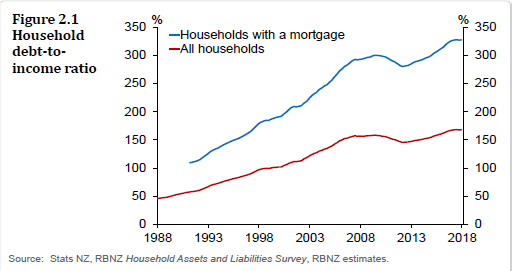
Take household debt, for example.  Here is the Reserve Bank’s chart

FSR chart 2

It is interesting to see the breakdown between households with a mortgage and the all-households number.   Perhaps even more interesting is the snippet they include in the text that “only 8 per cent of households own investment properties, but they account for 40 per cent of housing debt” (although it would be interesting, in turn, to know how that share has changed over, say, the last decade).

But what I’ve always found striking about charts like Figure 2.1 is how small the increase in household debt ratios has been over the last decade or so.   In the previous house price boom, household debt to income ratios rose much more sharply than they have in the most recent boom.  Among households with mortgages, the ratio rose by 90 percentage points of income from the cyclical low in real prices in mid 2001 to the peak, but that same ratio has risen by less since 30 percentage points from the previous peak to now.  On the more familiar metric –  total household debt to total household income –  the comparable numbers are 47 and 10 percentage points respectively.

Another way of looking at the data –  which I prefer, for various reasons including that all national income ultimately belongs to households –  is to look at the ratio of household debt to GDP.  Here is the chart of that series.

chart 3

Household debt as a share of GDP is lower now than it was a decade ago.   Even if you make allowance for the fact that the previous peak itself was during the recession (when GDP had dipped), the current ratio of household debt to GDP has barely changed since the previous peak in real house prices in mid 2007.  In many ways, this is extraordinary.

(And recall, of course, that banks’ housing loan portfolios came through the last recession –  a pretty serious recession, with a fall in nominal house prices –  unscathed.)

Here is the chart of real house prices (the QV index deflated by the CPI), expressed in log form.

chart 4

Real house prices are much higher than they were at the peak of the last cycle, and have risen by about 60 per cent from the 2011 low.

As the chart in log form illustrates, the percentage rate of increase in house prices has been less this time round than in the previous phase of the boom (2001 to 2007) when real prices rose by 87 per cent on this measure.

But that shouldn’t be any comfort.  If real house prices go from $250000 to $500000 in one period, and then from $500000 to $750000 in a subsquent period, the percentage increase is lower in the second period.  But if real incomes haven’t changed, one $250000 increase is just as burdensome as the other.

And that is pretty much what has happened with New Zealand house prices.  Relative to a base of 100 in mid-2001, real house prices increased by 84 percentage points from 2001 to mid 2007.   From mid 2011 to the present (Dec 2017 data being most recent) the increase, again relative to a base of mid-2001 prices, has been 94 percentage points.   Real incomes have increased a bit, to be sure, but actually the rate of increase (whether simple percentage increases, or relative to the 2001 base) in real GDP per capita was smaller in the more recent period.

None of that should be very surprising. In both periods we had really large, unexpected, population pressures, and in both periods we’ve had binding land use restrictions (not factors featuring in the Bank’s discussion).  Interest rates, of course, have been much lower in the second period than the first, but it doesn’t look as though one needs some exogenous interest rate story to explain another bout of house price increases of similar size to the one that happened when interest rates were a lot higher.

But it all leaves the debt to income (household income or GDP) charts a little puzzling.  As I’ve illustrated before –  and is pretty obvious with a moment’s reflection –  debt increases occur over a much longer period of time than house price increases do.  If house prices double today, the only people who will have been taking on more debt right now will have been the small minority of people transacting in houses in this particular short period. But now that house prices are higher, even if they rise no further, every new purchaser will be needing to finance the new higher prices.  Since the housing stock can take decades to turnover fully, the increase in the debt to income (or GDP) ratios can be expected to lag quite a bit behind house prices.

Here is a very simple stylised example of what I mean.  In this scenario, house prices have been unchanged for a long time, and debt stock is steady.  The aggregate debt to income ratio is about .5 (roughly what it was in New Zealand 30 years ago).  Now assume that some exogenous factor (call it “new land use regulation”) doubles house prices today.  Even if new entrants to the market borrow the same proportion of the purchase prices that their predecessors did when prices were low (on the same 25 year mortgages), it will take decades for the associated lift in the aggregate debt to income ratio to occur (35 years for even two-thirds of the adjustment to occur).

chart 5.png

And yet, in real world New Zealand, despite an equally big house price increase since 2011 as we saw from 2001 to 2007, there has been little or no increase in household debt ratios in the last decade (even though the aggregate ratios should still have been adjusting to the earlier price shock).

I’m not sure quite what the explanation is.  One explanation might be that (real) house prices have risen to such levels that a larger share of the houses are being purchased by more cashed-up buyers.  That would be consistent with the decline in the owner-occupation rate.  Perhaps regulatory financial repression is also playing a part –  successive waves of unprecedented LVR restrictions (grounded in gubernatorial whim rather than robust analysis) may have made some difference, not necessarily in a good way.   But it seems like an issue that we might have expected the Reserve Bank to explore in a document like an FSR.

Similarly, when the Reserve Bank talks up risk

The high level and concentration of household sector debt in New Zealand is the largest single vulnerability of the financial system. …..This risk has not changed materially since the last Report. Growth in household debt has slowed and house price inflation has stabilised, but significant vulnerabilities remain.

you might expect them to discuss:

  • the way rather similar levels of household debt performed in the last severe recession,
  • the Bank’s successive stress tests which suggest bank housing lending is not a systemic threat even under very severe (often unrealistically severe –  around unemployment) scenarios, and
  • their own capital requirements on banks, which are –  we are told –  calibrated to take account of the relative riskiness of different types of loans (even within an overall framework that has further increased capital requirements per unit of risk weighted assets).

But, as far as I could see, there was none of that in the document itself, and nothing of it in the Governor’s remarks at his press conference.    In the meantime, we have distortionary LVR controls kept in place –  on one man’s whim –  when, if anything, there appears to be less credit outstanding than one might reasonably have expected given the way other regulatory distortions have lifted house prices.

In a similar vein, I noted a story on Newsroom this morning, reporting the Governor’s appearance at the Finance and Expenditure Committee yesterday.  He was reported thus

But he told the select committee he would much rather the Reserve Bank, as banking regulator, could trust banks and borrowers to be prudent.

“I would love to not have to be active in that space. If banks had true long-term horizons, if the consumers were fully aware and myopia didn’t exist across borrowers, all the different foibles that people have, then you wouldn’t need the regulatory imposts.”

Talk about “nanny state” –  the Governor wishes he could trust us.  I wish we could trust him and his colleagues.

But, more specifically, the Governor here asserts again that banks are too short-term in their operations, that borrowers are myopic, and we need Reserve Bank intervention (he was talking of LVR and DTI restrictions) to save us from ourselves.  Par for the course, the Governor offered no evidence for his proposition (and there was none advanced in the FSR), it just seems to be some sort of new gubernatorial whim (as Graeme Wheeler came with the scarring experience of living through the US crisis, in this case Orr comes with an NZSF perspective –  neither grounded in specific  analysis of the New Zealand banking system).  I’ve lodged an OIA request this morning for any Reserve Bank analysis in support of these propositions.

I could have added, but overlooked doing so, a request for any evidence that – the private sector being inevitably flawed (by nature of being human) – that government regulators (also being human) can consistently improve on the outcomes of the market.  In a banking system (New Zealand, but Australia as well) where the only financial crisis in more than 100 years arose in the transition as heavy controls were being removed –  and neither the private sector nor the regulators really knew what they were doing –  you might suppose some presumption of responsibility and capability might be accorded to the private sector.  But not, it appears, by this Governor, or this Reserve Bank.  When a big ego and extensive statutory powers combine in a single person, the lack of serious supporting  analysis itself becomes a threat, including to the efficiency of the financial system.

Financial Stability Report and a lack of accountability

When Parliament legislated to require the Reserve Bank to publish six-monthly Financial Stability Reports this is what they said in the two relevant clauses

162AA Purpose of accountability documents

The purpose of the 3 accountability documents required under this Part is as follows:…..

 (c)financial stability report: to—

(i) report on matters relating to the soundness and efficiency of the financial system and other matters associated with the Bank’s statutory prudential purposes; and

(ii) allow assessments to be made of the effectiveness of the Bank’s use of its powers to achieve its statutory prudential purposes. 

165A Financial stability reports

……(2) A financial stability report must—

(a) report on the soundness and efficiency of the financial system and other matters associated with the Bank’s statutory prudential purposes; and

(b) contain the information necessary to allow an assessment to be made of the activities undertaken by the Bank to achieve its statutory prudential purposes under this Act and any other enactment.

Financial Stability Reports over the years seem to do a passable job of reportage –  a collection of sometimes-interesting charts and some text recounting (although only rarely analysing, or putting in context) what has been going on on the financing side of the New Zealand economy.   There are usually some fairly perfunctory updates on policy issues the Bank is considering.

But what is very rarely there is the sort of information that would enable us to really assess the Bank’s use of its powers and the conduct of policy under the various relevant acts.  There is never any critical self-scrutiny; it is as if the Bank thought itself beyond error.

Of course, supply tends to respond to demand.  There is little searching scrutiny of the Reserve Bank at the Finance and Expenditure Committee, and not much more from the media (the level of questioning at the Governor’s press conference this morning seemed weaker than usual).

What do I have in mind about weaknesses in today’s document?

Remarkably, there is no substantive discussion in today’s Financial Stability Report of CBL, the insurance company, regulated by the Reserve Bank, that the Bank petitioned to have put into interim liquidation earlier in the year.   I’m not aware of any reason to think the Reserve Bank acted inappropriately in this matter, but it is a fairly significant institutional failure (on the Bank’s watch), and a fairly significant set of regulatory actions, including the (at least somewhat questionable) use of gagging orders to prevent the company telling its own shareholders and customers about regulatory interventions.  Then again, remarkably no journalist asked a single question on this topic.

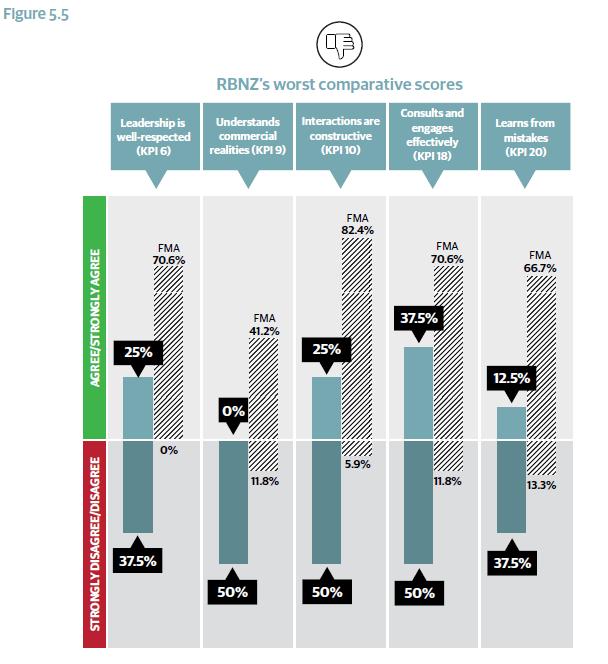
Readers will also recall the scathing feedback on the Bank’s prudential regulatory side in the recent New Zealand Initiative report, and survey of regulated entities.  There was, for example, this chart, comparing Reserve Bank and FMA results for the KPIs where the Reserve Bank scores worst in the survey.

partridge 1

This report had come out since the last FSR.  In a newspaper interview a while ago, the Governor had appeared to indicate that he was going to take it seriously, with comments like these

“This place is a diamond, but it needs significant polishing in places,” Orr said in an interview in the Reserve Bank headquarters.

“We need to think much harder about how we behave, how we roll, how we explain, how we do things. That’s a cultural challenge for the bank.”

and

As well as posting the comments of the report on the Reserve Bank’s internal intranet, Orr had written to bank bosses with the message that: “Hey, this doesn’t print well. We hear you. We need to do something about it.”

Interestingly, he actually talked then of problems in the Bank’s own culture.  But in his main accountability document for the financial regulatory functions, there was no reference to the survey, no comment on cultural issues at the Bank (all while continuing to bash banks), no comment on improving the Bank’s own performance, no nothing.

And, remarkably, the Governor faced no questions on the matter, even though the survey had almost handed them the data with which to grill the Governor.  Perhaps the journalists have forgotten, but the counterpart to the delegation of extensive powers to unelected officials has to be serious scrutiny and accountability.  There appears to be almost none here.

Similarly –  and somewhat remarkably –  the Governor managed to avoid any questions about his “culture war” by noting that he and the FMA would be appearing before a select committee this afternoon, and suggesting deferrring questions.  But I don’t suppose he will be holding a press conference after that appearance, and questions from MPs are likely to be as weak as ever, more interested in associating with the Governor than in holding him to account.

And this failure to ask questions was perhaps more remarkable given that the press release the Governor put out with the FSR  bears the heading “Banking culture in the spotlight”.   Reading that headline one might have expected a substantive treatment, but in the press release there was just the unsubstantiated claim that “an ongoing driver of financial soundness is the conduct and culture of banks”.  To which one can only respond, well yes loans that turn bad tend, in sufficient volume, to be what brings down banks, but misjudgements about big picture credit quality, and the overoptimism that takes hold (of bankers and regulators) in boomtimes, aren’t the sort of stuff the Australian Royal Commission –  which the Governor always tries to associate with –  is about.  Here is what he had to say about that (cutesy picture and all)

conduct

Quite how evidence in an inquiry which has not yet reported can really illustrate anything conclusive –  let alone the connection to the soundness of the financial system –  is a bit beyond me.  The Governor seems more keen on his populism, and on associating himself with a highly political Australian inquiry, than on actually identifying specific reasons for concern here.   Perhaps he will explain himself this afternoon?

Reverting to other stuff, there was this extraordinary line in the Governor’s press release

The high dairy-farm indebtedness, and the fact that LVRs were necessary, reflects that banks’ allocative efficiency – eg deciding how much to lend to whom – can be impaired due to the pursuit of short-term, rather than longer-term, profits.

It is an almost incoherent sentence.  For a start, New Zealand bank loan losses have remained consistently low for several decades now –  even the farm losses in the last recession were pretty modest in the scheme of things.  Secondly, you can’t argue –  as a regulator –  that the fact you acted (in this case imposing LVRs) is evidence of a problem.  There might –  as I would argue –  have been no need for LVR controls in the first place –  after all, the Bank’s stress test results have consistently highlighted the resilience of New Zealand banks, and of the system as a whole.  And thirdly, if even there were to be a large stock of troubled lending that would not, of itself, suggest some systematic flaw n the way banks were allocating credit.  None of us –  not banks, not central banks –  operate in a full information world.  Sometimes, events will turn out differently than either lenders or borrowers expected.  That isn’t an indication of any sort of structural failing.   We might reasonably expect rather more substantive analysis before the Governor starts impugning the business decisions of private companies. but……there was nothing else in the report to back up his claims.  (And no cognisance of regulator failure either.)

Somewhat related to this was the pretty unsatisfactory discussion of the housing market, both in the document and the press conference.   The Bank consistently fails to recognise that land use regulation is the key factor explaining the high level of house and urban land prices: against that backdrop, bank lending practices are likely to be of little more than marginal importance.  Thus, they talk like this

housing fsr

But they never once recognise that if the mix of regulatory and population pressures keeps making land artificially scarce, high levels of bank credit are just necessary to accommodate people getting into the increasingly high-priced market.  In that case, credit is at worst a lubricant, a facilitator, but not either the cause or the real problem.  (The Bank might want to argue differently, but if so surely they owe us rather better and deeper analysis.)

There were a couple of interesting snippets in the report.  The smaller one was this comment on the next stage of the review of the Reserve Bank Act

Both the Reserve Bank and the Treasury have provided advice to the Minister of Finance on the scope for Phase 2. The terms of reference for Phase 2 will be published by the Government in June. Phase 2 will be a significant undertaking and could take a number of years to complete.

That suggests the untrammelled rule of the Governor alone –   in the financial stability area –  could continue for some considerable time.  That is unfortunate, especially as there is less effective accountability for the Governor around these functions than around monetary policy (where accountability is weak enough).  Nonetheless, I will look forward to seeing the announcement in June.

The other interesting snippet was Box C, a report on a benchmarking exercise undertaken in respect of a sample portfolio of dairy loans.

The exercise required the banks to measure the risk of the same portfolio of loans to 20 hypothetical dairy farms. These farms represented a range of characteristics and varying degrees of risk. Banks were then provided with financial data and descriptive information for each farm, as well as the details of the hypothetical loans.

The preliminary results of the exercise indicate significant differences in estimates across banks. The highest and lowest average risk weight for the whole hypothetical portfolio differed by 40 percentage points, leading to differences in the hypothetical capital requirement.

Variation in both PD [probability of default] and LGD [loss given default] was was significant. Figure C1 shows the range of average PD estimates across five groups, each containing four loans, ranging from the group of loans with the lowest estimated PDs to the group with the highest estimated PDs. Each line represents the estimates of one bank, before overrides. Absolute variation was largest at the mid- to high-risk end of the spectrum, but proportionate variation was large across all levels of risk. The model overrides applied by banks tended to reduce the variation across banks, but it remained significant.

dairy PD

These are big differences.  The Bank reports that

The provisional results show significant variation in model outcomes, even for the same level of underlying risk. The Reserve Bank is conducting further analysis of banks’ farm lending portfolios to see if patterns in actual risk estimates are consistent with the results of the hypothetical exercise. This work will help inform the Reserve Bank’s review of bank capital requirements.

There are at least two quite different ways of looking at such results.   One could treat them as evidence that “banks can’t be trusted” to get these things right, and that the Reserve Bank should just be setting all the key parameters that feed into calculations of capital requirements.  But one could also see them as a reminder of the uncertainty of the world in which we live, and that equally intelligent people can at times assess the risks of a particular type of loan quite differently.  There is –  or should be –  information in that difference.  That information would be lost if the Reserve Bank  was simply imposing its estimates, the more so as there is no particular reason to suppose that Reserve Bank staff are better able to assess risk than employees of an institution that has its own money on the line.

Without consistent evidence that one bank has been better than the others at assessing risks on particular types of loans, the Bank should be hesitant about what it does with the results of such benchmarking exercises.  As I’ve argued previously for stress tests, perhaps transparency is the best way forward.  Our Reserve Bank  – unlike say the Bank of England –  doesn’t publish stress test results for individual banks.   As the chart above illustrates, it also doesn’t publish information from benchmarking exercises by bank.  Perhaps they should.

Overall, it was another Financial Stability Report that –  for all the cutesy pictures –  fell well short of the level of self-scrutiny and openness that citizens should expect from such a powerful agency (and individual).   And the way the Bank completely passed over the very negative detailed feedback it had received only recently on its own performance, suggests that the cultural failures that dogged the Bank during the Wheeler years might be less likely to be seriously addressed under the new Governor than I’d hoped.

For example, if culture and conduct issues really worry the Governor, perhaps he should start closer to home, and demonstrate consistent excellence, transparency, and accountability as a regulator.  There is plenty of scope to clean up his own house. Physician heal thyself, and all that  (here and here).


Banking conduct and culture – the Governor again

It can be hard to keep up with the twists and turns of the new Governor of the Reserve Bank (a living argument for the need to entrench committee-based decisionmaking –  and, at that, committees that are not under the thumb of the Governor).  Take conduct issues and the Australian Royal Commission as a prime example.

Not many weeks ago –  he has only been in the job for two months –  Orr was apparently content that there were no significant conduct problems here.   That was a bit of a surprise, given the common ownership of many of the financial institutions operating here and the fact –  not to put too fine a point on it –  that only a decade ago we’d been sending people to prison for the way they’d run finance companies.  But, according to the Governor, things were different  –  the culture here was “infinitely better”.    We certainly didn’t need a Royal Commission.

It wasn’t clear what these conduct issues had to do with the Governor anyway –  the Reserve Bank is a prudential regulator (soundness and stability) not a conduct one.  And the Governor did move on to acknowledge that any decision on Royal Commissions or the like wasn’t a matter for him –  the establishment of the Australian one was a highly political call.

But then, before we knew where we were, the Governor had done a volte faceperhaps uneasy that the Financial Markets Authority –  which is a conduct regulator –  was going to get the limelight, and any kudos that came from putting pressure on the banks.  And so we had a joint demarche from the Governor and the chief executive of the FMA, summoning banks to a meeting and demanding –  like some populist political figures, rather than officials in a country governed by the rule of law –  that banks prove their innocence.

There wasn’t much doubt as to the sort of stuff the Governor (and the FMA head) were talking about  –  their letter explicitly referenced the Australian Royal Commission, and the FMA’s own conduct guide.

Last week, the Governor and his FMA counterpart moved on to life insurance companies, sending them a very similarly worded set of demands.

And then a document appeared on the Reserve Bank’s website late last week, under the heading

Banking conduct and culture – The Reserve Bank’s role and efforts ahead

Release date
24 May 2018
An article by Reserve Bank Governor Adrian Orr.

One could only assume it was going to be more of the same.  But as I read it, it became clear that the Governor had changed horses again.   This time we got a very defensive three page essay on banking and banking regulation, apparently in the leadup to the release of the Financial Stability Report tomorrow morning –  the new Governor’s first.

It opens with lots of bluster about various public concerns about banks since the 2008/09 crisis

Globally, and especially following the mid-2009 financial crisis, there has been significant, vocal, public concern about the drivers and cultures of bank behaviour. Are banks too profitable, too short-term, incentivised to over-lend, insufficiently sound, too large to be managed, too global to be regulated, and too open to operational and security risks?

without ever once stopping to note that New Zealand and Australian banks came through that episode in fine shape, and that most of the questions the Governor is referring to relate to places where there were systemic banking failures, and government bailouts of major institutions.

Then we get some references to the Australian environment

The plethora of recent Australian-led banking inquiries is unprecedented, the most significant being the ongoing Australian Royal Commission into Misconduct in the Banking, Superannuation and Financial Services Industry.  The concerns that gave rise to these inquiries should be heeded, not just by Australian-owned banks, but by all financial service providers in New Zealand, including our own domestically-owned banks and insurers.

never once noting the febrile Australian political environment, and casting aspersions by association (using taxpayer resources to do so) without offering a shred of evidence.  It is what populists do.

And then we get this odd claim

The general public hear plenty of noise from these institutions and local commentators as to whether we are doing too much, or too little, too often. The noise is confusing to the non-expert.  We get that.  The topic is technical, we deal with institutions in confidence at times, and many New Zealanders have not experienced first-hand a financial crisis. 

Actually, we hear very little from the banks.  By all accounts, they are scared of crossing the Reserve Bank in public (recall the previous Governor’s attempt to shut down Stephen Toplis).  And the Reserve Bank itself is highly secretive –  note its refusal to offer any open accounting for its conduct around the Westpac capital models or Kiwibank capital instrument cases.  If the Governor is foreshadowing a new openness from the Reserve Bank on such regulatory issues that would be welcome, but the past has been his Bank’s failure not that of the banks, local commentators, or the public (to whom he seems to be trying to talk down).  Acknowledging that the Reserve Bank can, and has, made mistakes would be a helpful start, a signal of being in earnest.

The Governor moves on to set out three sets of expectations for banks.

First, operating in New Zealand.

This means they must abide by the laws of the land, and these are often different to where they came from. For example, we need the locally incorporated banks to have local directors, who are bound by domestic law and must attest to the bank being sound. These directors should be closest to the bank decision making, and are liable for these decisions.

and so on.  So far, so banal.  The Governor outlines no specific concerns, and appears to be trying to operate by slur – the “evil Australian banks who think they can come here and act as if this is Australia”.    That is no way for a central bank Governor to operate.

The second is a lengthy statement of the point that foreign banks operating here have both home and host regulators.  That’s true, but it isn’t clear that the Governor has a point, and certainly not one related to that “Banking conduct and culture” heading.

Weirdly, he repeats a line he ran in an interview a few weeks ago

No foreign government can commit their current or future taxpayers to bailing out foreign country depositors or shareholders. It is untenable politically.

As I noted then, this is simply irrelevant

For a start, the question of how we manage the failure of a bank in New Zealand has nothing whatever to do with the idea of foreign taxpayers bailing out New Zealand depositors.  I’m not aware that anyone supposed that was very likely.  Indeed, all our planning –  including the requirement for most deposit-taking banks to incorporate locally –  has been based on the idea that New Zealand is on its own (although for the Australian banking groups, whatever happens in the event of failure is likely to be negotiated by politicians from the two countries).   Instead the general issue here is

  • should a large bank simply be allowed to close if it fails, and handled through normal liquidation procedures (few would say yes to that).
  • if not, how best can the bank be kept open,
  • it could be bailed out by the government (benefiting all creditors, including foreign wholesale ones),
  • or the OBR tool could be used, in which all creditors’ claims would be immediately “haircut”, so that the losses fall on shareholders and creditors not on taxpayers but  the bank’s doors remain open.

But the Governor concludes this particular section by asserting that OBR is the failure management resolution tool, when as he knows that isn’t his call –  it is a decision for the Minister of Finance at the time, probably after extended haggling with the Australian government.

The Governor’s third point is

Third, and finally, when we regulate any licensed entity we need to do so in a manner that is both sound (safe) and efficient (dynamic and competitive).

Which is more or less fine (actually, the requirement is around the system as a whole not the individual institution), but a propos of nothing that is apparent in the Governor’s statement.

All of this seems to have rather little (ie nothing) to do with “conduct and culture” but with banks’ gripes about the Reserve Bank’s handling of its responsibilities.

Recent bankers’ complaints about our activities tend to focus on three issues: NZ-specific capital, the role of attestation requirements, and the need to prove their ability to resolve a bank failure inside the legal and fiscal bounds of New Zealand.

to which the Governor’s response is a single sentence dismissal

These are all part of doing business here in New Zealand. It is profitable business, and our goal is for consumers to be well served, taxpayers’ money preserved, and our financial systems sound and efficient.

That isn’t serious policymaking or serious accountability, it is just a set of rhetorical assertions, trying to take cover under the Governor’s joint efforts with the FMA to suggest there is something amiss in the way banks are running themselves in dealing with individual customers.

The Governor goes on

Our aspiration is to have the best ‘regulator-regulated’ relationship in the world built on mutual respect.  This doesn’t mean we will always agree with regulated entities. What it does mean is we will be clear and consistent on our position, engage with regulated entities in open and responsive manner, and balance soundness and efficiency considerations.   This is our service promise to regulated entities. 

I’m not sure it is in the public interest for the “regulator-regulated relationship” to be “best in the world” –  regulatory capture is a really significant risk, and perhaps especially when the regulator has recently done as poorly, and had such atrocious feedback, as the Reserve Bank’s regulatory function.   Not many weeks ago the Governor was pledging to take that feedback seriously and bring about change –  I praised him for it –  but that sentiment all appears lost now.

And so the Governor attempts to bring all this back under the heading of “conduct and culture”.  He claims

All said and done, the effectiveness of all of our efforts rests very much on the conduct and culture of the banks that operate in New Zealand. Culture determines ‘how they do things’.

Actually, that is nonsense.  The Reserve Bank is a prudential regulator, not a conduct one, and the perceived failure of the Reserve Bank in this area over recent years (all that feedback captured in the New Zealand Initiative report) is much more about the conduct and culture of the Reserve Bank of New Zealand than about anything to do with the banks operating here.   A defensive mentality, that doesn’t welcome criticism or scrutiny,  policy measures put out in a rush without decent supporting analysis, and so on.  Those are Reserve Bank failures.  They weren’t the fault of the current Governor, but it is his responsibility to fix that culture.

But then the Governor closes his statement with an attempt to articulate what he means by culture.

  • Do banks acknowledge they are operating in New Zealand – and the responsibilities this implies?
  • Do banks acknowledge the home-host regulator relationship, giving each appropriate respect?  And,
  • Are banks willing to compete in both a sound and efficient manner for the long-term – beyond the tenure of a current CEO or Board? This means investing in the people, systems and capabilities needed for a sustainable New Zealand bank business.

For a start, none of this bears any relationship to the culture and conduct stuff he and the FMA had been demanding of banks, stemming from the Royal Commission.  It is a sign of a Governor on the defensive, trying rhetoric rather than analysis.

How, for example, are banks supposed to prove to the Governor’s satisfaction that they ‘acknowledge they are operating in New Zealand –  and the responsibilities this implies”?  Does that mean just accepting whatever the Governor says or does without challenge?  If the Governor has specific concerns –  thinks the banks have broken the law –  he should take those matters up with them individually.  Otherwise, he should get off his bully pulpit and simply do his job, including fixing up his own institution.

As for his second point, what is “appropriate respect”.  I want banks that obey the law, and challenge it and the Bank when they seem to be doing a poor job.  Respect, Governor, is earned by a track record of consistent competent performance, not demanded as some sort of right.

And as for the final point, it is really very little to do with the Reserve Bank.  If an individual bank were, say, to take a view that prospects in New Zealand were poor, and it was looking to wind down its business here over time, that is matter for the shareholders, not for the New Zealand prudential regulator.   Banks themselves might reasonably ask whether the Reserve Bank is regulating beyond the term of the existing Governor.   But again, if the Governor has specific concerns –  within his statutory mandate –  he should raise them with the banks concerned, and outline them in the FSR.

It was a strange statement, and attracted little media attention (perhaps the Governor is already talking so often that his words have become cheap talk).  It should probably have attracted more, given the rather desperate attempt to cloak a pushback against the banks, around prudential regulatory policy, with his populist “culture and conduct” cause.  It was all a bit empty.

By the time the FSR comes out tomorrow it will have been six days since this recent statement was issued. Who knows what tack the Governor will be taking by then.  It really isn’t good enough –  we should be able to expect a stable and predictable regulatory voice, engaging in substantive issues (if there are such) in substantive ways.  I hope some journalists or MPs take the opportunity tomorrow to call him out on the way in which he has been operating.


Why are we gifting so much to farmers?

Despite announcing yesterday a plan that aims to eradicate mycoplasma bovis from New Zealand, there was no sign of the pro-active release of any background papers or analysis.   We don’t have copies of the relevant Cabinet papers, or the relevant advice from The Treasury or MPI.    Not that long ago, the incoming government talked of its commitment to open government, and now it plans to spend hundreds of millions of dollars of taxpayers’ money –  without, it appears, any additional legislation – without giving us, up front, any of the relevant papers.

Here is the extract from the Minister’s statement yesterday

The full cost of phased eradication over 10 years is projected at $886 million. Of this, $16 million is loss of production and is borne by farmers and $870 million is the cost of the response (including compensation to farmers). We expect to do most of the eradication work in 1-2 years.

Government will meet 68 per cent of this cost and DairyNZ and Beef+Lamb New Zealand will meet 32 per cent.

The alternative option was for long-term management. This was projected at $1.2 billion. Of this, $698 million is the loss of production borne by farmers and $520 million of response costs.

To not act at all is estimated to cost the industry $1.3 billion in lost production over 10 years, with ongoing productivity losses across our farming sector.

We don’t know how any of these numbers is calculated.  I’m not sure what the average price of cattle is, but even if it is $1500, compensation for the cull of 150000 cattle is a long way short of $870 million.  We also don’t know what reasonable probability to assign to the success of the eradication strategy.    That matters, a lot.

But what we can deduce is that given the choice between long-term management and eradication (or doing the nothing), the costs of which would be borne by the industry (farmers), while two-thirds of the cost of the eradication strategy is to be borne by taxpayers generally.    As there appear to be no foreign trade issues (and even if they were, they would be costs to the industry) or food safety issues, it isn’t clear why taxpayers should be expected to meet any material proportion of the costs, when all the benefits will accrue to industry themselves.  It has the feel of the classic line about people being keen, when they can, to socialise losses and capitalise gains.

I’m not unsympathetic to individual farmers (there are quite a few past or present dairy and beef farmers in my wider family) but why isn’t this just an industry issue, in which if the industry regard eradication as the appropriate option that strategy is funded by an appropriate levy collected, say, per head of cattle?   Most of the cattle aren’t any longer in small scale operations (even the average dairy herd size in now 400).  Between the stock and the land ($40000 a hectare, median farm perhaps 100 hectares) and the milking equipment, a typical dairy farm isn’t a small business and the typical owner isn’t poor by any means.  An increasing share of the cattle is in very large business operations.

$600 million here, $600 million there, and pretty soon you are talking serious money.   If there is public money to spend so liberally on health, I’d rather it was spent on human health.  I’m sure there are other pressing needs within the natural ambit of government.  And, of course, there is always the option of returning our own money to taxpayers in the form of lower taxes.

I also don’t purport to understand the politics of this.  Perhaps the government is dead keen not to alienate further the business community and “regional New Zealand”, but this appears to be almost wholly an industry issue, and I’m not sure that mending party political fences with elements of the business community is really a legitimate use of public money.

Perhaps there is a stronger wider public policy case to be made for this intervention?  But if so, it hasn’t been made to the public so far.  Instead, they are just taking our money and giving it to the farmers, to directly benefit the bottom lines of firms in that industry.

New Zealand’s establishment and the PRC

Two interviews on Radio New Zealand’s Morning Report this morning followed on from the news, reported in the local media on Saturday, of a US Congressional commission having held hearings on PRC influence in New Zealand politics (and that of various other countries).

I wrote about the testimony and related issues here.   As I noted in that post, it was pretty clear that the testimony, by a couple think-tank staffers (one former US Defense Department, one former CIA), was secondhand, reporting (sometimes in slightly garbled form) the work of Anne-Marie Brady in particular, and people like Australian journalist John Garnaut.  Of itself, that isn’t a criticism – in any inquiry of this sort, looking into a number of different countries and not in great depth, it makes a lot of sense to draw on the work of others closer to the specific country.   What was interesting about the US inquiry was that it was happening at all, and that the New Zealand situation was getting this degree of visibility, and that is was before a longstanding commission with representatives from both sides of politics.

On Morning Report, one of the think tank staffers, Peter Mattis was interviewed.    I’m not going to suggest it was an impressive performance, because it wasn’t.    He didn’t have a good command of the sources he was drawing on, and seemed unable to cite specific examples of the sorts of behaviours and developments here that concern him.  Painting with a broad brush risks getting dismissed with a broad brush, and that is more or less what happened –  Mattis’s weak answers (unfortunately) spoke for themselves, and the tone was also evident in the voice of the interviewer, Guyon Espiner.

But let’s have a look at what Mattis said in his testimony (from p114) to the Congressional commission, and see what (if any) of it is wrong, or has been satisfactorily refuted.

First point is that Australia and New Zealand both face substantial problems with interference by the Chinese Communist Party. In both cases, the CCP has gotten very close to or inside the political core, if you will, of both countries. The primary difference between the two has simply been their reaction.

The problems that are there include the narrowing of Chinese voices, the CCP’s essential monopolization of the media outlets, the takeover of community organizations, and in a sense denying the rights of Chinese Australians and Chinese New Zealanders to exercise the rights of freedom of association and freedom of speech in public forums. And this relates to the political systems of these countries primarily because if these are the–if CCP backed people are the heads of these Chinese community organizations in those two countries, and politicians use them as their sort of advisors or their guide to what the Chinese community is thinking, it means that they really essentially have a CCP firewall, if you will, between the political class in both countries and the Chinese communities that live within them.

Of the “political core”, well no one now disputes that National MP Jian Yang was (and probably is –  since in CCP terms, no one leaves without being expelled) a member of the Chinese Communist Party, which controls the PRC.  Jian Yang served for some years on Parliament’s foreign affairs committee, and accompanied the Prime Minister and trade minister on official visits to the PRC.   This was the same Jian Yang who now openly acknowledges that he misrepresented his past as part of the Chinese military intelligence system (and who has now gone to ground, not accepting any interview requests from the English language media for many months now).

And on the other side of politics is Raymond Huo, currently chair of Parliament’s Justice committee (dealing, for example, with electoral law).  Huo may not have the same questionable background as Jian Yang, but was –  so it is reported, and hasn’t been denied –  responsible for taking a slogan of Xi Jinping’s and using it as a centrepiece in Labour’s election campaign among ethnic Chinese voters last year.

Of both Jian Yang and Raymond Huo, former senior diplomat, and now trade consultant and lobbyist, Charles Finny was interviewed on TVNZ’s Q&A show last year. As I recounted it

Finny confirmed that he knew both Jian Yang and Raymond Huo, the latter less well.  He observed that he thought it was great that we had Chinese MPs, and had no problem with them being in our Parliament.  But then he went on to note that he was always very careful what he said to either man, because he knew that both of them were very close to the Chinese Embassy.

As for community organisations, Chinese language media, and so on, no one has attempted to refute the claims made about the situation both here and in Australia.  From everything I’ve read and heard, it would be pointless to attempt to do so. It is just the way things now are.

Mattis went on

There’s also the issue of what you might call a three-way transaction where retired officials or politicians take on consulting jobs, if you will, and when a company tries to open their business in China and open sort of different avenues where they need political support, the CCP side simply says, well, you need to pay so-and-so to open the doors for you and to arrange the meetings, and that way there is never a direct, direct CCP payoff to a Western consultant or person, but rather it’s done through the companies themselves so it’s a bit of a proof to the pudding of Lenin’s apocryphal comment that only a capitalist will pay for the rope that’s used to hang him.

To the extent he is referrring specifically to New Zealand, some of this seems a little overwrought (although there is the egregious case in Australia of Andrew Robb, the former Trade Minister who went straight from Parliament to a (NZ)$1m a year part-time job working for business interests with close connections to the Chinese state).  But even here, we have former senior politicians on the boards of PRC (government-controlled) banks, and a former Prime Minister serving on a PRC forum, focused on extending the Belt and Road Initiative, all while also serving on the board of the New Zealand government funded New Zealand China Council.

Mattis again

With respect to the reactions, in New Zealand, both the last prime minister, Bill English, and Jacinda Ardern, have denied that there’s a problem at all, and although the current prime minister has said that the attempts to intimidate and to steal materials from scholar AnneMarie Brady will be investigated, that’s a far cry from any sort of productive action when you have people who have lied on immigration forms that are now sitting as members of parliament.

That’s pretty much a statement of fact.   No party leader seems bothered by the presence in Parliament of a former member of the Chinese military foreign intelligence system (who has never once been heard to criticise the PRC), or even by the acknowledged fact that he misrepresented his past to get into New Zealand.

And from the subsequent interchange with members of the Commission

MR. MATTIS: The answer is yes, that’s precisely what I was implying, that it should be considered on an ongoing basis, and the way some of what was described to me is that, yes, some of these individuals had not, don’t have direct access to the product of NZSIS or the Ministry of Defense, but because they were close to the prime minister, in the case of Bill English, that anything on China that was briefed to Bill English was briefed to Mr. Yang Jian, and therefore it may not be sort of official day-to-day access, but in terms of the conversations, the briefings, it was entirely present within the system.

And I think because it has gotten very close to the political core, one of the major, one of the major fundraisers for Jacinda Ardern’s party has United Front links, that you have to say this is close enough to the central political core of the New Zealand system that we have to think about whether or not they take action and what kinds of action, what do they do to reduce the risk, because especially once, once it involves members of parliament, it requires the prime minister to make a decision themselves of whether or not there’s an investigation of them. If the prime minister is not going to make that decision, then nothing can happen below that.

I presume here that Mattis is relating (in somewhat garbled fashion) the claim that Jian Yang, when travelling with official delegations to the PRC, is likely to have had access to highly classified briefing material prepared for senior ministers –  material for which, were he not a member of Parliament, he would never have been granted access to (as, given his background, he would never have been granted a high level SIS security clearance recommendation).   I’m not sure if this claim  –  regarded Jian Yang’s past access –  has been confirmed, but I’m confident that no effort has been made to refute it.  And recall Charles Finny’s observation –  confirmed in numerous bits of photographic evidence, including on Jian Yang’s own website –  of how close Jian Yang is known to have been to the PRC embassy.

Here is Brady

Yang accompanied New Zealand PM John Key and his successor PM Bill English on trips to China and in meetings with senior Chinese leaders when they visited New Zealand. This role would have given him privileged access to New Zealand’s China policy briefing notes and positions. Under normal circumstances someone with Dr Yang’s military intelligence background in China would not have been given a New Zealand security clearance to work on foreign affairs. Elected MPs are not required to apply for security clearance.

And what of the fundraising aspects?  Note that Mattis did not –  contra the Herald headline –  suggest that the Chinese Communist Party was funding Labour.  His specific suggestion, channelling Brady, was

one of the major fundraisers for Jacinda Ardern’s party has United Front links

The Labour Party General Secretary and President claim no knowledge of what this refers to (Nigel Haworth went so far as to say Labour had no one working for them that fitted the description.   Anyone who has read Brady’s paper will recognise the reference to Labour MP (ie paid by the taxpayer) Raymond Huo.    Here is Brady

Even more so than Yang Jian, who until the recent controversy, was not often quoted in the New Zealand non-Chinese language media, the Labour Party’s ethnic Chinese MP, Raymond Huo霍建强 works very publicly with China’s united front organizations in New Zealand and promotes their policies in English and Chinese. Huo was a Member of Parliament from 2008 to 2014, then returned to Parliament again in 2017 when a list position became vacant. In 2009, at a meeting organized by the Peaceful Reunification of China Association of New Zealand to celebrate Tibetan Serf Liberation Day, Huo said that as a “person from China” (中国人) he would promote China’s Tibet policies to the New Zealand Parliament.

Huo works very closely with the PRC representatives in New Zealand. In 2014, at a meeting to discuss promotion of New Zealand’s Chinese Language Week (led by Huo and Johanna Coughlan) Huo said that “Advisors from Chinese communities will be duly appointed with close consultation with the Chinese diplomats and community leaders.” Huo also has close contacts with the Zhi Gong Party 致公党 (one of the eight minor parties under the control of the United Front Work Department). The Zhi Gong Party is a united front link to liaise with overseas Chinese communities, as demonstrated in a meeting between Zhi Gong Party leaders and Huo to promote the New Zealand OBOR Foundation and Think Tank.

It was Huo who made the decision to translate Labour’s 2017 election campaign slogan “Let’s do it” into a quote from Xi Jinping (撸起袖子加油干, which literally means “roll up your sleeves and work hard”)

and

During his successful campaign for the Auckland mayoralty, in 2016, former Labour leader and MP, Phil Goff received $366,115 from a charity auction and dinner for the Chinese community. The event was organized by Labour MP Raymond Huo. Tables sold for $1680 each. Because it was a charity auction Goff was not required to state who had given him donations, but one item hit the headlines. A signed copy of the Selected Works of Xi Jinping was sold to a bidder from China for $150,000.

I’m not aware that any of this has been refuted, even if Andrew Kirton and Nigel Haworth wish to attempt to plead ignorance.

(And to be clear, there is no suggestion that Labour operates much differently in this regard than National. I presume Mattis referred to Labour because they happen to be in office now.)

There is no suggestion in any of this that New Zealand electoral laws have been broken –  charity donations like that to the Goff campaign are not illegal.  But the suggestion Mattis made –  of close ties near the top of the political establishment –  appears to be on pretty safe ground.

Following the Mattis interview this morning, Morning Report also had on Labour Party President Nigel Haworth, who wasn’t exactly pushed very hard.      But why focus just on MPs raising funds for the party, when we could look at the role of party presidents, National and Labour, themselves.  From a post late last year.

A month or two ago, at the time of the 19th Communist Party Congress, it came to light through the Chinese media that the presidents of both the National and Labour parties had been sending warm greetings and congratulations.   This last weekend, the Labour Party went one step worse.

The Chinese Communist Party held a congress in Beijing for representatives of such political parties from around the world (300 from 120 countries) as it could gather to its embrace.    Most of them were from developing countries.  Nigel Haworth, the President of the New Zealand Labour Party, attended.   Here is how one Chinese media outlet reported the event.

The CPC in Dialogue with World Political Parties High Level Meeting was the first major multilateral diplomacy event hosted by China after the recently concluded 19th CPC National Congress.

It was also the first time the CPC held a high-level meeting with such a wide range of political parties from around the world…..

During the closing ceremony, Chinese State Councilor Yang Jiechi stressed that the meeting was a complete success with a broad consensus reached. He also said CPC leaders elaborated on the new guiding theory introduced by the 19th CPC National Congress.

“The innovative theoretical and practical outcomes of the 19th CPC National Congress not only have milestone significance for the development of China, but also provide good examples for the development of other countries, especially developing countries,” Yang said.

The Beijing Initiative issued after the meeting states that over the past five years, China has achieved historic transformations and the country is making new and greater contributions to the world.

It also highlighted that lasting peace, universal security, and common prosperity have increasingly become the aspiration of people worldwide, and it’s the unshakable responsibility and mission of political parties to steer the world in this direction.

“The most important thing between the 18th and 19th CPC party congress was the belt and road initiative,” according to the Russian Communist Party’s Dmitry Novikov. “And the most important thing about the initiative is the economic cooperation among various countries. Such cooperation leads to the promotion of relations in culture and politics.”

And the President of the New Zealand Labour Party was party to all of this.    In fact, not just a party to it, but someone who was willing to come out openly in praise of Xi Jinping.

Here he is, talking of Xi Jinping’s opening speech  (here and here)

“I think it is a very good speech. I think it is a very challenging speech. I think he is taking a very brave step, trying to lead the world and to think about the global challenges in a cooperative manner.  Historically we have wars and we have crisis, but he is posing a possibility of a different way of moving forward, a way based on collaboration and cooperation.  Making cooperation work is difficult, but he think that’s a better way for mankind. I think we all share that view.”

It is shameful.     Probably not even Peter Goodfellow would have gone quite that far –  if only because there might have been some (understandable) rebellion in the ranks if he had gone that public.

To which one could add that it appears that Peter Goodfellow and Jian Yang actually share business interests (and here) in promoting the PRC government’s Belt and Road Initiative.

To repeat, no one –  not Brady, not Mattis –  is suggesting that anything illegal is going on (except perhaps for the acknowledged and documented failure of Jian Yang to disclose his PRC intelligence past, apparently on PRC instructions, when entering the country). But they are suggesting a willed indifference to the nature of the PRC regime, and its activities threatening its own citizens (perhaps the least important issue for outsiders), threatening the interests of other countries that share our historic commitment to democracy and the rule of law, and its activities in New Zealand, at a political level and among New Zealand ethnic Chinese communities.    This isn’t just any other foreign government.  The United Front approach isn’t, for example, that of the British Council – the shameful sort of parallel that Guyon Espiner seemed to attempt to introduce in his interview with Nigel Haworth.

The (Beijing affiliated) New Zealand China Friendship Society also entered the fray.  Morning Report reported a text or tweet from their president suggesting that it was past time for a critical examination and review of Professor Brady’s paper.  I’m sure Professor Brady would welcome that –  it is how academe works –  and it has been nine months now since her paper was released, and I’ve not seen any serious attempt to refute or disprove any significant element of her paper.   Surely if she had just got the wrong end of the stick it would be easy to disprove? Perhaps the NZCFS would have asked someone to do so?  I had a look at their website, and found that their annual conference was being held this last weekend.  There was nothing on the conference programme suggesting any serious engagement with the issues.   Perhaps that would have been awkward for the sponsors.  Brady again:

The Xi administration’s strategy of working more with local governments for economic projects has now revitalized the CPAFFC, as well as the local equivalents they work with such as in New Zealand, the New Zealand-China Friendship Society (NZCFS). NZCFS, like their parent organization, went into decline from the 1980s on, and struggled to attract membership. Now thanks to significant support from both the PRC and the New Zealand government, a re-invigorated NZCFA is again promoting China’s interests, but this time it is an economic agenda—One Belt, One Road.

The Herald’s article on Saturday had some political reaction to the story.  Perhaps unsurprisingly, it was just another round of “nothing to see here” from both the Prime Minister and the Leader of Opposition.    In their never-ending pursuit of yet another trade deal –  serving the specific interests of a few influential business groups (including the universities) –  they sell New Zealanders, and our values, short, unbothered apparently  by the corruption of our own system. or the activities of the PRC regime.     And their craven stance –  never ever critical of anything the PRC do –  appears to have been ably represented this weekend by our Minister of Foreign Affairs.

When asked whether he would raise issues regarding the South China Sea, after China landed a bomber on one of the islands in the disputed territory, he said he expected the issue to come up, but said he would not do Chinese politicians and officials the “discourtesy” of airing New Zealand’s specific position on the matter via the media.

“The Chinese would not have any respect for me if I did that, and I do want them to respect me.”

(I wonder if he will ever tell us  –  citizens, voters, taxpayers – “New Zealand’s specific position on the matter”?)

One can only imagine that the PRC regime has about as much respect for Winston Peters (or Simon Bridges –  who wanted to sign us up for a “fusion of civilisations –  or Jacinda Ardern) as Hitler had for Neville Chamberlain.