Still reluctant to do what it takes

I’ve been laid aside (medically) this week so won’t be writing much about today’s MPS.  But I had a few observations nonetheless

The OCR cut itself was really the least the Governor could do, especially having laid the groundwork with his interim statement a few weeks ago.  It was interesting that for the first time since the easing cycle (better described as “reversal of the ill-judged tightening cycle”) got underway, the Bank now says not just that further easing “may” or “seems likely” to be required, but “will be required”.   Of course, that is still conditional on their forecasts panning out, but it is pretty strong language for a central bank.  It does rather prompt the question of why, if they are that confident they didn’t just cut the OCR by 50 basis points now.  On their current forecasts, inflation wouldn’t have overshot the target –  perhaps they’d have got back to the target midpoint at the start of 2018, rather than the September 2018 (still two years away, and well beyond the expiry of the Governor’s term) they currently project.   Perhaps they’d even have got the exchange rate down somewhat –  instead of another OCR review in which the exchange rate rises, at least on the day.  And yet the Governor said they hadn’t had any serious discussion of the option of a 50 basis point cut.  If so, that seems somewhat remiss –  if nothing else, seriously thinking about alternative policy approaches can help clarify arguments, even if that alternative is never adopted.

As I watched the press conference, I thought the Governor was looking rather tired and beaten-down.  In one sense that shouldn’t be too surprising.  The whole story upon which he based monetary policy for the first half of his term simply turned to dust.  There was no upsurge in inflation to get on top of, and instead he has been managing a staged withdrawal for more than a year now, still reluctant ever to acknowledge a mistake.

Perhaps more importantly, there is a reluctance to take responsibility: New Zealand’s inflation rate is largely something that New Zealand’s central bank controls.  There are all sorts of influences on prices, but we –  citizens –  pay the Bank to recognize those influences and respond sufficiently vigorously to keep inflation near the target we’ve set for them. Low world inflation is, for us, just one of those things.  We don’t control it, but we can adjust domestic monetary policy to take advantage of it.  And I say “take advantage” deliberately: low world inflation would have given us the opportunity to have had lower real domestic interest rates over the last few years, and with it stronger domestic activity, lower unemployment, a lower exchange rate, and inflation closer to target.  But even now, the Governor is clearly reluctant.  He keeps emphasizing the “unprecedented” global stimulus –  even though the best evidence of “stimulus” is something being stimulated, and there is little sign of global inflation being stimulated much –  and, domestically, “accommodative” monetary policy.  But again, where is there much sign of the “accommodation”?  Inflation is consistently well below target, and the unemployment rate has been above any estimate of a NAIRU for 7 years now.  No doubt some will respond “look at house prices”, to which my response is to refer people to the structural pressures: the interaction of rapid population growth and land use restrictions.

The Bank remains optimistic that GDP growth is going to accelerate, expecting 3.5 per cent per annum over the next couple of years.  Perhaps they will be right, but I still don’t see what is likely to bring about such stronger growth. If anything, waning population pressures should lower headline growth, even if per capita growth were to strengthen a little.  Between the high exchange rate, subdued commodity prices, subdued world activity, and a waning (and then reversing) impulse from net migration, I’d have thought New Zealand will struggle to grow as fast over the next year as it has done this year.

I’ve noted previously that the Governor would be well-advised to stop making open calls that the “exchange rate needs to come down”.  This morning, the TWI was sitting just above the average level that has prevailed over his entire term.  It was higher when markets thought we’d go on tightening for some time, and lower when it looked like the rest of the world might start tightening. But over four years it hasn’t really gone anywhere.
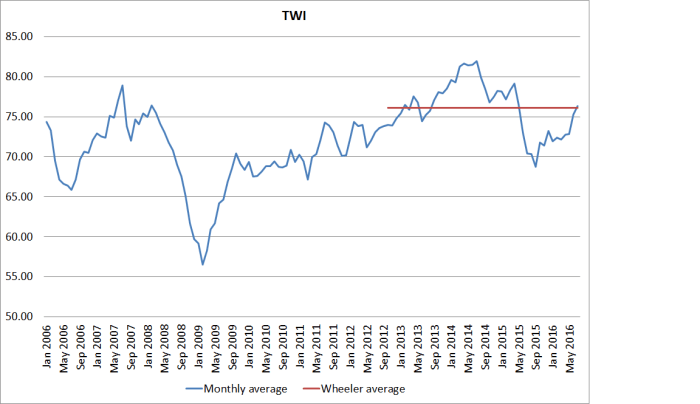
wheeler exch rate.png

And in many ways that isn’t very surprising.  After all, real interest rates in New Zealand haven’t gone far for years either.
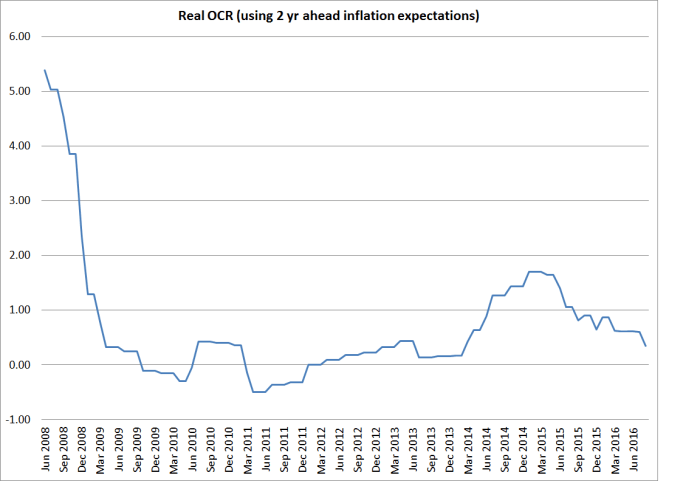
real ocr to aug 16.png

Even after this morning’s cut, the real OCR on this measure is still only about where it was just before the February 2011 earthquakes hit.  Back then, we were in middle of coping with the increase in the rate of GST and no one really recognized just how weak New Zealand or global inflation pressures were turning out to be.  There is no easy rule of thumb to say where the OCR should be now, but I think there is a pretty strong case –  in the context of the inflation targeting regime, which the Governor strongly (and rightly) recommitted to this morning –  that it should be lower than it is now.  Given how much we’ve been surprised over the last few years –  about things at home and abroad –  one could pretty easily make a case for a negative real OCR right now.

A few years ago, Mario Draghi the head of ECB galvanized and totally changed market sentiment about the euro-area with his off-the-cuff pledge to “do whatever it takes” to hold the euro together.  We haven’t seen that sort of commitment in respect of New Zealand monetary policy.  When asked this morning whether he’d be willing to take the OCR to zero if necessary, the Governor fended off the question.  Instead, it would have been a great opportunity to say “yes, of course.  We’ll look at the data every six weeks, but we are concerned about persistently low inflation –  and about expectations drifting down, and about unemployment lingering high.  We’ll do what it takes”.  Instead, we heard unease that if the Bank did too much it might create “more damage” to the economy.  Than what, I was prompted to wonder.  As it is, New Zealand continues to look like the last bastion offering some –  no longer much – yield to investors.  Interest rates of 2 per cent aren’t much, but they are much higher than you can get in most places. If so, no wonder the exchange rate remains relatively high.   And, relative to the Bank’s target, there is simply no need for interest rates to be that high –  not even on the Bank’s own forecasts, let alone a more realistic assessment of capacity pressures.

The Bank attempts to make quite a lot in the MPS of the idea that capacity pressures are becoming real in New Zealand, while they are largely absent in the rest of the advanced world.  They attempt to support that using various international output gap estimates, and their own estimates for New Zealand.  As they, and we, know output gap estimates are very imprecise, and prone to considerable revisions over time (especially for estimates of where the economy is right now).  For the last five years, the Bank has repeatedly tried to run the line that spare capacity has been used up in New Zealand, only to have to revise those estimates back again.  Another way to look at these things is through the lens of unemployment rates,  They aren’t a perfect measure, but are often more useful than output gap estimates, and relate back to some specific human concerns –  people who are actually out looking for work.  Here are the unemployment rates since 2005 for New Zealand, the OECD as a whole, and the G7 as a whole.

U rates to aug 16

New Zealand’s unemployment rate has been consistently below the other lines –  not surprising, as we have a more deregulated labour market than most.  But all three lines went up a long way during the 2008/09 recession, and there is no sign that New Zealand’s has fallen faster since.  If anything, it is rather the reverse.  The gap between New Zealand’s unemployment rate and those of the rest of the advanced world is smaller than at any other time in this sample.

The answers to our inflation challenges –  getting it up to and keeping it around target – really are in our own hands, or more specifically in the Governor’s hands.  We could have had lower interest rates, a lower exchange rate, more demand, lower unemployment, and higher inflation.   (And if the powers that be couldn’t fix up housing supply or immigration policy, the Governor could have required banks to hold larger capital buffers in case the domestic housing market caused future loan loss problems).
 

The Reserve Bank’s challenge tomorrow

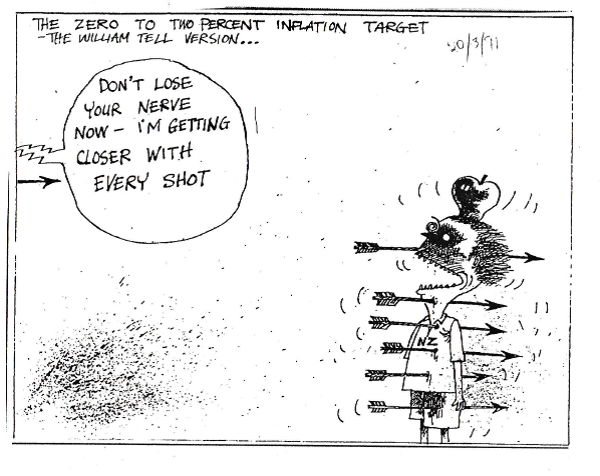
I ran a couple of cartoons from my 1980s and 90s collection a couple of weeks ago.  Many of the ones in my folder were about monetary policy –  the hugely controversial disinflation process we were engaged in, trying to get inflation down to 0 to 2 per cent per annum, and then keep it there.  No one much believed we would manage it (or even be allowed to do so by the political process)  –  there were even cartoons along the lines of “pigs might fly”.  This was one from my collection.

william tell cartoon

These days the challenge is the other way round –  getting inflation back up to (a now higher) target.

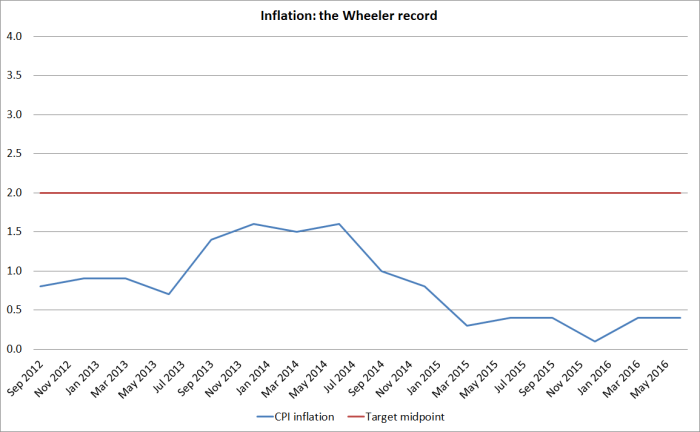
This chart shows inflation over Graeme Wheeler’s term as Governor. It has never got nearer the 2 per cent target midpoint that he and the Minister explicitly inserted into the PTA in 2012.  Most of the time, the annual inflation rate has been below the 1 per cent lower bound of the target range.

wheeler inflation

And so the cartoon struck me as apposite on the eve of the next MPS.  At almost every single OCR review and MPS the Governor has assured us that inflation will soon be getting back to around 2 per cent. Each time, so far at least, he has been wrong.  Forecasts have been revised down repeatedly, and with them the OCR.

Of course, if you look carefully, that cartoon was dated March 1991. By the end of that year, inflation was finally inside the target range.  Indeed, most studies looking at New Zealand’s experience of low inflation start from around then.

Perhaps we will be surprised, and after all the surprises and failures  so far inflation really will be back to around 2 per cent before too long.    The right monetary policy judgements are a part of making that prospect real.

A submission to the Reserve Bank’s faux consultation

A bit under three weeks ago the Reserve Bank announced a proposal for a further, substantial, extension of its LVR controls on banks’ mortgage lending  It is formally a proposal, subject to a consultative process, but it is all done in such a mad rush that it is difficult for anyone to take the “consultation” process seriously.  Late last year, the Bank announced that it would be allowing substantial consultative periods, and on this occasion they have offered no argument or evidence for why it is so urgent that such a short time is allowed for consultation and the preparation of submissions.  Presumably it is just the impatience –  backed by very little analysis – of the Governor –  much the same impatience that means this is now the third attempt in three years to get LVR controls “right”.  What was worse was the instruction to banks to simply fall into line now.  We live in a country supposedly governed by the rule of law, not the whims of men.  And until the proper consultative process has been completed, and the Governor has had regard to all the submissions, what he is proposing (a) is not law, and (b) cannot be counted on as ever being so.  But just to write that is to explain why it is hard to take the consultative process seriously.

I have  written and lodged a submission.  It was a fairly rushed job, but I’m out of commission for the next couple of days and needed to get it in this evening.

Submission to RBNZ consultation on further extension of LVR limits Aug 2016

This is the heart of the conclusion of my submission

In substance, the proposal if adopted will further undermine the efficiency of the financial system, while doing little or nothing to reduce any threats to financial stability (risks which, on your own stress tests are already very low). Indeed, there is a risk that such direct controls could increase, albeit modestly, the risk of serious financial system stresses because it will reduce the volume of capital held against bank mortgage books.    Over time, the growing use of direct controls risks progressively undermining the willingness and ability of banks to do their credit risk assessments, and to compete with each other in doing so,  rewarding going along with the Bank’s assessment of risks, while gaming the rules at the margin wherever possible. 

Since the Bank offers us no reason to think that its own assessment of credit risks –  in the aggregate or at a more disaggregated level –  is superior to that of the market, and since our banks actually came through a much larger housing and credit boom largely unscathed, there is little basis for us to prefer the Bank’s judgement.  And it has offered nothing to suggest how much its planned intervention might affect the probability or severity of any crisis. 

Over-reliance on a very slender base of international evidence, and a failure to think hard about the distinctiveness of New Zealand (from, say, the Irish or US experience) or to make the attempt to gather and analyse New Zealand loss experiences should give citizens little reason to have any confidence in what the Bank is proposing,   Even if investor loans were to prove slightly riskier, all else equal, than owner-occupier loans, the scale of the differentiation in the rules for the two types of lending suggests the Bank is driven at least as much by tilting the playing field against investors and in favour of first-home buyers as by its statutory responsibilities to use its powers in the interests of financial system soundness and efficiency.  If so –  and I hope there is nothing to that suspicion –  it would have involved the Bank stepping well beyond its responsibilities (with little ability for citizens to hold it to account if it did so).

There isn’t much to like in the consultative document.  The empirical evidence they now rely on is two studies undertaken by a central bank (the Irish one) which had already decided to have a regulatory distinction between investor loans and owner-occupier loans.  One of those studies is claimed to examine the UK experience –  in fact, it looks as the loan books in the UK of the three (failed) Irish banks, not necessarily a representative sample of UK experience.  I’m open to the possibility that investor loans are slightly riskier than owner-occupier ones, but have simply not yet been presented with any compelling evidence.  And the Bank has still made no effort to look at the experience in New Zealand, where the post-2008 reductions in house prices in some regions were not dissimilar to the UK experience, where unemployment rates lingered high, and where in some cities nominal house prices stayed well below previous peaks for a prolonged period. Obviously, New Zealand data reflecting New Zealand banking practice, New Zealand law, and New Zealand cultural norms would be more persuasive than the experience of the Irish banks (and even those research papers have some real problems).

The proposed controls differentiate between investor loans and owner-occupier ones to a huge extent.  Implicit in these proposed new rules is the view that loans to an owner-occupier with an 80 per cent LVR are less risky – not just as risky –  as loans to investors with a 60 per cent LVR.   Nothing in the data they’ve presented warrants that sort of differentiation, and it looks like a bit of covert redistributive policy: regardless of the riskiness of the respective loans, make things harder for investors and help out the first home buyers (even though those young buyers might be getting in right near a peak).  That simply isn’t the Bank’s job.  It is charged with financial system soundness and efficiency: it pays lip service at best to the efficiency issues (and the way its controls will progressively undermine competitive credit allocation decisions) and its own stress tests say that the financial stability risks are slight.  And why should regulatory policy be prohibiting a young person in, say, Wanganui getting into the rental property market with an LVR above 60 per cent.  Direct controls lead to arbitrary boundaries, absurd outcomes, and/or ever-increasing regulatory complexity.  That was part of the reason why we deregulated markets, and relied more extensively on indirect instruments, in the 1980s. it remains a good model –  and served New Zealand well through the boom and bust of the last decade, when our banks came through largely unscathed.

A key feature missing from the consultative document is any recognition that to the extent that the controls reduce high LVR lending, they will also reduce the amount of capital banks need to hold against their mortgage books. The Bank argues that the proposals will reduce the risk of financial crisis, but they show no sign of having thought much about the implications of the reduction in required capital.  If the capital requirements for high LVR loans were too low in the first place, that might be one thing. But our risk weights on housing loans are among the highest anywhere, and the Bank went through a consultative process not that long ago to increase those risk weights on high LVR lending.  And as part of what the controls will do is push a pile of lending to just below the respective ceilings –  there will be a lot of 59.9 per cent investor loans , even though a 59.9 per cent loan is little less risky than, say, a 60.1 per cent loan.  Capital requirements are likely to fall further as a result, even if the underlying risks haven’t changed much.   It would be unfortunate if measures ostensibly designed to reduce financial system risk actually modestly increased those risks, by reducing the capital buffers banks have to hold.

I don’t suppose submissions will make any difference to the Bank, but time (not much time, if they plan to have the restrictions in effect from 1 September) will tell.

Readers will recall that a couple of weeks ago the ANZ’s local head, David Hisco, called for the controls to be much more constraining than what the Bank is proposing. As I noted, there was nothing to stop ANZ restraining its lending accordingly.  But I do hope the ANZ will now pro-actively release its submission to the consultation so that we can see if Hisco’s submission on regulatory policy aligned at all with the rhetoric in his newspaper article.

I have lodged an Official Information Act request for all the submissions the Bank receives.  If past practice prevails they will eventually release those of entities other than banks, while claiming that the Reserve Bank Act prohibits the release of the bank submissions. I discussed this curious interpretation of section 105 of the Act the other day.  It cries out for a short amendment to the Reserve Bank Act to make it clear that all submissions on new regulatory proposals of this sort are covered by the Official Information Act.  That, of course, would be just a start on the sort of extensive reforms of the governance of the Reserve Bank that are needed.


Perhaps there is an example after all

I’m pretty pessimistic about the prospects of sorting out the housing supply/land use regulatory mess that, in conjunction with population pressures, has given us –  Auckland in particular –  extremely high house prices (and price to income ratios).  There are no great technical barriers to getting the market working again, with housing as affordable as it used to be.  But I have repeatedly noted here that I’m not aware of any country/region/locality that had once got into such a mess and had found its way back again, unwinding the morass of regulation (tell me again how many pages there are in the draft Unitary Plan).  Each time I make the point, I really hope someone is going to tell me about a compelling counter-example, demonstrating that what it technically possible has also proved politically feasible.

But reading Tyler Cowen’s Marginal Revolution blog just now I found a really encouraging piece headed Laissez-faire in Toyko Land , which in turn draws on a fascinating Financial Times article Why Tokyo is the land of rising home construction but not prices .  I hadn’t paid much attention to Japanese house prices, implicitly ascribing the lack of house price inflation to (a) the aftermath of the 1980s boom, and (b) the flat and now falling population.    But here is the key chart in the FT article

tokyo

Over the last 20 years, Tokyo itself has had about the same rate of population increase as London.  A nice locality apparently relatively near the centre has had faster population growth than San Francisco.  And yet look at the differences in the rates of house price increases.   Sure, the chart flatters Japan because Japan has had general consumer price deflation, while the US and the UK have had general inflation –  but even in real terms, the differences would be large.

Anyway, I’d encourage people to read the blog piece and the underlying article itself.  It isn’t a totally laissez-faire story, but the flexibility that seems to have been introduced to the system following the 1980s boom looks impressive.  I’m not expert – no doubt there are other perspectives on the Tokyo experience –  and perhaps the changes that were put through in Japan could never be done in Anglo countries.  But they were done in Japan. That in itself is encouraging.

UPDATE: I had been continuing to mull this FT material.  It focuses on the change in prices over the last 20 years as a whole, and not at all on the levels.  This 2014 link from one of the FT blogs confirms that the bulk of the 1980s boom in Tokyo prices had been reversed by 1995.  However, it also includes a chart showing price to income ratios for new Tokyo apartments (in the greater Tokyo area) which –  while pretty stable over the last 20 years –  still seem strikingly high, especially once one takes account of the “famously diminutive” size of Tokyo apartments.

And here is an interesting post with a more extensive discussion of Japanese zoning procedures and rules.

Let’s not give even more statutory powers to the Reserve Bank

This morning the Reserve Bank released a variety of material that followed on from the leak of OCR at the time of March MPS.    Slipped out quietly onto their website – in response to an OIA request from me – was what might best be called the second stage of the leak inquiry report.  It is a document written by Deloitte almost a month after the release of what the Governor has called the “summary report” that was released on 14 April, and in places it is clearly phrased to respond to criticisms made after the release of that report.  I’ll have more to say about that document another day, but would just note that I was touched by the solicitousness of the Bank in deleting my name from a report they were releasing to me, apparently so as to “protect the privacy of natural persons”.  Perhaps they thought I’d forgotten my involvement?

The Bank also put out a press release headed “New Reserve Bank procedures for policy releases”.   After the discontinuation, from 14 April, of pre-release MPS and FSR lock-ups for journalists and analysts, there was pushback, especially from journalists, seeking the reinstatement of media lock-ups, under new and improved security arrangements (as distinct from what Deloitte call the “very high trust” arrangements –  under  which journalists could simply email from the lock-ups whenever they liked –  which had been found sorely wanting).   The Governor had indicated that the Bank would consider the options, and apparently commissioned a “security review” to explore the feasibility of lock-ups with much tighter security.  That review was undertaken under the leadership of Deloitte, but from the text the Bank has released today it is clear that it had a high degree of Reserve Bank staff involvement.

At the end of the process, the Governor has come to the right conclusion.  Lock-ups are not being reinstated, whether for analysts or journalists.  That was an approach I recommended at a time when the Bank itself didn’t even believe there had been a leak.  I commended the Governor’s initial decision to terminate the lock-ups, and I commend him again today.  There is simply no need for such lock-ups, and to hold them inevitably exposes the Bank to unnecessary security risks and/or unnecessary costs.  The public might have been well-served by lock-ups in a pre-internet age –   when it was hard to get timely access to the released documents –  but with today’s technology, the text is open to everyone at much the same time, and the onus is on the Bank to write its documents in a way that clearly communicates the messages it wants to convey.

Of course, the Bank is not seriously committed to openness or competitive neutrality in the access to information.  I have heard that they are still running briefings for analysts after the release.  [UPDATE: A market economist tells me that although they had such a briefing in June, there won’t be any in future]  An overseas expert on central bank communications has recommended –  and I agree with him –  that if such briefings are to be held (and there may be a useful place for them) they should be webcast, so that everyone has access to the same information/interpretation, not just the invited few who find it worthwhile to come all the way to Wellington (recall that most trading in the NZD is done offshore, and most New Zealand government bonds are held offshore).

[UPDATE: On further reflection, I would argue that such a post-release briefing, provided it is made openly available, would be a sensible option and cannot really understand why the Bank has scrapped them.  At a minimum it is less bad (and less costly in time) than lots of analysts approaching the Bank individually, and getting answers that could be (a) inconsistent across analysts, and/or (b) could be influenced by how well the analyst in question gets on with – eg  doesn’t criticize too much – the Bank and its senior economic staff in particular.]

For the media, the Bank notes that

We will also be placing additional emphasis on other opportunities for media access, such as on-the-record media briefings which have been trialled successfully this year.

There may be a place for such briefings, but if they are on-the-record again there is a strong case for webcasting them –  or even quickly publishing a transcript –  again so that everyone has the same information on a timely basis.  And, of course, on-the-record briefings –  with an emphasis on what the Bank wants to tell the media –  are very different from the sort of on-the-record searching interviews that the Governor consistently refuses.

I noted the other day that the Bank is sheltering behind an old provision of the Reserve Bank Act which, they argue, imposes serious sanctions (including a large fine or a term of imprisonment) if they were to release submissions –  especially from banks –  on proposed changes in regulatory policy.  I argued that if they had any sort of commitment to open government they should be promoting a simple amendment to the Act, to ensure that such submissions were fully, and simply, within the ambit of the Official Information Act.  If the Bank won’t promote such a change, perhaps an MP with a commitment to open government might.

So when I read through the Deloitte security review document, I was struck by the number of times that report had encouraged the Bank to seek a change to the Reserve Bank Act, this time to provide criminal sanctions for the early unauthorized release of OCR or MPS (or FSR?) material.  I suspect the idea for such a change did not come from Deloitte, but from Bank management themselves – in particular from the Deputy Governor responsible for such things (and former Government Statistician) Geoff Bascand.  In previous material released on the OCR leak, Bascand was on record as noting that Reserve Bank material of this sort did not have the sort of protections the Statistics Act provided to Statistics New Zealand.

It is really important that when the coercive powers of the state are used to compel individuals and firms to provide information to state agencies that people can be confident that that information is held securely.  Severe punishment for the inappropriate release of private information supplied by other people is quite appropriate.  But in fact, both the Statistics Act and the Reserve Bank Act already provide such penalties –  under the Reserve Bank Act someone can be sent to prison for three months, or a company can face a half million dollar fine.

But the economic forecasts and policy views of a government official (the Governor in this case) are a quite different matter.  And in many respect, that sort of information is not so different than the private information a firm might hold about a proposed merger or acquisition, about its planned dividend, about a new investment project, or –  in the New Zealand case –  Fonterra’s expected dairy payout.  Perhaps I’m wrong, but I’m not aware that there are criminal sanctions that protect, say, government Budget documents, or any other release of planned policy or legislation by government ministers.

In all those cases, confidentiality is clearly important to the information holder.  But in each case there would appear to be civil procedures open to information holders to protect the confidentiality of their information.  Typically, some staff in the relevant organization would have access to such information, and early unauthorized release would typically be a grounds for disciplinary action or perhaps even dismissal.    But other parties might too –  government Budget documents are printed externally, as is the MPS.  Sometimes professional advisers –  eg lawyers –  will be involved. And in some cases, entities will choose to provide information under embargo, or even to hold a lock-up.  In each and every case, it is open to the owner/provider of the information to specify in contract the confidentiality obligations of any party receiving the information.   Remedies for breaches of those policies are the responsibility of the institution providing the information.  There is no obvious need for criminal sanctions to be introduced in the process.  I hope that the Reserve Bank thinks again, and decides not to seek amendments of the sort Deloitte (no doubt at the Bank’s prompting) has suggested.  There is simply nothing that special about the OCR information –  it is not private information involuntarily provided to a government agency, and nor is it (say) material relating to national security.

In conclusion, it is interesting that in all the material that has emerged in recent months there has been little or no mention of one of the greatest security risks the Bank –  quite unnecessarily  – faces.    In most countries, the OCR decision is made and released on the same day –  that will have been what happened at the RBA yesterday.  The Reserve Bank has considerably shortened the lags over recent years, but as their recent article on the monetary policy process decision illustrates, the OCR decision to be released next Thursday will be made by the Governor this Friday.  There is six whole days when the information about the decision is known within the Bank.  Even if the formal knowledge is kept to a relatively small group –  when I was involved it was 10 to 15 people – it is simply an unnecessary risk.  With the best will in the world,it is almost inevitable that one day some one will let something slip, and there will be a huge uproar.  In terms of tightening security, still the best reform the Bank could make would be to release the OCR decision on the day it is made.


There is just so much wrong with this sentence

The latest version of the proposed Auckland Unitary Plan –  itself a phrase that leaves me slightly queasy each time I read it –  is apparently due out at 1:30.

Reading an article on it in today’s Herald I found this sentence:

“it will decide where and how Aucklanders will live, work, and play for the next 30 years”

Actually, I doubt even the most fervent advocates will claim all of that for it –  and almost certainly it won’t be what actually happens – but it is a sad reflection of where we have got to, in respect of freedom, property rights, individual choice (add in the sheer unknowability of the future) that a journalist can write a sentence like that and probably not even see anything unusual or controversial about his statement.

In a free society, Aucklanders would make those choices themselves, and Councils (as providers of basic infrastructure and public services) would fit themselves to those private choices exercised in a free market in land, and the ability of private landowners to contract with each other, to respect each others’ interests and property rights

Allow any land within 100 kilometres of downtown Auckland to be built on to a height of two storeys and we’d pretty soon see house and land prices a lot lower, and the market –  private preferences, private opportunities –  would sort out just where the new houses were built.


A good feature of our tax system

Yesterday I commented regretfully on the absence of any sign of much in-depth thinking from the Labour Party about reversing New Zealand’s ongoing relative economic decline.  I noted then that they had plenty of company in that failure.  As one illustration, I saw a piece on The Treasury’s website this morning outlining Treasury’s work programme, which is apparently organized around seven “strategic intentions”.  Each of them is probably fine in their own way, but none bears directly on reversing New Zealand’s decades of relative economic decline.  The standards of the modern Treasury seem to be  reflected in this quote from a related document, trying to recruit a new Chief Economic Adviser:

we are facing up to the challenge that economic actors operate in complex ways and not according to straightforward and predictable scientific models.  Moreover the days when improvements in living standards were measured exclusively by the increase in total production – GDP – are on their way out.

I just shook my head in weary despair.    I no longer have my Stage 1 economics textbook, but I doubt that even there anyone assumed that “economic actors” (people?) are other than complex.  No Treasury in my 30 years of working alongside them ever did.  And perhaps the Treasury could point us to cases where anyone ever thought that “improvements in living standards were measured exclusively by the increase in total production –  GDP”.  We conscripted labour in World War Two –  forced people to work even when they didn’t want or need to, and forced them to work longer hours than they preferred.  That provided a big boost to GDP, but no one thought it boosted living standards – it was a means to an end, defeating our enemies.   If they are really reduced to arguing against such straw men, it would be a very brave, or slightly deluded, person who took on that Treasury role.

But this post is, in part, about praising the Labour Party (and on this one, I suspect Treasury probably agrees with them).  The Herald has an article this morning on turnover taxes on real estate transactions.  They draw on this piece from a UK accountancy firm which looked at turnover taxes (on US$1m houses) in 26 countries.  New Zealand has no turnover taxes on property taxes and so ranks top of the table –  just marginally ahead of Russia, which levies a fee of US$30.45 on such a transaction.  Belgium, by contrast, which has always been known for its high turnover taxes charges US$113131 on a purchase of a $1m house.

The Herald found a local economist, Shamubeel Eaqub, who (in the sub-editors’ words) “frets on tax ranking” and who thinks, in his own words, “it would be a very good thing for New Zealand to tax property purchases”.  To his credit, Labour’s housing spokesman Phil Twyford disagrees noting that “stamp duty is a relatively inefficient tax” and stating that Labour did not advocate stamp duty –   no if, no buts, no suggestions of referring it to a working group.  Stamp duties on property purchases are just bad policy.  In some places (eg Australian states) they have been used when revenue options aren’t available to that particularly authority, but from either tax policy or housing policy perspective, let alone fiscal or labour market considerations, they have almost no other redeeming features and we should be grateful that we are free of such taxes.

The UK accountancy firm that wrote the piece fretted that high turnover taxes might make it hard to recruit overseas senior executives or rich foreign investors.  I’m not sure that the latter concern in particular will really have much resonance among electorates anywhere.  We should worry much more about what turnover taxes mean for the functioning of the market for ordinary people.  Moving cities is expensive enough as it is, without slapping an additional heavy tax on people whose job opportunities mean it is necessary for them to move.  Stamp duties on property transactions bear no relationship to ability to pay or any of the other usual desirable features of a tax system.  At the margin, they impede labour mobility, undermining the effectiveness of the labour market.  And, almost certainly, they reduce housing turnover.  Some might see that as a good thing, since high housing turnover is often associated with rising prices –  but it isn’t the turnover that generates the higher prices, it is the underlying boost to demand that lifts turnover and prices together.   Structurally reducing the level of housing turnover would simply reduce the choices people face when they do come to the market.  And where it might make good practical sense, on account of changing family circumstances, to move house, such taxes will simply encourage more people to alter and extend an existing house instead.  There is no obvious welfare gain from that.

And, of course, there is no sign that the presence or absence of a turnover tax plays any part in explaining cross-country variation in house prices, or price to income ratios.  Belgium’s houses certainly aren’t cheap, Australia and the UK both have quite material turnover taxes and house price problems as severe as ours, and in the US places fast-growing places with very affordable housing co-exist with highly unaffordable cities all in a regime with very low property turnover taxes

I’m also very uneasy about property taxes tied to turnover – whether stamp duties, or realisations-based capital gains taxes (which all real world CGTs) are –  because of the fiscal risks they create.  When times are good property turnover is higher than usual –  often quite a lot higher than usual.  Tax revenue floods in –  not just 10 per cent higher than GDP when GDP is 10 per cent higher, but multiplicatively so (housing turnover per capita might double or treble from bust to boom),  If the boom runs for several years, the fiscal authorities –  officials and politicians –  come to treat the higher level of revenue as normal, and perhaps even sustainable.  Even if some boffins in Treasury keep sounding the alarm, politicians have elections to win and abundant revenue encourages even-more abundant spending.  This is a problem even when tax systems draw almost entirely on income and consumption –  our own Treasury finally caved in in 2008 and conceded that the higher levels of revenue built up during the boom of the previous few years was sustainable,  just before the severe recession blew to pieces all those assumptions. It was much m0re of a problem in Ireland, where property-based revenue had hugely flattered the fiscal picture in the years leading up to the crisis.  It is fine to talk about clever schemes to limit these risks –  fiscal rules or separate funds –  but they rarely work well.  And there is no good tax policy or housing policy case for turnover taxes in the first place.

I’m not so keen on the rest of Labour’s housing tax policy –  extending the quasi capital gains tax for investment properties, or “axing” so-called negative gearing –  but credit to them for having no truck with pure turnover taxes.

(UPDATE: I noticed that Treasury recently released some material on the – rather limited –  work they had been doing on the possibility of a stamp duty –   turnover tax –  for residential property).


Young UK voters and the EU: then and now

Since the successful Brexit vote on 23 June, there has been a great deal of (mostly rather disdainful) attention paid in some quarters to the demographic breakground of the support for Leave and Remain.  Among aggrieved Remainers there has been a particular focus on the fact that –   at least among those who bothered to turn out to vote –  young voters had fairly strongly favoured Remain.  In Lord Ashcroft’s exit polls, the Remain/Leave split among voters aged 18 to 24 was 73 per cent in favour of Remain, and 27 per cent in favour of Leave.  Among the (much larger group of) voters aged 65 plus, 60 per cent favoured Leave and 40 per cent favoured Remain.   Here is the graphic from the Ashcroft polls.

The rising generation favoured Remain and only the old really wanted Leave (although the margin in favour of Leave was pretty clear cut among all those aged over 45).    This led some more fevered critics to suggest that old people should be deprived of the right to vote altogether –  although it was never clear what age threshold they had in mind.  But a similar sentiment was evident in an op-ed in the FT the other day from Nick Clegg, former Deputy Prime Minister, former Liberal Democrat leader (and champion of the EU).  According to Clegg

the status quo cannot last. A country that has taken such a momentous decision about its own future against the wishes of its own younger generation is not on a stable path.

Which might be a sort of plausible argument if the views today’s young held could be counted on to remain unchanged for the rest of their lives, or if (somewhat equivalently) today’s old had been those staunchly opposed to the UK entering the EEC in 1973.     Of course, even if today’s young still do feel the same in 20 years time, and they manage to command a pro-EU majority then, there is nothing to stop a future UK government seeking to rejoin the EU (if it is still there).  Neither Parliaments nor referenda today bind future Parliaments and governments.

My instinct had been that one couldn’t count on such preferences remaining stable throughout life.  For most of us, it only takes a brief moment of introspection to recall views we held staunchly decades ago that no longer reflect our views today.  And, after all, today’s UK young have known only Britain in the EU.  Once Britain leaves, they –  and next cohort of young people –  will have different experiences.  Exit might work out well, or badly, or be simply hard to tell, but different data will be available to future voters (and responders to opinion polls).

In the course of pottering around secondhand bookshops in Northland and Auckland last week, I stumbled on a fascinating book, published in 1973 by an Oxford political science academic, called Diplomacy and Persuasion: How Britain Joined the Common Market. I have not read it yet, but flicking through it my eye was immediately drawn to the statistical tables and charts, with data on support for, and opposition to, joining the EEC.    In the early 1960s, British public opinion had been strongly in favour of joining the EEC,  but by the late 1960s and early 1970s –  as entry actually became possible, once de Gaulle had departed the scene – public opinion had reversed.  In one major poll in 1971, where the same questions were asked in the UK and  in each of the six EEC countries, public opinion in each of the six was strongly in favour of Britain joining, while British opinion was strongly against.    Foreshadowing future tensions, public opinion in each of the six strongly favoured a move towards a United States of Europe, while British public opinion was opposed (even conditional on the UK actually joining).

The British government of the early 1970s had undertaken to join the EEC only if there was clear majority in favour, in Parliament and in the country.  That simply didn’t happen before Britain entered the EEC on 1 January 1973 –  key parliamentary votes were very close, and in the run-up to entry date public opinion (as captured in the polls) never got beyond being evenly split between those favouring joining and those opposed.

But what particularly interested me was the demographic data the author reported.  He reports detailed results for 21 different polls from early 1971 to late 1972.   The age breakdowns are a little different than in the Ashcroft polls above, but in every single poll the over 65 age group were opposed to the UK joining the EU (typically by very large margins), and the 16 to 24 age group was either in favour of joining or much less strongly opposed.

Here are the average results from the five 1972 polls that are shown in the book, with all results shown in net balance terms ( a positive number means a net balance of that demographic in favouring of the UK joining the EEC).

By age

Net support for UK joining EU
Overall 16 to 24 25 to 44 45 to 64 65+
0.2 5.6 10.4 0.8 -20.2

Overall, the population was split, but young people were much more inclined to support joining than old people were.  But the 1972 20 year olds are today’s 64 year olds – people on the brink of joining the group most strongly now in favour of leaving.

And here are the results by social –  or occupational –  class

Net support for UK joining EU
AB C1 C2 DE
50 19.8 -10.2 -27.2

The divide between the more-educated higher status groups is somewhat similar to that now (see the Ashcroft table above), but it is perhaps notable that for all the disdainful talk now about how the educated favoured staying in the EU and the uneducated wanted out, the gap between the views of these occupational groups is much less marked than it was in 1972.  In 1972, overall public opinion was evenly divided, but with huge margins in favour among the AB group –  professional and semi-professional occupations –  and substantial opposition among the working classes.  Working class opinion now is similar to what those polls captured in 1972, but “elite” opinion is much more evenly split (57:43 in favour of Remain) now than it was then.  Joining the EU was always an “elite” project, and Britain is now leaving because enough of the “elite” groupings have lost confidence that the EU is the best option for Britain.

I don’t suppose anyone took very seriously the idea of depriving the old of the right to vote.    But why we would suppose that 1972’s 16 to 24 year olds were better placed then to make a decision on the best interests of their country, themselves, and their children and grandchildren, than today’s 60 to 68 year olds are now?  They are, after all, the very same people.

(For anyone interested, there has also been a lot of coverage of the fact that a majority of Scottish voters favoured Remain in this year’s referendum.   By 1972, there was not much difference in the poll results by region, but I was interested to find that in every single one of the 16 1971 polls, Scottish opinion had been more opposed to joining the EEC than opinion in the rest of the country.)


Another example of the Reserve Bank’s approach to the OIA

Regular readers will recall the OCR leak at the time of the March MPS.  A month or so later, when the Reserve Bank reluctantly recognized that there had in fact been a leak, and that their systems needed to change to reduce future risks, they released what purported to be a report undertaken for them into the leak by Deloitte.

In fact, subsequent material released by the Bank in response to an OIA request confirmed that what had been released then was not the actual report but a short-form “public” version.  I’m not sure what they had to hide, but decided to ask for a copy of the full report, partly out of genuine interest in its contents (as I had been the subject of a significant portion of the short-form “report”) and partly on the principle that leak inquiry reports, paid for by taxpayers’ money, should be made public as a matter of course.  In particular, the public should not be misled into believing that they were being given a full report, when in fact they were being given only a convenient summary.  When the initial release was made on 14 April, there was no suggestion at all that what was being released was a summary report only.

Anyway, I lodged the request several weeks ago, and this afternoon received this response.  How it can take more than 20 working days to decide whether or not to release a single report (that they already claimed to have released), which they themselves commissioned, and which they must have expected to be requested, and which deals only with their lock-ups etc is beyond me.  It seems like just another excuse for delay, another opportunity to simply ignore the principles of the Official Information Act.

(UPDATE: A reader points out that the Bank has given itself almost twice as long to consider the release of a single easily accessible administrative document as it allows for citizens to make submissions on its own proposals for further far-reaching regulatory interventions around housing finance.)

22 July 2016

Dear Mr Reddell

RE: OIA REQUEST FOR FULL DELOITTE INQUIRY REPORT

On July 4 2016 you made a request under the Official Information Act for:

“…. a copy of the full Deloitte inquiry report (as distinct from the “summary” – Graeme’s description in the Board minutes – or “public” version that was released on 14 April”.

The Reserve Bank is extending the time limit for decisions on your request to 10 August 2016, as permitted under section 15A(1)(b) of the Act, because consultations necessary to make decisions on the request are such that a proper response to the request cannot reasonably be made within the original 20 working day time limit.

Under section 28(3) of the Official Information Act, you have the right to complain to the Ombudsman about the Reserve Bank’s decisions relating to your requests.

Yours sincerely

Naomi

Naomi Mitchell

External Communications Adviser | Reserve Bank of New Zealand (Auckland)

205-209 Queen St, Auckland 1010 | P O Box 5240, Auckland 1141

  1. +64 9 366 2643 | M. +64 27 294 3900 | F. +64 9 366 0517

www.rbnz.govt.nz

Monetary policy and the exchange rate

The Herald‘s Claire Trevett was perhaps being just a trifle unfair yesterday in commenting on the Reserve Bank’s “consultative” document on the latest iteration of the increasingly unpredictable LVR restrictions

The Reserve Bank’s definition of “consulting” appears to be akin to North Korean President Kim Jong Un’s

The Governor on the exchange rate tends to bring to mind parallels with the (misremembered) story of King Canute.   Canute was trying to deliberately demonstrate to his courtiers how little command he actually had –  none over the tide and the seas.  But the Governor loftily –  or perhaps plaintively – decrees that “a decline in the exchange rate is needed”, and the market really doesn’t pay that much attention.  The exchange rate did fall a bit yesterday, and has pulled back some way over the last 10 days or so, but the exchange rate today is perhaps only a couple of per cent lower than the average over his whole term to date.  For almost his entire term, he has been lamenting the strength of the exchange rate.

I’ve noted previously that I entirely agree with the Governor that a successful transformation of the New Zealand economy’s growth prospects is likely to require a sustained and substantial fall in New Zealand’s real exchange rate –  a substantial fall in the prices of non-tradables relative to the prices of tradables.  But nothing the Reserve Bank does, or could do, has anything much to do with bringing about that sort of change.  It isn’t some fault or failing of financial markets either.  Rather, responsibility for the persistent pressures on domestic resources that have given us a real exchange rate persistently out of line with our deteriorating relative productivity performance rests squarely in the Beehive.  The choices successive governments make –  and both major parties still defend – explain the bulk of our underperformance.   Here is a chart I ran a few weeks ago.  If anything, I suspect – but of course can’t prove formally –  that we need the exchange rate to fluctuate below that 1984 to 2003 average for a decade or two, not the 20 per cent above that average we’ve had for the last decade and more.

real exch rate

But in the shorter-term (perhaps even periods of several years) monetary policy choices make a difference.  Sometimes quite a large difference indeed.  Notice the big fall in the exchange rate following the 1990s boom.  The TWI briefly fell almost as low, in real terms, as it reached following the 1984 devaluation –  and for the economic elite in 1984/85, one of the big challenges then was felt to be “cementing in” that lower level of the real exchange rate.

During this period around the turn of the century, the NZD/USD exchange rate was below .5000 for almost three years.  At the trough in late 2000 it was around .3900.   What else was going on?

In New Zealand, it was the first year of the new Labour-Alliance government, and the business community did not like the policies, or attitudes, of that government one little bit.  I was head of the Reserve Bank’s Financial Markets Department at the time, and used to go along to Board meetings each month.  One particularly prominent and vocal member constantly wanted to get me to say that the weak exchange rate was all a market judgement on the new government.  I usually pushed back quite strongly.

And here is why.

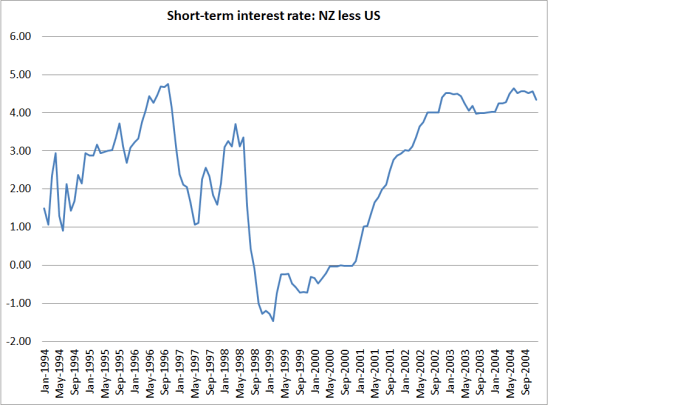
int rates us and nz

This chart uses OECD short-term interest rate data for 1994 to 2004.  During that period from mid-late 1998 to the start of 2001, New Zealand short-term interest rates were at or below the level in the United States.  It is the only time in the whole post-liberalization period when that has been so.  The respective central banks judged that that was where their own interest rates needed to be to keep inflation at or near target (a formal target in the New Zealand case, and an informal target back then in the US).

It isn’t a mechanical relationship by any means.  Apart from anything else, expected interest rates tend to matter at least as much as actual short-term rates –  ie the expected future path of policy.  And other expected returns mattered too.  Even after the NASDAQ had peaked in early 2000, there was still an important theme around markets of “new economies” (with the tech boom) and old economies.  The NZD and AUD –  not seen as currecies of high tech “new economies” – were very weak in response.

The Governor can’t change the structural fundamentals that influence savings and investment preferences in New Zealand.  But he has our OCR in his personal control.  If he were to cut the OCR to 1.5 per cent, there would still be quite a large margin over US interest rates –  unlike the situation in 1999 and 2000 –  but that gap would be quite materially narrower than it is now.  Perhaps the OCR might even be able to go below 1.5 per cent –  after all, it is not as if the resulting margins to world interest rates would be unprecedented –  but we’d have to see how the data unfolded.

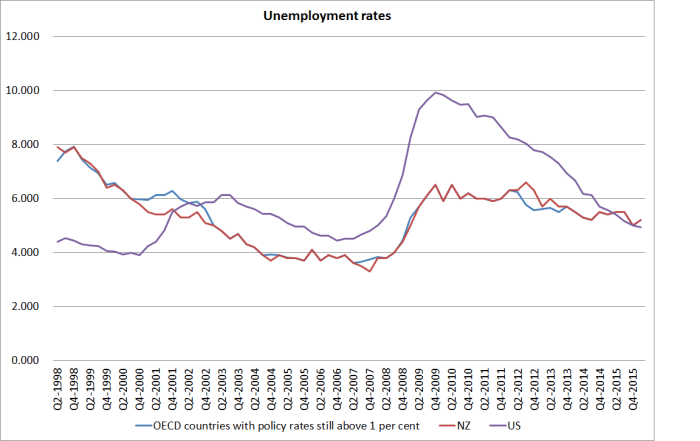
The Governor can’t just set the OCR on a whim.  Instead he is required to deliver on an inflation target.  But we know that New Zealand’s inflation rate has been persistently very low relative to the target the government set for the Bank.   Among the OECD countries where the central bank still has some material monetary policy discretion –  say, a policy interest rate still above 1 per cent –  our inflation rate has also been falling away relative to the median in those other advanced economies (a sample which includes Australia).  Inflation just isn’t a constraint at present –  if anything, it is the absence of enough inflation that is the problem.  And is the economy under mounting pressure?  Well, by contrast with the United States where the unemployment rate is almost right back  to where it was prior to the recession, in New Zealand –  even on the latest SNZ revisions –  (and in the median of those other higher interest rate OECD countries) the unemployment rate is almost 2 percentage points higher than it was prior to the recession.

U rates us and nz

There is simply no sign that the real economy could not cope with materially lower policy interest rates – if anything, the evidence is pretty clear that it could do with the boost (or rather with the inappropriately restraining hand of the Reserve Bank being eased up).

The gap between New Zealand and US long-term interest rates has “collapsed” in recent months –  the gap between 10 year nominal bond rates is now only around 65 basis points.  That suggests that markets actually think quite a bit of policy rate convergence is coming. But they can’t be sure when, as the Governor remains so reluctant to cut the OCR and has been prone to inconsistent communications.  The economic case for a 50 basis point OCR cut next month, foreshadowing further cuts to come, is reasonably strong. I don’t expect the Governor to adopt that policy, but if he is serious about getting monetary policy out of the way of the exchange rate  adjustment he seeks, it is exactly the policy he should adopt.

No doubt, some at the Reserve Bank will continue to cite their estimates of neutral interest rates being around 4 per cent –  as the Assistant Governor apparently recently told FEC.  If you asked me where I though global real interest rates would converge back to over the next 20 years, I too might talk in terms of a 2 per cent real interest rate (so with inflation targets centred on 2 per cent, perhaps something around 4 per cent).  But that is simply not a meaningful basis for making monetary policy today.  We don’t know where “neutral” interest rates are now, but most of the external evidence suggests monetary policy isn’t particularly accommodative at all – rather it has sluggishly adjusted towards whatever has changed in the real economy.  In New Zealand’s case, that failure to adopt a practically accommodative policy is holding the exchange rate higher than it needs to be –  higher than the Governor himself would like.  To that extent, the solution is in his hands.