New Zealand First’s immigration policies

I was briefly half-encouraged when I heard that Metiria Turei had been attacking New Zealand First for having “racist” immigration policies.  Mostly it seemed like a further rather depressing attempt to suggest that any serious debate about New Zealand’s unusually large and ambitious immigration policy was illegitimate, all the while trying to look like the Greens were taking the high moral ground, even as their co-leader actually descended into mud-slinging and name-calling herself.   But….there was the hint there that perhaps New Zealand First actually had some distinctive immigration policies.  The last time I’d looked on the NZ First website what was notable mostly was how little material there was on immigration policy, and how few significant policy proposals.

But, no.    When I checked again yesterday, there still wasn’t much there.    From listening to Winston Peters over the years, or even just listening to the reaction to him, you might have supposed New Zealand First had some far-reaching and specific proposals that would change the face of immigration policy in New Zealand.  Instead what you find is this.

New Zealand First is committed to a rigorous and strictly applied immigration policy that serves New Zealand’s interests. Immigration should not be used as a source of cheap labour to undermine New Zealanders’ pay and conditions.

There have been numerous instances of administrative failure to apply immigration rules and standards.

New Zealand First will strengthen Immigration New Zealand to give it the capacity to apply immigration policy effectively.

New Zealand First will:

  • Make sure that Kiwi workers are at the front of the job queue.
  • Ensure that immigration policy is based on New Zealand’s interests and the main focus is on meeting critical skills gaps
  • Ensure family reunion members are strictly controlled and capped and there is fairness across all nationalities.
  • Ensure that there is effective labour market testing to ensure New Zealanders have first call on New Zealand jobs.
  • Introduce a cap on the number of older immigrants because of the impact on health and other services.
  • Make sure effective measures are put in place to stop the exploitation of migrant workers with respect to wages, safety and work conditions.  In Christchurch and elsewhere there is evidence of exploitation of migrant workers.
  • Develop strategies to encourage the regional dispersion of immigration to places other than Auckland. Auckland’s infrastructure is overloaded.
  • Remove the ability to purchase a pre-paid English lesson voucher to bypass the minimum English entry requirements.

And that is it.   I’m guessing that no one (or at least no political party) is going to disagree with anything in the first three mini-paragraphs.    But if no one is going to disagree, those words aren’t saying much either.

What about the specifics?   Everyone is going to sign on for avoiding the exploitation of migrant workers, even if reasonable people might differ on quite where the line would be drawn.  Even the current government took some steps in response to the Christchurch evidence.

The current labour market testing system may, or not, be working well, but on paper there are requirements in place that are supposed to prioritise potential New Zealand workers (three of the eight NZF bullet points).  Again, no one much  –  perhaps not even ACT or the New Zealand Initiative –  is going to disagree with the general goal, and nothing New Zealand First says here is very specific.  It all seems pretty mainstream stuff –  probably putting too much faith in the capabilities of MBIE for my own tastes.

New Zealand First wants to cap family union entry, and also cap the number of older people getting residence visas.  But again, how different is that to current policy, where applications for parent visas are currently suspended altogether?    Perhaps New Zealand First wants to go further in that direction than most, but it hardly has the ring of something very dramatically different.

And in calling for a larger proportion of migrants to be encouraged to places other than Auckland, NZ First seems quite consistent with the government’s policy of offering additional points for people with job offers in the regions.  And Labour want to allow regions to develop their own priority occupation lists.  Personally, I think all three are daft, and simply tend to lower further the average quality of the immigrants we get, but (sadly) there is nothing out of the mainstream in the direction NZ First seems to be proposing.

And that leaves the final bullet about English language requirements.  Without knowing anything much about it, on paper what NZ First is proposing looks reasonable enough (if we are going to have English language requirements, a prepaid voucher for a course one may never bother attending doesn’t look like much of a substitute.    But it is a level of detail that hardly seems likely to divide parties deeply.

And quite what qualifies as “racist” there –  and Turei was explicitly talking about “policies” –  is beyond me.  Except of course that she and her co-leader (the latter in his speech last week) seem determined to insist that no legitimate discussion or debate is possible about New Zealand’s unusually large immigration policy –  unless, of course, they are proposing things, in which case presumably we can all be assured of their virtue and rectitude.

What is more striking is that, for all the speeches and interviews, there is nothing in that New Zealand First list that would make any very material difference to the expected net inflow of non-citizens.   In particular, there is nothing at all about the overall level of residence approvals.  Reading this list, NZ First appears to be comfortable with a residence approvals target of around 45000 per annum (three times, per capita, the US rate of approvals), and it is the number of residence approvals that will, over time, determine the contribution of immigration to population growth, pressure on resources or whatever.     There is also nothing at all on provisions around international students, nothing about working holiday visas, and nothing specific on temporary work visas.

If one took this page of policy seriously, one could vote for NZ First safe in the expectation that nothing very much would change at all about the broad direction, or scale, of our immigration policy.     Of course, there would be precedent for that.  The last times New Zealand First was part of a government, nothing happened about immigration either.

Perhaps there is still some major announcement with some more substantive policy specifics still to come.  I see that the New Zealand First conference is being held this coming weekend.    Perhaps that will be the occasion.   But at present, there is very little there, and most of what there is isn’t a million miles from where the other parties –  including the government –  seem to have been.

Options for a new Governor

Applications for the job of Governor of the Reserve Bank closed this morning.

As I’ve noted before it is a very odd business:

  • applicants don’t really know what job they are applying for (since Labour and Greens are promising material changes in the monetary policy decisionmaking model, and in the Bank’s statutory objectives, and the Rennie review may yet foreshadow changes by the current government),
  • the Board, charged with evaluating and recommending a candidate to the incoming Minister of Finance, also has no real idea what the job is.  The emphases of a Labour/New Zealand First government (say) would probably be rather different than those of a National-ACT government.

And yet, with still 2.5 months until the election, the Board will shortly settle down with their recruitment consultants to winnow down the list of applicants.  And this is a Board entirely appointed by the current government, and although the individual Board members may each be quite capable they are likely to be a different bunch of people, with different inclinations and preferences, than a Board appointed by a Labour-led government would have been.    Of course, elections have consequences –  governments get to appoint sympathetic people to the (too) numerous goverment bodies –  but it isn’t obvious why, if this year’s election leads to a change of government, the last election should so strongly influence the sort of person likely to be presented to the incoming Minister of Finance as the nomineee for Governor.

Board members have neither legitimacy nor expertise.  They aren’t elected, don’t front up to select committees or the media, don’t even maintain proper records (as required by law), and can’t be tossed out by voters if they do a poor job.   In other countries, almost every country I’m aware of, the Governor of the central bank is appointed by the Minister of Finance (or some other elected person –  eg the President in the US).  And in most countries, the Governor of the central bank has much less power than our Governor has.

In our system in particular, the Governor is a really consequential appointment.  The Governor is the sole legal decisionmaker on monetary policy and most aspects of banking regulation (as well as numerous other less important things the Bank is responsible for).  He –  and it most probably will be a he – alone gets to decide how aggressively the Bank should respond to economic downturns, or how closely it adheres to the Policy Targets.  He gets to decide how well-positioned New Zealand is for the next recession. He gets to decide whether banks are even allowed to lend to you by residential mortgage.  He could, if he chose, stake billions of taxpayers’ money on interventions in the foreign exchange markets, and if the bet goes wrong we –  not he –  lives with the consequences.    There is a gaping democratic deficit –  too much power in one person’s hands –  but is made worse by the fact that elected politicians (whom we can hold to account) can’t appoint someone in whom they have confidence to exercise these powers.  They must take a name handed to them by a bunch of company directors and the like appointed by the previous government.  The Minister can knock back any particular Board nominee, but in the end the Minister can only appoint someone that Board nominates.  And he can’t even easily replace the Board at short notice.

So who are these enormously influential members of the Board?   One member’s term expires in a week or so, and apparently he won’t be replaced until after the election.  That leaves six of them.

The chair is now Neil Quigley, vice-chancellor of Waikato University.   These days, Neil is an academic administrator, but earlier in his career he had a research background in banking regulation, financial history etc.

The vice-chair is Kerrin Vautier, a microeconomist by background, who has also been a company director and is a lay member of the High Court (under the Commerce Act).

The other four include two private sector company directors (one of whom is a director of an insurance company, even though the Reserve Bank regulates insurance companies), one lawyer, and one member whose roles seem to be mainly government appointments and not-for-profit positions.

I don’t want to be too critical of them as individuals.  I know, and have worked with, three of them at various times, and they are each able people.  But none of the six individually – or the group collectively – really seem to have the skills for making such a crucial public appointment.   They are not subject experts and have no expert advisers –  and yet they must presumably evaluate applicants’ monetary policy or regulatory inclinations/expertise – nor do they bear the downside if they make a poor recommendation.  They also have no experience in high profile public roles.   Ministers of Finance also typically aren’t experts, but (a) they have an entire Treasury to assist, and (b) they do bear the downside, since the public (reasonably enough) tend to hold elected politicians to account for the failures of public agencies.

The process is so flawed that I’ve argue before, and repeat the point today, that the Opposition parties really should indicate that, if elected, they will change the law to allow the Governor to be appointed simply by the Cabinet on the recommendation of the Minister of Finance, as is done in most other countries (perhaps with advisory quasi-confirmation hearings by a parliamentary committee).  Not only would it make our system more democratically legitimate and internationally comparable, it would also put the Board in a better position to monitor and hold to account whoever is appointed as Governor.  They’d have no incentive to simply back their own appointee, but could simply do the monitoring job  –  on whoever the Minister appointed –  as agent for the Minister and the public.

But for now, the system is as it is, and has its own momentum.  As the Board prepares for its next meeting on 20 July, they really need to start by thinking hard about:

  • what the nature of the job really is, and
  • about the outgoing Governor’s stewardship of the role during the last five years (especially bearing in mind that many of the current Board were responsible for Wheeler’s appointment).

It isn’t obvious the Board has really been doing the second with much energy at all.  I’ve written previously about their Annual Reports, which never seem to have found any cause for concern about anything, functioning more as additional legs in the Bank’s own public communications efforts.   The year just ended is the first in which the new chair, Neil Quigley, has led the Board.   Perhaps this year’s report will be a bit different and a bit more open but it is difficult to be very optimistic.    This is, after all, the same Board who defended the Governor over the OCR leak debacle, expressed no concern even after the event at the ill-fated 2014 tightening cycle, and so far have been totally silent about Graeme Wheeler’s highly inappropriate sustained attempts, including use of his senior managers, to attempt to censor a private sector critic.

When the advert for the Governor’s role first appeared, I wrote a bit about some of the surprising features of what they were asking for in their advert.  If there are governance system changes in the period ahead the Governor’s role may change, but at present it seems that there are three broad aspects to the role:

  • chief executive of an organisation with a large (but typically low risk) balance sheet, and a staff with significant policy, analysis and operational responsibilities,
  • the sole legal decisionmaker on all aspects of monetary policy, most aspects of banking regulation, and personally responsible for the Bank’s policy advice and actions in other areas,
  • a key crisis manager, and
  • the public face of an organisation whose choices at times bear heavily on the short-term performance of the New Zealand economy.

Under current law, those are features of the role at any time.   But in the current situation, there is the additional challenge of rebuilding the Bank’s capability and reputation after the Wheeler years.   Monetary policy hasn’t been well-handled.  Banking regulation appears to frustrate the banks (more than the inevitable tension between regulator and regulated).  No one now seriously looks to the Reserve Bank for “thought leadership” in the areas of its responsibility.  And, for all that the Bank likes to claim to be very open and engaged, it is perhaps akin to (say) a Singapore-government style of openness, that chooses tame interlocutors and just ignores alternative perspectives or, say, journalists who might ask hard questions.   There is a great deal of rebuilding to be done, and a good Governor over the next few years –  particularly with the prospect of legislative change –  needs to have qualities that will enable him or her not just to steward an organisation in good heart, but to lead organisational change and revitalisation.

With so much policymaking power personalised in the Governor’s hands, it is difficult to see how the right appointee won’t need to have a significant amount of directly relevant professional expertise.   Of course, monetary policy is very different from banking and insurance regulation, and quite possibly no serious candidate is particularly strong in both fields.   And on the financial sector side, it is important to recognise that this is a regulatory role –  some of my friends differ on this, but the Reserve Bank (despite the name) isn’t primarily a bank, even though it needs to understand banking to regulate it effectively.

Each of the three Governors under the current law has had an economics background. None was necessarily strong in the key technical dimensions (and of the three, only Don Brash had any prior experience in the public eye).     Ideally, we would find someone better aligned to the role (as, say, the last three Governors of the Reserve Bank of Australia have been), but there may not be such a candidate.    Really successful organisations are usually able to promote from within –  again the Australian experience –  but unfortunately the Reserve Bank here has been quite weak on developing people with the relevant senior experience (Grant Spencer has been both chief economist and head of financial stability, but he is retiring).

But if the appointee needs to have some significant professional expertise in the Bank’s areas of responsibility –  it might be different if the Governor was primarily CEO and just one voting member among five or seven on relevant committees –  technical expertise is far from all that matters.  As I noted in the earlier post, I was surprised the Board made no mention of character and judgement –  qualities that can take someone a long way, especially when times get tough and the Governor is under pressure.    Earlier in the year I wrote

For me, I’d settle for someone with the character, energy and judgement, backed up a solid underpinning of professional expertise, to revitalise the institution, rebuild confidence in it, and provide a steady hand on the policy levers, backed by high quality analysis and an openness to alternative perspectives, through both the mundane periods and the (hopefully rare) crises.  And all that combined with a fit sense of the limitations of what monetary policy and banking regulation/supervision can and should do

That still seems right.

Who might it be?   Back in February, shortly after Graeme Wheeler announced that he would be leaving, I noted

the lists of people talked about as potential candidates as Governor, be it Geoff Bascand or Adrian Orr (probably the names at the top of most lists) or others –  Rod Carr, John McDermott, Murray Sherwin, David Archer, Arthur Grimes, New Zealanders running economic advisory firms, New Zealanders who are past or present bank CEOs here or abroad etc

They still seem the most likely sort of people.  For reasons I’ve outlined before I don’t think it would be at all appropriate, let alone politically feasible, to appoint a foreigner as Governor, wielding all the power that position holds at present.     One foreign member of (say) a five or seven person Monetary Policy Committee or Financial Policy Committee might make sense at times.  But under our current law the Governor wields at least as much power as a typical Cabinet minister, and we require our Cabinet ministers to be New Zealanders.

When people occasionally ask me who I think will get the job, I usually note that Geoff Bascand must have the inside running.   He is a competent economist (albeit not mainly in macro or financial areas), knows his way around the bureaucracy, and has outside chief executive experience.   He has a number of downsides, including lack of any financial sector (or related regulatory experience), but appears to have been actively promoted by the current Governor (which perhaps should be a negative, but may not be).  The Board gets to see him every month.  A competent internal deputy is always likely to have the inside running.

I’ve heard that there is talk around Wellington that one of the CEOs of the Australian banks might be in line for the job, and Ian Narev’s name (head of CBA, parent of ASB) has been specifically mentioned.    At present, three of the group CEOs of the Australia banks are New Zealanders (one was apparently even a bank economist early in his career).   One can’t rule out the possibility completely, but none of these guys has any experience with monetary policy, nor any of being a regulator.  And they are used to running vast organisations, not ones of 250 staff.  You have to wonder whether a left-wing government –  perhaps especially one including Winston Peters –  would really be comfortable handing control of our monetary and banking system to the very wealthy CEO of an Australian bank (Narev for example took home A$12.3 million last year).   And, of course, if one were a shareholder of an Australian bank mightn’t the fact that the chief executive was looking to get out, applying for another job, be information that you might regard as material, warranting disclosure?   It seems a more plausible option if, say, the Minister could just directly appoint someone in whom they had confidence, rather than going through a drawn-out application process.

Of the people on that list, David Archer probably now isn’t widely known in New Zealand.  He holds a senior position at the Bank for International Settlements (club for central banks) but was formerly Assistant Governor and Head of Economics, and prior to that Head of Financial Markets, at the Reserve Bank.  He and Alan Bollard didn’t really get on, and David went overseas in 2004.    David would bring drive, energy, curiosity, openness, and high intellect.   On the other hand, he has been out of New Zealand for a long time now, and that does have hard-to-pin-down disadvantages.   He also doesn’t have any real experience with financial regulation –  in fact, in times past was a champion of a fairly minimalist approach (and whatever the merits of those arguments, they bear no relation to current NZ law).  He also has –  or had –  a style that works very well with some (the intellectually self-confident, perhaps even combative) but not necessarily with others.

Rod Carr remains an interesting possibility.   He was Deputy Governor for five years, and missed out on becoming Governor when Don Brash left.  He has direct banking experience (albeit 20 years ago).  He has also been a Reserve Bank Board member for the last five years, but was apparently ousted as chair by the other Board members last year.  Perhaps he will apply for Governor.  But in the various Board minutes that have been released to me in recent months, there is no sign that Carr absented himself from discussions around the process leading towards advertising for and selecting a new Governor.  Had he been planning to apply, to have absented himself (and documented that absence) would have seemed appropriate conduct.

Time will tell.  My main point is that it is a terrible way to select a person for the most powerful unelected role in New Zealand:

  • the wrong sort of people dominate the process (in principle)
  • in practice, the current Board has done a poor job, and doesn’t look well-placed to find a good replacement Governor, and
  • the timing is weird

At very least, the Board should have left applications open until the election result is clear.  That much was in the Board’s own hands.  Political leaders should have taken back to themselves the power to make (directly) such a vital appointment, as is done in other countries.  There is still time.

(And, of course, far-reaching governance reform is overdue. Ideally, the Minister would be looking for someone to oversee and implement a transition to a new model.)

It is now the school holidays.  Posts over the next couple of weeks will be quite sparse.


Reserve Bank DTIs and the cost of crises

I was late getting round to reading the whole of the Reserve Bank’s consultation document, that backs its bid to persuade the Minister of Finance to agree to authorise them (at some future time) to impose debt to income limits on banks’ mortgage lending.   I’d heard from some people who’d read it that it wasn’t very good, but even so I was surprised how weak the document making the Bank’s case is.  This post isn’t a substantive response to the body of the document, which will probably come in a few posts over the month or so until submissions close.  Today I wanted to focus on just one assumption they make.

The Minister of Finance insisted that the Reserve Bank include a cost-benefit analysis in the consultation document, and one that was a bit more than the usual Reserve Bank effort (an unweighted list of unquantified pros and cons).    It is hard to do so when they aren’t wanting to impose the control right now, but they made a valiant effort.   The value in these things is not in the precise bottom line number (inevitably wrong), but in forcing regulators to spell out their assumptions.

In their cost-benefit analysis, the Reserve Bank assumes that a DTI type instrument can reduce –  by a third –  the risk of a financial crisis.    And they assume that (a) financial crises are really expensive (lost GDP) and (b) that in addition to reducing the probability of a financial crises, a DTI instrument can reduce –  by a quarter –  the severity (again, lost GDP) of such a crisis.      If all three assumptions aren’t correct –  if, say, a DTI instrument could reduce the probability but not the cost, or vice versa, or if a plausible crisis wasn’t as costly as the Bank assumed –  the expected net benefits shown in the paper would simply evaporate.

So how costly are financial crises (especially one concentrated in developments around housing) in moderately well-governed market economies which (a) have their own monetary policy, and (b) haven’t run up against hard fiscal constraints?    The Reserve Bank assumes a cumulative loss of 20 per cent (of a single year’s GDP) –  and they describe that as “conservative”, meaning towards the lower end of a plausible range.

The honest answer is that we don’t really know.   The relevant historical sample (of such crises) is exceptionally small.     And even when a financial crisis happens, it is hard to disentangle the contribution of the financial crisis itself from adjustments that would have happened anyway.

Of course, there is the United States in the last decade –  the case that grabbed everyone’s attention at the time.   Plenty of writers since have described it as ‘the worst financial crisis since the Great Depression” –  in some respects (narrow financial system stresses) one could mount an argument that the recent episode was worse.    The Reserve Bank constantly like to invoke Ireland, but while that case study might be useful for some purposes, it isn’t for this one.   Ireland gave up its own monetary policy when it joined the euro, and so had little or no scope for any stabilising macro policy when the crisis hit.

So lets have a look at how things unfolded in the United States.     They had a nasty recession but they weren’t alone in that.  So one benchmark might be to look at how the US relative to, say, other moderately well-governed floating exchange rate countries, and especially ones that had lots of housing debt and house price inflation but didn’t have a domestic financial crisis.   Australia, New Zealand, Canada, and Norway seemed like a nice subset of such countries.

This chart uses IMF WEO annual data. It shows real GDP per capita for the US normalised to 100 in 2007, the last year before the recession (and before the financial crisis itself intensified).   And it shows the average for the four rising house price non-financial crisis countries on the same basis.

US vs NZ Can etc

Sure enough, the US recession was deeper than that in the average of these other four floating exchange rate countries which –  despite the debt and run-up in house prices –  avoided both housing busts and financial crises.      But the cumulative gap between the two lines (ie adding up the differences across the nine years) is just under 10 per cent, which isn’t even quite half of the “conservative” assumption the Reserve Bank is using.

Of course, even among these four countries there are some quite different experiences: Australia didn’t have a real GDP recession at all, and Norway still hasn’t regained the level of per capita income they had in 2007.  That is why it helps to average across a range of non-crisis countries.

Is it a fair test?   If anything, I think the simple difference between the two lines errs towards overstating the costs of the US financial crisis.  After all, the US ran into the effective lower bound on nominal interest rates.  Standard Taylor-rule prescriptions would have had the Fed cut interest rates a lot more than the 500 basis points they did cut by (a nice chart I have in front of me from the Boston Fed illustrates that in the previous six easing cycles the Fed had cut by an average of more like 800 basis points).    And the US went into the crisis with much less fiscal leeway than our fairly unindebted comparative sample.   And, as it happens, each of the four comparators benefited from average terms of trade in the years since 2007 that were higher than those in the previous half decade or so.    By contrast, the terms of trade for the US have been weaker than they were in the pre-crisis years.

Of course, if I compared Iceland with the four non-crisis countries, I could come out with a number that exceeds the Reserve Bank’s 20 per cent loss estimate.   But the Icelandic crisis (a) wasn’t concentrated on housing, (b) was an order of magnitude more severe (in its own financial system) than the US one, and (c) the Icelandic government ran into severe policy constraints, including exhausting their capacity to borrow.    It is an important case study, but it isn’t the sort of crisis we should be thinking about in contemplating the possible use of DTI controls here.   Arguably, even the US experience is only somewhat enlightening given that an oversupply of houses was a significant element in the US experience.   An oversupply of houses might be fine thing here one day, but it seems unlikely to be an issue here or in other Anglo countries while tight land-use restrictions are in place.  But that is an issue –  not touched on in the Reserve Bank paper – for another day.

If a reasonable “cost of crisis” were, say, a third lower than then Reserve Bank assumes then, on their assumptions about everything else, there are no net benefits from a DTI instrument.

The Greens on immigration: taking the low road

Earlier this week various media outlets were carrying reports of a new speech on immigration from Green Party co-leader James Shaw.  In both Stuff and the Herald articles were headed “Green Party apologises for anti-immigration pandering.   To be fair to Shaw, that wasn’t quite what he said.

A year or so ago, the Greens came out with a new policy on immigration.    The aim was to produce annual population growth of around 1 per cent, and they would adjust immigration policy settings (in light of changes in rates of natural increase or of the comings and goings of New Zealanders) to meet such a target.   At the time they talked a lot about the pressure points that really big net migration inflows caused.   Shaw told Radio New Zealand

“We know that immigration is becoming more of a concern for people and in my experience the vast majority of people aren’t concerned about immigrants, they’re concerned about the impact on house prices, and infrastructure.”

They seemed mostly to be about stabilising population growth pressures, rather than reducing average net immigration very much at all.   After all, average annual population growth in New Zealand in the 20 years prior to the current immigration surge was 1.1 per cent, and rates of natural increase are slowing.

But whatever their intentions, I think everyone who thought about the issue at all seriously, concluded that their policy was unworkable, mostly because of the big –  and not readily forecastable –  fluctuations in the comings and goings of New Zealanders.  I wrote about it at the time

In a sense the fatal conceit in the Greens new policy is the idea that New Zealand’s population growth rate can be held stable from year to year.  While New Zealanders are fairly free to move –  or not –  to the much larger Australian economy in response to changes in relative economic opportunities –  and while New Zealand incomes are so much lower than those in Australia –  we will almost inevitably have the sorts of swings in the net outflow of citizens I showed in the first chart above.  Trying to manage the inflow of non-New Zealanders year by year to offset those fluctuations would be (a) impossible, and (b) something of a fool’s errand even to try.

Others pro-immigration people have made the some point about the unworkability of the scheme.

So in that respect it is good that the specific formulation of a target has been dropped.  If they were serious about a population policy –  and I think they are the only party to have one –  they could have rephrased it to aim to produce average population growth of around 1 per cent per annum on, saying, a five year forward looking basis.    That would have been less unworkable.  But, instead, the numerical target has gone altogether.

From the tone and content of Shaw’s latest speech there must have been a huge backlash in some quarters against the party leadership, and probably Shaw in particular, over last year’s proposed policy.

Last year I made an attempt to try and shift the terms of the debate away from the rhetoric and more towards a more evidence-based approach.
We commissioned some research which indicated that immigration settings would be best if tied to population growth.
Unfortunately, by talking about data and numbers, rather than about values, I made things worse.
Because the background terms of the debate are now so dominated by anti-immigrant rhetoric, when I dived into numbers and data, a lot of people interpreted that as pandering to the rhetoric, rather than trying to elevate the debate and pull it in a different direction.
We were mortified by that

I guess I’m not a Green supporter, but much of this just looks unrecognisable.  Go back and look at the mainstream media coverage, and no one then seemed to think he was “pandering”.   It looked at the time like a serious attempt (apparently backed by some commissioned research) to grapple with some pressing issues –  especially around housing and transport –  and if the solution he came up with wasn’t very workable (and probably should have had a lot more internal stress-testing before it was released for public consumption), it was a serious attempt.  It didn’t blame migrants for New Zealand policy failures, it simply recognised that very rapid population growth can create stresses for us all.   As Shaw noted then

Mr Shaw said the aim of the policy was for better planning, and less hostility towards immigrants.
“The debate around immigration is kind of being captured by those voices who are just simply anti-immigrant, and we really want to make sure that doesn’t happen.

It all seemed pretty calm and rational (even if unworkable).   In fact, at the time so calm and rational that Shaw could even use the (relatively) moderate “anti-immigrant” to describe those who wanted to pull back more significantly on immigration.

There is none of that calm moderation in this week’s speech.    In a speech of only 1350 words, “xenophobia” appears four times, and “scapegoating” three times (admittedly “racism” gets in only once).    People who disagree with the Greens’ stance are, apparently, characterised by such evils.  And on the other hand, the Greens are the party of love

I’m proud to lead a party that stands for the politics of love and inclusion, not hate and fear

and

Openness, inclusiveness and tolerance must win out over racism and scapegoating and xenophobia.   Love and inclusion must win out over hate and fear.

If that isn’t pandering, I’m not sure what is.  And all the while attempting to secure the high moral ground.   Thus

We in the Greens are deeply concerned that the debate about immigration policy in New Zealand has, over the course of time, come to be dominated by populist politicians preaching a xenophobic message in order to gain political advantage.

This ugly strain of political discourse is quieter at times of low net migration into New Zealand, but rises at times of when net migration is high – as it is now, and so, at this election, sadly, the xenophobic drum is beating louder.

“Xenophobia” is one of the favoured words of the groups –  whether from the right or the left –  in our society who favour a continuation of our unusually large-scale immigration policies.

My Oxford dictionary defines xenophobia as a “morbid dread or dislike of foreigners”.   I’d challenge Mr Shaw, or others in the media and lobby groups who like to the fling around the word –  or cognates like “fear” (widely used in this year’s New Zealand Initiative report) – as if the only basis for questioning New Zealand’s immigration policy can be something irrational, to produce some evidence for their claims.    I presume Shaw isn’t wanting to apply this description (“xenophobia”) to his Labour Party allies who recently came out with some proposals designed to reduce the net inflow of migrants (at least temporarily), using much the same sort of arguments Shaw himself was articulating, calmly and reasonably, only last year.  No doubt he intend his comments to apply to Winston Peters –  also the avowed target of the New Zealand Initiative’s report.   I’m no fan of Peters, but I’ve read various of his speeches over the years, and listened to him in interviews, and the “morbid dread of foreigners” seems to bear no relationship at all to what Peters is saying.    Do the Greens recognise any legitimate reasons for being sceptical about the merits of the large scale non-citizen immigration programmes New Zealand runs?

“Scapegoating” is one of Shaw’s other favourite words.   Here, there was a section in Shaw’s speech that I totally agreed with

Migrants are not to blame for the social and economic ills of this country.
Migrants are not to blame for the housing crisis.
Migrants are not to blame for our children who go to school hungry.
Migrants are not to blame for the long hospital waitlists.
Migrants are not to blame for our degraded rivers.
It is the government’s failure

But again, is anyone engaged in the public debate saying anything different?   I was flattered to be described recently by the New Zealand Initiative as “New Zealand’s most articulate critic of immigration”.  I’ve said repeatedly that migrants are just doing what all of us probably seek to do –  pursuing the best opportunities for ourselves and our children.  The problem isn’t the individuals, it is the policy choices governments make.  Again, is anyone who is critical of current immigration policy saying anything different?

Shaw seems to have abandoned what he described as

an attempt to try and shift the terms of the debate away from the rhetoric and more towards a more evidence-based approach.

and tried to cover his own poor specific policy proposal last year, by adopting instead the politics of the slur.   And all while pretending to claim the high moral ground.   Perhaps naively, I’d always thought the Greens –  much as I disagree with them on most things –  were better than that.

As it is, we are now left unclear what the Green Party’s immigration policy really amounts to.  To their credit, there is a 10 page densely-typed immigration policy document on their website, but neither it nor the two page summary give us much clarity at all.

They begin

We support an appropriate and sustainable flow of migrants

Which differentiates them from who how?   “Appropriate” is one of those words bureaucrats use when they don’t want to be specific.

And among their three ‘key principles’

Maintain a sustainable net immigration flow to limit effects on our environment, society and culture.

Surely any possible worries about the impact on “society” or “culture” could only stem from “xenophobia”?  Or is that only when other people make such arguments?

There are strange observations such as

Only make decisions to use immigration as an instrument of economic policy openly by an Act of Parliament

I don’t really disagree, but…..immigration policy operates under the Immigration Act, passed and amended by Parliament.  And among the purposes listed in that Act is

contributing to the New Zealand workforce through facilitating access to skills and labour

The Immigration Act, at least in its modern guises, has always been substantially an instrument of economic policy.

There is lots of detail on various aspects of the policy, but no sense at all as to how many permanent non-citizen migrants we should be seeking to take each year.  We know they are keen to take more refugees, but it isn’t even clear whether that increased intake would be in addition to the total number of non-citizens we take in each year at present, or whether additional refugees would replace some others.

On voluntary migrants they say

an open immigration policy would be unmanageable, and it is the Government’s duty to ensure that voluntary immigration is managed in the national interest. Although ‘national interest’ can mean different things to different people, the definition that has informed our national immigration policy for many years is that we should accept people who will bring skills, capital, or other desirable attributes with them.

And they have a view on the types of skills which should be favoured

Give priority in the skilled migrant category to skills needed for a sustainable society and economy, such as scientists, engineers and other trades with specialised skills applicable to fields including — but not limited to — organic farming, biodegradable materials, recycling, and renewable energy and fuels.

But there is nothing, at all, as to whether current target levels (around 45000 per annum residence approvals) is too high, too low, or about right.

Not even their general stance towards the environment gives much clue.   In discussing “yearly immigration quotas” they say we need

an assessment of the ability of our environment to cope with population increases, taking into account changes in energy use and other behavioural and infrastructural factors;

but they also talk in the same breath of

the need to have spare environmental, social and cultural ecological capacity to accommodate potential returning New Zealanders and people displaced by climate change

But what does it all mean?   You could mount a good argument, on environmental grounds, for a much lower annual target for new residents.   And the likely economic costs of meeting our climate change emissions commitments –  made more difficult by rapid increases in population – would just reinforce that, especially as the Greens are explicit that immigration policy needs to be managed for the interests of New Zealand, not the world.   But that doesn’t seem to be the Greens approach at all.

And then of course, there are the cultural dimensions.  Here is what they have to say

The Taonga of our people, and sites of historical, cultural, environmental, recreational, and general emotional significance for resident New Zealanders, should be protected from adverse impact as a result of immigration, and should not be seen as up for sale to wealthy newcomers. The Green Party will:

1. Take all reasonable steps to prevent immigration numbers, and the sale of land to rich immigrants, from having an adverse impact on Taonga.

But, again, what does it mean?   And why isn’t it what the Greens themselves would refer to as “xenophobia” if anyone else was raising the issues?

Perhaps one can only conclude that answering fairly basic questions like how many non-citizens we should take in each year, or even just what rationing devices we should use to decide which migrants to take, is altogether too hard.  That isn’t promising for a party that wants to be in government only a few months hence.

Reading Shaw’s speech the other day, I did notice this line

in fact, the Greens have the ambition of being the most migrant-friendly party in Parliament.

I did carefully note the potential distinction between “migrant-friendly” and “migration-friendly”, but when I first read the line I was struck by how similar it was to lines one sometimes sees from ACT.   David Seymour obviously thought so too, as he was soon out with a release casting doubt on the Greens’ claims in this area, and suggesting that ACT really was the most pro-immigration party.    Perhaps the Greens just want to be known as nice, while Seymour explicitly eschews niceness

We stand up for productive immigrants and the businesses that employ them, not because it feels nice, but because New Zealand needs immigrants

In fact, I suspect both parties have quite strong globalist leanings –  more so than a concern for the interests of existing New Zealanders –  but neither can quite bring themselves to consistently adopt such an approach.  Curiously, both also seem keen on values statement and the indoctrination of immigrants –  even if they probably couldn’t agree much about what ideas they’d indoctrinate the immigrants with.

If it weren’t for such leanings, it is hard to imagine the Greens –  vocal champions of clean rivers etc –  wouldn’t be much more strongly advancing an agenda that avoided government policy exacerbating population pressures on the environment.    Whether on economic grounds, or environmental grounds, the immigration programme we’ve run for at least the last 25 years (through all sorts of year to year swings in the overall net inflow or outflow) simply doesn’t look to have been working in the interests of New Zealanders as a whole.  If the Greens disagree, it would be good to see the argumentation and evidence.


Squeezing out business investment

I was up early this morning to talk to the breakfast meeting of a Rotary club about immigration and economic performance in a New Zealand context (similar points to my LEANZ address last week, but shorter and a bit simpler).  I hadn’t been to a Rotary meeting for decades, since going to the odd one as a teenager as my father’s guest, and somewhat alien as it was (altogether too extrovert for me, especially at 7am), it was also rather inspiring –  people working together to make a difference in their community; some of George H W Bush’s “thousand points of light”.

In the course of my talk, I’d made my standard point that in New Zealand rapid population growth seems to have contributed to crowding out business investment.   Whatever the reason, over the decades business investment as a share of GDP in New Zealand has averaged around the lower quartile of what has happened in OECD countries as a group.  Driving home I remembered that a couple of months ago I’d downloaded all the data to help illustrate some of the stylised facts that bothered me, but had never gotten round to using the resulting charts.

All else equal –  and it never is –  a country that has faster population growth would normally be expected to devote a higher share of current output to investment than countries with slower population growth.  That observation isn’t exactly rocket science.  More people need more houses, and roads, and shops, and offices, and schools, and hospital, and factories.   A country with no population growth at all could simply maintain its capital stock per person by devoting enough of current output to capital expenditure to cover depreciation.  (To be clear, in all this I am using national accounts measure of investment (“gross fixed capital formation”), which (largely) measures resources devoting to building new stuff.)

Houses make up the largest single component of the reproducible capital stock (and almost half the total in New Zealand at present –  note that this is houses, not the land under them).    And since everyone needs a roof over their head, and almost everyone does, you would expect to find a materially larger share of current output devoted to house-building in countries with faster population growth rates.   There is lots of short-term cyclical volatility in house-building activity, so it makes sense to look at average over a long enough period to look through cycles.

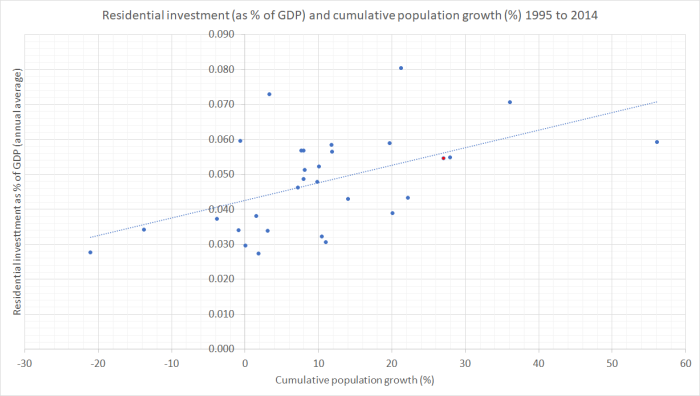
In this chart, I’m looking at the period from 1995 to 2014 and looking across OECD countries.  I chose the period because quite a few OECD countries –  especially former eastern bloc ones –  don’t have data before then, and when I downloaded the data a couple of months ago a few countries didn’t yet have 2015 data.    One year won’t materially alter the picture.

res I % of GDP

New Zealand is the red dot close to the line (above population growth of about 27 per cent).

The slope has the direction you’d expect –  faster population growth has meant a larger share of current GDP devoted to housebuilding –  and New Zealand’s experience, given our population growth, is about average.     But note how relatively flat the slope is.  On average, a country with zero population growth devoted about 4.2 per cent of GDP to housebuilding over this period, and one averaging 1.5 per cent population growth per annum would have devoted about 6 per cent GDP to housebuilding.    But building a typical house costs a lot more than a year’s average GDP (for the 2.7 people in an average dwelling).     In well-functioning house and urban land markets you’d expect a more steeply upward-sloping line –  and less upward pressure on house/land prices.    But that isn’t today’s point, which was simply that more people has indeed meant more residential investment.

But what about the business investment picture?  In the data, business investment is a residual –  calculated by taking total investment and subtracting housing investment and general government investment.  Again, all else equal, you would expect a country with a faster population growth rate to have devoted a larger share of current output to business investment.  Workers need “tools”, and if economies are going to maintain their trajectory of growth in income per capita, then the growth in the capital stock needs to at least keep pace with the number of workers.

(You might wonder why I look across countries, rather than just across time within individual countries.  There are two reasons.  First, in many countries there isn’t much variation in population growth rates.  And second, to the extent there is, reverse causation may well be at work –  a booming economy will tend to draw in more people. )

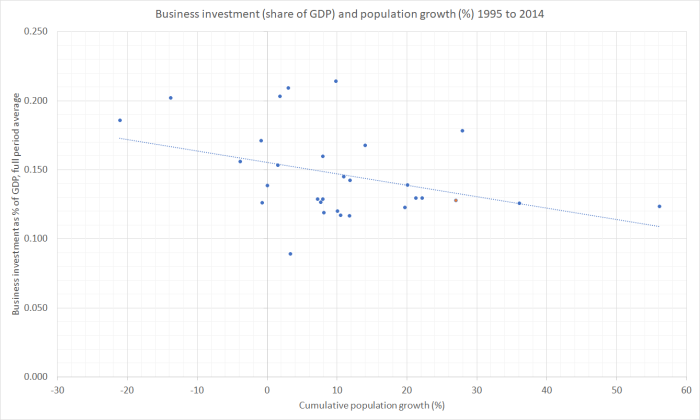
But here is what the cross-country chart looks like.

Bus I % of GDP

Again, New Zealand is the red dot near the line.

There is plenty of variation –  not every observation is close to the line –  but there is no sign at all of the expected upward slope.  If anything, the regression line is downwards –  the faster population growth was across these countries in this period, the smaller the average share of current output devoted to business investment.  The (non-housing) capital stock per person will have been growing materially more slowly in the average high populaton growth country than in the low population growth countries.    The countries with material falls in population were all former eastern-bloc countries, who might be thought to have lots of convergence (and investment) opportunities anyway.  But even if one deleted them from the chart entirely –  and recall that we too were supposed to have lots of convergence opportunities –  the regression line is still very slightly downward sloping (basically dead flat).

It is a chart that should be pretty troubling.    Even a modestly upward-sloping line would still be weaker than ones prior might lead one to expect.

Some readers with more of a background in formal economic research don’t like these scatter plots at all.  They rightly note that it captures just a relationship between two variables, and there is a lot of other stuff inevitably missing.  The relationship may be causal, but it might not be.    One protection against that risk is the use of long period averages for 30+ countries.    But, as importantly, scatter plots of this sort have to be taken together with the wider context –  other stuff we know.

For example, is there a plausible mechanism that might account for such a relationship?  Well, the notion of “crowding out” is a pretty well-established one in the economics literature.  When the government increases its expenditure, the typical result (in a reasonably fully employed economy) is for private sector spending to fall.  Higher interest rates and a higher exchange rate are part of the mechanism by which that happens.   Whether or not there is a full offset is debated, but no one seriously doubts the mechanism or the direction of the effect.    Investment spending tends to be more sensitive than consumption spending, with the exchange rate channel making tradables sector activity (sales and investment) particularly likely to respond.

Increased demands associated with faster population growth may well work in much the same way.   The summary, scatter plot, data certainly isn’t inconsistent with such a story.   In the New Zealand context, one of the stylised facts we have to grapple with is that our real interest rates have been persistently higher than those in other advanced countries, and our real exchange rate has fluctuated around persistently high levels.  (And when I restrict the business investment chart only to countries with floating exchange rates, the downward slope is still apparent.)

So I don’t find the scatter plot in isolation conclusive, but it is troubling nonetheless –  and should be for those who like to invoke the empirical estimates of large per capita income gains from immigration, again in a cross-country context.  How likely are such gains, if countries with relative fast population growth rates (almost all, on account of high immigration inflows) are also the countries that, on average, have relatively modest levels of business investment?  Firms invest to take advantage of the new opportunities that arise.

I’ve asserted that high levels of planned immigration have a disproportionate effect on investment in the tradables sector.  These aggregate data don’t shed any light on that split –  they are just total business investment.   But, at least in a New Zealand context, it makes sense that things will have worked that way.   Higher real interest rates than in other countries –  unmatched by faster productivity growth – will deter all long-lived investment here, regardless of sector.  But when the exchange rate is also boosted, firms considering new investment in the tradables sector are exposed to a double-whammy: highest cost of capital, and a less competitive position relative to foreign firms.   Domestic demand tends to be strong in countries with fast population growth, while international demand is something New Zealand firms just have to take as given.   As our export share of GDP hasn’t been growing –  if anything shrinking –  while those in most other OECD countries have, it seems reasonably likely that investment in theNew Zealand tradables sector has been much weaker than otherwise, and weaker than that in the non-tradables sectors.  That weakness in tradables investment is likely to affect both our natural resource based industries (deterring more capital intensive modes of production) and in the struggling (where unsubsidised) other parts of the tradables sector.

For many countries, population growth isn’t that materially influenced by national policy.   In the former eastern bloc countries, the fall in population is about natives leaving.  In some other countries, illegal immigration can be a big issue.  But in New Zealand –  and Australia –  policy makes a big difference.   We have full control over our borders, and let in lots of legal non-citizen migrants.   In New Zealand, in particular, it looks as though discretionary policy choices have worsened the business environment, and in particular skewing things against the prospects for strong investment by firms that could successfully take on the rest of the world.

(In case anyone is interested, somewhat to my surprise I discovered that there is also a downward-sloping regression line when one plots general government investment and population growth.   I’d expected to find that the government investment just happened anyway –  governments not being subject to market tests.  But over these countries in this period it didn’t.  If, optimistically, you think that government investment is a complement to private investment in improving economic performance, that should be particularly worrying.  Even if the lagging government investment is just about keeping up with the numbers of schools and hospitals (say) a higher population requires, it doesn’t exactly look like a mark of success –  whether in New Zealand, or across the OECD.)


Affordability is in the eye of the beholder

Silly and meaningless as the category “affordable housing” is, perhaps this  –  which my wife spotted last night – must be what Nick Smith had in mind when he claimed that affordability was in the eye of the beholder?

$990,000, and supposedly aiming at first home buyers……

What have our governments brought us to?

http://www.trademe.co.nz/property/residential-property-for-sale/auction-1338386026.htm

Attention First Home Buyers

  • Asking price: $990,000
  • Listed: Thu 1 Jun, 10:20 am
  • Watchlist

Listing #: 1338386026

Location: 12 Quadrant Road
Onehunga
Auckland City
Auckland
Rooms: 3 bedrooms, 1 bathroom
Property type: House
Land area: 663m2
Price: Asking price $990,000
Parking: 2 offstreet carparks
Open home times:
Sat 8 Jul, 1pm – 1:30pm
Sun 9 Jul, 1pm – 1:30pm

Donald Trump & lessons from NZ’s economic boom of 1996-2001

Late last week I was scrolling through a story about the IMF’s latest comments on the US economic outlook, short-term and more medium-term.   As the story reminded readers

The Trump administration says its economic platform — including cutting corporate and ­income taxes, boosting infrastructure spending and reducing regulations — will push growth up to a sustained rate of 3-4 per cent a year and cut unhealthy government debt levels.

At present, the Federal Reserve’s FOMC members collectively think potential GDP growth rates in the US are a touch under 2 per cent per annum.

The IMF has just finished its Article IV “mission” to the US (the US Treasury and the Fed being each a few blocks’ walk from the IMF), and released the team’s Concluding Remarks.   The Fund is, understandably, (more than) a bit sceptical about prospects for such an acceleration in the rate of growth of potential output.  But they are international public servants, and the US has a lot of clout on the Fund’s Board –  and, what is more, the Administration is currently looking to cut back US funding of various international organisations.

So the IMF can’t just come out and talk about the unlikelihood of any sort of large-scale acceleration of potential economic growth because of (a) a fundamentally unserious President, with little interest in policy and no apparent ability to deliver on an agenda anyway, or (b) a US Congress which has, if anything, (and on a bipartisan basis) lower approval ratings than the President, or (c) the corrupting influence of vested interests.  Instead, the Fund has to fall back on fairly bloodless technocratic arguments and illustrations.   But one thing they should be able to bring to the table is authoritative use of perspectives from other countries –  the Fund, after all, undertakes monitoring and surveillance of virtually every country’s economy, other than North Korea.

And whereas I’ve never seen a chart in the IMF’s Concluding Remarks for New Zealand, there were five in last week’s US document, four of which looked quite useful.  A couple even found their way into the Wall St Journal, and given how little attention the IMF’s view on the US usually get in the US, that probably counts as success.

Little old New Zealand was even singled out in one of the charts.

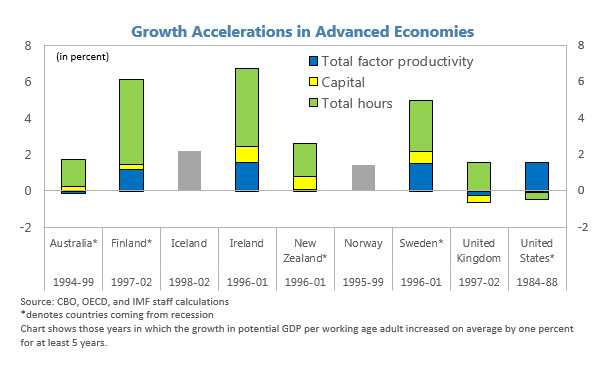
IMF growth accelerations

Looking at advanced countries since 1980, the IMF found this smallish sample of cases where countries had achieved at least a one percentage point lift in potential output growth (per working age adult) that lasted at least five years.    On this chart, New Zealand’s experience over 1996 to 2001 looked pretty impressive –  fourth best seen among IMF advanced countries in the last 35 years.

But it was a bit puzzling.   I sat around the Reserve Bank’s Monetary Policy Committee table right through that period, and “startingly impressive economic performance” wasn’t one of the descriptions that came easily to mind.     Even though the Fund’s asterisk describes us as “coming from recession” during that period, it was actually one that began at the end of a (pretty strong) four or five year recovery, encompassed another mild recession, as well as some chaotic monetary policy, an odd mix of fiscal policy, and towards the end of the period, increased marginal tax rates and a considerable slump in business confidence.    Through quite a bit of volatility, interest rates and the exchange rate fell a long way.

But perhaps I’d missed something, through getting too close to the short-term ups and downs.  So I dug out the data and had a look.

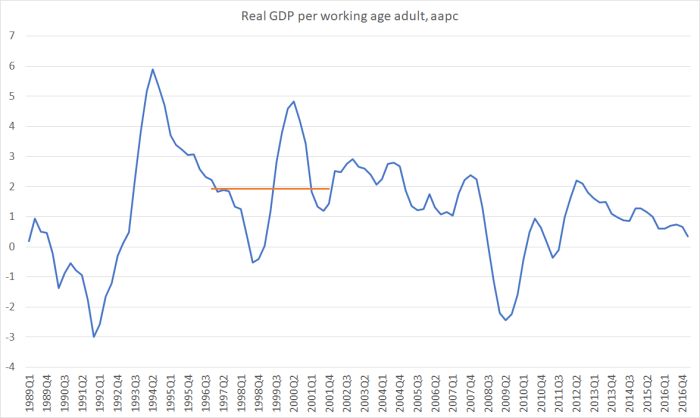
Perhaps if the IMF had had a quick look at this chart first, they’d just have left New Zealand off the chart (I’ve used the average of our two GDP measures, and the official HLFS working age population data).

Real GDP per WAP

Nothing stands out about that 1996-2001 period (average growth for which is highlighted in orange).  By our standards. it wasn’t a bad period, but it wasn’t obviously one I’d be wanting to send other countries’ officials and ministers to learn from.  There was no acceleration in real growth, let alone a sustained one.

But I had read carefully the labels on the IMF chart, and they were using “potential output growth” (per working age adult).  The problem with “potential output” growth is that it isn’t directly observable, and even years later it often hard to get a reliable handle on.

The OECD publishes estimates of potential output growth for its member countries including New Zealand.  And one can back out IMF estimates of potential output growth because they publish output gap estimates (actual growth adjusted for the change in the output gap is potential output growth).   Adjusting both for growth in the working age population produced this chart.

potential growthThere isn’t anything startling about 1996 itself, but at least on these measures potential output growth in the late 1990s was estimated to have been stronger than before or since.

So over the period the IMF highlights, actual real GDP growth (per working age person)wasn’t anything out of the ordinary, but the international agencies think that potential growth (per working age adult)  was pretty impressive  –  more of an acceleration than seen almost anywhere in the advanced world in modern times.

One possible reconciliation could be that New Zealand went into a severe recession during this period, leaving lots of excess capacity (but lots of underlying potential growth, as trend productivity grows rapidly).  It does happen –  it was part of the story of the US in the 1930s for example.

But that certainly doesn’t look to have been the story here.

Labour util

The unemployment rate was a bit lower in 2001 than it had been in 2006, and the labour force participation rate was a bit higher.

Another way to try to make sense of what was going on is to look at:

  • growth in the capital stock (per working age person)
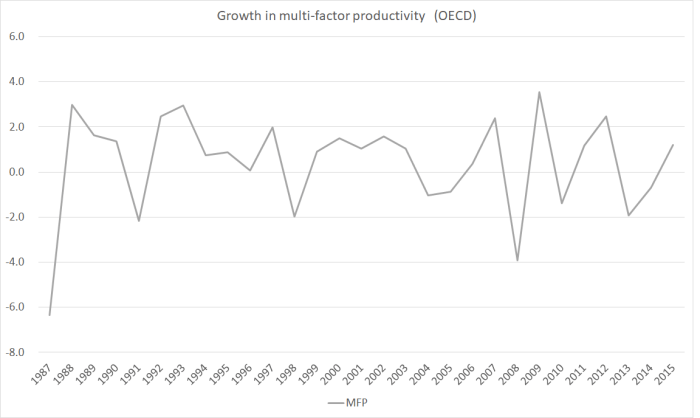
  • growth in multi-factor productivity,
  • growth in hours worked per working age person, and
  • growth in labour productivity (real GDP per hour worked).

Here is the growth of the real capital stock per working age person, shown in two different ways –  the total capital stock, and the capital stock excluding residential dwellings.

cap stock

The period from 1996 to 2001 certainly saw stronger growth in the capital stock (per person) than in the previous period, and thus there is something to the IMF point about growth in potential during this period being somewhat influenced by the previous recession.    But even on this measure, nothing really stood out about the period.  Growth in the capital stock was no faster than it had been at the end of the previous boom, and was lower than we experienced in the last few years prior to the 2008/09 recession.

What about multi-factor productivity growth?   Measured properly, this is stuff everyone is after –  more outputs for the same inputs.    This is annual growth in the OECD’s measure of MFP.

MFP growth

Nothing stands out about the 1996 to 2001 period (consistent with the IMF chart itself, in which the contribution of MFP growth is all but invisible).

Here is (HLFS) hours worked per working age person.

hours worked

Again, nothing stands out about the 1996 to 2001 period.  There had been a big contribution in the previous few years, as demand recovered, drawing more labour back into employment, but by the period the IMF is focusing on there is nothing notable.

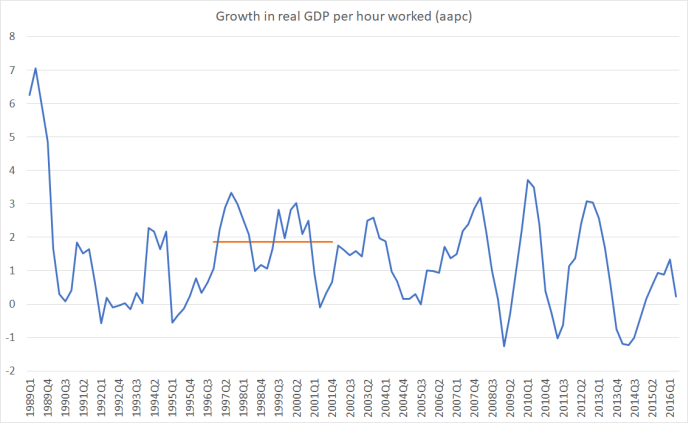
And, finally, what about labour productivity (growth in real GDP per hour worked)?    Here, at last, perhaps there is something to the IMF story.

IMF GDP phw

Using the average of the two real GDP measures, labour productivity growth actually was a bit faster in this period than in, say, the five year windows either side.     Even by New Zealand standards (among the weakest productivity growth in the OECD over 45 years) it is not that strong a performance, but the recovery in investment growth (see capital stock chart above) must have made a helpful difference for a time.

I got to the end of all this reassured that I hadn’t in fact missed any great lift in New Zealand’s economic performance over 1996 to 2001.  People are simply better to look at our actual experience, rather than the IMF or OECD estimates of unobserved “potential”.  Perhaps the other country examples the IMF cited work better?

I don’t suppose Donald Trump will be taking any notice of the IMF’s analysis or advice,  but if any minions do pay some attention to the IMF piece, the Fund’s use of the New Zealand case won’t do anything to lift anyone’s confidence that the IMF really has anything very compelling to offer.   Sadly, they didn’t have much useful to offer us either (here and here).


A question for the Minister of Education

I usually don’t pay much attention to the output of the Ministry of Education or its ministers.  I often fear that if I did it would turn out to be about as disconcerting as MBIE’s output.   I focus on getting my own kids through the school system with as little enduring damage as possible  (one of the real joys of being a stay-at-home parent is the time to counter the “indoctrination” that comes from, say, fourth form social studies teachers).

Every time I walk past the Ministry of Education’s head office in Wellington, their slogan or motto emblazoned across the front of the building gets my goat.  It reads

“Lifting aspiration and raising educational achievement for every New Zealander”

It must have sounded good to the bureaucrats and their PR people, but frankly it is the sort of slogan that shouldn’t be seen outside an authoritarian state –  Singapore, Turkey or the like.   Ideally it wouldn’t be seen even there.

I don’t particularly want to have my “educational achievement” raised, and certainly not by the government and its ministry.  As it happens, I’m always keen to learn and am a voracious reader.  Many people aren’t.   But, either way, what business is that of the government?    My “aspirations”, such as they are, are my own, and also no business of the ministry or the government.   The Ministry would, only can only assume, have strongly disapproved of St Paul, who wrote that “for I have learned, in whatsoever state I am, therewith to be content”.

If one took it seriously, it is the stuff of a mindset that sees citizens as a resource of the state, owing it to the state to get with the programme (whatever it is).    Many ministers must be able to see the slogan from their Beehive office windows: does it never occur to them that they are from the National Party?  Among National’s values are, supposedly

  • Individual freedom and choice
  • Personal Responsibility
  • Competitive enterprise and reward for achievement
  • Limited government
  • Strong families and caring communities

I’m pretty sure that list doesn’t really fit that well with the Ministry of Education trying to lift your aspirations or achievements.  Come to think of it, the ACT leader is a Parliamentary Under-Secretary to the Minister of Education, and as a party they claim to be even more strongly in favour of limited government.

Do government departments need slogans at all?  Perhaps “administer our legislation and advise the Minister of Education” doesn’t have quite the same ring to it, but it is what officialdom is really supposed to be doing.

That quote has been annoying me for a while, but this post was prompted by news that the Minister of Education has announced that “computational thinking” and “designing and developing digital outcomes” will become compulsory parts of the national school curriculum from next year.     Perhaps there is a good case for adding those items to the curriculum (I’m frankly a bit sceptical –  apart from anything else, in ye olden days when I went through school we didn’t teach typing to everyone).  But I looked through the Minister’s speech announcing this change, and have read newspaper articles on it, and listened to other media stories.  And in all of that material, I’ve seen not a hint of what the Minister wants schools to stop teaching, or teach less of.

I’m sure there aren’t many economists in the Ministry of Education, but the idea of constrained optimisation shouldn’t be too difficult to grasp, even for Cabinet ministers.   It is easy to add new items that sound or feel good, but there are only so many hours in the day, so many weeks in the school year (and I’m not one of those who thinks that year should be lengthened).    Perhaps there is room for increased productivity in schools, but there isn’t any suggestion that that is the answer either.  It feels a lot like an initiative that will squeeze other stuff out, and we’ll never quite know what, but the Minister concerned and her officials will long since have moved on by then.  But surely the Minister should be able to tell us what she wants schools teaching less of?   Because it is a real choice, and something will be lost, either consciously and deliberately or by default.

I think I’ll always remember the evening, shortly after our oldest child started school, when the then Principal of the local school –  a vocal union advocate for teachers, staunch opponent of National Standards, and prone to somewhat convoluted prose (I often thought he must have been angling for a job at the Ministry) – declaimed that he had no interest in teaching specific knowledge because pretty much everything he had learnt at school had been superseded.   I’m a history buff, and I kept asking myself whether somehow Dick Seddon, Michael Joseph Savage, Sid Holland or Keith Holyoake were no longer significant figures in our history?  Or did World War Two, or the Russian Revolution no longer take place?  Is gravity no longer a force?  Does Shakespeare no longer influence our language and cultural reference points?

It is old ground, but worth repeating. It is all very well to teach general problem-solving and analysis skills, but without context, without specific structured knowledge, those skills aren’t really that much use at all.    And so when the Minister says that schools must teach “designing and developing digital outcomes”, which

“is about understanding that digital systems and applications are created for humans by humans, and developing knowledge and skills in using different digital technologies to create digital content across a range of digital media”

I can’t help thinking that rather better use might be made of the time the Minister wants to devote to matters digital. For example, in teaching New Zealand history, in the context of the history of western civilisation (or even global history), than preparing to use Facebook or whatever newly trendy medium is around a few years hence.    And if there are more resources to train teachers,  I’d suggest some be devoted to improving teachers’ own communications skills.  The local principal (a new one) recently began her newsletter this way

Last week I began a conversation about dispositional ways of being.

I still have no idea what it meant.

C S Lewis, professor of English at Cambridge, once wrote a letter, replying to a young American fan, offering five guidelines for good writing.    Thanks to the wonders of the internet, it is freely available to all our teachers, and to Ministry of Education bureaucrats as well.    George Orwell offered similarly sound advice.

UPDATE: I put the text of the Minister’s speech into Readable.io, which provides statistical measures of readability.  It came back with this summary

RATING: D

Your average sentence length is too high. Try to shorten or split up some of your long sentences.
You are using too many long words. Try replacing some of them with shorter alternatives.

On the Flesch-Kincaid grade, the speech came out with a score of 13.1, apparently as hard to read as a typical US law.    Ernest Hemingway, apparently, managed a score of 4, and the website observes that a document needs to have a score of 8 to be readable by most people.   It would seem a reasonable benchmark for a Minister of Education to aim for.


Who has been getting residence visas?

Someone called Keith Ng (who is apparently quite pro-immigration), has gone to the effort of downloading some of MBIE’s (not at all user-friendly) visa approvals data and formatting it in a reasonably readily usable way.  The resulting spreadsheet is here.   I was particularly interested in the analysis by occupation, and particularly that for those granted residence here.  (He has provided the data for work visas as well, but it conflates all sort of work visa types, short and long term, and isn’t that informative as it stands –  I suspect that 30000+ tour guide visas in the last seven years or so mostly captures a lot of people who are here for very short periods of time.)

In their annual Migration Trends and Outlook publication MBIE do provide a table of the occupations of the principal applicants for skilled migrant category residence visas.  But, unlike most of their tables, there is no time series provided.  In 2015/16 –  the latest publication –  these were the top 10 occupations.

Chef 860
Retail Manager (General) 675
Cafe or Restaurant Manager 598
Registered Nurse (Aged Care) 520
ICT Customer Support Officer 372
Software Engineer 323
Carpenter 281
Developer Programmer 267
Baker 213
ICT Support Technicians nec 206

I was a bit curious how many chefs there were in New Zealand in total.  At the last census, there were only 16218.

But Ng’s table enables one to easily look at the main occupations of people being granted residence over the last decade or so.  He presents the data for  each of the years 2006/7 to the present, with only partial data for the incomplete (June) year 2016/17.  Here are the occupations with more than 1000 approvals over the decade.

Occupations of approved residence visas applicants: 2006/07 to present
Chef 6729
Retail Manager (General) 3765
Registered Nurse (Aged Care) 3609
Cafe or Restaurant Manager 3585
ICT Customer Support Officer 1993
Software Engineer 1943
University Lecturer 1789
Secondary School Teacher 1656
ICT Support Technicians nec 1439
Registered Nurse (Medical) 1393
Developer Programmer 1338
Baker 1294
Carpenter 1214
Early Childhood (Pre-primary School) Teacher 1192
Accountant (General) 1191
Office Manager 1145
Motor Mechanic (General) 1080

And this is the most skilled half of the people who are granted residence (others get in on non-skilled bases –  family, refugees, Pacific Access etc).

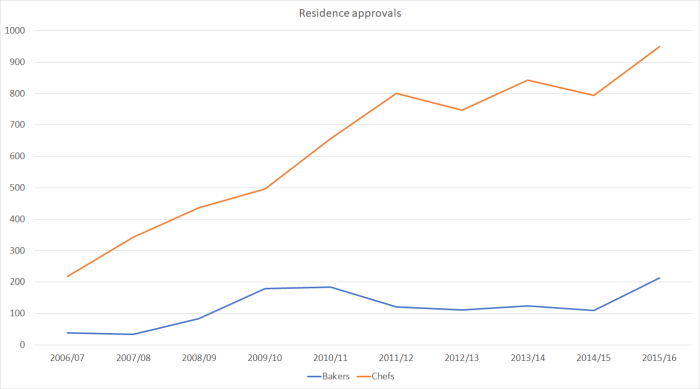
The list is quite dominated by the first few entries, and those occupations don’t stand out as occupations of exceptional skill, even though MBIE used to like to tell us that our immigration policy was a “critical economic enabler”.    And remember that this is about people getting residence, not about work visas which, notionally at least, are supposed to partly reflect specific temporary areas of skills shortages (and, hence, where one might expect bunching in particular occupations, but where the particular occupation would change over time).

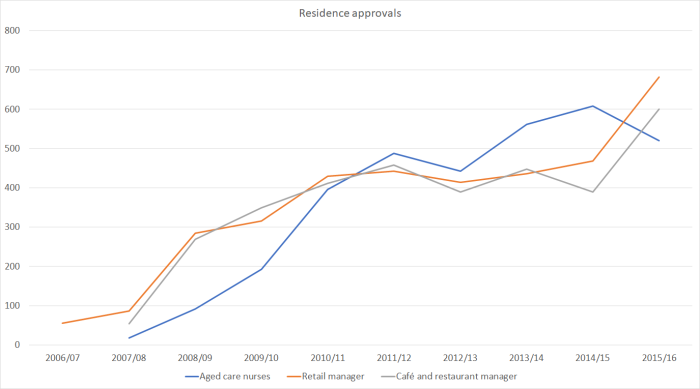
The large numbers of aged care nurses (and there are many more, and aged care workers, in the work visa numbers) stands in striking contrast to the recent pay equity settlement. In that settlement, the government concluded that employees in the sector were so badly paid that a direct government intervention was needed to drive up the wages.  I don’t usually focus much on the arguments about whether immigration lowers wages –  my focus is more on overall economic performance –  and I’m not (at all) a fan of “pay equity” interventions, but it is hard to look at these two things and not conclude that there is a certain incoherence about policy.   Had fewer aged care workers from abroad been granted visas, it seems likely that market wages in that sector would have been rather higher.

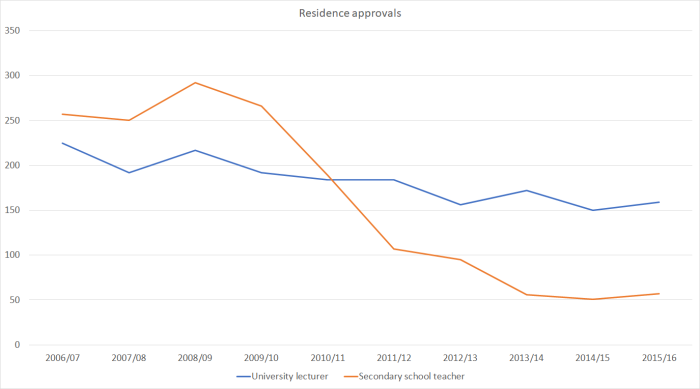
Of course, among the occupations on that list are some that seem genuinely quite highly-skilled.  My eye was caught by the number of university lecturers and “developer programmers”.

The number of developer programmers getting residence visas has increased from almost nothing, and at an even faster rate than the (presumably) rather less skilled ICT Customer Support Officers.

res approvals IT

On the other hand, rather fewer university lecturers (and secondary school teachers) have been getting residence.

res approvals teachers

How early childhood teachers qualify at all is a bit beyond me.

And just in case you, charitably, supposed that some of the less skilled occupations were becoming less important over time, here are the food-preparation ones on my list.

res approvals food

And here are the trends in the remaining top five roles

res approvals other

If there is a serious economic strategy behind all this, it is pretty hard to spot.  No wonder the government was casting around for other ideas when they ran into the Monahan brothers and came up with the global impact visas.  But just because something different needed to be done, didn’t make  “just anything” –  especially something with a rather hip or with-it feel to it –  a sensible thing to do.

The only really compelling story that makes much sense of the residence approvals numbers is official (political and bureaucratic) determination to drive up the population.  If that is the goal, I guess one can’t be very picky and we get a bunch of modestly-skilled people coming.  But there isn’t much sign that driving up the population has been a successful economic strategy anywhere –  unless, of course, one counts survival as a precondition, which partly motivates the Israeli policy of open doors to any Jews –  particularly not in places that remain heavily dependent on what they can do with fixed natural resources.    Sometimes rapid population growth can be a complement to economic success –  people will be keen to come and there might be plenty of prosperity to go round.  But New Zealand’s policy –  and Australia’s actually –  continues to put the cart before the horse, as if drawing more people here will somehow conjure up great new higher-productivity opportunities for them and for us.     But there is simply no basis –  and certainly not in New Zealand’s experience –  for such a belief.


Towards an engaging Governor

There won’t be a post here on Monday, but yesterday something caught my eye in the email inbox (and I’m not very much of a rugby fan).

This was the advisory from the Reserve Bank

Text of a speech by Head of Communications and Board Secretary, Mike Hannah, entitled “Engaging with our stakeholders to promote understanding, accountability and dialogue” will be published on the Reserve Bank website at 8:30am on Tuesday 27 June

It reminded me of an earlier piece by Hannah a couple of years ago.  It was a Bulletin  article published in May 2015 under the title Being an engaging central bank.  It didn’t seem to attract much attention at the time, although I wrote about it.  Hannah used the article as, among other things, a platform to highlight how active its engagement was and how transparent it was.  I highlighted then some of the many areas in which the Reserve Bank is well off the pace in respect of transparency, particularly around monetary policy.

When Hannah wrote his previous article things must have seemed to be going quite well for the Bank, at around the half-way mark of the Governor’s five year term.   The article presented and drew on a survey of external stakeholders about the Bank’s external engagement, that had been done in the second half of 2014.    The OCR increases were then well underway, and they and most of the people they regarded as domestic stakeholders still probably thought the Bank was doing the right thing.  The Bank used the article to talk up a more active programme of public speaking.   And just a couple of months previously Central Banking magazine had named the Reserve Bank of New Zealand as central bank of the year, citing various things to their credit including having been “the first advanced economy central bank to raise interest rates in the current cycle”.   (Oops)   Graeme Wheeler must have been feeling rather pleased.  According to the survey, most “stakeholders” were also reasonably happy with the Reserve Bank’s communication.

It will be interesting to see what Hannah has to say on Tuesday.  But it is a little surprising that he is doing such an on-the-record speech when the Governor has less than three months to run on his term.  It can’t, one would think, be outlining a new approach  – surely anything of that sort would be a matter for the new permanent Governor next year?   So we can only assume it will be an explanation and defence of the current approach.  If so, given the embattled state of the Bank it is a bit of a surprise that they leave it to a relatively junior member of the senior management group to make the case rather than, say, Hannah’s boss Deputy Governor Geoff Bascand, or indeed the Governor himself.

However they choose to engage, speeches clearly seem to have gone out of fashion again.  The Governor gave five on-the-record speeches in 2013, and seven in 2014.  Things seemed to be going well then.    But in 2015 and 2016 he gave only three on-the-record speeches each year, and in the first half of this year (ending next week) he will have given only one speech.    The pattern is pretty similar for his Deputy Chief Executive, Grant Spencer who is being appointed (questionably legally) Acting Governor for six months after Wheeler leaves.  He has also given only a single speech this year.

What is a relevant comparative benchmark?   Well, Phil Lowe, Governor of the Reserve Bank of Australia will have given six on-the-record speeches in the first half of this year.  His deputy, Guy Debelle, who is particularly active on international foreign exchange regulatory matters, will have given eleven speeches in the first half of this year.    The Reserve Bank of Australia, it will be recalled, covers a lot less ground than our central bank, not being responsible for the supervisions of banks, non-bank deposit-takers or insurance companies.    For most of the RBA senior management speeches, there is also a webcast or audio/video material, something our Reserve Bank doesn’t do.

Here are the numbers for the Governor of each of the other Anglo country central banks, and those of two other small inflation targeters.  Of those central banks, only the Bank of England has at least as wide a range of responsibilities as our central bank,

Governor speeches, first half 2017
UK 8
Ireland 8
Norway 7
USA 5
Canada 4
Sweden 2

What is striking in some of these central banks is the number, and range, of the speeches done by other senior managers.   Our central bank – smaller than most of course – will have done four on-the-record speeches in total in the first half of this year.

However the Reserve Bank engages, it isn’t through media interviews either.  The Governor now seems to give a soft interview to the Herald the day after a Monetary Policy Statement, but that seems to be it.  In almost five years he has given not a single searching interview to any media outlet.  Perhaps that is not so unusual internationally, but the Governor here wields personally an unusually large amount of power, and the Bank has been rather active (interest rates up and down, and more and more regulatory interventions) in the last few years.  Doing citizens the courtesy of a sustained interview once in a while –  an interview that is more than advertorial – would seem the least a Governor could do.  The Governor is said to be uncomfortable with the media.  In a role such as his that should really be disqualifying.

Of course, we now know that the Governor doesn’t much like criticism either.  In fact, one of the ways he engages (was that to promote “understanding”, “accountability” or “dialogue”?) is to send his senior managers out to try to whip critics into submission.  And when that doesn’t work, he sends threatening letters to the chief executive of a bank he regulates, calling for the critic concerned to be censored, to end the risk of upset to the Governor.  Perhaps Hannah will be able to offer some statistics on the frequency of “engagements” of this sort?   Perhaps he could offer some thoughts on the legitimacy of such engagements (after all, the Governor hasn’t been willing to front up in public)?  And on the effectiveness of them?  Does he judge that they have enhanced the Bank’s standing, and public/stakeholder confidence in the institution?

We also know another way the Reserve Bank was engaging, but is no longer.  Under Hannah’s stewardship the Reserve Bank was for years running lock-ups for journalists and analysts just prior to the release of MPSs and FSRs.  Unfortunately, they took that engagement so far that the procedures they used were so lax that people in the lock-ups could simply email highly confidential market sensitive stuff back to their offices (or indeed to anyone else).   That came to a crunching end when, somewhat by accident, I became aware that something of the sort seemed to have actually happened: MediaWorks staff in the lockup had been emailing things back to their office (who knows how many times before?) and on this occasion someone in their office passed the early information on to me (I was to be a guest on their show later that day).    In response, the Governor’s idea of engagement was to (a) largely whitewash MediaWorks, while (b) attacking me as irresponsible, even though I was the person who had brought to their attention what turned out to be both an actual leak and a serious weakness in their procedures.  Perhaps there will be some reflections on that sort of engagement?   Probably not though.

We’ll see what Hannah has to say on Tuesday. But in many respects it doesn’t much matter now.  The embattled Wheeler will be gone in three months, and Spencer  – probably not really the problem –  will be gone in nine.   The challenge for the new permanent Governor –  and something the Board and the Minister should be looking for in identifying potential appointees –  is to move towards much greater openness and effective open engagement.   There are so many fronts on which reform is overdue that it could make a post in itself.

So many other central banks are now so much further ahead of our central bank in this area (as well as others).  In most of them the whole institution has rather less power in the whole institution than is here concentrated in a single individual.  It is a shame, as the Reserve Bank could once reasonably have been said to be in the forefront of openness, transparency and honest engagement.  Now it is quite a laggard in this and other areas, with pre-existing institutional weaknesses reinforced by the problems of a thin-skinned insular and embattled Governor.  An engaging Governor would be a huge step forward towards a more engaging, open and accountable and central bank.  Whoever is Minister of Finance when the appointment is made should insist on it.