Paying MPs

So poor have the economic outcomes been in New Zealand for decades –  that slippage from number one or two, to an also-ran lost well down the rankings –  that one could probably mount a reasonable case for asking all those who’ve been MPs –  or ministers at least –  for a refund on the salaries they’ve been paid.  The honourable ones among them should really hang their heads in shame.

But setting aside that perhaps unreasonable hankering, what to make of the latest angst over salaries for our members of Parliament?

First, what has become of the process doesn’t reflect well on either the previous government or the current government.  Both government seem to have panicked in the face of numbers that might have made awkward headlines (but typically involve small changes, the overall effect of which –  including any anomalies –  are likely to wash out over a period of several years), and rushed for crude interventions (freezes, legislation under urgency).  Take the current government as illustrative, they knew the previous government had passed legislation tying increases in MPs pay to public sector pay, and they knew on coming into office that public sector pay was going to be one of the pressure points they would face.   So why, if they weren’t willing to live with the current formula, didn’t they put in place a review (yes, another) as soon as they took office, 10 months ago.  Had they done so, any proposed changes could have extensively consulted on, perhaps even legislated by now.

Second, there is no way to put the setting of MPs salaries at a total remove from the political process.  The enabling legislation has to be passed by Parliament itself, and what is passed by Parliament can be amended by Parliament, even retrospectively.   But we should be looking to develop and maintain systems, and conventions, by which the main parties (a) agree on the rules, and (b) agree to live with the results.  It shouldn’t be that hard –  Parliament doesn’t remove judges who rule against them, and mostly doesn’t even legislate to overturn specific decisions the political process doesn’t like.   All sorts of things embarrass MPs and ministers, but when our system works well, it is just something they have to live with.  I guess it must be tempting to play politics with MPs pay, but it isn’t in the interests of our system of government in the longer run to do so.  It also isn’t in the interests of the systems to have MPs or ministers choosing not to take increases.  Nothing stops them donating to charity, but let their good deeds be done in secret, not as political plays.

There is an article in today’s Dominion-Post by Stacey Kirk taking a cursory look at how the pay of our MPs compares with that in the other Anglo countries (all of whom have considerably higher average per capita GDP than New Zealand does).

The superficial comparisons tend to suggest that our MPs do rather well.  But those comparisons don’t mean much for several reasons:

  • the conversions in the article are done at current market exchange rates, but New Zealand’s exchange rate is generally regarded as being structurally overvalued.  On such comparisons, all wage rates in New Zealand will be flattered.
  • as the article notes in passing, the comparisons she does only cover base salaries. It isn’t generally true that “perks and supplements” are “hidden” (her word), but they can be challenging for outsiders to fully track down, and put a price on.  Defined benefit pensions, for example (still provided in the US and UK for example, but not here), can be extremely valuable in a low yield environment.
  • the comparisons don’t take any account of post-political opportunities which in some countries (notably the US) can be very lucrative (arguably corruptly so).

There is no unalterably right or wrong answer to how much we should pay MPs (absolutely or relative to prevailing incomes in the economy).  Presumably no one favours the old UK (pre 20th century) system in which MPs were not paid at all.  The presumption was that MPs would have another income, which –  of necessity –  meant that the only people who could become MPs were those who did.   If it didn’t necessarily lead to much actual corruption in that historical context, it would certainly open the way for corruption if adopted today.  And I don’t suppose anyone much would support a system in which MPs were all paid $1 million a year: it might attract some really able people, but you’d also be pretty sure that most people competing for the role would be in it for the money.     Putting my cards on the table, I’m sure I wouldn’t want to pay MPs and experienced teachers the same, no matter how good the teacher (a principal of a decent-sized school might be another matter).

It pays to stand back and think about what we should expect from MPs.  There are only 120 of them ( almost a quarter of whom currently serve in the executive), with primary responsibility for scrutinising and holding to account the vast establishment that is the New Zealand government (myriad public agencies and departments, endless regulations and related instruments, and lots of new proposed legislation).  They aren’t the only bulwarks to be sure, but they are the ones with the formal powers and responsibilities –  the ability to summon public servants before select committtees, to demand answers from ministers in Parliament, to insist on changes in legislation, even on occasion to disallow regulatory instruments.  Details matter, context matters, principles matter.   The responsibilities range very broadly (not to mention the hours, for a job decently done).  These aren’t, or shouldn’t be, roles for some amiable person fresh off the street.  And, even in a small country, the public sector is formidably well-staffed, and well-resourced, relative to MPs.

Take, for example, our largest government department, MBIE.  I went to their annual report and found the table of salaries.
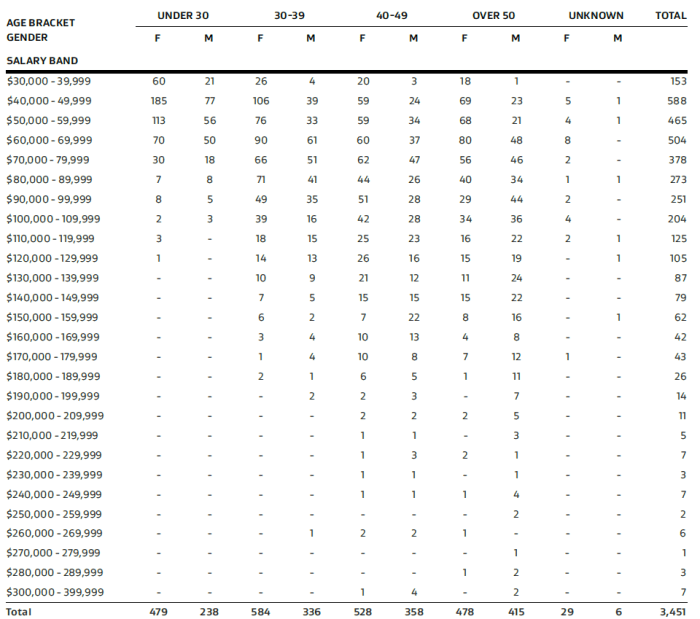
MBIE salaries

Perhaps you could treat that very top-tier (chief executive and deputy CEs) as the equivalent of Cabinet ministers.  But this one agency also has 45 people earning between $200000 and $300000 per annum.  These will probably mostly be third-tier managers.    Some of you might be inclined to object that these people are themselves overpaid, but I rather doubt it for what we should be expecting from the sort of people who should fill these sorts of roles.    Of course, they are well above average salaries –  we expect much more than average sorts of skills from people filling them.

And these are sort of people whose work we expect MPs to challenge/scrutinise etc (without any of the sort of staff resources these public sector senior managers have at their disposal).

So I don’t have a sense at all that our MPs are overpaid, and wouldn’t have begrudged them a pay rise this year, or any year (in which private wages were rising).    There are perhaps anomalies in the sense that a new 25 year old MP gets the same as an immensely-experienced former Cabinet minister, but there is no easy way round that feature.  And we should steer well clear of the absurd suggestion from the far-left leader of the Greens, who proposed that MPs should get only the same dollar increase as in the average wage –  thus compressing the relative margins between MPs and the rest every future year for ever (well, unless we have a burst of deflation).

I’m not altogether persuaded by the story that able people won’t go into politics because the pay is too low.  No doubt it is so for some. For others, it will be the hours, the separation from family, the public spotlight or whatever. But we should be careful not to increase the risks of such a system, in some self-reinforcing spiral, in which we complain of dud MPs, and then set a reward structure which only increases the probability of disproportionately getting such people in future.  Ours is a thin democracy, with few effective protections against executive over-reach and the like.  We should be looking for very able people to fill select committee positions –  not just as a passage towards promotion, but as a vital role in and of itself.  I’ve argued previously we should provide more resources to members and select committees –  the public goods of good government need to be properly funded, not skimped on –  but while we consistently refuse to do that the calibre of people serving as MPs is all the more important.


If pushed on the New Zealand situation, the person I suspect could be overpaid in our system is the Prime Minister.  It is a big job to be sure, but it really isn’t one people pursue for the money.  No one we would want to be Prime Minister is likely to look, before entering Parliament, at the PM’s salary to decide if they can support a family on it.  As Stacey Kirk’s article points out, on the (crude) international comparisons we appear to pay our Prime Minister quite generously

Data released by international consultancy group IG in May showed Ardern was the fifth highest paid leader in a comparison of 32 members of the Organisation for Economic Cooperation and Development (OECD).

In a study of the pay gap between world leaders and average citizens, Ardern ranked third, earning 8.63 times the average New Zealand wage.

Post-politics opportunities are probably better for many of the heads of government in these other countries –  Bill Clinton or Barack Obama make their money from being President once out of office. Or Gerhard Schroder or Tony Blair.   That isn’t a model we could, or should want to, emulate. I’d rather pay the Prime Minister a decent salary, and expect a considerable degree of self-discipline and restraint once out of office.

As a bonus, perhaps they could take the steps need to reverse the decades of economic underperformance, that have depressed the earnings of most New Zealanders (and led so many to leave altogether).

PS.   In digging around before writing this post, I stumbled on some data on the inflation-adjusted salaries of US Senators and members of the House of Representatives
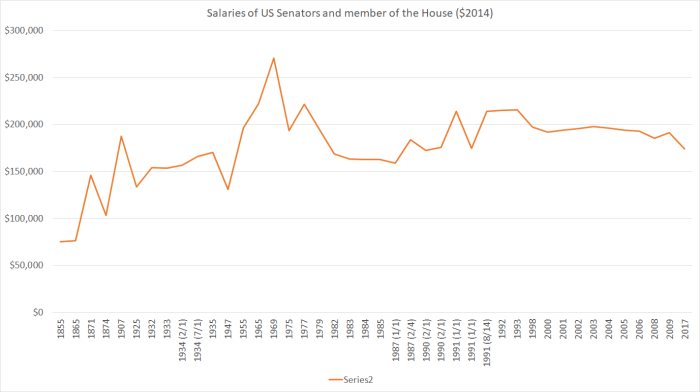
us senator salaries

The dates aren’t evenly spaced, but remarkably there has been no growth in real salaries since the 1950s (and no growth in nominal salaries since 2009).  Real per capita GDP in the US today is about three times what it was in the mid 1950s.   That, at least, seems like a benchmark of badness, and something to avoid –  so bad is the US system, the members get no accommodation allowances, and so not a few sleep in their offices while in Washington, and look to opportunities to cash out in new roles in K Street.
The Minister of Finance champions an economic strategy

Longstanding readers will know that I was pretty critical of the previous government for the utter absence of any sign of a set of economic policies that might have begun to reverse the decades of relative economic decline.  Worse, they and their acolytes too often seemed to make up stories about how well things were going when the data pretty clearly pointed in the opposite direction.   I’m not sure I’d be quite as harsh as Kerry McDonald and Don Brash, who recently gave the Key-English government an overall score of 0/10, but I’d be close, especially around productivity (and also around housing).

What has become increasingly disconcerting is that the new government –  now almost a third of the way through its term –  also has no credible ideas about reversing the decline and little interest either.  They seem increasingly reduced to making stuff up as well, and trotting out the same lines again and again without any sign of a really understanding the challenge, without any sign of a compelling analytical framework, and without any reason to think that the policies they talk of will make any material (helpful) difference.

I woke this morning to the news that the Minister of Finance had an op-ed in the Herald explaining how the government was going to restore our economic fortunes.   With suitably low expectations, I tracked it down.   Even with low expectations, I was struck by how weak it was, and left wondering why the Minister and his PR team thought the article was a good idea.

The Minister begins thus

The coalition Government is helping business modernise our economy to be fit for purpose for the 21st century.

Presumably he is aware that one sixth of the 21st century has already gone?  And that his party was in government for half that time?  But let that pass: as rhetoric it might be empty, but it is probably harmless.

This means being smarter in how we work, lifting the value of what we produce and export, supporting the environment, planning for future generations and giving everyone a fair shot at success. It means making sure that all hard-working Kiwis share in the rewards of economic growth.

All of which is hard to argue with, but isn’t exactly a) specific, or (b) new.  I keep a copy of National’s 1975 election manifesto by my desk, and flicking through it –  43 years on now – I think I spotted all those points (actually, in light of Eugenie Sage’s announcement on Sunday, I also found a pledge to “discourage all forms of environmental pollution and encourage the recycling of materials.  We will place a levy on difficult-to-dispose-of products’).   Labour’s 1972 manifesto, or its 1984 one, or its 1999 one probably had them all too.

Most New Zealanders know we cannot go on relying on a volatile mix of population growth, an overheated housing market buoyed by speculation, and exporting raw commodities as our growth drivers.

Quite a bit of that was in the 1975 manifesto too.    They are old lines, each trotted out by politicians of either main party for decades as the symptoms presented.     Not always even very accurately – does anyone actually think an “overheated housing market buoyed by speculation” added to national prosperity?   And not with much sense that the speaker had any sort of robust model of the New Zealand economy.  Let alone serious policies in response: for example, if this paragraph is to be believed, the current government is apparently uneasy about rapid population growth, but continues to run the same immigration policy as both its predecessor governments for the last 20 years.

And despite all this, a few sentences later the Minister of Finance tries to assert that

the fundamentals fuelling the economy are strong

Quite which “fundamentals” he has in mind – presumably not those in the previous quote (above) –  isn’t clear.  In fact, all he offers in support of his view is

Last week, the Reserve Bank said growth will still average 3 per cent over the next three years. And Mainfreight managing director Don Braid said recently: “I think the business environment is good right now.”

A government agency whose forecasts seem to command increasing scepticism among other forecasters, and one prominent business person.  Perhaps you are persuaded.  I’m not.

But finally we get to some of the things the government is promising.  First, what the Minister presents as a key component

Our plan to become more productive is built on getting our infrastructure sorted. This year, and for the next 10 years, we will invest more than $4 billion getting roads, rail and coastal shipping humming. We are sorting out Auckland’s congestion to save the $1b loss in productivity it causes each year.

Haven’t we heard these infrastructure stories (“we are taking steps to clear the backlog”) for 15 years now?  But even if they are doing everything well in this area, look at the number in the final sentence.   $1 billion –  assuming the estimate is robust –  is a great deal of money to you and me individually, but this is an economy with an annual GDP of $280 billion.  On the Minister’s own numbers, fixing congestion would lift GDP by about 0.36 per cent.  It would be very welcome, but it is tiny relative to the scale of the economic underperformance: with no productivity growth at all for the last three years, it might take 10 similar initiatives to just reverse the further slippage (relative to other countries) in the last few years.  But this was the only hard number in the entire article.

So what else does the Minister have to offer in his economic strategy?

We are investing to improve the skills of our workforce so that workers can adapt to changing workplaces. New programmes like our Mana in Mahi/Strength in Work apprenticeship scheme will get young people off the dole and support employers with the costs of giving them an apprenticeship to help them grow their business.

As I’ve noted numerous times previously, on OECD data New Zealand workers are among the most highly-skilled in the OECD.   And where the government is spending most heavily in the broad area of skills, it seems to be in providing fee-free tertiary education –  a policy that will (a) mostly redistribute money to people (and their families) who would already undertake tertiary education, and (b) to the limited extent it encourages further participation, presumably do so mostly among those for whom tertiary education offers lower expected returns.  It doesn’t have the feel of a productivity-enhancing policy, and the government has not (that I’ve seen) offered any numbers to the contrary.   As for getting “young people off the dole”, it is (of course) a worthy objective but haven’t we seen many such initiatives in the last 50 years?

Other policies supporting small and medium enterprises to manage costs include greater access to training programmes, e-invoicing and cutting compliance costs.

There may well be some useful stuff in that list.  But surely every government in modern times has talked of cutting compliance costs?  And, in practice, haven’t most ended up increasing them overall?  The previous government liked to boast of the 500 (?) items that comprised its Business Growth Agenda, but none of it (not even all of it) began to reverse decades of underperformance.  It was symptom of the drive for action without analysis.

New Zealand was built on innovation. The best path for us to get richer as a country is to invest in new opportunities and find better ways of doing things. The coalition Government is supporting business to lift research and development investment, with $1b set aside in the Budget for R&D tax incentives.

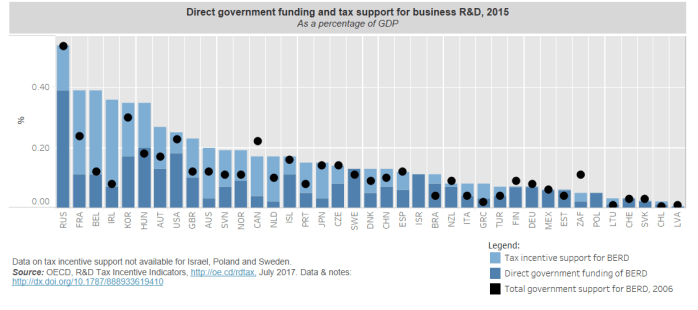
Hard to disagree with the second sentence, but without some compelling analysis suggesting that the government and its advisers understand why firms haven’t regarded it as worth their while to spend more heavily on R&D, it is difficult to be optimistic that more subsidies are the answer.   As I noted in an earlier post on the government’s proposals in this area

R&D tax credits aren’t the only form of government spending to subsidise business R&D – in fact, the government’s new scheme involves doing away with the current grants. And as it happens, OECD numbers suggests we already spend more (per cent of GDP) on such subsidies than Germany (DEU), and quite a lot more than Switzerland (CHE). [both of which have far far higher levels of actual business R&D]

All of which might suggest taking a few steps back and thinking harder about why firms themselves don’t see it as worth undertaking very much R&D spending here. But given a choice between hard-headed sceptical analysis and being seen to “do something”, all too often it is the latter that seems to win out.

But we are only stepping up to the big stuff

Our bold goal for New Zealand to have a net zero emissions economy by 2050 is essential as we face up to climate change. This goal creates economic opportunities. The business community is alongside us, with 60 of our biggest firms forming the Climate Leaders Coalition. The $100 million Green Investment Fund and the One Billion Trees initiative are key parts of this work.

Perhaps it is “essential”.   Perhaps it even creates “economic opportunities” –  big changes in regulation and relative prices always do, for some people.   But the government’s own consultative document, and modelling commissioned for them from NZIER, suggests that once one looks at the entire economy, a serious net-zero emissions target by 2050 will result in losses of real GDP per capita of 10 to 22 per cent (relative to the baseline in which no such target is adopted by New Zealand).   No democratic government is history has ever consulted on proposals that would lead to such a dramatic fall in expected future living standards and productivity.  And, as a reminder, on the government’s own numbers, the costs would fall wildly disproportionately on the poorest New Zealanders.   And, yes, there probably will be a lot more trees planted –  many of them probably on good, easy to access and harvest, land –  but just last week the government had to announce large subsidies to get even that programme underway.  Subsidies have never been the path to improved economywide economic prosperity.  Of course, few suppose the government proposes adopting a net-zero target for economic purposes, but they should at least stop misrepresenting the analysis on the economic effects from their own consultants.

We are also committed to ensuring no one is left behind in our economy. That’s why we have put in place the Families Package and lifted the minimum wage. It is why we have a $1b annual fund for regional infrastructure and economic development opportunities.

So the regions are so “stuffed” that only an annual subsidy scheme is going to help ensure they aren’t “left behind”?    That seems to be the implication of what the Minister of Finance is saying there.   And perhaps the Minister skipped over the likely tension between the laudable desire (see above) to get young people off the dole, and the really substantial increase in the minimum wage his government is putting in place (at a time when there is little or no economywide productivity growth)?

There are challenges in the world that are outside of New Zealand’s control. That is why we are running a surplus and being prudent with our debt levels. We are also diversifying our export markets to create new opportunities for our exporters.

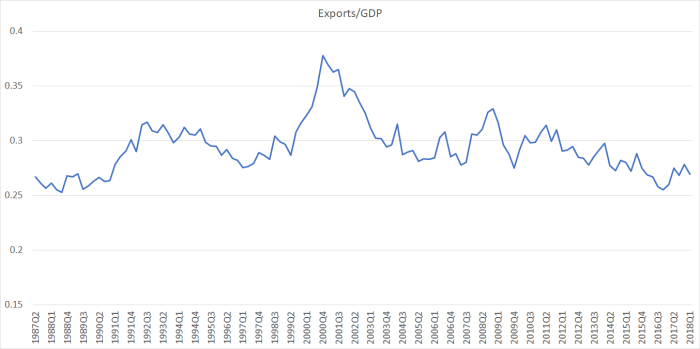
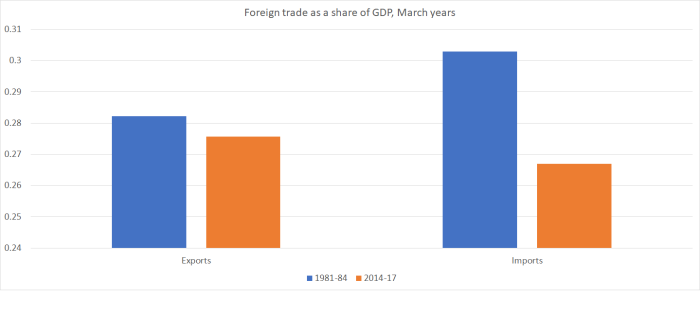
There is no hint of what, specifically, the Minister has in mind with his final sentence.  But there is a certain sameness to it, going back decades and decades (nice quotes –  including about the potential role of forestry –  in that 1975 manifesto I mentioned earlier).  And, actually, taken over the decades there has been a huge amount of diversification of export markets –  no single country takes more than a quarter of New Zealand firms’ exports – but it hasn’t enabled New Zealand to lift the foreign trade share of its GDP much.  In fact, over the last 35 years that share has shrunk.

As Don Brash noted in his article the other day, the previous government had fine words too

Key spoke about the need to increase the export orientation of the economy, and set a target for exports of goods and services of 40 per cent of GDP, up from 30 per cent when he came to office. Today, exports are just 27 per cent of GDP

Just no policies to make a difference.

The Minister of Finance attempts to end his article on an upbeat note

We are committed to working with business, workers and communities to build a stronger, more productive economy that delivers the quality of life that all New Zealanders deserve.

A worthy objective indeed, but there is nothing in what he told his readers that is likely to address –  and begin to reverse –  the decades and decades of underperformance.  If we take seriously the government’s own numbers around the proposed emissions goal, the relative underperformance could be even worse under this government (were it to win nine years in office) than under its two predecessors.

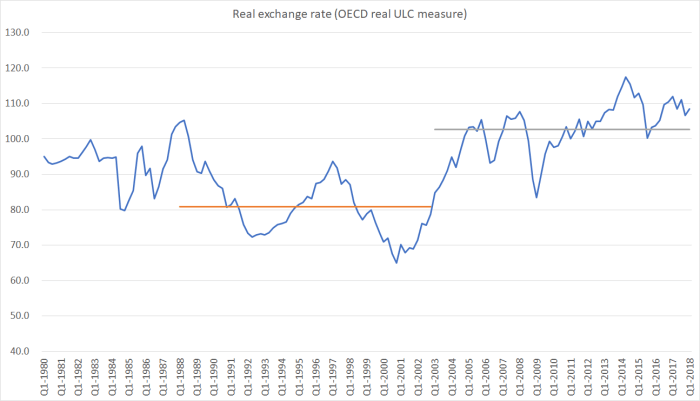
I presume (hope) the Minister believes what he says, but until he starts to confront the implications of charts like this he is unlikely to make any progress (except perhaps by chance)

With a real exchange rate now averaging 25 per cent higher than in the previous 15 years, in a country where productivity has dropped further behind, it shouldn’t be any surprise at all that foreign trade shares are falling, that the economy is increasingly skewed towards the non-tradables sector (where competition is often, and often of necessity) quite limited, or that firms don’t see the likely payoff to investing heavily in R&D.   These are classic symptoms of a severely unbalanced economy.  Most often they arise from misguided government choices.  In our case, the biggest single misguided choice is the grim determination –  or perhaps enthusiastic dream – to keep on rapidly driving up our population in such an isolated location where the opportunities to take on the world from here seem few –  and all the fewer with such a severely out-of-line real exchange rate.

Really successful economies  –  ones with materially stronger productivity growth than their peers –  tend to have strong, and rising, real exchange rates.  But that strength is a consequence of success, an outcome of success, a way of spreading the gains.  Driving up the real exchange rate has never been a part of successful strategy to lift the relative productivity performance of the economy.  The reformers here in the 1980s recognised the importance of a sustained lower real exchange rate as part of a successful economic transition.  It is tragic that today’s political and economic leaders seem to have almost completely lost sight of that.

We have –  and will have –  a 21st century economy.  But the question is whether it will be a struggling upper middle economy, with hazy memories of glory days long gone, or one that once again matches many of the richer countries in the advanced world, something I’m pretty sure we could do, but for a small number of people.  If the government really believes they have the answer for how they can do it with a population that they  actively drive further up every year, they surely owe it to us to lay out their reasoning, their analysis, with much more specificity than the Minister of Finance has yet done.  That might include explaining why their clever wheezes and proposed reforms will make the difference their predecessors also claim to have aspired to for decades now.

Then again, perhaps tangible achievement no longer matters.  Under the government’s wellbeing approach perhaps warm feelings will substitute for world-leading incomes?


Not very useful data at all

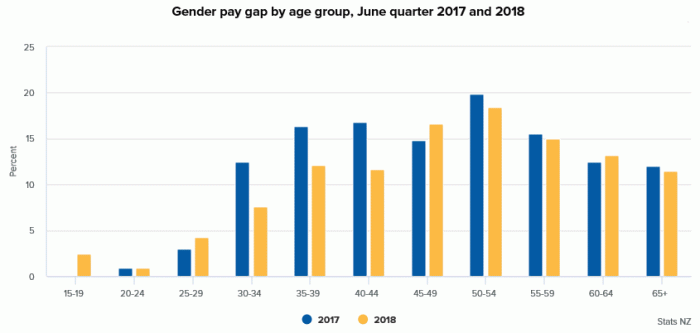
This dropped into my email inbox today from Statistics New Zealand (full release here)

The gender pay gap was 9.2 percent in the June 2018 quarter, Stats NZ said today.

This is the second-smallest gap since the series began 20 years ago. In comparison, the gender pay gap was 9.1 percent in 2012 (the lowest on record) and 9.4 percent last year.

The gender pay gap shows the difference in median hourly earnings for men and women. For the second year in a row, the gap reflected that median hourly earnings for women, from wages and salaries, increased faster than for men, up 3.2 and 2.9 percent, respectively.

gender pay
“The gender pay gap is a useful measure when trying to understand differences in pay between men and women, due to its simplicity. But this measure is limited. It doesn’t account for men and women doing different jobs or working different hours. It also doesn’t account for personal characteristics that can influence pay, such as qualifications and age,” Mr Broughton said.

In other words, it is almost certainly of very little use at all.

There does seem to be an increasing trend for our supposedly independent statistics agency to be working in league with government departments championing particular causes.  This seems to be another example.  Thus on the SNZ email we read this advert

Renee Graham, Chief Executive of the Ministry for Women, discusses the gender pay on YouTube from 11am.

It is to be expected that the Ministry for Women will have a view on such data, and causes to champion.  But what is Statistics New Zealand doing promoting the views of an advocacy agency?  Doesn’t it risk compromising confidence in SNZ’s statistics?  No doubt the Governor of the Reserve Bank has a view on the CPI numbers, or indeed the GDP or employment numbers, but it would be a worry if SNZ were using their platforms to promote the Governor’s efforts to spin things his way.

But as it is, surely the chart above points to something quite important.  There is next to no difference in the average hourly wages of men and women in the under 24 age group, and even the gap in the 25-29 age group is probably barely statistically significant (look at how much the measured gaps in individual age categories can jump around from year to year). Not much sign of the much-vaunted conscious or unconscious discrimination.  It seems quite likely that the subsequent gaps mostly reflect (the lagged effect of) intra-family choices about childcare etc, which have no obvious policy implications.  In such a context neither a widening nor a narrowing of the gap is something to be welcomed; it just is.

But I guess that wouldn’t fit the desired political and bureaucratic narrative.

I’ve just been shopping

There was a British visitor in town yesterday, apparently hosted by the New Zealand Initiative (I might write about his public lecture tomorrow or Monday).  I got the impression he was probably a Blairite – very keen on free trade, free investment flows, and open borders for people too, but also keen on lots of government intervention to deal with what he saw as domestic problems.

The visitor seemed to be a fan of New Zealand (or perhaps particularly of the 4th Labour government –  in his 20s, he’d worked for Mike Moore at the WTO).  We were, he claimed, in some respect the “birthplace of globalisation” –  which would have been news to anyone involved in policymaking at the time.   He told his audience this curious story, bearing some – but not that much – resemblance to reality about how dreadful New Zealand had been in the early 1980s (and we can all agree that assembling TV sets here was insane) and how New Zealand had “flourished” since then.  I don’t suppose he had ever actually had a look at any data, and seen for example that foreign trade (share of GDP) is barely higher than it was back then, that the income and productivity gaps to the rest of the world are larger now than they were then, or contemplated the affordability of a first home.

But one thing you could do in the bad old days – whether Kirk/Rowling or Muldoon –  was go to a shop and expect that your groceries – for example –  would be packed in a bag provided by the shop.  Not just groceries: bookshops, clothes shops, knick-knack shops or whatever.  Those who didn’t want a bag –  perhaps for a single item –  didn’t need to take one.     Perhaps back then the bags were more often paper bags, but we now know that paper bags are not only typically more expensive but more energy-intensive than a simple plastic shopping bag.  And often harder to re-use  (things often don’t store so well in paper bags, and they aren’t very tolerant of liquids).

But, assuming the Prime Minister and her Green Party associates have their way, that simple freedom is soon for the chop.   I’ve just come back from the supermarket, having done perhaps two-thirds of the weekly shopping for a family of five.    There were 15 bags of groceries, and 16 bags with various different lots of fresh produce.  Presumably these all count as the dreaded “single-use” plastic bags, although many will be re-used.   And, of course, when I got all the groceries home and arrayed them on the bench in the kitchen, I noticed that all the “single-use” plastic bags (actually often re-usable) would squash down to a rather smaller pile than the plastic in a single three litre bottle of milk (there were several of them).  I have no use at all for empty plastic milk bottles, or containers of shampoo, or dishwasher powder.  And yet our government proposes to outlaw the simple lightweight useful little plastic bags.

But perhaps the most important thing about the plastic bags I brought home is that when I’ve finished with them (used or re-used) they will all go in the rubbish.  None will go drifting down the street, blowing across the beach or whatever. Like most responsible people, I put my rubbish in the bin, whether at home or out.   Perhaps the Prime Minister doesn’t?  Perhaps James Shaw and Marama Davidson don’t.  Perhaps they can’t trust themselves to bring up their kids not to litter?  But what right do you think you have Prime Minister – in an ostensibly free society – to tell shops what sorts of bags they can and can’t provide (give or charge for) customers?

I can quite see the case for litter laws.   And this is, from the listening to the rhetoric,  a littering issue –  at least when it isn’t just about virtue-signalling, feeling-good and virtuous, and enjoying taking away some freedom to show we hold power.

So why not tighten the litter laws?  Fines tend to lag well behind growth in incomes and prices.  Surely it is an obvious response, that deals with the free-rider issues and associated externalities (unsightliness and visual pollution).  I’m loathe to suggest more worthiness for schools to teach, but perhaps if Labour and Greens voting parents really can’t be trusted to raise their kids not to litter, schools could add that to the daily indoctrination?

There is a consultation document available on the Ministry for the Environment website.  I haven’t read it yet, so I’m not sure quite what the limits to this authoritarianism are: is the Prime Minister also proposing to ban (for example) single-use rubbish bags, or selling salads or rolls or supermarket cooked chickens in plastic wrap/bags?   But I did electronically search the document on the off-chance that it contained any serious economic analysis, let alone a decent cost-benefit analysis.  There was no sign of either.   Which probably shouldn’t be surprising –  par for the course with, for example, the climate change consultation, let alone the (unconsulted) oil and gas exploration decision. I guess it doesn’t matter.  If it feels good they’ll do it.

It is strange to think that Jacinda Ardern and James Shaw could soon have one hankering for some simple freedoms of the Kirk/Muldoon years.

As a mark of how sold-out the public service apparently now is to the wishes and feelings of the government of the day, there is also on the MfE website a cutesy little questionnaire –  of the sort I’ve seen a few times now on various agency websites. Here was MfE’s

plastic

Totally loaded one way, and no room at all for my answer: I’d change shops at present to avoid those which don’t provide packaging.  The local supermarket tried out a plastic-bag free Friday last year.  It didn’t last that long, but while it did I actively avoided the place on Fridays.

And all because the PM and her followers can’t pick up their rubbish, and won’t punish more heavily the transgressors who litter.  Or because they simply have no respect for the simple freedoms of buyers and sellers, whose choices hurt no one else.


Don Brash and Massey revisited

I wanted to touch on three largely-unrelated points, two on the controversy, and one of what Don Brash was apparently going to say in his speech:

First, very briefly, much of the story has been written in terms of Massey’s Vice-Chancellor denying Don Brash the right to speak on campus.   As far as I can see, Don Brash doesn’t have any particular “right” to speak on campus, any more than you (assuming “you” aren’t a Massey student) or I do.  In that sense, the issue shouldn’t be about Don Brash –  although that is what Professor Thomas tried to make it about –  but about a Massey student society’s own freedom; the freedom to invite anyone they wish (operating within the law) to speak on campus.  That should probably be where the focus is, including  adding the question of whether Professor Thomas thinks she should also have the right to ban altogether student groups that might happen to hold views she strongly disagrees with. After all, such groups might be fora for such dangerous ideas to be uttered, not just once (probabilistically –  see the VC’s “fear” that Don Brash would utter such views) but day after day, week after week.   Both would be chilling, and especially so in a public (state-established, largely state-funded,  and with several members of the council appointed by the government) university.   Has she stopped, even momentarily, to reflect on the implications of her stance?  She’d have had no problem with anti-Vietnam War speakers –  even eminent sceptics – being banned in the 1960s?  Or perhaps speakers favouring legalisation of homosexuality in the 1970s?  And so on.  It always pays to try to look at these things the other way round, unless of course Professor Thomas’s view is “who care’s about inconsistency, I hold the commanding heights now”.    A fine standard for a university that would be.    As it is, neither Professor Thomas –  nor her Council –  will explain themselves.

Second, someone asked me last night why I made so much in my post of the fact that Professor Thomas had only been in New Zealand for 18 months or so.   Her general stance –  banning the Brash speech at the merest whisper of the threat of a few protestors, and banning it because she regarded Dr Brash’s view on some live public issues as unacceptable –  would be reprehensible from any Vice-Chancellor.

And, sadly, this stuff happens elsewhere.  La Trobe University in Melbourne last week initially tried to ban a speaker –  social commentator Bettina Arndt –  they didn’t like, then partially backed away trying to charge the organisers hefty security costs, only now to finally back down completely and adopt the only stance consistent with the values of a free and open society

But university administrators yesterday told The Australian they had decided the university would cover the cost of security, out of a desire to preserve free speech and discussion on campus. “We welcome free speech and the event will go ahead,” a spokesman said.

But if Professor Thomas banning the student society from having Dr Brash to speak would have been reprehensible at the best of times, whatever the issue, I found it more than usually unacceptable when the views Professor Thomas disapproves of so strongly are those relating to the Treaty of Waitangi, Maori wards, etc etc.    These are very specific New Zealand issues, and despite her repeated attempts to wrap herself in the Treaty of Waitangi (all that talk of being a Treaty-led organisation, whatever that means) and it ill behoves newly arrived foreigners to attempt to decree what aspects of these issues should be able to be freely discussed (hint: in a free society, any of them).  It all has the feel of a social justice warrior, rather out of her depth in a new country, having allowed herself to be captured by a particular minority.  It would be unacceptable in any public university Vice-Chancellor, but should be doubly so in one with little familiarity with the underlying issues –  and, frankly, no obvious personal interest or commitment to the future of New Zealand democracy or society.

My third point was really totally unrelated to yesterday controversy itself.  But the Herald has on its website the speaking notes Dr Brash was planning to use for his talk to Massey students about his life in politics etc.  I was struck by his final comments, particularly those on a couple of economic issues and how they have been treated under the previous government, and how things might unfold under this government.

Of the previous National government

A hugely disappointing Government:

I. They pledged to reduce the gap between NZ incomes and those in Australia, and utterly failed;

II. They pledged to make housing more affordable, and utterly failed

Hard to disagree with him on either of those.  Productivity gaps between New Zealand and Australia widened over the last 9 years, and as for housing, it became ever more unaffordable in large chunks of the country.

And here is what Dr Brash –  former leader of both National and ACT – has to say about prospects under the current Labour-led government

In my own view, the present Government is likely to do a better job in making housing more affordable, but probably a worse job in closing the income gap with Australia

I’m pretty sure he will prove right about the income and productivity gaps with Australia –  it is the sort of story I’ve been telling myself –  although bear in mind the likelihood of a change of government in Australia next year.

But what of housing?  It would be great if Dr Brash’s positive story were true, and would be quite an indictment on the previous National government.  But is he right?

I’ve been sceptical for some time, for two main reasons:

  • first, any Labour-led government was going to be dependent on the Greens, who had never shown any signs of fixing the urban land market in ways that would open competition and lower land prices. “Sprawl” is, after all, one of the things they seem to detest, and
  • second, whether in the year or two before the election or subsequently, there has been no mention of freeing up the land market from party leaders (Little or Ardern in Opposition, Ardern as Prime Minister –  although it was there if you went looking in the details of the housing policy), and lots of talk of policy responses since which, at best, only tackle symptoms.  There is lots of talk of Kiwibuild –  which, at its best, would do nothing about the land market.  There was –  and is –  no sign that the Labour leadership really believed what most serious analysts will be telling them is the only long-term fix.  If you don’t really believe it strongly, are never heard to openly make the case for it, it seems unlikely that you will be willing to push such reform through your own caucus, let alone get in through the Greens caucus.

In the last week or so I’ve seen a couple of bits of data which still leave me unclear about whether Labour will, finally, make much of difference in fixing the decades of dysfunction.

Whatever doubts many have about the Housing minister, Phil Twyford, it has always seemed as though he genuinely got the sort of reforms that might be needed.  The free-market people at the New Zealand Initiative certainly thought so a year or two back when they teamed up for a joint op-ed.

Consistent with that interpretation were some reported comments Phil Twyford had made recently in a vigorous debate with Environmental Defence Society CEO Gary Taylor.  I saw a copy of these yesterday, I gather taken from a longer article at politik.co.nz (for those with access)

Twyford replied that it was a question of values. 

“This is for us, for Labour, for our coalition government, this is fundamentally a social justice issue. 

“Our objective is not to build a Copenhagen of the South Pacific. 

“We could build a beautiful city with a whole lot of the policies we have talked about. 

“We could build a Vancouver of the South Pacific; beautiful but utterly unaffordable. 

“I’m interested in us fixing this totally dysfunctional urban land economy.

 “If we don’t deal with affordability we will have completely wasted the opportunity that has been given to our generation.”  

Twyford said the only way to deal with the affordability issue was to deal with the land price issue and that meant dealing with the artificial scarcity of land caused by the planning system and the availability of finance for infrastructure.

My spirits lifted when I read that. I imagine it was the sort of thing Dr Brash has in mind when he talks about a degree of optimism that Labour might change things for the better.

But then there was the Cabinet paper pro-actively released last week on the government’s “Urban Growth Agenda”.   It was really only a progress report, with full papers to come back to Cabinet next year.  And there was some good –  if highly politically contentious –  stuff around congestion charging.  Near the top of the list of recommendations (all only noting ones) were these positives

note that the high cost and shortage of housing is partly due to deep seated problems with the operation of our urban land markets and how infrastructure is planned, funded, and financed.

note the Urban Growth Agenda will deliver medium to long-term changes to create the conditions for the market to respond to growth, bring down the high cost of urban land to improve housing affordability and support thriving communities.

But then, towards the end of the paper there were paragraphs 32 to 35, which some experts (in email chains I’ve been on) have seen as undermining any hope of a seriously different and better vision of how land markets might work.

How we could see growth occurring in practice
32. Growth enabled through the UGA would likely take a phased and sequenced approach targeting growth within existing urban centres before greenfield development.

33. For example, in Auckland we will firstly emphasise urban intensification and regeneration projects in existing areas, particularly along transport corridors and urban centres. Development in already planned greenfield areas would take place alongside this.

34. Our attention will then focus on new transit-oriented development occurring within existing nodes [a few words redacted at this point] . Development opportunities will be identified collaboratively with local government and other stakeholders.

35. Finally, new leap-frog greenfield development would be enabled beyond the current Future Urban Zone with a priority towards the South of Auckland. This step would be subject to new spatial planning and cost allocation tools to mitigate risks and ensure an efficient urban growth pattern occurs. The majority of this growth would be within Auckland’s existing administrative boundary.

All of which sounds a great deal like central and local government planners trying to keep control, determine where growth does and doesn’t happen, with little real sense of the possibilities that genuine competition (among potential developers and landowners) would open up.  In the entire Cabinet paper, there is no suggestion that we might move to a model in which landowners had a presumptive right to build.

I’m left still fondly hoping that Don Brash’s favourable judgement on the new government, in this particular area, will prove well-warranted, but also still more than a little sceptical.  Nothing like a crunch decision seems to have been faced yet, nothing that would really tell us whether the government will radically transform the market  –  and it really is a social justice issue, as Phil Twyford described it.   But there is one other test: the market test.  If landowners, actual and prospective, really believed that the government was serious, that it was going to implement the sort of vision Phil Twyford talked about so eloquently, land prices on the peripheries of our cities would be falling, and falling rather substantially (just as taxi badge prices in regulated cities abroad as competition finally opened up that previously-overregulated market). I’m not aware of any evidence of such falls, but if readers are please get in touch and I’d be happy to report such an encouraging development.


Massey Vice-Chancellor bans Don Brash

In many ways, it isn’t surprising that Massey University’s Vice-Chancellor has barred Don Brash from speaking on campus at an event organised by Massey students.   So-called “no-platforming”, in response to pressure of mobs –  often threatening disorder if a speaking engagement were to proceed – has become rather too common in the United States and in the UK.  It was only a matter of time until this practice arrived here, and perhaps almost a matter of chance which speaker/group would be the first victim.  As it happened the lot falls to a 77 year old former corporate chief executive, former Governor of the Reserve Bank, former MP and leader of the National Party invited, by a student politics group, to talk about his time as leader of the National Party (the party that has led governments in the country for 47 of the last 70 years).

And what offence has this lifelong New Zealander given to Massey’s Vice-Chancellor, an Australian who has lived in New Zealand for all of 18 months?  She tells us that her concern is

Mr Brash’s leadership of Hobson’s Pledge and views he and its supporters espoused in relation to Māori wards on councils

This is the group whose website outlines a vision

Our vision for New Zealand is a society in which all citizens have the same rights, irrespective of when we or our ancestors arrived. 

It might not be your vision, I’m somewhat ambivalent about it myself, but it clearly isn’t Professor Thomas’s view of the country.  Which probably shouldn’t really matter greatly because (a) she isn’t a citizen herself, and (b) because the nature of politics in a democratic country is about conflicting views, not just about means but also about ends.

But Professor Thomas appears to regard such views –  and opposition to Maori wards on local councils (which have been defeated in most/all places where a referendum has been held on them) –  as simply illegitimate, and having no place in New Zealand, let alone on the campus of Massey University, an organisation founded and substantially funded by the New Zealand government and taxpayers.  She was terrified that Dr Brash might make some negative comment about Maori wards on campus

Whether those views would have been repeated to students in the context of a discussion about the National Party may seem unlikely, but I have no way of knowing.

And presumably no one at the university she manages could cope with knowing that somewhere on campus, an elderly former politician was expressing a view they might disagree with –  a view which, on this particular occasion, appears to be held by a fairly large chunk of the population.

In a startling display of casual inaccuracy (one hopes not deliberate) Professor Thomas is also upset that Dr Brash was part of the Free Speech Coalition, that supported the right to be heard (in public premises), of two controversial recent Canadian visitors.  She claims

Dr Brash was also a supporter of right-wing Canadian speakers Lauren Southern and Stefan Molyneux, who were due to address a public meeting in Auckland.

Had she done any research at all, she would know that Dr Brash had indicated publicly that he had little or no knowledge of the views Southern and Molyneux had espoused but –  like left-wing activist Chris Trotter for example –  did not approve of public facilities being denied to people who wanted to use them to hear from visiting speakers, however much their views might be controversial or provocative. (Disclosure: I am part of the Free Speech Coalition myself, and as I noted in my earlier post on this issue, had never heard of either Southern or Molyneux until the Auckland Council banned use of its facilities, the mayor boasting –  inaccurately – that he had done so.)

For a private university to have banned such a meeting, and a speaker such as Dr Brash, would have been unwise and generally inconsistent with the sort of ethos universities generally sought to represent (contest of ideas etc).  But, being private institutions, they’d be quite free to make that choice.

But Massey is different: it is a public institution (establishment, funding, appointments to the council).  And if the (foreign) Vice-Chancellor of a public university thinks Dr Brash  –  who has given decades of public service to this country – shouldn’t be allowed to speak on campus, when invited by students (what, one wonders, would she do if one of the professors invited him to speak to a class?), you have to wonder who –  and which views –  are next in the line for a ban.  Dr Brash is prominent enough –  even if not always liked –  that there will be an outcry against his ban, while this sort of insidious censorship can be applied more broadly to less prominent people.

Professor Thomas really should be called into line, by her own Council (her employers), by the Minister of Education (funding agency), the Prime Minister (if she is at all serious about her claims to support free speech –  to her credit, I see she has come out a little critical of Professor Thomas).  But where, one might wonder, is the Leader of Opposition on this?  It is a pretty sorry picture if the leader of the National Party won’t forthrightly defend the right of students at Massey to hear from one of his predecessors about his own time as National Party leader.   Does he believe in free and open debate, notably at our universities, or doesn’t he?

As it happens, Professor Thomas had conveniently laid out her perspective on free speech a few weeks ago when the Southern/Molyneux debate was raging (and no one was talking about university facilities). In a lengthy Herald op-ed she sought to build her argument around the concept of “hate speech” –  a concept that, fortunately, still has no place in New Zealand law.  Even Professor Thomas can sound reasonable at times

Beyond the reach of the law, however, the battle against hate speech is fought most effectively through education and courageous leadership, rather than through suppression or legal censure.

And this is where universities can take positive action by providing a venue for reasoned discussion and cogent argument.

Which you might have thought could include a lecture to a student politics society by the former Leader of the Opposition, former Governor of the Reserve Bank?  But apparently not.

Perhaps she justifies her stance this way

Given the current dominance of wall-to-wall social media and the echo chambers of fake news, universities are in many ways obliged to make positive societal interventions.

But one can’t help suspecting that in this case she means “we need to put a stop to the expression of any views we disagree with”.   That certainly seems to be the practical import in the current case, and rather at odds with her very next sentence.

Universities support our staff and students to push boundaries, test the evidence that is put to them and challenge societal norms, including examining controversial and unpopular ideas.

Ah, perhaps it is only societal norms that (recent arrival) Professor Thomas disapproves of that should be challenged?  Certainly, from her op-ed and her statement today, she seems to think no space at all should be given to any debate around how, or how best, to think about the Treaty of Waitangi and its place in modern New Zealand.  Which would be outrageous coming from any university CEO, but perhaps all the more so from one fresh off the plane.

In her statement on the Brash case, Professor Thomas made passing reference to security concerns –  even though it is equally apparent from her statement that she was just looking for an excuse to ban the meeting (having put her prejudice against Don Brash on display in that earlier op-ed.    Her approach isn’t that of the courageous leader defending freedom and debate, but rather of aligning herself with the mob to veto the ability of student groups to invite speakers (ones uttering controversial views) to campus.  That sort of mobocracy, if allowed sway, would be the very antithesis of democracy as we’ve come to practice it in countries like ours (even Professor Thomas’s Australia) in the last couple of centuries.  Thugs and bullies rule, at the expense of those who respect the ability of decent people to disagree.   Thugs and bullies can come from either side of the political spectrum.  These days, in New Zealand (and other Anglo countries) they are almost all from the far-left.

(Much as I support what should be the freedom of the Massey student group to invite whoever they wish to have to speak to them (supported if necessary by the Police to keep law and order, and allow law-abiding citizens to go about their business), I increasingly wonder at the prospects for such a world.  Process liberalism –  you do your thing, I do mine, and we leave each other alone –  is very slender reed around which to organise any society, and I rather doubt it can hold: perhaps it will prove to have been just a very brief historical interlude as society moved from one set of largely shared beliefs to another.   Human societies seem to need more than just process rules to hold them together, and that process tends to involve the marginalisation or exclusion or forced suppression of minority views.  Since most of my own more important views these days are distinctly minority ones in modern New Zealand, I hope it isn’t true, but I suspect it is.  If so, of course, in New Zealand issues around the Treaty and Maori/non-Maori perspectives could prove a very nasty and dangerous fault line.)

NB  As I imagine all regular readers will know, Dr Brash was my boss in years past, and these days I count him as a friend.

UPDATE: So the most Chris Hipkins can say is that it isn’t the decision he would have made and the most the Prime Minister can do is call it an “over-reaction”.  In context, they are little more than weasel words, washing their own hands of owning responsibility, without full-throatedly condemning Professor Thomas and calling on her to reverse her decision.  Simon Bridges has described the ban as a disgrace.


Disconnected thoughts on the economy

I wrote a post a month or so go about some comparisons between the drop in business confidence after the previous Labour government took office at the end of 1999 and the current fall.   At the end of that post, I concluded that the current situation should probably be more concerning than the earlier episode which, intense as it was at the time, blew over fairly quickly.  Perhaps the biggest difference, I suggested, was around the exchange rate:

The current level is about 30 per cent higher than it was in 2000, and it had fallen a long way to get to those 2000 levels (and not on heightened risk concerns etc).  Those falls created a credible prospect of new business investment in the tradables sectors.  There is nothing comparable now, and we’ve probably exhausted the limits of domestic demand (especially residential investment) as a support for headline GDP growth.

The Reserve Bank’s TWI measure of the exchange rate has averaged about 74.4 this decade to date, with a standard deviation of about 3.7.   Thus, although the current TWI is now a bit lower (72.6) than it was at the time of last year’s election, in both cases the numbers were within one standard deviation of the mean.  Those sorts of fluctuations are often little more than noise.   There is nothing yet visible in the current government’s plans and policies that is likely to reverse the longer-term structural overvaluation of the exchange rate.

Another comparison I’ve seen in recent days is with early 2008.  Some of the business confidence measures are back to the sort of levels we saw in early 2008.  I saw one prominent journalist opining that “current conditions are nothing like 2008”.   No doubt true if one has in mind the final (global crisis) quarter of 2008, but in April/May 2008 –  when business confidence had weakened to similar levels to the present –  New Zealand was already in recession (so the published data tell us) but few people realised it.   Here, for example, was the Reserve Bank in June 2008, still asserting that GDP growth that year would be positive (and they weren’t alone in that view).

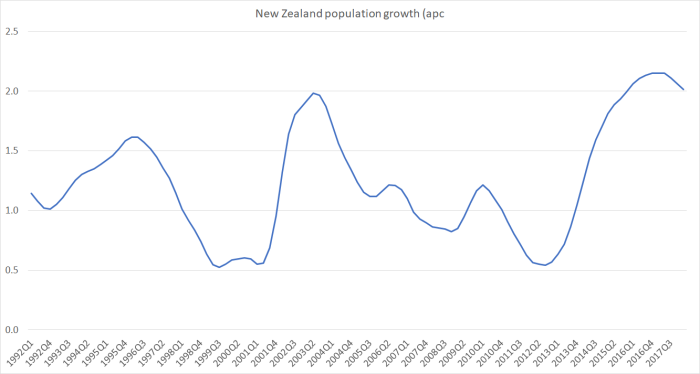
Another comparison relevant to making sense of business surveys (and the like) is population growth.    For better or worse (mostly worse, on my telling), the current population growth rate is still much higher –  at least twice as high – than it was in either 2000 or 2008.

popn growth aug 18

When the population is growing that rapidly, business surveys don’t mean the same thing as they would if (say) the population was flat.    A typical business survey will ask whether things are rising, falling, or much the same, and report the net of those saying higher and those saying lower.  With 2 per cent population growth, one should expect net positive responses even if per capita activity was going backwards a bit.   At present, 2 per cent annual GDP growth would be a really bad outcome.

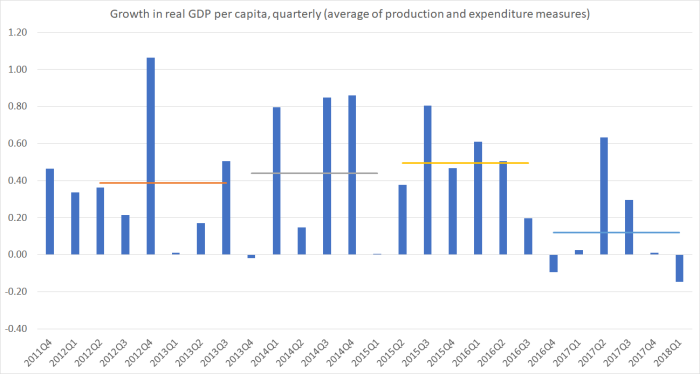
At her post-Cabinet press conference yesterday, the Prime Minister seemed to be flailing.  She preferred, we were told, to look at real data to judge how things were going. Here is one such chart from my earlier post

gdp pc to mar 18

How have things been going on real GDP per capita? Not well, and that included late in the term of the previous government.  Perhaps there is some element of businesses slowly realising just how mediocre our economic performance has been.  Perhaps the Prime Minister –  who during the election campaign was too ready to grant that things were going well economically –  should wake up to the underperformance.

What about other real indicators?

The Prime Minister talks of our “low” unemployment rate, and yet seem conveniently oblivous to the fact that among the G7 leading advanced economies, the UK (Brexit and all), the US (Trump and all), Germany, and Japan all have unemployment rates lower than New Zealand’s.  Ours is better than it was, but it is nothing much to be proud of –  roughly one in 20 New Zealanders keen to get a job, ready to start work next week, can’t find one (and that is narrowest definition of excess labour capacity).    Labour would once, rightly, have regarded that as pretty shameful.

There has been very little growth in productivity at all for five or six years now, and last week’s labour market data (showing quite reasonable employment/hours growth, even as no one expects stellar GDP growth this quarter) suggests the trend has continued.   And for all that we are suppposed to be impressed by yet another board, this time to consult on trade agreements (chaired by a competent former diplomat who now works for the propaganda arm of MFAT/NZTE, the New Zealand China Council), the reality remains one in which exports (and imports) as a share of GDP have been shrinking not rising.  That isn’t how things go in successful economies.

exports aug 18

Business investment has been weak too, especially once one takes account of the needs of a rapidly rising population.

The Prime Minister tell us that in a speech later this week the Minister of Finance will outline how the government expects things to be turned around, with our economy becoming more productive, more outward-oriented etc.  I will, I’m sure, read the speech with interest, but there is little sign that anyone near the top of government really has a sense of what might make a useful and substantial difference to the medium-term performance of the New Zealand economy.  You will, for example, never hear them talk of a real exchange rate out of line with the relative productivity performance of the New Zealand economy, or show any understanding of how that might come about.  In practice, they seem wedded to much the same failed economic strategy as the previous government –  notably the “big New Zealand” rapid inward migration strand –  made worse, at least in prospect, by things ranging from large increases in minimum wages to aggressive headlong pursuit of net-zero emissions targets with not a decent cost-benefit analysis in sight.   Whatever the merits of, say, capital gains taxes or R&D tax credits (and I’m not persuaded of either), they simply aren’t game-changing stuff.

One of the uncertainties about New Zealand economic data is what happens to the outflow of New Zealanders (mostly to Australia).   Because the wage differentials are so large, the normal state of affairs is for the outflow to be quite large.   Those income and productivity gaps haven’t closed in recent years –  if anything they’ve widened –  and as the Australian labour market has recovered, the outflow of New Zealanders has been picking up again.  If things remain more positive across the Tasman we can expect that trend (growing outflow) to continue.  If so, it might dampen activity here a bit further, offset by the increased sales New Zealand firms can make in a better-performing Australian economy.  Then again, business confidence measures in Australia don’t seem stellar at present either (the latest manufacturing PMI number is very similar to that in New Zealand).

I try to largely avoid economic forecasting.  Mostly, it is a mug’s game (the future, beyond perhaps a couple of quarters ahead, is basically unknowable), and it is a very rare forecaster who will prove right for the right reasons (and more than randomly so).  Perhaps the economy will weaken from here –  there is a lot running against it, and not much for it – but perhaps not.    But what really disconcerts me is that lack of much sign of serious thinking of how the next serious downturn –  which will happen, it is only a matter of when – should be handled.   That sort of complacency, especially in officialdom, was never really excusable even when things seemed a bit more buoyant – after all, we pay these people (so they tell us) to take a rather longer-term view.  But it is even more worrying now.   The official view that interest rates would soon move higher again has been falsified by experience, year after year.

As a reminder, the OCR now is 1.75 per cent.  That is lower than official interest rates were in every country in the world, bar Japan, going into the last recession (our own OCR was 8.25 per cent then).  The Reserve Bank tells us that they agree the OCR probably can’t usefully be cut below about -0.75 per cent, which just isn’t that far away –  even if people have been lulled by almost a decade in which the OCR has been in a range of 1.75 per cent to 3.5 per cent.

We’ve had a new Governor now for 4.5 months, and have not had a single substantive speech from him on monetary policy (his only on-the-record speech notes have been about climate change, for which he has no responsibility at all).  And, of course, we’ve heard nothing on these issues (and threats) from the Minister of Finance or the Secretary to the Treasury.    And while there is lots of talk of how much fiscal room New Zealand supposedly has, remember that revenues will drop away quite quickly in the next recession, the NZSF will be booking big losses, and the political process will almost inevitably balk at really large, repeated, fiscal stimulus.  For those doubting that, look at the political limits to fiscal stimulus in the last US recession, or the UK, or….well, almost anywhere.

But if our officials and politicians are letting us down, the contribution of the leading market economists doesn’t seem to be any better.  I’ve read the MPS previews (for this week’s RB announcement) of three of the four main banks, and not one seems to devote any space to the “what if” questions.   They all seem to believe that we’ll get through the current confidence dip in reasonable shape, and so the real question is when the OCR will be raised.  Perhaps they will be right about that.   Perhaps too they are mainly interested in foreshadowing what the Governor might say or do this week (and he and his institution have been pretty complacent for a long time).  But what if things don’t work out fine?  What if we do find ourselves in a recession in the next 12 or 18 months?  And how best should we think about the probabilities, and about the best possible policy responses, given the uncertainties and the very real limits of the OCR instrument much beyond the current level?  It doesn’t seem to be something our leading market economists even want to address.

(My own view isn’t an unconditional forecast, but a conditional statement: if there is an OCR change in the next 12 months it will be a cut.)

There is a serious need for some hard thinking, and sober realisation, about the disappointing performance of the New Zealand economy.  It would be a shame if the current downturn in business confidence (whatever specific mix of factors, political  and otherwise, is driving it) were just used for another round of patting people on the head, and reassuring them “don’t worry, after all, we are one of the best-performing economies in the world”.  In truth, we are anything but, and nothing either of our main political parties has to offer gives any reason to expect change for the better.


Two scattered things

There seemed something strangely apt about the power going out on a lecture about the current Treasury/government craze for “wellbeing”

(Having said which, I expected the lecture itself would be interesting and stimulating –  Arthur usually is even when, as often, I disagree with him.  I hope it is rescheduled.)

Out of the blue the other day, I received a copy of a new book by Simon Burnett, a New Zealand journalist resident in Germany, about an episode in recent New Zealand financial history that I’d almost entirely forgotten.

Blunder: How ANZ and ING squandered 800 million dollars in a Wall Street casino—and ignited a revolt of small-time investors

As the blurb puts it

Between 2003 and early 2008, fifteen thousand financially illiterate people in New Zealand were persuaded to invest their savings in packages of hyper-speculative securities. They were told that these were safe alternatives to bank deposits. The investments crashed. The shell-shocked investors, mostly elderly and risk-averse and in no position to recover from financial disaster, banded together, formed a national committee, set up regional groups, took the battle on to the streets, and won.
The securities, known as CDOs, were packed into two mutual funds (or unit trusts) managed by the New Zealand arm of the Dutch financial giant, ING. Its joint-venture partner and half owner, the Australia and New Zealand Banking Group (ANZ), was a major sales agent. When the CDOs tanked and the funds tanked with them, the ANZ and ING began a desperate cover up, blaming unforeseen circumstances. This was baloney and the investors knew it.

and

This is the story of the biggest, most sustained, investor revolt in New Zealand history, told not by a financial expert but by one of the ANZ/ING investors who himself took part in demonstrations. The author unravels the financial complexities that neither the ANZ nor ING apparently were aware of.
The scandal was regional, but the lesson is universal: it illustrates just what can happen when financial institutions do not check what they are investing in and pass on the risks to unsuspecting customers.
Financial commentator and economist Gareth Morgan wrote that, “For anyone investing their savings with the financial sector in New Zealand—especially with some of the biggest brands in the business—I commend this book to you as a good background on what you can expect if you do not do your homework.”

I haven’t read the book, but hope to.  Too few of the episodes in our economic and financial history are well-documented, and if this book makes some contribution to such a literature I welcome it.

Gareth Morgan has written the preface to the book.  There are plenty of things I disagree with Gareth about, notably financial regulation.  But he has been around, and his willingness to write the preface suggests there is something to the book, as a story, even if you don’t go as far as he does on policy.  Here is some of Gareth’s view.

And in New Zealand there is a sequel. In a flurry of belated regulatory responses to events here—not just the ANZ/ING debacle, but also the mass destruction through the finance company sector—a licensing regime is being brought down on financial advisers and a rewrite of the Securities Act is being attempted in order to rein in the malfeasance.
But industry’s capture of the regulator is so complete that the financial adviser
regulations are little more than window dressing. Not one of the offences committed by this sector during the GFC would have been prevented under the licensing requirements that are being implemented —indeed the worst offenders have been exempted most of the qualifying requirements the Code Committee for Financial Advisers has implemented.

There are no grounds whatsoever for the public to increase its confidence in this sector, no chance the new regulations will ensure it has a duty of care to it, and the book “Blunder II” will be required in a few years to outline why the malpractice has continued.

And were the FMA to ever investigate such an episode, we were reminded again this week that they can arbitrarily slap suppression orders on, stopping people talking about thet directly affects them and their customers –  even stop them talking to parliamentary committees.

I’m pretty ambivalent on Nicky Hager too, but here is some of his endorsement

“This is why Simon Burnett has done a great service in writing this book: explaining an important New Zealand story as part of the world-wide crisis, distilling the lessons and holding ING, ANZ and their senior staff to account. He has done a huge amount of work to piece the story together and to make it into an interesting, readable book. It is also pleasing that he tells the story of the ordinary investors who complained and fought and protested, in the face of misleading information and resistance from the respectable sounding companies involved, until they found out the truth and got some justice. The book is a fine piece of investigative journalism.”

The book looks to be well-documented, and from the bits I dipped into seems to read easily enough. I suspect I would probably part company from the author on any policy implications, but probably not on the ethics of what went on.

UPDATE: In a comment below the author notes:

At the moment, the book is exclusively on Amazon as an eBook. A paperback is scheduled for the end of August. Anyone who wants to can get a PDF copy from me free. Just email me at frozenfunds08@googlemail.com.

Confucius Institutes, the PRC, and all that

Last week there were screenings in Auckland and Wellington of Canadian journalist and filmmaker Doris Liu’s documentary “In the Name of Confucius” .  Each screening was followed by a Q&A session with the filmmaker herself, who has been on a bit of a roadshow promoting the film (which is funded by the Canada Media Fund) and its message (which has now also been screened at the British Parliament and at various parliaments in Australia).

From the promotional material

Culture. Language. Power.  On average, China opens one Confucius Institute per week in partnership with school boards and academic institutions around the world, with a goal of opening 1000 by 2020.  Yet, a growing number of schools are also starting cut ties with the program, alarmed by concerns ranging from human rights violations, financial incentives and censored content to national security and espionage.

In the Name of Confucius is a one-hour documentary about the Chinese government’s multi-billion dollar Confucius Institute (CI) program and the growing global controversy at academic institutions around the world as scholars, parents and others question the program’s political influence and purpose.

The Confucius Institute (CI) programme began in 2004, and there are now three of them in New Zealand (made possible as part of the 2008 China-New Zealand “Free Trade” Agreement), one each at Auckland, Victoria and Canterbury universities.  Given the substantial amounts of money involved –  the universities get to extensively leverage their brand with PRC money –  and the sensitivities of the PRC authorities on all manner of things (try the Rockhampton fish story for example), it was to the credit of Victoria University that they allowed their facilities to be used for the Wellington screening, even with the strange disclaimer that “This external event does not necessarily reflect the views, thoughts and opinions of the university”.    Perhaps naively, I’d associated universities with the contest of ideas, evidence etc, rather than with any single view held by “the university”.

(Reflecting an official PRC perspective, the film featured a clip of the head of Hanban –  the PRC government agency responsible for the CI programme –  stating that the CIs meant that it was “like foreign universities work for us”.)

The documentary centres on two main Canadian stories.  The first was the defection of a Mandarin language assistant (the main strand of what CIs do), Sonia Zhao, whose defection and subsequent human rights complaint (based on the then formal PRC prohibition of anyone with Falun Gong connections being a Mandarin language assistant) contributed to the closure of the Confucius Institute at McMaster University in Ontario.   Zhao herself had been a Falun Gong practitioner who, on her telling, had been unaware of the prohibition until presented with her draft contract, and was then fearful of imprisonment or other punishment in China.    She recounted the instructions the assistants received that –  in Canadian government classrooms –  they should avoid issues like Taiwan and Tibet, change the subject if possible, and otherwise parrot the Party line.

The second story was around the battle, ultimately successful, to convince the Toronto public schools system (apparently the third largest in North America) to end its association with the Confucius Institute/Confucius classroom programme.  It featured rather gruesome footage of little Canadian kids singing a song, drawn from CI resources provided by the PRC authorities for Toronto schools, in praise of Chairman Mao “leading his people forward” (no mention presumably of the tens of millions of deaths ascribed directly to government choices?).

The section focused on the Toronto debate featured footage of vociferous protests outside the meetings (on both sides, mostly from the ethnic Chinese community, with those in favour of the CI programme apparently organised by other PRC front organisations), some pretty arrogant bureaucrats (including one who had clearly enjoyed being “wined and dined” –  his words –  by Beijing), and some dramatic footage of the impassioned debate at meetings of the school district board of trustees.    There were the competing perspectives: one Chinese immigrant tried to claim that Tibet’s status was really just like Quebec’s.  That sparked a feisty response from one trustee about the possibilities for independence referenda in Tibet, to which the response was ‘oh, we don’t need referenda, because we know no one wants independence”.    And, on the other side, other ethnic Chinese noted that for all the CI claims to promote Chinese culture, it was the Communist Party which had set out to destroy so much of Chinese culture.     At the end there was an overwhelming vote (20 for, 2 against) to end the Toronto school district’s association with the Confucius programme.

The documentary was primarily about the Confucius Institute programme.  But it was also –  particularly through the lens of the Sonia Zhao story –  about the brutal and systematic PRC persecution of the Falun Gong.    The filmmaker –  herself a Chinese immigrant to Canada only about 10 years ago – has some involvement with Falun Gong herself, and indicated that she has family members back in the PRC who are active practitioners. One could only admire her courage in speaking out, although wondering about the risks she might be exposing her family still in the PRC to.

Here is an extract from a pamphlet Falun Gong people were distributing in central Wellington last week

falun gong

Or you could read an Australian (ABC) article.

This is the sort of regime that we allow to put its people into our schools.

Falun Gong isn’t, to put it mildly, my cup of tea.  But that isn’t the point.   States shouldn’t get to compel, or proscribe, religious/spiritual practices in this day and age (cuius regio, eius religio was from hundreds of years ago) and, when they nonetheless still choose to do so, we should not be actively aligning ourselves with such regimes (one could add regimes like Saudi Arabia to such a list), let alone allowing them to put (ideological “sound”, politically safe) people in our schools.   The PRC has now removed the explicit prohibition on Falun Gong people from the websites describing these Mandarin language assistant roles, but it makes no practical difference, given that the practice of Falun Gong is prohibited in the PRC and the government actively persecutes (and in some cases, it appears, murders) practitioners.

As it happens, and to her credit, the director of Victoria University’s Confucius Institute attending the screening of “In the name of Confucius” in Wellington.  Rebecca Needham was, until recently, a fairly senior MFAT official, including former New Zealand Consul-General to Guangzhou.  As I noted recently, in the weird conflation of roles and interests that swirls around Wellington over the PRC relationship, even though her current job (directly on the payroll of Victoria University) involves implementing a programme largely funded by the PRC, she is still shown on the MFAT website as one of the group of public sector experts on China (the only non public servant on the list).

When it came to the Q&A session, Needham made a couple of points:

  • to the extent that events were portrayed accurately in the film, they bore no resemblance to the way the Confucius Institute at Victoria (or others in NZ) were run, and
  • that the Victoria Confucius Institute was completely transparent and non-political.

Since I had met her once before, and she had then volunteered a willingness to talk and answer questions, I emailed her and asked whether she could be specific about any differences in how the New Zealand CIs were run, and whether there were any prohibitions on Falun Gong teaching assistants.

She invited me to come and talk it over, and we met in her office yesterday. Despite her offer to talk, she was clearly a bit uneasy about talking to me, and so I offered to keep her remarks off-the-record, and simply use them as background to my own descriptions etc.  In the course of the discussion, Tony Browne – former New Zealand Ambassador to China, chair of the Confucius Institute and senior consultant (unpaid) to Hanban (the PRC agency behind Confucius Institutes –  dropped in.  I’ve also written previously about the multiple hats Browne wears.

To recap, the main focus of the Confucius Institute, despite its location in a university, and use of the university brand, has almost nothing to do with the traditional role of a university.  They neither teach undergraduates, nor conduct research.  It is mostly a programme of (at PRC government expense) putting native Chinese speakers (typically young graduates from good Chinese universities) into our schools, to support Chinese language (and related) programmes. (There are also “cultural” programmes that look as though they should be better done, if at all, directly through the PRC embassy, not with a local university imprimatur).   A different cohort of these young people come out each year, and they are based in various towns and cities (in Victoria’s case, the North Island up to and including the Bay of Plenty), working in local schools alongside New Zealand registered teachers.  Apparently, no textbooks or the like are provided by Hanban, the Confucius Institutes, or the Mandarin Language Assistants themselves (presumably reducing the likelihood of kids in our schools singing songs celebrating Chairman Mao).

Apparently the hope of Hanban has been to localise Chinese language teaching over time (presumably, in turn, reducing the substantial cost the PRC taxpayer –  in a much poorer country than NZ –  bears).  Even if that is the hope, it isn’t the situation at present, whether in New Zealand or in other countries where CIs are operated.

The recruitment process for the Mandarin language assistants who come out here involves the New Zealand Confucius Institute staff making the final decisions (sensibly enough –  they need people who will fit in, living in perhaps a small New Zealand provincial town for some time). But they make those decisions from a list provided to them by PRC universities.    We can be pretty sure that all of those people –  after all, coming to pursue an official government agenda just by their presence – will have well-vetted. No Falun Gong will have survived the vetting process, but nor will anyone calling for (say) independence for Tibet, free and open elections in the PRC itself, respect for Taiwanese democracy, or freedom of religion or freedom of expression.   That is just the way the PRC is, and he who pays the piper calls the tune.  New Zealand staff needn’t concern themselves with this sort of pre-vetting.

Now, of course, these are young graduates.  Some might be politically passionate, but probably most aren’t –  more concerned with seeing the world, shopping, the opposite sex, developing their English, or whatever, all the while adopting the only safe PRC position (keeping your head down, and your speech tightly constrained).  So I’m not suggesting that when these people come into our classrooms they are generally consciously actively propagating some PRC agenda or worldview to our kids.  But it doesn’t change the fact that they are approved representatives of a heinous regime, and they (and the Victoria staff) have chosen to be complicit with that regime, no matter how often they repeat the line that “we just do language and culture”.     Are they helping some New Zealand kids in the process?  Yes, no doubt.  (And having myself spent time growing up in Kawerau, I was half-pleased to see that kids in places like Kawerau and –  still poorer –  Murapara are getting support in their Chinese language learning.)

But it doesn’t make the system right.  I suggested to the director that it really wasn’t much different than if, say, a cohort of Hitler Youth (which pretty much everyone had to join, whether a zealot or not) had beeen coming to the UK in the mid-late 1930s each summer to teach German language and culture, at the expense of the Nazi regime.  There is nothing wrong with learning German, or Chinese, but the people who work on those programmes (from university vice-chancellors down) make themselves complict in the evil.

If we want to encourage Chinese language learning in New Zealand, how much better if we spent our own money on it?   That is what we do when we want to improve science or maths or English or economics teaching.   It is what self-respecting people do, not mendicants.  We don’t (that I’m aware of) have a government-facilitated programme to bring in native French or German or Spanish speakers for our schools, but if that were regarded as a worthwhile part of secondary education I’d have no particular objection. But spend our own money, recruit people directly ourselves, and recruit them from places (in the Chinese case, eg Taiwan, Singapore, or even semi-free Hong Kong) where we can reasonably confident that a foreign government won’t have prescreened for political suitability and safety.  Particularly not a foreign government like that of the PRC.   (And this is all the more so for courses for our public servants, of the sort the CI conducts.)

You can read the Victoria University Confucius Institute material for yourself: there is plenty of it on their website.   You can also see that the talk about it being “just” language and culture (and doesn’t “culture” encompass “the way we do things” –  the PRC not being a model for most New Zealanders), they are quite open about the political nature of what is going on.  The handbooks for schools might mostly be branded as “Victoria University” products (Vic has many institutes and schools) and perhaps that helps marketing and recruitment in the provinces.  The Annual Reports are a bit different.   We find photos of a Vice-Premier, of a visiting Communist Party secretary.  We read that a counsellor from the PRC Embassy sits on the board of the Confucius Institute, and that one of the CI staff is involved in programmes “to raise China literacy in the public sector”  (we ask the PRC government to help “educate” us on China?   And the Nazi Party to educate us on Germany in the 30s?)   In fact, in the 2017 Annual Report there is a celebratory photo of Xi Jinping on page 2 –  clearly not embarrassed that this tyrant, just taking power for life and further clamping down on any freedoms in the PRC –  launched the Victoria CI in 2010.

The PRC doesn’t have any doubts about the point of the Confucius Institute programme.  But you have to wonder why New Zealand universities, government departments, and decent individuals are so willing to allow themselves to be used by such a dreadful regime.  Language learning generally is a good cause, but ends aren’t all the matter. Means matter too.

The presence of Confucius Institutes clearly isn’t the biggest issue that should be worrying people in the supine, even slavish, way our authorities approach the PRC.  Rather more important is when, for example, the Leader of the Opposition (who as a minister signed us up for a “fusion of civilisations” with this dreadful regime) can claim, apparently with a straight face

He also said he continued to back National MP Jian Yang who was forced to defend himself after confirming that he had taught ‘spies’ in China.     “Before me being or becoming the leader, he has asked and answered quite decisively the questions around all of this … he is a highly valued member of parliament,” Mr Bridges said.

(This of a man hardly heard from in the English language media since the allegations surfaced)

or a Defence Minister who was reported the other day, at a function to celebrate the People’s Liberation Army 91st anniversary, that New Zealand was a “strategic partner” of the PRC.

If you want to update on what sort of regime it is that we allow to put its people in our schools, that we solicit foreign aid from, and have our universities celebrate, I recommend that new Der Spiegel piece on the open-air concentration camp that the Chinese province of Xinjiang has become.  Or an update on the organ transplant abuse situation, that someone sent to me a few days ago.  Perhaps you are inclined to look the other way, or just ignore this issue, as I was until quite recently.  If so, at least I suggest you check out the calibre of some of the people involved in leading the fight against this practice.  Yes, governments need to have relationships with the PRC (stiff formal ones ideally), but we shouldn’t be beggars, and we shouldn’t give our good name to voluntary association with such a regime.

Women at the Reserve Bank

My post the other day, about the Treasury paper on “Women in economics”, was mostly about the apparent waste of (probably quite expensive) staff resources –  diverted from the real and substantive economic challenges Treasury should be addressing.  It seemed to be about virtue-signalling and feel-goodism more than focused analysis, made all the worse because the authors weren’t new graduates repeating an honours project (sometimes the basis for NZAE papers by young economists); indeed one of the authors is the chief economist of The Treasury, a deputy secretary no less.  Of course, that paper in itself was just a small example of what has gone wrong at The Treasury under its current leadership (facilitated by both the past and present government).  The Living Standards Framework, and the coming Wellbeing Budget, are the more prominent examples: a “well-meaning wafflefest” is the best that is likely to be said for that.   The quote is from Pattrick Smellie’s column today –  he seems slightly more optimistic than I am, noting the “intellectual grunt of The Treasury” (perhaps his memories of his time as Roger Douglas’s press secretary in the days when Treasury had intellectual grunt –  agree with them or not), but clearly a bit uneasy that it might all come to nothing much.

As I noted in comments to the previous post, I spent a couple of years working at The Treasury, and although it was getting on for a decade ago now, one of the things that struck me then –  recall, I was coming from the Reserve Bank – was the much higher proportion of women in economics, policy, and core management roles.  Frankly, I found it refreshing, and it was the only time in my working life when I sometimes went to economics/policy meetings at which there were more women than men.  I was struck then by the openness of The Treasury to part-time work, and to job-sharing arrangements, which seemed to make the place more attractive to women, especially those with young children (including several who had moved from the Reserve Bank to The Treasury).  The situation is also self-reinforcing –  when some (future) parents see flexible arrangements in an institution genuinely working for other people, it gives them more confidence it can work for them.  My own children were very young at the time, and my wife was considering going back to work, so they were issues that I paid attention to.

Perhaps it has all gone downhill again, even in these areas, in the last few years.  But I doubt it.   Which is partly why I struggle to take seriously Gabs Makhlouf, Tim Ng, and the rest of them whipping themselves about not meeting self-imposed quotas –  or indeed giving more attention to such issues, including in their Annual Report, than to lifting analytical excellence and the quality of their policy advice.   It just isn’t clear that they are addressing a real problem in The Treasury –  perhaps exemplified by them discovering that the institution had been using a tool that would have discouraged the use of words like “analysis” in job adverts, because they were somehow male-dominated words.

By contrast, I think there probably is a real situation that needs addressing at the Reserve Bank.  Here is how I described my assessment of the situation at the Bank in a comment on a post a few months ago

I agree that sex is not, and should not be, a relevant criterion in the selection of a Governor. But I also recognise that in a powerful public sector institution, with a high public profile and pervasive impact, in this era it isn’t necessarily inappropriate that questions should be asked to understand why, after 84 years there has never been a women appointed to a policy or operational senior management position (Governors, or heads of economics, financial markets, macrofinanancial stability, prudential regulation, or even notes and coins). For years, I defended those outcomes as mostly reflecting preferences (far more men end up doing macro and finance – and far more women do health and social economics etc), and I still think there is something to that story, but I’m no longer convinced it is enough of an explanation – substantively or politically. After all, Janet Yellen has just stepped down, and the RBA has two pretty impressive female Assistant Governors.

A commenter on my Treasury post drew my attention to an article from a couple of months ago, quoting the new Governor, that I hadn’t seen.   In it, Adrian Orr says

“I’m disappointed that it is as imbalanced as it is. We will be working actively. We are just going to have to be far more aggressive at getting the gender balance balanced,” Orr said in a recent interview with BusinessDesk.

Consistent with my comments in that quote just above

At the Reserve Bank, 36 percent of its 252 staff were women, although that dropped down to 20 percent of management roles – including managers and team leaders and senior positions of influence – and 26.2 percent of senior specialist roles. The Reserve Bank’s website shows just two of 13 senior managers are women: chief information officer Klarissa Plimmer and human resources head Lindsay Jenkin.

To its credit, the Bank is now being a bit more open with some of the data

In the year to June 30, 2017, the bank tried to hire six mid and senior management positions, attracting 101 external applicants, of which 19 were women. Of the four external hires, only one was female.

In particular, the data around applications for the position of Governor.    They initially refused to release this data, only relenting after the (surprisingly quick) intervention of the Ombudsman.

In the same vein, the hiring process that appointed Orr attracted 48 applicants, of which just six were women. Only two of those women made the final short list of 25.

But in a sense, the data on applicants for the position of Governor highlight that whatever is going on, isn’t a simple and straightforward story about (eg) institutional bias.

After all, anyone is free to apply, and in applying to be Governor you are backing yourself to be able to make a difference, including if you had heard that the Bank wasn’t (say) very welcoming to capable women.

And who got to make the decisions?  Well, the Minister of Finance was the final decisionmaker, and even he had to take the nomination to Cabinet (chaired by a woman).  But the real decision on the appointment of the Governor was made by the Reserve Bank’s Board.   And at the time, late last year, of the six Board members, three were women (including the deputy chair).  I only know one of the three, but none looks like the sort of person who would be pushed around by anyone, let alone consciously or unconsciously biased against female candidates.

Successful organisations mostly end up promoting from within.  It is a mark of the Reserve Bank’s failure as an organisation that 1982 was the last time an internal candidate was appointed as Governor and, perhaps even more so, that currently three of the four most senior positions (including Governor and Deputy Governor) are held by outsiders.  The failure of the Reserve Bank to have women in senior core functional positions (top advisers or senior managers) is, to a substantial extent, a failure of history, the failure to develop and maintain a culture and working arrangements that made it attractive for the very many female economics (and related) graduates the Bank has recruited over the years to stay.  Of course, most of all the graduates the Bank hires go on to do other things, but not one of the many female hires has stayed. I look around Wellington and see various women who once worked for the Bank in economics roles now holding relatively senior positions in other agencies.

The Bank itself has made this point.

The Reserve Bank admitted as much during a Parliamentary review of its 2017 annual report in February, with then acting governor Grant Spencer saying the bank hired a lot of women graduates, but struggled to retain women in senior and management roles

It is the single biggest difference between the Reserve Bank of New Zealand and the Reserve Bank of Australia: both of the two (impressive) female RBA Assistant Governors (in core areas –  economics and financial system) have spent the bulk of their careers at the RBA.  There has been nothing similar at the Reserve Bank of New Zealand.

To be sure, the Reserve Bank of New Zealand is a smaller organisation.  And no organisation can compel an individual to stay.  And I –  and probably most people –  am firmly opposed to so-called “positive discrimination”.  But our central bank should be the sort of place –  interesting work, reasonable prestige –  that plenty of able people (male and female) would want to stay at.

I wrote earlier about my observations of flexible working arrangements at The Treasury.  There was, in practice, nothing similar at the Reserve Bank; few or no examples of it working successfully, even if on paper the rules allowed it.  In my observation, it wasn’t that senior managers were in any active sense discriminating against women, but they just didn’t have a mindset that focused on creating an environment where women (in particular) who wanted to be parents as well as economists would find it most attractive to work.  That was still my observation, as part of the Economics Department management group, just a few years ago.  And, as a result, decades on the Bank seems to have not many more women in senior policy or analysis roles than it did when I started there 35 years ago.

Is the quality of the Bank’s work poorer as a result?  Probably not much, but probably a bit –  I seriously doubt there is a distinctive female perspective on macro or financial stability or bank regulation, but some of those very able women who didn’t stay might well have made a stronger contribution than at least some of the men who did.  We’ll never know.

There are probably aren’t any wise quick fixes.  As the pool of applicants for Governor suggests, there aren’t currently many women in New Zealand with a strong interest and/or the skills/experience for the very top roles in the Bank.  And, as the Treasury paper noted, the number of people doing economics to an advanced level at university is falling, and the proportion of women among them seems to be falling away a bit too.   Absent token appointments (which would be bad for everyone, except perhaps the appointee, and perhaps even her) fixing the Bank is likely to be the work of a decade or more –  most worthwhile things probably are.  But it still needs to be treated as a priority, for both substantive reasons, and because the Bank is a high profile and very powerful institution and questions will (and should) be asked.

What worries me a bit is that the Governor often shows signs of appearing to favour the quick win and the rather-too-glib answers, rather than digging more deeply into issues.  He has, after all, lots of turf battles to fight in the next few years, and a government that is all too keen on quotas.  In the article my reader linked to there was a private sector example of the sort of questionable responses to external pressures

ANZ Bank New Zealand has a policy that any short list for a position must be 50:50 gender split and the interview panel must also be equally split.

And yet, if honours graduates in economics are roughly one third female and two thirds male, a shortlist requirement of 50/50 male and female will (by construction) often not mean that only the best candidates are on the list.

And keep an eye out for appointments from the Governor in which he chooses to positively discriminate (while no doubt denying it).  I was a bit puzzled recently to see who the Bank had appointed an acting head of its Macro-financial Department (to fill in for a substantial period while the permanent head is on secondment leading the review of the RB Act).  The Macrofinancial Department is responsible for producing the Financial Stability Report, and for analysis and policy advice on macro-stability and macro-prudential issues. It also happens to include the Bank’s statistics unit (which doesn’t naturally fit in any of the core departments).  The acting head of the unit has no background at all in financial stability, regulatory policy or anything of the sort.  I gather she is quite well-regarded as manager of the statistics unit, but is hardly a natural fit for leading the entire policy-focused department.   Perhaps she really was the best available option, but when the Governor is out promising to be “aggressive” in rebalancing the statistics, it is inevitable (and sadly appropriate) that the question will have to be asked.

Change needs to come, but it needs to be done well and wisely.