More kids means more education spending

I’m tied up with other commitments today, but I happened to notice this chart from the OECD.

education spending

Since today is also the day the primary/intermediate teachers’ strike hits Wellington, it seemed timely.

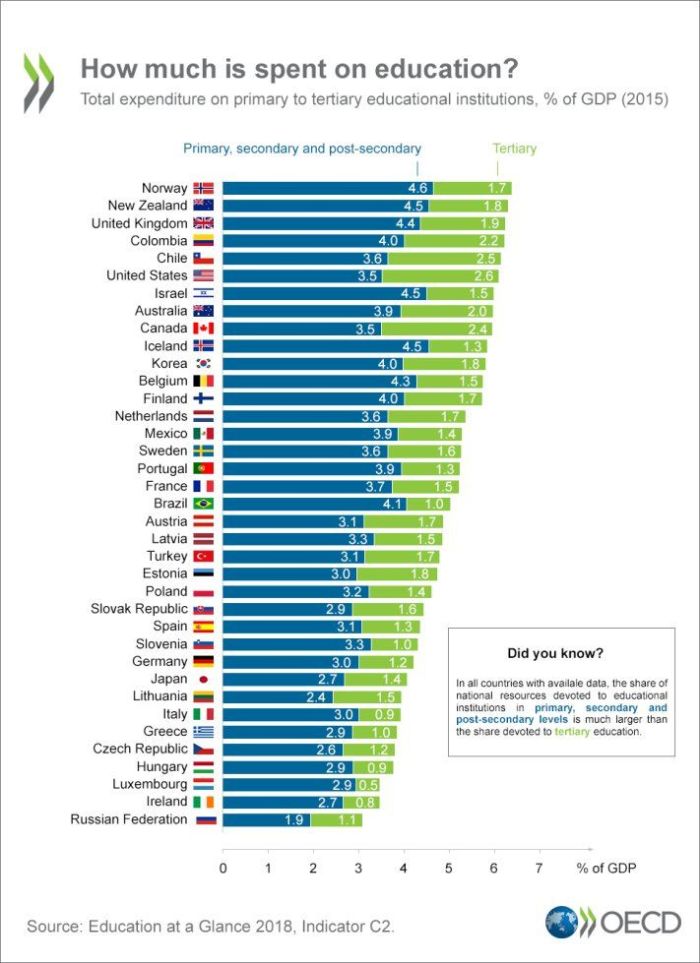
In some ways, it is quite a striking chart.  New Zealand devotes the second largest share of GDP to education of any OECD country, exceeded only by super-rich Norway (as far as I can see this is an estimate of total public and private spending).

And yet, once one looks even a bit more closer it is less interesting than it might have seen.  For example, at the other end of the chart both Ireland and Luxembourg have GDPs that are flattered by unusual effects –  in Ireland’s case, the impact of their corporate tax system (which ends up exaggerating the true economic value occurring in Ireland, and does not reflect value accruing to the Irish), and in Luxembourg’s case, the fact that a lot of the GDP arises from people who work in tiny (financial centre) Luxembourg but live across the border in various neighbouring countries (their kids won’t be using Luxembourg’s schools).

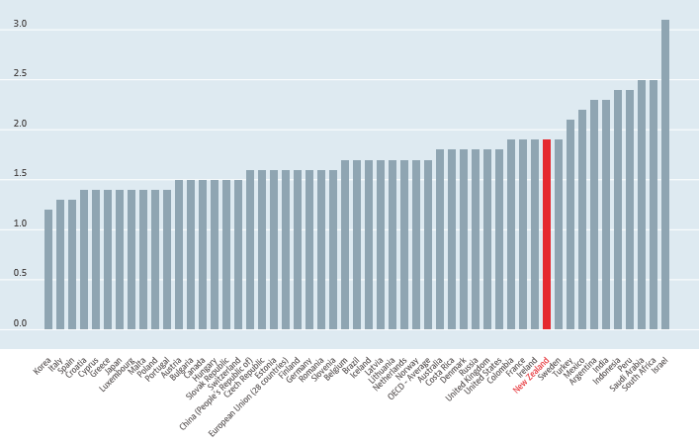
And in our case, who uses schools and universities?  Mostly children and young people, and if you don’t have many children you’ll need to spend less (as a share of GDP) on education.   As this chart shows, of the OECD countries only Turkey, Mexico and Israel have a higher total fertility rate at present than New Zealand does.   Our TFR this particular year was 1.9 (births per woman) while that for, say, Japan was about 1.4.  That makes a big difference to how much needs to be spent on schools (all else equal about a third more).  Iceland spends as much on schools as we do, but with quite a bit smaller a birth rate.

Total fertility rate (2016)
fertility-rates

And the other thing that marks us out relative to most OECD countries, although not all, is a high rate of immigration.  Not all migrants, by any means, have children with them when they move here (temporarily or permanently) but some do.  It all adds to the amount (share of GDP) needing to be spent on education.

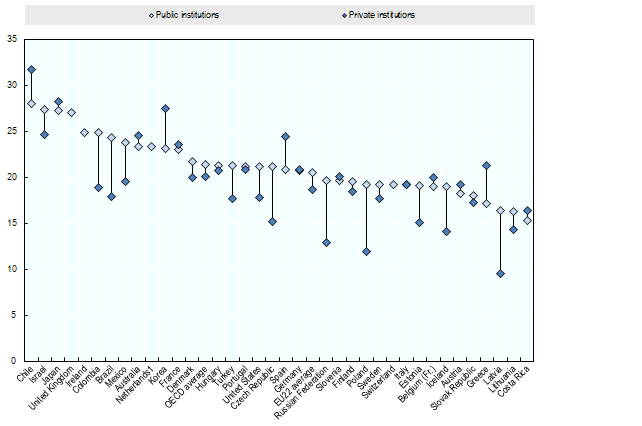
Both birth rates and migration rates are just one of those things that people doing education budgets just have to take as given.    The other thing that you’d expect to influence education spending quite substantially is class sizes –  even at tertiary level the old Oxford/Cambridge tutorial system is a lot more resource intensive than, say, stage 1 lectures with 350 young people with largish tutorials run by honours students. But there tends to be more of a focus on school class sizes.  Unfortunately, the charts in the OECD Education at a Glance publications don’t have New Zealand data for pupil/teacher ratios, but here is the chart.

Average class size in primary education, by type of institutions (2016)

ratios

What I found striking is how wide the range of practices is.  It isn’t just that richer countries have smaller class sizes –  Chile is at one end and Costa Ricas at the other –  even though my understanding of the educational research is that smaller class sizes is mostly just a luxury item, with little or no impact on educational outcomes.   Shifting from one end to the other is likely to have significant implications for the cost of primary school education.  I have no idea where New Zealand would sit on the chart: I’m always a bit surprised how small my children’s class sizes have been, but that probably just marks me out as an old fogey, recalling classes in the mid-high 30s back in the early 1970s.

I don’t have any particular conclusion to this post, other than the caution that a high share of GDP devoted to schooling sheds –  on its own – precisely no light on the reasonableness, or otherwise, of the teachers’ claims, and their strike.  Having said that, I’d have preferred my daughter’s Principal not to have been using public resources to email us all urging parents to support the industrial action, join the protest rally etc.

More thoughts on financial crises and economic performance

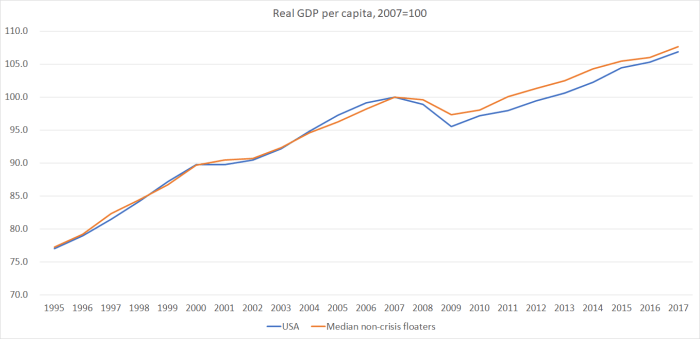
In my post yesterday, focused specifically on Geoff Bascand’s speech on financial stabilty, financial crises etc, I used this chart

crisis costs

to, again, raise questions about just how much of the poor economic performance over the last decade or so can really be ascribed specifically to the financial crisis (bank failures, large loan losses etc).  After all, the US was the epicentre of the crisis, and my other group of countries (long-established advanced countries, also with floating exchange rates –  Australia, Canada, New Zealand, Norway, Israel, and Japan)  didn’t have domestic financial crises.

I’d been playing around with that data with a view to writing a post about an article in the latest issue of Foreign Affairs, The Crisis Next Time: What We Should Have Learned from 2008″, by Carmen and Vincent Reinhart (she an academic researcher, and he a senior market economist and formerly a senior Fed official).    The Foreign Affairs website is having open access this month, so the link should work for anyone wanting to read the (accessible and not overly long) article itself.

I thought the article was a bit of a mixed bag (and this post ends up only partly being about the article).  Carmen Reinhart, in particular, has been at the forefront of efforts to remind that recessions associated with financial crises are often more severe than other recessions.  That is a useful reminder, but hardly surprising.  Mild recessions tend not to generate many loan losses, and even if the banking system wasn’t rock solid in the first place, nothing too serious is likely to follow.  But if resources have been severely misallocated in the first place, supported by ample new credit, then when the correction occurs –  and views about what is profitable have to be revised –  it isn’t surprising that the associated recession can be deep and the financial system can come under stress.  In New Zealand, for example, it wasn’t the financial system crisis (failure of DFC, repeated near-failures of the BNZ) that made the 1991 recession so serious; rather than pressures on the financial system were part of the same aftermath of excess –  over-inflated expectations – that the entire economy was caught up in, combined with some serious efforts to break the back of high trend rates of inflation.

As the Reinharts point out, the problems can then be particularly severe in a country that has few or no macro policy levers left open too it –  a fixed exchange rate or a common currency, tied to the fortunes of a group that may not share the particular problems you did (thus, for example, Ireland in a euro-area in which Germany is the largest economy).  Adjustment can be a lot slower without the ability to adjust the nominal interest and exchange rates.  Perhaps more than the authors, I’m a sceptic on the euro.

For my purposes, there is a convenient couple of sentences in the Reinhart article

Financial crises do so much economic damage for a simple reason: they destroy a lot of wealth very fast. Typically, crises start when the value of one kind of asset begins to fall and pulls others down with it. The original asset can be almost anything, as long as it plays a large role in the wider economy: tulips in seventeenth-century Holland, stocks in New York in 1929, land in Tokyo in 1989, houses in the United States in 2007. 

It usefully highlights a key difference between, say, the US (or Ireland or Iceland) late last decade, and the experiences of the group of non-crisis floating exchange rate countries whose experience is reflected in that first chart above.   Stock markets in those latter countries took a short-term hit, of course, but there was no sustained loss of (perceived) wealth akin to what happened in the crisis countries.

It isn’t entirely clear from the article how much the authors want to focus mostly on the depth of the initial recession and how much on the disappointing economic outcomes in many countries over the last decade.  But both are mentioned, and there seems to be a tone that conflates the two in a way that I’m not surely is overly helpful (given the goal of learning lessons that can help better prepare us for future severe adverse events).  There also seems to be a very strong focus on the demand side, and none at all on the supply side (no mention at all of productivity growth).

And yet, if we look across the OECD as a whole, the unemployment rate was right back down to where it had been in 2007.  If (and there is) a disappointment about the last decade as a whole, it can’t be now about excess labour supply (unemployed workers) –  slow as the unemployment rate was to come down, it did eventually.  As it happens, the unemployment rate in the US (epicentre of the crisis) is now lower than in the median of my non-crisis floating exchange rate group –  which wasn’t the case in the years running up to 2008.

I have plenty of criticisms for the way many central banks (including our own) handled the years after the 2008/09 crisis and recession.  In some cases, actually tightening when it wasn’t necessary or appropriate, and often a hankering for some sort of return to “normal” interest rates (that may have prevailed in the previous couple of decades) when as has become increasingly apparent something about what is “normal” has changed.  Throw in the lack of any pro-activity in addressing the existence of the near-zero lower bound on nominal interest rates (itself arising from regulatory and legislative choices), and it is clear that more could –  and should –  have been done in many countries.

But even if such changes (in macro policy) had been made, the differences in economic outcomes would probably have been at the margin:  helpful (eg in a New Zealand context, getting core inflation back to 2 per cent, and getting unemployment down to the NAIRU perhaps two or three years earlier), but it is unlikely that it would have made much difference to productivity growth, or indeed to levels of real GDP per capita today.

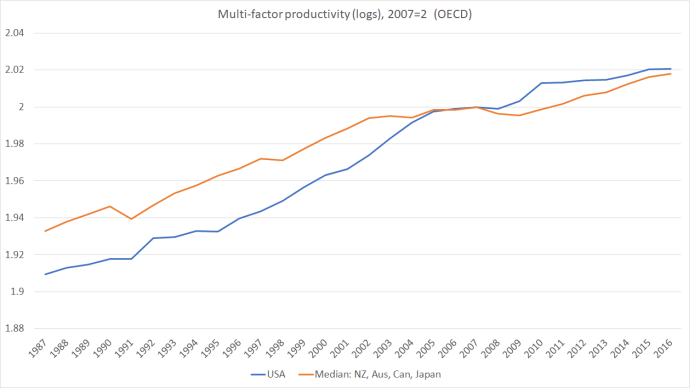
In yesterday’s post, I showed a chart comparing labour productivity growth trends in the US (epicentre of the financial crisis) and in the group of non-crisis floating exchange rate advanced economies.  But what about multi-factor productivity?

The OECD only has MFP data for a subset of member countries.  Of my sample of non-crisis advanced countries, they don’t have data for Norway and Israel.  But here is the comparison for the US and the group of four non-crisis advanced countries, all normalised to 2007.

MFP crisis.png

In both cases –  although perhaps more starkly so for the non-crisis countries –  it is clear that the slowdown in productivity growth was underway well before the recession (and crisis).  The financial crisis (centred in the US) cannot be to blame for something that is (a) apparent across crisis and non-crisis countries (especially when the non-crisis countries are less productive than the US to start with), and (b) when the phenomenon got underway before the crisis or recession did.

(The Conference Board Total Economy database does have MFP estimates for my full group of non-crisis countries.   They use a different model to estimate MFP, but the same two key observations hold in their data: the slowdown was apparent in both lots of countries well before the crisis/recession, and (if anything) the US has done better than the non-crisis group both before and since its crisis.)

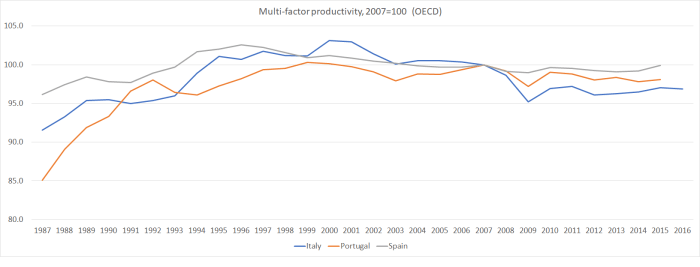
But what about some of the euro-area countries you ask?  And the Reinharts themselves rightly point out how poor the economic performance of Italy (and Greece) has been.  The OECD doesn’t have MFP estimates for Greece, but here are the estimates for three other embattled euro-area countries: Portugal, Spain, and Italy.

MFP crisis 2

All three countries have been in deep trouble for a long time now –  the estimated level of MFP peaking around 2000.   On this score, the trends don’t look materially different over the last decade than over the years leading up to 2007.    Whatever the cause of their problems with productivity, it can’t have been the financial crises these countries went through.

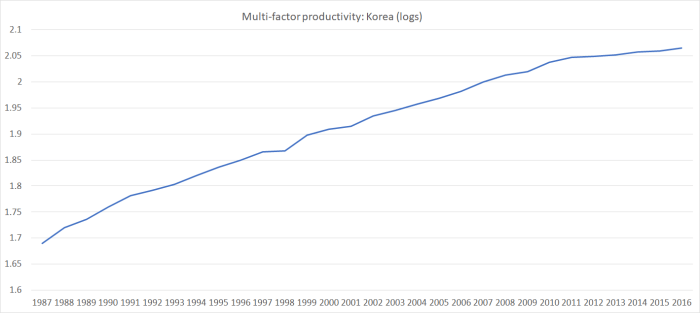
And perhaps nor would you expect it.  Readers might recall a wrenching financial crisis that Korea went through in 1998.   And here is the OECD estimate of multi-factor productivity for Korea.

mfp crisis 3

You can see the 1998 crisis/recession in the data, but as a short-term blip.  In the decade after the crisis, Korea productivity growth kept on at much the same rate experienced in the decade prior to that crisis –  before (presumably) joining in the global slowdown this decade.  (That had also been the experience of the United States in earlier crisis episodes –  estimates suggest that the 1930s, for all its problems (around demand shortfalls) was a period of strong MFP growth.)

There is lots to learn from the searing experience of crisis, recession, and slow growth in the advanced world over the last decade or more.   But I still reckon there needs to be a much more careful unpicking of the different strands of the story than central bankers –  who tend to see the world through money and finance lenses, and who are often keen to champion their future role –  are prone to.  To me, the cross-country evidence just doesn’t square with a hypothesis in which the financial crisis itself plays any large part in the sustained disappointing performance of so many countries over what is now such a long time.

Central bankers meanwhile might be better off rethinking the merits of arrangements like the euro, or of the continued passivity around the near-zero lower bound, both of which look as though they have the potential for causing very major problems the next time there is a serious economic downturn.

Reserve Bank whimsy

I was meeting someone in town this morning. I was a bit early and the person I was meeting was a bit late so I found myself standing for some 20 minutes across the road from the Reserve Bank.   As I did, I became a bit curious about these four guys.

orr1

In the entire time I watched them, this is all the activity there was (the chap with his hand on the cone).

Most of the Bank’s building is apparently still closed as a result of the asbestos scare, although the ground floor museum has now reopened.  But it isn’t at all clear what these guys were doing.  Access to the turning circle is now controlled (remotely) by those metal bollards, and although there will probably be billions of dollars of notes in the vaults, electronic security systems –  and big thick steel doors and walls – will be guarding that.  They weren’t acting as a guide to members of the public –  various people walked up the main steps into the museum while I watched and none interacted with the security men.  They seemed to be just standing there.  And when I walked past again 45 minutes later, they were still there….just standing.  Is the Bank a bit overfunded, or is it just the average productivity in New Zealand is so low that labour intensive operations (accomplishing what?) are still affordable?

I’ve commented here on the new Governor’s enthusiasm for all manner of green causes.  But he seems to be doing his bit personally, or maybe just saving a few dollars for the staff cafeteria.  Someone pointed out to me that the Bank now has a dinky little vegetable garden right on the corner of Bowen St and The Terrace.  I guess the space is too small for a tree?

orr2

On a slightly more serious note, readers will recall that a few weeks ago the Governor was billed as giving a speech on transparency, to the annual meeting of the (largely) taxpayer-funded lobby group Transparency International, to be introduced by the State Services Commissioner (who has responsibilities for open government)……..and yet the speech was to be totally non-transparent (no text published).    Potential attendees were told that the Governor was to be thanked by the head of the Department of Prime Minister and Cabinet, Andrew Kibblewhite, who is shortly to take up the job of Secretary for Justice, with responsibilities for the Official Information Act.

As it happens, the newsletter of Transparency International dropped into my inbox the other day.  It featured a report of the Orr address.

Guest Speaker: Adrian Orr

Guest speaker, Governor of the Reserve Bank of New Zealand (RBNZ), Adrian Orr, was introduced by Adrienne Meikle, CEO of the Commerce Commission. Noting that people referred to her as “the other Adrienne” she augmented her introduction with comments about the key priorities of the Commission.

The RBNZ Governor provided a most insightful, off-the-record address with ideas to stimulate thinking about the relevance of transparency, accountability and integrity for more-effective governance.

The vote of thanks was delivered by Lyn McMorran, Executive Director of the Financial Services Federation, who has contributed an account of Adrian’s presentation below.

Perhaps Peter Hughes and Andrew Kibblewhite were just too busy in the end, or did they get cold feet about being associated with such a travesty –  the secret speech on transparency by a public official, to a (publically funded) transparency and governance lobby group?

Senior officials, in roles that are closely followed by markets etc, really shouldn’t be doing “most insightful” off-the record addresses.  If the speaker can’t be bothered writing a full text he or she can do as the Reserve Bank of Australia does and make an audio or video record available.

As it happens, Ms McMorran has given us a summary of this “off-the-record” address.  Here is an extract (emphasis in the original)

He said, however, that often constructs within society work against us doing the right thing. In terms of transparency he said that what gets measured gets managed. Too often what is measured are things that are short term and that managers are often being incentivised for the start line not the finish line.

It is, therefore, crucial to get the horizon right – determine what outcomes we want over time – horizons that matter.

Another excellent point Governor Orr made was about the principal/agent phenomenon where a manager owns the capital but is highly divorced from the managers and the managers of managers to whom they outsource this capital and it is hard for the person at the top to know how ethical all the layers are within their organisation.

Same old themes –  especially the bit about time horizons, where the Governor seems still to be convinced that he knows better than citizens and markets what timeframes are relevant for what sorts of institutions/issues.

Under the Official Information Act I also asked the Bank for the speech or –  if no full record existed –  a summary of what was said (memories are official information too).  For completeness, here is the summary I received.

Governor Orr did not use any notes for his speech but drew upon:

An outline of the speech from Governor Orr’s recollection, is as follows:

  1. Thanks for the invite.
  2. Congratulations on your work to raise transparency as a means of ensuring integrity in peoples/firms/governments behaviour.
  3. Property rights sit at the basis of a sound functioning economy.
  4. Macro stability is also very useful (monetary and fiscal policy).
  5. Microeconomic incentives to invest productively are also necessary (human and physical capital investment).
  6. 3-5 (above) are endogenous inputs to economic growth (see Conway and Orr, RBNZ Bulletin 2000).
  7. Transparency assists 3-5 occur – as it reduces the likelihood of some forms of ‘market failure’ – myopia, asymmetric information, time inconsistency in policy, and principal-agent issues.
  8. Even if people don’t aim to create bad outcomes, market failure can lead to sub-optimal outcomes.  Likewise, market intervention can suffer the same issues.  Hence, commitment and transparency can reduce these risks.
  9. Applause and thanks.

There were no questions as there wasn’t time.

I remain less interested in the specific substance of the speech than in the principle of openness.  Private fee-paying audiences shouldn’t have better access to the Governor’s views or insights than the wider market or public audience.


Armistice Day

Sunday is Armistice Day –  Remembrance Day if you like – the 100th anniversary of the end of that four year conflict now known as World War One; the one some had hoped really would be the war to end all wars.  It isn’t a day for relitigating the politics, or even for analysing the economics, but for calling to mind and remembering those who died and the sacrifice they made.  In most cases, at least from this part of the world, they were volunteers.

I don’t have direct ancestors who died in World War One, or even siblings of my ancestors.  But when I reflect on the sacrifices of New Zealand servicemen, I think of my grandmother’s cousin, (temporary) Captain Robert K Nicol of whom I’ve learned a little  in the last few years.   As it happens (we generally not being a Wellington family), he attended the same primary school as my children, and the same Baptist church congregation that my family is part of today.     After all the analysis people like me are prone to, connections like that bring it all closer.

Here is the war memorial bell, still there, at Island Bay school

island-bay-school-war-memorial

Robert Nicol probably left school quite young and by the time the war broke out he was a painter –  nothing out of the ordinary, and from what accounts there are no particularly special skills.

He served in Gallipoli and then in France (by then a second lieutenant) where in late 1917 he was awarded the Military Cross.   The citation for that award read

For conspicuous gallantry and devotion to duty. When in charge of Stokes mortars in defence of a captured village one of his two gunds was destroyed, so he handed the other on to his Corporal and joined the company, which was in the village. Here he displayed magnificent gallantry and the utmost fearlessness in assisting the company commander, personally leading a bombing party against an enemy counter-attack, and accounting for six of the enemy himself in the desperate hand-to-hand fighting which ensued. His prompt action and fine leadership saved the situation.

The medal was awarded at Buckingham Palace by George V himself.

Nicol was then recruited to serve in a special British Army unit, which came to be known as Dunsterforce (commanded by a Major-General Dunsterville).  As a Herald article a few years ago recorded it.

Nicol, assigned the rank of temporary captain, had a solid reputation as a capable officer, handy with the Lewis gun and Stokes mortar and a skilled bomb instructor. It made him a perfect candidate, with 23 other New Zealanders, for special service with the British Army.

With volunteers from Australia, Canada and South Africa, the small band of brothers – the War Office had in mind a secret force of 100 officers and 200 NCOs – had a mission to block the Bolsheviks from the Caucasus.

It was a perilous and risky initiative – the NZ Rifle Brigade History notes the men were told when they assembled that few could hope to come through alive.

After Russia’s exit from the war, Dunsterforce’s role was

After crossing Europe as far as Italy, the soldiers boarded a ship for the Suez Canal and round to Basra before heading up the River Tigris to Baghdad in what was then Mesopotamia. The task set for Dunsterforce was ambitious: to blunt Turkish and German expansion reaching the rich Baku oil fields on the Caspian Sea.

The strategy involved the small Allied unit persuading Georgian, Armenian and Assyrian forces to hold the line against the rampant Turkish armies.

You can read a fair amount about the adventures of Dunsterforce, including the attack on Baku, in various on-line documents, including Appendix V of the official history of the New Zealand Rifle Brigade.    Another branch of Dunsterforce, including Captain Nicol, was in Iran (then Persia)

Hemmed in along the western shores of Lake Urumiah were some 80,000 survivors of the Nestorians, or Christian Assyrians, a thriving people that at the beginning of the war had occupied the fertile lands between the two lakes. Though reduced by repeated massacres they had succeeded in holding their own here against the Turks; but now their ammunition was running short, and utter annihilation stared them in the face. On learning of their predicament the British authorities made arrangements to send up supplies under cover of a sortie by the Assyrians, and, on July 19th, six officers and fifteen non-commissioned officers of Major Starnes’s detachment set off from Bijar with the ammunition, an escort of Hussars from Hamadan accompanying them. They were to be met half-way by a small column of mounted Assyrians, but after waiting at the rendezvous for some days without news of any movement they were unexpectedly joined by the bulk of the Assyrian army, numbering some 10,000, who had inflicted a somewhat severe blow upon the Turks. The engagement, however, had taken longer than was anticipated, and, in the absence of the fighting men, the remainder of the Nestorians became panic-stricken and began to rush southwards along the road on the heels of the army. Now the latter in their turn became infected, and there ensued a frightful and disastrous rout. Presently wounded women and children began to straggle in. This sight was too much for the Dunsters, and three officers and three sergeants, taking Lewis guns and a liberal supply of ammunition packed on baggage-mules, moved back along the human stream until they encountered the Turko-Kurdish brigands at their foul work of slaughter. Fighting, withdrawing, and fighting again, in a series of rearguard actions lasting all through a day and a night, these six brave fellows kept at bay a force of over 200 strong, until the arrival of a detachment of Hussars finally relieved the pressure. In this gallant action Captain R. K. Nicol, M.C., of the Wellington Regiment, lost his life.

A record from a publication of the Western Front Assocation records

Robert Nicol exposed himself to enemy fire whilst gallantly attempting to save the mules which enemy snipers were picking off.  His body could not be retrieved from the battlefield.

It was 5 August 1918.

Ours isn’t primarily to judge the right or wrong of the actions, and causes, of those who went before us, but there is something very 21st century about a combat death while trying to get to safety a large party of civilian (religious minority) refugees.  Perhaps that is why there have been various articles (including this one) about Nicol –  just one soldier among so many – over recent years.

Captain Nicol died in Persia and there was no marked grave.  But –  strange to realise in this era when relations between Iran and the West have been less than warm –  there is Commonwealth War Graves Commission memorial in Teheran (I gather in the grounds of the –  large –  British Embassy compound). Captain R. K. Nicol is remembered there.

teheran memorial.png

And the Commonwealth War Graves Commission record

NICOL_ROBERT_KENNETH CWGC

And here is how he was remembered back home at church.

berhampore honours board

At this distance it is easy to focus on the geopolitics, the economics, the peace process, and the next war that came too soon afterwards. But, to me, anyway, this weekend is a time to remember those who served, those who – when circumstances were thrust upon them –  exercised such courage, and those who died.

From Binyon

They shall grow not old, as we that are left grow old:
Age shall not weary them, nor the years contemn.
At the going down of the sun and in the morning
We will remember them.

UPDATE (26/11)

An article about a new memorial, at Makara cemetery, to the involvement of New Zealanders –  including Nicol –  in defending the Assyrians, and another recent article about this events.

Some reading for Todd McClay

Perhaps naively, I’m still in shock at those comments the other day on the situation in the Chinese province of Xinjiang from National Party foreign affairs spokesman, former senior minister, Todd McClay.

“Abuses of human rights are a concern wherever they occur,” says National’s Foreign Affairs spokesperson Todd McClay, “however, the existence and purpose of vocational training centres is a domestic matter for the Chinese Government.”

Perhaps the million of so spies forced into Uighur households should, in Mr McClay’s reading, best be described as intensive case management of needy families?

I’d come to take for granted that our members of Parliament – all sides –  pretty much knew the evil the regime was up to at home and abroad, but preferred to look the other way, keep quiet, and get along (careers to advance, Beijing to buddy up to).  I didn’t suppose that senior politicians  –  on the public payroll, not that of Beijing-affiliated entities (that’s for too many retired politicians, here and abroad) – would be so shameless as to literally run PRC regime propaganda for them.

But who knows. Perhaps Todd McClay really does believe the regime narrative?  In which case, there was a useful little exercise by a Dutch academic popped into my inbox yesterday morning, courtesy of the US think-tank the Jamestown Foundation, using fiscal transparency, PRC version, to illustrate what is going on.   I had no idea there was such transparency in China.

He begins

In August 2018, the U.N. Committee on the Elimination of Racial Discrimination expressed its concern at reports the PRC had detained as many as a million members of Muslim ethnic minorities in extrajudicial re-education camps in the Xinjiang Uyghur Autonomous Region (XUAR). At the same meeting, the PRC flatly denied the existence of “re-education camps”, with United Front Work Department official Hu Lianhe arguing that “criminals involved only in minor offenses” are assigned to “vocational education and employment training centers to acquire employment skills and legal knowledge” (China Daily, August 14).

Perhaps that was what Todd McClay had been reading?

But the PRC government’s own budgets appear to contradict these assertions. Xinjiang’s budget figures do not reflect increased spending on vocational education in the XUAR as the region ramped up camp construction; nor do they reflect an increase in criminal cases handled by courts and prosecutors. Rather, they reflect patterns of spending consistent with the construction and operation of highly secure political re-education camps designed to imprison hundreds of thousands of Uyghurs with minimal due process.

It is tempting to reproduce some of his tables – I like tables but they might be detail too far.  But here are his summary observations from the Xinjiang government budget data

This article supports this conclusion through examination of official PRC budgetary figures, analyzing spending breakdowns at the regional, prefectural, and county levels to produce findings of unprecedented granularity. Among its most striking conclusions:

  • Spending on budget items that explain nearly all security-related facility construction rose by nearly RMB 20 billion (or 213 percent) in 2017
  • Vocational spending in Xinjiang actually decreased from 2016 to 2017, as widespread camp construction began.
  • Instead, camp construction has largely been funded by the same authorities that oversaw the recently-abolished system for re-education through labor.
  • Spending on prisons doubled between 2016 and 2017, while spending on the formal prosecution of criminal suspects stagnated.
  • Expenditures on detention centers in counties with large concentrations of ethnic minorities quadrupled, indicating that re-education is not the only form of mass detainment in the XUAR.

There’s more

The region’s so-called “vocational training” is arguably not substantially different from the former re-education through labor system, which was abolished because the PRC government deemed it inappropriate for a modern society governed by the rule of law (Zenz, September 6).

Moreover, Xinjiang’s so-called “vocational training” campaign has not actually improved employment outcomes among the campaign’s target population. Official reports note that in 2017, 58,500 “poor persons” found employment, 17 percent more than planned, but not a large increase from the 57,800 in 2016 or the 57,900 in 2015. The same figure for the first three quarters of 2018 was 38,800, equivalent to only 51,730 per year [6]. This data provides a powerful official counternarrative to what Xinjiang’s governor is claiming. Neither the 2017 nor the 2018 XUAR employment reports refer to the purportedly successful “vocational training centers”.

Before he concludes

These facts do not support the notion of a large campaign to improve vocational skills. Rather, the mass disappearances of Muslim minorities in Xinjiang, beginning in early 2017, almost certainly resulted in their imprisonment in de facto political re-education institutions administered by public security or justice system authorities. It is safe to assume that in 2017, billions of renminbi were spent on these highly secure facilities, where individuals undergoing “training” are involuntarily detained for indeterminate time periods. Furthermore, budget figures indicate that it is unlikely that many of the so-called “criminals involved only in minor offenses” underwent formal trials. It is therefore entirely inaccurate to label them “criminals”. Often, their only “offense” is being Muslim.

Whatever “employment training” these facilities provide is, evidently, not administered or paid for by the vocational education system. This would explain why teacher recruitment notices for the newly constructed re-education system do not require tertiary degrees or relevant skills, in stark contrast to genuine vocational education (Zenz, September 6).

The actual employment benefit of the camps’ re-education “training” is questionable. Quite the contrary: the real goal of Xinjiang’s “skills training” campaign appears to be political indoctrination and intimidation.

In a way it is sickening to even have to write this bloodless stuff.  Every honest and decent person with the slightest interest knows what this campaign is about –  and it isn’t better job opportunities.  But careful work like that of Adrian Zenz helps remove any sort of fig leaf that people like Todd McClay might try to use for cover.

And what of those million spies forced on Uighur households? I’d urge you to read the full story, which ends with this chilling reflection

The tyranny that is being realized in Northwest China pits groups of Chinese citizens against each other in a totalitarian process that seeks to dominate every aspect of life. It calls Han “relatives” into coercive relations with their Uighur and Kazakh hosts, producing an epidemic of individualized isolation and loneliness as families, friends, and communities are pulled apart. As new levels of unfreedom are introduced, the project produces new standards of what counts as normal and banal. The “relatives” I spoke to, who did the state’s work of tearing families apart and sending them into the camp system, saw themselves as simply “doing their jobs.”

I believed them. For the most part, they simply did not seem to have thought about the horror they were enacting. No free press was available to them. The majority of the people I interviewed simply did not know or believe that the reeducation camps function as a Chinese-specific form of concentration camps where beatings and psychological torture are common, or that Uighurs and other minorities tended to view being sent to the camps as a form of punishment. Only one of the 10 Han people from Xinjiang I interviewed believed that the camps were functioning as prisons for people who were guilty of simply being in the wrong religious and ethnic categories. It is also important to remember when writing about Han civilian participation in the mass detention of Muslim minorities, as David Brophy and others have noted, that Han civilians who resist state policies toward Uighurs put themselves in serious danger. As one of my Han friends from Xinjiang told me, in this part of the world the phrase “where there is oppression” is met not with the phrase “there will be resistance,” but rather, “there will be submission.” Given the totalitarian politics of the Xinjiang police state, Han civilians in Xinjiang often appear to feel as though they have no choice but to participate in the state-directed oppression of Muslim minorities.

Citizens of totalitarian states are nearly always compelled to act in ways that deny their ethical obligations. In order for a grass-roots politics of Han civilian refusal of Chinese state oppression of Muslims to even be imaginable, what is taking place in Northwest China needs first to be accurately described. As Hannah Arendt observed decades ago, systems like this one work in part because those who participate in them are not permitted to think about what they are doing. Because they are not permitted to think about it, they are not able to fully imagine what life is like from the position of those whose lives they are destroying.

Perhaps Todd McClay thinks this is all made up too?  If so, I can only do that rare thing and urge him to read the strident ultra-nationalist spinoff of the People’s Daily, the Global Times, where the story a couple of days ago was.

1.1 million civil servants in Xinjiang pair up with ethnic minority residents to improve unity

Northwest China’s Xinjiang Uyghur Autonomous Region has implemented the pairing and assistance program between officials and the ethnic minority citizens to promote communication and interaction among different ethnic groups in Xinjiang.

Until September 2018, some 1.1 million civil servants have paired up with more than 1.69 million ethnic minority citizens, especially village residents, People’s Daily reported on Wednesday.

The report said that various administrative departments, enterprises from the central government and military departments, including the Xinjiang Production and Construction Corps and Xinjiang Armed Police Corps, have made over 49 million visits to local residents. The number of activities themed “ethnics unite as a family,” held by these departments, reached more than 11 million.

“The pairing and assistance program has been implemented for two years, which is a successful practice for Xinjiang,” Zhu Weiqun, former head of the Ethnic and Religious Affairs Committee of the National Committee of the Chinese People’s Political Consultative Conference in Beijing, told the Global Times on Wednesday.

Besides promoting the unity of different ethnics in Xinjiang, Zhu noted that the program is beneficial to both the masses and civil servants in Xinjiang, as it helps officials get close to the grassroots level of Xinjiang society, bringing advanced technology and views to rural districts, which can solve their life difficulties and develop the productivity.

“It can also help officials of Xinjiang to improve their serving conscious and capabilities,” he added.

Zhu pointed out that the program should be insisted for a long time in accordance with the practical need.

The program began from October 16 in 2016, encouraging civil servants to interact actively with the masses in Xinjiang through various methods like pairing and regarding as relatives.

It is a sickening level of repression, intimidation, destruction of families, of faith, or cultures, and so on.  And that is before one gets onto the bird-like spy drones (which initially sounded a bit fanciful, but the story is fron a regime-sympathising Hong Kong newspaper) the movement restrictions, the forced organ transplants and so on.

That’s unambiguously sickening.  But so is senior elected politicians in a free Western state –  who know better – trying to minimise evil, spin the regime propaganda, and provide cover for one of the worst regimes on the planet.  Without any legitimate excuse whatsoever.


Inching towards greater transparency

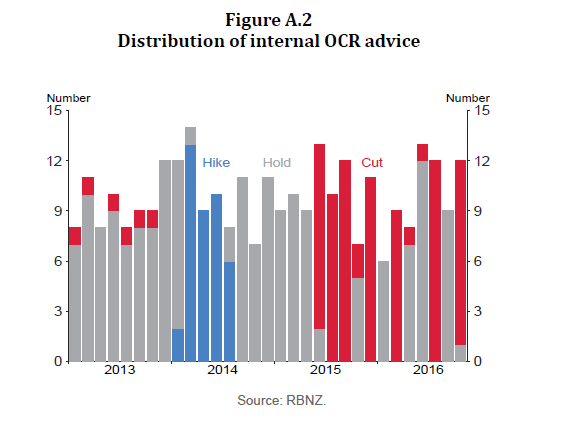
Several years ago the then Reserve Bank Governor went public when there was some criticism around an OCR decision (more so about communications surrounding it) telling us that all his advisers had on that occasion supported his decision.   A group of senior staff provide written advice at each OCR decision.

If it was good enough for him to disclose such information when it suited him, I thought it should be fine to have the information disclosed routinely, including for OCR decisions some time in the past.  I lodged an OIA request accordingly.

Not that surprisingly, given the Bank’s approach to the OIA, I didn’t get anywhere.  They refused to release any other information about previous OCR decisions and, a bit more surprisingly, [as I recalled things, but see below] they managed to get the Ombudsman to provide cover for their refusal.

But in this morning’s Monetary Policy Statement we find almost exactly the data I requested 2.5 years ago, in the form of this chart.

OCR advice

Kudos to the Governor for releasing the information, even (a) this belatedly, and (b) only for the period to the end of 2016, which is now two years ago.  We still have no idea what the balance of advice has been over the last couple of years, most of which wasn’t even in the current Governor’s term.  But it is better than nothing.

I was among this group of advisers up to and including the March 2014 decision –  where I’m pretty sure I was the grey vote (opposed to the OCR increase).

Given that the Governor has now released so much information, I’m tempted to lodge another OIA request for the more recent information –  there cannot possibly be any market sensitivity or other problems (defensible under the Act) in knowing that (say) one advisor out of ten favoured an OCR cut six months ago –  but as the legislation is about to change perhaps I will leave it for now.

The Governor goes on to note that

Generally, there was a clear majority in the balance of advice. Should the current Reserve Bank Amendment Bill become law, our intention would be to publish the formal votes of the Monetary Policy Committee each time a vote is taken. It is envisaged that a vote would not be called for every meeting, but only when needed.

I found this mildly encouraging, Until now that rhetoric has tended to emphasise very heavily the consensus model the previous Reserve Bank management favoured (under which any differences of view –  inevitable in a well-functioning organisation dealing with so much uncertainty –  would be obfuscated and kept secret).  At least now there is a straightforward explicit statement that the formal votes will be published when such votes are taken.   It still isn’t too late for the select committee looking at the bill to amend the legislation to require votes to be taken, and require the number of votes for each position to be published.

There is still a long way to go in getting the Reserve Bank to the point of operating transparently, even reaching (say) the level managed by the Treasury through the Budget process.  I still have an Official Information Act request in, now with the Ombudsman, over the Reserve Bank’s refusal to release background papers underpinning claims it made (including around KiwiBuild) in last year’s November Monetary Policy Statement.   The Bank has long argued that it would be destabilising, undermining the effectiveness of policy, if anyone ever saw any internal background papers.    They claim, citing the OIA itself, that the substantial economic interests of New Zealand would be damaged.

Some months ago the Ombudsman advised a preliminary view that would have continued his office’s longstanding practice of allowing the Bank to keep almost anything associated with monetary policy secret.  I made a submission in response that highlighted what appeared to be a serious inconsistency in the way, for example, budget papers are treated.  This was some of what I wrote

In general, I think Mr Boshier’s provisional decision, if allowed to stand, would seriously detract from effective accountability for the Reserve Bank, and in particular would expose the Bank routinely to less scrutiny and challenge than Cabinet ministers or government departments receive.  That cannot be the intention of the Act.    That parallel doesn’t seem to have been taken into account at all in the draft determination.
Thus, Cabinet papers underpinning key government announcements are frequently released, sometimes in response to OIA requests and at other times pro-actively.  But so too is advice to a Cabinet minister from his or her department.  That is so even when, as is often the case, officials have a different view on some or all of the matters for decision from the stance taken by the minister.   A classic example, of course, is the pro-active release of a great deal of background material, memos, aide-memoires etc compiled and submitted as part of the Budget formulation process.  Many of the working papers in that case may never even have been seen the Secretary to the Treasury but will have been signed out to the office or minister at the level of perhaps a relatively junior manager.  Many will have been done in a rush, and be at least as provisional as analysis the Governor receives in preparing for his OCR decision.  I’ve been personally involved in both processes.
Is it sometimes awkward for the Minister of Finance that his own officials disagreed with some choice the minister made?  No doubt.  Do ministers sometimes feel called upon to justify their decisions, relative to that official alternative advice? No doubt.  But it doesn’t stop either the provision of such dissenting (often quite provisional) analysis and advice, or the release of those background documents.
The sorts of arguments the Reserve Bank makes, and which Mr Boshier appears to have accepted, could well be advanced by Cabinet ministers (eg clear messaging about this or that aspect of budgetary or tax policy –  all of which are substantial economic interests of the NZ government).  If they have advanced such arguments, they have generally not succeeded.  And nor should they.  Doing so would undermine effective accountability or scrutiny, even though the Minister’s formal accountability might be to Parliament (he has to get his Budget passed).
The relationship between the Minister and his or her department officials is closely parallel to that between the Governor of the Reserve Bank –  the sole legal decisionmaker (who doesn’t even have to get parliamentary approval of his decisions) –  and the staff of (in this case) the Economics and Financial Markets departments of the Bank.  One group are advisers, and the other individual is the decisionmaker.  The fact that they happen to both part of the same organisation, doesn’t affect the substantive nature of that relationship.   Manager and senior managers in the relevant departments are responsible for the quality of the advice given to the Governor, in much the same way that the Secretary is responsible for Treasury’s advice to minister (and at his discretion can allow lower level staff to provide analysis/advice directly to the Minister or his office.   I would urge you to substantively reflect on the parallel before reaching your final decision, including reflecting on how (if at all) official advice on input to the OCR is different than official advice (including supporting analysis) on any other aspect of economic policy.
Mr Boshier’s argument about potential damage to substantial economic interests itself seems insubstantial, and displaying little understanding of how financial markets (and the market scrutiny of the Reserve Bank) work.  It also appears to be based wholly on official perspectives; officials who will routinely oppose transparency (except as they control it).    All those who follow, and monitor, the Reserve Bank recognise that there is a huge degree of uncertainty about any of the assumptions the Bank (or other forecasters) make, Indeed, the Bank itself stresses that point.    Markets trade changing perceptions of the outlook all the time, each piece of new data slightly adding to the mix.   Most monitors of the Reserve Bank (many of whom have previously worked for the Bank) recognise the distinction between analysis and advice, provided as input to the Governor, and the Governor’s own final decision and communication thereof.    And since markets –  and the Bank –  know that any projections are done with huge margins of uncertainty, the pretence that economic outcomes could be substantially damaged by people knowing there were a range of views or analysis is almost laughable.  Again, there is also a distinction to be considered between possible institutional interests of the Reserve Bank and the substantial economic interests of New Zealand.   You seem to treat those two sets of interests are the same thing, but they are not.

Given that some more months have now passed I hope the Ombudsman is seriously considering these arguments.   But whether he is or not, I call on the Governor to take seriously his words about greater openness and more transparency, and put in place proactively a new regime (perhaps for the new MPC) in which staff background papers provided to the Governor and MPC are released, with a suitable lag (perhaps four to six weeks) as a matter of course.  Doing so would be a significant step forward, and should help to boost market and public confidence in the Bank.  It wouldn’t be terribly radical; it is pretty much what is done for the government’s Budget each year.  Perhaps the new Treasury observer could explain to his Bank colleagues how it works, and how Treasury continues to function, continues to offer free and frank advice, even knowing that in time the background work will most probably be open to scrutiny.  It is how open democracies, open societies, should work.

I might have some other thoughts tomorrow on more substantive aspects of the Monetary Policy Statement.

UPDATE:  Well, it seems that credit is due to the Ombudsman not to the Governor. A few minutes after putting this post, I received this letter from the Bank

Dear Mr Reddell

At the invitation of the Chief Ombudsman, the Reserve Bank has reconsidered your request for the aggregate numbers of MPC members favouring each rate option for each OCR decision since mid-2013. You made this request on 14 March 2016.

On the basis that the requested information has become sufficiently historic, the Reserve Bank has decided it can now release the information. You can find the information on pages 13-14 of today’s Monetary Policy Statement at the following web address www.rbnz.govt.nz/monetary-policy/monetary-policy-statement.


Perhaps standards are different in Rotorua?

When you think that our politicians can’t sink much lower when it comes to matters related to the dreadful regime in Beijing all one has to do is wait another day or two.

Stuff has a major piece (a double page spread in this morning’s Dominion-Post) about the situation of the Uighur people in Xinjiang province in China, focusing on the stories of some of the Uighurs now living in New Zealand.

But what I wanted to highlight was the reaction of our politicians, National Party foreign affairs spokesman (and MP for Rotorua) Todd McClay in particular (emphasis added).

Ardern’s office didn’t respond to questions. Foreign Affairs Minister Winston Peters is overseas and also couldn’t comment.

“Abuses of human rights are a concern wherever they occur,” says National’s Foreign Affairs spokesperson Todd McClay, “however, the existence and purpose of vocational training centres is a domestic matter for the Chinese Government.”

McClay adds that “if credible evidence of human rights abuses came to light,” National would expect the government to “make representations to China through formal channels”.

The Chinese embassy did not reply to any questions about the issue.

So neither the Prime Minister nor the Foreign Minister would comment (in this era, being overseas is not a justification for saying someone “couldn’t” comment).    We saw the Prime Minister’s own feeble stance on this issue a couple of weeks ago

She said she might raise her concerns at a future meeting with Chinese officials, but made no firm commitment.

But McClay’s stance plumbs whole new depths.   Had he said “look, we know Beijing is an awful regime and often treats its citizens abominably, but we really want an upgraded FTA”, that would be bad enough, but at least it would be honest.  Instead he adopts the chilling language of the regime itself, suggesting that these (forced) internment and indoctrination camps are “vocational training centres”, and that the accompanying intense surveillance and control regime (electronic surveillance, let alone the government spies Uighur families are forced to host in their own houses) is just as nothing.  Does he suppose that the million of so people locked up in these centres are there voluntarily?  What bits of the evidence of systematic abuse and repression does he not believe?  Or, more probably, does he just not care?

All manner of brutal regimes have had Western apologists.  But history tends not to look very kindly on them.   And this man sits in our Parliament –  alongside Jian Yang –  aspiring to again be a senior Cabinet minister.  In my view, anyone that senior who sinks that low should never be allowed anywhere near the reins of government.  He disgraces himself, and disgraces a once-decent and honourable party.  The same party whose current leader last year, as a senior government minister, signed up with Beijing to some sickening aspiration to a “fusion of civilisations”.

To be clear, the current government seems no better, content to sit by as evil happens, even if not quite so sickeningly crass in their wording as Todd McClay.

As the Stuff article notes, more or less in passing, China’s human rights record has been under review in Geneva this week (part of a five-yearly review that all UN members face).   I’m no great fan of the United Nations or its associated bodies, and the Human Rights Council seems to be mostly a sick joke.  Nonetheless, these forums –  the Universal Periodic Reviews –  do pose the opportunity for other countries to ask (openly) searching questions about evident or apparent abuses.    A leading US China scholar wrote about it on his blog

On Nov.6, the People’s Republic of China underwent its third UN Universal Periodic Review (UPR), which is a peer review at the Human Rights Council of China’s human rights record. Each country, ridiculously, only had 45 seconds to speak! All eyes were watching if China’s mass incarceration of Muslims in Xinjiang and related repression outside the detention prisons would be criticized. Many countries did speak out, including the U.S., Canada, Germany and the UK. The only Muslim country that raised this issue is Turkey. It is shameful that Muslim countries and their regional organizations have done so little to date. The PRC cleverly lined up a large number of sycophant states to sing its praises and take time away from states that wanted to be critical. (All UPR-related documents are here at the UN’s website.)  The PRC has moved relentlessly to increase its influence over the Human Rights Council while the U.S. has withdrawn from it. Accordingly, many countries, including developing and authoritarian countries that rely on China’s economic ties, lavished high praise on China’s human rights achievements, instead of treating the session seriously.

But in addition to the 45 seconds, individual countries could lodge written questions.  Many did.    From our traditional allies, there was (a selection in each case)

The UK asking

  • When will the Government implement the recommendations made by the UN Committee for the Elimination of Racial Discrimination regarding Xinjiang Autonomous Uyghur Region, including to: halt the practice of detaining individuals who have not been lawfully charged, tried, and convicted for a criminal offence in any extra-legal detention facilities; immediately release individuals detained under these circumstances; eliminate travel restrictions that disproportionately affect members of ethnic minorities; and provide statistics on the numbers of those held involuntarily in the past 5 years?
  • What steps is the Government taking to ensure that freedom of religion or belief, freedom of movement, and cultural rights are respected and protected for all religious and ethnic groups in China, particularly those in Tibet?
  • What steps is the Government taking to ensure that lawyers, activists, journalists and human rights defenders including Wang Quanzhang, Yu Wensheng, Jiang Tianyong, Li Yuhan, Gao Zhisheng, Tashi Wangchuk, Ilham Tohti, Wu Gan and Huang Qi are protected from harassment, mistreatment and discrimination, and that those detained for merely exercising their constitutional rights are released without delay?

And the US

  • Can China provide the number of people involuntarily held in all detention facilities in Xinjiang during the past five years, along with the duration and location of their detention; the grounds for detention; humanitarian conditions in the centers; the content of any training or political curriculum and activities; the rights detainees have to challenge the illegality of their detention or appeal the detention; and any measures taken to ensure that their families are promptly notified of their detention?
  • Can China clarify the basis for its apparent criminalization of peaceful religious practices as justification to detain people in these political “re-education” camps in Xinjiang, as well as which officials are responsible for this policy?
  • Since the Chinese constitution guarantees religious liberty, what steps is China taking to stop the continued repression of religious freedom, such as increasingly strict regulations being passed or proposed on religious activity China has passed or proposed, the detention and mistreatment of Falun Gong practitioners, and the church closure and demolition campaigns seen in multiple provinces throughout the country?
  • What is China doing to end the unlawful practices of torture, secret detentions, and detention without due process halt the practice of detaining individuals who have not been lawfully charged, tried and convicted for a criminal offense in including Wang Quanzhang, who has been held incommunicado for over three years without an open trial, and Swedish citizen Gui Minhai, who was released in 2017 and redetained in January 2018?

And Australia

·                 Paragraph 4 of China’s 2018 National Report states that “there is no universal road for the development of human rights in the world”, with the relevant section headed “human rights with Chinese characteristics”; in contrast China’s 2013 report stated “China respects the principle of universality of human rights”.

Does China still accept the principle of universal human rights, and if not, can China explain how its conception of human rights fits into the international human rights regime built on the concept of universality? Can China explain how “human rights with Chinese characteristics” differs from universal human rights, and if it does not, why it wishes to introduce this distinction?

 ·                 Australia is concerned about reports regarding the arbitrary detention of Uighurs and other Muslim groups in Xinjiang, and the lack of transparency and access for members of the international community, including monitors from the United Nations Office of the High Commissioner for Human Rights.

What steps is China taking to ensure that the concerns raised by the United Nations Committee for the Elimination of Racial Discrimination (CERD) are being addressed in an open and transparent manner?

And what of New Zealand?   Perhaps our diplomats used their 45 seconds in a courageous and searching intervention?  But there was no sign of any advance written questions.  No sign our government cares even a little.

It isn’t even as if this is some left vs right issue.  Human Rights Watch and the United Nations are alarmed by what is going on, but so (according to a piece in my inbox this morning) is the libertarian think-tank the Cato Institute.     Can we make a difference?  On our own no, although us speaking up (even quietly) would probably lead Beijing to sit up and take a bit of notice – if even their pet Caucasians (a description someone passed on) are willing to speak, perhaps we need some different tactics? – but sometimes you just have to do what is right.

I’m going to end as I ended a post last week

The Churchill quote – from his famous ‘iron curtain” speech – is very apposite, but in the specific New Zealand context, and the way our politicians court the regime and fear doing or saying anything even slightly controversial, the commentator’s own line was a nice place to end.

It comes back to the values, not bank balances, we want to have for ourselves and for our children.

Perhaps ethics, morality and decency mean something different in Rotorua. But I’m pretty sure it isn’t that.  It is just that they seem to mean something different at the top of our two main political parties.

The PRC and New Zealand: bits and pieces

For anyone who hasn’t yet listened to it I recommend Anne-Marie Brady’s interview with Wallace Chapman on Radio New Zealand last weekend.  Half-hour interviews are pretty rare, and this one gives a good flavour of the issues and concerns she has been raising since the publication of her Magic Weapons paper last September.  I’m not going to go over old ground again, but in listening to her I found four points worth noting:

  • she has been surprised by how slow the New Zealand official reaction has been to the material revealed in the Magic Weapons paper,
  • in discussing the Chinese-language media here, she noted that the Chinese Herald had initially reported her paper and also some of Matt Nippert’s Herald articles about Jian Yang.  She heard later that the editor had been called to Beijing to be straightened out, and that fresh people had been sent in.  There been no repeats of such deviations from the Party line (the PRC strategy to “harmonise” foreign Chinese language media with the line from Beijing) since.    She noted in passing how large the Chinese-language media is (in a population of only around 200000) , contrasting that with the straitened circumstances of the mainstream media in New Zealand.   “Who is funding them”, she asked.  The implied – if unstated – answer was pretty clear.   She sees this situation as itself a breach of New Zealand’s sovereignty.
  • she was asked about the description of New Zealand as the “soft underbelly of Five Eyes”.  As she noted, this wasn’t her description but the sort of line she heard repeatedly from the capitals of our traditional allies.  Of all that was in the paper, she suggested that this was the line that had riled official Wellington most.
  • asked about the (as yet unresolved) burglaries of her house and office, she was cautious about how much she said, but was clear that in her view there were unmistakeable indications of Chinese government involvement.

Brady’s paper is essential reading for the specific New Zealand context.  In the last week or so I’ve read a couple of other papers about the international situation, which I’d also recommend for anyone interested.   There is a paper from a researcher for a Canadian think-tank, “Hard Edge of Soft Power”, which I thought was an exceptionally clear description of the issues and challenges for countries like ours (and written for a general intelligent audience, whereas Brady’s paper (as released) was an academic conference paper and draft book chapter).  And then there was the original research from the Australian Strategic Policy Institute on the way in which Chinese military academy researchers have increasingly been using collaboration with Western universities (notably the UK, Australia, and Canada) to tap, and develop, potentially highly sensitive military technologies (summary here, including a link to the full report).

In terms of background resources, I just noticed that the Asia Media Centre here has a timeline of coverage on the PRC influence issues, with links to lots of the articles that have appeared over the last year or so.

Meanwhile the New Zealand government and opposition blithely act as if there is no reason for any concern.  They know what is going on, of course.  But they just don’t care.

Occasionally there are a few suggestion that things might be a little different, at least as far as our foreign and defence policies are concerned.   On the count, I noticed a post on the (relatively new) Point of Order blog (set up by a group of veteran political journalists).    The post (“Peters leading NZ away from trying to balance relations with US and China”), was clearly rather well-informed (probably from the Minister himself).   There we learned that

Led by Foreign Minister Winston Peters, the Coalition government has eased away from the previous National government’s ready accommodation with China and the presumption that NZ could easily balance United States and China relations to a more hard-nosed approach.  Several elements have contributed.

First, a powerful pro-Beijing faction in the Ministry of Foreign Affairs and Trade has lost influence.

Second, the present government is more attuned to current geopolitical shifts in NZ’s immediate north-west. Now there is a new, sharper understanding of the implications of a move by China into contacts with NZ’s immediate Pacific environment such as the Cook Islands.

It went on

Many New Zealanders   who cherish  their  country’s  “independent” foreign policy  have  little   idea   of  how  active   China has been  in  spreading its influence  into  this region.  Even  within  the  Labour and  Green  parliamentary  elements of the  government, where anti-Trump  feeling is dominant,  the  realignment of  NZ towards the stance  of    its  long-time closest  partners  may not  yet be fully understood.

and

But it is clear  Winston Peters   has been  instrumental  in the policy  revision  in Wellington, moving   NZ  in its attitude  to Beijing back towards that of  its closest  partners…….

The intelligence community is relieved by the government’s attitude. Before the general election, the National government seemed unwilling to accept or acknowledge the extent of Chinese penetration despite the growing indications of influence in NZ Chinese media and the apparent interventions of Chinese agents in NZ academic circles.

My reaction at the time was much as it was when the Defence strategy document was released a few months ago “well, that is all very well –  and I welcomed the P8 purchases – but I will believe it means anything much when I hear it from the Prime Minister”.  She, after all, leads the largest party in the government, and – together with National –  her party is deeply complicit in the kowtowing to Beijing, at home and abroad.     The Prime Minister was never heard from on the defence strategic issues.

In a sense, I didn’t have long to wait this time. In her weekly interview on Morning Report on Tuesday the Prime Minister was asked about Chinese overt and covert influence activities in the Pacific and in New Zealand and whether she had any concerns.  Kim Hill –  the interviewer –  explicitly referenced the situation in the Cooks and Nuie (touched on in a Sunday-Star Times story) and Anne-Marie Brady’s work.   It is hardly a secret that China has been very active in the Pacific (both Melanesia and Polynesia) and is widely thought to be sounding out possibilities for future naval bases etc.

And what did our Prime Minister have to say?  She burbled on about the “realm territories”  –  officialese for the unusual constitutional position of the Cooks and Niue – trying to somehow allay any concerns solely with the irrelevant observation that the two countries had had diplomatic relations with China for some years.   She said she didn’t want to single out any individual player –  as if, you know, someone other than Germany was threatening Czechoslovakia in 1938 –  and talked only about how we (New Zealand) needed to up our game in the Pacific regardless of what anyone else was doing.  Of New Zealand and China, she claimed that our relationship was “broad, complex, and vital”, but with no sign that she had any concerns whatsoever.   Of course, she asserted that New Zealand policy would always be made in New Zealand’s interests, and then went on to adopt the juvenile phrase beloved of the New Zealand left “we will always take an independent foreign policy”.  What, even when we face common interests and threats?   She somehow managed to avoid engaging on the domestic issues – be it donations, Jian Yang, collaboration between universities and the PRC, the break-in to Anne-Marie Brady’s house, the attempts to control the local Chinese language media, to suborn or silence ethnic Chinese New Zealanders.  Just nothing.

Winston Peters can talk a good talk to friendly –  but not widely read –  journalists, and even when he meets Mike Pompeo or Marise Payne. Perhaps it will even temporarily ease some of the behind the scenes pressure on the government, to stop lagging behind in taking the PRC influences activities more seriously. But until the Prime Minister is on side, openly engaging with the public we can safely assume nothing much we change about the corruption of our system and society –  National and Labour hand in hand.

(One reader observed to me yesterday that to listen to the Prime Minister on such issues it is rather like a Palmolive ad –  “squeaky clean”, nothing to see here.)

Take, for example, the ongoing disgrace of Jian Yang.   It is pretty bad that our immigration and citizenship officials appear to have done nothing about his acknowledgement a year ago that he misrepresented his past –  in the PLA military university –  when applying to move to New Zealand (not only has he acknowledged misrepresenting his past, but claimed –  as if in defence –  that the Beijing authorities had told him to do so).  It is worse –  frankly extraordinary – that a former PLA intelligence official, member of the Chinese Communist Party, someone never once heard to criticise any aspect of PRC policy (despite its heinous human rights record, expansionist foreign policy etc), sits in our Parliament –  defended by the National Party, and accommodated (left unbothered, not criticised) by the Labour Party (and all the other parties).  When did the party of the decent centre-right middle classes come to be the party that covers for such a person, simply (it appears) for all the donations he manages to pull in, and despite his ongoing close associations with the embassy of Communist China?

As part of the new podcast series by John Campbell, TVNZ yesterday released a podcast on Chinese influence in New Zealand, including the cases of Yikun Zhang (he of no English, very close Communist Party ties, donations and –  nominated by both parties – honours) and Jian Yang.    I was among those Campbell interviewed, along with Tze Ming Mok (an Auckland ethnic Chinese commentator, of Singaporean/Malaysian background) and Clive Hamilton, the Australian academic.   There isn’t a great deal that is new in the podcast, but the detail I thought was telling was Campbell’s effort to give Jian Yang a chance to talk.  He went to the constituency office Jian Yang shares with Paul Goldsmith.  Jian Yang was in the office, but simply refused to come out to talk.  He is apparently still quoted reasonably often in the Chinese-language media but simply refuses to explain himself to his majority English-speaking electors.  It is shameful, but it is also telling.  A decent man would want to front up and tell his story. A decent party would insist on it.  A decent opposition party would repeatedly highlight any failure to do so.  I wonder what Paul Goldsmith –  seemingly an otherwise decent National MP –  makes of his office mate’s refusal to talk?

A reader who is fluent in Chinese sent me a couple of snippets on Jian Yang.

In one of the …. files released last Oct by the immigration office under OIA , Jian Yang declared he entered to Luo Yang University in 1978 and graduated in 1982 where he obtained a bachelor degree of English Study.

When I checked the background of this university in Chinese source, I found this university (Luo Yang university) wasn’t even founded until 1980 which means the university didn’t exist in 1978, the year Mr Yang declared he started his university education.

Here is a brief introduction of the Luo Yang university in Chinese in Wikipedia which I have translated into English.

Luoyang University, is It was a Tertiary institute that existed between 1980 and 2007. The school was funded in September in 1980 through World Bank education loan and Luoyang City council, and was a full-time polytechnic. In 1997, Luoyang University began the construction of a new campus at Luolong District, south bank of Luo River. In 1999, Luoyang University moved to the new campus. The old campus still has the Luoyang University Adult College and some ancillary facilities. 

Before 2006, Luoyang University is a polytechnic level institute. The school had tried to upgrade to university level several times, but not successful. In 2007 Luoyang University merged with another polytechnic Luoyang Industrial Polytechnic, and became a university level institute called Luoyang Institute of Science Technology.

The certificate that Jian YANG submitted to the immigration office seems a official document issued by the university and that has left a question: why the university would take a risk to make a statement which is apparently again the fact?

Either the certificate itself didn’t come from the university but was made up by someone else or Jian Yang was assisted by the university for a purpose to cover up his military background.

Again, in serious and decent countries these matters would be taken at least as seriously as the dodgy Czech currently (and rightly) under investigation.

I was sent a link to a debate hosted by a local Chinese-language TV station during last year’s election among ethnic Chinese candidates from four different parties.   Among them were Jian Yang, and an ethnic Chinese (Malaysian born) candidate for the Maori Party.     I was sent a translation and brief commentary on an exchange between these two (at about 1:03)

Jian Yang was challenged by Maori Party’s Chinese candidate, Wetex Wang (a Malaysian born Chinese), asked if he has done anything about introducing foreign investment to help the local economy in his 6 years sitting in parliament.

Below is a translation of Jian Yang’s answer.

Our Yili Group, built milk powder factory here. Our Mengniu Dairy, that is, Yashili International Holdings. These enterprises came to New Zealand, in fact they have all contacted with me, including our largest waste disposal factory, Waste Management, is invested by Chinese. We all contacted with (them). I went to their companies to introduce New Zealand’s policy, why New Zealand is a good place, why you should come to New Zealand.

My reader notes

(Please note that Jian Yang in the video has kept referring those Chinese companies as  “Our Yili, Our Mengniu, Our Waste Management” which sounds like he is a CCP official.  This is quite strange for me. Even if Jian Yang is an ethnic Chinese, he is a NZ politician. I would not imagine Kiwi politicians would refer those Chinese companies as Our.. Our…Our… instead, they would say Chinese Yili, Chinese Mengniu.  Apparently, Jian Yang still positions himself as a CCP representative but sitting in a foreign political circle.)

Perhaps a small thing in its own right, but put it together with his background, his ongoing close ties to the PRC Embassy, his refusal to talk to the media, his refusal ever to say anything critical of the PRC, it makes my reader’s point that there is little sign that Jian Yang –  despite serving in the New Zealand Parliament –  prioritises New Zealand interests and perspectives.      And our government seems unbothered.

Of course, there is always the alternative perspective. I noticed the China Council –  New Zealand government paid champions of and apologists for the People’s Republic of China –  tweeting a link to this article by a New Zealand living and working, and publishing, in China.   He champions the China Council and concludes

There’s no quick fix, and it will definitely take time and effort, but the sooner the world understands that China and the Chinese people are just like the rest of us, the sooner the world will reap the sweetest fruit that trade liberalization and economic globalization can grow.

Probably many Chinese people do have much the same aspirations, but the Chinese people have no freedom of expression, no freedom of religion, no ability to change their government, often not even freedom of movement, no benefit of the rule of law.   Not just like us at all.  It is the Chinese government we –  and they –  have to worry about.   There were fellow-travellers and sympathisers writing from Berlin in 1938, or from Moscow throughout the Cold War too.  But most New Zealanders  –  and then both the government and the opposition (National and Labour) – knew better.

Our leaders should –  and I hope one day will –  hang their heads in shame at what they brush over, and consciously look past, just not caring, so long as the donations and deal keep flowing.


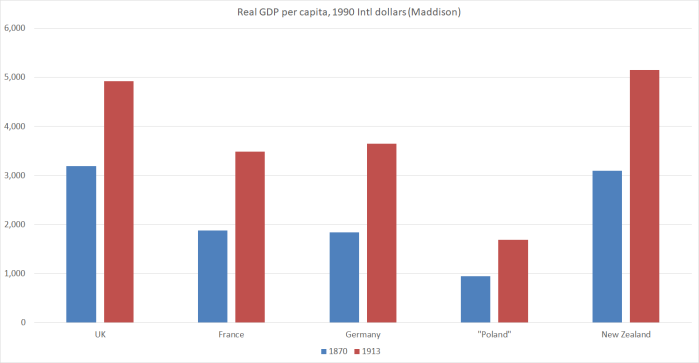
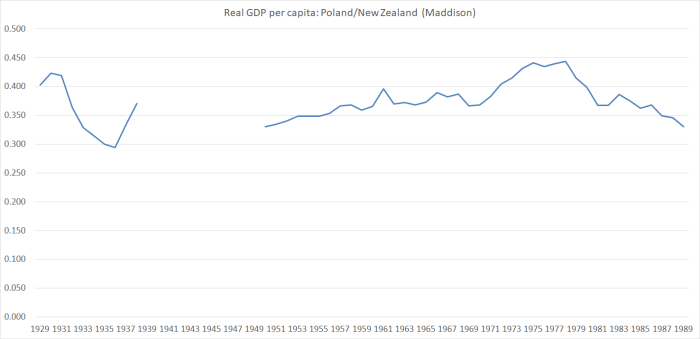
On Poland and economic performance

Next week we mark the 100th anniversary of the end of World War One.   Whatever else –  good and ill –  the resulting peace process ushered in, it led to the restoration of an independent Poland.   I was reading an article the other day by a British writer, resident in Poland, reflecting on 100 years of (renewed) Polish independence, which in turn prompted me to dig out some economic data.

My own reflection on Poland is that it is hard to think of a place in the western world (say, present day EU, other bits of western Europe, and western European offshoots – eg New Zealand, Australia, Canada, US, Argentina, Chile, Uruguay) that wouldn’t have been preferable to live in over the last 100 years or so, at least as judged by material criteria.   Perhaps if you were German, you have to live with the guilt of World War Two, but most of Germany was free again pretty quickly.   Romanians and Bulgarians might have been poorer on average, but they largely escaped the worst horrors of the German occupation.  To its credit, Bulgaria managed to largely save its Jewish population, while the Polish record was patchy at best.  With borders pushed hither and yon, and not a few abuses of other peoples (notably ethnic German) post-war, sanctioned by the state, the place then settled into 40 years of Communist rule.   There is a lot to admire about Poland, but I wouldn’t have wanted to live there any time in the 20th century.

In economic terms it has always been something of a laggard.   Here from Angus Maddison’s collection of data are estimates of real GDP per capita for 1870 and 1913 for the UK, France, Germany, the territory that was Polish, and New Zealand.

poland 1

Real GDP per capita in Polish territory (mostly ruled by Russia) was about a third of that in New Zealand.

The Maddison database has annual data for Poland from 1929 (excluding the period of the war), and that ratio of Polish GDP to New Zealand GDP seemed to show no real trend whether pre-war or in the communist years, averaging just a bit more than a third.

poland 2

Relative prices – including the purchasing power parity exchange rates used- matter quite a lot in these cross-country comparisons across time.  So not too much should ever be put on any particular levels estimate.  The Maddison database only comes forward to 2008 and the most widely used current numbers are those from the OECD.  On their calculations, at the end of communism Poland was a bit better off (say, relative to New Zealand) than in the Maddison numbers.  Polish GDP per capita in 1990 is estimated to have been about 44 per cent of that in New Zealand.

Here are the OECD estimates for the period since.

poland 3

On OECD estimates, Polish real GDP per capita hit 75 per cent of that in New Zealand.

Here is the OECD estimates for real GDP per hour worked (for which there are no longer-term historical estimates, but we can safely assume the ratio was very low on average –  perhaps averaging 35 to 45 per cent –  in the century prior to 1990.  In 1993, when the Polish data start the ratio was 43 per cent –  almost exactly the same as for real GDP per capita.

poland 4

Last year, Poland’s labour productivty reached 82 per cent of that of New Zealand.

All of which is clearly very good for Poland.   And it clearly isn’t just that they’d thrown off the shackles of communism: as the earlier charts show, Poland had been a laggard in the 19th century, and in the first half of the 20th century.

But, of course, part of the good news in these charts is a reflection of New Zealand’s own poor long-term performance.

Here are the latest OECD labour productivity (real GDP per hour worked) estimates for the same group of countries as in my first chart above.

poland 5

Last year, for the first time, Polish real GDP per hour worked passed 50 per cent of that in France and Germany.  100 years ago, of course, both France and Germany would have lagged well behind both the UK and New Zealand.

Perhaps Poland will go on to achieve much greater convergence with the other big European economies in the next few decades – we can only hope so –  and yet one can’t help wondering whether the leaders of a newly independent Poland wouldn’t have been rather disappointed if they’d been told that 100 years on their successors and fellow citizens would still be achieving only half the output per hour of the French and Germans.

Then again, they’d probably have been astonished to learn that 100 years on they’d be managing 82 per cent of average New Zealand productivity (and even 63 per cent of that of the British –  leading global power a century ago).

Hard to think though how disbelieving our own leaders would have been 100 years ago if they were told how far we would have fallen relative to these other countries, notably including Poland.     With none of the excuses –   wars, shifting borders, genocide, or decades of communist rule.

I might have a look at the data for a few of the other post World War One emergent countries later in the month.

Local listing for banks: a case for one in particular

There was a very strange article in the Herald yesterday from one Duncan Bridgeman claiming that it was, in the words of the hard copy headline Time to force Aussie banks to list in NZ”.

What wasn’t at all clear was why.

Bank profit announcements seemed to be the prompt for the column

Australian banks reaping huge profits from their New Zealand customers is a perennial scab that gets ripped off every time financial results come in.

I’m not persuaded the banks earn excessive profits here, but I know some other serious people take the opposite view.  But even if they are right, surely that is a competition policy issue –  the case for one of the new market studies perhaps, and any resulting recommendations.  There is nothing in the article explaining how forcing the Australian banks to sell down part of their New Zealand operations would affect, for the better, competition in the New Zealand banking services market.

The other prompt appear to be industry developments in Australia

Meanwhile, Australia’s big banks are starting to move away from vertical integration, partly because of conflicts of interest but also because their financial services model is unlikely to sustain the same profits over the longer term.

Suncorp, ANZ, CBA and NAB have all divested their life insurance operations. The latter two have also announced plans to spin off their wealth management operations. Westpac remains wedded to these areas of business but is expected to follow suit at some point.

And just last week financial services firm AMP, also heavily damaged by the banking royal commission, announced the sale of its wealth protection unit to US firm Resolution Life for A$3.3 billion and divulged plans to offload its New Zealand wealth management and advice businesses through a public offer and NZX listing next year.

But not one of those divestments has anything to do with core banking operations, unlike the approach Bridgeman appears to be proposing for the New Zealand bank subsidiaries.

A not unimportant word that one –   subsidiaries.  Presumably Bridgeman is fully aware, even though his article doesn’t mention, that all four Australian banks do the bulk of their New Zealand business not through branches, but through legally separate New Zealand subsidiary companies, with their own boards of directors (and statutory duties). (New Zealand compels them to do so, at least in respect of the retail business).

But when I read this paragraph I had to wonder if he really did appreciate that.

But if ever there was a time to raise the prospect of some form of domestic ownership and oversight of the banks, it is now.

The problem is it will never happen unless the Aussie banks are forced to by our politicians and regulators. After all, the last thing the banks want right now is another regulator to answer to.

Yet, why should it be accepted that four of this country’s five most profitable companies are effectively regulated in Australia?

The New Zealand subsidiaries are fully subject to New Zealand law: competition law, prudential regulation, financial conduct law, health and safety law.  The lot.  (Even the branches are subject to much New Zealand law, but leave them aside for now.)   The Reserve Bank of New Zealand sets minimum capital standards. minimum liquidity standards, disclosure requirements and so on.

Of course, since the New Zealand subsidiaries are part of much larger Australian-based banking groups, APRA’s regulations and requirements for the group can also be binding  –  not on the New Zealand business itself, but on the group as a whole.   APRA can, in effect, hold the local subsidiaries to higher requirements than those set by our Reserve Bank  (in just the same way that shareholders might voluntarily choose –  perhaps under rating agency pressure – higher standards than a regulator might impose), but it can’t undercut New Zealand standards for New Zealand operations.  Daft as they may be, New Zealand LVR restrictions are binding on banks operating in New Zealand.

Bridgeman goes on

Theoretically an Aussie bank could offload 25 per cent of the institution’s New Zealand assets and list the shares here separately. That would bring tax advantages to New Zealand investors who can’t use Australian franking credits, even though they are dual listed.

I presume he means selling off 25 per cent of the shares in the New Zealand subsidiary (rather than 25 per cent of the assets).  It would, no doubt, have tax advantages for New Zealand investors (and thus, in principle, the shares might command a higher price), and yet the banks haven’t regarded it as worth their while (value-maximising) to do so.    Bridgeman doesn’t look at question of why (presumably something about best capturing value for shareholders by holding all of the operations in both countries, and being able to  –  subject to legal restrictions and duties –  manage them together).

And he also doesn’t note that if, say, ANZ sold down 25 per cent of the shares in its New Zealand operation, the subsidiary will still be regarded by APRA as part of the wider banking group, and prudential standards will still apply to the group as a whole.  As they should –  after all, with a 75 per cent stake there would be a high expectation (from market, regulators and governments) of parental support in the event that something went wrong in New Zealand.

There is a suggestion that the article is a bit an advertorial for NZX

If a quarter of these assets were listed that would bring about $12.5b of capital to the local stock exchange – a badly needed injection at a time when the main market is shrinking.

But even then it isn’t clear what is meant.  It isn’t as if there is a new $12.5 billion (I haven’t checked his numbers) of local savings conjured up.   Buying one lot of shares would, presumably, mean selling some other assets.  In a country with quite low levels of foreign investment, the initial effect of any such floats would be to reduce that level further.  (Of course, in practice quite a few of the shares in any newly floated New Zealand subsidiaries would be picked up by foreign investment funds, leaving the alleged benefits of any compulsory selldowns even more elusive.)

Bridgeman ends with a rallying cry

And right now the Aussie banks are distracted with a battle on their home turf.

It’s the perfect time for some Coalition politicians to show some backbone and make a case for a change in this direction.

It might have appealed to Winston Peters once upon a time, but even if it weren’t a daft policy to start with, Bridgeman may have noticed that business confidence is at rather a low ebb right now.  Arbitrarily interfering in the private property rights of owners of private businesses – even if largely Australian ones –  wouldn’t be likely to do much to instill confidence in the soundness of policymaking.

As it is, they could start closer to home.  If governments really did want to focus on getting some more bank representation on the domestic stock exchange –  and it is not obvious why they would –  perhaps they could look at the New Zealand banks first.  After all, only one of them (Heartland) is sharemarket listed.  And the biggest of those New Zealand owned banks –  Kiwibank – is actually owned by the government itself.    In fact,  by three separate goverment agencies (NZ Post, ACC, and NZSF), none bringing obvious expertise to the business of retail banking, none themselves facing any effective market disciplines.  I’d be all in favour of a well-managed float of Kiwibank  (although once floated it might not last long as an independent entity).  There are good reasons (they’ve been there for years) for the government to consider seriously that option.  But there are no good reasons to force well-functioning locally regulated foreign-owned banks to sell down part of their operations in New Zealand.