Towards a statutory monetary policy committee

As part of the review of (parts of) the Reserve Bank Act, The Treasury is inviting comments and suggestions, on how the changes in stage 1 of the review (statutory goal of monetary policy, establishment of a statutory monetary policy committee) should be implemented, and on what else should be reviewed in the forthcoming stage 2 of the review.

Last Thursday I went along to a Stakeholder Engagement Roundtable, in which Treasury had invited various private economists in to offer our perspectives on those issues.  My post on Thursday –  on the statutory goal of monetary policy –  was, in effect, part of my notes in preparation for that meeting.   In the discussion, opinion was fairly mixed on the merits of making a change, but it was generally recognised that the government had committed to change and so the main issue was how best to give it legislative form.

The second chunk of the discussion was about the establishment of a statutory monetary policy committee.  Here there seemed to be greater unanimity that reform was desirable, and that part of any reform should be a greater emphasis on transparency, including individual accountability.

I’ve covered my own views on various of these points in earlier posts, but for ease of future reference, I thought I’d bring them together in a single post.  My model would not replicate that in any single other country, but is probably closest to the monetary policy committees in the United Kingdom and Sweden.

Who should appoint the members of the committee?

All of the members should be appointed by the Minister of Finance.   People who exercise significant statutory power –  and the conduct of monetary policy is certainly that –  sholu.d either be elected themselves or appointed by those who are themselves elected.  That is the general approach we take to governing New Zealand:  whether it is Cabinet, the courts, the boards of Crown entities, the Commissioner of Police, or the Auditor-General.  There is no particularly good reason why members of a Monetary Policy Committee should be different.    There are probably unique aspects to all governance appointments, but nothing around monetary policy marks it out as warranting putting another layer between the elected and the decisionmakers.

This is, of course, in contrast both to the current model (single decisionmaker –  the Governor –  in effect appointed by the Bank’s Board), and to the model Labour campaigned on (where external members would be appointed by the Governor –  putting them at a further removes from someone who has to actually face the voters).  Allowing the Governor to appoint the external members would risk substantially undermining the reasons for the reforms.

In the United States nominees for the Federal Reserve Board of Governors are required to win Senate confirmation.  That isn’t our constitutional model.  In the United Kingdom, appointees are required to face a parliamentary select committee hearing before taking up the role.  The committee can’t block the appointment, but can report on the suitability of otherwise of the nominee.   This might be a useful feature to add here.  It isn’t an approach we take generally, but monetary policy makers exercise wide powers of discretion (much more, say, than a typical Crown entity Board member) and, with ex post accountability difficult to maintain, it seems reasonable that those taking up such roles should face some open scrutiny at the start.

There is a counter-argument that the Governor should be free to appoint his or her own Deputy (as might be normal in a commercial context).  To which my response would be that if the deputy was not serving on a statutory committee, exercising statutory powers, that model would be fine.  But if the Deputy Governor is to exercise statutory powers, they should be appointed by someone who was elected, and who is accountable to voters: as far as I can tell, that is the typical model (including, for example, in Australia and the United Kingdom).

How many members should there be?

I’d favour either five or seven.  Any larger number would make it unduly difficult to fill the roles with good people consistently through time.

Either way, I’d favour having two internals (executives) – the Governor and a Deputy Governor –  with the remaining members being part-time non-executives.  It is highly desirable to have a majority of members who are outside the managerial hierarchy of the Bank.  Put the structure the other way round and there is a high risk that, over time, the non-executive members will be neutered (with management coming to block vote), and that  then good people will be unwilling to put themselves forward to serve on the committee.  Non-executives will always be at some disadvantage –  re access to analysis, and ability to influence the research agenda etc – and only be holding the majority of votes on the committee will they be able, if they choose, to consistently push back against that pressure.

The counter-argument often made is often about technical expertise: the choice between internals and externals is often presented as a choice between experts and non-experts.  To which there are several responses to be made.  First, as the Reserve Bank is currently structured, the internals will often not be “experts” on monetary policy at all –  none of the Governors since 1989 could really be classed as “experts” on monetary policy, although of course over time they acquired considerable experience, and even among Deputy Governors there have been considerable differences of expertise and background.  And the skills of being a good chief executive –  running the organisation, generating the analysis, managing the operations –  also aren’t necessarily those of a leading monetary policy expert.

But perhaps as importantly, while I think it is vital to have expert advice and analysis, as inputs to decisionmaking, it isn’t clear that we want technical experts making policy decisions, and exercising the (inevitable) degree of discretion that monetary policy makers do.  Some people with technical expertise may be able to serve effectively as decisionmakers (and communicators) but the skills aren’t the same at all.  And if the internal members of a Monetary Policy Committee, with all the technical resources of the Bank staff at their command, cannot convince one or two non-executive members of the merits of their case, it seems unlikely that they will be able to convince the wider public.

What sort of non-executive members should be appointed?

I’m wary of making much of an internal vs external distinction, and instead focus on that between executives and non-executives.  After all, there has been no internal candidate appointed as Governor since 1982.

But in considering non-executive appointments (three or five in my model) there are a few relevant considerations:

  • no one should be appointed to represent a particular interest group.  Of course, everyone has a background, but once one takes up a position on an MPC your commitment has to be to implementing the Act and serving the interests of the country as a whole,
  • there should be no prohibition on non-resident or non-citizen members (although I would favour no more than one at a time).   We are a small country, and there can at times be valuable perspectives that people employed abroad can offer (and it is a model the UK has used), as one vote among five or seven,
  • it would be desirable to have one member with some reasonable academic exposure to monetary policy, but undesirable to think of a Monetary Policy Committee as, say, a research conference or an academic seminar,
  • people with sound general Board-level skills can make a valuable contribution to an MPC, regardless of their formal academic background.  One doesn’t typical want an telecoms company Board stuffed full of tech people, and there isn’t any obvious reason why a Reserve Bank MPC should be different.  The ability, and willingness, to ask hard questions, and even just to say “tell me that again, in ways I can understand” is a valuable part of the mix.

How long should MPC members’ terms be?

I would favour five year terms, perhaps with a limit of one reappointment each.  With five or seven members, one appointment would come up every year or so, enabling a government is the course of a three year term to replace gradually around half the members of the committee, but not to launch a purge on newly taking office.   Terms of this length seem reasonably conventional (and are the same as those of the Governor, and Board members, at present).

Individualistic or collegial?

I’ve outlined here previously why I strongly favour the sort of individualistic model adopted in the UK, the USA and in Sweden, in which individual members of the MPC are individually accountable for their votes.  The current management of the Reserve Bank really dislikes the model, but they have never been willing, or able, to articulate –  from the experience of other countries –  what the nature of their concerns is, and how they balance any such concerns against the interests of democratic accountability, in a model in which decisionmakers exercise considerable discretion.

As I’ve documented here over the years, formal effective accountability for monetary policy decisions is hard –  much harder than those who devised the current law thought at the time it was drafted.  In practice, accountability can be exercised only through public scrutiny and challenge, and at the point where a member of the MPC is up for reappointment.  Against that backdrop –  and in a game where there is so much uncertainty – it is highly desirable that individual MPC members’ votes should be recorded and published, and that members should have the opportunity to have their views recorded in minutes that are published in a fairly timely fashion.  The Reserve Bank’s management has at times expressed concerns about this approach –  used elsewhere –  “muddying the message”, but in fact there is so much uncertainty about the way ahead (what is going on with the economy and inflation) that over time it will usually be preferable to have in public the sorts of issues and concerns that were bothering decisionmakers, rather than just some sort of somewhat-artificial consensus about an immediate OCR decision.

In a similar vein, MPC members should all be free to make speeches, give interviews etc articulating their own views on the issues the MPC is facing.  I’m not suggesting some sort of chaotic free for all: it would no doubt be desirable for members to develop protocols in which members ensured that other members were aware of forthcoming speeches and interviews, agreed to circulate draft texts to each other in advance, and perhaps agreed to avoid comment altogether in the week or so (say) prior to an OCR announcement.  Commonsense and common courtesy can resolve many potential issues.

Who should chair the MPC?

The Governor.  I hadn’t particularly thought of this issue, but it came up at the Treasury meeting the other day. There is an argument for a non-executive chair –  the approach in most Crown entities – but provided there is a majority of non-executive members I’m not sure I see the case for departing from the universal international practice, in which the Governor chairs the MPC.    (It is also perhaps worth noting here that in other countries –  including the UK – it has not been a problem if the Governor has at times voted with the minority.  Smart people will often view the same data quite differently.)

Transparency

The amended Act should require the publication of minutes, and the record of individual votes, within a reasonable time –  perhaps to be determined by the Minister –  of the particular OCR decision.  As I’ve noted previously, I do not favour either keeping, or eventually publishing (even with very long lags), transcripts of MPC meetings.

I would also favour moving to a system where the background papers for MPC meetings are routinely and pro-actively published (perhaps six weeks after the OCR decisions to which they relate).  Ideally, I would not consider this something that should be legislated, but given the obstructiveness of the Bank, and the willingness of successive Ombudsmen to aid and abet the Bank in keeping such papers secret even well after the relevant decision, the legislative option may need to be considered.

As I’ve noted repeatedly before, the Reserve Bank is quite transparent about stuff it knows little abour –  eg where the OCR might be a couple of years hence –  but isn’t very transparent at all about what it does know about.  Transparency is valuable in itself –  an essential part of democracy –  but in a small country with limited pools of expertise, the ability of greater transparency to facilitate more informed and debate and scrutiny of the issues is almost instrumentally useful.

Should there be a Treasury representative on the MPC (in a non-voting capacity)?

I don’t have a strong view on this issue, but it is a model that is used in a number of countries, and could help to formalise a recognition of the relationship between various bits of economic policy.    The model appears to have worked, without undue problems, in the UK.     But if it is to be done, it needs to be recognised that it would involvement a non-trivial time commitment by someone reasonably senior in Treasury –  and time/resources are scarce.

The Policy Targets Agreement

At present, Policy Targets Agreements are (a) signed with the Governor personally, consistent with the single decisionmaker model, and (b) have to be agreed with an incoming Governor before that person is formally appointed or takes office.  It is a poor model, and not one that is much imitated abroad.

Under my reform model, the MPC as a whole would be responsible for monetary policy and the onus of a PTA should also rest on them.  To do that probably requires rethinking the PTA model, and might suggest moving to the system adopted in some countries –  eg the UK –  where the goal (PTA) is specified by the Minister of Finance, and the MPC is simply responsible for conducting policy consistent with that goal.  The UK model isn’t ideal – the target can be changed at the Chancellor’s whim in the annual Budget –  but a system in which the target is specified every few years, after  advance consultation with the MPC of the day (and ideally with the wider public, and with FEC), would seem to have some attractions.  To get the right balance between responsibility for setting overall goals –  resting with the elected government –  and a degree of stability, perhaps the appropriate review period might be six months after a change of government (with provisions for other changes to the PTA only in exceptional circumstances –  say with the agreement of the majority of the MPC.)

The final issue Treasury asked us about under this heading was about the role of the Bank’s Board.  There seemed to be pretty universal agreement among attendeees that the Board adds little or no value.  But, as I’ve noted here previously, you can’t really answer the question about the appropriate role of the Board without thinking harder about the overall organisation of the institution (rather than simply one function –  monetary policy).  I’ll come back to that on Wednesday.

And on a completely different topic

Regular readers will know that I live in Island Bay.  Some will have seen the story in yesterday’s Sunday Star-Times suggesting that our local primary school was “New Zealand’s richest primary school”, based on reported donations in 2016 of $490000.    This qualifies as pretty poor journalism.  Island Bay School is a decile 10 school (although I suspect in the poorest 10 per cent of the top 10 per cent of neighbourhoods).  It was reported that

“Island Bay school’s 460 students contributed $490000 donations in 2016 –  an average of $1065.46 per student for the year’s schooling”

In fact, those parents who paid the scheduled annual donation paid around $250 per child, in other words only around a quarter of the total.   But one, very wealthy, old boy made one very generous donation.  Here is the Principal’s newsletter from 10 March 2016

I awoke to the best news ever this morning: Sir Ron Brierley, an old boy of the school, has generously agreed to donate a sizeable sum to the Rimu Block modernisation project. This gift, combined with Ministry of Education funding, gives us sufficient funding to realise our full vision for the modernisation of Rimu. This would not have been achieved without the generosity of Sir Ron, who has been a wonderful friend and supporter of Island Bay School over the years. In 2011 he kindly contributed towards the Learning Hub and now he has made this contribution towards Rimu Block.

As a parent, it always amused me that such a left-leaning school (and successive Principals) were taking such large amounts of money from a generous capitalist.  It is a real gain to the school, but it is almost totally irrelevant to the debate around the “donations” that parents are asked for each year.
 

The statutory goal for monetary policy

The government has a review of the Reserve Bank Act underway at present.    It is an odd beast.    There is a rushed process going on to review and amend the monetary policy bits of the Act, led by Treasury and assisted to some modest extent by an Independent Expert Advisory Panel –  itself chaired by someone with no experience in monetary policy.   And then there might be a second stage review, to be jointly run by the Treasury and the Reserve Bank, which might –  or might not –  have the same Independent Expert Advisory Panel.  If well-intentioned, it is pretty unsatisfactory: lightly-resourced, potentially giving too much influence to the Reserve Bank itself, and not working from a coherent overview of the Bank as an institution (thus, part of the first stage review is looking at the role of the Bank’s Board as regards monetary policy, without having engaged properly with how the whole organisation should be structured, managed, and held to account, or even looking at the interactions between the Bank’s various functions).  How much better it would have been to have had a proper independent review, looking at all the roles/functions of the Bank at the same time, with a view to legislating next year.    That was, for example, what was done in Norway recently with central banking legislation of similar vintage to our own.    It would also reduce the chances that, with a patch-protecting new Governor, the second stage of the review will just peter out and come to nothing.

There are two main bits to the first stage of the review:

  • amending the statutory goal of monetary policy to add a focus on maximising employment (or minimising unemployment), and
  • introducing a statutory committee, including non-executive members, to make monetary policy decisions.

For the time being, much of what the government says they want to achieve around the first bullet  (the objective for monetary policy) could be done through a new Policy Targets Agreement  –  one needs to be signed before Adrian Orr can formally be appointed as Governor (and thus will be necessary even before Stage 1 reforms can be legislated.  I outlined some suggested wording in a post last year.   Sadly, with the rushed review focused on the Act, there is no sign of any public process looking at the content of the Policy Targets Agreement, even though it is the main policy instrument for short-term macroeconomic management.

But how should the statutory goal be restated?  Since 1989 the key clause of the Reserve Bank Act (section 8) has read as follows

The primary function of the Bank is to formulate and implement monetary policy directed to the economic objective of achieving and maintaining stability in the general level of prices.

And 10 years ago, a revised purpose clause was added to the Act, and around monetary policy this is what it said

The purpose of this Act is to provide for the Reserve Bank of New Zealand, as the central bank, to be responsible for—formulating and implementing monetary policy designed to promote stability in the general level of prices, while recognising the Crown’s right to determine economic policy;

Policy Targets Agreements have to be consistent with section 8 –  ie “achieve and maintain” price stability, not just “promote” it.

The Labour Party, in Opposition and now in government, have offered various takes on what they want to do with the statutory goal without (sensibly enough at this stage) specifying a precise set of words.  Presumably they are serious about taking advice.

When the policy was launched last April the suggestion was to broaden “the objective of the Bank from just price stability to also include a commitment to full employment”.

In the terms of reference for the current review, agreed by Cabinet, the phraseology is as follows

recommend changes to the Act to provide for requiring monetary policy decisionmakers to give due consideration to maximising employment alongside the price stability framework;

The Minister of Finance has also talked about looking to the wording used in the central bank laws of Australia and the United States.

As I’ve outlined here previously, I favour changing the wording of section 8, as much as anything because the current wording does not adequately capture why we have a central bank running discretionary monetary policy.   One doesn’t need such an active central bank to maintain a broadly stable general level of prices; indeed, the introduction of fiat money systems over the last hundred years or so has led to less stability in the general level of prices than prevailed previously.

The existing wording of section 8 was an understandable –  and generally helpful –  reaction to the very poor inflation track record New Zealand (and many other countries) had run from the 1960s onwards.  Inflation has been lower and more stable than it was previously –  although not just because of the change in the Act.  But it still didn’t capture what we really wanted the central bank to do.    Active discretionary monetary policy is really about attempting to manage the business cycle –  and especially to be able to respond aggressively to extreme circumstances –  subject to the constraint of not letting inflation get away on us.    To word it that way doesn’t diminish the significance of keeping inflation in check –  any more than saying that fiscal policy should be managed to meet various government goals, subject to the constraint of not letting debt blow-out.

This way of thinking about active monetary policy is quite consistent with what we learned from the Great Depression –  countries that acted earliest to break the golden fetters rebounded earliest and saw resources (including unemployed people) back in work most quickly.  But, more mundanely, it is also consistent with the way in which inflation targeting central banks have (a) run things, and (b) specified their practical mandates.     Thus, from the earliest days of inflation targeting, there have been numerous events –  notably oil price shocks or indirect tax changes –  where the Bank has been expected to let inflation rise (fall) temporarily away from target, to minimise the output and employment consequences of such shocks  (trying to keep inflation on target in face of a big oil price increase would typically be expected to require inducing a recession).  Policymakers recognised that, actually, avoiding unnecessary surges in unemployment –  or recessions –  was locally more important than keeping inflation at, say, 2 per cent all the time.  But that calculus changes if it looked as though inflation was going to drift permanently higher.     The wording of the current legislation is unhelpful if –  and to the extent – it leaves voters fearing otherwise – that policymakers don’t care about unemployment/employment in its own right.

The other thing worth bearing in mind is that no central bank act –  not even something more specific like a Policy Targets Agreement –  can specify everything about how we want a central bank to run monetary policy.  Circumstances change, and the unexpected combinations of shocks happen.    There was a degree of naivete around that in the early days of the current Act, encapsulated in Don Brash’s unconditional answer to a radio interviewer indicating that he would lose his job if inflation went above 2 per cent (the then top of the target range).   But everyone recognises the limits now.

Thus, it is not possible to sensibly write down –  whether in the Act or the PTA – a numerical objective for “full employment”, “maximum employment” or the like (and the government has repeatedly stated that it has no intention of doing so).  But that doesn’t make it less worthwhile writing such considerations into legislation, requiring the Bank to report against them, and expecting those holding the Bank to account to take serious account of them.   And if even that was thought to be impossible, it might sensibly lead to some reconsideration as to whether having an independent central bank set policy –  rather than just advice on it –  was really the best way to organise things.

But how best to word things?  There have been suggestions from the Minister of looking at the specific wording in the Australian and US legislation.  I don’t think that will –  or should –  get people far.   Here is what I had to say on those options from an earlier post.

The Reserve Bank of Australia was set up in 1959, and the section of its legislation relating to monetary policy goals and objectives was in the original.

It is the duty of the Reserve Bank Board, within the limits of its powers, to ensure that the monetary and banking policy of the Bank is directed to the greatest advantage of the people of Australia and that the powers of the Bank … are exercised in such a manner as, in the opinion of the Reserve Bank Board, will best contribute to:

a.  the stability of the currency of Australia;

b.  the maintenance of full employment in Australia; and

c.  the economic prosperity and welfare of the people of Australia.

In 1959, Australia –  like most countries –  had a fixed exchange rate, so that “the stability of the currency of Australia” meant the external value of the currency.  The provision has since been re-interpreted, and as is now taken as meaning the domestic value of the currency (ie domestic price stability), but no one would write the provision that way today.

This wording is also legitimately subject to the criticism made by those who disagree with what Labour is proposing.  It makes no attempt to distinguish between the short and long run, and thus does not recognise that monetary policy cannot affect the longer-term rate of unemployment at all.    The Australian legislation also has nothing like a Policy Targets Agreement (the document that resembles a PTA is informal and non-binding) and provides far too much discretion to the Reserve Bank.  That discretion has not been blatantly misused in recent decades –  a period when the actual conduct of monetary policy in New Zealand and Australia have mostly been quite similar –  but the legislation should not provide any sort of model for New Zealand as to how best to specify the goals of monetary policy.

What of the United States?   Much is made of the “dual mandate” that has guided the Federal Reserve over the decades.   But even that, mostly quite sensible, conduct of policy rests on a rather slender and unreliable legislative footing.    The statutory objectives in the Federal Reserve Act were set out in 1977, around the high tide of monetarism, and read as follows:

Section 2A. Monetary policy objectives

The Board of Governors of the Federal Reserve System and the Federal Open Market Committee shall maintain long run growth of the monetary and credit aggregates commensurate with the economy’s long run potential to increase production, so as to promote effectively the goals of maximum employment, stable prices, and moderate long-term interest rates.

In other words, the Fed is actually mandated to pursue long-term money and credit growth targets, in the belief that doing so will promote (a) maximum employment, (b) stable prices, and (c) moderate long-term interest rates.  Again, no one would write the statutory objectives that way today, and the formulation should offer little or no guide to anyone looking to overhaul the objectives of our own central bank.  In practice, of course, the Federal Reserve works around the statutory formulation, rarely citing it directly.  I think they way they run monetary policy in practice is quite sensible –  and typically not that different to the way the Reserve Bank here has often run policy –  but I bet they wish Congress had written the goal a bit differently in 1977.

In an ideal world, both the Australian and US statutory provisions would be updated and amended.  It isn’t desirable to have powerful autonomous agencies working under the mandates that don’t reflect today’s understandings of policy, leading those agencies to creatively reinvent their own mandates.  Those reinventions probably lead to better policy in the short-run, but the process of doing so undermines confidence in the role of legislatures in mandating, and holding to account, such agencies.

So we need some fresh wording, and as far as I can tell there are no excellent models abroad to look to.

My strong preference would be to focus any new wording on minimising unemployment (or concepts like “full employment” –  a traditional Labour Party focus) rather than on maximising employment.       The concept of unemployment is about avoiding a situation where people who want to work, and are available for work, are unable to find work.   A simple focus on employment suggests that the more employment there is the better, whether people want (or need) to work or not.     I’ve seen political leaders boast that New Zealand has one of the highest employment rates in the advanced world, but to my mind at least that isn’t a sensible or legitimate boast –  or even a matter of public policy interest (speaking as someone who is, entirely voluntarily, not in the paid workforce).  It has Stakhanovite connotations.  By contrast, situations where people who want work, need work, can’t find work should be a matter of real public policy concern, and it is also something that  – in some but not all circumstances –  monetary policy can do something about, since most of the fluctuations in unemployment are a response to demand shocks.

So I’d suggest wording along these lines

“the goal of monetary policy shall be to promote the lowest rate of unemployment consistent with maintaining a low and stable rate of inflation on average over time”

But that might be too stark for some, too radical for others.   Another way of saying much the same thing, while keeping low inflation first in sequence, might be this sort of wording

“the goal of monetary policy is to maintain a low and stable rate of inflation on average over time. In pursuing this goal. the Bank shall do all that can be achieved by monetary policy to avoid unnecessary deviations of the unemployment rate from the rate that would resulting from those regulatory, structural, and demographic factors beyond the influence of monetary policy”

(You will note that I’ve suggested deleting altogether both the suggestion that monetary policy is the “primary function” of the Bank –  these days it is one of two prime functions –  and the references to a “stable general level of prices”.  The Bank has never targeted the price level, and the price level is not stable.    Some argue for a price level focus rather than an inflation rate focus, but there is no easy way for the statute to encompass both options without using even vaguer language.    Arguably, a “low and stable inflation” rate encompasses options for price level targeting, while “a stable general level of prices” does not really encompass a price level growing on average at up to 3 per cent per annum. )

Of course, the new wording for section 8 –  whichever formulation is chosen –  does not (or should not) stand alone.  Appropriate wording for a Policy Targets Agreement would still need to be found.  I’d have no problem with a continuing focus on a 2 per cent target midpoint –  as some sort of medium-term reference point for people to use in their planning.  But there should be a stronger emphasis in the Policy Targets Agreement on the cyclical management responsibilities –  including, in particular, preparation for the next big downturn (when, at present, monetary policy looks to be quite severely constrained in limiting the output and unemployment consequences).

And, as I’ve suggested previously, in both the Policy Targets Agreement, and in section 15 of the Act (governing Monetary Policy Statements) it would be appropriate to add some explicit wording requiring the Bank to report periodically on its estimates of the long-run sustainable rate of unemployment (and/or the NAIRU), on to report regularly on the relationship between actual unemployment rates and those estimates, and one what the Bank is, and is not, able to do about the gap.  These reports would serve several functions:

  • they would help focus the Bank’s attention (policy and research/analysis) on its raison d’etre  –  doing what it can to avoid unnecessary excess capacity, and
  • they would provide a formal and routine vehicle for articulating the limits of monetary policy.  It won’t, for example, be sensible to focus heavily on the unemployment rate for the time being if inflation really looks to be moving permanently much higher, but even in those circumstances, it is useful to require policymakers to contribute to the conversation about the appropriate balance of short-term focus –  what risks can and should be run (or not) and at what cost, even when everyone recognises the constraint that medium-term inflation needs to be kept in check.

One might even provide for the Bank to offer periodic advice to the Minister of Finance on what measures could contribute to lowering the structural rate of unemployment.    There are risks in such a provision –  many of those sorts of choices are almoat inherently political –  but again they help ensure a recognition that if monetary policy can, and should, do a lot about cyclical unemployment, it is unable to do anything much to alter the baseline structural rates of unemployment, which are mostly about political and social choices.

Those opposing change will emphasise the risks aroud these sorts of statutory changes.  And those risks need to be taken seriously.     But it is hardly as if the status quo is without risks or problems –  after all, we’ve spent the entire decade so far with the unemployment rate above domestic estimates of a NAIRU, and if that is no cost to most economists and policymakers, it has been for many ordinary New Zealanders.

Precisely because one can’t write down all that one wants a discretionary central bank to do with monetary policy in all conceivable circumstances, any particularly specification of the goal will be less than ideal.     So whatever the precise specification the government chooses, it is at least as important that an intelligent conversation be maintained about what monetary policy can and can’t do – not just in general, but in particular circumstances –  and that the Reserve Bank be encouraged (and compelled by law where appropropriate) to maintain an open and transparent approach, not just to the final fruit of its deliberations, but to its research, analysis, and the genuine uncertainty everyone faces in making sense of economic developments and the outlook for resource utilisation and inflation.


Some (Chilean) perspectives on monetary policy decisionmaking and communications

I’d had more or less enough for this week of thinking/writing about Reserve Bank reform issues, when a (central banker) reader sent me a link to an interesting new survey article by a couple of researchers at the central bank of Chile looking at various institutional arrangements, including decision-making and communications, at 15 inflation-targeting central banks (all from OECD countries).    I’d suggest The Treasury, and the Independent Expert Advisory Panel appointed by the Minister to assist with the review of the Reserve Bank Act, take a look at the paper.

It isn’t perfect by any means –  and there were a surprising number of small errors of detail or emphasis, including in places about New Zealand – but there is a lot of interesting material nonetheless.  For a start, they seem to have chosen pretty much the right group for comparison: the well-established market economies, with reasonably well-governed democratic societies.   One might quibble about the inclusion of Poland, or note that if Poland is included perhaps Hungary should be too, but if you are looking for insights and ideas as to how our central bank (in its monetary policy dimensions) should be organised –   and wanting something to read to complement the Reserve Bank piece I posted here yesterday –  this list of central banks/countries seems about right:

ECB, USA, UK, Japan, Canada, Korea, Norway, Sweden, Australia, Israel, Chile, Poland, Czech Republic, Iceland (plus New Zealand)

I wasn’t too interested in, and won’t comment further on, the detailed material on the specification of the inflation target itself (except to note to the authors that the New Zealand target now has an explicit midpoint reference) –  ground well-covered in various earlier Reserve Bank articles.

What of statutory decision-making structures?  Of the 15 central banks, only New Zealand and Canada do not have a statutory committee making monetary policy decisions.   That is well known.   What is less well-known perhaps is that all those 13 central banks with statutory committees operate by vote.     The authors note that Canada and New Zealand describe themselves as attempting to operate by consensus, but in fact of course in both places only one vote formally counts –   that of the Governor, who has the legal responsibility.     And even in New Zealand, although the three man Governing Committee is claimed to operate by consensus –  they refuse to release any minutes, even under the Official Information Act, to allow us to really know – the members of the wider advisory group make written OCR recommendations, in effect a non-binding vote.

In some of their writings, the Reserve Bank likes to claim that consensus-building models of decision-making are superior.   There may be some arguments on that side of the issue, but actually voting –  after examination of the issues, discussion and debate –  is typically how we make decisions in free societies: be it in elections themselves, decisions of a local tennis club committee, or our higher courts (five judges on the Supreme Court: the verdict supported by the majority rules).  There is no particular reason to think monetary policy decisions are not as well made the same way –  indeed, since there is a great deal of uncertainty, and decisions are revisited every eight weeks or so (so there are few irreversibilities) it seems a pretty demonstrably efficient approach.

The Reserve Bank has also sought to claim that small committees are generally better than large committees.  Again, at some point no doubt there is truth to that –  with all due respect to the Cabinet, the 20th person on any committee is unlikely to be adding much marginal value, and the incentives for any specific member of a committee that large to slack off (put in little effort or fresh thought) can be real.   But of the 13 inflation targeting central banks with statutory monetary policy committees, the median number of members is eight.    For a smaller country, a statutory monetary policy committee with five or seven members sounds about right for New Zealand (none of these statutory committees in other countries has fewer than five members).     Membership numbers don’t seem to be a luxury good: the authors present a chart showing no relationship between GDP per capita and the number of MPC members in an inflation-targeting country.

It is also clear that members of the statutory monetary policy committes are almost entirely appointed by politicians –  as most key positions in our societies typically are (from Chief Justice or Police Commissioner down).   There are some exceptions –  eg regional Fed Presidents in the US (who rotate through voting membership of the FOMC), but even that situation is now raising some concerns among scholars in the US.   And almost all of the central banks with statutory MPCs have external members, in some form or another (sometimes part-time, sometimes becoming temporary full-time executives, sometimes full-time non-executive): governments rarely seem to see monetary policy decisions as matters only for some career “priesthood of the temple”.

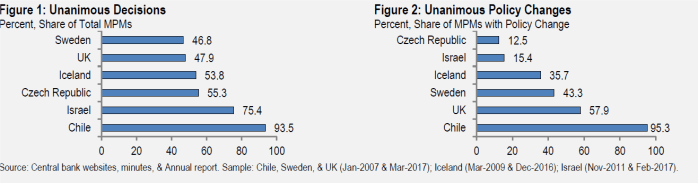
I was also interested in some analysis the authors had done on the extent of unanimity, or otherwise, among monetary policy committees where voting decisions are published.

To listen to our Reserve Bank, if voting records were published, or minutes in which individual members could outline their views on specific monetary policy decisions, it would be a recipe for mayhem.  They’ve talked of it creating confusion, and uncertainty, undermining confidence in, and the credibility of, the central bank.

Here is what the Chilean authors have to say about such individualistic committees.

In individualistic committees each member is held publicly accountable for their decisions, and each member is empowered with one vote. Decisions tend to be reached by majority vote, where the Governor tends to have the deciding vote in case of a tie. The high degree of individual accountability results in regular reservations, dissents, or minority votes against the final policy decision. Two regularly cited examples of this type of committee are those of the UK and Sweden. Importantly, when a certain degree of public disagreement among committee members occurs, market participants are generally not surprised and understand the differences as part of the policy process.

That is more or less the point I’ve been making.  One could say the same about the United States.  And recall that these authors are themselves from a central bank with a committee more towards the “collegial” end of the scale.

And, in any case, as they illustrate, even in individualistic committees raging dissent is hardly the norm.

central bank dissents

Roughly half of all the monetary policy decisions in the UK and Sweden in the last decade have been unanimous.  (On the other hand, even for central banks at the collegial end of the spectrum, not all decisions are unanimous).   I’m not sure why they didn’t include the Federal Reserve in this particular analysis, but I suspect the numbers there would show something similar to the UK or Swedish experiences.

There was also some interesting material on communications practices.  For example, all 13 of the central banks with statutory monetary policy committees publish minutes –  to repeat, every single one of them.   The timeliness varies –  the UK and Norway publish the same day as the monetary policy announcement, but a more typical lag in about two weeks –  and of course the nature of the content differs: some are pretty bland, while others (notably those of Sweden) although a full and careful articulations of the arguments and issues of concern to individual members.

But there was also some surprises (at least to me).  Our Reserve Bank grudgingly released background papers to a 10 year old interest rate decision, and consistently refused to release any background papers –  no matter how topical –  used in the preparation  of their interest rate decision or Monetary Policy Statement (eg the recent refusal to provide any background analysis papers on the impact of various policies of the new government).  By contrast, and at the other extreme, according to the Chilean paper the central banks of the Czech Republic and Norway “publish a version of the staff MPM [monetary policy meeting] presentations shortly after the meetings”.    I struggle to see any good reason why such background analysis should not be released publically with, say, an eight week lag (eg released after the OCR decision one after the decision to which the background material relates)

And a bigger surprise still was the publication of transcripts of monetary policy meetings.  I knew that the Federal Reserve was doing so, and had heard the odd mention of it happening elsewhere.  In fact, the authors show that seven of their central banks are now doing so (including the Fed, the ECB, the Bank of Japan, and the Bank of England).  The lags are quite long –  the Fed is the shortest at five years.  But, fascinating as some of the old Fed transcripts are, especially from the era before members knew they would be published, even I have my limits around transparency, and this is one of them.  As the Chilean authors note

as highlighted by the Warsh Review (2014), the publication of meeting transcripts (and minutes) may to a certain extent impair a candid discussion of policy options among policy-makers, and lead them to limit their interventions to written statements that express their view (and vote) without the consideration of the perspectives of other members. In this context, it is possible that policy deliberations may be driven to other settings where a formal record is not being taken. Moreover, some existing evidence for the U.S (Meade and Stasavage, 2008) suggests that the publication of FOMC transcripts reduced the likelihood of dissent among committee members, and made members less willing to change their positions over time.

But the fact that various major (and minor) central banks are publishing such transcripts again helps give the lie to our Reserve Bank’s constant claim that it is one of the most transparent monetary policy central banks in the world.

One final aspect the Chilean authors covered was the role (if at all) of a Treasury or government representative in monetary policy decision meetings.    In the Reserve Bank paper I linked to yesterday, the Bank authors attempted to minimise this issue.   They noted that in Australia the Secretary to the Treasury is a voting member of the Reserve Bank (monetary policy making) Board and that in the UK there is a non-voting Treasury observer  who attends (statutory) MPC meetings.   Of our 15 central banks, that is all they note (although in Colombia, one of the countries they look at, the Minister of Finance is himself a voting member).

But here is part of the fuller Chilean treatment of the issue

In a second large group of central banks, an important authority of the administration, such as the Minister of Finance or his delegate, is invited to attend and speak in the MPMs, but does not have the right to vote on the monetary policy decision. Within this second group, the degree of potential government involvement differs. In Japan for example, the representatives of the government (Minister of Finance, Minister of State for Economic & Fiscal Policy) may propose issues to be discussed in the MPMs, and may even formally ask the MPC to postpone a vote on monetary policy until the following meeting. In the case of the Bank of Korea, the representative of the government (Minister of Strategy & Finance) may publicly request the MPC to reconsider a monetary policy decision if it perceives that the decision conflicts with the government’s economic policy.

Their tables also lists Chile, the Czech Republic and the UK as having non-voting Treasury representatives.  In the comments on the Rennie review report from Charles Goodhart (ex UK MPC) and Don Kohn (a current member of the UK FPC) no concerns were raised about this aspect of the UK model.

I don’t have a strong view on the possible role of a Treasury representative on either a monetary policy or financial policy committee in New Zealand.  But there is enough precedent in other countries to suggest that option deserves more serious consideration than the Reserve Bank –  always keen to keep Treasury out of its hair –  gives it.     If there was to be non-voting observer, the rules of the game might be quite important –  the person would be there to inform, answer questions, and report (as in the UK) and shouldn’t see themselves as having a role to try to shape decisions.

The Chilean piece was interesting and refreshing.     They make it clear –  without directly engaging with New Zealand issues at all – that if the government reforms our Reserve Bank Act to provide for:

  • a statutory monetary policy committee,
  • all appointed directly by the Minister,
  • with a good mix of internals and non-executive internals,
  • and timely publication of minutes and vote number,
  • with perhaps even details of dissenting members’ views, and even
  • delayed publication of background papers

It would be placing the Reserve Bank of New Zealand’s new model of governance. decisionmaking and communications right in the mainstream of international practice for countries of our type.

As it happens, I saw last night one other snippet reminding us of how far central bank transparency could go.  The Financial Times had an interesting piece outlining concerns in some quarters about senior central bankers getting too close to private bankers (in the New Zealand in recent times –  but probably not generally –  the problem is more the opposite), with particular concerns about ECB head Mario Draghi.    Partly in response

The ECB also now publishes the diaries of its six executive board members after officials were found to have met private sector representatives around the time of monetary policy decisions.

It might be a worthwhile model for our new central bank Governor to consider emulating, along with (in time) his deputies and members of the new statutory decisionmaking committees.

Our central bank was once at the forefront of (some aspects) of central bank transparency.  These days, it has weak (formal) decisionmaking processes and doesn’t do at all well on the transparency front either.  Those issues should be tackled properly as part of the current review.


The Reserve Bank’s case for minimal reform

In early December, the Reserve Bank’s briefing to the incoming Minister of Finance  (BIM) was released, as part of the general release by the new government of the set of BIMs.     I wrote about the Bank’s briefing, and in particular about the appendix they included on the governance and decisionmaking issues.  In a departure from the now-common practice of including nothing of substance in BIMs the (unlawful) “acting” Governor –  I think I’ve gone a whole month without using that description –  took the opportunity to make his case in writing for minimal reform.

The Bank indicated that the appendix was itself a summary of a fuller document that they would make available to the Minister on request.  So I lodged an Official Information Act request for the fuller document, which they have released in full to me today.     It is really the sort of document that should be included with the collection Treasury has made available as part of the current Treasury-led review of the Reserve Bank Act, but as it isn’t there, I thought I should make it available for anyone interested ( RBNZ Memo – Review of policy decision process 16 Oct 2017 (1) ).

The paper was written by a couple of Reserve Bank managers –  Roger Perry, who manages a monetary policy analysis team, and Bernard Hodgetts who head the macrofinancial stability area –  and is dated 16 October, a few days before it became clear who would form the next government.   The paper itself is not described as Bank policy, but in the release I got today it is stated that

Please be aware that the document encapsulates Reserve Bank thinking at the time it was prepared.

Which suggests that at time it did represent an official view –  probably workshopped with senior management before the completed version we now have.     There is a pretty strong tone to the document suggesting that the authors did not expect a change a government (with only a couple of footnote references to possible implications of Labour Party policy positions in this area).

But, frankly, I was surprised how weak, and self-serving, the document was.  The Reserve Bank has been doing work on these issues off and on for several years –  there was the secretive bid a few years ago by Graeme Wheeler to get his Governing Committee enshrined in statute –  and yet there was little evidence of any particularly deep thought, and no sign of any self-awareness or self-criticism (over 30 years was there really nothing the authors –  or Bank –  could identify as not having worked well?).

There was also, surprisingly, no sign of any engagement with the analysis or recommendations of the Rennie report.  It is hard to believe that a report, on Reserve Bank governance issues, completed months earlier had not been shown to the Reserve Bank itself.   There was no substantive engagement with the models adopted in various countries that we tend to be closest too, or which are generally regarded as world-leaders in the field (by contrast, several references to the Armenian model –  to which my reaction was mostly “who cares”).    There was no reference at all to how Crown entities are typically governed in New Zealand –  that omission isn’t that surprising, given the Bank’s track record, but it should be (the Bank is after all just another government agency).  There wasn’t even any reference to how other economic and financial regulatory agencies in New Zealand are governed, even though the Financial Markets Authority is a new creation with a markedly different (but more conventional Crown entity) governance and decisionmaking model.

For what it is worth, on 16 October, the Bank seemed to favour:

  • enshrining the idea of the Governing Committee in law, but perhaps with slightly different versions of membership for monetary policy and financial stability functions,
  • legal decisionmaking power continuing to rest with the Governor,
  • the Governor’s appointment continuing to be largely controlled by the Board,
  • no publication of minutes or votes,
  • no external members of the committee(s).

But they make no serious attempt at critical analysis to support their case, let alone to engage with the risks of a system in which a single decisionmaker is key, and where that single decisionmaker is the boss of the other members of (what is really just) an advisory committee.   Or the anomalous nature of such a system in the New Zealand system of government, where even elected individuals rarely have such unconstrained authority, where committee-decisions are the norm (from Cabinet, the higher courts, through major Crown entities to school Boards of Trustees) and where Cabinet ministers (or Cabinet collectively) typically have the key role in appointing those who exercise considerable statutory powers.

The management of a central bank that can’t come up with better analysis than this really makes it own case for change –  legislative change, personnel change, and cultural change.

The Reserve Bank and financial regulation

Still working my way through the various articles and documents that turned up just before Christmas, I got to a lengthy issue of the Reserve Bank Bulletin, headed “Independence with acccountability: financial system regulation and the Reserve Bank”.   It is, I suspect, designed to fend off calls for any significant reform.

The Bulletin speaks for the Bank, and although as I read through the article I noticed distinct authorial touches and tendencies, when all is boiled down the author was sent into the lists to make the case for how things are done now: powers, governance, and accountability.  He does a pretty good job of presenting the party-line, against significant odds in many areas.    Even where one disagrees with the Bank’s case, it is a useful and accessible addition, in part because the Bank’s powers and responsibilities in regulatory areas have grown like topsy over the years and are scattered across various pieces of legislation.

Much of the first half of the article is designed to make a case for an independent prudential regulator, by reference to the theory and to the writings of the Productivity Commission.  But, for my tastes, it was far too broad-brush to add much value.  Probably no one disputes that we want the rules applied fairly and impartially, with politicians largely kept out of the process.  In the same way, we don’t want politicians deciding which person gets arrested and which not –  we want an operationally independent Police for that –  or who gets convicted  –  independent courts – or which airline passes safety standards and which not, and so on, so we don’t want politicians deciding to look favourably on one bank’s risk models and not on another’s.   There are many independent regulatory agencies –  or even government departments where the chief executive exercises responsibility in independently applying the rules –  but to a very substantial extent they apply and administer the rules, while other people make the policy/rules.

The Reserve Bank wants to make the case that in its area the rules/policy shouldn’t be set by elected people (whether Parliament itself, or ministers by regulation), but by an independent agency, and that the same agency should both make and apply the rules (without any possibility of substantive appeal).  It is the “administrative state” at its most ambitious –  unelected officials (a single one at present, not even directly appointed by a Minister) are lawmakers, prosecutor, judge and jury (and quite possibly the equivalent of the Department of Corrections as well).

The Bank seeks to rest a lot on the notion of time-inconsistency, a notion from the academic literature that is sometimes used to try to explain the high inflation of the 60s and 70s, and to make the case for an independent central bank to make monetary policy.  The idea is that even though one knows what is good in the long-run, the short-term benefits of departing from that strategy (and endless repeats of the short-term) mean that the long-term gains are never realised.  The solution, so it was argued, was to remove the short-term management of the business cycle from politicians.    I’m not particularly persuaded by the model as it applies to monetary policy (a topic for another day), and it is curious to see a central bank putting so much weight on that model after year upon year of inflation below target.  But today’s topic is financial regulation and financial stability, where the Bank would have us believe it is desirable/important to have the rules themselves –  the policy –  set by someone other than politicians.

No doubt it is true that there can be some tension between the short and the long-term around financial stability.  But that is surely so in almost every area of government life and public policy?  Underspending on defence now frees up more resources for other things now, but one might severely regret doing so if an unexpected war happens later.  Skimping on educational spending now won’t make much difference (adversely) to economic performance or the earnings of anyone (teachers aside I suppose) for a decade or two.  Running big fiscal deficits now can offer some short-term benefits, but at the risk of heightened vulnerability etc a decade or two down the track.   But in none of these areas do we outsource policymaking: they are political choices, and we then employ officials and public agencies to administer and deliver those choices.     The Reserve Bank has, as far as I’m aware, never offered any explanation as to what makes their specific area of policy different.   Sometimes they draw on academic authors writing about financial regulation, but many of those specialists fall into the same trap –  they see their own field, but never stand back and think about how democratic societies organise themselves across a wide range of policy.

As it happens, the current system around the Reserve Bank and financial regulation is a bit ad hoc and inconsistent to say the least, a point that the article more or less acknowledges.     Thus, for banks the Reserve Bank can vary the “conditions of registration” to change all sorts of big policy parameters, without any formal involvement from elected politicians at all (all the variants of LVR policy, from the first Wheeler whim were done this way).  But even for banks rules around disclosure have to be done by Order-in-Council, and thus require ministerial approval.  No one would write the law that way –  such different regimes for two different aspects of  bank regulation –  if starting from scratch (the actual legislation has evolved since 1986).

For insurance companies, the Reserve Bank itself can issues solvency standards (effectively, capital requirements for insurers), but for non-bank deposit-takers capital rules (and other main prudential controls) can only be set by regulation, again requiring the involvement and approval of the Minister of Finance.   (Incidentally, this is why LVR rules apply to banks but not non-bank deposit-takers: Wheeler could regulated banks directly, but couldn’t do the same for non-bank deposit-takers.

(And, as the Bank notes, it has “no direct role in developing rules associated with AMLCFT”, even though it administers and applies those rules for banks.)

At very least, there would appear to be a case for streamlining and standardising the procedures for setting the rules.     It isn’t clear why the Reserve Bank Governor should have almost a free hand when it comes to banks, but such limited scope to set policy when it comes to non-bank deposit-takers.   And, if anything, the case for ministerial involvement in settting the rules for banks is greater than that for the other types of institutions because (as the Bank acknowledges) bailouts and recessions associated with financial crises etc have major fiscal implications, and one might reasonably expect elected ministers to have a key role in setting parameters that influence the risk of systemic bank failures.   And, again as the Bank acknowledges, it isn’t easy to pre-specifiy a charter –  akin to say the Policy Targets Agreement –  for financial stability policy.

The Bank attempts to cover itself against suggestions that it might be, in some sense and in some areas, a law unto itself, by highlighting various ways in which the Minister of Finance might have some say.   There are, for example, the (non-binding) letters of expectation, the need to consult on Statements of Intent, and the potential for the Minister to issue directions requiring the Bank to “have regard” for or other area of government policy.     These aren’t nothing, but they aren’t much either –  and as the Rennie report noted, the power to issue “have regard” directions has never been used.    Even budgetary discipline is so weak as to be almost non-existent: there is a five-yearly funding agreement, but it isn’t mandatory  (something that needs fixing in the current review), isn’t particularly binding, and doesn’t control the allocation of spending across the Bank’s various functions.   The Minister of Finance doesn’t even get to make his own choice of Governor –  and all Bank powers still rest with the Governor personally.

The contrast with the other main New Zealand financial regulatory agency, the FMA, is pretty striking.   Policy is mostly set by the Minister (by regulation), advised by MBIE (to whom the FMA is accountable), and the powers of the organisation itself rest with the FMA’s Board, all the members of which are appointed directly by a Minister, and all of whom –  under standard Crown entity rules – can be removed, for cause, by the Minister.  Employees, including the chief executive, only have powers as delegated by the Board.    The FMA model is now a pretty standard New Zealand regulatory model, and an obvious point of comparison with the Reserve Bank.

Somewhat cheekily, the Reserve Bank attempts to present their own model as providing more scope for ministerial input than for the FMA  (see footnote 16, in which they note that for the FMA there is no power of government direction).   As regards policy, it isn’t necessary, since the government sets policy and appoints (or dismisses) the Board.   As regards the application of rules, one wouldn’t want –  and doesn’t have –  powers of government direction in either case.   As regards the banking system, mostly ministers can’t set policy, can’t hire their own Governor, and can’t fire him (re financial system policy) either.   The Governor and the Bank have far more policy power than is typical –  across other regulatory agencies –  appropriate, or safe.

The second half of the article is about accountability.  As they reasonably note, when considerable power is delegated to unelected agencies, effective accountability needs to provided for.    In their words “accountability therefore generates legitimacy and legitimacy in turn supports independence”.

It is, therefore, unfortunate that the Bank’s very considerable powers are matched, in this area in particular, by such weak accountability.   After pages of attempting to explain themselves and what they see as the various aspects of accountability, even they end up largely conceding the point.     These sentences are from the last page of the article

the BIS (2011) argues that financial sector accountability mechanisms should be focussed more on the decision making process rather than outcomes per se. This is because of the more intrusive nature of financial sector policy, and the issues associated with observing outcomes (lack of quantification and very long lags). Put another way, there should be less reliance on ex post accountability mechanisms and more obligations placed on ensuring decision-makers are transparent about the basis for their actions.

I’m not sure I entirely agree –  although there is certainly the well-recognised point that absence of crisis is evidence of nothing –  but at very least a focus on strong process might argue for:

  • a more effective separation between policymaking and policy administration (as is customary for many regulatory entities, but largely not for New Zealand bank supervision),
  • a decisionmaking structure in which power did not rest simply with a single individual, who is himself not directly appointed by an elected person,
  • decisionmaking structures that involve real power with non-executive decisionmakers,
  • effective and binding budgetary accountability,
  • a high degree of commitment to transparency and to ongoing external engagement,
  • a culture that is self-critical and open to debate,
  • perhaps some more effective scope for judicical review (including on the merits, rather than just process),
  • monitors with the expertise, mandate, and resources to ask hard questions and to critically review and challenge choices being made around policy and its application.

At present, as far as I can see, we have none of these for the Reserve Bank of New Zealand as financial regulator.

Take the formal monitors for example.  Parliament’s Finance and Expenditure Committee has little time, no resources, and little expertise.  The Treasury has no formal role, no routine access to Bank materials (or eg Board papers) and is probably quite resource-constrained in developing the expertise.

And what of the Bank’s Board?   By law, they play a key role, as agent for the Minister of Finance in monitoring the Governor, and (now) obliged to report publically each year on the Bank’s performance.    The Bank often likes to talk up the role of the Board –  doing so provides them cover, suggesting the presence of robust accountability –  but the latest article is surprisingly honest.  The Board gets a single paragraph, which simply describes the legislative provisions.  There is no suggestion of the Board have actually played a key role in holding the Bank (Governor) to account – not surprisingly, since in the 15 years they have been publishing Annual Reports, there has never been so much as a critical or sceptical word uttered.  Of course, it isn’t surprising that the Board doesn’t do a good job: it has no independent resources at all (even its Secretary is a senior Bank staffer), the Governor himself sits on a Board (whose main role, notionally, is to hold the Governor to account) and the Board members themselves typically have little expertise in the areas (quite diverse) around which they are expected to hold the Governor to account for.   (Their job is, of course, made harder by the rather non-specific mandate the Bank has in regulatory areas –  there is nothing akin to the Policy Targets Agreement (which has its own challenges in monitoring).)

What of some of the other claims about accountability?  The Bank points out that it is required to do regulatory impact assessments –  but these are typically done by the same people proposing the policies, and there is (or was when I was there) nothing akin to the sort of process some government departments have for independent panels vetting the quality of the regulatory impact assessments.

They are also required to consult on regulatory initiatives, and must “have regard” to the submissions.  But, except perhaps on the most technical points, there is little evidence that they actually do pay any real heed to submissions.    For a long time, they also kept the submissions themselves secret –  even attempting to claim that they were required by law to do so.  They’d publish a “summary of submissions”, which highlighted only the issues they themselves chose to identify.   As they note, and in a small win for a campaign by this blog, they have now started publishing individual submissions, belatedly bringing them into line with, say, Select Committees of Parliament or most other regulatory bodies.  But there is no sign of much change in the overall attitude, or of any greater openness to ongoing debate and critical scrutiny.

Then, of course, there is the Official Information Act.  The Bank is subject to the Act, but chafes under the bit, is very reluctant to release much, threatens to charge requesters, and generally seems to see the Act as a nuisance, rather than an integral part of an open and accountable government.

We had a good example just a couple of months ago as to how unaccountable the Bank is in its prudential regulatory areas.  It emerged that Westpac had not had appropriate regulatory approval for some model changes used in its risk-modelling and capital calculations.   But, as I noted at the time, the short Bank statement left many more questions than it answered, and no one –  including journalists asking directly –  has been able to get straight answers from them, even though capital modelling is at the heart of the regulatory system.

And, of course, if the formal monitors are lightly (or not at all) resourced, there isn’t much other sustained scrutiny.   Banks are scared –  and more –  to speak out: this is where culture matters a great deal, as banks will always have a lot of balls in the air with the regulator, and in an open society should feel free to openly challenge the regulator, without fair of undue repercussions.   Academics with much expertise in the area are thin on the ground, as are journalists with the time or expertise.

Mostly, in its exercise of its extensive financial regulatory powers, our Reserve Bank isn’t very accountable at all.   Providing it jumps through the right, minimal, process hoops it can do pretty much what it likes in many areas of policy, and the public is left just having to take the Bank’s word (or not) that things are okay.  That needs to change –  and thus phase 2 of the current review of the Bank’s Act needs to be taken seriously.    Making the changes isn’t about one single measure, and there are plenty of details that will take a lot of work, and thought, to get right.   Part of it is about building a better internal culture, one that (from the top) really wants to engage, and which welcomes challenge and critical review.

After yesterday’s post I had an email from a reader with considerable senior-level experience in the banking sector noting just how weak much of the formal scrutiny of the Bank is in these areas.

From my perspective the Bank would benefit from independent challenge about their prudential responsibilities, and cost-benefit analysis. I am unsure if they have reviewed this post the Westpac capital model issues.

I am unsure how the Board discharges the independent prudential review role effectively given their experience – two Directors have insurance experience  and no directors have Banking, payments system or other non-bank financial experience. Likewise experience of Insurance/Banking/Payments technology systems and risks. While there are some very good RBNZ executives they are not particularly strong in banking risk experience – funding, liquidity, credit etc.

…. I think it would be useful for the RBNZ at a governance level to have experience of how financial balance sheets, and liquidity operate under stress, they will have some very important decisions to make when the next financial crisis occurs.

Much of that rings true to me.    We have typically had Governors with more experience of macro policy, and perhaps financial markets, than of banking –  and yet financial regulation is a hugely important role in what the Bank does – and now have a new Head of Financial Stability with no background in banking or finance at all.   We have a Board responsible for monitoring the Bank across monetary and regulatory responsibilities, and with little specialist expertise.   The contrast with, say, the FMA is quite stark.

Quite what the right balance of a solution is, I’m not quite sure.   I favour moving to a committee-based decision-making structure, and moving more of the policy back to the Minister (with the Bank as a key adviser), but even a Financial Policy Committee might only have three or four externals on it, and no such group is going to encompass all the right bits of expertise.   As often, I guess it is partly about the willingness to ask the hard questions, and to be willing to commission independent expertise (whether from New Zealand or abroad, from academics or people with industry background) and to engage.   If the Board remains as a monitoring agency –  as Rennie recommends, but I’m sceptical of –  it needs to be provided with resources.   And the Minister needs to be willing to use his statutory powers to commission independent reviews of aspects of the Bank’s stewardship, to enable us (and the Bank) to learn from experience by critically evaluating performance (and process).  Personally, I’m still tantalised by the idea of a small independent agency resourced to pose questions, and commission research, on the stewardship of fiscal, monetary and financial regulatory policy.

If not all the answers are clear, what is clear is that New Zealand is a long way from having got the model right: the right allocation of powers, the right accumulations of expertise in the right places, the right cultures, and the appropriate mix of formal and informal accountability that can really give New Zealanders confidence in the regulation of the financial system.


The Rennie report finally sees the light

Almost a year ago now, the former Minister of Finance Steven Joyce asked The Treasury to commission some advice on possible changes to the governance of the Reserve Bank.  We only found this out a couple of months later, and then only when hints of a review seeped out prompting a journalist to put the direct question to the then Minister.  It turned out that Iain Rennie, former State Services Commissioner (and before that former senior Treasury official) had been commissioned to write the report –  indeed, by the time we learned of the commission, Rennie had already largely completed his work.

All along the way, The Treasury has been incredibly obstructive about the review.   The terms of reference have never been released.    They eventually told us (some of) the people Rennie had talked to, and the names of the peer reviewers Treasury had used but refused to release drafts of the reports, comments made by reviewers, or the finished report itself.   They even took to arguing that it had all been Treasury’s idea, and that the report was just to inform Treasury’s own post-election advice, as if Steven Joyce had never been any part of the story.    Frankly, it was a pretty gross case of flouting the Official Information Act –  for what was, when all boiled down, a private consultant’s report, paid for with public money, on matters of organisational design and goverance of a single government agency.

But yesterday The Treasury finally (and quietly) released the report itself, along with comments from the peer reviewers (on an earlier version, itself still secret), some advice on the report from Treasury to the (new) Minister of Finance, and some recent comments from the Reserve Bank on the contents of the Rennie report (all available here).   I appreciate the pro-activity of The Treasury in at least letting me know that the report was now, belatedly, available.    The material is all now presented as background material for the current two-stage review of the Reserve Bank Act, including the contribution of the Independent Expert Advisory Panel.

The Rennie report itself is here.  It isn’t a bad report –  in fact, for a fairly short report done quite quickly, it is a bit better than I had come to expect.   In some respects, the details don’t matter that much –  it is just one person’s view (having consulted not very widely, and mostly with people inside the central bank “club”), and his report has been superseded by the wider review Grant Robertson has commissioned.  Rennie’s report will be just one input to that mix.

Then again, Rennie had been the State Services Commissioner.  And he’d been the Treasury Deputy Secretary responsible for things to do with macro policy and the Reserve Bank (at the time of the last major review, with Lars Svensson, at which time Treasury had opposed any change in the governance and decisionmaking model).

And Rennie is quite clear that:

  • the current single decisionmaker model is far from best practice, whether considered relative to other central banks/ financial regulatory agencies, or relative to the governance of other New Zealand public sector entities,
  • a single committee is not a sensible solution.  Rennie, in fact, ends up favouring three separate committees (a model very similar to the one used now in the United Kingdom –  one for monetary policy, one for (so-called) micro-prudential policy, and one for (so-called) macro-prudential policy),
  • an internal executive committee (or even several of them) is not an appropriate solution.  External, non-executive, members should be involved,
  • the Minister of Finance should have primary responsibility for the appointment of all the members of the decisionmaking committees, given that the committees exercise significant statutory powers.

And on monetary policy he favours a materially greater degree of transparency than exists at present, including favouring (on-balance) the individualistic model –  as, for example, in the US, the UK and Sweden –  where individual members are individually accountable for their advice and their votes.    Existing Reserve Bank management hates –  I don’t think that is too strong a word –  that model: they hated it when I was still at the Bank, and in recent months they have gone public with their intense dislike of it.

There are lots of other details in the report, some of which I strongly agree with (eg the Policy Targets Agreement shouldn’t be tied to the appointment of the Governor, and if the Board is to be retained as a monitoring agency, it needs some resources of its own, and the Governor himself should not be a member), and others of which I’m more sceptical of (eg the proposed role of the State Services Commission in advice on the selection of the Governor and Deputy Governors, or the idea of devising a –  meaningful –  formal charter for the prudential committees).   One of the peer reviewers –  my former colleague David Archer –  is keen on a greater formal role for Parliament in the appointments, something I’m sceptical of (it just isn’t our constitutional system).  But I would probably favour emulating one aspect of the UK system Rennie doesn’t really touch on: hearings by Parliament’s Finance and Expenditure Committee in which nominees to the various committees can be scrutinised by MPs (and reported on), although not a binding confirmation vote (as in the US).

There are also limitations to the Rennie report.   For example, he treats the current assignment of powers to the Reserve Bank as given (perhaps this was inevitable in what he was asked for, but isn’t a limitation of the current review), a particular issue in the area of financial regulation and supervision.   There also isn’t much richness to his treatment of other countries’ models –  and it remains surprising that he made no effort to engage with Lars Svensson, who was not only a former reviewer of the New Zealand system, but a former practitioner (member of the Swedish monetary policy committee) in the sort of system (open contest of ideas) Reserve Bank management hates.  And perhaps partly because Rennie seems only to have talked to insiders –  eg there was three pages of (totally withheld) material in the Reserve Bank Board minutes on his meeting with them, and no attempt at open consultation –  there is no serious attempt to evaluate how effectively (or otherwise) the Board model has worked over the years.

What of the Treasury’s comments on Rennie?  Their report is short and is mostly a summary of Rennie’s recommendation.  But it was good to see this observation

“we are strongly of the view that a committee decision-making model should be codified in the Reserve Bank Act, and agree that there should be multiple committtees which include external experts”

In the first stage of the current review the government has only committed to a committee, with externals, for monetary policy.  I hope Treasury sticks to its guns, and persuades the Minister of Finance that better governance and decisionmaking on the financial regulation side of things is at least as important, and needs it own statutory reforms.    As even Rennie noted, there is –  for example –  a stark contrast between the governance of the other main financial regulatory –  the FMA –  and that of the Reserve Bank.  In the former, a non-executive Board (all appointed directly by the Minister) has overall responsibility for the organisation and the exercise of its powers, with some specific powers being delegated the Board to the chief executive and staff.  That is a much more conventional, and defensible, model than the Reserve Bank model in which all the power is held by the Governor personally.    And the Reserve Bank exercises a much greater degree of discretion over policy itself –  especially as regards banks –  than the FMA does (where big picture policy is mostly set by the Minister on the advice of MBIE).

As I noted, in yesterday’s release there was also a short note by the Reserve Bank commenting on the Rennie report.  Even though the report was completed months ago, this note is dated 11 December, and is prepared for the Independent Expert Advisory Panel assisting the Treasury-led phase one of the current review of the Reserve Bank Act.  Presumably there are rather more substantive comments, which the Bank is keeping secret –  along with all the extensive background work  (Rennie mentions it) done a few years ago on these issues, which the Bank has previously refused to disclose.

The Reserve Bank does not like the Rennie report at all.

we believe that much of the analysis underpinning the report was insufficient, and consequently the conclusions of the report are unreliable, or would require considerable further analysis.

“Sniffily dismissive” was my own summary of the Reserve Bank’s reaction.

In hand-waving mode, the Bank loftily notes

The Report does not define the nature of the problem it is seeking to address and needs a clearer analysis of the current decision-making framework and why it needs amending. In proposing a particular set of changes to the decision-making framework, the Report fails to provide options and does not demonstrate why the particular changes proposed would result in better policy decisions for monetary or financial policy in New Zealand.

You might suppose that having a decisionmaking and governance model designed thirty years ago when

(a) few central banks had updated their laws in these areas for a long time,

(b) our own laws and practices for governing Crown entities had not really been updated,

(c) the prevailing conception in New Zealand was that monetary policy was simple, and that it would be easy to hold a single decisionmaker to account,

(d) when financial regulation was conceived as a small and largely passive part of what the Reserve Bank did and

(e) when open government was still a pretty new concept, largely unknown to central banks and related regulatory agencies

was sufficient grounds for a serious review, and the probability that better models could be designed.   One might be strengthened in that view if one was aware that (as Rennie notes) no central bank has shifted from a committee-based decisionmaking to a single decisionmaker model for monetary policy, or was aware that no other significant regulatory body in New Zealand was governed the way the Reserve Bank is.

Had a five person Commission spent a year on the report, no doubt there would have been a lot more richness to the background material.  But the case for change has come to be pretty widely accepted already, and even the Reserve Bank gives the game away by conceding that committee-based decisionmaking is generally better than that of a single individual.  Once they conceded that –  and they could hardly do otherwise –  much of the rest of the issue is about detail.

But it doesn’t stop the Bank attempting to distract the Independent Expert Panel.

The Report makes no attempt to document the processes that the Bank actually uses to support its decision-making, beyond the high level parameters established by the Act. Nor does The Report attempt to evaluate the mechanisms that the Bank currently has in place to help ensure that its decision-makers confront a broad range of policy perspectives, including a wide range of views of those outside the Bank. There is, for example, no mention of the role of the broader group of MPC members in providing policy advice to the Governing Committee, the use of external advisers on the MPC, the Bank’s programme of business and financial sector liaison, its active public outreach programme, or its participation in the international financial and economic community. These are all ways in which the Bank considers a diversity of external views and perspectives ahead of its monetary policy decisions.

But so what?   All central banks do this sort of stuff in one form or another, and yet almost all of them also have the respective country’s Parliament specify a statutory committee as the basis for monetary policy decisions.  And if it is good enough for the Governor to invite a couple of outsiders into his second-ring of advisers (these days: it was the first tier when the system was established) why shouldn’t Parliament mandate the involvement of external members?   Moreover, the case for reform has rarely been about the problems with an individual Governor, but about a core principle of institutional design –  resilience.  We don’t want a system that works adequately only when a decent Governor is in place, but when that is resilient to bad choices and bad individual appointees (because in human systems there will be some of those).

I don’t disagree with all the Bank’s comments.  They oppose establishing two separate statutory committees for the different aspects of prudential policy, and I agree with them on that (apart from anything else, the whole thrust of bank supervision –  in particular-  is systemic in nature).

Rennie’s report recommended leaving the precise composition of statutory committees as a matter for negotiation through time.  I think that is wrong.  That balance is sufficiently important that it should be specificed in legislation (as, I understand it, is the near-universal practice abroad).   The Reserve Bank is clearly opposed to any suggestion that external members should out-number internal or executive members.

There is a strong argument that external members should not be able to out-vote the internal members if the latter are in agreement. Such an occurrence could severely undermine the influence of the Governors and the credibility of the institution.

I disagree, and was pleased to see that external reviewer Archer took the same view.  He argued  –  noting that the “probability of groupthink increases with the presence of hierarchy”  –  that “the law should restrict the proportion of executive insiders to below half by a big enough margin that these tendencies have a chance to be offset.

On the Reserve Bank’s argument:

  • if the Reserve Bank insiders, with all the resources and professional expertise at their disposal, can’t persuade enough outsiders to their point of view, it suggests they haven’t got a particularly compelling case (and may in turn struggle to convince outsiders),
  • if the system is set up with, say a 4:3 mix of outsiders and internals, it is explicitly designed by Parliament not to make the Governor a dominant figure (let alone any deputies).  The Governor and Deputy Governors have important executive roles in the management of the institution (generating advice and research, implementing decisions etc) and there should be no automatic presumption that the holders of those offices should play the key role in deciding the OCR outcome,
  • other countries have managed situations in which the Governor has been outvoted, without undermining the institution, and finally
  • even if there were such concerns, the Governor (and other executive staff) always have the option of voting tactically, such that there is no a straight insider/outsider split.  In a number of overseas models, the Governor chooses to vote last.

Perhaps anecdotes aren’t worth much, but it is worth recalling that the senior managers of the Wheeler bank were unanimous in their support of the 2014 tightening cycle.  And wrong.   Groupthink among internals is one of the problems reforms should be trying to overcome.

The Reserve Bank is also pushing back against Rennie’s proposal that all members of the decisionmaking committees (all three of them in his case) should be appointed by the Minister of Finance.

As in any other senior management context, it is essential that the Governor has confidence in his or her senior staff. There are few examples where a Chief Executive has no input into the selection of the senior management team.   It is also surprising that the Report does not confront the dangers that could arise in a system where appointments to the Policy Committees were made by the Minister of Finance. While the Report’s recommendation appears to be made largely on the grounds of ensuring decision-makers have democratic legitimacy (as per the discussion in para 102), the potential risks of political appointments are not considered.

The first of those arguments might look superficially plausible, at least in a corporate context.  But this is a situation where people are exercising considerable statutory powers.  And in central banks it is not at all uncommon for senior figures (often “deputy governors”) to be appointed directly  by Ministers with no formal role for the Governor in that decision (in practice, no doubt there is often consultation).   That is the way things work at the Reserve Bank of Australia (although the Governor then gets to appoint all the actual department heads, which seems appropriate), and at the Bank of England (for deputy governors), and at the Federal Reserve, and at the ECB.  It is pretty much the norm in fact.     Things are different in more conventional models like the Financial Markets Authority, where power vests with the Board, not with management (even the CEO, let alone his/her deputies).

As for the second argument, yes of course there are risks with political appointments.  There are risks with democracy in fact.  But if the Reserve Bank criticises Rennie for not covering that issue in great depth –  he touches on it, and to some extent takes it for granted –  the Bank itself never acknowledges that direct political appointment is the norm in other countries, and seems to work.  Certainly, they cite no evidence suggesting that the New Zealand system has produced superior results to those abroad.  As it happens, Rennie does touch on and speaks favourably of consultation by the government with other political parties for some of these appointments (as is apparently required  by the NZ Superannuation Fund board).

The final Reserve Bank concern that I want to touch on today is the one that seems to concern them a lot: the idea (endorsed by Rennie) that individual members of the statutory Monetary Policy Committee should be individually accountable for their views: that votes, and views, should be minuted and disclosed, and that individual members should be able to openly voice their views (in, eg, speeches or interviews).     It is pretty much exactly the model that has been used in the UK, the USA, and Sweden for quite a long time now.

But here is the Bank.

The proposition that members of the monetary policy committee would be able (and expected) to highlight their individual policy views in public is problematic. While this approach is clearly adopted in some countries (notably the UK, US), we believe such an approach could be destabilising in a small open economy like New Zealand. Any perception of a rift between committee members would be likely to add unhelpful noise to the communication of policy as well as inviting outside lobbying around particular views. There are more constructive ways of conveying divergent viewpoints and the balance of risks around monetary policy decisions.

Neither here nor previously has the Bank –  Spencer, Bascand, McDermott, the existing senior management –  ever sought to clearly articulate what it is about the model used in other countries that would not work well here.   I gather they aren’t even able to do so effectively in private and they floundered in an earlier press conference when they tackled the topic.

What makes New Zealand so different from, say, Sweden –  another “small open economy” –  or in these respects different from the US or the UK (UK economists often like to claim it too is a small open economy)?    The Bank makes no effort to tell us.    They never grapple with notions of open government –  as Rennie notes, the principles of the Official Information Act bias towards openness –  but perhaps as importantly they never really grapple with the huge uncertainties that face monetary policymakers everywhere and always.  Differences of view among policymakers shouldn’t be seen as problematic –  and they don’t seem to create great problems in other countries –  but as, if anything, reassuring.  Groupthink is one of the perils of any institution, and it is perhaps particularly risky where so little of the relevant future is known with any confidence.

Here is David Archer –  former chief economist of the Bank, and now head of central bank studies at the BIS.

Apparent unanimity is quickly shown to be untrustworthy spin. The essential reason is that the future is largely unknowable, and it is foolish to pretend otherwise. Consider the records of the few central banks – including the RBNZ – that publish forward policy interest rate paths. Forecast paths are almost always poor predictors of reality, even in the RBNZ case where unanimity about the outlook exists by construction. Being honest about the limited predictive powers of even highly paid specialists is likely eventually to increase their trustworthiness, at least relative to the results of repeated false marketing
of ostensible consensus.

I’d agree with every word of that.  He argues for timely release of good and transparent minutes, which reflect the individual differences of view.

I don’t like to think that the existing management of the Bank are just trying to protect their own position –  although bureaucrats will tend to protect themselves and their bureau, often to the detriment of the public –  but without a more robust articulation of their specific concerns, grounded in the international experience, it is hard to conclude otherwise.    Policymaking is typically better for dialogue, debate, and challenge –  inside the institution, outside in, and across the boundaries between the two.    Where there is so much uncertainty, and no institutional monopolies on wisdom or knowledge, it is perhaps as important in these functions as in any other areas of government.  It might not be comfortable for the bureaucrats, but that isn’t the goal of policy or institutional design.  And excellent officials –  as excellent outsiders –  should thrive on the opportunities that open and transparent contest of ideas and analysis throws up.

For now, I urge Treasury and the Independent Expert Advisory Panel –  not a group of individuals I have huge confidence in –  to reject the Bank’s apparently self-serving arguments, and to make recommendations that would lead to the redevelopment of a leading open, transparent and accountable central bank.

OIA obstructionism – yet more evidence for RB reform

Working my way through things that turned up while I was away, I stumbled on an impressive piece of public sector diligence.  At 3.44pm on the last working before Christmas – a time by which surely most office-bound workers had already left work for the holidays –  Angus Barclay, from the Communications Department of the Reserve Bank, responded to an Official Information Act request I’d lodged with the Bank’s Board several weeks earlier.   I was impressed that Angus had still been at work, but was less impressed with the substance of the response.

I’d asked the Board for copies of the minutes of meetings of the full Board and any Board committees in the second half of last year (specifically 1 July to 30 November).  It didn’t seem likely to be an onerous request: there would probably only have been four or five full Board meetings, and perhaps some committee minutes, all of which will have been readily accessible (in other words virtually no time all in search or compilation).    Perhaps the Board would have wanted to withhold some material, and (subject to the statutory grounds) that would have been fine.  But again, doing so shouldn’t have been onerous.   The Board, after all, exists mostly to monitor the performance of the Governor, on behalf of the public.   In an open society, it isn’t naturally the sort of material one should expect to be kept secret.

In fact, in the 22 December response I received I was informed that there were only five documents.  But I couldn’t have them.  Instead, the request was extended for almost another two months, with a new deadline of 19 February.   Oh, and they foreshadowed that they would probably want to charge me for whatever they might eventually choose to release.

Why was I asking?     After an earlier request to the Board, around the appointment of an “acting Governor”, it had come to light that there was no documentation at all around the process for the appointment of a new Governor (that had been underway in 2016, before Steven Joyce told them to stop), which in turn appeared to be a clear violation of the Public Records Act.    The process of selecting a candidate to be the new Governor is one of the Board’s single most important powers.   And yet the records showed that nothing had been documented –  to be clear (see earlier post), it wasn’t that material was withheld (for which there might well have been an arguable case), it just didn’t exist.   Following that post in May, I was interested to see whether the Board had sharpened up its act, and come into compliance with its statutory obligations.

I had some other interests, of course.   For example, in the five months covered by my request, Graeme Wheeler had finished his term, and I also wondered if there might be some insight in the minutes on the still-secret Rennie review on the governance of the Reserve Bank.

But instead I met obstruction.

There are two things that interest me about the response.  The first is that, although the request was explicitly made of the Reserve Bank Board –  which has a separate statutory existence, and whose prime function is to hold the Bank/Governor to account –  the response came from Reserve Bank staff, referencing only Reserve Bank policies and practices.  It is consistent with my longstanding claim that the Board has allowed itself to simply serve the interests of, and identify with, the Bank –  rather than, say, the Minister who appointed them, or they public whom they (ultimately) serve.

Thus, in respect of the charging threat, I received this line

The Ombudsman states on page 4 of the guidelines on charging that: “It may also be relevant to consider the requester’s recent conduct. If the requester has previously made a large volume of time-consuming requests to an agency, it may be reasonable to start charging in order to recover some of the costs associated with meeting further requests.”

I’m not precisely sure how many OIA requests I lodged with the Board last year, but I’m pretty sure it was no more than four (and one of those was to secure material that was in fact covered by, but ignored in the answer to, an earlier request).   Three of the four I can recall were simply requests for copies of minutes – with no substantial search or collation costs.  Given the uncertainty around the legality of the appointment of the “acting Governor”, major events during the year such as the Rennie review, questions around compliance with the Public Records Act, and the process of selecting a new Governor, it didn’t seem like an undue burden on the Board.

As the Ombudsman’s charging guidelines also note

Note, however, that some requesters (for example, MPs and members of the news media), may have good reasons for making frequent requests for official information, and they should not be penalised for doing so.

Since this blog is one of the main vehicles through which a powerful public agency –  Bank and/or Board –  is challenged and scrutinised, I’d say I was on pretty strong ground in my request for straightforward Board minutes.  (And just to check that the Board itself isn’t being overwhelmed with other requests, I lodged a simple further request this morning asking how many OIA requests the Board has received in each of the last two years, and copies of the Board’s procedures of handling OIA requests made of it.)

I can only assume that the Bank itself, which seems to be controllling the handling of requests made even to the Board, has gotten rather annoyed with me again, and decided to use the threat of charging as some sort of penalty or deterrent.  Longstanding readers may recall that we have been this way once before.  About two years ago, the Bank got very annoyed with me (and some other requesters) and started talking of charging left, right and centre.   Reaction wasn’t very favourable, and Deputy Governor Geoff Bascand even took to the newspapers with an op-ed defending the Bank’s stance.   There was talk of a “mushrooming” number of requests, but on closer examination even that didn’t really stack up –  the number of OIA requests the Bank received was much smaller than, say, those The Treasury received.     Explaining is (often) losing, and as I noted at the time, the Bank didn’t come out of the episode well.   As a refresher, the Bank released responses to 20 OIA requests in 2017.  The Treasury, by contrast, released responses to more than 80 OIA requests (in both agencies there will be have responses not posted on the respective websites).

But even in their defence a couple of years ago, Bascand asserted that the Bank –  no mention of the Board –  would be charging only when the requests were “large, complex or frequent”.  My latest request of the Board is neither large nor complex, and neither were the earlier requests.

Even though the Bank and the Board are not the same entities, they are clearly trying to conflate my requests to both entities.   But over the course of last year, my records suggest I lodged no requests at all with the Reserve Bank itself in the first five months of last year.    Between June and the end of the year, there seem to have been quite a few, but on topics as diverse as:

  • the new “PTA” signed by Steven Joyce and Grant Spencer,
  • the Toplis suppression affair,
  • assumptions about new government policies the Bank referred to in its latest MPS,
  • some data from an expectations survey that the Bank had not published
  • three old papers, each clearly-identified in the request,
  • a specific paper on RB governance issues explicitly mentioned in the Bank’s BIM, and
  • work on digital currencies that the Bank explicitly highlighted in a recent research paper.

All still seem like reasonable requests, of a powerful agency which has a wide range of functions.  It seems unlikely that many of them should have involved any material amount of time to search for, or collate (in fact, in response to several requests the Bank responded quite quickly and in full, prompting notes of thanks from me).   There are no requests that can reasonably be described as “fishing expeditions”, and no pattern of repeated requests for much the same information.  They seem like the sort of requests those who devised the Official Information Act might have had in mind.

Finally, it is worth noting what the Ombudsman’s guidelines suggest can and can’t be charged for (bearing in mind that very few agencies charge at all).    Agencies can, in appropriate circumstances, charge for things like

Search and retrieval 

Collation (bringing together the information at issue) 

Research (reading and reviewing to identify the information at issue) 

Editing (the physical task of excising or redacting withheld information) 

Scanning or copying

Five nicely-filed documents (Board minutes) will have taken mere minutes to retrieve, no time to copy (since they will exist in electronic form already) and no time to research.  It is conceivable that the physical task of redacting withheld information might take a little time –  but very little.

And what can’t agencies charge for at all?

Work required to decide whether to grant the request in whole or part, including:
– reading and reviewing to decide on withholding or release;

– seeking legal advice to decide on withholding or release;

– consultation to decide on withholding or release; and – peer review of the decision to withhold or release. 

Work required to decide whether to charge and if so, how much, including estimating the charge.

If the Reserve Bank or the Board think that trying to charge for five simple, easily accessible, documents is consistent with the principles of the Official Information Act, or of the sort of transparency they often like to boast of, things are even worse than I’d supposed.   And in the attempt, they will again damage their own image and reputation more than they inconvenience me.

If anything, it is further evidence of why a full overall of the Reserve Bank Act –  and of the institution –  is required.  You might have supposed that, with a review underway, the Bank and the Board would have wanted to go out of their way to attempt to demonstrate that there were no problems, no issues, in an attempt to convince the Minister to make only minimal changes, leaving incumbents with as much power and control over information as possible.  But no, instead by the words and actions they simply reinforce the case for reform, and indicate that they have little concept of what genuine public accountability means.   We should be looking for openness, not obtuseness and obstructiveness from the Bank –  whether the Governor (“acting” or permanent) or the Board, supposedly operating on our behalf to keep the Bank in check.  Once again, we don’t see what we should have the right to expect.

Perhaps, on reflection, the Bank or the Board will reconsider their wish to charge for some simple documents –  the sort of documents that should probably be pro-actively released as a matter of course.  If not, one can only assume they have something to hide.   The “good governance” former public servant in me is sufficiently disquieted about the evidence of weak or non-existent recordkeeping that I am thinking of taking further the apparent breach of the Public Records Act.  Options might include:

  • a letter to the chair of the Board, asking how the Board is assured that it is operating in compliance with the Act,
  • a letter to the Minister of Finance, asking whether (and how) he can be sure that his appointees (the Board) are operating in compliance, given past evidence of major gaps,
  • a letter to the minister responsible for the Public Records Act itself,
  • a letter to the Auditor-General expressing concerns about the evidence suggesting that the Board of the Reserve Bank is not meeting its statutory obligations under the Public Records Act.


Why so secretive?

Five weeks ago now, on 7 November, the Minister of Finance announced a process for his review of the Reserve Bank Act.    There was to be a two-stage process: the first stage led by Treasury to come up with specific recommendations on how to implement the Labour Party promises around monetary policy (goal and decisionmaking issues), and then an amorphous second stage, to be jointly led by the Reserve Bank and Treasury, to look at other  –  as yet undefined – issues around the Reserve Bank Act.  We were told that the phase one would be completed, with a report to the Minister, in early 2018.

Presumably the work is well underway.  At the post-Cabinet press conference the other day, we were told that the new Policy Targets Agreement –  which has to be signed by the Minister and the Governor-designate before Adrian Orr can be formally appointed  – will be informed by the recommendations of the first phase of the review.    As Orr is scheduled to take office on 27 March, you’d have to suppose that the report of the review would have gone to the Minister of Finance at least a couple of weeks prior to that.    After all, Orr himself would need to consider any proposed changes to the PTA, and might wish to take his own advice from Reserve Bank staff.

But if the work is well underway it is being kept very secretive, something that seems quite out of step with how things were portrayed when the Minister announced the terms of reference and associated process five weeks ago.

For example, we were told that an Independent Expert Advisory Panel was to be appointed.  According to the Q&A sheet issued on 7 November

Who will be on the Independent Expert Advisory Panel?

The panel members will be announced once they have been confirmed, but they will be individuals with independence and stature in the field of monetary policy, including in governance roles.

But there has been no announcement.   Either members haven’t been appointed yet –  in which case, how is the work going to be well done in the remaining time? –  or the Minister has gone back on his commitment to openness.  I have Official Information Act requests in with both Treasury and the Minister seeking the names.  The expectation of openness was confirmed with this q&a

Will their views be made public?

In commissioning the review, I have asked officials for advice on the terms of engagement of the Independent Expert Advisory Panel. This will include how their views are made public, and further details will be made public once that has been confirmed.

Note the “how”, not “whether”.   But, five weeks on, still no details.

The Minister also promised more details about a timeline for the whole review.  Five weeks on, heading into Christmas, still no details.  At yet the first stage is supposed to be completed by early March.

When will it conclude/report?

I expect the Treasury to report to me on phase one of the review early in 2018.

In commissioning the review, I have also asked officials to develop a detailed timeline for the review, and more details will be provided once they have been agreed.

I had supposed that the review would be seeking submissions or public input.  I wondered if that was just my imagination, but no.  Going back to the Q&As

Will there be public consultation? When?

I have also asked officials to develop a detailed timeline for the review, including how public consultation can best be facilitated. More details will be made public once they have been agreed.

Five weeks on, heading into Christmas, still nothing.   If the underlying review by officials is well underway, it makes a mockery of any sort of public consultation if views are only to be invited very late in the piece, if at all.

I’m not sure what the Minister of Finance can possibly have to hide.  The Labour Party campaigned on making changes along these lines, and the first stage of the review is supposed to be largely about giving that effect, and associated consequential issues.  But whatever the reason, it isn’t a particulary look, and again undermines any suggestion that the government might be committed to a more open approach.   Rhetoric around the Official Information Act is fine, but this stuff should be easy –  and it was explicitly promised weeks ago, in a review that is operating to tight timeframes.

It also isn’t clear why the Minister and Treasury are still keeping secret the Rennie review and associated documents.  The Rennie review of Reserve Bank goverance was commissioned by Treasury, at the request of the previous Minister of Finance.  The report was completed in April, and yet Treasury has repeatedly refused to release it and associated material (eg comments from expert reviewers), even though it is clearly official information and should be highly relevant to discussion/debate/submissions around the new government’s own proposals and review.      I have appealed the latest denial to the Ombudsman, and had confirmation this morning that the Ombudsman has opened an investigation.      But such investigations simply shouldn’t be needed, if we had any semblance of an open government.

As noted above, a new Policy Targets Agreement has to be agreed and signed by March.    The Policy Targets Agreement is the major document guiding short-term stabilisation policy for the next five years –  it affects us all.   And yet it seems that deliberations will continue to go on in secret (as has been the custom).    Again, it would be a good opportunity for a more open approach.  I’ve pointed previously to the Canadian model of conducting the research leading up to the renewal of the inflation target early and openly discussing/reviewing/debating it in public seminars/workshops.  It would be a good practice to adopt here, but it is probably too late for this time round.  But it wouldn’t be too late for the papers the Reserve Bank and Treasury have inevitably already prepared on the topic to be made public, in a way that would enable market economists and other observers to provide input on how this major macroeconomic tool is to be specificied and managed for the next five years.    We’d never pass legislation as secretly as the PTA is done. Indeed, the Reserve Bank couldn’t even put on the latest iteration of LVR controls  –  half-life perhaps one year – without proper serious consultation.  It is time for a more open and consultative approach to shaping macroeconomic policy.   Robertson (and Orr) could lead the way.

In addition to the work Treasury and Reserve Bank staff have done, consultation could take account of the comments the Minister made recently about contemplating removing references to the target midpoint from the PTA (I have mixed feelings about that idea, but think it is probably a bad idea, reinforcing the weakness of inflation expectations).  And there were other suggestions at the post-Cabinet press conference –  Robertson talking of how the government doesn’t just want the Bank to focus on price stability, or employment, but on “the overalll wellbeing of New Zealanders” –  that dread Treasury phrase once again, as devoid of specific meaning as ever.   But in case he isn’t aware, the 4th Labour government already included its own “virtue signalling” mandate in the Reserve Bank Act

169 Bank to exhibit sense of social responsibility

It shall be an objective of the Bank to exhibit a sense of social responsibility in exercising its powers under this Act.

38 years on and still no one knows what it means, if anything. But it probably felt good to include it.  Perhaps those words could be carried up into the Policy Targets Agreement, and the Governor could cite them every so often?


Governing financial stability policy

On Monday afternoon, The Treasury hosted Professor Prasanna Gai of Auckland University, who gave a guest lecture on the topic “Resilience and reform –  towards a financial stability framework for New Zealand”.     The timing of this event, put on at quite short notice, is presumably not unrelated to the current review of the Reserve Bank Act.

Prasanna Gai is well-qualified to talk about such issues.  He was formerly a professor at ANU, and prior to that worked at both the Bank of Canada and the Bank of England.  These days –  even from the ends of the earth –  he is an adviser to the European Systemic Risk Board.  A few years ago he served as an external academic adviser to the Reserve Bank of New Zealand, and did one of the periodic visitor reviews of our forecasting and monetary policy processes, based on his observation of one Monetary Policy Statement round.

In his presentation the other day, he appeared to set out to be “politely provocative” in pushing for reform, including greater transparency and accountability.   There was a fairly large number of Reserve Bank people at the lecture, and I suspect Prasanna’s calls won’t have gone down that well with them.

He began by noting that even now, 10 years after the last international financial crisis, there is very little academic analysis of the political economy of financial stability policy/regulation.  As he noted, in monetary policy there were key defining papers that laid the groundwork for monetary policy operational independence to become the norm internationally.    There is still really nothing comparable in respect of financial stability –  and certainly nothing robust that would justify delegating a very high degree of autonomy (arounds goals, instruments, and intermediate targets) to unelected officials (especially a single such official).

As he notes, in most countries –  though not the US or the euro-area –  politicians (as representatives of societies) play the lead role in setting/approving the inflation target.   Things aren’t just mechanical from there –  there can be, and are, real debates about how aggressively to respond to deviations from target and the like –  but at least there is some benchmark to measure performance against.    There is nothing comparable for financial stability, and Prasanna Gai argues  –  and I strongly agree with him –  that politicians need to “own” financial stability policy, including taking a view (implicit or explicit) on things like the probability of a crisis that society is willing to tolerate (it is the implicit metric behind much of what systemic financial regulators do).

Gai’s focus in his talk was on what he –  and the literature –  likes to call “macroprudential policy”.     He draws a distinction between the supervision of individual banks and the supervision/regulation of the system as a whole.  I’ve never been convinced that it is a particularly robust distinction, at least in the New Zealand context, where a key defining characteristic of our banking system is four big banks, all with offshore parents from a single overseas countries, all with relatively similar credit exposures (and funding mixes).   Gai –  and others (including the Reserve Bank when it suits them) –  argue that each bank might manage its own risks relatively prudently, but has no incentive to take adequate account of the impact of its choices on other banks.  Again, in a concentrated system like our own, I’m not sure that is really true, at least in a way that has much substantive content.   Anyone lending on dairy farms (for example) will know that the market in such collateral gets extremely illiquid whenever times turn tough (as they did after 2007).  You’d be a fool, in managing your own bank’s risks, not to recognise that other people might be trying to liquidate collateral at the same time as you.   Much the same goes for housing loans –  and even if you didn’t directly take account of other banks’ exposures, if your bank has a quarter of the market, you can’t just assume your actions will have no impact on the value of the overall collateral stock (whereas, say, a 1 per cent player might be able to).   It doesn’t mean that banks don’t get carried away at times, and excessively ease credit standards, but I doubt the big 4 are ever not aware they are big fish in a small pond.  Banks were all very consious of firesale risks in managing dairy exposures in 2009/10.

And if the banks themselves forget it, I don’t think the Reserve Bank ever has.   As regular readers know, I don’t feel a need to defend the Reserve Bank on every count, but……I sat on the Financial System Oversight Committee for the best part of 20 years, and was involved in putting together Financial Stability Reports, and the sort of narrow “my bank only” focus people talk about when they try to carve out macroprudential policy as something different from micro-prudential supervision never resembled the way the Reserve Bank dealt with these issues and risks.   Perhaps it happened to some extent at the level of an individual supervisor, but not at the institution level.  The starting assumption tends to be that the risks –  credit and funding –  are pretty similar in nature for all the big banks.  In fact, we see that illustrated in the way our Reserve Bank treats stress tests –  here is the focus is systemic whereas, for example, the Bank of England provides a high degree of individual institution detail (since banks fail individually, I think the BOE approach is preferable).    What also marks out New Zealand supervision/regulation, is that the statutory mandate is explicitly systemic in focus; there is no explicit depositor protection mandate.

So although Gai’s talk was avowedly focused on macroprudential functions, in the end most of what he had to say applies (at least here) to the full gamut of the Reserve Bank’s financial regulatory functions.  I think that conclusion is reinforced by the scepticism Gai expressed about the ability of central banks/regulators to do much effective to dampen credit/housing cycles, leaning against booms.  He sees the case for regulation as primarily about building the resilience of the financial system.

In passing, I would note that I also think he grossly overstates the cost of financial crises.  He put up a series of charts for various countries showing the path of actual GDP in comparison to what it might have been if the pre-2007 trends had continued, and asserted that the difference was the effect of financial crises (perhaps as much as 70 per cent of one year’s GDP).  I’ve disputed that sort of claim previously here (including here and here) and a few months ago I ran this chart  suggesting that another meaningful way of looking at the issue might involve comparing the path of GDP for a country at the epicentre of the crisis (the US in this case), with the paths for advanced countries that didn’t experience material domestic financial crises,

US vs NZ Can etc

But if the costs of financial crises are far smaller than people like Gai (or Andy Haldane) assert, they probably aren’t trivial either, especially in the short-term (one or two year horizons).  And much the damage isn’t done in the crisis itself, but in the misallocation of credit and real resources in the build-up to the crisis.

So I’m not arguing a case against supervision/regulation –  and have been recently arguing that we should, on second best grounds, introduce a deposit insurance scheme, which would only reinforce the case –  but I am more sceptical than many, perhaps including Gai, about how much value supervisors can really achieve, whether macro or micro focused.    There has been a great deal of  regulatory activity –  sound and fury –  in the few years since the last crisis, but that was precisely the period when banking systems were least likely to run into trouble anyway (managers, shareholders, rating agencies all remembered –  and were often scarred by –  the 2008/09 crisis, and actually demand for credit was generally pretty subdued too).  The test of supervision/regulation isn’t the difference it makes in times like the last 7 or 8 years, but the difference at makes at the height of the next systemic credit boom.  It isn’t obvious –  including from past cycles –  that regulators, and their political masters, will be much different from bankers next time round either.  Some regulators might well want to be different, but typically they will be marginalised, or just never (re)appointed to key positions in the first place.

But given that we have bank regulation/supervision, how should it best be organised and governed?     There is no one model, either in the academic literature or in the institutional design adopted in other advanced countries.  One of the question is how closely tied financial stability policy should be to monetary policy.   At one end there is  –  perhaps the practical majority  – view (including from Lars Svensson) that monetary policy and financial stability are two quite separate things, and should be run separately, possibly even in separate institutions.   At the other extreme, there is an academic view that monetary and financial stability are inextricably connected and policy needs to address both together.  A middle ground is perhaps a view associated with the BIS, seeing a role for monetary policy to lean against credit asset booms, with the advantage –  relative to regulatory measures –  that “interest rates get in all the cracks”.

In New Zealand, the Reserve Bank Act has since 1989 required the Bank to have regard to the soundness and efficiency of the financial system in its conduct of monetary policy (a requirement carried over in the PTA in 2012).  But no one really knows what it means – to the drafters in 1989 it seems to have meant something about avoiding direct controls –  but it sounds good –  motherhood-ish almost.   In practice, it has never meant much: successive Governors have, at times, anguished about housing markets and possible future risks, and on the odd occasion have tempered their OCR calls by those concerns.  But my observation suggested they’d have done so anyway.

So we are in the curious position where financial stability considerations don’t matter to any great extent to monetary policy, and yet we have single decisionmaker deciding policy in both areas with –  partly as a result –  little direct accountability.    The Minister of Finance has little effective involvement in the appointment of the decisionmaker, or in the specification of the goals of financial stability policy.   The Governor decides –  based on whim, rigour, or prejudice, but with little or no legitimacy or democratic mandate. Even the legislation grew like topsy, and the governance provisions never envisaged as active prudential policy as we’ve seen in recent years.

There is a range of different models, and Gai covered some of them in his talk.  In Sweden there is little or no integration between the central bank and the financial regulatory agency.  In the UK, all the functions are (now back) in the Bank of England, but there are statutorily separate committees (albeit with overlapping membersships), most of the members are appointed by the Chancellor, and all members are individually accountable for their views/votes.  In Australia, there are multiple agencies, a Council chaired  by the Reserve Bank, but also a strong role in policysetting for the Federal Treasury, representative of the Treasurer (and the Treasurer/government directly appoint the key players, including the Governor).  There are other countries –  for example, Norway –  where decisionmaking powers on systemic prudential interventions are reserved to the Minister of Finance.

Prasanna Gai wrapped up his talk arguing that there is a strong case for rethinking the governance model around systemic financial stability in New Zealand.     Specifically, he made the case for the Minister of Finance to be more directly involved.  As he had noted earlier in his talk, the sort of regulatory interventions like LVRs are almost inevitably highly political in nature (especially as they can be highly granular –  we saw a couple of years back regulatory distinctions between Auckland and non-Auckland, and we still have distinctions between types of purchasers, even if the collateral is identical), and that the more independent a central bank is around such interventions the more politicised the institution risks becoming.  Gai argued –  and I agree with him –  that we’ve seen this in New Zealand in the last few years.  He argues that wider participation in decisionmaking could help safeguard monetary policy credibility (and perhaps the Bank’s effective operational independence there).

Gai argues for the establishment of a statutory committee to be responsible for systemic financial regulatory matters that are currently the sole preserve of the Governor.  He didn’t spell out clearly what, if any, powers he would reserve to the Minister –  perhaps that is captured in establishing a mandate (backed by statute, not the goodwill/moral pressure of the current MOU).  But he envisages a model in which the members of the committee would be appointed by the Minister of Finance, and would be individually accountable (including to Parliament) –  presumably implying a considerable degree of transparency around minutes/voting records.  He argues –  correctly in my view –  that such a committee would not only provide access to more technical expertise but that it would provide greater “legitimacy” for the choices being made.

Mostly, Gai’s talk was very diplomatic.  But there was a bit of a dig at the current Reserve Bank, noting that there didn’t seem to be much turnover (“churn”) at the senior levels of the Reserve Bank, at least when compared to the experience of places like the RBA or the Bank of England, which –  he argued –  limited the scope for challenging “house views” or established orthodoxies.    Bringing in outsiders –  individually accountable – to a statutory committee could counteract those risks.    Personally I’m less sure that turnover (generally) is the issue –  and as compared to the RBA (most notably) the Reserve Bank of New Zealand has been weak at building internally capability (as a result, 1982 is still the last time a Reserve Bank Governor was appointed from within).  The issues at the Reserve Bank seem to be more about the capability of certain key individuals –  several of whom (Spencer, McDermott, Fiennes and Hodgetts) have been in their roles for a long time –  and the sort of culture fostered from the top in the Wheeler years in particular.     In a high-performing organisation, constantly opening itself to challenge, scrutiny and new ideas (from inside and outside) that stability might be a real strength.  In our Reserve Bank it has become a considerable weakness.  But an external committee, properly constructed, could be part of a process of change, and entrenching new and better behaviours.

Gai’s summary:

  • financial stability policy should be on an equal footing with monetary policy,
  • the focus of such policy should be on resilience of the system, not trying to fine-tune the credit cycle (just too ambitious),
  • politicians need to own the standards of resilience policy is working to maintain/manage, and be engaged more overtly in decisionmaking, and
  • because it will never be possible to establish very specific, short horizon, goals comparable to those in the PTA, the process of policy formulation and governance/accountability mechanisms take on an even greater importance for financial stability than for monetary policy.

I’d largely agree with him.

I hope these are issues that the Minister of Finance is going to take seriously as part of his (currently secretive) review of the Reserve Bank Act.    With central bankers who have a strong incentive to defend their patch and their powers –  including a new Governor with a reputation for fighting his corner, come what may –  if the Minister isn’t engaged it would be all too easy to end up with no material change, and far too much power still concentrated in the hands of one, less than excellent, institution and its single decisionmaker.     This is the opportunity for serious reform – bearing in mind Mervyn King’s injunction that legitimacy (the “battle for hearts and minds”) matters greatly –  and I hope the Minister is exposed to the advice Prasanna Gai offered the other day.  A Financial Stability Committee shouldn’t be dominated by academics, but the Minister could do worse, in establishing such a committee, than to appoint Prasanna as one of the founding members.

For anyone interested in these issues, there is also a presentation here given last year by David Archer – former Assistant Governor of the Reserve Bank, and now a senior official at the BIS. I meant to write about it at the time, but never did.  His title is “A coming crisis of legitimacy?”  and this from his first slide captures his concern

Make the case that many central banks are at risk of a crisis of legitimacy, with respect to new macro financial stability mandates. The issue is an inability to write clear objectives.

He highlights some similar issues to Gai, but is more strongly committed to keeping ministers out of regular decisionmaking, and so his approach is to supplement committees with a clear statutory specification of the issues, considerations etc that should be taken into account in using/adjusting systemic financial regulatory policy.

Adrian Orr as Governor-designate

There are some good aspects in the announcement yesterday that the government intends to appoint Adrian Orr as the next Governor of the Reserve Bank.

For a start, the appointment will be a lawful one –  always a help.  Steven Joyce’s unlawful appointee as “acting Governor” will continue to mind the store until late March, and then at least we will be back to having someone lawful in office.   The unlawful interlude was unnecessary, and reflects poorly on governance and policymaking in New Zealand, but it will be soon be over.  Be thankful for small mercies.

It also seems highly unlikely that Adrian Orr will spend his first five years in office skulking in corners, avoiding any serious media scrutiny.   He is a vigorous and, mostly, effective communicator (on which more below) and in that sense is likely to be a welcome breath of fresh air in the Reserve Bank.  If he can model greater openness, across all the Bank’s function, it would be a significant step forward.

And there might be reason to hope that an Orr-led Reserve Bank might start to take transparency –  within and beyond the confines of the Official Information Act –  rather more seriously.  I’m not a huge fan of the New Zealand Superannuation Fund, but I am quite impressed by their transparency, including in dealing with Official Information Act requests.  When I asked recently for the background papers justifying the decision to cut the Fund’s carbon exposures –  they’d already pro-actively released some papers –  I got (from memory) something like 3000 pages of material.  When one asks the Reserve Bank for background papers to monetary policy decisions, one is repeatedly stonewalled (unless it is about things from 10 years ago).  I hope the contrast bodes well for the sort of leadership Adrian will bring to the Bank.

That is the positive side of the appointment.  But here is what I wrote earlier in the year, at the time when controversy was raging about his NZSF salary.

Orr simply isn’t –  and I wouldn’t have thought he’d claim otherwise –  some investment guru, blessed with extraordinary insights into markets, prospective returns etc etc.  He was a capable economist, and a good communicator (at least when he doesn’t lapse into vulgarity), who turned himself into a manager and seems to have done quite well at that.   He always seeemed skilled at managing upwards, and his management style (in my observation at the Reserve Bank) seemed to err towards the polarising (“are you with us, or against us”), attracting and retaining loyalists, but not exactly encouraging diversity of perspectives or styles.  He isn’t exactly a self-effacing character. (That is one reason I’m not convinced he is quite the right person to be the next Governor of the Reserve Bank.)

I’d stand by those comments today.

He is more of a manager –  and perhaps a salesperson – than an economist, despite some comments in the last day about him being an “exceptional economist”.  That has probably been so for at least 20 years now.  In itself, that isn’t a criticism, and there is a significant management dimension to the Reserve Bank role –  in particular, at present, a change management responsibility (both to implement whatever changes emerge from the Minister of Finance’s secretive review of the Reserve Bank Act, and to lift the internal performance, and improve the culture, of the Bank).

His management approach might be more questionable. In his first short stint at the Reserve Bank, 20 years ago, he took over a department that was severely demoralised and lacking the influence it would normally have had.  In a narrow sense, he did an effective job of turning around that underperformance.   But his style always seemed to be quite a divisive one, playing up “his team” at the expense of others, rather than seeking to lift the entire organisation  –  in fact, he boasted of it in his farewell speech when he left the Bank in 2000.  I haven’t observed him directly in the last decade, but I am struck by the number of able people I’ve known who’ve worked for him for a time, and then didn’t.    It wasn’t, as far as I could see, that they went on to bigger and better things either.  Adrian seems to build cohesive teams of loyalists.  That has its place, but it isn’t obvious that the Reserve Bank is one of those places.

What of his communications skills?  He can be hugely entertaining, and quite remarkably vulgar (an astonishingly crude analogy involving toothbrushes springs to mind).   Just the thing –  perhaps –  in an old-fashioned market economist.  Not, perhaps, the sort of thing we might hope for from a Reserve Bank Governor.   Financial markets can get rather precious about very slight changes in phrasing etc from the Reserve Bank, and it is hard to be confident just how well Orr will go down.  No doubt he will rein in his tongue most of the time –  and perhaps he has calmed down a bit with age – but it is the exceptions that are likely to prove problematic.

And what happens when some journalist or market economist riles him?    Perhaps a journalist might ask him about how he would approach an episode like the Toplis affair?  You (and I) might like to hope things would be different, but I have in mind an episode from Orr’s time as Deputy Governor.  A visiting economist was engaging in what they thought was a bit of robust dialogue with Orr in a meeting with several people at the Bank.  Shortly afterwards, Orr bailed the visitor up in the street and told him ‘never, ever, do that in front of my staff again”.

And yet, so we are told, part of the motivation for the forthcoming reforms to the Reserve Bank is to ensure that more perspectives are heard, and incorporated, in decisionmaking at the Bank.   How confident can we be that Orr will actually implement the reforms in a way that will foster debate and diversity, rather than clamp down on it and marginalise anyone he perceives as disagreeing with him?   Particularly if the person or people disagreeing with them doesn’t share his blokish style, or might simply know more about a particular issue than Orr does.

And how is Orr going to do –  repeatedly in the public eye, in a way he hasn’t been for the last decade –  with the sort of gravitas and political neutrality the role of Governor requires?  Only a few weeks ago – when he must already have known that he was likely to become Governor –  Orr gave a speech to the Institute of Directors, in which he reportedly dismissed the views of Deputy Prime Minister on the economy as “bollocks” and went on to suggest, in answer to a question about nuclear risks in North Korea, that perhaps two issues could be solved at once ‘because Winston is going to North Korea”.  Recall that at the time, Orr was not some independent market economist, but a senior public servant.     He might well have been right in his views on the economy, but is this how senior public servants should be operating?

I also have concerns about the way Orr engages with issues and evidence. My very first dealing with him involved some controversial reform proposals we were working on at the Bank, while Adrian was still in the private sector.   Adrian’s submission had played rather fast and loose with the data, something I pointed out to Don Brash, the then Governor.  Don went rather quiet and didn’t say much, which puzzled me a little, until a day or two later Adrian’s appointment as Reserve Bank chief economist was announced.  Much more recently, there was some debate earlier in the year about NZSF’s performance.   On a good day, and in official documents, Adrian will happily tell you NZSF’s performance can only really be judged over, say, 20 or 30 years horizons.  But then he will pop up in the newspaper suggesting that a few moderately good years –  amid a global asset market boom –  vindicate the existence of the Fund and the way it is run.    He keeps trying to convince us that he runs  a “sovereign wealth fund”, when it fact it is a speculative punt on world markets, using borrowed money (yours and mine).  He has simply refused to engage with the international evidence casting doubt on whether active funds management can generate positive expected returns in the long-run, and when he led the NZSF into a big (politically popular, but economically questionable) move out of carbon exposures –  an active management call if ever there was one – he took steps to ensure that taxpayers couldn’t really know whether his judgement paid off (hiding the change in the benchmark itself, rather than being constantly reported in devations from a benchmark).     I’m just not sure it is quite the degree of rigour, authority and independence of mind that we should be looking for in a Reserve Bank Governor.  What example, for a start, does it set for his own subordinates in how they marshall evidence and arguments for him?

On the same note, there was that speech Orr gave last month to the Institute of Directors (full text here).  It was given at a time when he knew he was in the final stages of the gubernatorial selection process.   It was advertised as a substantial speech

Looking Beyond Our Shores – Adrian Orr’s Address to the Institute of Directors

Adrian Orr’s address to the Institute of Directors, Wellington, 16 November 2017.
Adrian shares his thoughts on what directors need to think about to make sure New Zealand benefits from its place in the globalised economy.

So you might have expected some considerable substantive analysis.   But there wasn’t much there at all.     You won’t find anything about New Zealand’s underperformance –  productivity, exports, or whatever.   But you will find one conventional wisdom thought after another (albeit with a tantalising aside on Chinese influence), whether or not they apply to New Zealand  (eg “returns to the owners of capital versus labour –  which is stretched to extremes at present within and between nations” –  when the labour share of income has been rising in New Zealand for 15 years).  And then it devolves to “doing something” about climate change –  which might or might not be sound, but isn’t going to make us materially better off – and lots of self-praise (not all of it even accurate) for the NZSF.    A speech on how to “make sure New Zealands benefits from its place in the globalised economy” ends with these platitudes

My summary thoughts are:

  • Companies must take more long-term ownership of all their activities – it is the Board’s role; 
  • New Zealand needs to embrace a global reputation of longtermism, and sell it; and
  • We can start with climate and our culture at the company level.

No real answers, and not much depth there.   Perhaps it wasn’t characteristic –  I haven’t gone back and read his other speeches from recent years –  but this was the speech on a topic somewhat closer to his new areas of responsibility as a (singlehanded) key economic decisionmaker.

I’m sure there are those capable people who are genuinely impressed with Adrian (as presumably, the Reserve Bank Board was –  the same people who appointed Graeme Wheeler).  But don’t be fooled by the absence of any sceptical comment at all in the last day or so.     Of the people the media is likely to go to for comment, many will be needing to maintain a professional relationship with him in his new role, and others will work for organisations that do business with NZSF –  and Orr is still chief executive there for a few more months.

Only time will now tell how Orr does in the job.   For a time he will be by far the most powerful unelected person in New Zealand –  exercising singlehandedly all the monetary policy, regulatory, and intervention powers the various Acts give to the Governor –  and then and beyond responsible for leading the transition to a reformed Reserve Bank (details of which are still unknown –  including how much effective power will be left with the Governor).  As someone who is well-known to fight for his patch, his people, I’ve further revised down my estimate of the prospects for real change at the Bank –  especially around the financial stability functions where (a) the Bank is almost lawless, and (b) the Minister of Finance doesn’t care very much.  I’d like to believe he will do well –  for the New Zealand public –  but it is hard not to shake the impression that Adrian Orr is no Phil Lowe (RBA), Stephen Poloz (Bank of Canada), Philip Lane (central bank of Ireland), Stan Fischer (former central bank of Israel and recent vice-chair of the Fed).   In some ways he will be very different from Graeme Wheeler, but in many areas we could be exchanging one set of weaknesses for another.

But I suspect he will be wildly popular at the annual financial markets function the Reserve Bank hosts.   Bonhomie, backslapping, and plenty to drink tended to characterise those functions when I had to attend them.