On the new PTA

The last ever Policy Targets Agreement was released this morning, signed by the incoming Governor and the Minister of Finance.  With it came the decisions the government has made on reforms to the legislative framework governing monetary policy (decision makers, governance, transparency etc).  We are now finally getting past the year in which first the outgoing Governor was a lame-duck, and then the period when there was no lawful “acting Governor” or lawful “Policy Targets Agreement” –  and even if you did regard both as lawful, they were no better than caretakers.   With the government’s planned reforms such an unfortunate hiatus should never happen again (as it doesn’t happen abroad).

The Policy Targets Agreement is the key document in short-term macroeconomic management in New Zealand: it is the mandate for the Governor in his role as single decisionmaker on monetary policy, and monetary policy is the active tool for short-term economic stabilisation.   This one isn’t expected to have a long life.  Once the new legislation is in place –  scheduled for next year –  the Policy Targets Agreement will be replaced by a mechanism in which the Minister of Finance unilaterally sets the operational objectives for monetary policy (the UK system), although only after receiving (published) advice from the Reserve Bank and the Treasury.   That is a welcome change –  not only does it put responsibility for goal-setting firmly where it belongs (with elected ministers) but it removes the awkward aspect of the current system, in which an incoming Governor has had to agree targets (sometimes dealing with quite technical points) before being appointed, and often with only limited staff advice.   It was also a necessary change once a committee, with evolving membership –  rather than a single individual –  was made responsible for monetary policy.

The new (shortlived) Policy Targets Agreement has a few changes, although mostly not of great substance.

  • there is an even longer statement of the government’s political aspirations (‘inclusive economy”, “low carbon economy”, an economy that “reduces inequality and poverty”) none of which has anything to do with monetary policy.  Closer to economic policy, there are worthy aspiration (“a strong diversified export base”) which monetary policy can’t do anything about, and government policy isn’t doing anything about.
  • the substance of the document has been shortened a bit, but mostly not in a good way.  For example,
    • if I welcome the deletion of the reference to asset prices added in 2012, I’m uneasy about removing the explicit expectation that in monitoring inflation the Bank shouldn’t just look at the headline CPI.
    • And perhaps it isn’t of much substance, but I’m interested that they chose to remove “average” from the requirement that policy “focus on keeping future inflation near the 2 per cent mid-point”.
    • And I am a little uneasy about the removal of the list of the sorts of event/shocks that might justifiably warrant inflation being away from target, and the removal of the requirement to explain, when inflation is outside the target range, what they are doing to ensure that future inflation remains consistent with the target.  At the margin, it slightly weakens formal accountability (weak enough in practice anyway) and –  in the current climate –  may weaken the impetus to get core inflation back to 2 per cent (after so many years),
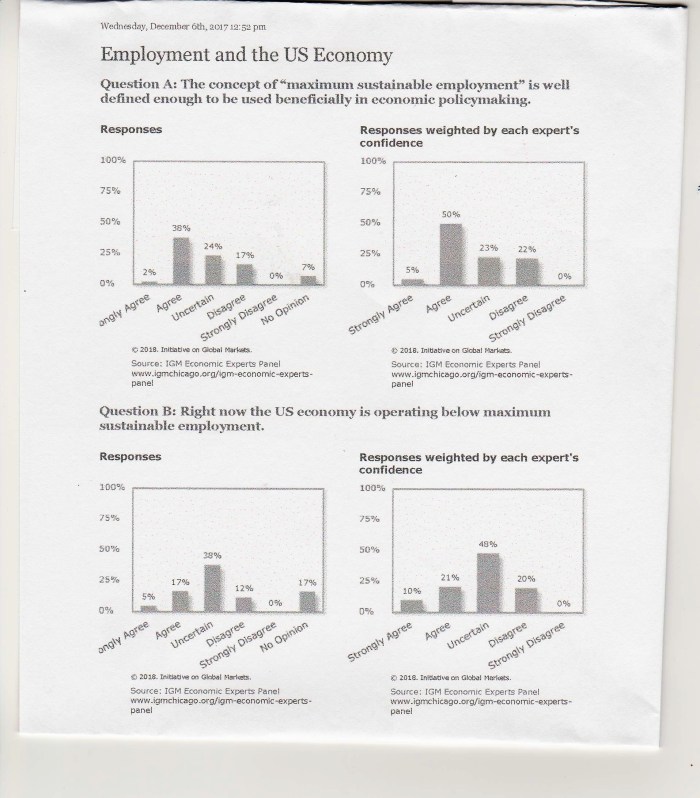
  • there are several changes relating to the new employment aspect of the objective (which, contrary to Arthur Grimes, I consider neither ‘disastrous’ nor ‘crazy’, and which risk being more feeble and virtue-signalling in nature than anything else).
    • at a high level there is an expectation that “the conduct of monetary policy will….contribute to supporting maximum sustainable employment”,
    • adding “employment” to the list of in the provision requiring the Governor to seek to avoid “unncessary instability”, and
    • a requirement to explain in Monetary Policy Statements how “current” monetary policy decisions contribute to “maximum levels of sustainable employment”

Quite what, if any difference, these provisions make will really depend on the new Governor’s assessment.   His press release suggests no difference at all

Mr Orr said that the PTA also recognises the role of monetary policy in contributing to supporting maximum sustainable employment, as will be captured formally in an amendment Bill in coming months.

In other words, just formalising what is already there.  An approach that, not incidentally, delivered us an unemployment rate materially above the NAIRU –  on the Bank’s own numbers –  for most of the last decade.   At present, we can probably expect lots of rhetoric –  repeated references to the contribution the Bank is making –  and nothing of substance, although in fairness it may be hard to tell for some time (since the unemployment rate is now closer to a true NAIRU than it has been for some considerable time).  It will be interesting to see the Governor’s first MPS and the associated press conference.

Personally, I’d have preferred that the new requirements were specified in terms of unemployment –  explicitly an excess capacity measure. There probably isn’t a great deal in the issue, except that the current formulation tends to treat high rates of employment as a “good thing”, when there is little economic foundation to such a proposition. By contrast, minimising (sustainably) the rate of unemployment is more unambiguously a “good thing”.

Perhaps more disappointingly, it is fine to require the Bank to explain how current monetary policy decisions are contributing to maximum sustainable employment.  But that is the sort of obligation an undergraduate student of economics could meet without difficulty and without much substance.  It is unfortunate that the Bank is not being required to:

  • explain how past monetary policy decisions have actually contributed to maximum sustainable employment,
  • explain how its future monetary policy plans will do so (the Act requires the Bank to explain policy plans for the (rolling) next five years),
  • publish estimates of the maximum sustainable level of employment.

Finally, with the OCR at 1.75 per cent and the current economic expansion having run for eight or nine years, it is disappointing that the Minister and incoming Governor have not signalled anything about the importance of preparing for the next recession, and reducing the extent to which the near-zero lower bound (inability to take the OCR below about -0.75 per cent) could severely limit the capacity of the Reserve Bank to maintain price stability (or contribute to maximum sustainable employment) in the next recession.  That recession  –  timing unknown of course –  remains much the biggest threat of unnecessarily high unemployment.  And yet it still doesn’t seem to be being taken seriously.

I’ll do a separate post on the planned legislative reforms.   For now, suffice to say that if it is a small step in the right direction, it is a big win for the Reserve Bank establishment.

On aspects of Reserve Bank reform

On Tuesday Adrian Orr will take up the office of Governor of the Reserve Bank and thus become, for a time, the most powerful unelected person in New Zealand.  In some respects he will in fact be more powerful than the Prime Minister, albeit over a much narrower range of functions, because it is much easier to oust a Prime Minister (see Tony Abbott and Kevin Rudd) or to vote her down in Cabinet than it is to constrain, or oust, a Governor.

It is a statutory requirement that a Policy Targets Agreement, governing the conduct of monetary policy, be agreed between the Minister of Finance and any person he is considering appointing as Governor before that person is appointed.  It is less than ideal that, three days out from Orr taking office, 3.5 months on from the appointment being announced, there is still no Policy Targets Agreement.   Have Treasury and the Minister lost sight of the merits of predictability and certainty, and the fact that markets (and individuals and firms) operate on a forward-looking basis?     But, apparently, the PTA will finally be signed/released on Monday, just a day before Orr takes office.   One can only hope that there will also be a pro-active release of the background papers relating to this major component of New Zealand macroeconomic policy.  If not, I will immediately be lodging OIA requests.

We are also told that information on decisions the government has made about “the new decision-making structure at the Bank” and other material on Stage 1 of the review of the Act (focused on monetary policy) will be released on Monday. If the government has done the right thing, before too long Orr will be stripped of much of his personal power, to become primarily an agency chief executive, and perhaps primus inter pares on one or more committees.   That would be a long overdue reform.  Perhaps the Independent Expert Advisory Panel –  which, thus far, has operated totally in secret – might open themselves to questioning?   Perhaps too we might get some hints as to what Stage 2 of the review –  content as yet undefined –  will cover?  You can expect there will be several posts on these issues next week.

As for Orr himself, only time and experience will tell what sort of job he will make of being Governor.  Today’s Herald has what can only be described as a puff-piece profile –  they managed preferential access to the previous Governor (notoriously media-shy), and presumably are targeting ongoing good relations more than serious scrutiny.  After having had monetary policy a bit too tight for most of this decade, we can only hope that their cartoon –  the new Governor appearing to keep money securely locked away –  isn’t inadvertently prophetic.

New Reserve Bank Governor Adrian Orr. Picture / Rod Emmerson

There was another, rather more interesting, piece –  from BusinessDesk –  offering some  thoughts from various economists on Orr taking up his new role.

Hawkesby likened Orr to UK politician Boris Johnson. “The stereotype of a central bank governor is someone whose communication is cautious, reserved and dry. Adrian is more like Boris, with communication that appears more spontaneous and witty,” he said.

TD’s Beacher warned, however, “there is the risk that his ‘good clear communicator’ reputation means he could make a poor choice of words on occasion when explaining the bank’s stance on policy settings.”

I greatly enjoy a good Boris Johnson newspaper or magazine column, but a comparison to Boris Johnson seems a backhanded compliment at best.    My own thoughts on Orr, and some of the opportunities and risks were in these two posts –  here and here.).

But the main prompt for this post was an interest.co.nz column from a day or two ago by my former Reserve Bank colleague, and now consultant on things to do with financial regulation, Geof Mortlock.  That website often runs to long headings for their articles.  This one is headed

Ex-RBNZ and APRA official, Geof Mortlock, argues the RBNZ’s regulation of the financial sector is so inadequate this responsibility should be passed on to a new agency

The article is well-worth reading for anyone interested in New Zealand financial system regulation and supervision, or in the governance and conduct of the Reserve Bank.

A few weeks ago I outlined the case (and here) for splitting the Reserve Bank in two, and shifting the regulatory and supervisory functions into a new agency, perhaps called the Prudential Regulatory Agency.   Various other people have supported that sort of change, one senior business figure commenting that, if starting from scratch, structural separation would seem like a ‘no-brainer’.     My case for that reform was summarised this way

In favour of that position is that:

  • it is the more common model in advanced countries today (including Australia),
  • the synergies and overlaps between the various functions of the Reserve Bank are pretty slight (and probably no greater than, say, those between fiscal and monetary policy),
  • structural separation would allow for clearer lines of accountability, and
  • structural separation would allow for the creation of stronger, more effective, cultures  –  with appropriately skilled chief executives –  in each of the two successor institutions.

And so I welcome the fact that Geof Mortlock is also calling for structural separation

In my assessment, the best way to achieve the needed changes is to remove the financial regulation functions from the Reserve Bank and move them to a new, separate agency. I am sceptical of the willingness or ability of the Reserve Bank to change its cultural DNA.  Moving financial regulation out of the central bank was done in Australia with great success. Likewise, this has been done in many other countries, such as Canada, Germany, Japan, Sweden and Switzerland.

At present, we don’t even know whether the government is open to considering this option –  since nothing is yet identifiably included in the proposed Stage 2 of the review –  but they should.  It would be likely to make possible –  although there are no guarantees – a better monetary policy agency and a better regulatory one.

The bulk of Mortlock’s artice is actually about the Reserve Bank’s conduct of its regulatory responsibilities.  On some counts I strongly agree with him, and his observations and criticisms echo points I’ve made here on various occasions

The Reserve Bank’s approach to policy formulation and consultation on regulatory initiatives is deficient. Too often, the Bank has allowed far too short a period for affected parties to make submissions on regulatory proposals. All too often the Bank has often given the strong impression that it has little interest in the submissions it receives – i.e. that it is consulting for the sake of appearance and has no intention of modifying its approach in light of submissions. It generally provides inadequate responses to submissions and insufficient justifications for any decision to reject points raised in submissions. The argumentation for policy proposals is often poorly developed. Cost/benefit analysis is typically provided to justify the Reserve Bank’s preferred option, rather than being objectively and rigorously developed at an early stage in the policy formulation process. There is very little substantive independent assessment of the Reserve Bank’s cost/benefit analysis. In stark contrast, the Australian system provides for much more rigorous independent assessment of all regulatory proposals.

All of these deficiencies need to be rectified by imposing on the Reserve Bank much stricter requirements on consultation and cost/benefits analysis, and by bringing much stronger external scrutiny to the process. Similar arguments can be made for other regulatory agencies.

One could add that the Bank’s regulatory impact statements are typically a joke, with no independent internal or external review –  and thus simply serving to provide support for whatver a particular Governor has chosen to do.

One could also add that the Reserve Bank remains highly averse to public scrutiny of its regulatory role, regularly falling back on statutory provisions –  which themselves should be reviewed and refine –  designed to protect commercially-confidential information obtained in the midst of a crisis, but used much more broadly than that.  Thus, the Reserve Bank recently refused to release any of a consultant’s review of the director attestation regime –  a central element in the prudential system. The utter lack of transparency around the Westpac capital models issue, or the stuff-up around the Kiwibank capital instrument are other examples.    Perhaps more than some other government agencies, the Reserve Bank tends to treat the Official Information Act as a nuisance that really shouldn’t applied to them, rather than as an intrinsic part of our democratic system, and a normal part of being a government agency.   The “but we are different” mindset is a hard one to break.

Quite a bit of the rest of the article –  on the Reserve Bank’s regulation/supervision activities and rules –  I disagree with.   It is nearer territory Geof spent has most of his time on than it is for me.  Then again, Geof has been a regulator for a long time, and appears to make his living in part from providing advice on fitting in with international frameworks and standards.   Of itself, that doesn’t invalidate his views, but it is worth remembering the old maxim that

I suppose it is tempting, if the only tool you have is a hammer, to treat everything as if it were a nail.

And there isn’t much sign of any cost-benefit analysis in his proposals for spending quite a lot more money (or so it would appear) on these functions.  I’m certainly sceptical of governments and bureaucrats wanting to spend more of our money on ‘financial literacy’ (as Geof suggests).  ‘Physician heal thyself’ comes to mind –  as Geof notes, the Reserve Bank will not even produce decent cost-benefit analyses for most of what it imposes on us.

I don’t doubt that the Reserve Bank could do some things quite a bit better –  process and culture included. I have also argued for removing some of the regulatory powers back to the Minister of Finance, and for more standardisation of the regime applying to all deposit-takers.   But I’m more sceptical that even more supervision is likely to be the answer to anything much.  A fair chunk of the global enthusiasm for more regulation, more supervision, over the last decade has been about backside-covering by politicians and regulatory agency officials after the crisis of 2008/09, with little attention to the inevitable limitations of regulation/supervision, including the incentives and constraints that face officials in regulatory agencies.  Action was demanded, and action was delivered, but the analytical basis for much of that action was often thin, and not well-grounded in serious sceptical scrutiny of the causes of the crisis.

And it is perhaps worth bearing in mind that New Zealand’s track record of financial stability has been pretty good.  Geof argues that

The Reserve Bank is also not well placed to proactively identify and resolve emerging problems before they become obvious or the financial institution is about to fail. The recent failure of CBL Insurance is an example of this. In earlier years, the Reserve Bank was slow to detect and respond to problems in DFC (which failed in 1989) and BNZ (which came close to failing in 1990).

Im not sure this is very persuasive.  On the one hand it is worth bearing in mind that it appears the Reserve Bank was onto the CBL problems well before the market was –  including bankers lending CBL new money –  and the DFC/BNZ failures were almost 30 years ago, under different legislation in the earliest days of the Bank having any prudential responsibilities and in the immediate aftermath of far-reaching financial liberalisation (followed by booms and failures in various other countries including Australia and the Nordics).   And on the other hand, we could note the crises and failures/near-failures (of regulated institutions or indeed the system) of the last decade in countries as various as the United States, United Kingdom, Switzerland, Denmark, Belgium, Netherlands, France, Greece, Italy, Spain, Ireland and so on.  In many of those countries, the IMF had previously provided a tick in its FSAP reviews.  Several of those countries will have –  and did –  prided themselves on their regulatory agencies, on-site or in-depth detailed scrutiny and all.     Neither New Zealand nor Australia (nor Canada, nor Norway for that matter) ran into such problems.    APRA may like to flatter itself that Australias avoidance of crisis was down to their fine supervision –  I’ve heard senior people run that line – and that New Zealand, free-riding on fine Australian supervision, was in the same boat.   My response to that claim would be, at best, ‘case not proven’.

It is also worth bearing in mind that the Reserve Bank isn’t the principal in this business, but the agent.  It hasn’t been –  and isn’t –  funded for more intensive regulation and supervision, and that is a choice successive Ministers of Finance –  advised by Treasury over the years –  have made.  In a sense, the Reserve Bank has done what Parliament  –  and Ministers –  asked it to do, and in that sense that question isn’t just about the Reserve Bank’s competence and capability but about choices our political system makes regarding the intensity of regulation.

All that said, if we might differ in emphasis, and in our confidence as to what value regulators and supervisors can add, we seem to be at one in favouring structural separation.  A good part of the case for such a reform is the ability to build a culture dedicated to doing excellently, and only, the regulatory and supervisory functions Parliament delegates to the Bank.  It is telling that, for a function that now bulks so large in the Reserve Banks mandate, recent Reserve Bank Governors have had little background in banking or of financial system regulation (certainly true of Bollard and Wheeler, and to a lesser extent for Adrian Orr).  At best, financial regulation and supervision is a part-time focus for the Governor.  And the new Head of Financial Stability –  an appointment made by Graeme Wheeler as he was leaving, without advertising the position –  has no background in those areas at all.  We can and should do better.  That ball –  structural reform and separation –  is now clearly in the Minister of Finances court.


A couple of Reserve Bank items

I had been meaning to write about a speech given last week by Grant Spencer of the Reserve Bank on so-called “macro-prudential policy”.  It was a thoughtful speech, as befits the man, and the last he will give as a public servant before retiring next week.

That it was thoughtful doesn’t mean that I generally agreed with Spencer’s (personal, rather than institutional) views.  There were at least two important omissions.  First, as it has done over the last half-decade (and more) the Bank continues to grossly underplay the importance of land-use restrictions in accounting for increases in the prices of houses (and particularly the land under them).  Until they get that element of the analysis more central, it is difficult to have much confidence in what they say about housing markets, housing risks, or possible Band-aid regulatory interventions of their own devising.    And second, they constantly ignore the limitations of their own knowledge.  I’m not suggesting for a moment that they are worse than other regulators in this regard –  who all, typically, have the same blindspot –  but it might matter rather more from a regulator than exercises, and wants to be able to continue to exercise, large discretionary intervention powers, with pervasive effects over the lives –  and financing options –  of many New Zealanders.   If they won’t openly acknowledge their own inevitable limitations, and discuss openly how they think about and manage the associated risks, how can we have any real confidence that they aren’t just blundering onwards, fired by good intentions and injunctions to “trust us” rather than by robust analysis.  In respect of both these omissions, I hope –  without much hope –  that the new Governor begins to put the Bank on a better footing.

When someone asked me the other day if there was anything new in the speech, one thing I noticed was how far the Bank’s current senior management appears to have come over the last few months around possible changes to the governance of the Bank’s main functions.   Casual readers might not notice the change, because it is presented as anything but.  Specifically, this is what Spencer had to say.

Given the planned introduction of a new decision making committee (MPC) for monetary policy, the Review should consider establishing a financial policy committee (FPC) for decisions relating to both micro and macro prudential policy. The Reserve Bank has supported a two-committee (MPC/FPC) model in place of the current single Governing Committee, for example in the Bank’s 2017 “Briefing for Incoming Minister”.

Of course, it is only a few months since the Bank’s expressed preference was simply to take the existing internal Governing Committee (the Governor and the deputies/assistant he appoints) and recognise it in statute, as the forum through which the Governor would continue to make final decisions.

And what of the claim that the Bank has –  not just does now –  supported a two-committee model, including in its Briefing to the Incoming Minister late last year?  At very best, that is gilding the lily.

As I noted at the time, both in the main text of that Briefing, and in the fuller appendix (both here) they devoted most of their effort to defending the existing Governing Committee model.    The main alternative they addressed was a Monetary Policy Committee  but even then the most they favoured was enacting the current Governing Committee model, perhaps with a few outsiders appointed by the Governor, and with the Governor remaining the final decisionmaker
“Provided the Governing Committee remains relatively small, we believe it should continue to make decisions by consensus, with the Governor having the final decision if no consensus can be achieved.  “
The only mention of a Financial Policy Committee is (from page 9)

The Reserve Bank considers that some evolution in its decision-making approach may be appropriate.  We recommend that the review of the RBNZ Act be limited to your stated change objectives.  We consider a review along these lines could be completed reasonably quickly and we would be happy to prepare a draft terms of reference, in consultation with the Treasury.  A variety of arrangements are possible and these are discussed, alongside the rationale for the Bank’s preferred model, in Appendix 6.

Other legislative changes that may be desirable over time include:

– Creating separate decision-making committees for monetary and financial policy

Note the suggestion to the Minister to keep the forthcoming review of the Act to the minimum of what Labour had promised (which dealt only with monetary policy), with some vague suggestion that at some time in the future –  but not in this review –  separate committees “may” be appropriate.  It could scarcely be called a full-throated endorsement of change.

Of course, the Bank lost various battles.  The first stage of the review is being led by Treasury (dealing with the monetary policy bits) and the second stage will look at (as yet unidentified issues).   And it seems they must have recognised that the ground is shifting, and that it would be hard to defend the current single decisionmaker models for the Bank’s huge regulatory (policy and operational) powers once momentum gathered behind a committee model for monetary policy.  Whatever the reason, it is a welcome move on the part of the current management.  Of course, we have no idea what the new Governor –  taking office in a few days –  thinks about suggestions to curtail his powers.

And just finally on the speech, one element of good governance is obeying, and respecting, the law.    Once again, Spencer’s speech and press release have been put out under the title “Grant Spencer, Governor”.  He simply isn’t.  At best he is “acting Governor”, a specific provision under the Reserve Bank Act.  A “Governor” has to be appointed for a minimum term of five years.   If it were a lawful appointment, there is nothing shameful in being acting Governor –  the one previous example, Rod Carr for five months in 2002, never purported to be the Governor.   As it is, my analysis stills suggests that the appointment was unlawful, and thus Steven Joyce and the Bank’s Board (by making the appointment) and Grant Robertson (in recognising it) both undermined the law and good governance and marred the end of Spencer’s distinguished career.  At very least, those provisions of the Act should be reviewed as part of Stage 2.

Meanwhile, we are still waiting for the now-overdue results of Stage 1, for the report of the Independent Expert Advisory Panel (which, as far as we can tell, has neither sought submissions nor engaged in consultation) and for the new Policy Targets Agreement which wil guide monetary policy from next week.

Still on matters re the Reserve Bank, there is a column in the Dominion-Post this morning by Rob Stock having a go at the Open Bank Resolution (OBR) and associated hair-cut of creditors and depositors option for handling a failed bank.  Like me –  and many other people, including the IMF and The Treasury –  Stock favours deposit insurance.  But he seems to see deposit insurance and OBR as alternatives, whereas I see them natural complements.  Indeed, the only way I can ever see the OBR instrument being allowed to work, if a substantial bank fails, is if deposit insurance is also in place.

Stock introduces his article with a straw man argument that ordinary depositors can’t really monitor banks and so shouldn’t be exposed to any financial loss if a bank fails.  Not even the first point is really true.  There are, for example, published credit ratings, and any changes in those credit ratings –  at least for major institutions –  get quite a lot of coverage.  A huge amount of information is reduced to a single letter, in a well-articulated series of gradations.   Should one have vast confidence in ratings agencies?  Probably not –  although perhaps not much less than in prudential regulators, based on track records.  But if your bank is heading towards, say, a BBB- rating and you have any material amount of money it would probably be a good idea to consider changing banks, or spreading your money around.    No one thought that South Canterbury Finance or Hanover were the same risk as the ANZ, at least until the deposit guarantee scheme made putting money in SCF rock-solid safe, whereupon many depositors rushed for the higher yields.

But there is a broader point that many risks in life aren’t able to be fully monitored, controlled, hedged, avoided or whatever  One might become a highly-specialised employee in a firm or industry that fails, or is taken out by regulatory changes.  Regions and towns rise and fall, and take house prices with them.  Governments might one day free up land use laws, reducing house and land prices to more normal levels.  Wars and natural disasters happen.  Chronic illness can strike a family. Even a marriage can be hugely risky.    For the median depositor there is typically much less at stake in their bank account (and typical losses –  percentage of liabilities – on failed retail banks aren’t that large).

Are there potential hard cases?  For sure, and Stock cites one of them.   If you’ve just sold your mortgage-free house –  for, say $1 million –  and are settling on another house next week and your bank failed in the course of that week, you could be exposed to quite a loss even though you’d had no desire to be a creditor of the bank.   Cases like that are one reason why I favour the Reserve Bank opening up electronic settlement accounts –  central bank e-cash if you like –  to the general public.  There wouldn’t be much demand, but on those rare occasions like the house settlement example, you might happily pay for the peace of mind of an effective government guarantee.  I’m looking forward to the new Reserve Bank Bulletin article on such matters next month.

I don’t think those few extreme examples warrant full insurance for all individual depositors, no matter the size of their balance.  There are many classes of people struck by not-easily-monitorable illiquid risks (see above) I’d have more sympathy with.  But I’m a political pragmatist, and as I argued previously I just cannot envisage an elected government allowing a major bank to fail, allowing all creditors to be haircut, if there is no protection at all.    That is especially so when, almost by construction, the Reserve Bank –  the government’s agent –  will have failed in its duties (and probably kept crucial information from the public, as in the recent insurance failure case) for the situation to have got to that point.    A full bailout will typically be the path of least resistance.

And a full bailout will mean not just bailing out the grandma with a $30000 term deposit, or the person changing homes with $1m temporarily on deposit, but bailing out wholesale creditors –  domestic and foreign –  with tens or hundreds of millions of dollars of exposure.     Do that –  or set up structures that aren’t time-consistent and encourage people to believe in bailouts –  and any market discipline, even by the big end of town, will be very severely eroded.  And, in a crisis, we’ll be transferring taxpayers’ scarce resources to people   including foreign investors – who really should be capable of looking after themselves.  It has happened before and it will happen again.   But deposit insurance –  funded by levies on covered deposits – increases the chances of being able to impose losses on the bigger creditors if things go wrong.

Perhaps OBR would still never be used.  And there are costs to the banks in being pre-positioned for it.  But we shouldn’t easily give in to a view that any money lent to a bank is rock-solid, backed by government guarantees.  It is not as if there aren’t plausible market mechanisms that could deliver much the same result, at some cost to the depositor (eg a bank or money market fund that held only short-dated government or central bank liabilities).   But there is little evidence of any revealed demand for such an asset –  the cost presumably not being worth it to most people, to cover a very small risk.  By contrast, we voluntarily pay for fire or theft insurance –  often to cover what are really quite modest risks.

There may not be any more posts this week (and if there are, they won’t be of any great substance).   I have a couple of other commitments on Thursday and Friday and, as I’m sure many have discovered before me, broken bones seem to sap an astonishing amount of energy for something so small.

The Reserve Bank’s Board

I’m not an NBR subscriber but I’d been told that last Friday’s edition was quoting me on various aspects of Reserve Bank reform, so when I was in town yesterday I picked up a copy.  I’ll come back later in the post to that article by Jenny Ruth.

But, as it happened, there was another substantial piece in the same issue of NBR also calling for an overhaul of the Reserve Bank governance model.  This one was from Roger Partridge, chairman of the New Zealand Initiative.

The New Zealand Initiative will, no doubt fairly, tell you that they don’t represent any particular interests.  Nonetheless, in Australian parlance, their membership makes up the “big end of town”.  In particular, all four main banks (and a couple of the smaller one) are members, and the Board includes the chair of the Financial Markets Authority and a (until recently) CEO of one of the banks  (CBL Insurance is also shown as one of the members, but I guess not for much longer).

The Initiative appears to be quite unhappy with the governance of the Reserve Bank, especially around its prudential regulatory functions.  All the Bank’s powers are “directly vested in the Governor” and thus, they argue, “the Governor is not accountable to the board in the way any other chief executive would be and the Board has no power to override regulatory decisions”.  Partridge goes on to note that, in his view,

“None of this would matter if the Reserve Bank’s exercise of regulatory power were consistently exemplary. But, as the New Zealand Initiative will disclose in a report to be published next month, there are reasons to believe the bank’s conduct is far from exemplary.”

(Disclosure: I was one of the many people they talked to in putting this report together, and have seen and commented on a draft.  Here I restrict my comments to what is in Partridge’s NBR article.)

Partridge expresses concerns about both “the standards of behaviour of those responsible for the bank’s regulatory decisionmaking, and with the quality of analysis informing its policymaking”.    He notes that the current model is unusual, and (a) lacks the checks and balances that arise from multi-member decisionmaking bodies, (b) the Board has limited effective ability to hold the Governor to account, and (c) the Bank isn’t subject to “the same level of departmental or parliamentary scrutiny as other regulators”.

It is hard to disagree, and I’m certainly not about to.

But in thinking about alternative models, I’m not convinced –  on the basis of what is on display here –  that the New Zealand Initiative has yet thought hard enough.  For example, they seem to take for granted that the Reserve Bank (a single organisation) should be responsible for both monetary policy and the regulatory functions, and yet focus only on the governance of one of those functions, not that of the organisation as a whole.  They also seem to take for granted the existing powers the Reserve Bank has on the regulatory side –  in which the Bank has much more policymaking powers, not just powers around the implementation and enforcement of policy, than most other regulators do.

Partridge appears to approach the issue primarily with a corporate model in mind.  In a corporation, the Board is elected by shareholders and has overall responsibility for the business.  The Board in turn appoints a chief executive –  who might, or might not, be appointed as a Board member –  and delegates certain responsibilities (day to day management) to the chief executive.    And what the Board giveth the Board can take away  – if it can hire, it can fire, and it can alter or withdraw delegations, or even override specific decisions.  Key strategic decisions will be taken by the Board.  There is, at least in principle, a clear goal in mind: maximising value for the shareholders.   And the business either operates in a competitive environment or if not, that is a problem for the competition authorities.  Hardly ever are commercial businesses handed monopoly powers.  That is a quite different situation from a regulatory agency – prudential or otherwise.

Partridge cites the Financial Markets Authority as a better model.  In many respects, the FMA is structured like a corporate: the Minister appoints (and can dismiss) part-time Board members, and the Board hires a chief executive.  But it is worth remembering that the FMA has quite limited policymaking powers: most policy is made by the Minister, whose primary advisers on those matters are MBIE.   The FMA is largely an implementation and enforcement agency.  That is a quite different assignment of powers than currently exists for the Reserve Bank’s regulatory functions (especially around banks).  Also unaddressed are the potentially serious conflict of interest issues around the FMA Board, in its decisionmaking role. More than half the Board members appear to be actively involved in financial markets type activities (directly or as advisers), and even if (as I’m sure happens) individuals recuse themselves from individual cases in which they may have direct associations) it is, nonetheless, a governance body made up largely of those with direct interests that won’t necessarily always align well with the public interest.

Reasonable people can reach different views on the performance of the FMA. I gather many people are currently quite pleased with it, although my own limited exposure –  as a superannuation fund trustee dealing with some egregious historical abuses of power and breaches of trust deeds – leaves me underwhelmed.  It is certainly a model that should be looked at in reforming Reserve Bank governance –  it is, after all, the other key financial system regulator –  but I’m less sure that it is a readily workable model for the prudential functions, even with big changes in the overall structure of the Reserve Bank, and some reassignment of powers.  It certainly couldn’t operate well if both monetary policy and the regulatory functions are left in the same institution.  It doesn’t seem to be a model followed in any other country.  And it isn’t necessary to deal with the core problem in the current system: too much power is concentrated in a single person’s hands.  In a standalone regulatory agency, I suspect an executive board –  akin to the APRA model –  is likely to be an (inevitably imperfect) better model.  In an monetary policy agency, the Governor and any committee/Board members should all be appointed by the Minister (as is standard international practice).

Having said that, I welcome the fact that the New Zealand Initiative is now championing the cause for reform of the governance of the Bank’s prudential regulatory functions, and hope that adds to the impetus for putting those issues front and centre in Stage 2 of the review of the Reserve Bank Act.

Jenny Ruth’s article in the same issue of NBR picked up two of the issues I’ve been calling for reform on.  The first relates to fixing up the current weak provisions around Reserve Bank five-yearly funding agreements: they are (formally) voluntary, not remotely transparent, and out of step with the way we fund numerous other important government agencies, including ones that can make life difficult for sitting governments deciding on annual budgets.   Current provisions are simply out of step, and should be fixed.  If not now, we could wait another 30 years until the next major review of the legislation.

The other issue relates to the future of the Reserve Bank Board

“Another of Mr Reddell’s views is that the Reserve Bank’s board is essentially useless and should be scrapped and Shoeshine can’t help but agree.”

She goes on to recount my own bad experience with the Board –  the Board chair’s active cheerleading for the then-Governor tarring me as irresponsible, after I highlighted evidence suggesting (correctly as it happens) a leak of the March 2016 OCR decision –  and the way the Board was similarly supine in the face of the former Governor’s attempt to silence BNZ chief economist Stephen Toplis.  By statute, the Board exists to hold the Governor to account.  By revealed preference, they seem to exist to have the Governor’s back and never ever express even the slightest open unease.  They aren’t decision-makers (Parliament hasn’t given them that power), and instead they’ve chosen to turn themselves into cheerleaders.

My unease here isn’t personal.  I know several of the directors and have worked quite closely with a couple of them.  One even attends the same church as me and was MC at our wedding.  But they are serving no useful role and in some areas simply aren’t even following the law.

Jenny Ruth highlights the quiesence around the misplaced and ill-judged 2014 tightening cycle, referring to Board annual reports.

Shoeshine knows what a wonderful thing hindsight is, but Mr Wheeler was never able to bring himself to acknowledge that hindsight did indeed show the 2014 hikes were a mistake. Clearly the board couldn’t bring itself to disagree with him.  Shoeshine’s all for this cheerleading role to end.

As it happens, the Board was cheerleading right to the end of Graeme Wheeler’s term.  Quite recently I lodged a request for the minutes of Board meetings from the second half of last year.  One of those meetings was Wheeler’s final one as Governor.   I guess it is customary to say only nice things to those who are leaving, and to step delicately around any points of unease.  But whatever they may have said in private they didn’t need to record anything much for posterity (which is what minute of this sort really are).    And yet they did.  This (with emphasis added]  is from the minutes of the Board meeting held on 21 September 2017.

The Board noted that Governor Wheeler had successfully led a substantial amount of change in Bank policies and in internal Bank management. Policy initiatives included the development of macroprudential tools to address financial stability concerns, changes to the regulatory regime for regulated financial institutions, a review of payments system infrastructure, the new currency, and an expansion in the Bank’s communication and external engagement. Within the Bank Governor Wheeler has promoted a focus on efficient use of resources, understanding risk in the Bank’s operations, the development of management and leadership capability and the formalization of the Governing Committee framework for decision-making within the Bank. On monetary policy and inflation, Governor Wheeler faced global economic and financial conditions that produced a sustained deflationary impulse through tradable goods prices despite moderately strong economic growth in New Zealand and non-tradable inflation within the target range. Governor Wheeler led a substantial new research programme within the Bank analysing the drivers of low inflation outcomes, including the reasons why the record levels of migration have produced less inflationary pressure than in earlier business cycles. The Board has enjoyed an open and collegial relationship with the Governor, including in the implementation of a range of new processes following from the receipt of Minister English’s “Letter of Expectations” to the Board.

The Governor thanked the Board for its constructive advice and support for him
throughout his term.

How terribly chummy.   It is carefully worded, but there is no mention of the persistent failure to keep inflation near the target midpoint (despite all the “substantial new research programme”), and none of the fact that surely no one other than Bank –  and the cheerleading Board? – regarded external communcations during the Wheeler years as any sort of positive.  In a way it is all encapsulated in the final remark recorded from the Governor –  this Board exists almost entirely as the agent of the public and the Minister to hold the Governor to account, not to “support” him.

It really time for this Board to be disbanded.   Perhaps a Board has a role in either an ongoing Reserve Bank (as monetary authority) or in a new Prudential Regulatory Authority, but if so it should be nothing like the sort of board we’ve wasted public money on for almost 30 years now.

Finally, the release of those Board minutes confirms that the Board still does not meet even some of its most basic statutory obligations, those under the Public Records Act.   There is nothing at all in the minutes about the process leading to the recommendation to the Minister of Finance of a name of a person to be appointed as the new Governor.  To be clear, if there had been I’d have expected much of the material to have been withheld –  on privacy grounds –  but the minutes are quite clear that there is no such record.   As an example, at the meeting of 16 November –  presumably the one at which the final recommentation was made –  there is just this

8.2 Non-Executive Directors-only Session

No minutes follow, no records, no indications of anything being withheld.  Simply a flagrant breach of a simple statutory obligation.

I noticed that earlier this week the government appointed Dr Chris Eichbaum to the Reserve Bank Board (a role he held previously, being appointed by Michael Cullen for a term from 2008 to 2013).   Eichbaum is an academic, working in the School of Government at Victoria University, and so presumably has a professional interest in good process etc. Whatever else Eichbaum brings, perhaps he could remind his colleagues of their basic statutory recordkeeping obligations?


Towards a new Policy Targets Agreement

In 20 days time, 27 March, Adrian Orr is scheduled to take office as Governor of the Reserve Bank.  I say “scheduled” because he can’t be appointed until he and the Minister of Finance have signed a Policy Targets Agreement consistent with the statutory objective for monetary policy set out in section 8 of the Reserve Bank Act.

We can assume there will such a Policy Targets Agreement.  After all, the current (unlawful) acting appointment of Grant Spencer ends on 26 March, and all the powers of the Reserve Bank are vested in the Governor personally.

But given that (a) Orr’s appointment was announced three months ago, and (b) the changes in focus for monetary policy that the new government has foreshadowed, it isn’t very satisfactory that we still have no Policy Targets Agreement, and that whatever is being cooked up is being done in secret.   Perhaps I get repetitive in making the point, but as I’ve noted previously the Policy Targets Agreement is the main instrument of macroeconomic management, signed up for five years at a time, and then with all the powers delegated to a single individual (who hasn’t even been inside the Reserve Bank before signing up to his new mandate). against whose decisions there are no rights of appeal.

There is also a review of the Reserve Bank Act underway at present.  When the Terms of Reference were announced  –  four months ago today – we were told that as regards the first part of the review, dealing with monetary policy goals and governance,

A Bill to progress the policy elements of the review, including on the details necessary to introduce a potential committee for monetary policy decisions, will be introduced as soon as possible in 2018. This will give greater certainty on the direction of reform in advance of the appointment of the next Reserve Bank Governor, currently scheduled in March 2018.

The clear suggestion was not just that a report might have been provided to the Minister of Finance, but that a bill would have been introduced to Parliament before the new Governor took office.   The decisions in that legislation would, it was implied, inform PTA negotiations.   That phrasing was repeated when the Independent Expert Advisory Panel was appointed in December.

At the time we were also told that

The Panel will also be responsible for a report to the Minister that sets out their views on the Treasury’s policy conclusions and recommendations for phase 1. This will be delivered to the Minister at the same time as the Treasury’s recommendations for phase 1, which is planned for the second half of February.

Treasury’s dates seem to have been slipping.  The web page for the review now says

For Phase 1, please provide any submission to us by 19 February 2018 if you would like your input to be considered before initial advice is provided to the Minister.

If submissions were only due by 19 February, it didn’t give much time for (a) Treasury to reach its conclusions, and (b) for the independent panel to reach and write up their views on the conclusions, all by “the second half of February”.

When this review was initially announced the dates seemed tight but, if observed, ones that might allow some external discussion before the new Policy Targets Agreement was set, especially around the proposed wording of any change to the statutory objective of monetary policy.   As things stand now, we seem most likely to be shortly presented with some sort of fait accompli.

It isn’t a good way to make policy.  The details of the legislation will, in time, be subject to select committee review (and the publication of associated submissions) but the Policy Targets Agreement itself –  including the extent to which it aligns with the proposed new legislation – will have legal force almost right away.   There is no good reason why a more open process could not have been adopted.  At very least, I hope that the Minister of Finance will instruct the Reserve Bank and Treasury to pro-actively release all the papers relating to the forthcoming PTA (it took several years after the event to extract those relating to the 2012 PTA).

And when the Minister sits down to decide what he wants in the Policy Targets Agreement, I would urge him to take much more seriously –  than there is any sign his predecessors, or officials, did over the last few years –  the next serious recession.  As a reminder, in typical recessions short-term interest rates fall (or are cut)  by 500 basis points or more, and at present –  with inflation below target midpoint –  the OCR is at only 1.75 per cent.   I talked yesterday to a journalist who asked how this might be done.   I don’t think it is a matter of changing the inflation target itself at present – that might be appropriate at some point but should be a last resort –  but there are at least three items which could be included either in the Policy Targets Agreement (preferably, since it is an agreement) or in the Minister’s non-binding letter of expectation to the Governor.

  • The Reserve Bank should be required to prepare and provide to the Minister (preferably disclosing the bulk of such a report) a report on practical options that could be put in place early to alleviate or remove the near-zero lower bound on nominal interest rates.  The Reserve Bank’s forthcoming Bulletin article on digital money –  now apparently delayed –  (which they told me about when they refused to release any of their work in this area) may be one input to such work,
  • In conducting monetary policy, and without derogating from its obligation to act to keep inflation within the target, the Reserve Bank should be required to have regard to the desirability of there being as much effective policy capacity (or at least rather more than at present) as possible to respond to the next serious recession, and
  • consistent with that, the Minister could indicate that he would be more comfortable if core inflation over the next few years fluctuated in, say, the 2.0 to 2.5 per cent part of the target range, than if core inflation continued to fluctuate around 1.4 per cent as it has now for a number of years.

It might also be desirable to require the Governor to publish a substantive statement, perhaps within a month of taking office (or at the next MPS), outlining his interpretation of the new Policy Targets Agreement.  We should not have to rely on discovering the meaning of a major instrument of macro policy  solely by revealed preference.

Our Reserve Bank isn’t the only one facing a change in the way its objective is specified.  Just recently, a new objective was set down for the Norwegian central bank, the Norges Bank.   It was the culmination of a two-year process, of which the Ministry of Finance observed

The Ministry has placed emphasis on ensuring a transparent process

The new specification lowers the inflation target –  from 2.5 per cent to 2 per cent.  The initial 2.5 per cent target, adopted in 2001, had been justified on the basis of Balassa-Samuelson types of effects –  as the oil wealth flowed, Norway might have expected to see high non-tradables inflation rates.  Norway is now, on their own reckoning, past that phase.

Here is the bulk of the (notably short) new mandate

Section 1 Monetary policy shall maintain monetary stability by keeping inflation low and stable.

Section 2 Norges Bank is responsible for the implementation of monetary policy.

Section 3 The operational target of monetary policy shall be annual consumer price inflation of close to 2 percent over time. Inflation targeting shall be forward-looking and flexible so that it can contribute to high and stable output and employment and to counteracting the build-up of financial imbalances.

Section 4 Norges Bank shall regularly publish the assessments that form the basis of the implementation of monetary policy.

The second sentence of section 3 is new –  explicit references to “high and stable output and employment” and also to ‘counteracting the build-up of financial imbalances’.  The latter provision is completely new, while the output and employment reference replaces the current objective of “contributing to stable developments in output and employment”.

What I liked was two things:

  • firstly, the deliberate and transparent process used to make the change, and
  • secondly, the public exchange of letters betweeen the Ministry of Finance and the Norges Bank explaining the change and (from the central bank’s side) explaining how the Bank envisages implementing the mandate.  Thus, on the financial imbalances point they note:

The regulation and supervision of financial institutions are the primary means of addressing shocks to the financial system. To some extent, monetary policy can contribute to counteracting the build-up of financial imbalances and thereby reduce the risk of sharp economic downturns further ahead. How much weight this consideration will be given in the conduct of monetary policy will be situation-dependent and must be based on an overall assessment of the outlook for inflation, output and employment.

I don’t think the Norges Bank specification is the appropriate one for New Zealand.  If it were adopted it would be a sign that the government wasn’t really serious about a greater focus on employment outcomes and minimising deviations of unemployment from an (unobservable) NAIRU.   But the open and deliberate process looks like a good example to follow.

In the New Zealand context, one legislative change that should be made is that future Policy Targets Agreements (or mandates from the government, if that were the chosen model) shouldn’t be developed before a new Governor takes office.  (Among other reasons, because no new Governor appointed since the early 1980s has had any recent practical experience with monetary policy).  The target should instead be set, say, every five years (with potential for changes more frequently than that  – eg in the event of a change of government), with a requirement that prior to any new PTA there should be a period of public consultation.  The Reserve Bank has to do that when, eg, it wants to impose new LVR limits.  Governments typically have to do that when they want to legislate (select committees).  For such a major instrument of macroeconomic policy, it seems fitting that a similar sort of process should apply.


Adrian Orr as RB Governor

An offshore bank asked a while ago if I’d do a conference call for some of their financial markets clients with an interest in New Zealand, about what the appointment of Adrian Orr as Governor might mean for the Reserve Bank and monetary policy.  I did a 20 minute spiel for them yesterday afternoon, and while I won’t bore readers with all that material this post will reflect the gist of what I told them.  It builds on the post I wrote at the time Orr’s appointment was announced in December.

Adrian Orr takes office as Governor on 27 March.  But what is striking is just how little of the uncertainty that has pervaded monetary policy, ever since it was confirmed last February that Graeme Wheeler was going, has been resolved.   The Bank has at times run lines about the certainty the regime provides, but not at present –  and perhaps not for some time, even in the best of worlds.  What do I have in mind?

  • a Policy Targets Agreement has to be signed between the Minister and Orr before the latter can be formally appointed.  Whatever process of deliberation is going on –  around the key instrument of macro-stabilisation policy –  is occurring in secret.
  • this secrecy matters more than it usually might, given the government’s commitment to changing the statutory objective for monetary policy and the expectation that they will want to fit as much of that shift into the PTA itself as possible (as I’ve illustrated previously, that wouldn’t be too hard, but precise wording can still matter).
  • not only will we have new words, but a new (single) decisionmaker –  one who has had no involvement in macro policy for 11 years now.  We don’t know his “reaction function” or how we will interpret the (as yet unknown) rules.  Quite possibly, neither does he.  Typically, when the PTA changes there is quite a bit of jockeying even inside the Bank to bend the ear of the new Governor to one interpretation or the other.
  • if the PTA were the only issue, things might settle down quite quickly.  But it isn’t.
  • instead, we have the two stage review of the Reserve Bank Act, none of which will be finalised (some not even started) before the new Governor takes office.  They will be a large number of issues in play including:
    • details of the new statutory objective, and any associated reporting requirements,
    • the design of the proposed new statutory monetary policy committee including
      • the balance of internals and externals,
      • who appoints the members,
      • the names of these future monetary policy decisionmakers,
      • accountability arrangements for the members (including the future of the Bank’s Board).
    • issues around transparency including
      • the character of any published minutes,
      • the freedom of MPC members to articulate their own views in public
  • who future PTAs will be between, what form they will take, and whether there will need to be yet another PTA when the new committee is set up (perhaps 9 to 12 months away), and
  • even if there isn’t another PTA next year, whether a new MPC  (in particular the external members) will interpret the PTA the same way Governor Orr may do while he is the single decisionmaker.

And all that is just about the monetary policy side of the Bank.

Stage 2 of the review of the Reserve Bank Act –  which Orr will no doubt be weighing in on what it should even cover –  is likely to look at the prudential powers of the Bank, where there is lots of potential for change (or for battles to prevent change?).  For example

  • should the supervisory and regulatory functions be moved into a separate agency altogether,
  • even if not, should the Governor continue to retain single decisionmaker powers, and
  • either way, should the Bank have quite such extensive policymaking power (as distinct from the implementation and administration of those policies) as it does, especially over banks.

And there are lot of other issues that could usefully be looked at (eg, the legislative arrangements for funding the Reserve Bank, which are relatively unconstraining and not very transparent at all, or whether the Bank should have policy control over the currency issue, or whether there should be any limits on the extent of the Bank’s financial risk-taking).  Quite possibly, the Act –  now 30 years old, and having grown like topsy –  should be rewritten from scratch.

That is a very long list of battles to fight.  The current Reserve Bank senior management appears to have been fighting pretty hard for minimal change: someone last week characterised them to me as favouring any change so long as it leaves things pretty much as they are now.  We don’t know what Adrian Orr’s perspectives will be on any of these specific issues (he has said nothing at all since his appointment was announced), which only adds to the uncertainty.  But it is no secret that over the course of his career, he has vigorously fought for his patch, and has never –  to my knowledge –  been keen on giving up power, resources, or flexibility.  Many of the possible reforms would tend to do exactly that –  part of the reason why the current Reserve Bank management have also resisted them.  With Treasury known to favour change, and parties that make up the government favouring change (or at least the appearance of change), there is a lot to fight for.

On things the government is absolutely adamant about there is probably no point fighting –  why spend political capital for no expected gain.   But on most of these issues, it isn’t clear that the Minister of Finance has any very strong views, or even cares much.   My suspicion has long been that he has been mostly interested in something that looks and sounds a bit different –  enabling the party base (his, and that of his partners) to see and hear something that sounds not like a Roger Douglas creation.

How will the Bank (and the Governor) win as many of these issues as possible?   No doubt, good quality analysis will help a bit –  and the Bank probably has more resources at its disposal than The Treasury or private commentators.    But part of it is about confidence-building, and that will include how the Governor is seen and heard to handle policy in the coming months.

There has been quite a lot of interest in the (rather sterile) question of whether Adrian will be a “hawk” or a “dove”  –  more or less inclined to tighten (or loosen) monetary policy.    Mostly it is sterile because for most people it depends on the data  (I’ve been what most would call “dovish” for the last four years or so, but was at the “hawkish” end of the spectrum on the Bank’s OCR Advisory Group for much of the 2005 to 2008 period: I don’t think I’ve changed.)

We don’t have anything much to go as to how Adrian will be reading the data at present, or what (if any) distinctive analytical model he might bring to bear.  It isn’t stuff he has needed to think about – much more than any other public sector CEO might have –  for 11 years now.  That is a large chunk of anyone’s career.

I sat on the same OCRAG as him for perhaps five years, in two separate stints.  It was a long time ago now, but I don’t recall any particular “hawkish” stances or moments.  But he didn’t typically mark out the other extreme either (although when he left the Bank in 2000 there was some –  probably badly misplaced – market speculation that he couldn’t abide the hawkish stance of his colleagues).  He was an operator, a communicator, a manager, rather than someone with a strong view on the data.  It is hard to see why that would have changed now, having moved further away from “doing economics” as his day to day job.

There isn’t much sign in anything he’s said –  eg speeches he gave as NZSF head – that his view of the world is much different from a conventional mainstream stance.  And he’ll come into a Bank which has been convinced for years (and wrong) that core inflation is not far from beginning to pick up.  Again, a conventional view – even at the time of the 2014 policy mistake.

The data might shift on us (and the Bank) and justify a quite different stance in time, but even then it looks a lot as if Orr’s incentive will be to do little to step outside a mainstream market consensus, while putting a great deal of effort into communicating an emphasis on the government’s new employment objective (and the limited –  but not zero –  amount monetary policy can do).  Actual OCR setting needn’t be observably very different for people to recognise a difference of tone.  And that difference of tone is part of what will help secure confidence in their new Governor among the Minister and his Cabinet colleagues.  You are more likely to entrust more too –  take less away from –  a Governor who is perceived as “sound”.    Perhaps, as I’ve argued in recent posts, the data might even justify an OCR cut later in the year.  But what the Governor really won’t want are mis-steps: new Governors (all from outside for decades) have each been prone to them, and with so much else unsettled –  in play –  the stakes are higher than usual.

This isn’t to suggest Adrian is likely to be operating outside the Act –  old or new –  or that he’ll jeopardise our record of low and stable inflation. But there is –  deliberately –  a lot of flexibility in any inflation targeting regime.   And Adrian is a shrewd political operator.  And there are a lots of political battles to win.  It is always a mistake to assume that senior officials don’t have private and institutional interests to pursue, as well as public interest (eg core inflation) ones.

As I noted in my earlier post, the contrast between Adrian Orr and Graeme Wheeler as public communicators is likely to be refreshing (mostly).  Wheeler simply wasn’t comfortable in the public spotlight –  and had never had any prior exposure to it –  and so largely avoided it, and acted excessively defensively when he couldn’t avoid it.

It seems unlikely anyone will be making that criticism of Adrian Orr.  He’s had two stints as a commercial bank chief economist, and even in his most recent role –  head of the super fund –  he has been pretty open with the media.   The younger Orr could be shockingly frank, and at times quite vulgar in public –  unacceptably so in a central bank Governor.  No doubt in the intervening years, he’ll have gone some way to rein in his language, but his press conferences – and off the cuff remarks in speeches –  are likely to attract a great deal of interest.  An openness and sense of humour go a fair way in winning people over.  In a way, the communications side of things –  from Bank to public/markets –  may be easier in the near-term, while Adrian is the sole legal decisionmaker, and his advisers are internal.  It will be more challenging if we adopt – as we should –  a Swedish, UK or US system where, when the Governor speaks, he is simply one vote, and no more than primus inter pares.

Incidentally, the advent of someone who isn’t (or hasn’t been) the buttoned-up bureaucrat  will –  or should –  greatly increase the pressure on the Reserve Bank to follow the RBA and make available livestreams, or at very least audio recordings, of Q&A sessions the Governor engages in following speeches (on or off the record).

Adrian is pretty outgoing himself (to the extent of trespassing on personal space). And he has been pretty willing to challenge other people’s ideas (or disagree vigorously) –  the story is famously told of Alan Bollard letting Adrian loose, and he then taking on Peter Costello pretty directly, at the time the Australian authorities were bidding to take over bank supervision.    His track record also suggests that he has become an effective corporate manager –  not an unimportant skill as Reserve Bank Governor – but he doesn’t have a history of fostering open debate and challenge.  That was my observation at the Reserve Bank, and things don’t seem to have been that different more recently.  There is a distinct impression that he works well with those who don’t challenge him, and not so well with those who do; with those who fit his style and not with those who don’t.  Many of the abler people don’t seem to have lasted long.  He has successfully built strong teams of loyalists.   Perhaps it is a management model that might have a place in some contexts – private fiefdoms.  It is hard to see that it is the sort of model of leadership for the public sector.

Even less that it is what is needed for the Reserve Bank, heading into a new era, when many are looking for greater openness and less groupthink, in a environment where extreme uncertainty characterises almost everything (perhaps especially about monetary policy).     The Bank’s Board and the Minister –  the people who hired him –  will need to keep an eye out for these tendencies (although whether the Board –  in particular –  would care much is another question).   Otherwise there is a risk that anyone who challenges him –  statutory MPC member or not – could find themselves frozen out.

A former central banker observed to me the other day about one of the highly-regarded RBNZ Governors of the past: “he was a wonderful man, understated and wise, marvellous to work for, wrote beautifully, encouraged a great openness of thinking among the staff…..he wanted good economics practiced”

No one can be good at everything.  But in my view, a critical quality in a Governor should be a degree of depth and seriousness, that looks for the truth – or at least our best approximations to it – not the arguments that sound superficially appealing, or which fend off a particular critic for the day.  We might hope to learn something –  not just the latest hint about the OCR –  when we read the speeches of a really good senior central banker.  But there has never been much sign that Adrian is a deep thinker –  more the capable operative.  And I’m uneasy that he has repeatedly proved himself too ready to grab, and run with, someone’s superficially appealing idea, or a politically opportune story.

It was an approach on display at the Bank in the past, but it has also been generally visible much more recently.   There was the politically-opportune, but analytically not very persuasive, decision last year to unload carbon exposures from the NZSF, and then bury this major choice in his reset benchmark so that it is very hard to keep track of whether it will prove to have been a good call.  Even more starkly, there were his appearances in the media last year to defend the Fund.   I dealt with some of this stuff in eg this post.  There was plenty of playing politics –  even though his role, as a public servant, was to run the Fund not to champion the policy choice to have it.   There were rather strained attempts to champion the Fund’s investment returns  – even though the Fund’s own official documents stress that one really needs a 20 year horizon to evaluate the value added in such a high risk fund.  There were strained attempts to present as a sovereign wealth fund –  similar to Norway or Abu Dhabi –  what is actually a speculative investment vehicle for a country that still has net debt outstanding.   Investment performance was defended with not a Sharpe ratio, or a Crown cost of capital, in sight, and no engagement with the international literature on the limits of active management.  And despite weighing into the political debates, no attempts to frame the role of NZSF in the context of overall Crown finances (including the ability to absorb large adverse shocks), let alone those of citizens themselves.

In many of the areas he has touched on, there are perhaps quite reasonable serious perspectives to be brought to the table.  But they take a bit longer to develop and articulate.  My point here isn’t that there is necessarily anything wrong with the NZSF, or even its management under Adrian for the last decade. But rather that he sometimes seems unable to resist grabbing the superficially appealing soundbite, or playing to a political audience, or loathe (or unable) to engage at a more serious level.

Adrian has grown into new roles in past.  When he was first appointed chief economist of the Reserve Bank there was a fair amount of scepticism in some quarters.  The economics department was fairly dysfunctional and Adrian had little management experience.  In fact, he did a pretty good managerial job –  even if, on his own confession, it was a deliberately divisive approach, involving playing off one part the Bank off against another.

Perhaps he’ll do so again, stepping up to this much bigger job, in the spotlight not as a commentator, but as a policymaker.  I hope so, but the risks seem quite large, and the uncertainties quite real.  Better communications seem assured –  even with the constant uncertainty as to whether he can hold his tongue –  and I’m sure we’ll see lots of more or less deft political maneouvring. There are, after all, , lots of turf fights looming.   But whether he provides much impetus for better analysis, better policy, better thought leadership, or is interested in inaugurating of a new open, engaged, and accountable era for the Reserve Bank is another question.   They won’t be the direction –  the priority anyway – that Adrian’s natural inclinations seem to run.  Winning political and turf fights is more likely to be a priority.

And I really hope that not all the stories I’ve heard – including that one about Adrian on top of a bar in Courtenay Place –  are true.  Being Governor of the central bank –  bearing, for now, an enormous amount of individual power –  should bring with it an expectation (matched by reality) of gravitas and decorum.  I’m sure he’ll be at hit at the Reserve Bank’s annual financial markets function, but I’m not sure that is quite the relevant standard.

Revisiting the case for splitting the Reserve Bank

The Minister of Finance has commissioned a two-stage review of the Reserve Bank Act.  The scope of the first part is pretty clear: it is about monetary policy (goals, transparency, and decisionmaking structures).  What, if anything, is included in the second stage is still up for grabs, with the Minister awaiting advice from the officials (a joint Treasury/Reserve Bank process) and from the Independent Expert Advisory Panel.   It seems likely that the Reserve Bank itself will try to keep any second stage to an absolute minimum –  as someone put it to me last week, the Bank seems happy with any reform that keeps things pretty much just as they are now –  and the arrival of Adrian Orr as Governor next month is likely, based on past performance, to reinforce that resistance.

A few weeks ago, I outlined the case that, as a key component of the second stage, the Reserve Bank should be split in two.  The Reserve Bank itself would remain responsible for monetary policy and associated activities (notes and coins, foreign exchange reserves, interbank settlement etc) while a new Prudential Regulatory Authority would take on responsibility for regulation and/or supervision of banks, non-banks, insurance companies, payments systems (and for the associated AML controls).

In favour of that position is that:

  • it is the more common model in advanced countries today (including Australia),
  • the synergies and overlaps between the various functions of the Reserve Bank are pretty slight (and probably no greater than, say, those between fiscal and monetary policy),
  • structural separation would allow for clearer lines of accountability, and
  • structural separation would allow for the creation of stronger, more effective, cultures  –  with appropriately skilled chief executives –  in each of the two successor institutions.

There hasn’t been a great deal of public commentary about this issue/option, but I noticed that the Shoeshine column in last week’s NBR picked it up.   NBR’s columnist  –  Jenny Ruth –  noted her support for structural separation (“a jolly good thing”).    She has been pretty critical of the Bank’s handling of a number of its prudential responsibilities, and is uneasy about the extent to which she believes the use of LVR limits –  by statutue, in pursuit of financial stability – “has become hopelessly confused with the Reserve Bank’s monetary policy functions”.

But in putting together her column she also talked to Massey banking academic David Tripe who “agrees there is a problem but isn’t so sure separation is the solution”.  He is quoted as saying

“My suspicion is that it wouldn’t improve matters because it would still be the same people doing the supervision”

and arguing

“We’ve got bank capture of the regulator –  the Reserve Bank asks for the data that the banks agree to provide, not the other way round”

On his first point, I guess my response would be that structural separation is not panacea, but that (a) change starts from the top, and (b) it should be materially easier to hold the financial regulator to account when it is responsible for only one main job (unlike today’s Reserve Bank).   And, as I’ve noted above, many of the other considerations also point in the direction of structural separation.  Finding a chief executive and senior management team who care primarily about the prudential regulation of the financial system –  whereas most of the senior management of the Reserve Bank over decades has always been more interested in (and had more background in) monetary policy –  is likely to be significant part of lifting the performance of the regulator.

Perhaps my one real unease is that a standalone regulatory agency could – if it were allowed to – become even more resistant to transparency and public accountability for its actions.  Whether there is a structural split or not, the officials and politicians doing the current review need to take steps to make the regulatory side of the Bank (as it is now) much more open.

(On Tripe’s second point, while I think there is something in what he says –  especially around data –  I rather doubt many of the banks would recognise the “regulatory capture” story.  On that note, I’m looking forward to the forthcoming publication of the New Zealand Initiative’s work on economic regulatory agencies, including the Reserve Bank.)

In her column, Jenny Ruth highlights a number of recent cases where the Reserve Bank’s handling of regulatory issues leaves a lot to be desired (and where, even if the Bank was correct, it has been so untransparent that we couldn’t possibly be confident of that).  I’ve written a bit about one of the cases she mentions –  the Westpac capital models issue.  The Bank has made no attempt to pro-actively disclose the relevant material (and would no doubt staunchly resist OIA requests), and although it claims it discovered the problem, as Ruth notes

“Westpac insiders say that Westpac outed itself. Shoeshine’s money in on Westpac”

Whatever the truth on that point, the whole episode did little to instill confidence in the Reserve Bank’s systems, processes, or accountability.

I haven’t written about the two other episodes Jenny Ruth highlights, both involving Kiwibank (you can read them for yourself).  Neither suggest that the Reserve Bank’s prudential wing has been on top of its game, or that they really have an instinctive handle on the nature of markets and financial institutions.

There are capable people in the regulatory/supervisory side of the institution (and I sat on the relevant internal policy committee for the best part of 20 years) but it is time for some refreshment, and the sort of restructuring that a fresh chief executive, focused on building and maintaining a strong and effective regulatory agency, can bring.  I’m not convinced, by any means, that all the regulatory framework is well-warranted, but if Parliament chooses to regulate, we need the job done excellently, and with considerable transparency and accountability.

NBR appeared on Friday morning.  As it happens, on Friday the Reserve Bank was taking regulatory action.   At 6.37pm an email dropped into my inbox stating that CBL Insurance had been placed in interim liquidation by the High Court, on application from the Reserve Bank.  The Reserve Bank is, of course, now responsible for the prudential regulation of insurance companies.

In time, I hope we see a substantial accounting by the Reserve Bank of its activities in this case, including its exercise of its powers to apply for the appointment of a liquidator.  In the meantime, I was interested in a piece on interest.co.nz by David Hargreaves who suggest that, based on what we’ve seen so far, this episode too raises questions about the handling of the Reserve Bank’s supervisory/regulatory role.

From the Hargreaves article

That the RBNZ was interacting, strongly it seems, with CBL Insurance going back as far as July last year was revealed by CBL Corporation to the NZX only as recently as February 5, almost in passing and then more explicitly on February 7.

Key parts of the February 7 revelation for me were that the RBNZ had done an independent review on CBL insurance, that it had, as long ago as July 27, 2017 issued a minimum solvency recommendation, and then – most crucially from my perspective – that on November 22, according to the statement from CBL Corp, RBNZ had issued directions to CBL Insurance, CBL Corporation and its subsidiaries, requiring them to consult on any non-business-as-usual transactions greater than $5m.

That last one, as far as I’m concerned is a biggie. Essentially a publicly listed company with a sharemarket value of three quarters of a billion dollars was put on the leash by the regulator three months ago. And yet nobody was told publicly.

The CBL February 7 statement went on to say that “these directions and discussions that CBL Insurance has had with RBNZ have been occurring under strict confidentiality orders prohibiting CBL from making any announcement to the market while those orders remained in place. These orders have now been lifted.”

Neither confirm nor deny

The RBNZ refuses to either confirm or deny that it had placed confidentiality orders on its interactions with CBL Insurance last year.

He goes on

I actually think the RBNZ had some obligation to let the public know it was engaging with this company.

I do not like the idea of regulation behind closed doors because it is suggestive, at least, whether that is the reality or not, of a holier than thou attitude. It is to me, the regulator putting themselves above the public.

I’m not sure how well prepared the RBNZ was for getting itself into a situation like this with a publicly listed entity like an insurance company.

I’m not so sure about “holier than thou”, but it is an example of just the sort of thing the Reserve Bank always used to worry about: if it had private information (especially about significant regulatory interventions) and customers were nonetheless allowed to carry on trading with regulated entity, doesn’t that then create at least some moral risk, some moral exposure, if the regulated entity subsequently failed?  It seems extraordinary, if true, that the Reserve Bank could ban a regulated entity talking about a regulatory intervention.

Hargreaves’ solution isn’t one I’d agree with

Personally, I would suggest creation of a separate authority to regulate and supervise the insurance sector. Yes, it would be more money, it would arguably be more bureaucracy, but sometimes that’s what you’ve got to do for the best results.

Frankly, I’ve never been quite sure that the case for prudential regulation of general insurance is particularly strong anyway, and would be very reluctant to see a standalone insurance regulator. But I take the Hargreaves story as reinforcing the case for a strong standalone prudential regulatory agency, led by people whose sole job is prudential regulation and supervision, and within governance and accountability structures that help ensure serious and effective scrutiny of how the regulatory agency does its job.

I gather that Treasury and the Reserve Bank have been consulting this week with private sector representatives on the possible prudential regulatory aspects of the Stage 2 review.  I hope that the idea of structural separation –  with all it could entail –  isn’t lost in the desire of Reserve Bank management to keep things just as they have (not overly effectively) been.

An employment objective for monetary policy: some survey results

Some link or other took me recently to the website of the University of Chicago’s Booth School of Business and, in particular, the IGM (economic) Experts Panel that they run.

Every few months, this outfit runs surveys of US-based academics on interesting economic questions.  Their panel is described this way

our panel was chosen to include distinguished experts with a keen interest in public policy from the major areas of economics, to be geographically diverse, and to include Democrats, Republicans and Independents as well as older and younger scholars. The panel members are all senior faculty at the most elite research universities in the United States. The panel includes Nobel Laureates, John Bates Clark Medalists, fellows of the Econometric society, past Presidents of both the American Economics Association and American Finance Association, past Democratic and Republican members of the President’s Council of Economics, and past and current editors of the leading journals in the profession.

You might not go to this group for “truth”. Academic economists have biases and blindspots, like everyone else (and tilt leftward politically), and sometimes the answers can look quite self-serving.  But a panel like this is likely to provide a fair representation of what US-based economics academics are thinking about issues.  They even provide two sets of answers: the raw responses, and a set in which respondents self-identify how confident they are of their views on the particular topic.

Flicking through the surveys from the last year or so, there were a couple of some relevance to the current review of the Policy Targets Agreement –  a new PTA is required in the next few weeks –  and of the Reserve Bank Act.

The new government has indicated its intention to add some sort of employment dimension to the Reserve Bank’s statutory objective for monetary policy, and they have often cited the (to me rather vague) wording in the US and Australian legislation.   In the US, the Federal Reserve is required by law to manage the money supply to grow in line with production, with the aim of thus contributing to

the goals of maximum employment, stable prices, and moderate long-term interest rates.

The Fed itself has reinterpreted this mandate –  without statutory authority although probably not unreasonably – as

The Congress has directed the Fed to conduct the nation’s monetary policy to support three specific goals: maximum sustainable employment, stable prices, and moderate long-term interest rates. These goals are sometimes referred to as the Fed’s “mandate.”

Maximum sustainable employment is the highest level of employment that the economy can sustain while maintaining a stable inflation rate.

One of the concerns some commentators here have expressed is whether any employment dimension added to our central banking legislation will have any real meaning or substance.  My own view, articulated here previously, is that it could do, but whether or not it does depends on how the provision is written, and what sort of reporting and accountability obligations are imposed on the Reserve Bank in respect of the employment dimension of the goal.   The Minister of Finance has not yet proposed any specific wording.

Against this background, it was interesting that the IGM Forum asked their panel members about the US wording.

employment IGM Weighted by the respondents’ individual levels of confidence, 55 per cent thought “maximum sustainable employment” was well enough defined to be used beneficially in policymaking.  22 per cent disagreed, and the remainder were uncertain.

This survey was done only a couple of months ago.  In that light, it is also interesting –  although not directly relevant to New Zealand –  that more respondents thought the US was still operating below “maximum sustainable employment” than disagreed.

At very least, these sorts of survey responses suggest that the government can come up with a formulation that might pass muster, as useful, among academic economists.  As a practical matter – and most of these respondents haven’t spent much time around policy –  I’m sure they can.    As I’ve noted previously, Lars Svensson – the leading Swedish economist who did a review of New Zealand monetary policy for the previous Labour government –  certainly believes some such framing is desirable and practically useful.

It isn’t yet clear whether the government wants a formulation that is practically beneficial and makes some difference to the conduct of short-term monetary policy, or simply wants something that looks different.   With Treasury, and the Independent Expert Advisory Panel (of questionable independence if the report on the back page of Friday’s NBR is anything to go by), due to report very soon, we should have some stronger indications before too long.

There was another recent IGM survey question of some relevance to New Zealand and other countries.  Last July, panellists were asked their view of the following proposition

Raising the inflation target to 4% would make it possible for the Fed to lower rates by a greater amount in a future recession.

Weighted by the confidence of the individual respondents 86 per cent agreed.

The panel was also asked their view of this proposition

If the Fed changed its inflation target from 2% to 4%, the long-run costs of inflation for households would be essentially unchanged.

A majority (51 per cent vs 29 per cent) disagreed, presumably thinking the costs of inflation would rise.

I’d agree with the majorities in both cases, and would answer the same way if the questions were posed for New Zealand.    I’d prefer not to have the target raised to 4 per cent –  actually meeting (or perhaps slightly overshooting) the 2 per cent target would do for now –  because there are (modest) welfare costs from a higher inflation target in normal circumstances.   But limitations on macro policy in the next serious recession is a real challenge, and there is little sign that the Treasury or the Reserve Bank have really engaged with them (eg it never appeared in the work programmes in Reserve Bank statements of intent).      And if there isn’t a willingness to address the practical constraint on taking interest rates much below zero, the Minister needs to be taking much more seriously the option of a higher inflation target.   Better to address the problem at source, but there is no sign our government – or officials –  have been doing so.

For those of a technical bent, in a Brookings newsletter the other day I noted a description of an interesting looking new paper tackling this issue from another angle.

Decline in long-run interest rates increases optimal inflation, but not one-for-one
If the decline in long-run real interest rates in advanced economies persists, nominal interest rates may be constrained by the zero lower bound more frequently. To counteract this, some economists have supported increasing the inflation target. Using a new Keynesian DSGE model, Philippe Andrade of the Bank of France and co-authors find that a 1 percentage point decline in the long-run natural rate of interest should be accommodated by an increase in the optimal inflation rate of about 0.9 percentage point—an estimate that is robust to various specifications that allow for uncertainty about key parameters in the model.

Parliament should fund the Reserve Bank annually

Readers may well be getting a little tired of the run of posts this year on issues relating to the review of the Reserve Bank Act.  In truth, so am I.    However, The Treasury is inviting comments, with a deadline of later this month.

There are two stages to the review.  The first, led by Treasury, is around implementing reforms Labour campaigned on (a statutory monetary policy committee, and adding some sort of employment goal).  The second –  as yet ill-defined – is to be led jointly by the Reserve Bank and Treasury and is to look at any other issues that the Minister agrees warrant review.  For now, The Treasury is inviting views on what issues should be looked at in Stage 2.

My broad response to them on that question has been “anything and everything”.  The Reserve Bank Act –  and the other Acts the Bank operates under –  has grown like topsy over 30 years.  Roles and functions have changed.  Expectations around transparency have changed. And models that might have seemed sensible in 1989 – eg the role of the Board –  no longer do so today.   Probably the Act should be rewritten from scratch, but even if that doesn’t happen, no part of the current Act should be outside the scope of the review.   My post the other day proposed structural separation –  spinning out of the Bank a new Prudential Regulatory Agency.

Today I want to focus on funding the Reserve Bank’s operations, an aspect of the Act that could be easily overlooked as part of the review, but where current legislation falls far short of best practice.

Historically, there were typically no checks on the spending of a central bank.  Central banks “printed money” –  physically or electronically – and didn’t need to rely on tax revenue appropriated by Parliament.   They typically earned a lot of income by issuing (zero interest) bank notes, and investing the proceeds (often in government bonds).  I regaled my kids recently with the tale of the night –  the RBNZ 50th anniversary –  when the Bank took over the Michael Fowler Centre and hosted a banquet and dance (free) for staff and spouses, includng a McPhail and Gadsby floor show.  The kids asked who paid for it, and struggled to get their minds around the notion that “we just printed the money”, but that was the way things were.  These days –  rightly –  the Taxpayers’ Union would be all over such extravagance –  or the chauffeur for the Governor (and, if I recall rightly, even the Deputy Governor).  There was an Annual Report, of course, but little detail and no effective spending control or accountability.  It wasn’t that the Bank was always extravagant –  it wasn’t – but there were few or no external constraints.

The reformers of the late 1980s recognised the need for things to change.   But expenditure control took a distinctly secondary place to promoting and preserving the operational independence of the Bank in the conduct of monetary policy (recall that at the time the Bank was conceived of largely as a monetary policy agency).    There was much less concern about controlling spending than about closing off backdoor ways for a Minister of Finance to exert pressure on the Bank’s monetary policy.  The ability to threaten an annual parliamentary appropriation –  “go easy on monetary policy or I’ll cut your funding”  –  was seen as an important risk

And thus we ended up with the Funding Agreement model.  Under this model, the Governor and the Minister of Finance may reach a five-yearly agreement, which has to be ratified by Parliament,  on how much of the Bank’s income can be used for operating expenses in each of the subsequent five years.   I wrote about the model when the current funding agreement was ratified in 2015.

There had even been talk –  probably not welcomed at The Treasury –  of using the Permanent Legislative Authority route (a model used for judges’ salaries and Crown debt servicing), a model under which no parliamentary authority would ever have been required for the Bank’s spending.  Even at the time, that seemed a little self-important.

The Funding Agreement model certainly means that for most of any five year period, the Reserve Bank does not need to worry about ministerial pressure exerted via its budget.  And, as it happens, there has always been a Funding Agreement in place, and those funding agreements did help to lower substantially the level of spending at the Bank.  In that sense, they were a step forward relative to what had gone before.   But they are very far from best practice.

Treasury has a nice document on its website outlining the principle and process of parliamentary authorisation of public spending.  It begins this way

A long-standing principle under the Westminster style of government is that no expenditure of public money can take place without the prior approval of Parliament. In New Zealand, both the Constitution Act 1986 and the Public Finance Act 1989 continue this historical requirement.

Appropriation ensures that Parliament, on behalf of the taxpayer, has adequate scrutiny of how public resources are to be used and that the Government is held accountable for how it has used the public resources entrusted. The Estimates specify for each appropriation:
• a maximum amount of resources that can be consumed
• the purpose for which the appropriation can be used.

As they go on to note, most appropriations are for only a year at a time.

The Reserve Bank model falls short in a whole variety of ways:

  • there is no legislative requirement for there to be a funding agreement at all, and no (formal) consequences if the Governor and Minister do not (or cannot) agree on one,
  • there is no breakdown of the agreed level of spending between the Bank’s (quite different) stautory functions, and thus no restriction on the ability of the Bank to spend the money  in one area rather than another as it chooses,
  • there are no penalties or formal adverse consequences if the Bank spends beyond the limits set out in the funding agreement,
  • while the Minister and the Governor can agree to a variation in the level of the funding agreement during its term there is no ability for the Minister (say, a new government) to override the agreement, even temporarily (as, say, there is in respect of monetary policy itself),
  • in (almost?) all areas of public spending, the Minister asks Parliament for approval, and Parliament approves (or rejects) the proposed level of spending.  Officials make bids and try to persuade ministers of a need for more money for their department or agency, but they have no ability to block or formally constrain choices of the Minister and Parliament.  But the Reserve Bank Governor –  himself, in effect, appointed by unelected people (the Board) –  has that degree of control (no agreement needed, any agreement needs the Governor’s assent, and no consequences from failure to agree).

And it isn’t even that workable a model.  No corporate sets operating expenditure budgets five years in advance –  circumstances change, the price level changes, and so on.

And this is not some trivial government entity doing some unimportant function.  It isn’t primarily a trading entity spending money to make money.  The Reserve Bank is the key entity responsible for short to medium-term macroeconomic management, and has a huge range of discretionary power in areas of financial sector regulation.   And it has several billion dollars of Crown capital. The financial expenditure provisions are a glaring anomaly, out of step with one of the fundamental principle of our system of government.

The system hasn’t been grossly abused: mostly the Reserve Bank seems to spend fairly responsibly, and the Minister is advised by Treasury at the point of renegotiation.   But, equally, it is not as if the Minister and the Bank have gone above and beyond the formal statutory provisions: they could, for example, lay out detailed annual estimates, by functions, at the time the Funding Agreement was released, and report actuals against those estimates over the following five years.  But they don’t even do that: it is the sort of lack of transparency that led me to suggest earlier that there is no more transparency around the Bank’s spending plans –  one line item per year –  than there is around that of, say, the SIS.  And unlike the Bank, the SIS needs an annual parliamentary appropriation or it can’t spend anything at all.

A common argument –  at least among central bankers –  is that somehow central banks are different.  There is only one important respect in which they are: they earn far more than they spend.  But even that isn’t very important here.  Central banks make money largely through the statutory monopoly on currency issue, which is just (in effect) another form of taxation.  And spending and revenue are two quite different bits of government finance: IRD might collect lots of money, but it can only spend what Parliament appropriates.

And what of those arguments about avoiding back-door pressure?  Even they don’t mark out central banks.  After all, we don’t want ministers interfering in Police decisions either (a rather more important issue than a central bank), but Police are funded by parliamentary appropriation.  So is the Independent Police Complaints Authority.   There are plenty of regulatory agencies where policy might be set by politicians, but the implementation of that policy is set by an independent Board, and where backdoor pressure could –  in principle be applied.  Other bodies publish awkward reports that make life difficult for politicians.  But those bodies too are typically funded each year by parliamentary appropriation.  It is just how our system of government works.

When I wrote about this issue in 2015 (having only recently emerged from the Bank), I was hesitant about calling for radical change.   The funding agreement system itself could be tightened up in various ways, which might represent an improvement on what we have now.   But there isn’t any very obvious reason not to start with a clean sheet of paper, and build a new system –  aligned with how we manage public spending in the rest of government –  starting from the principle of annual appropriations, with a clear delineation by functions (monetary policy, financial system regulation, physical currency etc), and standard restrictions on the ability of ministers to reallocate funds across votes).

I’m not aware of any country that funds it central bank by annual appropriation.  But historically, central bank spending all round the world was subject to weak parliamentary control.  This is one of those areas where the international models aren’t attractive, and the standard should instead be the way in which we authorise spending across the rest of government.   This is a policy and regulatory agency –  not, say, primarily a trading entity (like, eg, the New Zealand Superannuation Fund) –  and should be funded, and held to account, accordingly.

Should the Reserve Bank be broken in two?

I’ve come to think so.

The Reserve Bank has two main functions:

  • conduct of monetary policy (and supporting activities –  currency issues, foreign reserves management, interbank settlement accounts), and
  • prudential regulation of banks, non-bank deposit-takers, insurance companies (and roles around payments system and AML thrown in for good measure.

These quite different functions are conducted in one institution, but they needn’t be.  In fact, in most advanced countries they aren’t.

Historically, there wasn’t much prudential regulation in New Zealand at all.  There was lots of direct regulation of various types of financial intermediaries (banks, building societies, savings banks and so on) but most of the regulation (reserve ratios, interest rate controls etc) was macro policy focused, not about financial system stability or depositor protection per se.   That regulation –  often administered by the Reserve Bank, but individually approved by the Minister of Finance –  was a substitute for the sort of market-based monetary policy all advanced countries now rely on.   As interest and exchange rates were freed up, the panoply of direct controls was stripped away.   Our great bonfire of such controls took place in 1984 and 85.

By the time what became the Reserve Bank of New Zealand Act 1989 was going through Parliament, the primary conception of the Reserve Bank was as a monetary policy agency.   Sure, there were some regulatory provisions –  and in particular provisions around the handling of bank failures –  but it was seen as pretty peripheral activity.  If anything, it became more peripheral as the 1990s unfolded: the framework covered only banks (increasingly a foreign-owned group), there was a shift to a largely disclosure-based regime, and the function took very few staff  (from memory, only around 10 or 12 staff).  For practical purposes it probably wasn’t too much of an issue that the two functions were in one institution.

But as the 21st century unfolded so too did a dramatic change in the supervisory and regulatory activities the Reserve Bank was involved in.    There were new classes of entities to regulate or supervise, new functions (payments system and AML) to regulate or supervise, new statutory reporting obligations, a reduced reliance on disclosure (even for banks), and new powers and new appetite for more direct and discretionary regulatory interventions (culminating, for example, in the numerous iterations of LVR controls in recent years).  The Reserve Bank now is at least as much of a financial regulatory and supervisory agency as it is a monetary policy one.  A large share of the staff, a large share of the budget, and a large share of the Govenor’s time is now devoted to these functions.

I’m not here offering a view on the merits, or otherwise, of these new activities.  The point is simply that Parliament has either specifically mandated the Bank to do these new things, or written legislation that has allowed the Bank to do them.    And those functions don’t look like going away any time soon.  After all, if many details are a bit different from models used in other countries, the broad direction –  more comprehensive, more intensive, controls –  isn’t exactly some idiosyncratic New Zealand thing.  It is the way of the world, for good or ill.

At times, the Reserve Bank has tried to make a virtue of this “all in one” model.  In the wake of the 2008/09 recession, the former Governor Alan Bollard made much of the idea of a “full-service central bank”, very well-positioned to carry out the variety of different functions because they were all located in a single institution.    More often, the Bank has pointed out that there is a range of ways of organising these activities, suggesting that no one model is clearly superior.

There is certainly a range of models used in other countries, but once one looks a bit more closely there are also some pretty clear patterns which emerge.  Specifically, New Zealand’s current model is out of step with the main stream of advanced countries.

People here often, and naturally, look to Australia.  Once upon a time their Reserve Bank and ours had a lot in common in what the institutions were responsible for, and both had evolved through a phase where direct controls had been mostly about monetary policy.  But about 20 years ago, the emerging regulatory functions were spun out of the Reserve Bank and a separate Australian Prudential Regulatory Authority (APRA) was established.     There has been no sign that the Australian authorities are unhappy with that model, which seems to work well, allowing both the RBA and APRA to concentrate on their own primary areas of responsibility.

There are plenty of advanced country central banks which are responsible for bank supervision.  But in most cases now those national central banks are part of the euro-area: they don’t themselves set monetary policy (although each Governor has a vote at the ECB), and would struggle to justify existing as independent entities were it not for the supervisory roles.

But if we look at advanced countries that do have their own monetary policies, I could find only three others –  Czech Republic, Israel, and the United Kingdom –  in which the same agency is responsible for monetary policy as for prudential supervision.   The US is –  in this area as so many –  a curious hybrid system, in which the Federal Reserve has some –  but not remotely all – responsibility for prudential supervision.  But as far as I could tell, the following OECD countries have monetary policy and prudential supervision conducted by separate agencies:

Canada, Australia, Norway, Sweden, Korea, Japan, Poland, Chile, Turkey, Mexico, Switzerland, and Iceland

I’m not sure that Turkey or Mexico offer models of governance for New Zealand, but the presence on that list of small well-governed countries like Norway, Sweden and Switzerland –  as well as tiny Iceland –   gave me pause for thought.

And the more I reflected on the issue, the harder it was to identify good reasons why New Zealand should now stay with the all-in-one model:

  • probably the most common argument made is about the possible “synergies” between financial regulatory and monetary policy functions.  But there are snyergies, connections, and potentially valuable information overlaps all over the place.  Between fiscal and monetary policy for example, and yet we –  and every other advanced country –  keeps fiscal policy advice and governance quite separate from monetary policy.   And I could mount arguments of possible synergies between the Reserve Bank’s financial market activities and the role of the Financial Markets Authority, and yet no one seriously argues for putting the FMA into a mega Reserve Bank.     Specialisation, and specialist agencies, has tended to be the way in which advanced country governments have organised themselves (often backed by information-sharing protocols, and effective working relationships across agencies –  eg a typical Cabinet paper will reflect perspectives or comments from a range of agencies with relevant perspectives on the topic),
  • as it is, the synergies between the monetary policy related functions and the prudential regulatory ones are generally pretty slight –  almost vanishingly so in normal times (and there are some conflicts).   The timeframes are different, the instruments are different (indirect influence vs direct controls), the required mindsets are different, the Bank’s own financial market operations are typically quite mundane, and its research capability (developed mostly for monetary policy purposes) has rarely been used to produce research around the regulatory or supervisory functions.     One of my former colleagues likes to argue that one should conceptualise the Bank’s regulatory role as akin to that of a banker knowing his or her customers, and (eg) maintaining covenants on the credit facilities of those customers.  But mostly monetary policy isn’t about lending to banks –  and certainly not to insurers or credit unions –  and when there is lending involved in monetary policy, the Bank typically seeks to expose itself to minimum credit risk.   Crises can be, and are, different –  lender of last resort, and provision of emergency liquidity is a core part of a central bank role –  but it doesn’t seem to have been an obstacle to other small well-governed countries separating out the monetary policy and regulatory functions into different institutions.
  • organisational cohesion and culture are likely to be better-fostered in institutions that have a single main purpose,
  • the same goes for the senior leadership of the organisation.  20 years ago it would have been inconceivable that the Governor would be focused primarily on anything other than monetary policy –  that was overwhelmingly the Bank’s role –  but now it is not so at all, and yet the sort of skills, expertise, and even relationships that might be needed to be responsible for monetary policy –  with considerable macroeconomic discretion, and associated accountability, may be quite different from what best suits a regulatory agency.   We might well benefit from having both a highly capable macro and markets focused Governor of the (monetary policy) central bank, and the head of a specialised financial regulatory agency.
  • governance structures and accountability models would be likely to develop more naturally if the two main functions were structurally separated into different institutions.   (And it is more difficult than it should be to hold the Governor effectively to account when he is responsible for two, quite different. big areas of policy).
  • Specifically, the Bank’s regulatory activities would quite naturally fit with something much closer to a standard Crown entity sort of model (as with the FMA) –  in which key big picture policy matters were decided by the Minister of Finance (with advice from Treasury and the agency), while the Board of the agency was responsible (with operational autonomy) for the implementation of the framework.  The monetary policy (and related) functions don’t fit that sort of model, partly because of the inevitable quite substantial degree of policy discretion –  and hence need for ongoing transparency and accountability –  that are (largely rightly) seen to need to go with monetary policy.

I’ve argued previously that it seems mistake to push ahead with the proposed Stage 1 reforms flowing from the review of the Reserve Bank Act, without first completing an overall review of how the functions the Bank currently undertakes should best be organised, governed and held to account.

And so here is my model:

  • the Reserve Bank becomes responsible for the conduct of monetary policy (and directly associated functions –  interbank settlement, notes and coins, foreign reserves management.   In my post on Monday I outlined how I would establish a statutory Monetary Policy Committee.   The same people, appointed the same way, would comprise the Board of the Reserve Bank, and would be responsible for all the functions of the Reserve Bank.  Specific statutory provisions –  of the sort outlined in Monday’s post –  would cover them when meeting as the Monetary Policy Committee.  Note that this model would also increase the chances that the executive members of the Monetary Policy Committee would be genuine experts in the area, devoting of their time and energy to monetary policy,
  • a New Zealand Prudential Regulatory Agency –  parallel to APRA –  would be established to take responsibility for the regulatory and supervisory functions the Bank currently has  (but with a revision and streamlining of powers, so that  major policy framework decisions are once again matters for the Minister of Finance).    There is a variety of possible structures.  A typical Crown entity would have a non-executive Board responsbile for the institution, employing a chief executive to run the day to say organisation, generate advice, and implement the policies of the Board.   But a small executive Board (akin to APRA) is an alternative approach.
  • perhaps the (formal) establishment of a Financial System Council, with representation from the Reserve Bank, the NZPRA, and the FMA, to offer advice –   perhaps especially systemic advice –  to relevant ministers.

There is no role in this model for anything like the current Reserve Bank Board.    That Board is almost totally useless, and I’m not aware of anyone who thinks it adds value.  In many ways that isn’t surprising.   The Board was designed as agent for the Minister and the public holding the Governor to account, in particular for his conduct of monetary policy (but also for his more general stewardship).   It isn’t a model found anywhere else in the New Zealand public sector, and for good reason.  The Reserve Bank Board has no independent resources, it meets at the Reserve Bank, its Secretary is a senior Reserve Bank manager, and the Governor himself sits on a Board whose prime purpose is to hold the Governor to account.   It is a highly successful recipe for “duchessing”:  the Board comes to see itself more as part of the Reserve Bank, acting to defend the Bank and the Governor, lulled by all the smart people who present to it (and with few/no formal powers), rather than as some sort of independent source of scrutiny or critical analysis.

Part of the failure is structural –  the system was set up in a way that meant it would almost inevitably fail (at least once monetary policy was conceived of as anything other than mechanical, and once the functions broadened out) –  but that doesn’t remove responsibility from the people (often otherwise quite able) who have served on the Board over the years.   In the 15 years the Board has been required to publish Annual Reports –  which, bad sign, they choose to publish buried in the midst of the Governor’s Annual Report –  they have never once made even a slightly critical or sceptical comment about the performance of the Governor or Bank, on policy or other areas of performance.  Disgracefully, they stood by silently while Graeme Wheeler and his senior management tried to silence Stephen Toplis’s criticism –  and, of course, they cheered on Wheeler’s public attack on me when I drew the Bank’s attention to an apparent leak of an OCR decision.    They serve no useful function, and should be disbanded as part of the current review, and amended legislation.

Of course, that doesn’t mean there is a reduced need for scrutiny and accountability.  My point about the Board is that, in effect, over almost 30 years they simply haven’t served that role –  they just function as a department of the Bank, protectors of the insiders.  Effective accountability doesn’t really involve the power to fire –  or to recommend dismissal –  the main formal accountability power the Board has: no Governor (or MPC member) will ever be fired for policy-incompetence related cause during their term (and nor should they be), and the same goes (and should) for independent financial regulators.  But reappointment is another matter altogether.  And much about accountability is the quality of the questions, the bringing to bear of alternative perspectives etc.    The new government has proposed –  in fact promised before the election, although nothing has been heard of it since –  to establish a Fiscal Council, to help provide genuinely independent scrutiny of fiscal policy and associated analysis.  I’ve argued previously –  and repeat the call today –  that this new entity should actually be set up as a Macroeconomic Review Council, responsible for independent scrutiny (published reports etc) on fiscal policy, monetary policy, and systemic financial regulatory policy.  Operating at arms-length from all the agencies –  Treasury, Reserve Bank, NZPRA, and FMA –  and not resourced by them, it would have a better chance of making a material contribution than the Reserve Bank Board has done, and could help promote scrutiny and associated debate.

A little anecdote of how the Reserve Bank’s Board seems to allow itself to be subsumed into the Bank

A month or so ago I lodged an Official Information Act request with the Reserve Bank’s Board –  explicitly asking for it to be delivered to the Board chair – asking them

  • how many OIA requests the Board had received in 2016 and 2017, and
  • for copies of the Board’s policies and procedures for handling OIA requests.

It seemed to be a pretty straightforward request.   The Board is, after all, statutorily distinct from the Bank, is required to publish its own Annual Report, and (in my experience) had good, well-filed, sets of Board papers.   With a new emphasis from SSC on agencies reporting on performance with OIA requests, I felt sure it would be an easy request to answer.  At most, surely, counting the number of OIA requests might require a quick flick through, say, 10 sets of minutes for each year.  I guess I also –  naively –  assumed that, with the current review underway, the Board would be keen to demonstrate the independent way in which it operated.

More fool me.

A couple of weeks ago, I had a response from one Roger Marwick in the Reserve Bank’s Communications Department telling me that under the Reserve Bank’s charging policy –  note nothing about the Board –  they would want to charge for this information, but noting that I might be able to reduce the charges by narrowing the scope of my request.

So I asked them what the cost would be if I simply restricted the request to the number of OIA requests.     And Mr Marwick responded that it would make no difference because all the costs were associated with that limb of the request.

So I then went back to him –  this was 12 days ago now –  suggesting that if that was the case, I presumed he could now provide me with the Board’s policies and procedures (since he’d just told me that all the costs were associated with the other limb of the original request.

I’ve heard nothing more since.  Last Friday, I went back to Mr Marwick and specifically asked for clarification as to whether the Board was refusing to release the policies and procedures, or were still considering the matter (as fast as reasonably practicable –  the statutory standard).  And again, I’ve heard nothing more.  My suspicion is that there are no Board policies and procedures for handling OIA requests, and that even though the Board’s whole role is to operate at arms-length from the Bank, holding it to account, they’ve just made themselves part of the institution, and left the same management they are paid to hold to account to handle such things.  And, clearly, have no interest themselves in the number or nature of requests being made of them.

In short, they are useless and ineffectual, at least for anything other than giving cover to the Governor.   But perhaps it shouldn’t really be surprising: this was the same Board that, on the basis of their own disclosed papers, doesn’t even comply with such basic requirements of good public sector governance as the Public Records Act.

UPDATE: A day after posting this, I had an email from the Reserve Bank backing down.  I have now been provided with the number of OIA requests made to the Board, and a copy of the Bank’s policies for handling OIA requests, with this observation

requests addressed to the Board are processed in the same way as those addressed to any other part of the Bank. The policy for handling OIA requests addressed to the Board is the same as the Reserve Bank’s policy. In the case of OIA requests made of the Board, the Bank informs and consults the Chair on the requests, and the Chair informs the Bank of the preferred response.

But since the decision to waive charges –  and thus avoid an appeal to the Ombudsman –  is described as having been made by the Bank, not the Board, I think it largely serves to illustrate my point, that the Board works hand in glove with management rather than serving as an sort of independent check on them.