Financial crises since 2007

I’ve been working my way through a series of posts on the post-2007 economic experience of a large number of advanced countries, with a particular focus on trying to make some sense of New Zealand’s (no better than middling) experience.

Today I wanted to have a quick initial look at the incidence of financial crises, since the shorthand for what has gone in recent years has often been “since the financial crisis” or “since the [so-called] GFC”.  Many authors, including some pretty serious and respected ones, have ascribed much of the poor economic performance to the “financial crisis”, adducing the experience as evidence supporting a case for much tighter regulatory restrictions all round.  And there are plenty of theoretical discussions as to how financial crises might have detrimental economic effects.

But what do we mean by a “financial crisis”?  Many authors who try to classify events do so by looking at the gross or net fiscal costs of a crisis (eg the costs of bailouts, recapitalisations, guarantee schemes and so on).  I’ve long thought that was a flawed basis for classification, for a variety of reasons:

  • A country that allowed its banks to fail, with no bail-outs, might have no direct fiscal costs at all, yet on any plain reading could have experienced a very substantial crisis.
  • Most (though not all) of any fiscal support for troubled financial institutions tends to benefit citizens of the country concerned, and so redistributes wealth rather than destroying it.  There may be all sorts of adverse incentive effects, and deadweight losses from the taxes required to cover the fiscal costs, but the level of fiscal support is not a very meaningful indicator of the cost to society.  In rare cases (eg Ireland) the fiscal costs themselves can become quite directly problematic, in terms of on-going market access, but that is not the general experience.
  • A country’s banking system might be very highly capitalised, such that no banks actually failed even under severe stress, and yet on most reckonings the country concerned would have experienced a financial crisis.
  • In some cases, banks will have experienced the bulk of their losses on offshore operations, while the intermediation business in the home economy might have been fine.  The home government might choose to bailout the bank concerned, but there are few obvious reasons to think that those offshore losses (and the choice to bail) will have much effect on the home economy.  A good example, in the most episode, was the losses sustained by German banks.  On many classifications, Germany shows up as having had a financial crisis, and yet almost all of the increased loan losses resulted from offshore exposures (particularly in the United States housing finance market).  If we are trying to understand the economic implications, it probably makes more sense to think of those losses as a US event than a German event.

So instead, I proposed a classification based on non-performing loan data, which the World Bank collects and reports by country.   The proposition here is that, if there are sustained economic consequences from something we can label a “financial crisis”, they are likely to arise primarily from the initial misallocation of resources that led to the loan losses in the first place.  Gross over-investment in a particular sector (say, commercial property in New Zealand in the late 1980s, or in Ireland in the last decade) eventually leads to losses.  The projects don’t live up to expectations, and real resources devoted to those projects can’t easily or quickly be reoriented to other uses. Buildings lie empty, or even half-completed. If there are problems, they arise whether or not any bank ever fails, or is bailed-out by the state.  And banks have to reassess their entire models for generating income, and are likely to become more risk averse as a result of the losses their shareholders faced.  There might be additional costs if a large number of major financial institutions actually close their doors permanently after a crisis (that argument is part of the case for the OBR tool in New Zealand), but relatively few major institutions actually closed their doors in the period since 2007.

The table below classifies countries based on data on banks’ non-performing loans (NPL) from the World Bank’s World Development Indicators. The 20 countries that had a substantial increase in the stock of domestic NPLs after 2007 (the final two columns), are treated as having experienced a domestic financial crisis.

Non-performing loans since 2007
NPLs
Source: World Bank.

Note:

Very low and stable: NPLs:                     less than 2.5 percent of loans throughout, remaining at a stable percent of loans

Moderate and stable: NPLs:                  2.5 to 5.2 percent of loans throughout, remaining at a stable percent of loans

Moderate and small increase:               : NPLs greater than 2.5 percent of loans throughout, increasing by less than 2.5 percentage points

Mostly, the classification looks intuitive, and much as expected. All advanced countries that had a support programme with the IMF during that period are in the financial crisis category. At the other end of the spectrum, the commodity-exporting advanced countries (including New Zealand) all avoided a domestic financial crisis on this, as well as other, measures.

Two points may be worth noting. First, although the extreme liquidity crisis in the United States in 2008/09 attracted headlines – and had global ramifications – loan losses in the United States have been overshadowed by those in many European economies.  One element of this is that more loans in the United States were not on the books of banks (and this is bank data). Second, although some banks in countries such as Germany and Switzerland got into material difficulties, in most cases those were the result of losses incurred in the United States.  As discussed earlier, these losses probably had different implications for the performance of the home (German or Swiss) economy than losses arising out of domestic lending business.

If this classification looks broadly sensible, it is somewhat ad hoc, and might not easily generalise to other crises and other times, even if broadly comparable data were available for earlier periods.

One can’t just jump from this classification to the chart of GDP per capita performance to see whether countries that had financial crises, on this measure, did worse than those that did not.  Apart from the many other influences on any country’s performance, it is also important to recognise that any causation can run in both directions.  The argument that a quite-unexpected period of very weak economic performance will have generated large loan losses (many projects will have been based on assumptions that, however apparently reasonable, did not play out as expected) is at least as strong (I’d argue stronger) than the proposition that “financial crises” themselves cause sustained economic underperformance.  Loan losses did not cause Greece’s problems, but were an integral of an overall process of economic mismanagement and misallocation of resources that led to Greece’s disastrous underperformance in recent years.

And what of New Zealand?  We have had pretty low banking system NPLs throughout.  Finance company losses mattered a lot to investors in those companies, but were still quite modest relative to the overall stock of loans in New Zealand.  There were fiscal costs, through the deposit guarantee scheme, but without the international rush to guarantee schemes there would have been much the same loan losses and probably no direct fiscal costs.

As no major institutions failed, and (economywide) there was little evidence of sustained over-investment in any particular class of asset, one would not generally think of New Zealand having experienced a domestic financial crisis.  Funding was disrupted for a time in late 2008/09, and that was among the factors inducing a greater degree of caution among lenders, but 6-7 years on it seems unlikely that any domestic financial stresses have materially affected New Zealand’s overall performance.  For some sub-sectors, the picture might have been a little different, as finance companies had been major financiers for property developments, but for the economy as a whole the effect seems likely to have been quite peripheral.  And yet, our economic performance has been similar to that of the United States, the epicentre of the initial crisis, and where the increase in actual loan losses was substantial.

Can resource pressures in 2007 explain NZ’s middling performance since?

I’ve been blogging about what has happened in advanced economies since 2007, with a particular focus on trying to shed a bit of light on New Zealand’s overall performance.

New Zealand’s overall performance has been mediocre at best.  Of course, “mediocre” is better than we’ve done for much of the post-war period, but (a) it isn’t the impression some have had of New Zealand’s recent performance, and (b) there were reasons to think we should have done better.

Our terms of trade have been strong, we didn’t have a serious domestic financial crisis, and we neither hit the zero bound nor were under any great pressure to undertake fiscal consolidation.  Add in a floating exchange rate to the mix, in a world in which fixed exchange rate countries have mostly struggled, and things looked propitious for New Zealand.  On the other hand, the earthquakes required a major diversion of resources away from other activities –  the repair work has been both quite low productivity in nature (which isn’t a criticism, just a description of the nature of many of the repairs) and as a major non-tradables shock it diverted resources from the tradables sector.

One factor people sometimes cite for New Zealand’s no-better-than-middling performance is the initial pressure on resources.  The argument goes that the economy was stretched in, say, 2007, that inevitably growth in subsequent years would be slower.  And there had been a perception –  I contributed to it in one Reserve Bank article –  that New Zealand had experienced more intense pressure on resources than many other advanced countries.

Absolutely, this story can’t account for much.  Average annual growth rates since 2007 have been around 2 percentage points lower than they were in the decade or so previously.  Most output gaps in advanced countries were around 2 to 3 per cent in total.  So, yes, working off the excesses built up in the boom can explain some of the subsequent weaker growth but not much.

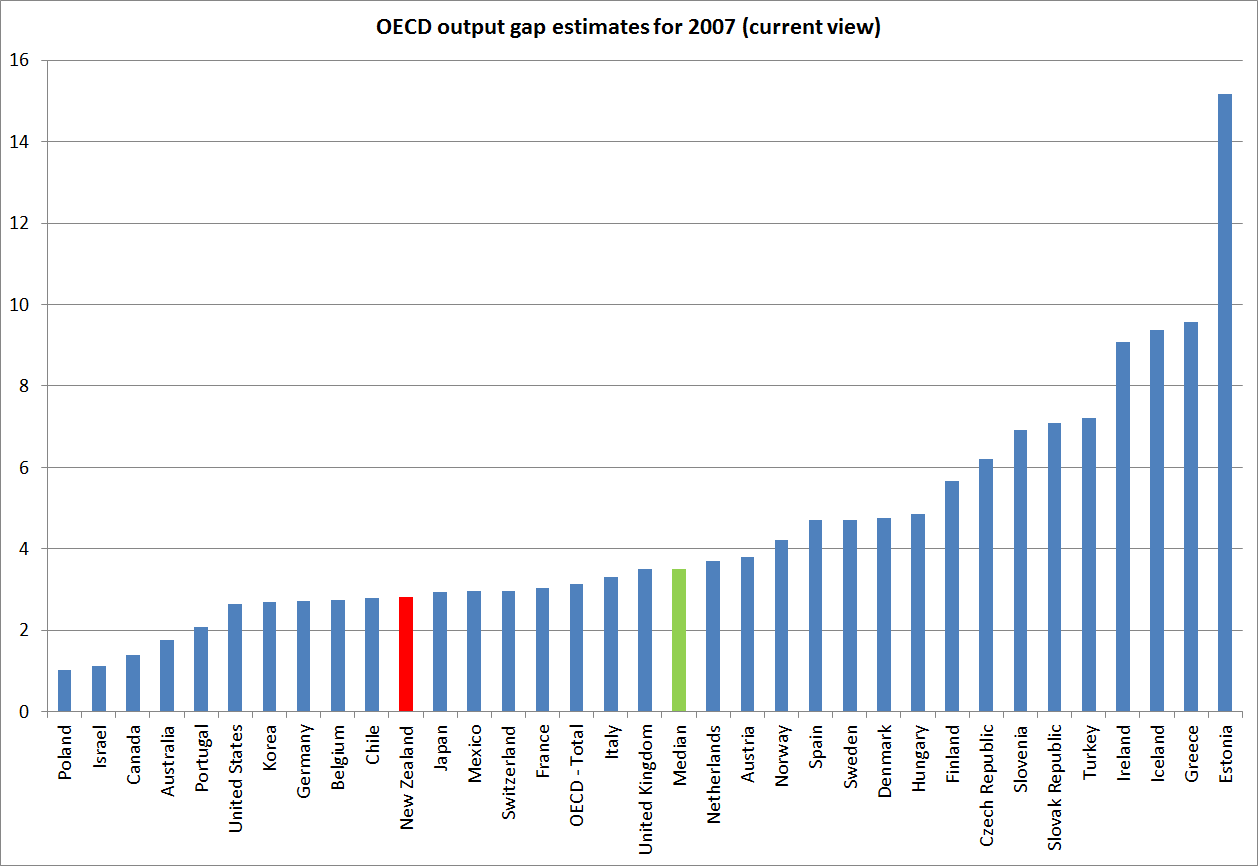
But, and more importantly, for my story, based on current international agency estimates New Zealand’s output gap prior to the recession wasn’t large by international standards.  No one agency does output gap estimates for all my sample of advanced countries, and for some of the countries there are no IMF/OECD estimates at all.  Since each agency uses different methodologies, estimates are comparable across countries and across time in an individual agency’s database, but we can’t simply combine the IMF and OECD estimates.  I should also stress the word “current”.  The next two charts are the respective 2015 estimates for output gaps in 2007 –  ie with all the benefit of hindsight, and later vintages of data.

Here are the current IMF estimates for 2007.  All these advanced economies are estimated to have had positive output gaps in 2007 –  even Japan, which is consistent with the views BOJ officials were espousing back then, although not a view widely held in the rest of the West.  The IMF estimates that New Zealand then had an output gap of around 2.4 per cent of GDP, just slightly below the median for this group of countries., and just slightly higher than that for the United States.  I don’t know the details of some of the other countries, but the estimate for Spain does look surprisingly low.

imfoutputgap

And here are the current OECD estimates for 2007 output gaps.  They estimate that New Zealand had an output gap of around 2.8 per cent of GDP, not that far below the median, but only 10 OECD countries are estimated to have had smaller output gaps than New Zealand just prior to the recession.   The Spanish estimate looks more sensible, and I’m not going to even try to make sense of what a 15 per cent output gap (in Estonia) even means.

oecdoutputgap

So New Zealand is generally regarded as having had a materially positive output gap in 2007, but it was no higher (in fact, a little lower) than those of most other advanced economies for which we have current estimates.  I’ve focused here on 2007, but the story is the same if one looks at 2006 or 2008 or the average of all three years.  Extreme pressures on resources prior to the recession can’t explain our mediocre relative performance since 2007.  Most countries had a little more excess to work off.  If anything, since the agencies current think that New Zealand has little (or no) spare capacity left, unlike most other advanced countries, our relative performance since 2007 might overstate what proves to be sustainable.

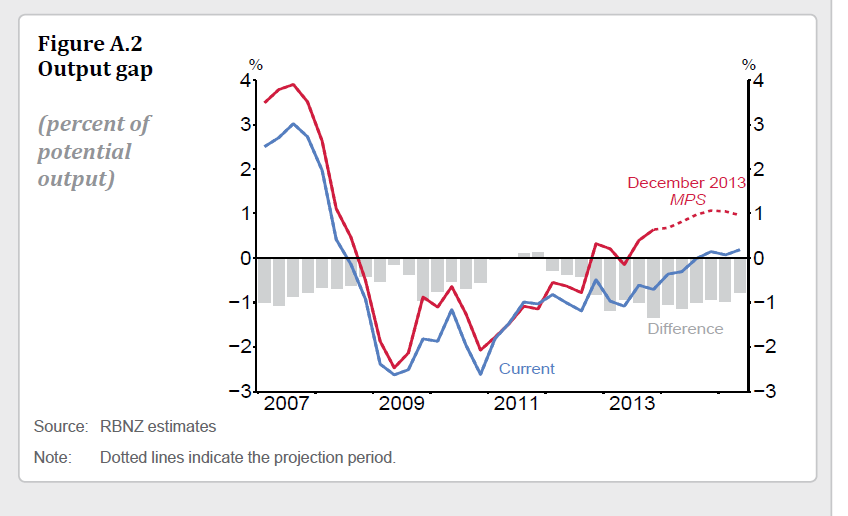
Incidentally, the current IMF and OECD estimates for New Zealand’s 2007 output gap are not so different from the Reserve Bank’s own latest estimates (around 3 per cent), in this chart from last week’s MPS.
mps output gap
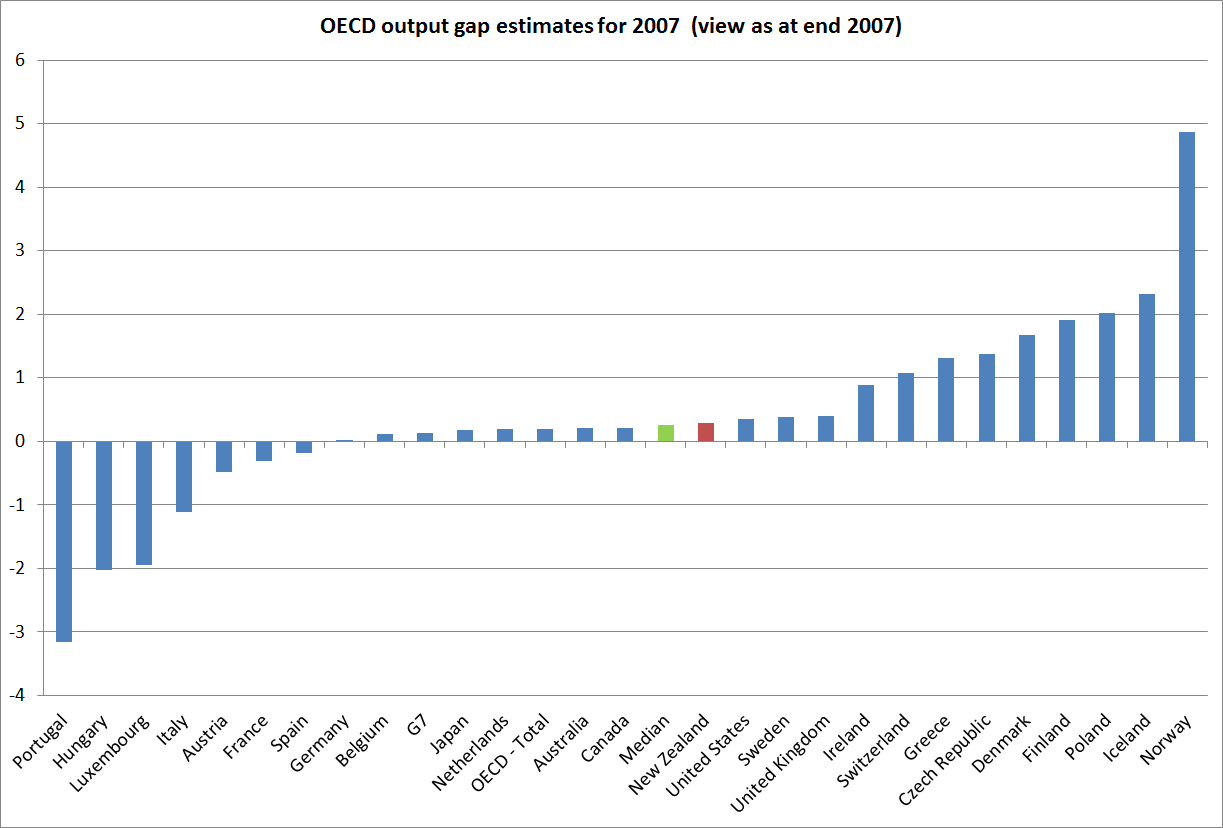
And one last chart, just to show how perceptions, and estimates, change.  This is the chart of the OECD’s output gap estimates for 2007 published in December 2007 –  before there was any widespread sense of a major recession looming. New Zealand was then estimated to be almost the median country, but notice how much lower the estimated output gap estimates all were.  For many countries, including Spain incredibly, the output gaps were estimated to have been negative, and only a handful of countries were estimated to have had positive output gaps much above 1 per cent.  This is not to pick on the OECD –  my impression is that their estimates are no more variable than those of the IMF, or of our own Reserve Bank or Treasury.  But it does make the point that if the output gap is a useful conceptual device, and is a useful summary metric for making sense of history, it is difficult to give it much reliable operational content in conducting policy.  The unemployment rate will often provide a less murky read.

oecdoutputgap2007

Paul Bloxham’s “rock star”

Reading the Herald over lunch, I found a piece by Paul Bloxham (of HSBC), author of the original “rock star economy” description, defending his image.  The sub-editors headed it “NZ’s economy still moves like Jagger”.

Personally, I am enough of an old fogey that “rock star” summons up unwelcome images of dissipation, licence, and worse.  I’ll take Bach or Handel any day.  But, anyway, Bloxham insists that New Zealand is some sort of “Nirvana” (apparently a rock group, that ended badly –  and, yes, I did have to look it up).    I’m not sure where lingering high unemployment fits into his story, or weak growth in productivity or per capita income.  Yes, there are many places worse off than New Zealand, but as I’ve been illustrating over the last couple of weeks many have been doing better.

Bloxham seems to focus on growth in total GDP, and certainly many OECD countries have much weaker growth than New Zealand has had.  But they also typically have very low population growth.  Our population growth is normally faster than that in the rest of the OECD, and has accelerated rapidly in the last year or so. On the latest SNZ estimates, our population is up 1.8 per cent on last March.  That might be good or might not –  perhaps less good if a lot of it just reflects New Zealanders not going to Australia because unemployment is also high in Australia.  Per capita real GDP growth just has not been that strong, and per capita income growth looks likely to slow even further as the terms of trade fall.

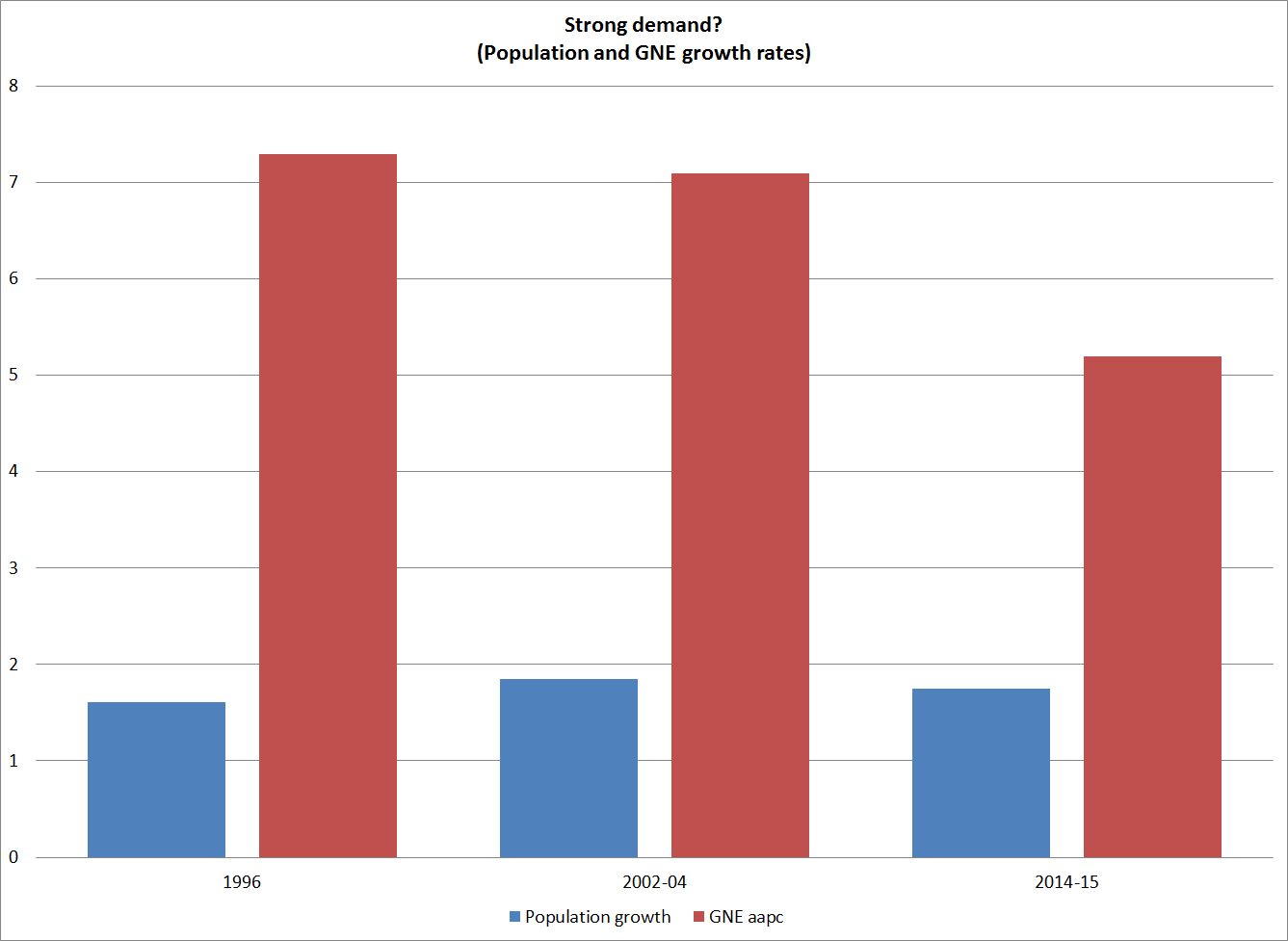
Bloxham is also convinced that demand is strong.  But rapid population growth tends to lead to rapid demand growth –  more people need accommodation, cars, other durables, and just the regular stuff of life (food, clothing etc).  SNZ’s quarterly population series only goes back to 1991.  But in the period since then there have been three episodes when annual population growth got up to at least 1.6 per cent –  in 1996, over 2002-2004, and the last couple of quarters.  Population growth rates and growth in domestic demand are quite strongly correlated. Here is how domestic demand growth (GNE) has been in each of those episodes (I’ve used aapcs for GNE, but the fall-off in the noisier apcs is even sharper).   Domestic demand growth has been much weaker over the last year than in the previous high population growth episodes, even though this time we have a large exogenous boost to demand resulting from the Canterbury earthquake rebuild.

nirvana

As I noted on Saturday, it is not that demand has been so strong, and supply has grown even faster to meet it. It is more case of rapid population growth, and some additional domestic labour supply growth (similar to that in other OECD countries), being accompanied by unusually weak growth in domestic demand.

The Productivity Commission on land supply

The Productivity Commission yesterday published its draft report on improving the supply of land for housing.  It builds from earlier work by the Commission and others identifying supply restrictions as one of the most important explanations for the high price of houses (more strictly, house+land) in New Zealand.

There looks to be a lot of fascinating material.  Being history-minded, the first thing I read was the fascinating little research note on the history of town planning in New Zealand.  Modern documents that quote from 1839 New Zealand newspapers appeal to me, even if the author of that research note seems more taken with the “need” for “town planning” than I would be.  And was the New Zealand Company really much involved in the founding,settlement and planning of Christchurch?  The books on my shelves don’t suggest so.

I also read the Summary Version of the report.  It is a summary, and while it lists the findings and recommendations and outlines the arguments,  there is a no doubt a lot more in the remaining hundreds of pages.  Some answers to my points below may lie in those pages, and I hope to look at them in more depth in coming weeks.

Land supply issues matter a lot.  That was one of the points the 2025 Taskforce stressed back in 2009.  It is a shame that the Commission does not pick-up the Taskforce’s recommendation that Councils be required to develop and publish indicators of the prices of otherwise similar land that is, and is not, zoned for residential development.  Information and data are a key input to any analysis, and even when the current public and official focus on these issues fades, it will be important to maintain the flow of data.

But what of the Commission’s own ideas and analysis?  Here is a list of thoughts/observations/concerns, in no particular order:

  • It is good to see the Commission come out in favour of land-value rating, reversing the trend in recent decades towards capital value rating.  Land value rating tends to focus the minds of owners of the scarce resource, land.  There are other ways to tackle “land banking” (ie don’t allow regulation to make new urban land scarce in the first place), but land value rating would be a step in the right direction.
  • As would, on a much smaller scale, levying local authority rates on Crown land.
  • But, as with many Commission reports, there seems to be a too-ready sense that government is the source of on-going solutions, rather than the source of the underlying problems.  In other words, the report doesn’t mainly focus on getting government (central and local) out of the way, but on finding smarter or better ways of the government being actively involved (eg “this means a greater degree of publicly-led development”).  Perhaps it shouldn’t be too surprising  –  after all, two of the three commissioners are former heads of government departments, and the Commission works on projects requested by government, in a process where ministers are advised by government departments –  but it is something to watch out for.  I had a similar reaction to the Commission’s recent draft social services report.
  • The report does not seem to grapple at all with the indications from historical cross-country experience that as cities grow richer they tend to become less dense, not more dense.  It also does not engage with the Demographia data suggesting that Auckland is already a relatively dense city by advanced New World standards.  I’m not at all suggesting that regulation should impede denser development, but some of the Commission’s lines of arguments become less persuasive if greater density is unlikely to be the main preferred market response to ongoing population pressures.
  • For example, the Commission focuses on the idea that local authorities do a poor job in this area because of the excessive weight of existing homeowners, concerned about the losses of price and amenity value on their houses.  That sounds plausible if we think about establishing high rise apartment through Epsom, but it is far less clear that existing home owners have any strong objection to greater ongoing development on the periphery of cities, where historically most new building has happened.     After all, existing home owners have children who will be looking for housing before too long –  but again the intergenerational perspective seems to be lacking in some of the Commission’s work.
  • The Commission does not seem to give much weight to the idea that restrictions on development at the periphery may have as much to do with the biases, preferences  and ideologies of Council staff.  Perhaps there is nothing to that suggestion, but I wonder how many Council staff come to work each morning dedicated to facilitating citizens doing as they like with their own property, rather than shaping and imposing a vision on “their” city.  I read the Wellington City Council’s recent draft long-term plan, and it confirmed my worries.
  • The Commission proposed removing “District Plan balcony/private open space requirements for apartments”, which sounds sensible.  But what about site coverage ratio restrictions?
  • I reckon the Commission oversells the gains to be had from improving land supply.  I’m reluctant to say that because I think the gains that are on offer –  much lower house prices –  are substantial and important, especially for the younger and poorer sections of the urban population.  But I’d say it is “case unproven” when it comes to gains in real GDP, or real GDP per capita.  The Commission cites recent work by Hsieh and Moretti, which suggests that releasing adequate land could lift GDP per capita in the US by as much as 9.5 per cent.  Perhaps it is true, and perhaps it is true of Auckland.  But New Zealand is already a highly urbanised country, Auckland already makes up a large share of the total population, and Auckland has had faster population growth than almost any other largest city in an OECD country in the decades since World War Two.
  • Related to this, the Commission seems to be too ready to embrace agglomerationist arguments.  Yes, it is true that cities tend to have higher levels of productivity than smaller centres, but that does not mean that policy designed to drive the growth of big cities will, of itself, lift productivity.  Yes, policy should avoiding impeding the distribution of population within the country to its most productive locations, but not go beyond that.  In fairness, many of the Commission’s specific recommendations are about removing roadblocks, but the supporting text often seems to go beyond that.
  • For example, there is the unsupported proposition that “Councils and their elected representatives also need to lead in persuading their communities of the benefits of growth. These are difficult conversations.  Facilitating growth requires communities to change, and change is hard.  Some people will lose from that change.  But the community as a whole, and New Zealand, will benefit from it”    Setting aside the condescending tone, where is the evidence that population growth is a “good thing” –  because population growth is the issue here?  Again, if we are going to have fast population growth, we need to find ways to absorb it, without causing scandals like, for example, current Auckland house prices.  But a reasonable voter (or elected representative) might reasonably ask “haven’t we had rapid population growth for 70 years, and some of the poorest  growth in productivity/GDP per capita of any advanced country?
  • The Commission proposes providing powers of compulsory land acquisition for housing purposes.  At one level, the claim that “compulsory acquisition of property by the state can be justified if it is in the public interest” is circular.  What is “the public interest”?  The public interest might, for example, involve the protection of private property rights, including the right to hold property undisturbed.  This is another example of the Commission’s apparent reluctance to grapple with pervasive government failure and abuse of regulatory powers.  The abuses of eminent domain powers in the United States should be a salutary warning here.  The Commission goes on to argue that “given the significant social and economic harm caused by the current housing situation, a good case exists for compulsory acquisition powers to assist in the assembly of sites for large masterplanned developments.”    As if to water down the rather shocking nature of this proposal, the report suggests that powers don’t need to be exercised much, as they can provide leverage (in the same way a mugger with a baseball bat won’t need to hit me to get my money) and the chair is also quoted as suggesting the powers might only be to deal with “holdouts”.     But it just is not clear why such powers should be given to public agencies.  In a well-functioning economy, housing is readily provided by the private sector.  Public agencies and political leaders got us into this mess, and why would we expect that new powers would not be abused?   Have powers of compulsion worked well in central Christchurch?  It hadn’t been my impression.
  • The Commission does not seem (I may have missed it) to touch on a more radical option.  Why not, for example, explore a proposal that would allow any land to have houses built on it, by right perhaps up to three storeys high?  One might make exceptions for geologically unstable land, but shouldn’t the presumption be shifted back in favour of the private land owner?    With something like that sort of model, combined with land value rating, it is difficult to envisage that peripheral urban land prices would be very high for very long.    Yes, I know this proposal does not deal with all the transport  and infrastructure issues, and many of the Commission’s suggestions on these issues appear sensible.

Keen as I am to see a more responsive supply of urban land, I came away from the report with a question.  Supply and planning restrictions have become an increasing obstacle to affordable urban house prices in many advanced countries in recent decades.  There are individual areas that have held out – Houston is among the best known – but are there any cases where there has been a move back from heavily planned and regulated urban land markets to much more liberalised ones?  I’m not aware of any, but my detailed knowledge in this area is pretty limited.  My prior is to be a bit sceptical about how likely it is that far-reaching changes to the planning regimes, of the sort that would materially reverse the growth in real urban land prices, could be made, and then made to last.  If the Commission is aware of examples of successful substantial durable reforms it might be helpful to include them in the final report.  A low prospect of success is not a reason for not doing the analysis and continuing to make the case, but there is a question as to where political capital might best be devoted.

Which brings me to my final point.  The Commission has to take population growth as given, since it was asked by ministers to look at land supply issues.  But it is too often forgotten that most of our population growth in recent decades, and all of it now, arises directly from active government policy.

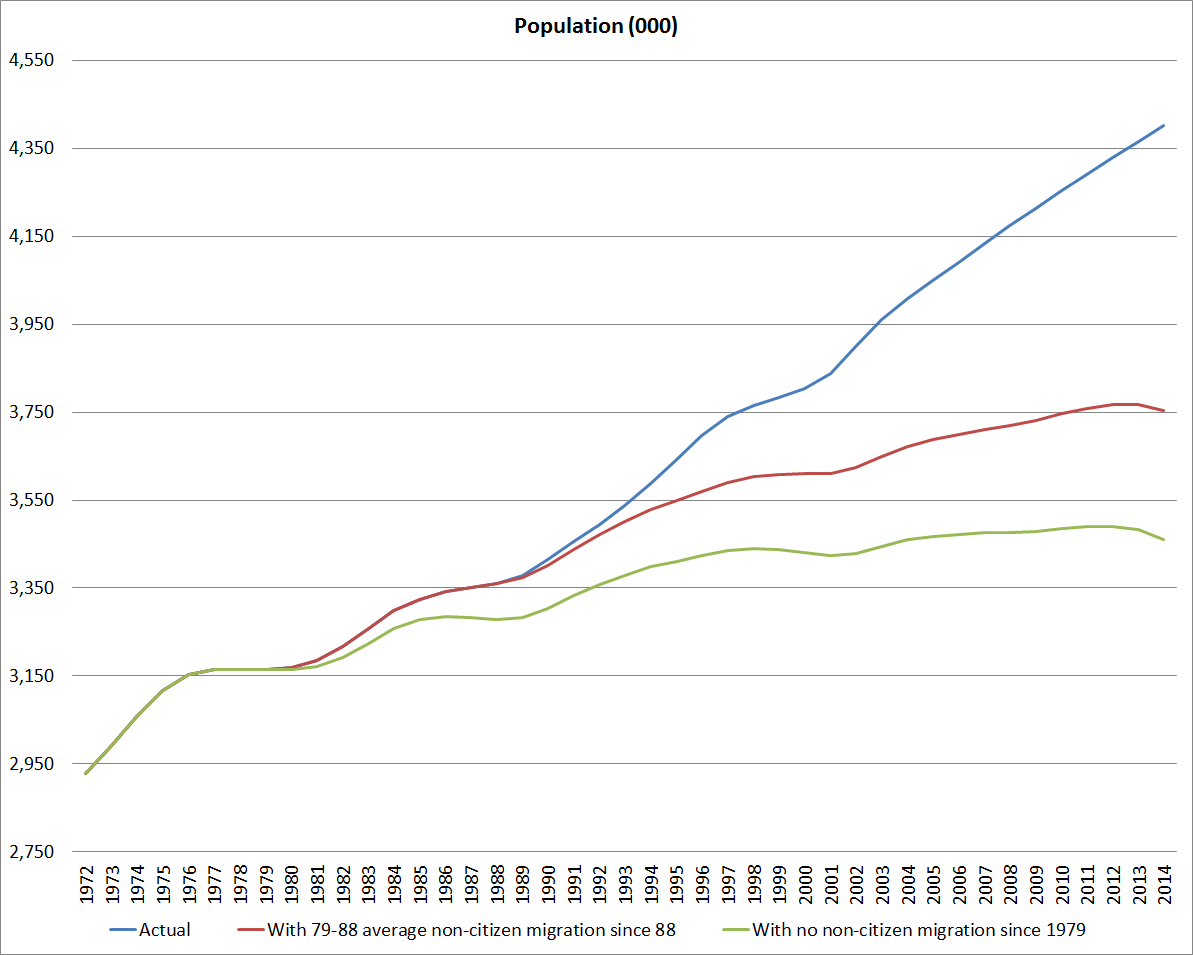
The chart below shows New Zealand’s actual population, and what it might have been under two different immigration scenarios.  Immigration policy only affects the movement of non-New Zealand citizens, and so what I’ve shown here is what population would have looked like if there had been no net non-NZ citizen immigration, and if net non-NZ citizen immigration had been kept at the sort of levels seen in the 1980s.  They aren’t precise estimates by any means –  it is possible, for example, that if there had been less non-New Zealand citizen immigration, there might have been somewhat less New Zealand citizen emigration.  But it is just designed to make the point that population pressures on the housing market are not any longer about the choices of New Zealanders (to have children or not, to stay or to migrate) but about active government policy.   With 1980s levels of non-citizen immigration, the total population would now be flat or falling slightly.   The only aspect of the non-citizen migration that is unrestricted is the (modest) flow of Australian citizens: all other arrivals require explicit government approval, and a planned policy of high net inward migration of non-citizens.

population scenarios

If we are worried about house prices –  and I certainly think we should be  –  a strategy with a higher probability of durable success might be to combine land supply liberalisation with some reduction in the targeted level of inward migration (bearing in mind that our government’s target for inward migration of non-citizens is itself very high by international standards).  There would still be considerable cycles in net immigration flows (as the net outflow to Australia waxes and wanes with the economic cycles), but the trend is the issue for longer-term affordability concerns.

And to hark back to the discussion on why New Zealand interest rates have been so persistently high, if lack of sufficient agglomeration and scale were really the big issue in New Zealand, we should tend to see low interest rates, and a low exchange rate, not the reverse.

Labour market since 2007

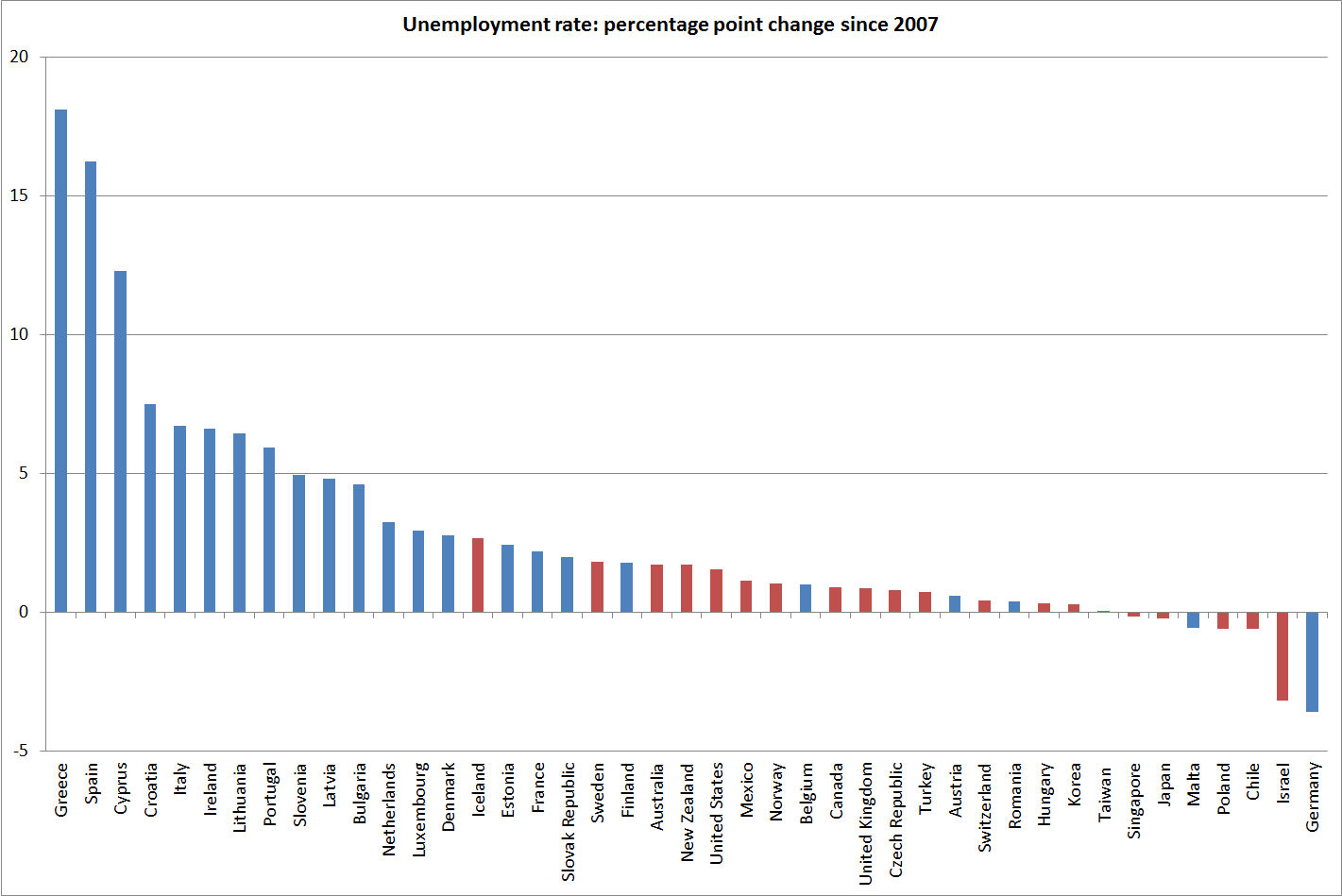
One other dimension of economic performance since 2007 is the labour market.  Using the IMF WEO database, which reports only annual data, here are the changes in advanced country  unemployment rates from 2007 to 2014.

U0714

New Zealand is almost the median country on this measure.  The unemployment rate was 1.7 percentage points  higher in 2014 than in 2007, almost identical to the increase in Australia, and slightly worse than for the US (of course, the US unemployment rate rose far higher and has subsequently fallen more rapidly).  On this chart, I’ve coloured red the countries with floating or flexible exchange rates.  It is pretty starkly obvious how the worst increases in the unemployment rates are concentrated in the euro-area countries, which have had no domestic policy flexibility.  On the other hand, once the fixed exchange rate regimes are allowed for, it is uncomfortably apparent that of the flexible exchange rate countries New Zealand has had the third largest (really second-equal) increase in its unemployment rate.  (And yet, for some reason, we were the advanced economy whose central bank was raising its policy rate.)

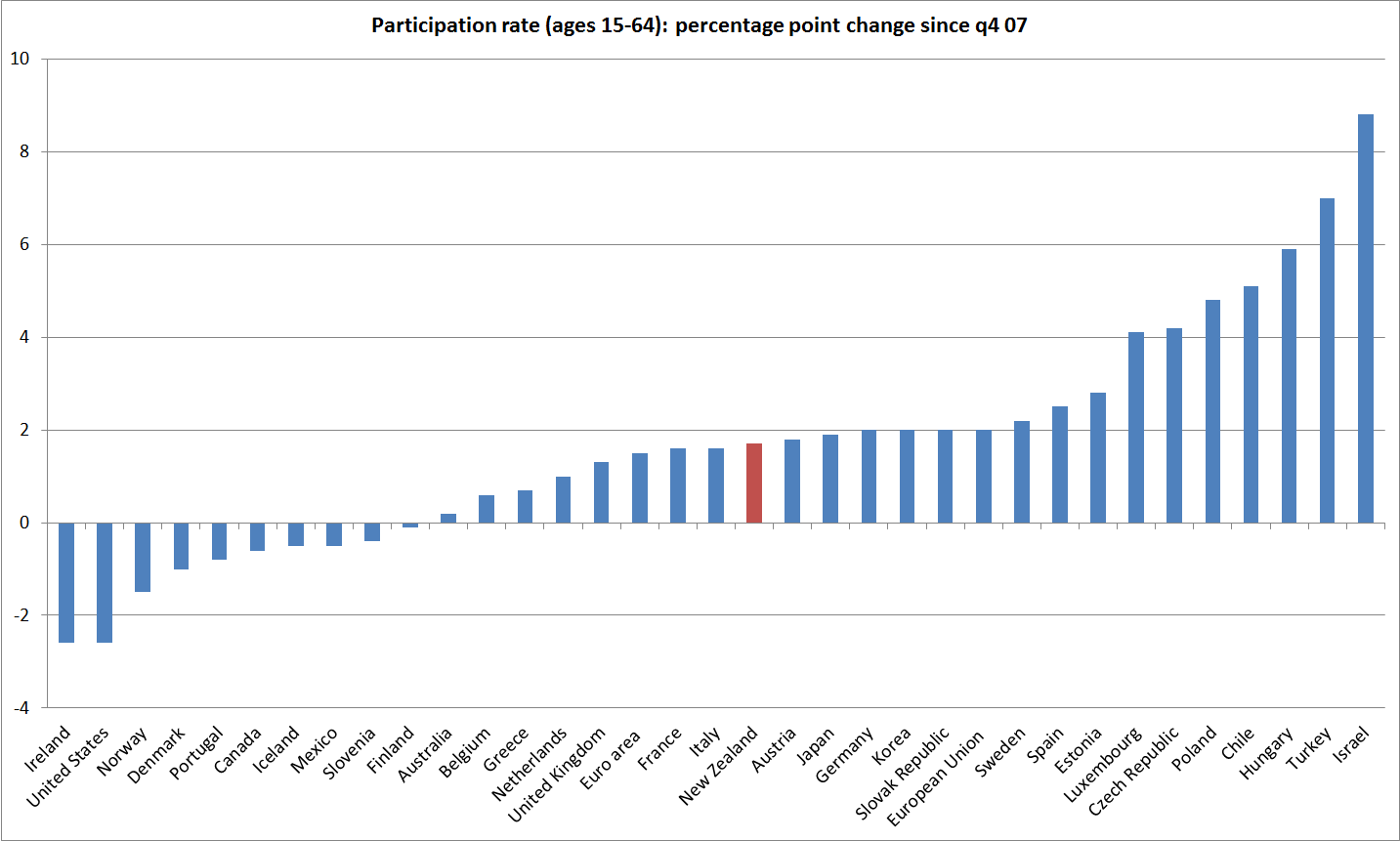
There has been a tendency in some circles to downplay the continuing high unemployment in New Zealand, by noting that participation rates have been increasing.  But here are the participation rate changes since 2007, this time just for OECD countries (I couldn’t quickly see comparable data on Eurostat).

participation

It is certainly true that participation rates have been rising in New Zealand, but not to any greater extent than in other OECD countries.  Again, New Zealand is about the median country in this group, and the increase here is just slightly more than in the euro-area as a whole, and just slightly less than in the EU as a whole.  Rising participation rates in most countries, at a time when unemployment rates are still above pre-recession  levels in most countries is an interesting phenomenon  – and somewhat unexpected given that participation rates typically tend to fall when unemployment is rising and rise when it is falling (thus the weak Irish participation rate is little real surprise).  The countries that struck me most forcibly were Greece and Spain, which have had huge increases in their unemployment rates and yet have seen labour force participation rates increasing.  Without anything more concrete to go on abouto what has happened in these two countries, I can only assume it is something around things being so tough that absolutely everyone is having to look for any work they can get, even if the probability of finding it is quite small.

Overall, then, the labour market remains another area of disappointing economic performance for New Zealand,  It is, of course, one that is more readily amenable to the ministrations of macroeconomic policy.  Easier monetary policy over recent years –  which there was demonstrably room for, given core inflation outcomes relative to the midpoint of the target range –  would have helped reabsorb the people who are unemployed more quickly than is currently in prospect.

Of course, one counter-argument to this line of argument is that the New Zealand labour market was unusually overheated in 2007.  Perhaps, but as we’ll see tomorrow there is nothing in international agency estimates to suggest that New Zealand’s economy was more stretched than most other advanced countries were just prior to the recession.

Macro policy flexibility since 2007

I’ve been looking at how advanced economies have performed since 2007.  New Zealand has not done that well, contrary to some of the stories one sees around (eg the somewhat incredible “rockstar economy” phraseology that held sway for a while).

It surprised me that New Zealand had not done a little better since 2007.  As I noted last week, we have had some of the strongest terms of trade of any OECD country.  But we also had other advantages.  For example, we did not have a substantial domestic financial crisis.   No major financial institution failed, and although many finance companies failed they were fairly peripheral.  Overall loan losses appear to have been relatively modest, and any disruption to the financial intermediation process –  of the sort often discussed in the literature around the economic costs of financial crises – must have been slight at best.  That New Zealand and the United States have had such similar paths of GDP in the last decade has left more sceptical than I was of the proposition that financial crises have large sustained real economic costs.

New Zealand also had more macroeconomic policy leeway than most countries.  Macroeconomic policy tools –  fiscal and monetary policy –  don’t make much difference to a country’s long-term prosperity, but they can make quite a difference to a country’s ability to rebound quickly from shocks.  Thus, for example, almost half the advanced countries I’ve been looking at are now members of the euro area.    Individual countries have no national monetary policy (so they can’t adjust their own interest rates or their nominal exchange rates) and the region as a whole has been at or near the lower bound on nominal interest rates for years now.  Many other advanced economies –  the US, UK, Japan, Switzerland, Sweden, the Czech Republic –  are also at the lower bound for nominal interest rate.  In all cases except Japan, they were able to cut policy rates a long way when the recession hit, but then they ran into limits.

New Zealand did not run into such limits.  In 2008/09 the Reserve Bank cut its policy rate, the OCR, by more than almost any of the other advanced country central banks.  But even then the rate was still 2.5 per cent.  There was plenty more leeway had that been judged warranted.  And during the recession itself, our floating exchange rate fell very substantially..

But the other area of macroeconomic policy where we had leeway was fiscal policy.  Intense debates rage around the role of fiscal policy in economic cycles.  When a country is not at the zero bound it seems reasonable that the stance of fiscal policy won’t make much difference to the path of GDP  (although it may affect the composition, and in particular that between tradables and non-tradables).  But it is likely to be a different matter for a country at the zero bound.  If there is little or no effective monetary policy leeway, changes in the fiscal balances are likely to have reasonably predictable “Keynesian” type effects: fiscal contractions will dampen recoveries, and fiscal expansions will support them.  Of course, confidence effects can undermine those effects, but in reasonably well-governed countries with floating exchange rates, it takes a lot to lead to material adverse confidence effects.  There is no evidence, for example, that the UK or the US came close to triggering serious adverse confidence effects during the years since 2007.

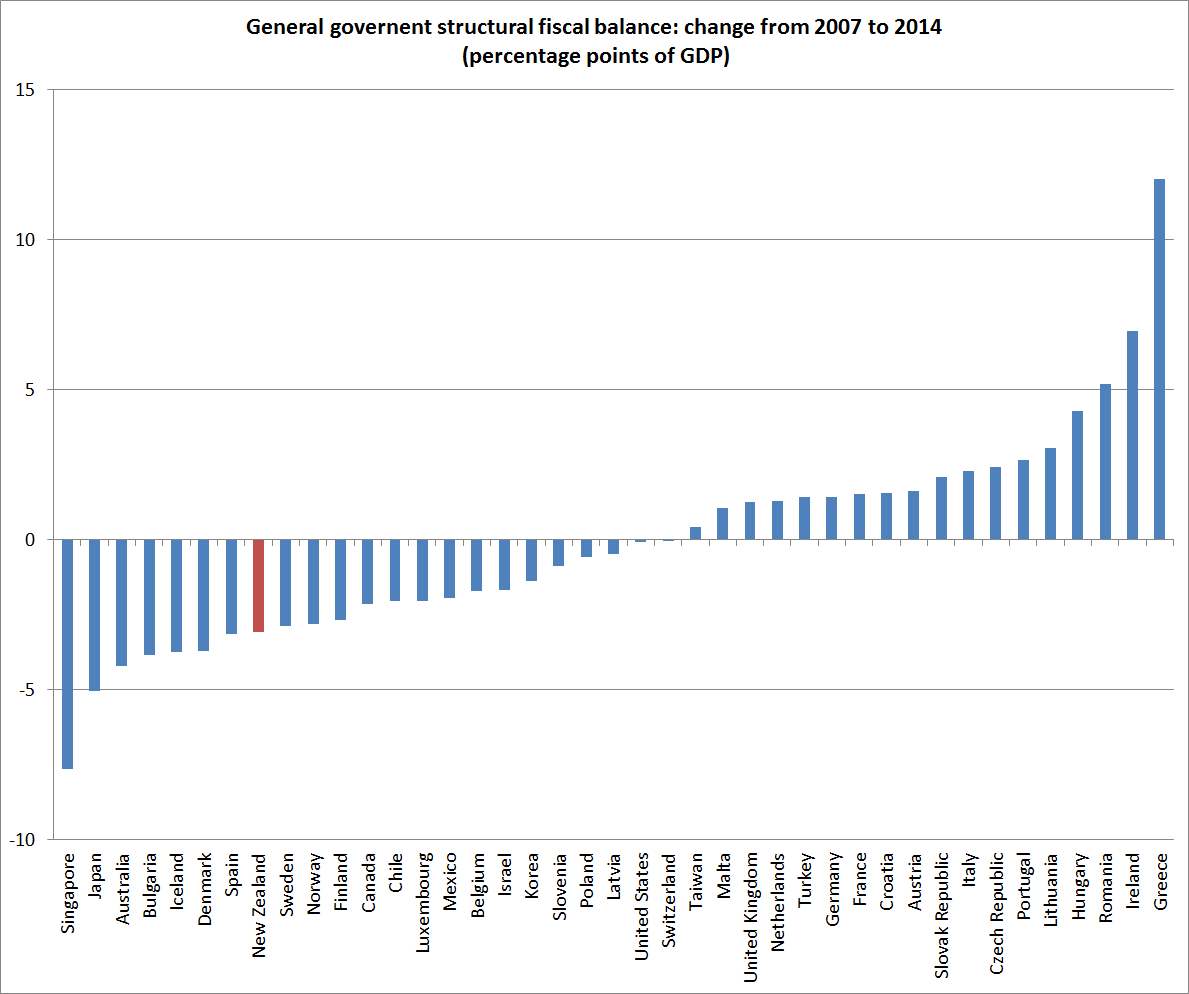
Turning to the IMF WEO database again, we can see what has happened to (estimates of) structural fiscal balances since 2007.  I would stress the word “estimates” –  no one can ever know the level of a structural fiscal balance with certainty, and current estimates for 2014 will be revised, in some cases perhaps quite substantially.  But here is how structural fiscal balances have changed since 2007.

fiscalbalances

Around half the countries have had fiscal contractions over that full period, while the other half have had expansionary fiscal stances.    Over the period as a whole, only seven countries are estimated to have had more expansionary fiscal stances than New Zealand.  What I found interesting is that of the 15 countries to the left of the chart, 10 had floating (or flexible in Singapore’s case) exchange rates.  Of the countries that have had contractionary fiscal stances, only a handful have flexible exchange rates.

Like most countries, New Zealand’s picture is one of two halves.  There was a huge shift from substantial structural surpluses as recently as 2007 ( when only Singapore had a materially larger structural surplus than New Zealand) , to large structural deficits just a couple of years later.   When I did one of these charts back in 2010, New Zealand had then had (depending on the measure used) either the largest or second largest expansionary shift in fiscal policy of any advanced economy.  The odd thing about New Zealand’s shift was that almost none of it was fiscal stimulus measures initiated once the recession hit –  it was all the effects of decisions made when it was thought (by politicians and their Treasury advisers) that times would stay good.

Since 2009 New Zealand, like many other countries, has been gradually reducing its structural fiscal deficit.  My point here is simply that we had the flexibility to do so, fast or slow, without materially affecting the economic cycle, because we never ran out of room to use conventional monetary policy to offset the short-term demand effects of fiscal consolidation decisions.  Having, on average, the highest real interest rates in the advanced world isn’t a good thing for our longer-term growth prospects (I argue) but in getting through the last few years it has had one distinct upside –  we had more room to cut rates than almost anyone else.  Given our disappointing economic performance, and weak inflation outcomes, one might argue that it is a shame that that leeway was not used more aggressively.

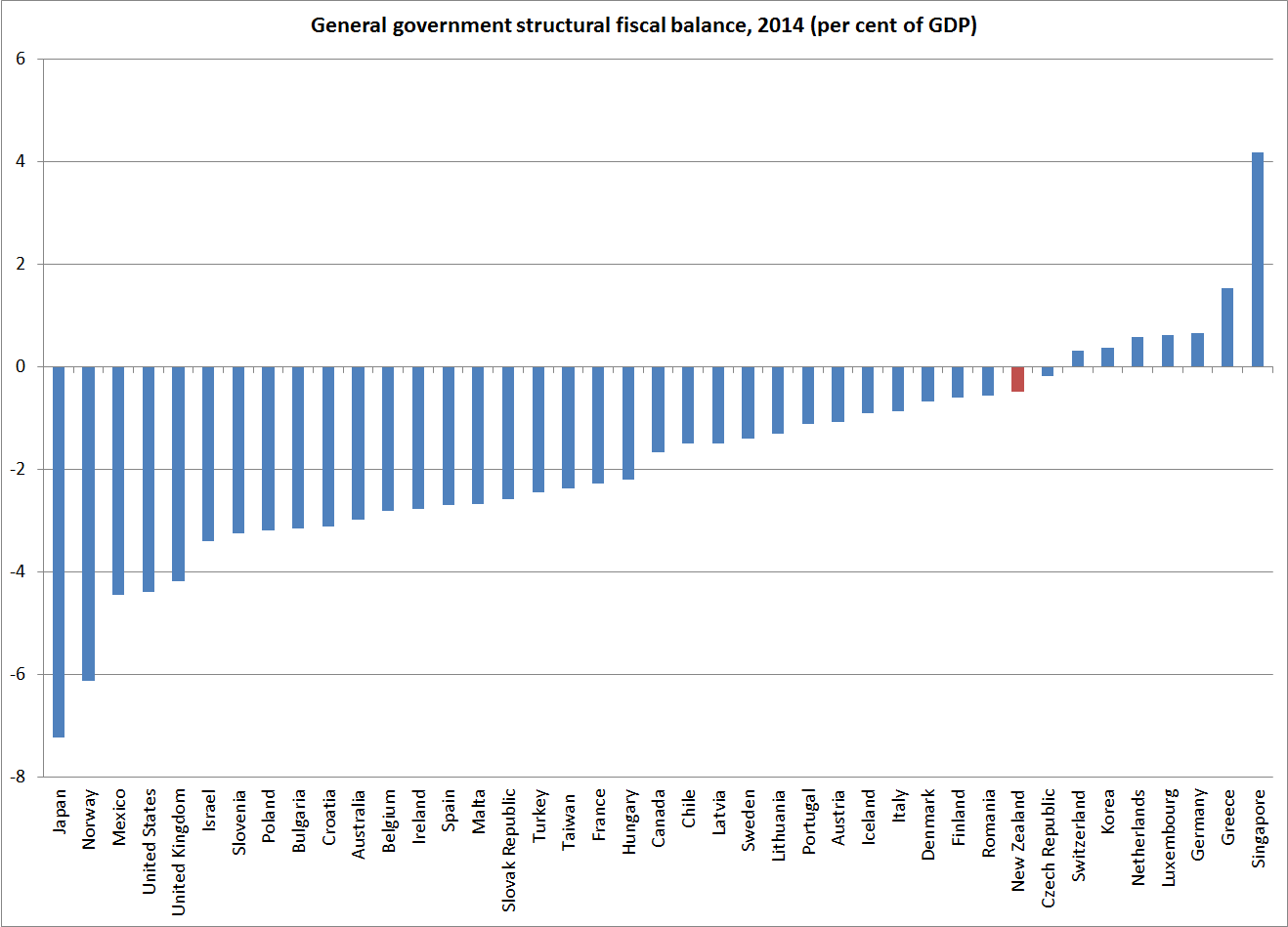
And finally, a chart of the IMF’s estimate of the level of each country’s structural fiscal balance in 2014.  New Zealand looks pretty good on this score (although the terms of trade flatter our numbers somewhat).
fiscal2014
Perhaps the saddest bars on both charts are those for Greece.  Running structural fiscal surpluses, in an economy at the zero bound and with 27 per cent unemployment, would not normally be considered sensible.  But that is what happens when a country loses market access, and yet lingers on in a straitjacket like the euro.  I stand by my assertion a month or two ago that there is no politically acceptable deal (politically acceptable in both other countries and in Greece) that can allow Greece to stay in the euro and yet begin to make material ground reversing the catastrophic loss of output and the appalling unemployment rate.  It increasingly looks as though the break is coming soon.  When and if it does, it will be messy for a time, but it finally offers a way back towards a more fully-employed economy.

Savings and investment since 2007

Last week, I started showing a few charts about how New Zealand had done against various other advanced economies since 2007, the last year before the recession that engulfed most of the world in 2008/09.

Today I’m going to show the charts for investment and national savings, using the data from the IMF’s WEO database.

First investment.

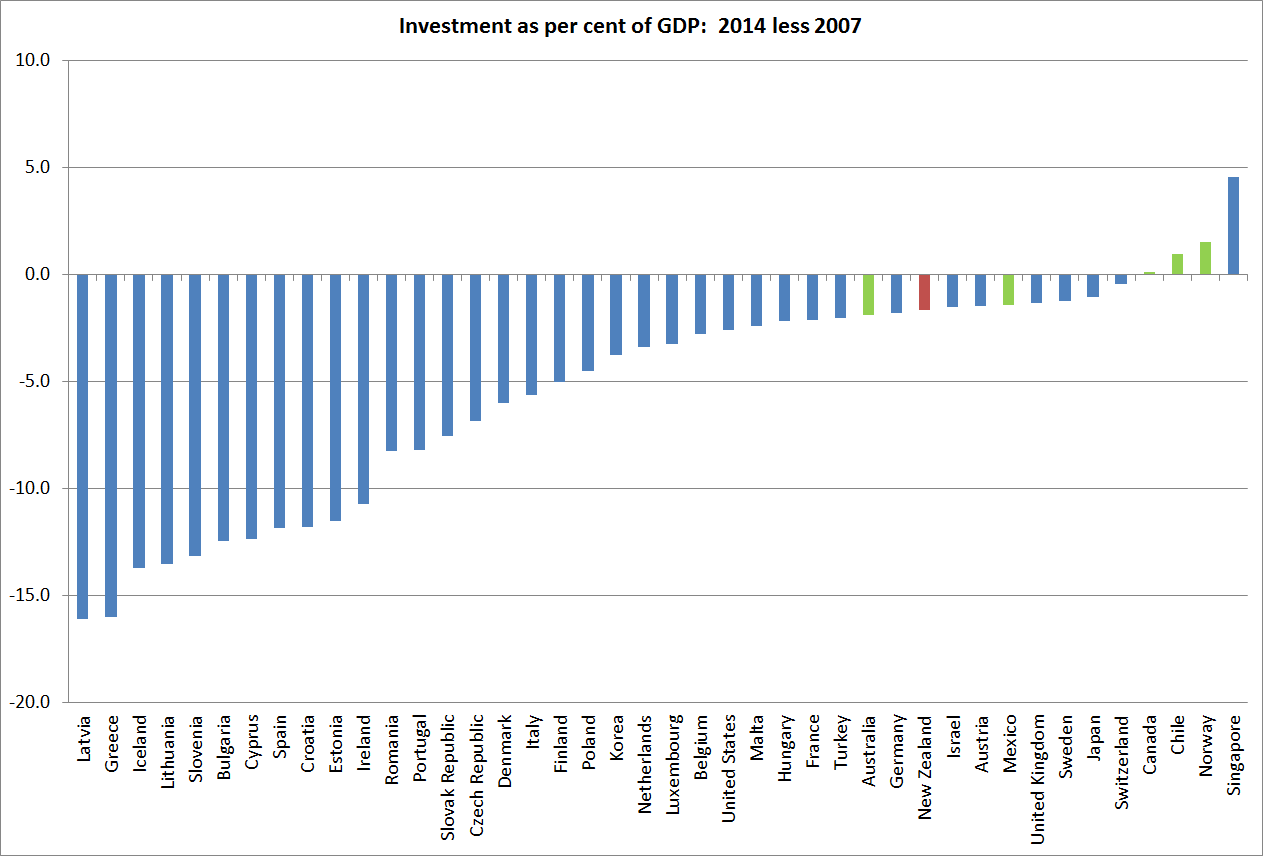
investment2014

Of this group of advanced countries, only four had a share of investment in GDP higher in 2014 than it was in 2007.  That probably doesn’t come as a great surprise.  2007 was a cyclical peak, and by last year hardly any of these countries would have been considered to have been operating at capacity.  Across the advanced world as a whole, population growth rates are falling, and lower rates of population growth mean less of GDP needs to be devoted to investment for any given level of technology.

But my main interest was the cross-country dimension.  Perhaps unsurprisingly, the commodity exporting advanced economies have all been among the countries with the most strength in investment.  But Germany comes between Australia and New Zealand, and I was surprised to find the United Kingdom, Japan, and Sweden doing better than either New Zealand or Australia.  At the other end of the chart, the 18 weakest economies all either use the euro, or have a currency pegged to the euro.

The New Zealand story itself is a little less favourable than it might first appear. Recall that I noted last week that there had been no sign of a surge in New Zealand business investment in response to the high terms of trade.  And, on the other hand, a significant amount of the strength in New Zealand’s investment in the last few years has been the repair and rebuilid activity in Canterbury.  It counts as gross investment but, since it is mostly replacing capacity that was destroyed or severely damaged, it isn’t adding much to the capital stock.

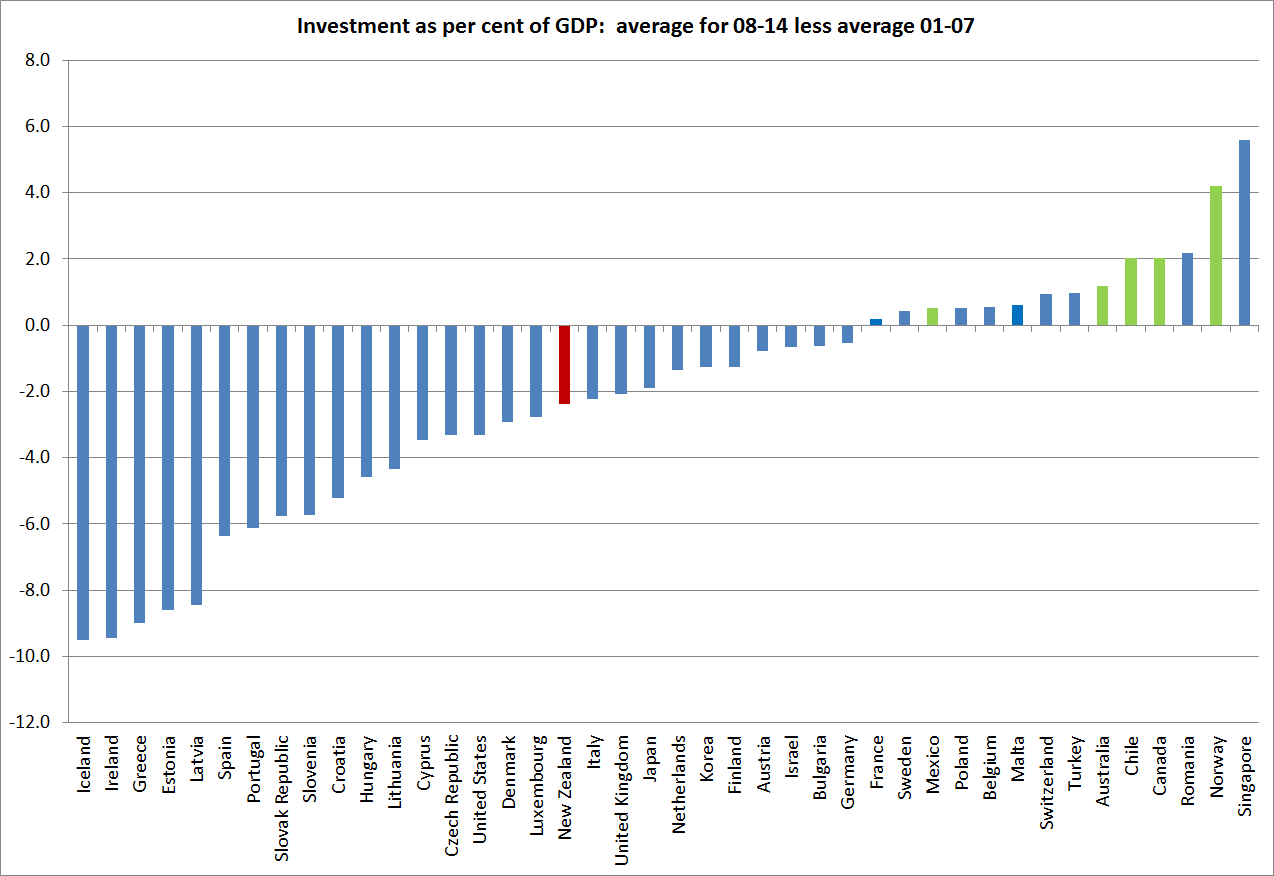
If we do the same chart comparing the average for 2008-14 with the average for 2001-07, New Zealand drops back to the middle of the field, and well behind the other commodity exporters.

investmentwholeperiod

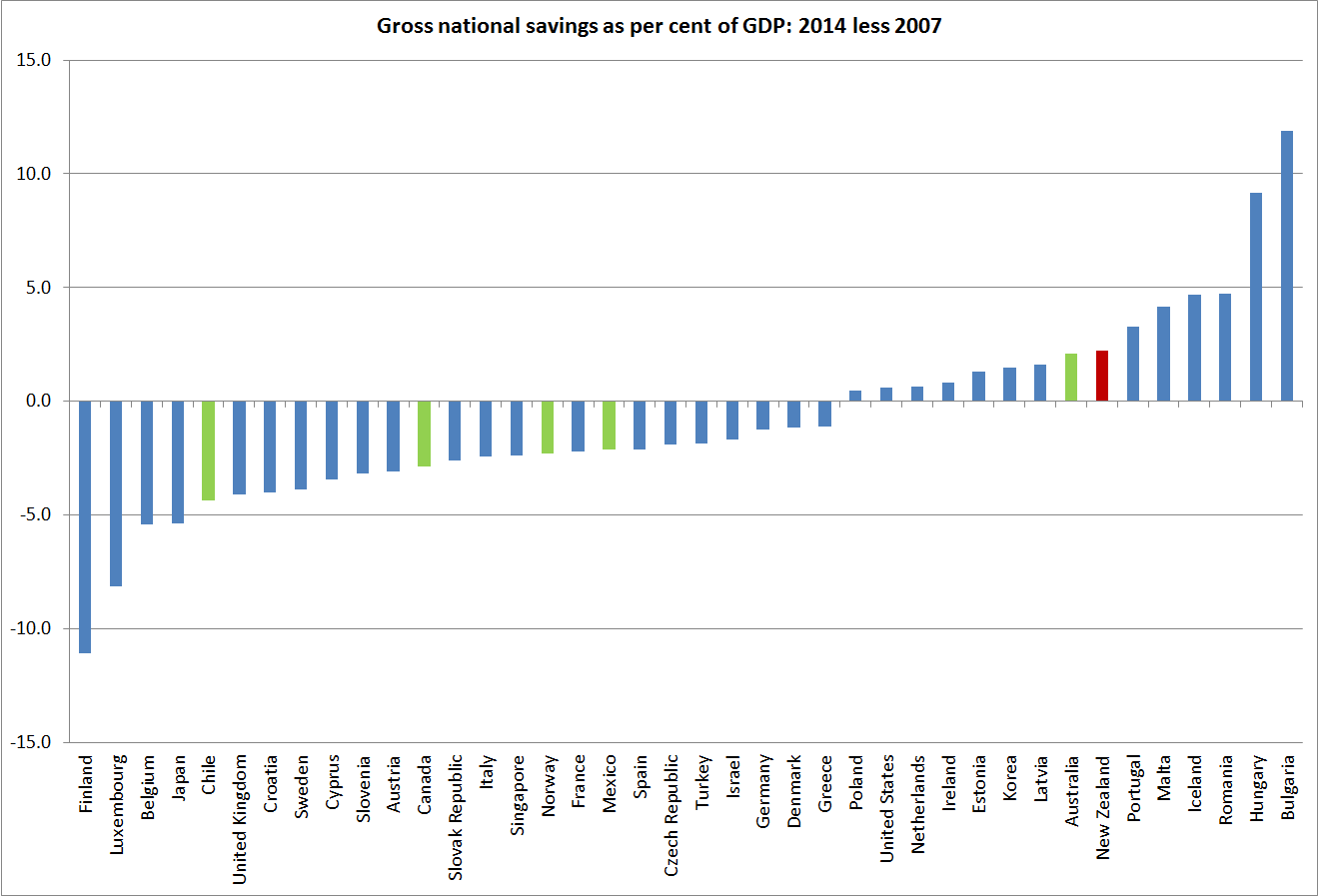
And what about national savings?  On this chart, any patterns are much less obvious.   Savings rates have fallen in more countries than they have risen, but 16 countries have had increases in their national savings rates.  Euro area countries, for example, are not bunched at one end or the other, and New Zealand and Australia show up as among the countries with the larger increases in national savings rates.

savings

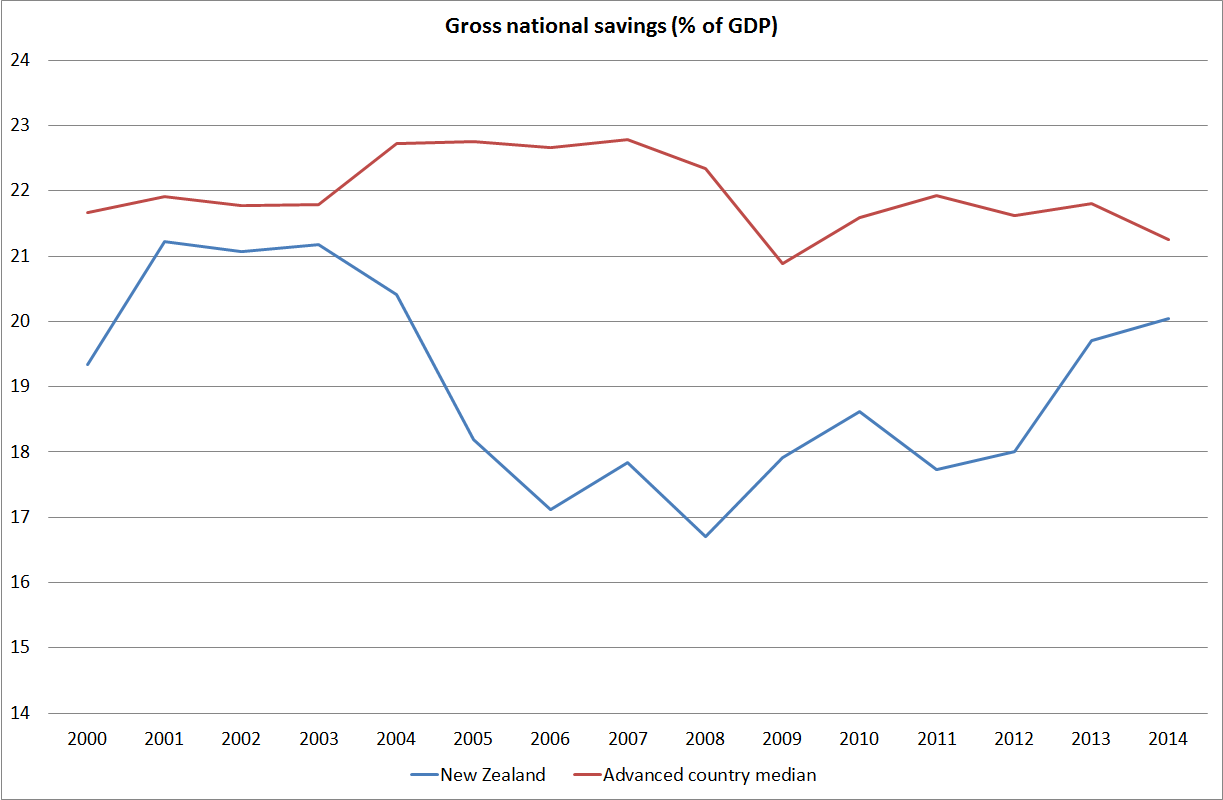
Before anyone starts getting excited about, for example, the impact of Kiwisaver, I should point out that when I compared savings rates for 2008-14 as a whole with those for 2001-07,  New Zealand dropped right back to around the middle of the chart.  Unlike the median advanced country in this sample, New Zealand’s national savings rate fell away sharply in the middle of the last decade, as public (and business) savings rates dropped away sharply.   Our national savings rate is only now back to around the level seen in the early 2000s.

savings2

(And one final note, these are ratios of national savings to domestic product.  In other words, the savings of New Zealanders as share of all that is produced in New Zealand, whether by New Zealanders or foreigners.  In other words, the two series aren’t strictly comparable.  For most countries the difference doesn’t matter, but here national income is materially less than domestic product (the difference is mostly the net earnings of foreigners on New Zealand’s negative net international investment position).  Taking national savings as a share of national income, New Zealand’s national savings rate would be around the median of this group of advanced countries.)

New Zealand manufacturing since 2007

The quarterly manufacturing survey came out this morning.  Noticing that growth in the sector seemed to be levelling off I was curious as to how things looked relative to levels just prior to the recession.

As is well known, the manufacturing share of GDP has been falling for decades in most advanced countries.  China, for example, has picked up a big chunk of global manufacturing, and services have become progressively more important everywhere.

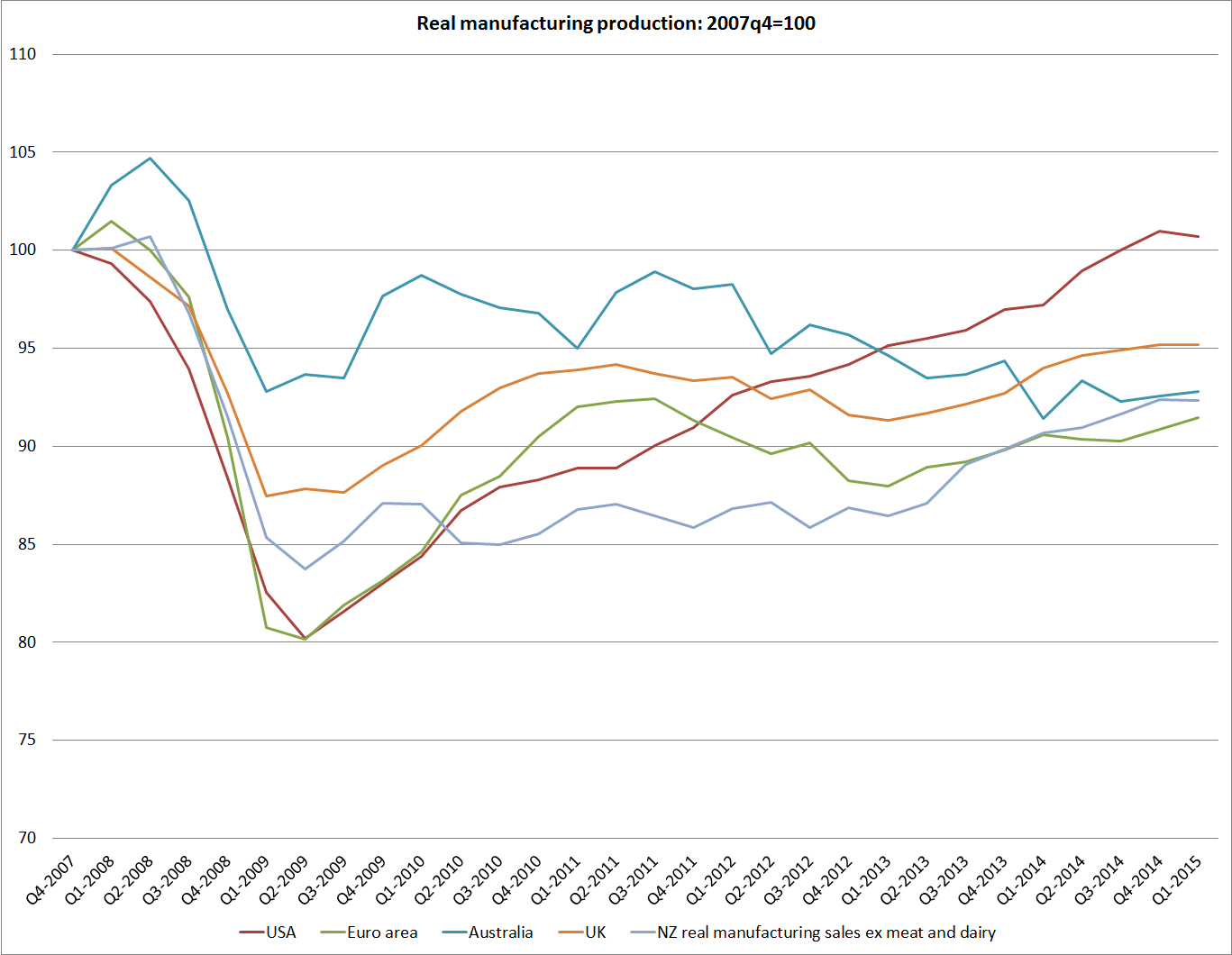
But this chart shows the volume of manufacturing activity (not as a share of GDP, not per capita, just the level) for a few countries/areas since 2007q4.  For the other countries, it is OECD data, while for New Zealand I’ve used the volume of manufacturing sales ex meat and dairy (the rather less noisy series SNZ also publishes).

manuf

I haven’t been paying much attention to these data in the last year or two, but I was interested how far below 2007 activity levels New Zealand manufacturing still is.  As previous Reserve Bank work pointed out, once one strips out meat and dairy, a lot of the activity in New Zealand manufacturing is a derived demand off the back of construction-sector activity.  And the construction sector here has been pretty robust, particularly on the back of the huge volume of work in Christchurch.

But I was also somewhat sobered by how similar the path of manufacturing activity has been in New Zealand and in the euro-area as a whole.  Note that these are not per capita measures, and euro-area population is pretty flat while ours has risen 6 per cent of so since 2007.

The US performance looks relatively good, but in fact is still slightly less good than (flat to falling population) Germany.

I’m not one of those who thinks that the relative decline of manufacturing is a tragedy, but on the other hand I also don’t think that it is a matter of total indifference.  Most likely, the relatively weak manufacturing sector performance in recent years, despite the buoyant construction sector, is a reflection of the persistently high real exchange rate.  Like Graeme Wheeler, I think the real exchange rate is out of line with medium to longer–term economic fundamentals.  A more strongly performing New Zealand economy, one making some progress in closing the gaps to the rest of the OECD, would be likely to see a stronger manufacturing sector.  It might still be shrinking as a share of a fast-growing economy, but a manufacturing sector that has seen no growth at all in almost 20 years doesn’t feel like a feature of a particularly successful economy.

Using the same data series as above, I had a look at what has happened since 1995q1.  Six OECD countries have had weaker manufacturing sector activity than New Zealand.  At least three are current cyclical basket cases (Spain, Italy and Greece), and the gap between the growth rates in manufacturing volumes and in population has been weaker only in Italy, Spain, and France.

Numbers like this certainly don’t suggest immediate policy remedies, but they probably should continue to prompt thinking about just what explains New Zealand’s disappointing economic performance.

Growth 1995 to 2015
Manufacturing Population
Italy -17.6 7.8
Spain -10.7 20.2
France -5.3 11.3
Greece 0 3.3
Japan 0.2 1
UK 1.6 9.9
New Zealand 4.3 22.7