An MPC member speaking

For the first six years of the newly-created statutory Monetary Policy Committee the external members were conspicuous by their silence. While their charter (agreed with the Minister of Finance) allowed them to speak openly we heard almost nothing from any of the three of them (and of course no disclosure of views or thinking in the minutes of the MPC either). The contrast with models like the central banks in the United States, Sweden, and the UK was stark.

This year there has been some sign of progress, albeit only from one of the members (whose approach may not be terribly popular with his MPC colleagues or – though they have very limited say – the Reserve Bank Board). The member in question is Prasanna Gai, a professor of macroeconomics at the University of Auckland and someone who spent the early part of his career at the Bank of England (and has had various other central banking involvements since). On paper he appears by far the strongest of the externals (and probably more so that at least of the internals), even if there is something less than ideal about having someone serving at the same time as an MPC member and on the board of the Financial Markets Authority. We also know nothing directly about his view on the state of the economy or much about his thinking about policy reaction functions etc, although we can deduce from his two recent speeches that he is probably the key player in the rather heavy (over)emphasis on uncertainty from the MPC in the last six months.

I wrote a few months ago about Gai’s published views (to be clear, from before he became an MPC member) on how Monetary Policy Committees should be functioned and governed. That post was shortly after his first speech
But in the last few weeks there have been two more sets of (fairly brief) remarks, and things have improved somewhat. In their email notification of upcoming speaking engagements, Bank management has noted that the two events were coming up, and the texts of the two sets of remarks are on the website (although you get the impression the Bank might be unenthused because they have not emailed out links, leaving people to remember to go and look for them, or otherwise to stumble over them).

The first of those sets of remarks was about uncertainty (mostly in the light of the US tariff situation), delivered to (it appears) an academic audience in Melbourne a few weeks ago. In those remarks, which were expressed reasonably abstractly, Gai could most reasonably be read as suggesting that the trade policy uncertainty was having a material macroeconomic effect on New Zealand and that fairly bold monetary policy responses were appropriate. I put some comments about those remarks on Twitter, which are in a single document here

tweet thread on Prasanna Gai’s uncertainty remarks

While welcoming the fact of the speech, I was a bit sceptical of the argument.  But then the good thing about policymakers laying out their thinking is so we can scrutinise, challenge, and engage with those arguments.

Gai’s most recent set of remarks was to some forum run by the Ministry for Ethnic Communities (one of those entities whose continued existence casts severe doubts on government rhetoric about cost-savings and lean efficient bureaucracy – but that isn’t Gai’s fault).   There is more about uncertainty (in fact the remarks carry the title “Navigating the Fog – A Tryst with Economic Uncertainty”) although he takes the issue rather wider than the US tariffs stuff.  I still wasn’t entirely persuaded, especially by the sentence I’ve highlighted.

Faced with the unknown, and already in the midst of a downturn, economic actors hesitate, delay investments, and reduce engagement. We see this in NZ surveys like the QSBO. Paradoxically, this cautious behaviour, while individually sensible, creates a self-fulfilling cycle. Caution reduces economic activity, which deepens uncertainty, leading to even more caution. Economists call this the “uncertainty trap.” It locks the economy into stagnation. By avoiding risk, we inadvertently create the very uncertainty we seek to avoid. This cycle of inaction feeds into a broader macroeconomic malaise, where growth stagnates, prices become sticky, opportunities are missed, and innovation slows. When everyone waits, nothing moves.

No doubt we can all agree in wishing away a fair amount of avoidable uncertainty (probably most people in New Zealand would count the US tariff uncertainty – regime uncertainty from day to day – in that category) but uncertainty is a part of life and always been.  Perhaps it is greater in the short to medium term in democracies and market economies (absolute dictators can, although perhaps rarely do, provide greater certainty about some things over those horizons) so it seems a bit odd to suggest that people dealing with uncertainty is somehow problematic, or even creates uncertainty itself.    There is more stuff along these lines in the remarks.

But my main interest in this set of remarks was the section headed “What Can Policymakers Do?”.   He seems to think they can and should do a lot.   I suspect he is far too ambitious (including on fiscal policy where he observes “At the same time, fiscal policy must step into its own strategic role — by investing through uncertainty and setting the stage for deep microeconomic reform. Where private actors
hesitate, public action creates space — catalysing investment in innovation, skills,
infrastructure, and housing8. And, like monetary institutions, fiscal policy must be guided
by intellectual clarity, coherence, and long-term commitment.”)   

But again, my main interest is monetary policy.    He writes

In other words, central banks must set the tone for the economic conversation. Their words, emphasis, and structure condition how millions of decisions unfold. They must illuminate the path ahead, not merely comment on the prosaic.

Transparency – describing the macro-landscape by publishing monetary policy statements and modelling scenarios – is helpful, but not enough. What really matters is the capacity to guide expectations. This requires intellectual rigour, deep technical expertise, and the agility to challenge conventional thinking. How we think, rather than who said what, is the essence of credibility when uncertainty is high.

It is important to remember that central bankers wield unelected power7. Direct engagement—through public speeches and testimony before Parliament—brings clarity to uncertainty. Speaking directly about how we think, and what would change our minds, provides analytical accountability that complements procedural channels that chronicle debate – such as meeting records and monetary policy statements. When we open the doors of our policy reasoning to scrutiny, the fog clears and trust builds. 

There is good stuff there (and in that footnote 7, which I’ve not reproduced, he refers readers back to the paper he wrote pre-appointment (see above), observing “some of those lessons are relevant for New Zealand”).

He is clearly laying down a marker here advocating for a materially greater degree of transparency from the New Zealand Monetary Policy Committee. The incoming Governor – about whom I will probably write later this week – went on record at her appointment announcement as favouring greater monetary policy transparency (unsurprisingly given that the Swedish central bank has substantively the most transparent monetary policy decision-making etc model anywhere). But you have to suspect it is going to be an uphill battle in an institution with a deeply rooted culture (not specific to any particular Governor) of favouring transparency only when it suits, whereas real transparency and accountability are about openness even when it hurts).

I’m all in favour of much greater transparency (and the new Bank of England MPC model looks as though it could provide a good model). But there is an important distinction between transparency that makes a difference to macroeconomic outcomes and that which largely supports heightened accountability. Perhaps the two should overlap but they rarely do. It isn’t obvious, for example, that the central banks that are much more open, including about differences of views and models among members, or whose MPCs had deeper stores of technical expertise among their membership, did any better at all – in terms of inflation outcomes – through the dreadful inflation resurgence of the early 2020s than, say, the Reserve Bank of New Zealand’s MPC did. But in those countries with greater transparency we know a lot more about the views of individual members and their thought processes and are thus better positioned to assess whether perhaps some are less guilty than others. Individual accountability is, thus, a serious possibility.

My impression is that Gai is much more optimistic about the scope for enhanced transparency to make a macro difference. In a sentence before the block of text I quoted he says “when uncertainty is high and the channels of transmission are weak, communication takes on greater importance”.

Well, perhaps, but only if the central bank has something meaningful to say, otherwise it just ends up as cheap talk. No doubt we can all agree that central banks should always and everywhere indicate that if (core) inflation looks like going off course they will respond accordingly. That is a (much) better place than we (advanced world fairly generally) were in 50 years ago, but it isn’t really much help in grappling the high levels of uncertainty firms and households actually face at times, most of which isn’t about monetary policy. Central banks can’t add much of any use on where US trade policy may go, let alone how other countries might or might not respond. Or whether (let alone when) the AI stock market surge will prove to be a bubble that will burst nastily. Or whether China will invade Taiwan. Or, to be more pointed and winding the clock back five years, what would happen to policy regimes around Covid (lockdowns, border closures etc) – surely the most extreme, perhaps inescapable, example of policy uncertainty in recent times. Central banks generally couldn’t get the macroeconomics right even when the policy uncertainty began to diminish (see inflation outcomes and generally very sluggish interest rate responses). The ability to “illuminate the path ahead, not merely comment on the prosaic” seems very limited in practice in most circumstances. (I think back, for example, to the early days of inflation targeting in New Zealand: we aimed then to be very transparent, and had a Governor who was a strong retail communicator, and yet if we consistently held out a vision – sustained low inflation and a fully-employed economy – we had no certainty to offer as to what it would take or when the payoff would be seen. Bigger central banks that went through similar dramatic disinflations generally found themselves in the same boat.)

But to conclude, it is great to have an MPC member putting his thinking on record (even in this case it is still mostly about processes/structures than the specifics of how the economy and inflation might unfold). Perhaps some journalists might ask him about the speech and seek to tease out his ideas. We all benefit when those wielding power – unelected power in this case as he rightly notes – put their ideas out for information, scrutiny, and debate. Perhaps some other MPC members might think of taking up speaking opportunities that come. Perhaps Gai, who has dipped his toe in the water with a couple of brief sets of published remarks, might consider a fuller version at some point?

Reserve Bank meeting the PM

There has been a flurry of coverage in the last couple of days after the Prime Minister told an interviewer yesterday not only that he thought the Reserve Bank should have cut the OCR by more/earlier, but that he had made this point to the Governor in a meeting with the Bank before the final OCR decision was made last week.

While I don’t think it is usually particularly wise, in general I don’t have a problem if the Prime Minister or Minister of Finance want to comment critically on particular OCR decisions or on the MPC’s handling of monetary policy. We give operational independence to the MPC for good (if arguable) reasons, but they aren’t a separate arm of government – so it is different than ministers criticising judges – and they are human and, as we’ve seen again in the last five years, they make mistakes, sometimes bad and very costly ones. The MPC is supposed to be accountable and ministers are our representatives and the ultimate vehicle for the exercise of that accountability. Back when core inflation was persistently undershooting the target last decade, ministers were eventually heard to grumble in public from time to time even about that poor performance.

It is another matter to be holding private meetings with the Governor (or other MPC members) and expressing your views – whether as PM or Minister of Finance – perhaps especially in the days immediately leading up to a particular interest rate decision. There is no public visibility – or, thus, accountability – for those comments, and Luxon was very unwise to have done what he said he did. That is particularly so at present when a) the Governor is on a short-term temporary contract and is bidding to be made the permanent Governor, and b) when things around the Reserve Bank have been so tangled and murky all year (and when, despite attempts to deny it, it seems clear that the capital settings review was mainly driven by pressure from the Minister of Finance). This is a time when people should be bending over backwards to ensure that they are behaving with propriety, and that there can be no question (or appearances) of anything else. I don’t really suppose that in his meeting the PM thought he would influence the MPC – maybe he was simply sounding off without thinking too hard – but those of a suspicious mind might reasonably worry that it was otherwise. Of course, in law the government cannot direct a particular OCR decision, and the Governor himself has only one of six votes on the MPC (and three other votes are held by externals who owe no particular deference to him).

It seems that these conversations occurred at a meeting that, in one form or another, has happened for decades in the day or two prior to each Monetary Policy Statement. I’ve been out of the Bank for 10 years now but my impression is that things are not very different now than they were in my day. The practice would be that at the end of the “forecast week”, when the Bank’s or MPC’s economic view had crystallised, the material from that forecast process would be used to prepare a short note for the Minister and Prime Minister. In my day, Treasury drew on Bank material to prepare that note, which included possible angles for questions that ministers might use to ask the Bank. But that note never touched on the OCR itself, and neither did the discussion in the meeting that followed (usually involving the PM, MoF, the Governor and chief economist, perhaps someone from Treasury, and perhaps some ministerial advisers). In all my years in the Bank I often heard reports back from these meetings, from the Governor or chief economist, and it was clear that boundaries were pretty consistently respected. What the Bank might do with the OCR was pretty much out of bounds (and in my day, OCR decisions were – formally – purely those of the Governor himself).

If the structure has remained much the same – and I gather the meeting in question happened last Tuesday – there is nothing very wrong with that model, except that the Prime Minister appears to have crossed the line, in ways that probably should prompt a rethink as to whether such meetings prior to the MPS are still appropriate. A model can have been around for decades, and appear to have worked okay, with people respecting conventions, but sometimes particular episodes prompt an overdue rethink. It was like that with the lock-ups the Bank used to hold for analysts and media immediately prior to MPS releases – which seemed to work okay until it became clear that security settings were weak and one media outlet was actually passing information from the lockup back to their office (something I got caught up in when their office passed information on to me, since I was due to be interviewed by them on the MPS later that morning). There are no more lockups (and nor should there be).

Should the Governor and an acolyte or two really be meeting with the Prime Minister and Minister of Finance immediately prior to MPS/OCR decisions? It may have worked fine for a long time, but it isn’t a good look, and on this occasion the PM has crossed the boundary, and it is hard to restore confidence now that the meetings are widely known of, and the PM has done what he says he did. There is no particularly compelling reason for the meeting. The Treasury has a non-voting observer on the MPC, and if there is any case for a briefing on the economic outlook before the release surely that person could arrange for the briefing. But it isn’t really clear that such a prior briefing is needed at all (and it has always been rather artificial for the Bank to be discussing the economic and inflation outlook without also discussing the monetary policy calls). Moreover, it isn’t the days of the single decisionmaker, and external MPC members in particular might reasonably think that it is time to rethink the approach (not just while the appointment of a new Governor is dragged out – will be six months next week since Orr left – but in the future more permanent state with a new longer-term Governor). Were I in Hawkesby’s shoes, I’d be thinking pretty hard about the risks and returns to those meetings anyway. There is plenty of time after releases and well clear of the next decisions to maintain Beehive relationships, to the extent they are needed on monetary policy matters.

Thinking about the MPC

I wrote earlier in the week about the as-yet unfilled vacancy in the office of Governor of the Reserve Bank. But there is also another significant vacancy that needs to be filled in the coming weeks, as the oft-extended MPC term of Bob Buckle finally comes to an end.

Buckle appears to be older than Donald Trump and has been on the MPC since it began 6.5 years ago. That means he’s been fully part of all the very costly bad calls ($11 billion of taxpayers losses when the MPC authorised the Bank to punt big in the bond market, and the worst outbreak of inflation in many decades, the consequences of which – notably in the labour market – we are still living with). And in his 6.5 years on the committee we’ve learned nothing at all of any distinctive contribution he may have made, we’ve heard nothing of his views (was he cheerleader, did he ever express any doubts etc?), there have been no speeches or interviews, he’s never apologised for or even acknowledged the bad calls (and their consequences) he’s been fully part of. And yet he has twice had his term extended (first reappointed by Robertson and was then extended again by Willis). He isn’t uniquely bad, and of the three externals first appointed back in 2019, when active expertise was deliberately excluded by Quigley and Orr, he was the least unqualified. But he is representative of all that is unsatisfactory with the Reserve Bank monetary policy governance reforms put in place in 2019. There is no accountability whatever, despite exercising huge amounts of delegated power.

Thinking about the vacancy, and the fact that it is now just over a year since Willis appointed two new, and apparently more capable, external MPC members prompted me to dig out the paper (“The Governance of Monetary Policy – Process, Structure, and International Experience”) that one of those new MPC members, (Prasanna Gai an academic at the University of Auckland but who’d spent a lot of time earlier in his career at the Bank of England), wrote in January 2023 as a consultant to the external panel reviewing the Reserve Bank of Australia. That review process that led to amended legislation and the creation this year of a distinct RBA Monetary Policy Board. It is a useful paper, easy to read and not long (28 pages), surveying experiences in a number of countries (including a quite sceptical treatment of the New Zealand MPC experience) and concluding with a couple of pages headed “Towards an ideal set-up” with six specific recommendations for the design of an MPC.

These were the recommendations

Recommendation 1: External members should be appointed through a merit based competitive process run at “double arms-length”, by a bi-partisan hiring committee appointed by the Treasurer that is diverse, experienced, and representative of society. Treasury Officials should be excluded from the MPC.

Recommendation 2: The threshold for economic expertise and policy acumen should be high. Members should be professional economists, with backgrounds in macroeconomics and financial economics, or offer broader experiences relevant to monetary policy. Gender, ethnicity, and industry diversity should be
important considerations in deciding the MPC make-up. Membership should be part-time with a commitment of around 3 days per week on average. Overseas members should be considered, subject to this time commitment.

Recommendation 3: The MPC should be relatively small (six). There should be two internal members and four externals. The role of Chair of the committee should rotate periodically and external members should be chosen for their capacity to serve in this regard. Pre-deliberation opinions should be sought, recorded (e.g. “dot plots”), and released to the public at an appropriate time. The chair should speak last and members invited to speak randomly. MPC members should be encouraged to interact with RBA staff between meetings.

Recommendation 4: The term of office be a single, non-renewable term of no more than five years.

Recommendation 5: To optimise information production and processing and to ensure democratic accountability, each member of the committee should “own” their decision and regularly explain their thinking to stakeholders at parliament and other fora. Members should have the freedom to dissent and MPC processes should be designed to diminish cacophony. Transcripts of the deliberation meeting should be released after a suitable lag so that stakeholders have a complete picture of the reasoning and debate behind the policy decision.

Recommendation 6: The MPC should be exposed to a regular schedule of external review by experts in monetary policy at 5-7 year intervals. These experts should be independently commissioned by the Treasury without consultation from the RBA, to avoid claims of partiality. The Treasury should take the lead in ensuring that review recommendations and insights are taken on board by the RBA and MPC.

Interesting food for thought, but anyone with any familiarity with the New Zealand system will recognise that list bears almost no relationship to what we have here (in law or in practice), except perhaps that odd “gender diversity” priority, which is pretty clearly what led Grant Robertson to appoint Caroline Saunders to the initial MPC (OIAed papers support that conclusion) and is probably why Orr appointed the otherwise utterly unqualified Karen Silk as the deputy chief executive responsible for macroeconomics and monetary policy, complete with a voting seat on the MPC. And, to be fair, there are some elements of Gai’s recommendations that I don’t agree with (including rotating the chair, bipartisan selection, and non-renewable terms).

One of the reasons I don’t like the idea of non-renewable terms is that serious accountability (ie with real and personal consequences at stake) is hard enough generally, but that the possibility of non-renewal is the most plausible point at which a monetary policy decisionmaker might face paying a price if they’d done poorly. Under the 1989 Act, the Bank’s Board was transformed into a body designed almost solely to hold the Governor to account, and they could recommend dismissal at any point if they concluded he was doing monetary policy poorly. The Board ended up so close to management (and for long periods was chaired by former senior managers), and had no resources of its own and limited economic expertise, that challenge was difficult. But, in principle, reappointment offered a chance, without too much awkwardness, to suggest that it was time for an incumbent to move on. The current Board still has some such role in respect of non-executive MPC members.

(The system was finally discredited in 2022 when, with all of Orr’s personal and policy failings already on display, the outgoing old board still recommended to their successors that Orr be reappointed, one of the worst public appointment decisions in New Zealand in quite some time, culminating in the engineered exit this year, barely two years into his second term.)

In formulating his recommendations, Prasanna Gai explicitly drew on a 2018 conference paper, (“Robust Design Principles for Monetary Policy Committees”) prepared for an RBA Conference, and written by David Archer (then a senior manager at the BIS) and Andrew Levin, a US academic but former Fed staffer. Archer, of course, had previously been chief economist and head of financial markets at the Reserve Bank until about 2004. It is another fairly accessible not-overly-long (16 pages) piece and they conclude with eleven principles, grouped as seven “governance principles” and four “transparency principles” (although I’m not sure I really buy the distinction). But like the Gai paper, it is very technocratic and rather weak on the place of a powerful central bank in a democratic society.

Reading the two documents together the thing I found most striking was that there was lots of talk (and they seemed to mean it seriously) about the importance of “accountability” (most explicitly in Gai’s recommendation 5 but strongly implicit in 3 and 6 as well). Archer and Levin are very much in the same vein (“Principle 6: Each MPC member should be individually accountable to elected officials and the public”). And yet, none of it seemed to involve any consequences whatever for the individuals. Both favour non-renewable terms so there is no potential discipline there, and Gai never ever seems to mention the possibility of removing an MPC member who had done monetary policy poorly. Archer and Levin are only slightly better, suggesting – in just a very brief reference not elaborated – that there should be “removal only in cases of malfeasance or grossly inadequate performance”.

I was a bit puzzled. One might expect serving central bankers to recite empty mantras about accountability that boil down in substance to not much more than having to publish a few documents and the Governor fronting up every so often to rather soft questioning at a parliamentary committee (in essence, the New Zealand model). But although each of these three authors had been central bankers none were at the time of writing.

It was, perhaps, particularly surprising in Gai’s case. After all, he was writing in January 2023 when central bankers in a wide range of countries were revealed as having stuffed up badly (no doubt with the best will in the world) and Phil Lowe was under fire in Australia. I wondered if perhaps one factor for Archer and Levin had been that were writing in 2018 when we were several decades into inflation targeting and in most countries if there had been monetary policy errors in the grand scheme of things they were relatively small.

And so I asked David Archer (now retired) why their paper had not dealt in any detail with options for serious personal accountability. He gave me permission to quote from his response (prefaced by a “joint papers are a compromise”)

On making accountability real, I favour the ability to remove for policy failure reasons
(a) where it is possible to define the objective with some clarity, and 
(b) where the procedure and protocols for assessing the bank’s/individual’s contributions to failure are fairly robust and shielded from political intervention.
 
I think (a) is possible, since maintaining medium term price stability — a single objective, able to be stated numerically — is clear enough.
 
I think (b) is more difficult. A previous NZ construction, involving a monitoring group that comprises outsiders who owe their duty to the public but that is able to peer inside the operation — that is, a board with independent chair and no management responsibilities — was a pretty good, though not perfect design. The imperfections were less in the construction than the execution, but the construction could still have been better — eg a requirement for an annual assessment report that requires a ministerial response and FEC examination.
 
It is noteworthy that the ability to remove for policy failures is almost vanishingly rare internationally. 

I agree with the spirit although not entirely with the details. In the end, I think that – in a democracy – decisions to appoint or to remove MPC members (executive or not) should be made by people who are elected (ie politicians) and thus themselves directly accountable. But it might be a reasonable balance to say that people could only be removed (for policy failure causes) on the recommendation of an independent assessment panel.

Unlike David, I think the old Reserve Bank Board model (while well-intentioned) was never likely to be an adequate approach. Operating within the Bank, with the Governor as a member, with a senior Bank manager as secretary, with no analytical or consulting resource of their own (to which one could add that they were required to review each MPS and see if it did the statutory job, which made it hard to stand back later and hold the Governor to serious account) it was never likely to succeed. Things got too cosy, the Board was more interested in having the Governor’s back, they held cocktail functions to help spread the Bank’s story, and to the extent there was challenge or questioning it was often on rather technical points rather than seriously attempting accountability. It might have been different if something like the Macroeconomic Advisory Council I used to champion had been set up, fully independent of the Bank and Treasury, and with serious analytical grunt itself.

Central bank monetary policymakers wield a great deal of power. There is no review or appeal process embedded. Being human, the best central bankers will make mistakes (just like the best corporate managers or corporate boards) and there needs to be a personal price to failure, otherwise we have given great power with little or no responsibility. If really big mistakes are not going to lead to those responsible being fired – or not even lead to them being not reappointed – we should rethink whether operational autonomy over monetary policy is appropriate at all. We still need expertise on these issues – as in so many other areas of public life – but there is no necessary reason why the decisionmaking power should be delegated. When politicians wield power we have the satisfaction of being able to toss them out when they do poorly. (And for those who worry about possible pro-inflation biases among politicians, a) for the decade pre-Covid we had the opposite problem (inflation a bit too low relative to target) from central bankers, and b) it is salutary to see how much “cost of living” now features among public concerns, here and elsewhere, even a couple of years after the worst of the inflation.)

To be clear, I am not suggesting that independent MPCs should be able to be second-guessed when they make their initial decisions (even if there had been a consensus in March/April 2020 that the MPC was going astray, Orr and company shouldn’t have been able to be tossed out then). But when outcomes go so badly off track, people should be removable and should not be reappointed. It can’t be a mechanical or formulaic thing – outcomes are always a mixture of specific policy judgements and unforeseeable shocks – but there is nothing particular unique about monetary policy in that (see the ousting of corporate chieftains when things go badly astray; sometimes it is just because there needs to be a scapegoat, somone seen to take the fall). But it does heighten the importance of making people individually responsible – speeches, interviews, proper minutes, attributed votes, FEC hearings and so on. It is hard to dismiss an entire committee – one of the 1989 government’s reasons then for choosing a single decisionmaker – but if a committee is doing its job at all well, some members will inevitably emerge looking better (or worse) than others. (Unlike our experts – above – I think there is a particular responsibility on the Governor, who controls staff analysis etc and is full time, but that isn’t an excuse for free-riding externals).

There is one area where we deliberately make it all but impossible to remove someone for bad substantive decisions: the judiciary. And that is probably as it has to be. But in the case of lower courts there are (layers of) appeal processes, and in higher courts finality is often the point (there may not be objectively right or wrong legal interpretations, but what the courts provide – subject to parliamentary override – is finality. And unlike most central banks, courts are unshamed about having majority and dissenting opinions, the latter often lengthy and thoughtful. There is no good reason for putting our central bankers on such a protected pedestal – mess up badly and face no personal consequences, no matter how much damage those bad choices have done to the country.

But to come back to the mundane, you have to wonder what Prasanna Gai makes of being an MPC member, operating in a model so much at odds with the analysis and recommendations he gave to the RBA review panel not much more than a couple of years ago:

  • He was selected last year by a panel, appointed entirely by the previous Labour government, led by Orr and Quigley, who would have spurned his expertise when the MPC was first set up in 2019,
  • The Secretary to the Treasury (or his nominee) is a non-voting member of the committee,
  • The MPC is numerically dominated by internals, one of whom has no economics background at all,
  • Not only is the chair not rotated, but it was held by a domineering personality, long observed to be intolerant of challenge and dissent, whose governorship finally flamed out when he completely lost his cool in meetings with, first, Treasury and then the Minister,
  • MPC members have renewable terms (although I guess Gai could decline to seek a second term)
  • There is no disclosure of individual member views, either in minutes or subsequently in speeches, interviews, or hearings (and in his paper Gai makes much of the free-rider problem/risk), and
  • Despite having been in place for 6.5 years now, through some of the most turbulent times for decades, the only “review process” was run by the Bank itself.

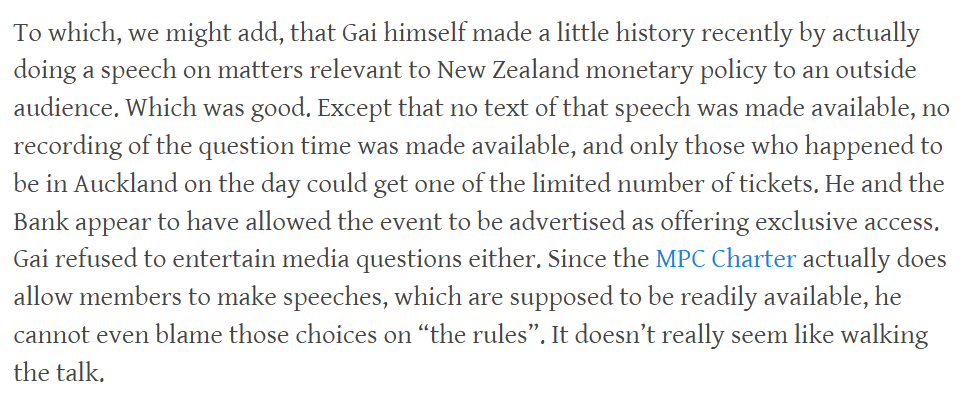
To which, we might add, that Gai himself made a little history recently by actually doing a speech on matters relevant to New Zealand monetary policy to an outside audience. Which was good. Except that no text of that speech was made available, no recording of the question time was made available, and only those who happened to be in Auckland on the day could get one of the limited number of tickets. He and the Bank appear to have allowed the event to be advertised as offering exclusive access. Gai refused to entertain media questions either. Since the MPC Charter actually does allow members to make speeches, which are supposed to be readily available, he cannot even blame those choices on “the rules”. It doesn’t really seem like walking the talk.

It is a shame in someone who appeared to have a lot to offer that he seems to have adapted to the cage Orr. Quigley, and Robertson built, and which so far Willis has done nothing to overhaul. I strongly suspect he adds more value than Peter Harris or Caroline Saunders – and I valued my engagement with him in those pre MPC years – but for the time being they are observationally equivalent. For those who initially talked him up as a potential Governor – and noting slim pickings – it isn’t a great display of leadership in action.

Meanwhile it will be interesting to see what sort of person Quigley and Willis find for the Buckle vacancy. Recall that, like the Governor’s position, the Board proposes, but the Minister of Finance is quite free to knock back a nomination and insist that the Board comes back with someone better.

MPC members speaking

In both The Post and the Herald this morning there are reports of interviews with executive members of the Reserve Bank’s Monetary Policy Committee: the Bank’s chief economist Paul Conway in The Post and his boss, and the deputy chief executive responsible for monetary policy and macroeconomics, Karen Silk in the Herald. In a high-performing central bank the holders of these two positions should be the people we look to for the most depth and authoritative background comment on monetary policy and economic developments. But in New Zealand we are dealing with the legacy of the Orr/Quigley years where we struggle to get straightforwardness, let alone depth and insight.

Now, to bend over backwards to be fair, interview responses will depend, at least in part, on what the journalist concerned chooses to ask. But then standard media training advice is to answer the question you wish they’d ask, not (necessarily or only just) the one they did. An interview with a powerful decisionmaker is a platform for the decisionmaker.

The Conway interview appears somewhat meandering and not very focused. I wanted to touch on three sets of comments in it.

First, asked about the transition after Adrian Orr’s sudden (and unexplained) departure, he says it is business as usual and it has been “a very smooth transition”.

“I think this institution is bigger than even Adrian Orr [it was certainly bigger – much bigger – as a result of Adrian Orr]……There’s a real sense of the ‘show must go on’ and it really has. We miss Adrian. It is a bit less fun around the place, less jokes going on – probably more appropriate jokes”, he smiles again.

So in addition to Orr being a bully, an empire builder, and someone well known for freezing out challenge and dissent, he also created an uncomfortable and inappropriate working environment? Or at least that is what Conway appears to be saying about the man who recruited him.

But you also wonder about just how straight Conway is being (and why the journalist didn’t ask more). After all, the Bank itself tells us there are big changes afoot (presumably consequent on the new Funding Agreement, prospect and actual). In the just over two months since Orr resigned, the top tier of management has been brutally slimmed down (credit to Hawkesby). At the start of March there was the Governor and an Executive Leadership Team of seven Assistant/Deputy Governors and one “Strategic Adviser”. Since then, Kate Kolich, Greg Smith, Sarah Owen, Simone Robbers and Nigel Prince have all either left already or we’ve been advised they will soon be doing so (none with an announced job to go to). Governor plus eight has been reduced to Governor plus four. And

That first group is Conway’s own level (though presumably the Bank will continue to need a chief economist). And then on down to the staff (and much of this is because Orr/Quigley massively blew the budget limit Grant Robertson had set for them and went on one last hiring spree last year). You somehow suspect that all is not exactly sweetness, light, and engagement at the Reserve Bank.

And then there was this

Conway is on record as a bigger-government sort of guy (we had his extra-curricular stuff last year, as an example) but what possessed him, interviewed as an MPC member and senior central banker, to suggest that more state interventions and bigger government might be “worth thinking about”? It simply isn’t in his bailiwick, and he shouldn’t have allowed himself to be dragged into responding to a hypothetical, especially about one outside the Bank’s responsibilities.

And finally, we got the meandering thought that “it’s possible that we get to a point where people just adjust their behaviours and ‘uncertainty’ becomes the new normal and we just get on with it. I’ve got no ’empirics’ to base that on – it’s just, I think, a very interesting thought-stream.”

Really? A “very interesting thought-stream” that people do in fact adapt to the world as it is? Startling and insightful (not).

Then, of course, there is his boss, Silk. Most serious observers regard her as fundamentally unqualified for her job, and not the sort of person who would be likely to be on an MPC anywhere else in the world, let alone as the deputy primarily responsible for monetary policy. She can be counted on to safely deliver speeches on operational topics that others have written for her, and to answer purely factual questions at MPS press conferences and FEC about what has happened to swap yields and mortgage rates. And that is about all.

She also seems to have a mindset in which rates being paid on existing mortgages are what matter rather than the rates facing marginal borrowers and purchasers. Perhaps it is what comes from a non-economics background in a bank? Thus, in the Herald interview we are told that she claimed that “the effects of the 225 basis points of OCR cuts the committee had delivered in less than a year were yet to be widely felt”. The journalist added some RB data on average actual mortgage rates which might appear to back that up. Of course, expected cash flows matter as well as actual ones – if your fixed rate mortgage is going to roll over in a couple of months onto a much lower rate that will almost certainly be affecting your comfort, confidence, and willingness to spend now. But more to the point, marginal rates for people looking at buying a property or otherwise taking on new debt have come down a long way, and were already down a long way months ago. This chart is from the Bank’s own website, showing short-term fixed mortgage rates.

As at yesterday, rates were a few basis points lower again than the end-April rates shown here. 200 basis points plus down from the peak, and that not just yesterday. And falling wholesale rates, which underpin these falls in retail rates, also affect the exchange rate, another important part of the transmission mechanism. (And, of course, with all Silk’s focus on the cash flows of existing borrowers, she never ever mentions the offsetting changes in the cash flows for existing depositors – I’m of an age to know!)

So far, so predictable (at least from Silk). But then there was this (charitably I’ll assume the word “fulsome” was not hers)

Reasonable people might differ over the inflation outlook and the required future path for the OCR, except that we were told in the MPS that there was unanimous agreement from the MPC to the forecast path for interest rates. And that is a path that is lower from here than the path published (again unanimously) in the February MPS (the deviation begins after the May MPS, not at it). In other words, not only did the February path show some further easing from (where they expected to be, and were, by) May onwards, but the May path shows even more easing from here forward.

And yet Silk talks of a “much stronger easing signal” sent in February.

Frankly, they seem all over the place. If the Committee (as it did) unanimously agrees to publish a (somewhat) steeper downward track than the one you had before then either you have an easing bias – always contingent on the data of course – or you made a mistake in adopting the track you did. And if you are comfortable with the track, it feels like a mis-step for the temporary fill-in Governor to announce that there was no bias. I guess Silk might have got stuck having to cover for her fill-in boss, but it is a pretty poor look all round. Surely (surely?) they must have rehearsed lines about biases before the press conference? Surely, if so, someone pointed out the disconnect between the proposed words and the chart above?

And finally from Silk we learn that “price stability is one of the conditions you need for growth”. It simply isn’t – and the economists on the committee are usually much more careful, with the standard central banker line being that price stability, or low and stable inflation, is the best contribution monetary policy can make (many muttering under their breath that that contribution isn’t necessarily very large). Not to labour the point but the economy was still growing, reaching its most overheated point in late 2022, when core inflation was around its worst.

All in all, not a great effort at communications from the MPC this week. As I noted in my post on Thursday, there was none of the prickly frostiness of Orr, and no sign of deliberately or conscious setting out to mislead Parliament, but it simply wasn’t a very good performance. And while Hawkesby is new to the role, chairing MPC and acting as its prime spokesperson on the day, Conway and Silk have no such excuse. Someone flippantly suggested that perhaps there is something about May and the MPC – last May was when the MPC went a bit wild talking of raising rates further (the OCR was still going to be above 5 per cent by now), and then Conway tried to blame his tools, rather than the judgements of him and his colleagues, for the associated forecasts.

If the government is at all serious about a much better, world class, Reserve Bank, they need to work with the Board to find a Governor who will lift the game and the Governor/refreshed Board will need to work with the Minister to produce a stronger MPC. It would seem unlikely that in such an improved Bank/MPC there would be a natural place for either Conway or Silk, pleasant enough people as they may be.

A letter

After the Reserve Bank’s appearance on 20 February at the Finance and Expenditure Committee (the Governor, his macro deputy Karen Silk, and his chief economist Paul Conway) on the previous day’s Monetary Policy Statement, I wrote a post here about it, focused on a number of areas in which Orr, either actively abetted or silently accompanied by his senior colleagues, had been stringing along or actively misleading (or worse) the Commitee. The post was headed Orr at it again, a reminder that there had been all too many such cases from the Governor over recent years – mostly misleading FEC (a rather serious matter) but also not infrequently any media outlets that ever posed slightly awkward questions. It is a long list and I won’t bore you with details (you can search: Google and “croaking cassandra, Orr, misleading” appears to work well).

There have been many specific points over the years. Some are quite complex to explain, and many get lost in longer posts. But on 20 February there had been a very specific, easy to explain, readily verifiable, factual claim.

“We were one of the first central banks in the world to be tightening; we were one of the first central banks in the world to be easing” said the Governor.

He’d made versions of the first bit of it previously (many times) but the second claim seemed new.

So I thought it might be useful to devote a single post just to rebutting those two specific claims. It would be easy to refer people to in future (and to find myself). It was headed, plaintively, Why is such rank dishonesty tolerated?

I didn’t give it much more thought. But someone else who is equally frustrated by Orr’s record of playing fast and loose with the facts got in touch suggesting that it might be worth raising the matter with the Finance and Expenditure Committee. I don’t have much confidence in any of our institutions these days, but the person who contacted me tends to be a bit more optimistic about things. Reflecting on the suggestion a bit more I decided it couldn’t really do any harm. There was, after all, a new chair of FEC, and it was possible he was neither aware of the extent to which his committee hearing had been misled, or of past form.

And so I wrote to Cameron Brewer, the National MP newly appointed to chair the committee, copied to Labour’s finance spokesperson Barbara Edmonds.

I heard nothing at all from Edmonds (perhaps Oppositions don’t bother with scrutiny of government agencies these days?). There was an automated reply from Brewer which assured correspondents that

More than five business days have now passed, and not even the courtesy of a reply.

Now, in a sense some of the specific concern has been overtaken by events. The Governor has resigned, effective from 31 March, and disappeared on leave for the rest of month with no explanations. But a) Orr is still a public official, and b) his two colleagues who sat alongside him while he made these claims are still in office (both statutory officeholders on the MPC). The chief economist at least must have known his boss was simply making stuff up, but did nothing to clarify things for the committee members.

Is Parliament, is FEC specifically, really so unbothered about being misled by such senior officials? Revealed behaviour over the years suggests so, but there is always (idle?) hope when a new person takes over. Perhaps some might take Parliament and its committees seriously as more than just a chance for performative display and bonhomie, and with an expectation that senior public officials, exercising a huge amount of power, might account for themselves in an honest, transparent, and positively helpful manner. It is what we should expect from members of Parliament – our representatives – and from the public officials. Too often it isn’t what we get.

Perhaps if someone in power had called Orr out previously we might never have got to Wednesday’s very messy departure, that seems to diminish both him, the Bank, and those (Board, minister, MPs) paid to hold him to account.

Appendix:

In case people have trouble reading the photo of the letter above, here is the body of the text:

Dear Mr Brewer,

I am writing to you in your capacity as chair of Parliament’s Finance and Expenditure Committee (cc’ed to the senior Labour Party member of the committee).

At your hearing on Thursday 20 February on the Reserve Bank’s latest Monetary Policy Statement, the Governor, Adrian Orr, in response to a question from Dan Bidois stated of the Bank and MPC 

“We were one of the first central banks in the world to be tightening; we were one of the first central banks in the world to be easing”

This was simply not so, on either count (tightening or loosening).   Moreover, it is not the first time that he has made similar claims to FEC, particularly in respect of the tightenings that began in late 2021. 

I am a former senior Reserve Bank official, served formerly on the board of the International Monetary Fund  (and serve now as a director of the central bank of Papua New Guinea).  Among other topics, my economics blog devotes considerable space to monetary policy and central bank governance issues.  In a post yesterday, I documented again how indefensible the Governor’s claims around 2021 were, and that the claim about being “one of the first to ease” (a new claim from him) was even less defensible.  In fact, in both episodes the Bank acted around the middle of the pack of OECD central banks (having allowed the economy first to become materially more overheated than most of their peers had).

Why is such rank dishonesty tolerated? | croaking cassandra

There are strong grounds to believe that the Governor makes these claims to your committee either knowing them to be false, or holding a position (and with resources at his disposal) in which he should be reasonably be expected to know that they are false,  Within the limited time each member inevitably gets in these FEC hearings, and with none of the MPs involved being specialists, he appears to count on getting away with it because none of you will have precise facts at your fingertips.

You are new to the FEC role.  Unfortunately, over the last few years there has been a succession of claims to the Committee by the Governor that are demonstrably false or misleading.  Many of these have been documented on my blog, and I would be happy to provide further detail.

Conduct like this tends to diminish both the Reserve Bank (once highly regarded internationally, now more often regarded with eye-rolling despair) and, more importantly, Parliament itself.   FEC scrutiny has been a key element of the autonomous Reserve Bank model since it was first set up in 1989, and effective parliamentary scrutiny of any public agency relies on the honesty and integrity of senior public officials.  You will know better than me the very serious view that Parliament has historically taken of either MPs or witnesses at select committees misleading Parliament or its committees.

At very least, I would urge you to follow up this matter with the Governor, inviting him to provide solid substantiation for his very specific claims.

Yours faithfully


Central bank policy communications

For a long time I’ve been a strong supporter of central bank transparency about stuff a central bank actually knows something about, but a sceptic of the faux transparency of publishing stuff a central bank really knows very little about. In the former category, one might think of the background papers going to the MPC (by aiming deliberately low I once got them out of the Bank for a forecast round 10 years previously, but good luck if you asked now for the papers around the 2020 and 2021 decisionmaking, let alone those from six months ago). In the latter category I primarily had in mind medium-term macroeconomic forecasts, including endogenous forecasts for the OCR. Sure, the numbers are mostly put together fairly honestly, but in truth (and this isn’t a criticism, more a description of the limitations of human knowledge) central banks just don’t know very much about the future, especially a couple of years ahead. In principle, an OCR forecast now for the end of 2026 would be drawing on forecasts for inflation pressures well out into 2028. Forecasting 2024 or 2025 remains a considerable challenge.

But my criticisms there have typically been about the hubris or delusion involved in thinking one could add meaningful value re where things might be a couple of years hence. In fact, I was rereading this morning an old piece I used at a BIS conference years ago on such issues. But I tended to be relatively more relaxed about near-term forecasts, for (say) the next quarter or two, included the associated guidance on likely policy. If one might still be sceptical about just how good central banks might be at nowcasting or near-term forecasting (a) they do have more resource to throw at the issue than any other forecaster, and b) they should at very least know a little more than we otherwise do about their own reaction functions (ie how they might react to any given set of economic/inflation data). That might be so whether one had in mind explicit near-term OCR forecasts (to the second decimal place) as the Reserve Bank does, or just “bias statements” of the sort pretty much all central banks tend to engage in.

Here in New Zealand, even with some new and (apparently) improved external membership of the MPC, the last six months don’t score very well even on that count.

It was less than five months ago (22 May in fact) when the MPC released a Monetary Policy Statement indicating, in their forecast track, that there was a bit better than even chance that the next warranted move in the OCR would be an increase this year (to be consistent with this track, probably in August).

Their associated communications (which I’ve written about previously) was so at-sea that they tried to deny the implications of their own chosen track (the chief economist even tried to blame it on the tools, rather than the MPC of which he was a part).

Within six weeks, (without a new full set of forecasts, and in the absence on holiday of the chief economist), the MPC had flipped to a dovish stance. This was how I illustrated it at the time

And on this occasion they more or less did follow through. There wasn’t any huge inconsistency between their July and August statements (and the associated 25 basis point cut in the OCR).

But this was the forecast track in the August MPS, published only six weeks ago

That forecast track was exactly consistent (weight by days) with 25 basis point cuts in October and November, such that it was clearly intended by the MPC as specific forward guidance. It looks as if they envisaged another 25 basis point cut in February such that by then the OCR would have been lowered to 4.5 per cent.

And yet yesterday we saw a 50 basis point cut, and a fairly high degree of confidence among market economists that another 50 points will follow next month. One can argue that there wasn’t a clear direct signal of that from the MPC, although when you put a big headline in the “minutes”, and explicit statements that a) inflation is expected to “remain” around the target midpoint, and b) that an OCR of 4.75 per cent is still “restrictive”, it doesn’t take much guessing to see what they had in mind yesterday (especially with the three month MPC summer holiday coming up).

Now, as it happens, I think yesterday’s OCR cut was most likely to right call in substantive macroeconomic terms (and still think we are probably heading towards 2.5 per cent by the second half of next year). But that isn’t the issue for this post. Rather the point was nicely summed up by a journalist’s tweet yesterday

Which is a pretty damning indictment, of a committee whose claims to exercise such great discretionary power is that they are technically expert and have some reliable/predictable idea of what they are doing. And that simply isn’t obvious at present.

No one particularly minds when central banks change their mind when there is some significant exogenous shock, the size or timing of which they could not reasonably have anticipated. But it is far from clear that anything very much has changed about the economic backdrop since May (no really big data surprises on GDP or unemployment, and confidence measures seem to have bounced around a bit without leaving us in a lot different place than in early May, let alone August). Instead, the expert committee, drawing on its staff, seem simply to have gotten things very wrong, and to have seriously misread the extent of the disinflation that was already well in train (or at least so they assume, having anticipated yesterday the CPI numbers out next week). It doesn’t seem so different (though probably less severe) than the mistake they made in 2020/21 and even early 2022.

If the MPC really can’t do better than that there are two options. Either they aren’t the men and women for the job (in several cases that seems quite likely) or they should stop just injecting random noise purporting to be expert judgement by publishing forward tracks and indications of what might happen next. And, of course, there is no indication in any of the published sets of minutes from May to now of any robust debate or disagreement among MPC members, which is simply additionally damning: they all went along with each of the flip flops and inconsistencies through time, with no indication that any of them were applying the intellectual energy and analytical grunt to contest and challenge whatever view was coming from staff or management. I’ve long argued for much more personal accountability for MPC members – the risk has always just been that individuals (whether inexpert internals or the externals) would just free-ride, go along for the status, the fee, the addition to the CV, while adding little, and not bearing any consequences when the overall MPC does poorly. Management hates the idea of an open contest of ideas – has ever since reform models started being explored a decade ago – and one of their worries was of a “cacophony” of voices, in which truth would be obscured. It was never a compelling argument – other central banks manage, and it was a clearly an argument that reflected mostly management self-interest – but the experience of the last six months highlights again just how little “truth” or knowledge there is in anything much the MPC says beyond the specific OCR adjustment on a specific day. An open (but respectful) contest of ideas, exploration of alternative models, could hardly be worse than what’s been on offer again this year.

Bits and pieces

As the executive members of the Reserve Bank’s MPC have fanned out in an attempt to put a favourable gloss on what everyone else recognises as a really sharp change of view between May and July/August (call it a U-turn or a flip-flop, or just a change a view sharper in a short space of time than ever seen from the Reserve Bank absent an exogenous external shock) there have been various rather dubious attempts to rewrite history. There was the Governor of course, but in the last couple of days we’ve also heard from Deputy Governor Christian Hawkesby, and from the deputy chief executive responsible for macroeconomics and monetary policy, Karen Silk. Whether these MPC members, really highly-paid senior officials, actually believed what they were saying when they said it (most likely) or were deliberately setting out to deceive, it really isn’t good enough.

As regards Hawkesby, interest.co.nz’s Dan Brunskill captured in this Twitter thread and the article he links to there.

And then there was Silk. In almost any other advanced country central bank, the holder of a position like her’s would be a highly-regarded economist who, if one didn’t always agree, could at least be counted on to be on top of the facts. Not so Silk, on either count.

She gave an interview to NBR and someone sent me a link to the article. It included these lines, attempting to explain the shift of view

That highlighted bit didn’t sound right, but…….she is the highly-paid statutory officeholder. So I thought I should look up the Bank’s own numbers.

The May MPS was finalised in the middle of the June quarter. In that set of forecasts their best guess was that the output gap had been negative in the March quarter, and was substantially negative in the June quarter. In fact, since May they’ve become less optimistic on when the crossover (to negative output gap) occurred, and for the first half of 2024 as a whole there is no material difference in the output gap view. It is really pretty basic stuff that commentators shouldn’t have to go round fact-checking, as if it was a politician on the campaign trail they were dealing with. (And yes, the Reserve Bank has become more pessimistic – larger negative output gaps – for Q3 and Q4, which is a point she could legitimately have made, but wasn’t (at all) the one she actually tried to put over.)

But digging into my table of old output gap estimate prompted me to look again at how they’d evolved, and when the Bank first estimated that the economy was really quite badly overheated (ie published a real-time estimate of a big positive output gap). They now reckon the output gap peaked in the September quarter of 2022 at about 4.5 per cent of GDP. That’s a dreadful reflection, but it is also an estimate with the benefit of hindsight.

What counts as “big”? If we look back to the 00s – and by 2007 there wasn’t much doubt that the economy was really overheated – the Reserve Bank now estimates a peak positive output gap then a 2.8% (of potential GDP).

As early as the November 2021 MPS, the Bank estimated that in the June quarter of 2021 the output gap had reached 2.6 per cent of GDP. Now, things got messed up by the lockdowns in the second half of 2021, but even in November 2021 the Bank thought the output gap would be back up to 2 per cent by the following quarter (March 2022).

Perhaps more strikingly, by the May 2022 MPS, the Reserve Bank estimated that the output gap for the quarter they were actually in was 2.7 per cent of GDP. As time passes it is so easy to lose sight of what happened when, but the May 2022 MPS was the one in which the Bank raised the OCR to the giddy heights of 2 per cent, pretty much bang on the midpoint estimate of the neutral nominal OCR (as published in that same MPS). Why would you (MPC) consider it appropriate to have the OCR only at neutral when the economy was already, on your own estimates, badly overheated? As an independent check on overheating, the unemployment rate for the March quarter (which the MPC had when they made their decision) was a multi-decade low of 3.2 per cent.

Now, it is certainly fair to note that the May 2022 MPS included a projected track of further OCR increases over the following year to a peak of around 3.9 per cent. But – as we’ve just seen again since May – forward tracks are to a considerable extent vapourware; the hard decision was the OCR decision made that day by that committee (which incidentally included both Silk and Hawkesby, and the then new chief economist Paul Conway).

It is easy to look back and criticise historical forecasts that turn out to be quite wrong. But that isn’t my point here. On the Reserve Bank’s own forecasts and estimates – of two unobservable variables (neutral interest rates and output gaps), but ones that play a significant part in the Bank’s rhetorical framing – things were badly overheated and yet the OCR had barely got to neutral. And it wasn’t as if there was no inflation evident: in May 2022 the latest estimate from the Bank’s own slow-moving sectoral factor model measure of core inflation was already at 4.2 per cent (later revised a bit further up), miles above the top of the target range, let alone the target midpoint that the MPC was supposed to have been focused on.

There really isn’t much excuse. On estimates the Bank had in front of them – and was willing to publish – the inflation drama could by now have been over a year ago had they adopted an OCR that their own forecasts/estimates pointed to. But the MPC chose not to (just as, for some weird reason, they kept on pumping out modestly-subsidised (so-called) Funding for Lending loans to banks – a Covid support measure, designed when the concern was deflationary risks – for many months more. Remarkably, there are still $15 billion of these loans outstanding.

The MPC’s stewardship of monetary policy in the last few years has been pretty consistently bad. If you might reasonably make allowances for 2020 – it was a very unusual event and set of circumstances and almost everyone found it hard to read (but the MPC is paid to be more expert than most) – nothing really justifies the delayed start to OCR hikes, or the sluggish response even at a point (mid 2022) when the Reserve Bank itself told us the economy was grossly overheated and core inflation was already well outside the target range. Against that backdrop, one can mount a reasonable case that this year’s policy flip-flop doesn’t matter hugely in macroeconomic terms. But it shouldn’t have happened – its view in May was not only clearly wrong, but it was clearly an outlier (views of other economists don’t provide them much cover – and when it did, we shouldn’t have to put with supposedly expert powerful officials just making up lines, apparently indifferent to the facts. Nor, of course, with a Governor who treats both facts and MPs (at FEC, the committee charged with scrutiny of the Bank) with such disdain whenever challenged.

Two central banks

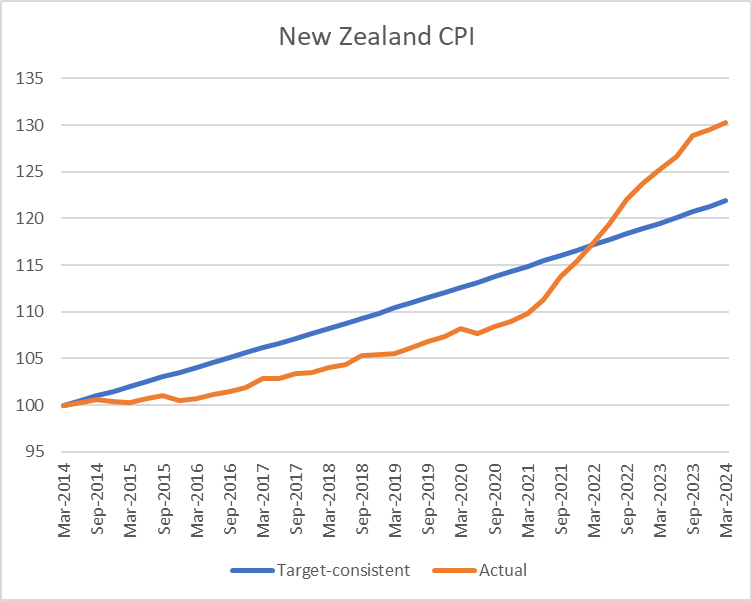
I got curious yesterday about how the Australia/New Zealand real exchange rate had changed over the last decade, and so dug out the data on the changes in the two countries’ CPIs. Over the 10 years from March 2014 to March 2024, New Zealand’s CPI had risen by 30.3 per cent and Australia’s CPI had risen by 30.4 per cent.

And that piqued my interest because the two countries have different inflation targets: New Zealand’s centred on 2 per cent per annum and Australia’s centred on 2.5 per cent.

So I drew myself this chart

Over the full 10 years, the two CPIs have increased by almost exactly the same amount, but they haven’t kept pace with each other steadily over that full period. Up to just prior to Covid, the Australian CPI had been increasing faster than New Zealand’s, as one might have expected given that the RBA had been given a higher inflation target than the RBNZ.

Now, before anyone objects, I should get in and note that in neither country is there a price level target. But if economies are subject to fairly similar shocks over a period of time one should normally expect a country with a higher inflation target to have experienced a higher cumulative price level increase than a country with a lower target.

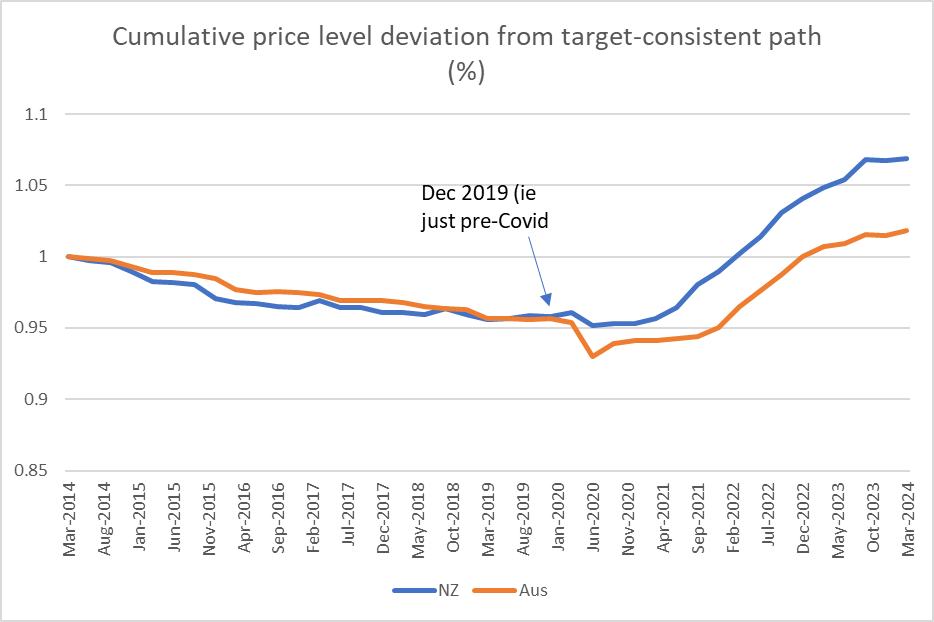
Over the 10 years here is Australia’s CPI relative to the price level that would have been implied by being consistently at target midpoint

and the same chart for New Zealand

And in this chart I’ve put it all together

Over the half-decade or so to the end of 2019, the RBA and the RBNZ had both ended up undershooting (on average) their targets by about the same extent. If you look closely, the RBNZ was undershooting more earlier, and the RBA more towards the end of the decade, but there wasn’t a great deal in the difference.

But where the difference really becomes apparent is in the years (four of them) since Covid hit. Over that period, the RBNZ has generated/tolerated much more of an increase in the price level, in excess of what is implied by their target, than the RBA did. (And for those – like Orr – who like to try distraction with things like oil shocks, wars and rumours of wars, and supply chain disruptions, Australia faced all those too.)

There is a lot of focus in Australia – and apparently reasonably enough – on whether the RBA has yet done enough with monetary policy. It has certainly been puzzling that they reckoned they could get away with materially lower policy rates than in other Anglo countries, in the face of (still) near-record low rates of unemployment and a quite stimulatory fiscal policy. But so far, and overall, they’ve done a bit less badly than the Reserve Bank of New Zealand through the last four years taken together.

It remains somewhat remarkable how little serious accountability there has been for serious Reserve Bank policy errors, for which now pretty much everyone (except them) is paying the price. in one form or another.

(By the way, for anyone interested, the NZD/AUD exchange rate averaged 0.933 in the March 2014 quarter and 0.932 in the March 2024 quarter, so over that particular 10 year period there was no change in the real exchange rate at all.)

Avoiding scrutiny

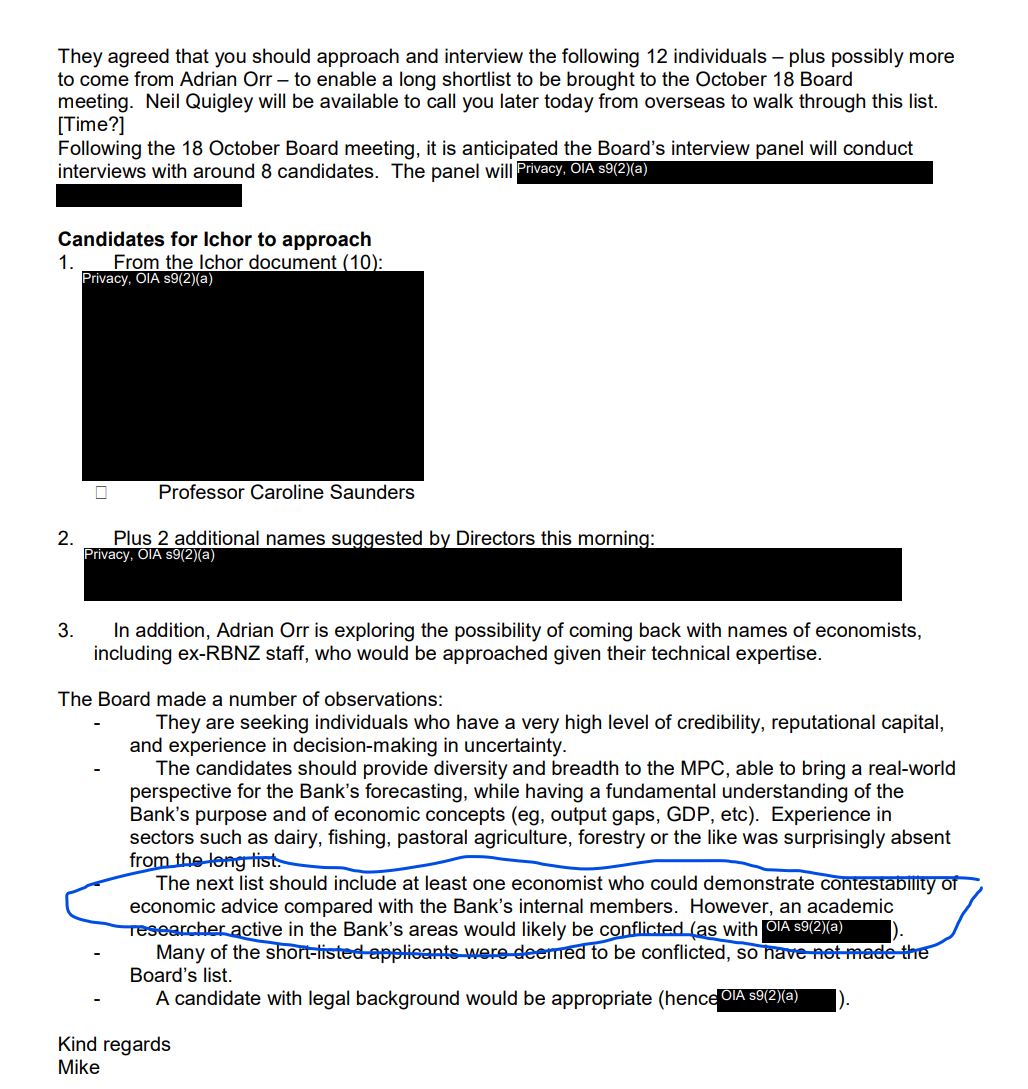
Regular readers will recall that I have, intermittently, been on the trail of the approach taken to the selection (and rejection) of external MPC members when the current crop were first appointed in 2019. I have been pursuing the matter since a highly credible person who was interested in being considered for appointment told me that (a) the Bank’s search company had informed my interlocutor that they would not be considered because they had active research expertise in areas around macroeconomics, and (b) having been somewhat puzzled by this response they had personally checked this understanding with the chair of the Reserve Bank’s Board, Neil Quigley, who had confirmed that was the policy. (The person concerned has never challenged my understanding of those conversations and has reiterated concerns over the years). OIAed documents from the Minister of Finance in mid-2019 confirmed that that approach had also been The Treasury’s understanding at the time (Treasury having responsibility for the ministerial/Cabinet side of the process); indeed that the Minister himself had endorsed/agreed to the ban.

I’m not going to repeat the entire subsequent chain. Everyone believed there had been such a blackball in place (it was even in an OIAed contemporaneous summary of a Board meeting discussion), and that included now-former senior central bankers (eg John McDermott) and the former economic adviser to Grant Robertson. These people may or may not have agreed with the ban, which the Minister himself and the Bank had defended on record in comments to media, but there was no doubt it had been there.

But then last year Quigley told Treasury that there had never been a restriction and Treasury - despite a bit of scepticism from a couple of senior officials – put out an official comment stating that there had never been a ban, and that the particular 2019 document from Treasury to the Minister was all a misunderstanding by another fairly senior Treasury figure (who had - conveniently - now left The Treasury, and whom they appeared never to have checked their new view with). More recently, a former Reserve Bank Board member - who had also been a member of the Board’s selection sub-committee in 2018 – confirmed to the Herald that there had been a ban of the sort generally understood (although his comments suggested Quigley may have conflated in his mind - years on – two quite separate sets of discussions).

The renewed interest last year prompted me to go back and check the OIA response the Reserve Bank itself had provided me in 2019 about the selection process for MPC members.  They had then provided a lot of useful material, but it also became clear that they had chosen to exclude - and not to identify for withholding under specific OIA grounds - all dealings between the Board and management on the one hand and the Board’s search company (Ichor) on the other, even though it was pretty clear that any and all such material had been within the scope of the initial request (“all material relating to the Board’s selection and recommendation of potential MPC members”). This was pretty egregious conduct by the Bank: it is one thing to identify that things have been withheld, and to provide specific grounds, and another to just ignore a whole class of material and never bother mentioning it. 

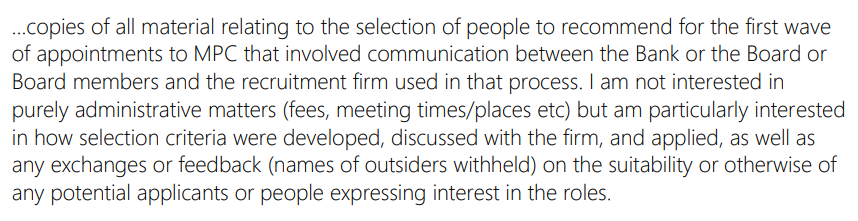
Anyway, I decided to lodge a new OIA, including explicitly highlighting that the material requesting should already have been covered by the 2019 request. My request (from 7 September) was as follows for:

When the Bank’s response finally came back they explicitly identified 26 documents (all of which should have been covered by the 2019 request), and had explicitly evaluated each of them against the criteria in the Act, concluding that 17 could be released in full, 9 in part (mostly it appeared withholding names on privacy grounds, which - per my request - is just fine), and identifying no documents in scope that would be withheld altogether.

But, nonetheless, they were not going to send me the information, and instead wanted to charge me $786.60, citing “the amount of time required to process your request and the frequency of requests from you over the last three months”.

I was briefly tempted. I have had run-ins with the Reserve Bank over proposed charges previously (some years ago). Almost always in the cases I’m aware of (my own and some other people) their attempts to charge have been, pretty clearly, straight-out obstructionism, when the Bank would really prefer people did not see the documents they had no grounds to withhold.

In this case, the Bank told me it had taken 10 hours to process the request. At just over a day of one person’s time that doesn’t seem particularly unusual – or out of step with requests I and others have previously lodged with them – and there was never an attempt to invoke a common agency line (often used to justify extensions) about needing to search a particularly large or ill-defined body of material (this was a specific request about one search firm on one project in one few-month period, so it must have been very easy to quickly find anything in scope, and it was all several years old). Moreover, they had made no attempt to reach out to narrow down the scope of the request or to suggest ways which might limit the risk of charging - the sort of good faith steps they are required to do, if acting lawfully and in good faith.

Had I made a few requests in the previous few months? Yes, I had, including on matters around MPC appointments, and on the Reserve Bank’s puzzling treatment of fiscal policy issues. They were relevant issues to the scrutiny of a very powerful, but underperforming - and not straight with the public - public agency, whose Board chair had already pretty clearly been shown to have actively misled Treasury and, in turn, the public. (Oh, and one was a request for a specific 2016 document, that was about two pages long and not itself contentious or on matters of policy, for which I gave them the title, the author, the date, and the document number in their document management system - I already had a copy but wanted to be free to use it with another audience.)

I’ve been sitting on the Bank’s response for a couple of months - other stuff demanding my time and attention - not quite sure what to do. I’d be astonished if the Ombudsman did not uphold an appeal against the Bank’s attempt to charge for this request – but that might take two years – especially given that the material should have been included in a response to a request that the Bank had responded to (otherwise) appropriately in 2019, and is on a matter of significant interest to those attempting to monitor and hold the Bank to account (it was after all prompted ultimately by Quigley’s and Treasury’s egregious attempts to rewrite history - and if Quigley really was, after all, telling the truth, these documents should if released support his position: almost certainly they do not).

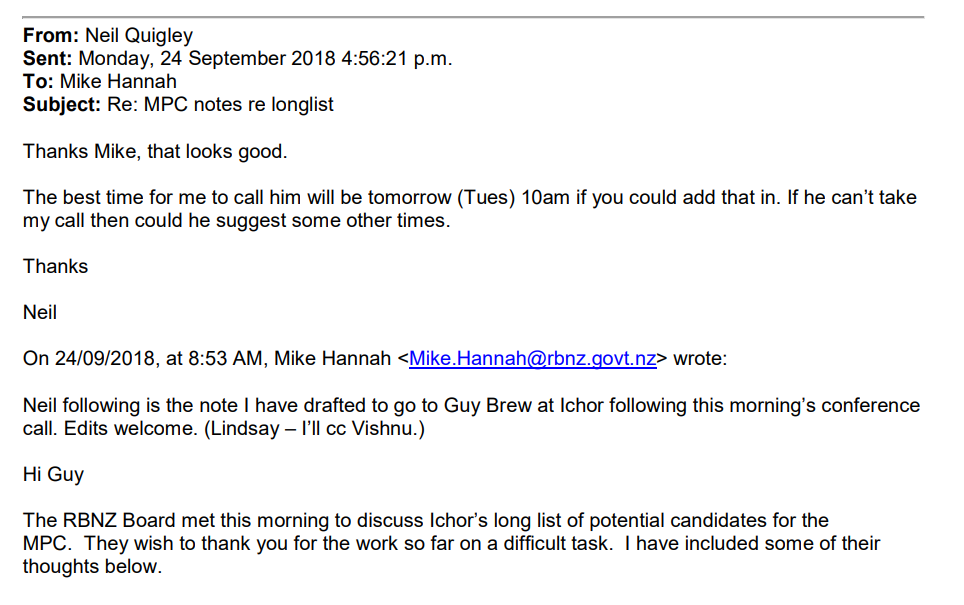
Just briefly, why do I say that they almost certainly do not? Among other things because in the material the Bank released to me in 2019 there was this email that I’ve included in previous posts on the MPC appointments issue (Mike Hannah then being the Secretary to the Board)

That said, since I have not lodged any OIA requests with the Bank for more than three months now, I am pondering resubmitting my request (it was, after all, them who cited as an excuse for attempting to charge a concentration of requests in a three-month period).

Alternatively, here is the full Bank response

RB OIA response re request for information on Ichor and the 2019 appointment of external MPC members

Anyone else could feel free to submit the request themselves (the exact words are in the document, as is the complete list of documents they had identified and already reviewed, so there will be almost zero marginal cost for them to handle such a request, and no legal basis for attempting to charge.   If anyone else does choose to make the request, I’d be happy to hear/see the response in due course (mhreddell@gmail.com).   

[UPDATE: The Bank’s contact email for OIA requests is rbnz-info@rbnz.govt.nz ]

As it is the clock is now ticking on the terms of two of the MPC members which expire (finally, with no possibility of reappointment) in the next few months.   The documents released last year suggest there is no longer a bar on specialist expertise in external MPC appointments, although the suspicion remains that Orr and Quigley (and the tame underqualified Board) will instead have imposed a bar on anyone who might make life at all awkward for the Governor.   To date, the new Minister of Finance has given no hint of reopening the application or selection process –  despite it all having occurred under the previous government and its appointees – and I guess only time will tell whether she has been willing to go along with such a bar, which might be less visibly egregious, but no better in terms of building a strong and open MPC, the need for which is only made more evident by the deep failures of the current MPC under Orr in the almost five years since the current externals were appointed.

Dismissing top public officials

In both monetary policy and policing there is a case for a considerable degree of operational independence from politicians. The case is (by far) strongest in respect of the Police, where it would be just egregiously unacceptable to have a system in which politicians got to decide who was and wasn’t arrested or charged. It isn’t a foolproof system, because Police Commissioners can have their own biases and preferences, and if there are some (eventual) protections against them arresting people for things that aren’t crimes or on allegations that have no real foundations, or against them simply making up evidence, there are no real protections against them just choosing not to enforce the laws Parliament has written. But constabulary independence is better than the alternative.

The case in respect of monetary policy is technocratic, and views have come and gone on the strength of that case. Operational independence has been the fashion of the last few decades, although in many countries (including New Zealand) there has always been scope for political overrides.

But, whatever your views on the case, in a free society operational independence has to be matched by effective accountability. If you wield great power you must be accountable for its use, and “accountability” here cannot just mean something as feeble as having to publish an Annual Report or front up once in a while at a select committee. The standard form of accountability – really in any job, but certainly in public life – is the threat of losing your job. That is, after all, what happens to politicians: when enough of us disapprove enough of their performance they lose the election, and office.

Both the Police Commissioner and the Reserve Bank Governor can be dismissed, but it is interesting to compare and contrast the statutory provisions.

First, from the Policing Act 2008

I hadn’t known until yesterday (when stories were around as to whether the new Minister of Police would or would not express confidence in the current Commissioner) that the Police Commissioner could be dismissed at will. It isn’t old legislation, and there don’t seem to be any process etc requirements in the Act around potential dismissal. All it seems to take is the signature of the Governor-General acting on advice.

My family used to be keen watchers of the New York police show Blue Bloods and I was always struck then by the fact that the mayor could dismiss the police commissioner at will, a point both (fictional) parties noted fairly often. It had the feel then of something open to abuse (and like all these things, in practice conventions and ex post scrutiny act as restraints) but I guess it recognises that ultimately the law and the enforcement of the law – the coercive powers of the state – are political matters.

To be honest, dismissal at will (with no compensation) seems a rather dangerous provision when it comes to the Commissioner of Police. It might be quite reasonable for a new government to want a different style of policing, and thus a different sort of person to run the Police, but if so they should be prepared to (and required to) state their reasons, and offer some compensation for loss of office. But what we shouldn’t want is a Commissioner of Police pandering to the minister behind the scenes to save his or her job, whether the pander involved things nearer to policy or things nearer to protection for some mate of a government (the latter might seem low risk, but we build institutions against tough times and risks of attempts to pervert the system).

I’m not overly interested in Police or the current Commissioner, and don’t have any strong views on his fate (although it probably isn’t irrelevant that his term only has 16 months to run) but I am interested in the Reserve Bank, and particularly the contrast between the dismissal provisions for the Police Commissioner and those who exercise official power at the Bank, notably the Governor. The statutory provisions in the Reserve Bank legislation are a little more complex.

Take the Governor first

The Governor can be dismissed at any time, but only “for just cause”. That immediately makes it much harder to dismiss a Governor, because it injects the potential for the courts to become involved in reviewing whether any cause cited by a Minister of Finance in dismissing the Governor was a just one. That makes dismissal almost inconceivable as a practical option, except perhaps in a truly egregious case of public disgrace (eg Governor charged with a serious criminal offence), or physical or mental incapability, because with so much power resting in the Bank we could not reasonably have months of market uncertainty while a court process, and appeals, were worked through.

What might constitute a just cause? You’ll notice in section 90(2) there are two sub-clauses. The first (2a) allows the Minister to seek to dismiss the Governor if (and only if) the Bank’s Board has made a recommendation to dismiss (for the current situation, remember that the entire Board was appointed in one go by the previous Labour government, and signed off on the Governor’s reappointment only last year). That particular provision is narrow – relating specifically to relations between the Governor and the Board.

The more general case is 2b, where the Minister can seek to dismiss whether or not the Board agrees. And what does the Act say counts as “just cause”?

It needs to be read together with this, which applies also to other MPC members

It is a long list, but it is really quite restrictive. Against the backdrop of Adrian Orr’s performance, probably only 92(1a) and 25(1a) are likely to be relevant. And, although the lawyers may have a different view, I’ve take these provisions as applying only to things done (or at least apparent) in the Governor’s current term of office. It isn’t obvious that he could be dismissed for the failures (of which there were many) in his first term, which expired in March this year, even if those failures were captured by these specific grounds for dismissal.

What of 92(1a)? I doubt anyone could mount a seriously credible argument that Orr was unable to perform the duties of his office or that he had neglected his duties (his focus on many other things not his responsibility notwithstanding). What of “misconduct”? I reckon actively misleading (or worse) the Finance and Expenditure Committee this year should count – it is a clear breach of Parliament’s own rules – but…..it is probably a stretch against the wording of this particular piece of legislation.

And so that brings us to section 25 in the schedule covering MPC members, including the Governor. On paper, 25(1)(a) sounds most promising. But what are the ‘collective duties’ of the MPC?

The MPC, under the lead of the dominant Governor, may have burned through $12 billion of taxpayers’ money, delivered inflation well above target for three years in a row, failed to deliver much in the way of speeches or serious supporting analysis……..all things that seem like clear marks of failure in the job, but it is simply impossible to envisage a court accepting that policy was not formulated (at the time) in a manner consistent with the Remit. It clearly was. It was just done very very badly, with not a sign of any contrition since from any of them. The sort of thing that should mean you could lose your job. But not, it appears, when you are the Governor or MPC member. Could continuing to run a big open punt on the bond market now (years on from Covid) count? I doubt it, as I doubt it would be considered now as “formulating monetary policy”, and it clearly had the support of the Board and the previous Minister of Finance.

The final possibility might be

I don’t think actively attempting to mislead FEC, in his role as Governor and MPC member, is acting “with honesty and integrity”…..but it seems a stretch.

Were Orr operating under Police Commissioner rules (law) he – and his fellow MPC members (especially the externals) – could be dismissed at will. It is not a choice that should ever be made lightly (and the terms of two externals in any case expire shortly), but when you (individually and collectively) have done as badly as Orr and his colleagues have in recent years it should be an option open to an incoming Minister. After all, the new government can impose a new Remit – against which the MPC has to operate – pretty much at will (doesn’t require legislation, at least within quite wide bounds) so why shouldn’t it be able to dismiss the key individuals and ensure that those holding these powerful offices genuinely enjoy the confidence of ministers?

If I could wave a wand I’d make it easier to dismiss Governors and MPC members and a bit harder to dismiss the Police Commissioner. As it is, it reminds me of an article I wrote perhaps 15 years ago – which the the Bank’s Board weren’t too comfortable with and insisted on changes – suggesting that in practice accountability for the Governor mostly existed at the point of reappointment. And since then governments have amended the legislation to make it a bit harder to dismiss the Governor, while limiting to two the number of terms any Governor can serve. Over the objection of the Opposition parties, Robertson chose to reappoint Orr last year, and since he is now on his second term (as are all the external MPC members) and can’t be reappointed again we are in this unacceptable position of someone exercising enormous power (doing it poorly, and having done a particularly poor job in recent years) and facing no effective accountability at all.

Of course, there are always options of seeking to buy out the Governor – whether directly or through the offer of another public role – but that would be to reward failure and poor performance, not punish it.

Were the Governor an honourable man he would already have resigned. But were he an honourable man he would at some point have expressed some serious contrition in recent years. Instead, he wields the power and we – and the incoming government – are left with massive financial losses, a huge inflation shock, and a poorly performing institution.