Mixed feelings, but the MPC really needs to improve its communications

I’m still not entirely sure what to make of yesterday’s OCR decision by the new Reserve Bank Monetary Policy Committee.

This was my first reaction yesterday afternoon.

If I have a problem, it isn’t with the OCR now being at 1 per cent.  At the time of the last OCR review in late June I was mildly critical of the Bank for not having cut the OCR then

Data have weakened here and abroad, inflation is – and has persistently been – below target, the exchange rate is holding up, and there is little real prospect of a sustained reacceleration of growth or of inflation pressures. Oh, and market measures of medium-term inflation expectations are around 1 per cent, not 2 per cent. In that climate, being a little pro-active and cutting the OCR now looks to have been the better choice. It isn’t clear what the risks to moving would have been. It is only six weeks until the next MPS, but (a) the MPC won’t have a lot more domestic information between now and then…and (b) the way the global situation is going one can’t rule out the possibility that another cut could have been warranted by then.

And so half of me is inclined to give the Bank some credit for catching up (I don’t think there is any sense in which they have now got ahead of the game).  It was certainly a fairly courageous call –  although whether that is more in the Sir Humphrey sense perhaps remains to be seen –  when the easier path would have been to have cut by 25 basis points yesterday and strongly signalled the likelihood of a 25 basis point cut in September.

And there was some rhetoric from the Governor at his press conference that I quite liked, including the reaffirmation of the effectiveness of monetary policy, the emphasis on the very low global nominal interest rate environment (which everyone just has to learn to work with) and a sense of being serious about getting core inflation back to 2 per cent, observing that there was worse things in the world to worry about than if the Bank were to look back 18 months from now and see inflation and inflation expectations rising.  In my words, after a decade of undershooting the target, you probably shouldn’t aim to overshoot, but the harm if you happen to is likely to be small.  I also liked the Governor’s affirmation of the point that cutting relatively energetically now may (probably slightly) reduce the risk of serious constraints on conventional monetary policy a bit down the track (by helping to hold inflation expectations up).

And yet conventions and communications matter.

50 basis point moves in interest rates used to be fairly normal (in our first ever tightening cycle. almost 20 years ago now. the OCR was raised by 50 basis points on three separate occasions).  But both here and abroad moving in 50 basis point bites went out of fashion (and I use the word deliberately –  it is a choice, on which not that much hangs, but it was one most advanced country central banks defaulted to).  In New Zealand, we had some very large individual OCR cuts during the international financial crises and recession of 2008/09 when not only was the hard economic and financial data deteriorating very rapidly, but bank funding margins were rising (so that OCR cuts were partly offsetting those incipient higher market rates).  And we cut the OCR by 50 basis points in the immediate wake of the February 2011 earthquake, explicitly as a pre-emptive precautionary strike against the possibility of a very sharp drop-off in confidence and economic activity –  explicitly noting that the cut was likely to be temporary.  And that was it. Until yesterday.  Even when Graeme Wheeler was setting out determined to raise the OCR by 200 basis points, he didn’t do so in 50 basis point bites.

As I noted the choices are partly about fashion and convention (including the choice –  pure choice –  to do things in multiples of 25 basis points: we and most advanced countries do that but in India yesterday they cut by 35 basis points).    Fashions and conventions can change, but roadmaps and markers to observers then take on a fresh importance.

And there were no signals whatever from the Bank that it was shifting to a mode of operating, and setting monetary policy, in which 50 basis point adjustment were back on the table in what are still relatively normal times (from a NZ macro perspective).    Perhaps it is tiresome to make the point again, but the Governor has given not a single substantive speech on monetary policy in the 17 months he has been in office.  No senior official of the Bank, including the new external MPC members, has given a speech this year, let alone in recent months, marking out how they think about the economy, about what is actually going on, about transmissions mechanisms, reaction functions etc, or even how they approach the more tactical issues around timing and magnitude of OCR adjustments.   That isn’t good enough, especially from a Bank which boasts –  as the Governor did yesterday (and wrongly) –  about how transparent the Bank is.

I recall that when the OCR system was introduced Adrian Orr –  then the Bank’s chief economist –  was vocally opposed to having, or using, OCR reviews other than those tied to the release of a Monetary Policy Statement.    I thought that approach was nuts (with 4 MPSs a year, even moving in 50 point bites it restricted us to 200 basis points of changes a year), and the original design (8 serious reviews a year) prevailed).  Is part of the explanation for yesterday’s surprise move –  and when no one picked your move, you should ask again just how transparent you are –  that the Governor still doesn’t like the idea of moving outside the context of a Monetary Policy Statement?    Perhaps not, but they have just not communicated with us, until they emerge with the surprise decree from the mountain-top.

And what makes it a bit more concerning is that it is pretty clear the Bank itself wasn’t intending to move by 50 basis points even a few days ago.  The projections they published yesterday were finalised on 1 August (last Thursday).   On those numbers, the projections for the OCR (quarterly average) were:

September quarter 2019    1.4 per cent

December quarter 2019     1.2 per cent

March quarter 2020            1.1 per cent

With the next OCR review in late September and the following one in md-November, those projections –  adopted by the whole MPC – clearly envisaged not getting to a 1 per cent OCR even by the end of the year.

The bulk of the Monetary Policy Statement itself is written in the same relatively relaxed style, with no hint of a change in policy approach, and thus no proper articulation of the reason for it, or (hence) for how we should think about how the Committee will react, in principle, at future OCR reviews.   The Bank has added to uncertainty around policy, not reduced it.    In a similar vein, there is a new two page Box A in the statement on “monetary policy strategy”, intended to run each quarter, which is so general as to add nothing to the state of understanding of what the MPC and the Bank are up to.

And you will look in vain for any real insight from the minutes of the MPC meeting.   We are told

The members debated the relative benefits of reducing the OCR by 25 basis points and communicating an easing bias, versus reducing the OCR by 50 basis points now. The Committee noted both options were consistent with the forward path in the projections. [a claim that demonstrably isn’t true –  see above] The Committee reached a consensus to cut the OCR by 50 basis points to 1.0 percent. They agreed that the larger initial monetary stimulus would best ensure the Committee continues to meet its inflation and employment objectives.

But nothing about the considerations Committee members took into account in belatedly lurching to a 50 point OCR cut, or how they think about the conventions and signalling around using 25 point moves vs 50 point moves (when things aren’t falling apart here –  and it was the Governor yesterday who announced, oddly, of New Zealand that “the country is in a great condition”).

The press conference also offered few insights into what the Bank was up to.   The external members weren’t invited to say anything, and showed no sign of offering to (at least some of them were there), and the staff MPC members the Governor did invite to comment were no more forthcoming or enlightening: they couldn’t or wouldn’t tell us what persuaded the Committee to move by 50 points, beyond handwaving about “the whole story, domestic and foreign”, even as the Assistant Governor noted that it was unwise to react too strongly to any particular piece of news (true, but……you seem to have).   And how seriously are we supposed to take the idea of “consensus” decisionmaking, when allegedly all seven of them suddenly shifted to a quite unexpected –  out of the mainstream – OCR call in just the last few days?

In the end perhaps none of it matters too much. On my reckoning, the OCR ends up where it probably should have been –  just less smoothly than it should have been –  and on the reckoning of some of the more dovish market commentators, it ends up now where they thought it would be next month.   The substance isn’t unduly affected.  But this episode won’t help the Reserve Bank’s reputation for being a steady pair of hands on the tiller.   Observers abroad will look at them oddly –  are things really that bad in New Zealand? –  those at home will be less sure how to read the Reserve Bank, and the Bank must have known it would feed fairly silly stories (from National that the 50 bps cut shows how bad things are, from Labour that the 50 bps cut shows what a great time it is to invest in New Zealand).  They really should do better than that.

If the Reserve Bank’s Board was actually interested in doing its job, rather than covering for their appointees (something of a conflict of interest surely?) they would be asking hard questions now about just what went on: why the Bank didn’t move in July, why they chose to act so unexpectedly yesterday, why they couldn’t have waited until September for the second 25, why the projections are so out of step with the decision, why the MPS itself gives little articulation of the case, and why serious speeches on the economy and monetary policy seem now not to be a thing at the Reserve Bank of New Zealand.   The Governor has an ambition for the Bank to be the best central bank.  On the evidence of yesterday they are very far from that (ridiculously unrealistic) objective.

I have various points on other aspects of the MPS and the press conference but will save them for a separate post.


Keep the focus on monetary policy

As we approach the OCR decision this afternoon and as some market economists are now talking about the possibility that the OCR could be below 1 per cent before too long, there has been more and more talk about whether fiscal policy should be brought to bear, to stimulate demand and (in some sense) assist monetary policy in its macroeconomic stabilisation role.  Just this morning there was an editorial in the Herald, a column on Stuff, and a comment from Bernard Hickey at Newsroom.   Some of the discussion is about what should be done now, and the rest is about contingency planning –  what happens when the next serious recession happens if the OCR is still constrained.

Much of the discussion seems to stem from people on the left who aren’t that happy with the government’s fiscal policy.  As someone not on the left, it has always seemed strange to me that Labour and the Greens pledged themselves to keep much the same size of government (and much the same debt) as National –  especially when, at the same time, you were running round the country talking about severe underspending on this, that, and the other thing.   I’m also of the view that structural budget surpluses are a bad thing, in principle, when net government debt is already acceptably low (on the OECD measure of net general government financial liabilities, New Zealand is now about 0 per cent of GDP, which seems like a nice round number – an anchor – to target).  There is an argument there –  whether from left or right – for some fiscal adjustment (taxes or spending), which might have the effect of a bit more of a boost to demand.

But those arguments really have almost nothing to do with the situation facing monetary policy.    They are fiscal and political arguments that should be made, and scrutinised, on their own merits: the arguments would be as good (or not) if the OCR was still 2.5 per cent as they are now, and you can be pretty sure that people on the left would have been making them then anyway?   The Governor of the Reserve Bank, for example, (a pretty staunch representative of the centre left) seemed keen on more infrastructure spending a year ago.  I guess he is a voter to so is entitled to his opinion, but it really doesn’t have much to do with monetary policy.

The general arguments that led countries around the world to adopt monetary policy more exclusively as the primary stabilisation policy tool have not changed.  Monetary policy can be adjusted quickly (to ease or tighten), operates pervasively (gets in all the cracks, without making specific distributional calls), is transparent, and so on.  If we had a fixed exchange rate –  as individual euro area countries largely do –  it would be a bit different (individual countries don’t have the monetary policy option any longer) but we have a floating exchange rate system which, mostly, works well for New Zealand.

To the extent that there is a monetary policy connection to the current calls for fiscal policy to be used (or the ground prepared to use it), it has to do with the looming floor on nominal interest rates.  International experience suggests that, on current laws and technologies, short-term nominal interest rates can’t be reduced below about -0.75 per cent without becoming ineffective (as more and more people shifted from other financial instruments into physical cash).  We don’t know quite where that floor is, as no central banks has been willing to take the risk of going further, but there is a fair degree of consensus (and it has long been my view too).

But that still means that in a New Zealand context there is 200 basis points of OCR cuts that could be used if required.    That isn’t enough for a typical New Zealand recession (rates have often been cut by 500bps), but is still quite a degree of leeway if what we are entering were to turn out to be a fairly mild slowdown in New Zealand.  It could (I’m not hedging here).   That capacity should be used energetically, not timorously.   So the issue –  monetary policy needing “mates” deployed now –  is not immediate.  It is about preparing the ground.

And there, the best macro stabilisation option remains the one the Reserve Bank –  and other central banks –  have done nothing active about, but really should.  Authorities (and it probably needs political support to do so) should be moving to make the effective floor on short-term nominal interest rates much less binding than it is.   It binds because the practice of central banks –  perhaps backed by law – has been to sell banknotes, in unlimited quantities, at par.   That practice can be changed.  It could be as simple as putting an (adjustable) cap on the volume of notes in circulation (quite a bit above the current level, but not at a level that would be transformative) and then, say, auctioning the right to buy additional tranches of bank notes from the Reserve Bank.  In normal times –  with the OCR at, say, current levels – the auction price would be at par.  If the OCR were cut to, say, -3 per cent (and be expected to stay there for some time) the auction price would move well above par, acting as a disincentive on people to attempt to make the switch from deposits to cash.  There is a variety of other ideas in the literature, as well (no doubt) as much less efficient regulatory interventions that could prevent really large-scale conversions happening.

Unusual as such options may sound, this is where the authorities –  here and abroad –  should really be concentrating their energies: giving monetary policy more leeway, in ways that will buttress market confidence that monetary policy will do the job when it is required.  At present, by contrast, when market participants contemplate a severe downturn they look into an abyss wondering what, if anything, will eventually be done, by whom, and for how long.  In a serious downturn that will just worsen the problem, driving down inflation expectations as economies slow (note that in the RB survey out yesterday, medium-term inflation expectations fell away quite noticeably –  and this while we still have conventional monetary policy to use).   And if there are objections that all this is somehow “unnatural”, bear in mind that had the inflation target been set at zero (rather than 2 per cent), as was the normal average inflation rate for centuries, we’d already have run into these practical limits, and been unable to get real interest rates even as low as they are now.

So there is plenty to be done with monetary policy, and the work programme to do it should be something open and active, drawing in the Bank, the Treasury, the Minister, and other interested parties.  The time to do preparation is now, not in the middle of a surprisingly severe downturn.

I have a few other reasons –  than “it shouldn’t be necessary” –  to be wary of calls for large scale fiscal stimulus now.  Just briefly:

  • there would be little agreement on what should be done –  these are inherently intensely political issues.  There is lots of talk of infrastructure gaps etc, but no agreement on what those are, let alone recognition of the twin facts that (a) the best projects, with the highest economic returns, have probably already been done, and (b) New Zealand government project evaluation is not such as to inspire confidence that new projects would add economic value.    And suppose there were attractive roading projects –  perhaps central Wellington and the second Mt Vic tunnel? – we know the attitude of the government’s support partner to new major roads.  Not a thing.  So what should we then spend on?  Uneconomic new railway lines?  Or what?  Perhaps some just favour more consumption or transfers spending – which might be fine if you are a lefty who believes in permanently bigger government, but if you aren’t the issue has to be addressed of how programmes once put in place are unwound later.
  • I don’t rule out the possible case for discretionary fiscal stimulus in the event of a new severe recession (especially if the authorities refuse to address the monetary policy issues above) but my prediction is that (in many ways fortunately) the political appetite for large deficits would not last very long, and that therefore we should preserve the option for when it might really be needed.  It isn’t now.   I take much of the rest of the world after 2008 as illustrations of my point: in late 2008 all the talk was of fiscal stimulus, but within two or three years all the political pressure was to pull deficits back again.  I don’t see why New Zealand would be any different (and that is to our credit, since low and stable debt has become established as a desirable baseline).
  • And thirdly, a point we don’t often hear from champions of more fiscal stimulus, relying more on fiscal policy and less on monetary policy to support economic activity and demand will, all else equal, put more upward pressure on the real exchange rate, further unbalancing an already severely-unbalanced economy (see yesterday’s long-term chart of the real exchange rate).  In a severe recession –  when the NZD tends to plummet –  that isn’t a particular problem, but it should be a worry now (when the TWI is still a bit higher than it was a year ago, let alone thinking about the longer-term imbalances.

Perhaps the Governor and the (experts-excluded) Monetary Policy Committee will proactively address some of these issues this afternoon. I do hope so. If not, I hope some journalists take the opportunity to push the Governor on why he (and the Minister and Treasury) aren’t actively pursuing work to make the lower bound on nominal interest rates much less binding, in turn instilling confidence in the capacity of New Zealand policy to cope conventionally with a severe downturn if/when it happens.

Oh, and I do hope some journalists might also ask the Governor this afternoon about the justification for ruling out from consideration for appointment to the Monetary Policy Committee

“any individuals who are engaged, or who are likely to engage in future, in active research on monetary policy or macroeconomics”

The Governor is, after all, a Board member and was one of the three person interview panel.    What was it that he –  or the Board generally –  were afraid of?    Expertise?  An independent cast of mind?  Of course, it isn’t only active researchers who have such qualities –  indeed, not all of them do either –  but it simply seems weird, and without precedent in serious central banks elsewhere in the advanced world, to simply disqualify from consideration for the (part-time) MPC anyone with the sort of background that many other central banks (Australia, the UK, the euro area, Sweden, the United States, and so on) have found useful, as one part of a diverse committee.

MPC appointments: prioritising sex over expertise

The lawlessness of the Board of the Reserve Bank of New Zealand never ceases to amaze me,  Just in recent years, there was clear evidence that the Board simply ignores the requirements of the Public Records Act.   There was their facilitation of what was almost certainly an unlawful appointment of an “acting Governor” in the run up to the election (decent outcome in the abstract, but unlawful nonetheless).   And, of course, they play fast and loose with the Official Information Act, apparently confident that the Ombudsman is largely toothless.  It is all the more extraordinary in that since 2013 the Bank’s Board has had a senior lawyer as a member.  I’d not paid much attention to him, not knowing anything about him, but when I finally met him last week –  where he told us he “trains judges” – it reignited my interest in just how a senior lawyer makes himself party to so much questionable –  borderline at least – conduct by a public agency.

We’ve seen a repeat of this sort of “the law doesn’t really apply to us” mentality around the release of papers relating to the appointment of the new statutory Monetary Policy Committee.  I wrote about that here.   I’d lodged requests with both the Minister of Finance and the Bank’s Board.  The Minister took a while to respond, but his responses were within timeframes allowed by law (a single extension of time, if that extension takes the deadline beyond the usual statutory 20 days).  The Board, on the other hand, extended, extended, and extended again –  quite unlawfully (Ombudsman advice makes that interpretation quite clear) –  before finally releasing some material a couple of weeks ago.      They did have a fairly junior person apologise for the delay, but that is pretty meaningless (no penalty on them –  even after I complained to the Ombudsman –  and no sense of any serious intention to amend their ways).   And yet these people – the Board –  are supposed to keep the Governor in check (and the government is now proposing to give them even more formal powers).

But this post is mostly about the substance of the MPC appointments.  There are two releases.  The Board’s response is here, and the Minister of Finance’s release is here.

Grant Robertson OIA release on MPC appointments

I know for a fact that neither release is comprehensive (including things I’ve been told privately, things alluded to in what has been released, and rather obvious omissions –  are we really supposed to believe that, eg, the Board chair did not brief the Board on his discussions with the Minister?) but what has been released does quite a lot to flesh out a picture of a process that doesn’t really seem to put anyone involved in a particularly good light.  There are even signs that the Board is taking the Public Records Act a bit more seriously than they did around the appointment of the Governor.   My earlier post on the new MPC is here: these releases answer some of the issues I raised there, mostly leaving me more concerned than I was previously.

One of my longstanding concerns about the new regime would be that it would largely replicate the dominance the Governor had in the old legislative model (where the Governor was, by law, the single decisionmaker).  Part of the reason for that concern was the statutory majority of internal members of the MPC.   All those internal members owe their day jobs to the Governor, who also decides on internal resource allocations, pay etc.  A really strong Governor might encourage diversity of perspective and challenge. There has never been any suggestion Adrian Orr is that sort of person, indeed rather the contrary.   And the external members are appointed on the Board’s recommendation, but…..the Governor himself is a member of the Board.  And instead of distancing himself from the process, and leaving recommendations to the non-executive directors, the Governor was one of the three man interview panel for the external MPC nominees.    Throw in the code of conduct the Board (Governor a member again) devised and clearly no one remotely awkward was going to get through the screening process.  (Consistent with that, in the four months since the MPC took office, not one of the externals has said a word – that might, in part, be because no media have asked them questions, but there is nothing to stop a more proactive approach.)

Consistent with all this, the Board released the set of questions they used for their interviews with potential MPC appointments.  There wasn’t much sign, from the questions, that the Board was looking for excellence (in anything), but there was certainly nothing in those questions to suggest they were looking for MPC members who robustly challenge, and offer markedly different perspectives over time to, the Governor and staff.

But it was much worse than that.  This is from a Treasury note to the Minister, released by the Minister (note that the Board itself kept this secret)

MPC 1

This is simply staggering, or should be in a country with good quality competent institutions.  And I know Treasury isn’t misinterpreting things, because I was told about this restriction some time ago by a person who was rejected on exactly these grounds –  that they might be interested and knowledgeable enough about monetary policy to be doing some research on it.   By this standard, I guess the Board and Minister (presumably aided and abetted by the Governor) would disqualify (a New Zealand) Ben Bernanke, Janet Yellen or (right now) John Williams, the head of the New York Fed and someone who –  while serving on the FOMC –  has continued to undertake research on monetary policy.   I realise that expertise is going out of the fashion at the ECB (Makhlouf, Lagarde) but their new Chief Economist –  former Irish Governor –  Philip Lane has been an active researcher and writer.  Or one could think of Andrew Haldane at the Bank of England, or….or….or.  Is it now considered a negative –  perhaps a disqualifying consideration  –  if the Reserve Bank’s chief economist was doing research on monetary policy, or does the disqualification only apply to externals, over whom the Governor has less control?  It almost beggars belief that the Minister and Board would get together and disqualify anyone with specific serious expertise in monetary policy from a new Monetary Policy Committee.   Sceptical as I was of the new committee in principle, even I was stunned when I learned of this prohibition.

(And, to be clear, I am not one of those who thinks an MPC should be stacked full of research macroeconomists –  I’d be happy to have a couple of people, of the sort who ask hard questions and have good judgement, with little or no formal economics background at all – just that such people shouldn’t be ruled out in advance.  As it is, the current MPC looks odd in that among its seven members there is not a single one who could really be considered to have a long record of depth of expertise in monetary policy and the New Zealand economy.)

So if the Board, the Governor, and the Minister weren’t looking for in-depth expertise, and weren’t looking for anyone to rock the boat, what were they looking for?   The short answer – suffusing both sets of releases – is women.     In none of the material released to me is there is any discussion about the sorts of expertise that might be sought, or how to build a committee with complementary sets of skills, but there is a great deal of unease –  particularly channelled from the Minister’s office –  about getting women selected (even to point, in some places, where there seemed to be attempts to strongly encourage the Governor to select a woman as his chief economist).  There are records of early approaches by the Board Secretary to get possible women (and Maori) candidates (and a Treasury response which points out that there really aren’t that many adequately qualified women –  not that surprising given how many women did (say) economics honours or masters programmes in New Zealand 30 years ago (in my own honours course at Victoria, the number was either one or zero out of about 15)).    As it is, despite all the huffing and puffing, they ended up with only one women on the shortlist.

There were a couple of other things that were striking.  The Board’s release records various email mentions of trying to identify candidates with legal backgrounds.  This is almost a complete mystery to me, as the MPC has no regulatory responsibilities and the legislation it operates under is pretty straightforward (and the Bank has internal and external legal advisers if things do require any clarification).  The MPC is about cyclical macroeconomics management, and communications thereon.  Someone of a particularly suspicious cast of mind might suggest that a legally-qualified MPC member would be one less knowledgeable person for the Governor to have to bother about.   I’m just genuinely puzzled.

The Board’s release also recorded various exchanges among senior Bank managers about what sort of person might be suitable as an external MPC appointee (they were looking for names to suggest to the Board).  What took me by surprise was the aversion to overseas appointees.  As regular readers know, I do not think we should have (say) a foreign Secretary to the Treasury (or a foreign Chief Justice, or a foreign Governor) but I was always among those at the Bank who saw one of the advantages of moving to a statutory MPC is that it could allow the appointment of one foreign person, bringing a slightly different expertise and perspective to New Zealand monetary policymaking.   It was never clear how feasible this would be –  distance, and relatively low New Zealand salaries being an obstacle –  but it has been tried, and appeared to work, in some other countries.

But that clearly wasn’t the view of the senior management last year.  The then Chief Economist, John McDermott (for example) is quoted as saying

“overseas members would be a logistical nightmare and what is their interest in looking after New Zealand welfare and monitoring the NZ business cycle on a continuous basis? So no from me.”

There is no sign of any of his colleagues or bosses dissenting and no reference to possible overseas appointees later in the any of the documents.  As it is, it isn’t clear how much “continuous monitoring” of the New Zealand economy the MPC members are actually doing (a recent conversation I was party to suggests not much in at least some cases).

Management also debated the issue of whether former RB staff or Board members should be considered (I suspect some might have liked to have Arthur Grimes appointed).  The consensus seems to be (reasonably enough) that there needs to enough distance for such a person to be genuinely external.  For groupies, one can try to guess which names are deleted in this paragraph

MPC 2

Disconcertingly, there are signs that management was open to have serving public servants appointed provided they didn’t currently work for agencies too close to things macro.  There should be an absolute prohibition on anyone working for a government department or Crown entity (other than as an academic) being considered for a part-time external MPC appointment in an (operationally independent) central bank.

The final point I wanted to touch on answered one of my questions from a few months ago.  Writing about the externals I noted

One area where I do have some concern is around the role of the Minister of Finance in these appointments.  In principle, I think the Minister should be relatively free to appoint his or her own preferred candidates, and should be fully accountable for those choices (including through the sort of non-binding “confirmation hearings” –  of the sort UK MPC members face – that I’ve proposed for New Zealand).  As it is, on paper the Minister has no say at all (can reject Board nominees, but nothing more).

But then I’m a bit troubled by the way in which the Board –  all but one appointed by the previous government – ended up delivering to the Minister for his rubber stamp a person who was formally a political adviser in Michael Cullen’s office when Cullen was Minister of Finance (Peter Harris) and another who appears to be right on with the government’s “wellbeing” programme.     They look a lot like the sort of people that a left-wing Minister of Finance –  one close to Michael Cullen –  might have ended up appointing directly.     I don’t think Peter Harris is grossly unqualifed for the role, but I am uneasy that one of the very first external appointees is a former political adviser to a former Minister of Finance of the same party as the one making the appointment.   …. (I don’t think former political advisers should be perpetually disqualified, but it might be more confidence-enhancing had they been appointed by the other party from the one for which they used to work –  thus Paul Dyer, former adviser in Bill English’s office, would probably be better qualified for the MPC roles than any of the recent external appointees.)

I’m left wondering what sort of behind-the-scenes dealings went on to secure these appointments.  I hope the answer is none.  I’d have no particular problem if, while the applications were open, the Minister had encouraged friends or allies to consider applying. I’d be much less comfortable if he had involvement beyond that, prior to actually receiving recommendations from the Board.  It isn’t that I disapprove of politicians making appointments, but by law these particular appointment are not ones the Minister is supposed to be able to influence.    So any backroom dealing is something it is then hard to hold him to account for.

The relevant provision of the Act says just this (buried in a schedule)

Appointment of internal and external members
The Minister must appoint the internal and external members on the recommendation of the Board.

It is very similar to the provision governing the appointment of the Governor.  That provision has been sold consistently as a model under which the Board puts forward a name, and the Minister can either accept or reject the person, but cannot interpose his own nominee.  If the Minister rejects the Board’s nominee, the Board has to go back and come up with another name.  The provision was explicitly intended to leave almost no discretion to the Minister.  (It isn’t a framework I approve of, but it is New Zealand law).

You will recall that in that earlier post I wondered quite how it was that the new MPC just happened to contained two obvious left-wing people, one a former political adviser in the office of a Labour Minister of Finance.  The material released to me answers that question pretty clearly.

I’d assumed that the Board had put up three names to the Minister and he had either accepted them all, or perhaps (though unlikely) had vetoed one name and the Board had then come up with another.   But that wasn’t what happened at all.  Instead, the documents disclose that the Board put up seven names to the Minister for the three external appointeee positions, not ranking or prioritising them at all, and giving the Minister complete leeway to choose any three of the seven.   Actually, they went further than that, in that the Board told the Minister that they had interviewed nine people, and listed the names of each of them, more or less inviting the Minister to suggest that if he didn’t like the seven names the Board recommended he could probably have one of the spare two (since it described all nine as “appointable”).

The documents also make clear that Caroline Saunders was the only woman on the shortlist (or certainly of the recommended seven).    Since Saunders has no background in macroeconomics or expertise in monetary policy, and given that strong focus in the documents on getting women nominees, it is unfortunately hard to avoid the suggestion that she was a “diversity hire” –  chosen for her sex rather than for the expertise she would bring to the MPC.  In the circumstances, how could the Minister not have chosen her?  One would hope it wasn’t so, but –  and this is problem with quasi-quotas –  it is impossible for us, or for her, to be confident that it wasn’t so.  Perhaps over time she will fully justify her selection on the substance, but at present there is no data either way.

Perhaps specialist lawyers will have a different interpretation, but I struggle to see how offering the Minister a list of seven – or even nine  – names and saying “choose any three” is the plain meaning and intention of the legislative text (would offering a list of 50 and saying “choose three” –  if so, the provision is gutted of any meaning and protection?).  The pool of potential MPC members really isn’t that deep in New Zealand and yet –  despite the fact that the law puts the onus on the Board –  we don’t even now know whether we have the best three external people on the MPC.  If this approach is lawful, it must be borderline at best.  (There was, for example, no sign of them adopting that approach to the internal MPC appointees –  there the Minister was given a list of two names for two vacancies, the approach envisaged in the law.)

My own preferrred model remains (the more internationally common) one in which the Minister of Finance is free to appoint whomever he or she prefers to the MPC.  I would complement that with non-binding confirmation hearings of the sort used in the UK.  Under that model, responsibility for the appointment rests clearly with the Minister of Finance, and there is scope for proper parliamentary scrutiny before people take up a powerful role.      Where this (brand new) legislation ended up is that the Minister can appoint his mates, within limits (but pretty broad limits) while pretending that the real choices were made by the Board.

In the end, after months –  not at all consistent with the spirit of the OIA let alone the letter – we did get a fair bit (by no means complete) of information offering insight on the MPC selection and appointment process.  Unfortunately that information tends to cast another shadow over the process, and suggests that the Board –  whose members have no real expertise in relevant areas –  continues to see its primary role as being to accommodate and humour the Governor and, now perhaps, to accommodate and humour the Minister, all behind closed doors.

And there is, of course, also the extraordinary secrecy as to how much these (possibly) second or third XI externals are being paid.  So much for openness and transparency.

Thoughts prompted by the OCR review

When I read yesterday’s OCR review release from the Reserve Bank, my first thought was actually about process.   This was the first interim –  ie between full Monetary Policy Statements – OCR review since the new Monetary Policy Committee took over responsibility.

The actual statement from the committee was about 175 words long.   It was accompanied by the summary record of the meeting (“the minutes”) that was about 530 words long.     That looks anomalous.   When there is a full MPS (with projections), the minutes are – in normal times –  not much more than a modest supplement.   But when there are no numbers and the press release itself is so short, the minutes are always likely to be the main event.    Given the way the Minister of Finance has chosen to set up the new system –  “minutes” released simultaneous with the policy decision (not done in plenty of other countries), and minutes not generally conveying individual views –  I wonder what the point is of having both statements on the occasion of interim OCR reviews.    There is nothing in the press release that couldn’t quite easily have been included in the minutes (almost all of it is there anyway) and having two documents just opens up risks of conflicting wording or differences of emphasis (in this case, the minutes are clearer on the likelihood of another cut than the statement is), for no obvious benefit.    It isn’t a big issue, but if I were in their shoes I’d be taking another look in the light of experience.    As it is, when one document has three times as many words as the other, the focus of attention is likely to fall on the longer fuller document.

Having said that, (with a sample of only two cases admittedly) experience is already confirming that the summary record of the meeting is really just a long-form version of the policy statement (whether the OCR review one, or the first page of the MPS).    I get that, for largely inexplicable (and unexplained) reasons, the Minister of Finance was keen on encouraging consensus decisions –  not an approach we take, for example, in the appellate courts, when individual judges are responsible for their own views and free to express them –  but the minutes we’ve so far really add nothing.   Take the possibility of an OCR cut yesterday.  This what they said, all of it.

The Committee discussed the merits of lowering the OCR at this meeting. However, the Committee reached a consensus to hold the OCR at 1.5 percent. They noted a lower OCR may be needed over time.

Wouldn’t a useful summary record have given some indication of the arguments members (perhaps only some) found persuasive in favour of a cut and the considerations that led them (by consensus) to conclude that it wasn’t an appropriate decision right now.  There is no sense of richness to the discussion, no insight into the thought processes or arguments or models being used, just nothing.       And this is early days, when presumably the Committee wants to put the best foot forward, to suggest real change, real gains in transparency.    It was predictable that the new-look committee would probably become little more than a slightly different front window for the Bank’s longstanding preference to tell us only what they think we need to know, only when they want to tell us.  It could have been different, even under the severe limitations of this legislation, but it would have been an uphill battle even with the right people  –  and there is now documentary evidence that several of the likely best people were simply excluded from consideration from the start. MPC members are free to speak publicly, but thus far none has.   It is a shame, but it is what I pointed out in my submission on the legislation last year, that the monetary policy reforms always appeared more cosmetic than real.

As for the actual OCR decision, I think it was the wrong decision (although I wouldn’t make too much of the point).  Data have weakened here and abroad, inflation is –  and has persistently been – below target, the exchange rate is holding up, and there is little real prospect of a sustained reacceleration of growth or of inflation pressures.  Oh, and market measures of medium-term inflation expectations are around 1 per cent, not 2 per cent.   In that climate, being a little pro-active and cutting the OCR now looks to have been the better choice.   It isn’t clear what the risks to moving would have been.   It is only six weeks until the next MPS, but (a) the MPC won’t have a lot more domestic information between now and then (eg the labour market data come out only 27 hours before the next release, and won’t be properly incorporated –  or in the projections at all) and (b) the way the global situation is going one can’t rule out the possibility that another cut could have been warranted by then.   Then again, markets strongly anticipate central banks.

Perhaps the saddest bit of the press release was this plaintive, orphaned, line

Inflation is expected to rise to the 2 percent mid-point of our target range,

The Bank has been saying this for years. December 2009 was the last time annual core inflation (on the Bank’s sectoral factor model was as high as 2 per cent).  There is no support offered for their view, either in the press statement or in the minutes, and no evidence even of any discussion to risks around the story.  I guess anything is possible, but it simply doesn’t seem the most likely story any longer.   The Bank’s former chief economist used to argue that they had to say this (that inflation was heading back to 2 per cent) because if they didn’t, it meant they should have been changing the OCR.  Well, quite.  But in these circumstances, the line should just have been quietly dropped –  or some more analysis/argumentation provided to support their beliefs.

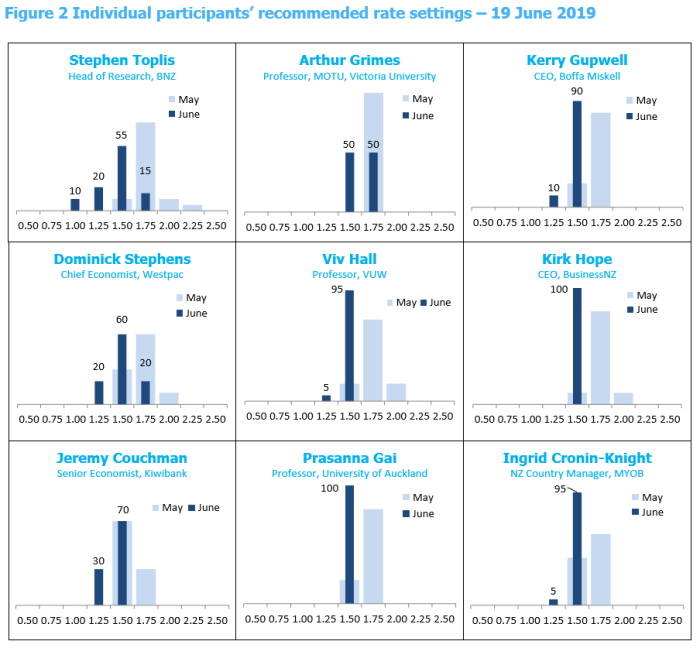
Earlier in the week, the NZIER released their Shadow Board exercise, in which a group of economists and business people offer their advice, and their range of views, on where the OCR should be set (conditioned on the target the Bank is given).  I know various readers are dismissive of the exercise –  and it does appear to be limping on towards eventual termination, rather than helping shape the debate –  but I’ve always had a geeky interest in exercises like this, even while noting that the Shadow Board tends to adjust into line with the Reserve Bank, rather than providing much collective leadership or independence of perspective.  This was in evidence in the NZIER press release this week

NZIER’s Monetary Policy Shadow Board has adjusted their recommendation in the wake of the Reserve Bank’s OCR cut in May.

It is strange that experts would adjust their view of what the OCR should be just because the Reserve Bank –  with no monopoly on knowledge and huge margins for error –  changed its view.   But here were the individual views of the panellists.

shadow board 19

I’ve always been puzzled too by how anyone could be 100 per cent confident of their view of where the OCR should be.   When I was on the Reserve Bank’s OCR Advisory Group (a forerunner to the MPC), we introduced a survey of this sort, where each member’s advice to the Governor had to include a probability distribution (summing to 100 per cent) on what the OCR should be (eg 50% 1.5 per cent, 25% 1.25 per cent, 25% 1 per cent).  Being a bit stubborn, and reminded of the breadth of the historic confidence intervals in OCR forecasts, I always tried to discipline myself to spread my probabilities over perhaps six alternative OCR settings, with not too high a probability on the OCR I actually recommended.  Apart from anything else, it was a helpful prompt to think about what would invalidate my central view.   Most of these respondents don’t seem to do anything similar.  For what it is worth, my current distribution might look something like this

0.5 or less 5
0.75 10
1 20
1.25 35
1.5 17.5
1.75 7.5
2 or more 5

The most interesting view in the chart (setting aside how tightly bunched his views were) is that of former Reserve Bank chief economist Arthur Grimes, who indicated a 50 per cent probability that the OCR now should still be 1.75 per cent. In his comments he notes

Conditions imply no need to change the OCR right now, but that has to be balanced against the unnecessary (and unwise) cut to the OCR at the last decision. Hence it is a 50:50 call as to whether the cut should be restored or whether to leave the OCR as is.

It is an interesting stance, more “hawkish” (for example) than the (typically) most hawkish of the local banks (BNZ), and it is a shame no media seem to have asked Arthur to elaborate on his view.  He must hold it strongly –  the words are much more forceful than just the numbers would have been –  and it would be interesting to read his fuller reasoning.  After all, although my central view appears to be substantially different to his, the margins of error/uncertainty in this game are quite large enough that he could prove to be correct (my own probabilities – above –  overlap with his).     Perhaps it is just that Arthur is downplaying the target midpoint, even though it is highlighted in the target given to the committee, and in that case it is just a personal policy preference.  But if it is a genuine difference of model, of making sense of current or prospective economic or inflation developments, it would be interesting to see his reasoning.

But for me, the downside risks, and the asymmetric nature of the consequences of being wrong –  surprising high inflation means getting into the top half of the target range for the only time in more than a decade, while the approaching limits of conventional monetary policy mean that any further slippage in inflation expectations could really aggravate the next significant downturn, arguing for erring –  if it all –  on the side of a lower OCR.

Can anything good come out of the ANZ?

ANZ’s New Zealand operation has had a bad run lately, what with the problems around the version of a model they were using for calculating operational risk capital, and then yesterday’s announcement of the loss of their CEO.    Perhaps it is a failure of imagination on my part, but I can’t claim that either episode greatly bothered me, whether as a customer or more generally.  Yes, both incidents suggest a degree of untidiness that isn’t ideal,  but it is a big organisation and they were pretty small issues.  Perhaps it suggests the local board doesn’t amount to much, but why would that surprise anyone?   Local incorporation is mostly about having (a) some assets that we can be reasonably sure will be available to meet local liabilities in the (very low probability) event of a major bank failure, and (b) having someone to prosecute if governance failures proved to have risen to a prosecutable standard (a reason for the otherwise questionable requirement for some of the directors to be locally resident).   Beyond that, it makes sense for the whole of the ANZ group to be able to be run, as far as possible, as a single entity.

But rather lost amid the headlines yesterday was a very useful new piece from the ANZ’s economics team, “Prospects for unconventional monetary policy in New Zealand”.   It is a very substantial piece of analysis, which gets into quite a lot of detail on how New Zealand might handle a situation in which the conventional limits of monetary policy had been exhausted (ie when the OCR has been cut to some modestly negative level).    I would encourage anyone with even a passing interest in the topic to read it.

Pretty much ever since this blog began in 2015 I have been lamenting the apparent failure of the Reserve Bank to take this issue very seriously.  It never popped up in Statements of Intent or gubernatorial speeches (in the days when we had a Governor who made them), even though many other countries had run into those limits in the last recession, and in most cases the pace of economic recovery had been disconcertingly slow.    Back in 2013 or 2014, perhaps the Bank had some small excuse –  the then management was so convinced the OCR was heading back up (and by a lot) that effective lower bounds just didn’t seem like an issue New Zealand needed to worry about.     But that was five years ago, and the OCR now is 1.5 per cent not the (say) 5 per cent the Bank might have hoped for.

In the last 18 months, there has been some movement by the Bank,  Last year, they published a Bulletin article surveying the experiences of other countries with unconventional monetary policy, and then offering some initial thoughts on options for New Zealand.   I wrote about that article here, welcoming the fact that it had been done, and the survey of other countries’ experiences, but regretting an apparent degree of complacency by the Bank about the New Zealand situation and the likely effectiveness of such policy tools.   That complacent tone characterised various comments the Governor has made at MPS press conferences: lots of handwaving, little hard analysis, and no engagement at all with just how slow the recovery was in most countries that were reduced in unconventional measures.    As I noted, central bank complacency risked coming at a cost –  a cost not to the comfortable central bankers themselves, but to those left unnecessarily unemployed for long periods of time.

The new ANZ piece is valuable for a number of reasons.  First, it will be more widely disseminated than the Reserve Bank article.  Second, it isn’t from the Reserve Bank (we need a wider range of discussion and debate around these isses and risks), and third, it goes into more operational detail (around important features of existing RB liquidity facilities etc) in several places than anything previously in the public domain.

I don’t agree with everything in the ANZ piece, and in particular I was surprised by the number of references to how distortionary or risky unconventional policies have been in other countries.  The rather bigger issue is that they mostly have not achieved much, at least once we got beyond the immediate crisis period (and this is a distinction the ANZ authors make).    As I’ve noted here repeatedly, there is little or no evidence that –  whatever the initial announcement effects –  long-term bond rates have fallen further relative to policy rates in countries that used unconventional policies than in countries that did not.

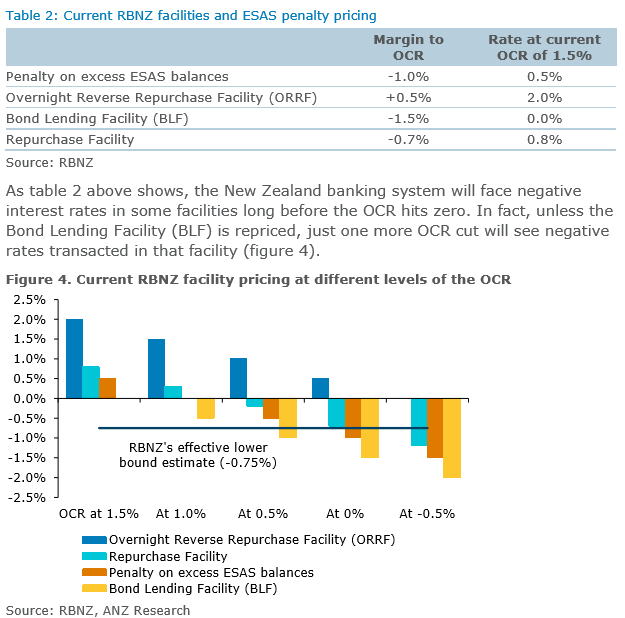
There was a useful reminder that some official RB interest rates will go negative well before the OCR itself gets to a negative number.    This is from their document

ANZ ZLB

The Bond Lending Facility is a facility whereby market participants can borrow bonds from the Reserve Bank (to support smooth market functioning) and, as the authors note, is little used.

The ANZ authors put more emphasis on the penalty on excess balances in settlement accounts.  I wrote about the Bank’s strange tiering policy in a recent post, but the gist is that the Bank determines for each bank what value of deposits at the Reserve Bank earn the OCR, and anything in excess of that earns 100 points less than the OCR.   Banks manage their settlement cash balances to minimise the extent to which anyone bears that lower return  But if the OCR were at -0.25 per cent, the rate on excess settlement account balances would be -1.25 per cent on current policies.   All else equal, that is a rate low enough that (a) no one else has imposed it, and (b) people might prefer to hold physical cash instead.

I’m a bit sceptical that this is a really important constraint on the ability of the Reserve Bank to use conventional monetary policy down to an OCR of around -0.75 per cent, since there is little reason to suppose the level of settlement cash balances would be rising as the OCR plumbed these new depths (if anything demand might be falling a bit), and banks would –  as the Bank would want –  be aggressively acting to limit the extent anyone bore the additional cost.   But it is an issue that is worth debating further, and which would become salient quite quickly if the Bank went beyond OCR cuts and started using unconcventional measures to boost settlement cash balances materially.  In earlier work, it was recognised that tiering policy would probably need to change if there was aggressive unsterilised asset purchases.

The authors rightly note many of the potential limitations of asset purchase options.  Sure, the Reserve Bank might be able to buy up a substantial portion of the government bonds on issue –  although some holders will be very reluctant sellers, having mandates that specify investment in government bonds –  but even if they could, what would be the channel whereby this would revive demand and economic activity (few borrowers took on long-term fixed rate debt).   And the Bank might be able to intervene heavily in the foreign exchange market –  perhaps on ministerial direction, to ensure the risks fall on the Crown –  but they’d likely be selling the New Zealand dollar when it was already undervalued, and if the OCR can’t go below -0.5 or -0.75 per cent, it isn’t likely that the exchange rate effect would be very large.  Intervening in the interest rate swaps market has been an idea around for a decade, and I’ve never been persuaded it would accomplish much.

But the options and issues really should be more widely debated, and the Reserve Bank and The Treasury should be taking the lead in encouraging open debate and serious scrutiny of the New Zealand specific issues.  As ANZ notes, perhaps interventions can be devised on the fly, but there is no excuse for finding ourselves in that position when we have had 10 years advance notice of the problem.  Adrian Orr’s tree god won’t offer the answers, no matter much Orr invokes Tane Mahuta.

My frustration is that thinking doesn’t seem to have advanced much at all in the ten years. I dug through some old files this morning, and among them I found a paper I’d written at Treasury in 2009 (benefiting from discussion with Reserve Bank staff)  on options if we reached the limits of conventional monetary policy.  I also found a discussion note I’d written in 2011 trying to engender some debate around the legislative provisions that support the near-zero lower bound on nominal interest rates, and was reminded of the report of a Bank working group I lead in 2012 on options if we faced near-zero interest rates (sparked by the intensity of the euro crisis then).  But nothing from either the Reserve Bank or The Treasury that has found its way into the public represents any advance on that thinking and work done up to a decade ago.  It really is pretty inexcusable.  It is almost as if our officials and minister think everything worked just fine in other countries after 2009 –  it clearly didn’t –  or they just don’t care.

Specifically –  and this is a criticism of the ANZ note as well (not even mentioning the issue) – there has been nothing done, no debate held, no analysis published, on dealing with fact that at present people can convert limitless amounts into hard currency, and will do so at some point once interest rates on other instruments (wholesale ones in particular) are substantially negative.   Here was what I wrote on that point in my post last year on the Reserve Bank’s article.

It is striking that the article does not engage at all with either of the two more radical options debated in other places and other countries:

  • reconfiguring the target for monetary policy.   This could take the form of a higher inflation target or, for example, the use of a price level or nominal GDP level target.  Each approach has its weaknesses, but either –  done in advance of the next serious downturn, not in midst when much of the opportunity is lost –  could help raise, and hold up, expectations about the path of the nominal economy, including inflation.
  • taking steps to material reduce the extent of the effective lower bound on nominal interest rates.

The latter remains my preference, for a number of reasons (including that the existing problem arises largely because central banks have  –  by law – monopolised note issue, and then not proved responsive to changing circumstances and technologies. Problems are usually best fixed at source.

If there is still a useful role for physical currency (I discussed some of these issues here), the ability to convert huge amounts of financial assets into physical currency, on demand, without pushing the price against you, is now a material obstacle to monetary policy doing its job in the next recession.    There is a good case for looking seriously at a variety of reform options, such as:

  • phasing out large denomination Reserve Bank notes (while perhaps again allowing private banks to offer them, on their own terms, conditions and technologies),
  • capping the physical Reserve Bank note issue, scaled to growth in, say, nominal GDP (perhaps with provision for overrides in the case of financial crisis runs),
  • putting a spread (between buy and sell prices) on Reserve Bank dealing in bank notes, or
  • auctioning a fixed quota of bank notes, and thus allowing the price to adjust semi-automatically  (when currency demand rises, as when the OCR goes materially negative) the cost of conversion rises.

These sorts of ideas are not new.  They do not get rid of the entire issue –  at an OCR of, say, -10 per cent, even transaction demand for bank deposits might dry up –  but they would go an awfully long way to ensuring that the next recession can be dealt with more effectively than the last.

If, for example, you thought the OCR was going to be set at -3 per cent for two years, then once storage and insurance costs are taken into account (the things that allow the OCR to be cut to around -0.75 per cent now), even a lump sum conversion cost (deposits into physical cash) of 5 per cent would be enough to keep almost everyone in deposits and bonds (even at negative yields) rather than physical cash.  That is a great deal leeway than the Reserve Bank has now.   Having that leeway –  and being willing to use it – helps ensure nominal rates don’t need to stay extremely low for too long.

In principle, many of these sorts of initiatives probably could be done in short order in the midst of the next serious downturn.  But we shouldn’t have to count on unknown crisis responses, the tenor of which have not been consulted on, socialised, and tested in advance.  It may even be that some legislative amendments might be required.

There is no excuse for not having these issue all sorted out well in advance, and having communicated clearly to the public (and ministers and markets) how they will be handled, secure in the knowledge that rigorous planning and risk identification has occurred.

In part, that is because of one other issue that ANZ piece doesn’t touch on (neither did the Reserve Bank article).  Once a new severe recession is upon us, people will fairly quickly begin to appreciate how few effective and credible options central banks and governments have, and react –  eg adjusting inflation expectations –  accordingly.  In 2009, the typical reaction was to expect a quick rebound, partly because that was how economies were perceived to have usually behaved, and partly because so many interventions were being thrown into the mix. Next time, people (markets) will go into a severe downturn with the memory of post-2009, an awareness of the unpropitious starting point, and an awareness of the distinct limitations of unconventional policy. All that is likely to exacerbate the downturn and further complicate effects at countercyclical stabilisation.  People will suffer as a result.

We need some leadership on these issues. If the Reserve Bank won’t or can’t provide it, the Minister of Finance –  who will bear responsibility before the voters –  needs to lead himself, and insist that his agencies do more and better, more openly, than they have done so far.

In the meantime, well done ANZ for a substantial piece of work. Once again, I’d encourage people to read it and think about the issues and constraints it raises.

Central bankers not giving speeches

I’ve been among those who’ve drawn attention, disapprovingly, to the fact that the Governor of the Reserve Bank, now in office for more than a year, has made no on-the-record speeches about either of his main areas of policy responsibility: monetary policy and financial stability/regulation.   The enabling legislation meant that until very recently he was the sole decisionmaker in both areas, and in both areas there have been significant new initiatives in the last year – a new objective, and new governance structure, for monetary policy, and far-reaching contentious proposals around bank capital.

The Governor has recently become merely primus inter pares on most aspects of monetary policy, joined by six others to form the new Monetary Policy Committee.  The first OCR decision of that new committee was released on Wednesday.

On Thursday morning, the Governor appeared at Parliament’s Finance and Expenditure Committee for his regular post-MPS questioning.  I was going to use the word “grilling” there, but the questioning is often pretty soft, and used to seem more attuned to soundbites for the evening news bulletins than to serious scrutiny and accountability. But this week, apparently, the Governor was asked about the criticism that he had not been delivering substantive speeches.   His response apparently was to “dismiss the criticism” on the grounds that the Bank publishes Monetary Policy Statements, OCR reviews, and some descriptive material on the new governance structure.

But here’s the thing.  Other countries’ central banks also publish official interest rate announcements, and the equivalents of Monetary Policy Statements (and these days, those documents are typically more in-depth and insightful than New Zealand Monetary Policy Statements). 

But since the Governor took office in March 2017 there has been not a single substantive public speech from the Governor on monetary policy.  There was one conference paper written by the now-departed chief economist, which must have been commissioned and substantially written before Orr took office.  That was more than a year ago.

In Australia this calendar year alone the Governor has given two public speeches on economic matters firmly within the monetary policy remit of the Reserve Bank of Australia.   And other senior managers have given another four such speeches.

In Canada, the Governor and senior managers have given eight to ten such speeches (depending how on classifies particular speeches).

In the UK, there appear to have been about six such speeches this year –  again, on things pretty closely related to monetary policy and the state of the economy.

And in the US, just at the Board of Governors (there were numerous other speeches by regional Fed people), I counted 10 such on-the-record speeches this year.

I deliberately mention speeches both by the Governor (or US equivalent) and by senior staff or committee members, because apparently Orr went on to ask, presumably rhetorically, if all public communications needed to come from the Governor, noting that in the past there had been criticism (when?) of a Governor having too high a profile (recall that Graeme Wheeler avoided all substantive searching interviews for five years).   Indeed, it doesn’t, but (a) we’ve had no speeches from any of them for more than a year now, and (b) until a few weeks ago the Governor was solely and personally accountable for monetary policy, and is still formally (ministerial determination) the spokesman for the MPC.

Playing distraction, Orr apparently went to suggest that a lot of discussion focuses on issues around things like climate change and social inclusion, asserting that the same people who criticise him for not doing speeches would criticise him for talking about such issues, and that he just couldn’t seem to win.

Of course, he knows very well that there are two quite separate lines of criticism.   Many (including me) think it is inappropriate and unwise for the Governor to be talking about such topics which go well beyond his remit (as it would be, say, for the Chief Justice to be giving speeches on economic policy).   But even if you were to grant that it was appropriate for the Governor to be discussing such peripheral (to the Bank) issues, you would then surely think it should be all the more reasonable to expect the Governor –  and other MPC members – to be giving serious, on-the-record, speeches about the state of the economy, monetary policy and so on (not to mention financial regulation, but this post –  and the FEC appearance – were about monetary policy).   Things they are actually responsible for, and where they wield a great deal of power, subject to no appeal or review.  It should be all the more reasonable to expect that at a time when (a) a new regime is being put in place, and (b) when the Bank has had to materially alter its policy view.

And when all their peers in other similar countries seem to give serious speeches as a matter of course.  It isn’t clear why our Reserve Bank has stopped doing so.


The new Monetary Policy Committee’s MPS

I agreed with the bottom line policy decision yesterday of the new Monetary Policy Committee (it was “unanimous” the Governor twice told us yesterday, even though their charter tells them to aim for consensus not for a vote).  Cutting the OCR looks, with the information to hand now, to have been the right thing to have done (although, as always, only time will give us a better sense as to whether it was in fact the best choice).

But, as a rather portentous (but also somewhat empty) recent Bulletin article reminded readers, there is more to the responsibilities of the Monetary Policy Committee than the succession of OCR decisions.    And on their first outing yesterday I don’t think they were performing that well.  It is early days of course –  three new externals (one of whom wasn’t even there for this round), and two internals who’ve both been in their new roles for less than two months. But there is a (very) long way to go if they are serious about the aspiration the Governor sometimes runs about being the best central bank.

Getting some basic facts right would be a helpful start.  For example, I heard the Governor on Radio New Zealand this morning talking about business investment, and suggesting that it was high but not rising.   Here is a chart showing non-housing investment, and the best proxy for business investment (total less housing less government) as a share of GDP (and recall that GDP growth itself has been slowing).

bus I may 19

Doesn’t look very high to me.

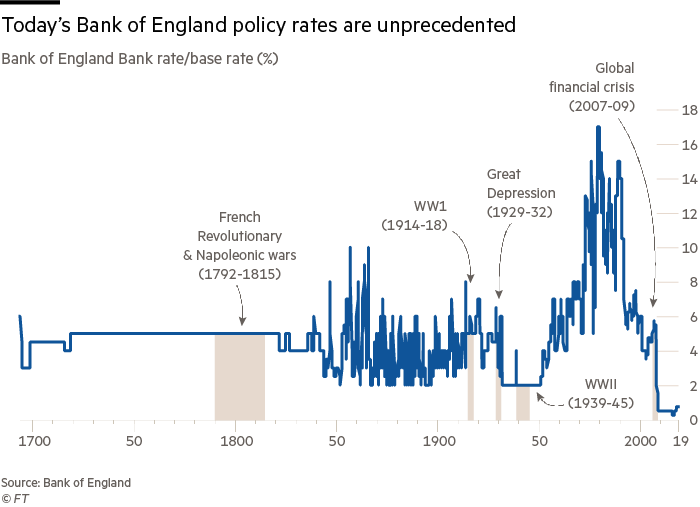
Or there was the exchange in the Governor’s press conference when he was asked about the persistence of low nominal interest rates and whether this was some sort of “new normal”.   There are all sorts of possible, reasonable, answers to that one, but the Governor’s answer wasn’t one of those.  He suggested that what we have now is a return to some sort of “old normal”.   To be sure, real interest rates were at times materially negative in the periods (70s mostly) when inflation was very high, but the Governor explicitly claimed to be referring to an earlier period.  Here is a chart from yesterday’s Martin Wolf column in the Financial Times.

long-term rates UK

The Governor also seemed rather cavalier (again/still) when asked about the limits of conventional monetary policy.  He waves his hands, talks expansively of all sorts of other tools, and yet never once mentions that the countries that reached the limits of conventional monetary policy in the last downturn mostly had very subdued recoveries –  and there is a reasonable argument that with more monetary capacity fewer people would have been unemployed for as long as they were.

In the document itself there were also various odd or questionable bits.  The downside risks to the world economy seem to have played a large (surprisingly large) role in yesterday’s decision, but I was left wondering about the supporting analysis when I read this in the document.

New Zealand has become more exposed to international shocks over time as our global economic links have strengthened. Structural changes since the 1980s, such as the liberalisation of trade and capital movements, have increased our exposure to international economic conditions.

What can they have in mind?   Foreign trade as a share of GDP has been shrinking this century, foreign investment has been subdued, immigration has almost always been important in modern New Zealand history, and external indebtedness as a share of GDP hasn’t risen for decades (even if the composition has shifted from public to private) and is materially lower than it was 100 years ago.  And, on the other hand, we’ve had a floating exchange rate since 1985 which acts as a semi-automatic buffer to many global shocks.

Then there was what looked a lot like a (questionable) bid for the government to increase its own spending.  In the press conference, the Governor disavowed any suggestion of wanting more government spending as a cyclical stabiliser, but in the minutes (the new element of the document) we read this (emphasis added))

The members acknowledged the importance of additional spending from households, businesses, and the government, to meet their inflation and employment targets.

(Rather weird framing to suggest we all need to spend more.)

And

A potential source of additional demand discussed by the Committee included government spending being higher than currently projected, in view of the current strength of the Crown balance sheet.

Since there has been no suggestion from the government that it might depart from its Budget Responsibility Rules  (so the MPC isn’t responding to something in the wind) it looks strange for them to have chosen to include these lines (it is quite simply a choice).

The Governor’s own (apparent) left-wing pro-government biases also seemed to be on display in discussing existing government policy.  There was a whole paragraph about how government fiscal policy would be boosting GDP, and that paragraph ends with the observation that

announced minimum wage rises are expected to support household consumption over the projection period

No analysis was presented in support of this claim, and there is no discussion at all of the possibility that much higher minimum wages might have adverse employment effects.  Readers are just left to suppose it is all good.

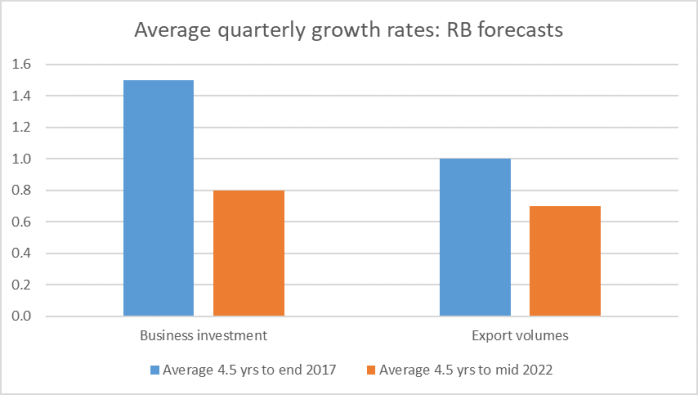
The Bank is relatively upbeat in its GDP forecasts (quarterly growth rates averaging 0.8 per cent for the next couple of years) and one explanation appears to be their view of KiwiBuild.   The document notes that KiwiBuild is “assumed to contribute to residential investment from the second half of 2019”, and even though population growth is slowing, credit constraints appear to be tightening, and nothing new has been done to free up land-use regulation, the Bank expects to seeing residential investment rising as a share of GDP.

Readers may recall that at the time of the last MPS the Bank released a background note on its KiwiBuild assumptions.  I took them to task then over the unrealism of assuming that KiwiBuild would represent a material net addition to building activity (and that was before the growing questions about the KiwiBuild programme itself).  As I noted then

On my story, there could be as many builders and associated tradesmen and labourers as you like –  resources flowing easily, with high elasticities, into building as required, with barely any change in prices –  and over any reasonable horizon (say, five to ten years) a credible government announcement that it will build 100000 more houses will, to a first approximation, reduce the construction of other houses by 100000 over that period.    It almost has to be that way because:

  • announcing that as a government you are going to build lots of houses doesn’t change land use law or land availability.  It is what it is –  whether in Auckland or elsewhere.  Everyone recognises that (artificially regulated) land scarcity is a huge component in the high cost of New Zealand houses.   Other government policy measures may yet act on the land use issues, but this is a debate about KiwiBuild, in the existing regulatory system,
  • announcing that you are going to build lots of houses isn’t likely to materially alter the price of building materials in New Zealand, and
  • it isn’t going to materially alter regulatory approval timeframes and related things that (for example) affect financing costs.

In other words the marginal supply price of a new residential property –  like for like in its features –  doesn’t change.    Fix those things and there will be more effective demand for houses from the existing (and projected) population: building activity could really step for quite a while (and some of those capacity constraint and resource pricing issues could be relevant for a few years).    But if you don’t change any of those things –  and KiwiBuild doesn’t materially change any of them –  you’ll end up with no more houses, unless (and only to the extent) that the government-sponsored construction doesn’t cover true costs, and effectively offers a subsidised entry to the market for the favoured few.  Even then, the effect will mostly be to drive out more private construction, but there might still – at least for a time –  be a net increase in the housing stock.

I stand by those propositions, but the Bank appears to continue to assert/assume that KiwiBuild will be lifting economic activity.  Perhaps they are right, but they need to offer more analysis that a single sentence assertion.

Productivity isn’t one of the things the Reserve Bank can do anything much about (on that note, I really welcomed an interview yesterday in which I was being asked about the economy and the Bank, and when I mentioned the underwhelming productivity record the non-specialist interviewer responded “And the Reserve Bank can’t do anything about productivity, is that right?”).   But the Bank’s view on productivity growth affects its forecasts of headline GDP growth, which in turn are grist to the political mill.

Like Treasury, the Bank’s forecasts have been repeatedly upbeat and repeatedly wrong about productivity growth.  They always assume it is just about to pick up again.

In the Bank’s case the story is muddied because the variable they publish forecasts for is “trend labour productivity”.  On this measure – definition unclear –  we have had labour productivity growth averaging 0.8 per cent per annum for the last six years, and over the forecast horizon (to 2022) that is expected to increase to 1.1-1.2 per cent per annum.  There is never any discussion as to how or why this increase is expected to occur.

But lets look at a hard, easily replicable, measure of economywide labour productivity growth.  In this chart I’ve used the average of the two measures of GDP (production and expenditure) and the average of the two measures of hours (HLFS and QES) to derive an estimate of growth in real GDP per hour worked.  We have hours data up to and including the March 2019 quarter, and I’ve used the Bank’s forecast for GDP growth in that quarter (0.4 per cent).

GDP phw may 19

The orange line is the average for the last five years.  There has been almost no productivity growth at all.  Nothing in the data, or in government policy such as it is, suggests that is about to improve materially any time soon.  With little or no productivity growth it would be surprising indeed if annual GDP growth is anything like 3 per cent.

(And yet none of this stops the Governor burbling on about global inflation being low because of positive global productivity shocks.  The rest of the world’s story isn’t as bad as New Zealand’s, but it is hardly a story of strong and robust productivity growth.)

I was puzzling a bit over the MPC’s apparent interest in increased government spending.  Looking through the detailed spreadsheet of forecasts the Bank publishes I found they had forecasts for a variable they call “government spending (including non-market investment)”.  Out of curiosity I averaged the quarterly growth rates over the period from when the current government came to office (their first full quarters was q1 2018) to the end of the forecast period in 2022.  Recall that the Bank uses the government’s announced plans for their fiscal numbers.  Real government spending over the 4.5 years to mid-2022 is forecast to increase by an average 0.5 per cent per quarter.  Still curious, I calculated the average for the previous 4.5 years, under the previous government, and it was 0.7 per cent per quarter.  I don’t have a strong personal view on the appropriate level or rate of growth of public expenditure, but as a detached observer I’ve always been a bit puzzled as to whether left-wing voters really wanted to elect a government that would have government spending (share of GDP) so similar to that of the previous government, and growing more slowly.

As I mentioned the Governor has tended to talk up the New Zealand economic story, including around business investment.  But here, from the same forecast tables, are the Bank’s projections for average quarterly growth in the volume of business investment and the volume of exports.

lab govt

Not, among other things, the sort of picture one might expect to see if productivity growth were really about to accelerate.

My overall summary?  The OCR call was correct, but little about the analysis or communications the Bank has presented gives one much confidence in our central bank having a good understanding of the economy and its challenges, or the willingness/ability to communicate in a well-grounded dispassionate ways that genuinely sheds light on the issues.  The new MPC is still finding its feet –  one reason why I put little weight on yesterday’s projections as a guide to how things will unfold over the next few quarters –  but there is a big challenge ahead of them.

Economic expectations

The macroeconomic news of the day will be around the Reserve Bank’s Monetary Policy Statement this afternoon.   But yesterday afternoon the Bank published the results of its quarterly survey of (somewhat expert) expectations.

There wasn’t much newsworthy in the survey results.  Across this group of respondents, the median expectations for the inflation rate two years ahead, five years ahead, and ten years were 2.00, 2.00, and 2.00 per cent. The Bank will be pleased.   Unfortunately for the Bank, market prices (from the market in indexed and conventional government bonds) suggest something close to 1.0 per cent (my own responses to the survey were not that low, but were in the lower quartile of responses).

The questions that caught my eye were those around monetary conditions.  Respondents are asked (on a 7 point scale) how they perceive monetary conditions at present, in three months time, and in nine months time.  It is entirely up to each respondent how they interpret “monetary conditions” –  what weight they put on each of, say, interest rates (short or long), exchange rates, credit conditions, share prices, or whatever.  Here are the summary results

mon con

A huge majority of respondents think current monetary conditions are looser than neutral (“neutral” is the Bank’s own term) and expect them to stay that way.

But the surprise was the shift, expected over the coming quarter, from neutral to tighter than neutral.  Sure, the survey was taken almost two weeks ago, but even then market prices were clearly centred on the prospect of an OCR cut –  whether today or in August – with no commentator I’m aware of expecting an OCR increase.   (And in the same survey three months ago, there was an expectation of a slight shift towards less-tight conditions.)

Who knows what respondents had in mind.  It can’t have been the exchange rate –  the survey asks for exchange rate expectations and they aren’t rising –  so perhaps it was something about credit conditions.  Then again, it is a fairly small sample (33 respondents) so perhaps a couple of people just read the options the wrong way round.

What about OCR expectations themselves?  The survey asks about expectations for the OCR as at the end of June and at the end of March next year.   The median response for June was still 1.75 per cent – no change now or at the OCR review at the end of June –  in a survey taken only 10 days ago.   The median expectation is for only one OCR cut by then , but the lower quartile response is 1.25 per cent, and at least one person (wasn’t me) is picking 1.0 per cent by then.  (On the other hand, at least one respondent thinks the OCR will have been increased to 2 per cent by March.)

And the last result that caught my eye was this one.  Respondents are asked for their expectations of GDP growth for the year ahead and then for the year beyond that.  This chart shows the average of those two expectations.

GDP expecs

The latest results are lower again, and are now at the lowest level since December 2009.   Expectations of this sort aren’t particularly useful as forecasts (lots else will change), and often largely reflect what has already been seen.  And the latest decline isn’t severe in the long-run history of the serious. But it isn’t exactly a rosy picture either.  Respondents don’t see anything on the horizon likely to accelerate growth rates.   All else equal, there isn’t much suggesting core inflation will rise.

There is a pretty good case for the OCR to be lower.  Then again, there was a good case (probably stronger) for a cut to official interest rates in Australia yesterday, and it didn’t happen –  the statement read like a central bank desperate not to cut, despite an agreed inflation target they’ve been badly undershooting.   I doubt our Governor will be desperate not to cut, but whether he and his new colleagues actually do so today we won’t know for a few hours yet.


Looking to the MPS

I was tempted to write a post about the new head of the Irish central bank, perhaps offering some pointers to my (handful of) Irish readers about the propensity of their new British Governor to speak openly, and typically not in a very robust or convincing manner, about all manner of things, all while the foundations of New Zealand’s economic prosperity –  our dismal productivity record –  were neglected.  No doubt he will be a solid administrator and is a nice guy, but it seems like quite a step down from Governors such as Philip Lane and Patrick Honohan.   That said – and unlike the New Zealand situation – at least the appointment  of the Governor was made by someone (an elected minister) with a democratic mandate.  As for the vacancy in the position of New Zealand Secretary to the Treasury, one can only hope that between the Minister and the State Services Commissioner they come up with a better appointment this time round.  But as I noted earlier in the year after the advert appeared, it is hard to be optimistic.      After all, it isn’t obvious that either the Minister or SSC sees a problem.

But to revert to more-mundane central banking, next Wednesday will see the release of Reserve Bank’s Monetary Policy Statement, the first (and first OCR decision) for which the new statutory Monetary Policy Committee is responsible (rather than the Governor personally).  There will be more interest than usual in this MPS.  In part that is because for the first time in a couple of years or more there is some genuine uncertainty as to what the OCR decision itself (as distinct from the language around it) will be.  But it will also be because of the new Committee and the uncertainty over how it will communicate (we know the minutes will be published at the same time, but don’t know what they will look like, we don’t know whether the MPS itself will look any different (probably not), and we don’t know whether some or all of the external members might start to avail themselves of the opportunity to speak openly (eg that thing called accountability)).

I’m pretty clear that the OCR should be a bit lower.  My reasons for that are straightforward:

  • core inflation is still below the focus of the target (the 2 per cent midpoint) –  has been for years, and any progress back towards 2 per cent seems to have petered out again,
  • market-based measures of medium to longer term inflation expectations are very low (close to 1 per cent),
  • that forces that added to demand growth this decade have more or less exhausted themselves and so there is little reason to expect (as a central view) higher inflation over the next year or two on current monetary policy settings,
  • confidence indicators are weak, output and employment growth have been slowing, and there is little sign of over-full employment, and
  • the global situation offers much the same set of messages (weak inflation, subdued output growth etc, albeit –  at least in some major economies –  with a better unemployment position than we have in New Zealand).

(And all this, even though New Zealand wage inflation –  often characterised as weak –  continues to outstrip growth in productivity and the terms of trade.)

But the focus here is on what the new Monetary Policy Committee might choose to do.

In his final statement as sole monetary policy decisionmaker, the Governor shifted his stance, expressing it this way

The balance of risks to this outlook has shifted to the downside. The risk of a more pronounced global downturn has increased and low business sentiment continues to weigh on domestic spending. On the upside, inflation could rise faster if firms pass on cost increases to prices to a greater extent.

The shift to an explicit statement of a (net) downside risk –  and thus more likelihood of an OCR cut than an increase in the period ahead – took quite a few by surprise in late March.

My reading of the data is that not much has changed since then. In other words, we have had another month or more of pretty subdued data and no fresh signs that (core) inflation is likely to get back to target.  Against that sort of backdrop, it would be quite easily justifiable to cut the OCR next week –  not necessarily foreshadowing a succession of future cuts, but just to provide a bit more of an underpinning for demand, and a bit more support for getting core inflation back to 2 per cent.

But, equally, it would be mechancially easy enough for the Bank –  having come only lately to recognise the need for a downside risk at all – to simply stand pat.   And, if anything, the Governor was sounding quite unbothered about the “recent slowdown in growth” in an interview with NBR last week.

What the Committee finally chooses to do has to be, more than might usually be the case, anyone’s guess.

For a start, the economic forecasts (that influence and are shaped by) the Committee’s policy preferences must be more of a wild card.  The forecasts will, presumably, be owned by the MPC itself –  not just treated as staff forecasts –  but four of the seven MPC members weren’t involved in the previous MPS and associated full forecast round.  One of the other members will have been, but he is now in a quite different (and vitally important) role as the Bank’s Chief Economist.

And we know almost nothing about the policy preferences, or mental models, of any of the new external members (or some of the internals).  How do they interpret the mandate?  How do they think about the relevance of overseas risks?  How much confidence do they have in the value of economic forecasting at all?   We don’t even know much about the Governor’s own views on such matters because (endlessly repeated point) he has not given a single public speech on monetary policy in his time in office.  Glib one-liners aren’t the same thing at all.

One thing I think we can count on is that there will be no vote, and thus no disclosure in the minutes of any difference of view among the MPC members.  Even if some members aren’t fully happy with where the majority is heading, the Governor is likely to put pressure on the externals not to explicitly dissent –  after all, he and the Minister have championed the “consensus” model, one which strengthens the relative hand of the Governor.  If there was a dissent first time up, that might establish a pattern or precedent that management really wouldn’t want.  As it is, it is hard to believe that any of the externals –  none with a significant background in monetary policy or forecasting –  would be wanting to buck the internal majority anyway, lest of all first time up.

The Governor has spent some time pushing back against suggests that his monetary policy communications has not been good.  In that NBR interview, he claimed again that it it isn’t his job not to surprise markets, and went on to suggest that picking the next OCR call was “barely necessary” and that energy devoted to it might be better devoted to lifting productivity, improving the health system or whatever.  I don’t suppose those comments –  typically glib –  will have endeared him to his critics in the market (eg those reported in the recent Reuters story).     For all his bluster, however, it would be a bit surprising if he wasn’t being advised to avoid further unnecessary controversy over his communications (especially now that, at least in principle, he represents the MPC not just himself).   That doesn’t necessarily determine which way the Bank will go, but perhaps there might be fewer comms risks from cutting now, than risking some sort of whipsaw reaction if they get the messaging wrong around holding fire for now?

One other consideration that may be relevant is the RBA interest rate decision next week.   Markets had swung to the view that the cash rate would be cut when the RBA Board meets on Tuesday –  core inflation is now badly undershooting the midpoint of the RBA target –  and I gather market opinion is now fairly evenly balanced.   (Ten days out from a general election is always an awkward time for monetary policymakers.)  The Reserve Bank of New Zealand MPC will almost certainly make their decision (more or less finally) before the RBA decision is known, but given that the Governor noted in March an unease that other countries easing while we didn’t could put upward pressure on the exchange rate, it might be appealing to him to move now.     If the RBA cuts and he doesn’t, there will be press conference questioning about “why wait?”, and if he cuts and the RBA hasn’t done so, the Governor could look pro-active and responsive.

I mostly don’t do MPS preview posts, and did so this time mainly because I’m interested in the legislative change and the impact/implications of the new system, and the uncertainty the transition generates.  In a poll earlier this week, I predicted a cut but, asked about the strength of my view, described it as a 51/49 call.  I see one of the big banks has just put out a note taking a similar view (55/45). It is easy to say that individual OCR decisions don’t matter that much –  and there is some truth in that, but they set the scene for the next one.  Probably no one can really claim they will be too surprised which way the OCR call goes on Wednesday, and the bigger challenge –  opportunity for getting things wrong –  is probably around the rest of communications (both the wording of the policy statement itself and the credibility of the forecasts, all shaped by new leadership).

There are now seven holders of statutory MPC positions. Not one of whom has made any serious speeches or paper on monetary policy (we know nothing of the views of most them), the Bank needs to be looking to improve its medium-term monetary policy communications quite materially.  It would be an inconceivable situation for most other advanced country central banks –  and those monitoring them –  to find themselves in.


Lack of transparency and the MPC

The statutory Monetary Policy Committee is now responsible for monetary policy and we’ll see the first fruits of their deliberations in a couple of weeks.   It won’t just be the outsiders who are new, with two of the four internals having also taken up their jobs (in one case, joined the Bank) since the last Monetary Policy Statement.

In addition to the questions about how the Committee is going to work, what approach to policy they will take, whether the Governor remains as dominant as I fear, and whether a new era of greater policy transparency is really being ushered in, there are some other outstanding questions about the Committee.

One of them is how much the external members are getting paid.  The government simply refuses to tell us.  The same government that once promised to be the most open and transparent ever.

There was an article about this in the Herald ten days or so ago.  The government’s standard schedule of fees for appointments to public board and committees allows a maximum fee of $800 a day.  Perhaps $800 a day might, just, be reasonable for a role that involved only, say, 10 days work a year.    But the MPC jobs were advertised as involving about 50 days a year –  a fair chunk of anyone’s earnings potential –  and there are some material constraints on what other activities people on the MPC can do.   $800 a day is probably equivalent in annualised terms to around $175000 per annum.

And so, reasonably enough, the Minister of Finance sought approval to offer a higher rate to those appointed to the MPC, arguing that if more money was not on offer they might struggle to get the “right” sort of applicants.   These sorts of exceptions are made from time to time,

A spokesman for [State Services Minister] Hipkins said in 2017/18, the Government approved 43 “exceptional fee” proposals.

That number was 90 in 2016/17 and 42 in 2016/15.

The suggestion in the article is that the government may be paying up to $1500 a day to the MPC appointees

The letter also said the most comparable role within the state sector would be a member of the Commerce Commission, who earns a salary equivalent to a daily fee of $1565.

$1500 a day might be equivalent to an annualised rate of around $330000 per annum.

I don’t too much problem with that level of fee, provided the MPC members are going to do the job well, and not just become free-riders largely deferring to management.

After all, consider what the internals on the committee are getting paid.   Going by the remuneration tables in the Bank’s Annual Report, they probably get something like this:

  • Governor                                                                                    $700000
  • Deputy Governor and Head of Financial Stability,            $500000
  • Assistant Governor (Econ and Financial Markets)             $425000
  • Chief Economist                                                                         $325000

The Deputy and Assistant Governor roles are both second-tier appointments, while the Chief Economist is a third-tier role.

Of course, academics get paid less well than this (and two of the three external MPC appointees have academic backgrounds) but the private financial sector pays able economists well.

Another possible benchmark is the $447000 per annum paid to High Court judges.  We need skilled and capable people performing those roles, but there are potentially two layers of appeal above a High Court judge, and none at all above the (collective) decision of the MPC.

But if I don’t have a problem paying a reasonable price for the job, I do have a problem in not disclosing what these decisionmakers are getting paid.   You can readily see from the Annual Report what each member of the Reserve Bank Board gets paid (not that much, but then they don’t do much), and the mandatory disclosure (without names) of all salaries in excess of $100000 gives one a reasonable sense of what the senior managers involved are being paid.   But the government insists that the external members’ fees should remain confidential.  Their argument?

“This is on the basis that it could weaken the Government’s ability to negotiate fee levels by creating an environment where the exceptional fee becomes the norm.”

I don’t find that persuasive, and the secrecy is inconsistent with the sort of openness and transparency we should expect around public appointments.  Frankly, it suggests the government has its fee schedules in the wrong place, at least for substantive roles.

Perhaps the closest parallel to the external MPC members are the comparable positions in the UK.  In fact, the Minister of Finance cites them in his bid to get higher fees for the New Zealand appointees.  But the terms of conditions of UK MPC members are available for all to see.   As the Minister noted

It also noted MPC members at the Bank of England receive around $1900 in New Zealand dollars.

“Reserve Bank of New Zealand external MPC members will require similar economic and analytical skills, although their role is likely to be less public facing,” Robertson said in the letter.

If it is good enough for the UK, not always known for its public sector transparency, it should be the standard of openness we expect here.

There are also some questions around the transparency of the MPC appointment process itself.

As I noted when the appointments were made

But then I’m a bit troubled by the way in which the Board –  all but one appointed by the previous government – ended up delivering to the Minister for his rubber stamp a person who was formally a political adviser in Michael Cullen’s office when Cullen was Minister of Finance (Peter Harris) and another who appears to be right on with the government’s “wellbeing” programme.     They look a lot like the sort of people that a left-wing Minister of Finance –  one close to Michael Cullen –  might have ended up appointing directly……

I’m left wondering what sort of behind-the-scenes dealings went on to secure these appointments. I hope the answer is none. I’d have no particular problem if, while the applications were open, the Minister had encouraged friends or allies to consider applying. I’d be much less comfortable if he had involvement beyond that, prior to actually receiving recommendations from the Board. It isn’t that I disapprove of politicians making appointments, but by law these particular appointment are not ones the Minister is supposed to be able to influence. So any backroom dealing is something it is then hard to hold him to account for. Perhaps nothing went on, but I have lodged a series of Official Information Act requests with the Minister, Treasury, and the Board of the Bank about any contacts (written or oral) between them on this issue.

Since the Act is written in a way that encourages the public to believe that the first time the Minister would even hear of any potential MPC members would be when the nominations landed on his desk from the Board (which he could accept or reject, but not impose his own candidate), the response from the Minister of Finance to my OIA request should have been quick and simple.

Here was my request to the Minister.

I am writing to request copies of all material (written and oral) held by you or your office relating to the appointment of members of the Reserve Bank Monetary Policy Committee.  Without limiting that request, it includes a request for any information relating to any approaches made by you or on your behalf (a) encouraging specific individuals to apply, (b) encouraging the Bank’s Board to nominate or select any particular individual(s), or (c) discouraging the Bank’s Board from nominating any particular person or type of person.

In subsequent contact, it was agreed I wasn’t looking for purely adminstrative stuff (emails like “does anyone know if Bob Buckle has signed hs contract yet?”).

The request was lodged on 29 March.  I had a letter from the Minister last week extending my request to 11 June (so not just 20 working days, or even a 20 working day extension, but a bit beyond even that).  And the justification?  The claimed need to “search through a large quantity of information”.

That certainly does not suggest a Minister of Finance who had taken the sorts of hands-off approach his own brand-new legislation appeared to envisage.  In that case, there would have been nothing to find, nothing to search.  The Minister would have known there was nothing.

In principle, I’m not averse to the Minister of Finance having an active role in such appointments.  In my submission to FEC last year on the amendment bill, I argued that the Minister should have the power to appoint directly (as is typical with most other public appointments, and most other central banks roles in other countries).  The MPC is a major element in short-term economic management, and we expect to be able to hold the minister to account (we can vote against his party, but have no clout over central bankers).  Try to appoint a party hack and expect blowback in public or Parliament.   But the Minister and the Select Committee chose to reject that proposal, and to use the model –   in place for the appointment of the Governor –  in which, on paper, the Minister has no role other than to accept or reject a final recommendation.

It looks as though what we are left with is the worst of both worlds.  The Minister of Finance isn’t keeping out of the process, until the end when he says yea/nay to formal recommedations, but whatever his active involvement it is behind the scenes in ways which make it hard to hold him to account (if second XI type people, or people with strong ideological affinities to the government end up appointed, he can simply say “it was the Board that handed me these nominations”).    It seems to be neither open nor transparent.

I hope that when the Minister finally gets round to responding to the OIA request, the evidence will suggest these concerns are overstated.  But, on what we have to date, the indications aren’t promising.

Transparency was to have been a key aspect of the Reserve Bank reforms.  To date, that is looking patchy at best, around such basics as remuneration and appointment processes.  We can only hope – against hope –  for better on policy and policy communications.