A researcher responds to Reddell on emissions and immigration

I’m sitting here a bit puzzled at what approach to contesting or debating policy they now teach and model at Oxford University, or practice at Auckland University of Technology.

A few weeks ago, I posted here a submission I’d made to the Productivity Commission’s inquiry into how New Zealand might make a transition to a low-emissions economy, and arguing that immigration policy should at least be considered by the Commission as one material influence on total New Zealand emissions, and as a potential tool to facilitate a cost-effective pursuit of the goverment’s emissions target.   Late last week, Newsroom published a column of mine based on that submission.       In that column I noted that

New Zealand has committed to a fairly ambitious emissions reduction target as part of the Paris climate agreement.  Of course, some political parties think the target isn’t ambitious enough, but New Zealand faces an unusual set of factors that affect our ability to reduce emissions here at moderate cost.  Appropriate policy responses, and the choice of the mix of instruments we choose to deploy, need to take account of that distinctive mix.

and concluded

The aim of a successful adjustment to a low-emissions economy is not to don a hair shirt and “feel the pain”. It isn’t to signal our virtue either. Rather, the aim should be to make the adjustment with as small a net economic cost to New Zealanders – as small a drain on our future material living standards – as possible. Lowering the immigration target looks like an instrument that needs to be seriously considered –  including by the Productivity Commission – if that goal is to be successfully pursued.

The backdrop of course –  and a point made in both the submission and my column – was the arguments I have been running for some years now suggesting that immigration policy itself been damaging to our economic performance, and thus has come at some net economic cost to New Zealanders.

But one academic reader decided that rather than engage primarily on the substance of the arguments I’d made –  the bottom line of which, after all, was simply that the Productivity Commission shouldn’t just ignore the issue –  he’d try to muddy the waters with some slurs.

David Hall is a young academic researcher at AUT, having returned to New Zealand relatively recently after doing a D. Phil at Oxford.   While he was in the UK he, for a time, had a regular Listener column.   His academic background appears to be in politics rather than economics, but he has been writing about climate change policy and was the editor of the recently-published BWB Texts book Fair Borders? Migration Policy in the Twenty-First Century, a collection primarily about aspects of New Zealand’s approach to and experience of immigration.  I’ve written previously about a couple of chapters in the book (here and here).  As I noted in the latter of those posts

As much as I can, I try to read and engage with material that is supportive of New Zealand’s unusually open immigration policy.   One should learn by doing so, and in any case there is nothing gained by responding to straw men, or the weakest arguments people on the other side are making.

Newsroom has published a response by Hall to my column (they even illustrated it with a photo of my own suburb, Island Bay).    There are some points of substance in Hall’s response, and I want to come back to them in a separate post.

But it was these two paragraphs that really annoyed me

What’s striking about all this is not only Reddell’s argument is from the perspective of climate change, but also economics. He resists the orthodox view that migration has a modest positive impact on national GDP. I’m no enemy of disciplinary iconoclasm, but it does beg for robust positive arguments. Reddell’s appeals to uncertainty (economists cannot prove definitively that migration increases GDP, therefore it might not be true) do not count. Climate scientists are all too familiar with this kind of denial.

So if economic evidence cannot always carry his arguments, one can only conclude that non-economic reasons are doing some of the work. To Reddell’s credit, he is explicit about his concerns for cultural cohesion, or that “Islam is a threat to the West, and a threat to the church wherever it is found”. These are real reasons for wanting to reduce immigration, but should be debated on their ethical and sociological merits, not couched in an idiosyncratic take on climate policy.

This is frankly pretty scurrilous stuff.

Apparently, when it comes to the economics of immigration, all I’m doing is “appealing to uncertainty” not advancing any “robust positive arguments”.  This is, so he claims, the economics equivalent of “climate change denial”.

First, lets look at what I’d actually said in my column

Of course, if there were clear and material economic benefits to New Zealanders from the high target rate of non-citizen immigration (the centrepiece of which is the 45,000 per annum residence approvals “target”) it might well be cheaper (less costly to New Zealanders) to cut emissions in other ways, using other instruments. But those sort of  gains –  lifts in productivity – can’t simply be taken for granted in New Zealand. Despite claims from various lobby groups that the economic gains (to natives) of immigration are clear in the economics literature, little empirical research specific to New Zealand has been undertaken. And there is good reason – notably our remoteness – to leave open the possibility that any gains from immigration may be much smaller here than they might be in, say, a country closer to the global centres of economic activity, whether in Europe, Asia, or North America.

Even many of those who are broadly supportive of New Zealand’s past approach to immigration policy will now generally acknowledge that any gains to New Zealanders may be quite small. And for some years now, I’ve been arguing for a more far-reaching interpretation of modern New Zealand economic history: that our persistently high rates of (non-citizen) immigration have held back our productivity performance (i.e. come at a net economic cost to New Zealanders).

It isn’t controversial to suggest that there has been little empirical research specific to New Zealand on the contribution of immigration policy to New Zealand’s economic performance.  It is simply an accepted fact –  and the chair of the strongly pro-immigration New Zealand Initiative accepted as much in an exchange here last year.   I also don’t think it is controversial to suggest that any economic gains to New Zealanders may be quite small –  it was, as I recall, the conclusion of Hayden Glass and Julie Fry (both generally pro-immigration) in their BWB Texts book last year.   Remoteness is generally accepted as an issue in New Zealand’s economic performance –  even if reasonable people differ on the implications and appropriate policy responses.

And then there was the reference to “and for some years now I’ve been arguing”.  Since the point of the emissions/immigration column was to argue that the connection should be considered, not to attempt to demonstrate that immigration has been economically costly, I didn’t elaborate in that column.  But it would, to most readers, have been a hint that there was a bit more to the argument than “appealing to uncertainty”.  If Hall himself hadn’t been familiar with my arguments, Google would willingly have helped.   There are, I see, 140 posts on this blog tagged with “immigration”, and there are plenty of speeches and papers, and a lengthy commentary on the New Zealand Initiative’s major piece earlier this year making the case for New Zealand’s immigration policy.  Only last week, in a post where I outlined some specific alternative immigration policy proposals, I linked to a recent speech outlining the economic case –  specific to New Zealand –  for rather lower target rates of non-citizen immigration.  People might disagree with my economic arguments and reading of New Zealand’s economic history, but none of those arguments is a mystery to anyone interested.

(In – very  – short, (a) extreme remoteness makes if very difficult to build many high productivity businesses here that aren’t natural resource based, and (b) in a country with modest savings rates, rapid population growth has resulted in a combination of high real interest rates and a high real exchange rate, discouraging business investment and particularly that in the tradables –  internationally competitive – sectors, on which small successful economies typically depend. I add to the mix how unusually large our immigration target is and how, despite the official rhetoric, the skill levels of the average and marginal migrants are not particularly high.)

But Hall’s rhetorical strategy rests on making as if none of this extensive body of argumentation and analysis exists, that I’m playing distraction, and then falling back on the “Muslim card”.

In parallel to this blog, I maintain a little-read (and these days, little written) blog where I occasionally write on matters of religious faith and practice, and sometimes on a Christian perspective on public policy issues.  If there is a target audience it is fellow Christians and in writing there I take for granted the authority of the Bible, and of church teaching and tradition over 2000 years.  I very rarely link to it here, as there is typically little overlap in subject matter and I know that most of the readers of this blog don’t share those presuppositions.

A couple of years ago, I wrote a couple of posts about refugee policy, prompted by some domestic commentary on the possible economic case for taking more refugees (in particular from Syria).   On this blog, I wrote something fairly short and narrowly focused on the economics, noting that there were unlikely to be net economic benefits to New Zealanders.  I concluded that

None of which is an argument for not taking refugees.  Doing so is mainly a humanitarian choice, not something we do because we benefit from doing so.  I don’t have a strong view on how many refugees New Zealand should take, but I don’t think possible economic benefits to us should be a factor one way or the other.

We do good because it is right to do so, not for what it might do for us.  Whether “doing good” in this case involves taking more refugees, or donating more money to cost-effectively assist in refugee support in the region, is a more open question.

A day or so later I wrote a longer post on my Christian blog on the refugee issue through the lens of the gospel, and included a link to that post at the end of the “economics of refugees” post.   At the end of quite a long post, aimed at Christian readers (and none of which I would resile from now) I included the phrase Hall now seeks to highlight.  Here is the full text

Islam is a threat to the West, and a threat to the church wherever it is found.  Political authorities in the West were right, and well-advised, to resist in the past, and at the Battle of Tours, at Lepanto, and at the gates of Vienna, to begin to turn the tide.    We owe it to the next generations of our own people to resist the creeping inroads of Islam.  If New Zealanders convert to that faith, there is of course little we can do, but neither compassion nor common sense requires, or suggests it would be prudent, for Western countries with any sense of their own identity to take in large numbers of Syrian refugees or migrants.

Frankly, I was a bit puzzled as to how Hall –  an apparently secular academic – was aware of this obscure post, with perhaps 100 readers in total, but not of the substance of my economic arguments.  But in an email exchange overnight, he tells me that he is actually familiar with this blog, and presumably with its economic arguments, and found the Christian post on refugees through this blog.   At least that answered that question, even if it doesn’t explain his attempt to pretend that I’m not raising substantive, or developed, economic arguments.

And as he acknowledges that he is familiar with this blog, perhaps he might have considered looking at the material I’ve posted here on the issues around culture, diversity etc.      There was, for example, this address to a Goethe Institute event on diversity etc.   Or a post earlier this year where I explicitly laid out some thoughts on culture and identity issues in response to one chapter of the New Zealand Initiative’s report.

I began the post by making the point I often use

My focus has tended to be on economic issues –  and thus to be largely indifferent on that count whether the migrants came from Brighton, Bangalore, Beijing, Brisbane or Bogota.  Almost all of my concerns about the economic impact of New Zealand’s immigration programme would remain equally valid if all, or almost all, our immigrants were coming from the United Kingdom –  as was the case for many decades.

Nonetheless, I noted that there were many groups of people who I would not have welcomed large number of migrants from

So long as we vote our culture out of existence the Initiative apparently has no problem.  Process appears to trump substance.  For me, I wouldn’t have wanted a million Afrikaners in the 1980s, even if they were only going to vote for an apartheid system, not breaking the law to do so.  I wouldn’t have wanted a million white US Southerners in the 1960s, even if they were only going to vote for an apartheid system, and not break the law to do so.  And there are plenty of other obvious examples elsewhere –  not necessarily about people bringing an agenda, but bringing a culture and a set of cultural preferences that are different than those that have prevailed here (not even necessarily antithetical, but perhaps orthogonal, or just not that well-aligned).

I went on, talking about the Initiative

They take too lightly what it means to maintain a stable democratic society, or even to preserve the interests and values of those who had already formed a commuity here.    I don’t want stoning for adultery, even if it was adopted by democratic preference.  And I don’t want a political system as flawed as Italy’s,even if evolved by law and practice.   We have something very good in New Zealand, and we should nurture and cherish it.  It mightn’t be –  it isn’t –  perfect, but it is ours, and has evolved through our own choices and beliefs.  For me, as a Christian, I’m not even sure how hospitable the country/community any longer is to my sorts of beliefs – the prevalent “religion” here is now secularism, with all its beliefs and priorities and taboos – but we should deal with those challenges as New Zealanders – not having politicians and bureaucrats imposing their preferences on future population composition/structure.

But the New Zealand Initiative report seems to concerned about nothing much more than the risk of terrorism.

A commonly cited concern in the immigration debate is of extremism. The fear of importing extremism through the migration channel is not unreasonable. The bombing of the Brussels Airport in 2016, in which 32 people were killed, or the Bataclan theatre attack in Paris where 90 people were murdered, shows just how real the risk is.

The report devotes several pages to attempting to argue that (a) the risk is small in New Zealand because we do such a good job of integrating immigrants, and (b) that the immigration system isn’t very relevant to this risk anyway.

The point they simply never mention is that in many respects New Zealand has been fortunate.  For all the huge number of migrants we’ve taken over the years, only a rather small proportion have been Muslim.

I went on

They highlight Germany –  perhaps reflecting the Director’s background –  where integration of Turkish migrants hasn’t worked particularly well over the decades, while barely mentioning the United Kingdom which is generally regarding as having done a much better job, and yet where middle class second generation terrorists and ISIS fighters have been a real and serious threat.  Here is the Guardian’s report on comments just the other day from a leading UK official –  the independent reviewer of terrorism legislation –  that the UK now faces a level of threat not seen since the IRA in the 1970s.  Four Lions was hilarious, but it only made sense in a context where the issue –  the terror threat –  is real.

But the Initiative argues that few terrorists are first generation immigrants, and some come on tourist or student visas (eg the 9/11 attackers) and so the immigration system isn’t to blame, or the source of a solution.  I’d largely agree when it comes to tourists, and perhaps even to students –  although why our government continues to pursue students from Saudi Arabia, at least one of whom subsequently went rogue having become apparently become radicalised in New Zealand, is another question.   But there are no second generation people if there is no first generation immigration of people from countries/religions with backgrounds that create a possibility of that risk.  Of course the numbers are small, and most people –  Islamic or not –  are horrified at the prospect of terrorism, or of their children taking their path.  But no non-citizens have a right to settle in New Zealand, and we can reduce one risk  –  avoiding problems that even Australia faces – by continuing to avoid material Muslim migration.

Having said that, I remain unconvinced that terrorism is the biggest issue.  Terrorists don’t pose a national security risk.  Whatever their cause, they typically kill a modest number of people, in attacks that are shocking at the time, and devastating to those killed.  But they simply don’t threaten the state –  be it France, Belgium, Netherlands, the US, or Europe.  Perhaps what they do is indirectly threaten our freedoms –  the surveillance state has become ever more pervasive, even here in New Zealand, supposedly (and perhaps even practically) in our own interests.

The bigger issue is simply that people from different cultures don’t leave those cultures (and the embedded priors) behind when they move to another country –  even if, in principle, they are moving because of what appeals about the new country.  In small numbers, none of it matters much.  Assimilation typically absorbs the new arrivals.  In large numbers, from quite different cultures, it is something quite different.  A million French people here might offer some good and some bad features.  Same goes for a million Chinese or Filipinos.  But the culture –  the code of how things are done here, here they work here –  is changed in the process.

So, Dr Hall, despite your attempts to suggest otherwise, basically none of my concerns about New Zealand’s immigration policy have anything to do with Islam at all.  Very few of the huge number of migrants we’ve taken over the years have been from Muslim backgrounds. It simply isn’t an issue New Zealand has faced (unlike, say, Australia).   As I’ve said previously, my economic arguments are blind to which country, or religious background, immigrants have come from.  We’ve taken lots and lots of people, from wherever, and the numbers are –  on my argument –  the issue, not the origins.   Those arguments apply as strongly to the post-war decades –  when most of the immigration was from the UK –  as they do in the last couple of decades.    And – to revert to the emissions/immigration connection, all those migrants –  wherever they’ve come from –  have added to New Zealand’s greenhouse gas emissions.

(To be clear, I would be uneasy about large scale Muslim immigration, on non-economic grounds.  But I’m quite sure I wouldn’t be alone in that –  in an exchange on his blog earlier in the year, even strongly pro-immigration New Zealand Initiative Chief Economist Eric Crampton noted that his one area of concern might be migrants who would undermine our democratic norms.  Eric seems to be quite strongly anti-Christian (and probably anti all religions) but he acknowledged that large numbers of Wahhabi Saudi immigrants –  not in prospect –  would be a serious concern.)

In reading some more of Hall’s own views on immigration, I found an interview with him in which he notes

But we also need to redistribute power and especially to give Maori greater influence over the ends and means of migration policy. I support Tahu and Arama’s call for tangata whenua to exercise greater influence on border policy as part of an emboldened tino rangatiratanga, not least because Māori have the most to lose from unfair migration.

I don’t agree with him on that, but my own thoughts on the implications of immigration policy for the Maori place in New Zealand are in the Goethe Institute piece linked to earlier and in a fairly-read post here earlier in the year, again prompted partly by the Initiative’s report.  In it I raised, for a general audience, concerns perhaps not a million miles from some of his own.

But don’t try to pretend that (a) there are not serious economic questions to be answered about the impact of our large-scale immigration programme, or (b) that I have not posed them, almost ad nauseum.   I’ll come back to some of the specifics around population and emissions targets, and the place of national policy in a wider world, in a separate post.

Debating immigration

Someone yesterday sent me a link to a column from a Canadian newspaper in which a prominent Canadia academic was calling for a five-year pause in Canada’s high target rate of non-citizen immigration, to let housing (and other infrastructure) catch up to the population-driven increase in demand.  I can see the case when it comes to infrastructure, but I suspect that in Vancouver as in New Zealand the housing issues are mostly about land.  If the land use regulations aren’t fixed then a temporary pause in immigration for just a few years won’t make more than a temporary difference.   And in New Zealand, at least, the real economic problems associated with rapid immigration –  plenty of jobs, but few good economic opportunities to enable us all to really prosper –  have to do with the average level of immigration we target over time, not with the peaks and troughs in individual years.

But in reading that column, my eye lit on another article on the same site, “How to debate immigration without distorting facts and foes” .  It began

Canada is one of the few advanced countries that can’t seem to hold an authentic public discussion about immigration policy.

Canadian boosters of high immigration and those who oppose it are mutually contemptuous. Their verbal boxing matches are dominated by sloganeering and name-calling.

If Ottawa is ever going to take seriously public opinion to fine-tune its immigration policies, the combatants need to follow a few rules. They may need a referee, who acts fairly when others are losing their heads.

I’m not so sure that Canada is that different than other countries, including New Zealand and Australia.  But the article was about a new column by Andrew Griffith, a former senior official in Canada’s immigration bureacracy, who took early retirement, to undergo cancer treatment, and now has a interesting-looking blog Multicultural Meanderings  which touches on issues of culture, immigration, identity and so on.  I get the impression that he is generally rather sympathetic to Canada’s fairly liberal approach to immigration.   But what interested the journalist, and me, was the piece Griffith had written recently for a public policy forum on “How to debate immigration issues in Canada” .

Griffith begins

Given the polarization between those who advocate for more immigration and those who advocate for less, we need guidelines to facilitate more respectful and informative debates. I also suggest some alternative language for both viewpoints, to provoke reflection.

And he summarises his suggestions in two tables, one for those favouring more immigration –  apparently a live option in Canada at present –  but presumably also applicable to those defending the quite high rates of non-citizen immigration Canada already promotes.

and one for immigration critics

Not all of it is directly relevant to New Zealand debates, but much of it probably is.  I’d add, for both sides, “focus on the specifics of your own country’s experiences and constraints, even when informed –  as you should be –  by overseas experiences”.  These are important issues –  about economic performance, but also about culture and society –  and if all sorts of important issues often excite emotion (on both sides of any issue), it is likely to be more productive if the emotions and the analysis can be separated, to allow civil reflection on the arguments and evidence various people bring to the debates.  On the other hand, of course, political discourse and popular debate are never likely to proceed like some idealised academic seminar (and I stress the word “idealised” here).

On a more immediate note, Newsroom has a piece this morning on concerns in some industries about how they will/would cope if immigration to New Zealand was to be cut back.     The focus is particularly on a few industries that have made themselves very heavily reliant on immigrant labour.    If the rules make it relatively easy to recruit labour to particular occupations, and such labour is available from relatively poor countries, it is hardly surprising that the industry concerned will gravitate to a production model in which (a) wages in that sector are pretty low by New Zealand standards, and (b) a large proportion of the workforce is foreign.  New Zealanders become reluctant to seek work in the sector because there are better opportunities in other sectors.  It isn’t a state of nature, or something inevitable, just a product of the regulatory environment –  the rules.

The aged care/rest-home sector seems to be a prime example of this sort of phenomenon.  It is a growing sector –  ageing population and all that –  heavily reliant on government subsidies (and thus cost-restraint pressures), and is a totally domestically-focused sector.

As I’ve noted here previously, if overall immigration flows were sharply cut back, there would be short-term adverse effects on some sectors that have become particularly reliant on immigrant labour.  But there would also be a reallocation of labour within the economy: demand for labour would fall markedly in sectors (often not particularly reliant on immigrant labour, like construction) that depend heavily on population growth, and those workers would need to find work elsewhere.   In sectors like dairy farming and tourism –  previously heavy employers of immigrant labour – employers would be looking for locals to replace the immigrant labour they could no longer hire.   People might be reluctant to take those jobs, in which case employers might have to offer higher wages.  But because the exchange rate would fall –  probably quite a lot –  if immigration was cut back substantially, those employers could afford to pay higher wages.  Business activities in the tradables sector would be more profitable, and in relatively short-order the labour market would adjust (it would take time, and I’ve never suggested changing the rules overnight).

But the rest-home sector is different.  Cut back their access to immigrant labour, and they might have to offer more to attract New Zealanders to do the jobs.   New Zealanders will do the jobs, at a price.  30 or 40 years ago when my grandmothers were in aged-care homes, the bulk of the employers will have been New Zealanders.  The question is likely to be largely one of price (ie wage rates).

But rest homes may not have a lot of pricing power.  They are typically heavily reliant on fixed government subsidies, and if immigration is cut back they can’t suddenly turn themselves into an export industry.  There is no more income to support higher costs.

The industry pushes back in the Newsroom article

“It’s a big issue for us because we are facing over the next 10 years a real spike in the ageing demographic and estimations from the work that we’ve done … is that we’ll need 1000 extra workers a year between now and 2027.”

The notion that the industry could just hire New Zealanders to fill the positions was unrealistic, as caregiving was now a much more highly-skilled position and there were simply not enough locals willing to do the work.

1000 new workers a year –  in an industry that apparently employs 22000 people –  just doesn’t seem that much (there will always be fast-growing and slow-growing industries) and people will do jobs for a price.  In fact, whatever one makes of the recent pay-equity settlement – which seems to have loaded additional net costs on the rest-home sector –  it is likely to increase the number of people willing to do the work.

(And while I won’t rely on anecdotes, as Griffith notes they do sometimes contain insights.  And so the suggestion that care-giving was now “much more highly-skilled” rang a bit hollow when a staff member in a home a relative of mine lives in was trying recently to encourage a room full of dementia patients to vote.)

New Zealand is in rather desperate need of a lower long-term real exchange rate.  That means raising the prices of tradables relative to those of non-tradables, increasing the relative attractiveness of investing in tradables sector firms.  A much lower immigration target is one way to bring about such an adjustment.  For many non-tradable firms, such an adjustment would mean a much lower level – or path of growth for –  demand.   Those sorts of firms would become relatively smaller.   But there are some areas within the non-tradables part of the economy –  and the aged-care sector is a prime example –  where demand wouldn’t be materially affected, and costs might well rise somewhat (and, of course, the value of their extensive land holdings might fall).   There is no point pretending such pressure points won’t exist, but we shouldn’t be orienting a key strand of economic policy around the needs of a highly-regulated heavily subsidised industry, even if it is one that cares for many New Zealanders (our parents or grandparents) in their declining years.   An appropriate rebalancing probably would involve some increased costs for residents and families and some increased costs for the government.   But over time, the stronger productivity path that would be likely to ensue from abandoning the “big New Zealand” strategy, would enable New Zealanders as a whole to be made (considerably) better off.

As Andrew Griffith noted in his tables, sometimes opponents of the status quo feel free to attack what is happening at present without advancing specific alternative approaches that can themselves be scrutinised and challenged.   I’ve previously tried to meet that challenge and be relatively specific in what I’m putting forward as an alternative to our current (package of rules that make up) immigration policy.

Some specifics of how I would overhaul New Zealand’s immigration policy:

1. Cut the residence approvals planning range to an annual 10000 to 15000, perhaps phased in over two or three years.

2. Discontinue the various Pacific access categories that provide preferential access to residence approvals to people who would not otherwise qualify.

3. Allow residence approvals for parents only where the New Zealand citizen children have purchased an insurance policy from a robust insurance company that will cover future superannuation, health and rest home costs.

4. Amend the points system to:

a. Remove the additional points offered for jobs outside Auckland

b. Remove the additional points allowed for New Zealand academic qualifications

5. Remove the existing rights of foreign students to work in New Zealand while studying here. An exception might be made for Masters or PhD students doing tutoring.

6. Institute work visa provisions that are:

a. Capped in length of time (a single maximum term of three years, with at least a year overseas before any return on a subsequent work visa).

b. Subject to a fee, of perhaps $20000 per annum or 20 per cent of the employee’s annual income (whichever is greater).

More of the associated story for why such changes are needed is in this recent address.

(And as I quoted from a Newsroom story in this post, this is probably the point to disclose that I have recently entered an arrangement with Newsroom in which they will be paying me for occasional columns.  Those pieces will usually be variants of material that has appeared here first.  It will not change my willingness to disagree with other material they run, but in the interests of transparency, I thought I should disclose it.)

Immigration policy and emissions targets

I’ve written a few posts in recent months about the connections between our immigration policy – materially boosting our population growth rate – and New Zealand greenhouse gas emissions (eg here and here).  New Zealand is unusual because, as the Ministry for the Environment (MfE) has highlighted:

• we have a fairly high rate of trend population growth,
• a large chunk of our emissions are from animals, and
• much of our power has long been generated from renewable sources.

I’ve also written here about Official Information Act requests to MfE (responsible for climate change policy advice) and MBIE (responsible for immigration policy advice). It turned out that neither ministry had given any thought at all, or done any work on, possible connections between immigration policy and the economic challenges of emissions reductions target (the MfE response is discussed here).  Perhaps one wouldn’t really expect MBIE to have thought so much about emissions issues, but in MfE the omission looks less excusable, and probably deliberate.

A few months ago, the government asked the Productivity Commission to hold an inquiry into making the transition to a low-emissions economy. In August the Commission published an issues paper, trying to frame the inquiry. That document was notable for almost completely ignoring the possible population/immigration dimension. But they were inviting submissions, and so this morning I lodged mine.

Rather than attempt to excerpt, or summarise, the relatively short submission I’ve reproduced the whole thing below. It does have the feel of the sort of issue where there should be some common ground discoverable between New Zealand First (with concerns about immigration) and Labour and the Greens (proposing more ambitious emissions targets). But, equally, for the National Party it should also be something they take seriously. After all, as I note in the submission, in pursuing an emissions reduction target the goal should not be to don a hair-shirt and deliberately “feel the pain”, but to make the adjustment in a way that has as little cost to the future material living standards of New Zealanders as possible.

Submission to the Productivity Commission inquiry on a possible transition to a low emissions economy

Michael Reddell

29 September 2017 

1.      This submission is in response to the Commission’s issues paper on a possible transition to a low emissions economy, released on 9 August 2017.  

2.      My concern is that the issues paper does not touch on at all the role that immigration policy has played in driving up total emissions in New Zealand nor, relatedly, on the role that potential changes in immigration policy could play in offering a lower cost (to New Zealanders, the appropriate standard against which to measure these things) transition to the proposed low emissions economy. 

3.      As the Ministry for the Environment has noted in its most recent annual document on New Zealand’s Greenhouse Gas Inventory, a growing population represents a significant challenge for New Zealand in meeting the emissions targets the government has set (let alone those proposed in the recent election campaign by other political parties).  In fact, the Ministry included population as the first in its list of challenges. 

4.      New Zealand’s population growth has been well above that of the typical advanced country, even though for some decades now our birth rate has been below replacement level, and even though for some decades the net emigration outflow of New Zealanders (at around 0.5 per cent of the population per annum on average) has been very high by international standards.  The difference is accounted for by immigration policy.   Because of our distance from other countries we have near-complete control over who comes to New Zealand and stays.   And we have chosen to bring in numbers of non-citizens each year that, as a proportion of the existing population, are far in excess of what happens in typical advanced economies. 

5.      As is also widely recognised, the marginal abatement costs for reducing emissions are generally quite high in New Zealand.  First, unlike most advanced countries, animal emissions make up almost half our total emissions and, as yet and as I understand it, science does not offer methods to reduce substantially the emissions while keeping the animals (which, in turn, generate much of the export earnings of New Zealand).  In addition, as I understand it, other countries do not yet include agricultural emissions in their regimes to charge for or tax emissions.  And, secondly, much of our power generation already uses renewable (mostly hydro) sources.  

6.      An increasing population has resulted in additional emissions, all else equal, through at least two channels: 

a.      The direct effects of more people needing more transport, more heating, more energy in their workplaces etc, and

b.      The indirect effects, in which a rapidly growing population and a generally lagging export sector has accentuated pressures for increased intensification in agriculture, with associated pushback against attempts to internalise the effects of environmental externalities (whether water pollution or methane emissions).  With fewer people, it seems quite plausible that we’d have had fewer cows. 

7.      Because the marginal abatement costs of conventional approaches are generally accepted to be particularly high in New Zealand, it is even more important that in undertaking its inquiry, the Commission should be willing to examine the role of immigration policy.  As Official Information Act requests to MfE (responsible for climate change policy advice) MBIE (responsible for immigration policy advice) have shown, core government departments appear to have done nothing at all to look at the possible connections.  There may have been ministerial political constraints on the freedom of either ministry to do so.   Those sensitivities should not hold back the Commission –  a more independent agency – from seriously considering the connection. (In that light, I found it disconcerting that there was no material reference to the topic in your issues paper). 

8.       The argument for using immigration policy as a potential instrument in meeting emissions reduction objectives would not be strong if there were clear and material economic benefits to New Zealanders from the high target rate of non-citizen immigration (the centrepiece of which is the 45000 per annum residence approvals “target”).    But those possible gains –  most notably perhaps a lift in labour or multi-factor productivity – cannot simply be taken for granted in New Zealand.     Despite claims from various lobby groups that the economic gains (to natives) of immigration are clear in the economics literature, little empirical research specific to New Zealand has been undertaken, and there is good reason –  notably our remoteness –  to leave open the possibility that any gains from immigration may be much smaller here than they might be in, say, a country closer to the global centres of economic activity, whether in Europe, Asia, or North America.    Even many of those who are broadly supportive of New Zealand’s past approach to immigration policy will now acknowledge (a) that the New Zealand specific literature is quite limited, and (b) that any gains to New Zealanders may be quite small.  Your staff are, I know, well aware of my alternative approach which interprets modern New Zealand economic history as suggesting that high rates of non-citizen immigration have held back our productivity performance (i.e. come at a net economic cost to New Zealanders).  I would be happy to discuss those issues with you further. 

9.      The overlay of an official emissions reduction target –  a new factor –  adds a new dimension to how best to think about immigration policy.  Even if immigration policy, on its own, was slightly beneficial, in economic terms, to New Zealanders, those assessments need to be redone in the light of the constraints posed by the emissions reduction targets.  In an economy with low marginal abatement costs through conventional price/tax instruments, the effect of any such reconsideration might be small. But in New Zealand, where all informed observers recognise that the marginal abatement costs are large through conventional means, it might well be that a lower immigration target would represent one of the most cost-effective ways to reduce total New Zealand emissions.  And as our emissions reduction target is quite similar to those of a number of other countries that have much lower population growth rates, there would be no serious basis for others to suggest that pulling back our immigration targets, to something more conventional among advanced countries, was in some sense free-riding or engaging in a “beggar thy neighbour” approach to the emissions issue.  New Zealand simply isn’t a cost-effective location to reduce emissions, but having taken on the commitment to a reduction, it doesn’t make much sense to create a rod for our own back by continuing to use policy to drive up the population, thus forcing reliance on even more costly alternative abatement instruments.   

10.   All else equal, lowering expected annual population growth rates by, say, half a percentage point (by, for example, lowering the residence approvals target from 45000 to around 15000 per annum –  in per capita terms, still about as liberal as the current US approach) would make a material difference to the projected path of greenhouse gas emissions.  Over 20 years, all else equal, the population would be 10.5 per cent lower than otherwise.  Direct emissions would, accordingly be considerably lower than otherwise projected, and the inevitable pressures to do little or nothing about agricultural emissions would be eased.   The national benefit/cost ratios look likely to be considerable higher if a lower immigration target was added into the mix of instrument used to meet the commitments the government has made.  At very least, I would urge you to think hard about, and undertake modelling as appropriate, to evaluate that possibility.  Doing so might not be easy.  There probably won’t be off-the-shelf modelling exercises from other countries you can simply look to. But in a sense that is the point of this submission.  The issues facing New Zealand in meeting emissions reduction objectives are different from those facing many other countries and we need analysis that takes specific accounts of the issues, options, and constraints that New Zealand itself faces. 

11.   In conclusion, I would urge the Commission to take much more seriously (than was evident in the issues paper) the role that rapid immigration policy led population growth has played in explaining the growth in New Zealand emissions since 1990, and the possible role that modifications to our immigration policy could play in facilitating a reduction in emissions, consistent with current or possible alternative official targets.   No doubt technological advances will offer options for relatively painlessly reducing emissions to some extent.  But those options will be available to all countries.  As official agencies already recognise, New Zealand faces some specific challenges that are quite different to those other advanced countries will be dealing with.  We make it much harder for ourselves to meet the emissions targets our governments have committed to if we persist with such an unusually large non-citizen immigration programme.    The aim of a successful adjustment to a low-emissions economy is not to don a hair shirt and “feel the pain”.  The aim should be to make the adjustment with as small a net economic cost to New Zealanders – as small a drain on our future material living standards – as possible.  Lowering the immigration target looks like an instrument that needs to be seriously considered if that goal is to be successfully pursued.


Immigration: numbers and options

On the off chance that anyone thinking about negotiations with New Zealand First might also be considering immigration policy options, I thought it might be time for a refresher on the numbers (as well as yet another dig at MBIE for not making accessible data readily available on a timely basis).  Since much of the accessible data MBIE do release is for June years, for this post I’ll mostly use data for the year to June 2017.

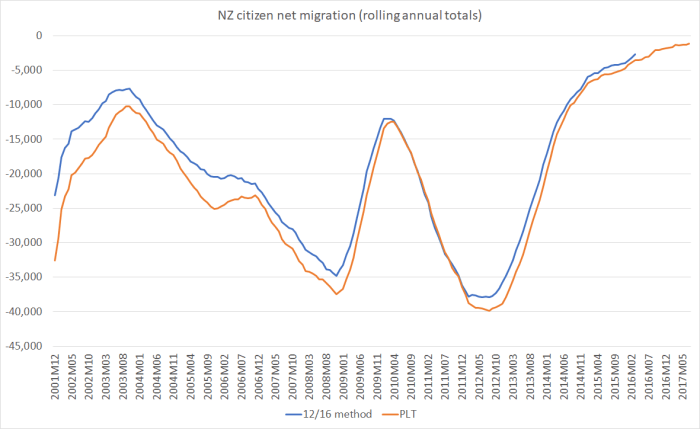
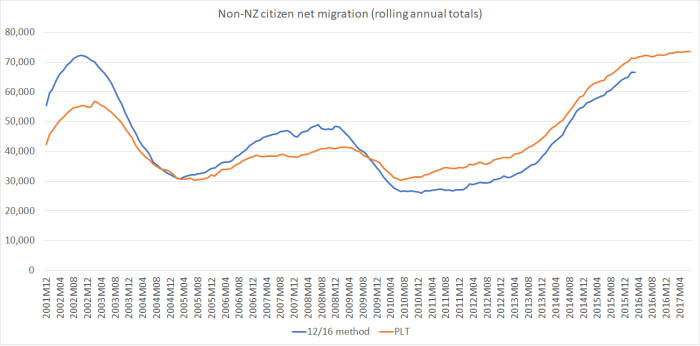
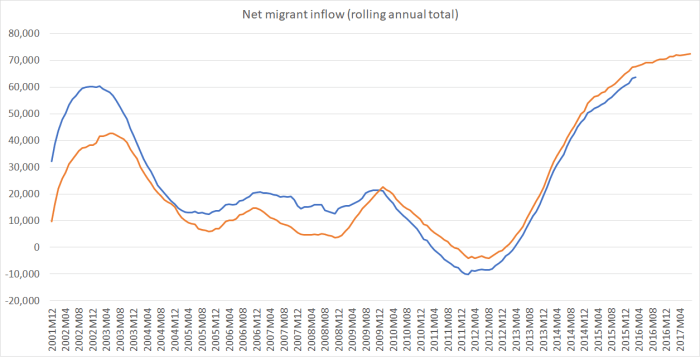
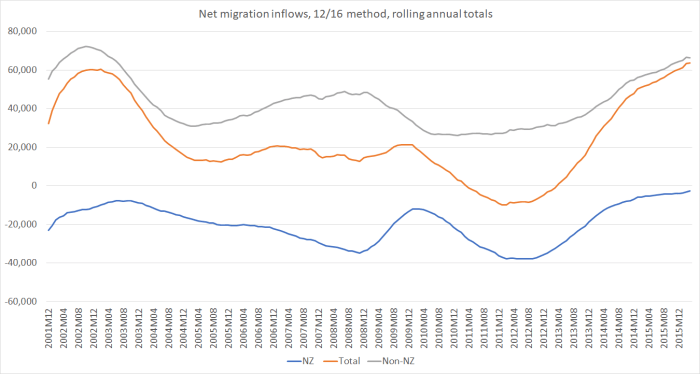
Recall that the headline writers focus on net permanent and long-term migration, calculated from the declared intentions of those (New Zealanders and foreigners) crossing the border.  If you are leaving and expect to be away for at least 12 months, or are a non-resident arriving and expect to be here for at least 12 months, you are in the PLT statistics.   Plans do change, but the new 12/16 data I wrote about a few weeks ago suggests that during the current cycle the PLT numbers have been capturing pretty well not just declared intentions but what actually happened.    In the year to June 2017, a net 72,305 people arrived as PLT migrants.   Just slightly more than that number of non-New Zealand citizens arrived, and 1284 New Zealanders (net) left.

PLT sept 17

As people often stress, a lot of the variance in the net PLT series is typically accounted for by changes in the choices of New Zealanders (net outflows have fluctuated between around 0 and around 40000, and there have been quite big fluctuations –  hard to predict –  every few years).  The choices of New Zealanders are not a matter of immigration policy.

But policy has pretty full control over the number of non-citizens arriving (Australians are allowed in without advance specific approval, although the numbers typically aren’t large).   And sometimes you will see this chart, which uses PLT arrivals data (gross, not net) to show what sort of visa people were on when they crossed the border as PLT arrivals (the “not applicables” are New Zealand and Australian citizens).

PLT arrivals by visa

But this chart doesn’t tell us anything much about immigration policy.  In the year to June 2017, 16711 people arrived on residence visas.  But during that year, MBIE granted 47331 residence visas, the overwhelming proportion to people who were already here (and who typically will have entered first on a student or work visa).  Perhaps it is worth noting, for all the talk of the success of the export education sector, by far the biggest increase in arrivals in recent years (absolute and percentage) has been in people with various types of work visas: around 24000 in the year to June 2012, and around 45000 in the year to June 2017.

If we want to look at immigration itself, it is much better to turn to the administrative data on the numbers of people approved for various classes of visas.  Unfortunately, unless you like playing with spreadsheets with half a million lines, MBIE only produce data annually, for June years, and the data for the year to June 2017 hasn’t yet been released.   Having said that, it doesn’t look as though there will have been big changes when the data do finally emerge.

Here are the numbers for visas granted to new workers under various policies (ie excluding renewals etc).

Number of new workers by policy
2011/12 2012/13 2013/14 2014/15 2015/16
Study to work 9,319 9,131 6,259 9,610 16,097
Essential skills 6,197 6,247 7,885 7,709 8,334
Work to residence 1,653 1,558 1,426 1,483 1,717

and there has been a big increase in the numbers granted working holiday visas

2011/12 2012/13 2013/14 2014/15 2015/16
Working holidays 41,561 47,168 53,131 59,742 63,230

Fortunately, Education New Zealand don’t seem to mind the half million line spreadsheets, and produce a nice monthly product on student visas.   Here is the chart of outstanding valid student visas by class of institution for the last few years.

vsv

Numbers are growing, but in the last year or two there has been quite a switch from private training enterprises (which will have included some of the more questionable institutions/courses) towards universities in particular).

What of residence approvals?  I did download the huge spreadsheet for that subset of the data to get an overview of the 2016/17 numbers.  Here are residence approvals in the last few years.

Number of residence visas approved
2011/12 2012/13 2013/14 2014/15 2015/16 2016/17
40,448 38,961 44,008 43,085 52,052 47331

Recall that (a) there is a “planning range” (in effect, a target) for the number of residence approvals granted. That range was 45000 to 50000 per annum, but was cut to 42500 to 47500 late last year.  Actual approvals fluctuate around the target, rather than being mechanically managed to meet it month by month or year by year.  The 2015/16 approvals were high, but the numbers have been cut somewhat in the most recent year.

Recall that most of those getting residence visas were already living here (on work, study, or related visas).

In terms of nationality, in 2015/16 these were the top source countries

China 9,360
India 8,498
United Kingdom 4,934
Philippines 4,614
South Africa 2,970
Fiji 2,230
Samoa 2,156
United States 1,288
South Korea 1,125

I didn’t calculate all the numbers for 2016/17, but the patterns looked pretty similar.

I hadn’t seen this data in the published MBIE summaries, but I was a little surprised to find that among the residence approvals 1937 were for people in a category of

Uncapped Family Sponsored Stream Dependant Child

These aren’t the children of principal applicants who are themselves getting residence visas (as those children are approved with the parents).   Around half of all these “dependent children” were Samoan, and of them 242 were aged 20-29, not typically what one thinks of when one hears of “dependent children”.   I’m not sure how or why such a policy exists, but when I get time I might have a dig around.

So that is the numbers.  Perhaps the key thing to keep in mind is that the residence approvals planning range –  the centrepiece of the immigration programme –  has been pretty stable for a long time (modest cut last year).  Much of the variability in the headline PLT numbers is New Zealanders, and most of the variability in the non-NZ net inflow relates to policy streams other than the residence approvals programme.

Of course, variability is only part of the picture.  The striking thing about the residence approvals programme is its sheer size: equivalent to almost 1 per cent of the population each year, and in per capita terms three times the size of the US “green card” issuance (under both recent administrations).   We have a very large number of legal temporary foreign workers here by international standards, but most of them will eventually go home.  What really marks us out is the size of the residence approvals programme –  bigger per capita than in almost any OECD country, and far bigger than most.   I’ve argued for cutting programme back to, say, 10000 to 15000 per annum (a similar size, per capita, to the US programme.)

As I’ve noted here previously, if one looks at the New Zealand First website there isn’t much specific on immigration policy.   Winston Peters has sometimes talked of lowering the annual inflow to something like 10000 to 15000, but quite what is meant by that hasn’t been clear.  Most naturally he may have wished to suggest a net PLT inflow of around those numbers.  If so, it would have to be treated as an average over time, since annual PLT flows are almost wholly unpredictable (given the variability in the net flow of New Zealanders).

Having said that, one could make some estimates of a trend net outflow of New Zealanders, likely to resume as the Australian labour market improves.   Assume that outflow is 20000 on average over the cycle (a bit less than in the past), and you might lower the residence approvals target to 30000 to 35000 per annum (the net of the two flows on average producing something like a 10000 to 15000 inflow per annum).  That doesn’t sound terribly radical, and frankly there looks to be plenty of room to (a) drop off the lower-skilled portion of the current approvals, while (b) removing the sort of absurd bureaucratic hassles really skilled people (eg the teachers profiled in the Herald the other day) can face.

One of the other, rather general, strands of New Zealand First’s immigration policy is

Ensure that there is effective labour market testing to ensure New Zealanders have first call on New Zealand jobs.

I’m sceptical of the practical means to do this, even if I’m somewhat sympathetic to the concerns that motivate it.  I don’t think bureaucrats should be trying to decide which job is really in excess demand, let alone try to reach Soviet-type judgements on which regions should be favoured, or whether wages for those particular skills should just be left to rise.  But in various recent presentations, I have included an option for reforming the work visas system (in addition to substantially tightening up on student work visas and post-study visas, for those with lower level qualifications)

Institute work visa provisions that are:

a) Capped in length of time (a single maximum term of three years, with at least a year overseas before any return on a subsequent work visa), and

b) Subject to a fee, of perhaps $20000 per annum or 20 per cent of the employee’s annual income (whichever is greater).   [To limit risks of exploitation, require the employer to prove that the employee has been paid at least $10000 above the mimimum wage, with no “fees”  allowed to be paid back to the employer or related entities.]

The key element is the second one.  If your firm really needs a highly-skilled person (surgeon, lawyer, CEO or whatever, earning say $200000 or more), and can’t find one on market in New Zealand, the annual fee is unlikely to be prohibitive given the key short-term such a person is like to be playing.   But, equally, there aren’t many of those sorts of people/roles, and many won’t want to stay here forever.  So I’d make it easy to recruit them, but with a strong emphasis (because the visa is non-renewable) on the need to identify a local permanent person.   At the bottom end of the labour market, if the business your firm is doing is really so valuable you can afford the $20000 annual fee on top of the annual salary, that might be a reasonable pointer to serious scarcity.  But it seems unlikely that we’d be granting many visas to lower-end chefs, or dairy workers, or aides in rest homes.  And that would, over time, be a good outcome for New Zealanders.


(And MBIE could you please please make the monthly data more easily available in an accessible format, as Statistics New Zealand and other agencies do.)


Investment data again highlight fundamental weaknesses

After an early morning with some boisterous visiting nieces and nephews, there is a certain calm retreat in getting back to some of the details of yesterday’s national accounts release.

I’ve written previously here about the investment numbers.  The state of investment spending is a useful, if never foolproof, indicator of the state of the economy.  Not so much in a mechanical adding-up sense –  a quarter of weak investment probably translates into a weaker quarter for GDP – as in the questions the data can pose about just what is going on more broadly, and the viable opportunities that businesses are finding, and taking up (or not), in New Zealand.

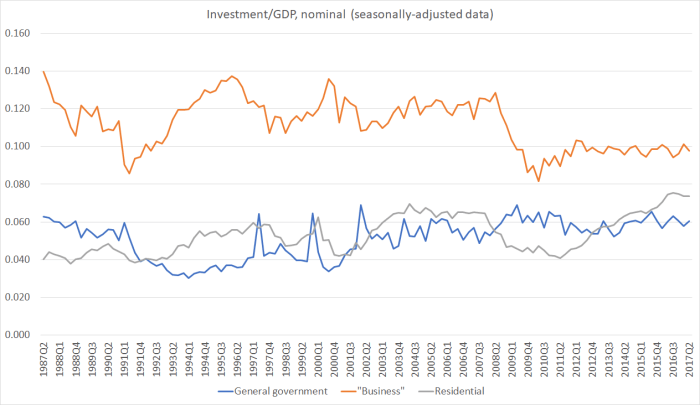
My typical starting point is a chart like this, breaking out investment spending into residential, government, and “business”.  (I put “business” in quote marks because, as the OECD does, it is calculated residually –  subtracting the other two components from total fixed capital formation.)

I shares of GDP june 17

Using quarterly data means living with a bit of “noise”, but not that much, and doing so enables us to see if there are any material changes emerging at the very end of the series.

I don’t want to say much about general government investment spending.   In recent years, that share has been averaging a bit higher than what we saw in, say, the five years before the last recession.  Then again, government (central and local) has faced significant post-earthquakes repair and rebuild expenditure, and the population growth on average over recent years has been a bit faster than that in the previous decade.  If anything, one might have expected the government investment share would have needed to be a bit higher still, at least given the range of functions governments currently take on,

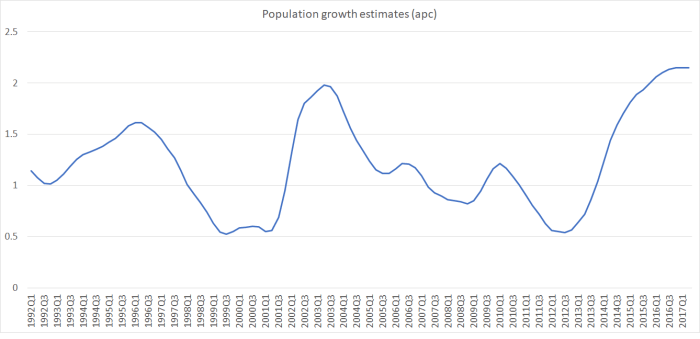
What of residential?   In nominal terms, residential investment spending (new builds and renovations etc) as a share of GDP is now just below the highest levels seen in the history of this series (and actually in the annual series which goes all the way back to the year to March 1972, thus capturing the peak of the building boom in the early 1970s).    Given the rapid rate of population growth –  a little higher, but lasting longer, than the growth rates 15 years ago –  one would expect to see a pretty high share of GDP being devoted to housebuilding and associated activities.   But you will notice that the residential line has fallen a bit in recent quarters, and consistent with that the volume of residential investment spending undertaken in the June quarter this year was about 1.4 per cent lower than such spending in the June quarter of last year.

popn growth apc

In this post, my main interest is in the business investment component (the orange line in the chart).  Strip out the modest quarter-to-quarter fluctuations up and down, and there has been no real change in the share of (nominal) GDP devoted to business investment for almost six years now.   Over the six years, business investment as a share of GDP has been materially lower (around 2 percentage points of GDP) than the average for the 15 years or so prior to the 2008/09 recession.    That is a big change.    And doubly so because of the sustained acceleration in the population growth rate in the last few years (and with it growth in the number of jobs).  Workers typically need capital equipment, even if it is nothing more than a laptop (and associated software) and a place to work.

Ratios of nominal investment spending to nominal GDP aren’t the only sensible way to look at things. In particular, in New Zealand a lot of capital equipment is imported (eg vehicles and most machinery, but not buildings themselves).  A high exchange rate –  such as we’ve had in recent years, but also had to a lesser extent in the last few years of the 2000s boom –  tends to lower the price (in NZD terms) of capital equipment.  The volume of business investment might still be growing quite rapidly, even if the nominal investment spending share of GDP is pretty weak  (of course, for tradables sector firms the high exchange rate is no gain –  capital equipment might be cheap, but the expected returns to any investment are also dampened).

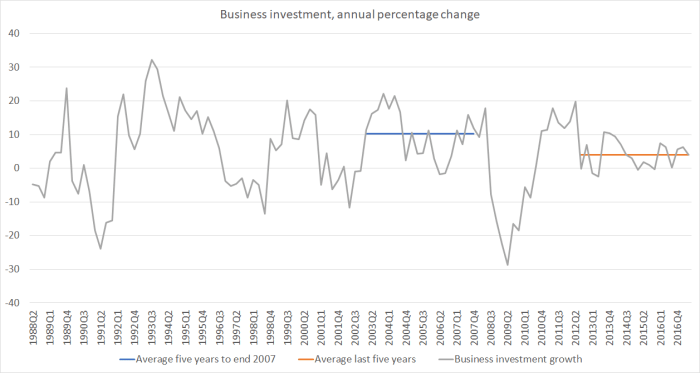
So here is a chart of the annual percentage change in real business investment.

bus i 2

The volume of business investment has been growing, but at a quite modest rate.  In the last five years of the previous previous boom, the annual growth rate was around 10 per cent per annum.  Over the last five years, the annual growth rate in the volume of busines investment has averaged only about 4 per cent (which also happens to have been the growth rate for the last year).

These pictures don’t really surprise me.  They are what one would have expected once one knew of (a) the magnitude of the damage caused by the earthquakes (from day one  at the Reserve Bank we knew this was a large non-tradables shock, which would skew activity away from business investment, especially in the tradables sector, for several years), and (b) the scale of the population increase.   Those pressures have helped hold our real exchange rate up so much and for so long, and reinforced the persistent large margin between our real interest rates and those abroad.  In that sort of environment, total business investment (share of GDP) is less than it otherwise would be, and –  although it isn’t able to be illustrated here –  what business investment does occur will be skewed away from tradables sectors.   Not even very high terms of trade levels were enough to counter-act the downward pressure on business investment growth, and monetary policy held tighter than it needed to be didn’t help either.

Looking back at that first chart, the weak and almost dead-flat business investment line was reminiscent of the productivity chart I showed yesterday.  It is also consistent with the weak export performance I wrote about last week.  The three indicators are causally related: business operating in, or which might have contemplated entering, the tradables sector, and thus taking on the world, simply haven’t been able to find sufficient attractive and remunerative opportunities.

The pressures associated with post-earthquake rebuild expenditure will wane, and probably already are.  But meanwhile, policy continues, year in and year out, to supercharge our rate of population growth, bringing in huge numbers of modestly skilled people, to a location where the successful opportunities for firms to take on the world with great products and services seem to be growing much more slowly than the number of people living here.  The flawed policy –  shared across both main parties and several of the minor ones –  just keeps making it harder than it needs to be for New Zealanders as a whole to get ahead.   Our immigration policy was crazy when lots of New Zealanders were leaving each year, but it is even more deeply problematic when the travails of Australia’s labour market mean that the outflow has (probably temporarily) largely ceased.


Immigration, the election, and shelf-stackers

Back in February I had coffee with a senior journalist, who was convinced that immigration was going to be a central issue in this year’s election campaign.  The journalist cited the Trump and Brexit phenomena, and I suppose at the time Geert Wilders and Marine le Pen were in the wind.   I was a bit sceptical.  I’d, mostly, have welcomed such a central place in the election campaign for what I regard as one of the key long-term failings in our economic policy settings.   But I didn’t really see any sign of a Trumpian insurgent – or a mood that was just waiting for such a person – or of the fascinating mix of motivations (immigration was only one) that had driven the Brexit vote.  But my interlocutor told me that political party focus groups were picking immigration up as a key issue, and suggested that the media need to attract readers would help fuel an intense focus on immigration.  I think there was a sense back then that National was in such a strong position in the polls that an issue like immigration would, as much as anything, be hyped to help keep things interesting.

As I say, I was sceptical –  although interested in the focus group snippet (which I later had confirmed by one MP).   We had dreadfully high house prices, and a dismal productivity (and exports) performance. High immigration has played a part in both those outcomes.  But those weren’t, it seemed to me, the sort of visceral dimensions that seemed to have played such a part in other countries: our last experience of terrorism was state-sponsored, by France; we don’t have problems with illegal immigration (some upsides to being a remote island), and we haven’t had problems with substantial Muslim immigration.  And for all my concerns about the mediocre quality of the skills of the median migrant, we’ve done less badly on that count that many other OECD countries (again, land borders and an explicit economic focus to the programme both help).

But now we are two days out from the election, and it is clear that immigration hasn’t played a particularly important role in the campaign at all.  New Zealand First –  which might have been a natural recipient of votes if there had been an upsurge in serious concerns –  looks as if it might end up with a smaller vote share than it had in 2014.   The government made some minor tweaks to immigration policy this year, on top of some other minor tweaks last year.   And Labour’s immigration policy didn’t involve much change –  outside the overseas student sector –  and hasn’t (at least that I’ve seen) had any pro-active place in their campaigning.   Oh, and the Greens’ leader ended up abjectly apologising to his base, casting slurs all round, for even having suggested last year a rational debate on the appropriate rate of immigration.

It is interesting to ponder why immigration hasn’t been a key issue.  After all, if one focuses (inappropriately, but as the headline writers do) on the PLT numbers there has been no abatement in the net inflow (whether of non-citizens –  the bit policy bears on –  or the reduced outflow of citizens).  And the “true” net inflow is almost as high, as a per cent of the population, as the previous peak 15 years ago, and it has run on for longer.

One reason is, presumably, the change in the political personalities.  At the start of the year, many thought the campaign might see Labour at or below the vote share it got in 2014, and New Zealand First and Greens perhaps both polling in the teens, and scrapping for second place in a possible left-led government.  Perhaps that might have been a climate in which Labour and New Zealand First in particular might have more prominently battled to capture those who were concerned about immigration-related issues.  But the “Jacinda effect” transformed that outlook and the campaign has mostly been like something from the old days: two big parties, with some minor players struggling for attention and coverage.    And although Labour has stuck with the immigration policy announced under Andrew Little, it is clear that Ardern has made a conscious choice to de-emphasise that policy, even though the focus of the proposed changes was on the deeply-flawed student market.

But I wonder whether some other factors aren’t at least as relevant among voters (and for all the talk of “leadership” a great deal of what politicians do is “followership”).   For one, house price inflation has abated in much of the country, and although house prices in Auckland remain sky-high they’ve gone roughly sideways for a year or so.    Quite why that has happened is still debated, but it isn’t because (a) the rate of growth of the number of people needing a roof over their head has slowed, or (b) because housebuilding in Auckland is now proceeding so rapidly that it has got ahead of population growth, or (c) because regulatory reforms have freed up land use sufficiently that peripheral section prices are now plummeting.     More plausibly, it is some mix of (a) rising domestic interest rates, (b) the tighter LVR controls the Reserve Bank put on last year, (c) tighter credit standards the banks themselves have established, under the influence of parents and of APRA, and (d) reduced capital outflows from China as the regime has tightened-up its controls.  But whatever the precise reason, it has taken much of intense heat out of the house price issue –  imagine if the opposition has still been able to repeat endlessly “house prices in Auckland are up another [x] per cent in just the last six months.   And with it, much of the heat around the immigration issue?

And the other reason –  one of the reasons I was sceptical of the political salience of the issue at present –  is the point I have been arguing for (and that previous generations of NZ economists recognised ) for years.  In the short-term, high and unexpected immigration adds more to demand in the economy than it does to supply.  In other words, it tends to boost economic activity –  measured or headline GDP for example –  and put more pressure on scarce resources.  Migrants don’t take jobs from locals, or add to unemployment; if anything, in the short to medium term, they add more to the demand for labour (all that capital stock that needs to be built) than to supply, and thus migration inflows tend to reduce unemployment.   The sugar-high is a real thing.  The effects might not last long, but when the dose is repeated each year for several in a row, it does have an effect.

There might have been no productivity growth at all for five years, but that sort of concept or measure doesn’t easily get much public resonance.  Exports might be shrinking as a share of GDP, as the need to build to cope with a rapidly-rising population crowds out the tradables sector……but it is a geeky macro statistic, and not one that anyone has successfully built a narrative around.  And perhaps people aren’t feeling good about their wages, but as I’ve noted recently, real wages have been rising consistently faster than productivity for some years now.  It is an unsustainable, unbalanced, mix, but it isn’t one that was ever going to capture the public imagination in any sort of “build a wall” way.  In the short-term, for those (most) with jobs things don’t seem too bad.  And even the Leader of Opposition has repeated on numerous occasions that the economy is doing fine.

And, of course, few of us want to be nasty about individual migrants (and of course, as I argue, the issue is New Zealand policy, not the rational choices of individuals), and no one wants to be subject to the dread “r-word” slur.

In many respects, I’ve long thought that the best environment for a serious public pushback against the out-of-step, failing, immigration policy we have run for a long time, is in the next severe downturn.  I wouldn’t welcome recessions – and remain concerned that the government and the Reserve Bank aren’t doing enough to prepare for the next one – but in a sense it is in periods when things are manifestly not going well that one is perhaps more likely to find a willingness to contemplate serious change in policy.  That’s a shame –  the best time (easiest adjustment) to make changes would be now, when the economic environment globally isn’t too bad –  but perhaps it is unavoidable, especially when (as above) we –  fortunately – don’t have the visceral issues around immigration that some other countries do.

Immigration policy did come up at the local candidates’ meeting last night.   The minor party representatives were predictable –  the Greens candidate was adamant that we “knew” that migrants benefited us economically, while on the other side the most entertaining TOP candidate –  whose opening speech was done in iambic pentameter – made the case for easier access for really skilled migrants, but for fewer migrants overall to ease the (claimed) downward pressure on wages.

Chris Finlayson repeated some of the serious misrepresentations that seem to characterise his party’s view.  We were told of the lots of New Zealanders who were coming back from Australia (when in the year to June 2017, a net 4678 New Zealanders left for Australia) and about how the immigration policy was bringing in the tradespeople wiuth the skills needed for, for example, the housebuilding.  I heard the PM repeat that line –  who will build the houses if we cut immigration – on Radio New Zealand yesterday: I would draw his attention, and that of his minister and local candidate to the data suggesting that the net immigration of building trades people is very small relative to (a) the actual increase in the construction workforce in recent years, and (b) to the total increase in the need for new housebuilding occasioned by the rapid increase in the population.   High immigration is worsening, not easing, those pressures.

But it was Labour candidate –  and near-certain winner –  Deputy Mayor, Paul Eagle whose comments on immigration really caught my attention.  He was obviously feeling on the defensive about the issue, and thus even though Labour’s actual policy proposals focus (numerically) mostly on fixing up some of the rorts around the student visa sector, he never mentioned that issue at all.  Instead, he wanted to stress that Labour welcomed immigration, and that we need immigration in some sectors.  It sounded fine, more or less, until he went on:  “Island Bay New World needs people”.   So can we take it that official Labour policy, enunciated by a candidate likely to be an MP for many years to come, is that we need immigration –  perhaps even more immigration –  so that the supermarket shelves get stacked?  What, I wondered, had we come to?  Once –  in MBIE”s words – a “critical economic enabler”, and now shelf stackers?

(And for anyone interested in some more observations from our Attorney-General, someone asked from the floor about Jim Bolger’s recent denunciation of “neo-liberalism”.  This senior minister got up and indicated he had talked to Bolger about what he had said, clarifying that he had meant the policies adopted by Labour and National governments between 1984 and 1993.  Finlayson himself went on to characterise that period as one of “extremist economic policies” concluding that “that ideology does not work, and we are not that sort of party”.  One brave member of the audience –  Island Bay is a pretty left-liberal sort of place –  called out “but none of it has been repealed has it?”        Was it floating the exchange rate, removing farm subsidies, removing trade protection, making credit available to ordinary people, lowering maximum marginal tax rates, ending fiscal deficits as a norm, putting in place a good GST, removing union monopolies, privatising state-owned business operating in competitive markets, or what……that the Attorney-General of an allegedly centre-right pro-market government regarded as “extremist”? )

Who will build the houses?

One of the Prime Minister’s campaign lines has been “who will build the houses?” if immigration numbers are cut back.   It is a curious line of argument, for a variety of reasons.

But it takes on a particular air of unreality when used –  as I heard in a debate last week –  to attack the Labour Party.    After all, Labour is campaigning on a policy that will (a) leave the current 45000 per annum residence approvals target unchanged, and (b) reduce students visa numbers quite substantially (resulting in a one-year reduction in the net PLT migration inflow).  On their own numbers, the changes they are proposing won’t make that much difference to the number of work visas issued, and where those numbers do change, the intention is to focus reductions at the lower-end of the skill spectrum.  (Their document is here, and my post on it is here.)   For what it is worth, Labour even proposes a Kiwibuild visa, designed to ensure that any reductions in work visa numbers don’t interrupt a flow of construction workers.

The student aspect aside (and even that isn’t part of the 100 day plan, although it isn’t that long until the new academic year starts), one might reasonably doubt whether Labour is serious at all about reducing ongoing immigration pressures.   Their policy, if implemented, won’t materially alter the net inflow over time. And I heard this morning an extended interview with Jacinda Ardern on Radio New Zealand in which she declared that she would have no problem at all with a net 70000 migration inflow per annum if only the houses were there, and actively endorsed some recent strongly pro-immigration comments made by Helen Clark.    Labour, like National, is still a “big New Zealand” party –  despite the economic damage that strategy has been doing over decades (remember how bad our productivity record has been) and will continue to do (ever more people and a heightened priority on improving water quality and meeting climate change targets is a recipe for severely undermining our productivity prospects.)

But this post isn’t about Labour’s proposals, but about (a) what has actually been happening over the last few years in the construction sector and related migrant inflows, and (b) more briefly, how the economy might adjust if there was to be a sustained material cut to target levels of non-citizen immigration.

In his weekly column in last Friday’s Herald, Brian Fallow touched on some of the first of those topics.  He went to the latest annual MBIE Migration Trends and Outlook publication (for the year to June 2016 –   MBIE could you please make data easily accessible on a more timely basis), looked at the data on who had been granted Essential Skills work visas in recent years, and concluded thus:

The conclusion has to be that the impact of net migration flows on the housing market and the construction industry is overwhelmingly on the demand, not the supply, side.

There has been a big increase in construction activity in New Zealand in the last few years.  Some of that is driven by the Christchurch repair and rebuild process, but increasingly the key influence has been the unexpectedly rapid growth in the population.  Each of those people needs a roof over their head.

And so employment in the construction sector has increased rapidly.    Here is the data from the HLFS, showing the percentage increase in people employed from calendar 2013 to calendar 2016 for each of the sectors employing more than 100000 people.

HLFS by sector

The construction sector has had by far the biggest increase in employment over the last three years.  Around 56000 more people were employed in construction in 2016 (on average) than in 2013 (the current total number of people employed in the sector is around 240000).

What contribution has non-citizen immigration (the bits our policy controls) made to this employment?

As Brian Fallow noted, on MBIE’s own numbers, this is how many Essential Skills visas were granted for construction trades and construction labouring roles in the year to June 2016.

And a startlingly low proportion – 7 per cent, or 2233 to be precise – were classified as construction trades workers like carpenters, plumbers, plasterers, tilers and painters. If you include scaffolders and builders’ labourers, the proportion rises to nearly 10 per cent.

And here are the corresponding figures for the previous couple of years.

Essential skills visas granted
2013/14 2014/15 2015/16
Construction trades workers 2090 2123 2233
Construction and mining labourers 399 546 831
Construction sub-total  2489  2669  

3064


Total 26502 28548 31766
Construction as % of total 9.4 9.3 9.6

Those might look like quite large numbers but:

  • at last report, construction jobs made up 9.3 per cent of all employment (and yet in this really rapidly growing sector only around that share of Essential Skills visas –  suggesting that immigration was hardly easing sector-specific pressures), and
  • as Brian Fallow also pointed out, most of these Essential Skills visas were being granted to people who were already in New Zealand (eg renewals).  Of 31766 Essential Skills visas granted in the year to 2016, only 8334 (or 26 per cent) were new workers (the proportions are similar in the earlier years).
  • people arriving and taking up first-time work visas need to be offset against people leaving.    In the three years I’m looking at here, MBIE tells us that the total stock of people here on essential skills visas increased by only 10062.   If the patterns were similar for construction jobs as for other roles, construction would account for about 1000 of that increase.

Of course, some people will have moved from work visas and obtained residence visas.  Based on the 2015/16 residence visa approvals numbers, that might have been around 450 people working in construction roles per annum.  Over three years, perhaps as much as 1500 people.

In other words, in a construction sector where total employment has increased by 56000 in three years, perhaps only 2500 (or less than 5 per cent) of that increase will have been met by the immigration of non-citizens.

So in that sense the answer to the Prime Minister’s question is easy.  Who will build the houses if immigration is cut back?  The same people who always overwhelmingly have, people who were already here.

But perhaps more importantly, if immigration were to be sharply cut back, the number of people needing accommodation would fall.  At one extreme, if the population is growing by 100000 per annum (as it has in the last couple of years), that suggests a “need” for around another 35000 houses each year (on top of the small number that would need replacing each year with a static population).  With net non-citizen migration at present in excess of 70000, the non-citizen immigrant flows alone create a “need” for perhaps 23000 additional houses each year.     Even if we go back to Brian Fallow’s original numbers of gross approvals of Essentials Skills visas, 3000 construction workers cannot build 23000 houses a year.   So the way immigration policy is actually being conducted it is exacerbating pressure on the construction industry, not relieving it.  That additional pressure is substantial.

(It needn’t be that way of course.  In the short-term immigration will almost always in increase economywide demand more than it increases supply.  But composition of the immigrants afffects where the pressures are most felt.  At the extreme, if all the migrants were builders (and related occupations), they’d probably just about keep up with the additional demand for housing (building, in effect, to house themselves).  Then the demand pressures would show up more severely in other sectors.    But when there is a big increase in the population, and hence in construction activity, immigration policy certainly isn’t relieving construction sector constraints when only around 10 per cent work visas are going to construction workers, when almost a quarter of the new jobs are in construction.)

So what would happen if, say, the 45000 residence approvals target was cut to, say, the 10000 to 15000 per annum I’ve been advocating (still, in per capita terms, around the rate of permanent approvals in the United States), and issuance of work visas was also tightened up, so that the stock of people on temporary work visas was no longer growing?

Overall, growth in domestic demand would weaken, and with it the pressure on domestic resources.  The notion that the short-run demand effects of immigration outweigh the supply effects shouldn’t really be controversial.  It has been that way in New Zealand for many decades.  But, given the huge scale of the pressures that new people put on the construction sector (not just houses, but roads, schools, offices, shops etc), and the fact that immigration policy as actually run has not seen us bring in many construction workers (10 per cent of the visas, when 25 per cent of the new jobs have been in construction), such a policy change would greatly ease resource pressures in the construction sector specifically.  In some other sectors it is quite conceivable that resource pressures could increase (one could think of export-oriented sectors such as tourism or dairying) if such an immigration policy change was made.  But on the construction side of things –  one of the most politically and economically pressing areas of our economy – the gains (the relief of pressure) would be substantial and almost immediate.  Not only would construction sector resource pressure ease, but land prices could also be expected to fall back to some extent (due to a reduction in expected future demand).

More generally, across the economy one would expect to see  interest rates falling (both market interest rates and the OCR) and with them the real exchange rate.    A lower real exchange rate would help secure the overdue resource-switching towards the tradable sectors. It would also provide the additional margin that would enable employers in those sectors to bid up wages to the extent required to attract existing residents to take up jobs in those sectors.    Plenty of people would be freed up from the construction sector –  a country with a modestly growing population wouldn’t have 10 per cent of total employment in construction –  and they’d be looking for jobs elsewhere.  Most of them would be long-term residents or citizens –  something we know with a high degree of confidence because the government’s own data tell us not many visas have been issued in recent years to people in construction, whether skilled workers or labourers.

But I guess the Labour Party can’t really use these arguments to push back against the Prime Minister because they aren’t actually planning a material and sustained reduction in non-citizen immigration at all.  That’s a shame.

(And if you wonder why all this discussion has used visa numbers up to June 2016, that is because MBIE only release more recent numbers in massive (600000 line) unwieldly spreadsheets.  It is possible that patterns in the last year have been a little different, but it seems unlikely –  given the similarity in each of the previous three years.  But debate would be better-informed, and more timely, if MBIE would make  timely data available in more readily accessible formats, as happens for almost all other important economic data released by Statistics New Zealand, the Reserve Bank or whoever.)


What’s happening to immigration data?

Back in May when Statistics New Zealand released the first results of their new 12/16 method of calculating net migration, based not on surveyed intentions, but on what travellers subsequently actually did, I was free with my praise.    The new data would provide a very useful, if lagged by at least 16 months, additional insight on what migrants were doing.  In particular, it offered richer insights on the activities of New Zealand citizens (we have administrative data on visa approvals etc for non-New Zealanders, but of course New Zealanders don’t need approval from our government to come and go).

But it seems that I should have been more suspicious.  This morning SNZ released the second wave of the data, bringing the data forward to March 2016 (for which they needed to be able to look at subsequent movements up to the end of July 2017).    That’s good, and the data are even available in a more user-friendly format than when they put the first release out.

But then there was this in the SNZ release

“With the pending removal of departure cards, developing the ‘12/16-month rule’ is a part of our work towards ensuring we can measure migration without depending on traveller cards,” population statistics senior manager Peter Dolan said.

“In the near future, the outcomes-based ‘12/16-month rule’ is expected to become a key component in how we determine the number of migrants in New Zealand.”

This is just astonishing.  Or perhaps not, but appalling anyway.  For a long time there has been a push  –  presumably from airlines and perhaps bureaucrats –  to get rid of arrival and departure cards.  I was involved from the Reserve Bank side in pushing back against an earlier initiative to dump them more years ago than I can now remember.     We pointed out the value of timely high frequency data on movements of people across the border ((tourists and migrants) for those doing macroeconomic policy and associated forecasting and analysis.    Bear in mind that New Zealand not only has some of the largest migration flows (in, out, and net) of any advanced economy, we also have among the most variable migration flows.  And cyclical fluctuations matter a lot when your job is cyclical stabilisation (ie monetary policy) –  let alone making sense of short-term developments in the housing market.   So you’d think it might be a high priority to have and keep high quality high frequency data.

And, as it is, we have some of the very best migration data in the world.   Being an island country, we have secure borders.  Being a remote set of islands, almost everyone arrives by air, at a handful of secure locations.  So it is easy to collect accurate data, and a pretty rich set of data, and to get it out pretty quickly  for forecasters, analysts, and even politicians to use.

I’ve explained here previously why the resulting PLT data has its limitations.   It isn’t a good basis to use to look at immigration policy itself.  Approvals data from MBIE is better for those purposes –  and would be better still if they made the information available in an accessible format on a more timely basis.     And the PLT data are based on self-reported intentions, and intentions aren’t always what people end up doing.  Some people think they are leaving permanently, and are back six months later, and vice versa..   But intentions data isn’t nothing either  (just as business surveys capture intentions/expectations and things don’t always turn out as they expect).    The patterns –  and especially the cyclical patterns, the turning points –  in the PLT data tend to match those in the (lagged) 12/16 data quite closely.

There are quite enough gaps (and long lags) in New Zealand economic data as it is –  monthly CPIs, monthly manufacturing data, quarterly income measure of GDP just for starters –  that I’m just stagggered that key economic agencies are apparently willing to let SNZ/Customs go ahead and consider dropping departure (and arrival?) cards.  Where are Treasury and the Reserve Bank on this?

How, specifically, does it matter?   Without departure or arrival cards we would, of course, still have immigration approvals data for most non-citizens (other than Australians).  In principle, they could be published weekly or monthly with just a day or two’s lag, and be available in quite accessible formats.  Since approvals lead actual arrivals, there is certainly useful information in those approvals numbers (it is just that they aren’t made easily available now).

We could presumably also have data on the total number of people crossing the border (gross and net) from passport scanning.   I’m not aware that those numbers are published at present, but they could be.  And presumably they could be broken down by nationality (or at least by the passport the person happened to be travelling on).    That would be useful –  relative to having no arrivals or departures data –  but not very.   If you look at total net arrivals or departures (or net) data it is enormously volatile, and thrown around things like Lions tours –  in other words, holidaymaker and other short-term visitor numbers swamp movements of migrants.   Using that data alone, we’d have no ability to pick turning points for some considerable time after the turn had already happened.

The gaps would be particularly serious for the movement of New Zealanders, and more than half the variability in the 12/16 measure of net migration has arisen from fluctuations in the movements of New Zealanders.  We would have no secure way of knowing if someone leaving was planning to be off for a week’s holiday, or intending to stay away for ever.  The 12/16 method would eventually tell us what they did –  but there is a lag of almost 18 months on the availability of that information.    And even if the new plan involves keeping arrival cards and only getting rid of departure cards, most of the variability in New Zealanders’ migration movements is in the numbers leaving, not the numbers arriving.

Less importantly, without the departure cards we would seem likely to lose the ability to analyse migration (including reflows outwards by migrants who become NZ citizens) by the birthplace of the migrant.

Perhaps someone has done a robust cost-benefit analysis on getting rid of departure (and arrival?) cards.  If so, I would be keen to see it, and particularly keen to see how the relevant officials have factored in the loss of some of world’s best migration data to macroeconomic monitoring and forecasting, in a country with some of the most volatile immigration flows in the advanced world (and not a great track record of getting monetary policy, or housing markets, right as it is).  And even if one sets aside the macroeconomic analysts interests, it is not as if net migration numbers are one of those issues of no political salience at all.  Put an 18 month lag on decent data, and you risk not silencing debate – which some might wish for – but allowing all sorts of misconceptions and concerns to flourish, which no one will be in a position to allay.  It would, frankly, seem crazy.    Immigration has a economic and political salience here which it might not have in a country with land borders and small permanent inflows/outflows.

In the report they released this morning, SNZ recognise that 17 month lags aren’t exactly ideal.   They say they have plans to try to come up with something better, but frankly they don’t seem that confident.

The analysis in this report shows the outcomes-based measure is better suited to estimating migration levels when accuracy is the primary concern. However, a 17-month wait for migration measures is not always appropriate. Stats NZ is prioritising work to address this.

Improving the timeliness of outcomes-based migration measures

The 12/16-month methodology of the outcomes-based migration measure will always carry a minimum associated lag of 17 months.

For this reason, Stats NZ is investigating methods and data sources for a more-accurate estimate of migration than the current PLT measure, but one that is also suitably timely.

These estimates will be generated through a probabilistic predictive model of traveller type (ie short-term traveller, or long-term migrant), based on available characteristics of travellers. Such a model will provide a provisional estimate of migration, which we can then revise (if required) as sufficient time passes for us to apply the outcomes-based measure. The migration statistics series will be extended to include both provisional and final estimates of migrant arrivals and departures.

What we are trying to model

A modelling approach needs to extract the small number of migrant movements from the very large number of overall border movements. For example in the year ending June 2017 there were:

  • 131,400 migrant arrivals, of 6.53 million arrivals (2.0 percent of all arrivals)
  • 59,100 migrant departures, of 6.46 million departures (0.9 percent of all departures).

This shows the imbalance of the traveller type present in the border movements. This highlights the considerable challenges that exist in achieving the required level of precision when estimating migration through a modelling approach.

In a country where migration flows matter, and fluctuate, as much as they do here, you might hope that they could show that they have techniques that would actually work before talk of eliminating departure cards got going.

Anyway, what do the latest wave of data actually show?    In these charts, I’m showing the 12/16 method and the PLT estimates for the various citizenship classes.

New Zealanders

nz citizens

The patterns are very similar (although the cumulative net outflow has been about 10 per cent smaller than the PLT numbers had suggested).  But, to reinforce the point above, the PLT data are an excellent indicator of cyclical fluctations in NZ citizen movements.  That is greatly jeopardised if departure cards are lost.

And here are non-citizen net migrant numbers.

non NZ citizens

There are, at times, big differences in the two series, but –  and this matters for macroeconomists –  the turning points are very much the same.  There is information in the PLT numbers relevant to, for example, the number of non-citizens likely to need a roof over their heads, and thus to housing market pressures.

The other thing I would note about this chart (and it is a point I’ve made previously) is that the net inflow of non-New Zealanders in the latest year for which we have this data (year to March 2016) is still less than the peak inflow in 2002.  And New Zealand’s population today is about 20 per cent larger than it was then.  In per capita terms, there are no record inflows (large certainly, but not record).

And here are the total net flows on the two measures

overall

They don’t match up perfectly –  one wouldn’t expect them to, and there is information even in the differences (eg what led people to change their plans) –  but no analyst would happily give up a series that provided a 17 month lead this (relatively) good on the 12/16 series.    (And, as above, in per capita terms the peak inflows look as though they will struggle to reach 2002 peaks-  albeit those peaks were shorter-lived).

And finally, here is just the 12/16 data.  Behold what SNZ would like you to consider as the official series.

12-16 method

It is good to have this data.  But, even together with the administrative approvals data, it can’t replace the PLT data.  If that goes –  if departure cards are dropped –  we risk a new, big, hole, in the New Zealand stock of statistics.


Reading a NZ economist supporting large-scale immigration

As much as I can, I try to read and engage with material that is supportive of New Zealand’s unusually open immigration policy.   One should learn by doing so, and in any case there is nothing gained by responding to straw men, or the weakest arguments people on the other side are making.

At present, supporters of our unusually open immigration policy hold all the levers of power, and dominate much of the media.   But what has surprised me over the years I’ve been thinking about these issues is how unpersuasive I find the pro-immigration material, perhaps especially that written in a New Zealand context.   I’m not sure whether dominating elite opinion for so long has meant they no longer put the effort in, or what.  But whatever the reason, I’ve expected stronger arguments and evidence –  in support of a policy now run for 25 years –  and haven’t found them.

At the start of the year –  in a document that they were quite open about being aimed at Winston Peters, and those who might be listening to him –  the New Zealand Initiative came out with a substantial publication, largely devoted to saying that there was really nothing to worry about: if they couldn’t demonstrate the economic gains to New Zealanders (a point they acknowledged) there were few or no downsides.   If there was a case for any refinements, it was very much at the margins.  I devoted a series of posts(captured in a collected document) to examining the case they’d made.    I remain surprised at the limited extent to which an institution run by economists engaged with the specifics of New Zealand’s longer-term economic (under)performance.

A month or two ago, BWB Texts published Fair Borders? Migration Policy in the Twenty-First Century , a collection of chapters by various New Zealand authors (mostly, it would seem, of a left-liberal persuasion).  I wrote earlier about the chapter on a particularly unusual feature of the New Zealand system: we are the only country with any material amount of immigration (and one of only a handful in total) allowing people to vote if they’d resided here for just a year.

But my main focus is on the economic perspectives, both because that is my own background, and because successive governments have sold the immigration programme primarily as a tool to improve New Zealand’s economic performance and the economic outcomes of New Zealanders.   One doesn’t see it any more, but MBIE used to call the immigration programme a “critical economic enabler” .

And in Fair Borders there is a chapter on the economics of immigration, headed “International Migration: The Great Trade-Off”.   The author is Hautahi Kingi, a young New Zealander –  with a fascinating back story, that left me disquieted about aspects of our system –  who has recently completed a PhD on the ‘macroeconomics effects of migration’ at Cornell, and now works for a consulting company in Washington DC.

He begins his chapter in praise of migration –  not just something good, but something “central to human experience” –  harking back to some mythical day when humans were free to wander savannahs and steppes, constrained only by wild animals, unfamiliar climate, and hostile people who were already there, but not by official border guards.

As he notes, actually, 95 per cent of people live in their country of birth.  Probably a fairly high percentage live within 100 miles of where they were born.   Given this, Kingi concedes,

immigration policies have the potential to transform not just our economies, but the structure of our societies and institutions.

Which is, of course, part of what many people worry about.  Societies and institutions exist as they are for good reasons.    G K Chesterton had some wise cautions to those who happily lay into such institutions.

Kingi continues “by definition, international migration is a global issue”.  Well, I suppose so, in that for any international migration to occur at least two countries are involved.  But there is no necessary reason why immigration policy should be considered a global issue at all.   It isn’t like issues around pollution or climate change.  And few countries do treat it as an international issue.  They make immigration policy, as they seek to make policy in most other areas of governments, primarily in the interests of their own citizens/voters.

Kingi’s first main section is about what he describes as “the global perspective”.   He is pretty persuaded by the papers which seek to show that if only all countries opened their borders and people could move wherever they wanted there would be a massive – perhaps 100 per cent –  increase in world GDP.  In his words “from a global income perspective, no other policy offers anything remotely as appealing”.

But, in fact, he doesn’t make much of a case.  Sure, open migration would beat out foreign aid –  the alternative policy he quotes – as a means to lift average incomes.  But whoever supposed that most foreign aid ever did much good –  Peter Bauer was writing about this stuff decades ago –  or that much of it wasn’t more about foreign policy (cultivating relationships with foreign governments) than about lifting living standards in recipient countries.     Free trade in goods and services does much more than foreign aid.

Perhaps more importantly, surely the most compelling and effective means to lift living standards en masse is for countries to adopt growth-friendly policies and institutitions.  China is the most obvious example in recent decades.   They have a long way to go –  on both policies and outcomes –  to get to First World living standards, but what they have achieved in recent decades is transformative, and obvious.  And for hundreds of millions of people.

Unfortunately Kingi –  and many of the libertarians who also run such arguments –  end up running a latter-day version of the line one used to hear decades ago from people on the dripping-wet left wing side of economic debates: the poor are poor because the rich are rich.    To a first approximation, it is simply false.    People in New Zealand, or the UK, or France, or Denmark aren’t rich because we won some lottery, or just got lucky, but because our ancestors developed, and we maintain, cultures and institutions that develop and maintain a high level of productive capability (encouraging and rewarding people for investing in human and other forms of capital).   Sadly, too many other countries have failed to do so.   (The need to work hard to maintain such cultures is part of why I think Oliver Hartwich’s Herald op-ed today is profoundly wrong: character matters greatly.)

It is not as if change is imposssible –  look at the convergence achieved in recent decades by a handful of east Asian countries.  It is not as if our relative position is immutable either –  not 1000 years ago, China was well ahead.   But prosperity, en masse, is mostly about the institutions, broadly defined, that societies develop and maintain.  Doing so is hard work.

Are there exceptions?  Well, yes of course.  In our age, if you don’t have too many people, and you do have lots of oil and gas, your people can be very rich, even without many of the supporting institutions that otherwise seem to be required.  But those are windfalls, in a sense achieved by free-riding on the gains –  demand and technology – developed elsewhere.

Generally, even if individuals might feel themselves lucky or unlucky, societies –  and all of us exist within societies – aren’t lucky or unlucky: they are the product of successive generations of choices.   Immigration restrictions don’t “elongate the misery” of poor countries: the choices of those societies are primarily what have that effect.

Can one import prosperity?  To some extent one can.  After all, New Zealand (and Australia and the like) are examples.  Material living standards weren’t high for indigenous people pre-colonalisation.  But New Zealand and similar countries had lots of land, a temperate climate, and by importing not just lots of people from the then most advanced economic culture (and all the legal and associated institutions), something a bit like Europe was created here.   Maori shared –  perhaps to a lesser extent than might have been desirable –  in the prosperity that was created here.   But –  and these are Kingi’s words – “movement of people entails movement of culture and norms”.    A New Zealand that was once largely the place of Maori isn’t really so any longer.

But that 19th century example –  that transformed Australia, New Zealand, Canada, Argentina, Uruguay, Chile, and US –  isn’t really relevant to New Zealand’s situation now.  Even if we wanted to engage in such a mass transplantation, there is no economic culture hugely more advanced than what we already have.

So Kingi’s focus is the other way round –  it is on the gains to migrants from being able to shift from poor countries to rich countries.  There is no doubt that, for individuals at the margin they are considerable –  it is why we see foreign students willing to pay $40000 for a job in New Zealand, with the aim of qualifying for a New Zealand residence visa.

But the staggering gains in the papers Kingi cites don’t result from quite modest flows, but from “massive” movements of people.  In his words “movement of people entails movement of culture and norms” –  and if those effects are small for modest migration flows, they are likely to be substantial for “massive” movements.  In the long-run, migrants import their own economic destiny –  just as we (descendants of the 19th century migrants from the UK) did.   And if poor migrants in large numbers ultimately bring their own cultures and institutions, it is most unlikely that in the long run they’d be better off here to anything like the extent the academic papers suggest.  After all, geographic New Zealand is no better intrinsically suited to economic prosperity for lots of people than many other parts of the world –  arguably (or so I’ve argued) our remoteness makes us less so.

Strangely, Kingi’s poster-child example of large scale immigration is the Gulf Cooperation Countries, such as Qatar and Kuwait.  86 per cent of Qatar’s population is made up of migrants. Qatar has probably the highest GDP per capita in the world.  It is obviously appealing to the poor migrants, who keep coming, but I’m not sure why Kingi regards it as a remotely appealing basis on which to sell mass migration to New Zealanders.   For a start, these are classic states with massive natural resources and (originally very few people).  It is no surprise that there are windfall gains that could be spread around.   But as even Kingi acknowledges, the exploitation of lowly-skilled foreign labour in countries like this is appalling (even if one wants to engage in economists’ talk of both sides benefiting or it wouldn’t happen).  It simply isn’t how we would want a society to be structured.  And although he notes that this large scale migration goes on without causing any great domestic political problems, (a) the migrants have few rights, and no political rights (even fewer typically than the natives), and (b) these are societies not exactly known for freedom of speech, freedom of the press and the like,  And, sadly, slavery –  or its modern equivalent –  can look quite appealing to the slaveholders and those who benefit from the practice.   It remains morally repulsive.

If you’d only got this far in Kingi’s chapter, you might suppose he was an out-and-out advocate of open borders and free migration, here and everywhere.     But it is here that he gets more interesting.  Note the trade-off in his chapter title, and he seems to recognise that whatever large scale migration might do for the migrants, it could well harm at least some natives.  I think he gives a fair account of the international debate about the impact of immigration on the wages of lowly-skilled natives

Although this debate continues unresolved in academia, it is at leasr conceivable that immigrants may negatively affect those native workers with whom they compete most closely for jobs.  The experience of globalisation in recent decades should teach us to take this potential concern very seriously.

He looks to reconcile what he sees a a global imperative to allow high immigration (generally) with the risk of harm to vulnerable natives, favouring better-educated migrants.

But as notes, immigration is’t just an economic issue.  And here too he seems torn.  He’s a paid-up member of those who “embrace multi-culturalism as a cherished part of progressive society” and yet recognises that “mass migration” can have a ‘potentially corrosive effect on that society”.    But as I say, he is torn.

When people cross borders, so do their cultures and norms, and we are almost always richer and stronger for it.

But

more diverse societies also tend to reduce the provision of public goods and erode support for the welfare state

Unlike some libertarians, that erosion of support for the welfare state seems to be a bad thing for Kingi.

and

[ethnic divisions] can severely undermine the social institutions sustaining an economy because, despite the assurances of modern legal systems, “virtually every commerical transaction has within itself an element of trust”

He notes

The impact of immigration on a country’s social fabric can be an uncomfortable issue to discuss because it forces us to acknowledge and confront lamentable tribal aspects of human frailty.

Institutions and societies evolve to cope with human fraility –  aka “reality”.

And almost in passing he notes a Maori dimension

modern Aotearoa was founded on the principle that tangata whenua have rights to their culture that should not be overridden by settlers.  At the heart of the critique against colonialism is a concern for the enforced erosion of culture.

Kingi sets out the concluding section of his chapter with the proposition that there is a moral dilemma between the global and domestic perspectives.

by restricting the entry of foreigners…we effectively accept the substantial inequality outside our borders in order to protect the veneer of equality within.

You can see where his economist instincts lie.  But he is simply wrong about the trade-off, at least once large numbers of people are involved.  Societies make, and sustain, their own destinies.   He argues that

migration is, and always has been, the best tool for reducing suffering  in our world

But demonstrably that isn’t so.  Europe didn’t get rich on the back of migration –  even if the 19th century outflows helped them a bit.  China didn’t lead the world –  and recover its standing in the last 40 years –  on the back of migration.   Perhaps some libertarians wish it were otherwise, but migration –  country to country –  has always been a distinctly minority experience.   It lifts prospects for relatively small numbers –  if the people of North America are generally richer than the countries of their ancestors, people of South American typically aren’t.  Rising prosperity, reduced poverty, mostly result from choices, conscious or unconscious, that societies make about how to organise and discipline themselves.

I’m not sure quite where Kingi himself ends up.  His chapter is strikingly high level, and despite being in a book focused on New Zealand hardly engages with the New Zealand economic experience (or New Zealand social/cultural issues) at all.  It certainly doesn’t recognise how unusually large New Zealand’s residence approvals programme is by modern international standards.

Perhaps when Kingi ends this way

While international migration represents a life-changing opportunity for many, it also threatens the livelihoods of others and strikes to the core of our societies by changing their structure, their jobs, their culture, their appearance

he is still working his way towards a policy prescription for modern New Zealand.

As part of Radio New Zealand’s recent podcast series on New Zealand immigration, Kingi and I did a series of email exchanges on these issues –  me as the sceptic and Kingi as the supporter.  Radio New Zealand tells me that the series of letters was well-received by readers,  in part for the very different angles they present on the economic issues.  I want to come back to that exchange, perhaps next week, to elaborate on some of the key points we each chose to make when confronted with the other’s arguments, under pretty tight word limits.


A fresher approach for ordinary New Zealanders

I’m as fascinated by the rise of Jacinda Ardern as any other political junkie.  I’ve always been a bit puzzled, struggling to see what issue she has led or what blows she had managed to land on the government.    Then again, she seems to have something different –  perhaps even more electorally important.   I’ve been dipping into accounts of Bob Hawke’s rise –  the last case I’m aware of that where major opposition party changed leaders close to an election (in that case only four weeks out) and won.     It isn’t clear that Bob Hawke was a better Prime Minister than Bill Hayden might have been, or that David Lange was a better Prime Minister than Bill Rowling would have been, but in both cases the new leaders had something –  a degree of connection, engagement etc –  that the deposed leaders didn’t.     Reading the accounts of the last weeks of Bill Hayden’s leadership of the ALP, the party had become as disheartened and lacking belief in its own ability to win (despite still leading in the polls), as some suggest the New Zealand Labour Party had become.    Quite what the Ardern phenomenon amounts to I guess we’ll see over the next few weeks.  From her comments so far, I could imagine her campaigning as Hawke did –  both the upbeat theme of “reconciliation”, and the more cynical description in (sympathetic) leading Australian journalist Paul Kelly’s book “no avenue of vote-buying or economic expansion was left untouched”.

For now, we are told that the “Fresh Approach” slogan is apparently out, and a new slogan and some new policies are soon to be launched.  Since no party really seemed to be campaigning on policies that might make a real and decisive for ordinary New Zealanders’ prospects, in many respect a fresher approach should be welcome.  Of course, it rather depends what is in that policy mix.

My interests here are primarily economic.  In an interview with the Dominion-Post this morning, the journalist put it to Ardern that “National will campaign on its economic record. Is that where Labour is weak?”.     Perhaps it is Labour’s weak point.  But what sort of “record” is the government to campaign on?  An unemployment rate that, while inching down, has been above the level it was when they took office –  already almost a year into a recession –  every single quarter of their entire term?  An economy that has had no productivity growth for almost five years?     House prices that, in our largest city, have gone through the roof?  Exports that are shrinking as a share of GDP?    And, at best, anaemic per capita real GDP growth?   If it is a weakness for Labour, it must be in large part because (a) their messaging has been terrible, and (b) nothing they offer seems likely to make any very decisive difference to the mass of ordinary New Zealanders.

What might?   Here’s my list of three main sets of proposals.    An effective confident radical Labour Party could offer the public these sorts of measures –  in fact, on some points arguably only a left-wing party could effectively do so (Nixon to China, and all that).

  1. A serious commitment to cheap urban land and much lower construction costs.
    • In a country with abundant land, urban land prices are simply scandalous.   The system is rigged, intentionally or not, against the young and the poor, those just starting out.  Too many of Jacinda Ardern’s own generation simply cannot afford to buy a house.
    • To the extent that there are poverty and inequality issues in New Zealand, many of them increasingly trace back to the shocking unaffordability of decent housing.   With interest rates at record lows, housing should never have been cheaper or easier to put in place.
    • And yet instead of committing to get land and house prices down again, the Labour Party has been reluctant to go beyond talk of stabilising at current levels.  Talk about entrenching disadvantage……(and advantage).
    • It is fine to talk about the government building lots of houses, but the bigger –  and more fundamental –  issue is land prices.  It is outrageous, and should be shameful, for people to be talking of “affordable” houses of $500000, $600000 or even more, in a country of such modest incomes.  International experience shows one can have, sustainably, quite different –  much better –  outcomes, but only if the land market is substantially deregulated.
    • I don’t have any problem if people want to live in denser cities –  I suspect mostly they don’t –  but it is much easier and quicker to remove the boundaries on physical expansion of cities (while putting in place measure for the associated infrastructure).   Labour’s policy documents have talked of moves in this direction –  as National’s used to do –  but it is never a line that has been heard from the party leader.     If –  as I propose –  population growth is cut right back, there won’t be much more rapid expansion of cities, but make the legislative and regulatory changes, and choice and competition will quickly collapse the price of much urban, and potentially developable, land.
    • It is clear that there is also something deeply amiss with our construction products market –  no one seriously disputes that basic building products are much more expensive here than in Australia or the US.  Make a firm commitment to fix this.  Perhaps it involves Commerce Commission interventions (supported by new legislation?)?  Perhaps it might even involve –  somewhat heretically –  a government entity entering the market directly.     But commit to change, to producing something far better for New Zealanders.
    • The vision should be one in which house+land prices are quickly –  not over 20 years –  headed back to something around three times income.  A much better prospect for the next generation.
    • No one will much care about rental property owners who might lose in this transition –  they bought a business, took a risk, and it didn’t pay off.  That is what happens when regulated industries are reformed and freed up.    It isn’t credible –  and arguably isn’t fair –  that existing owner-occupiers (especially those who just happened to buy in the last five years) should bear all the losses.   Compensation isn’t ideal but even the libertarians at the New Zealand Initiative recognise that sometimes it can be the path to enabling vital reforms to occur.  So promise a scheme in which, say, owner-occupiers selling within 10 years of purchase at less than, say, 75 per cent of what they paid for a house, could claim half of any additional losses back from the government (up to a maximum of say $100000).  It would be expensive but (a) the costs would spread over multiple years, and (b) who wants to pretend that the current disastrous housing market isn’t costly in all sorts of fiscal (accommodation supplements) and non-fiscal ways.
  2. Deep cuts in taxes on business and capital income
    • the political tide is running the other way on this one –  calls for increased taxes on foreign multi-nationals and so on –   but it remains straightforwardly true that taxes on business activity are borne primarily not by “the rich”, but by workers, in the form of lower incomes than otherwise.  So if you really care about New Zealand workers’ prospects, cut those taxes, deeply.
    • and one of the bigger presenting symptoms of New Zealand’s economic problems is relatively low levels of business investment.   Taxes aren’t the only thing businesses  –  and owners of capital  –  think about, but they are almost pure cost.   Tax a discretionary activity and you’ll get a lot less of it.   That is especially true as regard foreign investment –  those owners of foreign capital have no need to be here if the after-tax returns aren’t great.  For all the (mostly misplaced) concerns about sovereignty, foreign investment benefits New Zealanders –  ordinary working New Zealanders.     Cut the tax rates on such activity  –  they are already higher than in most advanced countries –  and you’ll see more of it taking place.    More investment, and higher labour productivity, translates into meaningful prospects of much higher on-market wages –  the sorts of wages they have in the advanced countries we were once richer than.
    • simply cutting the company tax rate will make a material difference to potential foreign investors.   It won’t make much difference for New Zealanders’ looking to build or expand businesses here, because of our imputation system    That’s why I’ve argued previously for adopting a Nordic system of income taxation  –  in which capital income is taxed at a lower rate than labour income.  Note the description –  it is a system not run in some non-existent libertarian “paradise” but in those bastions of social democracy, the Nordic countries.  Not because they want to advantage owners of capital over providers of labour, but because the recognise the well-established economic proposition that taxes on capital are mostly borne in the former of lower returns to labour.
    • some argue against cuts to business taxes on the grounds that it will provide a windfall to firms (especially foreign firms) already operating here.  Mostly, that is false.  It might be true if foreign firms dominated our tradables sector –  where product selling prices are set internationally.  But in New Zealand, foreign investment is much more important in the non-tradables sectors.  Cut taxes on, say, the banks, and you’ll find the gains being competed away, flowing back to New Zealand firms and households in lower fees and interest margins.  If for some reason it doesn’t happen, feel free to invoke the Commerce Commission (and/or expand its powers).
    • much lower business taxes should be a no-brainer for an intellectually self-confident centre-left party serious about doing something about long-term economic underperformance and lifting medium-term returns to labour.     I’m not really a fan of capital gains taxes, but if you need political cover promise a well-designed CGT –  it probably won’t do much harm, especially if you take seriously the goal of delivering much cheaper houses and urban land (see above –  there won’t be many housing capital gains for a long time).
  3. Deep cuts to target levels of non-citizen immigration
    • This item might be entirely predictable from me, but it is no less important for that.    Labour started out with some rhetoric along these lines, but as I’ve noted previously what they actually came out with was a damp squib, that would change very little beyond a year or so.   So
      • Cut the number of annual residence approvals to 10000 to 15000 per annum –  the same rate, per capita, as in Barack Obama’s (or George Bush’s) United States,
      • Remove the existing rights of foreign students to work in New Zealand while studying here.
      • Institute work visa provisions that are  (a) capped in length of time (a single maximum term of three years, with at least a year overseas before any return on a subsequent work visa) and (b) subject to a fee, of perhaps $20000 per annum or 20 per cent of the employee’s annual income (whichever is greater).
    • In substance, you will be putting the interests of New Zealanders first, but you will also strongly give that impression –  a good feature if you are serious about lifting sustained economic performance, while being relentlessly positive about it, and about your aspirations for New Zealanders.
    • Change in this area would immediately take a fair degree of pressure off house prices, working together with the structural housing/land market reforms (see above) to quickly produce much much more affordable houses and land.  Markets trade on expectations –  land markets too.
    • You’ll also very quickly alter the trajectory of urban congestion –  those big numbers NZIER produced in a report earlier this week.
    • But much more importantly in the longer-term, you’ll be markedly reducing the pressures that give us persistently the highest real interest rates in the advanced world, and
    • In doing so you’ll remove a lot of pressure from the exchange rate.  Lets say the OCR was able to be reduced to around typical advanced country levels (say 0.25 per cent at present).  In that world, the NZD offers no great attraction to foreign (or NZ institutional) holders – it is just one of many reasonably well-governed countries, offering rather low interest rates.  In that world, why won’t the exchange rate be averaging 20 per cent (or more) lower than it is now?
    • And that should be an adjustment to be embraced.  Sure, it will make overseas holidays and Amazon books etc more expensive, but in sense that is part of the point.  We need a rebalanced economy, better-positioned for firms to take on the world from here.  Combine a lower exchange rate, lower interest rates, and lower business tax rates, and you’ll see a lot more investment occurring –  and firms successfully selling more stuff internationally.  And with more investment will come the opportunities for sustainably higher wages –  and all the good stuff the centre-left parties like to do with the fiscal fruits of growth.

I don’t suppose anything like this will actually be part of the fresher approach.  But if it were……we could really look forward to a better, more prosperous, and a fairer New Zealand.