Championing high immigration

The strongly pro-immigration political and business establishment must have been very grateful to the proprietors of the Herald for making so much space available for lengthy unpaid advertorials for high –  perhaps even higher – rates of immigration to New Zealand.  They even provided a journalist to write these paeans.

First, there was a double-page spread in Friday’s newspaper and then yesterday there was a further gung-ho column (under the heading “New Zealand leading the way on immigration debate”), both by Liam Dann.  When I saw yesterday’s column my first reaction was “yes, and the Pied Piper of Hamelin also found followers –  much good it did them”.

The double-page spread on Friday purported to be journalism: Dann had gone out and talked to various people, but every single one of them seemed to be either keen on high rates of immigration to New Zealand or wanting even more (wanting rules changed to be even more employer-friendly).  He even gave an uncritical platform for Statistics New Zealand, the agency which –  unable to conduct a competent Census – has now delivered us permanent and long-term net migration data that is so bad (in the short-term) that even the Reserve Bank the other day indicated that they were now reduced to forecasting flows starting nine months prior to the publication date of their forecasts (whereas previously they had good indicative data available on a timely basis).

Much of the initial story seemed to be built around a premise that the parties in government had not delivered on promises to lower net migration.     But then whenever he has been in government Winston Peters has never done anything material to make a difference to immigration numbers.   There is no sign he has ever regarded the issue as particularly important.  And, if you check out their 2017 manifesto they didn’t make such promises then either –  there was, for example, no suggestion of cutting residence approvals numbers.  Sure there was some loose talk of net migration numbers falling, but then official forecasts (eg those by the Treasury or the Reserve Bank) also had large cyclical falls projected back then.

What about Labour?   Despite attempts to suggest otherwise, they did not promise to reduce the net migration inflow by 25000 to 30000 per annum.   I wrote about their immigration policy proposals here, prior to the election.   What Labour promised was a series of changes around study and temporary work visas which, if implemented, might have had the effect of reducing the net inflow by those sort of numbers, for one year only.   Nothing Labour proposed would have affected residence approvals numbers at all, and thus nothing would have affected the projected net inflow over, say, a 5 to 10 year period.

Of course, none of this is to deny that both Labour (at least under Andrew Little) and New Zealand First might have been happy to try to create the impression that things would be materially different under them.  But nothing they promised would ever have done so, and (unsurprisingly) nothing they have delivered has.

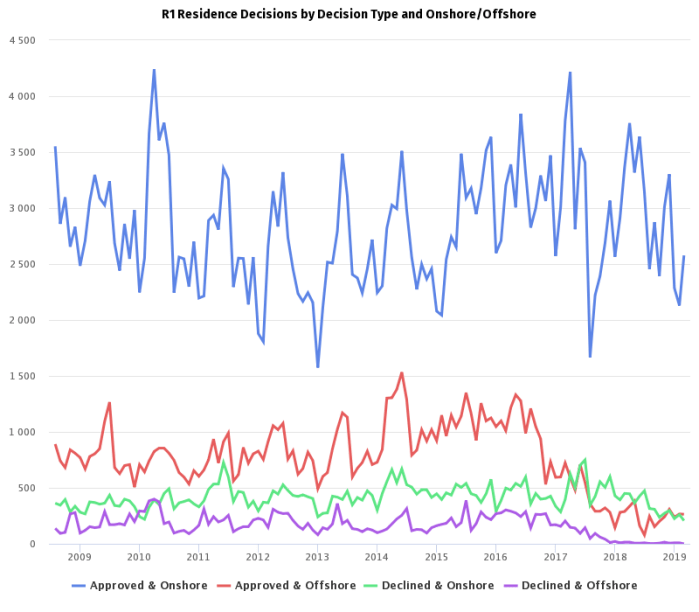
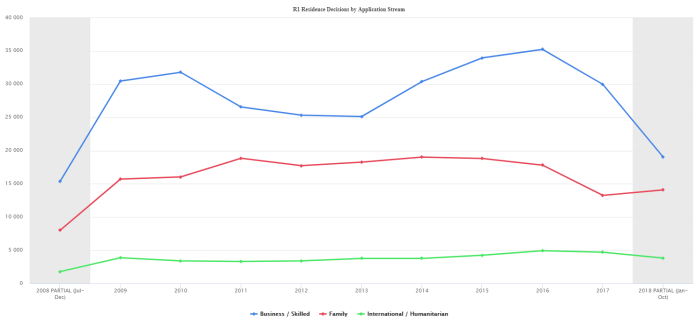
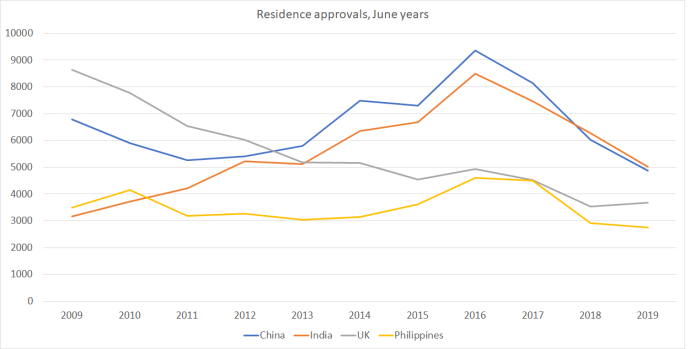
And yet, amid all the breathless gung-ho stuff in the article, there is no mention at all of the substantial decline in the number of residence approvals granted over the last couple of years, no mention of the recent cut in the target rate of residence approvals, and nothing about the plans the government is now working on to managed residence approvals streams differently in future.  For anyone interested, I wrote about them here last week.

There are lots of small points I could pick up on.  There was the weird statement that “policy plans and population outlooks continue to assume that New Zealand’s net migration will fall back into negative territory”, which simply isn’t true: neither SNZ population projections, nor (say) Reserve Bank or Treasury forecasts assume the net flow turns negative, just that it slows.   Or the odd comparison that noted that our peak population growth rate (in 2017) “was more in line with sub-Saharan African countries like Sierra Leone” than with other advanced countries –  which might have made for some interesting comparisons (eg around economic performance) but was just left hanging.

But I was more interested in two lines in Friday’s article.  First, we had the prominent and doughty academic champion of high rates of immigration, Massey’s Paul Spoonley. who ran this line

More recently we’ve seen issues such as Auckland property prices and the Crafar farms sale. “There are distinct issues that trigger highly negative responses,” says Spoonley.

“What equalises that is the positive economic story and a relatively strong understanding of the role migration plays in that.

“We came through the GFC quite well and have done relatively well since … and what is important in that is the contribution that migration makes.”

I guess if you repeat nonsense often enough some people will believe you.  As a reminder:

  • New Zealand’s economic performance is among the very worst in the OECD, whether one looks back 70 years (about what the post-war immigration surge got going), 50 years, or 30 years,
  • There was nothing particularly attractive about New Zealand’s record in the (so-called) GFC, at least if one compares us to other countries with similar sorts of economic management (floating exchange rate, own monetary policy etc),
  • And, as even the economists who will champion New Zealand immigration policy will concede, there is no evidence specific to New Zealand that our immigration policy –  the most aggressive in the OECD over the last two decades –  has contributed to (an imaginery) economic success, or even mitigated our relative failure.

As for the most recent wave of immigration –  which Spoonley himself (rather exaggeratedly in my view) describes as unprecedented –  here is the chart showing New Zealand labour productivity growth (or near complete lack of it) from Friday’s post.

GDP phw may 19

On matters economic (and he is sociologist not an economist) Spoonley is making stuff up, which Lian Dann happily channels for him.

And then there was the population issue. On Dann’s telling

One thing is for sure: if New Zealand wants to maintain a growing population it needs positive net migration.

and he even gets Statistics New Zealand’s chief demographer in to try to buttress his case

There are other places such as Korea, China and western Europe where the natural rates of fertility are much lower than New Zealand’s.

“In some ways they’re a harbinger of where we’ll be in future decades,” he says.

New Zealand’s total fertility rate has been below replacement for decades now (since about 1980) but with no trend apparent for further drops (the rate is pretty stable at about 1.8 children per woman) –  nothing to suggest that our birth rate future is that of Korea or Italy.

But even if our fertility rate were dropping, what of it?  Such a drop would presumably be the result of voluntary choices by New Zealand couples.    What is it that leads Liam Dann to be so sure that we need, or want, continued population growth?  He doesn’t say.

(And doesn’t, for example, mention that –  all else equal – more people mean more emissions, not just in New Zealand but (since our emissions per capita are quite high) probably at global level as well.)

And what of Dann’s rather shorter (and thus probably more widely read) column yesterday?

He begins with the tired rhetorical trope

New Zealand has always been a nation of immigrants.The good news is that most of us understand that.

I’m not sure about his background, but I certainly don’t count myself as an immigrant.  But even if in some sense his factual statement was true, what of it?  It tells us nothing about appropriate immigration policy now (any more than, say, it might have in 1840, had Captain Hobson suggested to the Maori chiefs “you know, this land has always been a nation of immigrants”).

But then he tries to get into substance

However even if numbers ease it seems unlikely that we’ll see a return to the migration outflows we regularly experienced through the past 100 years.

The New Zealand story in the 21st century is very different to the 20th.

For starters our economy is more robust. The peaks and troughs have mellowed.

There are concerns about the fairness of the economic changes made in the 1980s and 1990s but they created a more flexible economy that is less vulnerable to external shocks.

There is so much wrong with this it is hard to know where to start.   First, these “significant outflows” were not common at all in our history: net outflows to Australia happened towards the end of the great Australian boom (shortly to be followed by a very nasty bust) in the 1880s, and there were small net outflows in the 1930s (the UK’s experience of the Great Depression was much worse than our own).   Significant outflows have only become a feature in New Zealand since our economic performance started lagging so far behind Australia’s.  Once we and they had similarly high incomes: these days we are very much the poor relation, and if net outflows to Australia are now not what they once were, it isn’t because those productivity or income gaps have narrowed, but because Australia is much less substantively welcoming to New Zealanders (who can still go any time they like) than they once were.  That is probably a wise choice by Australia, but it has further reduced options for New Zealanders.

Second, what about that spin about our economic cycles. Certainly, any boom this last decade has been very (very) subdued –  basically not a thing –  but perhaps Dann has forgotten that rather severe recession that occurred only 10 years ago.  And there is a certain incoherence in the suggestion that the 1980s reforms reduced the likelihood of migration outflows, when many of the large outflows of New Zealanders have occurred in the decades since the reforms.

Ah, but it is not just the economics. We are now such a with-it place that who (decent human beings anyway) wouldn’t want to live in New Zealand.

Then there is New Zealand’s cultural rise on the world stage.

We’re still a minnow but we are visible and our international media stereotype is of a cool, progressive sort of place – rather than a backwater.

The internet and cheap air travel have removed the tyranny of distance. The immigration boom has turned our largest cities into more cosmopolitan places.

New Zealand has become a place that young people are in less of a hurry to leave, a place that those who do leave are more inclined to return to.

It is also a place that potential immigrants are more likely to be aware of.

It is a place those wanting to escape the madness of the wider world aspire to – whether they are Middle Eastern people fleeing war zones, or Brits and Americans seeking more progressive political landscapes.

And yet, as even the Minister of Immigration’s Cabinet paper –  discussed last week – noted, we have struggled to attract many really high-quality immigrants.  There will always be many poor people happy to move to a relatively prosperous country, if that country will let them in, but not many really able people would have a really remote country, with a poor record on incomes and productivity, as their first choice.   Not inconsistent with that, the number of residence approvals has been dropping not rising.

And then Dann returns to the big-New Zealand rhetoric

That’s just as well. New Zealand’s population growth in the 21st century will be tied to immigration.

Our natural birth rate is falling and our population is ageing, following trends in Western Europe and demand.

Without a steady flow of migrants our economy faces stagnation.

With unemployment at historic lows, an international labour pool prepared to drive trucks, pick fruit and work tough, low-paid shifts in factories, rest homes and hospitals is now crucial to New Zealand’s economic and social wellbeing.

As a factual statement, of course immigration policy will have a huge bearing on New Zealand’s population future.  It has almost throughout modern New Zealand history (when immigration was less expansive –  between the wars, and from the mid 70s to the late 80s –  as well as when the doors are fairly wide open).

But the idea that with a flat, or even modestly falling, population we face economic stagnation, or an inability to manage “economic or social wellbeing”, is –  quite simply –  unsubstantiated rhetoric that (for example) pays no heed at all to the experience of other advanced countries with fairly flat, or even falling populations.    One could add in that unemployment isn’t at historic lows, and that countries with little or no immigration still manage to get the jobs done.    It isn’t clear why we should aspire to having more “low-paid shifts in factories” in the first place, but even setting that to one side,  economies have ways of adjusting to differing patterns of population growth: some activities just don’t need to be done as much if the population is flat (housebuilding is a good example), and changing relative prices (wages) will draw people into service roles. Unless, of course, immigration policy – as it seems to around, for example, the rest home sector – acts to stymie such adjustment.

I wonder if Liam Dann has any idea how the dozen OECD or EU countries that experienced falling populations in the last decade maanaged?

Central planner to the end, Dann ends his column this way

There’s room for more people in this country. We just need to invest realistically for population growth.

As a matter of geography, there is room for more people. There is physical room in almost country.  So perhaps “investment” is the operative word here, and yet we know that rates of business investment in New Zealand (share of GDP) have been towards the bottom of the OECD range for decades even though our population growth rate has been at the upper end of the OECD range.  Sure, there are issues about government infrastructure keeping pace with population growth, but the rather bigger issue is that private businesses have not seen the remunerative opportunities to invest here in ways that might have generated the sorts of incomes and material living standards our peers in leading advanced economies –  most of them with rather modest rates of population growth –  have come to take for granted.   That failure –  not just this year or last year (although very obviously through this particular immigration surge) –  is the market test that the boosters just never grapple with.    And before any comes back with a “but housing….New Zealanders invest too much in housing”, recall that (a) conventional wisdom is that there is a shortage, not a surplus, of houses, and (b) that without rapid population growth a much smaller proportion of scarce resources would have to be devoted to building houses.

Recall that the government’s new immigration policy objectives were about improving the wellbeing living standards of New Zealanders.  Current immigration policy is failing on that count.   In Friday’s article, the Minister of Immigration was running the party line

What we’re interested in is having an immigration system that supports the economic transition to an economy that is more inclusive and more productive.”

Sounds like a worthy goal. Just a shame that productivity growth has been so poor, and exports and imports have been shrinking as share of GDP.    Current policy –  and whatever tweaks the Minister has in the works –  seem unlikely to change that for the better.  The policy, in much the current form, has been tried for decades now and has failed.

Big New Zealand –  a sentiment championed by too many all the way back to Vogel at least –  is a costly delusion.  It is past time it was abandoned, and we concentrated on doing much better for the New Zealanders we already have in our remote and unpropitious corner of the world, far from markets, networks, supply chains, and (most)opportunities.
Changing immigration policy with as little publicity as possible

For a government that has proclaimed itself the most open and transparent ever, sometimes it just doesn’t score that well on either count.    Take, as an example, the centrepiece of New Zealand immigration policy –  itself one of the key discretionary tools of economic/social policy –  the New Zealand Residence Programme.

On Friday someone overseas sent me a copy of the latest Immigration New Zealand Policy Amendment Circular, issued on 30 April.  As INZ describes it

We regularly review and update the Operational Manual. We publish these as Amendment Circulars. We publish the circulars when the changes have been approved and incorporate them into the Operational Manual on the day they come into force.

Second on the list of changes in the 30 April circular was this

New Zealand Residence Programme (NZRP) planning range

R6.1 New Zealand Residence Programme
R6.5 Allocation of places within the New Zealand Residence Programme
The NZRP planning range, which sets the upper and lower number for resident visa approvals, has been updated to 50,000 to 60,000 from 1 July 2018 to 31 December 2019.

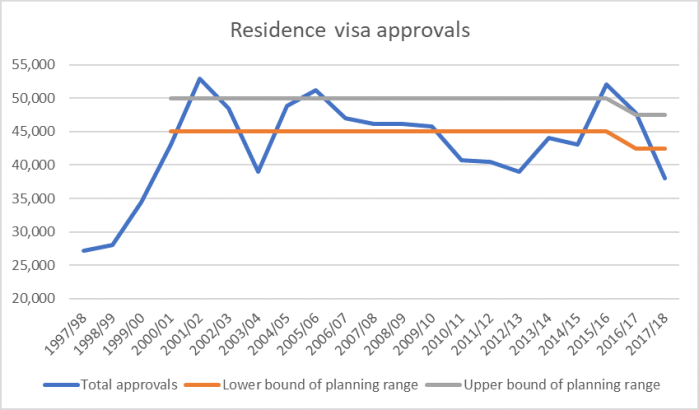
That was both interesting and a little puzzling.  Puzzling because the new circular was issued on 30 April, already more than halfway through the period from 1 July 2018 to 31 December 2019.  And substantively interesting because the new target (“planning range”) was substantially lower than the previous target.  In annualised terms the previous target had been 42500 to 47500 approvals per annum and this new target was the equivalent of 33333 to 40000 per annum.    It was (is) by far the largest change in the planning range this century (until 2016 the planning range had been unchanged at 45000 to 50000 per annum for a long time).

Here is a chart of annual residence approvals going back 20 years

ann res approvals

As I’ve highlighted in a couple of posts in recent months, it is striking how substantially the number of residence approvals has fallen (a fall well underway before the change of government).   MBIE only publish monthly data for the last decade or so, and so here is a similar graph for that period but this time showing twelve month running totals of residence approvals, the last observation being the year to March 2019.

res approvals 2

Annual approvals in the last 12 months have been lower than at any time since 1999/00.

Broadly speaking, operational policy is supposed to adjust to keep overall total approvals within the planning range (most obviously by varying the points threshold applicants have to meet).  In this case, however, it appears that the target has been adjusted into line with the actual reduced number of approvals.  That, surely, was somewhat newsworthy, especially given the debate at election time on what the various parties (Labour and New Zealand First) were and weren’t promising around immigration.

The open and transparent government was true to its word to some extent.  When I went looking I stumbled on the Cabinet paper that was the basis for the decision.  That Cabinet paper had been released onto the MBIE website on 19 February.   Here is a copy of the paper itself cabinet-paper-new-zealand-residence-programme 2019

The Minister of Immigration appears to have intended that openness and transparency would prevail.  Among the recommendations in the paper were these

Publicity
58 Subject to Cabinet’s agreement to these changes, I intend to issue a press release announcing the details of the proposals in this paper.
Proactive Release
59 I intend to proactively release a copy of this Cabinet paper under the Official Information Act 1982, with appropriate redactions, at the same time that I issue a press release announcing the details of these changes.

But I had a look at Iain Lees-Galloway’s page on the Beehive website.   There was nothing there.

So I went to the MBIE website (always something of a dog’s breakfast) and looked for any releases in February.  There was nothing there (or for March or April).

I checked Immigration New Zealand’s news releases page.  There was nothing there either.

But, as I kept digging, I did at last find something.  INZ has an email newsletter, called Korero, aimed specifically at immigration advisers

Kōrero is the Immigration New Zealand adviser-specific newsletter sent out as an email. Available every two months, Kōrero brings to you the latest news and information that affects you in your dealings with Immigration New Zealand.

And the February issue of this newsletter did contain the news about the residence programme.

It looks a lot as though Cabinet really didn’t like the idea of letting the general public know that they had been changing immigration policy.

But what of the substance of the policy?

In some respects, what the Cabinet paper is proposing –  and was apparently adopted –  is quite sensible.   The residence approvals programme planning range has always been an odd beast, because it encompasses all sorts of streams under which approvals can be made, each set up for a variety of different motivations.    And whereas when the residence programme was set up most approvals were granted to people offshore (and thus approvals regulated the number of non-citizens entering New Zealand to live), these days most approvals are granted to people already here (eg on temporary work visas, so that the overall planning range, at least on an annual or biennial basis, doesn’t even serve as much of a check on (for example) short-term pressures on housing or infrastructure.

Recognising all this, the government has apparently agreed that from 1 January 2020 each of the streams will be managed (or not) individually, rather than within an overarching planning range.    The residence programme includes, for example, non-citizen spouses (in particular) and children of New Zealanders.  We are never going to cap those flows, and management will mostly just consist of the tests to ensure that the relevant relationships are genuine.  And, on the other hand, if we think that (say) granting 15000 skilled migrants a year residence is sensible that is a decision that probably shouldn’t be materially influenced by how many New Zealanders bring back foreign spouses in any particular year.

On paper all that sounds sensible enough.  But, as so often, details can matter, and at present there are none.  There is nothing in the Cabinet paper giving a hint as to how many residence approvals in total (or by stream) Cabinet expects to be agreeing to for the coming years.   There is also nothing in the Cabinet paper evaluating, or reporting other evaluations, of the economic and social impact (benefits and costs) of the immigration programme to now –  it seems to be a typical MBIE document in which the benefits are more or less taken for granted.  The exception perhaps is this line (emphasis added)

In response to an overall trend of decreasing skill levels and remuneration amongst skilled migrant residence approvals, the previous Government tightened the requirements for the Skilled Migrant Category (ie the points system) and lifted the points level at which applications could be selected.

But even then there is no attempt to assess, or describe, the impact of those changes (or other changes which went in the opposite direction –  more points for regional jobs), and thus no attempt to assess why residence approvals have dropped off so sharply, despite reasonably good labour market conditions at present.

The other substantive part of the paper was a recommendation to change the objectives of the Residence Programme.  The paper reports that

The current objectives for the NZRP were agreed by Cabinet in 2001 and reflect an immigration context that was different from today. The existing objectives are:
24.1 Regulating the flow of foreign nationals wanting to come to New Zealand;
24.2 Prioritising among would-be migrants and avoiding the free flow from demand-driven immigration;
24.3 Trying to produce benefits to New Zealanders; and
24.4 Consistency and stability (market signalling around the number of residence places available in any particular year).

I was struck by the rather weak third objective (“trying to” produce benefits to New Zealanders –  very different from the upbeat MBIE rhetoric of a few years ago in which immigration was a “critical economic enabler” for New Zealand).  That list of objectives is very process-focused, and perhaps not unreasonable on its own term, but it provides no guide at all to ministers in actually setting the residence approvals planning range numbers.

The paper goes on to report that

The Government’s vision for immigration has changed and become broader. We intend to improve the wellbeing and living standards of New Zealanders, including through productive, sustainable and inclusive economic growth, by:
25.1 improving New Zealand’s labour market outcomes, including by filling skills and labour shortages and raising overall skill levels;
25.2 encouraging investment and supporting innovation and exports;
25.3 supporting foreign relations objectives and New Zealand’s international and humanitarian commitments;
25.4 supporting social inclusion, including through family reunification; and
25.5 protecting the security of New Zealanders and the border.

and thus

To better align the NZRP to this vision and focus on how to achieve it, I propose the following, equally weighted new objectives for the NZRP:
26.1 To maximise the contribution of the NZRP to the economic and social wellbeing of New Zealand and New Zealanders by:
 – attracting skilled workers and business migrants;
 – reunifying the families of New Zealand residents and citizens; and
 – meeting international and humanitarian commitments.
26.2 To manage overall residence numbers through controlling each of the individual components of the programme.

I’m pleased to see that the focus is clearly on benefits to New Zealand and New Zealanders, but there is still no sign that they have any idea at all how “attracting skilled workers and business migrants” is going to benefit New Zealanders in future when it hasn’t in the last 20 years (on their own metrics, immigrant skills levels are on average lower than those of natives, exports have been falling as a share of GDP, and business investment has remained weak).

Which brings us back to the target numbers, and the reduced “planning range” for the current period.  There is simply no explanation for why the government has chosen such a substantial reduction in the planning range, except –  and they more or less say this –  that it brings the target into line with forecast actuals.  But “forecast actuals” are a response to things including the rules of the scheme (eg the points granted and points thresholds).  It doesn’t have the ring of a particularly coherent policy.

Moreover, it is worth noting –  the Cabinet paper does –  that when the planning range was last approved around 60 per cent of visas were supposed to be for people in the business/skilled stream (principal applicants and their dependents).  60 per cent of 45000 would be 27000 annual approvals under the skilled/business streams (those which, as the paper itself claims, offer the greatest economic benefit).   But on the revised policy now in place only 51 per cent of the approvals are allocated to the business/skilled stream: 18700  per annum.  In other words, a 30 per cent cut in the number of skilled/business approvals.

Here are actual (12 month running totals) approvals under that stream.

res approvals skilled

In that sense, the new (temporary) policy simply adjusts the target to reflect the very substantial reduction in the number of actual approvals (again, to the lowest level seen since 1999/00).

My overall take?

  • I support, conditional on seeing details, a move to managing individual streams individually (so long as it isn’t a mechanism to obscure overall actual immigration policy),
  • I favour a substantial and permanent cut in the overall number of residence approvals granted, focused first on the (non-refugee) categories where there is no skill requirement, but also on the skilled/business side where (as MBIE themselves note) skill levels just haven’t been that high.  Doing so would be likely to enhance New Zealand’s medium-term economic performance.  The reduced target the government has adopted, if persisted with, looks to be a step in the right direction, but there is no indication as to whether they will persist with it,
  • but I also strongly support open government, and don’t like the idea of substantial reductions in the residence approvals targets being done on the sly, with no consultation and an (apparent) attempt to minimise the visibility of the change,
  • on which note, I hope that the government is planning some proper public consultation (not just, say, with business lobby groups) about the details of the new scheme, including the guidelines they will be adopting to manage the inflows of each of the individual streams and the overall number of residence approvals granted.  Lack of transparency can hardly ever be defended when it comes to the design of major instruments of economic and social policy.


Fruit-pickers, wages, and immigration

I’m not one of those who thinks wage and salary earners as a whole have had some sort of raw deal.  From time to time I’ve run this chart

lci wages vs gdp

suggesting that over the last 15+ years, wage increases in New Zealand (it is different in some other countries)  have outstripped that rate of growth in what I (loosely) term the earnings capacity of the economy: nominal GDP per hour worked, a variable that incorporates productivity growth and gains in the terns of trade.

To the extent there is some sort of “raw deal”, it is one the public has put up with: voting for politicians who, in office, do nothing about removing th roadblocks in the way of fixing our poor rate of productivity growth.  Fix that and we’d be considerably better off.  But across the economy we can’t consistently pay ourselves what hasn’t been earned.

But if wages growth across the economy has been, if anything, surprisingly high given the lack of productivity growth (I say “surprisingly”, but there are decent explanations as to why it has happened), there are still some wages puzzles.

One of them perhaps only puzzles public sector economist types who’ve never themselves had to make a payroll or face a market test for their services.

The Reserve Bank has long run a regular programme of business visits.  I always enjoyed participating (especially in visits well away from Auckland and Wellington) and often came away from the visits with a heightened admiration for the people who have built and maintained businesses, through good and bad economic times.    But there was one question that I never really got a satisfactory answer to.  In periods when the economy was doing well (for example the early 2000s) we would regularly hear from firms we talked to that it was really hard to get decent staff.   We’d nod understandingly, jot that down in our notebooks, and then ask “so what is happening to wage inflation?’ and “so are you increasing the wages you are willing to offer to get people”.  And often there was a look of almost incomprehension (perhaps it was really disdain for Wellington economists), and only rarely would anyone suggest that, indeed, it was really hard to get the right staff, and that they were paying over the odds to get people.  For some reason, a conversation on this issue at a firm in Timaru, probably in 2002, sticks in my memory.

There are strands to a possible good story.  Increase wages materially for new arrivals and before long you’ll have to increase them for everyone.  It is easy to raise wages and hard to cut them (if labour market or business conditions reverse).    Simply bidding more might attract a class of worker more likely to move on quickly if someone else offered a little bit more.  And so on.  So I get that there are reasons why wages move somewhat sluggishly (relative to, say, prices for oil or other commodities).  But I was always surprised at how weak a link managers/owners of private businesses appeared to draw between difficulty hiring and (what an economist would think of as) putative changes in the market-clearing price for such labour.

Which is all by way of introduction to a Stuff story I noticed yesterday about an industry having difficulty getting staff.   I’ve written previously about bus companies and bus drivers, and the bizarre situation in Wellington where the contracted companies get away with endless cancellations (with apparently minimal penalties) because they choose not to pay what it would take to employ the necessary number of drivers.  One might grant that that is a difficult situation –  a government-controlled “market”, in which both fares, operators, and service frequency are all supposed to be simultaneously controlled.

But yesterday’s article was about jobs in a fully private sector industry, with lots of individual employers, and with a significant export orientation: fruit-picking, including “grapes, apples, and kiwifruit”.  The article is quite a substantial piece, including a couple of quotes talking of a “dire” situation finding staff, and repeatedly talk of severe labour shortages.  And, remarkably, not one mention of wage rates.   It must not have occurred to the journalist to ask, let alone to the various employers (and employers’ representatives) to mention it.    Even though, when there is a “shortage” of tomatoes, tomato prices rise –  so that actual quantitity demanded at the going price is roughly equal to the actual quantity supplied.  At present, there is a “shortage” of avocadoes –  it gets a line perhaps somewhere in a newspaper, but prices adjust and so do (potential) consumers.

But not, it seems, in the fruit-picking industry.

The industry seems to think this is a problem for the government (admittedly, this is an approach fostered by successive governments, who also seem to think it is a “problem”, rather than (say) an opportunity for individuals who could capture the premium prices growers might otherwise pay to ensure their fruit was picked).  The article includes a quote from the head of something called the “Central Otago Labour Market Governance Group”, a title that sounds as if it could have been derived from some centrally-planned eastern European economy in the 1950s.

Perhaps there really is some movement in market rates for fruitpicking and the journalist just forgot to tell us. But if so, you’d have thought the industry representatives would have been keen to get the message across –  apart from anything else, it would be free advertising to people in those districts with a bit of time on their hands that there was (unexpectedly good) money to be had.

But again I’m left with a bit of a puzzle –  and perhaps it is only one to city-based macroeconomists – as to why a competitive bidding process isn’t at play.  One can understand the Wellington bus companies not raising wages (temporarily or permanently): they don’t have to, the passengers (mostly) bear the consequences, and entry to the business (Wellington bus routes) is restricted.  But for an individual grower (apples, grapes, kiwifruit or whatever), the situation is surely a lot different.  If there is a incipient shortage of pickers for the whole industry, that doesn’t mean your orchard has to miss out.  Offer better wage rates and presumably people will choose your orchard over another one down the street (on the other hand, choose not to compete and you risk fruit rotting on the tree/vine).  Of course, that invites the other orchards to increase their rates too, but that is how markets work.  And yet, if this Stuff story is to be believed, it doesn’t seem to be happening.  And that is even though much of the picking workforce seems to be itinerant or with no established and committed long-term relationships.  It isn’t obvious why offering more to pickers this year –  if the harvest is particularly early, or particularly good, or labour “shortages” are particularly severe –  need entrench higher rates for all time.

In fact, of course, much of the article channels an ongoing industry push to avoid paying higher wages to New Zealanders to do the job (not just this year, but permanently) by using the immigration system.  You might think that the case for using immigrant labour at times might be stronger than otherwise if there was evidence that wage rates in this industry had been rising particularly stronly (employers putting their money where their mouth is).  But apparently the industry doesn’t see it that way –  and neither (one deduces from their silence) does our current left-wing government, despite its key support base including workers and trade unions.

We are told

Key visa reforms sought by the industry include removing the need for annual reviews once a three-year visa is granted, giving those on three-year visas a pathway to permanent residency if no New Zealand residents are available for the job, and reworking the labour market test to make it more aligned with the employment conditions faced by employers.

It is fruit-picking we are talking about here, not the most skilled of jobs.  And an immigration system that, we’ve been told for decades, is supposed to be skills-focused, contributing to a lift in overall productivity growth, in ways that would raise wage levels for everyone.

As a reminder, there will be few/no/inadequate numbers of New Zealanders offering to work in a particular sector when wages (and overall conditions) in that sector are no longer particular attractive.  In the 1970s presumably our fruit was picked, our old people’s homes were staffed, our supermarket checkouts were staffed, by New Zealanders (whether those of longstanding or more recent immigrants –  but you couldn’t hire people from abroad specifically to fill these modestly-skilled jobs, and in the process keep down wages in that specific sector).

I presume much of what is going on here is that many of these fruit-based industries just aren’t that internationally competitive at current exchange rates. It probably isn’t the case with, say, gold kiwifruit, but for some of the other industries it seems quite conceivable that the economics is pretty tight and it might not be worth being in business if they had to pay materially higher wage rates to pickers.   There are hints of that in the article

“The growers are starting to think whether they are going to invest money because they need to have assurances about labour. It is a bigger issue than probably it is given credit for.”

To which I guess I have two strands of response:

  • first, there are lots of industries that are no longer viable here based on old production technologies (try making a living milking 50 cows by hand) or running a suburban petrol station (in my suburb there were four forty years ago and there are none now).  There might be issues of scale to consider, and/or investment in technology-based solutions, and
  • second, the real exchange rate (averaging more than 20 per cent higher since about 2003 than it did in the previous two decades, despite feeble economywide productivity growth) is a real symptom of the severely unbalanced New Zealand economy.  As a result, our export/import shares of GDP have been shrinking, not rising.    But however attractive the immigration option genuinely looks (and locally is) to an individual employer, on a large scale it exacerbates the economywide problems, not eases them.   For outward-focused industries in particular, a much lower exchange rate –  which would follow directly from substantial permanent cuts in immigration –  would improve NZD returns, and would also make producers in those industries better placed to bid competitively for New Zealand workers to fill their vacancies (or to invest in technological solutions, or the sort that help lift average labour productivity).

Firms simply shouldn’t be able to use immigration to fill positions requiring only modest skills or training without at least being able to demonstrate that the wage rates they are paying for such skills have run well ahead of other wage rates for several years.  But to get bureaucrats and ministers out of the business of picking favoured sectors/firms –  at present, the rewards to lobbying seem quite high – I continue to commend to anyone interested my model for temporary work visa policy.   It is pretty simple

Institute work visa provisions that are:

a. Capped in length of time (a single maximum term of three years, with at least a year overseas before any return on a subsequent work visa).

b. Subject to a fee, of perhaps $20000 per annum or 20 per cent of the employee’s annual income (whichever is greater).

If apple-growers really can’t get workers locally, and are happy to pay a substantial fee to the Crown, on top of a decent wage, I guess I’d be okay with temporary overseas recruitment.  As it is, they seem to simply want to undercut potential returns to New Zealand labour.

Immigration is inherently a political issue

In the few days after the Christchurch shootings, a few of the more rabid on the left appeared to want to rule out of court any discussion – ever –  about immigration policy.  Immigration was good –  was their prior –  and more immigration better, and no correspondence could be entered into.  Decent people don’t discuss such issues, except perhaps to celebrate.

The other day we had a similar sort of voice from another point on the political compass, this time in a column from Kirk Hope, the head of the leading lobby group advocating for the interests of businesses, BusinessNZ.   Despite counting myself pretty strongly pro-market (not at all the same as pro-business) I don’t often agree with Hope (I just googled his name and the name of this blog to remind myself of some of his more-egregious previous claims).  But Stuff seems to think him worth publishing, and he does head a pretty big advocacy group.

Hope’s key assertion?

One of the challenges we must face is for our politicians to stop treating the topic of immigration and immigrants as politics.

What a breathtaking proposition.   One of the most substantial instruments of government economic and social policy and Kirk Hope thinks that it shouldn’t be debated by politicians (let alone, presumably, the rest of us). Politics isn’t a bad thing –  as Hope seems to imply –  but something pretty fundamental, a big part of how we decide (and refine that view) what sort of country this will be.

As it happens, Kirk Hope never actually says how he thinks immigration policy should be decided, if not by politicians, weighed competing interests and claims.  Perhaps by BusinessNZ?   He never even tells us what his own preferred policy is.  Perhaps is he just some open-borders absolutist who thinks the very idea of an “immigration policy” is abhorent?   Probably not (there aren’t really very many advocates anywhere for such a policy).  My guess is that he’d like to keep on with something like our current immigration policy (probably the most aggressive anywhere in the advanced world), and just a bit more.   He doesn’t tell us, just urges that “politics” be removed from the process, all while advancing a mix of threadbare and/or flawed arguments for high rates of non-citizen immigration.

So how does Hope make his case?

First, there is the tired rhetorical trope about “a nation of immigrants”

It is a truth that New Zealanders are immigrants or the descendants of immigrants, and we are ethnically diverse.

Which is pretty meaningless, offensive, and acts to diminish people’s sense of identity with New Zealand.  If all human beings are ultimately descended from people emerging from, say, the Rift Valley, at very least everyone other than perhaps Kenyans and Tanzanians is descended from immigrants.  But what of it?  Closer to home, the ancestors of the Maori population came many hundreds of years ago.  They have no other home.  I’m have no idea of Hope’s ancestry, but I’m one of those (of European descent) with no other home but New Zealand –  I’ve never known an ancestor who wasn’t born in New Zealand.  But again, so what?  It is simply irrelevant to the question of how many people we should import now, on what terms, with what skills or backgrounds.   Like many who run the line, Hope makes no effort to draw out any logical implications from his factual statement –  presumably because there aren’t any.

Then we get another factual statement with few/no implications

It is also true that the demographics for New Zealanders born in New Zealand tell a story of aging and regional depopulation.

And?   People leave regions when the opportunities in those regions aren’t particularly attractive.   There is no obvious role for central planners (like Mr Hope) to argue for policy initiatives to repopulate areas they happen to think aren’t growing fast enough.  I suspect that Hope is also hoping to skate over the evidence that New Zealanders have been leaving the region of Auckland for most of the last 20+ years.   And if great opportunities do exist in particular regions, wage adjustments are likely to act as an effective signal (higher wages never seem to be part of how business lobby groups think markets should deal with incipient “labour shortages”).

Then we get a grab bag of statements inviting a “so what?”

We will soon have more people aged over 65 than under 15 years of age. Auckland and New Zealand will be dependent on immigration for skills. Two out of every five New Zealanders will live in Auckland, nearly a third of them Asian.

Isn’t it great –  something to celebrate –  that life expectancy is improving so much that there is an increasing share of the population aged (well) over 65?  Apparently not to Mr Hope.     Or was his (central planning again?) concern that New Zealand couples aren’t having enough babies?

And what of that strange claim about skills?  Is Mr Hope deliberately avoiding the OECD skills data showing not only that New Zealand workers had among the very highest skill levels in the OECD, but that immigrant workers on average had lower skills than natives (that gap is smaller in New Zealand than most, but still there)?  Let alone the official SNZ data that confirmed again last month how poorly the Auckland economy does (GDP per capita) relative to, say, big cities in many other (overall more successful, typically with less immigration) OECD countries.   Inconvenient I suppose.

Then claims start getting more far-fetched

The labour market needs to grow by 1.5 per cent to support moderate economic growth of 2.5 per cent, but actual labour market growth tends to be under 1 per cent. Workforce exits are increasing, while workforce entry levels are modest and declining.   Our people shortage is getting worse.

This is just nonsense stuff.  Sure, all else equal, if your population growth rate is faster so will the rate of growth of GDP.  But – unless you are raising an army –  total GDP doesn’t much matter to anyone.  What matters, more closely, is real GDP per capita and the real GDP per hour worked that undermines that per capita growth.   If, say, the population were static –  as it now is in many OECD countries – 1.5 per cent annual GDP growth would be a quite reasonable outcome.    As Mr Hope surely knows, we’ve had almost no productivity growth recently (despite, because of, or just coinciding with very strong immigration).

A central planner apparently to the core –  did he tell the (generally pro-market) people at BusinessNZ this when he was hired? –  Mr Hope is alarmed about “people shortages”.   This just incoherent stuff, and he shows no sign that he has looked, even cursorily, at how countries are managing where the population is flat or even falling a bit?  As a hint –  but he could check the data himself –  most are achieving faster growth in per capita income and productivity than New Zealand is.

He offers some strange arguments about how we need immigrants to “replace” New Zealanders who are retiring and yet a little later on even he acknowledges that  immigrants themselves get old.  If there are fiscal problems associated with increasing life expectancies –  and there are – why wouldn’t you tackle those directly (eg raising the NZS eligibility age)?

We are then get back to some other claims

Immigration contributes to population and economic growth, provides an expanded talent pool, helps us understand overseas markets, and contributes to the diversity and vitality of New Zealand communities.

I’d be impressed –  though still not thinking that immigration policy should be taken out of the realm of politics –  if he’d claimed (and offered New Zealand evidence for) that rapid New Zealand immigration had boosted productivity growth.  We never know the counterfactual, of course, but in our decades of high non-citizen immigration, we’ve made no progress at all in closing the productivity gaps, and have actually fallen further behind.  Oh, and “understand overseas markets”…..well, perhaps, except that New Zealand has one of the very worst exports (as a share of GDP) performances of any OECD country –  levels and changes –  despite all that immigration.

Not content with the evidence-free-zone so far, Hope ups his rhetoric

Our people shortage is critical now because of the opportunities that are opening for New Zealand business.

The successful completion of the giant Pacific trade deal CPTPP and the likely completion of an European-New Zealand trade deal mean 46 more markets will soon be open to enhanced trade with New Zealand businesses.

So, while our markets are expanding our working population is reducing.

So despite having probably the largest (per capita) non-citizen programme in the OECD, it just isn’t enough.    He calls for even more.

Even serious defenders of the New Zealand immigration programme will be embarrassed by this particular line.  After all, no serious analyst claims that CPTPP will be worth more than perhaps a 1 per cent boost to GDP –  and serious analysts would claim those gains would come through terms and trade and higher productivity, not conditioned on even more people.  As for the EU, I know Hope is a big advocate of that possible deal, but as I pointed out in debunking an earlier article containing his over-egged claims (that the EU deal might finally be what transformed our –  already –  “rockstar economy”), the best sober estimate of the GDP gains from Canada’s “free trade” agreement with the EU was about 0.5 per cent.

And wasn’t there the small point that, despite all the various trade deals New Zealand has signed up over recent decades – including those with Australia and the PRC –  and the reduction in global agricultural protectionism, exports and imports have been falling as a share of New Zealand GDP.  Perhaps another million migrants will make all the difference?  But perhaps not.

Hope ends by getting out the violins

We need to ensure that our political thinking more clearly acknowledges that we are an immigrant nation at our core, that we truly value diversity, that we are inclusive and will celebrate and support new New Zealanders as we all grow our economy and standard of living, contributing to our communities and our future.

I could –  and would- reframe this as something along these lines

We need to ensure that our political thinking more clearly acknowledges that after one of the largest-scale immigration programmes undertaken anywhere in recent decades, there is little or no evidence of economic gains for New Zealanders, and at least the possibility that such rapid rates of immigration, to a location so remote, have made us poorer rather than richer.  Responsibility for that rests not with the migrants themselves –  almost all of them as simply pursuing the best for themselves and their families –  but with our own political and business leaders, who have championed an ideological cause (with both globalist and bigger-New Zealand strands) even as the economic evidence in support of their claims has failed to arrive.  Notwithstanding a wider range of ethnic restaurants (and associated consumption diversity), there has simply been no compelling evidence –  as there is none globally –  that “diversity and inclusion” (as distinct from the ongoing contest of ideas) has produced any economic gains whatever.    If anything, New Zealanders at the bottom of the socio-economic heaps have been paying an increasing price for this obeisance to an “elite” ideology.

I’m still left rather gobsmacked that a supposedly serious public figure can, apparently seriously, suggest that immigration is other than a natural and appropriate subject for intensive political debate.   What is more fundamental to a country than the people who make it up, and yet that is what immigration policy influences very heavily, at least when done on the huge scale our politicians have chosen in New Zealand.  Even at a narrowly-economic level, it represents a significant change in the overall resource mix and productive structure of the economy (especially in a country as natural resource dependent as New Zealand or Australia).

Immigration policy doesn’t make that much difference in any particular year, but we’ve been running something like current immigration policy now since the early 1990s.  In 1992, New Zealand’s population was about 3.5 million. In the years from 1992/93, we’ve granted residence status to more than 1.1 million non-citizens.  That is a huge number.   Some, perhaps many, will think it is a “good thing” –  for various possible reasons –  and others will think it a disastrously bad choice (that’s my view, even if more apparent in hindsight than it could have been in 1992).  Even among those who think it a bad choice, some (me) will emphasise overall economic performance arguments.  Others might emphasise real world second-bests around housing, or traffice congestion, or just a preference for being small.  Others again might emphasise environmental pressures.  Others might raise concerns about precisely the sort of “diversity” Kirk Hope and the cheerleaders celebrate, highlighting issues around cohesion, trust, mutual support etc. And others too might be uneasy about large-scale immigration does to the relative place of Maori in New Zealand.  Some might just think that the ideological etc make-up of future New Zealand should be determined by the individual choices of New Zealanders, not by politicians skewing the future population one way or another.  But all those disputes are naturally and appropriately the stuff of politics.   Given our relative economic underperformance, notwithstanding decades of large scale immigration, all these angles should be debated more vigorously, not less.

Most of my own arguments around New Zealand’s immigration policy have been economic in nature.  On its own, the economic track record should have been more than enough basis for a rethink, were it not for the ideological priors of the champions.  Perhaps the most accessible version of my economic story is here, in a speech I did 18 months or so ago.

I have occasionally commented on various social and cultural dimensions, including in two posts sparked by the 2017 New Zealand Initiative report on immigration policy (here and here) and in some remarks on diversity, and its limits in a stable democracy, here.

I was also reading yesterday an  interesting article from the latest issue of The Atlantic by David Frum on US immigration, experience and policy.  Frum is a pretty determined never-Trumper, and yet he concludes his article this way

Reducing immigration, and selecting immigrants more carefully, will enable the country to more quickly and successfully absorb the people who come here, and to ensure equality of opportunity to both the newly arrived and the long-settled—to restore to Americans the feeling of belonging to one united nation, responsible for the care and flourishing of all its people.

Every country is different, but it is worth recalling that US immigration policy –  under all recent presidents – has targeted non-citizens inflow about one third those of New Zealand (in per capita terms).  I don’t agree with everything in his article, and some of the issues are different for New Zealand than for the US –  there is a more plausible argument in the US context that immigration is roughly a wash (in economic terms) for natives than there is here – but I thought it was a piece worth reading and reflecting on.  I wonder what Mr Hope would make of it?


Rereading the UN Compact on Migration

To listen to some of the more overblown rhetoric this week, you’d could only conclude that the speakers/writers thought that anyone opposed to the UN Compact on Migration –  signed late last year by many countries, including New Zealand, but boycotted by another 29 (including 9 EU countries, the US, and Australia) –  was at least indirectly responsible for Brenton Tarrant’s¹ [alleged] act of evil last Friday.

Most directly in their sights, so it seemed, was the National Party which (rather belatedly) opposed the Compact, promised to withdraw from it if/when returned to government, and had been running a petition of some sort opposed to it.  National didn’t help themselves by, whether through incompetence or something worse, initially giving erroneous stories about when the petition had been taken down.  Straight after the shootings appeared to be the final story.  As if they were now embarrassed by their previous stance – or simply anticipated the deranged rhetoric of the last few days.

I went back and reread the UN Compact this morning.   I came away with much the same view as I’d taken in December.   The document is unnecessary (as, largely, is the United Nations), statist, strongly pro-immigration….and it is a little chilling in a few places.  More than enough reason not to sign it –  the world is, after all, awash with largely meaningless resolutions, including from the United Nations, and that shouldn’t be encouraged.  But as I noted in my single post back then, I hadn’t written anything about it previously

as not only was it a non-binding political declaration, but most of it seemed more relevant to countries dealing with substantial illegal migration (and with migration mainly from very poor or disrupted countries – again, not the main situation in New Zealand).

I was, and remain, more than a little suspicious of National’s belated commitment to the issue.

My suspicion remains that National’s stance is more about positioning relative to New Zealand First –  the contest for provincial votes –  than anything of substance.

But perhaps I’m being unfair to them.

What follows is the heart of my earlier post, without blockquoting it all.

But it still isn’t clear to me quite what additional damage would be done by signing up to this pointless agreement.   Sure, even “non-binding” agreements will, at times, be used in domestic and international fora as a rhetorical stick to beat governments with if they ever look like stepping out of line with the mainstream.  But those sorts of arguments rarely deflect a government for long if it has domestic public opinion behind it in some direction or another (for good or ill).

There is some questionable economics in the document.  For example

Promote effective skills matching in the national economy by involving local authorities and other relevant stakeholders, particularly the private sector and trade unions, in the analysis of the local labour market, identification of skills gaps, definition of required skills profiles, and evaluation of the efficacy of labour migration policies, in order to ensure market responsive contractual labour mobility through regular pathways.

Or, alternatively, one could just let the market work it out.  When there are incipient skill shortages, wage rates tend to rise.  Same thing happens when, for example, bad weather creates a shortage of spinach or lettuce.    But, daft as the economics is, this stuff is the mindset of politicians and officials adminstering immigration schemes all over the western world. including New Zealand.  Recall that in New Zealand the current government is trying to get more actively involved in this sort of thing.

There are also totally vacuous bits, like the commitment to support and promote the United Nations International Day of Family Remittances.  Just what the world needs: another United Nations “day”.

Perhaps three clauses troubled me a little more.

There was this one

Enable political participation and engagement of migrants in their countries of origin, including in peace and reconciliation processes, in elections and political reforms, such as by establishing voting registries for citizens abroad, and by parliamentary representation, in accordance with national legislation.

I guess I can see what they are probably driving at (diasporas helping the reconstruction of the country of origin after say a protracted civil war). But, normally, we should expect migrants to commit themselves to their new country and its processes and political values and not be creating doubts about where their loyalties lie.  But in a country in which Jian Yang and Raymond Huo are MPs –  while still closely associating themselves with political interests in their country of origin –  and people like Yikun Zhang appears encouraged to play both sides –  it is hard to see how this particular provisions make things here any worse than they already are (around a small handful of our migrants).

And then there was this one

Promote mutual respect for the cultures, traditions and customs of communities of destination and of migrants by exchanging and implementing best practices on integration policies, programmes and activities, including on ways to promote acceptance of diversity and facilitate social cohesion and inclusion.

Which presents the issues as symmetric when they really should be asymmetric: the focus should be on encouraging the assimilation of the migrants, and ensuring their respect for the “cultures, traditions and customs” of the destination community –  just as when you go to someone else’s place for dinner you respect their practices, table manners etc.   One could also argue that encouraging “acceptance of diversity” and facilitating “social cohesion” are two contradictory, often mutually inconsistent, goals.  But again, flakey as all this stuff is, it is the way our bureaucratic and political “leaders” think and act anyway.  If the behaviour is a threat, it is hard to see that the UN agreement would be more of one.

Relatedly

Support multicultural activities through sports, music, arts, culinary festivals, volunteering and other social events that will facilitate mutual understanding and appreciation of migrant cultures and those of destination communities.

Quite what business this is of the UN –  or even of national governments actually – one has to wonder, but there is the “globalist” mindset for you.   And, again, it is pretty much what central and local governments do anyway.  I was interested that “religion” wasn’t on the list

And then, of course, there is Objective 17 (of the 23 in the document) which I have seen people express more serious concern about.

OBJECTIVE 17: Eliminate all forms of discrimination and promote evidence-based public discourse to shape perceptions of migration

We commit to eliminate all forms of discrimination, condemn and counter expressions, acts and manifestations of racism, racial discrimination, violence, xenophobia and related intolerance against all migrants in conformity with international human rights law. We further commit to promote an open and evidence-based public discourse on migration and migrants in partnership with all parts of society, that generates a more realistic, humane and constructive perception in this regard. We also commit to protect freedom of expression in accordance with international law, recognizing that an open and free debate contributes to a comprehensive understanding of all aspects of migration.

If that isn’t muddled I don’t know what is –  let alone, unrealistic (in no conceivable world are “all forms of discrimination” going to be “eliminated”).

The specifics under that Objective include commitments to

Enact, implement or maintain legislation that penalizes hate crimes and aggravated hate crimes

So-called “hate crime” legislation is almost always bad law and bad policy.  Punish assaults or murders or whatever as that: bad and unacceptable acts, regardless of who they are committed against or why.

And this

Promote independent, objective and quality reporting of media outlets, including internet based information, including by sensitizing and educating media professionals on migration-related issues and terminology, investing in ethical reporting standards and advertising, and stopping allocation of public funding or material support to media outlets that systematically promote intolerance, xenophobia, racism and other forms of discrimination towards migrants, in full respect for the freedom of the media.

Again, muddled at best.  You want to stop any public funding to outlets whose views are “unacceptable”, while having “full respect for the freedom of the media”.   Since I’m not entirely convinced there is a good case for public funding of any media outlets –  and since the publicly-funded outlets in New Zealand are champions of high immigration and all “worthy” leftist causes anyway –  it isn’t clear what difference this might make in New Zealand.    And there seem to be some MPs –  particularly in Labour and the Greens –  who aren’t too keen on allowing free speech on such issues anyway, whether or not we sign up to UN non-binding declarations.

And finally under Objective 17

Engage migrants, political, religious and community leaders, as well as educators and service providers to detect and prevent incidences of intolerance, racism, xenophobia, and other forms of discrimination against migrants and diasporas and support activities in local communities to promote mutual respect, including in the context of electoral campaigns.

All very asymmetric –  nothing at all about engaging with communities that might be uneasy about high immigration, or the immigration of groups with values antithetical to those of the destination community.  Perhaps, in some respects, this commitment troubles me more than most.   “Intolerance” is not an offence (in principle or in law) and it is the perfect right of people to debate –  perhaps especially in election campaigns – the future composition of their society.   A Saudi Wahhabi, a Chinese Communist Party zealot, an American evangelical, and a French secularist are all very different sorts of people. In large numbers, each group transplanted to (say) New Zealand would make a material difference to the society and polity we have here.  Those debates matter –  unless, apparently like the authors of this document –  you regard all differences of culture, politics, religion etc as superficial rather than fundamental.

March 2019 here again.

Rereading that, it still seems about right (and in fact we’ve had chilling signs of the antipathy to free speech from a number of quarters this week).

In their opposition to the compact, National repeatedly asserted that our sovereignty was going to be compromised.  I never quite saw them explain how.   But at the time of the earlier post, some people who were more negative than I was on the document highlighted a risk that –  although the agreement is formally non-binding on governments – our local courts could, or would, over time seek to introduce the provisions of the agreement (and the fact of it) into judicial rulings on immigration issues in New Zealand.   Such judicial conduct is not unknown.  Perhaps that was some of what National had in mind.

I’m not a lawyer, so am not sure how significant a risk that is.  But I guess at the time my response had a number of strands:

  • parliamentary sovereignty is still intact in New Zealand.  Even if it is bad form to legislate retrospectively (re a specific case) there is never anything to stop Parliament legislating to, in effect, counter any tendencies of judges to import non-statutory documents of this sort into their decisionmaking,
  • more substantial and important questions probably should be asked about how we appoint – and who we appoint –  as top tier judges in New Zealand.   These are, inevitably and sadly, somewhat political roles –  not party political so much, as “ideological”.  I had a post last week suggesting a more open process for scrutinising and confirming senior judicial appointments (as well as term limits).    That still seems a higher longer-term priority than a single non-binding UN document, even one with somewhat chilling language in a few areas.

And the third strand –  decisive to me –  was this, with which I concluded December’s post

As I said at the start, there is no obvious need for this document.  And even if there were obvious gaps, the very fact that it is a non-binding political declaration suggests it could meet no substantive need.  But in a New Zealand context, there are policies and practices around immigration that are much more damaging and threatening, particularly to our long-term economic performance, and perhaps in other areas too.  Among them:

  • the immigration policies of the National Party
  • the immigration policies of the Labour Party
  • the immigration policies of the Green Party
  • the immigration policies of ACT, and
  • the immigration policies of New Zealand First

I think that pretty much covers the spectrum.

There is no conceivable universe in which some international declaration –  or even agreement – around immigration would be more liberal and (in our specific economic circumstances) more damaging than what our political parties have done to us all by themselves.

And since Simon Bridges was asserting the other day

“If you look at our immigration position, I think we have the strongest pro-migration position across the Parliament.”

I think you’ll see my point.  As it is, I’m pretty sure he is wrong in his claim. ACT and the Greens, from apparently opposite ends of the political spectrum, beat him to the title.

But to suggest that National should be whipping themselves, or ashamed of their stance on the Compact, is just absurd –  and worse.  (Their ongoing support for our high immigration policies is another matter).  It is, like so many areas of public policy, something around which reasonable people will differ, perhaps quite strongly.  That is the stuff of politics, and indeed of life –  perhaps the more so, the more diverse (ideologically, religiously or the like) your society is.  Ideas matter.  Even non-binding declarations are championed for a reason –  so much energy wouldn’t be expended on them otherwise.  It is reasonable, perhaps, to pose the question to the champions –  or even those more indifferent –  “if it is so inocuous, what’s the point?  Why does it matter so much to you?”


  1. I won’t be following the Prime Minister’s stance of not mentioning the name of the [alleged] killer (nor, I presume, will our courts).   I thought this op-ed from the Jerusalem Post dealt with that issue well.   We think no better of Hitler or James Earl Ray or Sirhan Sirhan for mentioning them, and their acts of evil, by name.   More specifically, I’m a Christian and our faith teaches that no one is beyond the possibility of God’s grace. Those are hard words to hear, and at a civil level I’d be quite content if we’d had the death penalty in place.  But vile as the acts were, Tarrant was –  and is – a human being.  And, as Solzhenitsyn sagely put it, the line between good and evil runs not between people or states, but through every human heart.

Looking at the regional GDP numbers

Under this government money from the Provincial Growth Fund has been being flung round like confetti (this was last week’s example), with very little sign of any rigorous evaluation.  It isn’t clear to me whether things are worse under this government than they were before (recall the 13 bridges Simon Bridges was promising in Northland as Minister of Transport, to try to win a by-election) or whether this lot are just “better”
at the branding.   “Regional development” –  with no disciplined sense of what actually shapes economic performance – has certainly been a cause dear to the heart of all recent governments (and their MBIE bureaucrats).

SNZ yesterday released the annual regional GDP numbers.   As ever, these  numbers aren’t perfect –  nominal not real, and prone to revisions for several years –  but they are lot better than nothing, which is what we had until almost 20 years ago.

The Provincial Growth Fund seems to have been particularly concentrating its confetti in Northland, Gisborne, and the West Coast.  The Northland and Gisborne regions are estimated to have the lowest average GDP per capita in New Zealand (at about 70 per cent of the national figure).  As it happens, the West Coast doesn’t do too badly, with average GDP per capita 84 per cent of the national average in the year to March 2018.  Manawatu-Wanganui and Hawke’s Bay round out the bottom five regions (with average GDP per capita less than that on the West Coast).

The regional GDP data have been available since the year to March 2000.  Over the period since then, three of those five regions have had faster growth in per capita GDP than the national average (and by very substantial margins in Northland and the West Coast).  All five have recorded faster growth than Auckland and Wellington.  And if one goes back to 2000, one of the poorest five regions then was the Bay of Plenty, but it has recorded such fast (per capita) growth since 2000 that it has overtaken not just Hawke’s Bay but also Tasman-Nelson.

The picture is a bit less positive if one takes just the last decade, but even over that period growth in per capita incomes is estimated to have been stronger in Hawke’s Bay and Gisborne than in the country as a whole.

As a matter of interest, I also had a look at the unemployment data.  The regional data from the HLFS arem’t reported for the same groupings as the regional GDP data, but here is one chart I constructed.

regional U rates

Even at its worst this decade, the gap between the two lines wasn’t as large as it was 20 years ago.  Last year, it was almost as low as it has ever been.  Involuntary unemployment is a blight on lives wherever it is found, but these particular regions don’t seem to have been doing too badly.

Meanwhile, any guesses as to which regions had the slowest growth in average GDP per capita over the entire period from 2000 to 2018?

Wellington was worst, followed by Auckland as second-worst.

akld wgtn shares

The two regions combined have recorded a material increase in their share of national population, and yet their share of total GDP is unchanged (actually down very marginally).

What about Auckland alone?  If the picture is less dramatic than for Wellington, Auckland matters much more, due to sheer size (and population growth, actual and projected) Here is the latest version of a chart I’ve shown in previous years.

akld gdp pc to 18

It certainly isn’t monotonic.  There are reasonably good phases (which look to coincide with building booms in Auckland) and really bad ones, but there is no sign of the longer-term trend reversing.   An even-greater share of the population is in Auckland, and average output per person in Auckland is growing more slowly than in most of the rest of the country.  In high-performing economies –  at least those relying on something other than really abundant mineral resources –  the picture is typically the other way round.  Big city GDP per capita is typically much higher than in the rest of the country, and in most cases that margin is widening.  But not in Auckland.

Any why is Auckland’s population growing so rapidly when its economic performance has been unimpressive (to say the least).  That’s down to immigration policy.  That isn’t really a debateable point: the data show that (net) New Zealanders have been moving away from Auckland.  This chart was taken from a Treasury working paper I wrote about last year.

tsy akld popn

Our large-scale non-citizen immigration policy –  with targets not exceeded in per capita terms in any other OECD country –  is a practical centrepiece of the economic strategy of successive New Zealand governments.   You don’t hear the phrase now, but it is only a few years ago that MBIE openly talked of the policy as a “critical economic enabler“.  With the best will in the world no doubt, “critical economic disabler” would be a fairer description of the role immigration has played for decades (probably going back all the way to the post World War Two period).  It isn’t the fault of the immigrants –  simply looking for the best for themselves and their families –  but of successive governments and their officials.  They are particularly culpable as the evidence has mounted that their strategy simply is not producing the desired economic results.

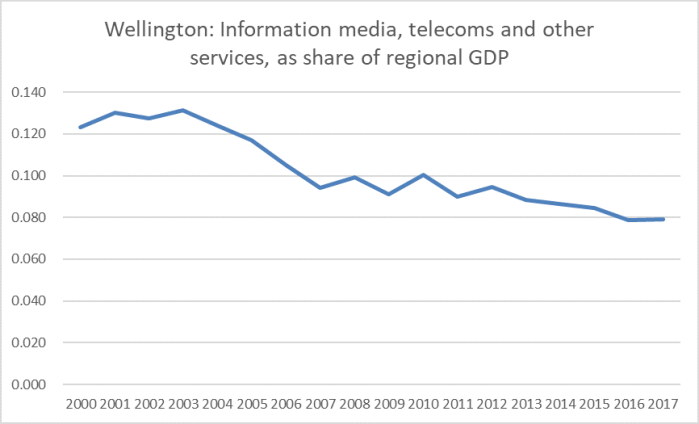
The story in Wellington is different of course, but probably no less telling.  Here, local government likes to talk up the idea of a city built on high tech industries.   Central government likes that talk, and also throws (lots of) money at the film industry.    The information in the regional GDP tables doesn’t give a full picture, but there is a line for the component of GDP labelled “Information, media and telecommunications and other services”.  Here is the share of that sector in Wellington’s GDP.

wgtn ICT

Even in Auckland, the share of that sector has been falling –  so there may be something structural around, say, the falling real price of telecommunications going on  –  but nothing like as steep as that fall in Wellington.

New Zealand does macro policy reasonably well –  fiscal policy and (for all my various criticisms at the margin) monetary policy – but our structural policies are set for failure, and in delivering continued underperformance, are doing just that.    The immigration policies pursued by successive governments simply take no account of either our experience (70 years of ongoing relative decline) or our most unpropitious location.   If –  as I noted yesterday –  this is a bad place for basing outward-oriented business (and revealed preference suggests that is so), it is a bad place for governments to engage in “population planning”, importing large numbers of people.  One of the fastest population growth rates in the OECD combined with one of the poorest economic performances should be telling anyone with ears to hear (not our politicians) something important.  The specific relative failure of Auckland just makes that message more stark.


What is going on with residence approvals?

Late last year I did a post using some data from the near-final version of MBIE’s new immigration statistics dashboard.   The dashboard is now on general release (here) and I should take the opportunity to commend MBIE on the initiative (even while wishing SNZ would now take the key time series and include them in their Infoshare database).  It takes a while to really work out how to make the most of the dashboard, but it means that administrative data (all the information on visa approvals –  and declines) that used to be published in readily useable form only annually and with up to an 18 month lag, is now readily available within 10 days of the end of each month.  For anyone trying to keep track of what is going on around the impact of immigration policy settings –  and recall that the late lamented PLT data was never any use for that –  it is a huge step forward.

And so lets have a look at a few charts, using data to the end of February.   Here is the number of residence visa approvals (and declines), actual monthly data and with MBIE’s “seasonally adjusted trend” (more trend than seasonal) through the data.

Res 1

Recall that the “target” rate of approvals is around 45000 a year, an average of 3750 per month.   The trend in actual approvals has been running (increasingly) below that level for the last two years.   For the current financial year, approvals are running at an annualised rate of under 35000 –  lower than at any time in the last 10 years.   Interestingly, it isn’t that more applications are being declined – in percentage terms, the fall off in declined applications has been larger than the fall in approvals.

I’m at a bit of a loss to know quite what is going on.  There was a slight reduction in the approvals “target” (they like to call it a “planning range”) late in the term of the previous government, but that was the difference only between 47500 per annum and 45000 per annum, nowhere near enough to explain the fall in actual applications and approvals.

I’d heard in several places that a big part of what was going on was shifting more residence visa processing back onshore.   Here is some relevant data on that

res 2

Clearly something has gone on, but (a) for a long time the overwhelming bulk of approvals were granted onshore, to people already in New Zealand (on other short-term visas), and if (b) offshore approvals have dropped away sharply, offshore declined applications have dropped to almost zero.  So I’m no clearer now than I was previously.

The points system is supposed to serve as a rationing device –  a quasi or shadow price. If there are lots of good applicants then, in principle, with a bit of lag the points threshold should be raised, so that we winnow out the lower quality (in terms of how the scheme is set up) applicants.  And, on the other side, if applications are dropping away sharply then, all else equal, the points threshold should in time be lowered and we’d find ourselves taking less-good quality applicants, who would otherwise not have qualified for residence.  But applications and approvals have been well down for two years now, and nothing has happened to the points threshold.

I’m mostly pleased with that –  part of my argument over the years has been that too many of the people we are bringing in (even under the skilled migrant headings) aren’t that skilled at all, and while they are benefiting themselves (and good luck to them) it isn’t doing any good for New Zealand.  Changes made late in the previous government’s term –  tightening up a bit on the one hand, and additional points for regional jobs on the other –  won’t have changed that picture.  But……..keeping the target unchanged (which is government policy, what Labour campaigned on and New Zealand First accepted in the coalition deal, looks a bit empty if the target is going to be persistently undershot (more so than, say, undershoots of the inflation target, since immigration approvals are an adminstrative act, directly under official control).  I’m a bit curious why no journalist seems to have been grilling the government about quite what is going on.  Is this the immigration equivalent of “opportunistic disinflation” –  they’ll take the cuts in immigration approvals if they come, but won’t do anything active to bring them about (or reverse them).  One can imagine there might be some blowback –  except among the handful of open borders people –  if standards for getting residence visas were lowered further.

It is noteworthy too that the fall in residence visa approvals has been concentrated in the streams (business/skilled) that were supposed to be the focus of the immigration programme.   That is so even though, for example, parent visa approvals are still suspended altogether.

res 3

I’m left puzzled about quite what is going on.  The number of people here on shorter-term work visas has still been rising strongly (and most people who get residence were already working here), and if the number of students is now flat, the numbers aren’t falling and an increasing share of the students who are here are in better quality, university, courses.  Quite possibly, a smaller proportion of those doing university study are interested in staying long-term than of those who were doing the PTE courses (often mainly as a pathway to work and possible eventual residence).

res 4

And finally, for those interested, here is what has been happening to residence approvals for our two largest source nationalities.

res 5

The next two biggest source nationalites –  UK and Philippines –  have also fallen away a lot, the former part of a long-term trend decline.

Overall, there are more questions than answered, but it is great to be able to do these sorts of charts quickly and easily.  Many fewer people who meet our quite low immigration standards now seem to be applying, or getting, residence visas, and that despite the apparently quite tight labour market.

Given announced government policy –  a continued high target – that should be a concern to them.    Some questions should be posed to Mr Lees-Galloway (although I can imagine that he would much prefer not to have to face them).


Terms and conditions surely?

With various media reports around – and numerous annoyed locals –  about Wellington public transport operators failing to deliver contracted services (cancelling services) because they haven’t (note the choice of word) recruited and retained sufficient drivers, perhaps it is time to haul up from the archives a couple of posts I wrote early last year on these and related issues.  Those posts were focused on bus drivers, while the latest stories feature both buses and commuter trains.  I see that, once again, there is talk of overseas recruitment.

This was my first post, sparked by reports that one company was wanting to recruit abroad to fill its vacancies.

Extracts:

What prompted this post was the story this week about a bus company – Ritchies –  wanting immigration approval to recruit foreign bus drivers.  Bus drivers don’t make the list MBIE released of occupations for which there were more than 100 (so-called) Essential Skills visas issued last year, but these occupations were some that did.

Essential skills visa approvals 2016/17
Truck Driver (General) 400
Winery Cellar Hand 396
Waiter 345
Sales Assistant (General) 320
Personal Care Assistant 289
Massage Therapist 259
Baker 231
Painting Trades Worker 220
Builder’s Labourer 185
Kitchenhand 181
Fast Food Cook 118
Farm, Forestry and Garden Workers nec 116
Bar Attendant 102

On the face of it, such roles don’t seem notably more (or less) taxing than being a bus driver.  It is a responsible role, but not one requiring huge amounts of skills or training (according to the story I linked to above 6 to 8 weeks training suffices).    It isn’t the sort of role one naturally thinks of when officials and ministers talk about skills-focused immigration programmes.

The case Ritchies make is that they can’t find locals –  New Zealanders, or people already here –  to fill new roles.

Auckland Transport awarded Ritchies Coachlines the contract to run buses on the North Shore from September.

But the company said so far it had not been able to find enough drivers locally and had asked Immigration New Zealand if it could bring in 110 of them from overseas to plug the gap.

And I’m sure that is correct.  If you pay low enough wages, it is hardly surprising that people with other New Zealand options aren’t lining up to work for you.

At least on the union’s telling

“The problem with Ritchies is that they pay over a dollar an hour less than the industry so their retention rates are minimal. People get trained up then they’ll go to other bus companies where the rates are better. Again Ritchies brings it upon themselves.

On the face of it, it looks like another case of a service contract won largely on the basis of (assumed) low labour costs.

The company more or less acknowledges the point

Mr Todd said the company would continue trying to recruit locally but only had until late June before it would need to look overseas for drivers including in Fiji, Samoa and the Philippines.

He admitted the $20.20 an hour it paid drivers would be difficult to get by on in Auckland but said this was the budget it had to work with.

“Lets face it, any job in the world, if you pay enough, you’ll get people to do it but…those costs will have to be passed on.”

I don’t really see the specific company as the bogey-man here.  They are operating in an environment –  bidding for public contracts –  where the overall level of funding seems to implicitly rely on access to very cheap labour (in this case, according to the company, from Fiji, Samoa, and the Philippines –  the jobs presumably not being attractive to bus drivers from the advanced world, since New Zealand is now a low income advanced country).

The same goes, more or less, for some other public-funded industries. Rest-homes, for example, rely heavily on immigrant labour from poorer countries: the existing level of rest-home subsidies constrain their options pretty severely.  No individual firm has a great deal of market power.  But the overall market is nonetheless skewed by policy choices successive governments have made about access to immigrant labour to fill what are mostly quite modestly-skilled roles.

It is why we need not small tweaks at the margins –  should or shouldn’t bus drivers (waiters, kitchenhands, or whatever) be on the approved list – but an overhaul of the entire immigration system.

But as part of that we should:

  • establish a strong presumption against use of unskilled immigrant labour (which mostly –  although not entirely –  competes with and tends to drive down returns to domestic unskilled labour), and
  • get ministers and officials out of the game of determining which specific roles people can and can’t hire short-term immigrant workers for.

To that end, I’ve argued previously for a system in which Essential Skills visas are granted on these terms:

a. Capped in length of time (a single maximum term of three years, with at least a year overseas before any return on a subsequent work visa, with this provision to apply regardless of skill level).

b. Subject to a fee, of perhaps $20000 per annum.


And this was the follow-up post from a couple of weeks later.

Extracts

In a typical market, there aren’t sustained physical shortages –  the price adjusts.  If in this case the price (driver wages) wasn’t adjusting –  if anything there was a suggestion Ritchies would be paying less than the previous operator –  it suggested the plan was to close the gaps another way (bringing in more relatively unskilled people from abroad.)    Ritchies has moral agency in that –  they made a choice to bid that way, and should live with the consequences if it doesn’t work (if, for some reason, MBIE turns down their application to bring in relatively unskilled workers from abroad).   But I didn’t want to focus on the individual company, since they are responding to incentives set up by various arms of government –  Auckland Transport offering the contracts, and even more so MBIE (as part of the New Zealand government) in making immigrant labour relatively readily available for what are really quite unskilled roles.    And it isn’t as if Ritchies is the only company operating this way.   Another operator has won most of the bus routes in Wellington, to take over in July, apparently operating on very similar assumptions about access to new immigrant labour.

I had some comments directly from people involved in the industry, on both sides.  In substance they were making quite similar points.  As one observed, demand growth (in this case for bus drivers) can always be met by expanded capacity (immigration) or higher prices (or wages).  They went on to argue that the ability of some companies to import drivers meant they won contracts, and that it was as clear a case of immigration driving down wages as you could find.

Of suburban driver jobs, I observed last week

It is a responsible role, but not one requiring huge amounts of skills or training (according to the story I linked to above 6 to 8 weeks training suffices).    It isn’t the sort of role one naturally thinks of when officials and ministers talk about skills-focused immigration programmes.

One driver confirmed that training story noting that his employer

…took me on with just a car licence. They spent about 8 weeks training me up and paid for the costs of getting a heavy traffic licence and a P endorsement (essentially a “fit and proper” test.)

In terms of (price-based) evidence of labour market pressures, this driver observed that over five years or so his basic hourly rate has increased by only around 1 per cent per annum (if so, that would be less than the average rate of CPI inflation, so a reduction in real wage rates).

There seem to be a variety of ways to spin the story as to how much bus drivers are being paid, and what the new entrants (Auckland and Wellington) are offering or planning to offer.   …..[But] there doesn’t really seen to be much dispute that the new operators –  claiming an inability to find sufficient local labour –  are not offering drivers more than the current operators.  Indeed, the general sense seems to be that pay for equivalent effort would be less than at present.

And in a typical, well-functioning, market, when demand exceeds supply –  and not just for a day or two  –  the price of the product or service in question will rise (not fall).   Quite how much the rise will be will depend on the elasticities of supply and demand –  maybe a lot more potential drivers would emerge for slightly higher wages (or maybe not), and maybe bus patronage would drop away sharply with slightly higher fares (wages are by far the largest component in bus company costs) or maybe not.  But you wouldn’t expect to see the relevant price –  bus driver wages –  under downward pressure when there is incipient excess demand for drivers.

(It is not as if the outgoing operators have had abundant labour.  As one correspondent noted “Go wellington have about 340 drivers for the current contract but even with huge active recruitment and training from scratch they only get 100 new per annum which is as many as they lose”.)

In fact, the way the bus driver labour market exists seems to be possible only because our governments –  present and past –  have opened up a channel through which supply can be increased, at or below the current price.  Open up incipient excess demand at current –  or lower –  than prevailing wages, and then get in workers on a (so-called) Essential Skills visa.

Bus drivers aren’t an occupation that appears on the official “skill shortage list” (if they were there would no further labour market test involved for any firm wanting to hire foreign labour).  Occupations such as bricklayers, plasterers, bakers, and jockeys are on the list.   But not being on the list doesn’t mean bus companies can’t hire foreign drivers.  There are just more hoops to jump through –  which is why employers who think they might have multiple vacancies (like the bus companies) are strongly urged (by MBIE) to seek an “approval in principle”.

MBIE’s employer guide is here.   You’ll see that for unskilled or modestly skilled jobs, part of the required test is to check with WINZ as to whether there are New Zealanders seeking work they can refer to the employer.   Bus drivers are in that category…….

That looks mildly encouraging.  You can’t just offer the minimum wage (for a job in New Zealand typically paying $5 an hour more than that) and expect to get your approval in principle to bring in foreign workers.   But if your wage contract is a little different from other operators (perhaps base rates are a bit higher, but other payments are lower?)  or even if you can find one other company somewhere in the country paying the same overall rate, you have to wonder (based on total numbers approved if nothing else) how rigorous MBIE is in enforcing the test.  And why, for example, it isn’t given more prominence in their guide to employers?

Because, you see, MBIE is really keen that firms hire foreigners.    In fact, they have whole website pages devoting to extolling the virtues of immigrant labour –  so much so that one has to wonder whether they really see themselves working in the interests of New Zealand citizens.    Employers are told

“Hiring migrants is a great way for you to maintain and grow your business”

And then the first item under that “Why hire migrants?” employers are told

Migrant workers can do more than just fill a gap in your staffing. They bring with them an international perspective and connections, provide support to up-skill local employees, add diversity, and generally can help businesses to stay ahead of their competition.

The “international perspective and connections” being oh so important for bus drivers, bricklayers, or even the cafe or retail managers or aged care nurses (occupations topping the work visa approval list).    There is no hint for example that there might be any disadvantages –  eg lower returns to New Zealanders in similar occupations, or the simple fact that, in aggregate, migrants add more to demand pressures (including for labour) than they do to supply in the short-term.

If we are going to have government officials administering something like a mass market Essential Skills visa scheme, and deciding who does and doesn’t get approval, surely a key aspect of any labour market test should be something along these lines?

“has the effective wage or salary rate for this occupation risen materially faster than wages and salaries more generally in New Zealand over the past couple of years?”

If not, how can you seriously use the term “skill shortage”?    Even if wages in a particular occupation have risen faster than the norm, it takes time for locals to respond and shift occupations, so one wouldn’t necessarily want to jump at the first sign of a bit of real wage inflation in a particular occupation, but if after a couple of years the pressures were persistent then some sort of Approval in Principle for temporary migrant labour –  at wages at or above those now prevailing in the domestic market – might make some sense as a shock absorber.  But MBIE seems perennially averse to markets adjusting in ways the generate higher real wages, even though that outcome is one core part of what we look for from a successful economy.  Successive Ministers of Immigration –  from both main parties –  seem to buy in to the story, and believe that central planning by them and MBIE bureaucrats is going to work better than the price system.  It wasn’t a good system in the Soviet Union, and it isn’t here.

I can’t see a reason why we should be giving Essential Skills visas for suburban bus drivers, and we shouldn’t be creating a system where firms are encouraged to bid in the expectation that they can use that system, rather than pay a market-clearing wage for New Zealand resident workers.

More generally, I don’t think there is particular merit in a system in which officials are picking and choosing which firms can and can’t hire short-term workers.   As I noted in my previous post I favour something along these lines

To that end, I’ve argued previously for a system in which Essential Skills visas are granted on these terms:

a. Capped in length of time (a single maximum term of three years, with at least a year overseas before any return on a subsequent work visa, with this provision to apply regardless of skill level).

b. Subject to a fee, of perhaps $20000 per annum.

If an employer really can’t find a local hire for a modestly-skilled (or unskilled) position, they’d be able to get someone from overseas, but only by paying (to the Crown) a minimum annual fee of $20000.  It is pretty powerful incentive then to train someone local, or increase the salary on offer to attract someone local who can already do the job. If you can’t get a local to do a job for $40000 per annum, there might well be plenty of people to do it for $50000 (and still cheaper than paying the ongoing annual fee for a work visa employee).

There are lots of operational details that would need to be refined, but as a starting point it seems like a pretty attractive system.  In the current situation, if bus companies really can’t find New Zealanders to drive, they could hire foreigners, but would have to pay an additional annual fee to the Crown of $20000 for each approval (but also wouldn’t otherwise have to jump through bureaucratic hoops, legal fees etc).  I’d be really surprised if there were any bus drivers then on Essential Skills visas or –  reprising the list from my previous post – kitchenhands, waiters, or massage therapists.  But, you never know.   If the market price adjusted that much that it was still better to hire a foreigner, that price adjustment might be a pretty compelling argument for a rather more genuine “skill shortage” than what we have now.

Perhaps in the end, MBIE won’t allow the bus companies to hire immigrant labour to fill the vacancies.  I’d welcome that, but the bigger issue isn’t any particular role, but how the system as a whole is designed and operated.

That’s the end of the extracts from last year’s posts.  There are lots of words there, but surely the bottom line is that for any modestly-skilled occupation for which there isn’t a sudden totally unexpected change in demand (and the number of people wanting to use public transport just doesn’t fluctuate that much), persistent “shortages” tell you more about the wages and other terms and conditions being offered than they do about any real sense of unavailable labour?  People will typically pursue the best opportunities available to them.  Make bus (or train) driving somewhat more attractive –  which is what the market signals are suggesting should happen –  and some more people will be interested in, perhaps even keen on, driving a bus or a train.

And lets not allow the immigration system to be used to avoid responding to domestic labour market signals, especially in non-tradables parts of the economy.  There is a place for immigration –  a reasonably generous approach to refugees, and an openness to some really highly-skilled people who might want to settle here (probably quite a small modest number given distance, modest income relative to other advanced countries, and the revealed preference experience –  only a small proportion of our actual migrants have been particularly highly-skilled).

(And, to be clear, the overall wage effects of high immigration are ambiguous, in part because in aggregate immigration boosts demand more than supply in the short run, and there are repeated waves of migrants, and thus repeated short-runs.  I am not one of those arguing that immigration policy is driving wages systematically down.  This post is about the impact in specific localised markets, and even more about the rules regarding labour market tests.)

Immigration data: some questions

For several years now I’ve been complaining about the inadequacies of MBIE’s administrative immigration approvals data.   It really should have been easy to have this data readily available (including in SNZ’s Infoshare platform) very quickly: we manage it, for example, for building approvals.   But it hasn’t been.

For a long time, the public was supposed to be content with the annual Migration Trends and Outlook publication.  It had a lot of interesting and useful data but (a) it was only available on an annual basis and (b) the lags were quite long.  They also made available gigantic spreadsheets which might have been readily useable for those with programming skills or the right software, but for humbler analysts required a significant investment of time to extract the simplest numbers.  And then those spreadsheets themselves were withdrawn –  they discovered, belatedly, some privacy issues.  They in turn were replaced with big PDF documents in small fonts where you could find some of the data updated each month, but still with an annual focus (thus they report year to date data, rather than monthly data).

There is progress afoot.  MBIE has spent a lot of time and resource developing a Migration Trends Dashboard which will, when it finished, finally get us to the point of having timely, useable, monthly data, seasonally adjusted where appropriate.  The sort of standard we’ve long expected for other major statistical series.   I’ve been invited to a couple of consultation sessions with them as the product has been developed and although the dashboard has not yet been formally launched they’ve told me they have no problem if I run some graphs here from the dashboard. (Because it isn’t yet officially launched, and it doesn’t yet work with all browsers, I won’t link to the dashboard here, but if anyone really wants the link to have a play with the data, email me –  address in the “About Michael Reddell’s blog” tab.)

This is the sort of thing that will be readily available: residence approvals by application stream.

R1 Residence Decisions by Application Stream (1)

This is calendar year data, so note that the final observations are only for 10 months.  But even if you scale those numbers up (by 6/5) what is unmistakeable is how sharp the reduction in the number of residence approvals granted in the business/skilled streams –  centrepiece of our economics-focused immigration programme –  has been.    I wrote first about this development a couple of months ago, somewhat puzzled by quite what is going on –  given that there was a small reduction in the residence approvals target last year, but nothing subsequently.

Unfortunately –  I guess it is still a prototype –  the November numbers haven’t yet been loaded in the Dashboard, so I had to go back to the more timely –  if less wieldy –  big PDFs, where the data is in financial year (to June) format.

residence approvals 2018.png

I’ve annualised the five months of data we have for 2018/19 to date.  At present approval rates we are on course for a slightly lower rate of approvals in 2018/19 than we had in 2017/18 –  both below official announced target (centred on 45000 approvals per annum).    Those would be the lowest number of approvals this century to date.

I remain a bit puzzled quite what is going on, and I’d have thought someone should be grilling the Minister of Immigration for answers.  There is an official target and it is not even close to being met.

Here is an update of a chart I ran a couple of months ago of the nationalities of those granted residence approvals (again the 2018/19 numbers are annualised).

residence approvals by nationality

What is striking is the reduction in the number of Indian and (even more so) Chinese approvals.

As I noted in the earlier post

I’m puzzled.  And, of course, I’ve spent years calling for a reduction in the residence approvals target, so in one sense I’m not unhappy to see the reduced numbers.  But I also strongly favour open and transparent policy, and there has been nothing announced suggesting that we should have been expecting –  or that the government was seeking –  such a large reduction in the number of residence approvals being granted.

And the number of points required to get residence is supposed to operate as a quasi-price: if too many “good” applicants are applying, the logic is supposed to be that the points threshold is raised, and if not many applications are coming in, the points threshold is supposed to be lowered.  But I’m not aware of any steps having been taken –  lowering the threshold –  this year.

One possibility is that although the government was not willing to openly take steps to reduce the inflow of (permanent) migrants, they (or at least parts of the government) were not unhappy if the inflow declined anyway.   And even among those champing at the bit for lots of migrants –  one might think of the Prime Minister –  perhaps there is some unease that announcing a reduction in the points threshold might reawaken a debate about the relatively low-skilled nature of many of our (notionally) skilled migrants.   These, after all, were the top occupations for the skilled migrant principal applicants from the most recent Migration Trends and Outlook.

Main occupations for Skilled Migrant Category principal applicants, 2016/17  
   
Occupation 2016/17
Number %
Chef 684 5.7%
Registered Nurse (Aged Care) 559 4.6%
Retail Manager (General) 503 4.2%
Cafe or Restaurant Manager 452 3.7%

And finally, a couple of other snippets of what we are better able to see with the new Dashboard.   This chart shows the number of first-time student visas granted to people from each of the two largest markets, China and India.

student visas FSV

I’d been aware that Indian student numbers had fallen sharply, although the numbers there appear to have stabilised.     The China market, however, is much more important for our universities and I hadn’t been aware that the number of first-time visas for PRC students had also been falling away for a couple of years now; so much so in fact that almost the whole of the boom has reversed.    No doubt the Vice-Chancellors will be even more concerned to keep pressure on the government not to say or do anything that might upset the regime in Beijing, no matter how egregious it is.

That chart is about flows –  first time arrivals.  The stock of foreign students takes longer to adjust, but here from the Dashboard is a chart of the stock of full fee paying student visa holders in New Zealand.

Counts by Full fee paying

And last of all, this is the stock of people in New Zealand with current work visas.  Whatever is going on around residence approvals, the number of people with short-term work visas continues rise pretty strongly (although, interestingly, when I dug down a little, the number of people here on working holiday visas has fallen back a bit from peak).

Counts by Total (Work)

When it is finished, MBIE’s new dashboard will be a significant step forward.  Even now we are beginning to get more information, on a more timely and accessible basis.  That is welcome.  But the better data unables us to pose some as-yet-unanswered questions including (particularly) just what is going on with the centrepiece of our immigration policy, the residence approvals programme.

(And while I’m awarding ticks –  well half-ticks anyway –  for this data, we shouldn’t lose sight of the loss of the data about the comings and goings of New Zealanders.)

UN Compact on Migration

Various readers have commented in recent weeks on the United Nations Global Compact for Safe, Orderly, and Regular Migration, due to be signed next week by as many governments as can be mustered in support.   I’d had a quick skim through it and decided not to write about it here, as not only was it a non-binding political declaration, but most of it seemed more relevant to countries dealing with substantial illegal migration (and with migration mainly from very poor or disrupted countries – again, not the main situation in New Zealand).   And, as I pointed out to various readers, who needs the United Nations for immigration policy and practice to cause problems at home.  We have successive New Zealand governments, cheered on by the business and political “elites”, to do that for us.

But when I saw yesterday that the National Party –  as pro-immigration as they come – had indicated that (a) it would not support signing, and (b) it would withdraw from the agreement when it returned to government, I thought I should take another look.  It would, after all, be unusual to find myself in more of a middle-ground position on immigration issues that the National Pary.  Then it emerged that the current government has still not yet decided whether to sign up.   My suspicion remains that National’s stance is more about positioning relative to New Zealand First –  the contest for provincial votes –  than anything of substance.

Overseas, I was aware that the United States and Australia had decided not to sign, as well as a few eastern European countries – including some places whose democratic credentials are no longer unimpeachable.    But when I went looking, I found this article suggesting the pushback in Europe is spreading.    Austrian and Italy have refused to sign, and governments in Belgium, Germany and the Netherlands are under pretty intense pressure (from within).  In Holland, for example

The government ordered a legal analysis of the text last week to ensure that signing it will not entail any legal consequences. The Cabinet finally decided on Thursday that it would support the pact, but would add an extra declaration, a so-called explanation of position, to prevent unintended legal consequences.

So I reread the document, more slowly this time.  I can’t see any substantive need for the document –  it seems more about political rhetoric and framing than anything else –  and have long been deeply sceptical that the United Nations adds any value to anything much.   And, yes, the document has a pro-migration tinge to it (it talks of wanting to “promote” migration) and a rather “globalist” set of presuppositions (including the demonstrably wrong statement –  especially in the context of remote island states – that “no State can address migration alone”).   But that doesn’t mark it out from dozens of pointless international fora and international declarations.    And there is little doubt that the “elite” mindset, in Europe and its offshoots anyway, is mostly pretty strongly pro-immigration.

But it still isn’t clear to me quite what additional damage would be done by signing up to this pointless agreement.   Sure, even “non-binding” agreements will, at times, be used in domestic and international fora as a rhetorical stick to beat governments with if they ever look like stepping out of line with the mainstream.  But those sorts of arguments rarely deflect a government for long if it has domestic public opinion behind it in some direction or another (for good or ill).

There is some questionable economics in the document.  For example

Promote effective skills matching in the national economy by involving local authorities and other relevant stakeholders, particularly the private sector and trade unions, in the analysis of the local labour market, identification of skills gaps, definition of required skills profiles, and evaluation of the efficacy of labour migration policies, in order to ensure market responsive contractual labour mobility through regular pathways.

Or, alternatively, one could just let the market work it out.  When there are incipient skill shortages, wage rates tend to rise.  Same thing happens when, for example, bad weather creates a shortage of spinach or lettuce.    But, daft as the economics is, this stuff is the mindset of politicians and officials adminstering immigration schemes all over the western world. including New Zealand.  Recall that in New Zealand the current government is trying to get more actively involved in this sort of thing.

There are also totally vacuous bits, like the commitment to support and promote the United Nations International Day of Family Remittances.  Just what the world needs: another United Nations “day”.

Perhaps three clauses troubled me a little more.

There was this one

Enable political participation and engagement of migrants in their countries of origin, including in peace and reconciliation processes, in elections and political reforms, such as by establishing voting registries for citizens abroad, and by parliamentary representation, in accordance with national legislation.

I guess I can see what they are probably driving at (diasporas helping the reconstruction of the country of origin after say a protracted civil war). But, normally, we should expect migrants to commit themselves to their new country and its processes and political values and not be creating doubts about where their loyalties lie.  But in a country in which Jian Yang and Raymond Huo are MPs –  while still closely associating themselves with political interests in their country of origin –  and people like Yikun Zhang appears encouraged to play both sides –  it is hard to see how this particular provisions make things here any worse than they already are (around a small handful of our migrants).

And then there was this one

Promote mutual respect for the cultures, traditions and customs of communities of destination and of migrants by exchanging and implementing best practices on integration policies, programmes and activities, including on ways to promote acceptance of diversity and facilitate social cohesion and inclusion.

Which presents the issues as symmetric when they really should be asymmetric: the focus should be on encouraging the assimilation of the migrants, and ensuring their respect for the “cultures, traditions and customs” of the destination community –  just as when you go to someone else’s place for dinner you respect their practices, table manners etc.   One could also argue that encouraging “acceptance of diversity” and facilitating “social cohesion” are two contradictory, often mutually inconsistent, goals.  But again, flakey as all this stuff is, it is the way our bureaucratic and political “leaders” think and act anyway.  If the behaviour is a threat, it is hard to see that the UN agreement would be more of one.

Relatedly

Support multicultural activities through sports, music, arts, culinary festivals, volunteering and other social events that will facilitate mutual understanding and appreciation of migrant cultures and those of destination communities.

Quite what business this is of the UN –  or even of national governments actually – one has to wonder, but there is the “globalist” mindset for you.   And, again, it is pretty much what central and local governments do anyway.  I was interested that “religion” wasn’t on the list

And then, of course, there is Objective 17 (of the 23 in the document) which I have seen people express more serious concern about.

OBJECTIVE 17: Eliminate all forms of discrimination and promote evidence-based public discourse to shape perceptions of migration

We commit to eliminate all forms of discrimination, condemn and counter expressions, acts and manifestations of racism, racial discrimination, violence, xenophobia and related intolerance against all migrants in conformity with international human rights law. We further commit to promote an open and evidence-based public discourse on migration and migrants in partnership with all parts of society, that generates a more realistic, humane and constructive perception in this regard. We also commit to protect freedom of expression in accordance with international law, recognizing that an open and free debate contributes to a comprehensive understanding of all aspects of migration.

If that isn’t muddled I don’t know what is –  let alone, unrealistic (in no conceivable world are “all forms of discrimination” going to be “eliminated”).

The specifics under that Objective include commitments to

Enact, implement or maintain legislation that penalizes hate crimes and aggravated hate crimes

So-called “hate crime” legislation is almost always bad law and bad policy.  Punish assaults or murders or whatever as that: bad and unacceptable acts, regardless of who they are committed against or why.

And this

Promote independent, objective and quality reporting of media outlets, including internet based information, including by sensitizing and educating media professionals on migration-related issues and terminology, investing in ethical reporting standards and advertising, and stopping allocation of public funding or material support to media outlets that systematically promote intolerance, xenophobia, racism and other forms of discrimination towards migrants, in full respect for the freedom of the media.

Again, muddled at best.  You want to stop any public funding to outlets whose views are “unacceptable”, while having “full respect for the freedom of the media”.   Since I’m not entirely convinced there is a good case for public funding of any media outlets –  and since the publicly-funded outlets in New Zealand are champions of high immigration and all “worthy” leftist causes anyway –  it isn’t clear what difference this might make in New Zealand.    And there seem to be some MPs –  particularly in Labour and the Greens –  who aren’t too keen on allowing free speech on such issues anyway, whether or not we sign up to UN non-binding declarations.

And finally under Objective 17

Engage migrants, political, religious and community leaders, as well as educators and service providers to detect and prevent incidences of intolerance, racism, xenophobia, and other forms of discrimination against migrants and diasporas and support activities in local communities to promote mutual respect, including in the context of electoral campaigns.

All very asymmetric –  nothing at all about engaging with communities that might be uneasy about high immigration, or the immigration of groups with values antithetical to those of the destination community.  Perhaps, in some respects, this commitment troubles me more than most.   “Intolerance” is not an offence (in principle or in law) and it is the perfect right of people to debate –  perhaps especially in election campaigns – the future composition of their society.   A Saudi Wahhabi, a Chinese Communist Party zealot, an American evangelical, and a French secularist are all very different sorts of people. In large numbers, each group transplanted to (say) New Zealand would make a material difference to the society and polity we have here.  Those debates matter –  unless, apparently like the authors of this document –  you regard all differences of culture, politics, religion etc as superficial rather than fundamental.

As I said at the start, there is no obvious need for this document.  And even if there were obvious gaps, the very fact that it is a non-binding political declaration suggests it could meet no substantive need.  But in a New Zealand context, there are policies and practices around immigration that are much more damaging and threatening, particularly to our long-term economic performance, and perhaps in other areas too.  Among them:

  • the immigration policies of the National Party
  • the immigration policies of the Labour Party
  • the immigration policies of the Green Party
  • the immigration policies of ACT, and
  • the immigration policies of New Zealand First

I think that pretty much covers the spectrum.

There is no conceivable universe in which some international declaration –  or even agreement – around immigration would be more liberal and (in our specific economic circumstances) more damaging than what our political parties have done to us all by themselves.