Skills-based immigration – C

Lots of the work visas approved in the last five years were for occupations starting with C.   There were quite a few carpenters, as one might expect, but when three of the top four categories are chef, cook, and café and restaurant manager it doesn’t have the ring of a strategy well implemented to enhance productivity and the earnings prospects of New Zealanders.  I was also struck by the number of commercial cleaners, commercial housekeepers, and community workers.  And I mentioned the 250 or so checkout operators yesterday.

A skills-based economic lever to lift productivity and living standards for New Zealanders?  Really…….

work visas c

Skills-based immigration – B

Not so many people came in with “letter B” occupations, but again the list of occupations with more than 100 approvals wasn’t a great advert for the transformational productivity-enhancing possibilities of our immigration policy.

work visas b

I won’t get into debates about the possible role of temporary migration in dealing with Canterbury rebuild pressures –  but really, builder’s labourers?  But even setting construction-related roles to one side for now, a list that has the top four places taken by beauty therapists, bar attendants, bus drivers, and baristas isn’t a great advert for the  productivity (and wage) possibilities this programme creates for New Zealanders.

Frankly, I’m surprised by how few of these work visa approvals seem to have been for genuinely highly-skilled roles.  But I led a sheltered life –  the Reserve Bank used to periodically recruit foreign PhD economists.   Then again, even in the Treasury papers I noticed reference to the declining average quality of migrants.

The Treasury papers also note (p 52) that

from a dynamic productivity perspective, we consider that migration shouldn’t provide a “path of least resistance” for growth in certain sectors of the economy.  By this we mean that temporary migration shouldn’t act as a lever that keeps labour costs in certain industries down to the extent that it dulls incentives to invest in capital or increase working conditions to attract local labour.

Perhaps they had the aged-care sector in mind? Or the dairy industry?

What sort of people get New Zealand work visas?

Fossicking on one of MBIE’s websites, I found a huge spreadsheet showing all work visas applications for the last five years.  I deleted the ones that were declined and starting to have a look at what occupations the people had who received New Zealand work visas over that period.   Not all of them, by any means, will have gone on to permanent residence, but most permanent residence approvals are of people  already living in the country (eg on a work visa).

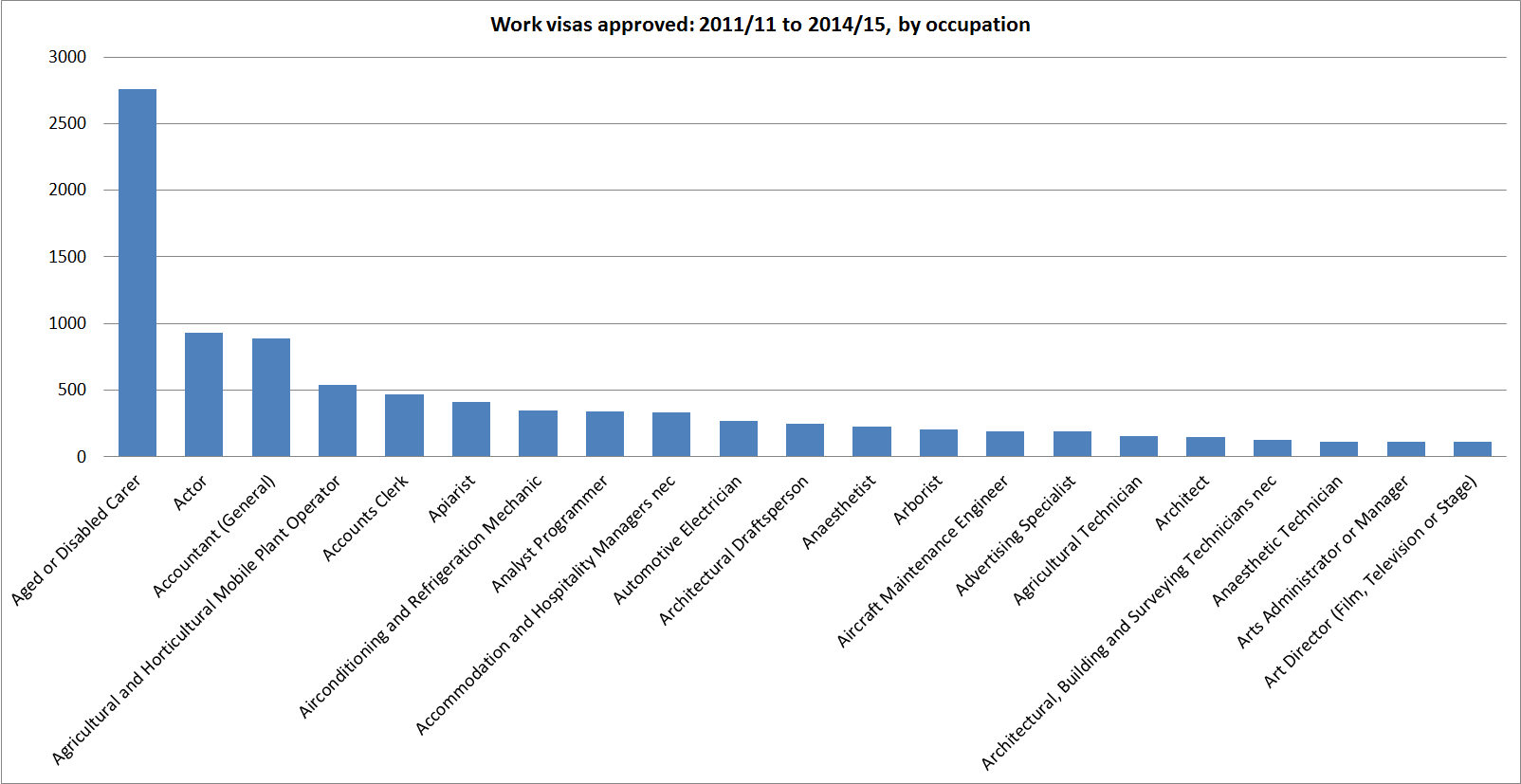
This chart is just for occupations starting with the letter A, showing those for which there were more than 100 approvals  over this period.  Given that the focus of the immigration programme is supposedly on highly-skilled migrants, the number of aged care workers was striking (albeit not too surprising).  I’ll assume that most of the actors were genuinely short-term project related (while recognising that the film industry only survives through large taxpayer subsidies), but number 5 on this list was also a bit of surprise.  Skill-based lifts in productivity driving off an influx of foreign accounts clerks?

work visas a

Some of the approvals I don’t show raised a wry smile.  It wasn’t clear, for example, quite what demand there was in New Zealand for a (single) Aboriginal and Torres Strait Islander Health Worker.   Or for an antique dealer?

I’m not sure my enthusiasm will hold for the rest of the alphabet, but in case not I should mention that as I glanced through the spreadsheet I found that the New Zealand government –  focused on lifting national productivity, according to those Treasury papers –  had granted work visas to 149 checkout operators and 227 shelf-fillers.

The Treasury on immigration

Some months ago, I commented briefly on a speech by the Secretary to the Treasury, Gabs Makhlouf (himself a fairly recent temporary immigrant), in which he had lauded the economic gains to New Zealand from our large-scale non-citizen immigration programme.  Makhlouf asserted that:

Migration helps to lift our productive capacity – it enables the economy to grow faster by increasing the size of the workforce, in much the same way that foreign capital allows us to grow faster than domestic savings alone would permit.

Like foreign investment, migrants also bring new skills, new ideas and a diversity of perspectives and experiences that help to make our businesses more innovative and productive.

And perhaps most importantly, migrants often retain strong personal and cultural connections to other parts of the world, which opens up, and helps us to pursue, new business opportunities. We are in a pretty incredible position in this regard, with so many New Zealanders – around 1 million people – living overseas, and so many people who live here having been born in another country.

More recently, I passed on the comment Makhlouf had reportedly made, in an official capacity, that ‘immigration is good, it is as simple as that” (or words to that effect).

Some time ago, I lodged a request with Treasury for copies of any advice they had provided to ministers over the last couple of years on the economic impact of immigration in New Zealand, and on the permanent residence approvals target (currently 45000 to 50000 per annum). I was curious as to see what analysis and argumentation might lie behind their chief executive’s rather gung-ho views, but was really more interested in any economic analysis around the permanent residence approvals target, which I knew had been reviewed last year.

It took quite a while for the papers to be released, but eventually I did get part or all of 21 documents. Treasury suggested that they might put the material on their website, but they do not appear to have done so [UPDATE: a link here], so here is a link to a single pdf which contains all the material they released.  Subsequent page references are to this document.

Treasury immigration OIA results

Perhaps what surprised me most – I’m a starry-eyed optimist at heart – is how little substantive material or argumentation there was. I wasn’t expecting a major essay in each paper, but across the 21 papers there just wasn’t much there, even taken together.  Having said that, I was pleasantly surprised to find that the advice Treasury staff were providing the Minister seemed rather less glowingly optimistic than the perspectives offered by the Secretary.

The government sees (and probably previous governments saw) immigration primarily as an economic lever. If so, we do it mostly because we think it benefits us.  The non-citizen migration programme is certainly large, and Treasury recognises that New Zealand’s non-citizen immigration programme is one of the largest (as a share of population) of any advanced country. An immigration programme of the size and character of the one New Zealand has run over the last 25 years has changed New Zealand very substantially.   Total population continues to increase quite rapidly (not now the case in many other advanced countries), and the ethnic composition of the population has been changing markedly. By sheer scale, it is probably larger than any other aspect of government economic policy in the last 25 years.   Statistics record a net 862000 non-citizen permanent and long-term arrivals in the 25 years to March, and the true scale of the inflow is probably larger than that.

But what is there to show for it?   The idea is, to quote from two of the Treasury papers:

High-skilled migrant labour increases the average productivity of the labour market, and this is the micro-economic channel through which many of the benefits of immigration accrue (p56)

Granting residence to skilled migrants can increase New Zealand’s human capital by helping meet skill shortages in a growing economy, improving productivity by reducing search costs for employers, and increasing the diversity and innovation of the workforce. These effects can improve labour market productivity over time, which contributes to New Zealand’s overall economic productivity. (page 29)

But there is no evidence of it having happened. We’ve had one of the largest targeted migration programmes anywhere, and there is no sign of any improvement in New Zealand’s productivity performance relative to other advanced economies.   In none of these papers is there anything concrete Treasury points to to suggest more favourable outcomes.

An independent economist (and former Treasury staffer) Julie Fry was commissioned by the Treasury’s Macroeconomic Policy team to prepare a paper on links between immigration and New Zealand’s macroeconomic performance. The resulting work last year found its way into a published Treasury Working Paper on the issues. Her abstract read as follows:

New Zealand’s immigration policy settings are based on the assumption that the macroeconomic impacts of immigration may be significantly positive, with at worst small negative effects. However, both large positive and large negative effects are possible. Reviewing the literature, the balance of evidence suggests that while past immigration has, at times, ha significant net benefits, over the past couple of decades the positive effects of immigration on per capita growth, productivity, fiscal balance an mitigating population ageing are likely to have been modest. There is also some evidence that immigration, together with other forms of population growth, has exacerbate pressures on New Zealand’s insufficiently-responsive housing market. Meeting the infrastructure needs of immigrants in an economy with a quite modest rate of national saving may also have diverted resources from productive tradable activities, with negative macroeconomic impacts. Therefore from a macroeconomic perspective, a least regrets approach suggests that immigration policy should be more closely tailored to the economy’s ability to adjust to population increase. At a minimum, this emphasises the importance of improving the economy’s ability to respond to population increase. If this cannot be achieve, there may be merit in considering a reduced immigration target as a tool for easing macroeconomic pressures. More work is require to assess the potential net benefits of an increase in immigration as part of a strategy to pursue scale an agglomeration effects through increase population, or whether a decrease in immigration would facilitate lower interest rates, a lower exchange rate, an more balance growth going forward.

The Fry paper considers a number of my ideas around the potential adverse effects of high rates on inward migration to New Zealand. I don’t entirely agree with her conclusion, which I think is probably too generous to the immigration programme New Zealand has run over the last quarter century, but even her conclusion is modest enough – any gains, from a very large scale programme, are likely to have been “modest”.   If so, why bother with the programme?

Just before the Fry paper was released, Treasury wrote an aide-memoire to the Minister of Finance, which they have released in full (from p 18). It is interesting because it is a joint product of the macro policy area of Treasury and more micro-oriented labour market and welfare team.   The authors note that “on the whole, The Treasury agrees with the assessment of the evidence in the paper”.  They don’t necessarily agree with the policy recommendations, but the government’s principal economic advisory agency apparently sees no reason to be more optimistic about the economic impact of immigration than Fry’s quite downbeat assessment. It is a very different from the tone of Makhlouf’s March 2015 public speech.

As I have noted on various occasions, with a well-functioning market in housing supply and urban land, immigration should have no material or sustained impact on house prices. But if supply is sluggish – as it undoubtedly is in New Zealand, largely for policy-determined reasons – increases in population will put considerable pressure on house and land prices. All New Zealand’s population growth now results from the large non-citizen immigration programme – without it, we would have a flat or slightly falling population. Against this background, it is surprising that the papers Treasury released make very little mention of the implications of the target level of immigration for house prices, in Auckland in particular, and hence for affordability and inequality issues. The young and the poor, the latter disproportionately brown, pay the price of a government commitment to continued high levels of non-citizen immigration. It is not as if other parts of Treasury are oblivious to the problem – this recently released paper on the housing market treats the issue quite well – but it does not seem to have been factored into immigration policy advice.

In my macroeconomic arguments about the effects of immigration, I have tended to assume the best about the make-up of the immigration programme itself – that it was bringing in mostly well-qualified people. I was willing to concede that there might be some skills gains, but to argue that these were probably outweighed by the macroeconomic pressures (on real interest and exchange rates). But people keep pointing out that even the skills gains are not as clear one might like to think. Apparently, we’ve given 20000   work visas for chefs in recent years.  And Fry points to formal studies showing how disconcertingly long it takes many similarly-qualified immigrants to reach New Zealand native earnings. And, as the Treasury papers show (page 26), over the three years to 2013/14 only around half of permanent residence approvals were to people under the “Skilled/investor” heading (while more than 10 per cent were for the parents of New Zealand citizens or residents).

I had also not paid much attention to the numbers coming under the numerous working holiday schemes that New Zealand is now party to.   But Treasury has, and actually recommended to the Minister of Finance last year that a cap should be placed on the numbers coming to New Zealand under the various uncapped working holiday schemes, highlighted a number of risks, including that the substantial growth in the number of working holiday visas might adversely affect employment opportunities for New Zealand young people.   This is no small point, since standard analysis (to which I largely subscribe) tends to be very sceptical of the idea that immigration undermines employment prospects, whatever it might do (positively or negatively) to productivity or wages. And it is not just one paper. In another, from December last year, Treasury notes that “immigration policy often involves trading off domestic labour market objectives with other policy objectives” (page 52) – a rather different tone, again, from the Makhlouf speech – and observing that “there is reason to be concerned about the impact some of our current immigration policies may be having on the labour market prospects of low-skill New Zealanders.”

And I’ve already highlighted some of MBIE’s own work suggesting that the investor and entrepreneur immigration categories might struggle to provide much net economic benefit to New Zealanders. There is no sign in these papers that Treasury is any more optimistic.

The other thing I learned from these papers, which I had not previously been aware of, is that when Cabinet reviewed the New Zealand Residence Programme last year, they agreed to set a two-year target rather than a three year one. That was, apparently, partly to shift future decisions, perhaps still triennial, into non-election years. But they also “directed officials to undertake a review of NZRP and report back to Cabinet by November 2015”. Treasury observes (page 53) “MBIE is currently undertaking a strategic review of immigration policy settings. One particular area of interest that has emerged is the extent to which labour market objectives are balanced against goals like foreign policy, tourism and export education”. It all seems a far-cry from a hopeful vision of substantial productivity gains, and beneficial spillovers to long-term New Zealand living standards, from a large scale inward migration programme.

Twenty five years on there is little or no evidence that our very large scale inward migration programme is producing economic benefits for New Zealanders – which should be the principal criterion guiding what is, after all, sold as an “economic lever”. There are some obvious winners – notably those who happened to be property owners in Auckland –  but that is purely a redistributional effect, at a serious cost to those who are increasingly squeezed out of being able to afford to buy a house in Auckland. And there are serious reasons to worry that actually the immigration programme has made things worse for New Zealanders, by putting pressure on scarce resources, and driving up real interest and exchange rates, and crowding out much of the sort of business investment we might otherwise have expected after the economy was freed-up in the late 1980s and early 1990s.

The Secretary to the Treasury is upbeat on the economic benefits to New Zealanders of the immigration programme. But where is his evidence? His staff don’t seem to have been able to find it.

Notwithstanding the prejudices of the elites, there would seem to be a pretty good case now for substantially reducing the non-citizen immigration programme, rather than just pushing on with a failed strategy –  a huge intervention in New Zealand’s economy and society for which Treasury can point to no material demonstrable benefits.

Of course, MBIE may yet have the answers. At the same time I lodged the original OIA request with Treasury I lodged a similar one with MBIE, the department with prime responsibility for immigration policy issues. That request is still working its way through the system, more than two months after it was first lodged. I’m beginning to wonder what interesting gems it contains, or (perhaps more saliently) which might yet be deleted and withheld.   Two weeks ago I had a friendly email from them telling me I would have the information the following week, and then last week I had another email, from someone further up the hierarchy, telling me that consultation – with the Minister’s office perhaps? – was taking longer than expected, but “we are working to provide a response to you as soon as possible”.   It isn’t an overly urgent issue, but it has now been more than two months, and the basic timeframe under the Act is 20 working days.

The government’s immigration policy changes

The Prime Minister yesterday announced several changes to New Zealand’s immigration policy. This is an extract from the Minister of Immigration’s press release.

New measures to take effect from 1 November include:

  • Boosting the bonus points for Skilled Migrants applying for residence with a job offer outside Auckland from 10 to 30 points. [They require 100 points]
  • Doubling the points for entrepreneurs planning to set up businesses in the regions under the Entrepreneur Work Visa from 20 to 40 points.  [They require 120 points]
  • Streamlining the labour market test to provide employers with more certainty, earlier in the visa application process.

“Unemployment across the Mainland is nearly half that of the North Island, and labour is in short supply,” Mr Woodhouse says.“We’re looking at offering residence to some migrants, who have applied at least five times for their annual work visa. In return, we will require them to commit to the South Island regions where they’ve put down roots.”

Mr Woodhouse says the Government is also considering a new Global Impact Visa to attract high-impact entrepreneurs, investors and start-up teams to launch global ventures from New Zealand.

“I will announce further details later this year, but we envisage this visa would be offered to a limited number of younger, highly talented, successful and well-connected entrepreneurs from places like Silicon Valley,” Mr Woodhouse says.

I can’t see any background analysis to these measures, either on the MBIE website or with the Minister’s press release.  On the face of it, however, this looks like a set of measures that will, on balance, to undermine the quality of New Zealand’s immigration programme.

We all know about the infrastructure pressures in Auckland –  largely self-inflicted by central and local government.  Perhaps trying to steer some of the immigrants away from Auckland might temporarily ease some of those pressures a little.  But there is a price to be paid. Providing a significant increase in the number of points available for people with job offers outside Auckland must lower the likely average quality of incoming immigrants.  There is no sign that the permanent residence approvals target (135000 to 150000 on a rolling three year basis) is being increased, so people going to the regions –  taking advantage of the additional points for doing so – will be at the expense of otherwise better-qualified people who would have gone to Auckland.    Under the new policy, people will only have to stay in the regions for a year, so perhaps it will make only a very small difference over time to the number of immigrants who end up in Auckland.  But the ones who do come in, taking advantage of these additional points, will be – on average – less good quality people than the applicants who are squeezed out (people who might have a job offer in Auckland –  our highest paying and –  at least in a statistical sense –  most productive city).    Perhaps I’m missing a significant strand in the reasoning, but I can’t see the likely long-term economic gain for New Zealand.

The Global Impact Visa idea sounds superficially promising. But my impression from the Pathways Conference last week was that existing entrepreneur visa schemes had not worked particularly well.  It will be interesting to see the analysis behind this proposal, including an assessment of how the risks around it will be managed and overcome.  I remain a little sceptical of the attraction of New Zealand to “younger, highly talented, successful and well-connected entrepreneurs from places like Silicon Valley”.  The flow of people in that sector would seem more naturally to be in other direction.  I hope it is not an example of the old derogatory adage used about Britons working in Hong Kong:  FILTH  (“failed in London, try Hong Kong”).

Immigration, and the evidence of things not seen

In the biblical book of Hebrews, there is a verse that reads “Now faith is the assurance of things hoped for, the evidence of things not seen”.

It seemed to be rather like that at the Pathways Conference that I attended part of in Wellington yesterday morning.  The Pathways conferences were established back in the 1990s and are held annually “to disseminate publicly funded research on international migration and demographic change”.  I hadn’t been to one before, and it looks like an excellent initiative, at least in principle.  The issues around immigration (here and abroad, past and present)  are fascinating and we (and other countries no doubt) need a “reasoned and deliberate” debate on immigration policy[1].  Funding enables the conference to be held at no cost to the participant, and enables academic and public sector researchers to discuss research results and immigration-related issues.  Given the significance of immigration in New Zealand, and the way it is seen as a significant “economic lever” (in the words of a senior MBIE official at the conference), we need scrutiny and debate.

There were around 120 attendees, but not a single member of the media.  That surprised me.   When I counted up the delegate list. almost 50 per cent were public servants (although I was a little surprised that no one from Treasury was there).

I suspect I may have been the only person present even mildly sceptical about the benefits of New Zealand’s immigration programme.  Certainly, none of the papers I heard, no comments from the floor, and none of the summaries of the remaining papers betrayed a shadow of doubt.      In fact, so certain of the direction of the argument were the organisers that they describe this year’s conference as being about “how New Zealand can better respond to these demographic changes in order to maximise the benefits associated with an increasingly diverse population”.  Perhaps there are such benefits, even net, but it would be better to demonstrate them, than simply assert them.  The tone of the conference –  supposedly about presenting publicly funded research  –  was apparent early on when the Minister of Immigration twice thanked conference attendees for all they (we?) did for “our migrant communities”.   And here I thought immigration policy was undertaken for the benefit of New Zealanders, whatever benefits there might be to the migrants themselves.

The contrast with the Australian Productivity Commission’s inquiry, which I wrote about last week, was striking.   There seemed to be no interest in questioning whether there were benefits, and if so who might be securing those benefits.  Nor much interest in innovative ideas (eg charging for migrant entry).  The Australian inquiry may well lead to no material changes in policy, but at least it should assure the Australian public of a serious and dispassionate analysis of the issues and options.

The Conference was described as being under Chatham House rules.  That seemed a little odd, at least in respect of the main presentations (as distinct from comments/questions from the floor), since the purpose was supposed to be about disseminating publicly funded research, to the public.    But the programme is on the web (see link) above.

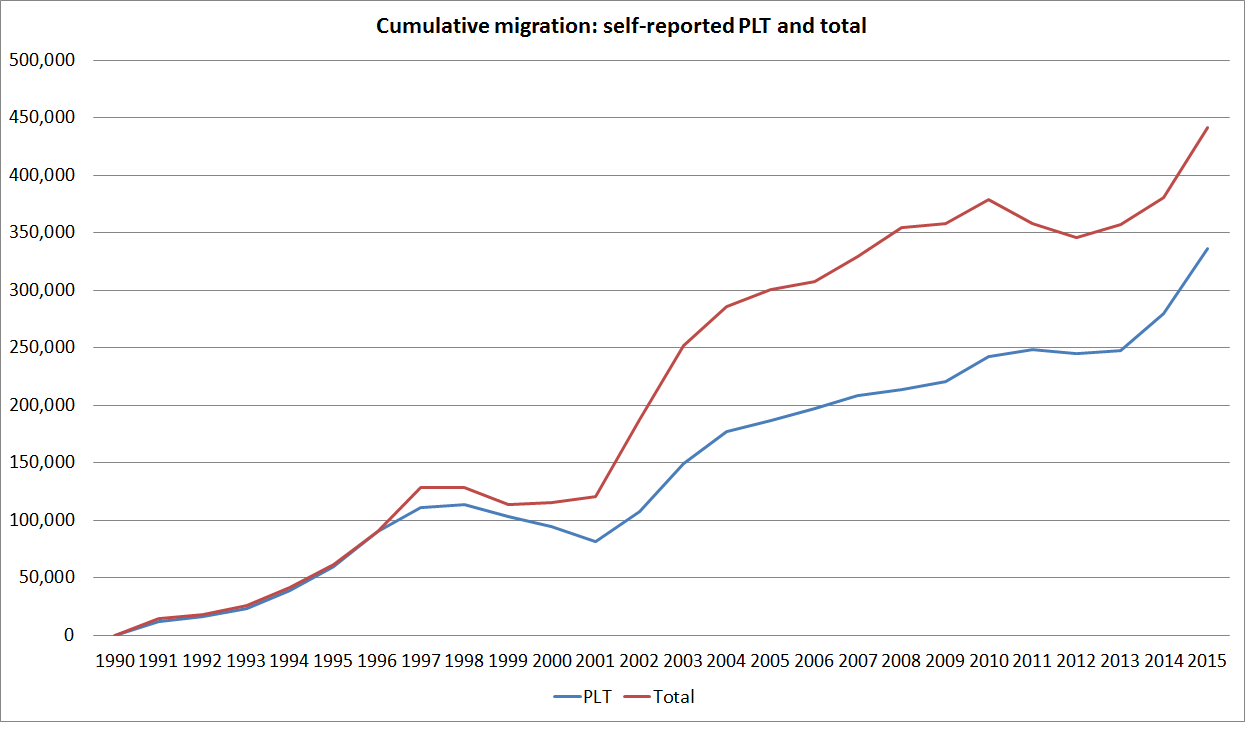
I found the Minister’s speech rather unimpressive.  The organisers described it as a “keynote” but it was anything but.  Unfortunately, I can’t quote from it, but suffice to say he appeared unimpressed by anyone –  be it the Herald, or perhaps even stray bloggers (with long-outstanding OIA requests in for departmental advice on immigration targets) –  suggesting that waves of migrants were putting pressure on resources or infrastructure.  A keynote actually addressing some of the issues might have been interesting.  And although the Minister and MBIE seem keen to remind people of the weaknesses of the PLT immigration data, they omitted to point out that in recent decades net PLT immigration has understated (not overstated) the net number of people coming to New Zealand.

cumulative plt since 1990b

In fact, what was striking about the morning was how little there was to give a listener any confidence that the “economic lever” (New Zealand’s immigration programme) was doing New Zealand much good.  I went along to listen, and was prepared to be sceptical.  But I didn’t really need to be.  Because what I heard wasn’t very encouraging at all.  Listening to people discussing the problems of designing an entrepreneur visa, for example, I became more sympathetic to the idea of auctioning migrant places.  And anguished talk of concern about how many migrants were going into low productivity sectors, rather than “where we want them to go” had much the same effect, and a desire to reach for my copy of Hayek, on knowledge problems etc.  The central planning tone (no doubt unselfconscious) was quite disconcerting.

One of the MBIE papers is on the web.  It discusses some work on investor migrants –  who already, in effect, buy their way into New Zealand.  The aim of the programme is to import people with business expertise and entrepreneurial skills, presumably to boost productivity in New Zealand.  And yet in these surveys of people at various stages of the investor migrant process  (and  in which respondents must have been at least partly motivated to give the answers MBIE wanted to hear, even if results were anonymised), 50 per cent of the money investor migrants were bringing in was just going into bonds, and only 20 per cent was going into active investments.  We aren’t short of money, but may be of actual entrepreneurial business activity.  And 70 per cent were investing only the bare minimum required or just “a bit more”.  And these people aren’t attracted by the great business opportunities in New Zealand, but rather by our climate/landscape and lifestyle.  It doesn’t have the sense of being a basis for transformative growth.  As even a fairly pro-immigration academic observed, New Zealand isn’t exactly likely to be first choice for the sort of person who might build the next great tech company.

In much of the debate around immigration in New Zealand it seems that people can’t quite make up their minds what sort of immigration we want.  On the one hand there is considerable emphasis on highly-skilled migrants. I can see the logic of that argument, even if I’m sceptical of what difference it might make.  But on the other, there was repeated discussion of the role immigrants play in the aged care sector and in the dairy sector.  Such migration is no doubt good for the migrant (migration usually is) but the basis on which it assists in lifting per capita incomes, and medium-term productivity, for New Zealanders is much less apparent.  As one senior official put it to me recently, the logic of bringing in large numbers of people to work cheaply on dairy farms isn’t obvious.  It may just allow farmers to bid land prices higher, or perhaps compensate for the self-inflicted problem of an overly high real exchange rate.

So there wasn’t much to go on if one wasn’t sure of the benefits of immigration in New Zealand.  But if you went along already convinced then no doubt faith carried you through the accounts of the practical limitations of how our immigration programmes actually work.

And, of course, I know that this was just one conference, and there are lots and lots of papers on immigration.  But few or none of them show, with any confidence, that New Zealanders are securing economic gains from this substantial economic lever that successive governments have sought to deploy.  We need a reasoned and deliberate debate, perhaps with our own Productivity Commission inquiry.

[1] Readers may recall that that was Shamubeel Eaqub’s description of the sort of debate he wanted about immigration, at least before he responded to my analysis with the label “racist”, a slur he has still not withdrawn.

The Productivity Commission looks into immigration

The Australian Productivity Commission that is.

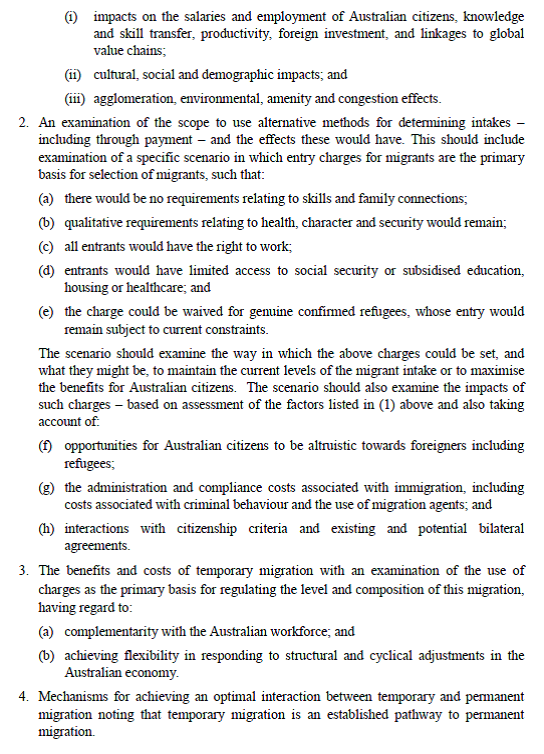
The Australian Productivity Commission has underway an interesting inquiry, initiated by the Federal Treasurer, into immigration to Australia. Here is the scope of the inquiry, taken from the Treasurer’s Terms of Reference.

aus pc1
aus pc2

It is interesting that the Australian government has chosen to initiate another Productivity Commission inquiry only 9 years after the previous large report into the economic impact of immigration. That bulky report concluded that in Australia, the gains from immigration mostly accrued to the immigrants, with little evidence of any material gains to native Australians. Despite the size of that earlier report, there was some aspects of the economic issues (possible benefits, as well as possible costs) that were not covered at all, and the modelling work that was done looked at the medium-term rather than the long term.

The new inquiry has two areas of focus. The first is helping to answer the questions about the costs and benefits of immigration, both to Australian citizens more generally and to the fiscal position of Australian governments more specifically. The second is around the intriguing idea of charging for entry. The idea of rationing entry by price turns up in immigration debates from time to time. “Intriguing” here is my code word for something like “this idea appeals to the economist in me, but yet there is something about it – which I can’t quite put my finger on – that is distasteful, and it seems unlikely to fly”. I can’t see it happening, and yet I’m not entirely sure why it shouldn’t. If we set aside the refugee quota, countries like New Zealand and Australia allow and promote immigration largely for economic reasons, and a price should tell something useful about who could get most value out of permission to live in our country. Perhaps willingness to pay is not overly well aligned to ability to help generate domestic productivity benefits?   But is there good reason not to use price to ration demand for places among those who meet certain basic criteria (age, English language, lack of criminal history etc)? It will be interesting to see what the Commission comes up with in this area.

To their credit, the team working on this immigration inquiry sent a couple of senior people to Wellington this week. New Zealand has quite similar immigration policies to Australia, and for Australia in particular, the largely-free trans-Tasman immigration area also complicates things (as it does for us, in the possibility of people returning home late in life to claim New Zealand welfare benefits). I was among the various groups of public and private sector people they met while they were here, and we had a good wide-ranging discussion.

I noted that I had increasingly come to think that good immigration policy – in countries like ours, with no treaty obligations to allow open access, and (unlike Israel) no national identity/security reasons to promote immigration – is best thought of as an optional complement to economic success. The alternative, which seems to be at the heart of the arguments of immigration advocates in New Zealand, is to see immigration policy as an engine (perhaps large, perhaps small) helping generate economic success.  I can’t think of a country – going back centuries – where immigration has materially improved the economic fortunes of the recipient country. In the last great age of immigration – the decades prior to World War One – migrants flowed to countries that were already economically successful (be it New Zealand, Australia, Canada, Argentina, the United States or even within Europe itself). Economic success allows a country, if it chooses, to support more people at high incomes. And emigration eases the pressures in the source country, lifting living standards among those who remain.

There is, of course, an exception to my story. Immigration has transformed the economic prospects of some physical territories, but only by totally taking over and largely replacing the indigenous population, and the economic institutions of that culture.   New Zealand – like each of the colonies of settlement – is an example of that. And it is an uncomfortable example. My assessment (backed, for example, by the work of people like Easterly, looking at long-term global economic performance) is that Maori average incomes are higher now than they would have been without extensive European settlement, but was the trade worthwhile – across all its dimensions – for the indigenous population? There are huge discontinuities between 21st century New Zealand and 18th century “New Zealand” that don’t exist for, say, the United Kingdom or France.

By advanced economy standards, New Zealand is a classic example of an underperforming country that people should be leaving. And, of course, for decades New Zealanders have been doing so, mostly to more successful Australia.   Of course, we can always attract plenty of people from other (even poorer) countries if we want to. But why would we?     There is no obvious area of the world where the culture and economic institutions are so obviously superior to our own Northern European-sourced ones that we can get the sort of transformative gains (at whatever costs) that Maori may have achieved by allowing extensive European settlement in the 19th century. There is no sign in the data that slightly larger countries grow faster (per capita) than slightly smaller ones.  And there is no reason to think we can somehow attract the very best of possible migrants to a small, remote, underperforming, but pleasant, country.   And if current migration patterns were repeated at scale, or for long enough, we would face the risk of factor price equalisation occurring, but not in the way we want – the typical migrant to New Zealand comes from countries, and economic cultures, that generate materially lower living standards and levels of productivity than New Zealand (or Australia) does.

The draft report of the Australian inquiry is due out in mid-November. I’ll be keeping an eye out for it. Perhaps it might be time for a similar inquiry in New Zealand. I think I’ve mentioned that when I first started raising my arguments about the possible link between immigration policy and New Zealand economic underperformance, there was a lot of discomfort at Treasury. Senior people then talked of the new Productivity Commission as a good place for such issues to be explored. That remains true today, and Treasury has a key role in advising ministers which inquiries to request from our Productivity Commission.

I have had Official Information Act requests in for some time with Treasury and MBIE for copies of advice to ministers on the economic impacts of immigration, and on the target level of permanent residence approvals. As is customary with government agencies, the responses to the requests have both been extended/delayed.   These aren’t particularly time-sensitive requests, but I will be interested to see what the departments have had to say. MBIE is well-known to be strongly pro-immigration, and I have heard reported that current Secretary to the Treasury (himself a temporary migrant) recently reiterated in private a view that “immigration is good; it is as simple as that” (repeating the tenor of comments in a speech earlier this year). Perhaps, but let’s see the argumentation, in the specific context of New Zealand, and in the light of cross-country economic history and experience.

Just how large a contribution has net migration made to population growth?

One of the challenges in discussing the impact of immigration in New Zealand is making sense of the data.  I’m running a story that says two (largely unrelated) things:

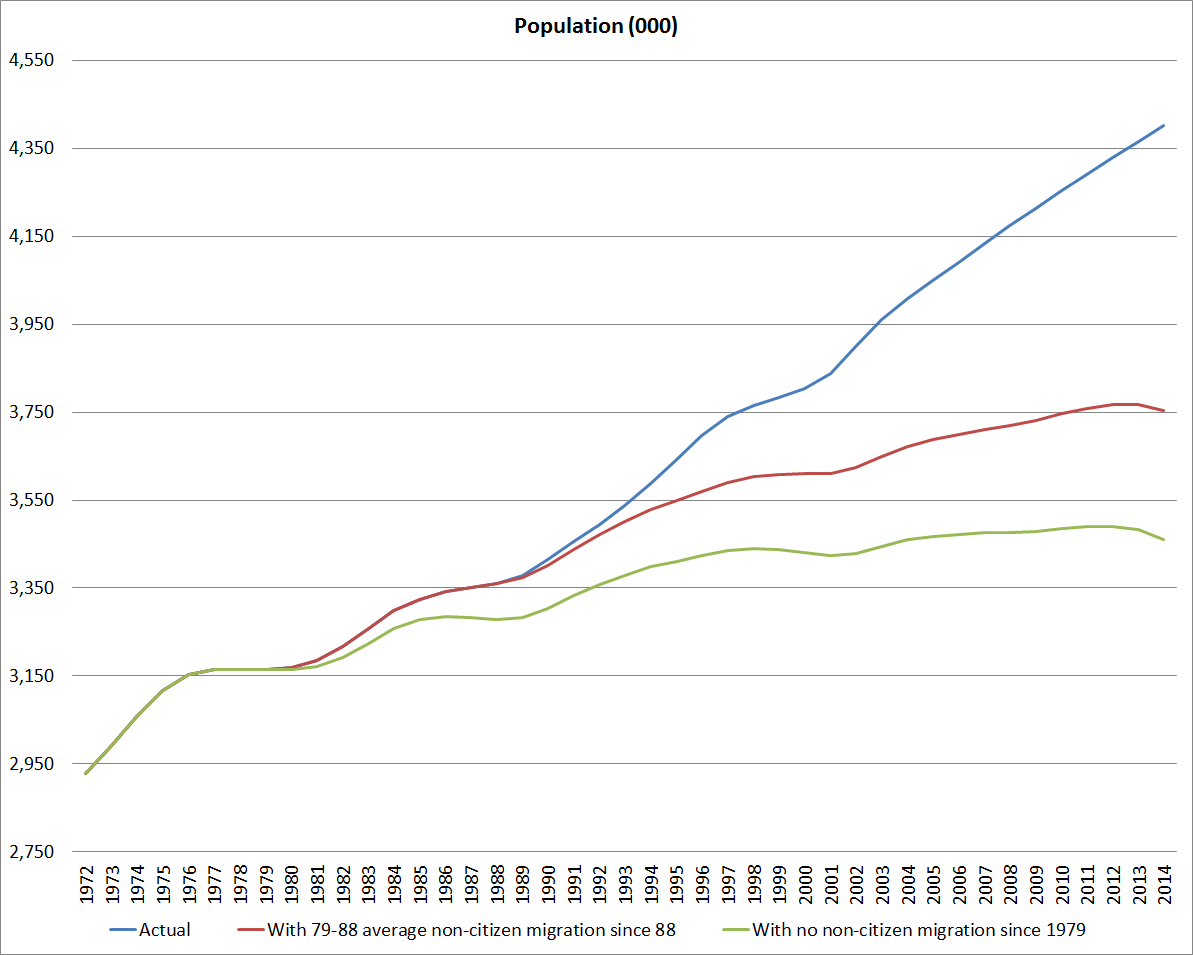
  • Given the severe land use restrictions in place, the high target level of non-citizen immigration (the bit directly amenable to New Zealand policy) is a major explanation for the upward pressure on house and urban land prices.  I’ve shown that, on one measure, all of New Zealand’s trend population growth is now resulting from immigration policy.
  • Given the modest rate of national savings, the high target level of non-citizen immigration is a major contributing factor to New Zealand’s persistently high (relative to other countries) real interest rates, the high average real exchange rate, and –  hence –  to the weak growth in productivity and the failure to reverse any of the decades-long decline in New Zealand incomes relative to those in other advanced countries.

We know the key policy parameters.  Specifically, there is a currently a government target of 135000 to 150000 permanent residence approvals on a rolling three year basis.  That isn’t all the non-citizen migration but it is the overwhelming bulk of trends in it.  There are lots of short-term flows, but my real interest is not in year to year fluctuations but in the contribution of immigration policy to the trend growth in New Zealand’s population.

When people turn to Statistics New Zealand data to analyse migration they most often look at the data on permanent and long-term (PLT) migration.  For any analysis about what is happening over short periods of time, it is the only sensible series to use.  The alternative is to use SNZ’s total migration data but (even when seasonally adjusted) it is hugely volatile in the short-term.  The noise swamps any signal.  Major sporting events –  eg Lions tours, or the rugby world cup – are an example of what muddies the water.

But the PLT data have their own limitations.  The total migration data are volatile, but they do count every person arriving in and departing from New Zealand, and so provide a highly accurate count of the cross-border contribution to the number of people in New Zealand at any one time.  By contrast, the PLT numbers are less volatile, but they rely on the self-reported intentions of travellers.  When someone arrives, or leaves, they fill in the arrival/departure card stating whether they intend to go/come for less or more than 12 months.  Those stating “more than 12 months” are treated as permanent or long-term movements.

But even if everyone answers the question honestly, plans change.  Some New Zealanders go to Australia in search of a better life, perhaps planning never to live here again.  But Australia doesn’t always live up to expectations, and some will come back to New Zealand a few months later.  Those people will have been PLT departures when they left, but returning short-term travellers when they come home.  Similarly, some foreigners come to New Zealanders planning to stay forever, but leave again a few months later.  Some New Zealanders go to Australia for a few months, but find a good job, settle, and don’t come back.  And some foreigners might arrive initially on short-term visas, but then end up staying permanently (most permanent residence visas these days are issued to people already in New Zealand).

You might suppose that the differences would be small, and would wash out over time.  To the extent that I had ever given the issue any thought, I suppose that was what I used to assume too.  In fact, there are large and persistent differences between the two series.  The difference was at its starkest in the 2002/03 migration boom, when the annual PLT inflow peaked at around 40000 and the total inflow peaked at almost 80000.  The differences didn’t just wash out the following year.

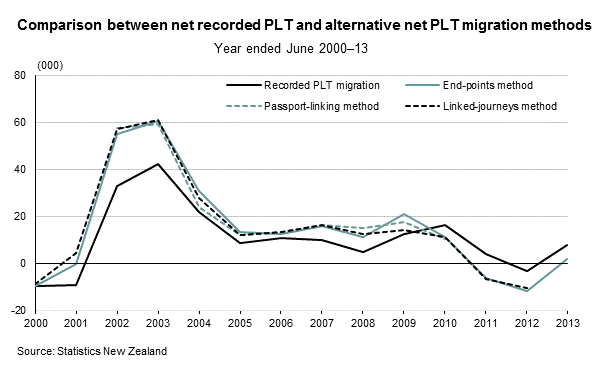
Statistics New Zealand has recognised the issue.  Late last year, partly prompted by my focus on the issue, they published a paper (which unfortunately got little or no coverage), reporting some experimental work they had done on trying to improve estimates of actual permanent and long-term migration (as opposed to self-reported intentions).  As one example of what they did, passport numbers were matched to check how many of those who (for example) said they were coming for less than 12 months were still here 12 months later.  Over the 2000s it was pretty clear that estimates of actual permanent and long-term migration could be materially improved.  Over 2002/03 “true” PLT flows appear to have been materially larger than self-reported PLT flows, and over 2010-12, true PLT flows were materially weaker than the self-reported flows.  In each case, trends in the total migration series were more reflective of what was going on than the self-reported PLT numbers.  This chart is from the SNZ paper.

plt-methods

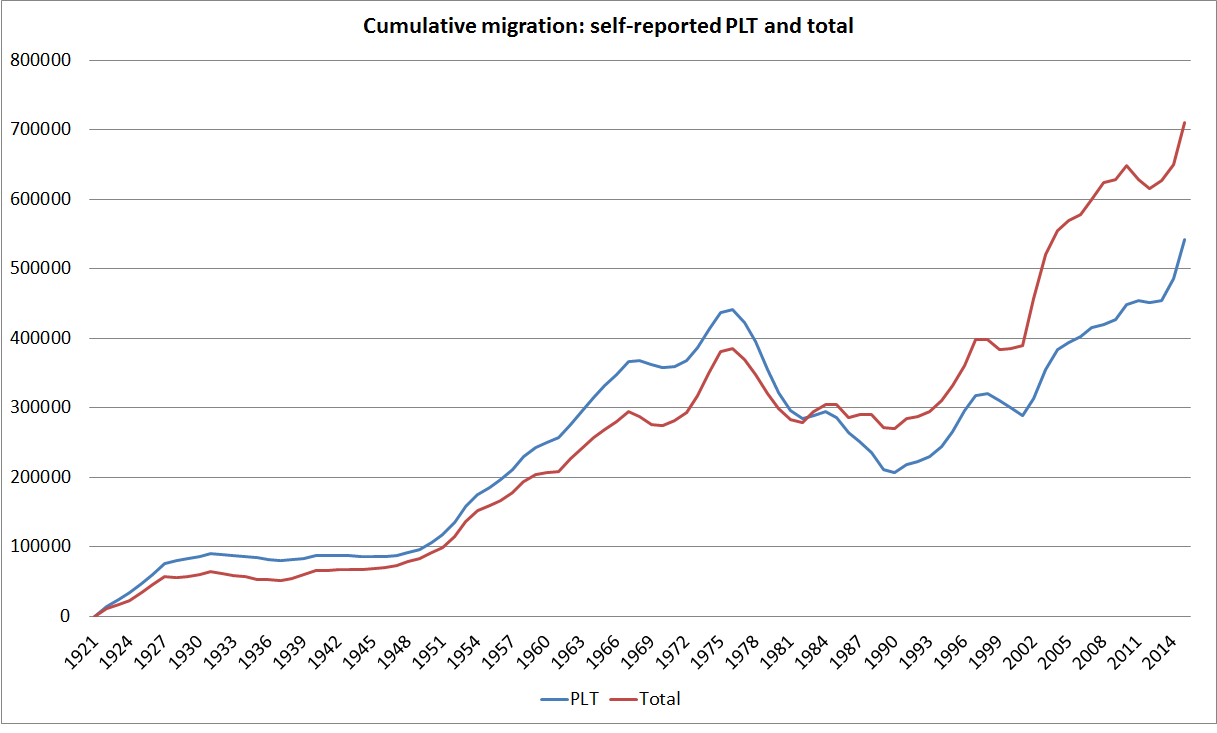
SNZ has not backdated its experimental estimates prior to 2000, and apparently (and unfortunately) does not have funding to produce these estimates on an ongoing basis.  But over much longer periods of time these differences also appear to matter.   Infoshare has data that distinguishes PLT and total migration since 1921.  Here are the cumulative net inflows in the two series.
cumulative migration since 1921
The cumulative difference is 170000 people (total net migration is much larger than self-reported PLT) –  quite material in terms of thinking about changes in New Zealand’s population which, even now, totals only 4.6 million people.  And the difference is not just down to, say, the growth of tourism: SNZ report that at any one time there are around 150000 foreign visitors in New Zealand, and around 115000 New Zealand visitors in other countries.

The divergence since 1921 is large, but note the crossover point in the early 1980s.  Until the end of the 1960s, self-reported PLT immigration had been consistently larger than total net immigration.  In earlier decades, there wasn’t much short-term tourism or many foreign students in our universities.  Since the outflows of New Zealanders also weren’t large until late in the period, much of the difference was probably down to people getting here and deciding New Zealand wasn’t really for them and going home again.

Self-reported net PLT outflows from the mid 1970s were large.  The flow of non-New Zealanders was quite small in this period (policy having been tightened materially in 1974), while the big change was the upsurge in the outflow of New Zealanders.  But since the (accurate) measure of total inflows and outflows shows nothing as large as the recorded self-reported PLT outflows, my hypothesis is that many New Zealanders set out to go to Australia for the long-term but quickly came home again.  The differences are huge: PLT data suggest a net 250000 outflow from 1976 to 1990. But the total migration data suggest a net outflow of only a little over 100000.

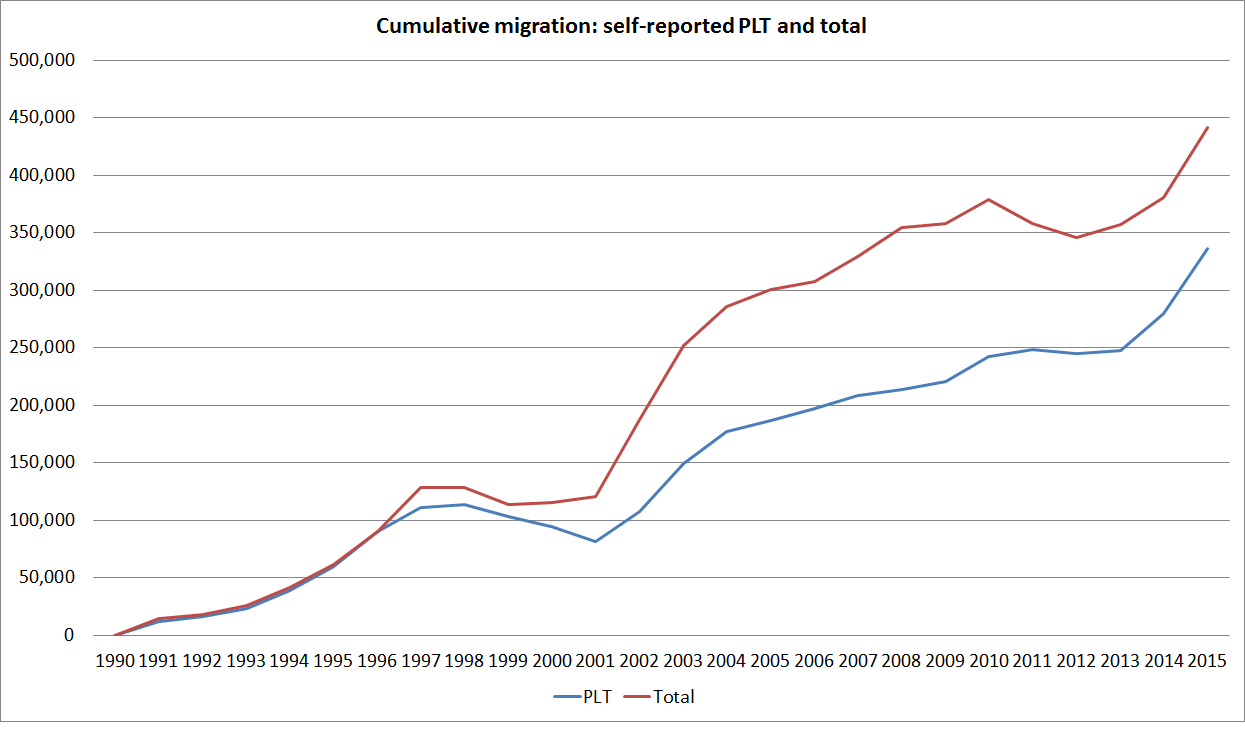
What about the more recent period?  Immigration policy was reformed and materially liberalised from around 1990 (in a succession of changes).    Here is the chart for total migration and self-reported PLT migration since 1990.

cumulative plt since 1990b

There isn’t much difference in the first few years, but from the late 1990s there has been a material difference between the two series.  Even the direction of change isn’t the same each year in the two series.  If one takes the total migration series as a better representation of the migration flows contribution to population changes (and demand for accommodation) than the self-reported PLT series, there was little or no net migration over 2008 to 2013 taken together (the red line goes sideways for that period), before the population pressures resumed strongly from 2013.  That coincides with the resurgence of very high house price inflation in Auckland.  Quite what is accounting for the divergences in the two series recently isn’t clear.  The SNZ paper I linked to earlier does not distinguish between NZ passport holders and other passport holders (although presumably they have the data).  Plausibly, some part of the difference will be down to New Zealanders finding Australia tougher than they expected and returning to New Zealand within 12 months of leaving, and some part will be down to foreigners arriving short-term and finding legal ways to stay for a longer term.

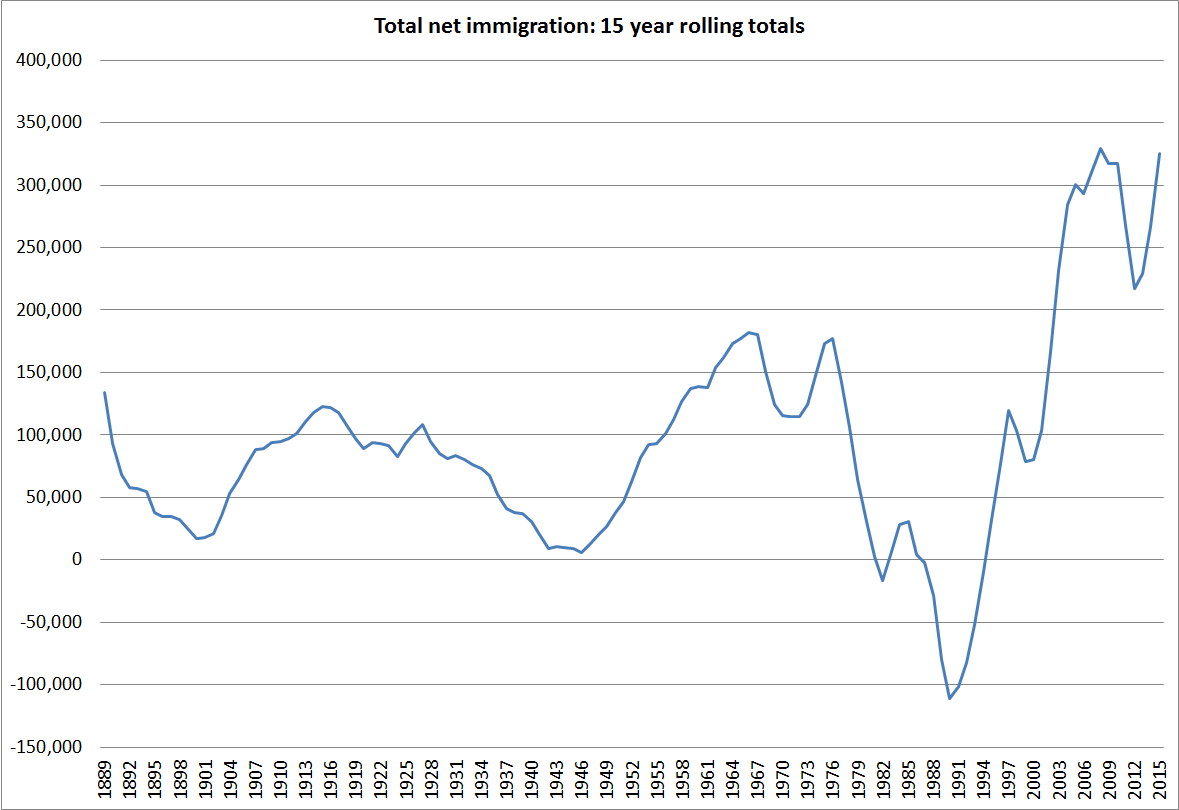
Finally, a chart showing just how large the total migration net inflows have been.  SNZ reports total migration data since 1875.  Here is the chart showing rolling 15 year totals (which should largely abstract from purely cyclical effects).

total net migration

These aren’t scaled for population, but New Zealand’s population in 1960 was about half what it is now, and the net migration inflows recently have been about twice as large as they were in those early post-war decades.  In those post-war decades,New Zealand experienced persistent pretty extreme excess demand pressures.  They didn’t show up in high interest rates (which were controlled) or in the foreign debt (the private sector largely couldn’t borrow, and the government didn’t). Instead, it showed up in the extensive network of controls  – on credit, on building activity, on imports, on holidays abroad etc – that was needed to keep excess demand in check.  Economic historians writing about New Zealand’s post-war experience seem to have been pretty well agreed that immigration policy exacerbated those demand pressures, rather than alleviated them (as I documented in this file note  Economic effects of immigration and the New Zealand economic historians ).

My story is that much the same pressures have been apparent since the resurgence of immigration in the 1990s –  but this time they show up in real interest rates and in a large negative NIIP position (which would otherwise probably have shrunk considerably as the fiscal accounts moved strongly into surplus).

Reflecting on Puerto Rico

For those not totally absorbed in the hour by hour machinations of Greek politics, another highly indebted area that has been getting attention this week is  the US territory of Puerto Rico.  The focus is on the debt, and Gillian Tett has a nice column in today’s FT on the complexities of trying to deal with that.

But the piece that got me more interested was a short post by Paul Krugman on the economic challenges of Puerto Rico.  Many probably disagree with Krugman on macro issues, and on politics, but issues around trade and economic geography are where he made his name.  He concludes:

But I’d argue for paying a lot of attention to the non-specific forces affecting the island, and in particular the economic geography side. Puerto Rico may to an important extent just suffer from being a slightly hard to reach island in a time when corporations place a high premium on easy, just-in-time shipments.

It got me thinking again about New Zealand and Australia.  Now, to be clear, I’m not suggesting that most of the parallels are close:

  • We have our own exchange rate, currency (and minimum wage).  Puerto Rico doesn’t.
  • And our public debt, while not low, is at pretty comfortable levels.  Issues of public debt unsustainability just don’t arise here.

But, on the other hand, we are a fairly small country, quite distant even from Australia.  We have a lot more land than Puerto Rico (but no warm winters) –  and have historically have had a land-based economy,  And no more land is being made.  We used to have a big manufacturing sector, but only when we built up huge and costly protective barriers that meant manufacturing here was the only way into the market.   If we had 10 million people we would still be small and remote.

For decades, tens of thousands of our fellow citizens have been leaving for what they perceive to be a better life, and better economic returns, in Australia.  The annual outflow fluctuates a lot, but over time the numbers mount up.  935000 New Zealand citizens (net) have left since 1970, mostly to Australia.  Even though I use these numbers often, every time I calculate totals like that the scale of the cumulative outflow still takes me aback.

Puerto Rico has been seeing outflows too, and the pace has stepped up in recent years. The most recent census was the first ever in which Puerto Rico’s population has fallen.  As Krugman notes, this is not necessarily a bad thing

Put it this way: if a region of the United States turns out to be a relatively bad location for production, we don’t expect the population to maintain itself by competing via ultra-low wages; we expect working-age residents to leave for more favorable places. That’s what you see in poor mainland states like West Virginia, which actually looks a fair bit like Puerto Rico in terms of low labor force participation, albeit not quite so much so. (Mississippi and Alabama also have low participation.)

And outmigration need not be such a terrible thing. There is much discussion of what’s wrong with Puerto Rico, but maybe we should, at least some of the time, just think of Puerto Rico as an ordinary region of the U.S.; at any given time, we expect some regions to be in relative and maybe even absolute decline, as the winds of technology and global trade shift. I wonder, in particular, whether Puerto Rico is suffering from the forces that seem to be leading to a general shortening of logistical chains and the “reshoring” of manufacturing to advanced economies.

We’ve had plenty of  towns/regions in New Zealand in which the population has fallen.  My usual examples are Taihape and Invercargill.  In one sense, emigration from those places is difficult for those left behind but, given the changes in relative economic opportunities, the departures are better (even for those left behind) than the alternative.  If everyone had just stayed in Invercargill or Taihape, even though the opportunities had moved away, the social and economic outcomes would almost certainly have been worse.  No one argues that as a matter of public policy we should aim to replace those who’ve left such towns.

But at a national level that is exactly what we have been doing in New Zealand for the last 25 years.  Rational economic agents –  our fellow New Zealanders –  respond to changing economic opportunities by moving to Australia.  Basic economics –  and plenty of formal literature on the great migrations of the 19th century –  suggests that those outflows will not only have benefited those who left, but will have contributed towards factor price equalisation – closing the gaps (but only somewhat ) between returns in New Zealand and Australia.  But central government, endued  with (or rather implicitly asserting) a superior sense of what is wise or right, stands in the way of that process of  factor price equalisation by bringing in yet even more people than the number who are leaving.  Having just come from one hubristic disaster –  Think Big –  we stumbled into thinking big on foreign immigration too.

They don’t do it in other countries.   Plenty of fast-growing successful countries have attracted large number of migrants, to take advantage of the opportunities (Singapore is a recent example, and Ireland –  after it had already become successful –  was another).    But countries that are aiming to catch-up with the rest of the advanced world don’t use inward migration as a means to that end.    It doesn’t work.  Ireland didn’t, the eastern European countries didn’t, and Korea and Taiwan didn’t.

Advocates of agglomerationist arguments will be spluttering by this point.  But there isn’t a lot of evidence for such effects in comparisons between countries.  Over 100 years big countries haven’t grown faster than small countries.  Indeed, many of the countries with the highest per capita incomes are resource-based economies with small populations.  I occasionally run  the line that perhaps the optimal population of New Zealand (if there such a thing) is either 2 million or 200 million.  At 200 million perhaps we’d be like Japan, albeit still facing a “distance tax”.  At 2 million we might be maximising the per capita value of our natural resources.  Would, for example, any fewer cows be being milked?

We aren’t going to have a population of 2 million or 200 million in my lifetime.  But if we pulled inward migration of non-New Zealanders back to around 1980s levels, we’d now have a slightly falling population.  We’d have a much better chance then of beginning to close the income and productivity gaps, of sustainably slowing the outflow of New Zealanders, and perhaps even in  time of attracting home again some of those 935000 New Zealanders who’ve already gone.    We’ll do that when, and if, we succeed.  We won’t help the prospects of success by simply importing more other people.

Immigration policy: 106 per cent of net new housing demand

I’ve just read Shamubeel and Serena Eaqub’s book Generation Rent¸one of the Bridget Williams Books series of short, often stimulating, books on New Zealand issues.    Housing is perhaps the ultimate topical issue, and I hope the Eaqubs’ contribution is widely read.

There is plenty in that I agree with, as well as quite a bit that I disagree with.  I might come back to the rest of the book when I have a bit more time, but today I wanted to focus on just one “framing” issue.   How one frames an issue often influences how readers think about it.

The Eaqubs have collected the data from old Yearbooks, and censuses, to show where population-based pressures on housing demand have arisen from over last fifty years (strictly, from the 1961 Census to the 2013 Census).  They present the influences under the following headings:

  • Natural increase,
  • Change in average household size, and
  • Net migration

Under this decomposition 61 per cent of the increase in the number of households has arisen from natural increase, 30 per cent from a reduction in average household size.  The remaining 9 per cent results from net migration.

Put that way, it allows them to present migration (and, hence migration policy) as a fairly minor issue, only really material in a short-term or cyclical sense. As we know net migration is quite variable and not particularly forecastable in the short-term.

But there is another way to look at the numbers.  The New Zealand government has no ability to control the movements of New Zealand citizens, inwards or outwards, so discussions of the role of immigration policy really should focus on the movement of non-New Zealand citizens.   Non-citizens can only come and live in New Zealand with the permission of the New Zealand government –  active permission is required in most cases, while policy allows Australian citizens to come and stay without prior approval.    There are lags in the system, and not everyone who is approved actually comes (or stays) but by and large we can think of the net flow of non-NZ citizens as the contribution of immigration policy.  Since 1960, there has been a net inflow of non-New Zealand citizens every (March) year except 1979.  If economic conditions here are poor, non-New Zealand citizens can leave again too.  In that sense the net inflow of non-New Zealand citizens understate the role of immigration policy in boosting demand for housing.

So what has the impact of non-NZ citizen net migration to New Zealand been?   In the 52 years from April 1961 to March 2013 there was a net inflow of 1139351 non-New Zealanders.  Over the same period (between the two censuses), the number of private occupied dwellings in New Zealand has increased by 918000.  With around 2.7 people per dwelling, the net inflow of non-New Zealand citizens has contributed 46 per cent of the total increase in the demand for houses since 1961.

The impact doesn’t happen all at once –  in 1961, people didn’t live at 2.7 per dwelling, but they do now.  And, of course, many of the non-New Zealanders who migrated in 1960s will have died by now.  But most of them will have had children or grandchildren since they moved to New Zealand –  and since the average birth rate in New Zealand has been above replacement, the effective contribution to housing demand from immigration policy is likely to have been higher than suggested by the raw numbers.  As birth rates have dropped, that may not be so in future.

Since 1961 there has been a variety of changes in immigration policy.  From the late 1970s to the late 1980s, inflows of non-New Zealanders were very small.  But what about the most recent since immigration policy was changed to actively pursue much larger inflows (at present, policy aims at 135000 to 150000 permanent residence approvals on a three year rolling basis)?

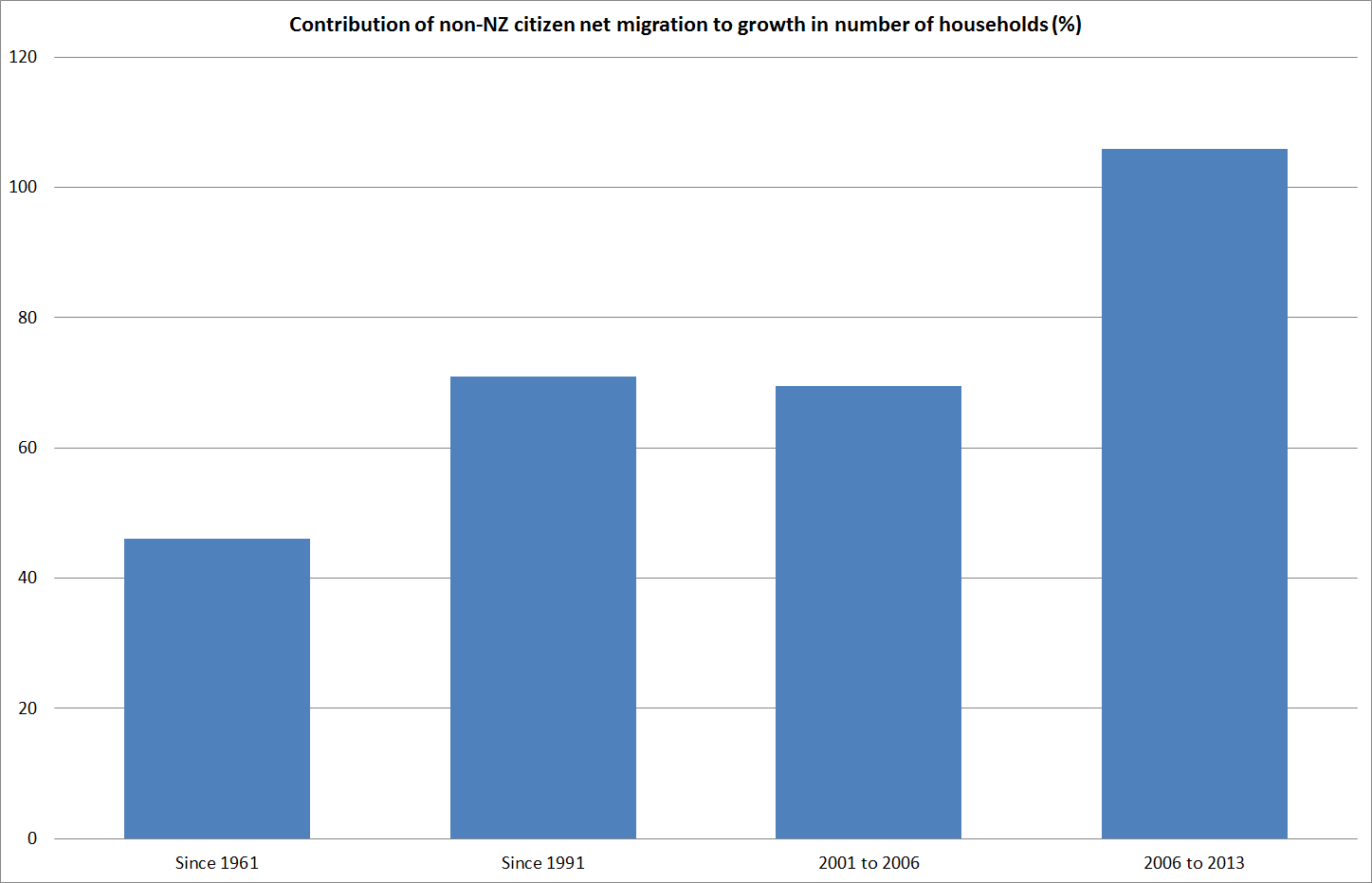
From 1991 to 2013, non-New Zealand citizen immigration accounted for around 71 per cent of the change in the number of households (or dwellings required).  For the last two intercensal periods the contributions of non-New Zealand citizen net immigration were as follows:

  • 2001 to 2006        70 per cent
  • 2006 to 2013       106 per cent

Even I was a little taken aback by the last number but, of course, it just reflects two things:

  • The chart I showed the other day illustrating that with no (or much lower) non-citizen immigration New Zealand’s population would now be flat or slightly falling
  • No change in the average person per dwelling number between 2006 and 2013.

non citizen plt to households

These numbers aren’t precise.  It is quite possible that new immigrants start off with a higher than average persons per dwelling –  as, on average, non-New Zealand immigrants are poorer than the average resident population.  And the number of people per dwelling is itself partly endogenous to house prices –  if house prices had not been so high, more people would have been able to fulfil their desire to, for example, live on their own.  It is also possible that without the high level of non-New Zealand inflow, the outflow of New Zealanders (which, all else equal, massively reduced the demand for housing) would have been a bit smaller.

But what the numbers do make clear is that immigration policy choices made by successive New Zealand governments account for a very large share of the new household formation, and housing demand, in New Zealand.  If anything, that share has been rising as natural increase slowed.

And, of course, these numbers also tell us nothing about what the appropriate target rate of non-citizen immigration is.  But, unless we can construct a regulatory environment in which the supply of housing and urban land are hugely more responsive to demand than they have been in recent decades, then any conversations around demand influences, and the potential influence of policy on them, needs to engage seriously with the role of immigration policy.  At present –  given what it is knows about supply responsiveness – the government’s immigration policy is actively driving house prices, especially in Auckland, at the reach of too many of those who would like to buy –  citizen or not.