New Zealand Initiative on immigration: Part 5 House prices

The New Zealand Initiative starts their discussion of the implications of immigration for house prices in a quite reasonable manner.

Rising house prices is an increasingly discussed topic. Fast growing populations, particularly in urban areas, have increased the mean demand for housing. Migration is a major contributor to urban population growth. In an ideal world, the underlying market systems would automatically adjust, such that as demand for accommodation rose and prices increased, developers built more houses. Likewise, cities would invest in infrastructure to accommodate more people.

However, that house prices have not stopped rising for a number of years means New Zealand has not reached this ideal place, and the system is not geared to cope with demographic shifts. The effect is most acute in Auckland, where about a third of the country’s population lives.

Thus far, I imagine everyone is on much the same page.  It was consistent enough with the lines from the Introduction that I quoted earlier in the week

Economists consider housing to be affordable when the median multiple is 3 or lower. In 2013, Auckland’s median multiple was 6.4, and in 2016 Demographia put it at 9.7.  The Initiative’s housing research blames restrictive planning policy and resistance to urban development. However, against a policy-induced, near-fixed supply, additional demand for housing must contribute to rising prices.

It is pretty much ECON101: if the supply of something is largely fixed, at least in the near-term, and there is an increase in  demand (especially an unforecast increase in demand), the price will increase.  Quite how much will depend on the elasticity of demand.   And the immigration contribution to population growth (and demand for accommodation) has been really large over the last 25 years, just as the land-use restrictions enabled by things like the Resource Management Act appear to have become more constraining.  The Initiative regularly, and rightly in my view, inveighs against those restrictions.  Without them, higher demand wouldn’t result in higher (real) prices for houses and urban land.

I also get that the Initiative favours large scale non-citizen immigration, but what I don’t get is why they won’t just be straightforward and say something like, “in the presence of land use restrictions, we recognise that high rates of immigration have been markedly increasing house and land prices, especially in Auckland.  But our best professional judgement is that the longer-term gains to New Zealanders from high immigration are sufficiently large, that we should overlook the distortions and arbitrary wealth redistributions that the high house prices, associated with high immigration have resulted in”

Perhaps there is a case to be made along those lines. It is, mostly, implicitly what the Initiative is saying.  But they won’t come out and say it directly, and instead have tried to shelter behind a short piece from a couple of MBIE-funded academics, Cochrane and Poot, who attempt to interpret the existing evidence to suggest that really immigration isn’t much of a factor in (Auckland) house prices at all.

MBIE is responsible to the ministers for immigration and housing (and, of course, has institutional bureaucratic incentives to maintain a large scale immigration programme).  Both ministers were presumably coming under pressure a year or so ago, and so MBIE commissioned Bill Cochrane and Jacques Poot to do a short review of the existing literature on immigration and house prices, and to draw some conclusions about what might have been going on in the last few years (as distinct, say, from the last 25).  That report was released in April 2016.  Some of it also appears to have been motivated by political concerns around non-resident purchases of New Zealand residential property, but as Cochrane and Poot note, the existing data don’t shed much light on that issue at all.

The New Zealand Initiative summarise the conclusions of the Cochrane and Poot report, with no sign of any caveats or concerns, as follows

Economists Bill Cochrane and Jacques Poot surveyed available evidence on the impact of net migration in New Zealand, and suggest migrants are not to blame for Auckland’s housing woes, rather New Zealanders are.

Personally, I hope no one wants to blame individuals at all –  migrants or New Zealanders. The issues are about policy and big picture forces, not about individuals acting in their best interests given those policies.

What is important to bear in mind is that there is a handful of formal studies that everyone tries to make sense of.   The Reserve Bank –  which historically has no dog in the fight about whether or not immigration is “a good thing”; they just want “the facts” –  has produced several studies over the years, each of which suggested really quite large impacts on house prices as a result of unexpected changes in migration.  And, on the other hand, Stillman and Mare produced a paper suggesting, using quite different techniques, that the effects are quite small.  That is the formal relevant New Zealand literature.   There is also a variety of results across these papers on which flows might have matter more (eg NZ citizens vs foreigners, arrivals vs departures etc).   On my reading the studies aren’t very conclusive: many people who’ve thought the issues through probably think the various RB estimates seem a bit large (up to 10 per cent increases in national house prices for a one per cent change in population) and the Stillman and Mare ones are a bit small.

In her Treasury working paper on macroeconomic performance in 2014, Julie Fry summarised her take as follows:

On balance, the available evidence suggests that migration, in conjunction with sluggish supply of new housing and associated land use restrictions, may have had a significant effect on house prices in New Zealand.

Cochrane and Poot read, or report, things a bit differently.  But it is important to remember that their mandate was to focus on the “last few years” –  whereas the New Zealand Initiative generalise it to apply to our longer-term house price issues.   And it is certainly true, that if we look at the big swing in overall PLT immigration in the last few years, a substantial chunk of that was about New Zealanders (net) not leaving at such a great rate, rather than about a change in immigration policy (ie the bit that governs foreign arrivals).  Their summary is as follows (emphasis added):

Overall we find that the literature and the available data on population change suggest that visa-controlled immigration into New Zealand, and specifically into Auckland, in the recent past has had a relatively small impact on house prices compared to other demand factors, such as the strongly cyclical changes in the emigration of New Zealanders, low interest rates, investor demand and capital gains expectations. Consequently, changes in immigration  policy, which can impact only on visa-controlled immigration, are unlikely to have much impact on the housing market.

There is quite a lot to unpick there.

First, it is a specific observation about the “recent past” –  when immigration policy (affecting foreigners) didn’t change much, and New Zealanders’ behaviour did.

Second, to talk of “investor demand and capital gains expectations” as distinctive factors is rather disingenuous.  Presumably, investor demand was partly a response to increased underlying demand for accommodation, and capital gains expectations partly a response to the actual interaction of increased demand pressures  in the face of restricted supply?

Third, if interest rates –  which aren’t some random variable, but have been low for a reason –  were a major independent factor, we wouldn’t have seen Auckland house prices rising so much more rapidly than those in most of the rest of the country (bits that mostly haven’t seen the same population pressures).

Fourth, the policy sentence is, literally, a non sequitur.  It simply doesn’t follow from what went before.  If immigration policy hadn’t been changed in the period they looked at –  and it mostly hadn’t –  it gives you no empirical basis for concluding that a future change in immigration policy would have no effect on house and land prices.  In fairness to the authors, in their text they elaborate, and highlight the lags in the process, and that short-term variations in immigration policy aren’t a very reliable means of managing overall net PLT flows. I totally agree with them on that, and oppose such short-term immigration management, but it is a quite different issue.

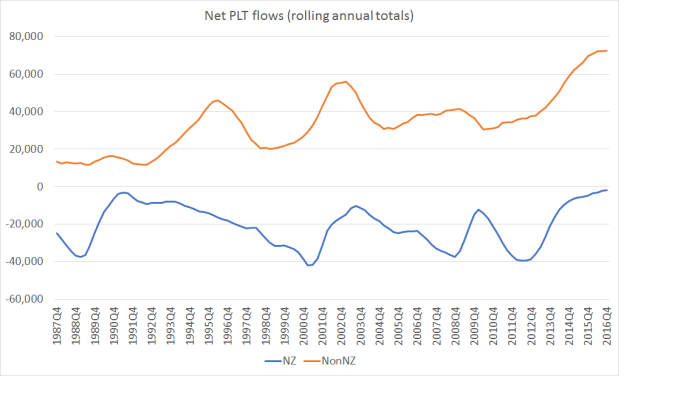
But even over Cochrane and Poot’s own period, it isn’t clear that they have the emphasis right.  Here are net PLT flows with New Zealanders and non New Zealanders shown separately.
plt-by-citizenship

Over the period from around 2006 to around 2013 most of the variability was in the New Zealand citizen net flows.  And specifically, from around 2012 to 2014 much of the pickup in PLT inflows was the change in New Zealanders’ behaviour –  nothing about immigration policy –  but over the last couple of years, there has also a huge increase in the net inflow of non-citizens, almost all of which is visa-controlled.  It all represents additional demand for accommodation.

Cochrane and Poot note that much of the increase in non-citizen net arrivals has been from people without approval to stay permanently (ie students, and people on work visas).

the growth in inward migration has been particularly in temporary visa-controlled immigration (e.g. international students, temporary workers – including working holiday makers), as could be seen in Figure 9.  The latter types of international migration flows are likely to have had a quantitatively  smaller impact on house prices and to have contributed little to house price increases observed recently. The lesser demand on the housing market of temporary migrants has  been shown with respect to students by BERL (2008).  Generally, research on the differential impact on housing markets between those arriving and staying on temporary visas, compared with those arriving on, or subsequently obtaining, permanent visas still needs to be undertaken.

Most students probably aren’t buying a house.  Most work visa arrivals aren’t either.  But they all need a roof over their head, and add to the overall demand for accommodation, especially in Auckland.    The authors play down this effect, noting that rents have increased much less than house prices have, but as I’ve illustrated previously, this divergence can be explained by the substantial fall in interest rates.  When long-term interest rates fall, rental yields should be expected to fall.  Absent population pressure, and in the presence of a well-functioning housing supply market, nominal yields should probably have fallen.   Presumably expected demand for accommodation from students and short-term workers influences the willingness of investors to bid for properties, in turn pushing house price upwards.   Population pressures don’t affect prices simply dependent on whether or not the new arrivals (or non-departures) choose to buy rather than rent.

One of the big challenges in modelling house prices is the so-called endogenity issue.  A thriving city might see rising wages, and new people being drawn to that city.  In the context, is it the immigration or the general prosperity that is raising house prices (given supply restrictions  –  real house prices tend not to rise for long without them)?   It is an important in the short-term, but I’m less convinced that it is over longer-term horizons –  eg the sort of 25 year period over which our immigration inflows and land-use restrictions have been interacting.  Perhaps prosperity draws additional migrants in, but it simply isn’t likely that house prices would have risen much and for long on prosperity alone, without the additional people.

An ideal test –  for economists anyway –  would probably involve repeated surprise changes in long-term immigration policy.  We could do a clean test if, say, every few years a random number generator decided how many residence approvals to grant to non-citizens each year.  This year it might be 45000 (the actual target), another years 75000, another year 10000, and so on.  We could then study the response of house prices in the wake of that clearly exogenous change in policy.

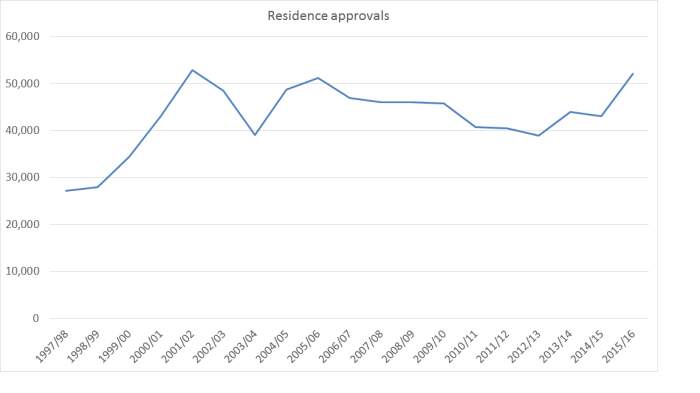
When it comes to New Zealand immigration policy, there simply haven’t been those sorts of changes researchers could study –  other perhaps than the gradual opening up from the late 1980s to the mid 1990s, a one-time event.  Here is the chart of residence approvals each year that MBIE provides the data for, back to 1997/98.
residence-approvals-annual
There hadn’t been a change in the target for 15 years until the very small cut announced late last year.  And the actual variability in the approvals granted from year to year is mostly cyclical, and endogenous –  dipping a bit when our unemployment rate was high, and then recovering lately.   Econometricians use various clever tricks to try to deal with endogeneity, but the fact remains that at a policy level there have been hardly any exogenous changes at all.  Just a very large net inward flow, varying a little from year to year, as a result of substantially unchanged policies.  Trying to correct for endogeneity using recent data in particular might be a fool’s errand

Those residence approvals over 19 years added up to 817231 people.  As I showed yesterday, the data suggest that perhaps 60 per cent of foreign arrivals settle in Auckland –  that would be around 490000 people.  Not all of them stay, of course, but even if only 80 per cent stay in the long term that is still almost 400000 people, adding to the demand for accommodation in Auckland in 19 years, as a direct result of immigration policy.    Yes, there is lots of variability in the NZ citizen flow –  Cochrane and Poot’s point –  but over that 19 years, around 160000 New Zealand citizens (net) left Auckland for overseas.   Again, as Cochrane and Poot point out, there has been considerable natural increase in Auckland’s population too.  But immigration policy –  visa-controlled almost all of it –  will have boosted Auckland’s population in that time by almost 400000 people.  And in a country – and city – which as they acknowledge does not have very responsive housing/land supply, that simply cannot have done other than put considerable pressure on Auckland house and land prices.

I’m still not sure why the New Zealand Initiative wants to avoid simply acknowledging that.

It is not as if this view is some contrarian Reddell-ite view held by no respectable or serious person.      Read the speeches and reports of the Governor of the Reserve Bank and his staff, or those of the Treasury.  Look at the analysis and reports of the IMF and the OECD –  both generally supporters of immigration.  It isn’t even treated as contentious that immigration has played a material role in house price inflation, in places where land use restrictions are in place.  Go across the Tasman, and listen to the Reserve Bank of Australia for example –  a nice recent example is here –  or look at the IMF/OECD reports on Australia too (with a similar mix of rapid population growth and land use restrictions).  When supply is substantially restricted and demand for housing increases, house/land prices will rise.  Population growth is a key source of additional demand, and immigration  –  whether exogenously influenced, or endogenous to the economic cycle –  is a huge component of population growth, especially in Auckland.

Flows of New Zealanders matter just as much as those of foreigners, and are often much more variable in the short-term (because less controlled by policy).  Immigration policy  –  affecting foreigners –  can’t sensibly attempt to stabilise housing market pressures in the short-term, but it can  –  and does – make a huge difference to housing demand over the medium-term.  In a system with quite tight land use controls, that affect over the last couple of decades has been almost entirely deleterious –  driving up house and land prices, and skewing wealth from the young to the old, the have-nots to the haves, and so on.  Yes, we should fix land use regulations, but don’t pretend –  as the Initiative tries to in this report –  that knowing continuation of high rates of non-citizen immigration, in the presence of those land use restrictions, isn’t knowingly allowing urban house and land prices to be driven progressively further upwards, in Auckland especially, but not of course exclusively.


Major cities in many countries have become progressively less dense

A reader yesterday linked to the recently-published United Nations World Cities ReportSceptical as I am of most UN things, out of curiosity I dipped into a few chapters of the report.

On doing so, I stumbled on this chart

city-density

In a quite striking way it makes the same point made in an early post on this blog: as countries become richer, the cities in those countries tend to become less densely populated.  Here was the chart from the earlier post showing data for London as far back as 1680 (just over a decade after the Great Fire).

london

These numbers shouldn’t really be a surprise.  Space is a normal good –  people typically want more of it, all else equal, when they can afford it –  and technological advances make longer distance commutes feasible.

No doubt there will be some issues with how the data are compiled/estimated –  quite where are the boundaries around the “built up area”, and how well is that known for, say, 1855.  But the general proposition shouldn’t be surprising: it is easy enough to think of the cramped tenement dwellings of New York in the late 19th century.

Of course, these trends aren’t ones that seem to please either the United Nations or many of our own local councils.  This text is from the UN report, just after the chart above

In recent years, UN-Habitat has brought into the forefront of attention the need for orderly expansion and densification so as to achieve more compact, integrated and connected cities. UN-Habitat’s support for planned city extensions programmes as well as promotion of tools such as land readjustment aims to increase densities (both residential and economic) with compact communities in addition to guiding new redevelopment to areas better suited for urbanization. These interventions are suggested to be an integral part of the New Urban Agenda as elaborated in Chapter 10.

And the constant refrain locally is for “more density”, when there is little or no evidence that such densification is what residents would prefer for themselves.  Indeed, it would be surprising if the revealed preferences across time and across countries/cultures had suddenly reversed.

I have no particular problem if people wish to live in high-rise apartments, or in small townhouses with no garden.  And people will choose to do so if regulatory constraints limit their options –  eg if land simply becomes too expensive –  but it doesn’t look like a first-best unconstrained preferred choice for most people.  We don’t, for example, see such bunching in our own provincial cities –  where housing is less unaffordable than in, say, Auckland –  and of course by international standards even our own largest city, Auckland, is not much more than a large provincial city (just a bit smaller than, say, Nashville).

Freeing up the use of land around cities remains the key to making housing affordable again and providing the choices/options that people value.  Experience suggests more populous cities will cover more space.  That isn’t something officials and politicians should be trying to stop.

Stress tests and credit availability

It is 3 January, a public holiday, the heart of summer (notionally at least –  it is actually cool and wet in Wellington), and something of a low ebb in local news and analysis.  But bright and early this morning, I did a radio interview on the Reserve Bank’s stress tests of the major banks.

The request was apparently prompted by a Stuff article, itself prompted by a recent new Reserve Bank animated video explaining stress tests.    The article, rightly, pointed out that following a very severe recession and significant credit losses for banks it was likely that banks’ lending standards would be somewhat tighter than they would have been in the previous boom.  That might even affect some of those hoping to take advantage of lower asset prices.

The stress tests themselves aren’t new.  They were done in late 2015, and were written up in the Reserve Bank’s Financial Stability Report last May.   I wrote about those results at the time.  In that stress test the Reserve Bank, quite appropriately, looked at how banks would cope if they were faced with a very severe recession and a very sharp fall in asset prices.  Stress tests are useless unless they use very demanding shocks.   These were. In the stress test, the unemployment rate rose to around 13 per cent and stayed there for some time.  For housing loan books it is the combination of unemployment and falling house prices that creates the scope for large loan losses –  either strand alone isn’t enough.  In fact, the increase in the unemployment rate was larger than anything experienced in any advanced economy with its own monetary policy in the 70 years since the end of World War Two.  And house prices were assumed to fall by 40 per cent generally, and by 55 per cent in Auckland –  about as large as any falls anywhere.

The banks emerged from these very demanding stress tests intact.  It wasn’t even a close run thing.  Capital ratios dropped, but mostly because the risk weights applied to banks’ outstanding loans increased  (a 50 per cent initial LVR loan looks riskier after house prices fall by 40 per cent).  The actual loan losses weren’t large enough to offset bank’s other operational earnings, so that the actual dollar value of banking system capital was not reduced.  This is the Reserve Bank’s chart of losses.

box-c-fig-c1-fsr-may16

Total losses, over four years, were around 4 per cent of assets.  As the Bank observed

The cumulative hit to profits averaged around 4 percent of initial assets (figure C1), which is a similar outcome to phase 2 of the full regulator-led exercise conducted in late 2014. About 30 percent of total losses were related to mortgage lending, with half of this due to the Auckland property market. SME and rural lending accounted for most of the remainder of financial system losses. Loss rates for mortgage lending were around 2 percent, significantly lower than the 5 percent loss rate observed for most other sectors.

Faced with such very demanding economic circumstances, banks could be expected to become more cautious about lending.  That is what generally happens in economic downturns.    Banks –  like others in the economy –  find that things hadn’t turned out as they expected, and aren’t sure what will happen next, or how long the downturn will last for.  Central banks don’t know either.

In this sort of climate banks are typically keen to conserve capital –  it isn’t necessarily easy to raise more capital, and shareholders are a bit uneasy.  On the other hand, banks stay in business by lending and borrowing, and being known to be reasonably willing to extend credit.    As I noted in my earlier post, lower asset prices (houses and farms) tend to result in a lower stock of credit over time just through the normal process of turnover.  What was a million dollar house might now be a half million dollar house, and a new purchaser will typically need a lot less credit to facilitate the transaction than the previous million dollar purchaser would have.  That process takes time, but it is fairly inexorable.  Combine it with the lower turnover that is typical during recessions and there is likely to be a lot less new credit going out the door, even without credit standards tightening.  Business credit demand also tends to fall away sharply during recessions –  demand for new investment projects dries up, and that is particularly marked in sectors like commercial property (where empirical evidence suggests banks are particularly prone to taking losses).

But I’m sceptical of the notion that even in the sort of recession dealt with in the Reserve Bank’s stress tests credit conditions for home buyers would tighten much.  There are really three reasons for that.  The first  –  unique to current circumstances –  is that credit conditions for home buyers are already quite (inappropriately) tight as a result of the Reserve Bank’s successive waves of LVR controls.  That is a very different climate than existed in previous booms (here or abroad).  Those controls would typically be expected to be lifted in any downturn.  The second reason is that, as the Bank’s results above show, even in a scenario of this sort loan losses on the housing loan books are not large –  not trivial by any means, by not of the sort of scale that is likely to take banks by surprise if such a shakeout ever occurs.   Servicing capacity remains a vitally important factor and any young couple with a secure income would be unlikely to find it that difficult to secure a 70 or 80 per cent LVR loan to purchase a first home.  Banks, after all, will often be keen to replace extremely highly indebted borrowers (eg investment property borrowers with negative equity) with less indebted owner occupiers with decades of home ownership in front of them.

The third reason is history.  Take, for example, the banking crisis of the late 1980s and early 1990s, which was much more damaging that the stress test results in the recent Reserve Bank exercise.  Several major banks were severely adversely affected, and the BNZ would have failed were it not for the government bailout.  And yet through that period-  late 80s and early 90s –  banks’ housing credit stock grew quite rapidly.  Even though the unemployment rate was high and rising –  not to 13 per cent –  and interest rates were still quite high, banks recognised that housing loans were generally relatively lower risk exposures.  To be sure, the stock of housing credit was much lower then than it is now –  and there was still some reintermediation (from non-banks to banks) going on, so I wouldn’t expect a repeat, but it is a reason not to be too worried about the availability of credit to house purchasers with reasonable deposits even in the aftermath of a very nasty recession and a sharp fall in house prices.  Even good projects advanced by property developers would probably struggle to get credit  –  as happened after 2007/08 –  but existing suburban houses are likely to be a very different proposition than new commercial developments, or even new fringe residential subdivisions.   (One caveat to that might be if governments were to intervene, in response to a sharp fall in house prices, and impair the value or certainty of banks’ security interests in residential mortgages –  but that isn’t an element in the Reserve Bank stress test.)

As a reminder, the stress test scenarios are very demanding.  The Reserve Bank likes to suggest that the scenarios don’t fully account for the second round effects of tighter credit conditions after the initial shakeout, but the scenario is so severe –  more so, say, than the US experience in 2008/09 – that we can largely set that concern to one side.     Based on the lending standards our banks were adopting in 2015 –  when the stress tests were done –  our banks look to be able to withstand all but the very worst imaginable economic shocks, and to be able to emerge still providing finance to reasonable projects, perhaps especially mortgages on existing residential properties.  Indeed, credit conditions for potential mortgage borrowers might be little or no worse than they are now, given the direct interference in that market through the waves of LVR restrictions.

The Stuff article appeared to be driven by the idea that those hoping to take advantage of a future fall in house prices might be out of luck, as the credit might not be available to do so.    For the potential first home buyer considering waiting for a future shakeout that seems a misplaced concern (although it might not be for someone wanting to buy say 20 properties at once).

The bigger question, of course, is what might trigger a really sharp fall in New Zealand real and nominal house prices.  I don’t think there is any evidence that what has happened here is, primarily, some sort of speculative bubble.  Mostly it is a consequence of the land use restrictions, exacerbated by the rapid immigration-policy fuelled population growth.  As we saw in 2008/09, recessions and reversals in immigration numbers can prompt a temporary fall in nominal house prices.  But without far-reaching reforms in land use regulation, perhaps supported by permanent material changes in target immigration levels, it is difficult to be optimistic that the sustained halving in house prices, that might re-establish more reasonable levels of affordability, is in prospect.

Gareth Morgan’s tax policy

Economist and commentator, Gareth Morgan, has begun releasing the policy platforms that his new party, The Opportunities Party, plans to contest next year’s election on.  Fairness seems to be his watchword and –  within limits –  who can argue with that aspiration?  But whatever “fairness” means, it doesn’t automatically translate into an obvious set of policy prescriptions.

The first policy he announced was that on tax (document here, and lots of FAQs here).  The centrepiece of the tax policy is to apply a deemed rate of return to  (the equity held in) all productive assets (including all houses) and tax that deemed rate of return at the owner’s marginal tax rate.  Own a million dollar house freehold and if the deemed rate of return was 3 per cent, you’d have an additional $30000 added to your assessed annual taxable income and those on the top marginal tax rate would have to pay, for example, an additional $10000 per annum.   The promise is that any revenue raised from this tax would be fully used to cut income tax rates, with a focus on those on below-average incomes.  In their own words, they expect this policy would

a. Make the tax system fairer;

b. Make housing more affordable over time;

c. Lead to more sensible investment of capital (everyone’s savings);

d. Make capital more readily available for productive businesses that create jobs  and pay wages;

e. Encourage a lot more “trickle down” from those who have stockpiled wealth courtesy  of this loophole; and

f. Reduce New Zealand’s reliance on foreign investment and debt to finance our growth.

I’m sceptical.

No doubt tax accountants and lawyers will have their own detailed concerns (some interesting issues were raised in this post from former Treasury and IRD tax adviser Andrea Black).

At the heart of the policy is a concern that the returns on houses are not appropriately taxed.    There are two strands to that.  The first, and most important in their thinking, is that the imputed rents on living in your own home aren’t taxed.  Everyone will, more or less, accept that that is something of an anomaly.  After all, if you rent an equivalent house and put your equity in a bank deposit, the returns to that deposit will be taxed.    The second is that capital gains typically aren’t taxed (and capital losses typically aren’t deductible).    There is much more room for debate about even the theoretical merits of taxing capital gains –  to say nothing of the practical problems.  But over the last 15 years in most of the country there have been large capital gains associated with housing.  Many rental property owners have not been declaring positive net taxable income, but have still made good overall returns through capital gains.

TOP eschew a capital gains tax –  rightly in my view –  but they appear to believe that their deemed rate of return policy will make future (untaxed) capital gains –  house price booms – less likely.

The idea of a deemed rate of return approach to taxing asset income isn’t new in the New Zealand debate.  Such an approach is already applied to holdings of foreign equities, and only a few years ago the government’s Tax Working Group reviewed the option as an approach to changing the taxation of housing.

Here are some of the reasons why I’m sceptical.

First, Gareth claims that a big part of the economic problem in New Zealand is an over-investment in housing, and that imposing a heavier tax burden on housing will reduce that.  As a result, so it is argued, more resources will be attracted towards business invesment.

This is old ground, but there is simply no evidence of systematic over-investment in housing.  Real investment (gross fixed capital formation) in housebuilding has,if anything, been less –  over recent decades- than we might have expected given our rate of population growth.  Countries with lots more people need lots more housing.  Most indications are that we haven’t built enough new houses.  And perhaps the best indication of that is the high price of houses and urban land.  Over-investment in something is usually consistent with low prices over time, not high prices.

But perhaps TOP have in mind something other than a national accounts meaning of “investment”?  They hint at a belief that houses make up more of household overall asset portfolios than is the case in other countries.  First, that factoid has been substantially discredited since the Reserve Bank last year introduced new and more comprehensive household balance sheet data.  Second, even to the extent it is true it partly reflects (a) overall modest rates of total household savings (people still have to live somewhere), and (b) the extent to which our tax system does not work to bias the ownership of the housing stock towards corporate or funds management entities (often tax-preferred in other countries).  And third, for every housebuyer there is a seller –  typically, from within the household sector.

Is there reason to think that New Zealand in some sense devotes “too many” real resources to housing.  The only one I can think of is that the average size of New Zealand houses –  like those in Australia and the United States – is quite large (much larger than in Europe).  Perhaps there is something in that, although since TOP argue that we need this policy partly because other countries (including the US and Australia) already deal with the distortions in other ways, it isn’t overly compelling.  Nor is it probably great politics to suggest smaller houses –  as we get richer – rather than more houses.

TOP claim that their tax policy will “reduce New Zealand’s reliance on foreign investment and debt to finance our growth”.  They don’t explain what they have in mind here.  Since, as I’ve pointed out, we already devote fewer real resources to building houses than one might expect given our population growth rate, it can’t really be through a channel of less housebuilding.  All else equal, less investment would reduce the current account deficit but……the TOP policy document argues we would see more business investment if their policy was adopted, so it isn’t even obvious why the current account deficit would narrow.

I think they must have in mind a wealth effect from high house prices onto consumption.  If high house prices encourages more overall consumption then, all else equal, that will widen the current account deficit –  although, contrary, to Gareth’s speaking notes at the launch of the policy, not since 1984 have these deficits involved “our political leaders trotting round the world with the begging bowl out”.    But as I have noted on various occasions previously, the evidence for a material wealth effect from higher house prices just isn’t very strong.  Here is a chart from a post I ran a few months ago showing consumption as a share of GDP over the last 30 years or so.

household C to GDP

Almost dead-flat (the red line is the full period average), and if anything edging slightly downwards, even as house prices have gone crazy.   That isn’t surprising: high house prices don’t make New Zealanders as a whole richer, they just redistribute wealth from one group to another (and in most cases –  since people want to stay living in the same house –  even the redistribution is more apparent than real).

In principle, of course, taxing an asset more heavily will tend to reduce its value.  Adopting the TOP policy could be expected to reduce house prices, to some extent.  But it won’t change the fundamental imbalances in the housing and urban land market (regulatory restrictions on land use the most important, but running head on into sustained government-induced population pressures).   And I wonder quite how much there is in the TOP policy proposal.

When the Tax Working Group looked at these issues a few years ago, they could talk loosely about a deemed rate of return of 6 per cent, something like the 10 year government bond rate at the time.  These days, having rebounded somewhat in the last few months the 10 year government bond rate is not much above 3 per cent.  And the Reserve Bank assures us that its modelling of long-term inflation expectations shows that they are firmly anchored around 2 per cent.    Real interest rates –  the real risk-free benchmark rate of return in New Zealand are very low.  And even then, our interest rates are still materially higher than those in most countries abroad –  and, as everyone accepts, that isn’t because productivity growth and real opportunities here are so much better than those abroad.  In the UK for example –  with a better long-term productivity record than New Zealand, much more government debt, and a similar inflation target –  the 10 year bond yield is around 1.3 per cent.

One of the problems with the TOP policy document is that there are no details.  They say that is all to be negotiated once they get into Parliament, but it makes a lot of difference whether they plan to use a real or nominal risk-free interest rate, or even a short or long-term rate.  Much discussion has tended to assume that a nominal long-term rate should be used.  I could make a strong –  stronger I think –  case for using a real short-term interest rate.

One of the flaws of our tax system –  or at least its interaction with our monetary policy inflation target –  is that all of nominal interest is taxed, and where interest is deductible all of nominal interest is deductible.  That is so even though the portion of the interest that simply compensates for inflation  –  maintains the real value of the asset – is not (in economic terms) income at all.  As a parallel, inflation raises the nominal value of your human capital to maintain the real value of that asset, but it is only the returns to that higher nominal asset value (any increase in annual wages) that is taxed.  Economists tend to quite like the idea of inflation-adjusting the tax system, while tax administrators hate it (for practical reasons).  It is already more of a problem in New Zealand than in most countries (because we fully tax –  and thus double tax –  all interest income).  But it would be a major new distortion, on a much more serious scale, to impose a nominal deemed rate of return across a much much larger stock of assets (than just fixed income assets that are already over-taxed).

So to me if the TOP policy were to be adopted the logic of using a real interest rate as the deemed rate of return (or fixing the zero lower bound and lowering the inflation target) seems pretty clear.

What about the short-term vs long-term rate issue?  No doubt, defenders of using a long-term rate would note that these are typically long-term assets.  But…..one has to assume that the deemed rate of return will change over time (even long-term bond rates do).  And it seems unlikely that if I buy a house today, Gareth’s policy would offer me tax certainty –  say, using today’s 10 year bond rate for the next 10 years.  If not, and if the deemed rate of return is subject to, say, annual review at each Budget, then using something like a one year government bond rate would seem a reasonable approach.    But the one year government bond rate is around 1.9 per cent at present, and year-ahead inflation expectations aren’t much lower than that.  A real risk-free government bond yield in New Zealand at present is around 0.5 per cent. And it is even lower in other, generally more successful, economies.

Now a reasonable rejoinder might be that the times are exceptional, and that these rates can’t last for ever.  If I were a betting man, I would probably agree.  But……our interest rates are higher than those in the rest of the world, and one of the goals of the Business Growth Agenda is to see that gap close.  And we aren’t in the depths of a recession: best estimates are that the output gap might be somewhere near zero, and yet our Reserve Bank expects no change in the short-term policy rate for the next few years.  If one is taking a policy to the electorate over the next 12 months, one surely has to work on the basis that the interest rates we have now might be around for some time.

If real short-term interest rates are the conceptually and practically appropriate rate to use in a deemed rate of return model, the tax on that million dollar housing equity would be around $1666 per annum, even for those on the top marginal tax rate.  That would be an annoyance to homeowners but –  especially with some income tax relief on the other side –  hardly likely to materially transform the housing market.   From Gareth’s perspective, that could have an upside –  an unthreatening introduction, and then when/if real interest rates return to “normal” it begins to bite much harder semi-automatically.  But it is a hard sell to make big changes in the tax system for such small potential payoffs at anything like current interest rates.

What else makes me uneasy (more briefly):

  • one of my objections to a practical CGT is that it tends to make government revenue even more highly pro-cyclical, encouraging unsustainable spend-ups as asset booms go on.   The deemed rate of return approach seems to face very similar problems.  Because a lot of housing assets are leveraged, the equity in housing changes more than proportionally with changes in houses prices.  A 20 per cent annual increase in house prices –  perhaps at a time when interest rates were rising anyway  –  might induce a 25 per cent rise in annual revenue from this tax.  While it is all very well to talk of full offsets in income tax reductions, it is very unlikely that would happen year by year –  or else, there will be material increases in income tax rates in the middle of asset busts, which again seems highly unlikely.  So, it looks like a policy that will tend to undermine spending discipline just at points of cycles when it is most needed, and undermine government revenue just at the point of the cycle when it is most valuable.
  • it is a systematic tax on Aucklanders  (most of the asset-based revenue will be raised in Auckland, but income tax rates are national and low income people aren’t concentrated in Auckland).  As a Wellingtonian that might not unduly bother me, and as an economist there might be a plausible argument for it, but there are awfully large number of voters in Auckland.
  • Valuation issues seem more substantial than TOP allow for.  In their FAQs there are blithe descriptions of how house values might be triangulated, but if I am facing a large annual tax on the imputed rent on my house I will likely care much more about the assessed value being used than I will in respect of local body rates.  The compliance costs seem non-trivial –  and that is before getting into business assets.
  • There is a reasonable economic case for a pure land tax. The quantity of unimproved land is fixed, and so taxing that value doesn’t change the supply of land.  But this isn’t a land tax.  It would apply to business assets as well, as –  in effect –  an underpinning minimum tax (if existing income tax liability is lower than the deemed rate of return).  But many businesses fail –  they never succeed in making much taxable income.  And while we want a strong stream of highly profitable businesses, one of the ways one gets there is to have plenty of entrepreneurs take risks, and often enough fail.   The TOP document talks about the ability of firms to   “allow those businesses facing a temporary or cyclical earnings downturn to defer their minimum income tax for a period of up this to 3 years (use of money interest to be charged)”.  But that doesn’t seem to deal with businesses that never succeed at all.  Imposing a fixed minimum tax, even if it can be deferred for a few years, is an increased tax on entrepreneurship.  What you tax, you get less of.    And yet TOP talk of encouraging more “productive” business investment and more entrepreneurship.

In the end, I think my assessment of the TOP policy is that a very high level it isn’t necessarily inappropriate, but would be hard to make work well, doesn’t offer very much in a low (real) interest rate world, and is misconceived as a structural answer to either our housing price problems or our sustained economic underperformance.

Next week I will write about TOP’s new immigration policy, which I strongly agree with parts of, while being quite sceptical of other parts.  To their credit, it is a more serious engagement with the issues than we’ve seen from other parties to date.

Debt to income limits: some questions

One of the jobs of the new Minister of Finance will be to decide whether or not to accept the Governor of the Reserve Bank’s request to add some sort of debt-to-income limit tool to the list of direct regulatory interventions that the government gives the Reserve Bank political cover to use.  It does this under the Memorandum of Understanding on (so-called) macroprudential tools.  I phrase things in that slightly awkward way because Parliament has delegated so much power to the Reserve Bank –  probably without fully realising the import of several legislative changes over the years –  that one unelected official, the Governor, does not actually need approval of the Minister of Finance, or of Parliament, to impose such intrusive direct controls.

To give some credit to the outgoing Minister of Finance, the Memorandum of Understanding framework, while legally non-binding, does more or less ensure that the current Governor would not use such a regulatory intervention without at least the political cover provided by allowing the inclusion of a debt-to-income limit on the list of approved tools.  Longer-term, reform of the governance and regulatory powers of the Bank should include making decisions on the application of such controls formally a matter for the Minister of Finance, on the recommendation of the Reserve Bank.

The Reserve Bank has been at pains to claim that their successive waves of LVR controls have improved the resilience of the banking system.  That claim is less well-founded than they would like people to believe.  For example, shifting a large group of borrowers from say 81 per cent LVR mortgages to, say, 79 per cent LVR mortgages won’t make any material difference to the expected losses a bank might face in a severe downturn, but might actually modestly reduce the ability of a bank to withstand those losses (since loans with less than an 80 per cent LVR typically have lower risk weights).   This risk is one my former colleague Ian Harrison has drawn attention to.  In addition, the Bank has never presented any sort of analysis, not even impressionistic in nature, of what banks are doing instead of making high LVR housing mortgages.  If their risk appetites haven’t changed, and the capital invested in the business hasn’t changed, the risks are likely to be developing somewhere else, perhaps somewhere rather less visible, on banks’ books.  There are also ongoing questions about the evidence base behind the regulatory discrimination against those borrowing to buy a house for residental rental purposes.  Before giving his imprimatur to the possibility of further Reserve Bank regulatory interventions, the new Minister of Finance might reasonably ask some harder questions about what has already been done.  He might also ask some questions about when the drift towards ever more direct intervention –  initially sold as quite temporary back in 2013 –  might end.

Before approving the addition of any sort of debt to income limit tool to the approved list, it would also be worth the Minister insisting that the Bank’s background papers get public scrutiny.  No doubt Treasury gets to see them and Treasury has had some serious questions in the past about proposed Bank interventions.  But since the Governor says there is no urgency about using a debt to income tool, there can be no good grounds for not putting the background material out for wider scrutiny now, before the Minister makes his decision, not sometime –  if ever –  afterwards, when (with luck) the OIA finally gets the papers out of the Bank.

In particular, it would be good to see a careful assessment of the empirical evidence the Bank is using in support of its case for a DTI limit, on both soundness and efficiency dimensions (both important in the Reserve Bank Act).  Along those lines, there was an interesting post out earlier this week on the blog of Richard Green a professor (in housing, real estater economics etc) at the University of Southern California.

In that post, he reports some interesting empirical work on a sample of 281000 fixed-rate mortgages purchased by Freddie Mac, one of the US quasi-government “agencies”, in 2004.  He runs a regression model across two-thirds of these mortgages, using a range of variables to model the probability of subsequent default, including through the largest shakeout in the US housing market in many decades.  His DTI term is not actually the ratio of debt to income, but the ratio of debt service to income, but clearly the two will be highly correlated, especially for these relatively high quality mortgages (ones that met US agency standards –  “qualifying”), looking at all the mortgages across the same period of time.

The equation results are in Green’s post.

Note that while DTI is significant, it is not particularly important as a predictor of default.  To place this in context, note that a cash-out refinance is 5.2 percentage points more likely to default than a purchase money loan, while a 10 percentage point change in DTI will produce a 1.3 percent increase the probability of default.

To be clear, increasing the total service burden from, say, 40 per cent of income to 50 per cent of income –  a huge increase – produced a 1.3 per cent increase in the (always quite low) probability of default.

One reason he notes is measurement

First, while DTI is a predictor of mortgage default, it is a fairly weak predictor.  The reason is that it tends to be measured badly, for a variety of reasons.  For instance, suppose someone applying for a loan has salary income and non-salary income.  If the salary income is sufficient to obtain a mortgage, both the borrower and the lender have incentives not to report the more difficult to document non-salary income.  The borrower’s income will thus be understated, the DTI will be overstated, and the variable’s measurement contaminated.

More generally, and in the US context

The Consumer Financial Protection Board has deemed mortgages with DTIs above 43 percent to not be “qualified.”  This means lenders making these loans do not have a safe-harbor for proving that the loans meet an ability to repay standard.  Fannie and Freddie are for now exempt from this rule, but they have generally not been willing to originate loans with DTIs in excess of 45 percent.  This basically means that no matter the loan-applicant’s score arising from a regression model predicting default, if her DTI is above 45 percent, she will not get a loan.

This is not only analytically incoherent, it means that high quality borrowers are failing to get loans, and that the mix of loans being originated is worse in quality than it otherwise would be.  That’s because a well-specified regression will do a better job sorting borrowers more likely to default than a heuristic such as a DTI limit.

He tests this by applying his model to the one third of the sample of loans held back in the initial estimation.

To make the point, I run the following comparison using my holdout sample: the default rate observed if we use the DTI cut-off rule vs a rule that ranks borrowers based on default likelihood.  If we used the DTI rule, we would have made loans to 91185 borrowers within the holdout sample, and observed a default rate of 14.0 percent.  If we use the regression based rule…… we get an observed default rate of 10.0 percent.  One could obviously loosen up on the regression rule, give more borrowers access to credit, and still have better loan performance.  

And extending the point

Let’s do one more exercise, and impose the DTI rule on top of the regression rule I used above.  The number of borrowers getting loans drops to 73133 (or about 20 percent), while the default rate drops by .7 percent relative to the model alone.  That means an awful lot of borrowers are rejected in exchange for a modest improvement in default.  If one used the model alone to reduce the number of approved loans by 20 percent, one would improve default performance by 1.4 percent relative to the 10 percent baseline.  In short, whether the goal is access to credit, or loan performance (or, ideally, both), regression based underwriting just works far better than DTI overlays.  

The current focus in the US isn’t on responding to a house price boom, but on access to finance (in a market still dominated by the government).  But the sorts of questions posed by these sorts of results are just as relevant here as they might be in a US context.  Perhaps here too, high debt to income borrowers might generally be better quality borrowers?     How confident can the Reserve Bank be that an actual debt to income limit –  as distinct from a pure hypothetical –  will actually improve the resilience of banks –  not just on the housing book, but overall?  And even if there is some improvement in resilience, at what cost –  recall the statutory efficiency mandate –  in terms of access to credit would that gain come at?

Perhaps there are good answers to all these sorts of questions.  Perhaps the Reserve Bank has access to other careful studies that produce different, and robust, results.  But these are the sorts of questions the new Minister of Finance, and the public, should be asking in response to the Governor’s request for political imprimatur for adding another tool to his kit of potential interventions.     And, more broadly, how confident can we be of any sustained gains from such interventions, as compared to the sure increases in resilience that would result from either higher risk weights on housing loans more generally, or higher overall capital requirements for banks (and non-banks regulated by the Reserve Bank)?


Interest rates, supply restrictions, and house prices

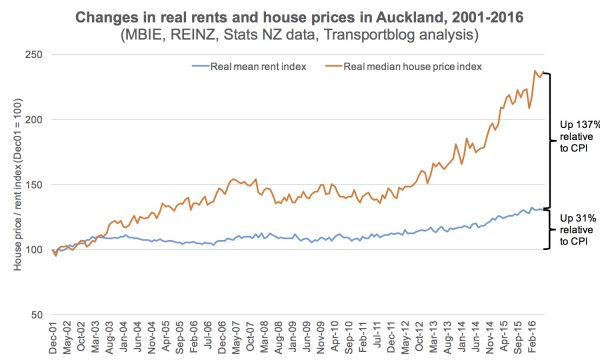
There was an interesting post from Peter Nunns on Transportblog the other day, attempting a bit of a back-of-the-envelope decomposition of how various factors, including land use restrictions, might have contributed to the rise in real Auckland house prices over the 15 years since the end of 2001.

Nunns starts his decomposition with the suggestion that:

One simple way to disentangle these factors is to look at the relationship between consumer prices, rents, and house prices:

  • When rents rise faster than general consumer prices, it indicates that housing supply is not keeping up with demand
  • When house prices rise faster than rents, it indicates that financial factors – eg mortgage interest rates and tax preferences for owning residential properties – are driving up prices.

and with this chart

nunns-1-auckland-real-house-prices-and-rents-2001-2016-chart-600x360

Disentangling the contribution of various factors isn’t easy.  A lot depends on what else one can reasonably hold constant.  Nunns seems to assume that holding real rents constant is a reasonable benchmark, and that we can then think about the change in net excess demand for accommodation by looking at deviations from that benchmark.   Thus, roughly, he suggests that a 31 per cent increase in house prices can be accounted for by supply shortfalls.

Over this period, I’m not at all convinced that is right.  Why?

Largely because of the big changes in long-term interest rates, which –  all else equal –  should have affected supply conditions in the rental market.  Specifically, when interest rates fall a long way it is a lot cheaper than previously to provide rental accommodation (the available returns on alternative assets having fallen so much).

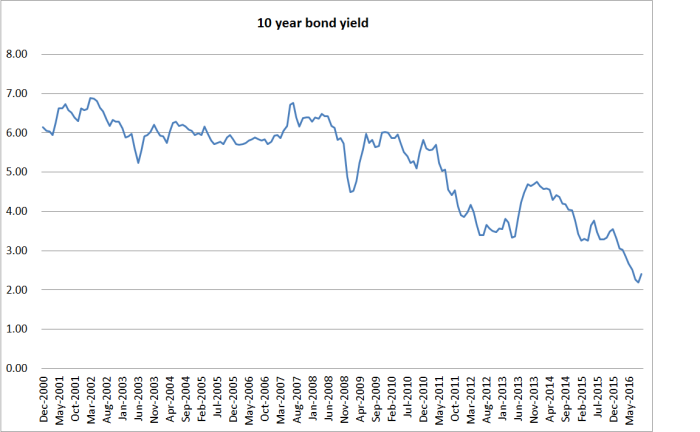
And what has happened to interest rates over this period?  Well, here is a chart of the 10 year bond rate since the end of 2000.

10-year-rate

There is always a bit of noise in the series, but long-term nominal government bond yields are now about 350-400 basis points lower than they were in 2001.  A little bit of that is falling inflation expectations (around 50 basis points according to the Reserve Bank survey).  But fortunately in 2001 we also had a 14 year government inflation-indexed bond outstanding, and we do so now as well.  In late 2001, that indexed bond yielded about 4.6 per cent, and the current yield is around 1.6 per cent.  Real long-term bond yields look to fallen by at least 300 basis points (and around two-thirds of that fall has taken place in just the last five years or so).

Short-term real interest rate haven’t fallen that much.  Short-term rates are more volatile, so here I use a two year moving average.

1st mortgage rate 6mth term deposit rate
   Dec 2001 7.99 5.86
  Sept 2016 6.14 3.59

Even on these measures, real interest rates have fallen by perhaps 1.5 percentage points.

In a well-functioning housing supply market, those sorts of falls in real interest rates might reasonably have been expected to be reflected in lower real rents.

Quite how much a fall one might have expected in such a market will depend on a variety of assumptions one makes.  But if landlords had been looking for an 8 per cent annual real return on rental properties back in 2001, then even a 2 percentage point fall in real interest rates, might readily have been consistent with a 25 per cent fall in real rents –  in a well-functioning housing market.  If real risk-free rates have fallen by more like 300 basis points –  as the indexed bond market suggests –  that would be consistent with more like a 40 per cent fall in the rental cost of long-term assets.

These are all illustrative hypotheticals. They assume that new assets can readily be generated.  But in a well-functioning housing markets, new houses can be readily generated.  New unimproved land can’t be (there is a given stock, only what it is used for can be changed).  But in well-functioning housing markets, the unimproved land component of a typical new house+land package will be quite low.  Think of dairy land prices at perhaps $50000 a hectare and you start to get the drift.  All else equal, in well-functioning housing supply markets, when interest rates fall unimproved land values should be expected to increase, but the value of land improvements and houses shouldn’t be much affected at all.

But even that story is a cautious one (biased to the upside).  After all, interest rates typically fall for a reason –  big trend falls don’t occur in isolation.  One such factor is low expected future returns (eg lower expected rates of productivity growth).   And interest rates are not a trivial factor in the cost of land improvements, associated infrastructure, and house building itself.  Again, all else equal, lower interest rates should lower the real cost of bringing new houses onto the market –  reinforcing the expected fall in real rentals.

Of course, this is so detached from the reality of Auckland (or New Zealand more generally) housing markets that it is difficult to even envisage such a scenario.  We have land use restrictions  –  which tend to produce high land prices and high rents –  and when those restrictions run head on into severe population pressures (especially unanticipated ones), it is hardly surprising that house and land and rental prices rise.  But when that clash (between land use rules and rising population) occurs at time when real interest rates have been falling a lot, looking at trends in rents can badly confuse the issue.

I’m not wedded to a story in which all the increase in real house prices in recent years is down to supply restrictions interacting with rapid population growth.  In his piece Nunns notes a couple of other possibilities

some other ‘financial’ explanations could include:

  • New Zealand’s tax treatment of residential property, and in particular investment properties – unlike many of the countries we ‘trade’ capital with, we don’t have any form of capital gains tax on property. All else equal, this means that we should expect structural inflows of cash into our housing market, driving up prices
  • The impact of ‘cashed-up’ buyers coming in without the need to borrow money to invest in properties – including, but not limited to, foreign buyers.

But….our tax treatment of investment properties has become less favourable not more favourable over the last few years  (reduced and then abolished depreciation provisions, the introduction of the PIE regime, lower maximum marginal tax rates.  If these arguments have force at all –  and they typically don’t when supply is responsive –  they should have worked in the direction of (modestly) lowering house prices over the last decade or so.

And while I suspect there is something to the “cashed-up foreign buyer” story, again any such demand only raises house prices when supply is unresponsive.  If supply is responsive –  which it would be without all the land use restrictions –  such demand would be just another export industry.

Of course, the common story is that lower interest rates have raised house prices.  And perhaps they have to some extent, but (a) recall that interest rates are lower for a reason, and real incomes now (ie the expected basis for servicing debt) are much lower than would probably have been expected a decade ago, and (b) lower real interest rates do not raise the equilibrium price of even a long-lived asset if that asset can be readily reproduced.  In well-functioning housing markets, houses can be, and unimproved land is a small part of the total cost.  If lower interest rates raise house prices, it is only to the extent that land use and building restrictions make it hard to bring new supply to market.  (As it happens, of course, in much of New Zealand real house prices are no higher than they were a decade ago when interest rates were near their peaks.)

To a first approximation, trend rises in real house prices are almost entirely due to supply constraints.  There can be all sorts of demand influences –  some government-driven, some not –  and it can be useful to identify them, but in well-functioning housing supply markets they don’t generate rising real house prices.

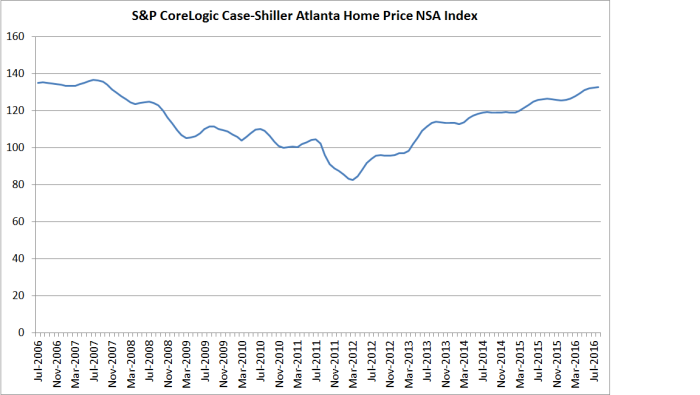
atlanta-2

As just one illustration, here is a chart of nominal house prices for Atlanta over the last decade. Atlanta has had rapid population growth, has experienced significant falls in real interest rates (like the rest of the US), is in a country with mortgage interest deductibility for owner occupiers, and is not obviously a worse safe-haven for Chinese money fleeing the weak property rights of China, and yet nominal house prices are no higher than they were in 2006.


Housing reform, the Corn Laws and possibilities for New Zealand

Brendon Harre, who writes interesting and thought-provoking pieces on housing (including contributing from time to time to the new Making New Zealand housing blog), had another stimulating article out this week, titled Housing affordability: Reform or Revolution .  Harre is strongly of the view that supply-side reform of the urban land market is critical to making home ownership affordable again, but is particularly interesting because he comes at the issues from a left wing perspective: the sheer injustice of the sorts of house price outcomes we (and so many other similar countries) have experienced in recent decades.  He fears that if reform doesn’t happen, extreme populist movements –  the modern “revolution”  – could.

In his latest article, Harre picks up on a point I’ve made several times previously.  I’ve argued that it is difficult to be optimistic about the supply-side reforms happening in New Zealand any time soon, partly because there are few or no known precedents of countries or regions/cities (and certainly not from among the Anglo countries) undoing restrictive land use regulations once they have been put in place.  He links to a post I did a few months ago suggesting that perhaps Tokyo might have been something of a counter-example, but essentially accepts the point that, thus far, there few modern examples of successful supply-side land use/housing reform.  In pondering why this might be, and how it might be changed, Harre suggests thinking about other cases from history in which policy reforms have finally overcome longstanding resistance, to free-up markets and bring prices down.

In a New Zealand context, he could have thought about the eventual removal of the sort of heavy import protection which for decades meant that New Zealand was a rare country where cars were not only very expensive, but often held their value over time.  Or of the removal of most agricultural industry support in the 1980s.

But on this occasion he looked at the movement that led, over decades, to the repeal of Corn Laws (which tended to hold up the price of wheat, benefiting landowners but at the cost of urban workers and industrialist) in the United Kingdom in 1846.    You can read the story for yourself, and I’m not an expert in the area (although the few books I pulled off my shelf suggested a different emphasis in a few areas), but the lessons Harre draws are

What are the lessons from the campaign for affordable food?

  • Achieving a strategic alignment of a broad cross-section of social groups is important
  • Acknowledging that moderate incremental reform can prevent future radical revolutions.
  • If traditional media does not report on your campaign create new media. The Economist newspaper was founded by the British businessman and banker James Wilson in 1843, to advance the repeal of the Corn Law.
  • Simple clear statements/images with a strong moral message are effective.

Harre ends on an optimistic note.

For New Zealand to become a fairer society, we should learn the lessons from earlier struggles for economic, social and political justice. If these lessons were applied to New Zealand’s housing crisis, in my opinion affordable housing could be easily solved.

I remain rather more skeptical.  As a technical matter, housing price scandals (here and abroad) are easily resolved.  But the challenges aren’t technical, they are political.

Harre draws hope from the recent Obama administration initiatives to encourage states, cities, counties etc to rethink their zoning rules

President Obama has chosen to address supply restrictions by releasing a Housing Development Toolkit, advising States and local jurisdictions on how to best manage urban planning to achieve affordable housing. Some US cities are very restrictive, so these reforms may cause a measurable downward price correction, but it is too early to tell. There are both supporters and detractors for the President’s approach, which if followed to its logical conclusion by going from advice to a command would remove some aspects of planning autonomy from local government control.

But…the US federal government has no responsibility for zoning and other local land use laws, the Obama administration is weeks from ending, and there seems little appetite in the places that matter in the US to make the sorts of land use liberalisations that many economists favour.  Of course, it is good to see the Administration (even an outgoing one) pick up the issue, but substantively it might matter not much more than, say in a New Zealand context, the ACT Party favouring such reform.  And housing affordability isn’t such an issue in the US, no doubt partly because if New York or San Francisco are “unaffordable” there are other big fast-growing cities people can move to without such regulatory burdens.

I’m not sure that reform is inevitable, even with a decades-long perspective.  After all, awful as the current system is, it could maintain an uneasy equilibrium in which more people involuntarily rent than used to, people buy homes much later in life than they used to with more debt, and then –  on average –  they reap a transfer back from their parents late in life.   I don’t favour such an outcome, but after several decades already of progressively more unaffordable home ownership for the relatively young, there is still no sign of this becoming some sort of moral crusade for justice, let alone efficiency.

Reverting to the Corn Law process briefly, my British economic history textbook records that

By 1846 the Anti-Corn Law League was the most powerful pressure group  England had known, and upon their techniques of mass meetings, travelling orators, hymns and catechisms a good deal of later Victorian  revivalist and temperance –  even trade union –  oratory was based.

Translated into the language and style of a different age, I don’t detect anything like that at present around land use regulation (outright homeless is a little different).

As Harre, and the economic historians note, the rising “ideology” of free trade played a part – though not necessarily a decisive part –  in getting the Corn Laws repealed.  There was an alignment between that belief system and the cause of “cheaper food for urban workers”.  But in New Zealand –  or Canada, or Australia, or the UK, or most of coastal USA –  is there any sign of that sort of ideological movement around housing, cities etc?  I don’t detect it.  There is no sign of the rhetoric of choice, freedom, flexibility etc assuming a dominant role –  among the public let alone among the elites.  The talk is still endlessly of smarter planning, and top down visions for what cities and other urban areas should be like –  our own Productivity Commission put its imprimatur recently on local authority desires to plan cities.  If there is ever talk of reform, it is of targeted specific interventions, not of getting planners out of the way, and allowing markets to work.  In my own suburb, there is currently a process underway –  hours and hours of meetings between “community representatives” and the Wellington City Council –  on a 10 year plan for the suburb –  and no one seems to find this strange, not 25 years on from the fall of European communism.

This isn’t intended to be a counsel of despair.  Things can change, but there doesn’t at present seem to be a pressing demand for change –  and particularly not for the sort of regulatory changes that would really make a major sustainable difference.  That means if change is really going to happen any time soon, someone –  some party –  is going to have to be willing to spend a lot of political or reputational capital on making initially unpopular change.  And that cost is only rising with each passing month in which more households – in Auckland and increasingly elsewhere –  take on debt at the new higher house prices.  Falling house prices don’t actually threaten most of those people –  servicing is the real issue –  but that doesn’t stop the prospect sounding pretty frightening.

One obstacles to getting comprehensive land use reform is fear in some circles –  particularly on the environmental left –  about what post-reform cities might look like.  Many talk disdainfully of “sprawl” –  as if there is something profoundly wrong about people in a small, lightly populated, country wanting a decent backyard for their kids to play in etc.  But even when the attitude isn’t disdainful, it is often fearful –  how far will Auckland stretch, and all those questions about roads and other infrastructure.  If Auckland really is going to grow by another million people those issues become a lot more pressing than otherwise.  People can, and do, come up with all sorts of smart solutions –  differential rates, MUDs etc-  and I’m quite sympathetic to all those arguments.  But they don’t really resonate with the wider public, and some visceral unease about “sprawl” (and even the loss of “prime agricultural land”) seems to.  It isn’t only the public: the Green Party is likely to be part of the next non-National government.

Which is partly why I think any successful sustainable package of land use reforms, particularly in New Zealand, should be accompanied by a commitment to much lower rates of non-citizen immigration for the foreseeable future.  As readers know, my main arguments about immigration policy aren’t about house prices –  which can be “fixed’ with proper supply side reforms –  but if one of the real barriers to land use liberalization is unease about population-driven “sprawl”, why not just take the policy-driven component of population growth out of the mix for a few decades?  It is not as if the proponents of immigration can show the real economic gains to New Zealanders from our immigration policy, and we know that GDP per capita in Auckland has been falling relative to that in the rest of the country, not rising.    There is no hard trade-off, only the scope for mutually reinforcing packages of reforms that might finally make a more liberal approach to urban land use possible in New Zealand, if some political leader (or coalition of parties) is really willing to take the risk.

Individual political leaders can make a real difference.  It would be great if one would stake a lot on urban land use reform, but anyone considering it needs to recognize the lack of precedents, the potential losers, and the worries and beliefs that underpin the durability of the current model here and abroad. And they probably need to find not only the right language to help frame repeal choices and options, but find a package of measures which helps allay – even if only in part, and for a time –  the sorts of concerns some have.  Plenty of the elites don’t really believe in choice and freedom  –  especially for other people –  but perhaps they might be a little more relaxed if they weren’t (reasonably or otherwise) worrying about the idea of an Auckland that stretched from Wellsford to Hamilton.

RIP timely mortgage approval statistics

The Reserve Bank has recently confirmed that it is going to kill one of the most useful statistical series it produces.

A decade or so ago, near the peak of the last house price boom, the Bank began collecting data on the number and value of housing mortgage loan approvals.  The data were never perfect, and the Bank’s statisticians always, slightly disdainfully, labelled them as “experimental”.

But they had a lot going for them nonetheless:

  • they were weekly data, whereas most Bank series are monthly or quarterly,
  • they were reported and released very quickly (data for last week is on the Bank’s website now), whereas most Bank series take the best part of a full month to collect and report,
  • they were about mortgage approvals, rather than drawdowns, so captured information at a materially earlier stage of the process (when one is close to agreeing to buy, rather than when settlement occurs), and
  • they told sensible stories that could be reconciled, then and later, with other things we knew about the housing and housing finance market.

Given that the Bank now puts much more weight on direct regulatory interventions in the housing finance market than it ever did before, you would think they would want all the data they could get –  and particularly very timely data.

But no.  The housing mortgage approvals series is to be discontinued next month.

The Bank would no doubt respond that they have, over the last few years, put in place a new set of data collections around housing finance.  They even have a new series of housing mortgage commitments, but (a) they have only three years of (monthly) data, and (b) the monthly data are available only with a considerable lag.    Check out the tables for the new series: today is 13 October, and the data for August are now there (and mid-August is now almost two months ago).  By contrast, as I noted above, last week’s new mortgage approvals are already on the website for the long-running “experimental” series.    It is significant step backwards, in terms of the public availability of timely data on what is, for the Bank, and rightly or wrongly, clearly a major market.

I made a brief submission on the proposal to discontinue this data, noting

The cumulative loss of information from the change could easily be 8 to 10 weeks of information (if, say, a mortgage approval is typically given perhaps a month before drawdown).  Even allowing for the fact that the mortgage approvals data is not a perfect predictor of actual drawdowns, the cycles in the approvals data have given good and consistently informative reads for a number of years now.  With the Bank varying LVR restrictions on average about once a year, losing 8 to 10 weeks of forward data seems cavalier –  even having regard to the inevitable compliance costs for banks (which must now be quite low for an established collection).

To which the Bank’s response last week was

We acknowledge that the housing approvals statistics provide more frequent and timely data, however, we do not believe that this a sufficient reason to continue with the collection.

I don’t think their heavy regulatory interventions, and repeated recalibrations of the restrictions, in the housing finance market are well-warranted –  in law or in economics.  But to intervene that heavily and then to simply abandon frequent timely data seems reckless.   Better more comprehensive later data can refine the insights from early takes –  as final GDP data several years on are better than the first cut estimates, but we don’t simply abandon publishing the first cuts – but in much of the business the Bank is in –  monetary policy and regulatory interventions –  preliminary insights are vital, and inform (heavily inadequately) the forecasts, and policy responses.  That is why, for example, the Bank does business visits, uses opinion surveys, and so on

Inside and outside the Bank, I’ve always found the mortgage approvals data useful and interesting.   Because it is weekly data, and not seasonally adjusted, I’ve taken to presenting the mortgage approvals numbers in a chart like this:

mortgage approvals oct 2016.png

The vertical access is the number (not value) of mortgage approvals per capita (using mid year population estimates).  The horizontal access is the week of the year.

There are data back to 2004.  The blue line is the average for the years 2004 to 2013, the decade prior to the use of LVR controls, and which encompasses both most of the last boom and the post-recession “bust”.   As you would expect, there is some seasonality apparent in mortgage approvals, but mostly around the Christmas/New Year period.

I’ve also shown the data for 2006 –  the year during the last boom when mortgage approvals per capita peaked –  and for 2015 and 2016.

There have been weaker years –  2010 and 2011 notably –  but the volume of mortgage approvals this year has simply not been very high.  It has averaged around the same as last year’s numbers –  but had looked as though it might be moving a bit higher before the Bank announced its latest set of LVR controls.  One of the great things about this high frequency timely data is that one can see approvals dropping off somewhat in the last couple of months, as one would expect given the new controls.

Taking a longer perspective, relative to the 2006 peak year, mortgage approvals per capita this year (and last) are only about two-thirds now of what they were a decade ago.   This is consistent with house sales per capita data, which are also running well below the peaks in the previous boom.

None of this is to suggest that high and rising house prices are not a problem. They are, and they are a disgraceful reflection on politicians and policymakers.  But it does help to illustrate that the issue is not primarily banks flooding the market with credit, or even a mania of buyers desperate for anything that moves.  The dollar value of credit is growing no faster (probably slower) than one would expect given the increases in prices –  higher-priced houses require more credit –  and the volume of mortgage approvals is actually quite low.

High and rapidly rising house prices are mostly a reflection of the severely distorted market in urban land –  distorted, that is, by central and local government –  exacerbated by policies that deliberately set out to rapidly boost New Zealand’s population, even when it is well-known that the housing and urban land supply markets simply can’t cope –  or at least not without seeing prices going sky-high, the market response to artificial, regulatorily-induced, shortages.

Direct interventions in the housing finance market are an inappropriate use of (too widely drawn) Reserve Bank powers.  But with their readiness to deploy those powers, and chop and change the rules, frequently, it is most unfortunate that they are dropping the most timely and frequent data on housing finance we have.


Labour and housing supply liberalisation

In a post the other day, I noted in passing that the political Opposition parties seemed to be as lacking as the government in any serious ideas or analysis as to how New Zealand’s dismal post-war economic performance might begin to be reversed.

That prompted a commenter to suggest that the Labour party did seem to be offering fresh ideas for dealing with the housing market, drawing my attention to a recent substantial post by Labour’s highly-regarded housing spokesperson Phil Twyford.  Twyford’s post is written with a left-wing audience in mind, but for anyone interested in housing policy issues it is worth reading.

There have been some encouraging words, at times, from Twyford on getting at the root cause of the housing problems –  the pervasive land use restrictions imposed or facilitated by central and local governments of both parties that have driven what should be quite a cheap product (suburban land) into one of the most expensive around.  It isn’t just a New Zealand phenomenon, but one seen in the United Kingdom, Australia, Canada, large chunks of the United States, and no doubt plenty of other non-Anglo parts of the advanced world.  Deal to those restrictions and houses will be as affordable as they still are in many other parts of the United States, or as they used to be here before the planners (bureaucratic and political) got control.

Twyford goes as far as to say that

The next Labour Government, led by Andrew Little, will be defined by how we respond to the housing crisis.

Of course, the current housing “crisis” got underway under the last Labour government  –  and neither that government, nor the current National-led government, have done anything much structural about it.

I’ve been a bit skeptical about quite how serious Labour is about structural reforms to make the housing market work better over the longer-term.  Unfortunately, Twyford’s latest piece doesn’t give me any reason for greater optimism.

He outlines a five point plan, as follows:

  1. “Bring back active government again” –  which means having the state building lots of houses for first-home buyers
  2. Tax changes

    (“We are going to tax speculators who sell a rental property within five years

    We are going to shut down the tax breaks that allow speculators to write off their losses.”)

  3. Restrict foreign buyers  (“We will ban non-resident foreign buyers from buying existing homes. And we will review the immigration settings to find a better balance between the country’s need for skilled workers and the impact on housing and the labour market”).
  4. Free up the planning system
  5. Build lots more state houses


Sure enough, doing something about the planning system is on his list, but (a) it is a long way down the list, and (b) it is the shortest section of any of those in his post.  Here is the total of what he had to say on the topic

4. We should be pragmatic about finding solutions and willing to adjust our policies when the facts change.

The right have constantly blamed Councils and planning laws for expensive housing. The left has always reflexively defended planning. But it’s a fact that restrictive land use controls have stifled building, and choked off the supply of land driving up prices.

We will reform the planning system so it can both protect the environment, while allowing us to build more and build better.

Which is fine, I guess, but says almost nothing of substance at all.  It has the feel of a ritual incantation –  feeling the need to acknowledge the point –  rather than being any sort of centrepiece of a housing reform programme.

Some of the other things on Twyford’s list may, arguably, be useful, or not harmful, in a transition (I’ve argued myself that if governments won’t/can’t reform the planning system they should pull back on immigration targets to give young New Zealanders more of a chance), but none get to the heart of the issue: allowing individuals and firms, and private markets, to much much more easily build houses in locations, and of densities, that suit them.

I hope I’m wrong.  Perhaps Twyford just felt the need to play down the market-oriented reforms because of his left-wing audience, but even if so that hardly fills one with confidence that his party has grasped where the fundamental problem is.

So I’m skeptical.  And for a number of reasons.  First, and a point I’ve made often before, there has been no case anywhere –  here or abroad – that I’m aware of where once the planning mentality has taken hold it has been enduringly unwound.  Perhaps the debate is a little further advanced in New Zealand than in some places –  although even the Obama Administration has made good, and sophisticated, noises on the importance of the issue –  but I see little reason to hope that New Zealand is about to lead the reforms.  At other times, and on other issues, New Zealand has been a reform leader, but there is no sign of any such appetite this decade.  Bad ideas and bad policies usually get discarded eventually, but it can take a very long time.

And for all the talk about the housing crisis, the National Party remains pretty popular.  It could well lose the election next year –  lots can happen in a year – but right now there is little evidence of a popular groundswell demanding far-reaching change.  For all the talk, bread and circuses –  and a few small measures to temporarily paper over specific cracks – seems to be enough to distract the populace.

And whatever the Labour Party genuinely thinks, if it should lead a government after the next election, it seems most unlikely that Labour will overwhelmingly dominate the government.  Perhaps they will have two-thirds or even three-quarters of the seats, but the Greens, and/or New Zealand First would have the rest.  In such an arrangement, each party has to decide what really matters to it, and what they can trade.  Perhaps far-reaching liberalization of planning law will be one of those things for Labour, but Twyford’s speech content doesn’t give one much confidence of that.  And the Greens aren’t known for supporting the physical expansion of our cities, or allowing markets to make such choices.  The other items on Twyford’s list look much more like the sort of stuff Labour and the Greens could happily agree on as a common housing policy: suppress demand, further mess up the tax system, and fall back on government as a chief provider of new housing.

And lest anyone think this is just an anti-Labour piece, it is also worth remembering that Opposition parties have talked a good talk on fixing the housing market before.     The National Party used a parliamentary select committee to run an inquiry into housing affordability in 2007 –  over the objections of the then Labour government –  and went into the 2008 election suggesting that it would fix the system.  Despite dominating all three governments since then, almost nothing has happened –  just more first home buyer subsidies, various demand suppression tools, and now talk of large government house-building programmes.

Labour and National are almost equally to blame for the mess we are in –  although of course, any incumbent government has to take a bit more of the blame.  But, no doubt, neither has done any far-reaching reform because there just isn’t the public demand for it –  and because neither really believes it enough to (a) properly prepare the ground, and (b) take some political risks and expend some political capital in a cause they think would genuinely advance the long-term well-being of New Zealanders.

I’d like to think I was wrong, and that Phil Twyford’s words really do foreshadow a Labour-led government that would lead a process of substantially freeing-up the housing supply market.

But if Labour is serious, perhaps they should think about the leadership opportunities they now have in local government.  Of our three largest cities, two now have Labour mayors, and the third has a mayor who was a former Labour Cabinet minister.  Central government might be an enabler of the land use restrictions, but it is local governments that put, and keep, the specific rules in place.  And local governments could lead the charge in removing those rules, freeing up land use restrictions in ways that could make a real difference.  Those three mayors can’t do everything in just a year, but if Labour is serious about liberalizing land use restrictions, Justin Lester, Phil Goff, and Lianne Dalziel could surely go quite some way before next year’s General Election to show us that Labour is serious about this stuff.  Sure, mayors don’t control councils, and only have one vote, but they have a  fresh mandate, and a bully pulpit (media cover mayors), and they lead our three largest cities.

Sadly I don’t expect much.  Here is the housing policy of the new Labour Party mayor of Wellington.

For starters, I’ll be sending a bill through to parliament to make rental WoF a reality in Wellington. If you’re paying rental for a house it’s only fair that house meets basic standards. Living in a warm, dry house that’s free of mould should be a right for every Wellingtonian.

I’ll also invest in social housing, so there’s more available for the people who need it most. This means a long term building program, partnering with third sector housing providers to increase the number of live-to-own dwellings. It also means improving the 2500 existing Wellington council owned social housing units, making them safer and better to live in. 

But that’s not enough. It’s vital that we look after those in need, but we also want Wellington to grow and prosper. That’s why I’m offering a $5000 rates rebate for anyone building their first home in Wellington. Newer homes means better quality homes, and Wellington needs to encourage fresh young talent and new families to move here if we want to keep thriving. 

Plus, I’m committed to establishing Build Wellington, an urban development agency that will utilise existing green-field land holdings for affordable, good quality residential development in the tradition of state and Council housing in years gone by.

Nothing, at all, about freeing-up land supply, just more statist “solutions”, and a local version of the sort of first home buyer grant central government offers –  the sort of tool that has been proved, time and time again, to do precisely nothing to improve housing affordability.

For those interested in housing policy and urban planning issues, I’ve been meaning to draw attention to the  stimulating new website/blog Making New Zealand


New dwellings and population growth

I hadn’t really intended to write anything today –  tempted as I was by the topic of so-called “ethical investing” – but yesterday’s post on how best to look at new building consents relative to population (growth) sparked a surprising number of comments so I thought some brief follow-up comments and charts might be in order.

My single main point yesterday was that new building permits per capita, whether compared across time or across TLAs, is not a particularly useful indicator of anything.  There are substantial differences in population growth rates –  both across time and across TLAs – so that simple comparisons of consents for new dwellings relative to the current stock of population won’t tell observers anything useful about how supply/demand balances are unfolding in particular markets, or how responsive land use and building regulation allow markets to be in particular times and places.

For either purpose –  and perhaps particularly for the latter – one really probably needs a more formal empirical model that can capture more of the idiosyncracies of particular times and places, and some of the two-way causation that can be at work (eg population growth generates demand for housing, but a readily responsive housing supply might also make such a locality more attractive to more people).  Fortunately, in comparing across TLAs in a single country we can treat a lot of things as constant (applying similarly across all TLAs) –  eg the same tax system, the same interest rates, the same banking system, the same trends in divorce rates, or childbirth rates (the latter two have clear implications for the number of houses demanded per capita).  But there are still local idiosyncratic features that need to be taken into account at times.  The most obvious of these in recent New Zealand history is the impact of the Canterbury earthquakes, which led to the loss of a lot of existing houses, especially in Christchurch city and Waimakariri (Kaiapoi).    Even if the population of those places didn’t change much at all, one would expect a lot of new dwelling consents in the years following such destruction simply to re-establish the previously desired volume of housing.  Seeing a lot of new dwelling permits in those (and neighbouring) localities might not tell one much about the responsiveness of the regulatory systems in those council areas, but simply about the specific nature of the shock.  And –  fortunately –  we don’t know how other localities (and their regulatory systems) would have responded to a natural disaster of that sort.

Building permits per capita don’t tell us much at all.  Building permits for new dwellings per person increase in population tells us more, but it is still a far from perfect measure –  especially when, as around Christchurch, there is a sudden need to replace existing lost houses.  So in my post yesterday I used the SNZ national data on housing stocks, and compared the (estimated) change in the housing stock to the (estimated) change in population.  This was the resulting chart.

housing stock

At a national level, the net increase in the number of houses has been very weak relative to (estimated) population growth, and there is no sign of any improvement.   It isn’t a perfect indicator –  changing birth rates or divorce rates might affect the desired number of people per house – but it is less bad than anything else we have.

What about at the TLA level?  We don’t have annual housing stock estimates (that I’m aware of) and the latest annual subnational population estimates are for June 2015.  So we are pushed back to using new dwelling consents.  Comparing consents with population growth produces silly answers in places with falling populations –  where there is usually some new building just to slowly replace the existing stock –  or even places with very low population growth rates.  So in what follows I’m just going to focus on places that are

  • relatively large, and/or
  • have had reasonable population growth

but with a particular focus on Auckland, greater Wellington, greater Christchurch, Hamilton and Tauranga.  The readily accessible data go back to 1996.

Here is an easy-to-read chart comparing the experiences of Auckland and Hamilton.  Both cities have had around a 40 per cent increase in population over the period.

akld and hamilton

But in only one year of these nineteen were more new houses being built per each new resident in Auckland than in Hamilton.  There might be some underlying demographic differences  –  as I said, ideally one needs a fuller empirical model –  but on the face of things it doesn’t reflect very favourably on the land use and building restriction of the Auckland council(s).  At least up to June 2015, there was no sign of the gap closing.

Tauranga has actually had faster population growth than either Auckland or Hamilton over the 20 years.  Here is what the chart looks like when we add Tauranga.

akld hamilton tuaranga

Pretty consistently higher (apparently more responsive to changes in demand) than Auckland in particular.  But what really stands out is the final four or five years on the chart.  Auckland and Hamilton are seeing less new building (relative to population growth) than they used to, while activity in Tauranga has held up at around the average for the previous 15 years.

What about Wellington and Christchurch?  The population of greater Wellington (Wellington, Upper and Lower Hutt, Porirua, and Kapiti) has grown by only 17 per cent over this period.  I never voluntarily defend Wellington local authorities.  Perhaps –  quite probably –  in a climate of heavy land and building regulation it is easier for building to keep pace with more modest population growth.  But for the full period, here is the number of new dwelling consents per person increase in population.

Auckland 0.32
Hamilton 0.38
Tauranga 0.45
Wellington 0.49

Greater Wellington has actually seen more building, relative to population growth, than even the least bad of those northern cities.

Christchurch is a story complicated by the loss of houses as a result of the earthquakes.  One would simply expect to see a lot more permits in that region following the earthquakes even if the population changed little.  Greater Christchurch encompasses three TLAs –  Christchurch city, Waimakariri and Selwyn.  The Selwyn council has a reputation for having facilitated growth –  including the otherwise improbable meteoric post-quake growth of Rolleston.

If we split the sample and look at the years up to June 2010 (ie before the first earthquake), the number of new dwelling permits in greater Christchurch relative to the (quite strong) growth in population had been higher than in Auckland, Hamilton or Tauranga over the same period –  but still a little behind Wellington.

The loss of existing houses muddies the post-2010 data.  If we take the full period (1996 to 2015) in the table above greater Christchurch comes out at 0.66 –  far above the other large cities.  But, of course, greater Christchurch lost lots of existing houses –  so the high numbers tell one nothing about supply/demand balances, or responsiveness of councils.

But one interesting angle is to look just at Selwyn.  Queenstown apart, Selwyn has had the highest population growth rate of any TLA in New Zealand over the last 20 years (107 per cent).  And Selwyn had few houses destroyed in the quakes. This is the chart of new dwelling consents per person increase in population in Selwyn.

selwyn

It is certainly a better experience than Auckland’s, but nothing to write home about.  In fact, in the sub-period prior to the quakes, the rate of new dwelling consents per increase in population was a little lower in Selwyn than it had been in Christchurch city itself. Of course, an open question is to what extent people moved to Selwyn because of a responsive regulatory system –  in turn pushed to its limits –  and to what extent because the land itself was more stable, and the new motorway made places like Rolleston very easy to get to and from.

And what if we add fast-growing Queenstown into the mix?

New dwelling consents per person increase in population (June years 1997 to 2015)

Auckland 0.32
Hamilton 0.38
Tauranga 0.45
Wellington (greater) 0.49
Christchurch (greater) to 2010 0.50
Queenstown 0.53

Of course, much of Queenstown’s construction is likely to be holiday homes, but nonetheless the contrast –  in a town with very rapid population growth – with Auckland (and even Hamilton) is striking.

As a final caution, do note that the sub-national population numbers for the period since the 2013 census are estimates, themselves derived from national population estimates.  In a couple of years’ time, after the next census, some of the recent population data could look quite different, affecting the interpretation of some of these recent construction numbers.  But in most cases, the patterns were well in place before even the 2013 census.