A strikingly poor speech from the Governor

On Wednesday afternoon the Reserve Bank Monetary Policy Committee released their latest OCR decision.  It was, as predicted, no change in the OCR.  I don’t think it was the right decision on the substance (some background to that here) but at least it was in line with the Governor’s public comments following the previous surprise decision.

I didn’t have that much to say about the two pages (statement plus “minutes”) they released.  So just a few quick points:

  • in the statement the Bank continues to overstate the contribution of the “trade war” to the slowdown in global trade and global growth.  It is a convenient “newspaper headlines” story, but the way they use it suggests they haven’t thought much more deeply about the issues,
  • they talk up the prospects of economic recovery, based on the reduction in interest rates, but never seem to recognise that interest rates had been cut for a reason.  Unless the OCR is cut by more than any fall-away in economic fundamentals, you wouldn’t expect to see a rebound.  As I pointed out last week, actual cuts in variable retail rates lag well behind the fall in market-determined long-term rates,
  • there is something inappropriate about the Bank talking up the idea of fiscal stimulus three times in two pages (not that fiscal stimulus might be out of place in some circumstances, but it is entirely a matter for the elected government).  On the other hand, I guess we should be grateful that the Governor has stepped away from his August comment that “of course the government has to be spending more”.
  • it is interesting that, at least as written, the MPC appears not to have any bias on the direction of the next move in the OCR.   They are very widely expected to cut in November and cut again next year but there is nothing in this statement to lead one to think the MPC shares that view –  if anything, in the minutes we read that “some members”, with a cost-plus model of inflation apparently, believe there is “potential for rising labour and import costs to pass through to inflation more substantially over the medium-term”.   Their predecessors were hawking similar lines in 2015/16.

It is 18 months today since Adrian Orr took office at Governor of the Reserve Bank.  I’ve not infrequently bemoaned the fact that in that time Orr has not given a single substantive on-the-record speech on monetary policy or banking regulation/financial stability (the Bank’s two main areas of responsibility).  Yesterday Orr gave short speech to a corporate audience in Auckland, which dealt with both monetary policy and (in more abbreviated form) banking regulation.  I guess we should be thankful for small mercies.

Sadly, the contents of the speech suggest we have a Governor who simply makes stuff up whenever it suits him.  It is extraordinary in such a powerful public figure, one supposedly operating as an independent and judicious technical expert.  Much of it comes across as almost delusional –  perhaps welcome to his mates in the Beehive, but even they must sometimes wonder whether independent public institutions aren’t meant to be more than cheerleaders.

To take just a few examples of what I have in mind, start here

The good news for New Zealand, unlike many other OECD economies, is that our government’s books are in good shape and there is already a strong fiscal impulse underway from public spending and investment. 

There is no disputing the first half of the sentence.  It is to the credit of successive governments of both parties that government debt has been kept pretty low and stable over recent decades.  But what about that second claim, about the “strong fiscal impulse”?  Well, it simply isn’t supported by the facts at all.    This is from my post on last month’s Monetary Policy Statement when the Governor tried to run the same sort of line.

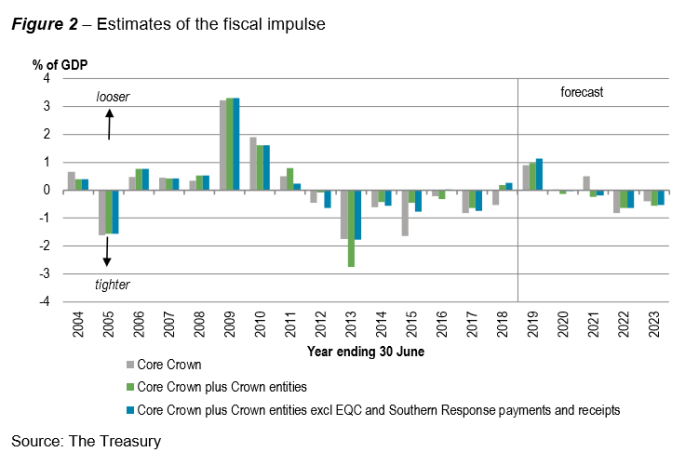
In fact, it prompted the perfectly reasonable question from Bernard Hickey about whether fiscal policy was actually very stimulatory at all.   The standard reference here is The Treasury’s fiscal impulse measure.  This is the chart from the Budget documents

fisc impulse.png

It isn’t a perfect measure by any means, and in particular one can argue about some of the historical numbers. In my experience, it is a pretty useful encapsulation of the fiscal impulse (boost to demand) for the forecast period. In fact, the measure was originally developed for the Reserve Bank –  which wanted to know how best to translate published forecast plans into estimated effects on domestic demand/activity.

And what do we see.  There was a moderately significant fiscal impulse in the year to June 2019.  That year ended six weeks ago.  For current and next June years, the net fiscal impulse is about zero, and beyond that –  which doesn’t mean much at this stage –  the impulse is moderately negative.    All using the government’s own budget numbers.  And consistent with this, operating revenue in 2023 is projected to be higher as a share of GDP than it is now, and operating expenses are projected to be lower (share of GDP) than they are now.    The Budget is projected to be in (fairly modest) surplus throughout.

And yet challenged on this, the Governor seemed to be just making things up when he claimed that we had a “very pro-active fiscal authority” and that “the foot is on the fiscal accelerator”.    It just isn’t.  Orr must know that (after all, he had Treasury’s Deputy Secretary for macro sitting as an observer in this MPS round).  One even felt a little sorry for the Bank’s chief economist spluttering to try to square the circle, but basically acknowledging that Hickey’s story was right, not the Governor’s.   Perhaps, you might wonder, the Bank thinks the fiscal impulse measure is materially misleading and has its own alternative analysis of the government’s announced fiscal plans. But that can’t be so either: there is no discussion of the issue in the Monetary Policy Statement.

(Incidentally, on Morning Report this morning Grant Robertson tried the same sort of line, only for the presenter to point out to him the fiscal impulse measure, reducing the Minister to spluttering “but we are spending more than the last lot”.  That is true, but the material overall fiscal boost was last year –  and growth and activity were insipid even then, inflation still undershooting the target.)

Was he being deliberately dishonest or simply making stuff up as he went protraying things as he’d like them to be?  You can be the judge, but neither alternative puts our central bank Governor in a good light.
Given that he has since had another 7 weeks to get his lines straight and yet repeats the same line, it looks even worse for him now.  As I said last month, if the Bank has an alternative take on the demand implications of fiscal policy it surely behooves them to lay it out for scrutiny, not just make idle claims inconsistent with their longstanding standard reference source the Treasury estimates).

Just as preposterous was this claim from the Governor

The low level of interest rates globally over recent years primarily reflects low and stable inflation rates – a deliberate and desired outcome of monetary policy.

Here the Governor was repeating much the same nonsense it is reported that he ran to Parliament last month

Over the weekend, I came across an account of the Governor’s appearance on Thursday before Parliament’s Finance and Expenditure Committee to talk about the Monetary Policy Statement and the interest rate decision. …. The Governor was reported as suggesting although neutral interest rates had dropped to a very low level, that MPs should be not too concerned as we are now simply back to the levels seen prior to the decades of high inflation in the 1970s and 1980s.

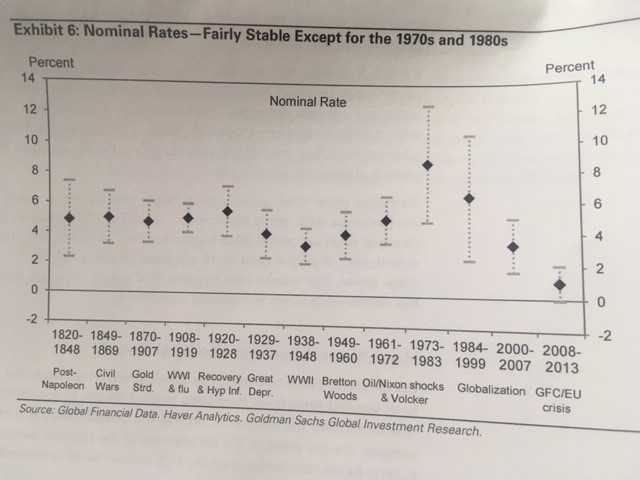
I’m not going to repeat the entire post I devoted to illustrating just how unusual global (and New Zealand) interest rates now are, both in nominal terms and (even more so in the long sweep of history) on real terms.  In centuries past there was little or no rational expectation of sustained inflation, while these days everyone agrees that medium to long-term inflation expectations are somewhere between 1 and 2 per cent.  The Governor may also have forgotten, in a New Zealand context, that the inflation target here is now materially higher than it was, say, 25 years ago.   Interest rates are, of course, far lower.  Here is just one chart from the earlier post, showing how unusual global interest rates were even five years ago (things are still more anomalous now, especially here).

As a final chart for now, here is another one from the old Goldman Sachs research note

GS short rates

In this chart, the authors aggregated data on 20 countries.  Through all the ups and downs of the 19th century and the first half of the 20th century –  when expected inflation mostly wasn’t a thing –  nominal interest rates across this wide range of countries averaged well above what we experience in almost every advanced country now.
Why does the Governor say this stuff?  Does he have no advisers left who are willing to tell him that what he says just isn’t so?

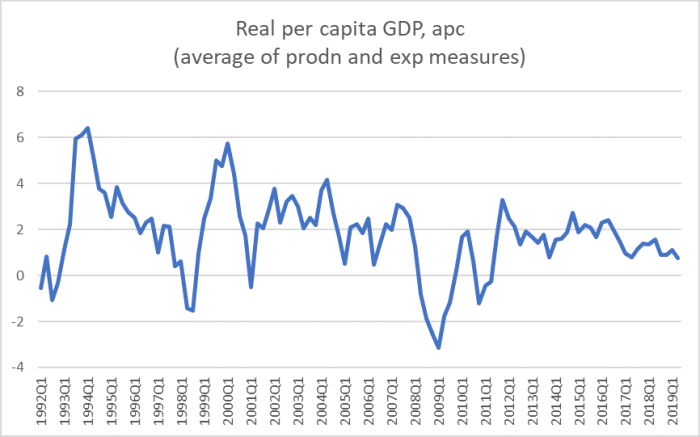
There are claims that the domestic economy still has “ongoing momentum” and that there is “strong demand for goods and services”.  These claims appear to be based the Governor’s interpretation of comments from the small group of firms the Bank went and visited recently.  Never mind the economywide measures, whether the range of business confidence and activity measures, or…..well, the national accounts.
pc GDP growth.png

He goes on repeatedly about how interest rates make it a great time to invest, as if he’d not given a thought to possible reasons why interest rates might be low (NB, it isn’t just because inflation came down again, see above).  He claims we have a “great environment to invest”, talks of “low hurdle rates for investing”, but seems not to recognise that in a climate of uncertainty, whether around policy (here or abroad) or the economic outlook, the option of simply waiting has considerable value, or thus that there is little reason to suppose that hurdle rates for investing have dropped much, if at all, in more recent times.

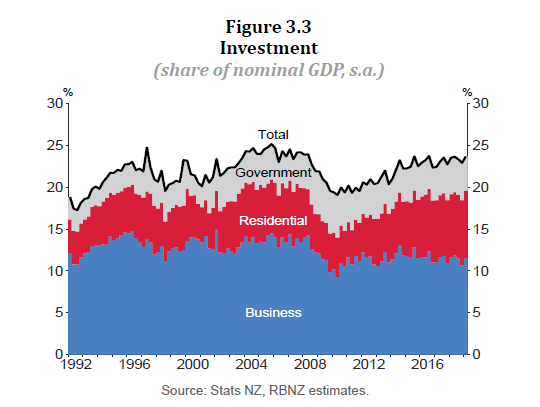
As a bureaucrat Orr is apparently convinced it is a great opportunity to invest and that profitable investment opportunities abound.  Experience suggests that people with a bottom line to meet disagree with him.  Here is the Bank’s own chart from the most recent MPS showing business investment as a share of GDP, with a few observations from me.

bus investment RB.png

As I’ve noted here repeatedly, business investment never recovered strongly from the last recession, and if anything (as share of GDP) has been falling back again in the last few years, even as population growth remained strong.

But despite the feeble business investment performance, the Bank expects business investment to recover from here.  There is no hint as to why they believe that is likely…. If there is any basis for their beliefs it seems to be little more than the repeated claim by the Governor and the Minister that it is “a great time to invest” in New Zealand.  But firms didn’t think so over the last five years –  even with unexpected population shocks –  and surely the reason the Bank is cutting the OCR has quite a bit to do with deteriorating conditions and investment prospects here and abroad?
But what do firms know?

Orr seems to more or less acknowledge the uncertainty issue, in these strange sentences, tinged with corporatist sentiments

However, there remains a loud call from all quarters of the country for leaders to better signal investment intent, and ensure we have the policy and goodwill to facilitate access to capital and resources to execute.

This call for investment-intent is to all collectively-owned (e.g., Iwi), Crown-owned (i.e., central and local government), and co-operatively owned (e.g., traditional primary sector) sectors. It is not just to traditional businesses, or any one party.

Easily said, harder to do without a clear desire to work together over an agreed horizon.

Or he could just have mentioned the major policy uncertainties.    Whatever your view on the merits of any of these issues (and I’m steering clear of expressing such views) mightn’t you think that uncertainty around the ETS, water quality policy, highly productive lands policy, the future of the RMA itself, whether any more significant roads will be built by a government apparently averse to them, bank capital regimes, the future of extractive industries might all be among the sorts of factors that might leave businesses and potential investors just a little wary, and pricing that uncertainty into their decisions around investment?

It all comes to a climax in this extraordinary claim in the Governor’s final paragraph (emphasis added).

In summary, we are not alone in the low interest rate environment, this is a global phenomenon. However, what we do have is more policy and business opportunities than most OECD economies and this is something that we need to take advantage of.

If by that he means that New Zealand productivity and per capita income rank far behind most of the OECD countries we used to like to compare ourselves to and that, at least in principle, those gaps could be closed, then I’m right with him.  But absolutely nothing about how policy has been run by successive governments for at least 25 years now has (so it appears from the evidence of hindsight) been consistent with closing those gaps: the productivity gaps in particular have just kept on widening and (though you would never know it from the Governor’s speech) we’ve had little or no productivity growth at all for the last five or more years.  Nothing about current policy suggests that record will improve in the next five years, and if anything one could mount a plausible argument that the measures adopted by the current government are heightening the risk of even worse (relative performance outcomes) in the next five.   Not only is this stuff well outside the Governor’s area of responsibility –  which is about macro and financial stabilisation –  but he either just doesn’t know what he is talking up or knowing better he just mouths such platitudes anyway.

Finally, there are several paragraphs in the speech about the Governor’s proposals to hugely increase the amount of capital locally-incorporated banks will need to have to back current balance sheets.    Notionally, there is process of consultation and deliberation going on at present. But when you read from the sole decisionmaker words like these,

Our proposals would see significant increases in shareholder capital in banks. With banks having more of their own ‘skin in the game’, the owners will sharpen their long-term customer focus, and it will reduce the chance of a bank failure and the cost on society as a whole should a bank fail. These outcomes are highly desirable for the long-term economic health of New Zealand, and should promote deeper and more liquid local equity and debt markets.

We finalise our decisions in early-December this year. Whatever our final decisions, we will be insisting on transition to higher capital at a sensible pace.

with all those “will”s, you get a pretty strong sense of pre-judgement.  That is, of course, what you’d expect when those proposals were based on very weak analysis –  numbers plucked out of the air at the last minute –  and when the Governor is prosecutor, judge, and jury in his own case, and where he knows that there are no effective appeal rights against his verdict as unelected unaccountable decisionmaker.

It really isn’t good enough.  Citizens should expect better.  The Bank’s Board is paid to hold the Governor to account, but they are almost worse than useless (they provide shadow without substance, suggesting there is scrutiny and accountability when there isn’t).  If the Minister of Finance were doing his job, or Parliament’s Finance and Expenditure Committee was doing its job, some pretty hard questions would be being asked about just what is going wrong at the Bank, and how such shallow –  and frankly embarrassing –  material is emerging from the mouth of such a powerful public figure.

Instead, no doubt, things will continue to drift, and the slow decline of New Zealand’s economic institutions –  hand in hand with the continuing decline in New Zealand’s relative economic performance – will continue.

But, you businesses out there really should be investing. This Governor tells you so.


A new BIS paper that undermines the Reserve Bank’s case

At the end of my long post yesterday on the Reserve Bank’s latest efforts to spin the Governor’s plans to increase very markedly minimum capital ratios for locally-incorporated banks, I noted

PS.  As Martien Lubberink at Victoria has pointed out there is another international agency paper out just recently that really doesn’t help the Bank’s case much if at all. I might touch on that tomorrow.

His post is here (complete with the sly –  if obscure, presumably deliberately so –  dig at the Governor in the final paragraph).

The paper he was referring was recently published by the Bank for International Settlements as a Working Paper of the Basel Committee on Banking Supervision, with the title “The costs and benefits of bank capital – a review of the literature”.   The paper was released only a couple of weeks ago, and it should be studied carefully by anyone interested in the issues here in New Zealand, including (one hopes) the Reserve Bank.

The paper begins

In 2010, the Basel Committee on Banking Supervision published an assessment of the long-term economic impact (LEI) of stronger capital and liquidity requirements (BCBS (2010)). This paper considers this assessment in light of estimates from later studies of the macroeconomic benefits and costs of higher capital requirements.

That earlier paper is referenced everywhere the issues are discussed, including in the Reserve Bank’s papers earlier in the decade, and in its consultative document for this review.   It supported –  to some extent made –  the (macro) case for higher capital ratios, in particular higher than had been in place up to that point (shortly after the crisis).  A review and update of the issues, by a group involving officials from the BIS, the Bank of England, the Banque de France, the Fed and Comptroller of Currency (among others) has to be taken seriously, including when the authors highlight the limitations of their own work, and outline areas needing further research.   The paper looks at many of the same studies the Reserve Bank cites but –  in Lubberink’s words –

The conclusions of the Basel Committee study, however, are different. They are much more modest than the findings of the RBNZ.

Before going on, I should say that I have serious problems with elements of the approach taken in the earlier and more recent BCBS papers (various points outlined at greater length in my own submission).   In particular, this work (and the Reserve Bank) treats all output losses in recessions associated with financial crises as being attributable to the financial crisis (bank failures etc) itself.  That is almost certainly wrong, and substantially overestimates the cost of crises themselves –  the loan losses that lead to bank failures arise from misallocations of investment resources (and/or overheated economies) and those misallocations will be corrected anyway (with likely output costs), whether or not any bank fails.   Remarkably –  and this is clearer in the more recent paper –  they also treat output losses in countries that didn’t have domestic financial crises (think Australia or Canada in 2008/09) as costs of financial crises, rather than allowing for the more plausible story that common third factors will have been driving, say, productivity growth slowdowns across the advanced world.  As I’ve argued (and as Cline, in a PIIE paper a few years ago, also made the case), if you want to isolate the output costs of financial crises, a better way is to look at the differential growth performance between (otherwise similar) countries that did and did not experience domestic financial crises.

A great deal turns –  in these sorts of modelling exercises – on how costly the modellers assume crises will be.  Both my points in the previous paragraph suggest the BCBS conclusions –  as to how much capital is likely to be warranted –  are likely to materially overstate the “true” numbers.

There are all sorts of other limitations to the BCBS work. For example, it focuses on “banks”, but doesn’t address the fact that for an individual country – think New Zealand –  a capital requirement on locally-incorporated banks won’t affect branches of foreign banks operating locally, or non-bank lenders.  Disintermediaton costs don’t figure.  It also, more generally, won’t apply to debt capital market funding.   Unlike the Reserve Bank, the BCBS paper does touch on the issue of alternative resolution mechanisms –  the Bank long favoured the OBR approach, but it was never mentioned in the consultative document, even though the more confident you are of OBR (I’m not, but they were) the less capital is required –  but it doesn’t touch on the issue of a banking system in which the large banks all have strong foreign parents.  And it doesn’t take account – in the macro calculations – of the possible income losses to New Zealanders from the higher equity returns to foreign shareholders (much of the overseas modelling seems assume redistribution of income within the country).  This latter point, in particular, has been covered in Ian Harrison’s papers.

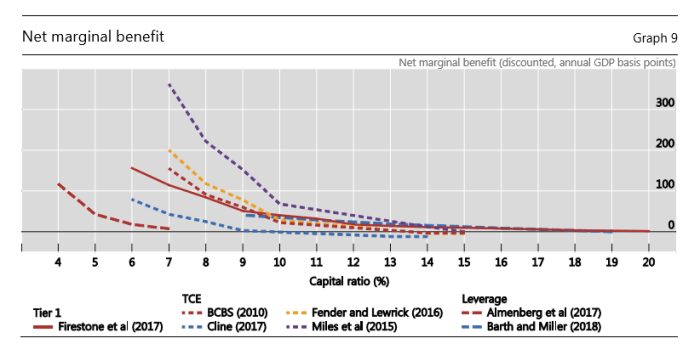
On my reading, this is the bottom line chart in the BCBS paper.

bcbs chart.png

They report the net marginal economic benefit (slightly lower GDP each year, offset against savings from a less serious crisis decades hence) from higher bank capital ratios, drawn from a series of studies.    On these models there were really big gains in lifting capital ratios, up to around to around 9-10 per cent.  If there are gains at all –  and they don’t report margins of error around these estimates –  they are looking extremely small beyond about 13 per cent.    Perhaps that doesn’t sound too far from the 16 per cent number the Reserve Bank is proposing for the big banks but (among other limitations, many made inevitable by data limitations):

  • this modelling is done on actual capital ratios, not regulatory minima (a 16 per cent minimum ratio is likely to see banks aim for something between 17 and 18 per cent actual ratio), and
  • none of this modelling takes account of differences in accounting and regulatory treatment across countries: conventional wisdom, (backed by estimates done by PWC) suggest that effective capital ratios in New Zealand (and Australia) would be far higher if things were measured the same way they were done in various other advanced countries, and
  • none of it takes account of the regulatory floor in how risk-weighted assets are calculated.  As the Bank is quite open about, a significant part of what is proposing is that in calculating risk-weighted assets, the big banks will have a floor of 90 per cent of what the standardised rules would generate (the more normal floor is, as I understand it, about 72 per cent).  A 17.5 per cent headline actual capital ratio would, on RB proposed rules, be akin to something like 20 per cent in the sort of framework the BCBS authors are looking at.

Nothing in this paper suggests any reason for confidence that effective capital ratios of, say, 20 per cent of risk-weighted assets would be generating net economic benefits, even on the (overly pessimistic) macro assumptions the authors are using.  But that is what the Reserve Bank claims to believe.  The onus, surely, is on them to show us, and to engage on their assumptions and analysis – in open dialogue – well before decisions are made.

And then lets go back to the macroeconomic inputs.    If most of the costs of recessions associated with financial crises would have happened anyway (see above) then the output losses used in these models are substantially overstated.   Higher capital ratios make no difference to whether those losses occur.  Cline (the lower blue line in the chart) uses assumptions more similar to mine: you can see where the crossover point (to net costs) is for him.

Note too that real interest rates and the real cost of capital are higher in New Zealand than in most advanced countries.  The median (real) discount rate used in the studies the BCBS paper looks at is something like 3.5 per cent and none uses a real rate higher than 5 per cent.  A standard New Zealand Treasury guidance for cost-benefit analyses on regulatory proposals is (real) 6 per cent.  Using a higher discount rate materially reduces any benefits from a crisis assumed to arise, probabilistically, decades in the future.   And yet even on the studies reviewed by the BCBS, there is no consensus in favour of anything near as high as the effective capital ratios the Governor is proposing.

And, as I’ve pointed out previously, all this work implicitly assumes that any higher capital ratios can be made binding for decades to come.  Since there is no pre-commitment technology, and actual rules have been changed every few years, there should be a further discounting of any potential gains, particularly in light of the inevitable transition costs from big increases in capital requirements (which are frontloaded, and represents permanent losses, for what may be a temporary policy).

It was also interesting to be reminded, in an annex, of this feature of the earlier (LEI) BCBS modelling

The main results of the LEI appear in Table 8, p 29, of BCBS (2010).  The calibration used is the following:

• the probability of a crisis is 4.6% for a capital ratio of 7%, and declines at a diminishing rate to 0.3% for a capital ratio of 15%.

In other words, a probability of a crisis every 333 years with an (actual) capital ratio –  calculated as more conventionally abroad –  of 15 per cent.  And yet the Reserve Bank’s proposals were supposed to be calibrated to a crisis every 200 years, and yet still somehow generate effective capital ratios of 18 per cent plus for the big banks.

Now in many respects Martien Lubberink’s comment is fair, that for all sorts of reasons

studies on bank capital are more quicksand than a sound foundation for policy recommendations.

And yet, they have been repeatedly invoked by the Reserve Bank, and –  when read carefully – do still provide a commonsense test against which the benchmark the Governor’s ill-considered far-reaching proposals for New Zealand.

The whole exercise really should be suspended.  Come back to it perhaps in a few years’ time when a revised Reserve Bank Act is in place, and when there has been proper parliamentary and public scrutiny of the assignment of powers to the Reserve Bank (which policymaking powers should rest with ministers and which with agencies).  And use the intervening period to undertake some serious local research, working collaboratively with APRA (recognising the common risks, common ownership, likely common resolution) and engaging in workshops and seminars to tests the strengths and weaknesses of staff thinking and research well before decisionmaking authorities reach a provisional view.

And, in meantime, take comfort from the fact that before the IMF suddenly swung in behind the Governor, when there were no institutional pressures at play that international agency only a year ago told us, and told the world, that there were ample capital buffers in the New Zealand banking system.

IMF capital

The risks haven’t changed materially in that time, it is just that the gubernatorial whim has since been revealed.  Such whims are a terrible basis for making serious policy, especially when there are no checks, no appeals, on the Governor’s ability to impose such substantial transitional and ongoing costs on New Zealanders.


,

Reserve Bank still spinning

Earlier this week, the Reserve Bank published (almost all of) the submissions it received on the Governor’s proposal to increase very markedly the share of bank balance sheets that need to be funded by equity.

Welcome as it is to have the submissions –  it is easy to forget that not four years ago the Reserve Bank was still reluctant to publish any submissions it received at all (even though it was the norm for government agencies, parliamentary select committees, and so on) –  the Governor sought to use the occasion for some more spin in support of his proposal (on which he alone will, a few months from now, make the final decisions –  the rest of us, whether Minister of Finance, banks, businesses or citizens will simply be stuck with the results of his whim, with no mechanisms for appeal or review.)

Instead of just releasing the submissions –  which could have been done weeks ago, very shortly after submissions closed –  the Bank chose to release a 22 page document labelled “Summary of Submissions” and a lengthy and argumentative press release in the name of the Deputy Governor.

I haven’t read all the submissions, or even looked at them all, but one reader –  distracting himself from other stuff he should have been doing –  did look at them all, and sent me a spreadsheet with the names of the submitters, the length of each submissions, and broad tenor of any comments.

A good consultative process draws out perspectives or comments or evidence that the consulting agency may not have thought of, may have chosen to ignore, may have interpreted differently, may have missed the point of, or whatever.  Having received that material, the consulting agency would carefully consider those perspectives, (in principle) looking to make the best decision, open to a revised perspective.   Of course, that sort of openness is rare –  it runs against human nature, particularly where the people making the final decision are the people who proposed the scheme in the first place.

And a consultative process shouldn’t be thought of, or presented as akin to, a public opinion poll.   If one wanted to make such decisions by public opinion poll then I guess (a) we wouldn’t delegate them to a specialised agency, and (b) we would commission a properly structured poll.   Apart from anything else, (a) people who are opposed to what is proposed are typically more likely to submit than those in favour, and (on the other hand) (b) especially when the numbers involved are small, it is easy for a handful of low-information submissions to be generated on either side of the issue.

The Reserve Bank, however, has tended to present the submissions as something of an opinion poll.     There was the silly line that “in general, submitters support the Reserve Bank’s objective to ensure that New Zealand’s financial system is safe” –  yes, and we support motherhood and apple pie too.  The issue isn’t whether the system should be “safe”, but how safe, and at what cost, on what assumptions.  And then

There was significant and wide-ranging media and public interest in the How much capital is enough? (PDF 545 KB) paper, with written feedback from 161 submitters.

Yes, 161 submitters is a lot more than the nine submissions they received on the previous paper in the longrunning capital review  but in the grand scheme of things –  considering the scale of the changes the Bank is proposing – it isn’t many.   And more than 20 per cent of the submissions turned out to be six lines or less: whether the submitter was for or against what the Governor was proposing (and in some cases it really isn’t clear) there is no useful information for a proper consultative process in submissions that short (unless perhaps one of the big banks had submitted “Dear Adrian, We agree.  Do start soon.”, which they didn’t).

Thus, when the Deputy Governor says

Many submitters, particularly from the general public, support the proposed higher capital requirements for banks.

He is correct.  Many did.  Very briefly.  Usually without much engagement in the argumentation and issue (although one of the Governor’s mates did write in to offer support and some argumentation, although strangely even he referred to some evidence that capital ratios should be 13-14 per cent, which led him to the view that the Bank’s proposed (minimum) ratio of 16 per cent was “acceptable”.)

And look at this attempt to play the populist card – the public versus the banks – a bit further

Some submitters, in particular banks and business groups, question whether the proposed increases are too large and too costly.

As they know very well, there were a variety of other serious –  more than half a dozen lines long – submissions from people with no vested interests who were very sceptical of the Bank’s proposal, and of the argumentation and evidence in support of it.

You also have to wonder how well the Bank would be able to defend a claim (perhaps in a judicial review) that the consultative process was a sham.  The Deputy Governor again

Increasing the amount and quality of capital can be reasonably expected to mean that banks can survive all but the most exceptional shocks, Mr Bascand says. “We think the costs of doing so are outweighed by the benefits – someone’s cost is for society’s broader benefit.”

(do note the attempt to play vested interests again: “someone’s cost”).  Isn’t it still months until the final decision is supposed to be made?  And yet the Deputy Governor can confidently declare not just ‘in putting out the consultative document we thought it likely benefits would exceed costs”, but (present tense) “we think the costs…are outweighed by the benefits”.  And if the Deputy Governor already knows perhaps he could release that cost-benefit analysis that so many submitters and other commentators have been calling for.  I guess they haven’t yet back-fitted the numbers to suit the Governor’s conclusion yet.

Continuing with the spin, the Deputy Governor moved on to invoke support from the International Monetary Fund and the OECD, both of whom released comments on the New Zealand economy last week.

Following its recent mission to New Zealand, the International Monetary Fund has released a Concluding Statement that highlights the need for strengthening bank capital levels and that the proposals appear commensurate with the systemic financial risks facing New Zealand. The Organisation for Economic Co-operation and Development’s latest Economic Survey of New Zealand expects increases in capital will likely have net benefits for New Zealand.

It is hard to make much of the IMF comments at this stage.  They are not much more than a couple of sentences in a press release, with no published supporting analysis.  And the Fund almost always backs the authorities – who are the people they talk to most  –  especially when central banks and regulators want to put more restrictions on banks. Why wouldn’t they?  Any economic costs don’t sheet home to them.  But the IMF’s support isn’t without its problem for the Reserve Bank.     Here is what they said

The new requirements would increase bank capital to levels that are commensurate with the systemic financial risks emanating from the dominance of the four large banks with similar concentrated exposure to mortgages, business models and funding structures.

Which, by logical deduction, appears to be saying that current levels of capital are grossly inadequate to the risks the New Zealand banking system faces. But there was no hint of these serious risks in past Financial Stability Report from the Reserve Bank (although they amped up the rhetoric in the latest one), and –  perhaps more to the point –  no hint of that in past IMF Article IV staff reviews or Executive Board discussions.  This snippet is from last year’s Article IV report, published as recently as June last year.

IMF capital

Not a word from staff, from the Board –  or, indeed, fron the New Zealand authorities in their published comments –  of a pressing need for a huge increase in minimum capital ratios.

The Deputy Governor also attempts to deploy the OECD in support.  They typically aren’t particularly expert in such matters, but here is what they actually said:

The Reserve Bank has proposed large hikes in bank capital requirements. High bank capital requirements reduce the cost from financial crises, but might also dampen economic activity through higher lending rates. On balance and nothwithstanding considerable uncertainty, increases in bank capital are likely to have net benefits, but the impacts should be carefully monitored.

Take it from me – I negotiated line by line wording on numerous OECD reports –  that is about as tepid as it gets.  It doesn’t even endorse the huge increases in minimum capital the Governor is proposing –  the comment is simply about “increases”, and there is a long way from current levels to what the Governor has planned.

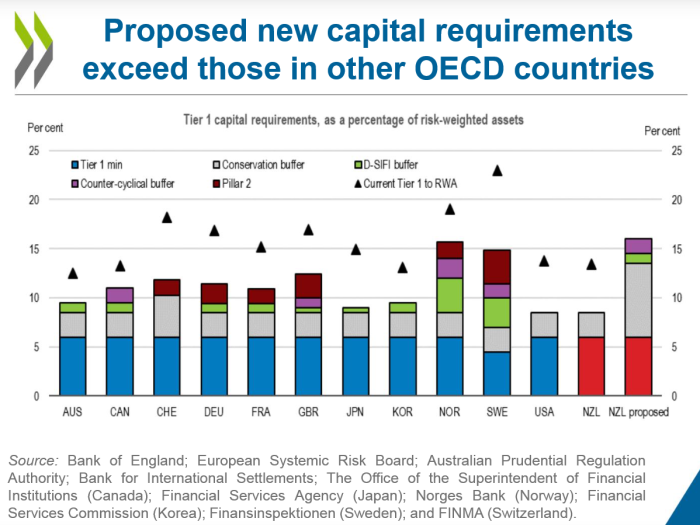
And if you doubt my take on the OECD, here is their own slide from the presentation when they released the report in Wellington last week.

OECD capital.png

And these comparisons are just of headline required ratios (triangles are actuals I presume), while part of the Reserve Bank proposal is to materially increase the calculation of risk-weighted assets for the big 4 banks, to an extent that would, in effect, add another three percentage points or so to those New Zealand numbers, which already –  in the OECD’s words – “exceed those in other OECD countries”.

So, spin all the way down.    Complete with the observation about their continuing consultation –  fishing around to find some supporters perhaps

It is continuing its stakeholder outreach programme, which includes conducting focus groups to understand the public’s risk appetite, and engagement with iwi, social sector and industry groups, financial institutions and investors. It has also engaged three external experts for an independent review of its proposals.

They elaborate a little in the document that supposedly summarises the submissions.  On the iwi point “a workshop with Maori service providers” –  but why, what specific issues might there be for “Maori service providers” (whatever they are) from any others –  Catholic, Pacific, or whatever?   And the workshop they plan with “social service providers and NGOs” really looks like an attempt to drum up support for the shonky “social costs of crises” material they’ve run previously, and which Ian Harrison (in particular) has comprehensively demolished.  I will be lodging an Official Information Act request for the reports etc from any focus groups –  again it looks a lot like an attempt at distraction, a populist Governor trying to summon a mandate from “the people”, rather than from Parliament.

Also from that Summary of Submissions, this attempt to spin the issue (wasn’t this supposed to be a summary of submitters’ view and analysis?)

It’s about keeping New Zealanders, their investments, and the economy safe from the disastrous impacts of financial instability and the failure of a registered bank, which historical evidence suggests can be very long-lasting and go beyond just the financial costs for people.

Loaded language (and not even particularly well written).  Nothing like a bogeyman to scare people with I suppose, but surely only fairly geeky people even read a document like this.  Who is the Governor hoping to impress?  Not much sign of calm, balanced, detached and objective consideration, that’s for sure.

(Having said that, it was noticeable reading through the Summary itself how few arguments staff managed to find from the submissions in support of what the Governor was proposing.)

The other person who has weighed in this week is the Minister of Finance, with a rather plaintive appeal to everyone to get on and talk nicely, as if he was a harried parent pleading with children to just play nicely (“pleeeeeeease”) at the end of a long tiring day.   The Minister is reported to have called for a “mature debate”, observing

“I want to remind all parties that we are still in a consultation process. I am calling on all interested participants to listen to and work with each other constructively as this work is carried out.”

It wasn’t exactly authoritative.

Perhaps he might address his concerns specifically to the Governor, including via the Acting Secretary to the Treasury and the Bank’s Board (whose job to work for the Minister and the public to monitor and hold to account the Governor).   And perhaps he needs to wake up to the power asymmetries here: we have a single unelected official (largely appointed by some other unelected board members, all appointed by the previous government), championing huge increases in minimum capital requirements, having made no effort to socialise thinking or test reasoning before settling on a view, and is now judge and jury in a case he himself is prosecuting.  And the “defendants” –  not just banks, but the wider economy –  have no rights of appeal.  And the way the Governor has conducted himself –  dismissive of sceptical comments, strong elements of pre-meditation, no cost-benefit analysis, no serious analysis of the transition, no serious engagement with the Bank’s preferred resolutiuon tool (the OBR), “independent” experts handpicked by him to review the proposal (but barred from talking to anyone else without his permission) and so on –  doesn’t exactly inspire confidence.  He talks a lot about “making banks safer”, but all independent analysis  –  and their history –  suggests the banks are fairly safe already: we could reduce lots of risks in society to near-zero (the road toll for example) but the costs just aren’t worth it. He simply hasn’t made the case that this proposal –  which he cannot commit would even endure beyond his governorship – is worth the risks and costs.

The Minister of Finance does not have formal powers to stop the Reserve Bank.  It is right and proper that the Minister should not be able to interfere with supervisory decisions or judgements involving individual institutions, but what is going on here is probably the largest policy initiative (bigger than, eg, outsourcing/local incorporation) around bank regulation in many decades.  Big policy calls –  in areas where there is huge uncertainty (as the OECD, among others, says there is here) – really should be a matter for politicians.  At very least, they shouldn’t be a call for a one-man band with a bee in his bonnet (and without even any particular specialist technical expertise).

If the Minister really wanted to display some leadership he would call in the Governor (in consultation with the Secretary to the Treasury) and strongly urge that the entire review be put on hold.   There are several and sufficient reasons to do so:

  • the government has made provisional decisions around deposit insurance, but there has been no attempt to link that initiative and the bank capital proposal,
  • Phase 2 of the review of the Reserve Bank Act is well underway, and the provisional intention is that the Governor should no longer be the sole decisionmaker on matters of prudential policy, and that in future Treasury should play a stronger review role,
  • there is absolutely no urgency about doing anything about bank capital now (as every one recognises banks are strongly capitalised and have strongly capitalised parents, and it is only a few years since capital ratios were increased),
  • if anything, there is a strong case for doing nothing right now: the looming economic slowdown and diminished inflation pressures that are leading to OCR cuts remind us again of the approaching limits of conventional monetary policy.  The last thing we should be doing in that climate –  when stress tests etc show that bank balance sheets are sound –  is throwing more sand in wheels, potentially impeding credit availability over the next few years.

Of course, the Governor could refuse such a request, but he would be very unwise to do so.   The Governor has no public mandate, no independent source of legitimacy, and this is not an issue about the supervision of an individual institution –  it is about overall economic management, where the big parameters (eg inflation targets, debt targets……and financial stability goals, which are harder to pin down) should be made by those we elect, and can toss out again.   It should hardly be controversial if the Minister were to suggest to the Governor that he would be prepared to legislate so that in future changes in bank conditions of registration –  the lever the Bank uses –  could only be done by Order-in-Council, not simply on the Bank’s whim.  After all, that is how the prudential regime works for non-banks (and you’ll note there is no proposal in front of us to markedly increase capital requirements for non-bank deposit takers).

We need expert advice from the central bank – something we aren’t getting at present –  and expert independent adminstration of the rules, but the big policy calls (which involve significant risks, which no one can determine definitively) need to be the responsibility of the elected government.

For anyone interested, my own submission is here.

PS.  As Martien Lubberink at Victoria has pointed out there is another international agency paper out just recently that really doesn’t help the Bank’s case much if at all. I might touch on that tomorrow.


Not tenable in a crisis

On a quick read through the Executive Summary of the latest consultation document from the review of the Reserve Bank Act, there look to have been a range of not-entirely-unreasonable in-principle decisions made by the Minister of Finance.   Some even look thoroughly welcome, if long overdue, including the in-principle decision to end the charade that the Board of the Reserve Bank could or would adequately do the job of holding the Governor to account.  In turn, the decision to stop the Governor being the sole decisionmaker on banking regulatory policy can’t be implemented soon enough.

The other major change that I welcome, and have championed for some years inside and outside the Reserve Bank, is the decision to introduce a deposit insurance system.   Among advanced countries, New Zealand has been increasingly unusual in not having such a system.  The discussion of deposit insurance issues is from page 85 onwards in this document.

There are lots of details still to be sorted out, but the headline-grabber in the announcement yesterday was the aspect of what is proposed that I have most problem with.

The Minister has also made an in-principle decision that the scheme will protect eligible depositors’ savings up to an insured limit, proposed to be in the range of $30,000-$50,000 per depositor.

This has the feel of a bureaucratic compromise, including with the staff at the Reserve Bank who have consistently opposed deposit insurance.    More importantly, it is a ridiculously low limit which would almost certainly prove untenable, unsustainable, in an actual crisis.  David Tripe, at Massey University, calls it “a joke”, but it is (of course) more serious than that.

I favour deposit insurance mostly for second-best reasons.   You can advance various arguments for why deposits should, in principle, be specially favoured and protected.  I’m not really convinced by any of them.  If people really wanted rock-solid assets, and were willing to pay for them, the market could and would provide.  The evidence is, quite strongly, that people don’t (look, for example, at the tiny number of people holding government retail Kiwi Bonds, in contrast to the amount in bank term deposits etc).  And that isn’t surprising. Not only are banking crises rare, in countries where markets are allowed to work –  how much different the literature and mindset in this area might be if for 150 years Canada had had US banking etc laws, and the US had had Canadian ones –  but in the course of our lives many of us are much more likely to have serious  –  larger –  unexpected losses (financial or otherwise) from other sources.  A leaky home, a lost job, a serious relationship break-up, health problems, a business plan that just didn’t work out, an unexpected change in government policy,  living in a town that economic activity moved away from, and so on.

I’m not even persuaded by arguments about bank runs, that seem to have appealed to the authors of the consultation document (and the IMF and OECD).  There is little evidence of irrational runs and –  as we saw globally in 2008/09 –  wholesale creditors are at least as capable of running for their money, rationally or otherwise, as small depositors.

No, I support a credible deposit insurance system because governments –  abroad, and here –  have a demonstrated track record of bailing out depositors, and whole banks, when faced with a crisis, and political incentives that mean it would be difficult to change that track record –  perhaps especially in a political system such as our own, where so much power is bested in the executive, and the executive governs by commanding a majority (at least on supply issues) of Parliament.    If we believe in the importance of market discipline (beyond simply shareholders) – and I do –  then we need to do what we can to identify and recognise the pressure points and to internalise the costs of the protection they result in.   In this case, it is a concentration of (likely) voters, facing (potentially) large and visible immediate losses.

I’ve run through the likely political calculus in earlier posts (eg here), but suffice to say that I just do not believe that a plausible New Zealand government, faced with a plausible failure scenario for a major New Zealand bank, would let a bank fail, and use the OBR tool on all creditors, with protection only (via a deposit insurance scheme) for $30000 to $50000 per depositor.

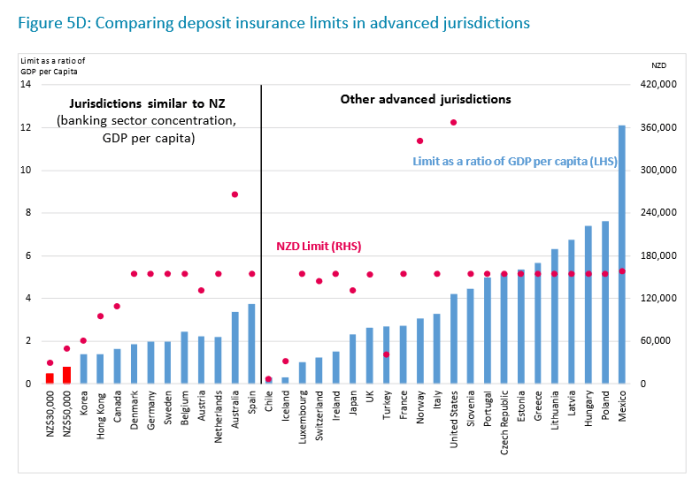
The government has sought to argue that the proposed cap on coverage is somehow internationally mainstream, but I don’t know who they are trying to fool (themselves apart?).   This chart is from the official document.

dep insurance

You can ignore the strained attempt to split OECD countries into two separate classes and just focus on the data.  Whether you look at the limit in simple dollar terms, or as a ratio to GDP per capita, the range of coverage the government proposes here would be lower than in all but two OECD countries.   And perhaps the thing that stands out to me most starkly from the chart is how many of those red dots (the other country limits in NZD terms) are at or near $150000.

Not unimportantly, the limit in Australia is A$250000 (just a bit more than that in NZD terms).  The government has probably noticed that the big banks in New Zealand are all subsidiaries of Australian banks.  It is probably aware that if a big New Zealand bank ever gets to the point of failure, it is highly likely to be a situation in which the parent is also on the brink of failure.  And anyone who has ever thought about the issue recognises the high likelihood that the resolution of a failed Australian banking group, with major operations in New Zealand, is likely to be handled at a trans-Tasman political level (including because of pressure from the Australian government to keep the banking groups together, which might well be the best way to realise value for creditors).  Most likely, the big banks would simply be bailed out completely.  But if they weren’t, how credible do you suppose it is that a New Zealand government will simply walk away from depositors with amounts in excess of, say, $50000 –  left to the tender mercies of OBR –  while their Australian siblings (in a bank with the same brand) are protected to A$250000?  Not very, would be my answer.     (And bear in mind the complication that it is generally recognised that if OBR is ever used, the non haircut deposits in any failed bank will need to be government guaranteed, and that such a guarantee may even need to be extended to other banks, to avoid a big loss of funds to the failed bank.)

I’m not arguing that we need the same limit as Australia –  apart from anything else, New Zealanders are poorer on average (but would it have hurt to have looked at common model?) –  but a $30000 to $50000 limit will simply strike people as so low that it won’t be persisted with if and when a crisis hits.  Deposit insurance limits get changed on the fly –  it happened all over the advanced world in 2008/09 –  and when they are, those who get the protection won’t have paid for it.    Failing to get this right, ex ante, simply increases the risk that when the crisis comes we’ll end up bailing out wholesale creditors (including foreign ones) too.

Much better to put in place a credible limit (indexed to inflation or nominal per capita, to remain sensible) –  perhaps $150000 per depositor – and charge depositors directly for the protection the Crown is proposing to offer.  Don’t –  as the discussion document talks of –  build up a modest fund and then stop charging the levy.  Remember that major bank failures are (and are supposed to be) very rare events: a levy of 15 basis points per annum on insured deposits for 150 years, would cover losses of (say) 20 per cent of all insured deposits (an extraordinarily large loss).   But just like your house insurance, the best outcome is if you pay your premium all your life and never need to make a claim.

The consultation document discussion on deposit insurance is itself something of a mixed bag.  At a technical level, some of its seems solid enough, but then they attempt to buttress it with overwrought claims.  There was this, for example

The GFC showed that a loss of confidence in one bank can rapidly spread throughout the financial system through ‘contagion’ that causes instability and destroys financial and social capital.

“One bank”????     And, even more far-fetched

The OECD (2013) and IMF (2017) have both warned that, without depositor protection, New Zealand is particularly vulnerable to contagious bank runs that can escalate into banking crises that destroy social and financial capital. The financial costs alone could be profound and long-lasting: experience overseas suggests that in a bank crisis GDP might fall 20 percent below trend, and the Government debt-to-GDP ratio might increase by 30 percentage points for a decade.

As we have seen, in analysing the Reserve Bank’s claims around bank capital, most of those “cost of crises” analyses simply don’t withstand serious scrutiny.  But, even if they did, no serious observer would claim that the presence or absence of deposit insurance in the difference sparing us staggering GDP losses.  Here, officials and the governments are attempted to sell us a model in which financial crises arise out of nowhere, and they know –  even the Minister really should –  that that is simply not so.

But I was left wondering quite how much the Minister of Finance understands when I saw him reported as suggesting that

A bank deposit protection scheme may help defuse the battle between the Reserve Bank and the country’s biggest trading banks over how much extra capital they should have to hold on their balance sheets, Finance Minister Grant Robertson indicated today.

It is a lot more likely to amp up the tensions I’d have thought.  From a fiscal perspective –  the Crown as underwriter of a deposit insurance scheme –  deposit insurance increases your interest in having bank capital ratios as high as possible (and the discussion document talks of funding deposit insurance with a levy on bank profits, rather than directly on insured deposits). But it was noticeable that there was no discussion at all of the interaction between the two: in principle, the higher your minimum capital ratios, the cheaper the deposit insurance should be.  I guess we will know the Governor’s final decision on capital before the Minister tries to legislate deposit insurance, but you would hope for some more joined-up discussion at some stage.

On which note, on the Radio New Zealand news last night, I heard the Prime Minister quoted as saying (apparently at her post-Cabinet press conference)

“Our banking system is one of the strongest and most resilient in the world”

I suspect she is probably right about that (floating exchange rate, vanilla loan books, little or no government interference in housing finance markets, no history of recent financial crises, banks part of much bigger overseas groups (from a similarly governed country).

But, if she is right, if that is what she has picked up from her briefings, from Grant Robertson, and perhaps even from the Governor, what possible grounds are there for requiring the huge increases in minimum bank capital ratios that the Governor is currently proposing?  We’ve not seen a cost-benefit analysis (but, who knows, perhaps she has).  On the face of it, let alone digging more deeply, there is no such case.   She is content, it appears, to let an unelected bureaucrat impose potentially large costs on the New Zealand economy  –  over a period (next few years) when things are likely to be difficult anyway –  for little or no gain (given the strength and resilience of the banking system, of which she spoke, and the inability to commit to such capital standards for more than a few years ahead).


Bank capital requirements: playing defence

Liam Dann, apparently the Reserve Bank’s favoured journalist, has a column on the Herald website on the Governor’s proposal to increase substantially the minimum core capital ratios for locally-incorporated banks.  No doubt it will warm the Governor’s heart, if perhaps not the more rigorous of his staff.  Dann’s column runs under the rather populist heading “Don’t let Aussie shareholders hijack our banking debate”.

And yet, here’s the thing.  Dann advances not a shred of evidence in support of his  suggestion.    He writes

I also know the Reserve Bank’s new capital ratio proposal is an important topic for national debate.

And it is becoming one-sided.

The sheer weight of PR power pushing for the status quo – ultimately the interests of Australian bank shareholders – is what leaps out at me in this debate.

We’re seeing the screws turned on the Reserve Bank by numerous financial institutions, lobby groups and even opposition politicians, in a way that undermines the process.

“Becoming one-sided” when a well-resourced major economic regulator, able to act as prosecutor, judge and jury in its own case, with no rights of appeals –  and able to get media coverage whenever he wants it – proposes very major changes in the operating environment for a core part of our financial system, without robust supporting analysis or a proper cost-benefit assessment, and a wide range of parties push back?

Perhaps Dann didn’t notice that the Bankers’ Association put in a unified submission.  Sure, the Australian-owned banks are the biggest members of the Association, but the small New Zealand banks are also members.  The Bankers’ Association submission draws on work led by former Secretary of the (New Zealand) Treasury, former (New Zealand) Productivity Commission member, Graham Scott, supported by other analysis undertaken by Glenn Boyle (New Zealand) academic at Canterbury University, Martien Lubberink (a Dutch academic, and former bank regulator, at Victoria University, and one other New Zealand economist.    As a reminder, all the bank members of the association (New Zealand, Australian, Chinese, Dutch, British, American) signed on.

What of other economists?  I’ve been fairly vocal on the subject, speaking only for myself  (and I may be the last native New Zealanders who has no family connections to Australia at all, let alone any connections to Australian-owned banks and their shareholders).  My former colleague Ian Harrison has gone into some of the issues in much greater depth.  He’s a New Zealander too –  driven by his reading of the evidence, argumentation, and the public interest – and didn’t do any of his work with Australian bank shareholders as his focus.    I guess we’ll have to wait until the Reserve Bank finally publishes all the submissions to see the full range, but I’ve read several other unpublished submissions by New Zealanders, working for New Zealand firms, that were far from convinced that what the Governor is proposing would be in the New Zealand public interest.

If anything, I have been a little surprised at how quiet the Australian banks have been, at least in public.  Presumably there is intense lobbying going on behind the scenes –  on both sides of Tasman – but isn’t that entirely appropriate, and what one should expect (and welcome)?     Perhaps it would be better still if the debates were played out more openly….but that might require the Governor to actually engage, not to play his “politics of slur” card, that anyone disagreeing with him is simply serving vested interests, in the pocket of Australian banks.

And what of that bizarre suggestion that somehow the “screws are being turned….by Opposition politicians”…. “in a way that undermines the process”.  The Opposition must be flattered that anyone thinks they have that much power.  But quite what bothers Dann about the Opposition (or the wider opposition) isn’t clear….except perhaps that it has upset that nice Governor, who only has in mind –  and is clearly gifted with unique insights on – the wider public interest.  Contest and scrutiny and challenge are part of how policy is, and should be, developed and tested.

Anyway, you rather get the gist of the Dann column with this quote

To me, Orr and his predecessor Graeme Wheeler both seem to be intelligent, philosophical thinkers of a kind that is sadly all too rare in the upper levels of the New Zealand political sphere.

or

Neither this Governor nor the last has been troubled by differing views on where interest rates should be or what inflation is doing.

That would be same Governor (Wheeler) who marshalled his entire senior management team to complain formally to one of the banks (he regulated) when that bank’s chief economist criticised Wheeler on monetary policy?

or (of Wheeler)

For some reason many local commentators made assumptions about the Governor being the prickly one.

“For some reason”!    Very good, very visible, reasons –  whether one was inside or outside the Bank at the time.

In Dann’s world, Wheeler and Orr have been something akin to perfect hero knights, to whom the rest of us should defer in some mix of wonder and gratitude.  In the real world, both were pretty deeply flawed, with increasing questions about whether Orr is equipped (eg temperamentally) for the role (it became clear that Wheeler wasn’t).

When half-baked and costly proposals emerge from very poor policy processes –  and when there are no appeals against Orr’s unilateral exercise of statutory power –  those proposals need to be robustly scrutinised and challenged, by entities directly affected (whichever country they come from), and by those with a concern for the wider health and economic wellbeing of New Zealand.    Good proposals always benefit from robust scrutiny (even just enhancing confidence that what looks good actually is) and bad, poorly supported, proposals put forward by the confident and powerful badly need that scrutiny and challenge, in the public interest.   There are plenty of serious questions journalists could put to Orr – if he’d give them access to ask them –  and, on some at least there might be convincing and robust responses.  We’d all be better for hearing how the Governor deals with the substance of disagreement.   At present, reliance on slurs raises further questions as to whether the Bank has good answers, and whether it (and the Governor) have thought broadly and deeply enough.

A few weeks ago we learned that the Governor was planning to have some independent experts rather belatedly involved in what has, to now, been a very poor policy process.

The Reserve Bank is also in the process of appointing external experts to independently review the analysis and advice underpinning the proposals.

On the surface that sounded better than nothing, although as I noted in a post just before the FSR

And who are they going to find to serve as “external experts” this late in the piece, when most of those who think about the issues domestically have already either expressed their views and been involved as consultants in preparing submissions by others.  There can be a role for overseas experts, but knowledge of the New Zealand system and New Zealand experience should not be irrelevant.  And quite what is the selection process the Governor is going to use at this late stage –  the suspicion will inevitably be that he will be aiming for people just credible enough to look serious, but emollient enough not to want to make difficulties.

That same day the Bank quietly posted on its website –  where no one would find it who wasn’t looking –  the terms of reference for these external experts, together with the names/background of the people the Governor had appointed.   All three are from overseas, none (it would appear) with much/any background in banking regulation and none with any substantial background in New Zealand economics or banking (one spent a few weeks here in 2014).  At least two seem to have publications which suggest they will be very sympathetic to the Governor, and one other has published an entire book on protecting bank supervison from regulatory capture (good book).

You will recall the report last week that at FEC the Governor had gone further and (slanderously) claimed that anyone local had already been “bought” by the banks.   Which left me puzzling again at the way the Bank has apparently overlooked Professor Prasanna Gai, at the University of Auckland,  of whom we learn.

Professor Gai is currently serving a four-year term on the Advisory Scientific Committee of the European Systemic Risk Board

He might be presumed to have some relevant perspectives and experience, and I hadn’t seem his name associated in public with any other submissions/views on the current capital proposals.  I have no idea what his views on bank capital might be, but I suspect he isn’t flavour of the month at 2 The Terrace for some of his other views on the governance of financial stability etc.  And, unlike the foreign experts, he would have been somewhat attuned to the local debate.

As it is, in addition to having been carefully selected by the Governor himself –  at a late stage in the process, when he already has his stake in the ground –  the role of the “independent experts” has been drawn very narrowly.  One could even say, generously, surprisingly so.

First, there is the framing in the terms of reference. Thus (emphasis added)

The Capital Review has been carried out within the context of New Zealand as a small open economy, with external imbalances and an economic and financial system that is disproportionately subject to external economic and financial shocks and changes in offshore sentiment

This claim pops up quite regularly from the Bank, but there is no empirical or analytical support offered for it all at all.   Then we are told

Much of New Zealand’s private debt is concentrated in the household and agricultural sectors, and has been steadily climbing over recent decades.

That second half of that is simply wrong.  There were big run-ups in debt (to income or GDP) in the 90s and 00s, but the ratio of private debt to GDP or income is little different now than it was prior to the last recession.

The risk appetite framework is centred on the concept of ensuring that systemically important banks can survive large unexpected losses – i.e. losses that have a likelihood of occurring only once in every 200 years. This is a higher degree of risk aversion than is implicitly built into the New Zealand system at the moment, reflecting the Reserve Bank’s judgement that the economic and social impacts of financial crises are large and more wideranging than previously realised.

And yet have outlined nothing (here or in the fuller documents) in support of the claims in the final sentence, nor do they note –  these are overseas experts recall –  that New Zealand itself, like Australia, has not had a systemic financial crisis in well over 100 years.

And they repeat one of their starting stipulations

Capital requirements of New Zealand banks should be conservative relative to those of international peers, reflecting the risks inherent in the New Zealand financial system and the Reserve Bank’s regulatory approach.

But it is all castles in the air stuff, because they never seek to demonstrate that the risks around the New Zealand financial system (floating exchange rate, vanilla loan books) are even as high, let alone higher, than those of a typical advanced country.

What also wasn’t clear from the initial Reserve Bank reference is that the focus of the independent experts is not to be on the decision still to be made.  Instead, they are invited to review all the papers the Bank has released in its (multi-year) capital review.   This is the Scope of Work

The External Experts Report will cover: 

  • Is the problem that the Capital Review seeking to address well specified? 
  • Has the Reserve Bank adopted an appropriate approach to evaluate and address the problem? For example, is the range of information considered, and the analytical approach appropriate? 
  • Do the inputs and cited pieces of evidence used by the Reserve Bank in its approach appropriately capture the relationship between bank capital and financial system soundness and efficiency? 
  • Has the analysis and advice taken into account all relevant matters, including the costs and benefits of the different options?   
  • Have the issues raised in submissions been assessed fairly and adequately? The External Experts will only consider the Reserve Bank’s assessment of issues raised in the submissions on the first three consultation papers.
  • Have the key risks been adequately considered across the proposals in the Capital Review?  Was the advice and analysis underpinning the Capital Review reasonable in the New Zealand-specific context?

The Capital Review has generated internal analysis covering a wide range of issues. This analysis has formed the basis of four public consultation papers and a much larger number of internal reports. This analysis has covered all aspects of the capital requirements, including the definition of capital (“the numerator”), the calculation of risk-weighted assets (“the denominator”) and the capital ratio itself.

Thus, the independent experts are not asked to look at the submissions on the latest (most controversial document).  They are invited to consider whether the “advice and analysis” was ‘reasonable in the New Zealand-specific context”, and yet there is almost nothing about the New Zealand specific context in the “how much capital is enough” consultation papers, none of the experts has any material New Zealand specific knowledge, and they are not supposed to engage with or review the submissions.   And

It is not expected that the External Experts will carry out extensive consultation as part of their work. Any external consultation should be agreed in advance with the Reserve Bank.

If, for example, one of the experts was somehow to become aware of (say) Ian Harrison’s specific critiques of some of the modelling, they would be prohibited from engaging with Ian without the prior permission of the Reserve Bank.

I’m not impugning the integrity of the independent experts.   But they have been chosen by the Governor, having regard to their backgrounds, dispositions, and past research –  a different group, with different backgrounds etc, would reach different conclusions – and the Governor is well-known for not encouraging or welcoming debate, challenge or dissent.  Quite probably the experts, each working individually, will identify a few things the Bank could have done better, but it will alll be very abstract, ungrounded in the specifics of New Zealand, and the value of their report is seriously undermined in advanced because of who made the appointment, and the point in the process where the appointment was made.  This is the sort of panel that, at very least, should have been appointed a year ago.  Better still, it would not have been appointed by the Governor.

The flawed process highlights just what is wrong with the governance of banking regulation and related issues in New Zealand.  We need an expert bank supervisory body, but that body shouldn’t be able to set big-picture policy all by itself (one unelected individual, to whom all the rest work).   Those calls should be made by the Minister of Finance –  who, in any case, should be playing a more active and public role on this specific proposals in front of us –  advised by both the Reserve Bank and The Treasury, and drawing on whatever independent perspectives the Minister would be useful to the process.   The current system would be flawed even if we had a superlative Governor –  expert, judicious, rigorous, open-minded, self-critical etc etc –  but it is performing particularly poorly under the leadership the Reserve Bank has had for most of this decade, as the Bank has chosen to take to itself bigger and bigger interventionist policy calls.

Twenty questions

I wasn’t planning to write anything today, but in the Herald this morning there was an “interview” with Reserve Bank Governor Adrian Orr around the bank capital proposals. I put the word in quote marks, because it was more of a platform for the Governor to articulate his views and frustrations, than any searching or penetrating scrutiny.  I tweeted out a link which attracted a response from Newsroom’s Bernard Hickey

Twitter isn’t really conducive to a long list of possible questions (240 characters and all that) and I have more readers here than there, so I thought I’d jot down a few suggestions, a non-exhaustive list of possibilities, here.

  1.  Given that proposals of this sort were always going to be controversial, why didn’t you adopt a more robust process from the start (eg technical workshops, green papers etc before the Governor signed up formally to a specific option)?
  2. Especially so given that in this area you (single decisionmaker) can be seen as prosecutor, judge, and jury in your own case, without any rights of appeal?
  3. Why did you not publish all the relevant documents when the consultation paper itself was released, rather than drip-feeding them out over months?
  4. Why was there no proper cost-benefit analysis, with assumptions and senstivities clearly stated, published with the consultative document?
  5. Why have you not published (or prepared?) a robust comparative assessment of your proposals relative to the capital rules proposed/in place in Australia, enabling submitters to see clearly the similarities/differences?
  6. Why have you repeatedly attempted to slur all critics of your proposals as representing “vested interests”, rather than engaging with the substance of the arguments critics have made?
  7. Wouldn’t your position, and preferences, appear more robust to disinterested parties if they could see you engaging with, and specifically responding to, alternative perspectives?
  8. Are you willing to revisit the Bank’s previous decision on the inadmissibility of CoCos?  Given the relatively high level of CET1 capital, what grounds do you have not allowing (eg) CoCos issued to wholesale investors to meet any additional capital requirements the Bank considers warranted?
  9. Wouldn’t the ability to issue CoCos to meet any additional capital requirements be particularly valuable to the (capital-constraind) New Zealand banks?
  10. Why was there no discussion of OBR in the consultation document?  A credible OBR system appears to greatly reduce the need for any capital requirements (let alone very high ones), so does this absence suggest the Bank was walking back its support for OBR?
  11. Where is the evidence for the claim, made several times in the recent Bank FSR, of evidence that the costs of financial crises are much higher than previously realised?  Realised by who, and when? (Bearing in mind that current capital requirements post-date 2008/09.)
  12. You have taken to suggesting that the 2008/09 episode in New Zealand supports the need for further increases in bank capital.  GIven the very low level of loan losses and NPLs through that period –  a severe recession, after a dramatic run-up in credit to GDP – can you elaborate on your view?
  13. Why was there no discussion/analysis of the probable transitional effects in the consultative document?
  14. Why are you not proposing to impose the same higher capital requirements on NBDTs?  Won’t this further un-level the playing field?
  15. What sort of disintermediation from the balance sheets of the big 4 locally incorporated banks do you expect to see, bearing in mind that the requirements don’t apply to (a) other non-bank lenders in New Zealand, (b) banks operating here that are not locally incorporated, (c) foreign banks not operating here, but lending to major New Zealand borrowers, or (d) to the domestic securities market?
  16. How does this disintermediation square with the efficiency constraint that appear prominently in your Act (didn’t we experience lots of disintermediation in the 70s and early 80s?)
  17. Do you agree that any costs of the higher capital requirements are likely to fall most severely on borrowers (and depositors) with the fewest alternative options?  Under that heading, is it likely modestly-sized borrowers with idiosnycratic needs (including farmers) will be among the harder hit?  If not, why not?
  18. In your documents you do not seem to have engaged with the evidence that floating exchange rate countries that did not have a financial crisis in 2008/09 did not perform much differently than floating exchange rate countries that had a financial crisis?  Why not?  Doesn’t this suggest your “cost of crisis” assumptions are substantially overstated?
  19. How, if at all, do you distinguish between the economic costs of a misallocation of resources during a credit boom (which higher capital requirements are unlikely to stop) –  but which only crystallise (and become apparent) in the bust – and those arising from the banking crisis itself?   There is no sign that you attempted to draw this distinction in any of your documents?
  20. Why are you so reluctant to pay heed to repeated waves of Reserve Bank stress tests which suggest that very severe (appropriately so) adverse shocks would not severely impair the health of the New Zealand financial system, based on the lending standards adopted in the last decade or more?

And that was a list straight from the top of my head, without even pausing to check my submission on the proposals.  It wouldn’t be hard to come up with at least another twenty questions that journalists seriously interested in holding the Governor to account might reasonably ask.

An embattled Orr

Still catching up, but noticing some concerning newspaper stories about how the Governor was handling things, yesterday I finally got round to reading the Reserve Bank’s Financial Stability Report and watching the Governor’s press conference.

Of the former, probably the less said the better.  It is a disappointingly lightweight effort, clearly designed to sound a bit more worried about New Zealand financial system risks – to support (belatedly) the Governor’s capital proposals – even while offering no evidence to suggest that such risks were (a) significant, or (b) worsening.       There were statements of the blindingly obvious –  “some” households and farms are overindebted, as if that has not always been the case –  and alarmist conclusions (about the threat banks could face if lots of borrowers default) made without any reference to the Bank’s own repeated stress tests.

And then there was the press conference.   I’ve seen some pretty poor performances from Governors over the years –  early ones by Alan Bollard were often awkward, and as Graeme Wheeler became more embattled the defensive introvert, never comfortable with the media, took over.     But this one was the worst I’ve seen, and from someone who has many talents in communications.  But just not, so it is confirmed again, in coping with challenge, disagreement, or finding himself on the back foot.  I doubt a senior politician would have got away with it, and it isn’t obvious why an unelected bureaucrat, uncomfortable at facing serious scrutiny, should do so.

The Governor and Deputy Governor faced several questions about the possible impact of the Bank’s capital proposals on farm lending –  various commentators have suggested such borrowers will be among the hardest hit.  The Bank attempted to push back claiming that any sectoral impacts were nothing to do with them, and all about banks’ own choices.  But they seemed blind to the fact that banks will have more ability to pass on the additional costs of the higher capital requirements to some sectors, some borrowers, than others.  And that is because of a point the Bank never addresses: their capital requirements don’t apply to all lenders.

They don’t apply to banks operating here that aren’t locally incorporated, they don’t apply to banks operating abroad in respect of loans to New Zealand entities, they don’t apply to local non-bank institutional lenders (deposit-takers, who have their own capital regime, or others), and they don’t apply to bond markets.   So some borrowers (think large corporates in particular) have a variety of alternative options and others don’t.  Almost inevitably the costs of the Bank’s capital proposals would bear most heavily on those with the fewest options, and farm borrowers are foremost among that group (there isn’t a big appetite from new entrants to build farm loan books, and farm lending is information-intensive and quite property-specific).   The Reserve Bank’s failure to openly and honestly address these sorts of issues –  none of them have been touched on in any of the consultative documents –  reflects poorly on them.   Whether it is because they simply never recognised the issue, or are trying to play blame games and shift responsibility etc, isn’t clear, but since the issues have been raised here (and elsewhere) for months, there is an increasingly likelihood that they know exactly what they are doing, not playing straight with the New Zealand public.

The Governor came across as embattled from start to finish –  embattled at best, at times prickly, rude, and behaving in a manner quite inappropriate for a senior unelected public official exercising a great deal of discretionary power, with few formal checks and balances.   BusinessDesk’s Jenny Ruth – who often asks particularly pointed questions about the exercise of the Bank’s regulatory powers, and the lack of transparency around its use of those powers – was the particular target of his ire, and at one point he tried to refuse to take further questions from her.

It isn’t always clear that the Governor hears the way he sounds: he goes out of his way to state that it is a genuine and open consultation, only to then conclude “but we are going to have more and better capital” –  in other words, no true consultation at all, as he has already made up his mind on the big picture.  Asked by another journalist what had changed in recent years that made further big increases in capital requirements warranted now, he fell back on spin –  no substantive answer, but “not enough has changed since 2008”, which isn’t a serious answer at all, especially in view of (a) the resilience of Australasian bank loan books in 2008/09, (b) repeated stress tests since, and (c) that aggregagate debt to income ratios are little different now than they were 10 years ago.   At one point, he actively misrepresented a prominent submitter’s submission.

Not all the awkward questioning was about the new capital proposals.  Some was about the recently-discovered failure of ANZ to use approved models in calculating capital requirements for operational risk, in the course of which it was revealed –  belatedly –  that the  Reserve Bank had told banks  (but not the public) that it is no longer approving any changes they would like to make to their internal models.    Under pressure –  this is after all the Reserve Bank’s day job –  the Governor moaned that the Bank hadn’t been adequately funded and that they had to prioritise. It was a shame no one asked about why the $1 million on the Governor’s Maori strategy, his tree god spin, and the endless talk about climate change –  at best peripheral to the Bank’s responsibilities – is being prioritised over proper adminstration of the bank capital regime.  Someone still should (after all, recently they had the money to send two staff to Paris for a climate change shindig).

The press conference deterioriated further as it got towards the end.  Without specific further prompting, the Governor noted a certain frostiness in the room, and then launched off again in his own defence.  The Bank was very transparent –  he asserted, even though it took months to get the full capital proposal documentation out, and we still have no cost-benefit analysis –  and it was very open-minded (except that, as he told us, he was closed minded on the needed for more and better capital).  He went on to note that he needed to rely on facts, and he would welcome decent questionings but (and I paraphrase) “I will be short with people when I see continuous mis-statements from journalists and others with vested interests”, all while – he told us –  he was trying to serve the interests of the people of New Zealand.

It should become a case-study for official agencies in how not to do things.

But it appears that Orr wasn’t finished, and didn’t go back to his office, reflect that that hadn’t gone well, listen to some sage counsel from his senior managers or Board, and re-engage in that sunny upbeat way the Governor at his best can manage much better than most.

A couple of articles in the Herald in recent days tells us some more of the story.   The first was from Liam Dann, who has in the past provided a trusty outlet for the views of successive Governors, and the second was a column from Pattrick Smellie, under the heading “Bunker mentality returns to the RBNZ?”, evoking unwelcome memories of the Wheeler governorship.

Dann’s article draws from a media lunch at which Orr had apparently been speaking.  There was, it appears, no hint of emollience, no suggestion of welcoming all the thoughtful work and analysis that had gone into the many submissions the Bank had received.  That is what a normal person would do and say (whatever they felt privately).  But not Orr.  He’s all in.  People either don’t understand, or they choose not to understand because –  on the Governor’s telling – they are all self-interested, part of the financial sector, while he –  and he alone it appears –  is looking out for the future of New Zealand.   If you think I’m caricaturing, read the article for yourself (I’m reluctant to excerpt extensively something behind a paywall).   But here are two extracts.

Orr said he had expected the strong critical response from the banks because he was aware of “the capability and resource” within the industry to lobby for the status quo.

“It is a very, very powerful industry.”

But he said he had been surprised by the personal attacks and “the underlying venom” that had come from the broader financial sector – including bloggers, think tanks and some sections of the media.

The noble Governor –  alone equipped to assess the public interest –  as the Three Hundred at Thermopylae facing down the amassed hordes of bankers (and “bloggers, think tanks and some sections of the media”).

Not only is there nothing about the substance of the arguments and evidence submitters and commenters have made (at length over many months) but note the attempt to imply that anyone criticising his proposals (and the very weak process around them) was part of the “financial sector”.   No doubt my views don’t count for much, but I’ve articulated numerous questions and criticisms here (and in my submission), and have never once taken a cent from the “financial sector”.  My former colleague Ian Harrison has extensively critiqued the Bank’s proposals and supporting documents, and I know for a fact it was entirely a labour of love (well, voluntary and unremunerated anyway).  And even if affected industries have made submissions –  shouldn’t we want them to? –  the onus should still be on the Governor and his staff to address issues and criticisms in a constructive way, not to engage in some sort of Trumpy politics of slur (no need to engage, because you are  – great evil –  banks).  It actually got worse at FEC (at least according to the Smellie column): questioned about why his “independent experts” (appointed belatedly) were all from abroad, he couldn’t stick to a moderate line that (say) most New Zealand residents who knew much about the issue had already weighed in in one form or another, but had to resort to the (frankly slanderous) suggestions that any New Zealand experts “had already been ‘bought’ by the trading banks”.

In the Dann article there was further illustration of how the Governor plays politics and spin, rather than engaging on substance.    We get this

Orr described the notion that the major banks “sailed through the GFC” as a popular myth that had taken hold with the general public.

In fact sailing through had involved a $133 billion overnight guarantee, an $8b direct asset purchase by the Reserve Bank to provide liquidity, a $10b wholesale underwrite and a drop of the OCR by 5.75 per cent.

I know Orr was not in the core public sector at the time (he was trading the markets at NZSF), but this is a highly misleading attempt to play distraction.   First, as the Governor very well knows, the big banks did not want to participate in the retail deposit guarantee scheme (the Minister of Finance compelled them to, as a condition of the limited wholesale guarantees).  Second, as the Governor equally well knows, every wholesale funding market in the world dried up for a time (and for reasons –  as all the contemporary documentation makes clear –  that had nothing to do with the specifics of Australasian banks).  Third, it is a core role of the Reserve Bank to provide liquidity support when demand for liquidity rises.  Fourth, as regards banks, all those operations were profitable for the Crown.    Fifth, the scale of the OCR adjustment is totally irrelevant to questions of bank soundness or otherwise –  there was a severe recession, partly domestic, partly foreign –  and adjusting the OCR as it did was just the Reserve Bank doing its day job (a little slowly as it happens).  And finally –  and really the only point of relevance to the capital debate  – bank losses (and NPLs) remained impressively moderate through that nasty recession and slow recovery.  Capital was never impaired.

On my reading, even Pattrick Smellie’s column is too willing to defend Orr’s conduct –  last week, and more generally.    He sticks up for his use of the Bank to pursue climate change agendas that have no grounding in statute (translations of the Bank’s self-chosen Maori name signify precisely nothing), of the tree god nonsense and the costly Maori strategy (even defending Orr’s claim that criticism of him on this is somehow “racist”).  And he buys into the Orr propaganda line that the Bank is “now more open and transparent” (it just isn’t so –  the capital review is only the latest example, but nothing material has changed about monetary policy, we’ve had no serious speeeches from the Governor on his core responsibilities, and they play OIA games just as much as ever), but this really should worry the Board (albeit they are usually in the Governor’s pocket), The Treasury (other distractions I suppose), and the Minister of Finance.

Ebullient, rambunctious, prone to Shane Jones-ian turns of phrase, Orr is the antithesis of his prickly predecessor, Graeme Wheeler. The RBNZ is now more open and transparent.

However, Orr and members of his senior team are starting to exhibit some of the same bunker mentality as beset Wheeler,

Orr very much needs to be pulled into line, for his own sake and that of the country (as single decisionmaker he still wields huge untrammelled power).  At present, he is displaying none of the qualities that we should expect to find in powerful unelected official –  nothing calm, nothing judicious, nothing open and engaging, just embattled, defensive, aggressive, playing the man rather than the ball, all around troubles of his own making (poor process around radical proposals made without any robust shared analysis, all while he is prosecutor, judge, and jury in his own case).

It is a sad week for New Zealand when the heads of our two main economic agencies –  The Treasury and the Reserve Bank –  are so much, and so deservedly, under intense scrutiny, and when we have no idea who will even be Secretary to the Treasury –  lead economic adviser to the government –  three weeks from now.


Poor policy processes and bank capital

The Reserve Bank’s Financial Stability Review is out tomorrow.  The last such document came out in late November, when we got a lot on the non-issue (from a New Zealand banking system systemic risk perspective) of climate change and almost nothing on bank capital.   There was a double-page spread on the former –  which the Governor has next to no responsibility for –  and on the latter only this

A consultation paper on the minimum capital ratios is due to be released in December. Our preliminary view is that higher capital requirements are necessary, so that the banking system can be sufficiently resilient whilst remaining efficient. The Reserve Bank’s aim is to announce final decisions on all key components of the capital framework in the second quarter of 2019.

The actual announcement of a huge proposed increase in minimum capital ratios was a mere two weeks away –  decisions must already have been made –  and there was not even a hint of the magnitude of what the Governor was about to hit the economy with.  And do note that strong sense of pre-determination: they thought they could announce proposals on the eve of Christmas and have everything finalised by June.  Their latest plan, announced last week, is for a final decision in November.   Even then, there is a strong hint of pre-determination, with comments as recent as the last day or two stating that “we will lift capital levels”, even if they now seem to want to sound more open about the extent.

I don’t suppose the Governor will be saying much tomorrow about the substance of the bank capital proposals.  Submissions have now closed, and it would be unwise for him to weigh in further now, at least if he hopes to be able to defend himself against charges that the consultation wasn’t for real.     But I hope there are serious questions –  both at the Governor’s press conference, and from the Finance and Expenditure Committee –  about the process.    It has been poor from the beginning, built on a weak and inappropriate governance framework, and if the latest announcement is a little more encouraging there are still significant unanswered questions.

Under the terms of the Reserve Bank Act, the Governor can unilaterally vary conditions of registration for banks.  That includes their minimum capital requirements.  This isn’t a conventional regulatory model: no ministers are involved, no decisionmaking board is involved, Parliament’s regulations review committee can’t disallow such rules.   And, of course, the Governor is not elected, is not even appointed by people who are elected, and neither he nor those who appoint him face any serious or effective accountability.  The only thing he has to do is to make sure that he jumps through the process hoops around “consultation”, and even then it is a very weak test given the deference courts tend to pay to agencies, and the extreme reluctance of banks to ever openly challenge their regulator in court (the Bank has lots of other discretion it can wield to disadvantage awkward banks).  It is a bad case of the adminstrative state run rampant, neither accountable nor particularly expert.

The Governor himself can’t change the statute he operates under (although the government does have underway at present a review of the Reserve Bank Act).  But a good Governor can recognise the limitations of that legislation, and choose to operate in ways that minimise the risks and disadvantages of a framework put in place decades ago, when the designers did not envisage the Bank exercising major regulatory discretion.  As it is, the Governor is effectively prosecutor, judge, and jury in his own case, and there are no rights of appeal.  Anyone with the slightest sense of history and human nature would recognise certain risks in such a model.   Checks and balances not.

The Reserve Bank’s overall capital review has been running for several years, dating back to Graeme Wheeler’s time.   There has never been strong grounds for urgency around the review, capital requirements having been lifted last only a few years ago.  Of course, regulated entities (banks, in this case) want certainty, but I’m pretty sure even they want robustly developed and scrutinised rules.

How much better if, having got their internal staff work to a certain point, the Reserve Bank had engaged in some proper, open-minded, consultation before the Governor ever signed on to a particular proposal.   Perhaps there could have been a series of Analytical Notes, Bulletin articles, and other background papers, reviewing relevant literature, reviewing the New Zealand experience, comparing and contrasting New Zealand’s situation with those in other countries (including identifying how and in what ways specific countries were relevant comparators, and rigorously reviewing arguments and evidence around possible medium-term transitional effects.  It might have all come together in something like, in older parlance, a Green Paper: not formal proposals, but a canvassing of issues, possibilities, risks, costs, benefits and so on.  A series of workshops and/or conferences could have been held over several months, open to interested parties (including invited local and international experts), to help test the Bank’s preliminary thinking. scrutinise the evidence etc etc, and all without the eventual decisionmaker having committed himself.  Such a process wouldn’t simply have been about picking holes, but might have highlighted new evidence (for or against) the Bank wasn’t aware of, or identified a list of important further questions needing more analysis or research.

It could have been a genuinely constructive process –  the path to better policy, as well as to a better reputation for the Bank (recall that stakeholder survey from a year or so ago).  At very least, it would have helped alert senior management (the Governor particularly) to the potential weaknesses in the Bank’s own analysis, major areas of concerned that commenters might raise if the matter went to formal consultation, and thus should have helped his own preliminary decisionmaking process.

And having done all that over a period of several months, the Governor might then have taken a preliminary view and moved to the next phase of consultation, but have done so with all his ducks in a line:

  • all the relevant papers would be released at the same time (not continue to be written over several months) including the pro-active release of background internal material,
  • there would be a proper rigorous cost-benefit analysis, with appropriate key sensitivities and asssumptions clearly highlighted,
  • there would be a regulatory impact assessment, not just done by those championing the reform, but independently reviewed and scrutinised,
  • and recognising that, unlike when a minister initiates legislative proposals (which have to get through Cabinet, select committee, and Parliament), the Governor is the sole decisionmaker on his own proposal, it would have been appropriate for the Governor to have announced the appointment –  at the start of the process –  of a small independent panel of credible experts to assist him in his later deliberations.  The Governor can’t delegate his statutory decisionmaking powers to expert advisers, but he can commit to have serious regard to the analysis and advice of such a panel, and to publish their advice before his own final decision was taken.

But we’ve had none of this.  Instead, the Governor charged ahead on what was evidently little more than a whim and a personal preference, and has been rushing to try to backfill his case ever since.  Having run into what appears to have been unexpectedly strong resistance to his plans –  and not just from the directly affected banks themselves, but from plenty of people with no vested interests –  we are now finally promised a proper cost-benefit analysis, and some “external experts”, but it is now so late in the piece that whatever and whoever they come up with is going to be greeted with a considerable measure of scepticism.  Anyone can produce a cost-benefit analysis to meet his or her boss’s preferences, and there will inevitably be a sense that whatever is finally produced –  how many more months away? –  it was generated to support the boss rather than to illuminate the issues.  And who are they going to find to serve as “external experts” this late in the piece, when most of those who think about the issues domestically have already either expressed their views and been involved as consultants in preparing submissions by others.  There can be a role for overseas experts, but knowledge of the New Zealand system and New Zealand experience should not be irrelevant.  And quite what is the selection process the Governor is going to use at this late stage –  the suspicion will inevitably be that he will be aiming for people just credible enough to look serious, but emollient enough not to want to make difficulties.

In a better world, having got this far, the Bank would now commit to publishing the cost-benefit analysis, the regulatory impact assessment, and the advice of the (as yet unknown) external experts and then reopening the consultation process for a short period (say 4-6 weeks), and only after any new submissions had been received, analysed, and seriously considered would the Governor make his final decision.   These are very big issues, with potentially major economic consequences, and no urgency (no doubt the Bank will tomorrow repeat its longrunning assurance that the financial system is sound).  We need to see much better policy processes used than have been on display so far –  all the more so when a single non-expert unelected official is making the proposals and the final decisions, and when his final decisions cannot be appealed.


Submitting on bank capital proposals

It probably isn’t a great look for a powerful government agency, avowing its desire to hear from anyone and everyone on its radical proposals, to have its spam filters set so that a vocal critic’s submission couldn’t be received (that was my experience last night).  But I did get a friendly response when I enquired what was going on, and no doubt they will get it sorted out today.

My submission is here

Submission to RBNZ minimum capital ratios consultation 15 May 2019

The Governor’s consultation document was released in December. It was the culmination of a review of aspects of the bank capital framework that had been underway for several years, but as the documents the Bank subsequently released made clear, much about the central proposal –  the large increase in minimum core capital ratios – had come together only at the last minute, none of the supporting analysis had been critically reviewed before the Governor adopted it as his cause, and the analysis started weak and never really improved.  No decent analysis has ever been presented about the transitional effects, including distributional effects and possible changes in the structure of the financial system.

In a mark of all that is wrong with the governance of financial regulatory functions in New Zealand, having signed on to the cause of much higher capital ratios, the Governor will now be judge and jury in a case he himself is prosecuting.  And there are no rights of appeal.   Good government has to mean something better than this.

The Reserve Bank’s December 2018 consultative document proposed three main changes:

·       Much higher minimum ratios of capital (CET1) to risk-weighted assets than previously,

·       Higher minimum capital ratios for systemically-significant banks than for other locally-incorporated banks, and

·       A significant narrowing in the gap between the calculation of risk-weighted assets as between the big banks using internal models and the remaining locally-incorporated banks using the standardised approach.

In my submission I supported the third of these proposals (which itself would be expected to lead to a reasonably significant increase in capital for the big banks) and opposed the other two.   Higher capital ratios for similarly-risky large banks might make some sense if the minimum requirements were themselves modest, but they aren’t (and rating agencies generally reckon that our larger banks are safer than the small ones –  which makes sense for various reasons, including the strong parents who own the larger banks).

The focus of the submission was on the proposal to increase substantially the minimum core (CET1) capital ratios.  Combined with the higher floor proposed for calculating risk-weighted assets, this proposal would –  it appear, but we could never be sure because no serious benchmarking was presented –  have made New Zealand regulatory minima among the very highest in the world.  No case was made in the consultation document for why that was appropriate, including why it was appropriate for New Zealand requirements to be so much more demanding than those in Australia.

Most of the material in the submission has probably already been covered in a succession of posts here over recent months, but here it is in summary form.

I started by noting that there seemed, at best, a scant prima facie for further large increases in minimum capital requirements.

Relevant context

An unbiased observer, looking at the New Zealand economy and financial system, would struggle to find a case for higher minimum capital ratios.   Among the factors such an observer might consider would be:

  • The fact that the New Zealand financial system has not experienced a systemic financial crisis for more than hundred years (and to the extent it approximated one in the late 1980s, that was in the idiosyncratic circumstances of an extensive and fast financial liberalisation which left neither market participants nor regulators particularly well-equipped),
  • Our major banks – the only ones that might pose any serious economywide risks – come from a country with very much the same historical record as New Zealand,
  • Despite very rapid credit growth in the years prior to 2008 (increases in the credit to GDP ratios among the larger in the advanced world, spread across housing, farm, and other business/property lending), and a severe recession in 2008/09 and afterwards, the banking system emerged with low loan losses,
  • Since then, banks have not only increased their actual capital ratios (and been required to calculate farm risk-weighted assets more stringently) but have also substantially improved their funding and liquidity positions (under some mix of regulatory and market pressure).
  • Over the decade, bank credit growth (relative to GDP) has been pretty subdued and there has been little or no evidence (in, for example, Reserve Bank FSRs) of any serious degradation of lending standards.
  • The balance sheets of the large banks remain relatively simple, and there has been no sign (per FSRs) of the sort of financial innovation that might raise significant doubts about the adequacy of existing models.
  • In terms of the wider policy environment, government fiscal policy remains very strong, we continue to have a freely-floating exchange rate, and there has been neither legislation nor judicial rulings that will have materially impaired the ability of banks to realise collateral.
  • And the Open Bank Resolution option for bank resolution has been more firmly established in the official toolkit (note that if OBR were fully credible then, in the absence of deposit insurance, there would be little case for regulatory minimum capital requirements at all).
  • And repeated stress tests – over a period when the regulator had no incentive to skew the tests to show favourable results –  suggested that even if exposed to extremely severe adverse macro shocks, and associated large price adjustments for houses, farms, and commercial property, not only would no bank fail, but no bank would even drop below current minimum capital requirements.
  • Consistent with this experience – also observed in Australia, the home jurisdiction of the parents of our major banks – the major banks operating here continue to have strong credit ratings (consistent with a very low probability of default), and the ratings of the parent banks are even higher.
  • There has been no change in the ownership structure of our major banks, or in the implied willingness of the Australian authorities to support the (systemically significant) parents of the New Zealand banks were they ever to get into difficulty.

Add into the mix indications that New Zealand banks CET1 ratios, if calculated on a properly comparable basis, would already be among the highest in the advanced world –  in a macro environment with more scope for stabilisation (floating exchange rate, strong fiscal position, little unhedged foreign currency lending) than in many advanced countries –  and there would be a fairly strong prima facie case for leaving things much as they are.

But the Reserve Bank’s consultative document – and associated material, including speeches and interviews – engages substantively with almost none of this context.

There is little evidence the Bank has thought hard about financial crises.

…there is a strong (implicit) tendency in the document to treat financial crises as exogenous shocks, events arising out of the blue, which a decently-managed bank (or financial system) will face every once in a while, (be it once a century, or two).     But a moment’s reflection is all it should take to realise that that is simply the wrong approach to be using (especially when, as in this consultation, you are talking of proposals designed to reduce already-low risks to extremely low levels).     You could look at the Irish crisis, the Icelandic one, the US crisis, the Korean crisis of the 1990s, the Nordic crises of the early 1990s (and even the New Zealand and Australian experiences in the late 80s and early 90s) to appreciate that the system-threatening problems didn’t arise from exogenous shocks, but from several years of very degraded lending standards.     Exogenous shocks may have played some part in determining the timing and nature of the crystallisation of the problems, but they weren’t what determined that there would be a costly re-adjustment at some point.  If the Bank believes differently, the onus should have been on it to make its case.  There was no sign of such a case in the consultation document. 

Linked to this point, there is very little recognition (none in the main document, and very little in subsequent papers) that many or most of the output losses associated (in time) with financial crises have to do with the misallocation of resources (bad lending, bad borrowing, bad investing) in the preceding boom years.  Your documents recognise that one cannot simply measure output losses from a pre-crisis peak (typically a period with a positive output gap) but do not go anywhere near far enough to recognise the significance of this, rather larger, point. In such circumstances, estimates of potential GDP itself may be materially overstated.  As far as I can tell, the research papers you quote are open to the same criticism (which is not a defence for the Bank, but – probably – an indication of the predispositions of many of the chosen researchers and their institutional sponsors).

When an economy and financial system has gone through several years of badly misdirected lending, borrowing, and investment, not only is there an inevitability about output losses because of the bad prior choices crystallising, but there is a near-inevitability about both lenders and borrowers being hesitant about doing new business in the wake of the realisation of past mistakes.  Prior assumptions and business models prove invalid, and it takes time for risk appetite to revive, and to identify like projects that would prove profitable.  That is likely to be so whether or not banks emerge from the crystallisation phase with ample levels of capital.       At best, it is only the marginal additional output losses from banks falling into “crisis” (however defined) that is likely to be eased by much higher initial capital ratios – and yet you made no attempt to distinguish this effect.

The Bank has made no effort to provide a proper cost-benefit analysis, with key assumptions and sensitivities documented, but even what on has been presented the numbers just don’t seem to add up.

In his speech in February, the Deputy Governor indicated that the Bank’s own analysis suggested that the output cost of the proposed higher capital ratios would be “up to 0.3 per cent” of the level of GDP.  In other words, the annual insurance premium society would pay – even on your assumptions – might be 0.25 per cent of GDP.  As you note, the standard Treasury discount rate is a bit larger than what is used in many of the papers you cite, and applying such a discount rate to this expected annual cost gives a present value of lost output of perhaps $15 billion.    That is a high hurdle to get over when the gain on offer is the reduced (from already low levels) probability of output losses resulting (narrowly) from a financial crisis expected in, on average, 75 or 100 years’ time (your claim is that you want to keep the probability of crisis to no more than once in 200 years).   On plausible estimates of those marginal additional output loss savings, the cost-benefit simply would not stack up.  (And as Ian Harrison notes, none of these numbers appear to take account of the income loss to New Zealanders from imposing higher capital requirements on – and thus requiring higher expected equity returns to shareholders of – foreign-owned banks.)

There has been no attempt to adequately benchmark the Bank’s proposals against those of other regulators, and no sign that the Bank engaged closely with APRA in bringing them together.

It is grossly unsatisfactory that throughout months of consultation the Bank has made no effort to illustrate how its proposals for minimum CET1 ratios and the associated floors around the calculation of risk-weighted assets, compare with those planned by APRA for the Australian banks.

Such an exercise should have been relatively straightforward, especially if the Reserve Bank had done what most New Zealanders might reasonably have expected, and worked closely together with APRA in formulating its proposals.  Of course, New Zealand is a sovereign nation and the Reserve Bank (regrettably) has final decision-making powers in New Zealand but:

·       APRA has a considerably deeper pool of expertise, including at the top of the organisation, than the Reserve Bank of New Zealand,

·       The nature of the risks in the two economies and markets is quite similar (including similar legal institutions, and similar housing markets),

·       If anything there is a case for thinking that APRA minima would be ceilings below which New Zealand requirements for our large banks should be set (since we have the benefit of strong parent banks, and well-regarded supervisor of those banks, whereas the parents  – and parents’ supervisors – themselves are on their own, and we have also chosen to have the OBR as a frontline resolution option),

·       For the institutions that might pose potential systemic issues in New Zealand, any substantial increase in capital requirements can reasonably be seen as an attempt to grab group capital for New Zealand.  Why not work these things out together?

The onus should, surely, be on the Reserve Bank of New Zealand to demonstrate – make the case in detail – why the New Zealand subsidiaries of Australian banks should be subject to more onerous capital requirements than the parents, and banking groups as a whole, are subject to.  But not once has the Reserve Bank attempted to make that case.

The arms-length (or worse) approach re APRA seems hardly consistent with the spirit of the trans-Tasman banking regulatory accords that were reflected in the legislation of both countries some years ago, even recognising that New Zealand interests are not always identical to those of Australia.

And there has been no analysis published on the transitional effects, the distributional effects, whether any disintermediation might worsen the soundness and efficiency of the financial system.

The only estimates we’ve seen have been those for possible changes in lending margins for institutions affected by the proposed higher capital ratios. There has been no serious analysis published of the extent to which banks might become less willing to lend. And there has been no discussion about the extent to which business may migrate from regulated banks to either unregulated (i.e. not locally incorporated) banks here or abroad, or to finance companies, or of the possibility of disintermediation (such that more of society’s demand for credit is met without the direct interposition of a financial institution’s balance sheet). There has been no analysis of which economic sectors might be most severely affected. Large corporates for example will have plenty of alternative providers, probably at a price very similar to what they pay now, and many housing mortgages could be relatively easily securitised if necessary, but SMEs and rural borrowers might be more likely to bear the brunt of any price or capacity adjustment. Similarly, there was no analysis of where the brunt of any adjustment to deposit and wholesale funding interest rates might fall, but it seems reasonable to posit that wholesale creditors will not bear most of the burden.

Perhaps more concerningly still, there is no sign of any analysis of whether a financial system in which more business has gravitated to institutions not locally-incorporated or to disintermediated markets would be (a) sounder, and (b) more efficient. There is a risk that the core banks (already low risk) become somewhat safer, but that those institutions in future have a diminished role in the system. Most of the Bank’s analysis appears to, in effect, treat locally incorporated banks as the sum of the financial system, which is less likely to be the case in future if these proposals proceed. Failure to address these issues does not instill confidence.

And

… there was no discussion at all of the macroeconomic context in which these proposals would take effect. The proposals involved a transition over five years. Nine years into an economic recovery, with slowing domestic growth and growing global risks there has to be a fairly significant chance that the next significant recession will occur in the next five years (i.e. during the proposed transition period). That means a significant risk that regulatory policy would be exacerbating any downturn (through tighter credit constraints, reduced credit appetite, and potential higher pricing), in a downturn in which monetary policy is likely to be hard up against conventional limits (the Bank’s own analysis has suggested the OCR might be able to be cut only to around -0.75 per cent). Of course, if bank balance sheets were looking shaky it would be prudent to move ahead anyway – better ten years ago, but if not then now – but nothing in the Bank’s published analysis (past FSRs, stress tests, consultation document) nor in the credit ratings of the relevant institutions suggests anything like that sort of vulnerability. Without it, you will – with a reasonable probability – make economic management over the next few years more difficult (additional upfront potential economic costs), in exchange for the modest probability of making any real difference to (already very low) financial system risks over that period. It isn’t a trade-off that appears to be worth making – at least not without much more supporting analysis than we have had to date.

I also commented briefly on the signs of anti-Australianism that have emerged from senior Bank managers

We’ve also seen it in rather glib comments that perhaps the Australian banks might sell down their stakes in their New Zealand subsidiaries, in a tone which implies that Reserve Bank senior managers think this might be quite a good thing.    Anti-Australianism is a recurring theme in New Zealand political debate around banks, but it should have no place in the assessments or public comments of officials operating under the Reserve Bank of New Zealand Act.

In my view, New Zealand benefits considerably – in terms of financial system soundness and efficiency – from the fact that the major banks are all part of much larger banking groups, each headquartered in a friendly country with good institutions, and strong record of financial stability.   The Reserve Bank should not lightly jeopardise that situation with proposals that simply aren’t backed by robust analysis of the risks they are supposed to mitigate or of the costs of adjustment.

Before concluding

Serious recessions are things to seek to mitigate.  That is primarily the role of discretionary monetary policy, made possible by a floating exchange rate.  Serious misallocations of resources are likely to be costly, but the misallocations arise in the good times – when credit is growing strongly – not in the subsequent bust.  The marginal additional losses arising from financial crises themselves appear to be (typically) small, and these proposals in any case involve only a further modest reduction in an already low risk of serious problems (in a country with little history of serious systemic financial problems).  

There are limits to what any regulators and officials can do about initial misallocations, but my recommendation to the Bank would be to abandon the push for higher minimum capital ratios (while proceeding to level the playing field between advanced and standardised model banks) and to focus its energies instead on sharpening its ability to recognise, and respond vigorously to, any sharp deteriorations in lending standards promptly when and if they get underway.  Complement that with robust championing of  (a) the importance of the floating exchange rate regime –  especially in a country with neutral interest rates higher than the rest of the world –  and (b) of keeping the government out of the business of directing credit and, together with existing demanding capital standards, you are likely to best serve the interests of New Zealanders.  Better that approach than the (probably costly) steep increases in capital requirements proposed in the consultation document without anything like adequate, carefully and independently scrutinised, supporting analysis.    New Zealanders deserve better than they have had in the poor process and weak substance that together made up this consultation.

We can only hope that the Reserve Bank will be proactive and publish all the submissions shortly, not wait (as they often do) until the Governor has retreated to his high castle and contemplated for months.

There have been all sorts of unsatisfactory aspects to the process around this consultation.   There was no good reason why extensive socialisation, and testing, of the Bank’s analytical material –  such as it is –  could not have been undertaken well before the Governor signed up to one particular option.  In a system where the Governor is also the final decisionmaker, with no rights of appeal, that would have been even more useful and appropriate.  When they did publish the consultative document, they should have all the supporting material already available and published simultaneously, not released (as it was written) over several months subsequently.   And the quality of the material they have put out –  whether or not one agrees with the proposed bottom line –  just isn’t up to scratch.

That is the Governor’s responsibility, personally (although his Deputy, the Head of Financial Stability, presumably shares a lot of responsibility).   The Bank’s Board exists largely to hold the Governor to account, on behalf of the public and the Minister of Finance.  They really should be asking hard questions already about the substance and (in particular) the process, and insisting on a proper ex post review, including (for example) a survey of submitters and other stakeholders.   Early last year the New Zealand Initiative published a major report highlighting how poorly the Bank was regarded as a financial regulator.  Perhaps the particular failings that concerned people have changed a little in the transition from Wheeler to Orr, but it is difficult to believe that the Bank is any more highly regarded as a regulator now than it was then, and all the structural weaknesses –  which underpin the cultural problems – are still as they much as they were: too much power rests with a single individual, with little effective accountability.   It isn’t helped by the fact that neither of the key senior individuals has a strong background in financial stability or regulation.   New Zealanders deserve better.


Bank capital again

Just a quick post today, as submissions close soon on the Reserve Bank Governor’s plans to require banks to fund much more of their balance sheets with equity capital, and I still need to write mine.  The Governor stated last week that the Bank has already received 50 or so submissions.  I hope that, in the spirit of open government and genuine consultation, the Bank will put those submissions up on their website pretty promptly –  and not, as is more usually the case with them (but not, say, with parliamentary select committees), only when the Governor has made his final decision.

I’ve seen a few submissions, none of which seemed very positive on what the Governor was proposing.   It remains striking that, five months on from the release of the initial consultative document there has still been no serious attempt at a cost-benefit analysis, and only the promise that they will eventually do one –  conveniently aligning, no doubt, with the final decision the Governor makes, and too late for any challenge or scrutiny of the analysis or numbers to make any difference.   It is quite an extraordinary democratic deficit that a single unelected official, himself appointed by other unelected officials, gets to make decisions of this moment on his own whim, with no rights of appeal or review.  And the Minister of Finance sits by claiming it is none of his business.

That lack of any cost-benefit analysis is one of the central points in BusinessNZ’s submission.   I noticed interest.co.nz’s Gareth Vaughan attacking BusinessNZ for not offering support to the leg of the Reserve Bank proposal which will improve somewhat the competitive position of the small New Zealand banks (by narrowing the differences between the risk-weighted assets calculations between the big banks using internal models, and the rest using the standardised rules).   I happen to support that leg of what the Reserve Bank is proposing but –  sensible as it is –  it isn’t going to be of much benefit to anyone other than the small banks themselves, unless those banks are able to raise materially more capital themselves and take a larger share of the credit market.  As I noted in my post on this issue a couple of weeks ago

Sure the competitive position of the small banks is going to be improved, relative to what it is now, but –  as noted earlier –  only one of those smaller banks is a listed vehicle, and neither TSB, SBS, or Coop have means of raising lots more core capital without dramatically changing their ethos or ownership structure.    Perhaps Kiwibank might manage to wrangle lots more capital out of NZ Post, NZSF, and ACC….or perhaps not.  And how confident could we be that New Zealand would be better off with a very fast-growing government-owned bank, subject to few effective market disciplines.  That sort of entity has often been on a fast road to something very nasty.

The big issue around the Reserve Bank’s plans is the proposal to greatly increase minimum capital ratios, and that is the focus of comments and submissions should probably be.

I’ve devoted a couple of posts here to the sterling work of my former colleague, former RB risk modeller, Ian Harrison in reviewing in depth the succession of documents the Reserve Bank has put out over the months to try to buttress its case.   Most recently, there was this post on the lecture Ian did at Victoria University late last month (and earlier there was his paper “The 30 billion dollar whim”.

Ian has now released another paper, “Third Time Lucky?”,  in which he reviews at some length the latest paper the Reserve Bank published (last month) in support of its proposals.   That Reserve Bank paper was described to me last week by a reader with considerable experience and expertise in these and related fields as simply not up to the standard one should expect from an advanced country central bank.

The short answer to Ian’s question is no: a compelling case still hasn’t been made. In fact, when I read a near-final draft of Ian’s paper last week I found it a pretty complete –  if sometimes quite technical –  evisceration of the Bank’s work.  I get the impression that he would regard the comment about this paper not being worthy of an advanced country central bank as being unfair to other central banks: it simply isn’t up to an acceptable standard for any powerful regulatory body, much less one where decisions are made by a single unelected official.

Here are his key conclusions

1. Capital increases unnecessary.    The Bank has failed to support its case for a substantial capital increase in the information document. The best evidence and logical analysis shows reasonably strongly that increasing banks’ capital ratios will reduce welfare. We stand by our previous assessment that the costs could be very large. Estimates of the net present value costs in the tens of billions would not be alarmist.

2. Risk tolerance approach a backward step. The risk tolerance approach is not an advance in thinking about bank capital ratios. It tends to muddle the issues and can, conceptually, result in suboptimal decision making. Other supervisors have similar mandates to the Reserve Bank’s, but none have attempted to quantify it, and define ‘soundness’ in terms of the probability of a financial or banking crisis. Bank crisis is too subjective a notion to be a useful hard metric for bank capital policy. The Bank is trying to solve ‘a problem’ of its own making. On any reasonable assessment the banking system is sound. We do not need the Reserve Bank to ‘make New Zealand sound again’.

3. Modelling analysis is embarrassingly bad. There has been a corrosion of the quality of the Bank’s policy analysis. Some of the analysis of the inputs into the capital model is an embarrassment for New Zealand and a risk to the Bank’s credibility. APRA, which can understand the analytics, must be worried about the quality of the analytics decision making in an institution they may have to work with if there is a financial crisis some time in the future.

4. Bank missed a double counting in the capital requirement. The Bank missed the fact that they have already increased bank capital by 20 per cent by requiring advanced bank capital to be 90 percent of that required under the standardised approach. Even if the Bank’s analytical modeling of the optimal capital ratio was robust (which it definitely is not) it should be wound back by about a third to correct for this double counting.

5. Impact of foreign ownership continues to be ignored. The Bank has continued to ignore foreign ownership of the New Zealand banking system. It has ignored: the possibility that Australian owned subsidiaries will be sometimes supported by their parents, reducing the probability of a crisis; that there is little point in a subsidiary having a higher capital ratio than its parent; and the cost to New Zealand of increased profits to foreign owners.

6. Economic cost of crisis substantially overstated. The direct economic costs of banking crises have been grossly overstated. The Bank’s preferred estimate appears to be 63 percent of GDP. A more realistic assessment of the marginal cost of a banking crisis, for New Zealand as opposed to the underlying economic shock, would be no more than 10 percent of GDP.

7. Misrepresentation of the social costs of crises. The Bank has grossly misrepresented the literature it extensively quoted from, on the social costs and longevity of banking crises. The World Bank and the UN did not say that financial crisis have long lasting effects as the Bank claimed. The relevant message from the papers the Bank quoted from is that the social costs in any economic downturn are substantially mitigated in countries, which, like New Zealand, have robust social safety nets. We found no evidence of long lasting ‘wider social costs’ in some relevant New Zealand data. Suicide rates, divorce rates and crime rates did not deteriorate during the GFC recession.

8. Fiscal risks benefits overstated. Higher capital will have a limited impact on governments’ fiscal risks, which are already limited and manageable. Higher capital may not reduce governments’ gross fiscal costs at all if a government feels obliged to top up a banks’ capital to the new higher level after a crisis. Anything less could mean the banking system would continue to be ‘unsound’.

And from his Introduction

However, the Bank still didn’t seriously engage on the following critical issues.

• The need to adjust for the difference between New Zealand and foreign capital calculations when using foreign data on the relationship between capital and the probability of a banking crisis.

• The need to consider the use of the Open Bank Resolution (OBR) option, which is a partial substitute for capital, as part of the capital review process.

• The need to consider the impact of foreign ownership of New Zealand banks on the probability of a crisis.

• The need to take into account foreign ownership on the cost of additional capital. The Bank has only considered the impact of interest rate increases on economic output. It has ignored the fact that there will be a transfer to foreign owners because of higher lending rates/or lower deposit rates.

• The need to explain the gap between its assessment of the ‘soundness’ of the New Zealand financial system and that implied by the rating agencies’ assessments and the Basel advanced model results.

• The need to explain why the Bank now considers the New Zealand financial system is unsound, when it had determined that it was sound in fifteen years of financial stability reviews.

There is a new Financial Stability Report out in a couple of weeks.  It will be fascinating to see how the Governor has attempted to draft around that final point.

As a reminder, there is every indication that what the Bank is proposing will involve putting in place the highest effective minimum core capital ratios anywhere in the advanced world, despite a near-complete absence of supporting evidence or analysis, despite twenty years of championing the role of the OBR mechanism, and despite the complete lack of any open engagement on the question of why our Reserve Bank is so confident that it is appropriate to impose much higher core capital requirements here than those being imposed on the parents of most of the same banks in Australia.  There has been no serious benchmarking undertaken, or if it was undertaken none published.

And, of course, there has been no serious or sustained analysis of the transitional effects or the distributional effects.    Without something of that sort there is even less reason to have confidence that the Reserve Bank really understands, or perhaps cares much, about the gubernatorial whim they are pursuing.