Non-resident purchases of houses: the data

Last week, LINZ released the first batch of data from the new attempt to measure non-resident purchases of property in New Zealand.

As they note, at this stage the data have considerable limitations (including around the exclusion of purchases by trusts and companies).  In addition, it is unlikely that the few months these data cover will prove to have been representative.  On the one hand, there may have been some permanent behavioural changes as a result of the introduction of the “brightline test” and the tax number requirement introduced on 1 October.  For those concerned about non-resident purchases of houses in New Zealand, if those legislative changes reduce the extent of purchases that would no doubt be welcomed, but it will also mean we will never know with any certainty what the extent of non-resident purchases was in the couple of years before the law was changed.

So our law changes may have permanently reduced offshore purchases.  But they will almost certainly have temporarily disrupted the flow of such purchases.  Some people will have rushed to get in ahead of the law changes, and others will simply have been unsettled by them, or a little confused by them.  Many regulatory changes have that sort of effect –  a (potentially material) short-term disruption, which gradually abates.  In the housing market, we’ve seen it with the succession of new LVR restrictions.

All of which means that whatever the non-resident share of house purchases over the first three months of the year, it is likely to be a low-end estimate of the number of non-resident purchases (at least until China more effectively cracks down on capital outflows, and/or runs a regime that makes people more comfortable with holding their wealth in China. As I’ve pointed out before, in normal successful countries citizens don’t rush to buy houses in other countries as some sort of safe-haven store of value.

The focus of the discussion of this issue has been on the Auckland market.  The LINZ data tell us that in the January to March period, 4 per cent of transfers involved non-resident purchasers.  In most other localities, that share appears to have been smaller, but in the Queenstown-Lakes TLA, the share was a little higher still (for the entire October to March period).

What has surprised me somewhat is that 4 per cent has been treated by most people as a small number.  In writing about this almost a year ago, I noted that –  with no data whatever to back the supposition –  it wouldn’t surprise me if 5 per cent of Auckland housing demand was from non-residents, and that in a market with fairly tightly constrained new supply, even quite small percentages could make a material difference to house prices.

And much of the discussion of this issue seems to ignore the fact that most turnover in the housing market is not as a result of people entering the market for the first time or leaving it for the last time.    Most turnover involves New Zealanders buying and selling from one another –   people changing city or suburb, or just changing their stage of life (wanting a bigger house as the kids grow, or a smaller house later in life).  The same goes for residential rental properties: the stock turns over as individual owners’ circumstances and interests change.  A well-functioning housing market will have a lot of turnover (facilitating those changes in life circumstances etc) and little persistent pressure one way or the other on real prices.    In these data, New Zealanders bought sold from each other around 40000 houses in a six-month period.

Pressure on prices arises from net new demand to the market (or –  the Christchurch story post-earthquake – net reductions in supply) not from routine turnover.  It is a bit like immigration influences on the housing market.  In a year in which there are big swings in net migration, those fluctuations might amount to only around 1 per cent of the population.  Even if migrants typically eventually purchase their own home, probably most don’t purchase in their first year or two here (especially as many initially come on temporary –  work or student – visas), so newly-arrived immigrants themselves might still only account for a quite small percentage of house sales in any year.  But previous formal empirical studies have  suggested that a 1 per cent shock to the population from a change in immigration can still produce up to a 10 per cent change in house prices.  Markets operate at the margin –  it is changes in the net new demand/supply that really should be the focus of attention.

If the average New Zealand house was turned over five or six times in the course of an adult life (eg turning over roughly every 10 years), then perhaps 80 per cent of all turnover would just represent “churn” –  a term that sometimes has pejorative connotations, but here I just mean New Zealanders moving through different phases of their lives.  If, on the other hand, most of the non-resident purchases were net new demand to the market, then 4 per cent of total turnover might be more like 20 per cent of net new demand to the market.  I’m not staking anything on that number; it is purely to illustrate that data suggesting non-resident purchases are 4 per cent of turnover may tell one very little about what role those purchases are playing in the overall balance of pressures on the Auckland market.

The issues around immigration are a bit different from those around non-resident purchases.  Immigrants need to live somewhere, regardless of whether or not they own a house themselves.  Non-resident purchasers, almost (but not quite on the LINZ measure) by definition don’t need somewhere to live here.  On the other hand, the suggestion has been  – although we don’t have the data to know the extent of it –  that many non-resident purchasers have been buying properties and leaving them empty (recall the store of value motive).  If that is happening to any material extent, the impact on the housing market is much as if they were a new migrant. If, on the other hand, houses purchased by non-residents are placed on the rental market, non-resident demand might still raise house prices materially (in a supply constrained city) but shouldn’t materially affect the affordability of accommodation itself –  ie rents.

One other limitation of the residency data is that it doesn’t give a sense of transitions from one residency to another.  For example, the data show quite a large number of purchases, and a large number of sales, by Australian tax residents.  One possibility is that most of these people are actually New Zealand citizens.  A New Zealander might have gone to Australia a few years ago, and left a house behind, unsure how long they would stay in Australia.  Finding that life has worked out well in Australia, and having become an Australian tax resident, they might now be selling the house here.  Or a New Zealander who has lived in Australia for some time, and become an Australian tax resident, might be looking at coming home, and purchases  a house here in anticipation of the move.  Given the easy migration flows between New Zealand and Australia, there is likely to be a different interpretation on transactions by these non-residents than there might be in respect of most purchasers with Chinese tax residence (a country where there is a well-known high level of capital outflows to a variety of countries, often manifest in residential real estate purchases).  Of course, if that Australian story is correct, there is a considerable element of “churn” in those transactions too, rather than net new demand to the market.

It is going to take time, and more refinements by LINZ, to really get a good sense of the situation, particularly after the first disruptive effects of last year’s regulatory changes pass.   But, for now, it is best to keep in mind that even if the offshore non-resident purchases (from people not having lived here previously or likely to live here in the near future) are only equivalent to a few per cent of total housing turnover in Auckland, that probably isn’t a small number in terms of its economic effect.  In a well-functioning house supply market it might be different –  increased demand boosts supply, in effect providing a new export industry.  When supply doesn’t work well, quite small changes in the net balance of demand can have uncomfortably large implications for prices.


The Treasury on immigration policy

The other day Treasury released a 29 page set of slides put together in September 2014 for an internal “Immigration Policy Forum”.   The Forum discussion –  probably gathering all the key people in Treasury –  seems to have been designed to help Treasury come to a “clearer shared position on immigration policy”.  For a time, at least, there seemed to be two schools in Treasury –  a “microeconomic wing” championing the gains to New Zealand from immigration policy, and a “macroeconomic wing” –  perhaps somewhat influenced by some of my arguments –  uneasy about the possibility that the macroeconomic pressures (eg on real interest and exchange rates) resulting from high target rates of non-citizen immigration might be impeding New Zealand’s medium-term economic performance.

I’m not entirely sure why Treasury chose to release these slides now.  They aren’t a response to an OIA request, but may have been prompted by my recent OIA request (the results of which they released the same day) asking for copies of any material Treasury had prepared on immigration since 1 April 2015.   I haven’t read the OIA release results in any detail yet (there is 200 pages of material), but these slides look to provide more of an overview of Treasury’s perspective than any of the specific papers in that collection.  The slides themselves don’t tell us what view the Forum reached on immigration, but from the fact that Treasury has voluntarily released them and that there is no suggestion the meeting disagreed with the proposed stance, it seems safe to conclude that the slides represented a Treasury view, at least in late 2014.

Last year, I had asked for copies of papers Treasury had provided to the Minister on the economic impact of immigration.  I discussed here what they released then, noting that I had been surprised how little evidence or argumentation they had advanced suggesting that New Zealanders as a whole were getting economic benefits from one of the largest inward migration programmes run anywhere.

What about the 2014 slide pack?  Is there any sign of a more in-depth assessment of the issues and arguments as they apply specifically to New Zealand?  Unfortunately, not really.

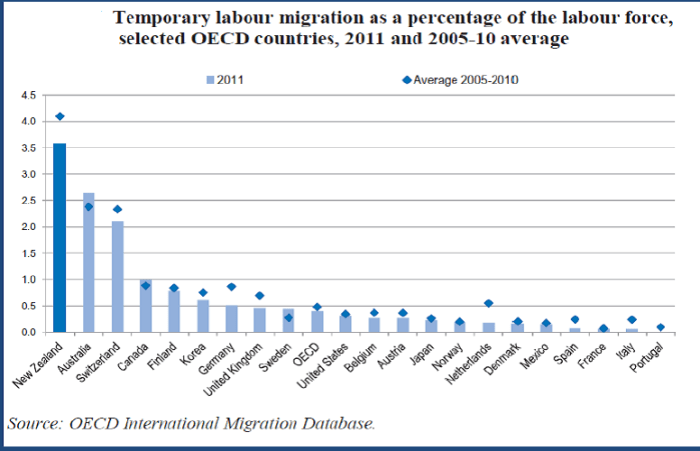
There are some interesting and nicely-put-together charts.  There were even a few things I didn’t know (eg there is an interesting OECD chart showing that New Zealand has the highest share of the labour force made up of temporary migrants of any OECD country).

temp workers

Much of the discussion is, in principle, organized around this decision tree.

decision tree

Which is more or less fine, as far as it goes, although it continues to structure debate in terms of microeconomic benefits vs macroeconomic costs, simply taking for granting that in the specific case of New Zealand there are in fact microeconomic benefits to New Zealanders.

I’m not going to devote any more space to either Option 1a (substantially increasing immigration) or Option 1d (trying to adjust the inward flow of migrants cyclically, to ease cyclical pressures on the economy).    The first simply isn’t going to happen –  especially while the advocates of large scale immigration to New Zealand can show no clear evidence that New Zealanders have benefited from the large scale immigration we’ve already had over many decades.  And I agree with Treasury that adjusting the immigration programme cyclically isn’t particularly sensible or workable –  both because the economic cycle is difficult to forecast, and because many of the fluctuations in net migration (ie flows between NZ and Australia) aren’t directly amenable to New Zealand policy measures.  Monetary policy should remain the cyclical management tool of choice.

The real choices are between maintaining something like the current target level of non-citizen immigration (45000 to 50000 residence approvals a year) and reducing that target, perhaps to something more in line with the typical OECD country.   Within either of those options, there are choices about how we select migrants and what sort of people we aim to bring in.  At least in these slides, Treasury is more interested in these latter issues than in the former.

The challenge of identifying impacts of current level of migration is that it
is difficult to specify a counterfactual – what would have otherwise
happened without the observed level of immigration.
The evidence isn’t definitive enough to make a judgement about whether
net benefits would be higher from the current quantity of inward
migration or a lower level. But it does show that composition matters.
Of course it is difficult to specify a counterfactual –  it often is –  but that is no excuse for not trying.  It seems that, in substance, Treasury is reduced to saying “we really have no idea whether New Zealanders are benefiting from the large scale immigration”.  That is quite indictment after 25 years of (more or less) the current policy, and this from our premier economic advisory agency.
Treasury is uneasy about the skill mix of migrants however. The slides are quite explicit in some places
Our key judgment is that migrant labour is increasingly likely to be a substitute for local low -skill labour, and this is an impact that we should try and mitigate.
I’d see this as fairly consistent with the points I made in a series of posts last year (eg here) about just how relatively not-very-skilled our skills-based immigration had become (eg the disproportionate numbers of retail or restaurant managers).
But Treasury remains quite upbeat on the prospects for highly skilled migration
More high-skilled migrants can benefit high-productivity firms and industries, and we are less concerned about wage and employment effects for high-skilled local labour.
This is because we think:
– High–skill migrant labour is more likely to complement local labour and capital, rather than substitute for it
– High-skill labour will increase the skill composition of the local workforce, which is the theoretical channel through which many of the beneficial impacts of migration are achieved
– To the extent there are LM impacts on competing local labour, we think there are normative policy reasons to be less concerned at that end of the earnings spectrum
Research suggests that the high – skill migration may have a positive impact on
innovation and productivity via its effects on skill composition. High – skill labour is also likely a complement for both low -skill labour and capital.
We think this suggests that we should look to increase the supply of this sort of labour.

All of which might be fine if, for example, they could show that the New Zealand economy (and New Zealanders in particular) was actually benefiting from the high-skilled immigration we already have.   Or if they could show how New Zealand could attract genuinely highly-skilled people in large numbers, when large numbers of our own skilled people are typically treating New Zealand as a place to leave.  Or if they had engaged with the data suggesting that many skilled migrants take decades to match the earnings of comparably-skilled locals.

At one level, I don’t disagree with Treasury.  If we are going to run a large inward migration programme, it is far better to do as we advertise, and make it a genuinely highly-skilled focused programme.  The proportion of fairly modestly skilled people we have been allowing in in recent years seems most unlikely to benefit New Zealanders as a whole, and there are more plausible stories for widespread benefits from attracting highly-skilled migrants than low-skilled ones.

But one really needs a lot more material than is captured in these slides to reach a considered view on the appropriate level of non-citizen immigration for New Zealand.   Perhaps most importantly, one would need to engage seriously with 25 years of continued economic underperformance, even though we have been running one of the largest immigration programmes around.  But one would also need to show signs of thinking hard about the structural characteristics of the New Zealand economy, which continues to rely –  almost as heavily as ever  –  on its natural resource base, not self-evidently a resource that needs (or benefits from) lots more people.  One might need to show a serious willingness to grapple with such characteristics of the New Zealand economy as its persistently high real interest rates and the persistently high real exchange rate.  Or to grapple with the indications of the economic underperformance of Auckland.

And there is simply none of that in these slides.

(One might even want to grapple more seriously with the housing market tensions that high levels of immigration has created.  I’m quite with those who say that a first best response might be to sort out the housing supply and urban land market, but……there is very little sign of that happening, and no sign that it has successfully happened anywhere else.  This isn’t just some sort of sequencing problem –  urban land issues look fairly intractable, not for technical reasons, but for reasons having to do with the preferences of residents on the one hand, and planners, bureaucrats and central and local government politicians on the other.  In the meantime, while people blithely talk of “immigration isn’t the problem, housing supply is”, too many people seem to be living in overcrowded accommodation, garages and even –  no doubt rarely and temporarily –  in cars.)

I’ve argued previously that the Productivity Commission should be asked to conduct a serious review of the economics of New Zealand’s immigration policy, in the context of the specific structural features of the New Zealand economy.  The Commission seems, on its track record to date, to be prone to rehearsing  – in more sophisticated language and at considerable length –  current conventional wisdoms, but it remains the best-placed official agency to do some more serious work in this area and to contribute to a better-informed public debate.