Bad advice on public sector discount rates

A couple of months ago now I wrote a post about the new set of discount rates government agencies are supposed to use in undertaking cost-benefit analysis, whether for new spending projects or for regulatory initiatives. The new, radically altered, framework had come into effect from 1 October last year, but with no publicity (except to the public sector agencies required to use them). The new framework, with much lower discount rates for most core public sector things, wasn’t exactly hidden but it wasn’t advertised either.

My earlier post (probably best read together with this one) was based largely around a public seminar Treasury did finally host in February, the advert for which had belatedly alerted me to this substantial change of policy approach (and sent me off to various background documents on The Treasury website).

As a quick reminder, discount rates matter (typically a lot), as they convert future costs and benefits back into equivalent today’s dollars (present values). The discount rate used makes a big difference: for a benefit in 30 years time discounting at 2 per cent per annum reduces the value by almost half, while converted at 8 per cent the present value of that benefit is reduced by almost 90 per cent.

Until last October, projects and initiatives were to be evaluated at a 5 per cent real discount rate – rather lower than the rates historically used in New Zealand, but not inconsistent with the record low real interest rates experienced around the turn of the decade (recall that the discount rates did not attempt to mimic a bond rate, but took account of the cost of both debt and equity).

The new framework, summarised in a single table, is

and in case there was any ambiguity about where the focus now lay, not only was the non-commercial proposals line listed first but the circular itself made it clear that the non-commercial rate(s) were likely to be the norm for most public service and Crown entity proposals.

In the earlier post I outlined a bunch of concerns about this new approach, both around the substance and what it might mean for future spending (and, for that matter, regulatory) pressures, and around what appeared to have been quite an extraordinary process, with no public consultation at all. Treasury officials at the seminar had, however, assured me that it had all been approved by the Minister of Finance, which frankly seemed a little odd given the (then) new government’s rhetorical focus on rigorous evaluation of spending proposals etc.

Anyway, I went home and lodged an Official Information Act request with The Treasury. They handled it fairly expeditiously but it took me a while to get round to working my way through the 100+ pages they provided. This was the release they made to me

Treasury OIA re Public Sector Discount Rates March 2025

and this was their advice to the Minister of Finance, already released but buried very deep in a big general release on a range of topics.  I’ve saved it here as a separate document.

Treasury Report: Updates to Public Sector Discount Rates 30 July 2024

None of the released material allayed any of my concerns. In fact, those concerns are now amplified, and added to them is a concern about the really poor quality, and loaded nature, of the narrow advice provided to the Minister of Finance on what can be really quite a technical issue but with much wider potential political economy implications. There was an end to be achieved – officials were keen on lower discount rates – and never mind a careful. balanced, and comprehensive perspective. It was perhaps summed up in the comment from one principal adviser who noted “I get a bit lost on the technical back and forth on SOC vs SRTP” but “I support moving to 2%”.

Somewhat amazingly, even though all the documents talk about how a change of this sort really should have ministerial approval – this is even documented in the minutes of The Treasury’s Executive Leadership Team meeting of 12 March 2024 – in the end all they did was ask the Minister to note the change they (officials) were making. All the Minister was asked to agree to was process stuff around the start date and future reviews. I’m surprised that there seems to have been no one in her office – her non-Treasury advisers, who in part are supposed to protect busy and non-technical ministers from officials with an agenda – who appears to have appreciated the significance of what was going on or thus to have triggered a request for more and better analysis/advice. Or even, it appears, to have raised questions about what was behind the comment in the Consultation section of the paper that “To manage risks of raising external expectations and a risk of prolonged debate, we have not consulted publicly”. Were there perhaps alternative perspectives then that the Minister should have been made aware of? (The only people consulted were other public sector chief economists – whose agencies will typically be keen on getting project evaluation thresholds lowered – and a few handpicked consultants.)

What became more apparent in the papers was that this entire project had got going under the previous government (Labour, but with Greens ministers) when the Parliamentary Commissioner for the Environment had suggested in 2021 that public discount rates should be reviewed with a view to adopting a model that would discount future benefits (relative to upfront costs) less heavily. Treasury had undertaken in 2022 to the (then Labour majority) select committee that they’d do a review. Things seemed to get their own momentum from there, and nothing about either a change in fiscal circumstances – back in 2021/22 even Treasury was keen on spraying public money around – nor a change in government seems to have prompted a pause. Had the new Minister of Finance, or her office, been more alert to the implications, perhaps they’d have called a halt to the work programme (but on this occasion I’m reluctant to put much blame on the Minister, as she appears to have been so badly advised by The Treasury).

The only advice the Minister of Finance appears to have been provided with is the short paper linked to above. It has just over two pages of substance (the rest is process, plus a four page technical appendix – which I’d imagine that, for a noting recommendation only, a busy – and non-technical – minister would not normally read).

It is striking what the Minister is never told:

  • there is no mention in the paper that the practical implication of the new approach Treasury was planning to take was that most public sector projects and proposals would be evaluated primary at a 2 per cent real discount rate rather than the (standard) 5 per cent rate previously.  They mention that the SOC-based rate is being increased, in line with the increase in bond rates, but never that this discount rate will no longer be used much.
  • there is no attempt in the paper to the Minister to explain, or justify, the new approach under which discount rates for years beyond year 30 would be evaluated at even lower discount rates still (there are arguments for and against, but none of it is mentioned and nor are the implications drawn to the Minister’s attention).
  • they note the distinction that one rate will be used for commercial projects and one for non-commercial things, but offer no analysis or advice on either why such a distinction should be introduced or how, either conceptually or practically, the two would be distinguished (they promise they would develop future guidance, but this still appears not to have been done). 
  • they never draw the Minister’s attention to the fact that one can evaluate projects at any rate one chooses but that it does not change the fact that there is a real cost –  in debt and equity finance – which isn’t a million miles away from the Social Opportunity Cost (SOC) approach they were planning to move away from.    Projects that passed a cost-benefit test at a 2% (or 1%) discount rate but failed to do so using an 8 per cent rate would, if approved, simply be being subsidised by taxpayers. 
  • they never drew to the Minister’s attention that they were planning to leave the rate of capital charge at 5 per cent, now inconsistent with either approach to discounting and project evaluation  

There is also no engagement with some of the conceptual issues raised by what Treasury was planning. This is from my previous post

It is all very well for Treasury to say that every proposal will have to have numbers presented with both a 2% and 8% discount rate, but if they cannot answer simple questions like these (or alert the Minister to them) then all they’ve done is introduced a pro-more-spending muddled model.

Perhaps most breathtaking was the bold claim (offered with no supporting analysis at all) that “The updated discount rates will not change the dollar volume of spending, since individual spending proposals will continue to be prioritised within a budget constraint (fiscal allowances).”

It is the sort of claim that if a first year analyst had made you might take them aside and explain something about incentives, political economy, and what was and wasn’t fixed in the system. This paper was written and signed out by a highly experienced Principal Adviser and a highly experienced Manager, and the policy had been signed off by the entire Executive Leadership group.

Never once it is pointed out to the Minister that budget allowances (whether capital or operating) are hardly immoveable stakes in the ground, enduring come hell or high water from decade to decade. (Why, this very morning, the operating allowance for this year was altered again). Or that the overall effect of what Treasury was planning to do would mean that more projects (spending proposals) and more regulatory initiatives would pass a cost-benefit test and show a positive net present value. And that while, in any particular year, an operating allowance might bind (so that only – at least in principle – the most highly ranked projects (in NPV terms) would get approved, over time if more projects and regulatory proposals showed up with positive NPVs the pressure would be likely to mount – whether from public sector agencies or outside lobby groups – for more spending and more regulation. (In fact, Treasury never even pointed out the operating allowance is a net new initiatives figure and higher taxes can allow higher spending even within that self-imposed temporary constraint.) And that even if a National Party minister might pride herself on her government’s supposed ability to restrain spending, time will pass, governments will change, and future governments that are predisposed to spend more will hold office. Sharply lowering discount rates – to miles below the actual cost of capital – was just an invitation to such governments. It seems like fiscal political economy 101…..and yet not only is this issue not touched on in the advice to the Minister there is no sign of it in any of the other documents Treasury released to me. You wouldn’t get the sense at all either that the fiscal starting point was one in which New Zealand now had one of the largest structural deficits in the advanced world, with even a projected return to surplus years away.

Treasury seems to have just wanted lower discount rates.

You get this sense in this extract from that short paper to the Minister

Goodness, we wouldn’t want anyone debating the appropriate discount rate would we, so let’s just render it moot by moving to an extremely low rate (in a country with a historically high – by international standards – cost of capital). Or, we don’t anyone fudging their cost-benefit analysis – but isn’t Treasury supposed to be some of gatekeeper and guardian of standards – so we’ll just make it easy and slash the discount rate hugely. And as for that claim that a 5 per cent discount rate – miles below any credible estimate of cost of capital or private sector required hurdle rate of return – incentivises decisionmakers to focus on the short-term, there is no serious (or unserious) analysis presented to the Minister suggesting this was in fact so (that lots of projects with compelling cases were missing out), nor any attempt to suggest that capital is in fact costly, and that when it is costly there should be a high hurdle generally before spending money that has payoffs only far into the future.

There is, you should note, no corresponding paragraph outlining the incentive effects and risks around what Treasury was planning to do.

There was a time when you could count on The Treasury for really good and serious policy advice. If this paper is anything to go by, that day is long past. Changes of this magnitude should have been done only with the Minister’s explicit approval and should probably only have been done after serious and open public consultation. And the Minister was entitled to expect much better, and less loaded, advice than she received on this issue, where what Treasury was planning ran directly counter to the overall direction of the government fiscal policy and spending rhetoric. The Minister herself probably should have had better and more demanding advisers in her office, but really the prime responsibility here for a bad, muddled and ill-justified change of policy rests with The Treasury.

(And in case you think I’m a lone voice in having concerns, here is a column from a former very experienced Treasury official who had considerable experience in these and related issues)

[Further UPDATE 21/5. Consultant and former VUW academic Martin Lally has added his concerns on the substantive issues in two posts here

https://nzae.substack.com/p/social-rate-of-time-preference-lally-one

https://nzae.substack.com/p/social-rate-of-time-preference-lally-two ]

A pre-Budget speech

In a pre-Budget speech this morning the Minister of Finance announced that this year’s operating allowance – the net amount available for new initiatives – was being reduced from $2.4 billion to $1.3 billion (speech here, RNZ story here). Operating allowance numbers in isolation don’t mean a great deal (what happens to the rate of general inflation matters a lot) but a cut like that, at the very end of the Budget process, can probably be taken at face value. On its own, it is equivalent to about a quarter of a per cent of GDP.

Readers will recall my post last Thursday presenting the IMF’s Fiscal Monitor numbers, which show New Zealand being expected to have the largest general government primary structural deficit this year of any advanced economy. Cutting spending by $1.1 billion will, all else equal, probably shift the New Zealand government to having the second largest advanced country deficit.

If the headline sounded encouraging, reading the full text of the speech left me less encouraged.

First, it sounds as if more handouts are still part of the plan.

And second, although there is talk of a “significant savings drive” freeing up “billions of dollars”

there have been no announcements of things the government is going to stop spending money on, or of agencies/departments it is just going to close down. I guess it is still a few weeks until the Budget itself so perhaps something is coming, but there isn’t even a taster in this speech.

And third, it seems pretty clear from the speech that this operating allowance cut is mostly about avoiding yet another fiscal update in which the date for a return to operating surplus is pushed back yet again.

And note that the small surplus Treasury projected for 2028/29 was on the Minister’s slightly dodgy new ex-ACC measure of the operating balance (one that The Treasury did not endorse). On the more usual operating balance measure, HYEFU showed 28/29 as the 10th year in succession of deficits. From what the Minister said this morning, that is likely still to be the case in the BEFU numbers.

I’m not going to object to the cut to the 25/26 operating allowance – which is a policy lever chosen by the Minister, not something for Treasury to “forecast” – but without specifics we might reasonably be sceptical about the durability of the cuts.

Late in the term of the previous government, the then Minister of Finance was solving his problems with forecast fiscal outlooks by telling Treasury he’d stick to low operating allowances in future years. Willis seemed to be doing something a bit similar last year (Treasury noting the tension between inevitable cost pressures and those headline numbers they are required to use, as advised by the Minister). That really was vapourware. This year’s cut is likely to have more substance to it, since it will directly affect appropriations for the 25/26 financial year.

But without specifics on what the government is going to stop doing or paying for, there has to be a bit of a suspicion that what is effectively going on is across the board (real) cuts, with no real idea as to what the impact or opportunities for durable savings might be. This was the second item in the Minister’s three-point list.

But we already had one round of generalised savings last year. After the approach of the previous government it was always likely that most agencies would have some fat to cut (while still delivering things the government says it wants/needs). Whether that is still the case must be an open question. No doubt agency CEs – under tighter fiscal rules than, say, the Reserve Bank (see last week’s post) – will ensure that their departments stay within their budget, whatever it is set at. But at what point do inroads start being made in capability? It certainly isn’t as if economywide productivity growth is running at 2 per cent per annum.

It would all be a great deal more reassuring if there were specific announced things the government was no longer going to do. But, for example, all the subsidies in the system still seem to be continuing.

And finally, a reminder of the starting point. In my post last week I included this chart

As a reminder, this used the 2024 HYEFU and 2025 BPS as the base for the New Zealand fiscal data.

When I was writing that post last week I remembered writing some similar critical pieces in the run-up to the 2023 election, where the numbers were based on the then Labour government’s stated fiscal plans. The October 2023 IMF Fiscal Monitor came out just a few days prior to the election. This was the same chart – for structural primary balances – for 2024, as published in that edition.

In relative terms, we had the 5th worst structural deficit forecast then and have the worst now (maybe second worst with this morning’s announcement). In absolute terms, the IMF’s October 2023 estimate of the structural primary deficit for 2024 was 3.4 per cent of (potential) GDP. Last week’s new IMF estimate for the structural primary deficit for 2025 was 3.7 per cent of (potential) GDP.

To repeat a point from last week’s post, these are not operating balance measures but rather encompass all (non-interest) spending and revenue. The lines between opex and capex are often very blurry and malleable in government accounts, and not only does it often make sense to look at overall primary balances rather than operating ones even when looking at just your own country, it is only way in which meaningful cross-country comparisons can be done.

The fiscal bottom line still appears to be that things are no better, in structural cyclically-adjusted terms, than they were 18 months ago, and may even be worse. We should no doubt be thankful for small mercies – this morning’s announcement may be one – but the outstanding imbalances are large and do not yet seem to being addressed seriously. Those imbalances are bad, both absolutely and in international comparison terms. They are political choices. Unfortunate ones.

Fiscal failure

The IMF’s twice-yearly World Economic Outlook and Fiscal Monitor publications have come out in the last couple of days.

If there is gloom in the GDP numbers (eg this chart for the advanced countries, and we don’t score a lot better on the comparable one for the 2019 to 2025 period which encompasses the whole Covid and inflation/disinflation period), much about that is outside the direct or near-term control of any particular government.

My focus was on the fiscal numbers. We already know, from the published Treasury forecasts, that New Zealand’s fiscal position doesn’t look good. Last year’s Budget slightly widened an already uncomfortably large (estimated) structural fiscal deficit.

But the great thing about the IMF publications is that they enable meaningful cross-country comparison, something that is quite impossible just with what Treasury produces for New Zealand. (If The Treasury was seriously committed to improving debate and analysis on fiscal issues in New Zealand they would start routinely producing estimates for New Zealand in an IMF format, alongside their own preferred New Zealand format.)

I put this chart on Twitter this morning, and it appears to have caught some attention. You can see why that might be.

(For the selection of countries I’ve used those of the IMF advanced country grouping for which there are numbers – that excludes, notably, Taiwan and Singapore – omitting Norway (where the IMF reports only ex-oil numbers, which aren’t reflective of the overall state of Norwegian public finances) and adding Poland and Hungary. Poland, in particular, is now about as well off – in real GDP per capita terms – as New Zealand.)

I regard this as the best core measure of flow fiscal imbalances.

In interpreting the chart, however, there are a few points worth making.

First, it is a measure of “general government” not just central government. That is the only sensible basis for international cross-country comparisons. In New Zealand, local government is small relative to central government so the numbers are dominated by central government choices.

Second, the IMF states that they do their New Zealand fiscal projections based on the December 2024 HYEFU and the 2025 Budget Policy Statement. They have an independent set of macroeconomic projections and then recast the New Zealand fiscals into their internationally comparable format. They are not taking an independent view on what the government will or won’t do with fiscal policy in next month’s Budget (and are also not taking account of recent defence spending commitments).

Third, this is a measure of the primary deficit (ie excluding net interest) not the overall balance. Some countries have a large stock of outstanding public debt which they are stuck paying interest on (the US is a good example). That interest is, of course, part of the overall deficit, but it is a reflection of past choices. The primary balance is a reflection of current policy choices. As a general rule of thumb, if a country is running a primary surplus, pretty much however small, that country’s fiscals will eventually come out okay. If not, course corrections are necessary.

Fourth, the IMF numbers are presented on a calendar year basis but the New Zealand fiscal year ends on 30 June. The IMF appears to move New Zealand numbers six months forward (thus they show a significant primary deficit in 2019, which was probably capturing New Zealand outcomes for the year to June 2020. Thus the 2025 numbers shown in the chart above probably already capture what the Minister of Finance has told us she is going to do, in aggregate, in next month’s Budget.

Fifth, the series is cyclically-adjusted. Booms and busts – economies running temporarily above or below capacity – do not, at least in principle, affect this particular series. The IMF estimates (like the Reserve Bank) that New Zealand has a negative output gap in 2025 (while, say, the United States in these projections has a positive one).

Sixth, it is not a measure of the operating balance (the focus of New Zealand domestic analysis and commentary) but of the overall (primary) fiscal balance. Most countries don’t use an operating balance measure, so it can’t readily be used for international comparisons. Total balances (operating and capital spending) can make more sense for fiscal analysis as the line between operating and capital expenditure is pretty blurry for government. In a private business, capex is intended to generate (net) revenue, but that isn’t often the case with government capital expenditure – even if, which can’t be assumed, that capex passes some overall cost-benefit test.

Taking all that into account – which clearly wasn’t going to fit in my original tweet – what should we make of the chart, which shows New Zealand estimated to have the highest cyclically-adjusted primary deficit of any advanced economy this year?

First, it didn’t used to be so. The IMF table I drew from only goes back to 2016 but the comparison over time looks like this

We used to be better than the average advanced economy. Once upon a time, not so long ago. But not now. We also had the large primary deficit of this group of countries in 2023 and 2024 and were second largest in 2022. (In fact, when I looked at the IMF’s table of this series for “emerging market and middle income countries” still the only countries with a larger primary deficit than New Zealand for 2025 are China and Romania. Ukraine probably is too – the estimates aren’t there for 2025 – but then being invaded by your neighbour probably counts as a decent excuse.)

There can be a case for cyclically-adjusted (or structural) primary deficits, even large ones. Wars, for example, are often financed by a mix of debt and taxes. Pandemics can be another example – big disruptions to output and activity almost from out of the blue – and so no one really quibbles much over primary deficits in (calendar) 2020 and 2021.

But we don’t face a war or a pandemic. Our politicians – first Labour and now the National-led coalition – have simply chosen to run large primary deficits. Structural deficits – primary or otherwise – don’t arise from nowhere, and they certainly aren’t fixed by sitting by and hoping for something to turn up (they also aren’t fixed by – as in last year’s Budget – cutting spending and adding a new tax and using the proceeds to cut other taxes, leaving structural deficit measures little changed (slightly wider on The Treasury’s estimate)).

In case you are wondering about the overall structural balance picture, here is that chart

We don’t have the largest overall structural deficit among advanced countries, but there aren’t many worse than us.

And we are heading in the wrong direction.

Much of the commentary on New Zealand emphasises that our net general government debt is still relatively low as a share of GDP. But that picture is changing quite fast.

The US (98 per cent) and UK (95 per cent) used to be – and in my memory – relatively low debt countries too.

These New Zealand structural fiscal deficits aren’t some consequence of Covid but a series of choices to act, and not to act, by both governments in succession. It is on the current government’s stated intentions for the second of its three Budgets that we are estimated to have the largest cyclically-adjusted primary deficit among advanced countries.

It is a far cry from the laudable record of fiscal management – again under governments of both main parties – that we enjoyed not so long ago at all. At least back then when we had feeble productivity growth and weren’t closing the gaps on the rest of the advanced world we had an enviable record of fiscal stewardship. These days, productivity and real GDP per capita growth is lousy, and we are running big deficits and rapidly increasing debt.

It is a choice, but it is a bad one.

And since we know The Treasury estimates that we have a fairly large structural operating deficit, that judgement (“a bad one”) holds true even if, as perhaps they would claim, the level of general government capital expenditure was all passing robust cost-benefit tests on credible discount rates.

RB spending: the Board and the Minister

On Twitter on Saturday I indicated that there had been a mistake in my post from last Thursday in which I attempted to step through the Reserve Bank Funding Agreement issues. Making mistakes (there are two) is annoying and I don’t fully understand how I did it (probably too much haste). I can only apologise to readers (and acknowledge that it was a sentence in the Herald’s Thomas Coughlan’s article on the Funding Agreement that prompted me to go back and check). The central point isn’t affected: real spending in the next couple of years is hardly cut at all from levels authorised by Grant Robertson just before the last election.

As it happens, since writing that post on Thursday morning a couple of other relevant documents have been released by the Reserve Bank. So, and at risk of some repetition, I’m going to attempt in this post to cover the full ground, focusing under three headings:

  • the change in approved spending from one Funding Agreement (Robertson’s) to the next (Willis’s)
  • the change in actual spending, and 
  • what seems to have gone on regarding last year’s Reserve Bank Budget and their bids for the new (just signed) Funding Agreement.

This post is long.  I have a summary in six bullet points at the end.

From one Funding Agreement to the other

In the Funding Agreement for the period 2020-25, as varied by agreement with Grant Robertson in August 2023, two classes of operating expenses are separately provided for. A fairly large chunk of the Bank’s operating expenses (around $30m a year) is not covered by the Funding Agreement at all – for reasons good and less so. But of those that are dealt with by the Funding Agreement, the first class was what we might call “core” operating expenses (where $149.44m was the allowable expenditure for 2024/25) and the second is “net direct currency issue expenses” ($14.5 m for 2024/25).

In the new Funding Agreement released last week there is no longer a set of annual allowances for the currency issue expenses. Instead, under the “Excluded expenditure” heading there is provision for the Bank to spend up to $65m in total on this item over the full five years covered by the Agreement.

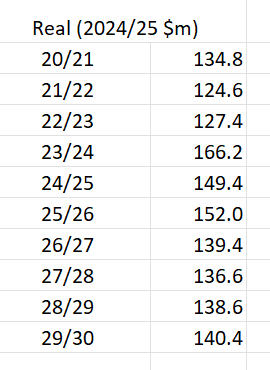
Consistent with that, in Thursday’s post I included this table, which covers the “core operating expenses” covered by the Funding Agrement in real, inflation-adjusted, terms, for the periods covered by the old and new agreements

As you can see, approved core operating expenses in the coming financial year ($152m) are actually a couple of per cent higher in real terms than those Grant Robertson had approved for the year ending in June ($149.4m). Over the remaining life of the agreement the numbers are lower (in 29/30 the approved allowance is 6 per cent below the level Robertson had approved for 24/25).

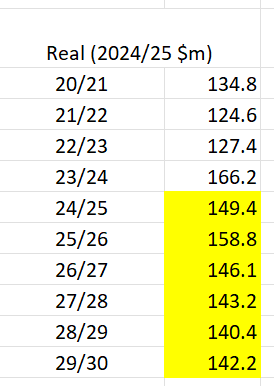
However, in the new Funding Agreement a number of new items are excluded from being counted against that spending limit. Thus, a true apples for apples comparison with approved spending levels under the old agreement would mean higher numbers for the 2025 to 2030 years. Only one of these new exclusions is quantified: an average of $5m a year for the next three years is allowed for implementing the new Deposit Takers Act (which has been being implemented gradually including over the last two years – it was part of the justification for Robertson revising up approved funding in August 2023). Other items aren’t quantified, including operating expenses associated with such potentially costly items as work on a Central Bank Digital Currency and those operating expenses associated with refurbishing or replacing the head office building. If we allowed another couple of million per annum for these other new exclusions (aiming to be conservative – low end – in our guesses), we might end up (illustratively) with a table like this

where, say, even in 2026/27 approved real operating spending would be only 3 per cent lower than the level Grant Robertson had approved for 2024/25.

Note too that the Bank’s actual and budget (for 24/25) spending on those net direct currency expenses over the five years of the last Funding Agreement was about $32 million. Although the new Funding Agreement does not provide annual limits for this item, it allows $65 million spending on it over five years in total – much higher than recent actual spending, and not very different from what was allowed in this component of the previous (2020) Funding Agreement (although note some unexpected inflation since 2020)

Overall, the new Funding Agreement doesn’t represent much fiscal restraint relative to the last approved levels by Grant Robertson in August 2023.

And it isn’t as if the Bank had been consistently abstemious over the years.

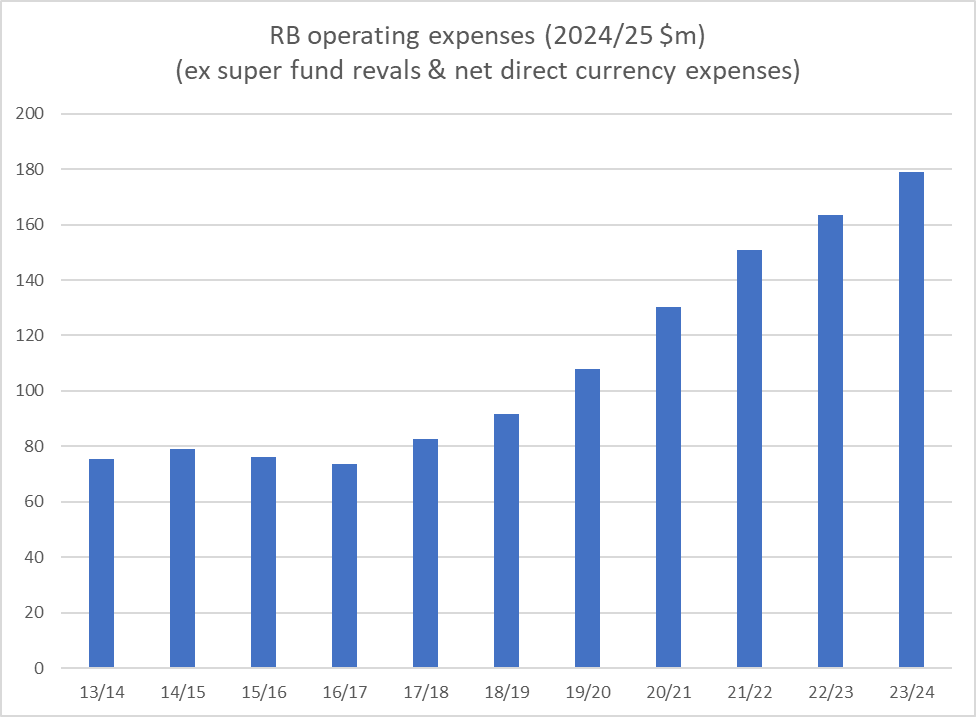
Because the definitions of what is and isn’t covered by Funding Agreements has changed over the years, it can be helpful to look at the trend in operating expenses, as disclosed in successive Annual Reports.

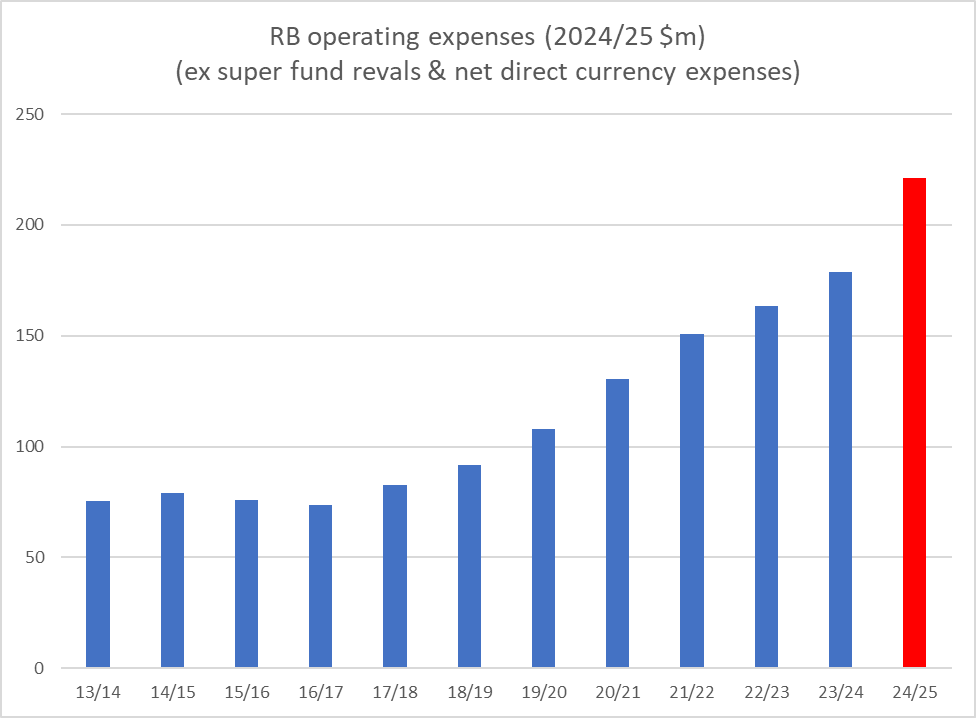
This chart shows actual total operating expenses in real inflation-adjusted terms (excluding actuarial gains/losses on the staff super fund, which aren’t controllable, and the net direct currency expenses item). Adrian Orr became Governor in March 2018 and real spending in 2023/24 (the last year for which we have actual data) was already more than twice 2017/18 levels.

Funding agreement vs actual and budgeted spending

The Funding Agreements cover five financial years. The Act is quite clear that when an amount is stated for each of those five financial years, that is the intended limit for that year. The Bank is not free to underspend in some years and overspend in others.

Note, however, that there is no direct disciplining mechanism. If the Bank overspends in total, or underspends in some years and overspends in others, there are no (automatic) consequences. And as I recall it, including my time on the senior management group at the Bank (long ago now), there used to be a practical view that small unders and overs in individual years weren’t too concerning, particularly so long as spending over the full five years stayed under the total allowed in the Funding Agreement.

The Bank discloses in each Annual Report how its spending on Funding Agreement items has aligned with the amount provided for each year in the relevant Funding Agreement.

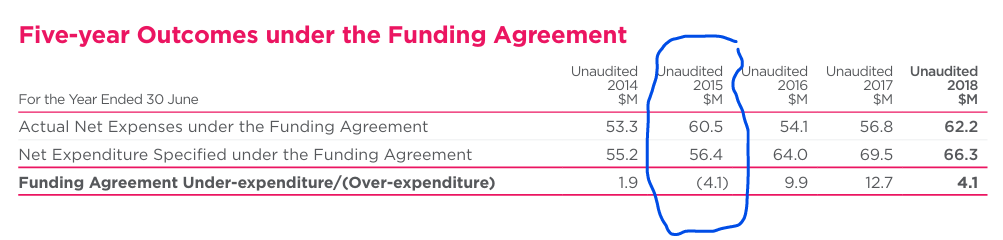
Here is an example from the 2018 Annual Report

This period happened to straddle two different Funding Agreements (and mostly Graeme Wheeler’s stewardship as Governor). Over the full five years, the Bank ran operating expenses below the Funding Agreement level. In 2014/15 they ran over the Funding Agreement amount, something that disconcerted management at the time (and prompted a round of redundancies and cost savings.

Here is a similar table from the 2024 Annual Report

Really big increases in operating spending had been allowed both in the original 2020 Funding Agreement and in the August 2023 variation that Orr, Quigley, and Robertson had signed just before the election.

You will note that in 2020/21 the Bank substantially underspent the Funding Agreement allocation (although operating spending under the Funding Agreement still increased by 13 per cent that year). In its 2021 Annual Report the Bank offers several factors as explanations for the underspend, but they mostly seem to come down to Covid (and a serious data breach the Bank experienced). I’m less interested in the specific explanations than in the final comment: “We expect this underspending to reverse in future years and the Bank to be within the five-year aggregate expenditure provided for in the funding agreement”.

Maybe that didn’t seem unreasonable at the time – Covid, after all, was out of blue for them (and all of us) – BUT (as noted above) the relevant provisions of the Act do not envisage or provide for carrying forward underspends from one year to the rest of the Funding Agreement period.

But then, as it happens, for the next two years, net operating expenses were almost bang on the Funding Agreement allowed amount (when the allowances for core operating expenses and currency issuance expenses were combined). But the Bank – management and Board – still seemed to think it was just fine to carry forward an underspend from years earlier. You can see that in the final line of the table.

You’ll also see in that table that there was a big increase (33 per cent) in approved Funding Agreement spending for 2023/24, made possible by the August 2023 variation. The Bank then underspent that allowance rather dramatically ($29m), even though they’d increased (funding agreement covered) actual operating expenses by almost 19 per cent in a single year. This was still a year (more than half of which occurred on the watch of the new government) in which they had increased actual FTE staff numbers by 91 (18 per cent). As for that delayed project spending, it doesn’t seem like great management and Board oversight given that they’d only got Funding Agreement variation approval as recently as August (ie already into the relevant financial year).

By the end of the 2023/24 year the Bank’s total (Funding Agreement) operating spending was a total of $49 million below the sum of the Funding Agreement limits for each of those four years. $19 million of that shortfall had occurred years earlier.

But what of it? Recall that under the Act, there really wasn’t discretion for the Bank’s management and Board simply to decide to shift large amounts of spending from one year to the next. (No one might have quibbled over a few million here or there – given the way the Funding Agreement system and legislation were set up – but…..this was $49 million).

And, by then, we had a new government, which had made quite a fuss in the election campaign around bloated public spending, and had started on cuts to most central government departments.

The Bank’s 24/25 budget, Statement of Performance Expectations, and 2025 Funding Agreement bids

Annual budgets are set by the Reserve Bank’s Board which now has full responsibility for the governance of the institution. The high-level budget numbers are published in a document, required by law, called the Statement of Performance Expectations. Last year’s was signed (by Governor and Board chair) on 21 June and included this table.

Here is the chart above updated for the Board-approved 24/25 budget

It was to be the largest percentage increase in core operating expenditure in any of the Orr (& Quigley) years (about 24 per cent in real terms).

The Bank does not report its budget on a Funding Agreement-consistent basis, but the proactively released Board minutes indicate that $31m of the operating expenses were on items not covered by the Funding Agreement. So $200 million was on item covered by the two Funding Agreement streams, up from $158m actual spending on these streams in 23/24 (the Board would not have had final 23/24 numbers when they approved the 24/25 budget on 20 June, but the estimates must have been pretty close).

How did this happen you might be wondering. After all, hadn’t the Minister of Finance handed down her overall government budget as recently as 30 May with a heavy, and very public, emphasis on expenditure savings and redirection of resources towards so-called frontline services? Those with access to the Minister might well ask her.

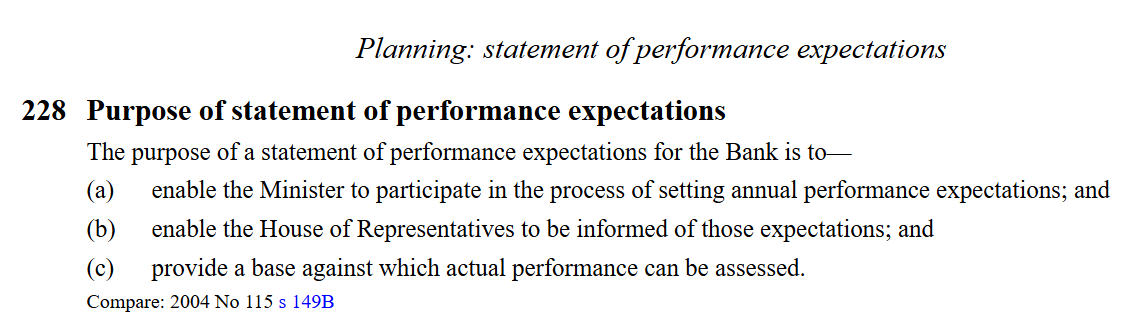
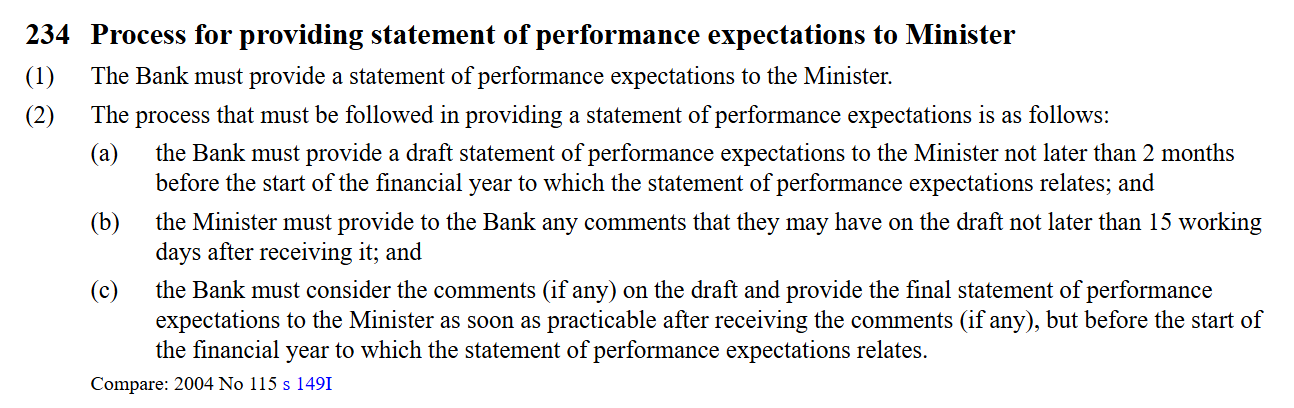
Perhaps you are wondering if the Board did all this 24/25 budgeting in secret, and the Minister of Finance simply didn’t know. But the numbers had to be included in the Statement of Performance Expectations (SPE) and the Minister had to be consulted on a draft of the SPE. In fact, the law says that a main point of the SPE is to enable the Minister to be involved

and the “how” is covered, among other sections, here

And it isn’t as if somehow the Bank overlooked the need to provide a draft to the Minister last year. The Board minutes for 20 June record that written comments (on the draft Statement of Intent and the draft SPE) had been received from both the Minister of Finance and Treasury and “had been incorporated”. There is no suggestion of any material difference of opinion, or of the Minister taking a harder line than the Board. It is really quite extraordinary…..coming just weeks after the expenditure saving and reallocating government budget. One of her agencies was going to increase spending by 25 per cent or so, in a single year.

What was the Minister thinking/doing? What was Treasury thinking/doing? (I have lodged an OIA asking for the comments from both of them on the draft SPE.)

Now, again if you were inclined to bend over backwards to excuse her responsibility you might note that the Minister of Finance could not formally stop the Bank’s Board setting the budget for 24/25 at any level it liked. The Bank has that degree of operational independence.

But…. she is the Minister of Finance and has a bully pulpit. Imagine if she’d told the Board “well, you can increase your budget by 25 per cent for this coming year if you like, but if you persist in doing so I will go public and excoriate you for a reckless and irresponsible use of public money, for operating in breach of the Funding Agreement, and for choices that are utterly out of step with the government’s wider fiscal priorities. Do we really suppose there’d have been a wave of public sympathy for the Board?

More directly, Board members are appointed by the Minister of Finance. Reserve Bank board members cannot be dismissed at will, only for cause. But the Reserve Bank Board chair’s term was due to expire on 30 June 2024. It had been widely assumed that, having been in place for many years, he’d be replaced by the new government. Being responsible for an egregiously large budget increase might have been just another reason to replace Quigley. Instead, Willis reappointed him, and as if to add insult to injury she announced that puzzling reappointment on 20 June, the very day the Board confirmed that huge operating expenses budget, that she’d had every chance to comment on.

Like many, I was genuinely mystified last June when Quigley was reappointed. Now that one realises (a) the timing and b) the huge budget increase he was overseeing I’m simply flabbergasted.

(Note that the 2024/25 Budget was so out of step with the Funding Agreement provisions/levels there would appear to have been – perhaps still would be – good grounds for the Minister to dismiss board members for cause (not one of them having recorded a dissent when the budget was adopted).)

Now, as a final effort towards trying to understand what she might have been thinking, perhaps the Minister was advised by the Board and management that the Bank was simply utilising the underspends from earlier in the Funding Agreement period. The Bank was claiming (see table above) that they had $49m up their sleeve. Add $49m to the Funding Agreement allowances of $149.4m for 24/25 core expenses and $14.5m for 24/25 net currency issuance expenses and you get $212.9m. Perhaps it looked as though the Bank’s big new budget ($200m on Funding Agreement items) was actually less than was allowed.

If the Bank claimed as much to the Minister, we might (at a pinch) excuse her. She is busy and you might assume the board of your central bank was giving you honest advice and an honest interpretation of the Funding Agreement and Act. But……she has an entire department of her own, The Treasury, supposedly expert in such stuff. And they should have told her in no uncertain terms that neither the Funding Agreement nor the Act envisaged carrying forward substantial underspends from past years to allow lots more spending in later years. To be consistent with the Funding Agreement, the Bank’s total (funding agreement covered) operational expenses could be no more than $163.5m in 2024/25. Not $200 million.

Why weren’t they (apparently) doing those basics properly? It is clear that they had seen the draft SPE and the Board minutes record regular senior-level engagement with Treasury (a couple of Treasury DCEs often attended a session with the Board, and sometimes the Secretary herself). They’d been overseeing the advice on the government budget, probably putting pressure on numerous departments to deliver savings. And yet the Bank’s Board adopted a budget with a 25 per cent or so increase in operating spending, and nothing seems to have been said or done.

All of which brings us to the 2025 Funding Agreement (bids and final settlement).

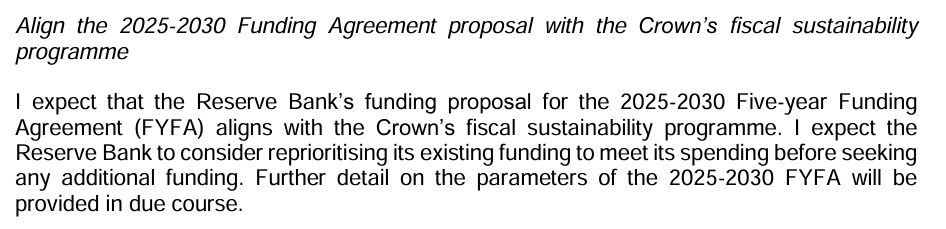
The Minister had written a Letter of Expectation to the Board chair in April stating, among other things,

The messaging seems pretty consistent with what the Minister had been saying in public (see references to the “fiscal sustainability programme”)

Here it is helpful that late last week the Bank finally get round to proactively releasing the Board minutes for the September quarter of last year. You may recall that in the paper to the Cabinet committee on the new Funding Agreement the Minister indicated that

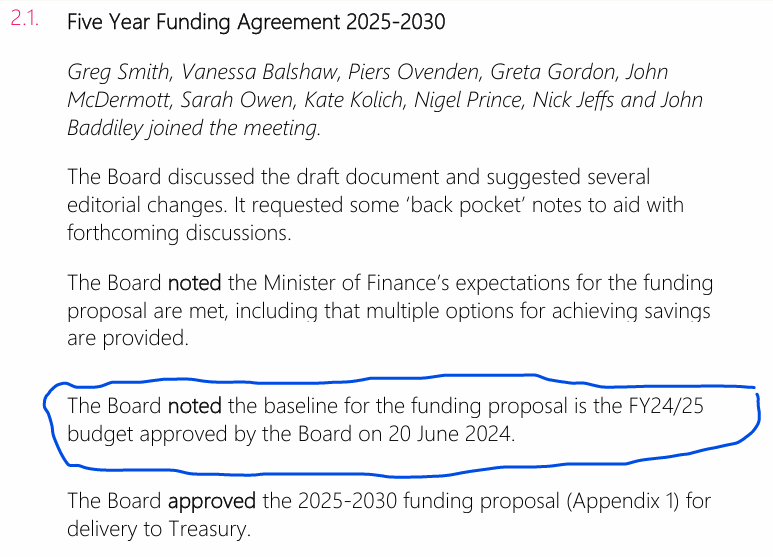
This submission was approved at a meeting of the Board held in Auckland on 29 August late year. The minutes record as follows

It is quite explicit there that they had bumped up the 24/25 budget massively – using some illegitimate argument about carrying forward past underspending – not just to clear out some backlog one-offs, but providing a baseline for their bid for operating spending for the following five years. You’d think perhaps we were still in the era of Grant Robertson budgets. And although it is easy to focus on Adrian Orr as Governor, these bids – and the budgets – were the responsibility of the board, and particularly its chair, Neil Quigley.

But there are still puzzles. For example, note that in the paragraph above the one I highlighted the minutes record the Board’s understanding that “the Minister of Finance’s expectations for the funding proposal are met, including that multiple options for achieving savings are provided”. What, one is left wondering, led them to think that what they were bidding for had met the Minister’s expectations (presumably as conveyed not only in that April Letter of Expectation but in regular engagement with top Treasury officials)?

The Minister now is keen to highlight that she cut back the Bank’s spending relative to its 2024/25 hugely increased budget (not by 25 per cent but probably by an apples-for-apples 17-18 per cent or so) but (a) how did she let the budget happen in the first place, b) how did the board get the impression that its bid for massively increased real resources (relative to the previous Funding Agreement) met her expectations, and c) why did it take so long then to pull the Funding Agreement bid back to earth? Given that she has made clear that Orr’s resignation did not have to do with the Funding Agreement, we might reasonably also ask why no one involved has lost their job over this?

The initial Funding Agreement bid wasn’t approved, but you’d have thought the Minister – and Treasury – would have told them many months ago that a bid based on the inflated 24/25 budget simply wasn’t acceptable, and that they should go back and try again, perhaps benchmarking themselves, as a start, against the last ministerially approved level of spending (the 2023 Robertson variation). But they seem to have done nothing of the sort, and there wasn’t a revised funding proposal from the Board until a week or so after Orr left. We are left to wonder if – and one really hopes it is not so – it was not until very late in the piece that the Minister and Treasury actually started demanding some serious fiscal restraint from a Bank that was (a) far overspending its own Funding Agreement approved levels for 24/25 and b) wanted that to be the starting point for what they could spend for the next five years. As it is, even the final settlement – above what Treasury had wanted – largely validates the bloated spending and organisational size up to 2023/24, just undoing the further excess that occurred on Willis’s own watch.

(Note too that we do not know how much actual spending will have to be pulled back in 2025/26 as all the papers refer only to last June’s approved budget and not to any mid course corrections the Bank may have made. The board must have updated forecasts of actual operating expenses for 24/25 but none of that has been disclosed. That said, any such mid year savings might be small: after all, as the Cabinet paper disclosed, the Bank increased staff numbers by another 10 per cent between 30 June last year and 31 January this year. In straitened fiscal times….)

Finally, I noted in the posts late last week that the Bank was then in breach of the Act, which requires a Funding Agreement when published to

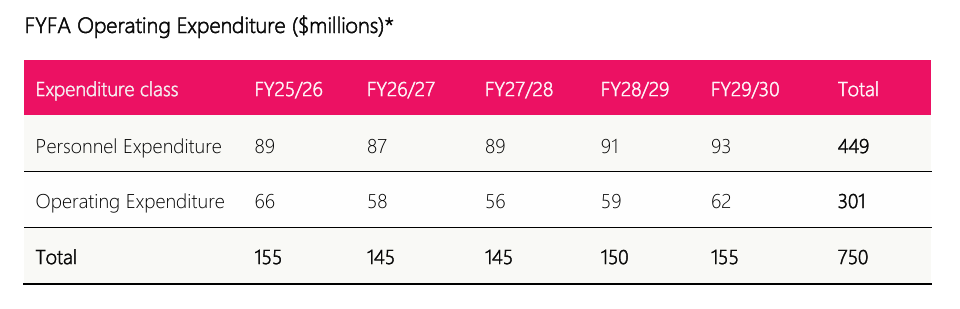
A document purporting to meet this requirement seems to have turned up on website on Thursday afternoon. On the operational expenditure side this is all there is

Not only is there is no starting point comparison (forecast figures for 24/25) but there is no information at all enabling us (public or, say, FEC) to know in what functional areas the Bank will be looking to make cuts. This document probably doesn’t meet the statutory requirements but if it does it just highlights again how deficient the Reserve Bank funding legislative framework is, including the absence of any requirement for parliamentary approval. That was an egregious omission (when the legislation was amended by the previous government) but the gap is even more stark now when considered against what the Reserve Bank Board (and management) got away with last year.

Summary

There was a lot of ground to cover. My bottom lines messages are as follows:

  • the new Funding Agreement represents pretty limited cuts in the Reserve Bank’s authorised spending, using as a benchmark the previous Funding Agreement variation in 2023,
  • the Minister of Finance appears to have done nothing when advised in the first half of last year that the Bank’s Board was proposing a near 25 per cent increase in operational spending for the 24/25 year, and in fact announced the reappointment of the Board chair the very day the Board gave final approval to that budget,
  • the Bank’s Board was in breach of its collective duties in authorising 24/25 spending far in excess of what the Funding Agreement allowed for that year, and
  • was egregious in bidding for that 24/25 grossly inflated level of spending to be the baseline for the next Funding Agreement period,
  • where was Treasury in all this?
  • how can we have any confidence in those involved at the Bank (board chair and members, senior managers including the CFO, the former Governor – now gone – and the Deputy Governor, currently the temporary Governor)?

Appendix: Aggregating the Two Separate Streams of Spending in the Funding Agreement

There is an aspect of the 2023 variation to the Funding Agreement that deserves a bit of attention, without distracting from the main flow of the argument.

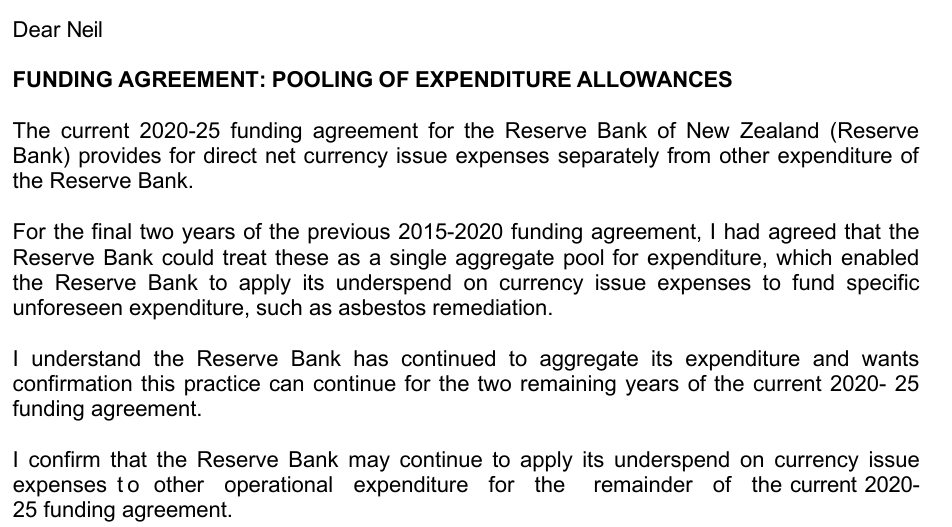
This letter from Grant Robertson to the board chair, Neil Quigley accompanied the 2023 variation to the Funding Agreement

There is a good logic to providing separately for (net) direct currency expenses, since currency issuance is a (the key) profit centre for the Reserve Bank, and we wouldn’t want any incentive for the Board or management to skimp on spending there to give them more freedom to spend on nice-to-haves.

According to Grant Robertson’s letter, the Bank wasn’t needing to spend as much as allowed (in the 2015-2020 Funding Agreement) on currency in the late 2010s, and on the other hand faced some unanticipated cost pressures in other areas (the asbestos remediation referred to in the latter). Grant Robertson’s permission then was, in many respects, equivalent to a variation to the Funding Agreement, raising the amount that could be spent in 2018/19 and 2019/20 on core operating expenses and reducing what could be spent on net direct currency issue expenses. That may well have been a reasonable call by the then Minister of Finance (and is water long under the bridge now).

But, remarkably, Robertson’s letter suggests that whereas he had given permission for the two Funding Agreement expenditure components to be pooled for 2018/19 and 2019/20 for a specific purpose (that asbestos remediation), the Bank had actually treated it as carte blanche, a general permission to pool the two buckets that had deliberately been set up separately, so as not to be pooled. It appears they had had no authorisation for doing so at all. Perhaps by 2023 someone was asking questions (Treasury, or just possibly the Bank’s Board which actually became formally responsible for the governance of the Bank on 1 July 2022)?

That 2023 Funding Agreement variation had already given the Bank a massive increase in permitted core operating spending (up a total of $79.3 million for the 2023/24 and 2024/25 years). But in addition, Robertson allowed them to add any underspend on currency issuance to their other operating spending (another $6m a year or so). Note that this aggregation was only allowed within years, and there is never suggestion that underspends can be carried forward into overspends in subsequent years.

A bit more unpicking of RB spending and the Funding Agreement

[See update note at the very end of this post which means that some parts of this post – re 24/25 spending – need correcting and reframing]

In yesterday’s post I tried to present the Reserve Bank Funding Agreement for 2025-30, as approved by the Minister of Finance and the Bank’s Board, in the context of the previous agreement, and the variation to that agreement signed up to by Grant Robertson a few weeks before the last election (which hugely increased the amount available for operating expenditure). Against that benchmark, yesterday’s agreement didn’t seem to display much restraint at all, even on the headline figures.

The Minister of Finance had sought to make much of (a) how much lower the agreed numbers were than the first bid made by the Bank last September (a total of $1.03bn over five years for both capital and operating expenditure – capex being only $50m in total), and b) relative to a number we had never seen before, what she described as the Bank’s operating expenses budget for 2024/25 of $200m. This latter was the basis for the much-publicised 25% cut claim.

I was a bit dismissive of that presentation, and what seemed mostly to be spin (unlike the RB’s own press release).

So I’m now going to try to step through it all fairly painstakingly and more slowly/carefully than I did yesterday.

First, here are the operating expenditure numbers for things covered by the 2020 Funding Agreement, showing both the original agreement and the August 2023 variation.

There were really big increases granted in that 2023 variation (far more than, say, implied just by the inflation surprise). Note too that spending for 23/24 was allowed to be much higher than in 24/25. I’m pretty sure we never got a specific explanation for that, but it probably related to some major new initiative.

By law, the funding agreements are required to specify maximum expenditure for each single year (the Bank can’t just pick and choose, transferring money from one year to the text on a whim). However, in the 2023 variation Grant Robertson explicitly allowed the Bank to treat the last two years as a single aggregate pool (apparently he had done the same for the last two years of the previous agreement). In principle, I have no particular problem with that (although of course most government agencies would have to come to Parliament and get a fresh appropriation each year) but it opens up a number of risks.

And here are the old and new Funding Agreement opex numbers, expressed in constant 2024/25 dollars (for each year I’ve used the level of the CPI for the average of the relevant Dec and Mar quarters).

There are a number of ways to look at that series. One way is to compare spending in 29/30 with the average allowed (over the full five years) under the previous Funding Agreement. Those two numbers are almost identical.

Another might be to compare 29/30 with the approved Funding Agreement level for 24/25. That implies a cut of about 6 per cent in real terms.

If we wanted to be slightly partisan about it (Willis can only be held accountable for stuff that has happened on her watch), approved opex for 2029/30 will be a little over 10 per cent higher in real terms that what was approved for 22/23, the last full year of the previous government.

In each of those comparisons note that the fresh exclusions from what is covered by the Funding Agreement mean that 2025-30 numbers are understated relative to the numbers for earlier years. It is pretty unsatisfactory that neither the Bank nor the Minister (nor Treasury) has provided any sort of reconciliation table to provide a clearer sense of magnitudes.

But all of those comparisons are between Funding Agreement approved numbers for each year. What about comparisons with what the Bank has actually done, or planned to do, in the current (24/25 year).

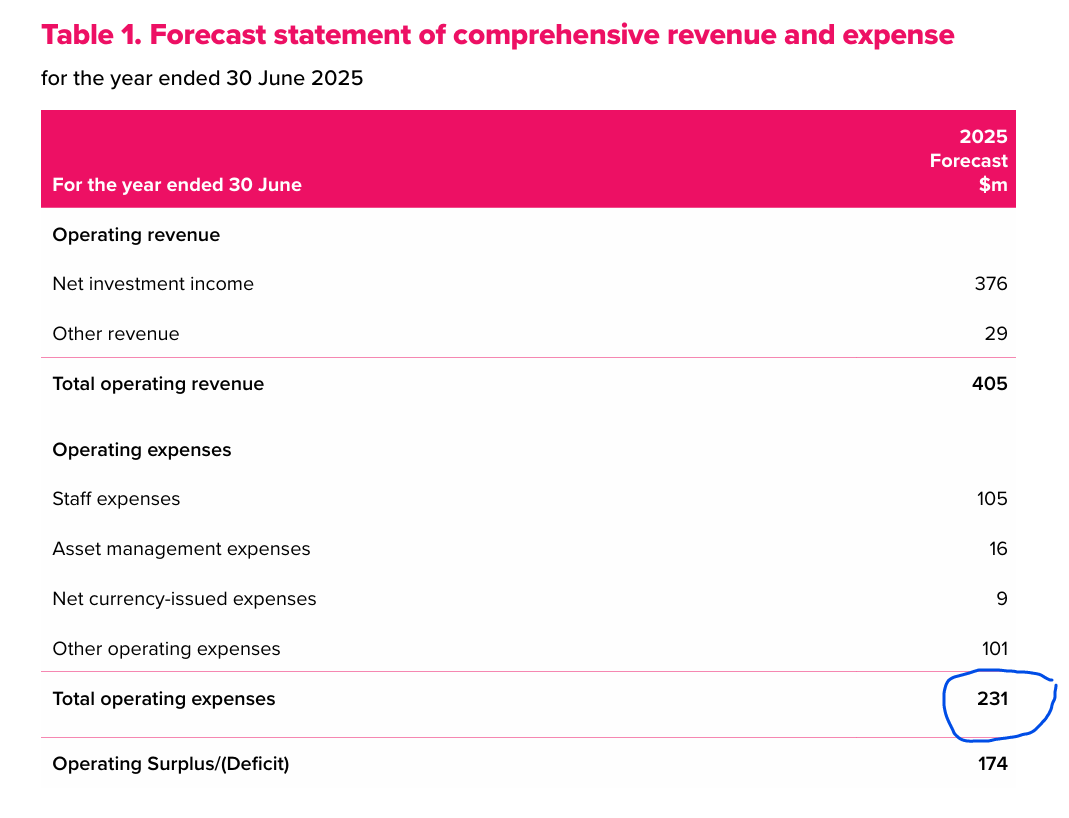
In the Bank’s Statement of Performance Expectations, published in the middle of last year and fully adopted by the Board (signed by both Quigley and Orr), these were the Bank’s financial forecasts for the current year.

Total operating expenses were forecast then to be $231 million. That was an increase from $186 million the previous year, and $105 million as recently as the year to June 2021.

As it happens, and shortly after the Statement of Performance Expectations came out I wrote a post about some aspects of their numbers

It was pretty breathtaking stuff. What I don’t think I’d noticed by then was that the Minister of Finance had already, in April 2024, set out this is her annual Letter of Expectation to the Board.

That seemed pretty clear. $149.4 million was the baseline for what they were allowed for (Funding Agreement covered) opex in 2024/25, the Minister seemed to be pretty clearly encouraging them to focus on reprioritisation not bids for more and yet (a) the Board signed up to a massive increase in opex for 24/25 (well ahead of the Funding Agreement number for that specific year) and b) then in September bid for a big increase in real opex spending allowances for the coming five years (roughly a 25 per cent real increase).

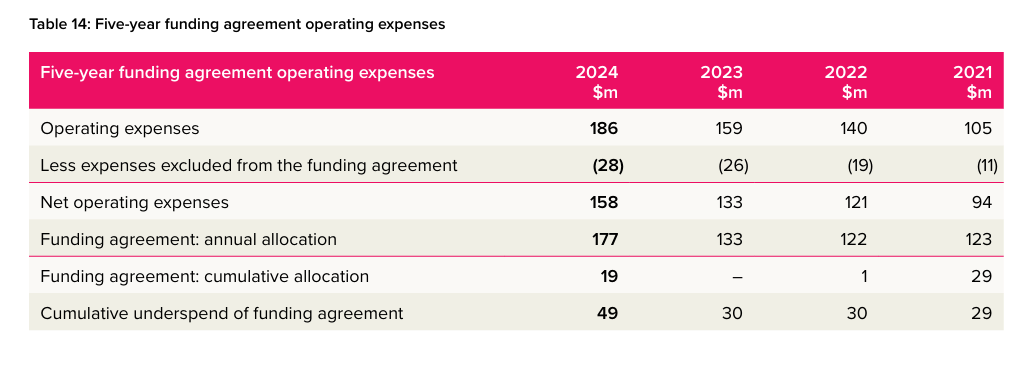
But how does that $231 million number compare to the $149.4 the Bank was allowed under the then Funding Agreement for 24/25? There we get some hint from a helpful table in the Bank’s 2023/24 Annual Report

Now, this has to be read carefully too. You will notice that the Funding agreement: annual allocation number ($177m for 2023/24) isn’t the same as the Funding Agreement number in the first table above. That is because in the 2020-25 Funding Agreement there is a separate category for “direct net currency issue expenses” (currency is, after all, a profit centre for the Bank so there is some logic in treating it separately). In the year to June 2024, $13.5m was allowed for that set of expenses (subtract that from $177m and you get the $163.5 in the table above).

You will also notice that of the total operating expenses ($186m that year), $28m were for items not covered by the Funding Agreement at all (these exclusions matter, and as noted above they are growing).

So lets go back to that $231m budget for 2024/25 that the Board approved in mid 2024. Of that, $14.5 could have been for those direct currency issue expenses (that was what was allowed in the Funding Agreement), but another table in the Annual Report suggests that in 2022/23 and 2023/24 actual net currency issues expenses had only been $5-6 million per annum, and the Minister’s Cabinet paper says that the latest budget for currency issues expenses for 24/25 is $9m. In absence of further information, and with a little extrapolation, we’ll allow $30m as having been for things not covered by the Funding Agreement at all. Subtract those two items and you are left with $192 million, which is a lot larger number than the $149.4 million allowed for 24/25 in the Funding Agreement (2023 variation).

Now, you will also note in the table – penultimate line, although not clearly labelled – that in 2023/24 the Bank had underspent the Funding Agreement amount by $19m (some mix of currency and other opex), and so – per the Robertson agreement mentioned above – they could in 2024/25 spent up to $19m more than what had been specified for that year alone. That would take the permissible limit to $168.4. Even that number is still a long way short of what the Bank was actually budgeting for the year (see previous para), and it relied scope for one year’s spending that shouldn’t have been prudently used for anything other than one-offs, since a new Funding Agreement was just about to be negotiated, in a period of straitened fiscal circumstances, and when the Minister had already warned them about the future. And yet they were planning a 21 per cent increase in staff expenses in a single year – the final year of the old agreement.

As noted earlier, in the Minister’s Cabinet committee paper – and her press release – she referred several times to an (apparently revised) Reserve Bank operating expenses budget for 2024/25 of $200m. If we take off $30 million for spending not covered by the Funding Agreement and $9m for currency expenses that would get us back to $161m, still substantially more than the $149.4 allowed for that specific year, although lower than what would have been allowed in that year from carrying forward the previous year’s underspend.

You have to wonder at what point the published budget was revised so sharply (down 13 per cent for the full year). Perhaps Treasury had some input when the saw how far out of line the published budget was?

It wasn’t as if this big increase in opex for 2024/25 looks to have been all about one specific project. According to the table in the Cabinet paper, in 2024/25 there is a 40 per cent increase in spending on the core functions (monetary policy, markets, and financial stability), following a 48 per cent increase the previous year. And the support functions (now running at more than four times the level of spending in 2017/18) also see spending rise 17 per cent this (24/25) year.

The Minister’s Cabinet paper, released yesterday, told us that total staff numbers (FTE) had reached 660 by the end of January. Last year’s Annual Report tells us that as at 30 June last year – only 7 months previously – they’d had 601.3 FTEs. It is staggering increase in the last year of a five year Funding Agreement – relying for that year’s Budget on a big underspend the previous year, and despite the Minister’s warning of coming fiscal stringency.

It seems pretty clear that Orr, Quigley and the rest of the Board were engaged in a strategy designed, in effect, to try to bounce the Minister into agreeing to a new higher baseline spending number that (probably) would have been even higher in real terms for the next five years that what they were spending in 2024/25. If so, and it is difficult to read what happened any other way (given that we know what the Bank bid for last September) it is really pretty inexcusable conduct all round (and frankly pretty poor behaviour vis-a-vis staff, since it was a risky high-wire act and if it didn’t come off it was likely to be staff who paid the price.

All the exclusions (and changes in exclusions – for example, those net currency expenses now have just a five yearly total cap rather than annual provisions) mean it is difficult to know with any certainty how much the Bank is really being cut back relative to this year’s spending

Take that $200m budget for 24/25, subtract $30m for spending excluded even in the previous Funding Agreement and $10m for net currency expenses and you are back to $160m. The new Funding Agreement allows for spending in 2025/26 of $155m BUT there are new exclusions. There is this one, which is at least quantified

That might be $5m per annum. In addition (and as mentioned yesterday) spending around the CDBC project is also newly excluded and there are a number of other items. Subtract those of the $160m budgeted on Funding Agreement covered items and you get pretty close to that $155m. Even allowing for a couple of per cent of inflation, there isn’t much sign of real spending cuts – in an organisation that had massively increased spending as recently as, well, this current year.

For the period beyond that there looks to be somewhat more restraint imposed on the Bank but it is nothing very dramatic, in an organisation where spending and staff numbers have blown out in recent years, and kept doing so in 2024/25. (And as noted in yesterday’s post, the Minister rejected Treasury’s push for lower numbers.) Actual real spending later in the Funding Agreement period remains – per table near the start of the post – well above what was spent in the last full year of the previous government.

There are a lot of numbers in this post, and several at least are uncertain. But the bottom line seems to have been one where the Bank’s Board and Governor tried it on, with their preposterous bid for much higher Funding Agreement operational expenditure. Thankfully that made no headway with the Minister. No one seems to emerge with much credit, and if you were inclined to make an allowance for The Treasury there is the mystery of how that huge operating expenses budget ($231m) happened in the first place. Surely they were aware before the thing saw the light of public day?

As for the Minister of Finance, the attempt to claim a 25 per cent reduction relative to this year’s budget looks even more disreputable than I realised yesterday. At least 20 per cent of that budget seems to be on items that weren’t even covered by the (previous) Funding Agreement.

The Minister of Finance appeared on RNZ this morning and from the resulting story it appears that she wanted to emphasise a message that “New Zealanders are doing it tough…..We expect you to show some restraint. Focus on your core statutory requirements”. Which is good stuff as rhetoric, but the reality seems to be one where the funding the Minister has approved will only stop the Bank continuing to expand further (having already expanded for one more year than almost all other government agencies), and do little or enough to ensure they are focused on the core stuff. That’s a shame, and I’m sure most New Zealanders would prefer a few more (say) kidney transplants than cementing-in very high levels of spending – far far above pre-Orr levels in real terms, and above even levels late in Labour’s term – at the central bank.

Perhaps it is only a few geeks and nerds who really care about the law being followed in these obscure matters, but as a reminder

There is still no sign of a budget (let alone a nice to have like a proper reconciliation table).

UPDATE:

Here is another way to try to look at it

The blue bars are actual (real) operating spending by the RB on things covered by the Funding Agreement, with the 24/25 numbers being per the Bank’s budget disclosed in the Minister’s Cabinet paper. On the headline new Funding Agreement (and allowing for 2 per cent inflation) we get the red bar. Allowing $7 million for the new exclusions – $5m for the Deposit Takers Act implementation (see above) and (somewhat arbitrarily) just $2m for the rest – we get the yellow bar. If the yellow bar is roughly right, real spending (like for like) in 25/26 would be 4.4 per cent lower than in 24/25 and barely lower at all than the actual for 23/24 (more than half of which year was under the current government).

Because we do not know the precise value of new exclusions, the yellow bar is illustrative only, but the direction is pretty clear. All the other numbers are from RB documents or the Minister’s Cabinet committee paper.

UPDATE 19/4: There is a mistake in this post, in interpreting the 2024/25 budgeted spend. A full post, revising and amplifying the story, will follow on Tuesday.

Spin (and obfuscation)

I came in this morning after doing some chores and looked quickly at Twitter before unpacking the groceries. Someone was retweeting a Radio NZ story with the headline “Reserve Bank’s budget to be slashed by 25%”. Wow, I thought, the Minister of Finance has really delivered this time. And then got on with putting the groceries away, relieved that the story I’d heard last week, that the final agreement hadn’t cut future spending much and wasn’t unduly bothering the Bank’s senior management, seemed not to have been true.

Coming back a little later, it was very quickly clear just how much spin was involved in that headline. And that, while journalists really should dig even slightly deeper than a ministerial press release, the headline could perhaps be excused when one looked at the Minister of Finance’s own press release. And, critical as I sometimes am of Reserve Bank Board chair Neil Quigley, it should be said that if his press release wasn’t very illuminating, it also played things straight. The “25%” did not come from him. (In fairness to RNZ, their headline was what I noticed, but some other media seem initially to have fallen for the spin.)

Here was the key bit of the Minister’s press release

I’d heard a while ago that the Bank had bid for in excess of $1 billion for the coming five years, and had struggled to quite believe it. But it turned out that that story was accurate. It was quite remarkable, even coming from the noted empire builders, Orr and Quigley. But what empire builders bid for going into budget round (in this case the Funding Agreement round) is really neither here nor there. Kids want lots more pocket money too, and yet the extent to which their desires are not met tells us nothing about actual parental restraint. Of course $1.03bn wasn’t going to be “value for money” when most observers struggled to work out how Orr/Quigley had ever persuaded Grant Robertson to allow the evident bloat that had occurred over the last few years.

Which leads us onto a genuine puzzle. You’ll note that the Minister refers to an operating budget for the current financial year of $200 million. She also refers to it twice in the short paper she put to Cabinet’s Expenditure and Regulatory Review Committee.

But in the most recent variation to the previous Funding Agreement, signed by Grant Robertson just weeks before the 2023 election, provided for operating expenses (those covered by the Agreement) to be $149.44 million in the year ending 30 June 2025. And the Bank’s own published Statement of Performance Expectations for the year to 30 June 2025 showed a budget for Total Operating Expenses of $231 million. The $231 million will, presumably, have included some items not covered by the Funding Agreement, but we – and Ministers – are left with no idea where the Minister’s $200m comes from or how it relates to the $149.44m that Grant Robertson had approved for that same year. The Bank’s Annual Report says they had underspent their budget in the 2024 year, so perhaps there was some catch-up spend while they could. But whatever the case it is very hard to see anything like $200m as some sort of baseline annual operating spending (although presumably Orr had tried to make it so to justify his billion dollar five year bid).

This is the core section of the new Funding Agreement

On headline numbers, the Bank is being allowed to spend in the coming financial year 3.7 per cent more than Grant Robertson in August 2023 thought was appropriate/necessary in the current (24/25) financial year. Headline inflation came down pretty much as had been expected in August 2023 and is now pretty close to the midpoint of the target range. Some restraint…… Things get a bit tighter for them in the following couple of years, although nothing has been released so far to explain the phasing. Perhaps they’ll have some redundancy costs in the first (2025/26) year?

Note also the list of things the Bank spends on that aren’t covered by the Funding Agreement is noticeably longer than the list in the previous one. Some of the changes are small (eg the exclusion for the Bank’s legacy superannuation scheme used just to be for actuarial gains and losses, while now it is for any expenses – and the Bank meets most of the direct admin expenses associated with the scheme) but others don’t look very small at all.

I’d have thought costs associated with refurbishing or replacing the building would have been expected to be met from depreciation. But apparently not. And the Bank has been spending a lot of money over several years pursuing its CBDC dream (the solution in search of a problem). Those expenses were presumably covered by the Funding Agreement in the past, but a material chunk of them now appears to have been moved outside that limit. (I’ll save for another day the question of why a Minister preaching fiscal restraint is letting them continue to pursue this – at best – nice to have.)

There was also this new exclusion

The simple comparison between past and present Funding Agreement operating expense numbers seems to exaggerate (by unknown amounts) the extent of any restraint. And even if we discount that problem, the massive expansion and bloat made possible under Orr seems to have been largely cemented in. Approved operating spending (inside the Funding Agreement scope) in the final year of the new agreement appears to be just 6 per cent lower than it would have been if Grant Robertson’s last approved number had just been increased by 2 per cent a year (midpoint of the target range). Real spending had roughly doubled during the Orr years, even on that Robertson number for 24/25 – which appears to have been far below actual spending this year. These aren’t exactly the much-vaunted “frontline services”)

And, as the Minister had advised her Cabinet colleagues, it wasn’t as if the growth had been in core statutory functions

Now, it is pretty clear that the Bank had been remiss in maintaining its IT systems and needed to spend more, but on the table included in the Cabinet committee paper, IT spend doesn’t look as if it stands out. The Bank just grew a great deal, least of all in the most core function around monetary policy, and now Willis is proposing little more than stopping the growth. We should, I suppose, be thankful for small mercies, and that the Orr/Quigley bid wasn’t accepted, but really……in a time of very straitened fiscal circumstances.

Here is the table on where the money has been spent

The Cabinet committee paper reveals that there had been a suggestion of cutting by more, but the Minister had had her arm twisted by Quigley (probably after Orr left).

Having presumably been told that their billion dollar bid was simply unacceptable

Frankly, it doesn’t seem very persuasive, given that Treasury had been looking at the numbers for months and had even engaged an external consultant to help them. 4 per cent lower spending might have started to look like making real inroads in reversing the bloat, but….the Minister simply gave it away, with no indication of what it was that Treasury had not previously appreciated about the scope for savings.

It is all pretty underwhelming, and perhaps does not bode well for the extent of fiscal restraint we might see in next month’s Budget. Structural deficits don’t close themselves.

Finally, lets return to some of the statutory provisions. It remains pretty astonishing that the Funding Agreement – authorisation to spend for five years for a major public policy agency – no longer requires parliamentary approval. It is a gaping democratic deficit introduced by the previous government, and means there is also no parliamentary debate on how much this behemoth spends, let alone on what.

On which note, note (f) below. In today’s release there is no sign of any such budget, so we have no idea where the Bank intends to make savings.

and in case you are wondering, yes the law does require the budget to be published with the Funding Agreement (or any variation to it, as in 2023)

SImple defiance of the law (as it seems, and as it seemed in 2023) seems more Trumpian than the way we do things in New Zealand. But there is no sign of a budget, with the required detail, with either the Bank’s or the Minister’s releases.

I’ve been reading

Over the last three rather tumultuous US trade policy weeks, I’ve read these four books. I started with Irwin (whose book had sat on my pile for years, consulted from time to time but not read) in a week of lots of flights and hanging around airports/hotels, and then one thing led to another. In a somewhat related vein, I’m expecting to finish today John Taylor’s book on his time (2001 to 05) as US Treasury Under Secretary for International Affairs for a, perhaps rather complacent, echo of a somewhat less troubled age.

All four books made for interesting reading, although in truth the fourth (Dobson) is perhaps likely to be of niche interest only, although it was a reminder of an age (mostly, the Cold War) when alliances were thought to matter greatly.

Doug Irwin’s history of US trade policy dating all the way back to the colonial era has been often lauded in the years since it was published, and deservedly so. It is a fascinating and apparently pretty comprehensive history, all the more so if your knowledge of 19th century US history and politics before the Civil War is as patchy as mine. There was, for example, what Irwin describes as “the most dramatic self-imposed shock to US trade in its history” [a description that probably still holds even this month], legislation in 1807 that “prohibited all American ships from sailing to foreign ports and all foreign ships from taking on cargo in the United States. Although foreign ships were permitted to bring goods to the United States, few did so, because they would have had to return empty. The embargo brought America’s foreign commerce to a grinding halt…” The embargo didn’t last long but while it did it was enormously disruptive and costly (imports at the time were around 7 per cent of GDP).

The book was also a helpful reminder that high tariffs in the US started out primarily as a revenue tool (small Federal government, and a limited number of ports so – as in various countries more recently – tariffs were generally easier to collect. Income tax was also unconstitutional in the US in the 19th century. New Zealand’s early tariffs were also primarily about revenue.)

But two of the points I wanted to comment on appeared on pages 2 and 3 of the book. From page 2, “Congress is at the center of the story because it is the principal venue in which trade policy is determined. Producer interests, labour unions, advocacy groups, public intellectuals, and even presidents can demand, protest, denounce, and complain all they want, but to change existing policy requires a majority in Congress and the approval of the executive. If the votes are not lined up, the existing policy will not change.”

The book was published as recently as 2017.

This month, we can only yearn for Congress to reassert its constitutional authority and to once again take the central place in the story. One of the fascinating dimensions of the book is how little involvement presidents really had in trade and tariff policy perhaps until the Reciprocal Trade Agreements Act of 1934. Even then the scope of power delegated to the Administration was quite limited and time-bound, with authority having to be renewed every few years. The US tariff schedule was primarily a matter for the Congress.

Perhaps some of Trump’s recent moves will eventually be held not to have been authorised by the various pieces of legislation under which Congress has delegated far too much of its power to the President, but if the insane policies are Trump’s own doing, they have been enabled by supine legislators over many decades.

And then, on page 3 of the book, Irwin makes his case for his book (the first major history of US trade policy since 1931) thus:

“Since then the United States has moved from isolationism and protectionism in its trade policy to global leadership in promoting freer trade around the world”

As a claim, it was probably always a bit of a stretch – and Irwin doesn’t shy away from describing the quotas (under pressure and threat from the US) on exports of Japanese cars in the 1980s, or things like the Multi Fibre Agreement, only completely unwound 20 years ago, even if he is perhaps light on agricultural trade restrictions and subisidies (eg) – but that was 2016/17, and this is now. Those were the days.

Irwin concludes his book by noting that, amid all the ups and downs and political dramas around this or that aspect of trade policy, there had been three broad eras in US trade policy history (to 1860, from 1860 to 1934, and since 1934) and (in words that must have been written very early in 2017 at the latest) “if it took the Civil War and the Great Depression to bring about a major shift in US trade policy in the past, it is hard to anticipate the next political or economic jolt that might put it onto a different track, the election of President Trump notwithstanding.”. Too which I guess we can only wryly reflect that – in the old line – forecasting is hard, especially about the future.

Fishman’s book, Chokepoints, was almost equally fascinating, but much more contemporary being published just this year and focused on US economic warfare over the last couple of decades – with a focus on relations with Iran, Russia, and China – from the perspective of a well-connected academic who was an insider (State, Treasury, Defense) for a time. It really is well worth reading – with positive blurbs from all sorts of prominent people – but if you only want a review, this from Foreign Affairs is a good taster.

There has been rising global unease (among traditional US friends and allies) over the weaponisation of the financial system by the US in the last couple of decades (and other recent books worth reading in this area are Daniel McDowell’s Bucking the Buck and (former French official) Agathe Demarais’s Backfire: How Sanctions Reshare the World Against US Interests). Former Bank of England Deputy Governor Paul Tucker in his fairly recent book on the international order was clearly uneasy about the extent and reach of US sanctions policy.

There are two main chokepoints. One – around chip technology – isn’t really new. Dobson’s book (see above) is a reminder that economic warfare during the Cold War was in large part about controlling the exports of technology to the Soviet Union and its satellites. Overall trade as a share of GDP was never as high between the eastern and westerns as that between the West and China today, but nonetheless the Soviets were keen to get access to advanced Western technology and for decades there were fights (inter-agency in the US, and with allies) around just what should be banned and what permitted, and what approach might best balance commercial and geopolitical interests. Extraterritorial US sanctions were even briefly in place in the 1980s.

But use of the financial system, and the dominant position of the US dollar, as a direct instruments of leverage/sanctions, is newer. Fishman is a champion of the US approach, which often relies not on sanctions directly on other countries, but on the ability of the United States to penalise, and exclude from the dollar systems and markets, private companies – American or foreign – who might have anything to do with countries, entities, or people targeted by the US. Or to, in effect, compel, SWIFT – based in Belgium – to accede to US information demands. US sanctions on Iran were enforced this way, to the immense frustration of many European governments who were unable stop European companies/banks responding to (pretty draconian) “incentives” on them from the US. At a more individual level, apparently when Hong Kong’s Carrie Lam was sanctioned by the US, even Chinese banks had little effective choice but to stop dealing with her, forcing her to fall back on cash for personal transactions.

You or I might or might not agree with the US foreign policy approach in each of these cases. Many, for example, are probably sympathetic re pressure on Russia (although as book notes, in reality pressure on Russia would have been a lot greater if the West – US perhaps most notably – had been willing to endure the much higher prices that an effective embargo would have involved), but what should probably sober us all is the power it delivers to a rogue president to do exactly as he pleases, using this economic warfare weapon (a variant on the general point that in providing powers to governments one should always think first about how the other side might use it when their time comes).

Take, for example, this extract from the Conclusion to Fishman’s book (written before the return of Trump):

“The United States should also explore novel uses for sanctions and export controls. Some of humanity’s biggest challenges today, including climate change and the risk of unconstrained artificial intelligence, are transnational collective-action problems – not usually the province of economic warfare. But just as Washington can bar companies from dealing with Iran or Russia, it could bar them from participating in carbon-intensive energy projects anywhere in the world.”

Just breathtaking. And if you are, perchance, a Green Party supporter and think this possibility a “good thing”, turn it round and imagine it applied to some other cause where you and some US President might have opposing views. Think of that sort of power used more broadly historically: support our war of choice on Iraq or…..you’ll be cut from the US financial system. And if one might have been inclined to scoff at the prospect of such extremes just a few months ago, we now have the rogue lawless US President in office, apparently unbothered by any ideas of alliances, mutual trust, and anything beyond the flattery of the tributary. For good and ill these are real powers, able to be used (and actually being used) today. I can think of causes where such power might be used for good, but any such fearsome power exercised by one state – and more so one person – at next to no near-term cost to those wielding it is pretty fearsome to say the least. In a decent, responsible, and judicious person, let alone Trump.

People might reasonably push back and note that in WW1 and WW2 neutral rights (to trade) took a battering at the hands of the belligerents (often our side, since the British, and then the British and Americans, jointly had effective control of the high seas). And if, as Thucydides, “the strong do what they can and the weak suffer what they must”, at least those WW1/WW2 interferences were a) at a time of legally declared international war, and b) for the most part didn’t attempt to reach behind national borders. Not like, as above, the suggestion that the US alone should be able to determine what sort of energy projects a country undertakes. (To be clear, I’m not aware of any politician having proposed this: I’m responding to the proposal in the book.) It is a power too far (as even some more reflective US figures have appreciated – for example the cautions offered by the then US Treasury Secretary in 2016)

At this point, exacerbated by the events of recent weeks, there must be many (and many more) people wishing for the dethroning of the dominant position of the US dollar. And that might be so even if you regard the increasingly lawless and untrustworthy rogue United States as, taken together, immeasurably less evil than the CCP-controlled People’s Republic of China.

All that said, it is hard to see it happening any time soon, how it could be brought about, or even what such a change would practically amount to.

People talk loosely of the USD as “the reserve currency”, but in doing so they tend to be conflating quite a range of things. At the narrowest level, there is the currency that most central banks hold most (although far from all) of their foreign reserves in (here New Zealand is a – very sensible – exception in that, enabled by being very small, our foreign reserves are widely spread across a range of currencies). But countries with properly floating exchange rates actually don’t need much in the way of foreign reserves and often don’t hold that much. Moreover, even among the countries that have run up very large reserves, holding their real exchange rates down to some extent, the biggest increase occurred back in the 00s. And it isn’t that obvious from the data that the US ever got any particular benefit from having countries holding the bulk of their reserves in US dollars, most especially in the floating era now 50+ years old. If countries were to shift away from USD reserves holdings it is not obvious the US would be particularly worse off either (as someone who used to champion the RBNZ approach in house, I really do recommend it for small and middling countries).

There is a lot of loose talk about how being “the reserve currency” enables the US to run imbalances other countries couldn’t. Some US MMT champions even focus on the US as somehow uniquely able to adopt their approach. But it really isn’t so. Look, for example, at the fiscal imbalances in Japan, or the current account deficits (and large negative net IIP positions) that places like New Zealand and Australia (and others) used to run back in the 00s. You do not need to be a “reserve currency” to be able to borrow in your own currency at pretty affordable rates. And, like it or not, the US – unlike Antipodean economies – is always going to be large economy (with a significant weighting in global asset allocations).

I can’t help thinking that what matters much more is the (largely unconscious) market choice to use USD as the reference currency (eg in most foreign exchange trading), and the size and depth of US markets, including debt and equity funding markets, that really matters (including in giving the US that economic warfare power discussed above). And those things aren’t about central bank choices at all. Markets could, eg, trade NZD or AUD mainly against the yen or the euro, but they don’t. And the network efficiencies from those evolved market practices are strong, and very unlikely to be easily displaced. In principle, perhaps, the euro could be a viable replacement – or something like co-equal role – but there isn’t the market depth, and it is only a decade or so since break-up (or at least break-out risk re Greece) was very real. As for China, there is no capital account openness and whatever one thinks of the lamentable trend in the rule of law in the US, or the rather random risk of being stopped at the airport or picked up off the street, no one in the rest of the advanced world is going to take Chinese ideas of rule of law (what suits the Party) in preference.

There is lots of discussion around these topics on the way in which the US came to displace the UK 100 or so years ago. I’m not sure that a lot of it is overly helpful, since on the one hand we’d been coming then off a metallic base for currencies (including through the heyday of London pre WW1), and there was an (increasingly evidently) larger economy and market to take much of London’s dominant role (and of course two World Wars didn’t help). This is a fairly unique situation, and it isn’t easy to see how things evolve away (at least without much more direct other-government interventions than seem on the cards at present).

This has all been rather discursive and perhaps self-indulgent. In (probably large) part that is because there is no easy or evident alternative, and the only paths forward for now seem to be ones where, whatever good there might have been about the US at times in the last century, things look to be getting worse, and people/countries are more vulnerable than they’d like, whether to tyrannies or to an utterly untrustworthy rogue democracy, in decline in for decades and yet spiralling worse this year with no obvious way reliably back or out. Meanwhile neither side of US politics does anything serious about the fiscal rot.

If you want some more reading on these topics, this new article in Foreign Affairs by Fishman and a couple of co-authors is interesting, if not fully compelling (seems harder than they think for the USD to be “dethroned”).

What was the story re Orr’s resignation?

It is almost six weeks since the shock announcement early on the afternoon of Wednesday 5 March that the Governor of the Reserve Bank, Adrian Orr, was resigning effective 31 March, and that in fact he had already left and an acting Governor was already in place. Orr had been (controversially) reappointed in late 2022 to a second five-year term that still had a little over three years to run. In his seven years in office he’d been a near-constant figure of controversy, not least for his role as chair of the Monetary Policy Committee which had not only let inflation run out of control then needing to bring about a (mild) recession to get back in check, but for the $11 billion of losses the Bank had sustained punting in the government bond market. His relationships with anyone but sycophants and yes-men seemed strained – whether the rapid turnover of senior managers, his treatment of external critics, or the very evident rather dismissive and at best frosty relationship with the current Minister of Finance when she was in Opposition. On many occasions – including at numerous select committee hearings – his relationship with the truth also seemed tenuous.

It is good to see the back of him, but it really isn’t adequate that we’ve had no explanation at all for the sudden departure, sufficiently precipitate that he simply walked off the day before he was due to host a research conference, with speakers of the eminence of Ben Bernanke, to mark 35 years of inflation targeting. Orr’s own comments – the only ones being in the official statement (linked to above) – shed no light at all on the reasons for his resignation or for the precipitate departure. Neither the Bank’s Board nor the Minister of Finance has shed any light at all, including on why they allowed their employee to simply walk off with no (effective) notice whatsoever. What were the relevant provisions in his contract, and were they enforced? One can think of circumstances in which an employer might want an employee- senior or junior – out instantly (eg if there were serious behavioural issues or if someone was resigning to take up a position that involved a direct conflict of interest – eg when Don Brash left the Reserve Bank to go into politics, or if Orr had resigned to go and work for a bank or funds managers), but generally people expect to (and are expected/required to) give a decent amount of notice and to work out that notice. As just one example, when the Deputy Governor resigned a few years ago he gave four months notice. Why wasn’t Orr working out a decent length of notice?

I’ve been looking back through articles etc from 5 March, and what limited material has emerged since. The line that caught my eye was from Infometrics’ Brad Olsen on the day of the resignation:
“Let’s be very blunt. The Board of the Reserve Bank needs to front, they need to front urgently, and they need to be open and transparent. Anything less is just not acceptable”

And yet “anything less” is just what we have got. No straight answers from either the Board or the Minister of Finance. The Bank likes to boast of its commitment to transparency, but as I’ve had cause to observe numerous times over the years while they are very open about things they want us to know, they are consistently obstructive about much of the rest. Serious transparency involves openness even when it is uncomfortable or embarrassing. Anything else is really just PR/spin.

Early candidates for the explanation for Orr’s departure were disputes with the Minister of Finance over either (or both) the Bank’s budgets and (forthcoming new) Funding Agreement or bank capital etc regulation. It had been only a week previously that the Minister had finally confirmed publicly that she would be looking for savings from the Bank.

Neither of those factors ever seemed adequate to account for what we knew. After all, despite suggestions that the Bank had actually been bidding for more funding, pretty much every government agency had had to live with budget cuts in the last year, and no other chief executive is known to have tossed his/her toys and stormed off in protest. The Bank and Governor must have known that fiscal restraint was going to come for them too. And the Board chair told us that while discussions were ongoing nothing had been finalised by 5 March. And even if the Governor had concluded that in his best professional opinion the Bank couldn’t do its job on the level of funding the Minister and/or Treasury were proposing, why storm off with no notice (around a not-yet-finalised agreement) when the new Funding Agreement was not even due to come into effect until 1 July this year? Giving notice that he’d be going on 30 June would have seemed to (relatively) mature and responsible approach had fiscal concerns been the key to Orr wanting to leave.

Much the same goes for issues around bank capital regulation. The Minister has been quite open that she had been taking advice on possible changes to the legislation to allow her to determine key prudential policy parameters. Reasonable people can and do differ on that. A central bank Governor might have regarded such changes, had they been confirmed, as simply unacceptable and not a regime he/she would be willing to work under. But there do not seem to have been any confirmed decisions, legislation takes time to put in place, and again…..3-4 months notice would have been quite reasonable if the Governor had concluded that someone else should pick up the baton for the years ahead. There is nothing of such apparent urgency to account for simply walking off with no effective notice at all.

Same goes if the Governor had simply come back from his summer holiday and decided he no longer has enough “gas in the tank”, was tired, and thought it was time to go. Plenty of people do come back from holidays thinking it is time for a change (plenty of them then settle back into the routine of the year), and look around for another job and/or give notice and move on. People might even sympathise with a senior official who got to that point. But it doesn’t make sense of Orr’s departure….with no effective notice at all.

If anything, the mystery – and a sense that the Board and Minister are keeping important stuff from us – was highlighted by the OIA response obtained from the Minister of Finance by the Herald’s assiduous Jenee Tibshraeny, as reported here. (I’m guessing she probably has a similar request in with the Bank itself, but is probably being obstructed and delayed there.)

Those documents suggest that Orr had last met with Willis on 24 February. By 27 February, Board chair Neil Quigley had been in touch with Treasury Secretary Iain Rennie about Orr, and Rennie advised the Minister of this conversation (substance of which was withheld). Most strikingly, the documents show that on the morning of 5 March “Reserve Bank staff sent Willis’s staff a draft press release for the resignation announcement, dated 10 March” (the following Monday, and after the inflation targeting conference was out of the way). And yet by 1:30pm on the 5th the resignation announcement went out – Orr himself was already out – with staff (on both sides of Bowen St/The Terrace) having scrambled to finalise press releases.

Something must have happened that morning. It simply cannot have been developments around either the funding agreement or bank regulatory policy (and although I can’t verify these claims I have heard a couple of times from people I trust that (other) people very close to the situation have confirmed that neither was the explanation for either the departure or the suddenly expedited announcement and no-notice nature of the exit).

Then there is the other document reported in the Herald article: some proposed Q&As for the Minister prepared by her press secretary. This particular press secretary must have been particularly averse to openness, suggesting that in response to a question “Did you ever have disagreements with Adrian Orr” she answer (in essence) “no comment”, when surely almost any minister and agency CE worth their salt would have disagreements, including on policy issues, from time to time.

Then there was this one

Which has to be the ultimate answer designed to deflect, and yet in the process suggested there really was something there. David Farrar picked up on this issue thus

It would be pretty extraordinary for a senior official to raise his/her voice with a minister (sadly, vice versa is not unknown), and although Orr was not formally a public servant, it would still be pretty grossly unacceptable behaviour from such an official and something the Board should have been alerted to. Unfortunately, Orr’s impulsive and undisciplined nature means that raising his voice at the Minister sounds all too plausible.

But, even if so, still not an adequate explanation for why the resignation was brought forward at the very last minute.

The Herald article also reports that (a) the Minister told her press secretary not to give out the purpose of the 24 February meeting (not exactly committed to transparency is she?), b) wasn’t briefed by her press secretary on answering questions re bank capital (presumably the press secretary didn’t think that was the story), and c) Willis was advised to say “not that I’m aware of” if asked if the resignation had anything to do with either the funding agreement or her opposition to his 2022 reappointment.

So where does it leave us? We – the public – are clearly being stonewalled by both Willis and the Bank’s Board (while Orr, now no longer a public official is saying nothing at all). The usually supine Finance and Expenditure Committee – currently launching an inquiry into improving performance reporting and public accountability – is living down to form.

Faced with the set of facts (the unquestioned known ones), and applying something like Occam’s Razor, most reasonable people would deduce that something pretty serious and potentially scandalous must have gone on. The facts?

  • resignation with no-effective notice (out of the door by the time the announcement hit the screens (Quigley told questioners that the acting Governor had been in place from “lunchtime today”)
  • resignation on the eve of a significant and fairly prestigious conference, where CEO level hospitality would normally have been expected,
  • resignation accelerated at the last minute (10th brought forward to the 5th),
  • person resigning not indicating anything about (a) a new job, and b) even general new career directions,
  • other proffered stories (funding, bank capital) making no sense of the stylised facts, even from an undisciplined and volatile character like Orr.  (Health hypotheses also don’t work, as even a short non-specific mention of health as the explanation would have quickly allayed questioning and resulted in widespread sympathy.)

There are, of course, problems with a conduct/scandal hypothesis.

Specifically, Neil Quigley appears to have denied it at his hastily-called short press conference later on the afternoon of 5 March.   Someone who was there kindly sent me a transcript, which this draws from.

Quigley’s first answer on this point might appear to have wriggle room.  Asked if there were “any conduct issues outstanding”, Quigley replies with a simple “No”.  But, of course, it isn’t exactly unknown for questionable conduct to be dealt with by way of quid pro quo: someone resigns and an issue is taken no further.  Once the resignation is lodged and accepted (as it clearly was by late on 5 March) there wouldn’t be any conduct issues “outstanding”.

But a later question seemed to allow less wriggle room: asked whether there were any “policy, conduct and performance issues which are at the centre of this resignation”, Quigley responded “we have issues that we’ve been working through, but there are no issues of that type that are behind this”, and in a follow-up clarified that the issues they’d been working on had been the policy/funding issues.   But was he then primarily answering about “policy” rather than the other limbs of the question?

There is also a final question, where the transcript isn’t fully clear.  Quigley appears to have been asked if there are “current issue with Adrian” and if there had been “any complaints”.   He is recorded as responding “I’m not going to go into that because that’s history”, and something about “some things that have made as a public record’ [perhaps past concerns about Orr’s treatment of people like Roger Partridge and Martien Lubberink] “but I don’t intend to go into those now” before he walked off and terminated the press conference.

Quigley also stated that Orr had still had his (Quigley’s) confidence, while avoiding answering a question that was about the Board’s continuing confidence.

The problem is that Quigley (a) doesn’t seem to be giving straight answers, and b) has form.   Thus, if the only thing you read was the transcript of his press conference you’d get the sense that the story was somehow about Orr feeling the job had been done and it was time to move on.   But that makes no sense of what we now know (the rush to bring forward the announcement to that afternoon), and he provided no compelling explanation when asked why Orr hadn’t just stuck round long enough even just to be hospitable at the conference.   And even what he did say doesn’t make much sense of a “time for a change” story, noting that he and Orr had been in discussion on “this and exactly how it would play out over a few days”. 

And, as to Quigley’s “form”, regular readers will recall his denial –  and putting Treasury in a place where it went public with a denial –  that there had ever been any sort of blackball on expertise when the first MPC members were appointed five years ago.  Not only did personal testimony contradict him (people who were told by Quigley himself they would not be considered because they were active experts), but so did the documentary record (OIAs), and comments from one of his own fellow Board members who’d been actively involved in the selection process back then.

One final straw in the wind is that just a few days after Orr left, a release quietly appeared on the Reserve Bank’s website advising that one of Orr’s several deputies, an Assistant Governor responsible for Information, Data, and Analytics, had resigned.  There was no indication of any other job to go to, and the departure date was less than three weeks from the date of the announcement (by contrast, another Assistant Governor resigned last year, offering more than two months notice).    Perhaps there is no connection to Orr’s departure.   But the coincidence in timing, with no specific job to go to, should at least prompt some questions.

We (the public) still have no idea what actually happened.  And that really isn’t good enough from either the Board or the Minister about the holder of such a consequential office.    But what we do know is enough to lead a reasonable interpreter to fear that it really may have been something around Orr’s conduct.   If not (and one genuinely hopes not) a straightforward explanation could set the record straight very quickly.  And if so, people shouldn’t be able to hide behind private commitments to secrecy that might serve the interests of some of the powerful, but are hardly likely to serve the public interest.

Tariff madness and monetary policy

We’ve seen this morning the latest step up in the Trump-initiated trade war, with the additional 50 per cent tariffs imposed on imports from China. If the tariff madness persists – but in fact even if were wound back in some places (eg some of the particularly absurd tariffs on supposed US allies in east Asia, or 48 per cent tariffs on Madagascar’s vanilla) – it is going to be extremely damaging to global economic activity in the (probably protracted) transition. A global recession would then be the best forecast (through a whole variety of channels including, but not limited to, extreme uncertainty – fatal for investment, which can usually be postponed – and wealth losses). Faced with severe adverse shocks, and extreme uncertainty, layoffs happen and firms close faster than replacements emerge.

(The longer run effects will also be adverse, lowering potential GDP in all the countries that participate in the “war”, which consciously and deliberately put sand in the wheels of their own economic performance, but economies adjust – you can have full employment in a highly protected economy with impaired productivity growth (see NZ in the 50s and 60s) or in a high-performing open and competitive economy.)

The direct effects of the tariff war on New Zealand are still probably pretty limited. Our goods exporters to the US face the lowest tariff band, lower than those facing many competitors (eg European wine exporters) and the amounts involved are just a small fraction of GDP anyway. But as pretty much every commentator is now pointing out, the indirect effects will swamp any direct effects. It is perhaps a bit like early 2020 when government agencies were initially focused on the damage to a few New Zealand exporters (lobster, universities etc) from China’s disruptions, only for those modest effects to be totally swamped by the wider global effects and our own experience with Covid (pre-emptive adjustments and lockdowns). In a global recession there is pretty much no place to hide.

But what does, and should, it mean for monetary policy, here and abroad (if the madness persists)?

In the US, it is near-certain that there will be a material increase in consumer prices. Headline inflation will, all else equal, increase over the coming few months. To the extent there is any logic in the madness, that is part of the point. Higher prices in the US increases returns to domestic producers and make foreign produced products relatively less attractive (of course, in many cases, US producers will also face higher costs on imported inputs). From a revenue perspective, it is also akin to a big increase (inefficient and all as it may be) in consumption taxes – reportedly the largest US tax increase in some decades. So prices will rise and real household disposable incomes will fall.

A sensible central bank will always have to play things by ear to some extent. No idiosyncratic event is ever quite like another. It isn’t impossible that the higher tariffs will translate into behaviours consistent with households expecting inflation to be permanently higher. If that happened, the Fed would need to lean against that risk – hold policy tighter than otherwise.

But an alternative scenario might be one akin to an increase in GST. Increasing consumption taxes raises consumer prices and headline inflation. We’ve had three experiments of this sort in New Zealand in our post-liberalisation years: when GST was first imposed in 1986 (a 6%+ lift to the price level) and when it was increased in 1989 and 2010 (each increasing consumer prices by a bit over 2%). On none of those occasions did the Reserve Bank seek to tighten monetary policy in response, and with hindsight that was the right call on each occasion. The lift in prices was (at least implicitly) recognised by the public as a one-off lift in inflation, that dropped out of the headline rate again a year later.

How likely is something like that in the US at present? Given the chaotic policy and political processes, and the fact that – unlike with GST changes – prices won’t all change on one day, perhaps there is less reason for optimism there. And perhaps all bets are off if the public and markets come to think there is a credible threat to sack and replace existing Fed decisionmakers.

But, even if household expectations (beyond 12 months ahead) and behaviour do rise – and surveys and behaviour are two different things – there is still the big hit to real household disposable income to consider. Such hits happen with some GST adjustments (the NZ 1989 one was intended as a fiscal consolidation) but not others (the NZ 2010 GST change was intended as a tax switch). And in addition to the direct effects of the tariffs, there are wealth losses (see stockmarket) and the impact of business disruption and business uncertainty delaying investment spending. Real activity, and pressure on resources and capacity, seem almost certain to ease. All else equal, a reasonable conclusion should be – and market pricing is consistent with this – that the Fed is more likely to need to ease than it would otherwise have thought, consistent with keeping core inflation near to target.

There is rhetoric around that somehow the lesson of the last few years is not to ease in the face of adverse supply shocks. But a lot depends on the nature of your supply shock. This isn’t (for example) a case of literally shutting down the economy and people going home (voluntarily or otherwise) to avoid a virus. The labour is still there, the capital equipment is still there. It can all be used – capacity is real – but the demand for resources is likely to diminish quite considerably. Monetary policy cannot (of course) do anything about the longer-term adverse effects of a shift to a more protectionist economy and policy regime. If the regime persists, Americans will be poorer than otherwise. But monetary policy often has a role to play in smoothing the dislocations, in trying to replicate what a market interest rate would be doing – reconciling desired saving and investment plans – absent a central bank. One parallel, for example, is the recession and financial crisis in the US in 2008/09. Monetary policy couldn’t fix the misallocation of resources and bad choices that led to the financial crisis in the first place. To the extent financial crises impair productivity, monetary policy also couldn’t do much about that. But not many people think that simply holding the Fed funds rate at mid 2007 levels in the face of the dislocation and associated severe recession would have made much sense.

What about New Zealand (and countries like us). If we see higher prices directly as a result of the tariff war, they should be fairly scattered and limited. It isn’t at all impossible that we might see import prices, in foreign currency terms, falling as (for example) Chinese manufacturing exporters look for alternative markets where they won’t face 100 per cent plus tariffs. With a fairly limited manufacturing sector ourselves, that terms of trade gain might be fairly unambiguously welcomed. We might get (temporarily) lower headline inflation and slightly higher real disposable incomes.

But, and on the other hand, a global recession would almost certainly more than cancel out that effect. We’d see materially lower export prices for commodities, and lower volumes for many other exports (eg tourism, students). It doesn’t matter that the initial crisis/shock wasn’t generated here, any more than it mattered in 2008/09.

I put this on Twitter this morning

and, of course, once the recession really took hold we got a big decline in (imported) oil prices but it wasn’t enough to stop the terms of trade overall falling by 10 per cent.

Assuming the tariff madness persists (see mercurial and unpredictable occupant of White House) it is very difficult to see how we – and other countries – avoid something similar this time round. I’m glad I’m not an economic forecaster paid to put specific numbers to it – this is just another case of extreme uncertainty making all but the most highly conditional numerical forecasts barely worth the paper they are written on – but the direction is clear, the severity of the shock is clear, our (non-unique) exposure is clear. All else equal, the OCR is likely to need to be a lot lower than otherwise, and since it is starting out still above neutral and with core inflation not far from target, that suggests a lot lower in absolute terms. To be clear, this is not a forecast, but in past serious downturns – demand led – short-term interest rates have often fallen something like 5 percentage points (in New Zealand, but also actually in the US).

The Reserve Bank’s MPC has its latest OCR review announcement out this afternoon. They are in a difficult position: they have only an acting Governor (who was responsible for the Bank’s macro and monetary policy functions when the really bad calls in 2020 and 2021 were made), a deputy chief executive responsible for macro who has no expertise or background in the subject, and so on. Being an interim review, they won’t have a full sort of forecasts and scenarios of the sort done for the quarterly MPS. They’ve also continued the madness of scheduling OCR reviews a week before the CPI comes out so they won’t even have a good read on the baseline – pre tariff madness – state of core inflation. And policy out of Washington (and Beijing and Brussels) can shift by the day.

Most people seem to expect the MPC to stick to the 25 basis point cut foreshadowed at the last MPS. On the domestic macro data they’ll have to hand – all from before the latest tariff madness (which even Jerome Powell has noted is worse than had been expected) – that would be perfectly defensible.

But so would a somewhat larger adjustment. After all, the external environment has changed, the effect is not likely to be small (or to be fully reversed even if we woke up tomorrow to find the last week had just been a bad dream), and even the government, channelling Treasury, is now warning of the adverse economic effects and risks. It isn’t time for dramatic emergency moves – that time may come, although one hopes we never need to see a 150 basis point cut ever again, as in late 2008 – but a rate that seemed fitting, to the New Zealand inflation outlook, 10 days ago, shouldn’t seem right today. And for all that they have only an acting Governor they may feel less locked into Orr’s February commitments than he might have were he still there. The risks are pretty moderate, especially as on the Bank’s own estimates the OCR is still above neutral and the output gap is estimated to be materially negative.

What are some counter-arguments? There is always the “six weeks doesn’t make any macro difference” so why not wait until the (full forecasts) and the May MPS. Perhaps there will be fuller information. I don’t think it is particularly compelling as it seems quite unlikely that the fog of war will have disappeared by next month (the macro implications will just be starting to become apparent), and if a large adjustment is eventually needed it may be best to get started. If it isn’t eventually needed a larger move today doesn’t take the Bank beyond where it thought things would level out at.

I heard one market economist on the radio this morning suggests that a larger cut today might rattle people. Quite probably, but most likely they should be rattled. This is a really serious economic policy shock Trump has launched on the world.

And then there is the exchange rate. People – reasonably – note that in severe downturns the New Zealand exchange rate usually falls a lot. That will tend to raise the prices of tradables, all else equal. It hasn’t really happened yet – if anything the TWI is a bit stronger – but it seems a pretty plausible story. It is just that in serious downturns previously – most notably 2008/09 – the direct price effects of a lower exchange rate ended up being outweighed by the disinflationary effects of the downturn on non-tradables inflation. An exchange rate adjustment is likely to be part of the overall response to the tariff madness shock, but not a substitute for action by the MPC.

We’ll see this afternoon what the MPC has come up with, but we shouldn’t be surprised if they do cut by more than 25 basis points, and doing so would probably be the right call. If they don’t, then I guess even more attention than usual will be paid to the wording of their statement, recognising that with the loss of a Governor some changes in wording may just be idiosyncratic – linked to one person’s stylistic or other preferences.

Reserve Bank, bank capital etc

Things seem to be at a pretty low ebb in and around the Reserve Bank. There was, in particular, the mysterious, sudden, and as-yet unexplained resignation of the Governor (we’ve had four Governors since the Bank was given its operational autonomy 35 years ago, and only two have completed their terms and left in a normal way, which must be some sort of unwanted advanced country record). Having slimmed down the bloated number of Orr’s deputies by one last year, another of them quietly resigned and left last month on (apparently) short notice and no specific job to go to. Of those who remain, two are (at best) ethically challenged and one is simply unqualified for the job she holds.

And then there is the mystery as to why a temporary Governor (specifically provided for in the Act) has not yet been appointed, even though it is now four weeks since Orr tossed his toys and walked out (formally finishing on 31 March, but no longer present). I wrote about this briefly on Monday morning when it emerged (in The Post) that despite what the Minister and Bank had led us to believe on the day Orr resigned (effective 31 March), there would not be a temporary Governor in place from 1 April. The Bank’s spokesperson, quoted in the Post article on Monday so badly misread the relevant provisions of the Act that the Bank seemed to feel it necessary to issue a release yesterday, which added nothing but at least didn’t muddy the water further. The Bank’s Board has to (finally) make a recommendation of a person to serve as temporary Governor by 28 April, but even once she gets such a nomination the Minister of Finance can take as long (or short) as she likes to make an appointment (or, presumably, knock back a recommendation and send the Board away to make another).

Reasonable people would have assumed that within a few days of Orr announcing his resignation (and storming off), the Board would have met and made a recommendation. With more than three weeks notice (at least on paper) having been given there was really no excuse for not even having a recommendation on the Minister’s desk by the end of March. We are left to wonder why. Perhaps Hawkesby didn’t want the job? Perhaps the Board doesn’t have confidence in him to do even the fill-in role? Perhaps the Minister had indicated that she didn’t want him? We don’t know, and neither do international markets who (like the rest of us) were taken off-guard by Orr’s resignation. It really isn’t a good look. And if for some reason Hawkesby isn’t an option (and there are very slim pickings among the other 2nd tier managers), perhaps they could twist the arm of former Deputy Governor Grant Spencer and bring him back for a second stint filling in between Governors (only it would be legal this time)?

The unsatisfactory picture was compounded just a little later on Monday morning when Hawkesby and the Board chair Neil Quigley fronted up to the Finance and Expenditure Committee to announce that they were after all going to have a review of bank capital requirements (their opening statements are here). This had all been arranged with the Minister of Finance, who put out a simultaneous statement welcoming the review, and confirmed by the Bank’s Board at a meeting last week (which the outgoing – but still in office, and thus still a Board member – Governor did not attend).

[UPDATE: Meant to mention that Hawkesby did himself no favours – if he aspires to be seen as anything other than Orr’s man – when he opened his FEC statement this way (emphasis added)

“I’d like to begin by acknowledging our Governor, Adrian Orr, who over 7 years would have attended FEC hearings more than 50 times and always been engaging.  We are looking forward to continuing that relationship.”

Orr actively misled FEC repeatedly, and the frostiness of his encounters with any questioning FEC members has been repeatedly commented on. ]

Recall that, rightly or wrongly (I think wrongly), Parliament has given policymaking powers on such matters to the Bank (and specifically to the underqualified Board). Recall too that just a few weeks ago the Minister of Finance had indicated that she was seeking advice on ways to compel the Bank to change policy. Presumably the Board – and perhaps management – reading which way the political winds were blowing simply caved and arranged Monday’s FEC appearance and announcement, rather than risk losing their powers. They were, after all, in a weak position: as far as we know the Bank’s Funding Agreement for the next five years has not yet been approved (the Minister has talked of coming cuts), there wasn’t a permanent Governor in place, and even the appointment of a temporary Governor seemed to be hanging in some sort of limbo.

It is always possible that the Bank itself (especially now minus Orr – who last year was vociferously defending current policy and, as so often, attacking any critics) thought that a review was (substantively) timely and appropriate, but it looks a lot like bowing to political pressure, at a point of particular weakness. In an independent agency. And, frankly, since I believe that big policy calls should be made by elected politicians, I’d rather the government had actually legislated to shift big-picture prudential policymaking powers back to the Minister of Finance, while retaining a vital role for a better-performing Reserve Bank to advise and to implement (essentially the model in most other areas of government policymaking).

There are also lots of questions about where to from here with the review. The suggestion from Quigley is that the review will be completed by the end of the year, but while decisions are finally a matter for the Bank’s Board, it does invite the question of what role (if any) the new permanent Governor is to have (at least if it is anyone other than Hawkesby). By law, the temporary Governor can (eventually) be appointed for six months, extendable for another three. Even if the Board gets on and advertises for a permanent Governor this month, at best it will be several months before a new Governor is on board (eg there was roughly six months between Don Brash resigning and Alan Bollard starting work). With a non-expert Board wouldn’t one normally expect the Governor to be taking the lead in formulating the advice on which the Board would finally make decisions? Or is the new person to be presented with a fait accompli?

And then of course, there are questions about the nature of the review itself. Is it purely appearance theatre (“we need to look like we are doing something”) or is it genuinely a case of an open-minded reassessment? There is talk of consulting banks before any changes are made, but what about the wider group of interested experts and commentators (many of whom submitted on the 2019 policy proposals/decisions)? And for all the talk of commissioning “international experts”, surely only the most naive would take that at face value. You choose your expert according to your interests (eg a different group if one wanted people likely mostly to reaffirm your priors than if you were genuinely opening things up). I reread yesterday my post about the “international experts” Orr had commissioned in 2019, and the rather limited (and conveniently-supportive, having been chosen for a purpose) contribution they made. Those earlier experts were barred from talking to anyone in New Zealand other than the handful the Bank approved. Will it be any different this time?

And although back in 2019 the law was such that the decisions were still those of Orr alone (the Board then had a different role), Quigley was also the Board chair then and has had Orr’s back right throughout his time in office – apparently serving the Governor’s interests more than the public’s interest. His own questionable relationship with the facts on a number of occasions has also been documented here on various occasions. Apparently Quigley presented quite well at FEC on Monday, but so what? When he isn’t under pressure – and FEC was more attuned to welcome the review than ask very searching questions – he is a smooth operator (when he is under pressure, well…..see his press conference on the afternoon Orr resigned).

My own view, back in 2019, was that even the final Orr position – which pulled back from the initial proposals – went further than was really warranted. But one of the things I’d be looking for as part of the Bank’s review this year – and as a test of seriousness and openmindedness – is a rigorous and transparent comparison of the New Zealand capital requirements (for large and for small banks) with those of other countries. The Reserve Bank made no atttempt whatever to provide those sorts of comparisons in 2018/19.

One might think of countries like Norway, Sweden, Denmark, Australia and Canada, but perhaps also advanced countries where the bulk of the banking system is made up of subsidiaries of much-larger foreign banks (for example, the Baltics). To do this properly isn’t a superficial exercise of comparing headline capital ratios. One needs to look at things like the composition of balance sheets (in a quite granular way), risk weights on individual types of exposures (standardised and IRB) and so on. One might, in principle, take the business structure of one or more New Zealand banks and actually apply the rules in other countries to see how much capital they would be required to have on those rules, relative to the rules here.

If the current Reserve Bank policy, and scheduled further increases in minimum required capital, ended up pretty much in the pack, relative to the situation in other advanced countries, it might be considered the end of the matter. There might not be anything very optimal about what those other countries have chosen to do, but the case for any revision to the New Zealand rules would be that much harder to sustain than if (for example) the full New Zealand requirements imposed much higher capital requirements on much the same sort of portfolios. There is no compelling reason to believe that the exposure to really serious adverse shocks is any greater in New Zealand than in other advanced economies, so absent a compelling argument that the rest of the world is just “too lax”, being somewhere around the median of other countries might be a reasonable benchmark for New Zealand authorities (in a world of inevitable great uncertainty). (Incidentally, there would be no point in having requirements lower than those applied by APRA, since their requirements would set a floor for the Australian banking groups as a whole – there has been too little mention of the APRA group requirements in the recent New Zealand debate).

Reviewing some old posts yesterday I also stumbled on this chart, taken from a 2019 working paper of the Basle Committee on Banking Supervision (which I wrote about here)

I don’t want to fixate on the individual numbers, but simply to reiterate the point that any wider economic gains from higher required minimum capital ratios abate quite quickly as those requirements are increased. Actual numbers that might emerge will depend heavily on things like assumed discount rates (the ones used in these studies are far below the standard discount rates for us in New Zealand public policy evaluation), and the ability (or otherwise) of high capital ratios to save us from financial crises with severe economic consequences (a point quite in contention in 2019, when I observed that the numbers used by the Bank and their supporters were grossly implausibly large).

(Finally, on this topic, it is worth remembering that capital buffers are very useful to absorb losses, but that what matters even more – including as regards real economic losses and dislocations – is the quality of bank assets, and thus bank lending standards. A bank can have pretty large capital buffers and yet can still go off the rails quite badly in a surprisingly short space of time if lending standards degrade and/or management/Boards start chasing lending opportunities which look fine and good in the heat of a boom only to prove anything but as the tide recedes. Probably the largest real economic losses don’t arise from a bank itself coming under stress, but from the gross misallocation of real economic resources that can occur all too easily when undisciplined or excessively risky lending occurs, and those costs are already baked in when the lending and associated real investment choices are made, even if they only become apparent when the shakeout happens.)

Anyway, we will see what comes of the Bank’s review. And if, as Hawkesby/Orr [previously]/Quigley claim, the Bank’s policies are basically right, whether they can make a compelling case to persuade the public, external commentators….and of course the Minister of Finance who, I guess, still has the threat of legislating up her sleeve.

Changing tack completely, today marks 10 years since I left the Reserve Bank. As I noted at the time, that move was something of a double coincidence of wants: Graeme Wheeler really wanted me out, and I really wanted out, to be around as a house husband for our kids. It was a great move and I’ve not had the slightest regret (indeed, one shudders at the thought that I might otherwise have been there when the Orr years started). Being available for the kids, and helping to enable my wife to hold down busy jobs, will always count as one of the blessings of my life (and a few weeks ago the youngest left for university).

Every so often I think about where to next. The blog has been less frequent in the last few years (including due to 2-3 years of fairly indifferent health including post-Covid, but now passed). Circumstances change and I’ve got busier. I have occasionally thought about shutting it down and doing other stuff – I had an outline on my desk when the BPNG appointment came through of a time-consuming project I’d still like to pursue. For now, various circumstances and considerations mean I’m going to try to discipline my public comment more narrowly. There has been an increasing range of things I’d like to have written about but it wasn’t possible/appropriate. For this blog that will mean primarily Reserve Bank things, fiscal policy, productivity and not much else, which was the original intended focus. (And if a capable, even excellent, Governor is appointed, consistently lifting the performance of the Bank, and its efficiency, openness and transparency, perhaps even Reserve Bank commentary will die away. There are much bigger economic policy challenges.)